Rarity Season is Upon Us!

I do like a good storm system. Especially as Rarity Season is now upon us! So besides our desperately-needed rain, I was anxious for this weekend’s weathah in the hopes it will set up some action for my favorite time in the birding year.

The winds turned east on Thursday (10/20), and strengthening easterly winds, scattered showers, and developing fog minimized the migration overnight into Friday morning. It was hard to tell from the radar is there was some limited, low movement, which would be indicative of the sparrows that move this time of year. Florida Lake Park was slow in the morning, though, and nothing new was under our feeders at home or at the store, however.

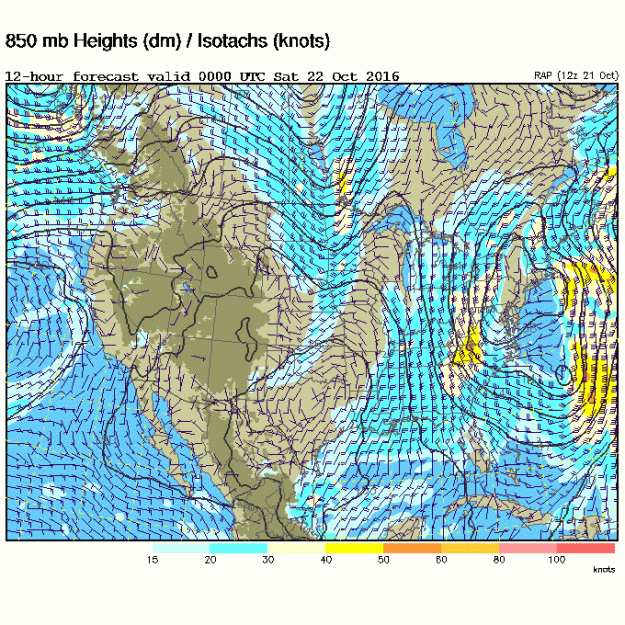
During the day on Friday, a shortwave moved out of the Ohio Valley, and overrunning precipitation fell during the day. By dark, however, that low was deepening and strengthening, and overnight, it tapped tropical moisture, leading to torrential rains, isolated thunderstorm, and by far our best soaker in at least 6 months: 3-6 inches of rain fell over the area! Southeasterly winds turned back to the east before going calm with thickening fog by morning.
wind-map-10-21-16

Fog and a little drizzle on Saturday morning was all that our Saturday Morning Birdwalk had to contend with on our outing to Wolfe’s Neck Farm; it does seem like there are more Laughing Gulls around later this year than I can ever remember (just the warm weather or are these related to Hurricane Mathew?).

The low slowly moved into the Canada, with an onshore flow (I had hoped for more southwesterlies) throughout the day. On the backside of the system, winds shifted to the west overnight while more rain and showers continued from the afternoon through the first half of the night. Winds were howling west by the morning, and the air definitely felt seasonable for a change.
wind-map-10-22-16

With the storm system pulling away to the north…
wind-map-10-23-16

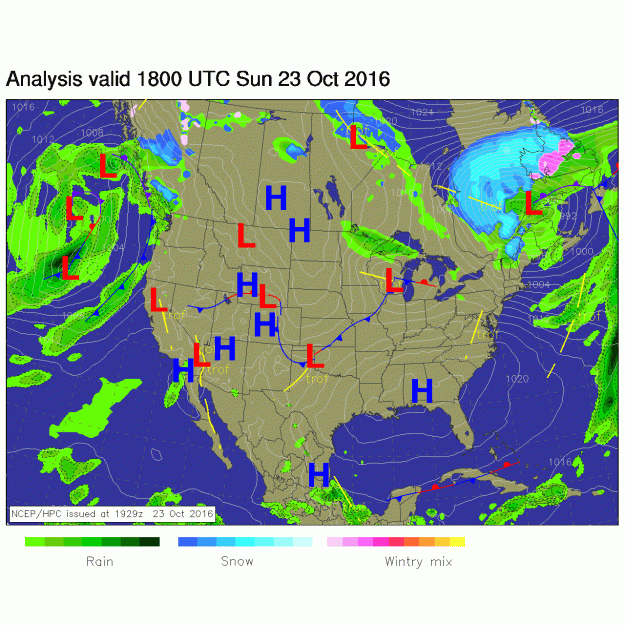
…and the temperatures falling (and even some snowfall was seen in the mountains!) it’s time to really go birding!
surface-map-10-23-16

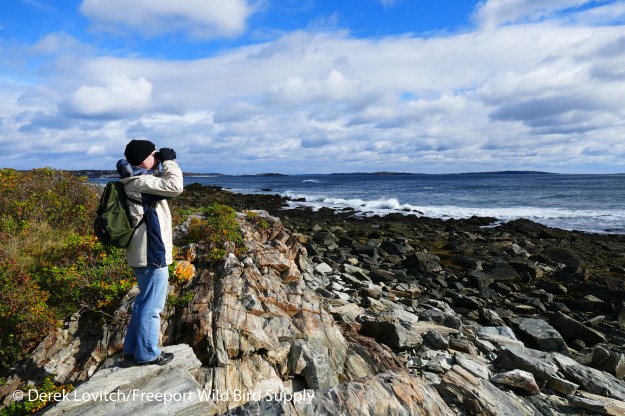
On Sunday, Phil McCormack and I headed over Peak’s Island, a place I really want to spend more time searching in the fall. Afterall, it’s a mere 15-minute ferry ride, there are a variety of interesting habitats, and the maritime climate tempers the onset of the seasons a little more. In other words, it looks good for rarities! (And you know I need to seek them somewhere other than Portland now!)

And with my Rarity Fever stoked, a productive morning of scouring the southern 1/3rd of the island yielded the seasonal rare-but-regular stuff that makes one keep coming back: A Clay-colored Sparrow, a Yellow-breasted Chat, and an Orange-crowned Warbler (my second of the season). Add to that single Nashville and Palm Warblers among a total of 6 species of warblers, a fly-by flock of 57 Brant, 8 lingering Red-winged Blackbirds, a good Northern Gannet flight, a Merlin, and recently arrived Red-necked Grebe and 9 Red-breasted Mergansers and you can see why I will be birding here more and more (my once a fall needs to become at least 3-4 visits each season, me thinks).
ccsp_peaksisland10-23-16
Not the best photo of a Clay-colored Sparrow (can you find it?) that I have taken!

battery_steele1peaksisland10-23-16_edited-1battery_steele2peaksisland10-23-16_edited-1
peaks_shoreline10-23-16_edited-1

There wasn’t any migration visible on the radar overnight, but there were southwesterly winds – the direction that can help facilitate the arrival of vagrants to the Northeast. But with winds once again rapidly increasing during the day on Monday, the detection of birds was limited. However, Jeannette and I enjoyed a visit to a particularly productive patch of private property in Cape Elizabeth, where a Blue Grosbeak and a Clay-colored Sparrow that I found last week continued. Dark-eyed Juncos increased to 100+ and White-throated Sparrows were up to 50. Other sparrows had decreased, as expected, but there were still 75 or so Song Sparrows, 6 Chipping, and 2 White-crowned, along with about ten each of Swamp and Savannah. Singleton Indigo Bunting and Common Yellowthroats were both getting late.

With the low pressure system still spinning over the Maritimes, and another shortwave disturbance rotating through, winds remained gusty through the night. Despite the preferred northwest wind (slowly becoming west through the night) there were just not a lot of migrants willing to deal with the winds and likely resultant turbulence overnight. And the winds were gusty and increasing by dawn once again.

I was in Harpswell for the morning, leading a birdwalk for the Curtis Library as part of their fall reading series. Mitchell Field, a true hotspot at this time of year, was our destination, but it was anything but hot from a temperature perspective! However, there were a bunch of Yellow-rumped Warblers and a few flocks of migrant Common Grackles easily eclipsed 1,000 – a sign that it wasn’t just the birders who were thinking that it’s finally starting to feel like winter is approachintg! Migrant Turkey Vultures (10), Sharp-shinned Hawks (4), and a trickle of Northern Flickers were also winging it south.

Despite the wind, I poked around a couple of other spots on the peninsula since I was down there, with Stover’s Point yielding a 3 Horned Larks, a “Yellow” Palm Warbler, and 9 Black-bellied Plovers among others. But it was windy!
stoverscove10-25-16

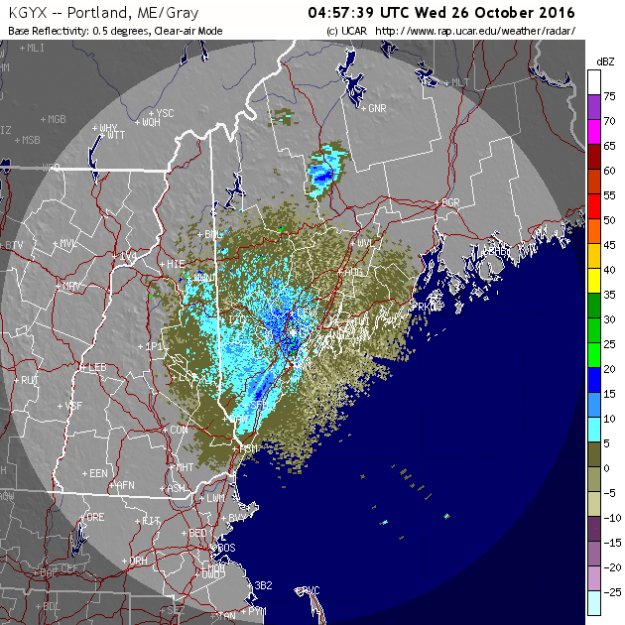
Winds died down a little overnight, finally, and with it, some birds took to the air. For the first time in seven days, there was at least a moderate flight underway. Here’s the 10pm radar image for example, which shows a strong flight underway:
10pm-radar10-25-16

But by 1:00am, the flight was already rather light, suggestive of the short-distance migrants of the season making a little bit of progress, but for the most part, more birds departing than arriving:
1am-radar10-25-16

And therefore, Sandy Point wasn’t as great as I had hoped for on Wednesday morning. However, I still enjoyed a respectable morning flight for this time of year. A total of 444 individuals of 22 species were led by 262 American Robins and 82 Common Grackles, but also included my first Fox Sparrow of fall, my 3rd Orange-crowned Warbler of the season (and only the 6th Sandy Point record), and this very tardy (or perhaps, “reverse” or 180-misoriented) migrant Prairie Warbler.
prawsandypoint10-26-16_edited-1

Strong northwest to northerly winds continued through the day, but they are finally expected to lighten up overnight. The current forecast looks good for a big flight tonight, and, if the winds stay more northwest – or at least north – than northeast by morning, I might get a “big one” at Sandy Point.
10-27_wind_forecast
wind-map-10-26-16

I sure hope so, as I haven’t had a lot of great mornings there this year, between all of my time on Monhegan, our recent quick trip to Cape May, and the overall lack of cold fronts this entire fall. The good news is that it seems to be changing now, and at the very least, a more active weather pattern should not only bring some more rainfall, but some good winds for producing good birding. While weather doesn’t necessarily cause vagrancy of fall migrants, winds certainly facilitate their arrival in far-off places.

Hopefully, the onset of cooler weather and more north and northwesterly winds will usher them to the coast and concentrate them in those seasonal hotspots that I will be hitting hard in the coming weeks. Also, this series of strong low pressure systems could in fact displace some birds, or at least get birds that are still on the move a littler further northeast (I am of course, drastically over-simplifying the mechanisms of vagrancy here). At the very least, the little bit of snow to our north and west, colder nights, and the end of our growing season – and resultant greatly diminished numbers of insects and other food sources – should help those patches that get better when the weather turns towards winter.

You know I’ll be out looking! So stay tuned to our store’s Facebook feed and other resources, all of which are available at our website, for the latest news. And go birding! Rarity Season is upon us!

I am so over birding in Portland.

Walking around various former hotspots and seasonal patches of significance in and around the Portland peninsula recently (including a few yesterday), I have come to one conclusion: I am so over birding in Portland during migration!

It used to be all I did – come late fall, head to the big city, especially the peninsula, and poke around the Eastern Promenade, weedy gardens, wooded hillsides, and scrubby patches. I’ve found lots of really good birds this way, from a Yellow-throated Warbler in a small grove of pines in front of the old Scotia Prince ferry terminal to annual Yellow-breasted Chats and regular Orange-crowned Warblers and Dickcissels.

But I give up.

I’ve chronicled the destruction to the uplands at Capisic Pond Park – after having once been a shining example of urban landscaping for wildlife and users, and a great way of showing what good can come of people, politicians, and professionals working together. And then it was gone. And that’s before the pond-dredging-skating-rink-creation-project-mess started.

The lack of oversight resulted in a road being built through some of the best woods behind Evergreen Cemetery – and that was even after the same city officials and engineers working on the same (necessary) sewer repair project supposedly learned their lessons with the Capisic Pond Park section. And then there’s the road the University of New England built through the other side of the woods, spreading invasive plants deeper into the forest and destroying some of the best scrub habitat in the park for migrants. Oh yeah, and natural and unnatural sedimentation in the ponds, along with the diminishing shoreline vegetation (erosion, overuse, etc) has greatly reduced the volume of migrant birds that find food and shelter around what was once one of the best spring migrant traps in the entire state. While the cemetery is still pretty good for birding – especially in spring, after “fallouts” – the degraded habitat just doesn’t hold birds like it used to.

Next, although the area known to birders as “Dragon Field” has long since lost its bird appeal due to mismanagement that allowed for the rapid overtake of invasive plants, there won’t be much of a chance of recovering it anymore. Of course, distributed solar is the way of the future, and this is truly a great project…I just wish it was atop a warehouse roof or over a parking lot instead of one of the city’s greenspaces. But it’s mostly going to be covering Japanese Knotweed and Stinging Nettles now anyway.

Do you see a theme yet?

Urban areas present all sorts of challenges, and it takes very knowledgeable and talented land managers to balance all of the issues, environmentally, socially, and economically. But we also know how important greenspaces are to urban areas, environmentally, socially, and economically.

While I do not expect that the number one priority of any city will be “migratory bird habitat and birding opportunities,” it is clear that Portland does not prioritize at all the health of its greenspaces and the welfare of the wildlife, especially migratory birds, that call these places home for some period of time and various parts of the year.

Today, I want to focus on how much the City of Portland has destroyed the green spaces on the Portland peninsula. Surrounded by water and dense, urban development, city parks and gardens provide critical cover for migratory birds. When certain weather conditions result in migrants being deposited within the urban jungle, they are forced to seek shelter and food wherever they can.

Personally, I love urban birding: immersing myself in fallouts, finding vagrants in the oddest places – like that aforementioned Yellow-throated Warbler – and seeing so-called “late” migrants eking out an existence in seemingly inhospitable corners.

But I am running out of places to bird in the city of Portland!  Especially now, in the fall through early winter, when “lingering,” “pioneering,” and vagrant birds seek the warmer microclimates of urban parks, or become “stuck” in low-quality habitat, unable to accumulate the fuel reserves needed to move further. However marginal urban habitats are, they are absolutely critical for these birds to have a chance. Healthy migrants will simply wait out the day and take off under the cover of darkness, while others will find the resources (such as weed seed in the case of many of our native sparrows) necessary for a full recovery.

But such places are becoming impossible to find in Portland.

The once-productive trees and scrub along the Commercial Street Extension is mostly gone – developed or simply clear-cut to hell. Replacing a fairly healthy canopy is little more than regenerating knotweed, bittersweet, and buckthorn.
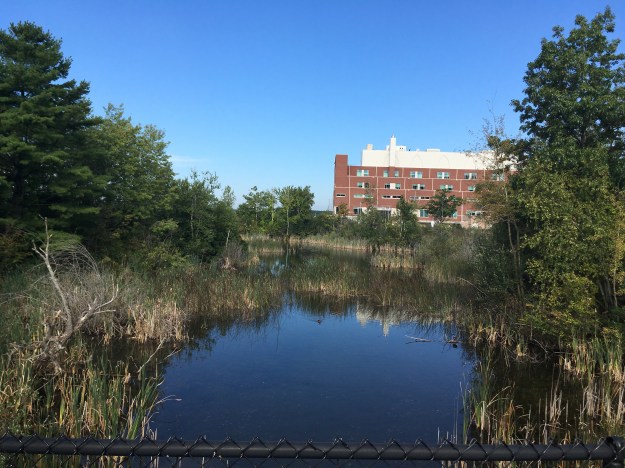
west-commercial-st

Many small lots have been developed, and several years ago, the trees and brush throughout the Fore River Parkway Trail was clear cut. Not much for birds left there anymore.

Mercy Pond remains a miniscule oasis – although the edge is far to narrow to hold songbirds for very long.
mercy-pond

Unfortunately, it doesn’t seem likely much of this will remain if hospital expansion plans go through. Which seems incredible to me, as this little pond regularly hosts (are they even breeding?) State Endangered Black-crowned Night-Herons!

But I think the most egregious example of poor management and devastation of bird habitat and birding potential is along the Eastern Promenade. A favorite patch of mine since I moved here, I have seen a whopping 176 species along it, including some really “good” birds over the years. With a cumulative list of 208 species as of this year, a lot of people have enjoyed a lot of good birding in this urban greenspace.

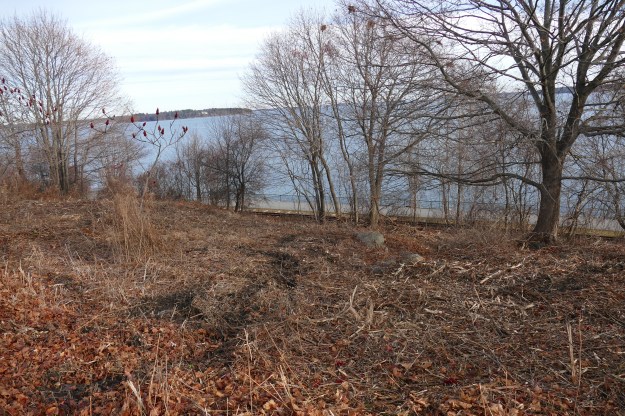
Unfortunately, mismanagement and misguided “maintenance” continues to greatly degrade it. Native plants are significantly reduced, and invasive plants have taken over and continue to proliferate. Despite the efforts of the Friends of the Eastern Promenade (who I have worked closely with over the years), it always seems that for every step forward, there’s three or more taken back. In fact, it’s about as bad as ever now, following yet more devastating clearing in late fall of 2015.
2015-12015-22015-32015-4

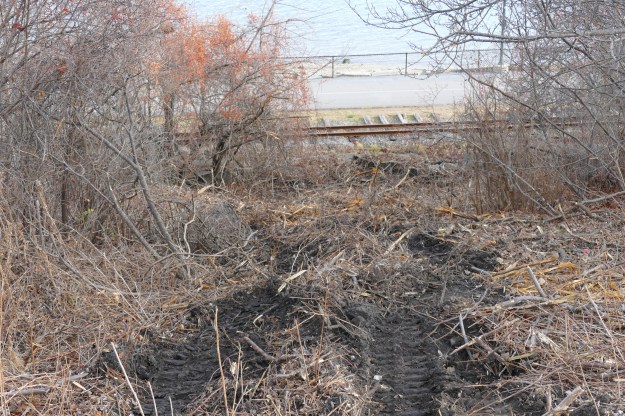
Continued slashing of what’s left of the native vegetation continues.  On 9/9, I noticed yet more hacked swaths like this.
2016-22016-3

Unfortunately, this is so incredibly counter-productive on multiple levels, as all it does is allow dense and ornithologically-useless invasive plants, especially Japanese Knotweed to proliferate even more.
2016
knotweed

And makes it easier for Asiatic Bittersweet to take over everything else.
bittersweet-2bittersweet

Meanwhile, valuable native plants like this Gray-Stemmed Dogwood is hacked to hell.
gray-stemmed-dogwood

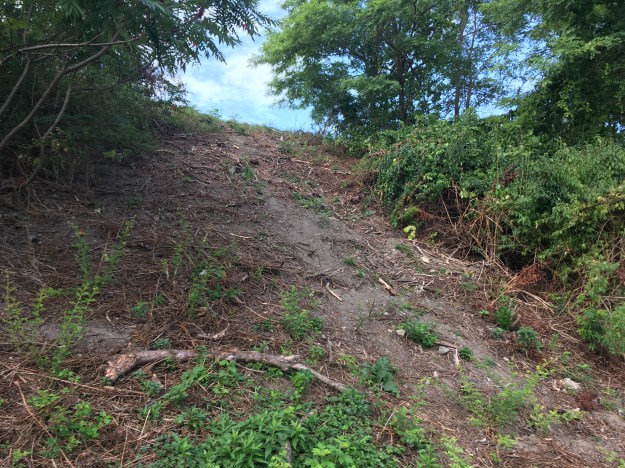
And it’s great at accelerating erosion.
bare-ground

The “Mid-Slope” Trail, which is often the most productive in late fall, has been destroyed…
mid-slope

…And the weedy slopes full of goldenrods, late-blooming primrose, and other great birdfood was mowed too early this year. Sparrows will be wanting for sustenance, and those late-lingering warblers – especially Orange-crowned – will be hard pressed to find food and cover. Additionally, it seems that it was mowed in perfect time to destroy any chance Monarchs would have had to breed successfully there this year. This is particularly unnecessary and unjustified mismanagement.
non-meadow

Based on the overall size of the greenspace and it’s placement along the shoreline at the northern terminus of the peninsula, there’s little doubt there will still be some birds along the Prom this fall, and perhaps even a rarity or two. But as for regular migrants and vagrants that are seeking shelter and sustenance, there will be little reason to stay very long.

Fallouts will occur because of weather events and the disorientation of migratory birds in city lights (especially in fog) and those birds will still descend on the Prom. However, most will likely leave as soon as they can, winging it inland in “morning redetermined migration,” hopefully not hitting windows or being hit by cars as they do.  It also likely means birding opportunities will be greatly reduced as these birds depart immediately in search of better habitat. Get there early!

But the exceptional days of fall birding, such as thousands of White-throated Sparrows scratching in the undergrowth or several Orange-crowned Warblers working the meadows, are unlikely to occur anymore. Birders lose. Birds lose more.

And what does any of this accomplish? It looks like crap. Thickets grow back denser, and people move back in – they’re just harder to see now. And then you clear-cut once again. And in between, tired and hungry migrant birds find little. And birders go elsewhere. Great solution.

As for me, with “Rarity Season” approaching and weather getting cooler, birds seek out warmer microclimates, like sunny hillsides, urban lots, and so on, where moderated temperatures can extend the availability of food resources, even insects.  This is the time of year – through the “Christmas Count Season” – where I usually would spend an increased amount of time birding all of the nooks and crannies throughout the peninsula, looking for late migrants and hoping for rarities.

Unfortunately, with so few opportunities left in Portland, I’m forced to look elsewhere. That means fewer eyes covering what’s left of the habitats, and fewer lunches I’ll be eating in town and fewer cash-burning errands.

But much more importantly, there are just fewer places that tired and desperate birds can go to find safety and refuel. That means even more birds hitting windows, being hit by cars, and being killed by cats. All of the trials and tribulations of a bird finding itself in an urban environment are exacerbated when there’s no good habitat left.

And all of the reasons there’s less habitat left in an urban environment are exacerbated when open space is managed as poorly as it is in the City of Portland. For a city that loves to bill and market itself as being “green,” it really does a terrible job in its greenspaces. While cities who honestly attempt to make themselves greener encourage or even mandate “bird safe” building guidelines to reduce collisions with glass surfaces (Portland on the other hand, promotes new developments with glass predominating), and work on “Lights Out!” campaigns to reduce the disorientation of birds from light pollution.

Taking things even further, 24 cities (Baltimore was the most recent) have signed onto the US Fish & Wildlife Service’s “Urban Bird Treaty City Program” which works to:

  • Protect, restore, and enhance urban/suburban habitats for birds
  • Reduce hazards to birds
  • Educate and engage citizens in monitoring, caring about, and advocating for birds and their conservation
  • Foster youth environmental education with a focus on birds
  • Manage invasive species to benefit and protect birds
  • Increase awareness of the value of migratory birds and their habitats, especially for their intrinsic, ecological, recreational, and economic significance

Now that’s what a “Green” Portland should be doing. Instead, all it does is fire up the brush-hogs and chain saws.

I’ll be birding elsewhere this Rarity Season. I just hope the birds find somewhere better to go as well.

Birds on Tap – Roadtrip: Migrants and Malts, 10/9/2016

fort-foster-1

The forecast called for light showers ending in the early morning, and the sun coming out. With rain developing overnight with the passage of a cold front, dreams of a fallout danced in our head as we headed south on the Maine Turnpike on Sunday for our latest installment of the “Birds on Tap (sm)– Roadtrip!” series.

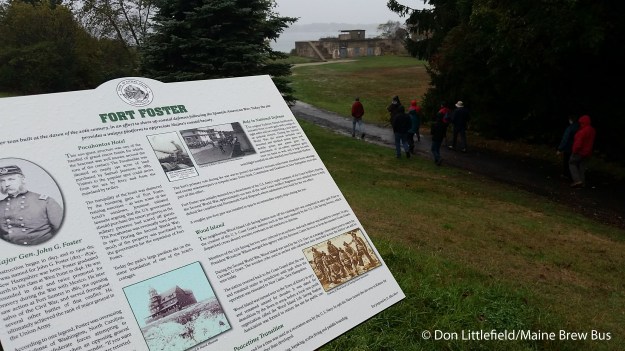
Fort Foster in Kittery was our destination, and there are few other places I’d rather be in Maine if a fallout was going to occur. But had the winds shifted early enough? Did birds take to the air before the rain arrived? Would the rain stop in time for sun to shine on the hottest corners of the park?

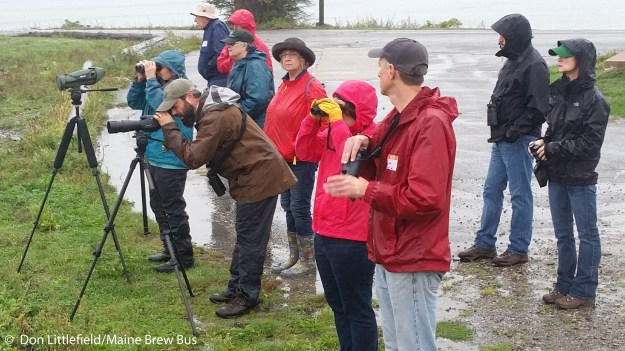
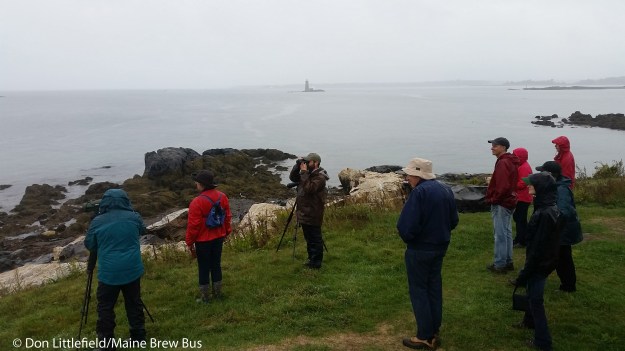
With anticipation – and quite a bit of apprehension because most of us were dressed for a few brief light showers – we stepped off the bus at the entrance to Fort Foster in a light, but steady rain. I was watching a plume of moisture offshore; moisture that was being sucked up from Hurricane Matthew.  It was supposed to remain offshore.

It didn’t.

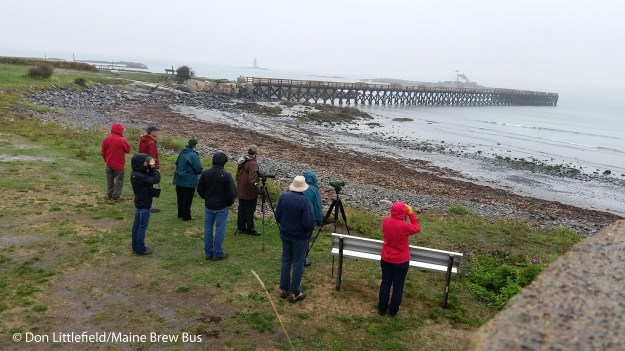
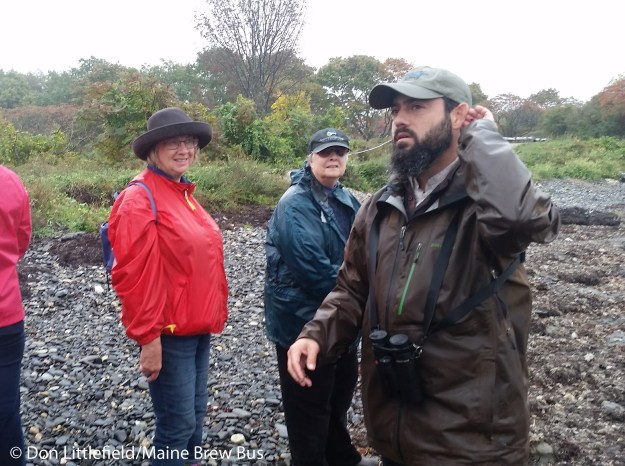
It kept raining. And then it rained some more. We got soaked to the bone, and suffice to say, there was no fallout. (And for the record, the “showers ending in the early morning” continued to fall, moderate at times, through about 11pm that night!).
fort-foster-sign

But luckily it was fairly warm, we were mostly in shelter from the wind, and we found a few good pockets of birds.  Our first bird of the day was a low and close Blackpoll Warbler along the entrance road, which stoked the fallout hopes briefly. But other than a couple of pockets of White-throated Sparrows, the woods were rather slow.

We spent some time with plant ecology, and talked about the importance of the shrub-scrub habitat in the park. We played in the wrack line on the beach to observe Springtails and Seaweed Flies.  A large male Gray Seal on offshore rocks dwarfed the Harbor Seals around it.  A Great Cormorant posed for us to compare it to the plethora of Double-crested Cormorants nearby, and Common Eiders and a couple of Common Loons, joined by 8 newly-arrived Surf Scoters, plied the waters.
fort-foster-2fort-foster-3

A couple of cooperative Least Sandpipers were on the beach, while a single mixed-species foraging flock that contained a truant Wilson’s Warbler, a Blue-headed Vireo, and a couple of Yellow-rumped Warblers amongst a band of Black-capped Chickadees hinted at the migrant potential of the place, as did a low and close late American Redstart a little earlier.
fort-foster-4
i_hear_something

Four Semipalmated Sandpipers were studied at exceptionally close range at nearby Seapoint Beach, which also hosted 6 Semipalmated Plovers. Unfortunately, Legion Pond only contained a handful of Mallards today.

These were all new locations for everyone on the tour, so the value of exploring new areas (to return to on a sunny day!) was recognized, even if the birding was on the lackluster side of things. As was the weather.

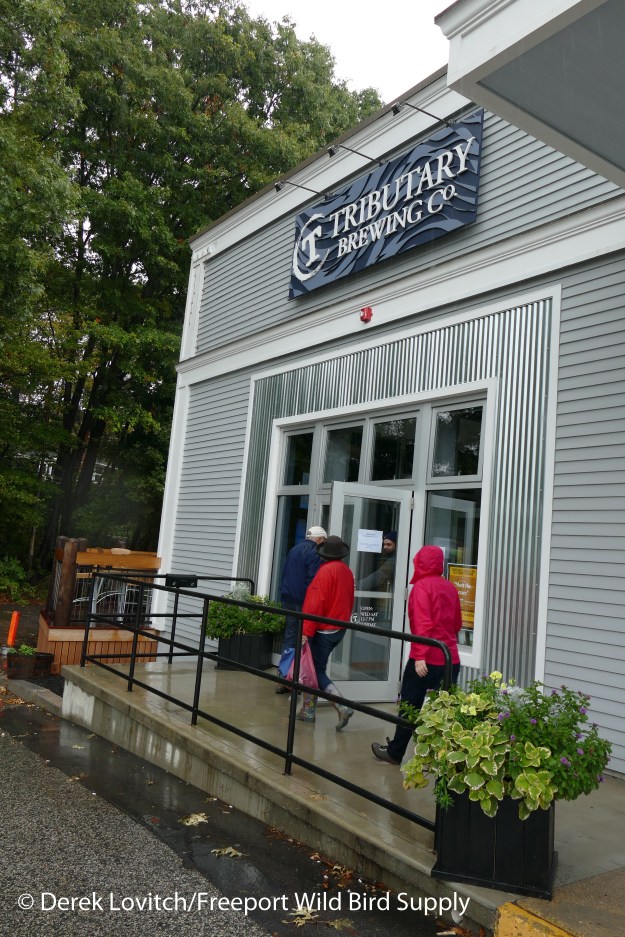
So with our rather damp birding time coming to a close, Don Littlefield took over and delivered us to Kittery’s Tributary Brewing Company.

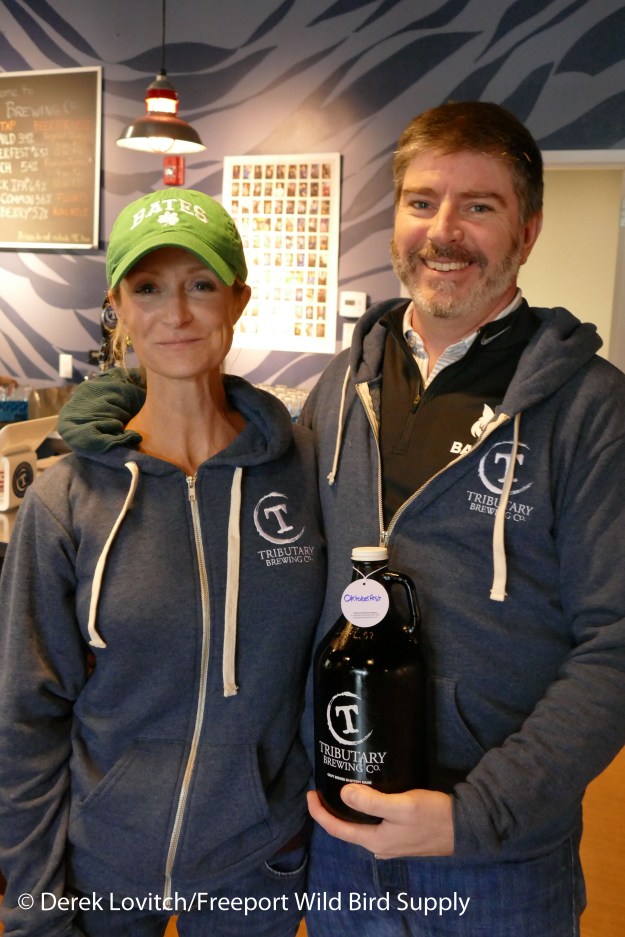
After working at several breweries throughout his career, New England brewing legend Tod Mott – the creator of the Harpoon IPA that is often credited with beginning the American IPA revolution – and his wife, Galen, opened their own brewery in September of 2014. With a focus on “traditional, well-balanced, full-bodied beers” and locally-sourced ingredients, Tributary has rapidly become a favorite tasting room destination for many aficionados.
tributary_tasting_room_edited-1

And it just happened to be down the road from Fort Foster – which, when it’s not pouring rain – is one of Maine’s premier birding destinations and therefore was a natural fit for a Birds on Tap (sm) – Roadtrip! destination.  One half of the Ian and Ian tag-team duo of brewers, Ian Goering, came into work early to open the doors to welcome us out of the elements.
tributary_entrance_edited-1

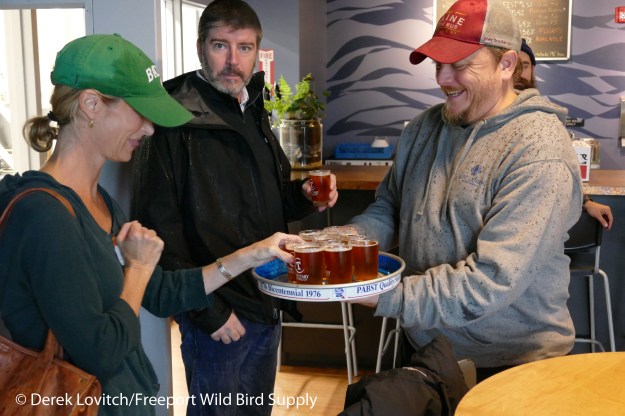
We began our tasting with an American Mild brewed with an experimental hops that offered an essence of strawberry. Downplaying malts in order to showcase the hops, it was a little bitter by design, with a less sweet finish.

Next up was the Oktoberfest – which turned out to be the favorite beer of the day for many –a fuller bodied lager, heavier in malts, yet with a crisp finish.
tributary_oktoberfest_edited-1
tributary_oktoberfest_glass_edited-1

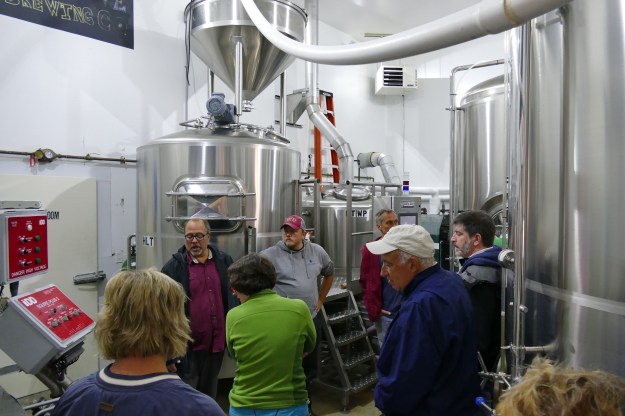
As we sipped it, Ian gave us a tour of their ultra-clean and efficient brew house.

Next up was their Blueberry Ale which – unlike many blueberry beers that add artificial flavors or blueberry syrup – added real blueberries into the kettle to allow the sugars of the fruit to be fermented by the brewing yeasts. The result was a decidedly un-sweet pale ale that had just the essence of blueberries.

Last but not least, we enjoyed a taste of their smoky and very chocolate-y – while still being nice and hoppy – Black IPA.
tributary_brewhouse_2_edited-1
tributary_fans_edited-1
New fans of Tributary. Well, and/or just cold and needing another layer?

We were able to dry out further as Don filled us in on some of Maine’s brewing facts and history as we headed up the road to Hidden Cove Brewing Company in Wells.

Formerly a restaurant with a small house brewery, the building has been creatively re-purposed into a growing brewing operation.  A “tale of two breweries,” as Don put it, with “traditional offerings alongside more creative barrel-aged” options, Hidden Cove offers a wide array of options in their tasting room.
hidden_cove_tasting_edited-1

Today, we sampled five diverse offerings, beginning with their Patroon IPA – their best selling, flagship beer which was rich in juicy hops.

Next up was the Compadre Pale Ale, “the sidekick to the flagship IPA and is a classic West Coast IPA that utilizes a single hop, Belma.”  The tropical fruit flavors really came through for me, with a very crisp and clean finish.

Rich with the flavor of Meyer Lemon peel, the refreshing Summer Ale brought us back to warmer days. Bitter (remember, that is not always meant as a negative when tasting beer!) and yet quite bready from the yeast, the hop-forward Belgian IPA was the last planned sample.
hidden_cove_brewhouse

However, Don wanted to show off the creative brews that are coming out of their aging barrels, so we were treated to a sample of the very complex Mo-Lay, a sour pumpkin with chili, chocolate (mole), and finished in bourbon barrels with Brettanomyces and Lactobacillus. Like a lot of complicated beers, some people loved it, some didn’t, but everyone enjoyed the opportunity to see what people are doing with beer these days.

Afterall, part of the goal of the Birds on Tap (sm) – Roadtrip! series is to introduce folks to new breweries and new birding sites, new beers and new birds, and broaden horizons and open eyes wider to each!

Speaking of, our next Birds on Tap – Roadtrip! tour is coming up. On November 13th, join us for our second annual “Fall Ducks and Draughts” when we venture north to the waterfowl hotspot of Sabattus Pond, followed by stops at Baxter Brewing and Maine Beer Company!

group_photo_edited-1

2016 Fall MonhegZen Migration Weekend

from_terez_edited-1

Our annual “MonhegZen” Fall Birding Weekend visited Monhegan Island over the weekend. I arrived on Thursday afternoon to find nearly as few birds as when I departed four days prior, as my week on the island with my WINGS tour concluded. However, there was a noticeable increase in Yellow-rumped Warblers, both Ruby- and Golden-crowned Kinglets, and Swamp and White-throated Sparrows; clearly, the transition to October had been underway. No rarities to catch up with or track down for my tour group, either. So I enjoyed some time with friends, and that evening’s sunset (here, from the Island Inn) more than made it worth the early arrival.
island_inn_sunset2

Thanks to a strong flight overnight on a light to moderate northeasterly wind, there were, however, a lot of birds to kick off the tour as I met the group of nine at the dock at 8:00am. Yellow-rumped Warblers (over 90% of the flight, apparently), were swirling overhead and we ran into large groups and scattered small, reorienting flocks all morning. It was nice and birdy through lunch, even if almost everything was a Yellow-rump! However, the homogeny was punctuated by good looks at things like a cooperative Northern Waterthrush at the Ice Pond.

l1070767

…and a couple of Lincoln’s Sparrows in gardens.
l1070800

We had a fun day, with a nice diversity of birds, including one Dickcissel, several Cory’s Shearwaters, lots of Northern Gannets, and a respectable 11 species of warblers.
l1070712

We awoke to light showers and continuing northeasterly winds on Saturday morning, with the radar indicating merely a light flight overnight. There was virtually no morning flight over the Trailing Yew after sunrise, and it was exceptionally slow after breakfast. Five species of sparrows on one of my seed piles was decent, and again we had a single Dickcissel.

thrasher_worship_fromsteveb_edited-2
Some thought I was worshiping this Brown Thrasher, perhaps praying to the bird gods for more migrants. But really, I was just conducting an experiment on how many mealworms a thrasher can eat. For the record: 9, with one taken to go.

But it was hard to sugar-coat things, especially for the three new arrivals that came mid-morning! This was as slow as Monhegan gets, but I can say this: the weather was much better than expected. We only had a little spitting rain after the early morning showers, and light east winds. Expecting a possible wash-out, I would take it, and I would definitely take the results of our afternoon seawatching from Whitehead: 30+ Cory’s Shearwaters (just a few years ago, they were genuinely rare here), 50+ Northern Gannets, a Pomarine Jaeger, and 6 newly-arrived Surf Scoters landing with hundreds of Common Eiders.
seawatching_from_steveb_edited-2

And on our way back into town, we hit a couple of nice birdy spots which helped to end on a high note, including the Clay-colored Sparrow that we had been trying to catch up with.
l1070805
Several Monarch butterfly chrysalises were noted behind the Trailing Yew. They better hurry!

Northeasterly winds continued for a 4th or 5th straight night, and a little light rain was once again falling at sunrise. With virtually no visible migration on the radar with diminishing northeasterly winds and scattered showers after midnight, there was yet another nearly-bird-less morning flight over the Yew at dawn. Well, there were the TWO Yellow-rumped Warblers to be exact!

It was another wicked slow morning – I found myself apologizing profusely to those members of the group who were new to the island; I swear this is not what Monhegan is usually about! But at least the rain ended by the time we were done with breakfast, and with the ceiling lifting, we finished strong with birds coming out into the open. There was the Clay-colored Sparrow once again in the Peace Garden by the church comparing itself perfectly to nearby Chipping Sparrows…
l1070885

…the two Dickcissels together in town (here’s one of them)…
l1070893

And several really good looks at Cape May Warblers, including this male.
l1070942

Blue-headed Vireos seemed to have arrived overnight, as did a smashing drake Wood Duck that was feeding in the bushes at the Ice Pond’s wide muddy edge. In fact, the 61 species we recorded on the day (with a 4:30 departure) was our best total of the three days.
l1070773

Most of the group departed, and those who took the late boat back to Port Clyde with me saw a Razorbill and a few more Cory’s Shearwaters, including one rather close to the boat. The two couples that stayed on the island dreamed of sunshine and a fallout for the next morning (sunshine and more birds, but no fallout, alas).

l1070892
“Yellow” Palm Warbler catching flies emerging from a compost bin

So while “tour guide spin” suggests I should just talk about the Clay-colored Sparrow, Dickcissels, Cape May Warblers, and all of the Cory’s Shearwaters, it’s hard to not see through that. It was slow…and weekends like this happen in the fall. Unlike my week-long WINGS tour that saw multiple changes in the weather, we were stuck in a dreary, northeasterly pattern that doesn’t produce a whole lot of birds for Monhegan. And, as true of the entire fall, up and down the Eastern Seaboard, the continued lack of cold fronts continues to minimize numbers and concentrations along the coast and offshore. A mere 71 species were recorded in our three days together; our average for the weekend is 99 species (with an average of 20 species of warblers)! Or should I say, was.

trap_day2

So now comes the “spin:” If I would have to spend a weekend anywhere else in a “slow” fall, it sure has heck would be Monhegan! The best pizza in the state and other great meals, fantastic beer, good company, and the unique and truly special sense of place that Monhegan offers (including Trap Day, which we enjoyed from afar on Saturday). And yeah, Dickcissels, Clay-colored Sparrows, Cory’s Shearwaters, and 11 species of warblers in three days in early October really isn’t too shabby.
l1070954l1070969
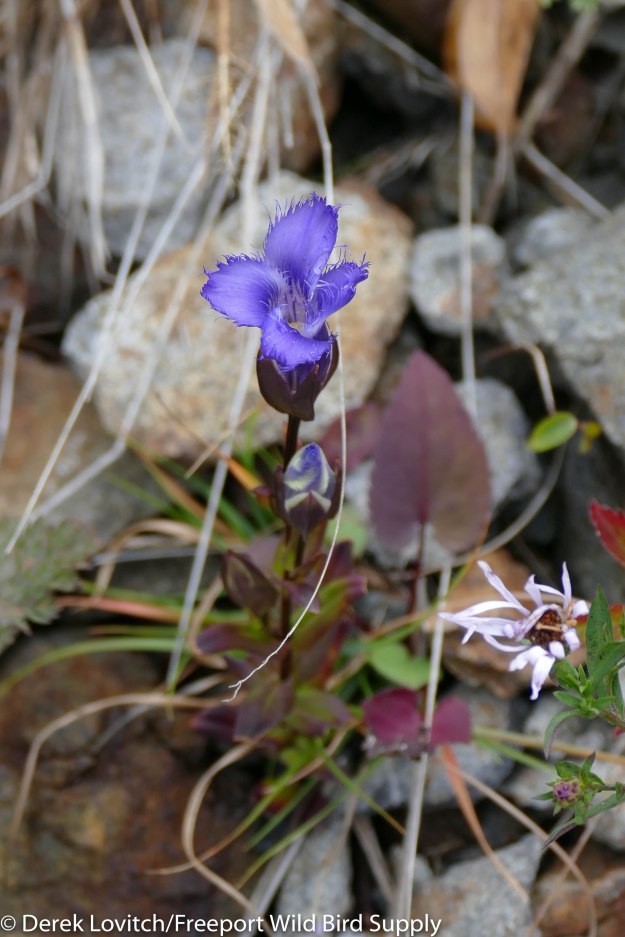
Of course, there are always things like Fringed Gentian to look at as well!

We’ll just make up for it in spring!

l1070989
The daily lists:
Species: Fri 9/30, Sat 10/1, Sun 10/2.

Canada Goose: 0,5,0
Wood Duck: 0,0,1
American Black Duck: 1.5,1.5,1.5
Mallard: 8,12,12
Common Eider: x,x,x
Surf Scoter: 0,6,0
Common Loon: 3,1,0
CORY’S SHEARWATER: 5,30,5
Northern Gannet: 100,50,20
Double-crested Cormorant: x,x,x
Great Cormorant: 6,10,10
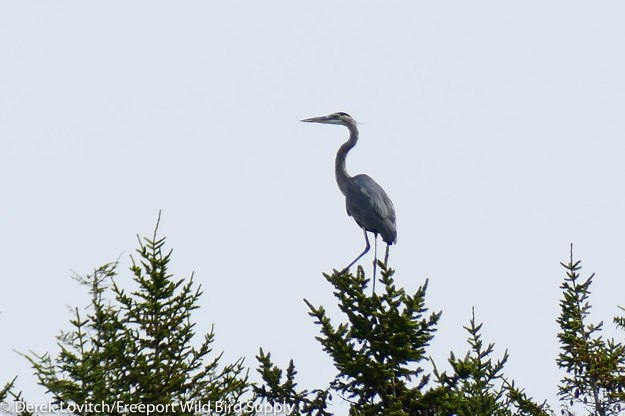
Great Blue Heron: 1,1,1
Bald Eagle: 2,1,0
Sharp-shinned Hawk: 4,4,2
American Kestrel: 1,1,1
Merlin: 6,5,3
Peregrine Falcon: 1,2,2
POMARINE JAEGER: 0,1,0
Laughing Gull: 0,1,0
Ring-billed Gull: 0,0,1
Herring Gull: x,x,x
Great Black-backed Gull: x,x,x
Black Guillemot: 6,2,4
Mourning Dove: 4,4,8
Yellow-bellied Sapsucker: 4,5,6
Downy Woodpecker: 3,3,2
Northern Flicker: 30,10,4
Eastern Phoebe: 3,3,1
Blue-headed Vireo: 0,0,2
Red-eyed Vireo: 6,4,3
Blue Jay: 28,24,16
American Crow: x,x,x
Common Raven: 1,3,2
Black-capped Chickadee: x,x,x
Red-breasted Nuthatch: 30,20,10
White-breasted Nuthatch: 2,2,2
Brown Creeper: 2,6,1
Golden-crowned Kinglet: 25,25,20
Ruby-crowned Kinglet: 5,4,3
American Robin: 4,1,0
Gray Catbird: 6,6,4
Brown Thrasher: 1,1,1
European Starling: 11,11,11
Cedar Waxwing: 75,50,40
Yellow Warbler: 1,0,1
Cape May Warbler: 1,2,2
Black-throated Blue Warbler: 1,2,0
Yellow-rumped Warbler: 200,30,30
Black-throated Green Warbler: 1,0,0
Palm Warbler: 20,6,4
Blackpoll Warbler: 15,4,1
Black-and-white Warbler: 1,0,0
American Redstart: 1,0,0
Northern Waterthrush: 1,0,0
Common Yellowthroat: 10,4,2
Chipping Sparrow: 4,6,4
CLAY-COLORED SPARROW: 0,1,1
Savannah Sparrow: 6,5,8
Song Sparrow: 20,20,20
Lincoln’s Sparrow: 2,2,1
Swamp Sparrow: 3,0,2
White-throated Sparrow: 10,10,25
White-crowned Sparrow: 5,6,6
Dark-eyed Junco: 0,1,1
Northern Cardinal: 4,12,10
Rusty Blackbird: 1,0,0
Common Grackle: 2,2,2
Brown-headed Cowbird: 0,0,2
DICKCISSEL: 1,1,2
Purple Finch: 1,0,1
American Goldfinch: 4,4,2\

l1070822
White-throated Sparrow

A Week on Mohegan with WINGS, 2016

monarch-9-24

Every other year, I have the pleasure of spending a week on Monhegan Island in the fall with a tour group for WINGS. Unlike my annual weekend tour through the store, this allows us to fully experience multiple changes in the weather and the resultant changes in bird numbers and diversity.

This year’s tour, which took place from September 19-25, recorded 116 species (including 5 seen only from the ferry or while we were on the mainland), including 18 species of warblers. Both tallies were a little low, as the weather was often simply “too nice” for much of the week, and fewer birds found themselves on the island. But as usual, great looks at a wide variety of common birds, spiced up by a smattering of rarities, made for a wondrous week of birding.

Birds from any direction are possible at this migrant trap, and this week, we experienced visitors from the south (e.g. Orchard Oriole), west (e.g. Lark and Clay-colored Sparrows), and even the east (Cory’s and Great Shearwaters). While the allure of a “Mega” kept us searching, local rarities kept us entertained. From Peregrine Falcons overhead to a Sora at our feet, you never quite know what’s around the next corner. Even the “slow” days offered new birds, as our relaxed and casual pace simply allowed us the opportunity to enjoy whatever happened to be in front of us. And the overall weather and food was unbeatable – adding to the mystique of this truly special place.
group-in-town-9-23

While daily turnover in the island’s birdlife is expected during the peak of fall migration, a shift in the weather can yield a distinct change in the birds we see. Several clear and calm nights allowed migration to continue unimpeded, while a northwesterly wind on the night of the 22nd yielded numerous birds overhead in the morning – including our first big push of Yellow-rumped, Palm, and Blackpoll Warblers. However, no fallouts – the stuff Monhegan birding legends are made of – occurred this week as unseasonably warm and relatively pleasant weather continued. It might not have produced massive numbers of birds, but it sure made for comfortable birding!

A couple of nights of southwesterlies produced dreams of vagrants, and likely resulted in the arrival of several “southern” birds such as Orchard Oriole, Yellow-throated Vireo, and Blue-gray Gnatcatchers. In contrast, by week’s end, the first White-crowned Sparrows, Dark-eyed Juncos, and other late-season migrants from the north began to appear.

“Drift migrants/vagrants” such as Lark Sparrows and Clay-colored Sparrows, along with a number of Dickcissels, all normally found further west, were present and accounted for as usual out here.
town-9-23
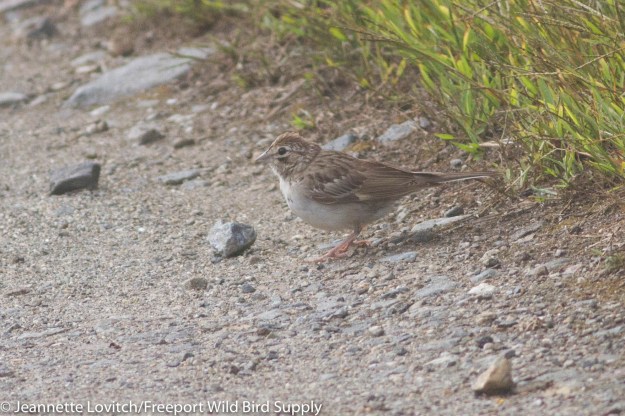
Lark and Clay-colored Sparrows

Two immature Yellow-crowned Night-Herons (perhaps part of a small scale northward irruption into the New England coast) stood guard in the early mornings at the Ice Pond.  Later in the week, the world’s most confiding Sora appeared, spending one afternoon foraging in the open at the pond’s muddy edges – this year’s drought had reduced it to a mere muddy puddle.
sora-blja-9-21
Sora and a Blue Jay

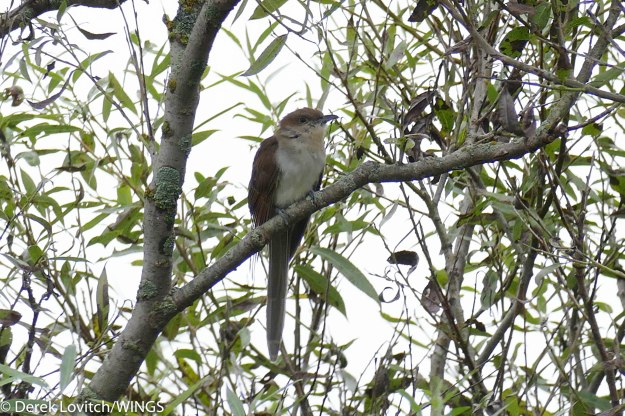
A Connecticut Warbler was one of our finds of the week, heard by all, seen by some on two occasions; an “exclusive” for our group. A late Olive-sided Flycatcher was another treat, as was the Black-billed Cuckoo that we caught up with thanks to the efforts (and game of charades) of friends – exemplifying the spirit of the Monhegan birding community shared by most.
bbcu-9-23

Calm winds and the season produced excellent seawatching conditions on the 21st, and from the high cliffs of White Head, we observed Cory’s Shearwaters (once a rarity this far north and east) and Great Shearwaters – with massive rafts of one or both just beyond the realm of identification– and a few Minke Whales. Always a highlight in the fall is the raptor passage, which most of the week was limited to numerous Merlins, scattered Sharp-shinned Hawks, and the occasional Peregrine Falcon, On our last day, a light northerly wind also ushered in a steady movement of Northern Harriers and Ospreys, along with another surge of falcons.

And then there was the food: exquisite fine dining at the Island Inn, the best pizza in Maine at the Novelty, and a candlelight lobster dinner – with lobsters brought in just for us! – at the rustic Trailing Yew, complete with a lobster ecology and human ecology lesson and step-by-step instructions. And that’s in addition to the limitless lobster scrambled eggs at breakfast every morning!

Highlights for our group each day were as follows, along with a brief synopsis of the overnight flight and the day’s weather.

9/19: Balmy Days ferry from Boothbay Harbor:
– 1 Long-tailed Duck (FOF; early)
– 1 Pomarine Jaeger (harassing Northern Gannet)
– 1 Cory’s Shearwater

Island:
– A few light showers, drizzle, and fog occasionally lifting on light and variable, and rather warm winds throughout the day. Calm and foggy at dusk.
– 1 female Orchard Oriole (new)
– 1 Lark Sparrow (continuing)
– 1 Clay-colored Sparrow (continuing)
– 1 Carolina Wren (continuing)
rbnu-9-24
Like everywhere in Maine this fall, Red-breasted Nuthatches were abundant.
ichneumon_wasp_edited
Ichneumon wasp sp on window screen.

9/20:
– Sunrise: 62F, dense fog, very light southeast. Light migration likely overnight, but hard to decipher on the radar due to fog.  Fog coming and going throughout the day, warm and humid, very light southeast.  Light south and fog at dusk.

Another relatively “slow” day, but these were the highlights:
– 1 CONNECTICUT WARBLER
– 2 juvenile Yellow-crowned Night-Herons
– 1 Blue-gray Gnatcatcher
– 1 Lark Sparrow
– 1 Clay-colored Sparrow
– 2 American Golden-Plovers
– 1 Cory’s Shearwater
– 1 Greater Shearwater
– 1 Carolina Wren

harbor-9-20
client-at-barnacle-9-20
I tell people never to leave their binoculars behind when on Monhegan; you never know what you will see where. They also can come in handy for reading the fine print of menus!
group-in-fog-9-20
lasp-9-20
Lark Sparrow

9/21:
– Am: 62F, mostly clear, calm. Light to moderate migration overnight on lt SW to W, but again intensity obscured by fog. Moderate-good morning flight overhead at dawn, with lots of new birds around. Hot and calm!  Clear and calm at dusk.

73 species on the day, including the world’s most cooperative Sora and some fantastic afternoon seawatching.

Highlights:
– 1 CONNECTICUT WARBLER
– 1 Yellow-crowned Night-Heron
– 3 Dickcissels
– 1 Clay-colored Sparrow
– 10 Cory’s and 12 Great Shearwaters plus 125 large shearwater sp.
– 2 Lesser Black-backed Gulls
– 1 Eastern Kingbird
– 1 Warbling Vireo
– 1 Sora
– 3 Minke Whales
wyeth-house-9-21
brth-9-21
Brown Thrasher on the Trailing Yew lawn
caterpillar-9-21
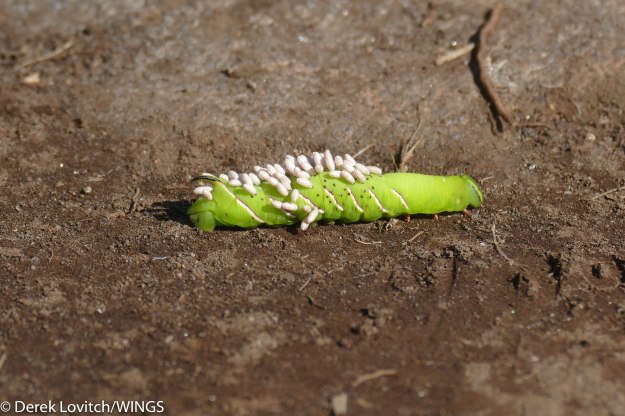
Sphinx moth caterpillar with parasitic wasp pupae
merl-perched-9-21
Merlins were all around
rubl-9-21
I’m not sure of this Rusty Blackbird left this particular group of yards for the rest of the week!
rubl2-9-21
whitehead-client-9-21whitehead-9-21
Afternoon seawatching from Whitehead.
sora-9-21
Ending the afternoon with a Sora at the Ice “pond,”
blja-9-21

9/22:
– AM: 59F, clear, very light NW. Light-moderate migration overnight on light SW to West to NW. Lots of birds overhead at sunrise (mostly Blackpoll, Yellow-rumped, and Palm Warblers), but less landing than expected as many birds kept going to the mainland. Relatively hot once again, with light and variable breeze. Clear and light South by dusk.

Highlights:
– 1 Yellow-crowned Night-Heron
– 1 Yellow-throated Vireo
– 1 Olive-sided Flycatcher
– 2 Dickcissels
– 1 American Golden-Plover
– 1 Clay-colored Sparrow
– 1 Blue-gray Gnatcatcher
– 1 Carolina Wren

amre-9-22
American Redstart
baor-9-22
Baltimore Oriole
fuzzy-caterpillar-9-22
Unidentified caterpillar- some sort of tussock moth?
view-of-harbor-9-22_edited-1
harbor2-9-22

9/23:
– AM: 65F, cloudy, lt-mod SW. Little to no visible migration overnight on lt-mod SW and rain approaching from north with dropping cold front. Drizzle and some light rain ending by mid-morning. Overcast but warm on light west winds. Increasing north by dusk.

A slow day of birding on Monhegan is better than a good day of birding most anywhere else with NINE new species for the week today.

Highlights:
– 1 Black-billed Cuckoo
– 2 Dickcissels
– 2 Cory’s Shearwaters
– 1 White-crowned Sparrow (FOF)
– pair of Pine Warblers were our 18th species of warbler on the week (a little low).
clients-at-lighthouse-9-23cloud-9-23
Here comes the front!
dick-9-23
Dickcissel
lobsters-9-23
Special delivery!
lobster-chef-9-23

9/24:
– 50F, mostly clear, light N. Huge flight overnight on radar on diminishing N, but very little overhead at dawn. Although new birds had definitely arrived, it was not the huge flight that was hoped for. Apparently, there were more birds arriving on the south end of the island today (we always started on the west-north-west side) as reorienting migrants were returning to the island, or likely departing from the island’s north end. Diminishing N wind became light and variable before NW began to increase in the late morning, producing a good hawk flight.

With the hopes a big flight dashed by the lack of a westerly wind component by morning, we had a very casual and relaxed pace for our last day with some hawk watching taking precedence. Quite a few new birds were around, including several new species for out week’s list: Northern Harrier, American Pipit, and a single Semipalmated Plover. Cape May Warblers were particularly conspicuous today (at least 5), and as always it is painful to say goodbye. Good thing I’ll be back next weekend with the store’s annual weekend!

Highlights:
– 2 American Pipits (FOF)
– 1 Dickcissel

Ferry back to Boothbay Harbor:
– 1 Yellow-bellied Sapsucker (about half way, heading towards the mainland)
– 2 White-winged Scoters

cmwa-9-24
Cape May Warblers were conspicuous the last few days
departing_monhegan9-24_edited-1
group_on_ferry9-24_edited-1
arriving_boothbay9-24_edited-1
Boothbay Arrival

And now I’m off this afternoon for for three more days!
group_at_brewery9-22_edited-1

2016 Washington County Weekend Tour

I simply love birding Washington County, and my biennial “Washington County Weekend” van tour is little more than an excuse for me to bird the area. Of course, in doing so, I get to share the avian, scenic, and culinary glories of Downeast.  So everybody wins!

We set out from Freeport on Friday, 8/26. Not wanting to squander the entire morning just driving, we break up the trip by birding our way north. Corrina Marsh was our first stop this year, yielding Wood Ducks, side-by-side comparisons of Spotted and Solitary Sandpipers, several Ruby-throated Hummingbirds in the jewelweed, and a Northern Harrier coursing low over the marsh.

Nearby Alder Stream held multitudes of Wood and Ring-necked Ducks, along with a couple of Pied-billed Grebes. More Wood Ducks were at Plymouth Pond, along with Common Loons, but we didn’t find the Sandhill Cranes that we had hoped for.

After lunch at the flagship Dysart’s (no Maine roadtrip is complete for me without at least one grilled cheese from a Dysart’s), we strolled Essex Woods and marsh in Bangor. Four rare-so-far-inland Snowy Egrets were joined by a single Great, and we enjoyed superior views of Lesser and Greater Yellowlegs for comparison, along with more Solitary Sandpipers for comparison.

Our entrance into Washington County via The Airline was met with a bang: our first birds in the county were a migrant flock of 18 Common Nighthawks bounding overhead. Dinner, and of course, pie, from Helen’s in Machias (not to mention the blueberry sangrias!) was a sure sign we had arrived.
1. view from hotel

2. blueberry sangria

Without a doubt one of the best reasons for visiting this area in August is the massive congregation of gulls and seabirds, along with whales, that occurs in Head Harbor Passage, off of Eastport.  Therefore, one of the highlights of this tour is our private charter on the “Pier Pressure” for whale- and bird-watching. And this trip most definitely did not disappoint.

5. boat trip 24. Boat trip 1

Sorting through 5,000-7,000 Bonparte’s Gulls finally yielded a Sabine’s Gull, a stunning adult, and one of the most sought-after species on the trip. It was nearly the end of the boat ride, my eyes were shot from combing through so many Bonies, and then I spotted it on the water, a short distance away.  It took off and joined some commuting Bonies, and we tried to follow it, but despite Captain Butch’s best efforts, we unfortunately could not keep up with it as it headed towards Maine waters, and lost it as it mingled with a large flock of Bonies. But my goodness, what a stunning species it is!
28. boat trip 19 - SAGU227. boat trip 18 - SAGU1

300-400 Black-legged Kittiwakes was likely a ridiculously low guesstimate, as is the goodly 200+ Razorbills. Although Razorbills are regular in the passage in most summers, the numbers this year have been exceptional. Scattered Great Cormorants among the multitudes of Double-cresteds, plenty of Black Guillemots, about a dozen tarrying Common Terns, and a total of 15+ Bald Eagles added to the show. A total at of 5 Lesser Black-backed Gulls of various ages were detected, but I admit to not sifting through every large gull – it was the rare “hooded” gulls that we were on the lookout for!
26. boat trip 1725. boat trip 16 - GRCO2
Adult Great Cormorant.

24. boat trip 15
Juvenile and adult Black-legged Kittiwakes with Bonaparte’s Gulls. 

23. boat trip 14
Lots and Lots of Bonaparte’s Gulls (and Black-legged Kittiwakes).

18. boat trip 917. boat trip 8
Black-legged Kittiwakes

16. boat trip 7
Black-legged Kittiwakes, Herring Gulls, and Double-crested Cormorants

15. boat trip 6'14. boat trip 512. boat trip - RAZO3
Razorbills.

11. boat trip -RAZO29. boat trip BLKI3
Adult Black-legged Kittiwakes8. boat trip BLKI27. boat trip RAZO
Razorbill father with juvenile (L).

6. boat trip BLKI
Snazzy juvenile Black-legged Kittiwake.

Harbor Seals and Harbor Porpoises were common, and we visited with some massive Gray Seals as well. We spotted a single Minke Whale, and then drifted with a massive Fin Whale for a little while.
19. boat trip 10 -Gray Seal1
21. boat trip 12 - Gray Seal 320. boat trip 11 - Gray Seal 2

While we only has one fly-by unidentified phalarope and did not find a single tubenose (despite spending some time off of East Quoddy Head), the trip was an incredible success, because, well…Sabine’s Gull!

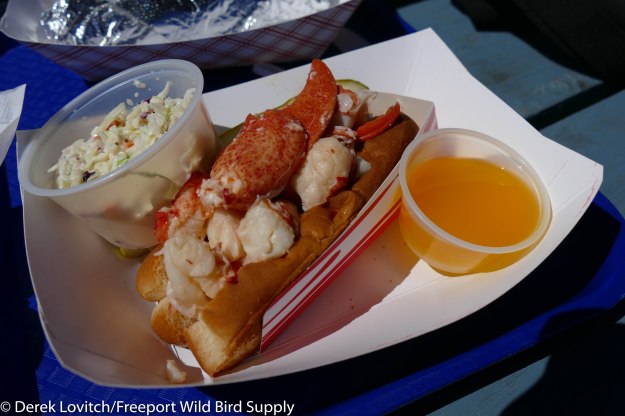
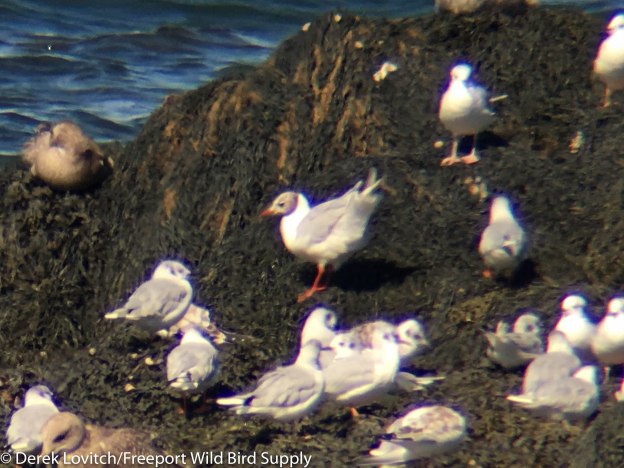
We fueled up on arguably the best lobster rolls in the state at the Quoddy Bay Lobster Company, before spending some time seawatching at the end of Clark St (hoping for the Sabine’s to reappear!). Close-up kittiwakes and Bonaparte’s Gulls were nice, as were a couple more Lesser Black-backed Gulls. However, it was the molting adult Black-headed Gull that was the welcomed consolation prize.
29. Eastport lobster rolls

IMG_0390

We slowly worked our way up the peninsula, checking out various viewpoints, and seeing a smattering of shorebirds and lots of Black Guillemots in the process. Finally, at the Sipayik Trail at the ballfields at Pleasant Point, a nice mix of birds as always included a trio of out-of-place Sanderlings, a few Bobolinks, more Bonaparte’s Gulls and Black-legged Kittiwakes offshore, and 2 Nelson’s Sparrows in the marsh. Another close Northern Harrier coursing low over marsh stirred the pot, kicking up more Green-winged Teal and Least Sandpipers than we thought were present.

Dinner at the Hansom House in Dennysville left much of the group speechless. It is a very interesting, and very different place indeed!
31. Hansoms230. Hansoms1

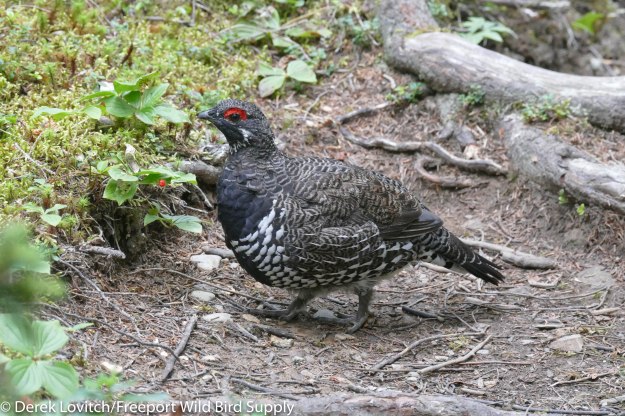
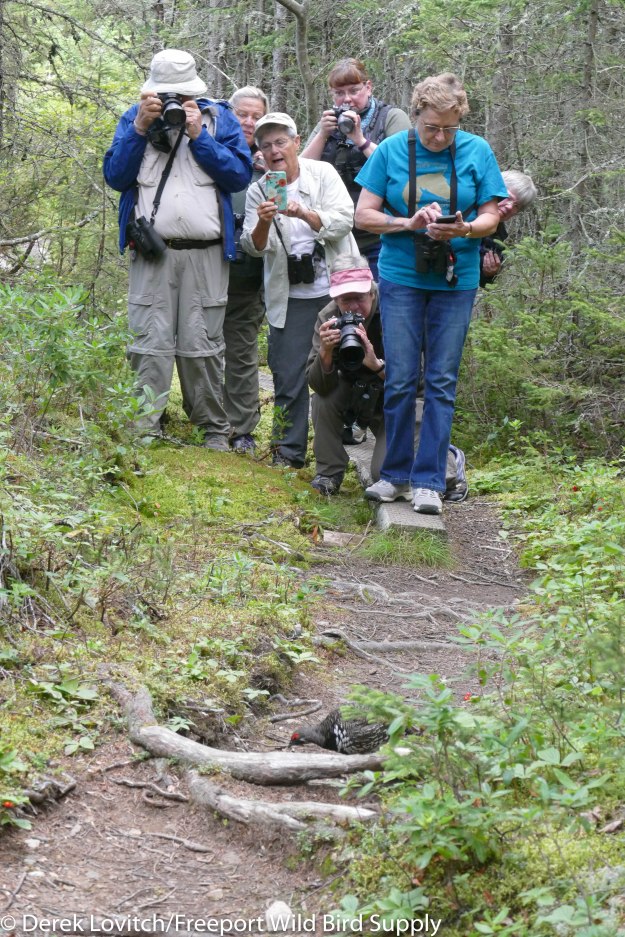
Day 3 found us making an even earlier start, but we were rewarded with our efforts with a dapper male Spruce Grouse doing its thing in the trail at Boot Head Preserve in Lubec.
3. Sat morning
34. SPGR433. SPGR332. SPGR131. SPGR-group

Following that success, some edge- and sky-watching at the bog there yielded fly-over Red Crossbills (2+), 3 Pine Siskins, and among the scattered warblers in small flocks working the edge, at least 6 Palm Warblers (local breeders).  We also began to truly get a sense for just how incredibly abundant Red-breasted Nuthatches are in the forests around here right now – undoubtedly portending a great finch winter to come!

Our Lubec-area day continued with a stroll at Quoddy State Park, where Red-breasted Nuthatches were once again downright deafening. At least 4 Red and 3+ White-winged Crossbills were detected, and we spotted a Philadelphia Vireo within one of the mixed flocks around the edge of the bog. There, we also took time to enjoy the plants of this fascinating habitat, including carnivorous Pitcher Plants and the two species of sundews.

Our busy and productive morning continued at the Lubec Bar and Flats, where a large number of shorebirds had aggregated. Although it has apparently been slow here recently, we found a rather decent number and diversity of shorebirds. I do wish we were arrived about a half hour earlier, and had about an hour more time here, however!  About 1500 Semipalmated Sandpipers and 250+ Least Sandpipers were joined by 75-100 Sanderlings (a surprisingly high count for here), 60-80 Black-bellied Plovers, a handful of Semipalmated Plovers, 1 Ruddy Turnstone, and 1 Whimbrel.

Lunch at Cohill’s was a hit. In fact, the Shepherd’s Pie turned out to be the favorite meal of the trip for two people, although I was quite over-satisfied with my “Drunken Potato” with Guinness gravy and cheese curds.

Following the obligate stop at Monica’s Chocolates – where we left with the cooler overflowing! – we headed back to Quoddy State Park for some relaxing sea-watching. In 1.5 hours, we tallied at least 14 Sooty Shearwaters (making up for the lack of them on our boat trip), counted 10 juvenile Laughing Gulls (they seemed unusually frequent up here this year, and of course, we tried to string each of them into a jaeger!), picked out a few Razorbills, and spotted two Northern Gannets, and excitingly, two Atlantic Puffins. A few more Great Cormorants and a dozen Black-legged Kittiwakes were noted, for those who hadn’t yet gotten their fill.
35. Quoddy SP

Scanning the flats again, but this time from the roadside, we finally picked up a single White-rumped Sandpiper, increased our tally to 6 Short-billed Dowitchers, and otherwise improved on our looks at the other species from earlier.
36. Lubec flats

While Pike’s Puddle was nearly dry and devoid of birds, the beach on the other side of the road yielded a juvenile Baird’s Sandpiper. That was cause for celebration enough, but the show was stolen when a Merlin came out of nowhere and nabbed an unsuspecting Semipalmated Plover. That’s a hearty meal for even a female Merlin, so after quickly dispatching it, she struggled to drag it across the rocky beach before finally taking off and disappearing into the trees to have her dinner.
38. MERL

37. BASA
Phone-scoped documention of the Baird’s Sandpiper

As did we…and no Derek Lovitch tour is complete without a brewery, apparently, so our evening’s destination simply had to be the new Lubec Brewing Co!

No visit, tour or otherwise, gives me enough time to bird this area. This four-day weekend is truly just a sample, and despite my interests in going back to the Lubec flats or the Eastport gulls, after two long days of jam-packed birding, we began our day (after a leisurely breakfast at Helen’s) simply by watching the shorebirds behind our motel.  606 Semipalmated Sandpipers, 41 Semipalmated Plovers, 20-30 Least Sandpipers, and another out-of-place-on-mud Sanderling surpassed expectations.

I like to slowly mosey back home, and I like to mix in a new site or two on each tour. Therefore, instead of racing east only to start the drive back west, I decided to do some exploring, beginning with the Mason Bay Conservation Area on the Jonesboro/Jonesport border.  More Red-breasted Nuthatches and a couple of mixed species foraging flocks were indication that this is a spot worth checking in the breeding season, and at the end of our stroll (which included some more botanizing, a few butterflies, and fun with Tent Caterpillars) another Red Crossbill passed overhead.

A typical stop for me when taking Route One back towards Ellsworth is Addison Marsh. Although we arrived at high tide and the productive mudflats and river edge were no longer visible, the salt pannes provided some entertainment. Although diversity was low, we could not have asked for more enjoyable views of a mixed flock of Least and Semipalmated Sandpipers. A couple of Solitary Sandpipers and a Greater Yellowlegs passed overhead, and a couple more Northern Harriers and Bald Eagles, along with three migrant Ospreys, stirred the pot.
40. Addison 2
A great opportunity to compare Least and Semipalmated (center) Sandpipers.
39. Addison1

Exploring access points to scan Flat Bay in Harrington, we found some shorebirds here and there as the ride finally started to go out. As shorebirds were appearing off of Oak Point, I realized lunchtime was approaching, and I decided to get back into the van before I spent the next three hours making everyone (myself most definitely included) starve as I sorted through shorebirds. Besides, a rapidly increasing northwesterly wind was making it challenging to see any birds in the distance (our first experience with anything other than perfect weather all weekend!).

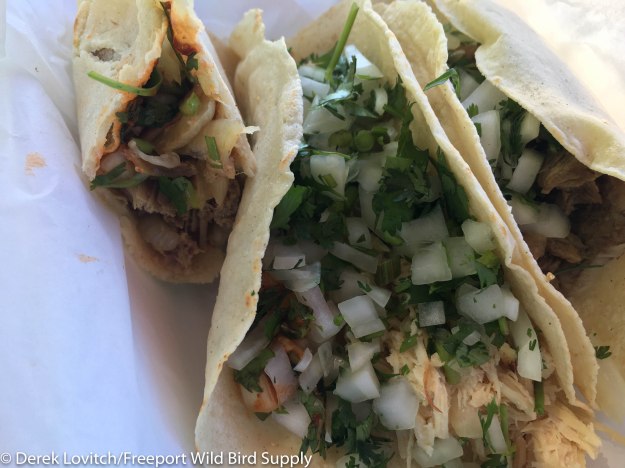
But to be honest, most of that exploring was just to put us in position for Vazquez Mexican Takeout in Millbridge for lunch (second only to Helen’s pie as sought-after “twitches” for this tour!). I ate too much, as usual. Actually, gluttony was a regular theme of this tour, as many of us were forced to roll out of many of our meals. Apparently, we were all single-handedly trying to jumpstart the region’s economy with our consumption!
41. Tacos

A quick check of Hog Bay was thwarted by the increasing winds, and that was a sign it was time to begrudgingly bring our birding to an end and make our way back home. From Sabine’s Gulls to Spruce Grouse, from thousands of Bonaparte’s Gulls to hundreds of Red-breasted Nuthatches, from blueberry pie to “tacos as good as in McAllen, Texas” (according to one of our transplanted participants), and from pitcher plants to Fin Whales, there is no doubt that I will be looking forward to my next tour to this awesome area!  In fact, one participant on this year’s tour has already signed up for 2018. That should tell you something!

The Two “Shorebirds and Beer” Birds on Tap – Roadtrips of 2016

1. Brew_Bus_store_from_Stacey_edited-1

“Shorebirds and Beer” was our first-ever “Birds on Tap – Roadtrip!” in partnership with our friends at The Maine Brew Bus last August. Now our 6th trip together, combining casual yet instructive birding in some of the state’s best seasonal hotspots with visits to two of our fantastic local breweries, we planned a return to Scarborough Marsh – where it all began!

And by popular demand, we added a second date. So this year, we had two “Shorebirds and Beer” departures, on August 7th and again on August 14th.  Both visited Scarborough Marsh, focusing our efforts on migratory shorebirds, but combined pairs of very different breweries.

We began the August 7th visit to Scarborough Marsh at the Eastern Road Trail.  A nice variety of birds were observed, including a couple of very cooperative singing Nelson’s Sparrows. Unfortunately, we found our destination, the salt pannes on the northern side of the marsh to be completely bone-dry due to this year’s drought. Needless to say, the numbers of shorebirds were not what we were hoping for. In fact, other than a few small groups of Least Sandpipers popping in and out of the grass, the pannes – often the most productive place in the entire marsh at this season – were completely devoid of shorebirds!
2. from_Don1_edited-1
3. EasternRoadTrail_group

However, along the road, we had some good instructive lessons, including ultra-cooperative Least Sandpipers than began our introduction into shorebird identification. We learned how breaking shorebirds down into family by shape and size first narrows the choices, and allows you to focus on just a few species to identify. We even had a perfect example of this, when three members of the genus Tringa were standing side-by-side as a dainty Lesser Yellowlegs joined a couple of Greater Yellowlegs while a bulky Tringa-on-steroids, Willet (of the Eastern subspecies, for the record) looked on.

Heading over to Pine Point as the tide rapidly rolled in, various human disturbances in Jones Creek limited shorebird diversity, but we could not have asked for more cooperative Semipalmated Sandpipers and Semipalmated Plovers (about 200 and 100, respectively) that really allowed us to practice our plover vs. sandpiper feeding shape and style dichotomy.
4. from_Don2_edited-15. from_Don3_edited-16. from_Don4_edited-1
7. SEPL_SESA-group_edited-1

We then moved on to work on specific identification.
8. SEPL_JonesCreek,8-7-16_edited-19. SESA,JonesCreek,8-6-16_edited-1a

The remainder of our birding time was spent scanning the last of the distance sandbars (adding Black-bellied Plover to the shorebird checklist), before one of the members of the group called me over to check out an odd bird she found in her scope. It was an American Avocet!

While distance and heat shimmer precluded documentation photos, everyone was treated to a look or two in the scope of this very rare-in-Maine bird that isn’t seen every year anywhere in the state. While the long, fine bill was barely discernable at the distance, the very long legs and overall tall size (compared to nearby gulls) coupled with the distinctive tri-colored appearance (buffy head and neck, white underparts, and black wing with a broad white stripe) looks like no other.

And then it was time for a celebratory beer!  After a celebratory hand-pie for lunch, of course.
9A. hand_pie_edited-1

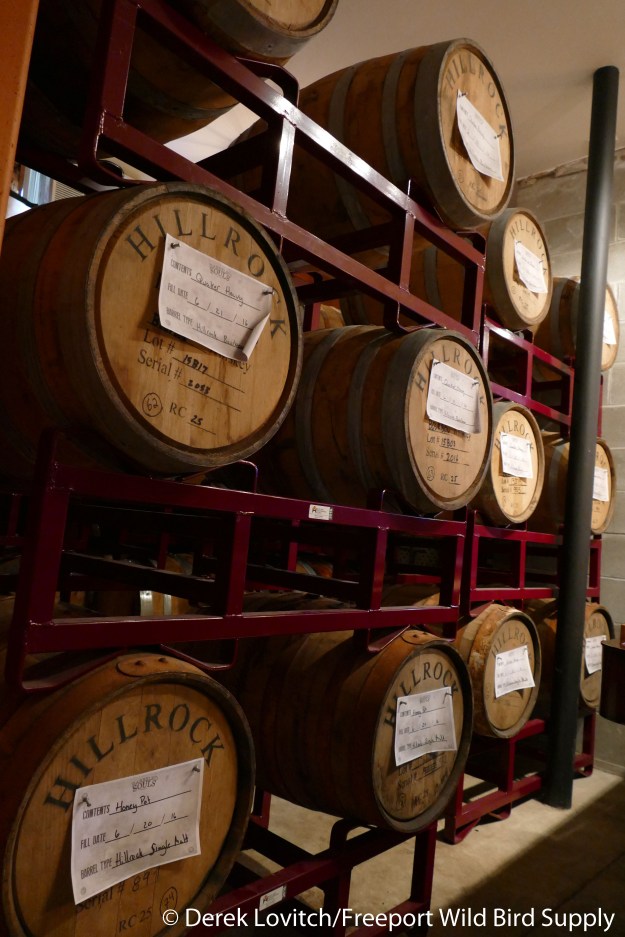
First up was Barreled Souls in Saco, the only brewery in the country that is producing 100% barrel fermented beer in their Burton-Union system. Producing a mere 400 barrels a year – yet still offering 10-12 brews on tap at all times! – this time-consuming process which included two stages of fermentation, allows for the creation of some very complex beers.

Our samples today began with Half-Shilling, a very-light-bodied and low-ABV Scotch Ale as an introduction. Rosalita followed, using agave nectar in the primary fermentation and then steeped with hibiscus flowers during secondary fermentation, making for a very floral and subtly-sweet brew.  Space Gose was next, a summer refresher made with Maine sea salt, lemon zest, and coriander. By request, we then did a complete beer-wise-180 and shifted over to a heavy Barrel-aged MCAM – a very unique breakfast porter made with cinnamon, French toast, and bacon!  The spice, sweet, and smokiness were evident, as were the hints of bourbon from the bourbon barrels it was aged in. It was a potent, and very tasty, beer and a good representation of Barreled Souls’ creativity.

10. Barreled_Souls2_edited-111. Barreled_Souls3_edited-112. Barreled_Souls1_edited-113. Barreled_Souls4_edited-114. Barreled_Souls5_edited-115. Krisiti_tatoo_edited-1
Kristi shows off her very-appropriate for a birding/beer tour tattoo.

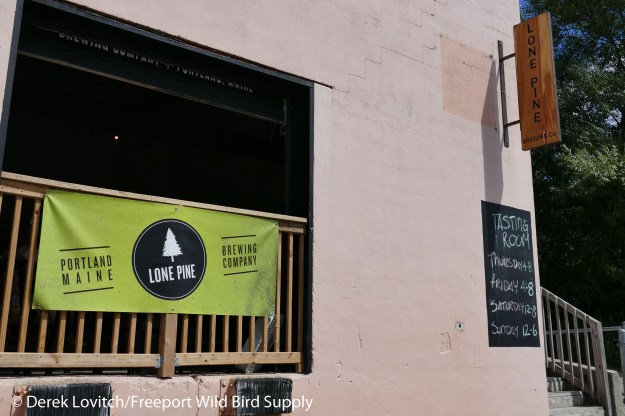
Our final destination of the day was Lone Pine Brewing in Portland. We began with their flagship Portland Pale Ale, using 90% Aroostook County-grown malts. This is a really great pale, with lots of flavor but incredibly smooth and lacking bitterness. Pale ales are occasionally “boring” to those who like a lot of hops, but this exceedingly well-balanced beer could be a new go-to for quite a few of us on the tour.

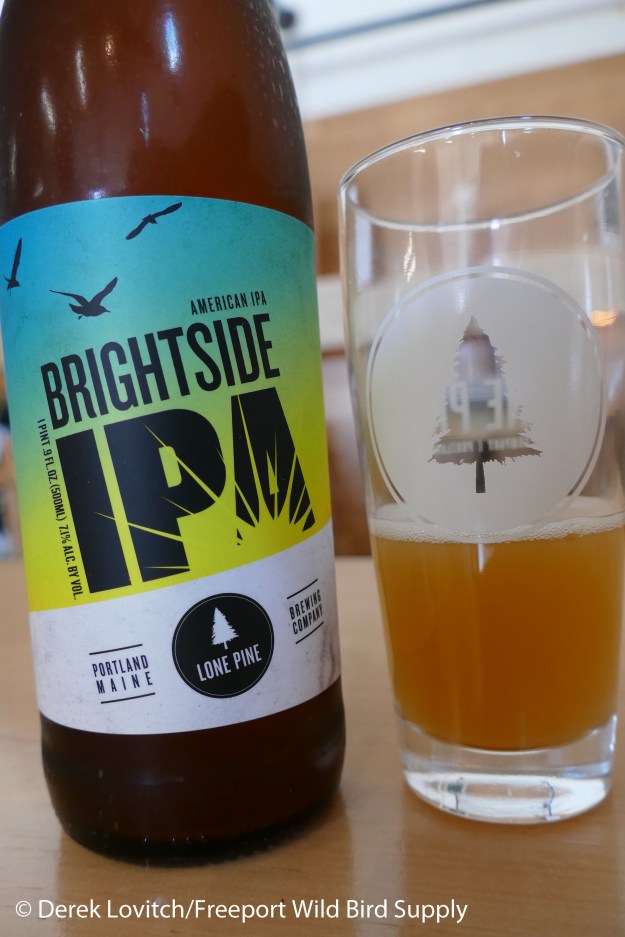
Their new Brightside IPA was next on our agenda, and I would put this right up there with the best IPAs in the state. Bright and citrusy, yet without that overwhelming bitterness that often pervades stronger IPAs (this one clocks in at a potent 7% alcohol), it may be way too easy-drinking. It was also a very “accessible” IPA for the non-hopheads. One member of group in particular, who normally doesn’t like IPAs at all, was actually quite a fan of this also well-balanced beer. For me, a sign of a truly great beer is one that is so good is that it appeals to those who normally don’t like that particular style.
16. Lone_Pine_outside_best_edited-117. Lone_Pine_group_edited-118. Lone_Pine_group1_edited-119. Brightside_IPA_edited-1

The following weekend, we once again began our birding at Eastern Road. Despite some rain in the past few days, however, the salt pannes were still dry. But to and fro, we encountered a nice mix of shorebirds, including some unbelievable cooperative Least Sandpipers once again.
21.LESA,EasternRd_edited-1
This one was phone-binned (a photo taken with an iPhone through my binoculars)!

Three Spotted Sandpipers – our first shorebirds of the day, actually – were encountered as we began our walk, and a decent number of Semipalmated Sandpipers were in the dried pannes. Both Lesser and Greater Yellowlegs were seen together for instructive studies. A distant hunting Northern Harrier, more singing (but this week, not seen) Nelson’s Sparrows, and lots of Cedar Waxwings and Song Sparrows foraging in the trailside scrub were among the highlights. We also took the time to watch Common Wood-Nymph butterflies, Great and Snowy Egrets, and stopped to enjoy the magnificently beautiful color of the eyes of Double-crested Cormorants.
20. GREG,EasternRd_edited-1
Great Egret posing.

On the walk back, with the tide just starting to recede, we had the opportunity to check out a few Semipalmated Plovers, Semipalmated Sandpipers, and a Least Sandpiper all side-by-side, just about 20 feet away.
22.SESA,LESA,andSEPL1,Eastern Rd,8-14-16_edited-1

A quick stop at the Pelreco marsh produced yet more Least Sandpipers, a better view of the details of Greater Yellowlegs, two spiffy adult Little Blue Herons, and most importantly: Patches! Arguably one of the rarest birds in the world, this Tricolored Heron x Snowy Egret hybrid that has been frequenting the marsh for the past 3 years put on quite a show for us. It could – hypothetically – be the only one of its kind!
23.TRHExSNEG-best,8-14-16_edited-1

Thanks to a change in brewery itinerary for this second run of “Shorebirds and Beer,” I was able to stall at the marsh long enough to allow enough water to flow out that mud was rapidly being exposed at Pine Point. And with it, excellent numbers of all of the expected shorebirds began to appear: 400+ Semipalmated Sandpipers, 300+ Semipalmated Plovers, 150+ Black-bellied Plovers, 22 Short-billed Dowitchers, 8 “Eastern” Willets, 6 White-rumped Sandpipers, 4 Ruddy Turnstones, a few Least Sandpipers, and 2 Greater Yellowlegs.

No American Avocet though, but a hunting Peregrine Falcon zipped through, causing quite the ruckus.

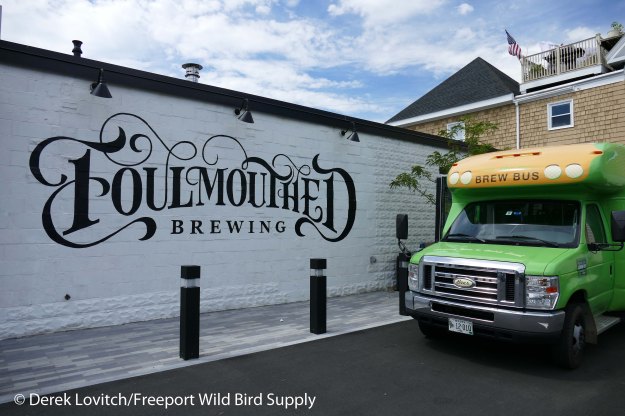
And then it was once again beer o’clock, and today we began our beer-ing tour with a visit to South Portland’s Foulmouthed Brewing. Only open for 7 weeks, it was a new destination for everyone on today’s tour – myself included – and we learned all about the owners, the fledgling (see what I did there?) brewpub (yup, they opened a restaurant too), and their wide range of beers.  We even enjoyed a not-quite-ready-for-prime-time sample of their new “Blue Balls,” a Belgian dark, strong beer with blueberries. Still a week or two from being finished, it was a great introduction to their creative brewing side.
24.Foulmouthed1_edited-125. Foulmouthed3_edited-1
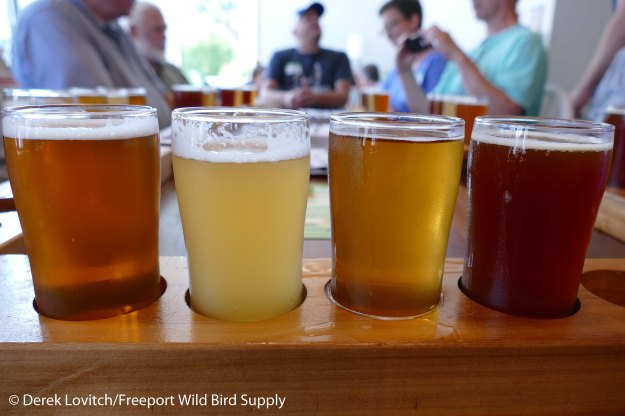
Inside at the brewpub, we sat at the big kids’ table and sampled four of their current offerings. Beginning with Brat, a German-style session with its bright and clean Noble hop finish, we moved onto Half Wit, a “hybrid” (not of heron and egret, mind you) of a Belgian Wit and an American Pale. A favorite of many on today’s visit, it was smooth and accessible, with enough body and flavor to hold its own. Kaizen Saison was up next, with its rotating hops producing a different flavor and aroma profile with each batch. We finished up with Rhubarb de Garde, a strong amber aged on rhubarb. I found a little extra sweetness and especially just the hint of tart from the rhubarb complimented each other nicely.
26. Foulmouthed4-edited27. Foulmouthed5-edited_edited-1

Our final beer stop of the day was a return trip to Lone Pine Brewing. Tom once again took us through their methods and philosophy, and shared with us their Portland Pale Ale and Brightside IPA. The more I drink the Portland Pale, the more I love this perfectly balanced beer.
29. Lone_Pine_Abby_edited-1
And Abby was dressed in our honor today.

28. Tom_and_Don,LonePine,8-14-16_edited-1
While Don, always attentive, looked like he had just spotted a Blue-footed Booby.

With our final sips of Brightside, the second installment of Shorebirds and Beer came to a close and it was time to head back home. Every day is different during the window of shorebird migration, and these two visits to Scarborough Marsh exemplified that. A wide range of shorebirds were studied, as we started to expand our identification – and appreciation – toolbox. And between Barreled Souls, Lone Pine, and Foulmouthed, we were exposed to a wide range of beer styles and methodologies.
30. brewbus_at_LonePine_edited-1

And both are the goals of our Birds on Tap – Roadtrip! series: exposure to some of our seasonal birding highlights and our vast array of fantastic local breweries. We hope you’ll join us for our next roadtrip, on October 9th, when we head to the deep south to visit Kittery’s Fort Foster and Seapoint Beach for our birding, and Tributary and Hidden Cove Brewing for our beering. Hope to see you then!

2016 Birding By Schooner Trip Report

My 7th (now annual) Birding By Schooner aboard the Lewis R. French tour got underway on Monday morning from Camden Harbor with sunny skies and a light breeze perfect for a little sailing. Black Guillemots, Common Eiders, and Laughing, Herring, and Great Black-backed Gulls escorted us out of the harbor, as Ospreys kept a close eye on the proceedings.
1. Camden Harbor Departure_edited-1
3. map session_edited-1

Out in the bay, Harbor Porpoise were soon spotted (they were very plentiful on this trip) and plenty of Harbor Seals. Merlin, Bonaparte’s Gulls, and Common Loons were quickly added to the list. Sailing towards the Fox Islands Thorofare, we picked up an unexpected inshore Great Cormorant, an immature hanging out with Double-cresteds on Scraggy Island. Burnt Cove Harbor on Swan’s Island was our destination for the evening.
2. Entering Fox Islands Thorofare_edited-1

In the morning, we took a walk onshore, birding and naturalizing our way to the lighthouse. A Red Crossbill flew over calling as we landed at the dock, my 132nd all time Birding-by-Schooner species! The walk sampled the common denizens of the Red Spruce-dominated Acadian habitat of the region, with numerous Black-throated Green Warblers and many others. A White-tailed Deer crossed our path, and we spent some time learning the local trees.
5. Burnt Coat Harbor 2_edited-1
As we checked out the feeding station at this house, we couldn’t help but feel as if we were being watched…and we were!  I remember being creeped out by this doll when we last landed here a few years ago.
6. Burnt Coat Harbor 3_edited-1
7. Burnt Coat Harbor 4_edited-1
8. DEJU1C_edited-1

9. Burnt Coat Harbor -later_edited-1
10. Burnt Coat Harbor-departing_edited-1

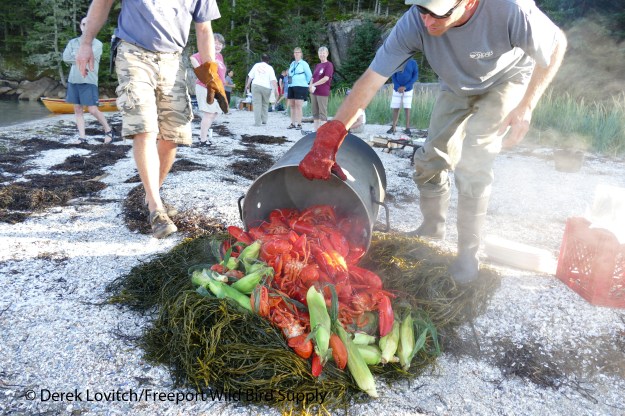
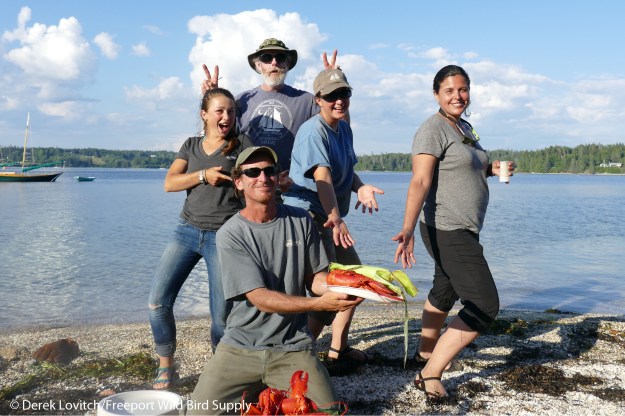
Back on board, the fog had lifted, and we sailed through Blue Hill Bay, arriving at tiny Babson Island for the evening. Usually, the famous lobster bake is the finale of the trip, but this tour’s focus is having the chance to get out to Seal Island – far offshore and needing a narrow suite of conditions to make it possible (or, at least comfortable). Therefore, Captain Garth decided to mix things up a bit and take advantage of a pleasant evening and a lovely little beach. Much food was consumed. Several more Bald Eagles were noted.
11. Babson Island1_edited-1
12. Babson Island 2_edited-1
13
Tobias, visiting us from Sweden, shares the story – and flavors – of Skane aquavit, while Dan shares stories of Garth as a young mate.
14
15. Lobster Bake 3_edited-1
16. crew at lobsterbake_edited-1
The crew.

17. post Lobster Bake1
18. post Lobster bake2

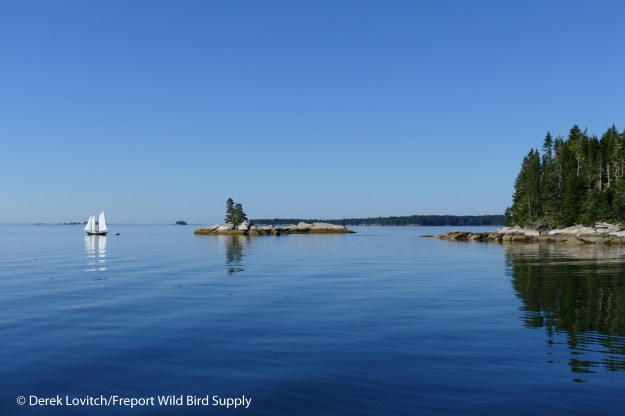
Once again, Garth nailed the window, and conditions were absolutely perfect for a trip out to Seal Island, part of the Maine Coastal Island National Wildlife Refuge.  We passed between Stonington and Isle Au Haut, and cruised by Saddleback Ledge and into open water. I became more vigilant.
19. Babson Island am_edited-1
20. Saddleback Ledge_edited-1
Saddleback Ledge

One of the reasons I most look forward to the annual trip is for the chance to visit Seal Island. Our goal is to head out there every year and spend a night anchored offshore. It’s a very unique and special opportunity, and of course a chance at some great birding. Not the least of which is the chance to see “Troppy,” the Red-billed Tropicbird that has come to the island for the past 10 summers (and 11th year in the area overall). But this year, my anticipation about a visit was stoked even more with a spate of other rarities recently, including a Royal Tern, a Yellow-crowned Night-Heron, and – two days prior to our departure, an inconceivable 1st Western Atlantic seaboard record of a Great Knot! A bird that breeds in Siberia and winters mostly in Southeast Asia and Australia, this is truly an incredible record.  Needless to say, it was not on my annual list of Next 25 Birds for Maine! I was showing symptoms of rarity fever.

Also, needless to say, I couldn’t wait to get out there!  But, at the mercy of the wind (or often, lack thereof), I had little say in whether or not we’d have a chance to look for it (although I really had zero expectations of it sticking around), Troppy, other rarities, or simply enjoy puffins, Common Murres, Razorbills, and calling Leach’s Storm-Petrels through the night.

With Seal Island on the horizon, we scanned the open waters, which we found to be unusually quiet. Commuting Common Terns and several Arctic Terns (who recently regained the crown of longest-distance migrants in the world: up to 55,000 miles a year!) began to appear, a sign that we were getting close. Under full sail (we often have to motor-sail to get this far out on a nice enough day), we spotted a lone Northern Gannet, and as we neared the island, numerous Atlantic Puffins became visible.
21. juvARTE1_edited-1
Juvenile Arctic Tern
22. Seal Island approach_edited-1

We slowly plied the waters off the islands southwest side, enjoying close up puffins, practicing our tern identification, watching Great Cormorants, and keeping an eye out for…

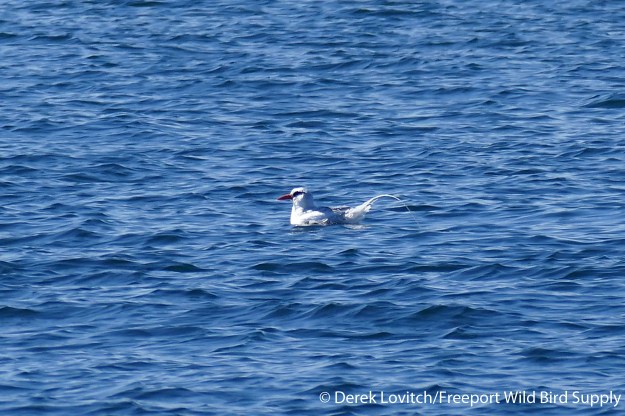
Troppy!  Just a few minutes ahead of schedule at 4:17pm, the famous Red-billed Tropicbird appeared. I was able to spot him as he was flying low, and dropped in for his usual (as long as it is sunny!) afternoon bath. Captain Garth and 1st mate/co-Captain Dan adeptly positioned the boat to slowly approach him on the water, without flushing him. We got incredibly close and cameras clicked away (my photos are a little distant as I decided to try for video this year when we were making our closest approach). Soon, he relocated to his more-usual bathing location closer to the island.
23. Troppy1
24. Troppy8_edited-1

Success!  And with happy birders and a Captain basking in his glory of once again perfectly timing our arrival to once again put us in perfect position for an enjoyable view, we sailed over to the Eastern Bight and dropped anchor for the evening. Besides our incredible success rate of seeing Troppy (5 out of 6 visits to Seal now, a great batting average), this tour also – again, conditions permitting – affords the unique opportunity to spend a night off of this incredible and remote island.

As per tradition, we invited the Seal Island crew of Puffin Project biologists aboard for dinner (thanks to the talents and perfect planning of our cook, Carla and her Mess Mate, Genevieve) and a visit, giving the crew and participants a chance to pepper them with all sorts of questions. We all kept an eye out for shorebirds passing or rounding the island, and Keenan and crew took the opportunity to survey the growing contingent of Laughing Gulls that have been congregating on the island. The sunset was particularly spectacular this evening as well.
25. Seal Crew visits2_edited-125. Seal Crew visits_edited-1
25B. L1060029_edited-1
26. Seal Sunset 2_edited-1

But we weren’t done with the “unique experiences” yet!  In addition to the remoteness of our anchorage, spending the night at Seal also gives us a chance to listen (and perhaps even see) Leach’s Storm-Petrels, vocalizing as they return to their nesting burrows under the cover of darkness.

While staying up a little later, or getting up a little earlier, would likely yield some calling birds, I don’t want to just hear them; I want to experience the cacophony to its fullest extent. Therefore, I suggest people wake up in the middle of the night for a listen. This year, I proposed waking up at 3:00am, and since several folks wanted to also see them, staying up through the twilight until sunrise.

As I stumbled to the deck at 3, I was pleasantly surprised to see seven people had joined me in the insanity. And, with a light fog rolling in (perfect!), the birds were calling a lot – and some giving their almost-sinister, cackling chatter very close to the boat.  Five of us stayed up right through daybreak, and although we didn’t actual spot a Leach’s (although Dan glimpsed a shadow of what was undoubtedly one), we thoroughly enjoyed the experience. Adding to the mystique was the low fog, and the low, deep moans and groans of baying Gray Seals.
27. Seal sunrise_edited-1

We were, however, anxiously anticipating the arrival of morning coffee and muffins!

A Savannah Sparrow briefly alighted on the boat before returning to the island, puffins and guillemots were abundant, and terns were busy, heading to and fro. We only saw one Razorbill on the water, and no Common Murres on this visit, and sorted through the handfuls of shorebirds that were around (migrants, mostly Semipalmated Sandpipers and a smattering of others, along with local and vocal family groups of Spotted Sandpipers).

The skies cleared after breakfast and with a light south-southwest wind, we decided to head out for a little offshore sailing. We passed along Seal, hoping for another visit from Troppy, but then turn around the north end of the island and tacked our way offshore. Dan, Garth, and the sailing fans were having fun, while the birding fans enjoyed the numerous commuting puffins. We also spotted a few good pelagics: led by a Cory’s Shearwater, my first ever from the windjammer, soon followed by a second sighting. A single Great Shearwater passed close by, shortly before encountering a more-distant raft of 36.  There were painfully few Wilson’s Storm-Petrels, but we did have a Minke Whale, and moments after I said we “could use a Manx Shearwater now” a Manx Shearwater passed by!
28. Seal Day 2_edited-1<

We had hopes of sailing around Matinicus Rock, but time and wind suggested it was time to head inshore. We rounded Wooden Ball Island, still under full sail, but then the wind ran out. Drifting mostly with the incoming tide, and soon into dense fog our progress was slow. But napping was in order, and this was the perfect opportunity.

We needed our yawl boat to push our way past Vinalhaven and into the Fox Island Thorofare where the fog finally lifted. Anchoring between the village on North Haven and a dock on Vinalhaven, our day came to a close. Unfortunately, we arrived too late in the day for an evening walk.
29. Fox Islands Thorofare 1_edited-1
30. OSPR1_edited-1
31. Galley1_edited-1
32. Green flash_edited-1
Look? We saw “the green flash” at sunset!

50. breakfast of champions_edited-1
Tobias’s breakfast of champions.
It was a lovely, albeit humid and rapidly warming, morning, which began with a pair of vocal Merlins from the boat. Making up for lost time, we hopped to shore, and I lead a walk in the North Perry Creek Preserve on Vinalhaven. Northern Parula, Black-and-white Warbler, Ruby-throated Hummingbird, and many others were added to our triplist, but most birds were Black-capped Chickadees, Golden-crowned Kinglets, Black-throated Green Warblers, or Red-breasted Nuthatches. Twelve-spotted Skimmer (a dragonfly), Smooth Green Snake, Wood Frog, and a spiffy diurnal moth, the Virginia Ctenucha were also observed.
51. North Perry Creek Preserve_edited-1
52. North Perry Creek Preserve 2_edited-1

We extended our loop a bit, but our selected return trail turned out to be more rugged than expected, so we made it back just in time for lunch. After another scrumptious, and this time well-earned, meal, we pushed to the east, then set sail and turned north into East Penobscot Bay.

While the occasional Razorbill is regular in the bay, small groups are often found after storms, and at this time of year fathers leading flightless juveniles are regularly encountered. But earlier in the season, Garth had started noticing 30-40 regularly in a particular area, roughly between Eagle, Butter, and Bradbury Islands. Seeing them often enough, it was more than a random occurrence.

Needless to say, I was intrigued (and a little bit proud, I must say!), and since we only had one distant Razorbill out at Seal, it seemed like a good plan to check it out today. As we approached the area, I spotted one Razorbill in flight, then a group of 5 passed by. Black Guillemots were even more numerous than usual, and gulls (including several Bonaparte’s) were more common than elsewhere in the bay. But no rafts of Razorbills.
53. BLGU2_edited-1
54. BLGU5_edited-1
56. BLGU12_edited-156. BLGU9_edited-1
I kept scanning, but noticed Garth was looking a little disappointed. Then I asked Dan to check out what appeared to be a large raft of birds. I immediately thought Razorbills, but the group was so big, I doubted myself. It was way more than 30-40. Were they just eiders distorted by distance and heat shimmer, or were we about to see something really, really exceptional?

We’re going to go with the latter. But no, there were not 30-40 Razorbills anymore. There were now 252. And while there were a few fathers escorting kiddos, the majority of the group were adults. I need to do some research, but this is probably an unprecedented number for inshore waters, and perhaps even a summertime record for Maine? Regardless of the statistics, it was amazing, and as we simply drifted among them, many photographs were taken, and we were even able to hear many of them growling, and one of the juveniles piping.
65. RAZO1_edited-1
66. RAZO8_edited-1
67. RAZO12_edited-1
68. best1-RAZO13_edited-1
70. RAZO15_edited-1
71. RAZO_juv1_edited-1
72. RAZO-juv4_edited-1
73. RAZO30_edited-1
74. RAZO33_edited-1
75. RAZO38_edited-1
I also spotted a spec in the distance, which I photographed for later analysis. Blowing it up on the computer, I can confirm the 134th species to be seen from the Lewis R. French during the Birding By Schooner Tour: Red-throated Loon (a rare but regular summertime lingerer that I have been expecting to spot at some point).

But, did I mention all the Razorbills!?

59. Garth and Dan_edited-1
With another extraordinary experience under our belts, we pulled into Gilkey Harbor on Islesboro for the night.
57. roast beef_edited-157. Carla Cooking1_edited-1

Carla at work. 
60. dinner line_edited-1\
61. last sunset_edited-1
62. last sunset3_edited-1
63. last piping_edited-1
64. cannon2_edited-1

I was up early the final morning, hoping to add a few more singing birds from the mainland to what was a paltry total triplist. But once again, the dawn chorus was nearly non-existent, and for the first time, species such as Swainson’s Thrush and Winter Wren went undetected during our tour. Was it just because of our few-days-later-than-usual outing? Did the drought lower productivity and birds have already cleared out? Or, was it an early and successful breeding season and birds have already finished doing everything other than secretively undergo molt?
33. last morning1_edited-1

While we did have 1 or 2 fewer walks than usual, we had a better seabird tally than in most years. But no migrant swallows? And a low diversity of migrant shorebirds.  So our total checklist was well below average, so I was working hard to pad the list: American Black Duck and Belted Kingfisher in the harbor, and as we slowly sailed back to Camden: Turkey Vulture and Red-tailed Hawk over the Camden Hills.

Of course, no one would have traded Troppy, three shearwaters, countless calling Leach’s Storm-Petrels, or an unprecedented aggregation of Razorbills for a few more total ticks!

As Ospreys called around us as we entered Camden Harbor – the same ones that announced our departure, and the trip came to a close, another successful, unique, and bird-tastic Birding By Schooner tour was in the books.
34. entering Camden1_edited-133A. entering Camden2_edited-1
35. COLO11_edited-1
One of the first birds we saw was also the last, this Common Loon, apparently with a broken lower mandible, sneaking away from our docking boat.

Here’s our complete list from the trip:

  1. Mallard
  2. Canada Goose
  3. Osprey
  4. American Goldfinch
  5. Yellow Warbler
  6. Rock Pigeon
  7. European Starling
  8. Cedar Waxwing
  9. American Robin
  10. Song Sparrow
  11. Chimney Swift
  12. Double-crested Cormorant
  13. Herring Gull
  14. Great Black-backed Gull
  15. Black Guillemot
  16. Laughing Gull
  17. Common Loon
  18. Ring-billed Gull
  19. Bonaparte’s Gull
  20. Merlin
  21. GREAT CORMORANT
  22. Bald Eagle
  23. American Crow
  24. Mourning Dove
  25. Killdeer
  26. RED CROSSBILL
  27. Red-breasted Nuthatch
  28. Purple Finch
  29. White-throated Sparrow
  30. Black-capped Chickadee
  31. Gray Catbird
  32. Dark-eyed Junco
  33. Yellow-rumped Warbler
  34. Black-throated Green Warbler
  35. Common Yellowthroat
  36. Savannah Sparrow
  37. Broad-winged Hawk
  38. Hermit Thrush
  39. Eastern Phoebe
  40. Great Blue Heron
  41. Spotted Sandpiper
  42. ARCTIC TERN
  43. Semipalmated Sandpiper
  44. Northern Gannet
  45. ATLANTIC PUFFIN
  46. RED-BILLED TROPICBIRD
  47. Greater Yellowlegs
  48. Semipalmated Plover
  49. Ruddy Turnstone
  50. LEACH’S STORM-PETREL
  51. RAZORBILL
  52. CORY’S SHEARWATER
  53. Great Shearwater
  54. Wilson’s Storm-petrel
  55. MANX SHEARWATER
  56. Common Raven
  57. Blue Jay
  58. Downy Woodpecker
  59. Northern Parula
  60. Black-and-white Warbler
  61. Ruby-throated Hummingbird
  62. Northern Flicker
  63. Chipping Sparrow
  64. RED-THROATED LOON
  65. American Black Duck
  66. Belted Kingfisher
  67. Turkey Vulture
  68. Red-tailed Hawk

And the list of mammals, and a selection of other critters:

  1. Harbor Seal
  2. Harbor Porpoise
  3. Red Squirrel
  4. White-tailed Deer
  5. Orange Sulphur
  6. Gray Seal
  7. Minke Whale
  8. Wood Frog
  9. Twelve-spotted Skimmer
  10. Smooth Green Snake
  11. Virginia Ctenucha
  12. Great Spangled Fritillary
  13. Red Admiral

Since every year’s tour is so different, if you would like to look back on previous trips and their respective birdlists, please click on the links below. Furthermore, for more (and better!) photographs of the birds we see, check out the tours (2015 + 2013) that Jeannette was on!

2015

2014

2013

Hope to see you aboard next year!


A Weekend Adventure in Search of American Three-toed Woodpecker

I’ve been feeling the gravitational pull into the boreal forest recently. No longer able to resist, and finding a way to make another hole in my schedule, Evan Obercian and I made a rather impromptu trip north this weekend, heading to one of the most incredible areas of the state. It’s been way too long since I have visited Baxter State Park – the “crown jewel of Maine” – and the surrounding boreal-transition habitats.

We definitely had a target bird for this trip: American Three-toed Woodpecker. However, this was really just the excuse to spend a few days birding together, exploring an area Evan hasn’t been too, and enjoying the area that I don’t get to nearly enough. And camping.

We hit the road on Sunday morning, not exactly early, making it to Lincoln in time for the quintessential Maine road trip lunch: Dysart’s. Driving through rain, with more rain in the forecast, we wondered about whether or not this trip was really the best idea. But by the time we arrived at Harvester Road just before 3pm, it was mostly sunny, warm but breezy, but of course rather quiet: it was the afternoon in the middle of July after all.
1. Harvester Rd,7-17-16_edited-1

2. Evan_with_DeerFlies_edited-1
Mostly, we just heard Deer Flies.

We admittedly did only a modicum of research as to where three-toed woodpeckers had been reported from recently, so used that as a guide for our stops, if only for reconnaissance. Olive-sided Flycatchers were particularly vocal and conspicuous, and encountered one Fox Sparrow. Other “boreal specialties” included 3 Palm and 2 Wilson’s Warblers, and 2 each of Yellow-bellied Flycatchers.

In the heat of the afternoon, we looked at more “bugs” than birds, such as lots of Aphrodite Fritillaries…
3. Aphrodite_Frittilary,HarvesterRd,7-17-16_edited-1

…But at our last stop at a particular prime looking woodpecker spot, we did enjoy great views of a Black-backed Woodpecker – a very good sign.

A thunderstorm kindly missed our campsite…
4. approaching thunderstorm,7-17-16_edited-1

..and we stayed up way too late listening to Common Nighthawks and a lone American Woodcock give way to a chorus of 3-4 Eastern Whip-poor-wills.

Come dawn, dense fog and dueting Common Loons precluded the desire to get out of the sleeping bags. The vociferous “whip” at 4:00am didn’t help, either, as welcome as its song was. As we ate a leisurely breakfast, the fog lifted.
5. view from Campground,7-17-16_edited-1

Once again, however, we realized we were vacationing more than birding, and it was already 9:00 when we entered Baxter State Park. Making a bee-line for the Nesowadnahunk area, we took the Tote Road, and not stopping until we hit the best boreal-transition habitat in the stretch of road north of the Nesowadnahunk Field Campground.
6. ParkToteRoad,7-17-16_edited-1

A couple of Gray Jays made their presence known, we spotted a molting Bay-breasted Warbler or two, but possible woodpecker habitat was in short supply.
7. park_woodpecker_habitat,7-18-19-edited

We continued to explore, and the combination from the recommendations of a friend (thanks, Luke!) and an unrelated tip from a park ranger, led us to unmarked trail that lead us to Nesowadnahunk Lake and the adjacent campground.
8. Kahtadin_from_NesowadnehunkLake,7-17-16_edited-1

Besides the view, a few “trip birds” on the water, and a cold drink, we finally put together vague sightings reports to figure out that some of the summer’s American Three-toed Woodpecker reports were from this road to THIS campground. Of course, it was the mid-afternoon, and it was now the worst time of day at the worst time of the summer to find secretive boreal woodpeckers!

But we had a plan for the morning now, and although we hustled back to the car with an approaching thunderstorm, we had renewed optimism for our search.

We worked our way back south on the Tote Road, spending a couple of hours casually birding in the trails of the Tracey-Elbow-Grassy Pond area. A pair of Boreal Chickadees, a couple of family groups of Ruby-crowned Kinglets, and plenty of Yellow-bellied Flycatchers were seen and heard, while Grassy Pond hosted 16 Ring-necked Ducks and 5 Common Goldeneyes.
9. Kahtadin_from_Grassy_Pond-edited

Mostly, however, we studied plants, insects, and other general nature observation. Stunning Ebony Jewelwings were everywhere…
10. matingEbony_Jewelwings_edited-1

…and we learned what a gorgeous damselfly the Variable Dancer was.
11. Variable_Dancer_edited-1

12. Boreal_or_NorthernBluet_edited-1
Boreal or Northern Bluet

Of course we continued to look for birds, and Evan tried creatively to get a closer look at a family group of Red-breasted Nuthatches…
13. Evan_closer_look_edited-1

…photographed a confiding Red Squirrel…
13a. Red_Squirrel_edited-1

…but perhaps this is why we haven’t been seeing many woodpeckers!
14. why_we_werent_finding_woodpeckers_edited-1

15. lichen_garden_edited-1

We offered advice to a hiker who was making the rather-tame bug situation much worse for herself, changed a tire from a tourist clearly out of her element, and gave a lift to two guys who might have been off a little more than they can chew on their day hike. As we left the park, we were feeling pretty good about having built up some good karma for the next day’s dedicated (and less lazy!) effort to see a three-toed woodpecker!  When the two guys tried to give us some money for the lift, we of course refused, as I said something like “return the favor someday.”  We had no idea how soon we would need such favors.

Back at our campsite at the Abol Bridge Campground (our last-minute trip precluded any chance of getting a site in the park, plus we wanted to stay between the park and the Telos Road area), we spent some time photographing the pair of loons in the river/pond behind our tent.
16. COLO_pair_edited-117. L1050464_COLO1_edited-118. L1050458_COLO2_edited-1

And then Evan prepared dinner…local (from Lincolnville) Belted Galloway steaks and wild-foraged chanterelles (earlier, Evan yelled for me to “stop” while we were driving. I thought he just saw a woodpecker, or a ghost. Nope, he saw mushrooms).
21. dinner2_edited-1
20. dinner_served_edited-1

Although we were still sans American Three-toed Woodpecker(s), we had a great day, and the sunset was the icing on the cake!
22. sunset1,7-18-16_edited-1

On the morning of our last day, we some how struggled out of the campground before even coffee, focused on seeing the woodpecker. We decided to first try the spot along the entrance road to the Nesowadnahunk Campground (not to be confused with the Nesowadnahunk FIELD Campground in the park) via Telos Road.

Stomping around the edges of a clearcut and bog for a while, it was beginning to feel hopeless, and we decided to stop at the campground for a cup of coffee, before heading further up Telos Road to renew our search in the promising spot off Harvester Road.

However, I noticed a diffuse trail on an old skidder track; almost exactly at the posted milemarker 6 (which was the only specific location given in the handful of vague eBird reports). We walked all of about 30 yards when this happened:
23. L1050571_firstATTW_male,NesowadnahunkRd, 7-19-16_edited-1

I am fairly sure a second bird we saw briefly was a juvenile, being fed by the male. We followed the male for a while, taking hundreds of photos, while basking in the glory of our success (my 372nd bird in Maine and #1 for about the fourth year in a row on my Predictions List of my next personal State Birds) and in the glory that is the enigmatic American Three-toed Woodpecker.
24. L1050633_ATTW_male1,NesowadnahunkRd, 7-19-16_edited-125. L1050644_ATTW_male2,NesowadnahunkRd, 7-19-16_edited-126. L1050597_ATTW_male3,NesowadnahunkRd, 7-19-16_edited-127. L1050579_ATTW_male4,NesowadnahunkRd, 7-19-16_edited-128. L1050645_feedingATTW_male,NesowadnahunkRd, 7-19-16_edited-1

We then found the female, and watched and photographed her for a while.
29. L1050653_ATTW_female1,NesowadnahunkRoad,7-19-16_edited-130. L1050690_ATTW_female2,NesowadnahunkRoad,7-19-16_edited-1

One Red Crossbill – our only non-Purple finch of the trip – passed overhead, but we barely looked up.

Happy that we were successful in our search, we hatched a plan to casually bird and explore for the rest of the day, stopping to photograph bugs and abundant Snowshoe Hares.
31. L1050739_SnowshoeHare,TelosRd,7-19-16_edited-1

Then this happened:
“Ffffffhhhhhhhhhhhhhhhhhhh……tttttttsssssssssssssssss….”
32. tire

So….my car, like a lot of new cars, especially hybrids, comes with a pump and canister of fix-a-flat instead of a spare or a donut. Unfortunately, the canister of goo attached to the pump didn’t work.

The roads up here are notorious for shredding tires, thanks to the underlying flint bedrock that occasionally chips and breaks into upright daggers, aimed perfectly for taking on even the heaviest duty of truck tires.

A couple, heading down from the checkpoint, stopped, and offered a better plug than our impromptu creation, and a fresh can of Fix-a-Flat. The tire inflated, air was not heard, and we thought we were good to go.

We rolled about three feet, and the “giant Nelson’s Sparrow” sound returned.

“Ffffffhhhhhhhhhhhhhhhhhhh……tttttttsssssssssssssssss….”

Good thing we were about 15 miles from a phone (and yes, you can forget about cell service in these parts, as we knew).

Two loggers, their workday cut short by a broken part, happened by, and we hopped in. They generously took us in the opposite direction they were heading to deliver us back to the Abol Bridge Campground. A very insightful conversation about logging, the economy, and the possible National Park/Monument ensued.

“Umm, hi again. Can we use your phone?” I called Ford Roadside Assistance.

We waited for the tow truck confirmation. It didn’t come.

Not wanting to tie up the phone line incase that confirmation came through, I paid for the wifi and texted Jeannette. She called Ford. Apparently, the service was on hold.

I’ll make a long story short: Ford Roadside Assistance sucks. When we finally got a tow truck (thanks to a tip from our very helpful waitress and calls from Jeannette), it turned out that John – really the only option – told them what it would cost and they refused to pay it, even though I had already approved ANY cost overruns beyond their allocated $100 for towing. I knew $100 wasn’t going to get us very far. Of course, I would have liked to have known they refused it.

At least there was beer on tap – we needed it! – and a very good plate of poutine. More great conversation, with hikers just starting on the AT, and another just about finished, and the staff of the campground and restaurant passed the time.

Luckily, John was available, picked me up at the campground and we went up to the car (Ford told me to return to my car – in the middle of nowhere, without any kind of phone service – and wait for their tow truck which was still not arranged), loaded it up, and he entertained us with some really great stories on the long drive to Medway for the new tire.

A $110 tire, a $245 tow (yes, the complaint has already been filed with Ford), and 5 ½ hours later, we departed for the long drive home. It had just become a very expensive state bird!

To be honest, the “adventure” and the quality of the conversation (not to mention the beer and poutine), the clichéd but very real “kindness of strangers,” and the overall experience somehow turned into a highlight, rather than a lowlight.

That being said, as I mentioned to Evan as we stood there staring at the irreparable tire after the plug gave way “Good thing we actually saw the woodpecker!”

Note: All photos taken with a Leica V-Lux (typ 114)…Available at Freeport Wild Bird Supply!

The Galapagos (Part II)

For the first half of our trip, visit my previous blog entry here.

6/23: Santa Cruz Island.
Albatross_monument

Anchored in Puerto Ayora, we went ashore and boarded a bus back into the highlands of Santa Cruz to Rancho Primicias. There, we encountered our first WILD Galapagos Tortoises!  It was much more satisfying watching them foraging naturally, rather than eating salad off of a cement platform. Like several other ranches in the area, small pools and ponds are dug and kept filled with spring water to attract these water-thirsty beasts. Altitudinal migrants, they stop in for a drink – especially during the dry season – on their seasonal commutes.
firstWildTortoise
Our first wild tortoise!

RanchoPrimicias1RanchoPrimicias2RanchoPrimicias3RanchoPrimicias4_edited-1

These ponds also attract a lot of birds, including numerous Common Gallinules that looked out of place walking around woodlands. A Purple Gallinule was spotted as we drove in – perhaps the island’s most recent colonizer, with breeding records only from the last few years. “Darwin’s Gallinule” may only be several thousands of years away! Another treat was the Paint-billed Crake, a widespread South American species that is very uncommon in the Galapagos, but perhaps is not this confiding anywhere else. Great views were had as it poked around the edge of the tortoise-filled mud.
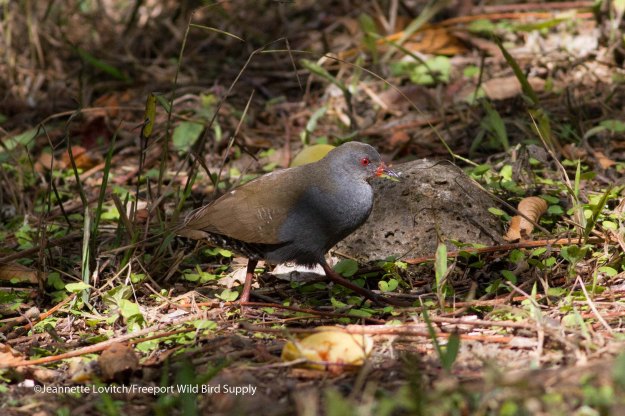
Paint-billedCrake

Finches were also in abundance, attracted by the water. Lots of Small and Medium Ground-Finches were present, along with Woodpecker, Small Tree, and Vegetarian. With a little effort, our guide Peter, also found us a pair of Large Tree-Finches – the only bird Jeannette, Steve, and I were still missing from the group’s first day on the island.

I was, however, having a hard time taking my eye off the tortoises, and yeah, we all posed for some touristy photos. No selfies though; we draw the line somewhere.

While a stop at a nearby lava tube did not produce a Barn Owl as hoped for, it did offer an impressive lavatube. Also, one of the highlights of the day was the Woodpecker Finch that we watched at close range as it probed a trailside branch. It was fascinating to see the bird hammer with its open bill (unlike a true woodpecker), and even more interesting watching its rapidly-flickering tongue appearing almost snake-like in its speed and purpose.  Jeannette, Steve, and I lost the group as they descended into the tube, us left behind smitten with the finch. Luckily for all, it was in the same exact place when we all resurfaced.
WoodpeckerFinch

lava_tube

A rather unhappy and perhaps exceedingly unhealthy Barn Owl was added to the list in a little maintenance shed housing an old air conditioning unit – a circumstance that definitely took away from truly enjoying yet another endemic subspecies.

Back in Puerto Ayora, Jeannette and I were granted permission to leave the group as they returned to the boat for lunch. Instead, we wandered around town, had some local food for lunch, checked email (yup, store, house, and Sasha all fine!), photographed a ton of finches (including several Common Cactus-Finches) and Galapagos Mockingbirds in town.
lunchlunchGround-Finch
A Small Ground-Finch visiting us at lunchtime
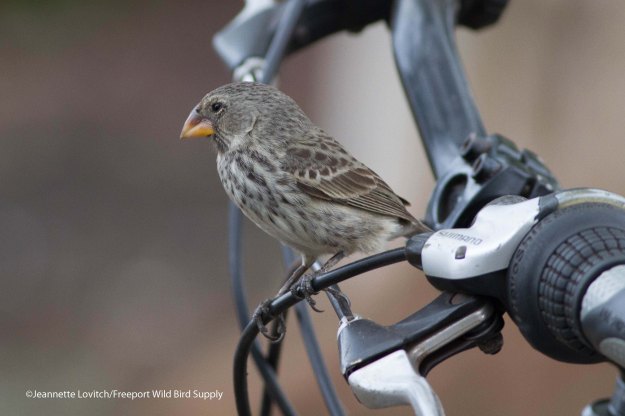
Mediumor LargeSmall
Small Medium or large Small? Goodness these things are tough!

A visit to the fish pier provided the chance to study and photograph Lava Gulls at close range: begging and battling pan-handling Brown Pelicans and Galapagos Sea-Lions for fish-gut handouts, these seemed to be de-volving back into Laughing Gulls!
beggingSeaLion_edited-1

photographingLavaGull1

Lava_Gull

MAFR

PuertoAyora1PuertoAyora2PuertoAyora3

Reunited with the group, we all walked across town – including a stop at the fish pier, working the occasional finch flock. It was really good to see the finches proliferating in urban and developed areas, but it did take a little of their mystique away – if you know what I mean.
finches_edited-1finches2-edited

CommonCactus-Finch
Common Cactus-Finch not on a cactus.

largeMedium
A large Medium or a small Large?

CommonCactus-FinchonCactus
Common Cactus-Finch back on a cactus to restore the mystique.

ProbLargeGround-Finch
Probable Large Ground-Finch?

Photographing_LavaGulls,Steve

We continued on until we reached the visitor’s center for the National Park, and slowly worked the scrub. Arriving at the Darwin Research Station, we learned about the conservation efforts underway for Mangrove Finch and five of the island’s 10 extant populations of tortoises. There was more good finch and mockingbird-watching to be had as well.
DarwinResearchStation1DarwinResearchStation2
GalapagosMockingbird
<img class=”alignnone size-full wp-image-2928″ src=”https://mebirdingfieldnotes.blog/wp-content/uploads/2016/07/saddlebacktortoise.jpg&#8221; alt=”SaddlebackTortoise” width=”3264″ height=”2448″ />
“Saddleback” tortoise

grou_in_town

sunset

6/24: Santa Cruz Island.

We pulled anchor in Puerto Ayora well before dawn and headed over to Plazas Islet. In stark – and most welcome – contrast to the busy harbor or Puerto Ayora (which was like a Maine harbor in summer, but with more frigatebirds!), we awoke to the peaceful cove at Plazas Islet off of Santa Cruz. We were the only boat around, and the only sign of humanity was the rustic concrete landing for our panga (our inflatable zodiac used for landing; any small boat in the Galapagos are called pangas).
Brown_Noddies
Galapagos Brown Noddies

Galapagos Shearwaters and Swallow-tailed Gulls greeted us instead of yachts and city lights, and once ashore, we looked down on the islet’s cliffs onto huge schools of reef fish (mostly Yellow-tailed Mullet, King Angelfish, surgeonfish, and a few stunning Blue-chinned Parrotfish. Swallow-tailed Gulls, Brown Noddies, Blue-footed Boobies, and Red-billed Tropicbirds glided by, with wheeling flocks of Galapagos Shearwaters calling as they returned to their partners in cliffside crevices.

King_Angelfish
King Angelfish

MAFR
Female Magnificent Frigatebird

Short-earedOwl
Roosting “Galapagos” Short-eared Owl

It was a hot, dry, and rather vegetatively-desolate island. It’s been remarkable how different every island has been, and for some reason, my mental vision of what to expect from the Galapagos was more like this – few species, lots of bare lava, hot and dry – than the varied habitats that we have been exploring.
PlazasIslet1PlazasIslet2PlazasIslet3Native plant restoration.

Peter_and_prickly_pear_tree

petrifiedSeaLionpoop
Petrified sea-lion poop!

We then motored to our next island, Santa Fe. Some deep water snorkeling produced a wide variety of fish, with Blue-chinned Parrotfish and Reef Cornetfish stealing the show.

On land on Santa Fe, we checked out the endemic subspecies of Galapagos Mockingbird – with longer bills, a different call, and more inquisitive behavior than the birds on Santa Cruz. Galapagos Hawks put in a couple of appearances, including some low and close passes overhead. Galapagos Doves, Gray Warbler-Finches, Small and Medium Ground-Finches, Galapagos Flycatchers, and Common Cactus-Finches – with much larger and imposing bills than the birds we have seen elsewhere – joined Santa Fe Ground Iguanas and Galapagos Lava Lizards on the land.
maleLavaLizard
Santa Cruz Lava Lizard -male.

LandIguana
Santa Cruz Land Iguana

GalapagosFlycatcher
Galapagos Flycatcher

The highlight for many, however, were the Galapagos Sea-Lions that greeted us on our arrival on one beach, and others, escorting us away from the departure beach. Inquisitive pups came up to inspect us, with one even exploring Jeannette’s leg with its soft but yet somehow prickly whiskers. It also took a liking to one of her boots.
SeaLions1SeaLions2SeaLions3SeaLions4SeaLions5
SeaLions_J-Mo_edited-1

Pelagic birding on the way northward off of the east side of Santa Cruz yielded more Galapagos Petrels, Swallow-tailed Gulls commuting offshore to feed after the sun went down (and squid come up to the surface), scattered Band-rumped, Wedge-rumped, and Elliot’s Storm-Petrels. But the massive boil of thousands of Galapagos Shearwaters encountered near a couple of sea stacks was simply astounding.
IMG_9051_edited-1

6/25: Bartolome Island.
Bartolome
Desolate, bleak, and vulcan: this is how I pictured more of the Galapagos Islands. But the older islands we have been visiting were softened around the edges by time. Soil built up, and endemic plant communities flourished.

It was different in the northern part of the archipelago, which we sampled around the edges of Santiago Island.  In a busy and fulfilling final full day aboard, we did a lot, beginning with a pre-breakfast panga ride around Bartolome Island. At least 17 Galapagos Penguins were encountered, with several calling their donkey-like bey (the closely related Jackass Penguin is named for this sound). One pair engaged in awkward, and as far as we could tell, unsuccessful, copulation, while Blue-footed Boobies looked on from the cliffs above.
GBHE-and-photographer
A Great Blue Heron (endemic subspecies) looks on.

humpingPenguins

GalapagosPenguins

Landing on Bartolome, the islands’ geology was on full display. Mostly a tuff cone, there wasn’t much here but lava, ash, and a few pioneering plants. Eeeking out a living among them were only a few Small Ground-Finches and a Galapagos Snake (our first of the trip).  Over 370 steps later (hmmm…it feels like we’ve been mostly sitting on a boat for a week!) we were rewarded with spectacular views of Santiago and the surrounding islets, including Santiago’s massive lava flow from less than 200 years ago.
Bartolome1Bartolome2

GalapagosSnake
Galapagos Snake

maleLava Lizard
Male Santiago Lava Lizard

While snorkeling nearby didn’t produce any penguins in the water as we hoped, we did see several new fish, and enjoyed more stunning parrotfish (Blue-chinned and Bicolored).

The Nemo III slowly motored past Bainbridge Island, allowing us to peer into its caldera lagoon. Eleven American Flamingos and at least 20 White-cheeked Pintails were present, with more wheeling flocks of Galapagos Shearwaters coming and going from the cliff.

Yet another round of snorkeling offered up a close encounter with two White-tipped Reef Sharks and a jaw-dropping (which was a problem since you had to clench onto the snorkel gear!) Moorish Idol – a spiffy damselfish with a very long, thin and waving dorsal fin that trailed behind it like the underwater equivalent of a tropicbird.

Another panga ride found three Galapagos Penguins (how did we miss those while in the water!?), many more Galapagos Shearwaters, American Oystercatchers, and our first two Whimbrels of the trip – our 58th and final species in the islands.

Motoring again, we encountered several more Galapagos Petrels and countless shearwaters, lots of Brown Noddies, and a few Waved Albatrosses.
ChineseHat
Chinese Hat

We circled Daphne Major, and although we failed to see any Galapagos Martins, we did see our first two juvenile Swallow-tailed Gulls among adults on the short shoreline cliffs.
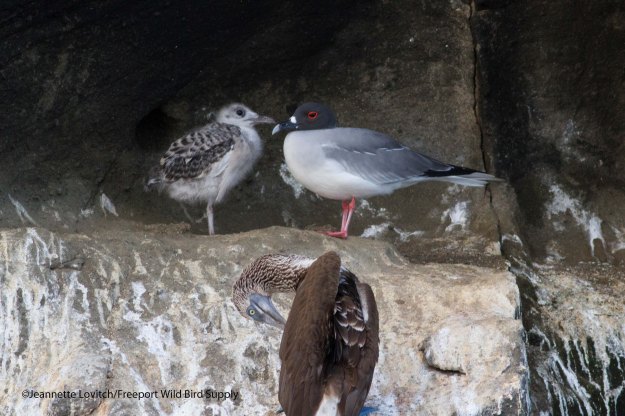
SWTGU-nest

Also, I was just happy to get an idea of what this island looks like, having read so much about it, such as in The Beak of the Finch: A Story of Evolution in Our Time by Jonathan Weiner, a Pulitzer-prize winning recount of the groundbreaking research by Peter and Rosemary Grant, and others on rapid, ongoing evolution of Darwin’s finches (Small and Medium Ground-finches in particular).

With the sun setting, and few more Galapagos Petrels, Wedge-rumped Shearwaters, etc added to the tally, we dropped anchor between Baltra and North Seymour Island for our final dinner.
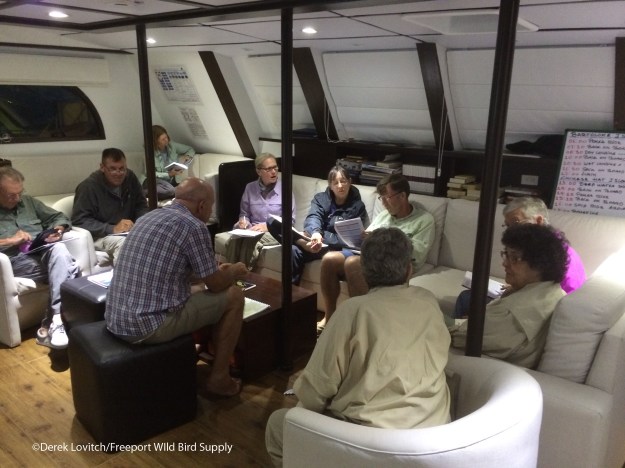
checklist
Final evening checklist session

fruitcarvings
Each dinner was accompanied by a fruit/veggie carving. The final one was our favorite.

6/26: Departure.

One last panga ride before breakfast along the shore of North Seymour Island (our first stop on the first day aboard the boat) produced our final endemic mammal of the trip: the Galapagos Fur Seal. Preferring bolder-strewn beaches, or in this case, a few small rubble landslide slips, the more-local fur seal was not expected elsewhere on our itinerary (they’re more common on the western and northern islands, closer to their deep sea fishing grounds).
GalapagosFurSeals

Lots of Swallow-tailed Gulls, both frigatebirds, and Brown Noddies escorted our boat, along with our last looks at Blue-footed Boobies, Red-billed Tropicbirds, Lava Gulls, Galapagos Shearwaters, and Brown Pelicans. Elliot’s Storm-Petrels circled the Nemo III, and on the beach of Baltra, a couple of Ruddy Turnstones and singleton Sanderling and American Oystercatcher.

Saying goodbye to the Nemo III’s fantastic crew, we boarded the bus for the short ride to the airport. With a little time to kill, I took a stroll, enjoying some cooperative Galapagos Doves and studying a Medium Ground-Finch for the last time in the foreseeable future.  Small Ground-Finches, meanwhile, were easy to get last looks of as they foraged for crumbs on the tables of the airport food court. At least a couple of us sipped one last vacation Pilsener.
Departure

The flight to Quito, once again with a short layover in Guayaquil, was smooth and easy, and we arrived at our San Jose hotel with just enough daylight for a little more birding. Jeannette and I quickly scored three more lifers: stunning Sparkling Violetears, pantaloon-sporting Western Emeralds, and impressive Great Thrushes (yes, we do need to bird the South American mainland!).
airportHotel

A final group dinner at the hotel was a nice wrap-up to the trip, even if several folks were a bit under the weather. While Don and Bill were joining Steve on his Mindo Tour in the mountains, the rest of us were begrudgingly heading home dark and early the next morning.

As the trip came to a close, Jeannette and I reflected on how lucky we were to be able to take part in this incredible opportunity. Somehow, we made it work, and despite the hellish couple of weeks that made the trip happen, we could not be any more thrilled about the trip. I am incredibly grateful for the opportunity WINGS offered us, and it was truly wonderful to marvel at Rich Hoyer’s wide wealth of knowledge from plants to birds, bugs to ecology. Our local guide, Peter Freire, was also tremendously knowledgeable, and throw in a little seabird discussion from Steve Howell, and I am overflowing with new information (ah, now, the key: retain some of it!).  Rich was really a pleasure to travel with, and I have never seen a tour group bond so well. Other than a bit of a bug of some sort that was passed around the boat (‘tis life on a boat tour!) that affected some more extremely than others (i.e. Jeannette), few complaints were uttered.

A friend strongly encouraged us to “take the opportunity…and go NOW!” Noah could not have been more right, and I am glad I heeded his advice. And between different government rules, climate change, tourism and population pressures, and much more, I would also encourage you to go to the Galapagos, and do it soon!

I also highly recommend that if you are a birder, you MUST go here with a birding tour group. We would have not seen many of the rarest species (like Large Tree Finch or Galapagos Rail) were we on a “regular” package tour. And with the need for knowledgeable local guides for almost anywhere you go (and Peter is one of the rare, true and talented birders among them), we would never have pulled off the near-complete list that we did.

Rich will likely be leading a WINGS tour in 2018 to the islands, perhaps the “other” route, that would yield one of our most wanted species: Flightless Cormorant. While we knew this itinerary would not produce it, it did produce most everything else – including some real surprises. But, we still need a subspecies of Large Cactus-Finch that will likely get split…and Galapagos Martin (which we missed on our one chance at Daphne Major; our only “dip” of the trip)…and Sharp-beaked Ground Finch…and the blood-sipping subspecies of Woodpecker Finch…and that cormorant.  Hmm, maybe we’ll just have to see you aboard!

Here’s our trip’s birdlist (an * denotes a life bird for both of us, ** is a life bird for only Jeannette, and *** was a life bird for me alone), in currently-accepted taxonomic order:

        1. White-cheeked Pintail (endemic subspecies galapagensis)
        2. Galapagos Penguin*
        3. Waved Albatross*
        4. Galapagos Petrel*
        5. Galapagos Shearwater*
        6. Elliot’s Storm-Petrel*
        7. Wedge-rumped Storm-Petrel (endemic subspecies tethys)*
        8. Band-rumped Storm-Petrel
        9. Markham’s Storm-Petrel***
        10. Red-billed Tropicbird
        11. Magnificent Frigatebird (endemic subspecies magnificens)
        12. Great Frigatebird
        13. Blue-footed Booby (Endemic subspecies excise)*
        14. Nazca Booby*
        15. Red-footed Booby
        16. Brown Pelican (Endemic subspecies urinator)
        17. Yellow-crowned Night-Heron (endemic subspecies pauper)
        18. Striated Heron (endemic subspecies sundevalli, including dark morph “Lava Heron”).
        19. Cattle Egret
        20. Great Blue Heron (Endemic subspecies cognata)
        21. Great Egret
        22. American Flamingo**
        23. Galapagos Hawk*
        24. Galapagos Rail*
        25. Paint-billed Crake*
        26. Common Gallinule
        27. Purple Gallinule
        28. Semipalmated Plover
        29. American Oystercatcher (endemic subspecies galapagensis)
        30. Black-necked Stilt
        31. Whimbrel
        32. Wandering Tattler
        33. Ruddy Turnstone
        34. Sanderling
        35. Lava Gull*
        36. Swallow-tailed Gull*
        37. Brown Noddy (endemic subspecies galapagoensis)
        38. Dark-billed Cuckoo
        39. Smooth-billed Ani (introduced)
        40. Barn Owl (subspecies punctatissima)
        41. Short-eared Owl (endemic subspecies galapagoensis)
        42. Galapagos Flycatcher*
        43. Galapagos Mockingbird*
        43a. Sante Fe Galapagos Mockingbird
        44. Espanola Mockingbird*
        45. San Cristobal Mockingbird*
        46. Floreana Mockingbird*
        47. Green Warbler-Finch*
        48. Gray Warbler-Finch (Espanola subspecies cinerascens)*
        48a. Gray Warbler-Finch (San Cristonal subspecies luteola)
        48b. Gray Warbler-Finch (Santa Fe subspecies bifasciata)
        49. Vegetarian Finch*
        50. Woodpecker Finch*
        50a. Woodpecker Finch (San Cristobal subspecies productus)
        51. Large Tree-Finch*
        52. Medium Tree-Finch*
        53. Small Tree-Finch*
        53a. Small Tree-Finch (San Cristobal subspecies salvini)
        54. Small Ground-Finch*
        55. Medium Ground-Finch*
        56. Large Ground-Finch*
        57. Common Cactus-Finch (subspecies intermedia)*
        58. Large Cactus-Finch (Espanola subspecies conirostris)*
        59. Yellow Warbler (endemic subspecies aureola)

Mammals:
1. Black Rat (introduced)
2. House Mouse (introduced)
3. Galapagos Sea Lion*
4. Galapagos Fur Seal*
5. Feral Cat (introduced)
6. Bottlenose Dolphin
7. Short-beaked Common Dolphin
8. Minke Whale
9. Blue Whale

Reptiles:
1. Santa Cruz Giant Tortoise*
2. Green Sea Turtle
3. Marine Iguana (four subspecies)*
4. Land Iguana (two or three subspecies)*
5. Galapagos Lava Lizard*
6. Espanola Lava Lizard*
7. San Cristobal Lava Lizard*
8. Floreana Lava Lizard*
9. Galapagos Snake*

A small variety of insects were also identified, including several endemics, and a wide variety of fish and other marine life.

And finally, we’ve been posting videos daily (with a few more left to post) on our store’s Facebook page that I took with my iPhone during the trip. You can view all of them here.

YWAR
The ubiquitous, adaptable, and inquisitive Yellow Warbler (endemic subspecies) was with us throughout the trip, occupying most any niche. It – the most colorful landbird on the islands! – seems like an appropriate species to bring this travelogue to a close.