(Updates as of 10/24 added at the bottom)
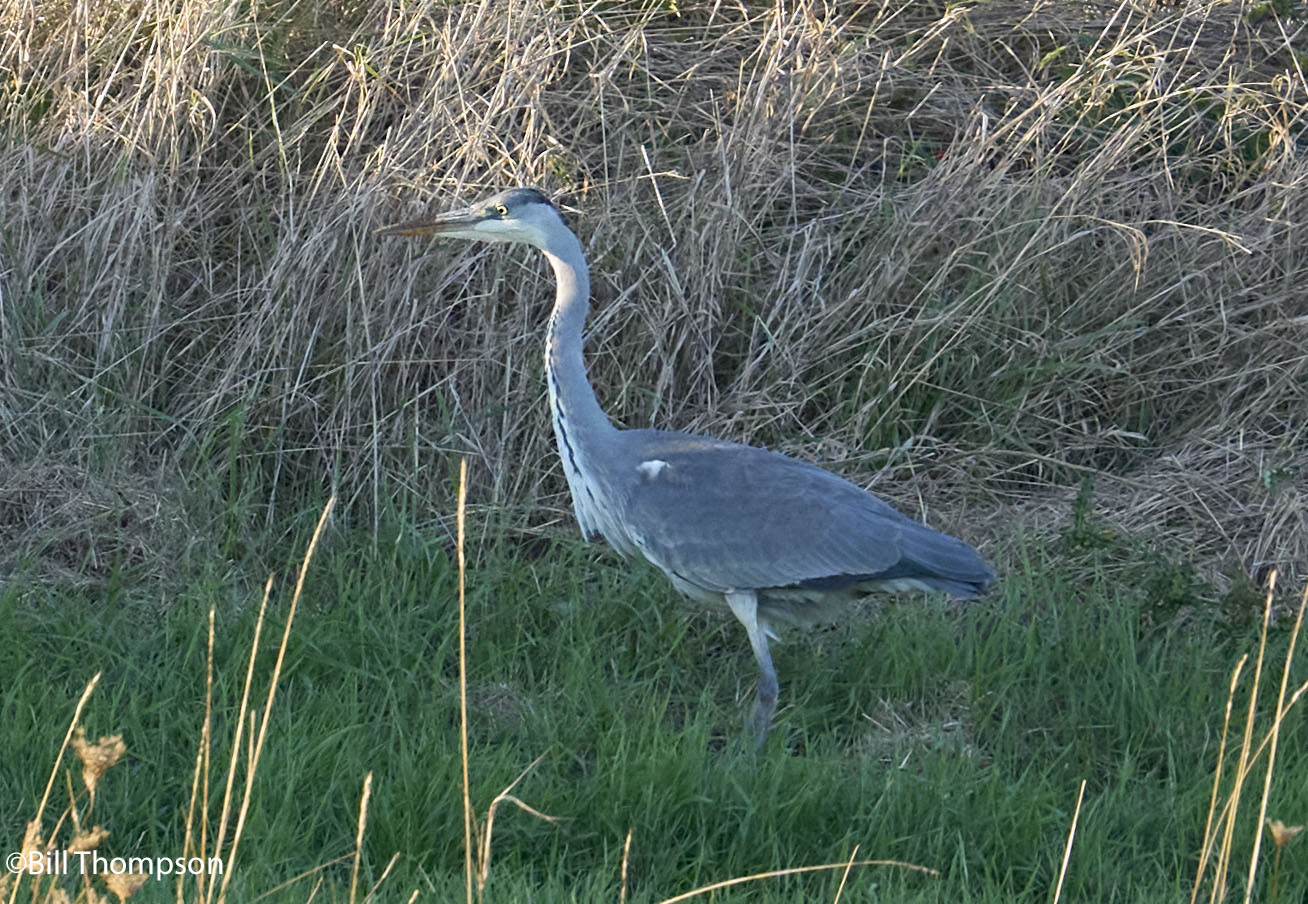
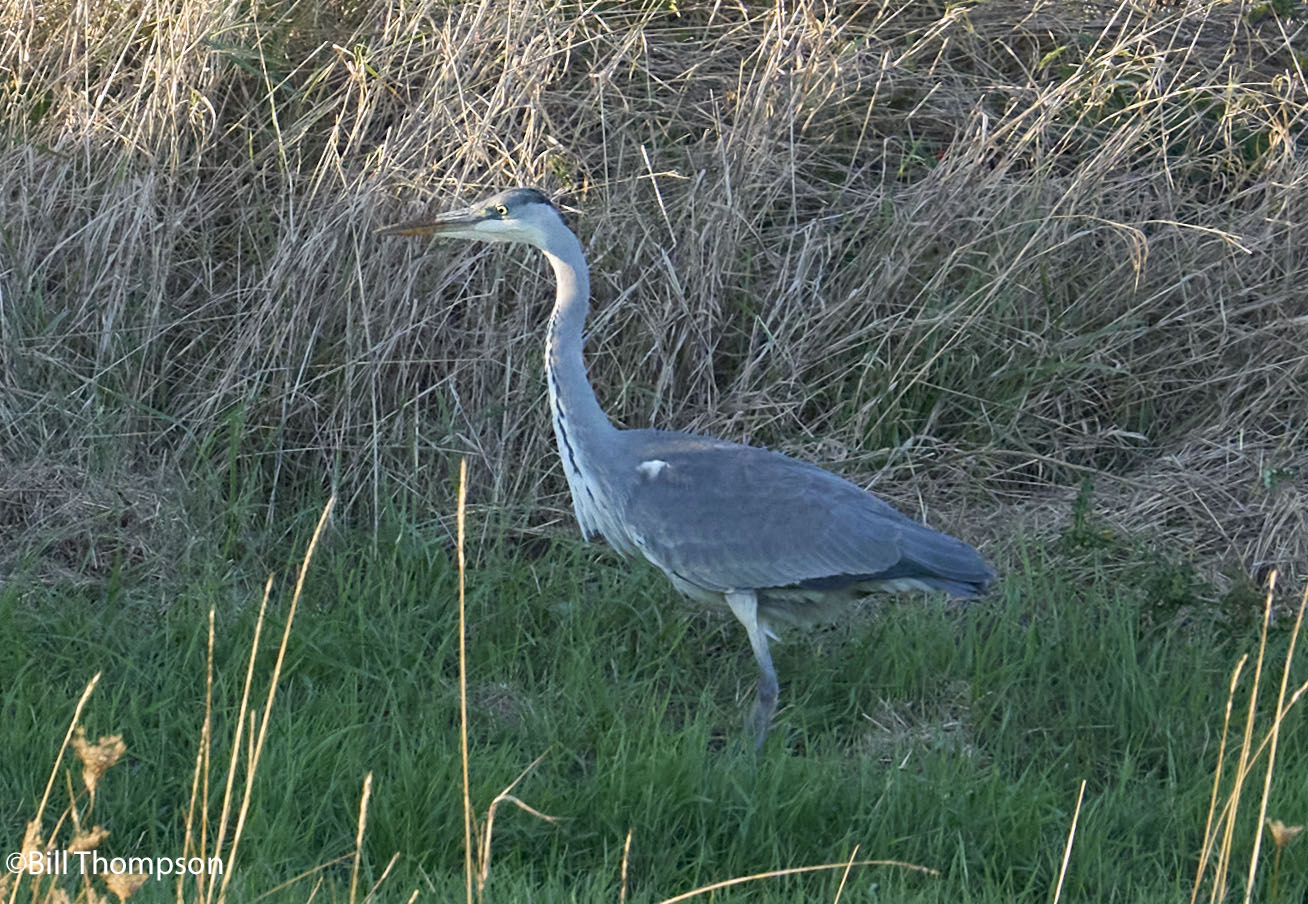
On Sunday, October 18th, a Gray Heron was discovered by an alert birder, Peter Griffin, on Jordan’s Farm along Wells Road in Cape Elizabeth. By the afternoon, its suspected identification came to light, and the word was spread.
I got a text, and Jeannette turned around on her way home to come back to the store to cover me. The chase was on! I arrived at 4:58pm, with the light rapidly fading, joining about a dozen other birders, including my friend Bill Thompson whose photos I once again have pilfered for my blog.
A very short while earlier, I was sent some photos, which I viewed on my phone. They sure looked like a Gray Heron, but I wanted to be sure! On the scene, Bill, Josh Fecteau, and I studied and debated it together (with similar conversations likely up and down the road), and we all felt pretty confident in the identification. Nonetheless, we were relieved to hear from a couple of friends – especially one with more extensive experience with Gray Heron than I – that they were convinced, too. There was no doubt in anyone’s mind. This was Maine’s first ever Gray Heron.
Several of us enjoyed watching it forage, studying its structure and movements, and later, its diet, including a presumed grasshopper and this unlucky Meadow Vole!
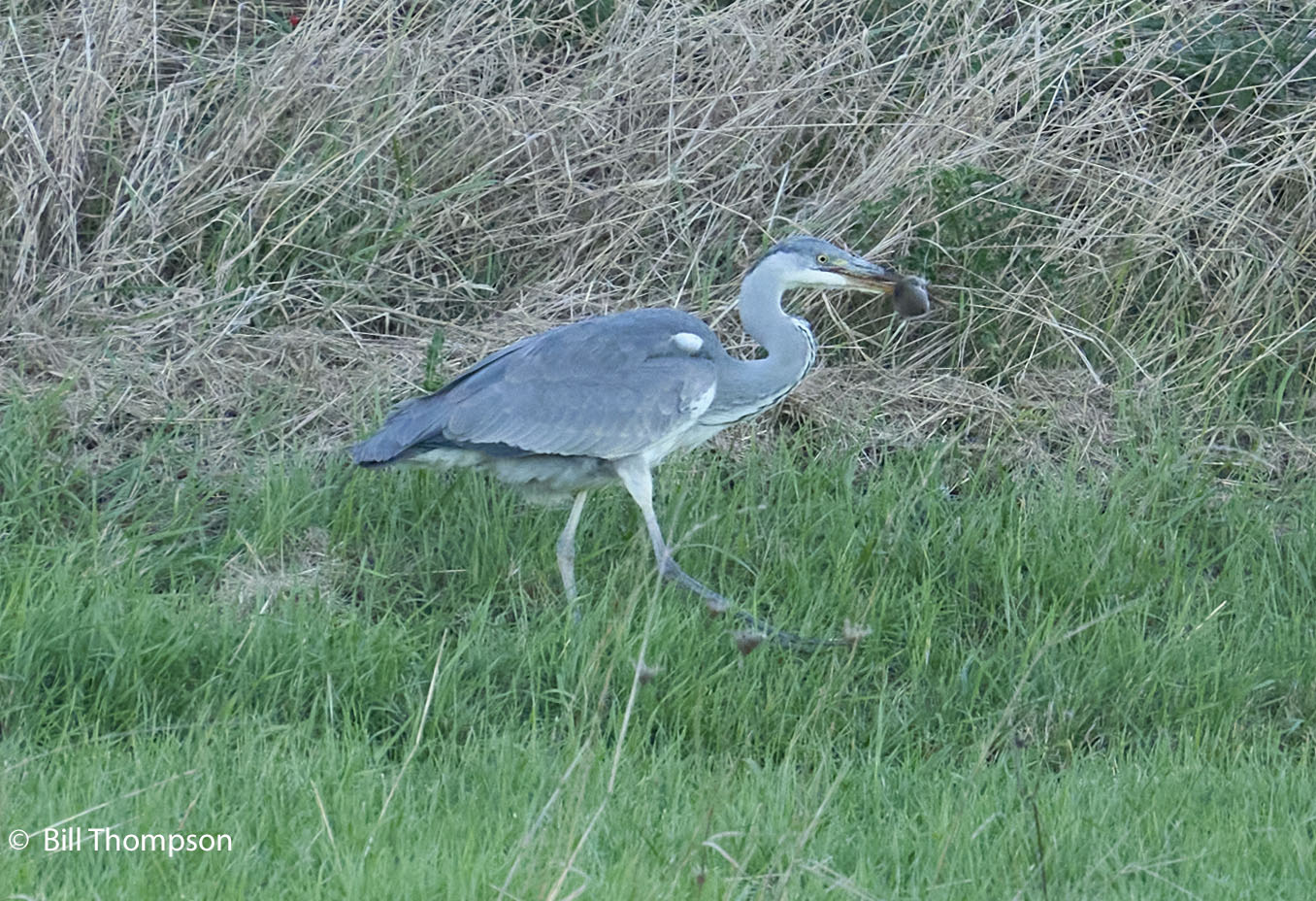
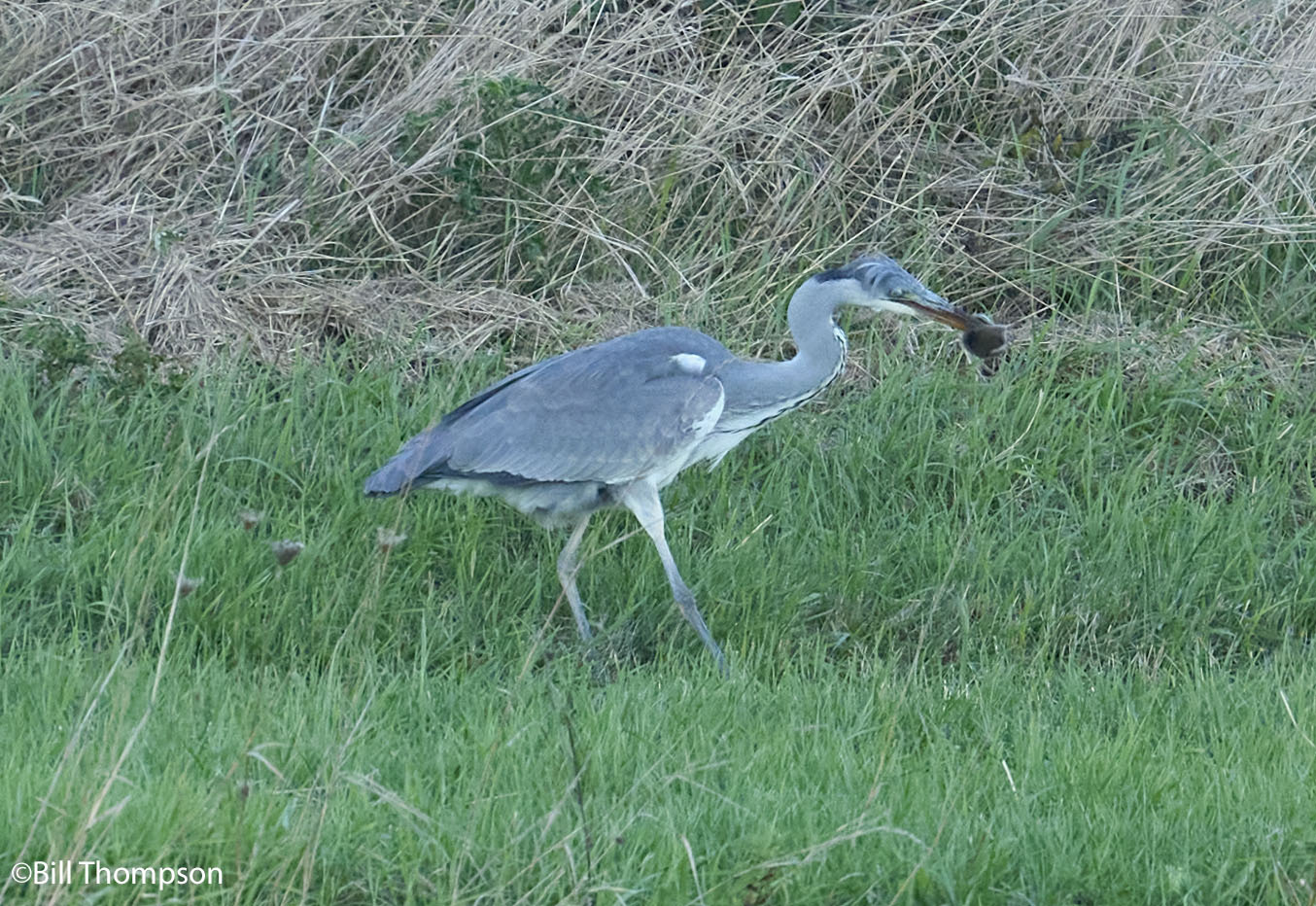
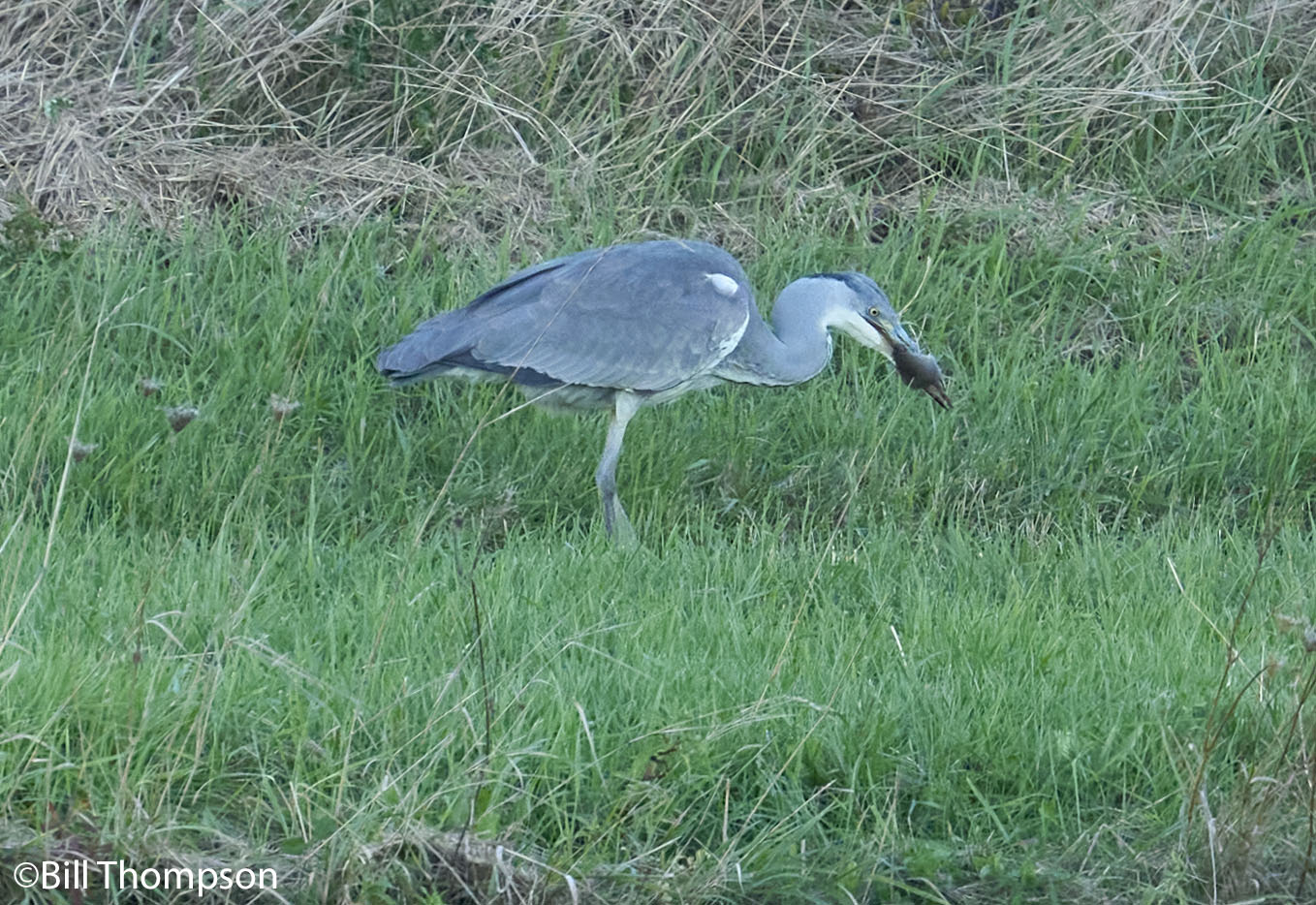
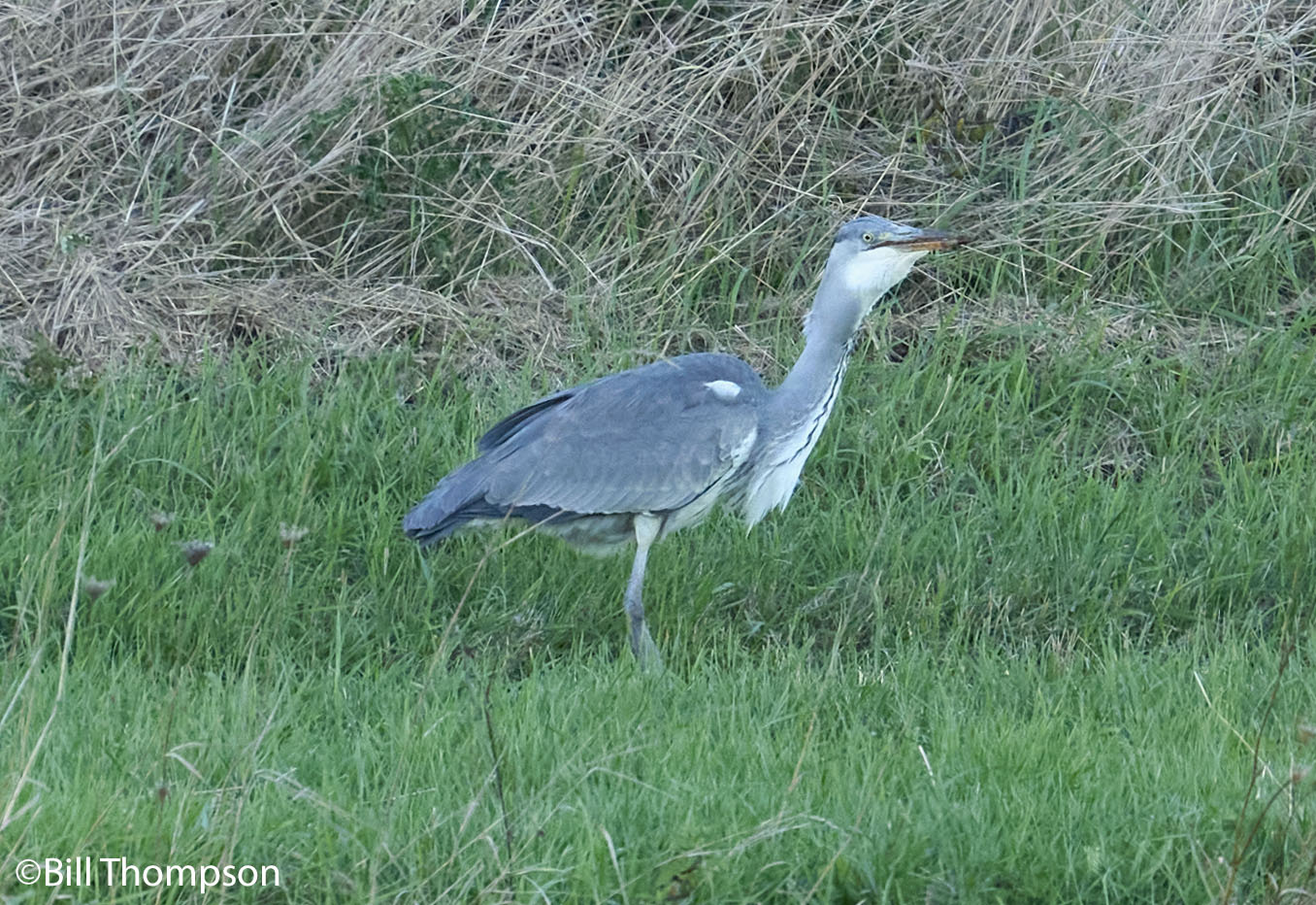
See, the thing is, this is actually a somewhat tricky identification, as the bird is very similar to our common Great Blue Heron. In juvenile/first winter plumage, which the Cape Elizabeth Gray Heron is (aged by the gray crown and uniform wing coverts and flight feathers on the spread wing) the head and especially crown pattern of Great Blue Heron (hereafter, GBHE) and Gray Heron (hereafter, GRAH) are essentially identical, but the two species are readily separable using the following traits.
Let’s start with the undersides. Here’s our GBHE; this one happens to be from our yard in Durham about this time last fall.
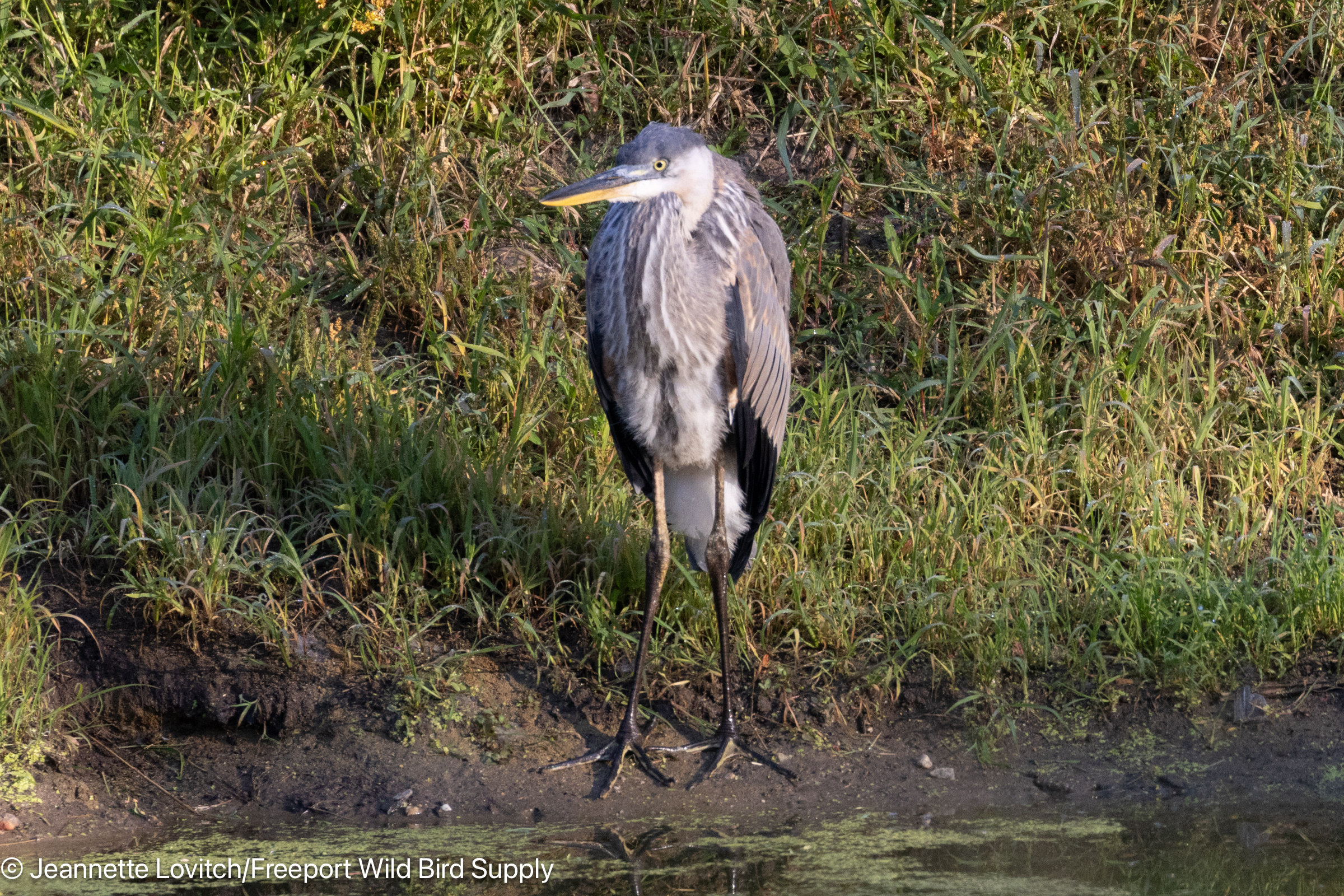
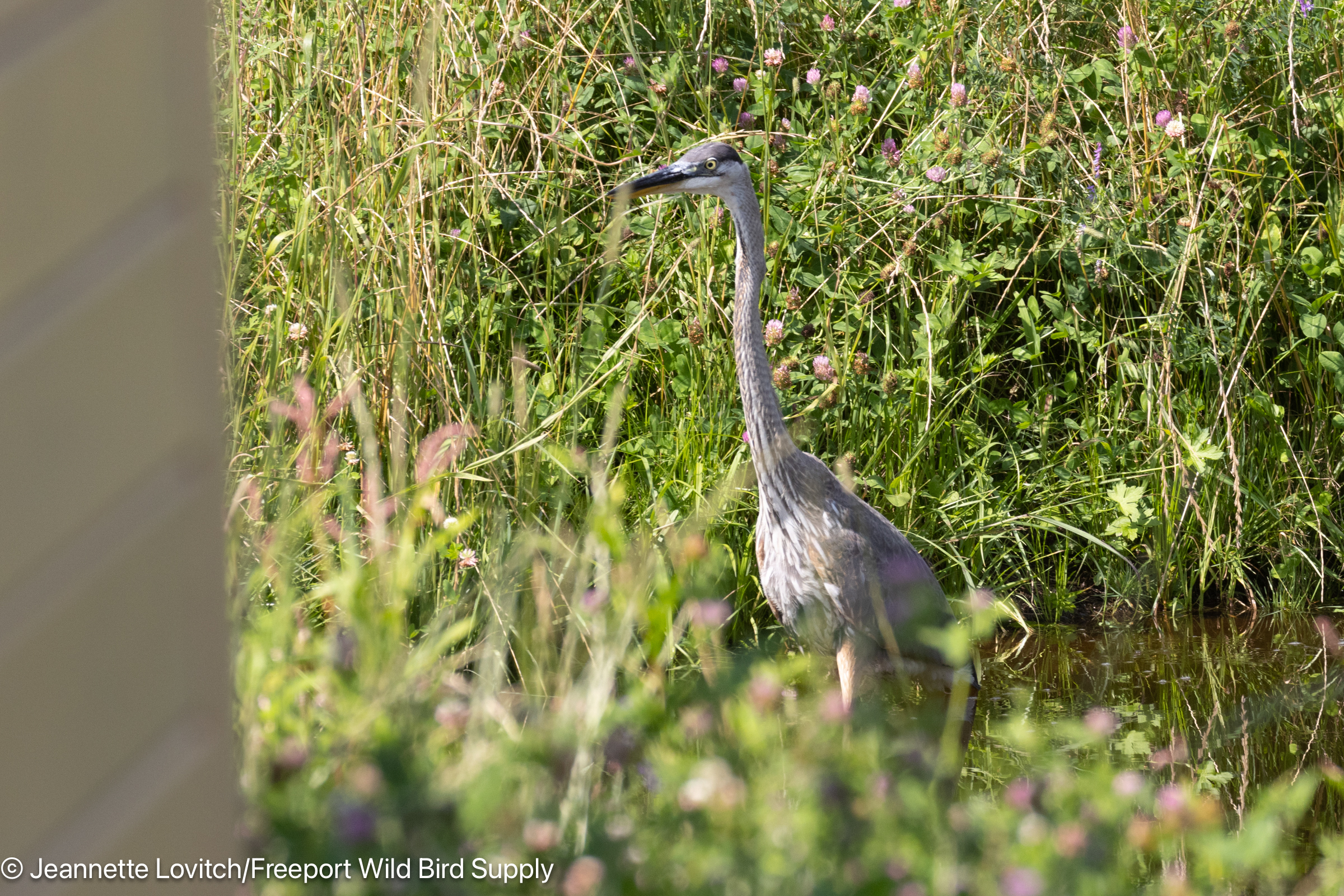
Note the neck, chest, and belly are heavily streaked with grayish-brown and the background color is whitish or very pale gray. On GRAH, the streaks are fewer, blacker, straighter, and contrast more with a purer white background. GRAH looks white-fronted, GBHE does not. Also note how the appearance of those streaks changes based on posture. Perhaps most importantly, the “thighs” (or more specifically, the feathers covering the upper leg) on GRAH are white or off-white, sometimes with a hint of buff, but on GBHE, they are usually reddish-brown, even at this age. Some can be quite pale, and keep in mind, these feathers are usually obscured when resting (Howell, et al, 2014).
In flight, there is one important difference. On both species, there are two small “headlights” on the leading edge of the forewing, at the bend in the wing near the alula and in the primary coverts. In GBHE, these two pale patches, which can vary in overall color, usually appear buffy or brown. They are pretty small, sometimes hard to see, and can appear very pale on some birds and in strong light.
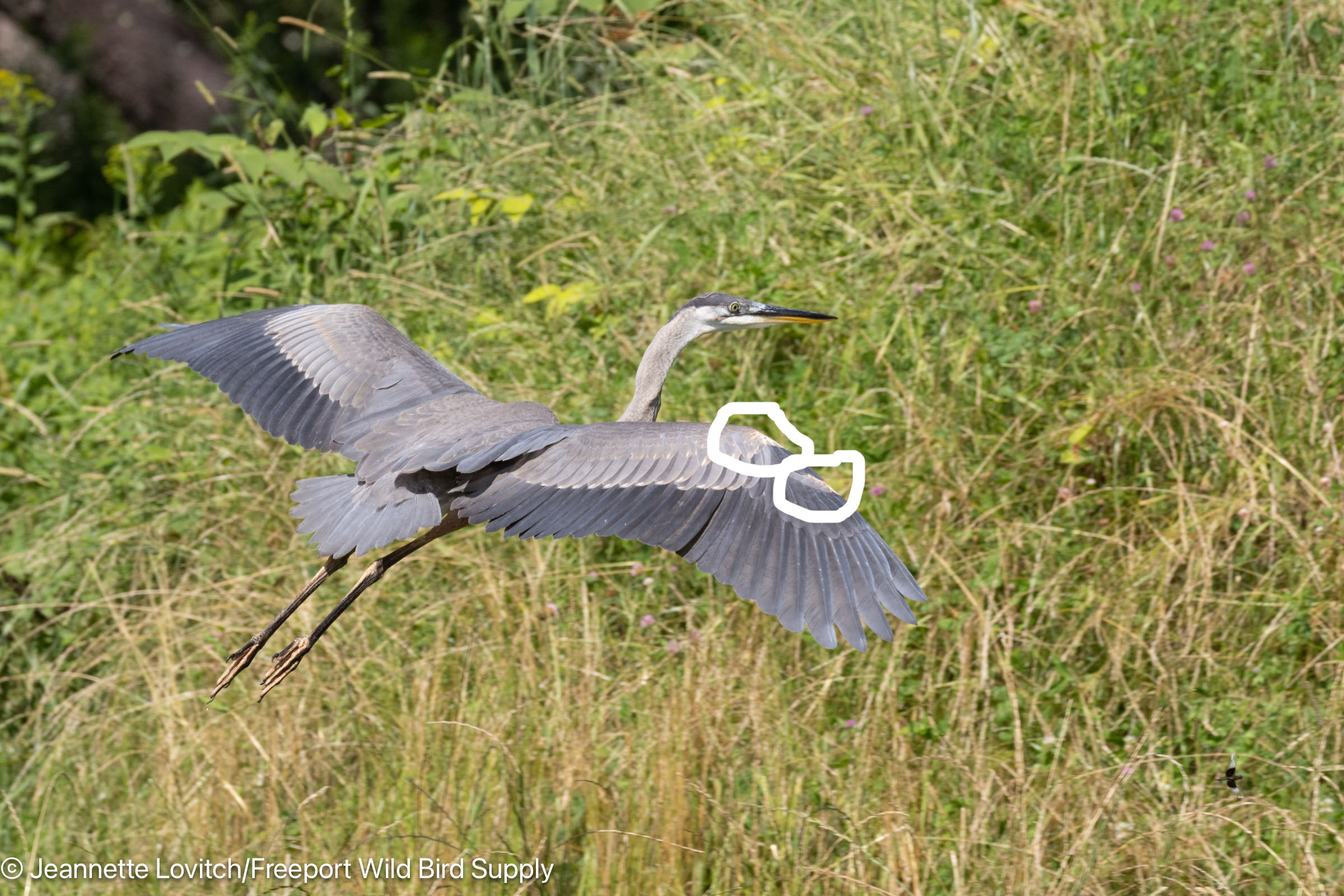
However, in GRAH these two patches are big, bold, and pure white. (I’ll insert a photo of the GRAH in flight when I get permission to use one)
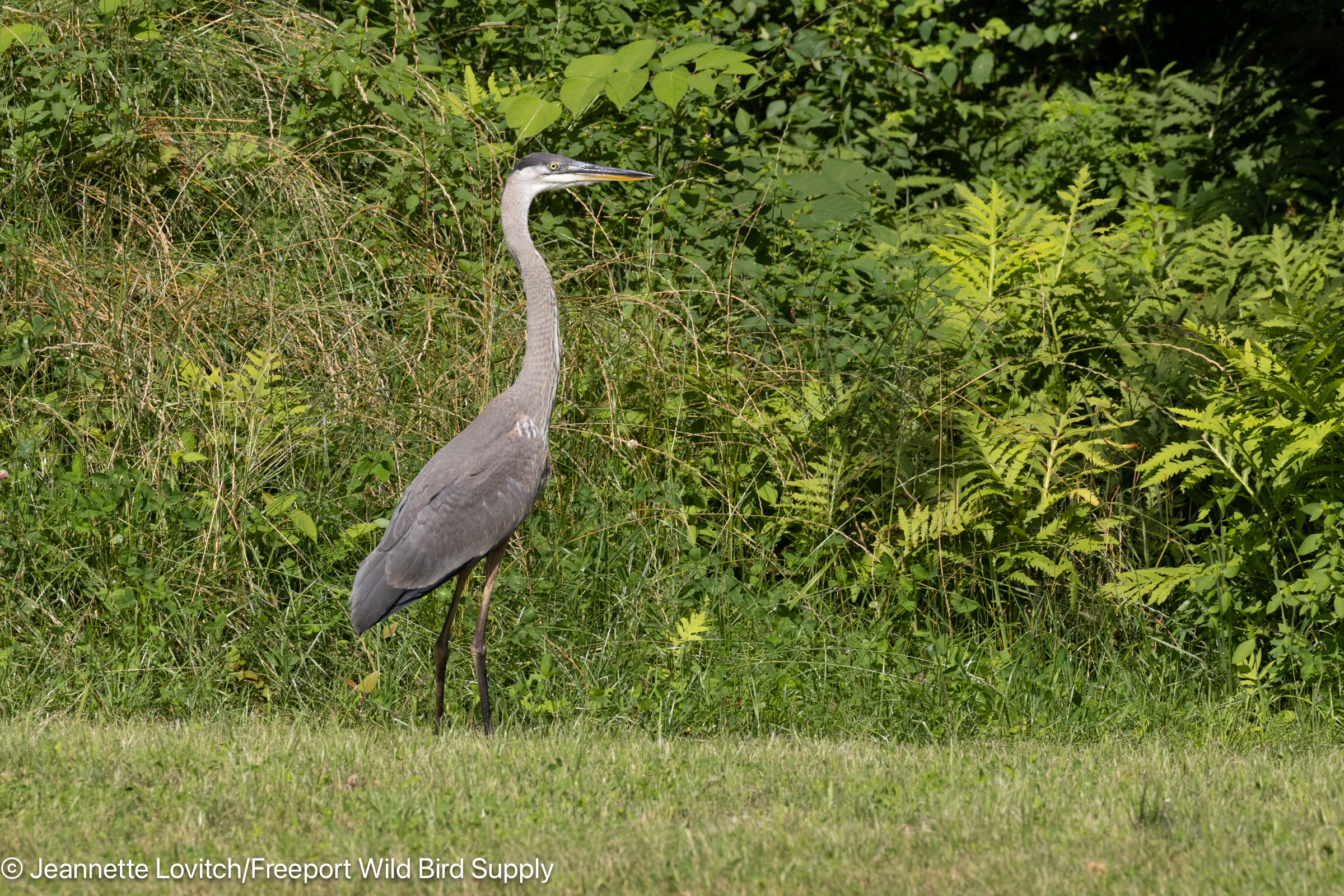
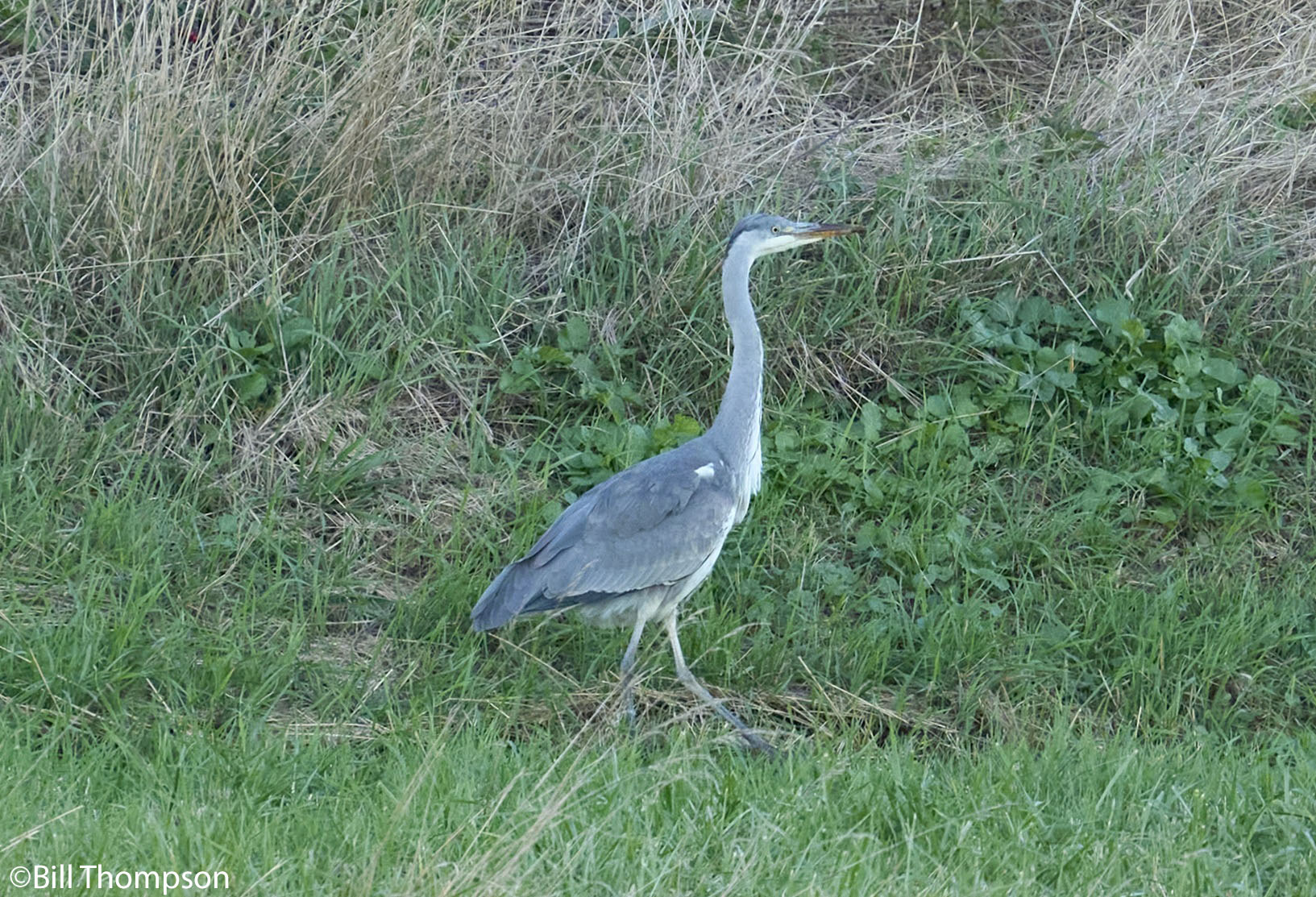
And then, there is structure. While we all wished there was a GBHE nearby when we were viewing the GRAH, its differing structure was still obvious. It’s short-legged and stumpy, the body seems more compact, and the neck is shorter and thicker. The bill appears shorter and somewhat more stout. GBHE looks like an elegant Great Egret on steroids. GRAH looks more like a Hulked-out Yellow-crowned Night-Heron or American Bittern.
I saw my first Gray Herons in Norway, and I thought they looked and were shaped quite different from the Great Blue Herons I knew from home. In August of 2022, Jeannette and I happened to be taking our summer vacation to Prince Edward Island, where a Gray Heron had been present for much of the summer. Happily, it was still present in Brackley Marsh, but we arrived on a rainy day, and a small group of herons were way out in the marsh, hunkered down, and obscured by water on our scopes and fog. One looked paler, but it was not obvious.
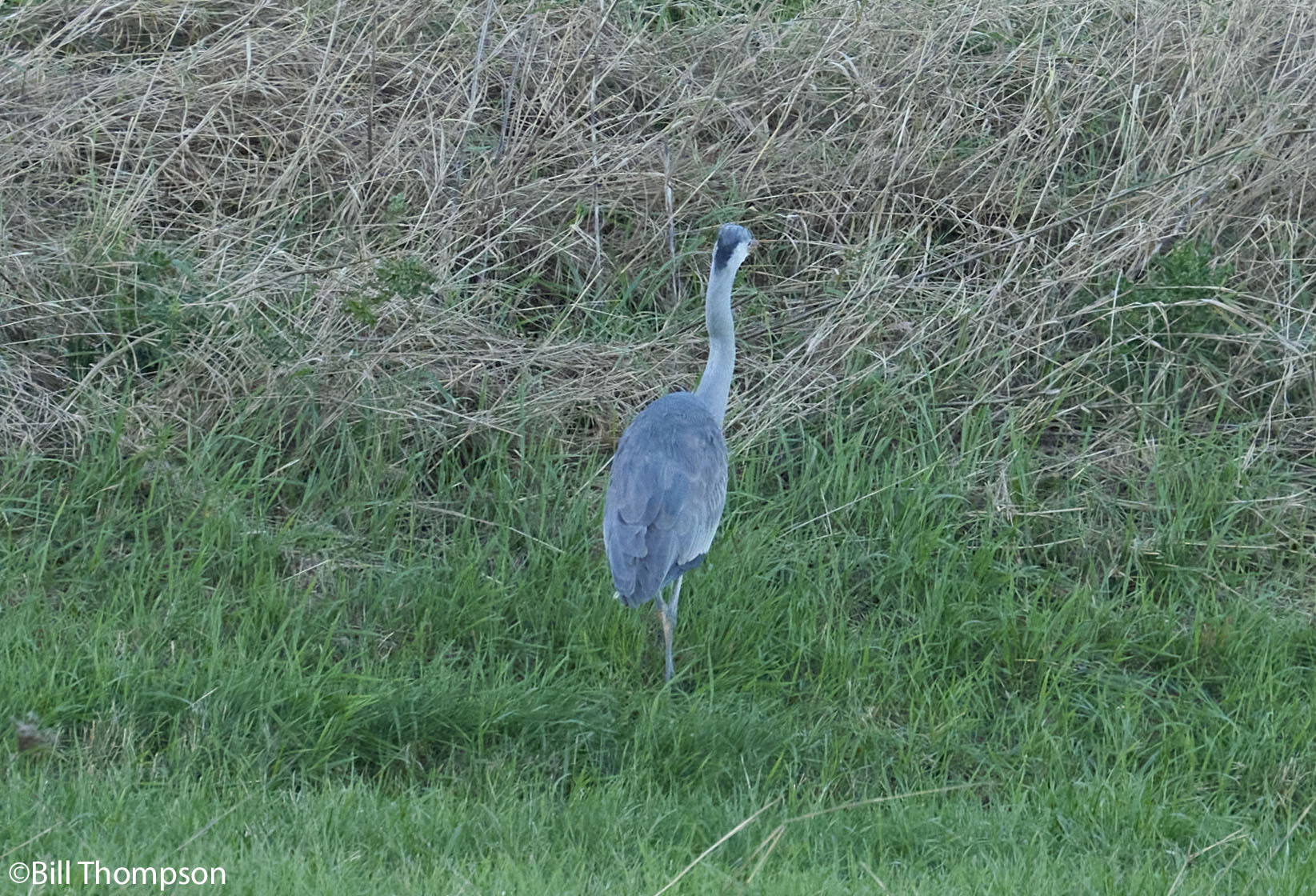
We went back the next day, when conveniently, other birders were already on the scene, and we thought, “oh, that one.” And it was the structure, conveniently positioned adjacent to several GBHE that first stuck out.
Got that? Structural differences coupled with the key field marks of underpart pattern and color, thighs, and different color and intensity of the “headlight” on the open wing are how we identify a wayward GRAH from our common and conspicuous GBHE.
Still think you have a GRAH in your yard? Or at your local pond/marsh/farm field? Unless you live in and around Spurwink Marsh in Cape Elizabeth, I am sorry to say it, and I will be blunt: you do not. But if you still think you do, I strongly encourage you to submit your report to eBird…while a second Gray Heron would be unprecedented, as birds continue to prove, nothing is impossible!
“Our” GBHE are found throughout the state, and while many have departed for points south by now, there are plenty still around. They often hunt voles and insects in upland fields, especially in fall, and single birds can look really out of place and unusual when seen out of context like that. (For more information on our resident heron, and how you can help them out since they have declined by as much as 82% along the coast of Maine, please visit the website for the Maine Heron Observation Network).
And while common birds can sometimes have uncommon appearances (such as plumage abnormalities), structure rarely differs. So, unless you are sure you have a thorough understanding of the nuances of the field marks and have the vast field experience to evaluate the subjective structural differences, can we please stop the comments such as “I have one here.” “I saw one too,” and my favorite “These aren’t rare, they are all over!”
Yeah, I made the mistake of looking at comments on the posts made by the local TV outlets and media sites that all covered this extraordinary visitor. I know, “NEVER read the comments in the (online) newspaper!” I sometimes forget.
But this is indeed, a very, very rare bird. A “MEGA” in birding parlance. The first record for Maine (it was, however, #7 on my Next Birds for Maine predictions list! Or, 7.7 based on the wonky formatting I never figured out how to correct in that post back in January). In fact, it’s one of only about 15 records ever anywhere in North America, including only the (likely) second individual ever in the Lower 48, with most records coming from the Canadian Maritimes, such as the 2022 PEI bird. These growing number of records to our northeast prompted me to bump it up on my predictions list recently.
So, now that I hope you are convinced that you do not in fact have one on your pond, or have seen them all over, how about going to see the real deal in Cape Elizabeth? A good “twitch” (when birders chase a rare bird) can be quite the sight, even just for the people-watching value! We’re an excitable bunch, and yeah, our antics can be entertaining.
But like internet comments, we can also be infuriating. There have been numerous reports of dangerous driving, inattentive pedestrians, improper parking, and other inconveniences to locals and landowners. Doug Hitchcox at Maine Audubon put together this helpful blog post which nicely describes the parking situation in the area, and how best to safely and conscientiously view the bird.
Additionally, the bird has been moving around a bit, so if it’s not in view (or the line of birders is not to be found) along Wells Road, you’ll want to check other places around the marsh. Recently, it has been viewed commuting to and from the fields and the marsh and has been spotted in the marsh from along Spurwink Rd and from the Spurwink Cemetery. But please, for the love of humanity, wherever it is or it isn’t, please be absolutely careful and respectful of the people and land and vehicles around you, and try to use some common sense!
So now that you know you don’t have a GRAH in you yard, and you had a wonderful visit with the bird, let’s think about the “how and why” a little bit.
GRAH is the ecological equivalent of our GBHE in the “Old World,” with the migratory subspecies having an extensive breeding range from mid-latitude western Europe to western Russia and Japan. They winter from western Europe to Southeast Asia and Africa, where migrants join year-round residents (Howell, et al, 2014). Like our GBHE, they are resident throughout much of its range, however, just like GBHE (including just about all of those in Maine), the birds clear out of the northern edge of their breeding range for points further south. Having to “leap frog” over residents, the northernmost birds often fly the furthest, and this long-distance migration is powered by the birds’ massive wings, but also by their ability to soar effortless for hundreds of (ground) miles, especially by soaring on rising thermals of warm air, just as migrant raptors do. We often see small groups of GBHE soaring high above the Bradbury Mountain Spring Hawkwatch when they return to Maine, for example.
GRAH is regular in Iceland, and there are records from Bermuda and the eastern Caribbean. They’re even now regular residents in Barbados! In other words, GRAH can travel far, so if one sets off in the wrong direction (the mechanisms that cause vagrancy are complex, poorly understood, and beyond the scope of this already too-long blog) they can end up in far-away places. They can also land on ships (several records listed in Howell, et al, 2014 for example), and take a ride as they rest, or even, scrounge up enough food (like handouts of fish or perhaps even disoriented songbirds) to live aboard a vessel for some period of time. The potential for “ship assisted vagrancy” in GRAH reaching North America is very real, and some birders still disparage this with an Asterix.
We’re not talking about a bird kept in a cage onboard on ocean liner for weeks on end, or some pirate’s escaped parrot, but a wild bird that was unrestrained landed on the boat and took the proverbial any port in a (likely) storm. Floating islands have been traversing the Atlantic Ocean for over 500 years now, and everything from massive cruise ships to oil tankers to cargo ships the size of stadiums are criss-crossing the world’s oceans at all times. This is very part a reality of the Anthropocene as a conscientious backyard birder keeping their hummingbird feeders out well into the fall in the hopes of attracting, feeding, and usually, saving the life of a vagrant (like Freeport’s Broad-tailed Hummingbird, New England’s first record, in 2022. Heck, we even did catch that one!)
A wild bird finding a way to survive in the face of a degrading ecosystem by taking advantage of humanity, whether it’s a feeder or a ship, does not seem worthy of an Asterix to me. In fact, they deserve a pat on the back (also proverbial; wild birds don’t like pats on the back).
So, if it rode a ship for all or part of its journey, so be it. I give it credit. But I don’t think we need to default to this as how it got here. As a growing record of European vagrants to northeastern North America attests, some weather conditions can aid in the vagrancy, or at least, facilitate their arrival (after some “mistake” has been made) in the “wrong” place, even the other side of an ocean.
For more on vagrancy and its mechanisms and the detection of rare birds, see my book, How to Be a Better Birder (Princeton University Press, 2012) and Rare Birds of North America (Howell, Lewington, and Russell, 2014).
And when weather patterns in the North Atlantic include extensively easterly winds, reaching as far as Greenland and Iceland and sometimes even beyond – such as on the backside of massive tropical systems or Nor’easters. OK, I can go down a wormhole, as you all know, with vagrancy and the mechanisms thereof, but let’s just agree for the moment that it got here somehow. That much is fact.
Peter Griffin has received the credit, and deserves all the accolades for his attention, carefulness, and simply being out in the field looking for birds. Afterall the best way to not find rare birds is to not go birding. Peter was birding, was looking, and noticed (I assume; I have not talked to him about it) that this did not appear to be a Great Blue Heron.
And unlike everyone else commenting on various Facebook pages right now, he was right! But a few days later, game camera footage from the farm proved the bird has been present since at least October 1st (fide Alex Lamoreaux)! How many birders drove by this field, and how many even noticed “just” a Great Blue Heron out looking for some vole treats?
Which brings us to another topic: detection. This bird was around for three weeks, when there were many more GBHE present than there are now, so would it have even been noticed by a passing birder. Detection bias is real…but that’s yet another blog for another day. This has gone on long enough. But the lesson is we should always look ay every bird carefully, even “just” our common ones, because every now and then, they are anything but common!
Here’s the summary: you do not have a Gray Heron in your yard or area. But holy shit, there’s one in Cape Elizabeth and it’s wicked cool! You should go see it. Just don’t be a dumbass when you do. And may I suggest taking an extra moment to study it, to appreciate it, and to watch what it does. This could be a once in a lifetime occurrence. Savor it. Add it to the list, sure, but take a moment to think about how amazing it is that it got here, was discovered, and now, here you are getting to see it…and what the hell is that guy wearing!? Because yeah, the people watching at these events can be fun, too.
References:
- Howell, Steve N.G, Ian Lewington, and Will Russell. 2014. Rare Birds of North America. Princeton University Press: Princeton and Oxford.
- Lovitch, Derek. 2012. How to Be a Better Birder. Princeton University Press: Princeton and Oxford.
- Mullarney, Killian, Lars Svensson, and Dan Zetterstrom. 2023. Birds of Europe: Third Edition. Princeton University Press: Princeton and Oxford.
10/24 Update.
Um, yeah, so…about that heron you saw in the field/marsh/pond? Might want to check again, especially if you are south of Portland! The GRAY HERON was not seen at all on 10/23, despite a lot of people checking the Spurwink Marsh area. It has not been seen as of 10:30 on 10/24, either.
So it could be anywhere! Although most likely heading south from Cape Elizabeth, assuming it has departed, but I would be carefully double-checking “just a Great Blue” in places like Scarborough Marsh, Webhannet Marsh, and anywhere else that a heron might be.
But the theme of the blog – and the social commentary about the distrust of authority and refusal to acknowledge expertise in internet comments withstanding – take a close look at every heron…using the objective criteria listed above!
And maybe, if people are out searching, something else of significance might be uncovered, too!