103 Common Nighthawks while driving between Pownal and Lewiston, 8/25 (with Jeannette).
50+ Common Nighthawks, over The Pub at Baxter, Lewiston, 8/25 (with Andy, Renee, and Anna Patterson and Jeannette).
Although I didn’t hit many prime spots for large numbers of shorebirds this week, a good variety – and lots of shorebirds at unusual places due to the rains of Tropical Storm Henri – produced the following high counts:
American Oystercatcher: 4 continuing (2 ad with 2 juv), Pine Point, Scarborough, 8/26.
Black-bellied Plover: 82, Pine Point, Scarborough, 8/26.
Killdeer: 68, Winding Brook Turf Farm, Lyman, 8/23 (with Nancy Houlihan, Pat Moynahan, and Jeannette).
LONG-BILLED DOWITCHER (FOY): 1 fairly early juvenile out of place at Wainright Field Rec Area, South Portland, 8/23. Video here: https://fb.watch/7CgydYWz1P/
Semipalmated Plovers and Semipalmated Sandpipers waiting out the high tide off of Biddeford Pool Beach on 8/20.
My observations of note over the past seven very productive days included the following:
Migrants on Monhegan Island, 8/15 (with Evan Obercian) included: 6+ Cape May Warblers, 1 Bay-breasted Warbler, 2 Least Flycatchers, etc.
1 immature Great Cormorant, Outer Duck Islands, Monhegan, 8/15.
1 Surf Scoter, Simpson’s Point, Brunswick, 8/16 (with Jeannette).
1 Blue-gray Gnatcatcher, Middle Bay Road, Brunswick, 8/16 (with Jeannette).
1 of 2 continuing TRICOLORED HERON, Pelreco Marsh, Scarborough Marsh, 8/16 (with Jeannette) and 8/19 (with Down East Adventures Shorebird Workshop tour group).
2 BOREAL CHICKADEES, Albany Mountain Trail, White Mountain N.F., 8/17 (with Jeannette). Very surprising in mixed woods at 1624ft. Even more surprising since the 1900+ ft summit is not very boreal. Molt migrant and/or post-breeding dispersal?
1 of the 2-3 continuing Red-necked Grebes, Ocean Avenue, Biddeford Pool, 8/20.
And, with many of the species now peaking (and some of the adults already past peak), my shorebird high counts for a goodly 19 species this week were as follows:
American Oystercatcher: 4 (2 ad with 2 juv), Pine Point, Scarborough, 8/16 (with Jeannette) and 8/19 (with Down East Adventures Shorebird Workshop tour group). Plus 1, Ocean Avenue, Biddeford Pool, 8/20.
Black-bellied Plover: 93, Wharton Point, Brunswick, 8/16 (with Jeannette).
Semipalmated Plover: 261+, Pine Point, 8/16 (with Jeannette).
Whimbrel: 1 each at Pine Point, 8/16 (with Jeannette) and 8/19 (with Down East Adventures Shorebird Workshop tour group); The Pool, Biddeford Pool, 8/19 (with Down East Adventures Shorebird Workshop tour group).
HUDSONIAN GODWIT: 43!!!, The Pool, 8/19 (with Down East Adventures Shorebird Workshop tour group). Horrific video and details here: https://fb.watch/7vL0DY756z/
On Saturday, July 31st, 2021, Jeannette and I were sitting on our back porch in Pownal sharing a beer in our usual after work beer o’clock/feeder and yard bird watch. We almost skipped it, however. We were leaving for a trip the next day and had yet to pack, the mosquitoes have been annoying, and besides, the Olympics were on. But I said “It’s my birthday and I can have a beer on the porch if I want to!”
We were enjoying our beverage while watching the constant activities of baby woodpeckers learning the ropes at the suet and nut feeders, and the aerial acrobatics and constant combat of hummingbirds. I’ve worked hard at increasing our hummingbird population with feeders, of course, but more importantly a near-constant source of natural nectar throughout the season. We have been rewarded in our efforts with two nesting females almost every year, and a constant stream of adult males. And now juveniles were about to fledge, adding to that activity.
It was about 7:00pm when I was enthralled with a particularly aggressive dogfight in the red Bee Balm. And then I basically did a spit-take when one of the combatants flashed rufous in its tail.
A SELASPHOROUS HUMMINGBIRD!!!!
I scrambled for the binoculars, Jeannette raced for her camera, and Bonxie wondered what all of the commotion was about and why we were disturbing his chipmunk watching.
We observed and photographed it for over an hour, finally retiring inside for dinner at about 8:15 when the hummingbird activity shut down for the evening. Emails were sent and calls were made.
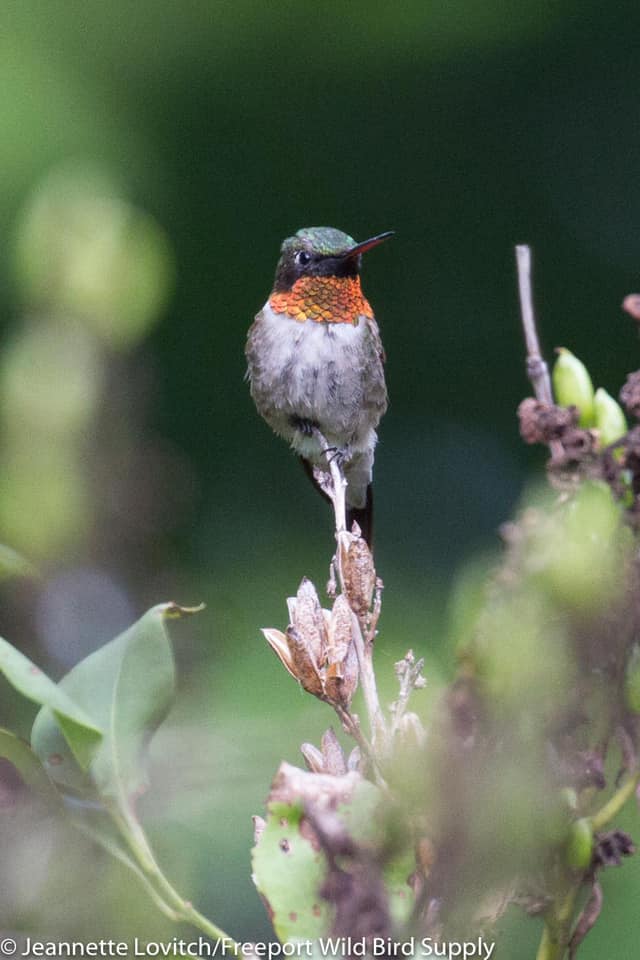
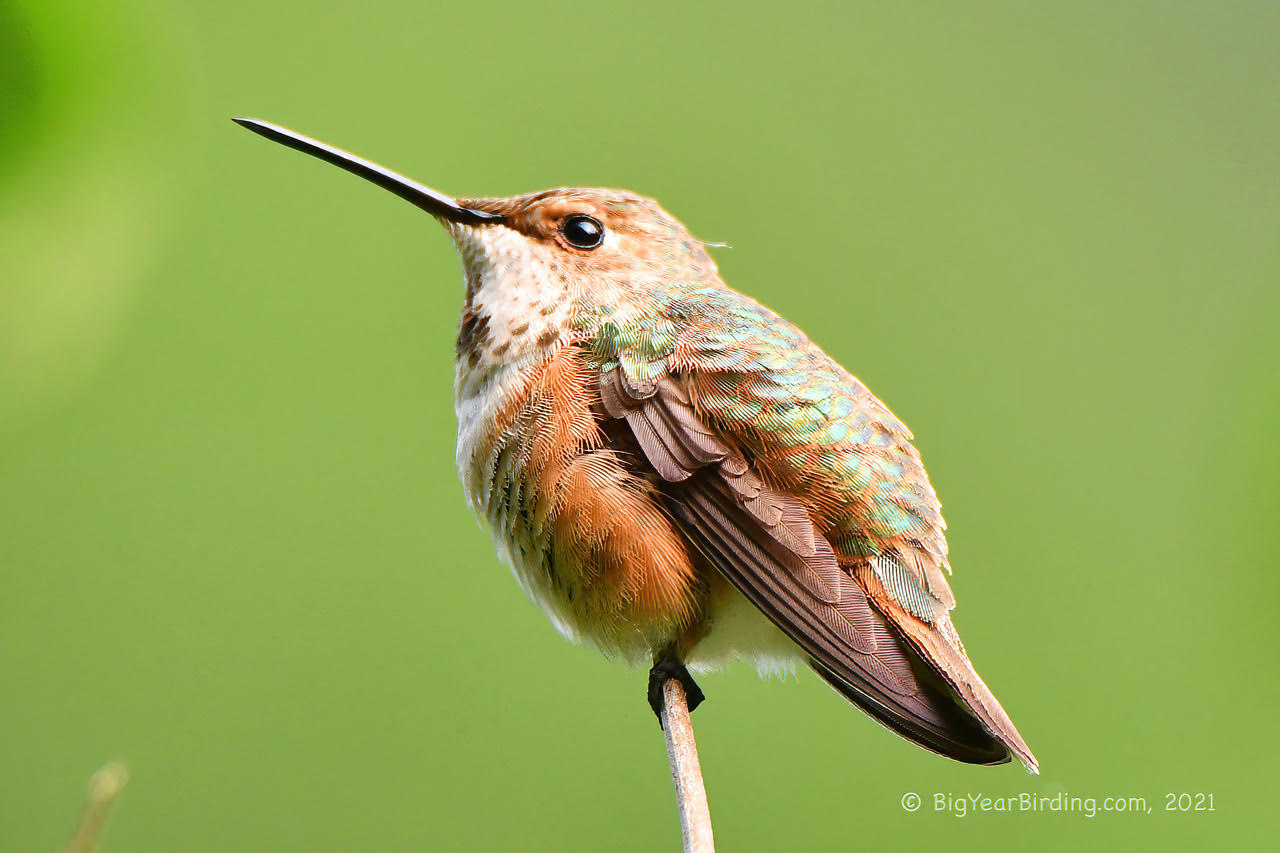
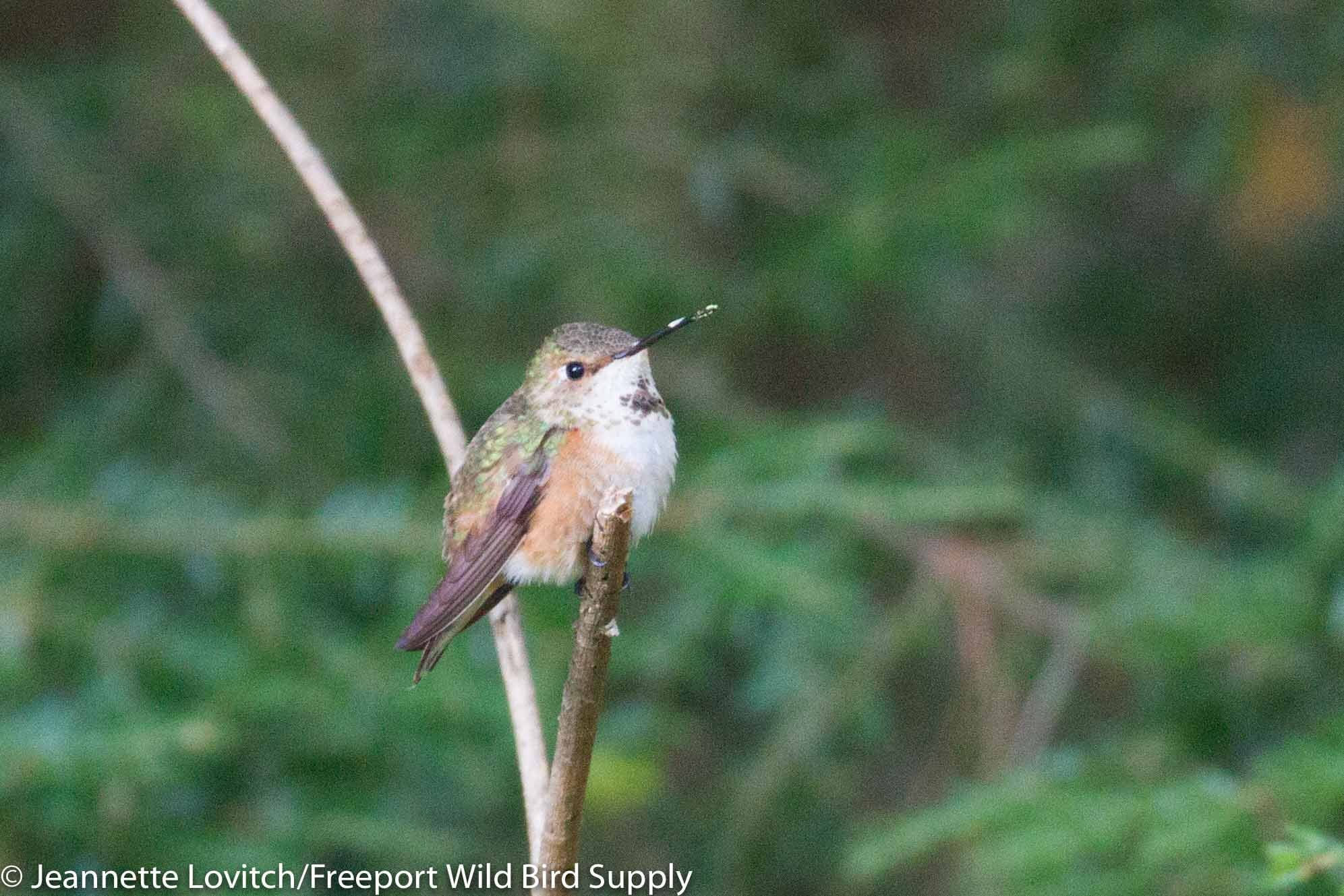
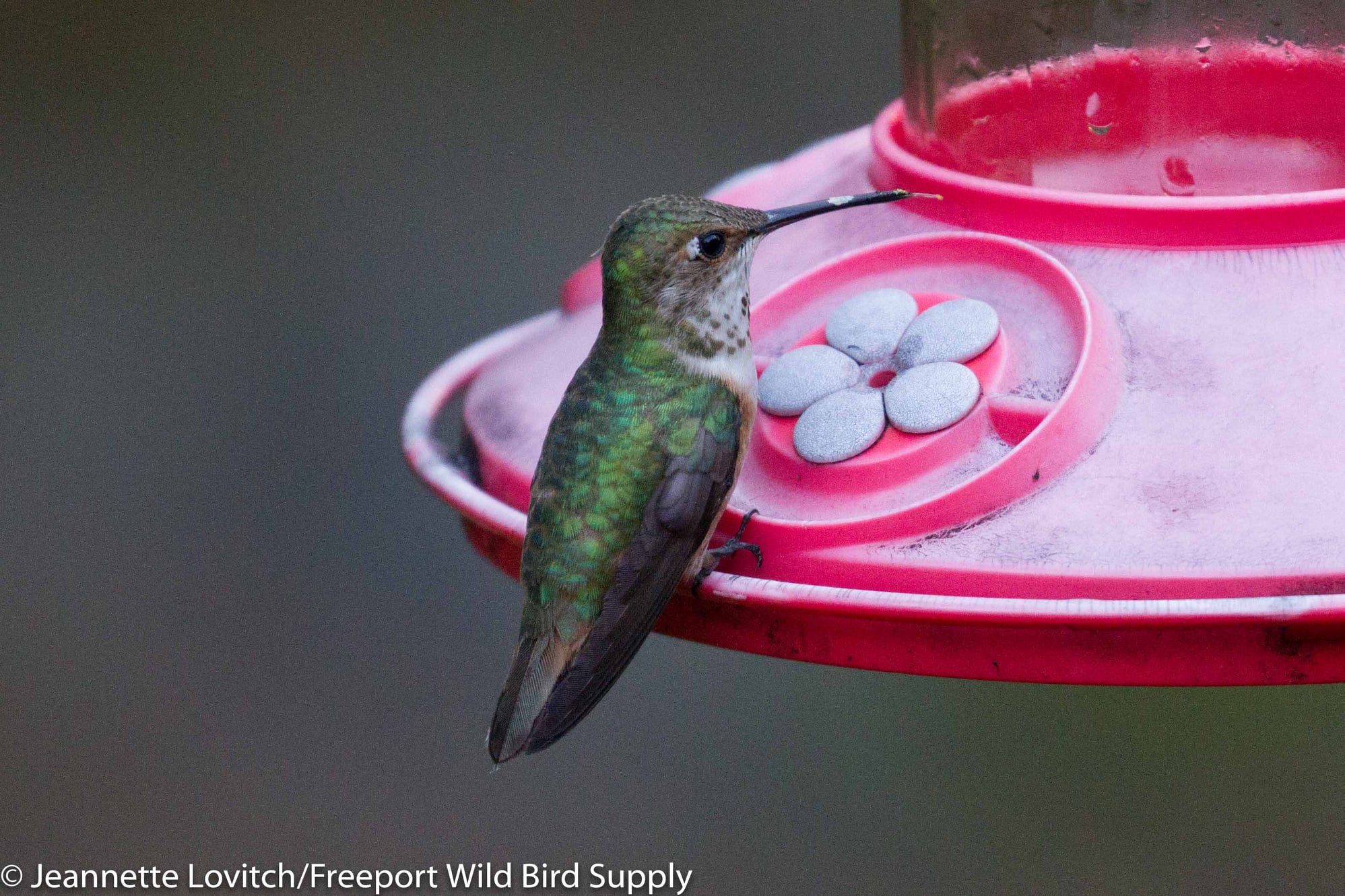
Here are Jeannette’s best photos from the evening:
It was already getting dark, it was tough to observe details, and her shutter speed was too slow to capture motion: and we really needed to see the spread-tail to have hopes of identifying this inordinately tricky genus.
We decided to invite a handful of folks over to our yard the next morning to share in our excitement over this special backyard visitor. We also hoped to have more long lenses pointed at that tail!
Studying the books and reviewing the photos – along with soliciting some input from other birders – it became readily clear that this was an adult female (based on overall wear and throat pattern) Rufous or Allen’s Hummingbird. We systematically eliminated the other members of the genus, and saw nothing suggestive of the even less likely Allen’s. But this is one of the most challenging species-pairs in North America, depending on the age and sex.
The next morning, 6 people joined us on the porch, and luckily, our bird showed up. And eventually, showed up really, really, well! Unlike the previous evening however, where she spent prolonged periods at the feeder, she rarely lingered at any one flower or feeder for long before be driven off by one of the resident Ruby-throats (at least two adult males, 2 adult females, and either another female or a juvenile were all present and protecting their resources). Plenty of photos were taken, but we had not yet seen the tail pattern clearly.
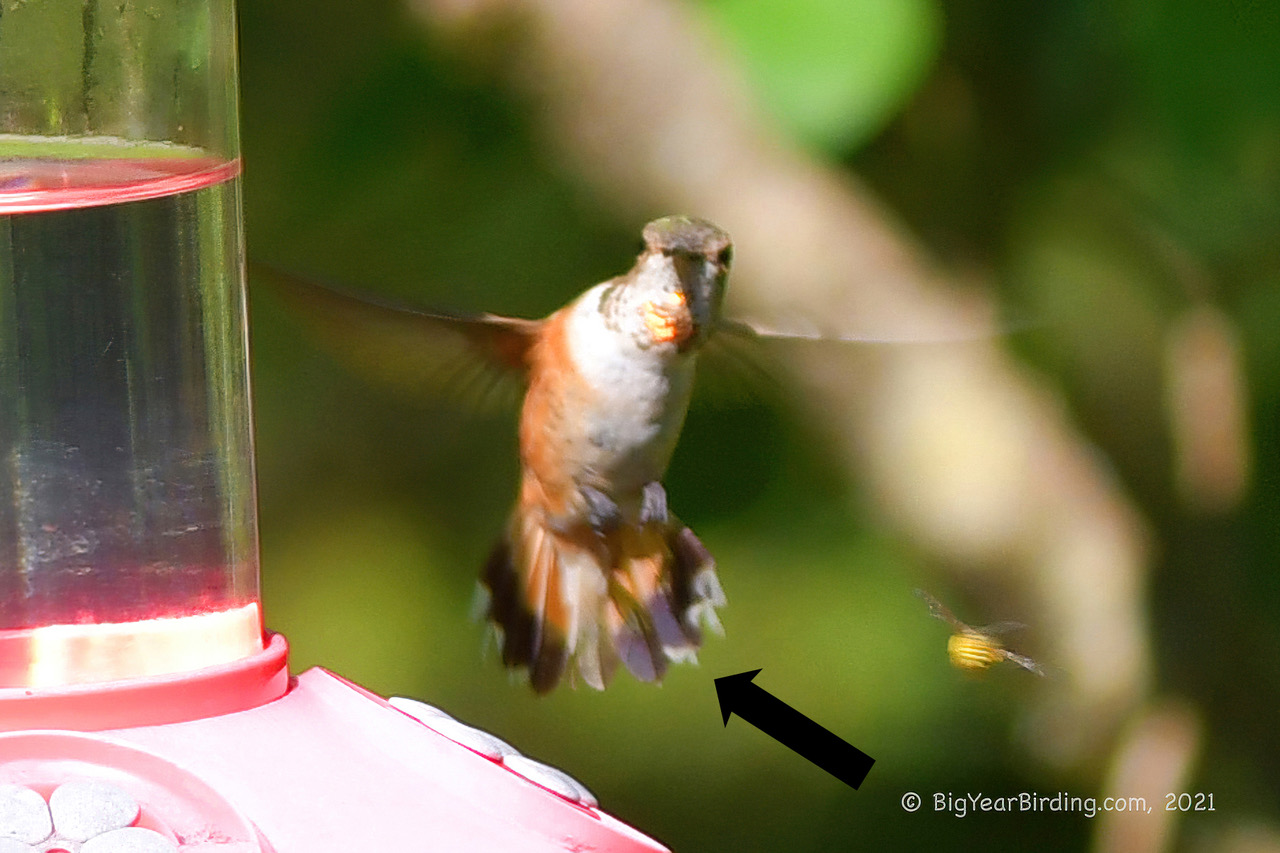
Jeannette and I really needed to go pack now, and so we left the hummingbird watchers to themselves. Eventually, Bonxie went off to camp, I packed the car, and soon it was time for us to depart. Luckily, Ethan and Ingrid remained vigilant as Ethan finally acquired those critical tail shots:
His arrows point to the critical R2, the 2nd tail feather from the center on each half of the tail. On most – but not all – adult female Rufous Hummingbirds, there is an emargination (often called a “nipple tip”) which is not present on Allen’s Hummingbird. Unfortunately, this birds tail is worn – not surprising at this time of year – and the exact original pattern is just impossible to deduce.
We are therefore left with less-reliable set of field marks and circumstances. Often, the fallback here is to band and measure it, but we decided not to consider that unless she was still present when we returned.
So this is what we have:
Tail feathers, including R5, look “wide enough” to be a Rufous. This is pretty subjective visually, however, and usually takes in-hand measurements to confirm.
Limited rufous in the uppertail coverts as expected on Rufous.
Overall wear and fading of plumage is rather minimal; most Allen’s Hummingbirds would look very worn and likely really tattered by now.
The circumstantial evidence is also quite strong:
Rufous Hummingbirds are early long-distance migrants who are on the move in the west by now. Breeding as far north as southeastern Alaska, Rufous Hummingbirds have a pattern of fairly regular vagrancy to the East in late summer. Allen’s does not.
The only New England record of Allen’s Hummingbird is from Nantucket on 8/26/1988 (Massachusetts Avian Records Committee). Admittedly, that is only a month later (I was surprised to learn!).
The next closest records are seven in New Jersey (mostly from Cape May) that all were first found between September 3rd and November 14.
Of course, the preponderance of unconfirmed/unidentifiable “Rufous/Allen’s Hummingbirds” records clouds the judgment of this pattern of occurrence a little.
We already had scheduled someone to take care of our feeders while we were gone, and when he did so on 8/4, he did not see our Selasphorous. We returned home in the evening of 8/8, and sugar water was still available and our meadow of Wild Bergamot was now in full bloom. But alas, our visitor was not present. There were plenty of Ruby-throats still buzzing around – perhaps one less adult male and one more juvenile now, but not surprisingly, our vagrant had continued on, whether by choice or by force.
Now if she was still here, we would have pondered opening our yard up to visitors (not visible from the road, let alone a public one) and perhaps arranging for a bander to visit and attempt to capture her for measurements. But alas, these are the best shots and information we have to work with at this time.
So I am still soliciting comments, but personally, I think this bird is a Rufous Hummingbird. While we might not have absolute conclusive proof, I see absolutely nothing to suggest Allen’s so for me, I am happy with the most probable identification and Rufous Hummingbird is our 133rd Yard Bird!
And after 16 years here, our backyard has finally attracted a bona fide vagrant (although the two Hoary Redpolls were pretty great as well). I just wish her timing was a little better. Then again, she could have shown up the next day and we would have never known! Nevertheless, it was a wonderful birthday present!
Thanks to Michael O’Brien and Paul Lehman for helpful comments on the bird’s suspected identity, and especially to Ethan Whitaker for the diagnostic (or nearly so?) photos.
References:
Howell, Steve N.G. 2002. Hummingbirds of North America: The Photographic Guide. Princeton University Press: Princeton and Oxford.
West, George C. 2015. North American Hummingbirds: An Identification Guide. University of New Mexico Press: Albuquerque.
Williamson, Sheri L. 2001 Hummingbirds of North America. Houghton Mifflin Company: New York and Boston.
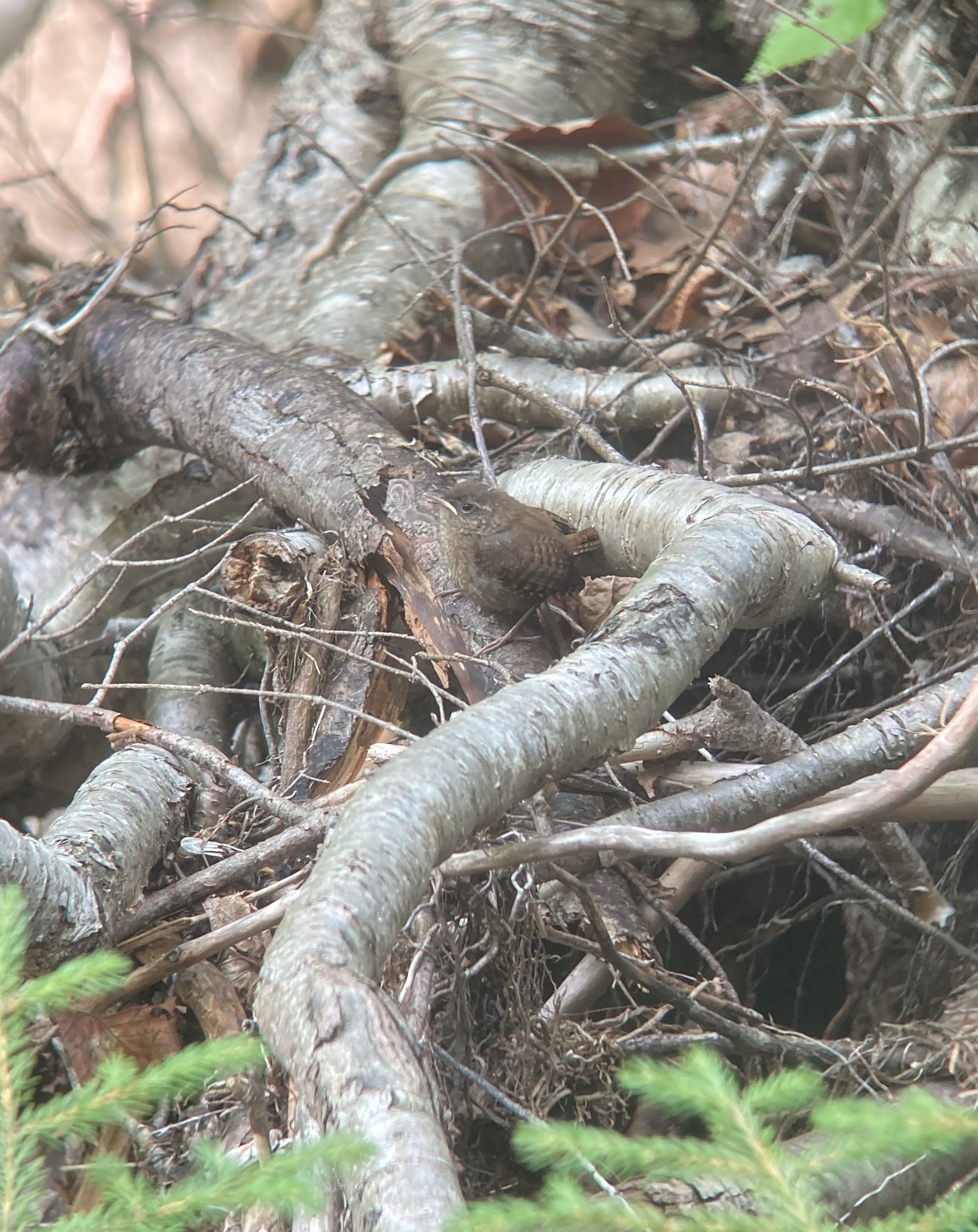
This fledgling Winter Wren on the trail at Burnt Mountain was not my rarest sighting of the week, but it sure was the cutest!
My observations of note over the past seven days included the following:
1-3 BICKNELL’S THRUSHES and 2 BOREAL CHICKADEES, Burnt Mountain, Carrabassett Valley, 7/26 (with Brian Bartlett).
1 American Bittern, Carrabassett Valley Snowfluent Ponds, 7/26 (with Brian Bartlett).
3 continuing female Black Scoters, Simpson’s Point, Brunswick, 7/27 (with Jeannette).
1 immature YELLOW-CROWNED NIGHT-HERON (FOY), Pine Point, Scarborough, 7/30: flew over the co-op pier from the direction of Stratton Island and landed in the Jones Creek Marsh on the am outgoing tide.
3 adult Red-necked Grebes, Ocean Avenue, Biddeford Pool, 7/30.
And, with southbound shorebird migration now in full swing, my high counts this week were as follows (no upper marsh at high tide visits this week):
American Oystercatcher: 4 (2 ad and 2 juv), Pine Point, Scarborough, 7/30 plus 1, Ocean Avenue, Biddeford Pool, 7/30.
Black-bellied Plover: 5, Wharton Point, Brunswick, 7/27 (with Jeannette) and Pine Point, 7/30.
My observations of note over the past fourteen days included the following:
Rare mid-summer SCOTER hat-trick with 4 Black, 2 White-winged, and 1 Surf, Simpson’s Point, Brunswick, 7/3.
4 Greater and 3 Lesser Yellowlegs, Wharton Point, Brunswick, 7/3.
Seawatching from Eastern Point, Gloucester, MA on 7/8 during Tropical Storm Elsa (with family): In about 2 hours where fog lifted enough to see, Great Shearwaters were passing at an average of 199 per 5-minute segment and Sooty Shearwaters were passing at an average of 314 per 5-minute segment. Plus 2 MANX SHEARWATERS, 1 unidentified JAEGER, and 1 Cory’s Shearwater.
Our second “Search for Troppy” tour with our partners the Isle au Haut Boat Services took place on Saturday the 10th. With Tropical Storm Elsa roaring through the day before, building seas to 7-10 feet, we were of course just hoping to run the tour.
But we remained optimistic, and as winds turned to the northwest behind the storm, the surf rapidly got knocked down. With calm winds by dawn, they came down even further. And by our 1:00pm departure on the M.V. Otter, Stonington Harbor was nearly flat calm, the sun was shining, and our offshore reports were positive.
With high hopes, we set off, and pretty soon came across several Wilson’s Storm-Petrels and of course, Black Guillemots. As we cleared the shelter of Isle au Haut, we found more storm-petrels, but we also found leftovers waves from the storm. There were a few pretty big swells remaining, but Captain Tracy handled them with skill and kept us surprisingly comfortable.
Scattered Wilson’s Storm-Petrels gave way to some massive groups loafing on the calm surface. Led by a single group of 91, I tallied a conservative estimate of 210! Unfortunately, the swells were just high enough that we couldn’t safely turn around for the single Sooty Shearwater that we saw bobbing in the waves, or what turned out to be the only Common Murre of the day.
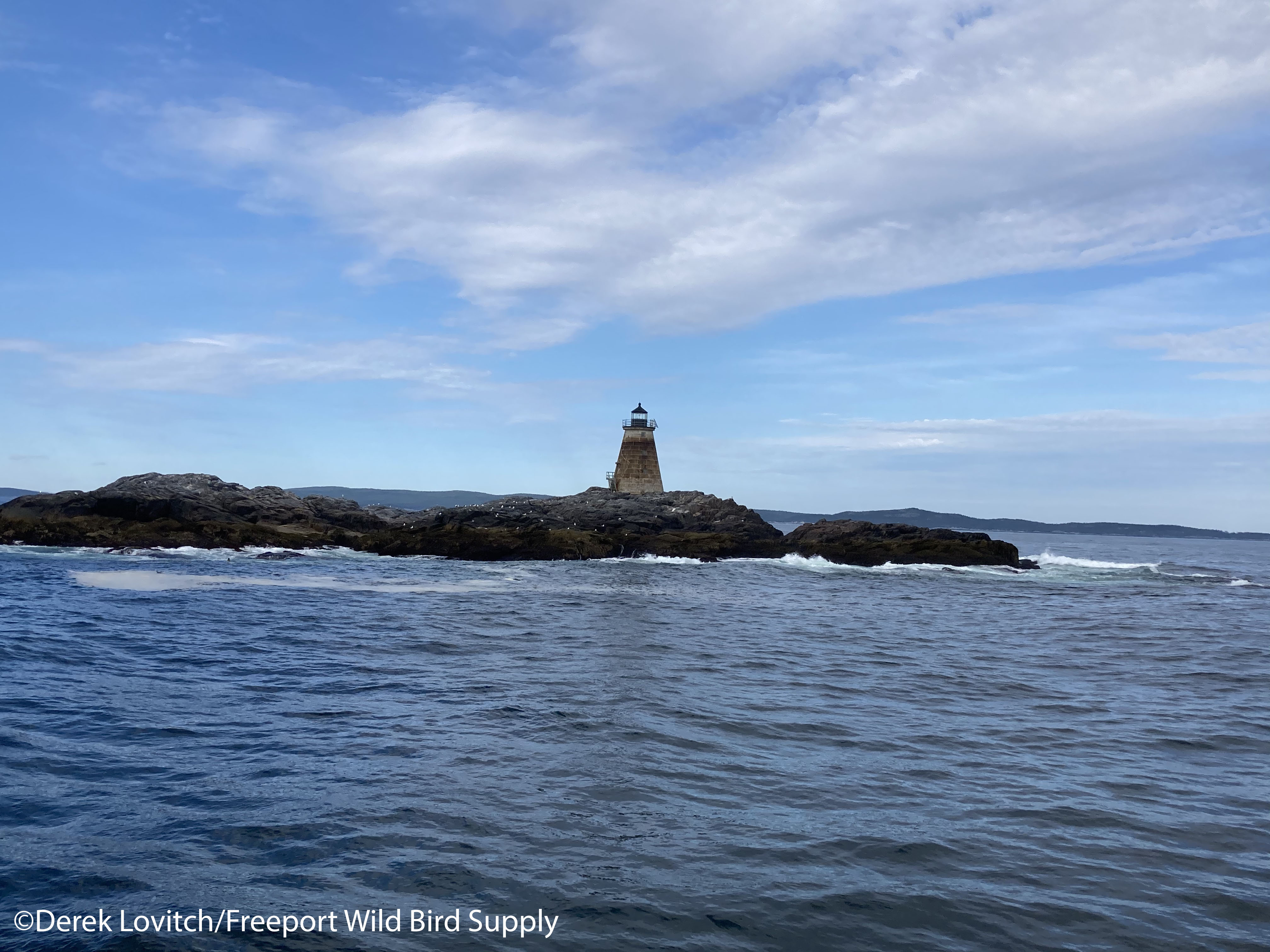
Reaching the lee of Seal Island, the waves disappeared, and we began our slow cruise enjoying the island’s summer denizen. Arctic and Common Terns were in abundance, there were plenty of Black Guillemots, and we checked out a couple of rafts of Atlantic Puffins. Likely due to the post-storm day, puffins were busy and not doing much loafing, so we actually saw relatively few. Unlike our previous tour where we had as many puffins close to the boat as I have ever seen out there, this was about as few as I have ever had. The Pufflings must be hungry!
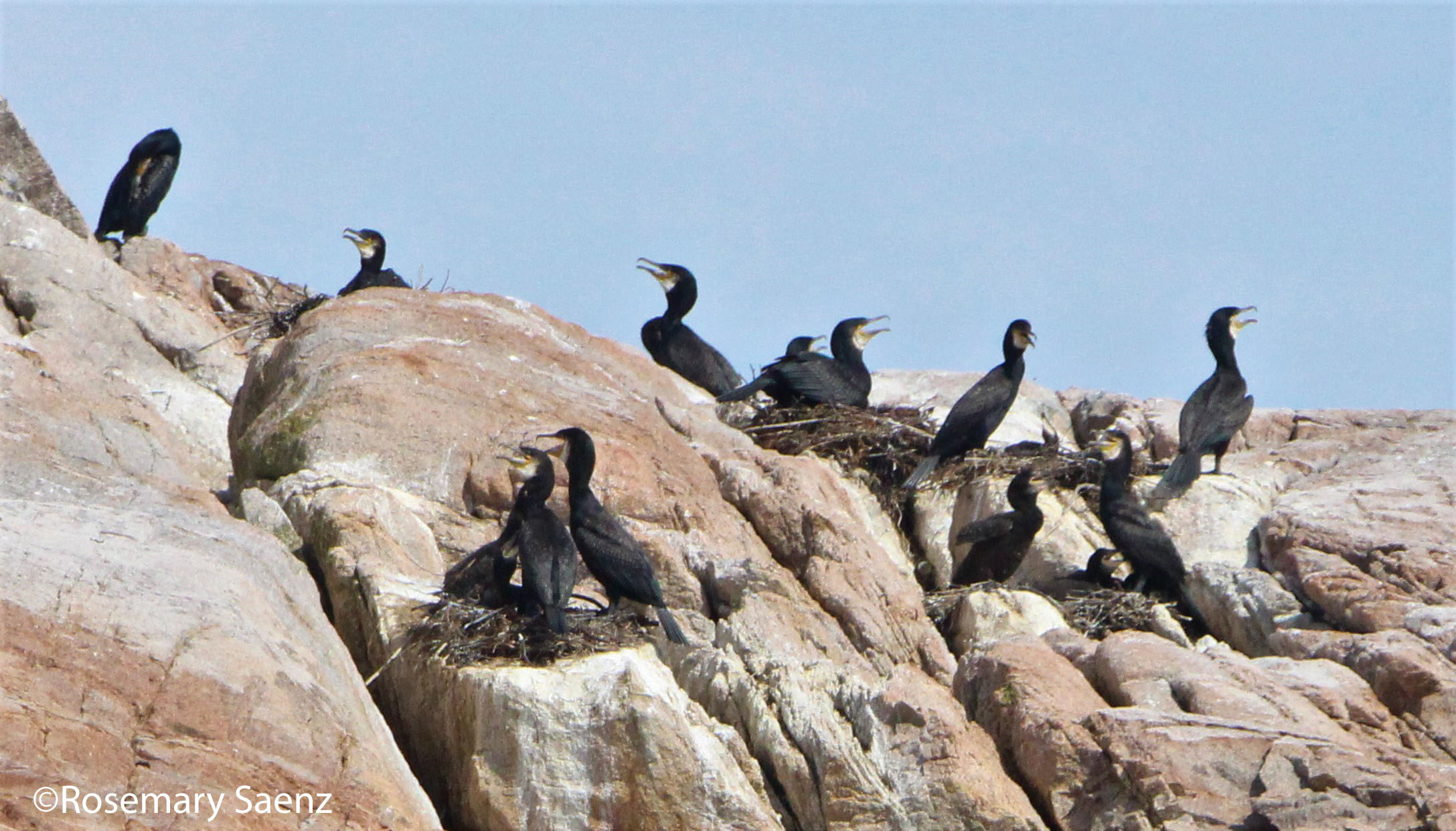
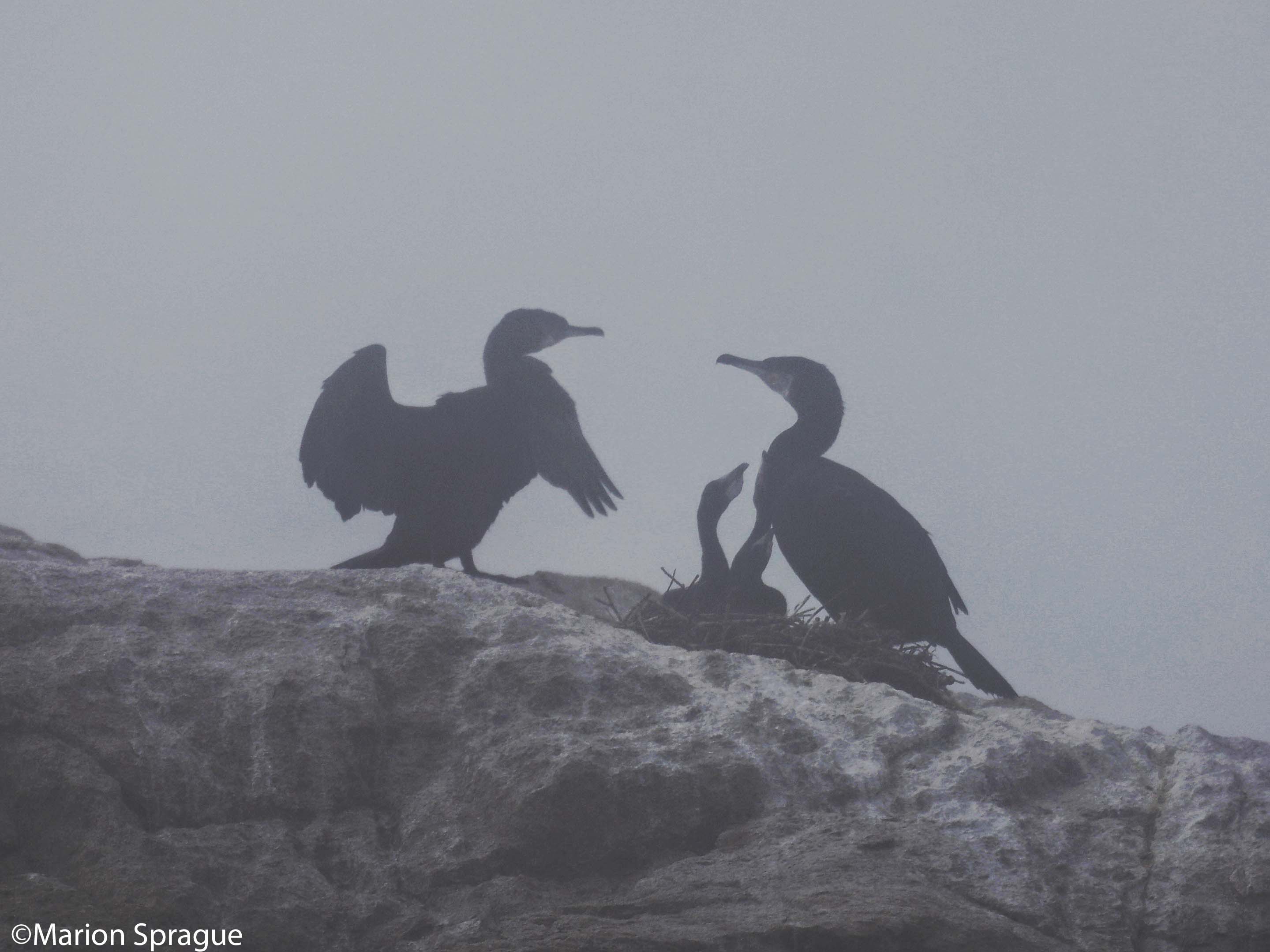
We finally spotted 2 Razorbills on our way to the bustling Great Cormorant colony, noted a pair of Common Ravens, and spotted a Peregrine Falcon – a rather unwelcome guest out here.
Thanks to the charter, we had plenty of time, and we needed as much patience as possible. I admit I was getting as worried as the guests that Troppy was not home today.
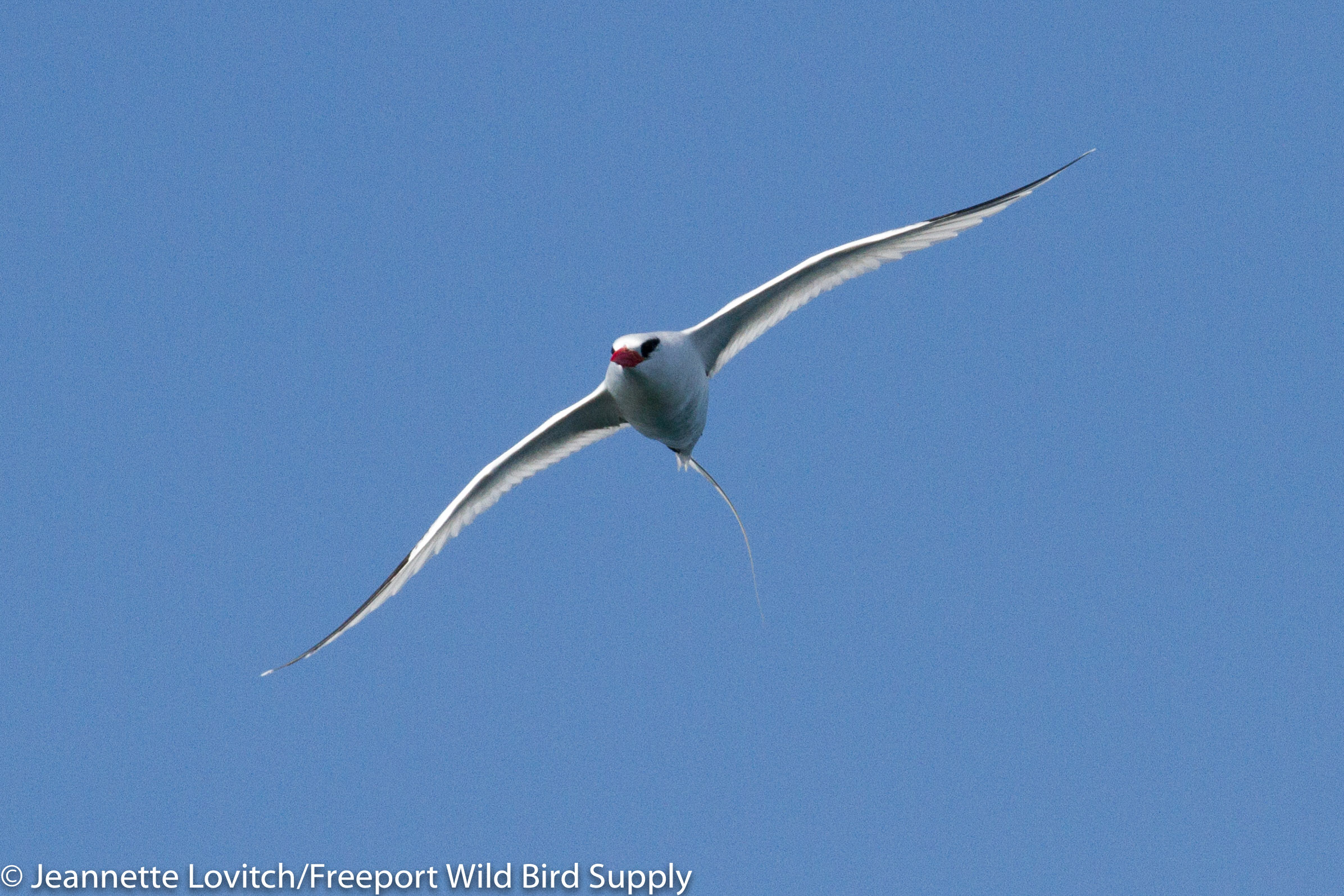
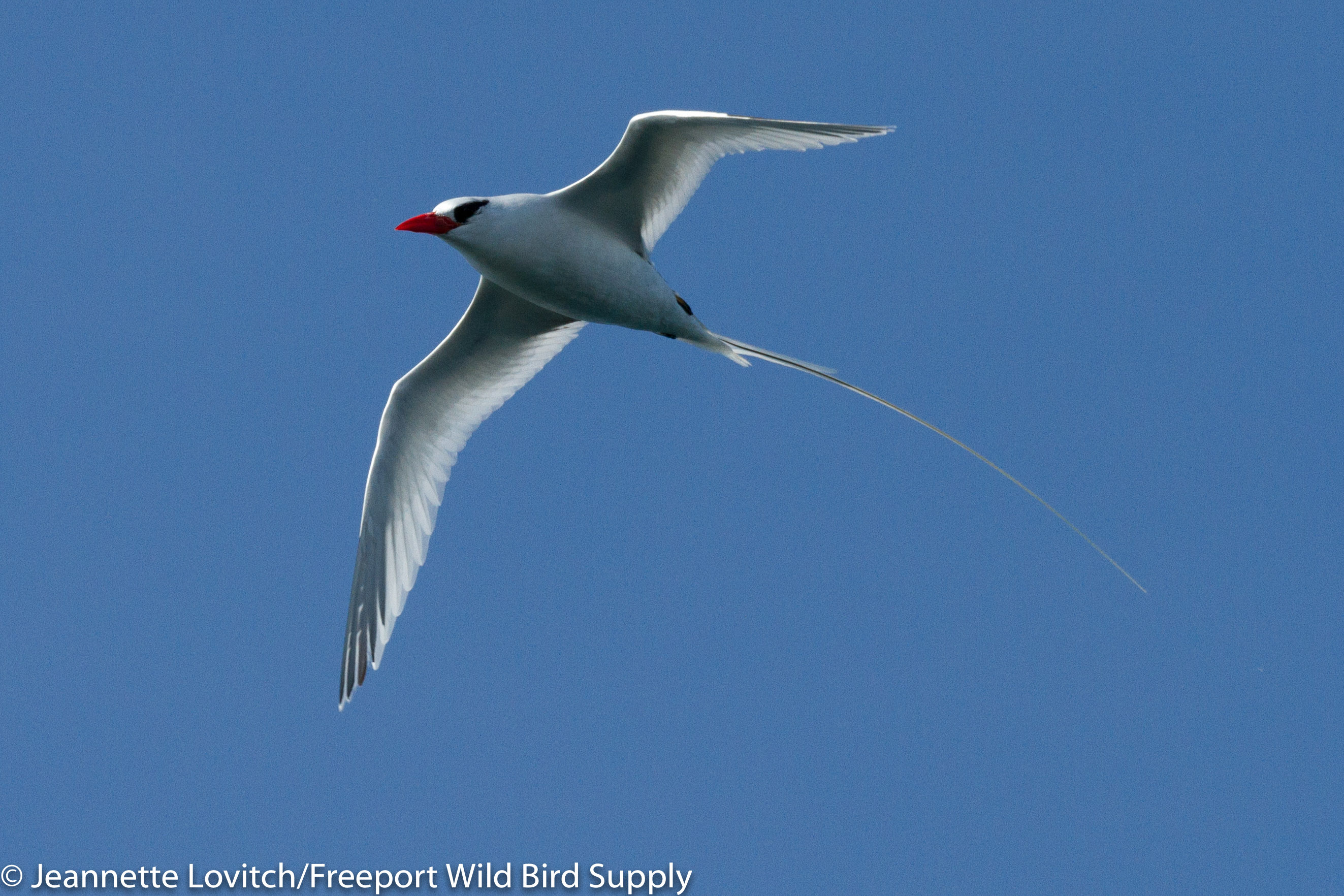
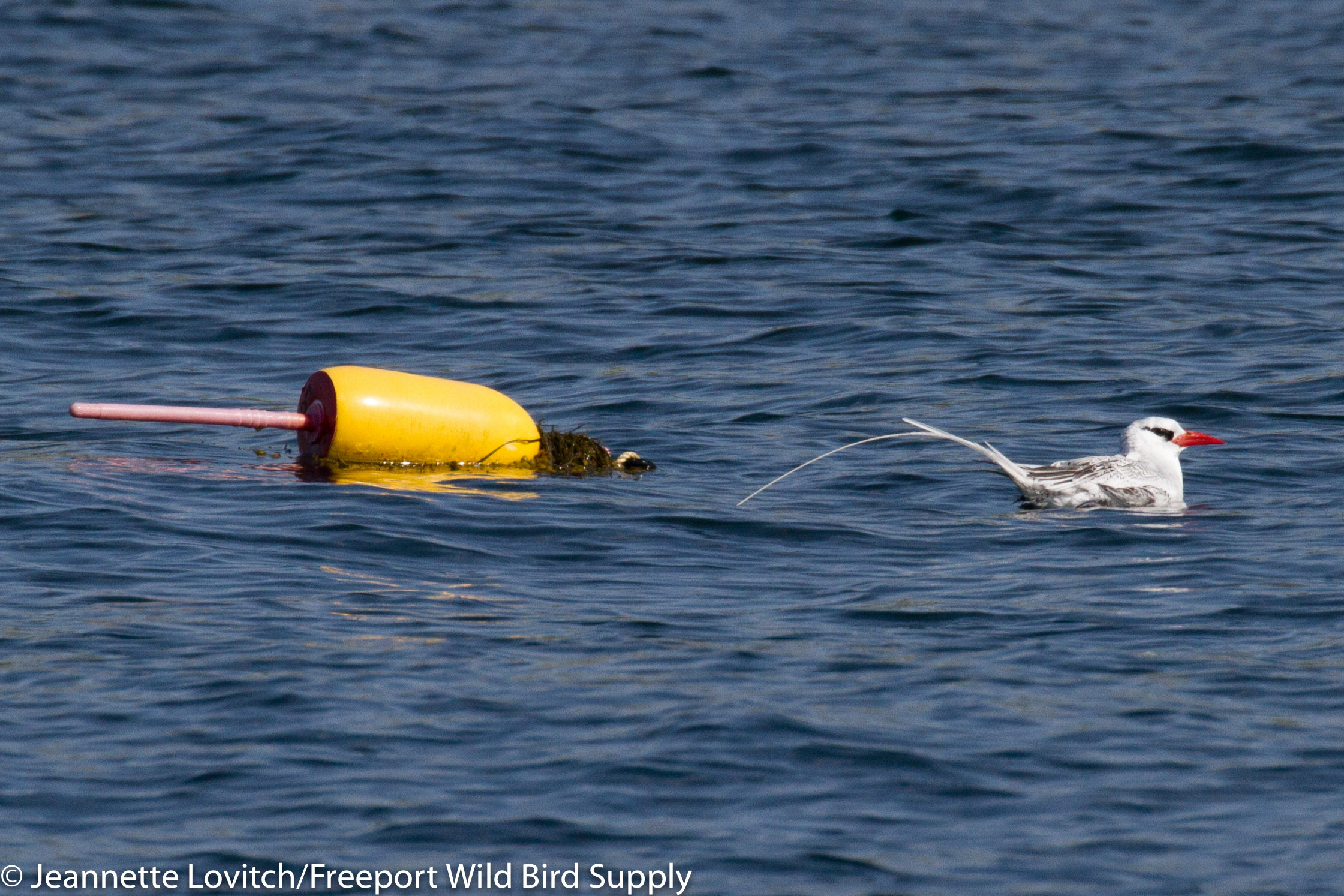
But then, this happened:
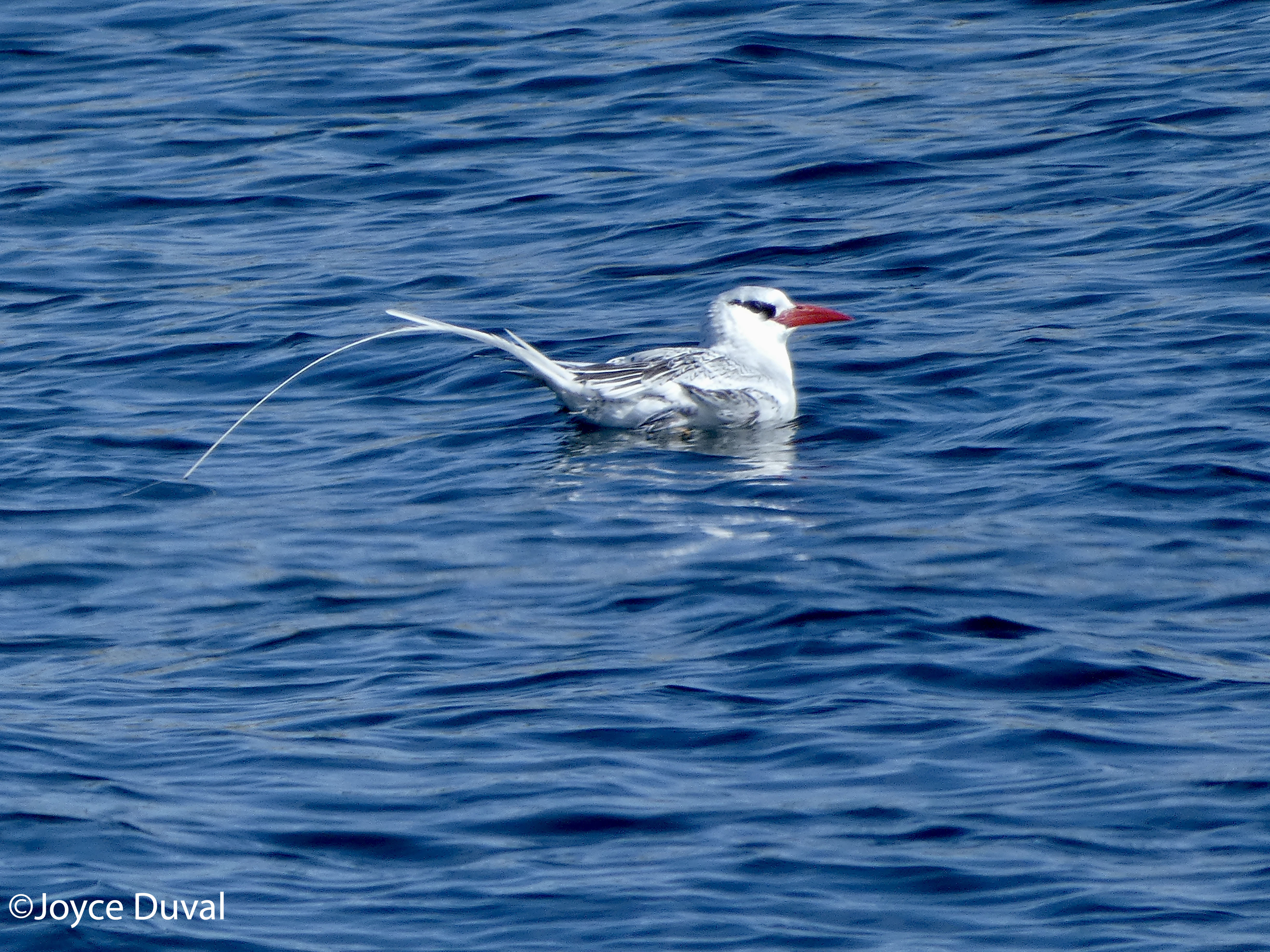
It was simply one of best 2 or 3 shows that I have ever had. He made repeated passes right overhead, did a lot of calling and displaying, and then finally sat on the water and took his bath. Captain Tracy did a great job returning us to good lighting, and we cut the engine once again and drifted along with him, enjoying the sights and sounds of the island, and of course, basking in the glory of a successful twitch!
Three Short-billed Dowitchers with three peeps launched from the island; a sign of the season as these are already on their way south. The other island birds including Song and Savannah Sparrows, Spotted Sandpipers, and oodles of Common Eiders were also present and accounted for.
Captain Tracy finally had to pull us away, but we were just getting greedy. It was time to leave Troppy alone to enjoy his afternoon bath in peace. He earned it today.
We made really good time coming back as the waves continued to subside. Unfortunately, it was too rough around Saddleback Ledge to check it carefully, but we did have 4 more Great Cormorants there. To and from the ledge, we encountered plenty of Wilson’s Storm-Petrels (although not nearly as many as on the way out) and a couple of Northern Gannets.
Surprisingly, we didn’t have any shearwaters on the way back, but a short distance beyond Saddleback Ledge, we spotted a couple of Razorbills. Then a small raft, and then another. In all, about 40-50 Razorbills – I guess that’s why we didn’t have many at the island; they were all feeding inshore!
A single Atlantic Puffin was with them, and we had several more Razorbills when we checked out a feeding frenzy of Herring and Great Black-backed Gulls not far out of the harbor entrance. And of course, a few ledges full of Harbor Seals.
In the end, we saw every possible island summer resident, especially, yeah, THAT one. It was a very good day.
“Fall” shorebird migration is underway! 7 Lesser Yellowlegs, 3 Greater Yellowlegs, and 2 Least Sandpipers (FOF) were off Eastern Road Trail, Scarborough Marsh, 7/1 (with clients from AZ).
4 Gadwall, Eastern Road Trail, 7/1 (with clients from AZ).
1-2 TRICOLORED HERONS, Scarborough Marsh, 7/1 (first at Eastern Road and then possibly same bird later at Pelreco Marsh; with clients from AZ).
The proposed continuing TRICOLORED HERON X SNOWY EGRET X LITTLE EGRET HYBRID, Pelreco Marsh, Scarborough Marsh, 7/1 (with clients from AZ). Later spotted passing over Pine Point.
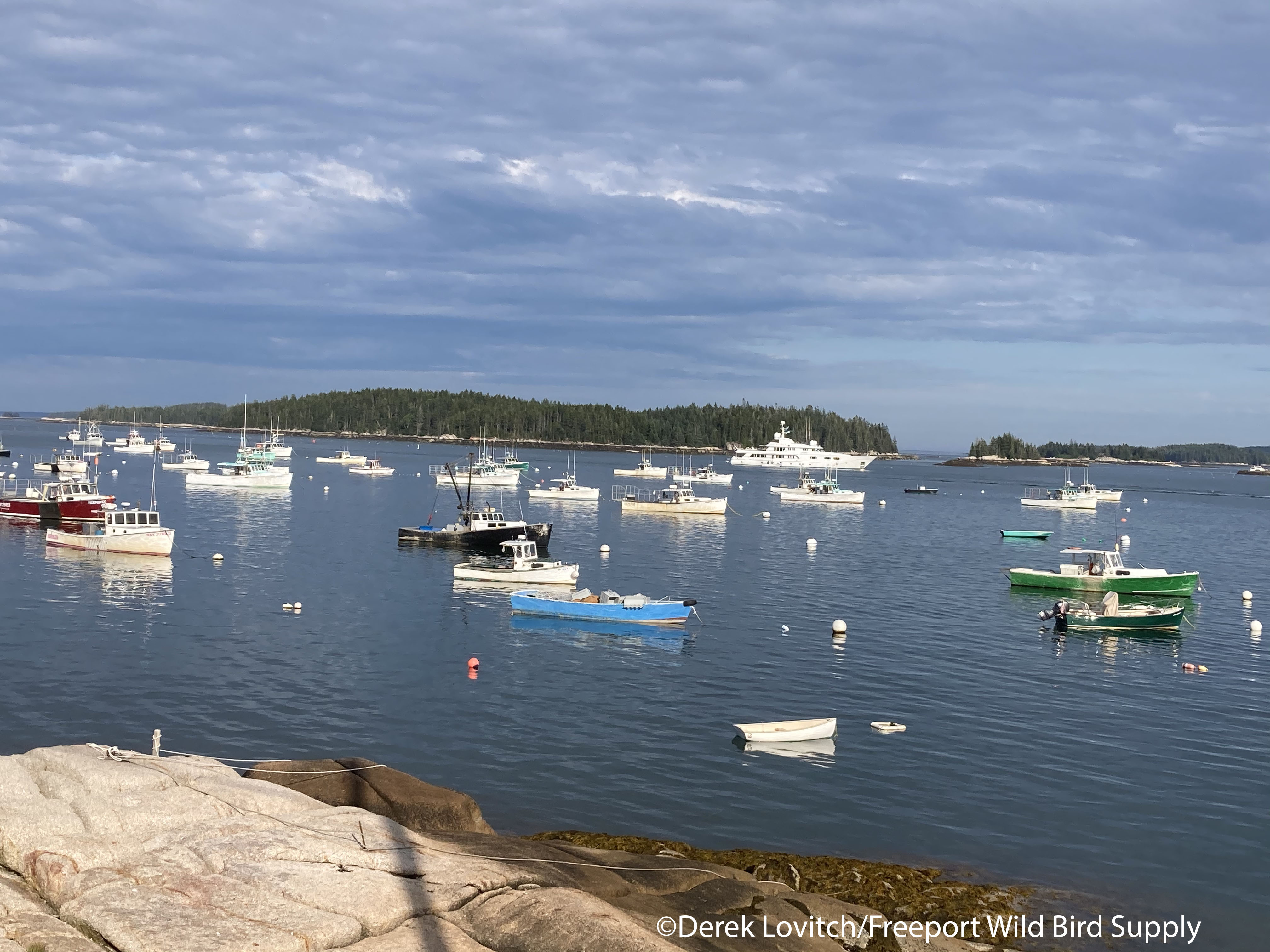
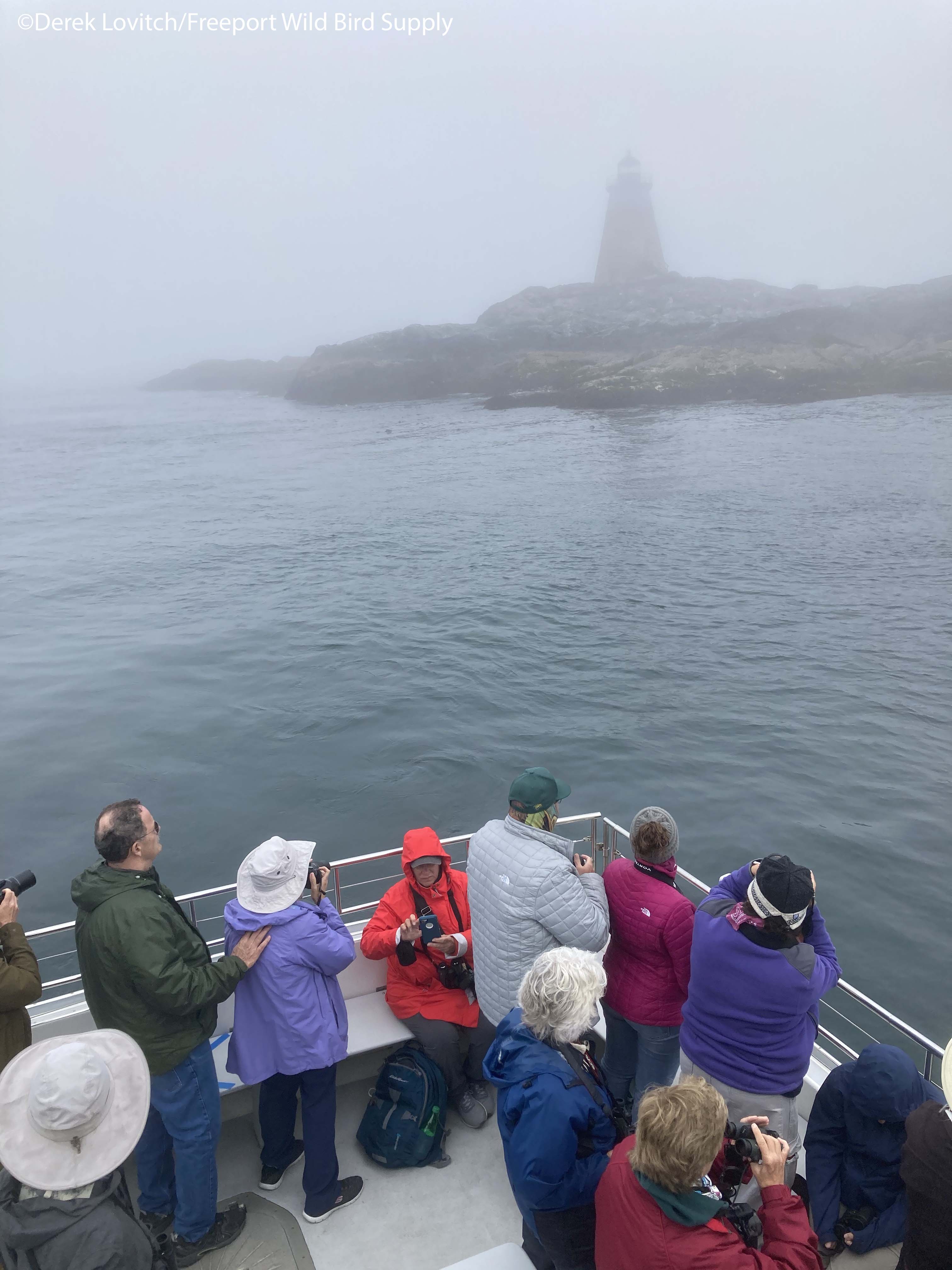
The first of two “Search for Troppy” charters to Seal Island took place on Saturday, June 26th. Departing Stonington at 1pm with the good folks of The Otter from Isle au Haut Boat Services, we would be in prime time for the appearance of Maine’s Red-billed Tropicbird that has called the Gulf of Maine home for the past 17 years. For this first trip of the year, I was joined by Marion Sprague, co-coordinator of the Maine Young Birder’s Club, as my co-leader.
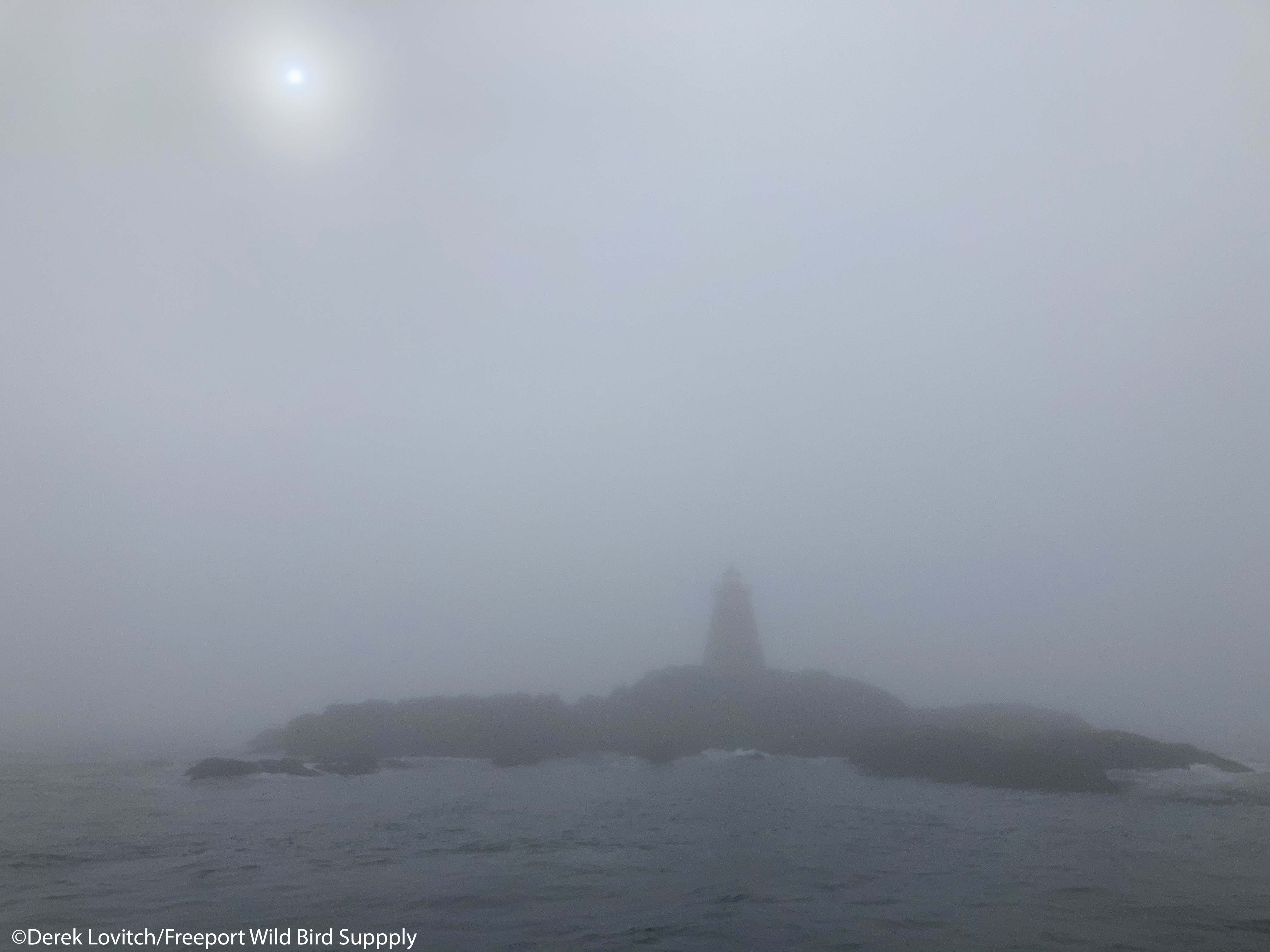
Unfortunately, the weather was not looking good. Dense fog, a moderate southerly breeze, and a forecast for marginal seas made us think twice. At the very least, Captain Garrett gave the talk about seasickness and where to find those handy bags. However, we were also receiving real-time weather data from a lobster boat hauling traps near the island, and we were being assured “it’s not bad out here.” But we were skeptical – Maine fishermen are tough!
Keeping us in the shelter of Isle au Haut for as long as possible, Captain Garrett plotted his course. A Merlin offshore was a little surprise, but otherwise we struggled to pull much out of the dense fog beyond the “big 5:” Herring and Great Black-backed Gull, Common Eider, Black Guillemot, and Double-crested Cormorant. A smattering of Common Terns and several occupied Osprey nests was about it.
As we began the crossing of open water to Seal, we soon became pleasantly surprised by the conditions. It was still foggy, and we had about 20 minutes of fairly rough seas, but the overall wave height was nothing like it was forecast and the winds seemed to be dying. Things were looking up.
We glimpsed a couple of Wilson’s Storm-Petrels and a Northern Gannet on the way out and took the time to ease up to an Atlantic Puffin loafing (probably too full to bother flying). We just didn’t want to take anything for granted. But that was about it, until Seal Island materialized from the fog.
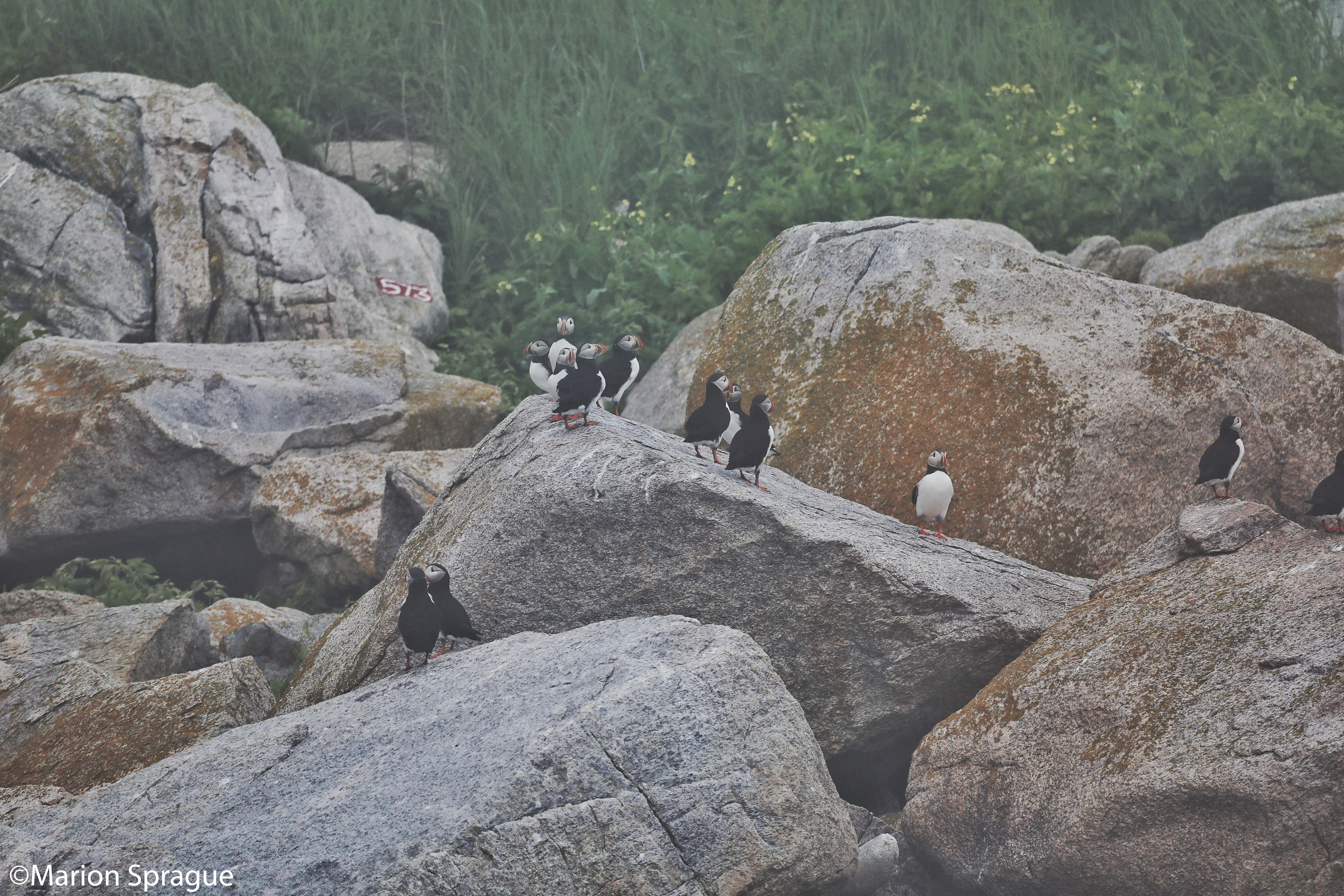
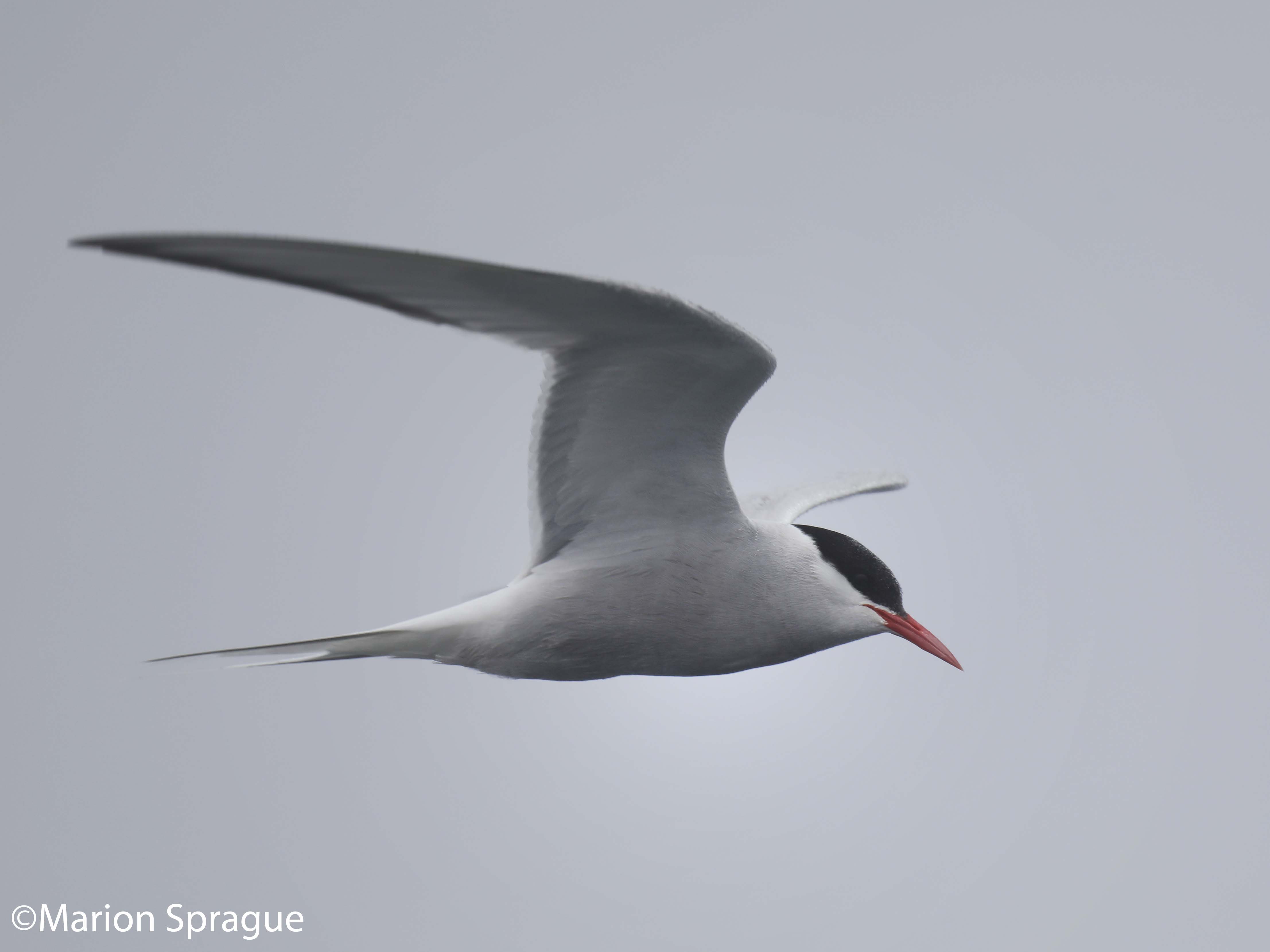
As we approached the surprisingly-sheltered shoreline of the island, puffins were everywhere! Fewer birds rest on the rocks in the fog, and so hundreds of birds were loafing on the water. With near-flat conditions in the cove, we just floated up to resting rafts. We got close to a couple of Razorbills too, and sorted through Arctic and Common Terns. Arctic Terns were also especially confiding today, often passing right over the boat and making repeated close passes.
We enjoyed the show of the tern colony and slowly crept along the shoreline. Spotted Sandpipers sounded off and made short flights, Common Eiders ushered their chicks around, and Black Guillemots were all around.
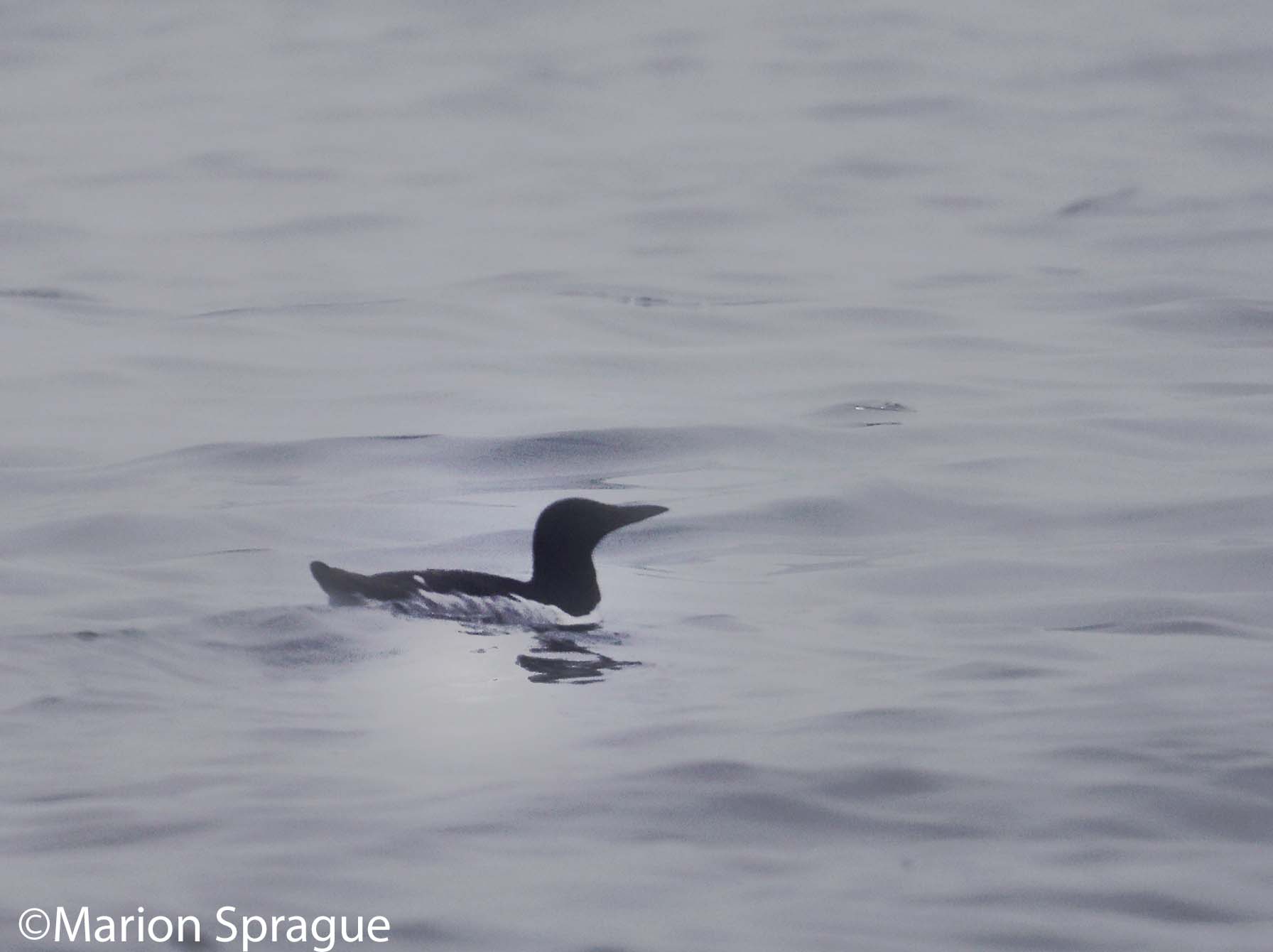
We spotted one Common Murre on the rocks, and with the water much calmer than we expected, we were able to round the southern tip to check out the Great Cormorant colony – the last in Maine. Working our way back towards the cove, we scored a much better view of a Common Murre on the water.
It was one of the best puffin shows I have ever had out here, and with the engine turned off, we just floated up to them while listening to the songs of Savannah and Song Sparrows emanating from the island.
But as joyous as this was, the reality soon became clear: the star of the show was not home today. Troppy disappears for 2-5 day periods and this was one of those periods. We were in the right place, at the right time, and had a couple of hours to search and be patient. But this time, our patience was not rewarded.
It’s always bittersweet when you depart Seal Island without Troppy, but that’s how it goes out here sometime. At least we weren’t miserable while searching! And we saw every other denizen, and wow, that puffin show! If you can’t find joy in that, perhaps birding is not for you.
The fog remained dense on the way back, and only a couple of Wilson’s Storm-Petrels and two gannets were spotted. We searched around Saddleback Ledge and a few other outcroppings, turning up only the big 5 and a whole bunch of seals (a few Gray out at Seal Island, but almost all Harbor Seals on the way in). With following seas and diminishing winds, we made great time, and before we knew it, we were at the dock and trying to get our landlegs back.
We’ll try it again on July 10th (that trip is sold out, but email us to get on the waiting list), and hope that Troppy is in town that day!






















 Maine Birding Field Notes