Next, my observations of note over the last seven days included the following:
Highlights from our Durham property this week included 1 Rusty Blackbird 10/8-9 and 3 American Woodcocks on 10/14.
Sandy Point Morning Flight, 10/9: A record-shattering day!
An exceptional Morning Flight passed over and through Sandy Point Beach, Cousin’s Island, Yarmouth this morning. In fact, it was record-breaking!
6:48-10:48am
41, clear, lt-mod NW (did not take early wind reading) decreasing then increasing back to 7.7-10.5mph before becoming increasingly gusty)
3244 Yellow-rumped Warblers (NEW RECORD!)
1423 American Robins
585 Unidentified (mostly high bunches or too far to north or south)
576 Dark-eyed Juncos (NEW RECORD!)
100+ White-throated Sparrows (Conservative estimate in parking lot area after flight; a handful appeared to cross at dawn).
59 Ruby-crowned Kinglets
50 Palm Warblers
74 Northern Flickers
72 Yellow-bellied Sapsuckers
44 Rusty Blackbirds (NEW RECORD)
43 Golden-crowned Kinglets
18 Chipping Sparrows
16 Black-throated Green Warblers
15 Northern Parulas
14 Cedar Waxwings
11 Purple Finches
10 unidentified kinglets
9 American Pipits
8 Blue-headed Vireos
6 Blackpoll Warblers
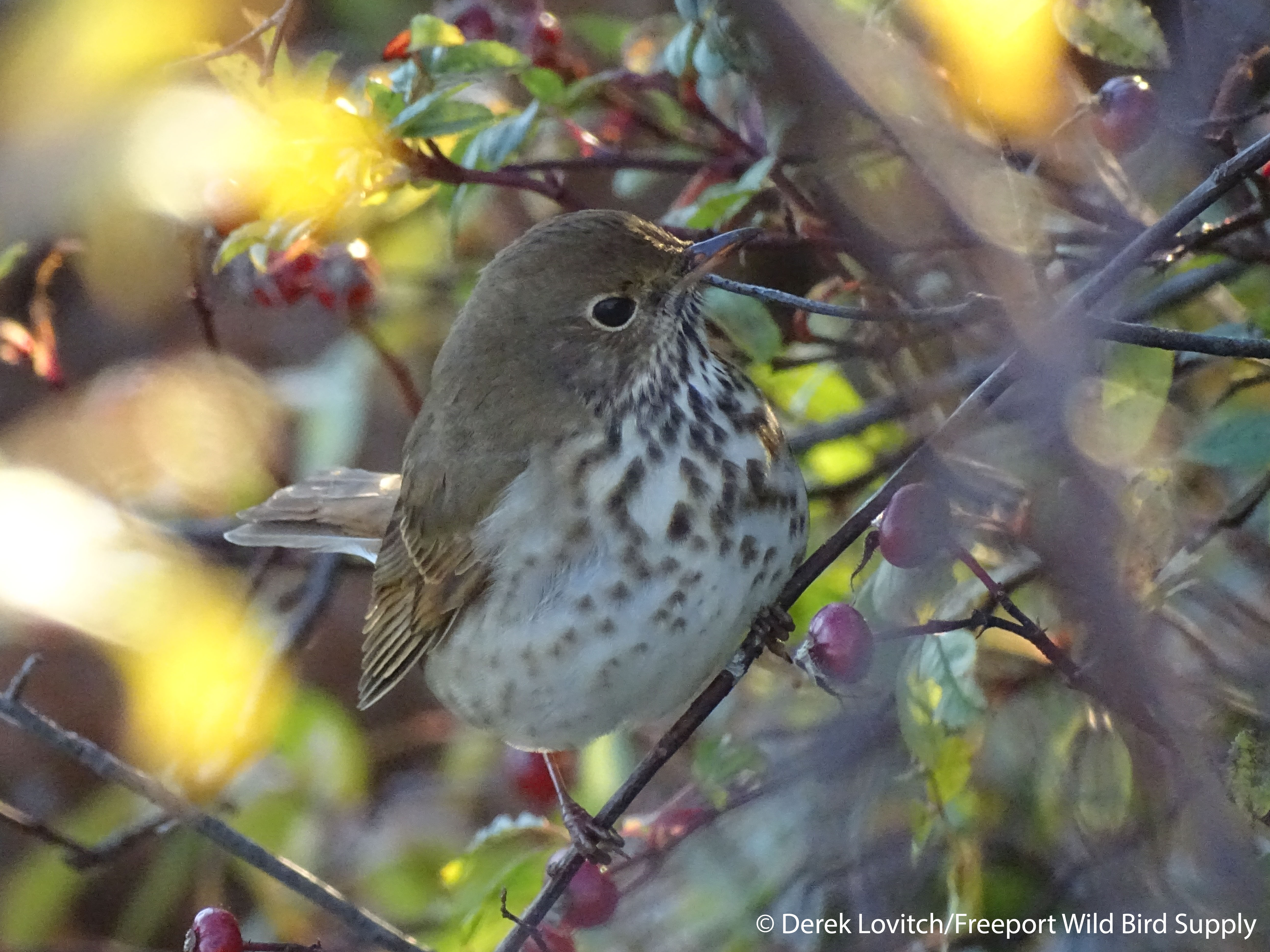
6 Hermit Thrushes (minimum, with two or several repeatedly visiting pasture rose hips at bridge base)
4 Eastern Bluebirds
4 Eastern Phoebes
4 American Goldfinches
3 Red-bellied Woodpeckers (NEW RECORD!)
2 Black-throated Blue Warblers
2 White-crowned Sparrows
2 Brown Creepers
2 Swamp Sparrows
2 Tufted Titmice (several false starts)
2 Merlins
2 Magnolia Warblers
2 Common Loons
1 Swainson’s Thrush (confirmed by Bill Thompson)
1 Yellow Warbler
1 ORANGE-CROWNED WARBLER
1 BLUE-GRAY GNATCATCHER (from photo review by Bill Thompson)
1 Red-tailed Hawk
1 Red-winged Blackbird
1 Common Yellowthroat
1 American Redstart
1 Blue Jay
1 Turkey Vulture
1 unidentified sparrow (probably a Field)
1 Eastern Towhee
1 Cooper’s Hawk
1 Pine Siskin
X Song Sparrows (significant increase in parking lot area but did not count)
***Total = 6,428 *** 2ND HIGHEST ALL-TIME COUNT and HIGHEST OCTOBER COUNT!***
Sandy Point Morning Flight, 10/10:
A good morning flight passed over and through Sandy Point Beach, Cousin’s Island, Yarmouth this morning. Given the calm winds of much of the night, and the completely calm dawn, it was much more active than I expected. Kinglets were swirling all over, so my counts may be too high or very low. The Ruby-crowned count seems a touch high, while the Golden-crowned count feels low. Meanwhile, the slower and lower flight, with more birds pausing before crossing despite the lack of wind made for excellent viewing and much more relaxing and enjoyable morning!
6:49-9:52am
33F, clear, calm with a developing puff of WNW.
449 Yellow-rumped Warblers
138 Ruby-crowned Kinglets
106 American Robins
52 Golden-crowned Kinglets
37 Yellow-bellied Sapsuckers
35 Dark-eyed Juncos
25 Cedar Waxwings
16 Northern Flickers
10 Eastern Bluebirds
9 Blue-headed Vireos
8 Palm Warblers
8 Chipping Sparrows
8 White-throated Sparrows
5 Red-breasted Mergansers
5 Nashville Warblers
5 Northern Parulas
4 Brown Creepers
3 Tennessee Warblers
3 Black-throated Blue Warblers
3 Hermit Thrushes
2 Blue Jays
2 Red-bellied Woodpeckers (2nd highest tally after yesterday’s record 3!)
2 American Goldfinches
2 Common Loons
2 Eastern Phoebes
2 Tufted Titmice (numerous “false starts.” Same two as yesterday?)
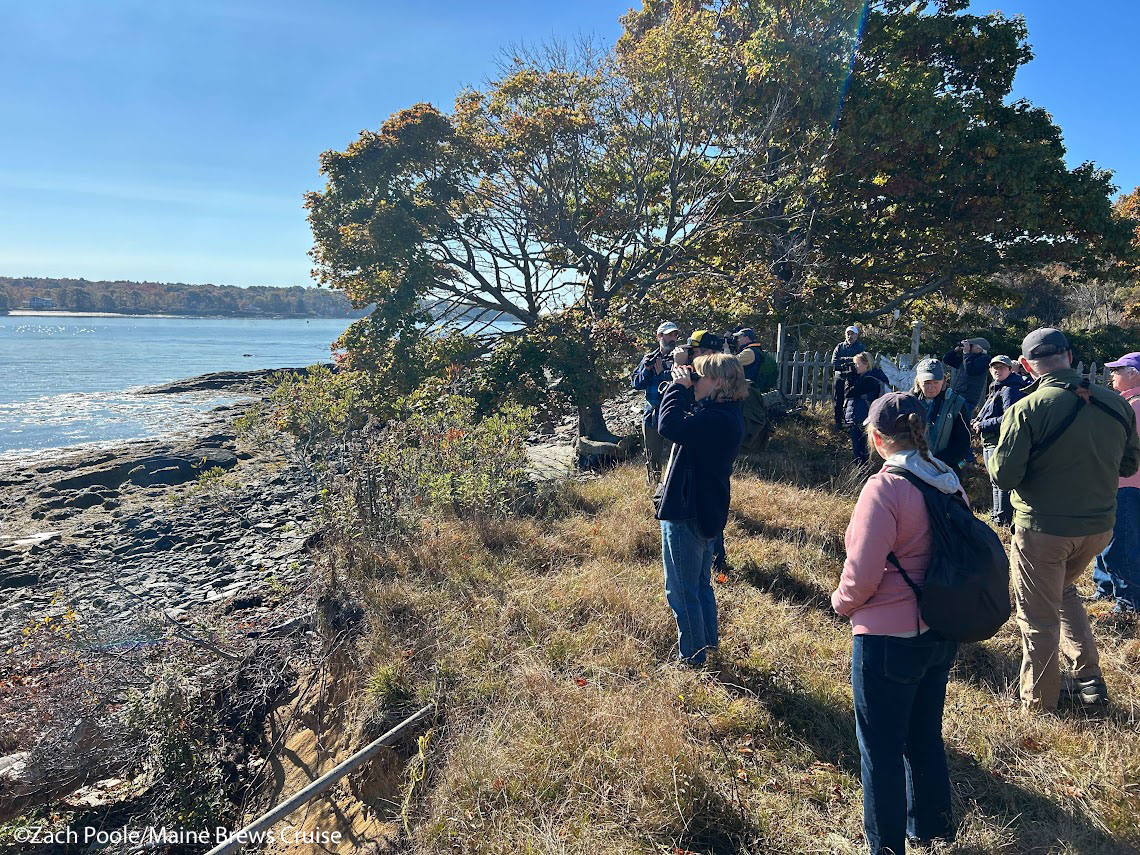
These unique, relaxed birding and beer-ing adventures that you have come to love combine great local birding at seasonal hotspots with visits to sample the delicious creations of some of our favorite local breweries. These tours are a perfect introduction to birding and/or craft beer, and a great opportunity to travel with significant others, friends, and family that have interest in one topic, while your interest is primarily in the other (for now!). But this time we’re leaving the van in the garage, and hitting the water! That’s right, we’re taking a cruise, and we’re returning to the private House Island in Porland Harbor twice in 2025.
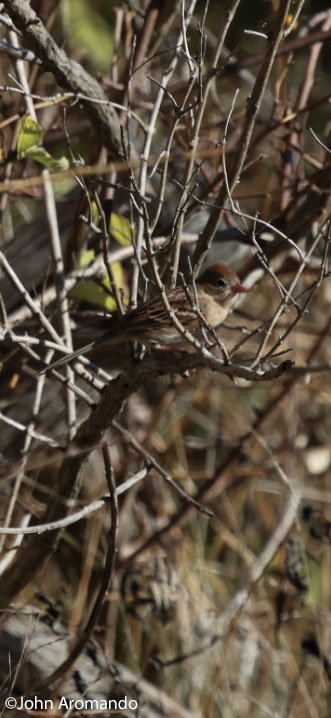
During last year’s wildly successful outing in which we became the first birding group ever on the island, we found oodles of Yellow-rumped Wabrlers, an uncommon Field Sparrow, and other migrants. But we were truly captivated by Captain Pete, who guided us through the historic fort, sharing a wealth of historical knowledge and fascinating stories. The beer was pretty darn good too, as we sampled the history of Maine’s craft beer scene.
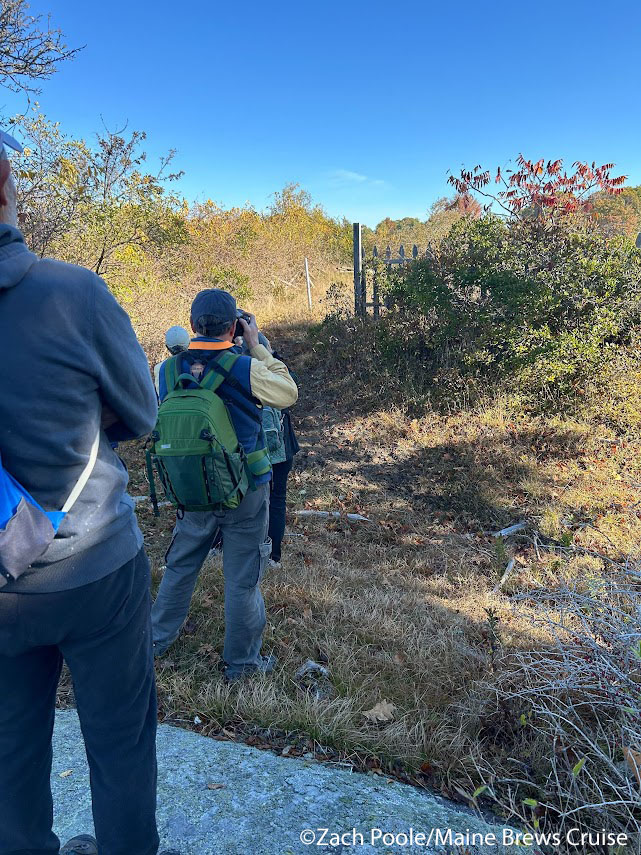
Building on that success, we’re visiting the private House Island in Portland Harbor twice in 2025. We’ve been granted special permission to come ashore and scour the island here in the peak of fall migration. We’ll follow well-maintained trails through the island’s mosaic of open habitats, scrub, and young woods. These are great habitats to search for a variety of migrants, and perhaps even a rarity!
Returning in late October, once again rarities will be on our mind. While rare birds are rare, we are still going to expect the unexpected. But more likely are regular migrants of the season such as Yellow-rumped Warblers, a variety of sparrows, and a growing diversity of waterbirds. At the very least, we’ll have resident waterbirds and several species of gulls to sort through. We are having daydreams of a rare flycatcher!
As we motor back across the harbor, we’ll continue to familiarize ourselves with some of the common waterbirds, such as Common Eiders, Common Loons, and the vanguard of our winter diving ducks while enjoying a local craft beverage produced in the city of Portland. While the exact plan is subject to change, we’ll be sure to come up with a plan to adequately celebrate our discoveries.
For 2024, I decided to post my Sandy Point Morning Flight tallies here in one blog entry (instead of only to Facebook and the Maine Birds Google-group), or perhaps one entry per month. If nothing else, it helps me organize them, and my thoughts! Hopefully, you’ll enjoy reading them, too. A busy tour schedule this fall, a little personal travel, and the continued decline in the number of strong, sweeping cold fronts due to climate change are all conspiring to reduce the number of days I begin at “my office.”
The following lists are birds counted passing over and through Sandy Point Beach, Cousin’s Island, Yarmouth as part of the “Morning Flight” or Morning Redetermined Migration. For more information about this site, and my counts here, see Site C14 in Birdwatching in Maine: The Complete Site Guide (2024).
September 3rd.
A light flight passed over and through this morning. It was my first visit of the season, as cold fronts have been few and weak so far this fall, so it was great to be back at my office. I was expecting a stronger flight, however. Perhaps the winds were just too westerly overnight, as the northwesterly component is so critical for pushing birds out over the bay and beyond, forcing them to reorient into the wind and concentrating here at the northwest tip of the island.
6:02-8:20am
48F, clear, light W increasing then decreasing.
105 Northern Parulas
88 Cedar Waxwings
56 American Redstarts
41 unidentified
12 Yellow Warblers
10 American Goldfinches
7 Red-eyed Vireos
5 Cape May Warblers
4 Magnolia Warblers
3 Eastern Wood-Pewees
3 Chestnut-sided Warblers
2 Nashville Warblers
2 Red-breasted Nuthatches
2 unidentified flycatchers
2 Black-capped Chickadees
2 Rose-breasted Grosbeaks
1 Black-throated Blue Warbler
1 Olive-sided Flycatcher
1 Black-throated Green Warbler
1 Baltimore Oriole
1 Black-and-white Warbler
1 Wilson’s Warbler
1 House Finch
1 Least Flycatcher
1 Bay-breasted/Blackpoll Warbler
1 unidentified Catharus
1 BLUE-GRAY GNATCATCHER (4th Sandy Point Morning Flight Record).
Total = 351
2. September 10th Update.
Well, so much for this plan! A week has gone by and there hasn’t been a decent morning to try at Sandy Point. And, with a massive area of high pressure dominating our weather (and most of the Eastern US) for another week, the next possible day looks a long way off! While several nights have featured at least some northerly component, it has been dead calm by dawn. Most other nights have been calm, and while that’s great for migrants to make progress, it’s not so great for a concentration of birds along the coast. For example, a very weak – and mostly dry – cold front that passed on Monday night briefly changed winds, but they were mostly westerly, and were calm by dusk.
Good for the migrants, not great for the migration-watchers! Let’s hope for a change in the forecast; we need the rain, too!
3. September 11.
I probably should have gone this morning, just based on the huge flight that occurred overnight. But, as with most good nights of migration this season, winds were virtually calm. Maybe there was just enough of a puff from the west to make a count worthwhile, but alas, my schedule didn’t allow for a last-minute change. However, there were A LOT of birds in the air last night.
A huge flight overnight on 9/13-14 resulted in a lot of birds offshore, and while I couldn’t be at Sandy Point, I had an exceptional morning flight on Monhegan – dominated by Cape May Warblers – with my tour group that weekend.
4. September 18th Update.
Yup, another clear and calm night, with migrants passing high overhead. Fog at dawn, too. Another week with no morning flight. Goodness, this blog sucks!
5. September 25th Update.
OK, this is getting ridiculous! Another week with lots of nights of great migration, but with either calm conditions or a light north to northeasterly aloft, not one more was conducive to being on the bridge. Friday and especially Saturday look great though…but alas, I’ll be back on Monhegan. No complaints there. But I’ll go ahead and change this blog title to “September-October” and hope for better conditions next month!
6. October 2nd Update.
Two great flights over the weekend conducive to a good if not great flight at Sandy Point occurred, but my tour group on Monhegan once again reaped the benefits. Next favorable winds might not be until Sunday the 6th. Fingers crossed! Maybe I’ll have some real content for this blog then…and I really need my Sandy Point fix!
6. October 5 – Finally!
I was finally at “my office” on the bridge this morning. Unfortunately, with clouds in the eastern sky and a light northerly wind, only a light flight passed over and through the point this morning. Furthermore, the Caribou radar showed rain into the early night, and likely unsettled weather thereafter, reducing or even eliminating the arrival of birds from the north and northeast (the radar after midnight showed virtually nothing over northern Maine). Nonetheless, it was just good to be back!
6:45-8:45am
45F, partly to mostly cloudy, NNW 5.3-7.0 to N 6.7-8.2mph.
60 Yellow-rumped Warblers
15 Blackpoll Warblers
9 American Robins
7 Palm Warblers
6 Ruby-crowned Kinglets
5 unidentified
4 Golden-crowned Kinglets
4 Red-breasted Nuthatches
4 Chipping Sparrows
3 Northern Flickers
3 Dark-eyed Juncos
3 Common Loons
3 Hermit Thrushes
3 White-throated Sparrows
3 unidentified blackbirds
2 Rusty Blackbirds
2 Blue Jays
1 Blue-headed Vireo
1 unidentified kinglet
1 Tufted Titmouse (did not cross after 4+ false starts)
1 Hairy Woodpecker (finally crossed after 7 false starts)
Total = 140
7. October 10.
A moderately-strong flight overnight on variable W to NW winds suggested many more birds departed last night than arrived. With a light W wind by dawn, only a light flight passed through the point.
6:49-9:15
41F, mostly clear, W 3.5 to 5.0 to W 4.4 to 7.7mph.
This Hermit Thrush kept me company at the point, alternating between snacking on Pasture Rose hips and contemplating crossing the channel (with Catharus thrushes rarely do after sunrise)
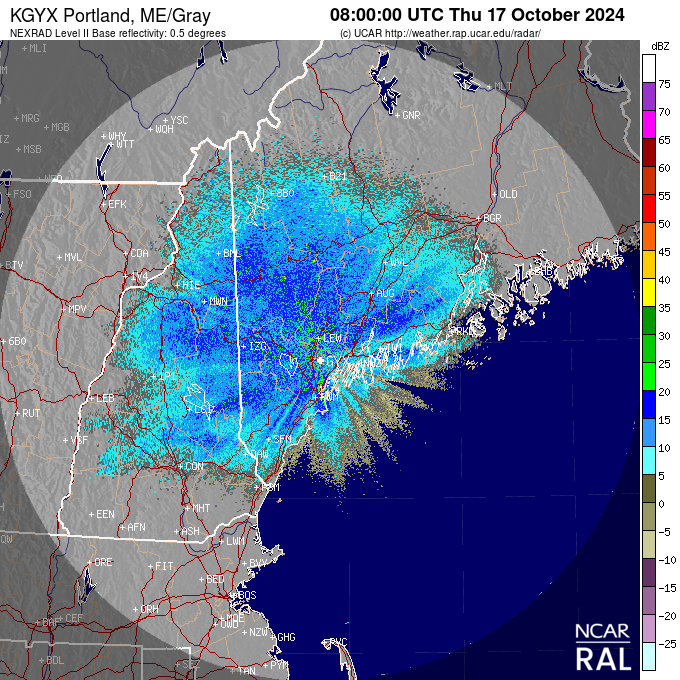
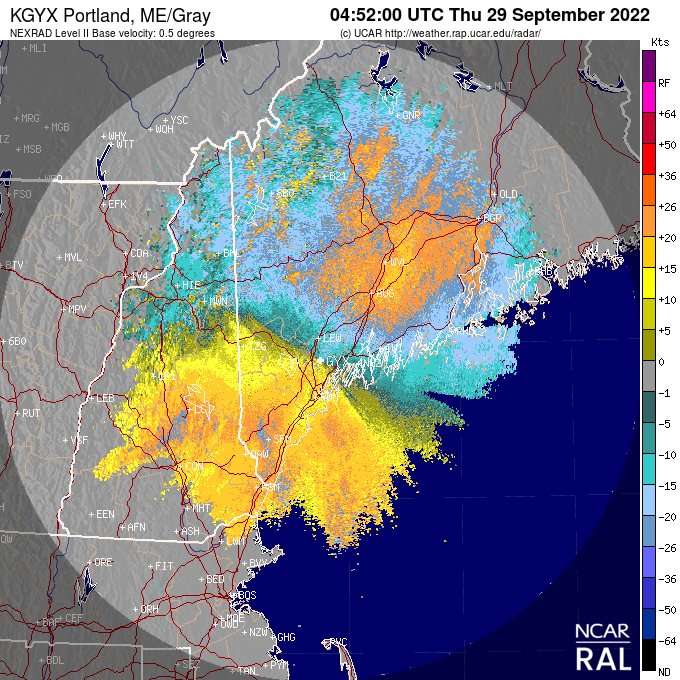
After a very slow start on a chilly morning, the flight picked up a bit in the second hour, but was still far lighter than I would have expected given the massive flight detected by the radar overnight. Even by 4:00am, the radar image was boomin’
6:59-9:15
31F, clear, NW 2.7-4.9 to W 1.2 TO 2.6mph.
114 Yellow-rumped Warblers
56 American Robins
44 Golden-crowned Kinglets
44 Blue Jays
17 Ruby-crowned Kinglets
14 Dark-eyed Juncos
9 Hermit Thrushes
8 Palm Warblers
7 Black-capped Chickadees (still did not cross after 14 “false starts”)
7 White-throated Sparrows
5 Unidentified
4 Nashville Warblers
4 Blackpoll Warblers
3 Swamp Sparrows
2 Purple Finches
2 Blue-headed Vireos
2 Tufted Titmice (did not cross after 4 false starts)
1 TENNESSEE WARBLER
1 Northern Parula
1 Eastern Bluebird
1 Yellow-bellied Sapsucker
1 Red-breasted Nuthatch
1 Northern Flicker
1 Savannah Sparrow
1 Common Loon
1 ORANGE-CROWNED WARBLER (in parking lot)
T=351
10. October 23rd.
With only a moderate flight overnight and very light winds, I didn’t have high hopes today for much of a flight. However, with the forecast for the next few days followed by a trip, this very well may be my last chance of the season, so off I went. Well, I was correct…there wasn’t much.
7:10-8:30
43F, mostly clear, NNW 2.7-3.2 to calm.
10 Dark-eyed Juncos
10 Yellow-rumped Warblers
4 Golden-crowned Kinglets
4 Hermit Thrushes
3 Savannah Sparrows
2 Palm Warblers
1 American Rpbin
1 Purple Finch
1 Black-capped Chickadee
1 Blue-headed Vireo
1 Chipping Sparrow
1 Red-breasted Nuthatch
1 Blackpoll Warbler
Total = 42
11. November 6th.
I had every intention of trying one more morning at the bridge after we returned from vacation. Sunday the 3rd may have been the day. But, avoiding the painful early wake-up call of the end of Daylight Savings Time, I decided to twitch the Common Gull in Rockland instead. I feel a little guilty, but ya know, every now and then I like a little chase, and besides, it was kind enough to stick around until we returned, so I felt I owed it.
It wasn’t a great season for me at “my office,” as this was certainly a record low number of visits. And to not catch any big flights is of course disappointing. But it was a good fall for birding – and an especially good fall for birds with little to impede their migration – and I enjoy every chance I can get to be at Sandy Point. And with a lot less pain this year than last year when I was still recovering from complications following shoulder surgery.
So with that, the 2024 Sandy Point Morning Flight season is officially closed. Still plenty of migration left, but it’s mostly diurnal migrants now. There will be a Dark-eyed Junco flight or two, some great flights of American Robins, and likely one last little push of Yellow-rumped Warblers. However, Rarity Season is now in full swing, so it’s time to focus on other birding locations. See you in August! (If there are any real cold fronts).
(And now it’s time to see what Yarmouth’s plans are for the walkway repair and improvement. I’ll need to make sure birding opportunities are improved and vegetation is protecting. Stay tuned…I might need your help)
Tour itineraries are meant to be broken. Or is that “rules.” Well, those too.
We have offered some kind of “Bicknell’s Thrush Wekeend” tour for almost 15 years now. There was a hiatus for COVID, and last year – perhaps due to the uncertainty with travel planning – we pulled the plug on our weekend for the first time as registrations were slow to come in.
Therefore, for 2024, it was time to try something new and head into Northern New Hampshire for a new plan of attack. Two chances at Bicknell’s Thrush over the course of two days, with this one enigmatic bird the sole focus (well, at least until we see it) – that part of it had not changed. Everything else was new this year.
We assembled at 9:00am on Saturday, June 29th in Errol, New Hampshire. The itinerary? Well, never mind.
Several folks arrived to see their guide staring up at the sky and immersed in deep thought (you could smell the wood burning). It wasn’t raining, and it looked like we had a nice window of fair weather. But it was already 9:00am, and by the time we got up the mountain…
…but the forecast for tonight. And tomorrow morning.
…but it can’t be worth it to try for one of, if not the, most elusive of North American breeding songbirds in the middle of the day.
…and it’s getting warm.
…and there’s rain building to our west. The winds are picking up higher up.
…but let’s go for it!
So up the mountain we went. At least we would be trying. And that evening, with the risk of severe thunderstorms, we might not even have a chance to try. And the next morning didn’t look great.
But weather forecasts are fickle, especially up here in the mountains, so it’s hard to make plans. But it’s easy to look up and see what’s about to happen, or not. And when I looked up, my face didn’t get wet, so that’s the only forecast that’s dependable in these parts.
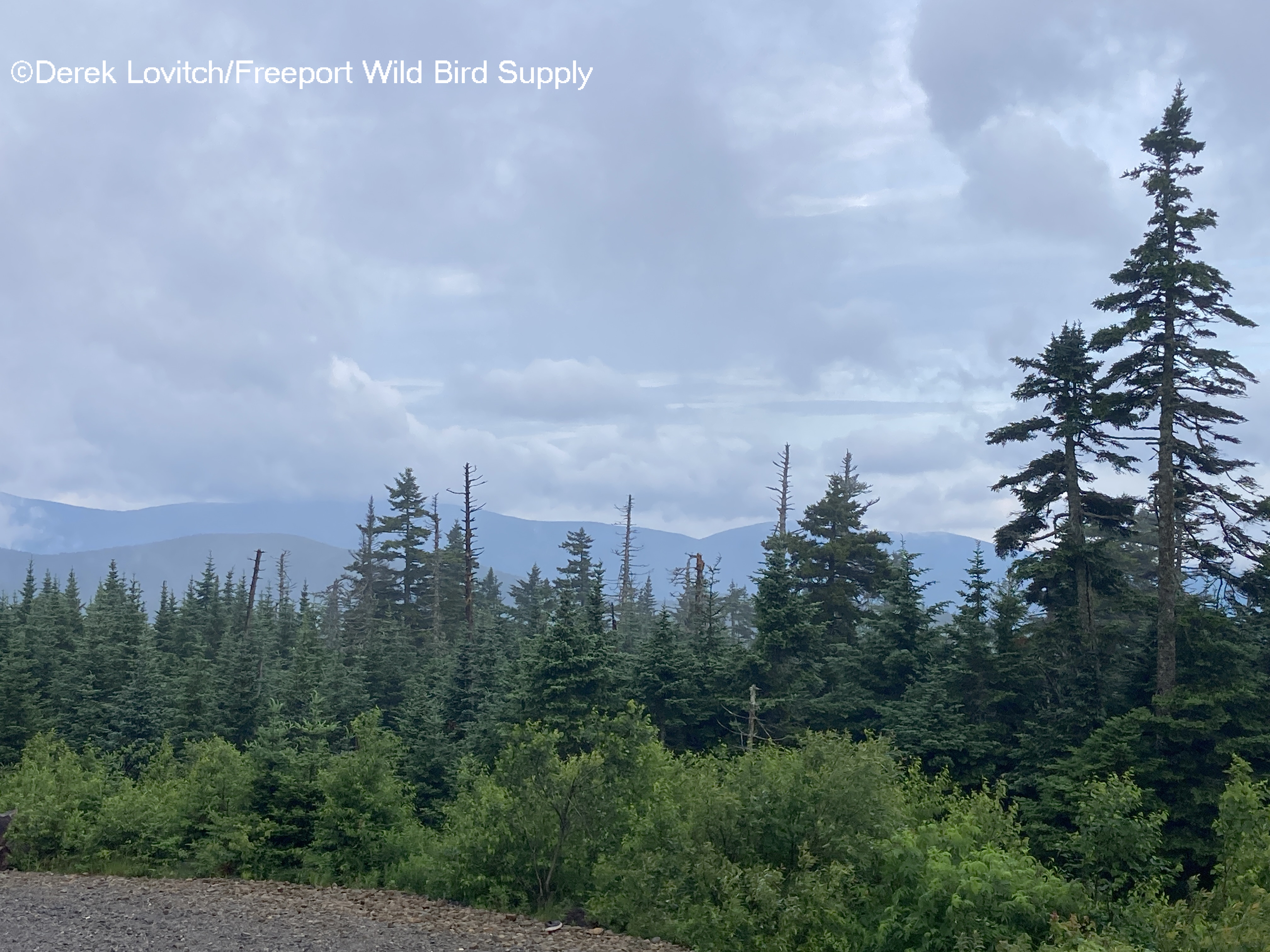
We raced up hill, arriving at about 3,000 feet and the realm of the Bicknell’s Thrush around 10:30, stopping for a Ruffed Grouse in the road escorting five chicks.
Southerly winds were increasing, blowing right up into and through our thrush territories. This was pointless. But hey, the rain was still across the valley. So we birded.
We heard the Fox Sparrow, spotted a couple of Blackpoll Warblers, and enjoyed the usual high-elevation species like Yellow-rumped Warblers and Dark-eyed Juncos.
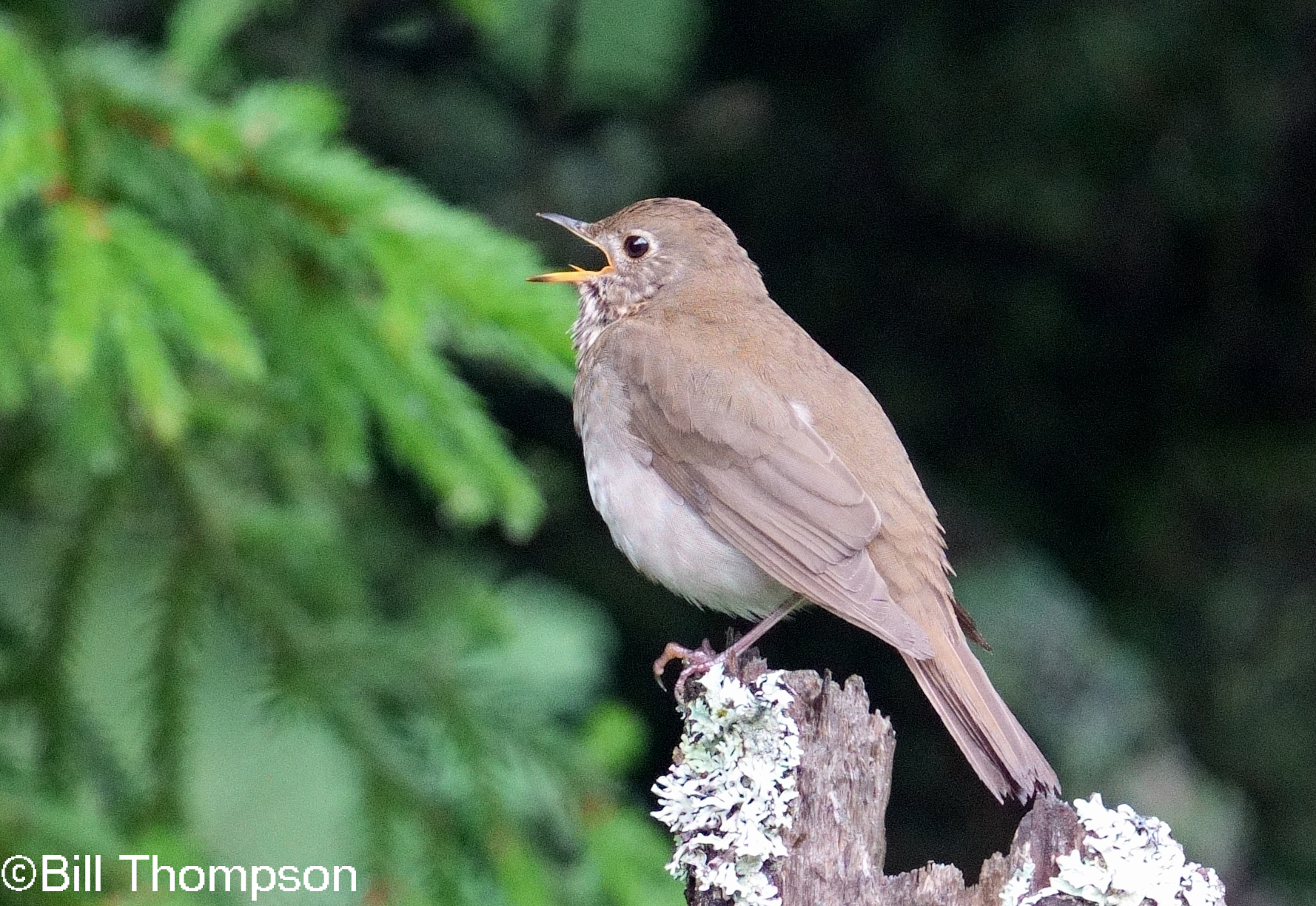
Then, at the surprisingly late (or extremely early) time of about 11:15am, a Bicknell’s Thrush began to call. Over the next 15-20 minutes, we were treated to two birds counter-singing, and at least 3 or 4 birds calling. One bird silently flew across a clearing, as well seen as a thrush in flight can get. The two dueling birds darted between trees and occasionally paused in view of one or two people before melting back into the trees.
There weren’t photography opportunities, but everyone was more than satisfied with the sum of their views. And it was a tremendous auditory performance. Overall, it was actually a pretty good show, and really demonstrated the behavior of this fascinating bird. And since this is more than just a tick and run” tour, the birds’ behavior was instructional and of keen interest.
And after all being satisfied, the rain arrived.
We enjoyed a leisurely and delicious lunch, and then set out for a little more birding. Making up for the change of plans in the morning, we took a walk and a drive through some boreal habitats, but rain was becoming steadier now. We heard and saw a few common birds, but it was just some good quality time in the afternoon woods, absorbing our phytoncides. When the rain arrived in earnest, we called it quits and went to check in at our hotel.
The original plan was to have an afternoon break, early dinner, and then head up the mountain at dusk to take advantage of the evening activity of the thrush. Instead, we had a relaxing dinner, many of us enjoyed a beer or glass of wine, and we just chatted. Good conversation was enjoyed by all, and the rain kept falling.
At one point, the rain let up and I began to ponder a run up the mountain. Just in case the thought became serious, a downpour arrived. Dessert was ordered.
We were back in our hotel rooms at about the time I had planned to be on the mountaintop, so I didn’t know what to do with myself! I think I was stressed about having nothing to stress about. When a tour is solely dedicated to one species, a trip is a failure without that one species. But we already had our quarry, and if it was raining in the morning, oh well. And if it wasn’t, we would just go enjoy the bird some more. I think I had the longest and best night of sleep I can recall while leading a Bicknell’s Thrush weekend!
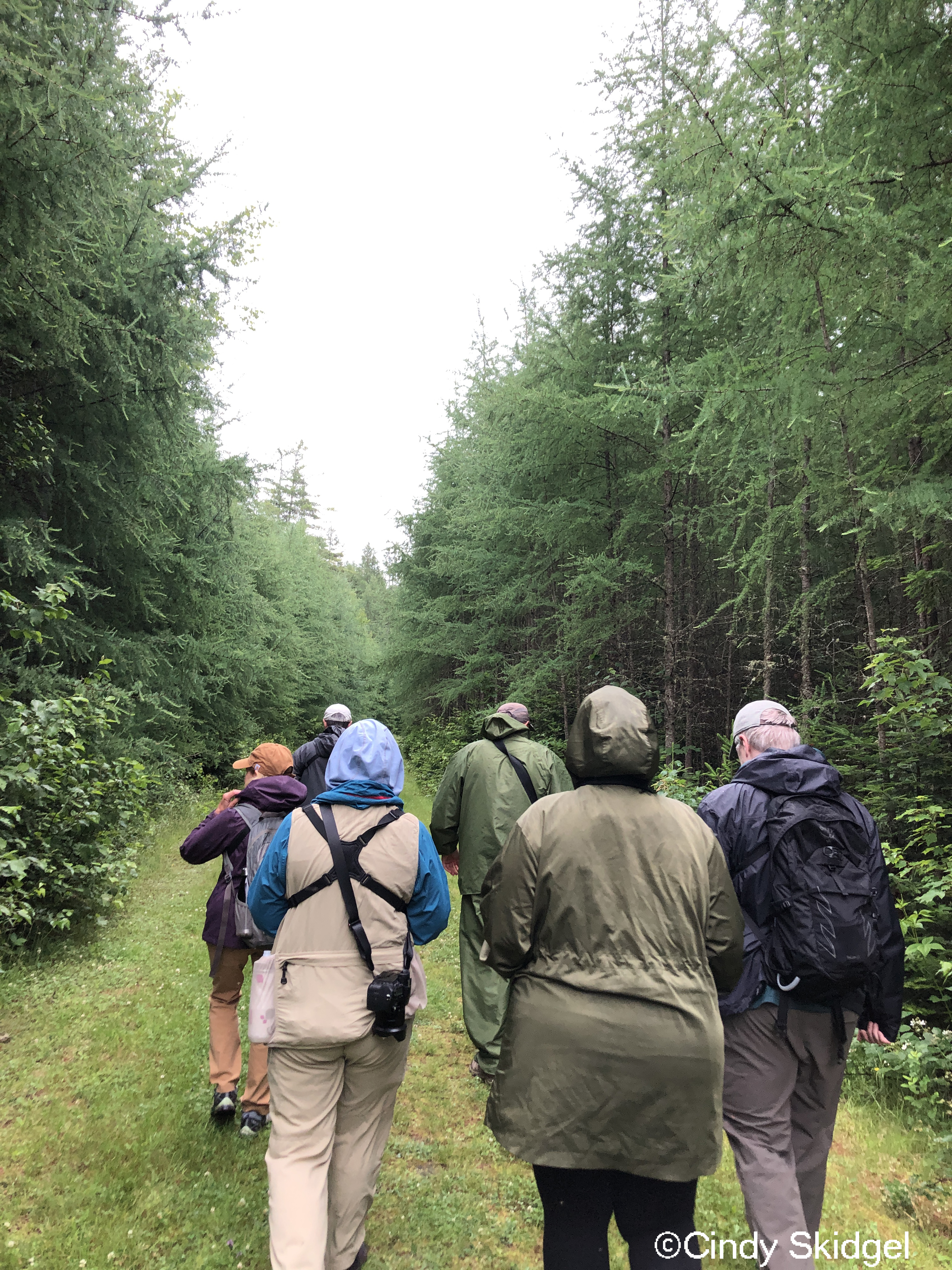
Well, it wasn’t that long. A “civilized” 5:30am departure from the hotel (thanks to our success the day before) found us free of the rain that was forecast, and there were even a few breaks of sun. It was rather breezy atop the mountain, and in almost two hours, we only had a couple of calls from Bicknell’s Thrushes. A simple continental breakfast was served from the back of my Subaru.
However, we had a Canada Jay (likely the last youngster in a family group that passed just downhill from us) in plain view, and spent some quality time with the local breeders like Blackpoll Warbler. Then, much to my disbelief, the second-most wanted bird on the tour (according to an unofficial survey), began to call very close to us. Could it be? I had to be mistaken. But not much else sounds like a Black-backed Woodpecker!
Then, with jaws dropping to the ground, it proceeded to fly overhead of us, heading up the mountain where it called a few more times. That was not something I was expecting – not just the species, but such a great look at it in flight (I can only recall one other time that I had seen one overhead) and far removed from the deep and dark bogs most of the local birds prefer.
Between yesterday’s thrush luck and today’s woodpecker fortune, not to mention another mountaintop visit devoid of the forecast rainfall, we were just ecstatic.
And then this happened…
You get a photo, and you get a photo, and you get a photo!
Wow. Just wow.
And it was on a snag that I had just declared, “if this bird comes out, it’s going to perch here.” Most people thought I was joking.
The thrush didn’t. Now, I wish I could always control birds like this, but especially with this species, I have really come to know them and their behavior. To me, it did look perfect for one to sit on. But no, I did not expect it to be sitting on it, singing up a storm, about 30 seconds later. It truly is better to be lucky than good.
And it sat there for long enough to take your camera down, adjust your settings, and return to firing away. It was even there long enough for your dumbfounded guide to remember he had his camera with him for a change. My panicked photos did not do the bird justice, so I will let everyone else’s speak for themselves.
There wasn’t much left to do up here, so we began our trek downhill.
A Mourning Warbler cooperated nicely.
Then, returning to our cars a (the?) family group of Canada Jays returned and came to check us out. Kathy’s granola bar was clutch here as two adults had a snack, with 2-3 dusky juveniles looking on, learning the ways of the Camp Robber.
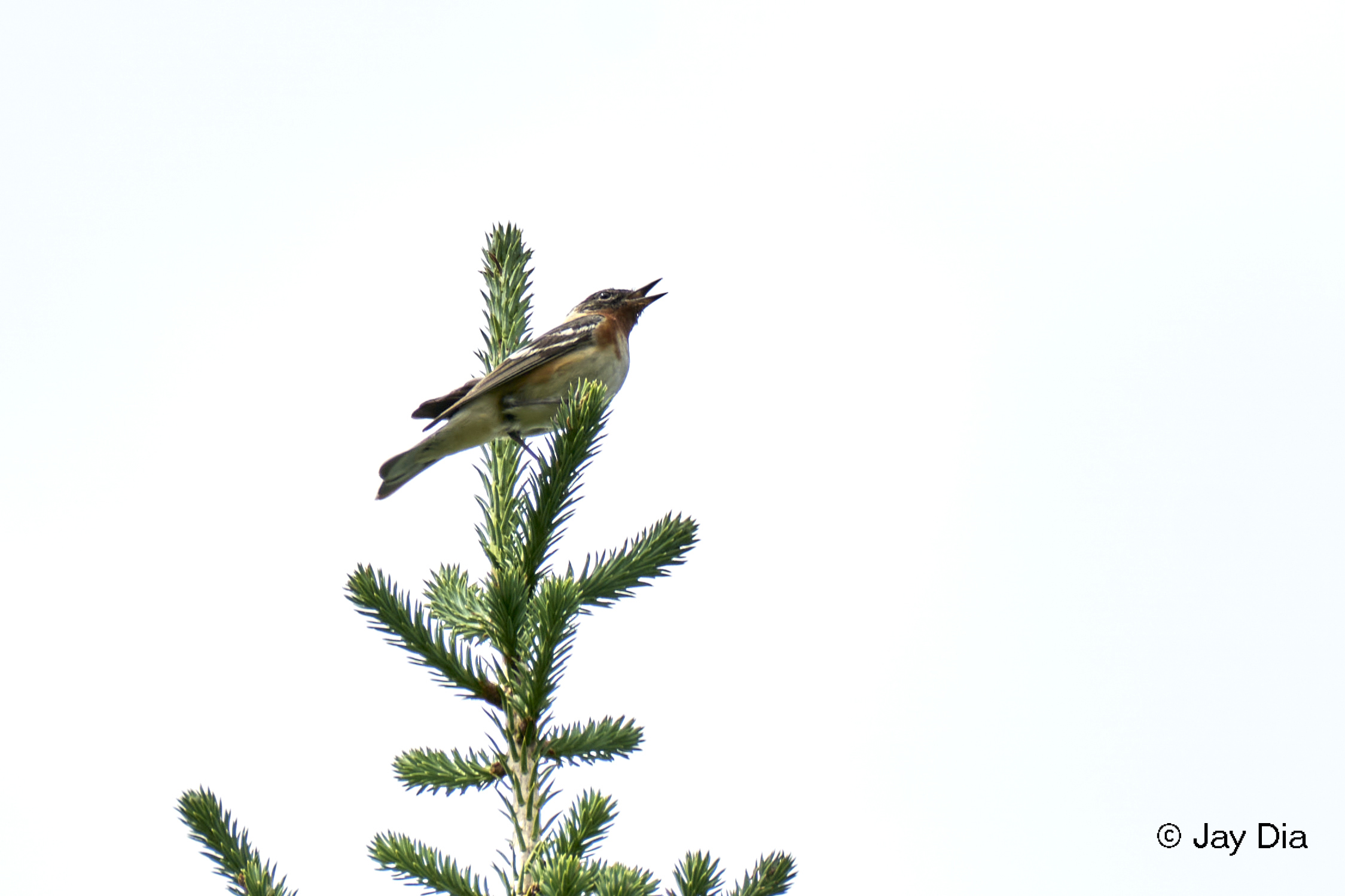
And then Kathy exclaimed “there’s a Bay-breasted!” and we all looked up to see a stunning male singing from a roadside fir right over our heads.
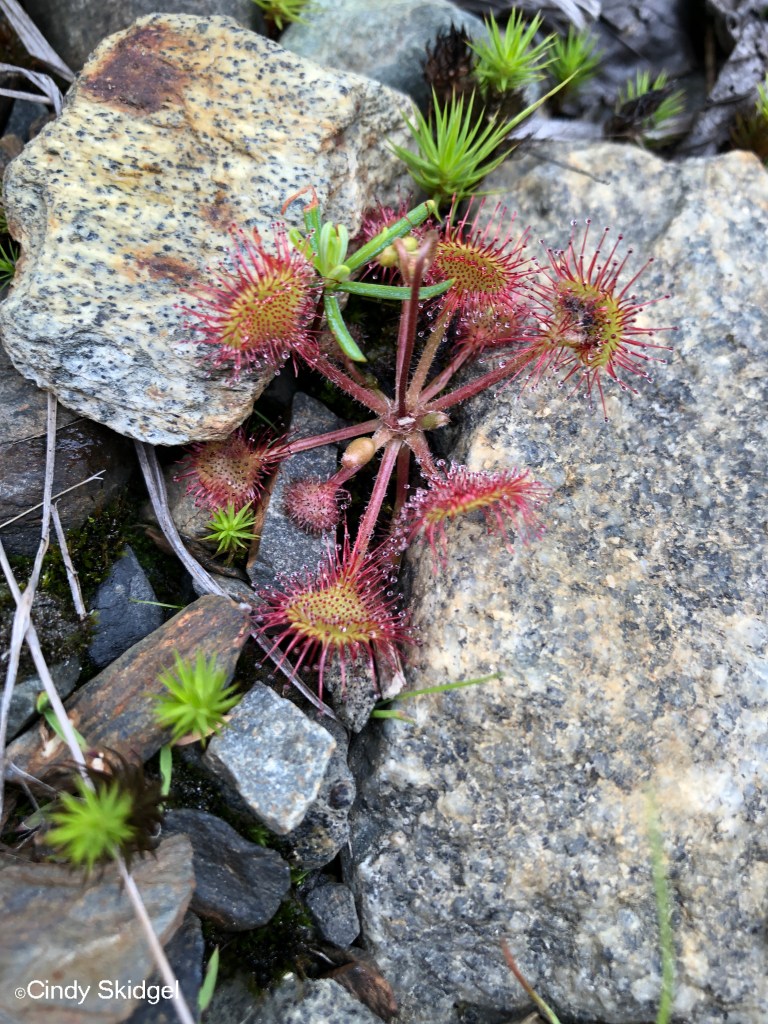
We heard or saw at least another 5 Mourning Warblers on the way down, glimpsed a busy Lincoln’s Sparrow (a Sharp-shinned Hawk passed overhead precluded a better observation, however), and took some time to enjoy and identify butterflies – even skippers (OK, only Bill actually identified said skippers) – and plants.
White Admiral
Round-leafed Sundew.
But as the winds began to gust, more rain was approaching, and ATVers were becoming overwhelming, we left the mountain and headed to Colebrook for a relaxed, celebratory luncheon as the rain began to fall and before we headed our separate ways.
As for this new Bicknell’s Thrush Weekend itinerary (with and without necessary audibles), well, I think you can assume we’ll see you here again next year!
One of the many stunning Baltimore Orioles that performed for us on our visit to Capisic Pond Park in Portland during May’s “Warblers and Wort” tour.
Join us for the much-anticipated return of the Birds on Tap series, a unique collaboration between Maine Brews Cruise and Freeport Wild Bird Supply. In 2024, we’re excited to bring back these special birding and beer tours, perfectly blending nature exploration and craft beer tasting.
These unique, relaxed birding and beer-ing adventures that you have come to love combine great local birding at seasonal hotspots with approachable opportunities to sample the delicious creations of some of our favorite Maine breweries. These events are a perfect introduction to birding and/or craft beer, and a great opportunity to enjoy our favorite pastimes with significant others, friends, and family that have interest in one topic, while your interest is primarily in the other (for now!). Educational, enjoyable, and eye-opening, our unique Birds on Tap series enters its 10th Year!
Seasonal birdwatching meets Portland Maine’s finest craft beverages–all with the convenience of being chauffeured!
We’re offering three tours this year, with each trip report being posted here.
Warblers and Wort, May 25th.
May means warbler migration, and the destination for Warblers and Wort visited two of Maine’s most famous springtime migrant traps, Portland’s Evergreen Cemetery and nearby Capisic Pond Park. Oases in the urban jungle, featuring water sources and a mix of various habitats, help concentrate migrant birds that found themselves in or over the city come sunrise. After migrating all night, tired travelers look for refuge: food, water, and shelter, and urban greenspaces are absolutely critical for refueling.
Beginning at Evergreen Cemetery, we confirmed our suspicions from the overnight radar images that it was going to be a slow morning for migration. But wow, it was slow! We enjoyed some good looks at Red-eyed Vireos and lots of Gray Catbirds, practiced our birding by ear, and discussed urban ecology, but I had seen (not) enough.
We then ventured over to Capisic Pond Park, where our luck instantly changed. While passage migrants were still few, it was downright pleasantly birdy. And birdy with vivid colors from some of our most beautiful birds. Blinding Baltimore Orioles were everywhere as expected, but we had some great quality time with battling males and affectionate pairs. We had lots of great views of male and female Yellow Warblers and the range of plumage variation in American Redstarts. Great looks at Warbling Vireos were enjoyed, but orioles kept distracting us! Northern Cardinals refused to be ignored.
In addition to a couple of Wilson’s Warblers and an uncooperative Magnolia Warblers, passage migrants included the world’s worst look at the awesome Mourning Warbler as it darted down the trail, never to be seen again, but also one of the best looks you’ll ever get at a Cape May Warbler as a female foraged in the grass and low branches of a grove of Eastern White Pine. You don’t often look down on a Cape May Warbler!
We saw a lot of birds well at Capisic today, using even the most common birds to hone our identification skills while taking the time to appreciate the beauty of even some of the most common birds around us. For example, we became intimately familiar with how Common Grackles are anything but black birds! This particular individual stood out because of the perfect lighting showing off it’s glossy, structural colors, but also the unusual white flecks in the head caused by some limited leucistic feathers.
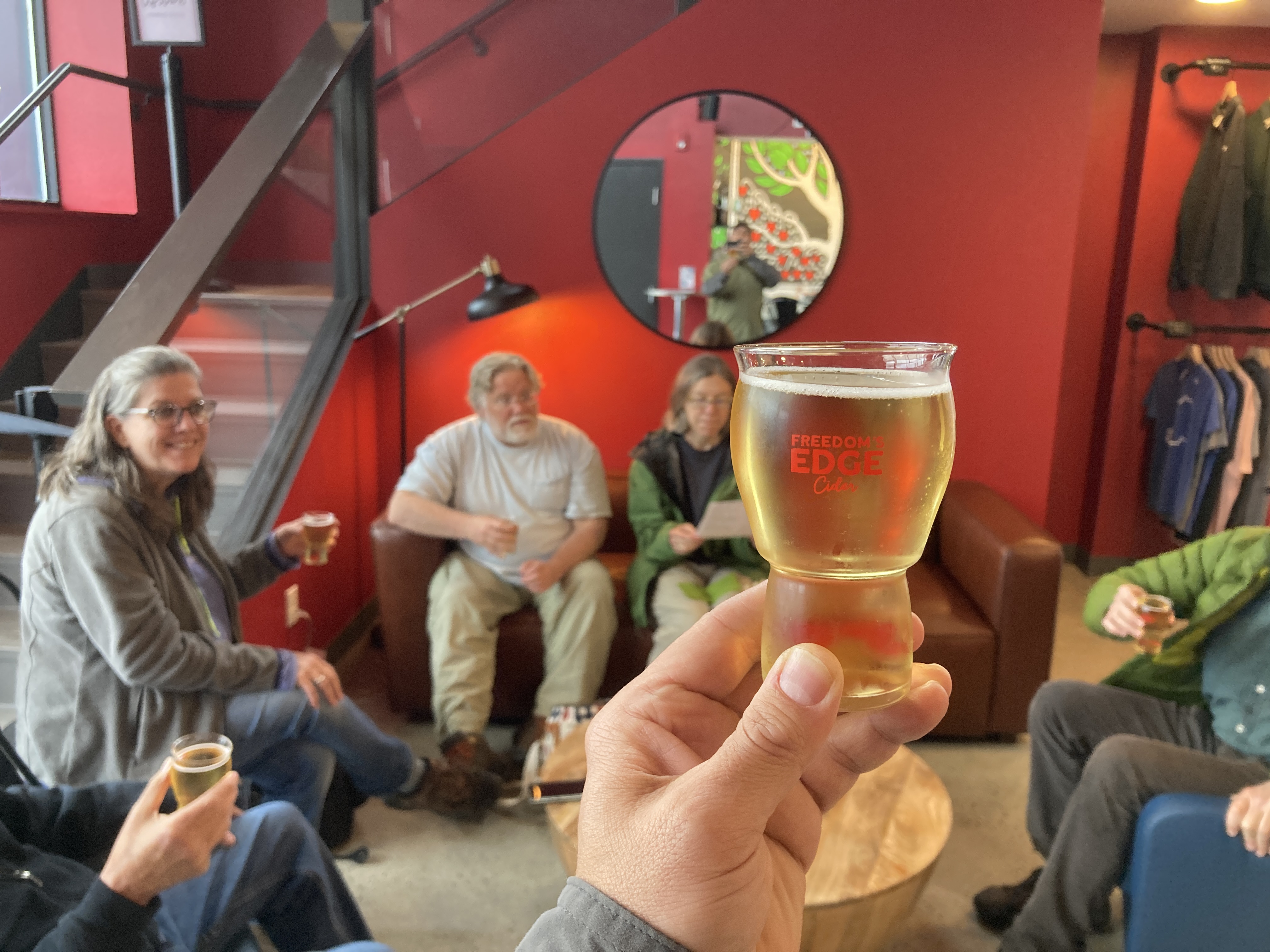
After struggling to see birds at Evergreen, we struggled to leave Capisic on time! It was a lot of fun, but it was time for the second half of the tour as we made the short trip across town to the Bayside neighborhood. Our first stop on the beverage portion of the tour was Freedom’s Edge Cider. After observing migrant birds in the crabapple trees at Capisic, it was only appropriate to enjoy cider, as the creation of hard cider was what led to the creation and diversity of crabapple trees! Focusing on the traditional, drier range of ciders, we began our tasting with their flagship “Original,” a nicely balanced semi-dry cider with a crisp finish. The unfiltered, modern “The Juice” was a touch sweeter thanks to the concentration of sugar via the freezing and thawing of the apples. I definitely picked up musty grape in the “Marc de Marquette,” a very flavorful cider aged over Marquette grapes. And finally, we were able to pick our own fourth sample. I am a sucker for maple, so I went for the “Pick Your Own” (coincidentally and appropriately) that complemented our birds of spring with flavors of spring in Maine: maple syrup and strawberries. The flavors were subtle, but the maple was really evident on the nose. However, the “Sweet Mullet,” a delicious cider steeped with mulling spices seemed to be the crowd favorite.
We’re all about the new and different on these Roadtrips, and our second stop was the very new (opened about 3 months ago) Argenta Brewing, Portland’s first lager-only brewery. Their delightfully named “Generic American Lager” had all the crushability and cleanliness of a traditional American Lager, but with a focus on Maine-grown ingredients. Learning the difference between lagers and ales while discussing topics ranging from glassware to bird conservation, we also learned all about Portland’s newest brewery. We were able to choose our second (very!) generous pour, and I joined others in the “Dark Lager” which had those nice roasted chocolate and malty flavors but with the lighter body and clean finish of a lager.
And with that, our first Birds on Tap – Roadtrip! Came to an end, but it’s not the last one in 2024, and definitely not the last one in years to come. It was good to be back on the road, and the combination of introductory birding with an introduction to Maine’s finest craft beverages is a recipe that has not lost its luster after a COVID-years hiatus.
Shorebirds and Steins, Aug 11.
We began our introduction to shorebirds with the basics, such as plover verses sandpiper, before moving into great depth such as yellowlegs vs Willet. Shape, size, and especially bill size and length are among the “bigger picture” tools we have to learn our shorebirds, such as with some close Willets – the “tringas of the 90’s steroid era in baseball.”
The original BoT Roadtrip! in 2015, our most popular tour returned to Scarborough Marsh at prime time for a good variety of migrant shorebirds. We learned how to identify our common species and searched a bit for the rare.
Birding began at Pine Point as the tide just began to flow. And as the mudflats were slowly inundated, a nice diversity of shorebirds soon appeared, and with each inch of incoming water, many of the birds moved closer and closer.
In Jones Creek, we were able to closely study the eastern subspecies of the Willet, later in close proximity to the closely related Greater Yellowlegs. And wow, did these two yellowlegs put on a show! Demonstrating their entertaining, aggressive feeding style that is highly suggestive of the species, they chased baitfish through the shallows. They were eventually so satiated that they sat down within about 15 feet of us and allowed for close looks at their bill structure and color without any straining through the scope. One spiffy Black-bellied Plover was joined by several dozen more in all stages of molt, and two awesome Whimbrels dropped in for the duration of our stay, nicely demonstrating the wide differences in shape and bill structure of our sandpipers.
Short-billed Dowitchers demonstrated their sowing-machine feeding technique – helpful as feeding style is an important part of the shorebird identification toolkit. But before we got that far, we started with the basics of plover vs sandpiper, nicely demonstrated by a flock of 150+ Semipalmated Plovers and 100+ Semipalmated Sandpipers that were concentrated before us by the incoming tide.
Two additional stops at the outskirts of the marsh gave us a sample of a different micro-habitat at high tide, yielded some Lesser Yellowlegs for our shorebird list, and gave us more looks at non-shorebirds, such as Great and Snowy Egrets, Glossy Ibis, and much more.
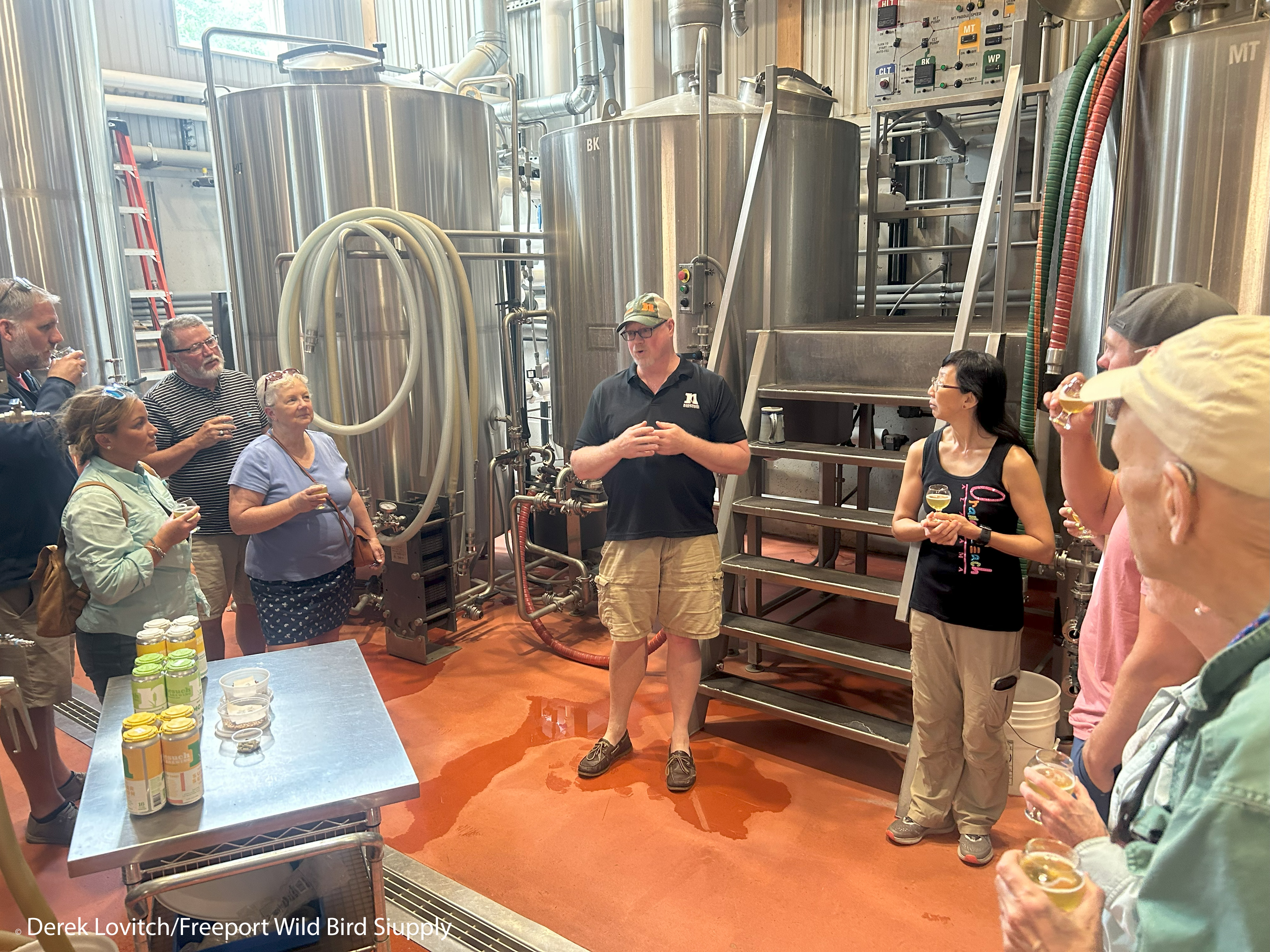
Then it was time to head over to Nonesuch River Brewing, where owner Michael and his wife Kristen graciously greeted us with a sample of their Summer Session – a nice light, refreshing welcome. We then enjoyed sips of their summery and bright Mojito IPA with lime and mint, followed by their Solstice hefeweizen with a little bit of ginger prickliness and hint of lemon. As we enjoyed those beverages, we thoroughly enjoyed an all-in tour in the brewhouse, learning the basics of brewing, and some of the house techniques to make Nonesuch such a popular brewery. I saw several four-packs of Mojito return to the bus with us, and the location can’t be beat for a post-Scarborough Marsh celebratory toast!
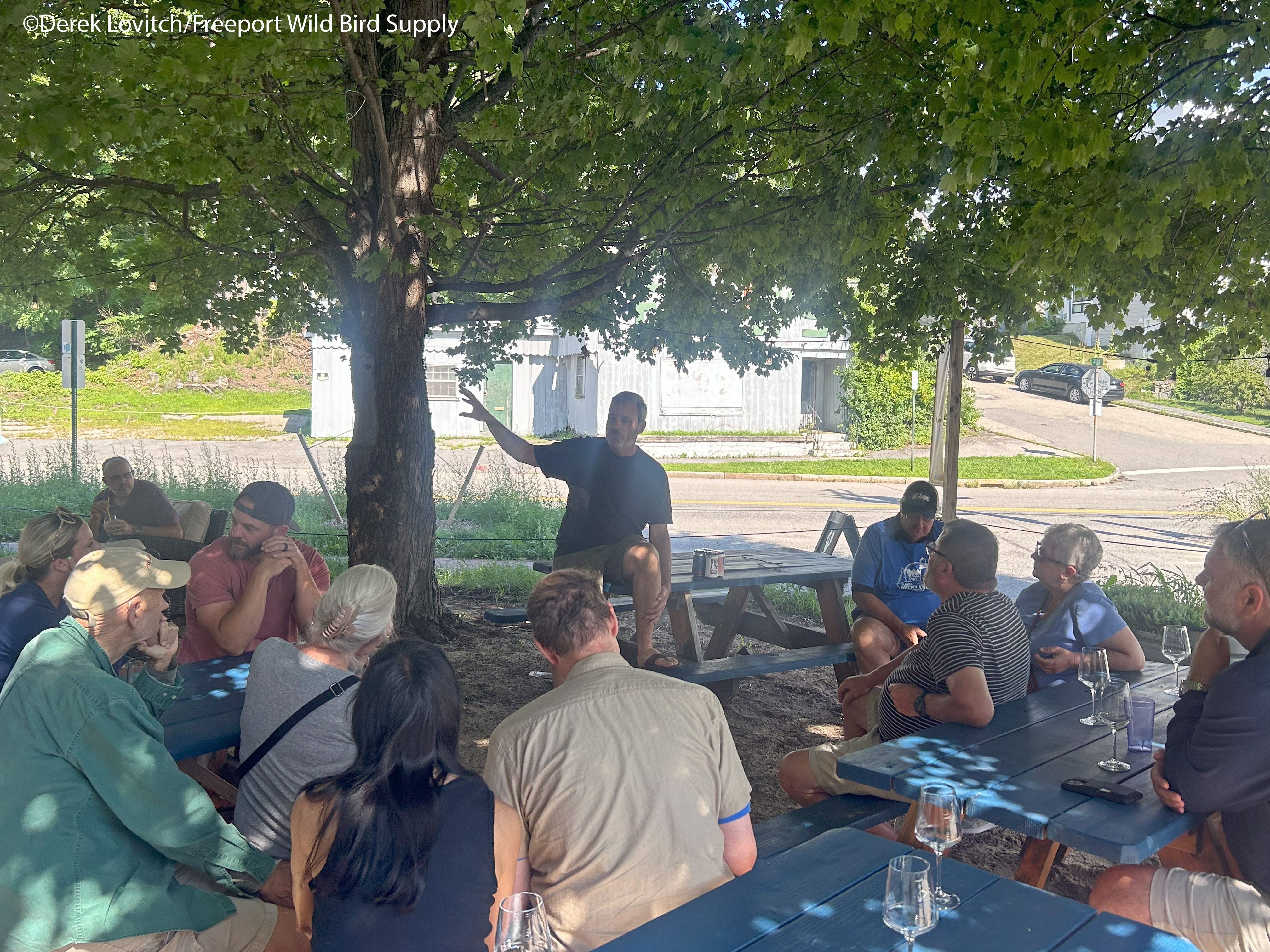
Returning to Portland, our second beverage destination was the newly expanded home of Blue Lobster Urban Winery. Once again, we felt privileged to get the tour from the owner and winemaker! Chris walked us through the winemaking process, the rational for canning it, and the history of the company. We began with a taste of their Tightline cider, a very dry cider made from local apple juice and wild yeast from the winery. Their sparking Rose was up next: very lightly carbonated with a strong strawberry nose but just a slight sweetness on the palate. Bayside Blend red was nice and dry, as I prefer my reds.
Chris then treated us to a special surprise – a barrel tasting, where we were privileged to be the first member of the public to sample an upcoming bottle release that has been conditioning for two years, and was made from grapes grown on 121 year-old vines in California. This was a special wine, and it was absolutely delightful. Our only complaint was we couldn’t buy any yet! Last but not least, we tried their blueberry infused red, with Syrah and merlot grapes infused with Maine blueberry juice. Especially after Chris suggested making a spritzer or Sangria with it, multiple four-packs were purchased to go.
Nice species of shorebirds, three beers, 4 wines, and 1 cider -now that’s a well-rounded Birds on Tap – Roadtrip!
Birds on Tap – The Boat Trip! Rare Birds and Island Exploration.
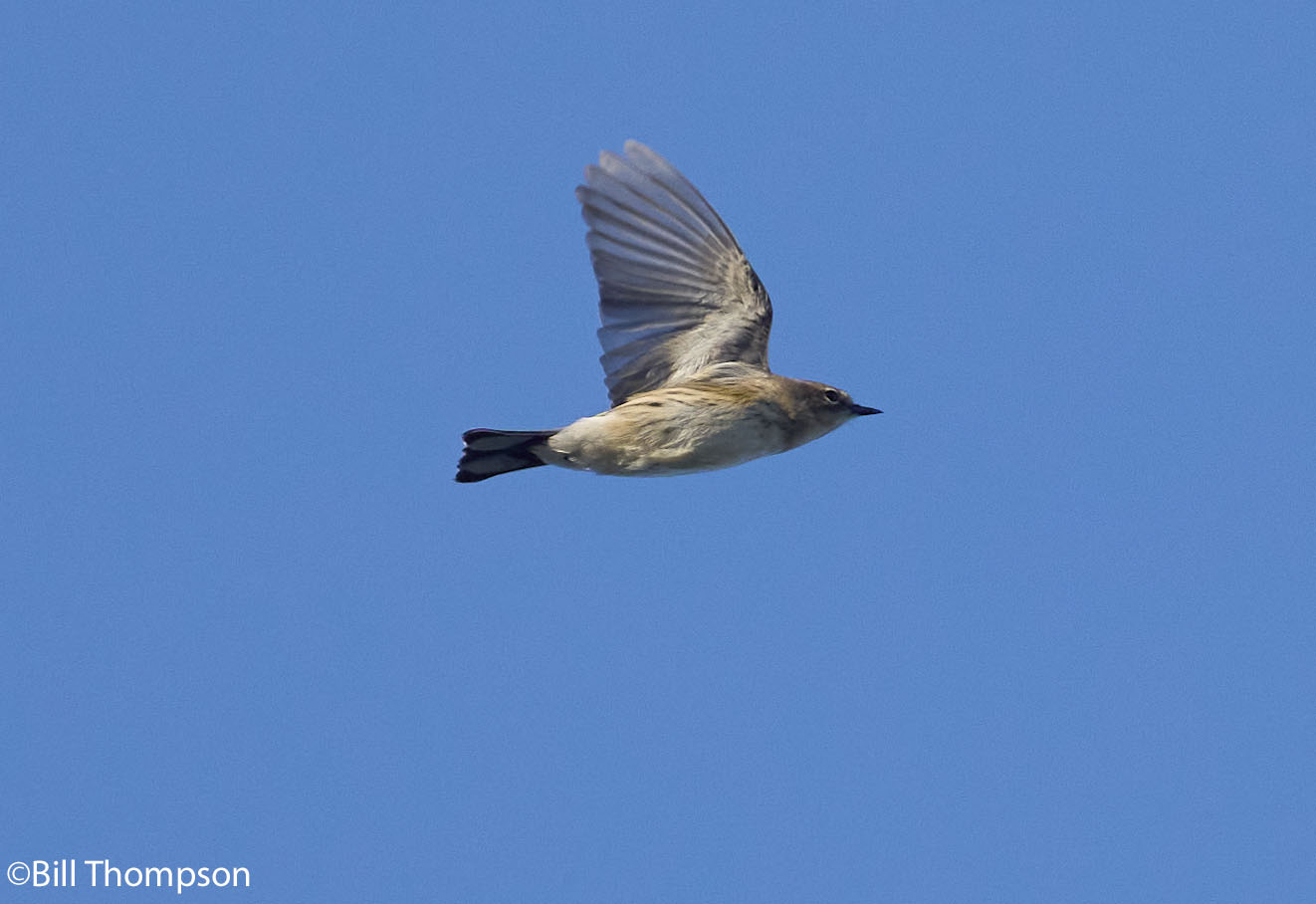
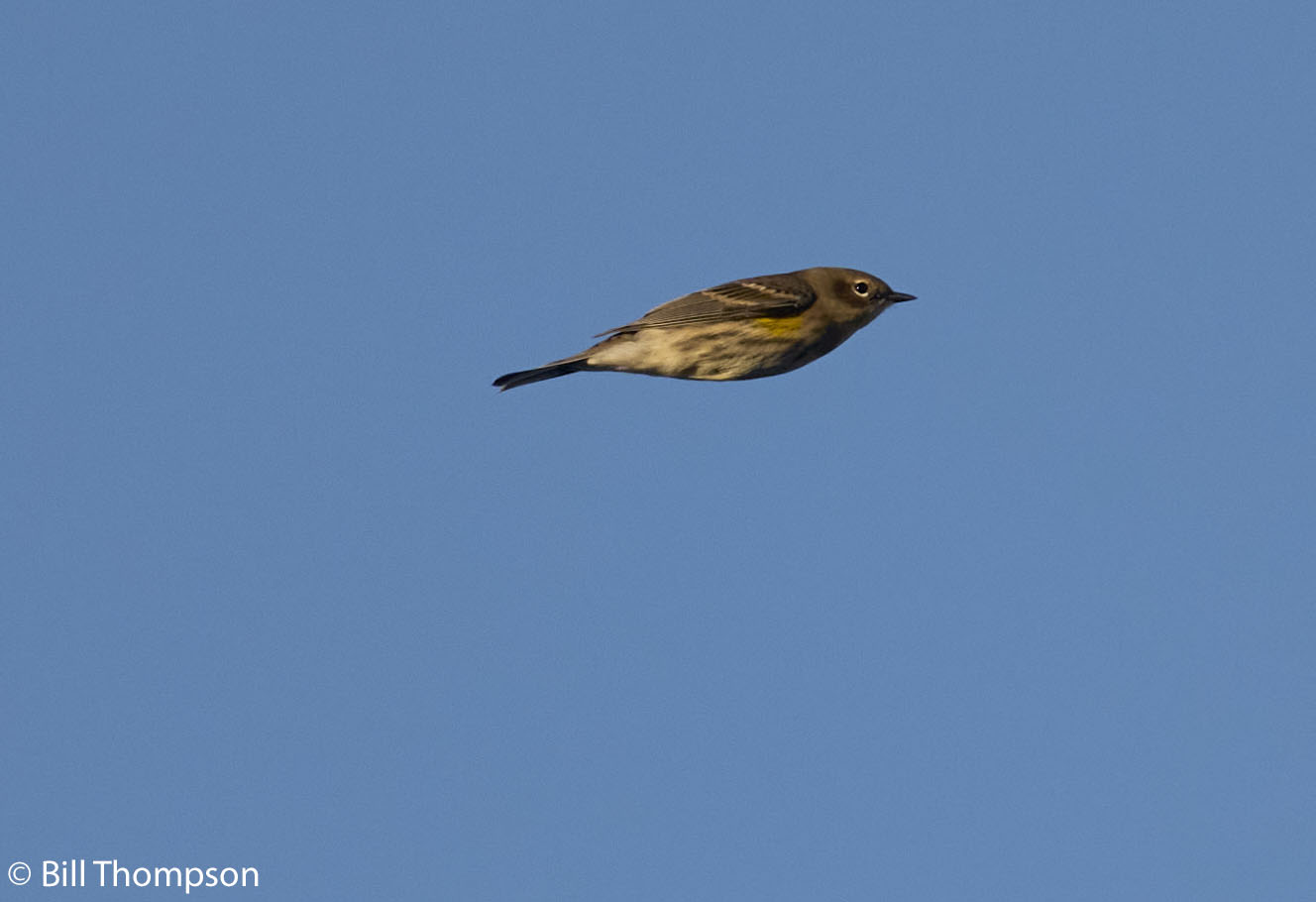
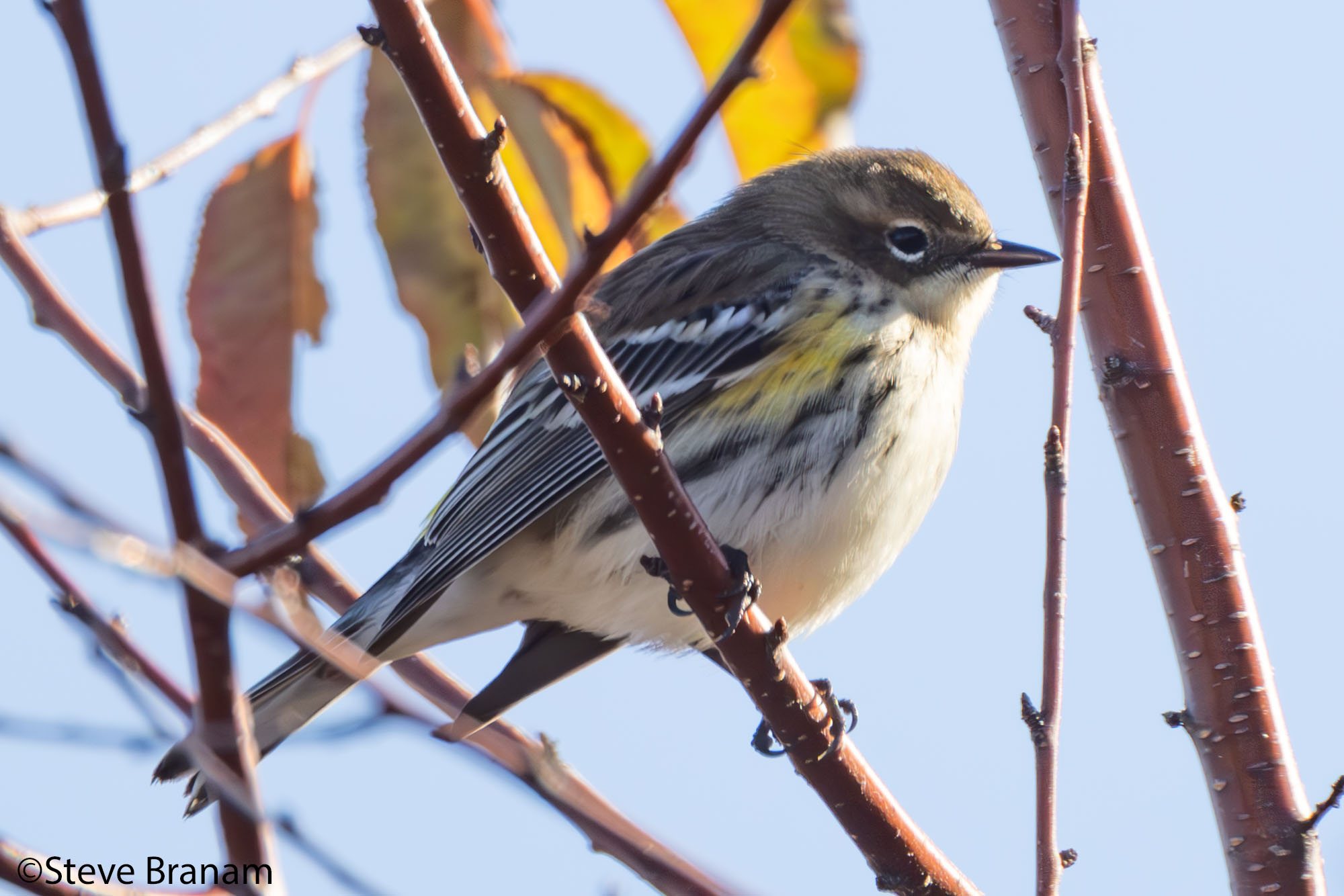
Yellow-rumped Warblers were the dominant species, not surprisingly given the date and island’s habitat, but the number present today was still most impressive. This one is nicely showing off its namesake.
The final Birds on Tap event of 2024 was a special one indeed. This day, we not only took to the water for the first time in the series, but we were able to visit the private House Island and its historic Fort. In fact, we were the first birding tour ever on the island! But this trip was not just about the birds.
We began with some birding, walking the trails and checking all of the nooks and crannies the island and fort had to offer. Yellow-rumped Warblers were simply everywhere, with dozens popping up with limited pishing, and countless others darting around. A few Song and White-throated Sparrows were here and there, and 1-2 Northern Mockingbirds were perhaps delineating winter territories on the island.
Surf Scoters and Common Eiders were offshore, a pair of Common Ravens flew by, and then, in the cemetery, we found an uncommon migrant: a single Field Sparrow.
We also learned about the food resources of the island, such as native Arrowwood Viburnum and especially the Northern Bayberry that all of these Yellow-rumped Warblers depend on and the invertebrates that can be found in the wrack line on the tiny beach.
Pete then expertly guided us into and through the historic Fort Scammel and the history of House Island. The first English settlement in Maine, it was the only island with a house on it, hence the name of the island. While primarily used for drying cod, fishing operations continued through 1907, when the buildings became part of an immigration station that operated until 1931. On the other half of the island, Fort Scammel was constructed in 1808. Four years later, it became Maine’s only coastal defense fort to fire a shot in aggression when it fired on a British privateer in the War of 1812.
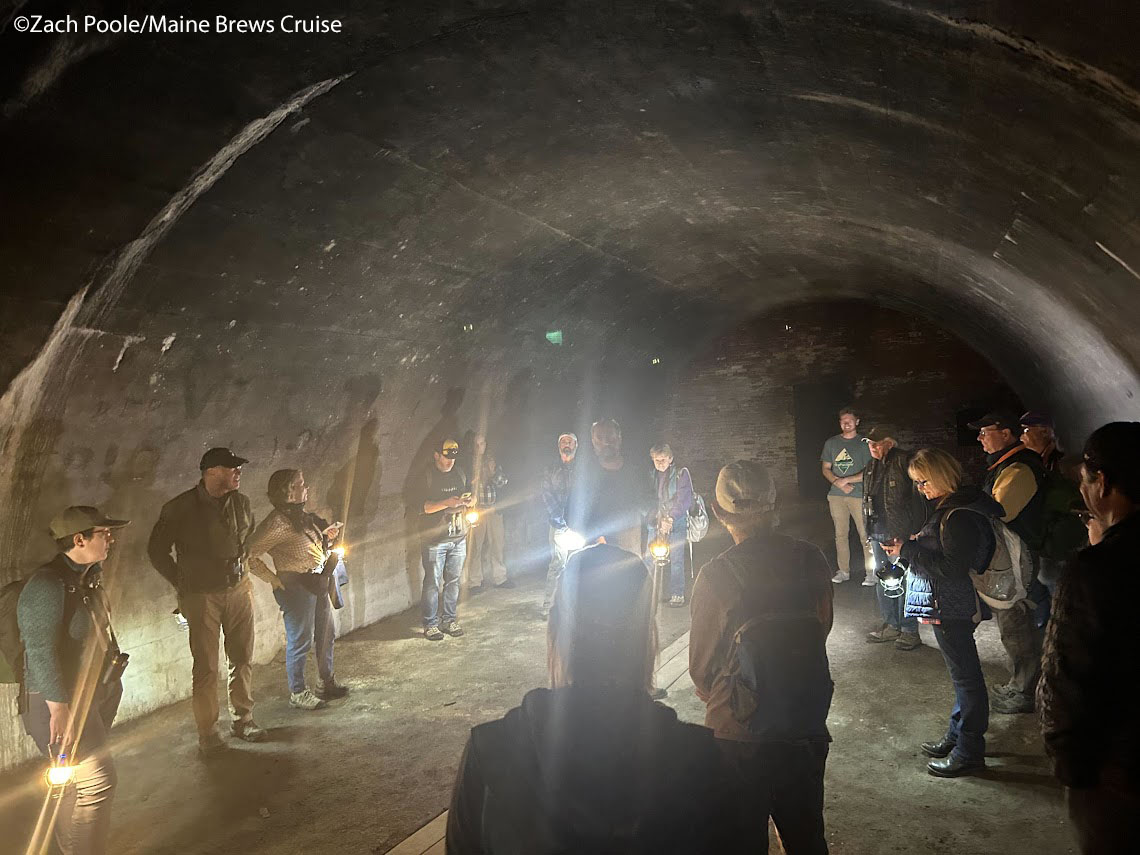
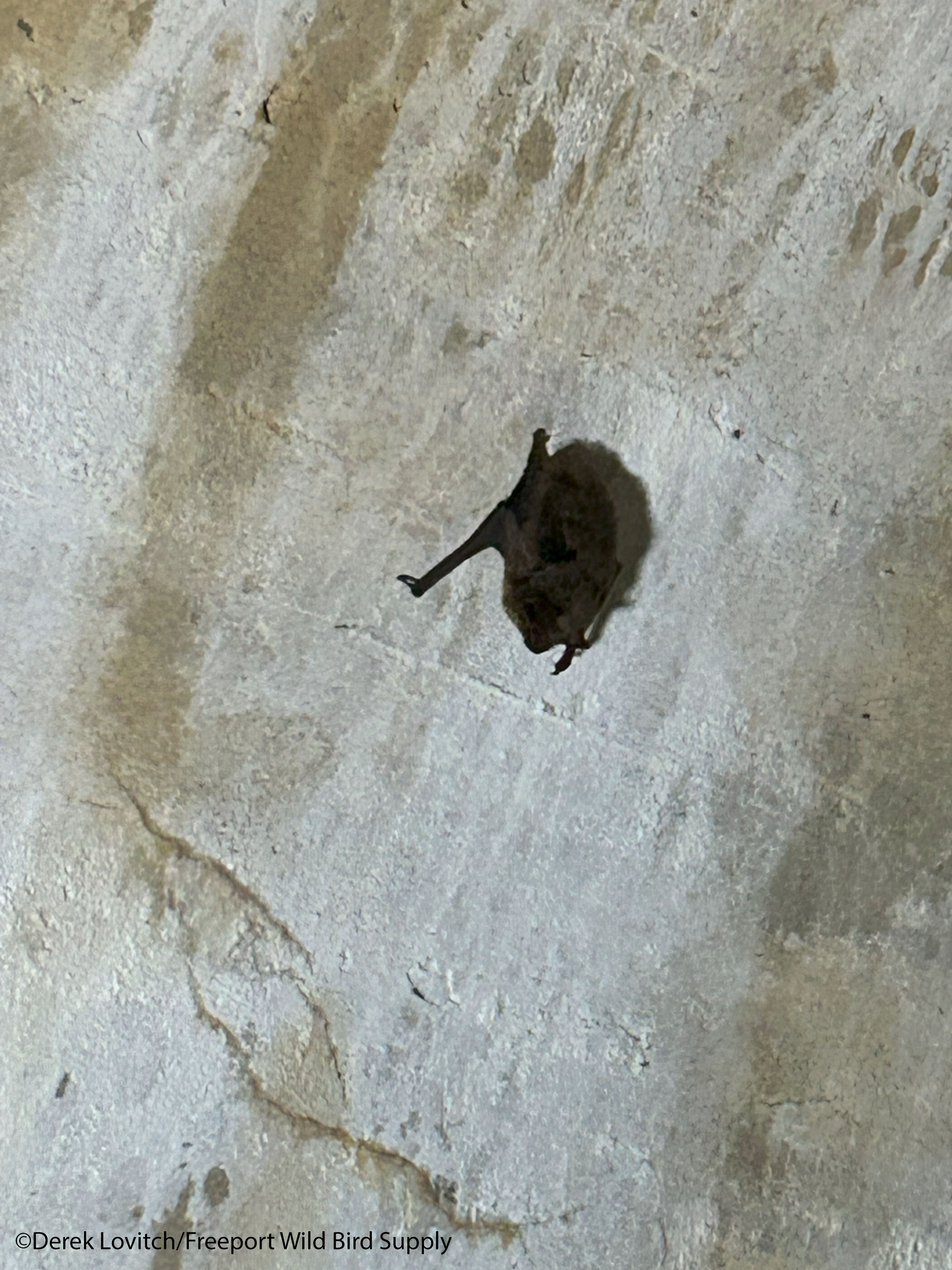
The fort was upgraded in 1840 and again in 1870, when a concrete cap was added, and it was insulated with dirt and sand. While the fort was obsolete by the Spanish-American War, anti-aircraft guns were placed here in World War 1, and in WWII, anti-submarine nets were stored here. Pete guided us through its corridors, described the cannon placement and usage, and we checked out the gunpowder magazines. We learned about the Battle of Portland Harbor, the furthest north battle of the Civil War, and we even found a roosting Big Brown Bat. Even though this was my second visit to the Fort, I was still in awe of the handiwork and the pristine condition.
Wait, what year is this?
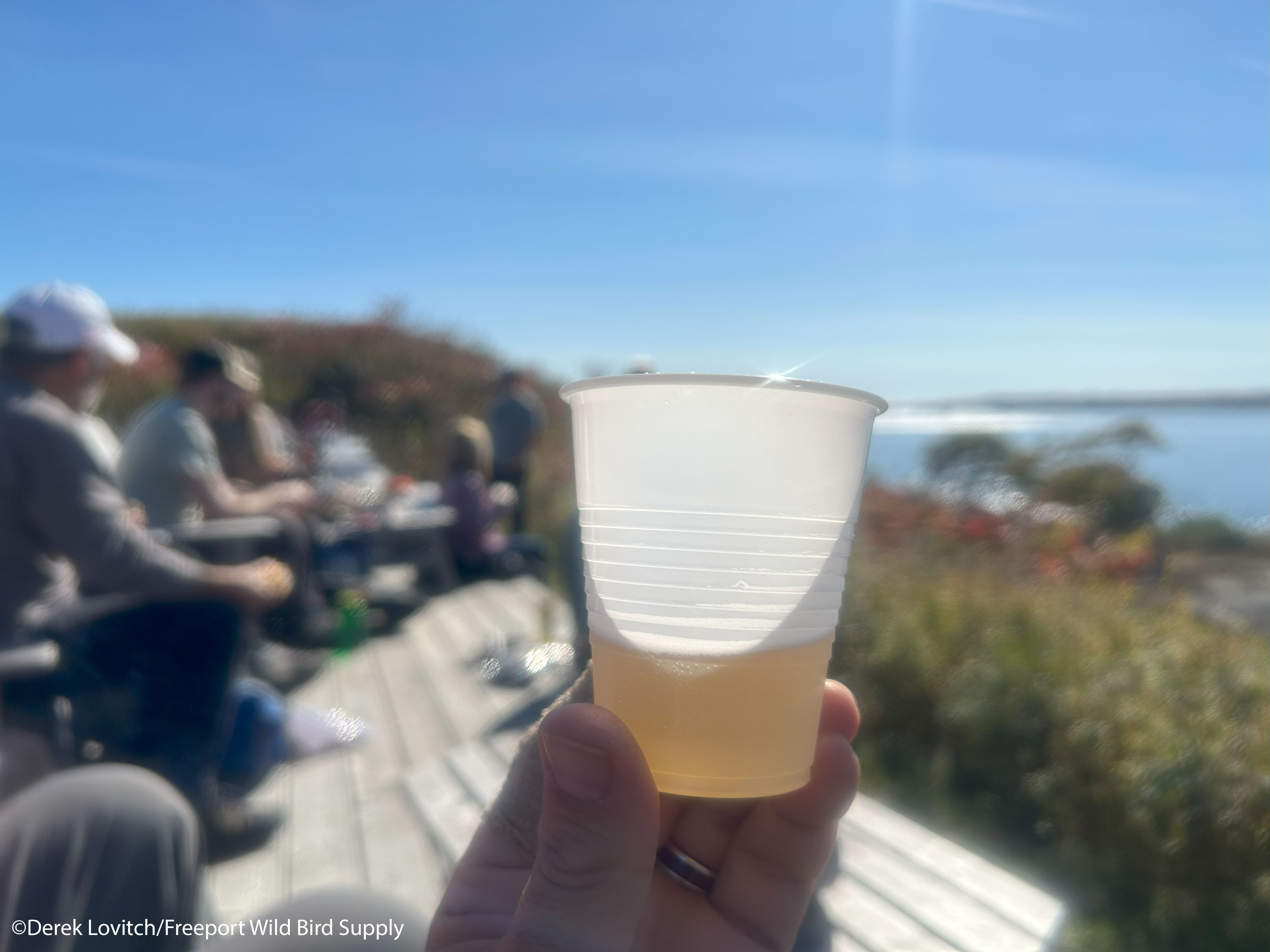
Then it was Tom’s turn to take over, and on such an insanely beautiful day, we took advantage of the comfy chairs above the parade ground for some more Portland history…but this time, it was the history of craft beer in the area. While Orange Bike is one of Portland’s newest breweries, this gluten-free brewery was developed with the help of Alan Pugsley – one of the Godfathers of the Maine craft beer movement. Starting with a refreshing and crisp pilsner, we also paid homage to a classic style.
Few beers say Portland more than Allagash White, and this was up next. The flagship of Maine’s largest brewer, its countless national and international accolades helped put Portland, Maine on the beer map. Speaking of, our next beer was Bissell’s flagship The Substance, one of the pioneers of the “New England IPA,” the hazy, juicy regional endemic that has since colonized the world.
A Horned Lark called as it unfortunately departed the island as we sampled our last beer, Mast Landing’s famous Gunner’s Daughter. A peanut-flavored stout rich in coffee, chocolate, and peanut butter notes, this was a perfect example of how creative modern beer has become.
While it was all-too-soon time to depart the island, our special tour was far from over. With such a gorgeous day (it was in the low 70’s with very little wind), Captain Pete decided to take a little ride out to the mouth of Portland Harbor. We motored past Chief Whitehead…
…and over to Ram Island Light, where Great Cormorants lined the old walkway. We compared their shape and size to the smaller, more common Double-crested Cormorants we passed on our way back inshore, while taking the time to enjoy the view, more Common Eiders and Surf Scoters, and scattered Black Guillemots.
A Gray Seal ushered us into the dock on our return.
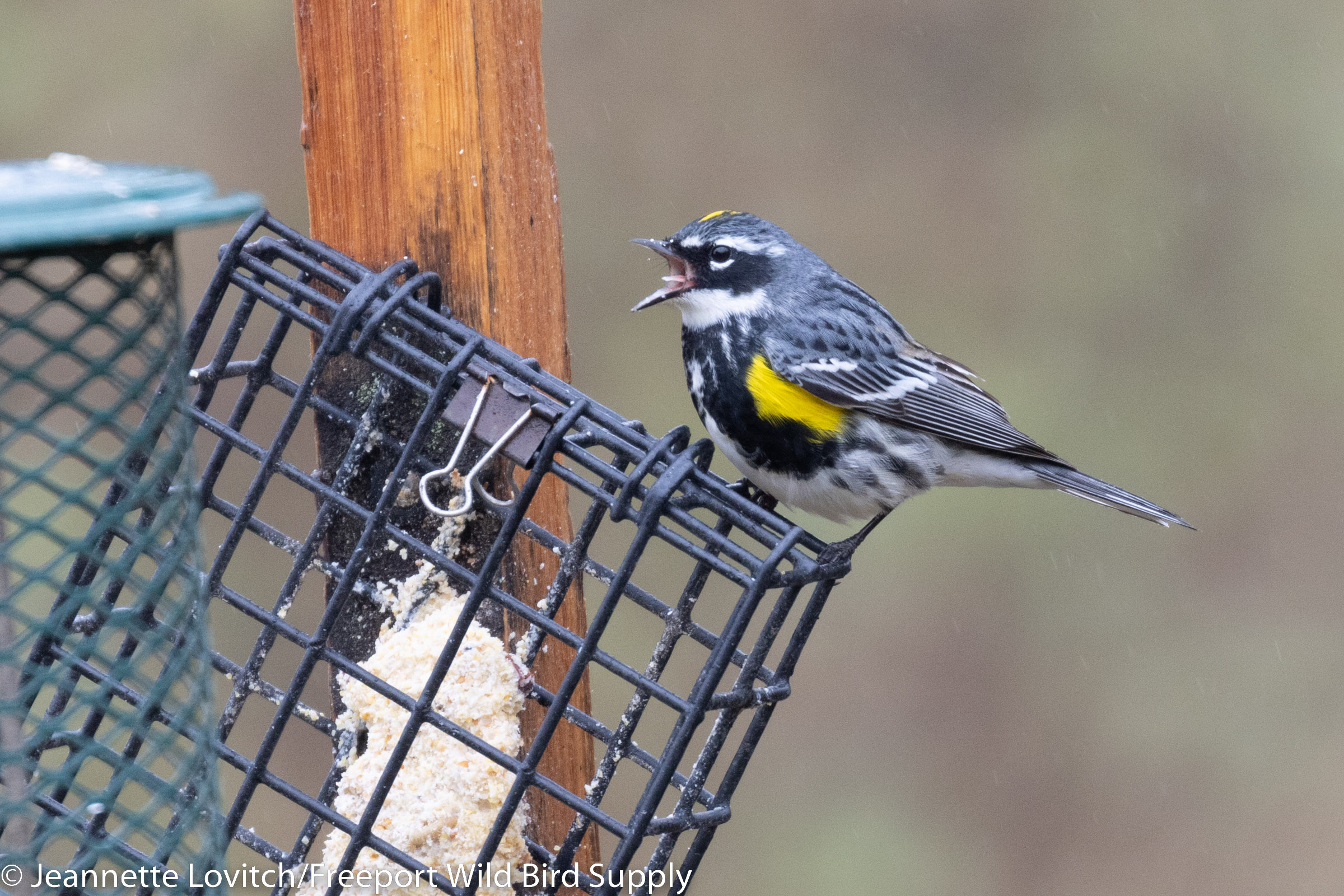
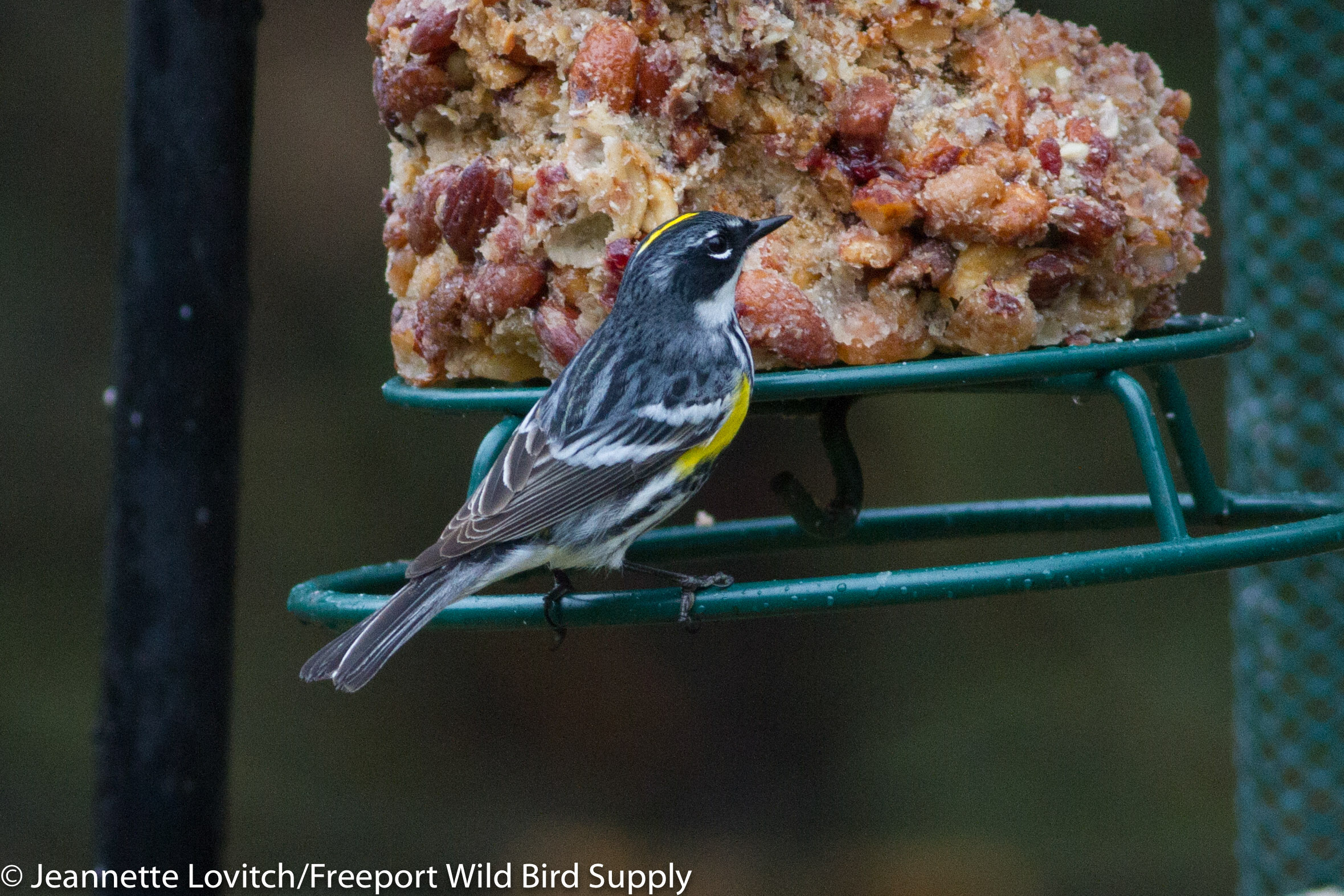
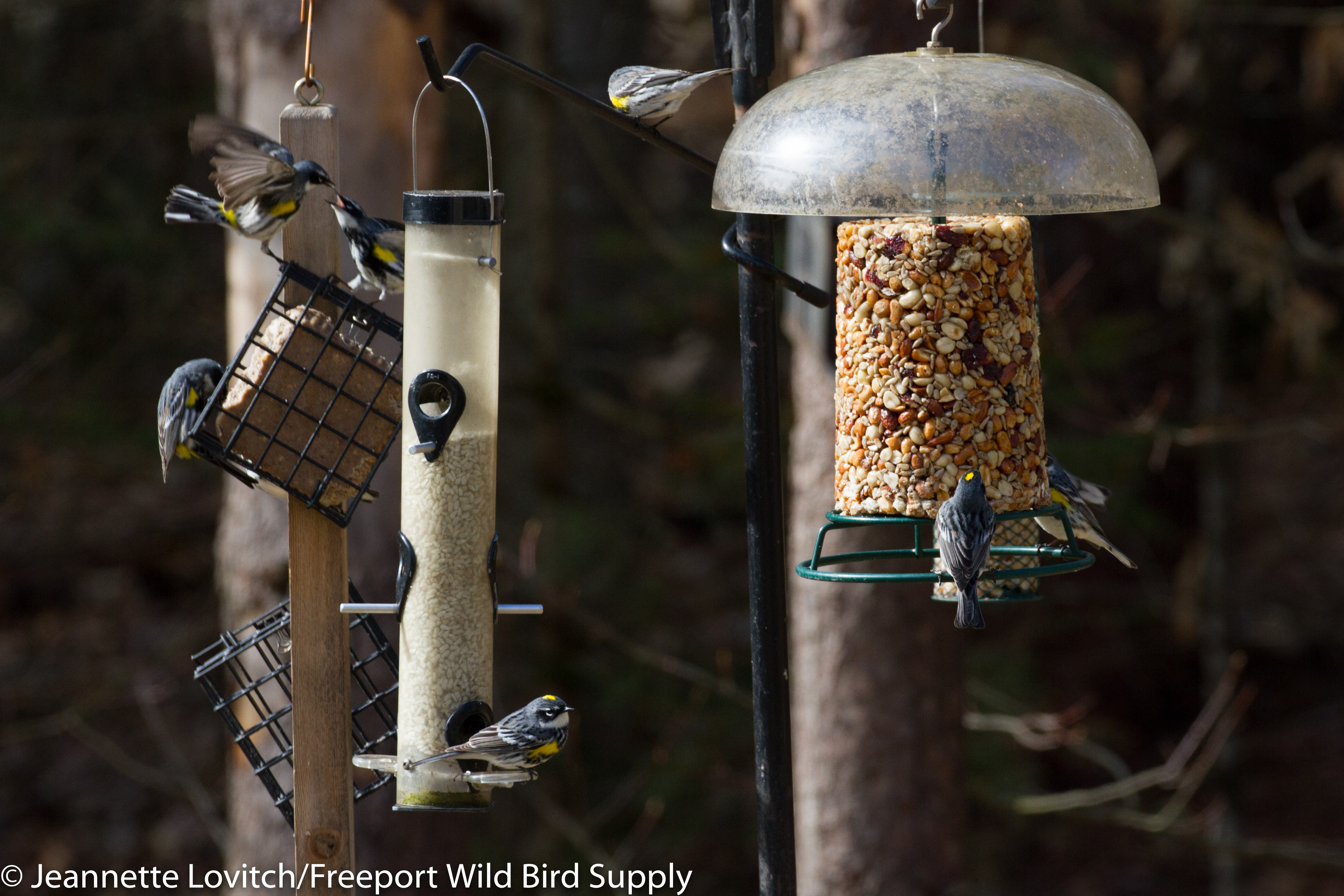
Yellow-rumped Warblers have been inundating our feeding station in Durham this week, feasting on nut blocks, insect suet, mealworms, jelly, and just about everything else.
Feeder-watching continues to be great, with lots of Pine Siskins, new arrivals, migrant White-throated Sparrows, and, at our home in Durham, up to a dozen Yellow-rumped Warblers daily – especially during the cool and often wet days we had this week. Meanwhile, Red Crossbills continue to be widespread in the area. There were no huge flights of migrants this week, but new arrivals were trickling in.
My other observations of note over the past seven days also included:
1 LOUISIANA WATERTHRUSH, Morgan Meadow WMA, 5/1.
6 total LOUISIANA WATERTHRUSHES, via “The Louie Loop” (Site AN4 in Birdwatching in Maine: The Complete Site Guide), Androscoggin County, 5/3 (with Noah Gibb).
One of the six individuals, a singing and mate-guarding male, paused just long enough for a snapshot in Mechanic Falls on the 3rd.
As is typical of the season, new arrivals were the headliners of most days of birding. Additional personal first-of-years this week also included:
1 Bank Swallow, Bradbury Mountain Hawkwatch, 4/29.
1 pair Rose-breasted Grosbeaks, our property in Durham, 4/30.
4 Black-and-white Warblers, Florida Lake Park, Freeport, 4/30
1 Great-crested Flycatcher, our property in Durham, 4/30.
1 Northern Waterthrush, our property in Durham, 5/1.
1 Common Yellowthroat, Morgan Meadow WMA, 5/1.
1 Wood Thrush, our property in Durham, 5/2.
1 Gray Catbird (first of spring), our property in Durham, 5/2.
As is often the case with prolonged cool, wet spells in early spring, Yellow-rumped (and Pine) Warblers descended on feeders. By week’s end, at least 14 were devouring suet, nuts, mealworms, and jelly in our yard in Durham.
Migration ground nearly to a halt for most of the week with a persistent onshore flow and lots of precipitation. Wednesday and Thursday nights, however, saw some good flights of passerines, with hawks moving once again on Thursday and Friday. My observations of note over the past seven days included:
1 female Evening Grosbeak, our feeders in Durham, 4/22.
This weekend (April 29-30) is the 13th Annual Feathers Over Freeport that we sponsor with public and private partners at Bradbury Mountain and Wolfes Neck Woods State Parks. We have a full slate of events all day, each day once again. The entire schedule and more information can be found here. All events are free with park admission.
There are some Morning Flights at Sandy Point that deserve their own blog. This was one of those. (I also haven’t finished my Monhegan Tour report blog yet, either).
Let’s start with the 1:00am reflectivity and velocity images from the Gray NEXRAD station. I was very happy that the station was back online in time for this incredible large flight. In fact, it was one of the densest flights I have seen in the area, and you can see how much biomass was offshore.
For an explanation of just what this means, see the “Birding at Night” chapter in my first book, How to be a Better Birder. Furthermore, see previous Sandy Point posts on the topic – you can use the search box in the upper right-hand corner of this blog page, and search “Sandy Point” or “Morning Flight.”
That got my pretty darn excited for the morning. And, well, it was a lot of fun! OK, mostly…at times I was overwhelmed and early on, I just felt beat! For the first 30 minutes, I often just clicked waves of “unidentified” as I tried to keep pace. Luckily, after the massive early rush, the flight became more manageable, although bursts of activity were barely quantifiable.
20 species of warblers, a very rare Blue Grosbeak, and my 195th all-time Sandy Point birds: 2 Little Blue Herons! It was quite a day.
Thanks to Evan Obercian, I learned a ton and had some great species tallies. I have no doubt that some of the records set (e.g. 2nd-highest tally for Cape May Warbler) came from his exceptional auditory skills – some of those birds would have just went unidentified or not even detected by me! Of course, the more eyes (and ears) the better, and Reed Robinson and Weston Barker – splitting time on the “flicker clicker” and pointing out birds landing below – helped immensely as well. Assistance was critical today.
When Evan and I finally departed for desperately needed bagels and coffee at 11:45, there were still a few birds on the move. With some raptors in the air, I am sure that if we didn’t leave then, I would be there all day. I wish I could have been, because this morning was simply awesome. Here’s the scoreboard:
6:36 to 11:45am
With Evan Obercian, Reed Robinson, and Weston Barker.
50F, mostly clear, WNW 4.5-5.1 to NW 13.3-16.1
2,389 unidentified
1,036 Yellow-rumped Warblers (*2nd highest)
449 Northern Parulas
374 Ruby-crowned Kinglets (*3rd highest)
286 Yellow-bellied Sapsuckers (*new record)
251 Northern Flickers
155 Blackpoll Warblers
138 Eastern Phoebes (*new record. Previous high of 26! And this was very conservative as many were swirling, too. But at times, steady pulses of 2-6 were clearly crossing)>
105 Black-throated Green Warblers
93 American Robins
75 White-throated Sparrows
71 Black-and-white Warblers (*new record)
65 Red-eyed Vireos (*new record)
64 Red-breasted Nuthatches (*new record)
58 Magnolia Warblers
57 Cedar Waxwings
44 Blue Jays
41 Dark-eyed Juncos
33 American Goldfinches
31 Blue-headed Vireos (*2nd highest)
26 American Redstarts
25 Cape May Warblers (*2nd highest)
25 Black-throated Blue Warblers
25 Purple Finches
23 Chipping Sparrows
22 Rusty Blackbirds
22 Nashville Warbler (*2nd highest)
22 Broad-winged Hawks
18 Tennessee Warblers (*3rd highest)
18 Golden-crowned Kinglets
16 Palm Warblers
12 Scarlet Tanagers
9 Yellow Warblers
8 Savannah Sparrows
7 Swainson’s Thrushes
7 American Kestrels
7 Turkey Vultures
6 White-breasted Nuthatches (*tied highest)
5 Baltimore Orioles
4 Ospreys
4 Philadelphia Vireos
4 Bay-breasted Warblers
4 Black-capped Chickadees
3 Brown Creepers
2 Rose-breasted Grosbeaks
2 Chestnut-sided Warblers
2 Orange-crowned/Tennessee Warbler
2 Red-winged Blackbirds
2 Eastern Wood-Pewees
2 Sharp-shinned Hawks
2 juvenile LITTLE BLUE HERONS (**high fly-overs. My first record for Sandy Point and Patch Bird #195.)
2 Lincoln’s Sparrows
2 White-crowned Sparrows
1 Pine Warbler
1 Least Flycatcher
1 Northern Harrier
1 Tufted Titmouse (did not cross after a few false starts)
1 Red-bellied Woodpecker (crossed after three false starts)
1 Common Loon
1 Eastern Bluebird
1 Hairy Woodpecker (crossed after 8 false starts)
1 BLUE GROSBEAK (**My 3rd-ever at Sandy Point. Spotted by Evan, photographed by Weston Barker; photo below).
1 Common Grackle
1 Wilson’s Warbler
1 Red-tailed Hawk
1 American Pipit
1 Blackburnian Warbler
1 unidentified Empid
1 Downy Woodpecker (did not cross after 2 false starts)
1 Swamp Sparrow
1 Hermit Thrush
1 Ovenbird (in the woods; warbler #20!)
X Common Yellowthroat (I don’t try and count them in the brush here, but there were a lot around this morning and many more than there have been. None even attempted a crossing as usual).
I don’t usually post my Sandy Point Morning Flight totals here, but today was more than worthy of a little something extra. After 8 nights with little or virtually migration (well, at least not a big flight on ideal winds), clearing skies and a light northwesterly breeze finally opened the floodgates. Here are the 1:00am reflectivity and velocity images, for example.
I am sure Monhegan – where I just spent 5 glorious days (despite the lack of a huge flight; more on that soon!) – was great, Sandy Point was just outstanding. In fact, it was my 3rd highest all-time flight!
Early on, clouds made everything into little black shapes as the intense flight proceeded at all levels. Wind, a cacophony of kinglets ringing in my ears, and the two loudest and most vociferous Tufted Titmice who just stayed screaming in the magic birch all conspired to further reduce my ability to identify birds. But mostly, waves of dozens at a time were simply clicked as “unidentified” as I tried to keep pace with quantifying the flight. Furthermore, there were at least 3-4 hunting Merling, a Cooper’s Hawk, and a Peregrine Falcon, which added to the swirling chaos. It was a challenge, that’s for sure. “I do this for fun?” I asked Matthew.
Here’s the scorecard from the Morning Flight of birds that passed over and through Sandy Point, Cousin’s Island, Yarmouth this am:
3 Swainson’s Thrushes – including two observed crossing.
3 Tufted Titmice
2 Scarlet Tanagers
2 unidentified vireos
2 Yellow Warblers
2 Red-breasted Nuthatches
2 Tennessee Warblers
2 American Goldfinches
1 Chestnut-sided Warbler
1 Pine Warbler
1 White-crowned Sparrow
1 Broad-winged Hawk
1 White-breasted Nuthatch
1 Hermit Thrush
1 unidentified Catharus
1 Red-bellied Woodpecker
1 Osprey
X Common Yellowthroats
1 YELLOW-BILLED CUCKOO – my 7th all-time here. Made 4 “false starts” before crossing at 10:04am.
Cuckoos are such shape-shifters in flight that I feel like I could have counted each pass from the one bird as a different species each time it passed!
For a grand total of 5,487 birds, my *3rd highest all-time count. So yes indeed, birds have very much been backed up.
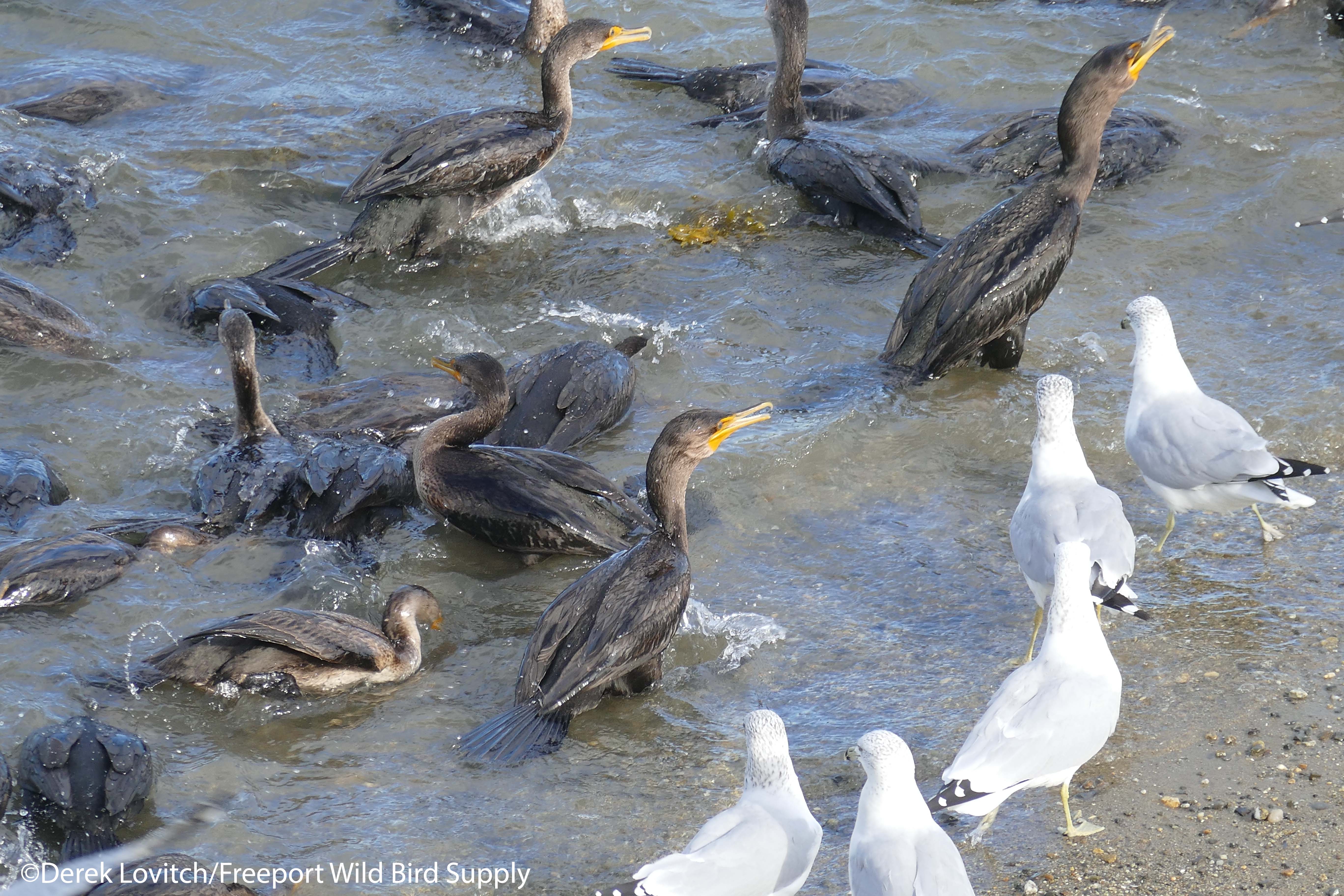
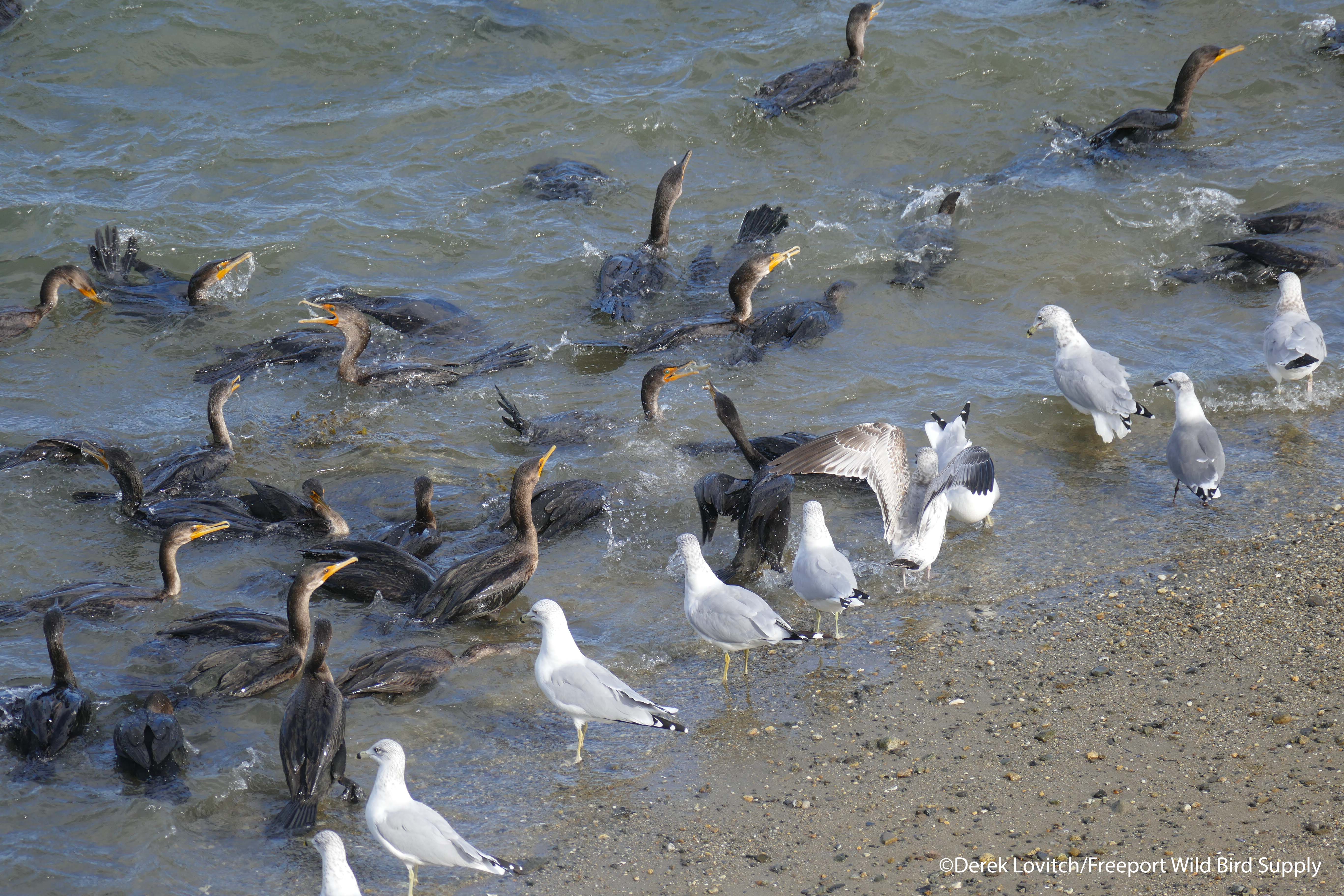
Meanwhile, adding to the excitement (and chaos) this morning was a massive feeding frenzy of Double-crested Cormorants and gulls. While I am sure a few migrants snuck by overhead, I couldn’t help but take a few moments to enjoy it…and make sure there were no rarities among the gulls! 15-20 Laughing Gulls and 4 Bonaparte’s Gulls joined 75-100 Ring-billed Gulls in snatching the baitfish that the Double-crested Cormorants had pushed right up onto the sandbar as it slowly emerged from the tide. It was quite a show!
On another damp and dreary morning at Florida Lake Park in Freeport on Thursday, I encountered 25-30 Yellow-rumped Warblers and 15 or so Palm Warblers. That was my best total of the season there so far, but in the last week of April through first week of May, I often see tallies of each into the triple digits.
On Friday it was drier, but still cool and raw at Morgan Meadow WMA. I finally hit 5 species of warblers on a morning with my first-of-year (finally) Black-and-white Warbler. About 20-25 Yellow-rumped and about 15 Palm Warblers were present. For perspective, on 5/3 last year, I hit 10 species of warblers at Florida Lake.
These are two of my favorite mid-spring migration patches, and in most years, I am at Florida Lake Park nearly every day. But this “spring”, it has been lackluster at best; worthless at worst. There just aren’t many birds around.
But it is definitely the spring for warblers at feeders! After our Facebook post on Wednesday garnered lots of attention and feedback, I thought I would expand a little, as clearly this is a very unusual – perhaps even unprecedented – event.
While Pine Warblers are regular at feeders, especially in early spring – and quite a few of us see some Yellow-rumped Warblers at feeders every year – we cannot recall a spring in which so many people are reporting so many of each at feeders throughout southern Maine. In fact, many folks are reporting Yellow-rumped Warblers at their feeders for the “first time ever.” Even more unusual, we’ve had reports of Palm Warblers at feeders, too – something that is almost never seen. Pine Warbler is our only regular, wide-spread “feeder warbler” in most seasons
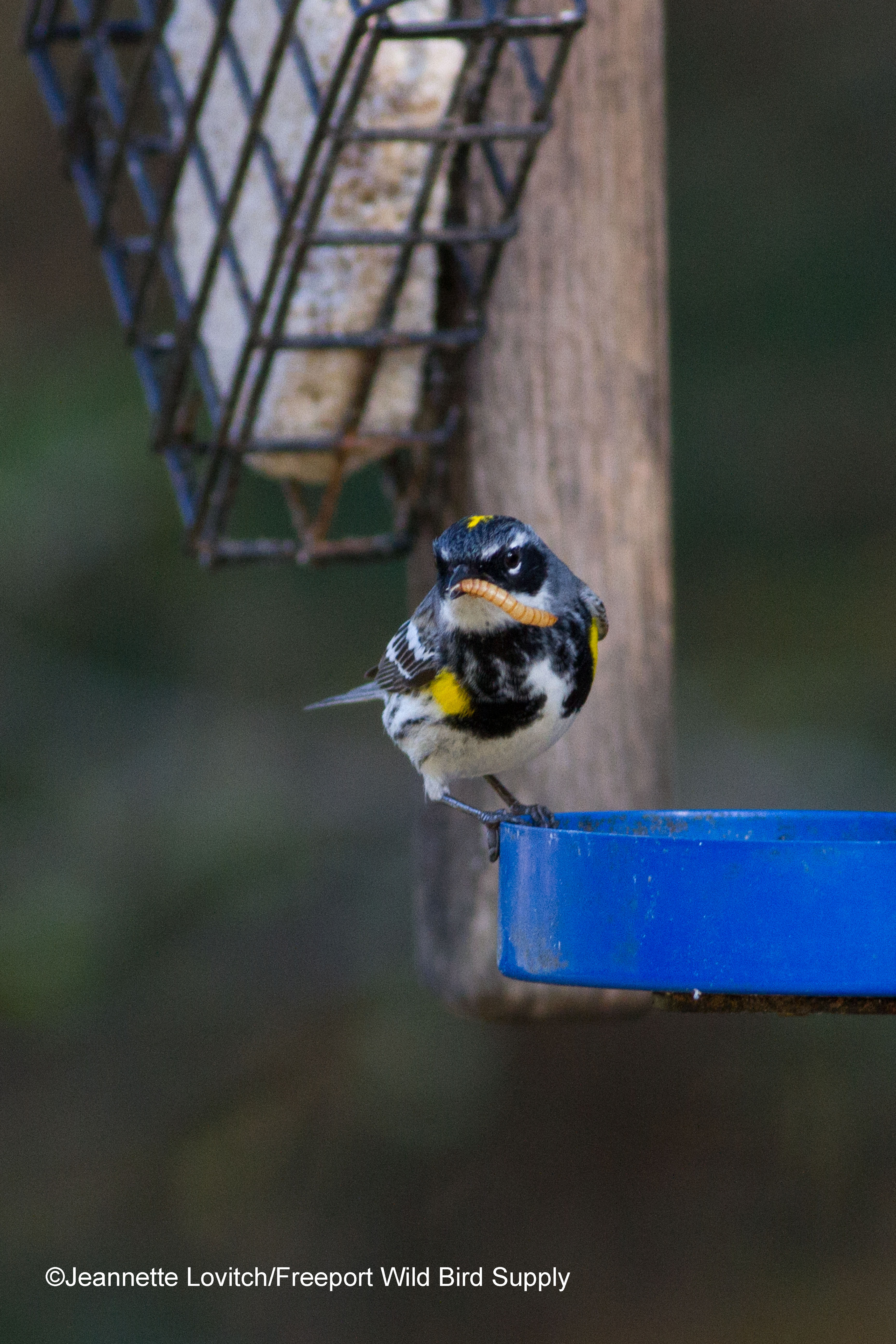
At home in Pownal, we’re up to 20 Yellow-rumped (and our usual pair of Pines), with as many as 8 Yellow-rumps frequenting the feeders at the store this week. We see them annually on our feeders at home, especially on damp and cold mornings, but this year the flock has been slowly but steadily building and has been consistently present for almost 3 weeks. In both locales, a diversity of food is being consumed by this normally-insectivorous (at least in spring and summer) species. In rough order of popularity, they are eating: live mealworms, dried mealworms, insect suet, Nutsie and Mr. Bird nut blocks (especially the Bugs, Nuts,&Fruit block), peanut splits, Birdberry jelly, and even some seed. While a little hulled sunflower isn’t surprising, at home, we even have them gobbling up white proso millet from our tray feeder!
In fact, until Thursday, I’ve had more Yellow-rumps at our feeders than on any morning at Florida Lake Park! And this is instructive.
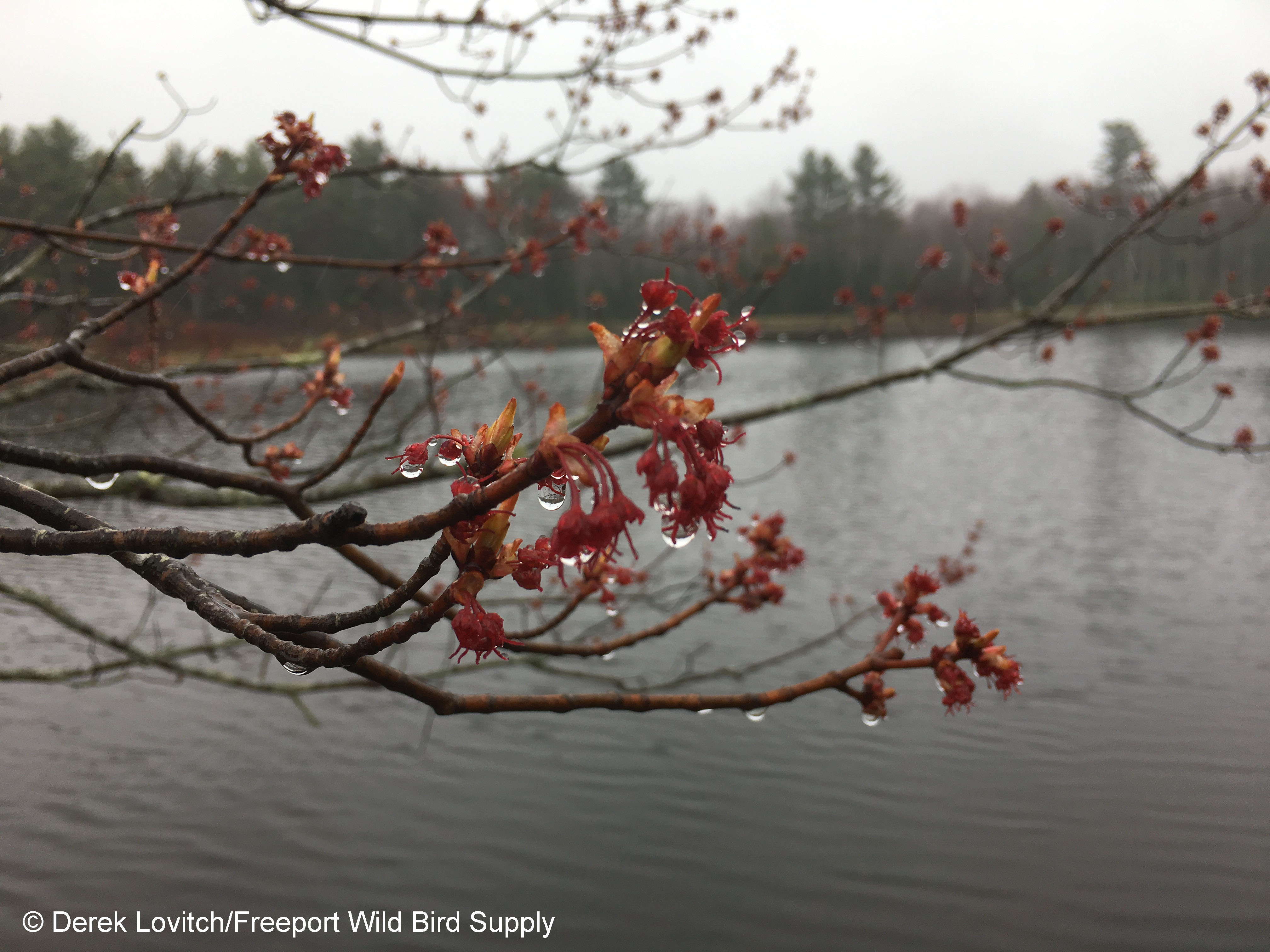
Midges are not yet emerging from the pond there, and even through some Red Maples are finally blooming, insect activity has been minimal or even non-existent at this important early-flowering tree. The phenology (to put it simply, the timing of things in nature over the course of the year) is off –way off – this spring. Food resources are not keeping up with the calendar.
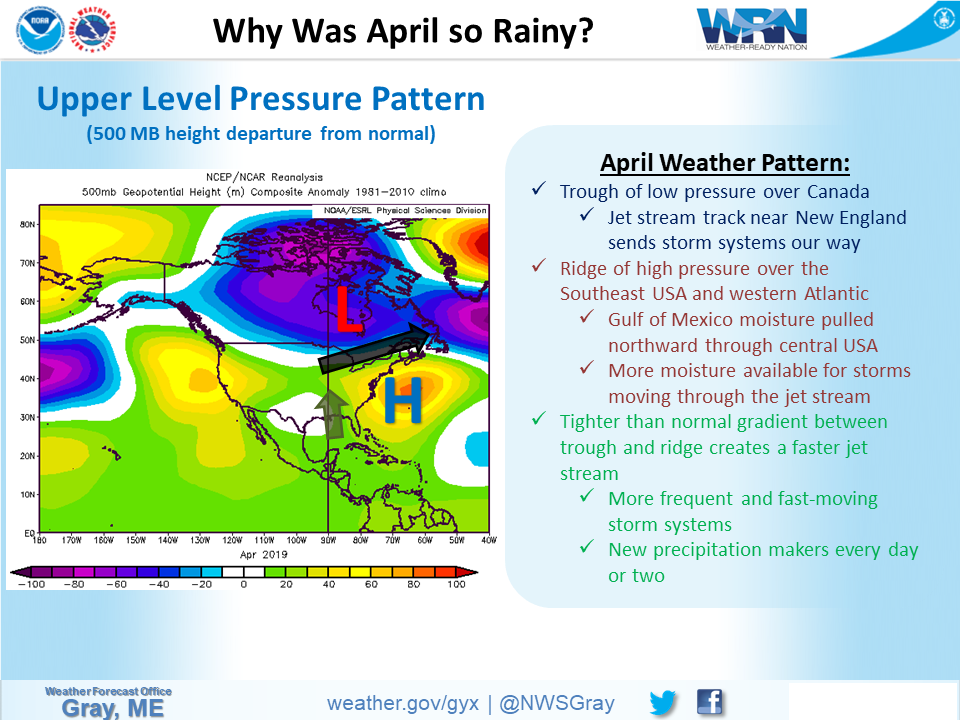
The jet stream is stuck to our south, resulting in unseasonable cool and very unsettled weather, with a steady progression of storm systems and disturbances crossing our area. This pattern is impeding the progress of our spring, and of migrants arriving from the south (I have yet to even see a Black-and-white Warbler this year, for example!). But the cool and wet weather is resulting in natural food sources being well behind schedule, so the birds that are here – on time in many cases – are searching for alternative food sources. And therefore: warblers at feeders.
This diagram of the jet stream from 4/30 shows the tight gradient and zonal flow that has been dominating our weather pattern and is preventing the arrival of warm temperatures and “spring.”
Or, as better explained by the National Weather Service office in Gray:
Meanwhile, cherries, apples, crabapples, Serviceberry, and other important early-season flowering trees aren’t even close to blooming. Nectar, pollen, and even the petals and new buds are consumed, but more importantly for most of our migrants, those flowers attract insects that are then eaten by birds. The forecast is for some better conditions for migration in the coming days, and that will start to deliver us newly returning migrants, but those birds will also have fewer food sources than normal.
In seasons like this, the supplemental food from well-stocked feeding stations becomes more important than usual. Ruby-throated Hummingbirds are already being reported; what would those birds do without a nectar feeder (no red dye!!!!) right now? And of course, who knows what kind of condition all of these hungry Yellow-rumped Warblers would be in right now without feeders.
Soon, other migrants such as orioles, tanagers, catbirds, and a wide array of warblers (or Neotropical migrants) will be arriving, and they need food after their long journeys. Especially until spring catches up (those long-distance migrants have no idea how delayed our season is up here), feeders will continue to be important for migrants – and unexpectedly productive birding hotspots.
There are a lot of hungry birds out there right now, and without a doubt, many of us will get to enjoy species we don’t usually get to see, or at least no so closely. So put your jacket on, come by the store for some high-quality foodstuffs (our insect suet is flying off the shelves right now!) and keep that feeding station well-stocked. Our migrants thank you.
Our 8th tour of the year with our partners, The Maine Brew Bus, ventured to Maine’s deep south and toured around the village of Kittery.
October in Maine can produce all sorts of surprises, and Fort Foster is a great place to find the unexpected. We started off with this BLACK-BILLED CUCKOO, a very late individual, that unlike most members of its species paused for photographs and long, satisfying views.
Another treat was an “Ipswich” Savannah Sparrow on the beach and a nice little wave of Yellow-rumped Warblers among the residents in the woods, but then our biggest surprise of the morning – a wide band of steady rain! The rain impacted our visit (for the second year in a row!) to Seapoint Beach, but a small pocket of activity on the seaweed included at least 5 Northern Mockingbirds (one burst into song, despite the rain), 6 Yellow-rumped Warblers, and 2 Eastern Phoebes. Several adult Northern Gannets were just offshore, which was another highlight. “Ipswich” Savannah Sparrow that breeds exclusively on Sable Island, Nova Scotia.
With rain still falling, I skipped the walk at the beach, and instead made a couple of short stops where we were able to hang by the bus. 20+ Bonaparte’s Gulls were off the Kittery Town Landing, and by the time we arrived at Legion Pond to enjoy 3 spiffy Wood Ducks among the masses of Mallards, the rain not only stopped but the sun began to return.
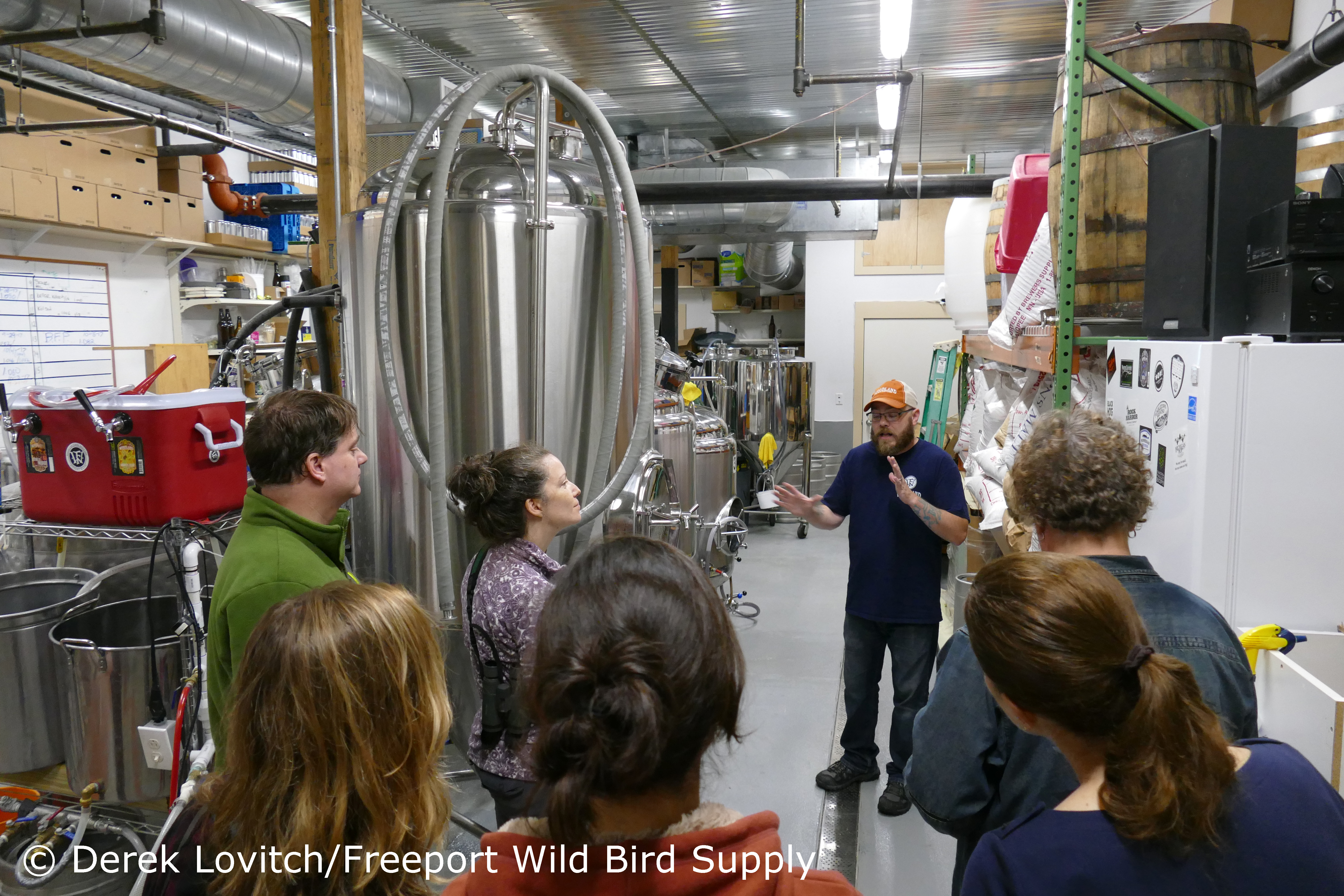
The first stop on the brewery tour was Woodland Farms Brewery, which opened only this February – but from the looks of things, had already gained quite a following! There, we sampled four brews from this lager-centric brewery. Very traditional and well-executed styles included Wolf Haven Extra Special Bitter (ESB) with a nice depth of flavor to balance the bitterness, and the Rowanbrau, a Dortmunder-style golden lager with a super-crisp-finish. We started with their light Cervaza Medico, a Mexican lager with a subtle sweetness from corn, and finished with a hop-forward Backyard Scientist IPL. A lot can be done with a lager, far beyond the basic American mass-produced swill, so it was a good lesson for us in the range of the technique.
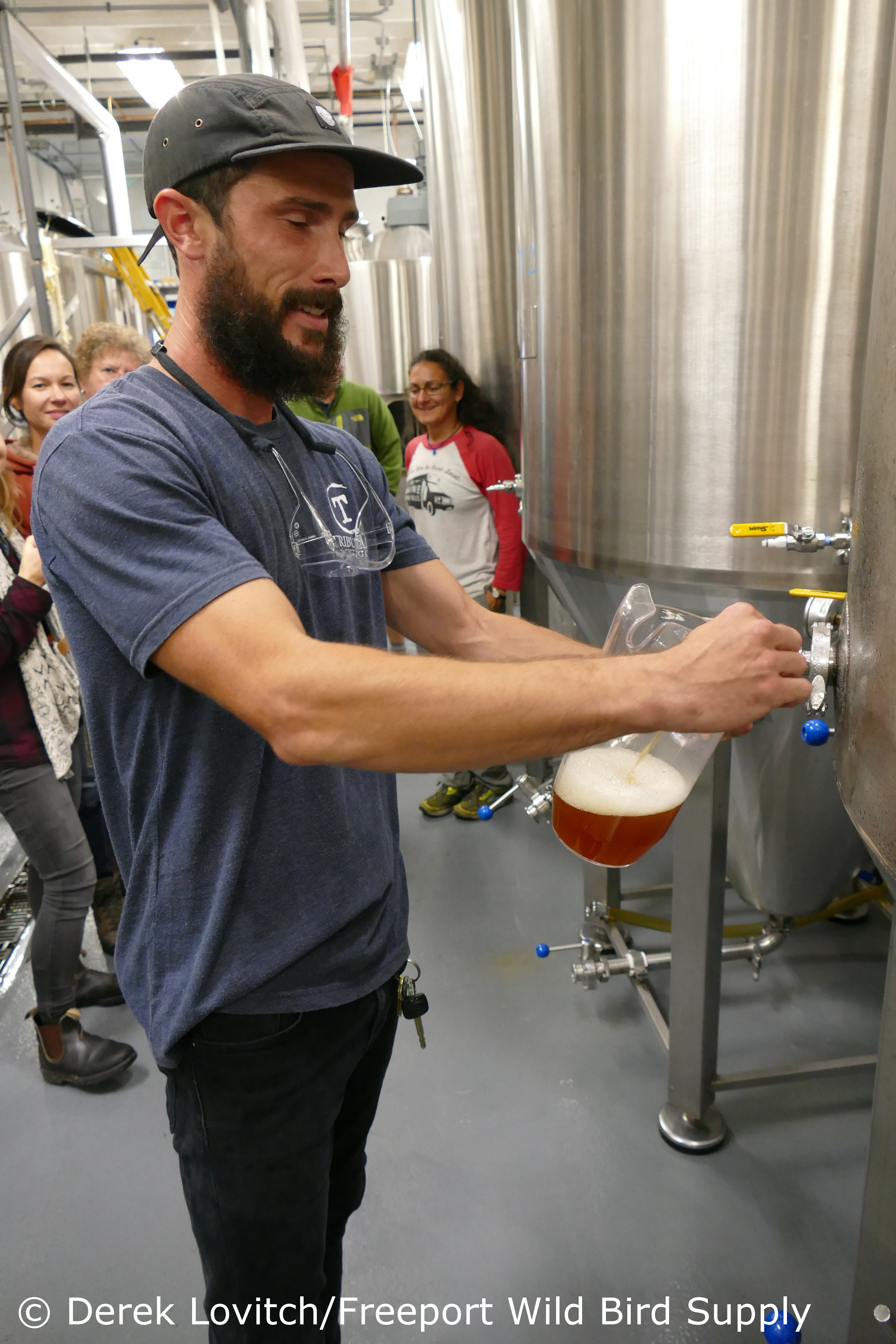
We learned about the benefits and limitations of focusing on lagers, and the methods that produce this style of beer, which we then contrasted with ales on our second stop, Tributary Brewing Company, where a wide range of traditional and modern styles were sampled. Starting with Oktoberfest, a perfectly-simple and clean version of the traditional German-style marzen, we finished with their Oyster Stout (anything but traditional), with subtle notes of minerality. In between, we tasted their Blueberry to find out what a beer with blueberries in the mash can really taste like (subtle, not in your face, and not overtly sweet at all) and their Pale Ale, their basic, but delectable flagship. In all cases, flavors were meant to be simple and subtle, complement the “basic” beer flavors and not overpowering them.
While comparing and contrasting this subtle, delicate use of flavors, it was not surprising that a discussion of “pumpkin/pumpkin spice” beers came up, and so Ian tapped the unfinished Pumpkin for us to sample – even though it was still weeks away from being ready and was un-carbonated. We were duly impressed, as the subtle flavors were quite apparent, and it offered insight into the brewing process as well, which is something we work hard on offering during these special tours.
With temperatures in the low 70’s, the rain was merely a nuisance, and it definitely impacted the middle part of our birding adventure. Regardless, a birding tour that begins with crippling views of a Black-billed Cuckoo and ends with stunning Wood Ducks is still a real winner! And if not, there was some great beer to enjoy and learn about!
































 Maine Birding Field Notes