Tag Archives: vagrants

Post-Arthur Beach Birding and Catch-Up

I know I haven’t been blogging much this summer, but I hope you know that doesn’t mean I haven’t been birding. Quite the contrary, actually! My June was as busy with tours and private guiding as it could have been, and with some other projects going on, much of my birding was rather purposeful. Of course, there was some wholly-recreational birding mixed in as well from time to time. Despite my irregular blogging, I did my best to keep folks up to date with my birding adventures and discoveries, mostly with near-daily posts to our store’s Facebook Page. (Remember, you need not be “on Facebook” to browse the posts of a business page.)

It was a busy month. But that’s not a complaint. And now, Jeannette and I are off to Colorado for a bona-fide vacation, to visit friends, family, and yes, do some birding. But first, I had Sunday morning to find some birds. My third attempt to organize a charter to see the Tufted Puffin that has been seen irregularly at Machias Seal Island (3rd or 4th record for the entire Atlantic Ocean!) was thwarted by residual high seas and localized damage from the passage of Tropical Storm Arthur. While Arthur took away my chance to see a Tufted Puffin in Maine waters, I was hoping it would produce some rarities of its own.

In a tropical system, birds are sometimes entrained in the eye, while others are pushed out ahead of the storm. This displacement usually occurs in the strong northeastern quadrant of the storm, and birds escape the eye when it hits land. With the storm passing to the east of Maine, I did not expect to see any vagrants on Friday. However, when the storm reached land in southern Nova Scotia on Saturday morning, birders there were in prime position for rarities. And sure enough: lots of Black Skimmers, several Gull-billed, Royal Terns, and Forster’s Terns…all rarities from points further south. (You can peruse the reports from the province, here).

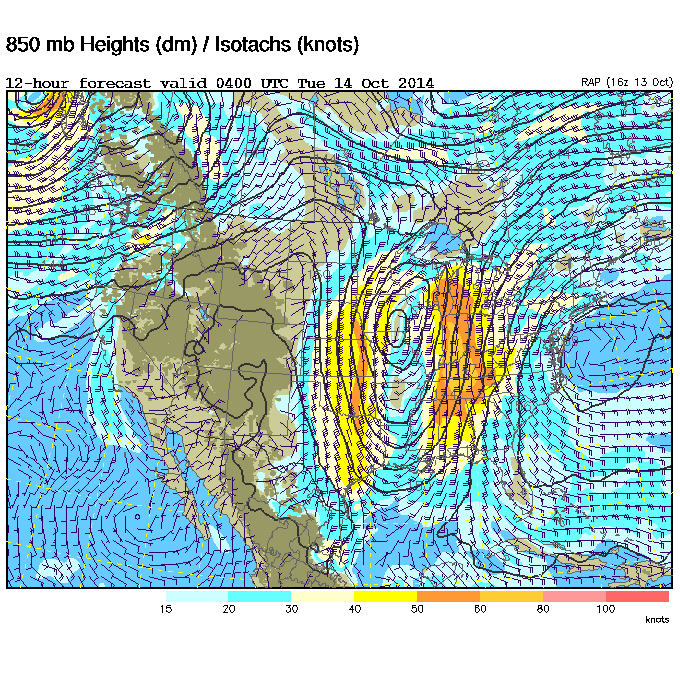
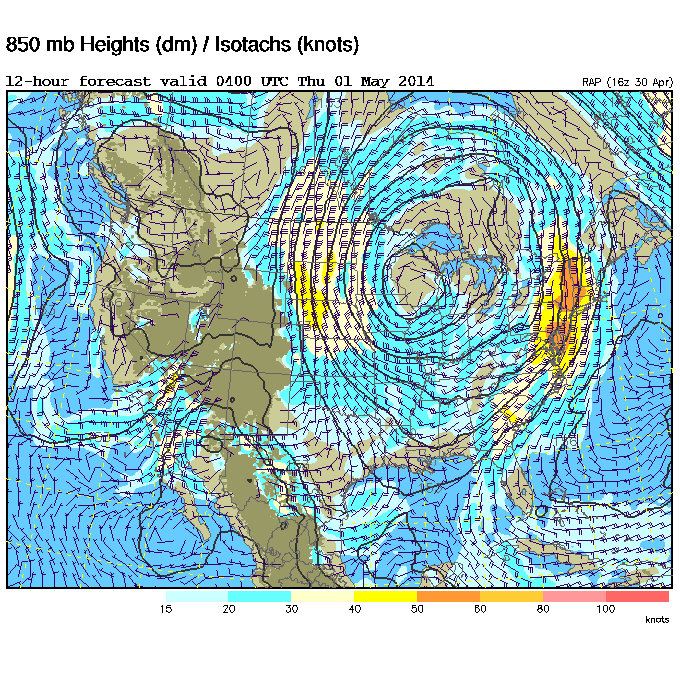
These birds, commonly displaced by tropical systems, were likely picked up by the storm as it passed over North Carolina’s Outer Banks on Thursday. Here’s the cumulative wind map as of 11:00am on Friday, with the storm’s center already off of the Delmarva Peninsula.
entrainment

As the storm hit Nova Scotia, birds finally had a chance to escape its grips. But notice the winds for Maine – they were already strong out of the northwest, on the backside of the storm (note the light winds of the disintegrating eye over the northern Bay of Fundy).
current winds,7-5-14

So Nova Scotia birders were having a lot of fun…and I was not seeing a Tufted Puffin. So instead, I decided to comb the beaches to look for some of these terns that perhaps are already returning south. While most of these birds likely made a bee-line straight across the Gulf of Maine on their return journey, some birds might conceivably follow the coast.

After birding Eastern Road at high tide (34 Least Sandpipers and 20 Short-billed Dowitchers – fall migration is definitely underway!), Lois Gerke and I headed to Pine Point Beach, where we spent a little more than an hour watching from the jetty. As the tide went out, exposing the sandbar and flats, Common, Least, and a few Roseate Terns were feeding, roosting, and loafing with at least a hundred Bonaparte’s Gulls. But alas, there was nothing unusual among them.

I then checked the mudflats from the co-op (more Short-billed Dowitchers, a few more Roseate Terns, and a lot of feeding Common Terns) before I spent the remainder of low tide at Hill’s Beach in Biddeford. At least 8 Roseate Terns, 75+ Bonaparte’s Gulls, 17 Short-billed Dowitchers, and my first Whimbrel of the year joined the regulars, but alas, no rare terns.

It appears I had the right idea, but just the wrong timing. Later in the afternoon, a Royal Tern was found at Hill’s Beach. And then, this morning, two Black Skimmers were roosting at Stratton Island. There are still quite a few waifs being seen in Nova Scotia, so it is conceivable that the coming days could see some reports of returning rarities here in Maine. Unfortunately, this morning, I had time only for a quick stroll at Capisic Pond Park. No rare terns there, but I did see my first Monarch butterfly of the season – which, the way things are going for this species, is even more exciting.

Meanwhile, indirectly storm-related were the 6 Glossy Ibis that were a little bit of a surprise on my Saturday Morning Birdwalk along Highland Road in Brunswick. The heavy rain nicely saturated the soil, and gulls and these ibis had moved inland to take advantage of the bounty.

In other birding news, a pair of Evening Grosbeaks has been frequenting our Pownal feeders – which are particularly exciting considering the dearth of them this year…in fact, these are the only ones that I have seen all year long. And, even more unexpectedly, three Eastern Bluebirds have hatched right here at the store!

Arthur gave us a momentary glimmer of rarity fever, and “fall’ shorebird migration is definitely underway. But July is for breeding birds – from terns to “sharp-tailed” sparrows to bluebirds and warblers. In other words, there’s no such thing as the “summer birding doldrums!”

A Great May Week of Birding in Review, and Some Predictions for More Feathery Fun.

DSC_0027_SUTA,Georgetown1,5-6-14

Simply put, it has been a helluva week of birding in Maine!  Strong flights of migrants occurred on 5 of the last 7 nights, producing a whole lot of new arrivals throughout the region. And then there were rarities, but we’ll get to that shortly.

As for regularly-occurring migrants, birds are arriving right about on time now. By week’s end, some of the latest arriving warblers, like Blackpoll have begun to trickle in, while the early migrants like Yellow-rumped and Palm have thinned out considerably. Some locally-breeding Pine Warblers are rarely singing now, as breeding season for them is well underway.

Almost anywhere you went this week, 12 or more species of warblers was possible.  I enjoyed 15 species at Florida Lake on Monday and 17 species at Evergreen Cemetery on Thursday, for example. The third week of May is when the coveted 20-species morning total is most likely around here, so you know I will be gunning for that in the coming days.

I added Lincoln’s Sparrow, Lesser Yellowlegs, White-crowned Sparrow (#126, 127, and 128 respectively) to my Bradbury Mountain patch lists this week, and a Lincoln’s Sparrow was the first in our Pownal yard (#116) on Sunday. Meanwhile, a spiffy male Orchard Oriole was the 114th species at our store, a one-day wonder at our feeders on the 10th.  So it’s been a great week for patch listing as well!

And Scarborough Marsh was just awesome on Tuesday morning, when Katrina and I had unbelievable numbers (for spring) off of Eastern Road, including 1500+ Tree Swallows, 500+ Least Sandpipers, 400+ Barn Swallows, ~125 Greater and ~100 Lesser Yellowlegs, 75-100 Bank Swallows, 6++ Semipalmated and 2++ White-rumped Sandpipers (both FOY), 2 adult Dunlin, and the continuing Tricolored Heron. Nothing rare per se, but the biomass of birdage was impressive, and was definitely the highlight of the week.

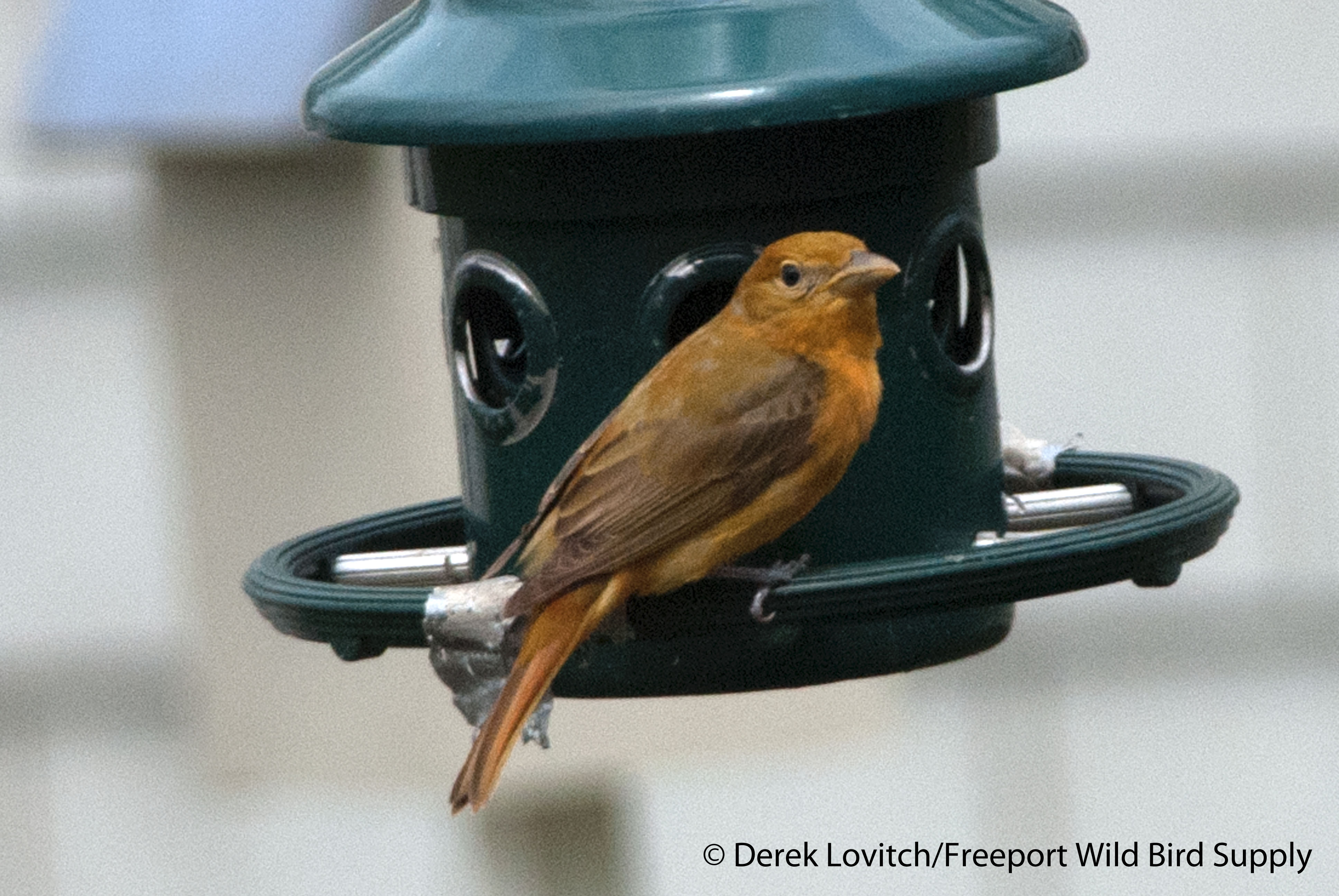
Following the “Mega” rarity Northern Wheatear that was last seen last Saturday in Scarborough Marsh, rarity news has been decidedly southern in nature. Although small numbers of “overshooting” southern vagrants are typical in Maine every spring, the number of White-eyed Vireos (I caught up with one at Capisic Pond Park on Thursday with my friend Lois), Summer Tanagers (I saw one in Georgetown last week with Katrina; see above), and Blue-gray Gnatcatchers (they’re everywhere!) is most impressive. Then there was a Painted Bunting on Monhegan this week, a Swallow-tailed Kite at the Bradbury Mountain Hawkwatch on 5/7, and a Mississippi Kite also at The Brad as the grand finale on the 15th.  The widespread smattering of Orchard Orioles is a little more typical.

This pattern of southerly vagrants is not caused by birds being “blown” here in a simple sense, but instead we believe it is caused by southerly winds facilitating their arrival beyond their normal range – perhaps by causing a bird to travel much further (in relation to the ground) in each night’s flight thanks to a favorable tailwind. Perhaps others were entrained by strong winds off the South Atlantic Bight and were pushed northwards until they made landfall in the Northeast (I wonder if the Boston Fork-tailed Flycatcher arrived this way?).

Less fitting of any particular pattern is the remarkable adult Black-headed Grosbeak that was on Monhegan this week – at the SAME FEEDER as the Painted Bunting, 2 Summer Tanagers, a Lark Sparrow, and a Dickcissel. <expletive deleted> And, not to be overshadowed, a dapper male Ruff was found in Bangor.

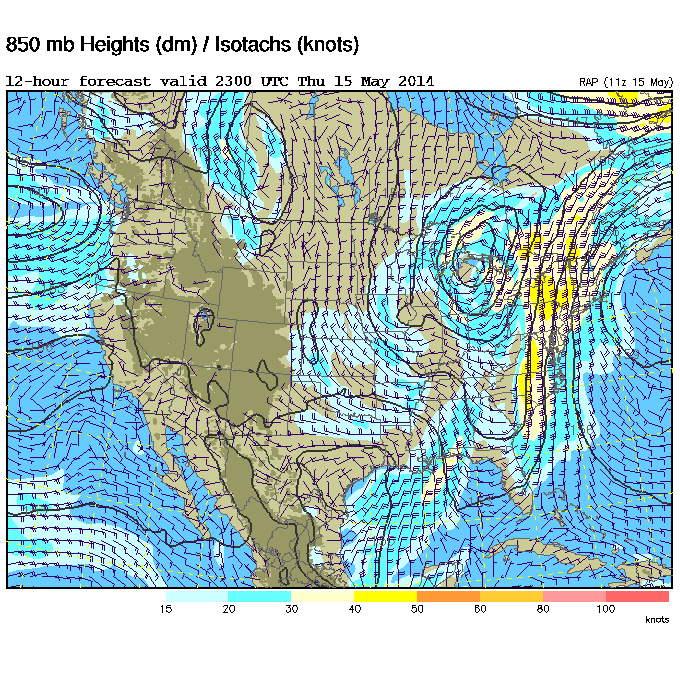
With a deep southerly flow continuing, and some very unsettled weather coming for the weekend, I think things will be getting quite interesting in the coming days. (I don’t want to know how many “Island Birds” Kristen Lindquist will pick up over me on Monhegan this weekend!).  Check out this wind map from the 15th, showing a very strong southerly flow originating all of the way from Florida and the Caribbean.

wind map, 5-15-14

For those of us not on Monhegan this weekend, I sure hope you’ll be birding hard – not despite the weather, but because of the inclement weather. At the very least, keep an eye on those feeders. Both here at the store and at home, we’re stocked up with mealworms, jelly, oranges, insect suet, and nut blocks. Not only will the cool, wet weather limit natural food sources, but the slow progression of the season continues to put a lot of important food sources well behind the birds’ required schedules.

For example, apples and cherries are only now starting to bloom. Early-arriving nectavores and insectivores flock to these (and other early-season bloomers like Shadbush, azalea, and quince) for both nectar and the insects attracted to that nectar. The lack of a lot of flowers so far this season has pushed many orioles (including some Orchards in addition to the regular Baltimores), Gray Catbirds, and Scarlet (and some Summers) Tanagers to feeding stations in above-average numbers.  I expect that trend to continue through the middle of next week, as a stubborn upper-level low remains locked overhead producing unsettled weather.

So keep an eye out the window, get outside, and find some good birds!  And regardless of rarities, it’s just a great time to be birding!

Biddeford Pool Snowy Owl and Weather Discussion

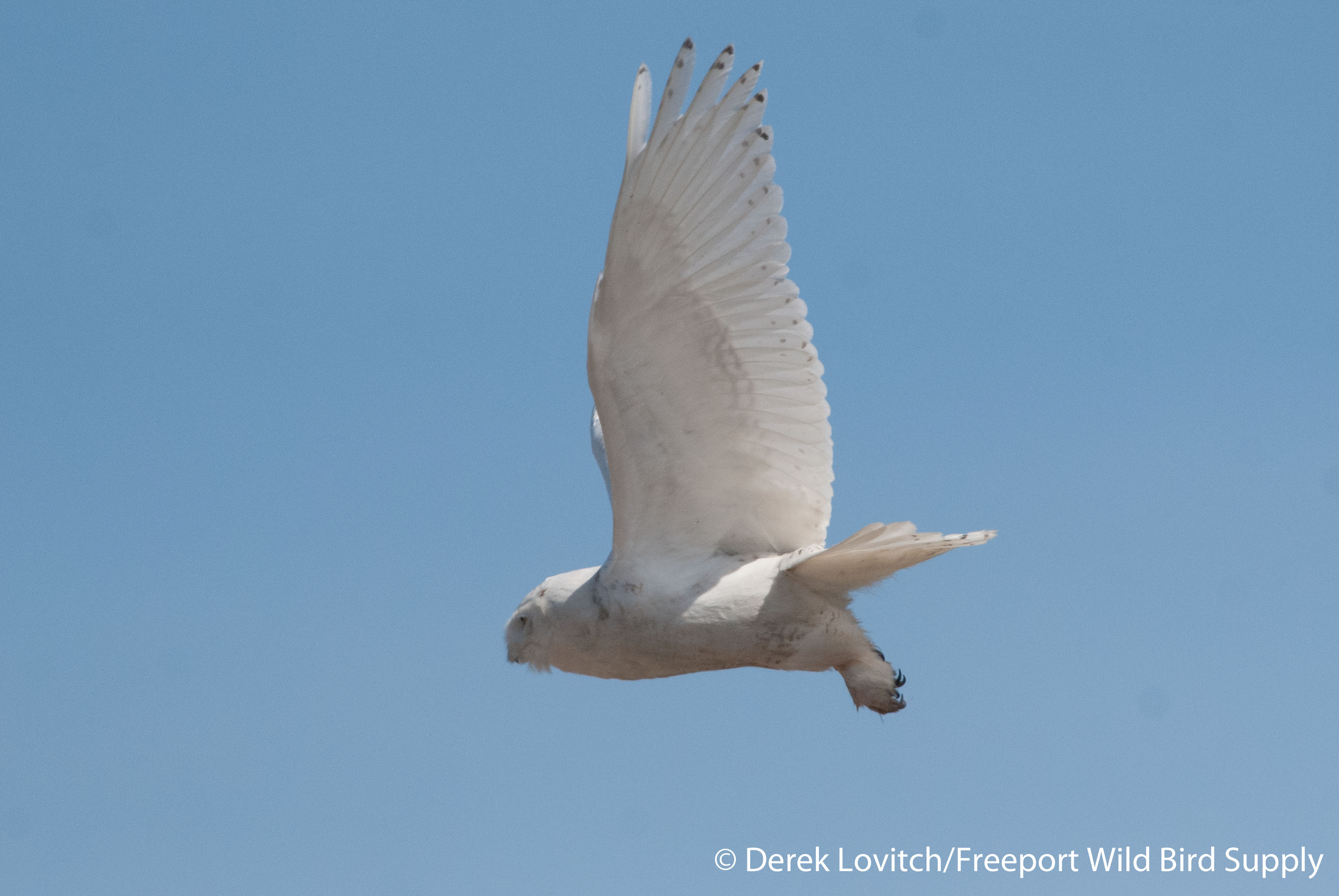
This was the birding highlight of Tuesday morning’s visit with Katrina to Biddeford Pool.
DSC_0005_SNOW1,Bidd Pool, 4-29-14_edited-1 DSC_0016_SNOW2,BiddPool,4-29-14_edited-1 DSC_0023_SNOW3,BiddPool,4-29-14_edited-1

The first photo was taken shortly after our arrival to The Pool, while the second two -with much more pleasant skies – was taken as we departed around noon.  Although its plumage is much more faded and worn now, it is likely that this is the same Snowy that has spent the winter near the western end of mile stretch.  Today, it was hunting voles once again on the incoming tide from one of its favorite rooftop perches.

While this was my latest Snowy in Maine, it is far from unprecedented following a massive irruption year. But seeing a Snowy Owl a mere two days away from May is still special; it could be a lifetime before we see an irruption of this magnitude again.

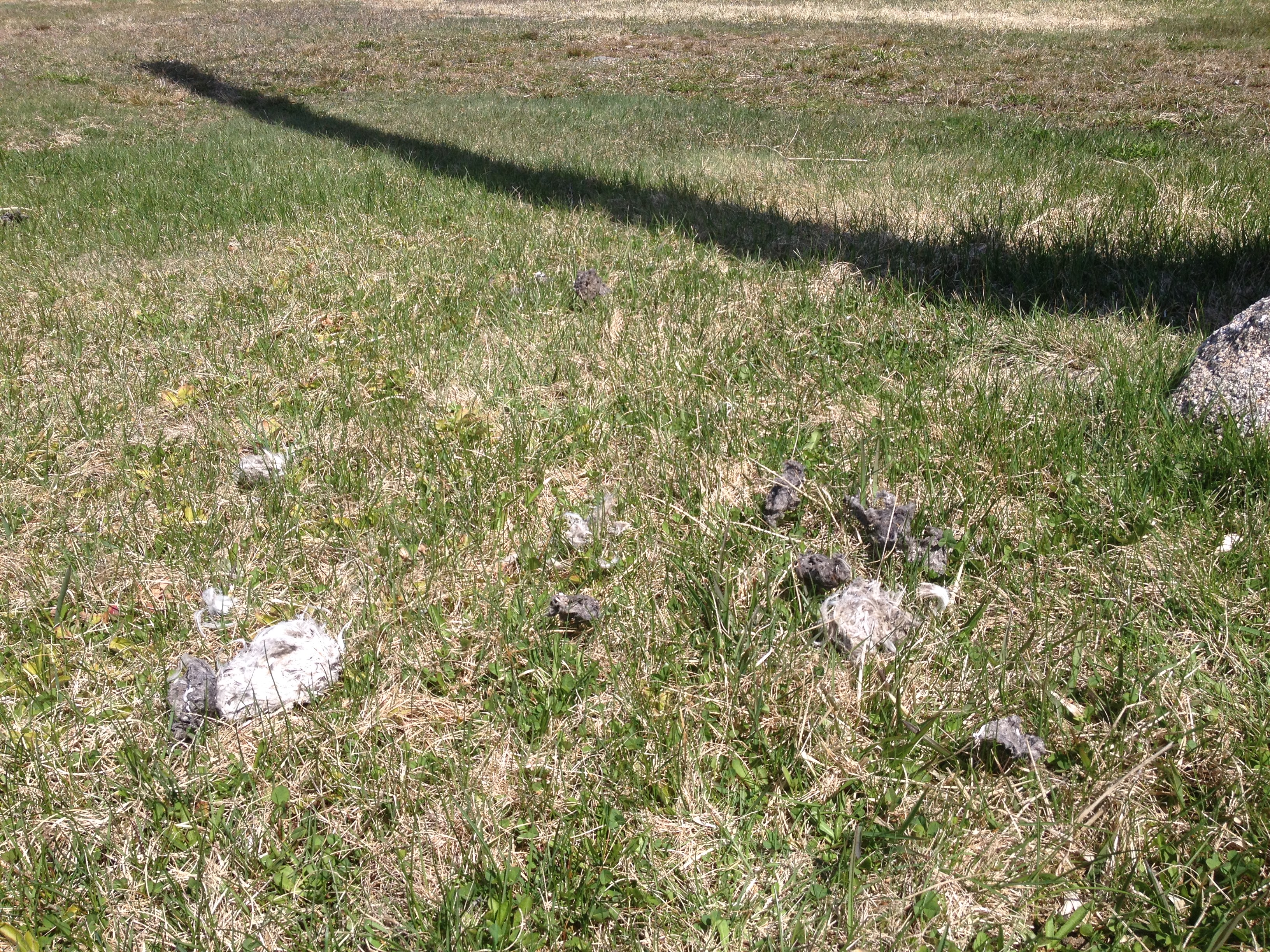
A little further down the road, where the second of the Mile Stretch Snowies overwintered, we found a pile of pellets below one of that bird’s favorite perches. Most were full of small mammal fur and bones, and the skulls were all of voles. One pellet, however, was pure thick, downy feathers – probably from a duck.
IMG_3465

But with migration still at a virtual standstill, the rest of the day’s highlights were rather few and far between; very few migrants were around. A pair of Blue-gray Gnatcatchers around the beach parking lot was a nice, and I had my first House Wren of the year in the neighborhood, and my first Laughing Gull off of East Point. 1-3 Black-crowned Night-Herons were also my personal “FOY’s,” but they have probably been present here for at least a couple of weeks now.

IMG_3449
The seas and skies sure looked like winter today, and the raw winds and low temperatures – and Snowy Owl! – sure made it seem more like early March than late April!

But yeah, migration has been kinda slow.  Although, interestingly enough, the House Wren and Laughing Gull were right on time for me, most of the usual late April arrivals (Black-throated Green Warbler, Northern Waterthrush, Black-and-white Warbler, etc) are nowhere to be seen, and really, have I only heard one Blue-headed Vireo so far this season?

We all know spring has been running late this year, and I would say bird migration is now about 7-10 days behind schedule (catching up from the 2-3 weeks behind schedule of early April).  Recently, our onshore winds (not conducive to facilitating migration for birds heading north) in this stubborn blocking pattern (a pattern that has seemingly become more and more regular recently) have not helped matters.  Here, for example, is the wind map from Sunday, showing the low pressure system just south of Nova Scotia that was pumping in those onshore winds since late last week.
wind map, 4-27-14

But take a look at today’s wind forecast…
wind map, 4-30-14

Here we see the massive low pressure system marching across the Great Plains. But now, on the leading edge of it, we see a deep southerly flow, originating all of the way from the Gulf Coast.  This southerly flow is expected to last for at least the next 48 hours.

Although the weather will remain unsettled – and we’re about to get a pretty good soaking tonight and tomorrow – through at least the weekend, I would expect quite a few migrants to begin to trickle in over the next few days. Simply put, some birds are running low on time to wait!  And, as evidenced by the 73 and 110 raptors tallied passing The Brad over the last two days, respectively, despite easterly winds, it is clear that some birds simply have to make some progress, and will do so when conditions are at least somewhat favorable (or, at least not completely unfavorable).

Furthermore, these deep southerly flows at this time of year can facilitate the arrival of annual spring “overshoots” from the south (see Chapter 4 of my book, How to Be a Better Birder for a full explanation of this phenomenon). When I see weather patterns such as this, I begin to think about things such as Summer Tanagers, Blue Grosbeaks, and Hooded Warblers!

At least potential food sources (insects emerging from ponds; insects attracted to blooming trees) are getting a little chance to catch up before the bulk of migrant birds arrive.  This phenology, or timing, of the plant and insect cycle is critical for migrant birds that need to refuel and/or then fuel up for the next leg of their journey. “Weird” weather such as this doesn’t bother birds as much as it bothers us, but it becomes a real problem when the weather results in the lack of specific food sources.

I haven’t seen much in the way of nectar-producing flowers yet – but Ruby-throated Hummingbirds and Baltimore Orioles often begin to arrive in the first week of May. This is going to be one of those seasons where well-stocked feeding stations are critically important to migrants, especially those that need insects and nectar.  Our hummingbird and oriole feeders are out and ready for business, and our feeder is stocked with insect-laden suet blocks (check out our “Photos from Friends of the Store” gallery on our Facebook Page to see what one particular feeding station in Brunswick has been seeing eating insect suet) and live mealworms.  It lies in wait for the first hummers, orioles, or any other migrants in need of assistance…oh yeah, any vagrants from the south, too!

2014 Maine State List Predictions

About this time each year on my blog, I make two lists of predictions for the coming year in Maine birding.  The first is my (somewhat-educated) guesses of the next 25 birds to be added to Maine’s state list.  The second is my predictions of the next 25 birds that I will add to my own personal state list.

But first, let’s recap 2013.  This past year, only one new species was added to the Maine list (although there was a report of a Rock Wren in Washington County this fall; I know little of the details): Eurasian Collared-Dove that appeared at a Falmouth feeder on 5/28.  This was my #1-ranked bird for each of the last two years.  I was hardly going out on a limb with this one, as this bird continues to rapidly colonize North America.  While reports in New England continue to be sparse, we can only foresee these becoming much more regular and eventually colonizing much of Maine.

For 2014, I added Neotropical Cormorant to the list, based on the expanding population in the interior of the continent and increasing vagrancy to distant corners of the continent.  I also replaced Bermuda Petrel with Barolo Shearwater.  Recently split from Little Shearwater, this pelagic waif has been detected near the mouth of the Gulf of Maine.  It seems it’s only a matter of time before a research vessel or even a whale-watch trip (especially following a tropical system) finds one within Maine waters.  I also shuffled around a few species based on increasing populations and/or trends in vagrancy.

So here goes my Top 25 Next Species for Maine list:
1)   California Gull
2)   Ross’s Gull
3)   Graylag Goose
4)   Roseate Spoonbill
5)   Little Stint
6)   Fieldfare
7)   Hammond’s Flycatcher
8)   Black-chinned Hummingbird
9)   Spotted Towhee
10)  Audubon’s Shearwater (on “hypothetical” list)
11)  Neotropic Cormorant
12)  Black-tailed Gull
13)  Anna’s Hummingbird
14)  Redwing
15)  Allen’s Hummingbird
16)  Barolo Shearwater
17)  Long-billed Murrelet
18)  Common Ground-Dove
19)  Western Wood-Pewee (my gut still tells me a bird I found on Monhegan last fall was actually this species, but a good voice recording is going to be necessary to confirm identification).
20)  Spotted Redshank
21)  Yellow-legged Gull
22)  Brown-chested Martin
23)  Bermuda Petrel
24)  Gray Flycatcher
25)  Common Scoter

As for me personally, 2013 was a productive year.  I added eight birds to my state list (with last year’s rankings):
a) Hoary Redpoll (#2), Bowdoinham feeder, 2/4.
b) Northern Lapwing (honorable mention), Range Hill Road, Poland, 5/6.
c) Acadian Flycatcher (#22), FortFoster, 5/21.
d) Mew Gull (#21), Thomaston, 8/8.
e) Black-necked Stilt (honorable mention), Eastern Road, Scarborough Marsh, 6/23.
f) Kentucky Warbler (#12), East Point, Biddeford Pool, 9/9.
g) Bell’s Vireo (#23), Bailey Island, Harpswell, 10/23.
h) Hermit Warbler (honorable mention), Harpswell feeder, 12/12.

Of those, only the Acadian Flycatcher and Bell’s Vireo were “self-found,” which is always the more fulfilling way to add to one’s state list.  I’ll have to do better with this in 2014.  Unfortunately, it brings my self-found list down to 88.7% of my total state list (363).

I also “dipped” on the St. George American White Pelican in September, waiting until it was no longer being seen before going to look for it.  I chased enough in 2013, but I could have chased much more.  In fact, I never made the effort, was away, or just didn’t get lucky enough for some other potential state birds (American Three-toed Woodpecker, the collared-dove, Great Skua, Yellow-headed Blackbird, and Bullock’s Oriole all immediately come to mind).

There are lots of options for birds to add to my own list in the coming year(s), so narrowing it down to 25 and ranking them is really just a guessing game.  Of course previous records and trends are taken into account.
1) Slaty-backed Gull
2) American Three-toed Woodpecker
3) Great Skua
4) Eurasian Collared-Dove
5) Gyrfalcon
6) Graylag Goose
7) Say’s Phoebe
8) American White Pelican
9) Western Grebe
10)  Boreal Owl
11)  Fork-tailed Flycatcher
12)  Tundra Swan
13)  Yellow Rail
14)  Ivory Gull
15)  Franklin’s Gull
16)  Sabine’s Gull
17)  Black-bellied Whistling-Duck
18)  California Gull
19)  Calliope Hummingbird
20)  Ross’s Gull
21)  Roseate Spoonbill
22)  Sage Thrasher
23)  Hammond’s Flycatcher
24)  Yellow-headed Blackbird
25)  Loggerhead Shrike

So there ya have it.  Now, let’s go birding and see what 2014 will bring!

A HERMIT WARBLER in Harpswell – BELATED.

DSC_0033_HEWA1,12-12-13_edited-1

A warbler arrived at a Cundy’s Harbor, Harpswell feeding station on November 18th.  Any non-Yellow-rumped Warbler is exciting in Maine by the end of November, but most turn out to be Pine Warblers – a rare but regular “half-hardy” that often winters outside of its usual winter range, and often takes advantage of feeders to do so.  This particular bird was identified as a Black-throated Green Warbler – an outstanding late-November record but not one without precedence.  Intriguingly, on the first day, it appeared with a second warbler that may have been a Black-throated Blue Warbler, but that bird was not seen again.  However, on December 11th, the homeowner brought in an iPhone snapshot of their visitor to the store to confirm the identification.  Distant and blurry through a window, the bright yellow face and black beady eye immediately stood out. “Um, can I come over?” I inquired.

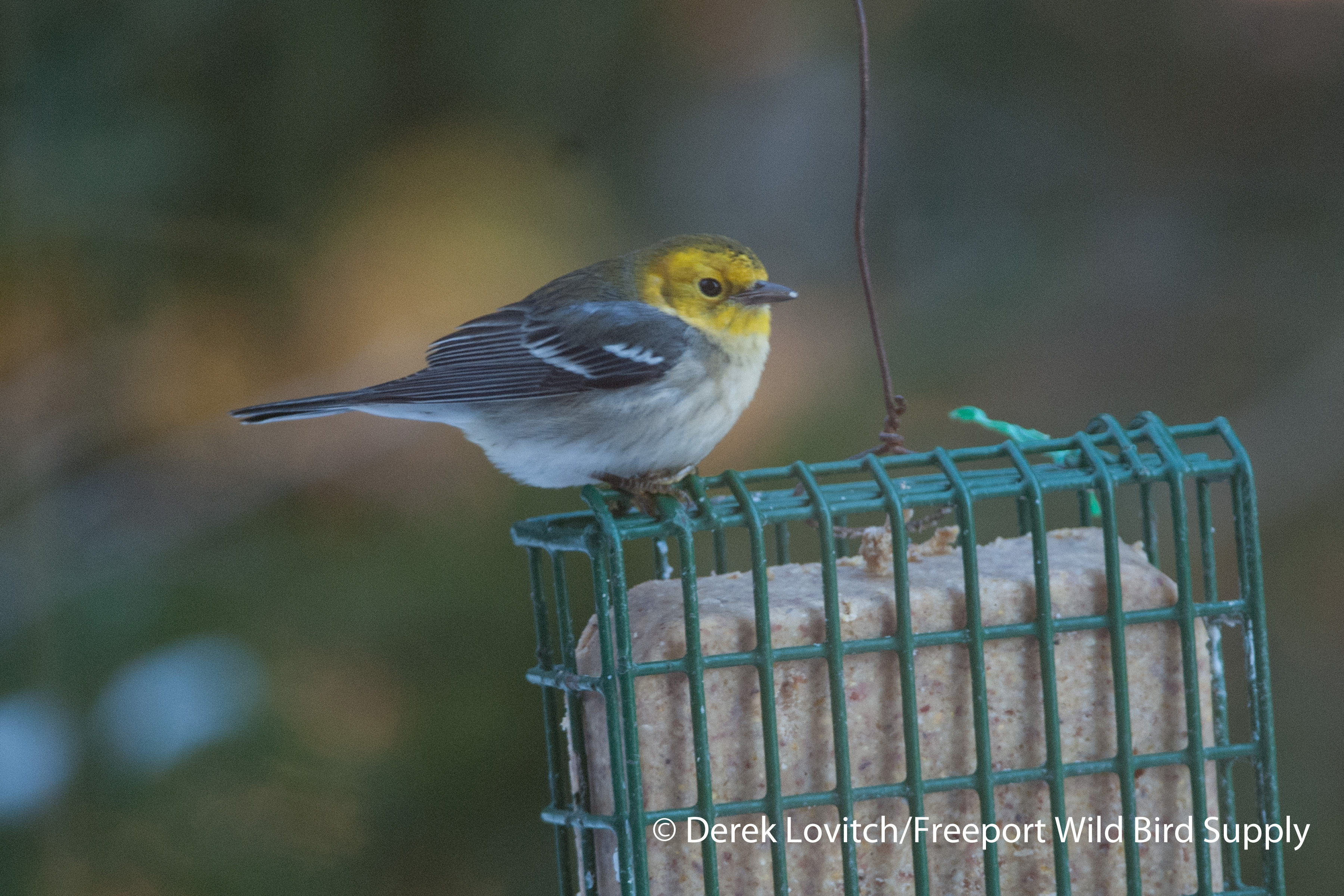
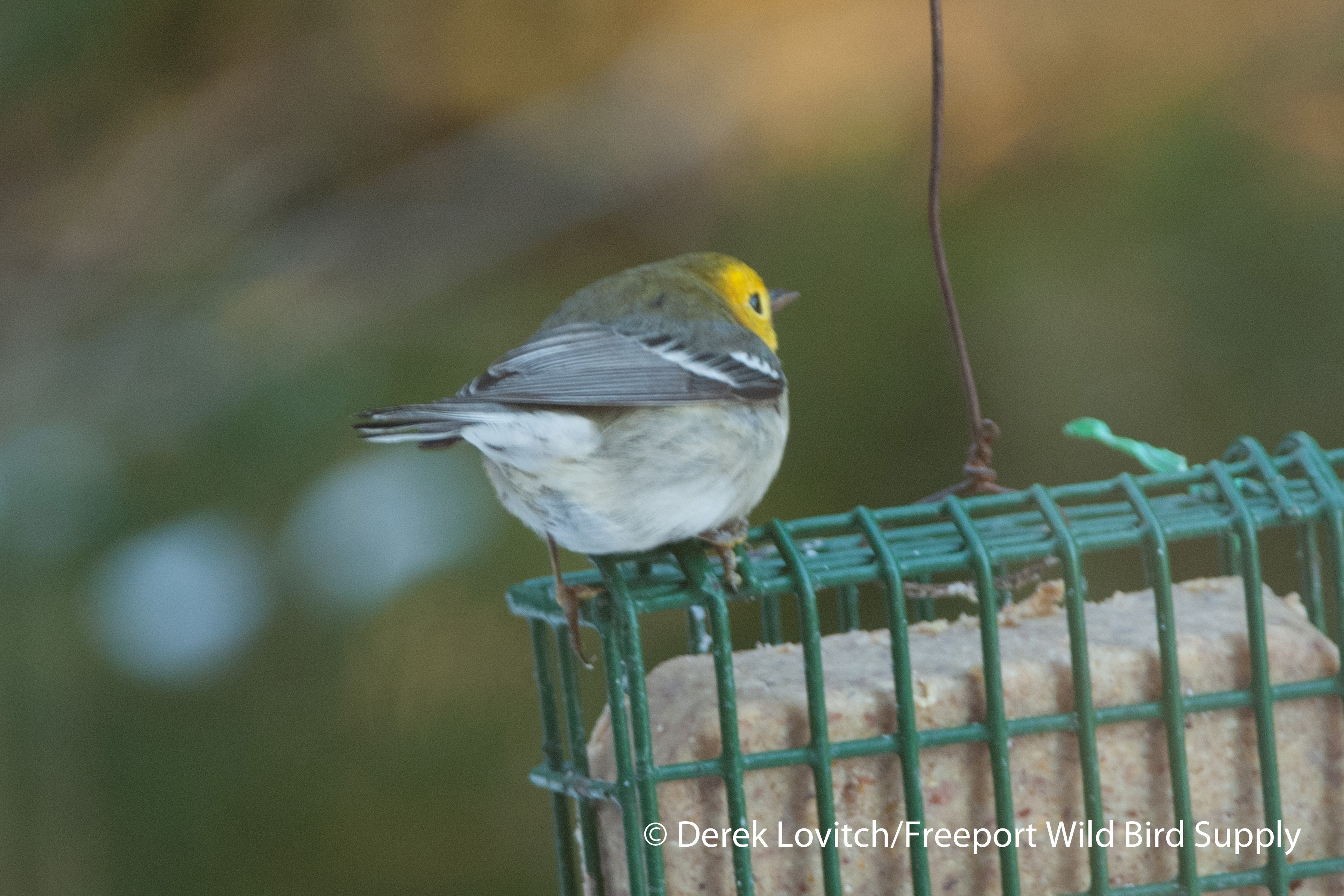
I arrived at 6:55 the next morning, as the bird was regularly being seen just after 7.  And sure enough, it showed up at 7:02!  It remained for just a few minutes, eating hulled sunflower seeds at the feeders with a small band of Black-capped Chickadees. And as I surmised, this was definitely a Hermit Warbler – only the second-ever to be seen in Maine!

The light was low, and the feeders were still in the long, early-morning shadows, so my photos were pretty poor.  I asked to stay a little longer, and after a brief visit at 7:35, the bird returned and fed extensively between 7:55 and 8:03, in which time I was able to photograph the bird extensively.
DSC_0040_HEWA2,12-12-13_edited-1  DSC_0037_HEWA4,12-12-13_edited-1

DSC_0060_HEWA5,12-12-13_edited-1  DSC_0052_HEWA6,12-12-13_edited-1

The bright yellow face was readily apparent, which sets off the seemingly-large dark, beady eye.  There’s a very limited amount of dusky green on the auriculars, and the greenish crown tapers to a “widow’s peak” on the forehead.  The back is greenish-gray and the gray wings are set off by two bold whitish wingbars and pale-fringed secondaries.  The throat was almost wholly yellow, except for a small white chin and a couple of dusky smudges.

I aged this bird as an immature female due to the overall relatively drab colors and lack of black almost anywhere in the plumage.  However, I was not familiar with this plumage in the field, and some photos online and in some books concerned me a bit, so I sent a couple of the photos to a friend in California for confirmation.  He forwarded them to Kimball Garrett, the Ornithological Collections Manager for the Natural History Museum of Los Angeles County, and the co-author of Warblers in the Peterson field guide series.

His response was straightforward, it was an immature female, born this past summer: “I certainly wouldn’t have called it anything other than a female Hermit Warbler.  The yellow across the uppermost throat is fine for female Hermits (shown to various degrees in all 3 of our skins of HY [hatch year] females).  I would worry about prominent streaks on the flanks and undertail coverts, but I really see almost nothing there (and what there is could be explained by darker feather shafts that sometimes lend the impression of streaks).”

This is truly a remarkable record.  The first state record, found by Scott Surner on MonheganIsland between September 29th and October 1st was seen by only a handful of birders – not including yours truly despite my presence on the island at the time, and eventually much effort, but that’s a long story for another day.  Breeding in the mountains of the Pacific Coast from the Olympic Peninsula of Washington south through the Sierra Nevada range to about south-central California, Hermit Warblers normally winter in southwestern Mexico through the mountains of Central America down to Nicaragua.

Therefore, for this bird to arrive in Maine it likely had to fly 90-degrees in the wrong direction.  While “180-degree misorientation” in which birds fly north when they “should” be flying south (for example) is a fairly well-established pattern that results in far-flung vagrancy, 90-degree misorientaton appears to be even rarer.  In other words, this bird was not “blown here,” (although it could certainly have been facilitated in its arrival by a strong storm or persistent westerly winds) but was somehow “miswired” to fly in a very wrong direction.  Although it is fun to ponder (at least for me!), how and why vagrants arrive in certain places, we obviously can’t know for sure what mechanism(s) delivered this bird to a feeder along the shore in Harpswell, Maine.

As I enjoyed this bird, and a wealth of other activity at the feeders, the homeowners and I discussed the significance of this sighting.  Of course, I broached the topic of “visitation,” as many birders would love the opportunity to see this bird as well.  I was exceptionally grateful for the chance to see this fantastic bird, and I knew other birders would be grateful as well.

Sometimes, rare birds at feeders are “easy” to share, such as when they are at a feeder visible from a road with ample parking nearby.  For a variety of reasons, some birds simply cannot be made public.  After much discussion, it was decided that this bird would not be publicized.  A small, private dead-end dirt road with virtually no parking, close neighbors, and no visibility from the road made this a challenge.  Simply put, you had to be in the kitchen…and with life schedules and all of the above considerations, it was, unfortunately, in the best interest of the homeowners to keep this bird under wraps even though everyone regretted this conclusion.

The bird was seen regularly through the 13th of December, but after the homeowners were out of town for the weekend, they came back on the 16th and have not seen the bird again.  A heated birdbath and live mealworms were deployed upon their return, but the bird is nowhere to be found.  Seeing that it has now moved on, I post this blog to document this “Mega” rarity for the permanent record, as per my agreement with the lucky homeowners who were graced by this special visitor from the “other” coast.

Fork-tailed Flycatcher in Connecticut!

“I don’t always chase birds, but when I do…”
DSC_0233_FTFL1,Lyme,CT_edited-1

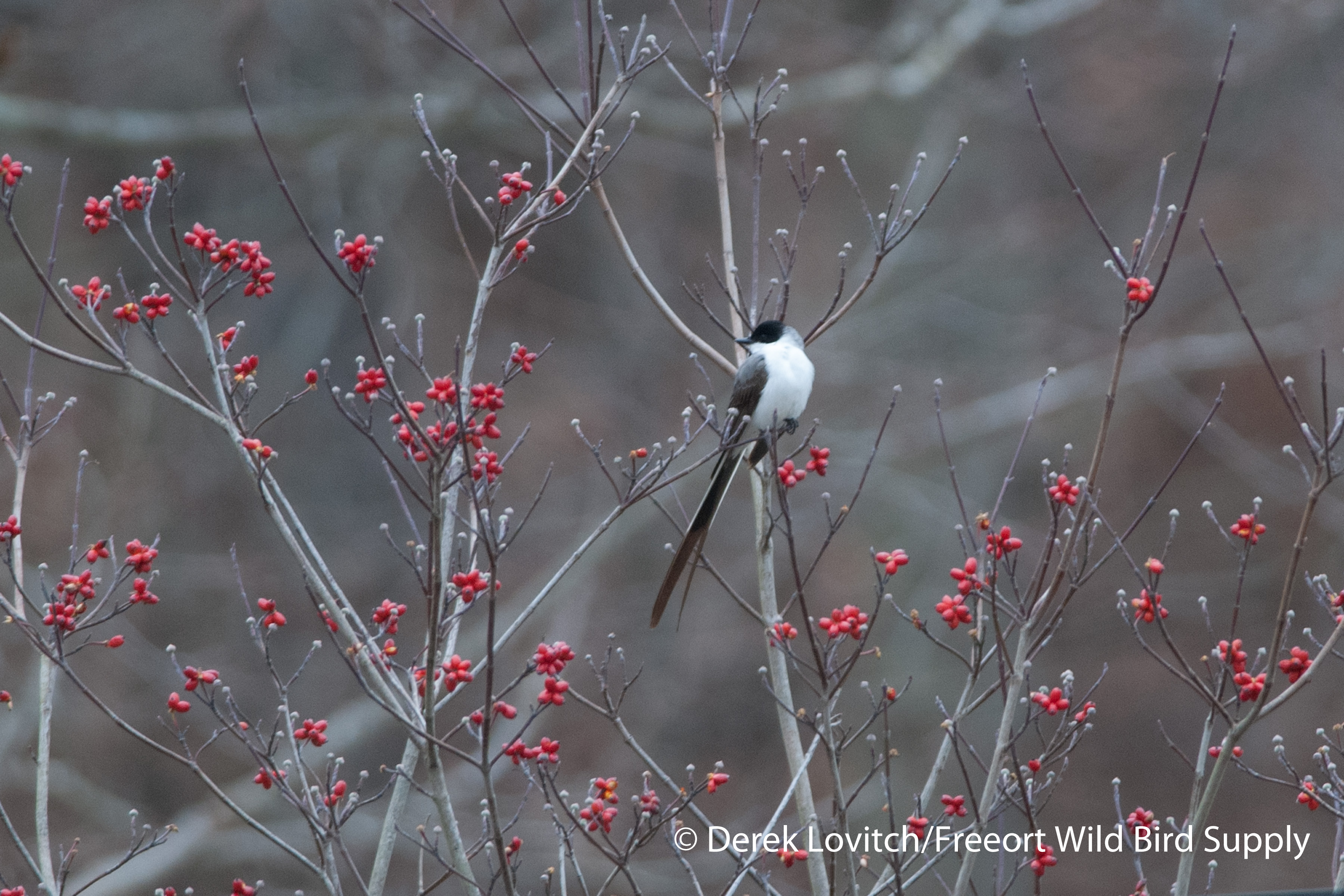
…And I almost never chase birds away from Maine, and I rarely even chase birds more than an hour away from home.  Therefore, it was exceedingly out of character for me to even consider chasing the Fork-tailed Flycatcher that has been present in Lyme, Connecticut.

A vagrant from South America, most Fork-tailed Flycatchers that show up in late spring or fall are notorious “one day wonders:” found one day, and gone the next.  That is why I have missed several, including a handful in Maine.  In fact, one showed up 15 minutes away in Brunswick the day we left for Russia two years ago.  Figures.  I even chased one with friends on Stratton Island that involved a boat charter, a borrowed dingy, a rope, and a signpost as a paddle.  We missed that one by about an hour.

In other words, this bird was a bona-fide nemesis, so one hanging out for 9 days as of Sunday was tempting my self-restraint.  Then, as my friend Phil and I and were planning a birding day, we decided to go for it.  Why not?  We didn’t have a better idea, it would be a fun drive of listening to music and conversing, and we’d have the Patriots game to pass the time on the trek back.  So off we went.

The drive seemed like it took forever!  We were anxious – seeing reports that the bird had been seen first thing that morning only made us more excited – and it was a long, often-boring drive.  Once the sun got high enough, we counted roadside Red-tailed Hawks to pass the time (17 starting at the 95/495 junction in Massachusetts).

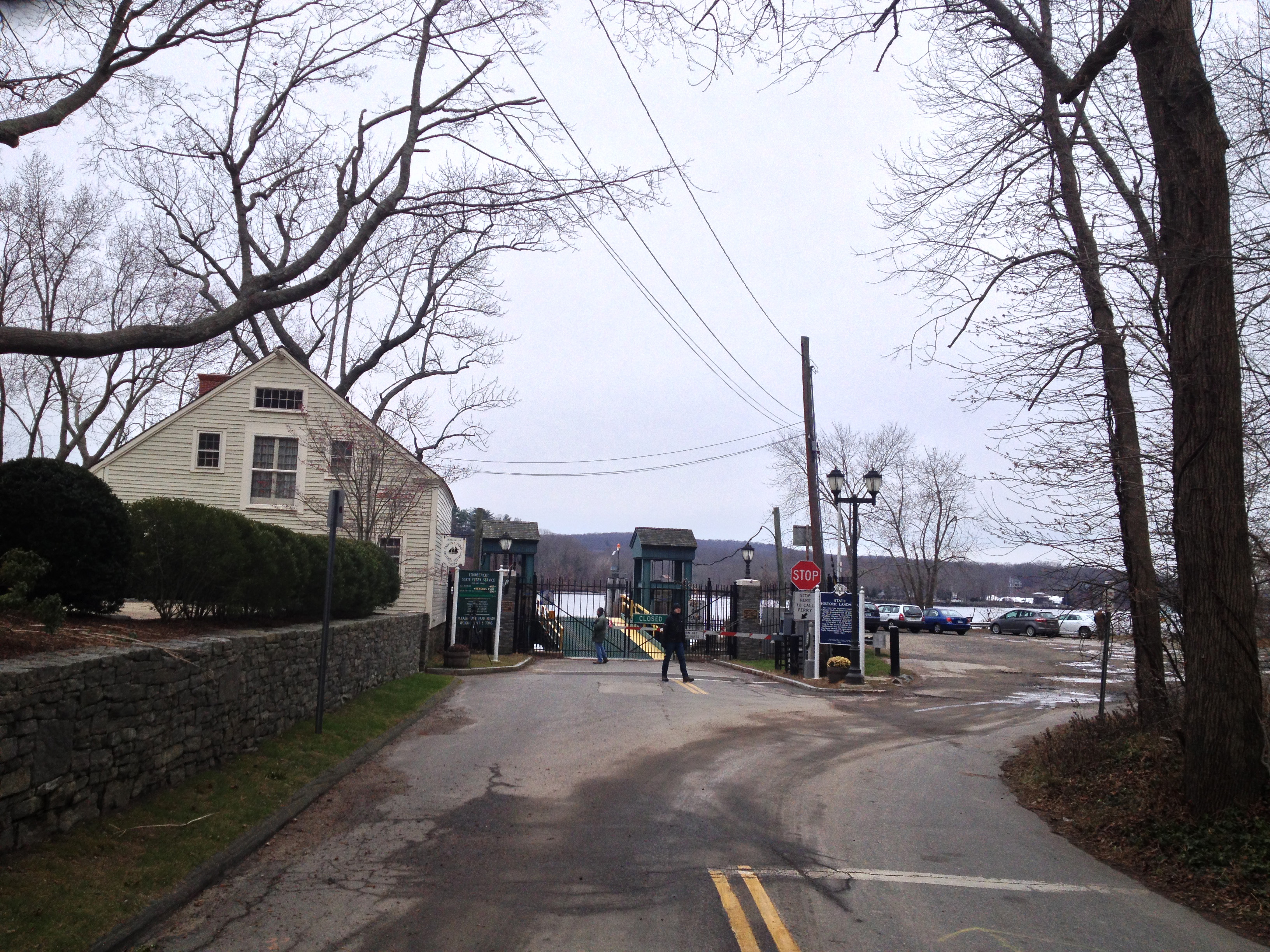
We arrived at the Hadlyme Ferry slip parking lot at 10:40am, with about a half-dozen other birders still present.  We were informed that it was seen as of about 25 minutes ago. 
Hadlyme_Ferry_Slip1

Hadlyme_Ferry_Slip2

Although it usually only disappears for about 20-30 minutes at a time (to feed behind a nearby inaccessible hillside), it wasn’t until 11:20 that it reappeared – an agonizing, and bone-chilling (30F, light northwest wind off the river) forty minutes!  The bird was well seen by all going about its business through 11:35.
FTFL6
The flycatcher was surprisingly inconspicuous as it fed on Pokeweed berries on the hillside.

DSC_0206_FTFL2
It was far more obvious when it came out to attempt to flycatcher (we did see it go after a couple of small bugs, despite the cold temperatures).

But Phil and I were not yet satisfied – we didn’t come all this way for 15 minutes – so we waited for its return.  This time, the wait was merely 15 minutes, and we then had a most-satisfactory and fulfilling time with the bird for about 40 minutes.  Quality time with a stunning lifer!  And more time for photographs and studying.  The birds’ behavior – so far out of place at such an amazing season certainly piqued my interest to see what it was eating to survive.
DSC_0197_FTFL3

DSC_0218_FTFL5

DSC_0225_FTFL4

It was already lunchtime, and Phil and I were definitely getting hungry.  Furthermore, I did want to get over to Hammonasset Beach State Park for some fruitful birding to work on my Connecticut state list – a list lacking quite a few common birds, especially winter waterbirds. But it was hard to leave a bird as sexy as a Fork-tailed Flycatcher!  “Let’s walk away from this Fork-tailed Flycatcher so I can look for Common Goldeneyes” said no one, ever.

The ferry slip area was quite birdy, with a little flock of Dark-eyed Juncos and White-throated Sparrows that also included a Hermit Thrush.  A flock of 8 Common Mergansers were heading south down the river, while a migrant Northern Harrier passed overhead just as we were leaving.  But I wanted more than one state bird on the trip, so after spending way too much time trying to find a place to eat: “closed at 1” does not mean “breakfast all day!” were among the examples of our lunch attempts being foiled.

We needed to start to make some progress eastward, and daylight is limited this time of year, so we skipped Hammonasset, and looked for lunch on a way to a park that looked promising on a map that was more or less on our way home.  We finally had lunch – despite rather slow service that resulted in our birding time rapidly ticking away – and then rolled into Bluff Point State Park in Groton.  There were two impounded back-bays, next to an airport, just a mile or two from the coast.  On a map, that looked like a perfect spot to find some ducks…and Snowy Owls.

Unfortunately, we soon learned that we had to walk to the coast, and we didn’t have time to do that.  A scan of the airstrip didn’t yield any owls, but the water – that looked good on the map – was nearly devoid of waterbirds!  8 Mute Swans, 7 Red-breasted Mergansers, and 2 American Black Ducks were it – and none of those were state birds.

I was disappointed, but really, I saw a Fork-tailed Flycatcher!   The disappointment of only seeing one state bird on the day did not last long…and was completely forgotten as Phil and I cheered on the Patriots during their remarkable and exciting comeback that certainly helped make the drive home feel a lot shorter.  As did -of course – the fact that we were successful in our twitch of one of the more charismatic vagrants that shows up in North America.  I’d call the day a success, to say the least!

Rarity Season-to-date in Review

I hope you didn’t think that my lack of blogging of late equated to a lack of birding!  Quite the contrary, actually – it is Rarity Season afterall!  I’ve just been posting more frequent, shorter updates on our store’s Facebook page (you can scroll through the timeline here to see recent posts), especially since I have found myself a bit over-extended with a variety of other projects at the moment – I’ve been working late most nights recently to make up for my morning birding gallivanting.

In fact, I have been birding even harder than usual – if you can believe that!  Spurred on by extraordinary late October finds of an “Audubon’s” Yellow-rumped Warbler at Fort Foster and a Bell’s Vireo (a state bird for me!) on Bailey Island, I found myself somehow even more motivated to beat the bush through the first half of November.  In addition to the 10th Annual South Coastal Maine Rarity Roundup that I organize every year, I worked hard at various traditional hotspots, favorite late fall patches, and various attempts to think “outside the box,” such as walking the 4.5 miles into work today to check a handful of swales and thickets en route (not very productive, except for the exercise, for the record)

While Audubon’s Warbler and Bell’s Vireo are going to be tough to beat – the early-rarity-season bar was set awfully high! – I have had some outstanding birding in November, even if there has yet to be another “Mega.”  Personal highlights in the first half of November include a very nice variety of lingering (pioneering?) warblers, a Yellow-breasted Chat, multiple Orange-crowned Warblers (I’ve had four this season to date), huge numbers of Ruddy Ducks on Sabattus Pond, and overall just really good birding with good diversity.

Elsewhere around the state, current highlights include a Northern Hawk-Owl in Lincoln – not a vagrant in the “Rarity Season” sort of way, but exciting nonetheless!  And perhaps that, along with an early Snowy Owl report from Biddeford Pool, portends a decent owl irruption this winter?  There certainly won’t be any winter finches around this year.).  Other birders have detected a variety of late warblers around the state (wow, November Chestnut-sided in Falmouth!), and lots of lingering shorebirds – especially in Scarborough Marsh.  But as far as the first half of November usually goes, there have been no truly exceptional birds.  Looking around the region, we see goodies such as a Calliope Hummingbird in New Hampshire, A Black-chinned Hummingbird in Connecticut, and the usual fun array of rarities in Massachusetts (Scissor-tailed Flycatcher, Yellow-headed Blackbirds, Western Tanager, American Avocet, etc).  However, it is an ultra-spiffy adult Ross’s Gull near Montreal that is the real headliner of the fall in the Northeast so far (and yes, I am being tempted to chase this, I have to admit).

So there are some good birds around the region, and no doubt there are some good birds still to find in Maine.  Other than a couple of days, it has been fairly temperate to mild all fall, and I can’t help but wonder if birds that arrived in the state through various vagrancy mechanisms (see Chapter 7 of my book, How to Be a Better Birder) have yet to concentrate along the coast as they seek out more favorable microclimates or seasonal food sources.  Also, as the season progresses, more rarities turn up at feeding stations as natural food supplies diminish.  December rarities, for example, are often discovered at feeders.  Two tardy Chipping Sparrows are at our store’s feeders as I type this, by the way; I’m hoping they pick up a clay-colored cousin.  A lot of folks are reporting very busy feeders right now, which is a good sign, especially considering the lack of irruptive finches.

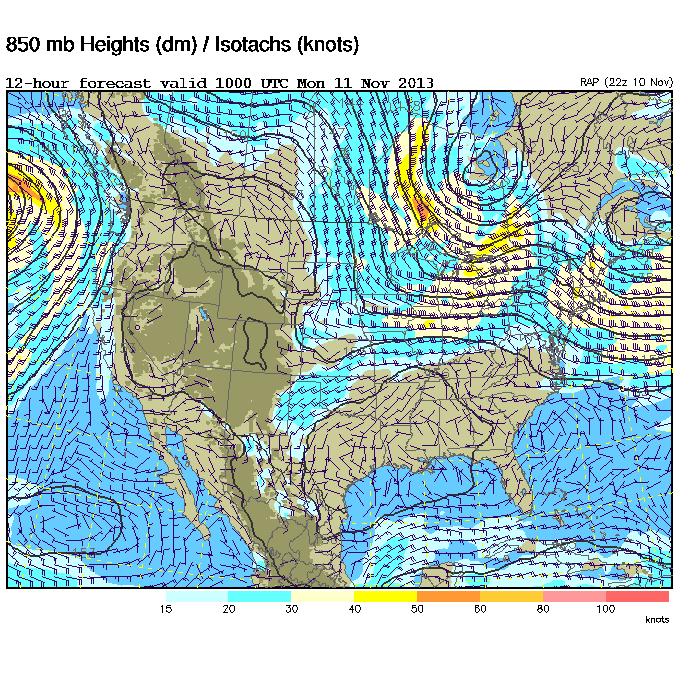
The last few days have seen a nice southwesterly flow aloft.  Look at Friday’s wind map, for example:
wind map,11-15-13

That extensive southwesterly flow early in the month would have surely deposited stuff like Cave Swallows in New England, but I wonder if that window has already closed.  A couple of Caves in Connecticut as recently as the 9th gives me some hope, however.  Contrast that map with the more zonal flow that we have seen for much of the month, such as on 11/10:
wind map,11-10-13

Although few birds are “blown” out of range, certain winds facilitate the arrival of more vagrants in certain areas than others.  And southwesterly winds in late fall are definitely the desired winds here in Maine.  With a fairly complex weather system on its way – including some really severe storms in the Midwest – I remain hopeful for some more out-of-range treats.  Interesting weather does have the tendency to produce some interesting birding, even without facilitating the arrival of rarities.
surface map, 11-17-13

At the very least, behind this system, we should see a return to colder, seasonable weather (as opposed to the 50’s of the last two days for example), and this should help push birds to feeders, warmer coastal and urban areas, etc.  Also, hopefully it will bring some snowfall to points north, as this year’s Goose Rarity Season has been lackluster, especially in the Greater Yarmouth Goose Fields.  A Greater White-fronted Goose that has been in Scarborough for a couple of weeks, and another in Berwick earlier in the month, along with a couple of Cackling Goose reports have been the only geese-of-note in southern Maine.  While “The County” saw single Barnacle and Pink-footed Goose in October, I have not had a single “good” goose in the fields of North Yarmouth, Cumberland, and Falmouth all season.  A Bean (!!!) Goose, Barnacle, and Pink-footed all in Nova   Scotia right now give me plenty of hope, and last year, things really didn’t pick up locally until mid-November anyway.  I will continue my thrice-weekly circuit.

So the short version of this is: go birding!  There are rarities out there to be discovered.

South Coastal Maine Rarity Roundup TEN!

BLPW,SheridanStreet,Portland,11-3-14
This Blackpoll Warbler was one of the record 9 species of warblers tallied on the day, and one of the top birds in my Portland territory. It was only the third time that this species was spotted by Rarity Roundup teams.

Each year on the first weekend of November, a group of us get together to scour the Southern Maine coast for vagrants, lingering migrants, pioneers, irruptive, and other seasonal highlights.  Coinciding with the peak of “Rarity Season,” we set out to use the geography of the Maine coast, coupled with knowledge of the best habitats and vagrant traps in order to find as many “good” birds as possible.  While this year failed to produce any “Megas,” we once again had a great day in the field, found lots of fun stuff, and enjoyed good food and beer at the Great Lost Bear at the end of the day (the real reason we all get together for this event!)

119 species were tallied by the 8 teams of the TENTH Annual South Coastal Maine Rarity Roundup, six species above our 10-year average, despite somewhat more limited coverage than in the past few years. The continuing “Audubon’s” Yellow-rumped Warbler was added to the cumulative checklist, while we also had our second-ever Snowy Egret, Prairie Warbler, and Nelson’s Sparrow.  Blackpoll Warbler and Clay-colored Sparrow appeared for the third time.

Most teams experienced a decidedly “birdy” day, especially from Portland through Scarborough.  A fallout of Dark-eyed Juncos, White-throated Sparrows, and Hermit Thrushes occurred with overnight northwesterly winds and a line of pre-dawn showers, with the fallout especially evident on the Portland Peninsula.  I’ll have more about the fallout on a blog entry later today.

Record high tallies were set for Pectoral Sandpiper (13), Northern Flicker (10), Carolina Wren (11), Hermit Thrush (52: the 26 in Portland alone was only one short of the previous all-time high), “Western” Palm Warbler (3), Chipping Sparrow (12), Field Sparrow (3; tie), and Lapland Longspur (37).  9 species of warblers was a new record as well, and Painted Turtle was added to our non-feather species list.  All but the longspurs can likely be explained by the unusually warm season to date.

Territory Highlights were as follows:

– Area 1, Kittery-York: Davis Finch.
1 NASHVILLE WARBLER, Legion Pond, Kittery.
1 Pine Warbler, Fort Foster.
1 PRAIRIE WARBLER, Fort Foster.
1 “AUDUBON’S” YELLOW-RUMPED WARBLER, Fort Foster.

– Area 2, Ogunquit/Kennebunport: Turk Duddy.
2 American Wigeon, Phillip’s Cove, Ogunquit.
1 Northern Pintail, Phillip’s Cove, Ogunquit.
1 Lesser Yellowlegs, Goose Rocks Beach.

– Area 3, Wells/Kennebunk: Doug Suitor, David Ladd, and Slade Moore.
2 Semipalmated Sandpipers, Webhannet Marsh
2 Gray Catbirds, Laudholm Farm.

– Area 4, Biddeford-Saco: Pat Moynahan, Marian Zimmerman, Joanne Stevens, et al.
1 NASHVILLE WARBLER, Saco Yacht Club.
1 CLAY-COLORED SPARROW, Timber Point.
1 NELSON’S SPARROW, Day’s Landing.
2 Lapland Longspurs, Day’s Landing.

– Area 5, Scarborough: Ed Hess, Noah Gibb, and Leon Mooney.
8 Great Egrets
1 SNOWY EGRET, Pelreco marsh
12 American Coots, Prout’s Pond.
8 LONG-BILLED DOWITCHERS, Eastern Road.
35 Lapland Longspurs

– Area 6, Cape Elizabeth: International Man of Mystery, Claudia, Robby Lambert.
2 “Western” Palm Warblers, private property
1 “Yellow” Palm Warbler, private property
1 DICKCISSEL, Higgin’s Beach.

– Area 7, South   Portland: John Berry and Gordon Smith.
1 Ring-necked Pheasant, Fort Williams Park.
1 Yellow-bellied Sapsucker, Calvary Cemetery.
1 Pine Warbler, Bug Light Park

– Area 8, Portland: Derek Lovitch and Kristen Lindquist; Jeannette Lovitch (Capisic and Evergreen); and a cameo by Doug Hitchcox.
2 Eastern Phoebes, Eastern Promenade.
1 BLUE-HEADED VIREO, Mercy Pond.
1 ORANGE-CROWNED WARBLER, Eastern Promenade.
1 BLACKPOLL WARBLER, Sheridan Street.
1 White-crowned Sparrow, West Commercial Street.

As usual, I exhaustively cover the Portland Peninsula and once again the most urban block in the state produced some great birds.  Kristen joined me for the second year in a row, while Jeannette (and Sasha) helped out with a few outlying patches.  Doug joined us just long enough to find the only White-crowned Sparrow of the entire day.  In addition to the goodies listed above, Kristen and I amassed 9 species of sparrows.

The fallout that I mentioned above was very evident in the morning, as we birded Portland’s East End. 150+ White-throated Sparrows and 100+ Song Sparrows littered the Eastern Promenade.  While Dark-eyed Juncos were fewer there, we encountered some big groups elsewhere, such as 60+ behind the East End School and 50+ in the lot on Sheridan Street, with 70+ later in the day in Western Cemetery. White-throats were everywhere: 50+ on Sheridan   Street for example.  And once again there was a decidedly disproportionate number of White-throated Sparrows in gardens and landscaping of downtown Portland.  A short loop from One City Center through Monument Square, behind Portland High, and back through Post Office Park yielded 35 White-throats, with the only other native migrant being 7 Hermit Thrushes.  Like the sparrow, Hermit Thrushes appear in a wildly disproportionate number to other migrants – especially all other thrushes – in downtown Portland.  I’m convinced that something causes White-throated Sparrows and Hermit Thrushes to either a) become disoriented by urban lights more often/more readily, especially under low ceilings (it was cloudy for most of the night and morning) or perhaps b) they simply don’t leave these lots in a morning flight as species such as Dark-eyed Juncos might.  In fact, I just read in an article in the Brown Alumni Magazine that a friend of the store dropped off about collisions in New York City that since 1997, more White-throated Sparrows have been found dead than any other species.  Coincidence?

Our sum of 26 Hermit Thrushes was truly amazing, as was our overall diversity on the day.  While the mild weather certainly has a lot to do with the number of lingering/pioneering birds that we, and other teams, encountered, the late-season fallout earlier in the morning certainly helped our cause.

Here are the overnight reflectivity and velocity images, with 10pm, 1am, and 4am once again used as an example.
a 10pm 11-2-13 ref

b 10pm 11-2-13 vel

c 1am 11-3-13 ref

d 1am 11-3-13 vel

e 4am 11-3-13 ref

f 4am 11-3-13 vel

At 10pm, there’s mostly rain in the area, but birds are mixed in.  By 1:00am, birds are on the move, as the rain has mostly moved into the Mid-Coast and offshore.  Birds were still on the go at 4:00am, as a narrow line of showers moved through the coast.  About an hour later, a steady rain developed (not shown) that continued until a short time before the 6:20 sunrise.  I believe this is why there were so many sparrows in and around the city come dawn.

In other words, it was another great day of birding in urban Portland in the heart of “Rarity Season!”

AUDUBON’S WARBLER at Fort Foster!

Yesterday, I had the pleasure of leading our annual “York County Rarity Roundup” Field Trip for York County Audubon today. With no rarities to “round up,” we set out to find our own, birding from Kittery through Wells.  We followed a very similar route to what Jeannette and I always do on our monthly south-coastal run.  The difference today was that with a group, and with so many birds at FortFoster, we never made it out of Kittery by lunchtime.  Too bad that meant we just HAD to have lunch at Loco Coco’s Taco (mmm, chili relleno burrito…)!

It was a very birdy day overall, even in the windy afternoon.  A preliminary total of 63 species of birds included 9 species of sparrows, 5 species of shorebirds, and 4 species of warblers.  Excellent-for-the-season bird diversity was augmented by 5 species of butterflies, 3 species of mammals, 2+ species of dragonfly, 1 reptile (Garter Snake), and 1 amphibian (Spring Peeper).

The bird of the day by far was “Audubon’s” Yellow-rumped Warbler that I found at FortFoster.  This western subspecies of Yellow-rump (it once was, and I believe will likely once again be considered a full species) has only occurred – or should I say, been detected – in Maine a few times.  I can only think of one recent record, an adult that nearly-overwintered at Dyer Point in Cape Elizabeth a few years ago.

If anyone wants to look for it, the bird was flycatching and occasionally eating Red Cedar berries along the west edge of the park. Follow the entrance road into the park, until the large gravel parking lot opens up on the left. The bird was loyal to the right (west) edge here, especially around the big cedars in the mowed lawn.

Noah Gibb and I photographed the bird extensively, and I was also able to borrow a phone to get a voice recording.  All aspects of the bird – from plumage to voice – fit perfectly with a pure “Audubon’s” Warbler.

I first glimpsed the bird sallying for insects in and out of shadows.  The overall extremely cool gray plumage tone – top to bottom – brought to mind a first fall female Pine Warbler. But something wasn’t right.  The bird began to call, and that was definitely not the call of a Pine Warbler…but what was it?  We saw the bird briefly a few times, the pieces began to come together, and then as it flew to another tree the bright yellow rump became evident.  “Audubon’s Warbler!!!!” I exclaimed.
DSC_0059_AUWA1,Fort Foster,10-27-13

DSC_0046_AUWA3,FortFoster,10-27-13

DSC_0044_AUWA,FortFoster,10-27-13

DSC_0057_AUWA5,FortFoster,10-27-13

We studied the bird extensively for at least a half hour, occasionally in perfect light for prolonged periods.  I scribbled notes, and encouraged others to do the same before we discussed the bird any further.  Plenty of “Myrtle” Warblers (the Eastern subspecies of Yellow-rumped) were nearby for convenient comparison.

– Obvious “Yellow-rumped” Warbler with bright yellow rump, overall size and shape, bill size and shape, etc.
– Exceptionally cool gray overall plumage tone, not suggesting the brownish tones of even the palest Myrtles.
– Very diffuse streaking below.
– Very restricted and pale yellow “blobs” on sides of chest.
– Very subtle and restricted yellow on throat, not visible in all light conditions, but quite obvious in good sunlight.
– Lacked the extension of pale on the throat that “points” up around the back of the auriculars as on Myrtle.  Therefore, throat patch appeared rounded, or encircled by the cool gray of head.
– Auriculars only marginally darker than rest of head, often looking concolorous.
– Call note very different from surrounding Myrtles, much sharper and not as “blunt.”
– Exceptionally dull plumage highly suggestive of a first fall female, but the lack of a definite molt limit within the greater coverts prevents us from clinching the age. (reference: The Warbler Guide, Stephenson and Whittle, 2013)

Good bird!  And yes, Rarity Season is most definitely in full swing!  Good thing it appears that, after a prolonged drought, I have finally refound my rarity-finding mojo.  Phew.

Other highlights over the course of the full-day tour included the following:
– 1 pair Wood Ducks, Legion Pond, Kittery.
– Fort Foster: 1 “Western” Palm Warbler, 2 “Eastern” Palm Warblers, 6 Brant, 15 Hermit Thrushes, 1 Brown Thrasher, 1 Red-bellied Woodpecker, 2 Carolina Wrens, 32 Great Cormorants…
– Seapoint Beach, Kittery: 1 Saltmarsh Sparrow* (see photos and notes below), 1 Common Yellowthroat, 1 Eastern Towhee, 2 Long-tailed Ducks (FOF)…
– 1 Gray Catbird, Rte 103, Kittery.
– 1 Nashville Warbler (late), 1 Indigo Bunting (late), 2 Carolina Wrens, etc, Beach Plum Farm, Kittery.
– 24 Pectoral Sandpipers, 1 White-rumped Sandpiper, 3 Dunlin, 10+ Greater Yellowlegs, Harbor Road, Wells.
– 4 Semipalmated Plover (late), Community Park, Wells.

Now, about that Saltmarsh Sparrow – which I admittedly called an “Interior” Nelson’s Sparrow in the field…  Expecting to see an “Interior” Nelson’s Sparrow based on the timing, micro-habitat, and behavior, I reached for my camera before I fully studied the bird. After firing off some photos, and making sure everyone got on the bird, it took off and we never saw it again. Although I mentioned that the malar looked “quite dark,” I didn’t second-guess the call until I looked at photos on the computer this afternoon.  Yeah, it’s a Saltie.  The malar is not only dark and distinct, but it frames a clear white throat.  The breast streaking is dark and extensive, the bill has a fleshy-pink cast, and it is simply too long-billed for an “Interior” (subspecies alterus or nelsoni; I don’t believe they are identifiable in the field).  As a final clincher, note the fine streaks towards the rear half of the supercilium.  Behavior and timing wise: odd for a Saltmarsh.  Plumage: essentially textbook for a Saltmarsh.  Therefore, “After further review, the call (in) the field is overturned.”
DSC_0061_SMSP1,SeapointBeach,10-27-13

DSC_0062_SMSP2,SeapointBeach,10-27-13

BELL’S VIREO in Harpswell!!!

Yesterday, Jeannette and I discovered a Bell’s Vireo on Abner Point Road, Bailey Island in Harpswell.  There are only three previous records of Bell’s Vireo for the state of Maine. 

In other words: MEGA!  And needless to say – especially since I missed the two from last year, despite my best efforts – this was a thrilling find, capping a very productive morning of birding Bailey Island that included a Yellow-breasted Chat (my first of the year) at Land’s End, and a total of 5 species of warblers on Bailey Island this am:  Hundreds of Yellow-rumps, and one each of Black-throated Blue, Black-and-white, Common Yellowthroat, and Blackpoll.  Song Sparrows, Dark-eyed Juncos, White-throated Sparrows, and other seasonal migrants made for a very birdy visit.

In what turned out to be our last stop of the morning, Jeannette and I walked Abner Point Road.  Upon reaching a promising thicket (see directions below), I began to pish.  Yellow-rumped Warblers and a Winter Wren responded immediately, and as Jeannette attempted to photograph the wren, I sorted through the yellow-rumps, hoping to find one with a yellow throat.  A handful of minutes later (about 10:35am), we heard a harsh, scolding chatter emanating from the dense vegetation.  “Vireo?” Jeannette asked quizzically as we both looked at each other, unsure of the sound – it sounded like nothing we are used to hearing.  I wondered out loud about a Carolina Wren making some odd sound (they’re good at that, and there was one in that particular thicket), and the nasal quality led me to consider a funky Red-breasted Nuthatch.  We looked hard but could not turn up anything that fit the sound.
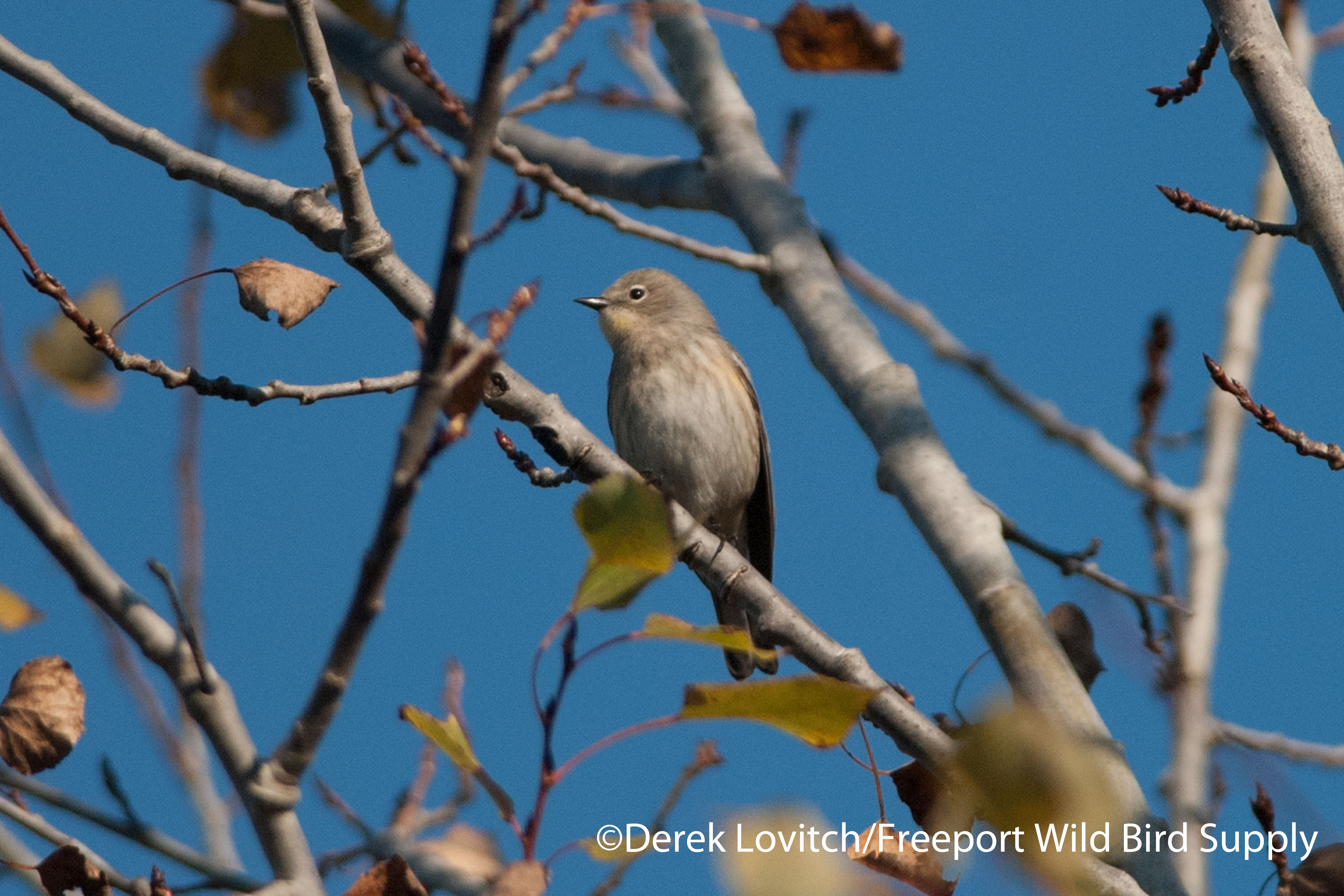
About 5 minutes later, a small vireo pops out of the brush in front of me.  At first I called “White-eyed Vireo” due to the bright yellow flanks and overall shape, but then I got a clear look at the head.  “BELL’S VIREO!” I exclaimed, as Jeannette, a few yards away still working on photographing the wren rushed over.

As is often the case for Bell’s Vireos, it quickly ducked back into the cover.  I continued to pish, and the bird popped back up.  I had a second brief, but unobstructed view of the whole bird.  Jeannette went for the camera, and prepared to fire away, only to see the bird dive back into the shadows once again.  One last brief glimpse of the bird was all we would have for the next hour.

We searched hard, but could not relocate it.  A Blue-headed Vireo was more cooperative, and permitted us some comparison.  We listened to a recording of the call of a Bell’s, and there was no question in either of our minds’ that is what we had heard earlier.

We thought we heard that call in the distance of the thicket one more time, and perhaps even a snippet of a song, but background noise and an increasing southerly wind made us unsure of that.  And that wind was clearly not making this skulker any more likely to show itself.  At 11:50, we heard the distinctive call once again, but from thick shrubs behind a house across the street.  We hustled over, but unfortunately only managed to pish in a cat (one of at least five in this immediate area; it was worse than Monhegan!), which was likely the object of the vireo’s recent ire.  We worked the area as best as we could, and eventually saw the homeowner in her yard and received permission to wander around.  No luck.  We had also received permission earlier from the homeowner adjacent to the first thicket to check her yard, so we did another circuit, but we came up empty, and it was getting breezier and cloudier.  Lunchtime was calling us, too.

While I left with almost three pages of field notes, it was rather frustrating to not get a photo, especially since Jeannette was so close to snapping it!  However, as a firm believer in the value of written field notes for documentation of rare birds, I scrawled away in my notebook.  Here are the particulars, after seeing the entire bird well a couple of times, with notes entered in rough order of observation, not in order of relative importance (edited only for context, not content):

–  Overall relatively dully-marked, small vireo.  Body shape and size, and brief glimpse of the body color first suggestive of White-eyed Vireo, the expected rarity here.

– Fairly bright and extensive yellow on sides, from chest through undertail (suggestive of the Eastern subspecies?)

– Dull olive-gray back.  Dull greenish-gray wings.  Lack of contrast anywhere except the bright yellow of the flanks and undertail.

– One fairly bright whitish wingbar, on the tips of the greater coverts.  An indistinct second wing bar, presumably on the edges of the lesser coverts, was discernable, but did not stick out.  Not the bold, bright white double-wing bars like Blue-headed Vireo.

– Head grayish, perhaps with a hint of an olive cast.

– White or off-white throat contrasting with gray head and face and yellow on the rest of the underparts.

– Very dull face pattern consisting of a partial eye-ring (or perhaps best described as two eye-crescents) and indistinct supercilium restricted to in front of the eye.  Maybe a small hint of a supercilium a very short distance behind the eye, but I am unsure of this.  A darker line, or narrow smudge, through the eye gave a subtle hint of a face pattern reminiscent of a darker Warbling Vireo or very pale Philadelphia Vireo.

– Perhaps due to the angle, I though the bill looked relatively long compared to the size of the head, but it was clearly rather narrow for a vireo, and was diminutive compared to the Blue-headed Vireo observed a short time later.

– Relatively long-tailed (NOTE: although in comparing photos later, I wondered if it was actually suggestive of the shorter-tailed Eastern subspecies).

– The first view was of a “sleeker” or slimmer vireo, not the chunky, broad-chested shape of Blue-headed.

– Very active, and did not come out into the open for very long (NOTE: tail movement not seen, or not noticed, which could have been a good key for subspecies), always disappearing into low, dense brush.

In comparison to other species:
– Wingbars and bright yellow underparts distinguish it from Warbling Vireo.

– Lack of yellow in the throat and pale face pattern, along with wing bars and fairly long tail and slim shape help distinguish it from Philadelphia Vireo.

– Incomplete eye ring and lack of broad and bright yellow spectacles separate it from White-eyed Vireo.  Wings paler and less contrasty, and no contrasting pale gray nape as on WEVI.

Directions to the bird (although I have not heard any reports, positive, or negative, about the bird as of 4:00pm today):
To reach the thicket we first found it in, take Rte 24 from Cook’s Corner in Brunswick south through Orr’s Island and onto Bailey’s.  Make a right onto Abner Point Road at the Johnson Field Preserve.  Park on your left in the gravel parking lot for the beach.  Walk down Abner   Point Road a couple hundred yards, around the bend.  On the right, you’ll see a small parking lot with little white signs with people’s names on them.  The bird was in the thicket behind these signs, along with a Blue-headed Vireo and a mess of Yellow-rumps.