Tag Archives: vagrants

AUDUBON’S WARBLER at Fort Foster!

Yesterday, I had the pleasure of leading our annual “York County Rarity Roundup” Field Trip for York County Audubon today. With no rarities to “round up,” we set out to find our own, birding from Kittery through Wells.  We followed a very similar route to what Jeannette and I always do on our monthly south-coastal run.  The difference today was that with a group, and with so many birds at FortFoster, we never made it out of Kittery by lunchtime.  Too bad that meant we just HAD to have lunch at Loco Coco’s Taco (mmm, chili relleno burrito…)!

It was a very birdy day overall, even in the windy afternoon.  A preliminary total of 63 species of birds included 9 species of sparrows, 5 species of shorebirds, and 4 species of warblers.  Excellent-for-the-season bird diversity was augmented by 5 species of butterflies, 3 species of mammals, 2+ species of dragonfly, 1 reptile (Garter Snake), and 1 amphibian (Spring Peeper).

The bird of the day by far was “Audubon’s” Yellow-rumped Warbler that I found at FortFoster.  This western subspecies of Yellow-rump (it once was, and I believe will likely once again be considered a full species) has only occurred – or should I say, been detected – in Maine a few times.  I can only think of one recent record, an adult that nearly-overwintered at Dyer Point in Cape Elizabeth a few years ago.

If anyone wants to look for it, the bird was flycatching and occasionally eating Red Cedar berries along the west edge of the park. Follow the entrance road into the park, until the large gravel parking lot opens up on the left. The bird was loyal to the right (west) edge here, especially around the big cedars in the mowed lawn.

Noah Gibb and I photographed the bird extensively, and I was also able to borrow a phone to get a voice recording.  All aspects of the bird – from plumage to voice – fit perfectly with a pure “Audubon’s” Warbler.

I first glimpsed the bird sallying for insects in and out of shadows.  The overall extremely cool gray plumage tone – top to bottom – brought to mind a first fall female Pine Warbler. But something wasn’t right.  The bird began to call, and that was definitely not the call of a Pine Warbler…but what was it?  We saw the bird briefly a few times, the pieces began to come together, and then as it flew to another tree the bright yellow rump became evident.  “Audubon’s Warbler!!!!” I exclaimed.
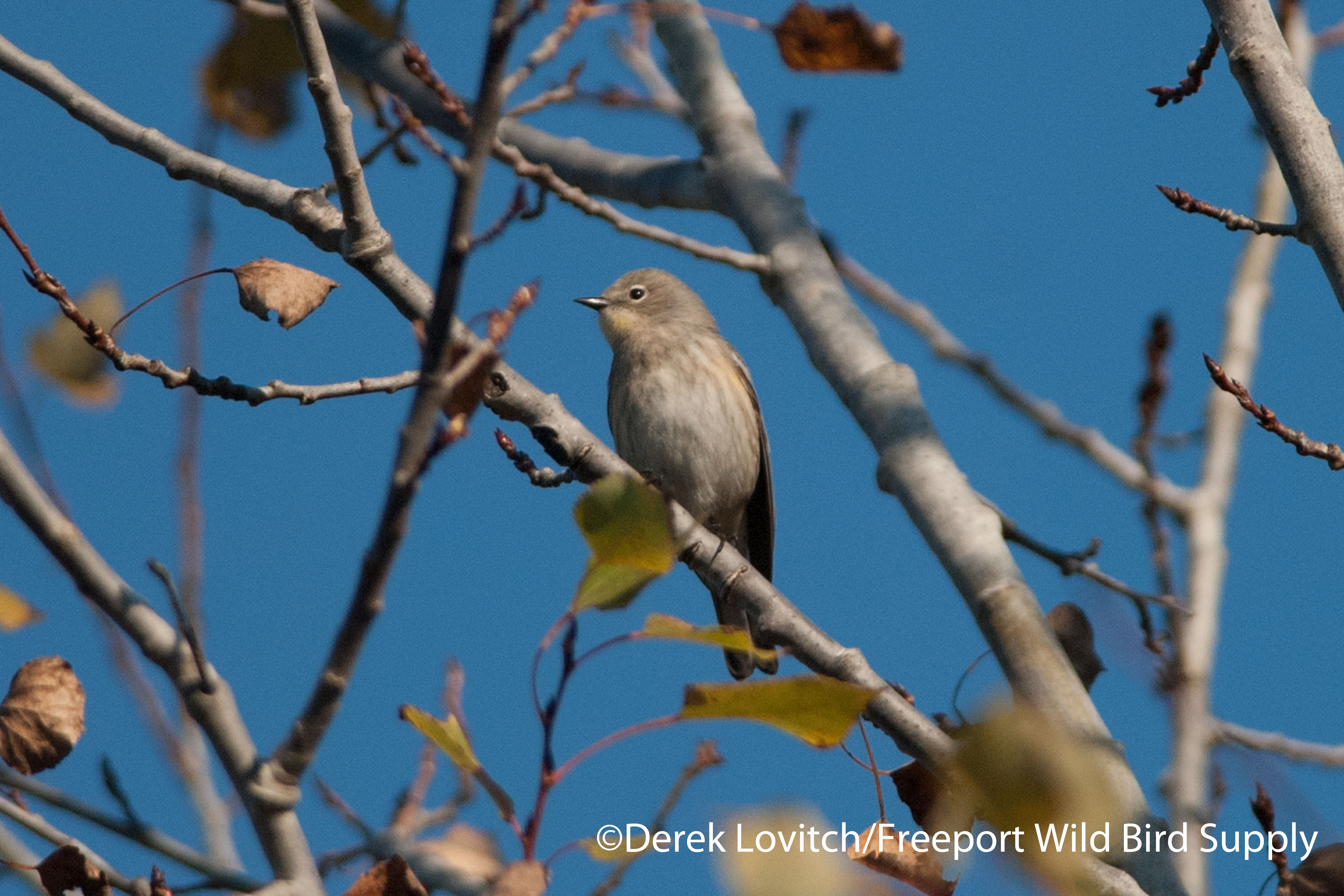
DSC_0059_AUWA1,Fort Foster,10-27-13

DSC_0046_AUWA3,FortFoster,10-27-13

DSC_0044_AUWA,FortFoster,10-27-13

DSC_0057_AUWA5,FortFoster,10-27-13

We studied the bird extensively for at least a half hour, occasionally in perfect light for prolonged periods.  I scribbled notes, and encouraged others to do the same before we discussed the bird any further.  Plenty of “Myrtle” Warblers (the Eastern subspecies of Yellow-rumped) were nearby for convenient comparison.

– Obvious “Yellow-rumped” Warbler with bright yellow rump, overall size and shape, bill size and shape, etc.
– Exceptionally cool gray overall plumage tone, not suggesting the brownish tones of even the palest Myrtles.
– Very diffuse streaking below.
– Very restricted and pale yellow “blobs” on sides of chest.
– Very subtle and restricted yellow on throat, not visible in all light conditions, but quite obvious in good sunlight.
– Lacked the extension of pale on the throat that “points” up around the back of the auriculars as on Myrtle.  Therefore, throat patch appeared rounded, or encircled by the cool gray of head.
– Auriculars only marginally darker than rest of head, often looking concolorous.
– Call note very different from surrounding Myrtles, much sharper and not as “blunt.”
– Exceptionally dull plumage highly suggestive of a first fall female, but the lack of a definite molt limit within the greater coverts prevents us from clinching the age. (reference: The Warbler Guide, Stephenson and Whittle, 2013)

Good bird!  And yes, Rarity Season is most definitely in full swing!  Good thing it appears that, after a prolonged drought, I have finally refound my rarity-finding mojo.  Phew.

Other highlights over the course of the full-day tour included the following:
– 1 pair Wood Ducks, Legion Pond, Kittery.
– Fort Foster: 1 “Western” Palm Warbler, 2 “Eastern” Palm Warblers, 6 Brant, 15 Hermit Thrushes, 1 Brown Thrasher, 1 Red-bellied Woodpecker, 2 Carolina Wrens, 32 Great Cormorants…
– Seapoint Beach, Kittery: 1 Saltmarsh Sparrow* (see photos and notes below), 1 Common Yellowthroat, 1 Eastern Towhee, 2 Long-tailed Ducks (FOF)…
– 1 Gray Catbird, Rte 103, Kittery.
– 1 Nashville Warbler (late), 1 Indigo Bunting (late), 2 Carolina Wrens, etc, Beach Plum Farm, Kittery.
– 24 Pectoral Sandpipers, 1 White-rumped Sandpiper, 3 Dunlin, 10+ Greater Yellowlegs, Harbor Road, Wells.
– 4 Semipalmated Plover (late), Community Park, Wells.

Now, about that Saltmarsh Sparrow – which I admittedly called an “Interior” Nelson’s Sparrow in the field…  Expecting to see an “Interior” Nelson’s Sparrow based on the timing, micro-habitat, and behavior, I reached for my camera before I fully studied the bird. After firing off some photos, and making sure everyone got on the bird, it took off and we never saw it again. Although I mentioned that the malar looked “quite dark,” I didn’t second-guess the call until I looked at photos on the computer this afternoon.  Yeah, it’s a Saltie.  The malar is not only dark and distinct, but it frames a clear white throat.  The breast streaking is dark and extensive, the bill has a fleshy-pink cast, and it is simply too long-billed for an “Interior” (subspecies alterus or nelsoni; I don’t believe they are identifiable in the field).  As a final clincher, note the fine streaks towards the rear half of the supercilium.  Behavior and timing wise: odd for a Saltmarsh.  Plumage: essentially textbook for a Saltmarsh.  Therefore, “After further review, the call (in) the field is overturned.”
DSC_0061_SMSP1,SeapointBeach,10-27-13

DSC_0062_SMSP2,SeapointBeach,10-27-13

BELL’S VIREO in Harpswell!!!

Yesterday, Jeannette and I discovered a Bell’s Vireo on Abner Point Road, Bailey Island in Harpswell.  There are only three previous records of Bell’s Vireo for the state of Maine. 

In other words: MEGA!  And needless to say – especially since I missed the two from last year, despite my best efforts – this was a thrilling find, capping a very productive morning of birding Bailey Island that included a Yellow-breasted Chat (my first of the year) at Land’s End, and a total of 5 species of warblers on Bailey Island this am:  Hundreds of Yellow-rumps, and one each of Black-throated Blue, Black-and-white, Common Yellowthroat, and Blackpoll.  Song Sparrows, Dark-eyed Juncos, White-throated Sparrows, and other seasonal migrants made for a very birdy visit.

In what turned out to be our last stop of the morning, Jeannette and I walked Abner Point Road.  Upon reaching a promising thicket (see directions below), I began to pish.  Yellow-rumped Warblers and a Winter Wren responded immediately, and as Jeannette attempted to photograph the wren, I sorted through the yellow-rumps, hoping to find one with a yellow throat.  A handful of minutes later (about 10:35am), we heard a harsh, scolding chatter emanating from the dense vegetation.  “Vireo?” Jeannette asked quizzically as we both looked at each other, unsure of the sound – it sounded like nothing we are used to hearing.  I wondered out loud about a Carolina Wren making some odd sound (they’re good at that, and there was one in that particular thicket), and the nasal quality led me to consider a funky Red-breasted Nuthatch.  We looked hard but could not turn up anything that fit the sound.

About 5 minutes later, a small vireo pops out of the brush in front of me.  At first I called “White-eyed Vireo” due to the bright yellow flanks and overall shape, but then I got a clear look at the head.  “BELL’S VIREO!” I exclaimed, as Jeannette, a few yards away still working on photographing the wren rushed over.

As is often the case for Bell’s Vireos, it quickly ducked back into the cover.  I continued to pish, and the bird popped back up.  I had a second brief, but unobstructed view of the whole bird.  Jeannette went for the camera, and prepared to fire away, only to see the bird dive back into the shadows once again.  One last brief glimpse of the bird was all we would have for the next hour.

We searched hard, but could not relocate it.  A Blue-headed Vireo was more cooperative, and permitted us some comparison.  We listened to a recording of the call of a Bell’s, and there was no question in either of our minds’ that is what we had heard earlier.

We thought we heard that call in the distance of the thicket one more time, and perhaps even a snippet of a song, but background noise and an increasing southerly wind made us unsure of that.  And that wind was clearly not making this skulker any more likely to show itself.  At 11:50, we heard the distinctive call once again, but from thick shrubs behind a house across the street.  We hustled over, but unfortunately only managed to pish in a cat (one of at least five in this immediate area; it was worse than Monhegan!), which was likely the object of the vireo’s recent ire.  We worked the area as best as we could, and eventually saw the homeowner in her yard and received permission to wander around.  No luck.  We had also received permission earlier from the homeowner adjacent to the first thicket to check her yard, so we did another circuit, but we came up empty, and it was getting breezier and cloudier.  Lunchtime was calling us, too.

While I left with almost three pages of field notes, it was rather frustrating to not get a photo, especially since Jeannette was so close to snapping it!  However, as a firm believer in the value of written field notes for documentation of rare birds, I scrawled away in my notebook.  Here are the particulars, after seeing the entire bird well a couple of times, with notes entered in rough order of observation, not in order of relative importance (edited only for context, not content):

–  Overall relatively dully-marked, small vireo.  Body shape and size, and brief glimpse of the body color first suggestive of White-eyed Vireo, the expected rarity here.

– Fairly bright and extensive yellow on sides, from chest through undertail (suggestive of the Eastern subspecies?)

– Dull olive-gray back.  Dull greenish-gray wings.  Lack of contrast anywhere except the bright yellow of the flanks and undertail.

– One fairly bright whitish wingbar, on the tips of the greater coverts.  An indistinct second wing bar, presumably on the edges of the lesser coverts, was discernable, but did not stick out.  Not the bold, bright white double-wing bars like Blue-headed Vireo.

– Head grayish, perhaps with a hint of an olive cast.

– White or off-white throat contrasting with gray head and face and yellow on the rest of the underparts.

– Very dull face pattern consisting of a partial eye-ring (or perhaps best described as two eye-crescents) and indistinct supercilium restricted to in front of the eye.  Maybe a small hint of a supercilium a very short distance behind the eye, but I am unsure of this.  A darker line, or narrow smudge, through the eye gave a subtle hint of a face pattern reminiscent of a darker Warbling Vireo or very pale Philadelphia Vireo.

– Perhaps due to the angle, I though the bill looked relatively long compared to the size of the head, but it was clearly rather narrow for a vireo, and was diminutive compared to the Blue-headed Vireo observed a short time later.

– Relatively long-tailed (NOTE: although in comparing photos later, I wondered if it was actually suggestive of the shorter-tailed Eastern subspecies).

– The first view was of a “sleeker” or slimmer vireo, not the chunky, broad-chested shape of Blue-headed.

– Very active, and did not come out into the open for very long (NOTE: tail movement not seen, or not noticed, which could have been a good key for subspecies), always disappearing into low, dense brush.

In comparison to other species:
– Wingbars and bright yellow underparts distinguish it from Warbling Vireo.

– Lack of yellow in the throat and pale face pattern, along with wing bars and fairly long tail and slim shape help distinguish it from Philadelphia Vireo.

– Incomplete eye ring and lack of broad and bright yellow spectacles separate it from White-eyed Vireo.  Wings paler and less contrasty, and no contrasting pale gray nape as on WEVI.

Directions to the bird (although I have not heard any reports, positive, or negative, about the bird as of 4:00pm today):
To reach the thicket we first found it in, take Rte 24 from Cook’s Corner in Brunswick south through Orr’s Island and onto Bailey’s.  Make a right onto Abner Point Road at the Johnson Field Preserve.  Park on your left in the gravel parking lot for the beach.  Walk down Abner   Point Road a couple hundred yards, around the bend.  On the right, you’ll see a small parking lot with little white signs with people’s names on them.  The bird was in the thicket behind these signs, along with a Blue-headed Vireo and a mess of Yellow-rumps.

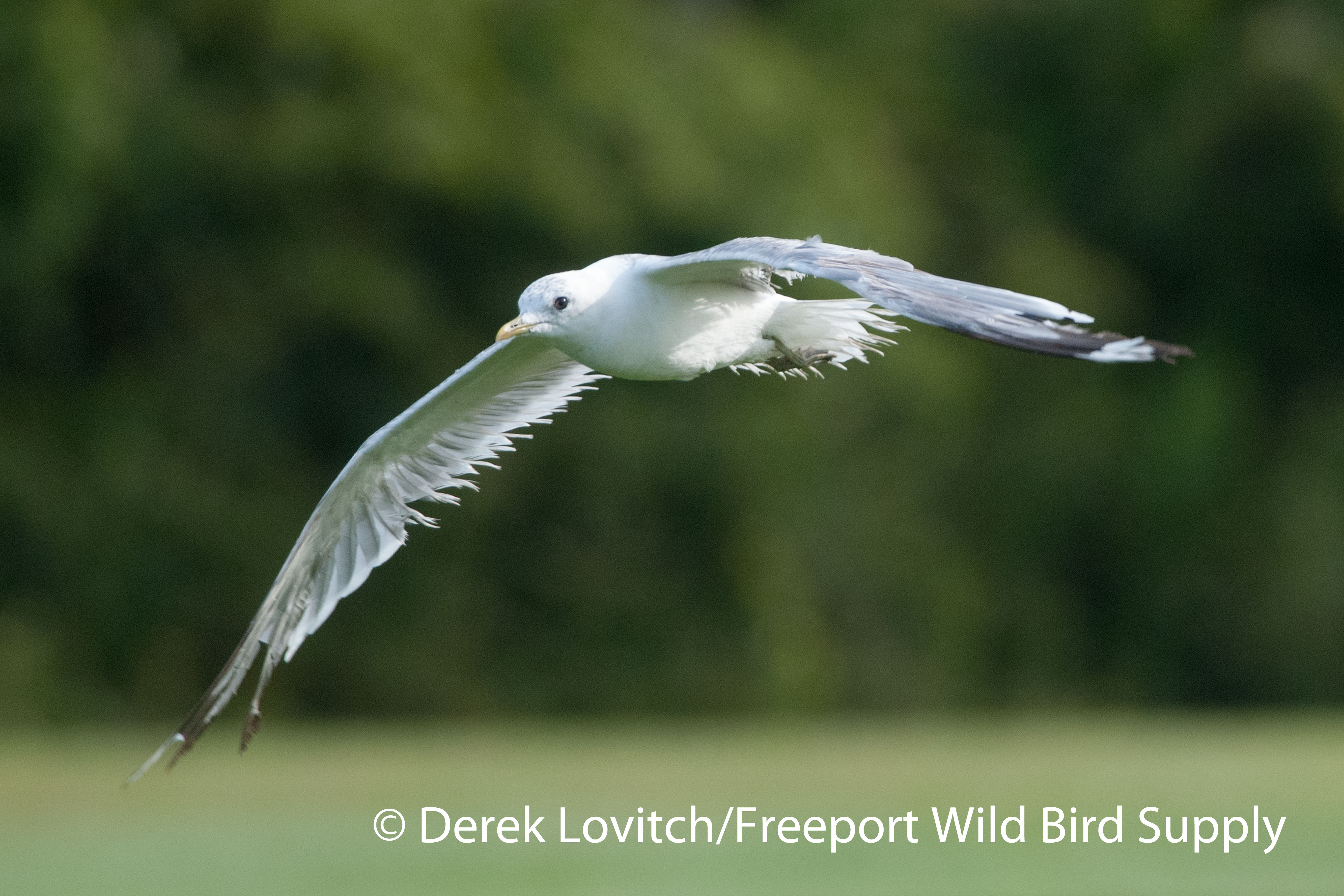
A MEW GULL in Thomaston!

On August 3rd, Don Reimer found Maine’s Third State Record of a Mew Gull in a parking lot in Thomaston.  While it was seen in the area for most of the day, it was not seen by anyone on the 4th – myself included – despite extensive searching.  However, a few days later, Don relocated it, and it has been seen regularly since, although it is not always in the same place at the same time, and it seems to feed somewhere unknown at low tide.

After returning from Hawai’i on Friday, I was happy to see the bird has kindly awaited my return.  Today was the first chance I got to head over, and at 7:45 I met Kristen Lindquist in the parking lot behind downtown Thomaston.  Kristen was studying about 30 Ring-billed Gulls in the parking lot until a birder drove by and flushed them.  Apparently, a few gulls from rooftops and/or a nearby field joined the flushed birds, and as they settled back down or flew off, I noticed a single, seemingly darker gray bird sitting atop a basketball hoop in the adjacent playground.

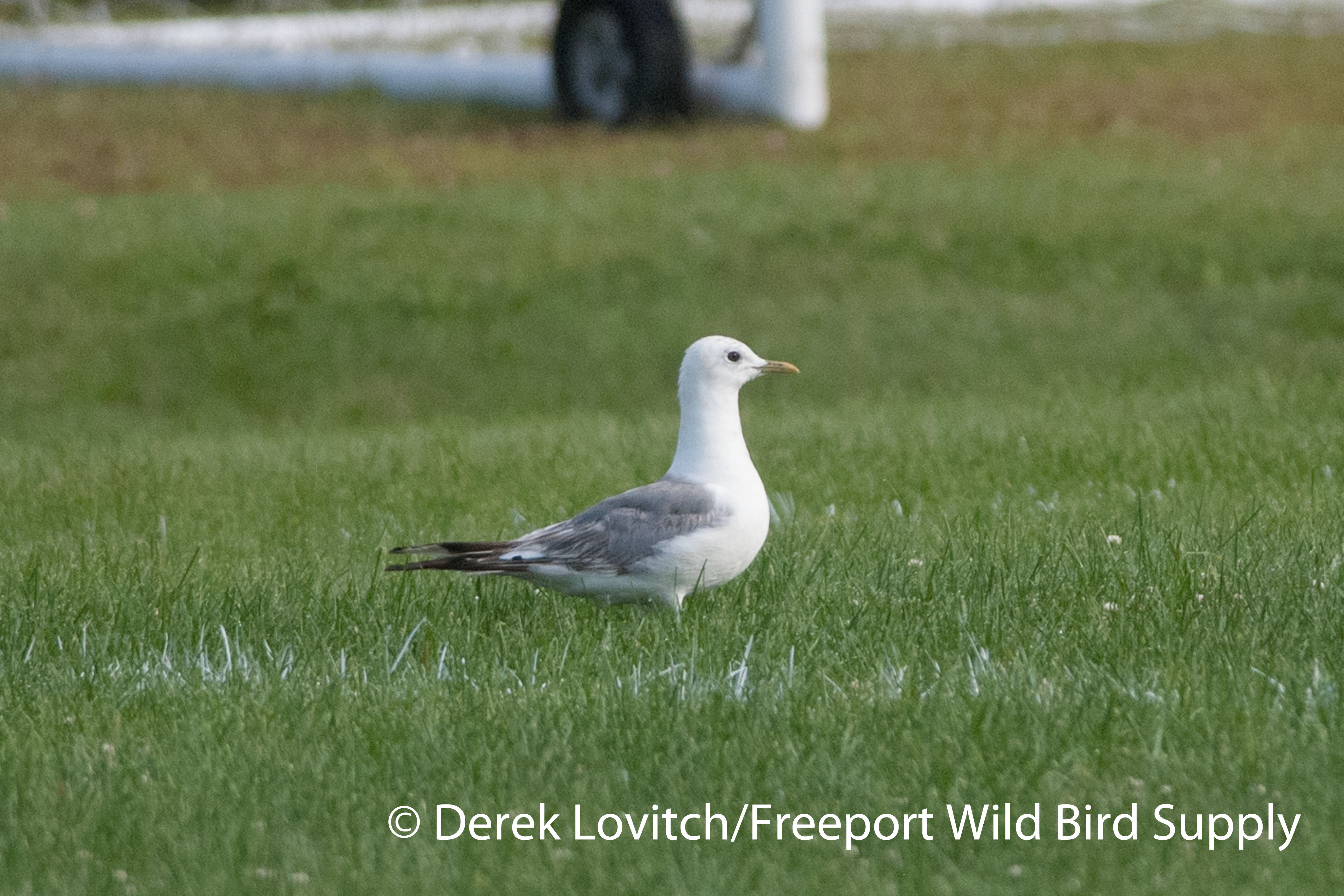
And sure enough!   I snapped a few phone-scoped images, including this one.
IMG_1357

Boy, that was easy, for us anyway (the gull is hard to see atop the basketball hoop here)!

MEGUonHoop, with Big CrankyDSC_0009_MEGU_on_hoop1

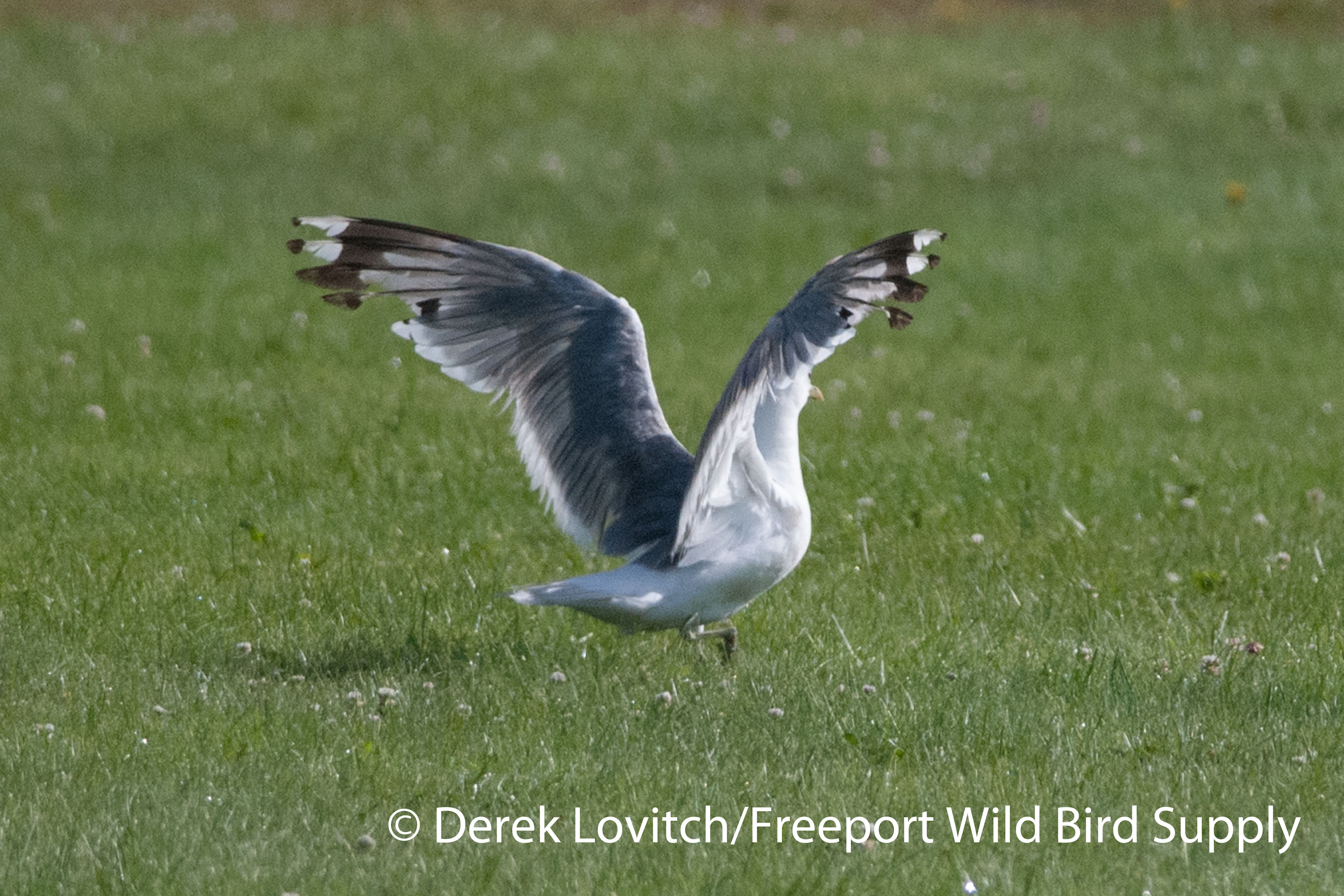
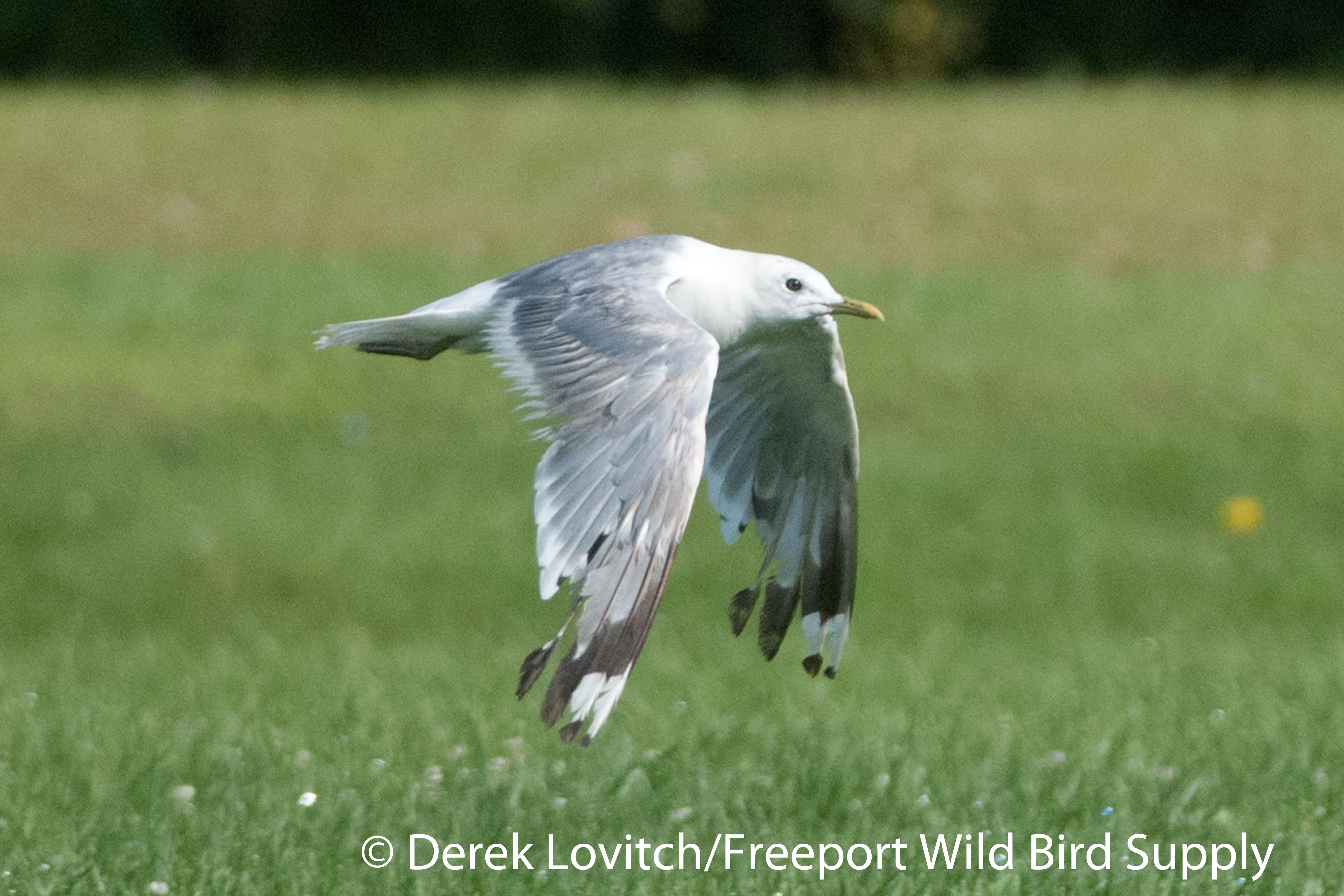
A short while later, it flew to a nearby field next to the Oceanside High School.  There, a jogger was doing laps around the track.  Although the bird was never too perturbed by this, it did fly a short distance when the jogger would be a little too close for comfort.  This afforded me a perfect opportunity for exactly what I wanted: flight and spread-wing photos. Shortly thereafter, it flew off the field and onto the roof of the elementary school where we left it at about 9:00.

(Click on the photos for a larger image)
DSC_0020_MEGU_upperwing2 DSC_0020_MEGU_upperwing3 DSC_0024_MEGU_upper_and_underwing1 DSC_0024_MEGU_upper_and_underwing2 DSC_0024_MEGU_upper_and_underwing3 DSC_0024_MEGU_upper_and_underwing4 DSC_0032_MEGU_in_field1 DSC_0032_MEGU_in_field2

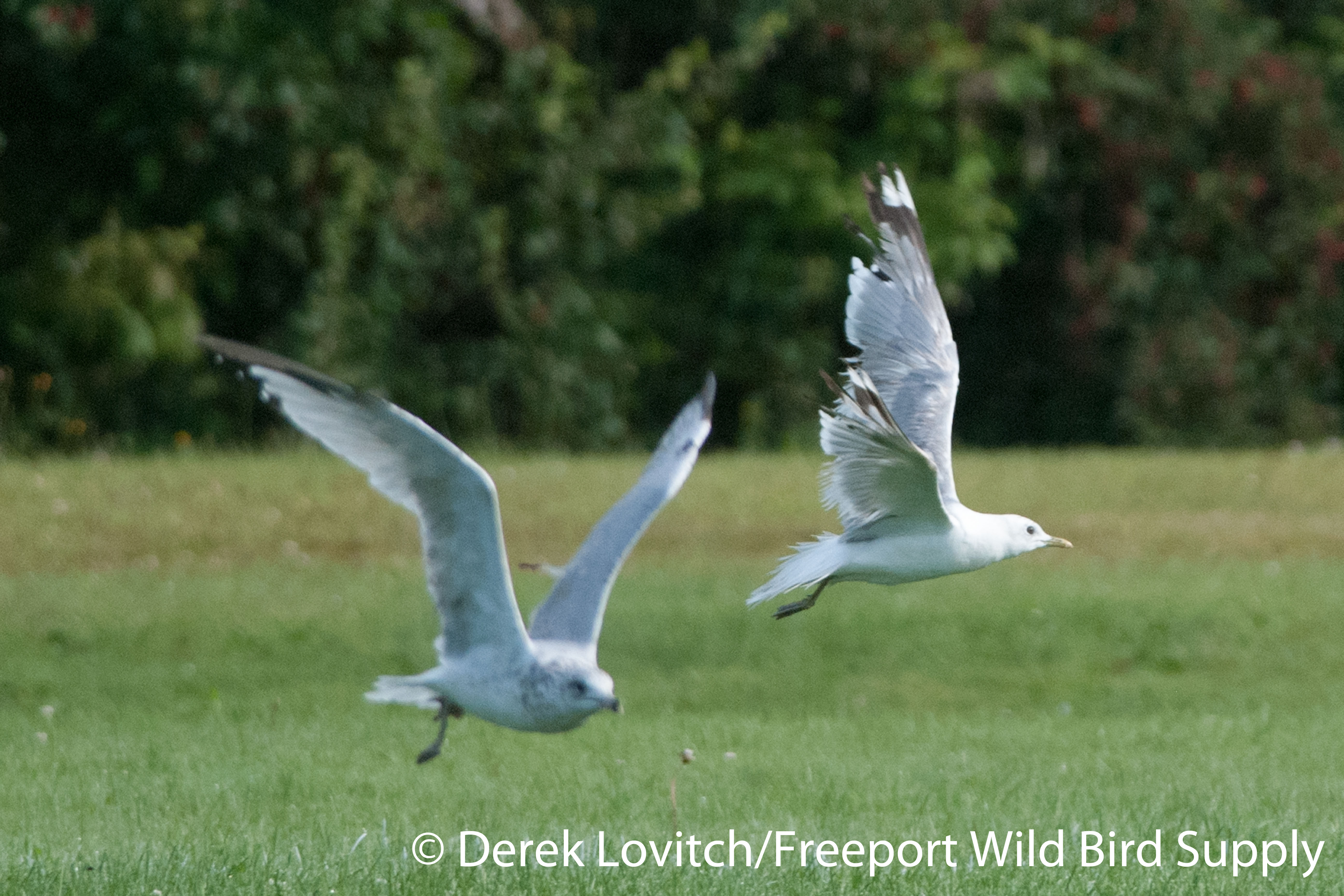
Side-by-side with a Ring-billed Gull:
DSC_0037_MEGU_and_RBGU2 DSC_0037_MEGU_and_RBGU3

DSC_0045_MEGU_flight1 DSC_0045_MEGU_flight2

So, what is this?  Other than a big, fat, mess?

It’s definitely a bird in the Mew Gull (Larus canus) Complex, which here in the States, we refer to as composing four subspecies. There’s “Mew Gull,” L.c.brachyrhynchus that is common in the west, breeding from Alaska to extreme northwestern Manitoba and south through the coast of British Columbia, and wintering along the Pacific Coast from Washington into Baja California.  However, vagrants that have been recorded on the Eastern Seaboard have mostly (I believe) been assigned to the expanding European population, L.c.canus, or “Common Gull.”  There’s also the “Kamchatka Gull” (L.c. kamtschatsensis) of the Russian Far East that is a regular rarity in Western Alaska, with  perhaps a few claimed elsewhere on the continent (I am vaguely recalling one in Massachusetts?).  Finally, there is L.c.heinei of Siberia, which may just be an intergrade between Common and Kamchatka Gulls and I am unaware of any possible records of this in North America.

In short, the European “Common Gull” actually seems to be more likely on the East Coast than the North American “Mew Gull.”  But most records are from winter, and most birds do not have a plumage as trashed as this individual.

The bird appears small to me, with a relatively thin bill (although it’s on the long side), and a relatively dark mantle, all of which would be points in favor of Mew Gull.  However, the plumage is so ravaged, that it’s hard to even age the bird.  Is it an advanced 2nd cycle, a retarded 3rd cycle, or an adult that had some really bad days?  Intermediate-aged birds in the complex are notoriously, well, complex – and very difficult, at best, to identify.

But what can we actually see?
–          Fairly broad white windows in outer two primaries (primaries 10 + 9)
–          Little to know white between the black and gray on P8 (although this is probably only of value on an adult.
–          P7 is trashed
–          Is that a new P6 growing in? (One primary is definitely missing as well, could it be P1?)
–          The four new primaries have a fairly broad white tip.
–          The legs are dull olive-y (subadult-like).
–          The bill is fairly bright yellow at the tip with an olive-y base (adult-like).
–          The tail is too trashed too look for black spots at the tip (expected in a 2nd cycle Mew Gull, but not in a Common)
–          The eye is fairly dark.

So, we have an odd time of year for a vagrant gull, and we have a trashed plumage.  Can we narrow it down to a probable subspecies?  I will be sending this blog out to those who know various members of the Mew Gull Complex better than I do, and I will let you know what I learn.  Whatever it is, I got myself a state bird today!

REFERENCE:
Howell, Steve N.G. and Jon Dunn. 2007. Gulls of the Americas. Houghton Mifflin Company, Boston/New York.