Luckily for this Great Egret – showing off it’s high-breeding condition lime green lores – last week’s snow didn’t last long in Scarborough Marsh.
The massive “winter” storm of 4/3 through 4/5 produced heavy snow cover and drove a lot of birds to feeders, including those that are not usual feeder visitors. Numerous reports of American Robins eating offerings of dried mealworms, suet, and even some seed were received. At our home in Durham, I spent the snow day experimenting with getting Eastern Phoebes to eat dried mealworms, finally finding success by floating them in the slush at the edge of our pond.
Meanwhile, feeder-watching during the day on the 4th yielded 44 Dark-eyed Juncos (up from 22), and more Red-winged Blackbirds and Common Grackles. By the next day, we had a new recent high of 4 Purple Finches and 6 Pine Siskins. Here at the store our 10 White-throated Sparrows continued, growing to 14 by week’s end. Two great nights of migration 4/8-9 and especially 4/9-10 saw many of these sparrows depart.
Away from feeders, my other observations of note over the past ten days included:
Red Crossbills continue to be widespread, with a highlight of 3 (including a fresh juvenile) feeding on the ground within 20-30 feet of the Saturday Morning Birdwalk group at Winslow Park on 4/6.
1 pair AMERICAN OYSTERCATCHERS, Pine Point, Scarborough, 4/7.
1 pair Piping Plovers, Pine Point Beach, 4/7.
1 Winter Wren (FOS), our property in Durham, 4/9.
1 Hermit Thrush (FOS), Florida Lake Park, Freeport, 4/10.
2 Ruby-crowned Kinglets, Florida Lake Park, 4/10.
1 Pine Warbler, Florida Lake Park, 4/10.
16 Palm Warblers, Florida Lake Park, 4/10.
2 Barn Swallows, Florida Lake Park, 4/10.
2 Yellow-rumped Warblers (FOS), Florida Lake Park, 4/10.
TOURS AND EVENTS:
1.Woodcocks Gone Wild – Now Saturday, 4/13
Due to the high winds and precip forecast for the evening of the 6th, we postponed our tour to the weather date of 4/13. There are no current openings, but a short waitlist if you would like to be added in case of cancellations. . Please call the store, 207-865-6000 to register.
2. Community Pizza Night at Maine Beer Company to support Feathers Over Freeport!
April 17: 4:00 – 8:00 p.m. – Maine Beer Company – Freeport Join us for a Community Pizza Night to benefit Feathers over Freeport. Proceeds from a raffle along with 20% of all food sales from 4-8:00 p.m. will be donated to support the annual birdwatching and nature discovery weekend hosted by the Bureau of Parks and Lands. Park and event staff will host an activity & information table and be on hand to answer questions about birding, the Hawk Watch, and Feathers Over Freeport. Location: Maine Beer Company, in the Tasting Room, 525 US-1, Freeport, ME 04342.
3. Birds on Tap! Kick-off event at the Portland Beer Hub!
Thursday, April 25, 2024; 5:00 – 7:00pm. Free!
Join Birding Guide and owner of Freeport Wild Bird Supply Derek Lovitch, and Brew’s Cruise owner Zach Poole, for an exclusive gathering at the Portland Beer Hub to celebrate the 10th Anniversary of Birds on Tap! and kick off our new tour lineup.
During this casual meetup, guests will mingle with other bird and beer enthusiasts, discuss the exciting lineup of upcoming Birds on Tap tours, and can enjoy flights of bird-themed local beers (for purchase).
It’s the perfect opportunity to immerse yourself in the world of birdwatching and craft beers. For a bit of fun, be prepared for some impromptu bird trivia and birding games.
We birded Rhode Island for a couple of days this week, and found this Pink-footed Goose, about the 7th or 8th ever recorded in the state as we drove through Middletown!
Despite 4 days of birding out of state during this period, I had a handful of observations of note here in Maine over the last nine days, including the vanguard of spring migrants. They included:
The first significant influx of Red-winged Blackbird and Common Grackles arrived this week, and waterfowl are definitely on the move. Scattered Red Crossbills continue, including around our Durham property and around the store area this week.
4 drake and 2 hen BARROW’S GOLDENEYES continue, Winslow Park, Freeport, 3/2 (with Saturday Morning Birdwalk group).
3 American Woodcocks (FOY), our property in Durham, 3/9.
Total of 12 Killdeer (FOY) from several locations around the “Greater Yarmouth Goose Fields, 3/10.
1 pair Northern Pintail, Thornhurst Farm, North Yarmouth, 3/10.
TOURS AND EVENTS:
Only a four spaces remaining for April 6th’s “Woodcocks Gone Wild.” This year, we are requesting pre-registration for the first time, with evening-of walk-ups only if we have extra space; sorry for the inconvenience. You can register here.
Unless there was a Dovekie in our road, we weren’t going to get out to look for one…at least once we actually got home!
A thorough search of Scarborough Marsh on Sunday and the Southern York County CBC on Tuesday, plus a pair of birdwalks, accounted for the vast majority of my birding this week. After the count, I would have liked to do some post-storm birding, but we were preoccupied with: 1. getting past floodwaters to even get back to our house, 2. checking on the house (it was fine, the waters didn’t quite reach it), 3. Working at the store leading up to Christmas, and 4. Cleaning up the yard. In other words, there wasn’t much birding the rest of the week. Too bad – there were probably some more great birds (at least Dovekies) to be found! Alas.
1 ROUGH-LEGGED HAWK (Pine Point), 5 total Great Blue Herons, 36 total Horned Larks, 19 Dunlin, 1 Northern Flicker, etc, Scarborough Marsh, 12/17.
While everyone else was out finding wrecked Dovekies on (way) inland lakes on Tuesday, Jeannette and I were covering the “Moody Sector” of the Southern York County Christmas Count. We tallied 61 species (felt like we had everything except Dovekies!), with highlights including 1 Turkey Vulture (3rd Count Record!), 1 Merlin (9th Count Record), 1 female Red-winged Blackbird, 1 Chipping Sparrow, 1 Double-crested Cormorant, 2 Yellow-rumped Warblers, and 1 adult Iceland Gull. Some of our better tallies (for our section) included 103 Black Scoters, 26 Northern Gannets, 6 Red-tailed Hawks, 46 Great Black-backed Gulls, 28 Song Sparrows, 21 Northern Cardinals, and 94 House Finches. American Goldfinches were also numerous – as they have been in most places, but we didn’t have any other irruptives. Black-capped Chickadee numbers were very low, and only the well-vegetated neighborhoods with lots of oak, bird, and conifers held a lot of feeder birds – similar to my postulations on the recent blog about surrounding habitat quality.
1-2 Red Crossbills continue in and around our property in Durham on a daily basis, hopefully a sign of upcoming or perhaps even current breeding.
UPCOMING TOURS.
No Birdwalk, 12/30.
Winter Waterbirds Workshop with Down East Adventures. Sunday, January 14th. Info here.
Gull Identification Workshop. Saturday, February 3rd and Sunday, February 4th. Info here.
This Purple Gallinule graced tiny Rogers Pond Park in Kennebunk on the 20th, and I could not resist the chase!
The last few have been tough for me. It’s October in Maine – my favorite month of birding, as I have opined about before. The weather went from unusually warm and benign to pleasantly normal and unsettled. But in between, there were those glorious fall days of crisp mornings, colorful leaves, and migrants everywhere.
Over the winter as I slowly recovered from shoulder surgery, I used my one good arm to enjoy morning vigils at the active feeding station, which I chronicled here and here. I kept track of daily ebbs and flows, and paid even greater attention to behavior, such as the winter’s-long Sharp-shinned Hawk drama at the feeding station.
While it’s been a long year of near-constant pain and discomfort, it has also been a very busy year and we had one of the most successful tour seasons in our company’s history, despite the near-constant rain. I battled through some tours but did my best to remain positive and productive.
Pain was building in my “good” arm all summer, constantly doing all the work the left, surgically repaired but then frozen shoulder was still unable to accomplish. My September trip to Monhegan for Down East Adventures was the most challenging yet.
For the first time in my career (around 30 years of guiding in some shape or form), I had to hire a replacement for a tour. Thankfully, my good friend and amazing birder Evan Obercian was able to cover our 18th annual Monhegan Fall Migration Weekend for me. I could barely get in and out of my recliner – I was not going to be able to walk around all day and show people birds!
The duration of this intense pain lasted far longer than I had expected, despite various combinations of medicines and therapies, but I mostly remained on “Injured Reserve’ (I feel like I am injured often enough to be an Offensive Lineman for the Patriots!) Meanwhile, October birding was at its finest, and birds were streaming through. Our Durham yard was absolutely bursting with birds on most mornings through, but my birding was limited to a short walk up and down the driveway.
Our September diversity of warblers slowly petered out into waves of Palm and Yellow-rumped Warblers in early October, with Ruby-crowned Kinglets bitterly scolding from all edges. Our fields and meadows were chock full of sparrows, with a productive breeding season for Song Sparrows soon augmented by flights of Swamp, the return of White-throated, more Song, and a surprising amount of Lincoln’s Sparrows.
Some other highlights during the peak of my limitations included a Philadelphia Vireo viewed from my recliner on 10/1 and a truant Scarlet Tanager spotted from the same position on the 5th. Happily, by the morning of the 7th, I was actually able to take a little walk with bins and that yielded a nice array of migrants including 2 Blue-headed Vireos, a presumed-continuing Scarlet Tanager, a new wave of Yellow-rumped Warblers and especially Ruby-crowned Kinglets, and an increase in Swamp, Savannah, and Song Sparrows in our field.
Meanwhile, my usual morning texts with Evan and Dan Nickerson as we monitored the ebbs and flows of migration helped to keep me abreast of what was happening beyond the yard. Our feeders in Durham were busier than what most people were experiencing this fall, but this is always a time of plenty. For me, unfortunately, my limitation was holding my head upright and using binoculars, so daily counts and monitoring were out of the question – no chance to attempt another Sandy Point Morning Flight, despite some great conditions on several mornings.
I was kept busy with a writing project, correspondence and planning for the store, and on the morning of the 8th, Jeannette and I boarded a plane for a trade show in Missouri. After a 5-year hiatus, we really needed to get back to reinvigorate our offerings and see if there were any revolutionary developments.
Flying into Kansas City, Jeannette and I enjoyed a couple of days off before the trade show, and then a day upon our return. We visited with a friend, checked out some breweries and indulged in the best of Kansas City BBQ, and of course, did a little birding. Finally feeling well enough to carry binoculars for a bit, we spent the morning of the 9th birding in Kansas (Spotted Towhees and Franklin’s Gulls!) and at least a couple of hours of each morning of our trip. A big overnight flight resulted in a very productive morning at the Lowe Conservation Area in Mexico, for example, with large number of Yellow-rumped Warblers and impressive numbers of Lincoln’s Sparrows among many others.
When we returned late on the 13th, much had changed here in Maine – a week is a long time in fall migration! I was finally back to work, leading the Saturday Morning Birdwalk once again on the 14th. If only to prevent me from snapping my head up in response to an unfamiliar flight call, I was still sporting a neck brace and quite a bit of discomfort. However, the birding helped ease the pain. In fact, it was an exceptional outing full of sparrows, a massive arrival of Pine Siskins, a late Nashville Warbler, and a Great Blue Heron hunting voles.
I birded our Durham property on the morning of the 15th, noting the changes since we departed. While truant House Wren and Indigo Bunting continue, gone are the last of our Gray Catbirds. There were still a lot of Song Sparrows, but fewer Swamp and more Savannah in our field. A Dark-eyed Junco and a few fly-over Pine Siskins have arrived, and a flock of about 100 Common Grackles briefly visited a patch of wet woods. Warblers, however, were now limited to a healthy smattering of Yellow-rumped only. A Rusty Blackbird and our first two immature White-crowned Sparrows arrived on the 17th, and the morning of the 20th was particularly birdy – Pine Siskins are here now.
Our annual Fall Boothbay Mini-Pelagic on the 16th went off without a hitch, with great weather and sea conditions. However, few seabirds were to be found, despite a lot of ground covered. The passerine list – including sparrows 28 miles offshore – was fascinating, however. But it felt more like being at Sandy Point than at sea!
It was a short trip, but I actually went birding on my own for a few hours on the 18th, visiting Sabattus Pond. Waterfowl numbers are increasing, with decent tallies including 140 Ruddy Ducks, 113 Lesser Scaup, 75 Greater Scaup, 3-5 Green-winged Teal, 2 Buffleheads (first of fall), and 1 each of Ring-necked Duck and Surf Scoter.
And finally, today was our last boat trip of the year – our Birds of Casco Bay with Seacoast Tours right here in Freeport. A casual 2.5-hour cruise produced an abundance of newly arrived Surf Scoters, 9 Red-breasted Mergansers, a surprising 15 truant Laughing Gulls, and a rather tardy Osprey.
And with my birdfinding so limited, I jumped at the chance to do a little bird-chasing. After my tour, I raced down to Kennebunk where a vagrant Purple Gallinule was found this morning. Interestingly, this is the second in Maine at the moment, with one continuing in the even more surprising location in a small pond in the North Maine Woods not far from Moosehead Lake!
It was in the open when I arrived, and I enjoyed some prolonged quality time with it by myself and with just a few others at we watched it feed on crabgrass and at least one large earthworm. Oddly, it remained loyal to a small patch of grass under a powerline, away from the water.
As I continue to slowly feel better, I’ll be trying to get out more. Unfortunately, there will not be any more visits to Sandy Point for the morning flight for me this year, but there are plenty of birds to see everywhere else. Sabattus Pond season is upon us, and Rarity Season is about to ramp up. It’s an amazing time to be in the field, and I will do my best to get out there and report back. Stay tuned for trip reports, birding summaries, and I am sure, a few “highlights” too!
A highlight of a slow weekend on Monhegan were the conspicuous Cape May Warblers, including these two that were regulars in a single tree that often featured every plumage aspect of this delightful warbler.
Following three days on Monhegan, I mostly birded the yard before heading back to the island for another tour.
Monhegan Island, 9/23-25 (with Down East Adventures Monhegan Migration Workshop group):
About as slow as I have ever experienced the island, even considering a nice little influx of birds on our last morning. Cape May Warblers were the most common warbler for the first two days, however, but overall numbers and diversity were extremely low. Highlights were few, but a brief trip report is posted here:
There were more birds in our yard than on Monhegan this week! A particularly active morning on 9/27 included tardy Ovenbird, Scarlet Tanager, 8 species of warblers including Tennessee and Cape May, a nice influx of sparrows including 4+ Lincoln’s, and my first 4 southern Maine Pine Siskins of the season.
A NOTE ABOUT YOUR “SLOW” BIRD FEEDERS:
Many folks have been reporting extremely slow feeders throughout much of the state recently. This happens on a regular basis, so the end is not near! In fact, a very similiar dearth of birds happened in the falls of 2017 and 2019. I’m currently working on a blog that is more specific to this year, but this blog written in 2017 nicely tells a good part of the story.
This presumed first-fall female Cape May Warbler was a good study in comparison with the other, brighter plumages of this species on display in that single tree on Monhegan.
Beginning in 2022, Cap’n Fish’s Cruises in Boothbay Harbor and Freeport Wild Bird Supply have partnered together to offer a mid-summer seabirding opportunity. I join the boat’s naturalist as a seabird and pelagic specialist, to help everyone see all of the breeding seabirds at Eastern Egg Rock (Atlantic Puffins; Arctic, Common, and Roseate Terns; Laughing Gulls; and sometimes Razorbill and Common Murre) before we venture offshore in search of whales. While doing so, we pay special attention on this cruise to the bird life – which is often found at the same places where we are looking for whales. This trip gives us a slightly more bird-centric tour compared to the regularly-scheduled departures.
Here are the trip reports from this very popular annual event.
July 16. 2022
Seas were fairly high (3-5ft) as we bounced offshore to deeper water first. Wilson’s Storm-Petrels were soon visible, and we passed one Razorbill. We could not stop or turn around for it as the seas were just a little too rough for that, and this was unfortunately our only Razorbill of the day. We cruised around waters over 300 feet deep, and were treated to a good performance from Great Shearwaters, Wilson’s Storm-Petrels, and picked up a few Sooty Shearwaters. We had one offshore Atlantic Puffin, but the big surprise was a rare, mid-summer NORTHERN FULMAR – definitely the pelagic bird of the trip.
With the seas building, we made a turn and took advantage of much more pleasant conditions as we trolled the area, giving people a better chance and seeing the aforementioned species. We also spotted a couple of Mola Molas, but no marine mammals, unfortunately.
Away from Eastern Egg Rock (both coming and going), our offshore (“pelagic”) scorecard was:
76 Great Shearwaters
61 Wilson’s Storm-Petrels
21 Northern Gannets
3 Sooty Shearwaters
2 Arctic Terns
1 Razorbill
1 Atlantic Puffin
1 NORTHERN FULMAR
1 Common Loon
scattered Common Terns and unidentified Sterna
As we approached Eastern Egg Rock, the action really picked up with all of the island’s breeding species soon apparent. Roseate and Arctic Terns joined the multitudes of Common Terns. At least a dozen Roseates included several putting on a good show, and we singled out quite a few close-passing Arctic Terns for good studies. 4 migrant Ruddy Turnstones joined island-breeding Spotted Sandpipers onshore, and we heard a couple of singing Song Sparrows. And of course a plentitude of Laughing Gulls; about half of the entire state’s population breeds here. Black Guillemots were also conspicuous today.
But Atlantic Puffins are the star of the show out here, and today, they did not disappoint. In fact, it was a great mid-summer performance, with several dozen on the water – often in very close proximity to the boat, commuters passing by, and dozens more stately stationed on the island’s rocks.
We wandered offshore on the way back, near where the boat had recently seen whales, added a few birds to the tallies, but alas, the only marine mammals of the day were two species of seals: lots of Harbor Seals and two Gray Seals. Hopefully, this got the seal of approval from the marine mammal watchers aboard today.
July 10, 2023.
A Parasitic Jaeger got everyone to our feet as we were motoring home through the fog.
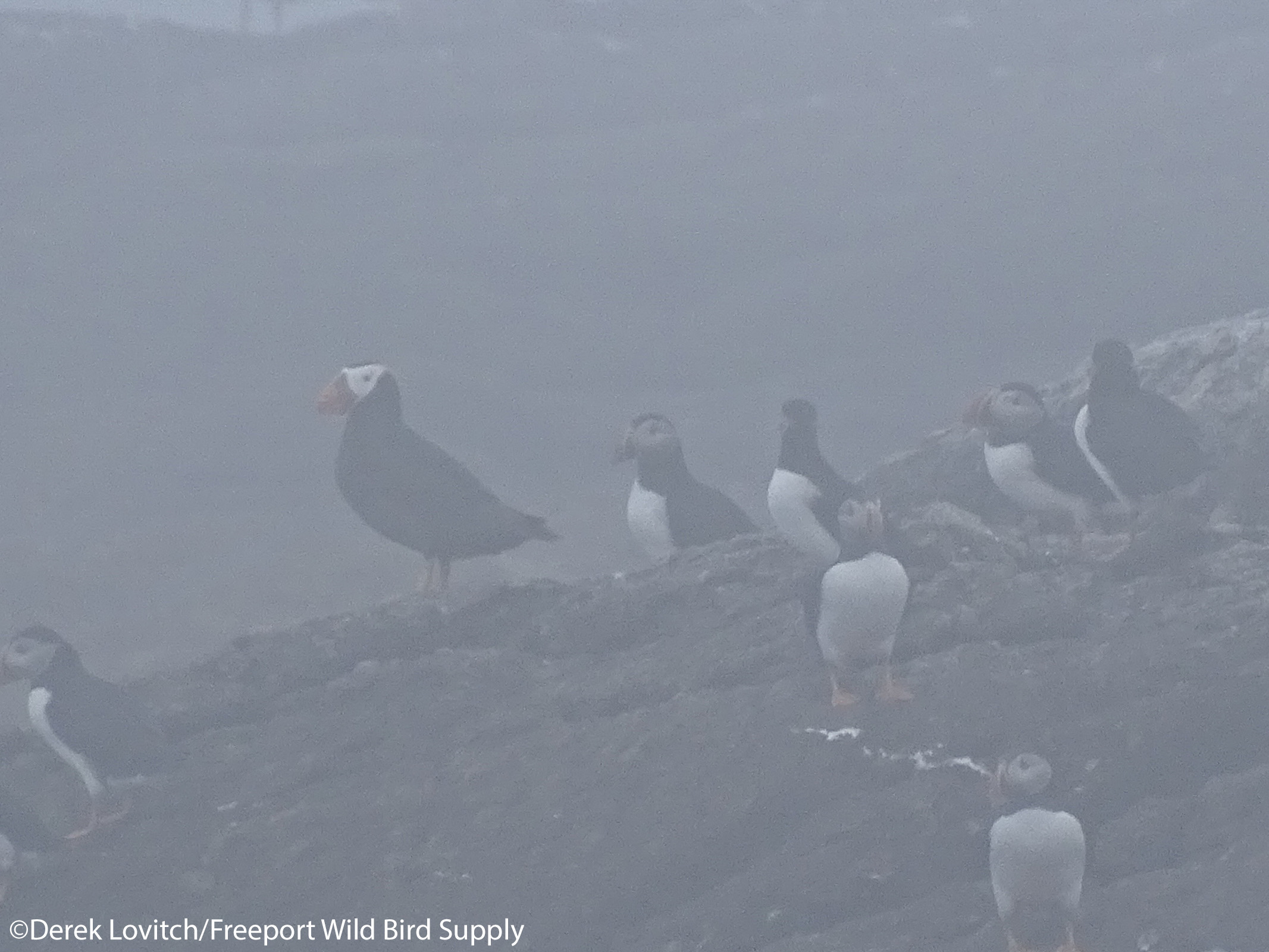
With even more anticipation than usual, birders flocked aboard for this afternoon departure. Three hours earlier, I had spotted the near-mythical Tufted Puffin on Eastern Egg Rock aboard Cap’n Fish’s morning Puffin Cruise. We made a bee-line for the island’s north end, but alas, the Tufted was not to be seen.
Nonetheless, we had a fantastic visit. Fog resulted in many of the island’s Atlantic Puffins being in the water and we had close birds all around the boat. We studied Arctic and Roseate Terns among the masses, making sure everyone had at least one rewarding look at each. While we searched vigilantly for the Tufted, we picked out one of two American Oystercatchers that have been here this summer, and just as we were about to leave, the single Common Murre floated around just off our bow.
It didn’t take long before our first Wilson’s Storm-Petrels of the day to be sighted, with small groups and singletons here and there throughout the rest of the trip for a total of 100-150 or so. Fog only thickened as we traveled further offshore, however, although we did find a hole where the visibility increased dramatically for a spell. While we searched diligently for whales to no avail (but plenty of Harbor Porpoises today), birds began to appear one by one.
A good look at a Sooty Shearwater. A glimpse of a Great Shearwater was followed later by a cooperative one that allowed close approach on the water. One group spotted a Manx Shearwater heading straight away, and a couple of other distant shearwaters disappeared into the fog. We only saw a few gannets today, scattered Common Loons on our way to and from, but a subadult Parasitic Jaeger spiced things up on our ride back (photo above).
Considering how dense the fog was, we were happy to spot much of anything once we left the rock, and considering we remained just east of torrential rain all day, we were more than satisfied with the comfort of what we did see!
If I only saw one bird all week, and it was THIS bird, I would have been more than satisfied. The near-mythological Tufted Puffin that has wandered around the Gulf of Maine for the last two summers finally was in front of my binoculars at Eastern Egg Rock on 7/10 (with Cap’n Fish’s Cruises “Audubon Puffin and Scenic Cruise). Unfortunately, it was not seen a mere three hours later when I returned to the island with my previously-scheduled Mini-Pelagic with our partners at Cap’n Fish’s.
While just about anything else would pale in comparison, I did have several other observations of note over the past seven days, plus lots of quality time with Roseate Terns, Salmarsh and Nelson’s Sparrows, etc:
Scarborough Marsh migrant shorebirds, 7/9 (with Ken Mettie and Mary Beth Oles): 16 Short-billed Dowitchers (First of fall), 4-6 Lesser Yellowlegs, 4 Least Sandpipers (FOF), and 2 Greater Yellowlegs.
Freeport Wild Bird Supply’s “Puffin/Whale Combo Mini-Pelagic” with Cap’n Fish’s Cruises, 7/10: 1 COMMON MURRE and 1 American Oystercatcher at Eastern Egg Rock. Offshore pelagic visitors: 100-150 Wilson’s Storm-Petrels, 2 Great Shearwaters, 2 unidentified shearwaters, 1 Sooty Shearwater, 1 subadult PARASITIC JAEGER. Some observers had a MANX SHEARWATER as well.
1 LOUSIANA WATERTHRUSH and 1 Yellow-billed Cuckoo, Morgan Meadow WMA, 7/11 (with Jeannette).
Scarborough Marsh and Pine Point migrant shorebird totals, 7/14 (with Alec Humann and Buffalo Ornithological Society tour group): 18 Short-billed Dowitchers, 15 Lesser Yellowlegs, 12 Least Sandpipers, 5 Semipalmated Sandpipers (FOF), 2 Whimbrel (FOF, Jones Creek, Pine Point), and 1 Greater Yellowlegs.
This Common Murre was a lucky find in the middle of nowhere as we traveled offshore during our ½ day Zeiss Pelagic out of Boothbay Harbor last Friday.
With 6 of the 7 days this week spent guiding in some shape or form, mostly in the Rangeley area, the weather presented a real challenge! As a cut-off low spun offshore, activity was certainly reduced on many of my trips, and my birding time in between was rather limited. Therefore, my observations of note over the past seven days were limited to the following – in addition to all of our great local breeding specialty birds, of course!
2 Willow Flycatchers (FOY) and 2 Glossy Ibis – my 152nd Patch Bird here! – Old Town House Park, North Yarmouth, 6/3 (with Saturday Morning Birdwalk group).
2+ Red Crossbills and 1 migrant Yellow-bellied Flycatcher, Hedgehog Mountain Park, Freeport, 6/6.
2 adult CANADA JAYS, 20 Red Crossbills, etc, Hunter Cove Wildlife Sanctuary, 6/7 (with Down East Adventures Rangeley Birding Workshop tour group).
2 adult and 2 juvenile CANADA JAYS, 11+ Red Crossbills, 1 Palm Warbler, etc., Boy Scout Road, Rangeley, 6/8 (with Down East Adventures Rangeley Birding Workshop tour group).
1 BOREAL CHICKADEE, 20 Red Crossbills, etc, Quill Hill, Dallas Plantation, 6/9.
1 adult Great Black-backed Gull, Lakeside Park from porch of Lakeside & Main, Rangeley, 6/9 (with Birds on Tap! Event for Rangeley Birding Festival group.
Meanwhile, as I slowly catch up on trip reports, here’s my travelogue from Memorial Day Weekend on Monhegan, including daily trip lists and lots of Jeannette’s photographs. For those waiting for the daily birdlists, I apologize for the delay.
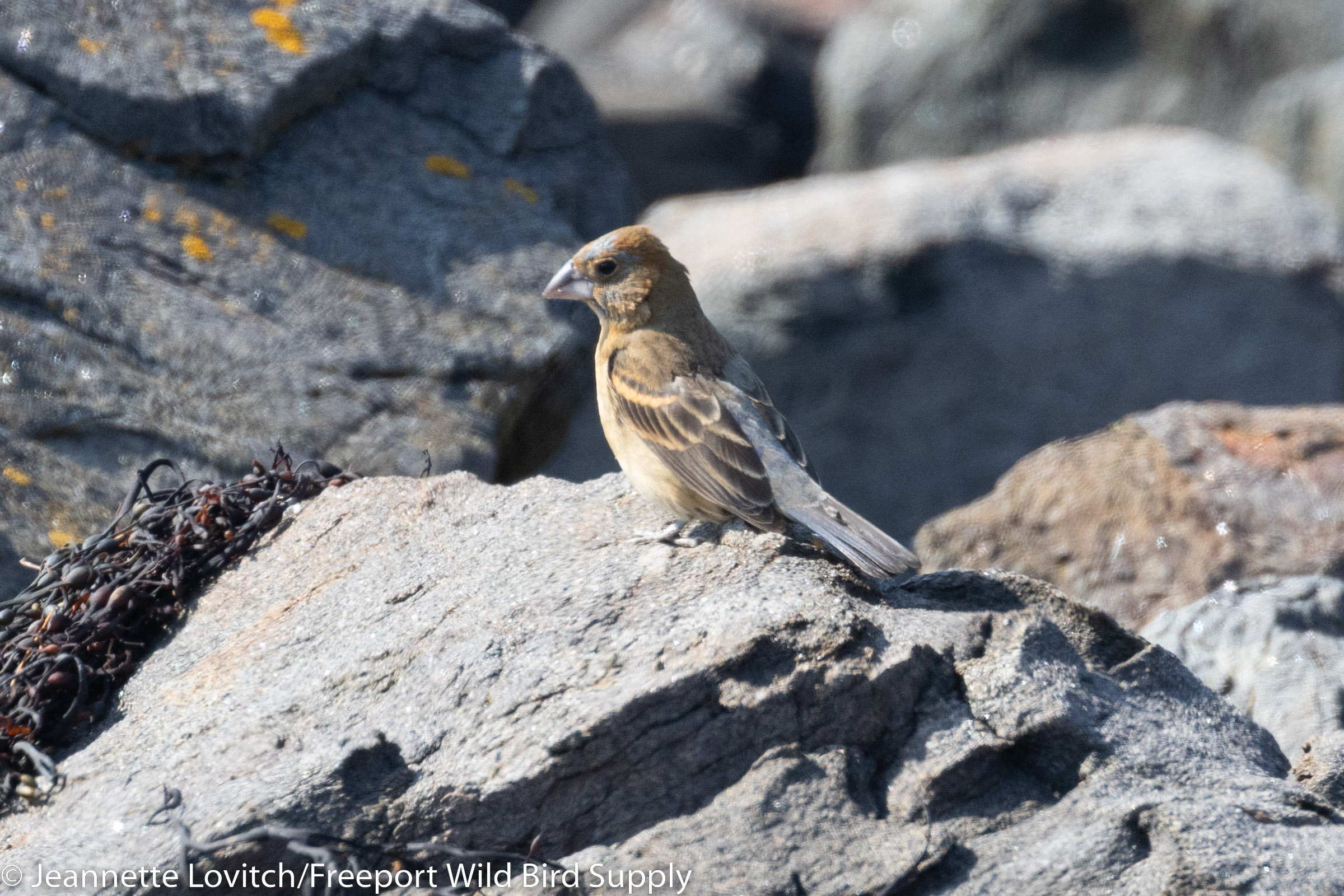
This first summer male Blue Grosbeak was present on Monhegan for at least a week, and unexpectedly, was flycatching for seaweed flies in shoreline rocks for most of the time, including the two days we looked at it with my Monhegan Spring Migration Weekend tour group.
With 5 days on Monhegan and one (half) day offshore, I enjoyed a lot of great birds this week. My observations of note over the past seven days included:
Monhegan Island with our Monhegan Spring Migration Weekend Tour group (full trip report and photos to come).
Daily:
Impressive numbers of Red Crossbills swirling around the island and tough to quantify, including many juveniles. High counts of largest flock(s) in the mid-20’s. Three WHITE-WINGED CROSSBILLS were present each day at least through the end of the weekend. Rare for the island, a pair of HOUSE FINCHES appeared on the 27th and continued through the end of our stay. Here are my group’s other daily highlights.
5/26:
11 Bay-breasted Warblers (FOY)
1 Cape May Warbler (FOY)
1 female Evening Grosbeak
1 Black-billed Cuckoo
1 continuing ORCHARD ORIOLE
1 Philadelphia Vireo (FOY)
5/27:
1 continuing male DICKCISSEL
1 continuing female/imm male SUMMER TANAGER
1 female ORCHARD ORIOLE
1 Olive-sided Flycatcher (FOY)
5/28:
9 GLOSSY IBIS – circled the island early in the morning but did not land. My 225th Island Bird!
1 probable immature male PURPLE MARTIN
1 continuing 1st-year male BLUE GROSBEAK
1 immature BROAD-WINGED HAWK
1 continuing male DICKCISSEL
5/29:
1 pair ORCHARD ORIOLES
1 continuing SNOWY EGRET – Jeannette and I finally caught up with it for my 226th Island Bird!
1 continuing 1st year male BLUE GROSBEAK
5/30 (With Jeannette):
1 continuing male ORCHARD ORIOLE
1 Field Sparrow
Did not try to catch up with continuing rarities, although two quick checks did not turn up the Dickcissel or the Blue Grosbeak.
The Zeiss Pelagic with Cap’n Fish’s Cruises out of Boothbay Harbor, 6/2. This special mini-pelagic, sponsored by Zeiss Optics visited Eastern Egg Rock before heading 20 miles offshore. Trip report to come, but for now, the highlights:
1 Razorbill at Eastern Egg Rock
1 COMMON MURRE (between Eastern Egg Rock and Murray Hole)
350-400 total Wilson’s Storm-Petrels (FOY)
12 RED-NECKED PHALAROPES
TOURS AND EVENTS:
I’ll see you next week at the Rangely Birding Festival! Most (but not all) tours are sold out, but everyone can join me for the free and open to the public Birds on Tap! Event at Parkside and Main (beverages not included)!
With my guiding season now in full swing, I have no choice but to be out in the field a lot, regardless of my shoulder situation. And with much finer weather and some good nights of especially Saturday and Thursday nights, the arrivals of migrants caught up to the date quite rapidly. Many new arrivals – as well as a lot of personal first-of-years since I had not been getting out much – resulted in a nice long list of highlights for me -and my clients – over the past 7 days.
My observations of note over the past seven days included:
10 Greater Yellowlegs, our property in Durham (thanks to a flood in our field), 5/5 diminishing to 3 by 5/7.
250-300++ White-throated Sparrow in impressive fallout, Evergreen Cemetery, Portland, 5/8 (with client from Spain).
1 female Red Crossbill, Evergreen Cemetery, 5/8 (with client from Spain).
10 species of warblers, Evergreen Cemetery, 5/8 (with client from Spain). This tied my latest date for reaching 10 species at one place in one morning for the first time of the season.
1 WHITE-WINGED SCOTER (looking very out of place) and a pair of RUDDY DUCKS, Sanford Lagoons, Sanford, 5/8 (with clients from Spain and Maine).
1 drake Northern Shoveler, Dunstan Landing, Scarborough Marsh, 5/8 (with clients from Spain and Maine).
1 pair LOUISIANA WATERTHRUSH, Morgan Meadow WMA, Gray/Raymond, 5/11 (with clients from Spain and Maine).
1 BLUE-GRAY GNATCATCHER, Florida Lake Park, Freeport, 5/11 (with clients from Spain and Maine).
The long list of my personal FOY’s this week also included:
1 Ovenbird, Florida Lake Park, 5/6 (with Saturday Morning Birdwalk group).
1 Nashville Warbler, Evergreen Cemetery, 5/8 (with client from Spain).
3 Chimney Swifts, Evergreen Cemetery, 5/8 (with client from Spain).
2 Yellow Warblers, Evergreen Cemetery, 5/8 (with client from Spain).
1 American Redstart, Evergreen Cemetery, 5/8 (with client from Spain).
1 Green Heron, Evergreen Cemetery, 5/8 (with client from Spain).
1 Black-crowned Night-Heron, Evergreen Cemetery, 5/8 (with client from Spain).
1 Chestnut-sided Warbler, Evergreen Cemetery, 5/8 (with client from Spain).
1 Prairie Warbler, Evergreen Cemetery, 5/8 (with client from Spain).
20+ Field Sparrows, Kennebunk Plains, 5/8 (with clients from Spain and Maine).
3 Vesper Sparrows, Kennebunk Plains, 5/8 (with clients from Spain and Maine).
1 Eastern Meadowlark, Kennebunk Plains, 5/8 (with clients from Spain and Maine).
2 Solitary Sandpipers, Sanford Lagoons, 5/8 (with clients from Spain and Maine).
1 Spotted Sandpiper, Sanford Lagoons, 5/8 (with clients from Spain and Maine).
1 Least Tern, Pelreco Marsh, Scarborough Marsh, 5/8 (with clients from Spain and Maine).
30+ Common Terns, Pine Point, Scarborough, 5/8 (with clients from Spain and Maine).
4-6 ROSEATE TERNS, Pine Point, 5/8 (with clients from Spain and Maine).
1 Eastern Kingbird, Dunstan Landing, Scarborough Marsh, 5/8 (with clients from Spain and Maine).
1 Northern Waterthrush, Florida Lake Park, 5/9.
1 Black-throated Blue Warbler, Florida Lake Park, 5/9.
1 Northern Rough-winged Swallow (finally, extremely late for my first of the year, and this one was not due to lack of visitation of its habitats), Florida Lake Park, 5/9.
1 Veery, Florida Lake Park, 5/9.
1 Cliff Swallow, Florida Lake Park, 5/9.
1 Ruby-throated Hummingbird, our yard in Durham, 5/9.
1 White-crowned Sparrows, feeders here at the store, 5/10.
14 Least Flycatchers, Morgan Meadow WMA, 5/11 (with clients from Spain and Maine).
2 Great Crested Flycatcher, Morgan Meadow WMA, 5/11 (with clients from Spain and Maine).
3-4 YELLOW-THROATED VIREOS, Morgan Meadow WMA. 5/11 (with clients from Spain and Maine).
1 Scarlet Tanager, Morgan Meadow WMA, 5/11 (with clients from Spain and Maine).
1 Warbling Vireo, Durham River Park, Durham, 5/11 (with clients from Spain and Maine).
1 Bank Swallow, Florida Lake Park, Freeport, 5/11 (with clients from Spain and Maine).




 Maine Birding Field Notes