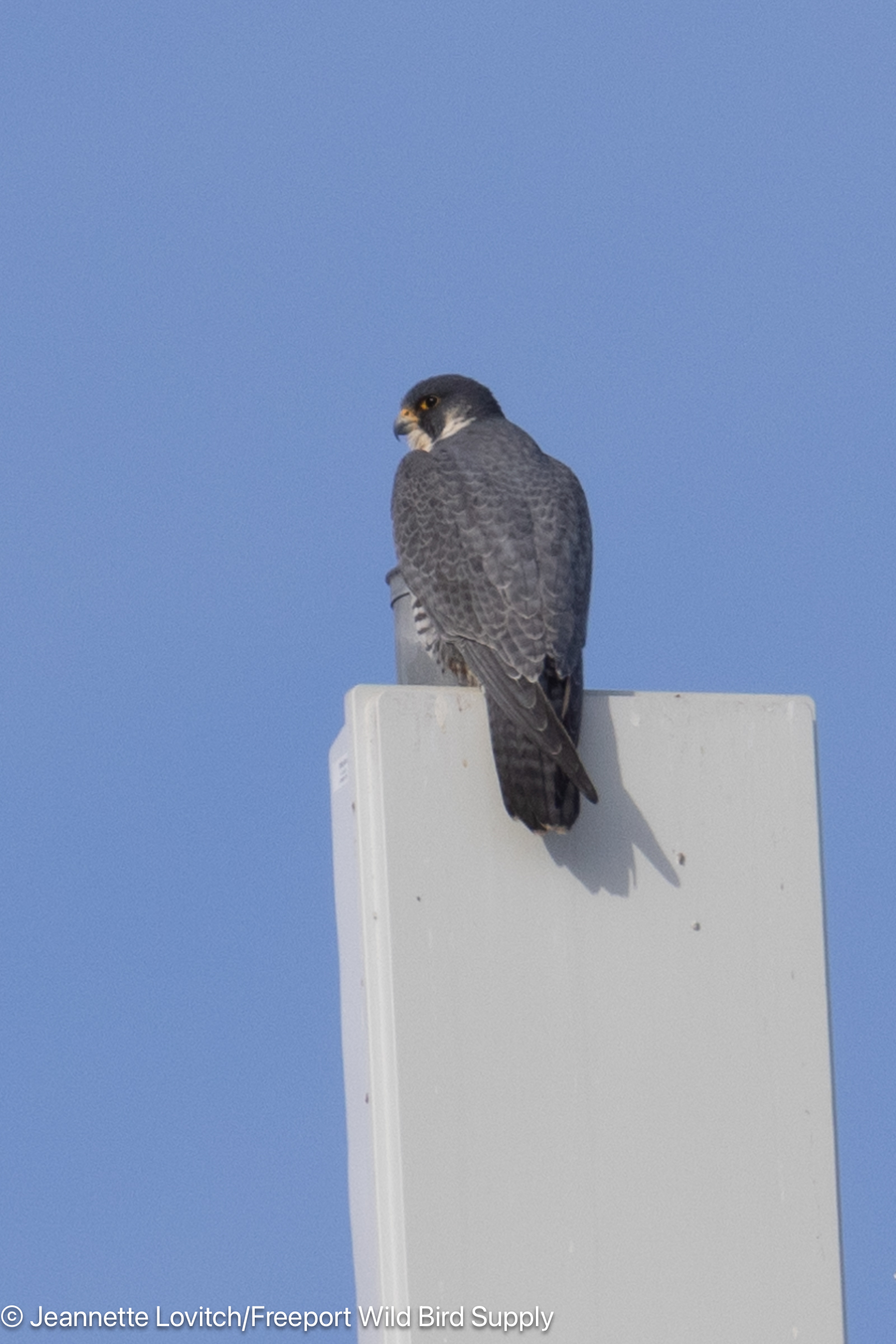
The pair of Peregrine Falcons that have been overwintering in Lewiston-Auburn for the past decade or so continue to frequent the area around the Bernard Lown Peace Bridge and Cedar Street, as here on the 10th.
I’ve been spending extended time feeder watching at home in preparation for my upcoming annual “Feeder Birds in Winter” snapshot blog. Unfortunately, we are not being frequented by as many winter finches as a lot of people are right now, but it’s been an interesting project once again. I’ll have a blog posted in the coming days. A few birding mornings elsewhere yielded some following observations of note.
1 pair Barrow’s Goldeneye, Winslow Park, Freeport, 2/13.
At least one Turkey Vulture continues along the I-295 corridor between Cumberland and Freeport as of this week.
This Week in Irruptives.
An absolutely incredible Saturday Morning Birdwalk on the 7th included a most-unexpected tally of 7 species of winter finches – which was wholly unexpected given the dearth of most finches locally! The “Winter Finch Big Day” that developed was actually a secondary goal, with the original one: 20 species of birds in Freeport, west of I-295 only (and therefore no open water) also being reached. This was an outing that will not soon be forgotten. Highlights included 8 PINE GROSBEAKS and 26 COMMON REDPOLLS at Hidden Pond Preserve in Freeport and 16 EVENING GROSBEAKS at the Old Brunswick Road/Ross Road intersection in Durham. We also had Pine Siskins at two locations, two feeders full of Purple Finches, and of course found some House Finches and American Goldfinches to pad the list. Full trip report can be seen here.
Purple Finches have increased overall this week, and Evening Grosbeaks continue to be around, but rather sporadic. One Pine Siskin flew over our Durham yard on the 12th.
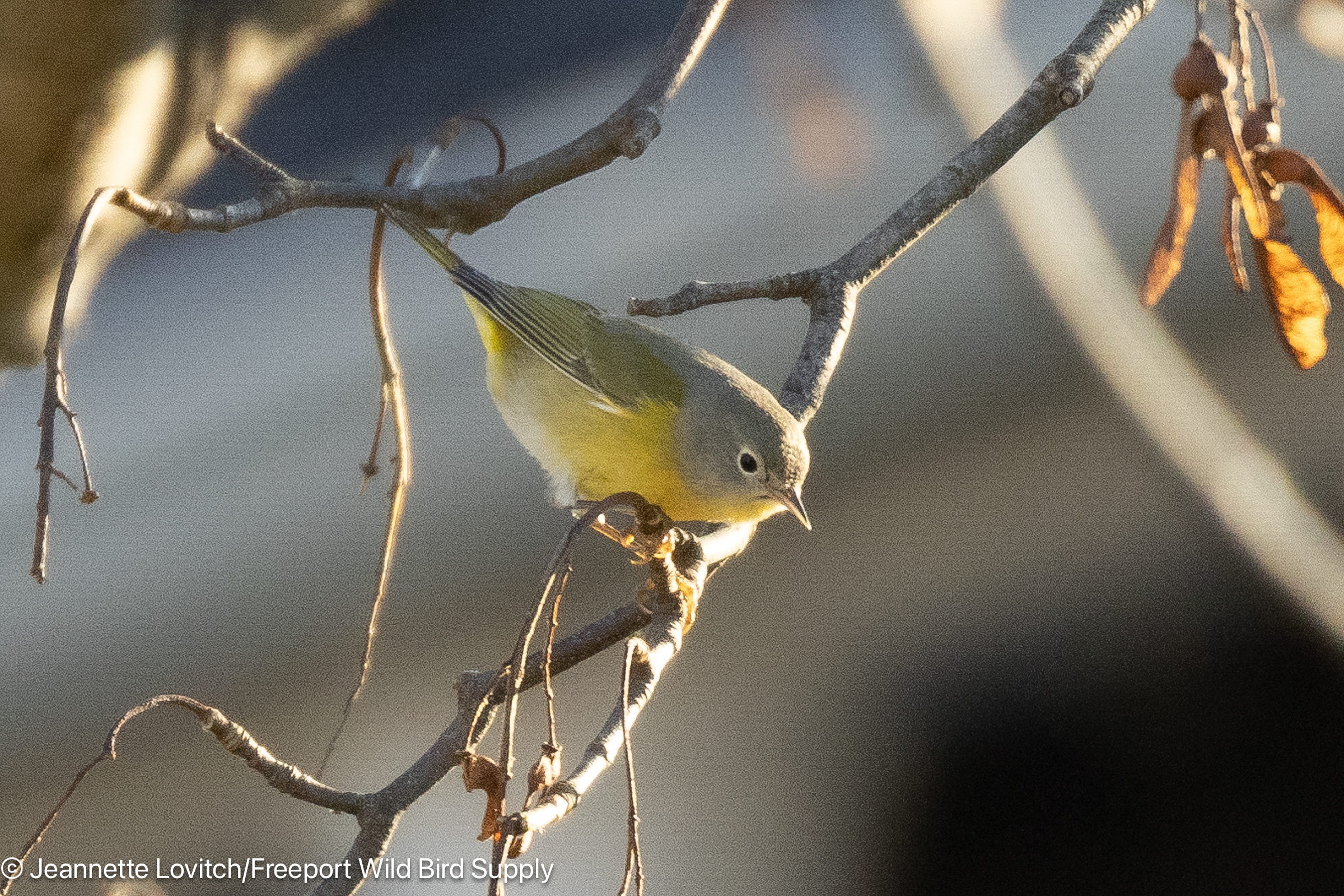
This Nashville Warbler (above) was one of two still on Peak’s Island as of the 1st, and this Orange-crowned Warbler (below) was one of four or five still on the island. Orange-crowned Warblers are pretty hardy, but if the Nashvilles are still hanging on, they would be questioning their life decision this morning! Speaking of, best wishes, wherever you are, to the Virginia’s Warbler that has not been seen since the 11/29.
Well, winter set in rather quickly this week, didn’t it? And no doubt much to the chagrin of the many vagrants, “pioneers,” and “half-hardies” that we have been enjoying recently. Despite the widespread below-zero temperatures by week’s end, I still saw four species of warblers this week. But I won’t expect that next week. Here are my observations of note over the past seven days.
2 continuing NASHVILLE WARBLERS, 3 Orange-crowned Warblers (at least 2 continuing), and 1 continuing COMMON YELLOWTHROAT, but no sign of the Virginia’s, Peak’s Island, Portland, 12/1 (with Jeannette. Photos above).
1 1st cycle Iceland Gull, Maine State Pier, Portland, 12/1 (with Jeannette).
1 ad. Red-shouldered Hawk, Ann St, Lisbon Falls, 12/4 (with Bill Thompson).
2 WILSON’S SNIPE and 4 Lesser Scaup, Lake Auburn, 12/4 (with Bill Thompson).
1 Fish Crow, Anniversary Park, Auburn, 12/4 (with Bill Thompson). 2-4 Fish Crows have been reliable here since April, including in the past few weeks.
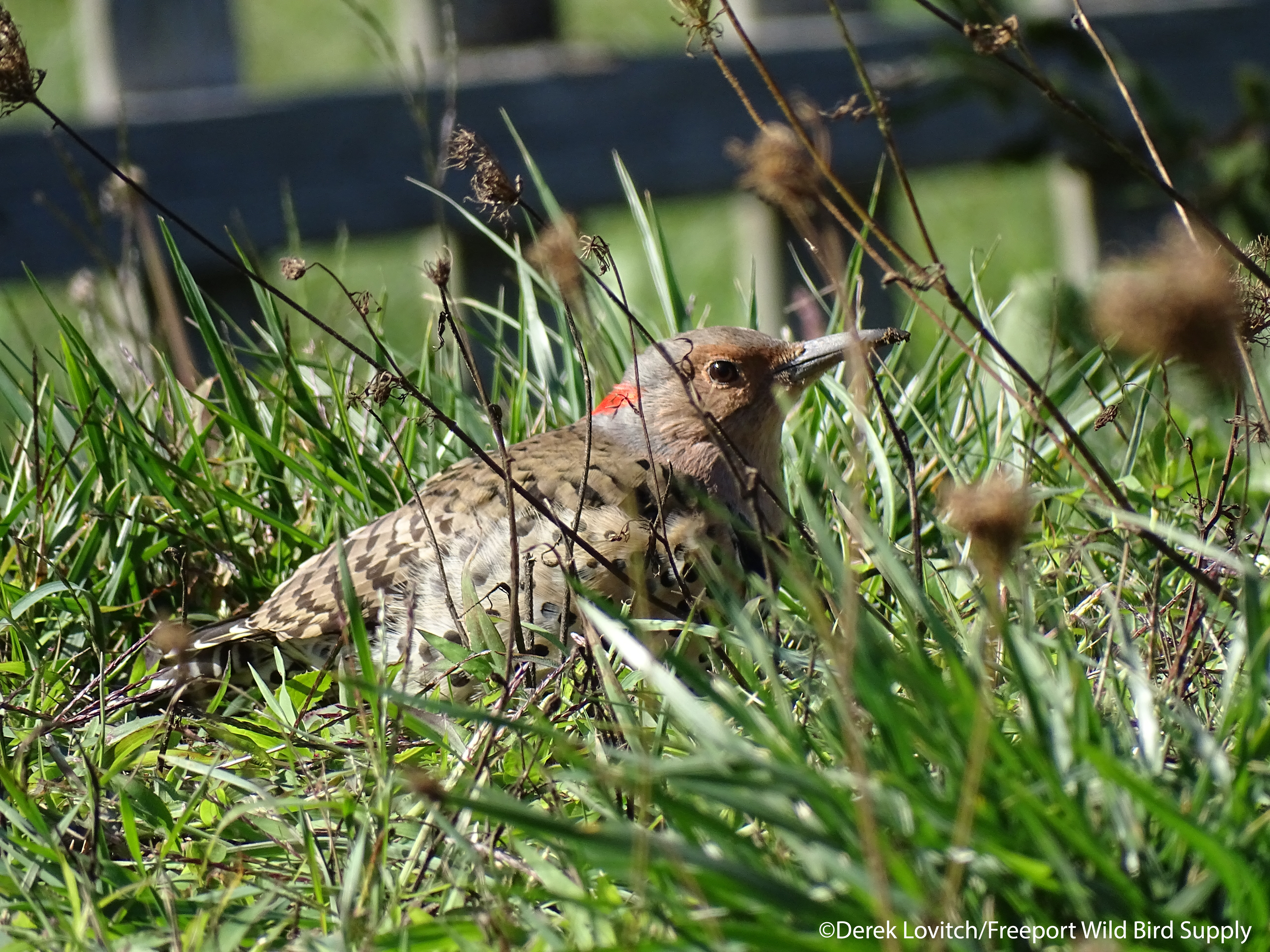
1 Northern Flicker, our feeders in Durham, 12/4.
Scattered Evening Grosbeaks and Red Crossbills continue in the area this week as well.
The Peregrine Falcon pair of Lewiston-Auburn is back to frequenting their favorite winter perches, such as this rooftop tower near the Bernard Lown Peace Bridge. One of the pair had returned here after taking a run at a Bald Eagle.
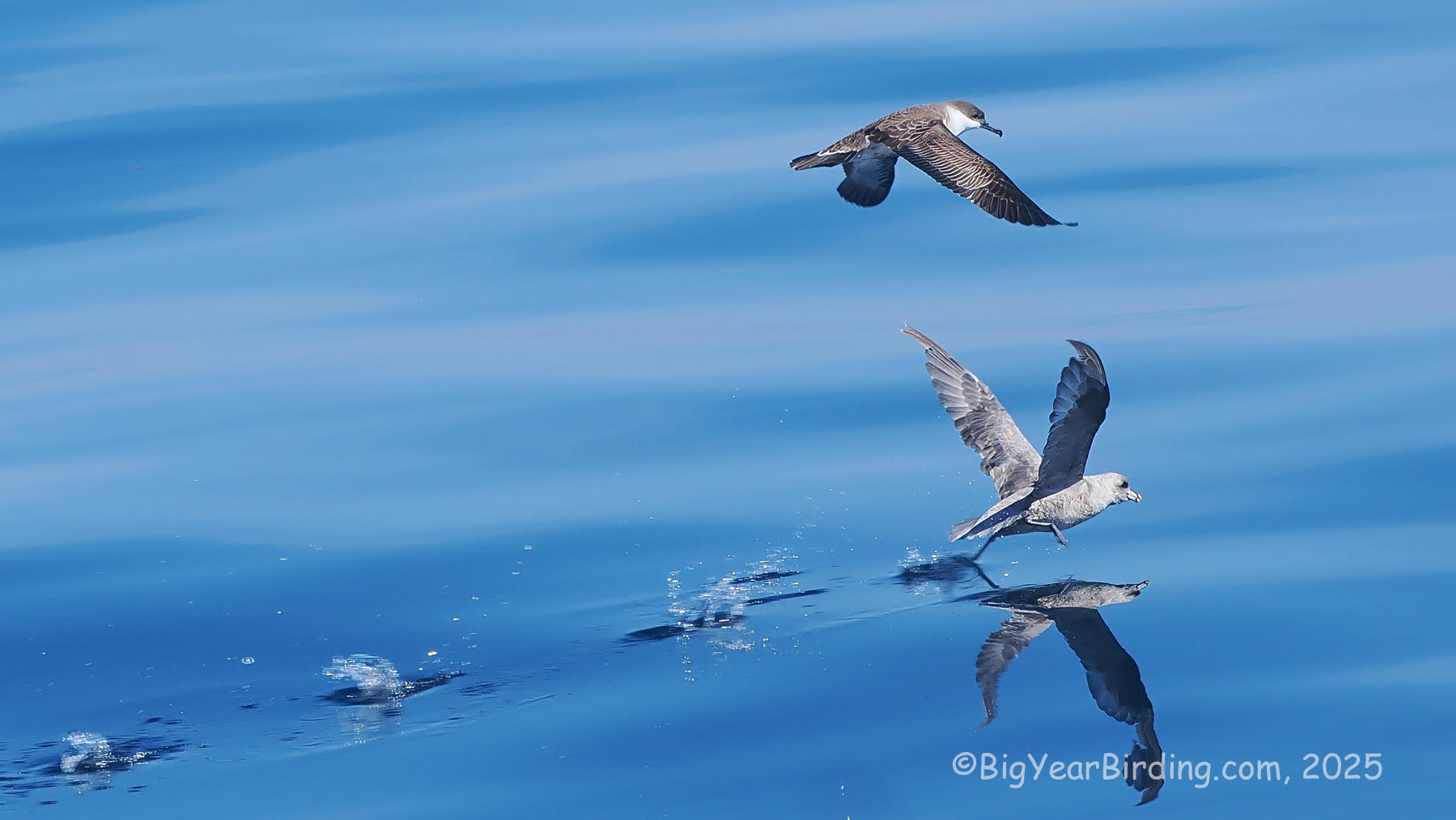
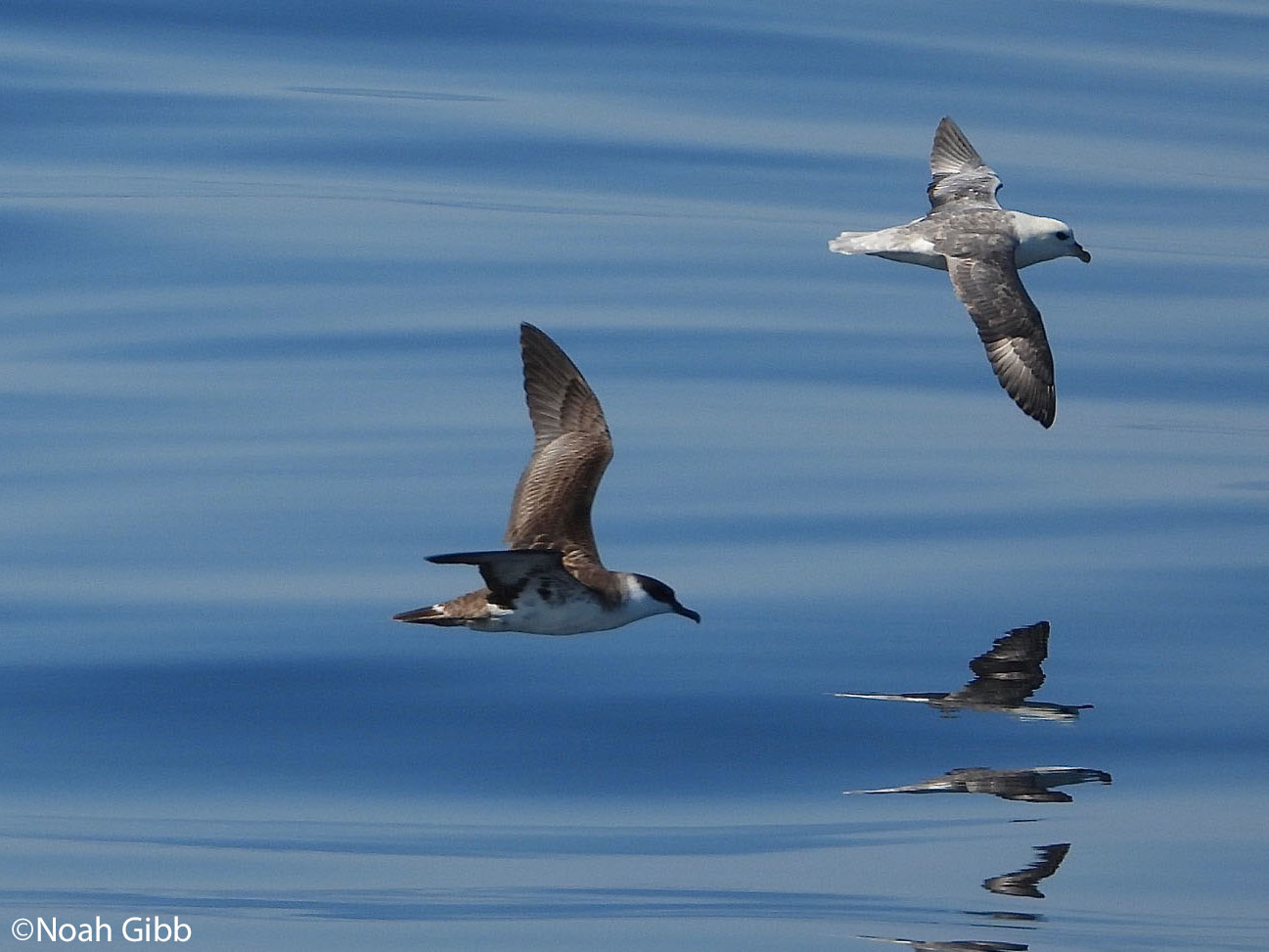
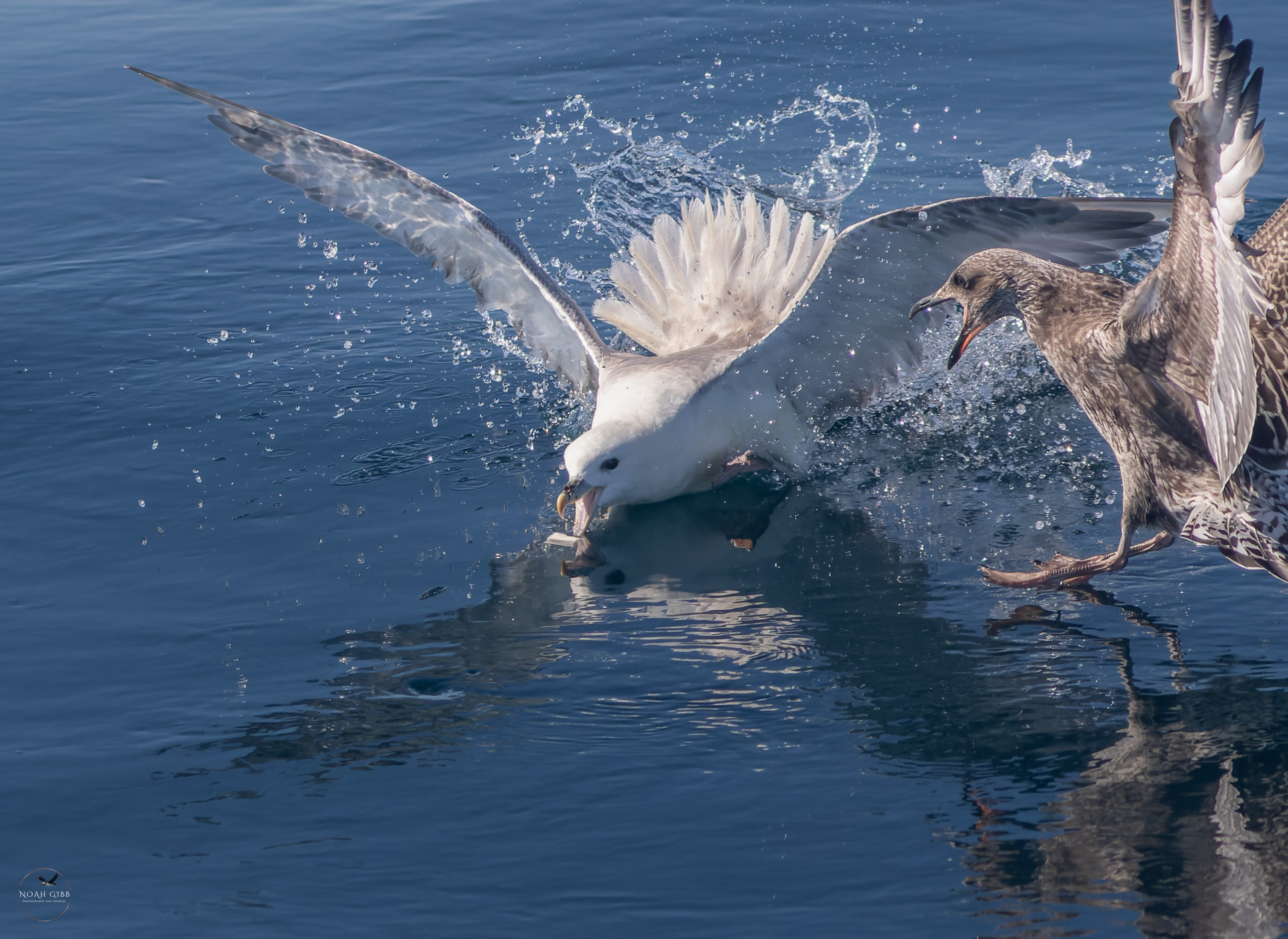
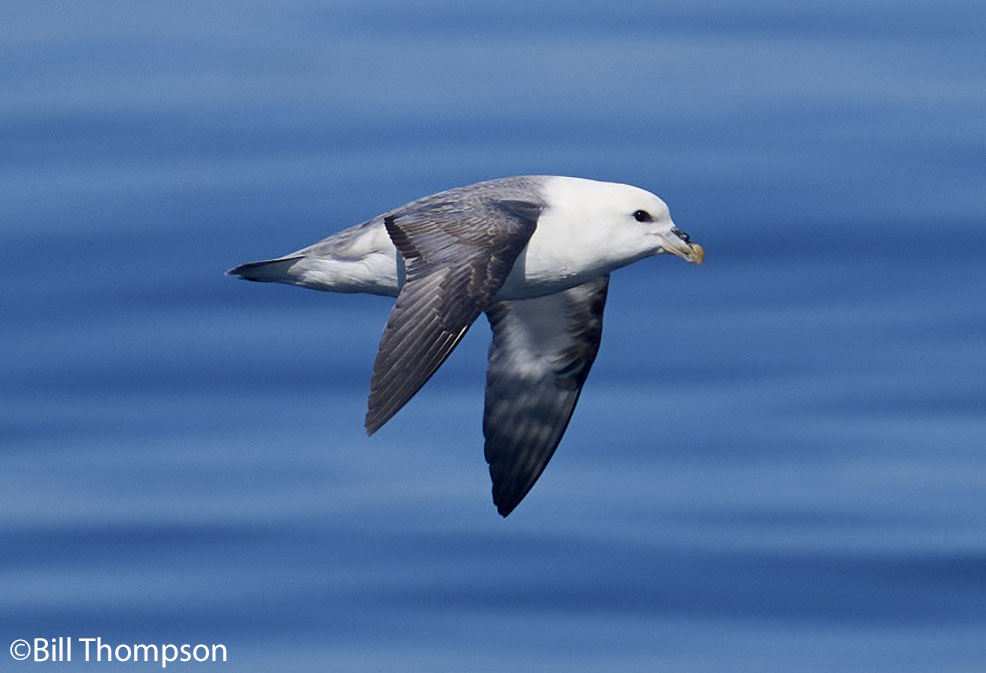
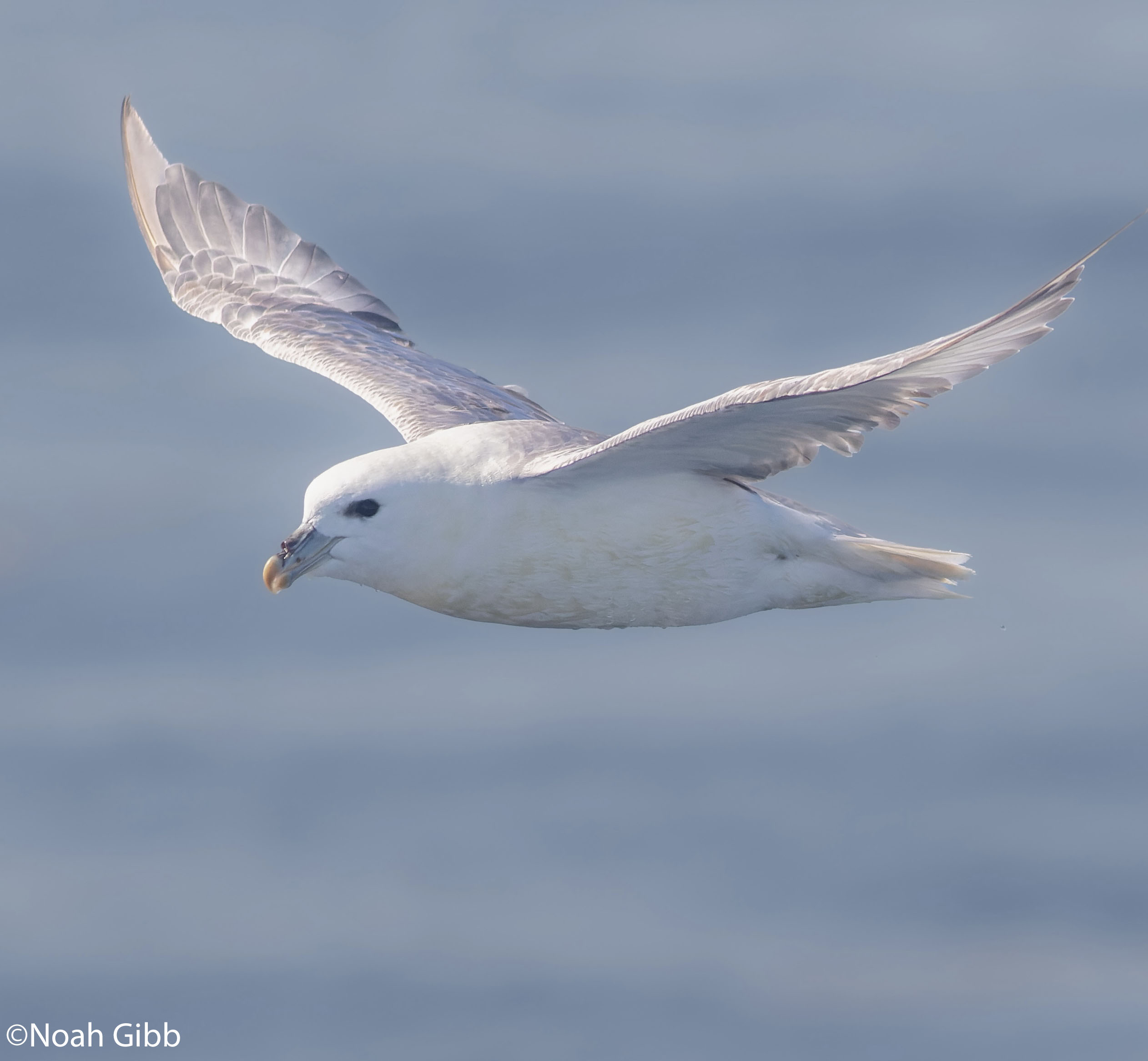
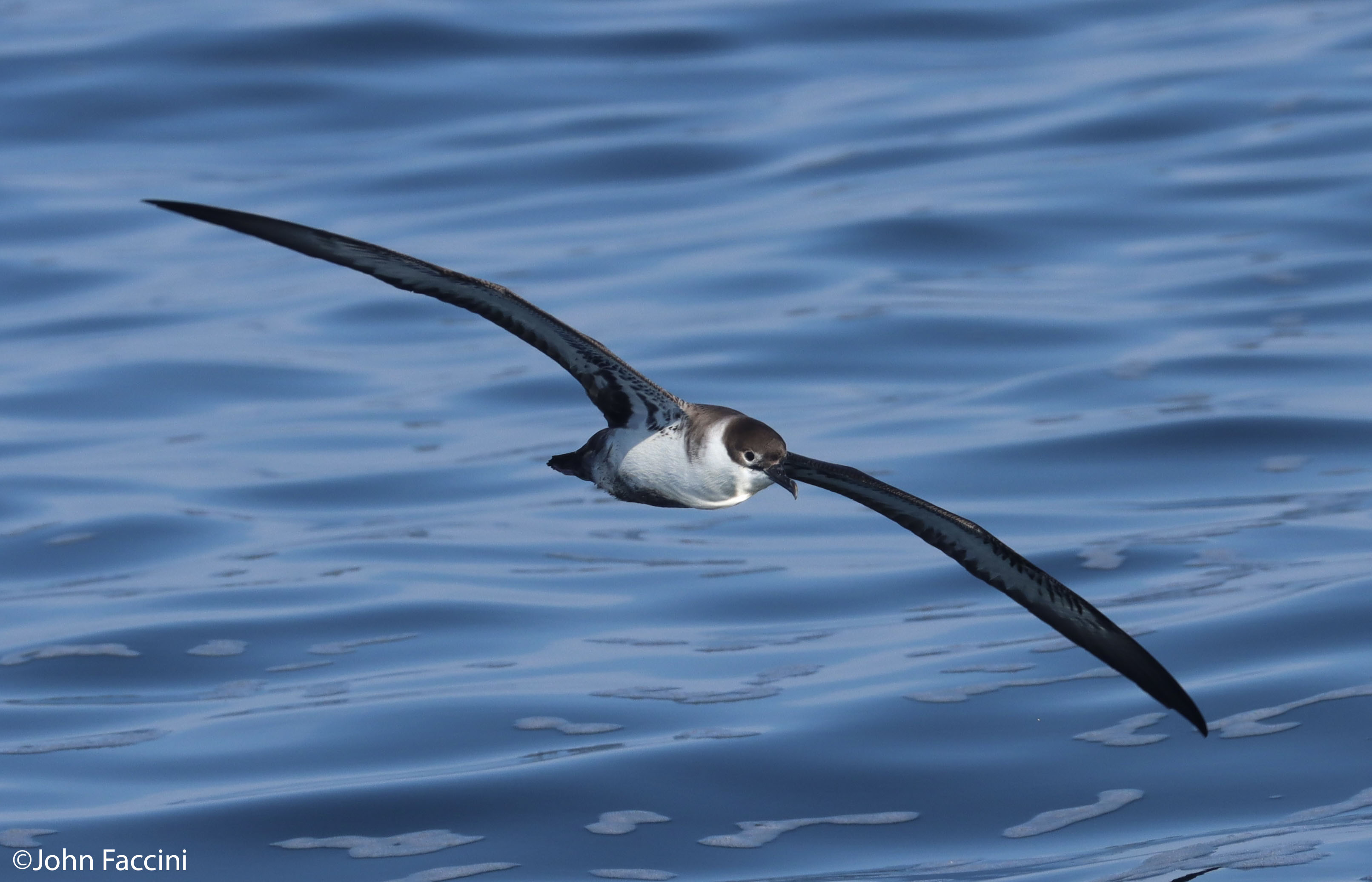
Considering most people would have been happy with a single Northern Fulmar, our tally of at least 18 was fantastic…but the photo opportunities of this winter visitor could not be beat, including of this much less common dark morph.
Fall pelagics in the Gulf of Maine are notoriously hit or miss. Suffice to say, our Half-Day Pelagic out of Boothbay Harbor on 10/5, with our partner, Cap’n Fish’s Cruises, was most definitely a hit!
And not just because of the ridiculously pleasant weather! The birding was great, the marine mammals were fantastic, and I don’t think a single person was seasick! What a difference a year makes.
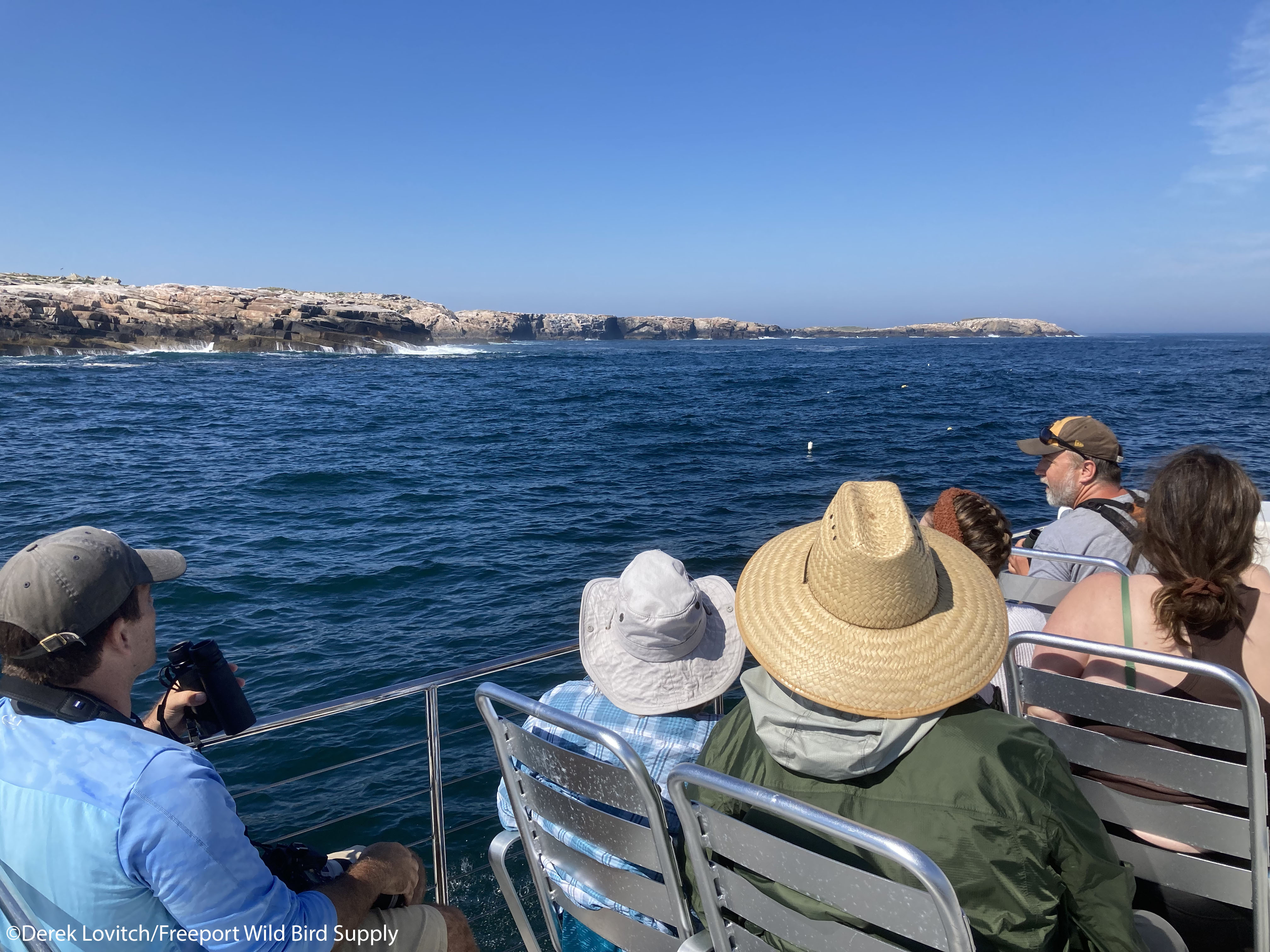
We departed the harbor at 9:00am, with clear and calm skies, less than a foot of swell offshore, and high hopes (I had a productive scouting trip on a whale watch two days prior). But even with the always-lofty expectations of pelagic trips, we would not be disappointed this day.
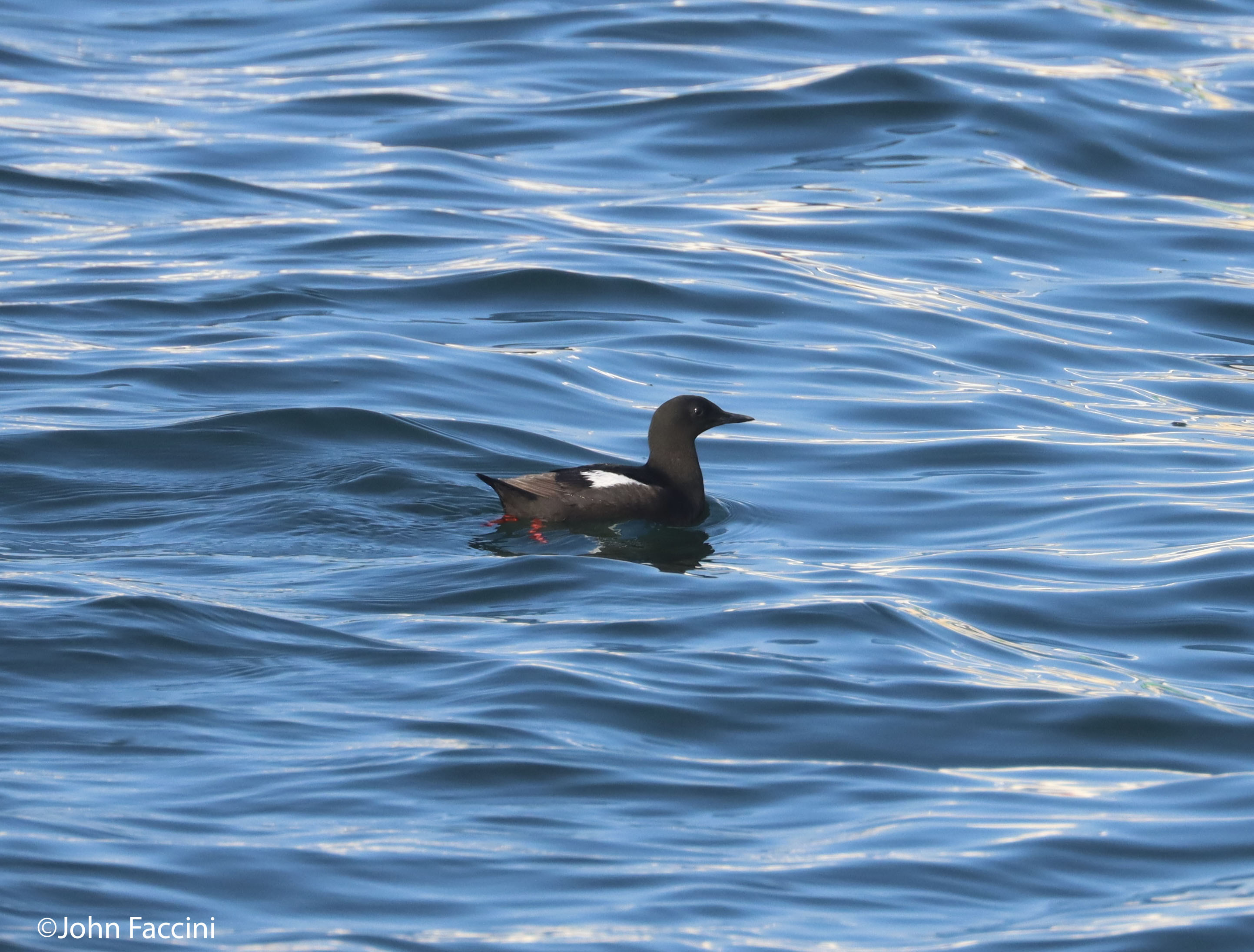
Black Guillemots are always a nice way to begin and end all of our local pelagic trips since they are usually only seen in inshore waters.
Perhaps the one complaint I had was that we didn’t get all that far offshore! In fact, our furthest point was only about 20 miles south-southwest of Monhegan. There was just too much to look at, and every time we were about to head further offshore, something else of note appeared.
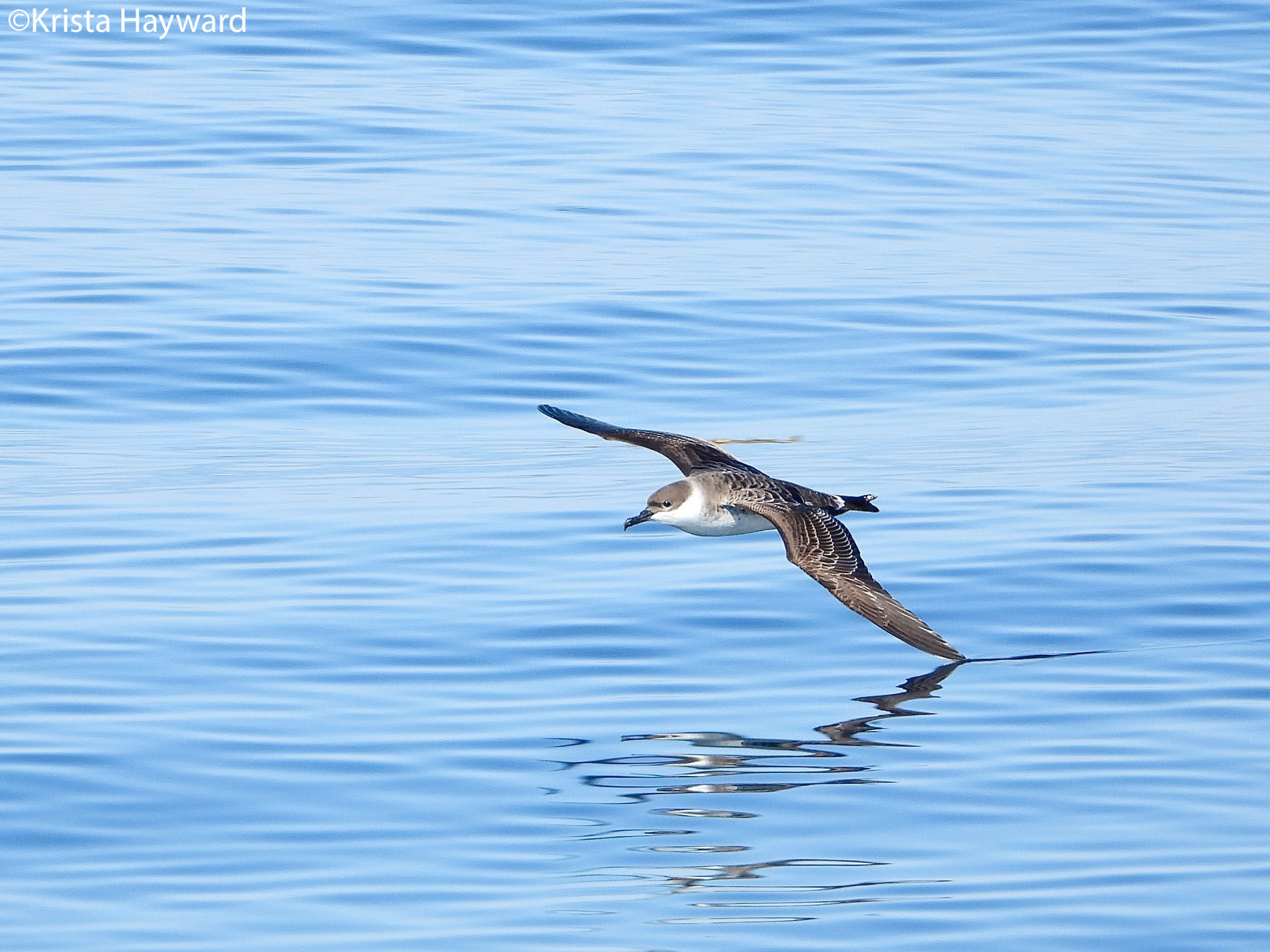
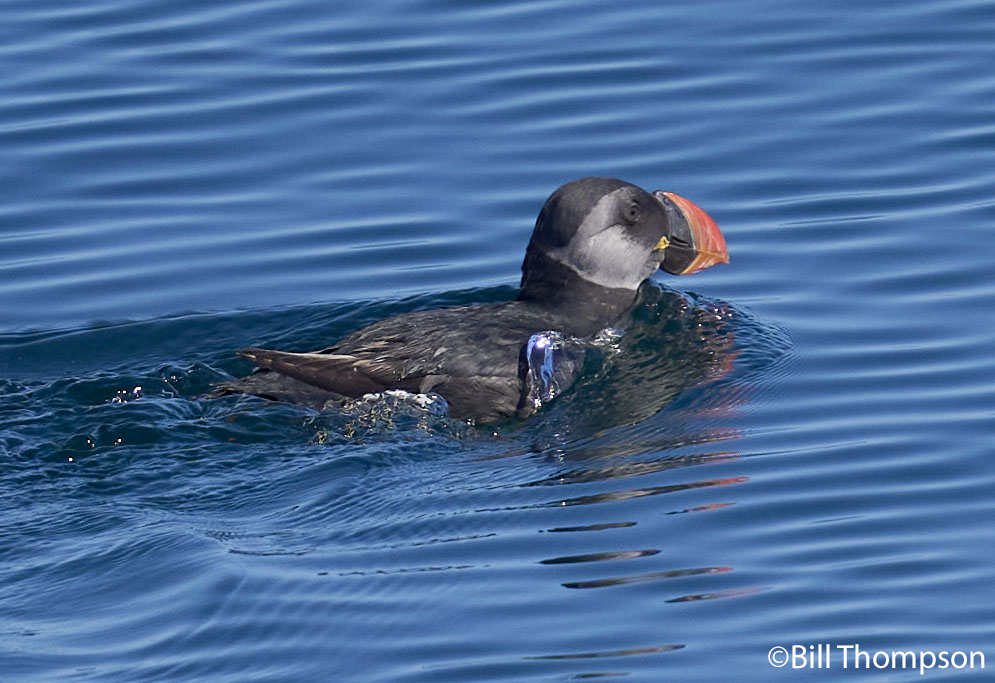
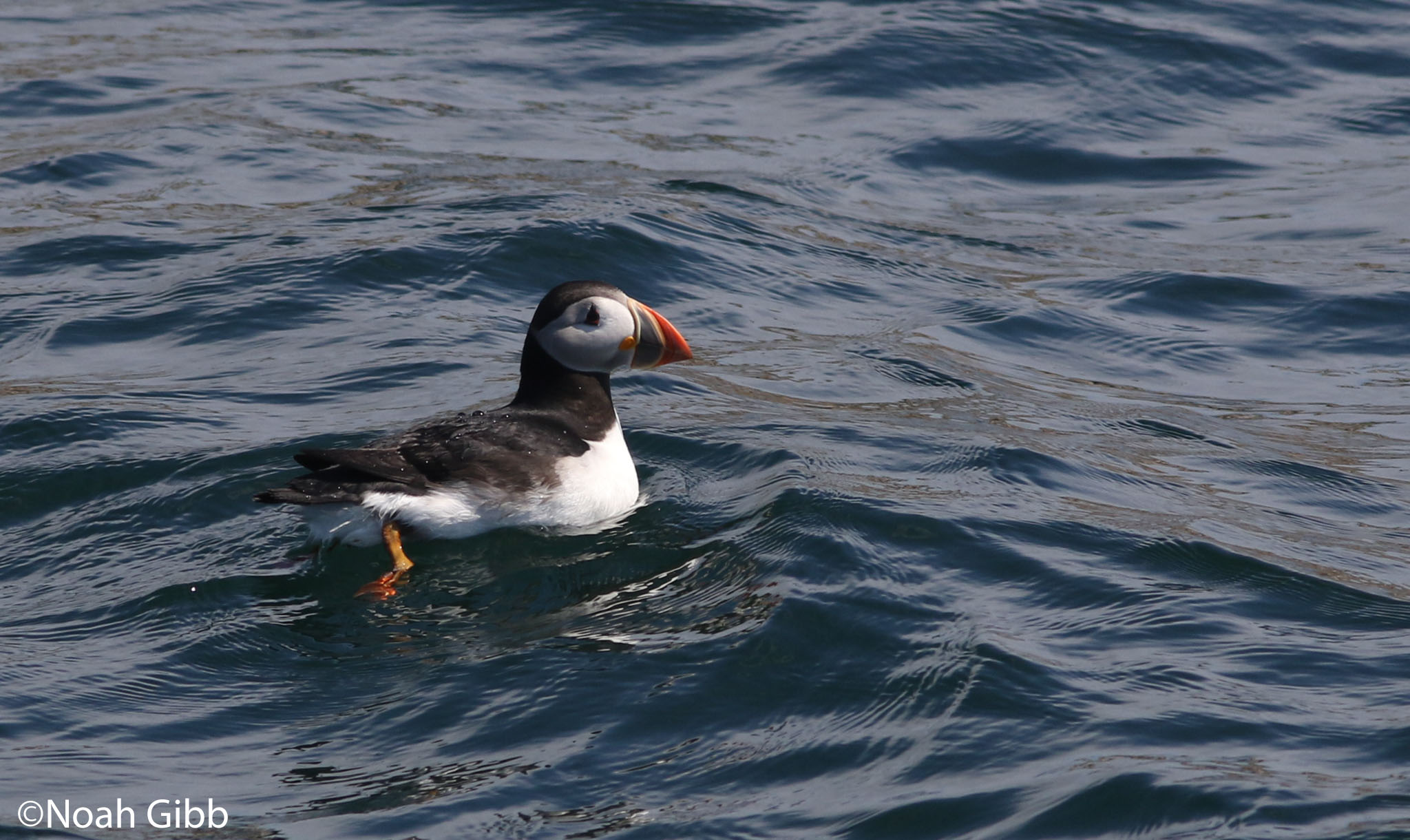
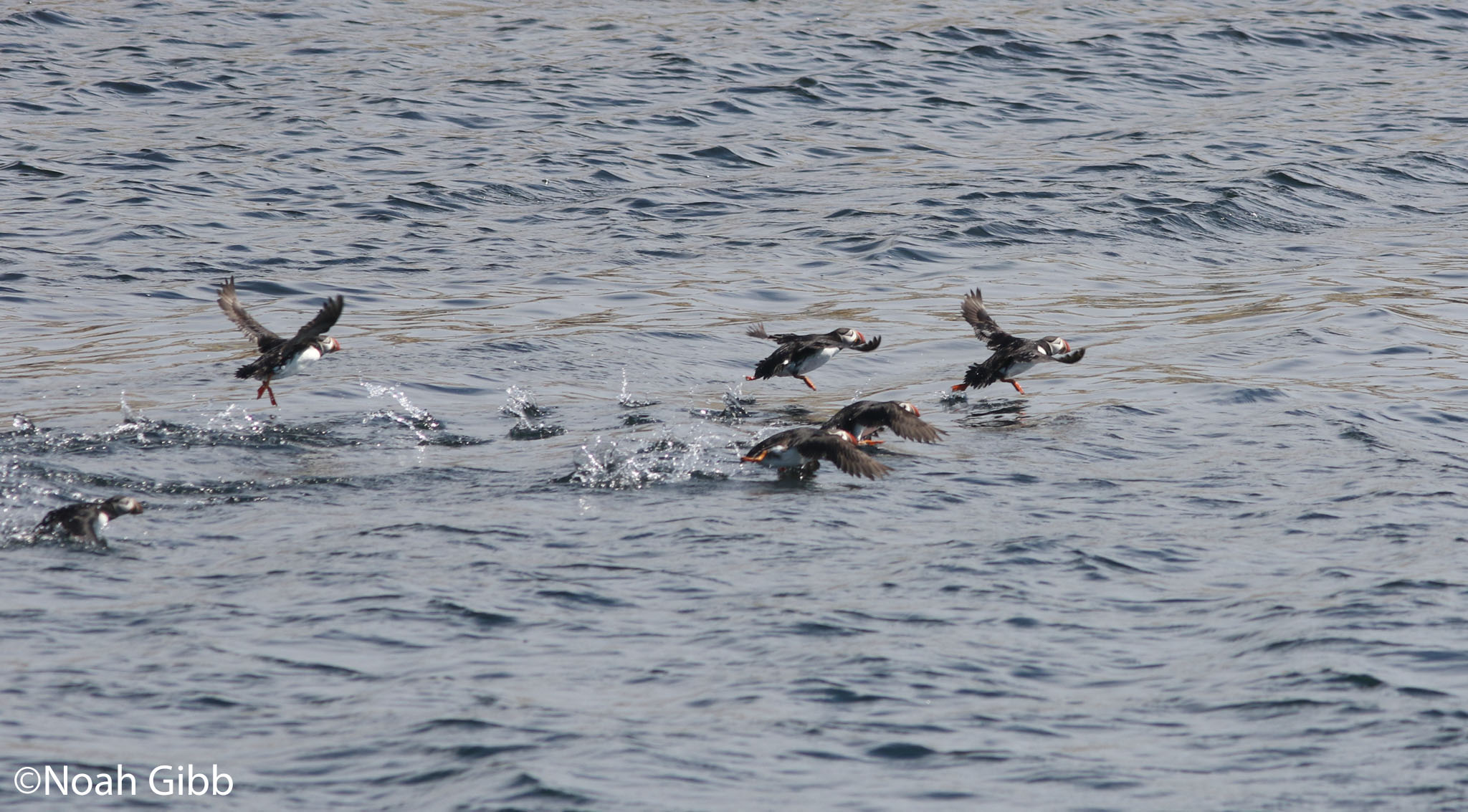
We started picking up a few seabirds, including our first of what would be a remarkable total of mostly juvenile Atlantic Puffins, the first of our sought-after Northern Fulmars, scattered Red-necked Phalaropes (mostly), along with a few Great Shearwaters, all around Murray Hole, but we hit paydirt right around the edge of the incoming shipping channel to Portland.
Great Shearwaters and Northern Fulmars were constant companions in our deeper water time.All of the photographed phalaropes so far that we encountered were Red-necked Phalaropes, so the checklist has been adjusted accordingly, even though we believe we had some Reds over the course of the trip.
There, in about 500-600 feet of water (but otherwise “in the middle of nowhere”), our chum slick of fish oil and pork fat (generously donated by Durham’s Old Crow Ranch!) worked its magic. Will Broussard, with both the honor and burden of his first time as Chummer, was the hero, bringing Northern Fulmars and Great Shearwaters in for close looks.]
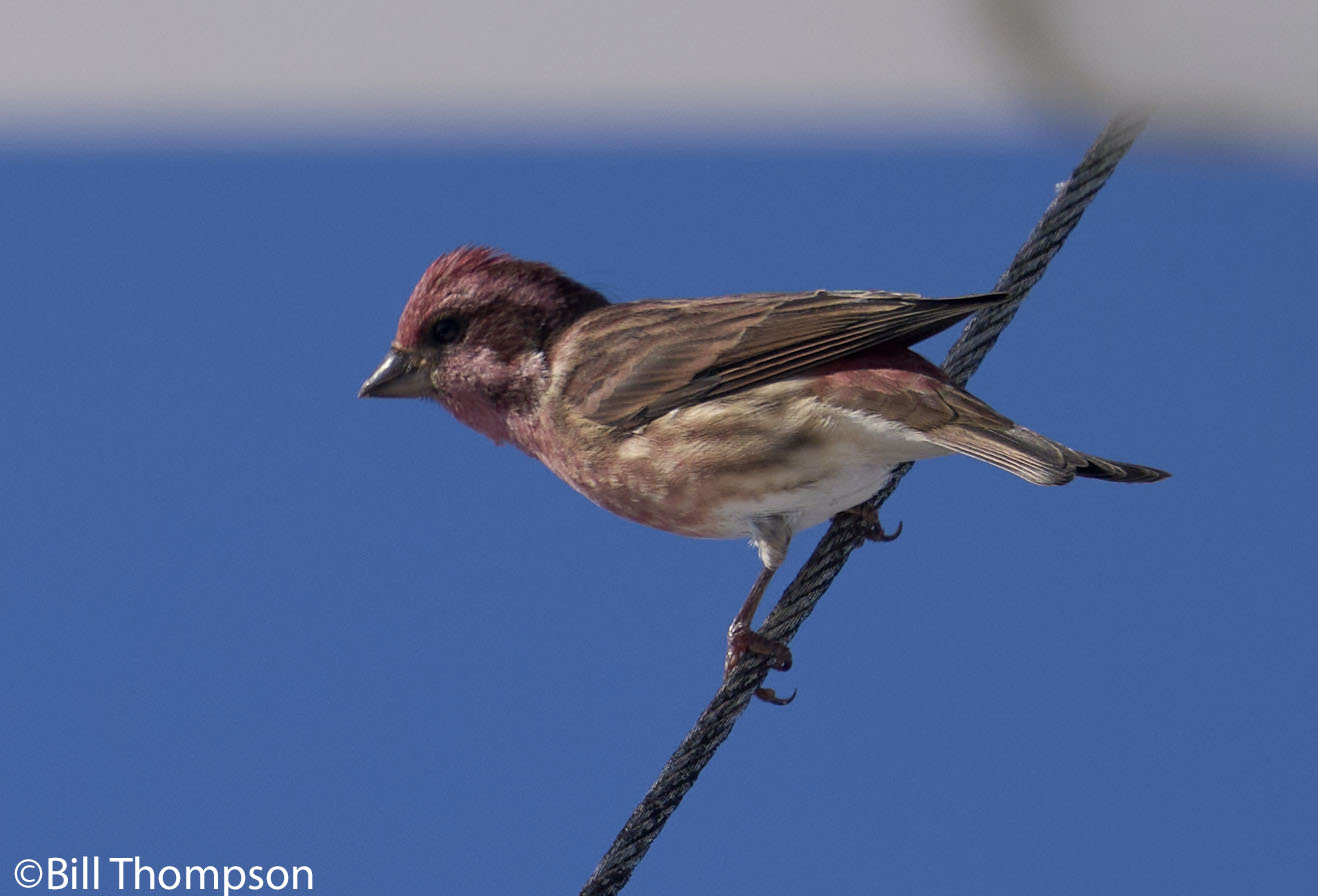
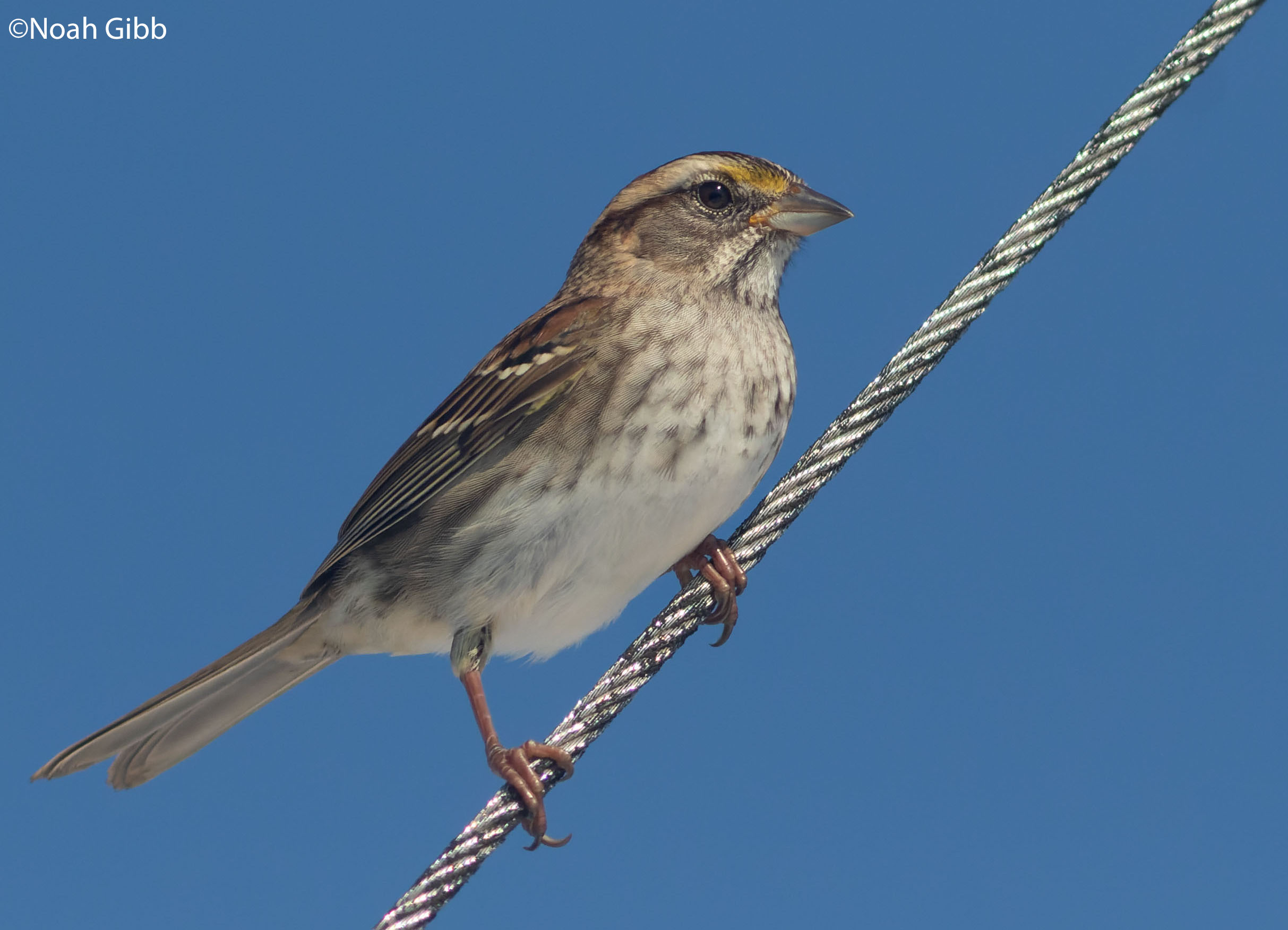
Passerines would appear on occasion, a total of somewhere between 4 and 8 White-throated Sparrows, including one that rode right back to port with us in the cabin. A male Purple Finch took a break on the boat, resting and preening on our radar, as a female did later. Passerines are always a fun addition to a pelagic birding experience.
Less fun, perhaps, but most amazing and insightful, however, was watching a Peregrine Falcon chasing a passerine, driving it into the water, and then, unable to snatch it off the surface, moved on, leaving an Ovenbird helpless on the ocean’s surface, likely becoming waterlogged and hypothermic. It was impossible for us not to, so we attempted a water rescue, with the crew putting in a valiant effort to save the hapless warbler. Unfortunately, it perished, but we had to try!
This might be one of the most incredible photos of non-pelagics ever taken on a pelagic. Awesome work, Bill!
Repeated sightings of Atlantic Puffins continued to surprise us, and we spent some time with two different Fin Whales, including getting to see one doing a little lunge-feeding. While we looked at whales, birds were all around us, thanks to the chum, so we had something for everyone.
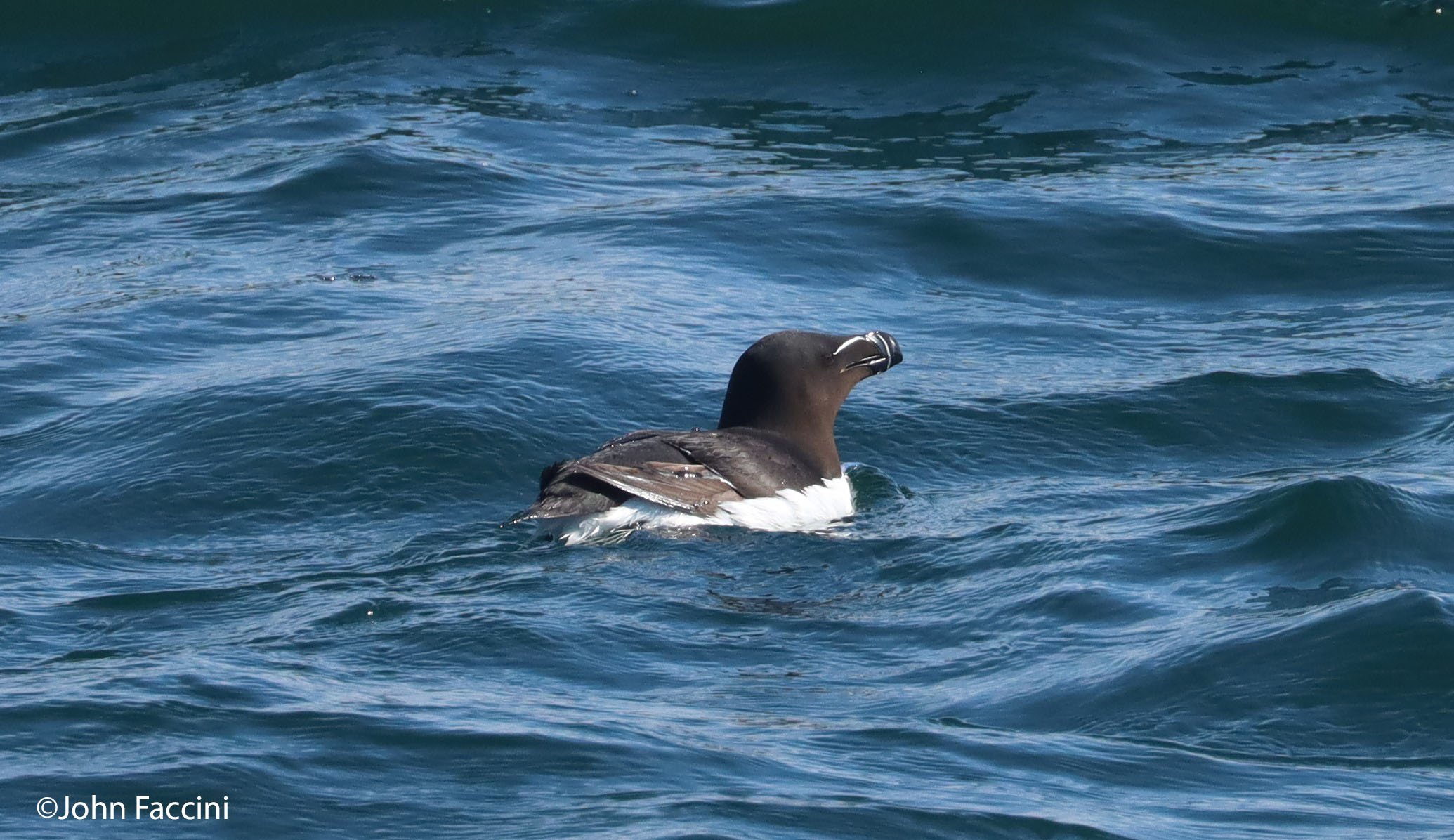
A big and bright-billed adult Atlantic Puffin.Both of our Razorbills were hanging out with juvenile puffins.
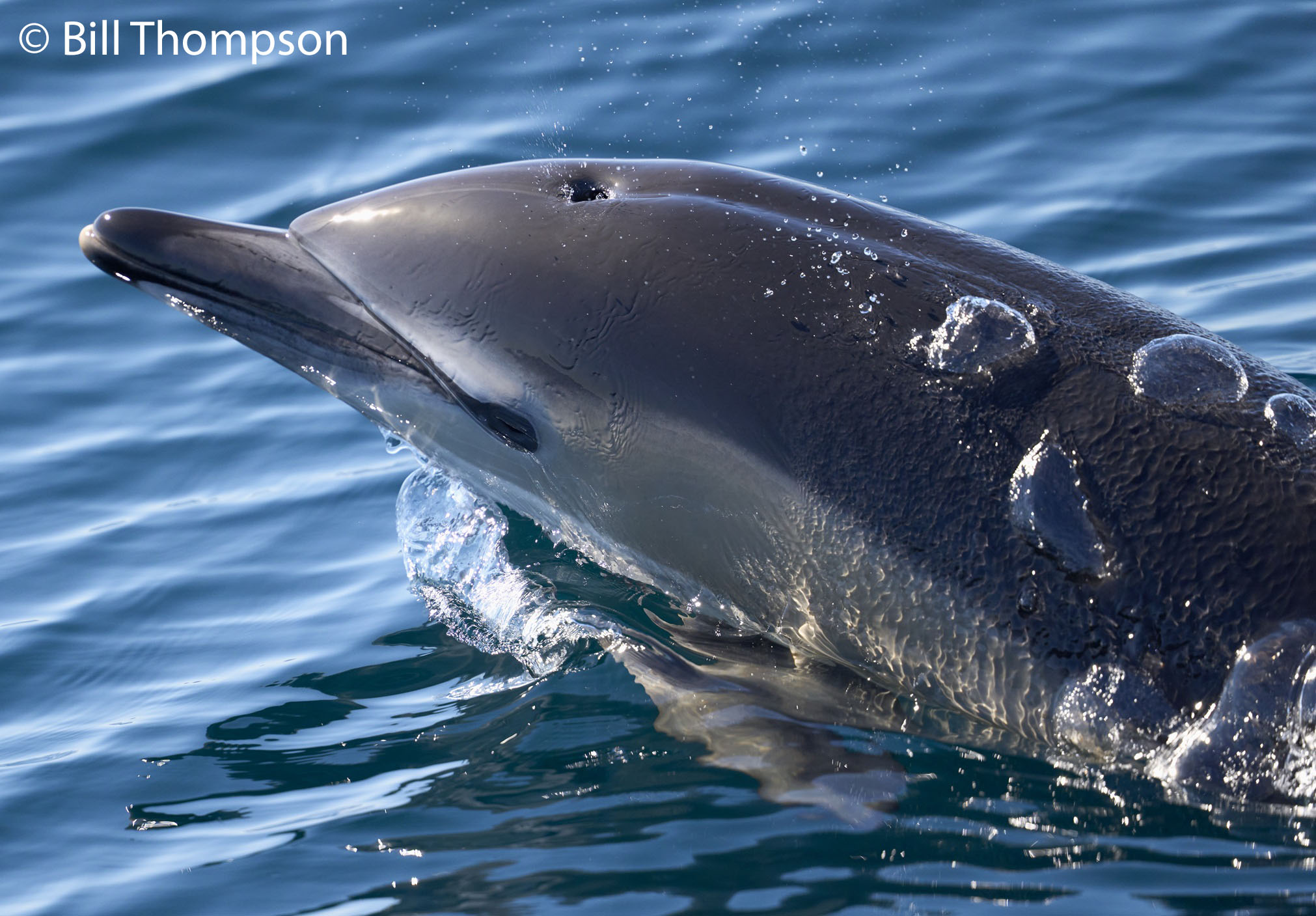
While this was of course a birding tour, we made sure to enjoy the marine mammals we encountered, along with a Blue Shark, but the highlight for most everyone was the incredible and awesome experience we had with a small pod of 25-30 Common Dolphins. Amid all of our seabird activity, the pod approached us in the glass-calm warblers. Captain Nate added a little speed to build up a wake, and the dolphins had come to play. They rode the bow, did some surfing, and otherwise created constant “oohs and aahs.” The photos don’t quite do it justice…it was really a special experience, a life mammal for most of the crew, and one of the best dolphin encounters I have experienced in the Gulf of Maine.
Puffins and fulmars, Fin Whales and dolphins, and all on just the most ridiculous weather possible for a fall pelagic in Maine! We’ll see you on board next year!
I want to thank Captain Nate for his skilled maneuvering of the boat – even more remarkable as this was his first pelagic, too! Naturalist Trinity shared the narration duties with me, taking over for local landmarks and non-feathered marine life, and Valentin and Joe took care of everyone at the galley – and did the work of our attempted Ovenbird rescue. Thanks to my team, chummer Will Broussard, and our checklist-keeper Noah Gibb. And a special thanks to Tabor and Seamus at Cap’n Fish’s for working with me to make this memorable trip a reality.
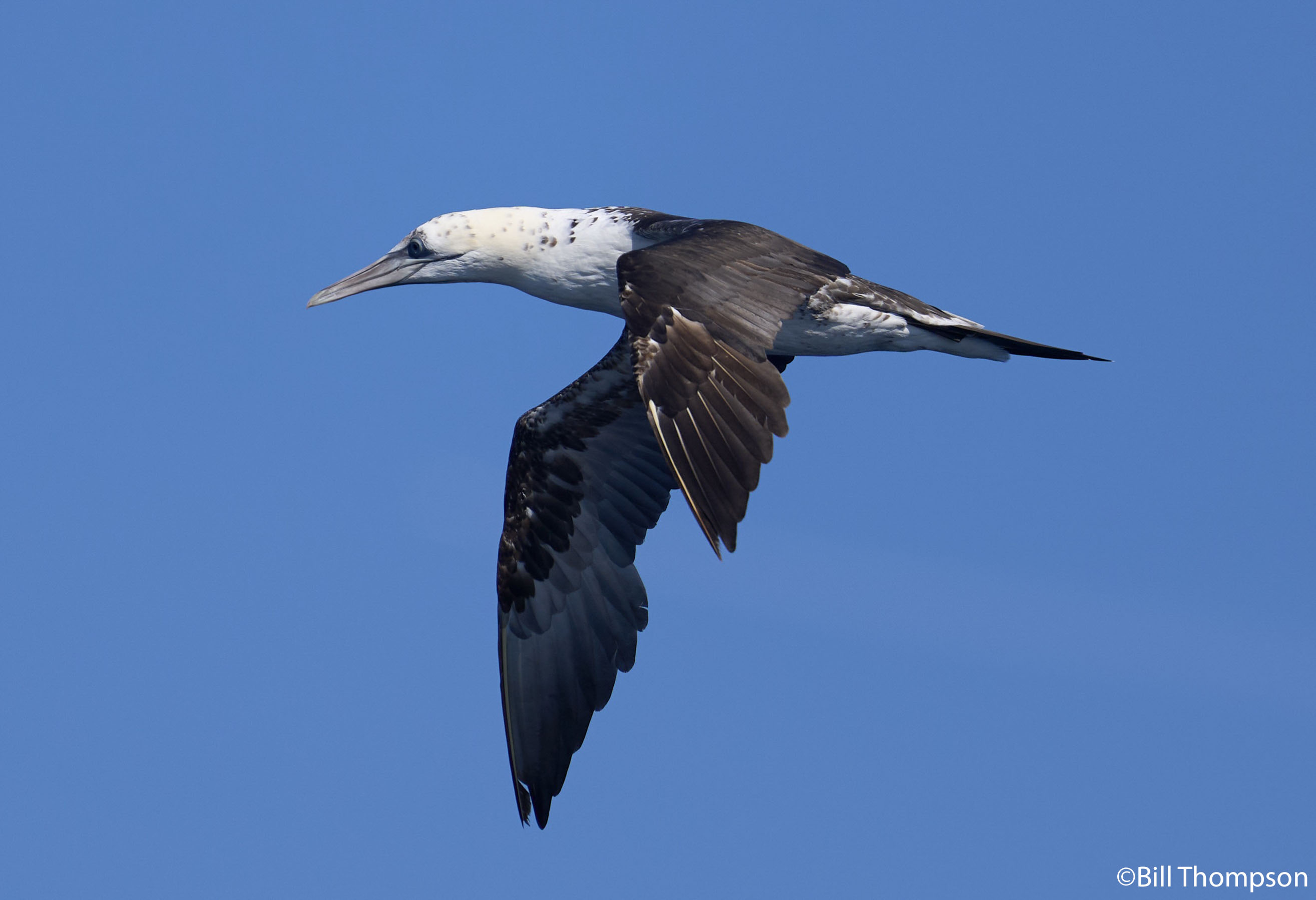
Subadult Northern Gannet
Here’s the complete trip list, including birds seen while docked before departure marled with an *. We know counts of several species, such as Common Eider and Herring Gull are likely extremely low, but we chose to be conservative with our Northern Fulmar and Great Shearwater tallies as we covered a relatively small area during our deeper-water time, and the chumming kept birds with us, and perhaps, coming back for more.
267 Common Eider
89 Surf Scoter
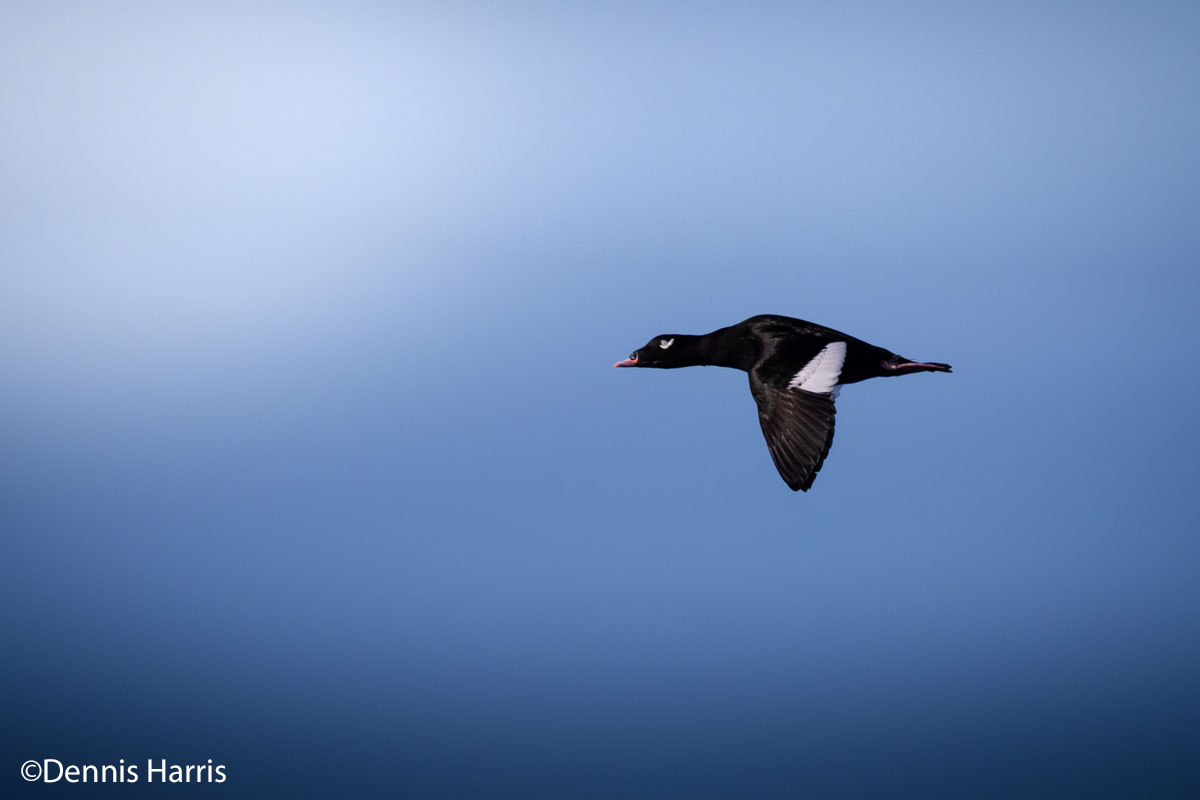
3 White-winged Scoter
36 Black Scoter
25 Rock Pigeon*
54 Red-necked Phalaropes
21 unidentified phalaropes
1 Pomarine Jaeger
28 ATLANTIC PUFFINS
15 Black Guillemots
2 Razorbills
1 Black-legged Kittiwake (only spotted from photos later, unfortunately)
Freeport Wild Bird Supply is very excited to partner with Down East Magazine’s Down East Adventures for the fifth year of offering exclusive birding workshops focused on gaining greater knowledge and field skills in a focused group of seasonally accessible birds. Focused on skill-builder rather than list-building, there will be plenty of “life birds,” but also more knowledge and education about birds, habitats, birding, and much more about the natural world. We are honored to be their provider for a series of unique and exclusive birdwatching endeavors. In 2025, we will have four outings once again.
February 9, 2025; 9:00am – 4:00pm Cancelled due to multiple snowstorms!
Winter is a wonderful time for birding in Maine – at least when you are dressed appropriately! Colorful seaducks that breed in the high Arctic grace our shorelines – including all three scoter species and dapper Long-tailed Ducks, along with everyone’s favorite: striking Harlequin Ducks. Purple Sandpipers and Great Cormorants replace our summertime shoreline denizens. And if the winds are right, very sought-after alcids – including Dovekies and Thick-billed Murres – join our regular Black Guillemots and Razorbills. Black-legged Kittiwakes, Northern Gannets, and “white-winged” gulls add to the mix. In this workshop, we’ll hit a few of the prime viewing locations along Maine’s southern coast. But we won’t just be working on the checklist today. Instead, we’ll be focused on learning how to search for these birds – the how, when, and why – and how to identify them. We’ll learn about microhabitats, weather considerations, and seasonal timing to aid our search today and in the future. By visiting several seasonally-productive sites, we’ll compare similar species while taking time to savor the splashes of color offered by winter seaducks in an otherwise gray and white landscape.
To get an idea of what you may see when the tour returns in the winter of 2026, see the 2024 and 2023 trip reports.
This Northern Parula was one of many ultra-cooperative warblers today. This was one of 10 parulas in a single cluster of willows on the shoreline of Capsic Pond Park during our 20205 workshop.
Spirits seemed low when we met in such dense fog, but I was even more excited to explore the environs of Portland migrant traps, beginning with Evergreen Cemetery. After a slow start, with few warblers overhead in the Morning Flight, we encountered several very productive pockets of activity, including a great diversity of warblers. Many were down low, too, with just fantastic looks at species such as Yellow, Black-throated Blue Warbler, Nashville, and Black-and-white Warblers, along with great looks at Veeries and Least Flycatchers. A “herd” of about 75-100 White-throated Sparrows marched through the forest understory, and we stalked a Black-crowned Night-Heron and spotted a Merlin among many other species today.
Evergreen was good, but nearby Capisic Pond Park was just great! While there were fewer warblers in both quantity and diversity, the cool, drippy morning conditions kept everyone even lower here. We began with 10 Northern Parulas at eye level all around us in a blooming willow (photo above), had great looks at a Prairie Warbler, listened to Northern Waterthrushes, and marveled at Baltimore Orioles.
We then discussed the overnight migration and how the radar images suggested what we would see and not see today, and how the “poor” weather produced such great birding. In the end, we tallied a very respectable-for-the-date 15 species of warblers! Although the list was not the priority as usual in these workshops, it’s hard not to get excited about the diversity of warblers now arriving. While Northern Parula was our most abundant warbler today, the total warbler list – in very rough order of abundance- also included Black-and-white,Yellow-rumped, Black-throated Blue, Ovenbird, Magnolia, Chesnut-sided, Yellow, Nashville, Common Yellowthroat, Black-throated Green, American Redstart, Northern Waterthrush, Pine, and the aforementioned Prairie. More importantly, perhaps, we worked on building our skills of recognizing each species and family so that our birding will be better and more successful on our own next time.
3. Shorebird Workshop
August 18, 2025; 8:00am – 4:00pm
This juvenile Piping Plover was one of 12 species of shorebirds we had the chance to really study on our Shorebird Workshop tour.
Could we have had more of a perfect day? Temperatures topping out in the mid-70’s, a light breeze in the afternoon, and clear skies – considering the rain of early summer and the recent extreme heat, we could not have asked for better. And then we saw thousands of shorebirds!
With more than 35 species of shorebirds regularly appearing in Maine, this workshop was designed to appreciate the diversity and beauty of this fascinating family. We hit some of the marshes, beaches, and rocky roosts that shorebirds prefer at the peak of their migration. We focused on comparative experience, learning how to recognize each species both near and far. Starting with the basics, such as plover vs. sandpiper, we’ll work our way up to the identification quandaries such as the “peeps” and lone yellowlegs. We worked through species by species as we developed a “toolkit” to approach shorebird identification on your own, using a combination of habitat, shape, size, structure, behavior, and plumage to identify this wonderfully diverse and attractive group of birds.
By day’s end we tallied a decent 12 (and a half!) species of shorebirds, a little short of our unofficial goal of 15. We did see a couple of rarities but were also dogged by Peregrine Falcons and Para-gliders causing birds to disperse and/or take cover. But we had plenty of chances to study a nice array of species, often side-by side.
Beginning at Biddeford Pool Beach, we started with the basics and enjoyed watching Ruddy Turnstones bulldoze their way into the wrack line and picking out White-rumped Sandpipers from a mass of Semipalmated Sandpipers. A Baird’s Sandpiper at Great Pond was one of our most notable birds of the day, and not where we expected it.
At Hill’s Beach, there was a lot of disturbance today, but we had some good opportunities to study Piping vs Semipalmated Plovers, Sanderlings, spiffy Short-billed Dowitchers, and more. We then shifted to the Pool, where we studied silhouettes and practiced distant shorebird using mostly general impression of size and shape. It was here that we had our largest numbers of the day, with an estimate of 1600 Semipalmated Sandpipers, 300 Semipalmated Plovers, and 163 Black-bellied Plovers leading the way.
Near or far, good light or bad, the general impression of size and shape, behavior, and more can be applied to identify shorebirds more readily than little nuances in some color or pattern.
After our lunch break, we returned north to Scarborough Marsh, where I would usually start the workshop, but with very low water in the upper salt pannes due to the drought, we shifted the itinerary. But the incoming tide at Pine Point did not disappoint! We had some close studies of more Short-billed Dowitchers and better views of Black-bellied Plovers, and about 1200 Semipalmated Sandpipers were present. However, as they moved close and concentrated, a Peregrine Falcon came tearing in, flushing most of the birds. Then, it made a sudden burst of speed and a hard turn and before we knew it, there was one less Semipalmated Plover on the mudflat. While it was poor timing for our shorebirds workshop (let alone for that one particular plover!), it was an awesome show (well, for us anyway) and one that will not soon be forgotten.
Some birds finally returned to the mudflat, when a large (for the date) flock of Willets flew in, making their usual grand entrance. We were able to put our advanced shorebirds ID skills to work with the bigger, lankier, grayer one that we soon identified as a rare in Maine “Western” subspecies of Willet. It might have been beyond today’s goals, but it was a great lesson in using comparative tools.
A couple of upper marsh stops finally gave us a good, close comparison between Least and Semipalmated Sandpipers, and a Lesser Yellowlegs that was close enough to study and enjoy, bringing a productive and successful day to a close.
4. Monhegan Birding Workshop
September 12-14, 2025
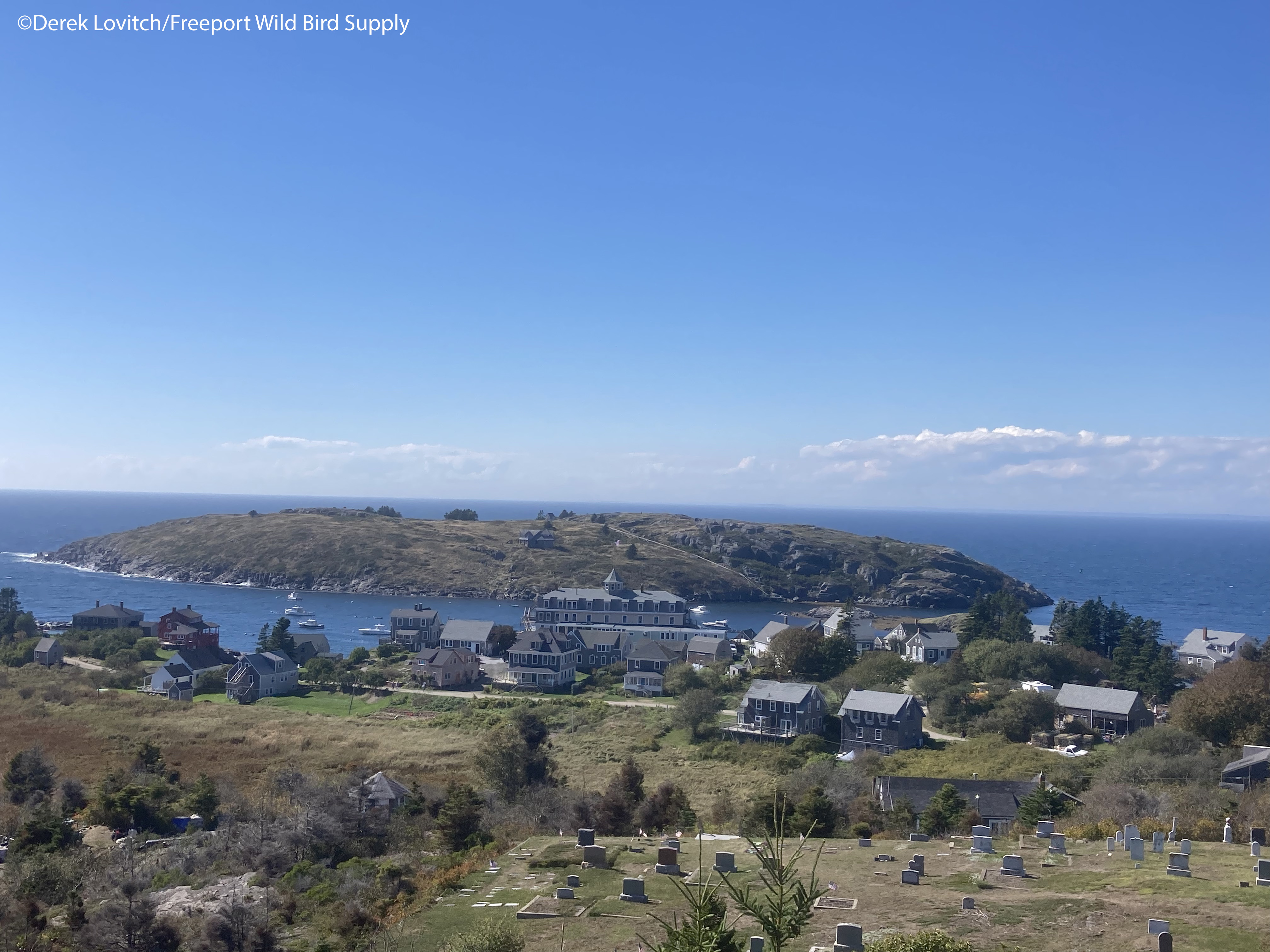
Our final Downeast Adventures birding workshop tour of 2025 spent 3 delightful days on Monhegan Island. Weather, geography, habitat, and migration ecology all combine to produce some remarkable birding opportunities at this special place. And even when it’s “slow” by lofty Monhegan standards, lots of learning experiences and workshopping opportunities would be at hand, often right out the front door of our hotel. Oh yeah, the food is sooo good, too!
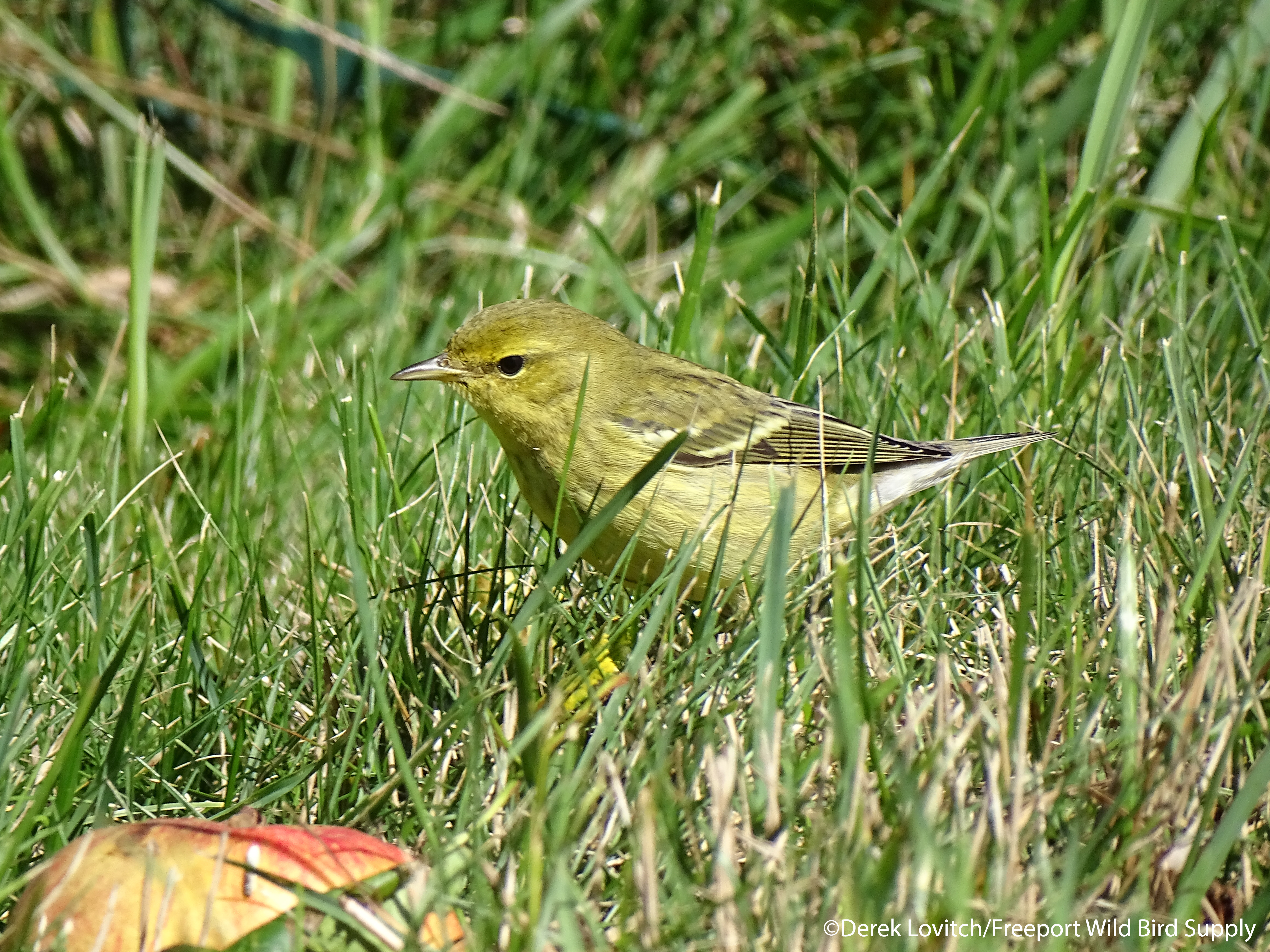
As per the plan, we hit the ground running shortly after our arrival on the island. It took us an hour and 45 minutes to walk the ½ mile or so to our hotel as we encountered quite a few migrants, especially at my favorite starting spot along Wharf Road. We jumped head-first into aging and sexing fall warblers thanks to 3 different plumages exemplified by a trio of Cape May Warblers. American Redstarts, Northern Parulas, Yellow Warbler, and more introduced us to what birding Monhegan in the fall is all about.
By the time we reconvened after a lunch break, the insanely gorgeous weather with bright sun and very little breeze encouraged birds to take to the shadows. A sky constantly abuzz with Merlins didn’t help either, although we enjoyed it. While passerine activity had slowed dramatically, we enjoyed a light hawk migration with a couple of Northern Harriers and a few American Kestrels, while the Merlins and 1-2 Sharp-shinned Hawks further diminished the activity in the trees and shrubs. We took the time to visit the east side of the island, sample the different habitat types of the island, and discuss food plants for birds and native insects. The butterfly, dragonfly, and insect-watching was excellent on this unseasonably warm afternoon, and we worked on learning the connection between birding and bird habitat.
On Saturday morning, we learned why there were so many birds around Friday morning, but few in the air at sunrise. But there were definitely “new” birds around, suggesting at least a light arrival of birds overnight had occurred, including two vociferous Dickcissels. I made the decision to try and track down a Blue Grosbeak that had just been reported, but unfortunately, it did not wait for us. We did have an immature male Orchard Oriole, however, which was a treat, and we spent more time studying Cape May Warbler plumages.
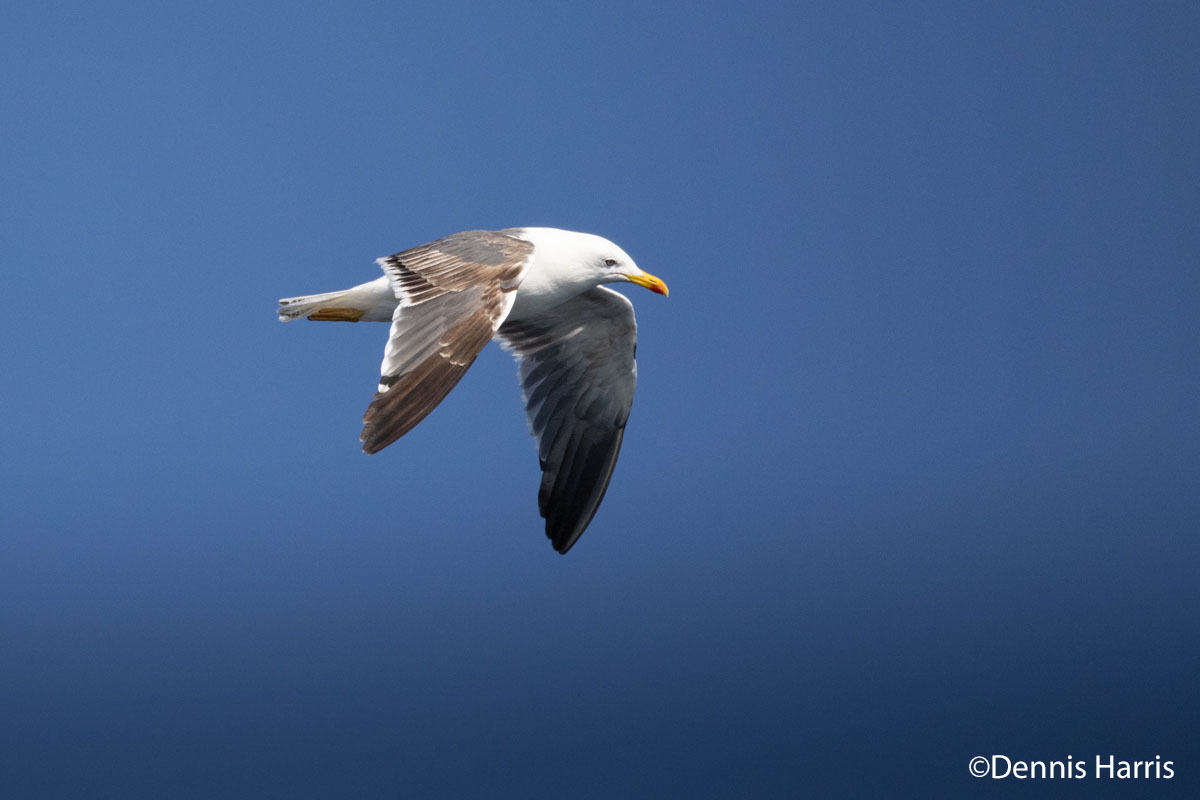
On such gorgeous days, a lot of newly-arrived migrants simply depart the island as part of their morning redetermined migration flights (yes, we discussed this more thoroughly among many topics of avian and general ecology discussed throughout the weekend). In fact, the second half of our morning was very slow, but we did enjoy a couple of adult Lesser Black-backed Gulls and we kicked up a very uncommon Marsh Wren. But warblers were few, and Merlins remained a’plenty. Red-breasted Nuthatches were very abundant however – demonstrating what an irruption looks like, and Ruby-throated Hummingbirds were unusually widespread for the date.
We filled the time between birds looking at all other walks of life. American Dagger Moths caterpillars were particularly plentiful.
The afternoon was spent with a couple of impromptu workshops, such as an introduction to gull identification as I attempted to enlighten the group about how manageable it is to understand the basics of this group of fascinating species. The avian highlight, however, was the thrilling chase of a Solitary Sandpiper by two Merlins right over our heads! The Merlins would gain some height, dive, and close the distance, only for the sandpiper to take another evasive maneuver. The sandpiper tried to gain elevation to stay above the diving Merlins, but they were getting closer! Then, the sandpiper made one quick turn, ascended, and took off to the north, leaving the hungry Merlins to mosey back down to the treeline to see if the marsh had something much slower to offer. We bid the sandpiper farewell and good luck as we thanked the Merlins for a most entertaining performance!
It was another very light migration overnight Saturday into Sunday, but unlike the previous day, we hit a wonderful early-morning wave. One sunny edge captivated us until it was time to hustle back for breakfast: Several American Redstarts, Red-breasted Nuthatches, Black-capped Chickadees, Common Yellowthroats, and Norther Parulas had joined together, punctuated by repeated views of a most cooperative Least Flycatcher. Every time we tried to move long, a new species appeared. A fly-over Greater Yellowlegs. A flycatching Eastern Wood-Pewee. And finally, a Brown Thrasher that popped out right in front of us.
I was thrilled to have this sample of “what Monhegan can be like” at this season for those who fought the urge to stay in bed. Post-breakfast was once again much slower, but we hit a few pockets of birds, as well a finding a Mourning Warbler which is always fun – and challenging – in fall migration. We watched and listened to territorial Carolina Wrens in a double-duet song battle, encountered a flock of 4-6 Red-eyed Vireos working on Fall Webworms, and spent more quality time with the island’s once-again-ubiquitous Ring-necked Pheasants. And of course, we made time to sample the stunning Acadian Forest habitat of the island’s interior and to take in the view from the lighthouse.
Another delicious lunch and then a slow meander to the ferry brought our visit to a close. On the ferry ride back, a few more Northern Gannets were seen, and plans to return to this extraordinary island were already in the works!
(2026 Birding Tours with Down East Adventures will be posted soon!)
This Cape May Warbler was one of many birds that escaped the strong winds by finding large flies eating rotting apples that littered the ground all over the island.
I arrived on the island on Thursday (9/22). Be happy that the tour didn’t start this day. It rained. A Lot. However, I was greeted by 6 Lesser Black-backed Gulls on Smuttynose Island upon my arrival: 5 adults and 1 juvenile. It turned out to be one of the highest counts ever on the island. That would also turn out to be my birding highlight of the day, as a short jaunt in the afternoon only yielded one species that I would not end up seeing with the group: a juvenile Ring-billed Gull, which is actually a very uncommon bird out here.
The sunset, however, was worth the trip, and the clearing skies foretold some good birding to come.
Overnight, a moderate migration on clearing skies brought many new birds to the island. The group met at 9:00, and we picked up the rest of the day’s participants as their ferry arrived. It was very windy today, but all day long, whenever we found a pocket of shelter, we found birds. It was mostly Yellow-rumped and Blackpoll Warblers, as expected for the date, but there was a decent smattering of diversity.
Between the winds and the raptors, birds were keeping low though! But speaking of raptors – wow, the falcon show! It was incredible. There is absolutely no way of knowing how many Peregrine Falcons and Merlins we saw today, with birds whipping by overhead. Some were hunting, and likely circling the island to do so, but it’s also possible that there was a steady flow of birds moving south, only pausing to wink at the island. It was impossible to quantify, but it was a whole lot of fun to watch!
Merlin.Immature Peregrine FalconNorthern Flickers had to stay low and out of sight to survive the day.
We enjoyed quality time with Cedar Waxwings, Monarch butterflies, and enjoyed some gorgeous Question Mark butterflies as well. White-crowned Sparrows were rather conspicuous, and we had a good lesson in duck identification with Mallards, an American Black Duck, and a hybrid thereof all side-by-side.
Black-throated Green Warbler on post-cider-making apple mash.
Wind was whipping all night long and continued to gust well over 20mph as of sunrise. With a high-pressure system building in, and powerful Hurricane Fiona passing well to our east, the wind would just not let up. Several ferries were cancelled, and if you happened to be in the room that a screen door was slamming up against all night (ahem), then maybe you were not as rested as you would have liked.
The Gray NEXRAD radar was down, but the Caribou station showed a moderate flight of birds overnight with marginally lighter winds over the mainland. A light morning flight – mostly strong-flying Blackpoll Warblers – didn’t portend a lot of birds had arrived, but pockets of White-throated Sparrows and Yellow-rumped Warblers in places where they weren’t yesterday suggested otherwise. In fact, there were a bunch of birds around, and it was a very productive morning!
We visited with two cooperative Dickcissels that have been around for days, caught up with the lingering Lark Sparrow, and were among the lucky ones who caught up with an early Orange-crowned Warbler. All before lunch.
Dickcissels.Lark Sparrow
And while the wind continued to gust, and uncountable falcons continued to wreak havoc, anytime we found a corner of shelter, we found birds – and often lots of them! White-throated Sparrows littered the woods, and because of the wind, many birds were insanely easy to see.
One of the highlights were warblers on the ground – hatches of large flies were feasting on rotting apples below laden trees, and with no flying insects able to survive a foot into the air today, we spent a lot of time looking DOWN at warblers.
Blackpoll WarblersCape May Warbler.We also made it over to the cliffs to see what may have been in the island’s lee.Female Green-winged TealScarlet TanagerWe saved this Gartner Snake from a cat’s mouth on our way to not seeing a Red-headed Woodpecker that was playing hard to get for us.
Finally, as dusk fell, the winds subsided. Unfortunately, by early nightfall, the winds were already a little more westerly than we would have liked. Come Sunday morning, a surprisingly light morning flight, dominated by Yellow-rumped Warblers almost exclusively, reflected the lack of the northerly component overnight. Birds seemed to be in lower quantities overall – a lot of Blackpoll Warblers had apparently departed – and with calm conditions (so, so welcome), there were fewer concentrations of birds.
Throughout the day, it was relatively slow by Monhegan standards, but we just kept adding new species to the triplist, and basking in repeated stellar views. The two Dickcissels were in their usual place throughout the day, a juvenile Lesser Black-backed Gull continued, and later in the morning we found a Marsh Wren – very uncommon out here.
Marsh Wren
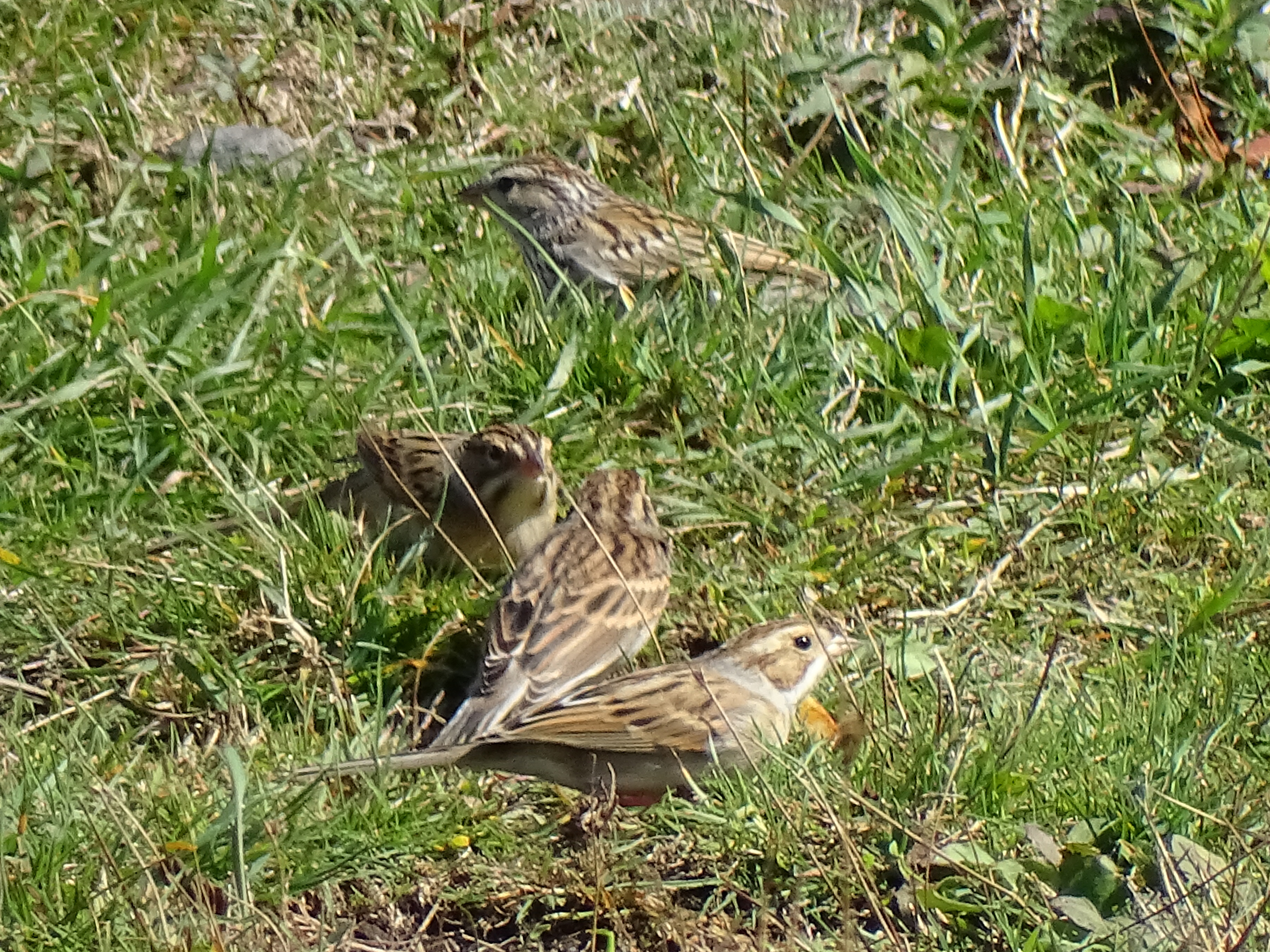
In the afternoon, we had a splendid sparrow session. We had our longest looks yet at the Lark Sparrow, but after a report of one Clay-colored Sparrow at the same spot, we arrived to find three! A Lincoln’s Sparrow even came out into the open to join the Song, Chipping, White-throated, White-crowned, and Savannah Sparrows, making for an impressive total of 7 species of sparrows from one spot! Of course, the comparative experience makes all the difference in learning these species – as most look so very different from each other. Well, most of them did, anyway! A solid 76 species were tallied by day’s end.
Clay-colored Sparrow with juvenile Chipping SparrowLark SparrowBlackpoll Warbler.
The last day of the tour was Monday the 26th, and our time was winding down. So were the number of non-Yellow-rumped Warblers. Some light showers overnight may have put a few birds down, but winds were southwesterly thereafter, and the Caribou radar (the Gray station was still down) showed little movement. The morning flight was therefore virtually non-existent.
We found an Indigo Bunting, and later, an Alder Flycatcher confused and disoriented, stuck in the ice cutting display building of the Monhegan Museum. Three Clay-colored Sparrows were still present; we had good looks at two of them at the school and had another session comparing them to the variety of ages of Chipping Sparrows they were cajoling around with. The Lark Sparrow also performed nicely for us again.
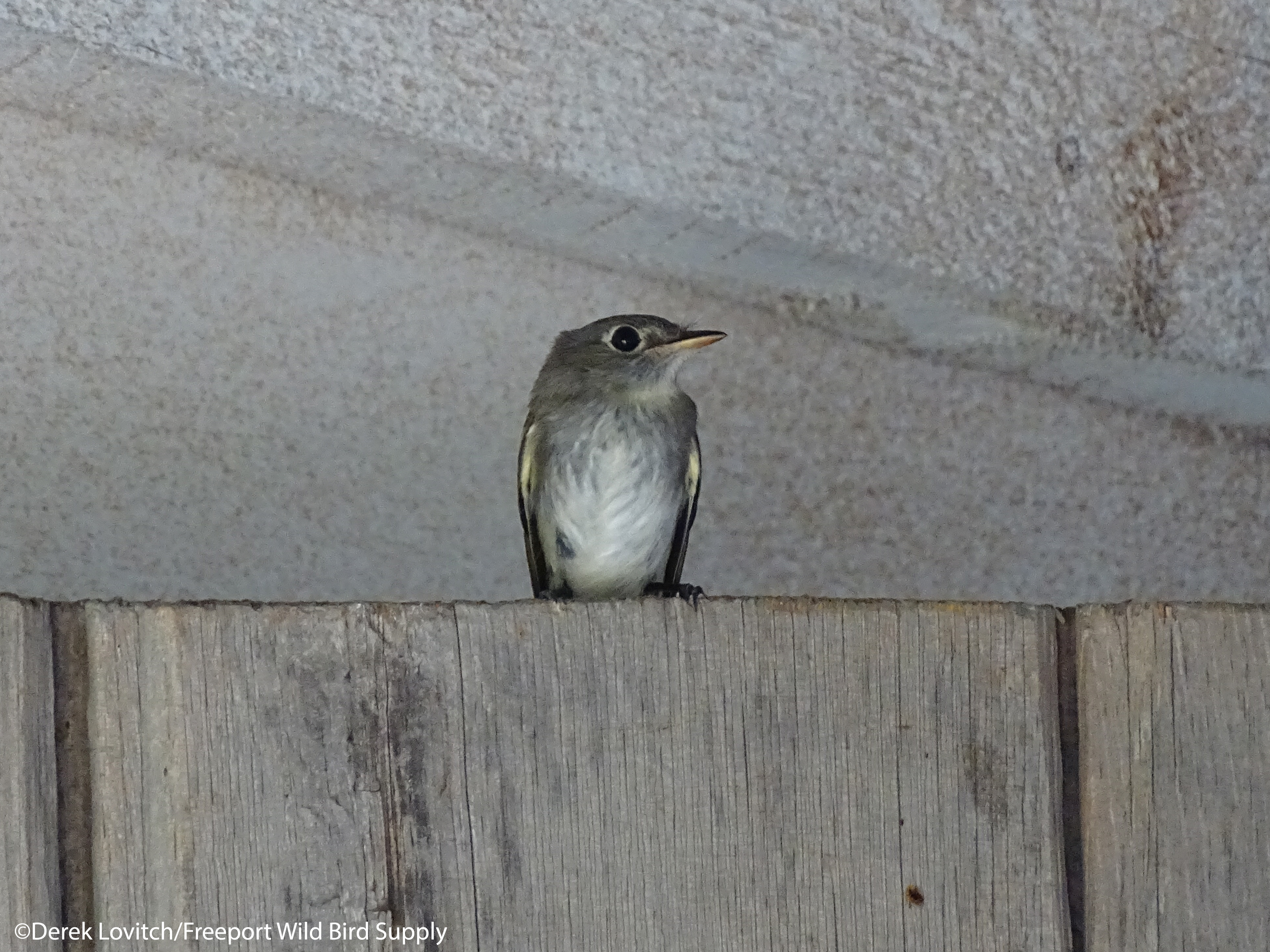
Alder Flycatcher in the museum’s ice-cutting shed. It eventually figured out the lighting and got itself out. Clay-colored SparrowTwo of the three Clay-colored Sparrows, here, with a Chipping Sparrow in the middle.
It felt very slow, especially in the afternoon, when we took time to enjoy Fringed Gentian and repeatedly “dip” on a Red-headed Woodpecker that most everyone except us had eventually seen. Yet interestingly, we kept finding new species for our day’s list, and by the time the tour ended in time to catch the 4:30 ferry to Port Clyde, we had accumulated our highest species total of the weekend – a goodly 81.
The apparent abundance of some species – such as White-breasted Nuthatch, which we conservatively estimated included the presence of 4-6 pairs despite apparent omnipresence and Blackpoll Warblers on the ground – continued to impress as well.
Blackpoll Warbler.
With today’s new additions along with Laughing Gulls on our ferry ride back, our total trip listed amounted to 95 species! So despite the strong winds that howled for the first two days of the tour, and unfavorable southerly winds for the last day and a half, our 95 species was exactly average for the 11 years we have run the trip on this same weekend. 16 species of warblers was a mere one species below average. Taking our challenging weather into consideration, I would absolutely call this a win! Plus, we were on Monhegan, so all is well, as an average day/weekend on Monhegan sure beats the same anywhere else – for so many reasons.
* denotes ferry ride only

23-Sep  24-Sep  25-Sep  26-Sep
After 17 consecutive summers in the Gulf of Maine, “Troppy” the Red-billed Tropicbird failed to return to Seal Island. Arriving in 2005, but continuing annually throughout the summer since 2009 exclusively at Seal Island, Troppy had become a mainstay of summer birding in Maine – and our tour calendar!
Arriving as an adult, Troppy was therefore at least two years old when he was first sighted in 2005. Since most sorces seem to reference “16-30 years” as a lifespan, a 19-year old “Troppy” would be getting a little long in the tooth, err, bill. But, as I romanticized in my 2019 article for Birding magazine, we all hoped he would find the long lost love. Maybe he did. Maybe he’s making a trop-ling somewhere in the Caribbean where he “should be.” Yeah, that’s what I’ll think. We need more happy thoughts these days.
Wherever he might be, it was not Seal Island or any other Gulf of Maine seabird island this summer, and with his absence, tours to Seal Island were few and far between. Our first one cancelled, but we were able to run our July 23rd departure with our friends at Isle au Haut Boat Services thanks to a dedicated group of birders who know how special Seal Island is, with or without the famous rarity.
And Seal Island most did not disappoint! Even without a tropicbird (or a Tufted Puffin for that matter, which of course we all hoped would make a reappearance).
First, the weather: it was unbelievable! Actually, it was downright hot, even offshore, and especially away from what little breeze there was when we were not motoring. Seas were a gentle 2-3 feet, with an occasional slightly larger but inconsequential swell. Falling rapidly, it was incredibly smooth in the coves of the island, and on the way back where we enjoyed following seas for a very flat and fast ride.
Shortly after departing Stonington, we spotted our first Atlantic Puffin before we even cleared Isle au Haut. A few more, scattered small numbers of Wilson’s Storm-Petrels (I tallied 41 in all), and a few Razorbills punctuated our trip out. Not much was happening around Saddleback Ledge though.
Of course, the show realty began upon arrival at Seal Island. The heat sent the alcids into the water, so virtually all of the Atlantic Puffins that were present were in the coves and often allowing close approach and stellar photo ops.
We worked our way around the island, slowly improving our views of Razorbills (at least 6) and finally finding two Common Murres.
RazorbillIt took a while, but we finally found a Common Murre – it was even the uncommon “Bridled” morph.
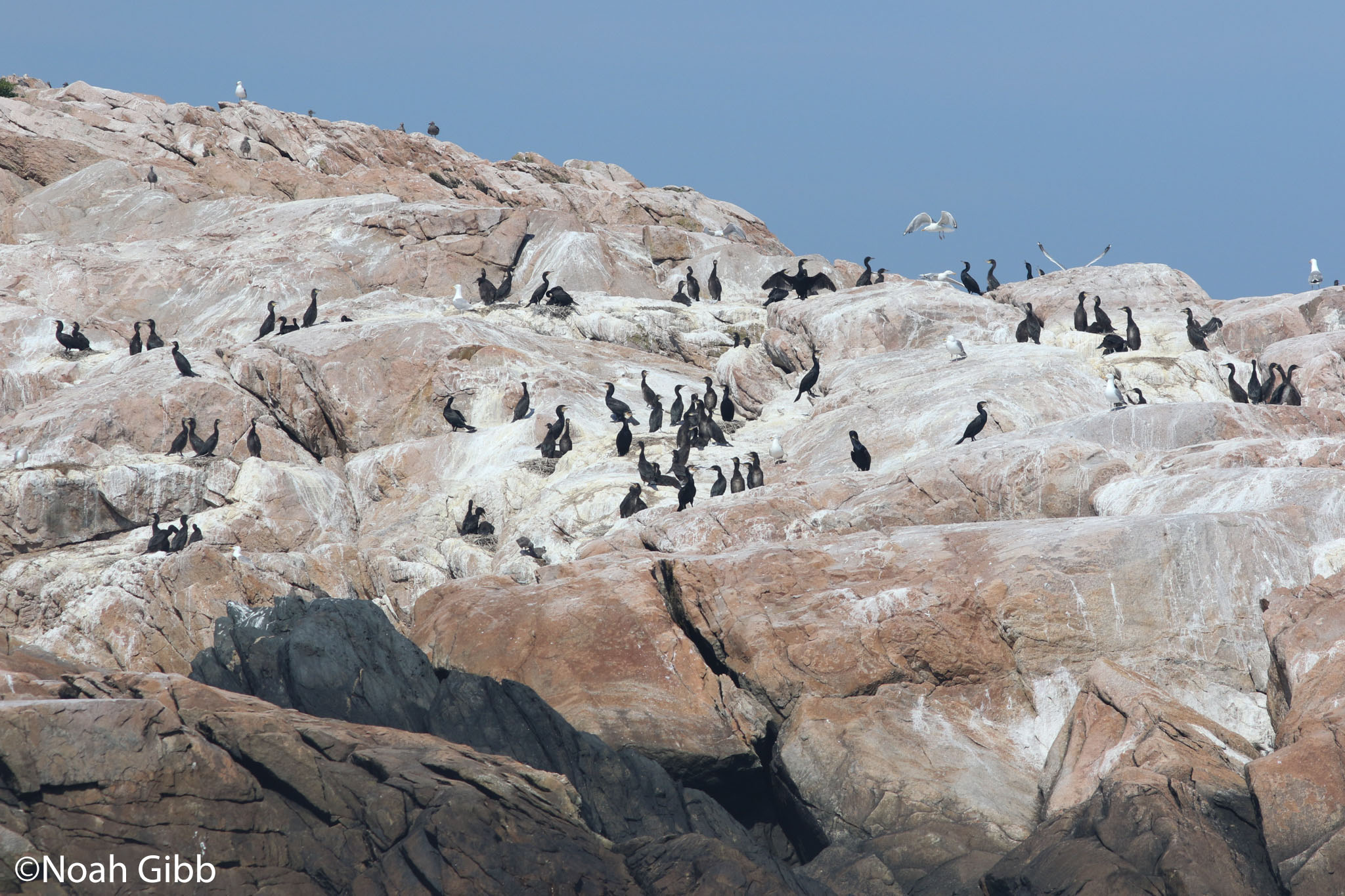
We motored around the south end, where the swell was just enough to prevent us from getting too close to the Great Cormorant colony – Maine’s last. But the nests brimming with growing chicks was still thoroughly enjoyed.
Off the northeast end, we cut the engine and drifted among the alcids. Off the open waters came a flock of 12 Whimbrel which we heard first before they flew close by. Likely having tanked up on blueberries in a barren Down East or in the Maritimes, they didn’t seem to consider pausing on the island. Later, 8 more flew by even further offshore.
Laughing Gull
While the lack of shearwaters all day was disappointing, the one Great Shearwater that we saw came in for a close look at us!
A little group of Sanderlings flew by, a few peeps were along the shoreline, and we spotted several calling Spotted Sandpipers.
And don’t forget about all of the dapper little Black Guillemots!
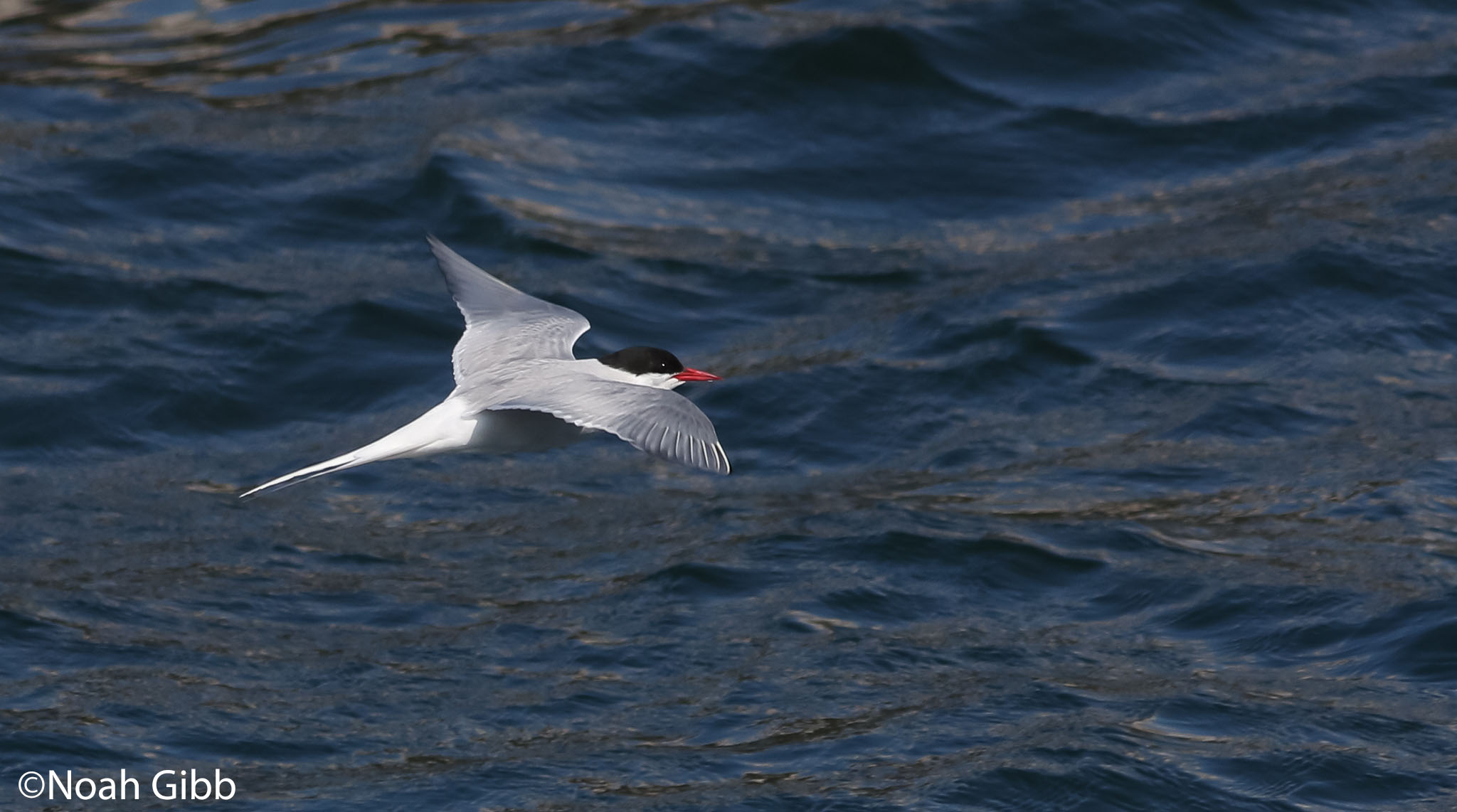
And of course, there were the terns. Hundreds of Arctic and Common Terns were present, with a goodly number of juveniles learning the ropes. Arctic Terns were particularly conspicuous today, with many making close approaches of the boat or disregarding our presence to take a bath.
Arctic TernsJuvenile Common Tern.
I both enjoyed and lamented the fact that I didn’t have Troppy to stress over. In fact, without needing to be in position and waiting for him, we took advantage of the gentle seas to not only circumnavigate the island, but also spend ample time drifting in sheltered coves, photographing alcids and searching for a big, black puffin with punk-rock hair.
The eastern side.
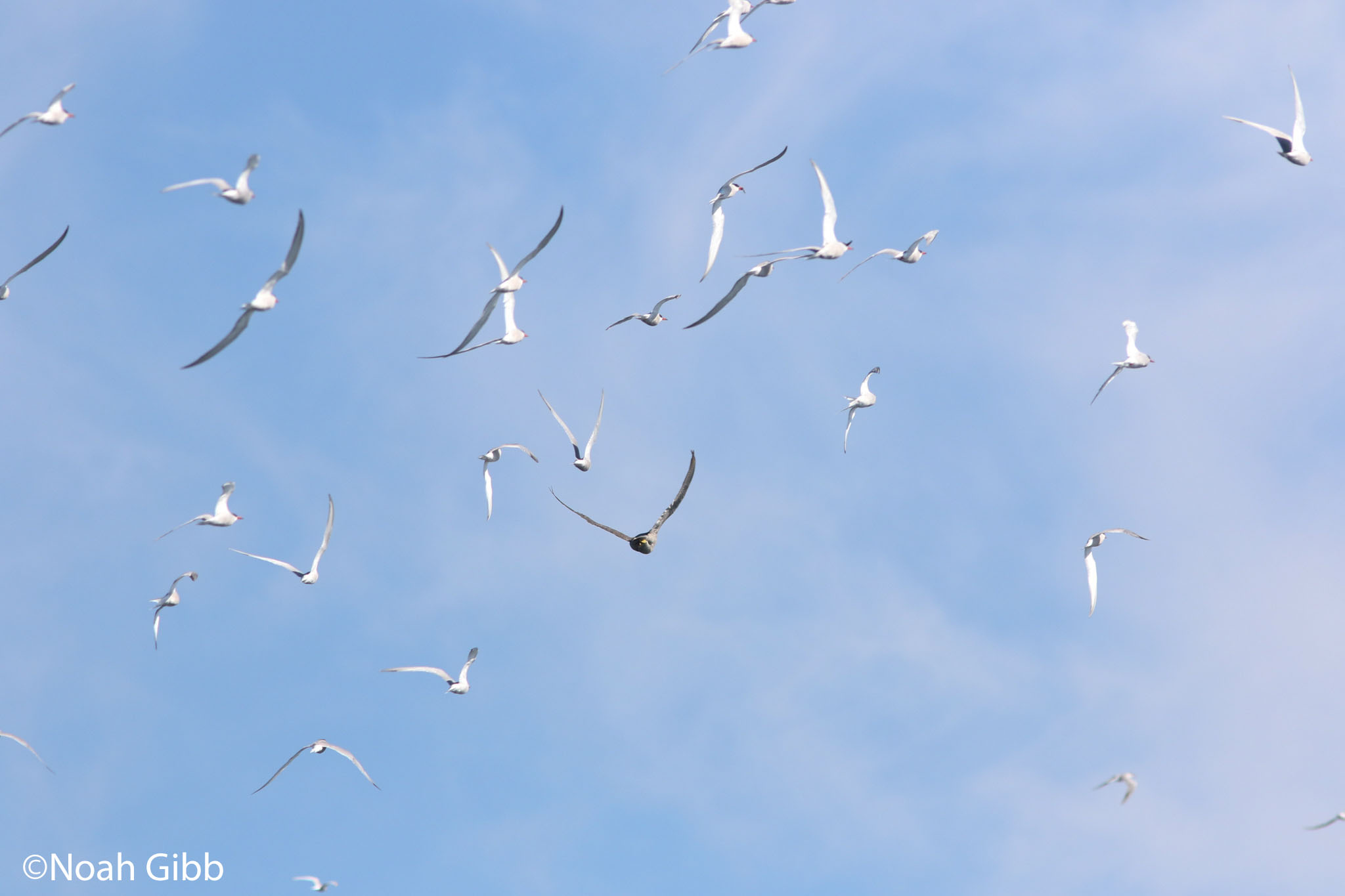
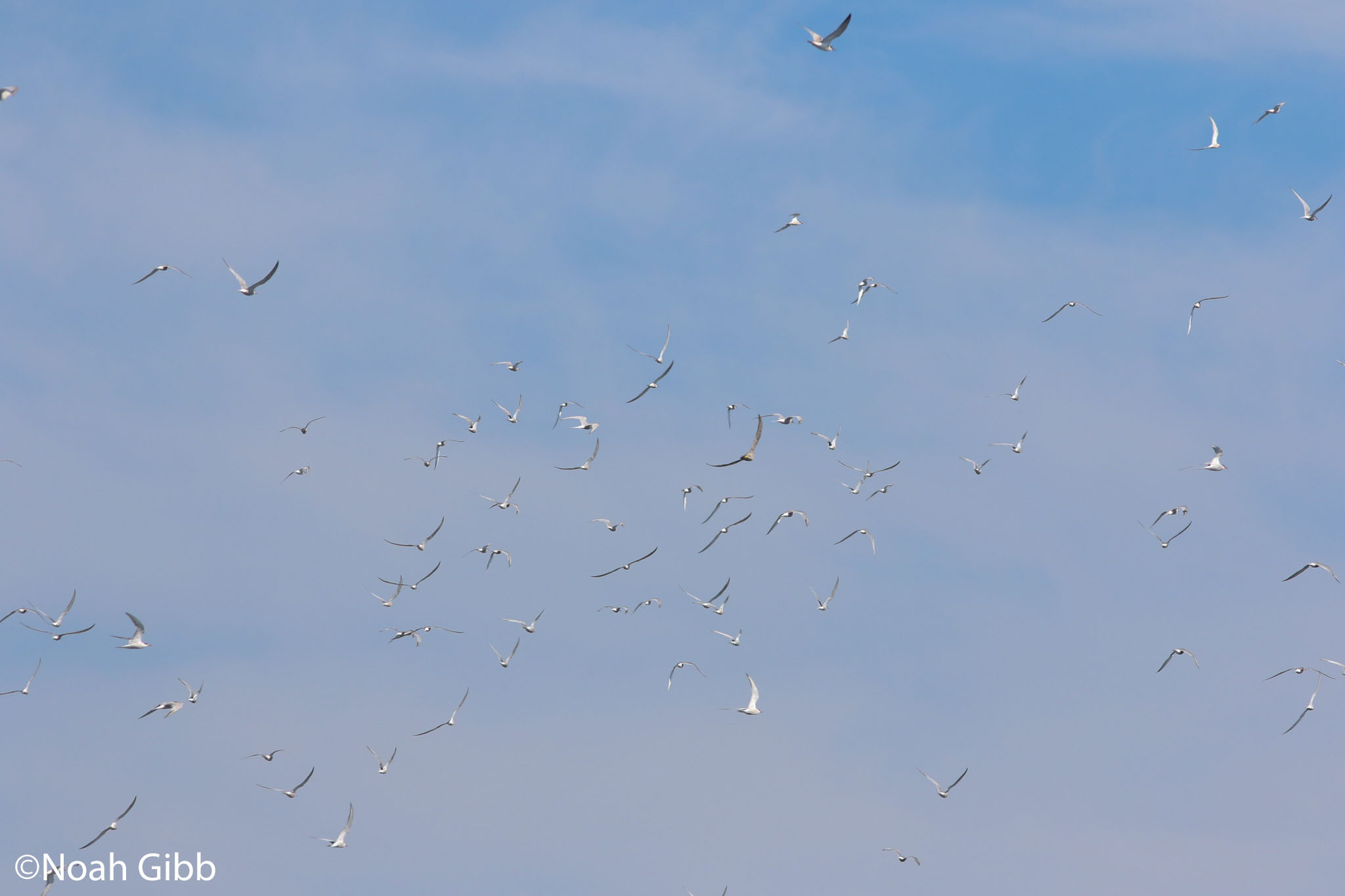
But we still had a time limit for our charter, so we decided to spend our last moments enjoying the action at the tern colony. That’s when a Peregrine Falcon arrived. While this is a most unwelcome guest at a seabird colony and we were conflicted about seeing it, it was also impossible not to sit back and watch the show.
It surprised the terns by coming up and over the backside of the island, scattering the entire colony. Upon identifying the intruder, all of the adults made a beeline and began diving, mobbing, and otherwise trying to drive the predator away. Watching one of the world’s greatest – and fastest – predators in action was a real special treat, but we were also not upset that it came away empty; we were rooting for the terns.
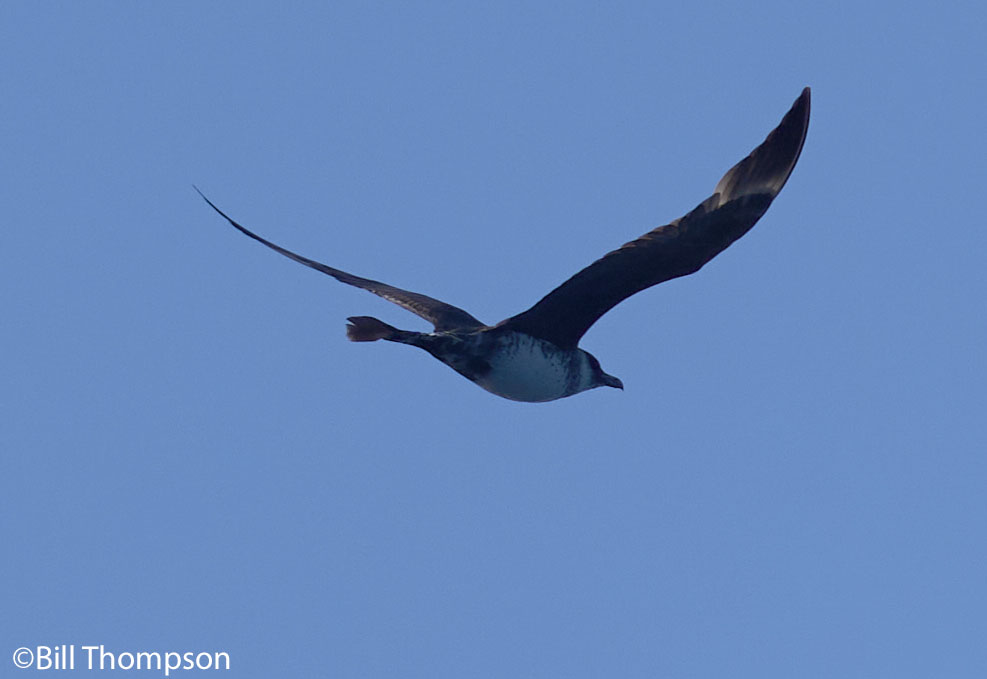
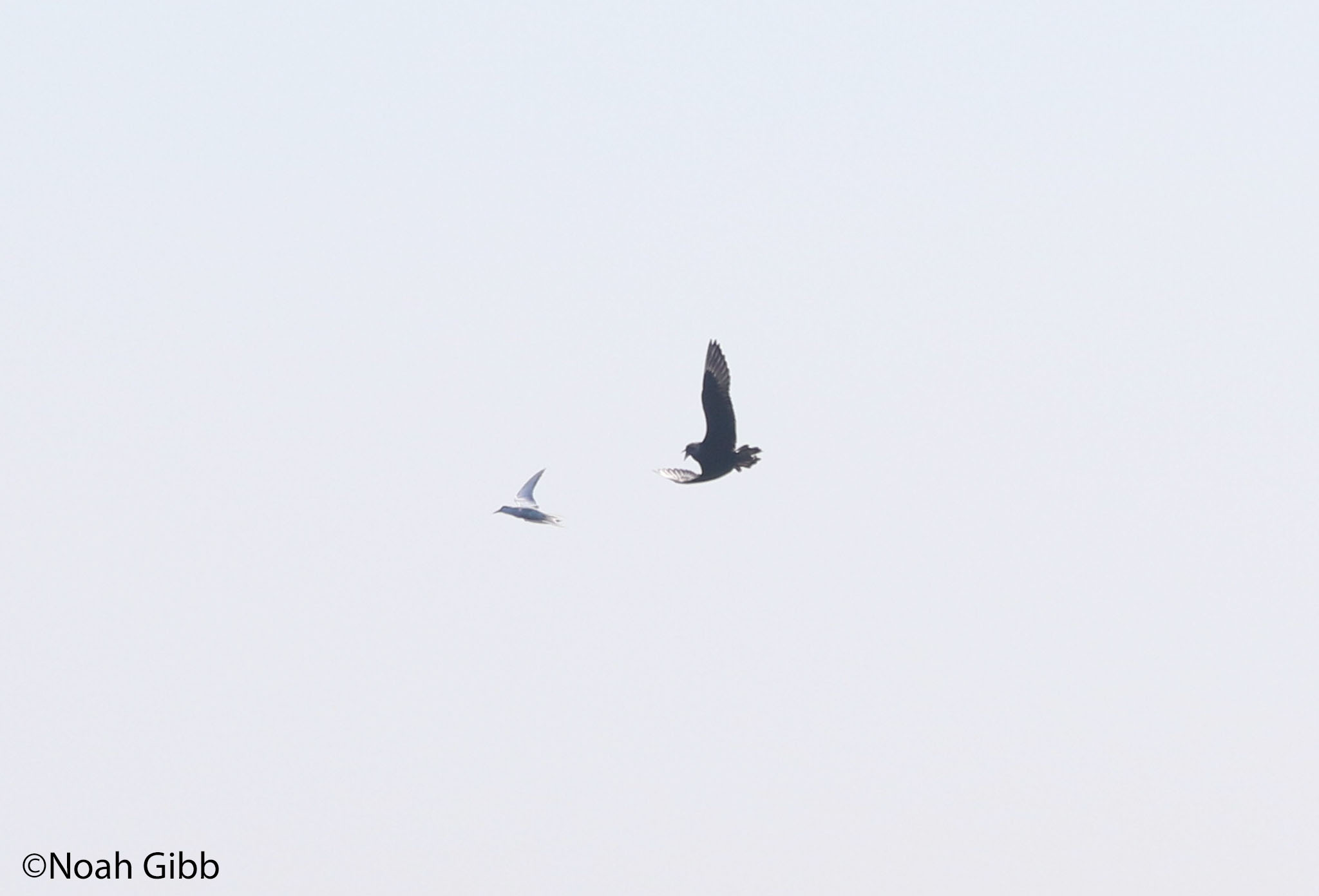
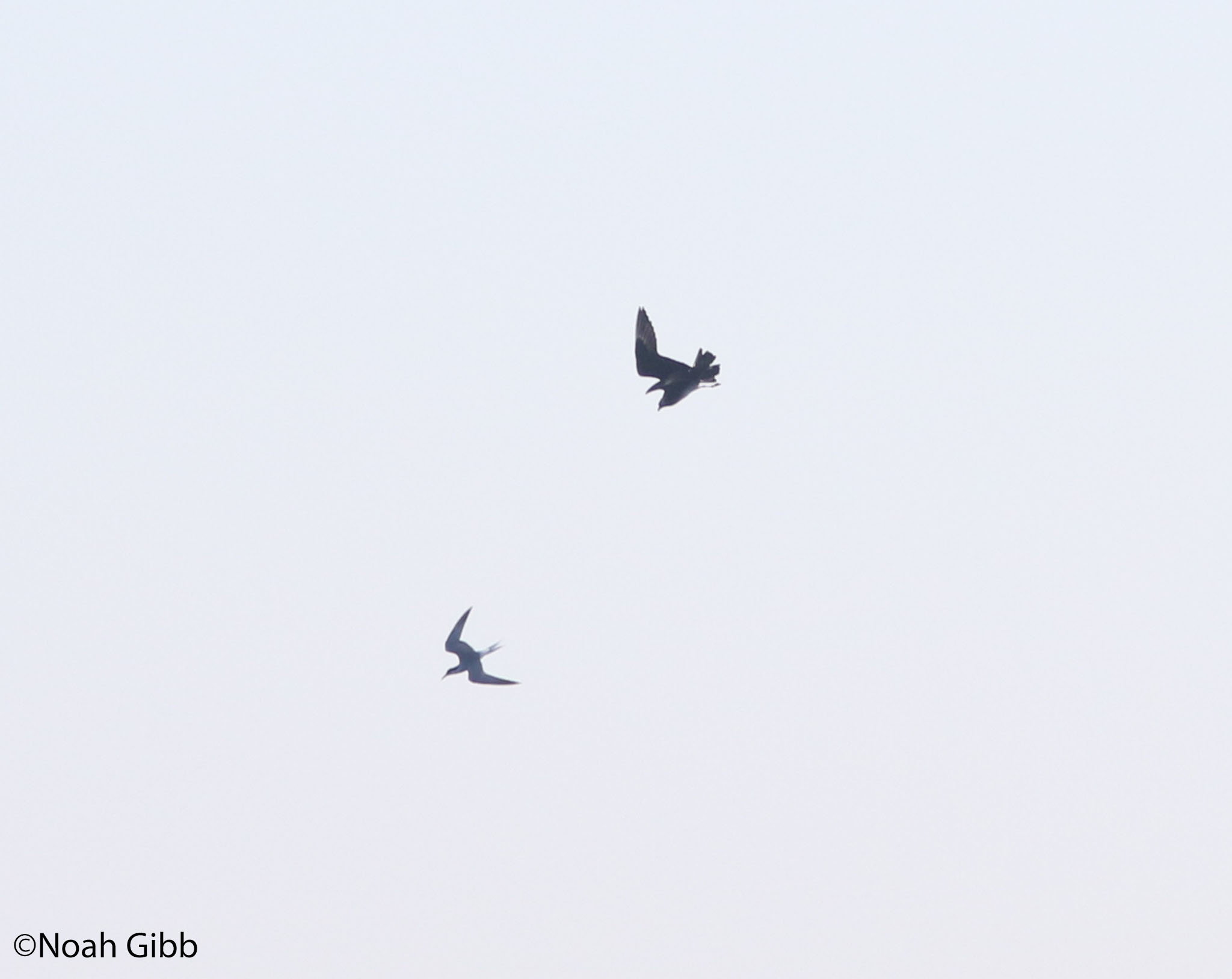
If that wasn’t a grand finale, I don’t know what is. Well, maybe the Parasitic Jaeger on the way back!
About halfway between Seal and Saddleback Ledge, I first thought it was a Peregrine tearing in after a lone Common Tern. But when it became clear that it was a jaeger, I yelled for Captain Mike to “step on the breaks.” We watched the dogfight for several minutes, and it was spectacular to see. It was just far enough away that we couldn’t tell if the tern gave up its fish, but it definitely didn’t do it willingly.
Shortly thereafter we began to run into little rafts of Razorbills (a conservative tally of 36, plus 7 more between Saddleback Ledge and Stonington) and scattered Atlantic Puffins. We had quite a few more Wilson’s Storm-Petrels on the way back, and finally some Northern Gannets.
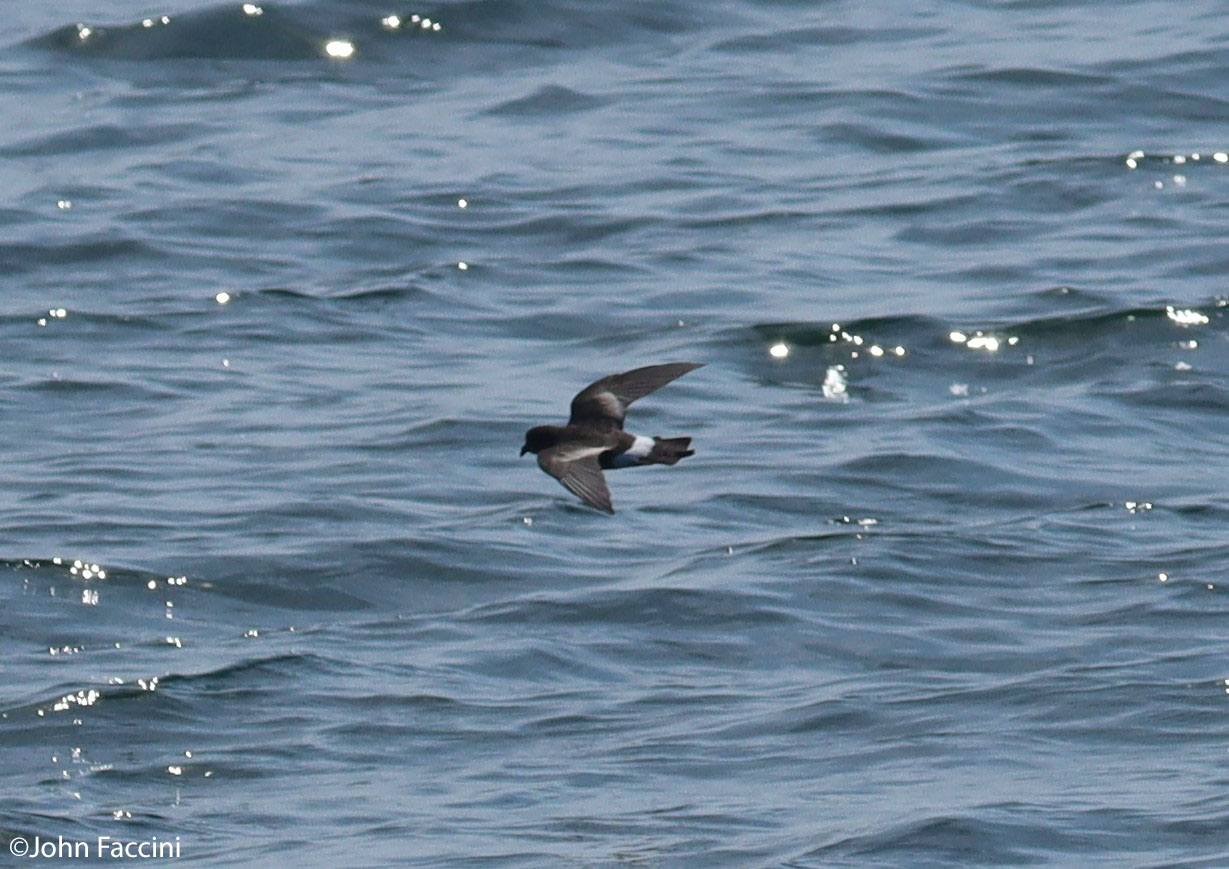
Wilson’s Storm-Petrel
We even had time to check some rocky islets for roosting shorebirds (none), loafing Harbor Seals (lots), and maybe spot something like a Great White Shark (nope; but the boat had one the very next day!).
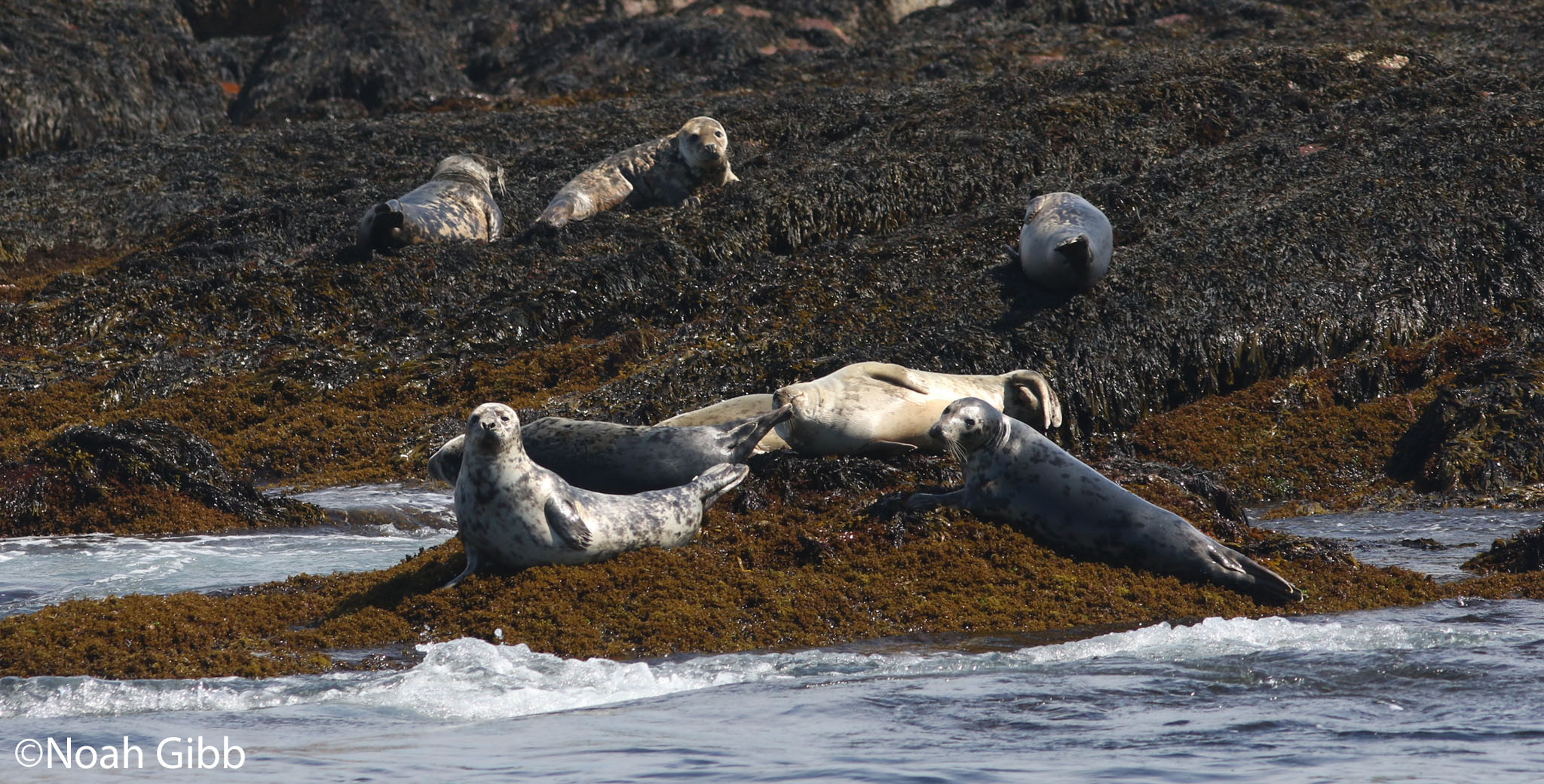
Gray Seals and Harbor Seals. Note the “horse’s head” profile of the Grays, verses the puppy-like Harbors.
In other words: what a trip! And exactly why it’s well worth a tour to Seal Island regardless. That being said, I must admit, it was not quite the same without “Troppy.” But as a guide, my stress level was a lot lower! Having seen him 9 times out of 12 visits to Seal, I consider myself beyond fortunate. I’m also so happy to have shared his glory with so many other birders on all these tours. So, wherever you are, Troppy, I’ll continue to lead trips to Seal Island in your honor!
The good thing about birding is that it can be done anywhere at anytime, such as between errands in Auburn where I enjoyed this Peregrine Falcon hunting around Great Falls. I snapped this photo with my phone through my binoculars on the Hampton Inn in Auburn.
I don’t usually get out birding much in the week before Christmas, and this year it was even less. But a few quick stops, dog-walks, and incidental observations produced only the following observation of note over the past seven days.
1 GRAY CATBIRD, Saco Riverwalk, 12/20.
This Week in Finches:
Although my birding was limited, the dearth of finches was noteworthy. Has the flight passed us by? Did the largest volume of redpolls simply move southward to the west of us? Are there more in the pipeline, or will we have a rather quiet January and February?
EVENING GROSBEAK: 1 (Old Town House Park, North Yarmouth, 12/21).
Red Crossbill: 0
WHITE-WINGED CROSSBILL: 0
PINE GROSBEAK: up to 10 daily (in and around the yard here at the store all week).
Purple Finch: 0
Common Redpoll: 0
Pine Siskin High Count This Week: 3 (Merrill Road Ext, Freeport, 12/19).
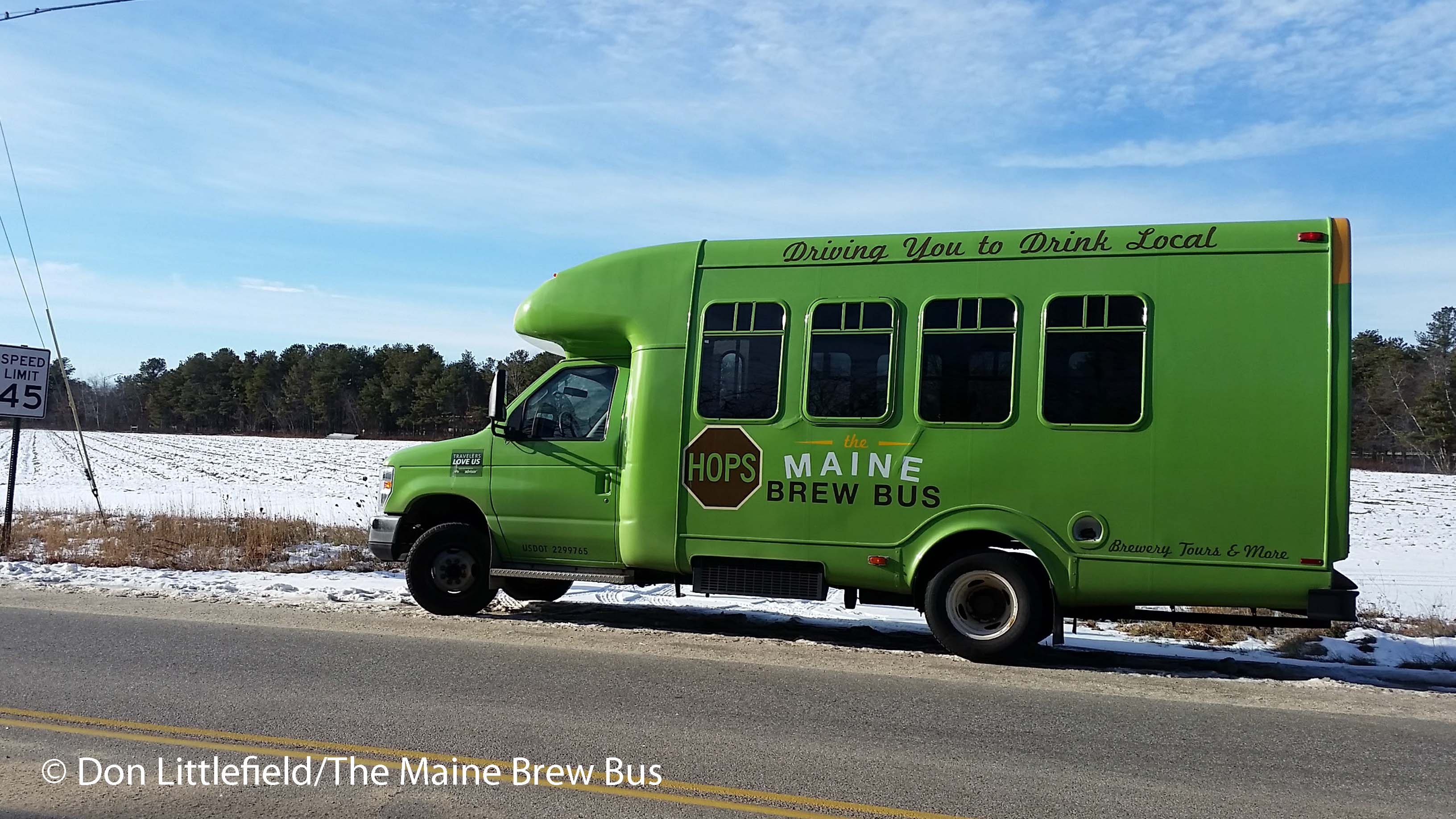
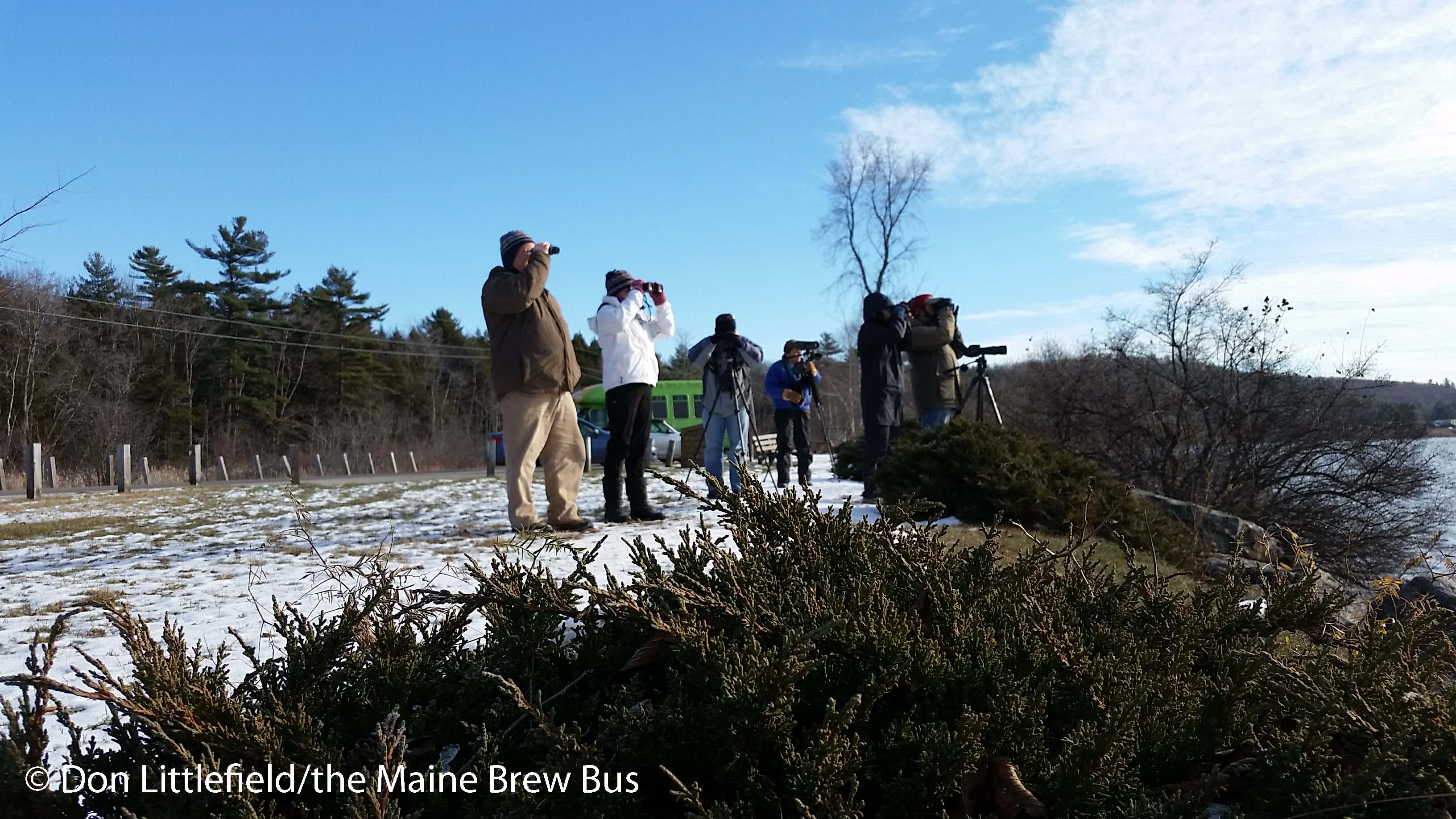
One of the most popular Birds on Tap – Roadtrips! is our annual “Fall Ducks and Draughts.” One of the original two BoT – Roadtrips! back in 2015, this popular outing visits Sabattus Pond near the peak of fall waterfowl migration with our partners, The Maine Brew Bus.
It rarely disappoints, but today it far surpassed expectations! We began at the south beach, where an American Coot was a surprise. However, more surprising was the flock of shorebirds littered around the south end. While many of the 30 or so Dunlin took off and kept going, about 10 White-rumped Sandpipers returned and landed right in front of the group, no more than about 30 feet away! We were able to carefully study the progression from juvenile to 1st winter plumage, with most individuals, such as these two, mostly still in colorful juvenile plumage (with one bigger, grayer Dunlin in the background).
With our focus back on waterfowl, we began to sort through the masses, starting with 6 spiffy Northern Pintails joining the Mallards nearby, while one lone female Green-winged Teal quickly paddled away. 18 Ring-necked Ducks loafed just a little further offshore, providing a good intro to the genus Aythya. Sabattus Pond is famous for its legions of Ruddy Ducks, and this cute little “stiff tail” was out in full force. We had a couple of hundred nearby, but a distant raft of many hundreds remained just a little too far to enjoy. We also began our comparison of Greater and Lesser Scaup, and took a moment to learn about the Chinese Mystery Snail that makes up a large percentage of the food source of all of the diving ducks we were here to enjoy.
I had set the over/under for waterfowl species at 13.5, and our list quickly began to grow: Buffleheads, Hooded Mergansers a’plenty, but surprisingly only one Common Merganser and a mere three Canada Geese. American Black Ducks and a single hen American Wigeon made for a tally of 13 species of waterfowl; just falling short of covering the spread…in part because we never did make it to our third stop!
Over at Martin’s Point Park on the southwest side of the pond, we worked the dabbling ducks and enjoyed stunning Hooded Mergansers. Then, I finally had a nice, close group of the two scaup species in perfect light to give us a lesson in how to identify this challenging species-pair.
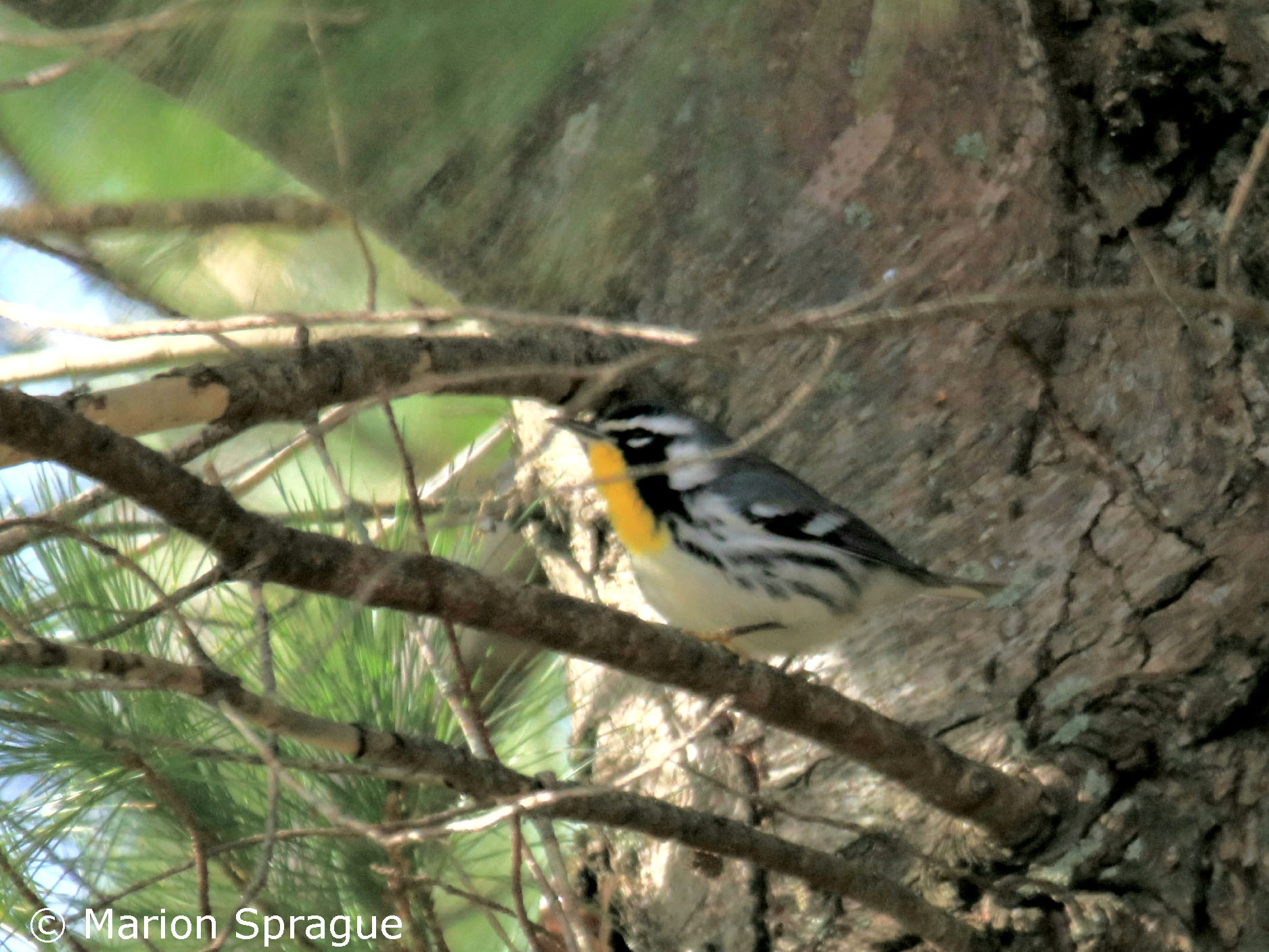
We began to walk closer, I began the lecture, and then I heard a call note from the trees that stopped me dead in my tracks. It was not a Yellow-rumped Warbler – the only expected warbler species at this season – and it’s sharp tone was very suggestive. I knew it wasn’t supposed to be here, whatever it was, and my suspicions of its identity were soon proven correct when a gorgeous Yellow-throated Warbler popped out!
Sticking close to the trunk of some large Eastern White Pines, it foraged within a small mixed-species foraging flock of Black-capped Chickadees, Tufted Titmice, White-breasted Nuthatches, and Golden-crowned Kinglets before eventually disappearing towards the neighborhood.
This is a real rarity in Maine, and because of the white in the front of the supercilium, we know it is of the interior subspecies albilora, and therefore not likely the result of the recent storm system. While there was unprecedented three together on Monhegan earlier in the month, this is quite the rarity, especially so far inland, and especially in Androscoggin County (I couldn’t help but wonder if there has ever been a record of this species anywhere in the county).
Unfortunately, in the meantime, some fisherman came to the shoreline, and the closest scaup departed. We did have a slightly farther raft to work through, but I ended up having to employ my rudimentary artistic skills to explain how to differentiate the two species!
>a href=”https://mebirdingfieldnotes.blog/wp-content/uploads/2017/11/dawn-2a_edited-1.jpg”>
It was truly hard to leave the pond today, and I of course couldn’t help but wonder what was around the next corner, but it was time to switch gears, turn our attention to Dawn – our driver and beer guide today – and make our way over to Baxter Brewing Company, you know, to celebrate our vagrant warbler discovery!
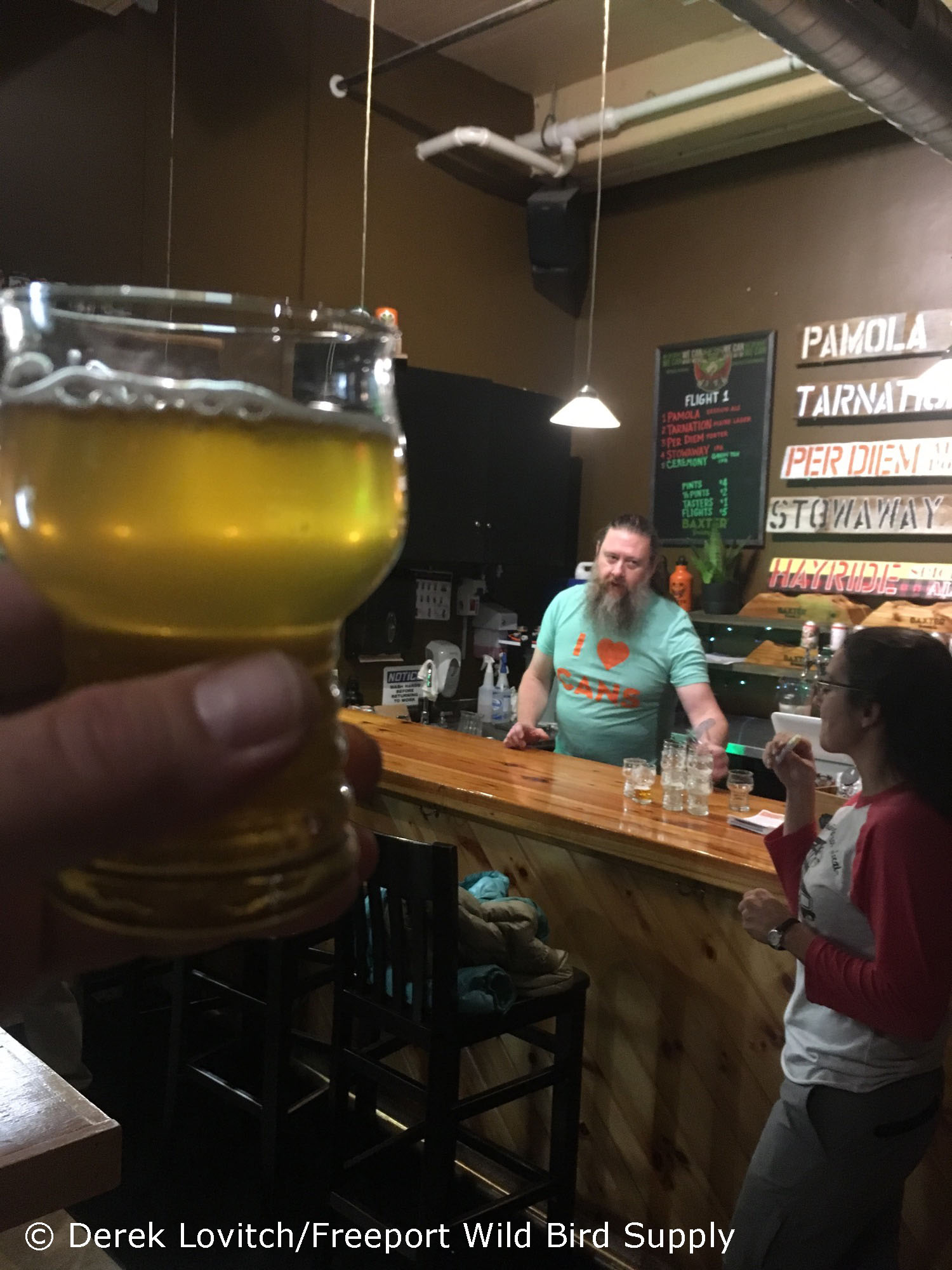
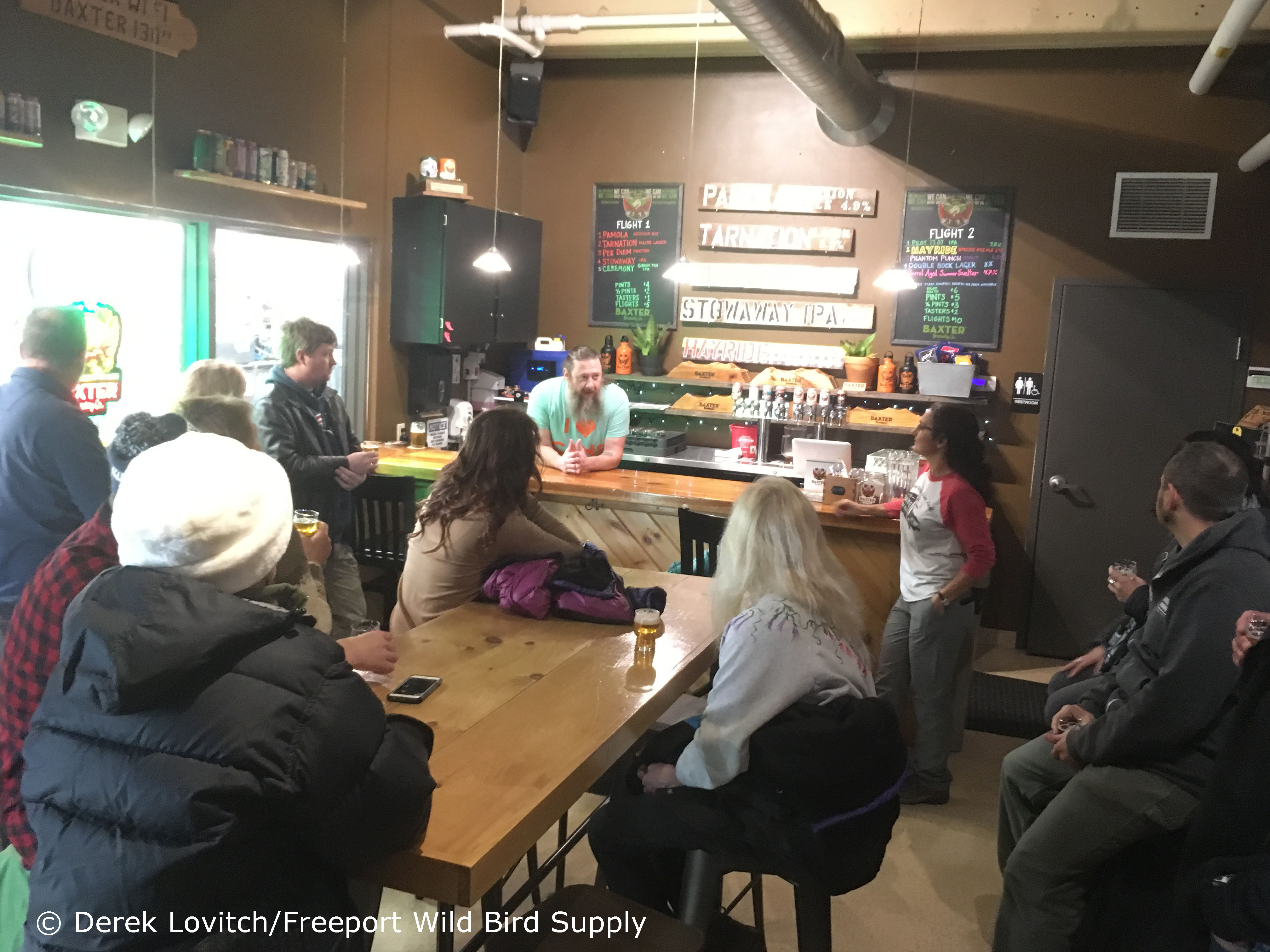
At Baxter, housed in one of the beautifully restored mills down by the Androscoggin River, we enjoyed five samples of their most popular beers. We learned about their philosophy and history – including the noteworthy fact that they were the first 100% canning brewery in Maine – and sampled some of their best selling beers, such as Pamola pale, Tarnation lager, Per Diem stout, and the venerable Stowaway IPA. We also sampled Ceremony Green Tea IPA which surprised a lot of people and showed off the creativiTEA (sorry, I couldn’t help myself) of the brewery.
We stepped outside of the brewery and were once again greeted by the local Peregrine Falcon atop the steeple of the Franco-American Heritage Center. After a few minutes of enjoying it through the scope, we hit the road, and discussed the beers we had just sampled. People’s favorites were rather evenly divided, aligning with their preferred style of beer, showing that Baxter really does offer something for everyone.
We followed the Androscoggin River towards the coast, and soon arrived at Maine Beer Company. MBC needs no introduction – at least if you are into IPAs or hoppy pales – but with so many folks on the trip today from “away” and/or making their first visit to this popular destination, we started things off with none other than their Peeper – their first brew that got it all started.
Spenser came out to introduce the beers and tell us all about how MBC is dedicated to “do(ing) what’s right.” And that philosophy transcends the beer.
They graciously offered everyone a choice of their next samples (I of course followed Lunch with Another One) and then Spenser really rolled out the red carpet for us, taking the group on a rare behind-the-scenes tour of their brewhouse…including a sneak peek at the massive new expansion that is underway. Clearly, Spenser’s excitement was evident and the group came out of this special tour absolutely bursting with MBC enthusiasm, and lots of promises to be back soon.
Thirteen species of waterfowl, many up close and personal. A most-unexpected rarity that no one in the group had seen in Maine before – and for some, a “life bird.” Urban Peregrine Falcon. Baxter Brewing Co and Maine Beer Company. Yeah, this is what Birds on Tap – Roadtrips are all about!
Our seventh and final “Birds on Tap – Roadtrip!” of 2016, entitled “Farms and Fermentation” traveled inland on Sunday. Unlike most of our itineraries, Farms and Fermentation has a very flexible birding route, affording us the opportunity to take advantage of seasonal highlights and variables including weather, northern bird irruptions, and local food supplies.
The theme of the tour is the connection between agricultural lands and birds, but we also spent plenty of time checking out the region’s most significant bodies of water as recent cold weather has slowly frozen small ponds and lakes, pushing waterfowl to the open waters of the deep Lake Auburn and the fast-flowing Androscoggin River.
It was a frigid day, but with temperatures rapidly rising through the 20’s and virtually no wind at most of our stops, we enjoyed a very pleasant and productive morning of birding. Our first stop was a large, open agricultural field in Gray and New Gloucester, where we immediately found 16 Horned Larks within about 30 yards of the road. No Snow Buntings, as I had hoped for, but the views of the four larks that stayed with us were hard to beat.
Letting the temperatures climb a bit, we hit the road for a longer stretch to arrive on the north shore of Lake Auburn. Unfortunately, the ducks were elsewhere today – perhaps flushed by an eagle or two – but we did view two Horned Grebes (rare inland in Maine except for here and Sebago Lake and a rather late date for them away from the coast). One distant Common Loon was also spotted.
A short hop to North River Road sampled the birds of early successional forest, undoubtedly the first step in reforestation of an abandoned farm. American Tree Sparrows, quite a few Northern Cardinals, and a number of House Finches were present, while a Bald Eagle soared over the river beyond the cornfields across the road (still no Snow Buntings). The highlight, however, was a Red-tailed Hawk that circled up and then glided low over our heads, with the reflection of the thin coating of snow on the ground acting as a spotlight to really light up its pale plumage.
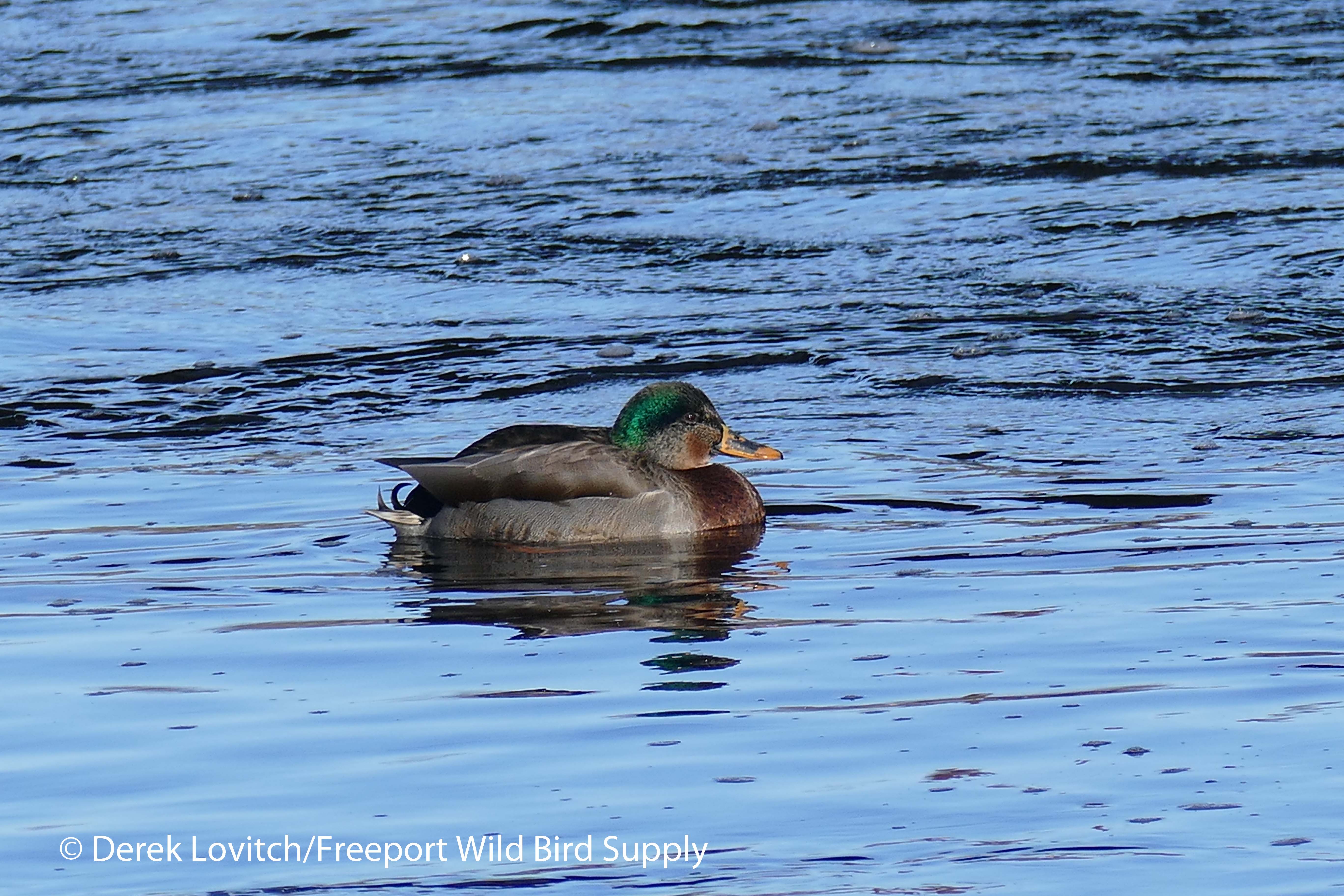
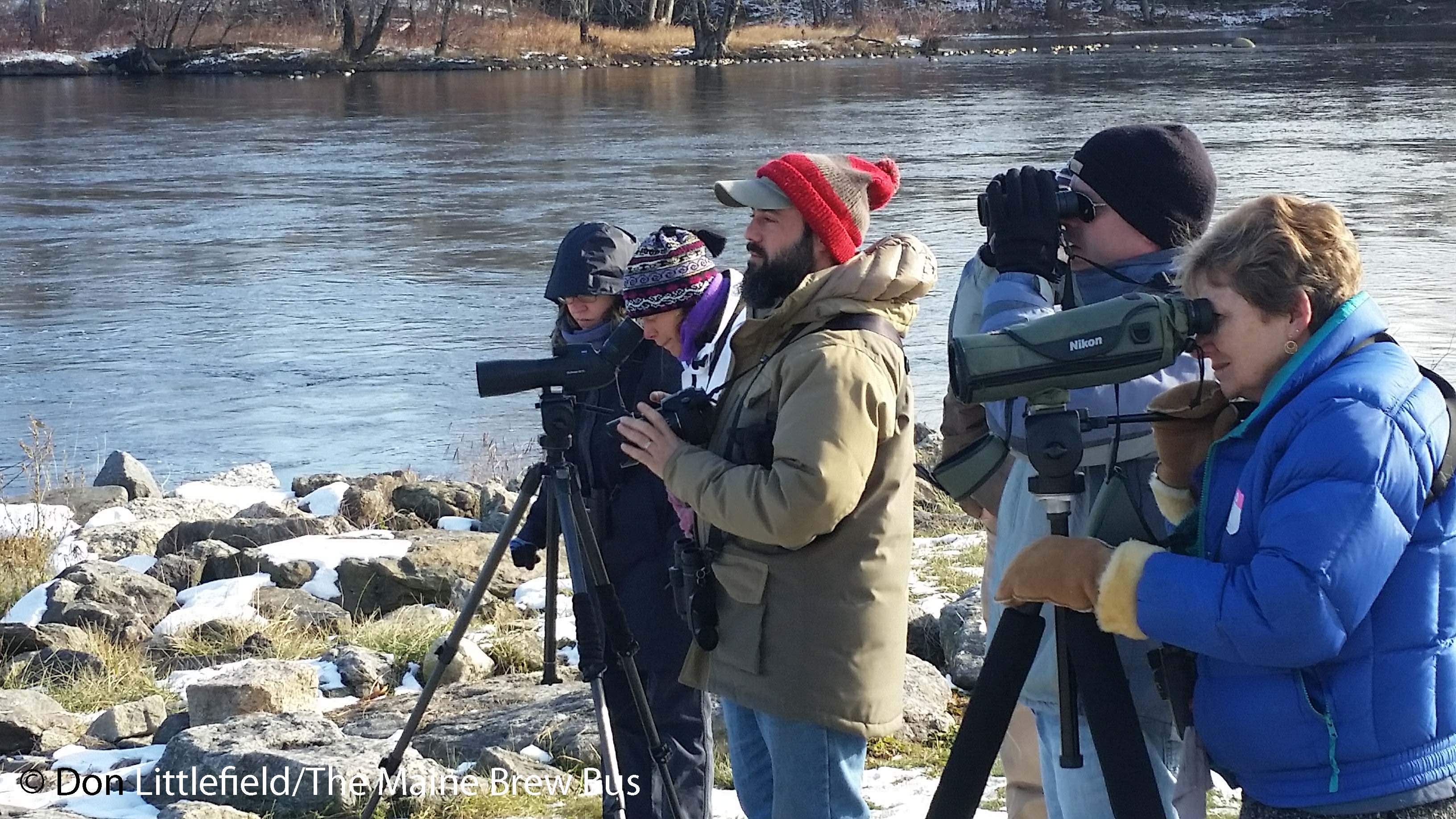
Three punk-rock Hooded Mergansers were at the nearby boat launch, and we finished up with some more waterfowl along the Auburn Riverwalk. Nearly 200 Mallards were present, affording us the chance to study individual variation and hybridization, as well as taking a moment to savor a truly beautiful critter. Hooded Mergansers
As for this individual, I am not sure how to interpret its odd plumage: a very old female taking on male characteristics, a hybrid with something domesticated, or perhaps a male that for some reason is unable to fully attain an adult plumage. Whatever it is, it was a perfect example of how much there is to be learned from looking at our most common birds!
Four American Black Ducks and some odd Domestic things were present, but I was hoping for an unusual dabbler or two to have joined the masses with the recent freezing. However, we did have two more Hooded Mergansers, and downriver, two spiffy drake Common Mergansers. A Common Loon was a little out of place on the river, likely a bird that woke up to encroaching ice on a lake this morning!
Don then took over as layers were shed for good, as we crossed the bridge into Lewiston on our way to Bear Bones Beer. Don was giving us some of the history of this new brewery, but I interrupted to have him pull into a parking lot. We quickly disembarked to temporarily resume our birding with scope views of the local male Peregrine Falcon eating lunch atop of the steeple of the Franco-American Heritage Center, as per our tradition during “Birds on Tap – Roadtrips” to Lewiston!
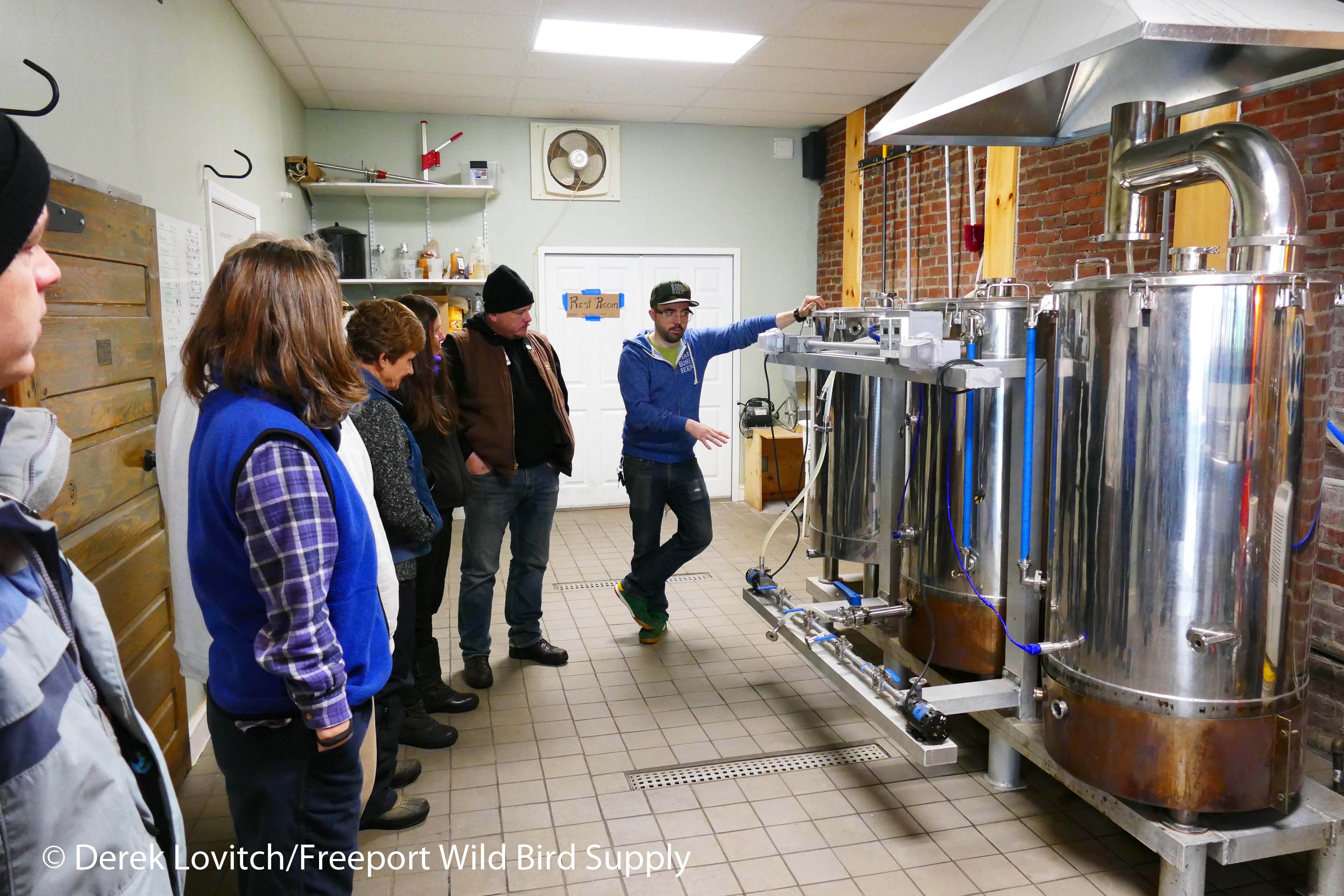
Arriving at Bear Bones Beer, a nanobrewery with a focus on sustainable production and ingredients, co-founder Eban Dingman welcomed us into the comfortable space in a renovated portion of a former department store in the heart of downtown.
We began our tasting with their 2X C.R.E.A.M, a smooth cream ale that featured a very nice balance, avoiding overdoing it with the hops. Dry-hopped with fruity Mosaic hops, Robot Bear Porter finished with a fruit flavor not typical of porters, putting a nice twist on a good winter stand-by. Picea, a dry stout brewed with spruce tips added to the whirlpool process, featured a subtle hint of spruce/resin, especially on the back end.
After sampling some of their applewood smoked barley malt, we tasted it in action. I went with the New Dead Smoked IPA, with just the hint of the smoky flavor and a more subtle hop kick than most IPAs these days. The “over-hopping” bandwagon had definitely not arrived – thankfully, if you ask me – here on Lisbon Street. Winston provided additional entertainment
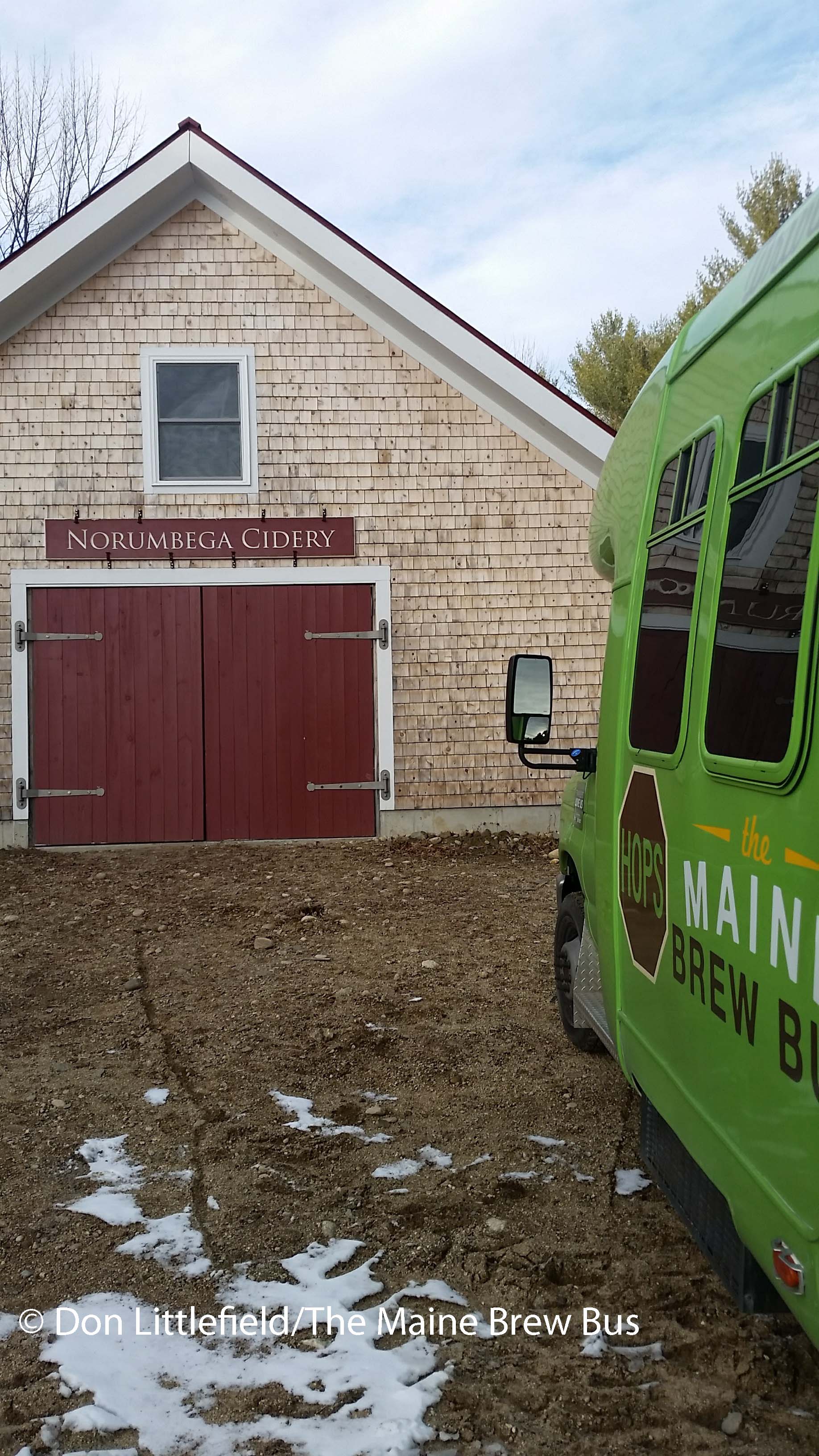
Trekking back across country, keeping an eye out for Northern Shrikes (we did spot two Northern Mockingbirds today however, much rarer in winter in interior Maine than shrikes!) as we returned to New Gloucester for a special visit to Norumbega Cidery. Open to the public only for the occasional special event, this was a real treat to learn about Noah Fralich’s family farm and his four-year-old cidery. Discussing his plans for the property, including the cultivation of a wide variety of heirloom and specialty apples, we also discussed the value of orchards to birding: in fact, if Pine Grosbeaks or Bohemian Waxwings had made it this far south by now, we likely would have visited an orchard or two on today’s tour – and wondered if in a few years, we might see these species right here at Norumbega.
I’m not a big cider guy, as I usually don’t like sweet drinks in general. Many of the most popular hard ciders today (at least from the national brands) are loaded with sugar, and are more akin to soda. Dry ciders, however, are closer to wine, and the white wine yeasts that Noah uses produce a very crisp, very dry, and very delicious product that retains aromatics and subtle flavors.
We began with the clean and crisp Classic, with just a hint of tartness followed by the Berry Medley with a sweet and bitter contrast from the tannins and sugars found in four varieties of berries. Sweeter than the others, but still finishing very smooth and crisp, the Honey (technically, a ceyser because of the use of honey) was next up, featuring its very subtle honey notes and nose. And finally, we tried the Spice – my new favorite cider that I left with four bottles of – with a really complex taste profile and depth of flavor produced by only three added spices: cinnamon, nutmeg, and cloves (admittedly, I also tend to love anything with nutmeg) that made me think of an unsweetened apple pie.
Taking the back roads back to Freeport, we slammed on the breaks when a Barred Owl was spotted, and quickly unloaded. Unfortunately, the Barred Owl was less excited and melted away into the woods, bringing our birding day, and our successful “Farms and Fermentation” tour to a close.
With ten tours on the schedule for 2017, including some really exciting new itineraries, we look forward to having your on board soon. All of the tours are posted on the “Tours, Events, and Workshops” page of our website, with direct links for online reservations.
Our theme for the this tour was “Ducks and Draughts,” and so we headed northwest to Sabattus Pond in Sabattus, one of the premier duck-watching sites in Maine, and arguably THE waterfowl hotspot in late fall in the southern half of the state. After pick-ups in Portland and Freeport, the bus, Paul (our driver and beer guide for the day), and I arrived at the south end of Sabattus Pond. It didn’t take long to know why this place is such a destination for birders at this time of year.
A large number of ducks were immediately encountered, but we soon focused our attention on the pair of Redheads – rare, but fairly-regular migrants in Maine – that were a “Life” or “State” Bird for some. For others, it was nothing more than the pleasure of seeing this attractive bird!
We covered the three primary hotspots on Sabattus Pond, amassing a total of 17 species of waterbirds. In addition to the Redheads, highlights included a Red-necked Grebe (rare in Maine’s interior), 24 American Coots, 4 Northern Pintails, 6 Green-winged Teal, and several hundred Ruddy Ducks. Although a relatively low number for here, “several hundred” Ruddy Ducks is not a statement uttered anywhere else in Maine…and especially not when proceeded by the word “low!” Other waterbirds species seen today included Lesser and Greater Scaup, Mallard, American Black Duck, Ring-billed and Herring (1) Gulls, Buffleheads, Hooded and Common Mergansers, Common Goldeneyes, and one Great Blue Heron.
Sabattus also affords the opportunity to study the two scaup species together, so we took plenty of time to go over this identification challenge. Side-by-side, the major differences are often readily apparent, so we practiced our skills to apply them to a homogenous group, or worse, the “dreaded” lone, single, distant scaup!
Having our fill of the nuances of Aythya identification, Paul took charge and delivered us to Lewiston’s Baxter Brewing. But as we stepped out of the bus at the renovated mill, it was back to the binoculars and scopes as we enjoyed a Peregrine Falcon pair – one busy feasting on a Rock Pigeon lunch – a top a nearby building. With that, it was beer time!
The first brewer in New England to can all of its beer, Baxter is known for such go-to brews as their Pamola Pale Ale and especially, their Stowaway IPA. Less well-known, however, is their ultra-creative 10-gallon Small Batch Series. Samples of Tarnation Lager, Phantom Punch Winter Stout, and Bootleg Fireworks Double IPA were enjoyed and discusses, and I simply had to quench my curiosity (as well as my thirst, of course), with the Small Batch “Sweet Tea Chai Spice Stout.”
A tour of the brewery and the brewing processed followed, and soon we were off – with one last quick look at the Peregrines, heading down the Androscoggin River to Freeport for a date at Maine Beer Company. Samples of Zoe (Hoppy Amber), Mo (Pale Ale), King Titus (Porter) and one of my absolute favorites, Lunch (IPA) were served, and a few folks sampled their most recent Pilot 8, their take on a Kolsch. Fueled by the delicious brews, we continued the discussion of…well, ducks…and draughts!
The “Birds on Tap – Roadtrip!” series, a partnership between the Maine Brew Bus and Freeport Wild Bird Supply will continue in 2016. In fact, several new tours are in the works, which we hope to announce soon. Stay tuned!























































 Maine Birding Field Notes
