Tag Archives: Brown Creeper

Recent Highlights, 10/3– 10/9/24

One of at least 15 Cory’s Shearwaters observed from a Cap’n Fish’s Cruises Whale Watch last week, showing the dark outer primaries on the underwing, making for a rounded end to the white of the underwing coverts, separating it from the recently-split Scopoli’s Shearwater.

October is my favorite month of birding in Maine, and this past week showed why. A great diversity of birds are on the move, and my past seven days featured everything from pelagics to yard birds. Here are my observations of note over the past seven days.

  • Pelagic highlights from a Cap’n Fish’s Cruises Whale Watch out of Boothbay Harbor on 10/4: 4 NORTHERN FULMARS (including one dark morph), 4 ATLANTIC PUFFINS, 14-15 Cory’s Shearwaters (most seen and/or photographed well enough to see full dark outer primaries on the underwing; see above), 6 Red-necked Phalaropes, and one BROWN CREEPER landing on a person on the top deck about 14 miles off of Damariscove Island (photo below). My complete list is posted here.
  • 1 Baltimore Oriole and 1 Nashville Warbler, Wolfe’s Neck Center, Freeport, 10/5 (with Saturday Morning Birdwalk group).
  • Sandy Point Morning Flight, 10/6: 140 birds of 18 species led by 60 Yellow-rumped Warblers. Total tally here.
  • 1 Rusty Blackbird, 1 Nashville Warbler, and 1 Pied-billed Grebe, Capisic Pond Park, Portland, 10/9 (with clients from New York).
  • 20-30+ Cory’s Shearwaters off East Point and Ocean Ave, Biddeford Pool, 10/9. Some just beyond Beach Island in good afternoon light to see dark outer primaries. 15 minutes of counting produced 18 individuals from East Point, all moving north, with 1-3 in view with almost every quick scan thereafter. Good sign for Monday’s pelagic! (with clients from New York).
  • 7 American Oystercatchers and 1 Horned Grebe (first of fall), Ocean Avenue, 10/9 (with clients from New York).
  • 1 American Redstart, Elphis Pond, Biddeford Pool, 10/9 (with clients from New York).
  • Highlights from our Durham property this week included the arrival of the first few Dark-eyed Juncos, a Rose-breasted Grosbeak on 10/4, continuing multiple Lincoln’s Sparrows, Nashville Warbler on 10/8, and another or the same Indigo Bunting on 10/9.
  • And here’s my complete trip report from my Monhegan tour and visit on September 27 through October 1st.

UPCOMING TOURS:

  • Our annual half-day pelagic with our partners Cap’n Fish’s Cruises out of Boothbay Harbor is on Sunday, October 14th – a nice, late date that should put us more in the season of things like Great Skua, and you can be sure we’ll be studying Cory’s Shearwaters hard to find a Scopoli’s! More info and link to registration is here. See notes above from my 10/4 outing.
  • A few spaces remain on our Birds on Tap! – The Boat Trip! To House Island in Casco Bay on Sunday, October 20th. More info here.
Join us on Monday’s pelagic and maybe a Brown Creeper will land on you!

This Week’s Highlights, 1/29-2/6, 2022

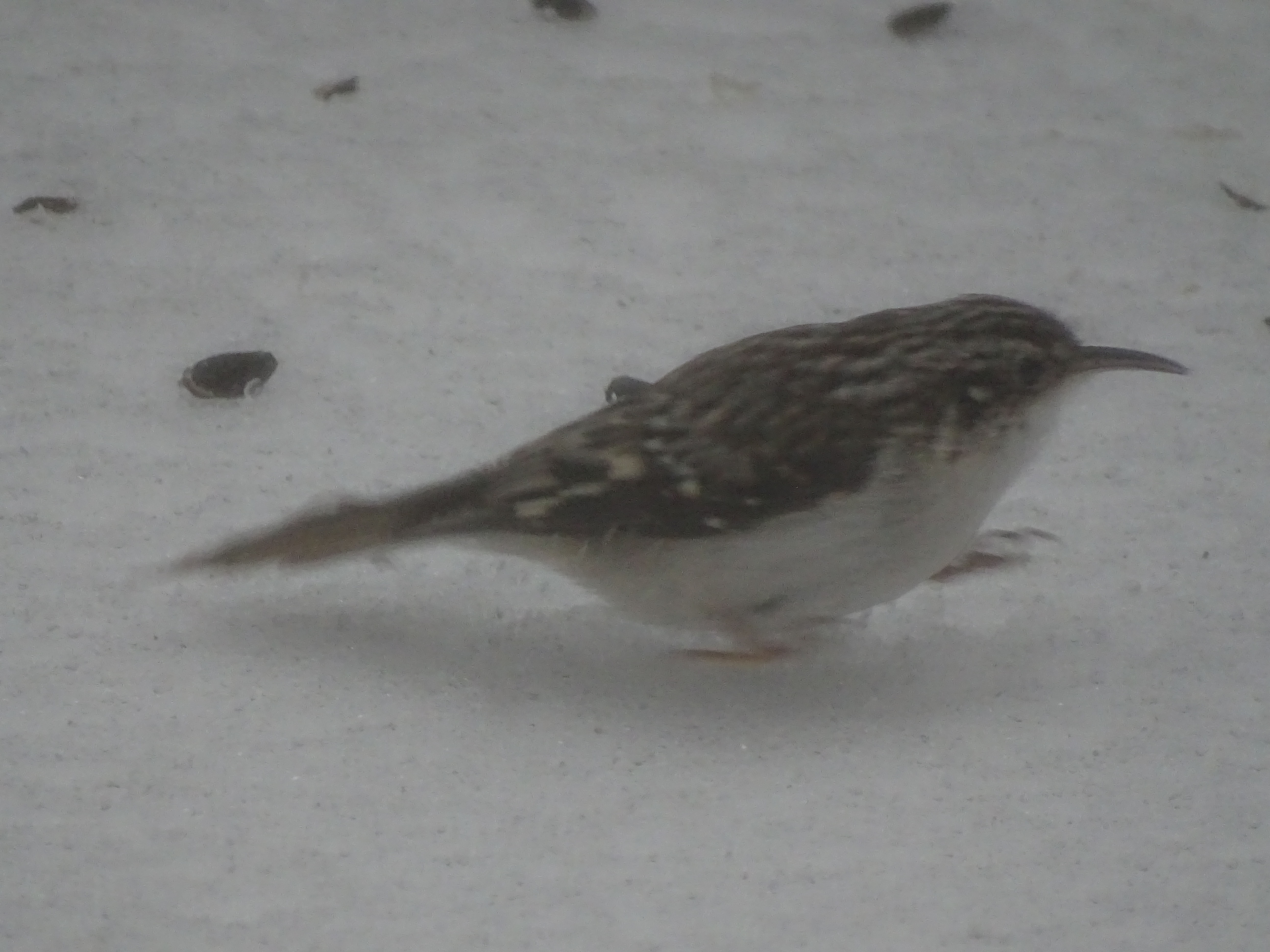
While not the rarest bird this week, I have been thoroughly entertained by this Brown Creeper who has taken to picking up bits of seed from under a feeder at our home in Pownal. The horizontal position makes the bird look so different! Sorry for the lousy photos though…they were taken through a screen during the ice/snow storm on 2/4.

The Blizzard of 2022 provided some great opportunities for cross-country skiing and snowshoeing locally for the first time this winter, so I took full advantage of that, even if it did further limit my dedicated birding during this busy week plus.  Interestingly, my most “serious” birding was a half day (post-snowblowing and shoveling) on Sunday searching Portland through Cape Elizabeth for storm-related birds, but that effort turned up nothing at all of note! Here are my observations of note over the past 9 days:

  • 5 WHITE-WINGED CROSSBILLS, 2 COMMON REDPOLLS (FOY), 6 Pine Siskins (FOY), and 1 Purple Finch, Long Falls Dam Road area of Carrying Place Township, 1/31 (with Jeannette).
  • The Androscoggin River between the downtowns of Lewiston and Auburn remain a surprisingly productive mid-winter hotspot. On 2/1, Jeannette and I discovered an incredible (especially for the interior of Maine) five species of dabblers from the Auburn Riverwalk!  Amongst the Mallards and a couple of American Black Ducks, there were single female GREEN-WINGED TEAL, AMERICAN WIGEON, and NORTHERN PINTAIL.  Making this even more interesting is the fact that it’s usually the drakes that we find overwintering in Maine.  Additionally, the drake RING-NECKED DUCK continues, and we had a single 1st-winter Iceland Gull. Two Bufflehead and 5 Hooded Mergansers joined the usual Common Goldeneyes and Common Mergansers for a goodly inland total of 10 species of waterfowl. A unusually conspicuous Beaver continues to amuse here as well.
  • 3 drake and 1 hen BARROW’S GOLDENEYES and 8 Dunlin (FOW here), Winslow Park, Freeport, 2/13.

Other Notes:

  • My article – a 13-page photo salon – on the Hybrid Herons of Scarborough Marsh (Patches!) has finally been published in the most recent issue of North American Birds. In it, I lay out the theory that at least 5 different individuals have been seen in Scarborough Marsh since I first found an odd juvenile heron in July of 2012 that we now believe is a hybrid between a Snowy Egret and a Tricolored Heron.

I made the case that the two current birds are backcrosses, one with a Snowy Egret (SNEG X TRHE X SNEG) and the other with a Little Egret (SNEG X TRHE X LIEG). I’ll be watching them carefully for the potential of a developing hybrid swarm.

Unfortunately, at this time, the journal is only available online to members of the ABA. However, digital e-memberships (with access to all of the ABA publications) are only $30 a year, and you can purchase issues of the magazine directly from the ABA by emailing info@aba.org. Also, if you wanted to take a peek at the article, I do have a couple of extra copies here at the store for you to peruse.

Believe it or not, a hybrid heron is much rarer than a Steller’s Sea-Eagle, at least from a world perspective…in fact, it’s possible these birds are one of a kind!