Tag Archives: “Birds

The Galapagos (Part I)!

Jeannette and I now have a saying: “When opportunity knocks, we buy plane tickets!” And such was the case when WINGS – for whom I am a Senior Leader – offered their guides and significant others the chance to take some open berths on Rich Hoyer’s Galapagos tour.  Because the boat was chartered, those empty beds would have gone to waste, so for the price of airfare and various expenses, this was a chance we simply had to make happen. Because the Galapagos!

As luck would have it, one of my weekend tours cancelled with too few participants, and I had kept the second half of June much more open than normal to work on a project. Well, with all of my guiding packed into the first two weeks of the month, plus finishing that project, plus running the store in a very busy season, etc, etc, we simply said “we have to do this” (despite all rational common sense suggesting otherwise)!

And so we did.

(I’ve taken the “travelogue” approach to this blog post as usual, recounting our trip and sharing a few thoughts and tidbits here and there. However, for a great and informative treatment of the Galapagos from birds to geology, I highly recommend John Kricher’s Galapagos: A Natural History.)

6/17: Travel Day.

It was a long day. A drive to Logan, a flight to Miami, a four hour layover, and then a flight to Quito…we didn’t get to bed until 11:30 local time (12:30 EDT). We were tired.

6/18: No time for rest yet.

A 5:45 breakfast, which we were barely conscious for, started the day. In addition to seeing Rich for the first time in many years, and Steve Howell (who also took advantage of the opportunity ahead of his upcoming Ecuador tour) for the first time in a few years, we immediately recognized two of the participants. In the “birding is a small world” department, we came to realize that we met Bill and Don in a van on St. Lucia in January!  We came together when the local guides we each were spending time with teamed up to get us to and from a remote part of the island, and search for Bridled Quail-Dove and White-breasted Thrasher. Go figure.

Organizing luggage and getting ready to board the minibus in the hotel’s parking lot, Jeannette and I quickly picked up a couple of life birds, as neither of us have been to the region before: Blue-and-yellow Tanager and Scrub Tanager. There were no doubt others in the garden, but they would have to wait for our return.

Already back to the airport, we boarded our flight to Baltra in the Galapagos, with a short stop in Guayaquil. After landing in Baltra, the short walk from the tarmac to the arrivals building yielded our first endemic of the trip: Galapagos Dove – with its spiffy, screaming-blue eyeliner.
North Seymour Island
Our first Galapagos Island – North Seymour Island, as we arrived in Baltra.

Our first “Darwin’s finches” flitted about: the un-evocatively but fairly descriptively-named Medium Ground-Finch. I was looking at a Darwin’s finch. Seriously, this was a dream come true.

We cleared immigrations and customs, and then we temporarily split off from the group; we were on our own this afternoon. We hopped on the bus to the ferry for the short crossing to Santa Cruz, enjoying numerous (Galapagos) Brown Noddies along the way.

A half-hour drive to our hotel gave us a sample of the transition between habitats as we gained elevation. We arrived at the Twin Lodges Galapagos, a quaint eco-lodge with lovely and spacious rooms, on the outskirts of the town of Bellavista.
Twin Lodges GardenTwin Lodges room

We walked into town for lunch, first feasting on numerous Yellow Warblers of the near-endemic subspecies aureola. Introduced Smooth-billed Anis were also common, and we began our education of Darwin’s finches by comparing numerous Medium and Small Ground-Finches.  Separated almost exclusively by bill shape and size, we struggled a bit, especially with lone birds, even with a small mixed group in town allowing helpful direct comparisons.

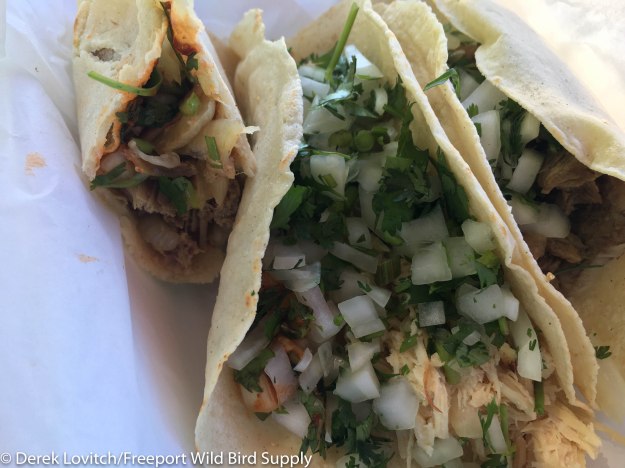
Lunch from a small streetside restaurant was superb, and a nice introduction to the local cuisine.
lunch

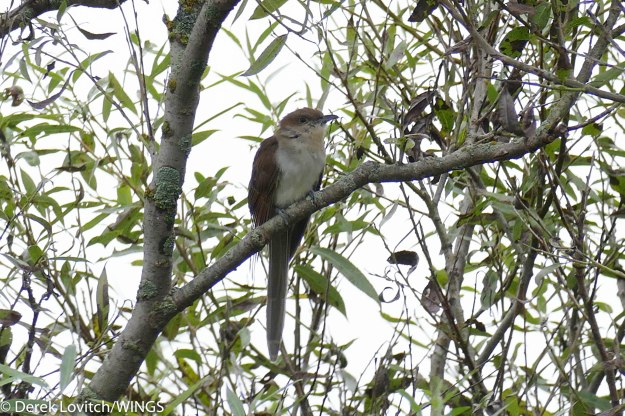
We picked up some vittles at a bakery for dinner (lunch was the large meal of the day!) and walked back up to our lodge, spotting our lifer Dark-billed Cuckoos.

After a little rest, a short casual mosey in the other direction gave us more time with finches, including our first Green Warbler-finches, as well as garrulous Galapagos Mockingbirds.

We were in bed by 7:30 and slept for 9 ½ hours. It was wonderful.

Twon Lodges Room 2
Perhaps the most “countable” Large Ground-Finch of the day.

6/19: Birding to the Boat.

After a breakfast overflowing with fresh fruit from the garden of the lodge, we took a short cab ride to meet up with the WINGS group at their resort. It was time to let Rich do the work!

A Small Tree-Finch worked the resort grounds, and following a discussion with Rich and Steve, added Large Ground-Finch to our list from yesterday. These birds are not easy, and a lot of them seem best left unidentified, but one pair of birds in the Bellavista town square clearly had the massively deep bill (as deep or deeper than it is long) and bill ridge above its forehead that should, in theory, confirm it as a Large…and not just a large Medium!

Our birding outing uphill yielded a few Woodpecker Finches. In particular, one bird that was perched on a snag was holding a thin, straight twig in its bill. One of the only birds in the world that uses a tool, this bird had its handy, wood-boring-larvae-extracting device at the ready. “Woodpecker Finch with a tool” was one of my most-wanted observations of the trip. Score!
Woodpecker Finch with tool

A Short-eared Owl almost took out Jeannette as it went crashing into the brush, offering up some of the best photographs that this species(s) will ever offer.

Then Rich went to work and got us a great look at the secretive (about the only secretive thing on these islands) Galapagos Rail – one of the most challenging species to see in the islands.
group hike

As we moseyed downhill, several Vegetarian Finches were encountered, including a few that were observed, well, eating their vegetables. One particular bird was fond of a certain type of fern frond. The uniqueness of each of Darwin’s finches is not found in their plumage, but in their diet and the amazing evolution of specialized bills to aid in that particular diet.
Vegetarian Finch

Galapagos Flycatchers, a rather dull Myiarchus, made their presence known, and one bird graciously posed for photos.

We then took a bus down to the ferry across the channel back to Baltra (with our first views of Galapagos Shearwaters). Then the other bus to the airport. And then another bus to the port where we took a zodiac to our home of the next week, the Nemo III.  Marine Iguanas, the endemic subspecies of American Oystercatcher, our first Galapagos Seal Lions and Blue-footed Boobies, were all soon spotted.

We settled into our exceedingly comfortable cabin, then wandered around the boat, spied Elliot’s Storm-Petrels as we ate lunch, and noted a lingering Sanderling on the beach. A single spiffy Lava Gull (arguably the rarest gull in the world with only about 300 pairs) stood guard.
cabin

Blue-footed Boobies and both Magnificent and Great Frigatebirds escorted us out of the harbor as we made our way to North Seymour Island.

As we dropped anchor, the magic really began. Swallow-tailed Gulls, one of my “most wanted” species in the world were jaw-dropping. Much larger than I expected, with a loping wingbeat reminiscent of a small egret, these simply stunning birds were even more astounding than I expected.

And then we landed.

And this is what Galapagos dreams are made of. While studying dull finches in town squares was pretty cool, having to move Swallow-tailed Gulls out of the landing was a little more impressive.
Swallow-tailed Gull

With an onshore breeze, frigatebirds, Blue-footed Boobies and Swallow-tailed Gulls were cruising by at literally an arm’s length. Our lifer Nazca Boobies punctuated the sorties of Blue-foots, Galapagos Shearwaters were numerous offshore, and Small Ground-Finches worked the dry ground.
MAFR-flight

As we walked along the trail – a mere half-mile that took almost 3 hours! – both frigatebirds were enganged in all stages of breeding, from “ballooning” males to nearly-fledged chicks. A few Blue-footed Boobies were dancing, but most were already incubating or brooding chicks of various ages.
BFBO1BFBO2BFBO-people

Galapagos Lava Lizards darted and prehistoric Land Iguanas lumbered.  A couple of Galapagos Petrels passed by offshore, and a Great Egret was escorted off the island by a Swallow-tailed Gull.

This place was simply extraordinary, and even surpassed what I thought were outsized expectations and visions for being here. As one member of the group said, “Why the hell did I wait so long to do this!?”  It defied superlatives. I just wandered around with a smile. Jeannette filled three memory cards.  I’ll let the photos do the rest of the talking.
frigatebirdcolony

iguana crossing
Iguana crossing.

IMG_8496_Swallow-tailedGull1_edited-1

Land Iguana

MAFR

MAFR-nestMale Great Frigatebird

Marine Iguana

prickley pair

sunset

6/20: San Cristobal Island.
sunrise

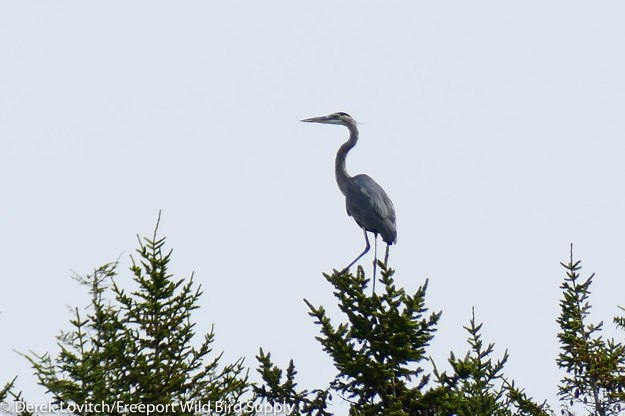
We awoke at our anchorage of the tiny Sea Lion Island, just offshore of San Cristobal. After the information and sensory overload yesterday, it was rather relaxing to stroll the tiny island. Plenty of Blue-footed Boobies, both Frigatebirds, and –you guessed it – Galapagos Sea-Lions were present. While there was a photo at every turn yesterday, and our heads were on a swivel, we instead spent a little more time closely looking and watching behaviors of the boobies, and still trying to figure out how to separate the different ages and sexes of Great and Magnificent Frigatebirds. Wandering Tattler (2) and Great Blue Heron (1-2) were added to our list, along with Green Sea Turtles just offshore. A Lava Gull finally posed for photos.
BFBO

posing Blue-footed Booby

Sea Lion Island

Sea Lion

The second half of the morning was spent snorkeling, it was stellar. Besides massive amounts of fish of many varieties and Diamond-backed Sting-Rays, we had feeding Marine Iguanas. It was rather surreal looking down into the water at a lizard, and we were treated to one in full swim commuting from patches of green algae – their required food source that is just starting to recover from the recent El Nino (we have seen quite a few dead iguanas that didn’t make it through the spell of warm water that kills the green algae; they apparently cannot digest the brown algae that flourishes in the warmer waters).

The fish – of which I know nothing about – were a lot of fun, but then, out of nowhere, a Sea Lion appears, and is swimming full speed right towards me!  At what seemed to be the last second, it wheeled around and dodged right, as if entertaining itself in a game of chicken. It did this several times to me, then to others, and then appeared to attempt to get one of us to play. Of course, it was probably just showing off – yeah, they’re a little more nimble in the water than us flopping humans.

The icing on the cake for me was the Brown Pelican that dove into a school of baitfish nearby. It was absolutely amazing to see the bird plunge down, massive maw agape. Unfortunately for the pelican, the little fishes dodged skillfully away.

Being in the water with Marine Iguanas, Galapagos Sea-Lions, and plunging pelicans is not something I will ever forget.

Back on the boat, we motored into some deeper water, hoping to see Wedge-rumped Storm-Petrels. Galapagos Shearwaters were numerous, and we passed a sea stack with Nazca Boobies and a Swallow-tailed Gull.

We glimpsed only one Wedge-rumped Storm-Petrel, along with one Band-rumped and many Elliot’s, but as we sat down for lunch, two Wedge-rumps came darting in and spent at least 20 minutes in our wake, affording great views and photo ops.

IMG_8590_edited-1
Anchoring in the unexpectedly (to us) busy harbor of the Galapagonian capital, Puerto Baquerizo Moreno, we boarded a bus for a short drive to the outskirts of town, just uphill. Starting at a small but packed cemetery, followed by a slow walk downhill on a wide bike path, we quickly scored San Cristobal Mockingbird (followed by five more on our walk), Gray Warbler-Finch (at least a dozen in all), the San Cristobal subspecies of Vegetarian Finch and Woodpecker Finch, and the largest-billed Medium Ground-Finches we have so far seen (adding to our confidence of our Large Ground-Finch identification from the first day). Small Tree-Finches and numerous Small Ground-Finches, ubiquitous Yellow Warblers, and several Smooth-billed Anis rounded out the list.
Sea Lions at dock

San Cristobal Mockingbird

Having gotten slightly more confident in the identification of the Darwin’s finches that we have been seeing, I have found more time to simply study their remarkable behaviors, such as the Woodpecker Finch foraging on a trunk like a nuthatch, the warbler-finch probing the ends of tiny branches like a parula, and the range of foodstuffs fed upon by the two ground-finches.
Gray Warbler-Finch
Gray Warbler-Finch

Small Gorund-Finch
Small Ground-Finch

largerSmallGround-Finch
A larger Small Ground-Finch? Or a small Medium?

Medium Ground-Finch
Definitely a Medium Ground-Finch.

Back in town, we gawked at gaudy Sally Lightfoot Crabs covering the rocks, Galapagos Sea Lions covering the docks, and a patient Lava Heron (dark-morph of the endemic subspecies of Striated Heron) waiting for passing fish.
Sally Lightfoot Crab

Lava Heron
Lava Heron (dark-morph Striated of the endemic subspecies)

6/21: Espanola Island.
sunrise

Today was incredible! I’m going to let the photos do most of the talking today.

The morning started with the exceptional Espanola (Hood) Mockingbird, the first of which left the beach to inspect the deck of our boat. Many more came out to investigate us as we strolled the beach, taking in the Large Cactus-Finches (soon to be Espanola Ground-Finch) and magnificent Galapagos Hawks – a bird Jeannette and I have wanted to see for a very, very long time.
EspanolamOCKINGBIRD_edited-1
Espanola Mockingbirds

femaleLavaLizard_edited-1
Female Espanola Lava Lizard

GalapagosHawk
Galapagos Hawk.

MarineIguana
Marine Iguana

SeaLion

Another mind-boggling hour of snorkeling (even with a wetsuit, that’s about the maximum in these chilly waters) in deep water, with sealife clinging to the shear cliffs included more close passes by Galapagos Sea-Lions. King Angelfish stole the show, however, although the Chocolate Chip Seastar was also a crowd favorite.

After lunch, we visited the Waved Albatross colony (lifer!) at Suarez Point. Dozens of nesting albatross were scattered about and many more were cruising by the cliffs, riding updrafts.
IMG_8689_WAAV_edited-1

I could have stayed at these cliffs all week: close passes by albatross, countless Red-billed Tropicbirds, many in display flight and Nazca Boobies, with goodly numbers of Blue-footed Boobies mixed in, a smattering of Swallow-tailed Gulls, and staggering numbers of Galapagos Shearwaters coming and going from their cliffside burrows.
MarineIguanaPile
Marine Iguanas

NazcaBoobyNazcaBooby2-SuarezPoint
Nazca Booby.

Red-billedTropicbird
Red-billed Tropicbirds

SuarezPoint

Swallow-tailedGull
Swallow-tailed Gull

usWavedAlbatross

The last hour of daylight was spent searching deeper waters for pelagics, which included our first Band-rumped Storm-Petrels of the trip. Then Steve Howell called out “Markham’s Storm-Petrel!” as this big, dark storm-petrel winged by – a lifer even for Rich, and a most unexpected addition to the now-hefty roster of lifer birds for me (unfortunately, Jeannette had just left to hit the shower!).
ElliotsStorm-Petrels
Elliot’s Storm-Petrels.

Wedge-rumped Storm-Petrel

6/22: Floreana Island.

As the Nemo III cruised close to the cliffs of Gardiner-by-Floreana, a few curious Charles (Floreana) Mockingbirds came out to investigate. Critically Endangered and now found only on two offshore islets around Floreana, this was a bird I was not counting on seeing. Seeing about a half-dozen was a real treat, even if they were about as far as anything we had seen the whole trip!
Gardner-by-floreanaGardner-by-Floreana2

A landing at Cormorant Point (named for a wrecked ship, and not the endemic flightless bird our itinerary will not be taking us to) to visit a brackish lagoon was an interesting new habitat, and yielded 11 American Flamingos, and the endemic subspecies of White-cheeked Pintail. Resident Black-necked Stilts, oversummering Ruddy Turnstones, and a single tarrying Semipalmated Plover padded the trip list as well.
CormorantPoint,Floreana

displayingBFBO

White-cheekedPintailandRUTU
endemic subspecies of White-cheeked Pintail with an oversummering Ruddy Turnstone

AmericanFlamingo

Flamingo1_edited-1Flamingo2_edited-1
phone-scoped American Flamingos

Some more birding by boat produced one (perhaps 2) Galapagos Penguins in the water – another bird I did not expect to see on this tour. It only surfaced a few times, but it was seen well, and it was a real treat to see a flamingo and a penguin in the same morning!
group_in_panaga

In the afternoon, we landed at Puerto Velasco Ibarra, where a truck ride uphill into the island’s higher interior, took us to a very different habitat, and into the realm of Medium Tree-Finches, a Galapagos Tortoise reserve (non-releasable hybrids; a long story) and some fascinating island history.
truck_to_AsilodelePaz

AsilodelePaz-view

captiveTortoises

MediumTreeFinch
Medium Tree-Finch

YWAR_and_tortoise
The endemic subspecies of Yellow Warbler occupies many niches, including foraging for flies around tortoises.

A couple of Common Cactus-Finches welcomed us back to town, joining the Small and Medium Ground-Finches, not to mention the Marine Iguanas and sea lions lining the pier.
CommonCactus-Finch
Common Cactus-Finch

Heading into our most productive seabirding waters after lunch, we were soon rewarded with a staggering amount of Galapagos Shearwaters, 100’s of Brown Noddies, and countless swirling Elliot’s and Wedge-rumped Storm-Petrels. A feeding frenzy attracted both Nazca and Blue-footed Boobies, and was centered around a group of feeding whales, which we unfortunately did not get very close to. We did have a couple of Minke Whales before and after, and a little while later, a magnificent Blue Whale – the largest animal to ever roam the earth.
GASH
Galapagos Shearwater

gape
Galapagos Petrel

Steve_checks_in
Steve checks to make sure he isn’t missing anything.

sunset

With our trip already half-over, it seems like a good place to break. Look for Part II (including our species list) in a separate blog post in the coming days!

Taking Action to Save the Birds of Monhegan Island

As many of you know by now, Monhegan Island has become near and dear to our hearts. It is an iconic birding destination in spring and fall which we, and many other birders, enjoy frequenting on our own as well as while leading tours. Unfortunately, the construction of wind power turbines within 3 miles of the island is closer to becoming a reality, and now more than ever requires action!

Hiking_East_Side,5-19-15

We are not opposed to wind power. But we are opposed to poorly-sited projects that put inordinate numbers of birds at risk. This is quite possibly the worst place in the state of Maine for such a wind power project due to its concentrations of migratory birds. And therefore we feel personally and professionally obligated to do whatever we can to defeat the plan, change the design and lighting to minimize impacts, or, if all else fails, mitigate the potential consequences.

Our most recent statement was posted to the blog this past December, as this misguided project was resurrected from the dead.

Our initial concern about the project was described in this letter and press release from 2013. The link includes our letter, as well as some links to press coverage of our concerns.

In the case of Monhegan, aesthetic concerns are directly tied to not just a sense of place, but the tourism economy. Jobs and livelihoods are put at risk – along with property values – if there is an outsized visual or auditory impact. The visual impact on some of the best views from the island – many of which have been made famous by some of the region’s most famous artists – will be negatively impacted by the placement of this project.

Additionally, while I will not speak for others, suffice it to say that birding tourism will decline. In addition to the direct mortality of birds that is likely, especially under the weather circumstances that cause “fallouts” that are the thing Monhegan birding legends are made of, there are no small number of birders who simply won’t want to look at those blinking lights atop the turbine towers (the biggest direct threat to migratory birds as it will attract and disorient already stressed and confused migrants). I for one will be forgoing my 2-3 tours annually to the island – I simply cannot imagine looking out at those blinking lights knowing the conditions that we are hoping for to bring countless birds on the island for our enjoyment will result in the death of countless birds as they collide with the turbines or simply drop dead of exhaustion. I’ll have to go somewhere else.

Instead of addressing the impacts that such projects cause, the wind industry simply denies the problem exists, suppressing data that proves otherwise, and hiding the facts behind a cloak of “proprietary information.” We know what they are hiding, and they are hiding the massive destruction of birds and bats from poorly sited projects (not all projects, if sited correctly and operated accordingly, will have a sizeable impact). We have the knowledge and expertise to reduce, if not eliminate, much of the direct threat that lighted structures of all kinds have on birds. But instead of addressing lighting color, intensity, and flash interval, the wind industry (unlike the communications industry), simply denies the problem exists.  Just like Big Tobacco and Bog Oil, it’s cheaper (or something) to deny, deny, deny than do anything at all.

Unfortunately, due to false pretenses and false promises, the project was approved and is once again on its way to becoming a dreadful reality. Luckily, people who believe in the island – its people, its birds, its economy, and everything that makes Monhegan, Monhegan, are not lying down as the University of Maine and Aqua Ventus clearly hoped. They are not willing to give up everything that makes this place so special for some free electricity and internet (maybe).

Below, I have copied the statement released on July 5, 2016 by the Monhegan Energy Action Coalition. Jeannette and I, and our business, Freeport Wild Bird Supply are fundamentally opposed to the construction of industrial wind turbines and towers in close proximity to Monhegan Island. Therefore, we are willing to put our money where our mouth is (this gets expensive; I have a big mouth!) and we will be supporting the campaign to raise money for the defense of the birds that pass through Monhegan Island.

First of all, Freeport Wild Bird Supply will be donating $500 to the fight. We urge you to consider a donation, of any size, to protect the birds and the way of life on Monhegan Island (see the letter below for instructions).

Additionally, we will donate 100% of the proceeds of EVERY optics sale in July to the cause. In other words, every cent we would earn from selling any pair of binoculars, spotting scope, phone-scoping adapter, or tripod through the end of the month will go to the fight. So if you have been thinking of a new pair of bins, do it this month, and help us save the migrants of Monhegan in the process.

We will also, personally, and professionally, be continuing to support the Monhegan Energy Action Coalition in any way we can, and we urge you to join us. Please, for the sake of the birds and birding on Monhegan, read the following statement that was released yesterday by Travis Dow for the Monhegan Energy Action Coalition, and we encourage you to add to the support.

“Hello Everyone…Travis, here. A new group is forming. Here is a statement (and a plea for donations) that we put out today. We have yet to have a name, but here is our intent:

A group of concerned Monhegan community members have sought legal advice concerning the Maine Aqua Ventus wind turbine project. This project would place two 585 foot wind turbines 2.7 miles off the southern coast of Monhegan. The information about potential impacts from the project on our unique and iconic island has been contradictory and incomplete. Given the possibility of too many unknowns and unintended consequences, we are compelled to protest the siting of this experiment.

Our objective is to uphold and protect Monhegan’s environmental, historical, and social legacy:

* In 1954, a Certificate of Organization was issued to the Monhegan Associates and was registered with the State of Maine. The Associates have been charged with a mission to preserve Monhegan’s environs, “as well as the simple, friendly way of life that has existed on Monhegan as a whole.” The Associates own approximately 380 acres of land, comprising about two-thirds of the island;

* In 1966, Monhegan was designated a National Natural Landmark by the National Park Service.

* In 1997, the waters around Monhegan were designated a Lobster Conservation Area by the State of Maine, and have had a regulated fishing season since the early 1900’s;

* Monhegan is an important landfall for migrating birds along the North Atlantic flyway;

* Monhegan is home to the highest ocean-side cliffs on the eastern seaboard. The island’s iconic vistas have been recorded by some of the most important artists and writers of our time, including, George Bellows, Edward Hooper, N.C., Andrew and Jamie Wyeth, Rockwell Kent, and many others;

* Monhegan is one of the last year-round island communities in Maine and is heavily supported by an active tourism economy.

* Monhegan is home to many of us.

It must be emphasized that we are not against the wind turbine project itself, just the siting of the project. We are not willing to risk Monhegan’s extraordinary legacy for an experimental wind project. The project can move. Monhegan’s character is irreplaceable.

Legal counsel has informed us that Monhegan may not have been afforded due process and that there is likely a case to be made that a variety of legal procedures were not properly followed. It is also clear that we cannot delay.

We are in the process of raising $25,000 to retain Doyle & Nelson as legal counsel. Jon Doyle is the attorney that helped Monhegan establish the Lobster Conservation Area. We have already raised over $13,000.00, from a large number of people, and your contribution will help reach this goal. Any amount will help. Checks can be made out to Doyle & Nelson, and sent to Travis Dow at P.O. Box 132, Monhegan, Maine 04852. Checks will not be cashed until reaching this funding goal. For more information, contact Travis at tgdow@hotmail.com, .”

surf at Lobster Cove

2016 MonhegZen Spring Birding Weekend PLUS Birds on Tap – Monhegan!

As I do most Memorial Day weekends, I head to Monhegan Island with a tour group for my “MonhegZen Spring Birding Weekend.”  But this was not going to be “just” a weekend on this wonderful, joyful, and bird-filled place. This was going to be truly special – it was “Birds on Tap – Monhegan!

A small group arrived with me on Friday, and boy did we hit the ground running. The first bird we saw off the boat was a Purple Martin zipping overhead – a nice rarity to get things started. As if my usual Monhegan-stoked Rarity Fever wasn’t already in full effect, the next bird we saw was a wet Empid. And let the games begin! Of course, this one was a pretty straightforward Alder Flycatcher after we got good looks at it and heard it call.
ALFL

American Redstarts, Northern Parulas, and Blackpoll Warblers were common and conspicuous as it took us over an hour just to walk up Dock Road!  A great look at a male Bay-breasted Warbler near the Ice Pond was a treat, and we caught up with part of the small flocks of Red and White-winged Crossbills that have been wandering around the island. We saw at least 8 Red and at least 6 White-winged, including fresh juveniles of each – likely having bred out here in the late winter and early spring.

A Sora calling in the marsh didn’t really stop all weekend, and Yellow Warblers were particularly conspicuous around town.
YWAR'

And our FOY Novelty pizza.
Novelty Pizza

While I – and the group – were hearing a little too much “you should have been here yesterday,” we were pretty content with the leftovers of the fallout, with 16 species of warblers by day’s end, including impressive numbers of Northern Parulas.
NOPA

A rare-in-spring Dickcissel flew over the Trailing Yew as we awaited coffee, soon followed by a close-passing Yellow-billed Cuckoo. After a strong flight overnight, there were a lot of new birds around. Fueled by the delicious Birds & Beans coffee being brewed by the Trailing Yew all weekend, we began our birding, soon picking up lots of new arrivals including Cape May Warbler and Swainson’s Thrush.

Apple trees in full bloom all around town were one of the major draws for birds and birders. In fact, you could basically pick an apple tree and sit in front of it long enough to see at least one of all of the common migrants that were about, such as Magnolias Warbler…
MAWA male

MAWA female

…and Chestnut-sided…
CSWA2CSWA1

Jeannette met up with the rest of the tour group arriving on the first boat from New Harbor, and caught up with us after catching up with two of the most cooperative Philadelphia Vireos you’ll ever meet that we all enjoyed along Dock Road.
PHVI

In town, we heard a White-eyed Vireo, another rarity (although one of the expected ones out here), ran into a few more of both species of crossbills behind the Ice Pond, and spotted the young Humpback Whale that has been making regular appearances close to shore off the island’s western shore!  And this Scarlet Tanager…which seemed an appropriate find since we have been consuming the coffee named for it!
SCTA

After hearing a singing Mourning Warbler earlier in the day for our 20th species of warbler on the trip, we had a handful of glimpses of a skulking female near the Yew. I turned around to follow a flitting Yellow-bellied Flycatcher. Training my bins on the flycatcher, I first focused on the branch behind it, which turned out to be hosting a roosting Common Nighthawk!
CONI1a

CONI2

83 species of birds on the day, including 19 species of warblers made for one helluva day, but the fun was just beginning! In addition to my annual tour, this was the weekend of Birds On Tap – Monhegan!

A collaboration between our Freeport Wild Bird Supply, Trailing Yew, Birds & Beans, and Monhegan Brewing, we took our “Birds on Tap” series of events offshore to celebrate birds, migration, bird conservation (especially through consumer choices like what coffee to drink), and, yes, beer!

And one of the truly special events was a limited, 31-gallon batch of a special coffee-infused milk stout from Monhegan Brewing, featuring a pound and a half of the dark roast Scarlet Tanager coffee from Birds & Beans!
MARY POUR

I had the honor of announcing the official release, taking some of the first sips of this delicious light-bodied stout featuring a subtle sweetness from lactose perfectly balanced with a bitter roastiness from the coffee.
Me_At MonheganBrewing_Paul_Wolter_edited-1

ON PORCH

Of course, we were also still birding. I promise!
GROUP AT BREWERY

In fact, we momentarily cleared out the brewery when a possible Orange-crowned Warbler (one was seen by others over the past two days) was spotted nearby. Rushing over, we carefully studied the bird before reaching the conclusion that it was indeed a pale Tennessee Warbler.
TEWA

After an unfortunate but necessary cancellation from our original speaker, Dr. Steve Kress arrived to save us – admittedly a feat marginally less heroic than what he did for puffins and endangered seabirds all over the world!


Giving the weekend’s keynote presentation on his work to bring Atlantic Puffins back to nearby Eastern Egg Rock, Steve explained the challenges he and the puffins faced before finally realizing his novel approach finally bore fruit, or should I say, pufflings.
Steve_Kress2_edited-1Steve_Kress1_edited-1

Overnight, a back door cold front sagged southward, shifting the winds to an easterly direction and limiting the arrival of new migrants to the island. Our “Morning Flight Watch” with plentiful free Birds & Beans coffee for all at the Trailing Yew wasn’t too eventful, but things definitely picked up for the post-breakfast walk.


Jeannette led my tour group, and the birding was still a bit slow, relatively speaking. But, they finally made their way down to the pump house to see Eastern Kingbirds flycatching in the marsh. And, up to the lighthouse for the first time which was highlighted by a fantastic view of a female Blackburnian Warbler.
BLBW female

Meanwhile, Kristen Lindquist assisted me in leading the free, open-to-all birdwalk as part of the weekend’s special events. A nice mix of birders, residents, and visitors enjoyed a casual stroll. We chatted as we went, covering a variety of topics from bird migration to conservation to coffee to the ill-conceived industrial wind development scheme for the island’s southern waters.


Some folks, new to birding, may have left with the impression that Red-eyed Vireos were about the most common bird in the world, as quite a few were calmly and methodically foraging through apple trees in and around town.
revi

But perhaps this male Blackburnian Warbler would end up being a “spark” bird for someone! Because male Blackburnian Warbler!
BLBW male

With a light easterly wind continuing, and our group back together after more Novelty pizza, we walked up to Burnt Head, where we enjoyed some nice close passes from Northern Gannets
NOGA

Jeannette and I spent an extra night on the island, knowing we would need a little time to unwind after the even-more-chaotic-than-expected weekend of events. After a great dinner with friends, we listened to two Soras calling from the marsh and an American Woodcock still displaying somewhere overhead before turning in.

We awoke on Monday to dense fog and no visible migration on the radar, but the birding was actually quite good. We found a Nelson’s Sparrow in the Lobster Cove marsh, but also enjoyed how the damp weather (mist, drizzle, and a few showers) were keeping activity low and close, easily viewed in the blooming apple trees around town once again.
As a warm front passed through, with only a little more drizzle but rapidly warming temperatures and clearing skies, we took a post-pizza hike, heading deeper into the woods, which netted more of the island’s breeding species, such as many more Black-throated Green Warblers.
BTNW

Somehow – now how did this happen? – our hike ended at the brewery, where another pour of the Birds & Beans-infused beer was in order.
CLOSE UP POUR

Unfortunately, especially since the sun was now shining brightly, it was indeed time for us to head back to the real world, so Jeannette and I begrudgingly plodded down to the dock and boarded the Hardy Boat for the return.  It’s never easy saying goodbye to the island – its birds and our friends there – but today was especially challenging as we know a fight about the future of the island – including many of the migratory birds that pass over and through here – is looming.
Leaving_island_edited-1

Here’s the complete daily checklist for the weekend:
26-May 27-May 28-May 29-May
1 Canada Goose 0 0 1 0
American Black Duck x Mallard 0 1 0 0
2 Mallard 2 10 12 8
3 Common Eider x x x x
4 Ring-necked Pheasant 3 3 3 4
5 Common Loon 1 1 0 1
6 Northern Gannet 0 0 12 0
7 Double-crested Cormorant x x x x
8 Great Cormorant 0 0 0 1
9 Great Blue Heron 0 1 0 0
10 Green Heron 1 0 0 0
11 Osprey 0 1 0 0
12 Bald Eagle 2 1 0 0
13 Merlin 0 1 0 1
14 Virginia Rail 0 0 0 1
15 Sora 1 1 2 1
16 American Woodcock 0 0 1 0
17 Black Guillemot x x x x
18 Laughing Gull x x 12 4
19 Herring Gull x x x x
20 Great Black-backed Gull x x x x
21 Common Tern 2 0 0 0
22 Mourning Dove 8 10 4 6
23 YELLOW-BILLED CUCKOO 0 1 0 0
24 Common Nighthawk 0 1 0 0
25 Ruby-throated Hummingbird 2 3 2 2
26 Yellow-bellied Sapsucker 0 1 0 0
27 Downy Woodpecker 4 4 2 0
28 Northern Flicker 0 1 1 1
29 Eastern Wood-Pewee 2 10 4 6
30 Yellow-bellied Flycatcher 1 4 0 5
31 Alder Flycatcher 1 2 0 0
32 Willow Flycatcher 0 4 0 1
33 “Traill’s” Flycatcher 0 6 2 1
34 Least Flycatcher 5 8 2 5
35 Eastern Kingbird 8 14 7 6
36 WHITE-EYED VIREO 0 1 0 0
37 Philadelphia Vireo 2 3 0 0
38 Red-eyed Vireo 15 100 30 25
39 Blue Jay 4 4 6 6
40 American Crow x x x x
41 Tree Swallow 8 2 2 2
42 Cliff Swallow 0 1 0 0
43 Barn Swallow 0 0 2 0
44 PURPLE MARTIN 0 0 0 0
45 Black-capped Chickadee x x x x
46 Red-breasted Nuthatch 2 4 2 3
47 House Wren 0 2 2 2
48 Winter Wren 0 0 0 1
49 Golden-crowned Kinglet 2 2 2 4
50 Swainson’s Thrush 0 1 0 0
51 American Robin 10 8 10 8
52 Gray Catbird x x x x
53 Brown Thrasher 1 0 2 0
54 Northern Mockingbird 0 1 0 0
55 European Starling x x x x
56 Cedar Waxwing 30 80 60 40
57 Ovenbird 0 1 0 0
58 Northern Waterthrush 1 1 0 0
59 Black-and-white Warbler 8 10 6 3
60 Tennesee Warbler 1 10 1 1
61 Nashville Warbler 1 1 1 2
62 MOURNING WARBLER 0 3 0 0
63 Common Yellowthroat x x x x
64 American Redstart 25 40 10 15
65 CAPE MAY WARBLER 0 1 0 0
66 Northern Parula 40 50 20 20
67 Magnolia Warbler 5 15 12 20
68 Bay-breasted Warbler 1 0 0 0
69 Blackburnian Warbler 3 3 2 2
70 Yellow Warbler 20 20 25 20
71 Chestnut-sided Warbler 15 15 10 15
72 Blackpoll Warbler 20 70 30 40
73 Black-throated Blue Warbler 1 3 1 2
74 Yellow-rumped Warbler 0 4 1 2
75 Black-throated Green Warbler 6 7 10 30
76 Canada Warbler 0 1 1 0
77 Wilson’s Warbler 1 0 0 1
78 Eastern Towhee 0 1 0 0
79 Chipping Sparrow 4 1 1 0
80 NELSON’S SPARROW 0 0 0 1
81 Song Sparrow x x x x
82 Lincoln’s Sparrow 0 1 0 1
83 Swamp Sparrow 0 1 0 1
84 White-throated Sparrow 1 2 2 1
85 Scarlet Tanager 0 2 0 0
86 Northern Cardinal 4 4 8 8
87 Rose-breasted Grosbeak 0 1 0 1
88 Indigo Bunting 1 3 1 0
89 DICKCISSEL 0 1 0 0
90 Bobolink 2 6 3 0
91 Red-winged Blackbird x x x x
92 Common Grackle x x x x
93 Baltimore Oriole 4 2 2 1
94 Purple Finch 2 2 2 1
95 RED CROSSBILL 8 2 3 ?
96 WHITE-WINGED CROSSBILL 6 8 0 12
97 Pine Siskin 15 30 30 40
98 American Goldfinch 6 4 4 4

2016 Bradbury Mountain Spring Hawkwatch Season In Review

Hawkwatch_last_day_2016
The 10th annual Bradbury Mountain Spring Hawkwatch wrapped up on May 15th, bringing a remarkable season to a close. Although I did go up for two hours to hope for a vagrant Mississippi or Swallow-tailed Kite on the 20th, netting five migrants (2 Sharp-shinned Hawks and 1 each of Broad-winged Hawk, Cooper’s Hawk, and Merlin. All immatures as expected on the late date). It was worth a try!

Anna Stunkel, a College of the Atlantic graduate and veteran of the Lucky Peak hawkwatch in southwestern Idaho, was the 2016 Official Counter, and she did an incredible job. A tireless observer and interpreter, she introduced hundreds of visitors to the project, and to our numerous local Bald Eagles! While Jeannette and I covered her days off – when rain didn’t do the job for us – or whenever else we got a chance, our many volunteers, especially Zane Baker, Tom Downing, Dave Gulick, Chuck Barnes, and Rick Hartzell were priceless. No hawkwatch is successful without a loyal cadre of assistants – spotting birds, answering questions, and bringing food – so thanks to you all!
L1040575_edited-1

The 2016 season total of 4,785 between March 15th and May 15th was our second highest total in the ten years of the project, and an impressive 17.6% above average (we exclude 2007 from our data analysis due to a change in methodology after this “trial” year).

Oddly enough, we amassed this tremendous total despite losing 16.5% of our possible coverage hours (9am to 5pm EDT) to weather, including fog, rain, snow, or high winds. The 414 total hours of observation was actually 6.6% below our average.

343 raptors passed the watch on April 17th, topped by the 980 tallied on 4/22 and 585 on 4/23. Those two amazing days changed our season dramatically – we went from worrying about a record low count to dreaming about a record high! 3,165 of our raptors passed through between April 16th and April 28th, accounting for 70% of our total flight.
Two rarities were recorded, headlined by a Black Vulture (our 7th of all time) on May 12th, and perhaps even rarer according to the season, a Broad-winged Hawk on March 20th (our previous earliest date was April 3rd, 2008 which itself was an outlier). We hypothesize that this was not a vanguard of the usual long-distant migrants arriving from Central America so early, but rather a bird that wintered either in South Florida or perhaps even well north of usual range thanks to the mild winter over the East.

Although southwesterly winds – our best conditions – were rare this spring, numerous days of west and light northwest in April, combined with sunny conditions and few weather systems during the peak weeks of our flight produced our great count, led by above average numbers of Osprey, Northern Harrier, Sharp-shinned Hawk, Broad-winged Hawk, American Kestrel, and Merlin. On our biggest day (4/22), light westerlies eventually turned to the southwest, and westerlies rotated around to the southeast on the following day.
IMG_4644_edited-2

However, the mild winter and early onset of early spring – including snow-free conditions over much of the area on the first day of the count and ice-out already occurring on larger rivers – got the season off to a quick start, but also meant we missed a number of birds that had already continued north before the count started on March 15th. Below average numbers of Turkey Vulture, Bald Eagle, Cooper’s Hawk, Northern Goshawk, Red-shouldered Hawk, and especially Red-tailed Hawks were the result. “Locals” of each from Day 1 also affected our count as we had to err on the side of caution early on to not overcount local birds (especially vultures and eagles) every time they flew around the mountain. It was a very, very different season from the 2015 count, in which winter never seemed to want to go away.

However, our record low 1 Peregrine Falcon is not as easy to explain – perhaps the constant westerlies just kept this predominately more coastal migrant far enough towards the coastline of Casco Bay.

As always, we also keep track of non-raptor migrants to the best of our ability.
2,010 Double-crested Cormorants, 1457 Common Grackles, 1028 Canada Geese, 918 Tree Swallows, and 747 unidentified/mixed blackbirds led the way.

Sandhill Cranes are now an annual occurrence, and this year we tallied four birds: 2 on 3/26, and one each on 4/16 and 4/25. The expansion/colonization/recolonization of Maine by this magnificent species continues, and our hawkwatch is apparently well placed to sample their return flight. Other noteworthy migrants included a White-winged Crossbill on 3/17, migrant Bohemian Waxwings on 3/26 (50) and 4/19 (29) with numerous visits by small flocks to the Common Juniper at the summit, and two Blue-gray Gnatcatchers (4/22 and 5/3).

A total of 92 species were seen and/or heard from the summit, including regular vocalizations from local Barred Owls and a variety of warblers.

IMG_4638_edited-2

  2016 Avg. 2008-2015 difference from average
Black Vulture 1 0.8 33.3%
Turkey Vulture 260 272.5 -4.6%
Osprey 513 431.1 19.0%
Bald Eagle 68 77.6 -12.4%
Northern Harrier 132 98.6 33.8%
Sharp-shinned Hawk 744 715.1 4.0%
Cooper’s Hawk 69 74.1 -6.9%
Northern Goshawk 2 7.9 -74.6%
Red-shouldered Hawk 75 91.4 -17.9%
Broad-winged Hawk 2123 1545.0 37.4%
Red-tailed Hawk 245 270.4 -9.4%
Rough-legged Hawk 0 0.9 -100.0%
Golden Eagle 0 0.5 -100.0%
American Kestrel 429 359.3 19.4%
Merlin 76 69.1 9.9%
Peregrine Falcon 1 5.4 -81.4%
       
Unidentified Raptor 47 47.3 -0.5%
Total 4785 4067.9 17.6%
       
Hours 414.25 443.5 -6.6%

Of course, this project doesn’t happen without your support of Freeport Wild Bird Supply, but we can’t do this without the support of Bradbury Mountain State Park and our co-sponsors, Leica Sport Optics. Our sincerest thank you goes out to Sunshine Hood, the new park manager at Bradbury (we can’t wait to grow the project with you!), and Jeff Bouton and Stan Bucklin of Leica.
L1040577_edited-1

But most importantly, this project doesn’t happen without all of you joining our counter at the summit, learning about raptors, migration, and conservation. To show your support for the project, and to raise funds for future needs (counter’s salary, new signage, etc), check out the exclusive Bradbury Mountain Hawkwatch t-shirt by North Yarmouth’s Coyote Graphics. It features Michael’s original artwork of the view from Bradbury within the outline of raptor on the front, and raptor silhouettes by the 2016 Official Counter, Anna Stunkel on the back.

We look forward to seeing you at the summit again beginning on March 15th, 2017 – or perhaps sooner if weather conditions align (like more kite weather!)
L1040752_edited-1

Western Grebe at Simpson’s Point (4/17/16)

A couple of weeks ago, I wrote about what a hotspot of Simpson’s Point in Brunswick currently is. I also predicted that it was about due for another rarity. And recently, with increasing numbers of migrant ducks, my Rarity Fever was further stoked.

Last Thursday, I counted an amazing 2600 Black Scoters – a really ridiculous count for interior Casco Bay. After enjoying a growing number of Palm and Yellow-rumped Warblers among other migrants (first of year Swamp Sparrows, etc) at Florida Lake this am, I took advantage of the finally-calm conditions to visit them again, and perhaps do a little sorting through the masses.

Those scoters were still present this morning, and the goodly number of Horned Grebes (20+ each day) continued. Horned Grebes molting into breeding plumage can look a lot like vagrant Eared Grebes, especially as the blond tufts are still growing in. I was scanning a small raft of Horned Grebes, thinking about finding the second Eared Grebe record for here.

That’s when I found…a Western Grebe! Not only was this a significant rarity, it was actually a “State Bird” for me (the first time I have seen the bird in the state). A long overdue one that was becoming a nemesis of sorts, it was #6 on my latest predictions list for my next 25 species to see in Maine. And of course, it is always sweeter and more rewarding for me to find it for myself.

It was not close, but the distinctive shape and profile was unmistakable. The relatively short body riding low on the water – like all grebes – looked disproportionally small as that long and skinny neck was craned up. The long bill and fairly large head (relative to the width of the neck) further added to the bird’s distinctive profile.

Upon closer look, the two-toned black-and-white neck and face was obvious. There’s little doubt as to this bird was a member of the genus Aechmophorus – Western and Clark’s Grebe. Luckily, as the active bird moved a smidge closer, I was able to scrutinize several features that ruled out Clark’s. For one, the black hindneck was evenly wide, not narrow and thin, and not pinching toward the top. Although it was too far to see the details of the face, it definitely did not look “white-faced” and I certainly could not see the eye (On Clark’s, the eye stands out in the white face in breeding plumage, on Western, the eye is harder to see as it is enshrouded by dusky black). The bill also looked yellow, but not as bright “banana yellow” or even orange-y like Clark’s.

But it was far, and perhaps a hybrid could not fully be ruled out. However, with one record of Clark’s for Maine (and all of New England) and with at least a dozen or so records of Western for Maine alone, there’s a fair “percentage play.”

Anyway, like many birds at Simpson’s Point, it was off to the east, and the light was not great in the mid-morning. After diving several times, it began to preen, and then loafed for a bit before tucking in its sinuous neck and falling asleep (had I scanned while it was asleep, I probably would have never picked it up!). In between, I managed to rattle off a bunch of phone-scoped “documentation” shots. Well, for what they are worth…

And here’s another lousy photo, from 4/21. However, it was in better light, so the bill color is a little more evident. However, the overexposure of the distant phone-scoped photo makes the face look much more whiter than it really is.
WEGR1,SimpsonsPoint,4-21-16_edited-1

Putative Ring-necked Duck x Scaup Sp Hybrid on Sabattus Pond, 4/11/16

IMG_8147_Hybrid1_edited-1

IMG_8146_Hybrid2_edited-1

On Monday, April 11th, Jeannette and I found a fascinating duck, clearly of the genus Aythya, at Sabattus Pond in Sabattus.  Off of Martin’s Point Park in the southwest corner of the pond, it was hanging out with a mixed flock of Ring-necked Ducks and Lesser Scaup.

Appropriate enough, because this bird appears to be a hybrid between Ring-necked Duck (RNDU) and one of the two scaup species! Unfortunately, it was windy, a light rain was falling, and so my phone-scoped attempts at the moderately-distant bird don’t capture this critter in all of his glory. But, they’re good enough for “documentation,” and they offer a chance to do a little analysis.

IMG_8163_hybrid_withRNDUs1_edited-1
2nd from the left, with Ring-necked Ducks.

IMG_8151_hybrid_withRNDUandLESC2_edited-1
2nd from the left, with Lesser Scaup pair and a drake Ring-necked Duck

IMG_8170_hybrid_in_flock_edited-1
With Ring-necked Ducks, Lesser Scaup, and a Bufflehead. Note the apparent size (see below).

IMG_8175_hybrid_with_LESCandRNDU3_edited-1
The hybrid (right), with Ring-necked Duck and overexposed Lesser Scaup.

IMG_8177_hybrid_withRNDU4_edited-1

Note the dark gray back (intermediate between RNDU and scaup) and the gentle curve on the upper edge of the sides, very much like a RNDU. The sides and flanks are very pale gray, also intermediate between RNDU and breeding plumages scaup. There’s also a narrow whiter area on the front of the chest-sides, suggestive of the distinct white “spur” on the sides of RNDU.

The head shape is also intermediate, with a decidedly peak-headed appearance that is closer to RNDU than either scaup, with a fairly straight nape and the peak at the rear of the head. The bill has a wide, but diffuse pale subterminal ring, suggestive of RNDU as well, but not as crisp or narrow (and no additional ring at the base of the bill). I could not see the width of the black tip at this distance, nor did I have the ability to see if there was a maroon ring around its neck (the namesake, if not very field-worthy, ring-neck of the Ring-necked Duck!).

So, it’s clearly part RNDU. Whether the other half is Greater Scaup (GRSC) or Lesser Scaup (LESC), well, that is another question entirely. While RNDU x LESC are the expected species pair (in large part due to an extensively-overlapping breeding range) that Reeber calls “regular,” RNDU x GRSC have also been recorded.

I never saw the spread wing, and I think a detailed and sharp photo of the wingbar could shed some light on the subject. Short of that – or preferably, a DNA analysis – we can’t say for sure, but there were two interesting observations.

IMG_8148_Hybrid_withLESC1_edited-1

IMG_8165_hybrid_withLESCandRNDU1a_edited-1
Note the Lesser Scaup on the left and the apparent size of the hybrid compared to it and the nearby Ring-necked Ducks. 

For one thing, in all lights, the head had a distinctly greenish sheen; never purple.  While head color on scaup is notoriously misleading and the interpretation of it is of little value for ID in most conditions, I found it interesting that when seen side-by-side with LESC, it still always looked green as the LESC looked purple (as does RNDU). However, Reeber notes that this hybrid pairing can have a green sheen as well. Remember, not all characteristics of hybrids are necessarily intermediate.

However, the one thing that was intriguing about the possibility of a GRSC  as the other parent (documented, but likely exceptionally rare) is that in almost every angle, the hybrid was noticeably larger than the LESC it was occasionally with, and it usually appeared larger than the RNDUs. Unfortunately, no GRSC were present – they were all on the other side of the pond today. If this bird was indeed larger than RNDU, it’s hard to imagine that one parent was the even smaller LESC. But with a scope shaking in the wind, the play of light on light colors verses dark, and the inherent subjectivity of the judgment of size, I would not swear to it that this bird was large enough to rule out LESC as one of the two parents.  Therefore, I am most comfortable with calling this a Ring-necked Duck x Scaup species hybrid. A rare and beautiful bird regardless!

IMG_8138_hybrid_with_GRSCandRNDU_edited-1
The hybrid (left) with Lesser Scaup and Ring-necked Duck.

Reference:
Reeber, Sebastien. 2015. Wildfowl of Europe, Asia, and North America. Christopher Helm: London.

Birds on Tap – Roadtrip: Spring Ducks and Draughts 2016

NOPI female1, Riverbank Park, 1-9-12_edited-1
One of the trips’ highlights was the two dozen Northern Pintail at the Mouth of the Abby. We enjoyed the gorgeous males, but also took time to appreciate the subtle beauty of the hens. We also learned how to separate “all the brown ducks” but considering shape and size. Female Northern Pintail, April 2009 – Riverbank Park, Westbrook.

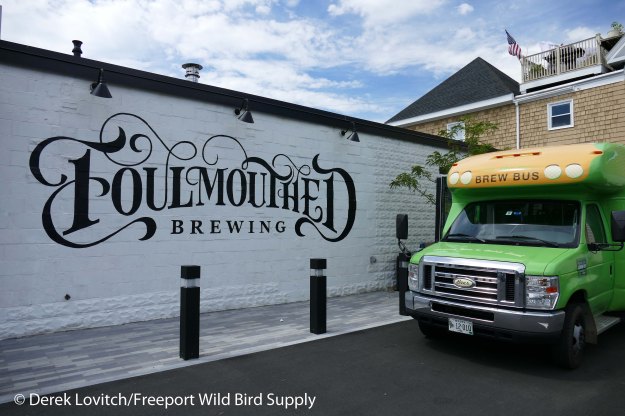
On Sunday, our “Birds on Tap – Roadtrip!” tour headed up to the spring waterfowl hotspot of Merrymeeting Bay. The Spring edition of “Ducks and Draughts” focused on the multitudes of waterbirds that congregate on this productive body of water with our partners at the Maine Brew Bus.

With the abnormally (even by modern standard) early spring, ice was out on ponds, lakes, and rivers to our north well over a month ago. Not surprisingly then, diving ducks were few. Dabbling ducks, however, are still present in great numbers, taking advantage of the food resources (last year’s wild rice and other seeds) in the fine mud of the bay’s extensive flats.

After a quick stop at Bowdoinham’s Mailley Park (Double-crested Cormorants, Common Mergansers, and my first Pied-billed Grebe of the year), we moved over to the famous “Mouth of the Abby,” where the Abagadasset River drains into the bay proper. And it most definitely did not disappoint: About 1,000 American Black Ducks were joined by 200 or so Green-winged Teal, at least 100 Mallards, a goodly tally of 24 Northern Pintails, a dozen more Common Mergansers, 8 Canada Geese, a mere 8 Ring-necked Ducks, and a pair of Wood Ducks. 6 Killdeer also foraged on the flats, and the second Bald Eagle of the day passed right overhead.
At_Abby1At_Abby2
With Jill hard at work taking photos for the paper.

The three Wood Ducks in the small pond on Brown’s Point Road flushed as the bus approached, and they didn’t let us get much closer on foot as we walked back. A Cooper’s Hawk was well seen, however.
BrewBus_BrownsPoint

After squiggling cross-country to Newcastle, we pulled into the brewery and rustic tasting room of Oxbow. After a couple of samples – Bandolier, their spring printemps was one of the favorites; it certainly was mine – Rocky took us on a tour of the brewery, and a part of the impressive property.
L1040500_Oxbow1_edited-1L1040521_Oxbow2_edited-1aL1040525_Oxbow3_edited-1L1040537_Oxbow4_edited-1L1040540_Oxbow6_edited-1

Oxbow’s connection to the land is evident, from the sour cherry orchard to the welfare of their livestock (pigs coming soon!). We learned about the philosophy of their beer, and some of the new and creative things they’re working on.
L1040541_Oxbow7_edited-1L1040547_GuineaFowl1,Oxbow_edited-1
Sorry folks, not “countable!”

After another round, it was back on the road, as we weaved our way through scenic rural vistas to Brunswick, where we made a quick stop at Bay Bridge Landing Park. We hoped to add a previously-reported Eurasian Wigeon to our waterfowl list, but the tide was already too high, and the low pass from a Bald Eagle – our 6th or 7th of the day – probably did not help matters! However, a low pass of an Osprey, hovering right overhead, was a nice consolation prize.
L1040558_OSPR,BayBridgeLanding,4-10-16_edited-1

Lively Brewing at Ebenezer’s Brewpub was our second brewery stop of the day. Kelso offered up three samples of some of their representative beers, guiding us through the different styles and some of the intriguing and creative options they play with here.
L1040564_LivelyBrewing1_edited-1L1040567_Lively2_edited-1L1040569_Lively4_edited-1

Whether it’s the birding or the beer-ing portion of these tours, there really is never enough time, so before we all knew it (time really does indeed fly when you are having fun; please excuse the pun) it was time to head back to Freeport and Portland, bringing another fun and successful Birds on tap – Roadtrip! to a close.

So that’s my recap on the trip. But this tour welcomed Meredith Goad, the food writer from the Portland Press Herald on board. You know you have a unique collaboration when you have a food writer wanting write about a birding tour! For Meredith’s perspective, comments from the participants, and more information about this truly unique birds and beer tour concept, check out Meredith’s excellent article in today’s paper!

Needless to say, the rest of the year’s four tours are filling up fast! For more information on those, see the Tours, Events, Programs, and Workshops Page of our website, and check out my blog about all of this year’s journeys. And don’t forget about Birds on Tap – Monhegan! in May.

My beautiful picture

No matter how common they might be, there are few things more stunning than a drake Mallard!

Simpson’s Point, Brunswick – Our Local Duck Hotspot.

IMG_4969_edited-2
Common Goldeneyes, Common Mergansers, and Greater Scaup (Vermont, March 2014)

Simpson’s Point in Brunswick, at the northern end of Middle Bay (Delorme Map 6: C-3) has become one of the best waterbird-watching spots in Casco Bay over the last few years. That trend continues this spring, with outstanding concentrations of waterfowl.

While there might not be a rarity or an addition to your year list right now, I highly encourage a visit to see the concentration (a scope is highly recommended), and it is certainly ripe for a rarity to be discovered!

I visited the point twice times this week, each yielding some remarkable counts (my attempts to visit it for a third time today was thwarted by unexpectedly dense fog). The first number is the count or estimate from 3/26 with my Saturday Morning Birdwalk group, and the second is from Monday, 3/27 with Jeannette.

– Mixed Black and Surf Scoters (roughly 60-65% Black: 1200/2100. A really incredibly count for the bay, this is by far the largest raft(s) of scoters I have seen within Casco Bay.
– Mixed Scaup (at least 80% Greater, but plenty of Lesser usually visible): 650/650. Down a few hundred birds from the massive overwintering flock.
– American Black Duck: 100/40
– Common Goldeneye: 75/40
– Bufflehead: 50/125
– Common Eider: 40/60
– Horned Grebe: 43/30
– Red-breasted Merganser: 10/25
– Common Loon: 5/3
– White-winged Scoter: 0/2

While more birder attention has definitely worked in its favor, it was always a well-known duck-watching hotspot. However, these numbers are outstanding, even based on the renewed attention to this spot over the last few years. I wonder what has changed? Sure, this winter the water was open and that kept the scaup around, but what is attracting all of these scoters? Is there a new food source? Is there a lack of some food somewhere else?

But it’s the oversummering birds (exceptionally rare for the state birds in summer like scoters, Red-necked Grebes and Red-throated Loons, and Long-tailed Ducks) that really suggest the uniqueness of this area. While rarities over the past few years, including Eared Grebe and Pacific Loon, have put this spot “on the map,” it is the numbers of common birds and small numbers of oversummering “winter” ducks that is most noteworthy. Is it nothing more than more birders paying more attention in mid-summer? I certainly am.

So go out and have a look, and perhaps you’ll get there on the day the scaup are close enough to pull out a Tufted Duck!

Meanwhile, nearby Wharton Point is always worth a visit, and can easily be combined with a trip to Simpson’s. Currently, it is hosting more typical-for-here large numbers of dabblers, led by American Black Ducks (800/495). On 3/28, Jeannette and I teased out a pair of American Wigeon and 1 Green-winged Teal from the masses, while 8 Dunlin were on the flats.

So in between the excitement of new arrivals, hawkwatching, and the anticipation of the diversity of May, I know I’ll be taking some more time to do a little local ducking!

Birds on Tap – Monhegan!

IMG_1030_edited-2
“Coffee Warbler” would be a better name for the Magnolia Warbler due to their affinity, and perhaps even reliance, on shade-grown coffee plantations in winter.

Beer + bird-friendly coffee + birds + migration + Monhegan + Dr. Steve Kress* = Epic.

IMG_1180_edited-2

You never know what will show up on Monhegan on Memorial Day weekend, like this female Hooded Warbler.

For a while now, I have been hinting at a big event in the works for Memorial Day Weekend on Monhegan Island. Partnering with Birds & Beans Coffee, Monhegan Brewing, and The Trailing Yew, Freeport Wild Bird Supply is pleased to announce:

Birds on Tap – Monhegan!

We have the “Birds on Tap!” lecture series at Rising Tide in partnership with Dr. Noah Perlut, and the Birds on Tap – Roadtrip! series in conjunction with the Maine Brew Bus, and now, we’re going even bigger with a weekend on the birding Mecca of Monhegan Island!
DSC_0051_2EAKI,Monhegan,5-24-14, edited-1
Eastern Kingbirds.

But now we’re adding coffee to the mix, specifically bird-friendly, shade-grown, organic, and fair-trade certified – not to mention absolutely delicious – Birds & Beans coffee! Roasted right here in Maine, Birds & Beans (available at Freeport Wild Bird Supply and several other retailers around the state) coffee carries the “gold standard” of certification, the “Bird Friendly” label of the Smithsonian Migratory Bird Center. With this level of certification, we can protect the rainforest habitat required for the Neotropical migrants that us birders flock to places like Monhegan Island in spring and fall to see.
Spring (2)_edited-1
DereksGroup_edited-1

Want to see warblers, vireos, tanagers, and orioles? Well then we really can’t afford to lose more rainforest where these birds spend up to eight months of every year. So this year, while enjoying the migrants that pass over and through Monhegan, we’re going to work to save them. By drinking coffee…and a little beer.
IMG_1020_edited-2

Northern Parula on springtime apples on Monhegan.

Dr. Stephen Kress will be giving a program titled: “Saving Seabirds: Lessons from Puffins and Terns”. Worldwide, about one third of all seabird species are globally threatened due to human caused threats. A recent study has shown that 70% of all seabirds have vanished in the last 60 years. Now, often at the last hour, there is a bold approach emerging to help some of the most threatened species. Dr. Kress will review how techniques developed on Maine islands have led to the restoration of puffins and terns to historic nesting islands. He will also discuss how these techniques are helping to expand breeding ranges and reduce risks to extinction worldwide while serving as a bellwether to the effects of commercial fishing and climate change. His lecture includes reviews of several inspiring and hopeful seabird restoration projects worldwide. Dr. Kress will also share the recent discovery of the previously unknown winter home for puffins- to an area known as New England’s remarkable ‘coral canyons and seamounts’ off the NE continental shelf. Discovery of the puffin wintering area provides an additional reason to protect this biologically diverse habitat.

Dr. Kress is Vice President for Bird Conservation for the National Audubon Society and Director of Project Puffin and the Hog Island Audubon Camp. His career has focused on developing techniques for managing colonial nesting seabirds. In this role, he manages 13 seabird nesting islands in Maine that are home to more than 42,000 seabirds of 27 species. Each year his program trains about 25 interns; hundreds of professional seabird biologists can trace their first interest in seabirds to Project Puffin. Methods first developed in Maine such as seabird chick translocations and social attraction are now standard practice worldwide. Dr. Kress received his Ph.D. from Cornell University and his Master’s and undergraduate degrees from Ohio State University. In the summer he lives in Bremen and winters in Ithaca, NY with his wife Elissa and daughter Liliana. He is author (with Derrick Jackson of the Boston Globe) of a new autobiography (Project Puffin: the Improbable Quest to Bring a Beloved Seabird Back to Egg Rock). The book tells the inside story of how puffins were brought back to Egg Rock and other Maine islands.


The Trailing Yew will be serving Birds & Beans Coffee for its guests all weekend, and there will be an ample supply available to fuel Sunday Morning. We’ll begin by sipping coffee while observing the “Morning Flight” above the Trailing Yew and keeping an eye on the spruces around the property – often one of the most productive patches on the island at sunrise! After breakfast, local experts will lead a birdwalk to some of the nearby hotspots, departing the Yew at 9:00am and returning around 11:00am.

Memorial Day weekend is prime time to view migrants on their way north, in full breeding garb, and we’ll also be seeking rarities – unusual species from all directions often show up on this weekend; expect the unexpected.

IMG_1068_edited-2
Such as near-annual Summer Tanagers…

DSC_0124_BRSP1,Monhegan,5-25-14_edited-1
… or, as in 2014, Maine’s first-ever Brewer’s Sparrow!

“But wait,” many of you are saying, “you said something about beer!” It is called “Birds on Tap!” afterall, so beer will definitely be at the forefront of this special weekend. But not just any beer, Monhegan Brewing’s fantastic beer! In fact, the event kicks off on Saturday afternoon with an exclusive, limited-edition, small-batch coffee stout brewed with Birds & Beans! “Beer-listers” will want to head out just for this one-time offering, just like birders flock to Monhegan for those once-in-a-lifetime bird sightings!
Sasha_atMonheganBrewery,5-26-14_edited-1Monhegan_Brewing,5-18-15_edited-1

Kenn and Kim will be signing books, birds will be discussed, and beer will be imbibed. And that’s just the kickoff!

Sold yet?

This is going to be a one of a kind event, so you’ll want to make your reservations soon. You can join my MonhegZen Birding Weekend Tour for 1, 2, or 3 days (see details on the “Tours, Events, Workshops, and Programs” page of our website) or make your reservations to spend a night on the island (our group, and our guest speakers, will be staying and dining at the Trailing Yew if you would like to join us!) and join us for some of these outstanding events…all of which are completely free (with books and beer available for purchase). Edit (5/12): NOTE: The tour is full, but all of the following events are free and open to the public, with no registration necessary.

Here’s the complete schedule of events.
Saturday, May 28th:
3:00pm – Release of Monhegan Brewing Company’s coffee-infused Milk Stout. Location: Monhegan Brewing Co.
7:30pm – Presentation by Dr. Stephen Kress. Location: community church. (Note: Trailing Yew will be offering an early dinner service at 6pm).

Sunday, May 29th:
6:30-7:30am – Casual birding while sampling B&B coffee with local experts around the Trailing Yew
9:00-11:00am – Guided birdwalk with local experts (Location: begins and ends at the Trailing Yew)

You often hear birders on Monhegan exclaim “it doesn’t get any better than this!” Except now, it has! I sincerely hope you’ll join us on the island for this fun-filled weekend, as if you needed more incentive than visiting Maine’s premier migration hoptspot!

Yew-May_edited-1

Monhegan, 5-21-11_edited-1

BBlogofinalThis. Is. Going. To. Be. Awesome.

IMG_1175_edited-2

Birds on Tap – Roadtrip: Surf And Suds! 2/28/16

brew bus at store

The first of six “Birds on Tap – Roadtrips!” with our partners at the Maine Brew Bus took place last Sunday. Our “Surf and Suds!” tour headed south, visiting two hotspots along the York County Coast, looking for waterfowl (especially Harlequin Ducks), Purple Sandpipers, and Great Cormorants and other winter denizens of the rocky shore.

We began at Marginal Way in Ogunquit, enjoying perfect conditions. With temperatures rapidly rising into the low 40’s on a very light, southwesterly breeze, it was more than comfortable. And with a high deck of clouds and calm waters, viewing conditions were perfect.
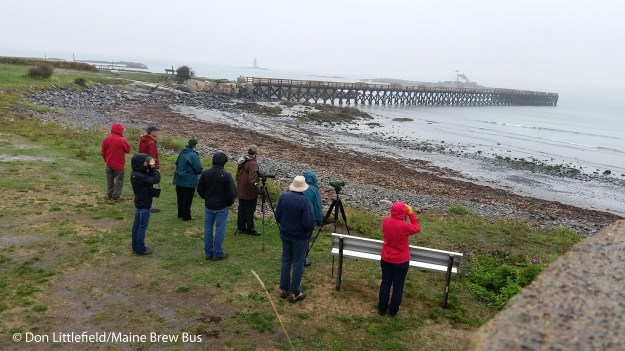
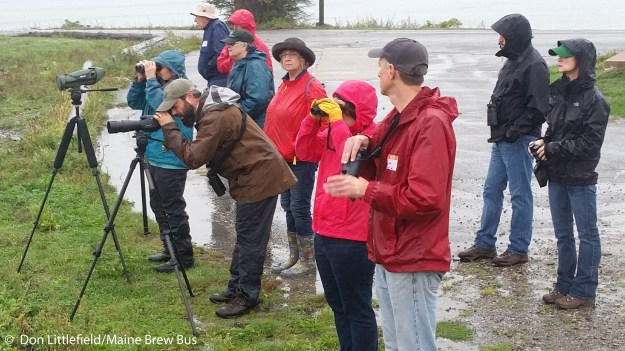
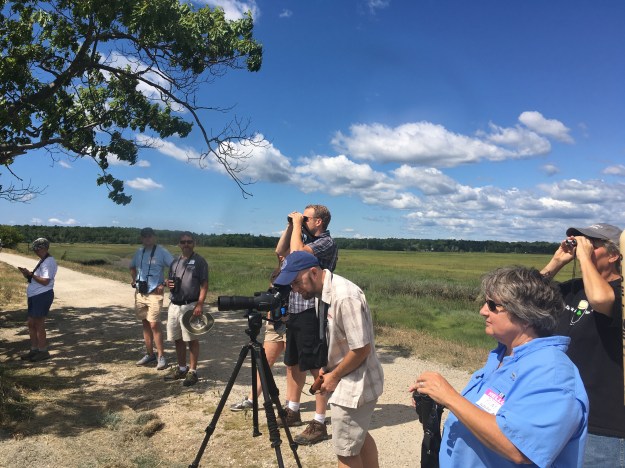
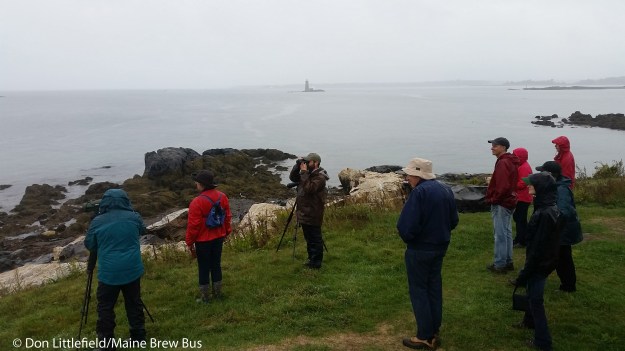
birders at Marginal Way

Harlequin Ducks are one of the premier “targets” of this tour, and they could not have been more obliging. At least 35 were along the pathway, with most very close to shore and several small groups hauled out on the rocks.

Harlequin Ducks (Histrionicus histrionicus) at Marginal Way, Ogunquit, ME

Harlequin Ducks (Histrionicus histrionicus) at Marginal Way, Ogunquit, ME

(Photo with Leica V-Lux Type 114)

HADU,MarginalWay,2-29-15_edited-1
(Phone-scoped photo)

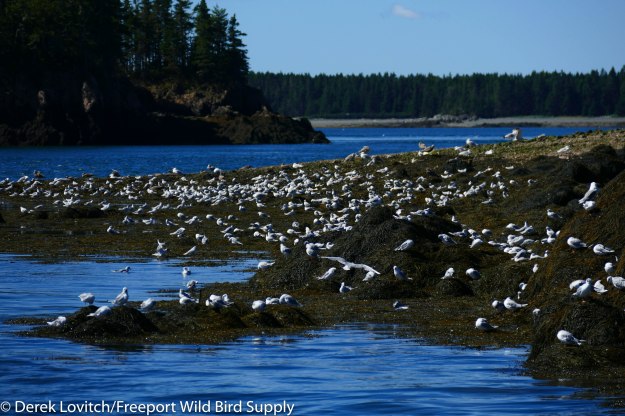
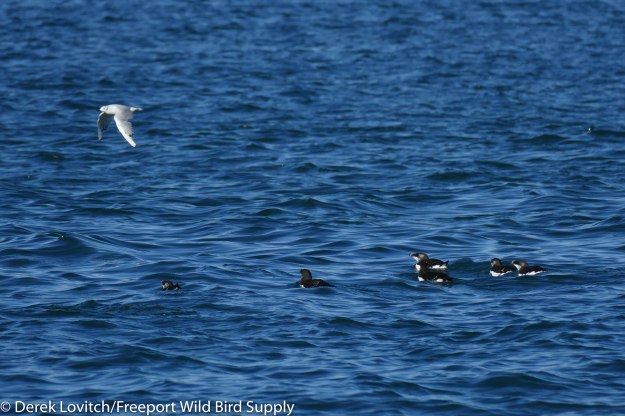
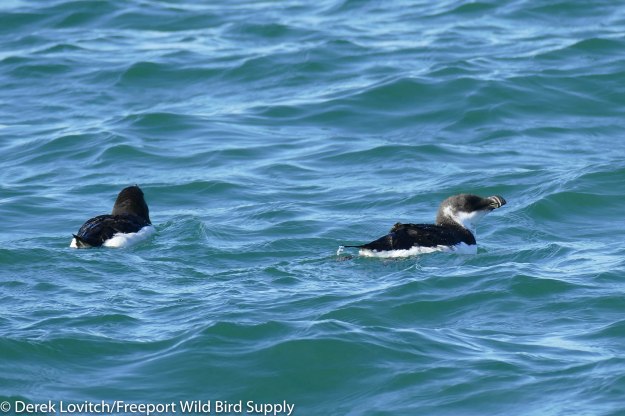
While we only encountered 15 Purple Sandpipers, we saw them exceptionally well. I just with the little raft of 8 Razorbills were a little closer! A Carolina Wren singing from the neighborhood and 250+ Black Scoters were among the other highlights, while we also took ample time to enjoy views of Common Eiders, Red-breasted Mergansers, and all three scoters.

Next up was The Nubble, where one Great Cormorant coming into high breeding posed nicely, and a goodly total of 38 Harlequin Ducks were present. It was a MUCH better look at the single Razorbill that was feeding just off the Nubble, and it would be impossible to obtain better views of a Red-tailed Hawk that was making rounds of the parking lot, the Nubble, and nearby rooftops.
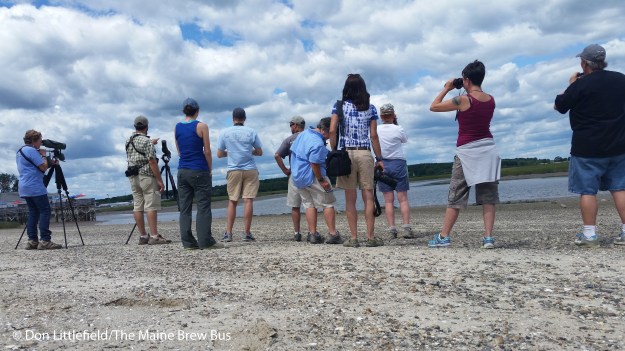
birders at Nubble

GRCO,Nubble,2-28-16_edited-1
(phone-scoped photo)

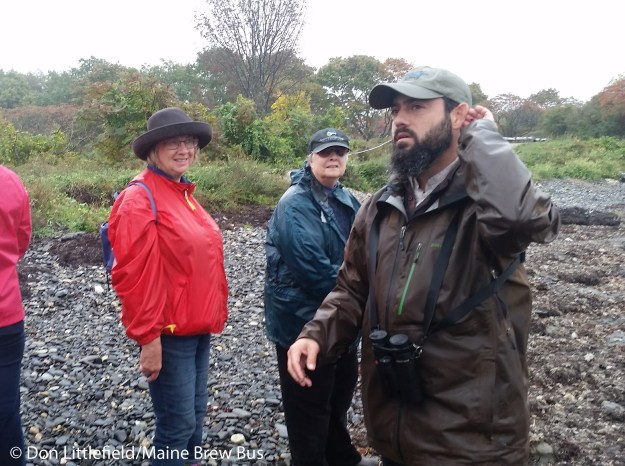
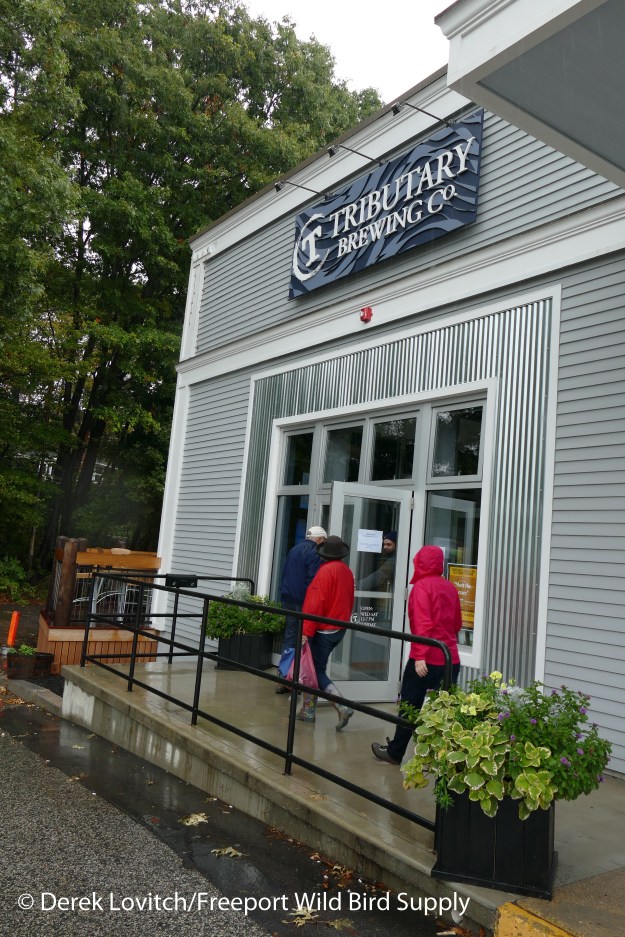
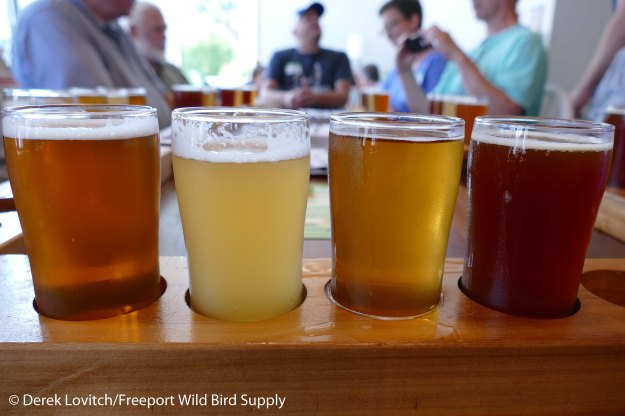
Before we knew it, it was “beer o’clock” and Don took over for the beer-ing portion of this unique tour. York’s SoMe Brewing was our first destination, and after a tour of their rapidly-growing operation as we discussed the ins and outs of brewing beer, we settled in for a flight of samples. Perhaps best known for their Whoopie Pie Stout and their go-to Apostrophe IPA, for me at least (and several others) “Sugar What?” stole the show. This Bourbon Barrel Aged Imperial Maple Amber hit all the right notes for me.
SoMe_board

SoMe1,2-28-16_edited-1

SoMe3,2-28-16_edited-1

Back on the Brew Bus, we began our trek northward, continuing our discussions about birds, beer, and everything from “status and distribution” to bird-friendly coffee. We pulled into the unassuming South Portland neighborhood’s Fore River Brewing Company – a first visit for me, and all of the participants on the tour.
IMG_7805_edited-1

Lygonia IPA was my favorite of our samples, although the crowd was appreciating their John Henry Milk Stout quite a bit. We also learned how their brewing system, philosophy, and background differed from our first brewery; it always fascinates me on these tours to learn about the brewers and their approach to beer.
ForeRiver-taps

With the bus unloaded in Freeport, conversation continued at the store, and plans were made for the next Birds on Tap – Roadtrip! On April 10th, “Spring Ducks and Draughts” will visit Merrymeeting Bay for waterfowl migration and Bald Eagles, followed by visits to Oxbow Brewing Company in Newcastle (I love their woodland tasting room!) and Lively Brewing in Brunswick. These trips are truly unique and we hope you will join us for the next fun-filled tour of birds and beer!