Tag Archives: Birding

FIELDFARE in Newcastle (and a rare April case of Rarity Fever!)

Last week was an incredible week in Maine birding. First up was the state’s first Vermillion Flycatcher that appeared on Hog Island on Monday the 17th. While it was #15 on my list of “Next New Birds for Maine,” HOW it was discovered defied imagination: it was seen by on observer watching the Hog Island Osprey Cam, as the black-and-scarlet little bird sallied for insects from the platform. Simply incredible.

Then on Wednesday, a long overdue(#10 on my predictions list) Fieldfare was discovered in Sheepscot Village in Newcastle. No, it wasn’t within a flock of thousands of wandering American Robins of the subspecies/clinal extreme from Newfoundland, it was in a front yard with a handful of “normal” robins. And Jeff Cherry saw it on his way to work.

I have been very busy of late with the new book, spring business at the store, the peak of the flight at the Bradbury Mountain Hawkwatch, the obligatory spring yardwork, and all of those usual things in life, plus – and most importantly and distractingly – our dog’s failing health. With Jeannette running the Boston Marathon on Monday, chasing the Vermillion fly wasn’t in the cards for me. Neither was skipping out on the 7,000 seed delivery on Wednesday morning when the Fieldfare was found.

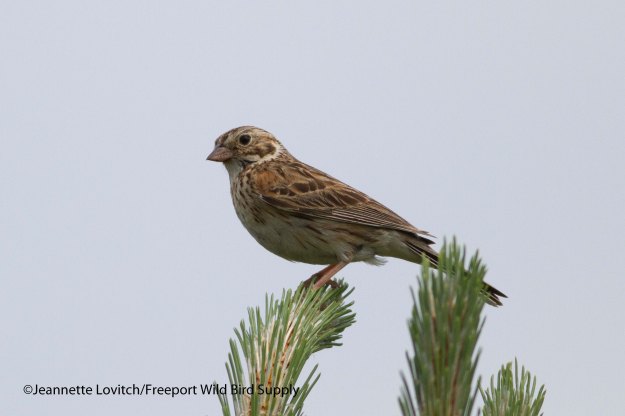
But when the bird was reported again at 2:30pm, I dropped what I was doing and raced up to Newcastle. I spent a couple of hours unsuccessfully looking for the bird. A Vesper Sparrow was a small consolation prize.

Now, I don’t chase very often, but a first state record within an hour’s drive is usually fair game. And I really like Fieldfares. And I’ve wanted to see one in Maine (or anywhere else in North America) for a long time. I’ve daydreamed about finding one as I searched through wintering robin flocks in orchards or migrants passing Sandy Point in late fall or Bradbury Mountain in the spring.

While it was not seen on Thursday, but I made a dumb decision of heading inland to look for a possible waterbird fallout. There was no such waterbird fallout. My first of year Ruddy Ducks at Sabattus Pond and a singing Louisiana Waterthrush at the Papermill Trail in Lisbon were the highlights. Not a Fieldfare.

My book release party was Thursday night, and I was down in Salem, Massachussetts for a book signing and presentation to the Essex County Ornithological Club on Friday night.  The Fieldfare was refound on Friday afternoon.

During a wet and dreary – but fairly productive, actually – birdwalk on Saturday morning, the Fieldfare was reported again, and it continued to be reported for regular intervals throughout the day. And as the cold and rainy day tempered business in the afternoon, Jeannette says “you should probably go” despite having plans to chase it with friends on Sunday.

So I went. And after a mere fifteen minutes, it popped out into the open. FIELDFARE!

In addition to being my 375th species in Maine (although it just fell out of the top 25 of my personal next birds in Maine), it was a new “ABA-area” bird for me. This was a good one.  I spent an hour watching it for a few minutes at a time, as it hopped between a copse of dense scrub and young trees and a mowed field, foraging with a small group of American Robins for a few minutes before disappearing again into the brush.

After about an hour, a total of 24 American Robins flew up from various corners of the fields and into the tops of some nearby Red Maples, where it lingered for about 5-10 minutes before flying off towards the center of town.
IMG_2822_FIEL1,4-22-17

Drizzle, fog, and distance precluded very good photos, but I did Facebook Live the sighting for about 30 seconds…just because.
 
Of course, I was semi-responsible as I headed back to work, while a few other folks relocated the bird much closer to the road in the village. Oh well, I still had Sunday morning.

Terez Fraser, John Lorenc, Erin Walter and I drove east and met up with Paul Doiron and Kristen Lindquist, and about 50 other fellow birders. It was not being seen, so people were beginning to split up and check other areas, besides the fields across the pond from 611 Sheepscot Road, where the bird was most often seen (including by me in the previous day).  So the 6 of us began to mosey down a promising side road, and as we strolled back to the corner, we saw the crowds were on the move.

It was seen in roughly the same spot (other side of the island of trees between the fields on the other side of the pond), but most people had scattered by now, so only a lucky few saw it (and apparently saw it pretty well). Unfortunately, it had disappeared into the larger island of trees by the time we got to the edge of the pond.

So we waited. And waited. And then waited some more. At least it was nice out.
Fieldfare_twitchers,4-23-17_edited-1

Then a couple of hours later, it was spotted in the leaf litter within the dense, young woods. It was glimpsed by many, frustratingly missed by others, and seen well by no one over the course of about 45 minutes.

Unfortunately, I had to force my carpool to depart (although we were all very much ready for lunch by then) to head back to the store for a meeting, which was frustrating to me as I had to pull my friends (only 2/3rds of which had unsatisfying glimpses) away from the stakeout. I was also the genius who suggested we walk first and caused us to miss that initial, decent observation. Well at least we had a great lunch at the Montsweag Roadhouse!  (And yeah, I did see it decently at one point, but not like I wanted).

But such is birding life.

More frustrating to me is the selfish birder who decided to walk down through the woods, opposite the group of more than 50 patient people, pishing (which thrushes don’t respond to, by the way) as he went. At one point, when the bird was coming out in the open, people could see this dumbass through their scopes, and he clearly flushed the bird back into the deeper depths…where it was not, as of at least 3:00pm that day, seen again.

While one might be able to argue he pushed the bird into our view, it seemed tough to argue that he didn’t directly ruin the opportunity for it to come out into an open edge for all to see, including those who had driven in from several states away. Of course, we all know who it was, and we all know how selfish some birders can be. And frankly, if there was one prick in the state of Maine who would act this way, it would be that guy. Thanks, buddy.

Anyway, we had a beer at Montsweag and that made me feel a little better.

Moving on…

So in the course of about a week, there was a Scissor-tailed Flycatcher in East Machias (also on Monday morning), a Vermillion Flycatcher in Bremen, and a friggin’ Fieldfare in Newcastle. I feel a bit hamstrung right now to hit the field as hard as I like to find out what else might be out there. Perhaps I’ll find the next one tomorrow…
Townsend’s Solitaire at Bradbury Mountain!

It was a very good day up at the Bradbury Mountain Spring Hawkwatch, sponsored by Freeport Wild Bird Supply and Leica Sport Optics. The 2017 Official Counter, Zane Baker, had the day off today, so I was the counter for the first half of the day. Jeannette took the second shift, and were it not for Sasha’s declining health, I definitely would have remained until day’s end. We were having too much fun!

With light southwesterly winds aloft (and light and variable at the surface), record warmth, and perfect timing, we knew it was going to be a big day. Zane could not stay away, and Katrina Fenton, the 2012 through 2014 Official Counter, was visiting from New Hampshire. Several other local birders were present as well, as were hawkwatchers from New Hampshire and Mid-coast Maine. After a slow, somewhat chilly start, the day, and the hawkwatch began to heat up.

At approximately 11:10, I spotted a Black Vulture soaring over Hedgehog Mountain. It was low and relatively close, affording prolonged scope views for over five minutes before it drifted away to the north or northeast. Several personal first-of-years included 7 Northern Flickers, 1 Barn Swallow, and 3 Yellow-rumped Warblers. 2 Yellow-bellied Sapsuckers and 1 Ruby-crowned Kinglet were also first of the season for the count site.  We also had a steady trickle of migrant Tree Swallows, along with a smattering of other passerine migrants. Later in the day, two Sandhill Cranes (our 6th and 7th of the season) also passed overhead.

A steady light flow of raptors was adding up, too. 209 were tallied when I departed at 1:00, led by 59 American Kestrels and 37 Broad-winged Hawks, but a decent total of 11 species in all. (A goodly 361 was our final tally by day’s end).

Sure, we had a little rarity fever on our minds, especially after the Black Vulture (downright expected on such conditions in early to mid-April), but all hell broke loose at 12:18pm EDT. 

Then, a medium-small passerine came flying towards us, moderately high, and suggestive of an Eastern Bluebird with a thrush-like flight and shape. But as I lingered on it, I realized it was definitely not a bluebird – its flight was faster, steadier, and it was solidly colored. It also seemed a little larger and longer. It was backlit by the sun, it was coming right at me, but it was looking odd. 

As it got closer, I said “get on this passerine…Katrina, get your camera!” as she was closer to her long lens than I was to my superzoom. As it passed right overhead, still a little backlit, I yell, “TOWNSEND’S SOLITAIRE!”

A slim bodied, long-tailed, thrush-like bird passed overhead, with a screaming wide, bold, and buffy stripe through the near-center of the wing (obviously known to be the base of the flight feathers).

As it flew over, then headed straight away, it was finally getting into better light. And it looked gray. Quite gray. As I was calling for it to “turn, turn!” Katrina was unable to find it in the viewfinder, so switched to bins. Zane got on it, as did a couple of other birders, including Don Thompson.

Unfortunately, it did not turn, and I never saw the upperwing. I also never got a real handle on the tail, beyond silhouette.

I don’t think we had really clinched the ID yet, even though I knew it had to be a Townsend’s Solitaire. Only the Catharus thrushes share that wide and distinct buffy wing stripe, which I will address in the notes below.

I stepped aside, turning over the watch to Zane, and wrote two pages of field notes. Only then did I consult a Sibley, and I discussed the bird with others, especially Katrina who was the only other person it saw it fairly well in binoculars.

  • Bold, buff wingstripe obvious, from based of inner secondaries to end, or nearly so, of outer primaries. Wide and fairly even throughout.
  • With sun behind it, it first looked all-dark, with little to no contrast (actually thought of a blackbird at first), but got lighter as it passed roughly overhead, distinctly solid gray as it went straight away. But it was never in perfect light.
  • First impression was of a thin tail, which it may have then partially opened at one point, but as it was going away, no detail was seen (i.e. overall color or white fringes).
  • Only other possibility was a Catharus thrush, but that seems even less likely to be overhead at 12:18pm on April 11th in Maine. While Hermit Thrushes are just now arriving, and we do occasionally see “morning redetermined migration” throughout the day (e.g. some Yellow-rumped and Palm Warblers, along with at least one surprisingly high Eastern Phoebe today), Catharus thrushes usually don’t reorient, and if they do (at least at Sandy Point in the fall), it’s immediately after sunrise.
  • Question: could the back-lighting have made the wingstripe look wider and bolder from below? From my experience at Sandy Point, when in fact a Catharus does go overhead, that wingstripe is obvious, but it is not as obvious as in this bird. And of course, no lightening scenario would make a brown bird look cool gray.
  • Tail seemed long, and the body especially seemed too slim for a Catharus. It did not have a broad chest or pot-bellied appearance, as it was uniformly more tubular (even slimmer than a bluebird). Smaller and much skinnier than a Wood Thrush, yet larger and longer than a Veery, we of course went to Hermit Thrush as a fallback (due to seasonal status; but see discussion below).
  • Upperwing not seen. Tail pattern not deciphered.

Discussion:

– Katrina: “When I finally got on it (in bins; heading away but now in the best light we had it) it did not look brown at all, and definitely appeared gray.” Zane also thought it looked gray, not brown.

– Katrina thought the tail looked long, body slim and not pot-bellied like a Catharus. And she reviewed my notes with no additional comments or edits.

– We then consulted Sibley Guide to Eastern Birds (2nd edition): Underwing coverts not obviously pale as in Hermit Thrush, wing pattern of solitaire only similar to Swainson’s or Gray-cheeked Thrush/Bicknell’s Thrush. Of course, what would one of those species be doing here now, and flying overhead in the middle of the day? Even if a vagrant/pioneering individual of one of those species wintered far north of usual range, why would it be in flight in the middle of the day? But Townsend’s Solitaires are on the move about now, and do migrate diurnally (like bluebirds).

The light was simply not perfect, and we were unable to get photos, so we carefully discussed the bird. With several birders of various levels of experience around us, we took this as a “teaching moment” to go through the process and exemplify the caution needed to make a call of a rarity under less than ideal circumstances.  But through the process of elimination, we simply cannot come to any alternative conclusions. It was too gray, too slim, and too out of place for a Catharus thrush; we could not figure out how the lighting or the view could have resulted in a solidly-gray undersides with little noticeable contrast (definitely no spots!). Also, I’ll fallback a bit on my initial excited call of Townsend’s Solitaire.

While we would have loved a longer and closer look in better light (or a brief alightment on a nearby tree!), and of course a photo, it is impossible for me to believe this was anything other than a Townsend’s Solitaire, a rare but regular vagrant to the Northeast. This was a new record for the Bradbury Mountain Spring Hawkwatch, and the park in general. And it might very well go down as the bird of the season.

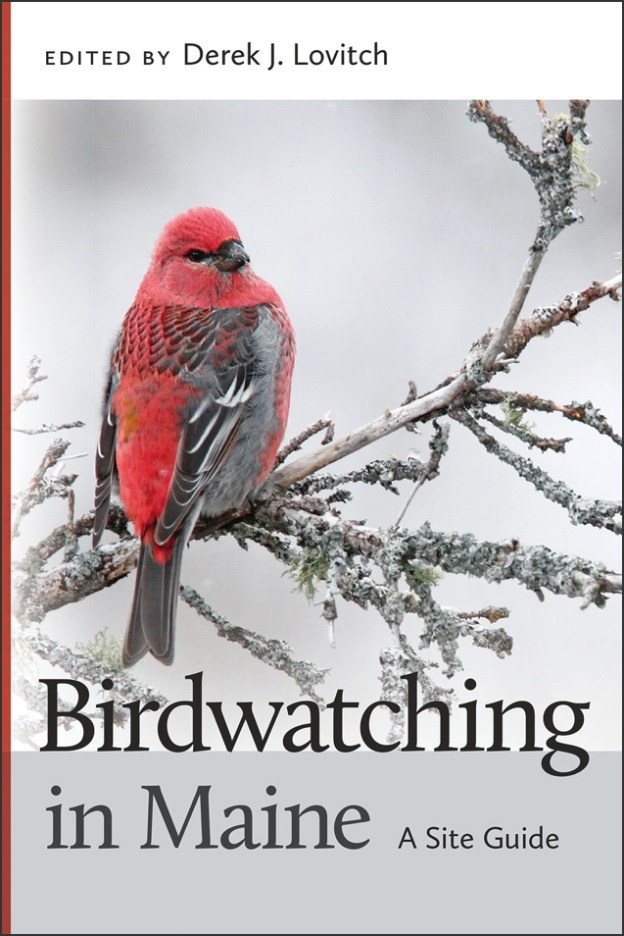
Birdwatching in Maine: A Site Guide (Coming soon!)

book cover

I am most pleased to finally announce that my next book “Birdwatching in Maine: A Site Guide” will be out shortly. I’ve been working on it for over three years now, but of course, all of my birding in Maine for the past 13 years has gone into the development of its concept and content. I sincerely hope you will be pleased with the final product, as I believe it will be an essential asset for birding in the great state of Maine.

With nearly 450 species of birds recorded, Maine offers an abundance of birding opportunities for people of all levels of interest and experience, from those looking beyond their backyards for the first time to knowledgeable visitors looking to plug a hole in their list of sightings. The state’s wealth of undeveloped land and its extensive coastline, countless islands, and varied habitat combine to host an impressive diversity of birds at all times of year. Birders travel to Maine from near and far to seek hard-to-find species, from the only Atlantic Puffins breeding in the United States on offshore islands to Bicknell’s Thrushes high in the mountains.

This book fills an important niche for the birdwatching community by offering comprehensive entries detailing the best locations for finding birds throughout the state for enthusiasts of all levels of skill and interest. It contains descriptions of 201 birding sites in Maine, with explicit directions on how to get there, for all sixteen of the state’s counties (several as large as other New England states!). Each chapter features a county map, my brief overview, numerous specific site guides, and a list of rarities. The book also contains a detailed and useful species accounts guide for finding the most sought-after birds.

Using a county-by-county approach, with chapters by Seth Benz, John Berry, Kirk Betts, Ron Joseph, Kristen Lindquist, Rich MacDonald, Dan Nickerson, Luke Seitz, Allison and Jeff Wells, and Herb Wilson, Derek tapped the knowledge of local experts to offer the most comprehensive and authoritative birdfinding guide the state has seen. And I guarantee there will be many sites completely new to you!

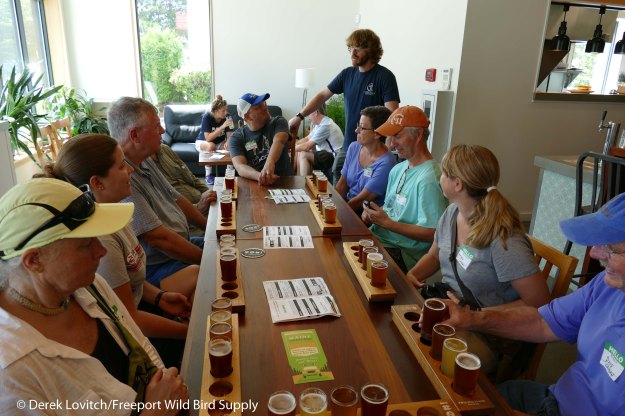
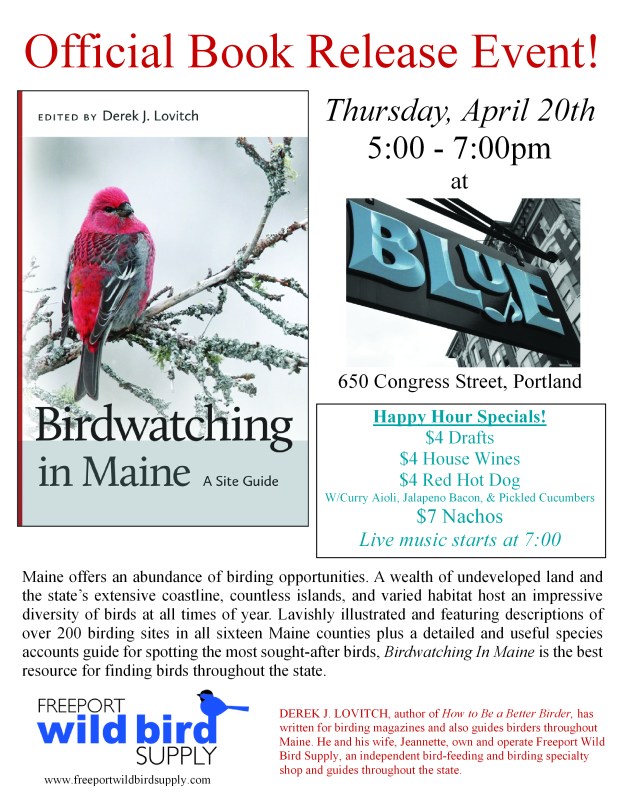
The Official Release Party will be at Blue in Portland (650 Congress St) from 5-7pm on Thursday, April 20th. This will be the first time the book will be available, anywhere.

We’ll also be offering a presentation, full of photos of Maine’s birds and birding places, on Saturday, April 29th at the Freeport Public Library at 7:00pm. This too is a free event, open to the public, and part of the annual “Feathers Over Freeport: A Birdwatching Weekend” events.

For more information about the Blue event, click here.

And for Feathers Over Freeport, click here.

We’re currently taking pre-orders online via our eStore.

Other free events around the state are being scheduled. You can check them out via Facebook on the page of “Birding Books by Derek J. Lovitch.”

Book release Blue

Birds on Tap: Gulls and Growlers!

L1090040-edited

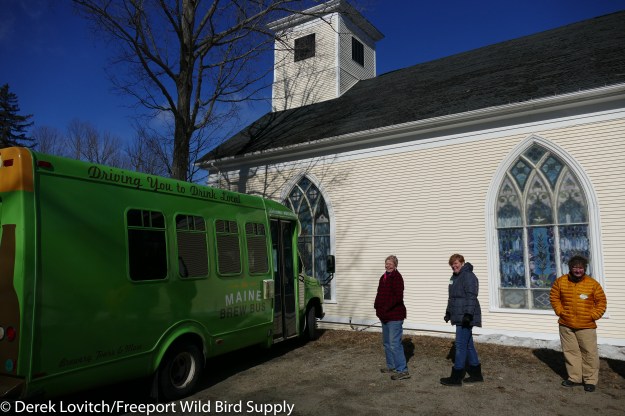
With windchills around -15F, even the gulls looked cold today. And there’s no way to sugar-coat it: it was brutally cold. The coldest temperatures in over a month – and one of the coldest days this entire winter – greeted the start of the first edition of the “Gulls and Growlers” tour in our “Birds on Tap – Roadtrip!” series with our partners, The Maine Brew Bus.

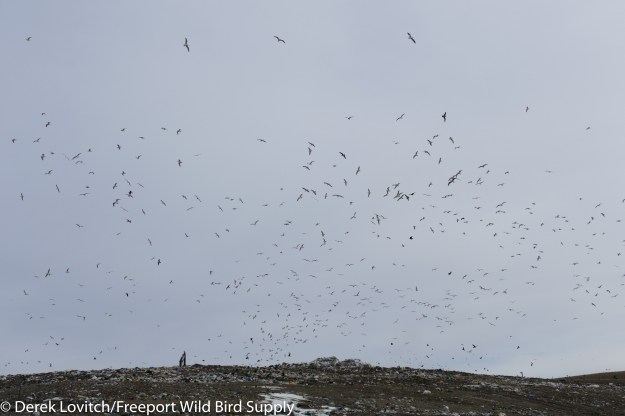
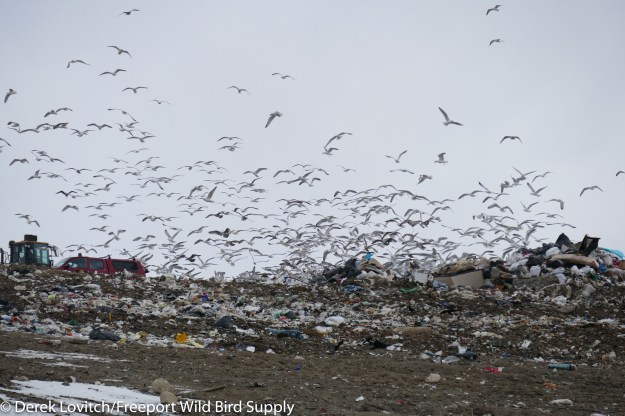
Donning plenty of layers, we hit the road and headed north to an unusual destination – well, only unusual if you’re not really, really into serious birding: the Hatch Hill Landfill in Augusta. And the swirl of birds that greeted us quickly explained why we were here on this bitter day.

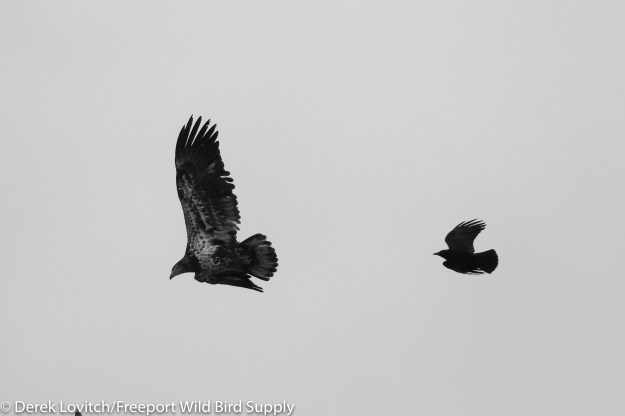
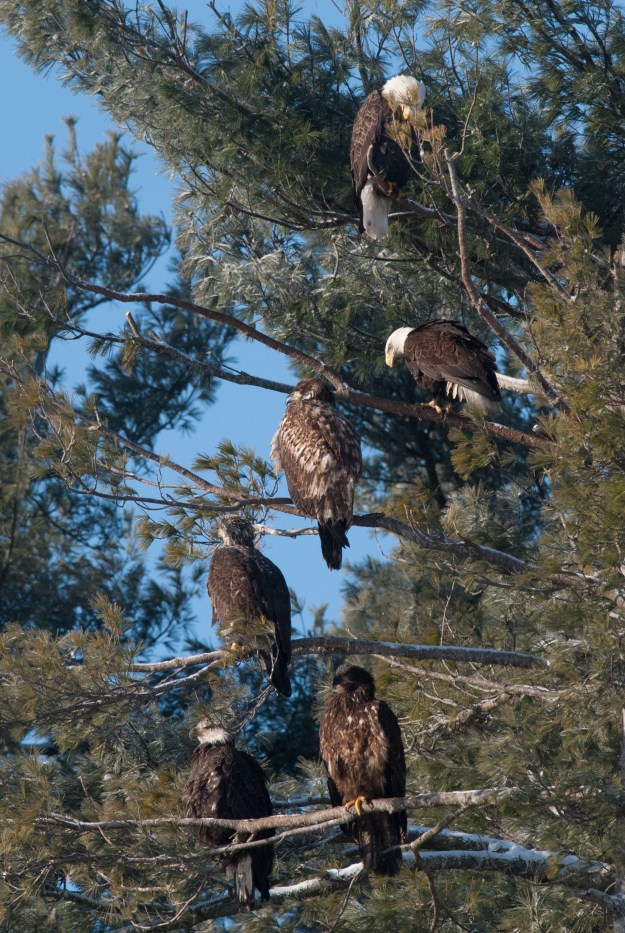
1,000-1,500 Herring Gulls (with a few Great Black-backed Gulls sprinkled in) would rise up in a swirling cloud every time one of the 8-10 Bald Eagles made a close pass. Add to that 500 or so American Crows and a few hundred European Starlings, and you have a lot of biomass! We learned a little about aging of eagles as birds passed overhead and perched in the towering pines behind us. We sorted through the masses of gulls for any unusual species, and the sight of so many birds in one place allowed for us to forget about the cold – at least for a moment.
L1090059-edited
L1090066-edited
L1090033-edited

My original plan was to spend 1 to 1 ½ hours here, watching and photographing eagles and studying gulls, hoping to tease out a rarity or at least foster an appreciation for just how approachable gull identification really is. But I’m also at least somewhat rational – well, unless I had spotted a rare gull! – so we knew when to say when and boarded the bus for a short ride to one of the local gull roosts.

At least 300 gulls were present, with dozens arriving every few seconds, so it would have been the perfect opportunity to carefully sort through them. Unfortunately, the 20+ mph wind was directly in our face. We soon moved on.

After a quick coffee/hot chocolate/bathroom stop – perhaps the most welcome stop of the day! – we shifted gears a bit and focused on the Kennebec River. Starting at Mill Park on the north side of Augusta’s downtown, we made several stops as we traveled south to Gardiner (often using the bus as a windbreak!).
L1090133-edited

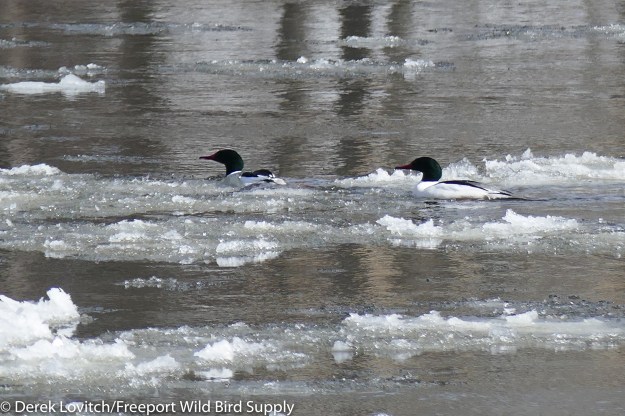
In doing so, we spotted at least 4 more Bald Eagles, and a tallied 132 Common Mergansers. In fact, the mergansers stole the show today, with several rafts actively displaying and some birds fishing in close proximity, diving into the strong current and surfacing between chunks of ice. It was a good count for this time of year, but we enjoyed uncommonly good views of many of the birds.
L1090122-edited

We checked through a few small groups of gulls – mostly Herring and Ring-billed as expected – and even though we were freezing, we were reassured that spring is right around the corner thanks to the Turkey Vulture that was weeble-wobbling its way through the gusty winds over Gardiner.

Mike, our driver and beer guide for the day, took over as we traveled between our last few birding stops, offering an abbreviated history of alcohol in Maine, and for a dark period, lack there of. Maine was at the forefront of the Prohibition movement, but now, we are back at the forefront of local, innovative, and cutting edge production of beer, cider, spirits, and much more.

Our first stop in the beverage half of today’s tour was Lost Orchard Brewing/Crooked Halo Cidery where David Boucher and his father, Nick are doing some really “crazy” things with hard cider. By using all sorts of different yeasts and adding lots of creative ingredients, David is working to make “a traditional style untraditional” with his self-admitted “mad science.” And speaking of untraditional, their repurposing of an old church as their tasting room – complete with a bar on the alter, which Nick constructed from the wood of old pews – made for a very unique place to visit. They even offered to turn the organ on for us!
L1090140-editedL1090148-edited

Closed to the public in winter, they opened their doors just for us, and treated us to some special drinks. In fact, we were the first members of the public to sample their new Exodus, a McIntosh apple cider fermented with farmhouse yeasts and Brettanomyces, which made for a well-balanced cider that was just tart, sweet, and dry enough.

Genesis was drier, “more like an apple wine,” and Hellfire – a strawberry-jalapeno-infusion – played with our taste buds with sweet strawberry up front and a jalapeno burn on the back end. Sour Sister used sour cherries and four strains of souring yeasts, and then David dipped into their private reserve to tantalize us with Dante’s Inferno. Aged in cinnamon whiskey barrels loaded with cinnamon sticks, this is my new favorite cider – and one of the favorite drinks of the day for the group. Our only complaint was that they didn’t have anything bottled for sale at the moment; I know I would have left with a case of Dante’s Inferno!
L1090181-edited
L1090209-edited

Heading south, our second stop was the brand-new Flight Deck Brewing in Brunswick. This was another special treat for the tour as they opened a mere two weeks ago, and we were the first tour group to visit. And we immediately saw first hand how well it has been received by the community, as the place was packed – as it has been since the day they opened; over 5,000 people were served in their first week alone!

Another really cool renovated building, Jared and Nate’s burgeoning brewery is housed in the former indoor small arms range of the Brunswick Naval Air Station. The path is paved with cement blocks cut from the walls to install windows, and they have an entirely electric, seven-barrel brewhouse run on 100% renewable energy from the old base’s micro-grid powered by solar and biomass.

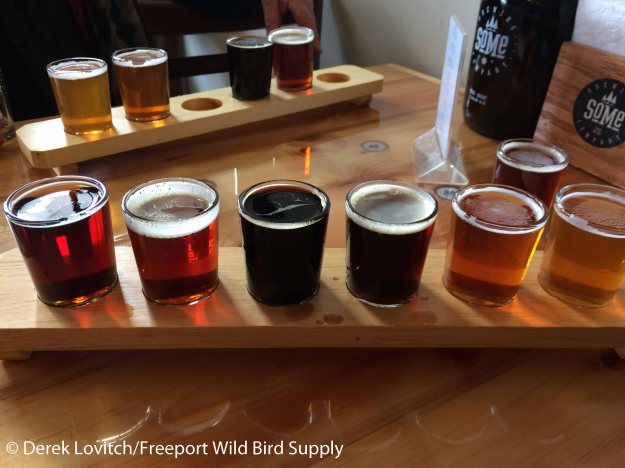
Head brewer Jared described the process and their brewing philosophy, while Nate joined us to describe their unique system, location, and goals for the new business. Meanwhile, we sipped a few of their delicious beers. We started out the Pilot’s Porridge Oatmeal Stout, a “session stout” that was light in body compared to many stouts, and fairly low in alcohol, it still had the flavors we know and love in stouts.
L1090214-editedL1090225-edited

Our next beer was 44th Parallel IPA, a traditional and straightforward IPA, and one that will no doubt be a standby for locals. But for me personally, both were overshadowed by the Irish Breakfast. A pale ale base with a day-long steeping of Irish breakfast tea made for a unique and fun beer. The tea definitely stood out, but its bitterness and herbaceous-ness was balanced by a sweet, malty backbone. I’m getting into some of these tea-beers, and I think this is a solid effort (they were already out of their Hibiscus Tea beer that was my favorite on a recent “scouting mission” here).
L1090237-edited

Winds were still howling, and temperatures- believe it or not – were dropping again, so we decided to forgo a search for Snowy Owls (none had been reported recently here, or we would have definitely cowboyed up!) and head home. While learning that Portland (well to the south of our sojourn today) reached a mere 17 degrees above zero, setting a new all-time record-low high temperature for the date didn’t make us feel any warmer, it certainly proved we earned our afternoon beverages!

While I can’t control the weather, or the birds, I do love the Birds on Tap – Roadtrips! because I know the beverages will always be there for us! And I believe this was a great itinerary that I look forward to leading again next year…hopefully with a few more degrees on the thermometer (and a little less wind!).

I have a feeling it will be warmer on the next eight Roadtrips we have in 2017, starting with the annual favorite, “Spring Ducks and Draughts” on Sunday, April 2nd. Oh, and by the way, as of today, there are only two spaces available! I hope to see you aboard one of our unique and exclusive trips, all of which are listed on our website.
L1090082-edited

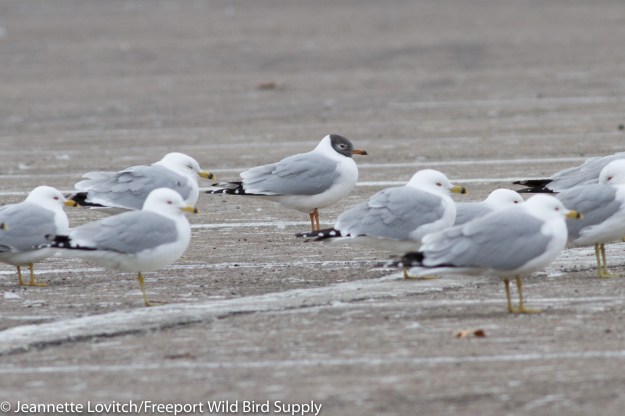
Black-headed Gull x Ring-billed Gull hybrid at Niagara Falls.

Jeannette and I took our annual pre-Bradbury Mountain Hawkwatch (starts on Wednesday!) roadtrip this year to Buffalo and Niagara Falls.  We went to Buffalo on a pilgrimage to visit the Anchor Bar – the birthplace of the Buffalo Wing. And we spent the rest of the time in the gull-watching Mecca of Niagara Falls.

On our first day at Niagara, wind gusts over 60mph were ripping over the falls (the local airport recorded a gust of 72 mph!) and birding was brutal at best, but essentially impossible (at least for a vacation). We spent a couple of hours in Niagara Falls State Park, but although it looked pretty that day, it was a day to go to the Anchor Bar! We also checked out the Olmstead-designed Delaware Park while in the big city.
Day 1 falls

The next day (Thursday, 3/9) it was quite a bit colder, but the winds were “only” 15-25mph. It was far from pleasant, but it was most definitely bird-able! And the birding was very good!
IMG_3837-edited-2

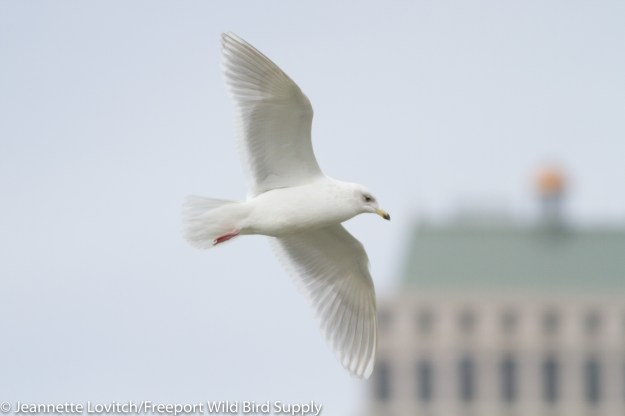
Despite the relatively late date for the peak of “winter” gulling here (despite what it felt like), we sorted through the many thousands of gulls (predominately Herring and Ring-billed, with a small number of Great Black-backed) and conservatively estimated at least 31 Iceland Gulls, 23 Lesser Black-backed Gulls, and 8 Glaucous Gulls in and around Goat Island alone.
IMG_3782-edited-2IMG_3789-edited-2
Third-cycle “Kumlien’s Iceland Gull

And then there was this one:
IMG_3806-edited-2IMG_3819-edited-2IMG_3822-edited-2

I identified it as a possible or “putative” Laughing Gull x Ring-billed Gull hybrid on account of several features:
– near-complete blackish hood with smudgy white around the eye.
– mantle was 1-2 shades darker than the surrounding Ring-billed Gulls.
– overall size and structure was comparable to Ring-billed Gulls, and didn’t bring one of the smaller hooded gulls to mind.
– large white apical spots on the outer primaries.
– dark orange bill with a blackish band, slightly smaller and thinner than nearby Ring-bills.
– yellow-orange legs

And frankly, it looked a lot like photos I have seen of this presumed pairing, such as this one from Amar Ayyash in Chicago.

Jeannette photographed it and we moved on. We never felt a need to flush it, and the bird clearly was not going to raise its wings on its own for us! But feeling the identification was solid, we enjoyed it, left it alone, and went on our way (perhaps we were simply being ultra-conservative about disturbance after the Great Gray Owl debacles this winter!)

A few minutes later, we ran into another birder, and alerted him to our find. He saw it, got some photos, came back to chat, and then went back to the bird. We continued to bird our way around the island.

I knew I needed to take a look at the photos on the computer, and do some homework. A couple of things really bothered me.  But before I had a chance to study the photos and re-evaluate my initial ID, chatter broke out on the area’s birding listserve. Chris Kundl was the birder we met, and he went back and spent some quality time with the bird, extensively photographing the wing pattern, which we – unforgivably!- did not. He, and several other local birders, then identified it as a (rarer) Black-headed Gull x Ring-billed Gull hybrid, based on the extensive white in the wingtips and the white leading edge to the wing. (His photos are here)

Kevin McGowan posted a link to a basic-plumaged individual of this presumed combination, and it definitely looks similar.

However, as Shai Mitra then pointed out on the listserve, a few things are a bit off for that combination. “(T)o me, this bird looks so unlike a Black-headed Gull that I remain puzzled. Specifically, it looks large, thick-necked, large-headed, broad-winged, and heavy-billed. Black-headed Gull is only half the mass of a Ring-billed Gull and very differently shaped, whereas this bird looks quite similar to Ring-billed Gull in overall size and structure. It is of course possible for hybrids to tilt toward one parent or the other in various ways, as opposed to showing intermediacy, but note that the Sullivan County bird from 2002 showed much more intermediacy in these very features (e.g., more obvious influence of Black-headed Gull in terms of size and shape). Looking more closely at the plumage, I also note that the hood seems to lack any of the brownish tones usually evident in Black-headed Gull, and that the mantle appears subtly darker than those of Ring-billed Gulls (Black-headed Gull is notably pale-mantled).”

The size, structure, shape, blackish (not brownish) hood, and darker mantle was what led me to the call of Laughing x Ring-billed. But how else does one explain that white leading edge to the wing? And the extensive white on the outer primaries? A hybrid Bonaparte’s Gull would explain that (and the black tone of the hood), but that’s even smaller and daintier gull than Black-headed.

So what does this mean? Simply: I don’t know. My initial ID does not explain the wing pattern, and that really bothers me.  So what is this? It looks like I have some more homework to do – and I will be sending this blog around to gather additional insight. I also want to look up when the various hooded gulls acquire their alternate plumage, as this seems incredibly early for a hooded gull to be hooded. Keeping in mind that not all hybrids are perfectly intermediate, that backcrosses occur, and that it’s hard to “prove” parentage, I think this bird is worthy of a little more debate.

Of course, we looked at everything else during our visit, including a couple of Harlequin Ducks off Goat Island, and goodly numbers of a wide variety of ducks (especially Common Goldeneyes, Red-breasted Mergansers, and Buffleheads) at a number of locations. And later, we finally caught up with a “as good as they get” Thayer’s Gull – a spiffy adult at Devil’s Hole State Park (after passing on labeling a couple as such at Goat Island earlier in the day).
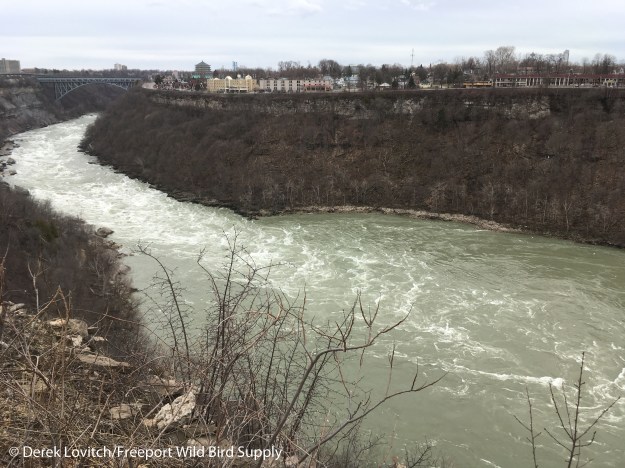
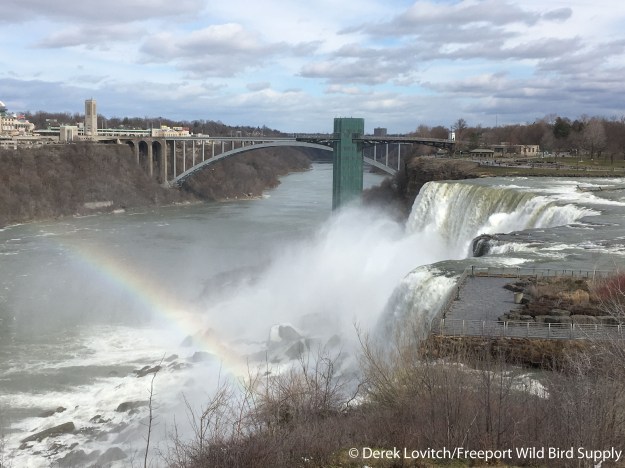
gorge and whirlpool
The Niagara River Gorge and the Whirlpool from Whirlpool State Park.

IMG_3833-edited-2
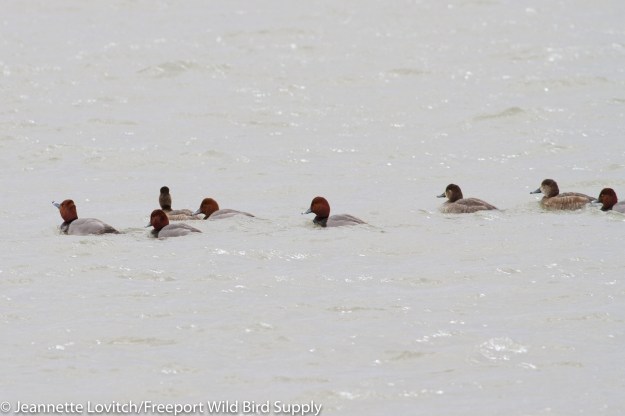
Redheads

Unfortunately, it was already time to head home on Friday, so after another walk around Niagara Falls State Park, we began the trek eastward, birding Iroquois National Wildlife Refuge. Unfortunately, the winds were very strong once again and our time was limited, but we thoroughly enjoyed the hundreds of Tundra Swans (it’s been a while since we’ve seen any!), good numbers of many ducks especially Ring-necked, and sorted through many thousands of Canada Geese at the refuge and nearby cornfields (13 Cackling Geese in Gypsum Pond were our only non-Canadas, unfortunately) before beginning the long drive home (made much longer by snow squalls and that darn Norlun trough that set up over southern Maine!).

Our time was far too limited, as always, but it’s time to get ready to count some hawks!  And at least we still have this gull to mull over.
Falls from Goat Island

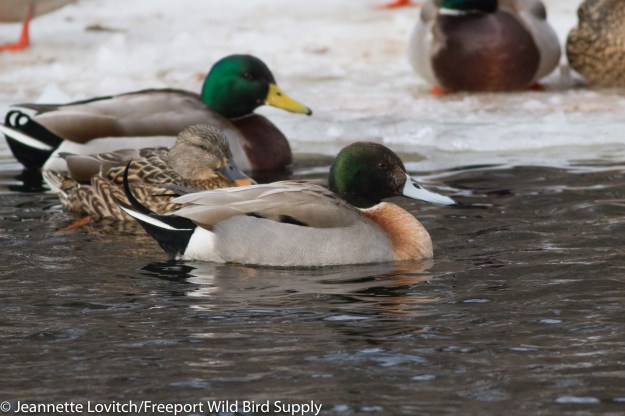
Northern Pintail x Mallard Hybrid in York (Wood Ducks, too)!

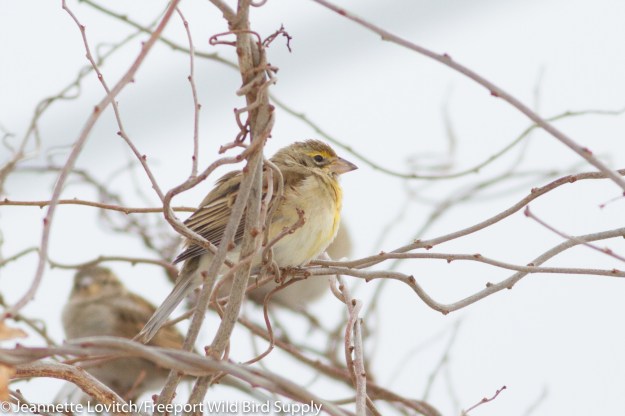
While birding The Nubble on Tuesday (not seeing Dovekies or Thick-billed Murres), Jeannette and I chatted with a local birder who turned us onto a Dickcissel that was in the House Sparrow flock at the entrance to Sohier Park.
img_3358-edited-edited

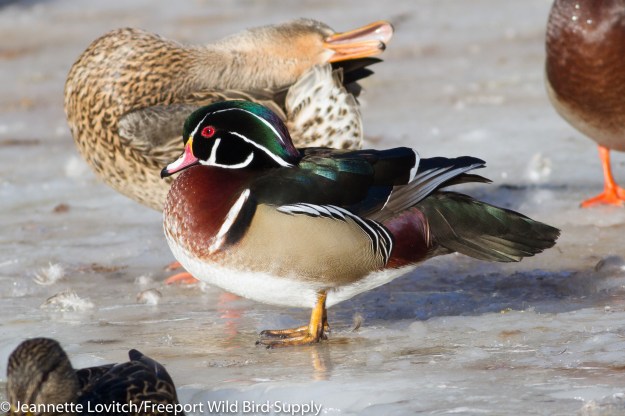
Chatting a little longer, we learned of some overwintering Wood Ducks in York. Now, the occasional overwintering Woodie in Maine is not a shock, especially when a mild winter finally turns cold. In fact, I have seen a few this winter, including a bird that was at South Portland’s Mill Creek Cove for almost a month. But the location he mentioned was new to me, and I like learning about new places.

So we found our way over to tiny Abbott’s Pond, where, well, a few ducks overwinter.
abbottspond12-14-17

During our visit, we chatted with the landowner, who had come to feed the flock. He said it started with a few geese and other ducks that “people dropped off,” and then it was discovered by wild ducks. Mallards love little places like this, and in winter, the numbers swell, as if often the case where handouts are offered. And A LOT of food is offered here, fed daily from a silo holding three tons of waterfowl feed!

A bubbler and the heat from so many birds keeps some water open, which keeps numbers up during the middle of winter (or, as in now, when winter finally arrives).

And what’s so fun, from a birding perspective, about places like this where multitudes of Mallards congregate (such as Riverbank Park in Westbrook or Mill Creek Park in South Portland), there are bound to be a few unusual species now and again. This winter, a pair of Wood Ducks was recently joined by a second drake.
img_3471-edited-editedimg_3458-edited-editedimg_3417-edited-edited

Comfortable among the habituated inhabitants, the photography opportunities are unparalleled. But even more exciting, we spotted this stunning drake Northern Pintail x Mallard hybrid that has been present here, on and off, for a month or so. This rare (especially in the East) combination is not something I had seen before, so we were excited to photograph and study it!
img_3402-edited-editedimg_3384-edited-edited

But even if it’s just a bunch of Mallards – the gorgeous drake would be more people’s favorite duck if it wasn’t so common – to enjoy, I know I will be back (in fact, I’ll probably be adding this unassuming little spot to the itinerary of Sunday’s Birds on Tap – Roadtrip! “Seaducks and Suds!” which does, by the way, have a few spaces left).

So a casual conversation led to finding one of my new favorite southern Maine birding hotspots. Who knows what has shown up here before, but I know I’ll find out what shows up next!

Epic Twitch of Mid-Coast Megas, 1/30/17

Fully caught up on work and life from our recent vacation, Jeannette and I spent Monday and Tuesday birding hard!  On Monday, we did our monthly “South-coastal Tour” from Kittery through Wells, enjoying a total of 49 Harlequin Ducks, two unseasonable American Pipits at Seapoint Beach, a hen Northern Pintail in the Moody Marsh, and finding a rare Pacific Loon off of The Cliff House (distantly phone-scoped here within an armada of Common Loons).

I16388218_1538684886161460_2799068214130599250_n

But on Tuesday, it was time to get caught up with some of this winter’s rarities. And so far this year, the Mid-Coast is where it’s at!

We began at Owl’s Head Harbor, arriving at 9:25. In about 10 minutes, we found the recently-discovered 2nd-cycle Mew Gull at the second lobster impoundment. Undoubtedly the same bird that spent last winter here, it was exciting to see it has returned, and with a more mature plumage. We watched it for about 20 minutes, as it regularly took flight, foraged in the cove, checked out the pens, and loafed with other gulls. Eventually, we watched it as it flew out into the bay, rounding the corner to the east and out of view. It steadfastly refused to fly into good lighting, however.
img_3149-edited-editedimg_3174-edited-edited

A lingering Belted Kingfisher was present as well, but surprisingly, not a single Iceland Gull was around.

We then went over to Owl’s Head State Park, where a little seawatching produced a couple of Black-legged Kittiwakes and Razorbills, but to our surprise, the Mew Gull as well!  It was feeding quite a bit off the lighthouse, out at a tideline.

Next up was a search for two Pink-footed Geese that have been around since December.  We didn’t find them in the playing fields they usually frequent, so we began a search of Rockland Harbor. The Mechanic Street Boat Launch yielded a Northern Shrike and lots of Mallards, but no geese.

We worked our way around the harbor, expecting to eventually find them in the greens of the Samoset Resort. Instead, we spotted them on the green of a sunny lawn in a small backyard off of Samoset Road. However, we were viewing them through a scope from a considerable distance, out across the large cove, from our vantage point in the parking lot at the end of Fales Street in downtown. They were not close.

So we raced over to Samoset Road, and got really lucky, finding them – along with a group of merely 15 or so Canada Geese – between a couple of houses.
img_3199-edited-edited

After lunch, we worked our way towards Camden, checking a handful of waterfowl sites, but finding nothing of note. But a pair of Buffleheads off of Mechanic St in Camden were particularly photogenic.
img_3207-edited-editedimg_3222-edited-edited

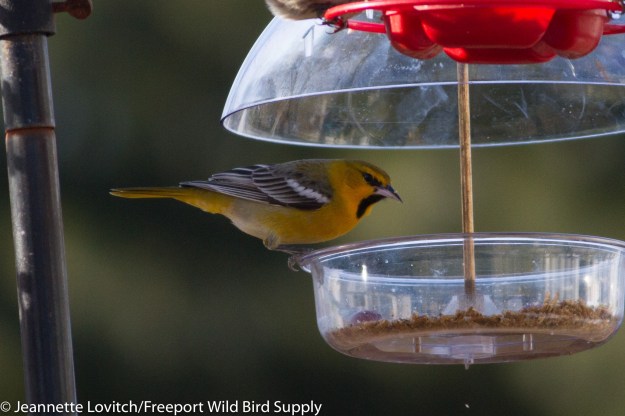
We then arrived at 4 Central Street, the home that has been hosting a Bullock’s Oriole – merely Maine’s 2nd ever – since the early winter. Jeannette had not looked for it yet, so a visit seemed overdue. We arrived at 2:09, and after waiting a mere 7 minutes (many observers have waited multiple hours), it arrived, landing in a tall tree behind the house, catching some late afternoon rays.

It dropped to the feeder, and instead of its usual brief visit, it spent well over 5 minutes gorging itself on mealworms and grapes.
img_3263-edited-editedimg_3297-edited-edited

Mew Gull, Pink-footed Geese, and Bullock’s Oriole: an incredible January hat-trick of Mid-coast Megas!

2017 Birds on Tap – Roadtrips!

outside-baxter

Freeport Wild Bird Supply and The Maine Brew Bus are excited to collaborate on ten great outings for 2017 in our popular and growing “Birds on Tap – Roadtrip!” (sm) series. The unique, relaxed birding and beer-ing adventures that you have come to love combine great local birding at seasonal hotspots with visits to sample the delicious creations of some of our favorite local breweries. These tours are a perfect introduction to birding and/or craft beer, and a great opportunity to travel with significant others, friends, and family that have interest in one topic, while your interest is primarily in the other (for now!). Seasonal birding hotspots and great local beer – a perfect combination, and we’ll even do all of the driving!

Who would have thought that, when I made that first call a year and a half ago to pitch the idea, we would not only be expanding to ten tours, but we would also featured in the Portland Press Herald (in the Food section no less) and Maine Public Radio. And then we went national via the Associated Press! (And for a little more about the history of our tour partnership, check out this blog entry from last year).

group_bus_funky-bow
For 2017, we have added several new itineraries, diversifying our birding and beering opportunities. We’ll visit breweries (and now a couple of cideries and distilleries, too!) from Newcastle to Kittery, and we’ll bird seasonal hotspots throughout southern Maine. Some of our most exciting new tours include March’s “Gulls and Growlers” where we’ll see dozens of eagles and look for rare gulls, and in July, we’ll spend a day at the beach looking at terns and shorebirds. In between, we’ll revisit all of our successful tours from 2016, including both Spring and Fall editions of Ducks and Draughts.

They still cost a mere $65 per person, which includes bird guiding, beer guiding, samples at both breweries, and round-trip transportation from Freeport or Portland.
easternroadtrail_group_edited-1
malts

“Seaducks and Suds”
Sunday, February 12th – 9:00am-3:30pm.
(Snowdate: Sunday, Feb 19)
pusa_edited-1

This perennial favorite visits the rocky headlands of York County that host impressive concentrations of some of the most beautiful ducks in the world. This tour will head to two of the hotspots, seeking Harlequin Ducks, all three scoters, Common Eider (and maybe even a King, one of the most sought-after of North American waterfowl), and many others. Purple Sandpipers and alcids (including Razorbill, Black Guillemot, and if we’re lucky, Common or Thick-billed Murre, and perhaps, if the winds align, a Dovekie!). We’ll scan the ocean from The Nubble, looking for these species, and more, including Black-legged Kittiwakes and “white-winged” gulls. Afterwards, a casual stroll along Marginal Way will afford us the opportunity to get up close and personal with “Harlies” and Purple Sandpipers.

Breweries: SoMe Brewing Co. in York and Dirigo Brewing Co. in Biddeford.

“Gulls and Growlers”
SATURDAY, March 4 – 9:00am-3:30pm.
(Snowdate: SATURDAY, Mar 11)
five_baeahatchhill1-16-15
landfill_eagles

That’s right, we’re taking you on a tour to a landfill! While it might not be our most aesthetically-pleasing destination, the massive concentration of easy food can produce incredible concentrations of birds, especially a variety of gulls, and Bald Eagles.  Up to 40 Bald Eagles can be seen here in the winter, and photography opportunities can be outstanding. Meanwhile, among thousands of Herring Gulls, we’ll learn to identify – and yes, appreciate – the variety of species (yup, it’s not just one “Seagull”), starting with Great Black-backed Gull, the largest gull in the world, and visitors from the north: Iceland and Glaucous Gulls.  After we’ve had our fill (pardon the pun), we’ll head into downtown Augusta to work the river for more gulls, eagles, and likely Common Mergansers. If it’s an “irruption” year, we might stop at the Viles Arboretum instead to seek out Bohemian Waxwings or Pine Grosbeaks if they are around.

Breweries: Lost Orchard/Crooked Halo Cidery in Gardiner and Flight Deck Brewing in Brunswick.

“Spring Ducks and Draughts”
Sunday, April 2 – 10:00am to 4:00pm.
rndu_edited-1

This tour will focus on the impressive springtime concentrations of waterfowl that stage on Merrymeeting Bay. Awaiting the opening of ponds and lakes further north, large number of Green-winged Teal, American Black Ducks, Ring-necked Ducks, and Common Mergansers build in the bay. Among the regulars, less common species such as American Wigeon, Northern Pintail, Blue-winged Teal, and Northern Shoveler are often found, along with rarities including Eurasian Wigeon. Visits to a few of the hotspots will seek the densest concentrations of ducks, and in doing so, we may see a dozen or more Bald Eagles. When conditions align, the concentration of ducks and the predators that seek them is one of the true spring birding spectacles in Maine.

Breweries: Oxbow Brewing Company and Split Rock Distilling, both in Newcastle.

“Warbler and Wort”
Sunday, May 14 – 8:00am to 2:00pm.
ccsp_edited-1

We’ll be taking two easy hikes on this outing to enjoy breeding birds and migrants in the inland forests. Our first stop will be in pine barren habitat. Although not all breeding birds will be present in full force, some of our targets, such as Prairie and Pine Warblers, Field Sparrows, and Eastern Towhees will be. We’ll also look for a Clay-colored Sparrow should a territorial bird return, and there’s always the chance that Red Crossbills could be around. Our next stop will be a location in search of Louisiana Waterthrushes. Once thought to be rare in Maine, they are actually a locally common breeding bird in very specific habitat. We’ll visit one of two locales for this species taking another walk in search of this shy bird. Hearing them is likely, but we’ll accept the challenge of getting to see one!  A variety of warblers, Scarlet Tanagers, Rose-breasted Grosbeaks, and many others may also be encountered.

Breweries: Gneiss Brewing Co. in Limerick and Sebago Brewing Co. in Gorham.

“Grassland and Grains”
Sunday, June 4th – 8:00am to 2:30pm.
vesp_edited-1

Kennebunk Plains is an annual pilgrimage for Maine’s birders, and one of our favorite BoT outings. There are few places – and none this easy – to observe state Endangered Grasshopper Sparrows and Threatened Upland Sandpipers. Throw in what is perhaps the densest concentration of Vesper and Field Sparrows and Prairie Warblers in the state, along with lots of Chestnut-sided Warblers, Eastern Towhees, and many more. Then, add a rarity like a near-annual Clay-colored Sparrow to the mix or a visit with one of the local pairs of American Kestrels, Brown Thrashers, or Eastern Kingbirds, and you have the recipe for a tremendous day of birding.

Breweries: Funky Bow  in Lyman and Banded Horn in Biddeford.

“Beach and Brews”
Sunday, July 16th – 10:00am to 4:00pm.
rost_edited-1

There’s no true “beginning” or “end” to migration as something is always on the move. This tour is designed to capture the ebb and flow of the season, including shorebirds that may be “oversummering” here, breeding locally (including Piping Plover and Willet), or already returning from the Arctic. We’ll start at Hill’s Beach, where shorebirds that are both coming and going can often be found. We’ll also look through the masses of Common Terns for the Federally Endangered Roseate Terns that often come here to feed. Piping Plovers usually breed here, and we’ll look for them too, while keeping an eye out for any other shorebirds.  Our next stop will depend on the tides, but will focus on seeing more shorebirds, likely via Biddeford Pool Beach or the mudflats of “the Pool” itself.

Breweries: Barrelled Souls in Saco and Fore River Brewing in South Portland.

“Shorebirds and Beer”
Sunday, August 13th – 9:00am to 3:00pm.
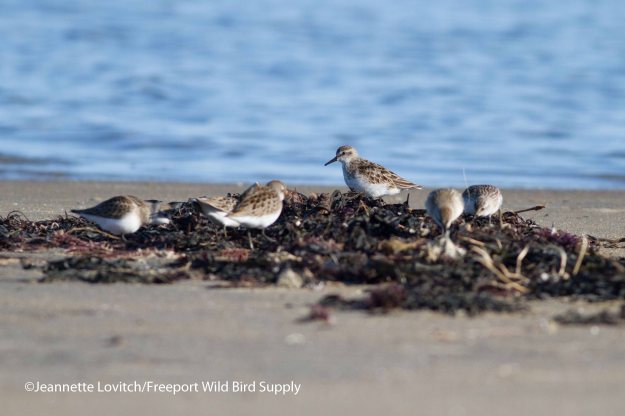
peeps_edited-1
patches

The original BoT Roadtrip!  in 2015, our most popular tour returns to Scarborough Marsh at prime time for a good variety of migrant shorebirds. We’ll learn how to identify our common species, and search for the rare. Up to 20 species of shorebirds are possible! We’ll practice identifying our “peeps” (Least, Semipalmated, and White-rumped Sandpipers) and attempt to tease out a Western or even a Baird’s among the masses. We’ll look for local breeding American Oystercatchers and Willets, while searching for migrants on their way from the high Arctic to the southern tip of Argentina. We’ll also take a look at everything else, such as Common, Roseate, and Least Terns; herons and egrets, and who knows what else? We may even get a chance to see Nelson’s and Saltmarsh Sparrows depending on time and wind.

Breweries: Foulmouthed Brewing in South Portland and Lone Pine Brewing in Portland.

“Migration and Malts”
Sunday, October 8th – 8:00am to 3:00pm.
pawa_edited-1

Migration is in full swing in early October, with a wide range of species on the move. The tail end of warbler and shorebird migration coincides with the increased movement of sparrows and other short-distance migrants. Raptors are also on the move, and the first of the migrant waterbirds begin to arrive. Early October is often also punctuated by the appearance of a rarity or two.  This trip will take us to the southernmost hotspots in the state, Fort Foster and Seapoint Beach in order to sample a great diversity of habitats sought by migrant birds of all types

Breweries: Tributary Brewing Co. and Woodland Farms Breweries in Kittery.

“Fall Ducks and Draughts”
Sunday, November 12th – 9:00am to 3:00pm.
canv_edited-1

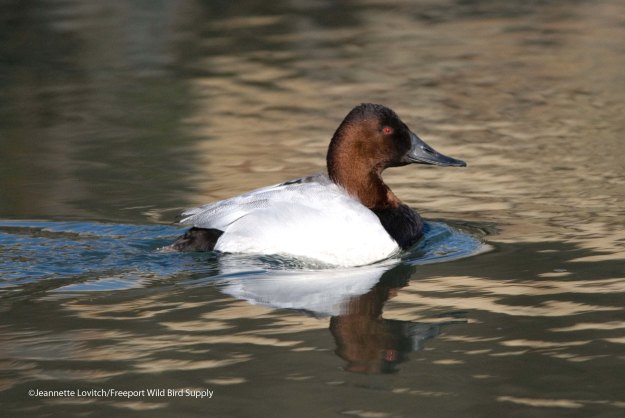
This trip will visit Sabattus Pond at the peak of waterfowl numbers and diversity. A combination of the shallow water, sheltered coves, and an invasive snail combine to make this one of the best locales for duck-watching in all of southern Maine. Hundreds of Ruddy Ducks, Lesser and Greater Scaup, Mallards, and Common Mergansers are often present at this season, with smaller numbers of all sorts of species, including American Black Ducks, Bufflehead, Common Goldeneye, Hooded Mergansers, and much more. It’s also the time of year that rarities show up, such as Redhead and Canvasback.. And we’ll look for the Peregrine Falcons of Lewiston and keep an eye out for Bald Eagles.

Breweries: Baxter Brewing Co in Lewiston and Maine Beer Company in Freeport.

“Farms and Fermentation”
Sunday, December 10th – 9:00am to 3:30pm.
pigr_edited-1

This itinerary will be flexible in order to take advantage of a seasonal hotspot, unusual concentrations of birds, or even a rarity. Most likely, we’ll begin the tour by birding the fields of Mayall Road on the Gray/New Gloucester line or in Durham to look for Snow Buntings and/or Horned Larks and perhaps Lapland Longspurs. Our second stop will also be dictated by current conditions, but most likely, we’ll visit either Lake Auburn, where diving ducks such as Greater and Lesser Scaup, and Ruddy Ducks tarry, as do waterbirds that are rare inland in Maine, such as Horned Grebes. Or, we’ll bird the Androscoggin River from the Auburn Riverwalk or the fields of North River Road, looking for unusual dabblers among the Mallards and Common Mergansers, as well as Peregrine Falcons and Bald Eagles.  And if Pine Grosbeaks or Bohemian Waxwings are present, we’ll seek these “irruptive” visitors from the north.

Breweries: Bear Bones Beer in Lewiston and Norumbega Cidery in New Gloucester.

So whatever your birding interests are, we have a tour for you! Complete details of each tour and links to trip reports from prior outings, along with information about registration (including online sign-ups with a credit card), are available on the Travel, Tours, Workshops, and Events page of our website:

We look forward to seeing you aboard the bus this year. Great birding and beer-ing opportunities await!
beer_samples
foulmouthed5-edited_edited-1
walking_kenny_plains

A January Big Day

luke-at-sunrise_edited-1

Yesterday, (Monday, January 10, 2017), Luke Seitz and I partook in a semi-serious Big Day, attempting to see as many species as we could in one day. Winter Big Days are tough because the days are short, rarities are usually relatively few, wintering birds tend to move around a lot more than territorial songsters, and it’s often firggin’ cold.

And it was certainly cold to start – 11 degrees to be exact as we greeted the sunrise seawatching at Dyer Point. Heat shimmer and sea smoke impacted our tally, but much worse was finding our second stop, Grondin Pond, completely frozen! Just 2 days ago it had at least three “good birds:” American Coot, Lesser Scaup, and Ring-necked Duck!
grondin_edited-1

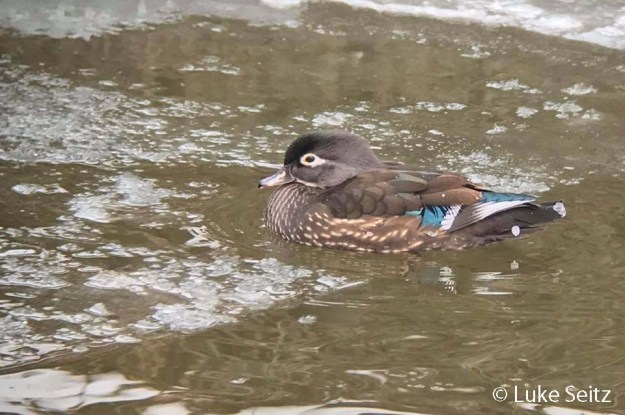
We then dipped on the long-staying Orange-crowned Warbler at Pond Cove, but the unexpected fly-over Northern Harrier plus Northern Mockingbird, Red-throated Loon, and Golden-crowned Kinglet put us back in the game. We then found a female Wood Duck at Mill Creek Cove in South Portland – our 50th species of the day, and it was only 9:53.
wood-duckmill-creek-park_edited-1
Phone-binned by Luke

Hmmm…maybe we should start taking this a little more seriously.

We started to clean up with a slew of successful twitches of very good birds: Green-winged Teal and Northern Pintail in South Portland, King Eider in Portland Harbor, Barrow’s Goldeneye in Cumberland, Great Blue Herons in Yarmouth, and Ruddy Turnstones and Dunlin at Winslow Park.

We even celebrated our good fortunes with a fueling, hot breakfast sandwich from Maple’s Organics in Yarmouth.
breakfast-sandwich_edited-1

Unfortunately, we then hit a cold stretch, striking out on Purple Finch and Hermit Thrush in my yard, and Evening Grosbeaks at a Pownal feeder. Snowy Owl and Snow Bunting at Brunswick Landing was followed by a strategic error – the absolute slowest service in history at the Five Guys in Brunswick!

Like I said, we were only so serious about this Big Day, as exemplified by stopping for food…twice! But a to-go order of some fries, a veggie sandwich, and a milkshake should not have taken so long. First, our sandwiches were left on the counter as they forgot to bag them with fries. Then they had to wait for more fries to cook, and then it turned out someone had accidentally switched off the milkshake machine.
veggie-sandwich_edited-1

Although that whole event really only wasted about 10 minutes, it was 10 minutes further behind schedule…our Pownal swing was a time suck, and the walk at Winslow took much longer than planned. And the days are short this time of year!

A Gadwall in Damariscotta was a nice pick-up, and we added a few en route twitches, but we got to Rockland with way too little time. We failed in our search of the harbor for the Pink-footed Geese and Snow Goose (they weren’t on the school fields due to the recent snow cover), and dithered on our decision to head to Camden, picking up a nearly-drive-by Bonaparte’s Gull on the way.

We didn’t run into any Bohemian Waxwings or Pine Grosbeaks on our drive, and we arrived way too late in the day to be graced with a visit from the Bullock’s Oriole. The thickening clouds ahead of the approaching storm was rapidly bringing the birding day to an early end. Quick-thinking rewarded us with the female Greater Scaup which we relocated in the Megunticook River after not seeing her in the harbor, and in very last light we somehow picked up American Wigeon in Rockport Harbor (not one as had been reported, but three, plus another Green-winged Teal), our 73rd and final species of the day.

We had hoped for a Barred Owl on the drive home; surprised that we didn’t run into one during the day, but the arrival of a mix of ice pellets, sleet, and dreezing rain didn’t help matters. However, with almost no scouting, no owling, and only about 9 hours of daylight, we agreed that this day was really an extraordinary success. 22 species of waterfowl in the middle of winter is pretty darn good, and we saw some great birds over the course of the day.

It’s almost certainly a record – if only because we don’t think anyone has done a January Big Day before (or submitted to the ABA as such!), even if it fell short of our goal of 75. And with quite a few misses and birds “left on the table,” we can’t help but wonder what a little planning, more discipline, and a packed lunch could have resulted in? (Or, having run it a couple of days earlier when Grondin was open!)

Finally, here’s an annotated checklist of the species we encountered, with notes on the rarities, single-sightings, or species seen only at one location.

Canada Goose
Wood Duck: female at Mill Creek park, South Portland
Gadwall: 1 drake, Oyster Creek, Damariscotta
American Wigeon: 1 male and 2 females, Rockport Harbor
American Black Duck
Mallard
Northern Pintail: male behind Bay Harbor Car Wash, South Portland
Green-winged Teal: male behind Bay Harbor Car Wash, South Portland and female at Rockport Harbor
Greater Scaup: female, Megunticook River from Mechanic Street, Camden
King Eider: female, Portland Harbor from Fish Pier
Common Eider
Harlequin Duck: Dyer Point, Cape Elizabeth
Surf Scoter
White-winged Scoter
Black Scoter
Long-tailed Duck
Bufflehead
Common Goldeneye
Barrow’s Goldeneye: male, Cumberland Town Landing
Hooded Merganser
Common Merganser
Red-breasted Merganser
Wild Turkey
Red-throated Loon
Common Loon
Horned Grebe
Red-necked Grebe
Great Cormorant: 1, Dyer Point, Cape Elizabeth.
Great Blue Heron: 2, Lower Falls Landing, Yarmouth
Northern Harrier: male, flying over Pond Cove, Cape Elizabeth
Bald Eagle
Red-tailed Hawk
Ruddy Turnstone: 3, Winslow Park, Freeport
Dunlin: 30+, Winslow Park, Freeport
Purple Sandpiper
Razorbill: several, Dyer Point, Cape Elizabeth
Black Guillemot
Bonaparte’s Gull: 1, Glen Cove, Rockland
Ring-billed Gull
Herring Gull
Iceland Gull
Great Black-backed Gull
Rock Pigeon
Mourning Dove
Snowy Owl: 1 Brunswick Landing
Red-bellied Woodpecker: at least 8-9 over the course of the day!
Downy Woodpecker
Hairy Woodpecker
Pileated Woodpecker
Peregrine Falcon: 1, Portland Harbor
Blue Jay
American Crow
Common Raven
Black-capped Chickadee
Tufted Titmouse
Red-breasted Nuthatch
White-breasted Nuthatch
Brown Creeper: 2, Winslow Park, Freeport
Golden-crowned Kinglet
Eastern Bluebird
American Robin
Northern Mockingbird
European Starling
Cedar Waxwing
Snow Bunting: 20+, Brunswick Landing
American Tree Sparrow
Dark-eyed Junco
White-throated Sparrow
Song Sparrow
Northern Cardinal
House Finch
American Goldfinch
House Sparrow

Total=73

Misses: Pink-footed Geese and Snow Goose in Rockland; American Coot, Lesser Scaup, Ring-necked Duck, and Northern Shoveler at Grondin Pond; Black-legged Kittiwake; Barred Owl; Cooper’s Hawk; Sharp-shinned Hawk; Rough-legged Hawk, Northern Shrike; Hermit Thrush (1); Bohemian Waxwing; Orange-crowned Warbler (1); Bullock’s Oriole (1), Purple Finch, Pine Grosbeak; Evening Grosbeak.

(Also,we posted a little play-by-play in a thread on the store’s Facebook page during the day. Check it out…we added commentary in the comments section, culminating with a video of me doing what it takes to get those wigeon at last light!)

The 2017 Maine Bird Predictions Blog

24-l1050633_attw_male1nesowadnahunkrd-7-19-16_edited-1

Yup, it’s that time of year again. Not just time to celebrate the end of 2016 (is anyone really upset to see this year end?) and ring in the new, but reset the ol’ Year List (if you keep such a thing) and look forward to the avian wonders of 2017.

That means it’s time for my annual Predictions Blog, where I view into my crystal binoculars and attempt to forecast some of the “new” birds to grace the State of Maine, and my own personal state list, in the coming year.

But first, let us check in with my 2016 Predictions post, and see how I did.

Two birds were added to the cumulative Maine list in 2016. Incredibly, both were on Seal Island! A Great Knot on July 23rd followed an Ancient Murrelet in May that was later seen (presumably the same bird) at Petit Manan Island and then Machias Seal Island. While Ancient Murrelet was on my radar, and was part of my lengthy honorable mention list, Great Knot most definitely was not! In fact, this was one of the most amazing vagrant records in the state in some time.

My predictions for the next 25 species to be found in the state therefore has not changed too much. The new list is now:

1) Neotropical Cormorant
2) Graylag Goose
3) California Gull
4) Roseate Spoonbill
5) Spotted Towhee
6) Hammond’s Flycatcher
7) Bermuda Petrel
8) Black-chinned Hummingbird
9) Common Shelduck – with a recent spate of records in Eastern Canada, including three birds in New Brunswick in December,a pattern of vagrancy is definitely emerging. Provenance will always be a question however, as this species is kept in captivity. However, we used to dismiss every Barnacle Goose – for example – as simply an “escapee,” but its clear many are of natural vagrancy. Increases in the species in Iceland are a good sign that some of these recent records are of wild birds.
10) Fieldfare
11) Audubon’s Shearwater – on “hypothetical” list, but I think the record is good.
12) Little Stint
13) Anna’s Hummingbird
14) “Western” Flycatcher (Pacific-slope/Cordilleran)
15) Vermillion Flycatcher
16) Common Ground-Dove
17) Allen’s Hummingbird
18) Redwing – one in New Hampshire in March was a “near-miss!”
19) Western Wood-Pewee
20) Spotted Redshank
21) Zone-tailed Hawk
22) Gray Flycatcher
23) Ross’s Gull
24) Black-tailed Gull
25) Common Scoter

Meanwhile, I was very pleased to add six species to my own Maine list this fall. First up was the Black-throated Sparrow in Winter Harbor, which I visited on January 17th. Because it was discovered before I posted my Predictions Blog last year, I can’t count that as a prediction! But you can be sure I was happy to put this stunning southwestern sparrow on my state list anyway.
l1040396_btsp1winter_harbor1-17-15_edited-1

My only self-found addition was my 6th ranked species: Western Grebe. I found one at Simpson’s Point in Brunswick on April 17th. It’s always much, much sweeter to find, rather than chase, a new state bird!

Adding American Three-toed Woodpecker to my list was just a matter of finding the time and putting in the effort. In Mid-July, Evan Obercian and I used it as an excuse to spend a weekend around Baxter State Park, which eventually yielded a pair of American Three-toed Woodpeckers along Telos Road.

A long-staying King Rail near Moody Point in the Webhannet Marsh was my 4th addition of the year. It was very high on my honorable mention list, but I left it off the ranking this year.

My Washington County Tour in August once again produced a Sabine’s Gull, and once again it was in Canadian waters, despite our best efforts to follow it across the border. Therefore, I was elated when one was discovered at Sabattus Pond on October 29th. This was my only “drop what I was doing and rush out the door” twitch of the year. It was worth it. I really like Sabine’s Gulls.

And certainly last but not least was the Bullock’s Oriole in Camden that Luke Seitz and I drove up to see on November 25th. Another bird high on my Honorable Mention list, but it too was not on the official Top 25.

Great Skuas were again seen with regularity off of Bar Harbor, but I missed them on my paltry few trips offshore again this year. The nemesis continues! There was also a one-afternoon wonder Harris’s Sparrow in Belgrade in November.

But with my #1, #6, and #13 “next species” checked off, my updated list for my own next 25 species in Maine now reads:

1) Great Skua
2) Eurasian Collared-Dove
3) Graylag Goose
4) Say’s Phoebe
5) American White Pelican
6) Neotropic Cormorant
7) Fork-tailed Flycatcher
8) Tundra Swan
9) California Gull
10) Franklin’s Gull
11) Black-bellied Whistling-Duck
12) Slaty-backed Gull
13) Yellow Rail
14) Boreal Owl
15) Calliope Hummingbird
16) Cerulean Warbler
17) White Ibis
18) Gull-billed Tern
19) Hammond’s Flycatcher
20) Loggerhead Shrike
21) Ivory Gull
22) Roseate Spoonbill
23) Spotted Towhee
24) Virginia’s Warbler
25) Common Shelduck

l1080679_buor1camden11-25-16-edited
Bullock’s Oriole on 11/25 in Camden