Tag Archives: waterfowl

Common Teal to Northern Lapwing; American Woodcocks to Wood Ducks: 5 Great Days of Spring Birding!

Well, that was a helluva good five days of birding! And, I covered a heckuva lot of ground in the process. Yes, spring – and spring birding – is finally upon us.

After checking local hotspots on Thursday morning (lots of Killdeer and my first Eastern Phoebes), I began my trek eastwards after lunch. I was giving a presentation and book signing at the Maine Coastal Islands NWR headquarters in Rockland, thanks to an invite from the Friends of Maine Seabird Islands. On the way, I hit a handful of water overlooks, with the only birds of note being my FOY Fish Crows in downtown Brunswick and FOY Double-crested Cormorant in Damariscotta Harbor.

But then I arrived at Weskeag Marsh, and that was most productive. Highlighted by two drake “Eurasian” Green-winged (aka “Common”) Teal, a nice diversity of waterfowl also included two pairs of American Wigeon and a pair of Northern Pintail. I flushed two American Woodcocks and four Fox Sparrows from the short trail that leads to the viewing blind. Afterwards, I found a single 2nd-Cycle Glaucous Gull with four 1st-cycle Iceland Gulls still at Owl’s Head Harbor.

Here’s a poorly phone-scoped image of one of the Common Teal, showing the bold horiztonal white bar across the wing and the lack of a vertical white bar on the side of the chest.
COTE,WeskeagMarsh,4-5-14

Spending the night with friends, I then met up with staff from the Coastal Mountains Land Trust for a walk around their Beech Hill Preserve to discuss and offer suggestions as to augment and improve bird habitat there. A spiffy male Northern Harrier and a Northern Shrike (my 11th of the season!) were me rewards.

I then took the (very) long way home, checking farm fields on my way to the Hatch Hill Landfill in Augusta. Although 900-1000 gulls were present at the dump – a nice number for here – all but 5 were Herring Gulls (plus three Great Black-backed and 2 Ring-billed). At least 10 Bald Eagles were still present however.

Working my way down the Kennebec, I checked the mouth of the Abagadasset River in Bowdoinham, which I found to still be frozen. Nearby Brown’s Point, however, had open water, and duck numbers were clearly building, including 44 Ring-necked Ducls and 50+ Green-winged Teal. Back at the store soon thereafter, I found our Song Sparrow numbers had grown from four to 12 overnight.

As the rain and drizzle ended on Saturday morning, the birdwalk group convened, and we headed inland (for the first time since December!) to work the “Greater Yarmouth Goose Fields.” Highlighted by two Cackling Geese that were first located on Thursday (a couple of hours after I checked the fields in the fog, dammit!) and yet another Northern Shrike (our third week in a row with a shrike on the birdwalk!), this very productive outing is fully covered on our website, here – as are all of our birdwalk outings.
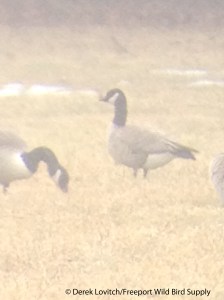
IMG_3244_CACG,GreelyRd,Cumberland,4-5-14One of the two Cackling Geese, phone-scoped through the fog.

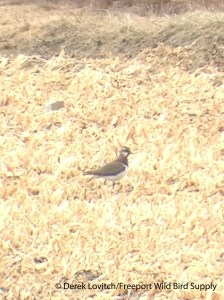
Normally, the birdwalk’s return to the store is the end of my birding on Saturday, but not this week. Soon, Kristen Lindquist, Barb Brenneman, and I raced off to Jordan Farm in Cape Elizabeth to twitch a real “mega,” the stunning Northern Lapwing! Discovered Friday evening, the bird was enjoyed by many throughout the day on Saturday, but it was not seen again on Sunday despite much searching. This is the 4th record of lapwing in Maine, and the third in just three years! I consider myself exceedingly fortunate to have seen the last two. My distantly-phone-scoped photos of the Cape Elizabeth bird hardly do this stunner justice.
IMG_3262_NOLA1,JordanFarm,4-5-14  IMG_3264_NOLA2,JordanFarm,4-5-14

Yet even still my birding day was far from over, as Saturday night was our annual “Woodcocks Gone Wild at Pineland Farms” dusk trip. Keeping an eye on the weather (the rain had cleared, but increasing winds were a concern), Jeannette and I wondered if we should postpone the outing. Moments after we decided to give the go-ahead in the afternoon, the winds began to gust – a lot. Then, at about 5pm, they died. When our walk got underway at 6:30, there was a little breeze once again, but it was not enough to keep the woodcocks from going wild! In fact, it’s possible that a little wind kept the birds’ display a little lower – especially the first handful of flights – which resulted in quite possibly the best show we’ve ever had here! At least 7 males were displaying, including one repeatedly right over our heads – and at least two more silent birds were observed flying by. Add to this lots of American Robins and a Northern Shrike before the sun set, and the group was treated to a wonderful spring evening performance!

Next up was Androscoggin County on Sunday with my friend Phil McCormack. While our primary target was a pancake breakfast at Jillison’s Farm in Sabattus, we were also hoping for a Redhead that was discovered on the outlet stream at Sabattus Pond a few days ago. Well, the pancake chase (the more important one!) was successful, but the Redhead chase was not. However, a very good day of birding was enjoyed nonetheless.

Scattered ducks on the river including Ring-necked Ducks and Common Mergansers, a couple of pockets of Tree Swallows, and other assorted species were trumped by two flooded fields along Rte 136 in Durham. With ponds and marshes still frozen, ducks are stacking up at more ephemeral – but unfrozen – habitats.  Thousands of ducks and geese were present, mostly Canada Geese, Mallards, and American Black Ducks.  However, between the two fields, we tallied an unbelievable 273 Wood Ducks (probably about quadruple my previous high count in the state). Two immature Snow Geese were my first of the year, and very rare away from the coastal marshes in the spring. 18 Green-winged Teal, 12 Ring-necked Ducks, 10 Northern Pintail, and two pairs of American Wigeon were also among the masses.
IMG_3271_WODUs2,Durham,4-6-14  IMG_3282_WODUs1,Durham,4-6-14_edited-1

Although these phone-scoped photos hardly do the scene justice, they should at least give you a taste of what things looked like.

After brunch, we birded the west side of the Androscoggin River (more Ring-necked Ducks and Common Mergansers, etc) before spending our last hour of our birding (half) day at Bradbury Mountain.  Our disappointment over missing an unprecedented 9 Sandhill Cranes was alleviated when #10 was spotted, along with my first two Ospreys of the year.

After four days of extensive birding, my Monday agenda at the store was lengthy, but the weather in the morning was just too good to pass up!  A spin of the local waterfowl hotspots was fruitful.  The Goose Fields yielded the two continuing Cackling Geese along Greely Road, along with my first American Kestrels of the year, and my FOY Wilson’s Snipe, also along Greely.

No luck finding a lingering Barrow’s Goldeneye in the Harraseeket River, but at Wharton Point, a group of 7 Northern Shovelers was one of the largest flocks of this species I have seen in Maine. My first Greater Yellowlegs of the year was also present, as were 60+ Green-winged Teal, 16 Ring-necked Ducks, about 30 distant scaup, 8 American Wigeons, and 1 Northern Pintail among several hundred American Black Ducks.

Two joyous hours at the Brad were full of raptors: 127 birds had past the watch when I departed at noon, including 4 Osprey. Red-tailed and Red-shouldered Hawks continue to add to their all-time record tallies. Hundreds of Canada Geese were sorted through, hoping for a rarity, while other migrants included Tree Swallows, American Black Ducks, Common Mergansers, and Great Blue Herons.

Furthermore, signs of a good flight last night included the return of Golden-crowned Kinglets to the area – after we were virtually devoid of them this winter, and an increase in Red-breasted Nuthatches (relatively few and far between this winter as well), Song-Sparrows, and at the store, a Fox Sparrow – a bird we don’t get here every spring due to our open habitat.

So long story short, it’s been a great few days of birding!  But now, I should probably get some work done!

A (Very) Early Spring Week in Review

Our Saturday Morning Birdwalk surveyed the waterfront in Freeport and Yarmouth.  On Sunday, Kristen Lindquist and I enjoyed an epic white-winged gull show in Portland, before working our way around the Cape Elizabeth shoreline.  Then, on Monday, we birded from Biddeford Pool through Scarborough Marsh with Snowy and Great Horned owls, Rough-legged Hawk, and Ruddy Turnstones among the many highlights.

Further south, Jeannette and I covered Kittery through Wells, as is our tradition on the first Tuesday in March.  Another exceptionally productive day was enjoyed, including two more Snowy Owls and a Common Eider of the northern subspecies, borealis.

Wednesday was spent dealing with various car issues and seed delivery, so birding was limited to the woods near our house, and the feeders of course.  Same for Friday, where at Hedgehog Mountain Park, a mere 7 species was actually the most that I have detected in a couple of months there.  In between, I was back in Portland and Westbrook on Thursday, and although the Westbrook riverfront was a disappointing, the continuing white-winged gull show in Old Port more than made up for it.

While “new arrivals” were few and far between this week as bitter cold continues, there were definitely signs of the season.  Waterfowl are obviously on the move: Brant, Canada Geese, Mallards, and American Black Ducks are returning in numbers, while the concentrations of seaducks, especially all three scoters, was greatly reduced as these birds have begun to disperse – if not actually migrating north.

For the first week of March, I recorded very few “first-of-years” this week: Great Horned Owl, Yellow-rumped Warbler, and Fox Sparrows.  Of those, only the sparrow is likely a true migrant; the owl is a resident, and the warbler likely wintered locally.  American Robins were definitely on the move, however, with several flocks noted moving northbound (at least at the given time), and American Tree Sparrows also seem to be on the go.

New reports of Snowy Owls – especially inland – likely included northbound migrants.  While all three of the individuals that I saw this week seemed to be birds that were continuing in a specific area for several weeks or more now, the fact that Kristen and I only saw one bird in a very thorough search at Biddeford Pool (four had been present for a couple of months now) suggests birds are already departing. Northern Shrikes – such as the one that briefly visited the yard here at the store on Thursday (our second of the season) are also likely migrating right now.

In the woods there is a different story, however, as even the local residents are a little less active vocally right now than we would expect.  I have yet to hear a Brown Creeper sing – although I am seeing them on regular basis – and Golden-crowned Kinglets remain very few and far between.  And other than goldfinches and resident House Finches, finches remain virtually non-existent.

But all of this is about to change, and my guess is that it will change rather rapidly.  In fact, with the winds turning south today, I wouldn’t be surprised if a few Turkey Vulture and Red-winged Blackbird reports trickle in this weekend.  And once the snow really begins to melt (especially to our south), expect those floodgates to really open!  (Any day now…any day now…)

IMG_4781_edited-3

IMG_4769_edited-2

Snowy Owl, The Cliff House, York, 3/4/14. As you have seen on this blog, our store’s Facebook and Flickr pages, etc, most of our Snowy Owl photos this winter have been of relaxed birds, often with their eyes closed.  Few have been “perfect” shots, whether in lighting or resolution.  And we’re proud of that!  To us, the birds ALWAYS comes first, and we pride ourselves in minimizing any chance at disturbance.  Unfortunately, this bird was sitting close to the parking lot and we spooked it before we knew it was present.  A pair of crows likely also affected the bird’s immediate response.  As it flew away from both us and the crows, Jeannette snapped some photos, as the bird first flew straight out to sea – thereby ditching the crows – before returning to land a short distance away.  We backed off and left it alone.  With a lot of unethical and selfish behavior occurring – as always – around charismatic owls around the country, we support the idea that the circumstances of photos be explained when it shows a behavior that may have been modified by our presence or behavior.

Sabattus Pond Season-in-Review

Sabattus Pond was frozen on Monday morning, as I expected, thanks to this recent bout of unseasonably cold weather.  While 35 Mallards, 3 Hooded Mergansers, 2 American Black Ducks, and 1 Mallard x black duck hybrid were present in the outlet stream, this likely brings my Sabattus birding season to a close.

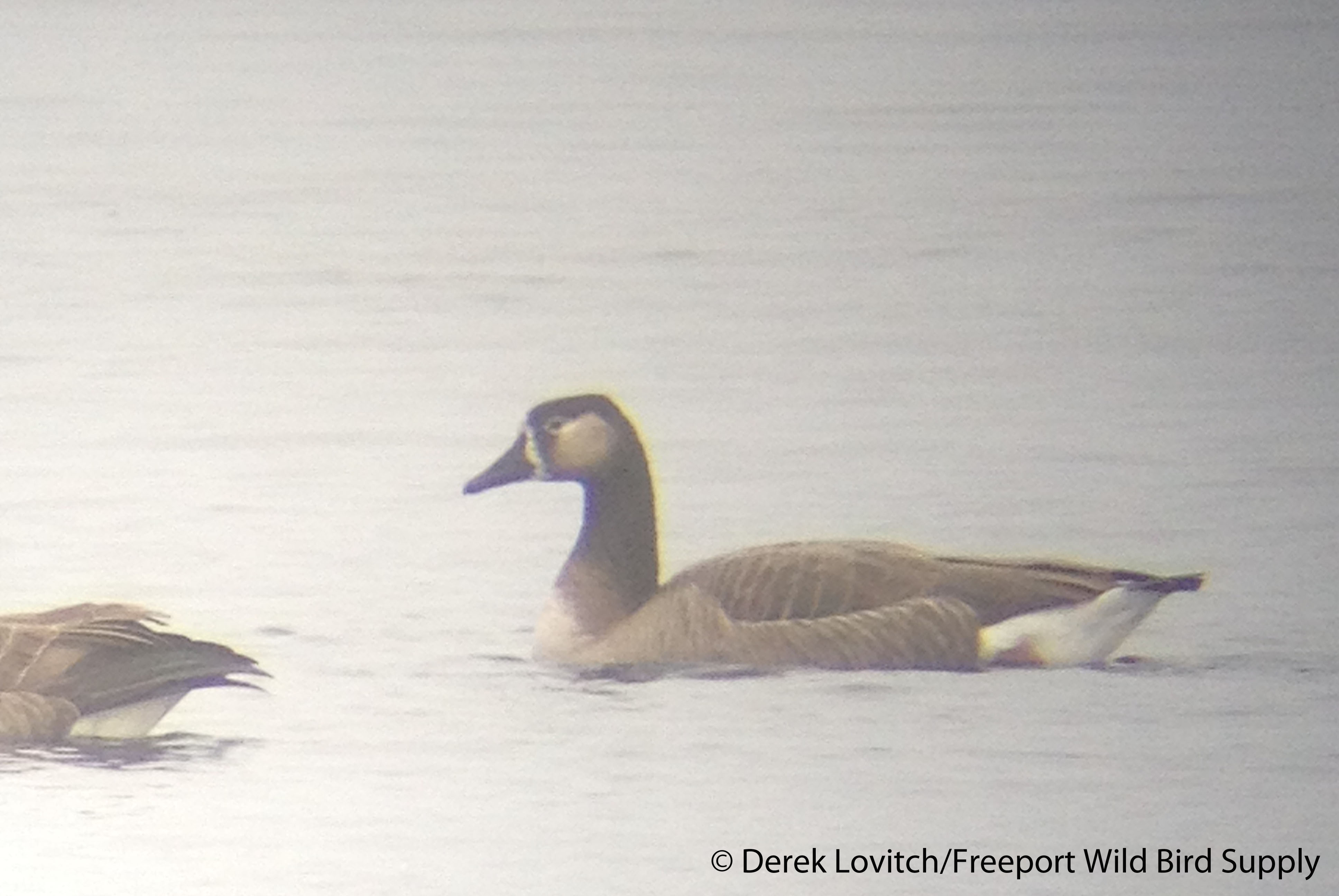
But it is just after Sabattus’s freeze-up that LakeAuburn is its most productive.  Today, 117 Canada Geese, 58 Greater Scaup, 46 Lesser Scaup, 41 Ruddy Ducks, 22 Common Goldeneyes, 8 Hooded Mergansers, 1 Bufflehead, and 1 continuing hen Black Scoter were tallied in a less-than-exhaustive search of the large lake.  The Black Scoter is a great bird inland, and she’s been present for at least five weeks now.  Meanwhile, among the Canada Geese, there was this funky mutt – apparently a hybrid with some sort of domestic thing.
CANGhybrid1,LakeAuburn,12-2-13

CANGhybrid2,LakeAuburn,12-2-13

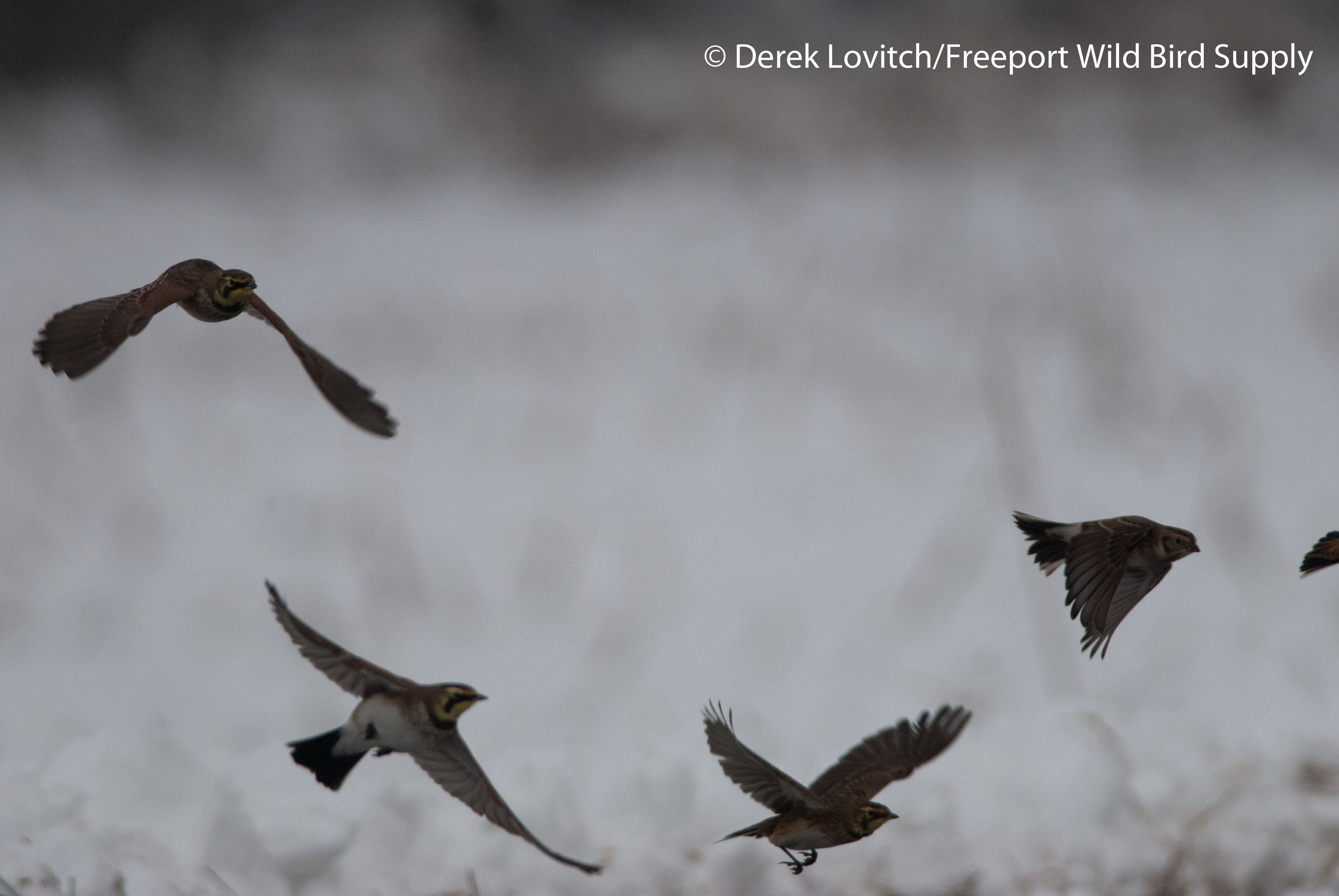
Between visiting the two lakes, I scoured Upper Street in Turner for Snowy Owls (none) or other raptors (just one Red-tailed Hawk), but I did happen upon a small flock of 35 Horned Larks that contained two Lapland Longspurs.  They were feeding at the edge of Pearl Road, taking advantage of where the plow had scraped the sides of ice and snow.  I got this lucky shot of one of the Lapland Longspurs in flight with the Horned Larks.  Unfortunately, the light mist and heavy cloud cover prevented a really great shot.
DSC_0154_LALOwithHOLA,Turner,12-2-13

But back to waterfowl…

Sabattus Pond is one of my favorite birding locations from mid-October through freeze-up.  The diversity of ducks is rarely matched in this part of Maine, and the proximity and ability to study birds (such as Lesser vs. Greater Scaup) is unsurpassed.  Each fall I tell myself I needed to visit Sabattus more often, so this fall I committed to visiting once a week, beginning on 10/30 – I would have started a little earlier in the month, but the weather at the time had been so warm that waterfowl were not yet arriving en masse prior to the end of the month.

I tallied all waterbirds (except for Herring and Ring-billed gulls) on each visit.  I was curious to document the ebbs and flows of respective species throughout a full season here.  I also hoped to find some rarities of course.

Here’s my weekly tally (on 10/30 I birded with Cameron Cox, and on 11/21, Dan Nickerson):

10/30    11/7    11/14   11/21   12/2
Canada Goose                        2          0          0          0          0
American Black Duck          14        53        63        24         2
Mallard                                154      301     254      255       35
Mallard x black duck              2          4          8          6          1
NORTHERN PINTAIL               1          1          0          1          0 (same bird)
Green-winged Teal                 0          0          1          0          0
Greater Scaup                       15        22        27        20         0
Lesser Scaup                       133      185      204      174        0
WHITE-WINGED SCOTER        0          0          0          1         0
Bufflehead                              12          9          5          8         0
Common Goldeneye               2        29          4          2         0
Hooded Merganser               11        17        15        19        0
Red-breasted Merganser        7          1          0          0        0
Common Merganser                0         3          7      224        0
Ruddy Duck                           470     531      541      273        0
Common Loon                          2          4          9          3        0
Horned Grebe                           1          0          0          0        0
RED-NECKED GREBE                0          0          1          0         0
Great Blue Heron                     0          0          0          3         0
Great Black-backed Gull          0          0          0          1         0
American Coot                          0          0          1          0         0
Belted Kingfisher                      0          0          0          2         0

Other highlights at Sabattus included a Peregrine Falcon and 40 Snow Buntings on 11/7 and 3 White-rumped and 3 Pectoral sandpipers on 11/14 (both late and noteworthy inland).

Overall, it was probably only an average season at Sabattus.  The only week I missed was last week, due to my schedule and Thanksgiving, which is unfortunate, as the pre-ice-up week would have provided some interesting data.  There were no fallouts, and only a few unexpected (or at least, expected to be seen rarely) birds (in caps above).   The Ruddy Duck numbers were well above average, but a lot of other things – especially the scaup – were average or below my high counts of recent years.  And why don’t coots visit here much anymore? And really, not a single Ring-necked Duck!? Nevertheless I find it very rewarding to regularly check one location, so I thoroughly enjoyed my extra effort this year.

On each visit, I also visited LakeAuburn, which is a much different body of water (deeper, sandier, and apparently without the invasive Chinese Mystery Snail that provides the sustenance for most of the birds on Sabattus).  Note, however, that as the numbers of ducks decrease on Sabattus, they begin to increase on LakeAuburn – the last lake to freeze in the region.

11/7     11/14   11/21   12/2

Canada Goose                        0          0          0      117
American Black Duck             1          0          0          0
Mallard                                     3          6          0          0
Greater Scaup                         0          0        38        58
Lesser Scaup                           8          0        31        46
SURF SCOTER                          1          0          1          0 (probably same bird)
BLACK SCOTER                       1          0           1          1 (probably same bird)
Bufflehead                              0          2           0          1
Common Goldeneye             0          5         21        22
Hooded Merganser               0        14           5          8
Common Merganser             0          3           0          0
Ruddy Duck                           20         2           0        41
Common Loon                        7         9           1          4
Horned Grebe                         1          0          0          1
RED-NECKED GREBE              0          1          0          0

I can’t help but wonder if some of the birds on the lake on Monday would return to Sabattus if a warm spell opens the pond back up, and if it does, I am sure birds from points north might drop in as well as they are frozen out of lakes and rivers.  In other words, the duck-watching season on Sabattus may not be over yet, but I think I will be turning my attention elsewhere unless it warms up dramatically.

Meanwhile, on all of my visits to the two lakes, I added at least a few other stops in between in the hopes of finally finding a really “good” bird in Androscoggin County (away from Sabattus, that is).  Uh…nope.  My only real highlights away from the two lakes were the two Lapland Longspurs on Monday.  My rarity drought in AndroscogginCounty might continue, but the waterbird watching is certainly exceptional.

By the way, in a series of spring visits, I have found very, very few ducks on Sabattus Pond, for reasons unknown.  Therefore, other than my annual check on Maine Maple Sunday, I’ll have to anxiously await next October!

Cape Neddick through Wells – Snowy Owl!

Jeannette and I birded from Cape Neddick through Wells on Tuesday, seeing a really pleasant variety of birds in the process in the calm before the storm. Delayed by a snowy start and somewhat slick roads (OK, not slick if didn’t drive like it was a dry race car track – 7 cars were off the road between Freeport and York, however) that backed up traffic (“Hey, there’s a car in the ditch, let me look!”), we didn’t reach the Nubble neighborhood until almost 9:00, but by then the snow had ended, the ceiling lifted a bit, and a very light wind made for decent  – albeit a bit raw – birding conditions.  Although we didn’t have anything earth-shattering, we did have a fair number of “good birds.”

Without a day off together in December (the store is open seven days a week from Thanksgiving to Christmas), our annual late November run through our usual route is the last time we focus on thickets and migrant traps in the hopes for lingering migrants and rare passerines.  Next time, waterbirds will be more of a focus.  And the limited number of non-resident passerines that we detected today (other than Dark-eyed Junco, White-throated Sparrows, American Tree Sparrows, and a scattered few Yellow-rumped Warblers) confirms that – as did the impressive, and growing, quantity of waterbirds.

Three Carolina Wrens was the highlight of a thorough check of the Nubble neighborhood thickets, although we did have a group of about 40 Snow Buntings fly over.  45 Black Scoters, 13 Purple Sandpipers, 8 Great Cormorants, 6 Harlequin Ducks, etc at The Nubble were a sign of things to come along the shoreline.

Passerines were few and far between along Marginal Way and the adjacent neighborhood, but great numbers of waterfowl along the shoreline more than made up for it.  As with everywhere we looked at the ocean today, all three scoters were present in numbers, including a close and talkative group of about 100 Black Scoters.  Lots of Long-tailed Ducks, Common Eiders, and a total of 20 or 21 Harlequin Ducks were also present, along with a half-dozen Purple Sandpipers.

OgunquitBeach was a hotspot today, with a flock of 75-100 Sanderlings being joined by 32 Dunlin.  200+ Mallards and a handful of American Black Ducks were in the river, and a Belted Kingfisher hunted from its shore.  One of the surprises of the day was two Ruby-crowned Kinglets actively foraging in four Dwarf Alberta Spruces in planters in front of the motel.  A Winter Wren at Beach Plum Farm was a very good bird for this late in the season (they’re the “All but in winter wren” in Maine), and we had two Peregrine Falcons and an immature Northern Harrier in and around Harbor Road and Community Park in Wells.

We checked WellsHarbor and the jetties from a couple of vantage points (wouldn’t this be a perfect place to find a Ross’s Gull!?) and then scanned the offshore rock ledges still above water on the incoming tide from the parking lot at the end of Mile Road.   Six more Dunlin were within the scattered flock of 75+ Purple Sandpipers, and there were a lot of the expected waterbirds, including 6+ Red-throated Loons and at least four Red-necked Grebes.

All day long we were scanning the marshes and shoreline rocks in the hopes of seeing a Snowy Owl.  There have been a rash of reports in the past 7-10 days, as it looks like an irruption is underway.  I have not heard any reports of lemming and vole populations on the tundra, but a southward push of Snowies means there are either too few rodents (a natural cyclical crash, especially in lemmings) or too many owls (good breeding productivity thanks to a boom year in lemmings).  Either way, there are a lot of hungry owls around Maine right now.  It was surprising that based on the recent uptick in reports, we did not see one all day…until our very last stop with the light rapidly fading.  One immature female-type (extremely heavily barred throughout the body, other than the face) was standing guard on the last of the rocking ledges that I scanned.  Any day with a Snowy Owl is a good day in my book!

Please remember that these birds are not down this far south by choice!  The birds are here because they are hungry, or even starving (one emaciated bird was found dead at Prout’s Neck the other day, for example).  While this charismatic and captivating species is sought by birders, photographers, and almost everyone else, we must be mindful of the dire straights that many of these birds are in.  Too often we have heard stories of birds harassed, flushed repeatedly, or otherwise bothered by supposed fans.  In the case of a Snowy Owl perched on a rock 100 yards or more offshore, there is little harm that can come from gawking at them from land.  But when they are in the marsh, in the dunes, out in a field, on a building, etc, how about we remain just as respectful to these magnificent creatures and admire them from a safe distance.  Besides, the birds’ natural behaviors will be more fascinating than watching it fly away from you.  No, you really don’t need to see the bird a little better, or get a photo a little closer . . . admire them from a distance and let’s not make life any more difficult for these birds – or ruin it for other birders!