Tag Archives: vagrants

Rarity Season is Upon Us!

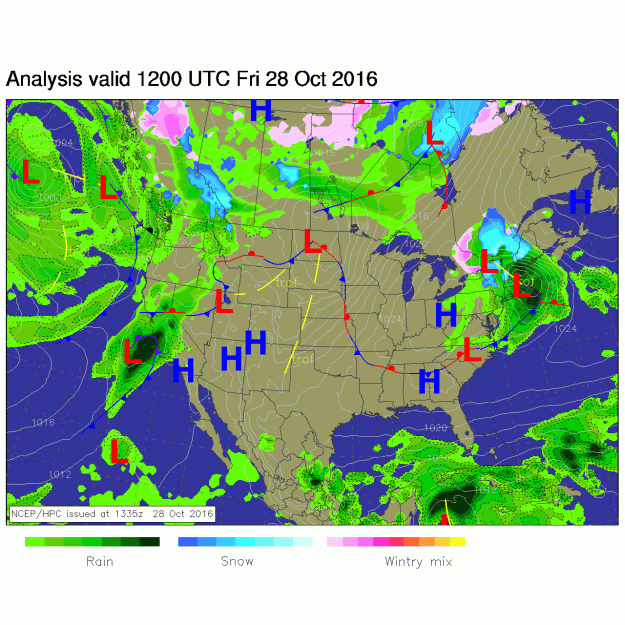
I do like a good storm system. Especially as Rarity Season is now upon us! So besides our desperately-needed rain, I was anxious for this weekend’s weathah in the hopes it will set up some action for my favorite time in the birding year.

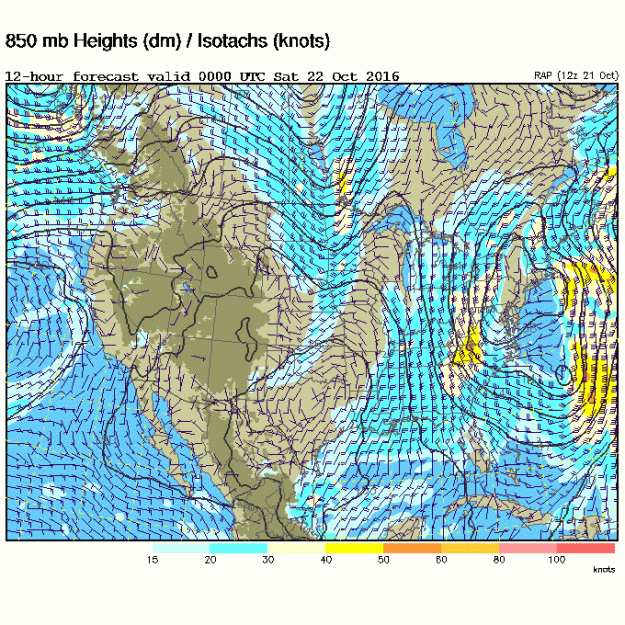
The winds turned east on Thursday (10/20), and strengthening easterly winds, scattered showers, and developing fog minimized the migration overnight into Friday morning. It was hard to tell from the radar is there was some limited, low movement, which would be indicative of the sparrows that move this time of year. Florida Lake Park was slow in the morning, though, and nothing new was under our feeders at home or at the store, however.

During the day on Friday, a shortwave moved out of the Ohio Valley, and overrunning precipitation fell during the day. By dark, however, that low was deepening and strengthening, and overnight, it tapped tropical moisture, leading to torrential rains, isolated thunderstorm, and by far our best soaker in at least 6 months: 3-6 inches of rain fell over the area! Southeasterly winds turned back to the east before going calm with thickening fog by morning.
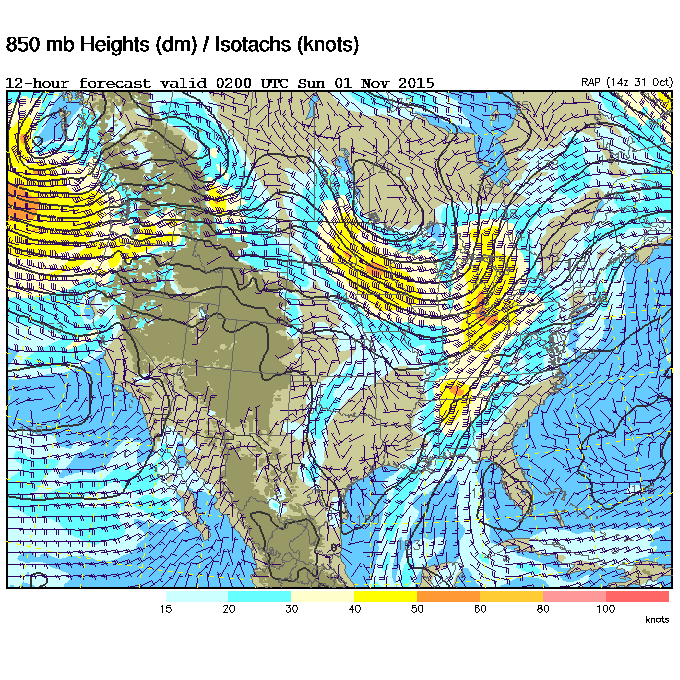
wind-map-10-21-16

Fog and a little drizzle on Saturday morning was all that our Saturday Morning Birdwalk had to contend with on our outing to Wolfe’s Neck Farm; it does seem like there are more Laughing Gulls around later this year than I can ever remember (just the warm weather or are these related to Hurricane Mathew?).

The low slowly moved into the Canada, with an onshore flow (I had hoped for more southwesterlies) throughout the day. On the backside of the system, winds shifted to the west overnight while more rain and showers continued from the afternoon through the first half of the night. Winds were howling west by the morning, and the air definitely felt seasonable for a change.
wind-map-10-22-16

With the storm system pulling away to the north…
wind-map-10-23-16

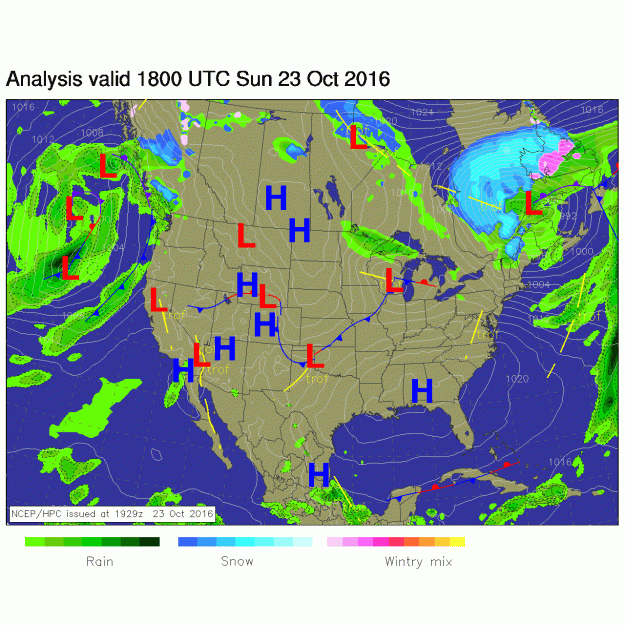
…and the temperatures falling (and even some snowfall was seen in the mountains!) it’s time to really go birding!
surface-map-10-23-16

On Sunday, Phil McCormack and I headed over Peak’s Island, a place I really want to spend more time searching in the fall. Afterall, it’s a mere 15-minute ferry ride, there are a variety of interesting habitats, and the maritime climate tempers the onset of the seasons a little more. In other words, it looks good for rarities! (And you know I need to seek them somewhere other than Portland now!)

And with my Rarity Fever stoked, a productive morning of scouring the southern 1/3rd of the island yielded the seasonal rare-but-regular stuff that makes one keep coming back: A Clay-colored Sparrow, a Yellow-breasted Chat, and an Orange-crowned Warbler (my second of the season). Add to that single Nashville and Palm Warblers among a total of 6 species of warblers, a fly-by flock of 57 Brant, 8 lingering Red-winged Blackbirds, a good Northern Gannet flight, a Merlin, and recently arrived Red-necked Grebe and 9 Red-breasted Mergansers and you can see why I will be birding here more and more (my once a fall needs to become at least 3-4 visits each season, me thinks).
ccsp_peaksisland10-23-16
Not the best photo of a Clay-colored Sparrow (can you find it?) that I have taken!

battery_steele1peaksisland10-23-16_edited-1battery_steele2peaksisland10-23-16_edited-1
peaks_shoreline10-23-16_edited-1

There wasn’t any migration visible on the radar overnight, but there were southwesterly winds – the direction that can help facilitate the arrival of vagrants to the Northeast. But with winds once again rapidly increasing during the day on Monday, the detection of birds was limited. However, Jeannette and I enjoyed a visit to a particularly productive patch of private property in Cape Elizabeth, where a Blue Grosbeak and a Clay-colored Sparrow that I found last week continued. Dark-eyed Juncos increased to 100+ and White-throated Sparrows were up to 50. Other sparrows had decreased, as expected, but there were still 75 or so Song Sparrows, 6 Chipping, and 2 White-crowned, along with about ten each of Swamp and Savannah. Singleton Indigo Bunting and Common Yellowthroats were both getting late.

With the low pressure system still spinning over the Maritimes, and another shortwave disturbance rotating through, winds remained gusty through the night. Despite the preferred northwest wind (slowly becoming west through the night) there were just not a lot of migrants willing to deal with the winds and likely resultant turbulence overnight. And the winds were gusty and increasing by dawn once again.

I was in Harpswell for the morning, leading a birdwalk for the Curtis Library as part of their fall reading series. Mitchell Field, a true hotspot at this time of year, was our destination, but it was anything but hot from a temperature perspective! However, there were a bunch of Yellow-rumped Warblers and a few flocks of migrant Common Grackles easily eclipsed 1,000 – a sign that it wasn’t just the birders who were thinking that it’s finally starting to feel like winter is approachintg! Migrant Turkey Vultures (10), Sharp-shinned Hawks (4), and a trickle of Northern Flickers were also winging it south.

Despite the wind, I poked around a couple of other spots on the peninsula since I was down there, with Stover’s Point yielding a 3 Horned Larks, a “Yellow” Palm Warbler, and 9 Black-bellied Plovers among others. But it was windy!
stoverscove10-25-16

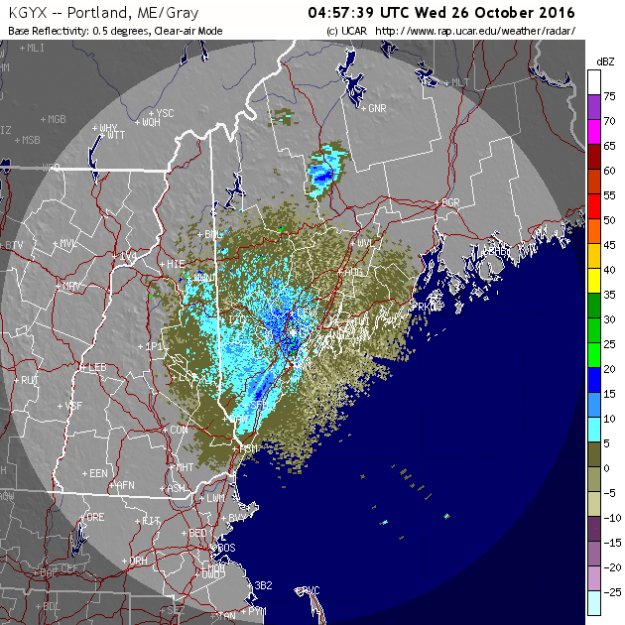
Winds died down a little overnight, finally, and with it, some birds took to the air. For the first time in seven days, there was at least a moderate flight underway. Here’s the 10pm radar image for example, which shows a strong flight underway:
10pm-radar10-25-16

But by 1:00am, the flight was already rather light, suggestive of the short-distance migrants of the season making a little bit of progress, but for the most part, more birds departing than arriving:
1am-radar10-25-16

And therefore, Sandy Point wasn’t as great as I had hoped for on Wednesday morning. However, I still enjoyed a respectable morning flight for this time of year. A total of 444 individuals of 22 species were led by 262 American Robins and 82 Common Grackles, but also included my first Fox Sparrow of fall, my 3rd Orange-crowned Warbler of the season (and only the 6th Sandy Point record), and this very tardy (or perhaps, “reverse” or 180-misoriented) migrant Prairie Warbler.
prawsandypoint10-26-16_edited-1

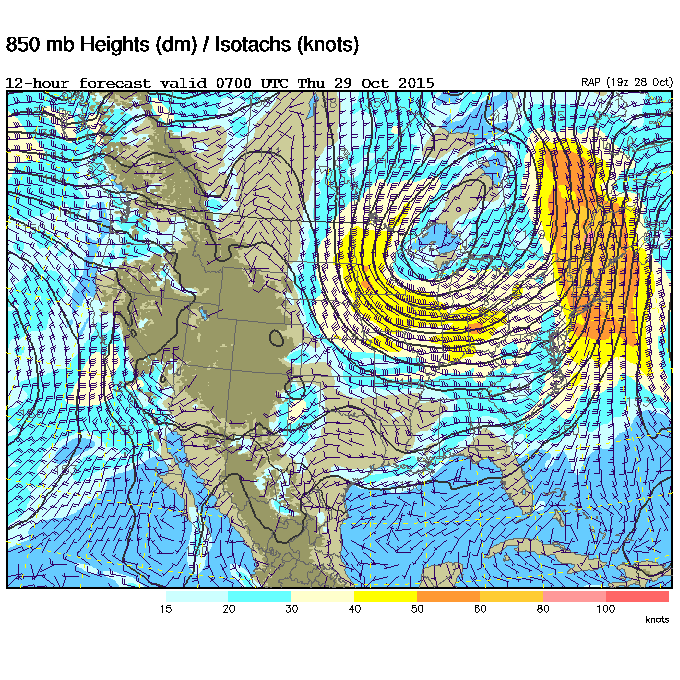
Strong northwest to northerly winds continued through the day, but they are finally expected to lighten up overnight. The current forecast looks good for a big flight tonight, and, if the winds stay more northwest – or at least north – than northeast by morning, I might get a “big one” at Sandy Point.
10-27_wind_forecast
wind-map-10-26-16

I sure hope so, as I haven’t had a lot of great mornings there this year, between all of my time on Monhegan, our recent quick trip to Cape May, and the overall lack of cold fronts this entire fall. The good news is that it seems to be changing now, and at the very least, a more active weather pattern should not only bring some more rainfall, but some good winds for producing good birding. While weather doesn’t necessarily cause vagrancy of fall migrants, winds certainly facilitate their arrival in far-off places.

Hopefully, the onset of cooler weather and more north and northwesterly winds will usher them to the coast and concentrate them in those seasonal hotspots that I will be hitting hard in the coming weeks. Also, this series of strong low pressure systems could in fact displace some birds, or at least get birds that are still on the move a littler further northeast (I am of course, drastically over-simplifying the mechanisms of vagrancy here). At the very least, the little bit of snow to our north and west, colder nights, and the end of our growing season – and resultant greatly diminished numbers of insects and other food sources – should help those patches that get better when the weather turns towards winter.

You know I’ll be out looking! So stay tuned to our store’s Facebook feed and other resources, all of which are available at our website, for the latest news. And go birding! Rarity Season is upon us!

I am so over birding in Portland.

Walking around various former hotspots and seasonal patches of significance in and around the Portland peninsula recently (including a few yesterday), I have come to one conclusion: I am so over birding in Portland during migration!

It used to be all I did – come late fall, head to the big city, especially the peninsula, and poke around the Eastern Promenade, weedy gardens, wooded hillsides, and scrubby patches. I’ve found lots of really good birds this way, from a Yellow-throated Warbler in a small grove of pines in front of the old Scotia Prince ferry terminal to annual Yellow-breasted Chats and regular Orange-crowned Warblers and Dickcissels.

But I give up.

I’ve chronicled the destruction to the uplands at Capisic Pond Park – after having once been a shining example of urban landscaping for wildlife and users, and a great way of showing what good can come of people, politicians, and professionals working together. And then it was gone. And that’s before the pond-dredging-skating-rink-creation-project-mess started.

The lack of oversight resulted in a road being built through some of the best woods behind Evergreen Cemetery – and that was even after the same city officials and engineers working on the same (necessary) sewer repair project supposedly learned their lessons with the Capisic Pond Park section. And then there’s the road the University of New England built through the other side of the woods, spreading invasive plants deeper into the forest and destroying some of the best scrub habitat in the park for migrants. Oh yeah, and natural and unnatural sedimentation in the ponds, along with the diminishing shoreline vegetation (erosion, overuse, etc) has greatly reduced the volume of migrant birds that find food and shelter around what was once one of the best spring migrant traps in the entire state. While the cemetery is still pretty good for birding – especially in spring, after “fallouts” – the degraded habitat just doesn’t hold birds like it used to.

Next, although the area known to birders as “Dragon Field” has long since lost its bird appeal due to mismanagement that allowed for the rapid overtake of invasive plants, there won’t be much of a chance of recovering it anymore. Of course, distributed solar is the way of the future, and this is truly a great project…I just wish it was atop a warehouse roof or over a parking lot instead of one of the city’s greenspaces. But it’s mostly going to be covering Japanese Knotweed and Stinging Nettles now anyway.

Do you see a theme yet?

Urban areas present all sorts of challenges, and it takes very knowledgeable and talented land managers to balance all of the issues, environmentally, socially, and economically. But we also know how important greenspaces are to urban areas, environmentally, socially, and economically.

While I do not expect that the number one priority of any city will be “migratory bird habitat and birding opportunities,” it is clear that Portland does not prioritize at all the health of its greenspaces and the welfare of the wildlife, especially migratory birds, that call these places home for some period of time and various parts of the year.

Today, I want to focus on how much the City of Portland has destroyed the green spaces on the Portland peninsula. Surrounded by water and dense, urban development, city parks and gardens provide critical cover for migratory birds. When certain weather conditions result in migrants being deposited within the urban jungle, they are forced to seek shelter and food wherever they can.

Personally, I love urban birding: immersing myself in fallouts, finding vagrants in the oddest places – like that aforementioned Yellow-throated Warbler – and seeing so-called “late” migrants eking out an existence in seemingly inhospitable corners.

But I am running out of places to bird in the city of Portland!  Especially now, in the fall through early winter, when “lingering,” “pioneering,” and vagrant birds seek the warmer microclimates of urban parks, or become “stuck” in low-quality habitat, unable to accumulate the fuel reserves needed to move further. However marginal urban habitats are, they are absolutely critical for these birds to have a chance. Healthy migrants will simply wait out the day and take off under the cover of darkness, while others will find the resources (such as weed seed in the case of many of our native sparrows) necessary for a full recovery.

But such places are becoming impossible to find in Portland.

The once-productive trees and scrub along the Commercial Street Extension is mostly gone – developed or simply clear-cut to hell. Replacing a fairly healthy canopy is little more than regenerating knotweed, bittersweet, and buckthorn.
west-commercial-st

Many small lots have been developed, and several years ago, the trees and brush throughout the Fore River Parkway Trail was clear cut. Not much for birds left there anymore.

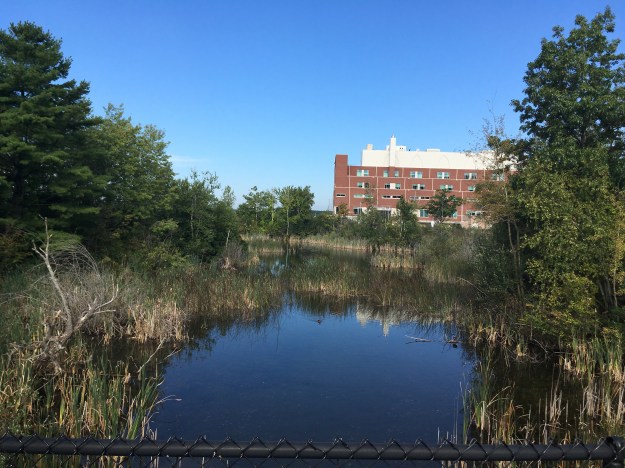
Mercy Pond remains a miniscule oasis – although the edge is far to narrow to hold songbirds for very long.
mercy-pond

Unfortunately, it doesn’t seem likely much of this will remain if hospital expansion plans go through. Which seems incredible to me, as this little pond regularly hosts (are they even breeding?) State Endangered Black-crowned Night-Herons!

But I think the most egregious example of poor management and devastation of bird habitat and birding potential is along the Eastern Promenade. A favorite patch of mine since I moved here, I have seen a whopping 176 species along it, including some really “good” birds over the years. With a cumulative list of 208 species as of this year, a lot of people have enjoyed a lot of good birding in this urban greenspace.

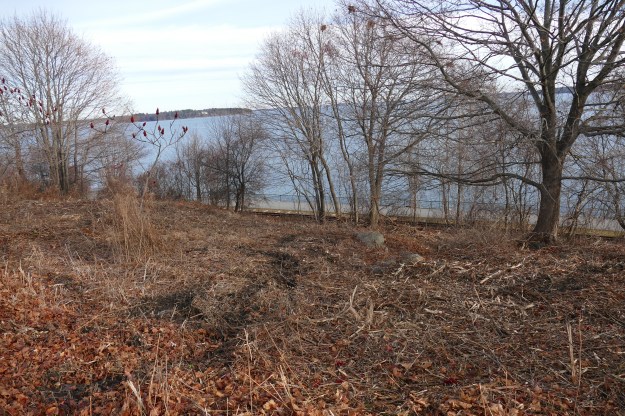
Unfortunately, mismanagement and misguided “maintenance” continues to greatly degrade it. Native plants are significantly reduced, and invasive plants have taken over and continue to proliferate. Despite the efforts of the Friends of the Eastern Promenade (who I have worked closely with over the years), it always seems that for every step forward, there’s three or more taken back. In fact, it’s about as bad as ever now, following yet more devastating clearing in late fall of 2015.
2015-12015-22015-32015-4

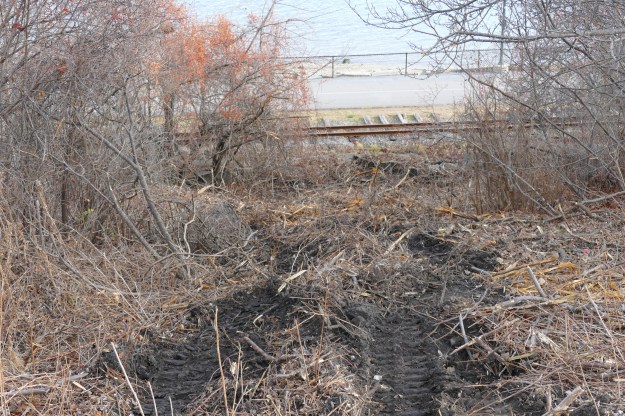
Continued slashing of what’s left of the native vegetation continues.  On 9/9, I noticed yet more hacked swaths like this.
2016-22016-3

Unfortunately, this is so incredibly counter-productive on multiple levels, as all it does is allow dense and ornithologically-useless invasive plants, especially Japanese Knotweed to proliferate even more.
2016
knotweed

And makes it easier for Asiatic Bittersweet to take over everything else.
bittersweet-2bittersweet

Meanwhile, valuable native plants like this Gray-Stemmed Dogwood is hacked to hell.
gray-stemmed-dogwood

And it’s great at accelerating erosion.
bare-ground

The “Mid-Slope” Trail, which is often the most productive in late fall, has been destroyed…
mid-slope

…And the weedy slopes full of goldenrods, late-blooming primrose, and other great birdfood was mowed too early this year. Sparrows will be wanting for sustenance, and those late-lingering warblers – especially Orange-crowned – will be hard pressed to find food and cover. Additionally, it seems that it was mowed in perfect time to destroy any chance Monarchs would have had to breed successfully there this year. This is particularly unnecessary and unjustified mismanagement.
non-meadow

Based on the overall size of the greenspace and it’s placement along the shoreline at the northern terminus of the peninsula, there’s little doubt there will still be some birds along the Prom this fall, and perhaps even a rarity or two. But as for regular migrants and vagrants that are seeking shelter and sustenance, there will be little reason to stay very long.

Fallouts will occur because of weather events and the disorientation of migratory birds in city lights (especially in fog) and those birds will still descend on the Prom. However, most will likely leave as soon as they can, winging it inland in “morning redetermined migration,” hopefully not hitting windows or being hit by cars as they do.  It also likely means birding opportunities will be greatly reduced as these birds depart immediately in search of better habitat. Get there early!

But the exceptional days of fall birding, such as thousands of White-throated Sparrows scratching in the undergrowth or several Orange-crowned Warblers working the meadows, are unlikely to occur anymore. Birders lose. Birds lose more.

And what does any of this accomplish? It looks like crap. Thickets grow back denser, and people move back in – they’re just harder to see now. And then you clear-cut once again. And in between, tired and hungry migrant birds find little. And birders go elsewhere. Great solution.

As for me, with “Rarity Season” approaching and weather getting cooler, birds seek out warmer microclimates, like sunny hillsides, urban lots, and so on, where moderated temperatures can extend the availability of food resources, even insects.  This is the time of year – through the “Christmas Count Season” – where I usually would spend an increased amount of time birding all of the nooks and crannies throughout the peninsula, looking for late migrants and hoping for rarities.

Unfortunately, with so few opportunities left in Portland, I’m forced to look elsewhere. That means fewer eyes covering what’s left of the habitats, and fewer lunches I’ll be eating in town and fewer cash-burning errands.

But much more importantly, there are just fewer places that tired and desperate birds can go to find safety and refuel. That means even more birds hitting windows, being hit by cars, and being killed by cats. All of the trials and tribulations of a bird finding itself in an urban environment are exacerbated when there’s no good habitat left.

And all of the reasons there’s less habitat left in an urban environment are exacerbated when open space is managed as poorly as it is in the City of Portland. For a city that loves to bill and market itself as being “green,” it really does a terrible job in its greenspaces. While cities who honestly attempt to make themselves greener encourage or even mandate “bird safe” building guidelines to reduce collisions with glass surfaces (Portland on the other hand, promotes new developments with glass predominating), and work on “Lights Out!” campaigns to reduce the disorientation of birds from light pollution.

Taking things even further, 24 cities (Baltimore was the most recent) have signed onto the US Fish & Wildlife Service’s “Urban Bird Treaty City Program” which works to:

  • Protect, restore, and enhance urban/suburban habitats for birds
  • Reduce hazards to birds
  • Educate and engage citizens in monitoring, caring about, and advocating for birds and their conservation
  • Foster youth environmental education with a focus on birds
  • Manage invasive species to benefit and protect birds
  • Increase awareness of the value of migratory birds and their habitats, especially for their intrinsic, ecological, recreational, and economic significance

Now that’s what a “Green” Portland should be doing. Instead, all it does is fire up the brush-hogs and chain saws.

I’ll be birding elsewhere this Rarity Season. I just hope the birds find somewhere better to go as well.

Western Grebe at Simpson’s Point (4/17/16)

A couple of weeks ago, I wrote about what a hotspot of Simpson’s Point in Brunswick currently is. I also predicted that it was about due for another rarity. And recently, with increasing numbers of migrant ducks, my Rarity Fever was further stoked.

Last Thursday, I counted an amazing 2600 Black Scoters – a really ridiculous count for interior Casco Bay. After enjoying a growing number of Palm and Yellow-rumped Warblers among other migrants (first of year Swamp Sparrows, etc) at Florida Lake this am, I took advantage of the finally-calm conditions to visit them again, and perhaps do a little sorting through the masses.

Those scoters were still present this morning, and the goodly number of Horned Grebes (20+ each day) continued. Horned Grebes molting into breeding plumage can look a lot like vagrant Eared Grebes, especially as the blond tufts are still growing in. I was scanning a small raft of Horned Grebes, thinking about finding the second Eared Grebe record for here.

That’s when I found…a Western Grebe! Not only was this a significant rarity, it was actually a “State Bird” for me (the first time I have seen the bird in the state). A long overdue one that was becoming a nemesis of sorts, it was #6 on my latest predictions list for my next 25 species to see in Maine. And of course, it is always sweeter and more rewarding for me to find it for myself.

It was not close, but the distinctive shape and profile was unmistakable. The relatively short body riding low on the water – like all grebes – looked disproportionally small as that long and skinny neck was craned up. The long bill and fairly large head (relative to the width of the neck) further added to the bird’s distinctive profile.

Upon closer look, the two-toned black-and-white neck and face was obvious. There’s little doubt as to this bird was a member of the genus Aechmophorus – Western and Clark’s Grebe. Luckily, as the active bird moved a smidge closer, I was able to scrutinize several features that ruled out Clark’s. For one, the black hindneck was evenly wide, not narrow and thin, and not pinching toward the top. Although it was too far to see the details of the face, it definitely did not look “white-faced” and I certainly could not see the eye (On Clark’s, the eye stands out in the white face in breeding plumage, on Western, the eye is harder to see as it is enshrouded by dusky black). The bill also looked yellow, but not as bright “banana yellow” or even orange-y like Clark’s.

But it was far, and perhaps a hybrid could not fully be ruled out. However, with one record of Clark’s for Maine (and all of New England) and with at least a dozen or so records of Western for Maine alone, there’s a fair “percentage play.”

Anyway, like many birds at Simpson’s Point, it was off to the east, and the light was not great in the mid-morning. After diving several times, it began to preen, and then loafed for a bit before tucking in its sinuous neck and falling asleep (had I scanned while it was asleep, I probably would have never picked it up!). In between, I managed to rattle off a bunch of phone-scoped “documentation” shots. Well, for what they are worth…

And here’s another lousy photo, from 4/21. However, it was in better light, so the bill color is a little more evident. However, the overexposure of the distant phone-scoped photo makes the face look much more whiter than it really is.
WEGR1,SimpsonsPoint,4-21-16_edited-1

The 2016 Maine State List (and my own) Predictions Blog.

The second record (and perhaps the first verified one) for Maine of Black-throated Sparrow was found in Winter Harbor on New Year’s Day, and continues through today, January 6th. I was tempted to chase it yesterday, but instead I am left to hope it sticks around until the end of next week when I return from a short business trip. Fingers crossed!

Before it arrived, I had begun to put together my annual list of the next 25 species to be found in Maine. I then follow that up with my own State List predictions, and no, Black-throated Sparrow was not on that list!

I know, I know, you’ve been awaiting this with baited breath for this. So without any further ado, let’s get started with the annual Maine State Birds Predictions List.

First, a quick recap of 2015.

Only one species was added to the state’s all-time birdlist, a Surfbird, which was discovered at Biddeford Pool in March. It was not a species on anyone’s radar, and it was most definitely not on my Predictions List for 2015!

But I did make several changes to my Next 25 Species for Maine list, and moved things around a bit. So here are the NEW prognostications:
1)Neotropical Cormorant – The new #1! With populations expanding in the Midwest and observations of vagrants increasing around the East, this one is only a matter of time now!
2) Graylag Goose
3) California Gull
4) Roseate Spoonbill
5) Spotted Towhee
6) Ross’s Gull
7) Hammond’s Flycatcher
8) Bermuda Petrel – see notes in last year’s blog entry at the link above.
9) Black-chinned Hummingbird
10) Fieldfare
11) Audubon’s Shearwater – on “hypothetical” list, but I think the record is good.
12) Little Stint
13) Anna’s Hummingbird
14) “Western” Flycatcher (Pacific-slope/Cordilleran) – Hope it calls! After a spate of reports in the Fall of 2015, this is another western bird increasingly being detected well outside of range.
15) Vermillion Flycatcher – Ditto.
16) Common Ground-Dove – A virtual irruption of this bird this fall, including one as close to Massachusetts had me thinking we would have added this in 2015. Maybe one is still out there awaiting discovery.
17) Allen’s Hummingbird
18) Redwing
19) Western Wood-Pewee
20) Spotted Redshank
21) Gray Flycatcher
22) Black-tailed Godwit
23) Brown-chested Martin
24) Black-tailed Gull
25) Common Scoter

As for me, I added three birds to my personal Maine State List in 2015:
A) Gyrfalcon – Wells, 1/17/15 (Ranked #5). This is one I wanted for a while! It was seen sporadically between Wells Harbor and Salisbury, Massachusetts for about a month. If first showed up while we were away at a trade show, but luckily, I caught up with it shortly after our return. I saw it on the 17th, and managed some photos  (my blog entry also includes more background about the sighting), but on April 5th, Jeannette got the better shots!
IMG_0332_edited-2

B) I also caught up with the aforementioned Surfbird on March 22nd (Definitely not on my list!) and Jeannette got these photos when we visited it again two days later.
IMG_0505_edited-2

C) Clapper Rail – Scarborough Marsh, 9/22. I had it as an “Honorable Mention,” a list that I also keep to work off of to come up with each year’s respective Top 25.
IMG_6223_CLRA1,JonesCreek,9-22-15

I missed a Franklin’s Gull on Sebasticook Lake in November, as it appeared just before I took a trip, and departed shortly after my return. There was also a one-day wonder on Stratton Island in Scarborough in June. With an unprecedented incursion of Franklin’s Gulls into the East this fall (the Sebasticook Lake bird clearly preceded the events that brought record numbers to New Jersey and several birds to Massachusetts and New Hampshire), I thought this would be my fall – and I definitely worked for one! But alas.

My two trips off of Bar Harbor this year did not yield a Great Skua (but a September trip did give me my 3rd South Polar Skua in the state!), and once again my summer went by without a trip up north for American Three-toed Woodpecker.

Therefore, I predict that my next 25 species in Maine will be:
1) American Three-toed Woodpecker
1A) Black-throated Sparrow! OK, I know this does not count as a prediction, but still…
2) Great Skua
3) Eurasian Collared-Dove
4) Graylag Goose
5) Say’s Phoebe
6) Western Grebe
7) American White Pelican
8) Neotropic Cormorant
9) Fork-tailed Flycatcher
10) Slaty-backed Gull
11) Tundra Swan
12) Franklin’s Gull
13) Sabine’s Gull
14) Black-bellied Whistling-Duck
15) California Gull
16) Yellow Rail
17) Boreal Owl
18) Calliope Hummingbird
19) Cerulean Warbler
20) White Ibis
21) Gull-billed Tern
22) Hammond’s Flycatcher
23) Loggerhead Shrike
24) Ivory Gull
25) Ross’s Gull

Well, there ya have it! We’ll check back next year to see how I did!

A Warbler (and Sparrow) Big Month. In December. In Maine.

December was unusually warm. In fact, it was record warm. And not just barely… records were shattered. The average temperature for the month was 38F. Not only was that a ridiculous 9 degrees above normal, it smashed the previous record of 24.8F (set in 2001). Surprisingly, despite the everlasting warmth, record daily highs were rare. Christmas Day was an exception, however, when temperatures soared to 62 in Portland, crushing the previous record high of 53, set just last year.

Our first measurable snow of the season didn’t fall until December 29th – the second latest date on record. Those 5-8 inches in southern Maine finally ushered in “real winter” and hopefully set the stage for a return to more normal conditions (although the last few days have once again been 5-10 degrees above normal).

Not surprisingly, such an unseasonable month resulted in some very-unseasonable birding. A variety of “lingering” or perhaps more accurately “pioneering” as Ned Brinkley, editor of North American Birds once dubbed it warblers in particular were making headlines.

So I decided to do a December Warbler Big Month. Because, well, warblers in December! In Maine!

With Tennessee, Yellow (2!), Nashville (2!), Common Yellowthroat, and Wilson’s on December 6th, I was half-way to my newly-set goal of 10 species for the month. The unusually mild fall has allowed more “lingering” birds to survive longer, and normal November hotspots are still hot (literally and figuratively).

Unfortunately, I waited until December 8th to decide to embark on this silly little hunt, so I had some catching up to do. There were some relatively easy ones (Yellow-rumped Warblers overwinter in a few places, along with “known” Blackburnian and Pine Warblers). That meant I just need to find an Orange-crowned Warbler (the second most-regular December warbler after Yellow-rumped) and then one other stray.

So off I went…

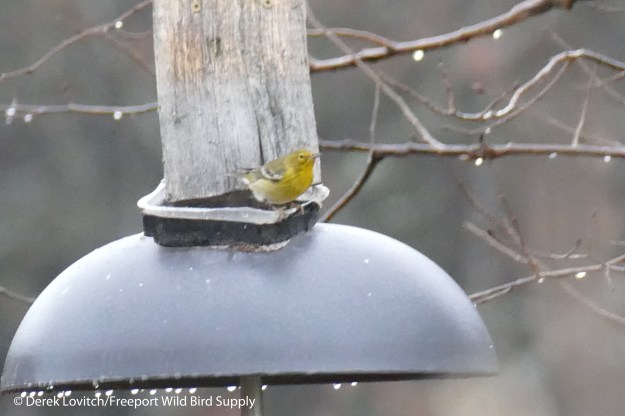
Not wanting to take any species for granted, I twitched a Pine Warbler that was reliably coming to a feeder in Brunswick on the 10th. I had to wait all of three minutes for it to arrive on my way back from walking Sasha. If only they were all this easy!
L1040178_PIWA2,JayStormers,Brunswick,12-10-15_edited-1

The next day I was once again at the Saco Yacht Club, looking for the Blackburnian Warbler (which I saw on Nov 30th – one day too early!). Activity didn’t pick up until the fog finally lifted after 10am, but I ran out of time. I did, however, enjoy another visit with the Tennessee, and 1 each of Yellow and Nashville Warblers. 2-3 Ruby-crowned Kinglets were also present, and a Yellow-rumped Warbler dropped in: my 7th species of the month! That and the Western Tanager were the consolation prizes (yes, I did just relegate the tanager to a consolation prize…shame on me… but I “needed” the Blackburnian!).
L1040189_WETA1,SacoRiverwalk,12-11-15_edited-1

I worked hard for an Orange-crowned Warbler in Portland on the 13th to no avail, but I did turn up the continuing Nashville Warbler along the Eastern Promenade (oh look, Portland ravaged vegetation here, too!) and a Gray Catbird on Sheridan St. I also took time to go visit the continuing Ross’s Goose along Stroudwater St in Westbrook – the third I have seen in Maine, and only the 6th or 7th state record.
IMG_6946_ROGO1,StroudwaterSt,Westbrook,12-13-15_edited-1(Phone-scoped image)

Continuing the quest, I had high hopes for the Southern York County Christmas Bird Count on the 14th. With a great territory that almost always turns up a good bird or three, Jeannette, Kristen Lindquist, and I worked the marsh, thickets, neighborhoods, and beach of the “Moody” sector. And we did indeed have a great day, including the 2nd Count Record Clay-colored Sparrow, the 5th Count Records of Baltimore Oriole and Lesser Scaup (21 – also a record high), and 6th Count Record of Dickcissel. But alas, not a single warbler. We didn’t even get a Yellow-rumped – for the first time, as there was virtually no fruit on the bayberry bushes along Ogunquit Beach or anywhere else.

When my friend Evan Obercian found a Yellow-throated Warbler at the Samoset Resort in Rockport on the 13th, my goal was definitely in sight (this was the “additional rarity” I needed), but in the weeks before Christmas, finding time was going to be a challenge. Luckily, a break in my schedule – and the rain – came on Thursday the 17th, so I got an early start and headed east.

I met up with Evan and Kristen and we wandered the grounds of the Samoset for almost two hours. I was not happy to find a stiff onshore breeze when I arrived, and it was increasing over the course of the morning. Then the mist rolled in, and soon, a steadier drizzle. There were not a lot of birds around (other than Canada Geese and Mallards on the golf course), and I was beginning to work on a plan to come back again. And not long thereafter, it called!
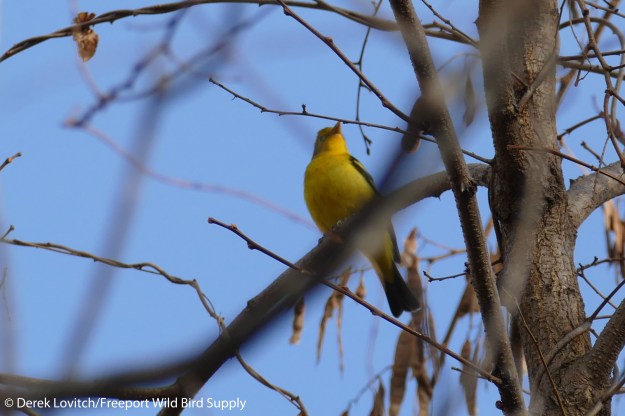
We spotted it in an isolated cluster of Scotch Pines, very near where Evan first saw it (and where we walked by 3 times already this morning). We followed it for about 30 minutes as it relocated to another grove before heading over to the hotel building, where it proceeded to forage in the sheltered porches of the four story building! Presumably gleaning insects from old webs in the corners and around furniture, clearly this bird had figured out a novel way of finding sustenance – especially on such a snotty day.

It was my 8th warbler of the month.
L1040215_YTWA3,Samoset,Rockport,12-17-15_edited-1L1040251_YTWA1,Samoset,Rockport,12-17-15_edited-1

I was back to the Saco Yacht Club with Luke Seitz the next morning, once again hoping for the Blackburnian. We worked the hillside and surrounding habitats hard, and absolutely cleaned up! The quick glimpse of a fly-by Western Tanager was more frustrating that satisfying, but we had great looks at the continuing Tennessee, Yellow, 2 Nashville, Common Yellowthroat, 2 Ruby-crowned Kinglets, and then, finally, the Blackburnian! My 9th warbler of the month!

Luke’s quote sums it up: “Let’s take a moment to appreciate what we are seeing and hearing around us right now. What. The. (Expletive deleted)!”

I had a little more time, so I made a quick trip down to Biddeford Pool. Working the neighborhood and thickets, I found a small group of Yellow-rumped Warblers (4-5), a nice addition to the day list. Besides, up until now, I had only seen one all month!

I was in the midst of plotting “Operation Orange-crowned” when I wandered over to look at a chattering Ruby-crowned Kinglet. A loud chip note caught my attention, and I looked up to see this Prairie Warbler – my 10th species of warbler for the month (and 7th of the day)!
L1040305_PRAW,BiddPool,12-18-15_edited-1

But did you really think I would stop at 10?

Hunting for Orange-crowns in Portland and South Portland on the 21st, I turned up a Baltimore Oriole on Sheridan Street (likely the same individual that Jeannette and I found here on 11/23), and along West Commercial Street (in what’s left of the vegetation here!), I had a Swamp Sparrow, and a Field Sparrow – my 8th sparrow of the month.
L1040314_FISP,WCommercialSt,Portland,12-21-15_edited-1

Hmmm…do I need to go for 10 sparrows, too?

Obviously!

So I went to Scarborough Marsh the next day, and quickly picked up a Savannah Sparrow along the Eastern Road Trail for #9.

Jeannette and I, post-holiday madness, continued the search on the 28th, combing the coast from Kittery through Wells. While nothing new was added, we did find three different Swamp Sparrows (two at Fort Foster, 1 in York Beach), and most excitingly, we relocated the Clay-colored Sparrow that we found on the CBC – a mere one block away. Once again, however, I managed only some quick phone-binned photos.
CCSP,Wells,12-28-15

A Northern Flicker and 5 Yellow-rumped Warblers were at Wells’ Community Park, while other highlights included 14 Sanderlings with Purple Sandpipers along Marginal Way in Ogunquit.

But before I knew it, it was December 31st. I still had yet to see an Orange-crowned Warbler (inconceivable!) for the month, and I was stuck at 9 species of sparrow. Therefore, Phil McCormack and I had a mission when we set out in the morning. We worked thickets and fields in Cape Elizabeth, with stops at various nooks and crannies in South Portland and Portland.

While we did not relocate the Lark Sparrow along Fessenden Road (it’s been a week since I have seen a report), we did have a Merlin there, and a couple of Yellow-rumped Warblers at Crescent Beach State Park. Luke had an Orange-crowned Warbler at Camp Ketcha back on the 20th, but it was rather devoid of birds today.

Throughout the day, pockets of Song and American Tree Sparrows were indicative of recent movements and concentration following the snow and ice, but we were not prepared for the concentration of sparrows at a particularly fruitful patch. In fact, it was astounding!

75+ American Tree and 50+ Song Sparrows flew out of the field, joined by 10 or so White-throated Sparrows and 20 or more Dark-eyed Juncos. A continuing female Brown-headed Cowbird was there, along with at least 80 American Goldfinches and 30 or so House Finches. A Carolina Wren sang from the woods, and two Swamp Sparrows and a female Common Yellowthroat were in the marsh…I knew my 10th species of sparrow was here somewhere!
L1040338_mixed_sparrows,Alewives,CapeE,12-31-15

After a teasing brief, distant but highly suggestive look, I finally found it – a Chipping Sparrow! My 10th species of sparrow in December!
L1040361_CHSP,Alewives,CapeE,12-31-15

Shortly thereafter, a Savannah Sparrow (my second of the month) appeared – not just our 7th species of the day, but the 7th species in this one spot! Amazing! And now I had a 7 species of sparrow day and 10 species for the month to match my 7 species of warbler day and 10 species for the month! (The Double 7/10 Split?)

But of course, I still wanted an Orange-crowned Warbler, so we kept birding (well, after a long, celebratory lunch of course), and I tried a few more OC spots in Portland after Phil departed. I still can’t believe I saw 10 species of warbler in Maine in December, and none of them were Orange-crowned, but it seems a fitting finish to the month, and the year, was the continuing Baltimore Oriole and Gray Catbird sitting in the same tree in the Sheridan St lot!
BAORandGRCA,SheridanSt,Portland,12-31-15_edited-2

Meanwhile, some other highlights over the course of the month, of the non-warbler or sparrow variety, including more seasonal species, such as two Snowy Owls on a Saturday Morning Birdwalk on the 12th, my first Iceland Gull of the season (finally) in Old Port on the 15th, a Snowy Owl at Biddeford Pool on the 18th, Harlequin Ducks, Purple Sandpipers, and a growing legion of wintering waterbirds.

Other signs of the unseasonably warm month included a lingering Double-crested Cormorant in Portland Harbor on 12/15, a few more lingering dabblers and Great Blue Herons than usual, but surprisingly, I didn’t see a Hermit Thrush all month – had they all moved on or would some now show up as the snow and ice pushes them to coastal migrant traps? But the most unexpected of them all was the Little Blue Heron that was found in the tiny Jordan Park Marsh in Ocean Park. I stopped by to visit it on the 22nd, about two weeks into its unseasonable stay.
L1040320_LBHE1,OOB,12-22-15_edited-1

Unfortunately, as much fun as this month has been – and as nice as it has been to not yet wear my parka – it’s impossible for me to ignore what this all means: the climate HAS changed. While no one month – warm or cold – is “climate change,” it is impossible for any rational person to not realize that our weather has become more and more unpredictable, less and less “normal,” and prone to more and more wild swings in seasonal and within-season variability. No, a hot day doesn’t mean Global Warming, nor does a snowstorm mean there’s not (Please James Inhoffe, please go away and shut the hell up). But the trends are real, very apparent, and very much here. Now. And they are most definitely affecting birds and bird migration.

That being said, I would not use these warblers as an example of this. Instead, I think the fact that here in December and they are still ALIVE, is however, a perfect example of just how ridiculously warm our weather has been! The mechanisms that delivered these birds to the Saco Riverwalk and elsewhere are likely varied. Perhaps the deformed, crossed-bill of the Tennessee Warbler impedes its ability to efficiently forage and put on the necessary weight for its next leg of migration. Perhaps the extensive southerly winds that have ushered in this warm air also facilitated the arrival of a 180-degree misoriented migrant Yellow-throated Warbler, and I would propose, the Prairie Warbler as well (I think the rare-but-regular late fall Prairies are actually birds from our south) that were “messed up” and flew the wrong way. But it is also possible that some of these warblers are “reverse migrants” that started to go south and then turned around, but I doubt it – facultative migrants like swallows and blackbirds do it, but I don’t know of any known proof that long-distance Neotropical migrants pull it off (on purpose, anyway).

These mechanisms occur every year, and rare warblers are found at places like the Saco Riverwalk every fall. However, they’re usually found in October and November and either move on (or, more likely perish) by now. So I think what’s remarkable is not that all of these warblers are here, but that they are still ALIVE well into December – and that is most definitely due to the mild winter so far. There have still been insects to be found, there’s plenty of fruit left to consume, and fewer calories have been spent to keep up internal body temperatures, meaning there are fewer calories that need to be consumed.

Migration in long-distance, obligate migrants is not triggered by temperatures, but trigged by physiological changes directed by hormones responding to the changing length of the day. In the fall, southbound migration is triggered in part by a response to changes in fat loading to fuel these epic journeys. At some point, the controls are switched away from building the fat reserves that are necessary for migration. I don’t know at what point in the season “pioneering” warblers lose the ability (perhaps, even the “desire”) to migrate. My guess is that even if you pumped these birds full of fat, at this point, they won’t be going anywhere – this is now their winter territory, for better, or for most likely, worse.

So what does this mean besides some amazing early winter birding? Good question. Conventional wisdom says these birds are all “evolutionary dead ends” that will soon be eliminated from the gene pool (it has to get cold sometime, right? If they’re not picked off by a Sharp-shinned Hawk or all of the damn outdoor cats that hunt there). However, with the effects of Global Climate Change clearly upon us, and not reversing anytime soon (if ever), perhaps these “pioneers” are the wave of the future. Maybe someday, warblers will successfully overwinter in Maine, and return to their breeding grounds to pass on those genes.

Maybe. Afterall, without vagrancy, we would not have Hawaiian honeycreepers or Darwin’s finches; distant islands would be sans all landbirds. Perhaps phenomena like “reverse migration” and this pioneering thing will allow the next wave of adaption to a changing climate. Of course, never before in the history of life on earth, has this change occurred so rapidly, and we have little evidence suggesting long-distant migrants can adapt this quickly – it’s going to take more than a few individuals of 10 species of warblers.

Sparrows, however, aren’t obligate long-distance migrants that are “programmed” to leave at a prescribed time. Instead, they are more flexible in their movements, and being seed-eaters, they aren’t reliant on warm-weather dependent insects. As long as seeds are available, and with the complete dearth of snow, they most certainly have been, those that linger can do just fine. White-throated, American Tree, Song, and Dark-eyed Juncos are all regular parts of our winter avifauna in southern Maine, lingering or “pioneering” Swamp Sparrows are regular here and there, and every now and then a Lark Sparrow (a “drift migrant/vagrant” from the Midwest) or Field Sparrow spends the winter in the state. Field and Clay-colored are also rare-but-regular in late fall/early winter, so once again, the presence of 10 species of sparrows is also not in and of itself caused by the record temperatures, but it is most definitely another sign of how mild – and especially snow-free – it has been.

But this is all a blog for another time…this blog was supposed to be about warblers (and sparrows!). In Maine. In December. And that’s amazing. Or, as Luke said, “What. The. (Expletive deleted).”

Not Your Usual December Highlights!

While this fall’s rarity season got off to a fairly slow start at the end of October, things have really heated up lately. In fact, it’s been a really outstanding couple of weeks.  And in the past few days, I have enjoyed some really great birding.

The mild temperatures have certainly played a role – while the southerly and southwesterly winds that have ushered in much of the unseasonably warm air may still be facilitating the arrival of some vagrants, at the very least the mild temperatures and benign weather are allowing vagrants and unseasonable “lingering” migrants to survive long enough to be found! And, the lovely weather is certainly keeping more birders out in the field. I have certainly been taking full advantage of this beautiful weather.

On Sunday, Ed Hess and I visited the Saco Riverwalk. While this is always a hotspot at this season, it is really extraordinary this year. After 8 species of warblers were seen there in November, the mild weather has allowed at least 5 species to continue – almost unprecedented for December. Ed and I saw the Tennessee Warbler, a really remarkable December record…
L1040092_TEWA,SacoRiverWalk, 12-6-15_edited-1

…both of the two continuing Yellow Warblers (the photos are of one of the two individuals), which is another exceptional species for the date…
L1040022_YWAR,SacoRiverWalk,12-6-15_edited-1

…the Nashville Warbler (and confirmed the continued presence of a second Nashville!)…
NAWA by Ed_edited-1

…the Common Yellowthroat (more expected for the season)…
L1040098_COYE1,SacoRiverWalk,12-5-15_edited-1

…and we saw one of the two Ruby-crowned Kinglets still present (much more regular in December than any warbler).
L1040116_RCKI,SacoYachtClub,12-6-15-edited

And although we didn’t see it, the most amazing of them all, a Blackburnian Warbler is still present. (Jeannette and I saw and photographed it earlier in the week, 11/30).
IMG_3040_edited-2

Ed and I then headed to Cape Elizabeth, where we photographed the continuing Grasshopper Sparrow at Dyer Point, and odd bird to see juxtaposed with Harlequin Ducks (18) and Purple Sandpipers (6)…
L1040136_GHSP2,DyerPt,12-6-15_edited-1L1040151_GHSP3,DyerPoint,12-6-15_edited-1L1040163_GHSP1,DyerPoint,12-6-15

…And we twitched a Wilson’s Warbler found earlier in the day nearby, just so we could say we saw five species of warblers in a day in December!  It cannot, however, be said that we “photographed” five species:
WIWA,CapeElizabethm12-6-15

The Grasshopper Sparrow was also our fifth species of sparrow on the day (Song, American Tree, White-throated, and Dark-eyed Junco) – I doubt I’ve had five species of warbler and 5 species of sparrows in the same day in December in Maine before.

Of course, that only somewhat consoled us about missing the vagrant Western Tanager that was found at the Riverwalk later in the afternoon. Damn.

On Monday, I headed over to Reid State Park in Georgetown with Kristen Lindquist. It was a rather quiet day here, but it’s always one of my favorite places to take a walk, especially on such (another) gorgeous morning.  43 Red-necked Grebes, a Northern Harrier, a flyover Red Crossbill (my first of the season), oh yeah, and another rarity: “Oregon” Junco.

While some might dismiss it as “merely a subspecies,” the westernmost subspecies of the Dark-eyed Junco is truly a rarity in the Northeast, and this was the first definitive “Oregon” Junco that I have seen in Maine (although I have never chased one at a feeder, where they are usually seen). It was in a small flock of “Slate-colored” Juncos and an American Tree Sparrow in the scrubby central ridge in the middle of the Griffith’s Head parking lot.

The flock flushed from short grass at the edge as we rounded the corner, and as it briefly alighted in a shrub, I was shocked to see a black-hooded junco. Closer inspection as we followed it for about 20 minutes yielded all of the pertinent field marks for a “textbook” Oregon, nicely eliminating the intermediate “hybrid swarm” – or whatever it is – that we sometimes refer to as “Cassiar’s” Junco.

Note the complete, black (not dark gray) hood, lacking contrast in the supraloral area. Also, the hood is cleanly demarcated on the back of the head, contrasting crisply with the reddish-brown back. The flanks and sides are particularly pale salmon-buff, which is not atypical for adult males (although many are much brighter). At the lower margin of the hood, note the smooth, rounded margin across the chest and up to the “shoulder.”
IMG_6908_ORJU4,meIMG_6909_edited-1IMG_6910_ORJU1,K_edited-1IMG_6912_edited-1,K.Lindquist

Afterwards, Kristen and I birded around Bath – no white-winged gulls or Barrow’s Goldeneyes yet, no doubt related to the mild temperatures as well, but we did spot one of the Snowy Owls at Brunswick Landing – unlike warblers, a slightly more expected highlight for early December in Maine.

While Jeannette and I didn’t turn up any rarities – or much of anything else for that matter! – birding Harpswell Neck this morning, I very much look forward to what the coming weeks will produce, especially when it finally turns cold!

The Rarity Fever Juices are Flowing – It must be November, and There was a Storm…

Rarity season is upon us, and there’s no better time for a big ol’ storm. Especially with an impressive southerly flow before and during the storm, and a strong cold front clearing things out behind it, my “Rarity Fever” symptoms got fired up.

Just look at those extensive southerly winds on Friday and Sunday, for example…
wind map,10-28-15

wind map,10-30-15

…following Thursday’s storm system.
surface map, 10-29-15

Heavy rain Wednesday night into Thursday gave way to a few hours of well-above normal temperatures and mostly sunny skies before winds and rain began to pick up in the late afternoon ahead of the cold front. I was able to squeeze in a visit to Sabattus Pond in the early afternoon, hoping for storm-grounded waterbirds.

While it was simply gorgeous out, the waterbird numbers remained below seasonal-norms here. A continuing pair of Redheads was the highlight, and a pair of White-winged Scoters was just the type of rare-inland migrant seaduck I hope to find after some weathah’. Otherwise, waterbird counts were modest: 219 Ruddy Ducks (well, modest for Sabattus – this is an epic count for anywhere else in the state!), 164 Lesser Scaup, 75+ Ring-billed Gulls, 62 Mallards (not sure where the masses were today), 41 Bufflehead, 39 Greater Scaup, 36 Ring-necked Ducks, 16 American Coots, 13 American Black Ducks, 11 Canada Geese, 2 Common Loons, 1 Mallard x black duck hybrid, and 1 Double-crested Cormorant.

On Friday, with southwesterly winds (more rarity wind!) gusting ahead of a secondary cold front, I spent the morning in Cape Elizabeth. While I had Cave Swallow on my mind, I settled for a nice mix of late migrants, including four species of warblers (Orange-crowned at Kettle Cove, my 4th of the year; Blackpoll and “Western” Palm at Pond Cove, and scattered Yellow-rumps), a Gray Catbird at Kettle Cove, and an Indigo Bunting on private property.
BLPW,PondCove, 10-30-15_edited-1

With a light (but decent-for-the-date) migration overnight, I started at sunrise at “My Office” at Sandy Point to take in what’s left of the Morning Flight. Calm winds seemed to preclude as many birds from reorienting here as I would have expected based on the decent-for-the-date radar image overnight. However, it was a very pleasant morning with nice little flight featuring good late-season diversity. I tallied a total of 247 migrants, led by an even 100 American Robins, 66 Dark-eyed Juncos, and a nice total of 14 Snow Buntings. “Tardy” birds included 3 “Yellow” Palm Warblers, an Eastern Phoebe, 2 Hermit Thrushes, a Red-winged Blackbird, and best of all, a late Black-and-white Warbler that I found in the trees after my Saturday Morning Birdwalk group had joined me.
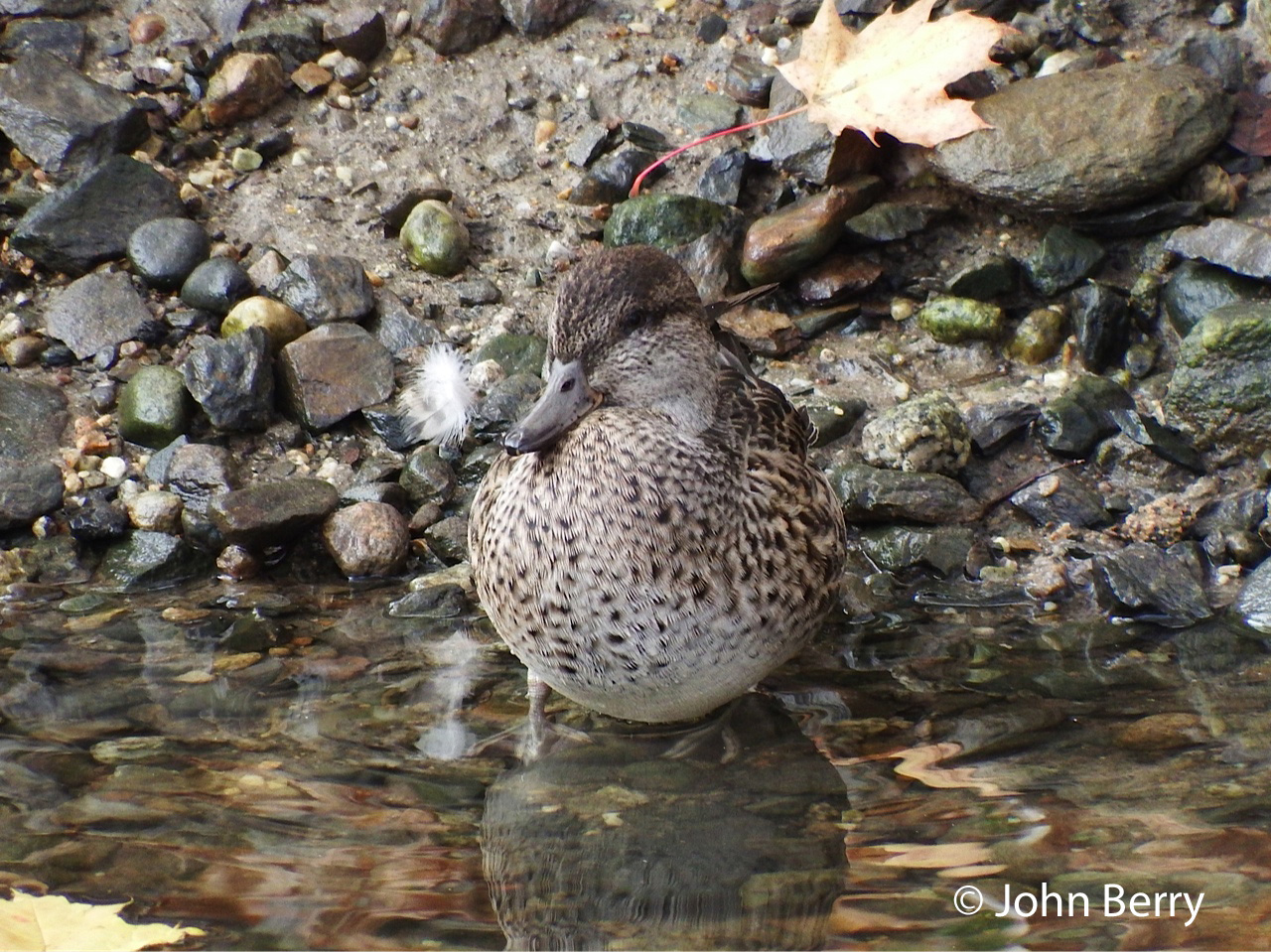
But on Sunday, vagrant-hunting was the name of the game. Although I did not organize a South Coast-wide “Rarity Roundup” this year for the first time in a decade, Kristen Lindquist, Evan Obercian, Jeannette and I ran my usual Portland Rarity Roundup itinerary, scouring the Portland peninsula for vagrants, “lingering” migrants, and other surprises. It was not exactly the birdiest of days on the Portland Pen’ but the Eastern Promenade was fairly productive, led by 2 Orange-crowned Warblers, a Palm Warbler, a Field Sparrow, and three Hermit Thrushes.
OCWA,EasternProm,11-1-15_edited-1
Here’s a terrible shot in the dawn dark and drizzle of one of the two Orange-crowns.

Elsewhere in the East End, we turned up a Hermit Thrush on Anderson Street, and a Gray Catbird on Sheridan Street, but then the passerines really dried up. The usually-productive stretch of woods on either side of West Commercial Street has been rendered useless, and was essentially devoid of birds.

On the riverside, there’s development, clearing a great stand of birch and scattered crabapples that once resided here:
IMG_6478_edited-1

But it’s a city, and development occurs, and there are lot worse places for trees to be cleared. The abandoned railyard and old docks along this stretch of degraded river is hardly habitat worth conserving. “There are more important places to protect,” as Evan stated. However, it was at least some habitat for tired and disoriented migrants that found themselves in the city and looking for food and shelter.

But degraded urban “brownfields” are exactly where development should occur. More frustrating – and rather perplexing – however, is the continued ravaging of quality habitat throughout the city by the City of Portland. From incredibly valuable parkland habitat at the Eastern Promenade to scattered thickets on undeveloped hillsides, it’s as if Portland doesn’t want birds to find refuge in the city. Of course, there are “other considerations” for this land mis-management, but that’s a blog for another day. But the misguided efforts to do whatever it is the city thinks it’s going to accomplish by clear-cutting what was the best strip of woods on the peninsula, reduced habitat for migrants – and resident species from Black-capped Chickadees to Hairy Woodpeckers, to Barred and Great Horned Owls (breeding) to this:
WestCommercialSt1,11-1-15

What a mess, and what an abomination! And what a waste. So yeah, there weren’t any birds here, either.

So after lunch, we gave up on the city (and crossed off several birding hotspots from the list…don’t get me started about what they have done to the Fore River Parkway Trail area!) and headed to Cape Elizabeth.

Unfortunately – especially with an increasing southerly wind in the afternoon – it wasn’t overly productive here. In fact, several of the best hotspots were incredibly slow – as slow as I have ever seen them at this time of year. However, we did hit some hotspots, led by a great amount of activity at Trundy Point. The five Snow Buntings on the beach were nice (photo below), but a feeding frenzy of 40+ Common and 6 Red-throated Loons, a single Red-necked Grebe, 1 Bonaparte’s Gull, and a goodly amount of Herring and Great Black-backed Gulls made for a fun visit. Northern Gannets were diving further offshore as well.
SNBU, 11-1-15

Maxwell’s Farm was productive, too: 17 Eastern Bluebirds, 5 American Pipits, and a Wilson’s Snipe led the way, and we had another snipe flying over little Joe’s Pond Park in South Portland. Mill Creek Park might have been the birdiest stop of the day – even if it was almost all Mallards and Ring-billed Gulls, however!

We then finished up the day, with the sun setting, at Portland’s Back Cove, with arguably the bird of the day – a late American Golden-Plover going to sleep with 9 Black-bellied Plovers and 5 Dunlin at the edge of the marsh. It was a nice way to cap an enjoyable day of birding with good friends, with the senseless optimism of Rarity Season keeping us going through nearly 14 miles of walking and searching.

No major rarities were to be found at Reid State Park on Monday morning, either, but Jeannette and I enjoyed a lovely, birdy walk on a beautiful morning. 8 late Semipalmated Plovers joined 151 Sanderlings on the beach, along with 8 American Pipits and 18 Snow Buntings. A lingering Nelson’s Sparrow (subvirgatus) was in the saltmarsh, and we spotted a Northern Harrier flying south, low over the water offshore. In the water, winter ducks and waterbirds are rapidly increasing: 31 Red-necked Grebes, 15+ Red-throated Loons, all three scoters, and a whole bunch of Long-tailed Ducks were among the growing legions today.

And then, I came into the store for a couple of hours of work this afternoon and was distracted by a Dickcissel at our feeders!
DICK,storefeeders,11-2-15_edited-1

After spending so much time sifting through urban House Sparrow flocks yesterday, of course one would show up right in front of me. It was a long overdue addition to our store’s yard list – #114! And it was my 5th mainland Dickcissel of the fall.

While the appearance of a vagrant after a storm could simply be coincidence, storms can facilitate the departure of already-wayward strays (to oversimplify things a bit). It’s hard to pin any one bird down to any particular weather event, but the appearance of a Swainson’s Hawk (about 6 or 7 state records) that was nicely photographed at the Cadillac Mountain Hawkwatch in Acadia on Friday, only served to further flare my Rarity Fever Symptoms. However, despite my best efforts, I didn’t turn anything of great significance up this weekend, and nor did anyone else in Maine.

From the lack of birdlife in many Portland spots (the ones that still have vegetation that is!) and especially in the warm Cape Elizabeth microclimates that I have been checking, it’s possible that the mild weather (remember we’ve only had that once cold snap so far) has simply not yet concentrated lingering/pioneering individuals and wayward vagrants in the little nooks and crannies that we seek them in at this time of year. And with a very mild week in store, perhaps it will be a little longer before we see them concentrate.

But there is one thing we can be sure of: there will be a “Mega” rarity soon. How do I know? Because I am going away during Rarity Season!

The 2014 South Coastal Maine Rarity Roundup

prairie warbler_edited-1
Prairie Warbler, Cliff Walk, York Harbor.

For the past ten years, I have organized the “South Coastal Maine Rarity Roundup” on the first weekend of November, when a group of friends get together to comb the coast from Kittery through Portland, focusing on finding lingering migrants, rarities, and hopefully “mega” vagrants.

This year, our event was postponed a week thanks to the massive Nor’easter and snowstorm that rendered last Sunday essentially un-birdable. A week later than usual, we expected fewer birds, but perhaps “better birds.” At the very least, we would be less miserable than in the 34-degree weather with driving wet snow and 50mph winds of last Sunday. Recent active weather and some good birds in the area helped stoked our “rarity fever” fire, which I prognosticated about on Friday’s blog.

The teams each cover a specific territory, including destination locations, and casual meanderings. This year, the Roundup was covered by:
Kittery –York: Katrina Fenton and Ken Klapper.
Ogunquit/Kennebunkport: Turk Duddy and Linda Woodward.
Wells: Doug Suitor, Andrew Gilbert, and Allison Moody.
Biddeford-Saco: Becky Marvil, Nancy Houlihan, et al.
Scarborough Marsh: Noah Gibb, Ed Hess, et al.
Cape Elizabeth: Robby Lambert and Lois Gerke.
South Portland: John Berry and Gordon Smith.
Portland: Derek Lovitch, Kristen Lindquist, Evan Obercian, and Jeannette Lovitch.

Although most teams described the day as “fairly slow” overall, we did indeed find some good birds, and surprisingly good diversity. 121 species (plus two subspecies) were recorded in all, well above the 11-year average of 114 species. Two new species were added to the all-time Rarity Roundup list: American Redstart and Lincoln’s Sparrow. Meanwhile, Brown Creeper went unrecorded for the first time, likely a factor of the scrubby habitats and open areas that we focus on at this time of year.

Unfortunately, despite overall high-quality birds, we once again failed to turn up any “mega” rarities. However, we did have a lot of fun as always, which really is the most important part. Or so we tell ourselves.

The full roster of “good” birds that were turned up by all of the teams were as follows:
American Wigeon: 4 at Hill’s Beach; 1 at Evergreen Cemetery.
NORTHERN SHOVELER: 1 pair, Deering Oaks Park, Portland.
Northern Pintail: 2, Fortunes Rocks Beach.
Common Merganser: 2, Saco Riverwalk.
Ruddy Duck: 40, Prout’s Pond.
AMERICAN BITTERN: 1 Eastern Rd; 1 Drake’s Island Road.
Great Egret: 1, Parson’s Beach Rd.
Black-crowned Night-Heron: 1 Mill Creek Park; 4 Mercy Pond.
Northern Goshawk: 1, Perkin’s Cove.
Ruffed Grouse: 1, Laudholm Farms.
American Coot: 64, Prout’s Pond.
SEMIPALMATED SANDPIPER: 1, Pine Point; 1 Wells Beach jetty.
White-rumped Sandpiper: 2 Timber Point; 1 Eastern Road.
Yellow-bellied Sapsucker: 1, Rte 103, Kittery.
Eastern Phoebe: 1, Fore River Parkway Trail; 1 Pond Cove.
Northern Shrike: 1, Fort Williams Park; 1 Laudholm Farms.
RED-EYED VIREO: 1, Chadwick St, Portland.
Carolina Wren: 6 total (low by recent standards).
Gray Catbird: 1, Hill’s Beach; 1 Laudholm Farms.
ORANGE-CROWNED WARBLER: 1, Pond Cove.
NASHVILLE WARBLER: 1, Saco Riverwalk.
NORTHERN PARULA: 2, Fort Williams Park.
PRAIRIE WARBLER: 1, York Cliff Walk.
“Yellow” Palm Warbler: 1, Saco Riverwalk.
“Western” Palm Warbler: 1, Private property in Cape Elizabeth.
BLACKPOLL WARBLER: 1, Saco Roverwalk.
Common Yellowthroat: 1, Capisic Pond Park.
AMERICAN REDSTART: 1, Saco Riverwalk.
CLAY-COLORED SPARROW: 1 Community Park, Wells; 1 Private property in Cape Elizabeth.
LINCOLN’S SPARROW: Capisic Pond Park.
White-crowned Sparrow: 1, Fort Foster
Lapland Longspur: 51, Eastern Rd.
WHITE-WINGED CROSSBILL: 60-75, Eastern Promenade

Meanwhile, record high total counts (from all teams) were set for an impressive 14 species:
81 Harlequin Ducks
40 Ruddy Ducks
2 American Bitterns
2 Merlins
64 American Coots
69 Purple Sandpipers
11 Red-bellied Woodpeckers
83 Horned Larks
19 Ruby-crowned Kinglets
2 Northern Parulas
9 Chipping Sparrows
51 Lapland Longspurs
25 Purple Finches
60-75 White-winged Crossbills

My guess is the later date this year helped those Harlequin Duck, Purple Sandpiper, and Lapland Longspur totals, and perhaps also the higher counts of Ruddy Ducks and American Coots. An overall mild fall likely resulted in the late departure of so many “half-hardies” such as Ruby-crowned Kinglets, Hermit Thrushes, and Chipping Sparrows. And the steady increase of Red-bellied Woodpeckers continues.

So not bad, and once again it gives us a fascinating snapshot into the under-birded late fall season along the southern Maine coast.

Personally, I was joined by friends as usual in Portland. While Jeannette (and Sasha) birded Capisic Pond Park, Evergreen Cemetery, and Back Cove, Kristen and Evan joined me on my march through the Portland peninsula. Jeannette gets the territory’s bird-of-the-day honors with the First Rarity Roundup Record Lincoln’s Sparrow at Capisic Pond Park, where she also had the count’s only Common Yellowthroat.

The peninsula, however, was about a slow as I have ever experienced it on a Rarity Roundup, likely due to the later date and resultant fewer food supplies. But even still, the Eastern Promenade was uncharacteristically slow, and development and ridiculous bush-whacking and clear cutting by the City of Portland diminished the value of the habitat along West Commercial Street.

With a few interesting birds, including our best bird of the day, a Red-eyed Vireo in a front yard in the West End, I wish I had gotten to this neighborhood sooner in the day, but alas, hindsight is always 20/20. And while Portland’s overall performance paled in comparison to the hauls from recent years, we still had some great birds. The flock of 60-75+ White-winged Crossbills that flew over us on the Eastern Promenade were the first I have seen all year, the pair of Northern Shovelers in Deering Oaks Park were unexpected, and the 4 immature Black-crowned Night Herons at Mercy Pond were good to see.

But perhaps the bird of the day was the Hermit Thrush. We had an impressive total of 31 throughout our day, including several in small downtown gardens and landscaping corners. White-throated Sparrow (including 24 scattered around downtown as well) were also prevalent. These two species were the only native birds – as usual – that we found in the center of downtown Portland. This always fascinated me, as these two species seem particularly regular in the heart of concrete jungles.
HETH,Portland,11-9-14_edited-1
I think this phone-photo of a Hermit Thrush captures the essence of this intriguing topic of conversation.

Perhaps next year we will find the “next big one.” Until then, I have some more fun data to play with.

Some of the “documentation” photos from the day:

AMBI,EdHess,EasternRd,11-9-14_edited-1


American Bittern, Eastern Rd, Scarborough Marsh.


AMERICAN BITTERN NOV 9 2014 SCARBOROUGH, ME IMG_0771_edited-1

barred owl_edited-1 Barred Owl, Fort Foster, Kittery.

BCNH,JohnBerry_edited-1

Juv. Black-crowned Night-Heron, Mill Creek Park, South Portland.

GWTE,John Berry_edited-1 Female Green-winged Teal, Mill Creek Park.

RUDDY DUCK NOV 9 2014 SCARBOROUGH, ME IMG_0793_edited-1 Female Ruddy Duck, Prout’s Pond, Scarborough.

Rarity Season-to-date: Nov 7, 2014

Two weeks ago (October 24th to be exact), I posted a blog heralding the arrival of “Rarity Season” here in Maine. The next day, a Townsend’s Solitaire was found on Hermit Island in Phippsburg. “Here we go,” I thought.

Unfortunately, things didn’t pick up immediately. In fact, despite some very good birding for the next week, there were few rarities discovered: a few Orange-crowned Warblers here and there, but a lot of “lingering” migrants. American Tree Sparrows, Snow Buntings, and a lot of waterbirds arrived, but these are all typical of the season. Personally, I had some great birding that week, such as an impressive array of tarrying shorebirds (led by the continuing family group of American Oystercatchers, a Hudsonian Godwit, and 6 Red Knots) in and around Biddeford Pool on the 27th, a nice diversity of birds at Reid State Park with Jeannette on the 28th (Tennessee Warbler, first-of-fall Snow Bunting, an impressive 473 Sanderlings), a huge count of 915 Ruddy Ducks and a continuing hen Redhead (a rarity) at Sabattus Pond with a friend on the 30th, more late shorebirds with 2 Semipalmated Sandpipers and 3 White-rumped Sandpipers at Pine Point on the 31st, and migrant sparrows in local patches and under feeders, including an increasing number of Dark-eyed Juncos and American Tree Sparrows. I also enjoyed two light flights at Sandy Point. And of course there are the goose fields to scour. (Don’t forget that I post near-daily reports to the store’s Facebook Page).

So yeah, I love October birding, even without rarities, and while landbird diversity decreases in November, there is still a lot of fun stuff to uncover. While rarities had been few during the first week or so of Rarity Season, I think the mild weather played a role: birds have just not been concentrated yet in warm microclimates and seasonally-productive microhabitats.

Plus, with more birders in the field on the weekends, more “good” birds are usually discovered. Unfortunately, the weekend of Nov 1-2 didn’t exactly invite a lot of people outside. In fact, for the first time, my annual Southcoastal Maine Rarity Roundup (where a group of us get together to scour the coast) was postponed. The massive coastal Nor’easter produced a heavy, wet, early-season snowfall (over 15” in Bangor and the Camden Hills!) and very strong north to northeasterly winds. It was a nasty day.
wind map, 11-3-14

While sea-watching was undoubtedly fantastic in periods when there was actually visibility, few reports of anything trickled in, as most birders stayed inside or found little of interest to report. The exception was a Greater White-fronted Goose, the first of the season, at the Greater Yarmouth Goose Fields.

With Jeannette out of town, my time was limited on Sunday and Monday mornings, but a walk with Sasha at Florida Lake Park on Sunday morning yielded a shock, with 5 Redheads. These were my 154th Patch Bird here, and while I went there hoping for some grounded waterfowl, these were definitely not the species I was expecting!

But in the wake of the storm, the first really cold air of the season arrived. Portland had its all time-record latest freeze, and for the first time, it received a measurable snowfall before the first freeze! Not surprisingly, some interesting birds arrived at feeding stations. There was a Baltimore Oriole at a Cape Elizabeth feeder and a Dickcissel at a Winterport feeder, for example. Plus, more Dark-eyed Juncos, American Tree Sparrows, and the first Fox Sparrows have filtered in (my first of the fall was in our Pownal yard on Monday morning). The usual smattering of late “lingering” warblers have been noted here and there as well, and there are a few very late Hudsonian Godwits and other shorebirds tarrying here and there.

With another active week of weather, I was antsy to get out birding, but unfortunately my schedule was a little busy. I had Tuesday, however, and made the most of it. Although I failed to turn up anything of note in the morning on Bailey and Orr’s Islands in Harpswell, Sabattus Pond was excellent again later that afternoon, led by still amazing counts of Ruddy Ducks, and now a pair of Redheads – it’s shaping up to be a very good fall for them in Maine.

And then this morning in Cape Elizabeth was exceptional. In fact, it was one of the best mornings that I have had so far this late fall. There was an Orange-crowned Warbler at Kettle Cove, a Gray Catbird at Crescent Beach State Park, and a Blackpoll Warbler with a Common Yellowthroat at Pond Cove.

But 2 hours on a private farm was absolutely unreal: Two Clay-colored Sparrows, a Dickcissel, an Orange-crowned Warbler, a wicked late Prairie Warbler and Lincoln’s Sparrow, an Indigo Bunting, 2 Common Yellowthroats, a Northern Goshawk, and my first Northern Shrike of the year, a brown immature. 100+ each of Dark-eyed Junco, House Finch, and American Goldfinch; 75+ each of Song and White-throated Sparrows; 40+ Swamp and 20+ Savannah Sparrows. And a single White-crowned Sparrow was my 10th sparrow species here today!
DSC_0013_CCSP,AlewivesBrookFarm,11-7-14_edited-1
1 of 2 Clay-colored Sparrows present this am.

But now we’ve reached the weekend, and I expect some fun stuff to be found. Surrounding states have also been relatively slow for rarities (but New Hampshire has started to pick up with continuing Yellow-headed Blackbirds and now a Western Grebe), likely due to the same factors as here in Maine, principally the mostly mild weather to date. Sunday will be our Rarity Roundup here in Maine, so I will look forward to seeing what we find – there has to be something really good out there! And if Cape Elizabeth today was a sign of things to come, the RR should be a whole lot of fun.

On Recent and Upcoming Weather, Vagrant Season, and Recent Great Birding

Late October through early November is traditionally the best “rarity season” in Maine, where vagrants from all directions are hoped for, and even expected. We’ve been in a rather active and dynamic weather pattern of late, and this may help to usher vagrants in our direction. While weather rarely “blows” birds off-course, winds and weather systems can certainly facilitate their arrival in far-flung places, especially when combined with some sort of misorientation (for a thorough discussion of the concept, see Chapter 7 of my book, How to Be a Better Birder).

As October progresses, the nights get longer, and the days (usually) get colder. The growing season comes to an end (although in many spots the killing frost has not yet reached the immediate coastline yet this year), and food sources become greatly limited. This can push vagrants that may have arrived over the course of the fall migration into favorable micro-climates and patches of seasonal food abundance. More recently-deposited vagrants, “late/lingering” migrants, and other more typical species can also concentrate in such prime areas, such as urban parks, coastal migrant traps, and so on.

Let’s take a look at some of the recent weather, and attempt to identify some possible species to consider.

Over the past ten days, above normal temperatures were regular, thanks to southerly winds. Take a look at the wind map from October 13th, for example.
wind map, 10-13-14

Strong southerly winds pumped warm air into the area from the Deep South and the Bahamas (and the South Atlantic Bight). These are favorable conditions for depositing “180-degree misoriented migrants” from the south, such as Summer Tanagers and White-eyed Vireos. I wonder if it’s a little too late for a big push of southern birds, however, as many of the Neotropical migrants have already departed the continent. Meanwhile, that extensive southerly flow all of the way into Mexico is the type of weather pattern that can facilitate the arrival of long-distance vagrants, such as Fork-tailed Flycatcher.

Sparrows are on the move now, and northerly winds with cloudy skies overnight on 10/18 to 19 resulted in a big push of sparrows. The low ceiling likely resulted in disorientation of these low-flying migrants by the big city lights, resulting in a massive flight of birds in Portland’s East End on the morning of the 19th. I estimated over 2000 White-throated Sparrows and 500 Song Sparrows just on the Eastern Promenade alone, with dozens more in almost every lot I checked. A hundred White-throats were in the North St Community Garden, and by the end of the morning, I had tallied 8 species of sparrows, and impressive numbers of Chipping Sparrows (76) and Eastern Phoebes (15) among others. Although 2 Red-bellied Woodpeckers were my 175th species on my Eastern Promenade Patch List, I was surprised that I could not tease out any rarities from the volumes of birds (the sheer number of birds plus gusty winds hampered detection, no doubt).

By 10/19, a strong cold front – a rare occurrence this season – pushed through, and with it, a huge flight of migrants. I tallied over 1100 birds at Sandy Point on the morning of the 20th, led by 461 Yellow-rumped Warblers and 159 American Robins.

You can see how strong and extensive these northwesterly winds finally were from the wind map that day.
wind map, 10-19-14

Rain began to arrive in the afternoon of the 21st, and it didn’t let up until this morning. This massive coastal Nor’easter drenched Maine with up to 5” of rain, and moderate to strong northeasterly winds battered the state, especially the coast.
wind map, 10-23-14

Birding was a challenge on Wednesday and Thursday, as strong winds and often-heavy rain made things difficult. Rain and coastal fog and mist precluded seawatching, and any lake-watching for grounded waterfowl was rendered impossible by visibility and waves. Essentially, feeder-watching was the best bet these two days, and a growing contingent of sparrows at both our home and here at the store provided the entertainment. About 200 Common Grackles descended into our Pownal yard on the 23rd as well.

But now, today (Friday), this massive storm is finally pulling away.
wind map, 10-24-14

And I had a great day of birding in Cape Elizabeth. I began with some seawatching at Dyer Point. From 7:50 to 9:50, I had moderate to good visibility for all but a total of 47 minutes as light showers and mist rolled through. Seas were down to 4-6 feet, and moderate north winds continued. Here’s the scorecard (all southbound unless otherwise noted) – which was actually a little lighter than I had expected:
317 Double-crested Cormorants
127 Northern Gannets (about evenly split between north and southbound)
77 Common Eiders (several hundred northbound)
20 White-winged Scoters
18 Black Scoters
17 Red-breasted Mergansers
16 unidentified ducks
16 Common Loons (plus 18 northbound)
15 Surf Scoters
10 “dark-winged” scoters
8 Long-tailed Ducks (first of fall)
8 Red-throated Loons
5 Great Blue Herons
5 Bonaparte’s Gulls
3 Red-necked Grebes
2 Green-winged Teal
2 Great Cormorants
2 Laughing Gulls
1 Black Guillemot
1 Peregrine Falcon
1 White-throated Sparrow (flew in off the water at 8:05am).

Next up was Kettle Cove, where a nice diversity of migrants, especially sparrows, also included an Orange-crowned Warbler and 3 Common Yellowthroats. Even more interesting was this gull, which appears to be a hybrid Herring x Great Black-back. Intermediate in size and shape between the two, and with an intermediate mantle color, the short wings and pinkish legs separate it from Lesser Black-backed.
DSC_0002_HERGxGBBG1,KettleCove,10-24-14_enlarged_edited-1

DSC_0001_HERGxGBBG2,KettelCove,10-14-14_edited-1

A local sparrow-rific patch of private property was fruitful as well. Although a very tardy Bobolink was the only surprise here, plentiful numbers of sparrows included 200+ White-throated, 100+ Song, 50+ Swamp, 50+ Savannah, 50+ Dark-eyed Juncos, at least 10 White-crowned Sparrows, and a single Lincoln’s Sparrow. A Red-bellied Woodpecker and my second Carolina Wren of the morning were added to the tally.

A male Black-throated Blue and a female Black-and-white Warbler joined Palm and Yellow-rumped Warblers feasting on seaweed flies in and near the wrack at Pond Cove, where another Red-bellied Woodpecker was sounding off.

On my way back, I swung through the goose fields, and clearly more Canada Geese have arrived in the last few days. 718 was a new season-to-date high count, with the most interesting new arrival being this spiffy leucistic Canada. Unlike a hybrid with a Snow or a Domestic Goose, this neat bird was the same shape and size as the average Canada, but with a dull brownish cast to the head, neck, and wingtips.
IMG_4625_leucisticCANG1,GreelyRd,10-24-14_edited-1

As this nasty low rides up into Atlantic Canada and beyond, strong wrap-around winds will offer the potential to displace Northern Wheatears or rare geese from Greenland. Meanwhile, next week, we’ll see unseasonable warmth return on southwesterly winds (“vagrant winds” as I like to call them), just the type of scenario that can facilitate the arrival of strays from the southwest, such as Cave Swallows and Ash-throated Flycatchers. They will also facilitate the survival for at least a little longer of vagrants that are still present but as so far gone undetected.

There isn’t one predominate pattern that yields a strong suggestion of any particular vagrant (or group of vagrants) from any particular direction. However, it is clear that we are getting a nice sample of different conditions that could produce some fun stuff.

At the very least, I expect some big flights of migrants, both day and night in the coming days. In fact, I think there will be a big one tonight. Check out these northwesterly winds that should be ushering in a big push of birds:
wind forecast, overnight

Sparrows will make up the bulk of the flight, especially White-throated Sparrows and Dark-eyed Juncos. If the clouds clear by dawn, I might get a big push at Sandy Point. If the ceiling stays low overnight, look for concentrations of sparrows in migrant traps, especially in and around bright cities. Meanwhile, during the day, a lovely weather forecast should get plenty of birders out into the field.

Needless to say, I will be out looking, and I hope you will to! I look forward to what the coming days and weeks will bring.