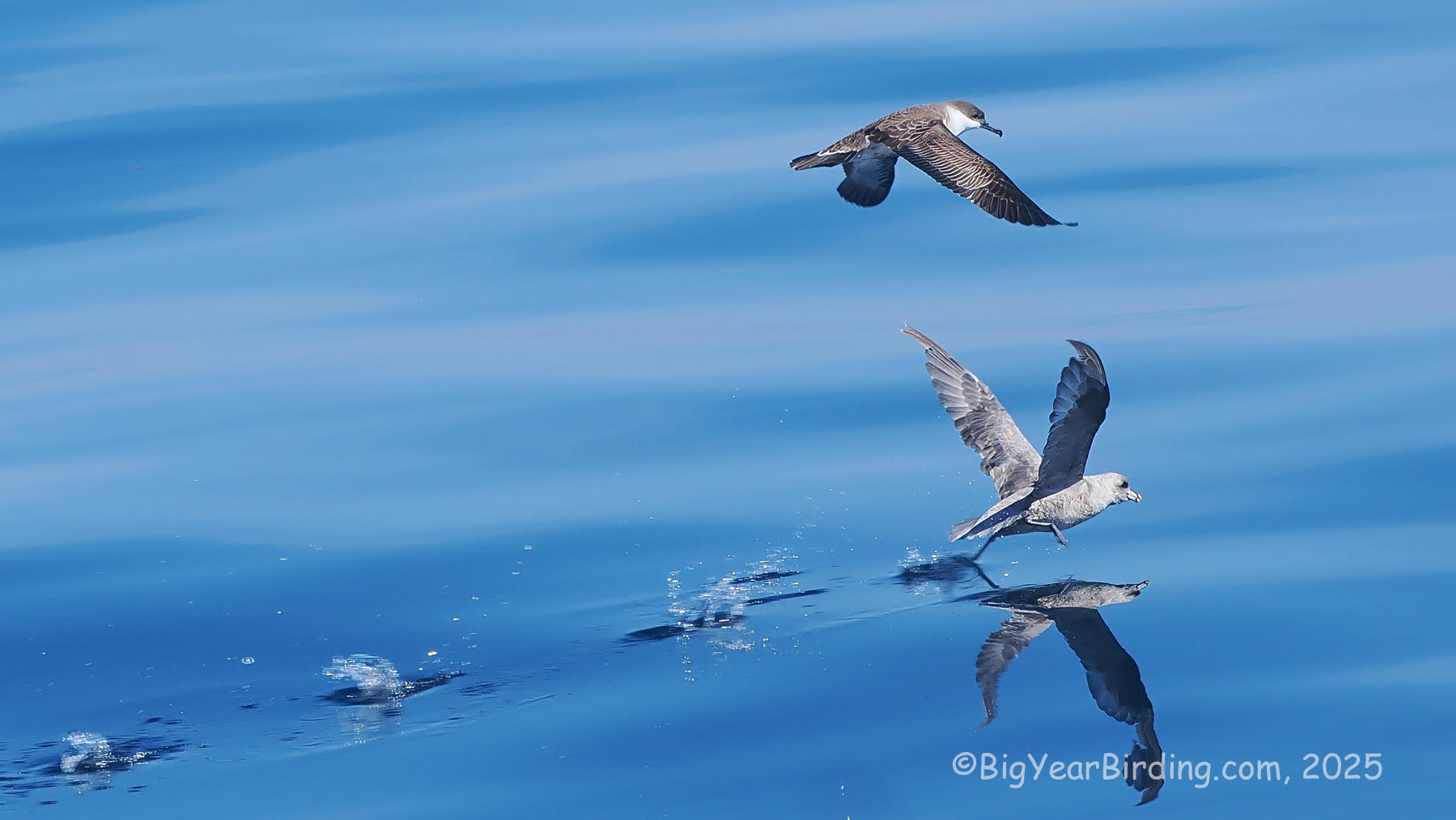
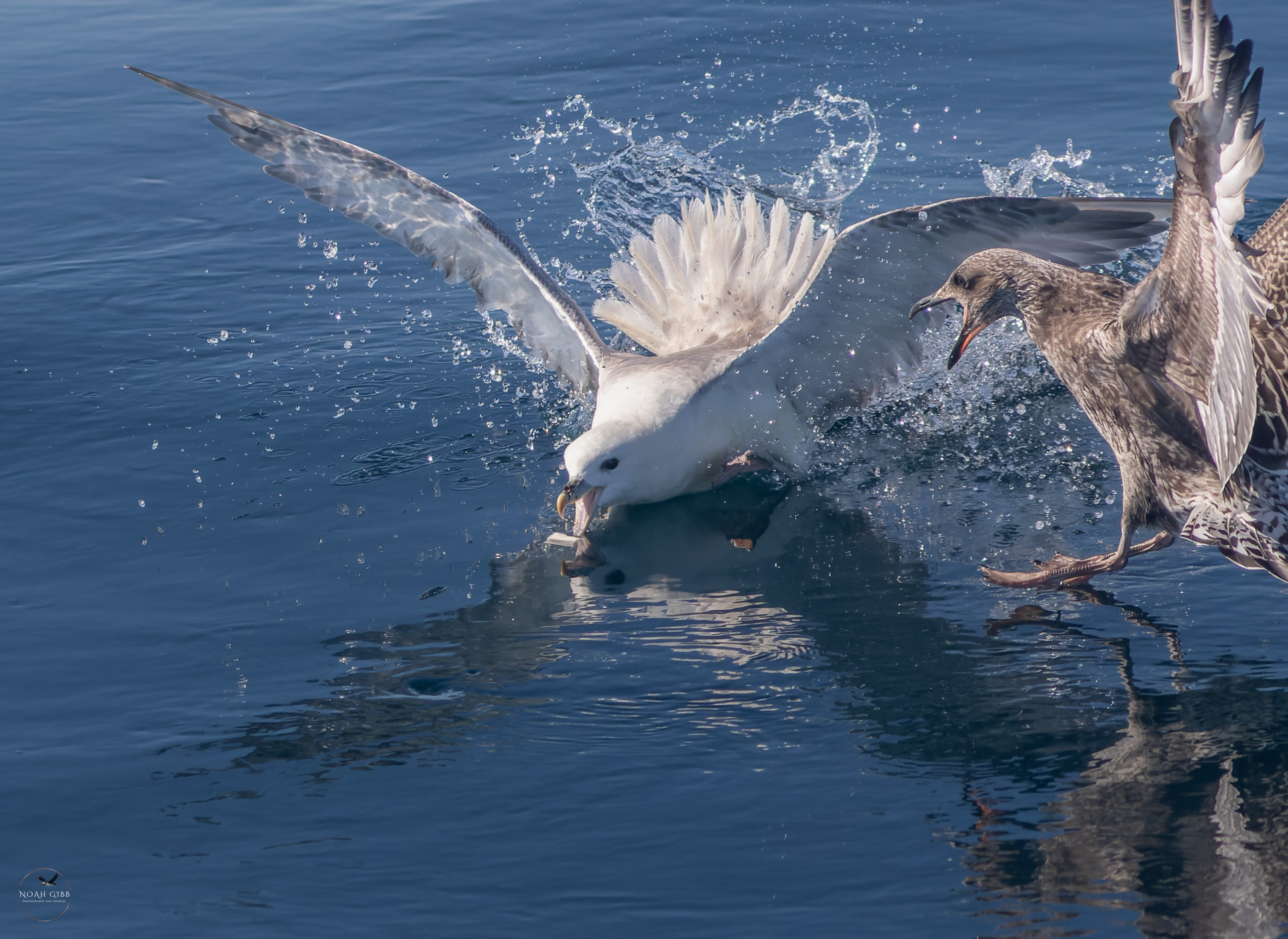
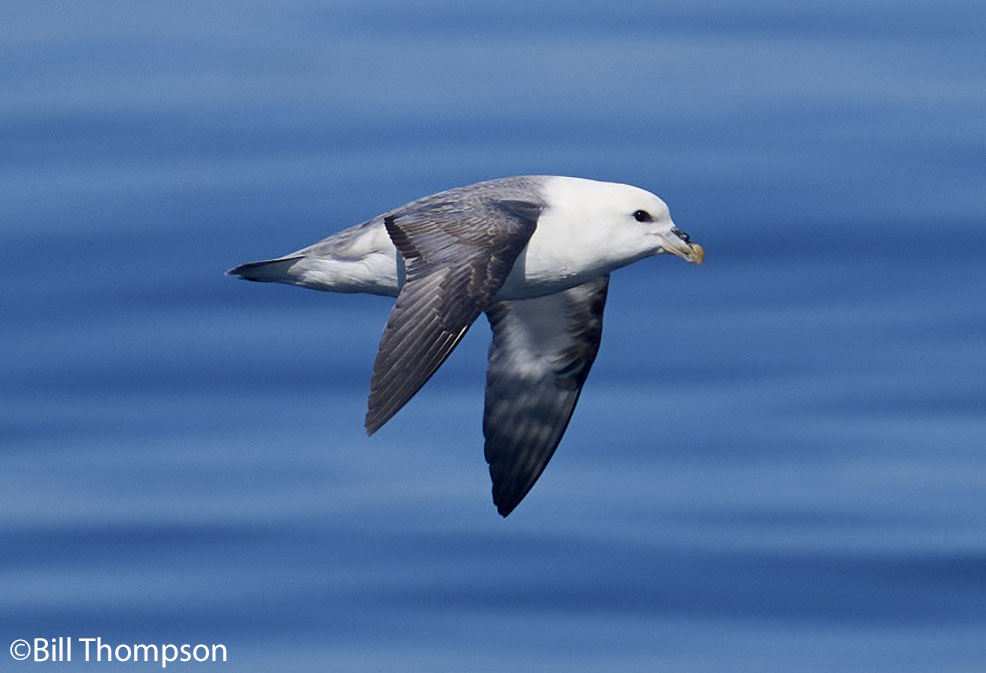
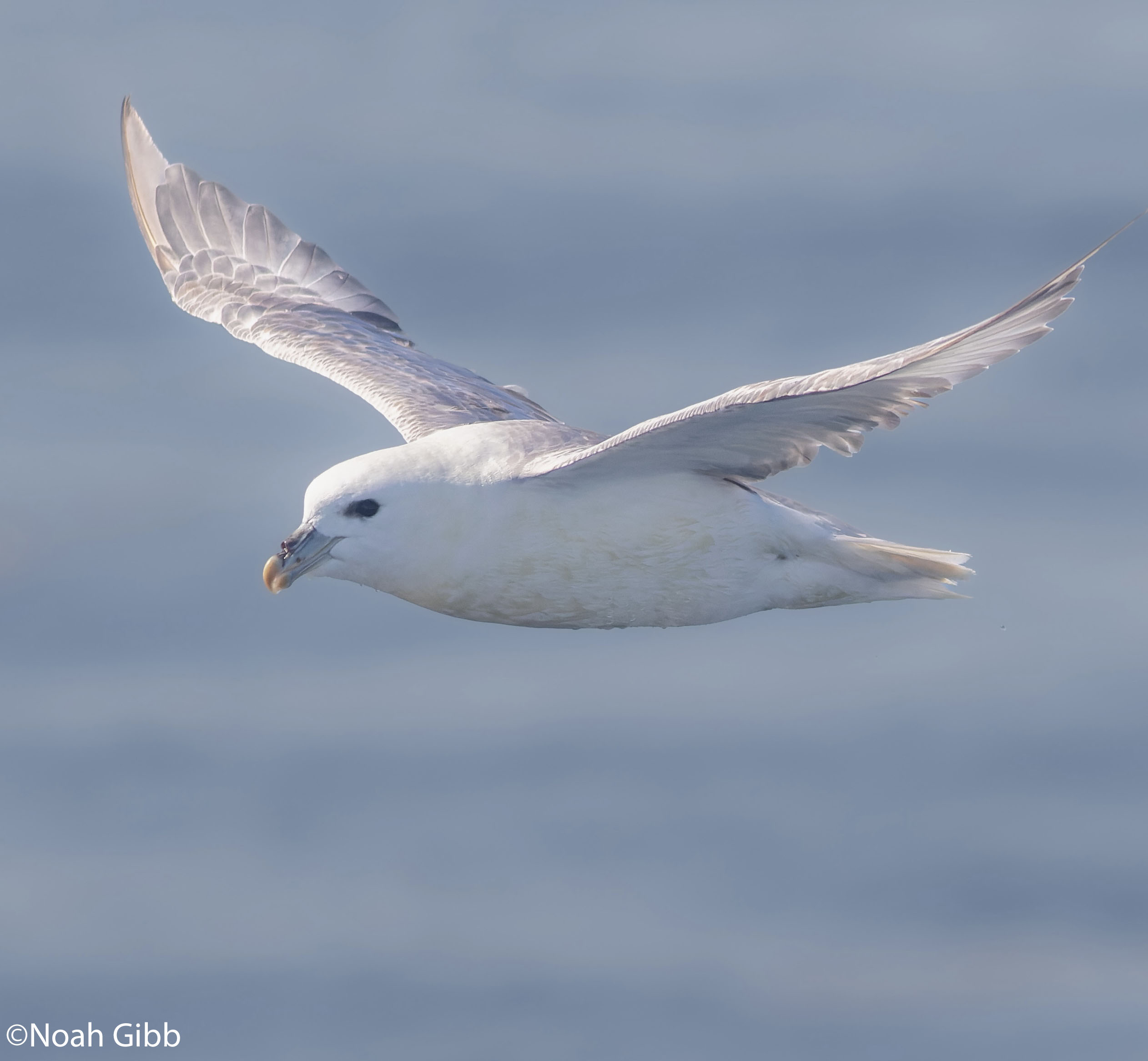
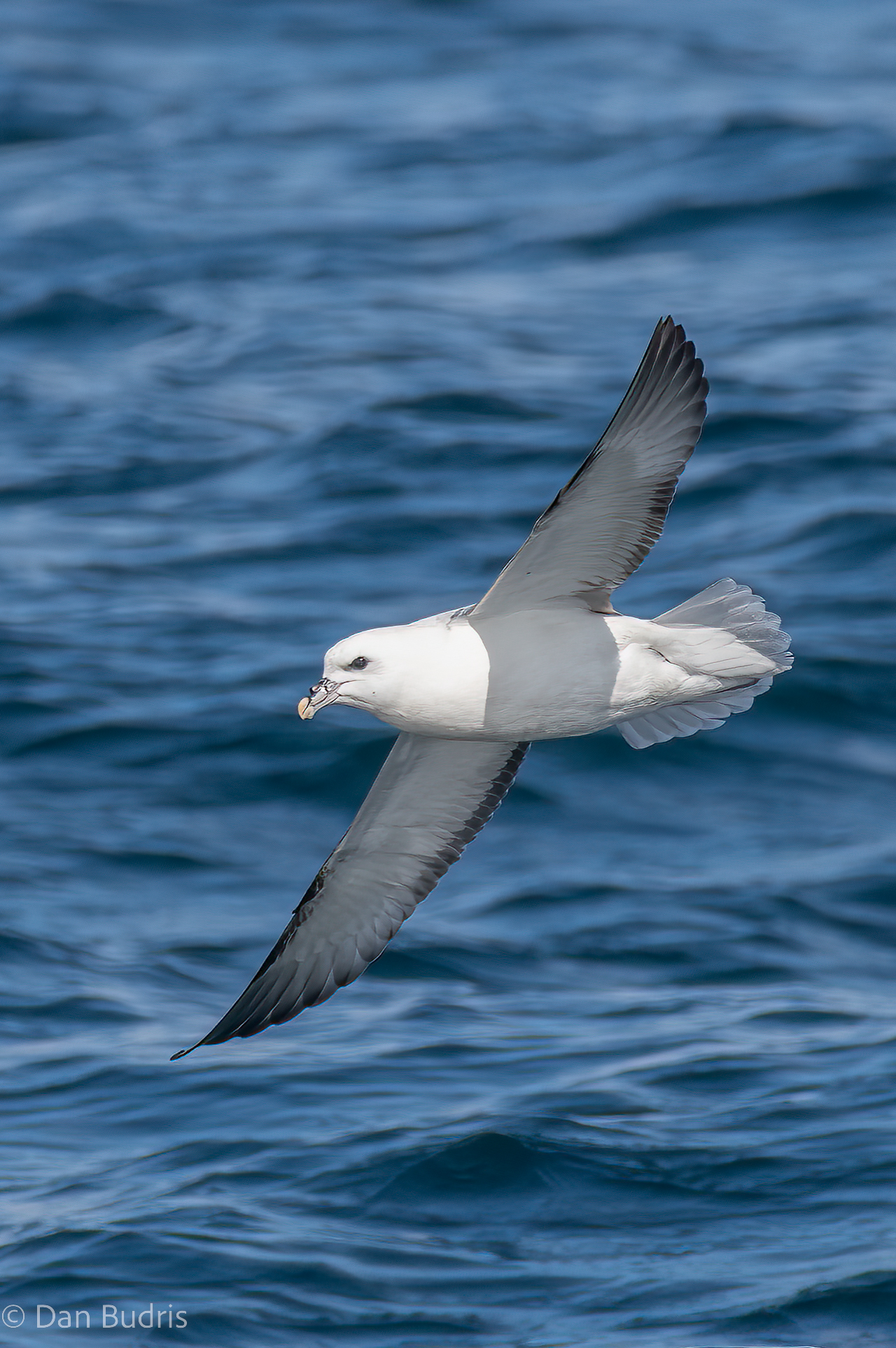
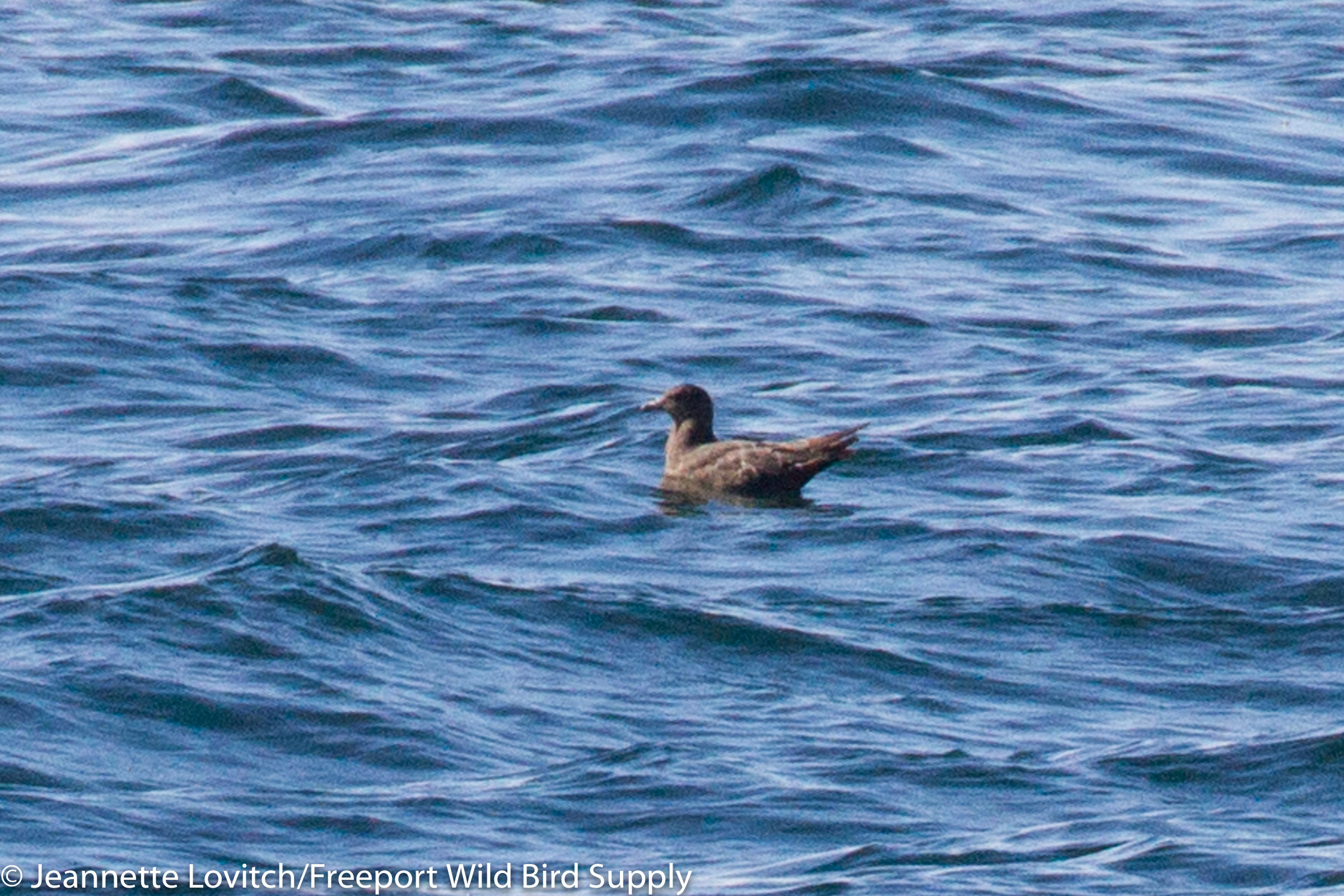
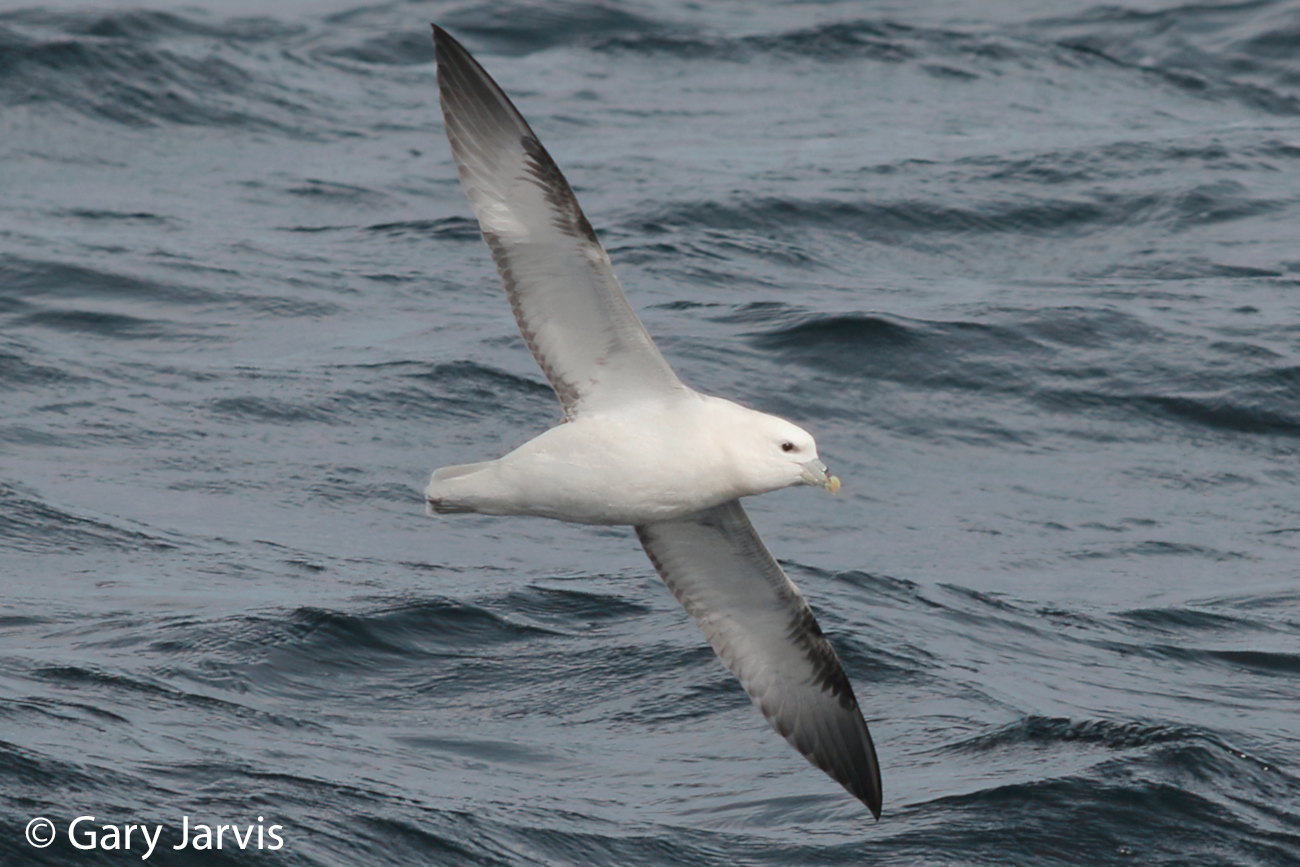
Considering most people would have been happy with a single Northern Fulmar, our tally of at least 18 was fantastic…but the photo opportunities of this winter visitor could not be beat, including of this much less common dark morph.
Fall pelagics in the Gulf of Maine are notoriously hit or miss. Suffice to say, our Half-Day Pelagic out of Boothbay Harbor on 10/5, with our partner, Cap’n Fish’s Cruises, was most definitely a hit!
And not just because of the ridiculously pleasant weather! The birding was great, the marine mammals were fantastic, and I don’t think a single person was seasick! What a difference a year makes.
We departed the harbor at 9:00am, with clear and calm skies, less than a foot of swell offshore, and high hopes (I had a productive scouting trip on a whale watch two days prior). But even with the always-lofty expectations of pelagic trips, we would not be disappointed this day.
Black Guillemots are always a nice way to begin and end all of our local pelagic trips since they are usually only seen in inshore waters.
Perhaps the one complaint I had was that we didn’t get all that far offshore! In fact, our furthest point was only about 20 miles south-southwest of Monhegan. There was just too much to look at, and every time we were about to head further offshore, something else of note appeared.
We started picking up a few seabirds, including our first of what would be a remarkable total of mostly juvenile Atlantic Puffins, the first of our sought-after Northern Fulmars, scattered Red-necked Phalaropes (mostly), along with a few Great Shearwaters, all around Murray Hole, but we hit paydirt right around the edge of the incoming shipping channel to Portland.
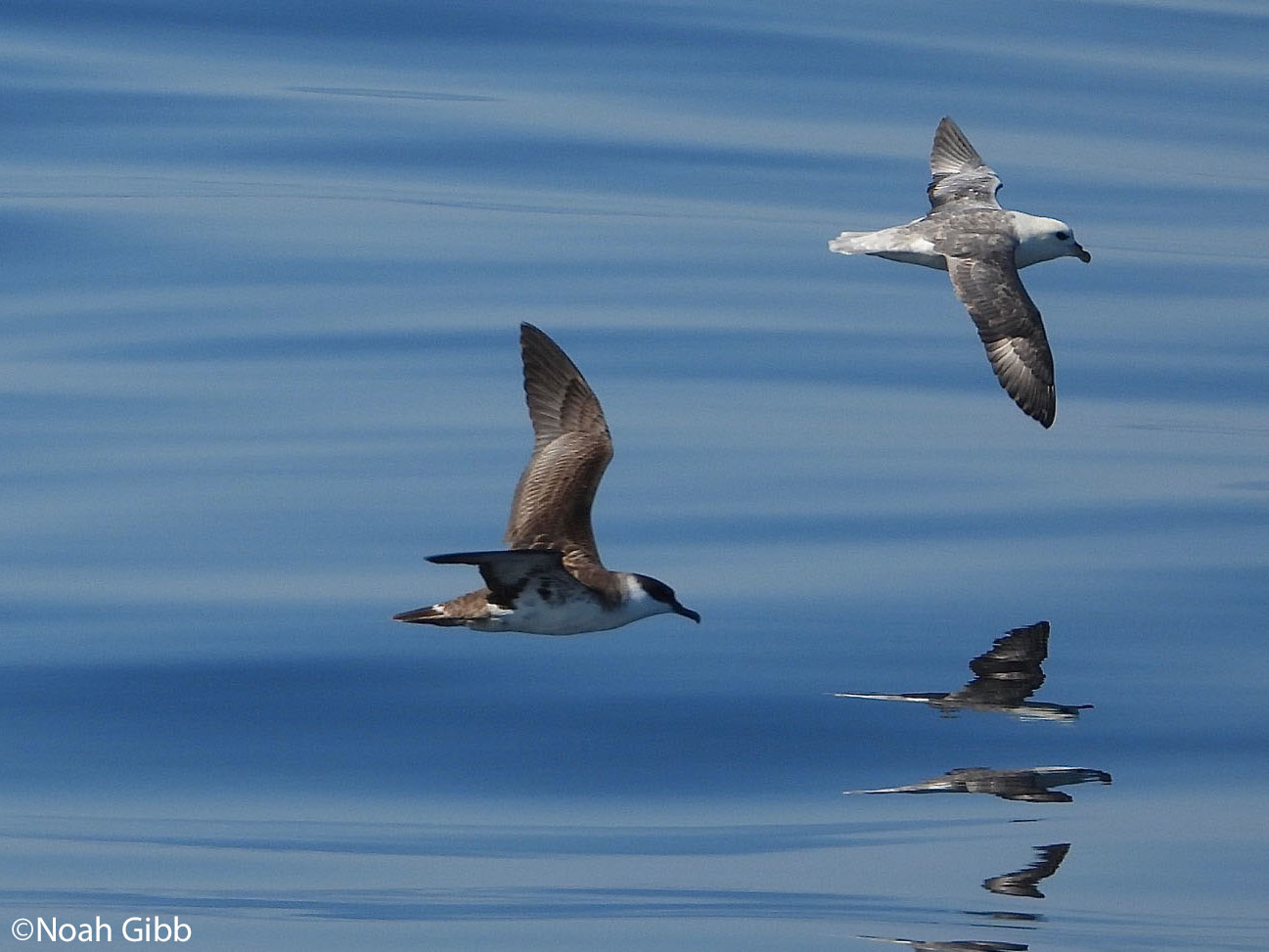
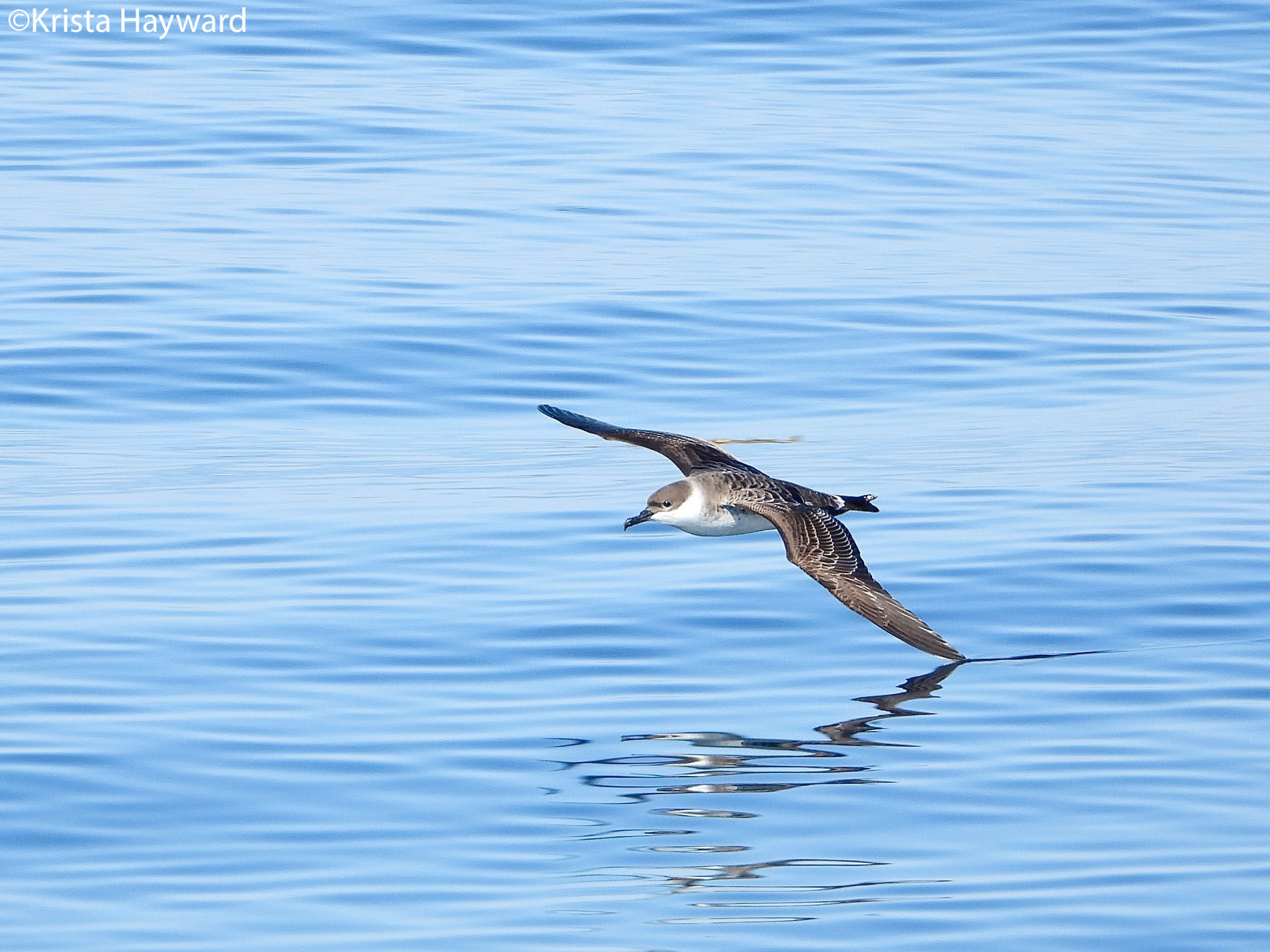
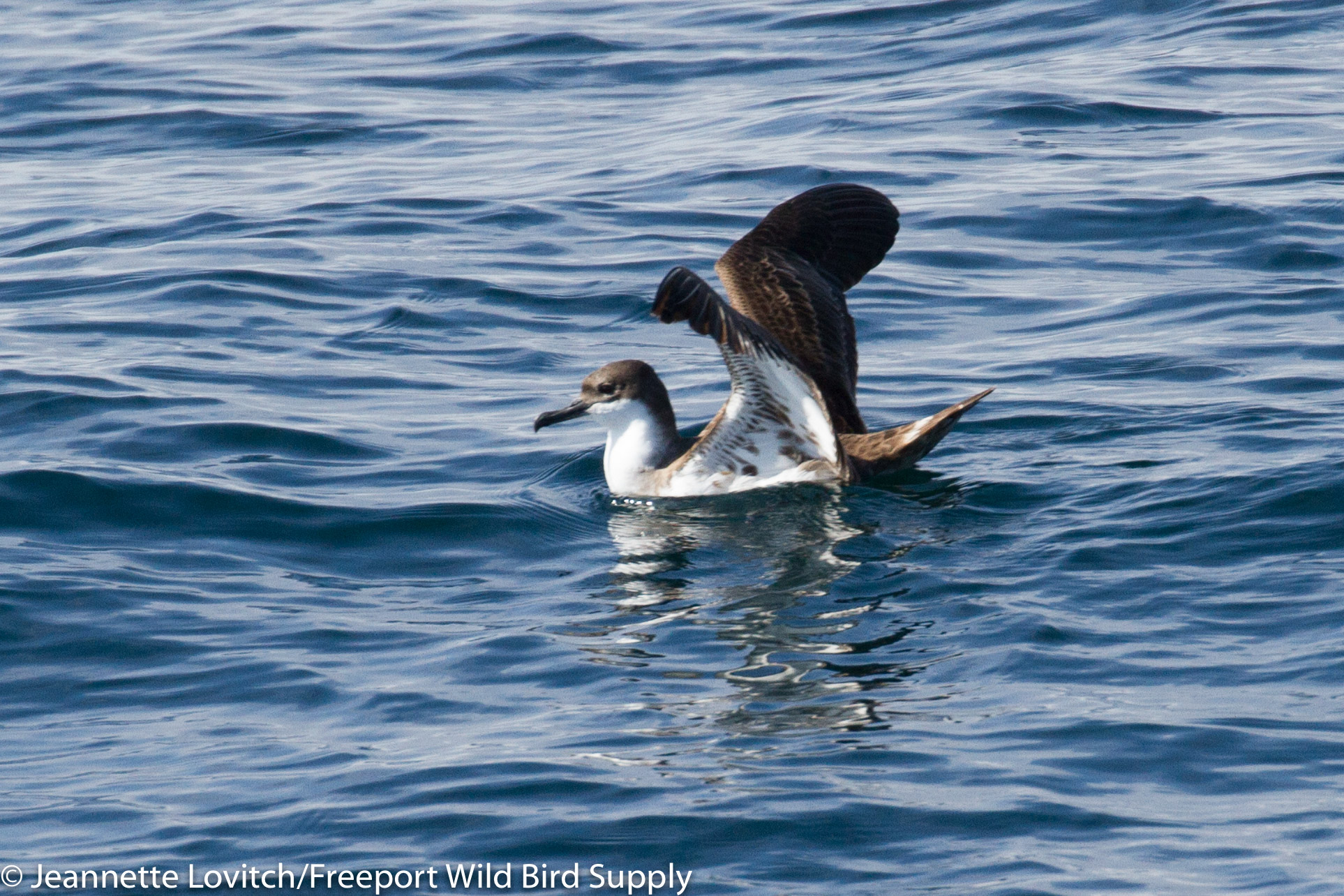
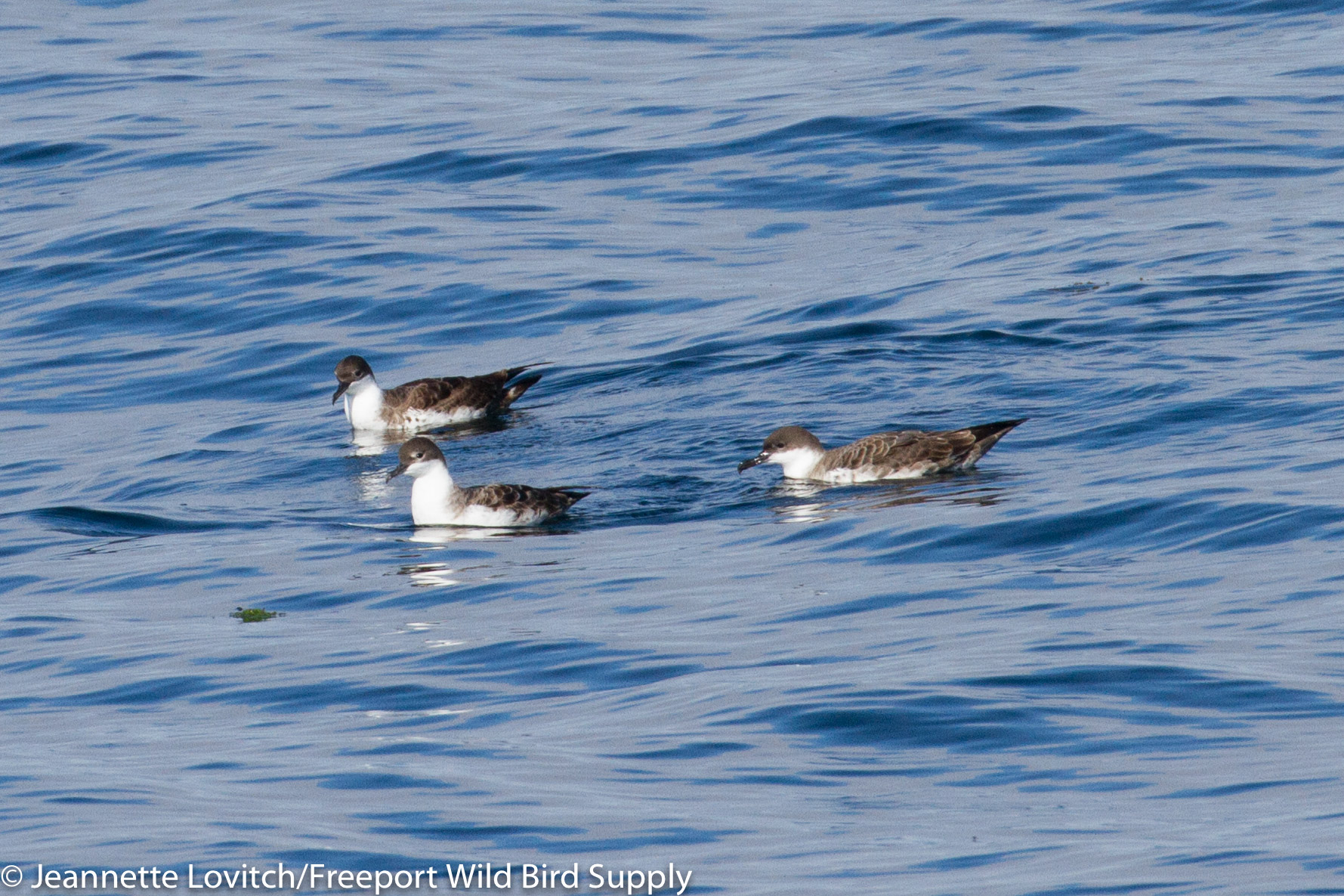
Great Shearwaters and Northern Fulmars were constant companions in our deeper water time.All of the photographed phalaropes so far that we encountered were Red-necked Phalaropes, so the checklist has been adjusted accordingly, even though we believe we had some Reds over the course of the trip.
There, in about 500-600 feet of water (but otherwise “in the middle of nowhere”), our chum slick of fish oil and pork fat (generously donated by Durham’s Old Crow Ranch!) worked its magic. Will Broussard, with both the honor and burden of his first time as Chummer, was the hero, bringing Northern Fulmars and Great Shearwaters in for close looks.]
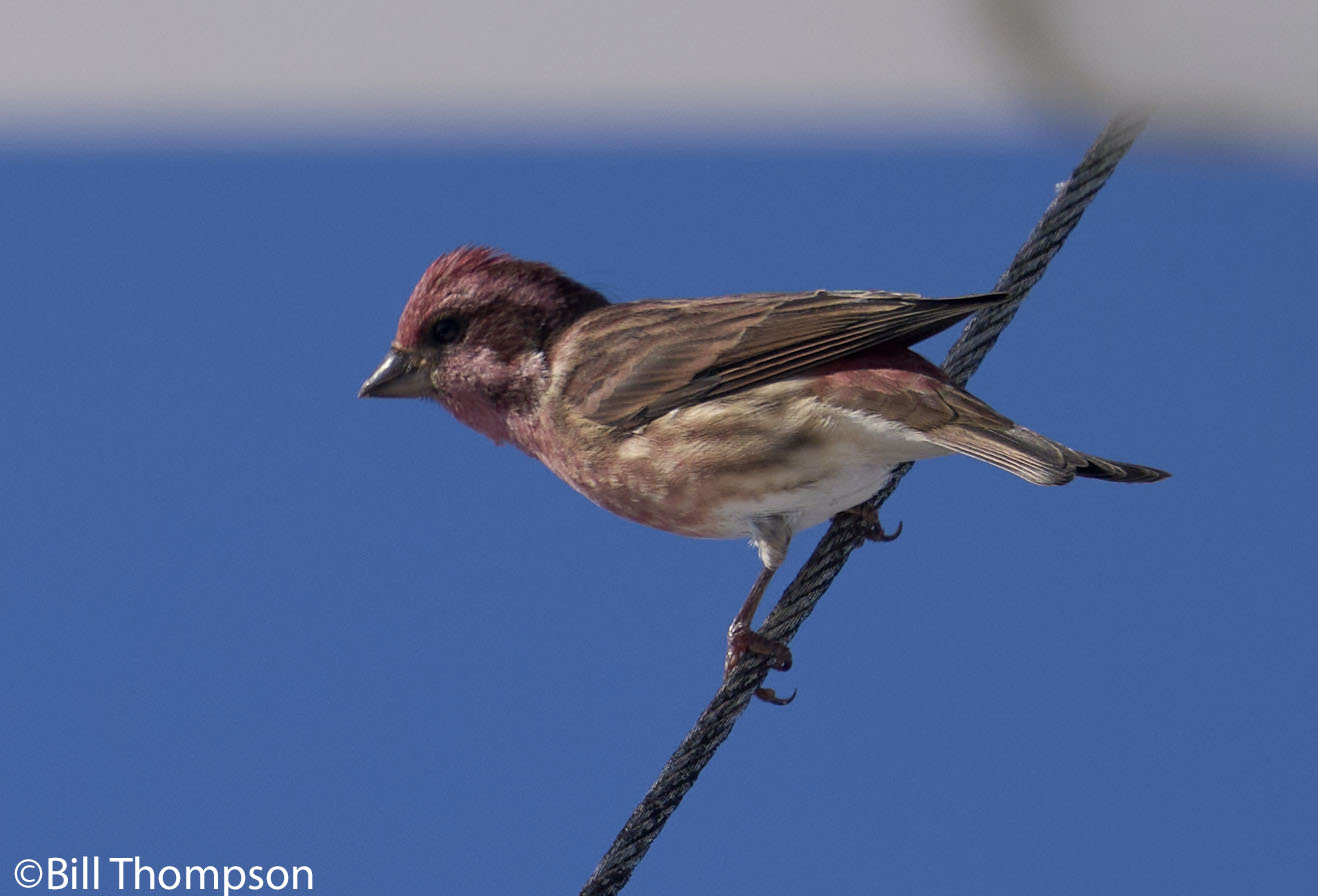
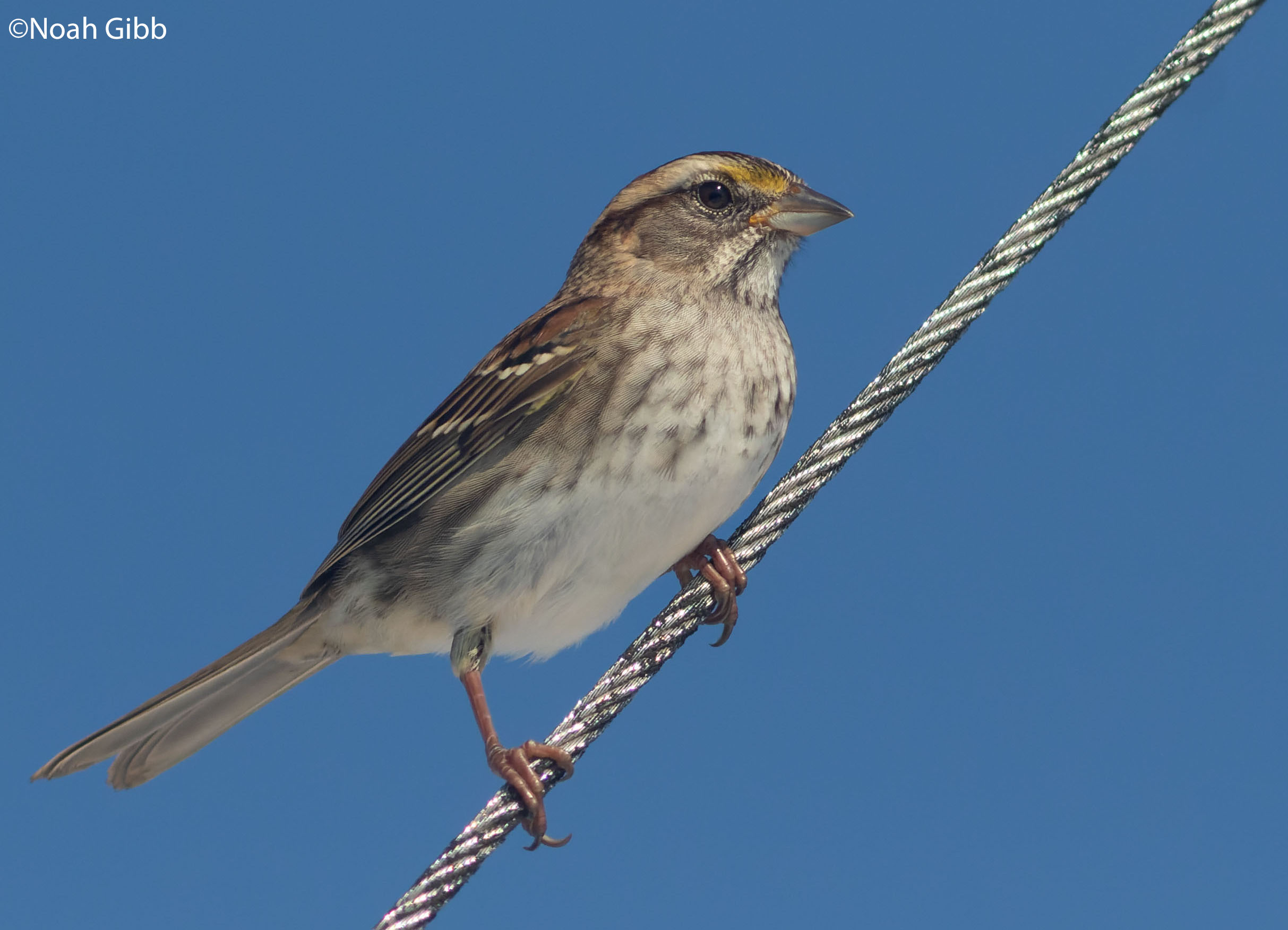
Passerines would appear on occasion, a total of somewhere between 4 and 8 White-throated Sparrows, including one that rode right back to port with us in the cabin. A male Purple Finch took a break on the boat, resting and preening on our radar, as a female did later. Passerines are always a fun addition to a pelagic birding experience.
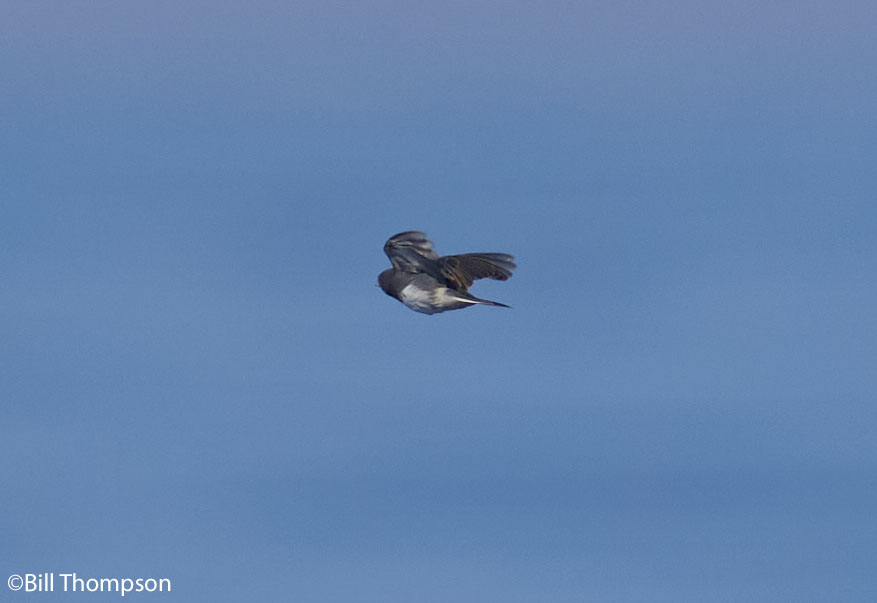
Less fun, perhaps, but most amazing and insightful, however, was watching a Peregrine Falcon chasing a passerine, driving it into the water, and then, unable to snatch it off the surface, moved on, leaving an Ovenbird helpless on the ocean’s surface, likely becoming waterlogged and hypothermic. It was impossible for us not to, so we attempted a water rescue, with the crew putting in a valiant effort to save the hapless warbler. Unfortunately, it perished, but we had to try!
This might be one of the most incredible photos of non-pelagics ever taken on a pelagic. Awesome work, Bill!
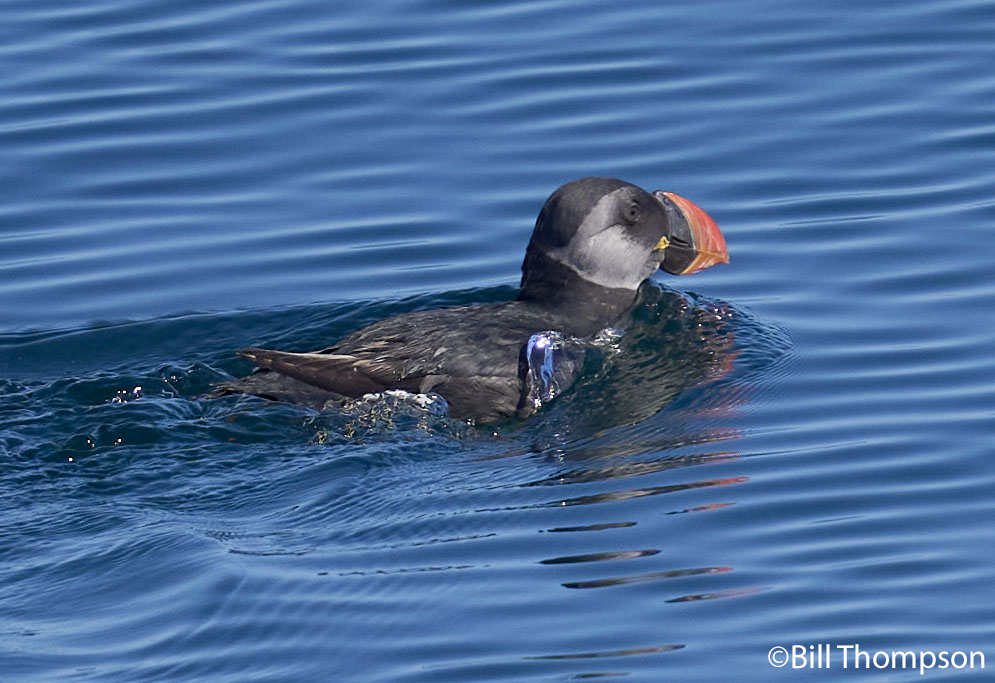
Repeated sightings of Atlantic Puffins continued to surprise us, and we spent some time with two different Fin Whales, including getting to see one doing a little lunge-feeding. While we looked at whales, birds were all around us, thanks to the chum, so we had something for everyone.
A big and bright-billed adult Atlantic Puffin.Both of our Razorbills were hanging out with juvenile puffins.
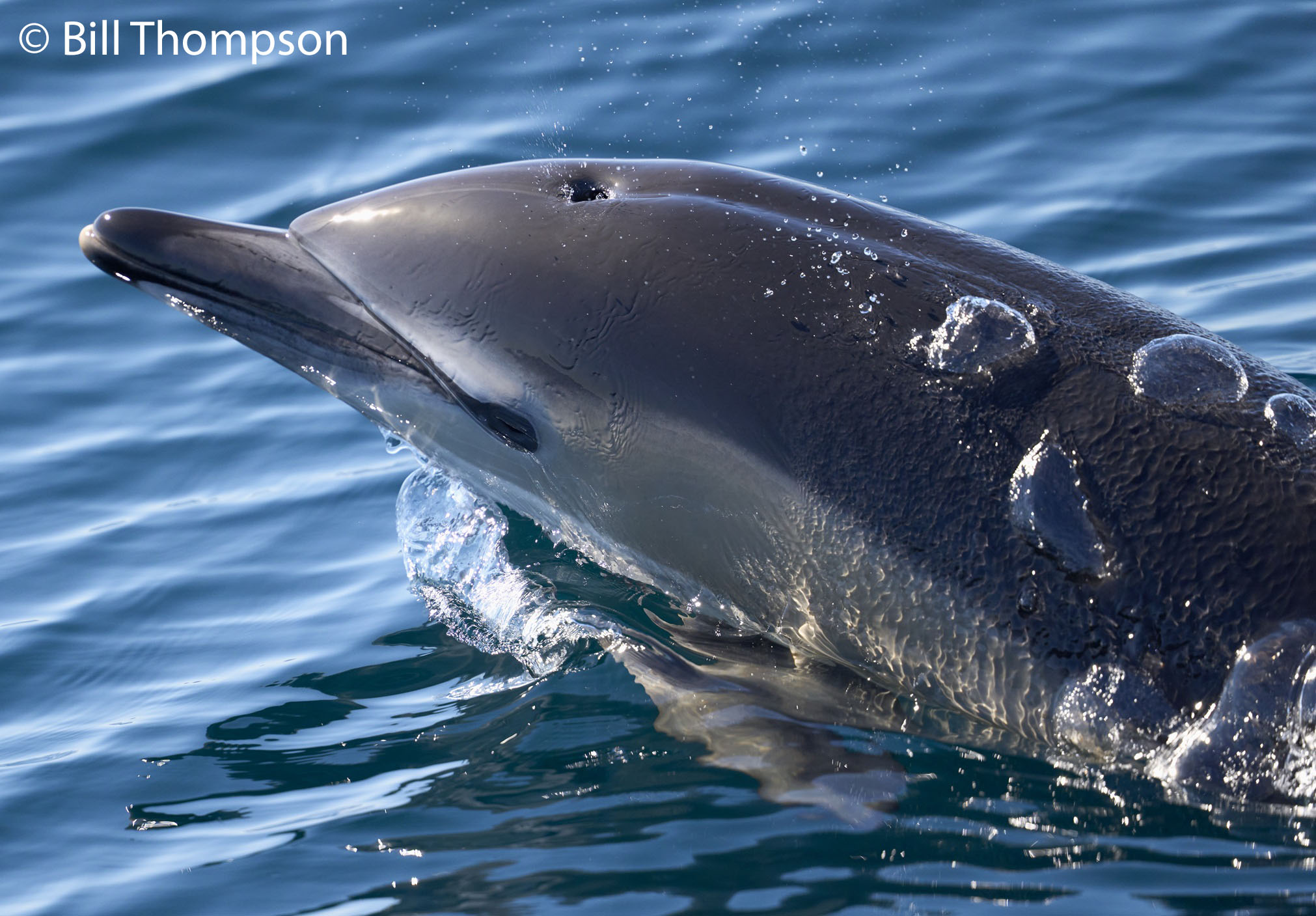
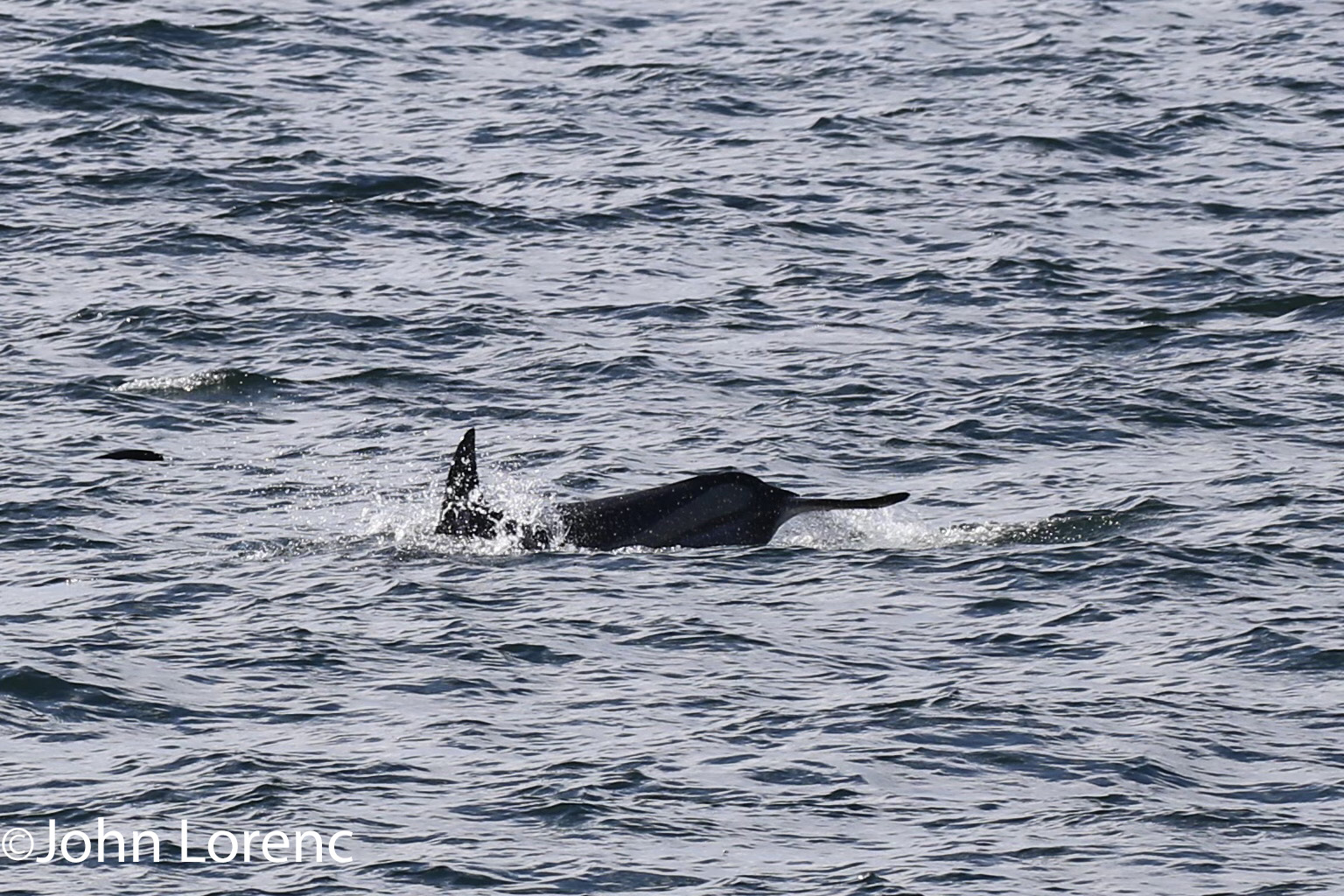
While this was of course a birding tour, we made sure to enjoy the marine mammals we encountered, along with a Blue Shark, but the highlight for most everyone was the incredible and awesome experience we had with a small pod of 25-30 Common Dolphins. Amid all of our seabird activity, the pod approached us in the glass-calm warblers. Captain Nate added a little speed to build up a wake, and the dolphins had come to play. They rode the bow, did some surfing, and otherwise created constant “oohs and aahs.” The photos don’t quite do it justice…it was really a special experience, a life mammal for most of the crew, and one of the best dolphin encounters I have experienced in the Gulf of Maine.
Puffins and fulmars, Fin Whales and dolphins, and all on just the most ridiculous weather possible for a fall pelagic in Maine! We’ll see you on board next year!
I want to thank Captain Nate for his skilled maneuvering of the boat – even more remarkable as this was his first pelagic, too! Naturalist Trinity shared the narration duties with me, taking over for local landmarks and non-feathered marine life, and Valentin and Joe took care of everyone at the galley – and did the work of our attempted Ovenbird rescue. Thanks to my team, chummer Will Broussard, and our checklist-keeper Noah Gibb. And a special thanks to Tabor and Seamus at Cap’n Fish’s for working with me to make this memorable trip a reality.
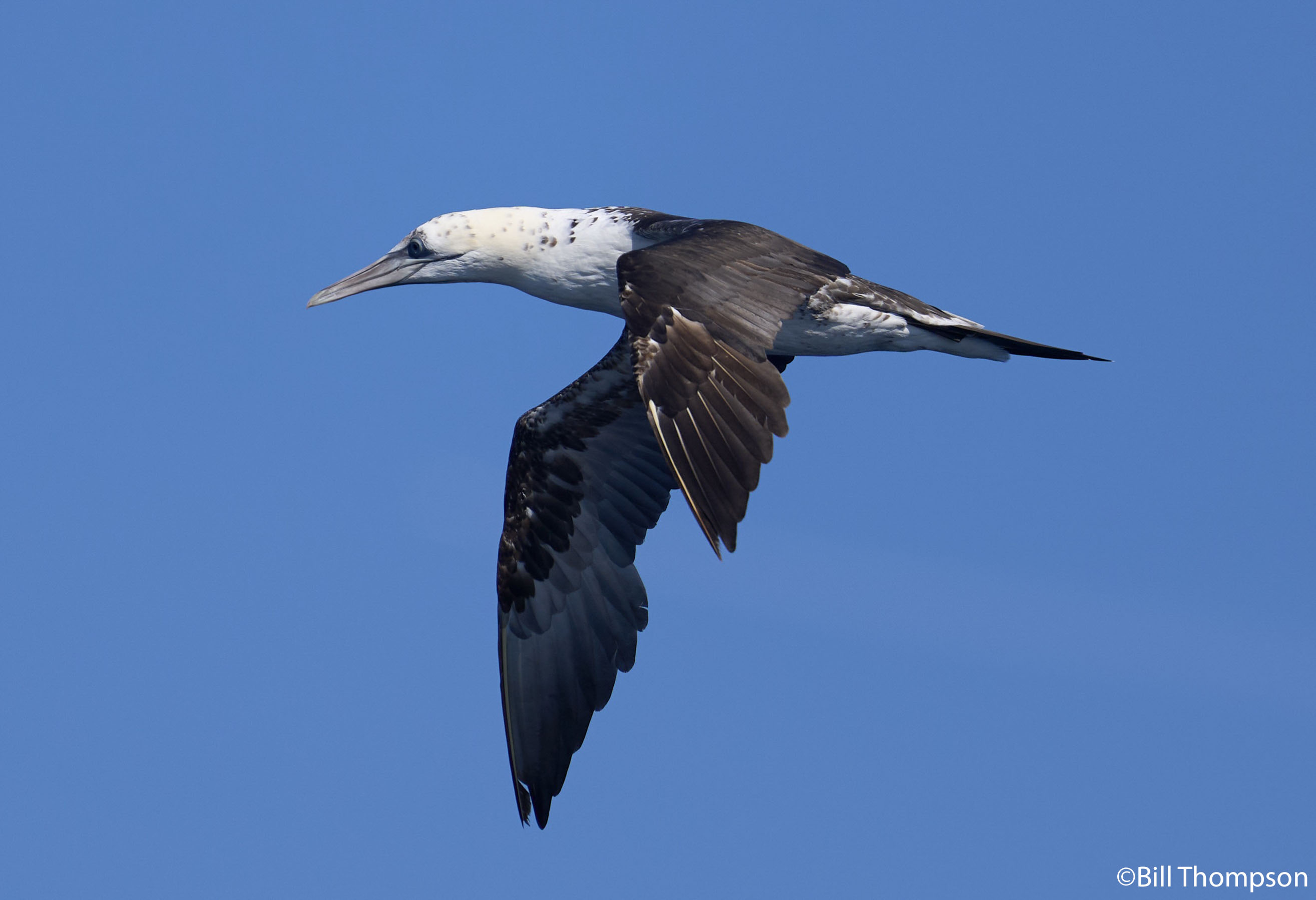
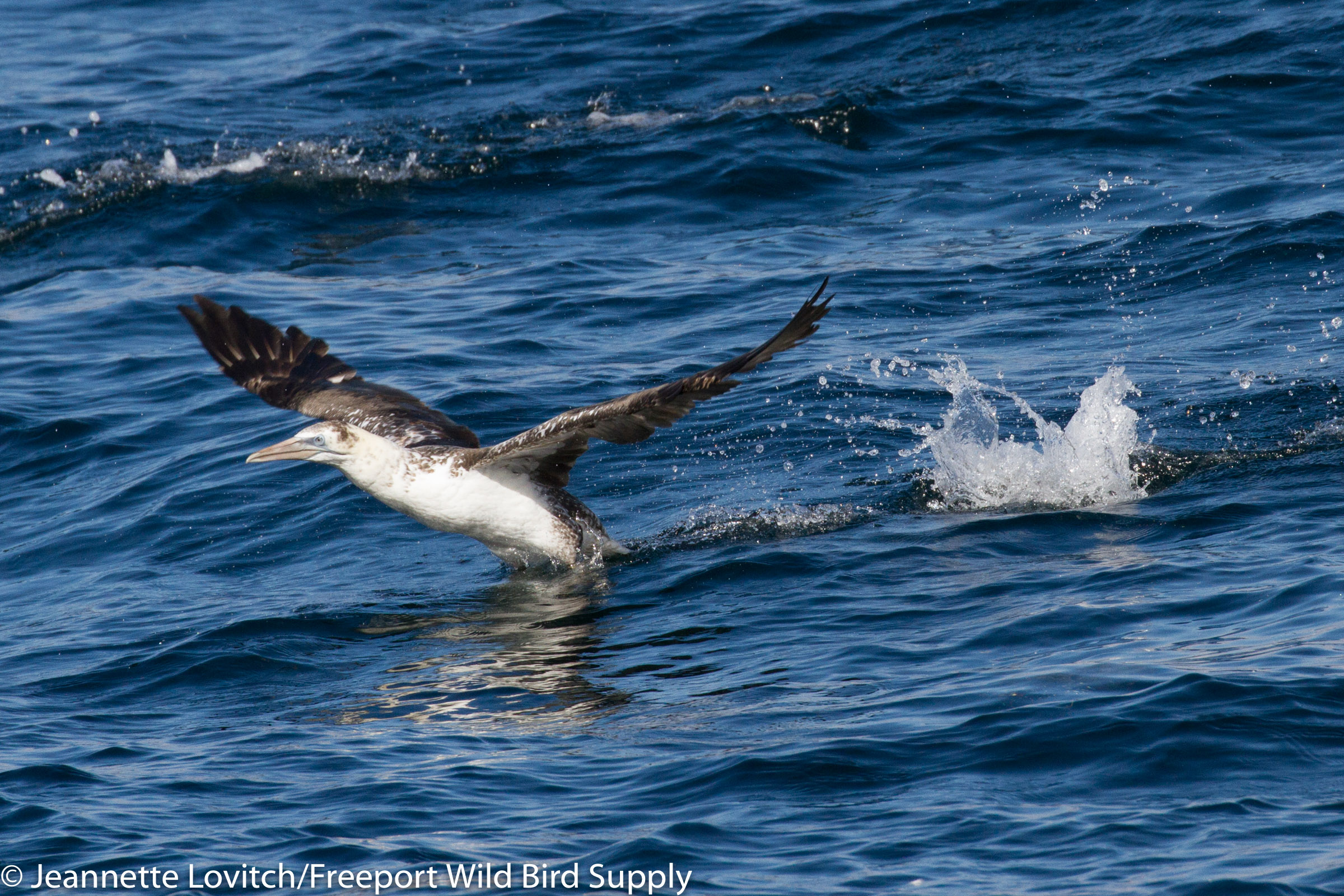
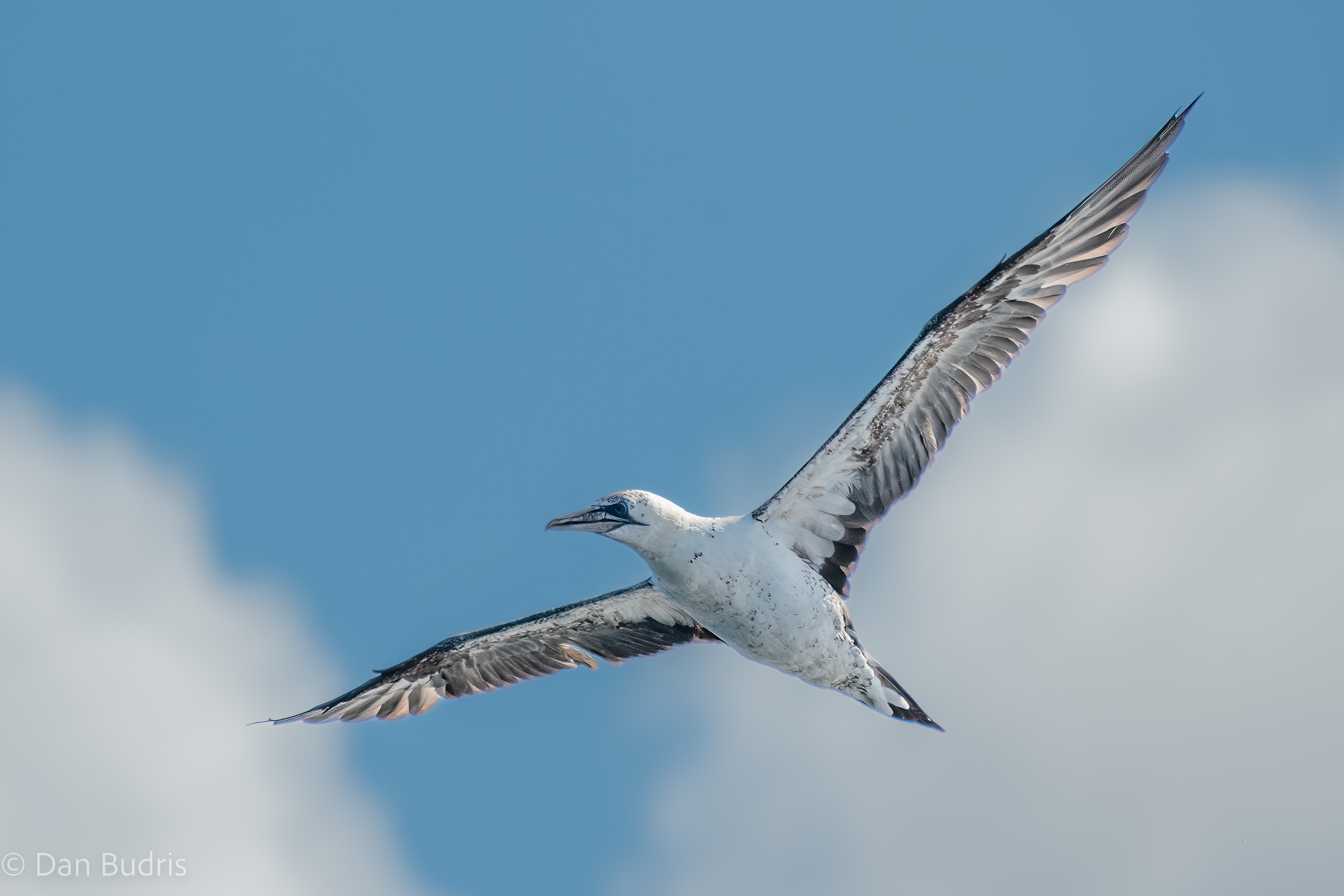
Subadult Northern Gannet
Here’s the complete trip list, including birds seen while docked before departure marled with an *. We know counts of several species, such as Common Eider and Herring Gull are likely extremely low, but we chose to be conservative with our Northern Fulmar and Great Shearwater tallies as we covered a relatively small area during our deeper-water time, and the chumming kept birds with us, and perhaps, coming back for more.
267 Common Eider
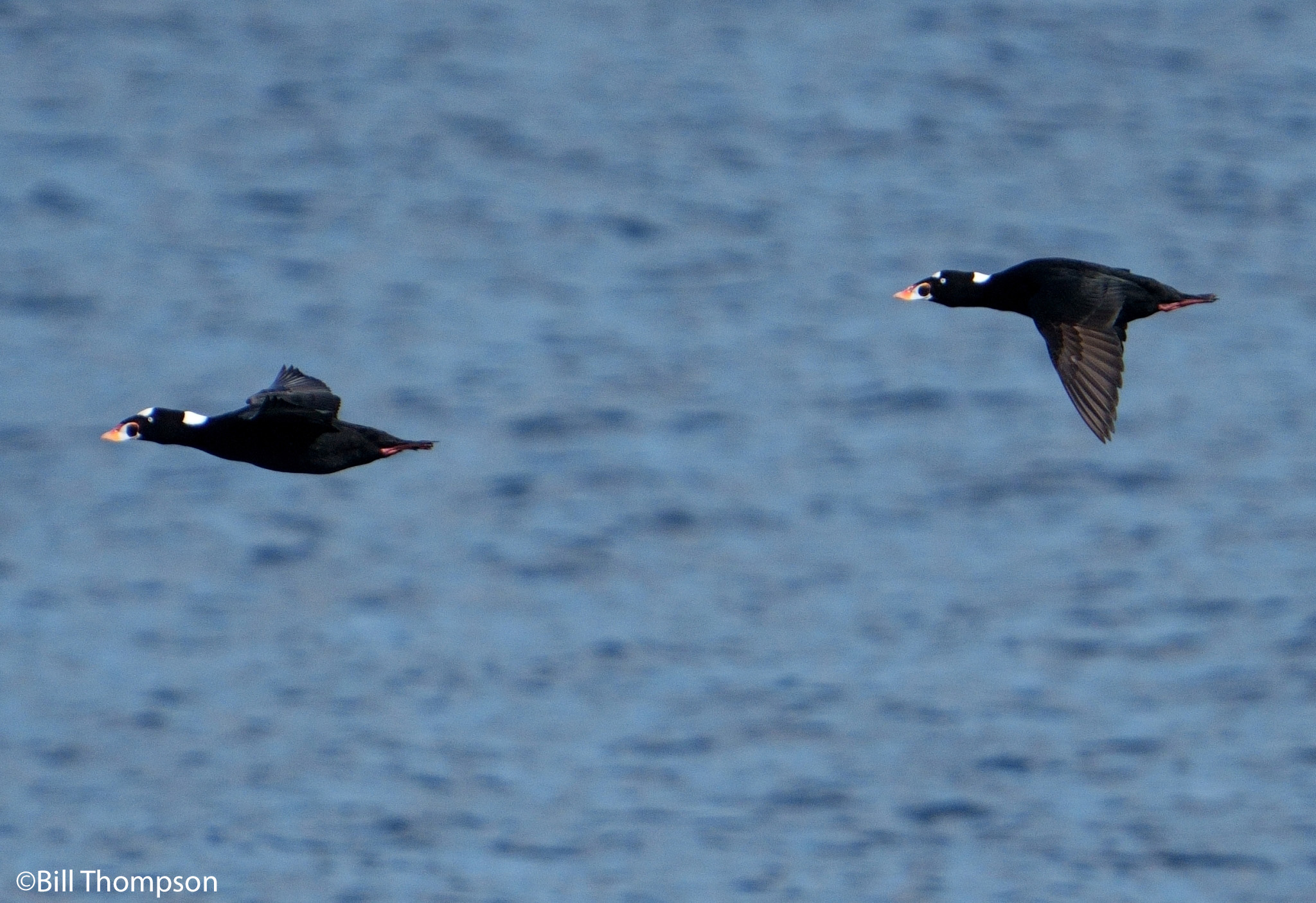
89 Surf Scoter
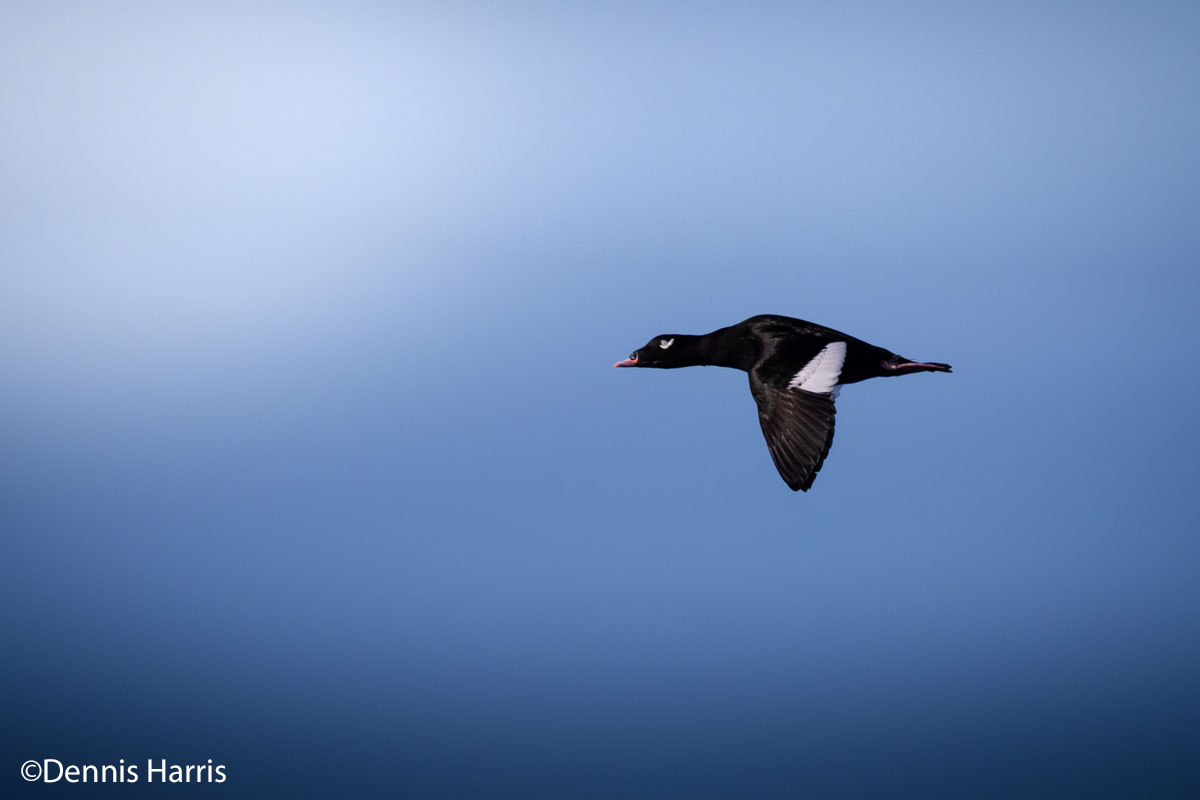
3 White-winged Scoter
36 Black Scoter
25 Rock Pigeon*
54 Red-necked Phalaropes
21 unidentified phalaropes
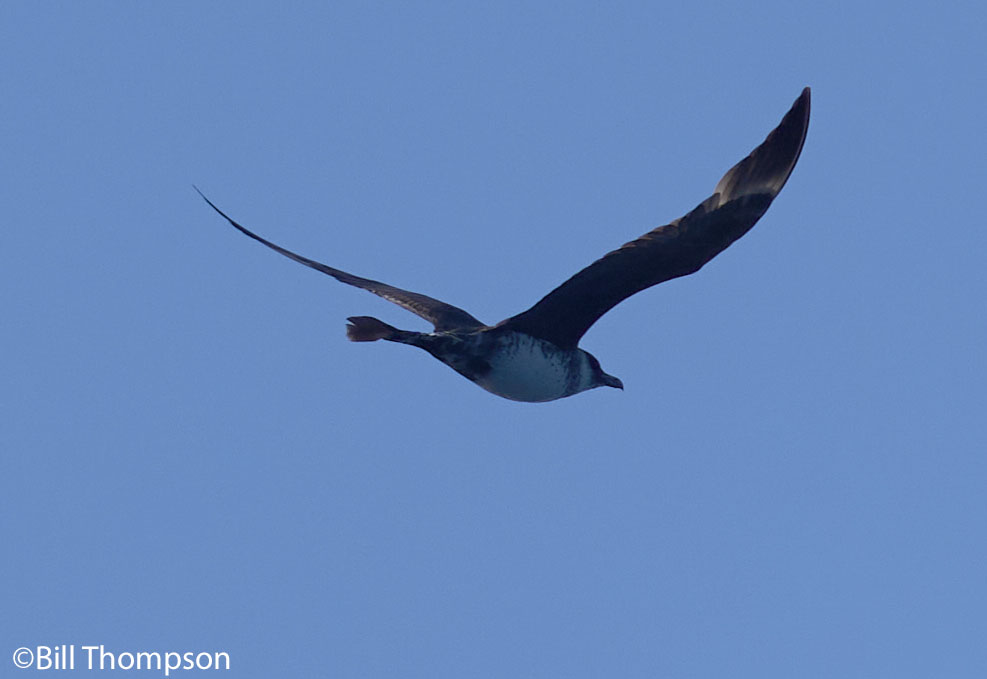
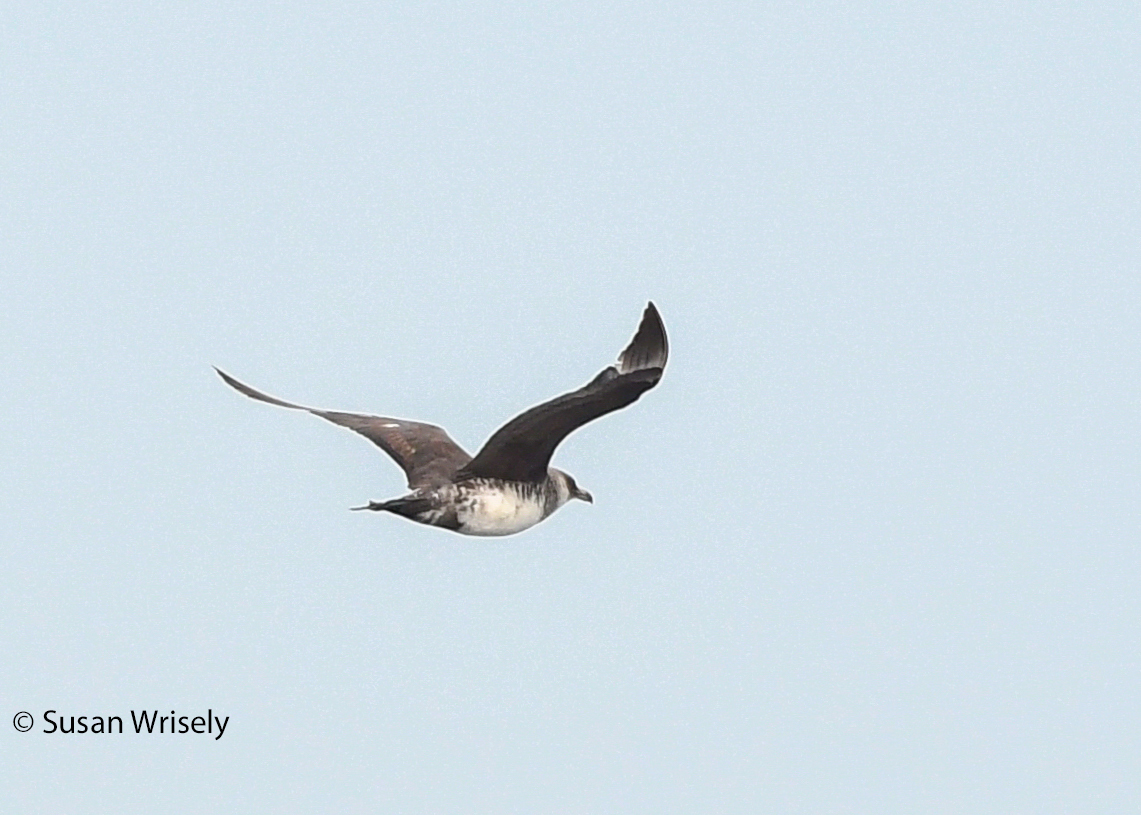
1 Pomarine Jaeger
28 ATLANTIC PUFFINS
15 Black Guillemots
2 Razorbills
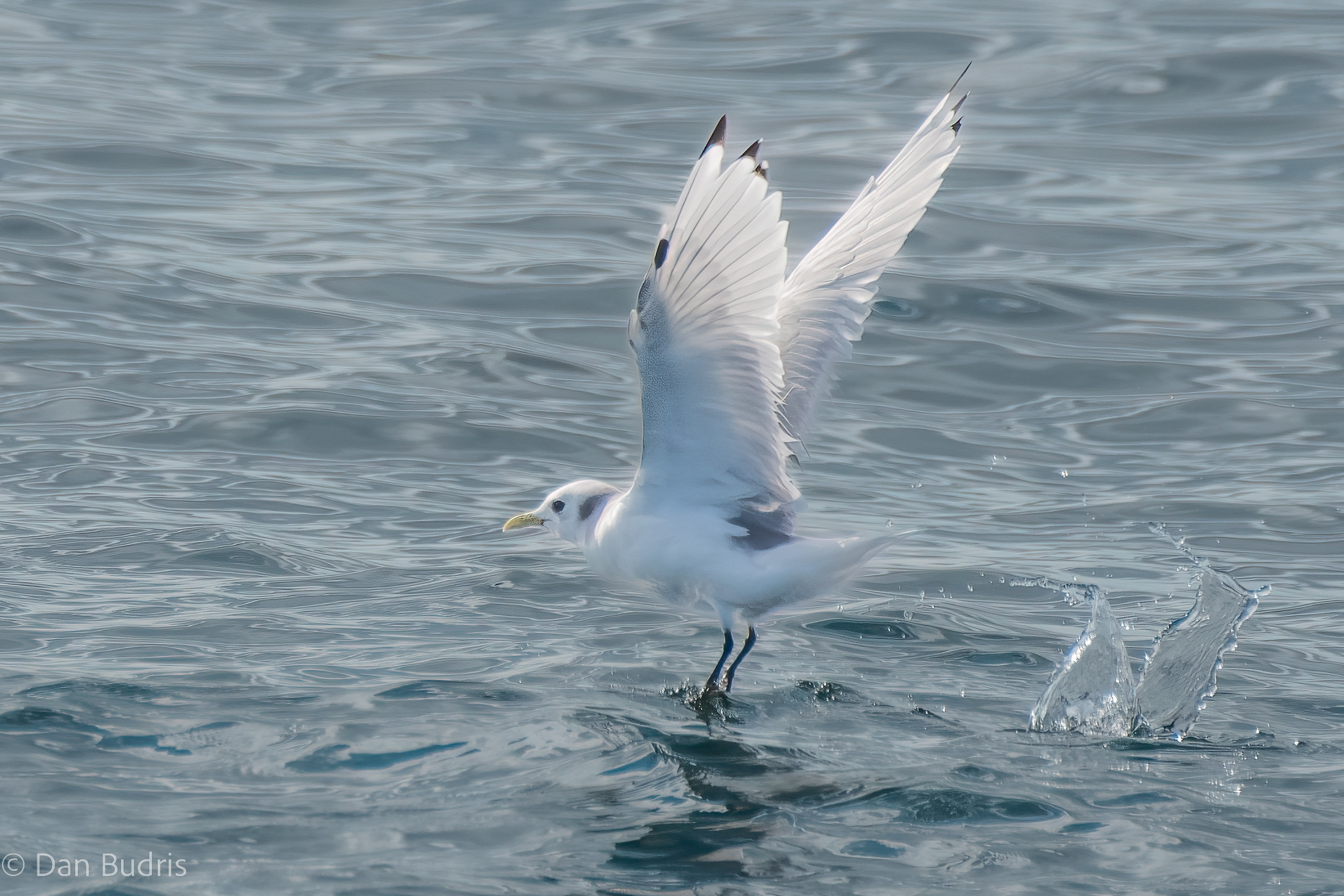
1 Black-legged Kittiwake (only spotted from photos later, unfortunately)
One of at least 15 Cory’s Shearwaters observed from a Cap’n Fish’s Cruises Whale Watch last week, showing the dark outer primaries on the underwing, making for a rounded end to the white of the underwing coverts, separating it from the recently-split Scopoli’s Shearwater.
October is my favorite month of birding in Maine, and this past week showed why. A great diversity of birds are on the move, and my past seven days featured everything from pelagics to yard birds. Here are my observations of note over the past seven days.
Pelagic highlights from a Cap’n Fish’s Cruises Whale Watch out of Boothbay Harbor on 10/4: 4 NORTHERN FULMARS (including one dark morph), 4 ATLANTIC PUFFINS, 14-15 Cory’s Shearwaters (most seen and/or photographed well enough to see full dark outer primaries on the underwing; see above), 6 Red-necked Phalaropes, and one BROWN CREEPER landing on a person on the top deck about 14 miles off of Damariscove Island (photo below). My complete list is posted here.
1 Baltimore Oriole and 1 Nashville Warbler, Wolfe’s Neck Center, Freeport, 10/5 (with Saturday Morning Birdwalk group).
Sandy Point Morning Flight, 10/6: 140 birds of 18 species led by 60 Yellow-rumped Warblers. Total tally here.
1 Rusty Blackbird, 1 Nashville Warbler, and 1 Pied-billed Grebe, Capisic Pond Park, Portland, 10/9 (with clients from New York).
20-30+ Cory’s Shearwaters off East Point and Ocean Ave, Biddeford Pool, 10/9. Some just beyond Beach Island in good afternoon light to see dark outer primaries. 15 minutes of counting produced 18 individuals from East Point, all moving north, with 1-3 in view with almost every quick scan thereafter. Good sign for Monday’s pelagic! (with clients from New York).
7 American Oystercatchers and 1 Horned Grebe (first of fall), Ocean Avenue, 10/9 (with clients from New York).
1 American Redstart, Elphis Pond, Biddeford Pool, 10/9 (with clients from New York).
Highlights from our Durham property this week included the arrival of the first few Dark-eyed Juncos, a Rose-breasted Grosbeak on 10/4, continuing multiple Lincoln’s Sparrows, Nashville Warbler on 10/8, and another or the same Indigo Bunting on 10/9.
And here’s my complete trip report from my Monhegan tour and visit on September 27 through October 1st.
Our annual half-day pelagic with our partners Cap’n Fish’s Cruises out of Boothbay Harbor is on Sunday, October 14th – a nice, late date that should put us more in the season of things like Great Skua, and you can be sure we’ll be studying Cory’s Shearwaters hard to find a Scopoli’s! More info and link to registration is here. See notes above from my 10/4 outing.
A few spaces remain on our Birds on Tap! – The Boat Trip! To House Island in Casco Bay on Sunday, October 20th. More info here.
Join us on Monday’s pelagic and maybe a Brown Creeper will land on you!
Beginning in 2022, Cap’n Fish’s Cruises in Boothbay Harbor and Freeport Wild Bird Supply have partnered together to offer a mid-summer seabirding opportunity. I join the boat’s naturalist as a seabird and pelagic specialist, to help everyone see all of the breeding seabirds at Eastern Egg Rock (Atlantic Puffins; Arctic, Common, and Roseate Terns; Laughing Gulls; and sometimes Razorbill and Common Murre) before we venture offshore in search of whales. While doing so, we pay special attention on this cruise to the bird life – which is often found at the same places where we are looking for whales. This trip gives us a slightly more bird-centric tour compared to the regularly-scheduled departures.
Here are the trip reports from this very popular annual event.
July 16. 2022
Seas were fairly high (3-5ft) as we bounced offshore to deeper water first. Wilson’s Storm-Petrels were soon visible, and we passed one Razorbill. We could not stop or turn around for it as the seas were just a little too rough for that, and this was unfortunately our only Razorbill of the day. We cruised around waters over 300 feet deep, and were treated to a good performance from Great Shearwaters, Wilson’s Storm-Petrels, and picked up a few Sooty Shearwaters. We had one offshore Atlantic Puffin, but the big surprise was a rare, mid-summer NORTHERN FULMAR – definitely the pelagic bird of the trip.
With the seas building, we made a turn and took advantage of much more pleasant conditions as we trolled the area, giving people a better chance and seeing the aforementioned species. We also spotted a couple of Mola Molas, but no marine mammals, unfortunately.
Away from Eastern Egg Rock (both coming and going), our offshore (“pelagic”) scorecard was:
76 Great Shearwaters
61 Wilson’s Storm-Petrels
21 Northern Gannets
3 Sooty Shearwaters
2 Arctic Terns
1 Razorbill
1 Atlantic Puffin
1 NORTHERN FULMAR
1 Common Loon
scattered Common Terns and unidentified Sterna
As we approached Eastern Egg Rock, the action really picked up with all of the island’s breeding species soon apparent. Roseate and Arctic Terns joined the multitudes of Common Terns. At least a dozen Roseates included several putting on a good show, and we singled out quite a few close-passing Arctic Terns for good studies. 4 migrant Ruddy Turnstones joined island-breeding Spotted Sandpipers onshore, and we heard a couple of singing Song Sparrows. And of course a plentitude of Laughing Gulls; about half of the entire state’s population breeds here. Black Guillemots were also conspicuous today.
But Atlantic Puffins are the star of the show out here, and today, they did not disappoint. In fact, it was a great mid-summer performance, with several dozen on the water – often in very close proximity to the boat, commuters passing by, and dozens more stately stationed on the island’s rocks.
We wandered offshore on the way back, near where the boat had recently seen whales, added a few birds to the tallies, but alas, the only marine mammals of the day were two species of seals: lots of Harbor Seals and two Gray Seals. Hopefully, this got the seal of approval from the marine mammal watchers aboard today.
July 10, 2023.
A Parasitic Jaeger got everyone to our feet as we were motoring home through the fog.
With even more anticipation than usual, birders flocked aboard for this afternoon departure. Three hours earlier, I had spotted the near-mythical Tufted Puffin on Eastern Egg Rock aboard Cap’n Fish’s morning Puffin Cruise. We made a bee-line for the island’s north end, but alas, the Tufted was not to be seen.
Nonetheless, we had a fantastic visit. Fog resulted in many of the island’s Atlantic Puffins being in the water and we had close birds all around the boat. We studied Arctic and Roseate Terns among the masses, making sure everyone had at least one rewarding look at each. While we searched vigilantly for the Tufted, we picked out one of two American Oystercatchers that have been here this summer, and just as we were about to leave, the single Common Murre floated around just off our bow.
It didn’t take long before our first Wilson’s Storm-Petrels of the day to be sighted, with small groups and singletons here and there throughout the rest of the trip for a total of 100-150 or so. Fog only thickened as we traveled further offshore, however, although we did find a hole where the visibility increased dramatically for a spell. While we searched diligently for whales to no avail (but plenty of Harbor Porpoises today), birds began to appear one by one.
A good look at a Sooty Shearwater. A glimpse of a Great Shearwater was followed later by a cooperative one that allowed close approach on the water. One group spotted a Manx Shearwater heading straight away, and a couple of other distant shearwaters disappeared into the fog. We only saw a few gannets today, scattered Common Loons on our way to and from, but a subadult Parasitic Jaeger spiced things up on our ride back (photo above).
Considering how dense the fog was, we were happy to spot much of anything once we left the rock, and considering we remained just east of torrential rain all day, we were more than satisfied with the comfort of what we did see!
This Northern Fulmar graced Gloucester, MA harbor on 12/26. I originally found the bird in a short birding outing on Christmas Day. Details below.
My birding highlights this week were mostly from Christmas in Gloucester, Massachusetts. I did very little birding, but in short outings, found two great birds! The first was a NORTHERN FULMAR in Gloucester Harbor, during a short break from eating on Christmas Day. Although not a “rarity” in Massachusetts by any means, having one sit in the harbor was an exceedingly rare occurrence in New England. I managed some lousy phone-scoped photos while hand-holding my phone to my scope with frozen fingers in 30mph winds. We returned the next day where Jeannette greatly improved upon my photos (see above). Many birders enjoyed it through the 27th.
But that was trumped by a bona fide state rarity that Jeannette and I found while walking Bonxie on the 26th. This Eared Grebe we found off Niles Beach would be MA’s 20th record I believe. My phone-binned photos while out with the dog were the best we did, but many birders were finding it through week’s end.
We also had a THICK-BILLED MURRE off Niles Beach on the 25th (along with an intriguing distant grebe that was undoubtable the Eared we confirmed the next day) and I had 4 RED CROSSBILLS in the Eastern Point neighborhood on the 26th.
Meanwhile, here in Maine, my observations of note over the past ten days included the following:
1 Common Redpoll (FOS), our yard in Durham, 12/28-29.
1 continuing SAGE THRASHER, Gilsland Farm, Falmouth, 12/29. Great views and a prolonged period of observation with no one else present early in the morning. My photos were a little more distant than I would have liked (and backlit) but the quality time with this incredible rarity – unlike the brief view on my first visit – was most rewarding.
Our third and final ½ Day Pelagic with our partners Cap’n Fish’s cruises out of Boothbay Harbor took place on a glorious fall day on Tuesday, October 11th.
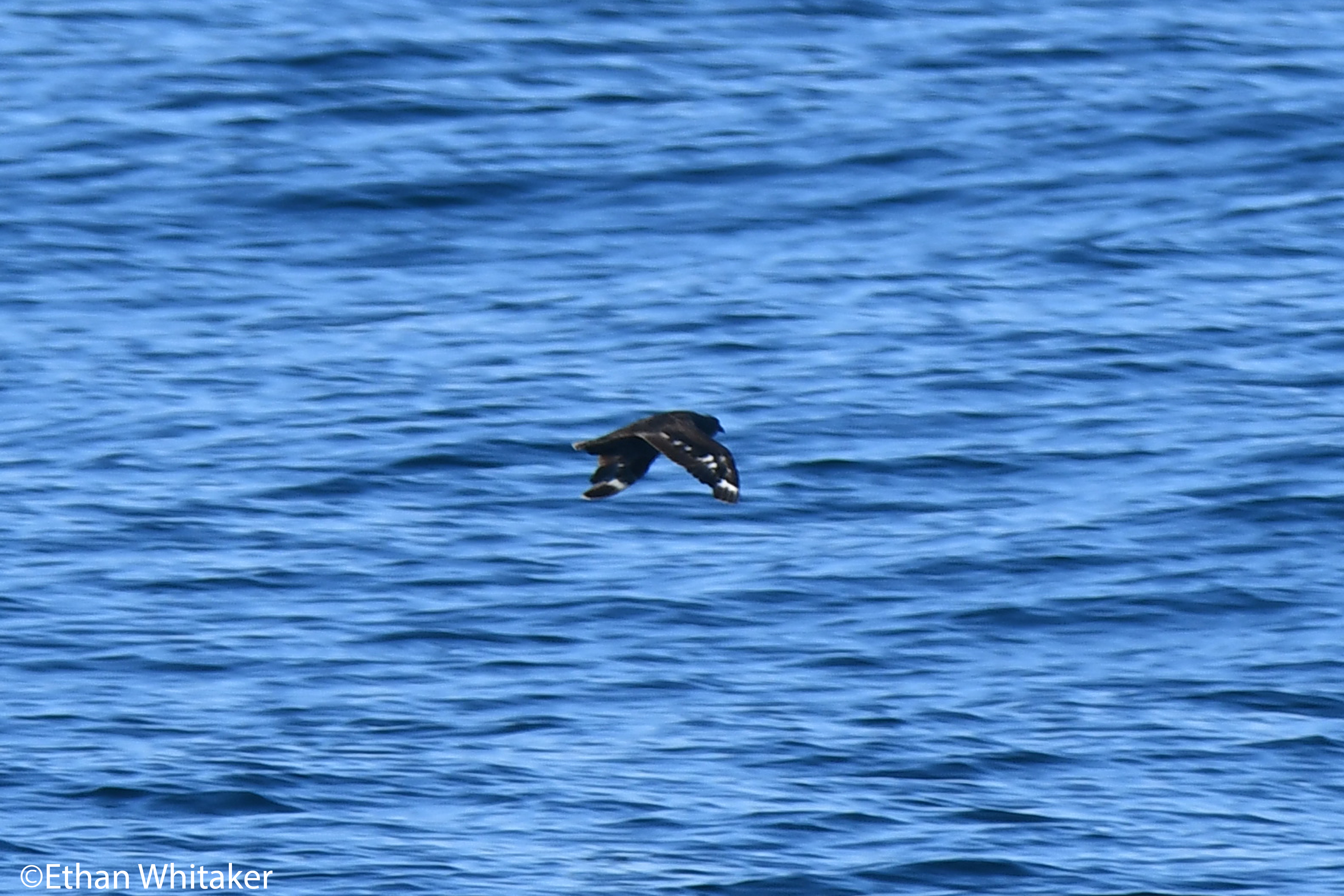
OK, let’s get right down to business: it was NOT a South Polar Skua. This is not the first time a mea culpa was issued over a Stercorariidae. It won’t be the last. Certainly not my last, anyway. But yeah, I got this one wrong, and I apologize.
We spotted a large, dark, and very heavy-looking skua/jaeger in flight parallel to the boat. Captain Nick did an exceptional job of staying with it, staying parallel to it, affording incredible views for an unusually long amount of time. We were traveling at 18.2 knots, and the bird was slowly taking the lead. When it looked like it was thinking of landing, I had Nick angle slightly away so as not to make the bird concerned. It worked! It landed, we slowly worked our way up to it, and almost circled it before it took off. High-fives were exchanged. Smiles reigned. We got a skua! Big, barrel-chested, thick dark bill, and short tail. The very cold tones and extensive molt strongly suggested South Polar Skua. It would be a life bird for many.
I was convinced in the field, and I was convinced when I got off the boat. Everyone I talked to was convinced too. Other than a small feeling that the bill looked a little long, and the bird looked a little, well, not-menacing on the water, I had little doubt. But as I announce on all of my pelagics, all jaeger and skua identifications are provisional until I can review photographs.
The doubt -err, fear – began in the evening, as I looked over Jeannette’s shoulder as she began to sort photos. Starting with the skua, I wanted to make sure it was in fact a South Polar, and not a Great. That was my only real concern. But then I saw her pics. I was observing through 8x binoculars, she was shooting at 400mm. Details would likely emerge that I could not see in the field. And I didn’t like those details.
That rear end did look a little tapered. The bill did seem a little thin. And wait, is that barring in the underwings? Uh-oh. Are we sure? What about the location of white within the outer primaries? Is it too narrow? And boy, it looks cuter on the water than I expected. And that bill does look two-toned and kinda long.
Photos were sent to a friend. The shadow of doubt cast over the room. He immediately said “Pomarine.” But we discussed, and he left it off as “but I could buy this as a skua.” Another friend “That’s a skua.” “I’m flip-flopping…maybe a hint of barring on the undertail and underwing coverts, but it looks so skua-like…the molt pattern is identical to one I saw a couple of weeks ago.” Back and forth with these three friends continued. I posted to the Skuas and Jaegers of the World Facebook page; “Definitely a skua…” said the first commentor. Books and papers were referenced.
More photos were received. And discussion continued. Some photos showed what could be nearly impossible to argue was anything other than a South Polar Skua. I only wanted to look at these.
I mean, look at that short little tail!And those dark underwings!
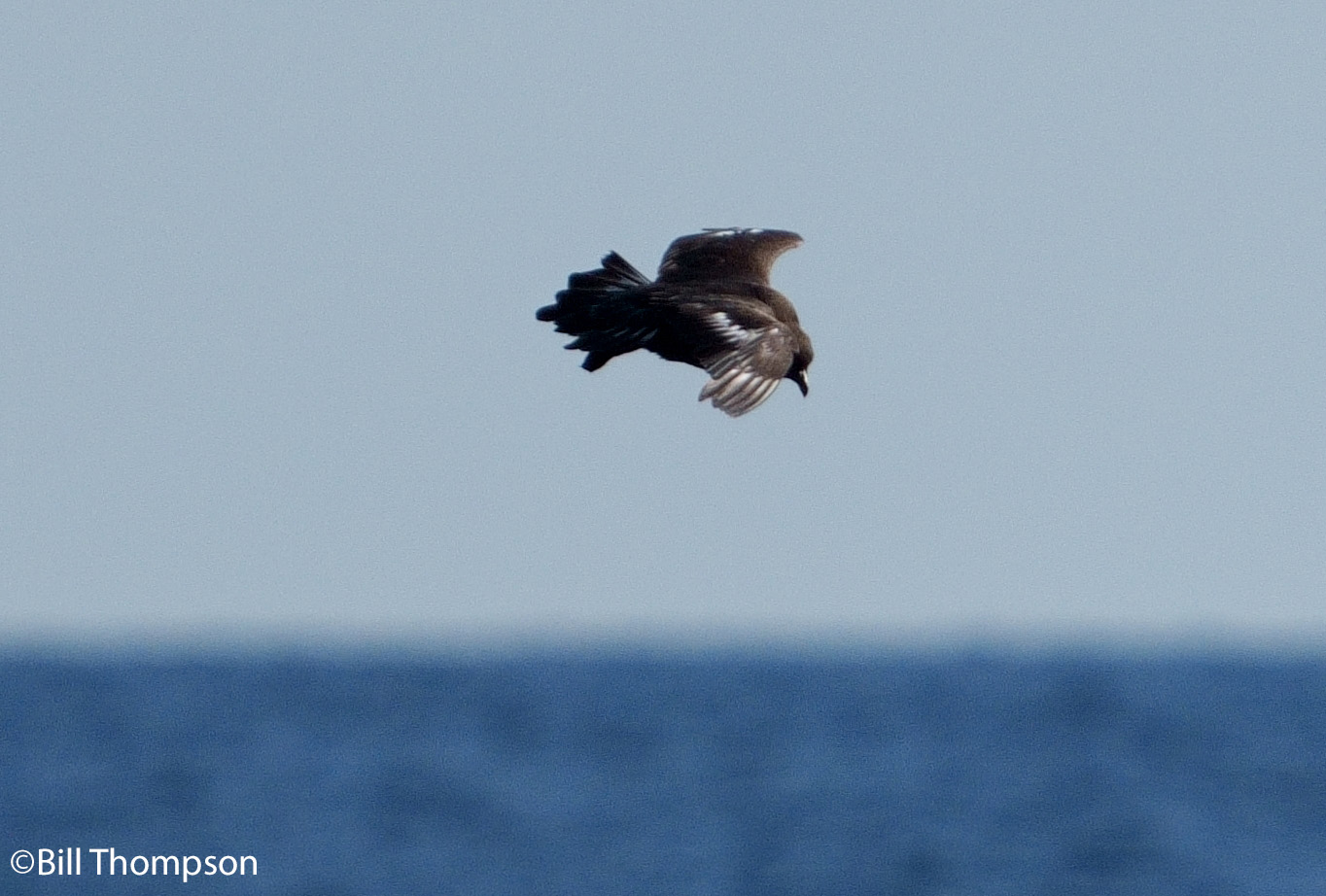
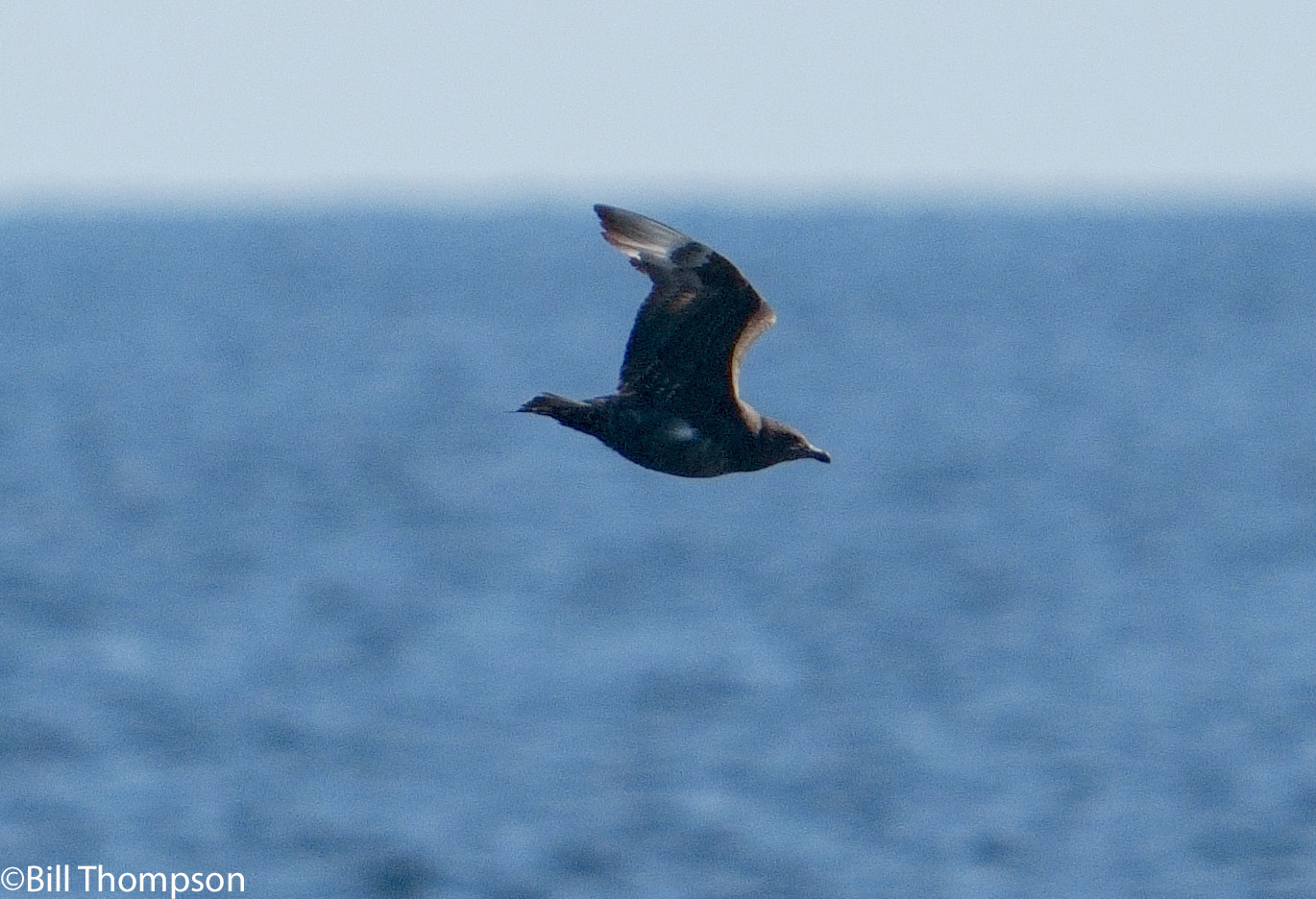
Sheepishly – knowing how tired he must be after a long drive to and from in the same day, I asked my friend Bill Thompson to check his photos. He jumped right on it, and sent this.
Well, crap.
Is that the beginning of the long, round-tipped central tail feathers of a Pomarine Jaeger? They’re so broad. And the rest of the tail is a worn, ratty disaster. That would explain why it looked so short-tailed in the field. But that bill looks short, stout, and all-dark.
I asked for an underwing shot.
Yeah, that looks barred. But still, that bird was a massive keg.
These photos were entered into the various discussions, and uncertainty ruled as I finally passed out from boat and skua-induced exhaustion.
I awoke – stalled in turning my phone on – and what little glimmer of hope was crushed when I opened some emails from Tony Carapella that clearly showed a Pomarine Jaeger. I mean clearly, unequivocally, without a doubt.
“And upon further review, the call on the field is overturned. After the play, personal foul, unnecessary roughness on the trip leader’s self esteem. 15 yards…”
Sorry, folks, I got this one wrong.
But, hey, the rest of the trip was decent, too, even if we scratched the headliner off the top. Right? Please tell me it’s all OK?
Of course, this wasn’t the only quandary on the day either. Late in the trip, three jaegers gave us the slip. I am hoping someone got some distant photos that might yield a hint, but for now, they will go unidentified. There were also two larger dolphins within a small group of Atlantic White-sided Dolphins. Kelsey and I are still trying to figure things out. Stay tuned. They were not skuas, either, however.
Several Northern Fulmars included one that eventually gave fantastic views. We had a few Black-legged Kittiwakes, and Captain Nick did an amazing job getting us a close look at the first one that was loafing on the water. We also had an American Pipit fly-by, and a Yellow-rumped Warbler land in the cabin and rest for a while before departing.
And it was an absolutely, insanely gorgeous day. The water had only a slight ripple, there was virtually no swell, and it was warm with plenty of sun (but just enough high clouds to reduce the glare). There could not be a better day to head into deep water in the Gulf of Maine.
In fact, the unreasonably benign conditions allowed us to motor even further offshore than usual to explore a new area. After finding two of our favorite spots a little, well, low on birds, we headed out about 28 miles to an area we found on the map known as “Mistaken Ground” where the bottom plunged to a depth of 918 feet. I accept the name as a warning that maybe this would not be a good decision. But alas, it was where most of our action was. I could have spent all day here.
Northern Gannets
While the chum slick failed to work, perhaps because it wasn’t windy enough to waft the odor towards hungry birds, and there were long stretches with virtually no life in sight, overall, we had a solid list for merely 4.5 hours offshore. The proximity to deep water and interesting underwater topography afforded by starting from Boothbay Harbor allows us to run these trips in a shorter timeframe, especially for those learning to get their sea legs. And today was definitely a day for building up one’s oceanic confidence. Confidence in skua identification, however, well, that is another story. Apparently, my “mistaken ground” was thinking I could identify these birds before studying photos on the computer!
Here’s the annotated trip list:
8 Canada Geese
970 Common Eider
113 Surf Scoter
12 White-winged Scoters
24 Rock Pigeon
1 POMARINE JAEGER (see treatise above)
1 PARASITIC JAEGER (one of the three distant birds that turned out to be identifiable from photos)
2 Unidentified jaegers
1 COMMON MURRE (spotted in outer harbor by a few observers)
1 Razorbill (confirmed from jaeger photo bomb)
9 Black Guillemots
7 Black-legged Kittiwakes
2 Bonaparte’s Gulls
145 Herring Gulls
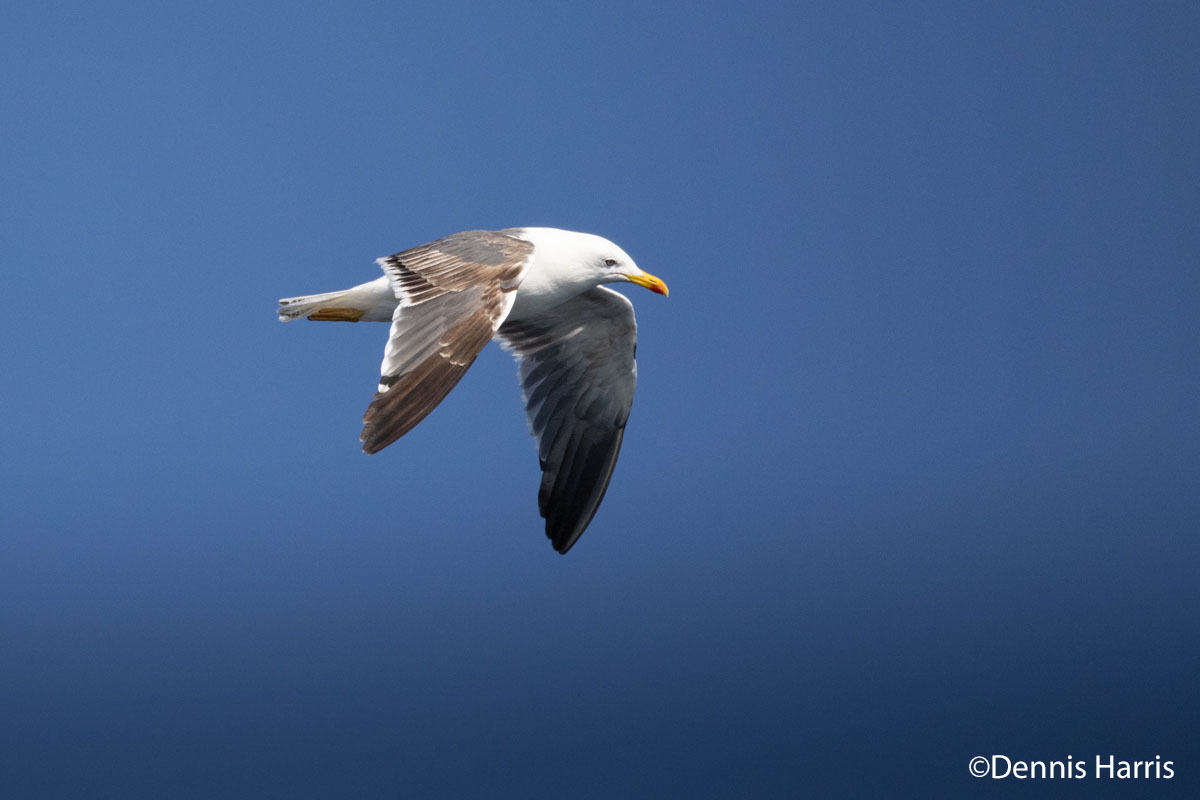
1 Lesser Black-backed Gull
With Great Black-backed Gull (right)
51 Great Black-backed Gulls
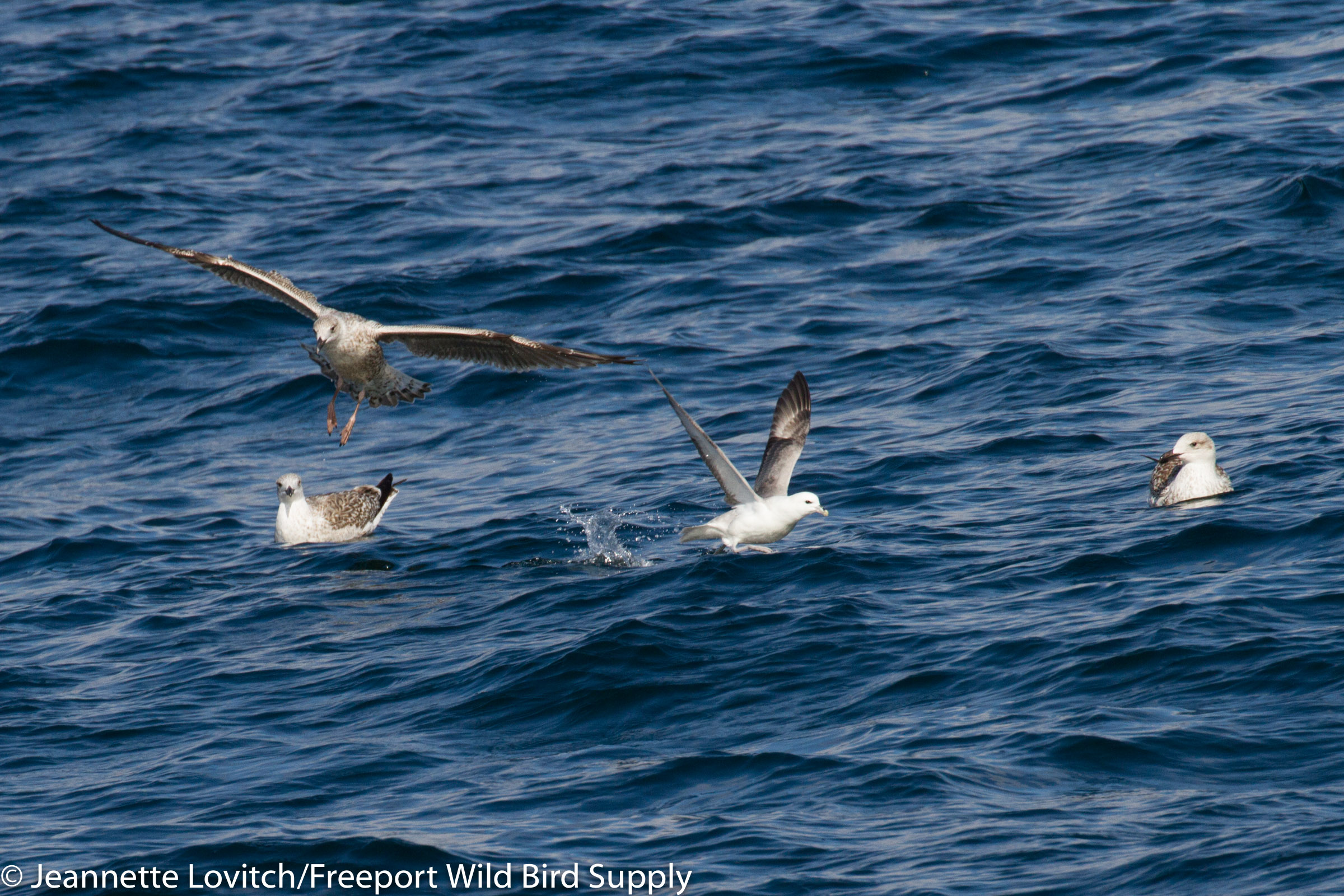
3 NORTHERN FULMAR
With Great Black-backed Gulls
1 Red-throated Loon
15 Common Loons
242 Northern Gannets
75 Double-crested Cormorants
2 Great Blue Herons
2 Bald Eagles
1 Merlin
8 American Crows
1 American Pipit
1 Yellow-rumped Warbler
1 Unidentified passerine.
Mammals:
1 Minke Whale
1 small pod of Atlantic White-sided Dolphins
2 unidentified larger dolphins (still working on ID possibilities but we have no conclusive photos yet)
Well that sure was fun! What a day! All the superlatives.
Fall pelagics in the Gulf of Maine are few and far between, especially in October. With whale watches ending early to mid-month each year, opportunities to board vessels to look for seabirds become greatly limited. There’s so much to learn about what is out there at this time of year.
Furthermore, fall weather is temperamental, and planning for a day of deep-sea birding months in advance is a crapshoot. And even when the conditions are great, there are days where there just seems to be no life out there. I’ve certainly been on whale watches in October without a single non-gannet seabird. Those can be long days, especially in rough seas.
Monday was NOT one of those days. In fact, it was incredible. Following up on our success of last year’s trip on October 12, and several extremely productive whale watches over the years with our partners for this tour, Cap’n Fish’s Cruises, we had high hopes, but reasonable expectations. Because pelagics. In the Gulf of Maine. In October.
The first of our wishes had come true: the boat was going to run! Although there would be some swell offshore (and there was), there was no concern about getting far offshore today. The winds were light, the air was warm, and it was basically about the nicest day one could hope for in a normal October in Maine.
So that was a good start. But soon, it got even better. Shockingly so.
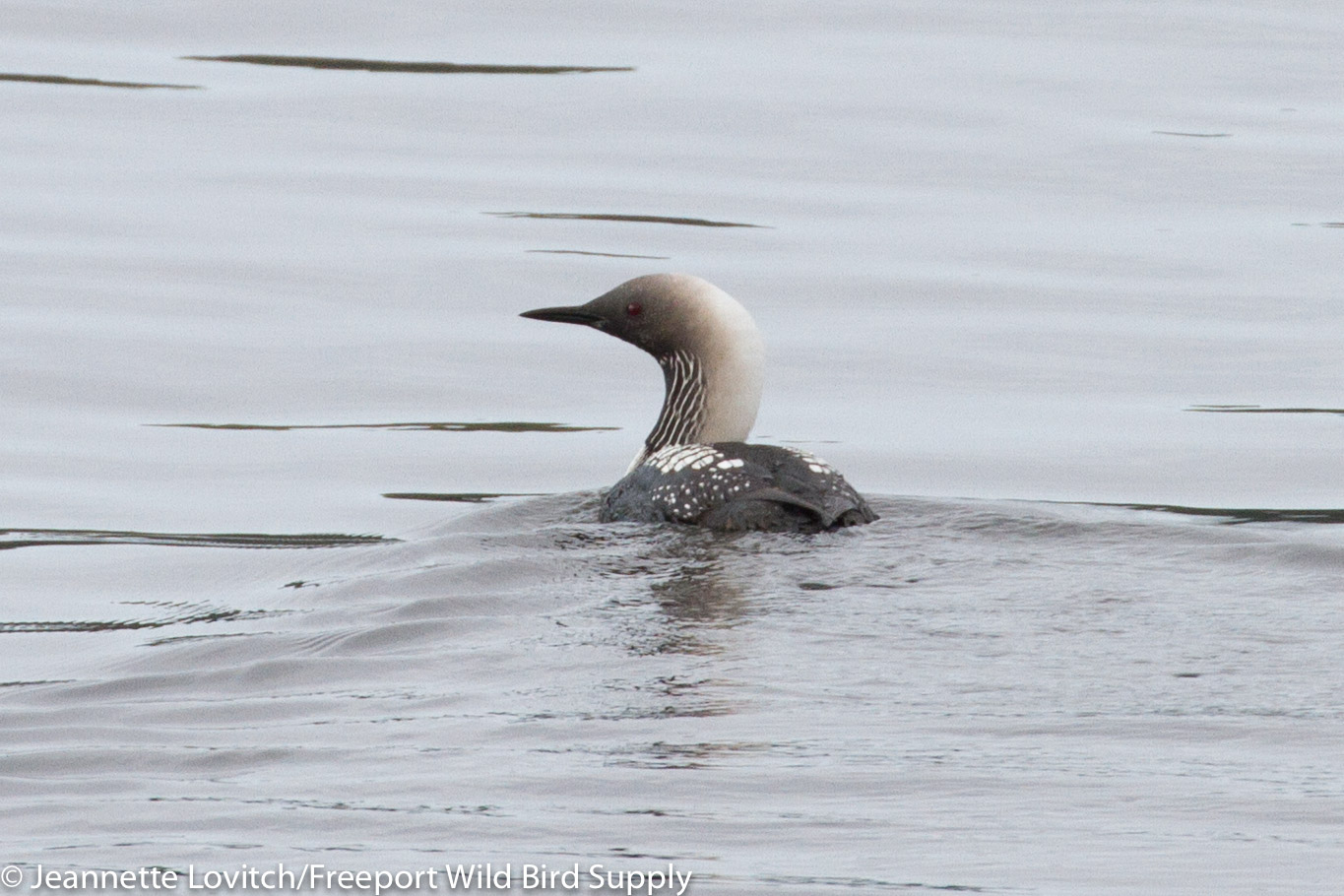
Just a few minutes out of the dock, a few folks spotted what they thought was a Red-throated Loon. I took a look, expecting the first Red-throated Loon of the season, but was shocked when I saw the puffy head and bright gray nape of what could only have been a Pacific Loon! In full breeding plumage!
What the what?
This stunning bird – rare but regular in Maine but extremely rare in such stunning breeding plumage – was with a Common Loon right off our bow. And we had not yet even left the harbor’s no-wake zone.
We were in the boat channel, and luckily, there was no traffic coming or going, so Captain Steve adeptly turned us around and we slowly worked our way closer to the loon, attempting to get the bird in the best light possible for photographs. And this was no easy feat – we were in a narrow channel and if there were any other boats coming or going, this maneuver might not have even been possible. But alas, luck was with us already, and many folks had a life bird, year-bird, or “life-plumage” before we even left the harbor. I for one was not ready for this…I was still organizing, and we were still plotting a course! And I clearly needed to finish that cup of coffee (words? What are words? And how do I use them again?)
Could this day get any better? Spoiler alert: it did.
The great thing about our partnership with Cap’n Fish’s is that we have a great, fast, comfortable boat that can cover a lot of ground when we need to. However, there’s something special about this area at this time of year that means we usually don’t have to. In fact, shortly after clearing Damariscove Island, we started picking up Northern Gannets and the first few scattered Great Shearwaters. There just wasn’t a long stretch of “worthless” ground to be transited before we start to see life. This was even more evident on the way back, as we were tallying seabirds until we were right up to the eastern side of Damariscove.
In between, we covered a fair amount of ground at a steady speed, setting two chum slicks over promising areas. Covering a couple of ledges and a long contour line where we have had great success in the past, there was rarely any lengths of time we didn’t have a pelagic species or two. We never went further than 20-25 miles offshore, mostly working an area near the Portland ship channel that has been productive for us in the past. At times we were in waters up to 500ft deep but were more interested in places where upwelling might occur – such as near ledges, ridges, or “holes.”
Unfortunately, birds were just not excited about the chum today, so we didn’t have a ton of birds close enough to touch. But, our captain did his best to get us close to the occasional raft of loafing Great Shearwaters for example. Northern Fulmars seemed to be “sniffing out” our offerings, but excitement never developed. Lots of great, close passes however, with others sitting on the water here and there. I was conservative in my count as I thought 4 birds were making a wide circle around us for a spell, but it’s possible there were a lot more individuals.
Great Shearwaters
I now expect Atlantic Puffins off this boat at this time of year, but we did not expect to tally 32 of them (which seems quite low in hindsight). I was surprised to not see any Razorbills until we were almost back inshore, but then we had some good looks within site of the outer islands.
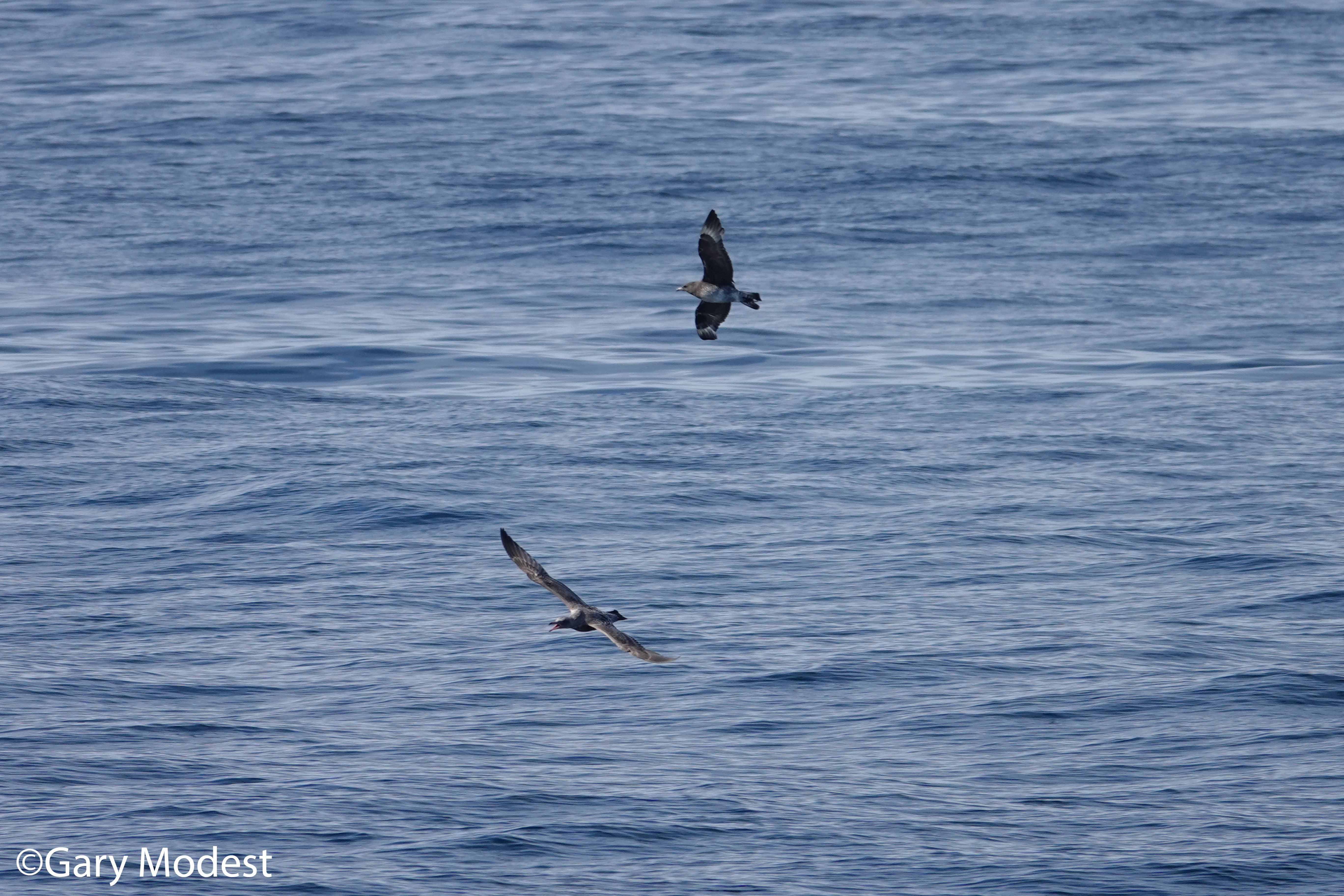
It took photo review to confirm the two jaegers (including one frustratingly distant one) as the expected species, Pomarine. But still, any day with a jaeger is a good day.
There was a good 2-4 foot swell offshore, but little chop. You could feel the roll though, and a few sharp turns were definitely noticed. It was just enough to limit how quickly we could stop on a dime and go back for a loafing bird, or change course to chase down a jaeger. But overall, it was a decidedly pleasant day on the water!
I think most people would have been satisfied if the only “good” bird was the Pacific Loon, but we had a challenger for best bird of the day. Now, the looks we had and the gorgeous plumage of the loon put it ahead for many, but from a rarely-encountered perspective – along with the fact that this is THE bird(s) we hope for on this trip – the excitement among participants reached its crescendo when I yelled the magic word: “SKUUUUUUUAAAAAAAAA!”
Just about 2/3rds of the way through the trip and about 20miles offshore, a dark, menacing terror of the ocean came roaring towards us and passed in front of the bow. It took a half-hearted swing at a Herring Gull before, unfortunately, continuing on. I spotted it as it was coming towards us at 11:00 (the bow of the boat is 12:00), but most folks got on it only as it came out of the sun glare by 1:00 or so. Therefore, most of our photos are of the bird heading away.
My initial reaction was Great Skua based on my impression of a reddish-tone to the upperparts in particular. I thought I saw a darker crown and I didn’t see a pale blaze on the face. Great Skua is a little more likely in this season, but we are still far from understanding the true ranges of it, and its southern Atlantic counterpart, the South Polar Skua, and especially differences in age classes (and their respective molt patterns).
However, after trying my best to give useful and enunciated directions to all the observers on board, I got back on the bird to study it only as it was going away. I was surprised by the cold, dark brown appearance it now had, as opposed to that first impression.
We threw out some chum to try and stir the pot, but it just kept going. We began a chase, but that did not last long – the skua smoked us!
The first photo I looked on the back of a camera seemed to confirm the reddish tone that would be indicative of Great Skua.
So that temporarily confirmed the call on the field, but as I made clear, I wanted to review as many photos as possible. And as I began to receive them, I could not get over how most of them showed a very dark, cold South Polar-like color impression.
The instant replay was now under review. Some skuas are straightforward, but this was not one of them, in large part because of the distance it passed and the lighting we were able to photograph it in. I have sent photos to several friends more fluent in skua than I, and I awaited their analysis. There are a few things that are just not computing for me, but I – like 99.9% of birders – just don’t have enough experience with skuas, especially in fall when many are a molting mess.
Unfortunately, a head-on or side shot might give us a definitive head pattern, but that is not apparently in existence. The lack of blond streaks on the back is a knock against Great, but some non-adults are really dark and minimally streaked at this season. And no photos show the nape, either.
So this is the best that we have to go on at the moment. I’ve included a series of photos here, and more can be found on eBird. I will update this blog as I receive more information and continue to study the incoming photos but I do believe at this time that this is a 1st-year South Polar Skua. That would explain the pattern of molt (similar to what an adult Great Skua should look like now) and those worn outer primaries that gave many folks – myself included – an impression of a paler, warmer brown. Also, those new coverts on the upperparts are so blackish – I can’t seem to find photos of Great Skuas suggesting that kind of deep, dark color. (I will add comments and commentary at the end of this entry as I receive them. I’ll also update the photo suite if I receive anything new and revelatory.)
Anyway, skuas are awesome, even if their identity is often in question – and realistically, cannot always be answered. But we had _a_ skua, any skua, and that is the apex of a fall pelagic trip, especially the further west and south you get.
(Oh, and since I am thinking of it, here’s a link to the pelagic-by-cruiseship that Jeannette and I investigated a few years back. That was a skua fest and resulted in my first confirmed Great Skua for Maine – which had been a nemesis until then. We were talking about this trip on the boat and wanted to share the link. )
So yeah, a Pacific Loon and a <insert identity> Skua! Lots of puffins, Great Shearwaters, Northern Fulmars (another target of the season), and so much more. And yes, we had a couple of Minke Whales, lots of Harbor Porpoise and Harbor Seals, several schools of Bluefin Tuna, and a really lovely pod of Atlantic White-sided Dolphins.
The following counts were adjusted to reflect total number of individuals (and not double-counting birds in and around the harbor while traveling to and fro) tallied in separate eBird transects kept by my trusty co-leader, chummer, and list-keeper, Ian Carlsen.
I’ve annotated the checklist with photos from Jeannette and others, as I received them. I’ll add more, especially if any pertinent to the skua ID discussion surface.
500+ Common Eiders
300+ Herring Gulls
173 Great Shearwaters
100+ Double-crested Cormorants
85+ Great Black-backed Gulls
94 Northern Gannets
32 ATLANTIC PUFFINS (high!)
31 Rock Pigeons (dock)
16 Common Loons
15 Black Guillemots
12 NORTHERN FULMARS
8 Razorbills
3 Bald Eagles
2 POMARINE JAEGERS
Bird #1:
Bird #2:
1 Surf Scoter
1 SOUTH POLAR SKUA (*see discussion above)
1 Black-legged Kittiwake (juvenile)
1 PACIFIC LOON (no, seriously!)
Today was a good day!
Skua Identification feedback (coming soon):
From Michael O’Brien:
“It’s tough to see much detail on this bird, so hard to be 100% sure about it. Having said that, I think I would lean toward a first year South Polar. It has fresh inner primaries, which fits the molt pattern of an adult Great or first year South Polar. The outer primaries seem quite worn/faded, which is why I’m thinking it’s a first year bird with old juv outer primaries. In terms of color, it seems fairly cold toned, and in particular, what looks like fresh greater coverts seem dark and cold toned vs normally paler, warmer, and more mottled (and contrasting with darker secondaries) on a Great. So that’s my take on it, at the risk of reading too much into some distant photos! “
My observations of note over the past fourteen days included the following:
Rare mid-summer SCOTER hat-trick with 4 Black, 2 White-winged, and 1 Surf, Simpson’s Point, Brunswick, 7/3.
4 Greater and 3 Lesser Yellowlegs, Wharton Point, Brunswick, 7/3.
Seawatching from Eastern Point, Gloucester, MA on 7/8 during Tropical Storm Elsa (with family): In about 2 hours where fog lifted enough to see, Great Shearwaters were passing at an average of 199 per 5-minute segment and Sooty Shearwaters were passing at an average of 314 per 5-minute segment. Plus 2 MANX SHEARWATERS, 1 unidentified JAEGER, and 1 Cory’s Shearwater.
My observations of note over the past six days included the following:
1 3rd-cycle LESSER BLACK-BACKED GULL, French Island Ledge, Casco Bay, 6/6 (with “Birds of Casco Bay” tour group). Photo below.
1 Roseate Tern, The Goslings, Harpswell, 6/6 (with “Birds of Casco Bay” tour group).
1 COMMON MURRE, 4 NORTHERN FULMARS, 5 RED-NECKED PHALAROPES (FOY), 103 Wilson’s Storm-Petrels (FOY), 1 Great Shearwater (FOY), etc, Boothbay Mini-Pelagic with Cap’n Fish Whale Watch, 6/7. Full trip list and tour report here.
Thanks to last fall’s wildly successful half-day pelagic with Cap’n Fish’s Cruises, we partnered up again to offer three outings in 2021. On Monday, June 7th, the first of three departures took place.
June is an untraditional month for southern Maine pelagics, but our Boothbay Harbor departures, and a fast, steady boat allow us access to some prime areas. Few people had this in mind however on Monday, when instead, most people were just excited to escape the stifling heat on land!
The seas had died down overnight, and the mere 2 foot swell was often barely noticeable. A cooling breeze over the 56-degree water made us welcome our layers, but not at all miss the sweltering mainland.
There are few guarantees in pelagic birding…well unless you visit a seabird island! So instead of just searching for needles in the offshore haystack, we first headed over to Eastern Egg Rock. We sifted through many hundreds of Common Terns until everyone got good looks at Roseate (20+) and Arctic (20+) Terns. 75-100 Atlantic Puffins, 100+ Black Guillemots, 500+ Laughing Gulls, Common Eiders, a Spotted Sandpiper, Double-crested Cormorants, Herring Gulls, and Great Black-backed Gulls were all observed from the comfort of our limited-capacity boat.
A passerine on our way to Eastern Egg Rock may have been an oriole (awaiting photos to review), but that was our only non-seabird of the day. Kelsey pointed out lighthouses, islands, and other landmarks as we motored from the harbor out past Monhegan Island.
We then traveled over 20 miles to waters over 500 feet deep, and a ledge where the bottom rose steeply to a depth of only 380. On the way out, it was quiet. Really, really quiet. Uh-oh, is this was June pelagic birding is like around here too?
But traveling over fairly flat, often sandy or muddy bottom is not a good sample, and as we hit the deeper water and some topography, we began to see our first tubenoses of the day: Wilson’s Storm-Petrels, which have just arrived from their sub-Antarctic breeding areas.
With Ian chumming, petrels began to come in closer, and the first of our Northern Fulmars arrived to check things out. While we worked the ledge, and then double-backed on our chum slick, the birds kept appearing and Captain Mike did a great job keeping birds in the best lighting possible.
Some of the highlights included the rather late fulmars and an unseasonable offshore Common Murre, but I think the real highlight was how well we saw just about everything! Even two of our Red-necked Phalaropes were close enough to age and sex (they were adult female), and Ian’s chum brought fulmars and storm-petrels in close. While we only had one Great Shearwater on this early date, it too made a close pass, affording good looks for everyone.
The total seabird count away from Eastern Egg Rock (see estimates from there above) was as follows (not including gulls and other nearshore species)
103 Wilson’s Storm-Petrels
13 Northern Gannets
10+ Arctic Terns (out of sight of Eastern Egg)
5 Unidentified phalaropes
5 RED-NECKED PHALAROPES
4 NORTHERN FULMARS
1 Great Shearwater
1 COMMON MURRE
It was not the diversity of later summer and fall, and certainly not the numbers (at least once we left the magic of Eastern Egg), but we had a nice selection of “good” birds, great looks at them, and we did all of this in less than four hours in offshore waters. The convenience of a Boothbay departure, the accessibility of some rich feeding areas without heading too far, the speed and comfort of the boat (especially the grilled cheese sandwiches), and more resulted in another rewarding trip and a sure sign of the potential of these tours.
In fact, our next trip in July (no chumming on this one, unfortunately) with a similar itinerary of starting at Eastern Egg Rock is filling up fast. We’re also now accepting reservations for our October outing, which, based on last year’s results, we are already looking forward too!
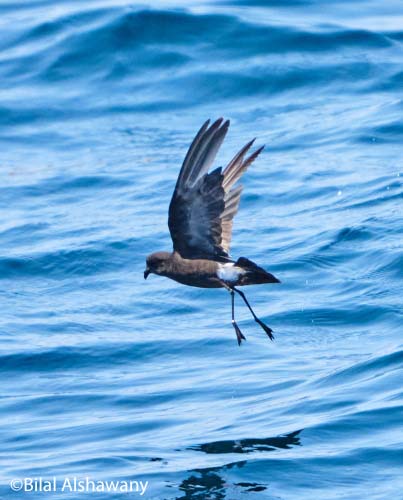
Leach’s Storm-Petrels were the star of the show today!
We were very excited to kick off a new partnership between Freeport Wild Bird Supply and Cap’n Fish Cruises with a half-day pelagic birding trip out of Boothbay Harbor on Indigenous Peoples’ Day, October 12th. We departed the wharf at 9:00am and returned at about 1:45pm.
Cap’n Fish’s Dominique Caverly joined me in narrating the tour, adding additional natural history information. Captain Tabor did an exceptional job keeping the boat as comfortable as possible, finding some interesting underwater topography, trying to position the boat to view birds in the best light, and catching up with those two jaegers! Ian Carlsen was our chummer extraordinaire, getting fulmars and Great Shearwaters within a few yards of the boat – while simultaneously keeping track of our eBird transects.
With a forecast for 2-3ft seas, we were not all that happy to find them more like 2-4 with the occasional 5-footer, but Captain Tabor did a great job in picking a track that maximized our time with comfortable following seas. There were a few bumps and splashes along the way, but so goes pelagic birding in the fall in the Gulf of Maine. We were just happy to successfully get offshore!
Heading into deeper waters of the Portland shipping channel about 20 miles offshore, we explored an area where the seafloor rises from 500 feet to 300, before dropping off again to over 600. What’s great about departing from Boothbay – and bodes well for future tours from here – is that we don’t have to travel too far to get to some good deep-water and interesting seabed topography.
Fall pelagics in the Gulf of Maine, especially in southern Maine, are a fickle beast, and can be really hit or miss. In fact, I have been out on whale watches in October that failed to record a single tubenose! But, having had a significant amount of success with Cap’n Fish’s whale watches during the fall, I was quite excited for the chance to head out on a dedicated bird-finding mission.
And it did take some work to find birds today. Even Northern Gannets and gulls were in very short supply. However, once we got to that aforementioned ledge, we had a lot of birds all around us.
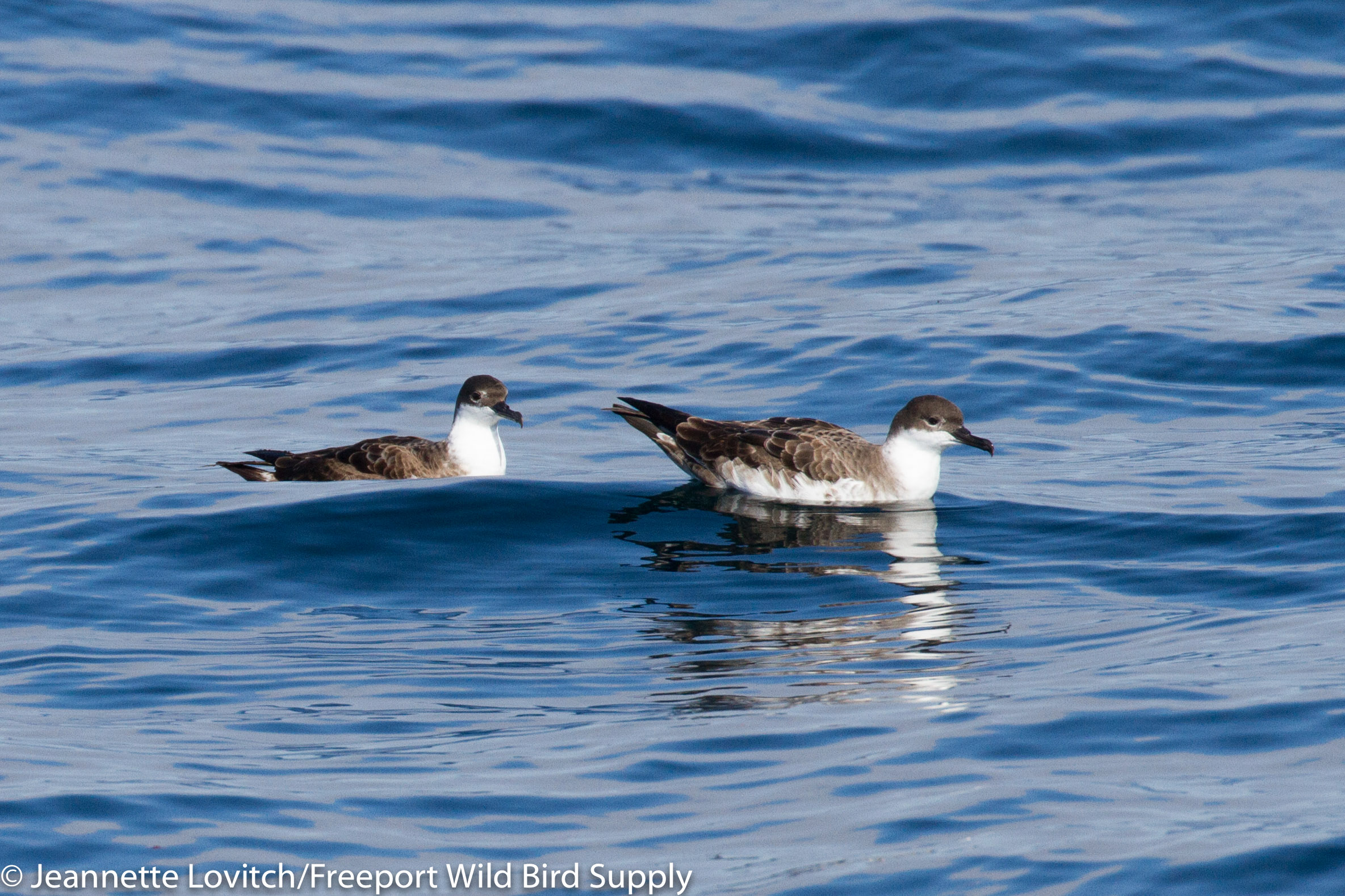
Great Shearwaters were the most numerous “tubenose” as expected.
But 3 Leach’s Storm-Petrels were anything but expected! Even one would have been a headliner, but today we had three – two of which were seen extraordinarily well for prolonged periods of time. I was hopefully for this species, but they are so hit-or-miss, I only included it on my “possible” list. And then I expected the sighting to be like our first – one zipping by and only seen by a few observers. Those second two, however: wow, just wow!
Any day with a jaeger is a good day in my book, and we had two good sightings of Pomarine Jaegers today, including one that was around us and reigning terror for a while. I called them both “Poms” in the field, but I looked forward to receiving photos to confirm their identify – no one should be above going to instant replay for jaegers! In fact, one early photo I received had me rethinking the first bird, but upon receiving a full set, the play was confirmed as called on the field.
Three Atlantic Puffins and 9 Northern Fulmars were more expected, but no less great to see. Unfortunately, the Razorbill was seen in flight by only a few. My tally of 91 Great Shearwaters is likely woefully conservative. When chumming, it became impossible to keep track of how many birds were circling us rather than just passing by for a look (and sniff!). And while this was indeed a birding-centric tour, we were disappointed to only encounter Harbor Seals and Harbor Porpoises during our travels; yes, this pelagic brakes for whales!
And finally, passerines are always exciting when encountered offshore, and always a challenge. I was a little surprised we didn’t encounter more as there had been a massive flight overnight, but the lack of a westerly component kept those birds from drifting offshore. In fact, both birds we saw were heading southwest, likely “onward” migration rather than compensating for overnight drift. One was relegated to “passerine species,” but photographs confirmed the other as a Yellow-rumped Warbler.
Beginning and ending with Black Guillemots and Common Eiders in the harbor and returning to a lovely warm and calm afternoon in the sheltered town, we can unequivocally call the day’s outing a success…and yes, plans are already in the works for more trips together in 2021! Sat tuned!
Here is the annotated checklist from the day:
Common Eider: 23 beyond mouth of the bay; numerous in harbor.
Surf Scoter: 61
dark-winged scoter sp: 20
Pomarine Jaegers: at least 2 winter adults; possibly a third bird.
#1:
#2:
Razorbill: 1 fly-by spotted by Captain and a few participants.
Black Guillemot: x
ATLANTIC PUFFIN: 3
Ring-billed Gull: 2
Herring Gull: x
Great Black-backed Gull: x
Common Loon: 15
LEACH’S STORM-PETRELS: 3. All photographed. First bird seen only by a few, second two birds seen insanely well and for prolonged periods of time.
#1:
#2:
#3:
Just ridiculously stunning views of this very challenging-to-see species!
Northern Fulmar: 9
Great Shearwater: 91 (very conservative count)
Northern Gannet: 30 (low)
Yellow-rumped Warbler: 1 (about 22 miles from land)
Passerine sp: 1 (probably a warbler but that’s as much as I can say)
Only marine mammals were Harbor Porpoises and Harbor Seals.
Great Shearwaters may have been overshadowed this day, but they too put on a great show!
















































 Maine Birding Field Notes