Tag Archives: migration

Sabattus Pond Season-in-Review

Sabattus Pond was frozen on Monday morning, as I expected, thanks to this recent bout of unseasonably cold weather.  While 35 Mallards, 3 Hooded Mergansers, 2 American Black Ducks, and 1 Mallard x black duck hybrid were present in the outlet stream, this likely brings my Sabattus birding season to a close.

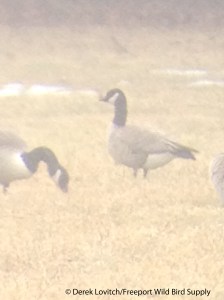
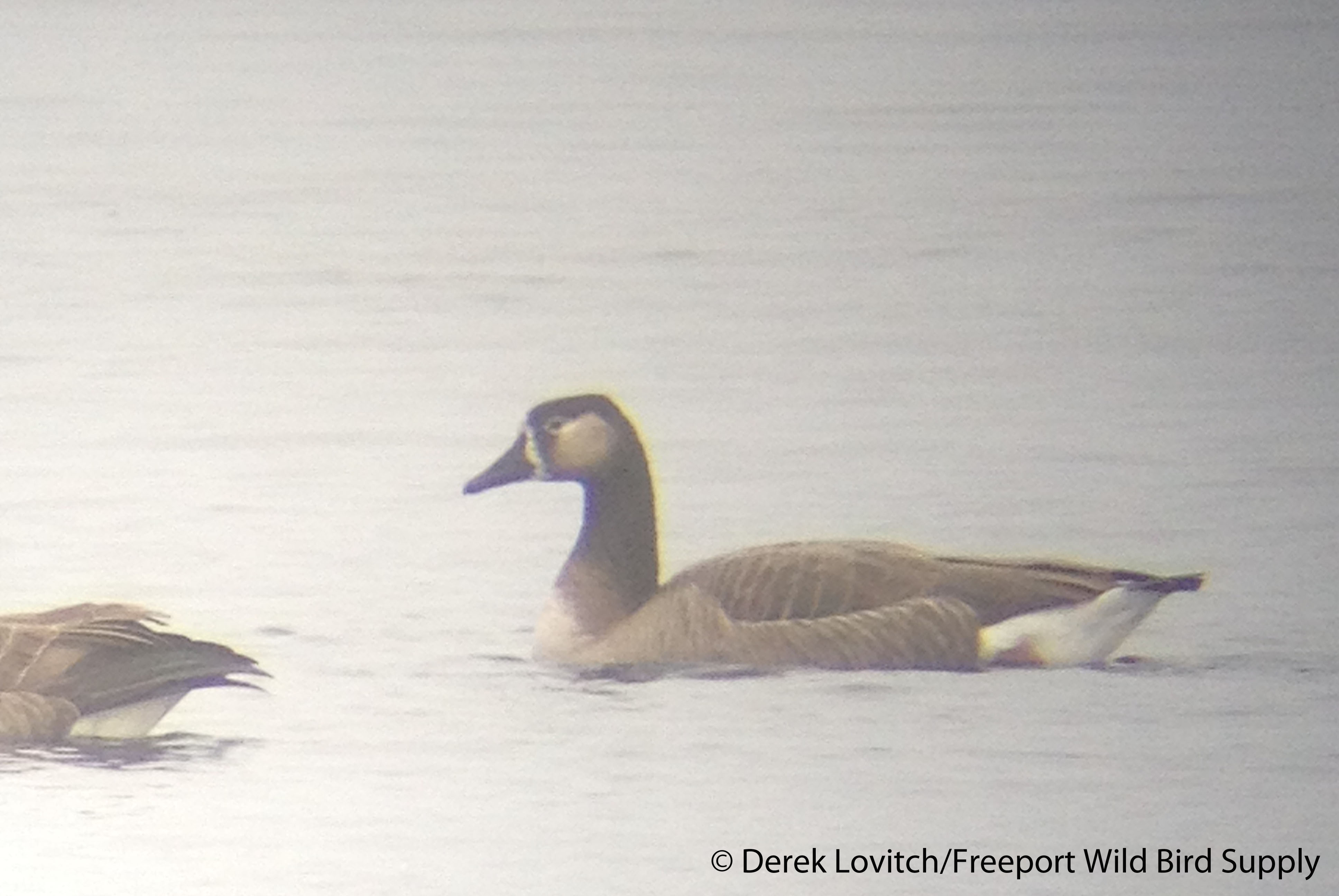
But it is just after Sabattus’s freeze-up that LakeAuburn is its most productive.  Today, 117 Canada Geese, 58 Greater Scaup, 46 Lesser Scaup, 41 Ruddy Ducks, 22 Common Goldeneyes, 8 Hooded Mergansers, 1 Bufflehead, and 1 continuing hen Black Scoter were tallied in a less-than-exhaustive search of the large lake.  The Black Scoter is a great bird inland, and she’s been present for at least five weeks now.  Meanwhile, among the Canada Geese, there was this funky mutt – apparently a hybrid with some sort of domestic thing.
CANGhybrid1,LakeAuburn,12-2-13

CANGhybrid2,LakeAuburn,12-2-13

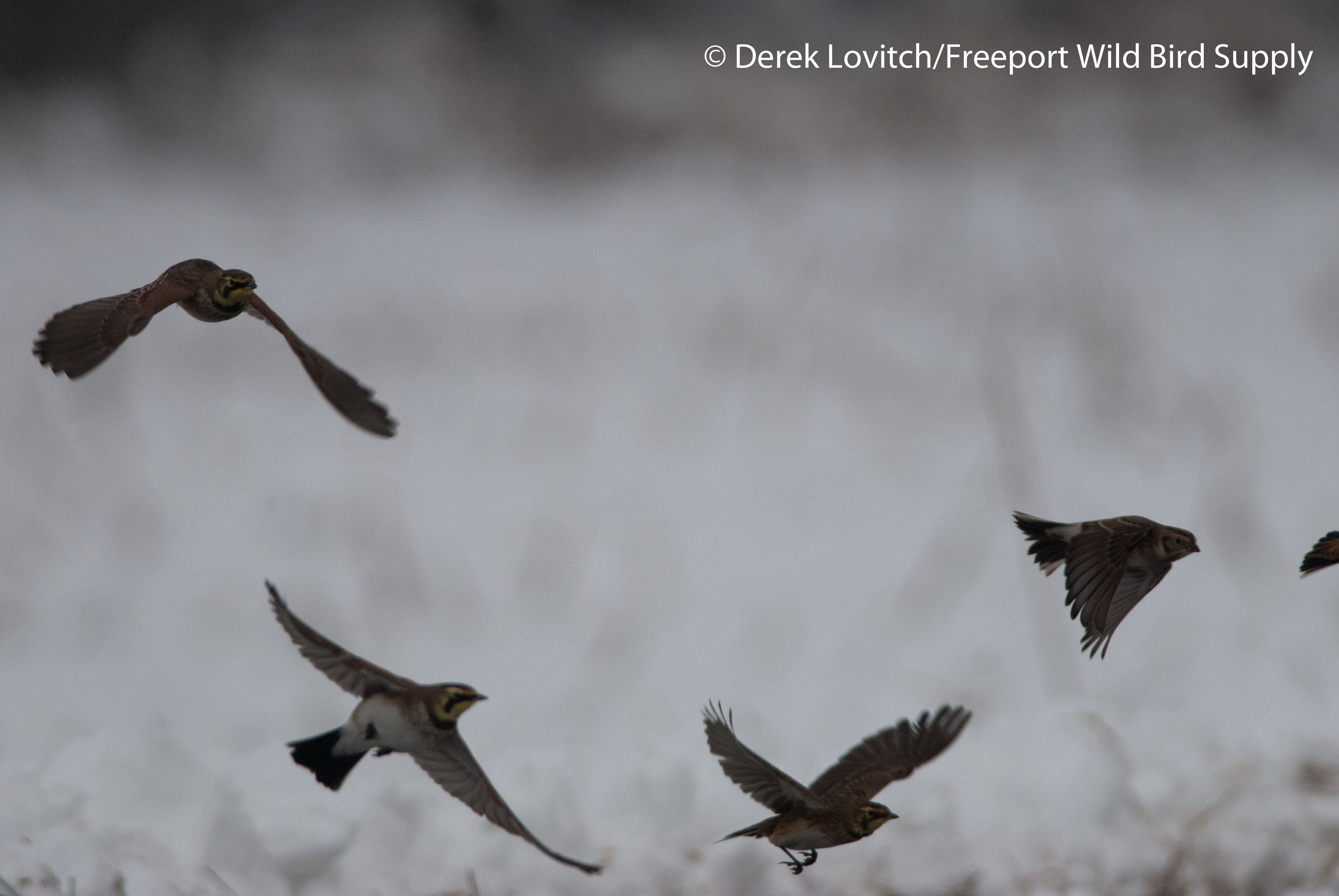
Between visiting the two lakes, I scoured Upper Street in Turner for Snowy Owls (none) or other raptors (just one Red-tailed Hawk), but I did happen upon a small flock of 35 Horned Larks that contained two Lapland Longspurs.  They were feeding at the edge of Pearl Road, taking advantage of where the plow had scraped the sides of ice and snow.  I got this lucky shot of one of the Lapland Longspurs in flight with the Horned Larks.  Unfortunately, the light mist and heavy cloud cover prevented a really great shot.
DSC_0154_LALOwithHOLA,Turner,12-2-13

But back to waterfowl…

Sabattus Pond is one of my favorite birding locations from mid-October through freeze-up.  The diversity of ducks is rarely matched in this part of Maine, and the proximity and ability to study birds (such as Lesser vs. Greater Scaup) is unsurpassed.  Each fall I tell myself I needed to visit Sabattus more often, so this fall I committed to visiting once a week, beginning on 10/30 – I would have started a little earlier in the month, but the weather at the time had been so warm that waterfowl were not yet arriving en masse prior to the end of the month.

I tallied all waterbirds (except for Herring and Ring-billed gulls) on each visit.  I was curious to document the ebbs and flows of respective species throughout a full season here.  I also hoped to find some rarities of course.

Here’s my weekly tally (on 10/30 I birded with Cameron Cox, and on 11/21, Dan Nickerson):

10/30    11/7    11/14   11/21   12/2
Canada Goose                        2          0          0          0          0
American Black Duck          14        53        63        24         2
Mallard                                154      301     254      255       35
Mallard x black duck              2          4          8          6          1
NORTHERN PINTAIL               1          1          0          1          0 (same bird)
Green-winged Teal                 0          0          1          0          0
Greater Scaup                       15        22        27        20         0
Lesser Scaup                       133      185      204      174        0
WHITE-WINGED SCOTER        0          0          0          1         0
Bufflehead                              12          9          5          8         0
Common Goldeneye               2        29          4          2         0
Hooded Merganser               11        17        15        19        0
Red-breasted Merganser        7          1          0          0        0
Common Merganser                0         3          7      224        0
Ruddy Duck                           470     531      541      273        0
Common Loon                          2          4          9          3        0
Horned Grebe                           1          0          0          0        0
RED-NECKED GREBE                0          0          1          0         0
Great Blue Heron                     0          0          0          3         0
Great Black-backed Gull          0          0          0          1         0
American Coot                          0          0          1          0         0
Belted Kingfisher                      0          0          0          2         0

Other highlights at Sabattus included a Peregrine Falcon and 40 Snow Buntings on 11/7 and 3 White-rumped and 3 Pectoral sandpipers on 11/14 (both late and noteworthy inland).

Overall, it was probably only an average season at Sabattus.  The only week I missed was last week, due to my schedule and Thanksgiving, which is unfortunate, as the pre-ice-up week would have provided some interesting data.  There were no fallouts, and only a few unexpected (or at least, expected to be seen rarely) birds (in caps above).   The Ruddy Duck numbers were well above average, but a lot of other things – especially the scaup – were average or below my high counts of recent years.  And why don’t coots visit here much anymore? And really, not a single Ring-necked Duck!? Nevertheless I find it very rewarding to regularly check one location, so I thoroughly enjoyed my extra effort this year.

On each visit, I also visited LakeAuburn, which is a much different body of water (deeper, sandier, and apparently without the invasive Chinese Mystery Snail that provides the sustenance for most of the birds on Sabattus).  Note, however, that as the numbers of ducks decrease on Sabattus, they begin to increase on LakeAuburn – the last lake to freeze in the region.

11/7     11/14   11/21   12/2

Canada Goose                        0          0          0      117
American Black Duck             1          0          0          0
Mallard                                     3          6          0          0
Greater Scaup                         0          0        38        58
Lesser Scaup                           8          0        31        46
SURF SCOTER                          1          0          1          0 (probably same bird)
BLACK SCOTER                       1          0           1          1 (probably same bird)
Bufflehead                              0          2           0          1
Common Goldeneye             0          5         21        22
Hooded Merganser               0        14           5          8
Common Merganser             0          3           0          0
Ruddy Duck                           20         2           0        41
Common Loon                        7         9           1          4
Horned Grebe                         1          0          0          1
RED-NECKED GREBE              0          1          0          0

I can’t help but wonder if some of the birds on the lake on Monday would return to Sabattus if a warm spell opens the pond back up, and if it does, I am sure birds from points north might drop in as well as they are frozen out of lakes and rivers.  In other words, the duck-watching season on Sabattus may not be over yet, but I think I will be turning my attention elsewhere unless it warms up dramatically.

Meanwhile, on all of my visits to the two lakes, I added at least a few other stops in between in the hopes of finally finding a really “good” bird in Androscoggin County (away from Sabattus, that is).  Uh…nope.  My only real highlights away from the two lakes were the two Lapland Longspurs on Monday.  My rarity drought in AndroscogginCounty might continue, but the waterbird watching is certainly exceptional.

By the way, in a series of spring visits, I have found very, very few ducks on Sabattus Pond, for reasons unknown.  Therefore, other than my annual check on Maine Maple Sunday, I’ll have to anxiously await next October!

Rarity Season-to-date in Review

I hope you didn’t think that my lack of blogging of late equated to a lack of birding!  Quite the contrary, actually – it is Rarity Season afterall!  I’ve just been posting more frequent, shorter updates on our store’s Facebook page (you can scroll through the timeline here to see recent posts), especially since I have found myself a bit over-extended with a variety of other projects at the moment – I’ve been working late most nights recently to make up for my morning birding gallivanting.

In fact, I have been birding even harder than usual – if you can believe that!  Spurred on by extraordinary late October finds of an “Audubon’s” Yellow-rumped Warbler at Fort Foster and a Bell’s Vireo (a state bird for me!) on Bailey Island, I found myself somehow even more motivated to beat the bush through the first half of November.  In addition to the 10th Annual South Coastal Maine Rarity Roundup that I organize every year, I worked hard at various traditional hotspots, favorite late fall patches, and various attempts to think “outside the box,” such as walking the 4.5 miles into work today to check a handful of swales and thickets en route (not very productive, except for the exercise, for the record)

While Audubon’s Warbler and Bell’s Vireo are going to be tough to beat – the early-rarity-season bar was set awfully high! – I have had some outstanding birding in November, even if there has yet to be another “Mega.”  Personal highlights in the first half of November include a very nice variety of lingering (pioneering?) warblers, a Yellow-breasted Chat, multiple Orange-crowned Warblers (I’ve had four this season to date), huge numbers of Ruddy Ducks on Sabattus Pond, and overall just really good birding with good diversity.

Elsewhere around the state, current highlights include a Northern Hawk-Owl in Lincoln – not a vagrant in the “Rarity Season” sort of way, but exciting nonetheless!  And perhaps that, along with an early Snowy Owl report from Biddeford Pool, portends a decent owl irruption this winter?  There certainly won’t be any winter finches around this year.).  Other birders have detected a variety of late warblers around the state (wow, November Chestnut-sided in Falmouth!), and lots of lingering shorebirds – especially in Scarborough Marsh.  But as far as the first half of November usually goes, there have been no truly exceptional birds.  Looking around the region, we see goodies such as a Calliope Hummingbird in New Hampshire, A Black-chinned Hummingbird in Connecticut, and the usual fun array of rarities in Massachusetts (Scissor-tailed Flycatcher, Yellow-headed Blackbirds, Western Tanager, American Avocet, etc).  However, it is an ultra-spiffy adult Ross’s Gull near Montreal that is the real headliner of the fall in the Northeast so far (and yes, I am being tempted to chase this, I have to admit).

So there are some good birds around the region, and no doubt there are some good birds still to find in Maine.  Other than a couple of days, it has been fairly temperate to mild all fall, and I can’t help but wonder if birds that arrived in the state through various vagrancy mechanisms (see Chapter 7 of my book, How to Be a Better Birder) have yet to concentrate along the coast as they seek out more favorable microclimates or seasonal food sources.  Also, as the season progresses, more rarities turn up at feeding stations as natural food supplies diminish.  December rarities, for example, are often discovered at feeders.  Two tardy Chipping Sparrows are at our store’s feeders as I type this, by the way; I’m hoping they pick up a clay-colored cousin.  A lot of folks are reporting very busy feeders right now, which is a good sign, especially considering the lack of irruptive finches.

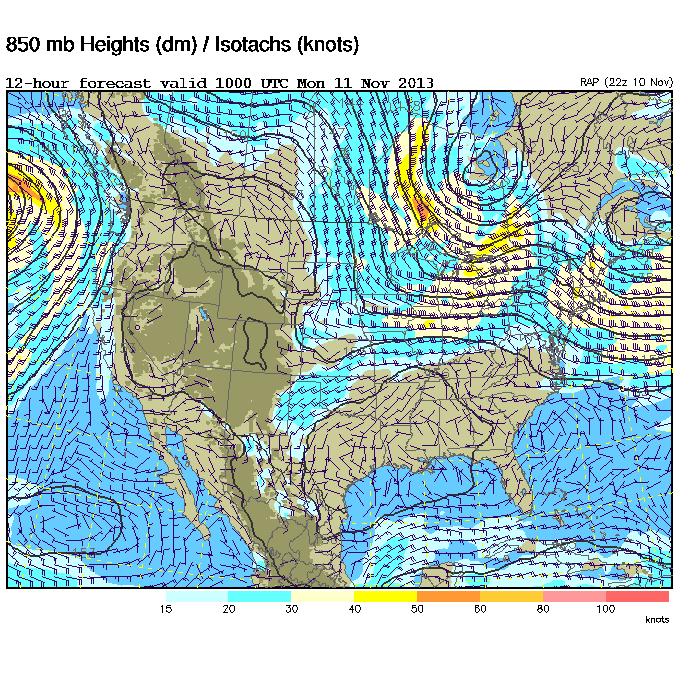
The last few days have seen a nice southwesterly flow aloft.  Look at Friday’s wind map, for example:
wind map,11-15-13

That extensive southwesterly flow early in the month would have surely deposited stuff like Cave Swallows in New England, but I wonder if that window has already closed.  A couple of Caves in Connecticut as recently as the 9th gives me some hope, however.  Contrast that map with the more zonal flow that we have seen for much of the month, such as on 11/10:
wind map,11-10-13

Although few birds are “blown” out of range, certain winds facilitate the arrival of more vagrants in certain areas than others.  And southwesterly winds in late fall are definitely the desired winds here in Maine.  With a fairly complex weather system on its way – including some really severe storms in the Midwest – I remain hopeful for some more out-of-range treats.  Interesting weather does have the tendency to produce some interesting birding, even without facilitating the arrival of rarities.
surface map, 11-17-13

At the very least, behind this system, we should see a return to colder, seasonable weather (as opposed to the 50’s of the last two days for example), and this should help push birds to feeders, warmer coastal and urban areas, etc.  Also, hopefully it will bring some snowfall to points north, as this year’s Goose Rarity Season has been lackluster, especially in the Greater Yarmouth Goose Fields.  A Greater White-fronted Goose that has been in Scarborough for a couple of weeks, and another in Berwick earlier in the month, along with a couple of Cackling Goose reports have been the only geese-of-note in southern Maine.  While “The County” saw single Barnacle and Pink-footed Goose in October, I have not had a single “good” goose in the fields of North Yarmouth, Cumberland, and Falmouth all season.  A Bean (!!!) Goose, Barnacle, and Pink-footed all in Nova   Scotia right now give me plenty of hope, and last year, things really didn’t pick up locally until mid-November anyway.  I will continue my thrice-weekly circuit.

So the short version of this is: go birding!  There are rarities out there to be discovered.

South Coastal Maine Rarity Roundup TEN!

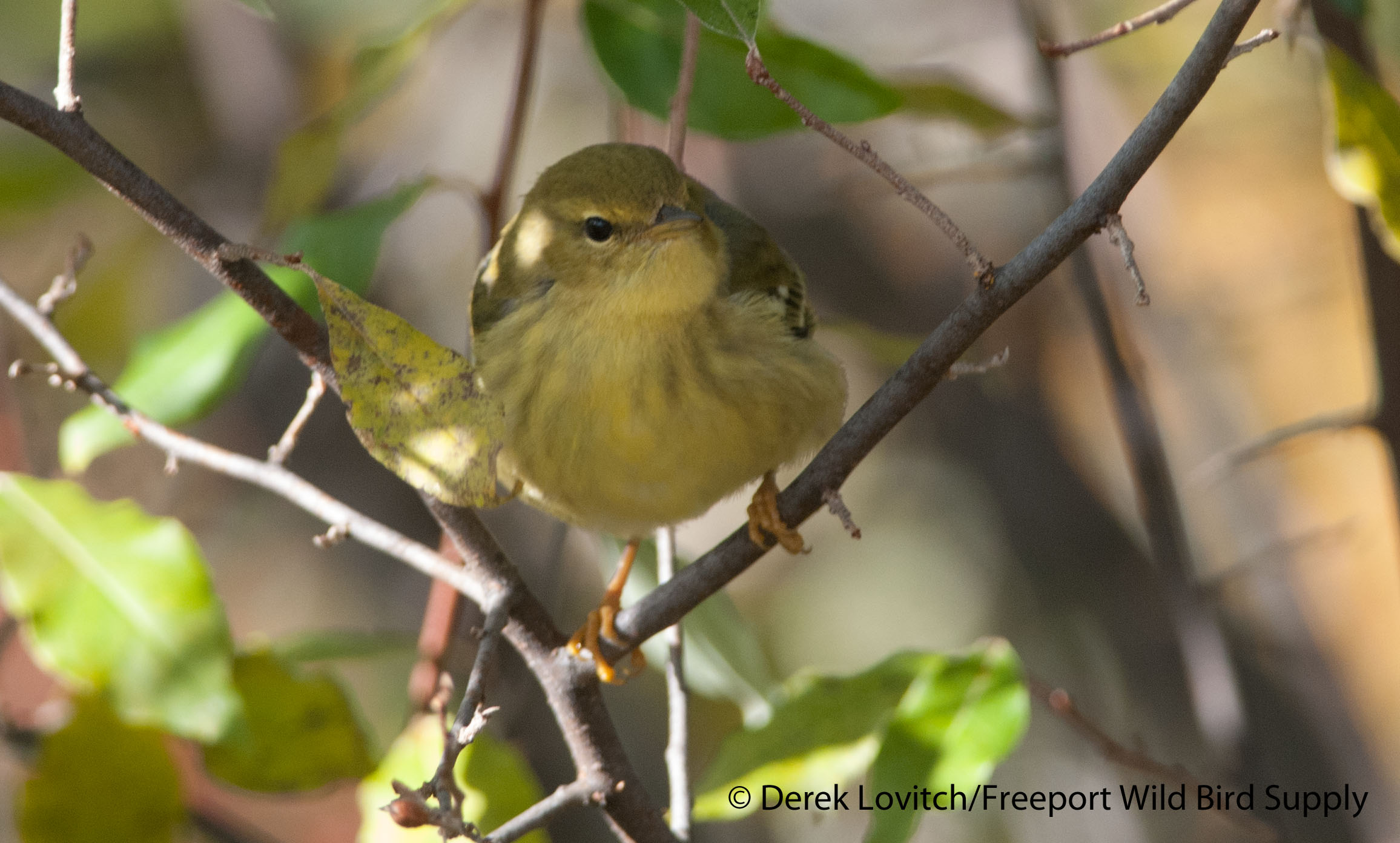
BLPW,SheridanStreet,Portland,11-3-14
This Blackpoll Warbler was one of the record 9 species of warblers tallied on the day, and one of the top birds in my Portland territory. It was only the third time that this species was spotted by Rarity Roundup teams.

Each year on the first weekend of November, a group of us get together to scour the Southern Maine coast for vagrants, lingering migrants, pioneers, irruptive, and other seasonal highlights.  Coinciding with the peak of “Rarity Season,” we set out to use the geography of the Maine coast, coupled with knowledge of the best habitats and vagrant traps in order to find as many “good” birds as possible.  While this year failed to produce any “Megas,” we once again had a great day in the field, found lots of fun stuff, and enjoyed good food and beer at the Great Lost Bear at the end of the day (the real reason we all get together for this event!)

119 species were tallied by the 8 teams of the TENTH Annual South Coastal Maine Rarity Roundup, six species above our 10-year average, despite somewhat more limited coverage than in the past few years. The continuing “Audubon’s” Yellow-rumped Warbler was added to the cumulative checklist, while we also had our second-ever Snowy Egret, Prairie Warbler, and Nelson’s Sparrow.  Blackpoll Warbler and Clay-colored Sparrow appeared for the third time.

Most teams experienced a decidedly “birdy” day, especially from Portland through Scarborough.  A fallout of Dark-eyed Juncos, White-throated Sparrows, and Hermit Thrushes occurred with overnight northwesterly winds and a line of pre-dawn showers, with the fallout especially evident on the Portland Peninsula.  I’ll have more about the fallout on a blog entry later today.

Record high tallies were set for Pectoral Sandpiper (13), Northern Flicker (10), Carolina Wren (11), Hermit Thrush (52: the 26 in Portland alone was only one short of the previous all-time high), “Western” Palm Warbler (3), Chipping Sparrow (12), Field Sparrow (3; tie), and Lapland Longspur (37).  9 species of warblers was a new record as well, and Painted Turtle was added to our non-feather species list.  All but the longspurs can likely be explained by the unusually warm season to date.

Territory Highlights were as follows:

– Area 1, Kittery-York: Davis Finch.
1 NASHVILLE WARBLER, Legion Pond, Kittery.
1 Pine Warbler, Fort Foster.
1 PRAIRIE WARBLER, Fort Foster.
1 “AUDUBON’S” YELLOW-RUMPED WARBLER, Fort Foster.

– Area 2, Ogunquit/Kennebunport: Turk Duddy.
2 American Wigeon, Phillip’s Cove, Ogunquit.
1 Northern Pintail, Phillip’s Cove, Ogunquit.
1 Lesser Yellowlegs, Goose Rocks Beach.

– Area 3, Wells/Kennebunk: Doug Suitor, David Ladd, and Slade Moore.
2 Semipalmated Sandpipers, Webhannet Marsh
2 Gray Catbirds, Laudholm Farm.

– Area 4, Biddeford-Saco: Pat Moynahan, Marian Zimmerman, Joanne Stevens, et al.
1 NASHVILLE WARBLER, Saco Yacht Club.
1 CLAY-COLORED SPARROW, Timber Point.
1 NELSON’S SPARROW, Day’s Landing.
2 Lapland Longspurs, Day’s Landing.

– Area 5, Scarborough: Ed Hess, Noah Gibb, and Leon Mooney.
8 Great Egrets
1 SNOWY EGRET, Pelreco marsh
12 American Coots, Prout’s Pond.
8 LONG-BILLED DOWITCHERS, Eastern Road.
35 Lapland Longspurs

– Area 6, Cape Elizabeth: International Man of Mystery, Claudia, Robby Lambert.
2 “Western” Palm Warblers, private property
1 “Yellow” Palm Warbler, private property
1 DICKCISSEL, Higgin’s Beach.

– Area 7, South   Portland: John Berry and Gordon Smith.
1 Ring-necked Pheasant, Fort Williams Park.
1 Yellow-bellied Sapsucker, Calvary Cemetery.
1 Pine Warbler, Bug Light Park

– Area 8, Portland: Derek Lovitch and Kristen Lindquist; Jeannette Lovitch (Capisic and Evergreen); and a cameo by Doug Hitchcox.
2 Eastern Phoebes, Eastern Promenade.
1 BLUE-HEADED VIREO, Mercy Pond.
1 ORANGE-CROWNED WARBLER, Eastern Promenade.
1 BLACKPOLL WARBLER, Sheridan Street.
1 White-crowned Sparrow, West Commercial Street.

As usual, I exhaustively cover the Portland Peninsula and once again the most urban block in the state produced some great birds.  Kristen joined me for the second year in a row, while Jeannette (and Sasha) helped out with a few outlying patches.  Doug joined us just long enough to find the only White-crowned Sparrow of the entire day.  In addition to the goodies listed above, Kristen and I amassed 9 species of sparrows.

The fallout that I mentioned above was very evident in the morning, as we birded Portland’s East End. 150+ White-throated Sparrows and 100+ Song Sparrows littered the Eastern Promenade.  While Dark-eyed Juncos were fewer there, we encountered some big groups elsewhere, such as 60+ behind the East End School and 50+ in the lot on Sheridan Street, with 70+ later in the day in Western Cemetery. White-throats were everywhere: 50+ on Sheridan   Street for example.  And once again there was a decidedly disproportionate number of White-throated Sparrows in gardens and landscaping of downtown Portland.  A short loop from One City Center through Monument Square, behind Portland High, and back through Post Office Park yielded 35 White-throats, with the only other native migrant being 7 Hermit Thrushes.  Like the sparrow, Hermit Thrushes appear in a wildly disproportionate number to other migrants – especially all other thrushes – in downtown Portland.  I’m convinced that something causes White-throated Sparrows and Hermit Thrushes to either a) become disoriented by urban lights more often/more readily, especially under low ceilings (it was cloudy for most of the night and morning) or perhaps b) they simply don’t leave these lots in a morning flight as species such as Dark-eyed Juncos might.  In fact, I just read in an article in the Brown Alumni Magazine that a friend of the store dropped off about collisions in New York City that since 1997, more White-throated Sparrows have been found dead than any other species.  Coincidence?

Our sum of 26 Hermit Thrushes was truly amazing, as was our overall diversity on the day.  While the mild weather certainly has a lot to do with the number of lingering/pioneering birds that we, and other teams, encountered, the late-season fallout earlier in the morning certainly helped our cause.

Here are the overnight reflectivity and velocity images, with 10pm, 1am, and 4am once again used as an example.
a 10pm 11-2-13 ref

b 10pm 11-2-13 vel

c 1am 11-3-13 ref

d 1am 11-3-13 vel

e 4am 11-3-13 ref

f 4am 11-3-13 vel

At 10pm, there’s mostly rain in the area, but birds are mixed in.  By 1:00am, birds are on the move, as the rain has mostly moved into the Mid-Coast and offshore.  Birds were still on the go at 4:00am, as a narrow line of showers moved through the coast.  About an hour later, a steady rain developed (not shown) that continued until a short time before the 6:20 sunrise.  I believe this is why there were so many sparrows in and around the city come dawn.

In other words, it was another great day of birding in urban Portland in the heart of “Rarity Season!”

AUDUBON’S WARBLER at Fort Foster!

Yesterday, I had the pleasure of leading our annual “York County Rarity Roundup” Field Trip for York County Audubon today. With no rarities to “round up,” we set out to find our own, birding from Kittery through Wells.  We followed a very similar route to what Jeannette and I always do on our monthly south-coastal run.  The difference today was that with a group, and with so many birds at FortFoster, we never made it out of Kittery by lunchtime.  Too bad that meant we just HAD to have lunch at Loco Coco’s Taco (mmm, chili relleno burrito…)!

It was a very birdy day overall, even in the windy afternoon.  A preliminary total of 63 species of birds included 9 species of sparrows, 5 species of shorebirds, and 4 species of warblers.  Excellent-for-the-season bird diversity was augmented by 5 species of butterflies, 3 species of mammals, 2+ species of dragonfly, 1 reptile (Garter Snake), and 1 amphibian (Spring Peeper).

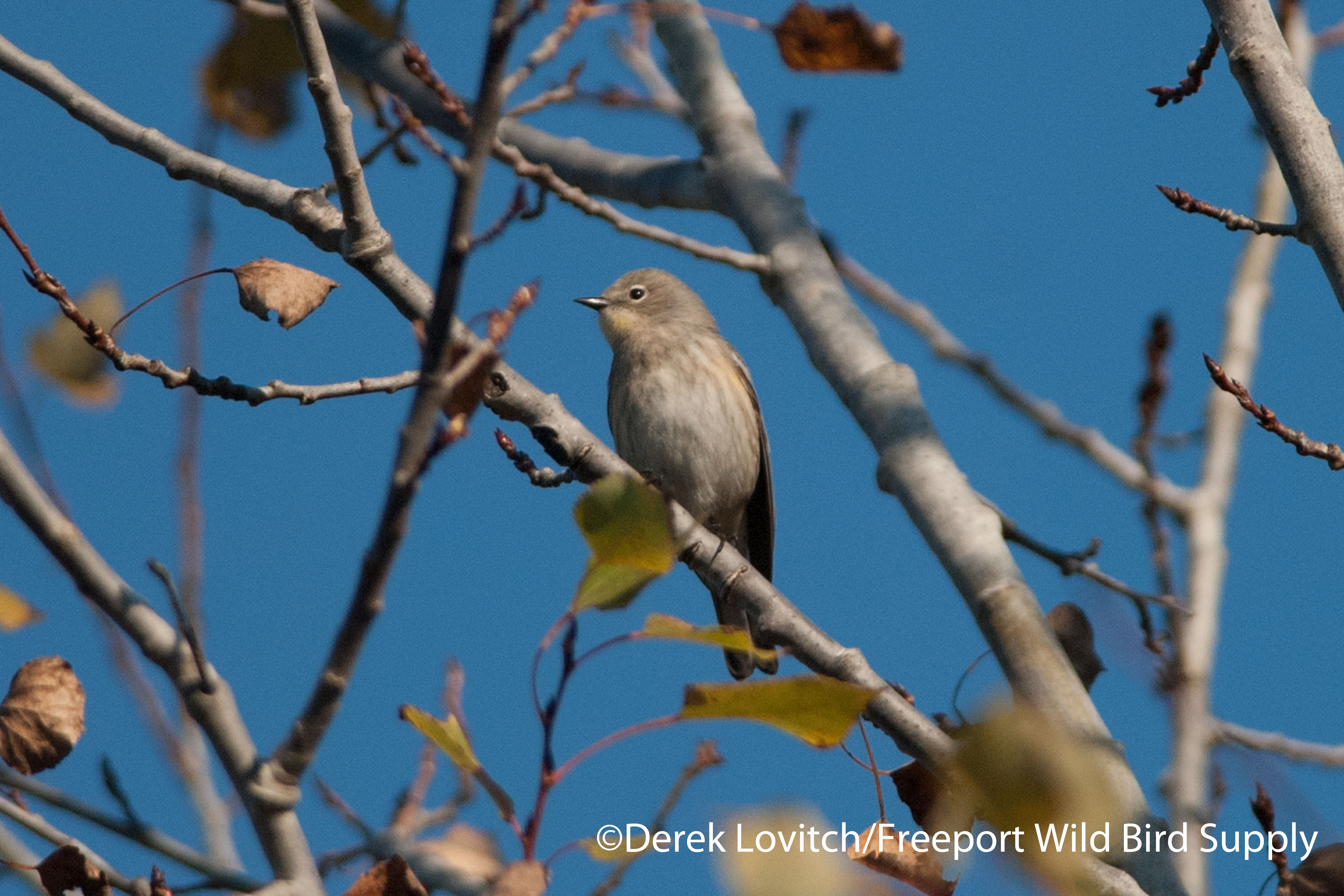
The bird of the day by far was “Audubon’s” Yellow-rumped Warbler that I found at FortFoster.  This western subspecies of Yellow-rump (it once was, and I believe will likely once again be considered a full species) has only occurred – or should I say, been detected – in Maine a few times.  I can only think of one recent record, an adult that nearly-overwintered at Dyer Point in Cape Elizabeth a few years ago.

If anyone wants to look for it, the bird was flycatching and occasionally eating Red Cedar berries along the west edge of the park. Follow the entrance road into the park, until the large gravel parking lot opens up on the left. The bird was loyal to the right (west) edge here, especially around the big cedars in the mowed lawn.

Noah Gibb and I photographed the bird extensively, and I was also able to borrow a phone to get a voice recording.  All aspects of the bird – from plumage to voice – fit perfectly with a pure “Audubon’s” Warbler.

I first glimpsed the bird sallying for insects in and out of shadows.  The overall extremely cool gray plumage tone – top to bottom – brought to mind a first fall female Pine Warbler. But something wasn’t right.  The bird began to call, and that was definitely not the call of a Pine Warbler…but what was it?  We saw the bird briefly a few times, the pieces began to come together, and then as it flew to another tree the bright yellow rump became evident.  “Audubon’s Warbler!!!!” I exclaimed.
DSC_0059_AUWA1,Fort Foster,10-27-13

DSC_0046_AUWA3,FortFoster,10-27-13

DSC_0044_AUWA,FortFoster,10-27-13

DSC_0057_AUWA5,FortFoster,10-27-13

We studied the bird extensively for at least a half hour, occasionally in perfect light for prolonged periods.  I scribbled notes, and encouraged others to do the same before we discussed the bird any further.  Plenty of “Myrtle” Warblers (the Eastern subspecies of Yellow-rumped) were nearby for convenient comparison.

– Obvious “Yellow-rumped” Warbler with bright yellow rump, overall size and shape, bill size and shape, etc.
– Exceptionally cool gray overall plumage tone, not suggesting the brownish tones of even the palest Myrtles.
– Very diffuse streaking below.
– Very restricted and pale yellow “blobs” on sides of chest.
– Very subtle and restricted yellow on throat, not visible in all light conditions, but quite obvious in good sunlight.
– Lacked the extension of pale on the throat that “points” up around the back of the auriculars as on Myrtle.  Therefore, throat patch appeared rounded, or encircled by the cool gray of head.
– Auriculars only marginally darker than rest of head, often looking concolorous.
– Call note very different from surrounding Myrtles, much sharper and not as “blunt.”
– Exceptionally dull plumage highly suggestive of a first fall female, but the lack of a definite molt limit within the greater coverts prevents us from clinching the age. (reference: The Warbler Guide, Stephenson and Whittle, 2013)

Good bird!  And yes, Rarity Season is most definitely in full swing!  Good thing it appears that, after a prolonged drought, I have finally refound my rarity-finding mojo.  Phew.

Other highlights over the course of the full-day tour included the following:
– 1 pair Wood Ducks, Legion Pond, Kittery.
– Fort Foster: 1 “Western” Palm Warbler, 2 “Eastern” Palm Warblers, 6 Brant, 15 Hermit Thrushes, 1 Brown Thrasher, 1 Red-bellied Woodpecker, 2 Carolina Wrens, 32 Great Cormorants…
– Seapoint Beach, Kittery: 1 Saltmarsh Sparrow* (see photos and notes below), 1 Common Yellowthroat, 1 Eastern Towhee, 2 Long-tailed Ducks (FOF)…
– 1 Gray Catbird, Rte 103, Kittery.
– 1 Nashville Warbler (late), 1 Indigo Bunting (late), 2 Carolina Wrens, etc, Beach Plum Farm, Kittery.
– 24 Pectoral Sandpipers, 1 White-rumped Sandpiper, 3 Dunlin, 10+ Greater Yellowlegs, Harbor Road, Wells.
– 4 Semipalmated Plover (late), Community Park, Wells.

Now, about that Saltmarsh Sparrow – which I admittedly called an “Interior” Nelson’s Sparrow in the field…  Expecting to see an “Interior” Nelson’s Sparrow based on the timing, micro-habitat, and behavior, I reached for my camera before I fully studied the bird. After firing off some photos, and making sure everyone got on the bird, it took off and we never saw it again. Although I mentioned that the malar looked “quite dark,” I didn’t second-guess the call until I looked at photos on the computer this afternoon.  Yeah, it’s a Saltie.  The malar is not only dark and distinct, but it frames a clear white throat.  The breast streaking is dark and extensive, the bill has a fleshy-pink cast, and it is simply too long-billed for an “Interior” (subspecies alterus or nelsoni; I don’t believe they are identifiable in the field).  As a final clincher, note the fine streaks towards the rear half of the supercilium.  Behavior and timing wise: odd for a Saltmarsh.  Plumage: essentially textbook for a Saltmarsh.  Therefore, “After further review, the call (in) the field is overturned.”
DSC_0061_SMSP1,SeapointBeach,10-27-13

DSC_0062_SMSP2,SeapointBeach,10-27-13

My Last Good Flight of the Season at Sandy Point?

A strong, if relatively homogenous, flight passed over and through SandyPointBeach, Cousin’s Island, Yarmouth this morning.

7:03-9:00
39F, mostly clear, light-moderate but rapidly increasing W wind.

708 American Robins
88 Yellow-rumped Warblers
45 Dark-eyed Juncos
34 American Crows
22 Unidentified
8 American Goldfinches
7 Palm Warblers
6 Golden-crowned Kinglets
5 Savannah Sparrows
3 Hermit Thrushes
3 Ruby-crowned Kinglets
3 Chipping Sparrows
3 Rusty Blackbirds
2 Brown Creepers
2 Unidentified sparrows
1 Common Loon
1 Eastern Phoebe
1 Tufted Titmouse (they keep on coming this year)
1 American Pipit
1 AMERICAN REDSTART (very late)
1 White-throated Sparrow

Total = 945

I actually expected more juncos and especially White-throated Sparrows (at least in the parking lot, they almost never cross the water here), but the American Robin count was actually my third highest here.  The redstart, one of the first birds of the morning, was definitely unexpected – it has been several weeks since I have seen one.

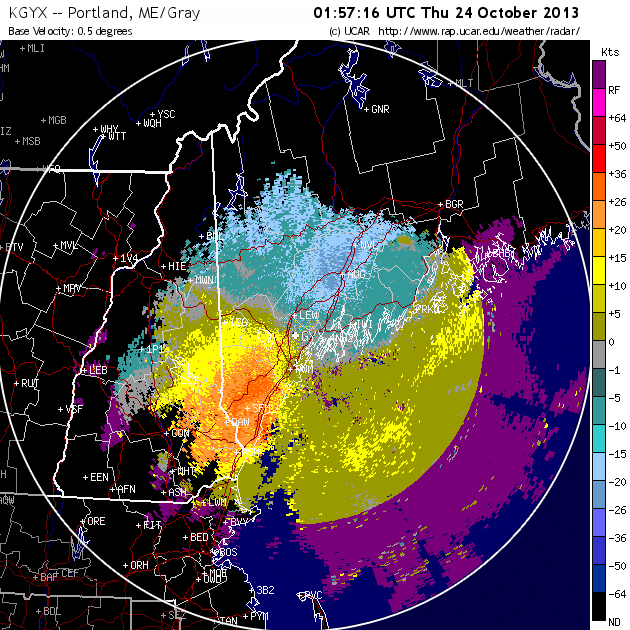
Unlike Tuesday night into Wednesday, last night’s radar was unambiguous (I posted briefly about yesterday on the store’s Facebook page).  This was a solid late-season flight.  Here are the 10pm, 1am, and 4am reflectivity and velocity images for example.  You can see the rain mostly remaining well offshore.
a -10pm radar, 10-23-13 b - 10pm velocity, 10-23-13

c - 1am radar, 10-24-13 d - 1am velocity, 10-24-13

e - 4am radar, 10-24-13 f - 4am velocity, 10-24-13

So was this my last good flight at Sandy Point?  I sure hope not, but the calendar is getting late.  There’s no doubt there is still a big push of juncos at least.  But we’ll see if the weather conditions cooperate.

Meanwhile, as SandyPoint winds down, “Rarity Season” starts to pick up.  There’s our Bell’s Vireo in Harpswell, an Ash-throated Flycatcher on Monhegan, a Pink-footed Goose that was up in The County, and the usual smattering of fun fall stuff like a White-eyed Vireo or two, a couple of juvenile Red-headed Woodpeckers, and a sprinkling of “late” birds in no doubt partially due to the mild season.  I believe there are symptoms of Rarity Fever welling up inside me!

BELL’S VIREO in Harpswell!!!

Yesterday, Jeannette and I discovered a Bell’s Vireo on Abner Point Road, Bailey Island in Harpswell.  There are only three previous records of Bell’s Vireo for the state of Maine. 

In other words: MEGA!  And needless to say – especially since I missed the two from last year, despite my best efforts – this was a thrilling find, capping a very productive morning of birding Bailey Island that included a Yellow-breasted Chat (my first of the year) at Land’s End, and a total of 5 species of warblers on Bailey Island this am:  Hundreds of Yellow-rumps, and one each of Black-throated Blue, Black-and-white, Common Yellowthroat, and Blackpoll.  Song Sparrows, Dark-eyed Juncos, White-throated Sparrows, and other seasonal migrants made for a very birdy visit.

In what turned out to be our last stop of the morning, Jeannette and I walked Abner Point Road.  Upon reaching a promising thicket (see directions below), I began to pish.  Yellow-rumped Warblers and a Winter Wren responded immediately, and as Jeannette attempted to photograph the wren, I sorted through the yellow-rumps, hoping to find one with a yellow throat.  A handful of minutes later (about 10:35am), we heard a harsh, scolding chatter emanating from the dense vegetation.  “Vireo?” Jeannette asked quizzically as we both looked at each other, unsure of the sound – it sounded like nothing we are used to hearing.  I wondered out loud about a Carolina Wren making some odd sound (they’re good at that, and there was one in that particular thicket), and the nasal quality led me to consider a funky Red-breasted Nuthatch.  We looked hard but could not turn up anything that fit the sound.

About 5 minutes later, a small vireo pops out of the brush in front of me.  At first I called “White-eyed Vireo” due to the bright yellow flanks and overall shape, but then I got a clear look at the head.  “BELL’S VIREO!” I exclaimed, as Jeannette, a few yards away still working on photographing the wren rushed over.

As is often the case for Bell’s Vireos, it quickly ducked back into the cover.  I continued to pish, and the bird popped back up.  I had a second brief, but unobstructed view of the whole bird.  Jeannette went for the camera, and prepared to fire away, only to see the bird dive back into the shadows once again.  One last brief glimpse of the bird was all we would have for the next hour.

We searched hard, but could not relocate it.  A Blue-headed Vireo was more cooperative, and permitted us some comparison.  We listened to a recording of the call of a Bell’s, and there was no question in either of our minds’ that is what we had heard earlier.

We thought we heard that call in the distance of the thicket one more time, and perhaps even a snippet of a song, but background noise and an increasing southerly wind made us unsure of that.  And that wind was clearly not making this skulker any more likely to show itself.  At 11:50, we heard the distinctive call once again, but from thick shrubs behind a house across the street.  We hustled over, but unfortunately only managed to pish in a cat (one of at least five in this immediate area; it was worse than Monhegan!), which was likely the object of the vireo’s recent ire.  We worked the area as best as we could, and eventually saw the homeowner in her yard and received permission to wander around.  No luck.  We had also received permission earlier from the homeowner adjacent to the first thicket to check her yard, so we did another circuit, but we came up empty, and it was getting breezier and cloudier.  Lunchtime was calling us, too.

While I left with almost three pages of field notes, it was rather frustrating to not get a photo, especially since Jeannette was so close to snapping it!  However, as a firm believer in the value of written field notes for documentation of rare birds, I scrawled away in my notebook.  Here are the particulars, after seeing the entire bird well a couple of times, with notes entered in rough order of observation, not in order of relative importance (edited only for context, not content):

–  Overall relatively dully-marked, small vireo.  Body shape and size, and brief glimpse of the body color first suggestive of White-eyed Vireo, the expected rarity here.

– Fairly bright and extensive yellow on sides, from chest through undertail (suggestive of the Eastern subspecies?)

– Dull olive-gray back.  Dull greenish-gray wings.  Lack of contrast anywhere except the bright yellow of the flanks and undertail.

– One fairly bright whitish wingbar, on the tips of the greater coverts.  An indistinct second wing bar, presumably on the edges of the lesser coverts, was discernable, but did not stick out.  Not the bold, bright white double-wing bars like Blue-headed Vireo.

– Head grayish, perhaps with a hint of an olive cast.

– White or off-white throat contrasting with gray head and face and yellow on the rest of the underparts.

– Very dull face pattern consisting of a partial eye-ring (or perhaps best described as two eye-crescents) and indistinct supercilium restricted to in front of the eye.  Maybe a small hint of a supercilium a very short distance behind the eye, but I am unsure of this.  A darker line, or narrow smudge, through the eye gave a subtle hint of a face pattern reminiscent of a darker Warbling Vireo or very pale Philadelphia Vireo.

– Perhaps due to the angle, I though the bill looked relatively long compared to the size of the head, but it was clearly rather narrow for a vireo, and was diminutive compared to the Blue-headed Vireo observed a short time later.

– Relatively long-tailed (NOTE: although in comparing photos later, I wondered if it was actually suggestive of the shorter-tailed Eastern subspecies).

– The first view was of a “sleeker” or slimmer vireo, not the chunky, broad-chested shape of Blue-headed.

– Very active, and did not come out into the open for very long (NOTE: tail movement not seen, or not noticed, which could have been a good key for subspecies), always disappearing into low, dense brush.

In comparison to other species:
– Wingbars and bright yellow underparts distinguish it from Warbling Vireo.

– Lack of yellow in the throat and pale face pattern, along with wing bars and fairly long tail and slim shape help distinguish it from Philadelphia Vireo.

– Incomplete eye ring and lack of broad and bright yellow spectacles separate it from White-eyed Vireo.  Wings paler and less contrasty, and no contrasting pale gray nape as on WEVI.

Directions to the bird (although I have not heard any reports, positive, or negative, about the bird as of 4:00pm today):
To reach the thicket we first found it in, take Rte 24 from Cook’s Corner in Brunswick south through Orr’s Island and onto Bailey’s.  Make a right onto Abner Point Road at the Johnson Field Preserve.  Park on your left in the gravel parking lot for the beach.  Walk down Abner   Point Road a couple hundred yards, around the bend.  On the right, you’ll see a small parking lot with little white signs with people’s names on them.  The bird was in the thicket behind these signs, along with a Blue-headed Vireo and a mess of Yellow-rumps.

A Mid-Western Road Trip

When the Iowa Ornithologists’ Union invited me out to be the Keynote Speaker for their 2013 Fall Meeting, I jumped at the opportunity to get some birding in in a part of the country that I have not spent very much time exploring.  Add to that a program and book signing at Milwaukee’s Urban Ecology Center, and I had a solid excuse to work on some under-served state lists…and visit some good friends.  Each day, I posted a short synopsis of my travels and birding on my book’s Facebook page.  Here, I’ve simply edited those and added some photos for your viewing pleasure.

10/10: Travel to Des Moines, Iowa.  Departing Portland at 6:14am.

10/11: Ankeny, Iowa.
On my way to the Iowa Ornithologists’ Union‘s Fall Meeting, I spent the first day and a half of my trip birding the Des Moines-Ankeny area with my friend Danny Akers, the 2009 Bradbury Mountain Spring Hawkwatch Official Counter.

I had hoped for Smith’s Longspurs to fill in a gap on the ol’ life list, but unfortunately, we came up empty, despite a few miles of walking up and down short-cut fields at a couple of locations. While a stiff southerly wind has not helped, they just don’t seem to be “in” yet. Unseasonably warm temperatures – a high of 78 yesterday for example – has likely put quite a few fall arrivals behind schedule.

A nice consolation prize for me, however, was a fair number of LeConte’s Sparrows – a bird I really like, but don’t get to see too often. Other birds that were a treat for me include Franklin’s Gull, Sedge Wren, Red-headed Woodpecker, and American White Pelican. Our best bird, however, was probably the Pileated Woodpecker at Waterworks Park in Des Moines – a long overdue Polk County bird for Danny.

But as always, I just flat out enjoy birding new places. And since I’ve only barely birded Iowa once before, my state list is growing by leaps and bounds. I was not too happy that I was unable to bird the famous Saylorville Reservoir, however, thanks to the government shutdown. John Boehner: you owe me some state birds!

We then headed east towards Clinton, where Danny and I would be leading a field the next morning.  I very much looked forward to seeing what might be moving behind this approaching cold front. While it might not clear in time for a flight tonight, Sunday morning could be a lot of fun.
a LESPA phone-binned juvenile LeConte’s Sparrow.

b Chichaqua WMALooking for Smith’s Longspurs at Chichaqua WMA.

10/12: Clinton, Iowa – Iowa Ornithologists’ Union Fall Meeting.
Danny and I led a field trip this morning to Princeton Marsh here in Clinton, IA. We had a great turnout – I was honored! – of birders. I just wish there were more birds than mosquitoes!

Few migrants were around in the morning; there was no morning re-determined migration today. The approaching cold front took its sweet time in getting here, and had not pushed through easternmost Iowa by dawn. It was interesting to see the huge flight on the Des Moines radar overnight, just west of the front, compared to the Davenport radar, just east of the front (where we were).

So the woods were quiet, but we had ample numbers of things like Yellow-rumped Warblers, both kinglets, and lots of Red-winged Blackbirds commuting overhead. A heard-only Pileated Woodpecker and a good look at a Winter Wren were local highlights. Oh, and I got a life frog: Cricket Frog! And lots of Leopard Frogs were around; it was not a good sign that I was ranting about bush honeysuckle and playing with frogs within the first 30 minutes of the walk.

A scrubby, weedy wetland area near the southern edge of the property was much birdier, however, highlighted by a teed-up LeConte’s Sparrow, 7 Wilson’s Snipe, and a Sora. A small group of 5 Eurasian Tree Sparrows were a little unexpected.

The front had now pushed through, dropping just a few sprinkles, but also blowing away the skeeters. That was nice. Danny and I decided to try a little river migration watching, so we headed over to a small riverfront park in Princeton that intrigued us during a quick visit yesterday.

Now we were in business! A trickle of raptors began to move overhead, as soon as the clouds cleared. A handful of Sharp-shinned Hawks, a Merlin, a few Red-tails, etc. A group of about 30 Franklin’s Gulls sitting on the sandbar took flight, soaring high and perhaps southwards. As we were about to depart, a line of 32 American White Pelicans came cruising down the river. Yay, migration in action!

In the afternoon, I presented my Russian Far East: In Search of the Spoon-billed Sandpiper program. Yeah, I apologize I went a little long there. Oops. But it was such a great experience to share, and really, is there ever such thing as too many Tufted Puffin pictures?
c Miss River Eco Center, ClintonHome base for the Meeting.

d birdwalk1, Princeton WMAEarly morning in Princeton Marsh.

10/13: Clinton, Iowa.
What a difference a day makes! A very strong flight took place overnight Saturday into Sunday, and a lot of birds arrived for Sunday morning.

Not only was I very happy to see a lot of birds on our field trip to Princeton Marsh, but I was happy to see that my predictions came to fruition. Following my evening program “A Sandy Point Case Study,” in which I concluded with a little local radar analysis, I predicted it was going to be a good morning (it’s always a risk sticking one’s neck out like that!).  And it certainly was at Princeton Marsh at least!

Large numbers of Yellow-rumped Warblers were reorienting overhead at dawn, and new arrivals included Palm Warblers and Fox Sparrow. Some waterfowl also arrived with Blue-winged and Green-winged Teals, and Gadwall becoming new entries in my state list. 2 Nelson’s Sparrows joined two LeConte’s Sparrows; both species were seen very well by all, and Nelson’s is fairly rare around here.

Very local in Iowa, a conspicuous Pileated Woodpecker was enjoyed (a lifer for some, actually), as was a spiffy adult Red-shouldered Hawk. But the bird-of-the-day was a very truant adult White-faced Ibis that was foraging in a shallow wetland.

A great morning of birding concluded a most enjoyable and productive weekend for me. I thank the Iowa Ornithologists’ Union for having me out, and I hope to see you again soon!
e birdwalk2, Princeton WMAPrinceton Marsh.

10/14: Clinton, Iowa:
Danny and I headed north this morning. Our first stop was the Goose Lake WMA.

After another good flight on the radar overnight, we found a lot of birds here. American Robins, White-throated and Swamp Sparrows, Red-winged Blackbirds, Cedar Waxwings, and Song Sparrows were all abundant, trumped only by the cloud of 500+ Tree Swallows.

A flock of Rusty Blackbirds were in the marsh, along with a single Ring-necked Duck – the last two new species for my Iowa list of the trip. The highlight for me, however, was the 60+ Wilson’s Snipe that joined ~25 Killdeer on a mudflat in the marsh; I’m not used to seeing so many snipe together.

We then drove to Madison, Wisconsin, picked up David La Puma and new friend Jessica Gorzo, and – in what, in hindsight was not a great idea – raced north to chase a long-staying White-tailed Kite. Not that an occasional chase with friends is a bad idea, but the fact that we were essentially racing the sun made us reconsider this.

Arriving in the area with about 30 minutes to sunset didn’t provide much hope, but an ultra-distant male Northern Harrier hovering over a field did – at least for a little while. Flocks of Sandhill Cranes were heading to roost, as was a massive cloud of Canada Geese. No small – in my mind – consolation prize, however, was the flock of about 30 Greater Prairie-Chickens that I spotted as they flew just over the tops of a field, before disappearing into the grass. Although known to be here – and intensively managed for them – they are not often seen, especially at this season, so that was a real treat for me. Having seen Greater Prairie-Chicken many fewer times than White-tailed Kite, I left satisfied. Mostly.
f Goose Lake WMA'Goose Lake WMA.


g DubuqueDubuque up the Mississippi from Mines of Spain State Recreation Area

h DubuqueDubuque Monument.

i WTKI chase“I think it’s too late” – All of us.

10/15: Madison, Wisconsin.
Danny said goodbye and took off in pursuit of the White-tailed Kite once again (unfortunately, despite many people looking it was not seen, and has never been seen again. Apparently, we missed it for good by exactly one hour). David and I wished him luck, but we thought our time would be better spent birding locally in Madison before heading over to Milwaukee.

The Pheasant Branch Conservancy was our destination – after a ridiculously late start for all (our respective travels had clearly caught up with all of us!). While the radar did not suggest that this was a morning that could not be missed, we probably – it’s October afterall – should have motivated sooner, but sometimes the body makes such decisions for you.

However, even in the middle of the morning, this Middleton preserve was decidedly birdy! It was full of sparrows, and my paltry state list grew by leaps and bounds. Fox Sparrows had arrived, White-crowned Sparrows were in good numbers, and plenty of White-throated and Song Sparrows were to be found, along with a goodly number of Lincoln’s Sparrows – one of my favorites!

Before we knew it, however, it was time to head to the Urban Ecology Center for my evening program. At a pre-presentation dinner, it was great to meet some new friends, and get re-acquainted with some of the people who joined me (OK, technically, I joined them) aboard the UEC’s private charter aboard the Schooner Lewis R. French out of Camden, ME last summer. They were stuck with me for 5 days yet came back to hear me talk even more, so I guess that is a good sign!

I wanted to thank Tim Vargo of the Urban Ecology Center for inviting me over, and I thank everyone who came out last night. I hope you all enjoyed the show!

j Urban Ecology CenterInside the Urban Ecology Center.

10/16: Madison, Wisconsin.
Following my Sandy Point Case Study presentation at the IOU Meeting over the weekend, I looked at the local radar with the group and suggested it would be a very good morning in the field. And, in most places, it definitely was. After my Urban Ecology Center program last night, we looked at the radar and saw virtually nothing that suggested bird migration.

David chastised me a little bit for even hinting that “no migration on the radar” means “don’t go birding in the morning.” “It’s migration – go birding every morning!” (My point in the progrAm was simply that I would not have gone to Sandy Point that next morning). And he’s absolutely right. There are plenty of birds around in mid-October even when they have not moved in the night before.

While there might not be a Morning Flight of note without many “new” birds, there are plenty of birds in the field – literally. It’s sparrow season, and just to prove the point, local Madison birding once again proved why you go birding every day in migration! First, we walked through the woods from David’s neighborhood to the 1918 Marsh. Not much happening. A walk around and through the marsh, out to Picnic Point. A little dissapointed by the low numbers of sparrows, we instead enjoyed a nice little sampling of newly-returned migrant waterfowl (Northern Pintail, Bufflehead, Gadwall, American Wigeons, and Redhead), and lots of American Coots. Coots always amuse me. And drake Wood Ducks are always worth and extended view.

Readers of my blog and the store’s Facebook Page know I am a big fan of birding community gardens in the fall, so you could image my glee when we exited the Biocore Prairie (which itself had a goodly number of sparrows) and I stepped into the acres of the Eagle Heights Community Garden. This is where all of the sparrows were! 400+ House Sparrows, 150+ American Goldfinches, 100+ White-throated Sparrows, 75+ Song Sparrows, 50+ White-crowned Sparrows including one of the western subspecies Gambelli. A couple of dozen Lincoln’s Sparrows and Dark-eyed Juncos. A smattering of Field Sparrows, Yellow-rumped Warblers, and Chipping Sparrows. A handful of Palm and Orange-crowned Warblers, 1-2 Fox Sparrows, and my 100th Wisconsin Bird: 2 Brown-headed Cowbirds. Times flies (as in almost 3hrs here!) when you are having fun!
k 1918 Marsh, MadisonUniversity of Wisconsin from 1918 Marsh.

l Picnic Point, MadisonPicnic Point.

la Eagle Heights GardenEagle Heights Community Garden.

m MadisonDowntown Madison.

10/17: Madison, Wisconsin.
This was my last day of birding of my little Midwest trip. After David and I hit the Eagle Heights Community Garden in Madison (more juncos and Chipping Sparrows, 1 Nashville Warbler, multiple Orange-crowned Warblers, a late Ruby-throated Hummingbird, a continuing “Gambell’s” White-crowned Sparrows, etc), I hit the road for Minneapolis.

Visiting a non-birding friend – yeah, sometimes I tolerate hanging out with people that don’t like birding – my birding was limited to a walk around LoringPark and the art museum’s SculptureGarden. White-throated Sparrows were quite common, with a fair number of Dark-eyed Juncos, Swamp Sparrows, and a couple of Lincoln’s Sparrows. There was actually a reasonable diverse selection of migrants in this small, very manicured city park. And I do love city park birding!
a href=”https://mebirdingfieldnotes.blog/wp-content/uploads/2013/10/n-rtha1.jpg”>n RTHAQuite possibly the world’s most cooperative Red-tailed Hawk in the Eagle Heights Community Garden.  This is just a standard photo with my iPhone.

o RTHA Phone-scopingDavid works on some phone-scoping.

p Loring Park, MNLoring Park, Minneapolis

q Minneapolis

10/18: Minneapolis, Minnesota.
As much as I love to travel, I love to come home even more! It’s good to be back, but I thoroughly enjoyed my time birding, visiting, and chatting about “How to Be a Better Birder” in Iowa and Wisconsin. Thanks again to the Iowa Ornithologists’ Union, Tim Vargo at the UrbanEcologyCenter, Danny Akers, and David La Puma for making this tour happen.

Next up, New Hampshire Audubon in Concord on 10/24.

Sandy Point on 10/9, Goose Fields Redux, and More.

After three nights with little to no migration, birds took to the skies en masse come nightfall last night.  It was a big flight.  For examples, here are the 10pm, 1am, and 4am reflectivity and corresponding velocity images:
10pm radar, 10-8-1310pm velocity, 10-8-13
1am radar, 10-9-13 1am velocity, 10-9-13 4am radar, 10-9-13 4am velocity, 10-9-13

That’s a heckuva flight!  But as October goes on, more and more of the migrants are sparrows. Most sparrows (juncos and Chipping Sparrows are the exceptions) do not partake – or barely so – in the morning re-determined migration (“morning flight”), at least at Sandy Point, so I have been disappointed with the tally come dawn at Sandy Point on more than one occasion in mid-October.  While this morning’s flight was still good, it was not as busy as I would have expected based on the density of those radar returns.  But there were a lot more sparrows around in the bushes at Sandy Point and elsewhere this morning; I wonder what percentage of last night’s flight were White-throated Sparrows?

At the bridge at Sandy Point, the morning’s flight started out quite slow.  By 7:30, I had even considered packing it in and going to look for sparrows.  But then things picked up a little bit, and a steady trickle of birds slowly added up to a respectable tally.  Both kinglets spent a lot of time swirling around the point this morning (as usual, I was conservative in my count of how many were actually crossing, as many would turn around, come back, and try again), and the sparrow tally was probably a lot higher.  However, by the time I left the bridge, most White-throats had already dispersed into the woods.  Song Sparrows – which I do not attempt to tally due the number of breeding birds in the powerline cut – were definitely more abundant than they have been as well.

Here’s the scorecard:
6:45-9:15
39F, light NNW to calm, partly cloudy to clear

323 Yellow-rumped Warblers
105 Ruby-crowned Kinglets
71 Unidentified
60 Dark-eyed Juncos
52 Palm Warblers
39 Golden-crowned Kinglets
30 White-throated Sparrows
15 Unidentified kinglets
13 Blackpoll Warblers
12 Black-capped Chickadees
12 Black-throated Green Warblers
8 American Robins
7 Blue-headed Vireos
7 Northern Parulas
6 Blue Jays
4 Common Loons
4 Common Yellowthroats
4 Chipping Sparrows
3 Nashville Warblers
3 Savannah Sparrows
3 Swamp Sparrows
3 American Goldfinches
2 Sharp-shinned Hawks
2 Eastern Phoebes
2 Tufted Titmice
2 American Pipits
2 Black-throated Blue Warblers
1 Hairy Woodpecker
1 RED-BELLIED WOODPECKER
1 Red-eyed Vireo
1 Hermit Thrush
1 Tennessee Warbler
1 Common Grackle

T=800

Afterwards, I did a circuit of the local “goose fields.” As with everywhere to our south, the resident, non-migratory population of Canada Geese is burgeoning in southern Maine.  This resident population begins to coalesce in the fields of Yarmouth, Cumberland, and Falmouth in early August, and by the middle to end of September, the flock includes a sizeable percentage of the local breeders.  The percentage of local breeders that are in the fields on any given day increases with the onset of early Canada Goose hunting season in early September.

This year, the number of geese among all fields has varied between 200-300 total birds since early September. This number of pre-migrant birds has grown steadily over the past five years in particular.  This week, the first real influx of geese arrived, presumably from some points north.  It is the flock of resident geese that know the safe fields (no hunting, less Bald Eagle activity) and travel corridors to and from the bay where they roost that attract the migrants, including those occasional rarities.

My high count this week of 445 Canada Geese today was my highest tally since the spring.  A couple of Eastern Meadowlarks and up to 8 Killdeer were also present at Thornhurst Farm this week, and Eastern Bluebirds have been rather widespread. A Pied-billed Grebe was once again in the pond on Woodville Road in Falmouth, as is often the case at this time of year.

The goose numbers and the chance for finding rarities should only increase (well, with various ebbs and flows) from now through the first heavy snow.  In fact, I often find my first “good” goose in the second week of October.  It’s also primetime for sparrows.  And this is why I hate leaving the state in October, but once again, I am off!

Early tomorrow morning I depart for Iowa, where I will be speaking at the Iowa Ornithologist Union’s Fall Meeting.  I’ll be giving the keynote presentation on “How to Be a Better Birder” using my SandyPoint case study program and I will also be showing my Russian Far East travelogue.  Finally, I will be joining the 2009 Bradbury Mountain Hawkcounter, Danny Akers, in leading a field trip.

After my weekend in the Hawkeye State, I head to Wisconsin to visit the Urban Ecology Center in Wisconsin.  In between and thereafter, I’ll be spending a couple of days birding and visiting with friends.   I’ll post the occasional update about migration in the Midwest, my birding, and other musings on my book’s Facebook page should you be interested in following my travels.

Now I am just left to wonder what state bird I will miss here in Maine while I am away (there’s always one!)

Black Skimmer at Sandy Point!

Well, I sure wasn’t expecting this on my Sandy Point Patch List!
DSC_0021_BLSK1,SandyPoint,10-4-13
Black Skimmer, SandyPoint #180!

An otherwise slow morning flight (more on that shortly) was interrupted by an odd call emanating from upriver of the bridge. “Hmm, sounds like a Black Skimmer, I thought.”  Uh, wait…but alas, there it was!  It alighted on what was left of a small sandbar with a couple of gulls, and as that sandbar became inundated, it took to the wing again and began to forage.  I lost sight of it as it moved up the bay, but a little pocket of Palm Warblers moving through distracted me.

Looking at the radar last night, the flight seemed strong, but the Morning Flight was decidedly slow.  Here are the 1am radar and velocity images for example:
1am radar, 10-4-13 1am velocity, 10-4-13

A couple of things are noticeable.  For one there’s the fairly narrow diameter of the flight reflection which would suggest a low flight (the radar beams well out from the tower are above the height of birds; the “angle of elevation).  This definitely happens when birds, such as sparrows – and they’re definitely on the move right now – which tend to fly relatively low dominate the flight.  So perhaps a lot of the flight last night was of the sparrow variety.

However, the velocity image suggests the north to south motion was rather slow.  Perhaps it was just because it was so calm and slower-flying migrants were in the air and therefore were making less progress (ground speed).  Or maybe there’s a lot of dust and bugs up there; it has been warm and dry after all.

Regardless of the explanation, or lack thereof, the flight was slow.  But did I mention I had a Black Skimmer?

– 6:38-8:20
– 46F, partly cloudy, calm.

41 Yellow-rumped Warblers
31 Palm Warblers
31 Unidentified
24 Ruby-crowned Kinglets
13 Blackpoll Warblers
12 Northern Parulas
10 Green-winged Teal
9 Golden-crowned Kinglets
6 Blue Jays
6 Black-throated Green Warblers
5 Dark-eyed Juncos
4 American Robins
4 Nashville Warblers
4 Black-throated Blue Warblers
4 Chipping Sparrows
4 White-throated Sparrows
3 Common Loons
2 Blue-headed Vireos
1 Great Blue Heron
1 Osprey
1 BLACK SKIMMER
1 Northern Flicker
1 Red-eyed Vireo
1 White-breasted Nuthatch
1 American Pipit
1 Cedar Waxwing
1 Magnolia Warbler
1 Common Yellowthroat
1 Savannah Sparrow
1 DICKCISSEL (5th of season here)
1 American Goldfinch

Total = 226

Afterwards, I decided to check on my “lots of sparrows moving last night” hypothesis, so I visited Old Town House Park.  There were an ample amount of sparrows (30+ Song, 20+ Swamp, a small number of White-throated, 2 Lincoln’s, 1 Savannah, and 1 White-crowned), but not enough to conclude much about the composition of last night’s flight, or lack there of.  But it was pleasantly birdy, with a nice sprinkling of other migrants, including 11 Eastern Bluebirds, 2 Pine Warblers, and the first Purple Finch that I have had in a couple of weeks.

Meanwhile, in the goose fields, things have not yet begun to heat up.  While there may be some bona fide migrants around, my tally of 283 Canada Geese today fits right there within the 200-300 that have been present since late August, when the local resident birds began to flock up post-breeding.  This will change soon.

MonhegZEN Birding Fall Migration Weekend, 9/26-30/13

This past weekend was my annual “MonhegZEN Migration Weekend.”  A small group – absolutely no more than eight people per day – joins me on a per diem basis to enjoy the wonder of fall migration at this offshore hotspot.  While the 105 total species was right about my Fall Weekend average, it did include 20 species of warblers, and a variety of the usual fall-on-Monhegan cast of characters.  And a few “good” birds as always.

But before I get into the daily rundown, let me post a quiz.  Here are the 1am radar and velocity images from each of the four nights preceeding each of my four days on the island.  Can you guess which days had the most birds?
9-27-13 1am ref 9-27-13 1am vel 9-28-13 1am ref 9-28-13 1am vel 9-29-13 1am ref 9-29-13 1am vel 9-30-13 1am ref 9-30-13 1am vel

If you said the first two had more birds than the second two, you would be absolutely right!  And yes, Saturday (Day 2) was definitely the best day for migrants on the island.  And yes, Monday (Day 4) was very, very slow.  The radar certainly suggested it, and our birding over the course of each day definitively ground-thruthed it.

IMG_1587Leaving Port Clyde, 9/26.

After the good flight on Thurday night into Friday morning, I arrived with part of my group from Port Clyde on the 7am ferry, dropping us on the island just before 8.  The birding was still going strong.  In fact, it took us almost an hour and a half just to walk to the end of Dock Road (about ¼ mile)!  At least six Cape May Warblers in one cluster of spruces, Rusty Blackbirds were overhead (including one just as our boat docked, a nice welcome to the island), and then a buzz-by from a Cooper’s Hawk.

Common on the mainland, Coops are rather rare this far offshore, and I don’t see them on the island every fall, so this was a real treat – and an “Island Bird” for a friend I was exchanging info with.  A short while later we caught up with the last individual of what was once 5 Broad-winged Hawks that drifted to the island – only my second-ever out here.   A Yellow-billed Cuckoo, a continuing Lark Sparrow, Clay-colored Sparrow, and Dickcissel – yup, most of the usual fall Monhegan “trash birds!”
a -DSC_0007_LASP1,Monhegan,9-28-13Lark and White-throated Sparrows

b -DICK1,Monhegan,9-27-13Very pale juvenile Dickcissel

c -CCSP,Monhegan,9-27-13Clay-colored Sparrow.

Honestly however, the bird of the day – from an island rarity perspective – was probably House Sparrow.  Seriously.   A male that apparently landed on the Hardy Boat half way to the island a few days prior had taken up residence here.  Were a female to show up – almost certainly in similar fashion – then we could have an issue <insert ominous foreshadowing music here>.

The morning flight was hot and heavy on Saturday morning.  In fact, there was so much overhead that we barely left the grounds of the Trailing Yew before breakfast.  All we could do was stand around, look up, and marvel at the wonders of migration.  Hundreds of Yellow-rumped Warblers, 10’s of Palm Warblers, oodles of Golden-crowned and Ruby-crowned Kinglets…2-3 Blue-gray Gnatcatchers, another Dickcissel or two, and a fly-by Blue Grosbeak (the first on the island this fall?) – it would have been overwhelming to quantify, but luckily, when I am away from SandyPoint, I am not nearly as compulsive.  Phew.

d -DSC_0020_BGGN1,Monhegan,9-28-13e -DSC_0016_BGGN_jumping,Monhegan,9-28-13
This Blue-gray Gnatcatcher visited us while we were dining on Novelty pizza.

ea -DSC_0092_BRCR,Monhegan,9-29-13Brown Creepers were common, and unusually photogenic, throughout the day.

Good birding continued throughout the day.  We confirmed a Nelson’s Sparrow in the marsh at Lobster Cove and found a Marsh Wren.  We tallied 17 species of warblers over the course of the day. It was warm.  It was calm.  It was simply perfect!

But we all agreed that the highlight was the afternoon on White Head.  A light southeasterly breeze produced a light updraft off of the cliffs, and Peregrine Falcons were taking full advantage.  Some birds were swirling around, doing little more than what could be described only as “playing” in the wind.  Some birds were undoubtably passage migrants getting a quick lift from the rising warm air.  We know there were at least six Peregrines, as we had a bona-fide kettle of six swirling together at one point.  Normally, the hawkcounter in me swings into action.  But alas, this is MonhegZEN birding, so I just sat back and enjoyed the show.
eb -DSC_0104_PEFA1,Monhegan, 9-28-13f -DSC_0105_PEFA2,Monhegan,9-28-13

g -DSC_0124_PEFA3,Monhegan,9-28-13j -DSC_0053_OSPR1,Monhegan,9-26-13me_with_group_Monhegan,9-28-13,K.Lindquist (Photo (c) K. Lindquist).
Sea- and Hawk-watching from White Head. Lots of eye-to-eye Peregrine Falcons, an Opsrey, and a distant Minke Whale or two.

A shroud of fog enveloped the island on Sunday morning, but there weren’t too many birds overhead to be obscured by it.  Although there were few birds overhead or moving around once the fog lifted, there was still an ample supply of Yellow-rumped Warblers and Golden-crowned Kinglets.   We happened upon a Prairie Warbler, and added a few other species to our trip list, such as two Ruby-throated Hummingbirds, and – finally – Ring-necked Pheasants (how did I go two days without hearing or seeing a pheasant here?).  Lark Sparrow, Yellow-billed Cuckoo, Rusty Blackbird, Least Flycatcher (finally, after three days I had an Empid to try and string!)…the list goes on.  But overall, birding was decidedly slower than the previous two days (note what constitutes a slow day on Monhegan!), and rather warm.
IMG_1591IMG_1600IMG_1597
While the birding was slow, we took time to enjoy the scenery in the fog.

Remember when I said that all that male House Sparrow needed was a female to arrive?  Uh-oh.
h -HOSPpair,Monhegan,9-29-13

I am unsure how long it’s been – if ever? – since two House Sparrows were on the island.  While only die-hard island-listers appreciated these birds as much as I did (I remain captivated by the way birds – all birds – find their way to islands and what their lives are like once they get there ), the members of my group that have birded here before at least understood the significance, and potential colonization consequences of this sighting.

Luckily, we had other intrigue to talk about as well.  The spruces along Dock Road were happenin’ again today, but one warbler in particular occupied us for a while.  I first called it a Blackburnian, and then I back-tracked…a lot.  It was so impressively pale, and feeding above us, some of the most diagnostic features were not visible.  We spent about a half hour with this bird, which eventually obliged us as it fed in the lowest boughs of the tree.  We worked it carefully and thoroughly, taking the opportunity to really learn from this individual.  It took a while, but I was finally convinced it was a Blackburnian in large part due to the very pale but distinct “braces” on the back, and what we would (via camera-screen “instant replay”) finally confirm as a small, pale orange central forehead stripe.
i -DSC_0142_ultra-paleBLBW1,Monhegan,9-28-13l -DSC_0134_ultra-paleBLBW2,Monhegan,9-28-13m -DSC_0155_ultra-paleBLBW3,Monhegan,9-28-13

The orange feet seem odd to me, and the dark auriculars appeared much more contrasting on these photos than we interpreted it in the field.  This was a good “learning and teaching bird,” and therefore this was one of my favorite birds of the trip.

IMG_1624_Monhegan_Brewery
I visited the Monhegan Brewing Company a couple of times for good beer and conversation.  And we know good business can be conducted over a beer.  In fact, during my last beer there on Sunday evening, I struck a deal with Sue to buy the sunflower heads from the Island Farm.  They’re currently drying at our house, but they’ll soon be for sale here at the store.  The money will go to help the Island Farm in their pursuit to provide a sustainable source of produce for the island.  The gardens are also great birding!
IMG_1614me,Sue,andSunflowers,K_Lindquist

Very few birds were on the move Sunday night, and with almost nothing visible on the radar, I didn’t exactly pop out of bed in the morning.  I did get out for a little while before breakfast, however, and once again the morning flight – or lack thereof – proved what the radar suggested.  My tour had come to an end, but I elected to stay out for the day to bird with my friend Kristen.  We both just wished there were a few more birds to see!

n -DSC_0167_YRWA1,Monhegan,9-30-13n -DSC_0168_YRWA2,Monhegan,9-30-13
Although I like the photo on the left of the Yellow-rumped Warbler atop a Red Spruce, as you can see on the right, I excel at photographs of fuzzy twigs.

IMG_1603 A most impressive Fringed Gentian.

We worked the bush hard, checking all sorts of seldom-searched nooks and crannies.  Some of our totals for the day were higher than previous days simply because we covered more ground.  The Clay-colored and Lark Sparrows continued, as did the two Green-winged Teal in the town marsh.  A spiffy Chestnut-sided Warbler was my 20th species of warbler for the weekend, and we added a few more waterbirds to the list by dedicating some time to sea-watching and scanning the gulls in the harbor.

Unfortunately, most of the afternoon – following one last pizza – was spent keeping an eye on our watches and watching our time rapidly tick away.  At least we weren’t nursing a concern about leaving hot and heavy birding – it was slow, very slow, today, and that did make our departure a little less unwelcome.  A little; it’s never easy to leave this magical place.
IMG_1627IMG_1632
Trap Day!

Here’s my weekend’s checklist, with estimates or counts of each species per day (not including ferry):

Mallard: 12, 12, 12, 12
American Black Duck: 1, 1, 1, 5
Green-winged Teal: 1, 1, 2, 2,
Common Eider: x, x, x, x
Surf Scoter: 0, 0, 0, 4
Ring-necked Pheasant: 0, 0, 3, 2
Common Loon: 3, 2, 1, 1
Red-necked Grebe: 0, 1, 0, 0
Great Cormorant: 1, 5, 1, 7
Double-crested Cormorant: x,x,x,x
Northern Gannet: 0, 125, 8, 30
Great Blue Heron: 1, 1, 1, 0
Osprey: 0, 2, 0, 0
Bald Eagle: 2, 2, 2, 2
Northern Harrier: 1, 1, 0, 0,
Sharp-shinned Hawk: 6, 5, 5, 4
COOPER’S HAWK: 1,0,0,0
BROAD-WINGED HAWK: 1,0,0,0
American Kestrel: 2, 2, 1, 1
Merlin: 15, 8, 4, 3
Peregrine Falcon: 8, 12, 1, 1
Semipalmated Plover: 2, 0, 1, 0
Laughing Gull: 0, 0, 0, 2
Ring-billed Gull: 0, 0, 0, 1
Herring Gull: x,x,x,x
LESSER BLACK-BACKED GULL: 0, 0, 0, 2
Great Black-backed Gull: x,x,x,x
Black Guillemot: 10, 20, 10, 15
Mourning Dove: 3, 3, 3, 3
YELLOW-BILLED CUCKOO: 1, 0, 1, 0
Ruby-throated Hummingbird: 0, 0, 2, 2
Belted Kingfisher: 1, 0, 1, 1
RED-BELLIED WOODPECKER: 1, 0, 0, 0
Yellow-bellied Sapsucker: 25, 50, 25, 20
Downy Woodpecker: 0, 1, 1, 1
Northern Flicker: 20, 15, 25, 20
Eastern Wood-Pewee: 0, 1, 0, 0
Least Flycatcher: 0, 0, 1, 0
Eastern Phoebe: 8, 5, 3, 1
Red-eyed Vireo: 30, 20, 18, 12
Blue-headed Vireo: 12, 20, 25, 6
Blue Jay: 6, 10, 8, 8
Common Raven: 2,2,2,2
American Crow: x,x,x,x
Black-capped Chickadee: 20, 15, 15, 20
Red-breasted Nuthatch: 6, 15, 10, 8
Brown Creeper: 15, 35, 20, 3
Carolina Wren: 5, 8, 10, 12
House Wren: 0, 1, 1, 0
Winter Wren: 1, 1, 1, 1
Marsh Wren: 0, 1, 1, 1
Golden-crowned Kinglet: 15, 75, 50, 35
Ruby-crowned Kinglet: 25, 40, 25, 15
BLUE-GRAY GNATCATCHER: 1, 2-3, 2, 0
American Robin: 0, 1, 0, 0
Gray Catbird: 6, 8, 10, 18
Northern Mockingbird: 1, 1, 0, 0
Brown Thrasher: 2, 1, 1, 0
European Starling: 8, 10, 12, 14
American Pipit: 2, 2, 1, 0
Cedar Waxwing: 40, 60, 40, 40
Tennessee Warbler: 0, 1, 0, 0,
Nashville Warbler: 5, 3, 6, 1
Northern Parula: 1, 0, 2, 2
Yellow Warbler: 2, 6, 7, 0
Chestnut-sided Warbler: 0, 0, 0, 1
Magnolia Warbler: 6, 5, 2, 0
Cape May Warbler: 9, 3, 0, 0
Black-throated Blue Warbler: 0, 8, 6, 1
Yellow-rumped Warbler: 300, 400, 300, 175
Black-throated Green Warbler: 0, 4, 2, 1
Blackburnian Warbler: 0, 0, 1, 0
PRAIRIE WARBLER: 0, 0, 1, 0
Palm Warbler: 30, 100, 30, 15
Bay-breasted Warbler: 0, 2, 0, 0
Blackpoll Warbler: 1, 20, 1, 3
Black-and-white Warbler: 25, 30, 15, 2
American Redstart: 2, 1, 2, 0
Northern Waterthrush: 0, 1, 1, 0
Common Yellowthroat: 10, 15, 10, 18
Wilson’s Warbler: 3, 4, 1, 0
Scarlet Tanager: 1, 0, 0, 0
Chipping Sparrow: 4, 6, 6, 5
CLAY-COLORED SPARROW: 1, 0, 1, 1-2
LARK SPARROW: 1, 1, 1, 1
Savannah Sparrow: 2, 15, 12, 10
NELSON’S SPARROW (spp. subvirgatus): 0, 1, 0, 0
Song Sparrow: 15, 15, 20, 25
Lincoln’s Sparrow: 0, 2, 2, 2
Swamp Sparrow: 2, 30, 20, 15
White-throated Sparrow: 25, 50, 60, 30
White-crowned Sparrow: 1, 5, 4, 2
Dark-eyed Junco: 3, 10, 6, 8
Northern Cardinal: 8, 6, 5, 8
Rose-breasted Grosbeak: 0, 0, 0, 1
BLUE GROSBEAK: 0, 1, 0, 0
Indigo Bunting: 0, 1, 0, 0
DICKCISSEL: 0, 2, 0, 0
Rusty Blackbird: 4, 9, 1, 0
Common Grackle: 1, 3, 4, 4
Baltimore Oriole: 1, 2, 2, 0
American Goldfinch: 12, 10, 10, 8
HOUSE SPARROW: 1, 1, 2, 0

Total species: 64, 83, 79, 66 (Total =105)

Mammals:
Minke Whale
Gray Seal
Harbor Seal
Harbor Porpoise
Muskrat
Brown Rat

IMG_1629