Tag Archives: “Birds

2014-15 Freeport-Brunswick CBC: West Freeport Territory.

The Freeport-Brunswick Christmas Bird Count (CBC) was conducted on Saturday, January 3rd. With the exception of the last two winters in which we were away visiting family during the count, Jeannette and I have taken part in the count since 2004.

In our first year, as newcomers to the count, we were assigned the least-popular “West Freeport” territory, which includes all of Freeport west of I-295, a corner of Yarmouth and Durham, and a sliver of Pownal. With open water (in some winters) limited to a small stretch of the Cousin’s River and Pratt’s Brook and adjacent brackish marsh, the territory doesn’t get the diversity of the other sections, that include productive places like Cousin’s Island, Winslow Park, and Harpswell.

While Hedgehog Mountain Park and Florida Lake Park are included, these are not usually very productive places in the middle of winter. But I still enjoy being able to cover two of my favorite patches, plus our own backyard (which makes for a good excuse to take a mid-day break for a hot lunch while counting at our feeding station). But in order to adequately sample this large area, with lots of yards, woodlots, and scattered fields, adequately, Jeannette and I spend a lot of time walking.

And whether it’s a CBC or any other birding, I always prefer more time walking than driving. So instead of driving all of these suburban and exurban roads, we walk them. And we walk a lot. Leap-frogging each other with the car, walking one mile stretches at a time, we walk about 20 miles (about 11-12 miles each) in all, and drive only 18-20. In doing so, we pass by a lot of feeders, and encounter mixed species foraging flocks that we would most likely never detect by just driving around.

And so we count a lot of birds. We sift through hundreds of Black-capped Chickadees as we pick out the other members of the winter flock. We listen for finches, check out feeders, and otherwise just go birding! This is how I like to CBC!

One of the other things I particular enjoy about covering this territory is that I am able to quantify some of my impressions of the winter’s birding that I have been noting walking Sasha at the ‘Hog, or watching my own feeders, and just while birding in general.

This year, a lack of snowcover made for easy walking, but reduced concentrations of birds, especially at edges and feeders. Some of the impressions that I have had turned out to be true: although feeders are often a little slower than usual, there are plenty of birds around. Red-breasted Nuthatches are abundant, but Golden-crowned Kinglets are nearly absent. Irruptive finches are still in short supply, but I expect them to now increase as winter returns. There also seem to be a lot of Red-tailed Hawks around, Wild Turkeys and Red-bellied Woodpeckers continue to increase, and the daily “commute” of gulls overhead (which I often note from the yard and Florida Lake Park in particular) no longer occurs following the closing of a feed lot in Auburn (gulls used to travel from Casco Bay to and from this and other Lewiston-Auburn feeding locations).

Dan Nickerson joined us this year, also welcoming the opportunity to bird his neighborhood as well, and making sure his feeder birds get counted. And we really lucked out with the weather. It was indeed the calm before the storm, with light winds all day and the first flurries not falling until we were at the wrap-up in the evening. It was cold though: 10F to start, with a high of only 21F. Increasing humidity and cloud cover made for a very raw afternoon, and a bone-chilling day. That lunch break at our feeders was a necessary respite today, as was some hot chai.

Due to the complex geography of the circle, we actually have two compilers, and two compilations, splitting the long peninsulas of the eastern edge off from the rest of the circle. Therefore, we usually speak of the western half of the circle (nicknamed “The Bean Count”) when comparing our numbers. Of the western half teams, we tallied 9 high counts, and had the only Common Redpolls, White-winged Crossbills, and Northern Shrike of the parties in our area.

The bird of the day was definitely the four White-winged Crossbills that Dan and I had departing a feeder on Beech Hill Road in Freeport. Jeannette and I were very excited to find a shrike at Hidden Pond Preserve where we also hope to see one, and hopefully the two Common Redpolls that flew over us on Granite Road in Yarmouth are a sign of things to come.

But my highlight was the Red-bellied Woodpecker that Dan and I found along Hunter Road. As we were coming up onto the Hunter Road Fields, the Red-bellied called and we spotted it at the edge of the road. I greatly amused Dan, apparently, as I sprinted across the road, got my feet onto the Hunter Road Fields property – which is part of my Hedgehog Mountain Patch List area – and logged the Red-belly for my 148th Patch Bird! …A long overdue, border-line nemesis patch bird at that!

Good conversation throughout the day, and Stella’s chili at the wrap-up at the store, were icing on today’s frosty cake. While our crossbills were one of the best birds of “The Bean Count” area, one could argue the Snowy Owl found at Brunswick Landing would take the crown. 31 Northern Pintails in the “Winter of the Pintail” at Simpson’s Point may have been the most unexpected, along with a Common Grackle in Brunswick, and two Barrow’s Goldeneyes were other highlights.

Because Jeannette and I conduct the CBC with such a consistent route and methodology, I find it unusually valuable to compare data from year to year. Therefore, as I offer the list of this year’s sightings, in parenthesis, I also offer the average for our territory. An *asterix signifies a new record high for our territory.

American Black Duck (8): 4
Wild Turkey (12): 23
Cooper’s Hawk (<1): 1
Red-tailed Hawk (1): 4*
Herring Gull (23): 3
Rock Pigeon (14): 19
Mourning Dove (47): 54
Red-bellied Woodpecker (<1): 2*
Downy Woodpecker (12): 26*
Hairy Woodpecker (7): 27*- by almost triple the previous high!
Pileated Woodpecker (2): 1
NORTHERN SHRIKE (1): 1
Blue Jay (66): 97
American Crow (76): 66
Common Raven (2): 3
Black-capped Chickadee (283): 380
Tufted Titmouse (24): 48*
Red-breasted Nuthatch (13): 44*- by more than triple!
White-breasted Nuthatch (20): 45*
Brown Creeper (3): 2
Golden-crowned Kinglet (13): 0 – our first-ever miss of this species
American Robin (42): 7
European Starling (14): 7
American Tree Sparrow (24): 30
Song Sparrow (1): 3*
White-throated Sparrow (1): 1
Dark-eyed Junco (15): 34
Northern Cardinal (5): 21* – more than double the previous high
House Finch (6): 3
COMMON REDPOLL (9): 2
American Goldfinch (63): 66
WHITE-WINGED CROSSBILL: 4* 1st territory record.
House Sparrow (12): 22

Total (31): 33 species.

The “West Freeport” section of the Freeport-Brunswick CBC doesn’t offer the rarities of the “Moody” section that I annually cover on the York County CBC, nor does it offer the intrigue and surprises when I cover the Portland Peninsula on the Greater Portland CBC. However, this is our “home field” CBC, and with thorough coverage, we quantify a nice sample of what occurs away from the shorelines in the winter. I look forward to learning more, counting lots of chickadees, and getting my exercise on next year’s CBC.

2015 Maine State List Predictions

It’s that time of the year again! Time for me to look into my birding crystal ball, and make random guesses…err, insightful, educated, prognostications about what the next year will bring to Maine and birders’ state lists.

But first, let’s, as usual, review the previous year. For the full list of 2014 species predictions, you can visit my blog from last January here.

Two species were added to Maine’s all-time list in 2014, a Brewer’s Sparrow on Monhegan in May, and a Crested Caracara in Unity (and later in Norridgewock) in August. While both species were on my “long list” for future additions, neither made the top 25. Following the report in the spring of 2014 of a Crested Caracara in New Brunswick (the 2013 caracara in Nova Scotia – and NJ – was apparently not a fluke…albeit distinctly possible to have been the same individual), there’s little doubt Crested Caracara would have made it onto the list this year. But I don’t update the list as the year progresses, so alas, no credit for me.

Meanwhile, perhaps even more remarkable, was the Tufted Puffin seen sporadically off of Machias Seal Island in June and July. Without getting into geopolitical boundary disputes, I believe both Maine (waters to south and east of island at least) and New Brunswick (definitely when it was on land) can claim this bird. While the puffin was not technically new for Maine, it was the first record – and unequivocal record – since a somewhat-disputed record claimed by Audubon in 1834.

Next, I would like to call attention to #23 – Bermuda Petrel, an annual species that is on my list, but this is the lowest it has appeared. However, it very already occurred in Maine. Geolocator (“data-loggers”)data from researchers puts the birds well into the Gulf of Maine, and even within the margin of error, perhaps several birds have appeared within the usual boundaries association with state bird lists (it is well beyond the 3 mile political zone).

“Conservation and At-Sea Range of Bermuda Petrel” by Jeremy Madeiros, Bob Flood, and Kirk Zufelt in the June-July 2014 issue of North American Birds (V.67, no. 4) includes a map (p.555) of hundreds of locations from around the Atlantic Basin, including about a half-dozen within the Gulf of Maine.

(Members of the American Birding Association can read the article in its entirety here)

Whether or not we “believe” geolocators are accurate enough to document an occurrence is a discussion for another time, but I predict a bird will be seen or confidently tracked into nearby waters in the future. Therefore, that species has moved up the list. Neotropic Cormorant’s continued increase to the north and east, with increasing frequency of vagrants, bumps that species up quite a bit as well. I shuffled things around near the end as well, including replacing Yellow-legged Gull with Black-tailed Godwit

Otherwise, I have made few changes to my list of the next 25 species to appear in Maine:
1) California Gull
2) Graylag Goose
3) Neotropic Cormorant
4) Roseate Spoonbill
5) Ross’s Gull
6) Fieldfare
7) Hammond’s Flycatcher
8) Bermuda Petrel
9) Black-chinned Hummingbird
10) Spotted Towhee
11) Audubon’s Shearwater (on “hypothetical” list, but I think the record is a good one)
12) Little Stint
13) Anna’s Hummingbird
14) Redwing
15) Barolo Shearwater
16) Allen’s Hummingbird
17) Black-tailed Gull
18) Common Ground-Dove
19) Western Wood-Pewee
20) Spotted Redshank
21) Gray Flycatcher
22) Black-tailed Godwit
23) Brown-chested Martin
24) Long-billed Murrelet
25) Common Scoter

Personally, I added two species to my own “State List” this year, the Brewer’s Sparrow (not on my predictions list) during my MonhegZen Spring Migration Weekend:
DSC_0124_BRSP1,Monhegan,5-25-14_edited-1

And, on the MonhegZen Fall Migration Weekend, I finally added Yellow-headed Blackbird to my state list (after moving it out if the top 10 for the first year, dropping it all the way down to #24 for some reason – probably out of frustration about still not having seen one…it worked!)
IMG_8673_edited-2

(And yes, this is why birders go to Monhegan Island!)

Once again, I didn’t make it up north to look for American Three-toed Woodpeckers (#2), which were again reliable near Baxter State Park, and despite Great Skua (#3) being seen regularly off of Bar Harbor this summer, I only made it offshore on a whale watch there once in October – on a skua-free day. I did not see the reported Western Grebe (#9) off of Harpswell last week, and I missed the Crested Caracara three times! I also did not chase a Tundra Swan (#12) in Winterport in October, or a Virginia’s Warbler (long list) on Monhegan. I also did not see a Cerulean Warbler (long list) that was on Monhegan this fall as well.

So, without any further ado, here are my predictions for the next 25 species to be added to my personal list here in Maine (with quite a bit of reshuffling this year):
1) American Three-toed Woodpecker
2) Great Skua
3) Eurasian Collared-Dove
4) Slaty-backed Gull
5) Gyrfalcon
6) Graylag Goose
7) Say’s Phoebe
8) Western Grebe
9) American White Pelican
10) Boreal Owl
11) Fork-tailed Flycatcher
12) Tundra Swan
13) Yellow Rail
14) Sabine’s Gull
15) Franklin’s Gull
16) Black-bellied Whistling-Duck
17) California Gull
18) Ivory Gull
19) Calliope Hummingbird
20) Cerulean Warbler
21) White Ibis
22) Gull-billed Tern
23) Hammond’s Flycatcher
24) Loggerhead Shrike
25) Neotropic Cormorant

So there it is, the annual list. Now, it’s time to go birding!

2 Early-Season CBC’s in 2014

Thanks to the calendar, for the first time in 7 years, I was able to partake in the Greater Portland Christmas Bird Count on Sunday. Normally a Saturday event – not something someone in retail can pull off in the last weeks before Christmas! – this year the count was held on the first day of the count period.

I covered my old CBC – and usual outside of the CBC – stomping grounds of the Portland peninsula, joined for half of my day by Luke Seitz.  As usual, the scrubby thickets, warm microclimates, and patches of fruit in the big city did not disappoint.

A second-count record Brown Thrasher in a parking lot crabapple along Spring Street was the highlight…

BRTH,SpringSt,Luke_Seitz_phone-binned,12-14-14_edited-1
Phone-binned photo by Luke Seitz.

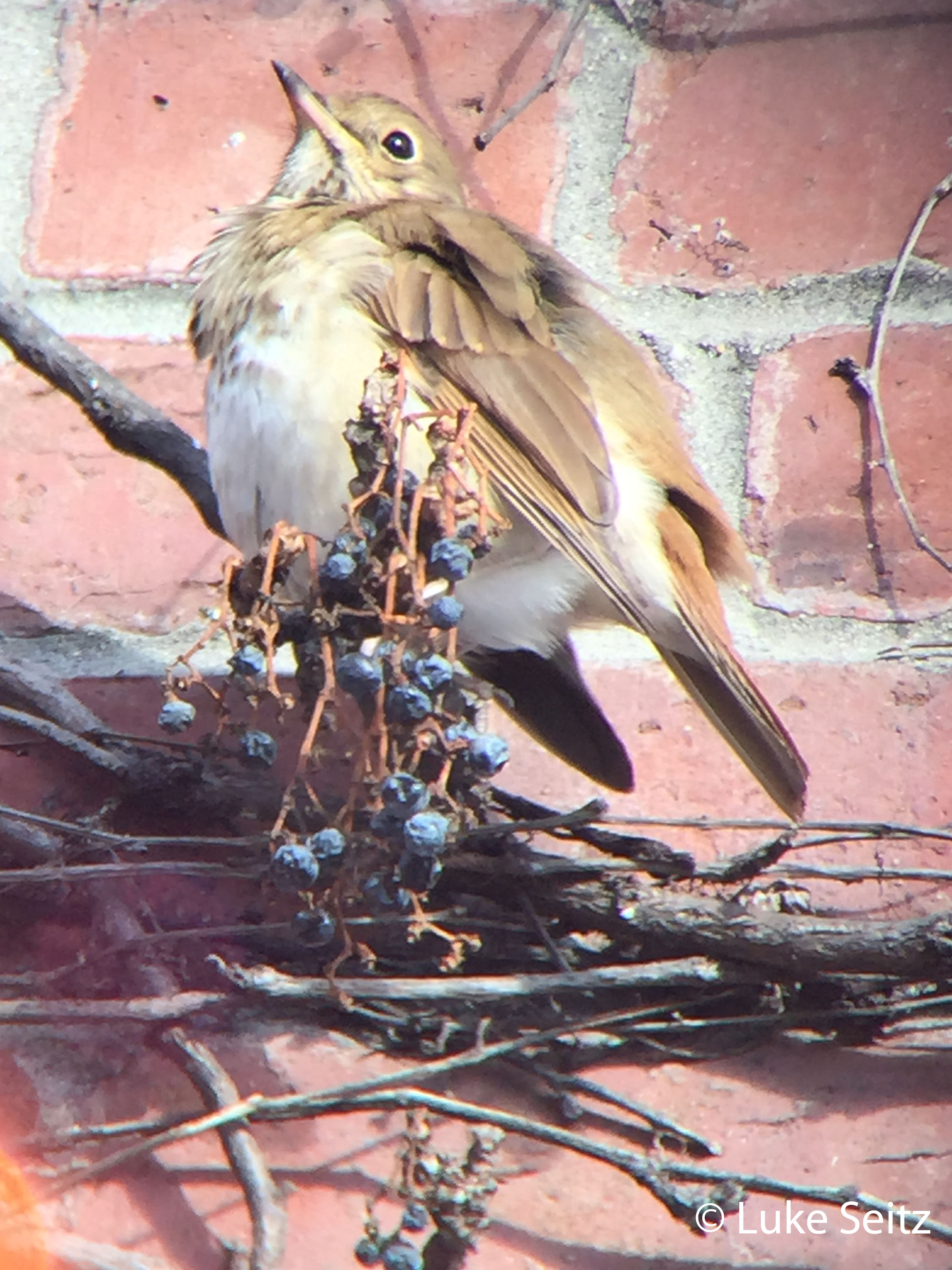
…followed closely by a total of 6 Hermit Thrushes. The previous circle-wide high count was 5!  This bird feasted on Virginia Creeper climbing up a brick wall along Free St.

HETH,FreeSt,Luke_Seitz_phone-binned,12-14-14_edited-1
Phone-binned photo by Luke Seitz.

Two Swamp Sparrows (1 along the Eastern Promenade and 1 at Mercy Pond) were noteworthy, as were our tallies of 44 Northern Cardinals and 26 Northern Mockingbirds in particular, for a total of 42 species.

7:15-3:15.
(Luke Seitz 8:20-12:45).
Miles by foot: 8
Miles by car: 5.7
Start: 34F, cloudy, NW 7
End: 45F (high of 46), clear, NW8

American Black Duck: 4
Mallard: 112
ABDU x Mallard: 3
Common Eider: 176
White-winged Scoter: 1
Long-tailed Duck: 32
Bufflehead: 81
Common Goldeneye: 9
Red-breasted Merganser: 35
Red-throated Loon: 2
Common Loon: 10
Great Blue Heron: 1
Cooper’s Hawk: CW
Red-tailed Hawk: 5
Ring-billed Gull: 42
Herring Gull: 360
Iceland Gull: 2
Great Black-backed Gull: 51
Rock Pigeon: 484
Mourning Dove: 14
Downy Woodpecker: 3
Hairy Woodpecker: 1
Blue Jay: 9
American Crow: 40
Black-capped Chickadee: 46
Tufted Titmouse: 2
White-breasted Nuthatch: 2
Carolina Wren: 3
RUBY-CROWNED KINGLET: CW
Hermit Thrush: 6 (!)
American Robin: 7
BROWN THRASHER: 1 (2nd Count Record)
Northern Mockingbird: 26
European Starling: 257
Yellow-rumped Warbler: 1
American Tree Sparrow: 2
Song Sparrow: 22
Swamp Sparrow: 2
White-throated Sparrow: 44
Dark-eyed Junco: 9
Northern Cardinal: 44
BALTIMORE ORIOLE: CW
House Finch: 82
Pine Siskin: 1
American Goldfinch: 84
House Sparrow: 247

Portland was birdier than usual for mid-December, likely due to an abundance of fruit (especially crabapples) and overall relatively mild temperatures this fall, allowing things like thrushes to stick around/survive in the area.

FullSizeRender1_edited-1
Sunrise at Moody Point.

Today, Kristen Lindquist and I covered the Moody (Wells-Ogunquit) area for the Southern York County CBC – my usual, exceptionally productive, territory for this count.  Again, it was a very birdy day, but unlike Portland, the birding was a little more challenging. The lack of snow cover and limited ice in the marsh reduce concentrations of birds, and the mild temperatures minimized concentrations at sunny edges. There was a lot of food to be found, so birds weren’t packed together at feeders or dense thickets in warm microclimates.

Nonetheless, we tallied 59 species (below average for this section), and several “good” birds. The best of which was an Eastern Meadowlark in the saltmarsh off of Furbish Rd, a 5th count record. A Common Yellowthroat (10th count record) was in a cattail marsh at Moody Point where I have had yellowthroats on this count more often than not. 8 Dunlin among a goodly 188 Sanderling on Ogunquit Beach were a 7th count record, and other good birds included a Hermit Thrush, 5 American Pipits (Eldridge Rd), a male and female Northern Pintail, and two Harlequin Ducks at our dawn seawatch at Moody Point. Five Black-legged Kittiwakes off Moody Point and 3 Razorbills off of Ogunquit Beach were expected, but always nice to see.
me,OgunquitBeach,12-15-14,K

7:17-2:45
With Kristen Lindquist
Miles by foot: 10.
Miles by car: 8
Start: 28F, clear, calm.
End: 37F (high of 42), clear, very light Var.

Canada Goose: 80
American Black Duck: 91
Mallard: 251
ABDU x Mallard: 2
NORTHERN PINTAIL: 2
Common Eider: 67
Harlequin Duck: 2
Surf Scoter: 26
White-winged Scoter: 100
Black Scoter: 45
Long-tailed Duck: 47
Bufflehead: 15
Common Goldeneye: 11
Red-breasted Merganser: 9
Red-throated Loon: 1
Common Loon: 7
Horned Grebe: 18
Red-necked Grebe: 65
Great Cormorant: 1
Red-tailed Hawk: 6
Sanderling: 188
DUNLIN 8 (7th count record)
Ring-billed Gull: 8
Herring Gull: 171
Great Black-backed Gull: 13
Black-legged Kittiwake: 5
Razorbill: 3
Rock Pigeon: 55 (very low)
Mourning Dove: 58
Downy Woodpecker: 14
Hairy Woodpecker: 2
Blue Jay: 25
American Crow: 46
Black-capped Chickadee: 104
Tufted Titmouse: 10
Red-breasted Nuthatch: 10
White-breasted Nuthatch: 18
Carolina Wren: 2 (very low; presumably affected by last winter)
Eastern Bluebird: 7
Hermit Thrush: 1
American Robin: 18
Northern Mockingbird: 2
European Starling: 582
AMERICAN PIPIT: 5
Cedar Waxwing: 45
Yellow-rumped Warbler: 3
COMMON YELLOWTHROAT: 1 (10th count record)
American Tree Sparrow: 19
Song Sparrow: 38
Swamp Sparrow: 2
White-throated Sparrow: 30
Dark-eyed Junco: 92
Northern Cardinal: 39
EASTERN MEADOWLARK: 1 (5th count record)
Purple Finch: 1
House Finch: 142
Pine Siskin: 1
American Goldfinch: 257
House Sparrow: 188

My next CBC will be Freeport-Brunswick on January 3rd.  Until then, Merry Christmas-counting everyone!

The Deal With Alpha Codes, and some Florida Pics.

This week, my blogging was hosted by the American Birding Association. A synthesis of the results of a query that I put out to the Maine-birds listserve regarding why the use of “four-letter (or “alpha” or “banding”) codes on listserves elicits such strong responses is featured in “Open Mic: The Deal With Alpha Codes.” I hope you’ll check it out, and I hope you’ll enjoy (or at least be thought-provoked by it).

Part 1 is here.

And Part 2 is here.

Please consider joining in on the discussion in the comments field of the ABA blog.

Meanwhile, Jeannette and I escaped the ice for a quick four-day trip to Florida for a wedding, a day with family, and an all-too-short day and a half of birding. I’m not sure if I will get a chance to write much of a blog about it, so let me quickly summarize the highlights:
Me_with_jay,ArchboldBioSation,12-8-14_edited-1

Florida Scrub-Jay was a life bird for Jeannette.  I think this is a “countable” view!
J-Mo_with_jay1,ArchboldBioStation,12-8-14_edited-1

Jeannette’s first ABA-Area Limpkins were among a lovely diversity of birds at the Circle B Bar Reserve in Lakeland, one of which posed nicely.
Limpkin on snag,Circle B Bar Reserve,FL, 12-8-14

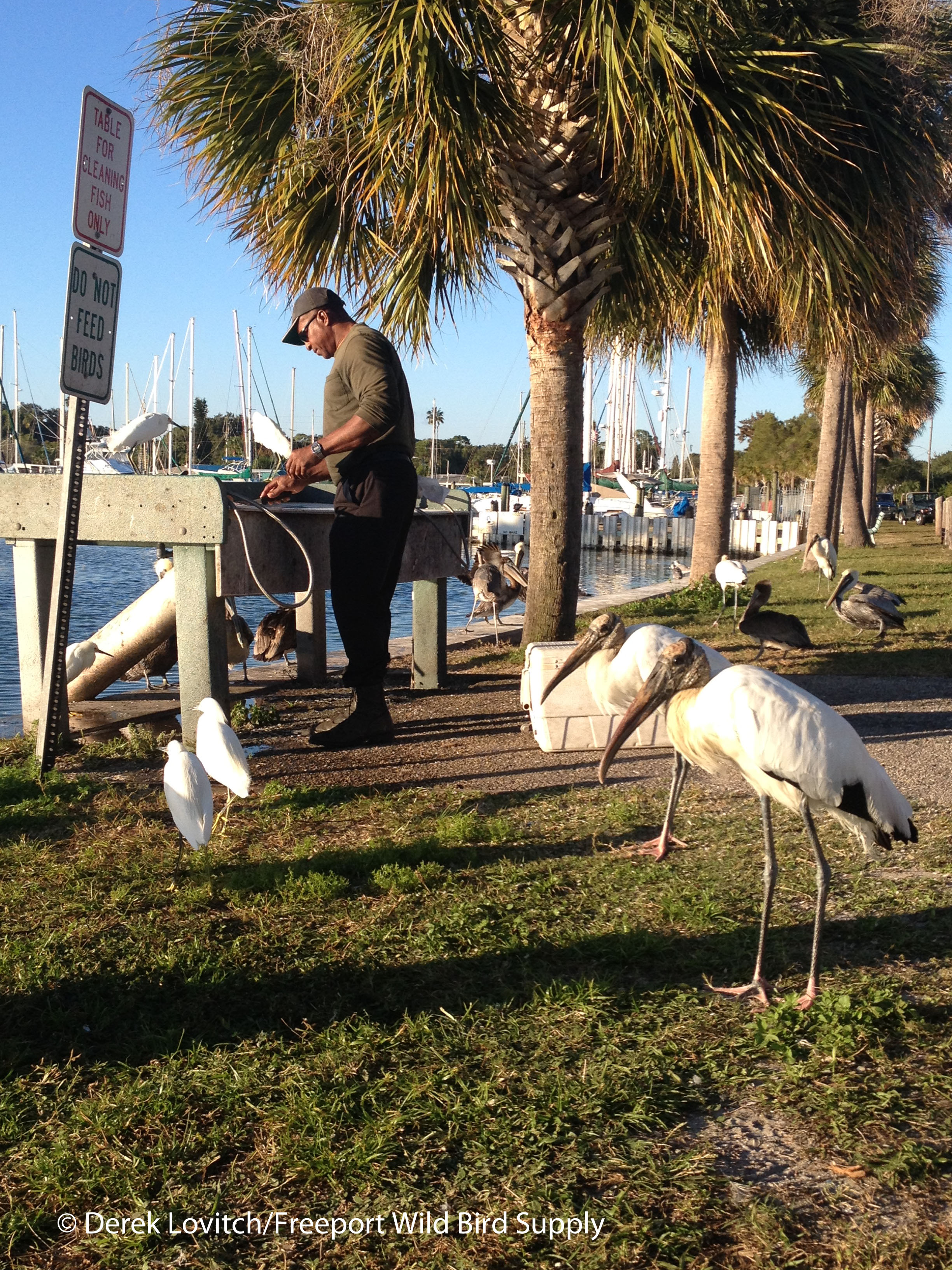
And while our mutual-lifer Nanday Parakeets were serendipitously spotted as we stepped out of breakfast at a Waffle House (itself a successful “twitch”), a stop in Gulfport for another look (also successful), presented an unexpected photo session with some, let’s say, very cooperative Wood Storks.
WOST_handouts,GulfportMarina,12-9-14_edited-1

As for local birds, I was happy to see the Townsend’s Solitaire was still at Florida Lake Park in Freeport this morning as I took Sasha for a stroll. I spent about 25 minutes with it today, as it alternated feeding on Winterberry and Multiflora Rose, and in classic solitaire-style, perching up on the tallest trees around. That was a nice welcome home.

Finally today, I wanted to steer you over to the Tri-Town Weekly (Freeport-Pownal-Durham) which ran this nice little feature on our store’s 6th Annual Snowbird(er) Contest for our Saturday Morning Birdwalks.

The All-Time Saturday Morning Birdwalk List

Maine’s first-ever Broad-tailed Hummingbird in November of 2022 was one of the rarest birds ever encountered on a Saturday Morning Birdwalk. Even better, we were among the first to see it as the birdwalk group was among the first to be granted permission to visit this Freeport yard before
it was open to the public for all to enjoy.

Last Update: 11/8/2025.

Our store, Freeport Wild Bird Supply, offers free birdwalks every Saturday morning, all year long. Meeting at 8:00am, we carpool to a local park of seasonal interest, and return to the store for bird-friendly coffee between 10 and 10:30. With the exception of inclement weather, we limit the drive to about 10-15 minutes away, and visit a variety of parks, waterfront overlooks, and other hotspots.

Over the years, we have seen a lot of good birds. We’ve “chased” as species or two, but we have found our fair share of “good” birds.  Encompassing a wide variety of habitats each season, we have seen an impressive array of species. Spurred on by the Townsend’s Solitaire that the Saturday Morning Birdwalk group enjoyed this past weekend, I have finally compiled a list of all of the species seen on Saturday Morning Birdwalks over the past 10 ½ years (As of 2015, and not including any other trips, tours, or special walks).

This is the “unofficial” list at the moment. UPPERCASE is for species seen only once or twice. I am hoping participants will take a look at the list and see if I have missed anything, or made any errors. I’ll edit the list as changes come in, so please let me know what I missed!

      1. Greater White-fronted Goose
      2. Snow Goose
      3. BARNACLE GOOSE
      4. Cackling Goose
      5. Canada Goose
      6. Wood Duck
      7. Gadwall
      8. EURASIAN WIGEON
      9. American Wigeon
      10. American Black Duck
      11. Mallard
      12. Blue-winged Teal
      13. Northern Shoveler
      14. Northern Pintail
      15. Green-winged Teal
      16. Canvasback
      17. Ring-necked Duck
      18. Greater Scaup
      19. Lesser Scaup
      20. Common Eider
      21. HARLEQUIN DUCK
      22. Surf Scoter
      23. White-winged Scoter
      24. Black Scoter
      25. Long-tailed Duck
      26. Bufflehead
      27. Common Goldeneye
      28. Barrow’s Goldeneye
      29. Hooded Merganser
      30. Common Merganser
      31. Red-breasted Merganser
      32. Ruddy Duck
      33. Ruffed Grouse
      34. Wild Turkey
      35. Red-throated Loon
      36. Common Loon
      37. Pied-billed Grebe
      38. Horned Grebe
      39. Red-necked Grebe
      40. Double-crested Cormorant
      41. Great Cormorant
      42. American Bittern
      43. Great Blue Heron
      44. Great Egret
      45. Snowy Egret
      46. Little Blue Heron
      47. Green Heron
      48. Black-crowned Night-Heron
      49. Glossy Ibis
      50. Turkey Vulture
      51. Osprey
      52. Bald Eagle
      53. Northern Harrier
      54. Sharp-shinned Hawk
      55. Cooper’s Hawk
      56. Northern Goshawk
      57. Red-shouldered Hawk
      58. Broad-winged Hawk
      59. Red-tailed Hawk
      60. Rough-legged Hawk
      61. GOLDEN EAGLE
      62. American Kestrel
      63. Merlin
      64. Peregrine Falcon
      65. Sandhill Crane
      66. Black-bellied Plover
      67. American Golden-Plover
      68. Semipalmated Plover
      69. Killdeer
      70. Greater Yellowlegs
      71. Lesser Yellowlegs
      72. Solitary Sandpiper
      73. “Eastern” Willet
      74. Spotted Sandpiper
      75. Whimbrel
      76. MARBLED GODWIT
      77. Ruddy Turnstone
      78. Red Knot
      79. Semipalmated Sandpiper
      80. Least Sandpiper
      81. White-rumped Sandpiper
      82. Baird’s Sandpiper
      83. Pectoral Sandpiper
      84. Purple Sandpiper
      85. Dunlin
      86. Buff-breasted Sandpiper
      87. Short-billed Dowitcher
      88. Long-billed Dowitcher
      89. Wilson’s Snipe
      90. American Woodcock
      91. RED PHALAROPE
      92. Laughing Gull
      93. Bonaparte’s Gull
      94. Ring-billed Gull
      95. Herring Gull
      96. Iceland Gull
      97. Lesser Black-backed Gull
      98. Glaucous Gull
      99. Great Black-backed Gull
      100. Common Tern
      101. FORSTER’S TERN
      102. DOVEKIE
      103. THICK-BILLED MURRE
      104. Razorbill
      105. Black Guillemot
      106. Rock Pigeon
      107. Mourning Dove
      108. Black-billed Cuckoo
      109. Yellow-billed Cuckoo
      110. Great Horned Owl
      111. Barred Owl
      112. Chimney Swift
      113. Ruby-throated Hummingbird
      114. Belted Kingfisher
      115. Red-bellied Woodpecker
      116. Yellow-bellied Sapsucker
      117. Downy Woodpecker
      118. Hairy Woodpecker
      119. Northern Flicker
      120. Pileated Woodpecker
      121. Eastern Wood-Pewee
      122. Yellow-bellied Flycatcher
      123. Alder Flycatcher
      124. Willow Flycatcher
      125. Least Flycatcher
      126. Eastern Phoebe
      127. Great Crested Flycatcher
      128. Eastern Kingbird
      129. Northern Shrike
      130. Blue-headed Vireo
      131. Warbling Vireo
      132. Philadelphia Vireo
      133. Red-eyed Vireo
      134. Blue Jay
      135. American Crow
      136. Fish Crow
      137. Common Raven
      138. Horned Lark
      139. Tree Swallow
      140. Northern Rough-winged Swallow
      141. Bank Swallow
      142. Cliff Swallow
      143. Barn Swallow
      144. Black-capped Chickadee
      145. Tufted Titmouse
      146. Red-breasted Nuthatch
      147. White-breasted Nuthatch
      148. Brown Creeper
      149. Carolina Wren
      150. House Wren
      151. Winter Wren
      152. Marsh Wren
      153. Golden-crowned Kinglet
      154. Ruby-crowned Kinglet
      155. Blue-gray Gnatcatcher
      156. Eastern Bluebird
      157. TOWNSEND’S SOLITAIRE
      158. Veery
      159. GRAY-CHEEKED THRUSH
      160. Swainson’s Thrush
      161. Hermit Thrush
      162. Wood Thrush
      163. American Robin
      164. Gray Catbird
      165. Northern Mockingbird
      166. Brown Thrasher
      167. European Starling
      168. American Pipit
      169. Bohemian Waxwing
      170. Cedar Waxwing
      171. Lapland Longspur
      172. Snow Bunting
      173. Ovenbird
      174. Louisiana Waterthrush
      175. Northern Waterthrush
      176. Black-and-white Warbler
      177. Tennessee Warbler
      178. Nashville Warbler
      179. Common Yellowthroat
      180. American Redstart
      181. Cape May Warbler
      182. Northern Parula
      183. Magnolia Warbler
      184. Bay-breasted Warbler
      185. Blackburnian Warbler
      186. Yellow Warbler
      187. Chestnut-sided Warbler
      188. Blackpoll Warbler
      189. Black-throated Blue Warbler
      190. Palm Warbler
      191. Pine Warbler
      192. Yellow-rumped Warbler
      193. Prairie Warbler
      194. Black-throated Green Warbler
      195. Canada Warbler
      196. Wilson’s Warbler
      197. YELLOW-BREASTED CHAT
      198. Eastern Towhee
      199. American Tree Sparrow
      200. Chipping Sparrow
      201. Clay-colored Sparrow
      202. Field Sparrow
      203. LARK SPARROW
      204. Savannah Sparrow
      205. Nelson’s Sparrow
      206. Saltmarsh Sparrow
      207. Fox Sparrow
      208. Song Sparrow
      209. Lincoln’s Sparrow
      210. Swamp Sparrow
      211. White-throated Sparrow
      212. White-crowned Sparrow
      213. Dark-eyed Junco
      214. Scarlet Tanager
      215. SUMMER TANAGER
      216. Northern Cardinal
      217. Rose-breasted Grosbeak
      218. BLUE GROSBEAK
      219. Indigo Bunting
      220. Dickcissel
      221. Bobolink
      222. Red-winged Blackbird
      223. Eastern Meadowlark
      224. Rusty Blackbird
      225. Common Grackle
      226. Brown-headed Cowbird
      227. ORCHARD ORIOLE
      228. Baltimore Oriole
      229. Pine Grosbeak
      230. House Finch
      231. Purple Finch
      232. White-winged Crossbill
      233. Red Crossbill
      234. Common Redpoll
      235. Pine Siskin
      236. American Goldfinch
      237. Evening Grosbeak
      238. House Sparrow
      239. SNOWY OWL, Brunswick Landing, 1/31/15.
      240. Purple Martin, Rossmore Road, Brunswick, 5/2/15.
      241. BLUE-WINGED WARBLER, Old Town House Park, North Yarmouth, 7/18/15.
      242. WHITE-EYED VIREO, Freeport Transfer Station/Hedgehog Mountain Park 10/10/15
      243. LITTLE EGRET, Tidewater Farm, Falmouth, 7/9/16.
      244. Upland Sandpiper, Bowdoin Sand Plains, 7/1/17
      245. GREAT BLACK HAWK, Deering Oaks Park, Portland, 12/1/18
      246. Vesper Sparrow, Wolfe’s Neck Center, Freeport, 10/9/21.
      247. CATTLE EGRET, Wolfe’s Neck Center, Freeport, 11/6/21
      248. HENSLOW’S SPARROW, Crystal Spring Farm, Brunswick, 7/9/22
      249. Olive-sided Flycatcher, Highland Rd, Brunswick, 8/27/22
      250. HUDSONIAN GODWIT, Wharton Point, Brunswick, 10/15/22.
      251. BROAD-TAILED HUMMINGBIRD, Private Property in Freeport, 11/26/22.
      252. ORANGE-CROWNED WARBLER (finally!), Wolfe’s Neck Center, Freeport, 11/4/23.
      253. Stilt Sandpiper, Walsh Preserve, Freeport, 8/10/24.
      254. RUFF, Walsh Preserve, Freeport, 5/10/25.
      255. MACGILLIVRAY’S WARBLER, Grist Mill Park, Yarmouth, 11/8/25.

The 2014 South Coastal Maine Rarity Roundup

prairie warbler_edited-1
Prairie Warbler, Cliff Walk, York Harbor.

For the past ten years, I have organized the “South Coastal Maine Rarity Roundup” on the first weekend of November, when a group of friends get together to comb the coast from Kittery through Portland, focusing on finding lingering migrants, rarities, and hopefully “mega” vagrants.

This year, our event was postponed a week thanks to the massive Nor’easter and snowstorm that rendered last Sunday essentially un-birdable. A week later than usual, we expected fewer birds, but perhaps “better birds.” At the very least, we would be less miserable than in the 34-degree weather with driving wet snow and 50mph winds of last Sunday. Recent active weather and some good birds in the area helped stoked our “rarity fever” fire, which I prognosticated about on Friday’s blog.

The teams each cover a specific territory, including destination locations, and casual meanderings. This year, the Roundup was covered by:
Kittery –York: Katrina Fenton and Ken Klapper.
Ogunquit/Kennebunkport: Turk Duddy and Linda Woodward.
Wells: Doug Suitor, Andrew Gilbert, and Allison Moody.
Biddeford-Saco: Becky Marvil, Nancy Houlihan, et al.
Scarborough Marsh: Noah Gibb, Ed Hess, et al.
Cape Elizabeth: Robby Lambert and Lois Gerke.
South Portland: John Berry and Gordon Smith.
Portland: Derek Lovitch, Kristen Lindquist, Evan Obercian, and Jeannette Lovitch.

Although most teams described the day as “fairly slow” overall, we did indeed find some good birds, and surprisingly good diversity. 121 species (plus two subspecies) were recorded in all, well above the 11-year average of 114 species. Two new species were added to the all-time Rarity Roundup list: American Redstart and Lincoln’s Sparrow. Meanwhile, Brown Creeper went unrecorded for the first time, likely a factor of the scrubby habitats and open areas that we focus on at this time of year.

Unfortunately, despite overall high-quality birds, we once again failed to turn up any “mega” rarities. However, we did have a lot of fun as always, which really is the most important part. Or so we tell ourselves.

The full roster of “good” birds that were turned up by all of the teams were as follows:
American Wigeon: 4 at Hill’s Beach; 1 at Evergreen Cemetery.
NORTHERN SHOVELER: 1 pair, Deering Oaks Park, Portland.
Northern Pintail: 2, Fortunes Rocks Beach.
Common Merganser: 2, Saco Riverwalk.
Ruddy Duck: 40, Prout’s Pond.
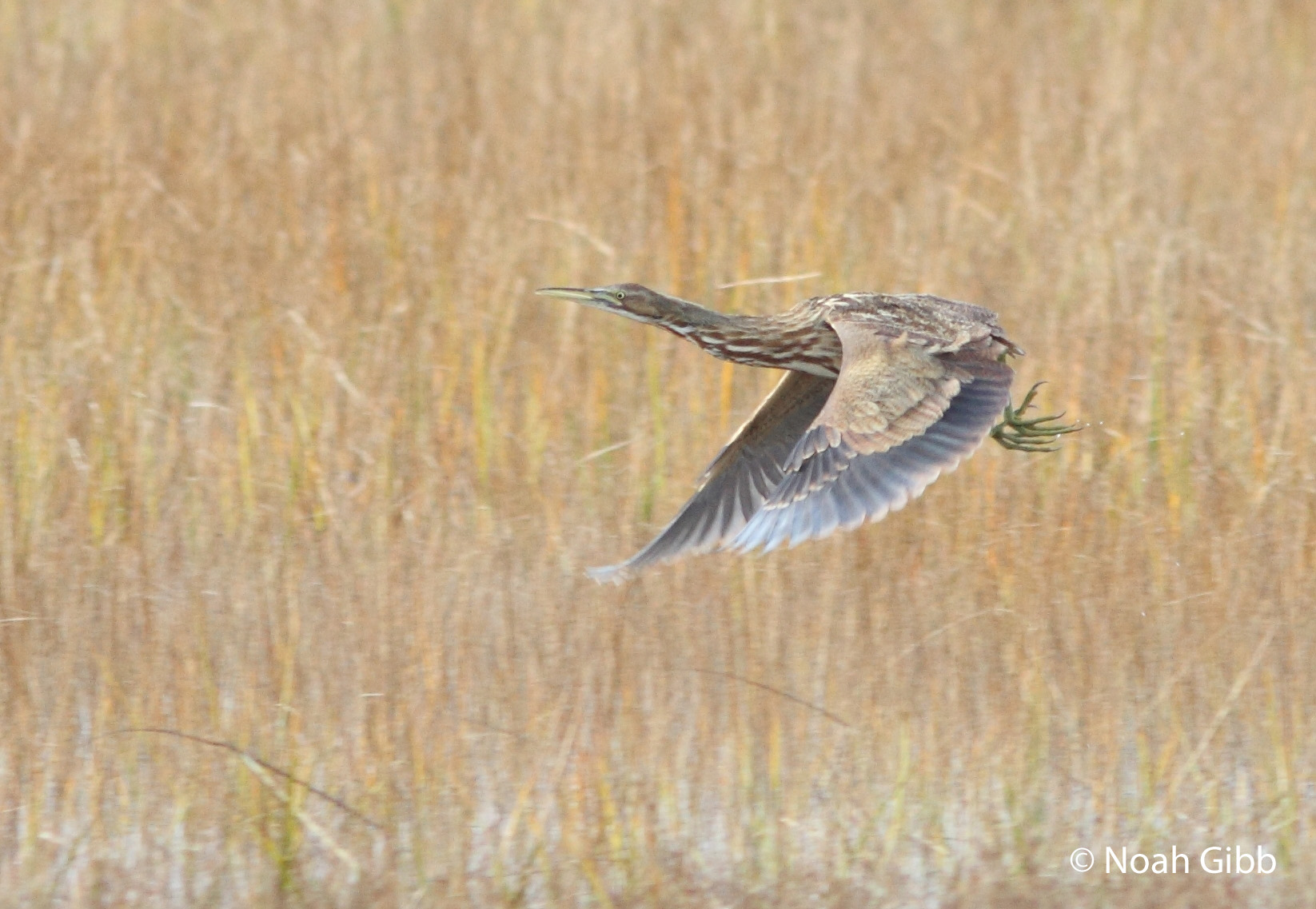
AMERICAN BITTERN: 1 Eastern Rd; 1 Drake’s Island Road.
Great Egret: 1, Parson’s Beach Rd.
Black-crowned Night-Heron: 1 Mill Creek Park; 4 Mercy Pond.
Northern Goshawk: 1, Perkin’s Cove.
Ruffed Grouse: 1, Laudholm Farms.
American Coot: 64, Prout’s Pond.
SEMIPALMATED SANDPIPER: 1, Pine Point; 1 Wells Beach jetty.
White-rumped Sandpiper: 2 Timber Point; 1 Eastern Road.
Yellow-bellied Sapsucker: 1, Rte 103, Kittery.
Eastern Phoebe: 1, Fore River Parkway Trail; 1 Pond Cove.
Northern Shrike: 1, Fort Williams Park; 1 Laudholm Farms.
RED-EYED VIREO: 1, Chadwick St, Portland.
Carolina Wren: 6 total (low by recent standards).
Gray Catbird: 1, Hill’s Beach; 1 Laudholm Farms.
ORANGE-CROWNED WARBLER: 1, Pond Cove.
NASHVILLE WARBLER: 1, Saco Riverwalk.
NORTHERN PARULA: 2, Fort Williams Park.
PRAIRIE WARBLER: 1, York Cliff Walk.
“Yellow” Palm Warbler: 1, Saco Riverwalk.
“Western” Palm Warbler: 1, Private property in Cape Elizabeth.
BLACKPOLL WARBLER: 1, Saco Roverwalk.
Common Yellowthroat: 1, Capisic Pond Park.
AMERICAN REDSTART: 1, Saco Riverwalk.
CLAY-COLORED SPARROW: 1 Community Park, Wells; 1 Private property in Cape Elizabeth.
LINCOLN’S SPARROW: Capisic Pond Park.
White-crowned Sparrow: 1, Fort Foster
Lapland Longspur: 51, Eastern Rd.
WHITE-WINGED CROSSBILL: 60-75, Eastern Promenade

Meanwhile, record high total counts (from all teams) were set for an impressive 14 species:
81 Harlequin Ducks
40 Ruddy Ducks
2 American Bitterns
2 Merlins
64 American Coots
69 Purple Sandpipers
11 Red-bellied Woodpeckers
83 Horned Larks
19 Ruby-crowned Kinglets
2 Northern Parulas
9 Chipping Sparrows
51 Lapland Longspurs
25 Purple Finches
60-75 White-winged Crossbills

My guess is the later date this year helped those Harlequin Duck, Purple Sandpiper, and Lapland Longspur totals, and perhaps also the higher counts of Ruddy Ducks and American Coots. An overall mild fall likely resulted in the late departure of so many “half-hardies” such as Ruby-crowned Kinglets, Hermit Thrushes, and Chipping Sparrows. And the steady increase of Red-bellied Woodpeckers continues.

So not bad, and once again it gives us a fascinating snapshot into the under-birded late fall season along the southern Maine coast.

Personally, I was joined by friends as usual in Portland. While Jeannette (and Sasha) birded Capisic Pond Park, Evergreen Cemetery, and Back Cove, Kristen and Evan joined me on my march through the Portland peninsula. Jeannette gets the territory’s bird-of-the-day honors with the First Rarity Roundup Record Lincoln’s Sparrow at Capisic Pond Park, where she also had the count’s only Common Yellowthroat.

The peninsula, however, was about a slow as I have ever experienced it on a Rarity Roundup, likely due to the later date and resultant fewer food supplies. But even still, the Eastern Promenade was uncharacteristically slow, and development and ridiculous bush-whacking and clear cutting by the City of Portland diminished the value of the habitat along West Commercial Street.

With a few interesting birds, including our best bird of the day, a Red-eyed Vireo in a front yard in the West End, I wish I had gotten to this neighborhood sooner in the day, but alas, hindsight is always 20/20. And while Portland’s overall performance paled in comparison to the hauls from recent years, we still had some great birds. The flock of 60-75+ White-winged Crossbills that flew over us on the Eastern Promenade were the first I have seen all year, the pair of Northern Shovelers in Deering Oaks Park were unexpected, and the 4 immature Black-crowned Night Herons at Mercy Pond were good to see.

But perhaps the bird of the day was the Hermit Thrush. We had an impressive total of 31 throughout our day, including several in small downtown gardens and landscaping corners. White-throated Sparrow (including 24 scattered around downtown as well) were also prevalent. These two species were the only native birds – as usual – that we found in the center of downtown Portland. This always fascinated me, as these two species seem particularly regular in the heart of concrete jungles.
HETH,Portland,11-9-14_edited-1
I think this phone-photo of a Hermit Thrush captures the essence of this intriguing topic of conversation.

Perhaps next year we will find the “next big one.” Until then, I have some more fun data to play with.

Some of the “documentation” photos from the day:

AMBI,EdHess,EasternRd,11-9-14_edited-1


American Bittern, Eastern Rd, Scarborough Marsh.


AMERICAN BITTERN NOV 9 2014 SCARBOROUGH, ME IMG_0771_edited-1

barred owl_edited-1 Barred Owl, Fort Foster, Kittery.

BCNH,JohnBerry_edited-1

Juv. Black-crowned Night-Heron, Mill Creek Park, South Portland.

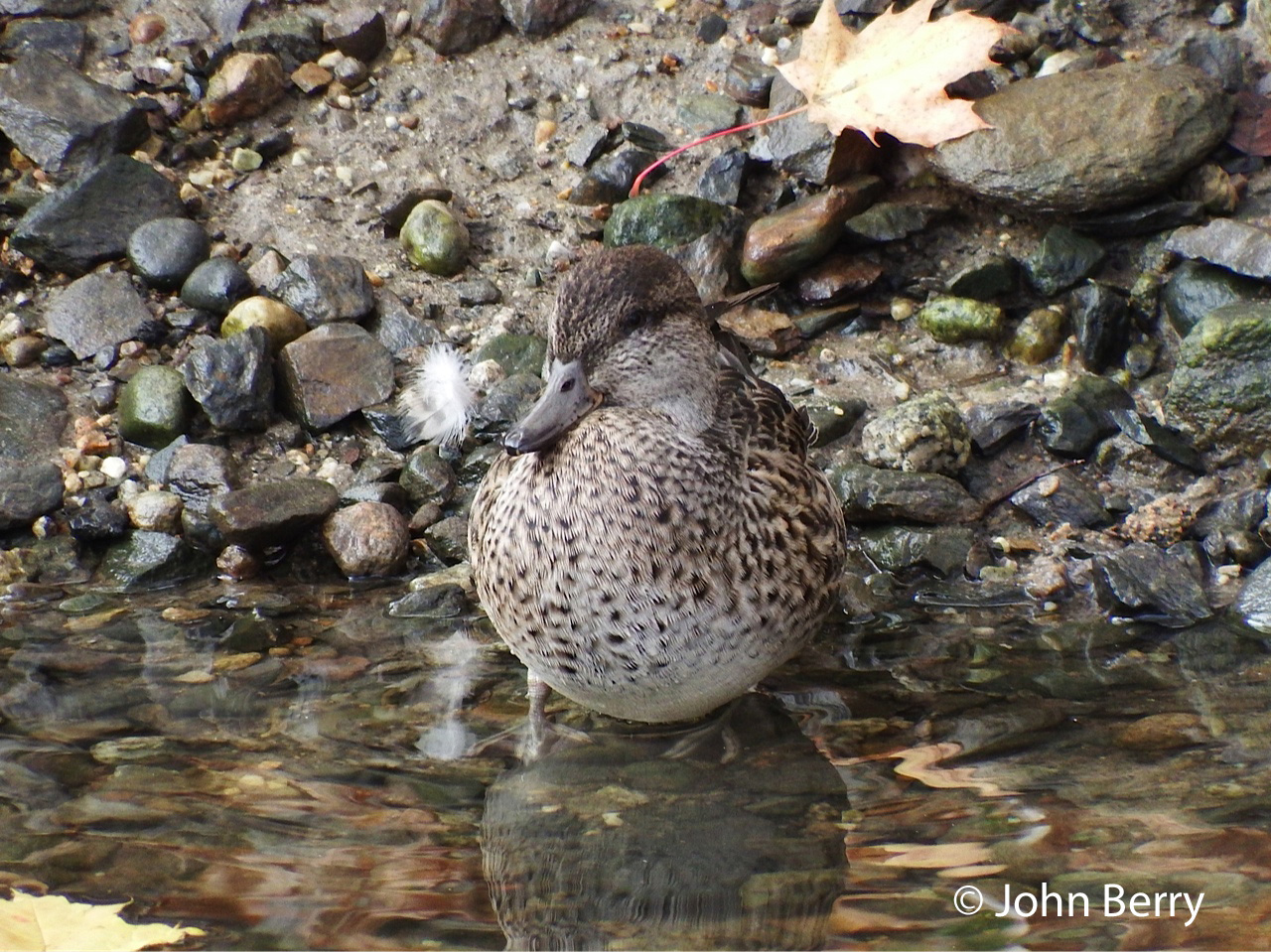
GWTE,John Berry_edited-1 Female Green-winged Teal, Mill Creek Park.

RUDDY DUCK NOV 9 2014 SCARBOROUGH, ME IMG_0793_edited-1 Female Ruddy Duck, Prout’s Pond, Scarborough.

Rarity Season-to-date: Nov 7, 2014

Two weeks ago (October 24th to be exact), I posted a blog heralding the arrival of “Rarity Season” here in Maine. The next day, a Townsend’s Solitaire was found on Hermit Island in Phippsburg. “Here we go,” I thought.

Unfortunately, things didn’t pick up immediately. In fact, despite some very good birding for the next week, there were few rarities discovered: a few Orange-crowned Warblers here and there, but a lot of “lingering” migrants. American Tree Sparrows, Snow Buntings, and a lot of waterbirds arrived, but these are all typical of the season. Personally, I had some great birding that week, such as an impressive array of tarrying shorebirds (led by the continuing family group of American Oystercatchers, a Hudsonian Godwit, and 6 Red Knots) in and around Biddeford Pool on the 27th, a nice diversity of birds at Reid State Park with Jeannette on the 28th (Tennessee Warbler, first-of-fall Snow Bunting, an impressive 473 Sanderlings), a huge count of 915 Ruddy Ducks and a continuing hen Redhead (a rarity) at Sabattus Pond with a friend on the 30th, more late shorebirds with 2 Semipalmated Sandpipers and 3 White-rumped Sandpipers at Pine Point on the 31st, and migrant sparrows in local patches and under feeders, including an increasing number of Dark-eyed Juncos and American Tree Sparrows. I also enjoyed two light flights at Sandy Point. And of course there are the goose fields to scour. (Don’t forget that I post near-daily reports to the store’s Facebook Page).

So yeah, I love October birding, even without rarities, and while landbird diversity decreases in November, there is still a lot of fun stuff to uncover. While rarities had been few during the first week or so of Rarity Season, I think the mild weather played a role: birds have just not been concentrated yet in warm microclimates and seasonally-productive microhabitats.

Plus, with more birders in the field on the weekends, more “good” birds are usually discovered. Unfortunately, the weekend of Nov 1-2 didn’t exactly invite a lot of people outside. In fact, for the first time, my annual Southcoastal Maine Rarity Roundup (where a group of us get together to scour the coast) was postponed. The massive coastal Nor’easter produced a heavy, wet, early-season snowfall (over 15” in Bangor and the Camden Hills!) and very strong north to northeasterly winds. It was a nasty day.
wind map, 11-3-14

While sea-watching was undoubtedly fantastic in periods when there was actually visibility, few reports of anything trickled in, as most birders stayed inside or found little of interest to report. The exception was a Greater White-fronted Goose, the first of the season, at the Greater Yarmouth Goose Fields.

With Jeannette out of town, my time was limited on Sunday and Monday mornings, but a walk with Sasha at Florida Lake Park on Sunday morning yielded a shock, with 5 Redheads. These were my 154th Patch Bird here, and while I went there hoping for some grounded waterfowl, these were definitely not the species I was expecting!

But in the wake of the storm, the first really cold air of the season arrived. Portland had its all time-record latest freeze, and for the first time, it received a measurable snowfall before the first freeze! Not surprisingly, some interesting birds arrived at feeding stations. There was a Baltimore Oriole at a Cape Elizabeth feeder and a Dickcissel at a Winterport feeder, for example. Plus, more Dark-eyed Juncos, American Tree Sparrows, and the first Fox Sparrows have filtered in (my first of the fall was in our Pownal yard on Monday morning). The usual smattering of late “lingering” warblers have been noted here and there as well, and there are a few very late Hudsonian Godwits and other shorebirds tarrying here and there.

With another active week of weather, I was antsy to get out birding, but unfortunately my schedule was a little busy. I had Tuesday, however, and made the most of it. Although I failed to turn up anything of note in the morning on Bailey and Orr’s Islands in Harpswell, Sabattus Pond was excellent again later that afternoon, led by still amazing counts of Ruddy Ducks, and now a pair of Redheads – it’s shaping up to be a very good fall for them in Maine.

And then this morning in Cape Elizabeth was exceptional. In fact, it was one of the best mornings that I have had so far this late fall. There was an Orange-crowned Warbler at Kettle Cove, a Gray Catbird at Crescent Beach State Park, and a Blackpoll Warbler with a Common Yellowthroat at Pond Cove.

But 2 hours on a private farm was absolutely unreal: Two Clay-colored Sparrows, a Dickcissel, an Orange-crowned Warbler, a wicked late Prairie Warbler and Lincoln’s Sparrow, an Indigo Bunting, 2 Common Yellowthroats, a Northern Goshawk, and my first Northern Shrike of the year, a brown immature. 100+ each of Dark-eyed Junco, House Finch, and American Goldfinch; 75+ each of Song and White-throated Sparrows; 40+ Swamp and 20+ Savannah Sparrows. And a single White-crowned Sparrow was my 10th sparrow species here today!
DSC_0013_CCSP,AlewivesBrookFarm,11-7-14_edited-1
1 of 2 Clay-colored Sparrows present this am.

But now we’ve reached the weekend, and I expect some fun stuff to be found. Surrounding states have also been relatively slow for rarities (but New Hampshire has started to pick up with continuing Yellow-headed Blackbirds and now a Western Grebe), likely due to the same factors as here in Maine, principally the mostly mild weather to date. Sunday will be our Rarity Roundup here in Maine, so I will look forward to seeing what we find – there has to be something really good out there! And if Cape Elizabeth today was a sign of things to come, the RR should be a whole lot of fun.

On Recent and Upcoming Weather, Vagrant Season, and Recent Great Birding

Late October through early November is traditionally the best “rarity season” in Maine, where vagrants from all directions are hoped for, and even expected. We’ve been in a rather active and dynamic weather pattern of late, and this may help to usher vagrants in our direction. While weather rarely “blows” birds off-course, winds and weather systems can certainly facilitate their arrival in far-flung places, especially when combined with some sort of misorientation (for a thorough discussion of the concept, see Chapter 7 of my book, How to Be a Better Birder).

As October progresses, the nights get longer, and the days (usually) get colder. The growing season comes to an end (although in many spots the killing frost has not yet reached the immediate coastline yet this year), and food sources become greatly limited. This can push vagrants that may have arrived over the course of the fall migration into favorable micro-climates and patches of seasonal food abundance. More recently-deposited vagrants, “late/lingering” migrants, and other more typical species can also concentrate in such prime areas, such as urban parks, coastal migrant traps, and so on.

Let’s take a look at some of the recent weather, and attempt to identify some possible species to consider.

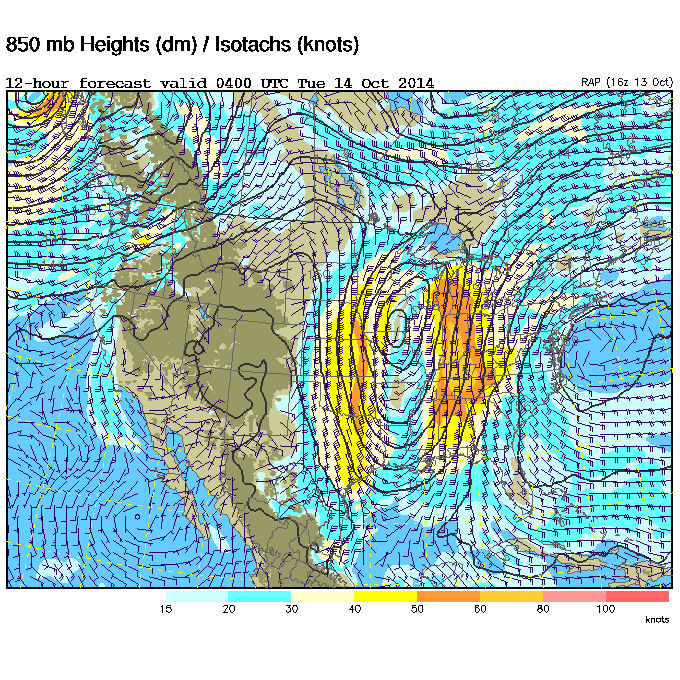
Over the past ten days, above normal temperatures were regular, thanks to southerly winds. Take a look at the wind map from October 13th, for example.
wind map, 10-13-14

Strong southerly winds pumped warm air into the area from the Deep South and the Bahamas (and the South Atlantic Bight). These are favorable conditions for depositing “180-degree misoriented migrants” from the south, such as Summer Tanagers and White-eyed Vireos. I wonder if it’s a little too late for a big push of southern birds, however, as many of the Neotropical migrants have already departed the continent. Meanwhile, that extensive southerly flow all of the way into Mexico is the type of weather pattern that can facilitate the arrival of long-distance vagrants, such as Fork-tailed Flycatcher.

Sparrows are on the move now, and northerly winds with cloudy skies overnight on 10/18 to 19 resulted in a big push of sparrows. The low ceiling likely resulted in disorientation of these low-flying migrants by the big city lights, resulting in a massive flight of birds in Portland’s East End on the morning of the 19th. I estimated over 2000 White-throated Sparrows and 500 Song Sparrows just on the Eastern Promenade alone, with dozens more in almost every lot I checked. A hundred White-throats were in the North St Community Garden, and by the end of the morning, I had tallied 8 species of sparrows, and impressive numbers of Chipping Sparrows (76) and Eastern Phoebes (15) among others. Although 2 Red-bellied Woodpeckers were my 175th species on my Eastern Promenade Patch List, I was surprised that I could not tease out any rarities from the volumes of birds (the sheer number of birds plus gusty winds hampered detection, no doubt).

By 10/19, a strong cold front – a rare occurrence this season – pushed through, and with it, a huge flight of migrants. I tallied over 1100 birds at Sandy Point on the morning of the 20th, led by 461 Yellow-rumped Warblers and 159 American Robins.

You can see how strong and extensive these northwesterly winds finally were from the wind map that day.
wind map, 10-19-14

Rain began to arrive in the afternoon of the 21st, and it didn’t let up until this morning. This massive coastal Nor’easter drenched Maine with up to 5” of rain, and moderate to strong northeasterly winds battered the state, especially the coast.
wind map, 10-23-14

Birding was a challenge on Wednesday and Thursday, as strong winds and often-heavy rain made things difficult. Rain and coastal fog and mist precluded seawatching, and any lake-watching for grounded waterfowl was rendered impossible by visibility and waves. Essentially, feeder-watching was the best bet these two days, and a growing contingent of sparrows at both our home and here at the store provided the entertainment. About 200 Common Grackles descended into our Pownal yard on the 23rd as well.

But now, today (Friday), this massive storm is finally pulling away.
wind map, 10-24-14

And I had a great day of birding in Cape Elizabeth. I began with some seawatching at Dyer Point. From 7:50 to 9:50, I had moderate to good visibility for all but a total of 47 minutes as light showers and mist rolled through. Seas were down to 4-6 feet, and moderate north winds continued. Here’s the scorecard (all southbound unless otherwise noted) – which was actually a little lighter than I had expected:
317 Double-crested Cormorants
127 Northern Gannets (about evenly split between north and southbound)
77 Common Eiders (several hundred northbound)
20 White-winged Scoters
18 Black Scoters
17 Red-breasted Mergansers
16 unidentified ducks
16 Common Loons (plus 18 northbound)
15 Surf Scoters
10 “dark-winged” scoters
8 Long-tailed Ducks (first of fall)
8 Red-throated Loons
5 Great Blue Herons
5 Bonaparte’s Gulls
3 Red-necked Grebes
2 Green-winged Teal
2 Great Cormorants
2 Laughing Gulls
1 Black Guillemot
1 Peregrine Falcon
1 White-throated Sparrow (flew in off the water at 8:05am).

Next up was Kettle Cove, where a nice diversity of migrants, especially sparrows, also included an Orange-crowned Warbler and 3 Common Yellowthroats. Even more interesting was this gull, which appears to be a hybrid Herring x Great Black-back. Intermediate in size and shape between the two, and with an intermediate mantle color, the short wings and pinkish legs separate it from Lesser Black-backed.
DSC_0002_HERGxGBBG1,KettleCove,10-24-14_enlarged_edited-1

DSC_0001_HERGxGBBG2,KettelCove,10-14-14_edited-1

A local sparrow-rific patch of private property was fruitful as well. Although a very tardy Bobolink was the only surprise here, plentiful numbers of sparrows included 200+ White-throated, 100+ Song, 50+ Swamp, 50+ Savannah, 50+ Dark-eyed Juncos, at least 10 White-crowned Sparrows, and a single Lincoln’s Sparrow. A Red-bellied Woodpecker and my second Carolina Wren of the morning were added to the tally.

A male Black-throated Blue and a female Black-and-white Warbler joined Palm and Yellow-rumped Warblers feasting on seaweed flies in and near the wrack at Pond Cove, where another Red-bellied Woodpecker was sounding off.

On my way back, I swung through the goose fields, and clearly more Canada Geese have arrived in the last few days. 718 was a new season-to-date high count, with the most interesting new arrival being this spiffy leucistic Canada. Unlike a hybrid with a Snow or a Domestic Goose, this neat bird was the same shape and size as the average Canada, but with a dull brownish cast to the head, neck, and wingtips.
IMG_4625_leucisticCANG1,GreelyRd,10-24-14_edited-1

As this nasty low rides up into Atlantic Canada and beyond, strong wrap-around winds will offer the potential to displace Northern Wheatears or rare geese from Greenland. Meanwhile, next week, we’ll see unseasonable warmth return on southwesterly winds (“vagrant winds” as I like to call them), just the type of scenario that can facilitate the arrival of strays from the southwest, such as Cave Swallows and Ash-throated Flycatchers. They will also facilitate the survival for at least a little longer of vagrants that are still present but as so far gone undetected.

There isn’t one predominate pattern that yields a strong suggestion of any particular vagrant (or group of vagrants) from any particular direction. However, it is clear that we are getting a nice sample of different conditions that could produce some fun stuff.

At the very least, I expect some big flights of migrants, both day and night in the coming days. In fact, I think there will be a big one tonight. Check out these northwesterly winds that should be ushering in a big push of birds:
wind forecast, overnight

Sparrows will make up the bulk of the flight, especially White-throated Sparrows and Dark-eyed Juncos. If the clouds clear by dawn, I might get a big push at Sandy Point. If the ceiling stays low overnight, look for concentrations of sparrows in migrant traps, especially in and around bright cities. Meanwhile, during the day, a lovely weather forecast should get plenty of birders out into the field.

Needless to say, I will be out looking, and I hope you will to! I look forward to what the coming days and weeks will bring.

October Birding in Maine.

October is my favorite month of birding in Maine. Great diversity, opportunities for observing the thrilling phenomena of migration, an increased chance for rarities, and often-beautiful weather combine to make for exciting times in the field.  I keep my schedule as free as possible for the month to maximize my birding time, and luckily, a current project dictates even more time in the field for me. For the past five days, October birding was at its finest, and my adventures nicely summarized what this glorious month has to offer.

On Friday, I spent the morning exploring 8 preserves of the Harpswell Heritage Land Trust. Six hours and about 5 miles of walking later, I had a better feel for the properties on Harpswell Neck, and their (significant) birding potential.

IMG_4568
Widgeon (sic) Cove Preserve.

I didn’t find anything out of the ordinary today – best birds were probably the Carolina Wren at Pott’s Point, a Red-bellied Woodpecker at the Skofield Shore Preserve, and a Nelson’s Sparrow at Stover Point – but almost all sites were delightfully birdy. Yellow-rumped Warblers were in abundance (especially at Mitchell Field) and there were plenty of Palm Warblers around (again, especially at Mitchell Field).  Other then a few Blackpoll Warblers, my only other warblers were single Pine at Skofield and a Black-throated Blue at the Curtis Farm Preserve.

Sparrows were widespread, as were Purple Finches and Pine Siskins, Red-breasted Nuthatches, and increasing waterbirds including a few groups of Surf Scoters. Mitchell Field was definitely the hotspot today, with good numbers of all expected migrants, along with migrant Osprey, a Sharp-shinned Hawk, a single Indigo Bunting, 3 Gray Catbirds, and 5 Monarchs.

After several nights with little visible migration (although there’s almost never “no” migration at this time of year!), clear and mostly light westerly conditions overnight Friday into Saturday produced a huge flight. Unfortunately, come dawn, clouds had rolled in and winds immediately shifted the northeast. Combined, the Sandy Point Morning Flight was reduced to a mere dribble totaling 91 birds, led by 36 Yellow-rumped Warblers. I was then shocked by a relatively slow birdwalk (even sparrow numbers were far lower than I would have expected) at Old Town House Park – where did all of the migrants overnight go? A Brown Thrasher was a good bird for here though.

Luckily, Saturday was the anomaly. After another very strong flight overnight, Sunday morning finally featured a light northwesterly wind.  Therefore, I finally got my fix in at Sandy Point, with my largest flight of the season.  9 species of warblers and a few new records highlighted the flight, with the following tally:

6:49-9:35am.
38F, clear, NW 5.1 to calm to WNW 4.7mph.

768 Yellow-rumped Warblers (*New Record).
421 Ruby-crowned Kinglets (*2nd highest).
179 Dark-eyed Juncos
116 Unidentified
87 Pine Siskins
79 American Robins
62 Black-capped Chickadees (*New a Record).
31 Golden-crowned Kinglets
26 Purple Finches (*New Record High).
21 Palm Warblers
20 Rusty Blackbirds (*Tied Record High).
17 Canada Geese
14 Blue-headed Vireos
14 Red-breasted Nuthatches
14 White-throated Sparrows
12 Chipping Sparrows
11 Savannah Sparrows (*New Record).
9 Northern Flickers
7 Eastern Phoebes
6 Black-throated Blue Warblers
5 Gray Catbirds
5 Swamp Sparrows
4 Unidentified kinglets
4 Black-throated Green Warblers
3 Brown Creepers
3 Hermit Thrushes
3 Nashville Warblers
3 White-crowned Sparrows
2 American Black Ducks
2 Blue Jays
2 WHITE-BREASTED NUTHATCHES (*tied record high).
2 Unidentified Catharus thrushes
2 Common Yellowthroats
2 Black-and-white Warblers
2 Lincoln’s Sparrows
2 American Goldfinches
1 Osprey
1 Yellow-bellied Sapsucker
1 Unidentified vireo
1 TUFTED TITMOUSE
1 Swainson’s Thrush
1 Nashville/Orange-crowned Warbler
1 Northern Parula
1 Blackpoll Warbler
1 MAGNOLIA WARBLER
1 Cedar Waxwing

Total = 1798 (*3rd Highest October Count).

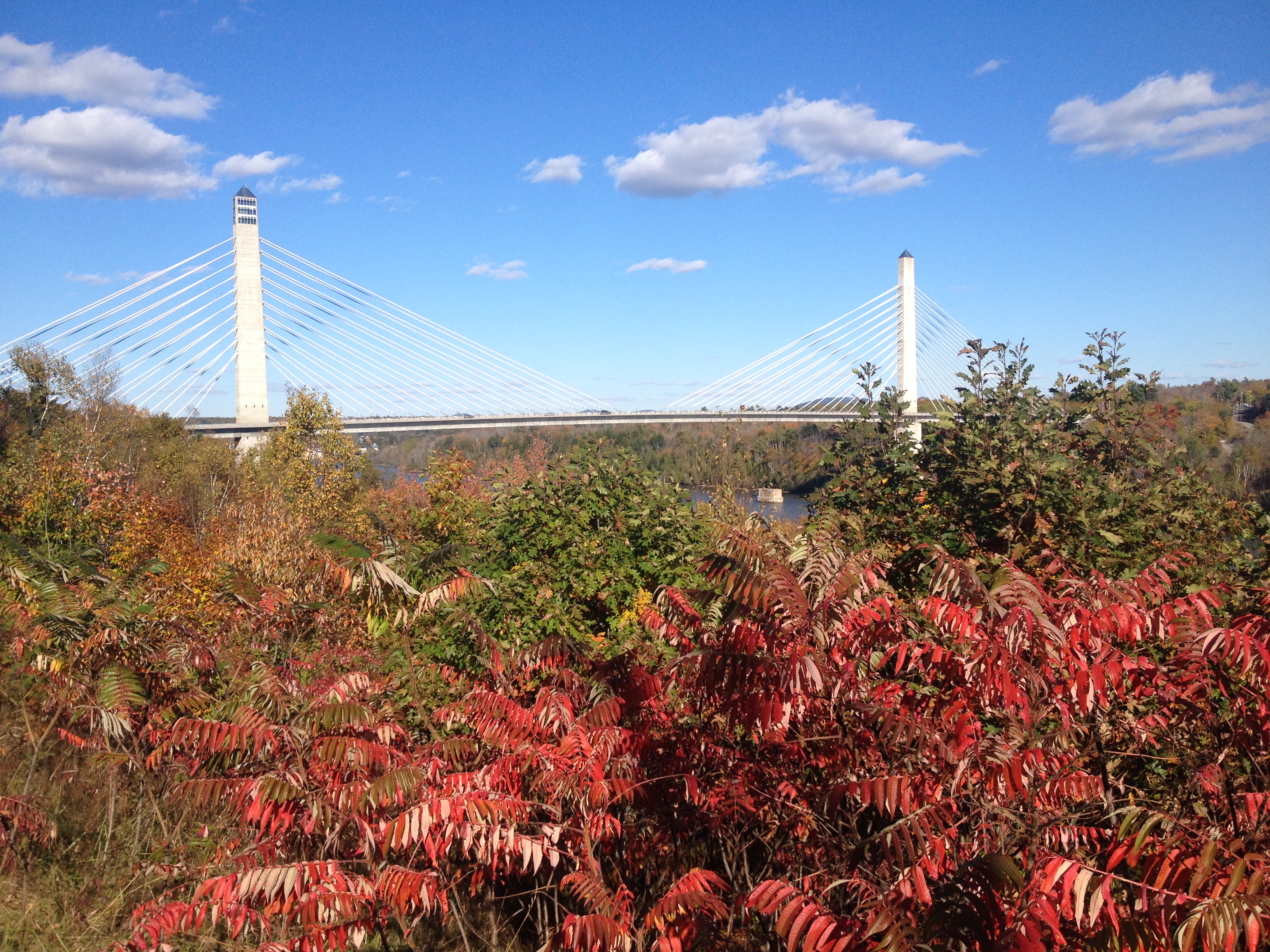
Afterwards, I began a quick trek east, visiting a friend in Camden, and having dinner with friends in Bar Harbor. In between, I enjoyed a little casual birding, and the fall foliage.
IMG_4574
The Penobscot Narrows Bridge.

On Sunday, Rich MacDonald and I did a little birding on the western half of Mount Desert Island.  An “interior/bay” subspecies of Nelson’s Sparrow at Back Beach in Tremont was a highlight, as was a nice variety of birds off Seawall Beach, including an unseasonable 148 Laughing Gulls.  20 Red-necked Grebes and about a dozen White-winged Scoters were also present.
IMG_4586

At noon, we boarded the Friendship V of the Bar Harbor Whale Watch for 3.5 hours offshore. I was really hoping for a Great Skua – my real reason (legitimate excuses aside) for this trip, afterall – but it was a rather slow day on the water. But hey, any day with a jaeger is a good day in my book, and we saw 3 Pomarines. 18 Northern Fulmars were a treat, but birds-of-the-trip honors goes to a rather unseasonable Manx Shearwater.  A single Great Shearwater, Black-legged Kittiwake, and a measly 3 Northern Gannets were all we could muster. Apparently, those northwesterly winds that finally gave me my flight at Sandy Point also pushed sea creatures out from these waters!
IMG_4591

DSC_0003_subadultPOJA,BarHarbor,10-13-14_edited-1
Subadult Pomarine Jaeger.

It was a quick trip Downeast, so I was home by Monday night, and in the morning – following a night with a return to southwesterly winds and no visible migration on the radar – Jeannette and I headed in the other direction. A ridiculously gorgeous day (light winds, temps in the low 70’s!) encouraged us to spend all daylight hours outside and birding hard, covering our usually route between Kittery and Wells.

As usually, Fort Foster provided the highlights, led by a White-eyed Vireo and an Orange-crowned Warbler.  Another Orange-crowned was at Seapoint Beach, an “Ipswich” Savannah Sparrow was in The Nubble neighborhood, 12 Brown-headed Cowbirds were at the feeders behind The Sweatshirt Shop in Wells, and Community Park hosted a Nelson’s Sparrow (ssp. subvirgatus).

Ten (and a half) species of sparrows (Eastern Towhee, Chipping, Savannah – plus “Ipswich,” Nelson’s, Song, Lincoln’s, Swamp, White-throated, White-crowned, and Dark-eyed Juncos) and six species of warblers (Orange-crowned, Black-throated Blue, Pine, Palm, Yellow-rumped, and Common Yellowthroat) were tallied, along with six species of butterflies (including a few dozen Monarchs).  Throughout the day we encountered lots of Yellow-rumped Warblers, Song and White-throated Sparrows, along with most of the regular October migrants from Horned Grebes (FOF) to Ruby-crowned Kinglets.

So there you have it. That’s just a sample of what mid-October has to offer here in Maine.  What’s left?  Finding that “Mega” rarity of course!

Book Reviews (Feb 2014), Part II

IMG_2139

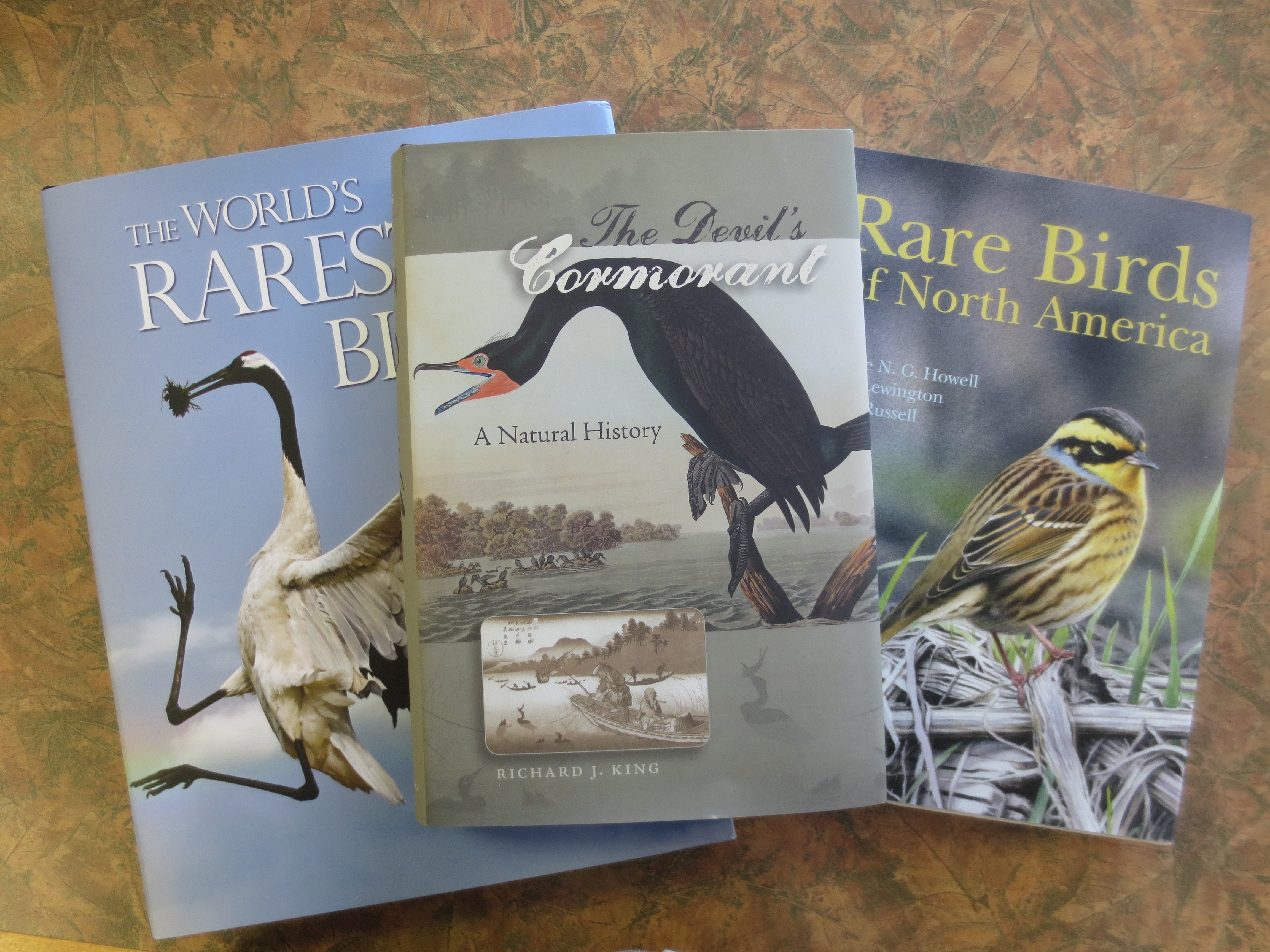
Part I, which includes The World’s Rarest Birds, Lost Animals: Extinction and the Photographic Record, and Birdwatcher: The Life of Roger Tory Peterson can be found here.

Rare Birds of North America by Steve N.G. Howell, Ian Lewington, and Will Russell.

This long-awaited and much-anticipated book “offers the first complete synthesis of the occurrence and distribution of” every vagrant recorded in North American through July of 2011.  These birds aren’t necessarily rare in a global context as with “World’s Rarest Birds” but they are most certainly rare in the United States (not including Hawai’i) and Canada.

The meat of the book is the species accounts, covering 262 species from around the world.   First and foremost – and certainly the most eye-catching aspect – is the artwork.  This book marks North American unveiling of the remarkable artwork of Ian Lewington, and for many readers, it will be the first introduction to one of the best bird artists of our time.  Simply put, the plates are gorgeous.  The birds appear amazingly life-like, yet technically sound.  There is a lot of detail, but they are not exaggerated schematics. In addition to be a sheer joy to look at, they are incredibly accurate and useful depictions that will go a long way in aiding identification, especially in cases where they are  – and fostering appreciation.  For many of these birds, these are the definitive drawings, and in some cases far surpassing the rendition in those species’ “home” field guides.  The traveling birder will gain a lot of information from studying the plates in this book when heading to that respective corner of the world.  Some of the best and most helpful plates are when similar species are painted side-by-side (such as with many of the albatrosses) and/or on adjacent pages (as with Willow Warbler, Common Chiffchaff, and Wood Warbler).

For each species account, there’s a short analysis of world distribution, North American records and their patterns, and a discussion of taxonomy. The catch-all “Comments” section includes discussions ranging from origin and patterns to unanswered questions. Not surprisingly, I enjoyed the various postulations about patterns and provenance. And last but certainly not least is the “Field Identification” section, which might be one of the most important for people who want to find these rare birds.  If you think you have discovered a new state record, this is probably the first place to go to confirm your identification, for example.  I found it quite helpful when “similar species” were thoroughly compared, although at times, I felt that the authors skipped over potential confusion species, especially when those confusion species were very real and regular features of birding discussions (i.e. domestic waterfowl and bona fide Graylag Geese; considering how often domestic geese are reported as true Graylags, it seems ridiculous to claim “Similar species: none if seen well.”)  But these complaints are relatively few.

My one over-arching quibble with the text is simply a pet-peeve of mine: the use of counties as the sole reference to rare bird records.  I have no problem with the specific locations of the records being left out (the ABA Checklist is a quick and easy place to find that info) but it seems to me that counties are one of the least valuable references.  Perhaps out West, where counties are the size of eastern states, this reference is more useful from a geographic standpoint, but in many parts of the East, in our small counties with irregular borders, many birders probably don’t even know what county they are standing in at a given time.  So why not be just a little more specific?  For example, when looking at the entry for Variegated Flycatcher, type in “York   County, Maine” to Google Maps or your favorite mapping website or software.  OK, you have an idea as to where in Maine the bird was.  Now, type in “Biddeford, Maine,” the town the bird was in.  I bet it won’t take much time (especially after reading the intro material!) to picture where this bird probably occurred – that long, narrow peninsula that sticks straight out into the water…yup, that’s where the bird was.  In other words, towns/townships/territories (or counties in unincorporated areas when necessary) provide a whole lot more information and more specifics with little additional information, space, or even typed characters: In this case “Biddeford” is two characters shorter than “York County” but provides a significant amount more of information and relevance geographically.

While the vast majority of the book is the species accounts, the introductory material is far from superfluous. In fact, it should not be missed.  In addition to the utilitarian aspects of using the book and defining exactly what a “rare bird” is, the instructive sections “Migration and Vagrancy in Birds” and “Where do North American Vagrants Come from?” are chock full of useful and interesting information about the mechanisms and geographic origins, respectively, that produces the “Mega” rarities that birding dreams are made of.  The “Molt and Aging” section is a concise introduction to this complicated topic, but one that is often important to identifying vagrants and their origin.

I must, however, disagree with their use of the term “reverse migrant” in the section “Migration and Vagrancy in Birds” to describe what is more accurately referred to as “180-degree misorientation” or “reverse misorientation” (which the entry confusingly uses in a couple of instances).   Reverse migrant is usually used to describe an entirely different phenomena where birds – from few to massive flocks – undertake a seasonally-opposite movement based on local and current conditions.  For example, a warm spell in the fall might cause thousands of swallows to move north along the west coast, or a cold snap could send Red-winged Blackbirds in a southbound retreat in spring.  These are not “mistakes” by a few as misorientation suggests, but rather a coordinated response to seasonal conditions and its impact on food supplies, regardless of age and experience.

This book is a must-own for any student of vagrancy and rare birds, and it helps to teach everyone how to find more rare birds.  Meanwhile, birders of all levels will simply appreciate flipping through its pages and marveling at Lewington’s artwork and the unbelievable diversity of species that is out there waiting for us.

The Devil’s Cormorant: A Natural History by Richard J. King. (University Press of New England, 2013).

I saved the best for last. In fact, this is one of the best natural (and cultural) history books that I have read in quite some time. Various species of cormorants are found on all continents (yes, including Antarctica) and in all corners of the world, we find these birds to be vilified, hated, and sometimes even cherished.

The author seamlessly integrates fascinating hard science and extensive research with personal anecdotes from his cormorant-centric travels around the world. At the same time, he explores the interaction between humans and these birds.  From the sacred cormorant fishing in Japan to the guano deposits of Peru, we see how cormorants are an important part of some cultures.  On the other hand, from the catfish farms Louisiana to the stocked fishing holes of England, we see how people have come to misunderstand or even downright hate – and often woefully mis-manage – cormorants. The author does an excellent job of remaining objective even when explaining human actions that seem completely insane and inane, but strives to educate the reader about the realities – including when the realities are negative for the cormorant.

During the course of the year, the author follows the life of the Double-crested Cormorants breeding on a small island in Long Island Sound, through all of the trials and tribulations of surviving in a cruel, unforgiving world.  In between, he travels the globes to get to know others species on an intimate level, from spending time with researchers to visiting museums.  I particularly enjoyed his self-deprecating and humorous portrayal of his visit to the Natural History Museum in Tring, England and his travels through the population and species of the “blue-eyed shag group” of the sub-Antarctic, a trip that I have had the privilege of experiencing.

Personally and professionally, I find myself often defending the cormorant, rejecting the vitriol directed towards it. Heck, we even have a giant photograph of the face of a Double-crested Cormorant on our dining room wall: a face that includes a vivid turquoise-green eye – that I feel is one of the most beautiful colors in the world – and the bright and vivid orange facial skin and gular patch that contrasts magnificently with the dark black feathering, the dirty gray and flaky, “ugly-looking” imposing bill.  In other words, I was exceptionally happy when a friend of mine handed me a copy of this book.  It’s a fair treatment of the cormorant – and like most things, when nature is treated fairly, the natural world – including its cormorants – is defended.  I guarantee you will have a new-found understanding and appreciation for this remarkable group of birds.

Of course, most of these titles are available at Freeport Wild Bird Supply, and a shipment of A Devil’s Cormorant has just arrived and is the featured “Derek’s Choice” at the moment.  Also, look for our next installment of “Birds, Books, and Beers” to feature Will Russell, co-author of Rare Birds to take place in early May.  More on that soon.

And speaking of new, “must-have” books, the new and completely updated Sibley Guide is coming out in March!  We’re currently taking discounted pre-orders here at the store.