Tag Archives: Biddeford Pool

The 2016 Maine State List (and my own) Predictions Blog.

The second record (and perhaps the first verified one) for Maine of Black-throated Sparrow was found in Winter Harbor on New Year’s Day, and continues through today, January 6th. I was tempted to chase it yesterday, but instead I am left to hope it sticks around until the end of next week when I return from a short business trip. Fingers crossed!

Before it arrived, I had begun to put together my annual list of the next 25 species to be found in Maine. I then follow that up with my own State List predictions, and no, Black-throated Sparrow was not on that list!

I know, I know, you’ve been awaiting this with baited breath for this. So without any further ado, let’s get started with the annual Maine State Birds Predictions List.

First, a quick recap of 2015.

Only one species was added to the state’s all-time birdlist, a Surfbird, which was discovered at Biddeford Pool in March. It was not a species on anyone’s radar, and it was most definitely not on my Predictions List for 2015!

But I did make several changes to my Next 25 Species for Maine list, and moved things around a bit. So here are the NEW prognostications:
1)Neotropical Cormorant – The new #1! With populations expanding in the Midwest and observations of vagrants increasing around the East, this one is only a matter of time now!
2) Graylag Goose
3) California Gull
4) Roseate Spoonbill
5) Spotted Towhee
6) Ross’s Gull
7) Hammond’s Flycatcher
8) Bermuda Petrel – see notes in last year’s blog entry at the link above.
9) Black-chinned Hummingbird
10) Fieldfare
11) Audubon’s Shearwater – on “hypothetical” list, but I think the record is good.
12) Little Stint
13) Anna’s Hummingbird
14) “Western” Flycatcher (Pacific-slope/Cordilleran) – Hope it calls! After a spate of reports in the Fall of 2015, this is another western bird increasingly being detected well outside of range.
15) Vermillion Flycatcher – Ditto.
16) Common Ground-Dove – A virtual irruption of this bird this fall, including one as close to Massachusetts had me thinking we would have added this in 2015. Maybe one is still out there awaiting discovery.
17) Allen’s Hummingbird
18) Redwing
19) Western Wood-Pewee
20) Spotted Redshank
21) Gray Flycatcher
22) Black-tailed Godwit
23) Brown-chested Martin
24) Black-tailed Gull
25) Common Scoter

As for me, I added three birds to my personal Maine State List in 2015:
A) Gyrfalcon – Wells, 1/17/15 (Ranked #5). This is one I wanted for a while! It was seen sporadically between Wells Harbor and Salisbury, Massachusetts for about a month. If first showed up while we were away at a trade show, but luckily, I caught up with it shortly after our return. I saw it on the 17th, and managed some photos  (my blog entry also includes more background about the sighting), but on April 5th, Jeannette got the better shots!
IMG_0332_edited-2

B) I also caught up with the aforementioned Surfbird on March 22nd (Definitely not on my list!) and Jeannette got these photos when we visited it again two days later.
IMG_0505_edited-2

C) Clapper Rail – Scarborough Marsh, 9/22. I had it as an “Honorable Mention,” a list that I also keep to work off of to come up with each year’s respective Top 25.
IMG_6223_CLRA1,JonesCreek,9-22-15

I missed a Franklin’s Gull on Sebasticook Lake in November, as it appeared just before I took a trip, and departed shortly after my return. There was also a one-day wonder on Stratton Island in Scarborough in June. With an unprecedented incursion of Franklin’s Gulls into the East this fall (the Sebasticook Lake bird clearly preceded the events that brought record numbers to New Jersey and several birds to Massachusetts and New Hampshire), I thought this would be my fall – and I definitely worked for one! But alas.

My two trips off of Bar Harbor this year did not yield a Great Skua (but a September trip did give me my 3rd South Polar Skua in the state!), and once again my summer went by without a trip up north for American Three-toed Woodpecker.

Therefore, I predict that my next 25 species in Maine will be:
1) American Three-toed Woodpecker
1A) Black-throated Sparrow! OK, I know this does not count as a prediction, but still…
2) Great Skua
3) Eurasian Collared-Dove
4) Graylag Goose
5) Say’s Phoebe
6) Western Grebe
7) American White Pelican
8) Neotropic Cormorant
9) Fork-tailed Flycatcher
10) Slaty-backed Gull
11) Tundra Swan
12) Franklin’s Gull
13) Sabine’s Gull
14) Black-bellied Whistling-Duck
15) California Gull
16) Yellow Rail
17) Boreal Owl
18) Calliope Hummingbird
19) Cerulean Warbler
20) White Ibis
21) Gull-billed Tern
22) Hammond’s Flycatcher
23) Loggerhead Shrike
24) Ivory Gull
25) Ross’s Gull

Well, there ya have it! We’ll check back next year to see how I did!

A Warbler (and Sparrow) Big Month. In December. In Maine.

December was unusually warm. In fact, it was record warm. And not just barely… records were shattered. The average temperature for the month was 38F. Not only was that a ridiculous 9 degrees above normal, it smashed the previous record of 24.8F (set in 2001). Surprisingly, despite the everlasting warmth, record daily highs were rare. Christmas Day was an exception, however, when temperatures soared to 62 in Portland, crushing the previous record high of 53, set just last year.

Our first measurable snow of the season didn’t fall until December 29th – the second latest date on record. Those 5-8 inches in southern Maine finally ushered in “real winter” and hopefully set the stage for a return to more normal conditions (although the last few days have once again been 5-10 degrees above normal).

Not surprisingly, such an unseasonable month resulted in some very-unseasonable birding. A variety of “lingering” or perhaps more accurately “pioneering” as Ned Brinkley, editor of North American Birds once dubbed it warblers in particular were making headlines.

So I decided to do a December Warbler Big Month. Because, well, warblers in December! In Maine!

With Tennessee, Yellow (2!), Nashville (2!), Common Yellowthroat, and Wilson’s on December 6th, I was half-way to my newly-set goal of 10 species for the month. The unusually mild fall has allowed more “lingering” birds to survive longer, and normal November hotspots are still hot (literally and figuratively).

Unfortunately, I waited until December 8th to decide to embark on this silly little hunt, so I had some catching up to do. There were some relatively easy ones (Yellow-rumped Warblers overwinter in a few places, along with “known” Blackburnian and Pine Warblers). That meant I just need to find an Orange-crowned Warbler (the second most-regular December warbler after Yellow-rumped) and then one other stray.

So off I went…

Not wanting to take any species for granted, I twitched a Pine Warbler that was reliably coming to a feeder in Brunswick on the 10th. I had to wait all of three minutes for it to arrive on my way back from walking Sasha. If only they were all this easy!
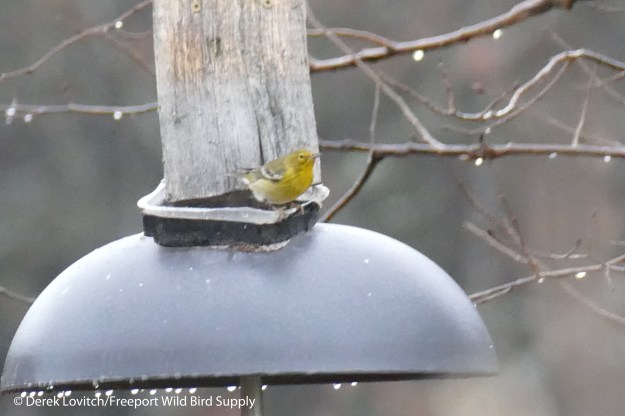
L1040178_PIWA2,JayStormers,Brunswick,12-10-15_edited-1

The next day I was once again at the Saco Yacht Club, looking for the Blackburnian Warbler (which I saw on Nov 30th – one day too early!). Activity didn’t pick up until the fog finally lifted after 10am, but I ran out of time. I did, however, enjoy another visit with the Tennessee, and 1 each of Yellow and Nashville Warblers. 2-3 Ruby-crowned Kinglets were also present, and a Yellow-rumped Warbler dropped in: my 7th species of the month! That and the Western Tanager were the consolation prizes (yes, I did just relegate the tanager to a consolation prize…shame on me… but I “needed” the Blackburnian!).
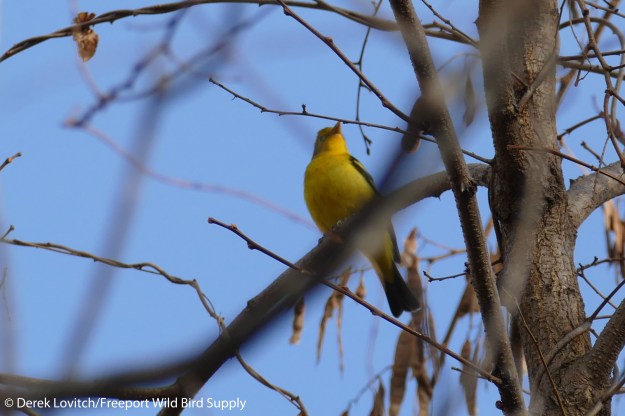
L1040189_WETA1,SacoRiverwalk,12-11-15_edited-1

I worked hard for an Orange-crowned Warbler in Portland on the 13th to no avail, but I did turn up the continuing Nashville Warbler along the Eastern Promenade (oh look, Portland ravaged vegetation here, too!) and a Gray Catbird on Sheridan St. I also took time to go visit the continuing Ross’s Goose along Stroudwater St in Westbrook – the third I have seen in Maine, and only the 6th or 7th state record.
IMG_6946_ROGO1,StroudwaterSt,Westbrook,12-13-15_edited-1(Phone-scoped image)

Continuing the quest, I had high hopes for the Southern York County Christmas Bird Count on the 14th. With a great territory that almost always turns up a good bird or three, Jeannette, Kristen Lindquist, and I worked the marsh, thickets, neighborhoods, and beach of the “Moody” sector. And we did indeed have a great day, including the 2nd Count Record Clay-colored Sparrow, the 5th Count Records of Baltimore Oriole and Lesser Scaup (21 – also a record high), and 6th Count Record of Dickcissel. But alas, not a single warbler. We didn’t even get a Yellow-rumped – for the first time, as there was virtually no fruit on the bayberry bushes along Ogunquit Beach or anywhere else.

When my friend Evan Obercian found a Yellow-throated Warbler at the Samoset Resort in Rockport on the 13th, my goal was definitely in sight (this was the “additional rarity” I needed), but in the weeks before Christmas, finding time was going to be a challenge. Luckily, a break in my schedule – and the rain – came on Thursday the 17th, so I got an early start and headed east.

I met up with Evan and Kristen and we wandered the grounds of the Samoset for almost two hours. I was not happy to find a stiff onshore breeze when I arrived, and it was increasing over the course of the morning. Then the mist rolled in, and soon, a steadier drizzle. There were not a lot of birds around (other than Canada Geese and Mallards on the golf course), and I was beginning to work on a plan to come back again. And not long thereafter, it called!

We spotted it in an isolated cluster of Scotch Pines, very near where Evan first saw it (and where we walked by 3 times already this morning). We followed it for about 30 minutes as it relocated to another grove before heading over to the hotel building, where it proceeded to forage in the sheltered porches of the four story building! Presumably gleaning insects from old webs in the corners and around furniture, clearly this bird had figured out a novel way of finding sustenance – especially on such a snotty day.

It was my 8th warbler of the month.
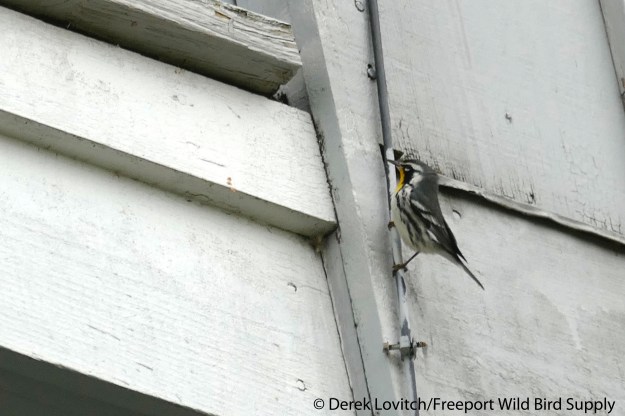
L1040215_YTWA3,Samoset,Rockport,12-17-15_edited-1L1040251_YTWA1,Samoset,Rockport,12-17-15_edited-1

I was back to the Saco Yacht Club with Luke Seitz the next morning, once again hoping for the Blackburnian. We worked the hillside and surrounding habitats hard, and absolutely cleaned up! The quick glimpse of a fly-by Western Tanager was more frustrating that satisfying, but we had great looks at the continuing Tennessee, Yellow, 2 Nashville, Common Yellowthroat, 2 Ruby-crowned Kinglets, and then, finally, the Blackburnian! My 9th warbler of the month!

Luke’s quote sums it up: “Let’s take a moment to appreciate what we are seeing and hearing around us right now. What. The. (Expletive deleted)!”

I had a little more time, so I made a quick trip down to Biddeford Pool. Working the neighborhood and thickets, I found a small group of Yellow-rumped Warblers (4-5), a nice addition to the day list. Besides, up until now, I had only seen one all month!

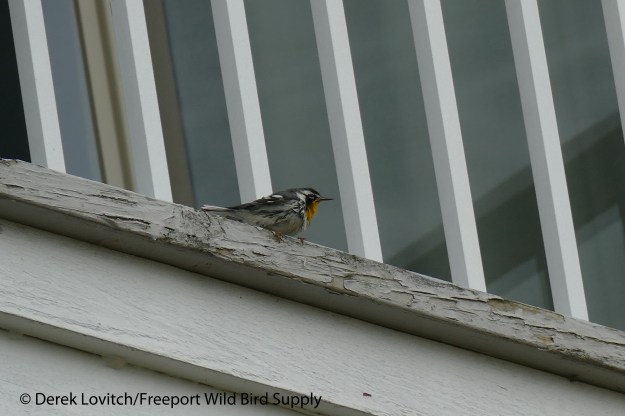
I was in the midst of plotting “Operation Orange-crowned” when I wandered over to look at a chattering Ruby-crowned Kinglet. A loud chip note caught my attention, and I looked up to see this Prairie Warbler – my 10th species of warbler for the month (and 7th of the day)!
L1040305_PRAW,BiddPool,12-18-15_edited-1

But did you really think I would stop at 10?

Hunting for Orange-crowns in Portland and South Portland on the 21st, I turned up a Baltimore Oriole on Sheridan Street (likely the same individual that Jeannette and I found here on 11/23), and along West Commercial Street (in what’s left of the vegetation here!), I had a Swamp Sparrow, and a Field Sparrow – my 8th sparrow of the month.
L1040314_FISP,WCommercialSt,Portland,12-21-15_edited-1

Hmmm…do I need to go for 10 sparrows, too?

Obviously!

So I went to Scarborough Marsh the next day, and quickly picked up a Savannah Sparrow along the Eastern Road Trail for #9.

Jeannette and I, post-holiday madness, continued the search on the 28th, combing the coast from Kittery through Wells. While nothing new was added, we did find three different Swamp Sparrows (two at Fort Foster, 1 in York Beach), and most excitingly, we relocated the Clay-colored Sparrow that we found on the CBC – a mere one block away. Once again, however, I managed only some quick phone-binned photos.
CCSP,Wells,12-28-15

A Northern Flicker and 5 Yellow-rumped Warblers were at Wells’ Community Park, while other highlights included 14 Sanderlings with Purple Sandpipers along Marginal Way in Ogunquit.

But before I knew it, it was December 31st. I still had yet to see an Orange-crowned Warbler (inconceivable!) for the month, and I was stuck at 9 species of sparrow. Therefore, Phil McCormack and I had a mission when we set out in the morning. We worked thickets and fields in Cape Elizabeth, with stops at various nooks and crannies in South Portland and Portland.

While we did not relocate the Lark Sparrow along Fessenden Road (it’s been a week since I have seen a report), we did have a Merlin there, and a couple of Yellow-rumped Warblers at Crescent Beach State Park. Luke had an Orange-crowned Warbler at Camp Ketcha back on the 20th, but it was rather devoid of birds today.

Throughout the day, pockets of Song and American Tree Sparrows were indicative of recent movements and concentration following the snow and ice, but we were not prepared for the concentration of sparrows at a particularly fruitful patch. In fact, it was astounding!

75+ American Tree and 50+ Song Sparrows flew out of the field, joined by 10 or so White-throated Sparrows and 20 or more Dark-eyed Juncos. A continuing female Brown-headed Cowbird was there, along with at least 80 American Goldfinches and 30 or so House Finches. A Carolina Wren sang from the woods, and two Swamp Sparrows and a female Common Yellowthroat were in the marsh…I knew my 10th species of sparrow was here somewhere!
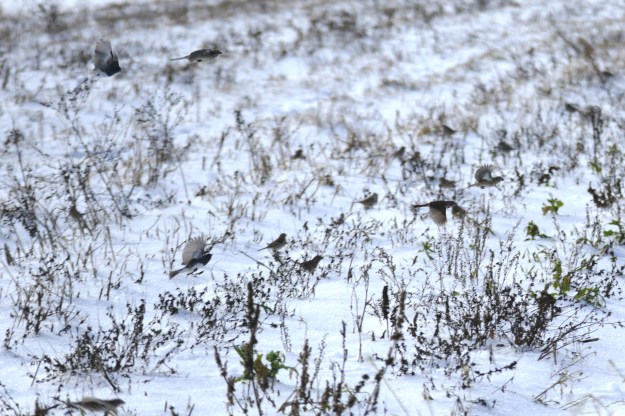
L1040338_mixed_sparrows,Alewives,CapeE,12-31-15

After a teasing brief, distant but highly suggestive look, I finally found it – a Chipping Sparrow! My 10th species of sparrow in December!
L1040361_CHSP,Alewives,CapeE,12-31-15

Shortly thereafter, a Savannah Sparrow (my second of the month) appeared – not just our 7th species of the day, but the 7th species in this one spot! Amazing! And now I had a 7 species of sparrow day and 10 species for the month to match my 7 species of warbler day and 10 species for the month! (The Double 7/10 Split?)

But of course, I still wanted an Orange-crowned Warbler, so we kept birding (well, after a long, celebratory lunch of course), and I tried a few more OC spots in Portland after Phil departed. I still can’t believe I saw 10 species of warbler in Maine in December, and none of them were Orange-crowned, but it seems a fitting finish to the month, and the year, was the continuing Baltimore Oriole and Gray Catbird sitting in the same tree in the Sheridan St lot!
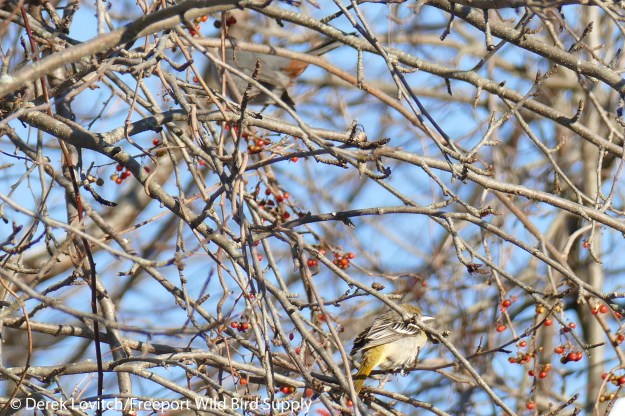
BAORandGRCA,SheridanSt,Portland,12-31-15_edited-2

Meanwhile, some other highlights over the course of the month, of the non-warbler or sparrow variety, including more seasonal species, such as two Snowy Owls on a Saturday Morning Birdwalk on the 12th, my first Iceland Gull of the season (finally) in Old Port on the 15th, a Snowy Owl at Biddeford Pool on the 18th, Harlequin Ducks, Purple Sandpipers, and a growing legion of wintering waterbirds.

Other signs of the unseasonably warm month included a lingering Double-crested Cormorant in Portland Harbor on 12/15, a few more lingering dabblers and Great Blue Herons than usual, but surprisingly, I didn’t see a Hermit Thrush all month – had they all moved on or would some now show up as the snow and ice pushes them to coastal migrant traps? But the most unexpected of them all was the Little Blue Heron that was found in the tiny Jordan Park Marsh in Ocean Park. I stopped by to visit it on the 22nd, about two weeks into its unseasonable stay.
L1040320_LBHE1,OOB,12-22-15_edited-1

Unfortunately, as much fun as this month has been – and as nice as it has been to not yet wear my parka – it’s impossible for me to ignore what this all means: the climate HAS changed. While no one month – warm or cold – is “climate change,” it is impossible for any rational person to not realize that our weather has become more and more unpredictable, less and less “normal,” and prone to more and more wild swings in seasonal and within-season variability. No, a hot day doesn’t mean Global Warming, nor does a snowstorm mean there’s not (Please James Inhoffe, please go away and shut the hell up). But the trends are real, very apparent, and very much here. Now. And they are most definitely affecting birds and bird migration.

That being said, I would not use these warblers as an example of this. Instead, I think the fact that here in December and they are still ALIVE, is however, a perfect example of just how ridiculously warm our weather has been! The mechanisms that delivered these birds to the Saco Riverwalk and elsewhere are likely varied. Perhaps the deformed, crossed-bill of the Tennessee Warbler impedes its ability to efficiently forage and put on the necessary weight for its next leg of migration. Perhaps the extensive southerly winds that have ushered in this warm air also facilitated the arrival of a 180-degree misoriented migrant Yellow-throated Warbler, and I would propose, the Prairie Warbler as well (I think the rare-but-regular late fall Prairies are actually birds from our south) that were “messed up” and flew the wrong way. But it is also possible that some of these warblers are “reverse migrants” that started to go south and then turned around, but I doubt it – facultative migrants like swallows and blackbirds do it, but I don’t know of any known proof that long-distance Neotropical migrants pull it off (on purpose, anyway).

These mechanisms occur every year, and rare warblers are found at places like the Saco Riverwalk every fall. However, they’re usually found in October and November and either move on (or, more likely perish) by now. So I think what’s remarkable is not that all of these warblers are here, but that they are still ALIVE well into December – and that is most definitely due to the mild winter so far. There have still been insects to be found, there’s plenty of fruit left to consume, and fewer calories have been spent to keep up internal body temperatures, meaning there are fewer calories that need to be consumed.

Migration in long-distance, obligate migrants is not triggered by temperatures, but trigged by physiological changes directed by hormones responding to the changing length of the day. In the fall, southbound migration is triggered in part by a response to changes in fat loading to fuel these epic journeys. At some point, the controls are switched away from building the fat reserves that are necessary for migration. I don’t know at what point in the season “pioneering” warblers lose the ability (perhaps, even the “desire”) to migrate. My guess is that even if you pumped these birds full of fat, at this point, they won’t be going anywhere – this is now their winter territory, for better, or for most likely, worse.

So what does this mean besides some amazing early winter birding? Good question. Conventional wisdom says these birds are all “evolutionary dead ends” that will soon be eliminated from the gene pool (it has to get cold sometime, right? If they’re not picked off by a Sharp-shinned Hawk or all of the damn outdoor cats that hunt there). However, with the effects of Global Climate Change clearly upon us, and not reversing anytime soon (if ever), perhaps these “pioneers” are the wave of the future. Maybe someday, warblers will successfully overwinter in Maine, and return to their breeding grounds to pass on those genes.

Maybe. Afterall, without vagrancy, we would not have Hawaiian honeycreepers or Darwin’s finches; distant islands would be sans all landbirds. Perhaps phenomena like “reverse migration” and this pioneering thing will allow the next wave of adaption to a changing climate. Of course, never before in the history of life on earth, has this change occurred so rapidly, and we have little evidence suggesting long-distant migrants can adapt this quickly – it’s going to take more than a few individuals of 10 species of warblers.

Sparrows, however, aren’t obligate long-distance migrants that are “programmed” to leave at a prescribed time. Instead, they are more flexible in their movements, and being seed-eaters, they aren’t reliant on warm-weather dependent insects. As long as seeds are available, and with the complete dearth of snow, they most certainly have been, those that linger can do just fine. White-throated, American Tree, Song, and Dark-eyed Juncos are all regular parts of our winter avifauna in southern Maine, lingering or “pioneering” Swamp Sparrows are regular here and there, and every now and then a Lark Sparrow (a “drift migrant/vagrant” from the Midwest) or Field Sparrow spends the winter in the state. Field and Clay-colored are also rare-but-regular in late fall/early winter, so once again, the presence of 10 species of sparrows is also not in and of itself caused by the record temperatures, but it is most definitely another sign of how mild – and especially snow-free – it has been.

But this is all a blog for another time…this blog was supposed to be about warblers (and sparrows!). In Maine. In December. And that’s amazing. Or, as Luke said, “What. The. (Expletive deleted).”

This Week in Shorebirds: 8/22-28/2015

L1030115_two_BASA1_edited-1

L1030121_BASA1_edited-1
Two juvenile Baird’s Sandpipers at Popham Beach State Park on Friday morning, “rare-but-regular” fall migrants.

August is for shorebirds. Although the “fall” southbound migration started in late June (when the first non-breeders begin to turn around to mosey back south) and continues into November when Purple Sandpipers are still filling in, August is the month of peak numbers and diversity in Maine.
Most weeks from mid-July into September of recent years, I post a weekly “shorebird high counts this week” summary to my weekly “Additional Highlights This Week” summary posts to the Maine-birds listserve. While I do hope this is interesting and of value to folks, I also do it to organize my own notes, allowing me to quickly reference the peaks and valleys of particular species with ease should I need to.

I generally only post this when I have hit at least two “primary” and at least one “secondary” site each week, to make the numbers meaningful. And I prefer at least one prime high tide location (Eastern Road Trail in Scarborough Marsh, Biddeford Pool Beach/Ocean Avenue, or Popham Beach State Park in some years) with one low or mid-tide hotspot (Pine Point, Hill’s Beach/The Pool, or Popham and nearby environs).

This week was a particularly productive week for my own shorebirding, so this week’s summary is a helpful future reference for me. I also thought it was worth going into a little more detail, since it yielded a goodly 21 species (plus one subspecies) and some excellent totals.

The inclement weather of the weekend into the middle of the week (regular rain, lots of fog, easterly or southerly winds) was perfecting for “grounding” shorebirds and allowing numbers to build. I think my only surprise was my lack of a real rarity – like Western Sandpiper (although I worked pretty hard for one!)

I hit the low-tide hotspot of Pine Point on Monday with Jeannette, followed by the Eastern Road Trail at high tide later that afternoon. Jeannette and I spent the incoming to high tide at Biddeford Pool Beach on Tuesday, and on Friday, Serena Doose and I visited Popham on the incoming to high tide. Additionally, Jeannette and I checked one of the “secondary” sites, Brunswick’s Wharton Point on Tuesday and on Thursday I visited Wells Harbor before the evening’s Scott Weidensaul talk that we co-sponsored with Birds and Beans coffee and York County Audubon.

It’s always good to hit a freshwater location for diversity and high counts of pond-preferring-migrants, so when my Poplar Hut Tour Group with Maine Huts & Trails visited the Carrabassett Valley Snowfluent Ponds on Sunday, my high counts of Spotted and Solitary Sandpipers were acquired, along with my only Wilson’s Snipe of the week.

And, as if often the case during the peak of shorebird migration, there is some other “incidental sighting” of a migrant in some weird place – but not as weird as the Whimbrel (my only of the week) foraging at 4,200 feet atop Sugarloaf Mountain that Paul Doiron, Kristen Lindquist, and I observed on Sunday afternoon. While I knew they forage on mossberry during migration, such as in the bogs Downeast, I was most definitely not expecting one up here!

Therefore, with a total of 7 shorebirding locations – plus that mountaintop Whimbrel! – “this week’s shorebird high counts” scoreboard looks like this:

AMERICAN GOLDEN-PLOVER: 1 ad, Eastern Road Trail, Scarborough, 8/24 (with Jeannette).
Black-bellied Plover: 160, Pine Point, Scarborough, 8/24 (with Jeannette).
Semipalmated Plover: 350, Pine Point, 8/24 (with Jeannette).
Killdeer: 3, Pine Point, 8/24 (with Jeannette).
AMERICAN OYSTERCATCHER: 5, Pine Point, 8/11 (with Jeannette).
Greater Yellowlegs: 12, Wharton Point, Brunswick, 8/25 (with Jeannette).
Lesser Yellowlegs: 38, Eastern Road Trail, 8/24 (with Jeannette).
“Eastern” Willet: 8 juvs, Pine Point, 8/24 (with Jeannette).
“WESTERN” WILLET: 1 juv. (FOY), Pine Point, 8/24 (with Fyn Kind, Gary Roberts, and Jeannette).
Solitary Sandpiper: 4, Carrabassett Valley Snowfluent Ponds, 8/23 (with Poplar Hut Tour group).
Spotted Sandpiper: 5, Carrabassett Valley Snowfluent Ponds, 8/23 (with Poplar Hut Tour group).
Whimbrel: 8, Wells Harbor, 8/27.
Ruddy Turnstone: 8, Pine Point, 8/24 (with Jeannette).
Sanderling: 40, Biddeford Pool Beach, 8/25 (with Jeannette).
Semipalmated Sandpiper: 1000, Biddeford Pool Beach, 8/25 (with Jeannette)..
Least Sandpiper: 75 mostly juv, Eastern Road Trail, 8/24 (with Jeannette).
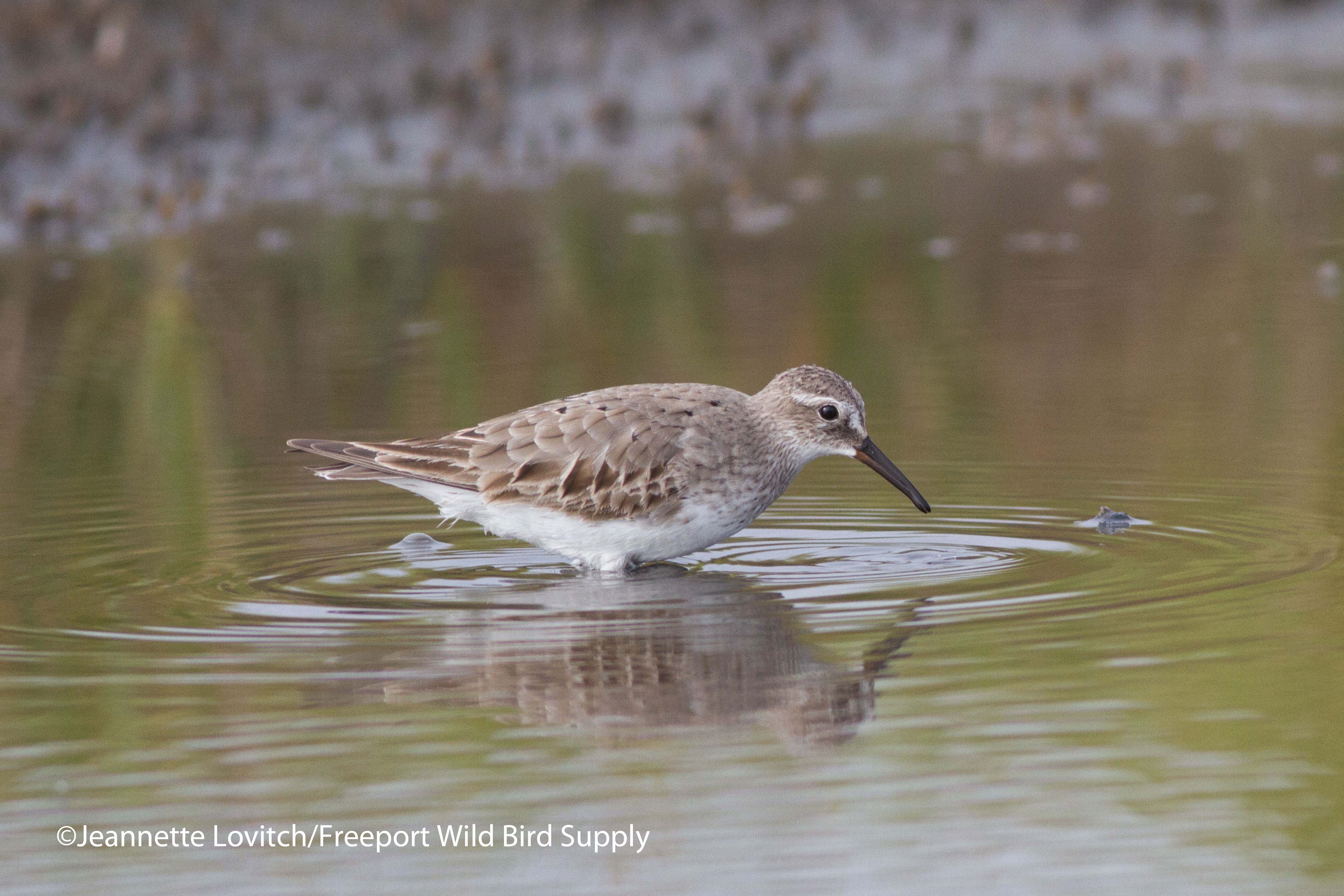
White-rumped Sandpiper: 80-100 adults, Eastern Road Trail, 8/24 (with Jeannette).
BAIRD’S SANDPIPER: 2 juveniles, Popham Beach State Park, Phippsburg, 8/28 (with Serena Doose).
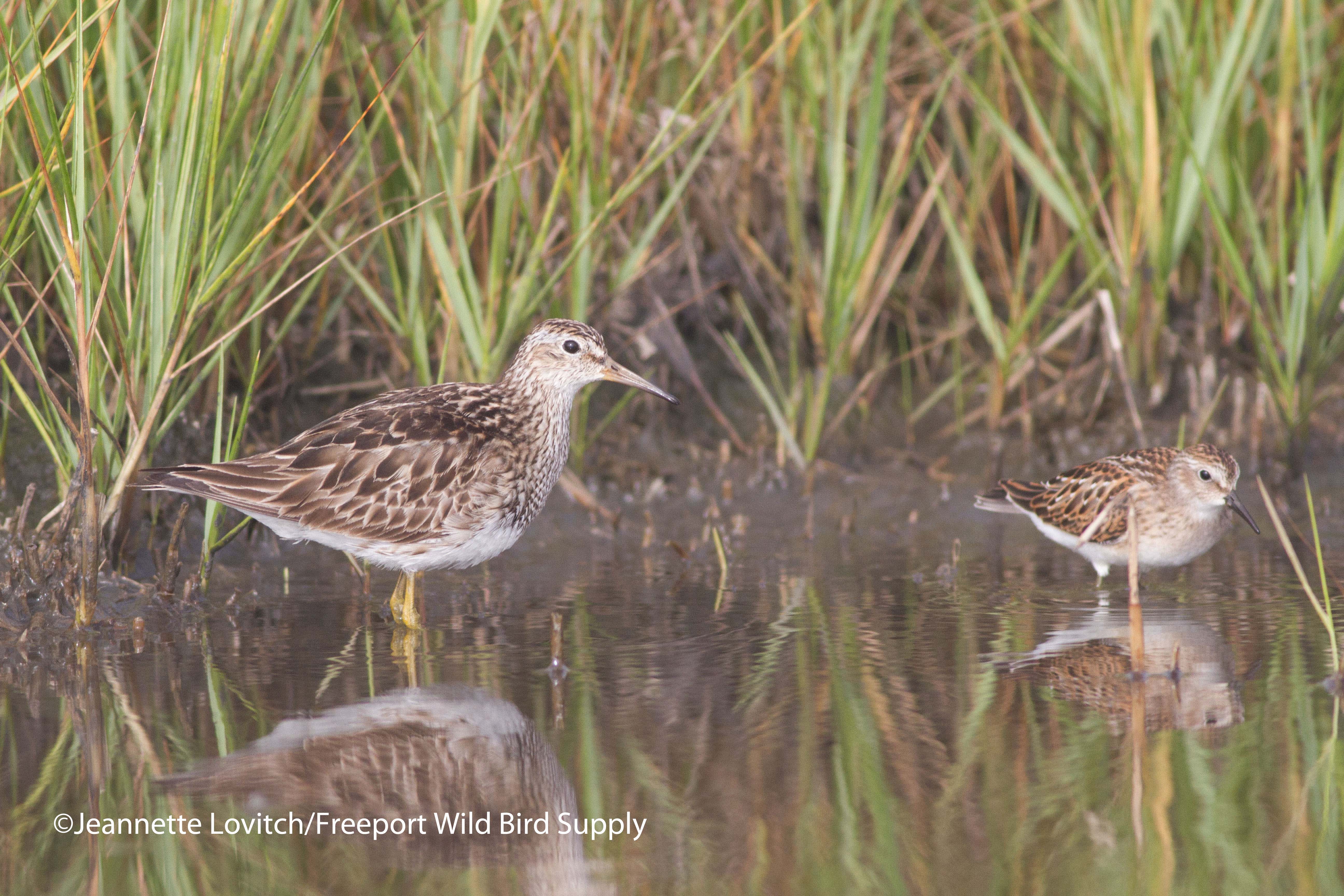
Pectoral Sandpiper: 6, Pine Point, 8/24 (with Jeannette).
STILT SANDPIPER: 4 ads, Eastern Road Trail, 8/24 (with Jeannette).
Short-billed Dowitcher: 19 juveniles, Pine Point, 8/24 (with Jeannette).
Wilson’s Snipe: 1, Carrabassett Valley Snowfluent Ponds, 8/23 (with Poplar Hut Tour group).

Furthermore, writing this blog gives me a chance to show off some of Jeannette’s photography! These are just a few of the shots she got during our visit to Scarborough on Monday.
IMG_2024_edited-2Adult Black-bellied Plover, Pine Point, 8/24.

IMG_2069_edited-2Juvenile Short-billed Dowitcher, Pine Point, 8/24.

IMG_2092_edited-2Adult Semipalmated Plover, Pine Point, 8/24.

IMG_2148_edited-2Adult and juvenile Semipalmated Sandpipers with one juvenile Semipalmated Plover, Pine Point, 8/24.

IMG_2256_edited-2Adult Pectoral Sandpiper and juvenile Least Sandpiper, Eastern Road Trail, 8/24.

IMG_2295_edited-2Adult White-rumped Sandpiper, Eastern Road Trail, 8/24.

IMG_2331_edited-2Semipalmated Sandpipers with one adult Semipalmated Plover and one adult Sanderling, Biddeford Pool Beach, 8/25.

Jeannette in Marsh_edited-1

Of course, it’s not just shorebirds that are on the move – there are plenty of passerines as well! A migrant Wilson’s Warbler and a whopping 14 Ruby-throated Hummingbirds were at Old Town House Park on Saturday morning when I visited it with my Saturday Morning Birdwalk group. My tour group to the Poplar Hut encountered mixed-species foraging flocks as we hiked to and from the hut, highlighted by an immature female Cape May Warbler in a little wave around the hut itself on Sunday morning.
Poplar Falls_edited-1

Other highlights this week included 14 Wood Ducks and a bumper crop of juvenile Common Yellowthroats at Florida Lake Park (8/24), the whiter of the two Tricolored Heron x Snowy Egret hybrids (“Splotchy”) in the Rte 1/9 salt pannes in Scarborough Marsh with Jeannette on the same day and a drake White-winged Scoter off of Biddeford Pool Beach on 8/25.

While a diversity of shorebirds will continue for several more weeks (and there’s a better chance for Western, Baird’s, and Buff-breasted Sandpipers), I tend to spend less time focusing on them (and therefore not enough time at enough prime locations over the course of the week), and therefore only occasionally post summary totals. In fact, if the much-reduced numbers at Popham today are any indication, a lot of shorebirds departed with the passage of this recent cold front.

Instead, I spend most of my free mornings now at “my office,” the bridge at Sandy Point Beach, Cousin’s Island, Yarmouth, observing and obsessively counting migrant passerines in the “Morning Flight.” In fact, my first visit of the season there on Thursday morning yielded 438 migrants, including 17 species of warblers, 1 early Dickcissel, 1 Blue-gray Gnatcatcher (my 3rd-ever here), and 5 Prairie Warblers – my 2nd highest count.

(Much) more on that soon.

Biddeford Pool Snowy Owl and Weather Discussion

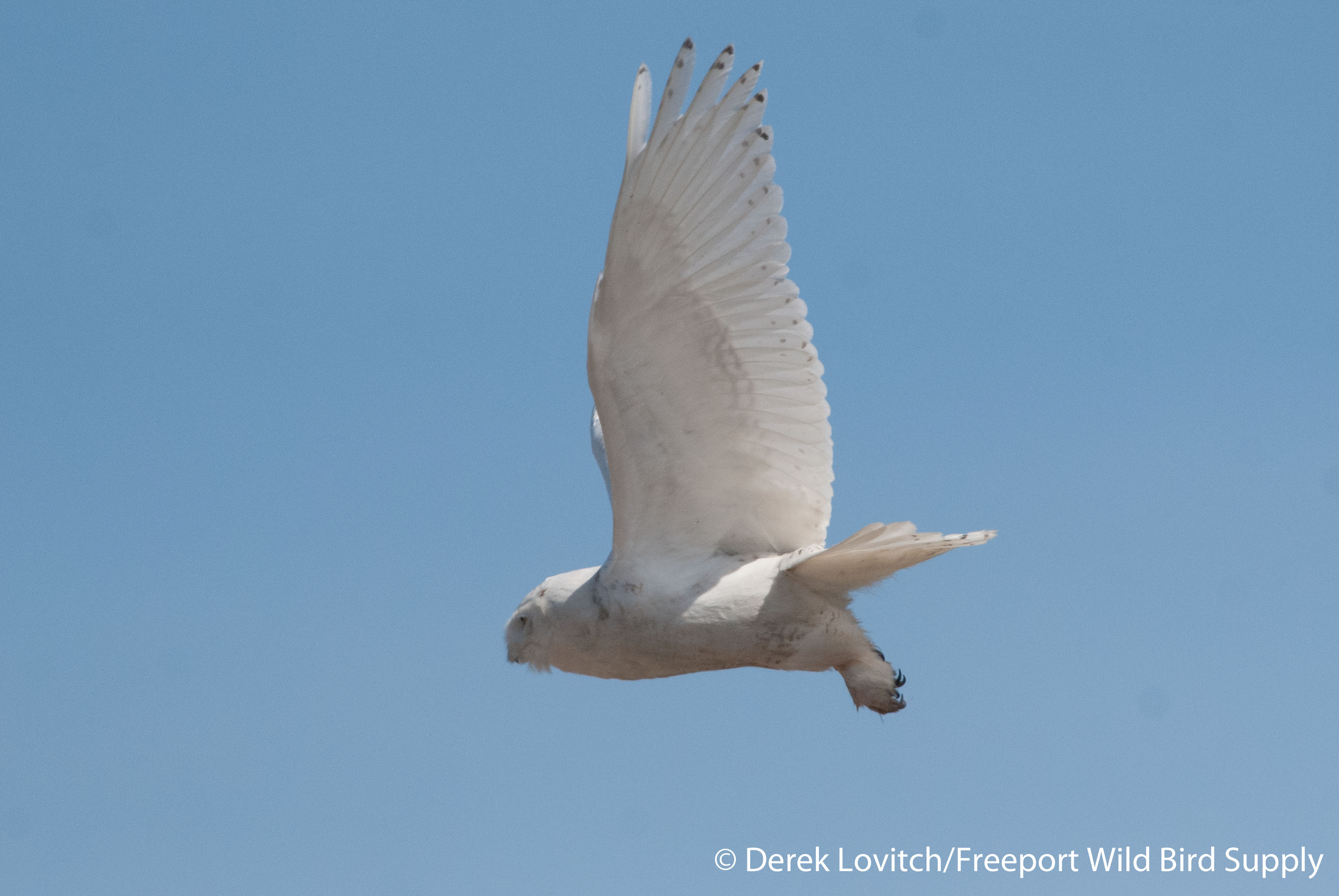
This was the birding highlight of Tuesday morning’s visit with Katrina to Biddeford Pool.
DSC_0005_SNOW1,Bidd Pool, 4-29-14_edited-1 DSC_0016_SNOW2,BiddPool,4-29-14_edited-1 DSC_0023_SNOW3,BiddPool,4-29-14_edited-1

The first photo was taken shortly after our arrival to The Pool, while the second two -with much more pleasant skies – was taken as we departed around noon.  Although its plumage is much more faded and worn now, it is likely that this is the same Snowy that has spent the winter near the western end of mile stretch.  Today, it was hunting voles once again on the incoming tide from one of its favorite rooftop perches.

While this was my latest Snowy in Maine, it is far from unprecedented following a massive irruption year. But seeing a Snowy Owl a mere two days away from May is still special; it could be a lifetime before we see an irruption of this magnitude again.

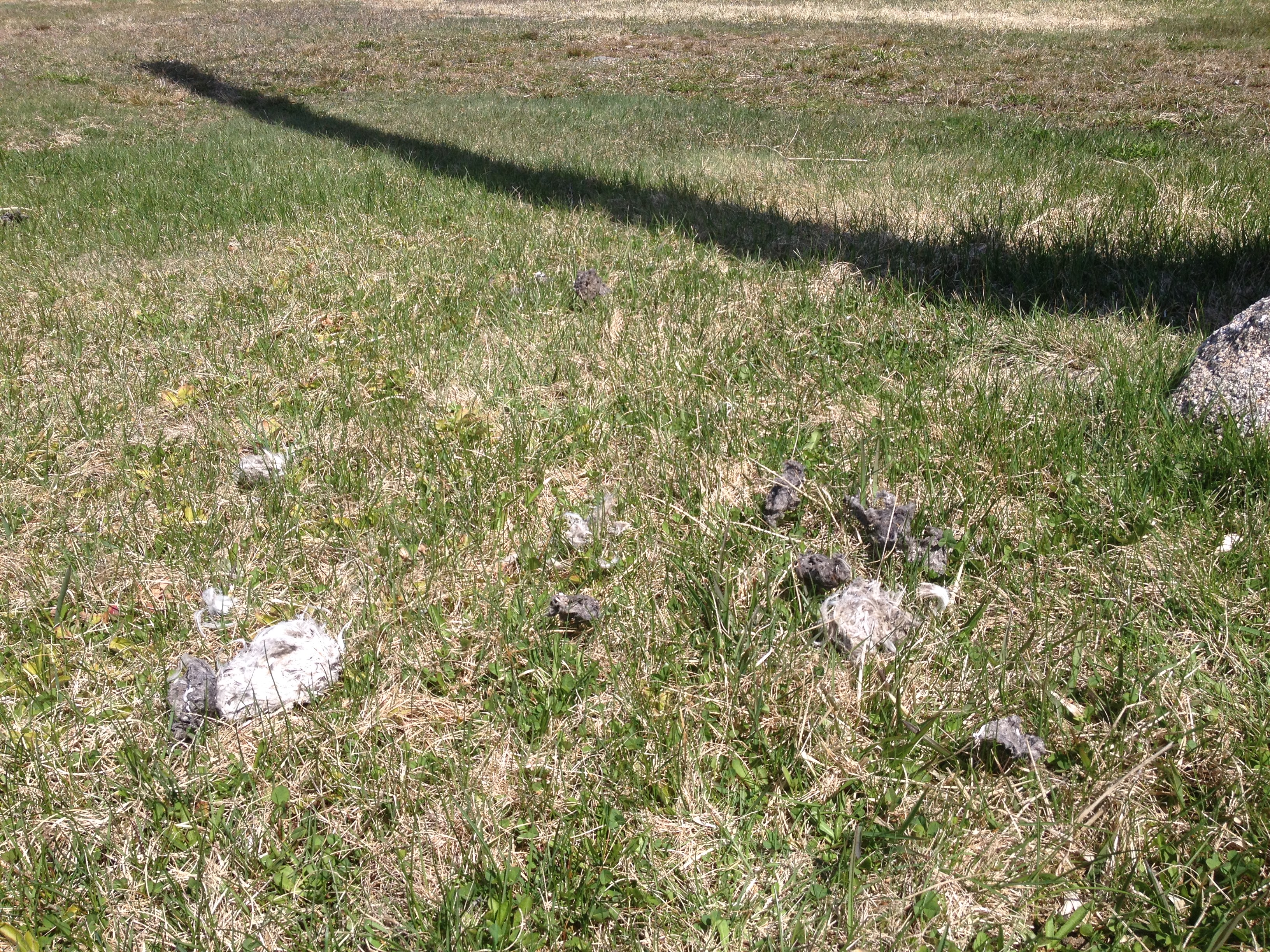
A little further down the road, where the second of the Mile Stretch Snowies overwintered, we found a pile of pellets below one of that bird’s favorite perches. Most were full of small mammal fur and bones, and the skulls were all of voles. One pellet, however, was pure thick, downy feathers – probably from a duck.
IMG_3465

But with migration still at a virtual standstill, the rest of the day’s highlights were rather few and far between; very few migrants were around. A pair of Blue-gray Gnatcatchers around the beach parking lot was a nice, and I had my first House Wren of the year in the neighborhood, and my first Laughing Gull off of East Point. 1-3 Black-crowned Night-Herons were also my personal “FOY’s,” but they have probably been present here for at least a couple of weeks now.

IMG_3449
The seas and skies sure looked like winter today, and the raw winds and low temperatures – and Snowy Owl! – sure made it seem more like early March than late April!

But yeah, migration has been kinda slow.  Although, interestingly enough, the House Wren and Laughing Gull were right on time for me, most of the usual late April arrivals (Black-throated Green Warbler, Northern Waterthrush, Black-and-white Warbler, etc) are nowhere to be seen, and really, have I only heard one Blue-headed Vireo so far this season?

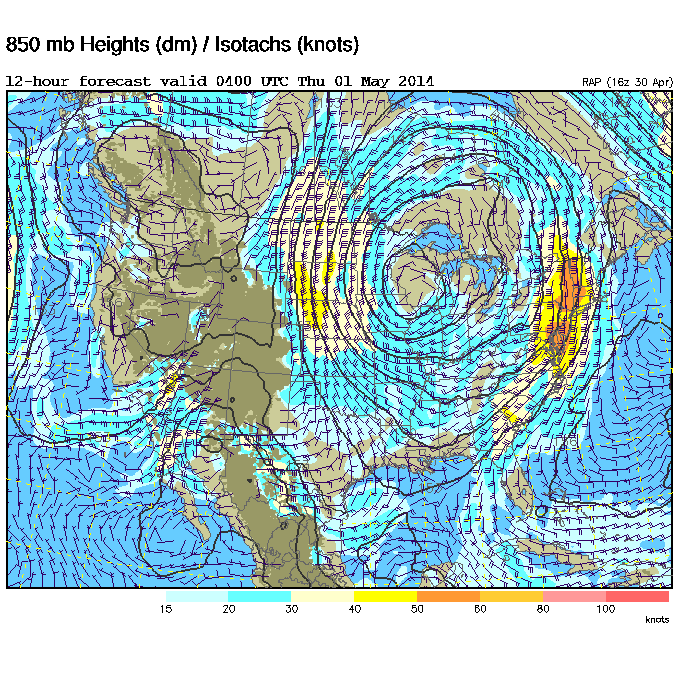
We all know spring has been running late this year, and I would say bird migration is now about 7-10 days behind schedule (catching up from the 2-3 weeks behind schedule of early April).  Recently, our onshore winds (not conducive to facilitating migration for birds heading north) in this stubborn blocking pattern (a pattern that has seemingly become more and more regular recently) have not helped matters.  Here, for example, is the wind map from Sunday, showing the low pressure system just south of Nova Scotia that was pumping in those onshore winds since late last week.
wind map, 4-27-14

But take a look at today’s wind forecast…
wind map, 4-30-14

Here we see the massive low pressure system marching across the Great Plains. But now, on the leading edge of it, we see a deep southerly flow, originating all of the way from the Gulf Coast.  This southerly flow is expected to last for at least the next 48 hours.

Although the weather will remain unsettled – and we’re about to get a pretty good soaking tonight and tomorrow – through at least the weekend, I would expect quite a few migrants to begin to trickle in over the next few days. Simply put, some birds are running low on time to wait!  And, as evidenced by the 73 and 110 raptors tallied passing The Brad over the last two days, respectively, despite easterly winds, it is clear that some birds simply have to make some progress, and will do so when conditions are at least somewhat favorable (or, at least not completely unfavorable).

Furthermore, these deep southerly flows at this time of year can facilitate the arrival of annual spring “overshoots” from the south (see Chapter 4 of my book, How to Be a Better Birder for a full explanation of this phenomenon). When I see weather patterns such as this, I begin to think about things such as Summer Tanagers, Blue Grosbeaks, and Hooded Warblers!

At least potential food sources (insects emerging from ponds; insects attracted to blooming trees) are getting a little chance to catch up before the bulk of migrant birds arrive.  This phenology, or timing, of the plant and insect cycle is critical for migrant birds that need to refuel and/or then fuel up for the next leg of their journey. “Weird” weather such as this doesn’t bother birds as much as it bothers us, but it becomes a real problem when the weather results in the lack of specific food sources.

I haven’t seen much in the way of nectar-producing flowers yet – but Ruby-throated Hummingbirds and Baltimore Orioles often begin to arrive in the first week of May. This is going to be one of those seasons where well-stocked feeding stations are critically important to migrants, especially those that need insects and nectar.  Our hummingbird and oriole feeders are out and ready for business, and our feeder is stocked with insect-laden suet blocks (check out our “Photos from Friends of the Store” gallery on our Facebook Page to see what one particular feeding station in Brunswick has been seeing eating insect suet) and live mealworms.  It lies in wait for the first hummers, orioles, or any other migrants in need of assistance…oh yeah, any vagrants from the south, too!

A (Very) Early Spring Week in Review

Our Saturday Morning Birdwalk surveyed the waterfront in Freeport and Yarmouth.  On Sunday, Kristen Lindquist and I enjoyed an epic white-winged gull show in Portland, before working our way around the Cape Elizabeth shoreline.  Then, on Monday, we birded from Biddeford Pool through Scarborough Marsh with Snowy and Great Horned owls, Rough-legged Hawk, and Ruddy Turnstones among the many highlights.

Further south, Jeannette and I covered Kittery through Wells, as is our tradition on the first Tuesday in March.  Another exceptionally productive day was enjoyed, including two more Snowy Owls and a Common Eider of the northern subspecies, borealis.

Wednesday was spent dealing with various car issues and seed delivery, so birding was limited to the woods near our house, and the feeders of course.  Same for Friday, where at Hedgehog Mountain Park, a mere 7 species was actually the most that I have detected in a couple of months there.  In between, I was back in Portland and Westbrook on Thursday, and although the Westbrook riverfront was a disappointing, the continuing white-winged gull show in Old Port more than made up for it.

While “new arrivals” were few and far between this week as bitter cold continues, there were definitely signs of the season.  Waterfowl are obviously on the move: Brant, Canada Geese, Mallards, and American Black Ducks are returning in numbers, while the concentrations of seaducks, especially all three scoters, was greatly reduced as these birds have begun to disperse – if not actually migrating north.

For the first week of March, I recorded very few “first-of-years” this week: Great Horned Owl, Yellow-rumped Warbler, and Fox Sparrows.  Of those, only the sparrow is likely a true migrant; the owl is a resident, and the warbler likely wintered locally.  American Robins were definitely on the move, however, with several flocks noted moving northbound (at least at the given time), and American Tree Sparrows also seem to be on the go.

New reports of Snowy Owls – especially inland – likely included northbound migrants.  While all three of the individuals that I saw this week seemed to be birds that were continuing in a specific area for several weeks or more now, the fact that Kristen and I only saw one bird in a very thorough search at Biddeford Pool (four had been present for a couple of months now) suggests birds are already departing. Northern Shrikes – such as the one that briefly visited the yard here at the store on Thursday (our second of the season) are also likely migrating right now.

In the woods there is a different story, however, as even the local residents are a little less active vocally right now than we would expect.  I have yet to hear a Brown Creeper sing – although I am seeing them on regular basis – and Golden-crowned Kinglets remain very few and far between.  And other than goldfinches and resident House Finches, finches remain virtually non-existent.

But all of this is about to change, and my guess is that it will change rather rapidly.  In fact, with the winds turning south today, I wouldn’t be surprised if a few Turkey Vulture and Red-winged Blackbird reports trickle in this weekend.  And once the snow really begins to melt (especially to our south), expect those floodgates to really open!  (Any day now…any day now…)

IMG_4781_edited-3

IMG_4769_edited-2

Snowy Owl, The Cliff House, York, 3/4/14. As you have seen on this blog, our store’s Facebook and Flickr pages, etc, most of our Snowy Owl photos this winter have been of relaxed birds, often with their eyes closed.  Few have been “perfect” shots, whether in lighting or resolution.  And we’re proud of that!  To us, the birds ALWAYS comes first, and we pride ourselves in minimizing any chance at disturbance.  Unfortunately, this bird was sitting close to the parking lot and we spooked it before we knew it was present.  A pair of crows likely also affected the bird’s immediate response.  As it flew away from both us and the crows, Jeannette snapped some photos, as the bird first flew straight out to sea – thereby ditching the crows – before returning to land a short distance away.  We backed off and left it alone.  With a lot of unethical and selfish behavior occurring – as always – around charismatic owls around the country, we support the idea that the circumstances of photos be explained when it shows a behavior that may have been modified by our presence or behavior.

Rarity Season Ain’t Over Yet..and Fun Store News and Contest Stuff

“It ain’t over ‘til it’s over” – Yogi Berra

Before we get to my birding of recent days, a couple of quick orders of business. First of all, tonight is our “After Hours Sale” here at the store.  This is our biggest sale of the year.  From 6:00 to 8:00 tonight only, everything in the store (with the usual exception of seed, optics, and sale items) is 25% OFF!  And we’ll have treats, coffee, and other refreshments to fuel your shopping

Then rest up and be sure to join us on Saturday morning for our usual Saturday Morning Birdwalk (meets at the store at 8:00am for a carpool to a local park.  We’ll return for coffee and feeder-watching between 10 and 10:30).  While I would, of course, love to see you all year long, you don’t want to miss tomorrow (or any of the next 17 weeks) as it’s the start of the Fifth Annual “SnowBird(er) Contest,” where we’ll award points to birdwalk participants based on how cold it is.  The top three birders at the end of March will receive some great prizes!

GRAND PRIZE: MAINE BIRDS by RALPH PALMER!
The classic tome from 1948 is still a valuable reference for students of the birds of Maine. This excellent condition copy is valued at over $75. It’s great for comparing status and distribution from then to now, and for collectors of birding books.

2ND PRIZE: BACKYARD BIRDHOUSE from Coveside Conservation in Casco. Perfect for everything from House Wrens to White-breasted Nuthatches, this house is perfect for any yard and made from New England White Pine.

3RD PRIZE: $25 GIFT CERTIFICATE to EDNA & LUCY’S in Pownal – Enjoy a great sandwich, award-winning donuts, and more. Perfect for your next trip up to the Bradbury Mtn. Hawkwatch!

Visit our website for more information and how the game is played. 

OK, back to birding….

In my blog a few weeks ago in which I summarized the Rarity Season through the middle of November, I suggested that it was unlikely that many rare passerines will turn up away from feeding stations.  However, the possibility of strays “concentrat(ing) along the coast as they seek out more favorable microclimates or seasonal food sources,” still seemed like a cause for hope.  And sure enough, yesterday, I found female Hooded Warbler in the Biddeford Pool neighborhood – a wicked good December bird anywhere in the US!

Unseasonable rarities like this really fascinate me.  How did it get here?  Had it flown the wrong way during the usual period of Hooded Warbler migration and only now was detected as it moved towards the coast to escape the recent cold?  How long has it been present – maybe it’s been in these thickets for months and only now did someone walk by the right place at the right time? (Based on how thoroughly I, and a few others, work this area in November, I find this scenario a little less likely)  Or perhaps, it was a mirror-migrant afterall that flew north instead of south from its usual range in the Southeastern US.  Instead of ending up in Central America, it ended up somewhere in the interior of southern New England.  Then, the recent cold “encouraged” the bird to move on.  But “mis-wired” somehow, it just kept flying the wrong way.  I always wonder why so many birders assume that once birds have made a mistake (i.e. flown north instead of south), they’ll magically figure things out and do the “right” thing the next time.  Of course, who really knows?  But it’s a fun thing to ponder (well, it is to me anyway).

Of course, I was only down at the Pool to look for Snowy Owls.  In that same blog, I wondered if we were seeing the first signs of an irruption.  My goodness, were we ever, and so far, it is HUGE!  There have been dozens up and down the Maine coast.  Jeannette had an amazing TEN in and around Biddeford Pool on Tuesday.  Not only are they widespread, but they are in unusual concentrations.  I “only” found four yesterday, but some of my time was spent walking a mile back for the camera (it was raining and my shoulder was aching when I departed the car) and then not refinding the warbler.
DSC_0157_SNOW,Hatties,12-5-13

This particular bird, that Jeannette also photographed on Tuesday, has made a temporary home for itself in the marsh behind Hattie’s.

While it is unlikely that this density of Snowy Owls will continue, we’ll certainly enjoy it while we can.  Some will head further south, and unfortunately, no small number will succumb to starvation (the reason they’re here in the first place – and with up to 80% of raptors dying in their first winter, it’s no surprise that most of these birds will not make it back to the tundra).  I also wonder if these recent very high tides (astronomical high tide plus a deep low pressure system well offshore) will flood the marshes too much.  In such cases, many rodents (especially voles) will drown as they run out of high ground.  That’s a natural occurrence, but if there are few voles in the marshes, that will be a lot less food for hungry owls.

Meanwhile, in that aforementioned blog I also postulated about the potential of finally getting a good goose in the “Greater Yarmouth Goose Fields,” despite the late date.  Finally!  Although my high count of Canada Geese was only 434 birds (on Wednesday), they were punctuated by an adult Greater White-fronted Goose, in the field off of Cross and Winn Road in Cumberland – the first rarity of the season in the fields.  My stubborn perseverance finally paid off.  Today, I improved upon my photos, and I posted a couple here.

I also had a Gray Catbird at Biddeford Pool yesterday, along with the Hermit Thrush that Jeannette found on Tuesday.  I also had a Winter Wren near the store while walking Sasha on Wednesday afternoon and a Northern Flicker fly over the highway in South Portland yesterday. So there are still some “lingering” migrants around.  Meanwhile, with another increase in seaducks offshore (250+ Black Scoters off of East   Point for example), things are picking up along the coast.

Oh yeah, and there are Snowy Owls everywhere!  In other words, go birding…well, after you visit us at the store, that is!

Biddeford in Shorebird Season

“Shorebird Season” is in full swing, and the greater Biddeford Pool area is one of the best places in the state to observe and study shorebirds.  Although numbers usually pale in comparison to the Lubec Flats and Scarborough Marsh, and diversity usually lags well behind the latter as well, the area often provides some of the best opportunities to study shorebirds, between Ocean Avenue and Biddeford Pool beach on the high tide, and Hill’s Beach at low tide.

Today, Phil McCormack and I birded the area thoroughly, beginning with viewing of the extensive mudflats of The Pool itself.  Birds were already well dispersed by the time we arrived this morning, so it was a challenge to really study and sort through the masses, but our tally was as follows:
196 Short-billed Dowitchers
~75 Semipalmated Sandpipers
57 “Eastern” Willets (plus one distant bird that may have been a “Western”)
~ 20 Black-bellied Plovers
~10 Semipalmated Plovers
4 Whimbrels (first of fall for me)
4 Least Sandpipers
2 Greater Yellowlegs
1 Lesser Yellowlegs
1 Ruddy Turnstone

At dead low, Biddeford Pool Beach was shorebird-free (which is often the case, as birds take advantage of the ephemeral mud and sand flats of The Pool and Hill’s Beach), but as we birded the neighborhood and Ocean Avenue, we picked up a few birds of note, led by 2 breeding-plumaged Red-necked Grebes.  Three Black-crowned Night-Herons and a few migrant passerines such as two Eastern Kingbirds and an Indigo Bunting were also noted.

As the tide began to turn, we headed over to Hill’s Beach, and hit it perfectly!  Here, the rapidly approaching water pushed birds towards us, and concentrated them in the highest spots for last-minute feeding.  We were able to carefully and critically sort through each individual, checking for rarities and studying variation.  Our effort turned up a few “good” birds, led by a trio of “Hendersonii” Short-billed Dowitchers (the prairie subspecies), a fairly-rare-but-regular stray to Maine.

The third bird we found, was the brightest of the lot, and was very obvious with its rufous coloration throughout its underparts.
HendersoniiSBDO1,HillsBeach,7-28-13_edited-1 HendersoniiSBDO1a,HillsBeach,7-28-13_edited-1
 (Phone-scoped Photos)

The other two were quite a bit paler, so were a little tougher to tease out.   I managed a crummy photo of one of them.
HendersoniiSBDO2,HillsBeach,7-28-13_edited-1
(Phone-scoped Photo).

Another highlight was a single adult Stilt Sandpiper, along with an adult Red Knot.  The complete tally was as follows:
119 Semipalmated Sandpipers
114 Short-billed Dowitchers (ssp griseus)
6 Black-bellied Plovers
3 SHORT-BILLED DOWITCHERS (ssp HENDERSONII)
2 Ruddy Turnstones
2 Sanderlings
2 Least Sandpipers
1 STILT SANDPIPER
1 Red Knot

So if the shorebird show was quite good, the tern show was simply great.  At least a hundred Common Terns, including many begging juveniles were present, along with at least 30 Roseate Terns.  A few Least Terns also joined the fray, including this adult standing watch on its fledgling.
LETEwFL,HillsBeach,7-28-13_edited-1
(Phone-scoped photo).