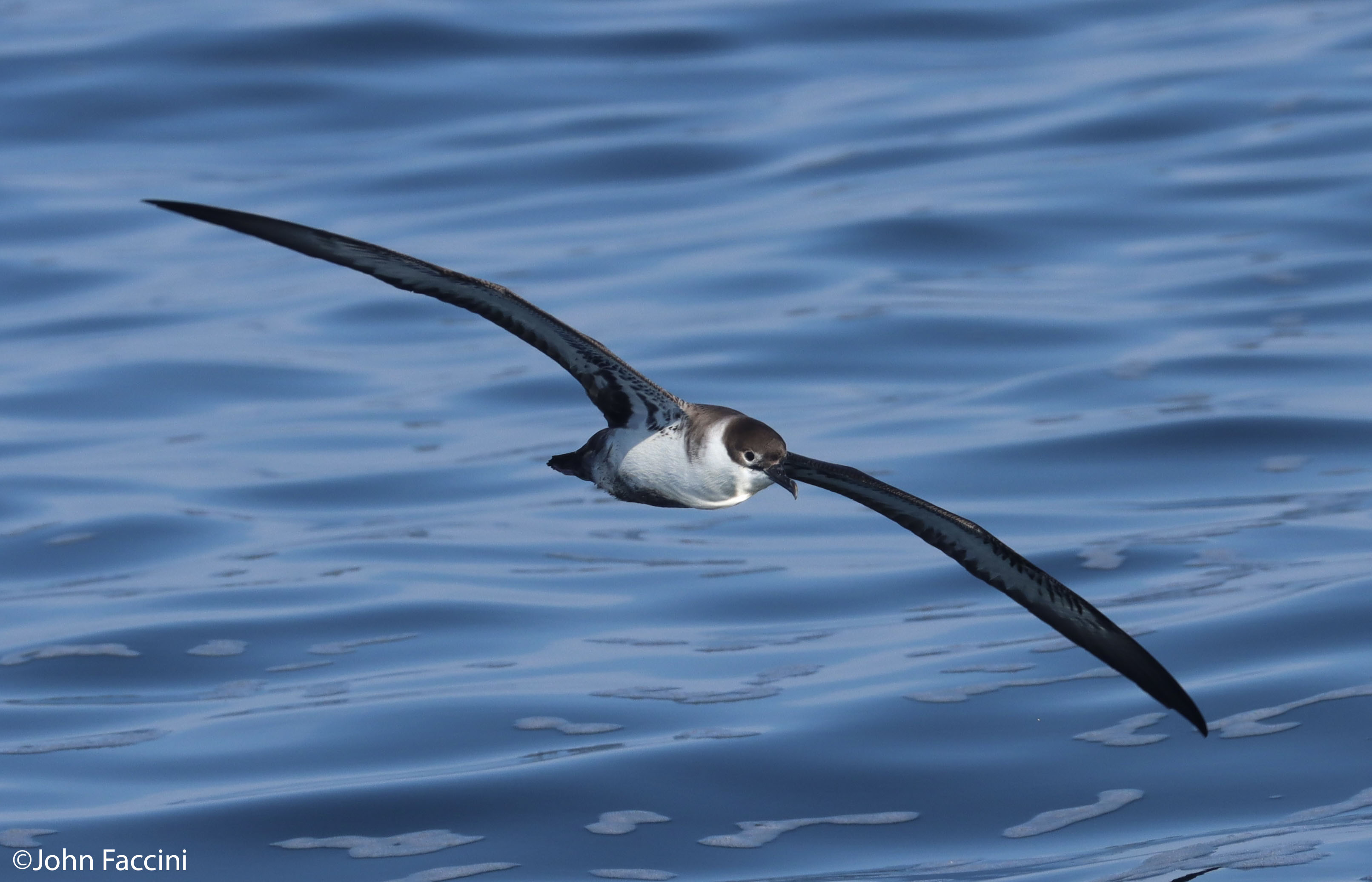
One of at least 15 Cory’s Shearwaters observed from a Cap’n Fish’s Cruises Whale Watch last week, showing the dark outer primaries on the underwing, making for a rounded end to the white of the underwing coverts, separating it from the recently-split Scopoli’s Shearwater.
October is my favorite month of birding in Maine, and this past week showed why. A great diversity of birds are on the move, and my past seven days featured everything from pelagics to yard birds. Here are my observations of note over the past seven days.
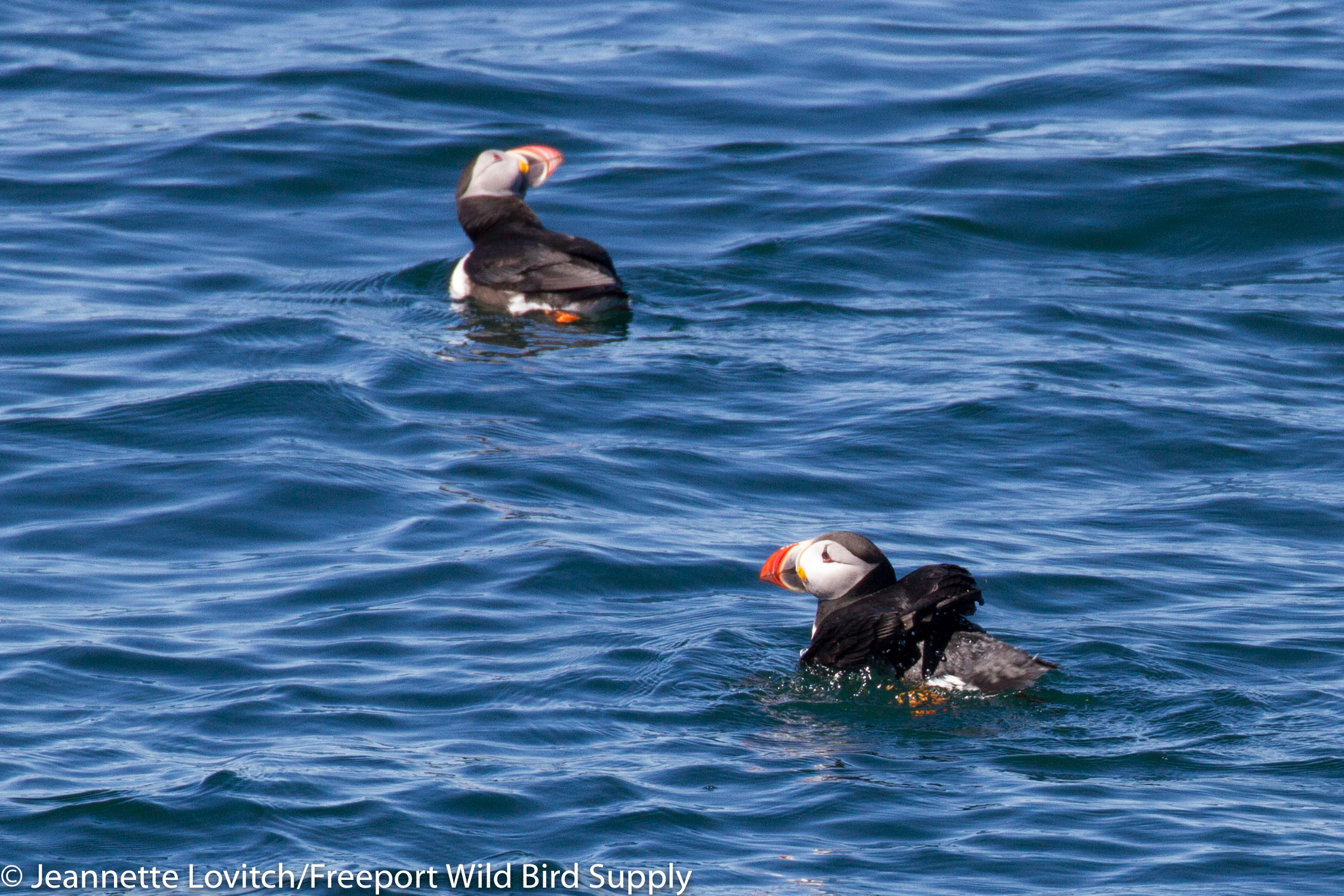
Pelagic highlights from a Cap’n Fish’s Cruises Whale Watch out of Boothbay Harbor on 10/4: 4 NORTHERN FULMARS (including one dark morph), 4 ATLANTIC PUFFINS, 14-15 Cory’s Shearwaters (most seen and/or photographed well enough to see full dark outer primaries on the underwing; see above), 6 Red-necked Phalaropes, and one BROWN CREEPER landing on a person on the top deck about 14 miles off of Damariscove Island (photo below). My complete list is posted here.
1 Baltimore Oriole and 1 Nashville Warbler, Wolfe’s Neck Center, Freeport, 10/5 (with Saturday Morning Birdwalk group).
Sandy Point Morning Flight, 10/6: 140 birds of 18 species led by 60 Yellow-rumped Warblers. Total tally here.
1 Rusty Blackbird, 1 Nashville Warbler, and 1 Pied-billed Grebe, Capisic Pond Park, Portland, 10/9 (with clients from New York).
20-30+ Cory’s Shearwaters off East Point and Ocean Ave, Biddeford Pool, 10/9. Some just beyond Beach Island in good afternoon light to see dark outer primaries. 15 minutes of counting produced 18 individuals from East Point, all moving north, with 1-3 in view with almost every quick scan thereafter. Good sign for Monday’s pelagic! (with clients from New York).
7 American Oystercatchers and 1 Horned Grebe (first of fall), Ocean Avenue, 10/9 (with clients from New York).
1 American Redstart, Elphis Pond, Biddeford Pool, 10/9 (with clients from New York).
Highlights from our Durham property this week included the arrival of the first few Dark-eyed Juncos, a Rose-breasted Grosbeak on 10/4, continuing multiple Lincoln’s Sparrows, Nashville Warbler on 10/8, and another or the same Indigo Bunting on 10/9.
And here’s my complete trip report from my Monhegan tour and visit on September 27 through October 1st.
Our annual half-day pelagic with our partners Cap’n Fish’s Cruises out of Boothbay Harbor is on Sunday, October 14th – a nice, late date that should put us more in the season of things like Great Skua, and you can be sure we’ll be studying Cory’s Shearwaters hard to find a Scopoli’s! More info and link to registration is here. See notes above from my 10/4 outing.
A few spaces remain on our Birds on Tap! – The Boat Trip! To House Island in Casco Bay on Sunday, October 20th. More info here.
Join us on Monday’s pelagic and maybe a Brown Creeper will land on you!
John Lorenc and I finally caught up with this continuing WHITE-WINGED DOVE at Donna Cundy’s feeders on Monhegan Island in our brief visit on the 17th. It appeared minutes after we walked away for the” last time,” but we were alerted by friends and raced back. My photos have a twig in front of that beautiful powder blue eyering, so I’m borrowing Kristen’s photo.
My observations of note over the past seven days also included:
15 species of warblers, led by only about 20 Black-and-white Warblers and about 15 Northern Parulas, Evergreen Cemetery, Portland, 5/12 (with Down East Adventures Spring Songbird Workshop group).
1-2 Blue-gray Gnatcatcher, Evergreen Cemetery, 5/12 (with Down East Adventures Spring Songbird Workshop group).
15 species of warblers, led by 9 Ovenbirds and 7 American Redstarts, our property in Durham, 5/13.
18 species of warblers (FOY), led by 40+ Yellow-rumped and 13 Common Yellowthroats, Florida Lake Park, Freeport, 5/14 (with Jeannette).
15 species of warblers, led by 10+ each of Ovenbirds and Black-throated Green Warblers, our property in Durham, 5/14.
15 species of warblers, led by 19 Common Yellowthroats and 10 Ovenbirds, Florida Lake Park, 5/15.
5 Red Crossbills, around the store’s yard, 5/15. More impressive was the 23 that Jeannette had fly over early in the day on the 18th.
A very productive ferry crossing from Port Clyde to Monhegan on 5/17 included 4-6 ATLANTIC PUFFINS (FOY), a group of 6 (or possibly 9) RED-NECKED PHALAROPES (FOY), 6 Black Scoters, several Long-tailed Ducks, etc. (with John Lorenc, Jess Bishop, Ron Joseph, Kristen Lindquist, Bill Thompson, et al). On the trip back, John and I had a total of 10 ATLANTIC PUFFINS and more Long-tailed Ducks.
1 continuing WHITE-WINGED DOVE (photo above) and 1 female-type SUMMER TANAGER, Monhegan Island, 5/17 (with John Lorenc).
Additional personal first-of-years this week also included:
1 Blackpoll Warbler, Evergreen Cemetery, Portland, 5/12 (with Down East Adventures Spring Songbird Workshop group).
1 Red-eyed Vireo, Evergreen Cemetery, 5/12 (with Down East Adventures Spring Songbird Workshop group).
1 House Wren, Evergreen Cemetery, 5/12 (with Down East Adventures Spring Songbird Workshop group).
2 Bay-breasted Warblers, Florida Lake Park, 5/14 (with Jeannette).
2 Eastern Wood-Pewees, Morgan Meadow WMA, 5/16.
4 Laughing Gull, ferry from Port Clyde to Monhegan, 5/17 (with John Lorenc).
4+ Indigo Buntings, Monhegan Island, 5/17 (with John Lorenc).
It was a great week of birding on our Durham property this week, including local breeding birds on territory often put on a show. Jeannette photographed this Yellow Warbler on our property on the 15th, for example.
Tours and Events:
There will not be a Saturday Morning Birdwalk on 5/25 as I’ll be on Monhegan with our tour group.
On July 22nd we boarded the Isle au Haut Boat Service’s The Otter for our special annual charter out of Stonington to the raucous seabird colony on Seal Island. Our partnership began while “Troppy” the world-famous Red-billed Tropicbird that called the area home for 17 years. Unfortunately, Troppy failed to appear last year, but we ran the trip anyway, and had an amazing time!
So we did it again this year. There’s just so much life out there, and it’s such an amazing place to visit, and so I needed an excuse for my annual visit. And sure, if that wily Tufted Puffin that’s been wandering the Gulf for the last two summers wants to be the new Troppy, that would be fine, too. But for now, we headed offshore with all sorts of high hopes.
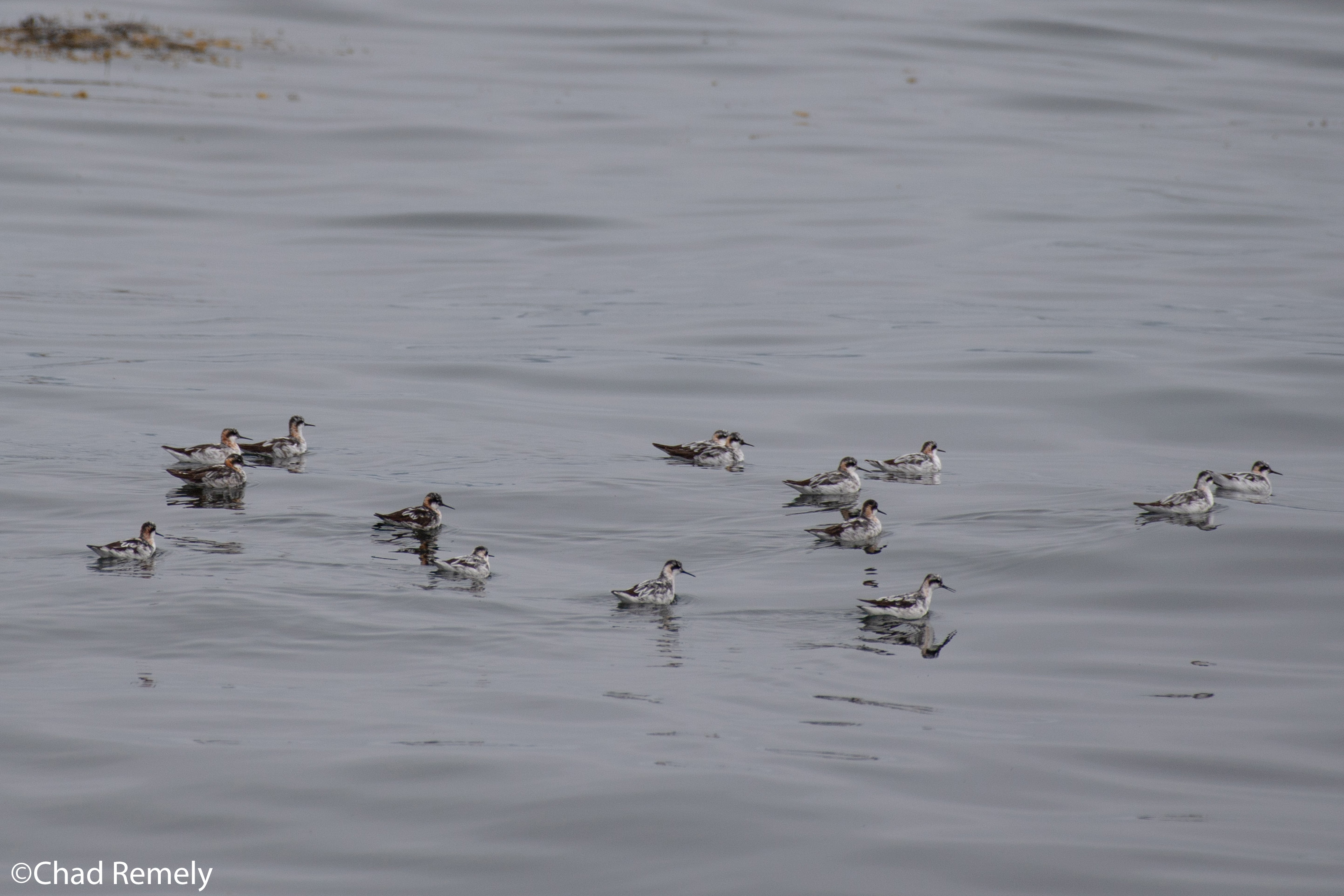
As we left Stonington Harbor, the fog began to thicken, but not before we spotted a group of 15 Red-necked Phalaropes sitting on the water. Captain Tracy did a great job getting us closer, and then inching up to them when they relocated a short distance away. It’s a treat to get so close to phalaropes on the open water.
A handful of Wilson’s Storm-Petrels were bouncing around, but the action picked up as usual as we approached Saddleback Ledge Light. A 1st summer Great Cormorant was surveying the scene, and our first Atlantic Puffin circled around us for a couple of passes. After we ourselves circled the small island twice, we turned for Seal and immediately ran into dense fog that had slowly been creeping in. The tradeoff for calm waters is often fog, and it was pea soup today.
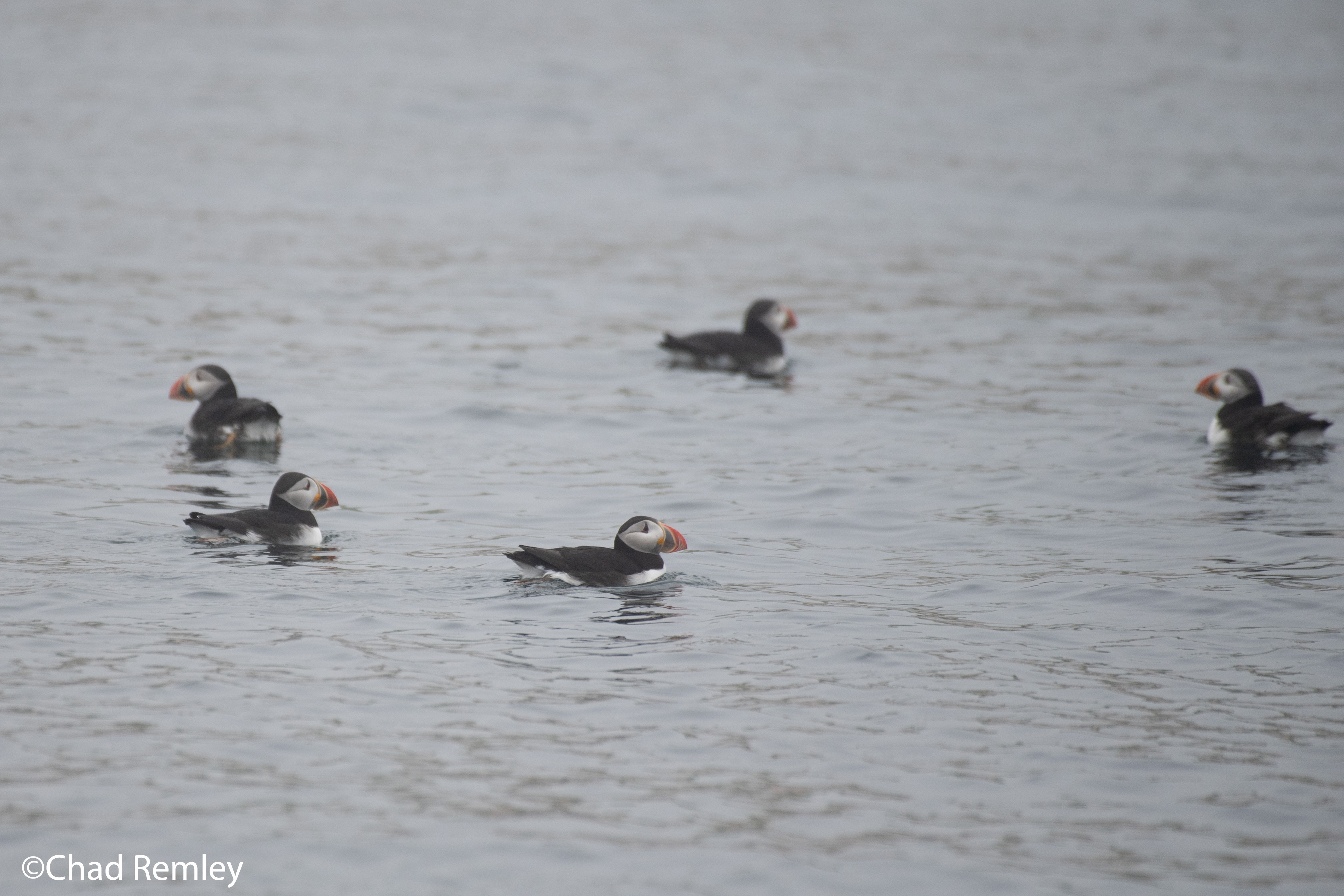
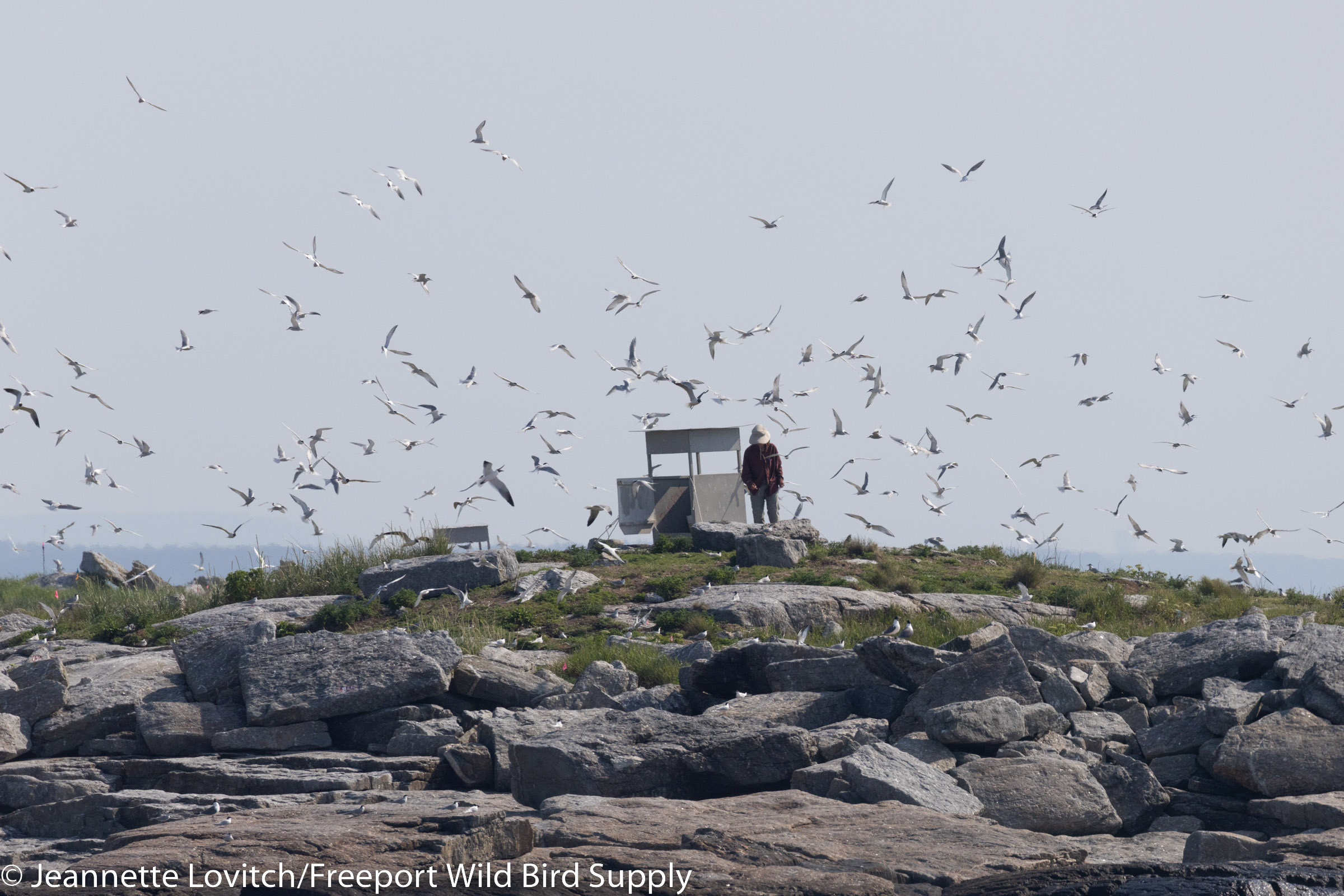
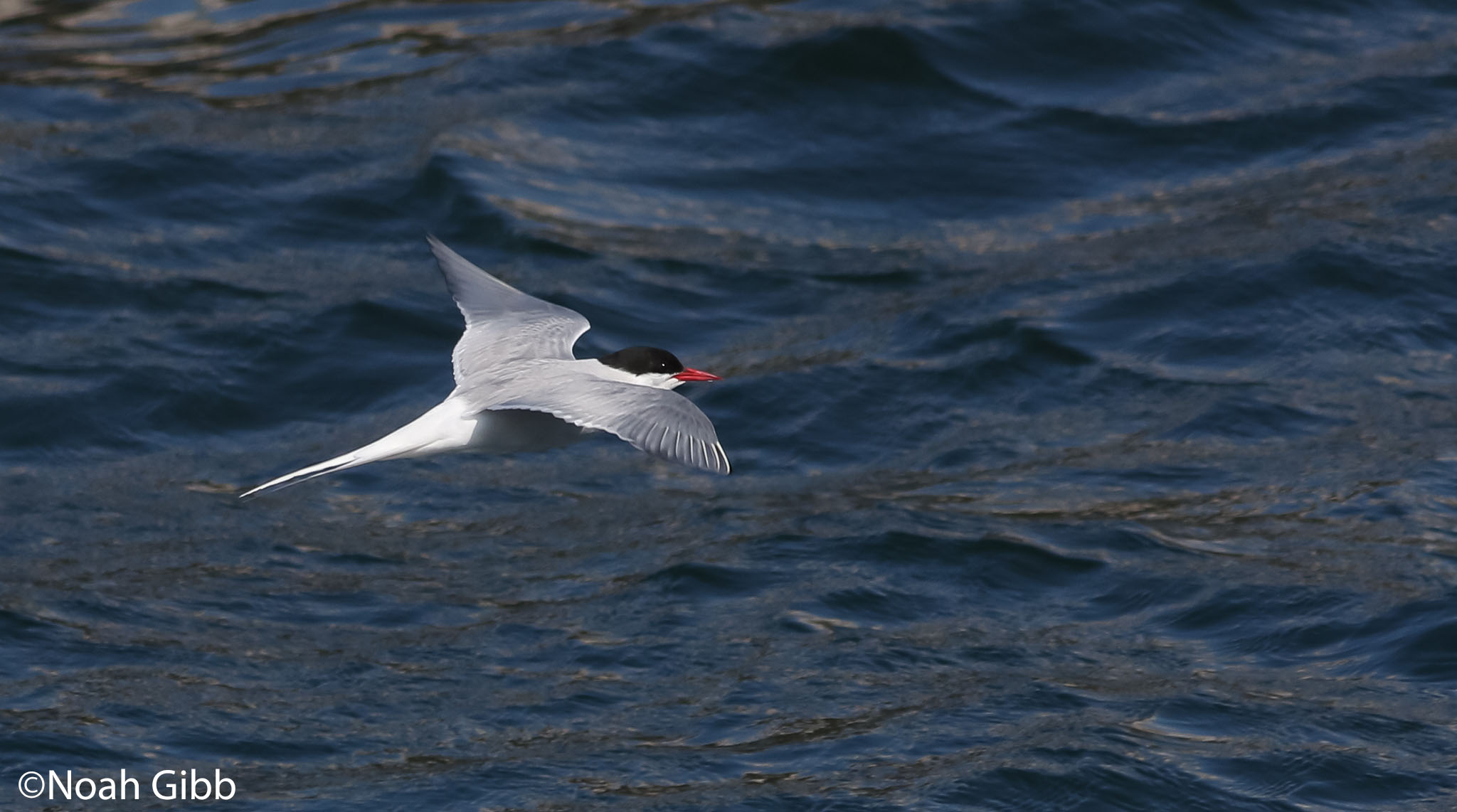
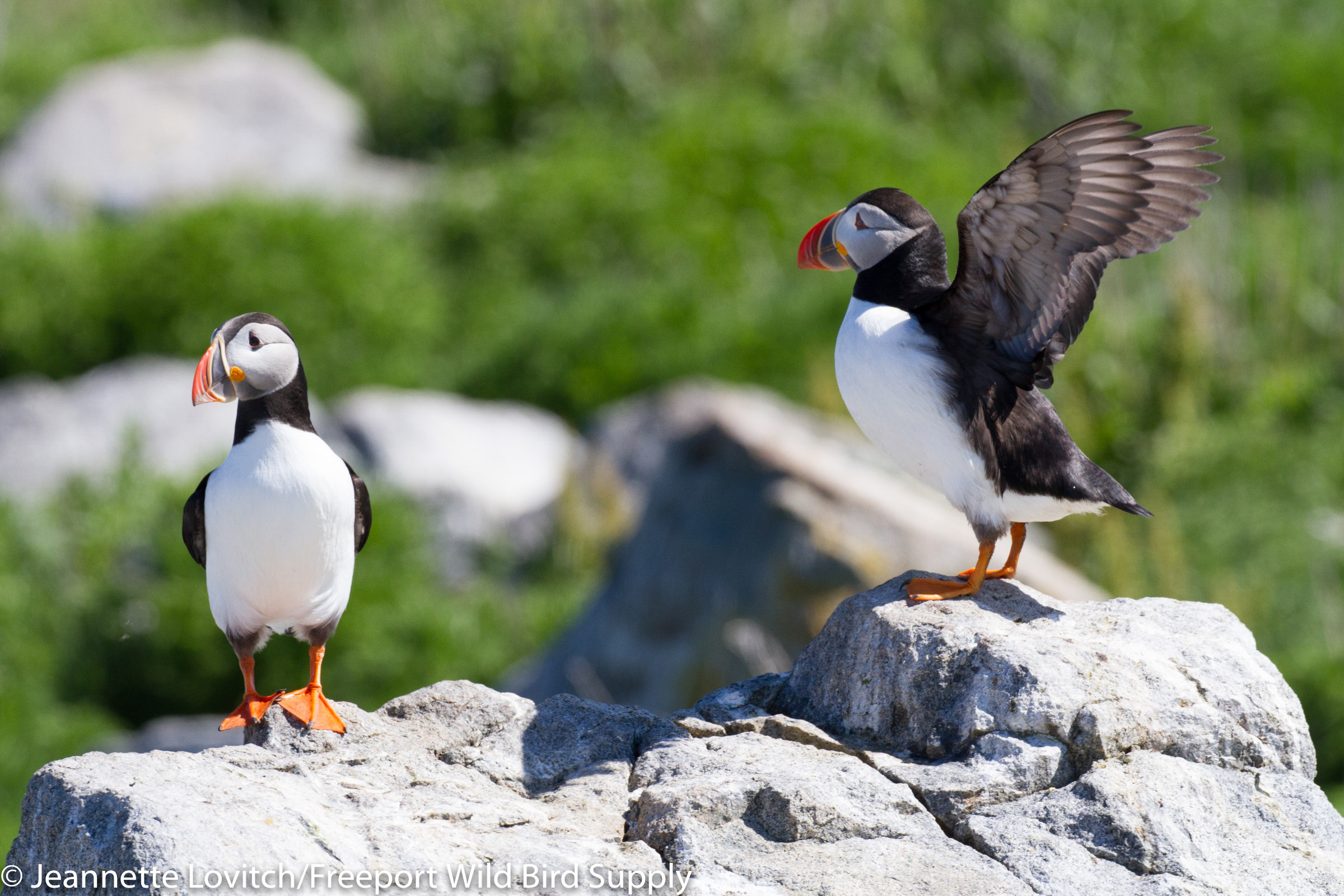
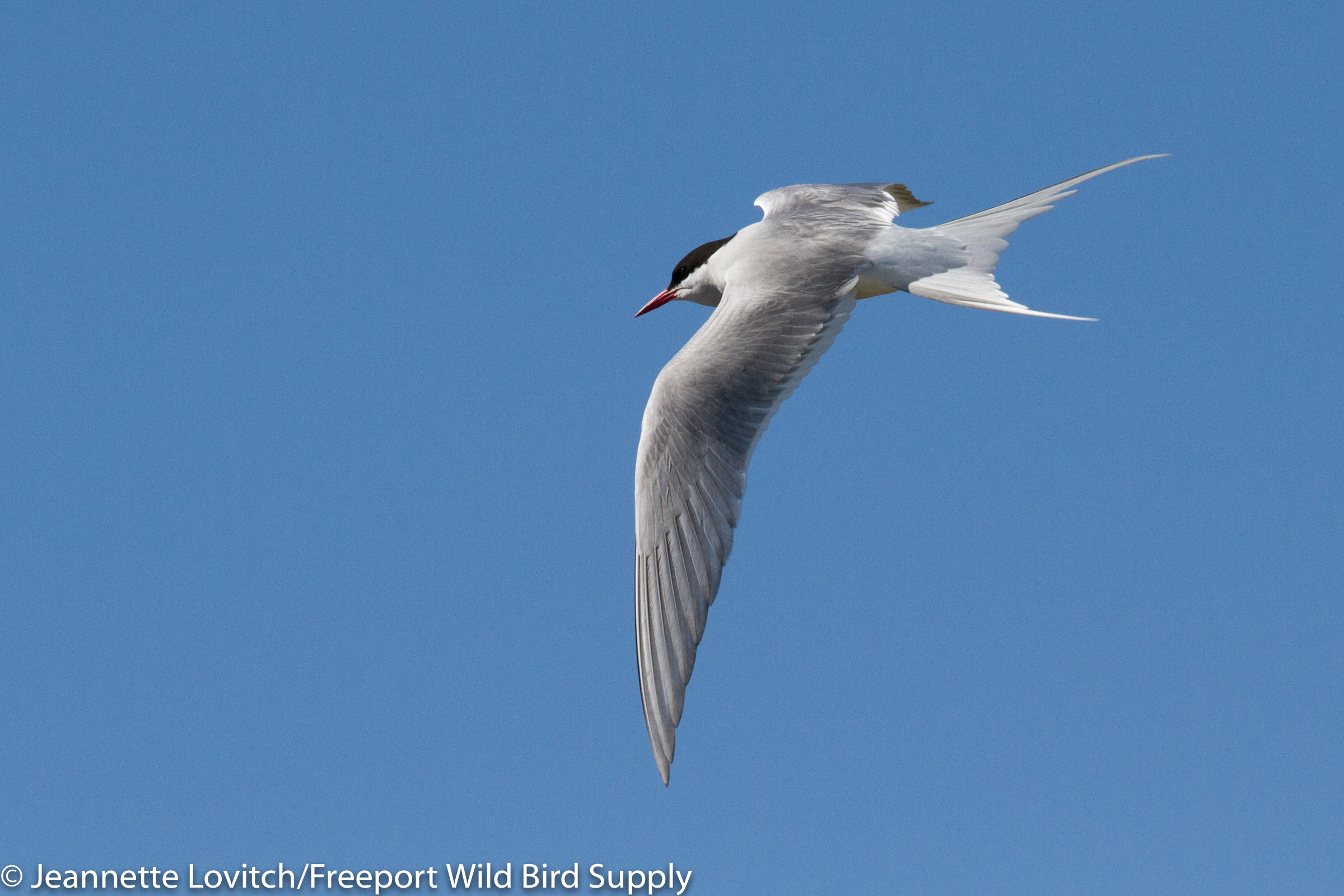
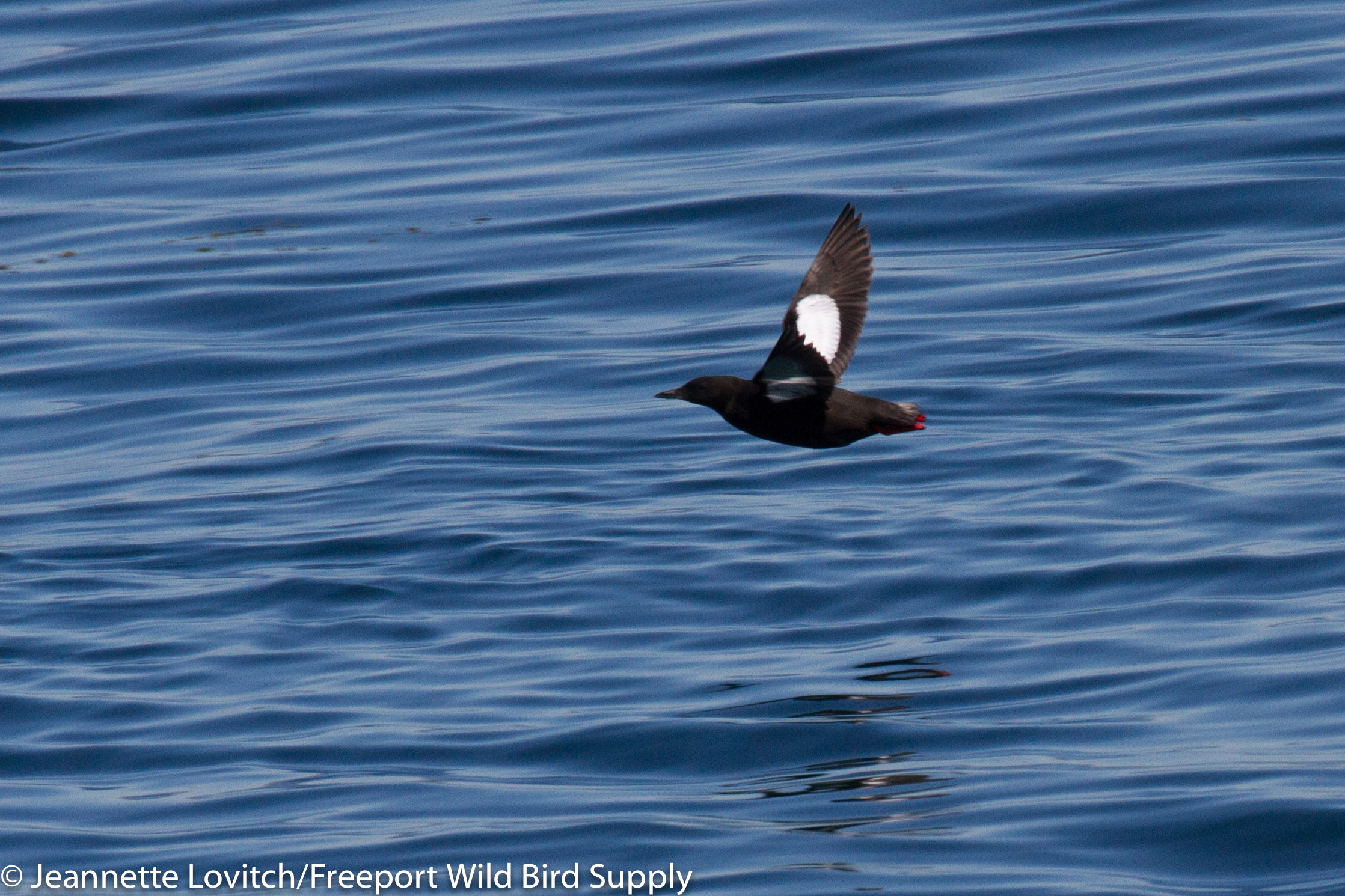
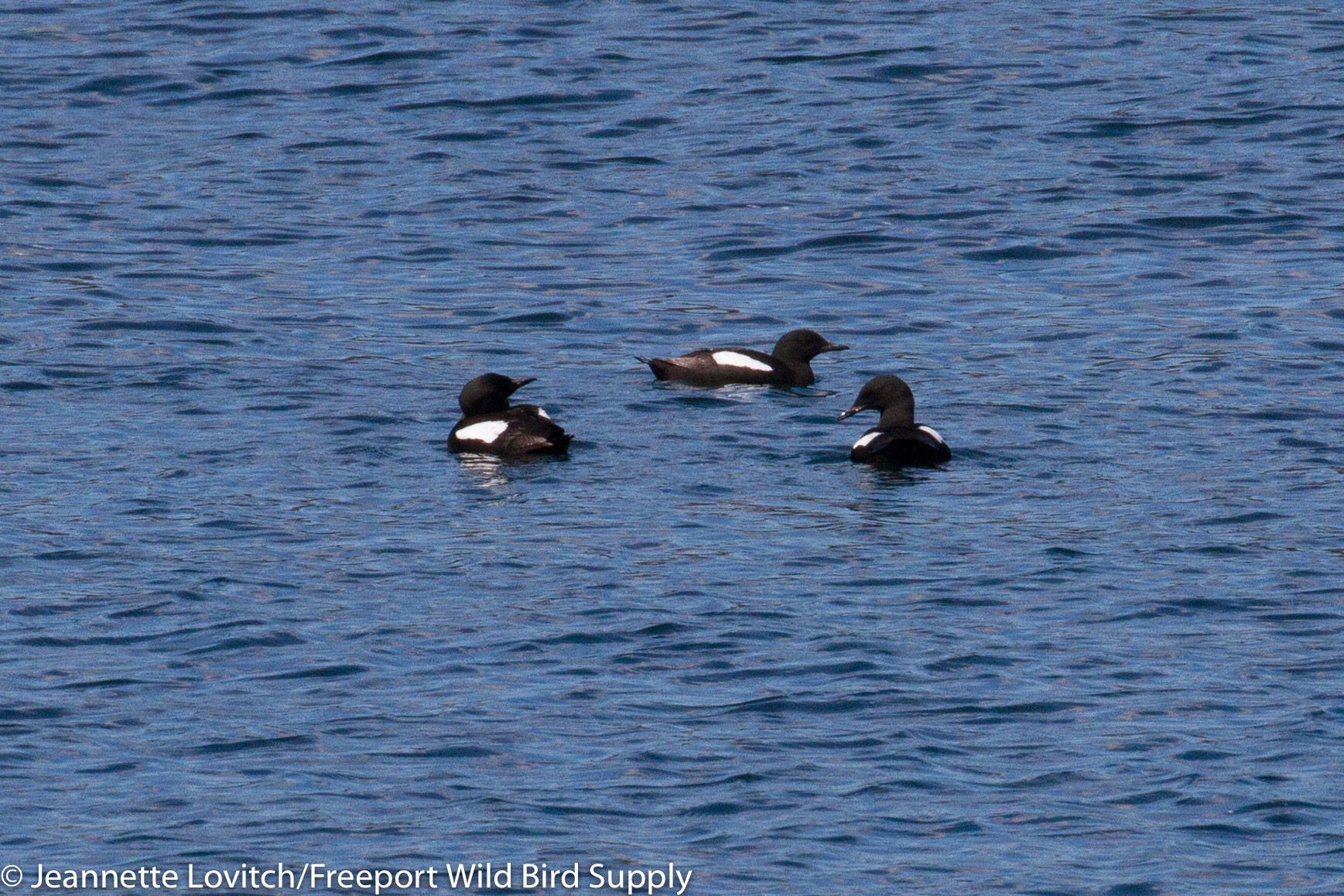
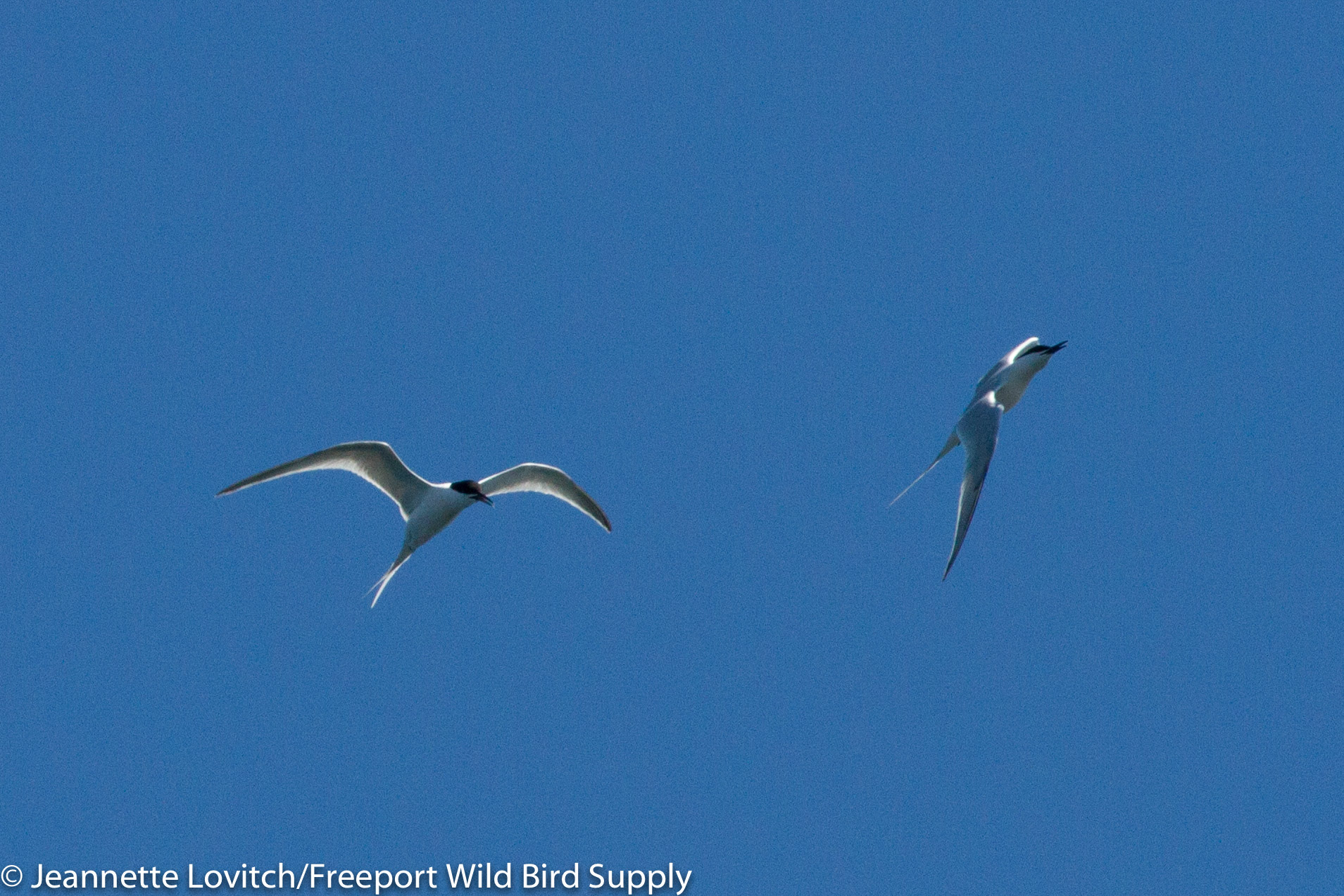
Not surprisingly, we saw little en route, but soon enough, we were out at Seal. While we heard – and even smelled – the tern colony before we could see the island, once along its shores, visibility was adequate. Arctic Terns put on a particularly good show for us, with several near the boat feeding and bathing. Arctic and Common Tern fledglings were everywhere, and we enjoyed their antics. There were plenty of Atlantic Puffins in the water and on land, including several groups that were remarkably confiding as we sided up to them in the glass-calm waters. And Black Guillemots were numerous, and very busy.
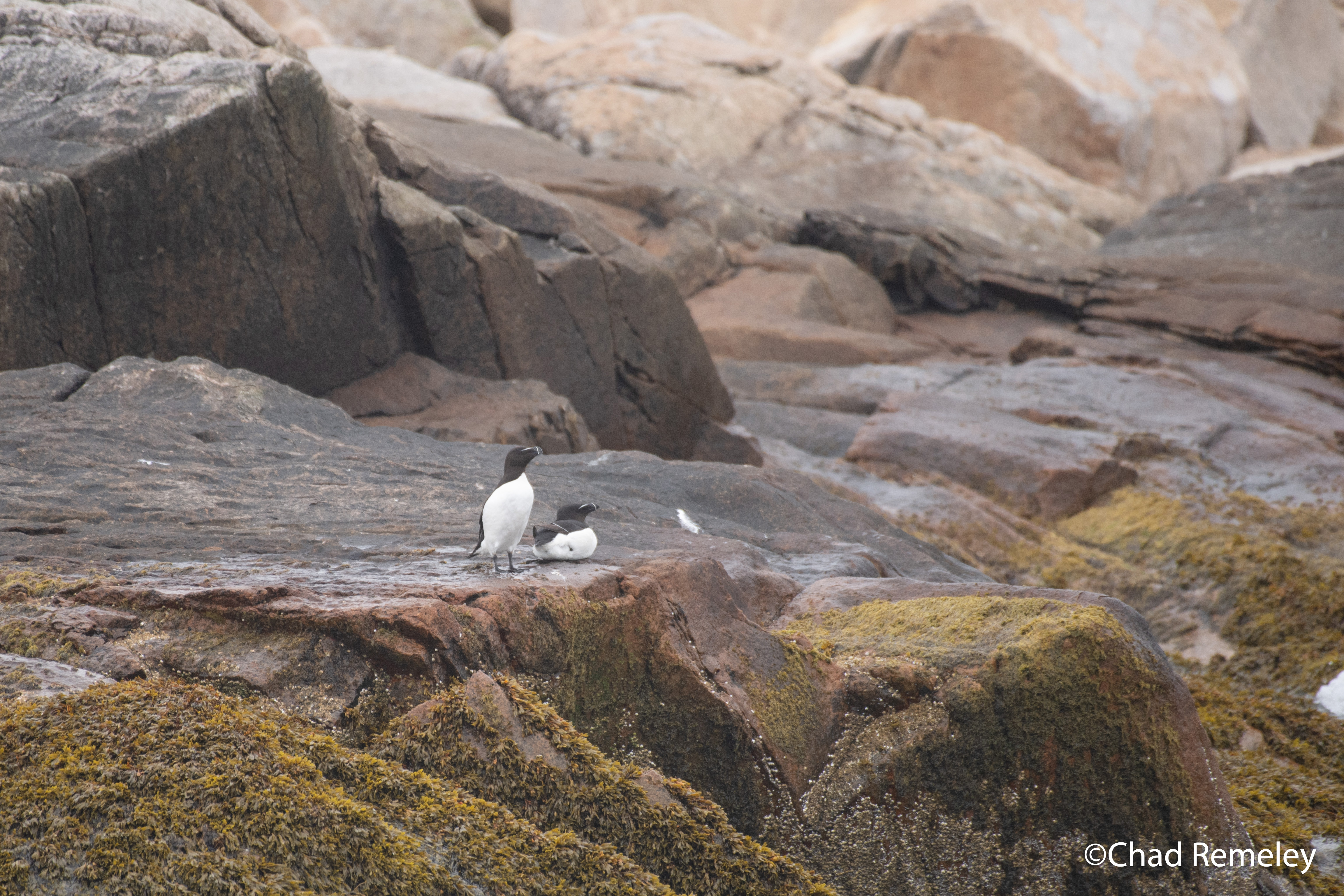
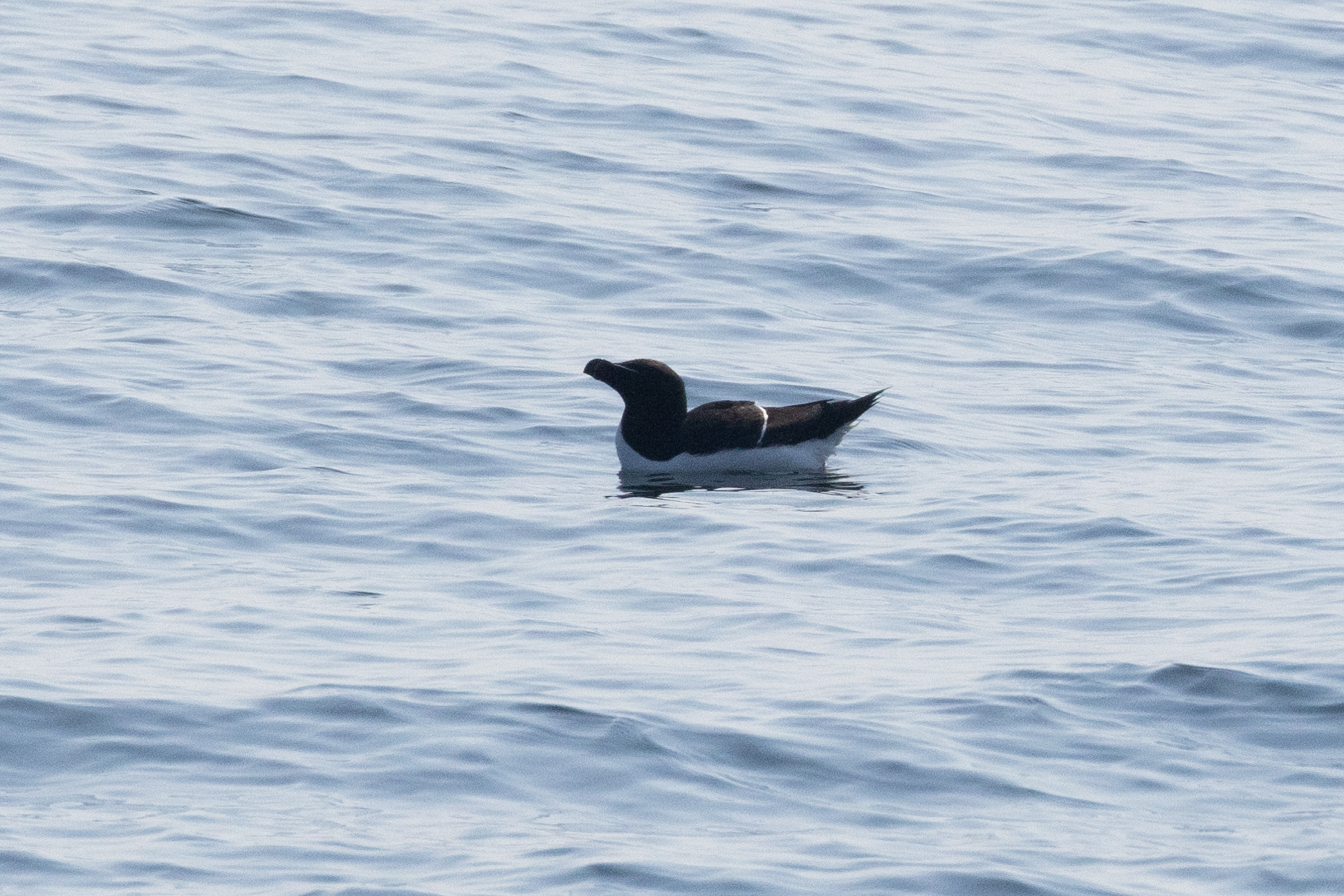
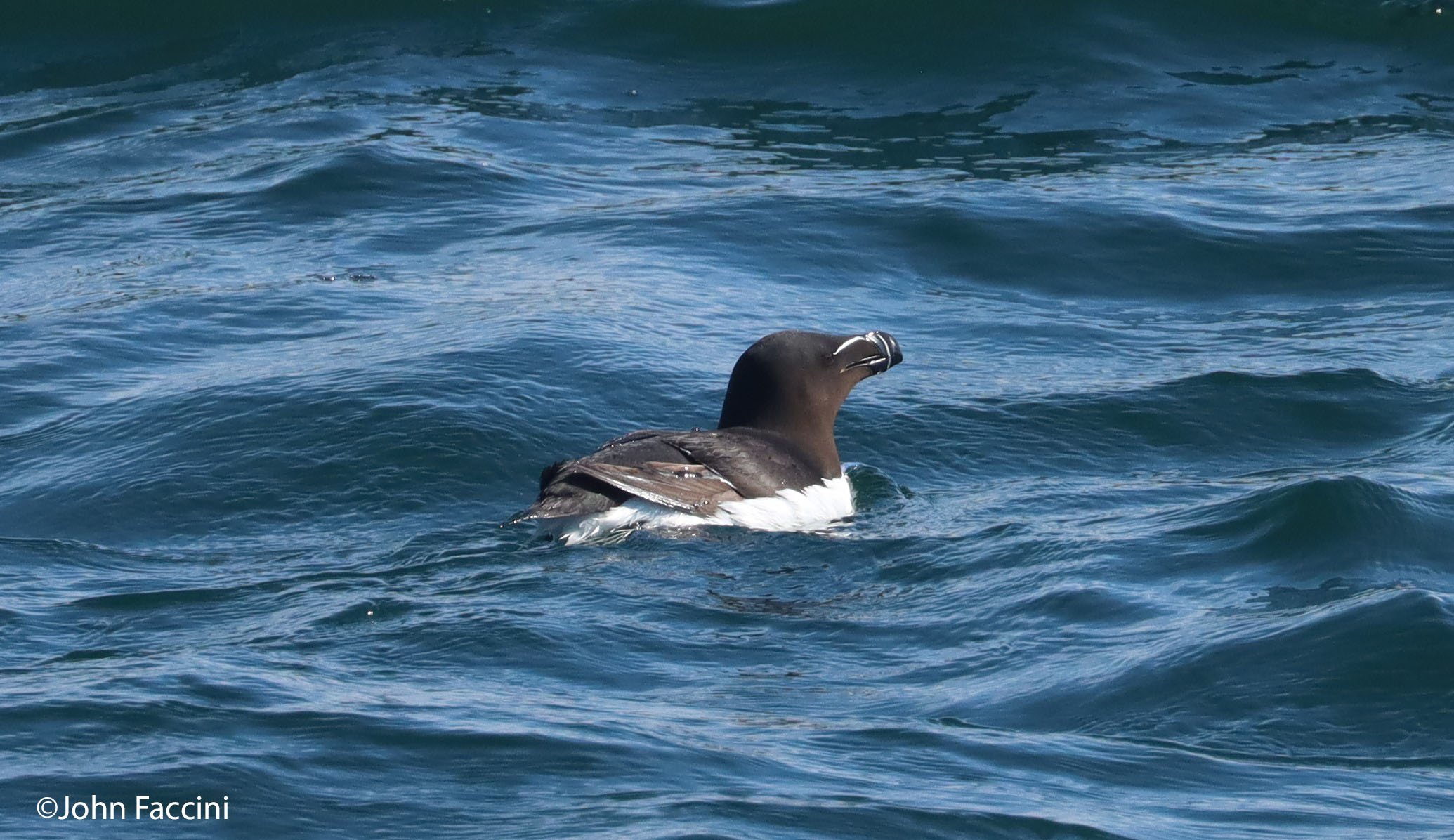
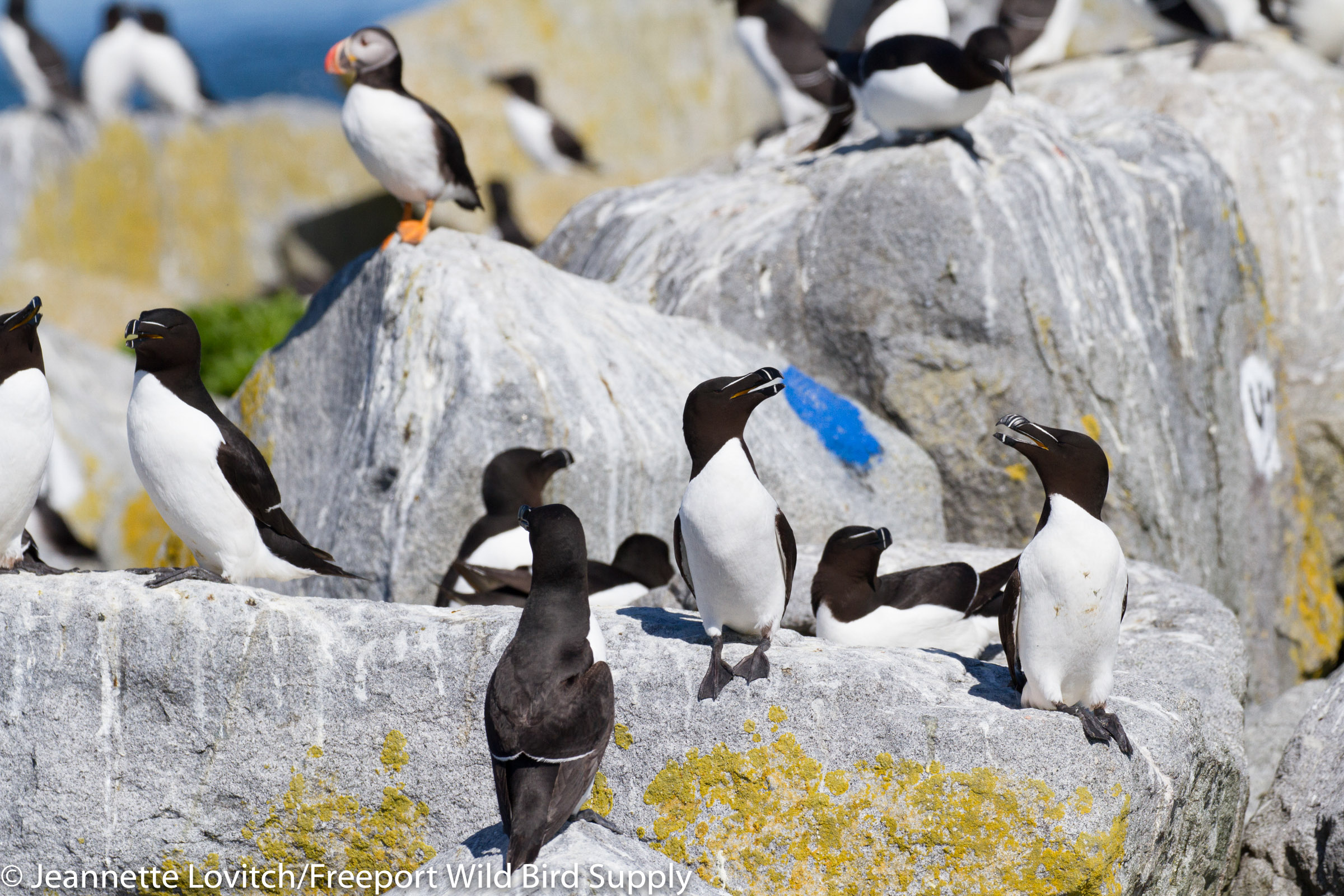
Razorbills were fledgling rapidly, so we only found two on the island, but later, we had great looks at one on the water, too.
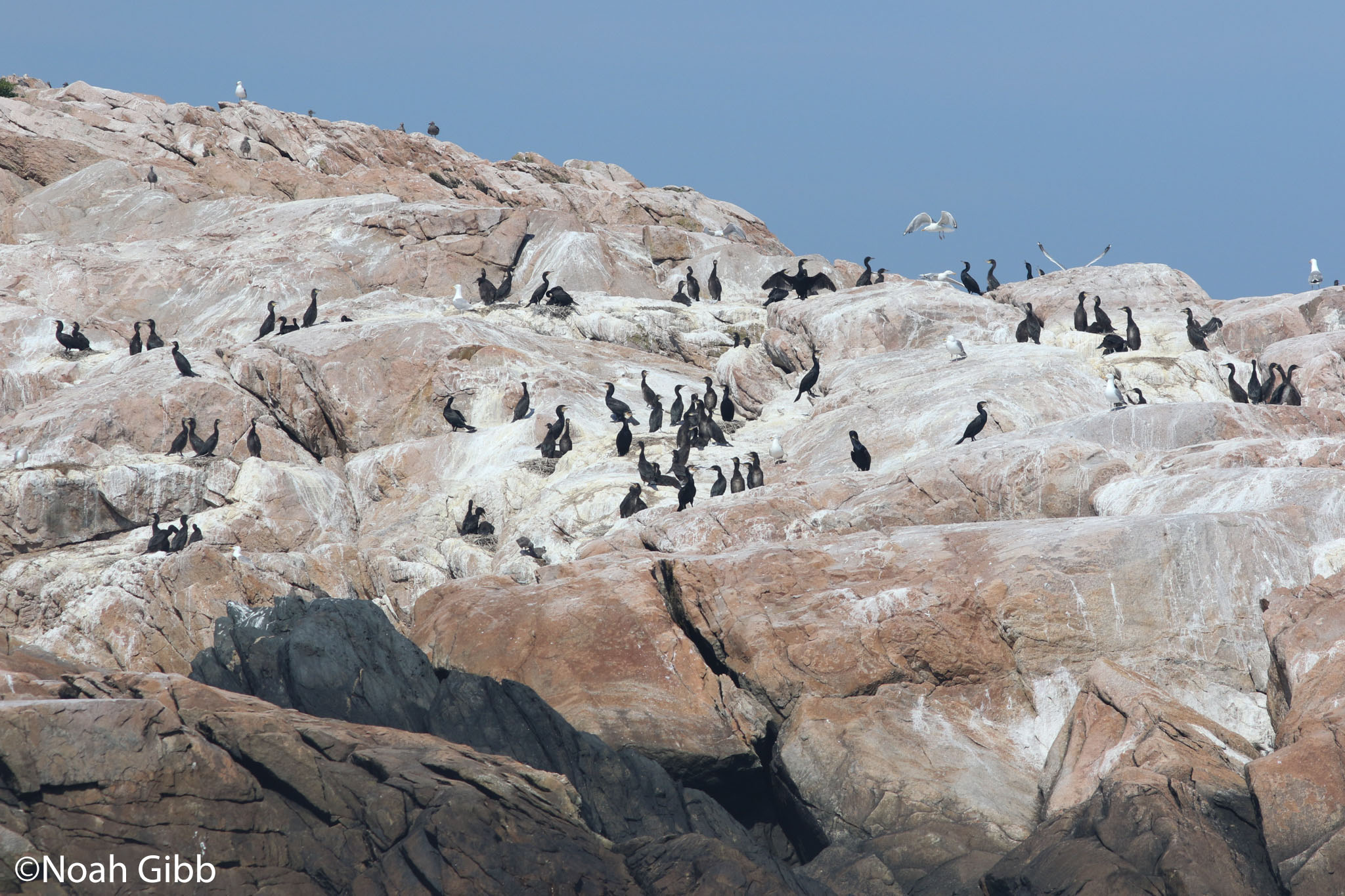
We circled around the southern end, spending some time observing the state’s last colony of Great Cormorants (and Double-crested); nests were brimming with chicks!
We kept an eye out for migrant shorebirds in addition to the locally breeding Spotted Sandpipers, but visibility remained a challenge: 4 Short-billed Dowitchers, 3 Least Sandpipers, and some unidentified peeps was the best we could do. A Great Shearwater made a close, but brief, pass as we were on the east side of the island before vanishing back into the fog.
Somehow, it was even foggier on our way back, so seabird sightings – even with a second visit to Saddleback Ledge – were limited to just a couple more Wilson’s Storm-Petrels.
So yeah, the fog was annoying, and did impact photos and our search for the next mega-rarity. But it also produced one of the smoothest boat rides you’ll ever be on in the Gulf of Maine and yielded lots of close puffins and some great looks at phalaropes. And besides, any day birding from a boat is a good day in our book! Especially when a few days prior we thought this trip was going to be cancelled due to wind and thunderstorms.
Beginning in 2022, Cap’n Fish’s Cruises in Boothbay Harbor and Freeport Wild Bird Supply have partnered together to offer a mid-summer seabirding opportunity. I join the boat’s naturalist as a seabird and pelagic specialist, to help everyone see all of the breeding seabirds at Eastern Egg Rock (Atlantic Puffins; Arctic, Common, and Roseate Terns; Laughing Gulls; and sometimes Razorbill and Common Murre) before we venture offshore in search of whales. While doing so, we pay special attention on this cruise to the bird life – which is often found at the same places where we are looking for whales. This trip gives us a slightly more bird-centric tour compared to the regularly-scheduled departures.
Here are the trip reports from this very popular annual event.
July 16. 2022
Seas were fairly high (3-5ft) as we bounced offshore to deeper water first. Wilson’s Storm-Petrels were soon visible, and we passed one Razorbill. We could not stop or turn around for it as the seas were just a little too rough for that, and this was unfortunately our only Razorbill of the day. We cruised around waters over 300 feet deep, and were treated to a good performance from Great Shearwaters, Wilson’s Storm-Petrels, and picked up a few Sooty Shearwaters. We had one offshore Atlantic Puffin, but the big surprise was a rare, mid-summer NORTHERN FULMAR – definitely the pelagic bird of the trip.
With the seas building, we made a turn and took advantage of much more pleasant conditions as we trolled the area, giving people a better chance and seeing the aforementioned species. We also spotted a couple of Mola Molas, but no marine mammals, unfortunately.
Away from Eastern Egg Rock (both coming and going), our offshore (“pelagic”) scorecard was:
76 Great Shearwaters
61 Wilson’s Storm-Petrels
21 Northern Gannets
3 Sooty Shearwaters
2 Arctic Terns
1 Razorbill
1 Atlantic Puffin
1 NORTHERN FULMAR
1 Common Loon
scattered Common Terns and unidentified Sterna
As we approached Eastern Egg Rock, the action really picked up with all of the island’s breeding species soon apparent. Roseate and Arctic Terns joined the multitudes of Common Terns. At least a dozen Roseates included several putting on a good show, and we singled out quite a few close-passing Arctic Terns for good studies. 4 migrant Ruddy Turnstones joined island-breeding Spotted Sandpipers onshore, and we heard a couple of singing Song Sparrows. And of course a plentitude of Laughing Gulls; about half of the entire state’s population breeds here. Black Guillemots were also conspicuous today.
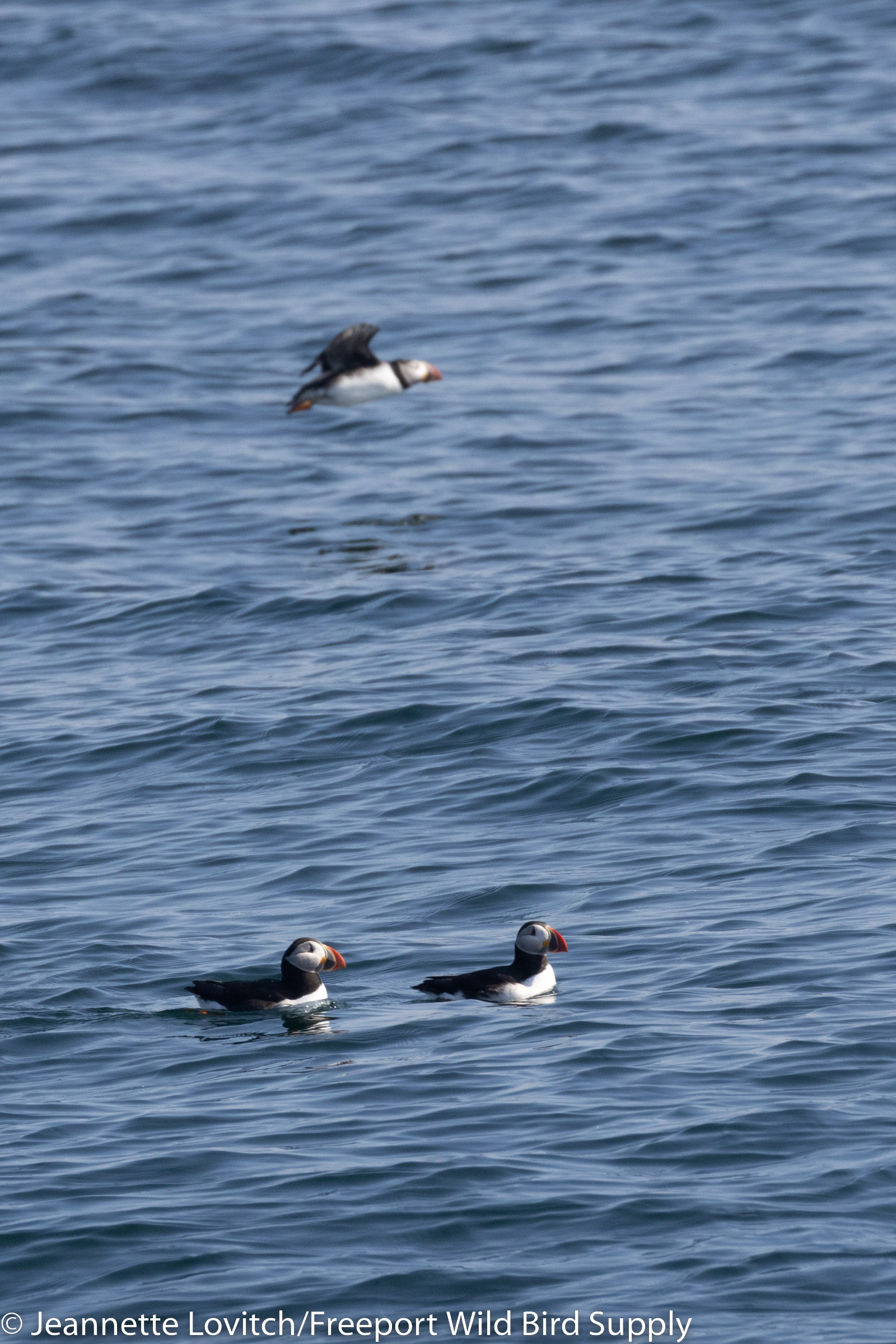
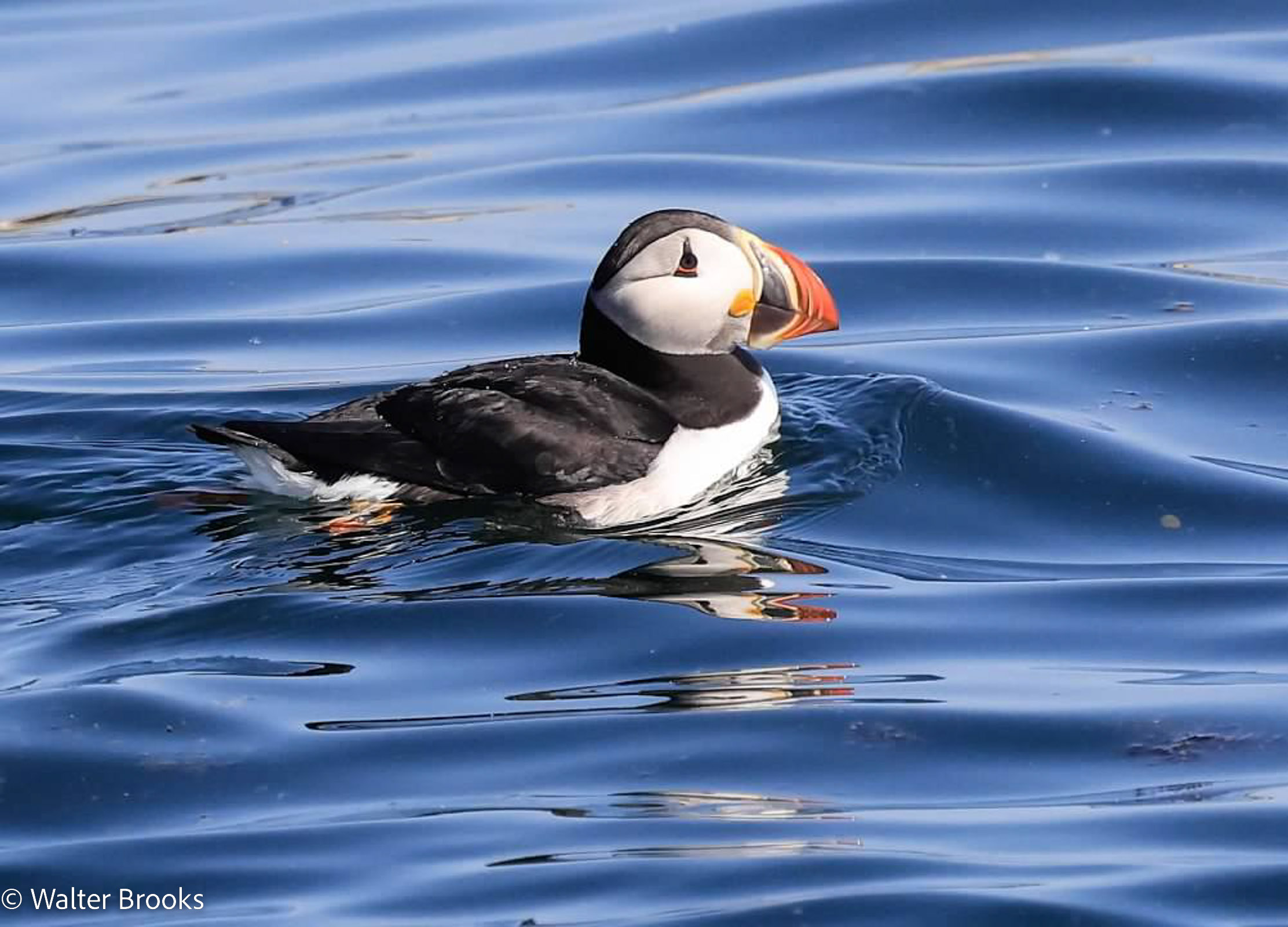
But Atlantic Puffins are the star of the show out here, and today, they did not disappoint. In fact, it was a great mid-summer performance, with several dozen on the water – often in very close proximity to the boat, commuters passing by, and dozens more stately stationed on the island’s rocks.
We wandered offshore on the way back, near where the boat had recently seen whales, added a few birds to the tallies, but alas, the only marine mammals of the day were two species of seals: lots of Harbor Seals and two Gray Seals. Hopefully, this got the seal of approval from the marine mammal watchers aboard today.
July 10, 2023.
A Parasitic Jaeger got everyone to our feet as we were motoring home through the fog.
With even more anticipation than usual, birders flocked aboard for this afternoon departure. Three hours earlier, I had spotted the near-mythical Tufted Puffin on Eastern Egg Rock aboard Cap’n Fish’s morning Puffin Cruise. We made a bee-line for the island’s north end, but alas, the Tufted was not to be seen.
Nonetheless, we had a fantastic visit. Fog resulted in many of the island’s Atlantic Puffins being in the water and we had close birds all around the boat. We studied Arctic and Roseate Terns among the masses, making sure everyone had at least one rewarding look at each. While we searched vigilantly for the Tufted, we picked out one of two American Oystercatchers that have been here this summer, and just as we were about to leave, the single Common Murre floated around just off our bow.
It didn’t take long before our first Wilson’s Storm-Petrels of the day to be sighted, with small groups and singletons here and there throughout the rest of the trip for a total of 100-150 or so. Fog only thickened as we traveled further offshore, however, although we did find a hole where the visibility increased dramatically for a spell. While we searched diligently for whales to no avail (but plenty of Harbor Porpoises today), birds began to appear one by one.
A good look at a Sooty Shearwater. A glimpse of a Great Shearwater was followed later by a cooperative one that allowed close approach on the water. One group spotted a Manx Shearwater heading straight away, and a couple of other distant shearwaters disappeared into the fog. We only saw a few gannets today, scattered Common Loons on our way to and from, but a subadult Parasitic Jaeger spiced things up on our ride back (photo above).
Considering how dense the fog was, we were happy to spot much of anything once we left the rock, and considering we remained just east of torrential rain all day, we were more than satisfied with the comfort of what we did see!
I didn’t hit the shoreline at all this week, other than a quick jaunt to the Brunswick waterfront, so I don’t have a lot of observations of note, other than 2 Upland Sandpipers at Brunswick Landing, Brunswick, 7/1 (with Saturday Morning Birdwalk group) and continued scattered Red Crossbills.
However, bird-watching was fantastic this week overall, even if it did not produce anything out of the ordinary. From a visit with clients to Salt Bay Farm Preserve in Damariscotta on Thursday to a stroll this morning at Old Town House Park, I found plenty of entertainment in the life and antics of our common breeding species.
In fact, on a couple of mornings, I just couldn’t tear myself away from our feeding station, which is chock-full of activity right now, including multiple pairs each of Baltimore Orioles, Rose-breasted Grosbeaks, Gray Catbirds, Purple Finches, Ruby-throated Hummingbirds and 5 species of woodpeckers, including fledglings of many: Downy, Hairy, Pileated, Red-bellied, and Yellow-bellied Sapsucker. Yeah, we’re going through a lot of suet right now!
Therefore, I’ll just leave you today with some of my favorite photos from last month’s tour with NJ Audubon. And maybe next week I’ll have some more time for bird-finding again!
Thanks to our store’s partnership with Zeiss Optics, our biannual “Zeiss Day” occurred offshore this spring. With Zeiss’s sponsorship, we were able to offer this unique trip at a special price, with extra spotters to help people see birds, and of course, with chumming.
And the weather could not be any better! In fact, we were all excited to head offshore to beat the heat on this day. Barely a puff of breeze resulted in remarkably calm seas, with the only waves caused by our boat. Thanks to the weather gods for this day offshore!
Evan Obercian, Dan Nickerson, and Jeannette helped spot birds, Noah Gibb handled the checklists, and Robby Lambert – chummer emeritus – stood at the ready as the boat’s naturalist, Kelsey, and I scanned from the wheelhouse. Our captain was amazing, and together we laid out a plan for the day. Throughout the day, Rich and Bill from Zeiss handed out binoculars to try and lots of optical questions were answered. It was a great way to test-drive a new pair of excellent binoculars, especially noting how important size and weight is when trying to hold binoculars steady on the open ocean, even without much in the way of waves.
Robby at his office.
Motoring out of Boothbay Harbor and across Muscongus Bay, we familiarized ourselves with the common denizens of Maine’s summer coast, such as Common Eiders, Black Guillemots, Common Terns, and Ospreys. Kelsey pointed out landmarks and gave a little history of the area.
Our first destination was Eastern Egg Rock, home to a thriving seabird colony thanks to the restoration efforts of Project Puffin. Leading pelagic trips in June is easy when at least some of our target birds are guaranteed!
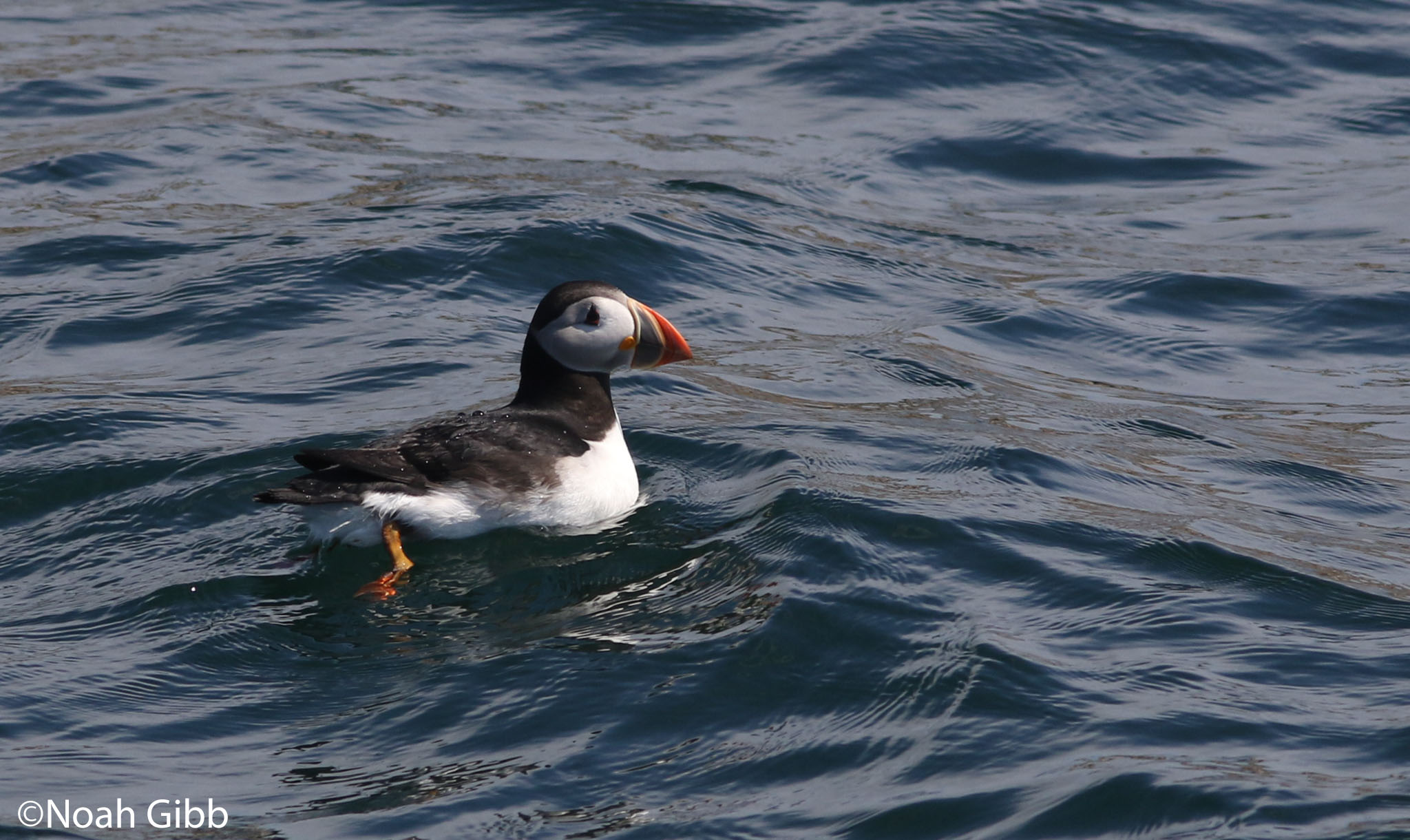
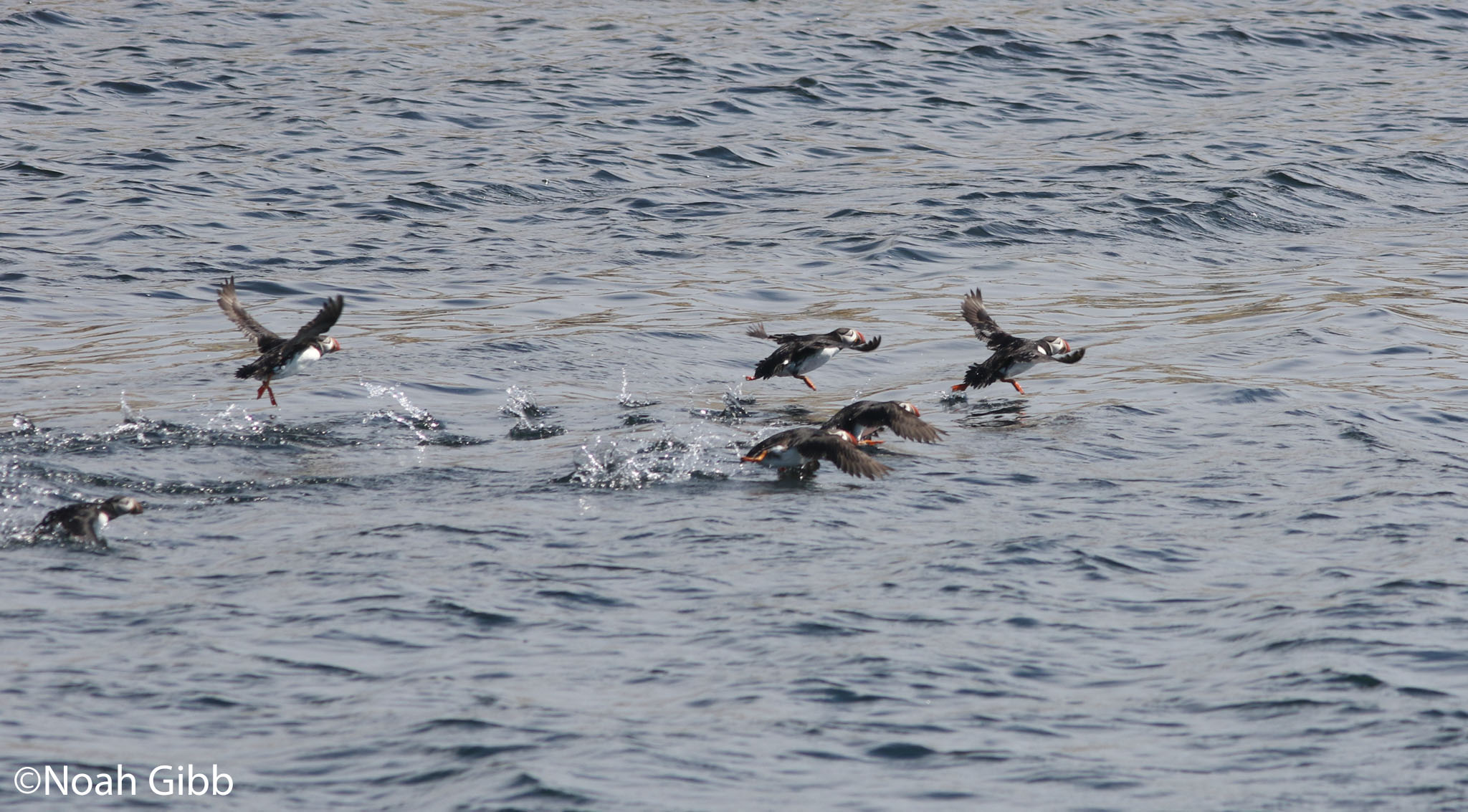
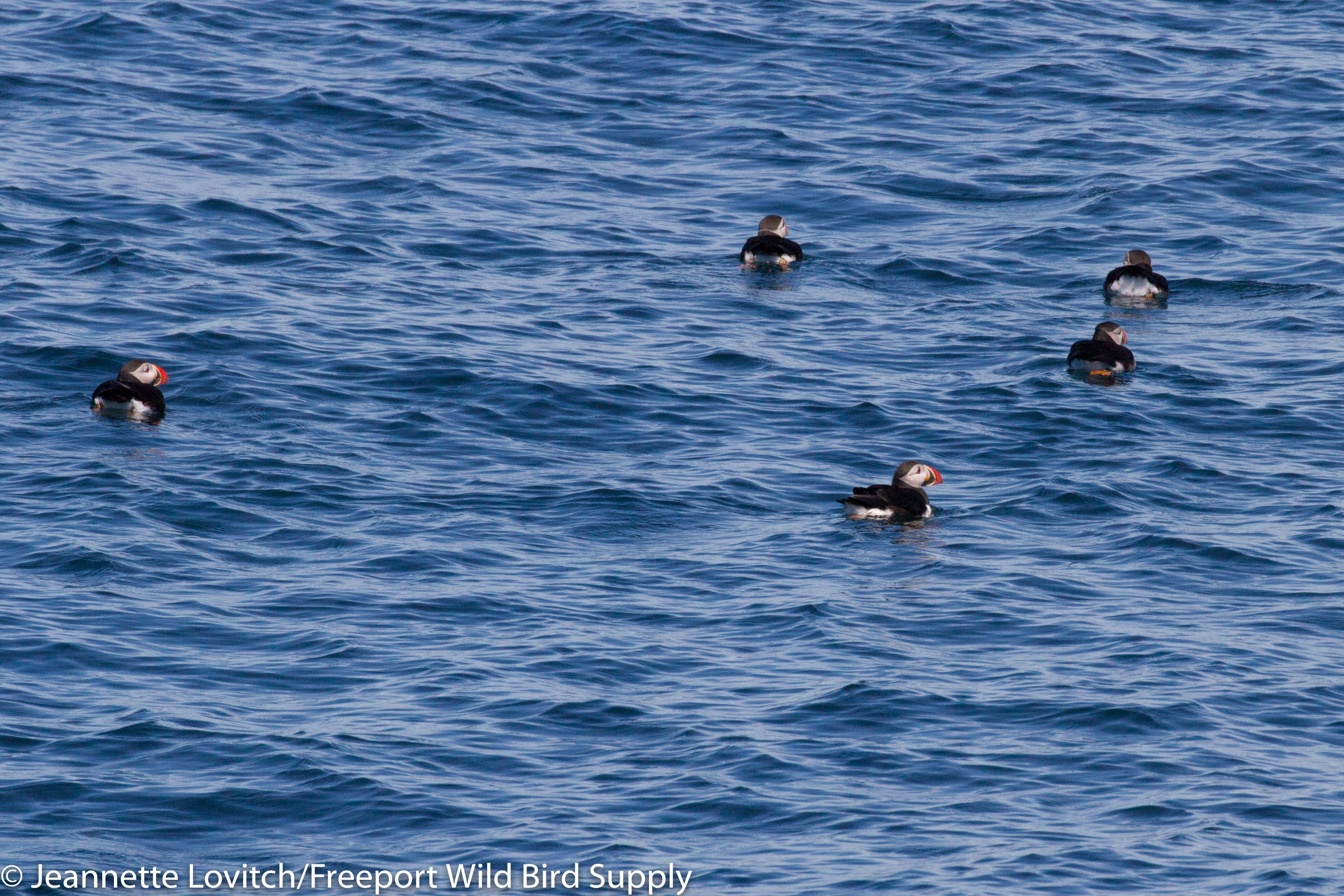
The amazingly calm conditions and unusually warmth worked in our favor, as many of the island’s Atlantic Puffins and Black Guillemots were in the water instead of loafing on the rocks, allowing us to drift closely to many of them. One of the island’s ephemeral Razorbills was spotted near the boat, giving us long and good looks as well.
Razorbill.
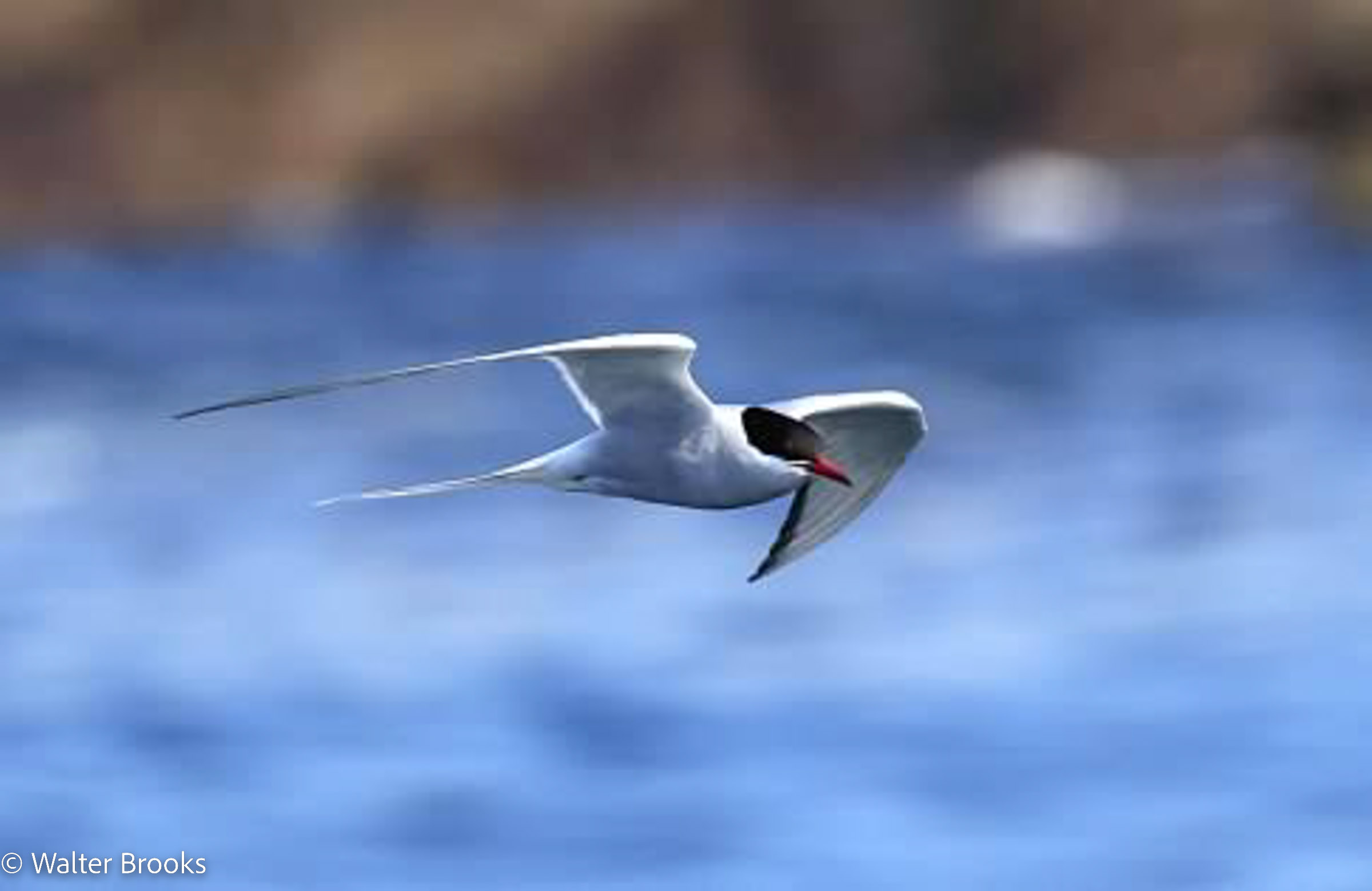
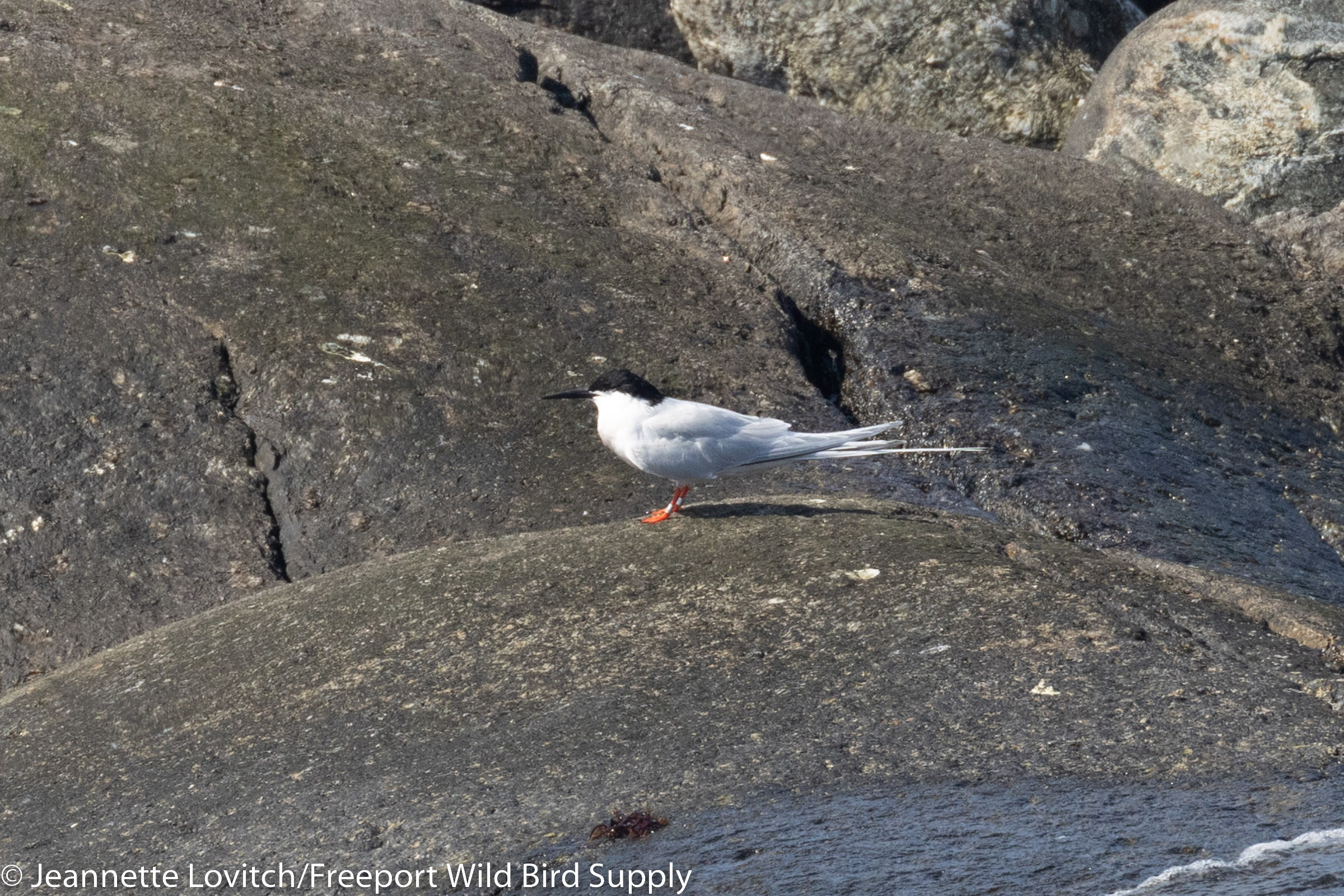
Of course there were the terns, and for a change, both Roseate and Arctic were easy to isolate for all to see. With the help of my spotters, and a cooperative pair of Roseates on an obvious rock, everyone saw each species well, as well as many hundreds of Common Terns of course. And a thousand or so Laughing Gulls, too.
Arctic Tern.
Roseate Tern.
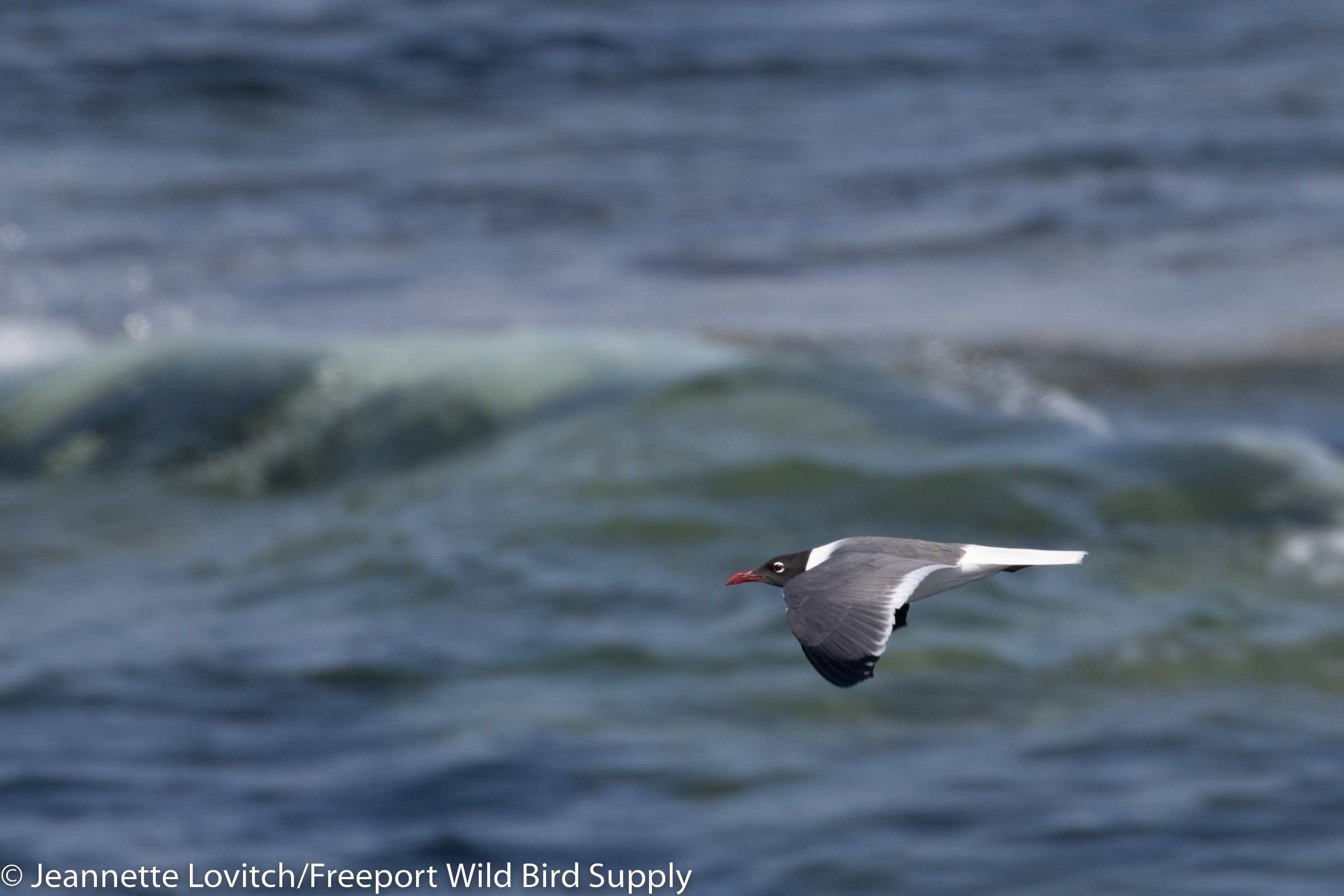
Laughing Gull
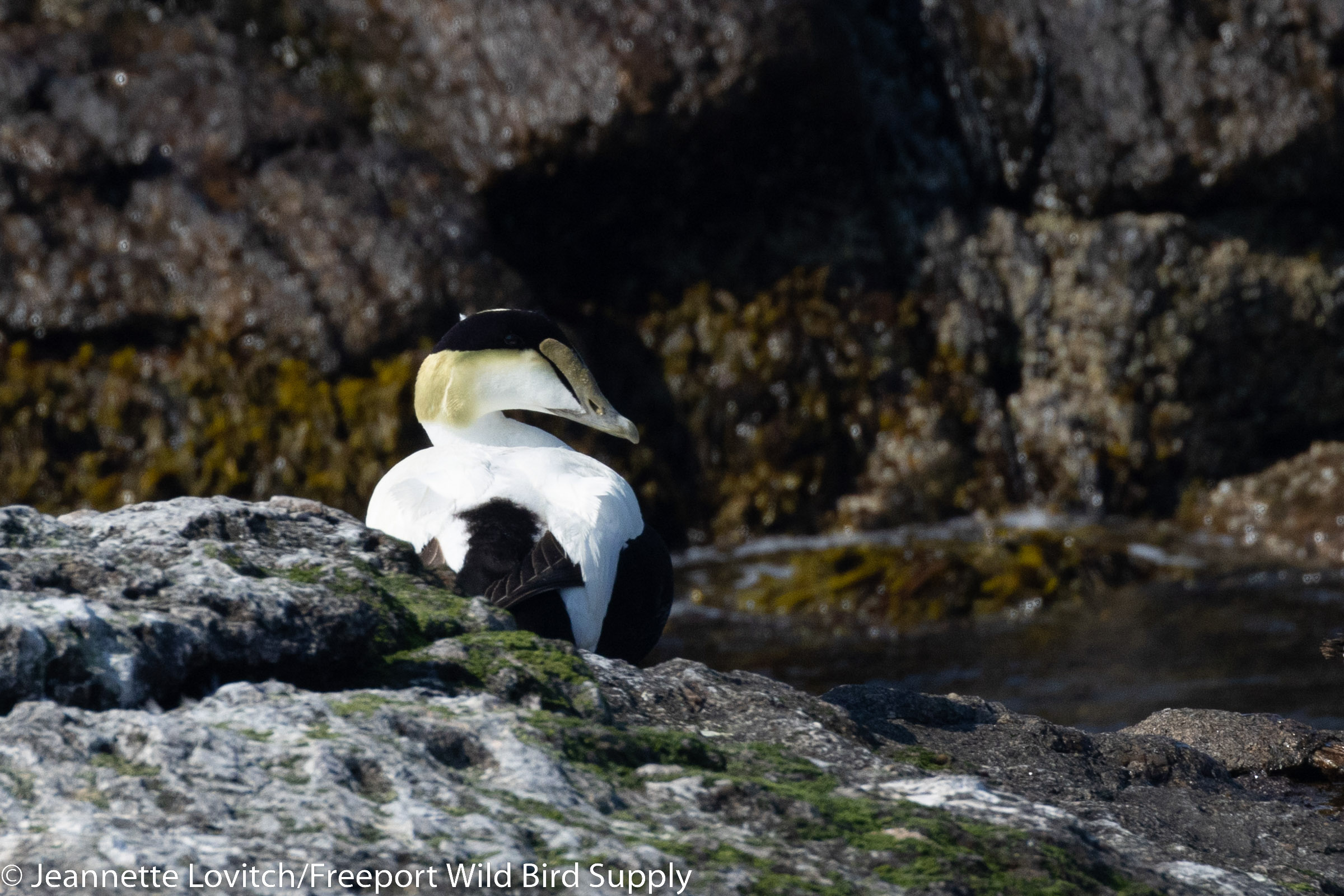
Common Eider.
Satisfied with our views of the island’s denizens, we turned offshore and followed the Arctic Terns to deeper waters. It wasn’t too long before we started seeing scattered Wilson’s Storm-Petrels, but we slammed on the breaks when I spotted a Common Murre on the water up ahead. Captain Steve was able to circle the bird for all to see and photograph before we continued on; the murre was most obliging. It also made for the hoped-for 4-alcid day, which is always a challenge this far south.
The lack of swell allowed us to make good progress and afforded us the chance to check three offshore hotspots. A good number of Wilson’s Storm-Petrels and a few Northern Gannets were at Murray Hole, but we motored through it.
We laid down a mile-long chum slick at The Kettle, but only a few of the many Wilson’s Storm-Petrels came in to check it out. I think it was simply too calm today – the scent wasn’t drifting, and birds – especially any shearwaters out here – were just not taking flight to forage; it’s just too inefficient without any wind for them to bother. But a fly-by from a southbound Ruby-throated Hummingbird nearly 20 miles offshore was unexpected!
We continued to tally Wilson’s when we set up a second chum slick at Mistaken Ground, but once again, little was interested, and only a few Wilson’s and gannets were to be seen.
Despite our extended time with the charter, it was soon time to head back to port, but we kept our eyes peeled throughout the trip. On the way back, we had a flock of 12 Red-necked Phalaropes buzz by and eventually land on the water, but we were going too fast and behind schedule to be able to turn around in time. Later, we passed not one, but two Basking Sharks, which was a real treat.
Harbor Porpoise and Harbor Seals were seen now and again, but overall, the offshore waters were quite slow – especially with gulls. The few gulls around didn’t even seem interested in our popcorn and suet, either.
Robby contemplates the meaning of life…and chum.
Our tally of Wilson’s Storm-Petrels was decent enough, but sadly, this would be our only tubenose of the day. Northern Gannets were in low numbers, as if often the case in early June, and whatever shearwaters may have already arrived may simply have been sitting on the water somewhere waiting for a breeze. I also felt terrible that not everyone saw the phalaropes.
Nonetheless – thanks to a perfect visit at Eastern Egg Rock and a random Common Murre floating offshore – I would call the day a smashing success! And for $40, few complaints were audible. The weather helped, too.
Rich talks optics.
Thanks to Zeiss for making this idea of mine come to fruition, and thanks to Cap’n Fish’s for letting us charter the boat to make this all happen. And most importantly, thanks to everyone who signed up and helped us explore the Gulf of Maine at this woefully under-birded time of year. Every day is different offshore, and you never know what you will or will not see. Excitingly, I am pleased to announce that Rich said, “let’s do this again next year!” Hope to see you aboard!
Here’s the complete trip list, from dock to offshore and back. Thanks to Noah for compiling this!
After 17 consecutive summers in the Gulf of Maine, “Troppy” the Red-billed Tropicbird failed to return to Seal Island. Arriving in 2005, but continuing annually throughout the summer since 2009 exclusively at Seal Island, Troppy had become a mainstay of summer birding in Maine – and our tour calendar!
Arriving as an adult, Troppy was therefore at least two years old when he was first sighted in 2005. Since most sorces seem to reference “16-30 years” as a lifespan, a 19-year old “Troppy” would be getting a little long in the tooth, err, bill. But, as I romanticized in my 2019 article for Birding magazine, we all hoped he would find the long lost love. Maybe he did. Maybe he’s making a trop-ling somewhere in the Caribbean where he “should be.” Yeah, that’s what I’ll think. We need more happy thoughts these days.
Wherever he might be, it was not Seal Island or any other Gulf of Maine seabird island this summer, and with his absence, tours to Seal Island were few and far between. Our first one cancelled, but we were able to run our July 23rd departure with our friends at Isle au Haut Boat Services thanks to a dedicated group of birders who know how special Seal Island is, with or without the famous rarity.
And Seal Island most did not disappoint! Even without a tropicbird (or a Tufted Puffin for that matter, which of course we all hoped would make a reappearance).
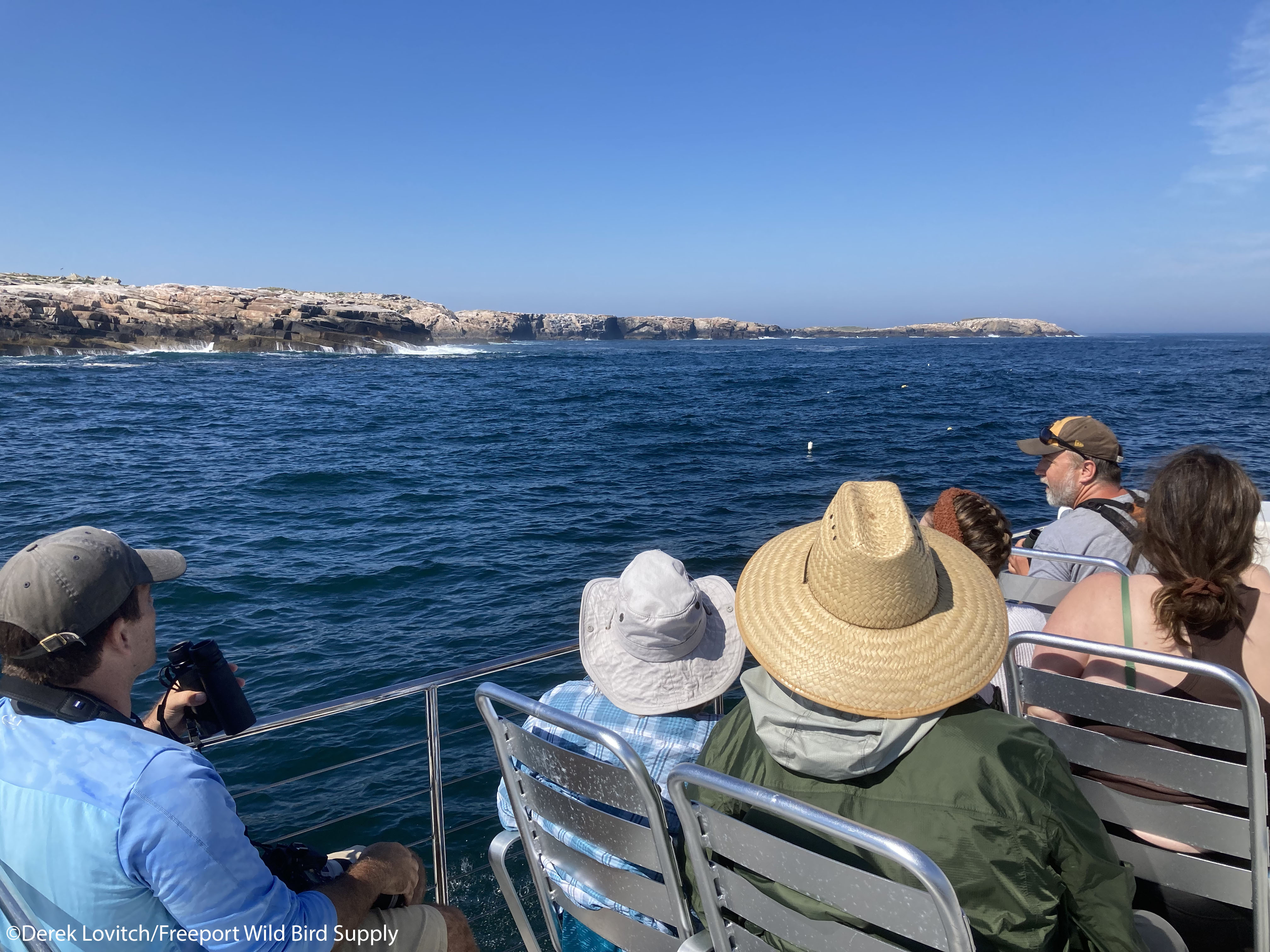
First, the weather: it was unbelievable! Actually, it was downright hot, even offshore, and especially away from what little breeze there was when we were not motoring. Seas were a gentle 2-3 feet, with an occasional slightly larger but inconsequential swell. Falling rapidly, it was incredibly smooth in the coves of the island, and on the way back where we enjoyed following seas for a very flat and fast ride.
Shortly after departing Stonington, we spotted our first Atlantic Puffin before we even cleared Isle au Haut. A few more, scattered small numbers of Wilson’s Storm-Petrels (I tallied 41 in all), and a few Razorbills punctuated our trip out. Not much was happening around Saddleback Ledge though.
Of course, the show realty began upon arrival at Seal Island. The heat sent the alcids into the water, so virtually all of the Atlantic Puffins that were present were in the coves and often allowing close approach and stellar photo ops.
We worked our way around the island, slowly improving our views of Razorbills (at least 6) and finally finding two Common Murres.
RazorbillIt took a while, but we finally found a Common Murre – it was even the uncommon “Bridled” morph.
We motored around the south end, where the swell was just enough to prevent us from getting too close to the Great Cormorant colony – Maine’s last. But the nests brimming with growing chicks was still thoroughly enjoyed.
Off the northeast end, we cut the engine and drifted among the alcids. Off the open waters came a flock of 12 Whimbrel which we heard first before they flew close by. Likely having tanked up on blueberries in a barren Down East or in the Maritimes, they didn’t seem to consider pausing on the island. Later, 8 more flew by even further offshore.
Laughing Gull
While the lack of shearwaters all day was disappointing, the one Great Shearwater that we saw came in for a close look at us!
A little group of Sanderlings flew by, a few peeps were along the shoreline, and we spotted several calling Spotted Sandpipers.
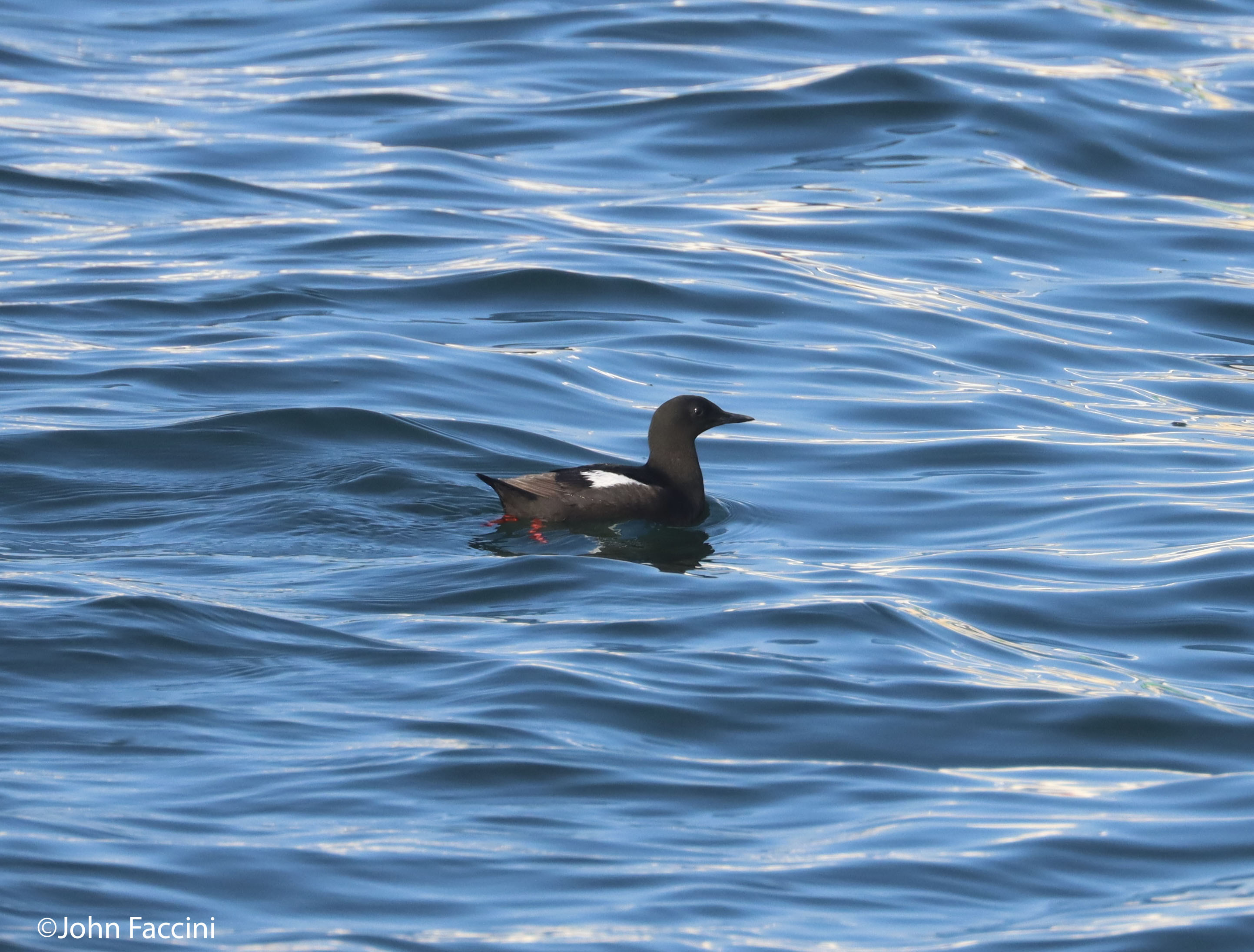
And don’t forget about all of the dapper little Black Guillemots!
And of course, there were the terns. Hundreds of Arctic and Common Terns were present, with a goodly number of juveniles learning the ropes. Arctic Terns were particularly conspicuous today, with many making close approaches of the boat or disregarding our presence to take a bath.
Arctic TernsJuvenile Common Tern.
I both enjoyed and lamented the fact that I didn’t have Troppy to stress over. In fact, without needing to be in position and waiting for him, we took advantage of the gentle seas to not only circumnavigate the island, but also spend ample time drifting in sheltered coves, photographing alcids and searching for a big, black puffin with punk-rock hair.
The eastern side.
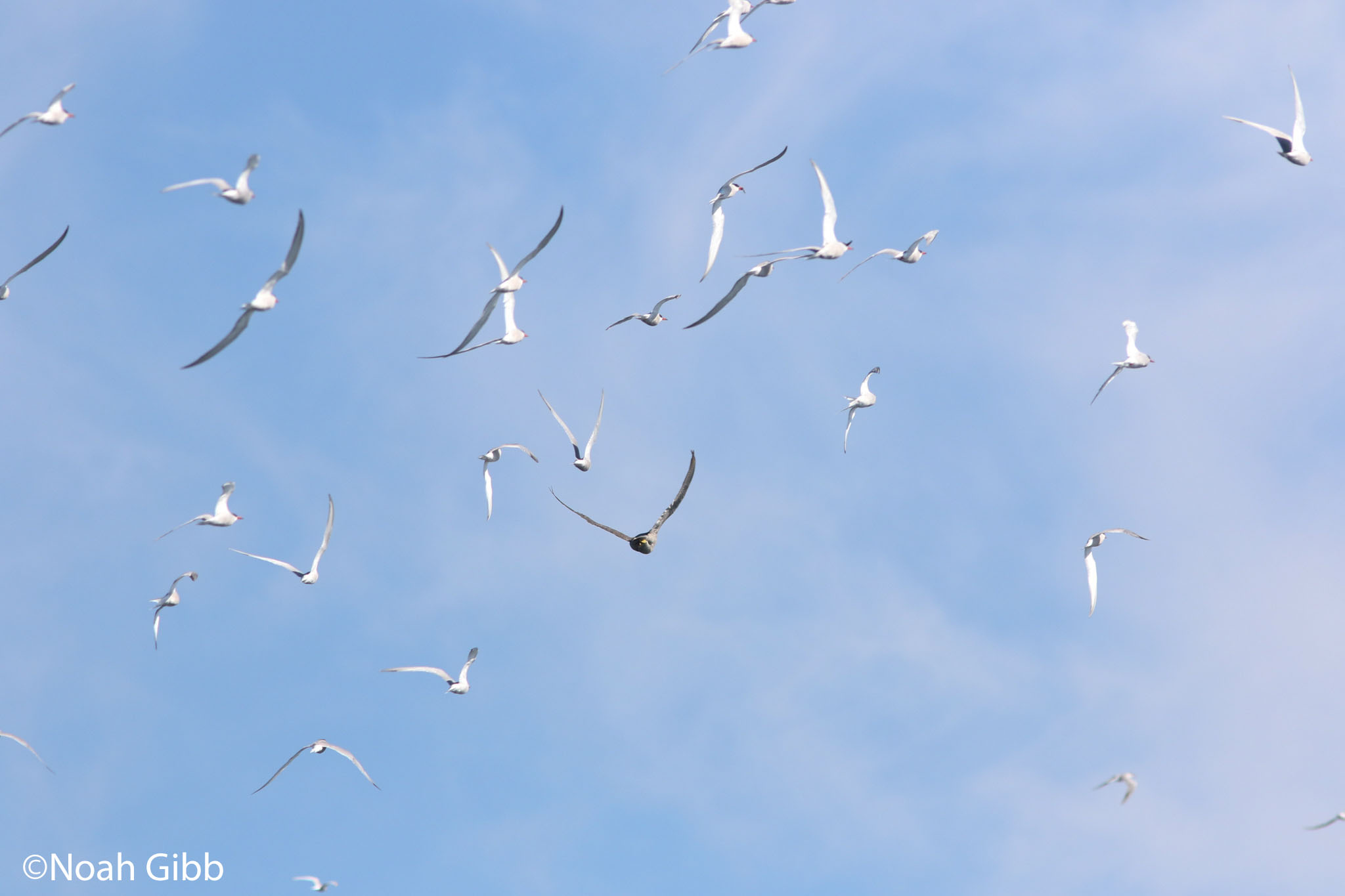
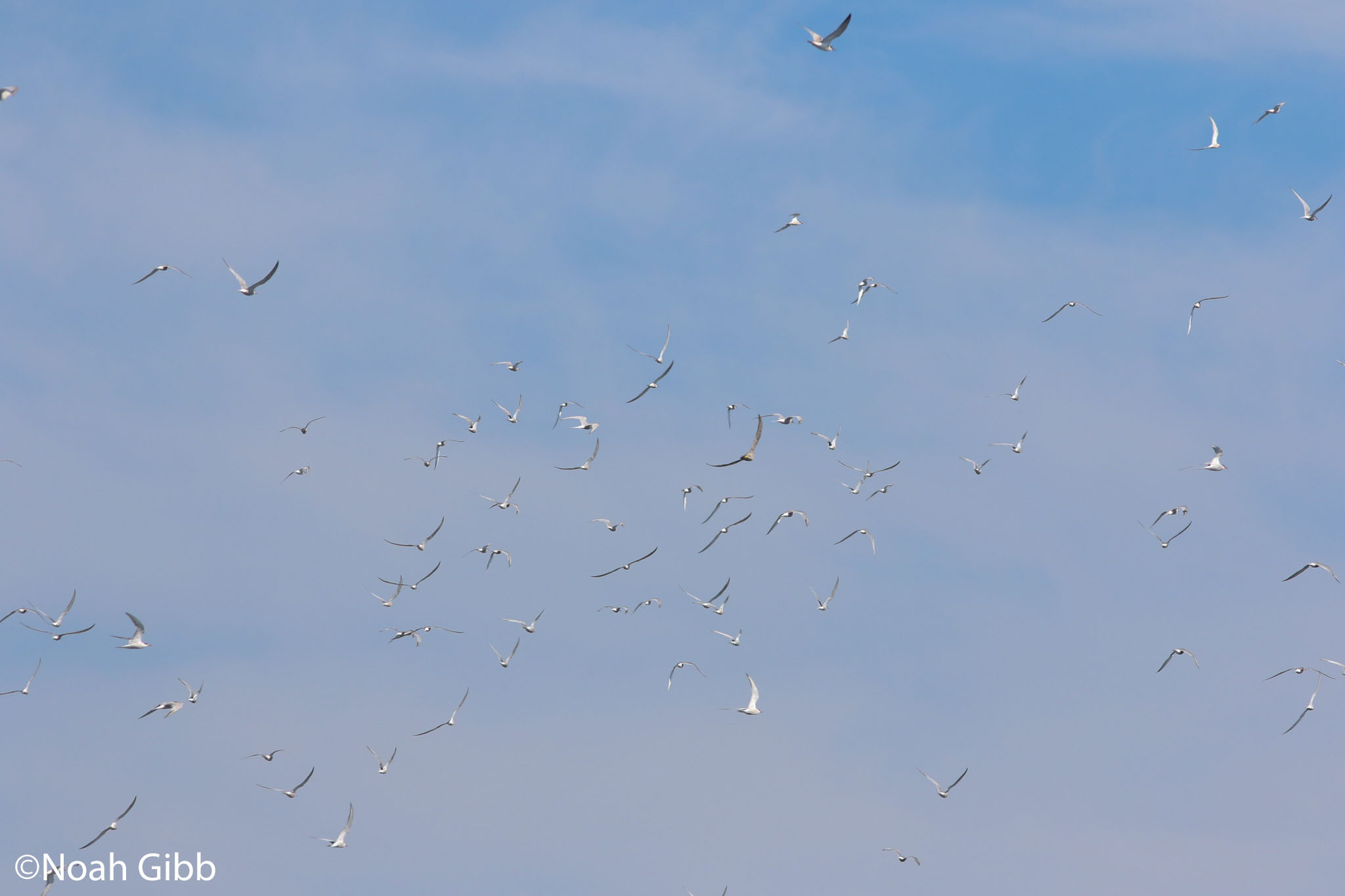
But we still had a time limit for our charter, so we decided to spend our last moments enjoying the action at the tern colony. That’s when a Peregrine Falcon arrived. While this is a most unwelcome guest at a seabird colony and we were conflicted about seeing it, it was also impossible not to sit back and watch the show.
It surprised the terns by coming up and over the backside of the island, scattering the entire colony. Upon identifying the intruder, all of the adults made a beeline and began diving, mobbing, and otherwise trying to drive the predator away. Watching one of the world’s greatest – and fastest – predators in action was a real special treat, but we were also not upset that it came away empty; we were rooting for the terns.
If that wasn’t a grand finale, I don’t know what is. Well, maybe the Parasitic Jaeger on the way back!
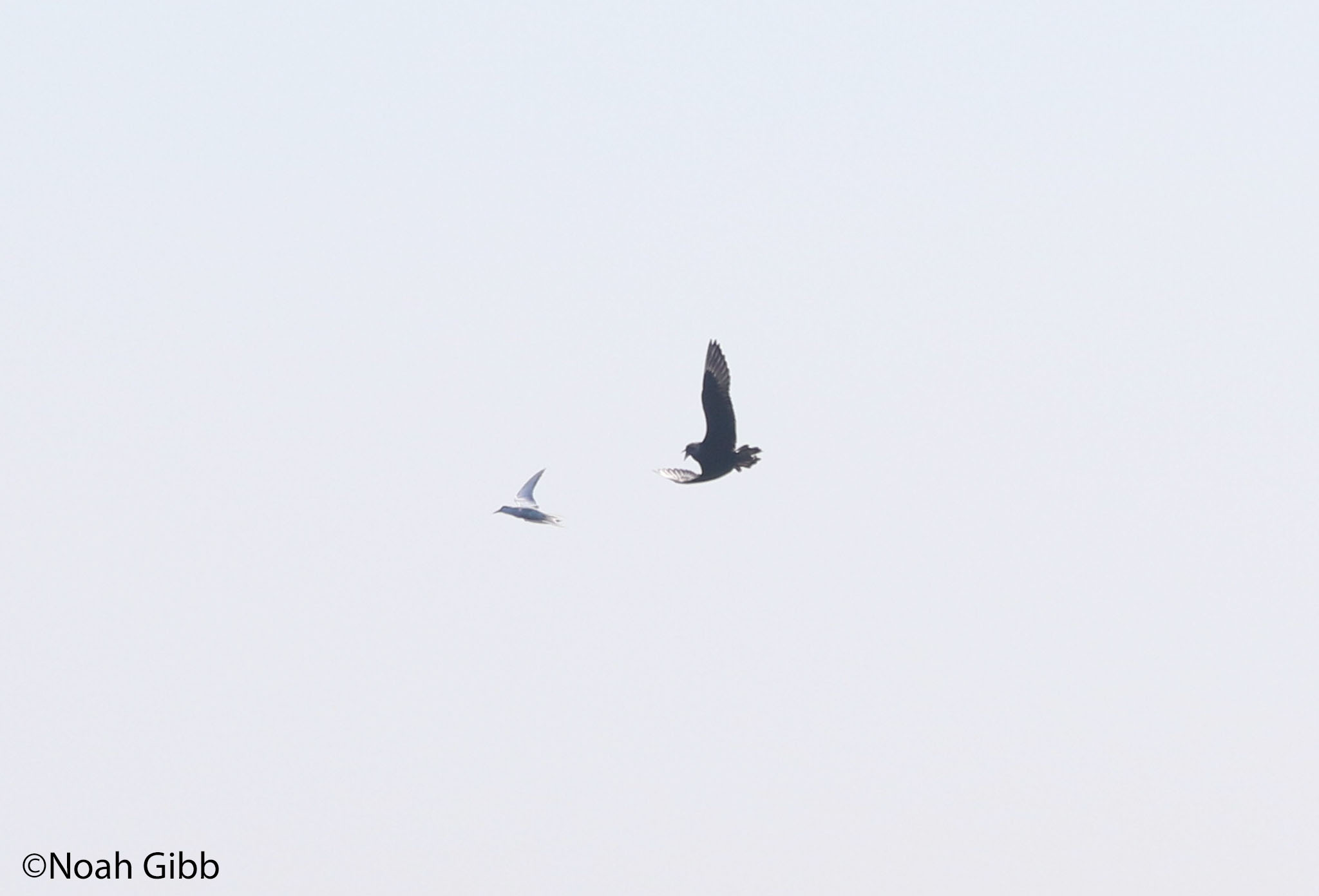
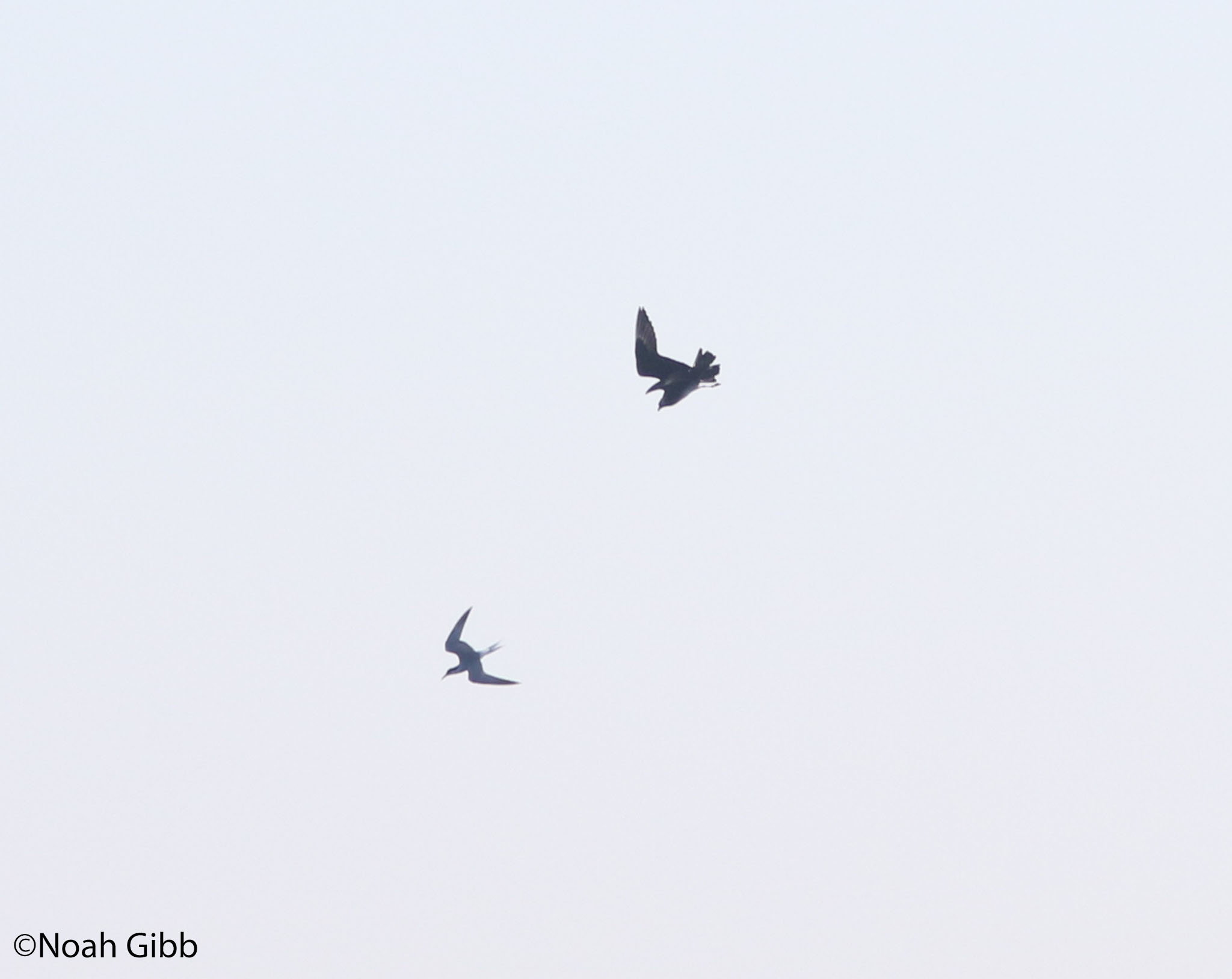
About halfway between Seal and Saddleback Ledge, I first thought it was a Peregrine tearing in after a lone Common Tern. But when it became clear that it was a jaeger, I yelled for Captain Mike to “step on the breaks.” We watched the dogfight for several minutes, and it was spectacular to see. It was just far enough away that we couldn’t tell if the tern gave up its fish, but it definitely didn’t do it willingly.
Shortly thereafter we began to run into little rafts of Razorbills (a conservative tally of 36, plus 7 more between Saddleback Ledge and Stonington) and scattered Atlantic Puffins. We had quite a few more Wilson’s Storm-Petrels on the way back, and finally some Northern Gannets.
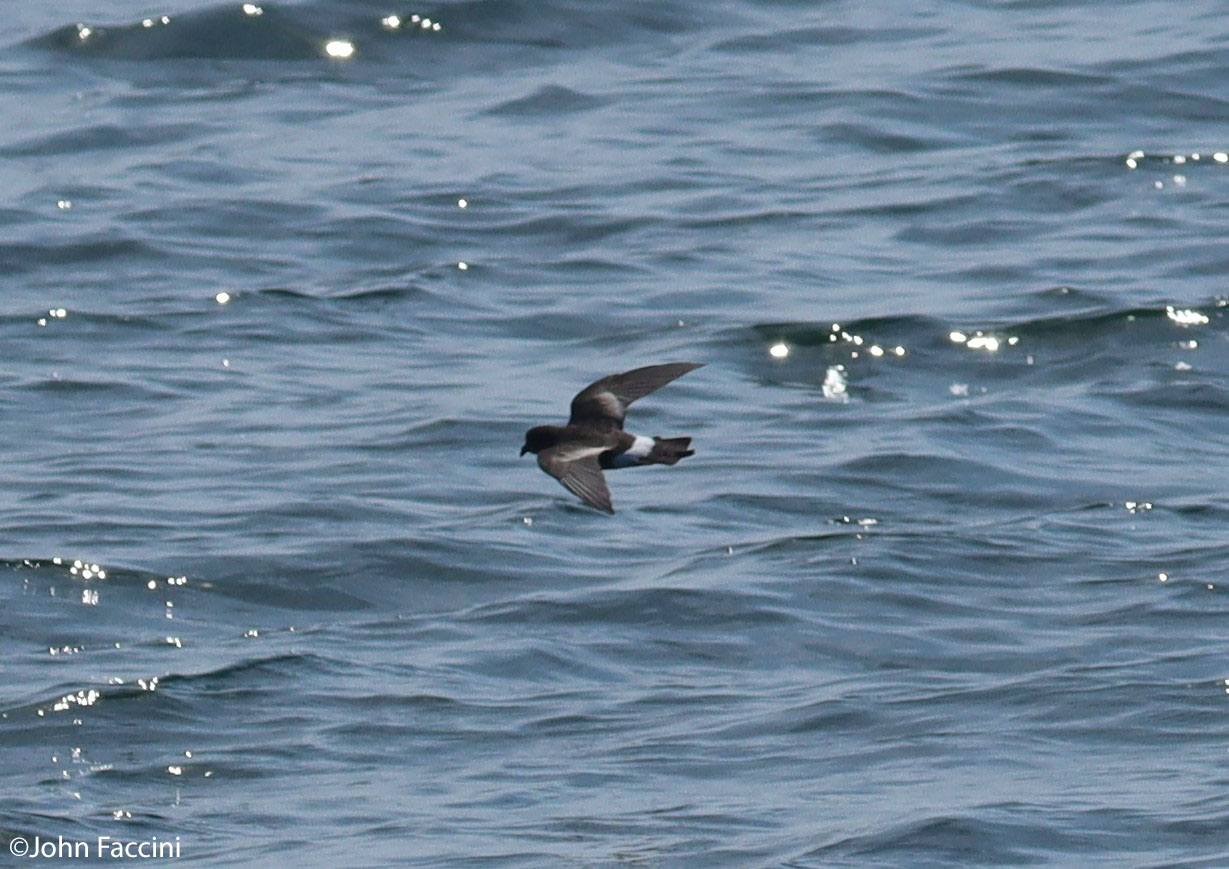
Wilson’s Storm-Petrel
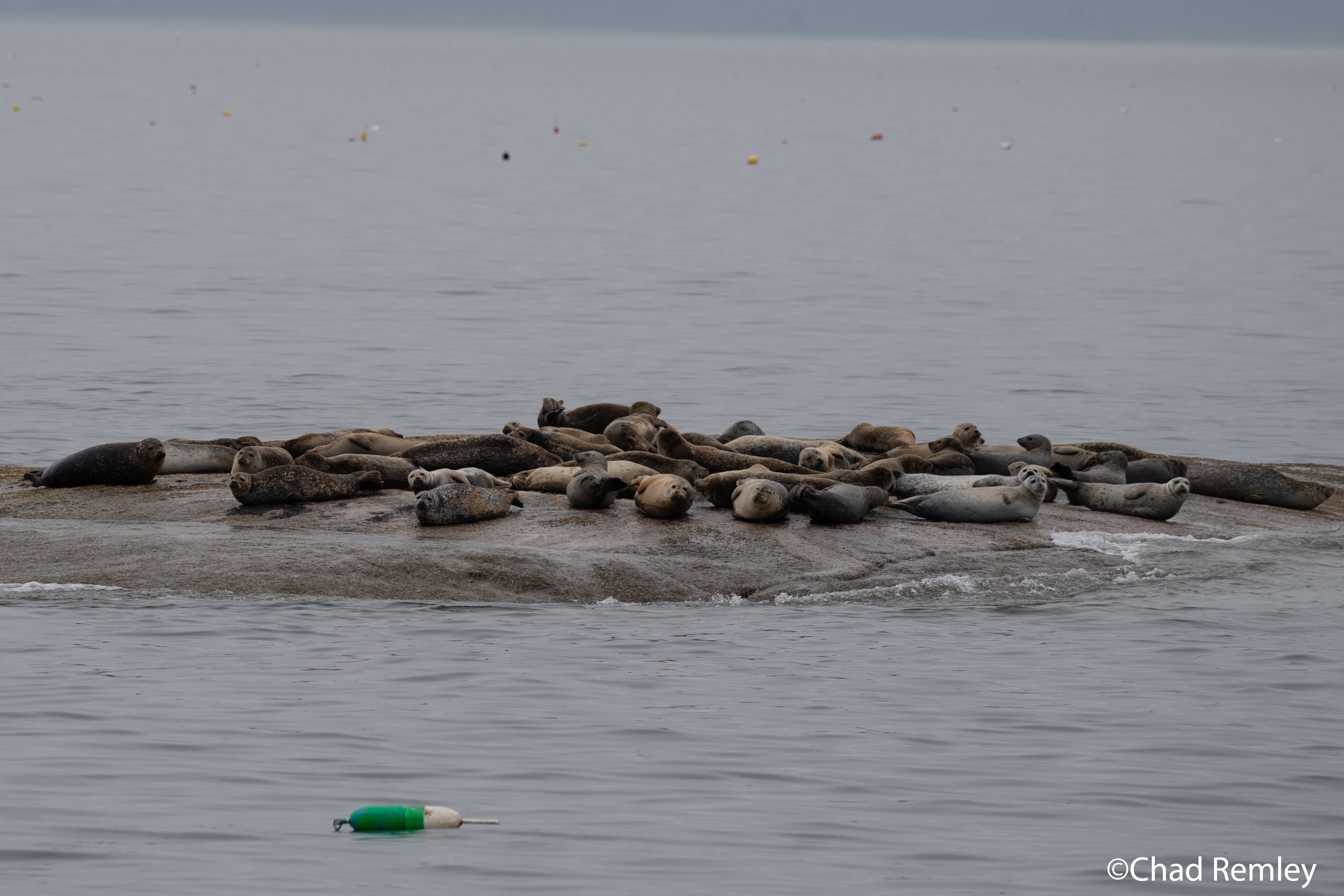
We even had time to check some rocky islets for roosting shorebirds (none), loafing Harbor Seals (lots), and maybe spot something like a Great White Shark (nope; but the boat had one the very next day!).
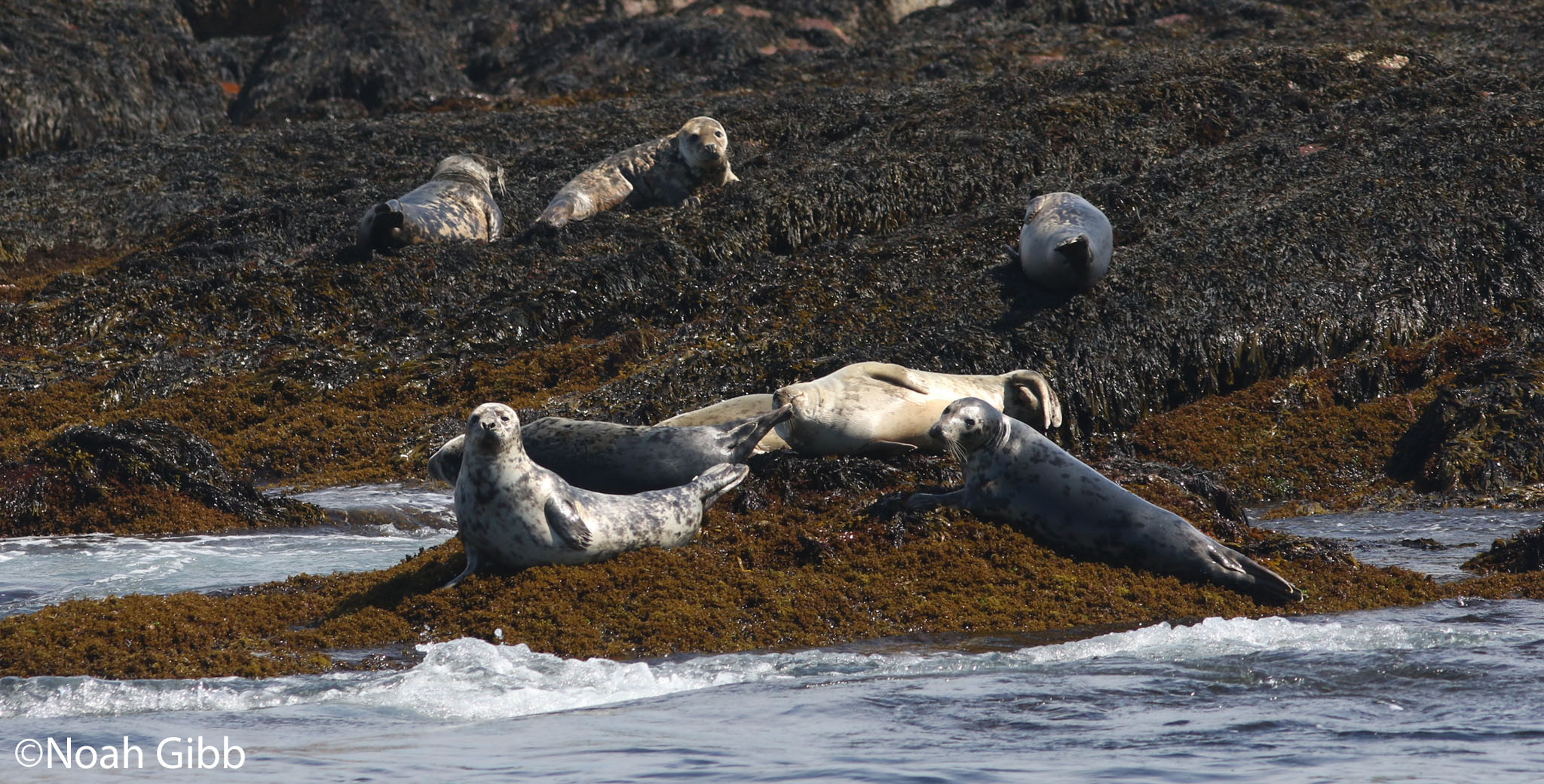
Gray Seals and Harbor Seals. Note the “horse’s head” profile of the Grays, verses the puppy-like Harbors.
In other words: what a trip! And exactly why it’s well worth a tour to Seal Island regardless. That being said, I must admit, it was not quite the same without “Troppy.” But as a guide, my stress level was a lot lower! Having seen him 9 times out of 12 visits to Seal, I consider myself beyond fortunate. I’m also so happy to have shared his glory with so many other birders on all these tours. So, wherever you are, Troppy, I’ll continue to lead trips to Seal Island in your honor!
A displaying pair of Northern Gannets stole the show at Machias Seal Island on our visit there on 6/22.Atlantic Puffins, Machias Seal Island, 6/22.Razorbills, Machias Seal Island, 6/22.Arctic Tern, Machias Seal Island, 6/22.
I had a rather busy week, but not as busy with birding as I would have liked. Therefore, this mostly to share Jeannette’s photography from our visit to Machias Seal Island last week. However, a few observations of note over the past seven days included the following
1 female ORCHARD ORIOLE and 1 Blue-gray Gnatcatcher, Green Point WMA, 6/27 (with Jeannette).
1+ BOREAL CHICKADEE, East Royce Mountain, White Mountains National Forest, 6/26 (with Jeannette).
1-2 LITTLE EGRET X SNOWY EGRET hybrids, Falmouth, 6/30. One bird spotted from the Martin’s Point Bridge appeared to have at least one long, Little Egret-like plume. It was not close enough for photos, but the plume – as well as overall structure was distinctive. After flying upriver with the incoming tide, I found a hybrid at Gilsland Farm (photo below), but no head plumes are visible. Note the greenish-yellow lores (looked darker in the field than this poor, phone-scoped photo), very long and fine bill, and spindly neck. It’s slightly longer legs and overall slightly larger size was apparent when it joined a distant Snowy. However, did I imagine the plume in the earlier view? Did it fall off in transit? Or, are there actually two again this year?
This presumptive Little Egret x Snowy Egret Hybrid was along the Presumpscot River in Portland and Falmouth on the 30th. See notes above.
I found this 1st summer Little Gull on Hill’s Beach in Biddeford on 6/19. It was among about 40-50 Bonaparte’s Gulls and hunkered down against the wind. This was my first in southern Maine in quite a few years.
Breeding season is upon us, and Maine’s seabird islands are in full effect – even when they don’t have a Tufted Puffin. I did find a Little Gull, however, and that was fun; I really like Little Gulls! My observations of note over the past seven days included the following:
Biddeford Pool shoreline and neighborhood, 6/19: 1 1st summer Great Cormorant, 3 Black Scoters, 1 pair Surf Scoters, and 1 likely-late migrant Magnolia Warbler.
1 first-summer LITTLE GULL and 1 AMERICAN OYSTERCATCHER, Hill’s Beach, Biddeford, 6/19 (photos above).
3 Semipalmated Sandpipers and 14 Black-bellied Plovers, The Pool, Biddeford Pool, 6/19.
Belgrade PURPLE MARTIN colony, 6/21: Jeannette and I counted at least 25 occupied nests holes, which I believe would be a recent record high of this venerable colony.
1 Red Crossbill, Downeast Sunrise Trail, Machias, 6/21 (with Jeannette).
15-20 Wilson’s Storm-Petrels, Cutler Harbor to Machias Seal Island with Bold Coast Charter Co, 6/22 (with Paul Dioron, Bill Thompson, and Jeannette).
1 pair NORTHERN GANNETS, displaying and early-courtship behavior, Machias Seal Island with Bold Coast Charter Co, 6/22 (with Paul Dioron, Bill Thompson, and Jeannette).
1 Greater Yellowlegs, Machias River Causeway, 6/22 (with Jeannette). High-flying and heading south, was this our first migrant of “fall?” or just an over-summering bird heading to a roost?
2 Red Crossbills (Typ1 10 fide Matt Young), 1 Bay-breasted Warbler, Palm Warblers, etc, Cutler Coast Maine Public Reserve Lands, 6/23 (with Jeannette).
1 pair AMERICAN OYSTERCATCHERS, Egg Rock off Petit Manan peninsula, with Acadia Nature Tours puffin trip to Petit Manan Island (with Doug Hitchcox, Jeannette, et al). No Tufted Puffin.
After a couple of failed nesting attempts followed by a 2-3(?) year hiatus, a male Northern Gannet has been hanging out and “prospecting” on Machias Seal Island again this year. Recently, he has attracted the attention of a 4th-cycle, presumed female. We were lucky enough to view them outside of our blind during a tour there on 6/22. This was just a quick snapshot with my phone. Jeannette has over a thousand photos to sort through!
The first of our pelagic birding opportunities for the year took place on Monday, June 6th, as I joined the good folks from Cap’n Fish’s Cruises in Boothbay Harbor for a special ½ day mini-pelagic.
We motored our way east to Eastern Egg Rock, looking at Common Eiders, Black Guillemots, Ospreys, and many other inshore denizens. Once we got to Eastern Egg Rock, however, the fun really started! The cacophony of the colony was evident on this gloriously calm day, and it was not hard to find plenty of Atlantic Puffins in the water near the boat.
We worked the masses of Common Terns to isolate a few great views of Roseate and Arctic Terns. The bright sunny day was a delight except for when trying to judge grayscale. That made tern identification a little more challenging, but we worked our way through it before departing the island for deeper waters. We had a good total of 7 Razorbills on and around the island, which is no guarantee on a visit here, and while we didn’t have the one Common Murre that has been lingering on the rock, we did have one fly-by later in the trip.
Bright sunlight made tern identification more challenging!RazorbillsBlack GuillemotCommon TernRoseate Terns
With seas barely 1-2 feet, just a puff of wind, and abundant sunshine, it was just a gorgeous day offshore. We cruised through a wide stretch of uneventful, flat bottom, but once we hit deeper waters, we began to see a number of Wilson’s Storm-Petrels. There were a lot more at our first deeper hole, but then when we got to our primary destination, it was clear how abundant they were.
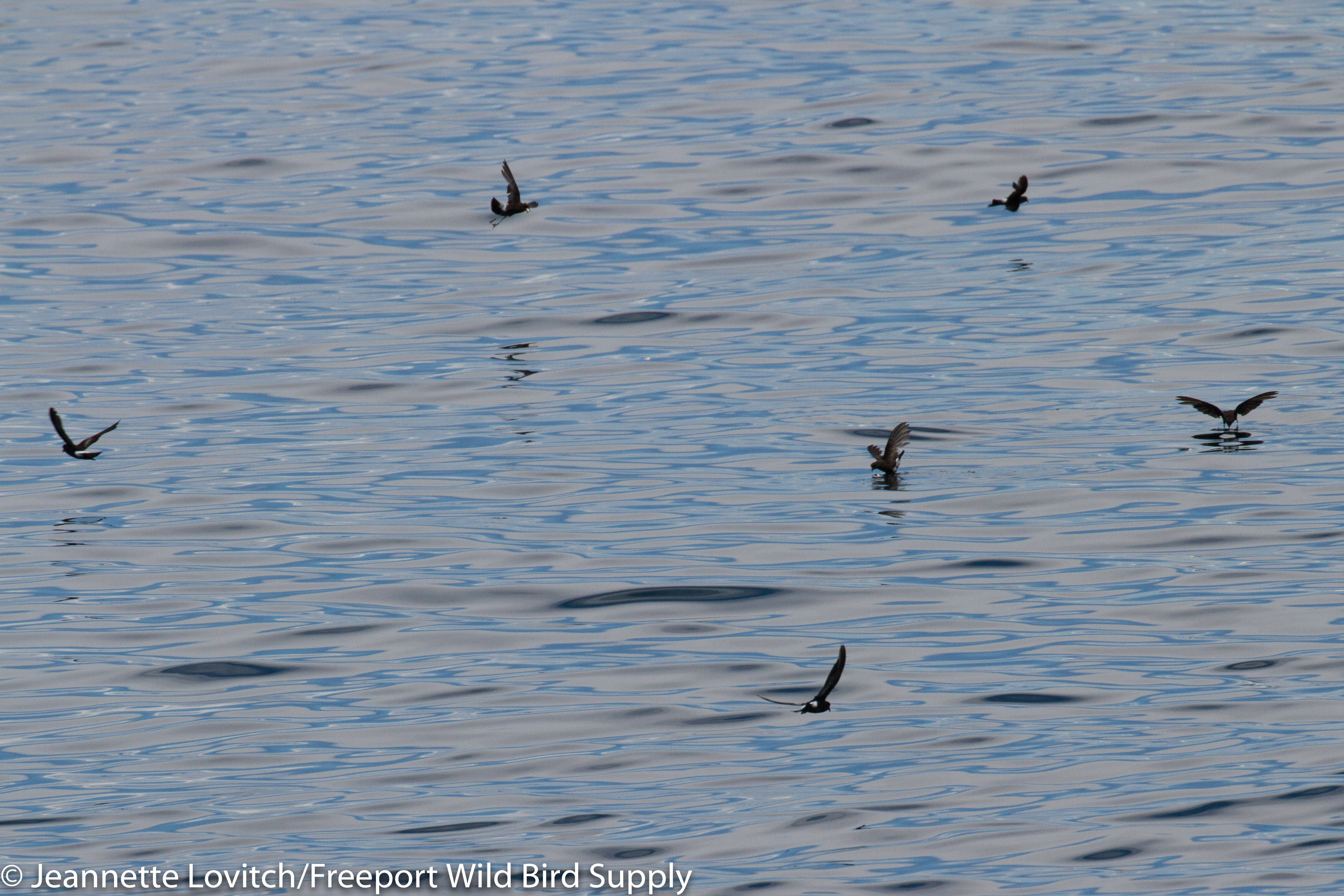
We laid down a 4-mile long chum slick, and then slowly cruised back through it. With the calm seas, it held together perfectly, and boy did it work! It was actually incredible. Unfortunately, other than a few Herring and Great Black-backed Gulls, it was 100% Wilson’s Storm-Petrels!
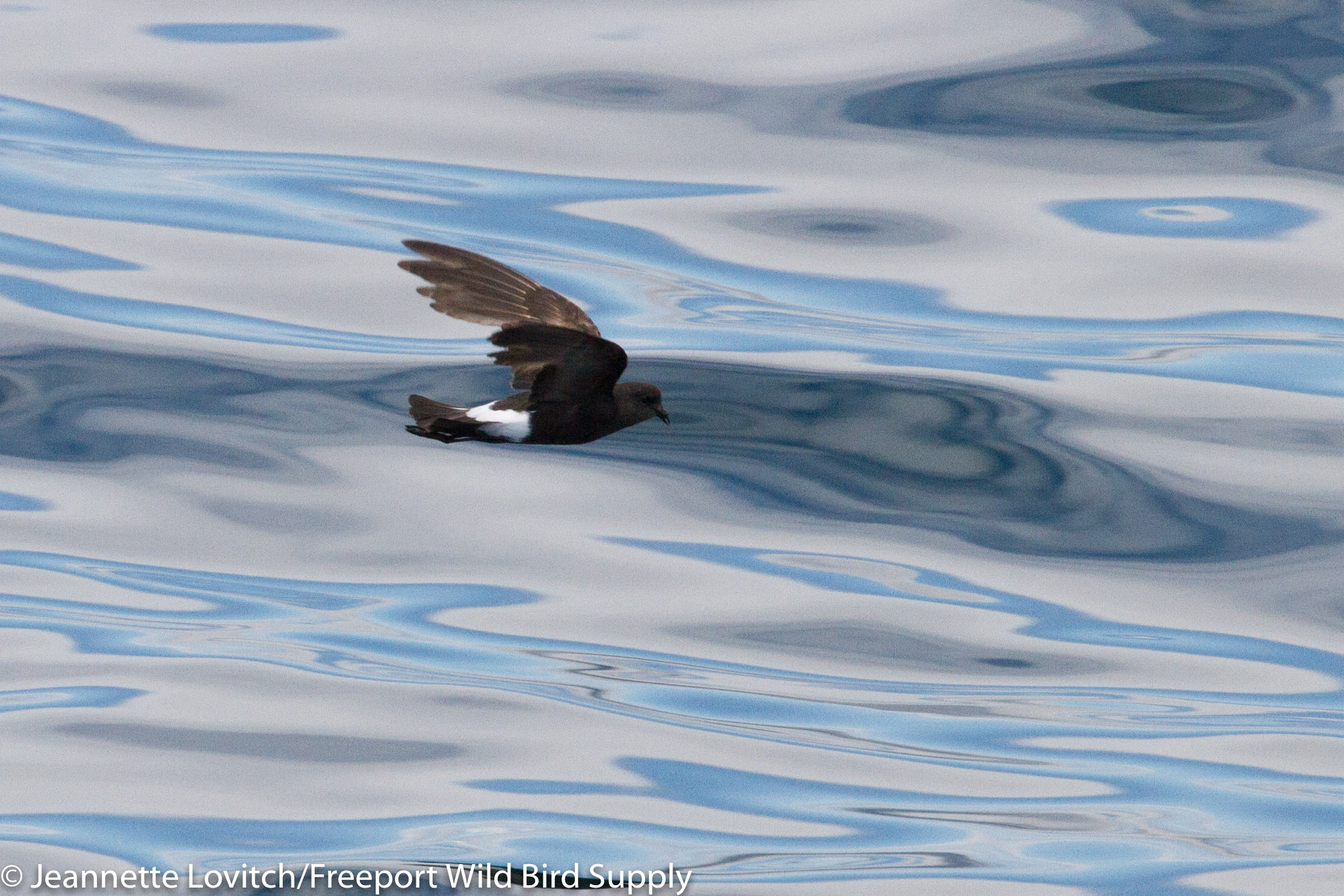
One of the ways to find other storm-petrels among masses is to look for the lack of obvious wing molt. This bird caught Jeannette’s eye because the wing is so clean and not showing any signs of flight feather molt. It’s a Wilson’s though, but could it possibly be another subspecies? Individual variation? Age? Or, just something slightly different to look at?
But what a show they put on! Dan, Jeannette, and I did our best to estimate the abundance, as this was truly a special event. Our estimate of a trip total of 2,600 birds included an estimate of 2,000 in our chum line!
We spotted the occasional Northern Gannet throughout the trip, but we desperately awaited another tubenose. Checking flight style, foot extension, wing bars, and underwing patterns, but yup, pretty darn homogenous. As a leader, I tried to check every bird. But the sight was impressive, and I couldn’t help but utter superlatives and occasionally just sit back and enjoy the show.
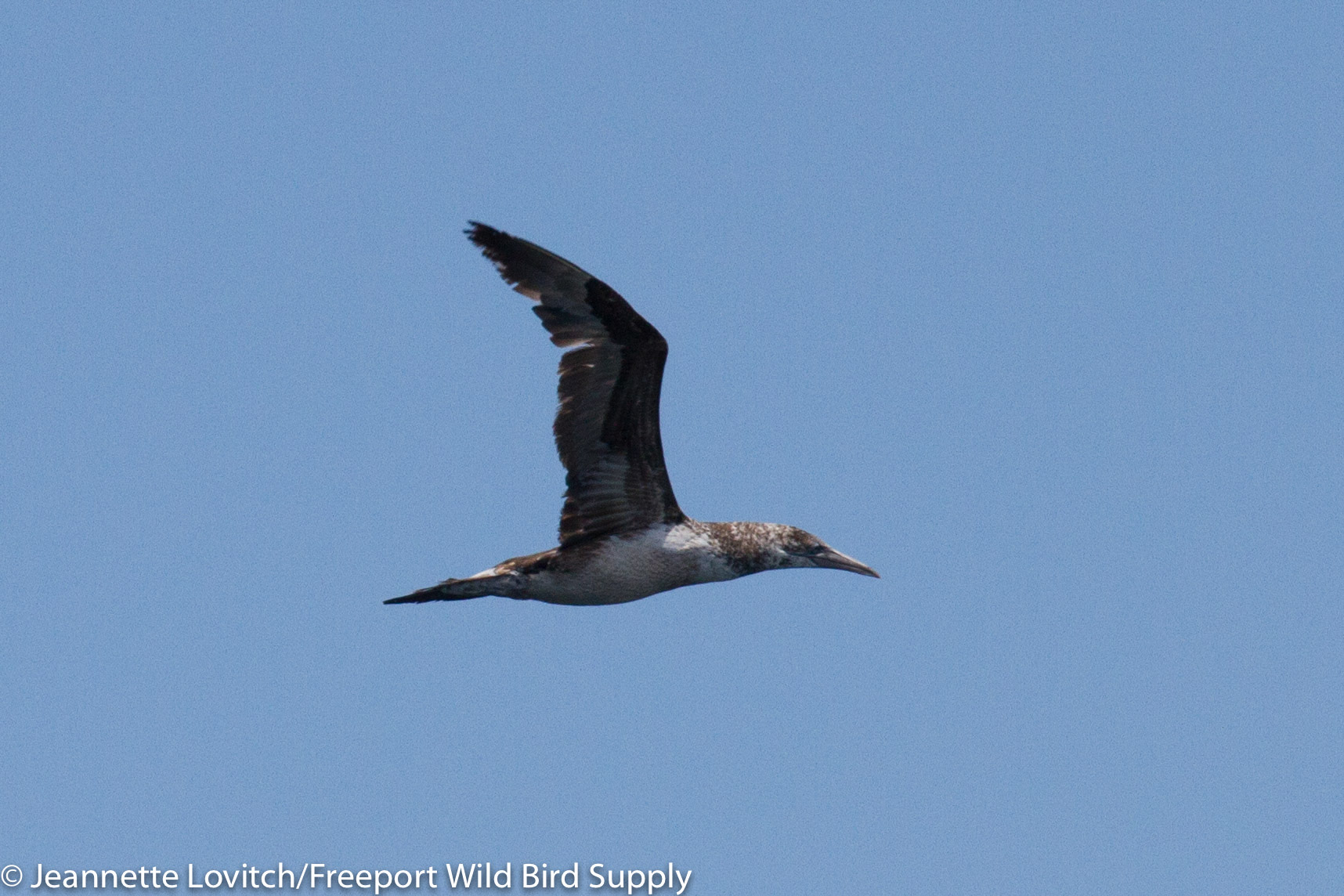
First-summer Northern Gannet.
We had to increase speed to make it back to the dock on time, but we continued to tally Wilson’s Storm-Petrels on the ride in. And Jeannette, Dan, and I worked hard to find something – anything! – else pelagic! We don’t have a lot of data on what is out here in June, and it’s likely different every year depending on water temperature and breeding success and/or failure of these “winter” visitors from the sub-Antarctic waters. In fact, one some June whale watches I have been on, I haven’t had a single species of tubenose – let alone 2600 of them.
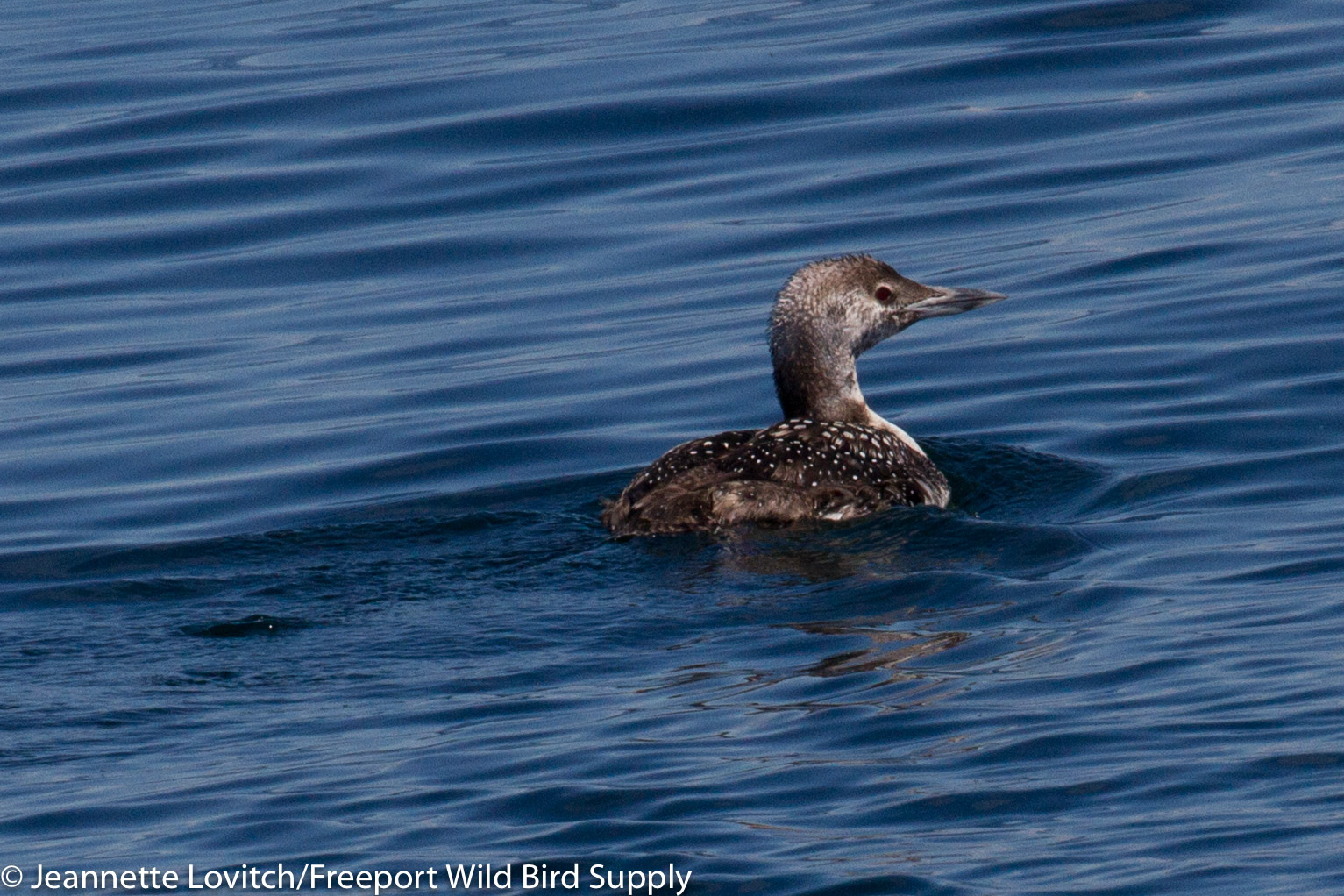
After last June’s adult Pacific Loon, I did have to have Captain Nick slam on the breaks when I spotted a decidedly gray-naped loon. When it surfaced, it was evident it was just a young Common Loon with an unusual amount of wear or bleaching on its head. It was worth a try though!
While our species list wasn’t legendary by any means, I’ve never seen this many Wilson’s Storm-Petrels in one, relatively short boat trip. In fact, this is by far the most I have ever seen together in Maine waters. Additionally, we had great looks at some of the Gulf of Maine’s most sought-after breeding seabirds to kick off the day at the birthplace of the Project Puffin. And the weather, wow, the weather – what a day to be on the water! And a great introduction to pelagic birding: the most exciting (and yes, at times frustrating) part of pelagic birding is every day, every trip, is so different, and it takes a lot of trips to appreciate the best of them.
We have two more trips planned with Cap’n Fish’s this summer. On July 15th, I’ll be joining the on-board naturalist for a visit to Eastern Egg Rock followed by a little birding-while-whale-watching. Then, on October 11th, it will be the second of our dedicated half-day pelagics, including chumming. Since we won’t have activity at Eastern Egg Rock at that time of year, all our time will be dedicated to finding birds offshore. Information and registration for these two trips – and our summer tours to Seal Island as well – can be found on the Pelagics Page of our website.
Here is our complete trip list, from the time the horn blew as the boat pulled out of the dock until we returned to the slip. Our estimates at Eastern Egg Rock are very conservative, and likely dreadfully low. Offshore, we worked hard at estimating individual groups of storm-petrels and tallying exact numbers of other birds offshore. There were also likely many more eiders, guillemots, and cormorants on the outer islands, but our focus was on finding more seabirds!










































 Maine Birding Field Notes