Maine’s 1st Broad-tailed Hummingbird in Freeport (Nov-Dec 2022).

In the afternoon of 11/19, a customer of the store alerted me to the presence of a hummingbird in her Freeport yard, present since the 5th of November. For over 15 years, we have promoted keeping hummingbird feeders up late into the fall and letting us know about any hummingbirds after October 1st.  In addition to several incredibly late reports of Ruby-throated Hummingbirds (now annual in small numbers well into the second week of October), this campaign has resulted in the detection and documentation of a Selasphorous hummingbird on 10/16-17, 2015 in Yarmouth, and a long-staying Rufous Hummingbird observed by many between 10/18 and 12/5, 2020, also in Yarmouth – the first “chaseable” Rufous in eight years in the state.

Upon receiving the report, we urged the homeowner to get any sort of photo. Later that day the bird finally obliged, and the photos sent to us were suggestive of a Selasphorous hummingbird.  I was invited to the property the following day to attempt more documentation.  I arrived at 3:05pm with snow flurries falling, and soon heard the bird. The call was clearly of a Selasphorous-type hummingbird. My limited experience with separating Selasphorous by call did not permit me to draw any further conclusions (in hindsight though!)

Twenty minutes later, the bird appeared at the feeders, feeding long enough for photographs, before alighting on a nearby snag in a sliver of sunlight.  In the field, and upon review of photographs, I immediately knew it was a Selasphorous. Lucky photos of a semi-spread tail showed a fairly broad outer tail feather, but I assumed it was probably “just” a Rufous. Or at least I am not knowledgeable enough to have thought beyond Rufous/Allen’s (it was clearly not a Calliope).

I reached out to Scott Weidensaul with the first few photos, and since he was available the next day to band it, I made arrangements with the homeowner. Scott was intrigued by the tail, and stated “I cannot rule out Broad-tailed from the photos” but also assumed it was likely to be a Rufous. They usually are.

Scott, Doug Hitchcox, and I arrived at noon on 11/21 to attempt to band the bird. In less than an hour, we had safely trapped the bird, and took a series of measurements and photos. The bird was healthy, undergoing active molt, and had a fat score of 1.

When we first observed the bird, Scott pointed out the bluish hue that was sometimes apparent on the back of the bird. He mentioned he saw that in one of my photos from the prior day, but dismissed it as probably being an artifact of the photo. I was unaware of this impression until he pointed it out.

However, as the banding process began, we were still working under the assumption that this was going to be a Rufous Hummingbird, until the “numbers” kept coming in. Doug was recording and noted the significant difference between Rufous Hummingbirds on the data sheet. When Scott read the width of the outer tail feather aloud, he seemed shocked, and immediately measured again. And again. Doug and I kept glancing at each other, eyes wide, attempting to hold back exuberance.

Wing: 49.15mm

Tail: 30mm

Bill: 18.62mm

Width of Outer Tail Feather (R5): 5.44!!!

We double-checked all measurements, took lots of photos, and Doug and I tried to not explode with excitement as Scott calmly but clearly excitedly expressed comments such as “this is the biggest tail I have ever seen on a Selasphorous in the East.”  We, as well as the homeowner who had joined us for the banding, were all shaking with excitement by now. The below-freezing air temperature played much less of a role.  A quick check of references, a final check of the measurements, and then the bird was released.  Of course, the bird’s host had the honor of letting it go. After processing, it immediately returned to the feeder and fed regularly for the rest of the day, calling even more vociferously in between.

Upon checking some references at home, and sending photos out for additional opinions, it was clear to Scott that we (OK, he) had just documented the first Broad-tailed Hummingbird, a hatch-year male, for Maine – and apparently, for all of New England!

Jeannette was invited to observe the bird on the 22nd, while I spoke to the homeowner several times over the phone to discuss the opportunity for others to share in the excitement. I arranged for a small group to visit in the morning of the 23rd as a test-run – a few close friends and young birders were the guests. After that successful visit when we all had repeated views, I suggested a feeder be placed in the front yard. If the bird took to it, visitors would have the chance to see it from a public road, without entering the yard. 

I placed that one of our feeders on the morning of the 25th, after the holiday so as not to bother the homeowner. I also observed the bird, regularly feeding in the cold rain, making two visits to the feeders within 15 minutes – a faster pace now. It was cold, but was it also tanking up?  Later in the day, Jeannette returned with a small shepherd’s hook to give the feeder even better visibility from the road, along with getting it into the morning sun to help keep it warmer on these frigid mornings. 

The homeowner has been taking in the feeder (now, feeders), every night so the first feeding will be at room temperature nectar. She’s been heading out early with a headlamp so as not to miss it’s first feeding session! What an amazing host!

My Saturday Morning Birdwalk group was invited over on that first Saturday morning, but the bird never came to the new feeder. As per prior arrangement, an hour later we were able to enter the yard and in doing so we enjoyed immediate prolonged views of it at the original feeder in the backyard.

The next test run was another small group on Sunday morning. We arrived at 8:00, and for almost an hour were teased by the hummer as he darted around the backyard, calling constantly, and briefly perching in obscured views.  Then, at 8:56, he finally made a brief visit to the new feeder!

In the next 30 minutes, he visited that carefully-place feeder three times, including two prolonged drinking bouts which provided ample opportunity for people to study, enjoy, and photograph the bird.  Success!  He is now using a feeder in view from the road, without entering the yard!

And with that success, on Wednesday the 28th, I was given the go-ahead to let the word get out, slowly, methodically, and carefully managed to avoid crowds and overwhelming the homeowner and the neighbors.

In consultation with the homeowner, I was tasked with managing the crowds and birders’ behaviors. People needed to email me for the set of visitation instructions and caveats, and since the end of November birders visited, saw, photographed, and mostly remained on their best behavior. The vast majority (but of course, not all) even followed all of the rules! I remained in close contact with the homeowner and reassured her that just about everyone was receiving the instructions directly from me. I did my best to respond to every one of the emails I received, spacing out visitation as much as possible. Of course, not everyone followed every rule – especially the one about sharing the location.

The bird continued into the middle of December. I would say “miraculously” given the plummeting temperatures, but it was mostly through the passionate dedication of the homeowner. When temperatures failed to reach the freezing mark for a high on December 10th,  it ushered in the most challenging stretch of weather in which temperatures did not hit 32 for four days.  During the time, the homeowner would go out regularly throughout the day with unfrozen sugar water to replace the simple syrup popsicles. The hummingbird learned to recognize her and this activity and would often visit the feeder immediately after she walked away.
Unfortunately, however, during this time, it saved energy by sitting for long periods in the sun, out of view from visiting, shivering observers. Even more frustrating for some, was hearing it vocalize in the backyard and never seeing it from the road – at the side feeder or his favorite perch. Thankfully, no one decided to tempt fate by entering the yard to look around back.

Earlier in the month, I had asked Scott Weidensaul about possible departure times, given his experience with vagrant hummingbirds in the Northeast. He told me that birds often depart on the first nice day after the first significant cold snap where the temperatures failed to reach the freezing mark for multiple days.  Such a day occurred on 12/15, where temperatures reached the low 40’s and a light northerly wind was increasing.  Thinking it could be his last day, I finished my morning’s birding at the location.

I arrived at 10:02 and immediately found him sitting in one of his favorite perches in the multiflora Rose. He sat there – save for one short sally, presumably for an insect – for the next 16 minutes before buzzing off, presumably to the feeder in the backyard. I heard him for most of the time but did not glimpse him again before I departed at 10:30. 

By the middle of December, his first gorget feathers had already begun to appear – but only on one side of its head, best seen in this photo from the homeowner on 12/12.

I was sure this was it. Storm a’coming. Temperatures above normal in the low 40’s, a light northerly breeze, and the sun was shining for a while. But alas, with the wet snow falling on Friday the 16th, the homeowner informed us that he was still present and feeding actively.  He was still present on Saturday Morning, with heavy flakes starting to pile out.

Luckily, the heated hummingbird feeders that the homeowner ordered had arrived and were deployed just in time!

Over 90 100 people have seen it now, and visitors are still welcome to view it, as long as they follow a strict set of rules. If you would like to see it, email us at freeportwildbird@yahoo.com with a day that you are interested in going, and we’ll send the instructions and address the day before, as long as the numbers of visitors remain manageable each day and on our best behavior. To minimize the number of emails in the queue, please include the day in your original email.

***12/26 UPDATE:*** We just received an email this afternoon from the homeowner, reporting that she has not seen the bird since 3:47 pm on Friday, 12/23. Pressure was dropping rapidly through the day with rain, heavy at times, and southwesterly winds gusting over 50mph for much of the day. She reported it was drinking regularly throughout that stormy day, with temps rising into the low 50s. Overnight temperatures dropped dramatically, by 40 degrees by sunrise, despite still-strong SW winds. Certainly not the time and conditions I would have expected it to depart on (assuming it survived the night), but it does bring up some interesting questions. Did it survive the storm? Was the storm the final incentive to depart? And if so, did it depart in the “wrong” direction that perhaps it arrived on (i.e. it was a “mirror vagrant” flying in the wrong direction to start with)? But since it’s banded, should it be found anywhere else, we very well might know, but short of that, we are left to conjecture.

The homeowner is leaving the feeders out for a little longer, just in case. If he returns, we’ll post an update here and include new instructions for visitation if possible.

This Week’s Highlights: December 10 – 16, 2022

At least one Ruby-crowned Kinglet continues at the Saco Riverwalk as of 12/15 (I had three here last week). This one does not seem particularly happy about it, however.

Being short-staffed in the weeks before Christmas is not a good recipe for lots of birding time when you work in retail!  Luckily, my three mornings out and about were all quite productive for mid-December.

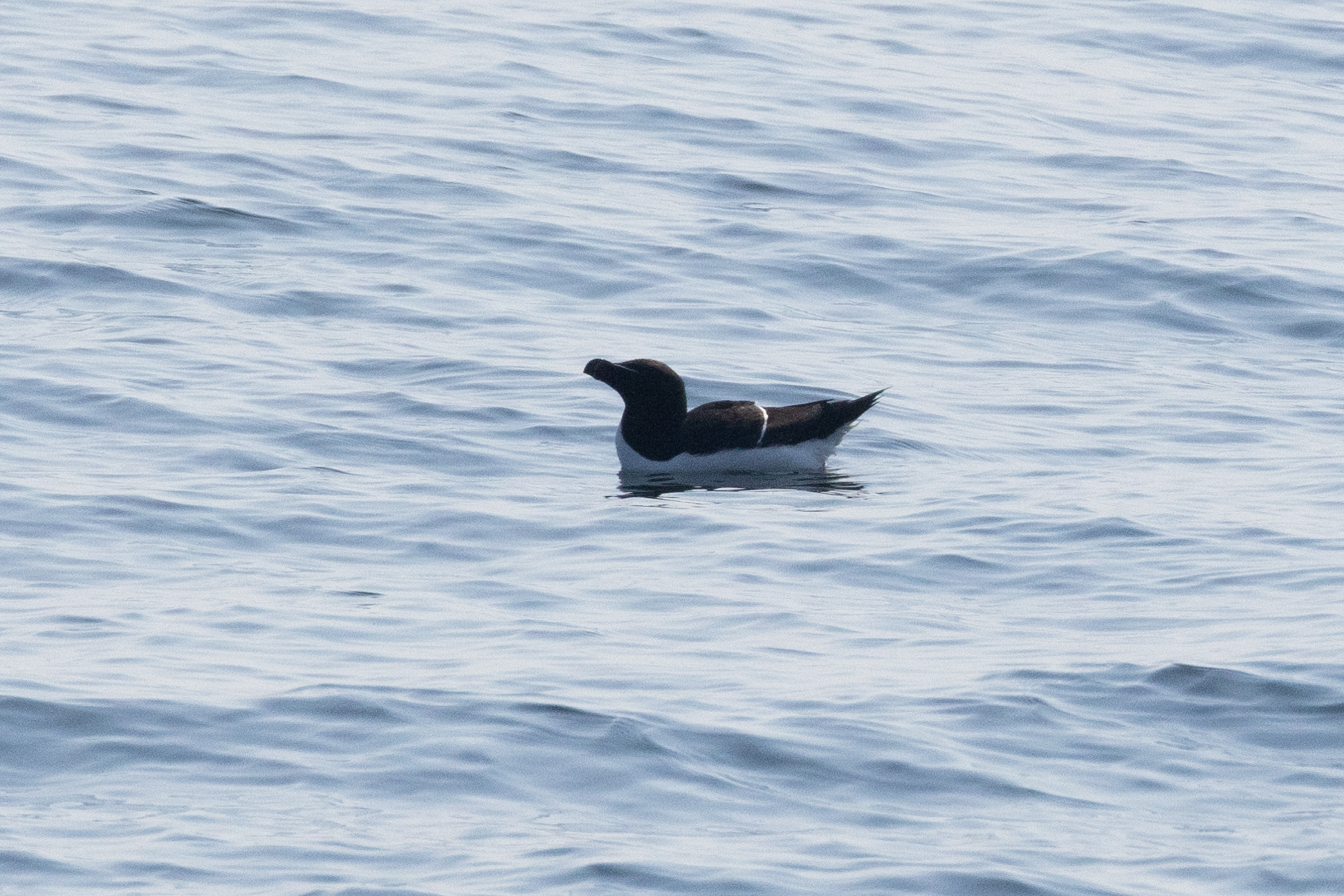
  • 1 DOVEKIE, 14+ Razorbills, 3 Black-legged Kittwakes, etc. in one hour of seawatching at Dyer Point, Cape Elizabeth, 12/11.
  • 1 Field Sparrow, private property in Cape Elizabeth, 12/11.
  • 1 Yellow-bellied Sapsucker, Mill Creek Park, South Portland, 12/11.
  • ~140 RUDDY DUCKS, 1 drake Green-winged Teal, 1 drake Northern Pintail, 52 Lesser Scaup, 19 Greater Scaup, etc, Sabattus Pond, Sabattus, 12/12.
  • 2 Red Crossbills, private property in Freeport, 12/13.
  • Scattered tarrying Turkey Vultures this week included a high count of 4 over the store on 12/13.
  • 1 continuing GRAY CATBIRD, 1 continuing Ruby-crowned Kinglet, and 1 continuing Wood Duck, Saco Riverwalk, 12/15.

This Week’s Highlights: December 3 – 9, 2022

The still-unfrozen waters of Sabattus Pond were fantastic this week. One of the highlights was this continuing drake Canvasback.

So-called “half-hardies” dominated my highlights away from a still-productive Sabattus Pond, as if often the case this time of year.

  • 1 adult Iceland Gull, Yarmouth Town Landing, 12/3 (with Saturday Morning Birdwalk group).
  • Sabattus Pond, 12/5: 1 continuing immature male EURASIAN WIGEON, 1 continuing drake CANVASBACK, 1 PIED-BILLED GREBE, 1 1st winter Iceland Gull, ~350 Ruddy Ducks, 3 Northern Pintails, 2 Ring-necked Ducks, 1 Horned Grebe, etc.  Full waterbird list here.
  • 1 Winter Wren, 1 Hermit Thrush, 1 Northern Flicker, and 3 Red Crossbills, Bailey Island, Harpswell, 12/5.
  • 1 Evening Grosbeak, our yard in Durham, 12/6.
  • 1 Fox Sparrow, feeders here at the store, 12/6-7.
  • 1 Gray Catbird, 3 Ruby-crowned Kinglets, and 1 Swamp Sparrow, Saco Riverwalk, Saco, 12/9 (with Allison Anholt).

I take a lot of photos this time of year of birds with Multiflora Rose stems in front of their faces. Like this – and every other – Ruby-crowned Kinglet shot from the Saco Riverwalk on 12/9.

This Week’s Highlights: November 26 – December 2, 2022

I found this rather cooperative, late Orange-crowned Warbler at Pond Cove in Cape Elizabeth – my 10th of the fall. Unfortunately, my camera was insisting it was the sticks I wanted a photo of, so this is the best I did.

Some of my highlights over the past seven days included the following. For the most part, my birds of note were decidedly more wintery than in the past weeks, although “late/lingering” oddities are making an appearance with the slow progression of the season and resultant concentration at seasonal hotspots.

  • 1 Red Crossbill, private property in Freeport, 11/24 (with Saturday Morning Birdwalk group).
  • 1 Hermit Thrush, private property in Freeport, 11/25.
  • 1 light morph ROUGH-LEGGED HAWK (FOS), Hinckley Road, Clinton, 11/28 (with Jeannette).
  • 59 Green-winged Teal (late, especially for such a large number), 1 Wood Duck, 6 Lesser Scaup, etc, Sebasticook Lake, 11/28 (with Jeannette).
  • 4 drake BARROW’S GOLDENEYES (FOS), University of Maine – Orono Steam Plant Nature Trail, 11/28 (with Jeannette).
  • 1+ PINE GROSBEAK (FOS), Sunkhaze NWR, 11/29 (with Jeannette).
  • 1 immature Northern Shrike (FOS), Veazie Waterfront Park, 11/29 (with Jeannette).
  • 1 1st-winter Iceland Gull, Bangor Waterfront Park, 11/29 (with Jeannette).
  • 1 ORANGE-CROWNED WARBLER and 1 Yellow-bellied Sapsucker, Pond Cove, Cape Elizabeth, 12/2.
  • 1 FIELD SPARROW, 2 RUSTY BLACKBIRDS, 1 imm. White-crowned Sparrow, and 1 Winter Wren, Private property in Cape Elizabeth, 12/2.
  • 4+ Red Crossbills, flying over the store, 12/2.

This Week’s Highlights: November 19 – November 25, 2022

I had a nice photo session with the late-season shorebirds at Biddeford Pool Beach on the 22nd, including this Dunlin – one of 54 present that day.

With the colder weather, we’re starting to see “late/lingering” migrants concentrating at the coast, and a smattering of rarities around the state. My observations of note over the past seven days included the following:

  •  1 Red Crossbill, Highland Road, Brunswick, 11/19 (with Saturday Morning Birdwalk group).
  • 2 Rusty Blackbirds, our feeder in Durham, 11/19.
  • 391 Ruddy Ducks, 1 White-winged Scoter, 150 distant scaup, etc, Sabattus Pond, Sabattus, 11/21 (with Jeannette).
  • 1 ORANGE-CROWNED WARBLER, 1 Field Sparrow, 2 Wood Ducks, etc, Saco Riverwalk, 11/22.
  • 1 YELLOW-BREASTED CHAT, South Point Preserve, Biddeford Pool, 11/22.
  • 1 Gray Catbird, 1 Chipping Sparrow, 1 Black-bellied Plover, 2 Ruddy Turnstones, etc, etc, Biddeford Pool environs, 11/22.
  • 1 Yellow-bellied Sapsucker, here at the store, 11/23.
  • 1 Yellow-bellied Sapsucker, Wolfe’s Neck Center, 11/25.

This Week’s Highlights: November 11 – November 18, 2022

I found this presumptive BLACK-HEADED X RING-BILLED GULL HYBRID along Greely Road in Cumberland during steady rain in the late morning of the 13th. It looks very similar to the individual of this hybrid pair that wintered on the Falmouth waterfront for at least two years, 2019-20, and 2020-21. Could it be the same bird with a little more black on the head due to the earlier date?

Rarity season is upon us, but most of my birding this week was in and around our yard. Not that that wasn’t extremely enjoyable though!  A few forays afield did not produce those hoped-for November “Megas,” but I did see a few things of note over the past eight days including:

  • Evening Grosbeaks have been present daily at our feeders in Durham all week. 7 on 11/11 peaked at 32 on 11/12 (with Saturday Morning Birdwalk group).
  • 1 Lapland Longspur (FOF), over our yard in Durham, 11/11.
  • 1 RUSTY BLACKBIRD, our feeders in Durham, 11/12 (with Saturday Morning Birdwalk group).
  • 1 first-winter Iceland Gull (FOF), Thornhurst Farm, 11/13.
  • 1 PUTATIVE BLACK-HEADED X RING-BILLED GULL HYBIRD, Greely Road, Cumberland, 11/13. First distant observation in driving rain suggested a much, much darker head and mantle, but finally relocated closer to the road. Joined by Nick Lund and Reed and Laura Robinson. 
  • Red Crossbills have been regular fly-overs in our Durham yard this week, but 10 were feeding on Eastern Hemlocks on 11/17.
  • 3 continuing CANVASBACKS, 398 Ruddy Ducks, 320 mixed scaup (too far to reliably sort through, 1 Evening Grosbeak, 1 Winter Wren, etc, etc, Sabattus Pond, Sabattus, 11/17.

This Week’s Highlights: October 29 – November 4, 2022

Evening Grosbeaks are predicted to head south in good numbers this fall and winter, and the first indications of that are appearing locally. Here’s one of the 8 that arrived at our
Durham feeders on the morning of the 3rd.

My observations of note over the past seven days included the following:

  • 2 Rusty Blackbirds, Wolfe’s Neck Center, 10/29 (with Saturday Morning Birdwalk group).
  • 4+ Red Crossbills and 1 Eastern Phoebe, Morgan Meadow WMA, 10/31 (with Jeannette).
  • 1 “Ipswich” Savannah Sparrow (FOF), 1 Semipalmated Plover, etc, Reid State Park, Georgetown, 11/1 (with Jeannette).
  • Sandy Point Morning Flight, 11/2: 154 individuals of 18 species in what was likely my last visit of the season. Complete count here.
  • Sabattus Pond, 11/3 (with Dan Nickerson): 469 Ruddy Ducks, 79 Greater Scaup, 55 Lesser Scaup, 2 Common Goldeneyes (FOF), etc.
  • 8 EVENING GROSBEAKS, our feeders in Durham, 11/3 (first of fall locally; photo above).

This Week’s Highlights: October 22-28, 2022

One of two Nelson’s Sparrows at Kettle Cove in Cape Elizabeth on Thursday, this one had much more well-defined streaking than the other. It doesn’t seem crisp and clear enough to be an “interior” subspecies, however, but I can’t help but wonder if there are Saltmarsh Sparrow genes in here, too.

A good week of October birding – at least when it wasn’t pouring again – included a goodly total of 5 Orange-crowned Warblers and a nice mix of “late” migrants. And finally, a morning at Sandy Point! My observations of note over the past seven days included the following:

1 CLAY-COLORED SPARROW and 1 BAY-BREASTED WARBLER, Wolfe’s Neck Center, Freeport, 10/22 (with Saturday Morning Birdwalk Group).

1 Orange-crowned Warbler and 1 Common Yellowthroat, Elphis Pond, Biddeford Pool, 10/23.

1 Orange-crowned Warbler and 1 Blackpoll Warbler, etc, East Point, Biddeford Pool, 10/23 (with clients from Maine and Pennsylvania).

Scoter sweep at Sabattus!  All three scoters were present on Sabattus Pond on 10/25 – perhaps only the second time I have ever had the hat trick here.  26 SURF SCOTERS, 21 BLACK SCOTERS, and 16 WHITE-WINGED SCOTERS joined 302 RUDDY DUCKS, 80 Greater and 44 Lesser Scaup, etc. (with Jeannette).

2 Orange-crowned Warblers, 2 Nelson’s Sparrows (see photo above), and 12 Semipalmated Plovers, Kettle Cove, Cape Elizabeth, 10/27.

1 Orange-crowned Warbler, 2 Indigo Buntings, 3 Lincoln’s Sparrows, etc, Private Property in Cape Elizabeth, 10/27.

Sandy Point Morning Flight, 10/28: 692 individuals of 37 species including late warblers and the first Morning Flight record of…House Sparrow! Full count here.

This Week’s Highlights: October 15 -21, 2022

I spent a lot of time looking at sparrows this week, as I love to do in October. This snappy immature White-crowned Sparrow was at Wolfe’s Neck Center on the 16th.

My observations of note over the past seven days included the following:

  • 1 continuing HUDSONIAN GODWIT, Wharton Point, Brunswick, 10/15 (with Saturday Morning Birdwalk group; the 247th all-time Saturday Morning Birdwalk species!). Observed at closer range later from the Maquoit Bay Conservation Land.
  • 1 Indigo Bunting, Wolfe’s Neck Center, Freeport, 10/16.
  • Incredibly morning at Bailey Island, Harpswell with Jeannette on 10/17: 1 ORANGE-CROWNED WARBLER, 1 CAPE MAY WARBLER, 1 Blue-headed Vireo, 1 Red-eyed Vireo.  6 total species of warblers; 7 species of sparrows. 400+ Dark-eyed Juncos, 200+ Yellow-rumped Warblers, 150+ White-throated Sparrows, 150+ Song Sparrows, etc, etc.
  • 1 ORANGE-CROWNED WARBLER, our yard in Durham, 10/17.
  • 1 Red Crossbill, our yard in Durham, 10/19.
  • 353 Ruddy Ducks, 1 Spotted Sandpiper, 61 Lesser Scaup, 18 Greater Scaup, etc, Sabattus Pond, Sabattus, 10/20.
  • 2 EVENING GROSBEAKS, 1 Common Yellowthroat, 50+ Swamp Sparrows, etc, Old Town House Park, North Yarmouth, 10/21.
I whiffed on phone-binning an Orange-crowned Warbler at Bailey Island on the 17th as I apparently followed the wrong bird. Turned out the other bird was this tardy Blue-headed Vireo, however.

This Week’s Highlights: October 8 -14, 2022

Northern Fulmar on our ½ day Pelagic on Tuesday.

My birding levels were closer to par for me this week, albeit concentrated on building our new yard list! The last two group tours of the year – both by boat – were conducted this week, with overall great success. It was also nice to have a few mornings to get some casual birding in before work. This is my favorite time of the birding year, afterall!

  • 1 Marsh Wren (in a dry patch of burdock!), our yard in Durham, 10/8.
  • 1 Bobolink, Wolfe’s Neck Center, Freeport, 10/8 (with Saturday Morning Birdwalk group).
  • 1 Long-tailed Duck (first of fall), 3 Snowy Egrets, 115 Surf Scoters, etc, Birds of Casco Bay Boat Tour, 10/9.
  • 1 Indigo Bunting in a very light morning flight at Sandy Point, Cousin’s Island, Yarmouth, 10/10 (total – 87 migrants).
  • ½ Day Pelagic out of Boothbay Harbor on 10/11: 1 Common Murre, 1 Parasitic Jaeger, 1 Pomarine Jaeger, 3 Northern Fulmars, 1 Lesser Black-backed Gull, etc.  Full trip report with photos and annotated checklist, along with my Stercorariidae mea culpa can be seen here.
  • Sabattus Pond, Sabattus, 10/13: 158 RUDDY DUCKS, 84 Lesser Scaup, 56 Greater Scaup, 2 American Wigeon, 1 Spotted Sandpiper, 1 Ring-necked Duck, etc.