Category Archives: Birding in Maine

Not Your Usual December Highlights!

While this fall’s rarity season got off to a fairly slow start at the end of October, things have really heated up lately. In fact, it’s been a really outstanding couple of weeks.  And in the past few days, I have enjoyed some really great birding.

The mild temperatures have certainly played a role – while the southerly and southwesterly winds that have ushered in much of the unseasonably warm air may still be facilitating the arrival of some vagrants, at the very least the mild temperatures and benign weather are allowing vagrants and unseasonable “lingering” migrants to survive long enough to be found! And, the lovely weather is certainly keeping more birders out in the field. I have certainly been taking full advantage of this beautiful weather.

On Sunday, Ed Hess and I visited the Saco Riverwalk. While this is always a hotspot at this season, it is really extraordinary this year. After 8 species of warblers were seen there in November, the mild weather has allowed at least 5 species to continue – almost unprecedented for December. Ed and I saw the Tennessee Warbler, a really remarkable December record…
L1040092_TEWA,SacoRiverWalk, 12-6-15_edited-1

…both of the two continuing Yellow Warblers (the photos are of one of the two individuals), which is another exceptional species for the date…
L1040022_YWAR,SacoRiverWalk,12-6-15_edited-1

…the Nashville Warbler (and confirmed the continued presence of a second Nashville!)…
NAWA by Ed_edited-1

…the Common Yellowthroat (more expected for the season)…
L1040098_COYE1,SacoRiverWalk,12-5-15_edited-1

…and we saw one of the two Ruby-crowned Kinglets still present (much more regular in December than any warbler).
L1040116_RCKI,SacoYachtClub,12-6-15-edited

And although we didn’t see it, the most amazing of them all, a Blackburnian Warbler is still present. (Jeannette and I saw and photographed it earlier in the week, 11/30).
IMG_3040_edited-2

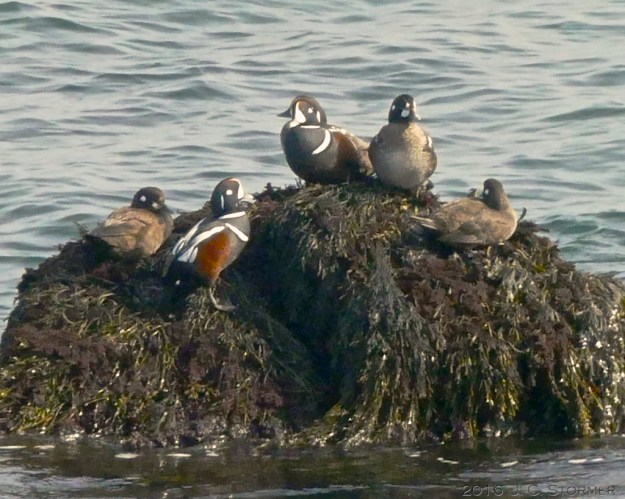
Ed and I then headed to Cape Elizabeth, where we photographed the continuing Grasshopper Sparrow at Dyer Point, and odd bird to see juxtaposed with Harlequin Ducks (18) and Purple Sandpipers (6)…
L1040136_GHSP2,DyerPt,12-6-15_edited-1L1040151_GHSP3,DyerPoint,12-6-15_edited-1L1040163_GHSP1,DyerPoint,12-6-15

…And we twitched a Wilson’s Warbler found earlier in the day nearby, just so we could say we saw five species of warblers in a day in December!  It cannot, however, be said that we “photographed” five species:
WIWA,CapeElizabethm12-6-15

The Grasshopper Sparrow was also our fifth species of sparrow on the day (Song, American Tree, White-throated, and Dark-eyed Junco) – I doubt I’ve had five species of warbler and 5 species of sparrows in the same day in December in Maine before.

Of course, that only somewhat consoled us about missing the vagrant Western Tanager that was found at the Riverwalk later in the afternoon. Damn.

On Monday, I headed over to Reid State Park in Georgetown with Kristen Lindquist. It was a rather quiet day here, but it’s always one of my favorite places to take a walk, especially on such (another) gorgeous morning.  43 Red-necked Grebes, a Northern Harrier, a flyover Red Crossbill (my first of the season), oh yeah, and another rarity: “Oregon” Junco.

While some might dismiss it as “merely a subspecies,” the westernmost subspecies of the Dark-eyed Junco is truly a rarity in the Northeast, and this was the first definitive “Oregon” Junco that I have seen in Maine (although I have never chased one at a feeder, where they are usually seen). It was in a small flock of “Slate-colored” Juncos and an American Tree Sparrow in the scrubby central ridge in the middle of the Griffith’s Head parking lot.

The flock flushed from short grass at the edge as we rounded the corner, and as it briefly alighted in a shrub, I was shocked to see a black-hooded junco. Closer inspection as we followed it for about 20 minutes yielded all of the pertinent field marks for a “textbook” Oregon, nicely eliminating the intermediate “hybrid swarm” – or whatever it is – that we sometimes refer to as “Cassiar’s” Junco.

Note the complete, black (not dark gray) hood, lacking contrast in the supraloral area. Also, the hood is cleanly demarcated on the back of the head, contrasting crisply with the reddish-brown back. The flanks and sides are particularly pale salmon-buff, which is not atypical for adult males (although many are much brighter). At the lower margin of the hood, note the smooth, rounded margin across the chest and up to the “shoulder.”
IMG_6908_ORJU4,meIMG_6909_edited-1IMG_6910_ORJU1,K_edited-1IMG_6912_edited-1,K.Lindquist

Afterwards, Kristen and I birded around Bath – no white-winged gulls or Barrow’s Goldeneyes yet, no doubt related to the mild temperatures as well, but we did spot one of the Snowy Owls at Brunswick Landing – unlike warblers, a slightly more expected highlight for early December in Maine.

While Jeannette and I didn’t turn up any rarities – or much of anything else for that matter! – birding Harpswell Neck this morning, I very much look forward to what the coming weeks will produce, especially when it finally turns cold!

The 2015-16 Winter SnowBird(er) Contest is Underway!

L1010480_RECR1_immMale,CousinsIsland,3-28-14_edited-1A group of Red Crossbills on Cousin’s Island that landed at our feet was just one of the highlights during the 2014-15 Winter SnowBird(er) Contest.

It’s December, and you know what that means! It’s time for the SnowBird(er) Contest here at Freeport Wild Bird Supply!

We are very excited to announce the start of the 7th annual “Winter SnowBird(er) Contest,” which was introduced as a way to encourage people to get outdoors in the depths of winter.  Just because it’s cold out does not mean there aren’t a lot of great birds to see!  While we offer free Saturday morning birdwalks throughout the year, it is much easier to entice people to participate in May when warblers are around, or July when it is nice and warm out.

Therefore, to get more birders out and interested in the great winter birding our area offers, we have added an extra incentive: prizes!  Participants accumulate points based on the temperature at the start of the birdwalk – the colder the morning, the more points are awarded.  The contest runs December 5th through March 26th, and at the end of the period, over $250 in prizes will be awarded!

Winter birding can be a lot of fun.  It is prime season to see seaducks, such as Common and Red-throated Loons, Common Goldeneye, Bufflehead, and scoters.  The southernmost wintering flock of Barrow’s Goldeneyes on the East Coast resides in the lower Harraseeket River in South Freeport, and we frequently visit Winslow Park and the Freeport Town Wharf to enjoy this beautiful duck.
female BAGO with imm COGO1, East Machias River, 2-13-12_edited-1
Barrow’s (center) and Common Goldeneyes side-by-side is another highlight of winter birding in the area.

We’ll look for Northern Shrikes, enjoy our year-round woodland residents, and who knows what else? Last year, we spotted everything from a vagrant Townsend’s Solitaire to Red Crossbills literally at our feet. And, if this winter turns out to be another “irruption” year (and there is a good suggestion that for many species, it will be), we may find Snowy Owls, Common Redpolls, both crossbills, and much more!

Droll Yankees logoThe person with the most points at the end of March wins this year’s Grand Prize: a B7 Domed Caged Feeder complements of DROLL YANKEES. Large capacity, Gray Squirrel-resistant, pigeon-proof, and sheltered from the weather, this great feeder solves feeding station problems. Like all of Droll’s products, it is made in the USA and has a Lifetime Guarantee.

Royal River Massage logoThe runner-up will receive a one-hour massage from ROYAL RIVER MASSAGE in Yarmouth. Relieve “warbler neck” and other aches and pains in a 60 Minute Therapeutic Massage! It’ll be a great way to recover from the winter season of shoveling snow.

Laughing Stock Farm logoAnd, finally, the third place finisher will receive 2 weekly organic vegetable pickups (“medium” shares) at LAUGHING STOCK FARM CSA in Freeport. A selection of veggies will be available on each of two pick-up dates in April.  We’ve been members of the farm’s CSA for 10 years and love having fresh, organic, and local vegetables all year long.

Betsey Puckett, President at Droll Yankees was excited to provide the Grand Prize for the second year in a row, “Kudos…for providing a challenging and educational event. But then again, you Mainers are known for your endurance.”

There are some mornings in mid-winter that can make it tough to get out of bed, so we hope to add a little extra motivation. The real prize of course, is the birding our area offers in the depths of winter.

For a recap of what we have been seeing on our recent birdwalks, you can always visit the News page of our website to see what you are missing. And with 240 species seen in the 11 years of free Saturday Morning Birdwalks, you have been missing a whole lot!

So join us on a Saturday this winter to see how fun winter birding can be, and start accumulating points! Birdwalks meet at the store at 8:00am for a short carpool to a local site, rarely more than 10-15 minutes away. We return to the store between 10 and 10:30 for free shade-grown, organic, bird-friendly coffee and a look at what’s hanging out at our feeders.  The birdwalks are free and do not require advance registration.  Hope to see you soon!

SNOW,Brunswick_Landing_birdwalk,1-31-15_edited-1
This Snowy Owl in Brunswick during last winter’s birdwalk was the 237th species ever seen on a Saturday Morning Birdwalk

Portland Eviscerates Capisic Pond Park

Several years ago, I joined a group of concerned residents in working for substantial restoration of Capisic Pond Park following the necessary – and federally mandated – replacement of the sewer line that runs the length of the park. The post-construction restoration plan was essentially “spread some grass seed.”

After countless meetings, public hearings, and workshops, a plan was implemented that not only limited damage from the construction process, but improved it. Over $150,000 was spent on restoration, including extensive planting of native plants to not only beautify the park, but improve biodiversity. Birds, and the many birders who frequent this little treasure of an urban park, would benefit.

Over the years, as those plantings have slowly come into their own, and began to bear fruit (literally!), bird diversity has only continued to increase. From the continued presences of Orchard Orioles – the only breeding pair known in the state, to a wealth of migrant sparrows, to rarities (including just last month, one of only 6 or so Ash-throated Flycatchers to ever be seen in Maine) have attracted birders from far and wide.

On Monday, Jeannette and I headed to Portland to work the productive micro-habitats and micro-climates in urban areas to search for rarities, and “lingering” migrants. We began our day at Capisic Pond Park.

And we were greeted by this:
IMG_6887IMG_6888IMG_6889IMG_6890IMG_6891

We were appalled. We were horrified. We were saddened.

What the hell has happened?

According to the Facebook page for the Friends of Capisic Pond Park, posted on October 31st:
“Don’t be alarmed by the mowing and cutting that will be done in the first week or so of November. It is important to mow the park for several reason. First, and most important, if the small trees and brush aren’t mowed and cut periodically the meadow environment will transform (in time) into a forest. Just like the open farm fields of the 19th century that covered virtually all of Maine are now woods, Capisic Pond Park will move from field to brush to forest unless it is mown and tended. Second, regular cutting will spread seeds and improve the habitat overall. Lastly, we will again be able to see the pond (what’s left of it, anyway) and access the ice (!) during the months before everything regrows next Spring and Summer. FOCP members Donna and Steve Williams and Andy Graham met with Jeff Tarling of Public Services on Friday October 30th to walk the park and talk about what should and should not be cut – we are fortunate to have Jeff as a knowledgeable and caring partner.

“Also – if you were wondering about the trees being cut on Capisic St near the pond, this is the first preparation for the pond restoration work to be done next year. Apparently this will be an access point for the equipment needed to dredge and remove the spoils next August and September.”

This wasn’t a “haircut.” This was a clear-cut.

Quite frankly, I am left to question either the motives or the expertise behind the decisions that were made – at least beyond the third rationales listed: “…we will again be able to see the pond.” And the reason I question whether that clear-cutting had anything to do with anything other than what site-lines some people preferred seems simple as the other reasons given are complete B.S.

1) Cutting is not necessary to spread seeds. Plants are built to do that on their own, either through wind, animals, or gravity.
2) Improve habitat? Granted this depends on what habitat you are trying to improve, but I would argue that this type of mechanized treatment did not in any way improve habitat for much of anything at Capisic. In fact, it damaged or even ruined the habitat for most of the species that frequent the park.
3) Selective cutting, girdling, or other low-impact methods are widely available to eliminate forest succession, especially on a scale as small as Capisic. Almost any other treatment would substantially improve and augment habitat, not ravage it. And that goes for the aesthetics, too – the place is a mess right now.

So I fail to see what was accomplished here, other than opening up some views or fitting in with some outdated philosophy that parks should be open. Actually, what was accomplished was that the value of Capisic Pond Park to most migratory (just about all passage warblers), breeding (including both Baltimore and the famous Orchard Orioles) and year-round resident species (i.e. Northern Cardinals) was severely, and very negatively, impacted.

The significant improvement in food source diversity (especially for frugivores) from the park’s restoration was set back by a decade – or permanently if native plants are not replaced and restored. This heavy-handed, unselective approach favors invasive species, as they out-compete regenerating natives. If left alone, Capisic will end up with significantly more Asiatic Bittersweet, bush honeysuckle, and Multiflora Rose after this misguided effort. Limited biodiversity begets limited biodiversity.

And we’ve seen this throughout the city, for example, the Eastern Promenade, where – despite the efforts of a handful of local residents attempting to stem the tide of invasives – city mismanagement continues to accelerate their spread and the degradation of the habitat. Portland has already ruined (for birds and birders) the “Dragon Field” (behind the Quarry Run Dogpark), annihilated critical migratory bird habitat along West Commercial Street and wiped out any shelter of any sort along the Fore River Parkway Trail, and continues to assault any sort of cover in roadside edges and overgrown lots (all critical for disoriented and exhausted migrants, and “pioneers” that are attempting to overwinter after possibly becoming “stuck” in the city. Portland stood by as Evergreen Cemetery had a road plowed through it and neglect continues to degrade the pond areas – despite being the most-visited birding location in that state. See a pattern here?

And through all this, little ol’ Capisic Pond Park stood as the lone bastion of hope. Residents, birders, engineers, and city officials came together to not only restore the park after the sewer reconstruction, but actually improve the habitat for migratory and resident birds. And birders have been reaping those dividends, as improved plant diversity continues to provide a greater array of native foodstuffs as the replanted vegetation matures. And that has meant more birds.

I was proud of what was accomplished at Capisic Pond Park. I – and many others – worked tireless to make that happen. A lot of time, effort, dedication – and yes, a substantial amount of money – was invested.

And then, with a few passes of a brush-hog mower, it was gone. All of that time, effort, dedication, money, and concern, wasted. Just like that. Poof.

I’m sickened by what I saw at Capisic Pond Park on Monday. And personally, it will be hard for me to go back. There will always be birds in the park – it’s truly an urban oasis, and some migrants will have no choice but to search for food here. However, the knowledge of how much better the bird habitat, and therefore the birding, should be will forever be a reminded to me about how much time and energy I have wasted fighting for birds in the City of Portland.

But at least I can simply go somewhere else. If you’re a bird in Portland, you’re running out of choices.

Birds on Tap – Roadtrip: Ducks and Draughts! 11/15/15.

scaup scanning

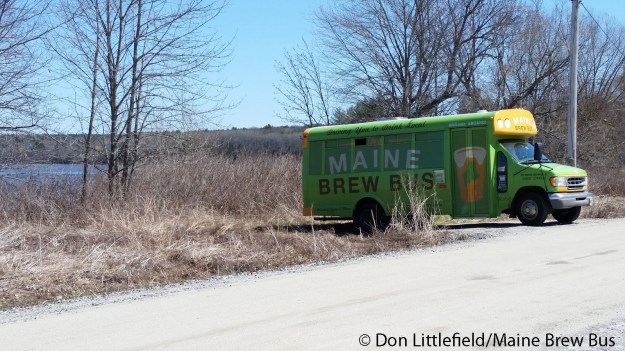
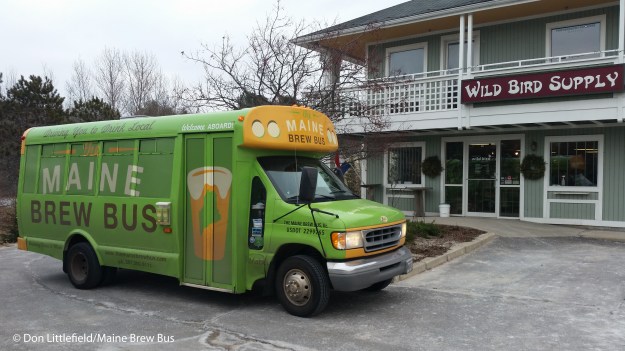
The second “Birds on Tap – Roadtrip!” of 2015 was another resounding success.  As a follow up to our first event in August that featured shorebirds in Scarborough Marsh, we once again partner with the Maine Brew Bus to offer a fun, bird- and beer- filled outing.

Our theme for the this tour was “Ducks and Draughts,” and so we headed northwest to Sabattus Pond in Sabattus, one of the premier duck-watching sites in Maine, and arguably THE waterfowl hotspot in late fall in the southern half of the state. After pick-ups in Portland and Freeport, the bus, Paul (our driver and beer guide for the day), and I arrived at the south end of Sabattus Pond. It didn’t take long to know why this place is such a destination for birders at this time of year.

A large number of ducks were immediately encountered, but we soon focused our attention on the pair of Redheads – rare, but fairly-regular migrants in Maine – that were a “Life” or “State” Bird for some. For others, it was nothing more than the pleasure of seeing this attractive bird!
group at south end

We covered the three primary hotspots on Sabattus Pond, amassing a total of 17 species of waterbirds. In addition to the Redheads, highlights included a Red-necked Grebe (rare in Maine’s interior), 24 American Coots, 4 Northern Pintails, 6 Green-winged Teal, and several hundred Ruddy Ducks. Although a relatively low number for here, “several hundred” Ruddy Ducks is not a statement uttered anywhere else in Maine…and especially not when proceeded by the word “low!”  Other waterbirds species seen today included Lesser and Greater Scaup, Mallard, American Black Duck, Ring-billed and Herring (1) Gulls, Buffleheads, Hooded and Common Mergansers, Common Goldeneyes, and one Great Blue Heron.
group on east side

Sabattus also affords the opportunity to study the two scaup species together, so we took plenty of time to go over this identification challenge. Side-by-side, the major differences are often readily apparent, so we practiced our skills to apply them to a homogenous group, or worse, the “dreaded” lone, single, distant scaup!

Having our fill of the nuances of Aythya identification, Paul took charge and delivered us to Lewiston’s Baxter Brewing. But as we stepped out of the bus at the renovated mill, it was back to the binoculars and scopes as we enjoyed a Peregrine Falcon pair – one busy feasting on a Rock Pigeon lunch – a top a nearby building.  With that, it was beer time!
outside Baxter

The first brewer in New England to can all of its beer, Baxter is known for such go-to brews as their Pamola Pale Ale and especially, their Stowaway IPA. Less well-known, however, is their ultra-creative 10-gallon Small Batch Series. Samples of Tarnation Lager, Phantom Punch Winter Stout, and Bootleg Fireworks Double IPA were enjoyed and discusses, and I simply had to quench my curiosity (as well as my thirst, of course), with the Small Batch “Sweet Tea Chai Spice Stout.”
baxter tour 2Baxter tour

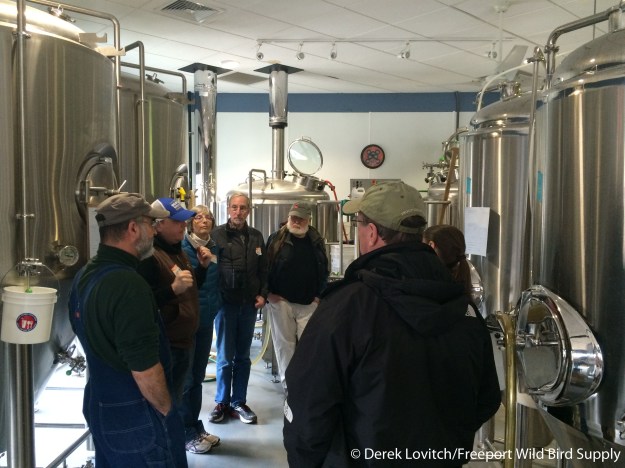
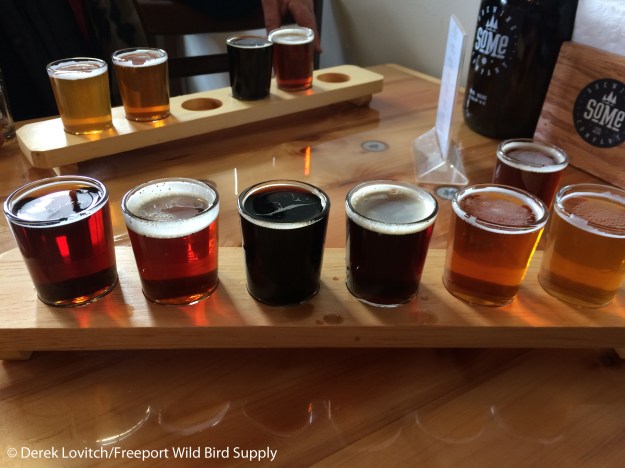
A tour of the brewery and the brewing processed followed, and soon we were off – with one last quick look at the Peregrines, heading down the Androscoggin River to Freeport for a date at Maine Beer Company. Samples of Zoe (Hoppy Amber), Mo (Pale Ale), King Titus (Porter) and one of my absolute favorites, Lunch (IPA) were served, and a few folks sampled their most recent Pilot 8, their take on a Kolsch. Fueled by the delicious brews, we continued the discussion of…well, ducks…and draughts!
MBC beers

outside MBC

The “Birds on Tap – Roadtrip!” series, a partnership between the Maine Brew Bus and Freeport Wild Bird Supply will continue in 2016. In fact, several new tours are in the works, which we hope to announce soon. Stay tuned!

The Rarity Fever Juices are Flowing – It must be November, and There was a Storm…

Rarity season is upon us, and there’s no better time for a big ol’ storm. Especially with an impressive southerly flow before and during the storm, and a strong cold front clearing things out behind it, my “Rarity Fever” symptoms got fired up.

Just look at those extensive southerly winds on Friday and Sunday, for example…
wind map,10-28-15

wind map,10-30-15

…following Thursday’s storm system.
surface map, 10-29-15

Heavy rain Wednesday night into Thursday gave way to a few hours of well-above normal temperatures and mostly sunny skies before winds and rain began to pick up in the late afternoon ahead of the cold front. I was able to squeeze in a visit to Sabattus Pond in the early afternoon, hoping for storm-grounded waterbirds.

While it was simply gorgeous out, the waterbird numbers remained below seasonal-norms here. A continuing pair of Redheads was the highlight, and a pair of White-winged Scoters was just the type of rare-inland migrant seaduck I hope to find after some weathah’. Otherwise, waterbird counts were modest: 219 Ruddy Ducks (well, modest for Sabattus – this is an epic count for anywhere else in the state!), 164 Lesser Scaup, 75+ Ring-billed Gulls, 62 Mallards (not sure where the masses were today), 41 Bufflehead, 39 Greater Scaup, 36 Ring-necked Ducks, 16 American Coots, 13 American Black Ducks, 11 Canada Geese, 2 Common Loons, 1 Mallard x black duck hybrid, and 1 Double-crested Cormorant.

On Friday, with southwesterly winds (more rarity wind!) gusting ahead of a secondary cold front, I spent the morning in Cape Elizabeth. While I had Cave Swallow on my mind, I settled for a nice mix of late migrants, including four species of warblers (Orange-crowned at Kettle Cove, my 4th of the year; Blackpoll and “Western” Palm at Pond Cove, and scattered Yellow-rumps), a Gray Catbird at Kettle Cove, and an Indigo Bunting on private property.
BLPW,PondCove, 10-30-15_edited-1

With a light (but decent-for-the-date) migration overnight, I started at sunrise at “My Office” at Sandy Point to take in what’s left of the Morning Flight. Calm winds seemed to preclude as many birds from reorienting here as I would have expected based on the decent-for-the-date radar image overnight. However, it was a very pleasant morning with nice little flight featuring good late-season diversity. I tallied a total of 247 migrants, led by an even 100 American Robins, 66 Dark-eyed Juncos, and a nice total of 14 Snow Buntings. “Tardy” birds included 3 “Yellow” Palm Warblers, an Eastern Phoebe, 2 Hermit Thrushes, a Red-winged Blackbird, and best of all, a late Black-and-white Warbler that I found in the trees after my Saturday Morning Birdwalk group had joined me.

But on Sunday, vagrant-hunting was the name of the game. Although I did not organize a South Coast-wide “Rarity Roundup” this year for the first time in a decade, Kristen Lindquist, Evan Obercian, Jeannette and I ran my usual Portland Rarity Roundup itinerary, scouring the Portland peninsula for vagrants, “lingering” migrants, and other surprises. It was not exactly the birdiest of days on the Portland Pen’ but the Eastern Promenade was fairly productive, led by 2 Orange-crowned Warblers, a Palm Warbler, a Field Sparrow, and three Hermit Thrushes.
OCWA,EasternProm,11-1-15_edited-1
Here’s a terrible shot in the dawn dark and drizzle of one of the two Orange-crowns.

Elsewhere in the East End, we turned up a Hermit Thrush on Anderson Street, and a Gray Catbird on Sheridan Street, but then the passerines really dried up. The usually-productive stretch of woods on either side of West Commercial Street has been rendered useless, and was essentially devoid of birds.

On the riverside, there’s development, clearing a great stand of birch and scattered crabapples that once resided here:
IMG_6478_edited-1

But it’s a city, and development occurs, and there are lot worse places for trees to be cleared. The abandoned railyard and old docks along this stretch of degraded river is hardly habitat worth conserving. “There are more important places to protect,” as Evan stated. However, it was at least some habitat for tired and disoriented migrants that found themselves in the city and looking for food and shelter.

But degraded urban “brownfields” are exactly where development should occur. More frustrating – and rather perplexing – however, is the continued ravaging of quality habitat throughout the city by the City of Portland. From incredibly valuable parkland habitat at the Eastern Promenade to scattered thickets on undeveloped hillsides, it’s as if Portland doesn’t want birds to find refuge in the city. Of course, there are “other considerations” for this land mis-management, but that’s a blog for another day. But the misguided efforts to do whatever it is the city thinks it’s going to accomplish by clear-cutting what was the best strip of woods on the peninsula, reduced habitat for migrants – and resident species from Black-capped Chickadees to Hairy Woodpeckers, to Barred and Great Horned Owls (breeding) to this:
WestCommercialSt1,11-1-15

What a mess, and what an abomination! And what a waste. So yeah, there weren’t any birds here, either.

So after lunch, we gave up on the city (and crossed off several birding hotspots from the list…don’t get me started about what they have done to the Fore River Parkway Trail area!) and headed to Cape Elizabeth.

Unfortunately – especially with an increasing southerly wind in the afternoon – it wasn’t overly productive here. In fact, several of the best hotspots were incredibly slow – as slow as I have ever seen them at this time of year. However, we did hit some hotspots, led by a great amount of activity at Trundy Point. The five Snow Buntings on the beach were nice (photo below), but a feeding frenzy of 40+ Common and 6 Red-throated Loons, a single Red-necked Grebe, 1 Bonaparte’s Gull, and a goodly amount of Herring and Great Black-backed Gulls made for a fun visit. Northern Gannets were diving further offshore as well.
SNBU, 11-1-15

Maxwell’s Farm was productive, too: 17 Eastern Bluebirds, 5 American Pipits, and a Wilson’s Snipe led the way, and we had another snipe flying over little Joe’s Pond Park in South Portland. Mill Creek Park might have been the birdiest stop of the day – even if it was almost all Mallards and Ring-billed Gulls, however!

We then finished up the day, with the sun setting, at Portland’s Back Cove, with arguably the bird of the day – a late American Golden-Plover going to sleep with 9 Black-bellied Plovers and 5 Dunlin at the edge of the marsh. It was a nice way to cap an enjoyable day of birding with good friends, with the senseless optimism of Rarity Season keeping us going through nearly 14 miles of walking and searching.

No major rarities were to be found at Reid State Park on Monday morning, either, but Jeannette and I enjoyed a lovely, birdy walk on a beautiful morning. 8 late Semipalmated Plovers joined 151 Sanderlings on the beach, along with 8 American Pipits and 18 Snow Buntings. A lingering Nelson’s Sparrow (subvirgatus) was in the saltmarsh, and we spotted a Northern Harrier flying south, low over the water offshore. In the water, winter ducks and waterbirds are rapidly increasing: 31 Red-necked Grebes, 15+ Red-throated Loons, all three scoters, and a whole bunch of Long-tailed Ducks were among the growing legions today.

And then, I came into the store for a couple of hours of work this afternoon and was distracted by a Dickcissel at our feeders!
DICK,storefeeders,11-2-15_edited-1

After spending so much time sifting through urban House Sparrow flocks yesterday, of course one would show up right in front of me. It was a long overdue addition to our store’s yard list – #114! And it was my 5th mainland Dickcissel of the fall.

While the appearance of a vagrant after a storm could simply be coincidence, storms can facilitate the departure of already-wayward strays (to oversimplify things a bit). It’s hard to pin any one bird down to any particular weather event, but the appearance of a Swainson’s Hawk (about 6 or 7 state records) that was nicely photographed at the Cadillac Mountain Hawkwatch in Acadia on Friday, only served to further flare my Rarity Fever Symptoms. However, despite my best efforts, I didn’t turn anything of great significance up this weekend, and nor did anyone else in Maine.

From the lack of birdlife in many Portland spots (the ones that still have vegetation that is!) and especially in the warm Cape Elizabeth microclimates that I have been checking, it’s possible that the mild weather (remember we’ve only had that once cold snap so far) has simply not yet concentrated lingering/pioneering individuals and wayward vagrants in the little nooks and crannies that we seek them in at this time of year. And with a very mild week in store, perhaps it will be a little longer before we see them concentrate.

But there is one thing we can be sure of: there will be a “Mega” rarity soon. How do I know? Because I am going away during Rarity Season!

Selasphorous Hummingbird in Yarmouth (October 16-17, 2015)

Most of Maine’s Ruby-throated Hummingbirds have departed by the middle of September, but there are always a few migrants and lingering juveniles into the first few days of October. But as October progresses, Ruby-throats become few and far between, and with each passing day, any hummingbird becomes more and more likely to be something other than our familiar Ruby-throat. In recent years, Western vagrants including Rufous and Calliope have appeared in Maine, while neighboring states have seen several others including Black-chinned and Allen’s. It’s just a matter of time before Maine adds another hummer to its state list. In fact, my Next 25 Birds for Maine predictions list includes Black-chinned (#9), Anna’s (#13), and Allen’s (#16).

Key to the observation of late season hummingbirds is continuing to dispel the silly (but persistent) myth that you have to take down your hummingbird feeders (on some arbitrary day like Labor Day) or the birds won’t migrant. But as usual, the birds are smarter than we are, and proceed as directed by hormonal changes triggered by the decreasing daylength. A nice patch of nursed flowers or any number of hummingbird feeders won’t stop them, but it’s the last truant birds and wayward vagrants that can really use the helping hand.

Here at the store, we have been working hard to dispel this myth for years, and get people to not only keep their feeders clean and nectar fresh (and always free of dye and color!) for as long as feasible, preferably into early November. We also urge people to contact us with any hummer sightings after October 1st, and take a picture if possible.

And happily, folks have. Some have gone unconfirmed as a brief sighting came and went or we learned of the observation belatedly, and others have been nicely documented. Last fall, I chased one in Falmouth on October 14th that turned out to be a Ruby-throat, much to my surprise (and somewhat, to my chagrin). The word is getting out, at least.

Last Friday (10/17) we got a call from Lois Randall and Phil Bunch on Cousin’s Island in Yarmouth. A hummingbird had been present all day, and it was photographed. I learned of the bird too late in the day to chase it, but I had hoped to go on Saturday. Lois told us it was still present in the morning, so I found some time in the early afternoon to make a quick run over. Unfortunately, I arrived to find out the bird was last seen at around 8:00am, but I was able to view Phil’s photos. And sure enough, this one was NOT a Ruby-throat.

Photo 1

(Click on the following photos for a larger image)
Photo 2

_MG_1843_edited-1

_MG_1840_edited-1

_MG_1832_edited-1

_MG_1824_edited-1

_MG_1827_edited-1

_MG_1828_edited-1

I received all of the photos today (10/22) and was able to take a long, hard look at them with references handy. It’s clearly a hummingbird of the genus Selasphorus, with its extensive buffy sides, buffy undertail, and – although it’s really hard to see – just a hint of the rufous in the base of the tail feather (see Photo 1). There’s not much here to work with, but the overall pale plumage and limited rufous-orange further suggests that this bird is an immature female, although some young males can be equally as pale.

And immature Selasphorus hummingbirds are tough, especially the females! In fact, most are unidentifiable beyond Rufous/Allen’s, with only (most) adult males readily identifiable in the field. In-hand measurements are usually required, or the holy grail of hummingbird photos – the upperside of the spread-tail. And of course, seeing the upperside of the tail (especially when spread), uppertail coverts, and rump would go a long way in identifying this bird, but we will work with what we have – and I am thankful for these photos (most hummingbird reports we receive are not photographed at all)!

The bill and tail both look too long to me for Calliope, and there’s probably a little too much white in the tail. I also think we can rule out Broad-tailed by the fairly extensive buff sides, but perhaps that could still be considered an outside possibility.

But despite Phil’s fine photos, I don’t think we can move beyond Rufous/Allen’s here, although the relatively broad and rounded outermost tail feathers (visible especially on Photo 1) are more suggestive of the more-expect rarity: Rufous Hummingbird. I think Photo 2 is also suggestive of the width of those outer tail feathers, but it also shows an awful lot of white, making me think we’re also seeing an artifact of light passing through the tail tips in this photo. Other photos show the buffy undertail typical of the family, better views of the sides and flanks, and the overall color and pattern of the head and throat.

Lois also diligently took some notes, and wrote them up for me:
1. First sighted on Friday October 16 at 8AM feeding amongst the flowering Agastache plants (common name: Hyssop) on our deck. As the bird darted rapidly back and forth, I caught a glimpse of its back and saw patches of iridescent green. The bird soon discovered the tube feeders hanging on our sliding glass doors and proceeded to feed on the hummingbird nectar vigorously throughout the day.

2. In addition to the single glimpse I got of the green “highlights” on areas of the hummer’s back (thanks to a flash of sunlight on an otherwise cloudy day), I noticed the white tips on the hummer’s tail, and noted rusty highlights on the bird’s “armpits”, otherwise whitish shoulders, and on the bird’s sides (flanks?) I also noted that the bird had a rounded full-looking belly.

3. I last saw the hummingbird briefly at 8AM, Saturday October 17, 2015. It visited the hyssop flowers briefly, flew off, and we haven’t seen it since. We will continue to watch for it in case it returns sometime this afternoon or tomorrow morning. Our best hope is that it “refueled” here and safely continued on its journey south.

So while this bird will remain unidentified to species, Lois’s notes and Phil’s photos combine to nicely document an immature Rufous/Allen’s Hummingbird – one of just a handful of confirmed records for Maine.

I suspect vagrant hummers are more regular in Maine then currently reported, so keep those feeders up, nurse those plants, and keep the reports coming in!

Excellent Morning Flight at Sandy Point, 9/16/2015

Over 2,000 migrants. 45 species, including 17 species of warblers. Yeah, it was a good morning to be at Sandy Point!

L1030171_CMWA,SandyPt,9-1-15_edited-1
Cape May Warbler, male.

I arrived, as usual, a few minutes before sunrise, but unlike most mornings, birds had already begun to cross. And once the sun crested the horizon, the floodgates open. OK, so it wasn’t “Warblergeddon” at Cape May, but it was fun for me and it was an excellent flight for here.

Well, mostly fun. A lot of birds were high, especially as the wind went calm. Big pockets of birds were just too high to identify. I did my best to just keep count. Birds were dropping into the trees on both sides of the road, others were zipping through underneath. As I focused on something in the elm, I am sure I missed birds overhead. It was tough to keep track, but I did my best.
L1030173_PRAW,SandyPoint_edited-1
Prairie Warbler, male.

By the time I departed at 9:30, the tally was the 7th highest I’ve had at Sandy Point (the 6th highest in September), and by far my best flight of the season to date. It also had some interesting birds, and I’ll analyze some of the numbers below.

6:16-9:30am.
61F, clear, West 6.3mph to calm.

940 Unidentified
403 Northern Parulas (3rd highest)
161 American Redstarts
155 Black-throated Green Warblers
61 Cedar Waxwings
55 Tree Swallows (record high)
34 Black-and-white Warbler (3rd highest)
30 Blackpoll Warblers
22 Northern Flickers
22 Magnolia Warblers
18 Yellow Warblers
16 American Goldfinches
13 Yellow-rumped Warblers
11 Red-eyed Vireos
11 Black-throated Blue Warblers
10 Chipping Sparrows
9 Blue Jays
9 Nashville Warblers
8 Ruby-crowned Kinglets
8 Tennessee Warblers (3rd highest)
8 Baltimore Orioles
6 Scarlet Tanagers
5 White-breasted Nuthatches (record high)
4 Purple Finches
3 Eastern Phoebes
3 Blue-headed Vireos
2 Black-capped Chickadees
2 Wilson’s Warblers
1 Osprey
1 American Kestrel
1 Downy Woodpecker
1 RED-BELLIED WOODPECKER
1 unidentified Empid
1 unidentified Vireo
1 Red-breasted Nuthatch
1 American Robin
1 Chestnut-sided Warbler
1 Cape May Warbler
1 Prairie Warbler
1 Bay-breasted Warbler
1 EASTERN TOWHEE (present in scrub; only 3 previous records here).
1 Savannah Sparrow
1 White-throated Sparrow
1 Rusty Blackbird (first of fall)
x Common Yellowthroat

Total = 2044

L1030179_BTBW,SandyPt,9-16-15_edited-1
Black-throated Blue Warbler, male. Look at how the “pocket hankercheif” is blown out by the low sun angle.

Several counts were noteworthy, including the two record highs. Tree Swallows usually don’t bother crossing from the island to the mainland via Sandy Point, but more often continue on to the south, crossing the bay with little trouble. Plus, most swallows are probably moving through after I depart in the morning. These birds, mostly in one large and a couple of small groups, were funneling over the bridge along with the rest of the typical Morning Flight migrants. Meanwhile, the 5 White-breasted Nuthatches were noteworthy as I usually see no more than a couple all fall here. The previous record for a single morning was two.

As for the higher counts, I was surprised by how large of a percentage of identified migrants were American Redstarts compared to Blackpoll Warblers. However, I think this is an “identification bias.” Redstarts are the easiest warbler to ID for me in flight, and few pass through at almost any height without being identified. I doubt many of the overwhelming “unidentified” count were redstarts. However, I would wager that a sizeable percentage of them were Blackpoll Warblers. Based on the date and what I’m seeing in the woods these days, there should have been a lot more blackpolls. However, these strong fliers are often very high overhead on light winds, and my guess is that the diminishing westerly this morning was of little consequence for them, and that a lot of those little dots overhead were blackpolls.

Yesterday, I was lamenting not being at Sandy Point. The conditions were great in the morning, and the radar was quite good overnight. However, I was guiding in the Camden area, and at least a little morning flight (ca 100 birds) flew over and through Merryspring Nature Center Park in town. It was a tease to think what might have been going on at “my office” however.

But last night’s radar was even better! Here are the very active 10pm, 12am, 2am, and 4am radar and velocity images from the overnight. See how much was offshore, even as of 4am?
10pm radar

10pm velocity

12am radar

12am velocity

2am radar

2am velocity

4am radar

4am velocity

And come dawn, the winds aloft were perfect for a good Morning Flight at Sandy Point.
5am wind map

In other words, that’s what produced 2,000 birds at Sandy Point, and with a busy schedule this fall, I was quite pleased to catch one of the big ones.

Morning Flight Fail

Following yesterday’s cold front, a huge flight was underway come nightfall. It was by far the biggest of the season to date, and one of the stronger (by density) flights as you can see around here.

Here are the midnight radar and velocity images, for example:
12am_radar

12am_velocity

Even as of 4:00am, with the eastern sky likely showing a little light, the flight was still strong:
4am_radar

4am_velocity

So of course I was up early to go to Sandy Point. However, the winds were forecasted to be out of the northeast, becoming easterly in the morning. And, the local weather stations I looked at (and my windometer at home ) were all reading north or northeast when I awoke a little before 5:00 this am. The 6:00am Intellicast “Wind cast” image shows this coastal northeasterly wind very well:
6amWIND_map

After almost any night in the fall with a little migration, there will be a few birds at Sandy Point. And after a migration as strong as last night’s, there were bound to be some birds. However, due to a combination of geography and the instinct to fly into the wind to compensate for overnight drift (to oversimplify things a bit), there are just never a lot of birds at Sandy Point on northeasterly winds.

On the other hand, on both north and northeast winds, I have witnessed good morning flights (aka Morning Re-determined Migration” or “Morning Reorientation”) in the south-facing peninsulas that reach into Casco Bay, including the dual peninsulas of Harpswell.  What I have not figured out yet, however, is which point is best, how, and when. This is mostly because I can’t tear myself away from Sandy Point long enough to find out!

But this morning, as I reached I-295, something made me turn north instead of south. With what was supposed to be an increasing northeasterly wind and a huge flight, this should have been a perfect morning to test my hypotheses at the tip of Harpswell.  So, with no small feeling of impending regret, I drove down to Pott’s Point at the end of Rte 24 for the dawn.

As birds that were over and beyond Casco Bay at sunrise begin to work their way inland and compensate for that drift, island-hopping to the north and northeast deposits birds in the long fingers of the Mid-Coast. Unlike Sandy Point on Cousin’s Island, however, there isn’t a single leading line, perfectly-pointing peninsula, narrow crossing, and raised bridge (for visibility) that combine to offer a perfect morning flight observation location.

So I thought today would have been a perfect morning to see if Pott’s Point was the answer on a northeasterly wind, even if it meant missing a few birds at Sandy Point.

I was wrong.

I arrived at the end of Pott’s Point at 6:27, 20 minutes after sunrise, but found the wind to not be northeast, or even north, but to be north-northwest. Uh-oh, I thought.

But since I have yet to find a way to be in two places at once, I settled in for the next hour at Pott’s Point (it would have taken at least 45 minutes to get from Pott’s Point to Sandy Point), and counted…very, very little:
16 Cedar Waxwings
11 American Goldfinches
5 American Redstarts
5 Unidentified
2 Yellow-rumped Warblers
1 Pileated Woodpecker

Now, all of those birds were doing the “right” thing, flying from over the bay or from Haskell Island just to the south, then over Pott’s Point and northward up the peninsula.  There were just so few of them!

CousinsIslandPowerPlant
If I only had a boat…

The view of the top of the power plant at the other end of Cousin’s Island was a reminder of what could have been, as Sandy Point is excellent in a NNW wind. Was I missing a huge flight? Or, were the winds northeasterly on the other side of the bay, and only a light flight was passing through there (although it would have undoubtably been better than the “flight” at Pott’s, I will convince myself of the latter!)?

In other words, I was here:
PottsPointMap

But should have been here:
SandyPointMap_edited-1

Besides, it’s a peaceful spot to spend the morning, with the only traffic being a few lobster boats.
panorama

And the narrow peninsula does have a Monhegan-esque feel to it and its birding (sometimes).
IMG_5997

So if the migrants were not at Sandy Point, where was the Morning Flight concentration this morning?  Looking back at the radar images, there was not a ton of offshore drift (due to the lack of a westerly component throughout the night), so maybe there just weren’t a lot of birds offshore come sunrise.  But there still looks like more than enough for a good reorientation flight at sunrise.

Bascially, I am not only left without an answer to my pursuit of a good Mid-Coast morning flight spot, but now I will no doubt spend the rest of the season being over-cautious about missing a flight at Sandy Point and therefore miss the next huge flight through Pott’s Point on a northeasterly wind!

There wasn’t much else left to do but go birding, so I poked my way up the peninsula and into Brunswick, checking a few of the hotspots. Some day I will find a rarity at Stover’s Point, but today wasn’t the day for that either. However, I did have some pretty good birding at Mitchell Field, including a trickle of warblers overhead. A Yellow-bellied Flycatcher and a Lincoln’s Sparrow were highlights, and other migrants present included seven species of warblers. OK, it was small consolation, but at least there were some migrants around Harpswell today!

Unfortunately, the wind and weather forecasts for the coming days hardly look good for Sandy Point, so it might be as much as a week before I am back to spending the sunrise at “my office” where I should be!

P.S. It’s not too late to sign up for my “Morning Flight Phenomenon on Cousin’s Island” workshop for RSU5 Recreation and Community Education next week. More information and registration details are here.

9/5 UPDATE: I received an email this morning from Bill Hancock who was at Sandy Point on Friday and reported it was “dead” and did in fact have a northeasterly wind. Phew!  Meanwhile, I tallied 110 migrants on calm conditions on Saturday morning – a very light flight, as expected this time.

This Week in Shorebirds: 8/22-28/2015

L1030115_two_BASA1_edited-1

L1030121_BASA1_edited-1
Two juvenile Baird’s Sandpipers at Popham Beach State Park on Friday morning, “rare-but-regular” fall migrants.

August is for shorebirds. Although the “fall” southbound migration started in late June (when the first non-breeders begin to turn around to mosey back south) and continues into November when Purple Sandpipers are still filling in, August is the month of peak numbers and diversity in Maine.
Most weeks from mid-July into September of recent years, I post a weekly “shorebird high counts this week” summary to my weekly “Additional Highlights This Week” summary posts to the Maine-birds listserve. While I do hope this is interesting and of value to folks, I also do it to organize my own notes, allowing me to quickly reference the peaks and valleys of particular species with ease should I need to.

I generally only post this when I have hit at least two “primary” and at least one “secondary” site each week, to make the numbers meaningful. And I prefer at least one prime high tide location (Eastern Road Trail in Scarborough Marsh, Biddeford Pool Beach/Ocean Avenue, or Popham Beach State Park in some years) with one low or mid-tide hotspot (Pine Point, Hill’s Beach/The Pool, or Popham and nearby environs).

This week was a particularly productive week for my own shorebirding, so this week’s summary is a helpful future reference for me. I also thought it was worth going into a little more detail, since it yielded a goodly 21 species (plus one subspecies) and some excellent totals.

The inclement weather of the weekend into the middle of the week (regular rain, lots of fog, easterly or southerly winds) was perfecting for “grounding” shorebirds and allowing numbers to build. I think my only surprise was my lack of a real rarity – like Western Sandpiper (although I worked pretty hard for one!)

I hit the low-tide hotspot of Pine Point on Monday with Jeannette, followed by the Eastern Road Trail at high tide later that afternoon. Jeannette and I spent the incoming to high tide at Biddeford Pool Beach on Tuesday, and on Friday, Serena Doose and I visited Popham on the incoming to high tide. Additionally, Jeannette and I checked one of the “secondary” sites, Brunswick’s Wharton Point on Tuesday and on Thursday I visited Wells Harbor before the evening’s Scott Weidensaul talk that we co-sponsored with Birds and Beans coffee and York County Audubon.

It’s always good to hit a freshwater location for diversity and high counts of pond-preferring-migrants, so when my Poplar Hut Tour Group with Maine Huts & Trails visited the Carrabassett Valley Snowfluent Ponds on Sunday, my high counts of Spotted and Solitary Sandpipers were acquired, along with my only Wilson’s Snipe of the week.

And, as if often the case during the peak of shorebird migration, there is some other “incidental sighting” of a migrant in some weird place – but not as weird as the Whimbrel (my only of the week) foraging at 4,200 feet atop Sugarloaf Mountain that Paul Doiron, Kristen Lindquist, and I observed on Sunday afternoon. While I knew they forage on mossberry during migration, such as in the bogs Downeast, I was most definitely not expecting one up here!

Therefore, with a total of 7 shorebirding locations – plus that mountaintop Whimbrel! – “this week’s shorebird high counts” scoreboard looks like this:

AMERICAN GOLDEN-PLOVER: 1 ad, Eastern Road Trail, Scarborough, 8/24 (with Jeannette).
Black-bellied Plover: 160, Pine Point, Scarborough, 8/24 (with Jeannette).
Semipalmated Plover: 350, Pine Point, 8/24 (with Jeannette).
Killdeer: 3, Pine Point, 8/24 (with Jeannette).
AMERICAN OYSTERCATCHER: 5, Pine Point, 8/11 (with Jeannette).
Greater Yellowlegs: 12, Wharton Point, Brunswick, 8/25 (with Jeannette).
Lesser Yellowlegs: 38, Eastern Road Trail, 8/24 (with Jeannette).
“Eastern” Willet: 8 juvs, Pine Point, 8/24 (with Jeannette).
“WESTERN” WILLET: 1 juv. (FOY), Pine Point, 8/24 (with Fyn Kind, Gary Roberts, and Jeannette).
Solitary Sandpiper: 4, Carrabassett Valley Snowfluent Ponds, 8/23 (with Poplar Hut Tour group).
Spotted Sandpiper: 5, Carrabassett Valley Snowfluent Ponds, 8/23 (with Poplar Hut Tour group).
Whimbrel: 8, Wells Harbor, 8/27.
Ruddy Turnstone: 8, Pine Point, 8/24 (with Jeannette).
Sanderling: 40, Biddeford Pool Beach, 8/25 (with Jeannette).
Semipalmated Sandpiper: 1000, Biddeford Pool Beach, 8/25 (with Jeannette)..
Least Sandpiper: 75 mostly juv, Eastern Road Trail, 8/24 (with Jeannette).
White-rumped Sandpiper: 80-100 adults, Eastern Road Trail, 8/24 (with Jeannette).
BAIRD’S SANDPIPER: 2 juveniles, Popham Beach State Park, Phippsburg, 8/28 (with Serena Doose).
Pectoral Sandpiper: 6, Pine Point, 8/24 (with Jeannette).
STILT SANDPIPER: 4 ads, Eastern Road Trail, 8/24 (with Jeannette).
Short-billed Dowitcher: 19 juveniles, Pine Point, 8/24 (with Jeannette).
Wilson’s Snipe: 1, Carrabassett Valley Snowfluent Ponds, 8/23 (with Poplar Hut Tour group).

Furthermore, writing this blog gives me a chance to show off some of Jeannette’s photography! These are just a few of the shots she got during our visit to Scarborough on Monday.
IMG_2024_edited-2Adult Black-bellied Plover, Pine Point, 8/24.

IMG_2069_edited-2Juvenile Short-billed Dowitcher, Pine Point, 8/24.

IMG_2092_edited-2Adult Semipalmated Plover, Pine Point, 8/24.

IMG_2148_edited-2Adult and juvenile Semipalmated Sandpipers with one juvenile Semipalmated Plover, Pine Point, 8/24.

IMG_2256_edited-2Adult Pectoral Sandpiper and juvenile Least Sandpiper, Eastern Road Trail, 8/24.

IMG_2295_edited-2Adult White-rumped Sandpiper, Eastern Road Trail, 8/24.

IMG_2331_edited-2Semipalmated Sandpipers with one adult Semipalmated Plover and one adult Sanderling, Biddeford Pool Beach, 8/25.

Jeannette in Marsh_edited-1

Of course, it’s not just shorebirds that are on the move – there are plenty of passerines as well! A migrant Wilson’s Warbler and a whopping 14 Ruby-throated Hummingbirds were at Old Town House Park on Saturday morning when I visited it with my Saturday Morning Birdwalk group. My tour group to the Poplar Hut encountered mixed-species foraging flocks as we hiked to and from the hut, highlighted by an immature female Cape May Warbler in a little wave around the hut itself on Sunday morning.
Poplar Falls_edited-1

Other highlights this week included 14 Wood Ducks and a bumper crop of juvenile Common Yellowthroats at Florida Lake Park (8/24), the whiter of the two Tricolored Heron x Snowy Egret hybrids (“Splotchy”) in the Rte 1/9 salt pannes in Scarborough Marsh with Jeannette on the same day and a drake White-winged Scoter off of Biddeford Pool Beach on 8/25.

While a diversity of shorebirds will continue for several more weeks (and there’s a better chance for Western, Baird’s, and Buff-breasted Sandpipers), I tend to spend less time focusing on them (and therefore not enough time at enough prime locations over the course of the week), and therefore only occasionally post summary totals. In fact, if the much-reduced numbers at Popham today are any indication, a lot of shorebirds departed with the passage of this recent cold front.

Instead, I spend most of my free mornings now at “my office,” the bridge at Sandy Point Beach, Cousin’s Island, Yarmouth, observing and obsessively counting migrant passerines in the “Morning Flight.” In fact, my first visit of the season there on Thursday morning yielded 438 migrants, including 17 species of warblers, 1 early Dickcissel, 1 Blue-gray Gnatcatcher (my 3rd-ever here), and 5 Prairie Warblers – my 2nd highest count.

(Much) more on that soon.

“Birds on Tap – Roadtrip: Shorebirds and Beers!” Trip report, 8/2/15

It’s pretty clear that I am not the only birder who loves beer. And based on the success of the “Birds, Books, and Beers” series at Maine Beer Company, the first of hopefully many “Birds on Tap!” lectures at Rising Tide Brewing, and the fact that many of my tours finish the day at a brewery (e.g. Monhegan Brewing), I was looking for a way to build on these events.

Enter the “Birds on Tap – Roadtrip!” series with our friends at the Maine Brew Bus. And the first of what we hope will be a regular schedule of unique birding and beer-ing outings took place on Sunday.

Combining three hours of birding with visits to two of our great local breweries, we strive to showcase some of Maine’s best birding, and best craft brewers. Beginning in August, there’s no better place to bird in southern Maine than Scarborough Marsh.
on the bus

After two convenient pick-ups, one at the store and one in Portland, it was down the marsh, starting at Pine Point on the incoming tide. Common Terns were feeding in the channel, and we took a moment to check out the truly beautiful turquoise eye of a nearby Double-crested Cormorant.
L1020995_bus_at_marsh

Out on the mudflats, 150+ Semipalmated Plovers were joined by at least 75 Semipalmated Sandpipers, 30 or so Short-billed Dowitchers, 15 “Eastern” Willets, and a few Black-bellied Plovers. As the ride rolled in, many of these birds flew closer, landing on the last strip of mud and sand right in front of us, offering detailed study of plumage details to complement the “general impression of size and shape” methodology of identifying birds afar.
L1020999_group_at_marsh

L1030005_SEPL,PinePoint,8-2-15_edited-1
Some birds, like this Semipalmated Plover, were incredibly close and offered great studies of plumage detail.

Our next stop, with the tide approaching high, was the Eastern Road Trail. The wide, raised trail crossing the marsh provided convenient access and easy viewing of the many hundreds of shorebirds out in the salt pannes. 300+ Semipalmated Sandpipers, 100-150 Semipalmated Plovers, 100+ Short-billed Dowitchers, 50+ Least Sandpipers, 20+ Greater and 6 Lesser Yellowlegs, 2 “Eastern” Willets, 2 White-rumped Sandpipers, and a single Spotted Sandpiper.

Joining the shorebirds in the pannes were a variety of wading birds, with 40+ Snowy and 25 Great Egrets, 8 Glossy Ibis, 4 Great Blue Herons, 3 Little Blue Herons, and “Patches:” the ultra-rare Tricolored Heron x Snowy Egret hybrid that has been frequenting the marsh for at least three summers now.
marsh_birds
There were a lot of birds in the pannes today, with shorebirds covering all of the exposed mud and wading birds standing guard at the edges.

Several singing Nelson’s Sparrows, including a couple of birds that offered unusually prolonged scope-views, a soaring Bald Eagle, and a hunting Northern Harrier added to the diversity of the day.

As we enjoyed some scrumptious vegetable hand-pies, Josh took over the show, and escorted us down to Saco’s Barreled Souls. While several birders got a life bird or two today, everyone in the group had their “life beers” from Barreled Souls. All of Barreled Souls’ beers are fermented in oak barrels using a version of the Burton Union system, a method developed in England in the 1800’s. Unique ingredients coupled with this system that offer subtle flavor additions and changes to the beer, provides a healthy growing environment for the yeast that does the dirty work of making the sugar into alcohol, and allows for the capture the healthiest yeast crops for the next batch of brew.
Barreled_souls

We received a tour of the facility, before being invited in the cozy tasting room. All the while, four unique and very flavorful beers, all very different in taste and body, were sampled, including Half-Nelson, an IPA with 100% Nelson Sauvin hops and Space Gose, a tart German style beer with coriander, Maine sea salt, and lemon zest. Mixing things up a bit, the fruity Eat a Peach and the finale, the malty and nutty – and potent – Quaker State Heavyweight.

Conversations about birds during the first half of the tour rapidly turned to conversations about beer, often spurred on by discussions about the samples, and several people remarked how these beers were outside of their usual comfort zone, broadening their horizons and challenging their pallets. One could say there is a parallel to our discussions about the finer point of “peep” identification while out in the marsh!
Zippys photo_edited-1

It seemed most appropriate that our second brewery of the tour would be Rising Tide Brewing in Portland – our partner in the Birds on Tap! lecture series. Refreshing Daymark, a clean and classic APA; Ishmael, the rich and malty American copper ale; Zephyr, Rising Tide’s hoppy but incredibly well-balanced IPA; and of course, the venerable Maine Island Trail Ale the citrusy, hoppy, and summertime-perfect American Ale that is one of the favorite beers of many a Maine beer drinker, myself included.
Rising_Tide

MITA

While many of the Maine residents in the group – we also had guests from Kansas and folks who share Maine with another home state – were more familiar with the offerings of this favorite brewery, Alex did a great job explaining the philosophy of the brewery and the methods they use to produce so many quality, unique, – and in many cases, exceedingly approachable – brews.

As we wrapped things up and Josh transported us back to our respective drop-offs, the bus was filled with chatter about birds, beers, and more than one question for when the next Birds on Tap – Roadtrip! from Freeport Wild Bird Supply and the Maine Brew Bus will be taking place…stay tuned!