On July 22nd we boarded the Isle au Haut Boat Service’s The Otter for our special annual charter out of Stonington to the raucous seabird colony on Seal Island. Our partnership began while “Troppy” the world-famous Red-billed Tropicbird that called the area home for 17 years. Unfortunately, Troppy failed to appear last year, but we ran the trip anyway, and had an amazing time!
So we did it again this year. There’s just so much life out there, and it’s such an amazing place to visit, and so I needed an excuse for my annual visit. And sure, if that wily Tufted Puffin that’s been wandering the Gulf for the last two summers wants to be the new Troppy, that would be fine, too. But for now, we headed offshore with all sorts of high hopes.
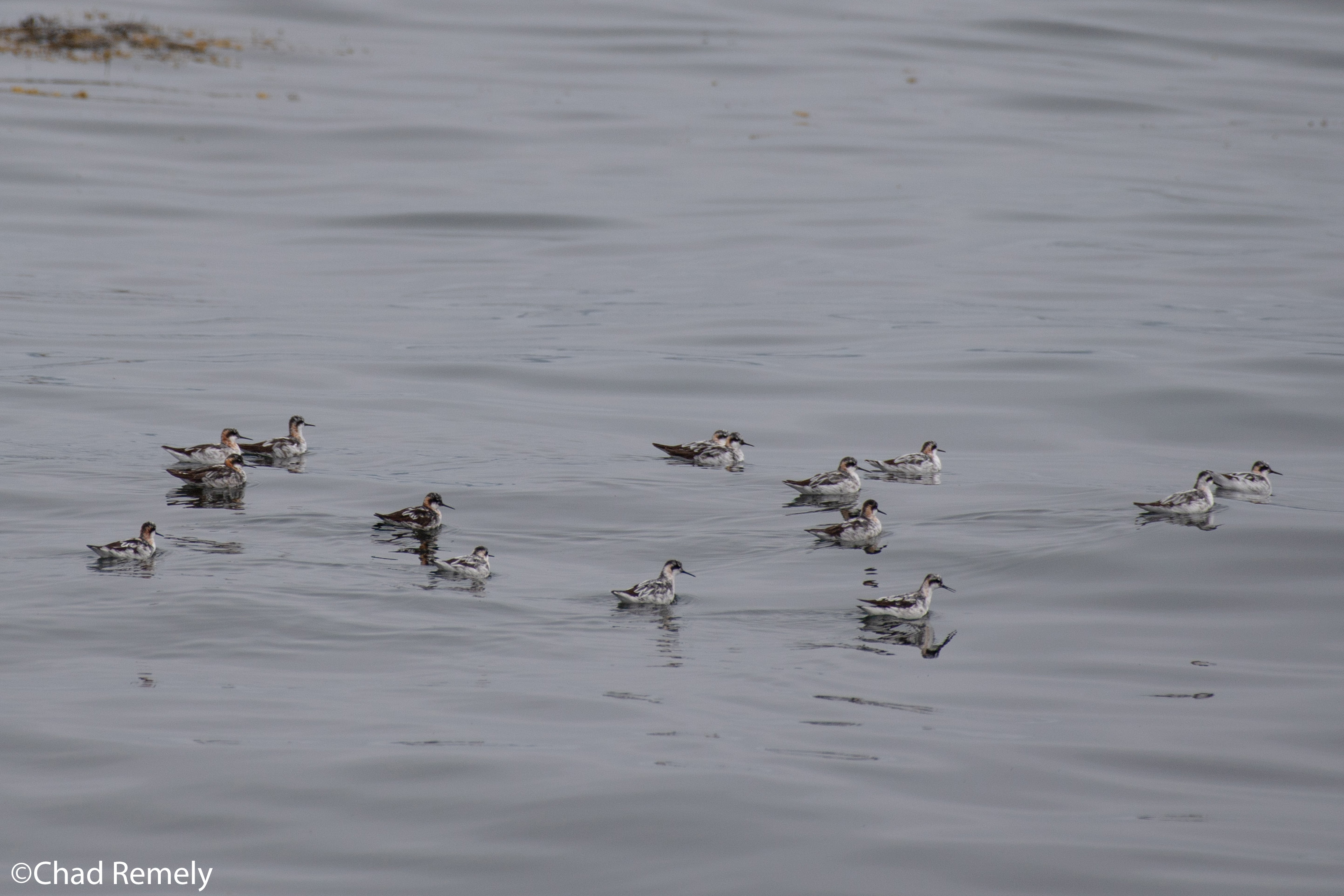
As we left Stonington Harbor, the fog began to thicken, but not before we spotted a group of 15 Red-necked Phalaropes sitting on the water. Captain Tracy did a great job getting us closer, and then inching up to them when they relocated a short distance away. It’s a treat to get so close to phalaropes on the open water.
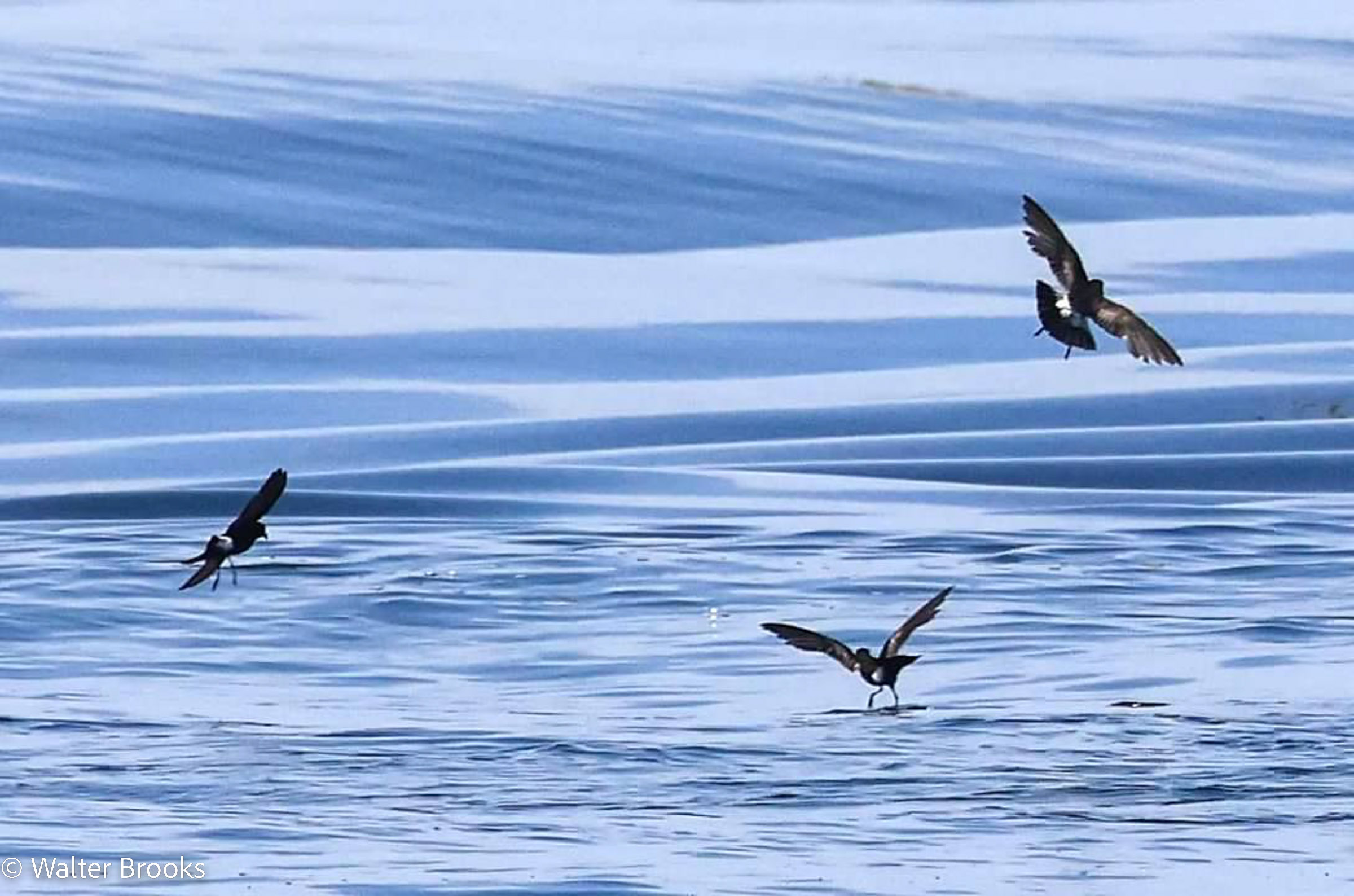
A handful of Wilson’s Storm-Petrels were bouncing around, but the action picked up as usual as we approached Saddleback Ledge Light. A 1st summer Great Cormorant was surveying the scene, and our first Atlantic Puffin circled around us for a couple of passes. After we ourselves circled the small island twice, we turned for Seal and immediately ran into dense fog that had slowly been creeping in. The tradeoff for calm waters is often fog, and it was pea soup today.
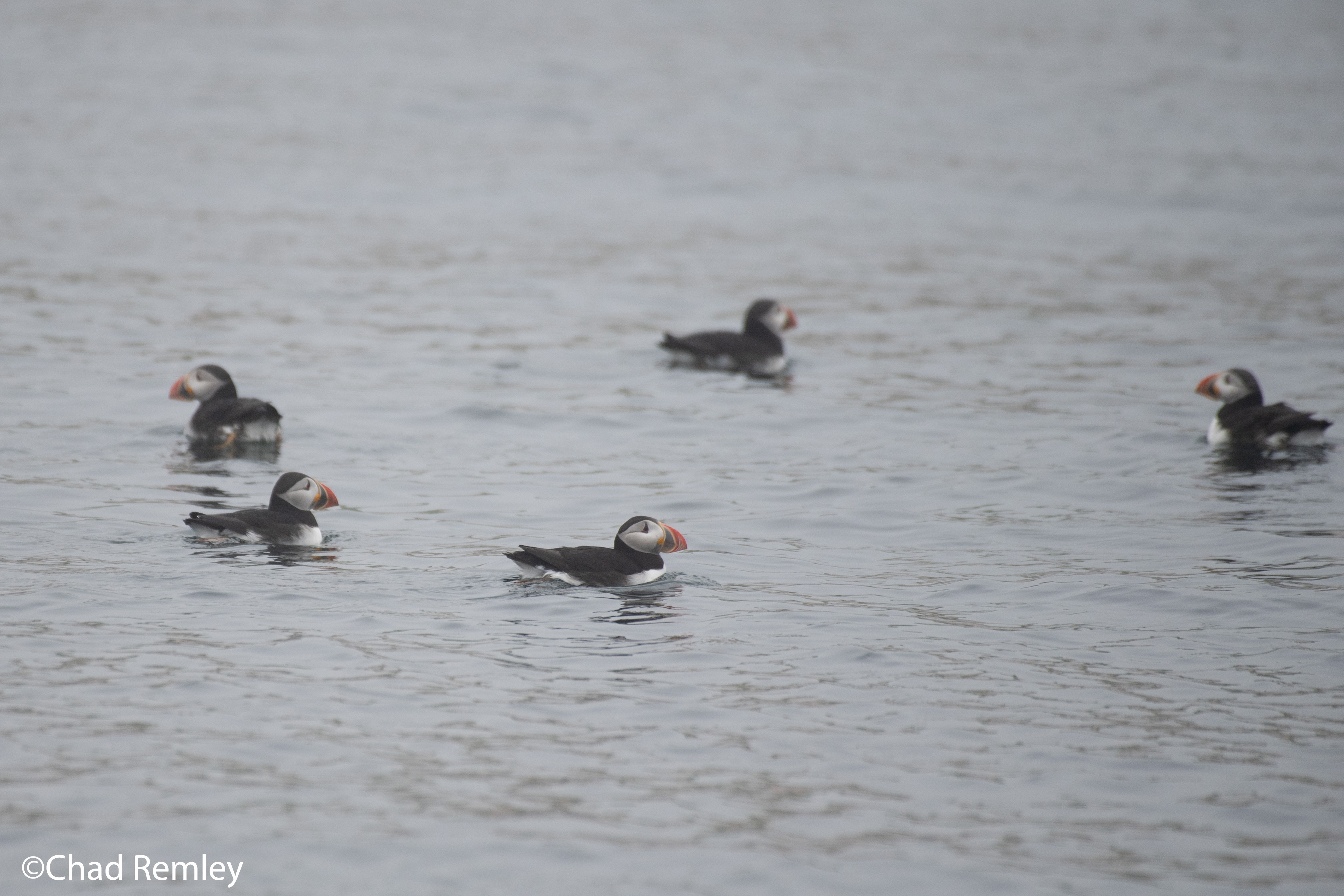
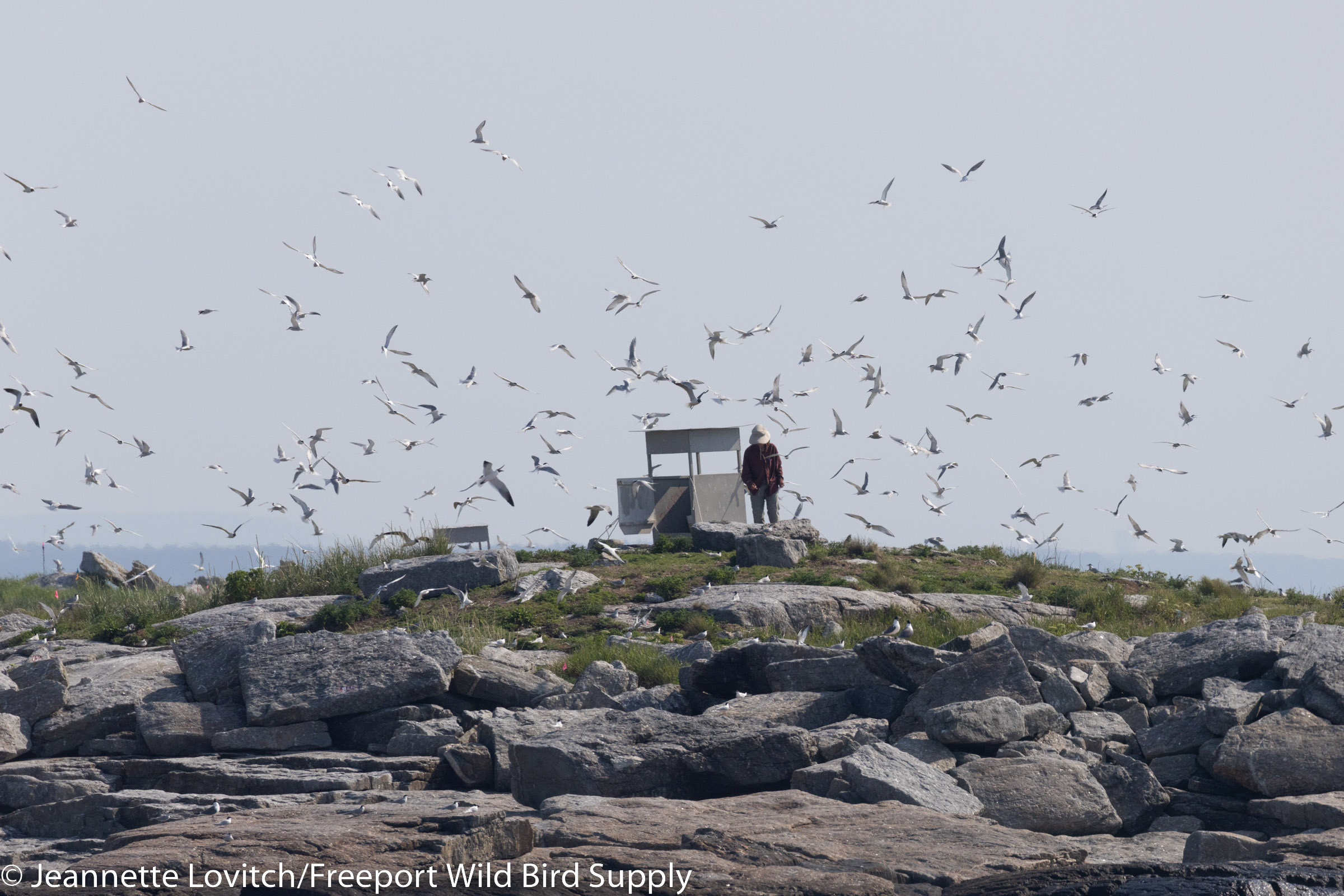
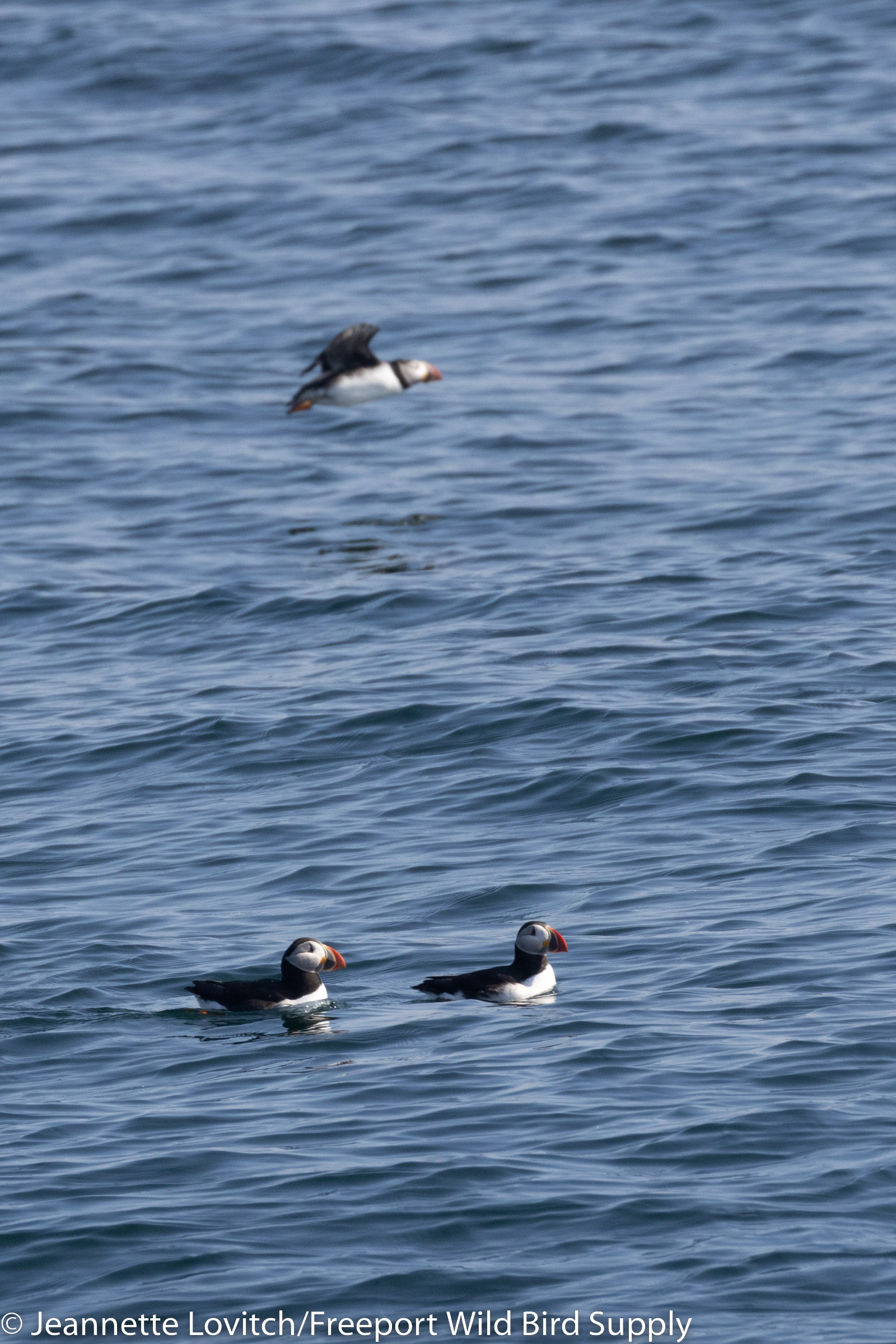
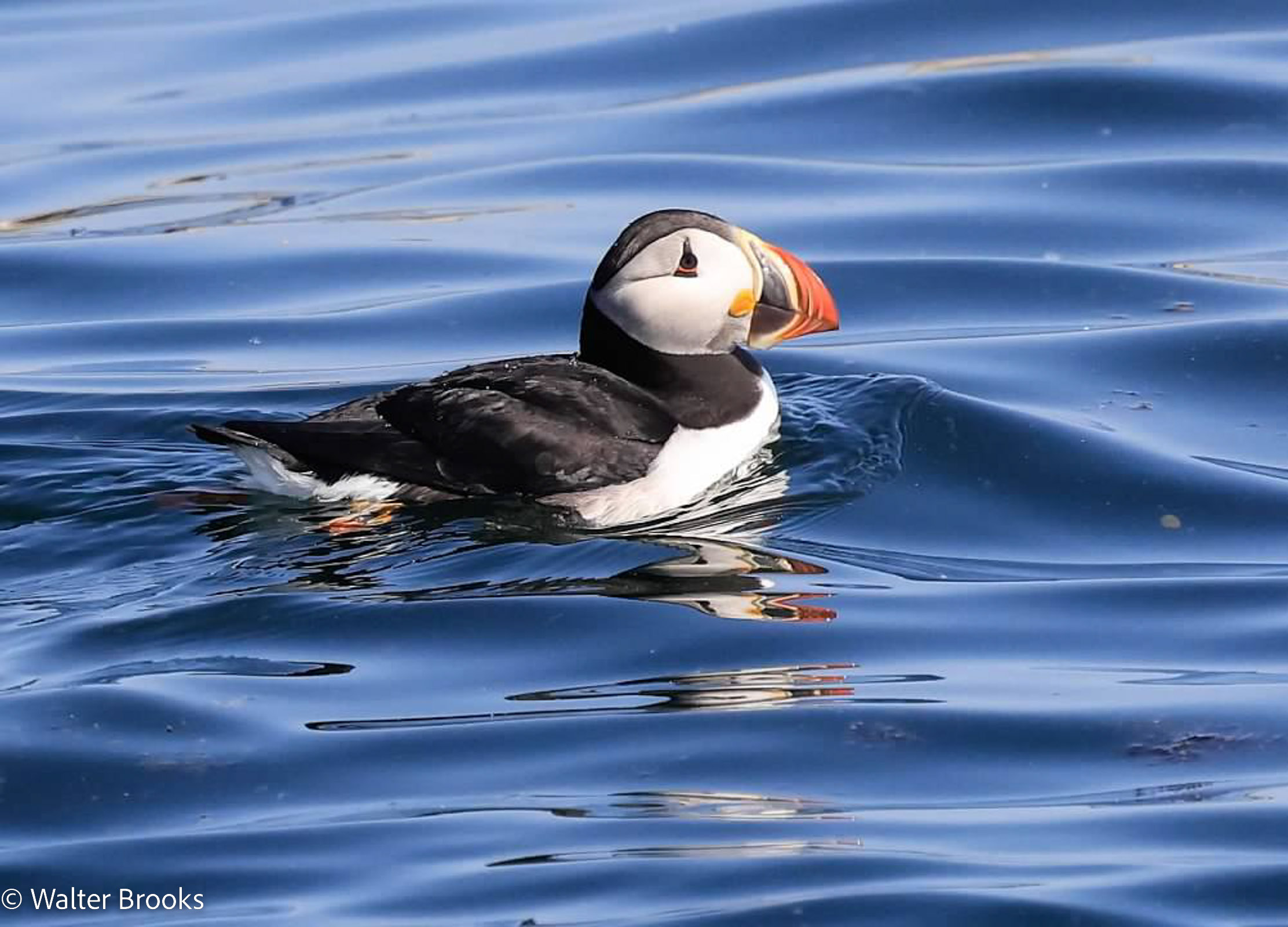
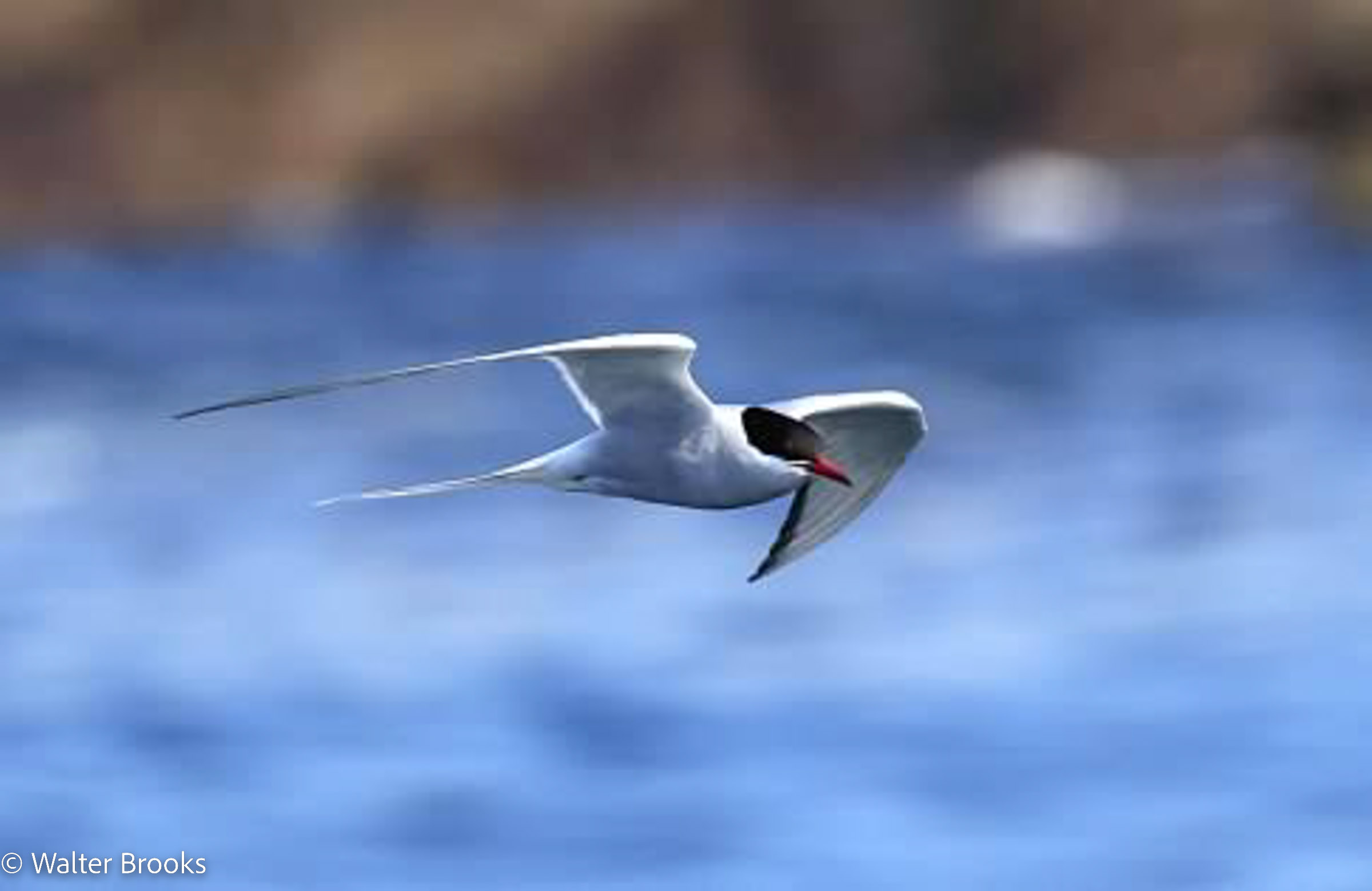
Not surprisingly, we saw little en route, but soon enough, we were out at Seal. While we heard – and even smelled – the tern colony before we could see the island, once along its shores, visibility was adequate. Arctic Terns put on a particularly good show for us, with several near the boat feeding and bathing. Arctic and Common Tern fledglings were everywhere, and we enjoyed their antics. There were plenty of Atlantic Puffins in the water and on land, including several groups that were remarkably confiding as we sided up to them in the glass-calm waters. And Black Guillemots were numerous, and very busy.
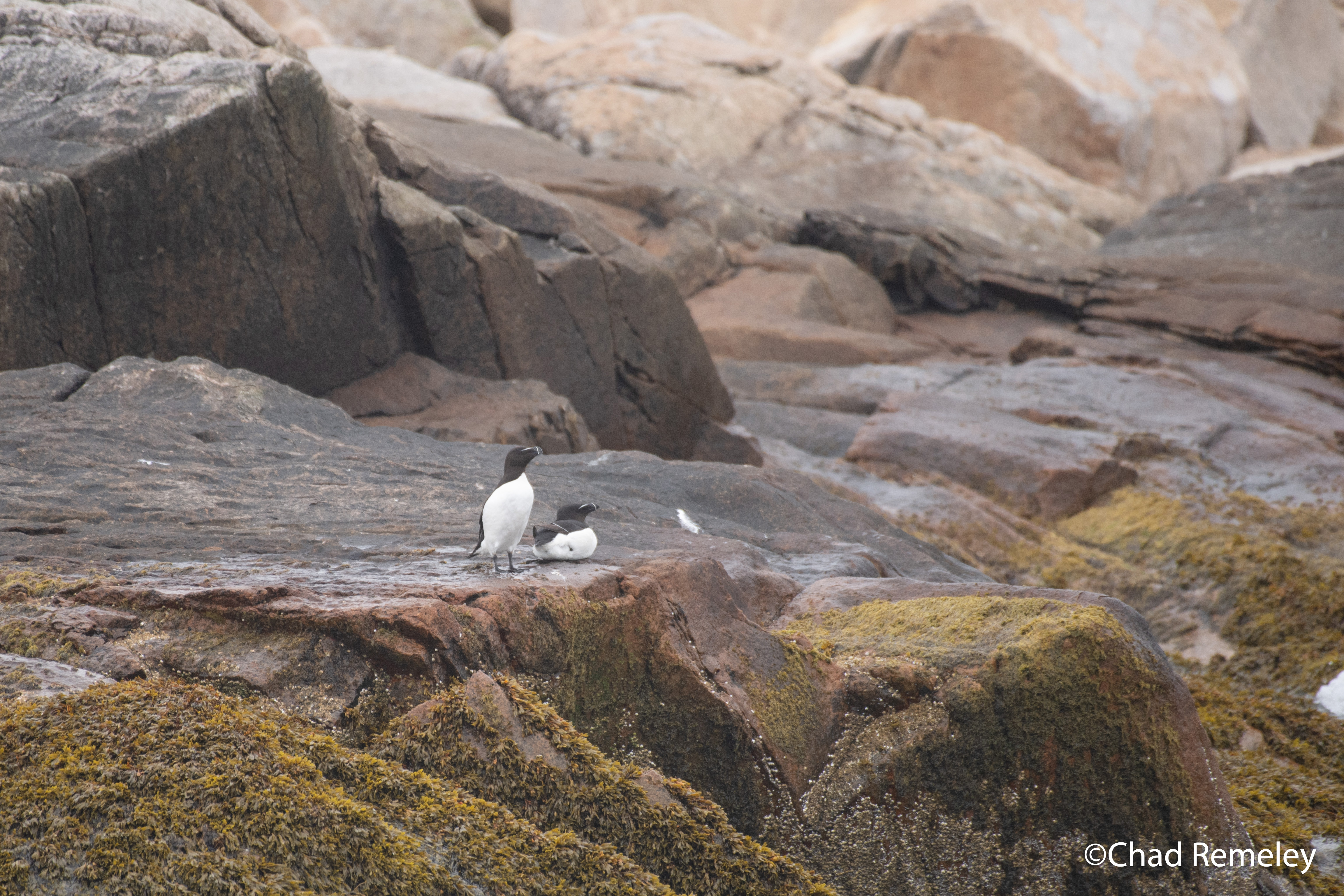
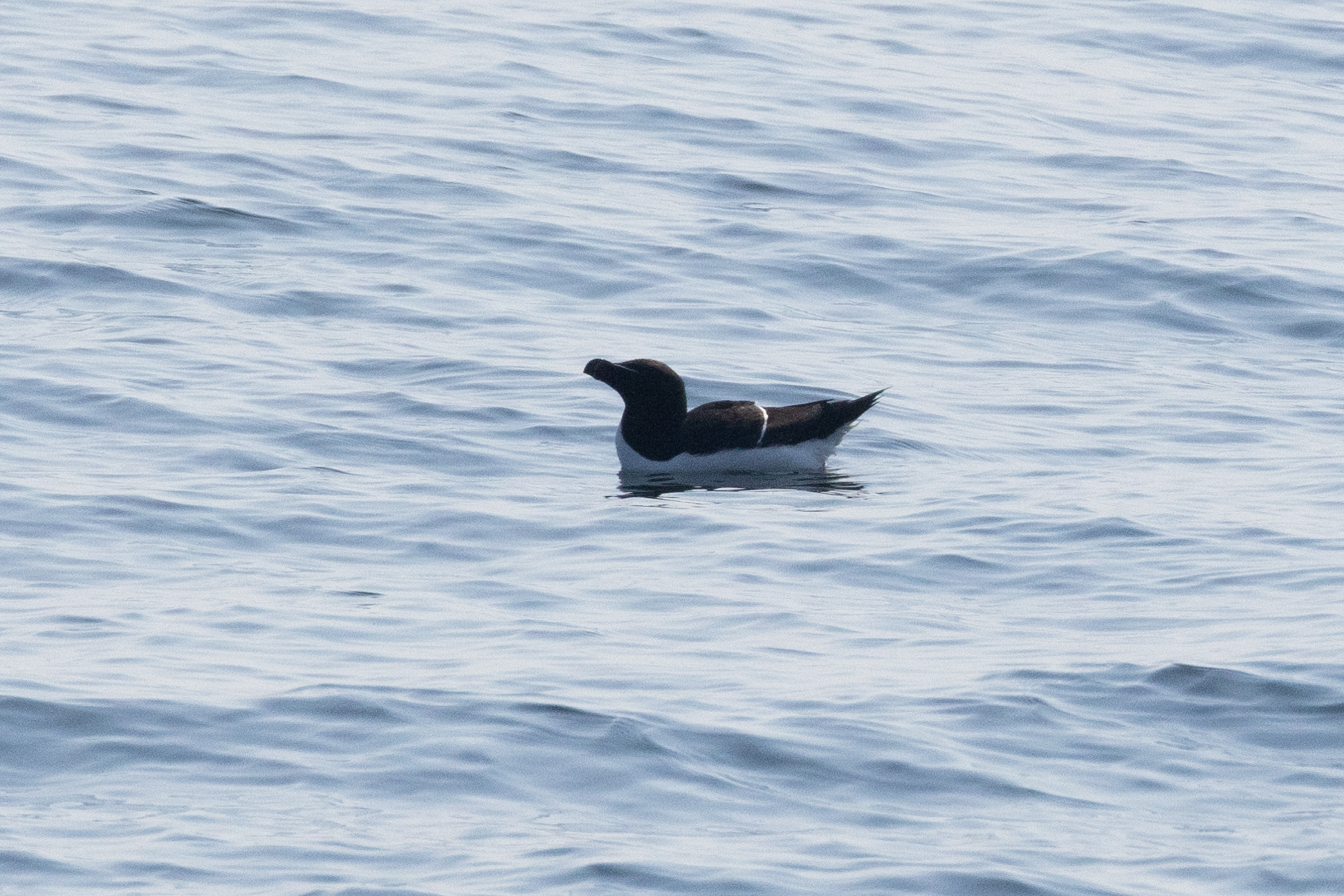
Razorbills were fledgling rapidly, so we only found two on the island, but later, we had great looks at one on the water, too.
We circled around the southern end, spending some time observing the state’s last colony of Great Cormorants (and Double-crested); nests were brimming with chicks!
We kept an eye out for migrant shorebirds in addition to the locally breeding Spotted Sandpipers, but visibility remained a challenge: 4 Short-billed Dowitchers, 3 Least Sandpipers, and some unidentified peeps was the best we could do. A Great Shearwater made a close, but brief, pass as we were on the east side of the island before vanishing back into the fog.
Somehow, it was even foggier on our way back, so seabird sightings – even with a second visit to Saddleback Ledge – were limited to just a couple more Wilson’s Storm-Petrels.
So yeah, the fog was annoying, and did impact photos and our search for the next mega-rarity. But it also produced one of the smoothest boat rides you’ll ever be on in the Gulf of Maine and yielded lots of close puffins and some great looks at phalaropes. And besides, any day birding from a boat is a good day in our book! Especially when a few days prior we thought this trip was going to be cancelled due to wind and thunderstorms.
Beginning in 2022, Cap’n Fish’s Cruises in Boothbay Harbor and Freeport Wild Bird Supply have partnered together to offer a mid-summer seabirding opportunity. I join the boat’s naturalist as a seabird and pelagic specialist, to help everyone see all of the breeding seabirds at Eastern Egg Rock (Atlantic Puffins; Arctic, Common, and Roseate Terns; Laughing Gulls; and sometimes Razorbill and Common Murre) before we venture offshore in search of whales. While doing so, we pay special attention on this cruise to the bird life – which is often found at the same places where we are looking for whales. This trip gives us a slightly more bird-centric tour compared to the regularly-scheduled departures.
Here are the trip reports from this very popular annual event.
July 16. 2022
Seas were fairly high (3-5ft) as we bounced offshore to deeper water first. Wilson’s Storm-Petrels were soon visible, and we passed one Razorbill. We could not stop or turn around for it as the seas were just a little too rough for that, and this was unfortunately our only Razorbill of the day. We cruised around waters over 300 feet deep, and were treated to a good performance from Great Shearwaters, Wilson’s Storm-Petrels, and picked up a few Sooty Shearwaters. We had one offshore Atlantic Puffin, but the big surprise was a rare, mid-summer NORTHERN FULMAR – definitely the pelagic bird of the trip.
With the seas building, we made a turn and took advantage of much more pleasant conditions as we trolled the area, giving people a better chance and seeing the aforementioned species. We also spotted a couple of Mola Molas, but no marine mammals, unfortunately.
Away from Eastern Egg Rock (both coming and going), our offshore (“pelagic”) scorecard was:
76 Great Shearwaters
61 Wilson’s Storm-Petrels
21 Northern Gannets
3 Sooty Shearwaters
2 Arctic Terns
1 Razorbill
1 Atlantic Puffin
1 NORTHERN FULMAR
1 Common Loon
scattered Common Terns and unidentified Sterna
As we approached Eastern Egg Rock, the action really picked up with all of the island’s breeding species soon apparent. Roseate and Arctic Terns joined the multitudes of Common Terns. At least a dozen Roseates included several putting on a good show, and we singled out quite a few close-passing Arctic Terns for good studies. 4 migrant Ruddy Turnstones joined island-breeding Spotted Sandpipers onshore, and we heard a couple of singing Song Sparrows. And of course a plentitude of Laughing Gulls; about half of the entire state’s population breeds here. Black Guillemots were also conspicuous today.
But Atlantic Puffins are the star of the show out here, and today, they did not disappoint. In fact, it was a great mid-summer performance, with several dozen on the water – often in very close proximity to the boat, commuters passing by, and dozens more stately stationed on the island’s rocks.
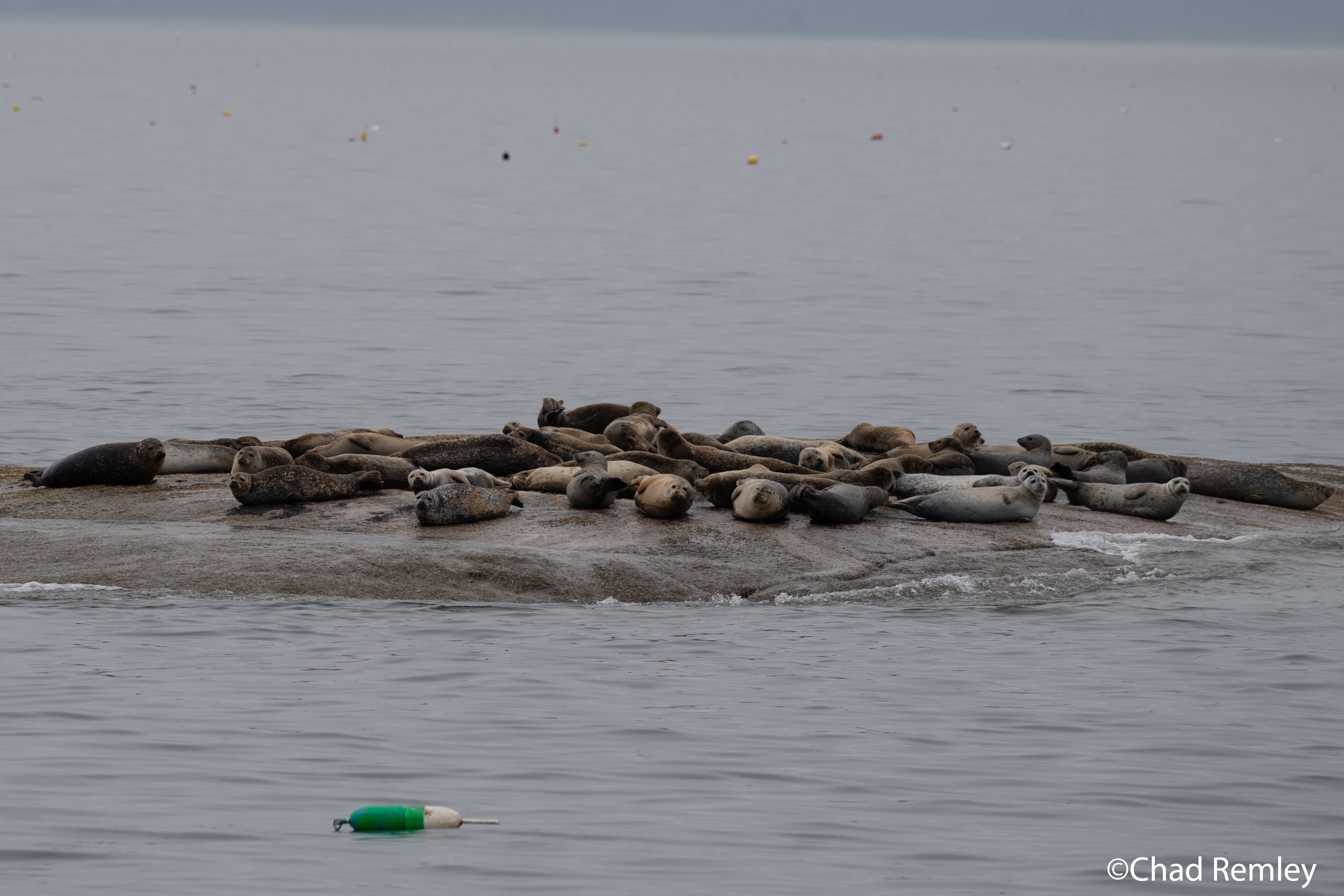
We wandered offshore on the way back, near where the boat had recently seen whales, added a few birds to the tallies, but alas, the only marine mammals of the day were two species of seals: lots of Harbor Seals and two Gray Seals. Hopefully, this got the seal of approval from the marine mammal watchers aboard today.
July 10, 2023.
A Parasitic Jaeger got everyone to our feet as we were motoring home through the fog.
With even more anticipation than usual, birders flocked aboard for this afternoon departure. Three hours earlier, I had spotted the near-mythical Tufted Puffin on Eastern Egg Rock aboard Cap’n Fish’s morning Puffin Cruise. We made a bee-line for the island’s north end, but alas, the Tufted was not to be seen.
Nonetheless, we had a fantastic visit. Fog resulted in many of the island’s Atlantic Puffins being in the water and we had close birds all around the boat. We studied Arctic and Roseate Terns among the masses, making sure everyone had at least one rewarding look at each. While we searched vigilantly for the Tufted, we picked out one of two American Oystercatchers that have been here this summer, and just as we were about to leave, the single Common Murre floated around just off our bow.
It didn’t take long before our first Wilson’s Storm-Petrels of the day to be sighted, with small groups and singletons here and there throughout the rest of the trip for a total of 100-150 or so. Fog only thickened as we traveled further offshore, however, although we did find a hole where the visibility increased dramatically for a spell. While we searched diligently for whales to no avail (but plenty of Harbor Porpoises today), birds began to appear one by one.
A good look at a Sooty Shearwater. A glimpse of a Great Shearwater was followed later by a cooperative one that allowed close approach on the water. One group spotted a Manx Shearwater heading straight away, and a couple of other distant shearwaters disappeared into the fog. We only saw a few gannets today, scattered Common Loons on our way to and from, but a subadult Parasitic Jaeger spiced things up on our ride back (photo above).
Considering how dense the fog was, we were happy to spot much of anything once we left the rock, and considering we remained just east of torrential rain all day, we were more than satisfied with the comfort of what we did see!
Thanks to our store’s partnership with Zeiss Optics, our biannual “Zeiss Day” occurred offshore this spring. With Zeiss’s sponsorship, we were able to offer this unique trip at a special price, with extra spotters to help people see birds, and of course, with chumming.
And the weather could not be any better! In fact, we were all excited to head offshore to beat the heat on this day. Barely a puff of breeze resulted in remarkably calm seas, with the only waves caused by our boat. Thanks to the weather gods for this day offshore!
Evan Obercian, Dan Nickerson, and Jeannette helped spot birds, Noah Gibb handled the checklists, and Robby Lambert – chummer emeritus – stood at the ready as the boat’s naturalist, Kelsey, and I scanned from the wheelhouse. Our captain was amazing, and together we laid out a plan for the day. Throughout the day, Rich and Bill from Zeiss handed out binoculars to try and lots of optical questions were answered. It was a great way to test-drive a new pair of excellent binoculars, especially noting how important size and weight is when trying to hold binoculars steady on the open ocean, even without much in the way of waves.
Robby at his office.
Motoring out of Boothbay Harbor and across Muscongus Bay, we familiarized ourselves with the common denizens of Maine’s summer coast, such as Common Eiders, Black Guillemots, Common Terns, and Ospreys. Kelsey pointed out landmarks and gave a little history of the area.
Our first destination was Eastern Egg Rock, home to a thriving seabird colony thanks to the restoration efforts of Project Puffin. Leading pelagic trips in June is easy when at least some of our target birds are guaranteed!
The amazingly calm conditions and unusually warmth worked in our favor, as many of the island’s Atlantic Puffins and Black Guillemots were in the water instead of loafing on the rocks, allowing us to drift closely to many of them. One of the island’s ephemeral Razorbills was spotted near the boat, giving us long and good looks as well.
Razorbill.
Of course there were the terns, and for a change, both Roseate and Arctic were easy to isolate for all to see. With the help of my spotters, and a cooperative pair of Roseates on an obvious rock, everyone saw each species well, as well as many hundreds of Common Terns of course. And a thousand or so Laughing Gulls, too.
Arctic Tern.
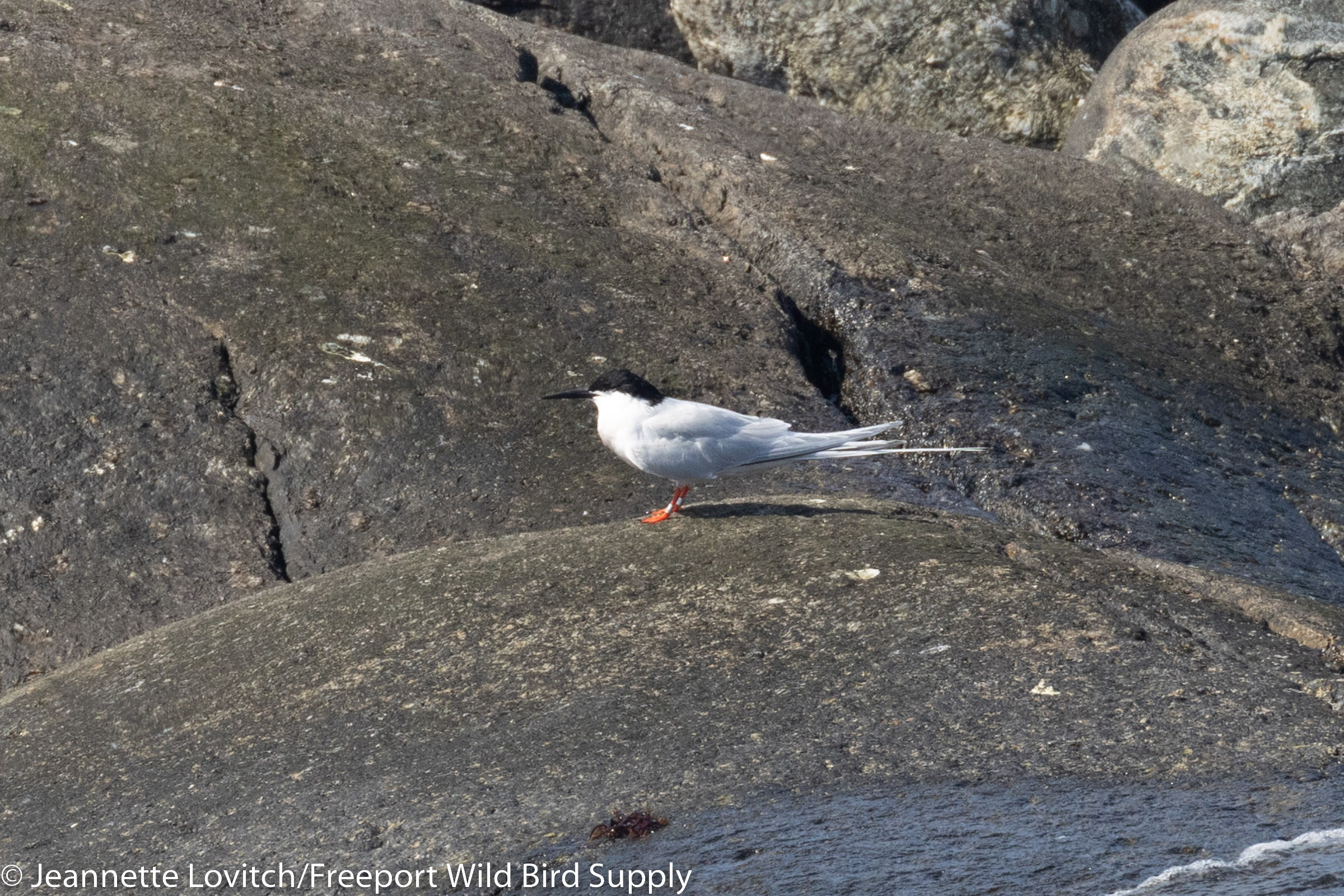
Roseate Tern.
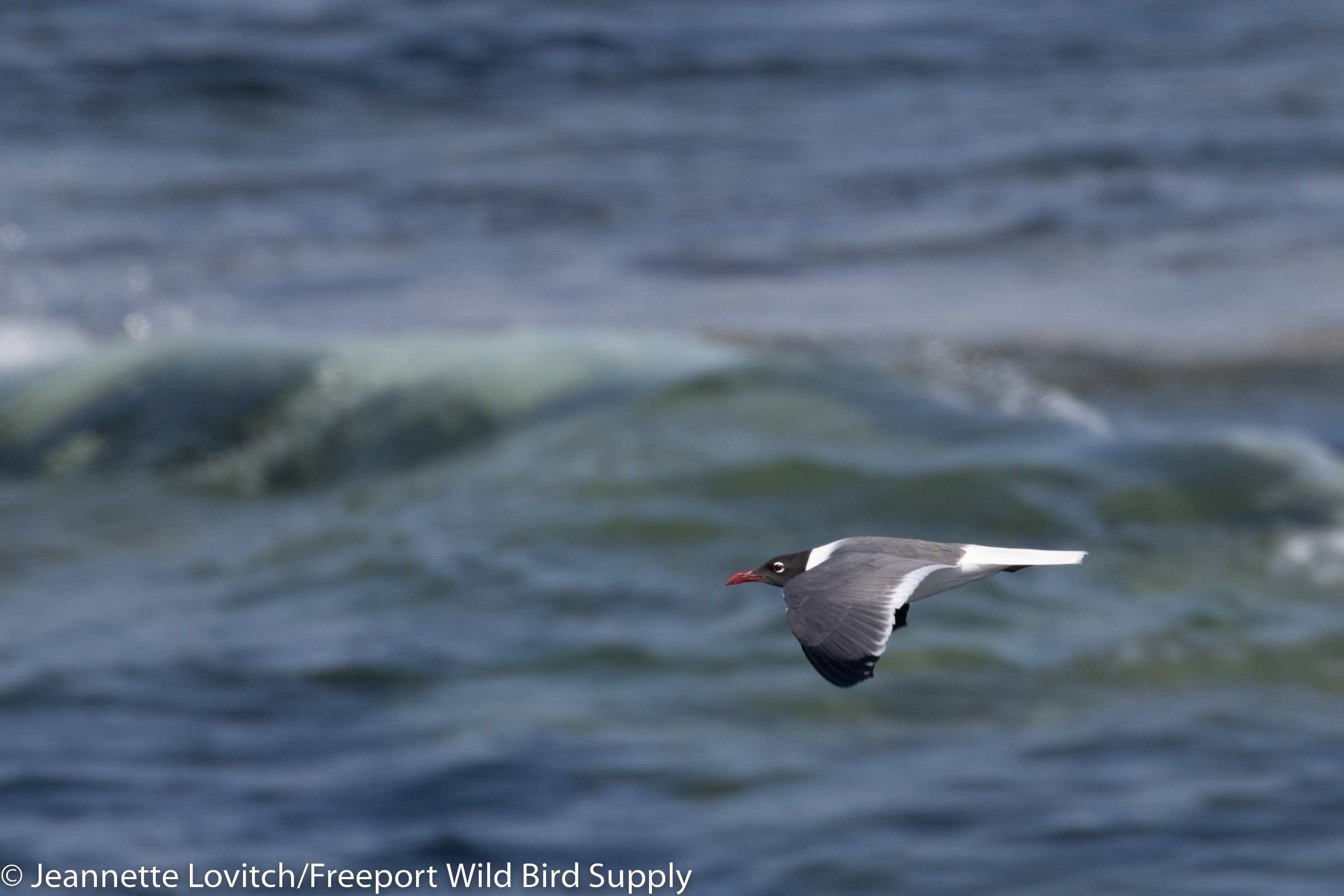
Laughing Gull
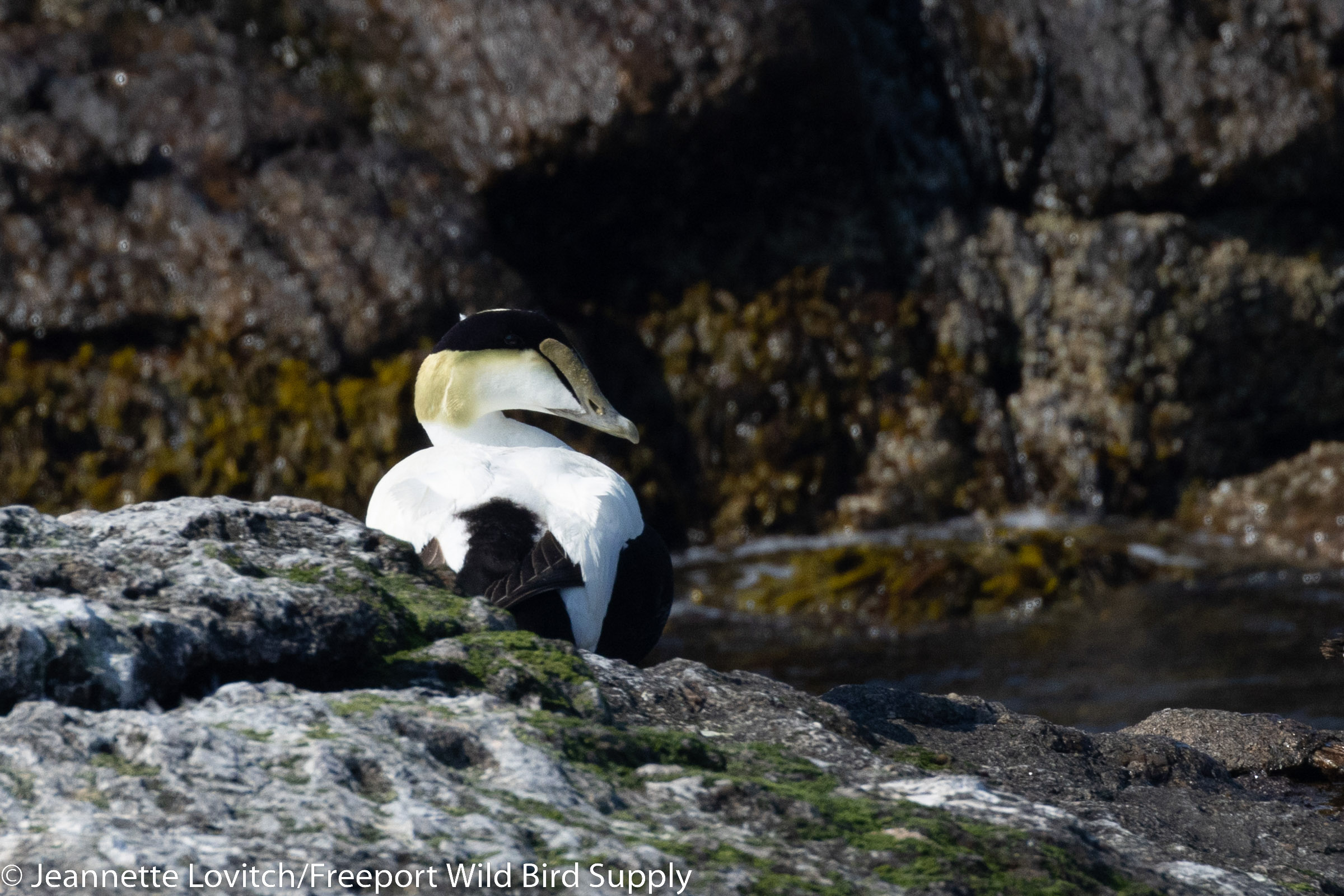
Common Eider.
Satisfied with our views of the island’s denizens, we turned offshore and followed the Arctic Terns to deeper waters. It wasn’t too long before we started seeing scattered Wilson’s Storm-Petrels, but we slammed on the breaks when I spotted a Common Murre on the water up ahead. Captain Steve was able to circle the bird for all to see and photograph before we continued on; the murre was most obliging. It also made for the hoped-for 4-alcid day, which is always a challenge this far south.
The lack of swell allowed us to make good progress and afforded us the chance to check three offshore hotspots. A good number of Wilson’s Storm-Petrels and a few Northern Gannets were at Murray Hole, but we motored through it.
We laid down a mile-long chum slick at The Kettle, but only a few of the many Wilson’s Storm-Petrels came in to check it out. I think it was simply too calm today – the scent wasn’t drifting, and birds – especially any shearwaters out here – were just not taking flight to forage; it’s just too inefficient without any wind for them to bother. But a fly-by from a southbound Ruby-throated Hummingbird nearly 20 miles offshore was unexpected!
We continued to tally Wilson’s when we set up a second chum slick at Mistaken Ground, but once again, little was interested, and only a few Wilson’s and gannets were to be seen.
Despite our extended time with the charter, it was soon time to head back to port, but we kept our eyes peeled throughout the trip. On the way back, we had a flock of 12 Red-necked Phalaropes buzz by and eventually land on the water, but we were going too fast and behind schedule to be able to turn around in time. Later, we passed not one, but two Basking Sharks, which was a real treat.
Harbor Porpoise and Harbor Seals were seen now and again, but overall, the offshore waters were quite slow – especially with gulls. The few gulls around didn’t even seem interested in our popcorn and suet, either.
Robby contemplates the meaning of life…and chum.
Our tally of Wilson’s Storm-Petrels was decent enough, but sadly, this would be our only tubenose of the day. Northern Gannets were in low numbers, as if often the case in early June, and whatever shearwaters may have already arrived may simply have been sitting on the water somewhere waiting for a breeze. I also felt terrible that not everyone saw the phalaropes.
Nonetheless – thanks to a perfect visit at Eastern Egg Rock and a random Common Murre floating offshore – I would call the day a smashing success! And for $40, few complaints were audible. The weather helped, too.
Rich talks optics.
Thanks to Zeiss for making this idea of mine come to fruition, and thanks to Cap’n Fish’s for letting us charter the boat to make this all happen. And most importantly, thanks to everyone who signed up and helped us explore the Gulf of Maine at this woefully under-birded time of year. Every day is different offshore, and you never know what you will or will not see. Excitingly, I am pleased to announce that Rich said, “let’s do this again next year!” Hope to see you aboard!
Here’s the complete trip list, from dock to offshore and back. Thanks to Noah for compiling this!
Not surprisingly for the end of May, Blackpoll Warblers were the dominate migrant on Monhegan this weekend. However, we never tired of seeing both males (above) and females (below) so well each and every day.
A point-blank Bay-breasted Warbler. Up close and personal Magnolia Warblers, Northern Parulas, and 9 other species of warblers including more Blackpoll Warblers than we knew what to do with…and we hadn’t even made it up the hill of Dock Road yet!
In other words, our 2023 Spring Monhegan Migration Weekend tour got off to a great start as we really hit the ground running. Then, a calling Evening Grosbeak. A fly-by Black-billed Cuckoo…more. Hmm… it was time to check in, and happily, shed a few layers.
After lunch, the excellent birding continued, with highlights including a flock of 10 Bay-breasted Warblers, a spiffy male Orchard Oriole, and great looks at a Philadelphia Vireo. By day’s end, we had 59 species including 13 species of warblers – not bad for a mid-morning arrival!
Yellow Warblers (above) and Common Yellowthroats (below) were common and conspicuous in and around town and other scrubby environs as expected.
It was cool and clear on Saturday morning, and the overnight radar image was a little ambiguous. Did the light westerly wind overnight push birds offshore as they approached from the south, or was that all just pollen and smoke haze in the atmosphere? However, the radar return did suggest birds offshore in the early morning, so we were excited to find out. Afterall, I did not expect yesterday to be so good, and it was excellent.
While only a few warblers were overhead by the time we assembled around the coffee pot at 6:30, it took a while for us to leave the spruces behind the Trailing Yew, as we had a nice pocket of warblers and good early-morning activity. We teased out a Blackburnian Warbler – the only one of the weekend, and the 3 White-winged Crossbills that have been on the island paid us a visit. Later in the morning, we caught up with the stunning male Dickcissel that has been around for a while, and were among the first to see a pair of recently-arrived House Finches (a surprising rarity on the island!). We also found a flock of 10 tardy White-winged Scoters and a total of 6 Surf Scoters that briefly visited Deadman’s Cove.
After lunch, we had the female/immature Summer Tanager, a female Orchard Oriole, found an Olive-sided Flycatcher, and while the afternoon was overall rather quiet, we had lots of great studies of a variety of birds, especially Blackpoll Warblers.
Although far from one of our best birding days on the island, it was noteworthy how well we saw just about everything. Even with a full group, birds were overwhelmingly cooperative, and everyone thoroughly enjoyed the birding…and another beautiful day of weather!
Many of our common warblers were easy to see, photograph, and enjoy throughout the weekend, such as this Northern Parula (above) and Black-and-white Warbler (below).
Saturday night into Sunday morning saw another ambiguous radar image, but the overall small number of new arrivals suggested that most of the return was something other than birds this day.
That being said, we started the day with one of the birds of the trip when I nearly spit out my coffee when I realized that flock of cormorants that looked strange was actually a flock of 9 Glossy Ibis. They circled the town, looked to be pondering the town marsh, and then soared up high and over Lighthouse Hill. Incredibly rare for the island, these were a new “island bird” for me, and we felt very fortunate that we were one of the only birders (I believe only one other birder saw them at all) on the island that got to see them. The “lingering around the coffee pot at the Yew” strikes again!
As expected, it was relatively slow overall, but even after the excitement of the ibis, we continued to enjoy ourselves. We had great looks at a lot of things all morning, including common warblers like American Redstarts and oodles of Blackpolls. We had our best looks yet of feeding Red Crossbills – they were all over the island this spring! – spotted a Peregrine Falcon, and continued to marvel at the growing flock of swirling Blue Jays contemplating a trip back to the mainland.
Ring-necked Pheasants kept us entertained as always, however.
After breakfast, we had another good find when a Purple Martin flew over us, and a bigger flock yet of Red Crossbills entertained us for a while. Jeannette arrived and joined the group to help carry my scope and to take photographs for this trip report, as well as help us find more birds.
Juvenile Red Crossbill.
It was warm and fairly slow, so I needed all the help I could get. Regardless, we added species to our trip list here and there in the afternoon, with quality surpassing quantity. We visited the long-staying 1st year male Blue Grosbeak that has taken up residence at Lobster Cove, where, unlike most Blue Grosbeaks, it has taken to flycatching for seaweed flies in the wrack. Why it is doing this no one knows, but it was a fascinating behavior to watch. Birds and birding on Monhegan never cease to amaze!
The Blue Grosbeak.
A little later, we found an immature Broad-winged Hawk, or again, it found us, as it passed right over us as we poked around the Underhill Trail to find some birds in the shade and in cover. It was often a struggle to find birds this afternoon, and it was downright hot! But I heard very few complaints compared to the slow days when it’s 45-degrees, windy, and raining!
We spent a lot of quality time observing birds today, getting to know their behavior and natural history, such as these courting Cedar Waxwings.
While also practicing our field ID skills, such as Eastern Wood-Pewee.
And enjoyed whatever warblers we did encounter, including this male Black-throated Green Warbler.
Monday saw even further reduced activity, with a very summer-like feel to the birding. The migrant flock of Blue Jays built up to at least 46, a Pine Siskin must have just arrived, and some of us even spotted the Virginia Rail! While passage migrants were few – almost all Blackpoll Warblers – we still had a great day of birding thanks to continued great views of most of what we were finding. There was a Northern Parula nest that a friend found for us to marvel at, and we had quality time once again with a family group of Red Crossbills. Watching them, especially the juveniles, eating buds and cones of Red Spruce at close enough distance to see if they were “righties” or “lefties” was memorable, and more than worth the visit. We had the male Orchard Oriole again, and paid the Blue Grosbeak another lengthy visit.
We took some time to scan the skies over the marsh while also enjoying “Lefty,” the Red-winged Blackbird with white outer primaries on only his left wing. He’s back for the second year.
One of the few birds we missed as a group all weekend was a long-staying but frustrating Snowy Egret that never seemed to stay in the same place long. It was reported at the Ice Pond while we were having breakfast, and Jeannette and I raced down to see it. The “racing” part after the new and ample breakfast buffet at the Trailing Yew may not have been the best decision, however, we got the bird! It was another island bird for me (#226) and I am glad I made the decision to skip the break to chase it, as it was long gone by the time our group arrived at the Ice Pond. I always like to get those chases out of my system before making a bad leadership decision and marching people across the island for a bird that only I cared about! (Since they are locally common on the mainland, only an island-lister cares about such silliness).
As the afternoon wore on, the group slowly moseyed away from the Blue Grosbeak-evolving-into-a-flycatcher and made our way back to town to catch the last ferries of the weekend, bringing the tour to a close.
A friend found a Northern Parula nest under construction that we took time to marvel at. Here, the female brings some more material in to line the nest, which is nestled in a woven basket inside of large clumps of down-hanging Old Man’s Bear lichen.
However, as usual, Jeannette and I stayed around for another 24 hours to have a day off together and with friends. Leaving the brewery with one friend, I found a male Eastern Bluebird- an odd “new bird” for the date. Where the heck has he been or where did he just come from? Another Monhegan bird mystery…their migration ended a month ago.
Later, as we walked back from dinner with other friends, we heard at least three displaying American Woodcocks. The sunset was quite the stunner, too.
I wasn’t upset to not have a group on Monday, because my goodness, it was slow! I think what was left of the passage migrants cleared out overnight, and little if nothing came in. There were a few Blackpolls here and there, and maybe a few more American Redstarts than usual in the summer, but in and around town, that was about all.
So Jeannette and I decided to take a longer hike and check some oft-productive-but-less-often-birded areas. In doing so, we found a Field Sparrow on Horn Hill, and had a singing Yellow-bellied Flycatcher between Burnt Head and White Head. An adult male Sharp-shinned Hawk was a surprise – was it breeding here? – and a visit into the shaded woods added Winter Wren and Swainson’s Thrush to our weekend list.
We got excited when we saw a gray-backed, white-bellied flycatcher over at Gull Pond, but alas, it had the expected short, not-forked tail that we were hoping for!
Not including the 7 species Jeannette and I saw between 3:00 on Monday and when we departed at 3:15 on Tuesday, the tour list for the 12th annual Monhegan Spring Migration Weekend ended up a goodly 90 total species, despite only 15 species of warblers. The overall count was better than our last two tours, but still below our long-term average. But I cannot recall four (and five) days of simply gorgeous and warm weather on any of our prior tours! While the benign weather of late reduced the volume of migrants yet to pass through, and allowed many recent migrants to pass unimpeded overhead, I was pleasantly surprised by the final tally. It was also a high-quality list, with lots of “good” birds not seen by many in Maine away from the island. Oh, and my two island birds were nice, too!
Blue Jays are not the biggest feeder bird on this island!
Even our most common and familiar birds present speciaal photographic opportunities out here!
Species
5/26
5/27
5/28
5/29
Mallard
x
10
10
8
Mallard x American Black Duck
1
0
0
0
Common Eider
x
x
x
x
White-winged Scoter
0
10
0
0
Surf Scoter
0
6
0
0
Ring-necked Pheasant
x
6
6
5
Mourning Dove
8
10
8
10
Black-billed Cuckoo
1
0
0
0
Chimney Swift
0
0
1
0
Ruby-throated Hummingbird
6
4
3
1
Virginia Rail
h.o
h.o
1
1
Semipalmated Sandpiper
0
0
1
0
Greater Yellowlegs
0
1
0
0
Black Guillemot
20
30
x
20
Laughing Gull
6*
2
1
6
Herring Gull
x
x
x
x
Great Black-backed Gull
x
x
x
x
Common Tern
1 + 5*
0
0
0
Northern Gannet
0
0
0
1
Red-throated Loon
0
1
0
0
Common Loon
3*
1
0
0
Double-crested Cormorant
x
x
x
x
Great Blue Heron
0
0
1
3
SNOWY EGRET
0
0
0
1**
GLOSSY IBIS
0
0
9
0
Bald Eagle
2
1
0
0
Osprey
0
3
2
2
Red-bellied Woodpecker
0
0
1
0
Merlin
2
2
1
0
Peregrin Falcon
0
0
1
0
Eastern Kingbird
0
0
2
2
Olive-sided Flycatcher
0
1
0
0
Eastern Wood-Pewee
2
2
2
2
“Traill’s” Flycatcher
2
0
1
0
Least Flycatcher
2
1
1
0
Eastern Phoebe
1
1
1
1
Philadelphia Vireo
1
1
0
0
Red-eyed Vireo
6
8
4
4
Blue Jay
x
48
47
52
American Crow
x
4
6
x
Common Raven
0
1
1
0
Black-capped Chickadee
x
x
x
x
Tree Swallow
0
2
2
2
PURPLE MARTIN
0
0
1
0
Barn Swallow
1
0
1
1
Golden-crowned Kinglet
0
0
1
0
Cedar Waxwing
30
50
40
30
White-breasted Nuthatch
0
1
1
1
Red-breasted Nuthatch
1
0
0
0
Carolina Wren
3 h.o.
4
4
3
Gray Catbird
x
x
x
x
European Starling
x
x
x
x
American Robin
x
x
x
x
HOUSE FINCH
0
0
2
2
Purple Finch
0
1
2
2
WHITE-WINGED CROSSBILL
0
3
3
0
RED CROSSBILL
0
2
24
20
Pine Siskin
0
0
0
1
American Goldfinch
12
10
12
12
Chipping Sparrow
0
0
1
1-2
White-throated Sparrow
2
2
2
0
Savannah Sparrow
3
0
1
0
Song Sparrow
10
X
x
x
Lincoln’s Sparrow
0
1
1
0
Bobolink
1
1
0
0
ORCHARD ORIOLE
1
1
0
2
Baltimore Oriole
1
4
3
3
Red-winged Blackbird
x
x
x
x
Common Grackle
x
x
x
x
Northern Waterthrush
0
0
1
0
Black-and-white Warbler
3
4
4
3
Tennessee Warbler
8
4
3
0
Common Yellowthroat
x
8
x
x
American Redstart
5
25
16
8
Cape May Warbler
1
0
0
0
Northern Parula
15
10
12
12
Magnolia Warbler
10
8
6
8
Bay-breasted Warbler
11
3
0
2
Blackburnian Warbler
0
1
0
0
Yellow Warbler
10
20
15
15
Chestnut-sided Warbler
2
1
1
1
Blackpoll Warbler
25
60
25
20
Black-throated Green Warbler
1
1
3
1
Wilson’s Warbler
2
2
2
0
SUMMER TANAGER
0
1
0
0
Scarlet Tanager
0
1
0
0
Northern Cardinal
x
x
x
x
Rose-breasted Grosbeak
3
2
2
0
Indigo Bunting
0
1
1
0
BLUE GROSBEAK
0
0
1
1
DICKCISSEL
0
1
1
0
Day Total
60
66
69
54
Warbler Day Total
13
13
12
10
Trip Total
90
Warbler Trip Total
15
Here is the trip list four the four-day tour. * = seen from ferry only. **=not seen with tour group.
For the third week of April, this is not a very impressive report – especially in terms of new arrivals! However, we were in Boston for three days cheering on Jeannette in the Boston Marathon (she did great…Go Jeannette!) and well, now I have frozen shoulder. So, field time remains woefully limited. Nonetheless, I had some observations of note (in Maine) over the past seven days:
~40 Yellow-rumped Warblers (FOY), 40+ Palm Warblers, 8 Pine Warblers, etc, Florida Lake Park, Freeport, 4/15 (with Saturday Morning Birdwalk group).
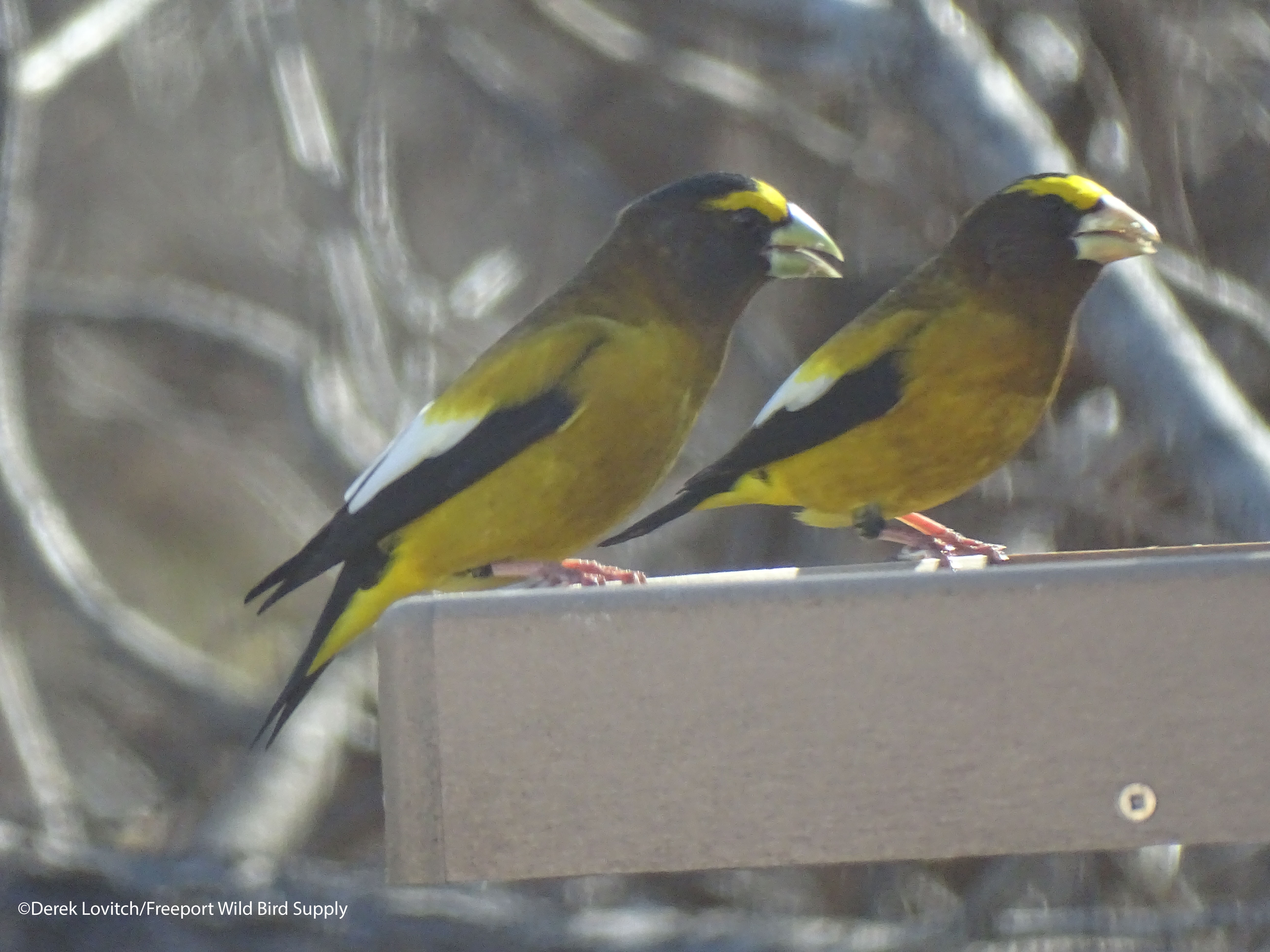
3 EVENING GROSBEAKS, our feeders in Durham, 4/19-20.
My other personal FOY’s this week also included:
2 Swamp Sparrows (FOS), Florida Lake Park, 4/15 (with Saturday Morning birdwalk group).
1 Pied-billed Grebe, Morgan Meadow WMA, 4/21
1 LOUISIANA WATERTHRUSH, Morgan Meadow WMA, 4/21.
1 Broad-winged Hawk, over I-295, Yarmouth, 4/21 (with Jeannette. Finally! I have really been missing spending time at the Brad!)
TOURS AND EVENTS:
Next weekend (April 29-30) is the 13th Annual Feathers Over Freeport that we sponsor with public and private partners at Bradbury Mountain and Wolfes Neck Woods State Parks. We have a full slate of events all day, each day once again, plus a Thursday night (4/27) kick-off presentation at Patagonia in Freeport!
Three Evening Grosbeaks at our feeders in Durham on the 3rd was a highlight this week; they were our first here this year.
It didn’t feel like it on most days this week, but spring was still in the air. My observations of note over the past seven days included the following:
3 male Evening Grosbeaks, our feeders in Durham, 4/3.
1 Pine Warbler (FOY), Brown’s Point Road, Bowdoinham, 4/4.
I enjoyed a fantastic visit to the Mouth of the Abby in Bowdoinham on 4/4. The tally:
1 drake “EURASIAN” GREEN-WINGED TEAL
1 drake “EURASIAN” X “AMERICAN” GREEN-WINGED TEAL HYBRID
269 American Black Ducks
264 Green-winged Teal
90 Canada Geese
28 Mallards
13 Wilson’s Snipe (FOY)
11 Common Mergansers
6 Ring-necked Ducks
4+ Mallard x American Black Duck hybrids
2 American Wigeon
2 Common Goldeneyes
2 Buffleheads
2 Lesser Scaup
1 pair NORTHERN SHOVELERS (FOY)
1 pair Blue-winged Teal (FOY)
1 Hermit Thrush (FOS), Florida Lake Park, Freeport, 4/5.
2 male Evening Grosbeaks, our feeders in Durham, 4/7.
Now that I am back in the field and at work a little more, my feeder-watching at home is just a little less frequent. However, as you can see above, we had some good visitors this week. For continued weekly updates, you can follow “Feeder Watching Friday” posts each Friday on our store’s Facebook page. This week was certainly interesting at the feeding station.
Tour Notes:
Our annual “Woodcocks Gone Wild!” trip at Pineland Farms was rescheduled to Saturday, 4/8 and we are a go. More info here.
Despite a few wintery days this week, spring is most definitely in the air. As I have finally seemed to have turned the corner with my dreadfully slow recovery, I am also getting out a lot more. Therefore, with more to report, and more changes week-to-week, I’ll try to get back into my old habit of weekly posts here.
Observations of note over the past seven days:
increasing number of blackbirds
first trickle of migrant sparrows
1 SNOW GOOSE, our property in Durham, 3/27.
increasing number and diversity of waterfowl inland.
1 Tree Swallow (FOY), Bradbury Mountain Hawkwatch, 3/31.
Despite only getting out into the field twice this week, I enjoyed some good birding. For now, my birding remains primarily feeder- and yard-watching, but this week, it was more evenly split between our feeders at home in Durham and here at the store in Freeport. Blackbird flocks are officially “in” and several species of sparrows are on the move.
At home, Common Grackles and Red-winged Blackbirds are now present daily, in varying numbers (between 4 and 56 and between 3 and 26, respectively), with one or two Brown-headed Cowbirds on most days. Similarly, at the store, small flocks of Common Grackles come and go, but 7 Red-winged Blackbirds are more consistent. One Brown-headed Cowbird made only one appearance here.
A Fox Sparrow that arrived last Friday departed on Tuesday night, and a second Song Sparrow arrived this week. Dark-eyed Juncos continue, with fewer by week’s end. However, a third White-throated Sparrow arrived on the 30th. Here at the store, four Song Sparrows continue, and 2 American Tree Sparrows arrived on the 26th– surprisingly our first two of the entire winter.
At both locations, breeding activity is heating up, too, with more territorial and courtship behaviors observed each day.
The yard highlight, however, was the Snow Goose – Yard Bird #125! -I spotted passing low over our yard on the 27th. While I didn’t technically see it from bed, I did get out of bed – where I was doing some of my physical therapy exercises to look at a large group of geese passing overhead. You may not be surprised to know that we have a pair of binoculars in every room, which is a good thing, as I was able to pull out the lone Snow from a flock of about 75 Canadas.
Speaking of binoculars, I need to take a moment to plug my Zeiss SFL 8×40’s. I fell in love with them when they came out last year, and I was very thankful for them when my shoulder was in pain. They’re just so incredibly lightweight, but I have found minimal tradeoff in brightness, color, etc. Since I am still a one-armed birder, they have been absolutely critical for my ability to look at birds when out and about now. Great balance combined with the light weight just makes them perfect for holding steady with one hand. I do need to rebuild my stamina, however, as there has been a lot of atrophy of field birding muscles over the last 2+ months!
Anyway, back to waterfowl….another highlight this week was the arrival of Wood Ducks in our backyard. A pair have been frequenting a vernal pool we can see from the house for the last few days, and Jeannette spotted them sitting in the trees just off of our porch on the 29th. Three more drakes are frequenting a pond across the street, where a pair of American Wigeon (my first of the spring) plopped in on the 30th).
Finally this week, I was able to get back up to the Bradbury Mountain Hawkwatch for a couple of hours on Friday. A few raptors were on the move (much less than we expected given the conditions), but I did pick up my first Eastern Phoebe and Tree Swallow of the year. Later that afternoon, another phoebe was staking out a territory around our house.
Quite likely the same individual that was first found in Portland before relocating to Thornhurst Farm in North Yarmouth, this Barnacle Goose was found on North River Road in Auburn on the 22nd. Dan Nickerson and I caught up with it two days later, here, on the 24th.
This (Two) Week’s Highlights:
Birding in Kentucky with the Beckham Bird Club
Changes at the feeding station.
Bradbury Mountain Spring Hawkwatch gets underway!
American Woodcocks are going wild!
2 Brown-headed Cowbirds (FOY), our feeders in Durham, 3/17 (with Dan Nickerson)
2 Common Grackles (FOY), our feeders in Durham, 3/18.
3 displaying American Woodcocks (FOY), our property in Durham, 3/18.
1 continuing BARNACLE GOOSE, North River Road, Auburn, 3/24 (with Dan Nickerson).
1 Fox Sparrow (FOY), our feeders in Durham, 3/24.
In contrast to my previous 8 weeks (summarized here and here), this period began with actual birding…in Kentucky! I had the pleasure and honor of giving a presentation at the Annual Meeting of the venerable Beckham Bird Club of Louisville. It was my first time birding beyond Greater Durham in two months; a most welcome change of scenery. But I must say, flying with a recovering shoulder really kinda sucks.
My new Kentucky state list kicked off on the morning of the 14th thanks to a local birding tour from Andrew Melnykovych. Starting at his patch, the Grand Allie section of Beckley Creek Park, I started to familiarize myself with the local wintering avifauna. I enjoyed revisiting with Carolina Chickadees in particular, with Black Vultures joining Turkey Vultures overhead. The weather didn’t feel like it, but I was definitely in the South!
That evening, I spoke to over 100 people at the banquet, offering my program about the Morning Flight at Sandy Point to describe concepts and techniques described in my first book, How to Be a Better Birder.
The following morning, I joined club members on a birdwalk to the delightful Anchorage Trail in the nearby town of Anchorage. Passing through a variety of habitats on an easy, paved, two-mile trail, we spent the morning slowly working through the various species we encountered (43 I believe was the official tally). Being from Maine, it was nice to hear Eastern Phoebes (overwintering and/or returning migrants), oodles of Carolina Wrens, and a nice variety of ducks in the pond: one Green-winged with a half-dozen Blue-winged Teal, Northern Shovelers, Gadwall, Hooded Mergansers, Gadwall, Ring-necked Ducks, and Mallards (photo above). I also enjoyed the woodpecker sweep: Downy and Hairy, Pileated and Red-bellied, Yellow-bellied Sapsucker, and Northern Flickers.
While it will be a little while longer before our Saturday Morning Birdwalks return, it was sure nice to get out in the field on a pleasant (by Maine standards that is!) early spring morning to help folks see some birds!
But then it was back to my usual routine. Arriving at home at 1:30am on Thursday the 16th, it wasn’t exactly an early start to my window-watching day, however. Not surprisingly, I spent less time looking out at our feeding station over that week than I have at any point over the past two months. Being out of town for three days coupled with a few visits to the store and lots of physical therapy resulted in fewer hours spent evaluating feeder bird numbers. Sharp-shinned Hawk presence didn’t help either, with our adult male continuing.
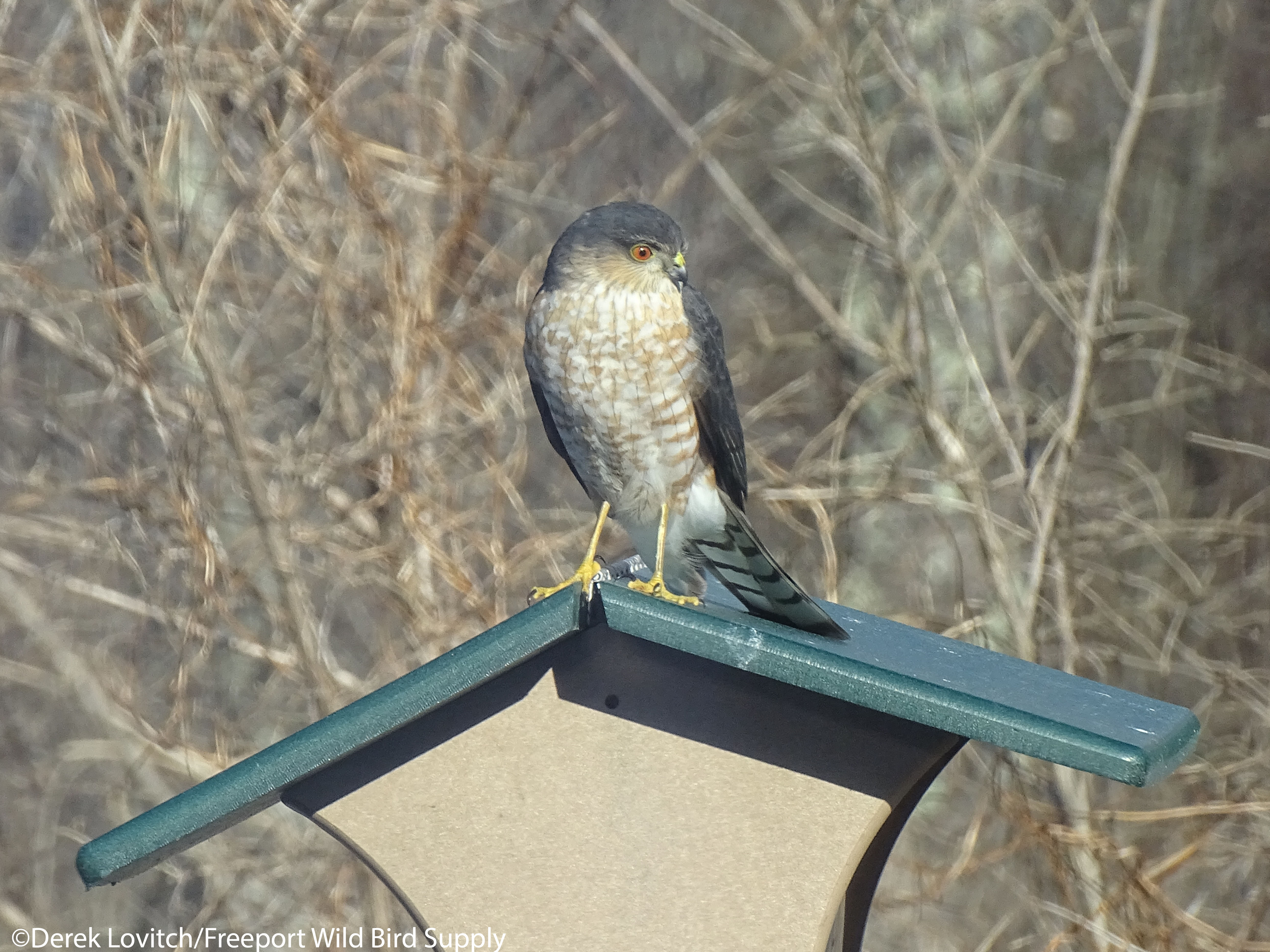
This continuing adult male continues to wreak havoc at the feeders, but my consistent observation this winter has offered me insight into this species’ natural history.
Nonetheless, there were plenty of changes in species composition and quantity noticed this week. We only received about 5-6 inches of snow here in Durham as temperatures hovered around the freezing mark for most of the day on the 14th, preventing accumulation until the late afternoon. In fact, there was less snow on the ground two days after the storm than there was the day before the storm (that was far from true for most of the state, however.
Not surprisingly, there were fewer Dark-eyed Juncos and American Tree Sparrows this week. Three Red-winged Blackbirds are regular, while the high counts of Northern Cardinals and Eastern Bluebirds continued to decline as territories began to be established and enforced. We also saw a noticeable decrease in the size of our American Goldfinch flock this week. Then, in the afternoon, my first two Brown-headed Cowbirds of the year (in Maine, that is) appeared.
The following week was much more spring-like, and the avian changes were even more evident. At least here in Durham, and changes to species composition and quantities are happening fast now.
Natural food is becoming more available as the snow recedes and the first “new” food sources emerge. A new uptick in American Goldfinches to 45 on 3/23 saw most of the birds spending most of their time eating aspen buds. Although a Pileated Woodpecker remains in the area, I did not see it visit the feeders once this week. We still have 8-12 Dark-eyed Juncos around, but they are often dispersed under brush away from the feeders. Our overwintering male Red-bellied Woodpecker, pair of Red-breasted Nuthatches, and our Carolina Wren have also spent considerably less time at the feeders this week. And not a single House Finch.
The last of our two American Tree Sparrows of the winter departed on the 17th, but a presumably new bird – a migrant – was at the feeders on the 21st through the end of the week. Our first Song Sparrow of the year arrived on the 18th and has been under the feeders since. Two White-throated Sparrows continue as well, and our first Fox Sparrow of the year appeared in the evening on the 24th.
While one Brown Creeper has been regular in the trees immediately behind the feeding station for a couple of weeks now, we now have a pair, and on the 23rd I spotted one of them creeping on the ground under a hulled sunflower tube. I didn’t see it eat anything, so I won’t count it on the feeder list quite yet, but I can see its bravery increasing.
Red-winged Blackbirds are now here to stay, with 2-3 territorial birds occasionally joined by migrants (high of 14 on the 21st), while we had Brown-headed Cowbirds (1-2) on two days this week. After our first two Common Grackles of the year briefly visited on the 18th, a flock of 22 dropped by on the 21st.Also on the 21st, we had 2 Pine Siskins – our first here since January 21st. I also spotted our first Turkey Vulture over the yard this year later that day.
Meanwhile, my yard-listing gears shifted from sorting through commuting gulls to commuting geese. With growing numbers of Canada Geese beginning to arrive starting on the 17th, flocks would often be visible from the window and over our yard as they commute between the Androscoggin River and local fields.
Our suspicion that the area right around our house would be a perfect place for displaying American Woodcocks was confirmed on the first warm and calm night of the spring: 3 birds displaying closely and vociferously right over our driveway on the 18th with two displaying and one silent fly-by (a female?) on the 22nd. Speaking of American Woodcocks, our first tour of the season is right around the corner: Woodcocks Gone Wild at Pineland Farms is only a week away!
Another sure sign that spring really is here, the Bradbury Mountain Hawkwatch kicked off on March 15th as usual, albeit delayed by 2 hours as the last of the precipitation cleared. It absolutely pains me that I cannot be up there, but thankfully Zane Baker has returned for his 5th season as Official Counter. While Jeannette and I will be up there much less than usual for a while longer at least, we know the count is in great hands!
I did, however, make a cameo on the 20th, spending an hour and a half to test drive my stamina. A handful of migrant raptors were spotted, and I was rewarded for the effort with a flock of 6 Northern Pintails flying by. This was my personal 144th species at Bradbury Mountain State Park, and we believe a first record for the Hawkwatch -and therefore the park itself!
Speaking of appearances, Jeannette and I appeared on Newscenter Maine’s 207 last week, discussing birds, bird feeding, and the changing climate and bird populations. Check it out!
I think my friend Dan Nickerson took pity on me – or was just tired of reading about our feeder birds? – so he was kind enough to pick me up and take me birding for the morning on the 24th for some local birding. It was great to get out, and I was most appreciative. And what a day we had!
We worked our way up the Androscoggin River, finding one 1st-winter Iceland Gull still at the Auburn Riverwalk and some new arrivals at the south end of North River Road in Auburn, including the boat launch area: a total of 10 Ring-necked Ducks and 3 Double-crested Cormorants (both being my first of the year in Maine), and off the boat launch, a small flock of 5 Lesser Scaup with one female Greater Scaup hanging out with them. The first of our three Ring-necked Ducks joined them briefly.
Further up the road, we looked for a previously-reported Barnacle Goose in the farm fields, but we couldn’t find it. There were a goodly number of Canada Geese around though, and with birds in and out of gulleys and presumably moving back and forth from the river, we decided to check back later.
We looked for Snow Buntings and the like along Upper Street in Turner, kept an eye out for frugivores, and then paid the Lower Street Harris’s Sparrow a visit. I saw this bird back on January 13th, but it was too good of a bird to not see again. When it immediately popped out of its favored bush, Dan got a life bird and I enjoyed a nice long view (but not so much photographs with one hand in a cold and gusty wind!).
We then returned to North River Road where I spotted the Barnacle Goose immediately this time. We savored this sighting – Dan’s second lifer in an hour! – and photographs were more successful (see above). We decided to celebrate with Thai food and broke for an early lunch as my shoulder was starting to whine a little about all of this excitement and activity. Thai food made everything better though, as it usually does.
Hopefully, I have finally turned the corner on my slow recovery, and next week will feature a little more time in the field and at the store, but for now, I will continue to track feeder birds in between.
This adult male Sharp-shinned Hawk was our fourth individual “Sharpie” identified at our feeding station this winter.
With the dreadfully slow pace of recovery following shoulder surgery, my birding these past three weeks was once again mostly outside our windows here at our home in Durham. One unseasonably mild week was followed by a week of below normal temperatures and several snow events. Then, the period finished out with spring-like feel. It was fascinating to track the ebbs and flows of feeder activity with each change in the weather and the progression of the season.
Highlights over the last 3 weeks:
2 Red-winged Blackbirds (First of Year), our feeders in Durham, 2/23.
Continued Sharp-shinned Hawk saga at our feeders.
Scattered Turkey Vultures and more Red-winged Blackbirds returning the area in the second week of March.
1 hen Barrow’s Goldeneye, Bernard Lown Peace Bridge, Auburn/Lewiston, 3/7 (with Jeannette).
Compared to the previous weeks –which I summarized in my last blog – unseasonably mild weather and a rapidly diminishing snowpack, activity at the feeders here in Durham continued to decrease during the week of the 2/13. The mixed-species foraging flocks had mostly broken up already, so it became harder to tell how many of each resident are around. However, a female Red-breasted Nuthatch rejoined our overwintering male, and we do have at least 12 Black-capped Chickadees now. There still seems to be two pairs of Tufted Titmice, but they no longer tolerate each other’s company.
Eastern Bluebirds (down to a pair daily) and Northern Cardinals (down to two pairs) decreased, but there was a noticeable increase in Dark-eyed Juncos this week: I saw around 20 under the feeders on 2/19 (up from 10-16), but there were more in the bushes. We have a little “evening flight” where the juncos leave our yard and scrub, fly down our driveway, and across the street into woods with thicker evergreen cover to spend their winter nights. I counted 34 that day as they departed the feeders and the woods behind it. With more bare ground, a lot of our ground feeders (also including Mourning Doves) were not frequenting the feeders as much, as expected. We still had 5 American Tree Sparrows and 2 White-throated Sparrows, however, carrying over from last week.
Signs of spring were everywhere. I caught a pair of Mourning Doves copulation on the 19th, and I began to see daily Canada Goose flocks moving between the river and the opening nearby farm fields. Common Mergansers returned to the Androscoggin River across the street from our property the next day. Woodpeckers were drumming more this week, and birdsong noticeably increased.
Then came the snowfall on the 23rd, and the accumulation brought a renewed surge of activity to the feeders, and a return to winter. The highlight was my first two Red-winged Blackbirds of the year, adding more color to a birdy day. Northern Cardinals jumped back up to 7, American Tree Sparrows increased to 10, and a third White-throated Sparrow arrived. Mourning Doves increased to 24, Eastern Bluebirds were back up to 7, and 3 House Finches returned.
Other than the Red-wings, these are mostly local birds that had begun to spread out, but returned to the supplemental food with the fresh snowfall. There did seem to be a legitimate increase in Dark-eyed Juncos that week, however, which may have included some early migrants. Meanwhile, 30-40 American Goldfinches continued daily, although once again we were sans winter finches except for a single female Purple Finch on the 21st.
Now, with a return to some significantly cold temperatures and more rounds of snow, I expected feeder-watching to be excellent during the week after that first storm. And sure enough, three bitter cold mornings followed by two more bouts of snow resulted in increased feeder activity overall yet again.
We continued to see 16-20 species a day at the feeders, although the wintery week pumped the breaks on new arrivals. Last week’s Red-winged Blackbirds likely turned back around when the snow began to accumulate, for example. A small bump in daily counts of Dark-eyed Juncos and American Tree Sparrows could involve some northbound migrants, but probably more likely were local birds concentrating again as snow piled up. Our 3 White-throated Sparrows continued. There was a definite uptick in American Goldfinches, however, with a high count of 46 on the 28th.
We saw fewer Eastern Bluebirds, Northern Cardinals, and Blue Jays most days that week compared to weeks prior, likely as these birds start setting up territories and/or begin to disperse. Lots of Hairy Woodpecker drumming and Tufted Titmouse singing this week, too, despite the return to full-on winter weather. Our lone overwintering male Red-breasted Nuthatch has also become less frequent. Unfortunately, 2-5 European Starlings became more regular – come on Sharpie, help me out here!
On Saturday the 4th, 12.5 heavy, wet inches accumulated here in Durham, burying our brush pile once again. Not surprisingly, ground-feeders didn’t appreciate that very much, especially with the continuing Sharp-shinned Hawk activity. Two “Sharpies” were present this week (see below) both an adult male and the return of a sub-adult male. Our brush pile is critical -as it often is in open areas and following new construction – for birds’ safety, and when buried under snow, it didn’t have a lot of accessibility to hide.
On the 5th, for example, the subadult male was seen for the first time in a few weeks, and after just missing a Tufted Titmouse diving off the feeders, it perched conspicuously next to the brush pile for over an hour. The next day, the adult male was staking out the feeders during my prime feeder-watching time of the morning, dramatically reducing my day’s tallies once again. There were times this week when the only bird in view out the window was a Sharp-shinned Hawk!
As the weather improved and snow began to melt rapidly as the week went on, Dark-eyed Juncos and Northern Cardinals in particular returned to previous weeks’ highs, finding safety when necessary in the brush pile once again. American Tree Sparrows had decreased to only 2 by week’s end, however, this may reflect the season more than anything; tree sparrows are among our first birds to start heading back north. Overall though, daily averages were down, but when all was said and done, the week’s high counts were very similar to previous weeks for most species.
Eastern Bluebirds have been fewer this week, likely as birds begin to disperse to breeding territories. And I have officially lost control of counting the number of Black-capped Chickadees and Tufted Titmice that are now visiting as they come randomly now instead of as a tight-nit mixed species flock(s) as they do in the winter. Another sign of the season was the arrival of 5 male Red-winged Blackbirds this morning (3/10), our first here since one on 2/23. Now, it’s possible they are here to stay.
In addition to marked changes in the weather, daily activity and consumption ebbed and flowed with Sharp-shinned Hawk presence and activity as I mentioned above. I would say my most fascinating observations this constant feeder-watching vigil provided was the Accipiter drama. I am sure this is happening everywhere, all of the time, but my unusual observation duration and frequency offered the rare opportunity to study the predator presence.
The adult female that has been present most of the winter and has provided much of the said drama continued to be spotted in the yard through the end of February. However, much to my surprise, yet a different bird was present on a couple of days during the week of the 27th: a new adult male. This makes the fourth different Sharp-shined Hawk that we have hosted this winter. Then, during the snowstorm on the 4th, a poor view of a Sharpie strongly suggest the subadult male that I saw only one day about three weeks prior. The saga continues! That ID was confirmed the next day, and he was seen repeatedly for the rest of the week. The adult male was also spotted a few more times through at least the 6th.
A second-winter male Sharp-shinned Hawk also returned to the scene this week.
Meanwhile, at the store in Freeport, two Red-winged Blackbirds that first appeared on the 19th increased to 7 during the snow, and a second Song Sparrow joined our single overwintering individual that week.
I have started to spend some time at the store in my continued limited-capacity, enjoying the feeder activity there was well. I was treated to the most activity that we have had there in a while on the 3rd, for example. We need our local Cooper’s Hawk to return as the Rock Pigeon flock is building again. But unlike at home, Red-winged Blackbirds continued, with 2-3 still present from a high of 7. We had a surge of American Goldfinches (from only 2-4 for most of the last few weeks to 12+. Our single overwintering Song and White-throated Sparrows continue, and 4 Eastern Bluebirds are now regular. I also welcomed back to work that day by a flock of 12 Cedar Waxwings descending on our Highbush Cranberry in the yard – a most welcome visit from one of my favorite birds!
And yes, I got out for a little birding this week, finally, as Jeannette and I visiting Auburn’s Little Andy Park and the Riverwalk, catching up with a few continuing winter birds: 1 Barrow’s Goldeneye and 3 Iceland Gulls. And when I was out and about this week (mostly being driven to and from appointments!), the renewed presence of Turkey Vultures was readily apparent.
I will be out birding a little more next week, but based on my visit with my surgeon yesterday, it looks like I’ll be forced to focus on feeder-watching for a while longer. Stay tuned!
Sharp-shinned Hawk drama has been keeping me entertained for the past month.
For the most of the past four weeks, my birding has been exclusively at our feeding station at our home in Durham as I recover from shoulder surgery. We designed our house to maximize feeder- and yard-viewing opportunities, and I am sure thankful that we did! It will come as no surprise to anyone who knows me that I don’t sit still well, so my extended feeder-watching sessions have been both mentally and physically therapeutic. It has also been quite productive! And keeping track of daily numbers has been quite elucidating.
Despite our new construction being completed (well, mostly!) in October and virtually no landscaping occurring, we have been very pleasantly surprised by the diversity and activity – a reflection of the quality of the habitat on our property (and hence why we purchased it). Nonetheless, I did not expect to be hosting 19-22 species a day at the feeding station in our first winter!
My feeder-watching vigils began the day after my surgery, on January 19th. The ebbs and flows during that first week were quite insightful. With three storm systems and snow piling up, the daily changes were noticeable, and mostly predictable. Our feeders were busiest with 22 species on 1/23 as over 14”of snow accumulated here in Durham. Numbers of ground-feeders peaked that day, with the week’s high counts of Mourning Doves (27), American Tree Sparrows (9), Northern Cardinals (11-12), and White-throated Sparrows (3). The 22 Dark-eyed Juncos was down a bit from a high of 25 following the first snowfall on the 20th.
Despite adding a third platform feeder, some ground-feeders had moved on by week’s end: 24 Mourning Doves, 14 Dark-eyed Juncos, 10 Northern Cardinals, and only 1 White-throated Sparrow remained, although American Tree Sparrows bumped back up to 9 with the snowfall of the 25th.
Eastern Bluebirds, meanwhile, had been increasing, with 4-6 daily becoming 14 by week’s end. Two House Finches became 5; they often travel with bluebirds in winter, so their simultaneous rise is not surprising. A single European Starling on 1/24 was unwelcome.
We picked up a second Red-breasted Nuthatch by week’s end, while one each of Red-bellied Woodpecker and Carolina Wren continue. Resident woodland birds that travel together in a mixed-species foraging flocks are notoriously hard to count, as it’s often impossible to know whether you are looking at the same flock or multiple flocks as they come and go throughout the day. Therefore, we are left to take the daily “high count” (maximum number of birds seen at one time) only as our “total,” so trends are harder to detect. My high count of Black-capped Chickadees did increase from 6 to 10 by week’s end, however, while a pair of White-breasted Nuthatches, 2 Downy Woodpeckers, 2-4 Hairy Woodpeckers, and 4 Tufted Titmice remain the same.
We also have a single American Crow that visits daily, an irregular visit from a male Pileated Woodpecker, and I’m trying to get a feel for the wide variation in daily Blue Jay high counts (between 1 and 10).
The only disappointment so far this winter had been our finch diversity so far. A single Pine Siskin 1/19-20 and female Purple Finches during the storm on the 23rd were our only non-goldfinches in that first week. However, our American Goldfinch flock has more than made up for it with between 32 and 74 (1/25).
But speaking of finches, the “birds of the week” those first seven days were 5 fly-over Pine Grosbeaks on the 25th. Bald Eagles and a Red-tailed Hawk regularly fly past the windows, as does the daily commute of Herring (and a few Great Black-backed Gulls) moving up and down the Androscoggin River; hoping to tease out a white-winged gull for the yard list. We’ve also had a small flock of American Robins (up to 18) feeding on Winterberry and Multiflora Rose in the past few days.
By the second week, a relatively deep, now-frozen snowpack, and only a couple of weak weather systems, resulted in less daily variation in the numbers at our feeders here in Durham. Fluctuations in counts had more to do with the day’s weather and the presence of a Sharp-shinned Hawk (see below), rather than the seasonal movements of species as had occurred with the onset of “real winter” the week prior.
A lot of species counts stabilized, such as the daily average of about a dozen Eastern Bluebirds and up to 46 American Goldfinches. However, some changes were noticeable, especially the ebbs and flows of ground-feeders: 6 American Tree Sparrows increased to 9, as many as 24 Dark-eyed Juncos decreased to 14, and after entertaining a third White-throated Sparrow for a couple of days, we are back down to two.
An impressive 13 Northern Cardinals on 1/29 was a seasonal high count, but otherwise most counts of the 18-21 species each day remained about the same. I had still not confirmed the presence of a second mixed-species foraging flock, for example, and our only finches remain the aforementioned impressive number of American Goldfinches and 4 House Finches.
Since my “observation week” begins on Saturdays, Week 3 began the morning of February 4th with some extreme cold weather. And, wow, that was some cold! Wind chill records (e.g. -45F in Portland and an astounding -108 at Mount Washington) Friday night into Saturday were thankfully short-lived. Here at our home, our windchill was “only” -21 on a low of -16F, as our anemometer was not receiving the full force of the wind.
The short duration of the cold snap – as extreme as it was – didn’t seem to have much impact on feeder birds, especially as the rest of the week’s weather was rather benign. Our Carolina Wren made it through, and overall activity and diversity was similar to last week (scroll down for previous posts).
American Goldfinches slowly declined at our feeders this (from 46 to a low of 22), likely as our birch crop is being picked clean. Sparrows were up again, however, with 15 American Tree Sparrows now after starting the week with 6. Dark-eyed Juncos spiked again to 20 on 2/5-6 before settling back down to 18; three more than we started the week with.
A female Purple Finch returned, and a Brown Creeper was now spotted daily in the trees immediately behind the feeding station. And a single Wild Turkey has returned to the feeders after being absent since early winter. Unfortunately, a pair of European Starlings were now present.
Two noticeable declines this week were in Northern Cardinals (from 11 to 7) and Mourning Doves (from 28 to 14). Meanwhile, Eastern Bluebirds have been far less frequent at our feeders as the week went on. This is all likely the result of direct and indirect (disturbance) effects of the continuing Accipiter saga. Daily high counts of other species were similarly affected by the presence of two different Sharp-shinned Hawks this week (see below).
Not surprisingly, the spring-like weather (including two days of record warmth) and very little precipitation reduced overall activity at the feeding station during Week 4, beginning on 2/11. We now have some bare spots on a slope now, where birds have been foraging, and the snowpack is much reduced in the woods. There’s more natural food available and less calories burned, so there’s less need for supplemental food – it’s long past time to put the “dependency on feeders” myth to bed!
Nonetheless, this week saw another uptick in Mourning Doves (high of 27) and American Tree Sparrows (of 10). Dark-eyed Juncos returned to a high of 21, but they have been spending as much time on the bare slope of our berm then at the feeders.
Eastern Bluebirds have been much less frequent this week, with a high of only 3 and they’re not visiting everyday. Same for the House Finches they usually travel with in winter –it’s just a sporadic pair now. American Goldfinches, however, remain strong, with a high of 32 this week. Our latest singleton Purple Finch has apparently moved on.
Winter flocks are breaking up, and that’s likely why the bluebirds have been less frequent; they might be spreading out already. The mixed-species foraging flock of residents are breaking up as well, and “bickering” is increasing among them, especially the Black-capped Chickadees. Meanwhile, Hairy Woodpeckers are courting now, and territorial drumming is frequent.
And then, with temperatures spiking to over 50 degrees on the 16th, Jeannette had the first Red-winged Blackbird of the year flying north overhead! Already. I expect diversity and daily counts to change more often in the coming weeks now.
Meanwhile, birdwatching is not just about counting, so I kept notes of interesting observations and behaviors through the duration of my time stationed in front of the window (and short walks up and down the driveway, weather and ice permitting). I enjoyed seeing the slow but sure progression of the season, as Downy and especially Hairy Woodpeckers became more territorial, and male Hairys especially began drumming, accelerating this week. A pair of Common Ravens was regularly observed, with pair-bonding flight displays increasing. Tufted Titmice and Black-capped Chickadees began singing more, too.
I’ve also conducted an experiment with some suet products that we may bring into the mix at the store. None of which, however, has come close to being as popular as our current offerings, however.
A few of my most interesting behavioral and natural history observations were:
1. 1/28: I watched a Dark-eyed Junco that was foraging along our foundation grab a large cutworm-like-caterpillar and smack it on the snow. As it began to eat it, a bluebird flew down and grabbed the caterpillar. I had not observed kleptoparasitism in bluebirds before!
2. 2/2: The male Sharp-shinned Hawk that has been hanging around was pursued and killed by a second accipiter that had been undetected by us. The brutal end to the chase took place within 10 feet of me. It was quick, I was in shock, neither a camera nor binoculars was within reach of my working arm, and I was afraid to move as I didn’t want to disrupt the proceedings – it’s the worst feeling to flush a predator from its hard-earned prey and see that prey item suffer and go to waste.
The thing is, I think the only-marginally larger predator was actually an adult female Sharp-shinned Hawk as opposed to the far more likely adult male Cooper’s Hawk. Cooper’s Hawks are known to kill Sharpies, but I am unaware of published accounts of cannibalistic Sharpies. It all happened too quickly, and accipters are much easier to identify in flight three miles away than when they are sitting in front of your face (at least as adults). Apparently I was too traumatized by the event (and/or slowed mentally by painkillers) to look at details of face pattern. But the relative size and the paler chest and less steely-back were highly suggestive of an adult female Sharp-shinned. Hopefully, it will take up the territory and I will be able to confirm its ID circumstantially. But it was a rather violent end to my feeder-watching week!
Although only circumstantial evidence, an unequivocal female Sharp-shinned Hawk was spotted (and positively identified!) the next day thereafter, leading credence to the rare cannibalism theory. It’s only circumstantial evidence, but I have little doubt this is the bird that took the male the prior day. Furthermore, I have not seen a Cooper’s Hawk here all winter. Absolutely fascinating, and I wish I had photos to document the gruesome event.
The plot thickened even further on the 8th, when I spotted (and photographed this time) a second-winter male (subadult) Sharp-shinned Hawk hunting the feeders in the morning. He better be careful out there! The woods of Durham are unforgiving!
The next week, I didn’t see him as only the adult female was around.
3. I’ve been sorting through as many of the daily commuting gulls as possible, and finally on the 15th, I picked out an Iceland Gull for our 122nd Yard Bird! Interestingly, it was an adult or near-adult, different from the 1st winter birds that have been frequenting the Lewiston-Auburn riverfront a few miles upriver.
For almost three weeks, I left the house or driveway exactly three times (a follow-up appointment, a field trip to see Avatar, and a successful chase of the Common Ringed Plover at Timber Point in Biddeford on 1/31. Jeannette dumped me in the car and we drove down – me fully reclined and with an icepack strapped on. The bird was present as we arrived, and since the word was just getting out, we even had a parking spot. She set me up behind the scope (I had to ask a fellow birder for assistance in moving it!) and then took some photos. I was pretty uncomfortable on the way home – to put it lightly – but it was absolutely worth it!
It wasn’t until Monday, February 6th (just under three weeks since my surgery) that I went out for a little birdwalk with Jeannette at the Auburn Riverwalk. It was a lovely day, and it was fantastically birdy! We found a hen Northern Pintail amongst nearly 500 Mallards, and had three 1st-winter Iceland Gulls – the most I have had here in several years. The overall bird activity was quite a bit above average, as the cold snap finally put some ice on the river and helped to concentrate birds here. Unfortunately, we did not see the Harris’s Sparrow in Turner before my body had enough of being upright.
The next day’s outing, however, was for an easy twitch. I only had to get out of the car and find some open space along the railing of the Arrowsic-Georgetown bridge over the Back River.
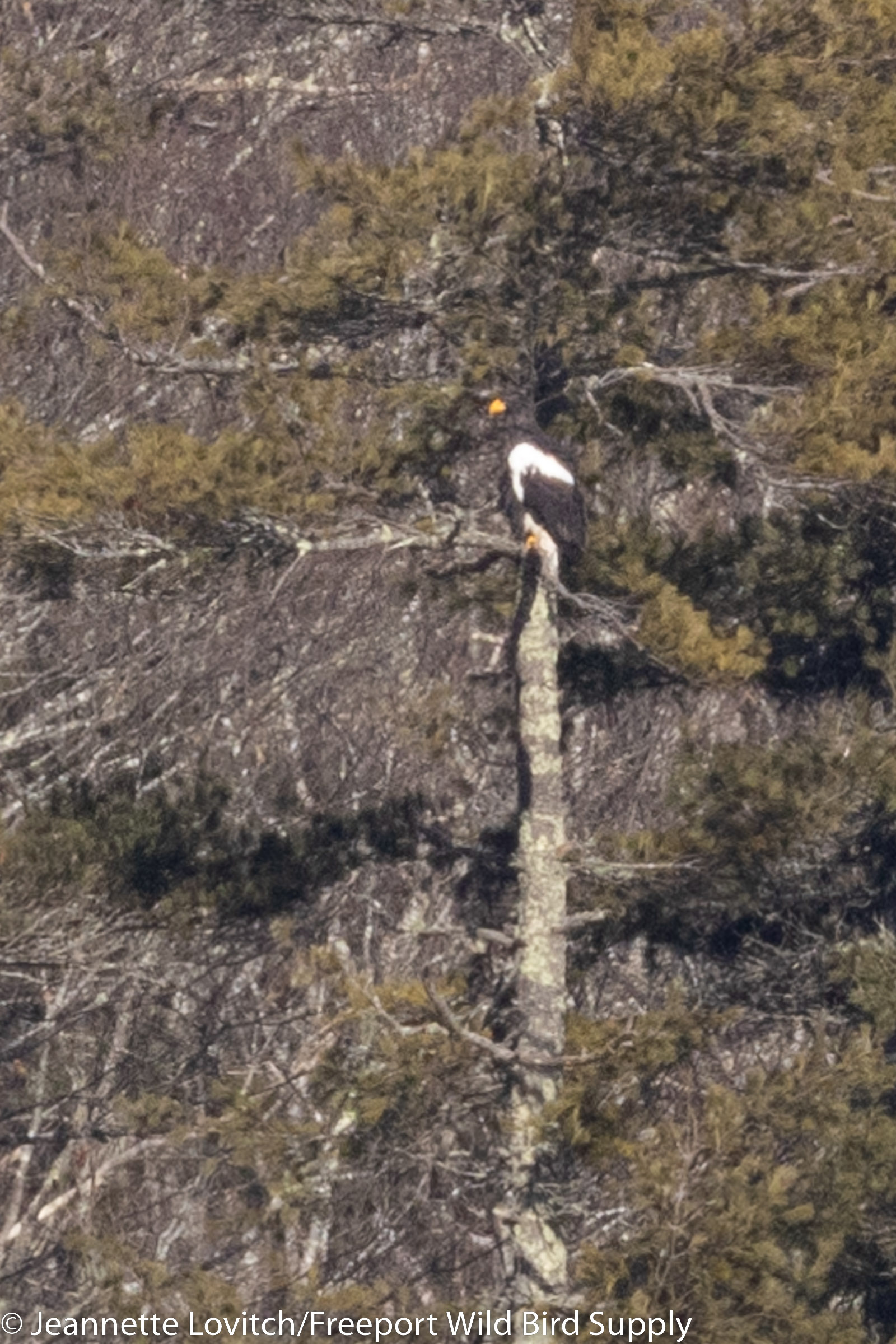
So yeah, the Steller’s Sea-Eagle is back, and it was in full (albeit fairly distant) view in our first visit with it of the year. I’ll get out of my recliner for a Steller’s Sea-Eagle any day! It was also good to catch up with a friend and get out of the house for the second day in a row.
A few days later, Jeannette and I took a walk at Winslow Park in Freeport (2/9) where we were thrilled to find 7 Barrow’s Goldeneyes (3 drakes and 4 hens), the second highest count that I have had here in nearly a decade. They put on a great show, too.
A visit to the Auburn Riverwalk on the 13th yielded only one 1st-winter Iceland Gull, while a walk along Brown’s Point Road in Bowdoinham the next day produced a couple of pioneering Northern Flickers.
So there ya have it…my last month of birdwatching. With slow progress on my recovery, I expect feeder-watching will dominate my activity for a few more weeks, but temperature swings will make that interesting…and hopefully another snowstorm or two. I need to be out and about with few limitations by the time spring is here to stay!






















 Maine Birding Field Notes