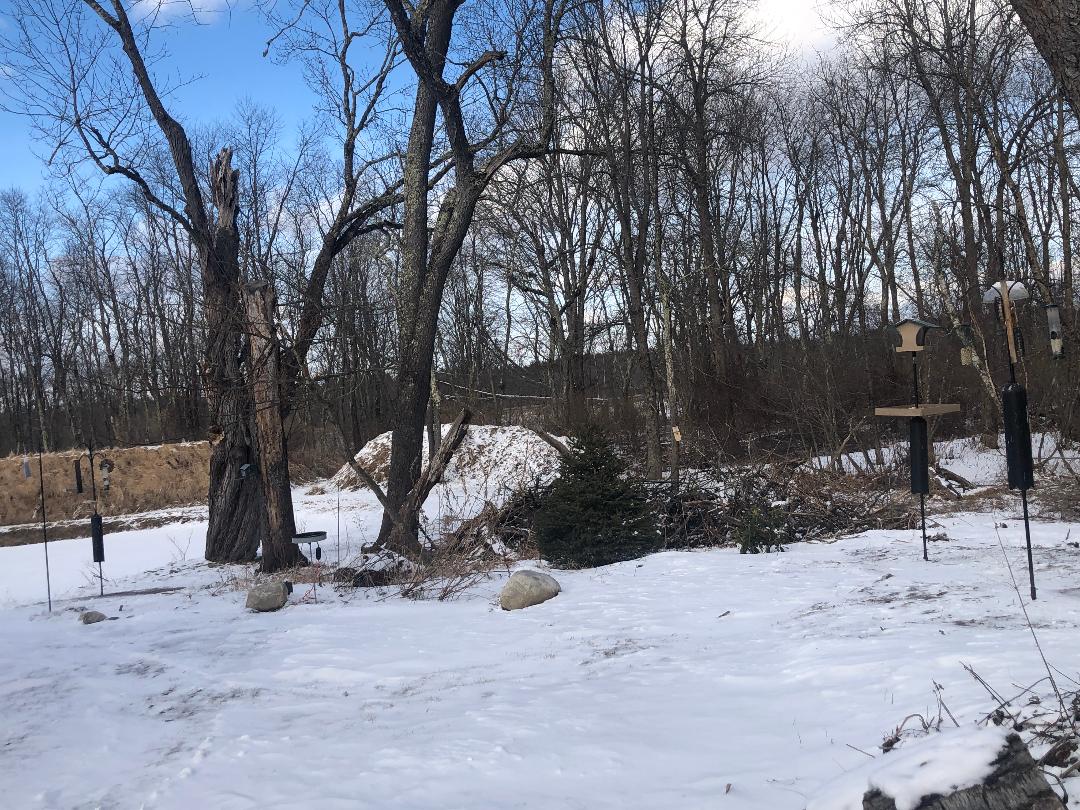
Yellow-rumped Warblers have been inundating our feeding station in Durham this week, feasting on nut blocks, insect suet, mealworms, jelly, and just about everything else.
Feeder-watching continues to be great, with lots of Pine Siskins, new arrivals, migrant White-throated Sparrows, and, at our home in Durham, up to a dozen Yellow-rumped Warblers daily – especially during the cool and often wet days we had this week. Meanwhile, Red Crossbills continue to be widespread in the area. There were no huge flights of migrants this week, but new arrivals were trickling in.
My other observations of note over the past seven days also included:
1 LOUISIANA WATERTHRUSH, Morgan Meadow WMA, 5/1.
6 total LOUISIANA WATERTHRUSHES, via “The Louie Loop” (Site AN4 in Birdwatching in Maine: The Complete Site Guide), Androscoggin County, 5/3 (with Noah Gibb).
One of the six individuals, a singing and mate-guarding male, paused just long enough for a snapshot in Mechanic Falls on the 3rd.
As is typical of the season, new arrivals were the headliners of most days of birding. Additional personal first-of-years this week also included:
1 Bank Swallow, Bradbury Mountain Hawkwatch, 4/29.
1 pair Rose-breasted Grosbeaks, our property in Durham, 4/30.
4 Black-and-white Warblers, Florida Lake Park, Freeport, 4/30
1 Great-crested Flycatcher, our property in Durham, 4/30.
1 Northern Waterthrush, our property in Durham, 5/1.
1 Common Yellowthroat, Morgan Meadow WMA, 5/1.
1 Wood Thrush, our property in Durham, 5/2.
1 Gray Catbird (first of spring), our property in Durham, 5/2.
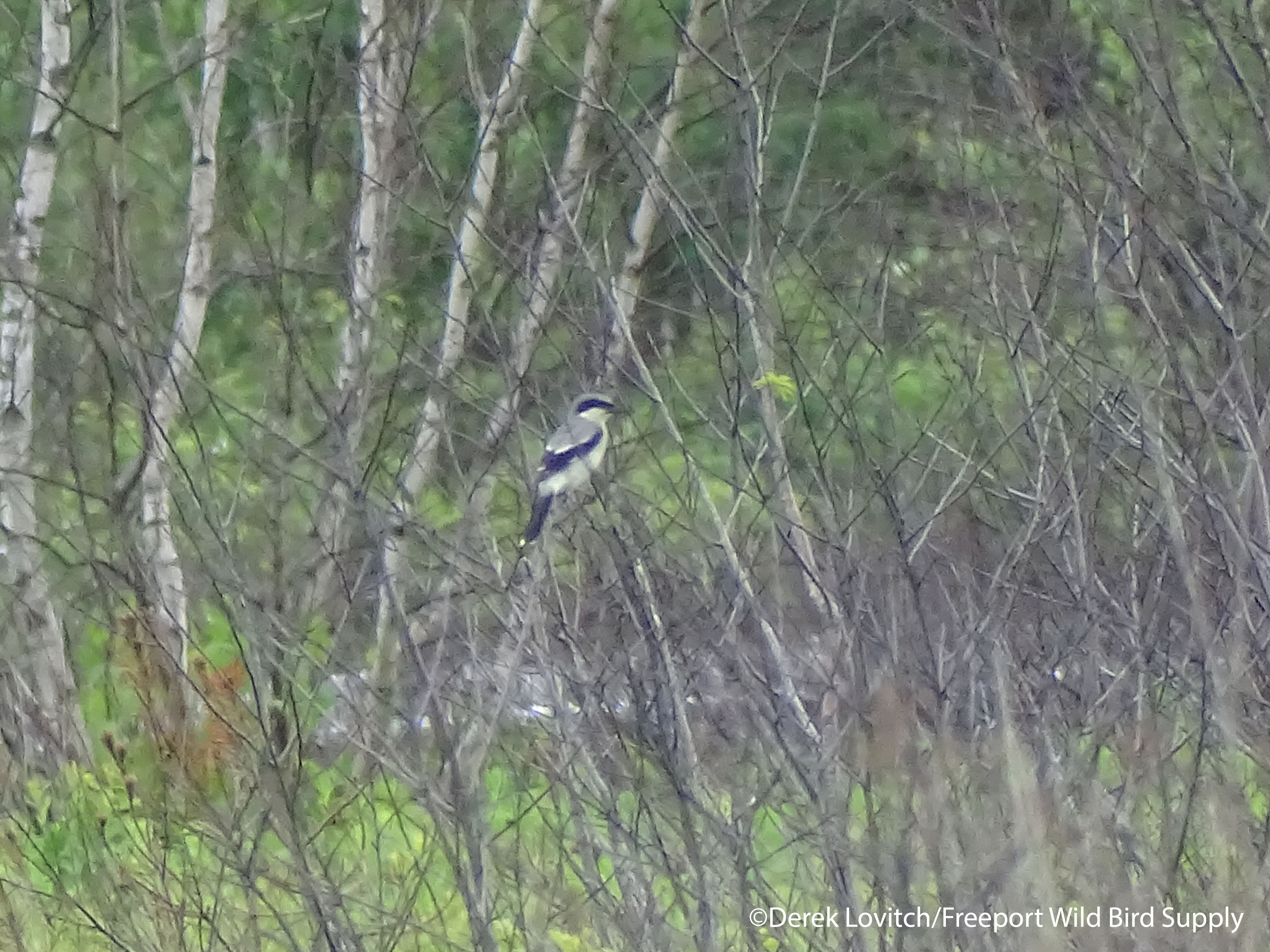
Although it had moved further away by the time I arrived, I managed a few phone-scoped photos of the Loggerhead Shrike that graced Chandler Brook Preserve and nearby yards in North Yarmouth on 4/21.
It was a great week of birding, with an impressive fallout on Saturday morning, a local mega rarity, and more new spring arrivals. My highlight of the week was catching an incredible early-season fallout at Florida Lake Park in Freeport on 4/20 (with Saturday Morning Birdwalk group). I eventually settled on a guestimate of 400 Palm Warblers and 125 Yellow-rumped Warblers. The full report can be found here. 75+ Palm Warblers and 50+ Yellow-rumped Warblers were present on the 24th, but on both dates the only other warbler – as expected for the date – were Pine (3 each day).
My other observations of note over the past seven days included:
1 Fish Crow, over our property in Durham, 4/20 (Yard Bird #150!)
1 LOGGERHEAD SHRIKE, Chandler Brook Preserve, North Yarmouth, 4/21. Found earlier in the afternoon and seen by several of us in the evening. I don’t chase very often, but when I do, I prefer it to be only 15 minutes out of the way on my way home from the store! It was only my second in Maine.
6 Red Crossbills (1 male, 2 female, 3-4 juvenile. Type 12 as per Matt Young), here at the store, 4/24.
Additional personal first-of-years this week also included:
*1+ CLIFF SWALLOW, Florida Lake Park, Freeport, 4/20 (with Saturday Morning Birdwalk group).
1 Northern Rough-winged Swallow, Florida Lake Park, 4/20 (with Saturday Morning Birdwalk group).
1 Blue-headed Vireo, Morgan Meadow WMA, Raymond, 4/21.
1 Black-throated Green Warbler, Papermill Trail, 4/26.
*Numerous very early arrivals of regular migrants are likely also tied to the overshoot event that brought southern vagrants to locations up and down the state’s coast.
TOURS AND EVENTS:
Feathers Over Freeport This Weekend!
Saturday, April 27th at Bradbury Mountains State Park and Sunday, April 28th at Wolfe’s Neck Woods State Park. All events FREE with park entry!
From birdwalks and a hawkwatch workshop to kids’ arts and crafts and a food truck, join us for two activity filled days in the 13th year of Feathers Over Freeport! A full schedule of events can be found here.
Note our regularly scheduled Saturday Morning Birdwalk meets at Bradbury on the 27th.
The deceiving very Little Egret-like Little Egret x Snowy Egret hybrid is back for another season on the Portland-Falmouth waterfront. Jeannette and I saw it for the first time this year at Tidewater Farm Preserve in Falmouth on the 14th. Details below.
My birding was limited during this period, unfortunately, especially considering a significant “overshooting” event from the most recent storm. Southern vagrants and some exceptionally early arrivals were detected. Unfortunately, we were out of town for the days in which most of the rarities were detected early this week. I did try to make up for it by finding something later in the week, but I struck out.
Overall feeder activity decreased as the snow receded, but we noticed an uptick in Purple Finches and Pine Siskins in our yard in Durham, along with the arrival of Pine Warblers at our feeders in Durham and here at the store. My other observations of note over the past nine days included:
1 LITTLE EGRET X SNOWY EGRET HYBRID, Tidewater Farm Preserve, Falmouth, 4/14 (with Jeannette). Back for another year, this very Little Egret-like individual is a tricky and misleading ID at any distance. Luckily, it was close to the point today, providing great studies. In the photo above, you can see the very long, LIEG-like plumes. Also apparent today in comparison to a nearby SNEG was the slightly longer and thinner bill and the somewhat thinner and more elegant neck, and it did appear to be a touch larger overall. However, up close, you can see the handful of wispy, SNEG-plumes on the back of the head and neck, and in most lights, the lores gave a distinctly yellowish appearance, especially near the eye.
Additional personal first-of-years this week were limited to:
1 Chipping Sparrow, feeders here at the store, 4/13.
1 Field Sparrow, our property in Durham, 4/14.
2 Pied-billed Grebes, Florida Lake, Freeport, 4/17.
Birds on Tap! Kick-off event at the Portland Beer Hub!
Thursday, April 25, 2024; 5:00 – 7:00pm – Portland Beer Hub – 320 Fore St. Portland, ME 04101- FREE!
Join Birding Guide and owner of Freeport Wild Bird Supply Derek Lovitch, and Brew’s Cruise owner Zach Poole, for an exclusive gathering at the Portland Beer Hub to celebrate the 10th Anniversary of Birds on Tap! and kick off our new tour lineup.
During this casual meetup, guests will mingle with other bird and beer enthusiasts, discuss the exciting lineup of upcoming Birds on Tap tours, and can enjoy flights of bird-themed local beers (for purchase).
It’s the perfect opportunity to immerse yourself in the world of birdwatching and craft beers. For a bit of fun, be prepared for some impromptu bird trivia and birding games.
2. Feathers Over Freeport!
Saturday, April 27th at Bradbury Mountains State Park and Sunday, April 28th at Wolfe’s Neck Woods State Park. All events free with park entry!
From birdwalks and a hawkwatch workshop to kids’ arts and crafts and a food truck, join us for two activity filled days in the 13th year of Feathers Over Freeport! A full schedule of events can be found here.
Note our regularly scheduled Saturday Morning Birdwalk meets at Bradbury on the 27th.
Using our Durham yard as a case study, I wanted to check to see if there were indeed fewer birds this winter than last year, as some (but no longer a majority) of folks have continued to mention to us at the store.
Stuck at home last winter while recovering from shoulder surgery, our feeding station provided my primary source of entertainment. I occupied my time with mugs of tea and enjoying the activity, and occupied my mind with figuring our exact counts, keeping tallies, and watching behavior closely. I wrote about my counts and observations in a pair of blogs, the first one is here, and the second one is here.
This past fall, everyone saw a very slow fall at feeders in Maine, and throughout the East, as discussed here. That was changing for a lot of people – but not all, by December, which I talked about in this follow-up blog.
In January, a series of strong storms, unseasonable heavy rain and flooding, a few cold spells, and eventually, by month’s end, solid snowcover helped change the narrative. Winter food resources were being consumed, ground-feeders were being forced out of the woods, finches were moving about, and so on. Furthermore, I believe that those strong storms knocked a lot of cones – especially those of Eastern White Pine – to the ground where they were subsequently consumed and/or buried.
At least here at our feeders in Durham, a slow start to the winter was a thing of the past, as we were filling almost all of our feeders daily by the end of January. Some impressive tallies included over 70 American Goldfinches and over 50 Dark-eyed Juncos at the end of the month.
American Goldfinches have been absolutely ravaging Nyjer at our home this winter. Fresh Nyjer makes all of the difference!
While some factors remain true from the fall – an abundance of natural food overall, relatively limited snowcover, low movement of irruptive species, etc – clearly most people were reporting to the store that things were “back to normal” or “tons of birds all of the sudden,” and so on. Our seed sales more than doubled by the end of January from what they were at the beginning of the month (by overall poundage).
Just how “normal” have things returned to, and what anomalies are out there? While our home in Durham is only two years old, and we’re a long way away from baseline data or long-term averages, we can at least compare February of 2024 to February of 2023. And since I had nothing better to do last winter, I already had some data to compare to.
So, for the last 10 days (not including the two that we were out of town for), I have once again returned to the window for dedicated sessions of feeder-watching and counting. Like last year, I used the standard methodology of using “high counts” (maximum number of individuals seen at any one time, unless they were readily identifiable as being different), and I was sure to count for at least one hour a day each day.
February 5 – February 15 (minus 2/12 and 2/13).
Species
Average per day 2023
Average per day 2024
Difference
Wild Turkey
0.2
0
-0.2
Mourning Dove
13.5
26.5
+13
Sharp-shinned Hawk
0.4
0.2
-0.2
American Goshawk
0
0.1
+0.1
Red-bellied Woodpecker
1
1
Same
Downy Woodpecker
2.4
2.9
+.5
Hairy Woodpecker
2
2
Same
Pileated Woodpecker
1
0.1
-0.9
Blue Jay
7.8
3.0
-4.8
American Crow
0.7
0
-0.7
Black-capped Chickadee
7.4
2.9
-4.5
Tufted Titmouse
4
3
-1
White-breasted Nuthatch
2
1.4
-0.6
Red-breasted Nuthatch
0.7
0
-0.7
Brown Creeper
0.4
0
-0.4
Carolina Wren
0.9
1
+0.1
European Starling
1.1
2.7
+1.6
Eastern Bluebird
4.4
3
-1.1
House Finch
2.1
0
-2.1
Purple Finch
0.5
0.3
-0.2
Pine Siskin
0
0.2
+0.2
American Goldfinch
26.6
46.8
+20.2
American Tree Sparrow
8.0
4.2
-3.8
Dark-eyed Junco
16.6
30.3
+13.7
White-throated Sparrow
2
2.3
+0.3
Song Sparrow
0
0.9
+0.9
Northern Cardinal
5.2
3.8
-1.4
Total individuals/day
110.9
138.6
+27.7
*Addendum: I guess I should have continued the study for a few more days! By 2/17, we had a whopping 72 Dark-eyed Juncos and an increase to 13 American Tree Sparrows, and by the next day, the American Goldfinch flock returned to well over 60 birds!*
Every year is different, and every yard is different. Controlling here for time and place, we can make some comparisons however. It was much colder in this period last year, with an average morning low of 19.6. This year, the average morning low for the ten days was 23.9 and there is a lot less snow on the ground, even after the fresh inch and a half Friday morning; there were three light snowfall events during the “study period” last year.
Clearly, there are plenty of birds at our feeders at least! And, contrary to conventional wisdom, we actually have more birds overall than last year! The dearth of feeder birds from the fall is no longer true for us. Similar conclusions can be reached from comparing data on our feeder birds at the store, and from conversations with friends and customers. Therefore, I believe the overall pattern fits what many are observing throughout the area.
As discussed in the aforementioned feeder blogs from the fall, Black-capped Chickadees are in low numbers. I saw 4.5 fewer per day at the feeders than last year. This goes with the idea that our local residents were not augmented by irruptives from points north, but also suggests that they did not have a great breeding season. Same for Red-breasted Nuthatch and Blue Jays.
But native sparrows are in larger numbers than last year, especially Dark-eyed Juncos (and elsewhere, like our store, significantly more White-throated Sparrows with a new winter record of 24 on 2/16). My guess is because the mild fall, abundant seeds from a productive growing season, and benign start to the winter kept those around to be pushed to feeders as the season wore on.
And yes, there are indeed a lot of goldfinches around! But very few other finches – at least at feeders. I am not sure where these European Starlings came from, however, and I’m not overly pleased by it!
Raptors are another part of the equation. This time last year, we had more consistent presence from two different Sharp-shinned Hawks. This winter, we only recently confirmed the presence of a single Sharp-shinned Hawk (seen on 2/15 and 2/16, but she likely took a Mourning Dove on the 14th). There was also an all-too brief fly-through of an immature American Goshawk on the 6th. Also this winter, a Red-tailed Hawk has been more frequent around the feeding station, but its focus is primarily the squirrels and voles. So we’ve had enough native predator presence both years that it shouldn’t be a huge factor in comparing feeder counts.
There you have it. 2024 does not have fewer birds at feeders compared to the same period in 2023, at least not in our yard as a single case study. With continued improvement of our yard’s habitat (most of which was put on hold this year due to my shoulder issues) planned, we would hopefully be increasing our yard’s carrying capacity, as feeders remain only a supplement and a relatively small percentage of a bird’s diet, even in the depths of winter.
Next winter, we also might not find a single Eastern White Pine cone in the entire state, and a lot fewer Red Oak acorns and Balsam Fir cones. And if that’s true to our north, perhaps this will increase the amount of irruptives around the area. But we’ll see! And maybe I’ll repeat this exercise next year, if I can force myself to sit still long enough!
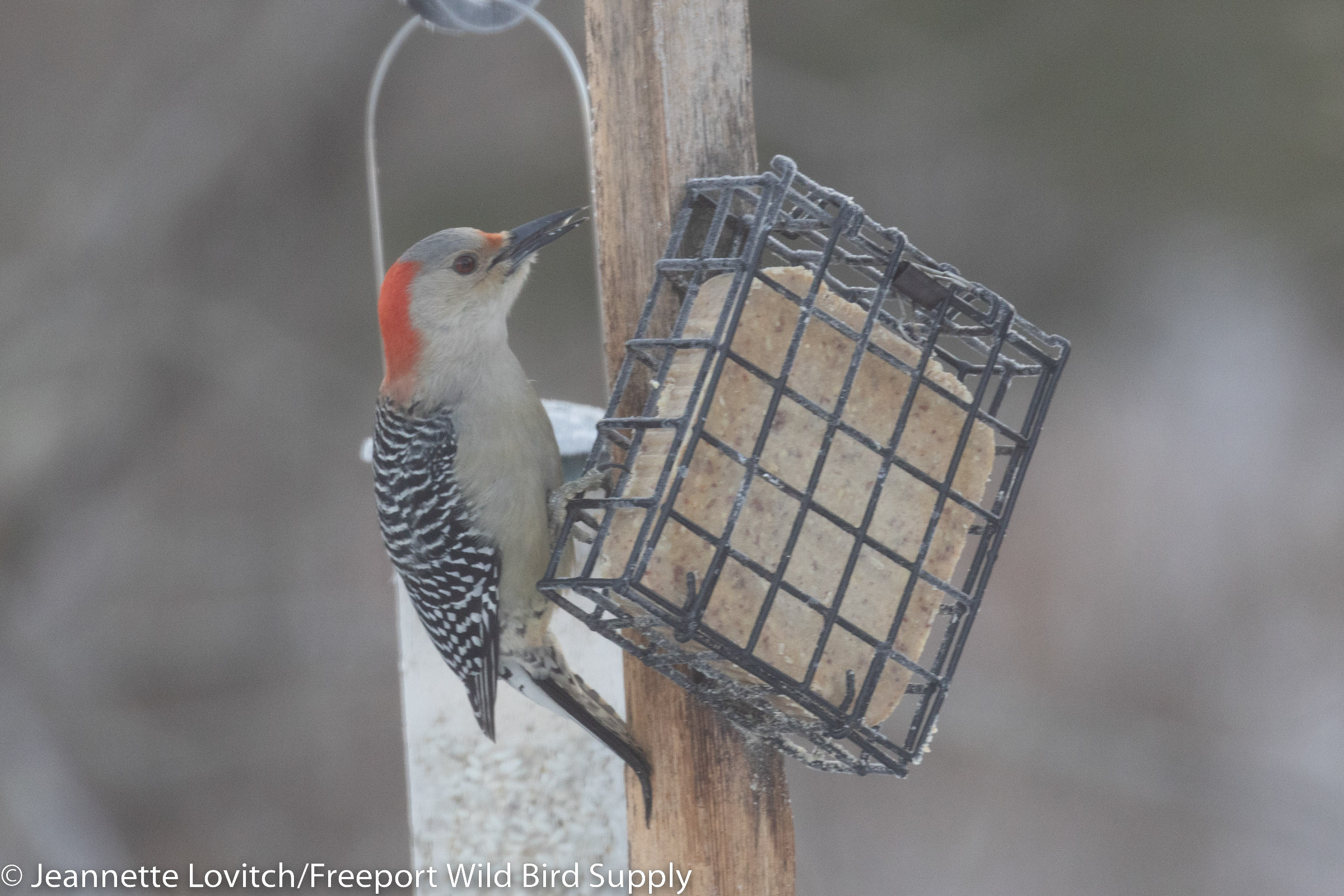
Last winter, we had a male Red-bellied Woodpecker nearly every day, while this winter it has only been this female. We hope they find each other!
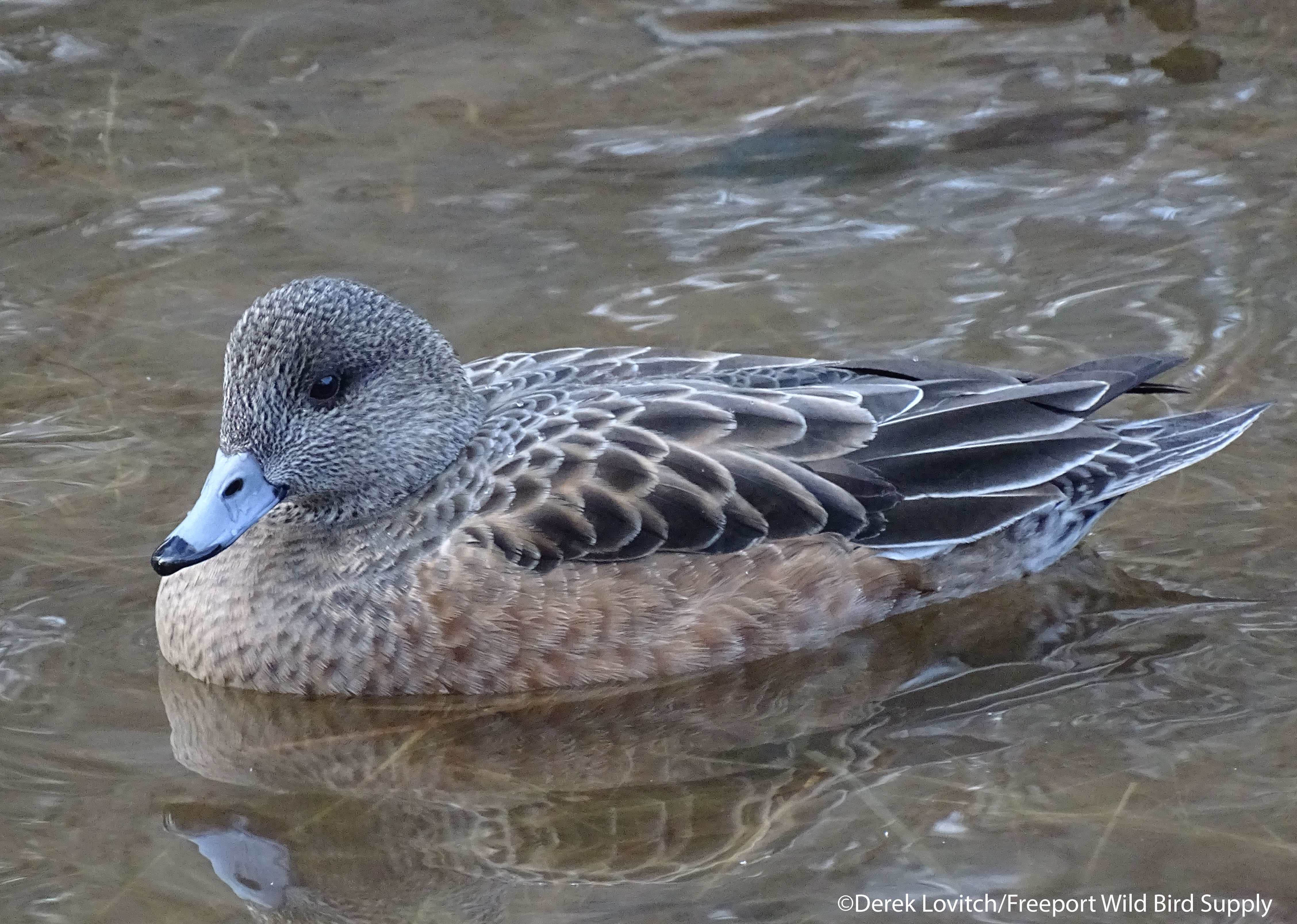
The long-staying hen American Wigeon offered a good, close study as part of the Winter Waterbird Workshop with Down East Adventures tour that I conducted on the 14th.
While I didn’t get as far afield as last week, I enjoyed a productive six days of birding, especially for early January! Here are my observations of note over the past seven days.
Our feeders in Durham have been incredible, led by a growing flock of Dark-eyed Juncos that peaked at 41 on 1/8 and 40+ continuing American Goldfinches. There was a big movement of sparrows after the weekend snow storm, with flocks of Dark-eyed Juncos and White-throated Sparrows common and widespread in the area, along with an increase in American Tree Sparrows. During Tuesday’s snowfall, a careful inventory during the snowfall on the 16th yielded 127 individuals of 16 species, led by 41 American Goldfinches and 37 Dark-eyed Juncos.
At least one Turkey Vulture still continues in the I-295 corridor between Cumberland and Freeport.
1 DOVEKIE, Sandy Point Beach, Cousin’s Island, Yarmouth, 1/13. Patch Bird #198! Healthy fly-by apparently turning around upon seeing the bridge, then turning northeast and following the Cousin’s Island shoreline. I lost it in the fog, but presumably rounding the island to return to sea. A Black Guillemot to the south of the bridge was one of my few ever from this location.
1 continuing female American Wigeon, York Duck Pond (Abbott’s Pond), York, 1/14 (with Down East Adventures Winter Waterbirds Workshop tour group).
Small number of Red Crossbills, Bear Mountain, Hartford, 1/15 (with Jeannette). Mostly single fly-overs and one small heard-only group, so quantification was impossible.
Freeport Wild Bird Supply is very excited to partner with Down East Magazine’s Down East Adventures for the fourth year of offering exclusive birding workshops focused on gaining greater knowledge and field skills in a focused group of seasonally accessible birds. Focused on skill-builder rather than list-building, there will be plenty of “life birds,” but also more knowledge and education about birds, habitats, birding, and much more about the natural world. We’re happy to bring back the complete slate of tours from our 2023 season.
The full list and descriptions, along with registration information, for all of our upcoming tours (and an outline of 2025 options) can be found here. At the conclusion of each tour, I’ll post the trip report here.
Winter Waterbirds Workshop, January 14th.
I mean, really, what’s better than a Harlequin Duck?
For the second year in a row, very strong winds greeted us in the morning. So the game of the day was finding sheltered coves and respites from the wind. Therefore, we adjusted our itinerary accordingly, making a further adjustment based on parking lot closures from storm damage.
While we had high hopes of finding alcids that were blown closer to shore and were seeking refuge after the strong storm of the previous day, we didn’t see a single one – not even a Black Guillemot! However, we did see just about every other regularly occurring winter waterbird, from Red-necked and Horned Grebes to Buffleheads and Long-tailed Ducks Not surprisingly, Harlequin Ducks were the star of the show, with about 10 along Marginal Way in Oqunguit and abut 20 at The Nubble. Large rafts of Black Scoters were seen at several locations, with Surf and White-winged Scoters seen nearby for careful study.
We had a lot of Common Loons today, and we practiced learning their shape and size to separate them from other waterbirds at any range. Great Cormorants at The Nubble were nice to see, and we did a little introduction to gull identification with a mixed flock at Short Sands Beach.
Finally, a stop at the York Duck Pond introduced us to another group of waterbirds: dabbling ducks. There, we had close studies of Mallards, American Black Ducks, and hybrids thereof. Practicing our “feather birding” we used the hybrids of an example of what to look for beyond the general impression of size and shape we were focused on throughout much of the day. The icing on the cake was the hen American Wigeon that has been here all winter – you may never see one as close and as well as that again! Enjoying the fine black detailing on the steely blue bill was a highlight for me.
Spring Migrant Songbird Workshop, May 12th.
Honestly, I am not sure if we could have dialed up a more productive morning for an instructional workshop designed for learning about migrants – from identification to natural history, habitat to visible migration. “Slow” by mid-May standards, we eventually tallied 15 species of warblers (including a few “heard only”), but we had absolutely remarkable “quality time” with so many of the species we did encounter today.
We were greeted by a Great-crested Flycatcher and finished with Maine’s most confiding Great Egret. In between, a wide range of species included an uncommon Blue-gray Gnatcatcher and a family of Wood Ducks. I particularly enjoyed the quality time spent with a pair of Black-capped Chickadees who were busy gathering moss for their nest lining.
But it was the Neotropical migrants who were the stars of the show, as predicted and hoped for. My first Red-eyed Vireo of the spring was uncharacteristically low and cooperative, but the single early-ish Blackpoll Warbler was most definitely not. However, almost every other warbler was just shockingly well seen. In one willow thicket, we watched – often without binoculars and often within 10-15 feet of us and below eye-level – two each of stunning Magnolia Warblers, gorgeous Northern Parulas, charismatic Common Yellowthroats, and distinctive Chestnut-sided Warblers. A short distance down the trail, our patience with Ovenbirds was rewarded with one walking out into the open a short distance ahead.
In between bird sightings, we discussed habitat, NEXRAD radar, and the big picture of what we were and were not seeing today and why. We noted how American Crows mobbed a Red-tailed Hawk but barely bothered to call at the sight of a less-threatening Broad-winged Hawk. OK, fine, those aren’t songbirds, but we learned a lot from them anyway.
More birds of more species can and will be seen under different conditions at Evergreen Cemetery and similar urban green spaces as encountered today, but we would be hard pressed to see so many birds so well, for prolonged periods of time to allow for thorough study. While we encountered one wave of migrants all moving together, which can easily become frustrating when getting started, many of birds came one or two at a time allowing for in-depth observation -exactly want we want in a songbird workshop!
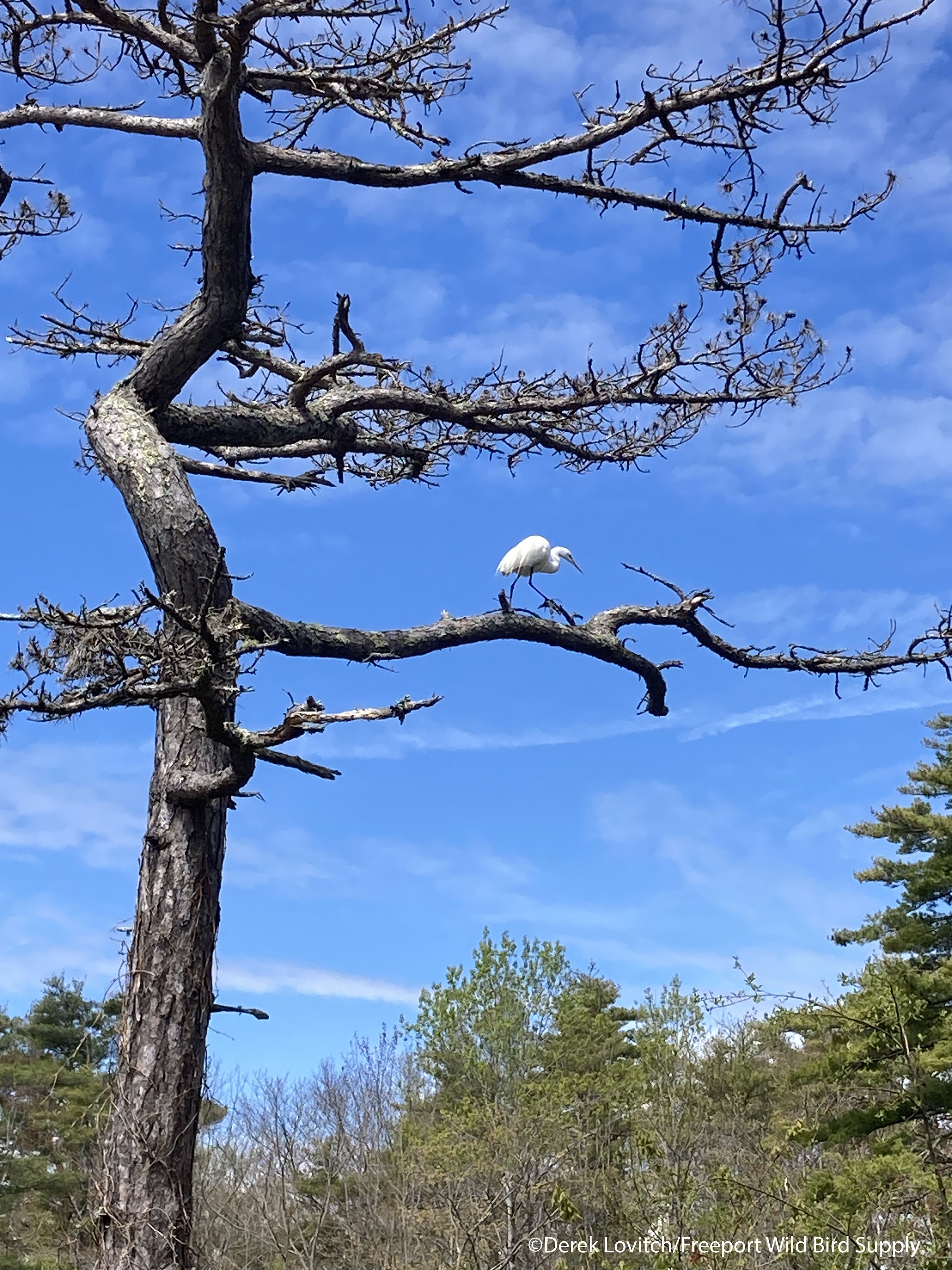
Not a songbird, but this Great Egret that frequents the ponds here also poses in interesting places.
Shorebird Workshop, August 15th.
Nothing wrong with starting out with the easy ones, like dapper Ruddy Turnstones!
Recent rainfall, approaching thunderstorms, and current observations all combined to make me throw our itinerary out the window this day. Sometimes audibles work…and today, it most definitely did.
While I prefer to start with smaller groups of birds so as not to overwhelm, we took advantage of the lovely morning and high tide to soak in an estimated 2000 shorebirds at our first stop! Biddeford Pool Beach did not disappoint, and we began our lessons with the basics: shorebird vs everything else, plover vs sandpiper, and eventually each species. We compared Semipalmated Sandpipers (~1750 individuals) and Semipalmated Plovers (about 200 individuals), then teased out several White-rumped Sandpipers from the masses. We noticed how white Sanderlings look, and what little bulldozers the distinctive Ruddy Turnstone can be. Spotted Sandpipers nicely demonstrated their shallow short-distance flight wingbeats as well.
Nearby Great Pond allowed us to compare Semipalmated Sandpipers vs Least Sandpipers at nearly arm’s length, while giving us better looks at a couple of Spotted Sandpipers. A single Lesser Yellowlegs was also added to the list.
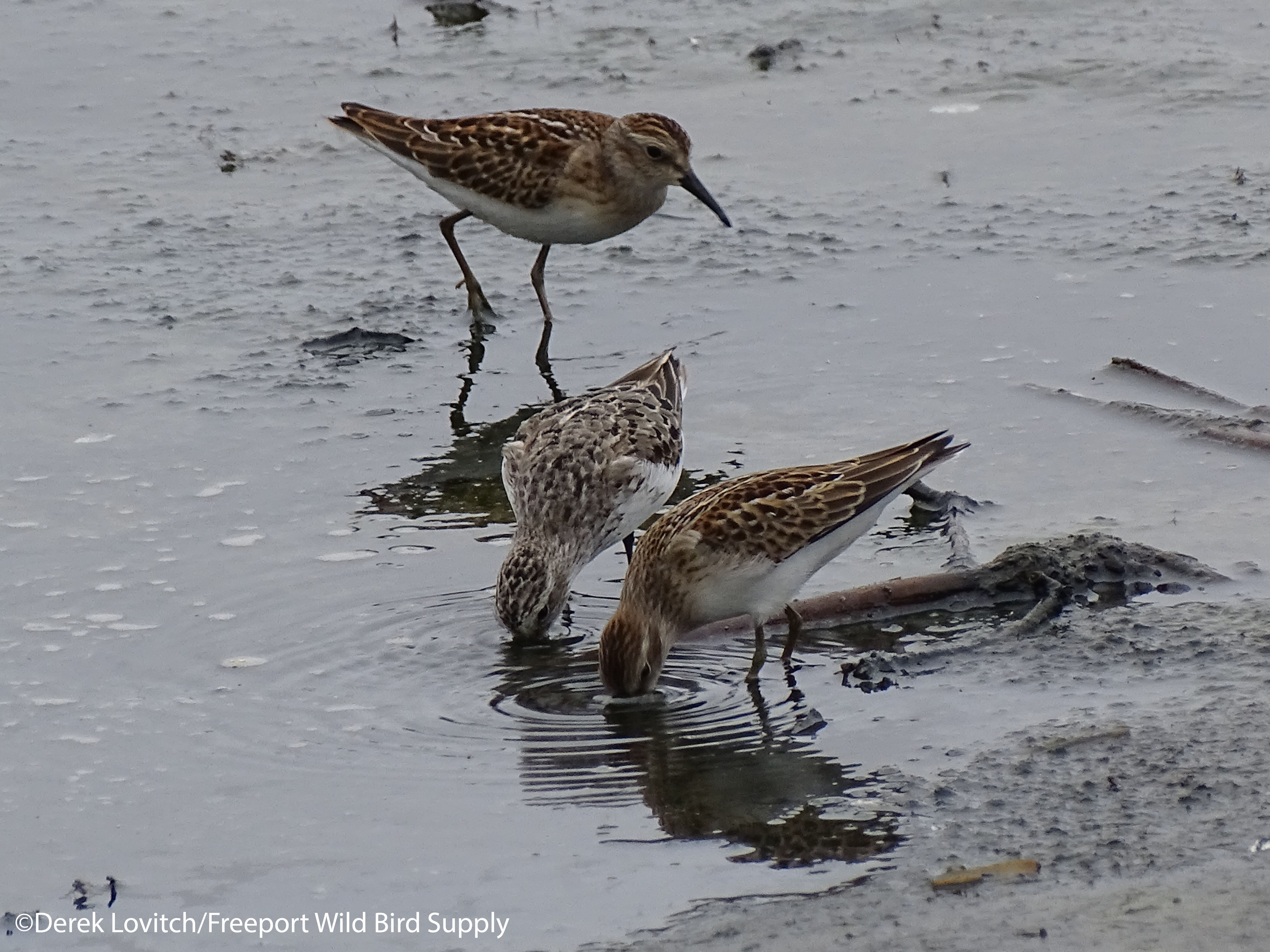
By using habitat cues and tide charts, we maximize our shorebirding productivity. By studying birds near (like these side-by-side Least and Semipalmated Sandpipers) and far, we can learn to quickly recognize most shorebirds, most of the time, using a range of tools that we worked on together throughout the day.
Next up was Hill’s Beach, on the prime outgoing tide. Unfortunately, thunderstorms were rapidly approaching, and after a short check (more Sanderlings and a growing number of Semipalmated Sandpipers and Plovers), we decided to play it safe, return to the cars, and head into Saco for lunch. Good thing, too, as while we were eating, it was pouring outside!
White-rumped Sandpiper.
Returning to the field, we poked around the edges of Scarborough Marsh as we waited for the tide to begin rolling back in and for the rain to finally come to a stop. After a 10-minute rain delay in the cars while we waited out the last of it, we returned to the field to take in the flats of Pine Point. Good looks at Black-bellied Plovers (75+) allowed us to compare their shape, size, and feeding style to the estimated 300 Semipalmated Plovers that were here. Another 1200 or so Semipalmated Sandpipers contained at least a dozen White-rumped Sandpipers, which we practiced sorting out at a distance using shape and size, especially those long primaries. 14 Willet were new for our list, and the 90’s steroid-era-baseball-players of the greater Tringa family nicely contrasted with 4 slim Lesser Yellowlegs that alighted with some of them. Four not-so-short-billed Short-billed Dowitchers were our 11th species of shorebird of the day. And finally, as we continued to grow and practice our shorebird identification toolkit, we also took note of some non-shorebirds, such as Common Terns and a variety of gulls which today included 2 very-uncommon Lesser Black-backed Gulls!
Monhegan Birding Workshop, September 13th – 15th.
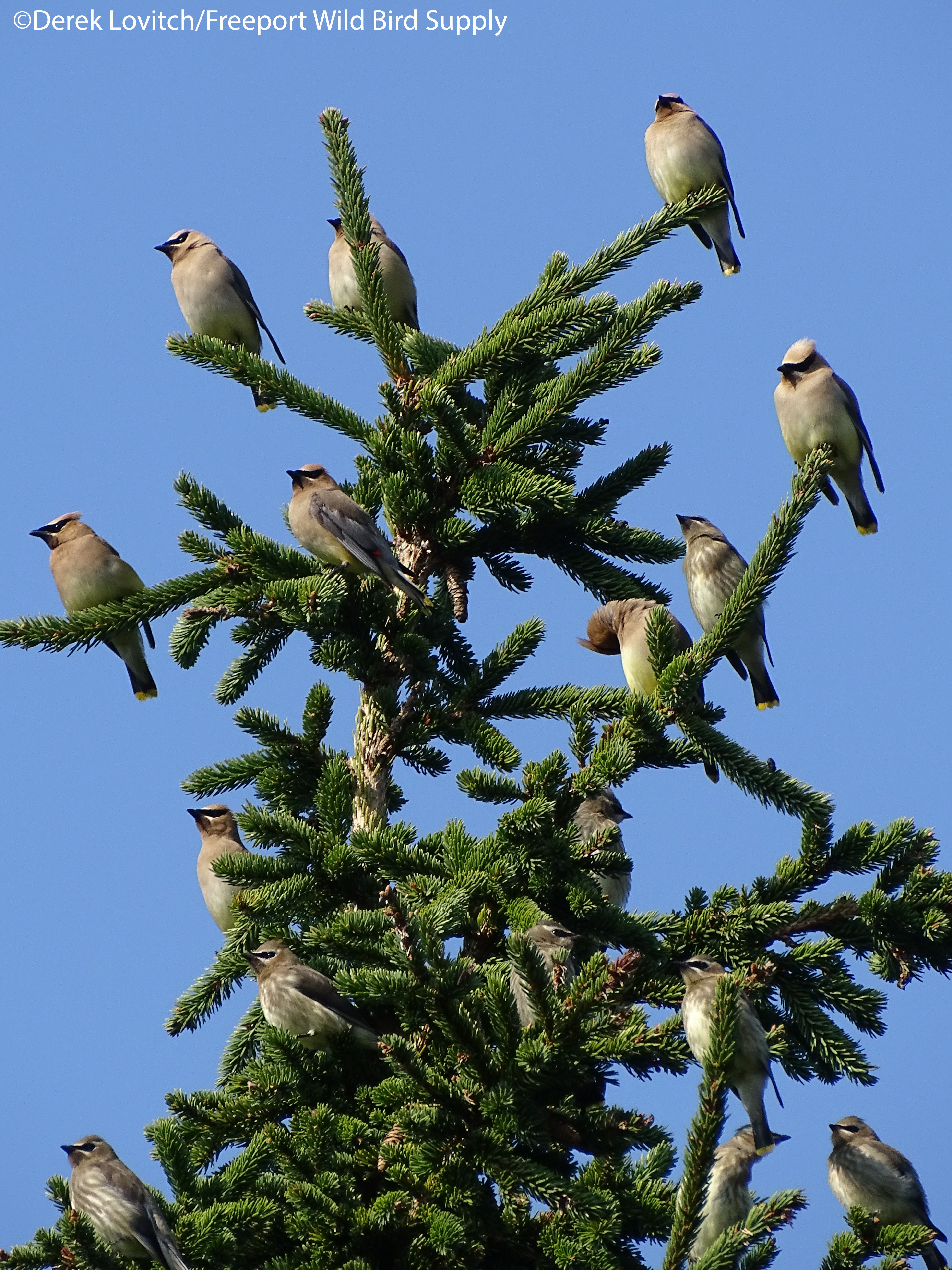
Cedar Waxwings were often with us, alighting on trees, eating native fruits, and avoiding marauding Merlins. Few things bring as much pleasure to the birding day as a “Waxwing Christmas Tree.”
Arriving on a glass-calm sea on Friday the 13th, luck was most definitely with us today and the entire weekend. We were greeted at the dock by a darting Merlin, a sign of things to come. After checking in and a relaxed lunch, we began our workshopping. While overall songbird activity was slow, we enjoyed plants, butterflies, and the weather as we wandered around and spotted birds here and there: a Northern Waterthrush in an isolated bush in a yard, a female Black-throated Blue Warbler in the woods, and lots of Cedar Waxwings in small flocks, overhead and landing in trees. Merlins continued to perform, and several Peregrine Falcons and Sharp-shinned Hawks joined the show, although it did not help us detect skulking warblers!
A late afternoon walk to Burnt Head to take in the cliffs and sample the habitat of the island’s interior produced a 1st-winter Lesser Black-backed Gull, but more importantly perhaps, allowed us to enjoy such a beautiful day on the island for mid-September.
On Saturday morning, we stepped off the porch at the Monhegan House, and it was ON. A great Morning Flight (morning redetermined migration) was underway, with dozens upon dozens of warblers zipping overhead as the sun slowly rose. As we did a short stroll to some favored early-morning micro-habitats, we ground-truthed the morning flight, finding that Cape May Warblers were indeed the dominant migrant of the morning. In fact, we often had 3 or 4 (as many as 5 in one tree) in the top of nearly every spruce we checked, and the entire range of plumages was on display. Northern Parulas were also numerous, but we estimated about 3 of every 5 warblers we encountered this morning were Cape May!
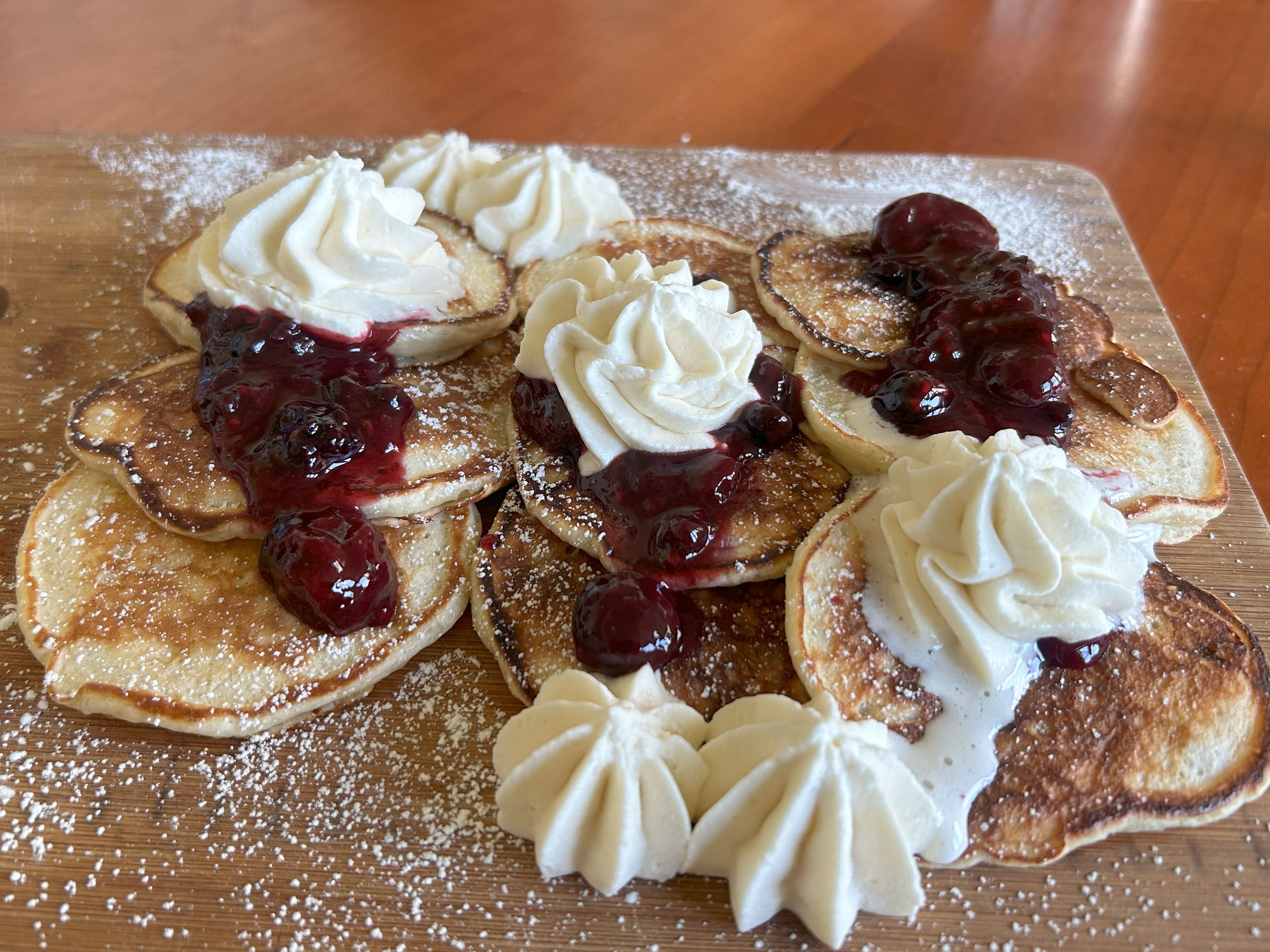
It was such a great morning it was hard to come inside to break for breakfast. Or so one thinks until they have had the Monhegan House Breakfast…and this was just the final of three courses!
Although the day’s activity peaked in the morning as many of the birds in Morning Flight continued on back to the mainland with a light northwest wind becoming northeasterly by noon, we continued to find pockets of activity and mixed-species foraging flocks throughout the day. There were a few Eastern Kingbirds and Eastern Wood-Pewees scattered about, often giving very good looks, and we had a nice mixed vireo flock that included 2 Philadelphia Vireos, 1 Blue-headed Vireo, and several Red-eyed Vireos for nice comparison. Northern Harriers put on a performance for us in the late afternoon over the marsh.
While our afternoon walk through the woods to the lighthouse was as much for pleasure and learning about habitats as it was for birds, the result was the discovery of a rare Lark Sparrow! We covered a lot of ground today, and definitely earned our delicious dinner. Before that, however, we had a little workshopping session to recap the day and compare what we saw (morning flight) with what the overnight radar image had suggested.
One of the new migration skills we learned was how to monitor and plan your birding accordingly by looking at NEXRAD weather radar. For comparison, here are the 1am images from Saturday and Sunday morning, respectively, showing the greater density of birds in the air and offshore on Saturday morning – and confirmed by our morning flight observations come sunrise.
Another clear and calm night resulted in a very strong flight of birds, but with fewer birds drifting offshore, the morning flight was slower than Saturday, as we forecast. However, there were plenty of new birds around, and we repeatedly saw birds we had not yet seen and many rather “fun” species. It started with a drift-vagrant Dickcissel in Morning Flight, followed by a Whimbrel flying around. A likely Clay-colored Sparrow disappeared before we could confirm it in poor light, but warblers such as Bay-breasted, Blackburnian, and Wilson’s were more confiding. Unexpected offshore and always a surprise on Monhegan, an immature Cooper’s Hawk flew over us on our way to lunch.
There was a noticeable turnover in species, with more sparrows and many fewer Cape May Warblers. We had some unusually cooperative Lincoln’s Sparrows to study, such as this one that perched in a bush with a Song Sparrow for comparison (and later, the same bush held a Swamp Sparrow next to a Song for further study of the entire genus!).
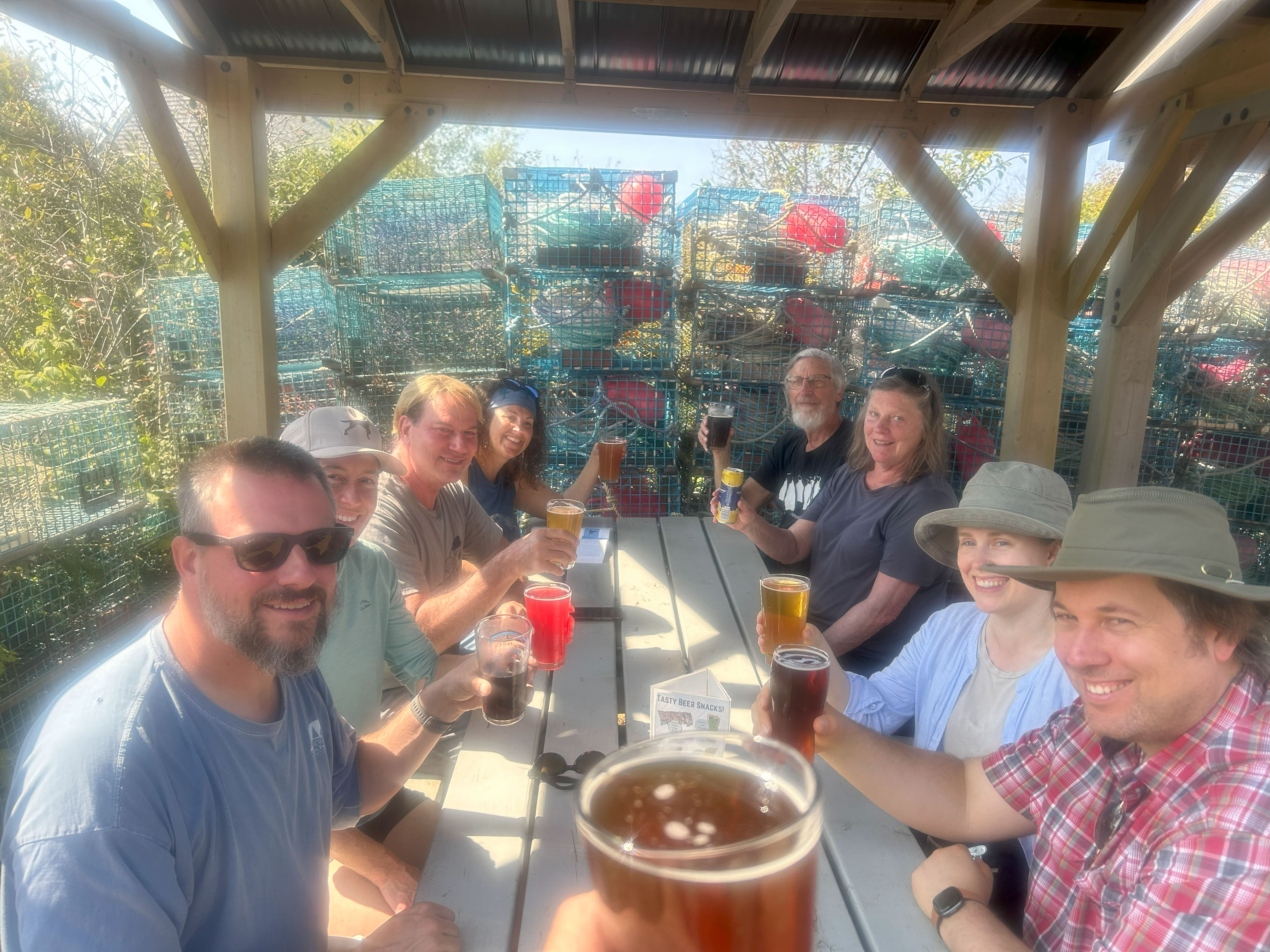
Since we were focused on learning bird identification and the nuances of migration’s ebbs and flows (and mechanisms thereof), we did not keep a running bird list. We did count our warbler tally and finished the trip with a very respectable 17 species of warblers! We found a couple of “good birds” (and jokingly disparaged the use of the descriptor) for ourselves and ate way too much good food. We learned a bunch about migration, plants, birds, and insects, and a little about the island. So instead of trying to add one more bird to the non-existent list, we brought the tour – and the 2024 Down East Adventures Birding tours season to a close with lunch and a toast at the brewery!
This Hepatic Tanager was a shocking discovery in Stockton Springs. I caught up with it on 12/31 to bring my 2023 birding year to a close. Such a lousy phone-scoped photo of such an amazing bird, though!
Happy New Year List Everyone (for those who keep one)! Rarities abound as we finish 2023 and begin 2024, and I caught up with a few of them this week, and, even more satisfying, found a few “good birds” of my own.
1-2 Red Crossbills continue in and around our Durham property this week. I need to work on finding breeding activity.
At least two Turkey Vultures continue in the I-295 corridor between Yarmouth and Freeport through week’s end.
I finished 2023 off with a bang, visiting the HEPATIC TANAGER on Station St in Stockton Springs on 12/31 (with Evan Obercian). Photo above.
1 male Red-winged Blackbird, Rte 127, Arrowsic, 1/1 (with Jeannette).
2 REDHEADS, 3 AMERICAN COOTS, 4 RUDDY DUCKS, 1 Long-tailed Duck, about 50 Lesser and 25 Greater Scaup, etc, Chickawaukee Lake, Rockport, 1/1 (with Paul Doiron, Kristen Lindquist, and Jeannette).
1 Northern Flicker, Thompson Meadow Road, Rockland, 1/1 (with Paul Doiron, Kristen Lindquist, and Jeannette).
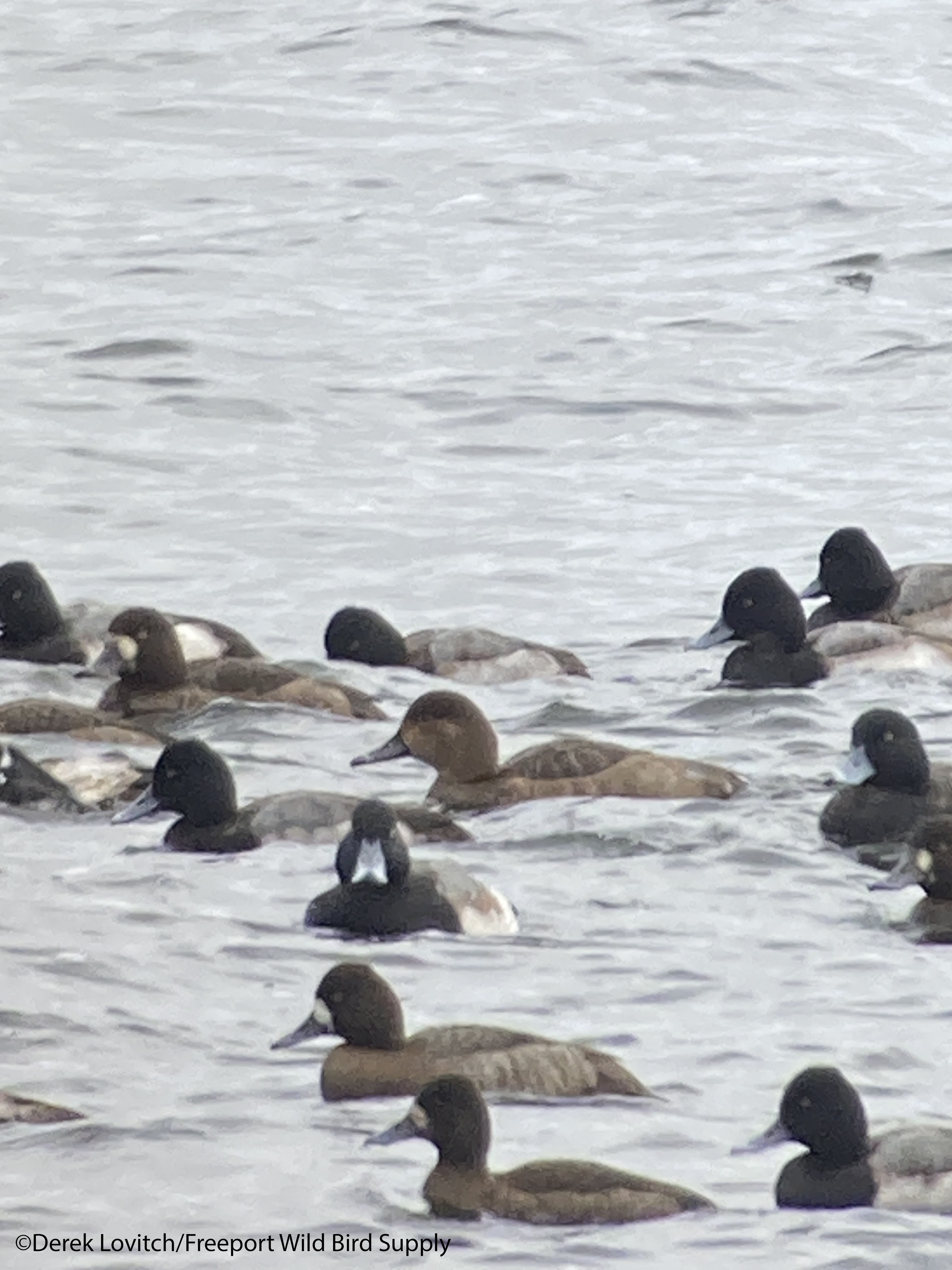
Jess Costa and I went down to Ogunquit Beach on 1/4. to look at the unprecedented mixed-species warbler flock that has been in and around the dunes and wastewater treatment plant here. I glimpsed what “had to be” the TOWNSEND’S WARBLER, but between the two of us, we saw the two CAPE MAY WARBLERS, 1 TENNESSEE WARBLER, 2 “WESTERN” PALM WARBLERS, 1 PINE WARBLER, and 3-4 Yellow-rumped Warblers well. However, my interest was observing the flock as a whole, especially what they were eating, what the range of the flock was, and whether the birds were exhibiting “normal” niche differentiation. Unfortunately, we only had two encounters with the whole wave in 3 hours, and periods of up to 45 minutes went by without seeing a warbler anywhere in the dune line. Where else are they going? The lack of sun that day made the edge less inviting, but they still seemed to have disappeared from the pine forest. Were they heading into a neighborhood or across the marsh? I have more questions than answers after the visit, so I might have to find time to go back! We also had one Red Crossbill, 1 MERLIN, two Northern Harriers, etc.
1 drake BARROW’S GOLDENEYE, 64 Lesser Scaup, 19 Greater Scaup, 1 Red Crossbill, etc, Lake Auburn, 1/5 (with Dan Nickerson)
2024 PREDICTIONS LIST BLOG NOW POSTED!
After an 11th-hour addition and requisite updates, my famous-ish Predictions Blog is now ready for viewing. In this annual post, I attempt to forecast the next 25 species to appear in Maine, as well as predict what the next 25 species I personally will see in the state. I also summarize the new species added to Maine’s list in 2023, as well as my own personal highlights and new species.
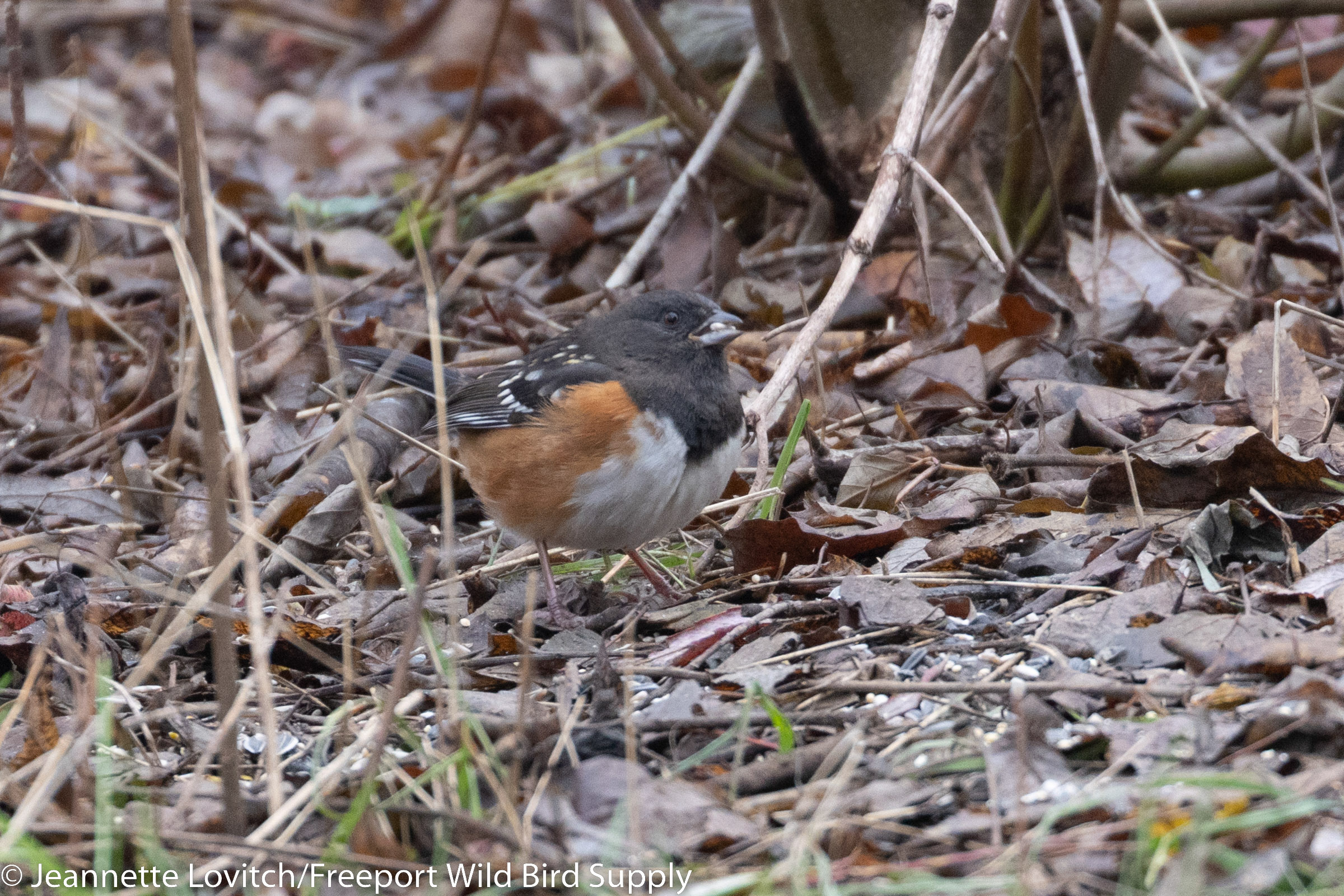
The only thing sweeter than seeing a first state record is when you find it yourself! This Spotted Towhee that I found in November at Fort Foster in Kittery was #4 on my list of next birds for Maine.
It’s once again time for my annual Predictions Blog, where I view into my crystal binoculars and attempt to forecast some of the “new” birds to grace the State of Maine – and then my own personal state list – in the coming year.
It was another great year for “mega” rarities in Maine. Whether it’s more birders and better communication, a climate in crisis, neonicotinoid pesticides effecting navigation, and more – or likely, all of the above – more really strange birds are ending up in really strange places – Maine definitely included. Four new species showed up in Maine in 2023, plus a first state record whose photos surfaced from 2022. I also had another pretty good year, despite much reduced birding as I recovered from shoulder surgery and a series of setbacks thereafter coupled with a record-busy year for tours and private guiding.
Last winter, recovering from shoulder surgery, I spent a lot of time watching our feeding station, quantifying those ebbs and flows, and paying a lot of attention to behavior. From dominance hierarchies in junco flocks to a case of Sharp-shinned Hawk cannibalism, dedicated feeder-watching (in a house designed to maximize it!) was a great way to pass the time stuck indoors. I recounted many of my observations in blogs earlier this year, especially these two:
Once up and about, I found myself forgoing birding mornings afield – especially in the fall – to just enjoy migration through our property in Durham and build our rapidly expanding yard list. Having moved in last fall, it was exciting to see the seasons change. Fall migration was particularly productive, and I found myself not wanting to bird anywhere else before work. Some great yardbirds over the year included a Snow Goose on 3/27, three different Mourning Warblers (one each in May, June, and September), an American Bittern for the day on 8/28, and a Dickcissel on 9/1. The yard was already approaching 150 species by year’s end.
Furthermore, I put more effort than ever into birding Androscoggin County in general, and while I didn’t find any rarities in the county this year, I did spend lots of quality time at Sabattus Pond and in search of patches for future birding focus – I didn’t find any of those, either, but I did get to know my new home county a lot better. In other words, when I did get out birding this year, I put a lot more focus on staying close to home – this less carbon-intensive mode of birding is what I believe the future of birding is (eg the “5 Mile Radius” list, which is all the birds seen within a five mile radius of one’s home) anyway, and I plan on keeping this focus for 2024.
But back to the rarities. Let us start as usual with a look at last year’s prognostications and see how I did.
Of the five new species for Maine, three were in my Top 12. I found Maine’s first confirmed Spotted Towhee at Fort Foster in Kittery on November 19th (and continued obligingly through the end of the year). This long-overdue addition to the state’s list was #4 on my predictions list.
Right behind it at #5 was the Hammond’s Flycatcher found on Monhegan in October. I’ve felt flycatchers were going under-detected in Maine for a while, and therefore they have been prevalent on my predictions lists. Then, a photograph from Mount Desert Rock from August of 2022 was reanalyzed and showed a Western Flycatcher (as it is once again rightly called, with Pacific-sloped and Cordilleran finally “lumped” back together), which was #12 on my list.
That strange date for a vagrant flycatcher is rather remarkable, as was the other addition to the list from the MDI region when a Red-footed Booby was photographed in Lamoine in July of this year. This tropical sulid didn’t even make my honorable mention list.
And finally, just before the clock was about to strike twelve, a remarkable Hepatic Tanager was found in Stockton Springs! While it was on my radar due to several well out of range records, it did not qualify for my Honorable Mentions list. It was the icing on the cake to another exceptional year of birding in Maine.
With three birds from the 2023 List off the board, I’ll do some reshuffling. A possible Gray Heron was photographed in Scarborough Marsh on the Portland CBC in December, but the photos – although very suggestive – were inconclusive. A search the next day didn’t turn anything up, but I hope others remain on the lookout. Nonetheless, it was suggestive enough to bump Gray Heron up from my Honorable Mention list into the Top 25, that is for sure. Lewis’s Woodpecker, Dusky Flycatcher, and White Wagtail are making their debut in the rankings while I’ve dropped Black-tailed Gull out of the Top 25 as North American records seem to have dried up.
As we found out when we saw this Gray Heron while vacationing on Prince Edward Island in 2022, they are not always easy to pick out of a crowd, as we looked through a lot of Great Blue Herons during our search for this long-staying individual. Hopefully, our view in Maine will be a little better, like this one Jeannette photographed in Norway.
Neotropical Cormorant
Black-chinned Hummingbird
California Gull
Limpkin
Gray Heron
Bermuda Petrel
Graylag Goose
Little Stint
Audubon’s Shearwater
Common Shelduck
Anna’s Hummingbird
Heerman’s Gull
Common Ground-Dove
Allen’s Hummingbird
Spotted Redshank
Lewis’s Woodpecker
Ross’s Gull
Black-capped Petrel
Lesser Nighthawk
Elegant Tern
Dusky Flycatcher
Painted Redstart
Hooded Oriole
White Wagtail
Common Scoter
Personally, I added 5 new species to my own Maine State List this year, despite relatively limited birding and a less concentration on rarities in general. Three days after my shoulder surgery, however, Jeannette loaded me into the car and took me down to Timber Point in Biddeford for a Common Ringed-Plover, which was #10 on my predictions list. Can’t say it was my most comfortable twitch, however. Medication helped.
In June, I raced down with Jess Costa between tours to see the Loggerhead Shrike at the Kennebunk Plains, which was my 399th species in Maine (recently relegated to my honorable mentions lists as they have become increasingly rare anywhere out of their contracting range).
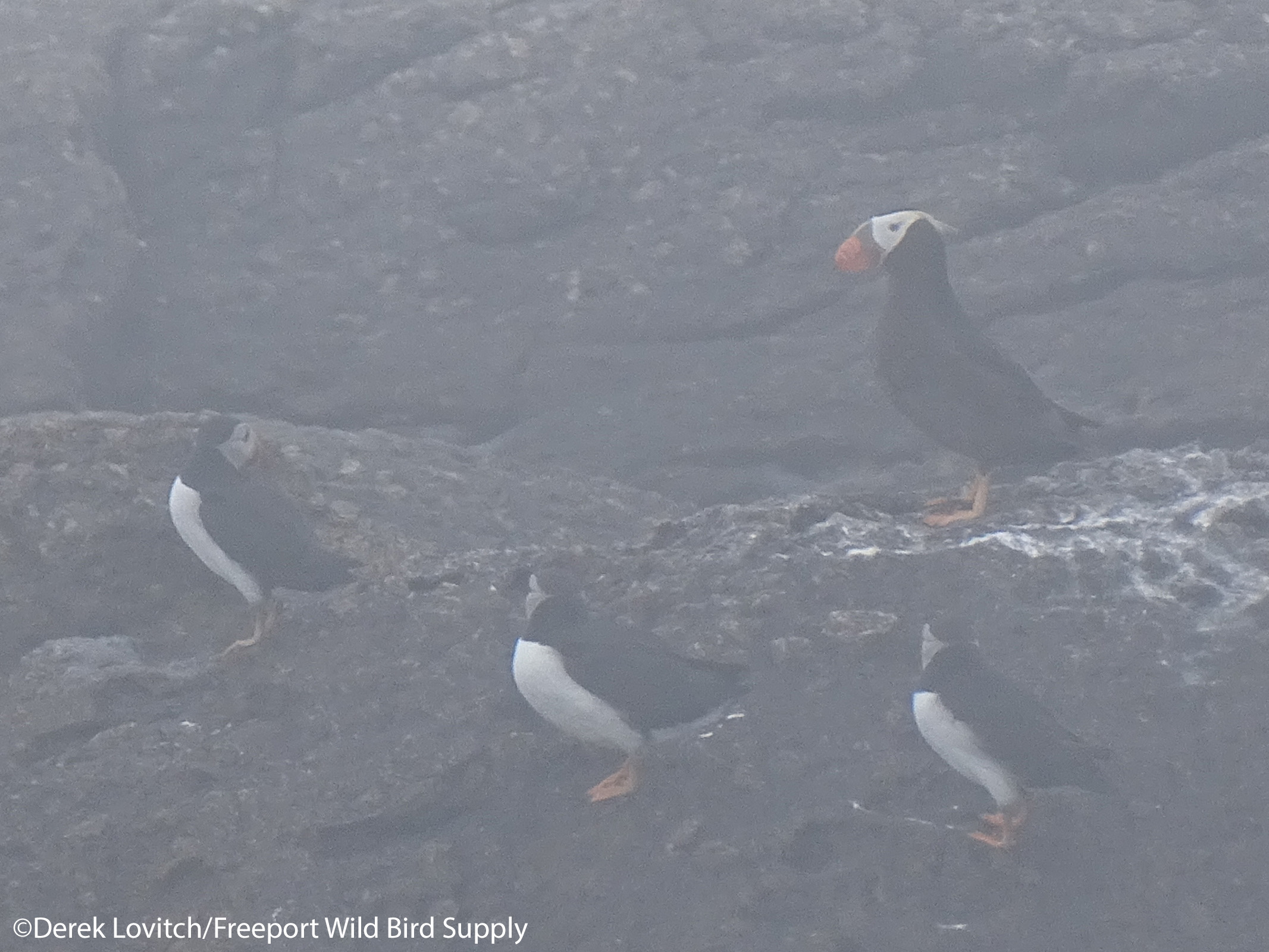
So for #400, I said it had to be “the Tufted Puffin or self-found” – I wasn’t going to chase anything else. With several sporadic sightings in June and July, and with numerous boat tours scheduled in July, I had high hopes. With an observation at Eastern Egg Rock on July 9th, and with a tour there scheduled the next afternoon with our partners Cap’n Fish’s Cruises, I was getting excited. And to hedge the bet, I hopped aboard their morning Eastern Egg Rock trip, and as we approached the island in the fog, a large, dark, puffin stood towering over the local residents! “TUFTED PUFFIN!!!” I exclaimed. No microphone was necessary. And this was #400.
With so few sightings – all being one-minute wonders – in the previous years, I hadn’t elevated this to my personal Top 25, but that’s OK – it was just as sweet.
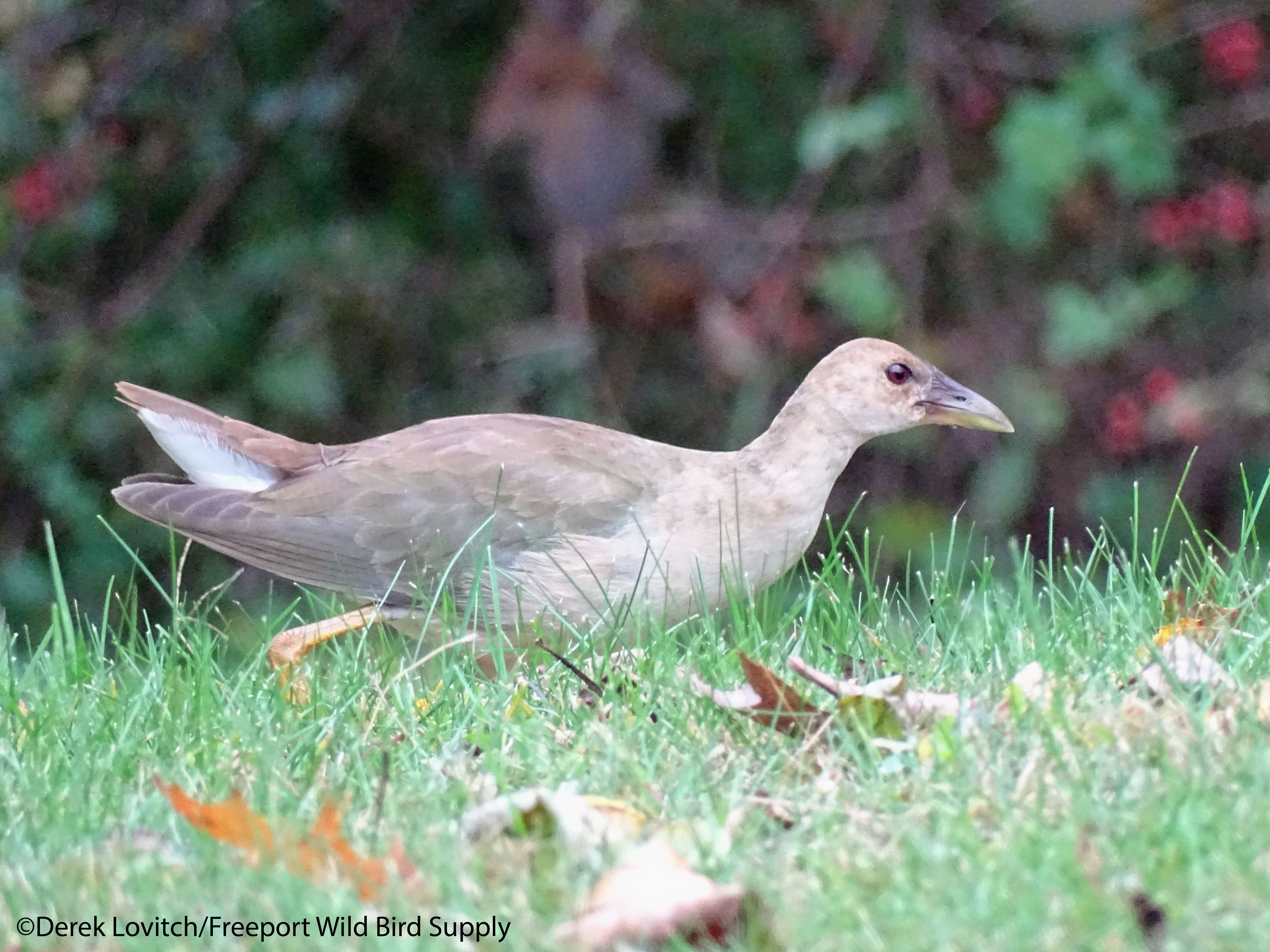
A Purple Gallinule (honorable mention) in the North Maine Woods near Moosehead Lake in October was beyond my chasing range, but when another – or perhaps, the same bird – appeared at a small park in Kennebunk, I was on my way!
The absurdity of the locale and ease of viewing simply forced me to go back for another look a week later with Dan Nickerson…after dipping on a nearby Western Wood-Pewee as Luke Seitz struck again. Making that miss worse was the reason I didn’t chase it on its day of discovery: we were on lockdown during the manhunt after the tragic Lewiston mass shooting. My state list was just not a priority I will readily admit.
Of course, the aforementioned Spotted Towhee, which was #15 on my list was a welcome self-found addition.
And finally, Evan Obercian and I paid a visit to the Hepatic Tanager in Stockton Springs on New Year’s Eve, bringing 2023 to a close.
Of course, I missed a few rarities this year, too! Although I only “dipped” on one chase (the pewee), I was simply unavailable to chase anything else, such as the Kirtland’s Warbler (unlisted) on Seal Island in September (can’t get there from here!). And I just didn’t have the time to chase Hammond’s Flycatcher (#14) on Monhegan. Meanwhile, the Red-footed Booby (unlisted) was a one-day wonder, and of course I missed a couple of Franklin’s Gulls (#2) as usual. Notorious one-day wonders, there was one on September 24th passing Schoodic Point, and one on November 18th at Long Sands Beach. I was going to “end up” at Long Sands the next day at the same time and tide, but my birding outing began and ended with my towhee find at Fort Foster. This rare but regular transient is officially my nemesis in the state!
But the one that really stings was missing out on Crested Caracara once again. I was birding with clients in Spurwink Marsh in late May when a friend texted me that he had one (the one?) flying over his house…we were no more than 2-3 miles away! Thankfully, my clients were game for a little searching, so we spent some time looking before having to move on. The caracara then resurfaced a couple of other times in the Mid-Coast, near Belfast, but I was on Monhegan or with a tour group elsewhere. So close!
Last year, I also predicted that my #400 would come from my Top 25 list. But Tufted Puffin wasn’t on it, so I was wrong about that. Forgive me if I wasn’t upset, however.
I did some reshuffling (it’s just a matter of time before I finally find or catch up with a Franklin’s Gull, right? RIGHT!?), and therefore my forecast for my next 25 species on my personal Maine list reads as follows:
Franklin’s Gull
American White Pelican
Neotropic Cormorant
Brown Pelican
California Gull
Brown Booby
Crested Caracara
Slaty-backed Gull
Boreal Owl
Calliope Hummingbird
Graylag Goose
Cerulean Warbler
Gull-billed Tern
Pacific Golden-Plover
Limpkin
Wood Stork
Black-chinned Hummingbird
Brewer’s Blackbird
Yellow Rail
Virginia’s Warbler
Western Wood-Pewee
Virginia’s Warbler
Gray Heron
Common Gull
Heerman’s Gull
It’s about time for me to finally see a Franklin’s Gull in Maine.
But really, who knows what might show up these days? For example, I am sure that no one had Red-flanked Bluetail on their Next Birds in New Jersey list, but one showed up in a random inland neighborhood in early December. It continued through year’s end, and it was awfully nice of it to remain at least through December 26th, when we just happened to be in the area for Christmas. In fact, it was only 24 minutes away from my Mom’s house. A bonus Christmas gift!
Bring it on, 2024. But less injuries and other birding-limiting events, please. I also have a goal of finding a rarity in Androscoggin County away from Sabattus Pond or our property! Will it be on this list?
I finally went back this week, this time with Jeannette, to revisit the Spotted Towhee that I found at Kittery’s Fort Foster on 11/19. We were treated to two sessions of it feeding, both of which provided longer and better views than on the first day.
Early December is often a time with another pulse of rarities being detected as birds concentrate at fewer seasonally abundant food sources, like feeding stations, and concentrate along the coast and other migrant traps. At the very least, it’s a time for unusual “late,” “lingering,” or “pioneering” birds that brighten up a cold, gray winter’s day. This was often the case for me in my relatively limited birding over the past two weeks, with the following observations of note:
1 Gray Catbird and 1 Ruby-crowned Kinglet, Capisic Pond Park, Portland, 11/30.
Sabattus Pond, Sabattus, 12/1 (with Dan Nickerson): 380 distant scaup, 272 Common Mergansers, 238 Ruddy Ducks, 209 Mallards, 8 American Black Ducks, 8 Common Goldeneyes, 7 Buffleheads, 4 GREEN-WINGED TEAL, 3 Common Loons, 1 Belted Kingfisher, and 1 RUSTY BLACKBIRD.
1 Chipping Sparrow, King Road, Lisbon, 12/1 (with Dan Nickerson).
3 Ruby-crowned Kinglets and 2 Field Sparrows, Saco Riverwalk, Saco, 12/3.
1 Hermit Thrush and 1 Swamp Sparrow, Elphis Pond, Biddeford Pool, 12/3.
Southern York County Coast with Jeannette on 12/5:
1 continuing SPOTTED TOWHEE (photo above), 2 MARSH WRENS, and 1 Swamp Sparrow, Fort Foster, Kittery.
2 American Pipits and 1 Horned Lark, Seapoint Beach, Kittery.
1,000+ Black Scoters, The Nubble.
60 Sanderlings, Ogunquit Beach.
1 Ruby-crowned Kinglet, Auburn Riverwalk, 12/7.
1 drake BARROW’S GOLDENEYE (first of season), 74 Lesser Scaup, and 2 Greater Scaup, Lake Auburn, Auburn, 12/7.
1 Red Crossbill, over our property in Durham, 12/8.
Meanwhile, at our feeders in Durham, a nice uptick in sparrow activity including up to 14 Dark-eyed Juncos, 4 continuing White-throated and 1-2 continuing Song Sparrows, with our first American Tree Sparrow arriving on 11/22 before the store, and 15 Dark-eyed Juncos, only 1 White-throated Sparrow, and a return on 12/6 of an American Tree Sparrow after the storm. 40-50 American Goldfinches and 1-2 Purple Finches continue daily, but this week, we only had Pine Siskins in the woods and not at the feeders.
Since we’ve had a mix of “the birds are back!” and “there are still no birds at my feeders” at the store recently, a wrote a new blog talking about the season and the inconsistencies we are seeing with overall feeder activity, which is posted here.
The amazing birding and migration site – especially for fall “morning flights” – in the Mid-Coast is once again under direct threat. Birders need to help convince the state to find an alternative location for a massive new port and its infrastructure. Our most significant places of concentration for migratory birds need to be protected. Here isour Statement in Opposition to a New Port on Sears Island in Searsport.
In last week’s report, I complained about the dearth of vagrants in Maine this November, but that changed dramatically this week. Several rarities around the state included Maine’s first confirmed Spotted Towhee that I found at Fort Foster in Kittery on 11/19. A Prairie Warbler, 1-2 “Western” Palm Warblers, 1 Gray Catbird, 1 Hermit Thrush, Type 12 Red Crossbills, and 1 Ruby-crowned Kinglet were also present that day.
Photos from myself and Luke Seitz, as well as observation notes and some information are all here:
Meanwhile, at our feeders in Durham, a nice uptick in sparrow activity including up to 14 Dark-eyed Juncos, 4 continuing White-throated and 1-2 continuing Song Sparrows, with our first American Tree Sparrow arriving on 11/22. 30+ American Goldfinches and 1-2 Purple Finches continue daily, but this week, we only had Pine Siskins in the woods and not at the feeders.
ISSUES and ADVOCACY:
The amazing birding and migration site – especially for fall “morning flights” – in the Mid-Coast is once again under direct threat. Birders need to help convince the state to find an alternative location for a massive new port and its infrastructure. Our most significant places of concentration for migratory birds need to be protected. Here is our Statement in Opposition to a New Port on Sears Island in Searsport.