Overall, it was a great week of sparrow migration, with a nice high count on 10/8 from Wolfe’s Neck Center of 125 Song, 100 Savannah, 75 Swamp, 25 White-throated, 2 White-crowned, and 1 Lincoln’s.
Sabattus Pond season is underway as well! On 10/8, I had early-season tallies of 76 Ruddy Ducks (first of fall), 33 Lesser Scaup, 18 Greater Scaup (first of fall), 2 Ring-necked Ducks, 2 Red-breasted Mergansers (first of fall), etc.
This Blue Grosbeak was among the highlights of an incredible weekend on the island.
“It was like the good ol’ days!” When every other bird you saw was a rare one, and you barely walked 10 steps before finding more birds. But this was not what we were expecting, and the weekend sure didn’t start out that way!
After a very rough boat ride, we were still putting ourselves back together when one birder said “Go back, there are no birds here.” Apparently, it had been a dreadfully slow week of little migration, but at least nice weather. This weekend, the weather wasn’t supposed to be very nice. So without many birds on the island, and quite a bit of rain on the way, were less enthused about arriving than usual…well, that might have had something to do with the boat ride.
And I am not sure if it helped that one of the first birds I looked at was a rare hybrid Herring X Great Black-backed Gull. I am not sure if anyone was ready to take in gull hybrids yet. Even more when we feared that this could be our best bird of the trip if the pattern held.
And sure enough, it was a very slow afternoon. But we did have good luck. We found a Sora that walked out into an open patch of mud, quickly caught up with the adult Lesser Black-backed Gull that has been hanging around, and after lunch immediately found the Least Sandpiper and Spotted Sandpiper at Lobster Cove that have been playing hard to get all week. There was also a good Northern Gannet show, which is always a treat. So at least we were seeing what was around, which sadly, really was not very much. But hey, it still hadn’t rained!
Least and Spotted Sandpipers – shorebirds are few and far between on the island.
A period of rain, heavy at times, fell overnight, but the band was much narrower and less heavy than forecast. It did not rain all night, and it even appeared that a light flight of migrants had developed on the radar after midnight. And sure enough, come dawn, there was a light Morning Flight overhead. It was mostly Yellow-rumped and Blackpoll Warblers, but hey, there were new birds around! And once, again, it was not raining.
A fly-over Dickcissel or two, a calling Gray-cheeked Thrush, and more. Birds! Yay!
Then, after breakfast, I went to spread some seed in my favorite corner to attract some birds for the group to enjoy this morning. Turning the corner near the famous “Chat Bridge” a shockingly bright flash of the most intense yellow you can imagine. And blue wings, and a flash of white in the tail. Prothonotary Warbler I exclaimed to no one around.
I raced back towards the group meeting point and sent them on their way. Kristen Lindquist took off running. I eventually made it back with the rest of the group and we divided to conquer. Kristen and about half the group spotted it repeatedly, while it remained tantalizingly out of view from where I and others were standing.
As other birders converged, a classic “Patagonia Picnic Table Effect” occurred. First, there were two Dickcissels, then I spotted a Yellow-breasted Chat making a short flight over the brush. While searching for that, Ilsa spotted a Yellow-billed Cuckoo that would sit still, preening, for well over and hour. It might have been the most cooperative cuckoo ever on the island! Another group had a brief look at a Clay-colored Sparrow.
Unfortunately, the Prothonotary Warbler was never seen again.
Yellow-billed Cuckoos don’t usually sit this still for this long. This bird was likely exhausted after just arriving on the island.In case you didn’t see it’s yellow bill.
It was already a pretty amazing day for one that we thought would be a wash-out. And it was still not raining. After our lunch break, we convened at the Monhegan House at 1:30, and spent the next hour and a half on its lawn, and going no where else.
One Dickcissel became two, and then four, and when the group finally took off together, we were shocked to confirm a genuine flock of 8 Dickcissels – exceptional, even for Monhegan. And there were not one, but two Clay-colored Sparrows! And other birds just kept arriving, as standing in one spot saw our list quickly grow: American Redstart, Brown Creeper, Warbling Vireo, etc, etc. One “Western” Palm Warbler became 4, a couple of Cape May Warblers paid us a visit, a Savannah Sparrow dropped in…
It was truly incredible! It felt like my first tours here 15 years ago. By now, a light shower was falling, but we didn’t seem to care. We finally pulled ourselves away as the action waned, wanting to see what the next hot corner would offer. After spotting at least 8 Baltimore Orioles along Pumphouse Road, the rain finally arrived in earnest by about 3:30pm. We called it quits, but considering the day we had, no complaints were to be heard. It was a really special day; one that will not soon be forgotten.
While it was more accurately “180-degree misorientation” and other forms of vagrancy and not “reverse migration” that brought us so many good birds, I brought a special beer out just in case we had a day like we did today!
Rain fell overnight again, and come dawn on Sunday (Day 3), dense fog had rolled in. There were a few Yellow-rumped Warblers overhead, especially during a short respite from the fog, but there were not nearly as many birds around as the day before. But, with fog overnight, we expected birds who were on the island to stay, which was good, because yesterday was awesome and there were still a few birds we had not yet encountered.
It might be a while before they are “countable” again, but the Ring-necked Pheasant population seems to be booming in town.
We delayed the start of the after-breakfast walk to let a batch of heavier rain clear through. We were stuck in such an odd fall weather pattern, with virtually no west-east progression of weather systems. But we had been so lucky with the timing of the rainfall so far, that a little delay was of no concern. Regrouping at 10:00, light showers gave way to just some lingering drizzle by 11, and it soon became apparent that there were new birds around. We had two Prairie Warblers, a Scarlet Tanager joining the growing flock of Baltimore Orioles, and a Blue-winged Teal joined a Green-winged Teal in the marsh. Two Cliff Swallows and a Barn Swallow foraged over Manana, and we had our second Yellow-breasted Chat of the trip – this one in the Island Farm garden on Pumphouse Road. And another Clay-colored Sparrow?
There was a really impressive number of Baltimore Orioles on the island over the weekend.
Pockets of Yellow-rumped Warblers here and there often contained another warbler species or two, and we had good looks at stuff all morning, even often-challenging birds to see with a group like Lincoln’s Sparrows.
And after lunch, the sun was out! We had the Lesser Black-backed Gull again, more looks at Clay-colored Sparrows, and finally the immature male Blue Grosbeak showed up for us, and show it did!
It wasn’t as birdy once the sun was out, but a light raptor flight, including at least 6 Peregrine Falcons helped make up for it.
On Monday, our last day of the tour, it appeared that little moved overnight on a light southwesterly flow aloft. But that had our daydreams going for rarities from our west and southwest. And sure enough, while some of us were dallying over breakfast, a Western Kingbird that Kristen Lindquist found earlier flew right over us at the Yew and alighted nearby!
After breakfast, we “cleaned it up” for the group when we relocated it at the cemetery, affording great looks for all. A slower day finally gave us an opportunity to head into the deeper woods. And while we expected fewer birds in the island’s interior, a couple of mixed-species foraging flocks finally put Red-breasted Nuthatch on the list, and we found the first Pine Warbler of the weekend.
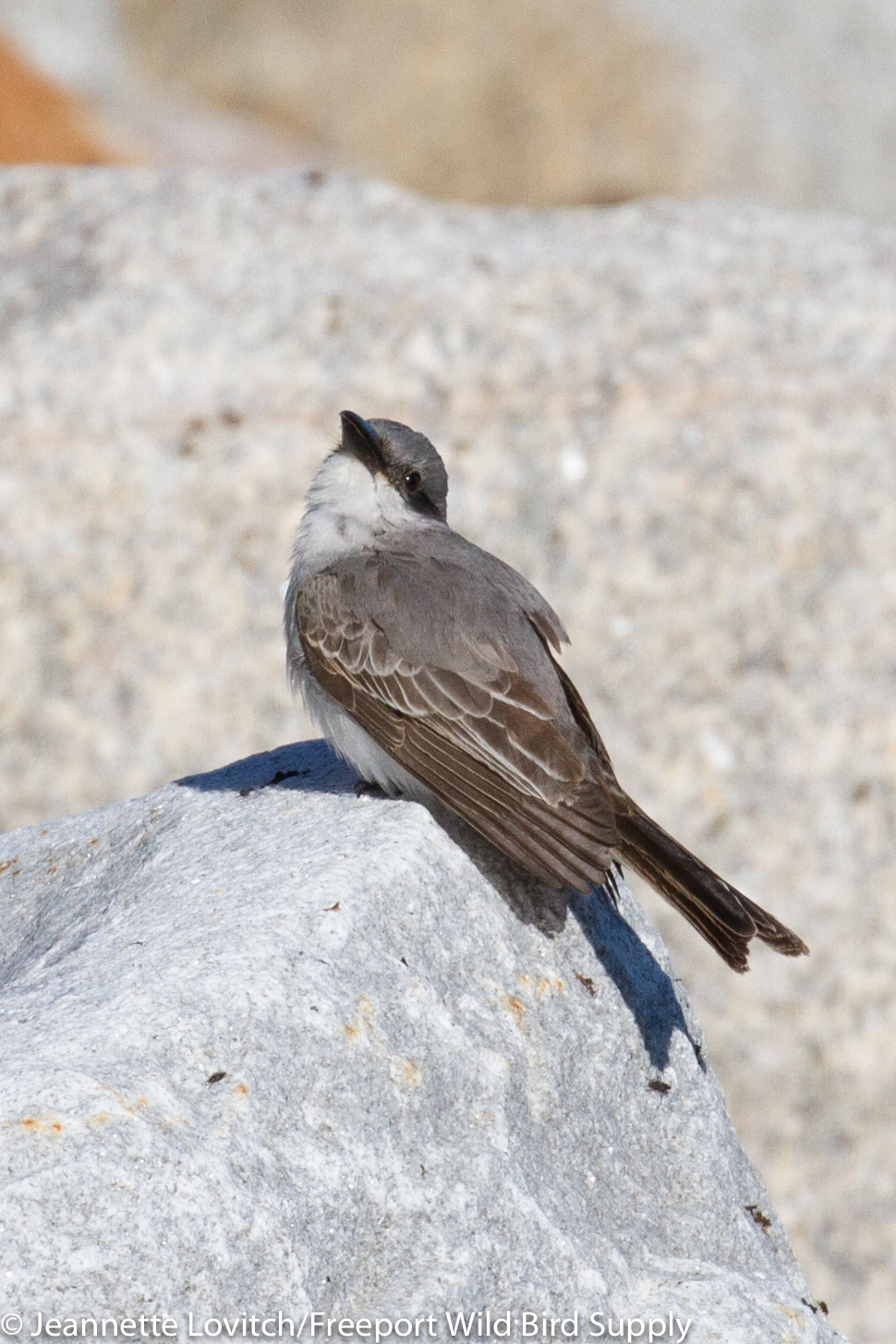
“Look at my tail!” Just in case anyone had hopes of stringing it into a rarer western Tyrannus.
Jeannette joined us by lunchtime, and after lunch, we had a frustratingly brief glimpse of the original Yellow-breasted Chat, along with more great looks at Clay-colored Sparrows.
The tour came to a close with the 3:15 departure back to New Harbor, bringing our incredible four days together to the always-bittersweet end.
Jeannette and I birded the rest of the afternoon together, picking up a few things, like my first “Yellow” Palm Warblers of the weekend and a Solitary Sandpiper. Our walk to dinner yielded a second Pine Warbler, and at the harbor: a juvenile Ring-billed Gull (actually fairly rare out here in the early fall) and another view of the lingering Lesser Black-backed Gull.
On Tuesday, Jeannette and I enjoyed our day off on the island, and Kristen Lindquist joined us for most of the day. A diminishing light southwest wind overnight gave way to a little bit of northwesterly winds by dawn, but it didn’t appear that much had arrived on the island overnight.
At least two, if not three, different Prairie Warblers were around the island. Getting late, a few American Redstarts helped bump up our impressive warbler tally.
However, we soon located a Lark Sparrow found yesterday by Bryan Pfeiffer, the immature male Blue Grosbeak paid us a visit, and we heard the Sora briefly. We then found an Orange-crowned Warbler out past the Ice Pond, my 20th warbler species of the weekend! Unfortunately, we were sans cameras with a little light rain falling.
This Scarlet Tanager was often cooperative at the grape arbor. As per tradition with this tour report: at least one gratuitous “food porn” photo. Here’s the colorful and fresh avocado toast from the Trailing Yew. And here’s one of the island’s resident Black-capped Chickadees…just because.
After lunch, we were excited to find two Lark Sparrows sitting next to each other at the cul-de-sac, there were now two Ring-billed Gulls in the harbor, and yes, there were still at least 4 Clay-colored Sparrows and several Dickcissels around!
Just for a change of pace, we decided to walk the diffuse trail along the island’s southwestern end, but were soon distracted by something large in the water in the distance. Retrieving my scope, it was clear that it was indeed a dead whale, and eventually it floated close enough to identify it as a dead (and rather bloated) Minke Whale. A handful of gulls were around it, and briefly, a quick pass by a jaeger that was too far to claim the identity of. It was a fascinating, if not rather sad, end to our visit as by now it was time for Jeannette and I to head to the dock to return to the real world.
A much more pleasant boat ride back, this time to Port Clyde yielded a number of Common Loons and plenty of Northern Gannets, and a surprise of a small pod of Atlantic White-sided Dolphins. I’m not sure if I have seen this pelagic species from a Monhegan ferry before, or this close to land at all.
And finally, one last “good” bird: a pair of truant American Oystercatchers on Dry Ledges (off of Allen Island)! Interestingly, we had a pair on the same exact ledge on our way back from the island on October 5th of last year.
At least 8 Dickcissels, at least 4 Clay-colored Sparrows, 2 Lark Sparrows, and an Orange-crowned Warbler from the Midwest. A Western Kingbird from the West. A Prothonotary Warbler, 2 Yellow-breasted Chats, and a Blue Grosbeak from the South. 105 total species (102 with the tour) including 20 species of warblers. Yeah, that was a good trip – and the stuff that Monhegan legends are made of, at least sans fallout.
Four of a flock that grew to an impressive 8 Dickcissels, often found in the swale behind the Monhegan House throughout the weekend.
And finally, here is our birdlist from the extraordinary weekend:
9/24 = * denotes ferry ride only 9/27 = * with just Jeannette 9/28 = with Jeannette; *denotes ferry ride only
This Blue Grosbeak was among the stars of the show from an exceptional weekend of great birds on Monhegan Island.
I haven’t yet posted a Monhegan tour blog from last weekend, so I figured I’d at least post some of the highlights from our extremely exciting weekend chock-full of great birds!
9/24 (with Monhegan Fall Migration Weekend tour group):
1 adult GREAT BLACK BACKED X HERRING GULL HYBRID
1 adult Lesser Black-backed Gull
1 Sora
9/25 (with tour group):
1 adult PROTHONOTARY WARBLER. Found by me at “Chat Bridge” and refound nearby a short while later by Kristen Lindquist and part of my group. Only bird of the weekend not seen again.
1 YELLOW-BREASTED CHAT
8 DICKCISSELS (in flock together at one point)
2 CLAY-COLORED SPARROWS (in flock with 8 Dickcissels).
I don’t usually post my Sandy Point Morning Flight totals here, but today was more than worthy of a little something extra. After 8 nights with little or virtually migration (well, at least not a big flight on ideal winds), clearing skies and a light northwesterly breeze finally opened the floodgates. Here are the 1:00am reflectivity and velocity images, for example.
I am sure Monhegan – where I just spent 5 glorious days (despite the lack of a huge flight; more on that soon!) – was great, Sandy Point was just outstanding. In fact, it was my 3rd highest all-time flight!
Early on, clouds made everything into little black shapes as the intense flight proceeded at all levels. Wind, a cacophony of kinglets ringing in my ears, and the two loudest and most vociferous Tufted Titmice who just stayed screaming in the magic birch all conspired to further reduce my ability to identify birds. But mostly, waves of dozens at a time were simply clicked as “unidentified” as I tried to keep pace with quantifying the flight. Furthermore, there were at least 3-4 hunting Merling, a Cooper’s Hawk, and a Peregrine Falcon, which added to the swirling chaos. It was a challenge, that’s for sure. “I do this for fun?” I asked Matthew.
Here’s the scorecard from the Morning Flight of birds that passed over and through Sandy Point, Cousin’s Island, Yarmouth this am:
3 Swainson’s Thrushes – including two observed crossing.
3 Tufted Titmice
2 Scarlet Tanagers
2 unidentified vireos
2 Yellow Warblers
2 Red-breasted Nuthatches
2 Tennessee Warblers
2 American Goldfinches
1 Chestnut-sided Warbler
1 Pine Warbler
1 White-crowned Sparrow
1 Broad-winged Hawk
1 White-breasted Nuthatch
1 Hermit Thrush
1 unidentified Catharus
1 Red-bellied Woodpecker
1 Osprey
X Common Yellowthroats
1 YELLOW-BILLED CUCKOO – my 7th all-time here. Made 4 “false starts” before crossing at 10:04am.
Cuckoos are such shape-shifters in flight that I feel like I could have counted each pass from the one bird as a different species each time it passed!
For a grand total of 5,487 birds, my *3rd highest all-time count. So yes indeed, birds have very much been backed up.
Meanwhile, adding to the excitement (and chaos) this morning was a massive feeding frenzy of Double-crested Cormorants and gulls. While I am sure a few migrants snuck by overhead, I couldn’t help but take a few moments to enjoy it…and make sure there were no rarities among the gulls! 15-20 Laughing Gulls and 4 Bonaparte’s Gulls joined 75-100 Ring-billed Gulls in snatching the baitfish that the Double-crested Cormorants had pushed right up onto the sandbar as it slowly emerged from the tide. It was quite a show!
The weekend will likely start off wet, but with several days of an extensive southerly flow originating all of the way from the Gulf Coast and Deep South, vagrants – like Blue Grosbeak, Hooded Warbler, Summer Tanager, and much more will be on our minds.
Similarly to last week, my birding time was woefully limited thanks to excuses including a trade show and a morning meeting. Therefore, my birding this week was mostly limited to our Saturday Morning Birdwalk and one great flight at Sandy Point.
Speaking of Sandy Point, I did not make it out for what was presumably a light flight on Monday morning, and of course a Clay-colored Sparrow – a long-overdue Patch Bird – was found. It wasn’t until Wednesday morning that I had a chance to look for it. While I didn’t find it, I did get a consolation prize. With a flock of about 400 Semipalmated Sandpipers in the cove on the north side of the point – the largest peep flock that I have seen here, I grabbed the scope. Among them was a single Sanderling, but also a single molting juvenile Dunlin – my 191st all-time species at Sandy Point!
There was a big movement of White-throated Sparrows this week however, augmenting productive feeder-watching. Granted, my extended period of afternoon feeder-watching on Monday was mostly limited to the entertainment of a constant dog-fight between a Sharp-shinned and Cooper’s Hawk for backyard supremacy
Now, let’s hope the forecast for the weekend is a little drier than currently called for! That being said, the pattern that we are in looks really good for southern vagrants (see photo above), and especially after 5 days of poor winds for migration, once this mess clears, the migration could be huge!
Philadelphia Vireos have been particularly conspicuous this week at Sandy Point, especially because of their propensity for stopping by the trees right next to “my office” as they contemplate crossing.
I didn’t get out birding much this week, other than at Sandy Point (see tallies here), and when I did, it was mostly just enjoying the local, regular passerine migrants.
In fact, my only observation of note was a good evening at the Walsh Preserve in Freeport on 9/14 with Jeannette, where a great late-season array of shorebirds included: 1 juv. LONG-BILLED DOWITCHER, 1 juv Dunlin (FOF), 76 Lesser Yellowlegs, etc,
Meanwhile, limiting most of my outings to local dog-walking patches and our two yards (home and the store), afforded the opportunity to enjoy lots of up-close migrants this week, including a Nashville Warbler that has been frequenting our dripper at home. Unfortunately, the LARK SPARROW that Will and Jeanne had here at the store on Monday, 9/13, has not returned.
Comparing my notes to last year, the first stages of the “super flight” of irruptives over the winter was already prevalent in these parts with many more Red-breasted Nuthatches and Purple Finches than normal, and the first Pine Siskins of the season. This year, Purple Finches have been in short supply so far, Pine Siskins have been virtually non-existent, and migrant Red-breasted Nuthatches have been limited (although it seems we had a good breeding season locally). Also at this time last year, a massive early flight of Dark-eyed Juncos and well-above normal numbers of White-throated Sparrows were around, likely signaling a low year of seed productivity. This year, those species are around in more seasonable numbers so far this season
I enjoyed three spiffy juvenile Baird’s Sandpipers this week, including this one that landed in front of my scope at Popham Beach State Park on the 10th.
In addition to the Sandy Point Morning Flight tallies posted to our store’s Facebook page – and elsewhere, my observations of note over the past seven – exceptionally productive and birdy – days also included the following:
3 Lesser Black-backed Gulls, Lubec Bar and Flats, 9/6 (with Allison Anholt, Cameron Cox, and Jeannette).
Pelagic from Eastport through Head Harbor Passage, New Brunswick, 9/7 (with Allison Anholt, Chris Bartlett, Cameron Cox, Beth Edmonds, Dan Nickerson, Andy Patterson, Erin Walter, and Jeannette): 1 Pomarine Jaeger, 9 Lesser Black-backed Gulls, 30-35 Common Murres, 210 Razorbills, 1 Great Shearwater, 3000 Bonaparte’s Gulls, etc.
Bonaparte’s Gull
Whale Watch from Eastport through Head Harbor Passage, New Brunswick, 8/7 (with Allison Anholt, Cameron Cox, Beth Edmonds, Dan Nickerson, Erin Walter, and Jeannette): 1 Pomarine Jaeger, 1 ARCTIC TERN, 7 Lesser Black-backed Gulls, similar number of alcids but perhaps even more Common Murres, etc.
1 Great Egret, Machias Causeway, 9/8.
1 adult Lesser Black-backed Gull, Roque Bluffs State Park, 9/8 (with Jeannette).
A pair of Sandhill Cranes have become annual visitors in the fall to the fields along Mayall Road in Gray/New Gloucester, and I saw them for the first time on the 10th. No colt this year, unfortunately.
In addition to the Sandy Point Morning Flight tallies posted to our store’s Facebook page – and elsewhere, my observations of note over the past seven days also included the following:
1 adult Lesser Black-backed Gull, Pine Point, Scarborough, 8/29.
8 SPRUCE GROUSE, 1 Evening Grosbeak, etc, Katahdin Woods and Waters National Monument Loop Road, 8/30 (with Jeannette). Photo above.
1 Mourning Warbler, Barnard Mountain Trail, Katahdin Woods and Waters National Monument, 8/31 (with Jeannette).
1 proposed TRICOLORED HERON X SNOWY EGRET X SNOWY EGRET HYBRID, Eastern Road Trail, Scarborough Marsh, 9/3.
Although I didn’t hit many shorebird sites this week (since we were in the north woods on our days off), I had a few excellent counts of several species:
American Oystercatcher: 4 continuing (2 ad with 2 juv), Pine Point, Scarborough, 8/29.
103 Common Nighthawks while driving between Pownal and Lewiston, 8/25 (with Jeannette).
50+ Common Nighthawks, over The Pub at Baxter, Lewiston, 8/25 (with Andy, Renee, and Anna Patterson and Jeannette).
Although I didn’t hit many prime spots for large numbers of shorebirds this week, a good variety – and lots of shorebirds at unusual places due to the rains of Tropical Storm Henri – produced the following high counts:
American Oystercatcher: 4 continuing (2 ad with 2 juv), Pine Point, Scarborough, 8/26.
Black-bellied Plover: 82, Pine Point, Scarborough, 8/26.
Killdeer: 68, Winding Brook Turf Farm, Lyman, 8/23 (with Nancy Houlihan, Pat Moynahan, and Jeannette).
LONG-BILLED DOWITCHER (FOY): 1 fairly early juvenile out of place at Wainright Field Rec Area, South Portland, 8/23. Video here: https://fb.watch/7CgydYWz1P/
Semipalmated Plovers and Semipalmated Sandpipers waiting out the high tide off of Biddeford Pool Beach on 8/20.
My observations of note over the past seven very productive days included the following:
Migrants on Monhegan Island, 8/15 (with Evan Obercian) included: 6+ Cape May Warblers, 1 Bay-breasted Warbler, 2 Least Flycatchers, etc.
1 immature Great Cormorant, Outer Duck Islands, Monhegan, 8/15.
1 Surf Scoter, Simpson’s Point, Brunswick, 8/16 (with Jeannette).
1 Blue-gray Gnatcatcher, Middle Bay Road, Brunswick, 8/16 (with Jeannette).
1 of 2 continuing TRICOLORED HERON, Pelreco Marsh, Scarborough Marsh, 8/16 (with Jeannette) and 8/19 (with Down East Adventures Shorebird Workshop tour group).
2 BOREAL CHICKADEES, Albany Mountain Trail, White Mountain N.F., 8/17 (with Jeannette). Very surprising in mixed woods at 1624ft. Even more surprising since the 1900+ ft summit is not very boreal. Molt migrant and/or post-breeding dispersal?
1 of the 2-3 continuing Red-necked Grebes, Ocean Avenue, Biddeford Pool, 8/20.
And, with many of the species now peaking (and some of the adults already past peak), my shorebird high counts for a goodly 19 species this week were as follows:
American Oystercatcher: 4 (2 ad with 2 juv), Pine Point, Scarborough, 8/16 (with Jeannette) and 8/19 (with Down East Adventures Shorebird Workshop tour group). Plus 1, Ocean Avenue, Biddeford Pool, 8/20.
Black-bellied Plover: 93, Wharton Point, Brunswick, 8/16 (with Jeannette).
Semipalmated Plover: 261+, Pine Point, 8/16 (with Jeannette).
Whimbrel: 1 each at Pine Point, 8/16 (with Jeannette) and 8/19 (with Down East Adventures Shorebird Workshop tour group); The Pool, Biddeford Pool, 8/19 (with Down East Adventures Shorebird Workshop tour group).
HUDSONIAN GODWIT: 43!!!, The Pool, 8/19 (with Down East Adventures Shorebird Workshop tour group). Horrific video and details here: https://fb.watch/7vL0DY756z/