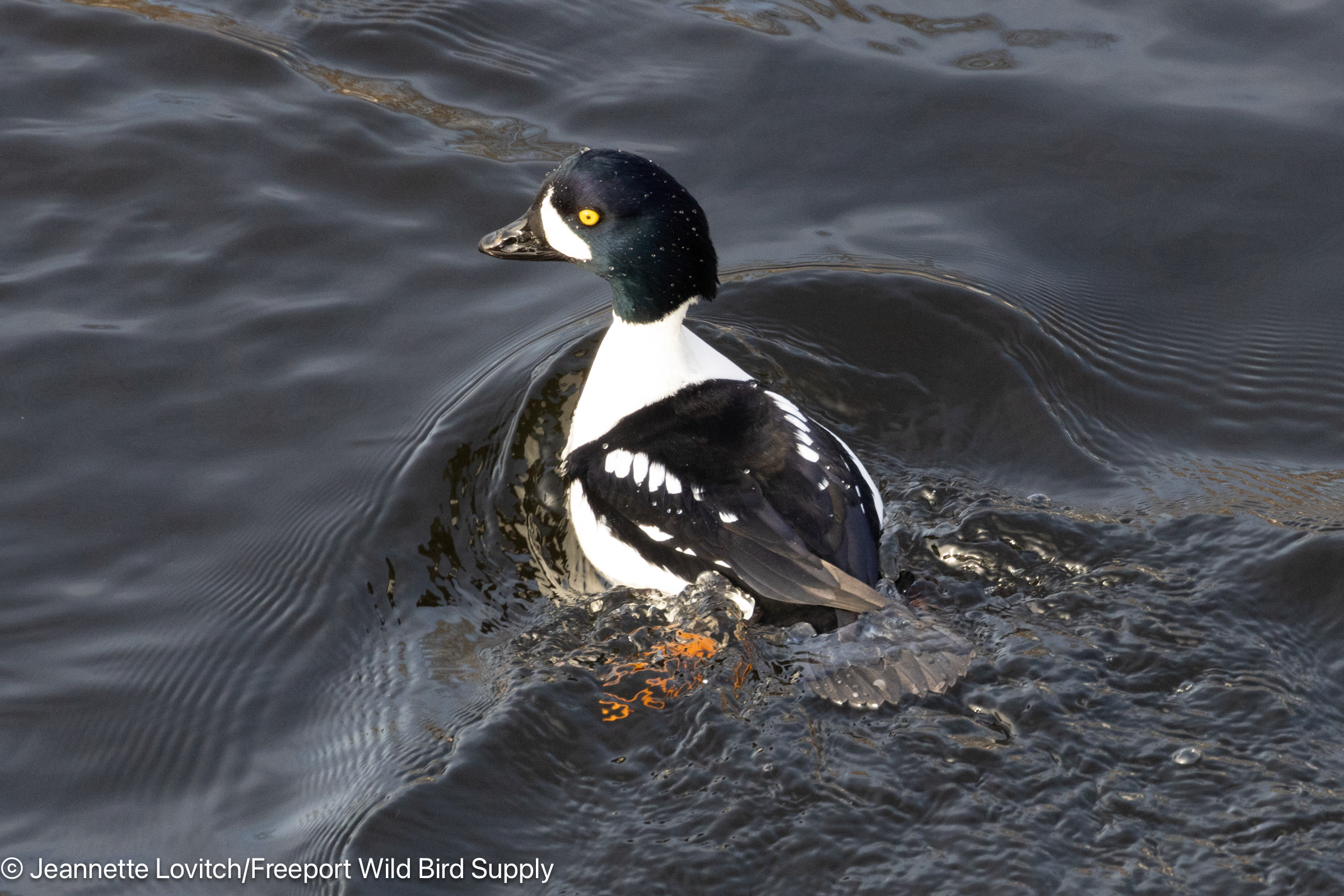
This drake Barrow’s Goldeneye was one of the foursome currently in the Androscoggin River between Auburn and Lewiston, most often in view from the Bernard Lown Peace Bridge. Jeannette paid them a visit on the 6th, where she found this one male just below the bridge.
Except for a delightful morning at Reid State Park, my birding outings were short and local, but I did enjoy catching up with local patches and their winter denizens, especially Barrow’s Goldeneyes. Here are my observations of note over the past seven days.
2 drake and 2 hen Barrow’s Goldeneyes, Winslow Park, Freeport, 1/4.
1 drake Barrow’s Goldeneyes, Sandy Point Beach, Cousin’s Island, Yarmouth, 1/6.
1 SNOWY OWL (FOS), 9-11 Red Crossbills, 58 Red-necked Grebes, 1 Savannah Sparrow (subspecies undetermined), 26 Sanderling, etc, Reid State Park, Georgetown, 1/8.
1 hen Barrow’s Goldeneye, Front Street Boat Launch, Bath, 1/8.
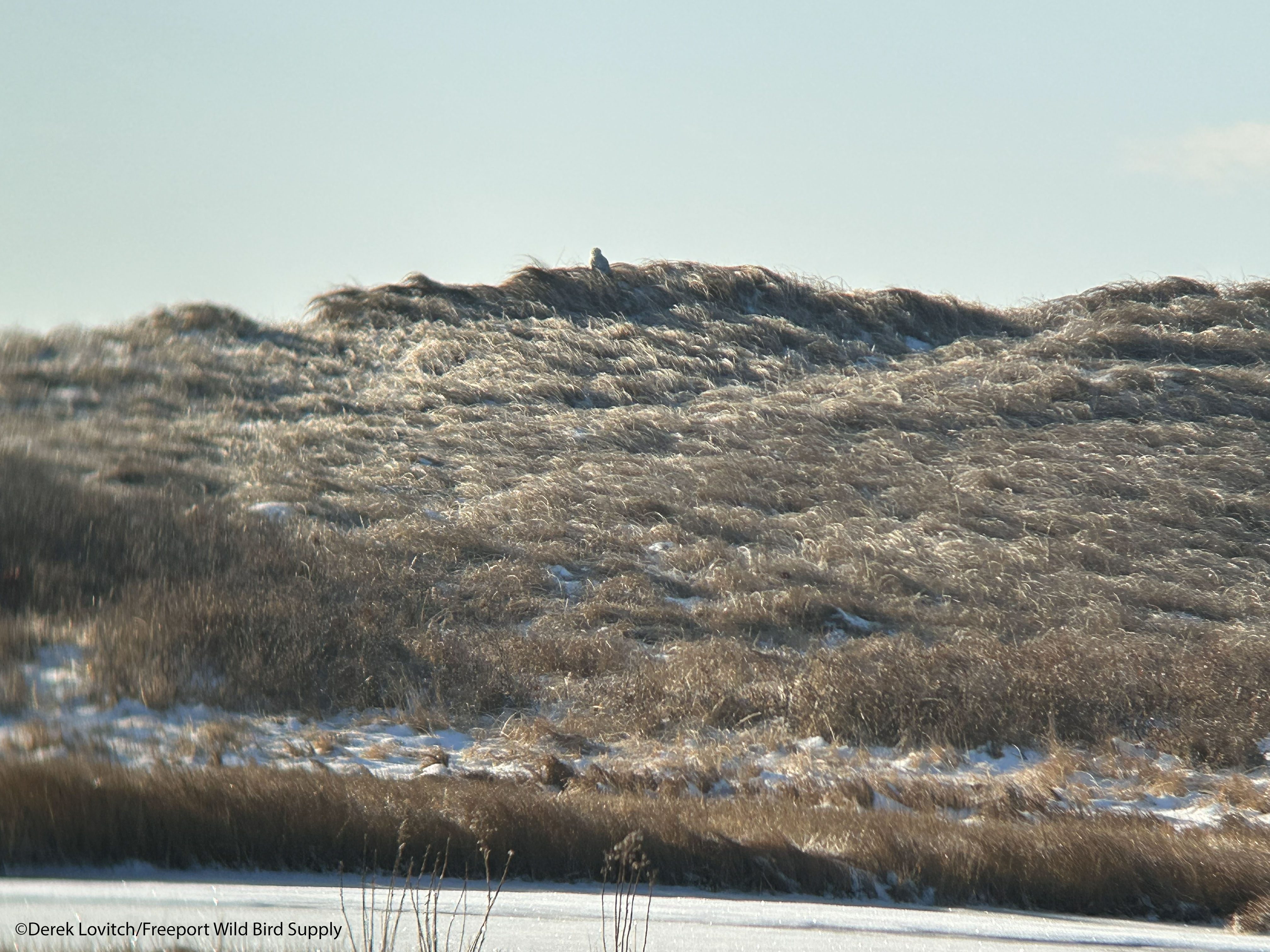
This is how I like my Snowy Owls…safe in the distance, backlit, poorly phone-binned, and otherwise unconcerned with my presence. Later, I spent 30 minutes observing it in the distance as it moved around, perhaps to get in position for hunting, or perhaps because it was getting too warm!
This Week in Irruptives.
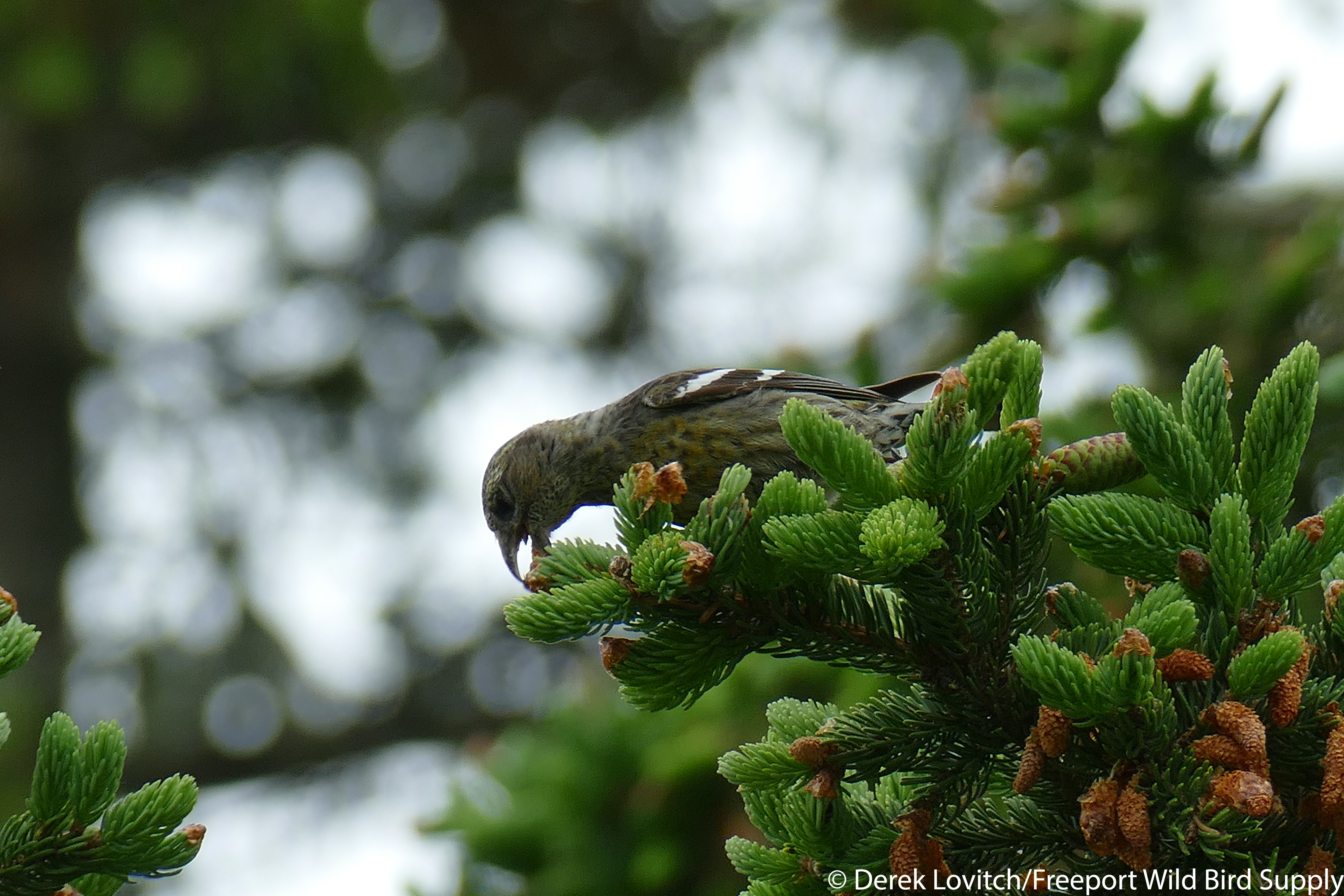
American Goldfinches and Red-breasted Nuthatches remain very abundant. While a number of customers at the store have continued to report scattered small flocks of Evening Grosbeaks at feeding stations, I did not hear or see any yet again this week. In fact, my only irruptive in limited time birding was a single Pine Siskin at Florida Lake Park on the 7th, until I re-entered the Red Spruce zone at Reid State Park on the 8th. There, there were several Pine Siskins and at least 9-11 Red Crossbills – including two singing males suggestive of upcoming mid-winter breeding!
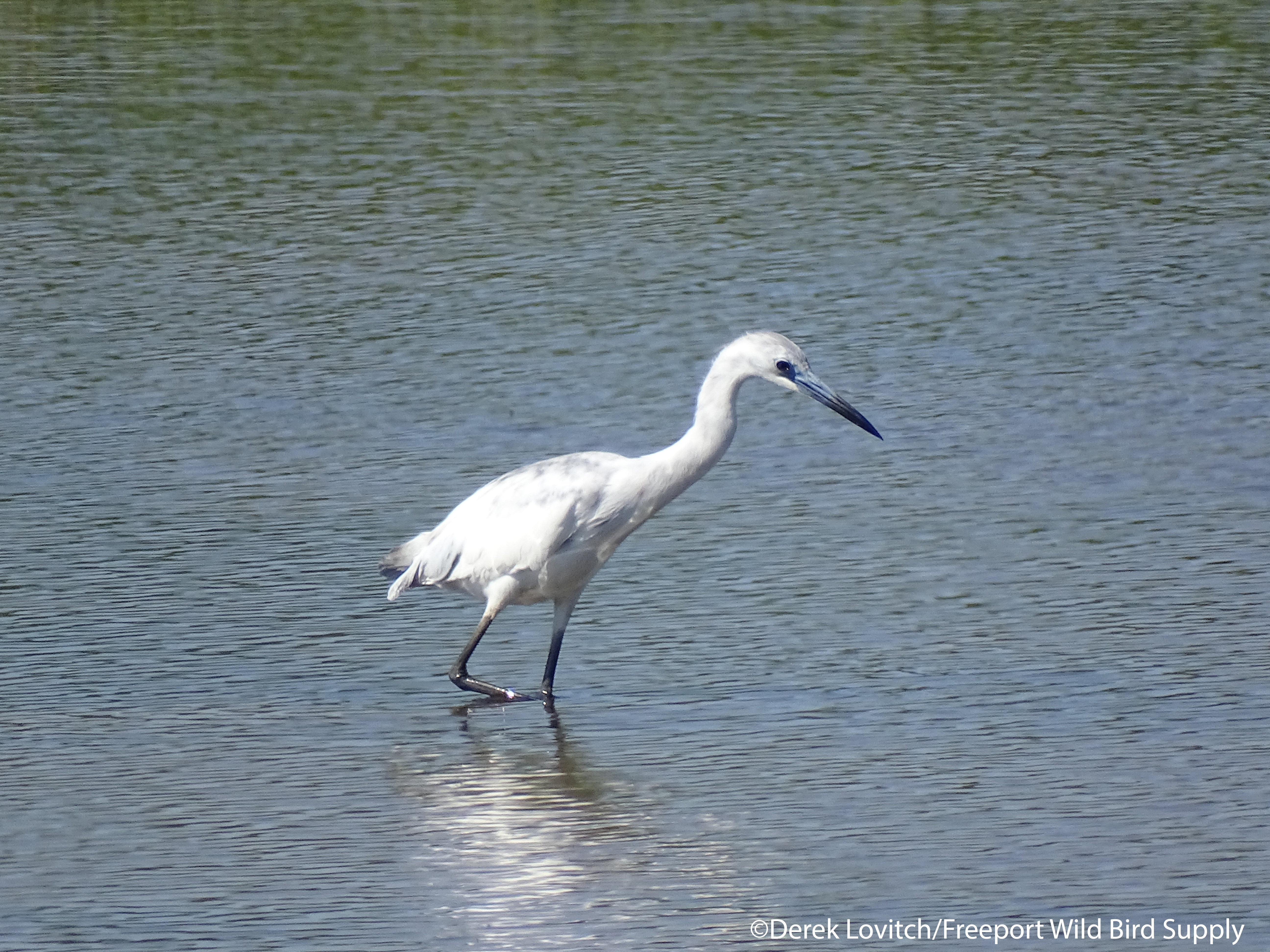
Little Blue Herons have declined in Maine, so it was nice to find my second of the year in an untraditional location. This 1st summer bird was in the marsh behind Seapoint Beach in Kittery on the 2nd.
Typical later migrants, such as Blackpoll and Magnolia Warblers, and a variety of flycatchers, were still moving in and through, especially during the first week of June. Then, my gears rapidly shifted to breeding birds on tours, events, surveys, and just general birding enjoyment. Quality time with boreal breeders in the Rangeley area and specialties such as Saltmarsh and Nelson’s Sparrows, Roseate Terns, etc here at the coast were the usual highlights of the first half of June, both personally and professionally.
In addition to the regular breeding birds we seek – again, both personally and professionally – it’s also a good time of year for unexpected birds in unexpected places, and just general good birding. Some of my additional, less expected observations of note over the past ten days included:
1 immature male and 1 female ORCHARD ORIOLE (FOY), and 1 late Red-throated Loon, Fort Foster, Kittery, 6/2.
1 1st summer LITTLE BLUE HERON, Seapoint Beach, Kittery, 6/2. Photo above.
A visit to the Kennebunk Plains on 6/4 with Jeannette yielded 2 singing CLAY-COLORED SPARROWS (one continuing male near “Clay-color Corner” and one about half-way between there and the main parking lot on the eastern loop trail). 2 UPLAND SANDPIPERS, 6 GRASSHOPPER SPARROWS, and at least 11 Red Crossbills were also detected.
1 pair Cape May Warbler, 1 Wilson’s Warbler, 1 Olive-sided Flycatcher, Palm Warblers, displaying Wilson’s Snipe, family of Canada Jays, etc, Dallas Plantation, 6/7 (with Matt Young).
Fun to be in the field with Matt Young for the Rangeley Birding Festival and hear him describe (and hopefully me learn!) Red Crossbill call notes. There weren’t many around, but we did encounter both Type 12’s and Type 4’s. Meanwhile, scattered birds continue to be widespread down here at the coast.
7 Turkey Vultures, over downtown Rangeley from porch of Parkside and Main, 6/7 (With Matt Young and Birds on Tap! event group for the Rangeley Birding Festival). Less than 10 years ago, a single was unheard of.
1 Semipalmated Plover, Eastern Road Trail, Scarborough Marsh, 6/11 (with clients from New Jersey).
Tours and Events:
Due to tours, there will not be a Saturday Morning Birdwalk on either 6/22 or 6/29.
White-winged Crossbills were amazingly abundant in Northern Aroostook County during our visit last week (see below).
Returning back from a little vacation to the crown of Maine followed by some time in New Brunswick, I apologize for the late report. Last week was a busy and productive week of birding for me, with the following observations of note.
Seal Island Tour, 7/22:
15 RED-NECKED PHALAROPES inside of Saddleback Ledge; 1 1st summer Great Cormorant, Saddleback Ledge Light; 3 Razorbills still at Seal Island; 1 Great Shearwater on trip back. Dense fog impacted our birding all day, but we had a fantastic performance from Atlantic Puffins and Arctic Terns in particular, and the fog cleared enough to enjoy the number of juvenile Great Cormorants in the growing colony on the island’s south end.
2 Red Crossbills, over our yard in Durham, 7/23. Interestingly, we didn’t have a single Red Crossbill in Aroostook County (unless they were all drowned out by all of the White-wings!). However, the Reds in our area seem to be focusing on coastal Red Spruce.
Aroostook County WHITE-WINGED CROSSBILLS, 7/24-7/27 (with Terez Fraser, John Lorence, and Jeannette). Wow, incredible! Over three days of birding from Fort Kent to Stockholm, we conservatively estimated observing about 50 per HOUR while in appropriate habitat! Our high count was 150-200 total along Square Lake Road in Sinclair on 7/26, with single flock of 70-75 individuals!
EVENING GROSBEAKS: just a couple heard here and there, including 1 on Nixon Siding Road, 7/24, 2 at Christina Reservoir, 7/26; and 2 at Square Lake Road, 7/26.
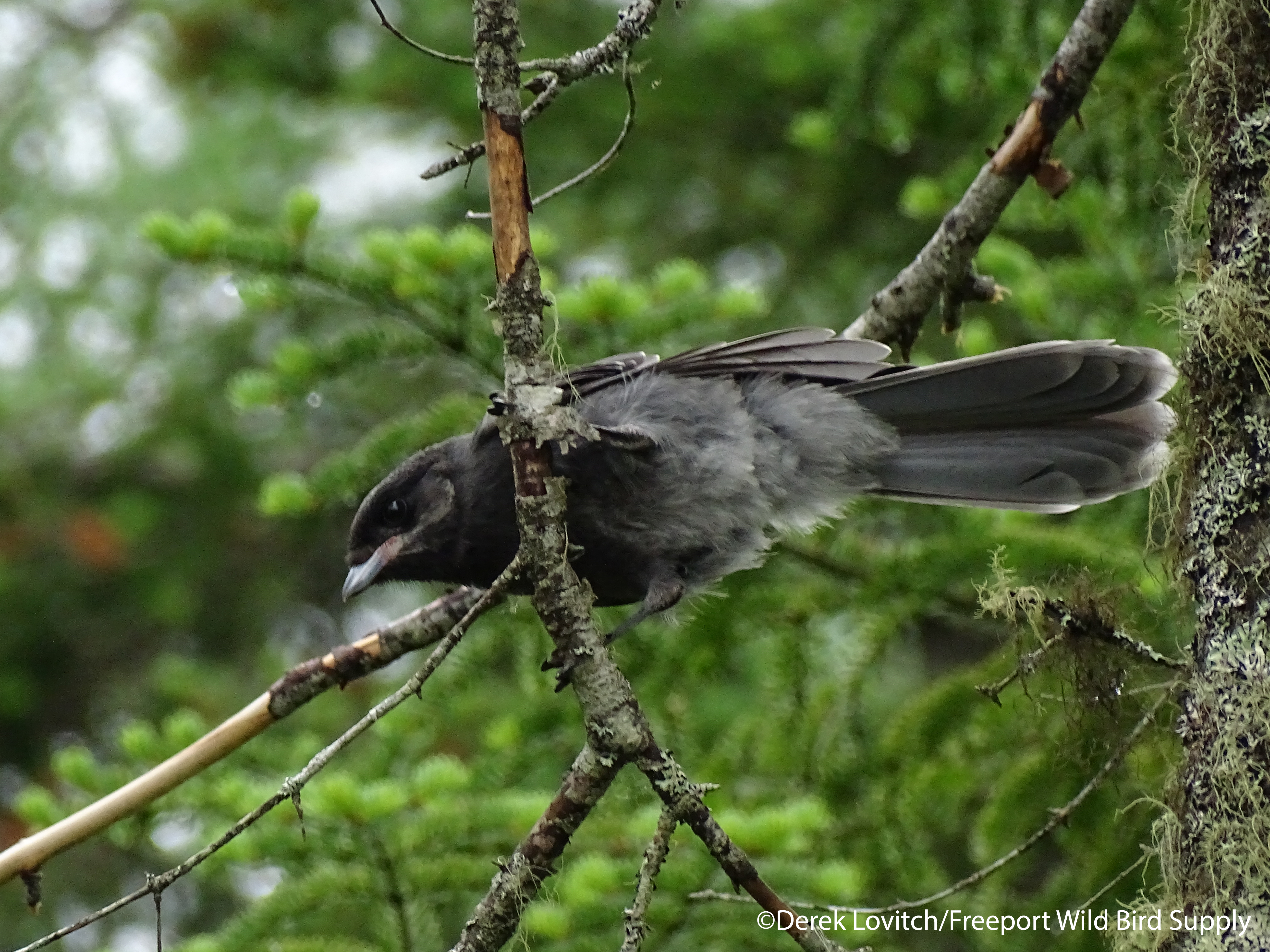
BOREAL CHICKADEES: Mostly heard, but some were unusually conspicuous, especially one (of 3) at Square Lake Road on 7/26 and 1 of 3 at Moscovic Road, Stockholm, 7/27 (all with Terez Fraser, John Lorence, and Jeannette).
Lake Josephine duck tallies (7/25 with John Lorenc and Jeannette): 125+ Gadwall (including juveniles of all ages); 1 drake American Wigeon, two family groups of Blue-winged Teal, 75+ Ring-necked Ducks, 1 American Bittern, etc. Numbers were lower when Jeannette and I visited on the 27th, likely due to Bald Eagle presence.
3 adult Bonaparte’s Gulls, Arnold Brook Beach Recreation Area, 7/25 (with John Lorenc and Jeannette).
Additional species from Square Lake Road in Stockholm on 7/26 (with John Lorenc, Terez Fraser, and Jeannette): 1 Bonaparte’s Gull, 3+ Bay-breasted Warblers, 1 Mourning Warbler, 1 Olive-sided Flycatcher, 1 Lincoln’s Sparrow, etc.
1 female American Wigeon with 10 chicks, Long Lake, St. Agatha, 7/26 (with Terez Fraser, John Lorence, and Jeannette).
3 Common Nighthawks, over St. John River at dusk, Fort Kent, 7/26 (with Terez Fraser, John Lorence, and Jeannette).
Most of the White-winged Crossbills we saw were in flight, or calling and singing in the distance. This male tee’d up nicely, albeit in unfortunate light. We also watched only one group feeding, and they appeared to be eating mostly buds of Tamarack (and maybe some young or old cones).
This Common Murre was a lucky find in the middle of nowhere as we traveled offshore during our ½ day Zeiss Pelagic out of Boothbay Harbor last Friday.
With 6 of the 7 days this week spent guiding in some shape or form, mostly in the Rangeley area, the weather presented a real challenge! As a cut-off low spun offshore, activity was certainly reduced on many of my trips, and my birding time in between was rather limited. Therefore, my observations of note over the past seven days were limited to the following – in addition to all of our great local breeding specialty birds, of course!
2 Willow Flycatchers (FOY) and 2 Glossy Ibis – my 152nd Patch Bird here! – Old Town House Park, North Yarmouth, 6/3 (with Saturday Morning Birdwalk group).
2+ Red Crossbills and 1 migrant Yellow-bellied Flycatcher, Hedgehog Mountain Park, Freeport, 6/6.
2 adult CANADA JAYS, 20 Red Crossbills, etc, Hunter Cove Wildlife Sanctuary, 6/7 (with Down East Adventures Rangeley Birding Workshop tour group).
2 adult and 2 juvenile CANADA JAYS, 11+ Red Crossbills, 1 Palm Warbler, etc., Boy Scout Road, Rangeley, 6/8 (with Down East Adventures Rangeley Birding Workshop tour group).
1 BOREAL CHICKADEE, 20 Red Crossbills, etc, Quill Hill, Dallas Plantation, 6/9.
1 adult Great Black-backed Gull, Lakeside Park from porch of Lakeside & Main, Rangeley, 6/9 (with Birds on Tap! Event for Rangeley Birding Festival group.
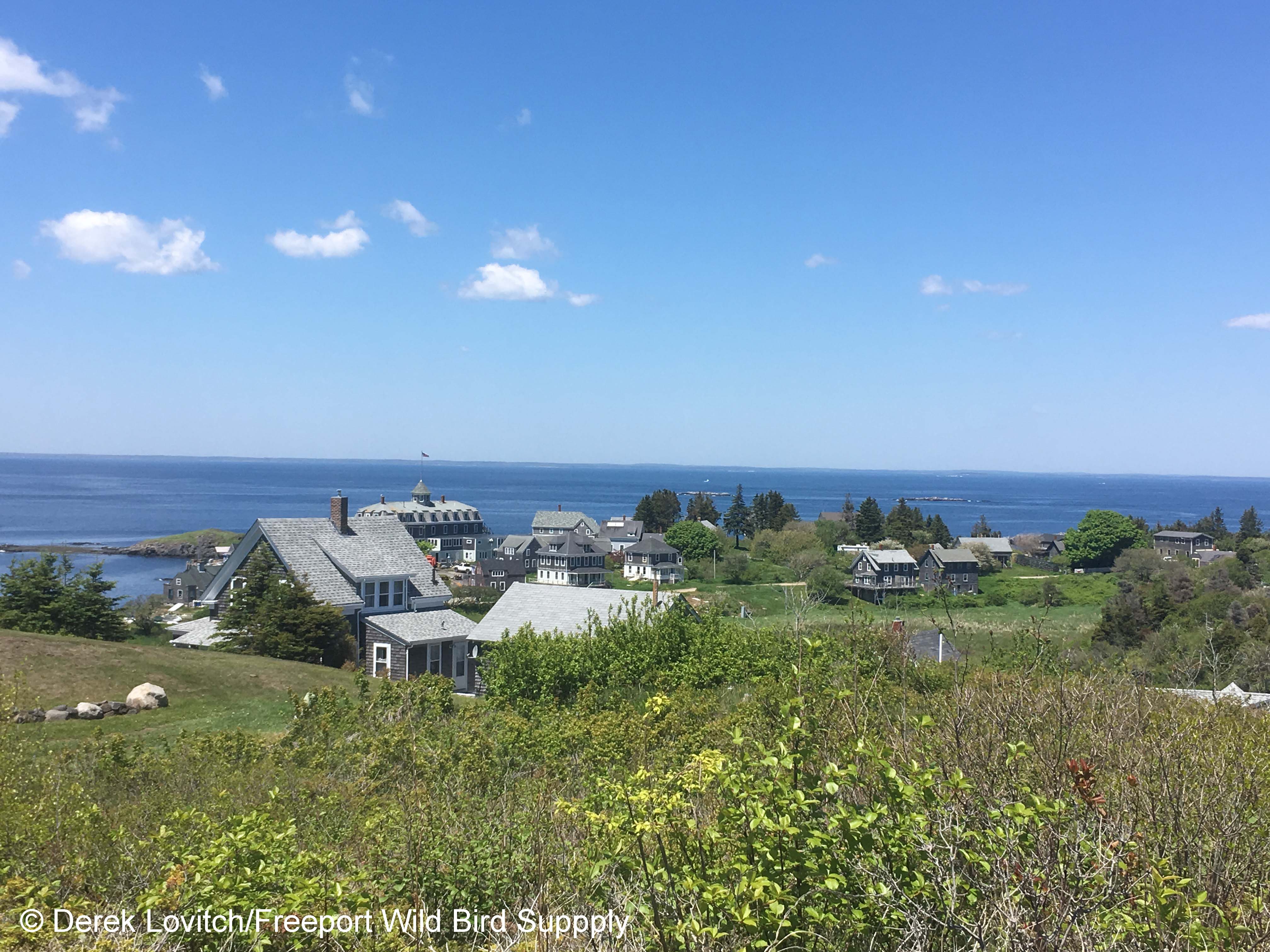
Meanwhile, as I slowly catch up on trip reports, here’s my travelogue from Memorial Day Weekend on Monhegan, including daily trip lists and lots of Jeannette’s photographs. For those waiting for the daily birdlists, I apologize for the delay.
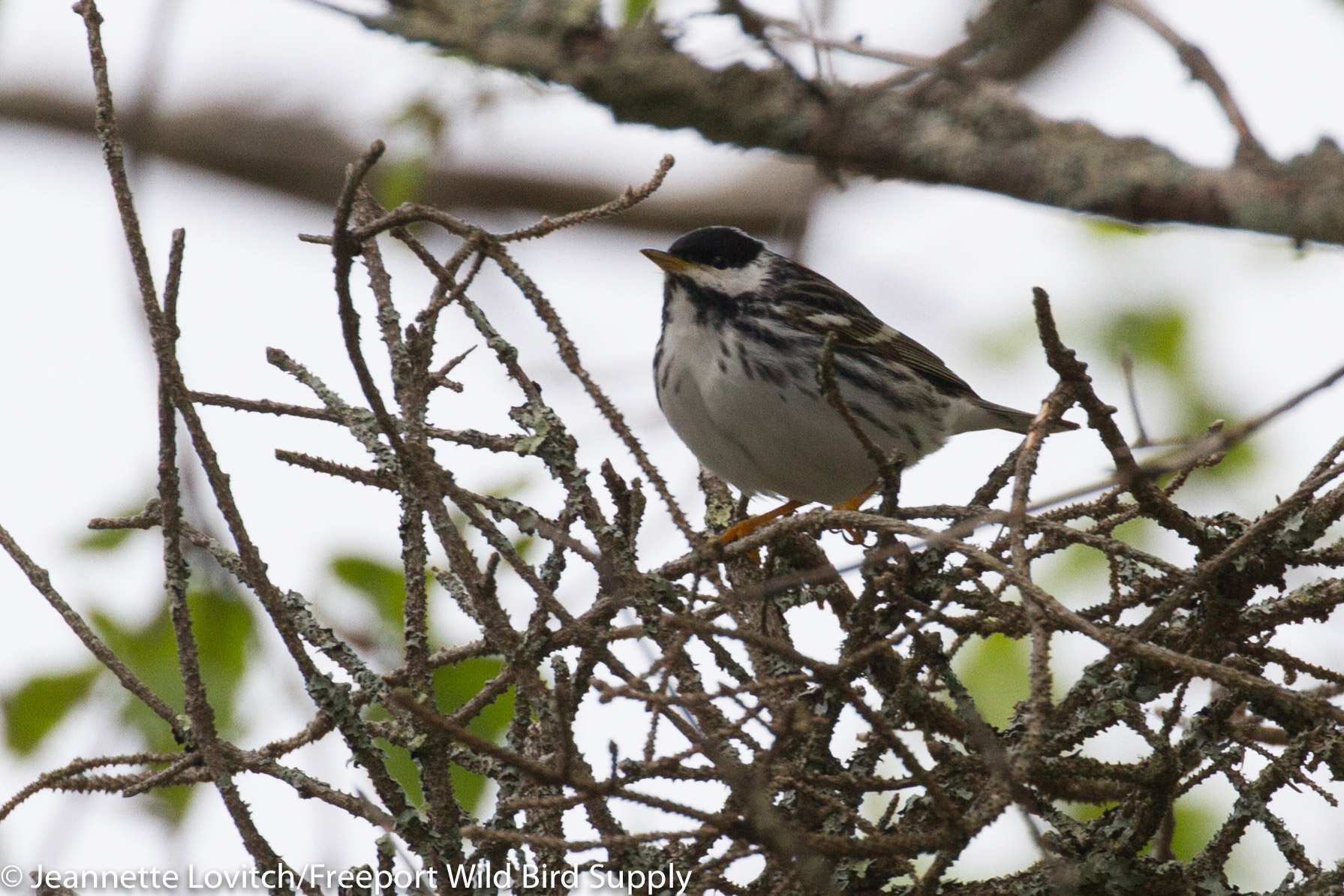
Not surprisingly for the end of May, Blackpoll Warblers were the dominate migrant on Monhegan this weekend. However, we never tired of seeing both males (above) and females (below) so well each and every day.
A point-blank Bay-breasted Warbler. Up close and personal Magnolia Warblers, Northern Parulas, and 9 other species of warblers including more Blackpoll Warblers than we knew what to do with…and we hadn’t even made it up the hill of Dock Road yet!
In other words, our 2023 Spring Monhegan Migration Weekend tour got off to a great start as we really hit the ground running. Then, a calling Evening Grosbeak. A fly-by Black-billed Cuckoo…more. Hmm… it was time to check in, and happily, shed a few layers.
After lunch, the excellent birding continued, with highlights including a flock of 10 Bay-breasted Warblers, a spiffy male Orchard Oriole, and great looks at a Philadelphia Vireo. By day’s end, we had 59 species including 13 species of warblers – not bad for a mid-morning arrival!
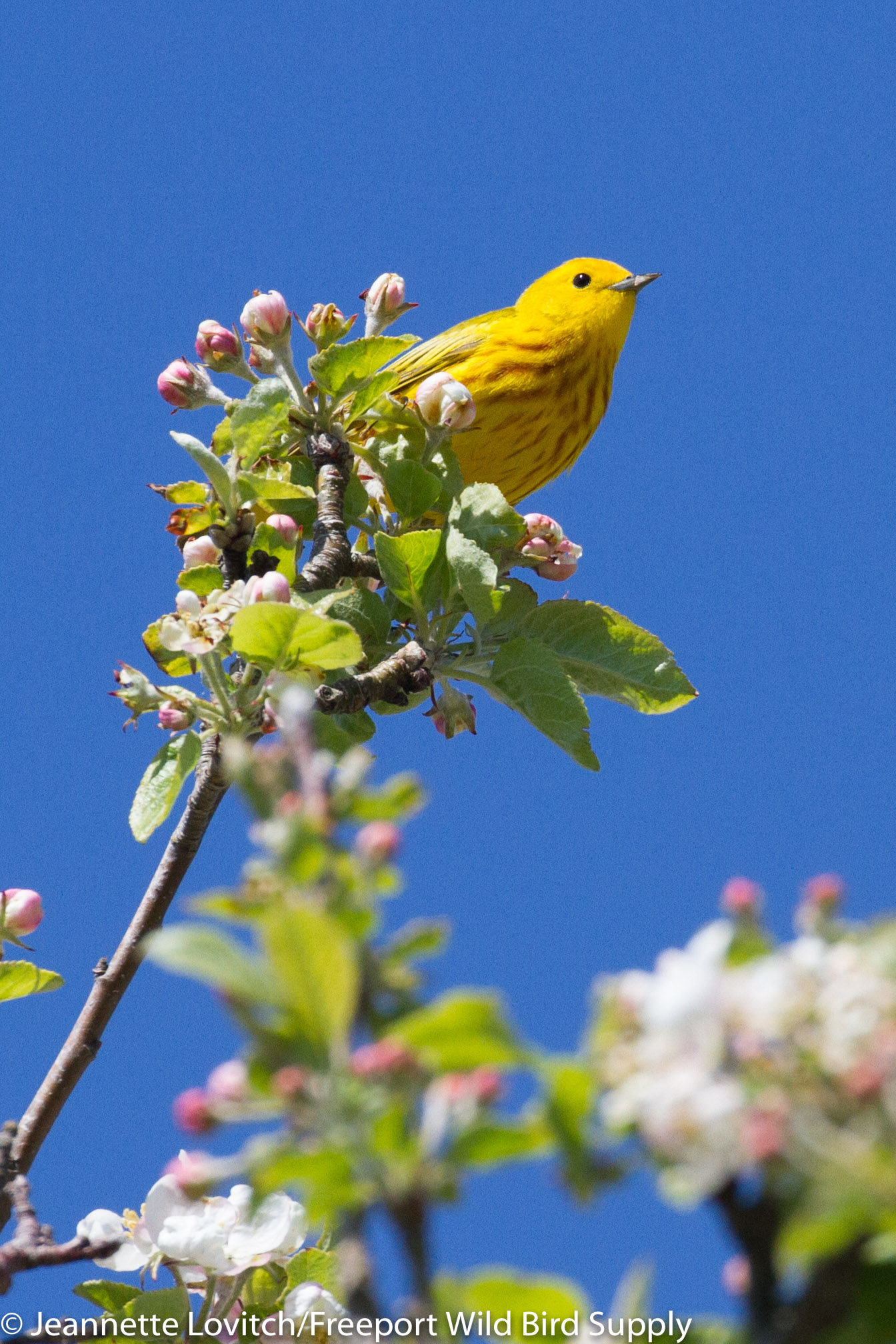
Yellow Warblers (above) and Common Yellowthroats (below) were common and conspicuous in and around town and other scrubby environs as expected.
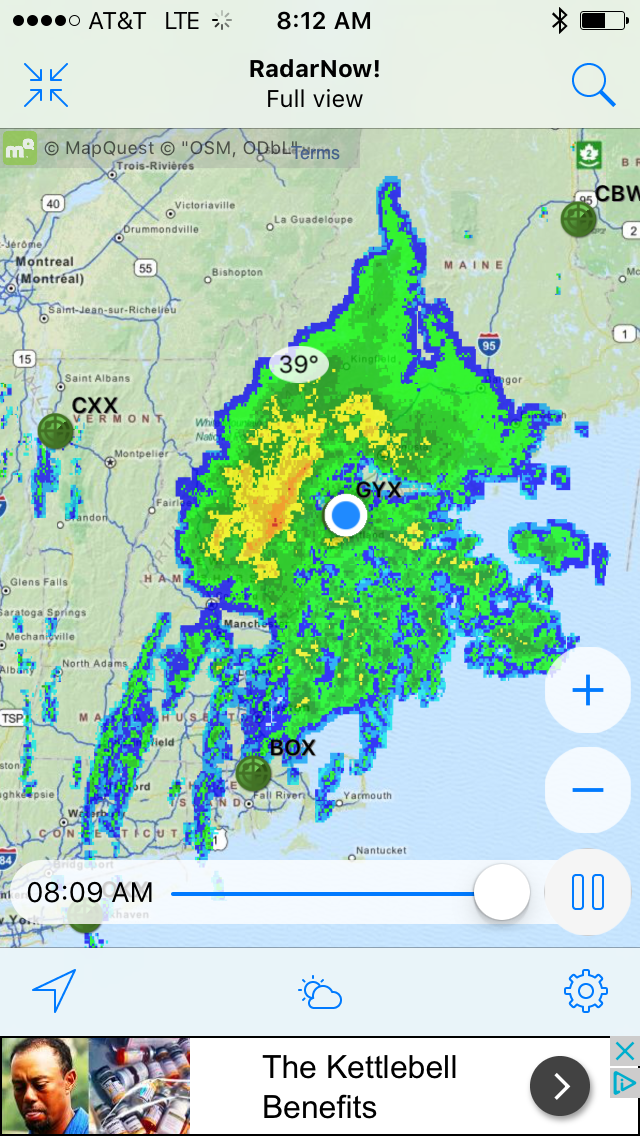
It was cool and clear on Saturday morning, and the overnight radar image was a little ambiguous. Did the light westerly wind overnight push birds offshore as they approached from the south, or was that all just pollen and smoke haze in the atmosphere? However, the radar return did suggest birds offshore in the early morning, so we were excited to find out. Afterall, I did not expect yesterday to be so good, and it was excellent.
While only a few warblers were overhead by the time we assembled around the coffee pot at 6:30, it took a while for us to leave the spruces behind the Trailing Yew, as we had a nice pocket of warblers and good early-morning activity. We teased out a Blackburnian Warbler – the only one of the weekend, and the 3 White-winged Crossbills that have been on the island paid us a visit. Later in the morning, we caught up with the stunning male Dickcissel that has been around for a while, and were among the first to see a pair of recently-arrived House Finches (a surprising rarity on the island!). We also found a flock of 10 tardy White-winged Scoters and a total of 6 Surf Scoters that briefly visited Deadman’s Cove.
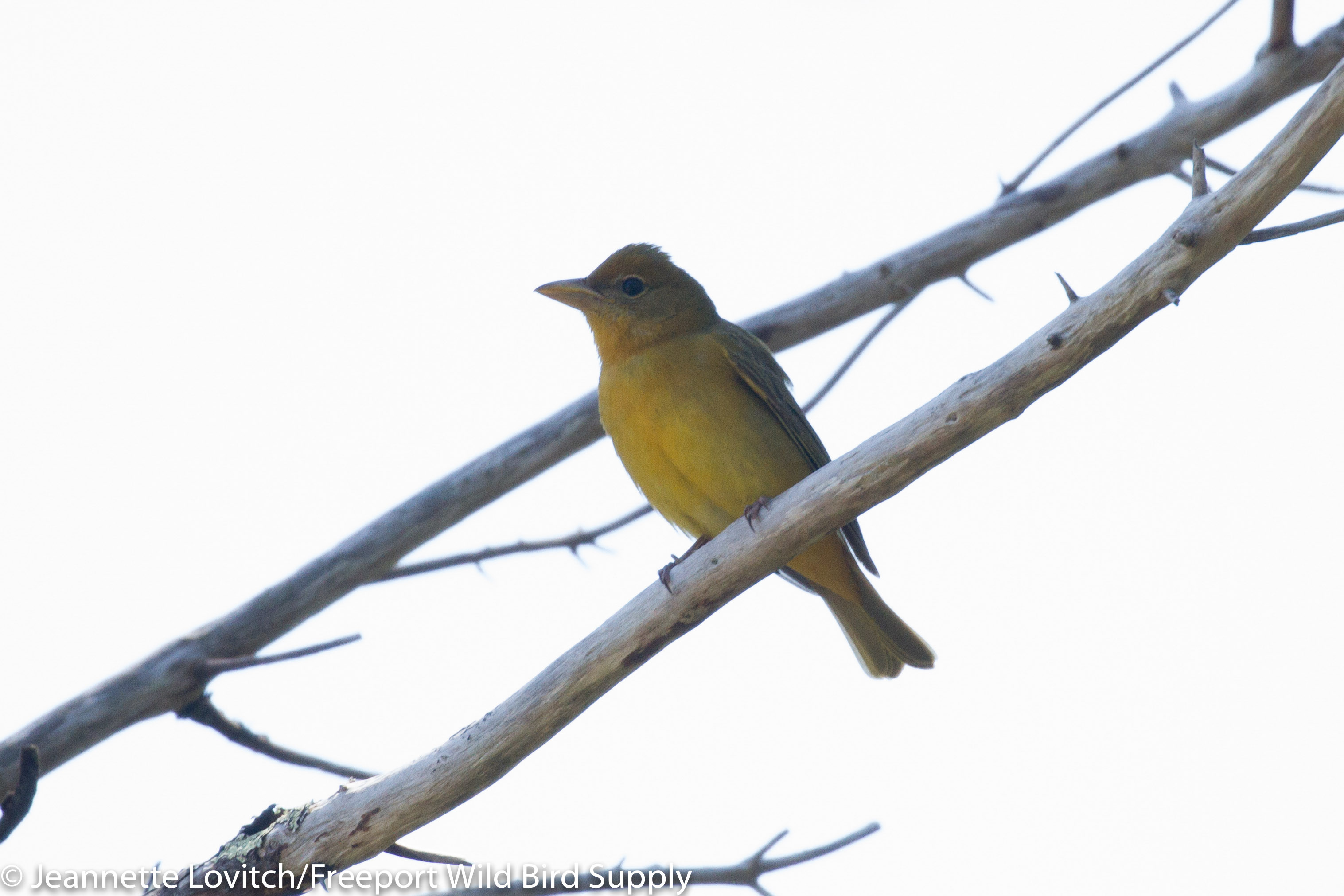
After lunch, we had the female/immature Summer Tanager, a female Orchard Oriole, found an Olive-sided Flycatcher, and while the afternoon was overall rather quiet, we had lots of great studies of a variety of birds, especially Blackpoll Warblers.
Although far from one of our best birding days on the island, it was noteworthy how well we saw just about everything. Even with a full group, birds were overwhelmingly cooperative, and everyone thoroughly enjoyed the birding…and another beautiful day of weather!
Many of our common warblers were easy to see, photograph, and enjoy throughout the weekend, such as this Northern Parula (above) and Black-and-white Warbler (below).
Saturday night into Sunday morning saw another ambiguous radar image, but the overall small number of new arrivals suggested that most of the return was something other than birds this day.
That being said, we started the day with one of the birds of the trip when I nearly spit out my coffee when I realized that flock of cormorants that looked strange was actually a flock of 9 Glossy Ibis. They circled the town, looked to be pondering the town marsh, and then soared up high and over Lighthouse Hill. Incredibly rare for the island, these were a new “island bird” for me, and we felt very fortunate that we were one of the only birders (I believe only one other birder saw them at all) on the island that got to see them. The “lingering around the coffee pot at the Yew” strikes again!
As expected, it was relatively slow overall, but even after the excitement of the ibis, we continued to enjoy ourselves. We had great looks at a lot of things all morning, including common warblers like American Redstarts and oodles of Blackpolls. We had our best looks yet of feeding Red Crossbills – they were all over the island this spring! – spotted a Peregrine Falcon, and continued to marvel at the growing flock of swirling Blue Jays contemplating a trip back to the mainland.
Ring-necked Pheasants kept us entertained as always, however.
After breakfast, we had another good find when a Purple Martin flew over us, and a bigger flock yet of Red Crossbills entertained us for a while. Jeannette arrived and joined the group to help carry my scope and to take photographs for this trip report, as well as help us find more birds.
Juvenile Red Crossbill.
It was warm and fairly slow, so I needed all the help I could get. Regardless, we added species to our trip list here and there in the afternoon, with quality surpassing quantity. We visited the long-staying 1st year male Blue Grosbeak that has taken up residence at Lobster Cove, where, unlike most Blue Grosbeaks, it has taken to flycatching for seaweed flies in the wrack. Why it is doing this no one knows, but it was a fascinating behavior to watch. Birds and birding on Monhegan never cease to amaze!
The Blue Grosbeak.
A little later, we found an immature Broad-winged Hawk, or again, it found us, as it passed right over us as we poked around the Underhill Trail to find some birds in the shade and in cover. It was often a struggle to find birds this afternoon, and it was downright hot! But I heard very few complaints compared to the slow days when it’s 45-degrees, windy, and raining!
We spent a lot of quality time observing birds today, getting to know their behavior and natural history, such as these courting Cedar Waxwings.
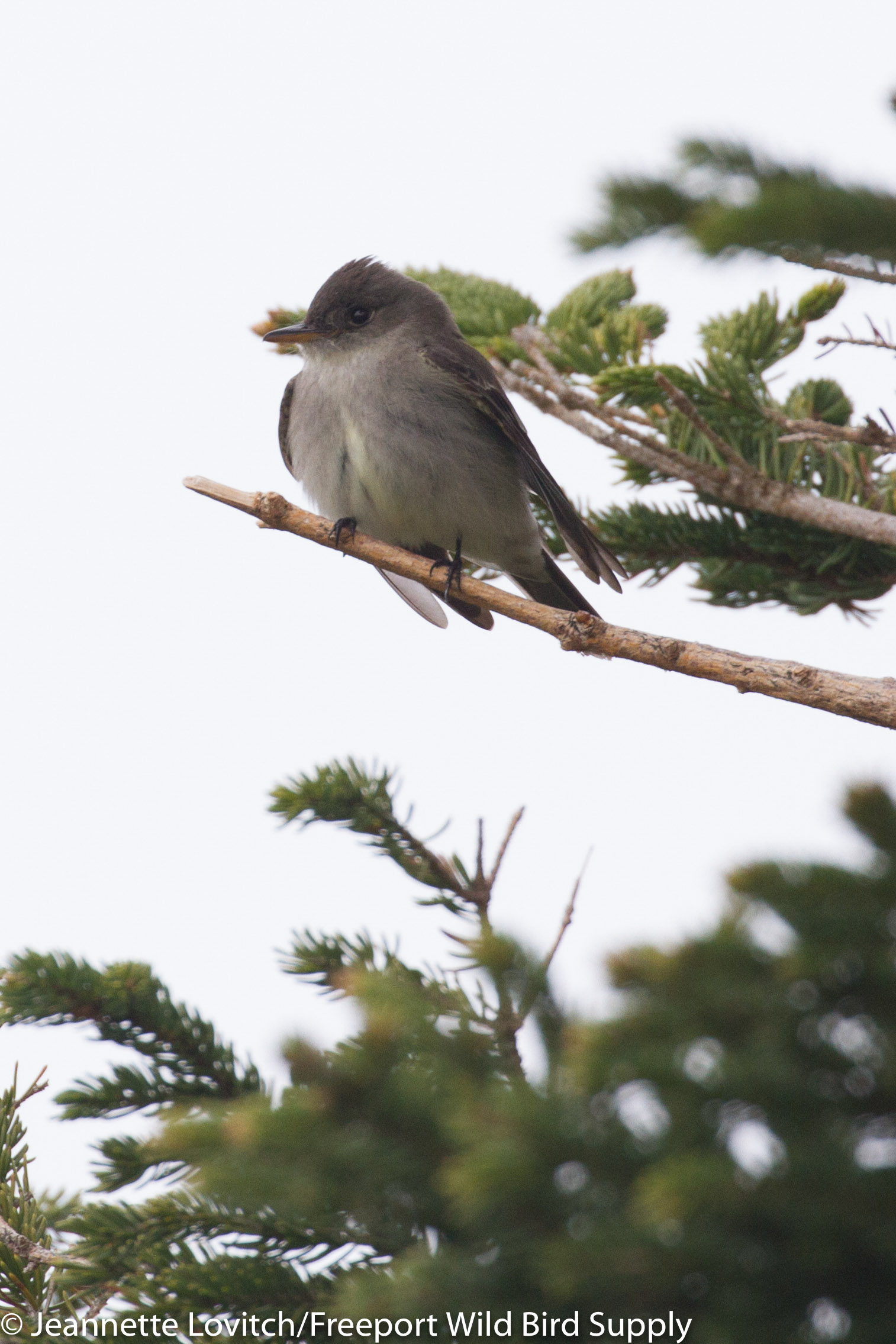
While also practicing our field ID skills, such as Eastern Wood-Pewee.
And enjoyed whatever warblers we did encounter, including this male Black-throated Green Warbler.
Monday saw even further reduced activity, with a very summer-like feel to the birding. The migrant flock of Blue Jays built up to at least 46, a Pine Siskin must have just arrived, and some of us even spotted the Virginia Rail! While passage migrants were few – almost all Blackpoll Warblers – we still had a great day of birding thanks to continued great views of most of what we were finding. There was a Northern Parula nest that a friend found for us to marvel at, and we had quality time once again with a family group of Red Crossbills. Watching them, especially the juveniles, eating buds and cones of Red Spruce at close enough distance to see if they were “righties” or “lefties” was memorable, and more than worth the visit. We had the male Orchard Oriole again, and paid the Blue Grosbeak another lengthy visit.
We took some time to scan the skies over the marsh while also enjoying “Lefty,” the Red-winged Blackbird with white outer primaries on only his left wing. He’s back for the second year.
One of the few birds we missed as a group all weekend was a long-staying but frustrating Snowy Egret that never seemed to stay in the same place long. It was reported at the Ice Pond while we were having breakfast, and Jeannette and I raced down to see it. The “racing” part after the new and ample breakfast buffet at the Trailing Yew may not have been the best decision, however, we got the bird! It was another island bird for me (#226) and I am glad I made the decision to skip the break to chase it, as it was long gone by the time our group arrived at the Ice Pond. I always like to get those chases out of my system before making a bad leadership decision and marching people across the island for a bird that only I cared about! (Since they are locally common on the mainland, only an island-lister cares about such silliness).
As the afternoon wore on, the group slowly moseyed away from the Blue Grosbeak-evolving-into-a-flycatcher and made our way back to town to catch the last ferries of the weekend, bringing the tour to a close.
A friend found a Northern Parula nest under construction that we took time to marvel at. Here, the female brings some more material in to line the nest, which is nestled in a woven basket inside of large clumps of down-hanging Old Man’s Bear lichen.
However, as usual, Jeannette and I stayed around for another 24 hours to have a day off together and with friends. Leaving the brewery with one friend, I found a male Eastern Bluebird- an odd “new bird” for the date. Where the heck has he been or where did he just come from? Another Monhegan bird mystery…their migration ended a month ago.
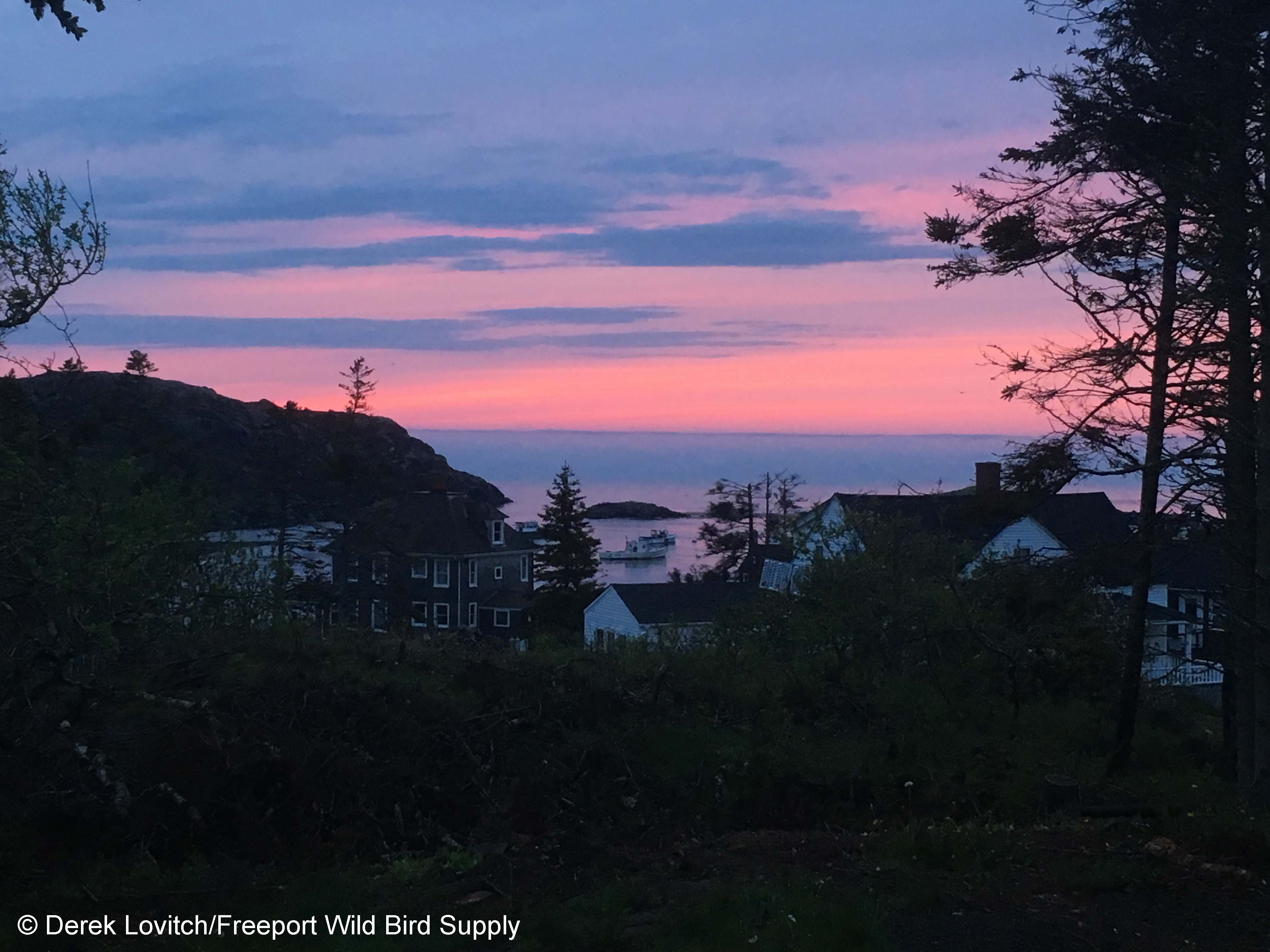
Later, as we walked back from dinner with other friends, we heard at least three displaying American Woodcocks. The sunset was quite the stunner, too.
I wasn’t upset to not have a group on Monday, because my goodness, it was slow! I think what was left of the passage migrants cleared out overnight, and little if nothing came in. There were a few Blackpolls here and there, and maybe a few more American Redstarts than usual in the summer, but in and around town, that was about all.
So Jeannette and I decided to take a longer hike and check some oft-productive-but-less-often-birded areas. In doing so, we found a Field Sparrow on Horn Hill, and had a singing Yellow-bellied Flycatcher between Burnt Head and White Head. An adult male Sharp-shinned Hawk was a surprise – was it breeding here? – and a visit into the shaded woods added Winter Wren and Swainson’s Thrush to our weekend list.
We got excited when we saw a gray-backed, white-bellied flycatcher over at Gull Pond, but alas, it had the expected short, not-forked tail that we were hoping for!
Not including the 7 species Jeannette and I saw between 3:00 on Monday and when we departed at 3:15 on Tuesday, the tour list for the 12th annual Monhegan Spring Migration Weekend ended up a goodly 90 total species, despite only 15 species of warblers. The overall count was better than our last two tours, but still below our long-term average. But I cannot recall four (and five) days of simply gorgeous and warm weather on any of our prior tours! While the benign weather of late reduced the volume of migrants yet to pass through, and allowed many recent migrants to pass unimpeded overhead, I was pleasantly surprised by the final tally. It was also a high-quality list, with lots of “good” birds not seen by many in Maine away from the island. Oh, and my two island birds were nice, too!
Blue Jays are not the biggest feeder bird on this island!
Even our most common and familiar birds present speciaal photographic opportunities out here!
Species
5/26
5/27
5/28
5/29
Mallard
x
10
10
8
Mallard x American Black Duck
1
0
0
0
Common Eider
x
x
x
x
White-winged Scoter
0
10
0
0
Surf Scoter
0
6
0
0
Ring-necked Pheasant
x
6
6
5
Mourning Dove
8
10
8
10
Black-billed Cuckoo
1
0
0
0
Chimney Swift
0
0
1
0
Ruby-throated Hummingbird
6
4
3
1
Virginia Rail
h.o
h.o
1
1
Semipalmated Sandpiper
0
0
1
0
Greater Yellowlegs
0
1
0
0
Black Guillemot
20
30
x
20
Laughing Gull
6*
2
1
6
Herring Gull
x
x
x
x
Great Black-backed Gull
x
x
x
x
Common Tern
1 + 5*
0
0
0
Northern Gannet
0
0
0
1
Red-throated Loon
0
1
0
0
Common Loon
3*
1
0
0
Double-crested Cormorant
x
x
x
x
Great Blue Heron
0
0
1
3
SNOWY EGRET
0
0
0
1**
GLOSSY IBIS
0
0
9
0
Bald Eagle
2
1
0
0
Osprey
0
3
2
2
Red-bellied Woodpecker
0
0
1
0
Merlin
2
2
1
0
Peregrin Falcon
0
0
1
0
Eastern Kingbird
0
0
2
2
Olive-sided Flycatcher
0
1
0
0
Eastern Wood-Pewee
2
2
2
2
“Traill’s” Flycatcher
2
0
1
0
Least Flycatcher
2
1
1
0
Eastern Phoebe
1
1
1
1
Philadelphia Vireo
1
1
0
0
Red-eyed Vireo
6
8
4
4
Blue Jay
x
48
47
52
American Crow
x
4
6
x
Common Raven
0
1
1
0
Black-capped Chickadee
x
x
x
x
Tree Swallow
0
2
2
2
PURPLE MARTIN
0
0
1
0
Barn Swallow
1
0
1
1
Golden-crowned Kinglet
0
0
1
0
Cedar Waxwing
30
50
40
30
White-breasted Nuthatch
0
1
1
1
Red-breasted Nuthatch
1
0
0
0
Carolina Wren
3 h.o.
4
4
3
Gray Catbird
x
x
x
x
European Starling
x
x
x
x
American Robin
x
x
x
x
HOUSE FINCH
0
0
2
2
Purple Finch
0
1
2
2
WHITE-WINGED CROSSBILL
0
3
3
0
RED CROSSBILL
0
2
24
20
Pine Siskin
0
0
0
1
American Goldfinch
12
10
12
12
Chipping Sparrow
0
0
1
1-2
White-throated Sparrow
2
2
2
0
Savannah Sparrow
3
0
1
0
Song Sparrow
10
X
x
x
Lincoln’s Sparrow
0
1
1
0
Bobolink
1
1
0
0
ORCHARD ORIOLE
1
1
0
2
Baltimore Oriole
1
4
3
3
Red-winged Blackbird
x
x
x
x
Common Grackle
x
x
x
x
Northern Waterthrush
0
0
1
0
Black-and-white Warbler
3
4
4
3
Tennessee Warbler
8
4
3
0
Common Yellowthroat
x
8
x
x
American Redstart
5
25
16
8
Cape May Warbler
1
0
0
0
Northern Parula
15
10
12
12
Magnolia Warbler
10
8
6
8
Bay-breasted Warbler
11
3
0
2
Blackburnian Warbler
0
1
0
0
Yellow Warbler
10
20
15
15
Chestnut-sided Warbler
2
1
1
1
Blackpoll Warbler
25
60
25
20
Black-throated Green Warbler
1
1
3
1
Wilson’s Warbler
2
2
2
0
SUMMER TANAGER
0
1
0
0
Scarlet Tanager
0
1
0
0
Northern Cardinal
x
x
x
x
Rose-breasted Grosbeak
3
2
2
0
Indigo Bunting
0
1
1
0
BLUE GROSBEAK
0
0
1
1
DICKCISSEL
0
1
1
0
Day Total
60
66
69
54
Warbler Day Total
13
13
12
10
Trip Total
90
Warbler Trip Total
15
Here is the trip list four the four-day tour. * = seen from ferry only. **=not seen with tour group.
Four of the five dapper drake Barrow’s Goldeneyes that Jeannette and I saw in the Penobscot River from the University of Maine-Orono campus on 11/30. This was the largest group that I have seen in several years in the state, sadly.
My observations of note over the past seven days were as follows:
Hmm…how do I spin this one? Well, it could have been colder, and it could have been a lot wetter. The crossbills were pretty amazing, and it was fun to find that Purple Martin.
But yes, as far as Monhegan Spring Migration Weekends go, this was a pretty slow and cold one. In fact, the 77 total species and only 10 species of warblers were both record lows (in 10 years of doing these trips on the last weekend of May). But it is not spin to say a slow day of birding on Monhegan is better than a great day of birding most everywhere else.
The very early spring this year had rapidly advanced vegetation. On many of our Memorial Day weekends, apple trees – one of the most important bird-magnets out here – are not yet blooming. This year, they were just about finished. Meanwhile, the dry and benign weather of the past few weeks have allowed migrant birds to proceed unimpeded. They were either going right overhead or stopping on the island only briefly before continuing onward. No traffic jams of birds held up by unfavorable weather, no concentrations at few and isolated foodstuffs, and certainly no fallouts. Well, at least the abnormally dry conditions we have been experiencing began to break this weekend.
More importantly, while the above complaints made for slow birding, they really made for a great migration for birds who don’t want to get stuck on an island or other migrant trap. Instead, they got to where they needed to go and many seemed to get right to work in order to catch up with the advanced season.
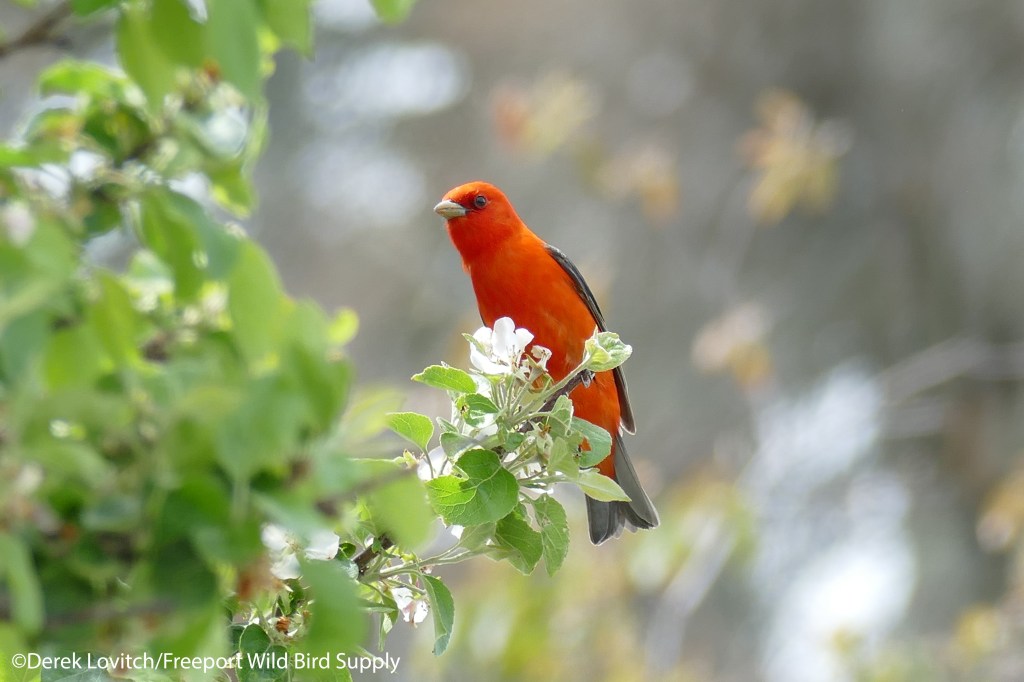
When we arrived on Friday, we found relatively few birds as expected given the preceding week’s beautiful weather. We quickly caught up with the pair of Blue-winged Teal that have been hanging around and possibly breeding out here – a very good bird on offshore islands. I was also happy to finally see my first Tennessee Warblers of the spring. And while diversity was not overly high, it was really nice out and we enjoyed really good looks at a lot of what we encountered, including the aforementioned Tennessee Warblers, Blackburnian Warblers, and our daily dose of the confiding and stunning Scarlet Tanager that was lingering around the village’s south end.
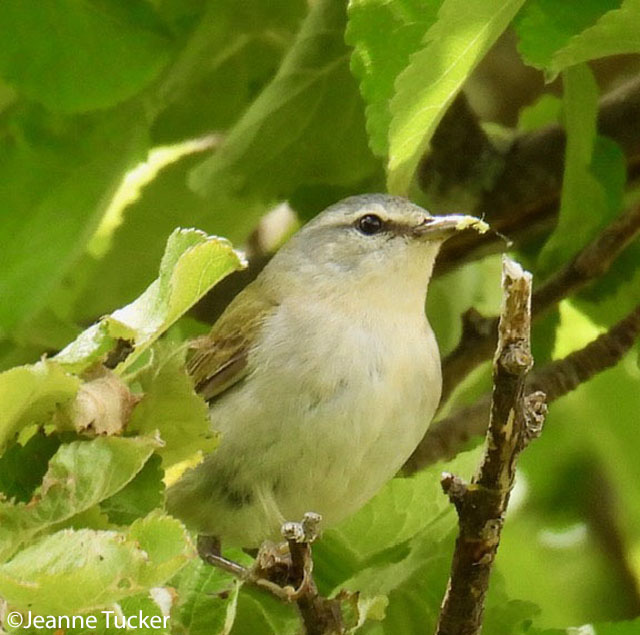
Scarlet TanagerTennessee Warbler.Cedar Waxwing.
I had really high hopes for Saturday morning. With very light southerly winds and partly cloudy skies at dusk (I enjoyed a Common Nighthawk and an American Woodcock while watching the sunset with a friend), the winds became very light southwesterly after dark. Then, around 2:00am, some light rain began to fall, and the winds shifted to the northeast. The hopes for a fallout kept me awake as I listened to those first showers in the early morning hours.
Upon sunrise, it soon became clear that my hopes and dreams had been dashed. There was minimal bird movement visible on the NEXRAD radar before the rain arrived. A large area of low pressure passing to our south, with the northern edge of rain moving much further north than forecast, suggested the possibility of fallout conditions. But were there even any birds on the move before the rain? Or, were they cut off to our south by the approaching storm? Or – as we have been surmising on the mainland as well – have they just mostly passed by already?.
Light rain continued for our pre-breakfast walk, and it was very slow. There was definitely not a fallout, and there did not seem to be many birds around at all. That Scarlet Tanager stole the show again though. Great looks at things like Yellow-bellied Sapsucker, American Redstart, and Northern Parula soon followed.
Rain slowly tapered off during the morning, and while cameras were mostly sealed away, it was more than birdable. We heard a Yellow-bellied Flycatcher (my first of the year), a Virginia Rail, and even briefly saw the vociferous Sora that incessantly called from the marsh throughout the weekend. Then, just before lunch, we found a female Purple Martin. Unexpectedly late, and rare out here in general, this was a nice find, and when we relocated it at Swim Beach, we had some great views to make sure it was indeed a Purple Martin.
The afternoon was dry, but the birding remained slow. We did get a better view of the dapper male Blue-winged Teal, and spent some real quality time with the flock of 18 Red Crossbills that contained a single White-winged Crossbill. Many folks got one, if not two, life birds in this flock, and we saw them as well as one could ever hope.
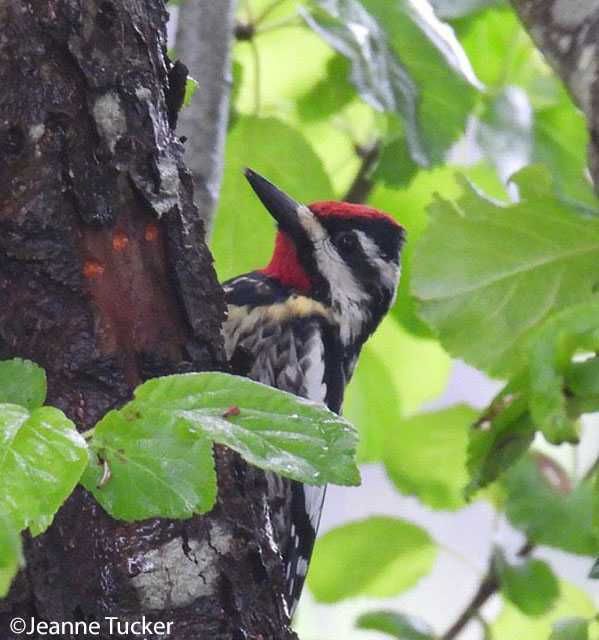
With a light northeasterly wind overnight, little to no migration was detected on the radar Saturday night into Sunday morning, but it was not yet raining. It was a little birdier than the day before, but the pre-breakfast walk only yielded two new species for us: a fleeting glimpse of a Lincoln’s Sparrow and a fly-by American Black Duck. But the crossbills entertained us once again! Also, Smooth Green Snake and Redbelly Snake side-by-side.
A large area of low pressure was rapidly developing off the mid-Atlantic coast, and the rain was heading our way. So we were grateful for another dry – albeit chilly – morning. A couple of late Bobolinks and a Merlin were new for us, and we glimpsed a less-than-cooperative Short-billed Dowitcher that had arrived and played hard to get for the next couple of days. With so little shorebird habitat out here, most shorebirds are noteworthy, even species common on the mainland. According to Brett Ewald, this was only the 16th record for the island, and 10th for spring. In fact, this was my 218th species on Monhegan! Even on a slow day, you never know what might show up out here.
Light rain had arrived by the time we regrouped after lunch and the northeasterly wind was picking up. We called it quits as the rain picked up in earnest around 3:00pm, retiring to our respective rooms – or, mostly, heated common areas – and got some reading and relaxation time in.
Overnight rain ended just about as our pre-breakfast walk got underway on Monday, with only light showers and a little drizzle for the next couple of hours. Given the forecast, this was most definitely a win. We checked gull roosts and other sheltered harbor nooks, turning up only a Savannah Sparrow as a new addition to our list. The rest of the morning was spent enjoying some of the birds we have been seeing for the past days, like the Blue-winged Teal and Yellow-bellied Sapsucker.
American RedstartRing-necked Pheasant.Yellow-bellied Sapsucker
After the weekend tempest, those of us who survived were rewarded with calm, following seas for our ride back to New Harbor. It was foggy, but we had some great sightings on the easy ride back with single fly-by Razorbill, Atlantic Puffin, and a feeding Bonaparte’s Gull. Adding these three excellent birds helped our paltry list to a total of 77 species. With a long-term average of about 95 species in four days, you can see that we really did have a weekend of low avian diversity.
So alas, the weekend came to a close. A few good birds, lots of great looks at regular birds, and a few lingering chills. But, as usual, we ate well. Perhaps too well. But hey, we were burning off calories thermoregulating! Hey it happens, and the regulars all know that there will be a “bad” weekend once in a while to make the “best” tours that much sweeter.
Read
Since folks who have been reading several years of these trip reports, I figured I would include the gratuitous food porn photo as usual. However, without the Novelty open, there was no pizza. Besides, we like to class it up once in a while, in this case, at the Island Inn.
(* denotes seen from the ferry only. **Seen only by the leader outside of group time)
It was fun to watch two male Red Crossbills feeding earlier this week without even leaving the store!
My highlights over the past seven days included the following:
2 Red Crossbills, feeding on Scots Pine here at the store, 5/1.
1 continuing PROPOSED TRICOLORED HERON X SNOWY EGRET X LITTLE EGRET hybrid, Pelreco Marsh, Scarborough Marsh, 5/2 (with clients from Maine. Full explanation in an upcoming article in North American Birds slated to be published this fall).
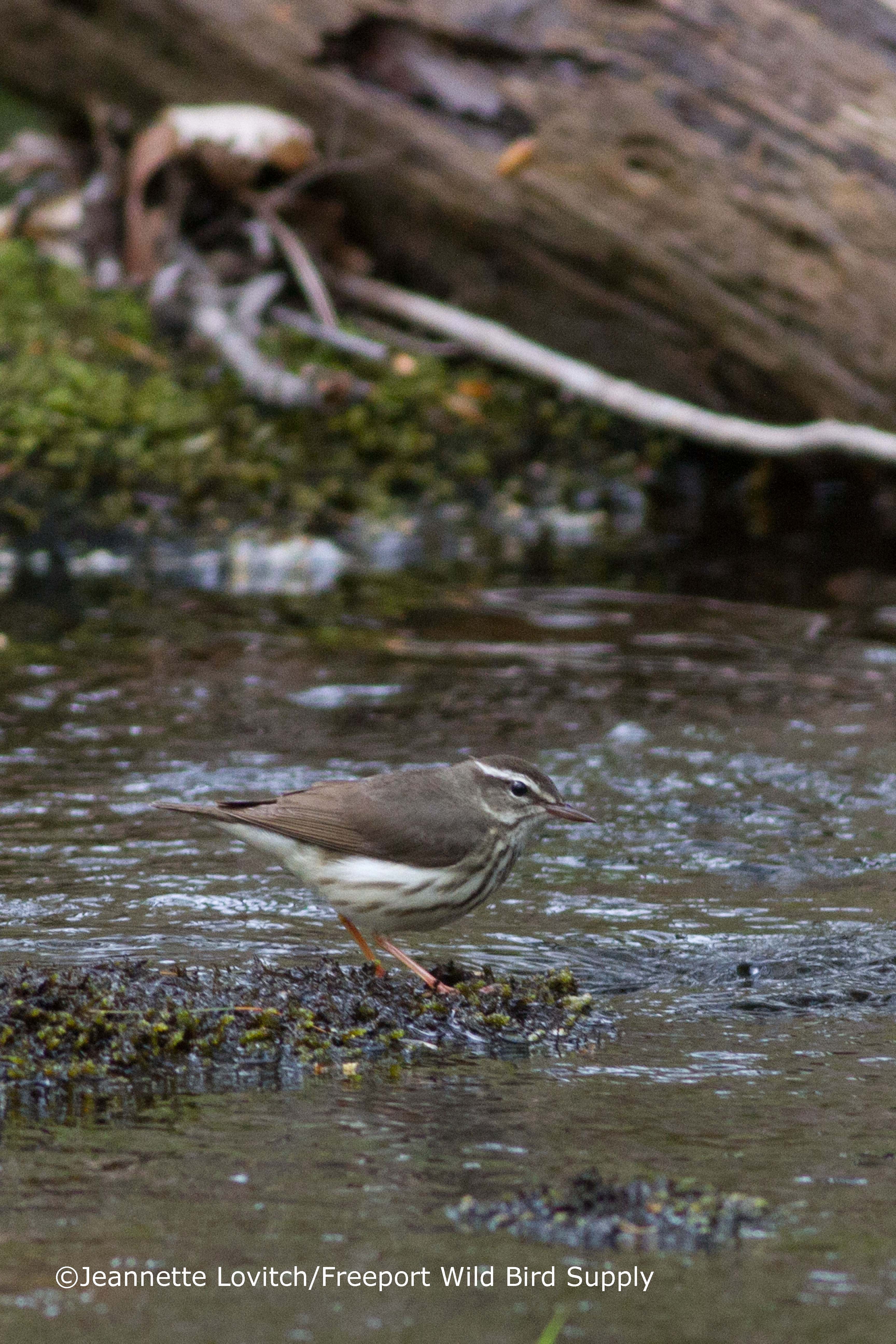
10 species of warblers (FOY; finally!) led by only 9 Pine Warblers and 7 Black-and-white Warblers but including 1 LOUISIANA WATERTHRUSH, Morgan Meadow WMA, Raymond, 5/7.
1 Evening Grosbeak, Morgan Meadow WMA, 5/7.
As the Neotropical migrant floodgates open, my personal first-of-years and new spring arrivals included:
The most abundant songbird throughout the weekend, a flock of 125 Cedar Waxwings would ball up each morning and then spread out through the island to feed.
My annual “Monhegan Spring Migration Weekend” battled highs seas (seriously, it was rough and we were all thankful it was only a 1-hr ride!) to arrive on the wonderful island of Monhegan on Friday, May 25th. Five days later, I had two new birds for my Monhegan list, a total of 97 species including 18 species of warblers, and way too much of the best pizza in Maine.
After regaining our legs and equilibrium, we hit the ground running as always, birding our way to and from our hotel, lunch, and eventually dinner. No daylight was spared, and in doing so, we caught up with a few things, including the flock of 30 or so Red Crossbills, three of which perched nearby by close studies. Personally, however, I was most excited about 2 Eastern Bluebirds (at least one had been present for a while), my 210th species on Monhegan! We had our first sighting of Warbling Vireo, which, like the 1-2 Field Sparrows – we saw everyday; both very uncommon on the island in spring. Apparently, I either started coming after – or perhaps only took better notes after – they last bred on the island. An island bird is a great way to start off the trip!\ Red Crossbill – female.
Rose-breasted Grosbeak – female.
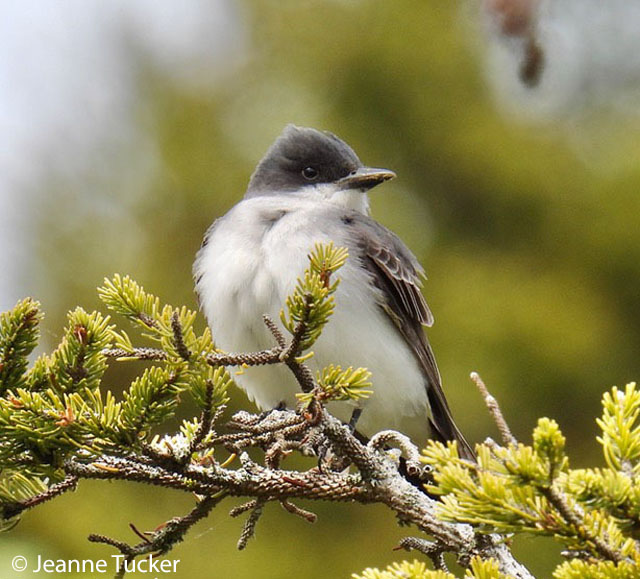
Eastern Kingbird
Friday calmly eased us into the weekend, but Saturday blew us away. It was just one of those great days, with birds seemingly everywhere, and many of them low and easy to see. Following a moderate flight overnight on light westerly winds, there were a lot of new arrivals. Five Tennessee Warblers heard singing from one spot while tarrying at the Trailing Yew awaiting the coffee pot were a sign of things to come.
As is often the case on such flight days, we didn’t have to cover a lot of ground, as waves of birds were passing through the island and around town, pausing at just about every apple tree. It was hard to estimate the number of birds around, but there was a consistent south to north flow on the island, and several relatively-large flocks of the most common migrants of the day. I finally settled on 80 Red-eyed Vireos, 50 Blackpoll Warblers, and 20 Tennessee Warblers – impressive numbers of birds normally relegated to the tops of the highest oak trees, but today, more often than not, in low brush and short apple
trees. Tennessee Warbler Blackpoll Warbler, male.
While it wasn’t the kind of day that Monhegan legends are made of, it was one of the “good ol’ days” where migrants were plenty, views were crippling, and birding was easy. And all of that was punctuated by a few goodies, including an immature male Orchard Oriole, three Eastern Bluebirds together (two appeared to leave the island shortly thereafter), a lingering immature Great Cormorant, my first Common Nighthawk of the year fluttering off the high cliffs of White Head, 14 species of warblers including 4 Cape May and 2 Bay-breasted, and much more. And the day ended with two American Woodcocks heard calling and twittering from the lawn chairs of the Trailing Yew. That’s what Monhegan in migration is all about! On Monhegan and elsewhere, a good birding rule of thumb is that if you see a blooming apple tree, you should look in it.
OLYMPUS DIGITAL CAMERA
And that sunset from the Yew!
Not surprisingly, Sunday was slower, as light northeasterly winds precluded much in the way of overnight migration. And while it seemed that a lot of yesterday’s migrants had departed or melted into the woodlands, there were plenty of birds around, with a slight improvement in diversity, still plenty of Blackpoll Warblers, and a few highlights including a cooperative Green Heron, more Red Crossbills, a fly-by Black-billed Cuckoo, a Carolina Wren (finally; good to know one is here again), and a Northern Mockingbird (uncommon to rare out here) that we witnessed fly onto the island from behind, or perhaps over, Manana.
Green Heron
The afternoon was rather slow overall, but we just kept seeing birds well: the Warbling Vireo at eye level, a Lincoln’s Sparrow in the garden, and continued good views of Tennessee Warblers. Field Sparrow White-crowned Sparrow Eastern Wood-Pewee
Monday the 28th was the last day of the tour, and with a smaller group in tow, we covered a lot of ground. While there was virtually no visible migration on the radar overnight on very light easterly winds once again, there were clearly a lot of new birds around (or at least, birds not seen the previous days) and we ended up with the best diversity of the trip – 71 species by day’s end.
In fact, by days’ end, we added 14 new species to our cumulative weekend list – not bad for a “slow” day and the end of a tour. And there was some quality to it, too: a continuing very late drake Long-tailed Duck that we finally caught up with…
…a Brown Thrasher, a Red-bellied Woodpecker, Sharp-shinned Hawk, and especially the Brant that we found on Nigh Duck – my 211th all-time bird on Monhegan, and a new “island bird” for just about every birder on the island.
On Tuesday, it was just Jeannette and I on a one-day vacation, mostly on our own, but meandering in and out of contact with several friends on the island. We awoke to dense fog, but that rapidly lifted, and the strong (for the date) flight overnight produced another new arrival of birds. It sure wasn’t Saturday, but there were plenty more Blackpoll Warblers around, and warbler diversity overall was the best of the weekend with a total of 16 species, highlighted by the Mourning Warbler we found by the Mooring Chain, and an impressive 15 Blackburnian Warblers.
John and Terez found a (or relocated a brief late-last-week fly-by) Summer Tanager…
…and we added a few new birds for the trip list including Great-crested Flycatcher, Northern Flicker, and had more species of butterflies today than total butterfly individuals all weekend, including an early Monarch. It was also a really, really nice day!
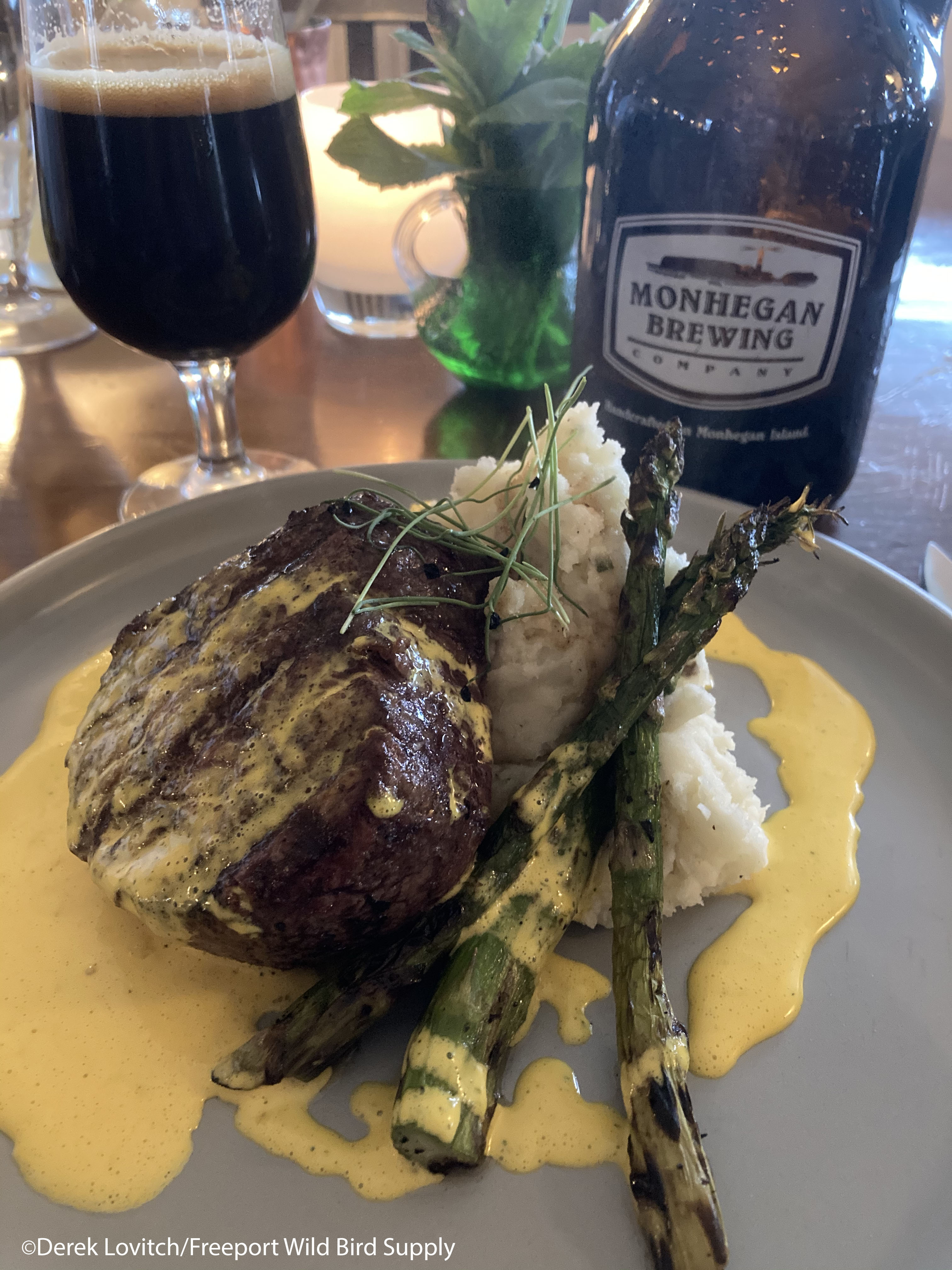
The afternoon was slower, and Jeannette and I winded down our visit with good conversation, one last slice (or two) of Novelty pizza and another pint (or two) of Monhegan Brewing beer, and caught up with some good friends who had just arrived with tours of their own. It was a relaxing finish to a great weekend, and the gentle boat ride home was more relaxing than we really needed before driving – just a little different than our outbound trip!
So yeah, it was a good trip. And, after one day at work, I am definitely ready to go back! At least I have two tours out here this fall. First, I have a full week with my WINGS tour, space on which is still available.
RED CROSSBILL (lone good recording identified as Type 10 by M. Young at Cornell).
30
0
5
h.o
2
Pine Siskin
0
1
1
1
0
American Goldfinch
10
x
x
x
x
I forgot to take a photo of the pizza – I ate it too quickly as usual – so here are some beautiful beets from the Island Inn.
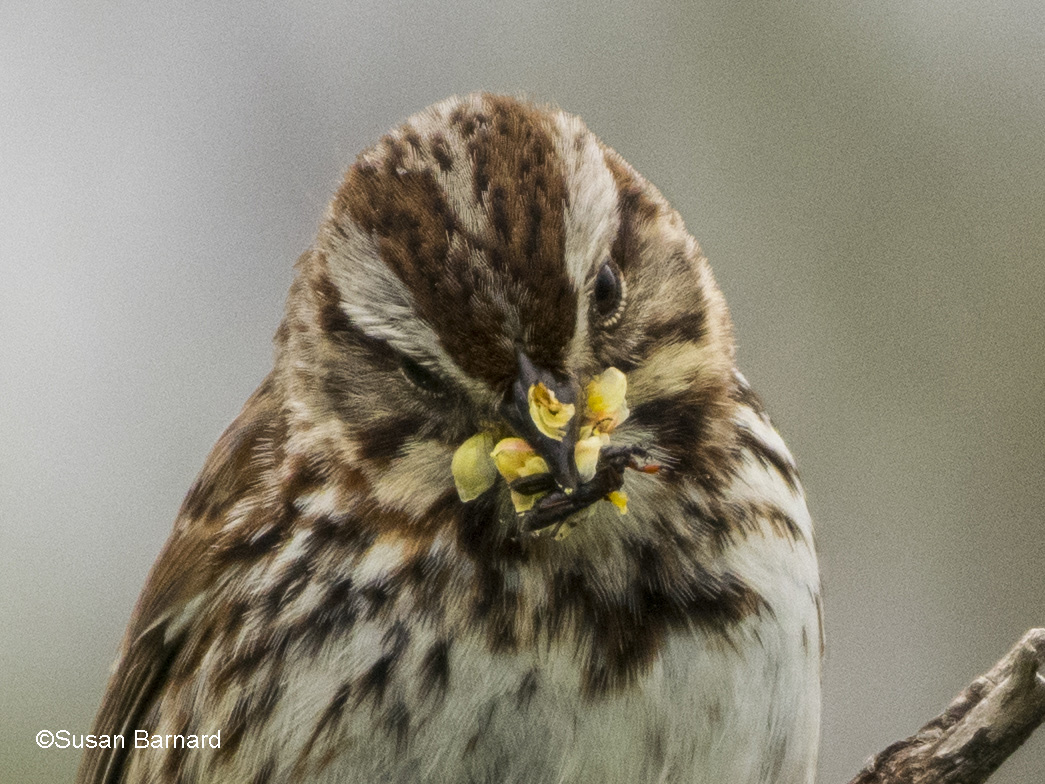
And as migrants were passing through, many of the island’s breeding species were well underway, such as this Song Sparrow gathering food for its nestlings.
Whether from a guide’s perspective or a participant, one of the great benefits of the Birds on Tap – Roadtrip! series of tours with The Maine Brew Bus is that no matter what the weather, no matter what the season, the breweries WILL be there. The same, obviously, cannot always be said for the birds, especially when rain and wind is forecast. Well, they will be there, but whether or not we get to see them is an entirely different thing.
And the forecast for Mother’s Day was not good. One of the local forecaster’s simply called it a “complete wash-out.” But rescheduling these events, outside of winter, is a real challenge, and like I said, we can at least guarantee that the breweries will be dry and open! Certainly, the radar, as we departed Portland, did not offer much in the way of optimism.
But despite the forecast, the May 14th “Warblers and Wort” Roadtrip was anything but a washout. In fact, half of the birding was done without a drop of rain and even a little filtered sun. But yeah, the first stop was rather damp.
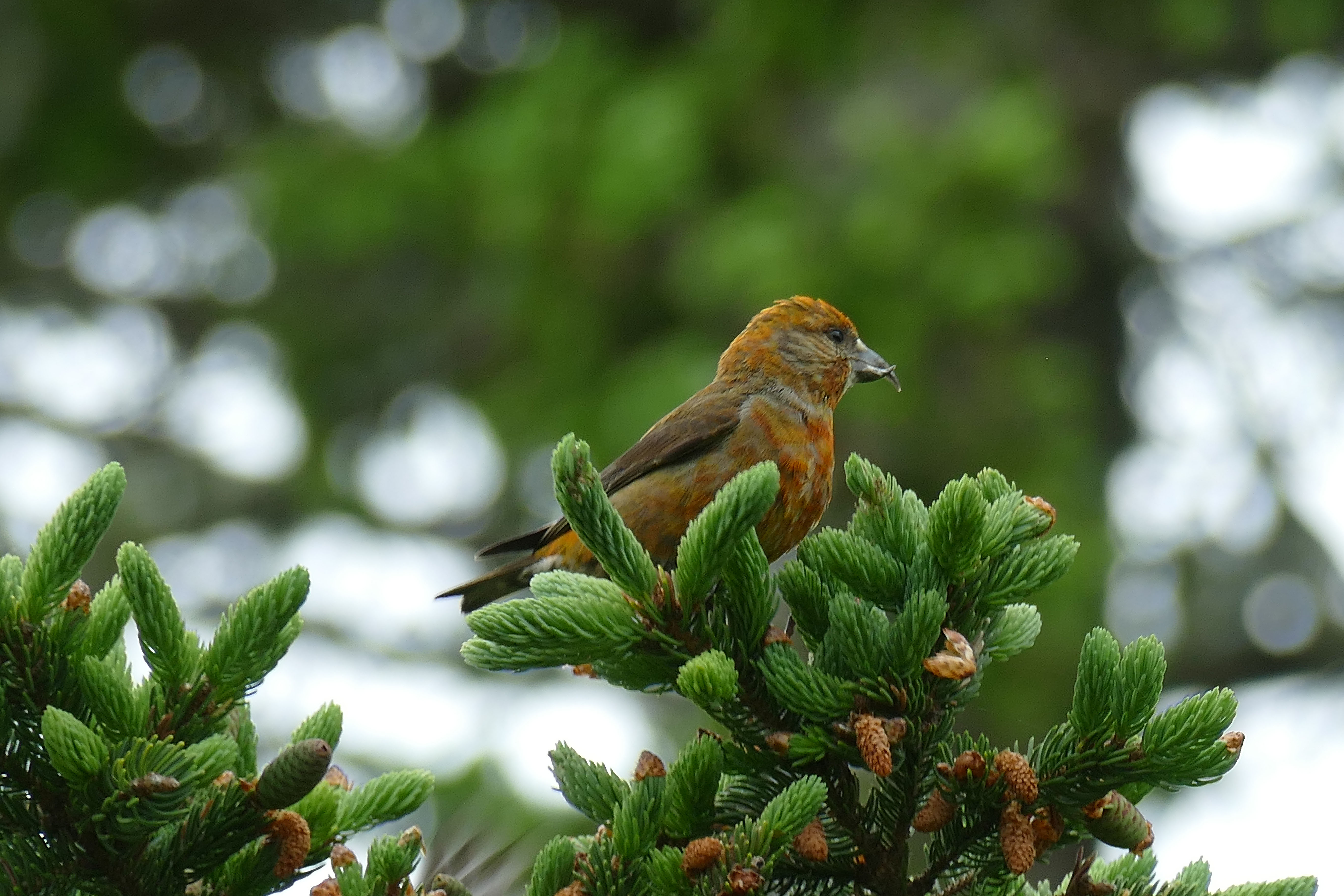
We began at the Waterboro Barrens Preserve in Shapleigh, where we enjoyed numerous and conspicuous Eastern Towhees. Several people commented that they had never seen so many towhees, and seen them so well. But with light rainfall falling steadily, the birding was rather slow. We only heard one Prairie Warbler, did not locate a single Field Sparrow, but we were quite pleased to have a singing Red Crossbill fly over. We did get to see a rather rare habitat for Maine – managed Pitch Pine-Scrub Oak barrens – and we compared the forest composition within the reserve to the degraded woods outside the property. We didn’t see all of the denizens of this specialized habitat, but plans were made for return visits on drier days. Female Red Crossbill and a Chipping Sparrow, from a different time and place.
Our second stop conveniently took place in the midst of a break in the precipitation. Unfortunately, wet, winding roads slowed down our transit, I spent a few more minutes than I should have at Waterboro, and a little communication error led to us falling well behind schedule. Therefore, we were on a mission as we marched into the Jagolinzer Preserve in Limington.
This beautiful little spot, which was one of my favorite discoveries while writing my new book, Birdwatching in Maine: A Site Guideis home to several territories of the localized Louisiana Waterthrush – a bird that today’s group was really hoping to see. As soon as we reached the river, we heard one singing, and then, in my favorite viewing spot, got one to immediately pop out of cover and provide unusually long and unimpeded views as he was clearly challenging the bird singing across the river.
Meanwhile, a rather confiding Veery competed for our attention. We would have worked harder for more of the breeding warblers here – this was “Warblers and Wort” afterall – but we celebrated our Louie success – the primary “target” of this visit.
The mixed woodlands here, and the deciduous-dominated riparian corridor on the banks of the Saco River were in marked contrast to the rather homogeneous pine barrens. A larger sample of the birdlife would show some significant differences in resultant avian species composition. If “Louisiana Waterthrush Habitat” was listed in the dictionary, this picture would be it definition.
All too soon Andy, our driver and beer guide for the day, had to crack the whip and get us on our way. Back in the bus, we shed layers, and Andy took over on the microphone as we weaved our way back around Sawyer Mountain and over to Limerick’s Gneiss Brewing Company, fueled by our kale and feta hand pies for lunch.
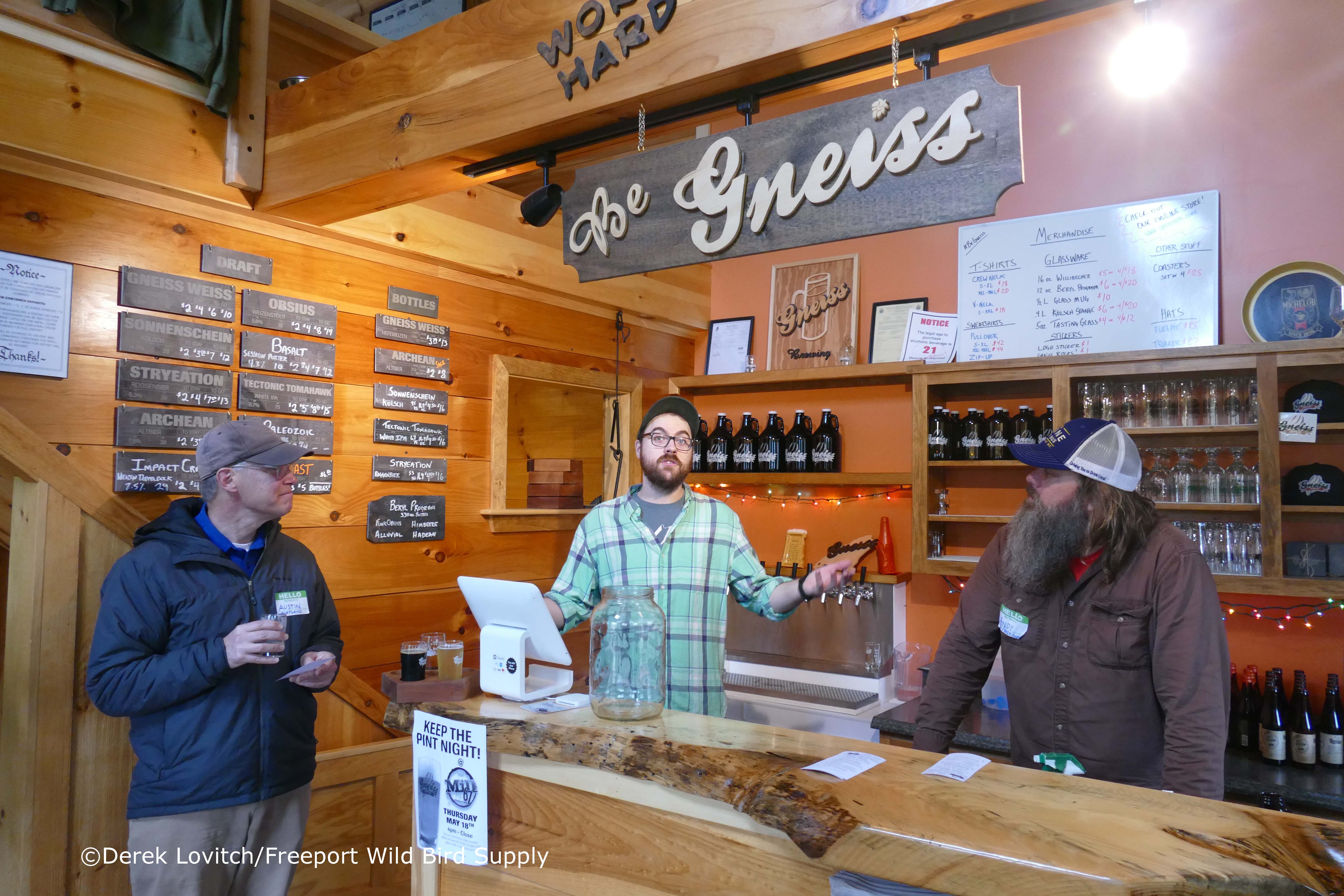
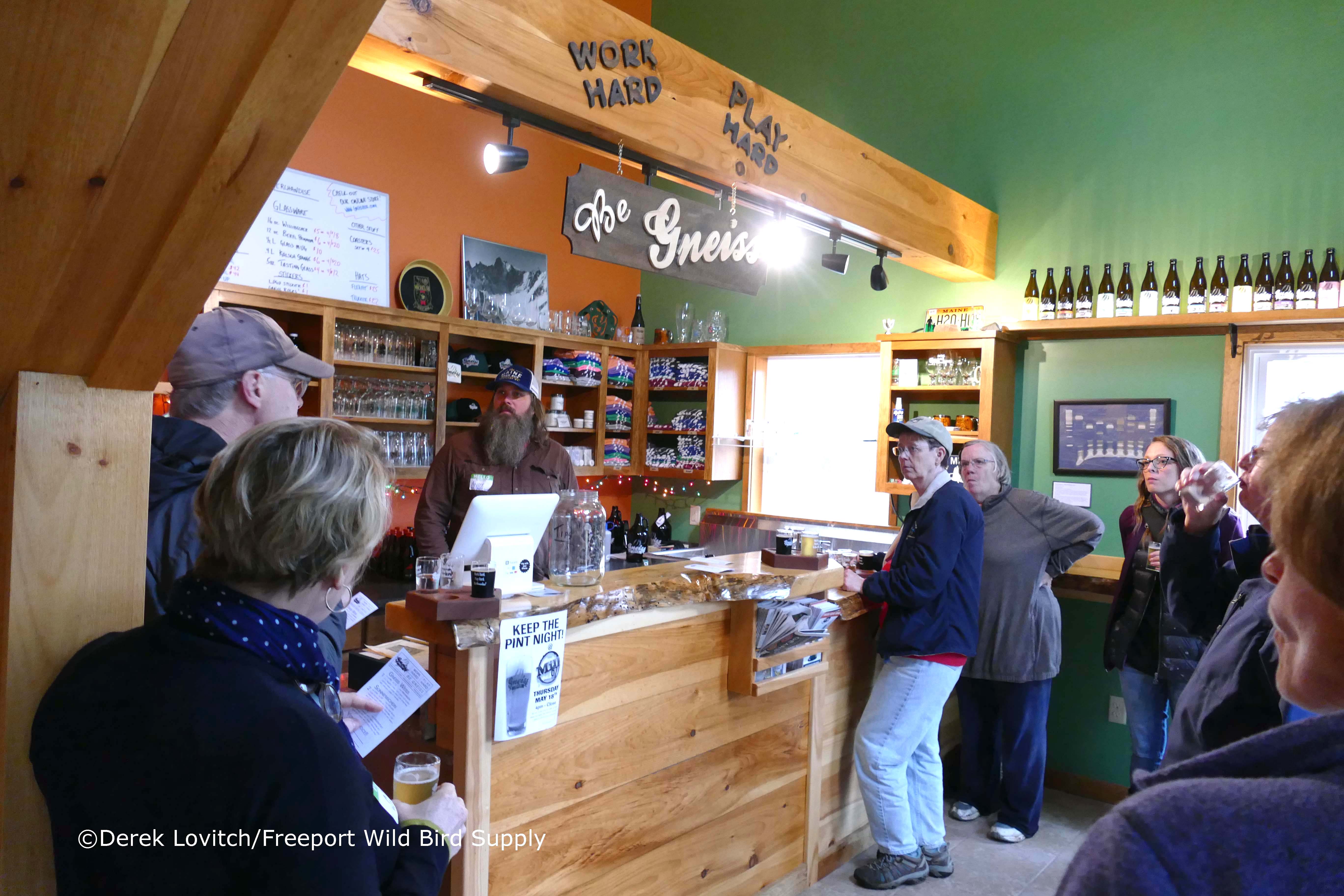
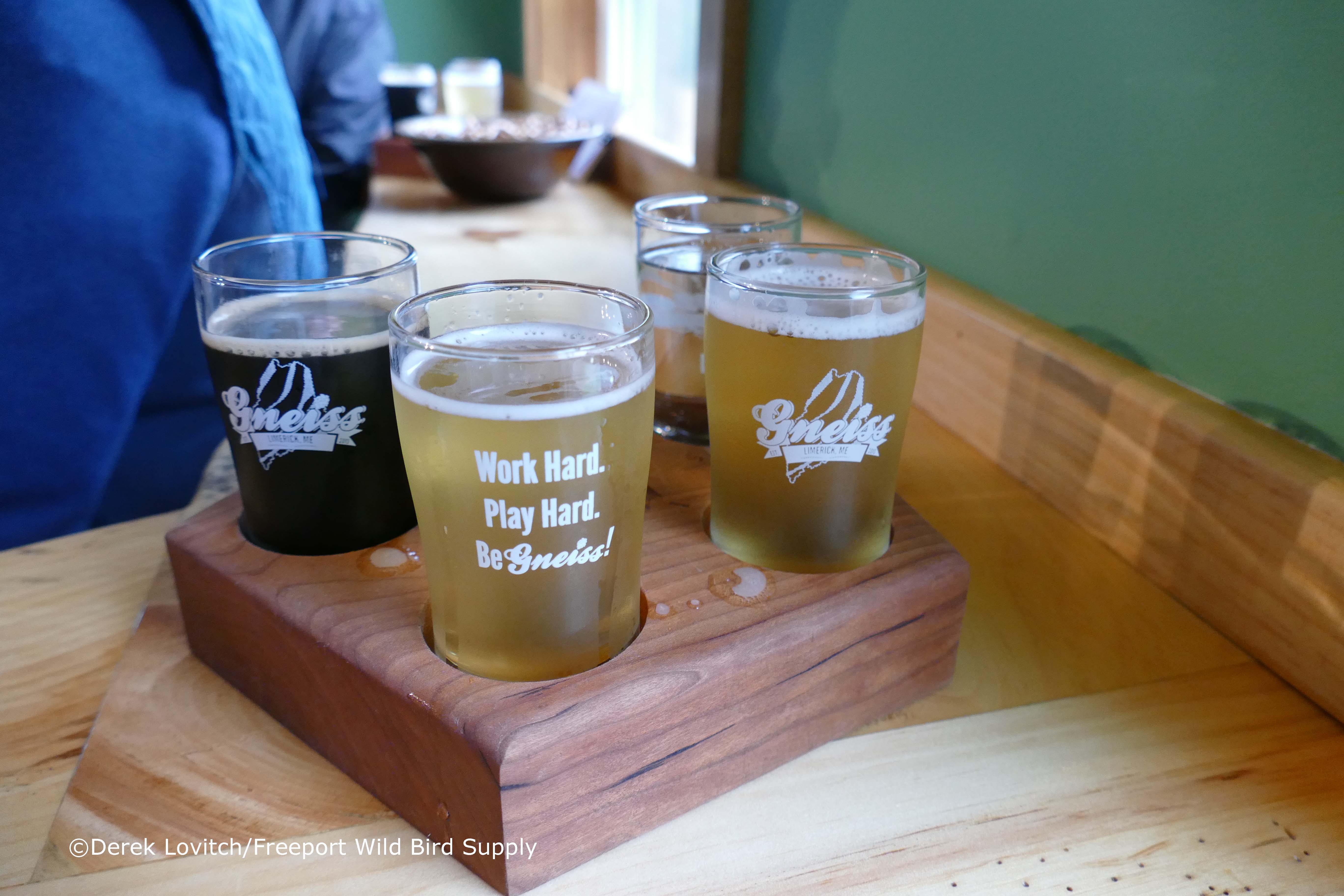
Not only had they opened just for us, they fired up the woodstove, and we rapidly dried out the remnants of that rain in Waterboro. Concentrating on classic German styles, we learned about Gneiss’s brewing philosophy and operation. Having produced 400 barrels last year, plans are in the works for future expansion and canning. We glimpsed a Wild Turkey strutting through the backyard as we toured the facility and sampled four of their beers.
Beginning with their flagship Gneiss Weiss, a full-bodied wheat beer with low bitterness and a subtle hint of banana, we moved on to Sonnenschein, a crisp and well-balanced Kolsch. I really liked this beer; crisp, clean, and easy-drinking but with really good balance and flavor. Next up was Obsius, a stout brewed with roasted wheat and fermented with their house hefeweizen yeast, making for a subtle banana note to go along with the traditional roasty and nutty stout flavors.
Last but not least, we were offered a sample of any one of their ten beers on tap at the moment, and on recommendation, I sampled Pyroclast, a collaboration with Orono Brewing Company. Starting with a potent golden ale, it was aged for 13 months in various barrels, including those of both red and white wines, with several rounds of various wild yeasts. The result was an ultra-complex brew with lots of fruity and tart flavors. And, with the Brettanomyces, just a little bit of funk.
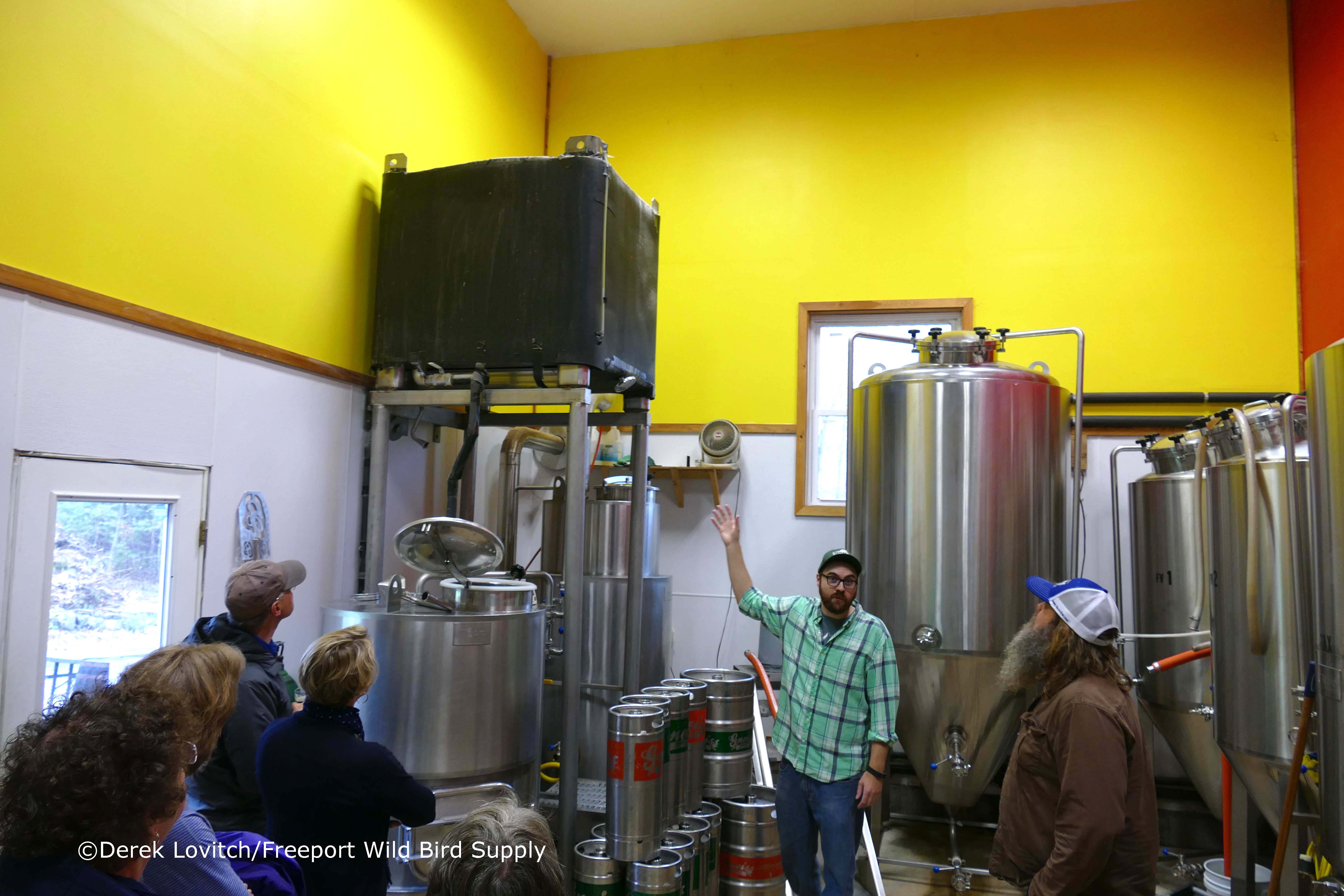
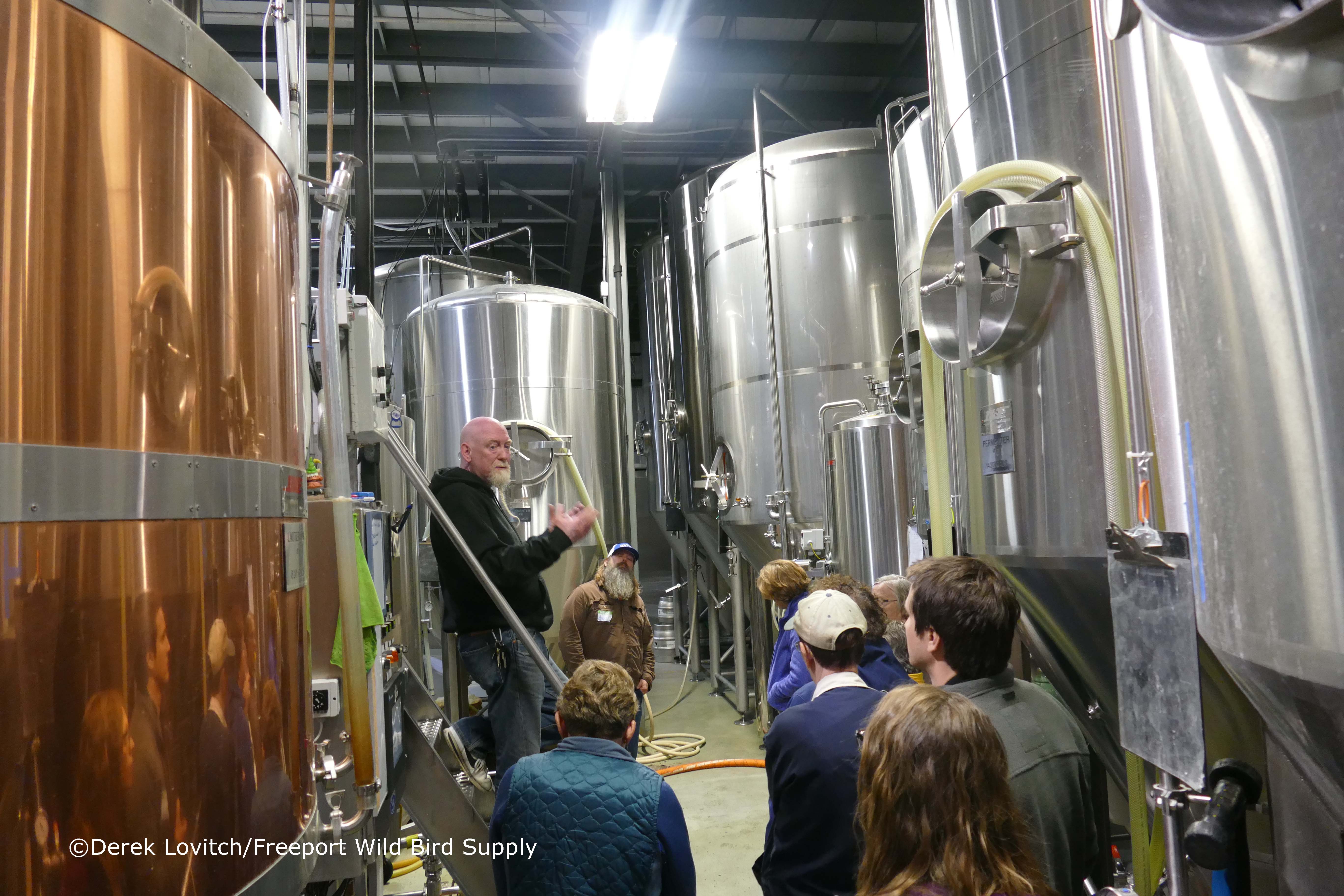
The second brewery on today’s itinerary was the production facility of Sebago Brewing Company in Gorham. It was fascinating to compare the size of the facility and equipment, and learning how craft beer is scaled up to accommodate growing demand. Ahead of the curve, opening their first brewpub way back (in the world of modern craft brewing, downright ancient) in 1998, Sebago now operates four brewpubs, and supplies cans and bottles around New England.
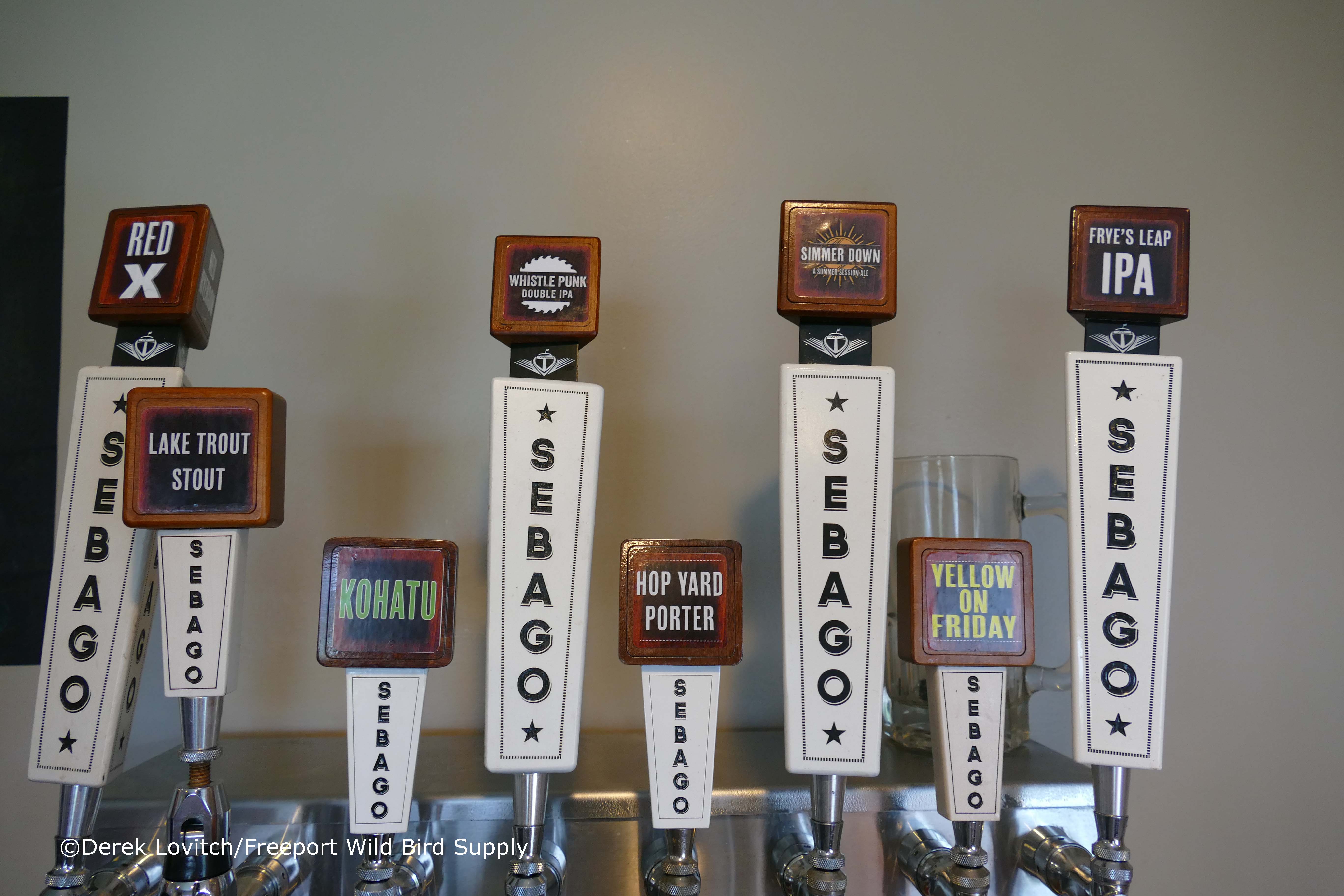
A generous helping of seven samples of a wide range of their offerings helped guide us through the tour and the discussion, starting with Yellow on Friday, their Czech Pilsner. Light in body, crisp, and mellow, this was a rare lager from Sebago. Next up was the Red X, a pale ale recipe using red malt. This one-time brew was surprising – the palette is expecting a sweet amber from the color, but this is an illusion – it was light and dry like a typical pale. It was definitely unique, and I quite liked it.
A single hopped pale ale featuring a new New Zealand hop variety offered some tangerine and bitter blood orange flavor, before we relaxed with a new stand-by, the light and refreshing session, Simmer Down. One of their new top-sellers, this was already the fourth release this year of what will likely be a new summer go-to, featuring lots of tropical fruit notes and low alcohol.
Sebago’s number one seller is their Frye’s Leap IPA, which may be up to 60% of what they produce in a month these days. Citrus and a touch of pine are featured in this classic IPA. Next up was one of my favorites from Sebago, the Whistlepunk DIPA, which has lots of citrus and other hop flavors, and although it’s a goodly 8% is not boozy to me. We then finished up with their Hop Yard Porter, with local hops, and a fairly light body for a porter.
Needless to say, we had all fully warmed up by now! The short trip to Portland and then on to Freeport, discussion revolved around the wide variety of beers that were sampled, and for many, life birds – especially the Louisiana Waterthrush – that were spotted. And the fact that it wasn’t even raining for the whole day; that is most definitely a win!





























 Maine Birding Field Notes