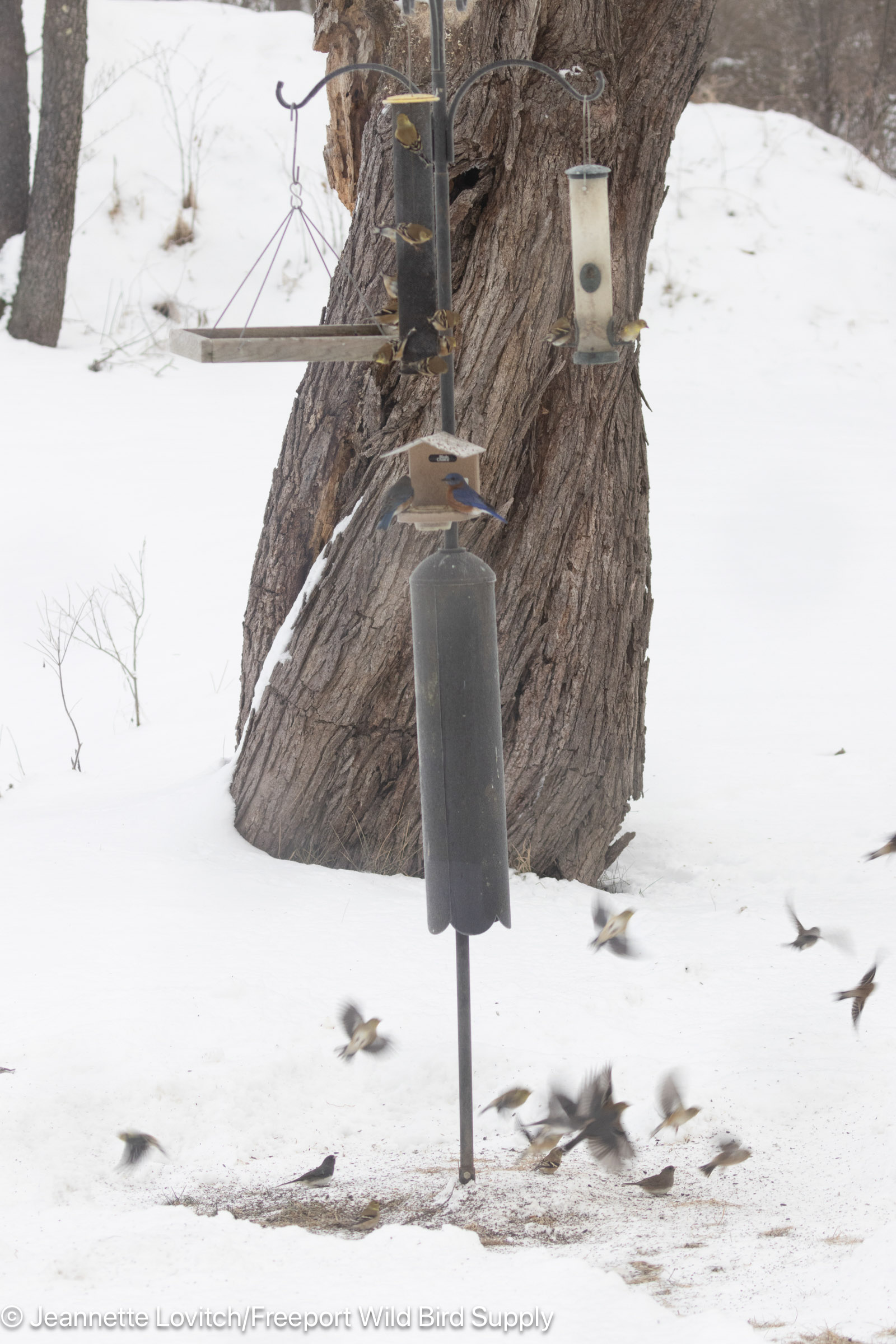
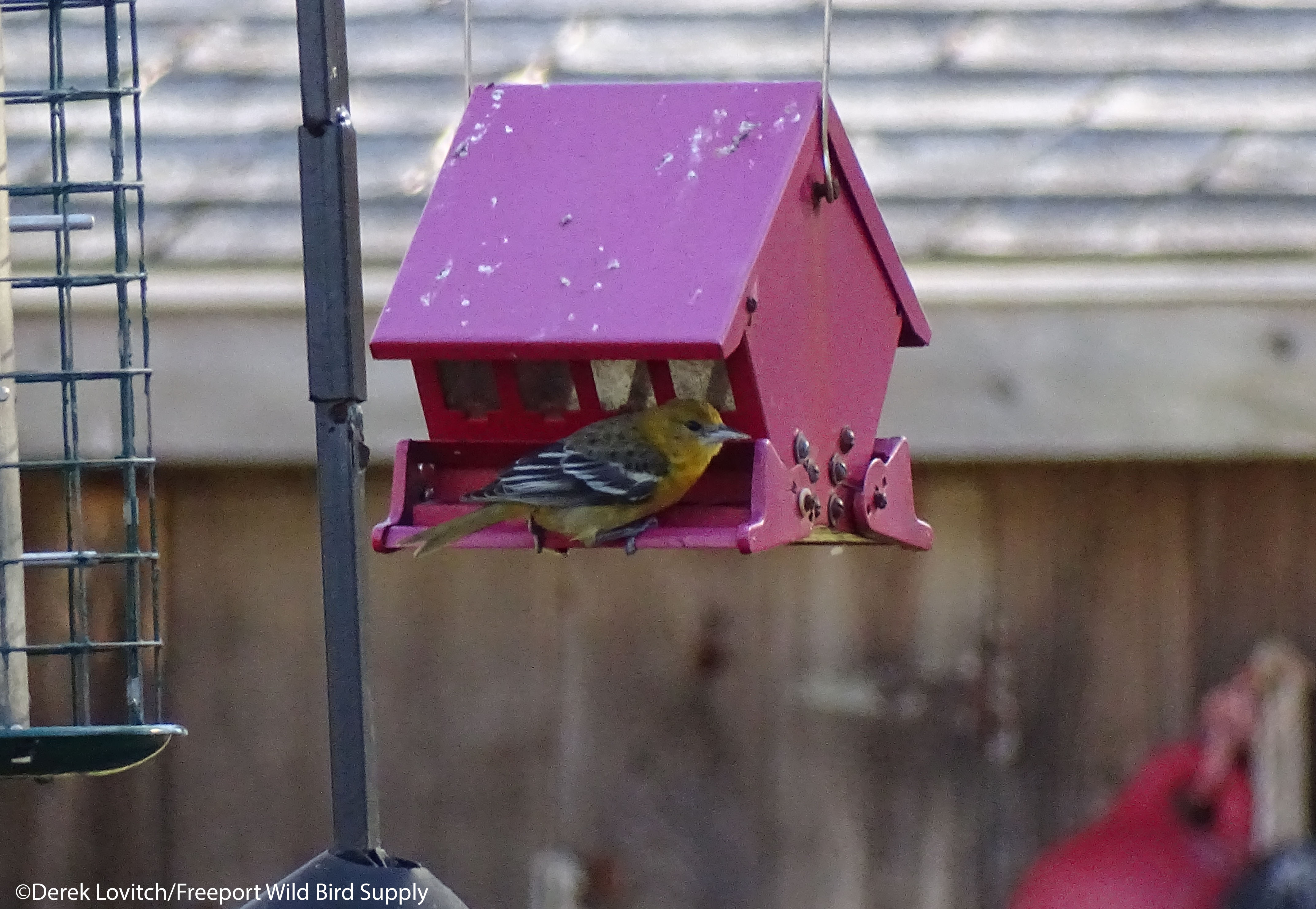
A Fox Sparrow, present at our feeders in Durham since mid-December has been a welcome addition to our winter feeder watching sessions.
After beginning a “feeder watching blog” while stuck at home from shoulder surgery in the winter of 2023 (here and here), I continued the tradition last year in an attempt to gauge the difference between the two winters. A lot of folks were commenting at the store at the time about how few birds there were at feeders in the winter of 2023-24, but this was changing by the time I collected my data in February of 2024.
This year, a lack of feeder birds has most definitely not been the complaint. In fact, bird seed sales are through the roof in much of the East, and at our store, we are really, really busy. Most folks are commenting about how much birds are eating at their feeders. And while recent snowfall is part of that, this pattern began in the fall.
My perception, however, is that there is actually somewhat lower diversity at our feeders (especially the complete dearth of any “winter finches”), and perhaps the number of individuals at the feeders is a little lower than usual, but those species and individuals that are at our feeders are eating a lot more.
Let’s start with the numbers. Once again, I dedicated time to counting feeder birds at our feeding station in Durham each day for at least one hour. I was unable to dedicate the time on two dates, so I counted for 10 of 12 days between February 2nd and February 13th – a window that began three days earlier than last year. Like last year, I used the standard methodology of using “high counts” (maximum number of individuals seen at any one time, unless they were readily identifiable as being different).
February 2 – February 13(minus 2/8 and 2/11), 2025.
Species
Avg./day 2023
Avg./day 2024
Avg./day 2025
Average 3 years
Difference 24vs25
Difference 25 vs 3yr
Wild Turkey
0.2
0
0
0.07
0
-0.07
Mourning Dove
13.5
26.5
29.6
23.2
-3.1
+6.4
Sharp-shinned Hawk
0.4
0.2
0
0.2
-0.2
-0.2
American Goshawk
0
0.1
0
0.03
-0.1
-0.03
Red-bellied Woodpecker
1
1
1.2
1.07
+0.2
+0.13
Downy Wo-odpecker
2.4
2.9
2.5
2.6
-0.4
-0.01
Hairy Wo-odpecker
2
2
2
2
0
0
Pileated Woodpecker
1
0.1
0
0.37
-0.1
-0.37
Blue Jay
7.8
3.0
9.2
6.67
+6.2
+2.53
American Crow
0.7
0
1.8
0.83
+1.83
+0.97
Black-capped Chickadee
7.4
2.9
5.2
5.17
+2.3
+0.03
Tufted Titmouse
4
3
4
3.67
+1
+0.33
White-breasted Nuthatch
2
1.4
2.4
1.93
-1
+0.47
Red-breasted Nuthatch
0.7
0
0.6
0.43
+0.6
+0.17
Brown Creeper
0.4
0
0
0.13
0
-0.13
Carolina Wren
0.9
1
1.8
1.23
+0.8
+0.57
GRAY CATBIRD
0
0
0.1
0
+0.1
+0.1
European Starling
1.1
2.7
8.7
4.17
+6
+4.53
Eastern Bluebird
4.4
3
5.7
4.37
+2.7
+1.33
House Finch
2.1
0
0.4
0.83
+0.4
-0.43
Purple Finch
0.5
0.3
0
0.03
-0.3
-0.03
Pine Siskin
0
0.2
0
0.01
-0.2
-0.01
American Goldfinch
26.6
46.8
25
32.8
-21.8
-7.8
FOX SPARROW
0
0
1
0.3
+1
+0.7
American Tree Sparrow
8.0
4.2
6
6.07
+1.8
-0.07
Dark-eyed Junco
16.6
30.3
13.2
20.03
-17.1
-6.83
White-throated Sparrow
2
2.3
0
1.43
-2.3
-1.43
Song Sparrow
0
0.9
0.6
0.5
-0.3
+0.1
Northern Cardinal
5.2
3.8
6.7
5.2
-2.9
+1.5
Total individuals/day
110.9
138.6
127.5
125
-11.1
+2.5
Every year is different, and every yard is different. Controlling here for time and place, we can make some comparisons, however.
Once again, I am sure I undercounted Black-capped Chickadees, and likely Tufted Titmice and White-breasted Nuthatches as I think there could be two small mixed species foraging-flocks around. I also think there are more than one pair each of Hairy and definitely Downy Woodpeckers, but using the “high count” method, I only tabulated the maximum seen at one time.
Two seasonal rarities graced us with their presence this winter. Our Gray Catbird, present since January 2nd, made it long enough to just make it on the list. Meanwhile, a Fox Sparrow that arrived in mid-December continues through today. I won’t expect either of these species to be at our feeders every year.
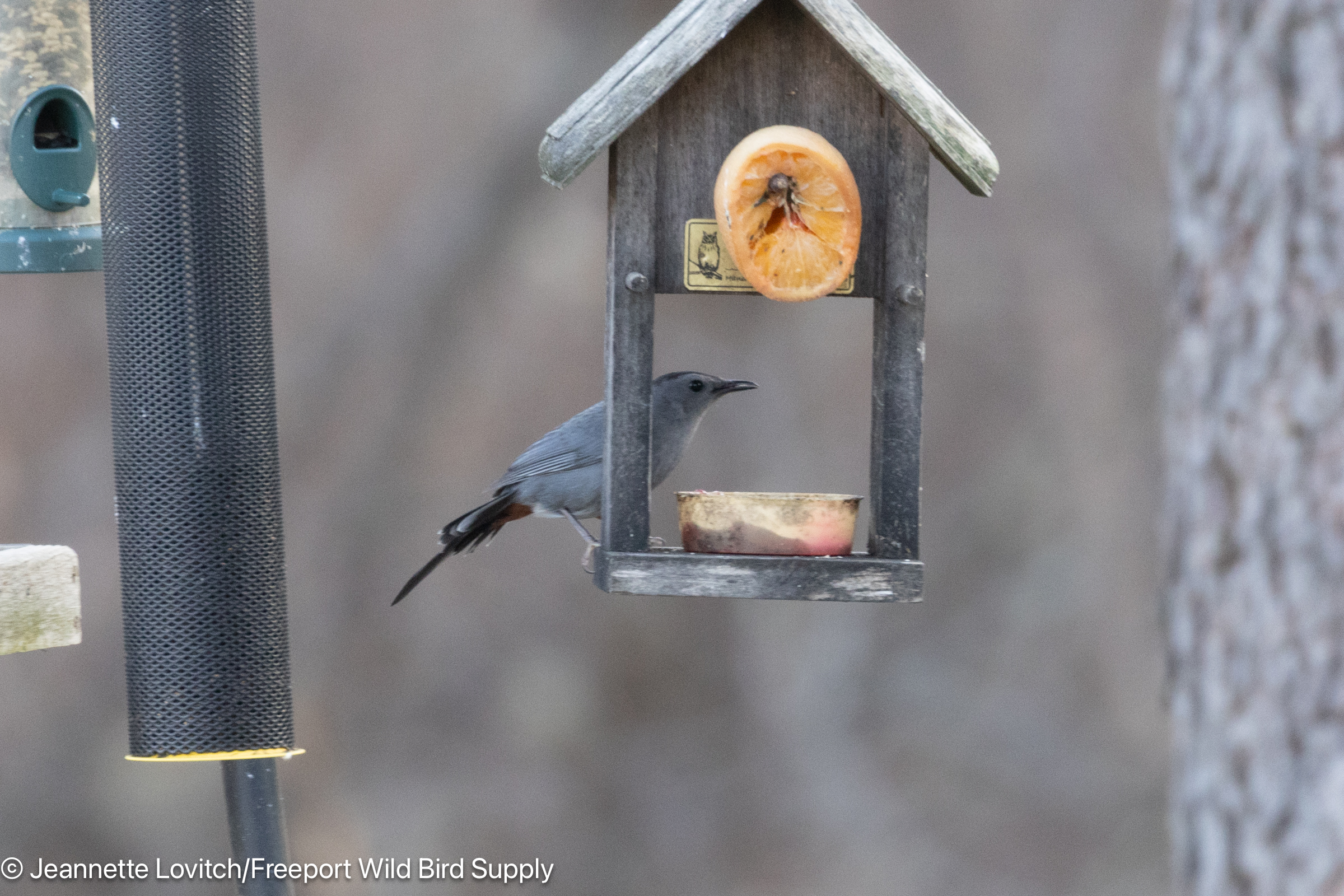
When our catbird first arrived, it was growing in most of its tail feathers. When it departed, the tail was mostly restored, it survived the coldest night of the season to date, and it coincided with the depletion of the last of the Winterberry in our yard – all a good sign that it simply moved on and did not perish. Here’s it’s taking a serving of semi-frozen grape jelly, but it mostly ate suet while it was here.
American Goldfinches were down from last year in our yard, but they were extremely abundant from the fall through early winter. The difference now is most of our birch catkin crops have now been consumed. Dark-eyed Juncos were way down for us this year, and we don’t have any White-throated Sparrows around. This is likely a direct function of increasing snow depths and the lack of dense coniferous cover in the part of our property that our home and feeders are in.
I’m not going to out a lot of weight into three-year averages, but a few early trends coincide with region-wide trends, such as the steady increase in Eastern Bluebirds and Northern Cardinals. I’m not liking this trend of rapidly increasing European Starlings in our yard, however. At least for now, this is only a winter occurrence for us, however.
Eastern Bluebirds are no longer rare at feeders throughout at least the southern half of Maine in winter.
The average morning low at our home during this period was a measly 6.5F. That was 13.1 degrees colder than the ten days I looked at last year. That’s a lot more calories that need to be burned each night! While total number of individuals is down this year from last, we are going through more seed than we were at this time last year, and the cold and snow is a part of this equation.
However, I think the biggest reason for the difference between the two years can be explained in three words: Eastern White Pine. Last year, our state tree had a “generational” mast; crowns of trees were absolutely covered in cones. This year, it’s hard to find any cones anywhere in the state. Therefore, last winter our local birds had such an overabundance of their most preferred food that they spent much less time at feeders. This year, they’re eating more because there is less natural food available. And with the weather – especially with recent snowfall and ice accumulations making some food resources harder to find – birds are taking advantage of supplemental food more often. The woods, away from yards with well-stocked feeders, are exceptionally quiet this winter.
While some Black-capped Chickadees and Red-breasted Nuthatches vacated the northern woods this year, it was not a major irruption. They, and Tufted Titmice and White-breasted Nuthatches did seem to have a good breeding season, perhaps having been supplemented by caches of all of that pine seed. Meanwhile, Blue Jays are around in good numbers thanks to a very good Red Oak acorn crop that has kept them here this winter.
Like last year (and as opposed to 2023), we didn’t have a lot of accipiter presence: I only glimpsed one unidentified accipiter back on the 4th, but there were times without any birds at the feeders suggestive of an avian predator hanging around. It’s possible this might just have been due to a pair of regular Red-tailed Hawks in our yard. Despite having little interest in small birds, few birds are willing to take the chance.
Now, to really take this “study” to the next level, I would be keeping track of the amount of seed and other foodstuffs that we are putting out each year. But that’s getting to sound like work, and real research! We’re filling almost all of our feeders at least daily (often twice daily when we are home in another snowstorm), and that concurs with comments we receive at the store. But every yard is different, and not everyone has the same results. If your feeders have seemed comparatively slow, consider what you are feeding, and how fresh the seed and suet is. These are important and we can help you with that here at the store. It’s worth exploring some of my previous blog posts on the topic that discuss reasons why feeder activity ebbs and flows.
American Goldfinches and Morning Doves were once again the most common birds at our feeding station.
We’ve only lived at this location for three years, so it’s too soon to tell what an “average” winter is like in terms of volume and diversity. Furthermore, we are rapidly accelerating plantings and habitat improvement that should increase the number of birds our property sustains. Given that feeders are only a supplement to natural food supplies, I believe our habitat work will pay dividends for our feeder-watching in years to come.
I enjoy this little project, and time permitting, I’ll plan on doing it again next year. It’s only one yard, but it’s a case study that can answer some questions or at least offer a little detailed context as to what others are reporting. How does our feeder activity compare to yours? Are you seeing anything different? Or do some of our observations and hypotheses fit with your observations?
This Greater White-fronted Goose has been making the rounds in Greater Portland this winter, most recently hanging out along Shoreline Drive in Falmouth, where I stopped by to visit it on the 2nd.
It sure feels and looks like winter out there now, but there are still quite a few “lingering” species to add to our usual winter mix. Here are my observations of note over the past seven days:
The GRAY CATBIRD that has been at our feeders since January 2nd was last seen on February 2nd. Hopefully it has just moved on as Winterberry and other fruits in and around our property have been exhausted.
1 Fox Sparrow (continuing since early December) continue at our feeders in Durham.
1 Fox Sparrow (since 12/21) continues here at the store through week’s end as well.
1-2 Turkey Vultures continue in the Cumberland-Freeport corridor of I-295.
2. Gull Identification Workshop: Freeport, Saturday, February 15, 2025 (1:00-4:00pm) and Part II in Portland: Sunday, February 16, 2025 (8:00am-12:00pm).
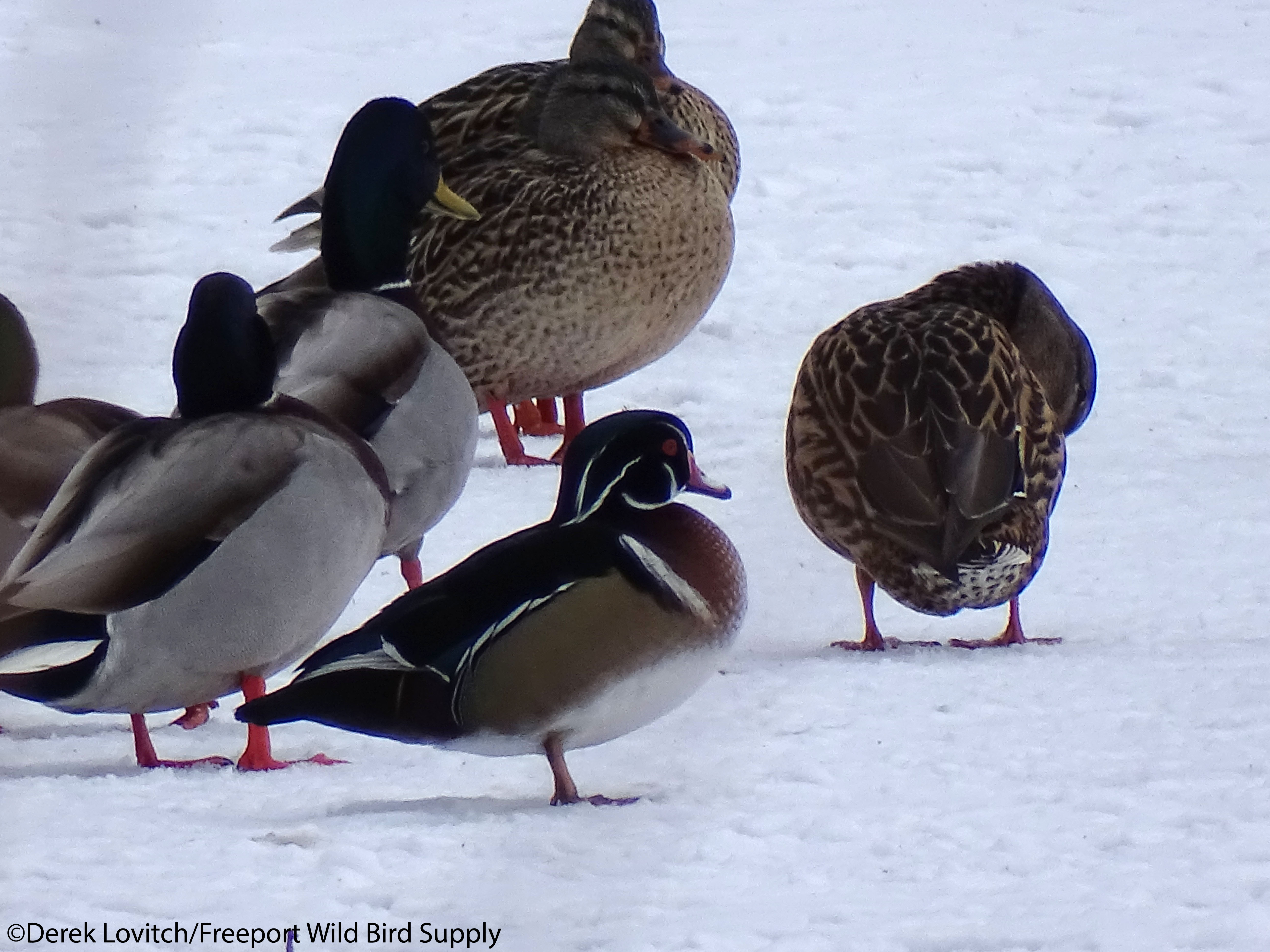
Nothing can brighten up a cold, gray winter’s day like a drake Wood Duck! This hardy drake was toughing it out amongst the Mallards at the North River Road Boat Launch in Auburn on the 13th.
“Lingering” seasonal rarities and concentrating waterfowl with the growth of river and lake ice this week produced some great mid-January birds despite limited dedicated birding outings.
The Fox Sparrow continues at the store since 12/21, but has been very sporadic this week.
1 GRAY CATBIRD and 1 Fox Sparrow continue at our feeders in Durham through week’s end.
At least two Turkey Vultures continued in the I-295 corridor between Brunswick and Cumberland, and scattered others continue in the area as well.
This spiffy adult Red-shouldered Hawk in Freeport on the 10th was a nice finale to a pleasant morning of birding with a friend.
Well, that was one windy and bitterly cold week, wasn’t it? Strong winds most days precluded productive birding, or at the very least, precluded motivation to do much birding! Feeder-watching was the name of the game on many mornings for me, but despite the cold, “half-hardies” dominated the highlights for me, and for most birders around the state. Lighter winds on Saturday and Friday, relatively speaking, allowed for some much more enjoyable and productive birding.
Single Fox Sparrows continued through week’s end at our feeders both at home in Durham and here at the store.
2 Turkey Vultures continued in the I-295 corridor between Brunswick and Cumberland into the New Year, and scattered others continue in the area.
There was a nice influx of American Robins into the area this week, with some large flocks arriving. Single-flock high count of 138 over the Yarmouth Town Landing on 1/4 (with Saturday Morning Birdwalk group). Keep an eye out for vagrants among them!
1 GRAY CATBIRD, continued from last week at our feeders in Durham through week’s end.
Our collaboration with The Maine Brews Cruise enters its 11th season, with six exciting itineraries. These unique, relaxed birding and beer-ing adventures that you have come to love combine great local birding at seasonal hotspots with approachable opportunities to sample the delicious creations of some of our favorite Maine breweries. These events are a perfect introduction to birding and/or craft beer, and a great opportunity to enjoy our favorite pastimes with significant others, friends, and family that have interest in one topic, while your interest is primarily in the other (for now!). Educational, enjoyable, and eye-opening you won’t want to miss out our unique Birds on Tap series. In 2025, we’re excited to bring back more of these special birding and beer tours, perfectly blending nature exploration and craft beer tasting.
The six tours are as follows. After completion, tour reports will be posted here so this blog is your one-stop shopping for tour reports and upcoming itineraries.
1. Birds On Trip℠ – Roadtrip! Harlequins and Hops
Sunday, February 23rd, 2025:
After postponing our original date due to extreme cold, it was a full 30 degrees warmer today at start time! And while there was a chilly wind at a couple of stops, we also had some lovely calm and sunny conditions. As much as we hate to reschedule, this one worked, and therefore the day was already a success before we even departed for our birding destination!
We began at Dyer Point in Cape Elizabeth, where we found our highest concentration of seaducks on the day, including at least 20 Harlequin Ducks – the tour’s eponymous bird.
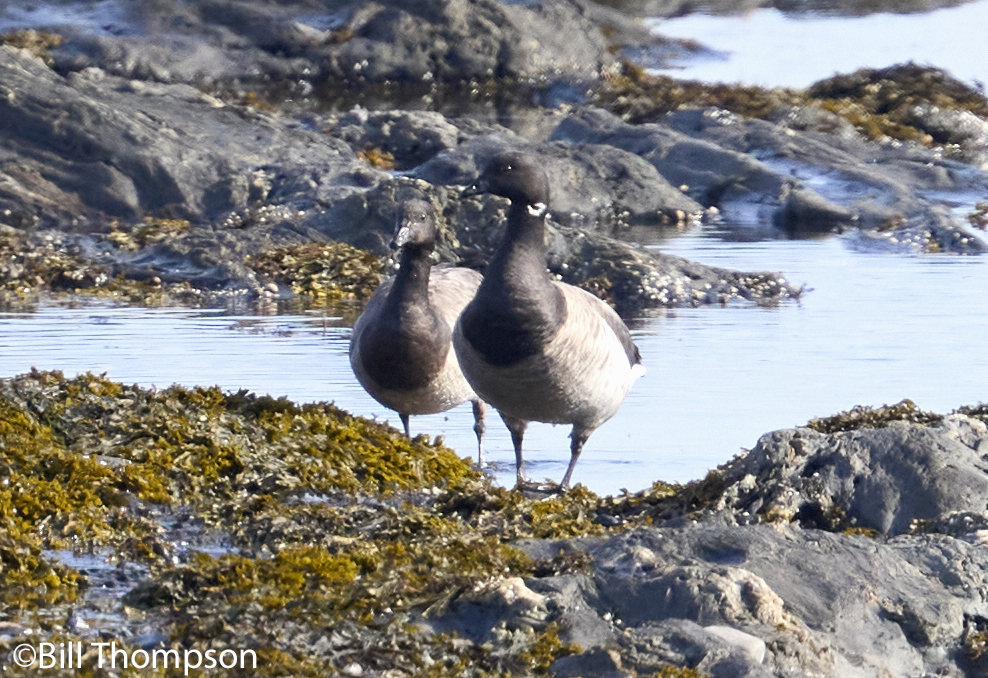
And what a stunner they were, with males in perfect light and some small groups pleasantly close to shore. Large numbers of Common Eider and Black Scoters were present, along with several other species, introducing us to winter waterfowl identification. And as a special treat, 4 uncommon and local Brant were foraging in a tidepool before us.
Most of the ducks were here today, and not at nearby Two Lights State Park, but there we saw another 8 Harlequin Ducks, discussed American Robin winter foraging ecology, and practiced our basic duck and gull identification before we headed to nearby Kettle Cove. There were not a lot of ducks here today, but we did get a surprise Merlin whipping through, perhaps the reason a Horned Lark was calling high overhead.
As a final stop, we checked Mill Creek Cove in South Portland for a very quick gull ID introduction to augment earlier conversation, compared Mallards and American Black Ducks (taking time to marvel at the beautiful drake Mallard!), soaked in a sunning drake Red-breasted Merganser, and enjoyed the sight of all of the gulls and ducks in the cove taking flight as our second Bald Eagle of the day soared overhead.
Part two of the tour began at Belleflower Brewing in Portland, one of my favorite Maine breweries. Keeping with the bird theme, we started by sampling their Magpie Pale Ale and then compared it to their Double-dry Hopped Finch & Thistle. Beginning with the recommended way of smelling and sipping a new beer, we discussed the basics of beer style, what the hell “double-dry hopping” means, the origins of the “New England” style, and then shifted gears with their brand new Just Like Home, a maple coffee brown ale. I thought the subtle maple sweetness was just right with a roasty coffee hint but the lighter body of a brown compared to a stout.
Crossing the Bayside neighborhood brought us to Argenta Brewing, one of Portland’s newest breweries. Exclusively brewing lagers, it was a nice contrast to our focus on ales at Belleflower. Starting with a generous half-pour of their Generic American Lager, we enjoyed the light, refreshing, “crushability” of a craft version of the popular lawnmower beer style. Craft beer truly is for everyone, and simple beers like Argenta’s Generic American Lager shows its not all about “hop-heads” and alcohol bombs.
We were given a choice for our next pour, and several folks tried the Mexican Lager to compare corn verses barley as the primary malt, while other tried everything from their hard seltzer to their Munich Dunkel- new to me, I found the mild roastiness and hint of sweetness on point for the style.
With a pleasant day (compared to the rest of the month), lots of beautiful and accessible wintering waterfowl – of course and especially including Harlequin Ducks – a few avian surprises, and newly-broadened palettes (I love it when folks say they really liked a beer in a style they didn’t think they liked), we kicked off the 11th year of the Birds on Tap – Roadtrip! the right way!
2. Birds On Tap℠ – Roadtrip! Warblers and Wort
Thursday, May 8, 2025.
While the rarest bird of the day came early, the rest of the trip was far from anticlimactic. Even better, it was the only warm and dry day of the week!
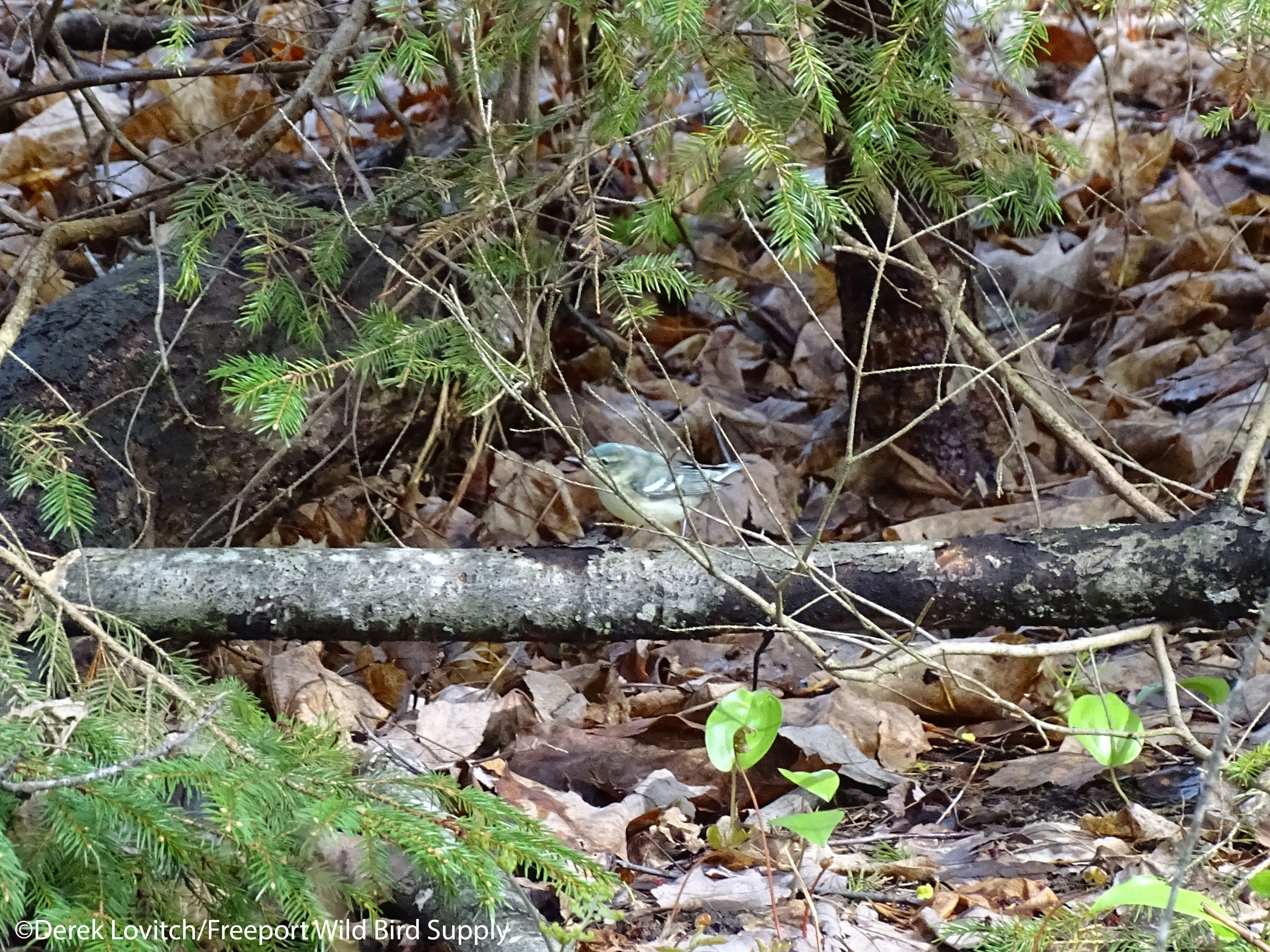
As planned, we began at Evergreen Cemetery, but our goal was set forth for us in the continuing presence of a very rare Cerulean Warbler. In fact, when I saw her a few days prior, it was the first Cerulean Warbler I have ever seen in Maine and at least a “state bird” for the several hundred folks who have seen it since. Even if you have never heard of a Cerulean Warbler, the excitement of the dozens of other birds present today was contagious. Luckily, we saw her not just once, but twice, without any concerted effort, and the second view was long and fantastic. Unfortunately, my sad attempt at a photo did not do it any justice.
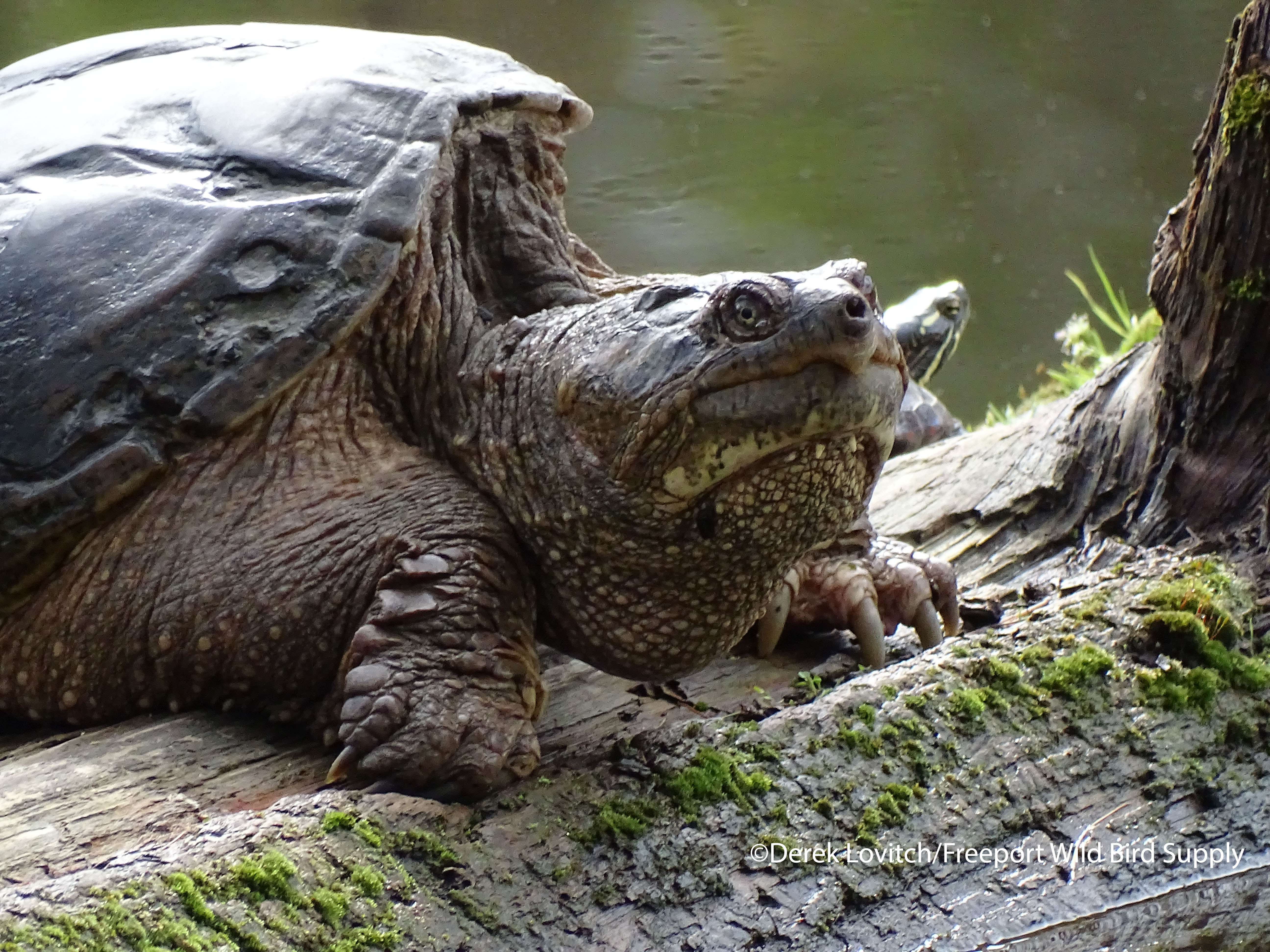
There were other birds, too! We heard Ovenbirds and Wood Thrushes, saw some close-up Black-and-white Warblers, found our first Wilson’s Warbler of the year, and enjoyed basking Painted and Snapping Turtles.
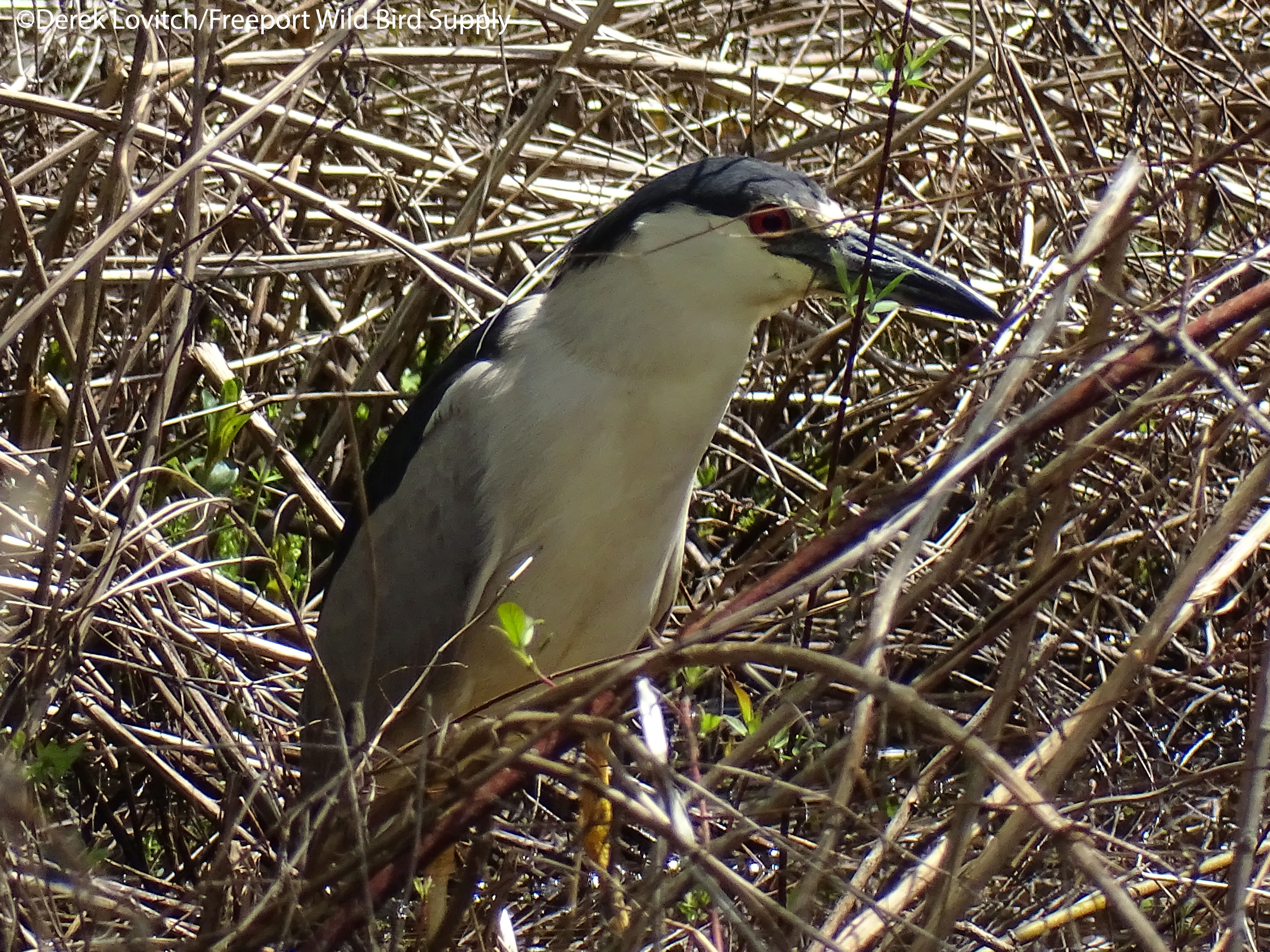
Other than the Cerulean excitement (do we have to rename this tour Cerulean and Cervezas!?), it was actually rather slow today for mid-May, so we relocated to Capisic Pond Park as the last of the fog burned off and the sun (remember that?) came out. Here, birds were easier to see, including stunners like Baltimore Orioles fighting over territories, and some really close and insanely cooperative Northern Parulas that fed right in front of our faces. A sharp eye yielded a Black-crowned Night-Heron as well.
After some productive and instructive birding, we headed back into town to visit Belleflower Brewing, one of my favorite Maine breweries. Keeping with the bird theme for a little longer, we began with their pale ale, Magpie, with its great citrus and resinous balance, followed by the more grapefruity Finch and Thistle. Belleflower treated us to a third sample, of our choice, and we covered a nice range of their offerings from a Vienna lager to a double-dry-hopped double IPA to savor as we discussed some beer history and mythology.
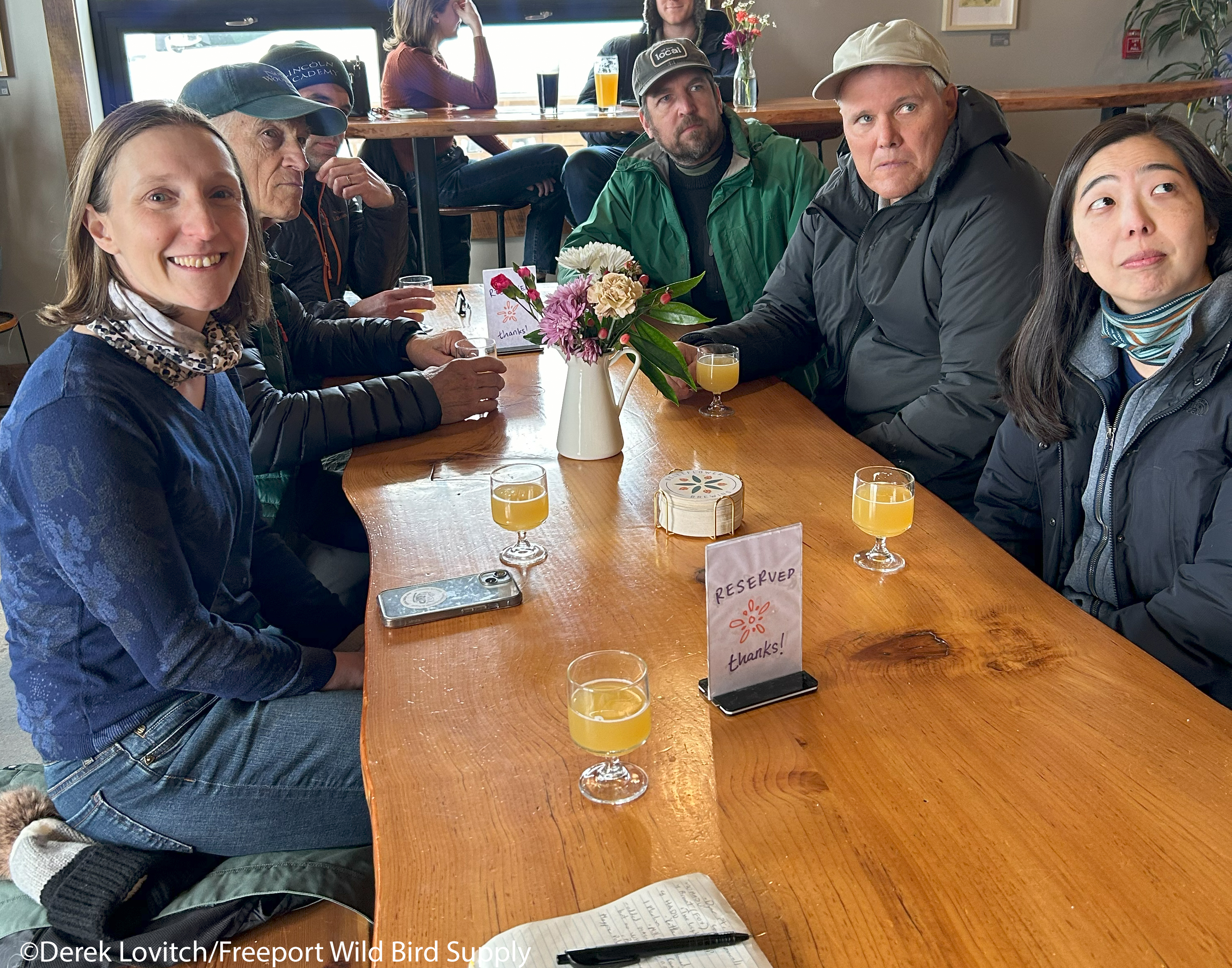
Next up was Definitive Brewing on the other side of town. With so many options, everyone was able to choose their two samples, and there are no shortages of choices here. I went with Robin (because bird names!) their Imperial Pastry Stout and Blueberry Waffles, a pastry sour. I saw lagers, an IPA, and several sours among the group, and this photo captured the rainbow of colors here, with my choices and those of two of the members of the group. Our birding had something for everyone: a rarity for the “life list” and cool behavior from some of our common and beautiful birds as we learned about the mind-blowing feat of migration. And between Belleflower and Definitive, there was most certainly something for every beer drinker!
3. Birds on Tap℠ – Road Trip! Shorebirds and Steins
Sunday, August 3rd: 9:00am – 3:00pm
The original BoT Roadtrip! Way back in 2015, our most popular tour returned to Scarborough Marsh at prime time for a good variety of migrant shorebirds. And we had absolutely gorgeous, perfect weather to do it!
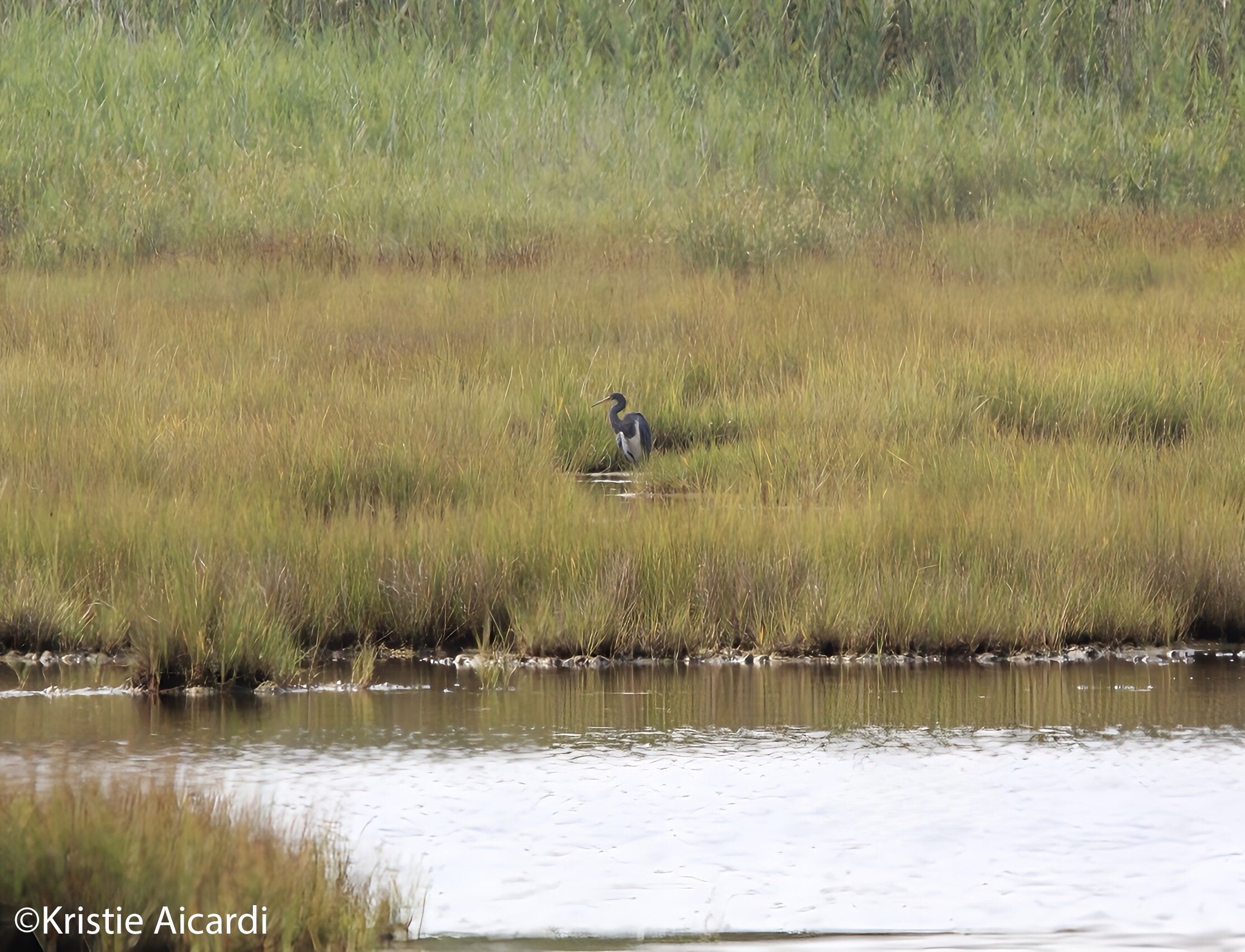
Beginning at the “Pelreco Marsh” high water levels limited our shorebird numbers a bit, but we were introduced to some of the basics of shorebird identification thanks to a flock of Short-billed Dowitchers and scattered Least Sandpipers. We spied a Saltmarsh Sparrow and talked about its fascinating ecology and peril, and were surprised by the arrival of a rare Tricolored Heron!
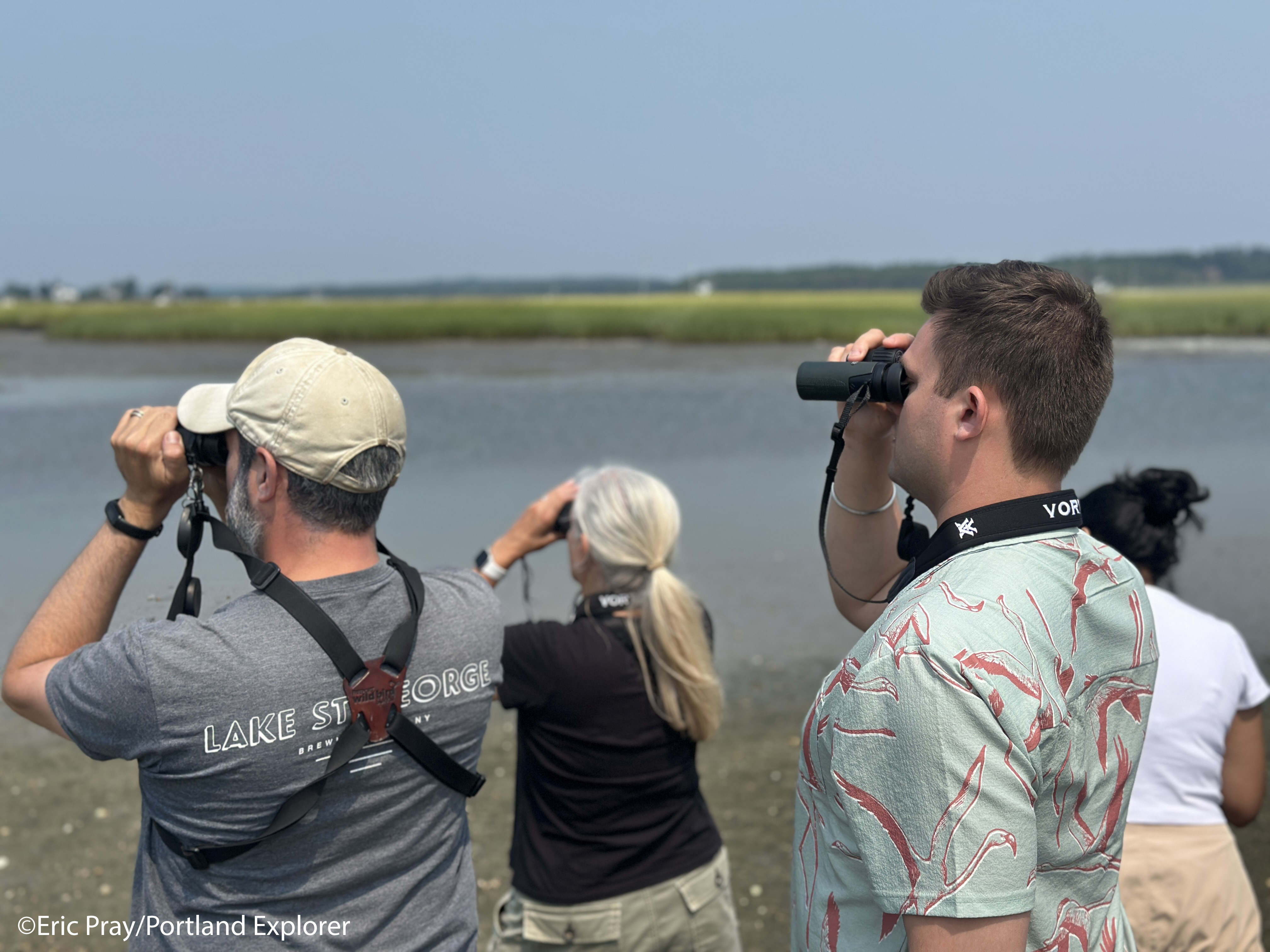
Relocating to Pine Point, we hit the tide perfectly, and soon, thousands of shorebirds were before us! The rapidly exposing mudflats steadily sucked in birds, with long-legged sandpipers appearing first, including 3 Whimbrel, with their massive curved bills, 8 Willets, and 3 Black-bellied Plovers. But as usual, it was the masses of the smallest shorebirds that stole the show, with an estimate of 2500+ Semipalmated Sandpipers and 225+ Semipalmated Plovers spread out before us. What looked like the first exposed sandbar was actually solid shorebirds! Learning the basics of sandpiper vs plover and moving on to sorting through the “peeps” for a White-rumped Sandpiper or two, we were introduced to the joys and challenges of shorebird identification, while mostly just enjoying the sight of so many birds! A few of us picked out a couple of Roseate Terns among Common Terns, and later, a mostly-adult-plumaged Bonaparte’s Gull was especially cooperative for photo-ops.
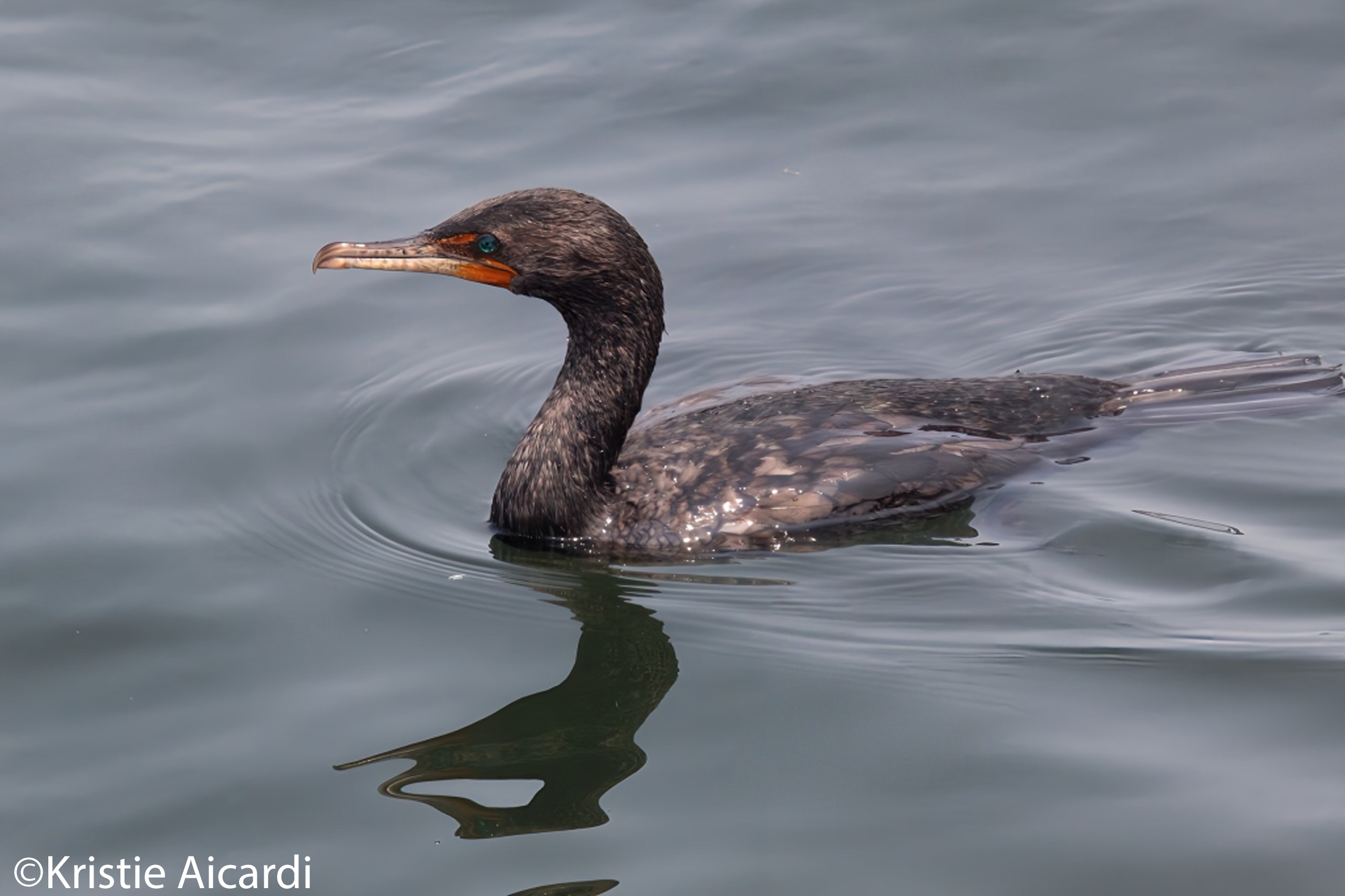
In the photo above, a Black-bellied Plover, Whimbrel, and Willet are in one field of view for comparative study, while I always insist on taking a moment to gawk at the eye of a Double-crested Cormorant.
Eric then led us to our first brewery, Modestman in South Portland. Originally founded in Keene, NH, owner/operator Ash Sheehan opened this second location closer to home here in SoPo. Tucked in a neighborhood down a side street off of Rte 1, someone on the tour who lived a mile and a half away didn’t even know it was there…there were all sorts of discoveries on this tour today, from rare herons to hidden gem breweries.
Coming in from the sun, we began with a refreshing and quenching light berliner Weiss sour, Black Reign with blackberry and boysenberry. Next up was It’s a Beautiful Thing, their flagship single-hope pale ale. Loaded with Citra hops, it blurs the line between a pale and an IPA, but it nicely progressed the palette and the ABV. When Life Gives You Lemons, loaded up with Citra and Simcoe was next up, providing a nice fruity/dank balance that Modestman is known for. I think this beer really nicely captured the essence of what people I know like most about their brews. Everyone got to choose their own last 4oz sample, and I went with Hard Rass Imperial Sour for a big and bold raspberry juice bomb.
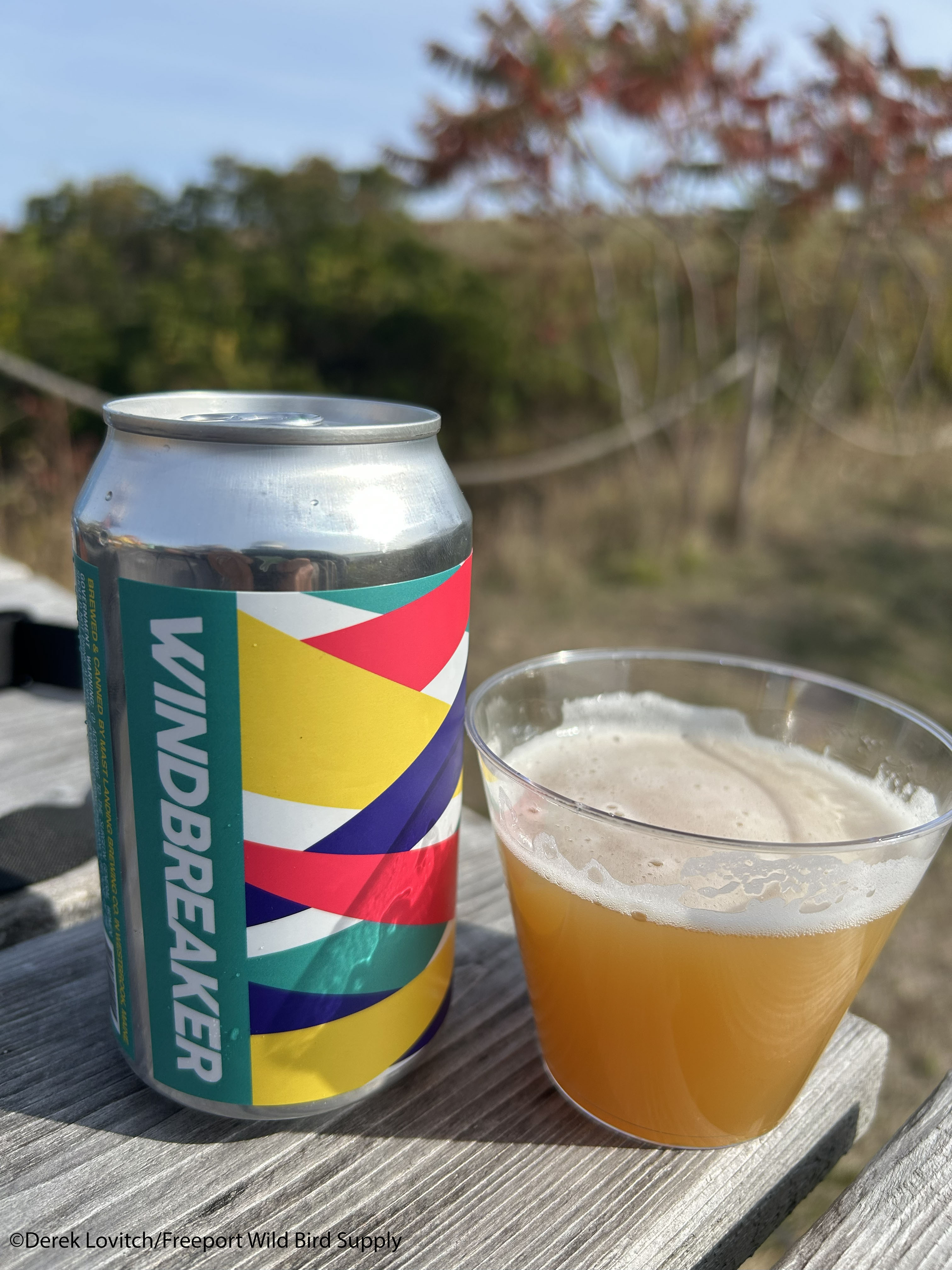
Our next destination was the latest tasting room for Westbrook-based Mast Landing, a short distance away on Cottage Street in South Portland. We continued to cover the basics of beer varieties here, starting with the clean and crushable Champ Lager. No visit to Mast Landing – especially a first visit for most of our crew today – is complete without trying their famous flagship Gunner’s Daughter peanut butter milk stout, and enjoying it on Nitro is always a special treat. Like a creamy liquid peanut butter cup (sans the allergens), Gunner’s Daughter deserves its accolades. Once again, our last sample was a personal choice, and since Mast Landing has something for everyone and I believe there were over 10 beers chosen among the 13 people (unfortunately, everyone but Eric, our trusty brewery guide and driver). Since it’s a Birds on Tap – Roadtrip, I for one had no choice but to go with a bird named beer. There are several here, but today I tried the 2025 incarnation of Song of the Swallow, which was laden with 5 varieties of hops for a really smooth and juicy final toast.
5. Birds on Tap – The Boat Trip! Rare Birds and Island Exploration.
Sunday, October 19th , 9:00am to 2:00pm
Here are some photo highlights from this annual favorite!
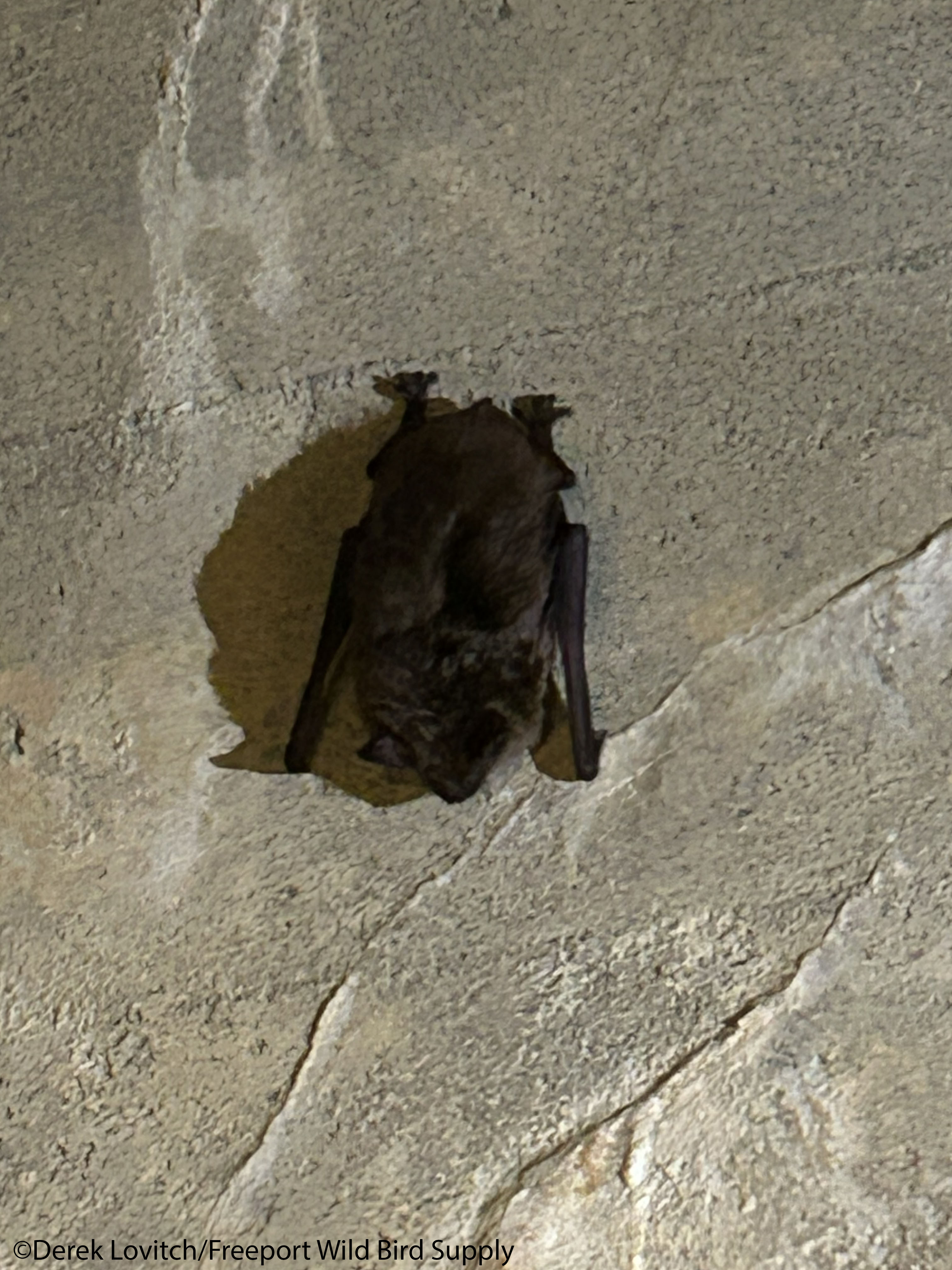
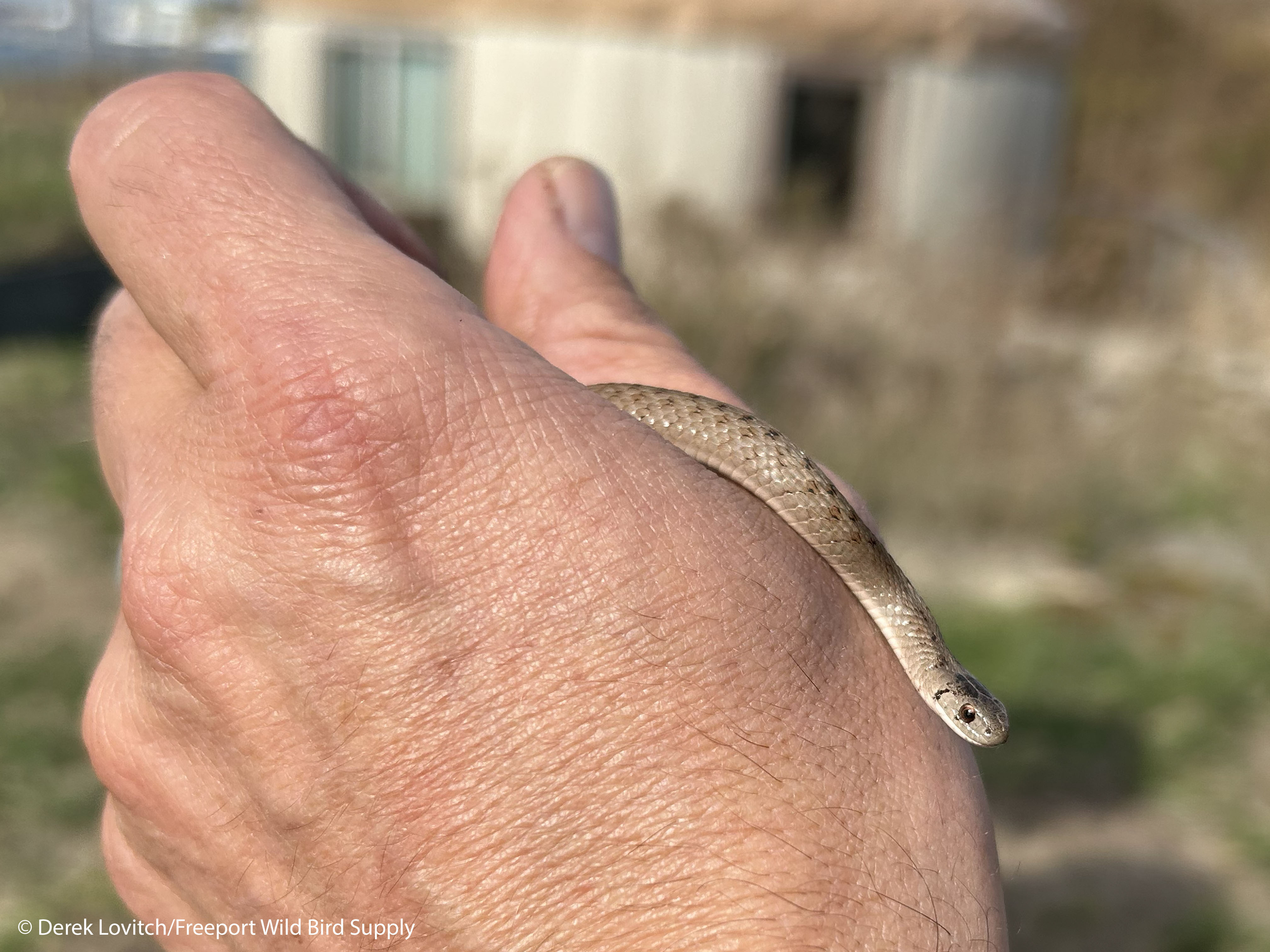
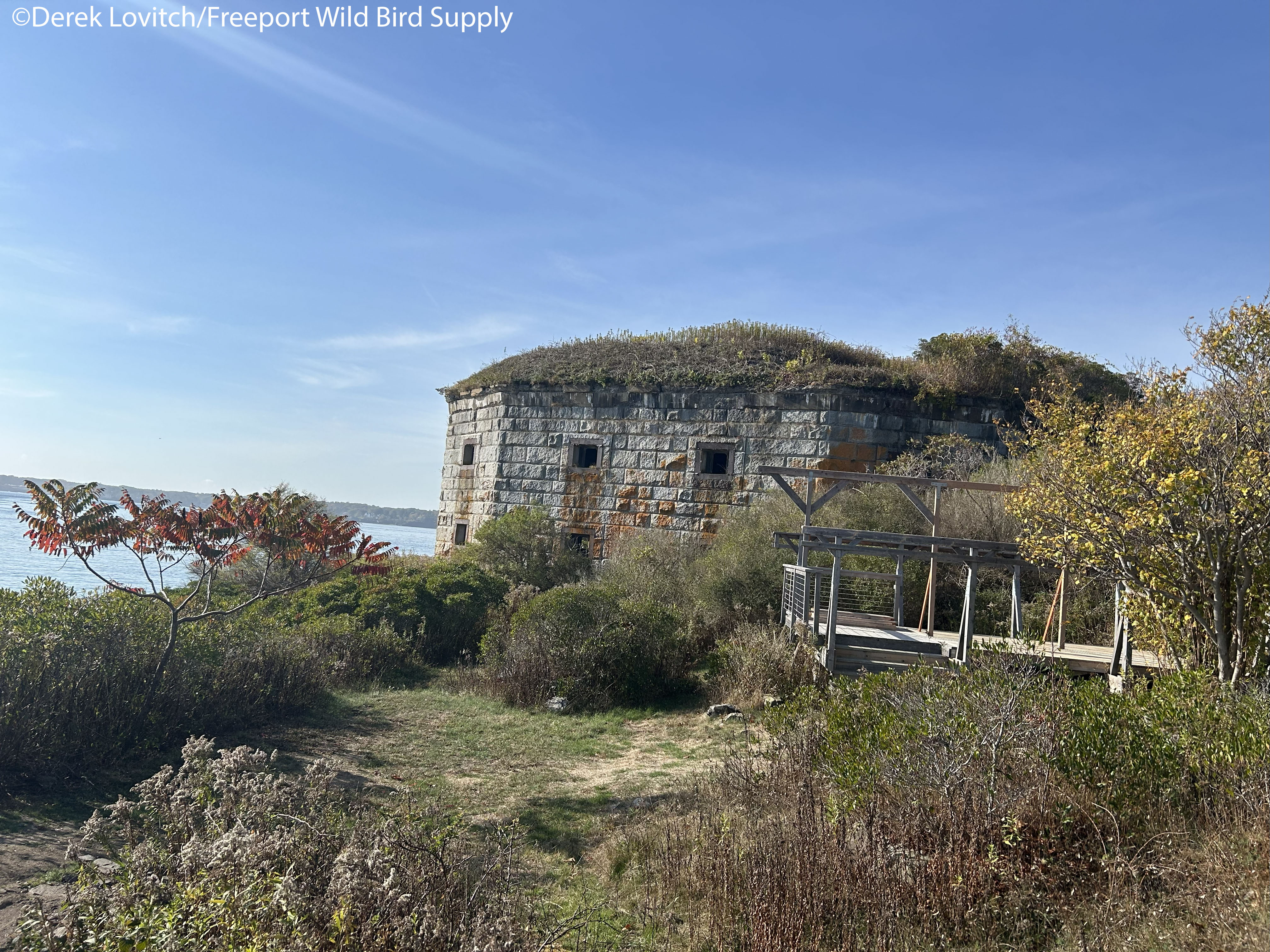
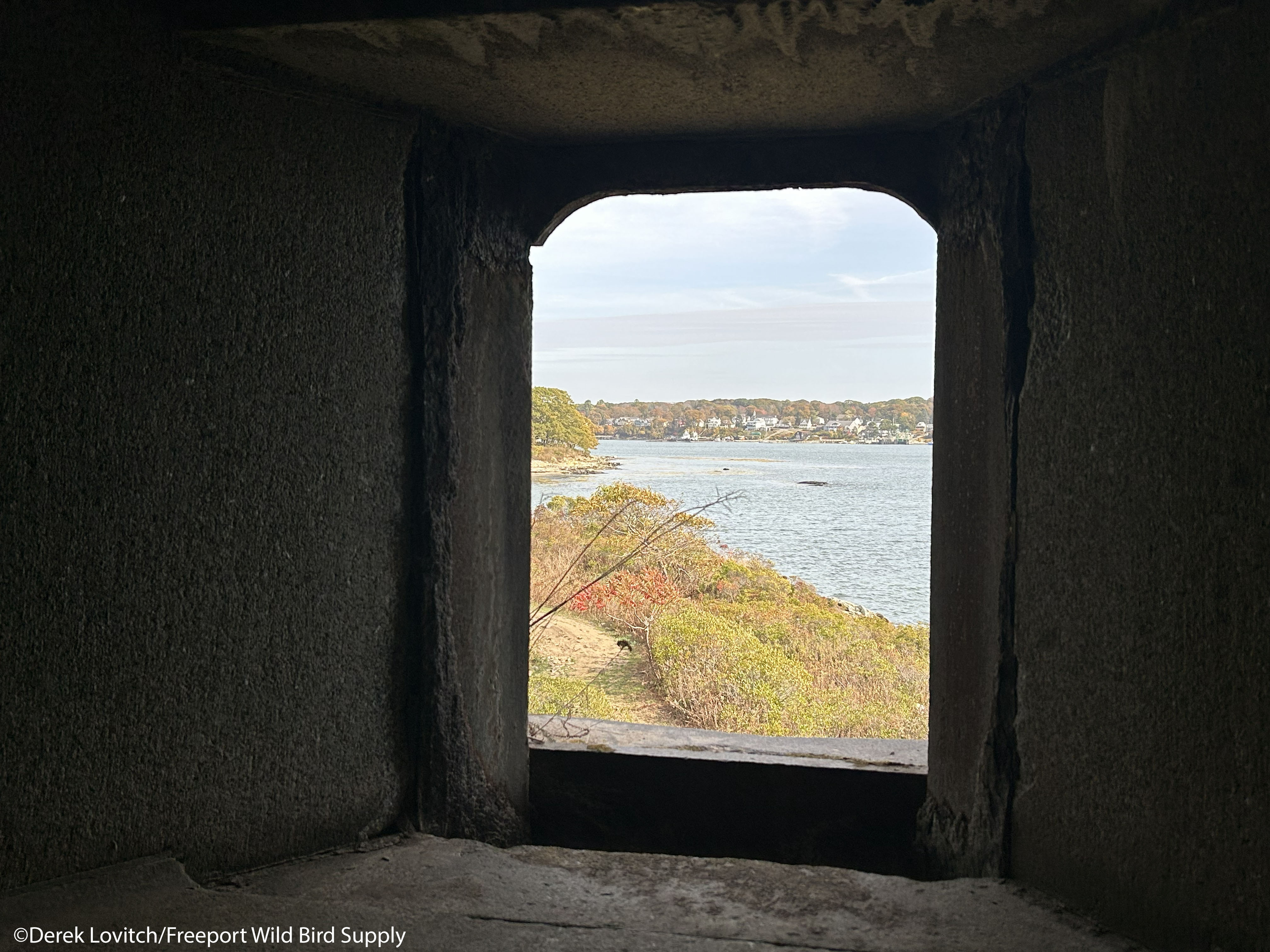
Big Brown BatDeKay’s Brown SnakeFort Gorges
6. Birds on Tap℠ – Road Trip! Rarity Roundup!
Sunday, November 9: 8:00am – 3:00pm
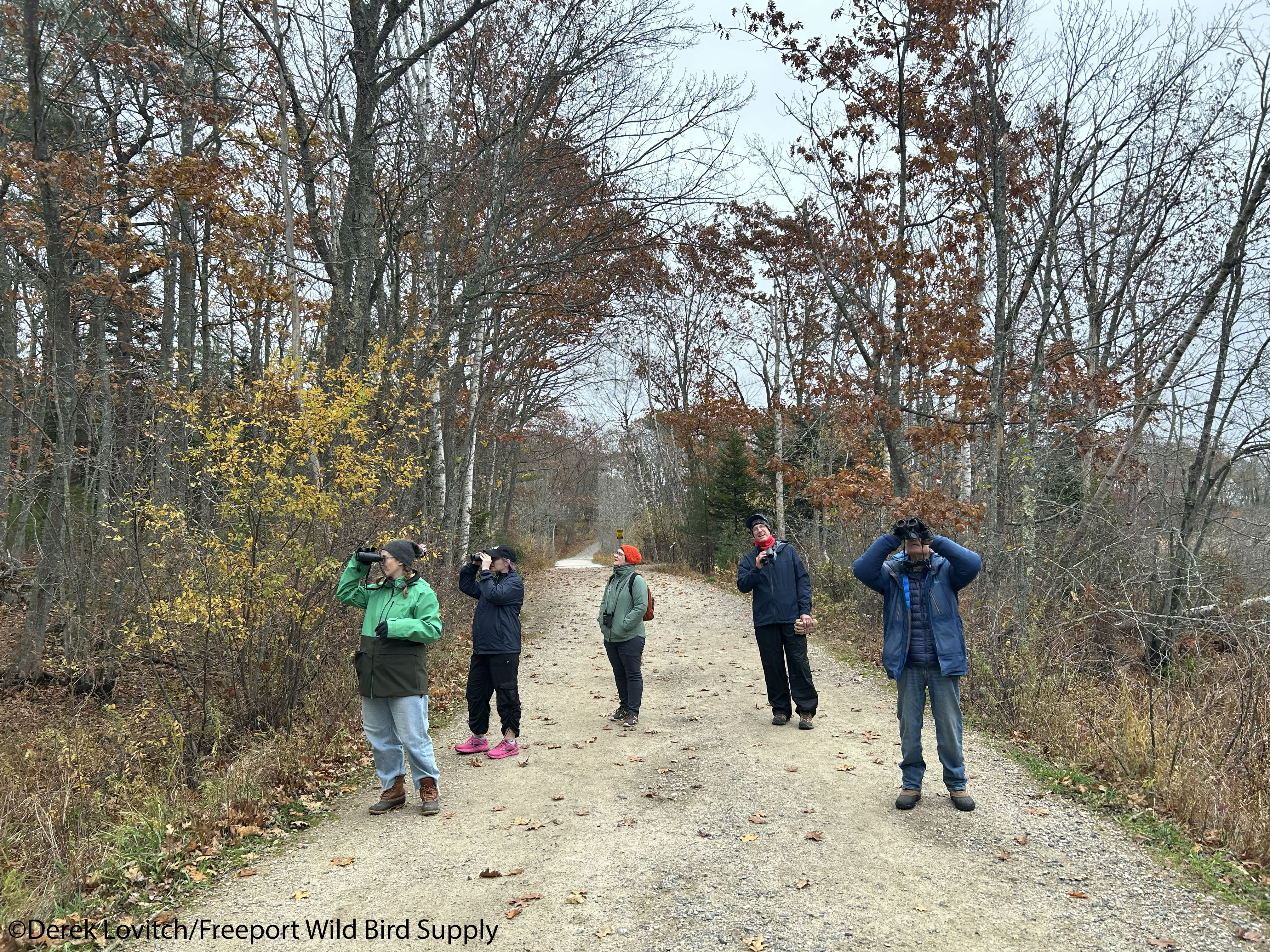
Our final Birds on Tap! tour of 2025 was our Roadtrip: “Rarity Roundup” on 11/9. Unlike most tours, where we know our destination – chosen to provide the best birding opportunities and highest rates of success possible – this trip didn’t have a destination until we were pulling out of the parking lot in Portland!
Designed to take advantage of the latest rare bird reports, our itinerary was to work our way south, either looking for rarities that had previously been reported, or finding our own by checking the seasonal vagrant hotspots. The southern coast of Maine is usually the best area for really rare birds this time of year, but I threw the plan out the window immediately and we turned northward.
I just couldn’t resist taking people to see a long-staying (since November 2nd!) MacGillivray’s Warbler (only the 7th ever in the state of Maine) in Yarmouth. I felt confident I could find it quickly, thanks to its constant vocalizations, we’d get a look and then we would move on to the next bird. I did not expect, however, to find it that quickly!
In fact, I heard it the very second we entered the trail. It was calling nearby and we slowly and quietly moved in position. We found it foraging low on the ground, in some perennials, only a handful of feet away. Now this skulky bird didn’t exactly sit out in the open, but over the next 15 minutes or so, we all had satisfying (or better) looks, until anxious birders (who had apparently been waiting too far down the trail for up to two hours!) overwhelmed us. We slowly moved away, following the bird’s call notes, eventually finding it again, and then watching as it flew about 2 feet from one of us where it disappeared into a dense thicket.
Wow! What a thrill!
I refreshed the rare bird alerts (and all the different places rare birds get reported these days) as we began our journey south, spending the time in the van working on a little game to practice our “status and distribution” knowledge during this exciting time of year for rare birds.
I didn’t want to ask folks to stand still in Scarborough Marsh for the rest of the morning to maybe hear a Clapper Rail call once, and there were no further reports of the Seaside Sparrow in Wells. So with each passing exit of the Turnpike, I decided to go all in in Kittery, beginning at Seapoint Beach. Yeah, there wasn’t much there, and nothing of note.
So the rest of our time was spent at the delightful Fort Foster, the host of so many vagrants over the years. We hoped the Cave Swallow from two days prior would reappear, or we would find something even better. Um, we did not.
In fact, it was pretty darn slow, at least in the brush and the woods. Offshore, waterbirds were building, and we had some good looks at Surf Scoters, for example. And overhead, there was an absolute massive Double-crested Cormorant migration going on. Numerous large flocks of several hundred were winging it south, in their usual “drunken v’s.”
We swung for the fences and combed Fort Foster, but alas, we were not heroes today: we found nothing rare. But it was fun to try!
And besides, not only did we get a “mega rarity” with the MacGillivray’s Warbler, we got another “mega” rarity when we arrived at Tributary Brewing. There, we found Mott The Lesser, their 10.5% ABV Imperial Stout, released twice a year, and only available at the brewery. And yesterday it was released, so this was quite the “twitch.” You think people drive far to see a MacGillivray’s Warbler!? Well, rare beers are no different. This year’s version was aged in red, white, and tawny port wine barrels and then a rare apple wood rye barrel for additional complexity.
Of course, we didn’t want to destroy our palates, and we were here to learn about a wide range of Tributary’s beers, so we began with their flagship Pale Ale and compared this West Coast American standard to Affluente, an Italian-style Pilsner, with Adriatic barley and a light dry hopping of lemon-forward hops. Moving on to their new Zwicklebier, an “immature” lager, which was more malt-forward thanks to 100% Maine grown and malted barley. Then we tried the Mott the Lesser. And it was good. And bottles were purchased.
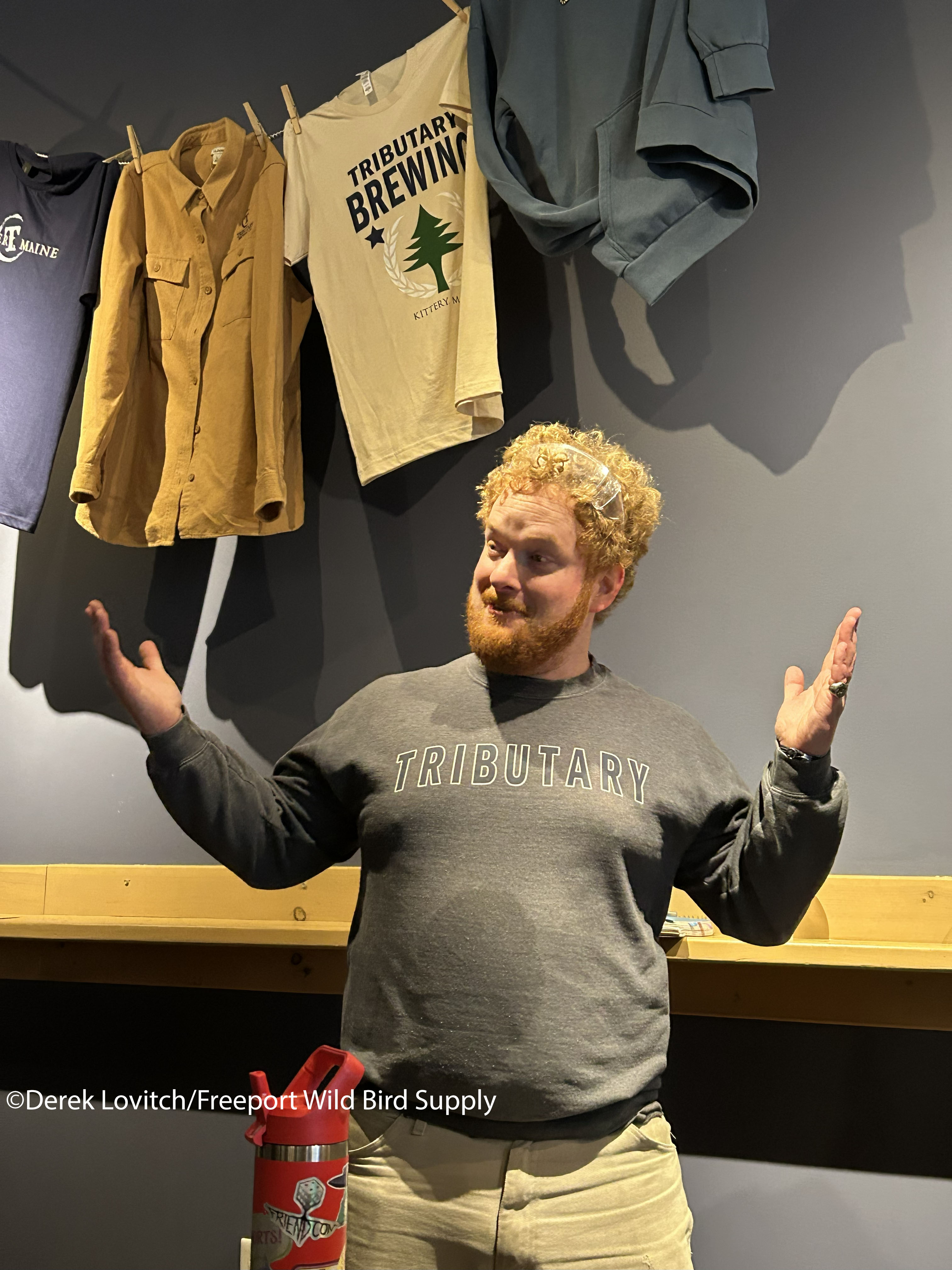
Our driver and beer guide Joe started us off with the basics of beer tasting and an overview of styles, but during our tasting, we were treated to a visit from head brewer and owner, Woody, who gave us the history of the brewery, started by his beer-legendary father, and guided us through the tasting. He discussed their commitments to Old World styles of beer and answered questions from the crowd.
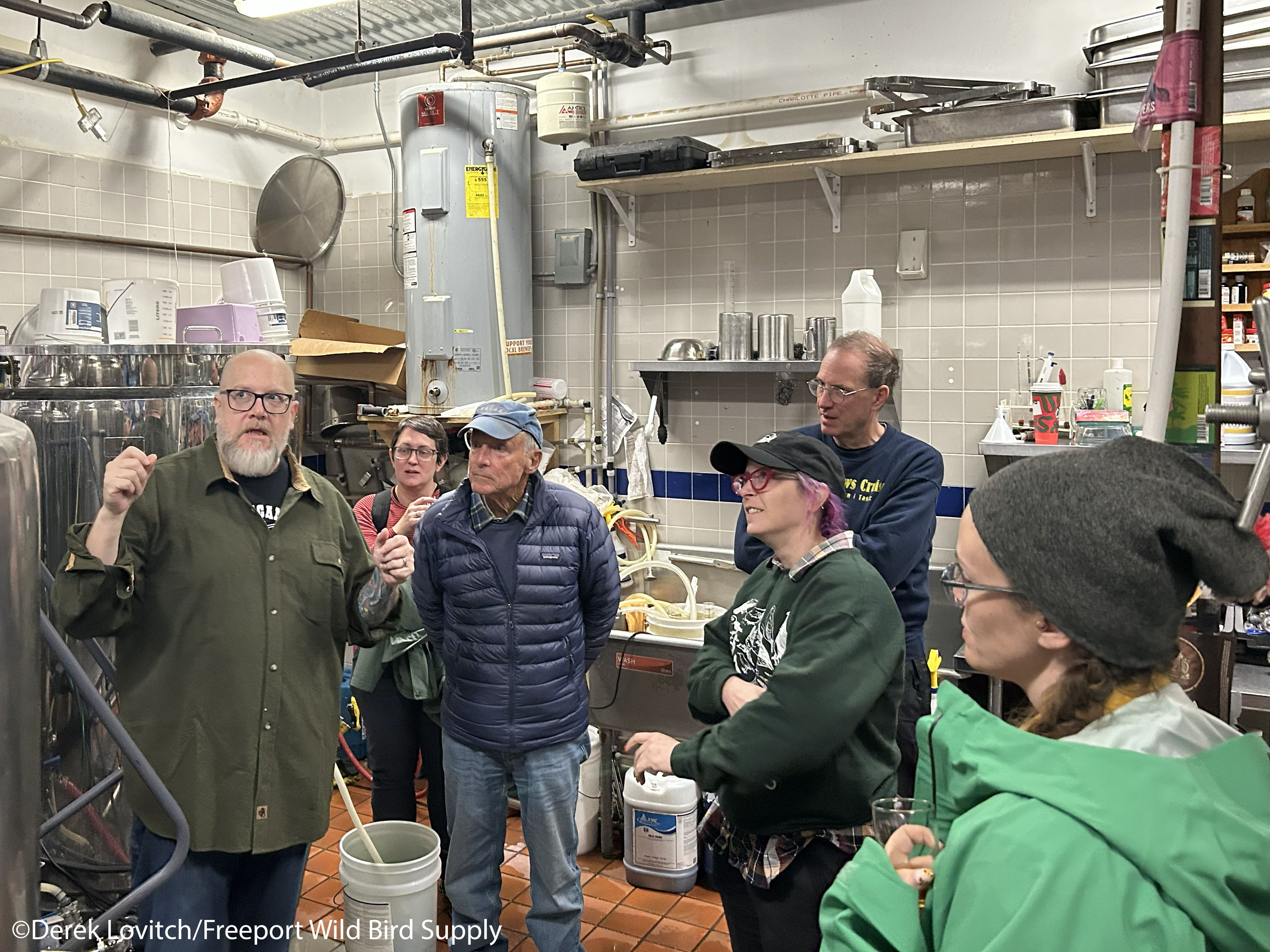
Not to be outdone, apparently, Woodland Farms just up the road also laid out the red carpet for us, with owner Pat not only guiding us through our tasting, but providing a tour of the brewery itself, from first boil to final packaging. Woodland Farms is becoming known for their wide variety of offerings, and it was amazing to see how they can pull so much off in this small space!
Their Flagship is Blinky, an IPA with a very complex dry hop bill. We then tried Rossa Matrimonial, their version of an Italian Pilsner, a dry beer made with red malts. We once again remained in the Old World with Tmavy Piro, which means “dark beer” in Czech. A dark lager, it offered the “crushability” of a lager, but with more malt flavors before the crisp lager finish. And finally, everyone got to choose a final sample, with most people choosing the Big Effin Porter, a robust 8.2% porter. I went with the masses and tried this, too, and enjoyed how rich it was without the thickness and weight of an imperial stout.
Woodland Farms is also becoming known for their non-alcoholic beers, a rapidly growing segment of the beer economy. Out back, we learned about the differences in making non-alcoholic beer that tastes good verses beer with alcohol, and especially, mass-produced NA beer that usually tastes like, well, not much. To demonstrate what NA beer means in 2025, we were treated to two bonus samples: the NA Dogwalker with an abundance of sticky, piney-resinous hops, and their NA Festbier, an easy-drinking seasonal malt-forward Oktober-fest style.
So from a mega rare bird and a mega rare beer, learning how to search for rare birds and how to make beer, and trying everything from non-alcoholic to a 10.5% imperial flavor-bomb, we most surely enjoyed an educational, enjoyable, and often enlightening day!
This cooperative hen Northern Pintail was one of the number of “late” dabblers that I encountered this week.
Far from the winter doldrums, a productive week of birding -especially at feeders – produced the following observations of note:
Single Fox Sparrows continued through week’s end at our feeders both at home in Durham and here at the store.
2 Turkey Vultures continued in the I-295 corridor between Brunswick and Cumberland into the New Year.
We tallied 16 species of waterfowl, highlighted by an impressive-for-the-date 5 species of dabbler (inc 1 continuing GADWALL, 1 Northern Pintail, and 3 Green-winged Teals), all in Brunswick during our Saturday Morning Birdwalk on 12/28. Details and locations here.
1 Swamp Sparrow, Lower Mast Landing Road and 2 Northern Flickers, Tidal Brook Preserve, Freeport, 12/29 during about 3 hours of coverage for the Freeport-Brunswick CBC.
1 pair American Wigeon, MacDougal Park, Rockland, 1/1 (with Jeannette).
1 GRAY CATBIRD, our feeders in Durham, 1/2. A fascinating time for it to show up. Presumably, it was pioneering locally and perhaps consumed the rest of a food source (like a cluster of Winterberry) and had to wander to find sustenance. It continues through the 3rd, eating jelly, suet, and nuts. The significant tail molt might be part of the reason it’s still around.
Annual Prediction Blog Now Posted.
And finally this week, it’s that time again: my annual Predictions blog where I look back at the Mega Rarities of 2024 and make my usual Top 25 predictions for the next species to be added to Maine’s list, and my own.
Although there was a previous state record, few if any of us were expecting to have the chance to see a Willow Ptarmigan ever again in Maine. Fewer of us expected to see one taking refuge on a lawn chair, as this one did in the Small Point area of Phippsburg in late August.
It’s once again time for my annual Predictions Blog, where I view into my crystal binoculars and attempt to forecast some of the “new” birds to grace the State of Maine – and then my own personal state list – in the coming year.
I was busy this year. Lots of birding tours here in New England, vacations to the Dominican Republic and the Gaspe of Quebec, a scouting trip through the Gulf of Maine, an even further diminished interest in “chasing” when I am actually home, and a lot more time spent casually birdwatching on our property – more and more my time is spent observing whatever is in front of me, instead of searching for rarities. I didn’t even spend much time at Sandy Point this fall, although weather had a lot to do with that.
There are several reasons for this change of motivation, but that’s a blog for another day. I did put in some concerted effort during a wild fall “rarity season,” but for the most part, my yard list in Durham was the only real priority. A Yellow-throated Vireo on the intriguing date of 7/21 was our 153rd species here since we purchased the property a little more than 4 years ago. Not a bad start! A Gray Catbird that showed up today, January 2nd, as I wrote this, is our first winter record (of course), and a good sign for productive yard birding in the new year!
Two species were added to Maine’s list this year, a Ferruginous Hawk at the Auburn Airport on July 14th and an Anhinga in Somerville for 6 days in July. I saw neither. Both times we were in Quebec. I think it’s a sign.
While Ferruginous Hawk was only marginally on my radar, Anhinga had been relegated to the Honorable Mentions list as northern reports have really dried up for a spell. I was wrong.
So, neither of the first state records were on my list, but I will do a little reshuffling to add two recent splits to the list: Scopoli’s Shearwater and European Herring Gull.
Scopoli’s Shearwater – recently split by most authorities from Cory’s Shearwater – likely has already occurred here. I saw at least one set of photos from this past summer that looked good to me, but the identification is a challenge, and we’re only learning how to identify them semi-reliably in the field (study up!). But I have little doubt that if we looked at every past photo of Cory’s Shearwater that has been taken in Maine, coupled with renewed scrutiny of the pattern on the underwing of the outer primaries of recent and future birds, that this will soon be confirmed in Maine.
Likewise, “American Herring Gull” (that’s our bird) and “European Herring Gull” are now separate species. European Herring Gull is another cryptic species that has also likely already occurred here, but it is another challenging, cutting-edge identification made more challenging by the extensive variation exhibited by our bird. Add to this Vega Gull from Asia, hybrids, and well…my Gull ID Workshop is open for registration (although I will not yet dive down the rabbit hole of American vs European Herring Gull…we’ll spend more time with Herring Gull vs “damn seagull.”
So here’s my list of the Next 25 Species to be found in Maine:
Scopoli’s Shearwater
Neotropical Cormorant
European Herring Gull
Black-chinned Hummingbird
California Gull
Limpkin
Gray Heron
Bermuda Petrel
Graylag Goose
Little Stint
Audubon’s Shearwater
Common Shelduck
Anna’s Hummingbird
Heerman’s Gull
Common Ground-Dove
Allen’s Hummingbird
Spotted Redshank
Lewis’s Woodpecker
Ross’s Gull
Black-capped Petrel
Lesser Nighthawk
Dusky Flycatcher
Painted Redstart
Hooded Oriole
White Wagtail
As for me in 2024, I did add four species to my personal State List: Willow Ptarmigan (not on list), Tropical Kingbird (Honorable Mention), American White Pelican (#2), and Common Gull (#24).
The most surprising was the second state record of Willow Ptarmigan that Jeannette and I were lucky enough to catch up with in a private backyard in Phippsburg on August 28th. After being seen on Cliff Island in early May, it miraculously appeared in Phippsburg in a yard of a home that the friend of a birder was house sitting for! Then it showed up in a nearby yard where limited access was granted. Jeannette and I were in the right place at the right time when news broke, and were among the first to try out the arrangements and see then bird. Unfortunately, a couple of days later, the ptarmigan likely fell victim to an owl.
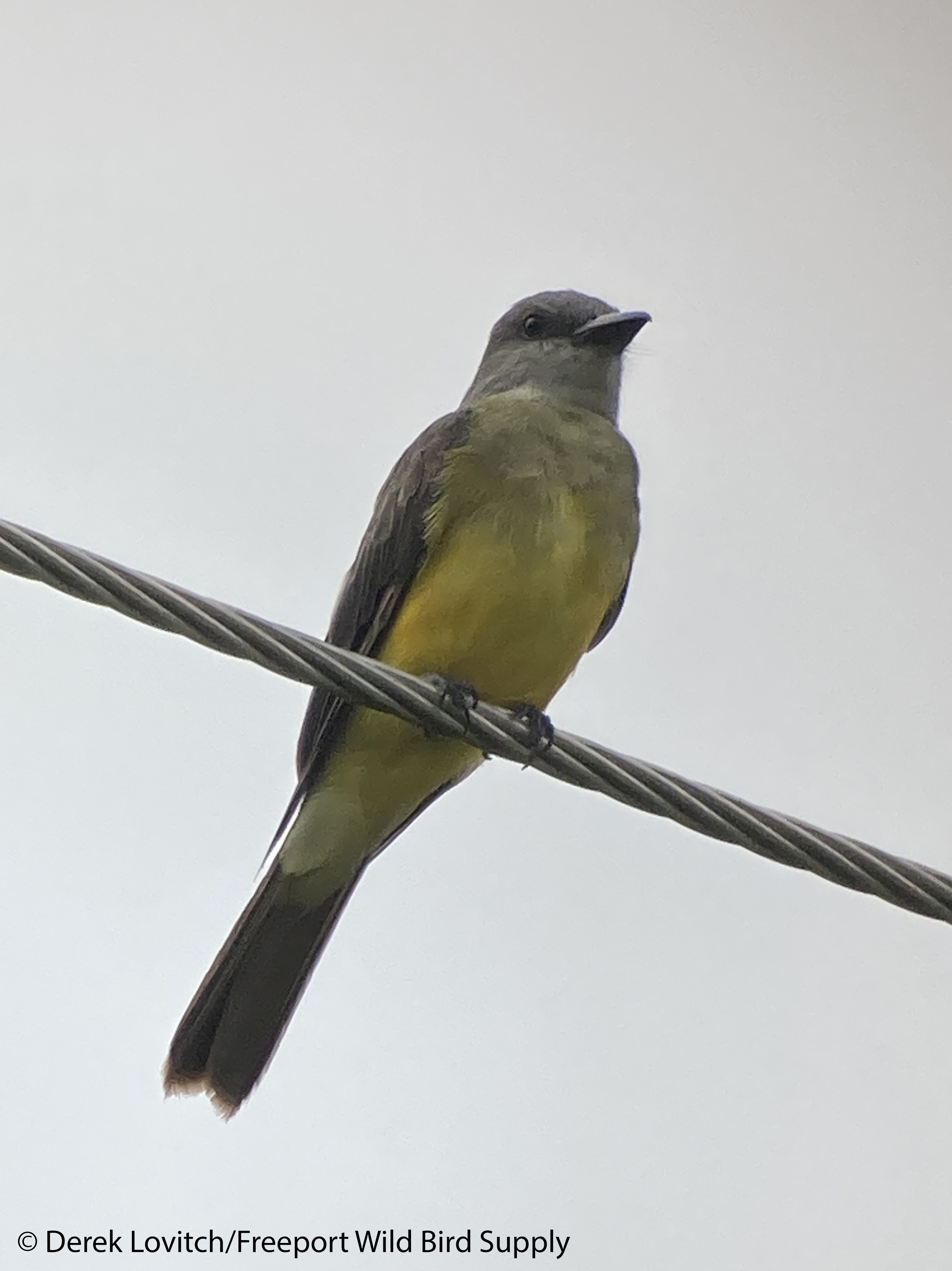
A Tropical Kingbird at the Skelton Dam Boat Launch in Dayton was found by a dog-walker and birdwatcher at the end of June, but news finally made it to the birding community in the middle of July, and I raced down to see it on the 18th. It has been on and off the Top 25 list for many years, but I’ve left it off for the last few. No complaints though, as the second modern, and third overall, state record was chaseable this time.
Later in the year, the birding community lost a great one with the passing of Davis Finch. Years ago, I would see Davis and Denny Abbott at a rarity, and they would be among the first people I would call when I found one (yup, we used to only call people to alert them to rarities!). Davis and I had a tradition where my final words as we were departing was always “See you at the ____” and pick a rarity. In fact, that might have even been the inspiration for this annual blog. This tradition became even more meaningful when I once left with “See you at the Ash-throated Flycatcher!” And a short time later, I found an Ash-throated Flycatcher (at the Saco Riverwalk, the second state record in November of 2006). Davis and Denny were the first to know, and I’ll never forget Davis saying “why the heck were you birding this dump?” as he offered congratulations on the find – a state bird for all (it has been cleaned up a lot since then and it has become a significant birding hotpsot). While there were plenty of other birds mentioned in between, for the last few years, it was always “see you at the Tropical Kingbird!” I heard someone say he was driven to Dayton to see the kingbird. I hope this is true…he really wanted that bird!
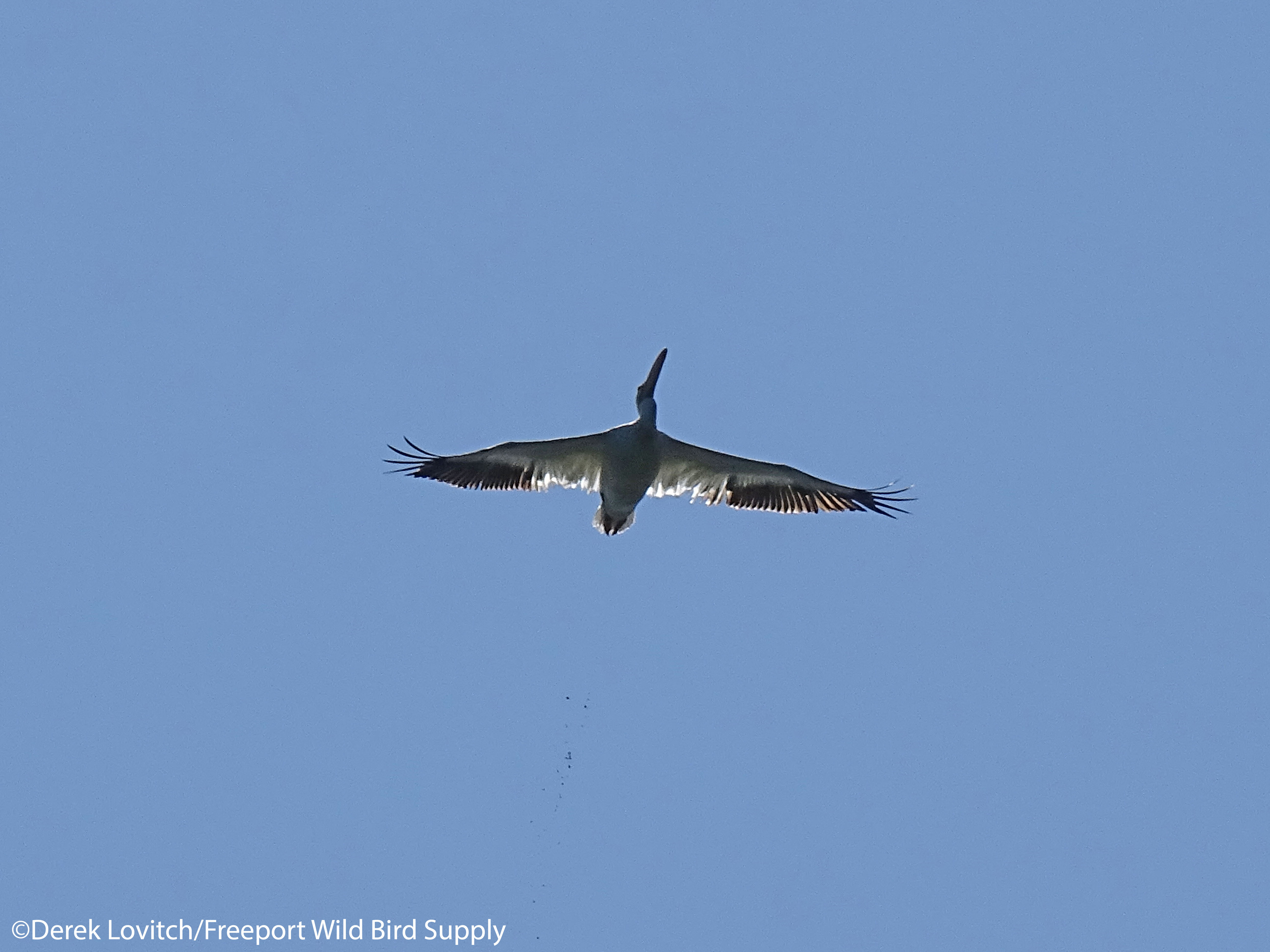
Moving on, I finally caught up with an American White Pelican on 8/26, conveniently close to home/work. Following a Saturday Morning Birdwalk, Kevin Harding and Brandon Baldwin stopped by Wharton Point in Brunswick on their respective ways home and found the pelican. They called the store (yup, phone calls still work), and I dropped what I was doing to head over. The bird was really far by the time I arrived, so Brandon and I walked down the Maquoit Bay Conservation Land trail for a closer look. A little while later, as other arrived, the pelican flew right over our heads for an incredible view!
And finally, after Common Gulls were found in Eastport in February and on Matinicus Rock in September, Evan Obercian found one much more conveniently located at the Samoset Resort in Rockland on Halloween. I was finally able to sneak away four long days later, getting to enjoy the bird on November 3rd.
Of course, I missed more than I saw, both with travel and a lessening interest in chasing. I missed a total of four Franklin’s Gulls (#1): Seapoint Beach in Kittery on 6/30, Hill’s Beach in Biddeford on 7/22, Sewall Beach on MDI on 9/14, and one in Wells on 9/15. I’ll catch up with these notorious one-day/hour wonders some day in Maine!
The aforementioned Anhinga and Ferruginous Hawks were not on my Top 25 list, nor was the Mountain Bluebird that was on Monhegan in early May – before twice-daily ferry service had begun. I did take a day trip with a friend for the heckuva it six days after it was last seen. There was also a Brown Booby (#6) that wasn’t chaseable on Seal Island in August, but had we not been in Quebec twice, it would have been a truly incredible birding year for me in Maine. Oh well, a weekend with friends and 100,000 Northern Gannets more than made up for it.
So with those hits and misses, my updated list of the Top 25 Next State Birds for Me is now:
Franklin’s Gull (will this finally be the year?)
Neotropic Cormorant
Brown Pelican
California Gull
Brown Booby
Crested Caracara
Slaty-backed Gull
Boreal Owl
Calliope Hummingbird
Graylag Goose
Cerulean Warbler
Gull-billed Tern
Pacific Golden-Plover
Limpkin
Wood Stork
Black-chinned Hummingbird
Brewer’s Blackbird
Yellow Rail
Scopoli’s Shearwater (undoubtably after further review of photos!)
Virginia’s Warbler
Western Wood-Pewee
Red-necked Stint
European Herring Gull
Gray Heron
Heerman’s Gull
Well there ya have it, let’s see what 2025 brings, at least when it comes to rare birds in Maine.
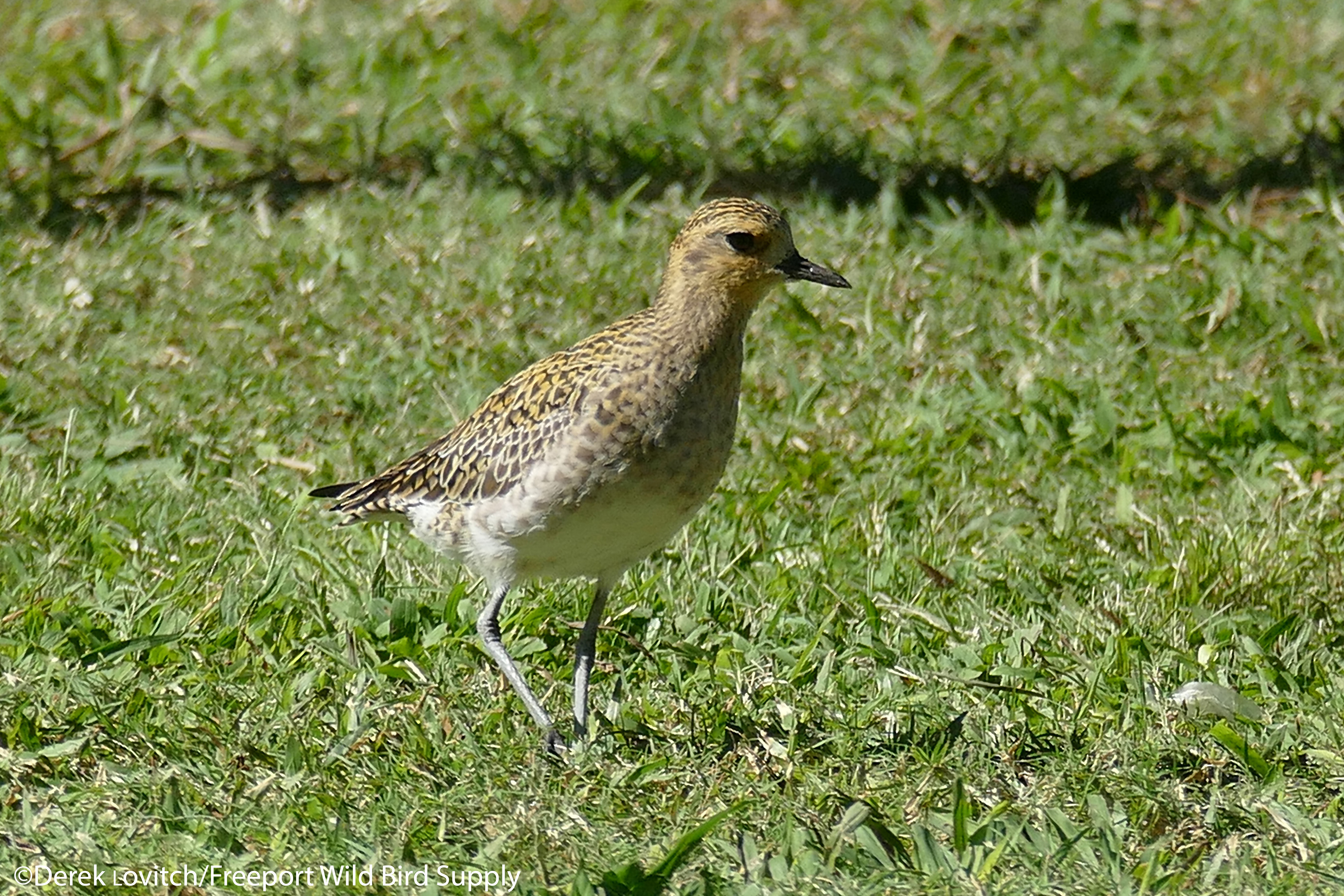
I think it’s about time for another Pacific Golden-Plover to show up here in Maine. This juvenile was photographed in Hawai’i.
One of three Fox Sparrows that appeared last week at the store and continued into this week, with one present through week’s end.
It was one of those weeks with lots to do, and therefore I didn’t get out as much as usual, as if often the case in the buys holiday shopping season. Nonetheless, when I was out (or inside watching feeders), there was plenty of good birding to be had. “Late/lingering” species continue to dominate the news.
3 Fox Sparrows continued at the feeders here at the store through 12/8, with a single bird continuing through week’s end.
1 drake and 1 hen Barrow’s Goldeneye, Winslow Park, Freeport, 12/7 (with Saturday Morning Birdwalk group). Early compared to recent years here.
1 Wilson’s Snipe and 1 American Wigeon, Moody Marsh, Ogunquit/Wells, 12/8.
1 immature Red-shouldered Hawk, 1 Northern Flicker, and 1 Swamp Sparrow, Community Park, Wells, 12/8.
1 Fox Sparrow, our feeders in Durham, 12/10-12.
1 FISH CROW (my first inland Dec/winter record), Auburn Riverwalk, 12/13.
1 drake Green-winged Teal, North River Road Boat Launch, Auburn, 12/13.
1 GRAY CATBIRD, 2 Hermit Thrushes, and 2 Fox Sparrows, North River Road, Auburn, 12/13.
Snow Buntings and Horned Larks were encountered in a bunch of locales this week, and Turkey Vultures are clearly no longer rare in early to mid December in southern Maine!
I usually miss at least one “Mega” rarity whenever I go away, so I was pretty pleased that this Common Gull – found on 10/31 by Evan Obercian at the Samoset in Rockland – stuck around until we returned. I was able to see it on 11/3. It took a while, but when it eventually spread its wing, the species/subspecific ID became certain. Separated by the abundant Ring-billed Gulls by the smaller size, slightly darker back, and thin bill, we can rule out the West Coast Short-billed Gull by the length of the bill and the wing pattern. Separation from Kamchatka Gull is more challenging, but it wasn’t particularly dark, the head was lightly flecked with brown, and there’s a relatively distinct bill band. According to Ayyash (2024), the shorter gray tongues on the outer primaries, the large P9 window that connects with the large P10 window, and little to no white at the end of the tongue on P8 all suggest Larus canus canus (and not Kamchatka Gull).
It’s November, and that means “Rarity Season” and unlike recent Novembers, Rarity Season is off to a roaring start. Here are my observations of note over the past 6 days. Below, see the trip report for our 7-day birding cruise that included time in Maine waters.
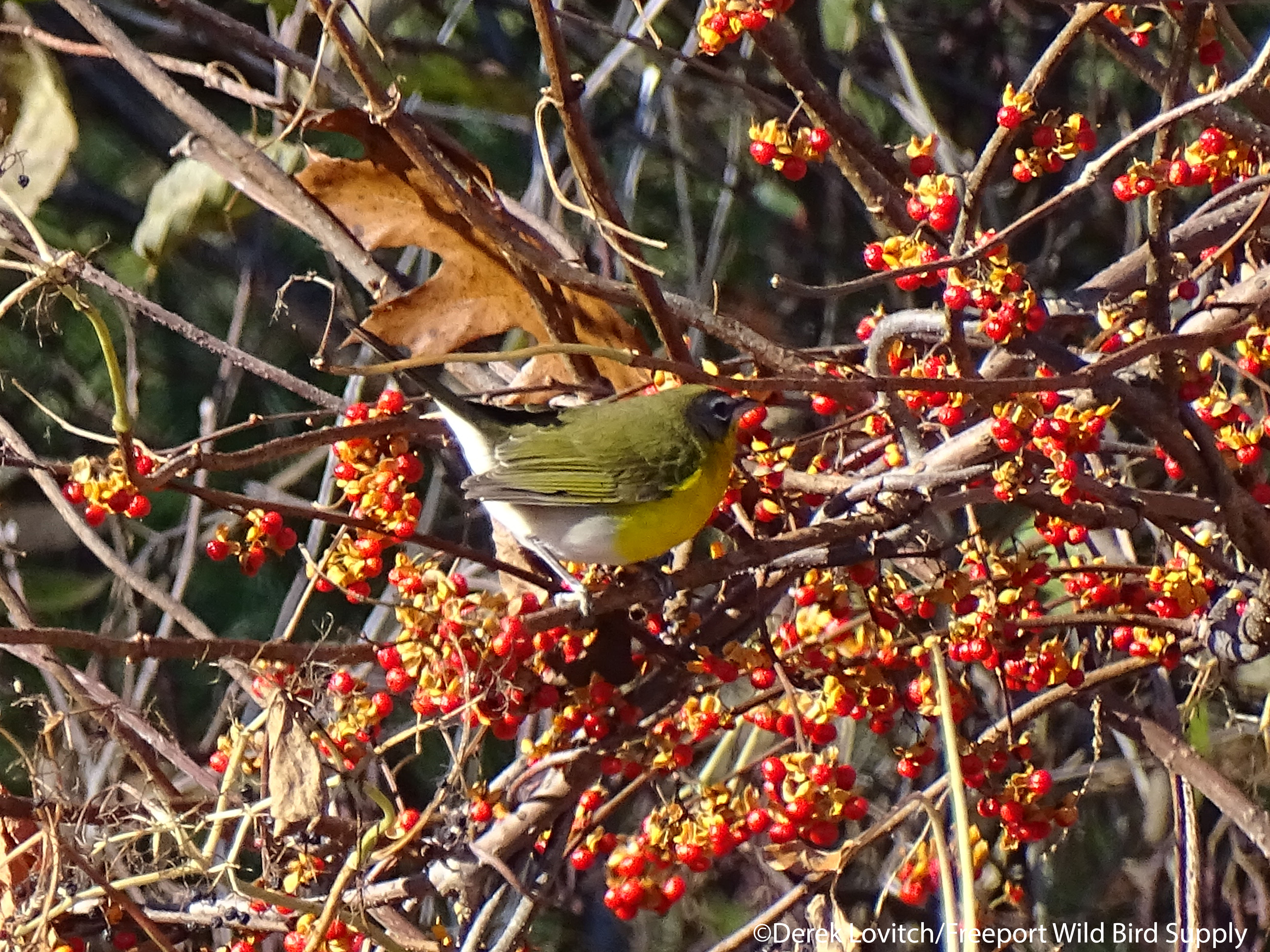
Although I chase even less frequently these days, I did make time to go see one of the two COMMON GULLS at the Samoset in Rockland on 11/3. Photos and discussion above. Additionally, I caught up with the YELLOW-BREASTED CHAT that was found there that day, although I blew the photos. A “Western” Palm Warbler, several American Pipits, and 4 Horned Larks were also present.
1 Pine Warbler, Bailey Island, Harpswell, 11/5 (with Jeannette).
1 RED-EYED VIREO and 6 American Tree Sparrows (FOF), Trout Brook Preserve, South Portland, 11/7.
Biddeford Pool environs, 11/8:
1 BALTIMORE ORIOLE
1 PRAIRIE WARBLER
1 “Ipswich” Savannah Sparrow
1 Rusty Blackbird
2 Lapland Longspurs
2 Greater Yellowlegs, 22 Black-bellied Plovers, and 26 Dunlin.
2 Northern Pintails
4 Hermit Thrushes and 1 Swamp Sparrow, etc.
Our Durham property is much quieter overall these days, but a few Red-winged Blackbirds have been around, a Ruby-crowned Kinglet was present 11/5-6, our first Pine Siskin of the season at home visited on 11/5 and increasing daily since, and Dark-eyed Junco numbers have continued to grow. At least one each of Swamp and Savannah Sparrow continue.
TRIP REPORT
Last week, Jeannette and I boarded a Princess Cruises ship in New York City to unofficially survey for rarities and things like Great Skua. The entire trip report is here, but our highlights from Maine specifically included:
1 RED-EYED VIREO, 2 Orange-crowned Warblers, 2 Field Sparrows, etc, Eastern Promenade, Portland, 10/29. Yes, we took a cruise only to go home!
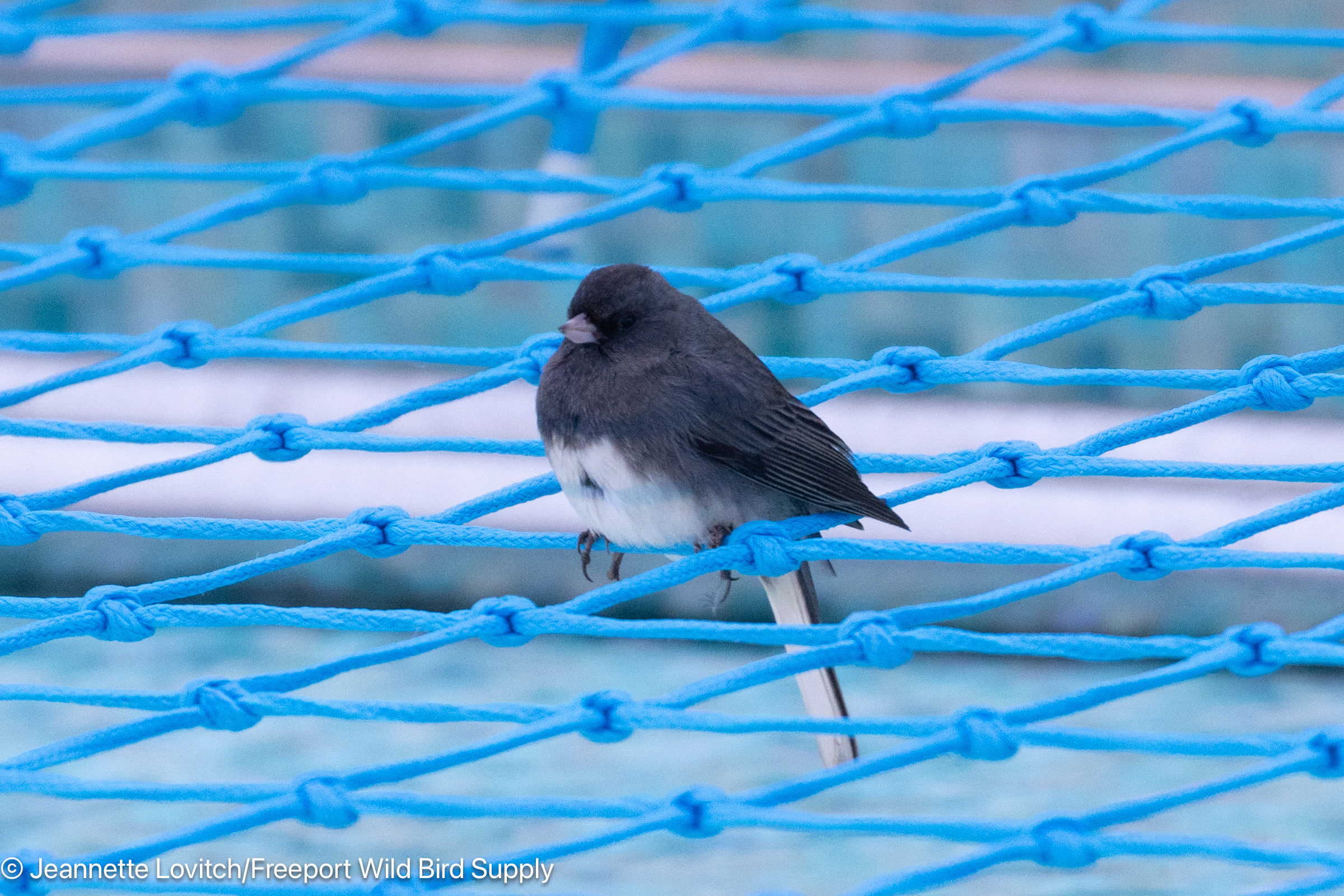
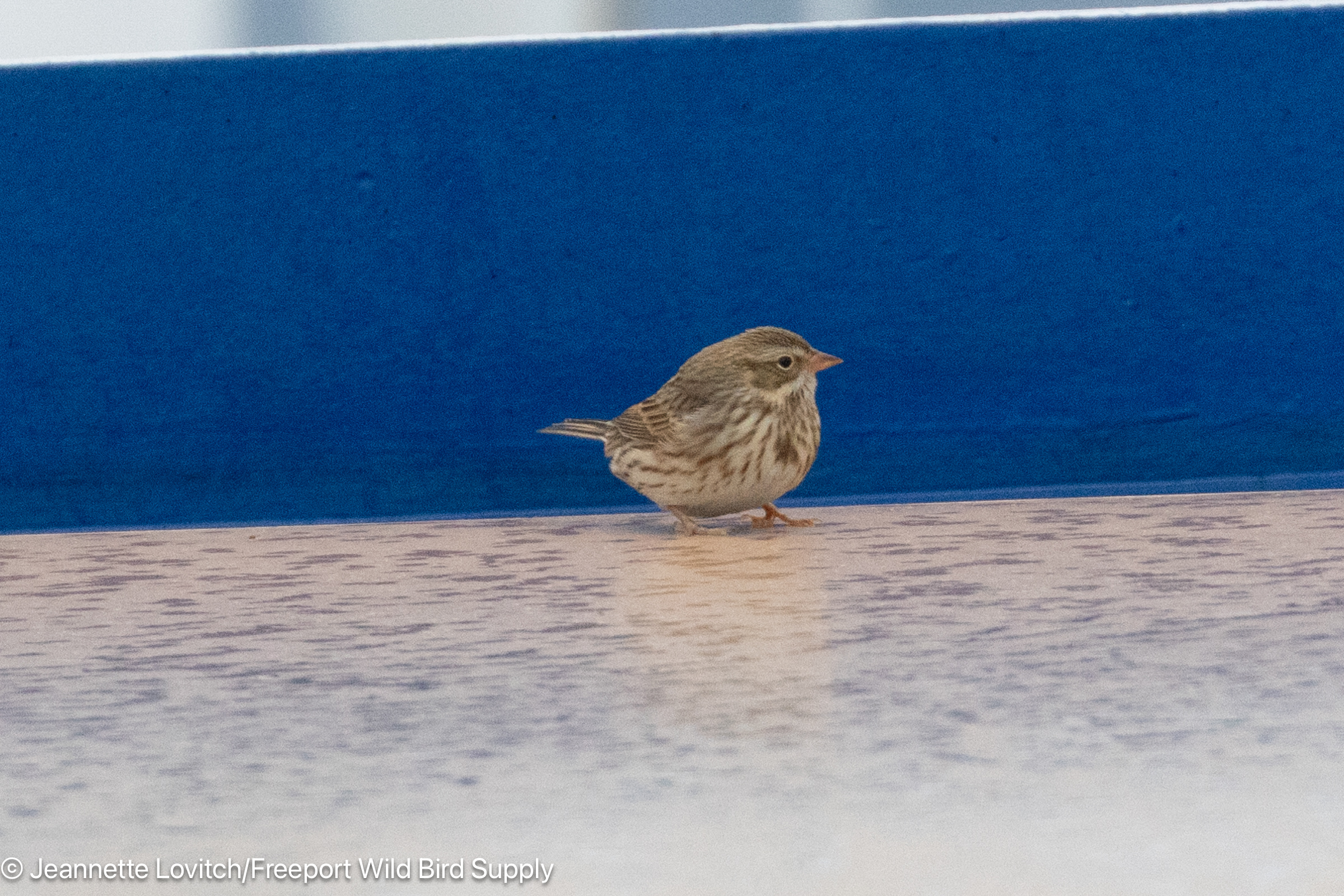
Passerine FALLOUT, 10/30. Awoke to birds on deck before dawn. 16.5 nautical miles southeast of Mt. Desert Rock. 12 species of passerines, led by 8++ Yellow-rumped Warblers but also including 1 Rusty Blackbird, 1 “Ipswich” Savannah Sparrow, 1 Snow Bunting, and perhaps most surprisingly, 7 European Starlings. Another birder on board photographed a Pine Warbler.
Very little time was spent in daylight in Maine waters, unfortunately, but we did have a couple of Northern Fulmars in Maine waters very early on the 30th.
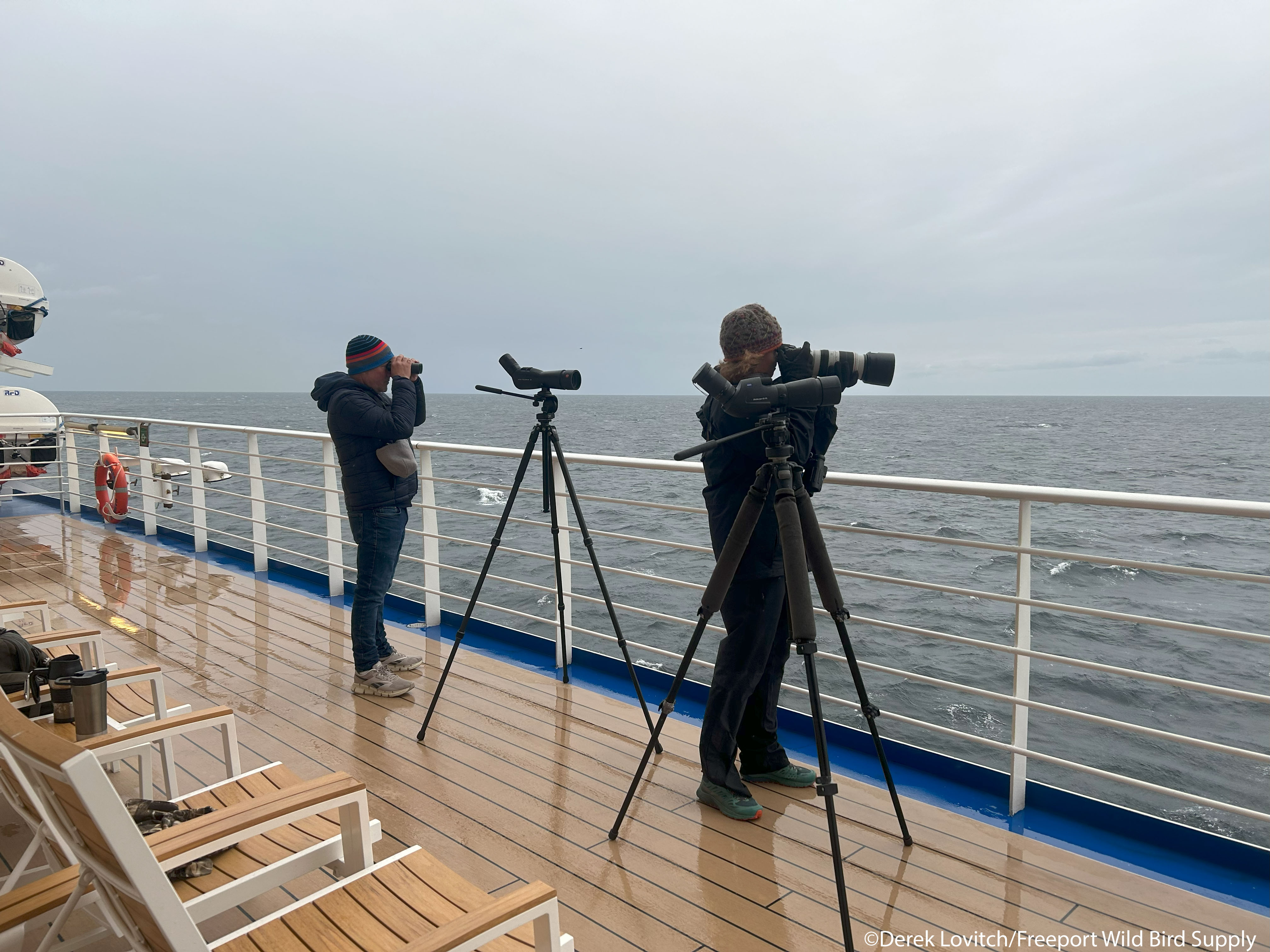
Cruise ships are big, stable platforms that allow for pelagic birding in comfort and with the use of spotting scopes!
In 2019, Jeannette and I took a cruise through the Gulf of Maine and northwestern Atlantic Ocean in the hopes of finding Great Skuas in particular. It was wildly successful, and if we could repeat this success, perhaps there would be a cruise-ship-based tour to offer. At least it would be more comfortable than last week’s attempt!
Therefore, on the evening of 10/26, Jeannette and I boarded Princess Cruises’s Enchanted Princess out of Brooklyn, New York. Our hope was to replicate the success of our 2019 trip. We were planning on a second scouting trip in the fall of 2020, but then COVID.
After finally feeling ready to consider a cruise again, we found the itinerary had changed, and we would need to spend seven days to get two full days offshore..we even needed to come back home first! But alas, we had pandemic-era credit that was going to expire, so off we went. Is this a reliable way to see Great Skuas in North America? Could I document a Barolo’s Shearwater this time?
We started our birding, however, at Brooklyn’s Greenwood Cemetery, home of this massive Monk Parakeet colony.
We departed New York Harbor with about an hour of usable daylight, picking up a single Cory’s Shearwater and plenty of Northern Gannets.
Screenshot
Arriving off Newport before dawn the next morning, we got the first shuttle to town, where our friends Bill and Jess picked us up for a lovely day of birding (Clay-colored Sparrow, Orange-crowned Warbler, late Nashville Warbler) before returning to the boat. About 45 minutes of deck time produced 8 Cory’s and a single Great Shearwater.
Newport arrivals. “Western” Palm Warbler at Sachuest NWR.
Unfortunately, this particular boat offered less-than-ideal viewing opportunities compared to our first trip, with the best deck space on Deck 7 (a great height) but way too aft. Even with our scopes on the steady platform, this was going to be a challenge.
Approaching Boston on the morning of 10/28, we checked the decks for passerines (none) before taking our place on Deck 7. There were a lot of Northern Gannets, 4-5 Cory’s Shearwaters close enough to identify as borealis, and a pod of Atlantic White-sided Dolphins. A Song Sparrow flew aboard just outside the outer harbor islands, but before that, our first real surprise of the trip: an American Woodcock appearing from the north and cruising alongside the length of the boat before disappearing. That’s not a “pelagic” we expected!
We birded Boston’s Greenway a bit, but returned to the boat well after dark. Sailing slowly overnight, we returned to Portland (the original itinerary had us visiting Bar Harbor), where a long, thorough check of the Eastern Promenade yielded two Orange-crowned Warblers and a very late Red-eyed Vireo.
Darkness reached us a tantalizingly-short distance to Cash’s Ledge, so we retired to rest up for the big day at sea tomorrow (finally!).
Waking up in Maine waters about 16.5 nautical miles southeast of Mt Desert Rock, I stepped outside well before first light at 6:05am. I immediately texted Noam, the other birder on board that we rapidly had become friends with, and I hustled Jeannette outside. With some drizzle arriving ahead of approaching light rain, we had ourselves a fallout!
Unexpected considering there were little to no birds on the Maine radars overnight, and with a south wind through most of the night, I was surprised to immediately hear the flight calls of several Yellow-rumped Warblers. Sparrows were scattered about on the open decks. Noam and I had to usher a Rusty Blackbird out of a foyer, while Jeannette had to steer a Dark-eyed Junco down a hallway.
“Ipswich” Savannah Sparrow – that was an unexpected migrant, but makes sense considering we were southwest of Sable Island!
Clearly disoriented by the obnoxiously superfluous lighting of the ship, dozens of birds were around…often being flushed by now-awakening crew and passengers. Luckily, few birds seemed to be in dire straits – only one Yellow-rumped Warbler looked to me to be thoroughly exhausted, thankfully. In fact, most birds were leaving the boat as the sun rose and they were able to reorient themselves. While some birds seemed to arrive in the 15 or so minutes after sunrise, just about all passerines had departed the boat by 7:30 or so.
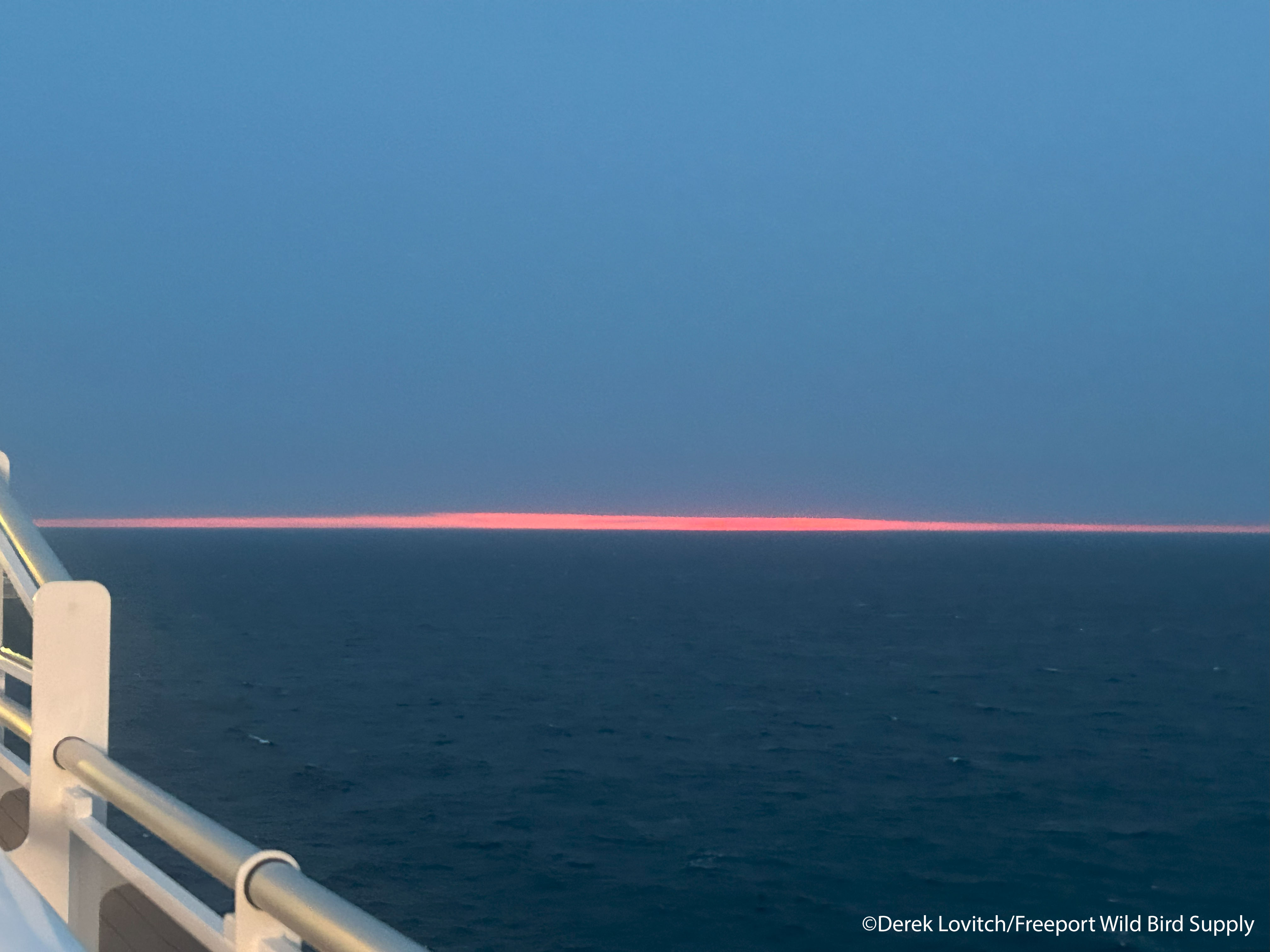
This photo, taken from off Eastern Point in Gloucester, MA the night before shows just how bright these ships are, and how disorienting they can be to birds.
With birds circling the boat before dawn, calling continuously, and others hiding in corners before being flushed to another corner, it was tough to count, but I estimated and counted a bare minimum of 8 Yellow-rumped Warblers, 8 American Robins (mostly overhead), 7 European Starlings (surprisingly), 6+ Dark-eyed Juncos, 2 Purple Finches, 2 fly-over American Pipits, 2 Savannah Sparrows, and one each of Palm Warbler, Snow Bunting, White-throated Sparrow, Cedar Waxwing, and Rusty Blackbird. Additionally, Noam photographed a Pine Warbler.
The three of us were in place on Deck 7 by 7:30, but the passerine show continued. A flock of 12 Red-winged Blackbirds flew by, while a flock of 14 American Robins joined by two more red-wings flew alongside the boat for several miles later in the morning before overtaking us and heading back to Nova Scotia.
Throughout the day, other passerines appeared and disappeared, some of which could easily have been sheltering out of sight somewhere inaccessible on the boat. These included a few more robins, 3+ Yellow-rumped Warblers, 2 Dark-eyed Juncos, and one each of Palm Warbler, Song Sparrow, Cedar Waxwing, Snow Bunting, American Pipit, and Lapland Longspur.
American PipitHarlequin Duck (L) with Black Scoters
But this was a seabird trip, and so we remained vigilant over the water. While we only had a few minutes in Maine waters once we began our vigil, the rest of the day was productive overall, although the afternoon was quite slow. As we passed the southern tip of Nova Scotia (we even spotted Seal Island Light that we were lucky enough to visit with a group of birders about 20 years ago), we finally called it quits at 5:45 pm when cloud cover accelerated the falling of darkness.
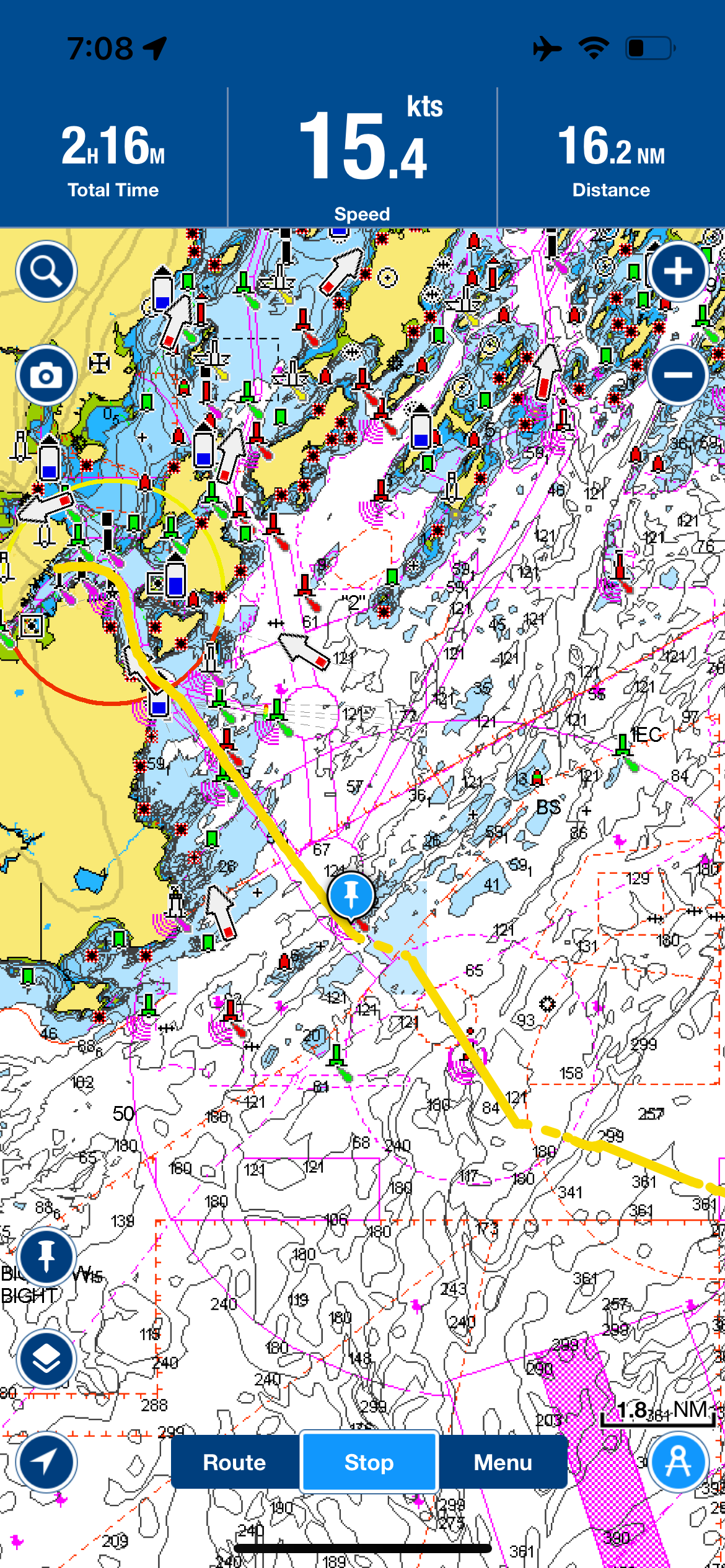
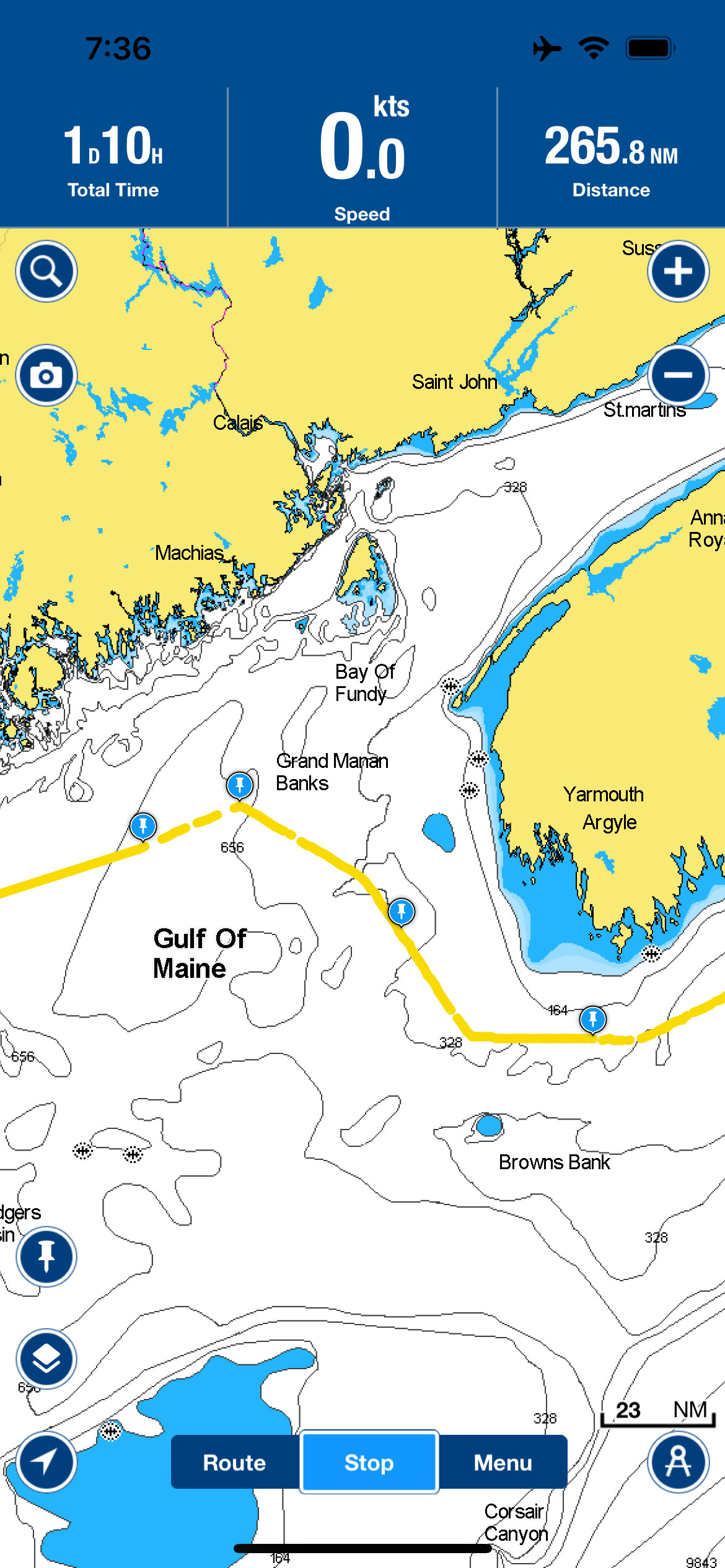
Here’s our route (left pin to right pin) for the day, thanks to the Navionics Boating app by Garmin.
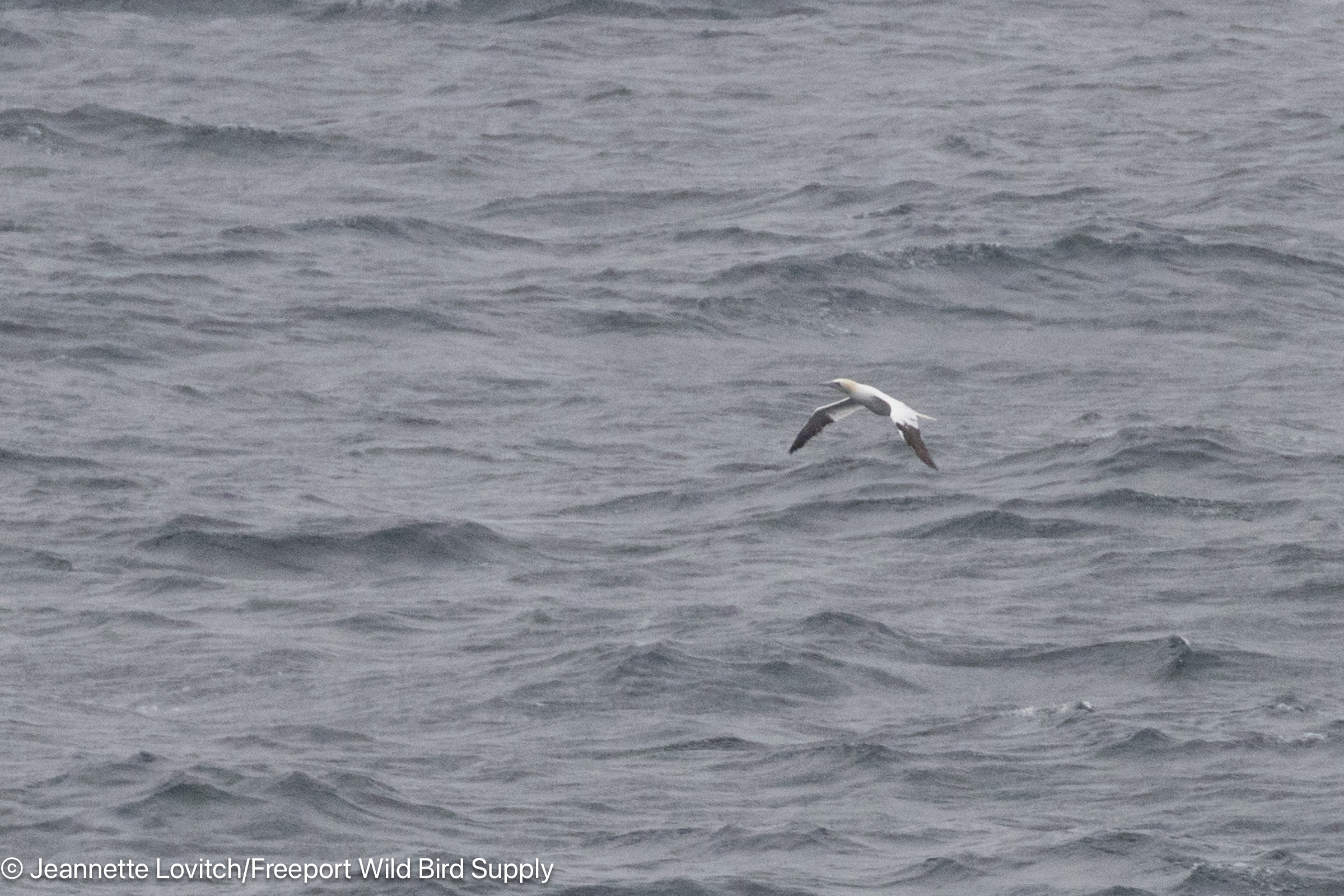
From start to finish, our respectable – albeit not breathtaking – seabird tallies included oodles of Northern Gannets (including a steady southbound trickle almost all morning), and occasional southbound flocks of all three scoters and Common Eiders. Specific counts included:
47 Black-legged Kittiwakes
36 Razorbills
13 Northern Fulmars
10 Great Shearwaters
6 DOVEKIES (one flock landing off to the side of the boat)
3 ATLANTIC PUFFINS
3 American Black Ducks
3 unidentified large shearwaters
2 Harlequin Ducks
1 Greater Scaup
Great Shearwater
So all in all, not a bad day, but the passerines stole the show, and while Dovekie is one of the target birds of this trip, we didn’t see a skua…or even a jaeger, surprisingly.
The next day we awoke well within Halifax Harbor, but a sunrise passerine check yielded two birds: a White-throated Sparrow, and of all things, a rare Dickcissel!
Local friends Eric and Anne once again rescued us for a day of casual birding and good conversation, but the ship departed after dark; just more time to rest for our second full day at sea!
Halifax Public GardenNorthern Flicker
The morning of 11/1 found us between Downeast Maine and the northern corner of Georges Bank. The rest of the day would be in the same waters of our great success on our trip five years ago. After a passerine check which didn’t turn up anything (which meant nothing was disoriented by the ship overnight or desperate for a place to land come dawn, so this is never a bad thing), it was time to get to work in our usual spot.
Unfortunately, strong southwesterly winds and growing seas, with haze and light fog in the distance, made birding challenging. We worked hard though, but it was slow. We did have some excitement from two Dovekies that landed fairly close to the boat, and two Manx Shearwaters that, thanks to the lighting, I was absolutely sure were not Manx Shearwaters until we carefully reviews Noam’s photos later.
With glare and haze becoming problematic, we broke for an early lunch at 11:30, with the previous 4.5 hours of observation producing only the following, plus two Humpback Whales:
12 Northern Gannets
7 Great Shearwaters
6 Red Phalaropes
4 unidentified large shearwaters
2 DOVEKIES
2 Northern Fulmars
2 Manx Shearwater (after review)
2 Black-legged Kittiwakes
2 Lesser Black-backed Gulls
2 unidentified large alcids
1 unidentified small black-and-white shearwater.
Unfortunately, with increasing wind (that we were heading straight into) and seas growing up to 7-10 feet (barely noticeable on a ship this big though, thankfully!), the lower deck was closed off for safety. Later, even the upper decks were closed off due to the very high winds, which were now blowing nearly 30mph out of the southwest.
Screenshot
Luckily for Jeannette and I, we had scored a forward-facing room, and although we were high up on Deck 17, we could see forward. Haze and the angled window were problematic, but we could see birds close to the ship, and we could relax, remove layers, and even crack open a beer. This is pelagic birding in style!
From 1pm to 5pm, when we finally called it a day, the afternoon cabin-watch netted:
11 Great Shearwaters
9 Northern Gannets
5 Cory’s/Cory’s-type Shearwaters
3 unidentified phalaropes
2 Manx Shearwaters
Screenshot
And so our two days at seas concluded without a Great Skua, our primary target species for a future cruise..and perhaps a future tour. Alas, we’re only 1 for 2 in seeing skuas from the boat, and we would need a different class of ship (and, a shorter itinerary with more time at sea and less time in multiple ports) if we were to do this again. We’ll be keeping an eye out from other companies and other Princess ships to see if there’s a more skua-tactic itinerary in the future, but until then, our northeast Atlantic cruisin’ days may have come to a close.
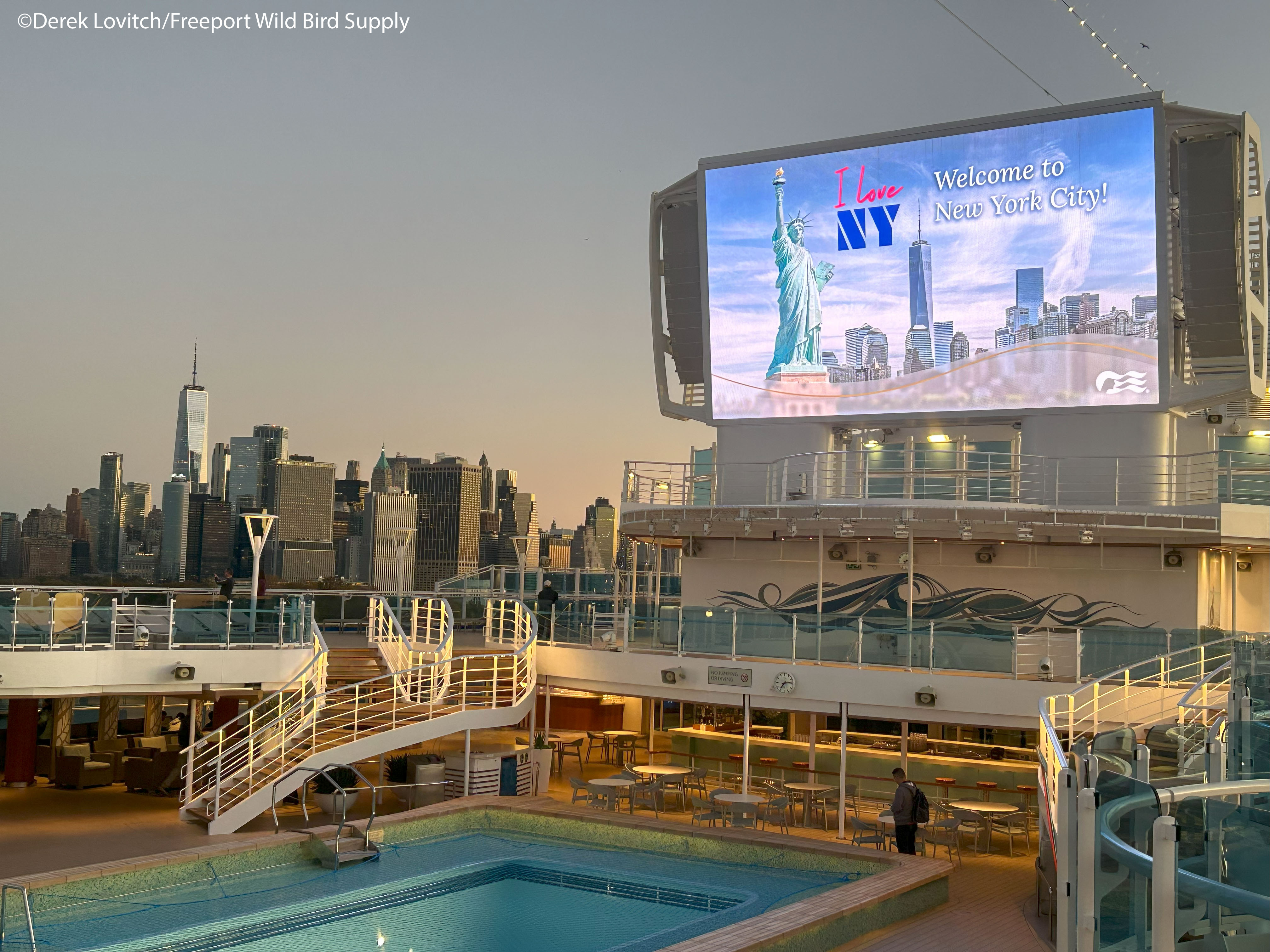
Arriving in New York harbor before dawn, our last sunrise deck check yielded a single Dark-eyed Junco, Yellow-rumped Warbler, and White-throated Sparrow, bringing our more-productive passerine birding cruise to a close.
































 Maine Birding Field Notes