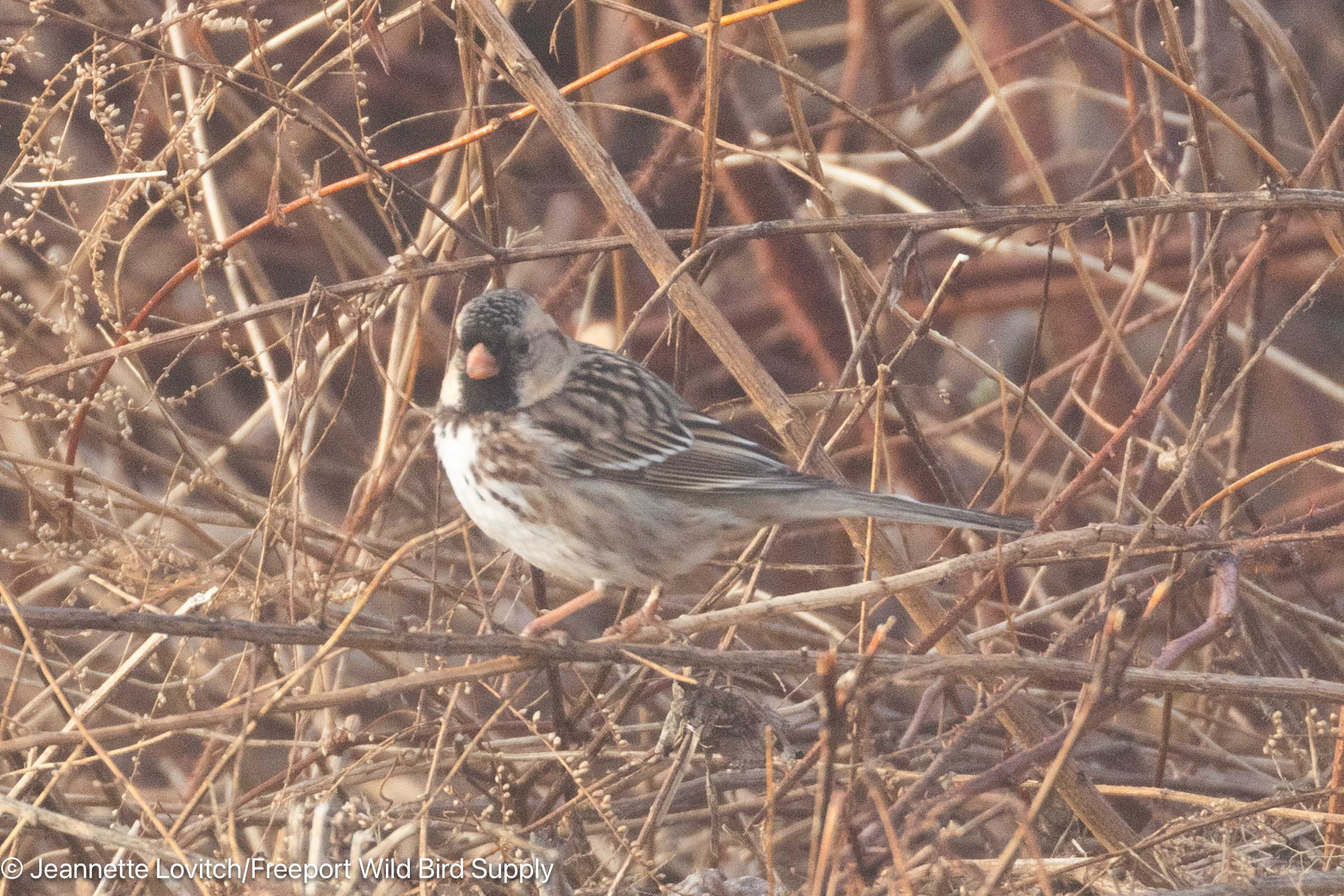
While I didn’t look at many birds in Maine this week, we drove a whole 6 minutes from our regular motel in New Jersey to chase this spiffy Harris’s Sparrow in Wall Township, my 352nd species in my native state! Does 6 minutes even count as a chase?
Much has changed since we left for our vacation on February 23rd. Immediately upon our return, we had to depart the state for a few more days for a family matter. In the meantime, the vanguard of spring migration both literally and figuratively passed over our heads. Here are a few observations of note over the past four days since returning to the state.
8 Common Grackles (Maine FOY), Over Exit 25, Kennebunk, 3/10.
In the following days blackbird numbers continued to increase, as did migrant Song Sparrows.
10 Green-winged Teal, Bernard Lown Peace Bridge, Auburn-Lewiston, 3/12.
1 drake Gadwall, 11 Northern Pintails, 5 Red Crossbills (including 1-2 singing males), etc, Reid State Park, Georgetown, 3/13.
Bradbury Mountain Spring Hawkwatch gets underway on Sunday!
But the main reason I am posting this week despite the few days of observation is that Sunday, March 15th begins the 20TH YEAR of the Bradbury Mountain Spring Hawkwatch! Join Zane Baker and project volunteers at the summit from 9-5 every day (weather permitting) from March 15th through May 15th. Can we reach least year’s record count?
March 28th or 29th. This tour is currently sold out. Please contact us to be added to the waiting list.
Portland Explorer Collab Tours.
Our collaboration with Portland Explorer has expanded once again, with the 12th season of the Birds on Tap – Roadtrip! series, but also new Birding and History tours. All of the 2026 outings are now posted and are open for registration. To learn more about these unique experiences, check out my recent blog entry.
Seasonal hotspots. Local expertise. Small-group experiences.
For the 12th season, Portland Explorer and Freeport Wild Bird Supply are teaming up to offer Maine’s most unique guided birding tours — combining peak birding hotspots, expert instruction, comfortable transportation, and in select outings, visits to some of our favorite local breweries.
Whether you’re a seasoned birder, just getting started, or traveling with someone whose main interest might be craft beer until they become a avid birder, these relaxed and educational outings offer something special.
This blog will be updated with trip reports after each tour, so check back in to see what you missed and to sign up for upcoming outings!
The 2026 Birds on Tap – Roadtrip Series!
Our collaboration with Portland Explorer (formerly The Maine Brew Bus) enters its 12th season, with three exciting itineraries. These unique, relaxed birding and beer-ing adventures that you have come to love combine great local birding at seasonal hotspots with approachable opportunities to sample the delicious creations of some of our favorite Maine breweries. These events are a perfect introduction to birding and/or craft beer, and a great opportunity to enjoy our favorite pastimes with significant others, friends, and family that have interest in one topic, while your interest is primarily in the other (for now!). Educational, enjoyable, and eye-opening you won’t want to miss out our unique Birds on Tap series, including a brand new outing for 2026.
The three tours are as follows. After completion, tour reports will be posted here so this blog is your one-stop shopping for tour reports and upcoming itineraries.
Birds on Tap -Roadtrip: Hawks and Hops!
Sunday, April 19, 2026: 9:00am – 3:00pm
Portland Explorer (formerly Maine Brew Bus) and Freeport Wild Bird Supply Freeport Wild Bird Supply are excited to continue our collaboration for 3 very special outings in 2026.
These unique, relaxed birding and beer-ing adventures that you have come to love combine great local birding at seasonal hotspots with visits to sample the delicious creations of some of our favorite local breweries. These tours are a perfect introduction to birding and/or craft beer, and a great opportunity to travel with significant others, friends, and family that have interest in one topic, while your interest is primarily in the other (for now!). Seasonal birding hotspots and great local beer – a perfect combination, and we’ll even do all of the driving!
This brand-new itinerary takes us to the Bradbury Mountain Spring Hawkwatch at Bradbury Mountain State Park in Pownal in the peak of northbound raptor migration. Now in its 20th year, this research project by Freeport Wild Bird Supply tallies an average of 4,180 migrating birds of prey each spring from the summit!
After a gentle 1-mile climb through the woods, looking and listening for migrant and resident songbirds, we’ll arrive at the summit and join the project’s Official Counter. Derek will discuss the history and methodology of the project, as the counter points out migrating raptors. Derek will lead us through the basics of hawk identification to give us a hawkwatch primer, and then if the migration action allows, we’ll sit back and enjoy the show until it is time to depart (the walk down is a steep ¼ of a mile on a wide, well-worn trail with rocks and roots and some steps; hiking sticks are suggested if you use them). This is the only Hawkwatch Workshop program that FWBS will be offering this year, so this is a tour you won’t want to miss!
After about 3 hours of birding, we will be transported to two of our great local producers to sample their offerings and learn their styles. Our brewery destinations are subject to change, but the current plan is to visit Maine Beer Company and Goodfire Brewing
Maine Beer Company was founded with a deep commitment to quality, community, and sustainability, Maine Beer Company has become one of the most respected craft breweries in the country. Known for their clean, hop-forward ales like Lunch and Dinner, they focus on balance, drinkability, and precision. Their Freeport brewery is a beautiful, modern space built with environmental responsibility in mind, including solar power and energy-efficient design.
Goodfire Brewing in Freeport offers a fresh, creative take on modern craft beer. Known for expressive New England–style IPAs, crisp lagers, and thoughtfully crafted seasonal releases, Goodfire focuses on vibrant flavors and small-batch innovation. Their welcoming taproom atmosphere reflects their community-driven spirit, this stop highlights the artistry and evolution of Maine’s contemporary brewing scene.
The samples are included in the tour price, and Portland Explorer will supply a light snack (TBD) and water. Bring binoculars. We also recommend bringing a lunch or additional snack if you so desire. Be sure to bring layers as it is often windier and cooler at the exposed summit than down below and trails may be muddy so wear appropriate footwear.
We’ll be doing all of the driving, so you can relax. And to make it even easier, we have two pick-up times and locations for this trip:
9:00am – Marginal Way Park & Ride (opposite the intersection with Diamond St, just east of Franklin Ave), Portland.
(Please arrive 15 minutes prior to your departure time at either location, and please let us know where you will be meeting us)
We’ll return to these locations to drop you off at 2:40pm (Freeport) and 3:00pm (Portland).
This tour is limited to 12 participants, so sign up soon! This is a one-of-a-kind tour, and we think one you won’t want to miss!
Birds On Tap℠ – Warblers and Wort
Sunday, May 10, 2026: 8:00am – 2:00pm
During last year’s tour, we tracked down this mega-rare Cerulean Warbler!
Portland Explorer (formerly Maine Brew Bus) and Freeport Wild Bird Supply are excited to continue our collaboration for 3 very special outings in 2026.
These unique, relaxed birding and beer-ing adventures that you have come to love combine great local birding at seasonal hotspots with visits to sample the delicious creations of some of our favorite local breweries. These tours are a perfect introduction to birding and/or craft beer, and a great opportunity to travel with significant others, friends, and family that have interest in one topic, while your interest is primarily in the other (for now!). Seasonal birding hotspots and great local beer – a perfect combination, and we’ll even do all of the driving!
We’re bringing back the “Mother’s Day Special” in 2026, with a return to Portland on one of our most popular itineraries. May means warbler migration, and the destination for Warblers and Wort will hit two of Maine’s most famous springtime migrant traps, Portland’s Evergreen Cemetery and nearby Capisic Pond Park. Two oases in the urban jungle, featuring water sources and a mix of various habitats, help concentrate migrant birds that found themselves in or over the city come sunrise. After migrating all night, tired travelers look for refuge: food, water, and shelter, and urban greenspaces are absolutely critical for refueling.
Warbler diversity will rapidly be increasing, over 15 species possible by the middle of May, depending on the progression of the season. Other species, such as sparrows, raptors, and other Neotropical Migrants such as orioles and tanagers are also on the move, increasing our chances of seeing a diversity of species. If the cemetery’s apples and cherries are blooming, we may be in for quite a treat as these are absolute magnets for hungry migrants. Meanwhile, most trees have yet to fully leaf out, making them easier to spot!
It’s sometimes hard to leave Evergreen on a busy spring morning, but if we do, it will be for the very short trip over to Capisic Pond Park, where we’ll continue to seek migrants of all shapes and sizes.
After about 3 hours of birding, we will be transported to two of our great local producers to sample their offerings and learn their styles. Our brewery destinations are subject to change, but the current plan is to visit Foundation and Rising Tide Brewing Company.
Foundation Brewing Company is known for its clean, focused approach to craft beer, with a strong reputation for hop-forward ales and thoughtfully balanced lagers. Their lineup often showcases precision and consistency, with beers that highlight both modern techniques and traditional brewing fundamentals. A visit to Foundation offers an opportunity to explore how attention to detail and quality ingredients come together to create approachable yet expressive beers that reflect Portland’s thriving craft scene.
Rising Tide Brewing Company has been a cornerstone of Portland’s craft beer community since its early growth years. With a diverse portfolio that ranges from crisp, easy-drinking favorites to bold, hop-driven offerings and seasonal specialties, Rising Tide emphasizes accessibility and craftsmanship. Their beers often reflect a balance between innovation and tradition, making them a great representation of the evolution of Maine’s brewing culture.
The samples are included in the tour price, and Portland Explorer will supply a light snack (TBD) and water. Bring binoculars. We also recommend bringing a lunch or additional snack if you so desire. Light-colored, long-sleeve shirt and pants are highly recommended to reduce the nuisances of biting insects and trails may be muddy so wear appropriate footwear.
We’ll be doing all of the driving, so you can relax. This tour will have one pickup location:
8:00am – Marginal Way Park & Ride (opposite the intersection with Diamond St, just east of Franklin Ave), Portland.
(Please arrive 15 minutes prior to your departure time.)
We’ll return to these locations to drop you off at 2:00pm.
This tour is limited to 12 participants, so sign up soon! This is a one-of-a-kind tour, and we think one you won’t want to miss!
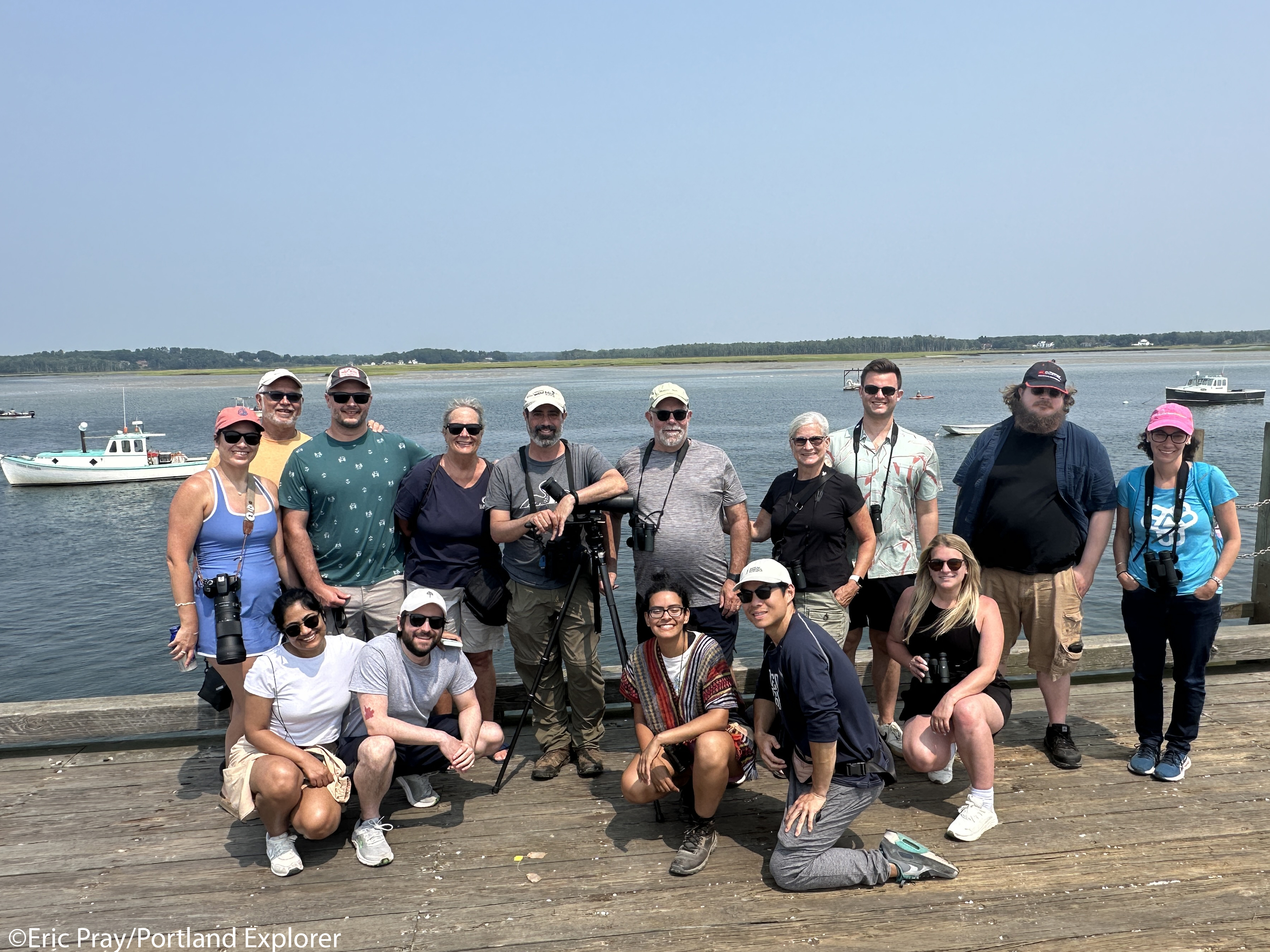
For a taste of what’s in store, here’s the trip report from our very exciting outing in 2025.
Portland Explorer (formerly Maine Brew Bus) and Freeport Wild Bird Supply are excited to continue our collaboration for 3 very special outings in 2026.
These unique, relaxed birding and beer-ing adventures that you have come to love combine great local birding at seasonal hotspots with visits to sample the delicious creations of some of our favorite local breweries. These tours are a perfect introduction to birding and/or craft beer, and a great opportunity to travel with significant others, friends, and family that have interest in one topic, while your interest is primarily in the other (for now!). Seasonal birding hotspots and great local beer – a perfect combination, and we’ll even do all of the driving!
The original BoT Roadtrip! Way back in 2015, our most popular tour returns to Scarborough Marsh at prime time for a good variety of migrant shorebirds. We’ll learn how to identify our common species, and search for the rare. Up to 20 species of shorebirds are possible! We’ll practice identifying our “peeps” (Least, Semipalmated, and White-rumped Sandpipers) and attempt to tease out a rare Western or even a Baird’s among the masses. We’ll look for local breeding American Oystercatchers and Willets, while searching for migrants such as Red Knots on their way from the high Arctic to the southern tip of Argentina.
And not to worry, we’ll take a look at everything else, such as Common, Roseate, and Least Terns; herons and egrets, and who knows what else? We may even get a chance to see Nelson’s and Saltmarsh Sparrows depending on time, wind, and tide.
After about 3 hours of birding, we will be transported to two of our great local producers to sample their offerings and learn their styles. Our brewery destinations are subject to change, but the current plan is to visit Nonesuch River Brewing and the Allagash Bungalow.
Nonesuch River Brewing blends classic brewing traditions with a creative, food-friendly approach. Known for producing a wide range of styles—from hop-forward IPAs to smooth stouts and refined lagers—the brewery emphasizes balance, drinkability, and quality ingredients. With a strong culinary influence behind their brand, their beers are crafted to complement a variety of tastes, showcasing both technical precision and thoughtful flavor development. A visit highlights the versatility and craftsmanship that define Maine’s modern brewing landscape.
Allagash Brewing Company is internationally recognized for its Belgian-inspired beers and commitment to craftsmanship. The Allagash Bungalow offers an inviting setting to explore a rotating selection of their beers, which may include their iconic witbier, barrel-aged specialties, or experimental small-batch releases. Rooted in tradition but continually innovating, Allagash represents one of Maine’s most influential breweries, known for its focus on fermentation, balance, and refined complexity.
The samples are included in the tour price, and Portland Explorer will supply a light snack (TBA) and water. Bring binoculars and a spotting scope if you have one. We also recommend bringing a lunch or additional snack if you so desire. Sunscreen, a light jacket in case the wind turns onshore, and sturdy comfortable walking shoes are also recommended – we will be out in the sun for the duration of the birding portion of the tour.
We’ll be doing all of the driving, so you can relax. There will be one pickup location for this tour:
9:00am – Marginal Way Park & Ride (opposite the intersection with Diamond St, just east of Franklin Ave), Portland.
(Please arrive 15 minutes prior to your departure time).
This tour is limited to 12 participants, so sign up soon! This is a one-of-a-kind tour, and we think one you won’t want to miss!
For a taste of what’s in store, here’s the trip report from our very exciting outing in 2025.
Our collaboration with Portland Explorer (formerly The Maine Brew Bus) enters its 12th season, and our collaboration continues with a new series of joint history and birding tours. These unique, relaxed birding and history adventures combine great local birding at seasonal hotspots with educational journeys through some of our local history. Join two experts in their field on this brand new collaboration! (Sorry, no beer tastings here!)
The three tours are as follows. After completion, tour reports will be posted here so this blog is your one-stop shopping for tour reports and upcoming itineraries.
Forts and Feathers: House Island!
Sunday, October 18: 9:00am – 2:00pm
As our collaboration with Portland Explorer enters its 12th season, we’re mixing things up with a brand new series of joint history and birding tours. These unique, relaxed birding and history adventures combine great local birding at seasonal hotspots with educational journeys through some of our local history. Join two experts in their field on this brand new collaboration! (Sorry, no beer tastings here!)
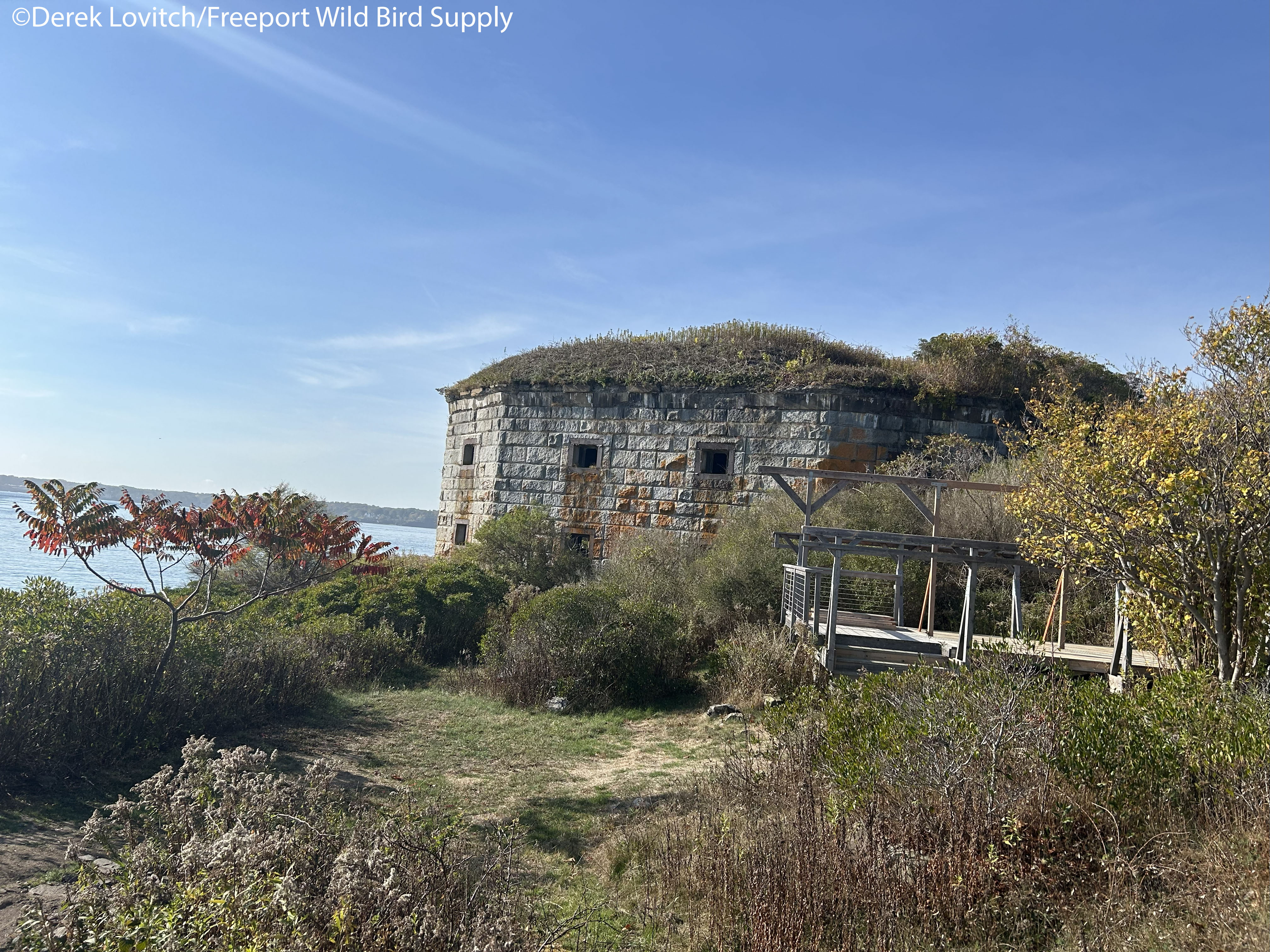
But this time we’re leaving the van in the garage, and hitting the water! That’s right, we’re taking a cruise, and we’re returning to the private House Island in Porland Harbor!
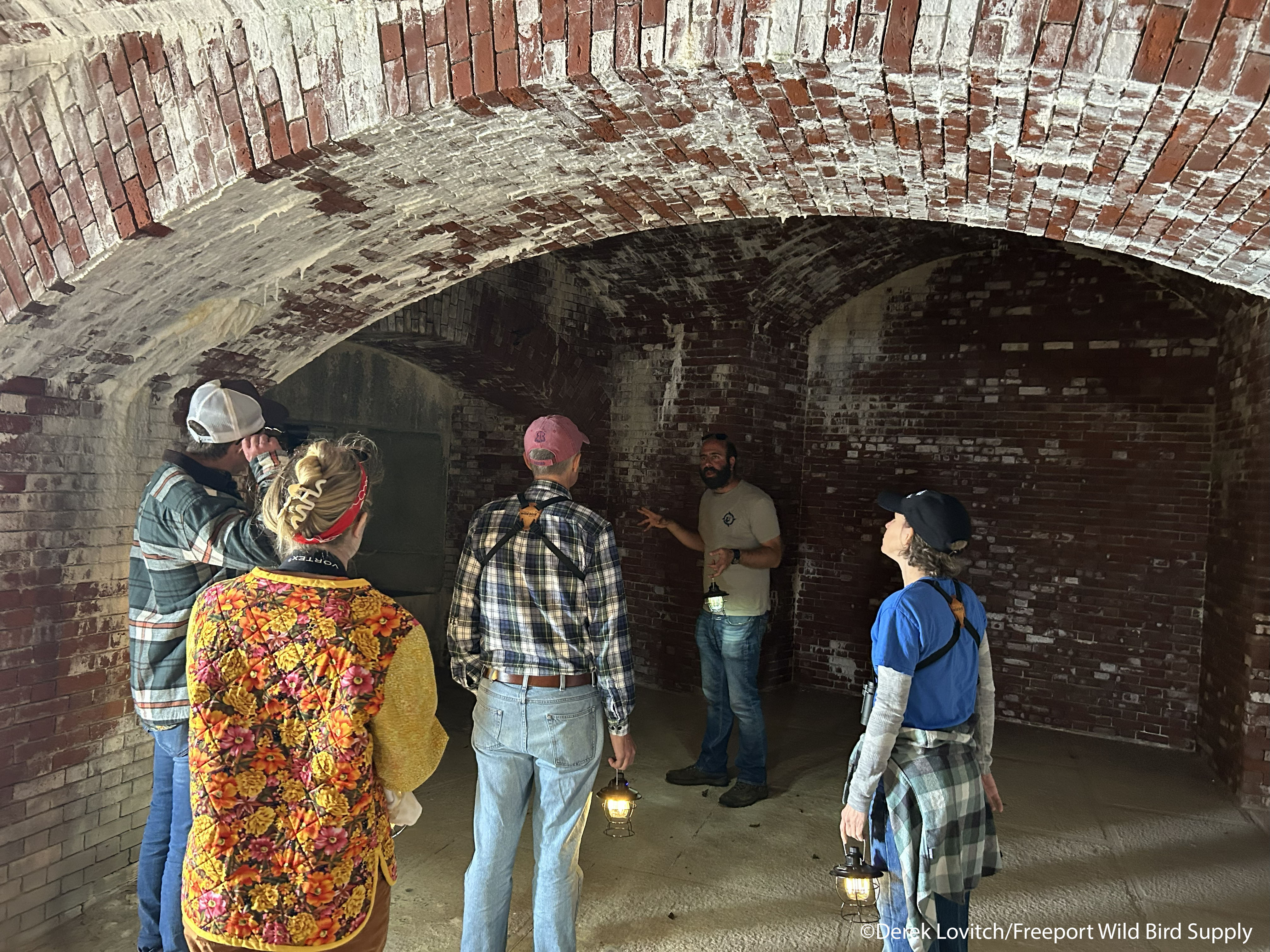
During our previous outings in which we became the first birding groups ever on the island, we found oodles of Yellow-rumped Warblers, other migrants, and learned about the island’s ecology. But we were also captivated by Captain Pete, who guided us through the historic fort, sharing a wealth of historical knowledge and fascinating stories.
Once again, we’ve been granted special permission to come ashore and scour the island here in the peak of fall migration. We’ll follow well-maintained trails through the island’s mosaic of open habitats, scrub, and young woods. These are great habitats to search for a variety of migrants, and perhaps even a rarity!
Returning in October, rarities will once again be on our mind. While rare birds are rare, we are still going to expect the unexpected. But more likely are regular migrants of the season such as Yellow-rumped Warblers, a variety of sparrows, and a growing diversity of waterbirds. At the very least, we’ll have resident waterbirds and several species of gulls to sort through.
As we motor back across the harbor, we’ll continue to familiarize ourselves with some of the common waterbirds, such as Common Eiders, Common Loons, and perhaps some lingering Ospreys and others from the summer, all while enjoying a local craft beverage produced in the city of Portland. While the exact plan is subject to change, we’ll be sure to come up with a plan to adequately celebrate our discoveries – or the one that got away!
Portland Explorer will supply a light snack and everyone is welcome to a free drink (alcoholic or non during the boat ride back). Bring binoculars. We also recommend bringing a lunch or additional snack if you so desire. Sturdy comfortable walking shoes are also recommended, as are a variety of layers as it can be quite chilly on the water by the end of October.
For a taste of what’s in store, here’s the trip report from our very exciting outing in 2025 (but note we will not be offering the beer tasting component in 2026).
*Please arrive 15 minutes prior to your departure time.*
We’ll return to Portland Beer Hub at 2:00pm
This tour is limited to 12 participants, so sign up soon! This is a one-of-a-kind tour, and we think one you won’t want to miss! To conveniently pay online, click on the “Book Now” link here.
Forts and Feathers: The Beaks of Peaks!
Sunday, November 1st (weather date 11/8): 9:00am – 3:00pm.
This “Mega” rare Virginia’s Warbler was Maine’s 5th ever, and found by Derek on Peak’s Island on the weekend we’ll be returning this year…just in time to find the next rarity!
As our collaboration with Portland Explorer enters its 12th season, we’re mixing things up with a brand new series of joint history and birding tours. These unique, relaxed birding and history adventures combine great local birding at seasonal hotspots with educational journeys through some of our local history. Join two experts in their field on this brand new collaboration! (Sorry, no beer tastings here!)
But this time we’re leaving the van in the garage and hit the water once again! We’re going to hop aboard the Casco Bay Ferry Lines for the short, 20-minute trip across Portland Harbor to Peak’s Island.
Once there, we’ll plan on walking 3-4 easy miles (paved or dirt roads and a few narrow trails including one with irregular boards over wet areas) to cover the prime birding hotspots of the island, including the thickets that were made famous last year when Derek discovered Maine’s 5th-ever Virginia’s Warbler (and first away from Monhegan). We’ll make our way along the shoreline, looking at resident and recently-arrived migrant waterbirds, but checking various nooks and crannies that can hold unexpected vagrants.
We’ll make our way to the famous Battery Steele – famous for its access, it’s impressive graffiti, and yes, its birding. Here, a complex of wetlands and scrubby areas combine to attract and hold a wide range of avian species, often including some that are usually long gone from Maine by now. We’ll then explore the open-access fort and even get to experience total darkness!
Birding will continue as we traverse the island to return to town. There will be an opportunity to purchase a delicious lunch, or bring your own, and we’ll relax for a spell as we await our ferry departure.
Portland Explorer will supply a light snack and water. Bring binoculars and a flashlight. We also recommend bringing lunch or additional snack if you so desire. Sturdy comfortable walking shoes are also recommended, as are a variety of layers as it can be quite chilly on the water by the end of October.
*Please arrive 15 minutes prior to your departure time.*
We’ll return to Portland Beer Hub at 3:00pm
This tour is limited to 15 participants, so sign up soon! This is a one-of-a-kind tour, and we think one you won’t want to miss!
Forts and Feathers: Fort Williams and Portland Head Light!
Sunday, November 29: 8:00am to 1:00pm
It’s a perfect time of year to find late migrants such as Orange-crowned Warblers in the scrubby habitats of the park.
As our collaboration with Portland Explorer enters its 12th season, we’re mixing things up with a brand new series of joint history and birding tours. These unique, relaxed birding and history adventures combine great local birding at seasonal hotspots with educational journeys through some of our local history. Join two experts in their field on this brand new collaboration! (Sorry, no beer tastings here!).
With arriving winter waterbirds – from Great Cormorants to all three species of scoters – and truant migrants (and sometimes, even rarities!) – late November is a great time to hit the coast of Maine for productive birding. On this tour, we’ll take the Portland Explorer van over to Cape Elizabeth to bird the cliffs and uplands of Fort Williams Park.
But that’s not all! We’ll also be diving into the history of the Fort and the world-famous Portland Head Lighthouse. At Fort Williams Park, we’ll explore a scenic coastal landscape rich with history and sweeping views of Casco Bay. The park features historic military structures, open green space, and dramatic rocky shoreline—offering a glimpse into Maine’s past alongside some of its most iconic ocean vistas.
Just beyond the fort grounds stands Portland Head Light, Maine’s oldest lighthouse. Perched on the cliffs overlooking the Atlantic, it has guided mariners for more than two centuries and remains one of the most recognizable landmarks on the New England coast.
We’ll be doing all of the driving, so you can relax. There will be one pickup location for this tour:
8:00am – Marginal Way Park & Ride (opposite the intersection with Diamond St, just east of Franklin Ave), Portland.
(Please arrive 15 minutes prior to your departure time).
This tour is limited to 12 participants, so sign up soon! This is a one-of-a-kind tour, and we think one you won’t want to miss! To conveniently pay online, click on the “Book Now” link here.
Portland Explorer and Freeport Wild Bird Supply are teaming up to offer a very special, very exclusive road trip outing in 2026.
Early November is a fantastic time of year in Maine for vagrants – birds normally seen in far-off places. Due to a combination of weather patterns, changing seasonal food resources, falling temperatures, and other factors – some of which are not completely understood – birds that may have ended up in Maine by “accident” begin to concentrate at the coast in “migrant traps” and “hotspots.” In other words, this is the time of year to expect the unexpected.
A traditional “Rarity Roundup” involves teams of birders heading out on a given day during rarity prime time, looking for species that are not supposed to be around. And in honor of that tradition, that’s exactly what we are going to do on this unique tour. We may “chase” a rarity (go to see something that has already been found, aka “twitch”) or we might choose a destination known for rare birds in an attempt to find one of our own. Or perhaps, we’ll do both!
Anything in southern Maine is fair game, and we might not even know where we will head until we are on the bus and the latest rare bird alert is received. For those who love adding a bird to your Life or State List, and/or basking in the thrill of discovery, well then this is the tour for you! In between seeing great birds, we’ll discuss the complex factors that are involved in delivering rarities to an area, and how we go about finding them.
For example, last year, our Birds on Tap – Roadtrip: Rarity Roundup traveled to Yarmouth to see one of the few MacGillivray’s Warblers ever recorded in the state, then ventured all of the way to Kittery to try and find our own vagrant and the famous Fort Foster Park. For a taste of what’s in store, here’s the trip report from our very exciting outing in 2025 (but note we will not be offering the beer tasting component in 2026).
Portland Explorer will supply a light snack (TBA) and water. Bring binoculars and a spotting scope if you have one. We also recommend bringing a lunch or additional snack if you so desire. Sunscreen, an extra layer or two, and sturdy comfortable walking shoes are also recommended as we will want to be comfortable during both a long drive or a standing vigil outside.
We’ll be doing all of the driving, so you can relax. There will be one pickup location for this van tour.
8:00 am – Marginal Way Park & Ride (opposite the intersection with Diamond St, just east of Franklin Ave), Portland.
(Please arrive 15 minutes prior to your departure time)
This tour is limited to 12 participants, so sign up soon! This is a one-of-a-kind tour, and we think one you won’t want to miss!
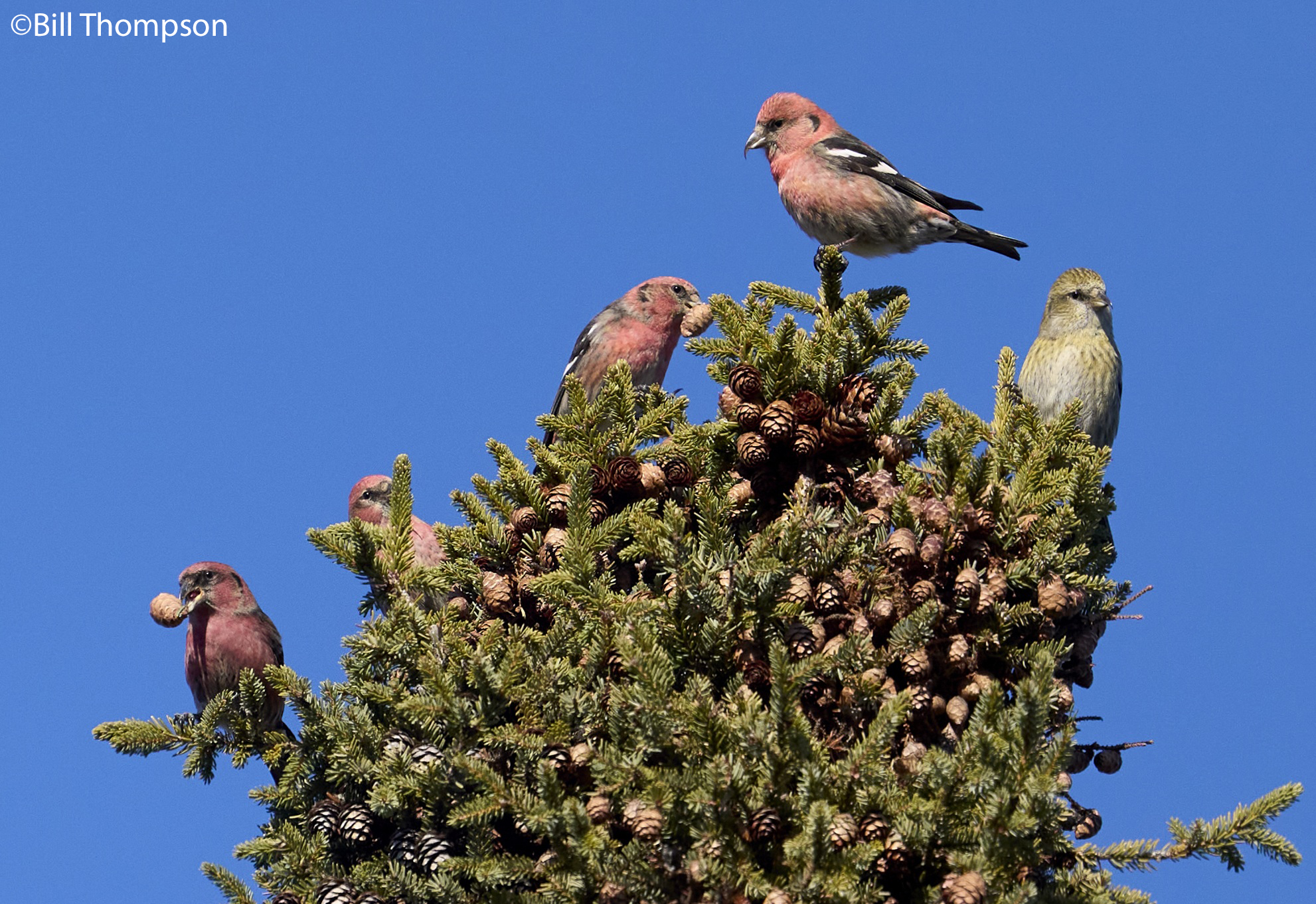
While a trek to the mountains on the 15th was not nearly as fruitful (pun intended) as we hoped, Bill Thompson and I were very surprised to find a flock of White-winged Crossbills – an irruptive species that has been virtually non-existent this winter in Maine – on South Shore Road in Rangeley.
I covered a better amount of ground this past week than I have been recently, even with relatively limited time in the field. I wanted more frugivores to show for it, but I did have a nice variety of seasonal highlights. Here are my observations of note over the past 10 days.
1 female “NORTHERN” COMMON EIDER (ssp BOREALIS), 1 drake Barrow’s Goldeneye, and 4 drake Greater Scaup, Winslow Park, Freeport, 2/14 (with Saturday Morning Birdwalk group).
2+ continuing FISH CROWS, Auburn Riverwalk, 2/15 (with Bill Thompson).
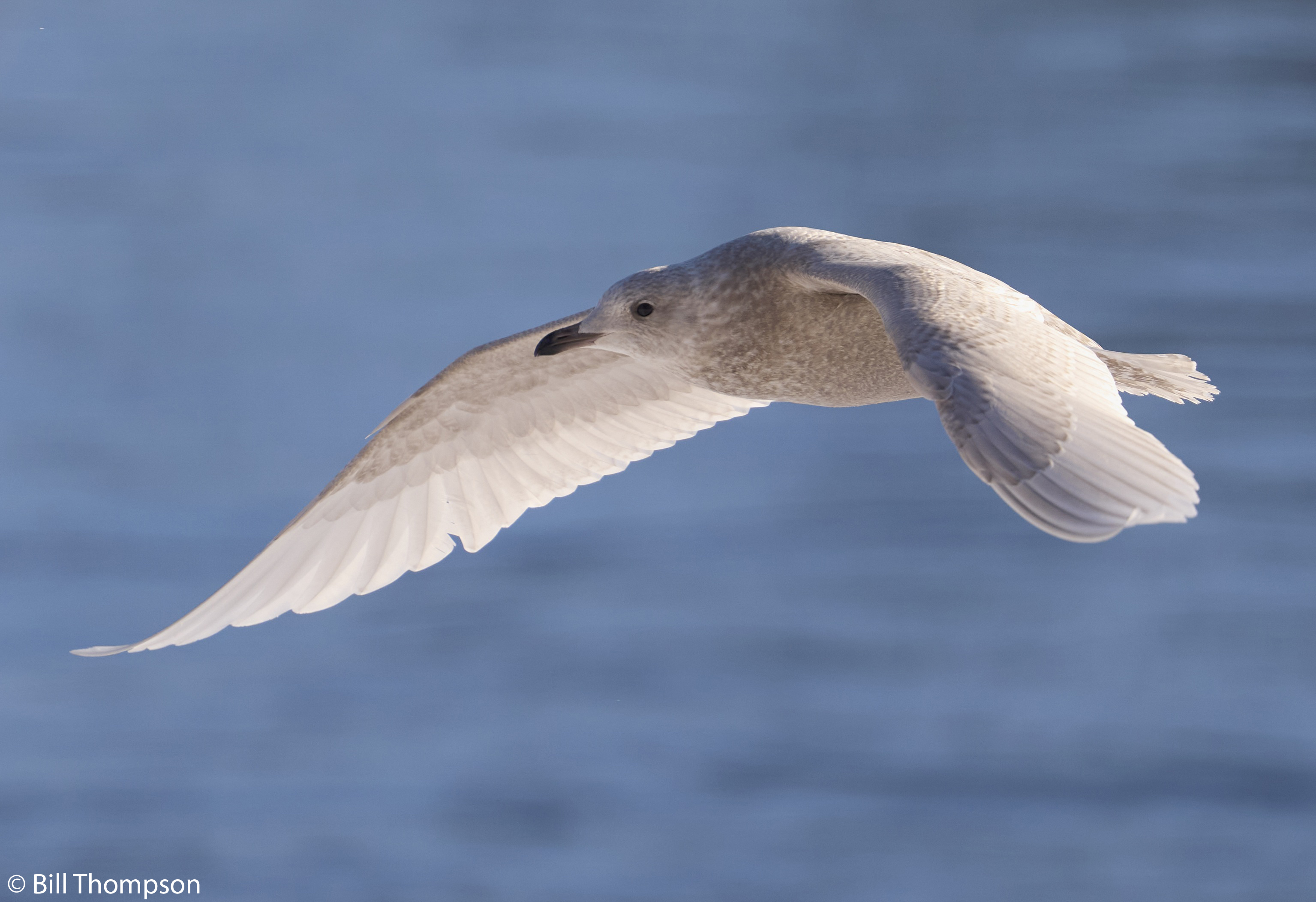
1 1ST-cycle Iceland Gull, Auburn Riverwalk, 2/15 (with Bill Thompson).
~20 Snow Buntings, moving between parking lots on Rte 4/2, Farmington, 2/15 (with Bill Thompson).
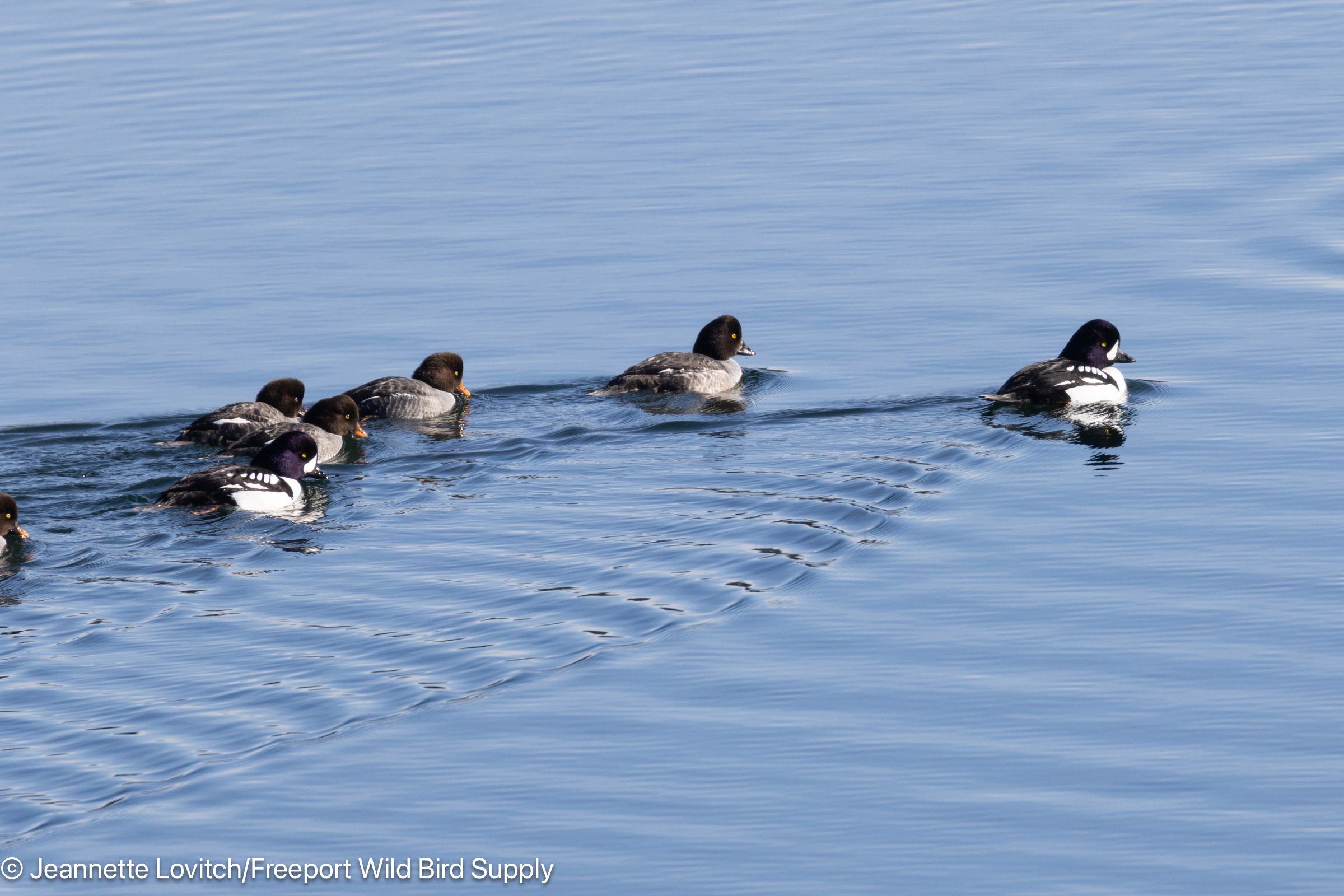
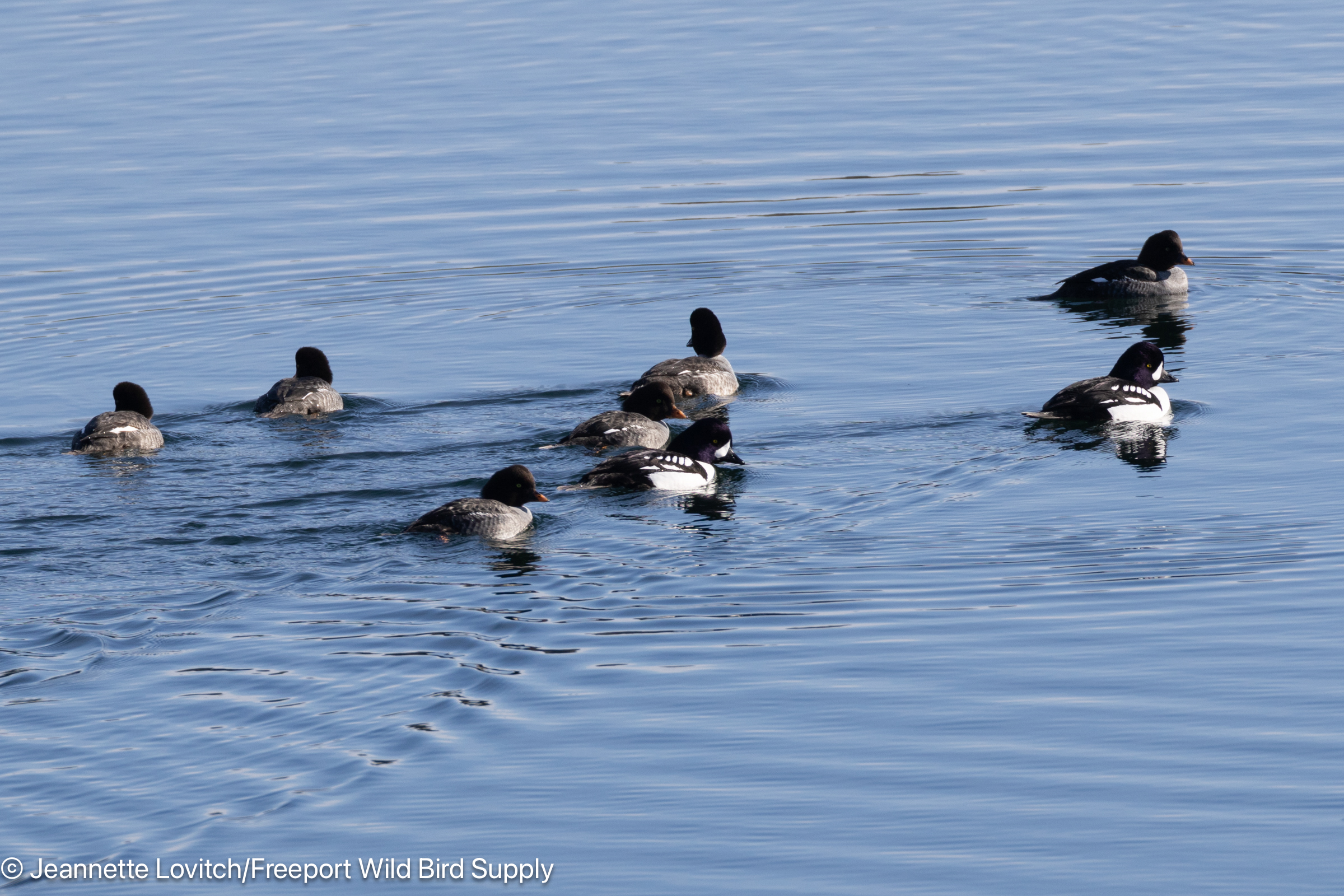
19 (10 drakes and 9 hens) BARROW’S GOLDENEYES, Gurnet Bridge, Harpswell, 2/16 (with Jeannette). This winter’s flock, which maxxed out at 26 individuals, is the largest flock in the state since about 2006. Even though we missed the peak, this was a very impressive flock and was delightful to see!
1 drake Barrow’s Goldeneye, Sandy Point Beach, Cousin’s Island, Yarmouth, 2/22.
1 pair Barrow’s Goldeneye, Cumberland Town Landing, 2/22.
At least one Turkey Vulture continues along the I-295 corridor between Cumberland and Freeport as of this week. Several scattered “TV’s” elsewhere in the area suggests the first trickle of their northbound migration.
One adult Red-shouldered Hawk continues along Rte 136 in Durham, near the Freeport Town Line.
This Week in Irruptives.
On the 15th, Bill Thompson and I birded from Auburn to Rangeley, mostly looking for irruptives. It was not the birdiest day, and the only frugivores we encountered (despite finding plenty of fruit) were a mere 4 Cedar Waxwings in Farmington. Most of our birding was in and around Rangeley, where we caught up with a flock of 28 Evening Grosbeaks at a downtown feeder, and “dipped” on a small group of Pine Grosbeaks. However, on South Shore Road, we encountered 14 WHITE-WINGED CROSSBILLS (see photo above) and a single Redpoll.
Elsewhere, Purple Finches were a little more widespread this week, although in lower numbers than last week. Jeannette and I had 3 Red Crossbills, including an apparent pair, at Long Reach Preserve in Harpswell on the 16th and one Redpoll flew over our property on the 22nd. Scattered Evening Grosbeaks in the area included one in our Durham yard on the 17th and again on the 23rd. Cedar Waxwings were also a little more numerous this week, although in small numbers (high count of 6 here at the store on the 18th).
Winter Feeder Birds Snapshot.
After beginning a “feeder watching blog” while stuck at home from shoulder surgery in the winter of 2023, I continue the tradition for the fourth year now, as I try to compare feeder activity between winters on our property in Durham, Maine, and then attempt to use it as a case-study for what the overall feeder bird activity is like in the area this winter. Here’s the 2026 Feeder Birds Snapshot. Since the “study,” we have seen a few more winter finches, and as of 2/13 are now up to 24 Dark-eyed Juncos, 11 American Tree Sparrows, and at least 45 American Goldfinches.
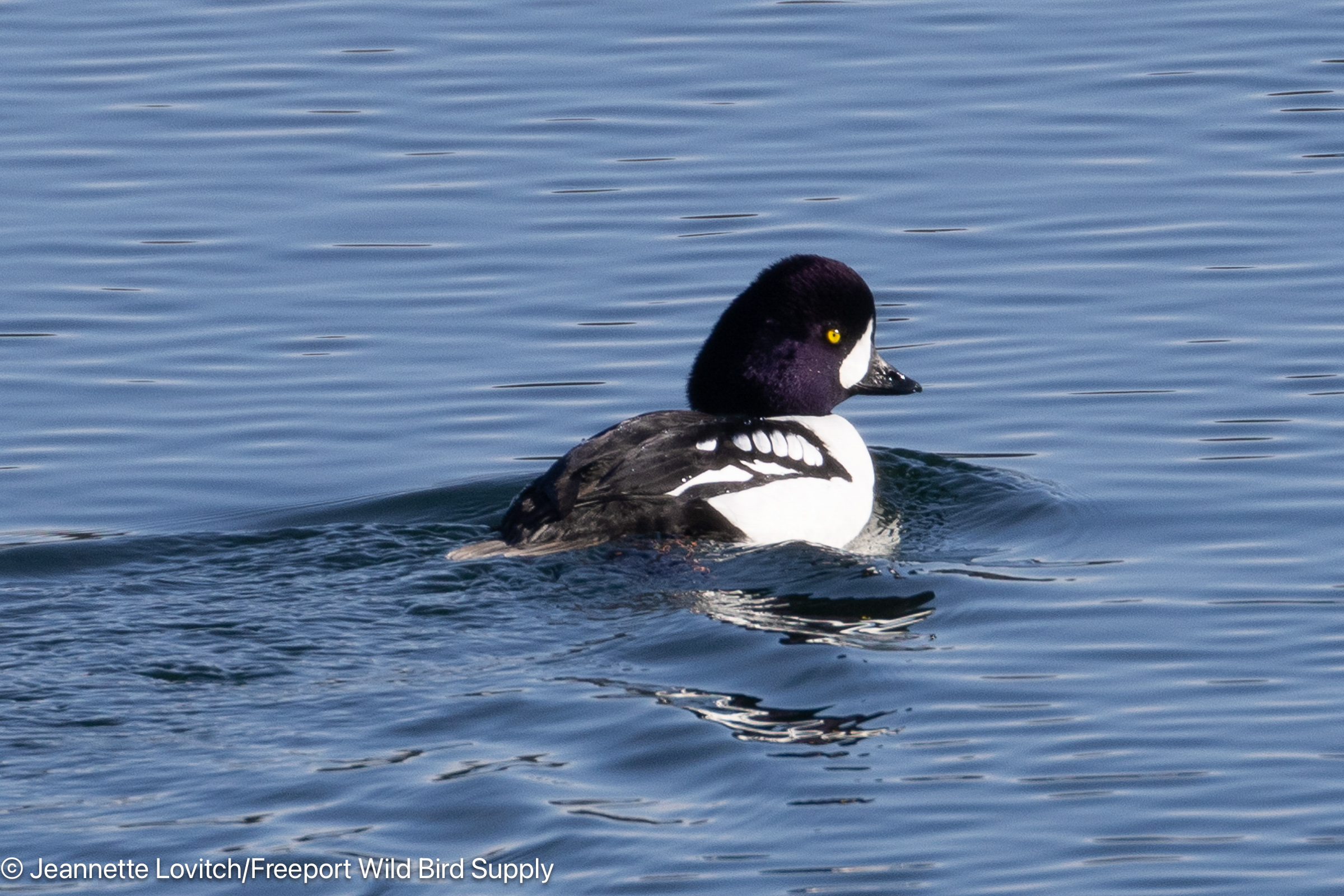
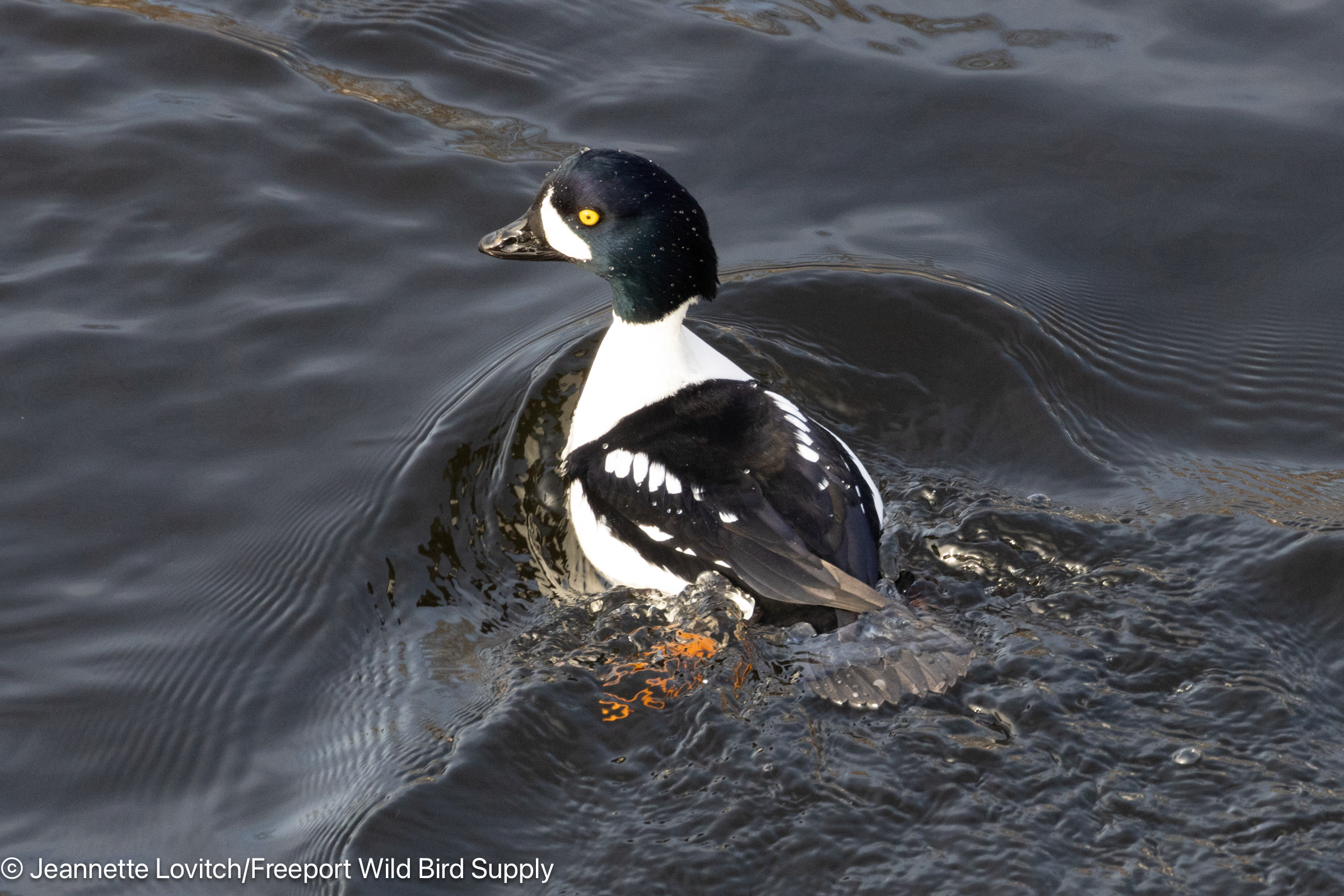
This drake Barrow’s Goldeneye was one of the foursome currently in the Androscoggin River between Auburn and Lewiston, most often in view from the Bernard Lown Peace Bridge. Jeannette paid them a visit on the 6th, where she found this one male just below the bridge.
Except for a delightful morning at Reid State Park, my birding outings were short and local, but I did enjoy catching up with local patches and their winter denizens, especially Barrow’s Goldeneyes. Here are my observations of note over the past seven days.
2 drake and 2 hen Barrow’s Goldeneyes, Winslow Park, Freeport, 1/4.
1 drake Barrow’s Goldeneyes, Sandy Point Beach, Cousin’s Island, Yarmouth, 1/6.
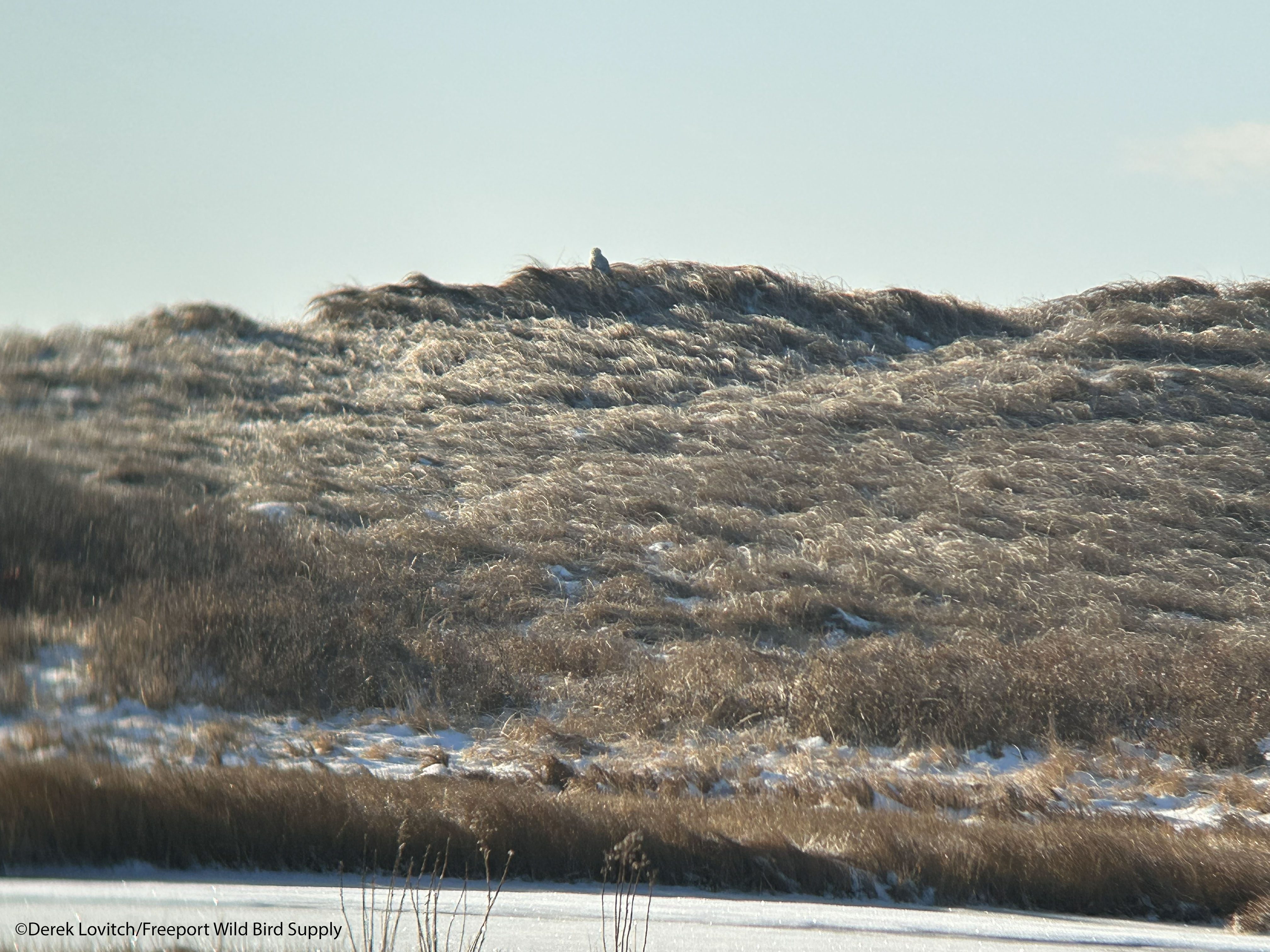
1 SNOWY OWL (FOS), 9-11 Red Crossbills, 58 Red-necked Grebes, 1 Savannah Sparrow (subspecies undetermined), 26 Sanderling, etc, Reid State Park, Georgetown, 1/8.
1 hen Barrow’s Goldeneye, Front Street Boat Launch, Bath, 1/8.
This is how I like my Snowy Owls…safe in the distance, backlit, poorly phone-binned, and otherwise unconcerned with my presence. Later, I spent 30 minutes observing it in the distance as it moved around, perhaps to get in position for hunting, or perhaps because it was getting too warm!
This Week in Irruptives.
American Goldfinches and Red-breasted Nuthatches remain very abundant. While a number of customers at the store have continued to report scattered small flocks of Evening Grosbeaks at feeding stations, I did not hear or see any yet again this week. In fact, my only irruptive in limited time birding was a single Pine Siskin at Florida Lake Park on the 7th, until I re-entered the Red Spruce zone at Reid State Park on the 8th. There, there were several Pine Siskins and at least 9-11 Red Crossbills – including two singing males suggestive of upcoming mid-winter breeding!
The state’s 4th or 5th Virginia’s Warbler – and the first away from Monhegan – was one of the rarest birds of the year in Maine, and it was even more special for me since I found it on Peak’s Island in November!
It’s once again time for my annual Predictions Blog, where I view into my crystal binoculars and attempt to forecast some of the “new” birds to grace the State of Maine – and then my own personal state list – in the coming year.
But first, let’s look back at last year’s predictions.
It was a great year for birding in Maine, with rarities at every season, especially during a truly epic November Rarity season. As a snapshot of just how many notable species were in the state in 2025, consider Noah Gibb and Stacey Huth’s Maine Big Year total of 332 species broke the old record by an astounding 10! Surprisingly, with such an eventful year for rarities in the state, no new species were added to the state’s list in 2025. With that, I’m going to keep Next 25 Species to be found in Maine list the same, but based on current trends and regional sightings, I am doing a little shuffling at the top to bump up Limpkin as the northward mini-irruptions of this tropical/sub-tropical bird continue.
1. Limpkin
2. Scopoli’s Shearwater
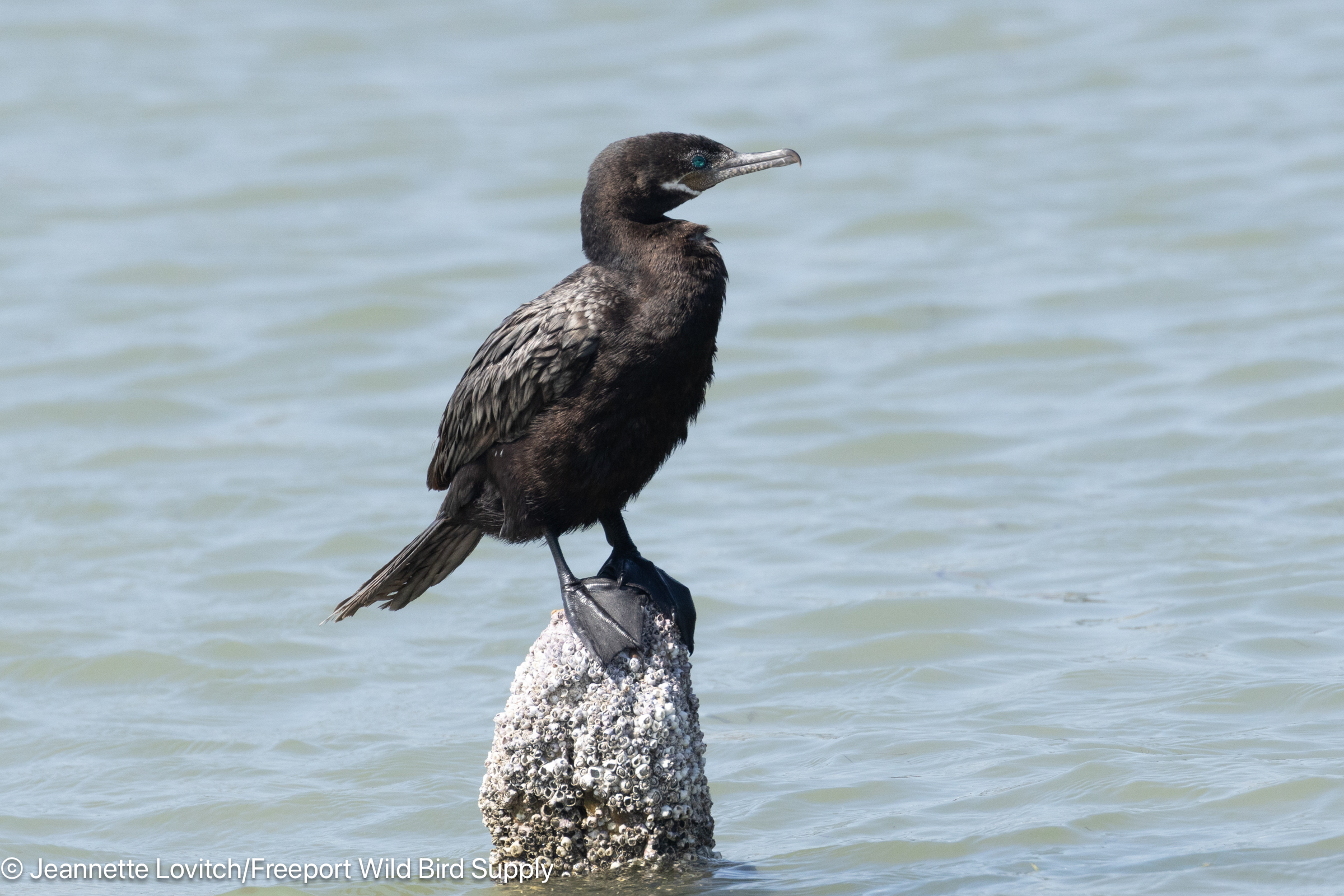
3. Neotropical Cormorant
4. European Herring Gull
5. Black-chinned Hummingbird
6. California Gull
7. Gray Heron
8. Bermuda Petrel
9. Graylag Goose
10. Little Stint
11. Audubon’s Shearwater
12. Common Shelduck
13. Anna’s Hummingbird
14. Heerman’s Gull
15. Common Ground-Dove
16. Allen’s Hummingbird
17. Spotted Redshank
18. Lewis’s Woodpecker
19. Ross’s Gull
20. Black-capped Petrel
21. Lesser Nighthawk
22. Dusky Flycatcher
23. Painted Redstart
24. Hooded Oriole
25. White Wagtail
It’s only a matter of time for Maine to be visited by its first ever Neotropic Cormorant, but it’s another Neotropical species that took the stop slot this year!
As for me, there were so many great birds seen in Maine in 2025, and the birds I chased just scratched the surface of the litany of vagrants this past calendar year as once again, my birding involves fewer and fewer chases each year. The MacGillivray’s Warbler in Yarmouth in November was one of the highlights – including becoming the 255th All-time Saturday Morning Birdwalk bird!- and a Fork-tailed Flycatcher in the Kennebunk Plains in July.
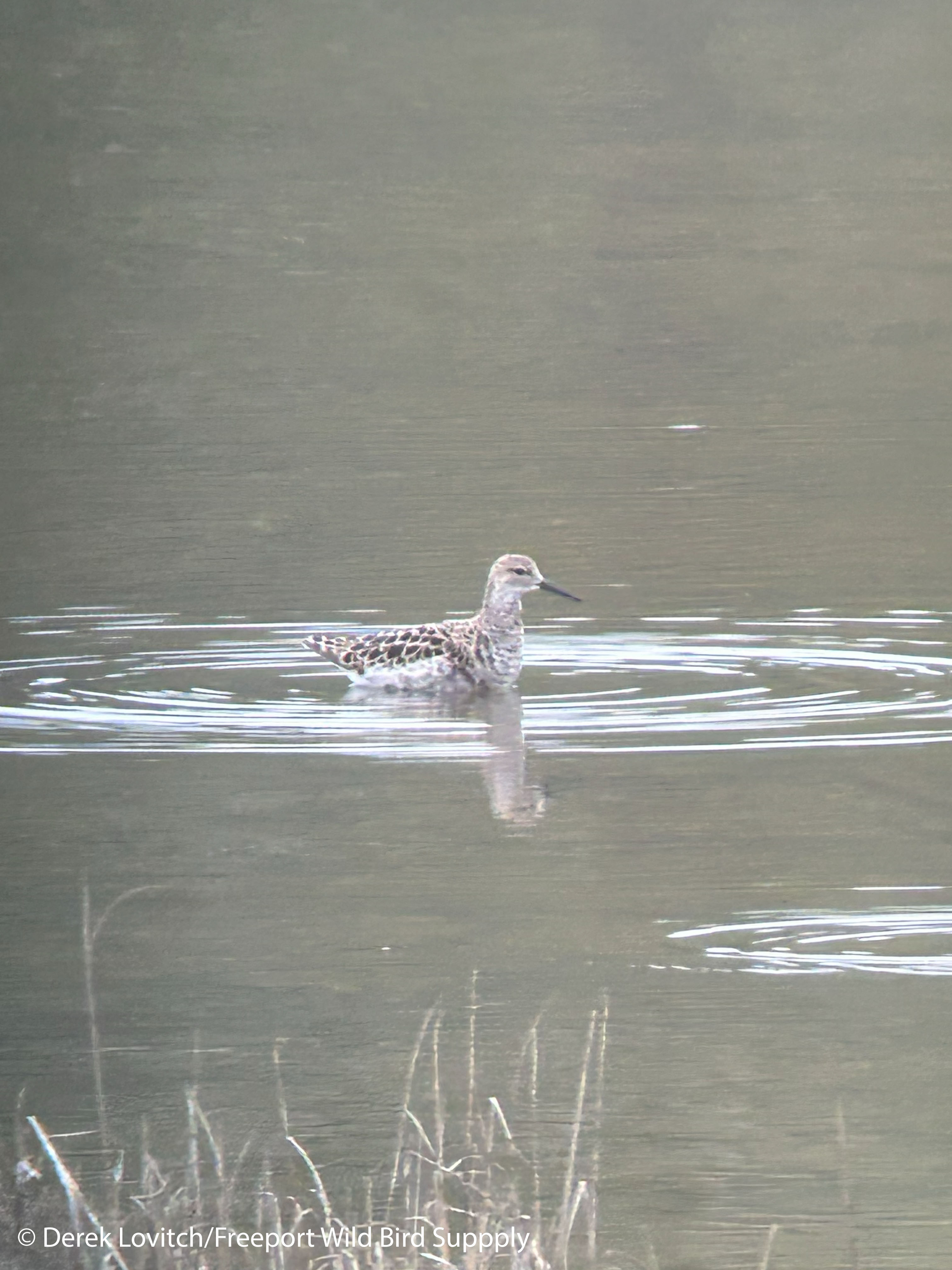
My first self-found rarity of the year was a Ruff at Walsh Preserve on 5/9…
..and Jeannette I chases the Northern Wheatear in Scarborough Marsh in September for a new ABA Area bird for her.
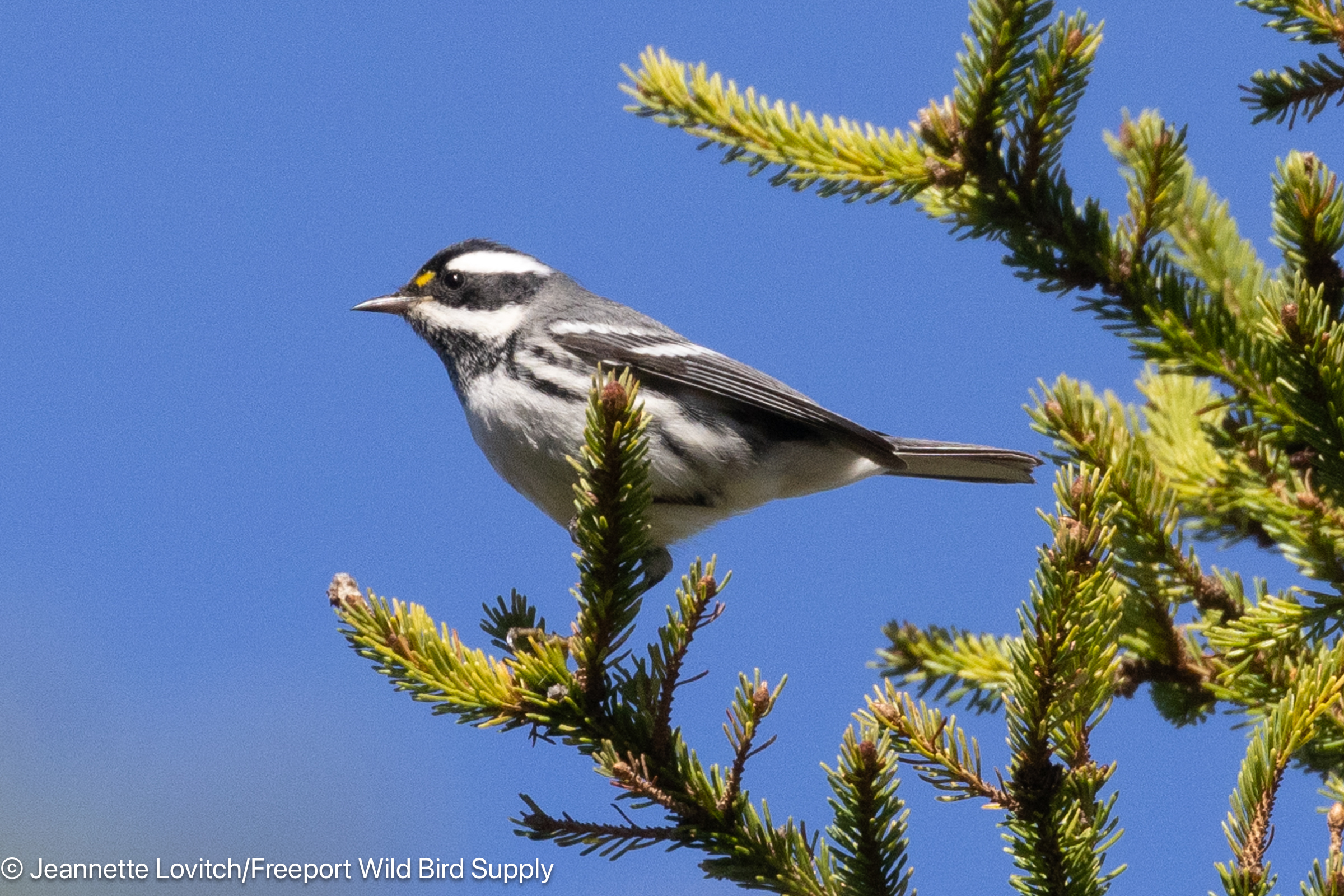
Black-throated Gray Warbler on Monhegan. A state bird for almost everyone, but “just” an exceptional “Island Bird” for me.
I even added two species to my State List in 2025, starting with an overdue Cerulean Warbler (#11) found by Doug Hitchcox in Evergreen Cemetery on 5/6. But nothing beats a “self-found” rarity, so finding a Virginia’s Warbler (#20) on Peak’s Island on 11/24 was even more special!
Of course, a few potential State Birds got away from me last year. However, all appeared to be one-day wonders, so it’s hard to complain: Crested Caracara in Scarborough Marsh on 4/30, a Franklin’s Gull (some day!) in The County on 5/21, an Anhinga over South Portland on 5/27, and an un-chaseable Ancient Murrelet at Matincus Rock on 6/19.
So, with those hits and misses, my updated list of the Top 25 Next State Birds for Me is now:
Franklin’s Gull (this is getting amusing/frustrating)
Neotropic Cormorant
Brown Pelican
California Gull
Brown Booby
Crested Caracara
Slaty-backed Gull
Boreal Owl
Calliope Hummingbird
Graylag Goose
Gull-billed Tern
Pacific Golden-Plover
Limpkin
Wood Stork
Black-chinned Hummingbird
Brewer’s Blackbird
Anhinga
Yellow Rail
Scopoli’s Shearwater
Western Wood-Pewee
Red-necked Stint
European Herring Gull
Gray Heron
Heerman’s Gull
Little Stint
Well there ya have it, let’s see what 2026 brings, at least when it comes to the birds in Maine.
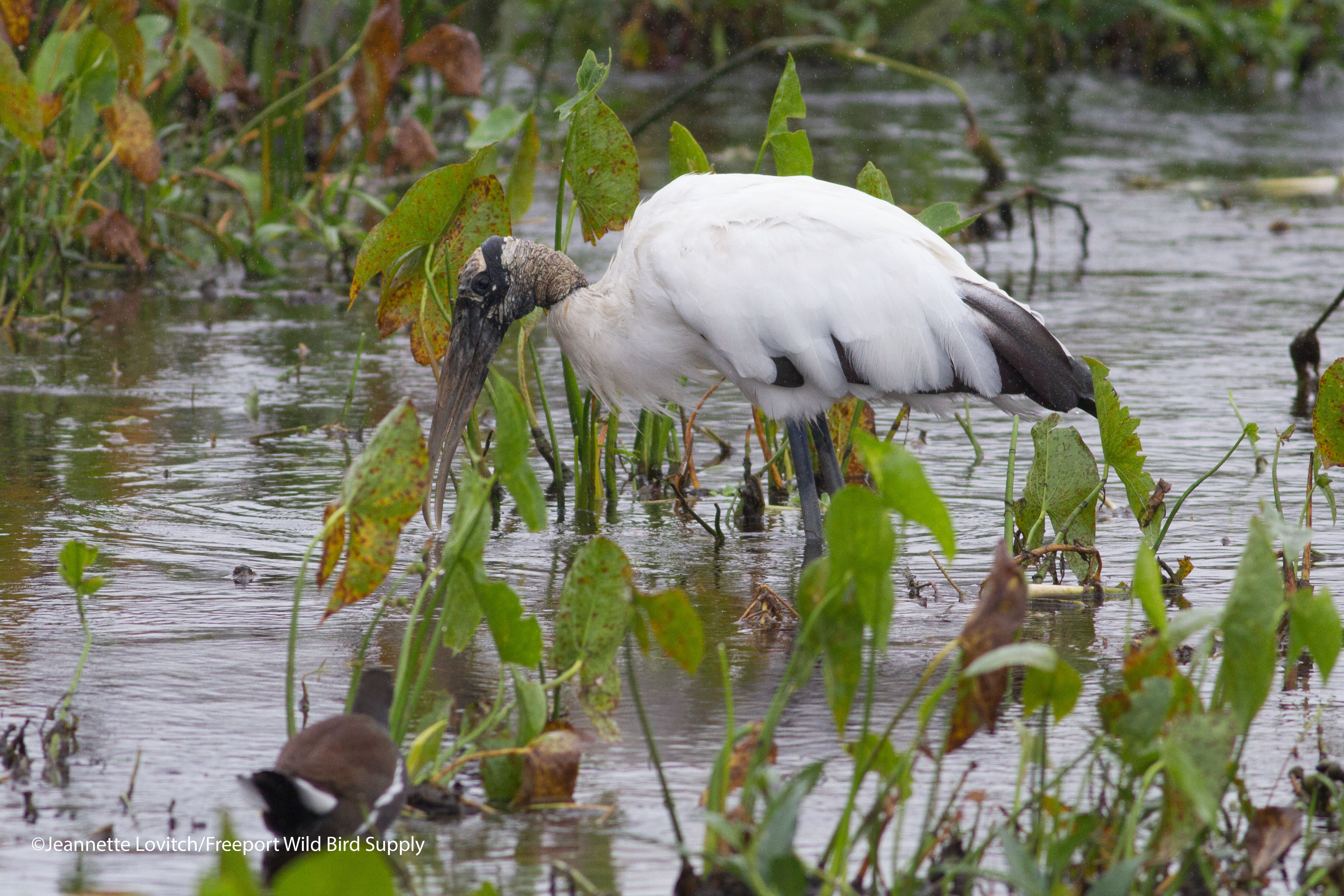
I think it’s about time for another Wood Stork to visit the state as well.
This Rufous Hummingbird graced a Bath yard for almost two months. The story below.
Life in retail during the holiday season, followed by a trip to the Motherland of New Jersey for Christmas resulted in limited Maine birding for me over the past two weeks. However, a couple of good days in the field here in Maine produced several observations of note:
Recent ice and more snow resulted in a nice little surge of Dark-eyed Juncos and American Goldfinches into our Durham yard. A male Purple Finch on ½ was the first I have seen locally in at least a month, and a Northern Flicker dropped in on 12/30.
1 continuing drake Green-winged Teal and 1+ Fish Crow, Auburn Riverwalk, 12/23.
2 drake and one hen BARROW’S GOLDENEYES, Bernard Lowne Peace Bridge, Auburn-Lewiston, 12/30 (with Kelley Sharp)
3 Fish Crows and 1 1st-cycle Iceland Gull, Auburn Riverwalk, Auburn, 12/30 (with Kelley Sharp).
1 pair American Wigeon, Rockland waterfront, 1/1 (with Jeannette).
Rufous Hummingbird in Bath, 10/31-12/26, 2025.
A Rufous Hummingbird arrived in a Bath yard on Halloween. And she stayed until the 26th of December! These birds are just incredible! Unfortunately, it was not in a yard that was conducive to visitation, so we had to keep the sighting under wraps. I really am sincerely sorry about that, but the homeowner’s rights and the bird’s welfare will always be put first and foremost with us. But it was well photographed, well studied, and well monitored. Here’s the story, identification particulars, and more.
We only had one morning for birding after visiting family, and we chose to spend it with an estimated 100,000 American Robins!
It was awesome and I hope these videos do it a modicum of justice! This was in Oldwick, NJ, discovered by Evan Obercian (yup, a birding friend of mine since high school who also now lives in Maine!) around 2021 (although he heard of a former roost not far away before this one). This was the largest gathering he has seen, at least around Christmastime. We just enjoyed the show, but he recently made the estimate (based on counting sample minutes and extrapolating). There were also about 1,000 European Starlings – look for a couple of dense flocks exiting the leaning bamboo during the videos. A few hundred Common Grackles and Red-winged Blackbirds were also present (mostly exited before sunrise in the first video), and Jeannette and I picked out a single Hermit Thrush. 3 Cooper’s Hawks and a Sharp-shinned Hawk were present, but they too seemed to be overwhelmed by the masses!
The videos can be seen here:
New Year Predictions Blog!
I know you are waiting with bated breath, but I’ll publish this soon. Of course, when I am delayed in getting it posted, something really rare shows up! So keep you eyes open!
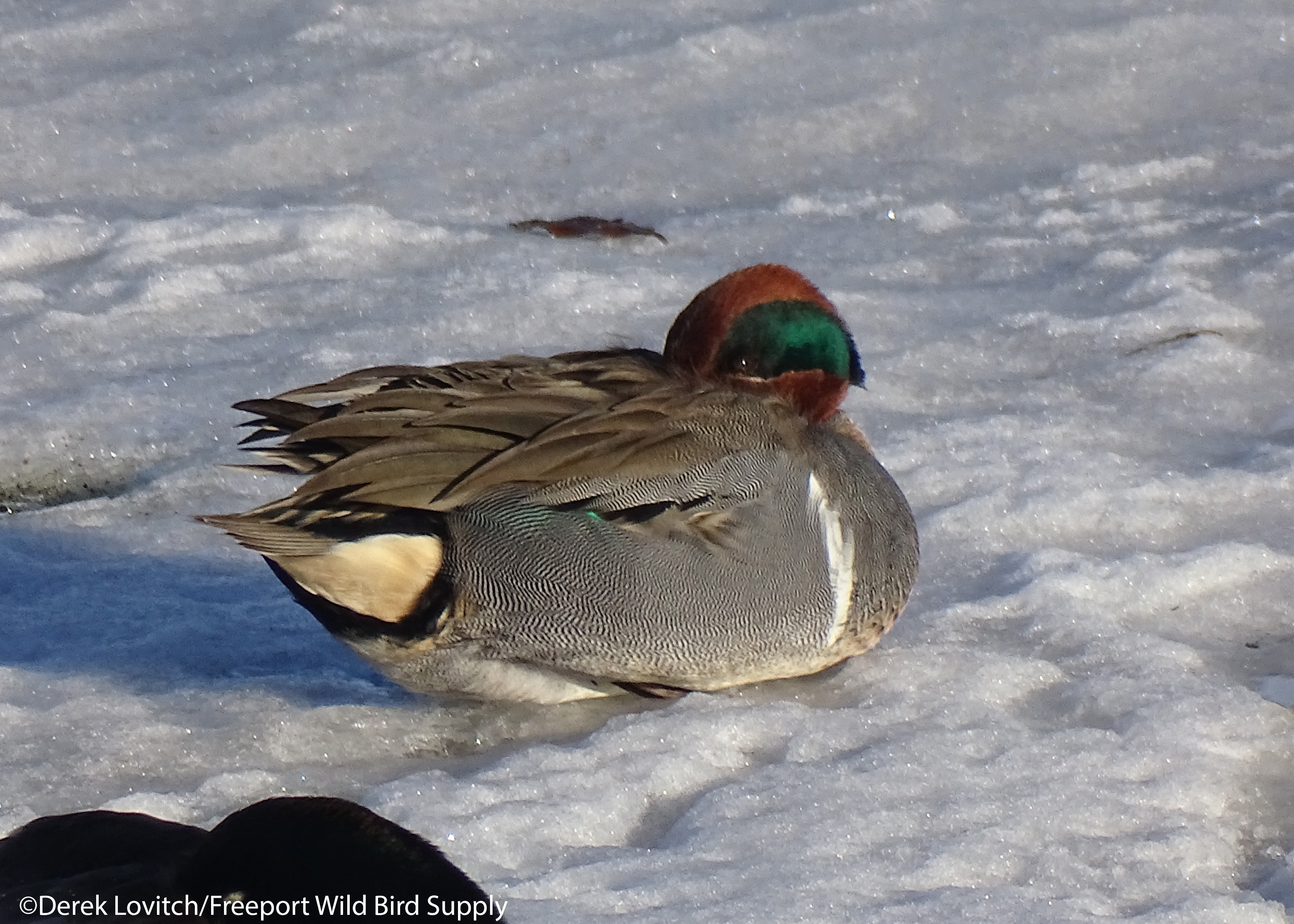
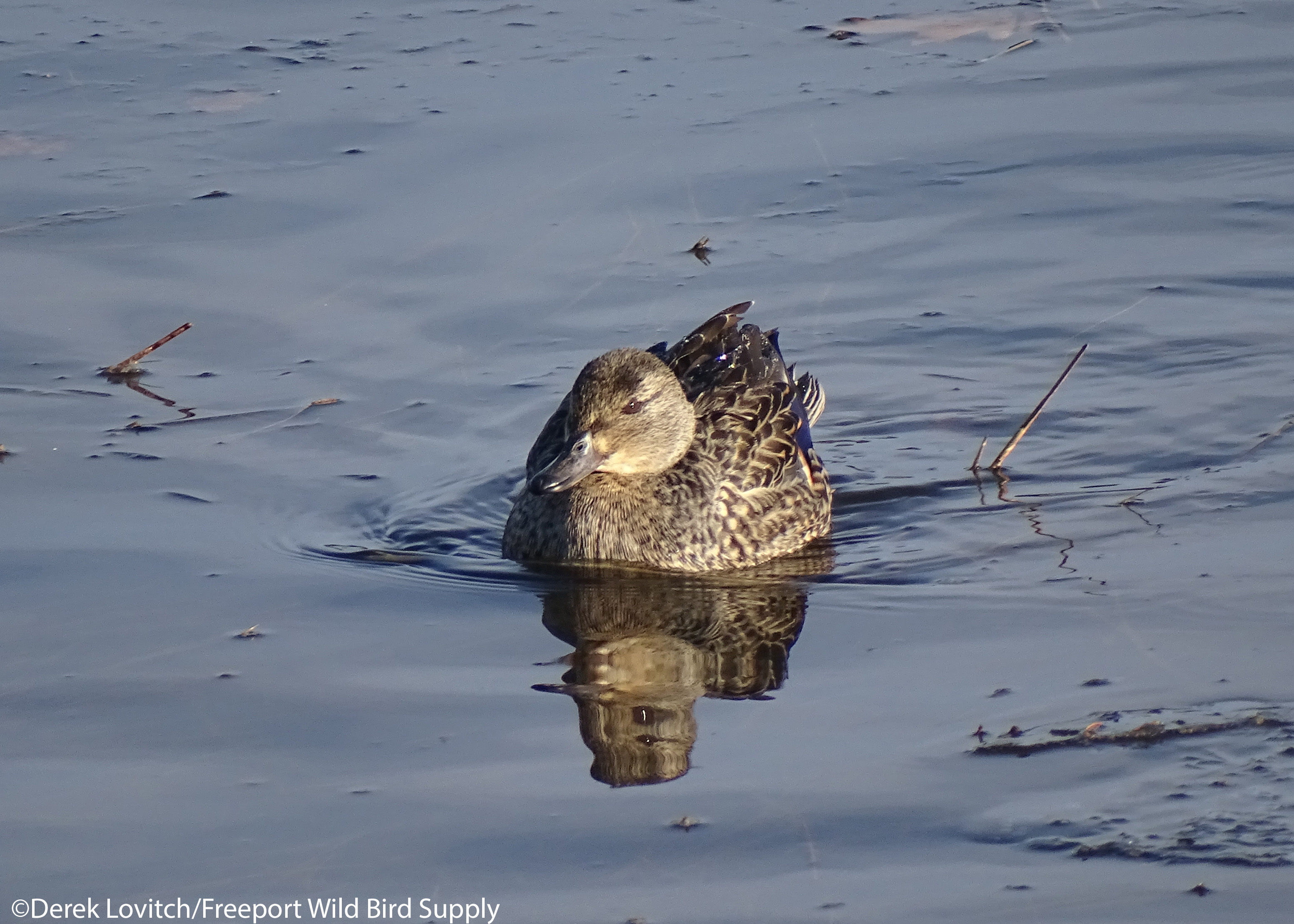
These tarrying drake Green-winged Teal were snoozing in the Mallard flock along the Auburn Riverwalk on the 16th (above) and at Mill Creek Cove in South Portland on the 18th (below). I don’t like to disturb birds, so I have lots of sleeping duck photos! I enjoy the calmness of it, and one can really take in the intricacies of the rest of the plumage that way.
A frigid start to the week yielded to a warming trend by week’s end. Will we see a “stirring of the pot” with the warm-up and upcoming storm system? My observations of note from the past seven days included concentrating waterfowl and a brutal, but productive day on the Southern York County CBC. Here are the highlights:
1 drake BARROW’S GOLDENEYE (first of season locally), Broad Cove Preserve, Cumberland, 12/13 (with Saturday Morning Birdwalk group).
Southern York County CBC, 12/15: Moody Sector with Jeannette:
2,168 individuals of 54 species, led by 440 Mallards, 272 Canada Geese, and 258 European Starlings. Landbirds – especially resident “yard birds” – and oceanfront waterbirds were insanely low, even given challenges of a bitter cold day with strong winds. Almost all landbirds besides starlings, Rock Pigeon, House Sparrow, and Song Sparrow were very low for us. Exceptions include a very high count of 23 Yellow-rumped Warblers (Ogunquit Beach dunes) and a total of 28 Horned Larks. Nonetheless, our roster of notable birds was above recent average, with highlights including:
_2_ ROUGH-LEGGED HAWKS (been a long time for us in this territory! Only 2nd time there was been more than on on this CBC!) one dark morph (probable immature) and 1 light morph immature, both seen soaring and hunting late in the afternoon from the north end of the Footbridge parking lot. Dark-morph spotted around 2:30pm, and seen again at about 3:30pm when the light morph appeared. We lost the dark morph, but the light bird eventually glided overhead and disappeared over the treeline, heading south.
1 KILLDEER, Ogunquit River Marsh from Bourne Ave
2 hen and 1 drake NORTHERN PINTAIL, Ogunquit Rivermouth
2+ Red Crossbills, flying over Bourne Ave.
1 Savannah Sparrow, Furbish Ave.
13 Sanderlings, Ogunquit Beach.
2+ Fish Crows, Anniversary Park, Auburn, and 2-3 along Auburn Riverwalk, 12/16 (see last week’s Highlights for a FICR discussion).
16 Snow Buntings, North River Road (in parking lot next to boat launch), Auburn, 12/16.
1 Swamp Sparrow, Florida Lake Park, Freeport, 12/17
1 Evening Grosbeak, here at the store, 12/17.
2 drake GADWALLS, 1 continuing pair Green-winged Teal, and 1 1st-cycle Iceland Gull, Mill Creek Cove, South Portland, 12/18 (photos above and below).
This hen Green-winged Teal, her plumage no less detailed and intricate than the male’s, was also dozing at Mill Creek Cove on the 18th. She woke up and took a swim though!
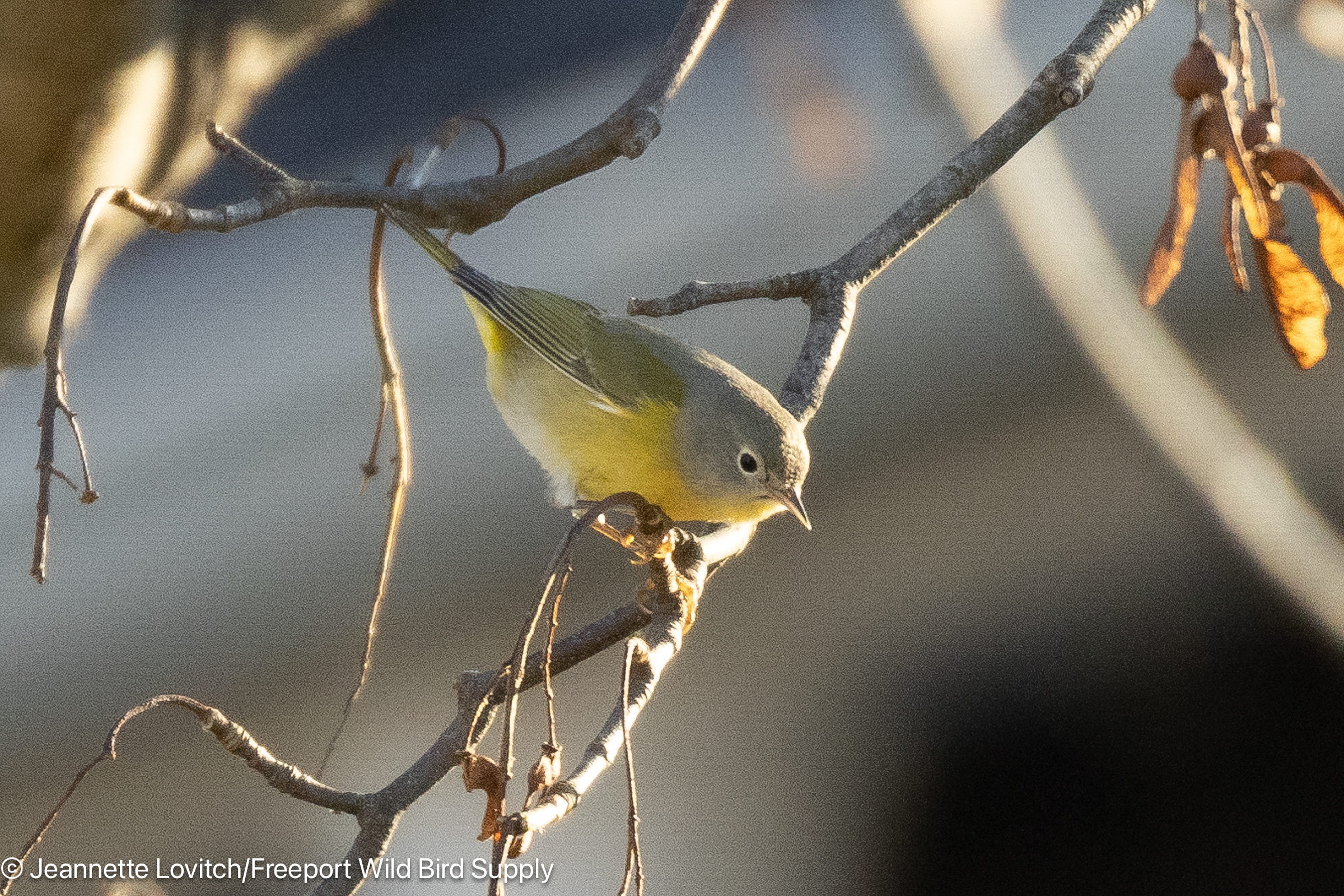
This Nashville Warbler (above) was one of two still on Peak’s Island as of the 1st, and this Orange-crowned Warbler (below) was one of four or five still on the island. Orange-crowned Warblers are pretty hardy, but if the Nashvilles are still hanging on, they would be questioning their life decision this morning! Speaking of, best wishes, wherever you are, to the Virginia’s Warbler that has not been seen since the 11/29.
Well, winter set in rather quickly this week, didn’t it? And no doubt much to the chagrin of the many vagrants, “pioneers,” and “half-hardies” that we have been enjoying recently. Despite the widespread below-zero temperatures by week’s end, I still saw four species of warblers this week. But I won’t expect that next week. Here are my observations of note over the past seven days.
2 continuing NASHVILLE WARBLERS, 3 Orange-crowned Warblers (at least 2 continuing), and 1 continuing COMMON YELLOWTHROAT, but no sign of the Virginia’s, Peak’s Island, Portland, 12/1 (with Jeannette. Photos above).
1 1st cycle Iceland Gull, Maine State Pier, Portland, 12/1 (with Jeannette).
1 ad. Red-shouldered Hawk, Ann St, Lisbon Falls, 12/4 (with Bill Thompson).
2 WILSON’S SNIPE and 4 Lesser Scaup, Lake Auburn, 12/4 (with Bill Thompson).
1 Fish Crow, Anniversary Park, Auburn, 12/4 (with Bill Thompson). 2-4 Fish Crows have been reliable here since April, including in the past few weeks.
1 Northern Flicker, our feeders in Durham, 12/4.
Scattered Evening Grosbeaks and Red Crossbills continue in the area this week as well.
The Peregrine Falcon pair of Lewiston-Auburn is back to frequenting their favorite winter perches, such as this rooftop tower near the Bernard Lown Peace Bridge. One of the pair had returned here after taking a run at a Bald Eagle.
I found Maine’s 4th or 5th Virginia’s Warbler on Peak’s Island on Monday, the 24th. Or at least I was confident that I did. I returned two days later to alleviate any lingering doubt, re-found it, saw it much better, and managed to photographed it! Many other birders have seen it through the 28th among a flock of other late/lingering warblers. Details below.
It was simply another incredible week of birding. Frustrated by not having found a mega-rarity since Monhegan (in an otherwise amazing fall for vagrants), I went to Peak’s Island on Monday. It worked! It was a six-warbler week for me, highlighted of course by the Virginia’s Warbler – a new state bird for me! My “Rarity Fever” is raging now! Here are my observations of note over the past eight days:
Evening Grosbeaks have become more regular locally this week, with single birds, mostly flyovers, here and there. Scattered 1 to a few Red Crossbills continue as well. Additionally, there was also a nice little surge in American Goldfinch and Pine Siskin numbers this week locally.
Plenty of the typical “late” migrants still around, such as Red-winged Blackbirds, Common Grackles, scattered Swamp Sparrows and Northern Flickers, Red-shouldered Hawk, etc.
1 Orange-crowned Warbler, Trout Brook Preserve, South Portland, 11/23.
Peak’s Island, 11/24: 1 almost-definite VIRGINIA’S WARBLER with 2 NASHVILLE WARBLERS (see below) on Seashore Ave, and 1 COMMON YELLOWTHROAT at Battery Steele.
1 NASHVILLE WARBLER, Commercial Street (near the cruise ship terminal), Portland, 11/26.
Back to Peak’s Island, 11/26: 1 VIRGINIA’S WARBLER (confirmed! Photo above) with 2+ NASHVILLE WARBLERS, 1++ Orange-crowned Warbler, and 1+ Yellow-rumped Warbler, Seashore Avenue. Complete details here:
4-5 NASHVILLE WARBLERS (4 continuing since being found by B. McKay et al on 11/26; I had a single bird at the other end of the hillside that was likely a 5th individual) and 1 Hermit Thrush, West Commercial Street, Portland, 11/28. This has been an insane fall for “late/lingering/pioneering/vagrant” Nashville Warblers here in Maine. Interestingly, this phenomenon appears to be rather widespread, as well above average numbers of NAWA are being seen along the Northeast coast as far south as Cape May this fall. Fascinating!
My best photo of the week was not of of the rarities, but I enjoyed this photo of one of four very cooperative Snow Buntings at Kettle Cove on the 23rd that I caught this one mid-stretch-break.
It’s been an extraordinary rarity season in Maine this fall. Perhaps it’s been the weather patterns, widespread drought, increasing use of neonicotinoid pesticides, or perhaps – according to a recent paper – geomagnetic storms!
But whatever it is, it’s made for an active month for vagrants here in Maine. Monhegan was epic at the end of September, October was pretty good on the mainland, and November has been exceptional. And, we still haven’t fully entered the rare-birds-at-feeders season, although there have already been quite a few noteworthy feeder visitors.
Personally, I’ve had a great fall, especially on Monhegan, and as you have read in my This Week’s Highlights blog (if you’re the one or two people who actually read it!), I’ve had quite a few notable finds, some fun chases, and overall great birding recently. But I hadn’t turned up a “mega” to add to the tally. On Monday, 11/24, I continued my search by taking a day to bird Peak’s Island, one of my favorite late fall birding destinations.
Arriving on the 7:45 ferry from Portland, I began my usual circuit, working around town to Picnic Point. The wrack line here always looks prime for a vagrant!
A short while later, at about 8:30am, I paused at one of my usual thickets on Seashore Ave, diagonally opposite the 5th Regiment Museum. There are always birds here, augmented by a dense tangle, some tall trees, and a few small feeders behind it.
On Monday, it was very active as usual, with numerous Northern Cardinals, a lot of House Finches, and other typical residents. Movement caught my eye in a stand of still mostly-still-leafed willow trees towards the back right of the thicket, approximately 25 yards from the roadside.
Three warbler-like birds were chasing each other. One appeared to be an aggressor, and I was hearing repeated short, high-pitched call notes that were either, or very similar to, Nashville Warbler. It’s been an extraordinary fall for “late” Nashville Warblers (although they are likely drift vagrants, mirror vagrants, or even reverse migrants rather than just behind schedule), so this was not too surprising. But three non-Yellow-rumped Warblers in one tree? That’s notable on November 24th!
The first bird I saw well was a bright, adult male-type Nashville Warbler (NAWA). The birds, still chasing each other and not sitting still, were not easy to see, but the second bird I got my binoculars on was rather confusing. I observed it for as long as I could, but the distance was just a bit too far.
A very drab Orange-crowned Warbler (OCWA) first came to mind, especially with the yellow undertail coverts, but the bird was really, really gray. A flat, cool, not at all yellowish or greenish gray. It was flicking its tail like a NAWA, but even more emphatically. It turned around, and I saw its breast, and there was a small amount of yellow there. Wait, what!? The patch was smaller and more isolated than a drab female Northern Parula, but there were no wingbars are at all, and it was too long-tailed.
I noted an eye-ring, but the distance made it hard to tell how bold it was, whether or not it was complete, or even if it was really white like a NAWA. I went for my camera, hoping to zoom in to see detail, but the birds were far too active and in too dense of a twiggy tree, so coupled with the distance, this was a complete fail.
Two birds departed to the right, but the bird of interest remained for another minute or three, calling very similarly to a Nashville Warbler, but quite emphatic. I then lost it, too.
By now, I was putting the pieces together and was under the suspicion that this was a Virginia’s Warbler, but I was not convinced. With all three birds departing as of 8:48, I opened up my Sibley app to refresh my memory (it’s been quite some time since I have seen a VIWA!) and listen to the call. The call recording on the app included two pitches of calls, the second of which was spot-on for what I was hearing from this very drab, gray, not-quite-Nashville warbler.
Hmm…but why didn’t I notice the yellow rump? Or was I just focusing on the rest of the bird? All of the views were so painfully brief, and I never saw the complete bird at one time.
About 10-15 minutes later, the trio returned: the adult male-type NAWA, a second, drab immature-female-type NAWA, and the likely VIWA. In a brief view, I noticed the all gray head, reminiscent of a female American Redstart, and confirmed the presence of yellow in the center of the breast.
The birds departed again, to the right, across Ryefield Street, but I only glimpsed one bird and it was likely the VIWA. I walked around the block, noticed a few feeders on New Island Avenue, but I did not find any warblers. Since they had returned to the original stand of willows three times now, I stood in place now, about a full hour after my original observation and I started sending out texts and scribbling notes.
I noticed that the recycling container at the house adjacent to the thicket had been taken in. Damn; I missed the homeowner! I needed to get closer to the thicket if the bird returns, but I am absolutely unwilling to trespass or enter yards without being invited/given permission. Many of you have understood this from my tours to Monhegan, but I stand by this elsewhere. But did it cost me today?
Happily, a short while later, the homeowner was in his yard and after a brief chat, allowed me to hang out in his backyard. It was now 10:28. He even brought me a comfy chair! I was so appreciative, now that I was camped out next to the willows, no warblers reappeared. I took another loop around the block, then returned to my chair. A single Evening Grosbeak dropped into the thicket, and I glimpsed what was almost certainly a Lark Sparrow within a House Sparrow flock, but I did not pursue it to confirm.
By 11:15, I was cold and needed to get a real walk in, so I departed, birding my usual circuit out to and through Battery Steele (found a Common Yellowthroat there) and otherwise enjoyed a rather birdy day on the island. A Hermit Thrush, a couple of Swamp Sparrows, a growing cadre of Red-necked Grebes offshore, and tons of Red-breasted Nuthatches in the woods. Song Sparrows were also unusually abundant.
I walked into town for lunch to go (the wraps at Unruly Girls’ Peaks Cafe are fantastic as always, but the hot chai was even more clutch!). I was back to the thicket at 1:36. The sun that broke through while I was far away had mostly been enveloped by clouds once, and the wind was picking up. Neither was particularly helpful. I departed at 2:25 to catch the 2:45 departure (I had planned on leaving before lunch!)
I was frustrated. I knew what I saw, but was bothered by what I did not see, and how unsatisfying and conclusive my views were. I felt confident that it was indeed a VIWA, but I don’t like birding by default or identification by the sum of all parts!
I thought about going back the next day but couldn’t. I must say, the oral surgery may have been less painful than having this bird get away!
I looked at guides, viewed photos online, and concluded there was little doubt that I had seen a VIWA. But the mind can play tricks on you, and memory can be affected by the post-observation studies, so it was bothering me. Jeannette asked if I was going to “count it?”
I didn’t know. So, on Wednesday morning, I decided to be a little late for work and go back to Peak’s Island. I couldn’t help it; I had to! Jeannette agreed.
Walking to the ferry terminal, I stumbled upon a Nashville Warbler on Commercial Street, near the cruise ship terminal, which I took as a good sign. 7:45 ferry, 8:05 arrival on the island, and I was to the thicket by 8:30, after a thorough check on Picnic Point on the way (the foggy conditions had me hoping to refind the bird on the wrack line like so many late-season insectivores find sustenance).
I stared at the thicket, but overall bird activity was much slower than two days prior. At 8:55, I began walking down Seashore, towards Maple Street. I soon heard warblers! I first heard a Yellow-rumped Warbler from quite some distance, but then heard NAWA, or NAWA-like, calls.
In the side yard of 66 Seashore, I found not three, but 5 warblers: 2 NAWA, a YRWA, and a drab Orange-crowned. Very drab. Hmm…could I have blown this mystery warbler? Was this all I had seen? No, no way! And then warbler #5 popped out: Virginia’s Warbler!!!!!
Between this yard, and the first yard on Maple Street a minute later, I had several perfect views at varying distances, and all field marks were observed. With a good look, there sure wasn’t any mistaking this bird!
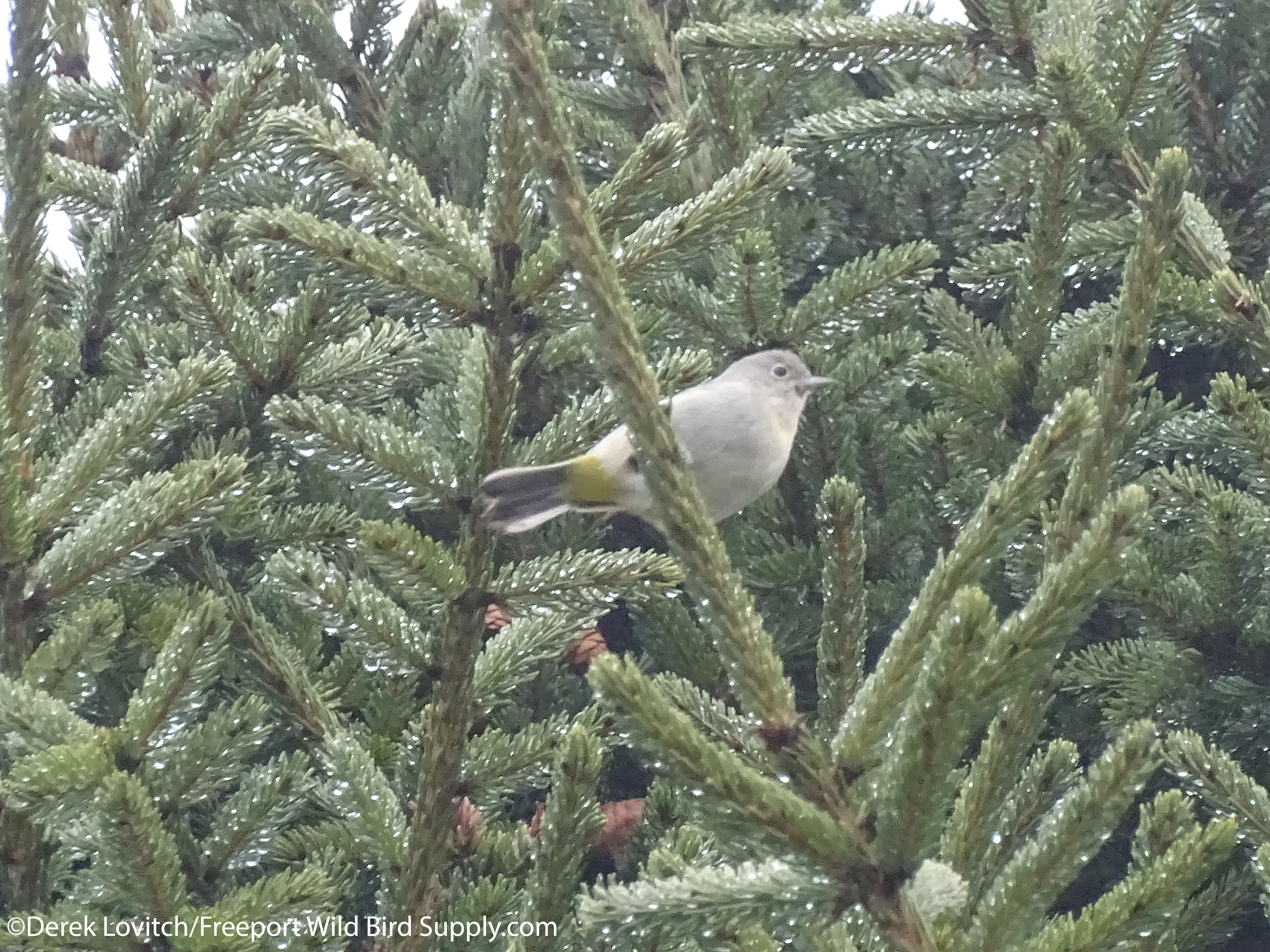
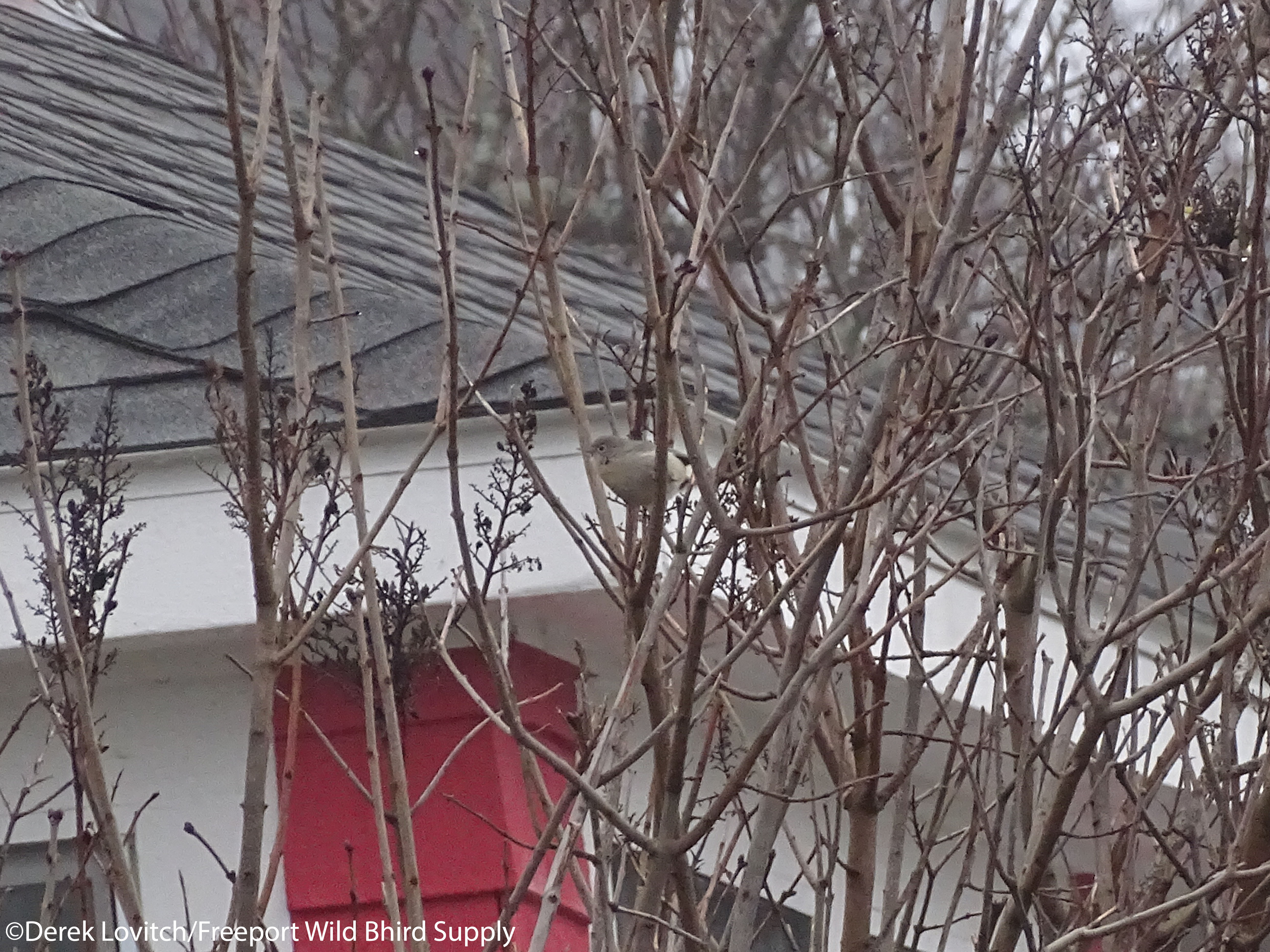
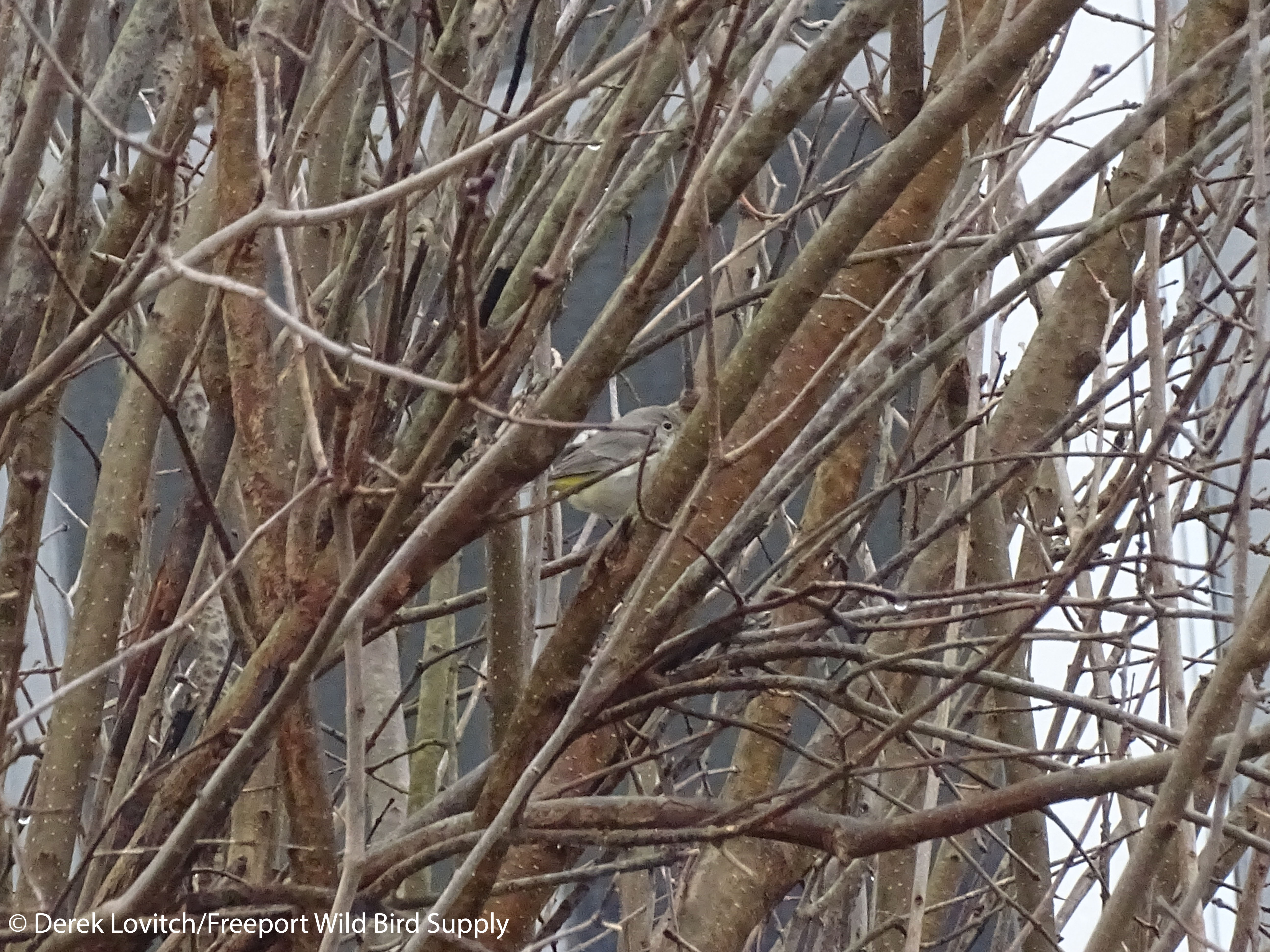
Thin, slim warbler with a thin bill; bold but thin white eyering; cool gray upperparts with no wingbars, and here, you can just make out part of the yellow rump.Most of my views – and all of them on Monday – were like this: small parts of a small bird between twigs! Here, however, you can see the plain gray overall color, complete, thin eye-ring, and a hint of the yellowish undertail.
I followed the flock back towards the original thicket and willow trees, but I lost their tail. I decided to be responsible and head back for the 10:00 ferry and get to work. I also had left my Tylenol in the car. Besides, my job here was done! This is the 4th or 5th record for Maine, and the first away from Monhegan.
Addendum: Several friends arrived on the next ferry, and after a short while found the bird in the same area, often returning to the original thicket from Monday. I was so focused on identification of the VIWA that I probably didn’t take a full inventory of all of the warblers that were around. They had at least 4 OCWA now, 2-3 NAWA, 2 YRWA, and crushing views of the VIWA. The bird was seen by many through the afternoon. And thanks again to the homeowners who accepted my presence in their yard and invited others in later that day!
I also can’t help but wonder if there will be a “Patagonia Picnic Table Effect” as birders descend upon and follow this possibly-growing flock of unseasonable warblers. Could I be heading back to Peak’s soon? I’ll at least be able to grab another Mediterranean wrap this time.
12/1 UPDATE: The VIWA has not been seen since the afternoon of 12/29. Birders searched for it on 12/30 and had 1+ NAWA and 4 OCWA in the area. Today, Jeannette and I spent the morning looking for it to no avail. In the Seashore Avenue area, we had 2 NAWA and 2-3 OCWA. As we widened our search, Jeannette and I had a continuing COMMON YELLOWTHROAT in the same spot as last Monday and another OCWA, both near Battery Steele.
















 Maine Birding Field Notes