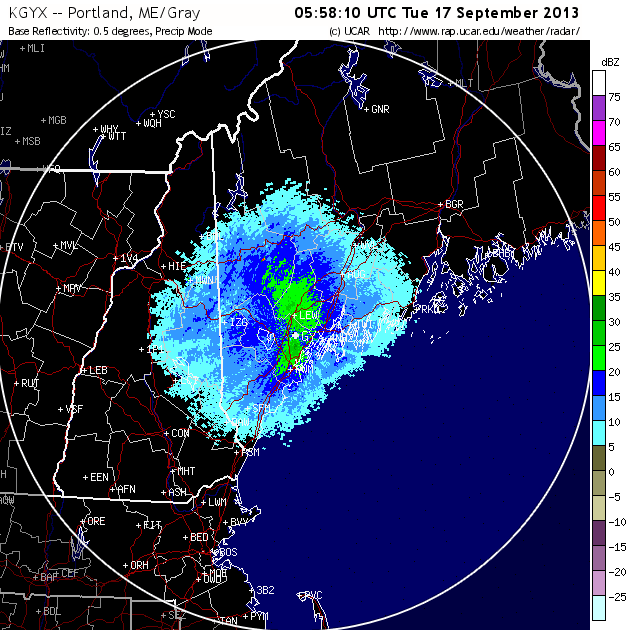
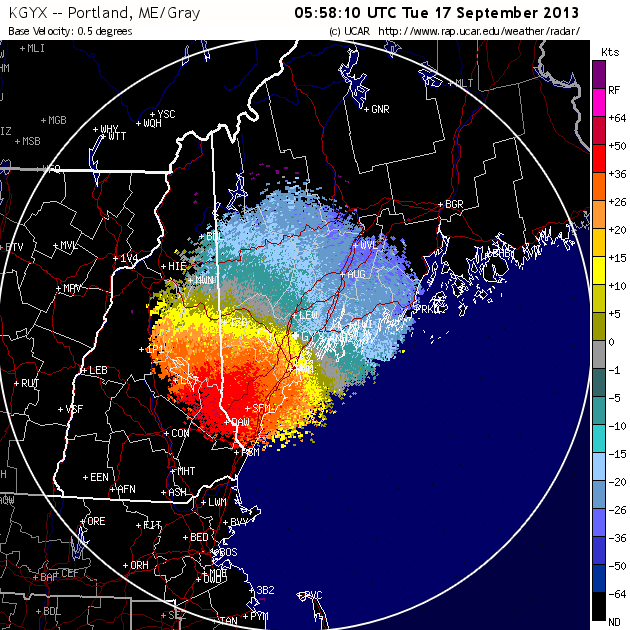
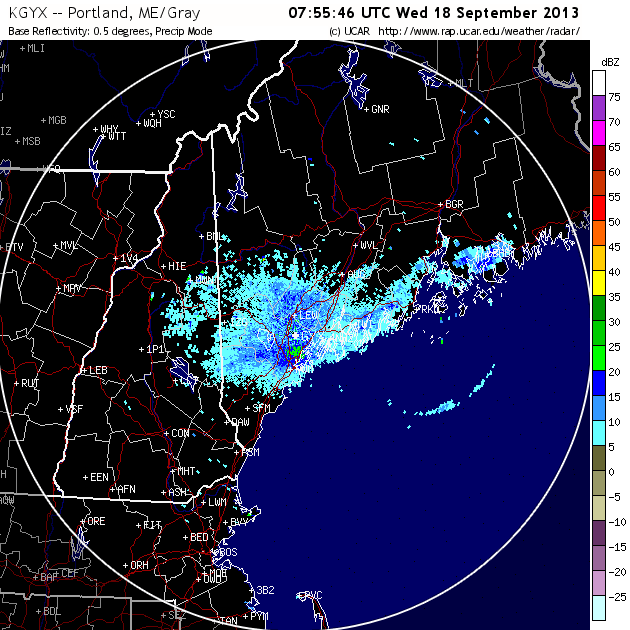
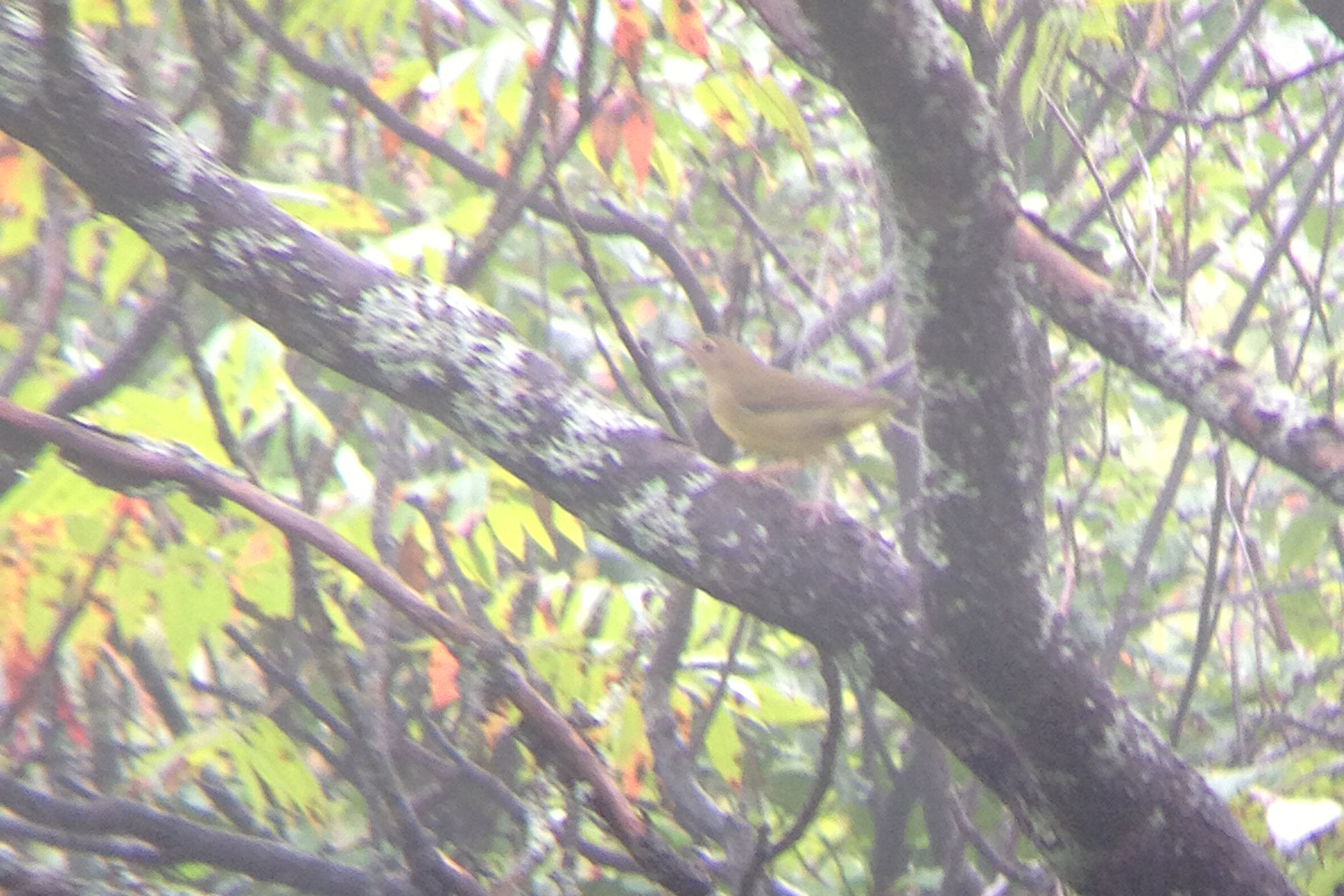
Huge Morning Flight at Sandy Point!
My last blog entry ended with a little bit of foreshadowing, did it not? But before we get to Sandy Point this morning, let us take a moment to review the radar images from the weekend for comparison.

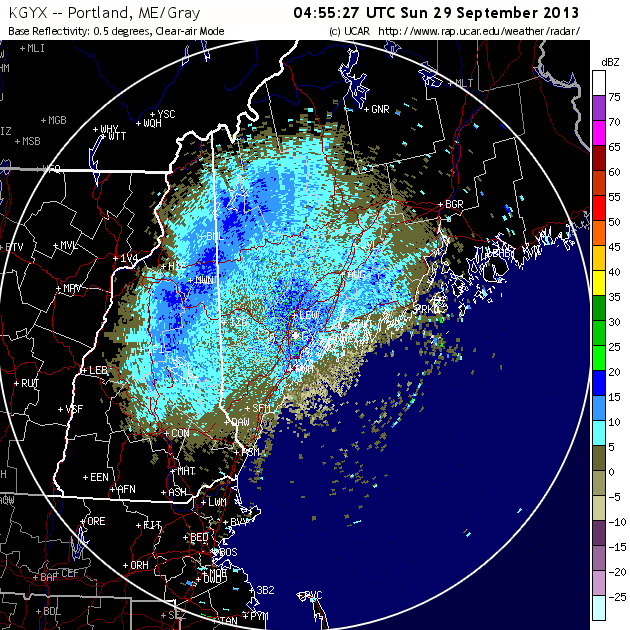
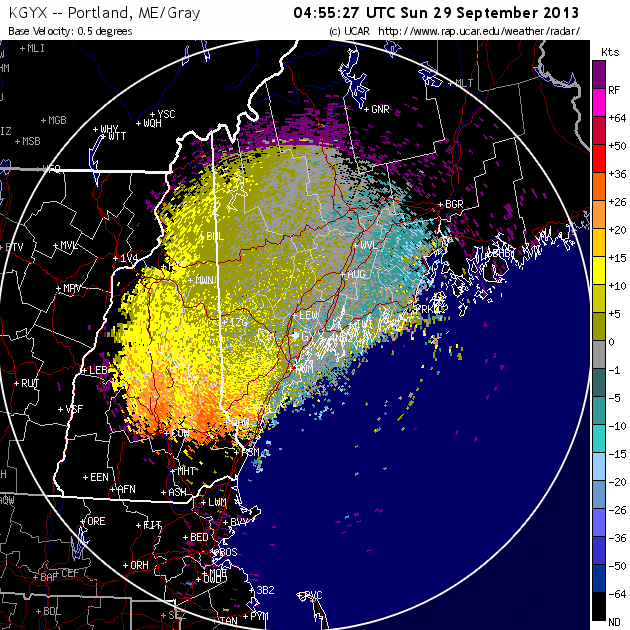
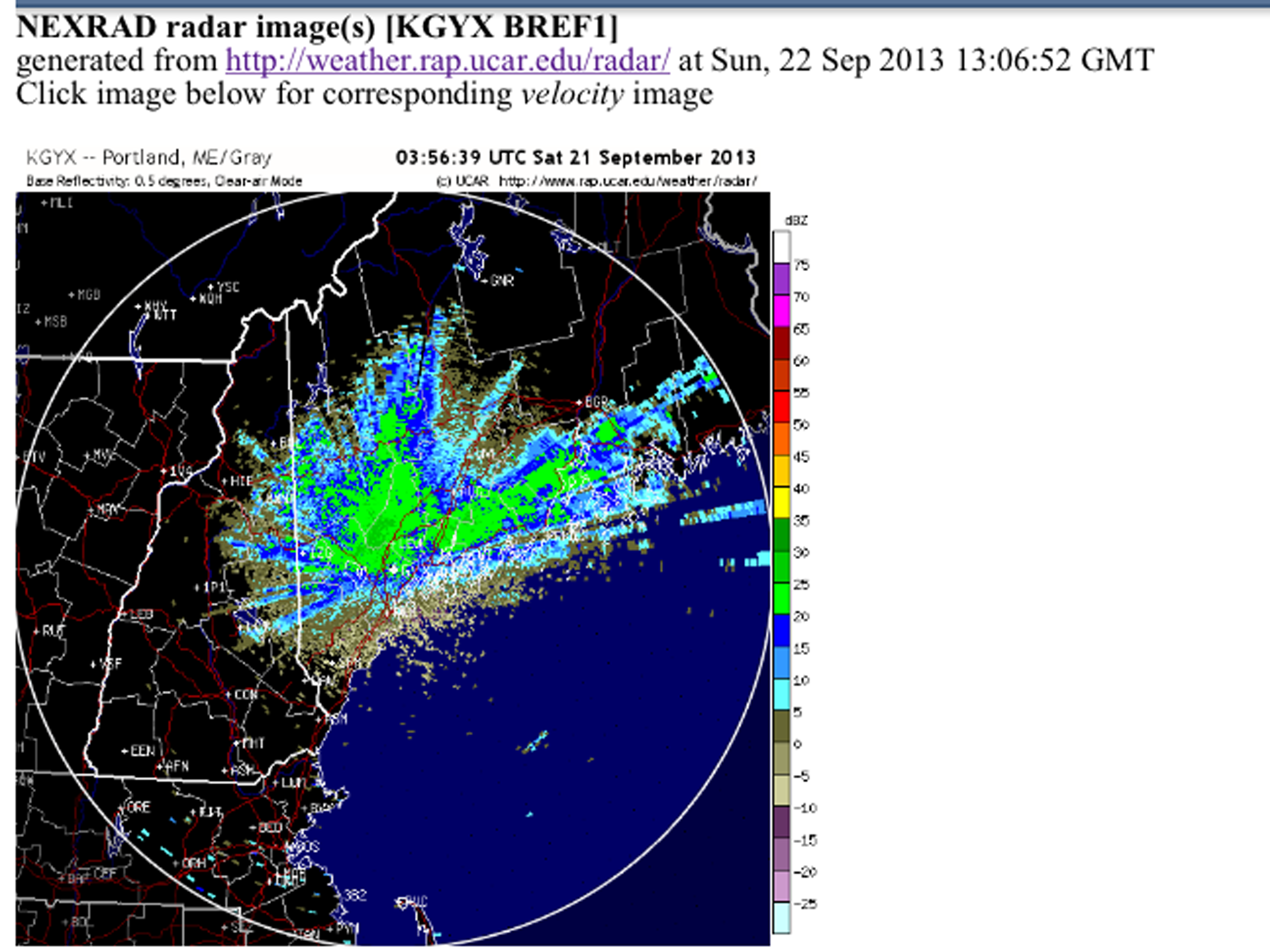
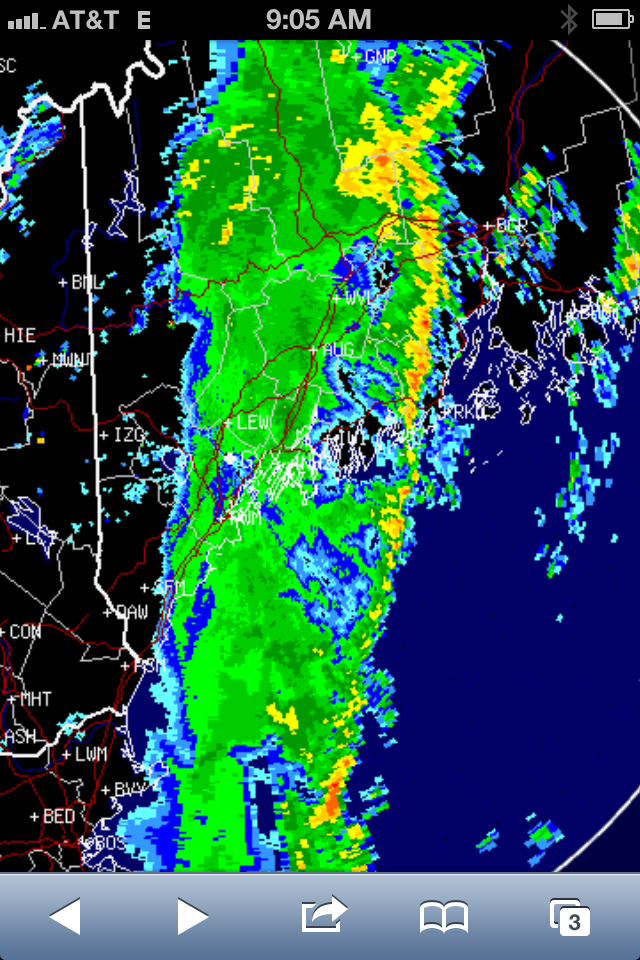
This is the 12:00am image from Sunday.  This is what “no migration” looks like on the radar.  You can also see the rain approaching from the west.
12am radar, 9-22-13

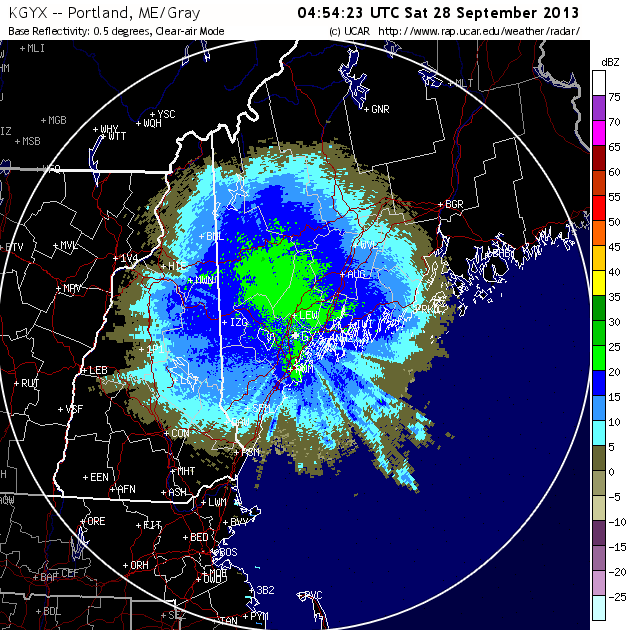
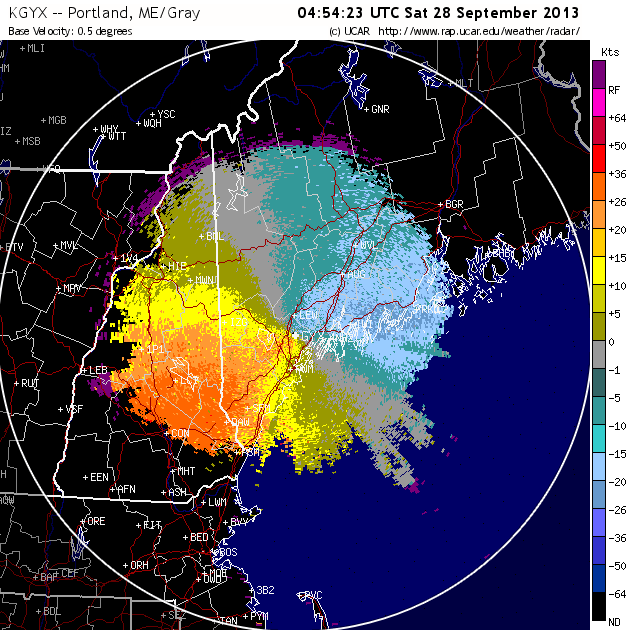
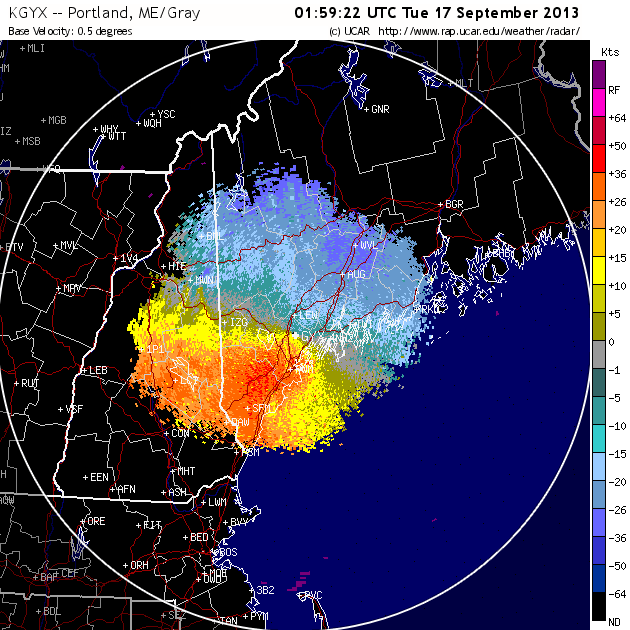
Now this is the midnight image from Saturday.  This is what “I have no idea what’s going on” looks like on the radar.  While anything from some weird warping of the radar beams from changes in air temperature to a simple malfunction could result in this, what it is NOT is a lot of birds.  It’s too irregular…and bird’s don’t “explode” in narrow bands!
IMG_1575_edited-1 IMG_1576_edited-1

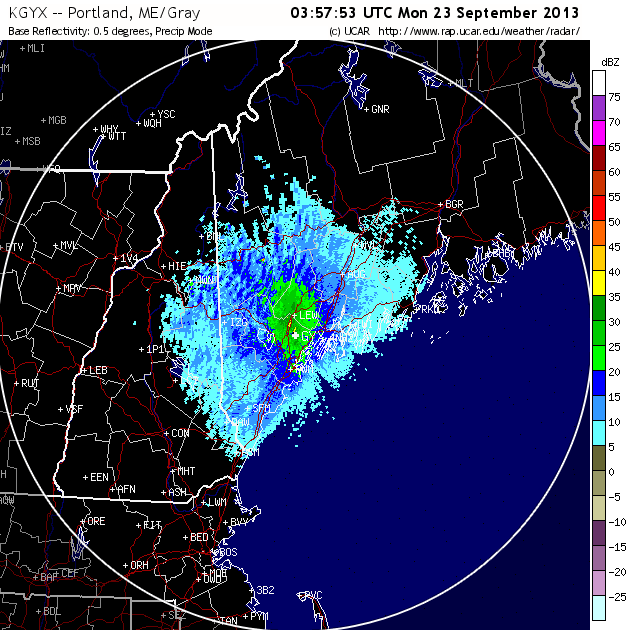
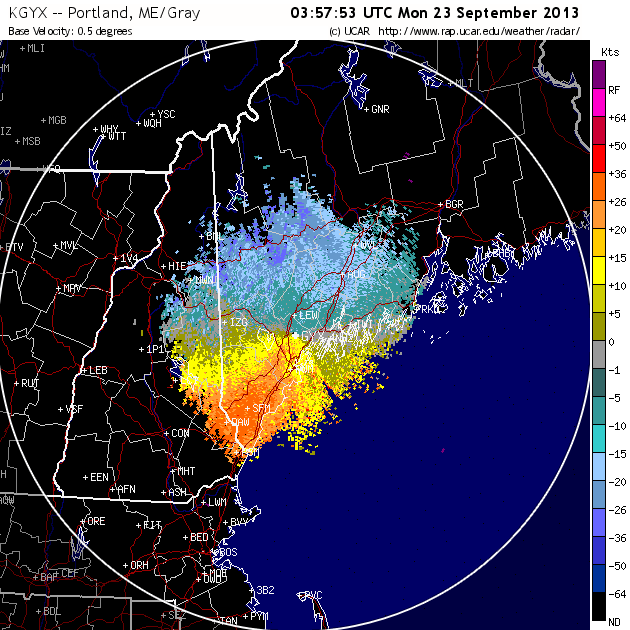
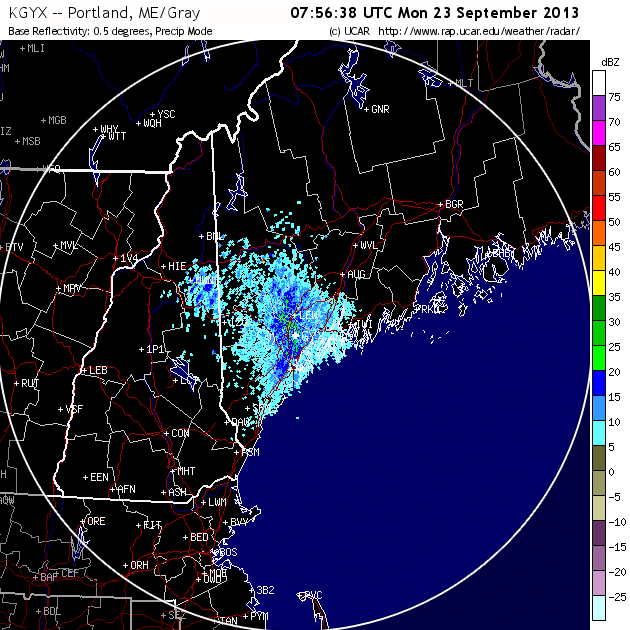
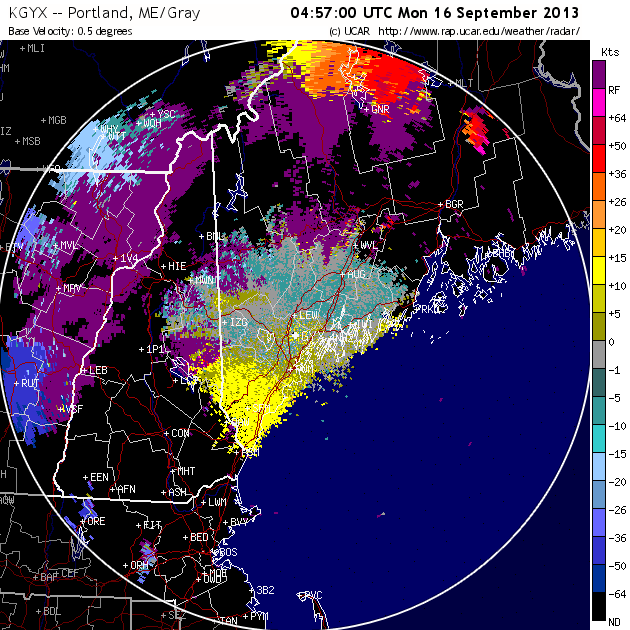
So, compare those to what “a whole boatload” of birds looks like.  Here are the 10pm, 12am, 2am, and 4am base reflectivity and velocity images from last night.

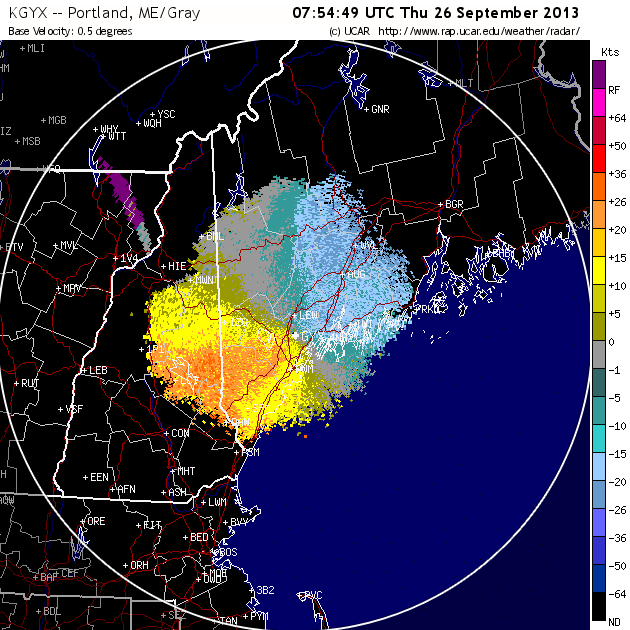
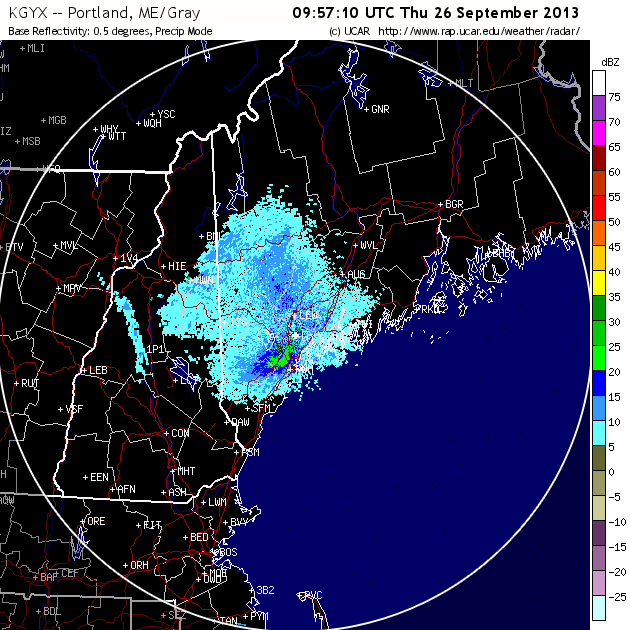
10pm radar, 9-22-13 10pm velocity, 9-22-13

12 am radar, 9-23-13 12 am velocity, 9-23-13

2am radar, 9-23-132am velocity, 9-23-13

4am radar, 9-23-134am velocity,9-23-13

Yeah, it would have been nice to be on Monhegan this morning.  But I was in my other sanctuary – my office at Sandy Point.  And this is what happened:

6:28 – 10:05am.
43F, increasing W to NW, clear.

1338 Unidentifed (*2nd highest)
416 Northern Parulas (* Seriously, how are there any more parulas to come through!  This is the second highest count of all time, and now all three of the highest tallies are from this year!)
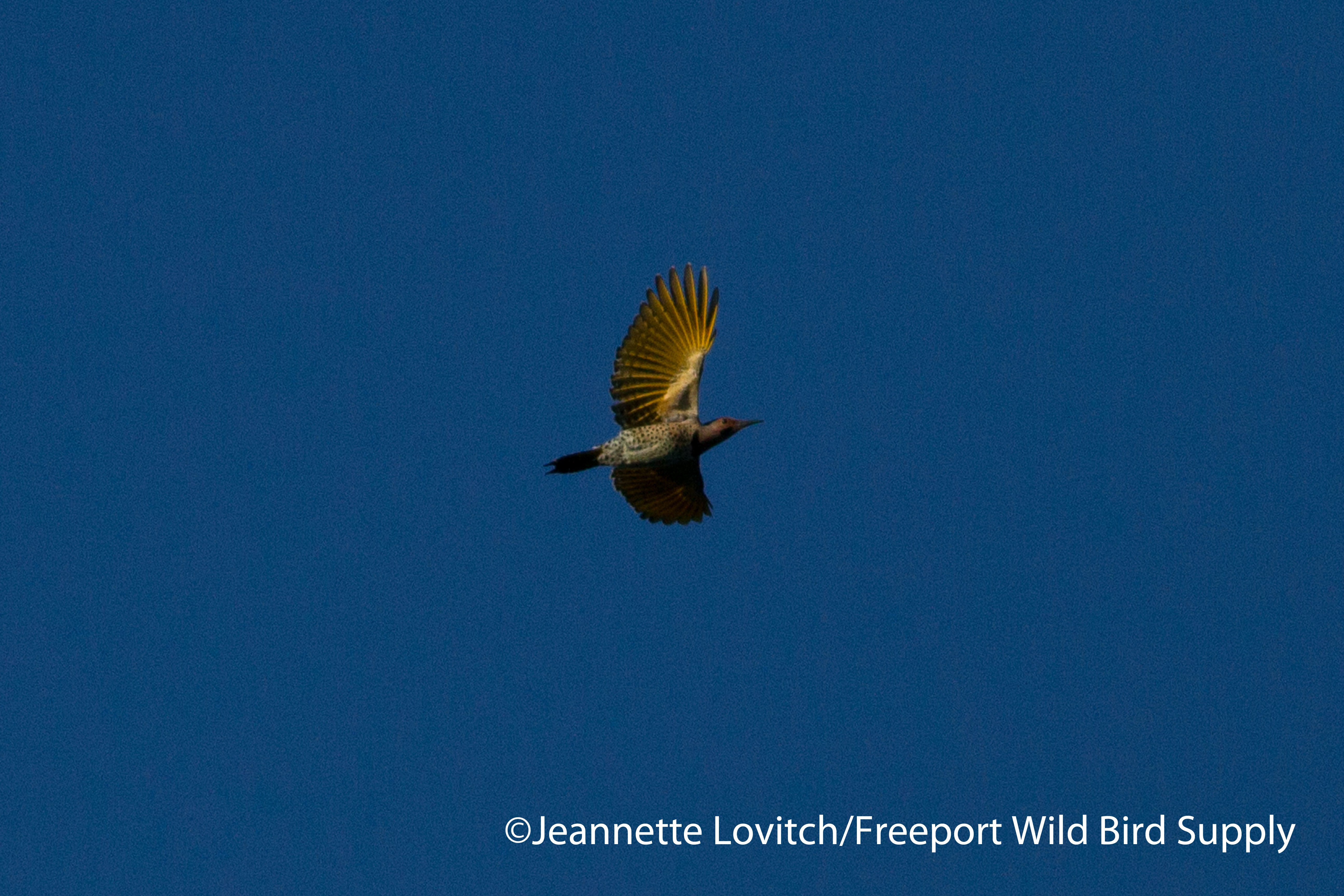
281 Northern Flickers
179 Black-throated Green Warblers (*2nd highest)
163 Blackpoll Warblers
91 Yellow-rumped Warblers
43 Black-and-white Warblers (*record high)
39 Red-eyed Vireos
35 American Redstarts
29 Blue Jays
29 Ruby-crowned Kinglets
23 Yellow Warblers
22 Blue-headed Vireos
21 Scarlet Tanagers (*record high)
21 Dark-eyed Juncos
19 Cedar Waxwings
18 Magnolia Warblers
17 Nashville Warblers (*record high)
17 American Goldfinches
13 Black-throated Blue Warblers
12 Eastern Phoebes (* ties high)
11 Swainson’s Thrushes
9 Palm Warblers
6 Rusty Blackbirds
5 American Robins
4 Unidentified vireos
4 Chestnut-sided Warblers
4 White-throated Sparrows
3 Least Flycatchers
3 Cape May Warblers
3 Bay-breasted Warblers
2 Common Loons
2 Broad-winged Hawks
2 TUFTED TITMICE (rarely seen crossing)
2 Unidentified thrushes
2 Golden-crowned Kinglets
2 Blackburnian Warblers
2 Common Yellowthroats
1 Osprey
1 American Kestrels
1 Yellow-bellied Sapsucker
1 Eastern Wood-Pewee
1 Common Raven
1 Philadelphia Vireos
1 Veery
1 Tennessee Warbler
1 CONNECTICUT WARBLER (My third of the season here; it’s the fall of the CONWs in Maine!)
1 Northern Waterthrushes
1 Rose-breasted Grosbeak
1 DICKCISSEL (third of the season here)
1 Baltimore Oriole

Total = 2, 905 (4th highest tally all time for me)

DSC_0016_REVIonAlternate-leafedDogwood,Sandy Point, 9-23-13DSC_0026_SWTH_onWinterberry2,Sandy Point,9-23-13
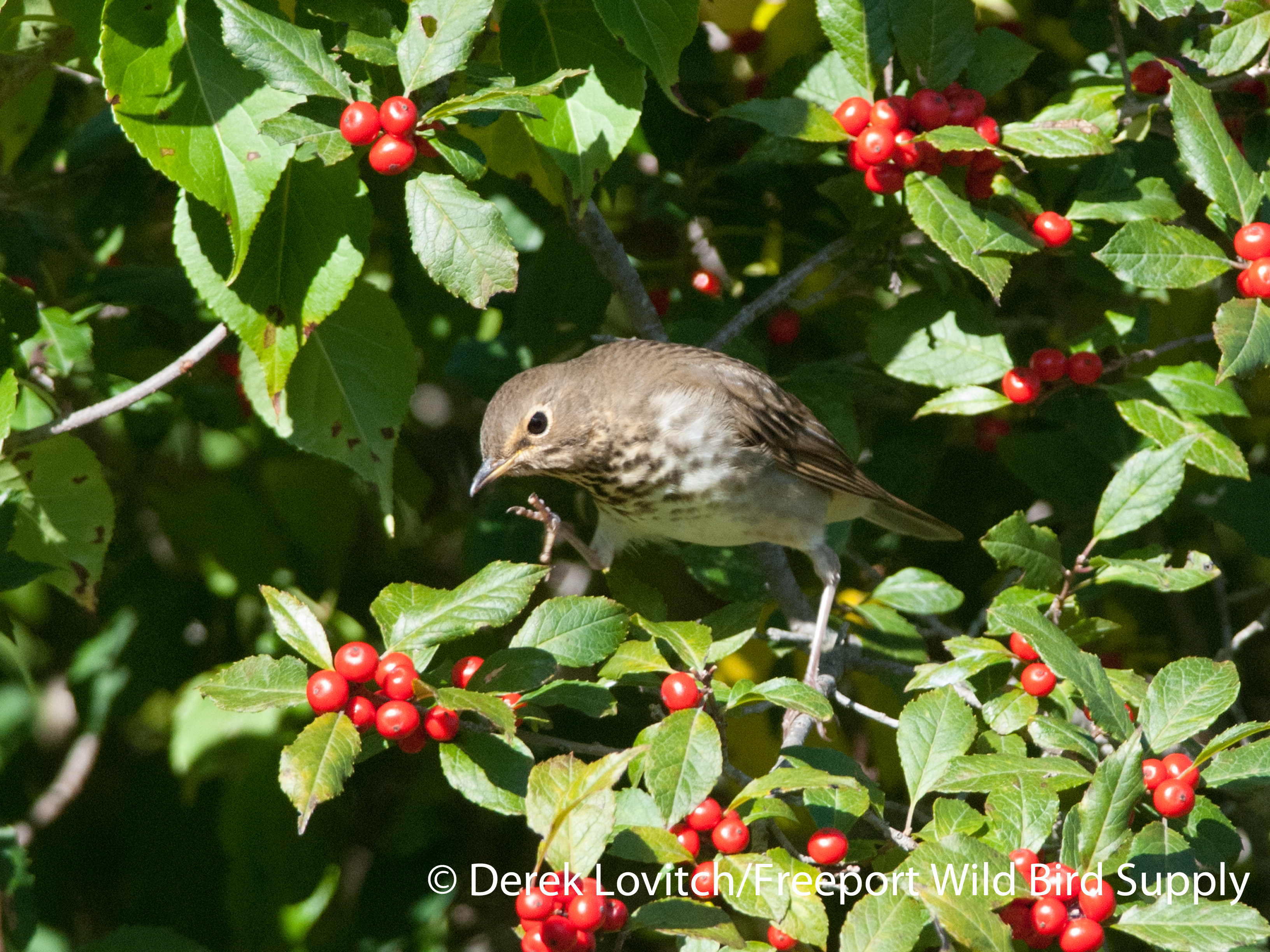
Some of the migrants pause long enough at Sandy Point to do a little snacking.  Here’s a Red-eyed Vireo eating Alternate-leafed Dogwood fruits, and a Swainson’s Thrush stepping out into the sun to dine on Winterberries.

DSC_0034_WISN,GreelyRoad,9-23-13_edited-1
A little post-Sandy Point birding yielded two Wilson’s Snipe trying to stay hidden along the edge of a puddle along Greely Road in Cumberland.

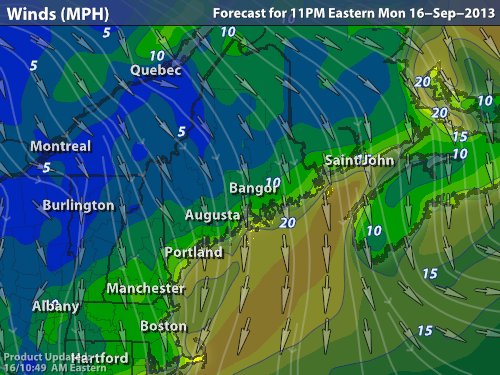
And tonight looks just as good…perhaps even a little better with a more northwesterly flow.  See ya at the bridge at sunrise!
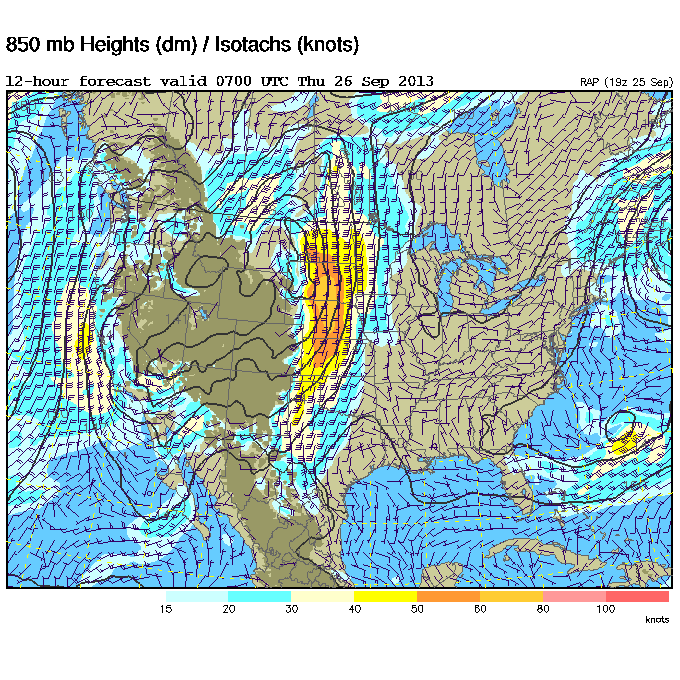
wind forecast, 9-23-13

Monhegan Island, 9/20-22/2013

On a morning with a big overnight migration in the fall, there’s no where I’d rather be than SandyPoint.  I just wish there was a direct ferry from there right to MonheganIsland.  Any other time, I would just rather be on Monhegan.

While our annual MonhegZEN Fall Migration Weekend coming up this weekend (still some space available), Jeannette and I headed to the island Friday through Sunday for a few days of birding and visiting with friends.  It was kinda odd being there without a group!  Not surprisingly, I did not bird much less hard.

I’ll post some radar images from the weekend on a forthcoming blog entry that I hope to post by day’s end.  A decent flight Thursday night into Friday produced a fair amount of birds on the island, even after our late (relatively speaking) arrival at 10:00am, and even though it seemed – as is often the case on calm mornings – birds that arrived at dawn continued on to the mainland.  Three of our first handful of species, however, were Philadelphia Vireo, Cape May Warbler, and Yellow-billed Cuckoo.  Welcome (back) to Monhegan.

The birding improved in the afternoon, highlighted by a Western Kingbird.
_MG_9983_edited-2

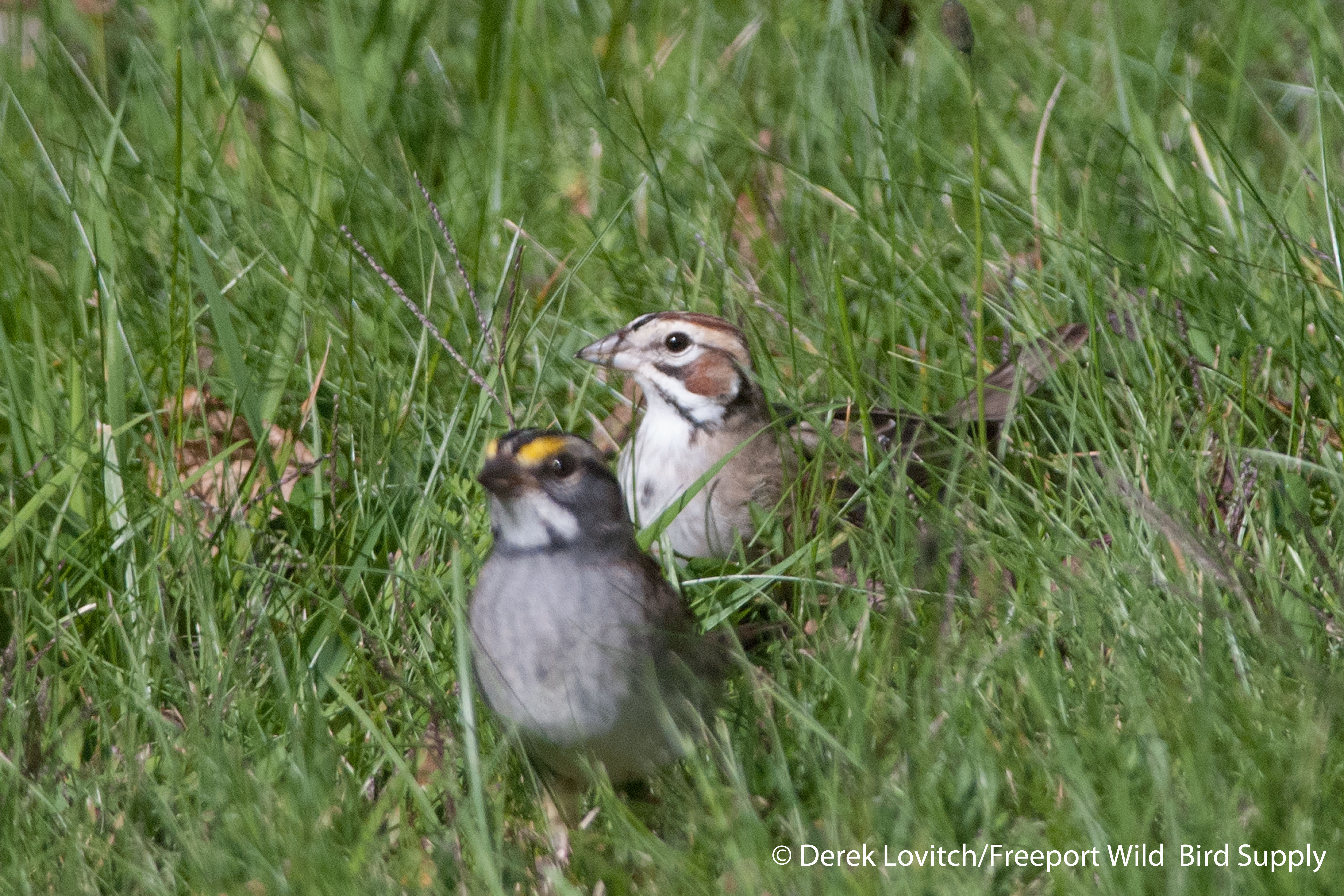
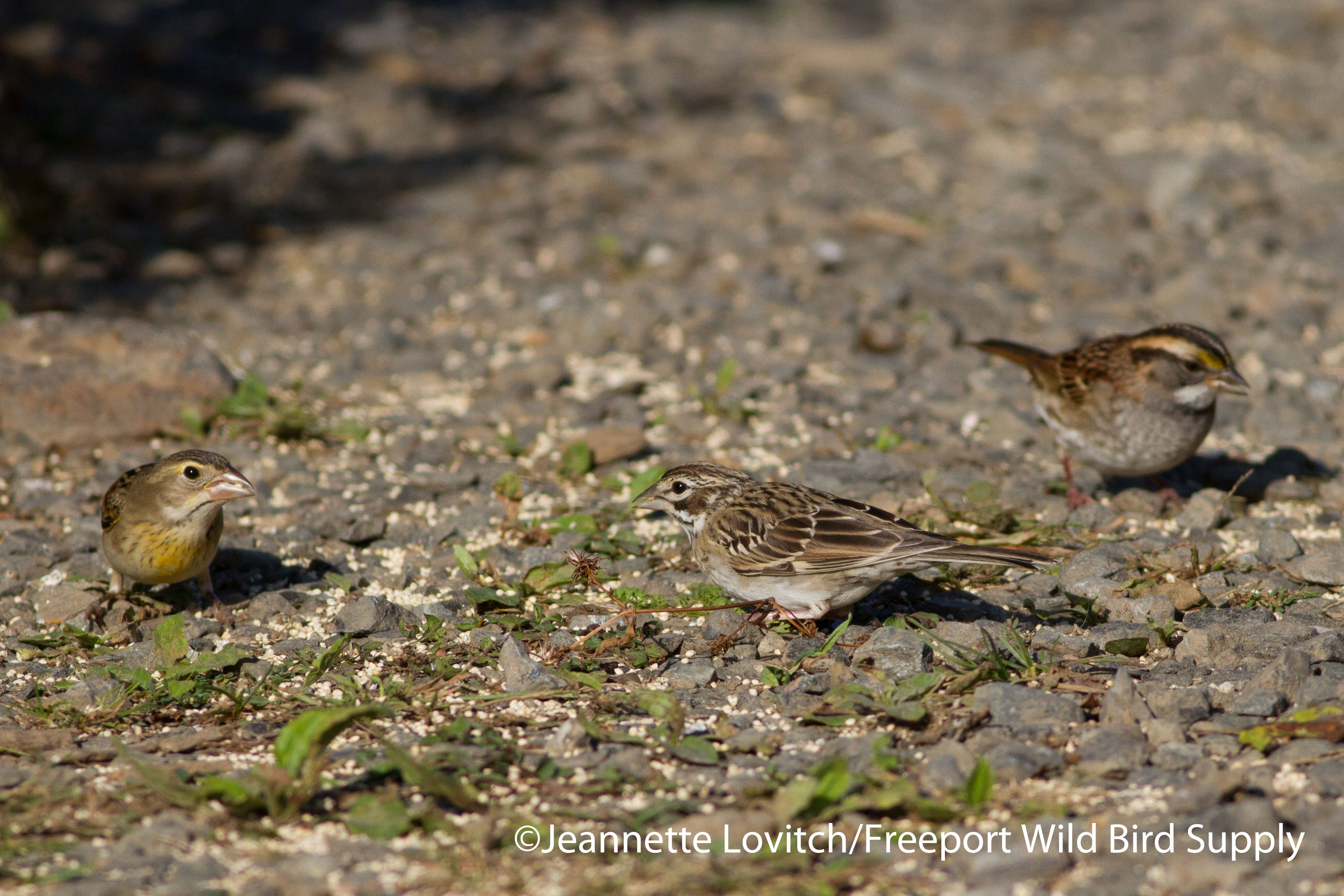
A Lark Sparrow and two Dickcissels – all present for a few days – were enjoyed (here, one of the Dickcissels with the Lark Sparrow and a White-throated Sparrow in the background). Typical “Monhegan Trash Birds:” birds that are noteworthy anywhere else in the state but are fully expected in an autumn visit here.
_MG_0050_edited-2

We ended up with 67 species of birds on the day, including 11 species of warblers.  Yup, a slow day of birding on Monhegan beats a good day of birding almost anywhere else.  Light southerly winds that developed over the course of the day became calm by nightfall, and call notes early in the night were suggestive of birds departing the island.
IMG_1571

With a southerly flow aloft, I didn’t have high hopes of a lot of new arrivals for the next morning.  The radar image was, simply put, was weird – some sort of temperature anomaly or perhaps a malfunction, so I couldn’t use that to confirm or alleviate my concerns.  A mere handful of bird overhead at dawn on Saturday morning confirmed it though – there was not much on the move overnight.

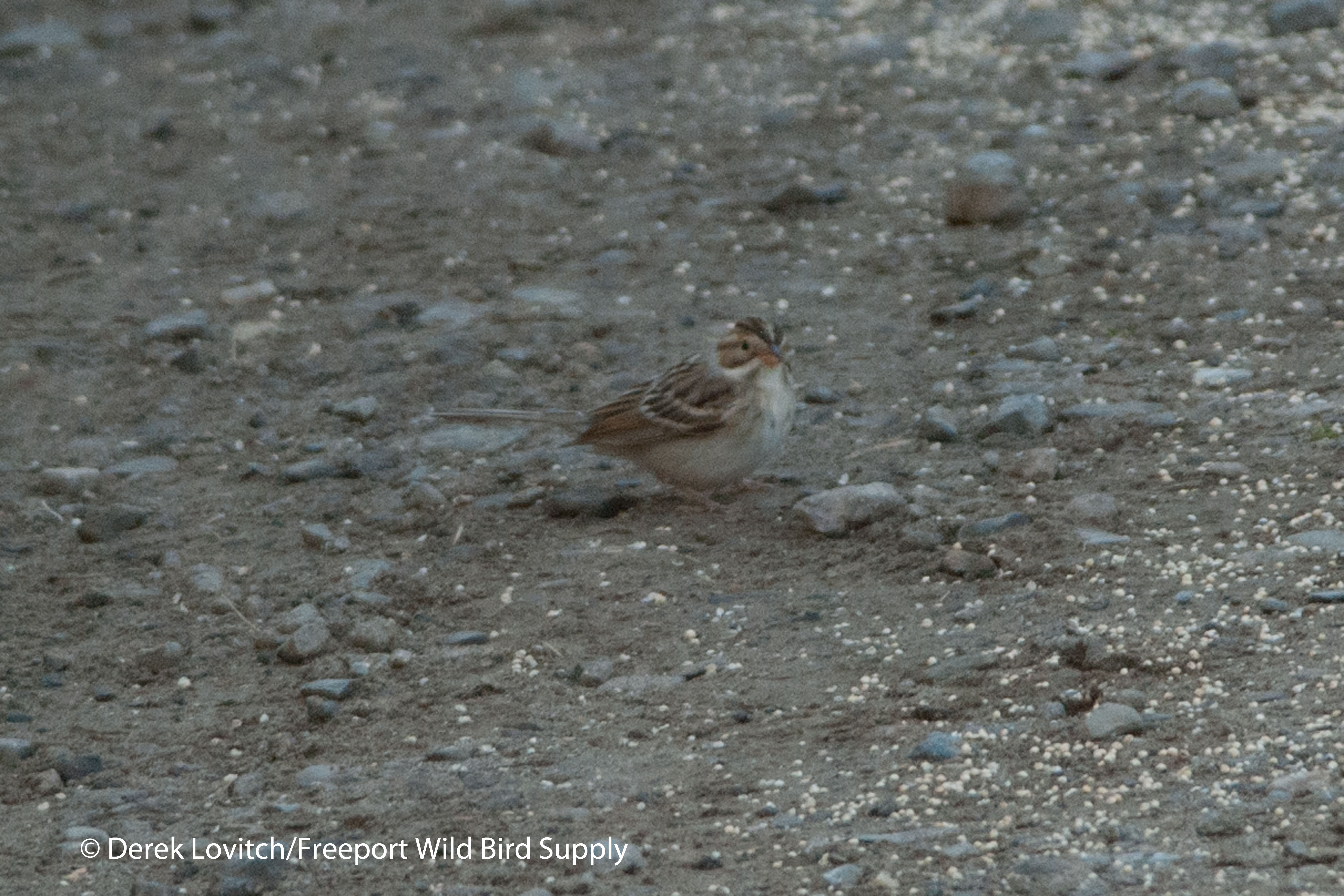
Fog rolled in and out for most of the morning, clearing out in the afternoon on an increasing south to southwesterly breeze.  We beat the bush hard, and covered a lot of ground, but birds were hard to come by.  There were quite a few more Yellow-rumped Warblers around than on previous mornings, Kristen noted, and we added plenty of species to our trip list over the course of the day.  While the Dickcissels apparently departed, the Lark Sparrow continued, and the island was now up to three Clay-colored Sparrows.
_MG_0160_edited-2

Clay-colored Sparrows, Dickcissels, and Lark Sparrow, check:  the triumvirate of Midwestern regular-rarities out here.  Two adult Lesser Black-backed Gulls, a tarrying Eastern Kingbird, a Semipalmated Plover, and a good afternoon Northern Gannet show were the other highlights of what amounted to be an exceptionally slow day of birding for Monhegan in the fall.  Nevertheless, complaints were not uttered – we were on Monhegan! – and besides, I got to mooch a TV (Thanks Paul and Sue!) to watch Rutgers come from behind to defeat Arkansas in an exciting finish, and we visited the Monhegan Brewing Company.  Yup, tough day.
_MG_9963_edited-2
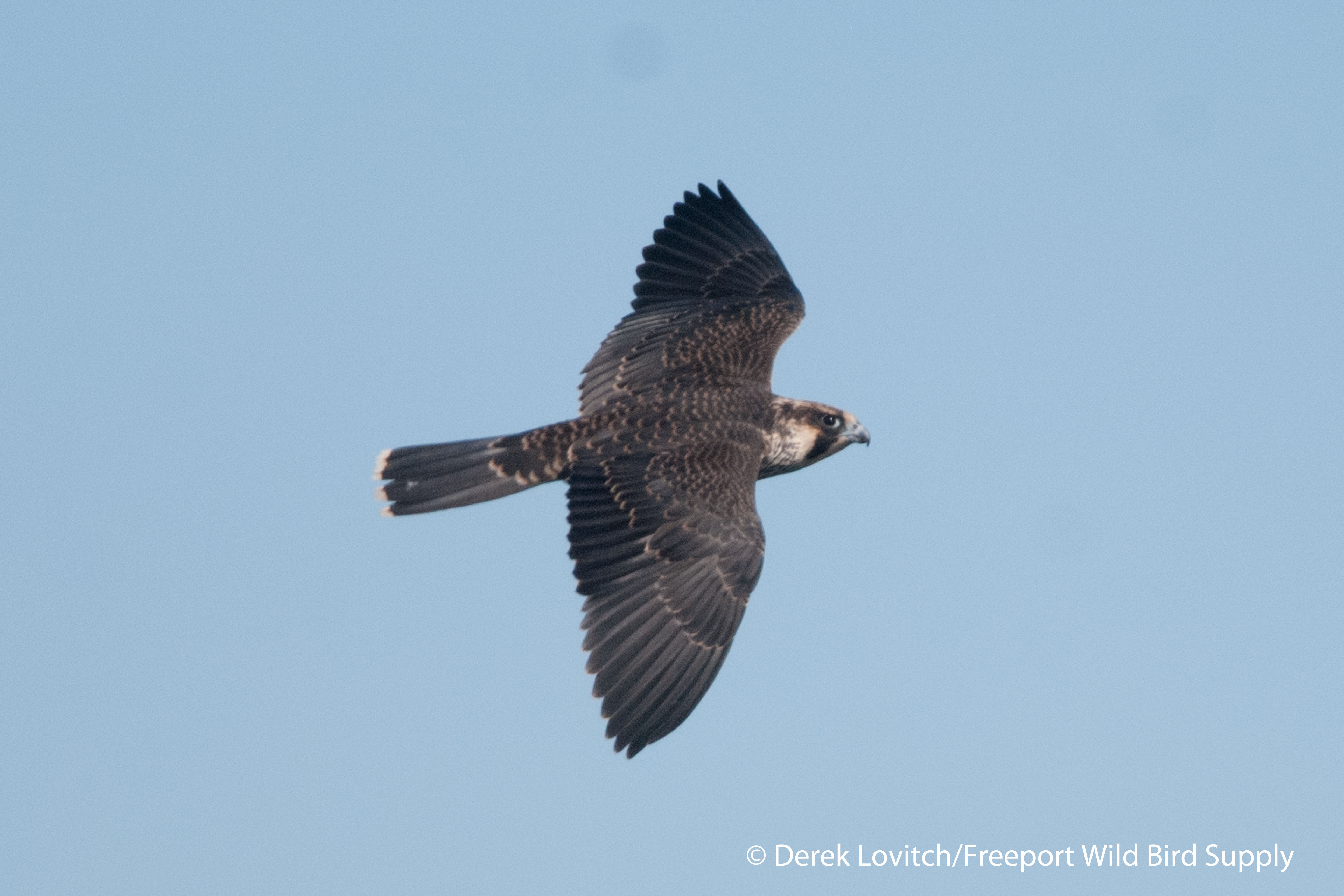
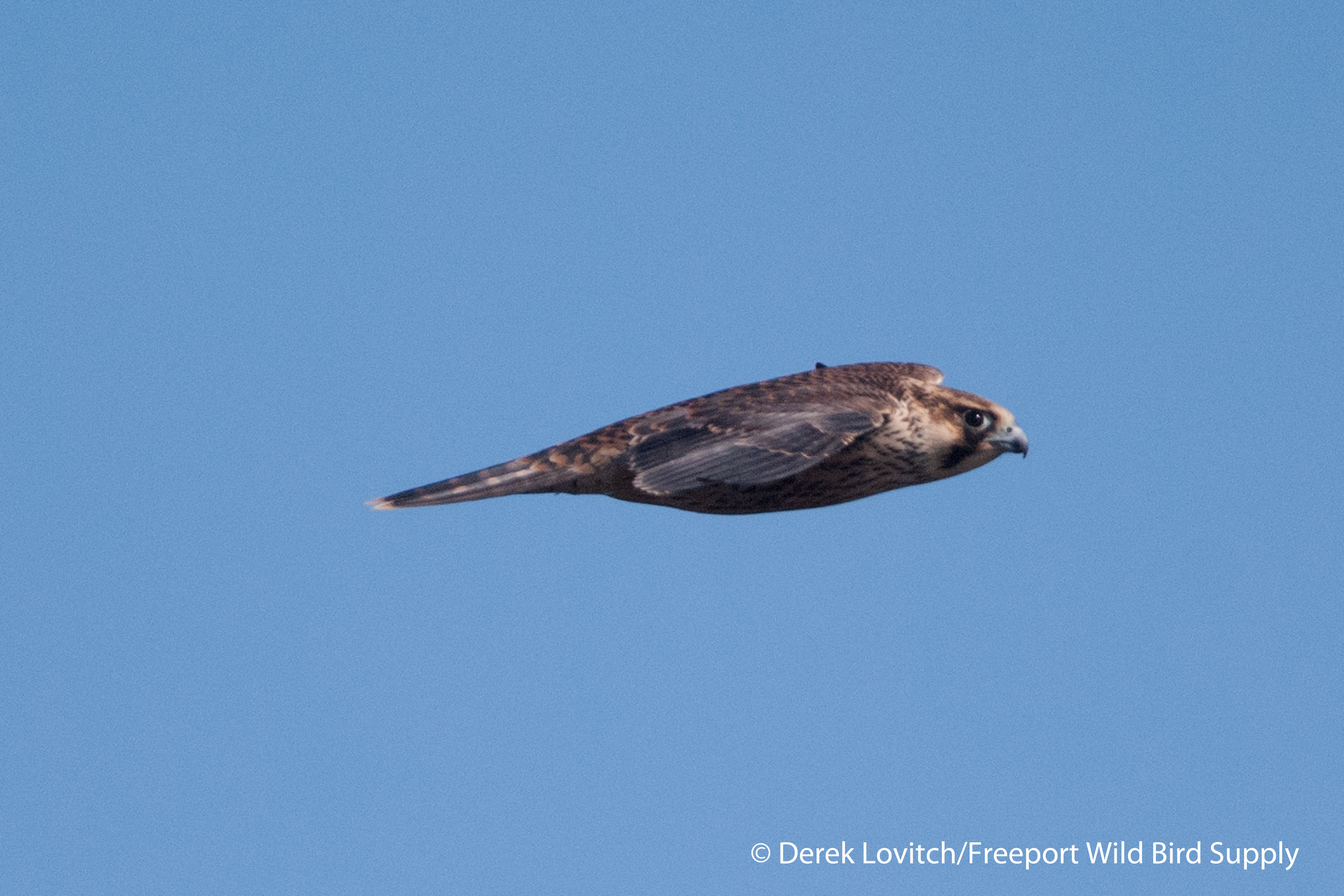
This young Peregrine Falcon – with a bulging crop from its last meal – also had a good day.

Unfortunately, an increasing southerly wind overnight precluded much in the way of any migration.  Take a look at the next blog to see what “almost nothing” looks like on a radar image.  Clouds were thick by dawn, too, but the rain held off until after breakfast.  After another fulfilling and scrumptious breakfast at the Trailing Yew, Jeannette, Kristen, and I headed down to Lobster Cove for a bit of seawatching.  We could see the wall of rain on the radar, and we could now see it on the horizon.  But as it marched closer, tubenoses joined the gannets.  In a mere 15 minutes or so, 20+ Great Shearwaters and 6+ Sooty Shearwaters zoomed through my scope.  And then the skies opened up.  This is what a line of rain – ahead of a cold front – looks like on the radar.
IMG_1573

The southerly winds were diminishing as the rain tapered off rather quickly over the course of the morning, but seawatching was less productive before lunchtime – apparently those tubenoses were all on the move just ahead of the precipitation.  But with the sun beginning to peak out after lunch, at least more birds were more visible again: two of the Clay-colored Sparrows, a Philly Vireo, etc.  Joined by Paul and Doug, we encountered a – or the – Yellow-billed Cuckoo, and then a calling flyover Lesser Yellowlegs became my 202nd species on Monhegan.

Moments later, Paul spotted a night-heron in a narrow drainage, and Doug soon relocated it.  A juvenile Yellow-crowned Night-Heron!  Once a more regular bird in Maine, and even on Monhegan, it had been about a decade since one had made an appearance on the island.  But this bird showed up a couple of weeks ago, and was often seen foraging on grasshoppers in lawns.  Rumors of its continued presence were circulated, but there were no confirmed sightings for over a week.  Until today.
_MG_0216_edited-2
Monhegan bird #203!  And two island birds in about 10 minutes.  Now that’s the way to finish strong.

When it was time to go, we were very happy to see the waves were rapidly dropping off.  Seven foot seas this morning had been reduced to 3-4 at most as we hopped on the Hardy Boat for the trip back.  A Great Cormorant on the Outer Ducks was our 88th species for the Monhegan tally for this trip, but 88 –including a mere 13 species of warblers – was a fairly low total for three days out here at this time of year.  That being said, it could have been much lower had we not continued to beat the bush.

Two juvenile Lesser Black-backed Gulls joined some hopeful Herring Gulls following the boat to shore, and westerly winds were increasing as the cold front pushed through.  There would no doubt be a lot of new birds come morning on Monhegan.  While I would be sorry to miss them, I knew fun was going to be had at SandyPoint, so I was not upset.

And I was right…

Two Fun Mornings at Sandy Point

_MG_9884_edited-2

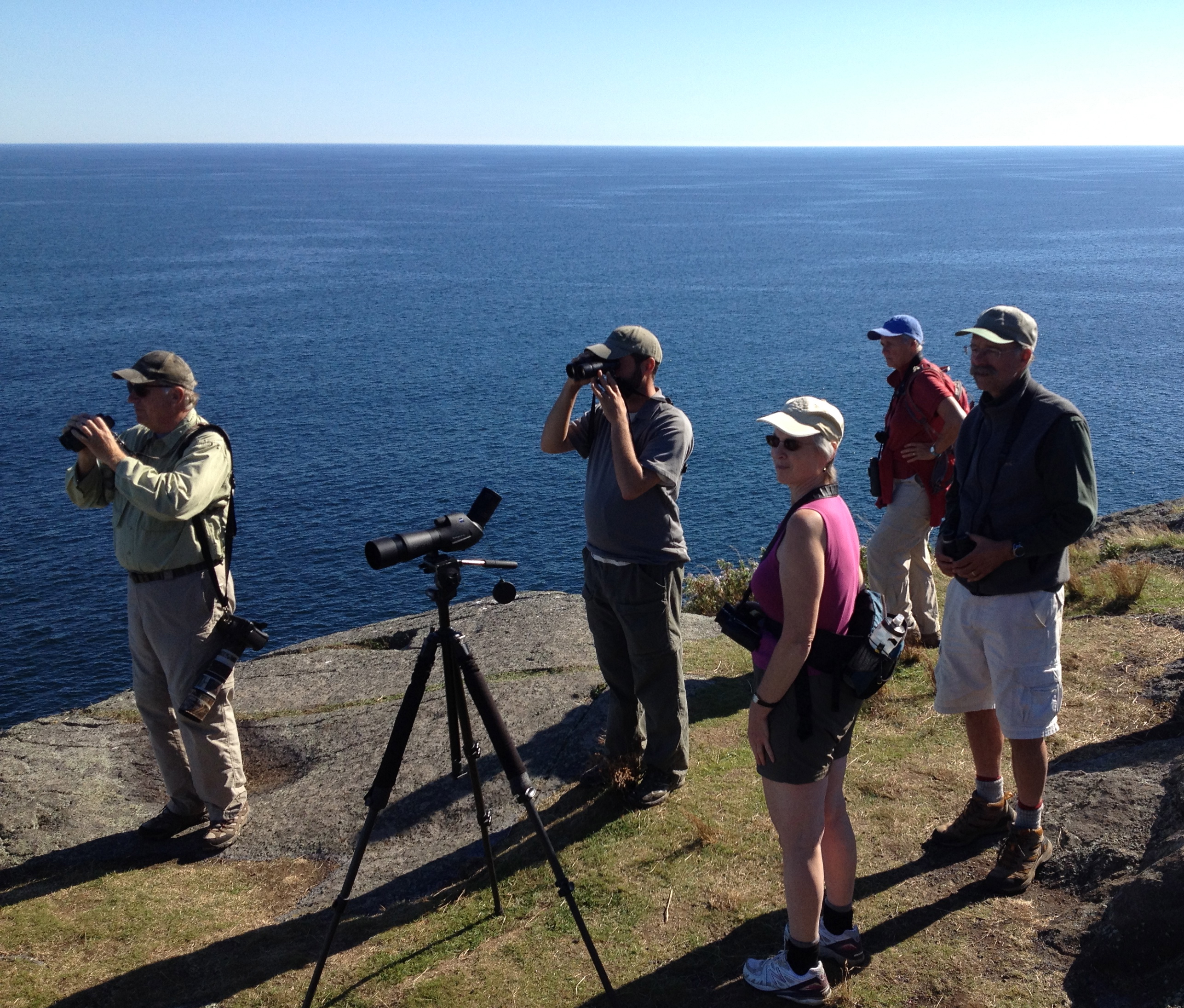
With a busy tour and travel schedule once again this fall (every year I say I will schedule fewer things in my favorite season to bird in Maine!), my time at Sandy Point is at a premium.  Since it takes certain conditions to make birding here worthwhile, I get quite excited when conditions line up for a good flight.

I was very anxious to arrive at “my office” on Tuesday morning.  Moderate northerly winds overnight turned to the northwest, resulting in an exceptional flight over and through SandyPointBeach come dawn.  Here is the morning’s scorecard:

-6:23-10:45am.
-37F, Clear, Light northwest, increasing.
-Jenny Howard and Jeannette Lovitch assisting with the count.

1195 Unidentified
984 Northern Flickers (*2nd highest count)
703 Northern Parula (*New high count; old record only 234!)
391 Cedar Waxwings (*New high count)
153 American Redstarts
152 Blackpoll Warblers
145 Black-throated Green Warblers (*2nd highest count).
101 Broad-winged Hawks (*New high count)
35 Yellow Warblers
28 Black-and-white Warblers
23 Yellow-rumped Warblers
21 Red-eyed Vireos
19 Magnolia Warblers
17 Swainson’s Thrushes (*ties high count)
16 Eastern Phoebes (*New high count)
12 Nashville Warblers
11 American Goldfinches
9 American Robins
9 Rose-breasted Grosbeaks (*New high count)
7 Palm Warblers
7 Scarlet Tanagers
6 Common Loons
6 White-throated Sparrows (in bushes; no crossings)
5 Tennessee Warblers
5 Common Yellowthroats (in bushes; no crossings as usual)
4 Cooper’s Hawks (*New high count)
4 Unidentified vireos
4 Blue Jays
3 Ospreys
3 Least Flycatchers
3 Unidentified empids
3 Philadelphia Vireos
3 Chestnut-sided Warblers
3 Blackburnian Warblers
3 Bay-breasted Warblers
3 Black-throated Blue Warblers
3 Chipping Sparrows
3 Rusty Blackbirds (first of season)
2 Sharp-shinned Hawks
2 American Kestrels
2 Bald Eagles
2 Ruby-throated Hummingbirds
2 Golden-crowned Kinglets
2 Ruby-crowned Kinglets
2 Cape May Warblers
2 European Starlings (first time I have “deemed them migrating”)
2 Dark-eyed Juncos
1 Red-tailed Hawk
1 Northern Harrier
1 Unidentified small falcon
1 Eastern Wood-Pewee
1 “Traill’s” Flycatcher
1 Blue-headed Vireo
1 Red-breasted Nuthatch
1 NORTHERN MOCKINGBIRD (6 false-starts before apparently crossing)
1 Pine Warbler
1 CONNECTICUT WARBLER (3rd of the season as Tom Johnson and Jenny Howard had one here on 9/15 as well)
1 Northern Waterthrush
1 Red-winged Blackbird
1 Purple Finch
1 Monarch butterfly

Total= 4,134 (*2nd highest count of all time!)

Simply put: wow!  That was one heck of a flight.  In fact, it was downright overwhelming at times – flocks of flickers, waves of warblers, packs of waxwings.  It was almost too much to count, and thankfully, Jenny Howard agreed (OK, so maybe I didn’t exactly ask, but beg) to tally flickers for the busiest part of the morning for me. That helped a whole lot.

After a flood like yesterday morning, I am not disappointed by the slow, but steady trickle through the point this morning.  It was a more manageable number to count, with quite a few birds lower than yesterday, and often only a few at a time; it was easier to sort through.

Here’s this morning’s scorecard, then, we’ll compare the different flights as viewed on the radar.
– 6:21-9:05
– 41F, Clear, Calm becoming very light west.

265 Northern Parulas (*2nd highest count)
202 Unidentified
54 Black-throated Green Warblers
45 Northern Flickers
32 Cedar Waxwings
32 American Redstarts
26 Yellow-rumped Warblers
17 Yellow Warblers
14 American Robins
14 Blackpoll Warblers
13 Blue Jays
10 Red-eyed Vireos
7 Nashville Warblers
6 Eastern Phoebes
6 Black-and-white Warblers
4 Ruby-crowned Kinglets
4 Tennessee Warblers
4 Palm Warblers
4 Wilson’s Warblers
4 Chipping Sparrows
3 Common Loons
3 American Kestrels
3 Blue-headed Vireos
3 Chestnut-sided Warblers
3 Common Yellowthroats
2 Unidentified empids
2 Ruby-throated Hummingbirds
2 Swainson’s Thrushes
2 Black-throated Blue Warblers
2 Magnolia Warblers
2 Rose-breasted Grosbeaks
2 Baltimore Orioles
2 American Goldfinches
1 Peregrine Falcon
1 Solitary Sandpiper
1 Least Flycatcher
1 “Traill’s” Flycatcher
1 Unidentified flycatcher
1 Philadelphia Vireo
1 Unidentified vireo
1 White-breasted Nuthatch
1 Prairie Warbler
1 Scarlet Tanager
1 Purple Finch

Total: 801

I’ll admit, I wasn’t expecting it to be quite this good.  And despite really only a “good” flight, parulas had their second highest tally – I didn’t think there would be any left after yesterday’s flight!  And yes, this more manageable flight was more “enjoyable,” if considerably less awe-inspiring.

So, what made me have lower expectations for today?  Let’s go to the radar!

First, the massive flight overnight Monday into Tuesday that led to all of the records yesterday.  I have included the 10pm, 12am, 2am, and 4am radar and velocity images:
a b c d e f g h

Combined, these images show a very strong flight all night long, with a lot of birds offshore come twilight, and likely a lot of birds arriving at the coast come dawn.  Looking at that image when I went to bed, and when I awoke, coupled with the light northwesterly winds all night left no doubt that things would be hopping at Sandy Point.  And, as we now know, there most certainly was. If you see a radar image that looks like this – go birding in the morning!

In fact, it was a good day all-around for migrants, and everywhere we looked up yesterday, raptors were on the move.

winds, 110am,9-17-13

Now, let’s take a look a the radar and velocity images from 10pm, 12am, 2am, and 4am last night:
i j k l m n o p

As night fell Tuesday night, clear and mostly calm conditions let birds take to the air once again – but not nearly as many as the night before. Notice how much smaller the area of return is, and how much less dense? Meanwhile, the velocity image was much less distinctly fast-moving, north-to-south as the previous night (of course, with little to no wind, the ground speed of the birds would be less anyway) – a little more ambiguous than the night before.  Furthermore, with a forecast for westerly winds (not as good as northwesterly), and the chance that they would become southwesterly by dawn, I did consider skipping Sandy Point this morning, but with the rest of the week looking even less productive, I knew I had to give it a go.

And, obviously, I am glad that I did.  But upon returning to the store, and checking those above radar images once again, I find it a bit odd that the radar image (small in diameter, but very dense) did not translate to a more distinct velocity image.  Perhaps there was a lot of slow-moving stuff up there (insects, pollen, dust, etc) that clouded the motion of the birds.  Either way, it was a good night for flying, and if it’s a good night for flying, it’s a good morning to be at Sandy Point!

A Weekend at the Cape Cod Bird Festival

Other than a departure point for pelagics, it has been over 15 years since I have birded Cape Cod.  Too long.  Every late summer and early fall in particular, it’s “we really should get to the Cape” for shorebirds, especially South Beach and Monomoy Island.  Well, my visit this weekend only wet my pallet for a future, more birding-intensive visit.

I was asked to join the Leica Sports Optics team of good friends Jeff Bouton and David La Puma at their booth for the first annual Cape Cod Bird Festival.  As the only Authorized Leica Optics dealer in Northern New England, I had multiple roles to play.  First, it was to be the retailer of any optics sales.  Secondly, I was there to use my first-hand experience in telling the story of the Critically Endangered Spoon-billed Sandpiper.  Leica has recently become a leading sponsor of the international effort to save this unique species.  And finally, I was there to sign some copies of my book.  Oh yeah, and do some birding and beer-ing with Jeff and David, of course.

The weather forecasts as of Thursday suggested that some good movements of migrants were about to occur.  I went to bed optimistic that the first flight would occur behind the front for Friday morning (see previous blog entry), but as I woke up to rain still falling, I knew that this was not to be.  Therefore, I began my trek southward, stopping for a short visit at Fort Foster in Kittery.  That short visit lasted a little longer than expected, as I found not one, but TWO Connecticut Warblers!

With rain still falling, I left the camera in the car.  Of course, this usually results in some exceptional photographic opportunity.  Yup, sure did.  A Connecticut Warbler (CONW) – normally a frustratingly secretive skulker in migration, walked out (the fact that it was walking, one foot in front of the other, rather than hopping itself helps to clinch the birds’ identity) onto a low branch at the edge of thick brush.  I lamented the lack of a camera, but was enthralled with my view.

A short while later, I was even more shocked to see a second CONW walking out into the relative open!  This time, I remembered that there was an iPhone in my pocket, and out of sheer desperation, I held it up to my binoculars and shot away.  It actually worked…a phone-binned CONW!  (This, as a friend pointed out, may have been a first-ever occurrence).  My best shot – relatively speaking of course – was this one.
CONW_edited-1

But this other shot nicely shows the very pink legs and exceptionally long undertail coverts.
CONW2_Fort_Foster,Kittery, 9-13-13

Oddly enough, with the exception of plenty of Common Yellowthroats, I only encountered three migrant warblers this morning…and two were CONW!  (The other being my first Palm Warbler in southern Maine this fall).  After stopping at Kelly’s Roast Beef, I finally arrived at my destination for the weekend, The Cape Codder in Hyannis.

Meeting up with David and Jeff, we got to work, and it was nice to run into quite a few other friends over the course of the weekend.  David – radar guru and creator of www.Woodcreeper.com – and I were (I know this will come as a surprise) glued to the NEXRAD images and wind forecasts in the evening, hoping to make a sound prediction for the hot birding.

IMG_1556_David_Leica,9-14-13
David works with the next generation of Leica fans.

Well, perhaps we should have tried elsewhere, as Harding Beach in Chatham was not the place to be.  In fact, we tallied the reorienting migrants on one hand (although we didn’t exactly make it there in time for sunrise).  There weren’t many passerines around the woods at Morris Island, either.  Looking at the overnight radar images, and seeing that winds were light north (instead of the forecasted NW), it was obvious that the big flight out onto the Cape just didn’t occur.  I guess the silver lining to this was that we didn’t have too hard of a time pulling ourselves away to spend the rest of the day inside.

At least I had my brand new review copy – thanks to the good folks over at the Houghton Mifflin booth – of the Peterson Reference Guide to Seawatching: Eastern Waterbirds in Flight by my friends Ken Behrens and Cameron Cox to page through.
IMG_2093_edited-1

And look who I found inside!
IMG_2095_edited-1

Come evening, we enjoyed seeing Pete Dunne in his native habitat: captivating a room full of birders with his story-telling.
Pete_Dunne_atCCBF,9-14-13

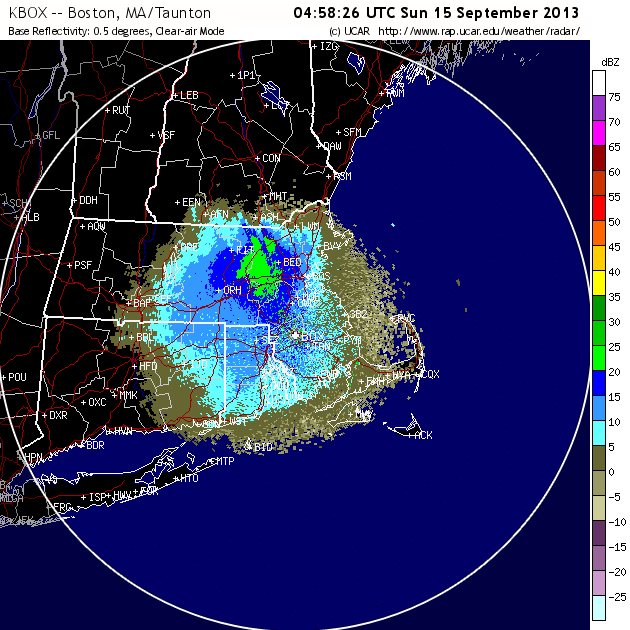
Afterwards, David and I checked the radar once again.  And once again, we saw birds on the radar, but few birds east of Boston.  Take a look at the 1am radar and velocity images from the Boston area NEXRAD.  The winds were just too light to push birds well out of Cape Cod Bay, apparently.

1am radar,Boston,9-15-131am velocity, Boston,9-15-13

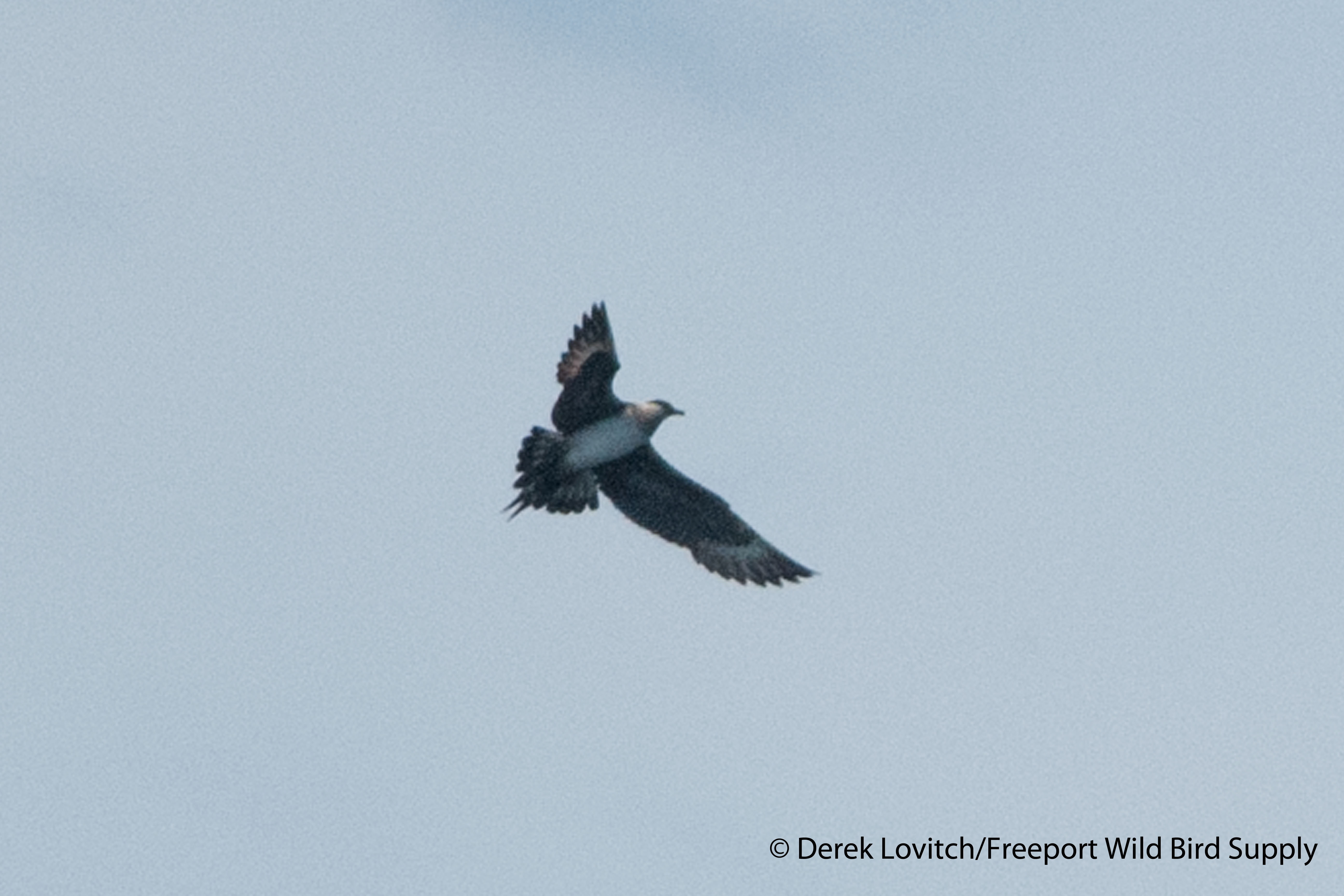
At least we didn’t have to make a decision as to where to start the day, as the three of us were on our way to the harbor to take part in the festival’s pelagic trip.  Like the waters north of Cape Cod (until your reach the waters off of Mount Desert Island), the summer seabirding has been dreadfully slow overall, so expectations were not too high.  The first half of the trip was living up to said low expectations, but things really picked up in the last few hours, as were well east of Cape Cod.  While the least expected seabird (for the season and the area) was probably the Leach’s Storm-Petrel, the highlight for me was this cooperative juvenile Long-tailed Jaeger.
DSC_0022_juvLTJA2,offCapeCod,9-15-13DSC_0024_juvLTJA1,offCapeCod,9-15-13

Although a fairly dark individual, we can see the fairly slim build, small head and bill, and overall more “gentle” appearance.  I flight, it seemed slim and attenuated.  The photos show the two white primary shafts on the upperwing, and the rounded central tail feathers.

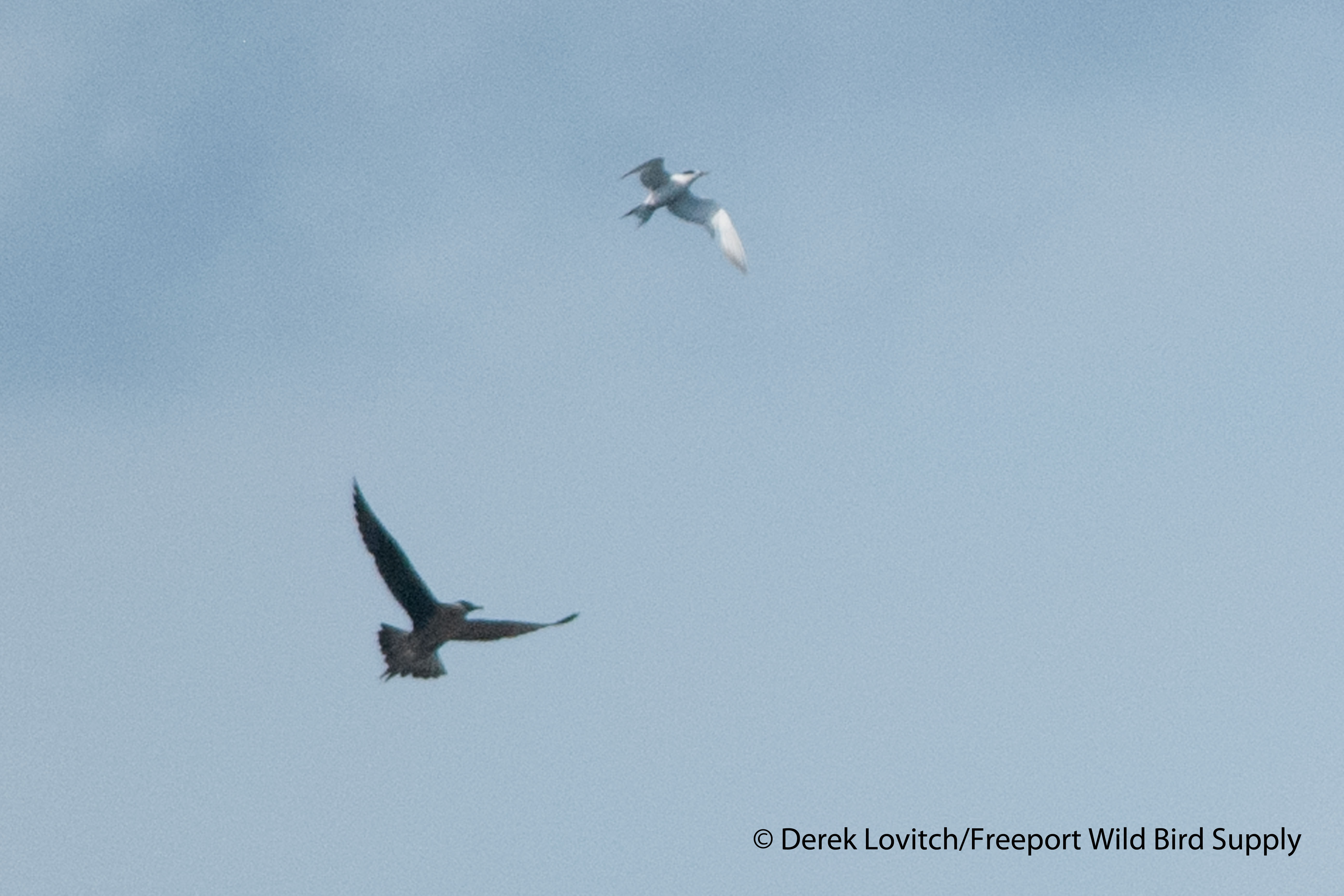
We also saw at least two Parasitic Jaegers, including this one chasing a juvenile Common Tern.DSC_0013_PAJA_ad2,off Cape Cod, 9-15-13DSC_0016_PAJAad1,offCape Cod,9-15-13

Four more unidentified, distant jaegers added to the strong finish – any day with jaegers is a good day in my book.  Other highlights included a Black Tern, 14 Sooty, 5 Great, and 1 Manx Shearwater, some good looks at Red-necked Phalaropes, two Basking Sharks and a Mola Mola, but only a couple of Minke Whales.  The cloud of Tree Swallows over Monomoy was quite impressive, as were some of the offshore landbirds: a Cape May Warbler, a Magnolia Warbler, a Northern Harrier, and an immature Black-crowned Night Heron – the latter of which was voicing its displeasure about being about 15 miles from shore, heading back north towards the Cape.  Three bats – at least one that I conclusively identified as a Red Bats, three Lesser Black-backed Gulls, two early Great Cormorants, and a “pelagic” Cloudless Sulfur rounded out what, in the end, was actually a fairly productive outing.

It was a long drive home afterwards, however.  Luckily, southwesterly winds suggested I wouldn’t have to wake up early to get to Sandy Point for dawn.  However, take a look at the radar image.  Once again, I’ve included the 1am image for the example.  It looks like a ton of birds!
1amradar,9-16-131amvelocity,9-16-13
But the velocity image suggested little to no speed for whatever was in the air (it was not foggy last night), so I do not know what it was.

There was little overhead in the morning in either our yard or at Old Town House Park, so I don’t think I was mistaken about this not being a big flight of birds.  Furthermore, in a short listening session before going to bed, I heard very, very little.

Tonight, however…well, let’s just say that I will be at Sandy Point tomorrow morning!  I just hope the winds stay more northwesterly than north, or – gasp – northeasterly by morning as currently suggested by the wind forecast I like to use.
11pm wind forecast,9-16-13

Current Birds, Weather, Predictions . . . and Pretty Shorebird Photos

Yesterday’s record high temperatures (92 in Portland shattered the old record of 87) were ushered in on a strong southwesterly flow.  Unseasonably warm air continues today, as the southwesterly winds aloft are picking up ahead of tonight’s cold front (more on that shortly).

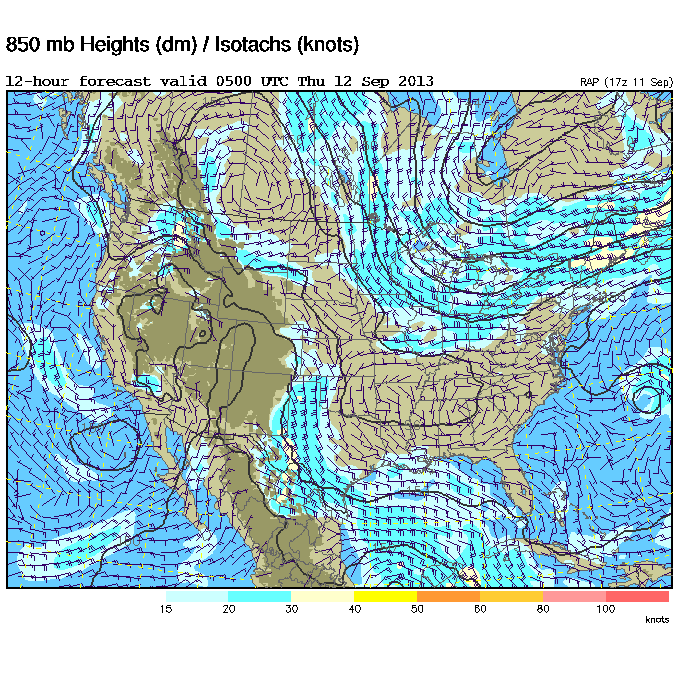
Here are the continental wind maps from yesterday afternoon, and this afternoon.  Yesterday, you can see the south-southwesterly flow originating from under a broad area of high pressure over the Southeast…
wind,9-11-13

…but notice that by today, cool, Canadian air was pouring down into the Upper Midwest (which resulted in some big flights over the last two nights in that region).
wind,9-12-13

In addition to hot and very muggy conditions, this strong southerly flow has the potential to usher in some hot new rarities to our neck of the woods. While it appears that the Biddeford Pool Kentucky Warbler has moved on, I am expecting some more southern strays to turn up in our region.  Keep in mind, however, that these winds are not “blowing” birds north, but instead facilitating birds to arrive here that are either wandering (post-breeding dispersal, prospecting for new territories, etc) or area already flying in the wrong direction (e.g. “180-degree misorientation”).

In other words, if a Kentucky Warbler – for example – was “miswired” and began to fly north instead of south, a strong southerly wind would push it even farther the “wrong” way.  Then, with tonight’s cold front, the strong northwesterly winds that follow could push the birds towards the coast.  There, they find a coastal migrant trap – i.e. a dense thicket full of fruiting bushes in the woods of Biddeford Pool – to seek shelter in while they refuel.  There, they are more likely to be found by an alert birder than say somewhere in the valleys of the western Maine mountains.  Many migrants spend 3 to 7 days to “refuel.”  I don’t think it was a coincidence that the Biddeford Pool KEWA was seen for five days…and that it disappeared after a night of light southerly winds. Of course, it may have just moved to a richer food patch, or one without birders unnecessarily blasting a tape at it all afternoon.

Anyway, what will the weekend produce?  I might be thinking more along the lines of birds like Summer Tanagers and Hooded Warblers based on this recent weather pattern.  Unfortunately, I won’t be around to find them!  Instead, I will be helping out at the Leica Sports Optics booth at the Cape Cod Birding Festival in Hyannis (I’ll also be signing copies of “How to Be a Better Birder,” which of course covers many of the vagrant-producing and Mega-finding topics that I have touched upon here).

Ahead of tonight’s cold front, and before the forecasted thunderstorms of the afternoon, I – not surprisingly – was out birding this morning.  It’s September – there’s really no such thing as a night with “no” migration.  However, what was flying last night was not being noticed on the radar; likely a limited number of birds were flying below the clouds, however.

Here’s the midnight radar image for example:
12am radar, 9-12-13

That would be thunderstorms.  Not birds.  And we can verify it from the velocity image:
12am velocity, 9-12-13

…A distinct west to east movement, unlike the northerly to southerly movement of southbound fall migrant birds.  Therefore, I was not surprised to have very, very few birds overhead at dawn over our yard this morning, or later on at Hedgehog Mountain Park.  I did, however, find a lot of birds in the woods.  While some of these might have been new arrivals that snuck in below the clouds and between the storms, the mixed-species foraging flocks working through the woods was much more indicative of birds that have been around for a day or two.  The flock that moved through our yard shortly after sunrise, consisting mostly of Blackpoll Warblers, also contained not one, but two new Yard Birds for us: Cape May Warbler and Philadelphia Vireo!  Also, at least two Tennessee Warblers.

Multiple mixed flocks were encountered at The Hog, led by Blackpoll Warblers, along with a healthy serving of Black-throated Greens.  A Lincoln’s Sparrow foraged at the edge, and a mixed-species flock consisting of 40+ Chipping Sparrows, 6 Eastern Bluebirds, and 1 Pine Warbler worked the edge of the transfer station and out through the ballfields.

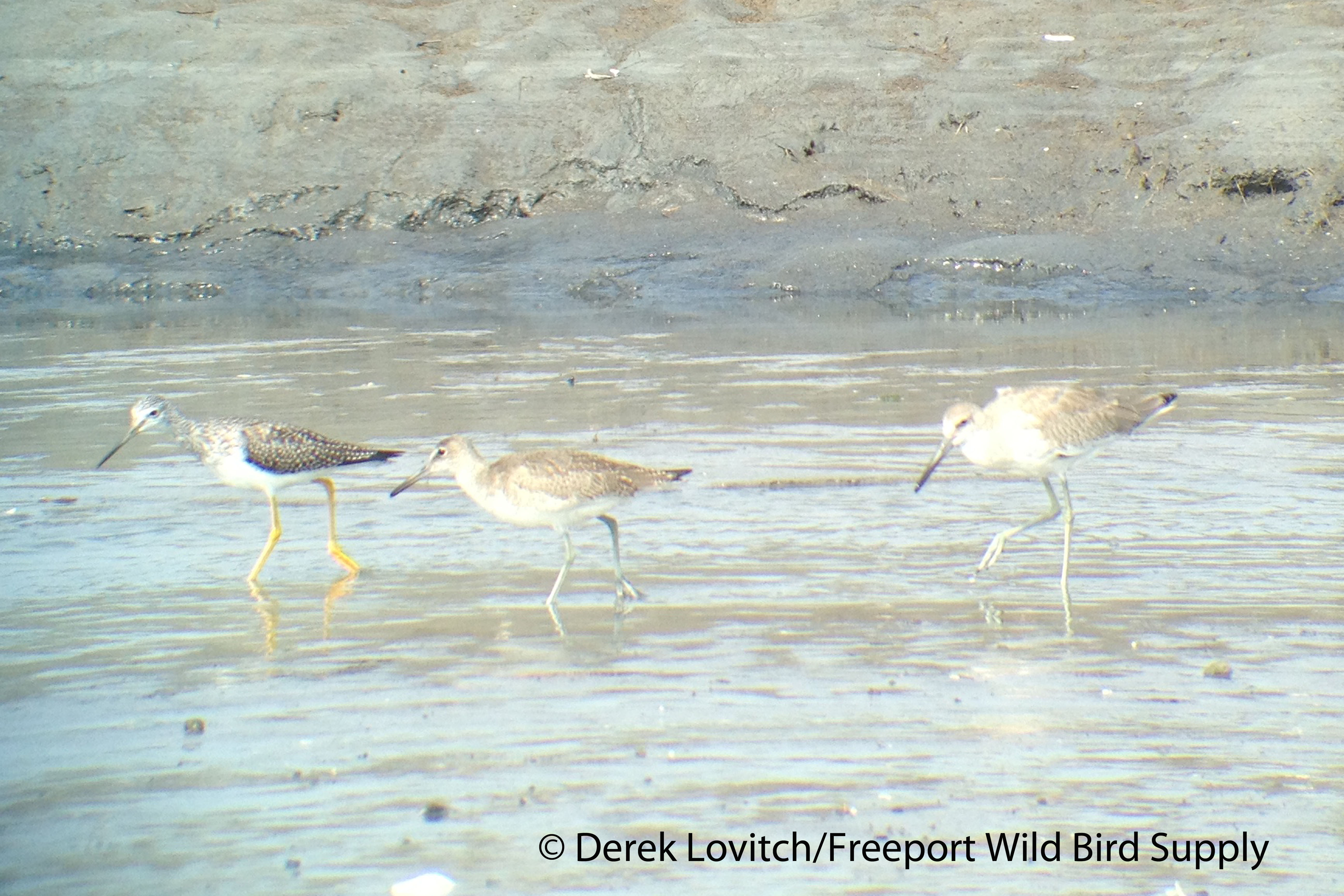
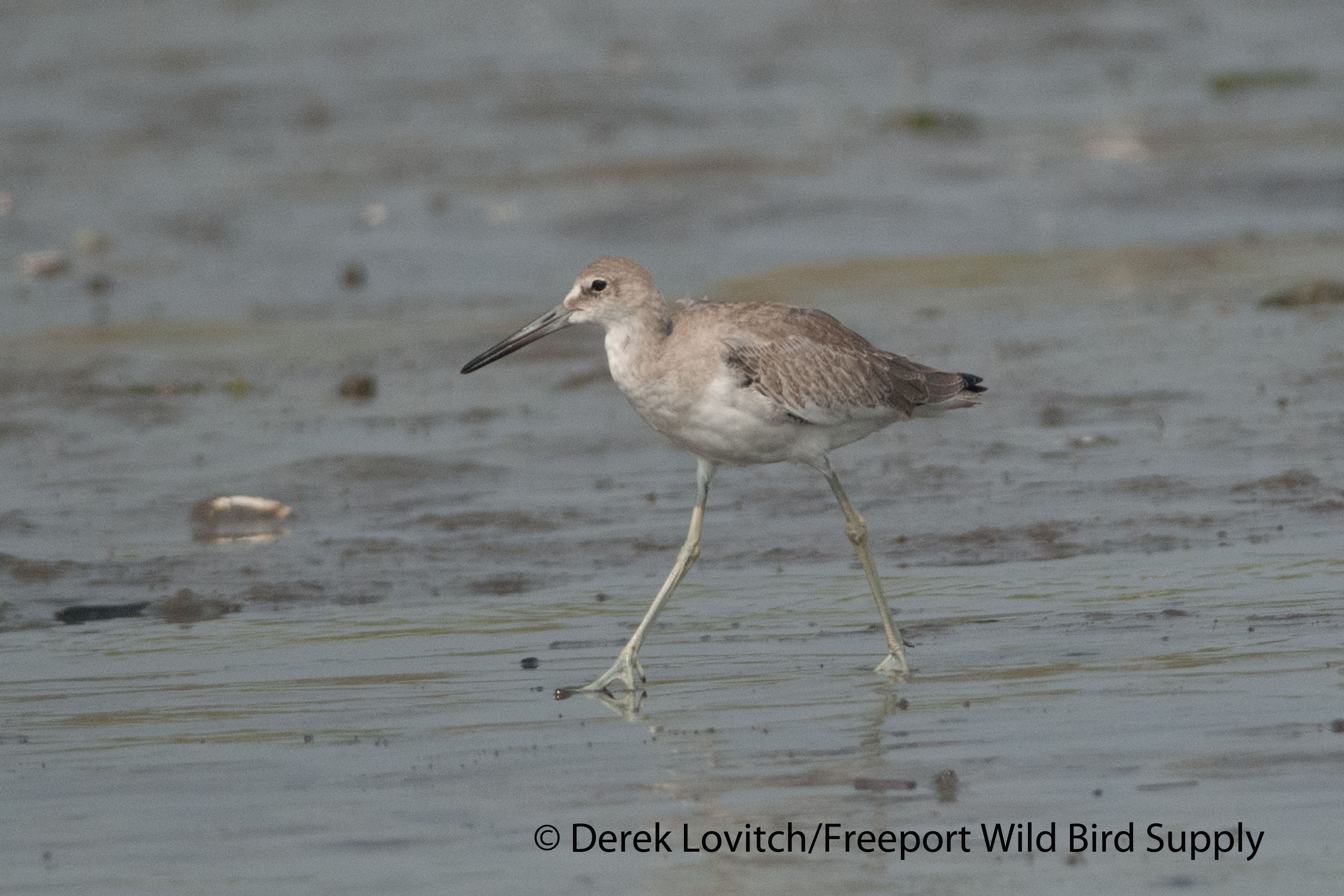
Afterwards, I zipped down to Pine Point for the low tide.  Shorebird numbers are down considerably, as expected by the middle of September.  And, I would expect a lot of the birds I saw today to clear out behind this next cold front.  About 180 Semipalmated Sandpipers led the way, punctuated by a juvenile Red Knot, and two continuing American Oystercatchers (they were too far to determine age, visible over on Western Beach as viewed from Pine Point Beach).  Four juvenile Dunlins were a sign that their migration – one of our two latest migrant shorebirds – is just now picking up.  The highlight, however, were side-by-side “Eastern” and “Western” Willets.  Unfortunately, I was only able to get the two in the frame together by phone-scoping, here with a Greater Yellowlegs for a convenient reference.
EWIL_with_WWIL2, Pine Point, 9-12-13

I then carefully approached with my “real” camera, but I never again saw the two birds in the same field of view.  However, I did get solid photos of both the juvenile Western…
DSC_0002_WesternWILL1,Pine Point,9-13-13

…and the juvenile Eastern.
DSC_0005_EasternWILL1,Pine Point, 9-13-13

Even from the lousy phone-scoped photos, you can see how distinctive these two subspecies (for now!) are.  The smaller, “dumpier,” browner Eastern nicely contrasts with the larger, lankier, and much grayer Western.  Also, note how the darker brown scapulars of the Eastern contrast with the rest of the wing; Western is more uniform.  The head of the Eastern is also more contrast-y, and in this individual, the bill is so distinctly shorter and blunter.

Elsewhere, I finally got a chance to look for – and find – the juvenile Hudsonian Godwit that has been frequenting the river behind the Scarborough Marsh Nature Center for about a week now.  This is the first “Hud-wit” that I have seen in two years here in Maine – this once-common migrant has definitely declined dramatically in the state.
DSC_0010_HUGOjuv1,NatureShed,9-12-13 DSC_0050_HUGOjuv3,Nature_Shed,9-12-13

Now, my eyes are on the weather maps, and after dusk, the radar, to see if I will be at SandyPoint at sunrise on Friday. This is the wind map as of 5pm.  The northwesterlies behind the front are barely peeking into the region north of the St. Lawrence River in Quebec.
winds at 5pm, 9-12-13

Currently, forecasters are suggesting that the cold front won’t pass through until tomorrow morning.  However, with very light winds overnight, perhaps with a westerly component, there could be some birds on the move…depending on when this latest batch of rain and thunderstorms (the storms last night and this afternoon were wicked, weren’t they?  And very un-September-like) moves through. Will the front get here soon enough?  Will birds be moving directly behind the front?  Will they be pushed offshore enough to need to reorient in the morning?  I’ll let you know tomorrow!

Fall Plans

Seriously, it’s already the end of August?  Where the heck did the summer go?  It feels like shorebird season just started, and now here I am checking the radar nightly as fall songbird migration heats up.  Goldfinches are eating seed heads in the perennial gardens, hummingbirds are molting and tanking up (many males have already departed), and biting insects are at a minimum.  As much as I love late August – and autumn is my favorite season – it’s always a little bittersweet to let summer slip away.

In most years, by the end of August I have combed through flocks of roosting peeps at Biddeford Pool or strained to see distant mudflats at Pine Point at least a dozen times.  I can’t believe Sunday was actually my first visit to Biddeford Pool on a high tide all summer!  This week isn’t helping either, with a visit to Massachusetts these past two days and some New Hampshire birding with a friend tomorrow.  In other words, I have been busy – wicked busy even!  This is by no means a complaint, however, just a statement – and an excuse as to why I never did find a Red-necked Stint for Maine this summer.

What is normally a “slower” season for me was anything but, and now, with September right around the corner, I am about to get even busier!  I have a trip to the Upper Midwest in October to speak at the Iowa Ornithologists Union Fall Meeting and the UrbanEcologyCenter in Milwaukee with some birding and visiting with friends in between.  I’ll be talking to New Hampshire Audubon in October as well, and I will be helping out Leica Sports Optics at the Cape Cod Birding Festival next month.

In between, I hope to spend as much time as possible at SandyPoint.  Keep an eye on the store’s Facebook Page (www.facebook.com/freeportwildbird) for my Morning Flight counts.  I’ll post the occasional significant flight report and corresponding radar analysis here, but most counts will just get posted directly to the FB page (as a “public” business page, it functions as a regular website; no need to “be on” FB to view).

SandyPoint at sunrise is probably my favorite place to be in the fall, but MonheganIsland is a very close second.  Actually, it’s probably a tie.  I wish I could be at both almost every morning all season long!  And speaking of Monhegan, I still have spaces on my “MonhegZEN Birding Fall Migration Weekend” tour, September 27through 30th.  It’s a “per diem” tour, so you can join me for anywhere between one and four days of birding at this amazing place.

In preparation of what is likely to be a whirlwind fall for me, I have updated our website with all of my events, programs, and tours on a newly-expanded “Tours, Events, Workshops, and Programs” page at http://www.freeportwildbirdsupply.com.  There you’ll find more information about the MonhegZEN Birding Weekend tour, and all of my programs for the coming months.  We’ve also started to finalize plans for an exciting 2014, including everything from our “Woodcocks Gone Wild” evening walk to a two-week tour to the Russian Far East.  More Monhegan, our now-annual trip with the Schooner Lewis R. French, and much, much more is now posted, with details rapidly being filled in.

So whether it’s in Iowa, the parking lot at SandyPoint, or on MonheganIsland, I hope to see you this fall.  And if you happen to have a cup of bird-friendly coffee handy, I will probably need it!

A Record-setting First Day of the Season at Sandy Point

I definitely had second thoughts when the alarm went off at 4:45 this morning.  I hate pre-5am alarms.  But August flights at Sandy Point Beach, Cousin’s Island, Yarmouth can be so much fun.  I just wish dawn didn’t come so darn early right now.

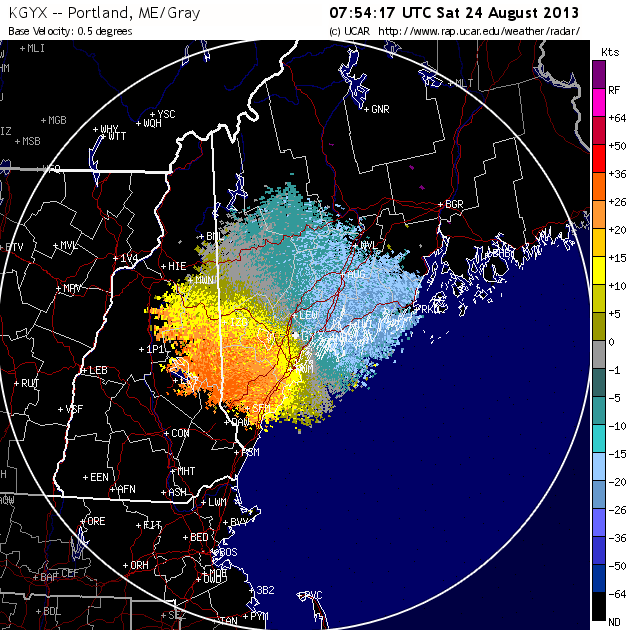
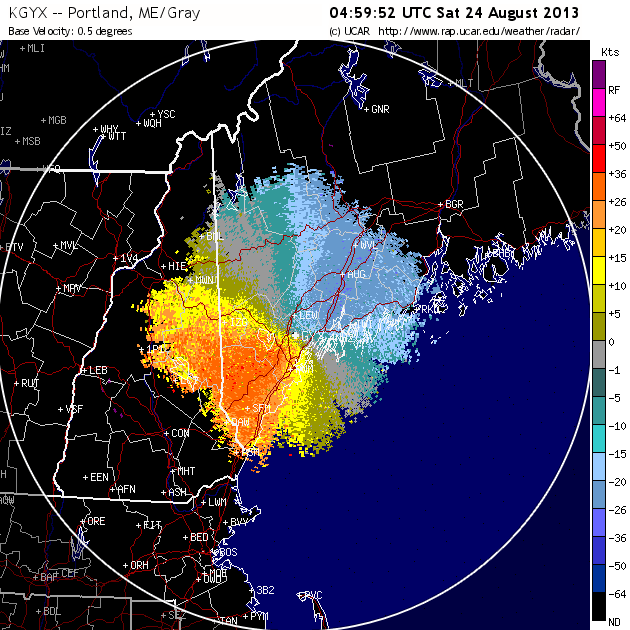
But as of 9:30 last night, the NEXRAD radar was absolutely on fire!  Light northwest winds and clear skies really put birds on the move.  Here are the 10pm, 1am, and 4 am radar and velocity images for example.  For a detailed explanation of how to read and interpret these images, see Chapter 5 of my book, How to be a Better Birder.
10pm radar,8-23-13

10pm velocity, 8-23-13

4am velocity, 8-24-13

4am radar,8-24-13

1am velocity, 8-24-13

1am radar,8-24-13

This was really an exceptional flight for this early in the season. But back to that alarm clock…I woke up, and saw that the winds had become northerly overnight.  The lack of a westerly component usually diminishes the Morning Flight here.  However, with that high of a density on the radar, even as late as 4:00am, I figured I would give it a go, despite serious contemplation of rolling over and waiting until the next cold front (and waiting for a few more minutes of darkness).  Let’s just say I was glad I motivated.  Come sunrise, a little northwesterly to westerly breeze at the surface developed, and encouraged more birds to cross at the point.  The winds were very light, so a lot of birds were high; the trees and shrubbery were fairly quiet this morning.  Therefore, with so many high birds, and some big groups just too far to the north of the bridge, my “unidentified” tally was higher than I would have liked.

Regardless, it was still great.  In fact, it was record-setting.  A new August high count, and a new high count for 6 species.  Plus a Patch Bird!  Here’s the morning’s scorecard (*= new record high count):

408 American Redstarts*
379 Unidentified
67 Yellow Warblers
59 Northern Parulas
59 Magnolia Warblers*
50 Cedar Waxwings
33 Black-and-white Warblers*
28 Black-throated Green Warblers
25 Yellow-rumped Warblers (all in active molt)
8 Bay-breasted Warblers*
8 Blackburnian Warblers*
7 “Traill’s” Flycatchers*
7 Canada Warblers*
6 Chestnut-sided Warblers
5 Unidentified empids
4 American Robins
3 Chipping Sparrows
3 Red-winged Blackbirds
2 Olive-sided Flycatchers
2 Least Flycatchers
2 Black-throat Blue Warblers
2 Bobolinks
2 American Goldfinches
2 Purple Finches
1 SOLITARY SANDPIPER (my 174th species here!)
1 Red-eyed Vireo
1 Ruby-throated Hummingbird
1 Pine Warbler
1 Wilson’s Warbler
1 Dark-eyed Junco (record early)
1 DICKCISSEL (first of fall; my 3rd August record here)

Total= 1177* (new August record)

Birding (and eating) in Hawai’i!

Ever since I returned to the mainland after working on the Big Island of Hawai’i in 1999 – my first seasonal field job out of college – I have been ready to go back to our 50th State.  And Kaua’i has been tops on my agenda.

Meanwhile, with a life-listing goal of all of the island endemic landbirds in the Western Hemisphere, and the increasing rarity of what remains of the native birds of Hawai’i, the time was now.  And Jeannette was making here first visit here.  Lifers awaited.

The native landbirds of Hawai’i are almost all in imminent danger.  The loss of native vegetation, development, drought, introduced mammals (especially cats, rats, and mongooses), and introduced avian diseases transported by introduced mosquitoes…there’s a litany of threats, and it is therefore no surprise that almost all of the endemic birds are declining, and some of them are declining rapidly.

This blog is a trip report, but no story about birding in Hawai’i is complete without an overview of the conservation issues that are affecting these birds.  For many species – especially those, like the gorgeous I’iwi, who are not showing signs of developing resistance to Avian Malaria – we are running out of time to save and yes, enjoy, these amazing birds.  The amazing adaptation and speciation of Hawaiian Honeycreepers puts even the famous “Darwin’s finches” of the Galapagos to shame.

Unfortunately, the American Bird Conservancy sums it up this way:

“Since human colonization, 71 bird species have become extinct on Hawai’i; 48 prior to the arrival of Europeans, and 23 since Captain James Cook’s “discovery” of the islands in 1778. Of the 42 remaining endemic taxa, 33 (31 species and 2 sub-species) are federally listed under the Endangered Species Act. Ten of those species have not been observed in 40 years and their status is unknown, though they are likely extinct. Today, Hawai’i supports 157 regularly occurring bird species, only 91 of which (57%) are native. Hawai’i is the global epicenter for imminent extinctions.”

To learn more about many of the species that I will mention here, and what you can do to help save them, please visit ABC’s Hawai’i Program, and make sure to take a look at the special Hawaiian Birds edition of Bird Conservation magazine (link at the end): http://www.abcbirds.org/abcprograms/oceansandislands/hawaii/index.html

But for now, we’ll get back to the task at hand: recounting our fantastic trip, from the birds to the beaches to the food (as always, local food is a big part of our travel experience).  And there is the chance that you’ll soon see us offering a Hawai’i birding tour with WINGS in the coming years, so stay tuned!

We arrived in Honolulu after a long and exhausting plane journey that was only tempered by a visit with a friend in Seattle for a few hours.  We arrived late on the 7th of August, and on our first morning in Waikiki on the island of Oahu, we awoke to the sounds of our first bird of the trip: Rock Pigeon.

Native landbirds are non-existent in the lowlands of Hawai’i, and not surprisingly urban areas are not an exception.  In fact, there aren’t even many native plants at low elevations anymore.  In places like Waikiki, almost everything you see is introduced, from grass to trees to birds.  One of the exceptions, however, was Jeannette’s first lifer of the trip (on her first visit to the islands) – the simply stunning White Terns over Kapiolani Park and the Honolulu Zoo.  In fact, the first ones we spotted were while we were eating breakfast on the veranda of Lulu’s.  After breakfast, we walked through Kapiolani Park, where Jeannette was introduced to quite a few life birds, and introduced to the worldwide avian smorgasbord that has been brought here: House Finches from the US mainland, dapper Red-crested Cardinals from South America, Java Sparrows from Indonesia, Japanese White-eyes (by some estimates the most abundant landbird in the islands), and so on.
A BWhite Terns

C D

Zebra Dove and Red-crested Cardinal.

E F_edited-1

Common Mynas and Kapiolani Park, Waikiki.

G_edited-1 H

Diamond Head from Kapiolani Park and Java Sparrows.

I_edited-1

A Great Frigatebird soaring over Diamond Head – another obligatory stop for first timers – was my first lifer of the trip, and dinner at Town, featuring locally-sourced fine food was our “splurge” meal of the trip (the cocktails in particular were worth the visit).  It was a splendid way to spend our first day in Hawai’i.
J_edited-1 K_edited-1

The view from Diamond Head.

L_edited-1 MRed-vented Bulbul 

On Day 2, it was time to get to work.  We met up with our friend Lance Tanino, who we got to know when he was working as the hawkcounter at New Hampshire’s Pack Monadnock hawkwatch, but now lives back in his native state leading tours and doing bird surveys through his business Manu Conservation (http://www.facebook.com/pages/Manu-Conservation/352241041463887) . We headed for the interior of the island, where Oahu’s remaining native forests, and therefore its remaining native birds, can be found.

A hike uphill at the Keaiwa State Recreation Area quickly got us into native forest, and in a fairly short amount of time, we located one of our two real targets: Oahu ’Amakihi.  After seeing one darting about in silhouette, we ended up running into multiple small family units.  Although there are no mountains that are above the mosquito line in Oahu, ’amakihis are doing reasonably well here; a very good sign that some birds are resistant, or at least able to tolerate the introduced diseases.  We also spotted one Mariana Swiftlet, a relatively rare and hard to find introduced bird that, based on its native SouthPacificIslands range, is a bird we may not see elsewhere.

RQ

Oahu Amakihi and Red-crowned Parrot.

Oahu ’Elepaio eluded us here, so we moved on. After we had essentially resigned ourselves to failure at the Kuliouou Valley Trail and began to trudge back to the car, Lance heard a single phrase and soon we tracked down the other Oahu endemic.  Celebratory lunch of Loco Moco (a lifer for Jeannette, too!) and Saimin for myself soon followed.

O editedWaiting for elepaio.

SOahu Elepaio.

P_edited-1Loco Moco.

We then birded along the southern and western shore of the island, yielding lifer Red-tailed Tropicbirds (including a nest mere yards away) and Wedge-tailed Shearwaters for the both of us, and two more for Jeannette: Hawaiian Coot and Black Noddy.
TRed-tailed Tropicbird

U VJuvenile “Hawaiian” Black-crowned Night-Heron and Green Sea Turtle.

W_edited-1 X_edited-1 Y Z

“Hawaiian” Black-necked Stilt and Hawaiian Coot.

ZA ZB

Adult “Hawaiian Black-crowned Night-Heron and Ruddy Turnstone.

ZCPacific Golden-Plover

August 10th was our tourist day, so fueled by a bento box from Zippy’s (rice, eggs, Portuguese Sausage, and the local “favorite” Spam!) we spent the morning at Pearl Harbor and the USS Arizona Memorial.  A foggy, dreary day actually seemed appropriate at this somber, but exceedingly well-done memorial to one of the most significant events in modern US history.

ZD_edited-1 ZE_edited-1 ZF_edited-1 ZG_edited-1 ZH_edited-1 ZI_edited-1

Afterwards, we found a perfectly-Hawaiian hole-in-the-wall “plate lunch” joint where I savored Hawaiian-style short ribs and Lau Lau Pork (pork cooked in taro leaves), and then made our way to the airport – with a brief visit to downtown Honolulu and Ala Moana Park which hosted a few more recently-returned migrants shorebirds: 5 ’Akekeke (Ruddy Turnstones) and 4 Kolea (Pacific Golden-Plovers).

ZJ_edited-2ZK_edited-1

ZL_edited-1 Drainage channel-feeding “Hawaiian” Black-crowned Night-Heron.

Soon after we exited the Lihue airport in Kaua’i, I ticked Red Junglefowl for my state list.  Although by sunrise of the following morning we would have our fill of this introduced – and I would say not-always-beloved – bird (brought here by the original Polynesian colonists), it was actually a very good sign.  The ubiquity of the chickens is evidence of the lack of Mongooses on the island. Somehow they never made it here. Legend has it that a cage of them that were going to be introduced was swept off of a pier and into the sea, and that has allowed Kaua’i to retain a substantial population of breeding seabirds and waterbirds that Mongooses have obliterated on so many other islands.

ZM_edited-1

The 11th was our relaxation day on the island, and casually birding our way along the coast, we picked up a migrant Sanderling, enjoyed plenty of “Hawaiian” Black-necked Stilts, and other native waterbirds such as the endemic subspecies of Black-crowned Night-Heron and Common Gallinule.  We also visited Polihale State Park, the westernmost park in the US, and home of extensive –and not crowded! – beaches, with White-tailed Tropicbirds (another lifer for Jeannette) wheeling overhead.
ZN_edited-1

Great Frigatebirds oversaw our afternoon swim at Salt Pond County Park before we enjoyed food and brews at the Kaua’i Brewing Company, the “world’s westernmost brewery!”

ZO edited

Our second full day on Kaua’i was a big one, and what would turn out to be an exhausting and somewhat painful one.  We met David Kuhn (www.soundshawaiian.com – be sure to check out some of his recordings!) near sunrise for a trek into the famous Alaka’i Swamp in pursuit of Kauai’s endemics. Perhaps his question the day before of “do you have shoes for the water?” should have suggested we might be dealing with a little more than puddles and mud. But, since this is the wettest place in the islands – and by some estimates at least, one of the wettest places on Earth – we figured we would have to deal with some standing water.  But in fact, we were pretty much always standing in the water, as David took us off-trail and up rocky mountain streams in pursuit of Puaiohi and the endemic honeycreepers.

ZP_edited-1ZR_edited-1

ZS_edited-1ZT_edited-1

ZU_edited-1

’Apapanes were abundant, and in fairly short order we enjoyed Kaua’i ’Amakihi, Kaua’i ’Elepaio, and glimpsed some I’iwis.  With patience, the very-Yellow-Warbler-like ’Anianiau showed itself well, and then a surprise that clearly got even our guide rather fired up – a single ’Akikiki creeping along the trunk of a big ol’ ’Ohia.  This is the rarest of the Kaua’i endemics, and one that our guide did not even have particularly high hopes for.

ZVJuvenile Kauai Elepaio.

ZW_edited-1ZX_edited-1ZY_edited-1

Webasked in the glow of the ’Akikiki for a spell, but then it was back into the creek, where Jeannette and (especially) I, proceeded to stumble, slip, and bumble our way up and down tributaries in search of the elusive – and in August, rather secretive, Kaua’i thrush.  Despite plenty of effort, some bumps, bruises, and quite a few scrapes, Puaiohi was not to be found today.  While we also missed ’Akeke’e, that was a bird we could hope for on our own, but dipping on the Puaiohi hurt a little – or perhaps it was just the throbbing pain from the shin I banged open on a rock during one of my three spills.  Perhaps I really do need to lead a WINGS tour here so I have a chance to come back and try again!

Admittedly, Jeannette and I struggled to motivate to head back uphill, but David implored we take advantage of the crystal clear skies to savor the view from the overlook at Koke’e State Park. And I am sure glad we did!

ZZ_edited-1

I am not sure if the ribs at the little BBQ joint in Waimea were anything special or not, but they sure tasted like the best ribs I’ve ever had after our tiring day.  I thought this was supposed to be a vacation?  But as usual, we get back from our birding-intensive trips in serious need of a vacation!

ZZA_edited-1 Just behind our cottage in Waimea.

Lance flew out to join us for our last two days on Kaua’i, for some more birding and food-ing.  Residing in the arid south shore, it was a nice change to see the island’s lush, windward north side.  And Kilauea National Wildlife Refuge not only lived up to preconceived expectations, but greatly exceeded it.

.ZZI_edited-1

Nenes on the lawn, Great Frigatebirds overhead, many hundreds of Red-footed Boobies nesting on the cliffs…Red-tailed and White-tailed Tropicbirds, including many red-tails engaging in their unique backwards-wheeling display flights.  But at this time of year, the real highlight here are the nesting Wedge-tailed Shearwaters.  Some are nesting a mere inches from the walkways.  Occasionally we would see an adult darting to or from the sea, but most of the birds were tucked away in their burrows – some of which were decidedly more sheltered and secure than others (and some were merely a scrape under a bush!).  Seeing adorable, fuzzy tubenose chicks at arm’s length is not a regular occurrence for us.

ZZN_edited-1ZZB

Breeding Red-footed Boobies.
ZZCZZJ

Red-footed Boobies.

ZZEZZH

Great Frigatebirds.

ZZKZZL

Nene

ZZD  ZZF

Wedge-tailed Shearwater chick and adults at burrows.

ZZM_edited-1 Wedge-tailed Shearwater “runways.”

ZZMA_edited-1 ZZMB_edited-2

More adult Wedge-tailed Shearwaters.

ZZO editedZZG

Displaying Red-tailed Tropicbirds.

ZZP_edited-1

ZZPA_edited-1Quite possibly the best piece of fruit I have ever eaten.

I certainly could have spent all day here, but there were other places to go. The flooded taro fields of Hanalei NWR produced bona-fide (not likely to have introduced Mallard genes) Koloa Maoli – the Hawaiian Duck.  Lots of Nenes, and even more Hawaiian Coots, “Hawaiian” Common Gallinules, “Hawaiian” Black-necked Stilts, and plenty of Pacific Golden-Plovers were present as well.

ZZPB_edited-1 ZZQ

Taro fields and “Hawaiian” Common Gallinule.

ZZR ZZU

Hawaiian Ducks and “Hawaiian” Black-crowned Night Heron, adult.

ZZX_edited-1

In the small-world department, lunch was at the Kilauea Bakery and Pizza shop, where our cook from our tours aboard the Schooner French here in Maine spends her winters, and then we worked our way up the north coast road, casually birding and seawatching.

ZZXA_edited-1

There were a lot of seabirds – mostly Wedge-tailed Shearwaters – off of Lyndgate State Park, but the masses were just too far to sort through.  So we elected for an early dinner, and Jeannette used her trusty Urbanspoon App to dig up Caffe Coco.

This may have been the meal of the trip.  I had coconut and macadamia nut-crusted tofu with coconut sauce, while Jeannette had local Ono fish with a similar preparation.   Lance had a pile of food.  I believe he called them “onolicious grinds” in the Hawaiian vernacular.  I agree, but Jeannette and I stuck with “wicked good.”

ZZXB_edited-1

Unfortunately, slow service had us a bit worried.  We had a sunset date with Hawaiian Petrels!  Perhaps I should have been more specific with our sense of urgency, but as we arrived at WailuaRiverState Park, our concern subsided.  We were not too late.  In fact, an absolute boatload of birds was offshore.  Although arriving a little earlier may have allowed us to comb through the masses of commuting Wedge-tailed Shearwaters a little more thoroughly – light was just getting too low – we did begin to pick out a few Hawaiian Petrels, our primary quarry for the evening.

Hawaiian Petrels actually breed high in the mountains of Kaua’i, and under the cover of darkness, commute to and from the sea (presumably to avoid being kleptoparasitzed by frigatebirds).  Yes “kleptoparasitize:” one species stealing food from another.  Good trivia word; impress your friends.  David had suggested we stand here at dusk to catch a glimpse of some of the early birds overhead.

While I was expecting high specks in withering light, the first bird came inland only a few tree-heights-high and with plenty of light to see all of the field marks of this striking, Endangered seabird.  The first bird came by at 7:06, and over the next hour – until there was no light at all – we tallied 26 birds, some high, some low, but all overhead, and all overland – an incredible way to see a Pterodroma petrel!  This experience was without a doubt one of, if not THE, avian highlight of the trip.

ZZXC_edited-1 ZZXD_edited-1 ZZZA

We celebrated with my favorite dessert in the world: mango sticky rice at a Thai restaurant in Lihue.   The mangos are a little bit better here than at our favorite Thai place in Portland, no offense of course.

ZZZB_edited-1

ZZZC_edited-1

Fruit salad for breakfast, foraged at a local farmers market, to fuel the birding day.

I had two more life birds to find on the 14th, our last full day on the islands.  I don’t think Lance was planning on us making him hike back into the Alakai, but we “needed” an ’Akeke’e!  There was little to no chance of us even trying for Puaihoi, however…next time.  Working the Phiea Trail to the Alakai Trail in the Na’Pali Kona Forest Preserve, the “2nd wettest place on Earth” proved itself, as a light to moderate shower fell all morning (it was dry and clear on our day here with David, well, at least when we were not falling in the water).  Birding more slowly, with a much shorter distance to cover (and no 1.5 miles up and down streams where you had to spend the time watching every step and not looking for birds), we saw a lot of birds: countless ’Apapane, 15 Kaua’i ’Elepaio, 9 Kaua’i ’Amakihi, 3 ’Anianiau, and at least 6 I’iwi.  A lifer for Jeannette, and one of the most beautiful birds in the world, we were really hoping for better looks at I’iwi, and one pair with a juvenile were particularly obliging.  Well, not as obliging as the curious and ridiculously-cute (scientifically speaking of course) juvenile ’Elepaios that occasionally checked us out.

Savoring that family unit led us into a small mixed-native-species foraging flock that including another ’Anianinau and progressively better view of the ’Amakihi. But once again, as with the Oahu ’Elepaio, we had all but given up hope of finding our quarry when – would you believe it? – I spotted a pudgy honeycreeper with a stouter bill and a black mask.  ’Akeke’e!  We did it.  We were elated.  And hungry.

ZZZD_edited-1

ZZZE Japanese White-eye.

ZZZF_edited-1ZZZG_edited-1

Kalua Pork (BBQ pulled pork) could not have tasted better as we dined at the convenient restaurant at Koke’e State Park, where we enjoyed the antics of lots of junglefowl.

ZZZI_edited-1ZZZH

Heading down the mountain, we stopped in at the Kawaiele Sand Mine Bird Sanctuary, a wetland restoration project to benefit the native waterbirds.  Jeannette and I spotted 11 Ruddy Turnstones and 1 Wandering Tattler here on our first visit three days ago, but the beginning of shorebird passage was more evident today with 16 turnstones, 14 golden-plovers, and 2 tattlers.

ZZZJ_edited-1Waimea Canyon, “The Grand Canyon of the Pacific.”

ZZZKPueo (“Hawaiian” Short-eared Owl).

Learning our rushed lesson from the night before, we took advantage of the ubiquitous Hawaiian “plate lunch” (so-called regardless of meal) to get some take out for our final seawatching stint of the trip at Poipu.

ZZZL_edited-1


Lots of Wedge-tailed Shearwaters were offshore, much closer than during our previous efforts.  We picked up a few more Hawaiian Petrels as well.  A pod of Bottlenosed Dolphins was a surprise.  As the afternoon wore on, and our time wore short, the birds were slowly coming closer, and with a helping of last-minute urgent effort, Lance and I teased out at least 2 Newell’s Shearwaters – my 14th and final Life Bird of the journey.
ZZZMWhite-tailed Tropicbird.

Here’s another instance where I could have spent all day, but it was time to catch the short inter-island flight back to Oahu.

We finished where our trip began, on the veranda at Lulu’s overlooking WaikikiBeach and watching White Terns over the zoo.  I consumed one last meal of truly fresh tropical fruit, and following one last quick swim, we made our way to the airport for the long trip home.

Red-crested Cardinals in the open-air terminal of the HonoluluAirport were the last species we saw until we landed in Boston after a red-eye out of Seattle.  In between, thoughts of lifers seen, species missed, and the future of birds in Hawai’i was on our mind.  Often described as “paradise,” the islands are anything but for most of the native birds.  As cool as Red-crested Cardinals are, I’ll take an ’Apapane any day.  But it’s unlikely they will ever be in the HonoluluAirport.  Without these introduced birds, much of Hawai’i – and certainly the parts where most people live and visit – would be devoid of avian life.

The question is, as mosquitoes move up the mountainsides because of Global Warming and as the state continues to drag its feet or even avoid Federal mandates to protect Endangered Species, one has to wonder will the remaining native forest one day go silent from native birds?  Could the ultimate example of speciation and island biogeography become nothing more than a large outdoor aviary for exotic creatures from lands afar?  One big open-air flight cage and nothing more?  And will the throngs of tourists from around the world packing the beaches like Passenger Pigeons once packed the air of the Eastern United States even notice?  Or even care?  Do you?

Birding in Hawai’i brings about a whole range of superlatives.  There are not adjectives available to describe the beauty of an I’iwi. But birding beyond the list brings out another range of words: sobering, scary, tragic.  Please, I urge you, if you have not done so already, please check out the link to the ABC way back at the beginning.
ZZZN_edited-1 ZZZO_edited-1

Trip bird list (#= lifer for me, * =lifer for Jeannette):

1)      Rock Pigeon

2)      House Finch

3)      House Sparrow

4)      Black-crowned Night-Heron

5)      Common Myna

6)      Zebra Dove

7)      Spotted Dove

8)      White Tern*

9)      Red-vented Bulbul*

10)  Yellow-fronted Canary*

11)  Java Sparrow

12)  Cattle Egret

13)  Common Waxbill*

14)  Japanese White-eye*

15)  Red-crested Cardinal*

16)  Rose-ringed Parakeet

17)  Great Frigatebird*#

18)  Chestnut Munia

19)  Red-whiskered Bulbul

20)  Red-crowned Parrot

21)  Red-billed Leothrix*

22)  White-rumped Shama

23)  Oahu ’Amakihi*#

24)  Mariana Swiftlet*#

25)  Nutmeg Manakin

26)  Pacific Golden-Plover

27)  Northern Cardinal

28)  Oahu ’Elepaio*#

29)  Red-tailed Tropicbird*#

30)  Wandering Tattler

31)  Brown Noddy

32)  Brown Booby

33)  Wedge-tailed Shearwater*#

34)  Masked Booby

35)  Hawaiian Coot*

36)  Common Gallinule

37)  Black-necked Stilt

38)  Mallard/Hawaiian Duck

39)  Black Noddy*

40)  Ruddy Turnstone

41)  Red Junglefowl

42)  Saffron Finch

43)  Sanderling

44)  Northern Mockingbird

45)  White-tailed Tropicbird*

46)  Short-eared Owl

47)  Hwamei (Melodious Laughing-Thrush)*

48)  Kauai ’Amakihi*#

49)  ’Apapane*

50)  I’iwi*

51)  Kauai ’Elepaio*#

52)  ’Anianiau*#

53)  ’Akikiki*#

54)  Erckel’s Francolin*

55)  Nene*

56)  Red-footed Booby

57)  Koloa Maoli (Hawaiian Duck)*#

58)  Hawaiian Petrel*#

59)  Gray Francolin*

60)  Black Francolin*

61)  ’Akeke’e*#

62)  Newell’s Shearwater#

A MEW GULL in Thomaston!

On August 3rd, Don Reimer found Maine’s Third State Record of a Mew Gull in a parking lot in Thomaston.  While it was seen in the area for most of the day, it was not seen by anyone on the 4th – myself included – despite extensive searching.  However, a few days later, Don relocated it, and it has been seen regularly since, although it is not always in the same place at the same time, and it seems to feed somewhere unknown at low tide.

After returning from Hawai’i on Friday, I was happy to see the bird has kindly awaited my return.  Today was the first chance I got to head over, and at 7:45 I met Kristen Lindquist in the parking lot behind downtown Thomaston.  Kristen was studying about 30 Ring-billed Gulls in the parking lot until a birder drove by and flushed them.  Apparently, a few gulls from rooftops and/or a nearby field joined the flushed birds, and as they settled back down or flew off, I noticed a single, seemingly darker gray bird sitting atop a basketball hoop in the adjacent playground.

And sure enough!   I snapped a few phone-scoped images, including this one.
IMG_1357

Boy, that was easy, for us anyway (the gull is hard to see atop the basketball hoop here)!

MEGUonHoop, with Big CrankyDSC_0009_MEGU_on_hoop1

A short while later, it flew to a nearby field next to the Oceanside High School.  There, a jogger was doing laps around the track.  Although the bird was never too perturbed by this, it did fly a short distance when the jogger would be a little too close for comfort.  This afforded me a perfect opportunity for exactly what I wanted: flight and spread-wing photos. Shortly thereafter, it flew off the field and onto the roof of the elementary school where we left it at about 9:00.

(Click on the photos for a larger image)
DSC_0020_MEGU_upperwing2 DSC_0020_MEGU_upperwing3 DSC_0024_MEGU_upper_and_underwing1 DSC_0024_MEGU_upper_and_underwing2 DSC_0024_MEGU_upper_and_underwing3 DSC_0024_MEGU_upper_and_underwing4 DSC_0032_MEGU_in_field1 DSC_0032_MEGU_in_field2

Side-by-side with a Ring-billed Gull:
DSC_0037_MEGU_and_RBGU2 DSC_0037_MEGU_and_RBGU3

DSC_0045_MEGU_flight1 DSC_0045_MEGU_flight2

So, what is this?  Other than a big, fat, mess?

It’s definitely a bird in the Mew Gull (Larus canus) Complex, which here in the States, we refer to as composing four subspecies. There’s “Mew Gull,” L.c.brachyrhynchus that is common in the west, breeding from Alaska to extreme northwestern Manitoba and south through the coast of British Columbia, and wintering along the Pacific Coast from Washington into Baja California.  However, vagrants that have been recorded on the Eastern Seaboard have mostly (I believe) been assigned to the expanding European population, L.c.canus, or “Common Gull.”  There’s also the “Kamchatka Gull” (L.c. kamtschatsensis) of the Russian Far East that is a regular rarity in Western Alaska, with  perhaps a few claimed elsewhere on the continent (I am vaguely recalling one in Massachusetts?).  Finally, there is L.c.heinei of Siberia, which may just be an intergrade between Common and Kamchatka Gulls and I am unaware of any possible records of this in North America.

In short, the European “Common Gull” actually seems to be more likely on the East Coast than the North American “Mew Gull.”  But most records are from winter, and most birds do not have a plumage as trashed as this individual.

The bird appears small to me, with a relatively thin bill (although it’s on the long side), and a relatively dark mantle, all of which would be points in favor of Mew Gull.  However, the plumage is so ravaged, that it’s hard to even age the bird.  Is it an advanced 2nd cycle, a retarded 3rd cycle, or an adult that had some really bad days?  Intermediate-aged birds in the complex are notoriously, well, complex – and very difficult, at best, to identify.

But what can we actually see?
–          Fairly broad white windows in outer two primaries (primaries 10 + 9)
–          Little to know white between the black and gray on P8 (although this is probably only of value on an adult.
–          P7 is trashed
–          Is that a new P6 growing in? (One primary is definitely missing as well, could it be P1?)
–          The four new primaries have a fairly broad white tip.
–          The legs are dull olive-y (subadult-like).
–          The bill is fairly bright yellow at the tip with an olive-y base (adult-like).
–          The tail is too trashed too look for black spots at the tip (expected in a 2nd cycle Mew Gull, but not in a Common)
–          The eye is fairly dark.

So, we have an odd time of year for a vagrant gull, and we have a trashed plumage.  Can we narrow it down to a probable subspecies?  I will be sending this blog out to those who know various members of the Mew Gull Complex better than I do, and I will let you know what I learn.  Whatever it is, I got myself a state bird today!

REFERENCE:
Howell, Steve N.G. and Jon Dunn. 2007. Gulls of the Americas. Houghton Mifflin Company, Boston/New York.

Shorebird Pseudo-Big Day

Luke Seitz and I embarked on a semi-serious “Shorebird Big Day” on Wednesday.  I say “semi-serious” because we didn’t exactly try too hard to build our list…at least not after our first stop.  Instead, we spent more time watching shorebirds, studying, and photographing them.  We still, however, tallied 14 species of shorebirds, but instead of heading inland to pick up Killdeer, Spotted Sandpiper, Solitary Sandpiper, and Upland Sandpiper, we just splashed in the water and studied dowitchers at Hill’s Beach.  It wasn’t a bad way to spend a gorgeous summer day.

We began in the morning at high tide by scouring Scarborough Marsh from the Eastern Road Trail.  If we were to have a chance at 20 species of shorebirds on the day, we would need to add a rarity or two from the pannes.  Unfortunately, high water levels from all of the recent rain minimized habitat, and shorebirds were not as plentiful as we would have preferred.  We did, however, see 2 or 3 Stilt Sandpipers, a decent bird in the summer.  Other than Greater Yellowlegs, with about 55 individuals, numbers were relatively low: 75 Semipalmated Sandpipers, 40 Short-billed Dowitchers, 25+ Least Sandpipers, 8 Lesser Yellowlegs, 3 Black-bellied Plovers, 2 Semipalmated Plovers, and 1 Willet.

Making up for the low shorebird totals, however, were the high wading bird totals: 85 Snowy Egrets, 60 Great Egrets, 40 Glossy Ibis, 39 Little Blue Herons, and 9 Great Blue Herons.  In addition to teasing out one of the continuing White-faced Ibises and spotting the continuing full Tricolored Heron, we also saw BOTH of the presumed Tricolored Heron x Snowy Egret hybrids.  Yup, there are two of these beasties out there!

The first is the bird that has been present all summer, with a ghostly cast to an otherwise Tricolored-like pattern.  Pure white is confined to the belly, the throat, and a thin line in the foreneck.
TRHExSNEG-A1,ScarMarsh,7-31-13_edited-1
TRHExSNEG-A2,ScarMarsh,7-31-13_edited-1

However, recently, a second bird has appeared, which is very reminiscent of the first, but has some splotchy areas of white, including mostly white wingtips.  I believe I saw this bird on July 18th when I was out with a client and sans camera; I remember commenting (and my field notes confirm) that I didn’t remember so much white in the wing
TRHExSNEG-B1splotchy,ScarMarsh,7-31-13_edited-2
TRHExSNEG- B2splotchy,ScarMarsh,7-31-13_edited-1

Meanwhile, it was nice to see that at least one of the White-faced Ibises continue, although at this stage of molt, it was impossible to age.  It was also not very close.  Here’s Luke’s best shot (mine were not passable at all).
WFIB_byLuke,EasternRd, 7-31-13_edited-1

After spending more time with waders and a little time of sparrows, such as this Nelson’s Sparrow…
NESP,EasternRd,7-31-13_edited-1

…we attempted to regain our shorebird focus over at Pine Point, as the tide was rolling out.  The mudflats had plenty of birds, including a few birds that would be important for a Shorebird Big Day, such as the pair – now, featuring two fledglings! – of American Oystercatchers (the only breeding pair in the state!).  We also had four Whimbrel, along with 296 Semipalmated Sandpipers, 124 Semipalmated Plovers, 25 Willets, 25 Short-billed Dowitchers, 19 Black-bellied Plovers, 3 Ruddy Turnstones, and 2 each of Lesser and Greater Yellowlegs.

But with a morning total of a mere 11 species of shorebirds, we elected for a leisurely lunch at Saco Island Deli instead of heading inland to work on our shorebird list – it is really too early in the season for a true Shorebird Big Day, but I am not sure if I have ever hit 20 in July, and since this was a day we both had a chance to get out all day together, we figured it was at least worth considering.  Anyway, on the incoming tide, we visited Hill’s Beach, where once again, we elected to forego shorebird listing for shorebird “quality” time, and therefore just spent close to three hours playing in the sand.

While the two Red Knots…
DSC_0175_REKN1,HillsBeach,7-31-13_edited-1

…4 Piping Plovers (a pair fledged two young here for the first time in recent memory), and 8 Sanderlings brought our count to 14 species on the day, we became distracted by photographing terns and studying dowitchers.  While our goodly count of 155 Semipalmated Plovers were augmented by about 65 Semipalmated Sandpipers, 8 Black-bellied Plovers, 4 Ruddy Turnstones, and 1 Least Sandpiper, it was the 120 or so Short-billed Dowitchers that kept our attention.

We were looking for individuals of the interior subspecies hendersonii, as I did on Sunday with Phil. (See blog and photos here:

https://mebirdingfieldnotes.wordpress.com/2013/07/28/biddeford-in-shorebird-season/).  We had what was possibly the same bright bird as Sunday (see above) fly-by, it was the paler birds that had us intrigued.
Luke on Hills, 7-31-13_edited-2

We thought the combination of a bright orange chest, and a fair amount of orange between the legs and on the undertail coverts, compared with the paler face and lightly, but distinctly spotted flanks and side (especially the side of the breast) of this bird made it look “good.”
DSC_0234_HendersoniiSBDO-pale,HillsBeach,7-31-13_edited-1

But we were pondering how extensive of color a hendersonii “needs” to have, as most of the individuals of the expected Eastern subspecies griseus, also were showing at least a touch of peachy-orange color in the undertail, etc.
DSC_0254_SBDOs,HillsBeach,7-31-13_edited-1

Here are some typical, and typically variable, griseus for comparison.
DSC_0236_SBDOs,HillsBeach,7-31-13_edited-1 DSC_0239_SBDOs,HillsBeach,7-31-13_edited-1 DSC_0250_SBDOgriseus,HillsBeach,7-31-13_edited-1

In the end, we simply said, “who knows!?”  and went back to photographing other fun stuff, such as this Bonaparte’s Gull…
DSC_0228_BOGU_HillsBeach,7-31-13_edited-1

And this juvenile Roseate Tern…which was actually one of my targets to photograph today.
DSC_0218_ROST-juv1,HillsBeach,7-31-13_edited-1

Ok, so we really quit on the Big Day attempt by about 10:33 in the morning, but 14 species of shorebirds included Stilt Sandpiper, American Oystercatcher, and two hendersonii Short-billed Dowitcher, along with two Tricolored Heron x Snowy Egret hybrids, White-faced Ibis, Tricolored Heron, a mid-summer marsh Merlin (these birds have simply got to be breeding in coastal Cumberland County!), it was hardly a bad day of birding.  In fact, it was actually a spectacular day!