The long-staying hen American Wigeon offered a good, close study as part of the Winter Waterbird Workshop with Down East Adventures tour that I conducted on the 14th.
While I didn’t get as far afield as last week, I enjoyed a productive six days of birding, especially for early January! Here are my observations of note over the past seven days.
Our feeders in Durham have been incredible, led by a growing flock of Dark-eyed Juncos that peaked at 41 on 1/8 and 40+ continuing American Goldfinches. There was a big movement of sparrows after the weekend snow storm, with flocks of Dark-eyed Juncos and White-throated Sparrows common and widespread in the area, along with an increase in American Tree Sparrows. During Tuesday’s snowfall, a careful inventory during the snowfall on the 16th yielded 127 individuals of 16 species, led by 41 American Goldfinches and 37 Dark-eyed Juncos.
At least one Turkey Vulture still continues in the I-295 corridor between Cumberland and Freeport.
1 DOVEKIE, Sandy Point Beach, Cousin’s Island, Yarmouth, 1/13. Patch Bird #198! Healthy fly-by apparently turning around upon seeing the bridge, then turning northeast and following the Cousin’s Island shoreline. I lost it in the fog, but presumably rounding the island to return to sea. A Black Guillemot to the south of the bridge was one of my few ever from this location.
1 continuing female American Wigeon, York Duck Pond (Abbott’s Pond), York, 1/14 (with Down East Adventures Winter Waterbirds Workshop tour group).
Small number of Red Crossbills, Bear Mountain, Hartford, 1/15 (with Jeannette). Mostly single fly-overs and one small heard-only group, so quantification was impossible.
Barrow’s Goldeneyes returned to the Androscoggin River this week, with a pair below the Bernard Lown Peace Bridge between Auburn and Lewiston on the 12th. Early morning shadows were challenging for photos, so I was happy with this great comparison shot of an intermingled pair each of Barrow’s and Common Goldeneyes.
While I didn’t get as far afield as last week, I enjoyed a very productive week of birding, especially for early January! Here are my observations of note over the past seven days.
Our feeders in Durham have been incredible, led by a growing flock of Dark-eyed Juncos that peaked at 41 on 1/8 and 40+ continuing American Goldfinches. There was a big movement of sparrows after the weekend snow storm, with flocks of Dark-eyed Juncos and White-throated Sparrows common and widespread in the area, along with an increase in American Tree Sparrows.
2 drake and 1 hen BARROW’S GOLDENEYES, Winslow Park, Freeport, 1/6 (with Saturday Morning Birdwalk group).
Still fascinated by the warbler flock in Ogunquit Beach after my visit there last week, Jeannette and I went back down on 1/8. Unfortunately, we only had a short look at the brighter CAPE MAY WARBLER and 1 “WESTERN” PALM WARBLER. One Yellow-rumped Warbler spent almost the entire time we were there in and around the sewage tank, eating the little flies along its edge. The Cape May and Palm just briefly waved through the nearby trees. I would have thought that anything still alive would have been in the tank the whole time on that cold morning, as was the single Yellow-rump. Interesting.
While searching, we had 100+ Sanderlings on the beach, two continuing Northern Harriers and 8 Snow Buntings in the marsh, and in the Ocean Avenue neighborhood leading to the footbridge, we had 1-2 fly-over Red Crossbills and 1 RED-WINGED BLACKBIRD while checking feeders in hopes of relocating the warblers.
Cape Elizabeth with Dan Nickerson on 1/11: 1 2nd Cycle LESSER BLACK-BACKED GULL and a few Razorbills at Dyer Point; 1 DOVEKIE at Two Lights State Park; 1 Swamp Sparrow on Private Property, and 1600-2000 Black Scoters between Dyer Point and Kettle Cove.
1 pair BARROW’S GOLDENEYES, Bernard Lown Peace Bridge, Auburn/Lewiston, 1/12.
1 immature Great Cormorant, North River Road Boat Launch, Auburn, 1/12.
+/- 130 Mixed scaup, Lake Auburn, 1/12. Actively feeding, but Lesser continue to greatly outnumber Greater in the flock, as expected on freshwater in winter.
At least one Turkey Vulture continues in the I-295 corridor between Cumberland and Freeport this week.
UPCOMING TOURS.
Winter Waterbirds Workshop with Down East Adventures. Sunday, January 14th. Info here.
No Birdwalk, Saturday, 20th.
No Birdwalk, Saturday, 27th.
Gull Identification Workshop. Saturday, February 3rd and Sunday, February 4th. Info here.
This Hepatic Tanager was a shocking discovery in Stockton Springs. I caught up with it on 12/31 to bring my 2023 birding year to a close. Such a lousy phone-scoped photo of such an amazing bird, though!
Happy New Year List Everyone (for those who keep one)! Rarities abound as we finish 2023 and begin 2024, and I caught up with a few of them this week, and, even more satisfying, found a few “good birds” of my own.
1-2 Red Crossbills continue in and around our Durham property this week. I need to work on finding breeding activity.
At least two Turkey Vultures continue in the I-295 corridor between Yarmouth and Freeport through week’s end.
I finished 2023 off with a bang, visiting the HEPATIC TANAGER on Station St in Stockton Springs on 12/31 (with Evan Obercian). Photo above.
1 male Red-winged Blackbird, Rte 127, Arrowsic, 1/1 (with Jeannette).
2 REDHEADS, 3 AMERICAN COOTS, 4 RUDDY DUCKS, 1 Long-tailed Duck, about 50 Lesser and 25 Greater Scaup, etc, Chickawaukee Lake, Rockport, 1/1 (with Paul Doiron, Kristen Lindquist, and Jeannette).
1 Northern Flicker, Thompson Meadow Road, Rockland, 1/1 (with Paul Doiron, Kristen Lindquist, and Jeannette).
Jess Costa and I went down to Ogunquit Beach on 1/4. to look at the unprecedented mixed-species warbler flock that has been in and around the dunes and wastewater treatment plant here. I glimpsed what “had to be” the TOWNSEND’S WARBLER, but between the two of us, we saw the two CAPE MAY WARBLERS, 1 TENNESSEE WARBLER, 2 “WESTERN” PALM WARBLERS, 1 PINE WARBLER, and 3-4 Yellow-rumped Warblers well. However, my interest was observing the flock as a whole, especially what they were eating, what the range of the flock was, and whether the birds were exhibiting “normal” niche differentiation. Unfortunately, we only had two encounters with the whole wave in 3 hours, and periods of up to 45 minutes went by without seeing a warbler anywhere in the dune line. Where else are they going? The lack of sun that day made the edge less inviting, but they still seemed to have disappeared from the pine forest. Were they heading into a neighborhood or across the marsh? I have more questions than answers after the visit, so I might have to find time to go back! We also had one Red Crossbill, 1 MERLIN, two Northern Harriers, etc.
1 drake BARROW’S GOLDENEYE, 64 Lesser Scaup, 19 Greater Scaup, 1 Red Crossbill, etc, Lake Auburn, 1/5 (with Dan Nickerson)
2024 PREDICTIONS LIST BLOG NOW POSTED!
After an 11th-hour addition and requisite updates, my famous-ish Predictions Blog is now ready for viewing. In this annual post, I attempt to forecast the next 25 species to appear in Maine, as well as predict what the next 25 species I personally will see in the state. I also summarize the new species added to Maine’s list in 2023, as well as my own personal highlights and new species.
Unless there was a Dovekie in our road, we weren’t going to get out to look for one…at least once we actually got home!
A thorough search of Scarborough Marsh on Sunday and the Southern York County CBC on Tuesday, plus a pair of birdwalks, accounted for the vast majority of my birding this week. After the count, I would have liked to do some post-storm birding, but we were preoccupied with: 1. getting past floodwaters to even get back to our house, 2. checking on the house (it was fine, the waters didn’t quite reach it), 3. Working at the store leading up to Christmas, and 4. Cleaning up the yard. In other words, there wasn’t much birding the rest of the week. Too bad – there were probably some more great birds (at least Dovekies) to be found! Alas.
1 ROUGH-LEGGED HAWK (Pine Point), 5 total Great Blue Herons, 36 total Horned Larks, 19 Dunlin, 1 Northern Flicker, etc, Scarborough Marsh, 12/17.
While everyone else was out finding wrecked Dovekies on (way) inland lakes on Tuesday, Jeannette and I were covering the “Moody Sector” of the Southern York County Christmas Count. We tallied 61 species (felt like we had everything except Dovekies!), with highlights including 1 Turkey Vulture (3rd Count Record!), 1 Merlin (9th Count Record), 1 female Red-winged Blackbird, 1 Chipping Sparrow, 1 Double-crested Cormorant, 2 Yellow-rumped Warblers, and 1 adult Iceland Gull. Some of our better tallies (for our section) included 103 Black Scoters, 26 Northern Gannets, 6 Red-tailed Hawks, 46 Great Black-backed Gulls, 28 Song Sparrows, 21 Northern Cardinals, and 94 House Finches. American Goldfinches were also numerous – as they have been in most places, but we didn’t have any other irruptives. Black-capped Chickadee numbers were very low, and only the well-vegetated neighborhoods with lots of oak, bird, and conifers held a lot of feeder birds – similar to my postulations on the recent blog about surrounding habitat quality.
1-2 Red Crossbills continue in and around our property in Durham on a daily basis, hopefully a sign of upcoming or perhaps even current breeding.
UPCOMING TOURS.
No Birdwalk, 12/30.
Winter Waterbirds Workshop with Down East Adventures. Sunday, January 14th. Info here.
Gull Identification Workshop. Saturday, February 3rd and Sunday, February 4th. Info here.
I had a nice photo session this morning with White-throated Sparrows at the Saco Riverwalk. I enjoyed watching them extracting the seeds from crabapples, the opposite of true frugivores that consume the flesh and cough up or poop out the seeds.
It’s been a productive seven days, with this week’s highlights being decidedly wintery in nature. ‘Tis the season!
7 Red Crossbills, Florida Lake Park, Freeport, 12/9 (with Saturday Morning Birdwalk group).
Since we’ve had a mix of “the birds are back!” and “there are still no birds at my feeders” at the store recently, I wrote an updated blog talking about the season and the inconsistencies we are seeing with overall feeder activity, which is posted here:
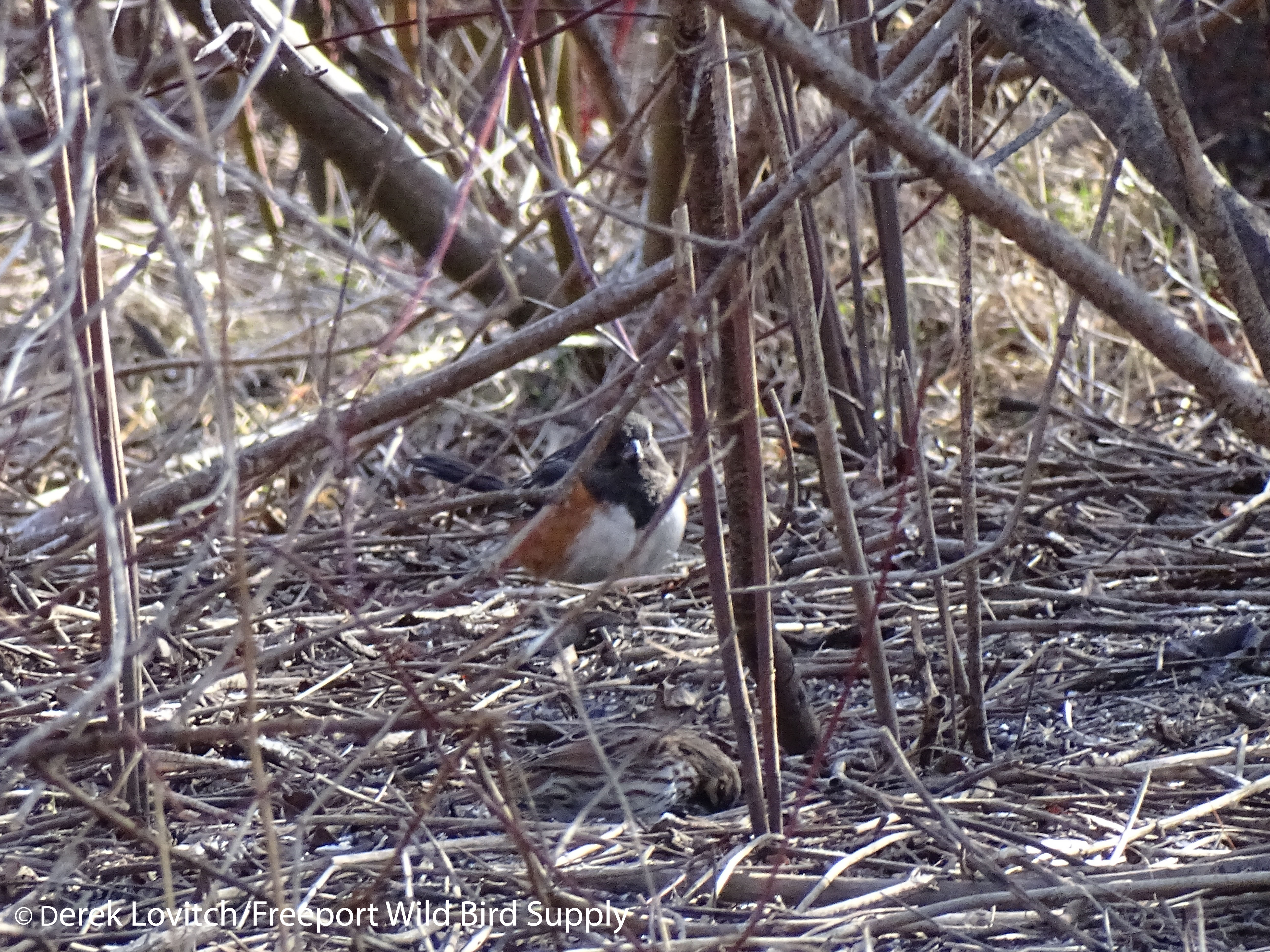
I finally went back this week, this time with Jeannette, to revisit the Spotted Towhee that I found at Kittery’s Fort Foster on 11/19. We were treated to two sessions of it feeding, both of which provided longer and better views than on the first day.
Early December is often a time with another pulse of rarities being detected as birds concentrate at fewer seasonally abundant food sources, like feeding stations, and concentrate along the coast and other migrant traps. At the very least, it’s a time for unusual “late,” “lingering,” or “pioneering” birds that brighten up a cold, gray winter’s day. This was often the case for me in my relatively limited birding over the past two weeks, with the following observations of note:
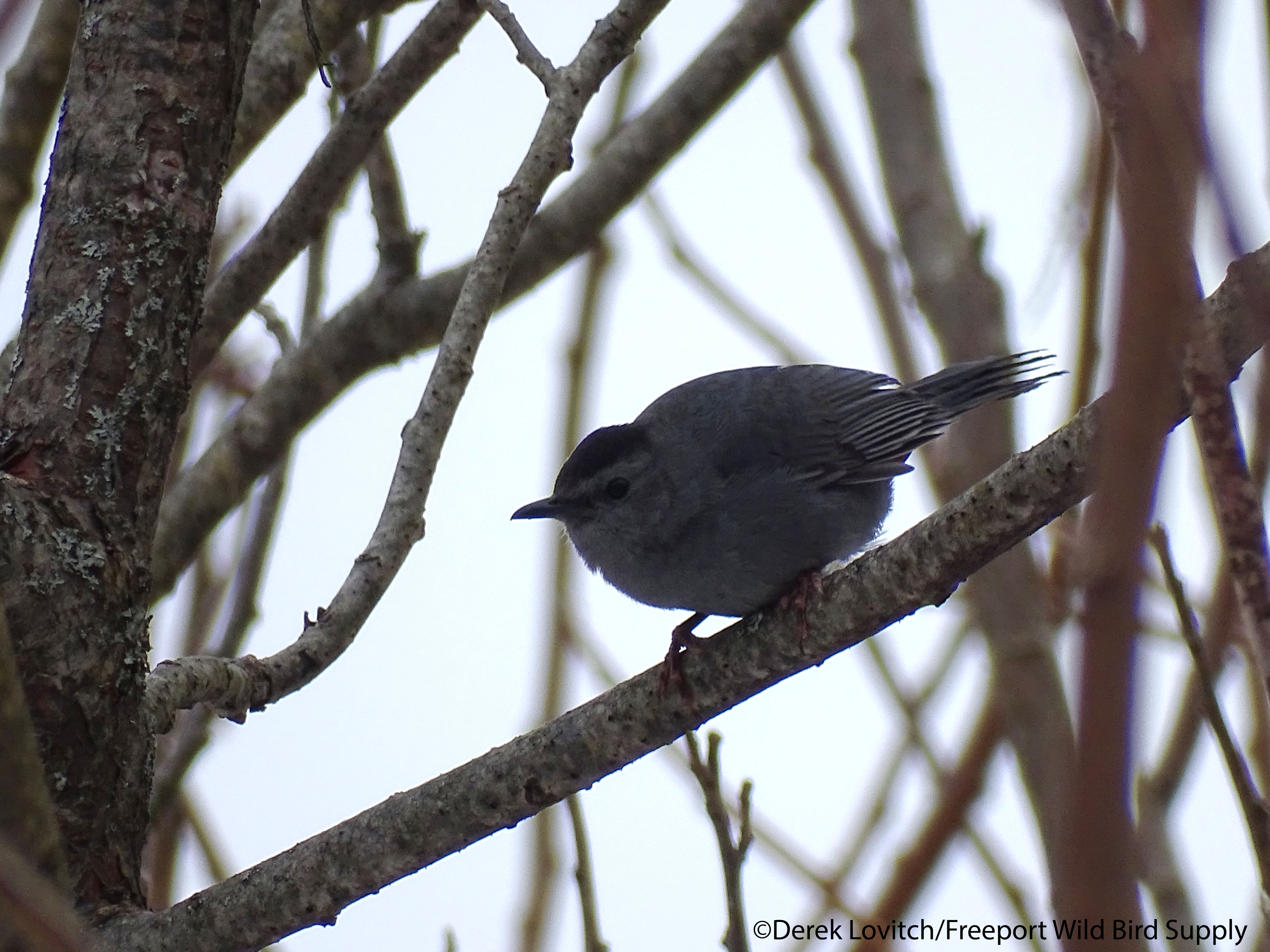
1 Gray Catbird and 1 Ruby-crowned Kinglet, Capisic Pond Park, Portland, 11/30.
Sabattus Pond, Sabattus, 12/1 (with Dan Nickerson): 380 distant scaup, 272 Common Mergansers, 238 Ruddy Ducks, 209 Mallards, 8 American Black Ducks, 8 Common Goldeneyes, 7 Buffleheads, 4 GREEN-WINGED TEAL, 3 Common Loons, 1 Belted Kingfisher, and 1 RUSTY BLACKBIRD.
1 Chipping Sparrow, King Road, Lisbon, 12/1 (with Dan Nickerson).
3 Ruby-crowned Kinglets and 2 Field Sparrows, Saco Riverwalk, Saco, 12/3.
1 Hermit Thrush and 1 Swamp Sparrow, Elphis Pond, Biddeford Pool, 12/3.
Southern York County Coast with Jeannette on 12/5:
1 continuing SPOTTED TOWHEE (photo above), 2 MARSH WRENS, and 1 Swamp Sparrow, Fort Foster, Kittery.
2 American Pipits and 1 Horned Lark, Seapoint Beach, Kittery.
1,000+ Black Scoters, The Nubble.
60 Sanderlings, Ogunquit Beach.
1 Ruby-crowned Kinglet, Auburn Riverwalk, 12/7.
1 drake BARROW’S GOLDENEYE (first of season), 74 Lesser Scaup, and 2 Greater Scaup, Lake Auburn, Auburn, 12/7.
1 Red Crossbill, over our property in Durham, 12/8.
Meanwhile, at our feeders in Durham, a nice uptick in sparrow activity including up to 14 Dark-eyed Juncos, 4 continuing White-throated and 1-2 continuing Song Sparrows, with our first American Tree Sparrow arriving on 11/22 before the store, and 15 Dark-eyed Juncos, only 1 White-throated Sparrow, and a return on 12/6 of an American Tree Sparrow after the storm. 40-50 American Goldfinches and 1-2 Purple Finches continue daily, but this week, we only had Pine Siskins in the woods and not at the feeders.
Since we’ve had a mix of “the birds are back!” and “there are still no birds at my feeders” at the store recently, a wrote a new blog talking about the season and the inconsistencies we are seeing with overall feeder activity, which is posted here.
The amazing birding and migration site – especially for fall “morning flights” – in the Mid-Coast is once again under direct threat. Birders need to help convince the state to find an alternative location for a massive new port and its infrastructure. Our most significant places of concentration for migratory birds need to be protected. Here isour Statement in Opposition to a New Port on Sears Island in Searsport.
In last week’s report, I complained about the dearth of vagrants in Maine this November, but that changed dramatically this week. Several rarities around the state included Maine’s first confirmed Spotted Towhee that I found at Fort Foster in Kittery on 11/19. A Prairie Warbler, 1-2 “Western” Palm Warblers, 1 Gray Catbird, 1 Hermit Thrush, Type 12 Red Crossbills, and 1 Ruby-crowned Kinglet were also present that day.
Photos from myself and Luke Seitz, as well as observation notes and some information are all here:
Meanwhile, at our feeders in Durham, a nice uptick in sparrow activity including up to 14 Dark-eyed Juncos, 4 continuing White-throated and 1-2 continuing Song Sparrows, with our first American Tree Sparrow arriving on 11/22. 30+ American Goldfinches and 1-2 Purple Finches continue daily, but this week, we only had Pine Siskins in the woods and not at the feeders.
ISSUES and ADVOCACY:
The amazing birding and migration site – especially for fall “morning flights” – in the Mid-Coast is once again under direct threat. Birders need to help convince the state to find an alternative location for a massive new port and its infrastructure. Our most significant places of concentration for migratory birds need to be protected. Here is our Statement in Opposition to a New Port on Sears Island in Searsport.
It was sure nice of this Orange-crowned Warbler to sit still long enough for photos, but it sure would have been nice if it was on the other side of that stem! Cape Elizabeth, 11/12.
After a great late October for rarities, November has been incredibly slow for vagrants in Maine so far…unlike surrounding states and provinces. While my increased birding time these past two weeks did not produce any significant rarities, either, it was good to be getting out! And in doing so, I enjoyed some very good birding recently. Here are my observations of note over the past two weeks.
1 ORANGE-CROWNED WARBLERS, 2 “Yellow” Palm Warblers, 3 Black-bellied Plovers, 42 Laughing Gulls, etc, Wolfe’s Neck Center, Freeport, 11/4 (with Saturday Morning Birdwalk group). While we are normally reticent to return to the same location two (let alone 4) weeks in a row, it has continued to be very fruitful, and the week-to-week ebbs and flows have been particularly insightful. More complete summaries are on the News page of our website.
2 ORANGE-CROWNED WARBLERS, 1 “Western” Palm Warbler, 1 Eastern Phoebe, 1 Fox Sparrow (first of fall, finally), 1 Field Sparrow, etc, etc, Bailey Island, Harpswell, 11/6 (with Jeannette).
Sabattus Pond, Sabattus, 11/10 (with Dan Nickerson): 575 Ruddy Ducks, 290 Common Mergansers, 224 Mallards, 156 Lesser Scaup, 113 Greater Scaup, 82 American Black Ducks, 61 Buffleheads, 32 Hooded Mergansers, 24 distant scaup sp, 21 American Pipits, 15 Canada Geese, 9 Green-winged Teal, 6 Common Goldeneyes, 5 American Wigeon, 4 KILLDEER, 4 Common Loons, 2 Black Scoters, 1 Snow Bunting, 1 Swamp Sparrow, etc.
1 American Tree Sparrow (First of fall), Yarmouth Town Landing, 11/11 (with Saturday Morning Birdwalk group).
Sabattus Pond, 11/16: 663 Ruddy Ducks, 442 Common Mergansers, 369 scaup sp, 217 Mallards, 102 Buffleheads, 92 Hooded Mergansers, 79 Greater Scaup, 14 Lesser Scaup, 14 Canada Geese, 12 American Black Ducks, 5 Common Goldeneyes, 2 American Wigeon, 1 Green-winged Teal, and 1 AMERICAN COOT.
1 drake Wood Duck, North River Road, Auburn, 11/16.
2 ORANGE-CROWNED WARBLERS, 25 Snow Buntings, and 1 Black-bellied Plover, Wolfe’s Neck Center, Freeport, 11/17 (with Dan Nickerson).
22 Black-bellied Plovers, 91 Dunlin, etc, Wharton Point, Brunswick, 11/17 (with Dan Nickerson).
2 “WESTERN” PALM WARBLERS, 1-2 Chipping Sparrows, 150+ Red-winged Blackbirds with a few Common Grackles, Pennellville Road, Brunswick, 11/17 (with Dan Nickerson).
Meanwhile, here in our Durham yard, the birdlife has become decidedly wintery. However, a few lingering/migrants of note recently included 2 RUSTY BLACKBIRDS on 11/4, two American Woodcocks through at least 11/4, and a Winter Wren 11/13-14.
Our feeders have been quite busy again, with varying numbers of all the expected species, but the number of American Goldfinches continuing to impress, with 30-50+ visiting daily. A few Pine Siskins have been mixing in with them as well, and we’re getting the sporadic Purple Finch or two. Our Njyer and hulled sunflower feeders are being emptied daily at this point. Under the feeders, White-throated Sparrows have been quite low, with only a max of 4 recently, while Dark-eyed Juncos have slowly but steadily increased over the past week. We’re down to just a couple of Song Sparrows, however.
Here at the store, we had a Common Grackle and a late Chipping Sparrow on the 15th. but we’re not seeing nearly the diversity or activity here as we are used to at the season – no doubt an indictment of the surrounding habitat.
I tried birding less (Doctor’s orders!) recently, but it’s such a tough time to do that. Luckily, this time of year is so fruitful that even reduced birding resulted in a number of sightings of note. Between rest days and a shelter-in-place order, I minimized birding to aid in my recovery. Slowly, however, I was getting out more and for more time.
1 Red Crossbill, Otter Brook Preserve, Harpswell, 10/29 (with Harpswell Heritage Land Trust tour group).
2 Field Sparrows and 5 Horned Larks, Pott’s Point, Harpswell, 10/29 (with Harpswell Heritage Land Trust tour group).
Sabattus Pond, Sabattus, 11/2 (with Dan Nickerson): 591 Ruddy Ducks, 289 Mallards, 107 American Black Ducks, about 80 mixed Lesser and Greater Scaup, 68 Buffleheads, 19 Canada Geese, 15 Northern Pintails, 13 Hooded Mergansers, 8 Common Mergansers, 7 American Wigeon, 7 Green-winged Teal, 6 Common Goldneyes, 2 Horned Grebes, 1 female Long-tailed Duck, 1 female Red-breasted Merganser, etc. etc.
Meanwhile, here in the yard, the season was rapidly changing. Starting this period with lots of Savannah and Swamp Sparrows around, they had mostly petered out by week’s end. Song Sparrows remain strong, albeit in somewhat reduced numbers, but White-throated Sparrows and Dark-eyed Juncos have finally begun to increase.
We’re down to just a couple Yellow-rumped Warblers in the yard now, but a few late-ish migrants have included a Red-eyed Vireo and Common Yellowthroat on the 25th, and the occasional small group of Red-winged Blackbirds and Common Grackles are still trickling through.
Pine Siskins and Purple Finches have been near-daily fly-overs, with the occasional Purple Finch visiting the feeders, building to 8 by 10/26 and a few Pine Siskins finally visiting the feeder on 11/1. Our American Goldfinch flock remains strong, however, with 20-25 continuing, splitting time between the feeders and the weedy margins of the property (especially Evening Primrose). Siskins and Purple Finches continued to pour into the area in the last days of October. Multiple large flocks of siskins and at least 20+ Purple Finches were in the Otter Brook Preserve in Harpswell, on the 29th, for example, and more are being reported at feeders in the area now.
Now that we are in November, the attention turns towards the water…and migrant traps for rarities!
TOURS and EVENTS:
All of our tours for 2023 are now complete, not including Saturday Morning Birdwalks of course. Keep an eye on the Tours page of our website, as we’ll soon begin adding more 2024 outings.
This Purple Gallinule graced tiny Rogers Pond Park in Kennebunk on the 20th, and I could not resist the chase!
The last few have been tough for me. It’s October in Maine – my favorite month of birding, as I have opined about before. The weather went from unusually warm and benign to pleasantly normal and unsettled. But in between, there were those glorious fall days of crisp mornings, colorful leaves, and migrants everywhere.
Over the winter as I slowly recovered from shoulder surgery, I used my one good arm to enjoy morning vigils at the active feeding station, which I chronicled here and here. I kept track of daily ebbs and flows, and paid even greater attention to behavior, such as the winter’s-long Sharp-shinned Hawk drama at the feeding station.
While it’s been a long year of near-constant pain and discomfort, it has also been a very busy year and we had one of the most successful tour seasons in our company’s history, despite the near-constant rain. I battled through some tours but did my best to remain positive and productive.
Pain was building in my “good” arm all summer, constantly doing all the work the left, surgically repaired but then frozen shoulder was still unable to accomplish. My September trip to Monhegan for Down East Adventures was the most challenging yet.
For the first time in my career (around 30 years of guiding in some shape or form), I had to hire a replacement for a tour. Thankfully, my good friend and amazing birder Evan Obercian was able to cover our 18th annual Monhegan Fall Migration Weekend for me. I could barely get in and out of my recliner – I was not going to be able to walk around all day and show people birds!
The duration of this intense pain lasted far longer than I had expected, despite various combinations of medicines and therapies, but I mostly remained on “Injured Reserve’ (I feel like I am injured often enough to be an Offensive Lineman for the Patriots!) Meanwhile, October birding was at its finest, and birds were streaming through. Our Durham yard was absolutely bursting with birds on most mornings through, but my birding was limited to a short walk up and down the driveway.
Our September diversity of warblers slowly petered out into waves of Palm and Yellow-rumped Warblers in early October, with Ruby-crowned Kinglets bitterly scolding from all edges. Our fields and meadows were chock full of sparrows, with a productive breeding season for Song Sparrows soon augmented by flights of Swamp, the return of White-throated, more Song, and a surprising amount of Lincoln’s Sparrows.
Some other highlights during the peak of my limitations included a Philadelphia Vireo viewed from my recliner on 10/1 and a truant Scarlet Tanager spotted from the same position on the 5th. Happily, by the morning of the 7th, I was actually able to take a little walk with bins and that yielded a nice array of migrants including 2 Blue-headed Vireos, a presumed-continuing Scarlet Tanager, a new wave of Yellow-rumped Warblers and especially Ruby-crowned Kinglets, and an increase in Swamp, Savannah, and Song Sparrows in our field.
Meanwhile, my usual morning texts with Evan and Dan Nickerson as we monitored the ebbs and flows of migration helped to keep me abreast of what was happening beyond the yard. Our feeders in Durham were busier than what most people were experiencing this fall, but this is always a time of plenty. For me, unfortunately, my limitation was holding my head upright and using binoculars, so daily counts and monitoring were out of the question – no chance to attempt another Sandy Point Morning Flight, despite some great conditions on several mornings.
I was kept busy with a writing project, correspondence and planning for the store, and on the morning of the 8th, Jeannette and I boarded a plane for a trade show in Missouri. After a 5-year hiatus, we really needed to get back to reinvigorate our offerings and see if there were any revolutionary developments.
Flying into Kansas City, Jeannette and I enjoyed a couple of days off before the trade show, and then a day upon our return. We visited with a friend, checked out some breweries and indulged in the best of Kansas City BBQ, and of course, did a little birding. Finally feeling well enough to carry binoculars for a bit, we spent the morning of the 9th birding in Kansas (Spotted Towhees and Franklin’s Gulls!) and at least a couple of hours of each morning of our trip. A big overnight flight resulted in a very productive morning at the Lowe Conservation Area in Mexico, for example, with large number of Yellow-rumped Warblers and impressive numbers of Lincoln’s Sparrows among many others.
When we returned late on the 13th, much had changed here in Maine – a week is a long time in fall migration! I was finally back to work, leading the Saturday Morning Birdwalk once again on the 14th. If only to prevent me from snapping my head up in response to an unfamiliar flight call, I was still sporting a neck brace and quite a bit of discomfort. However, the birding helped ease the pain. In fact, it was an exceptional outing full of sparrows, a massive arrival of Pine Siskins, a late Nashville Warbler, and a Great Blue Heron hunting voles.
I birded our Durham property on the morning of the 15th, noting the changes since we departed. While truant House Wren and Indigo Bunting continue, gone are the last of our Gray Catbirds. There were still a lot of Song Sparrows, but fewer Swamp and more Savannah in our field. A Dark-eyed Junco and a few fly-over Pine Siskins have arrived, and a flock of about 100 Common Grackles briefly visited a patch of wet woods. Warblers, however, were now limited to a healthy smattering of Yellow-rumped only. A Rusty Blackbird and our first two immature White-crowned Sparrows arrived on the 17th, and the morning of the 20th was particularly birdy – Pine Siskins are here now.
Our annual Fall Boothbay Mini-Pelagic on the 16th went off without a hitch, with great weather and sea conditions. However, few seabirds were to be found, despite a lot of ground covered. The passerine list – including sparrows 28 miles offshore – was fascinating, however. But it felt more like being at Sandy Point than at sea!
It was a short trip, but I actually went birding on my own for a few hours on the 18th, visiting Sabattus Pond. Waterfowl numbers are increasing, with decent tallies including 140 Ruddy Ducks, 113 Lesser Scaup, 75 Greater Scaup, 3-5 Green-winged Teal, 2 Buffleheads (first of fall), and 1 each of Ring-necked Duck and Surf Scoter.
And finally, today was our last boat trip of the year – our Birds of Casco Bay with Seacoast Tours right here in Freeport. A casual 2.5-hour cruise produced an abundance of newly arrived Surf Scoters, 9 Red-breasted Mergansers, a surprising 15 truant Laughing Gulls, and a rather tardy Osprey.
And with my birdfinding so limited, I jumped at the chance to do a little bird-chasing. After my tour, I raced down to Kennebunk where a vagrant Purple Gallinule was found this morning. Interestingly, this is the second in Maine at the moment, with one continuing in the even more surprising location in a small pond in the North Maine Woods not far from Moosehead Lake!
It was in the open when I arrived, and I enjoyed some prolonged quality time with it by myself and with just a few others at we watched it feed on crabgrass and at least one large earthworm. Oddly, it remained loyal to a small patch of grass under a powerline, away from the water.
As I continue to slowly feel better, I’ll be trying to get out more. Unfortunately, there will not be any more visits to Sandy Point for the morning flight for me this year, but there are plenty of birds to see everywhere else. Sabattus Pond season is upon us, and Rarity Season is about to ramp up. It’s an amazing time to be in the field, and I will do my best to get out there and report back. Stay tuned for trip reports, birding summaries, and I am sure, a few “highlights” too!