Category Archives: Private Guiding and Tours

2016 Birding By Schooner Trip Report

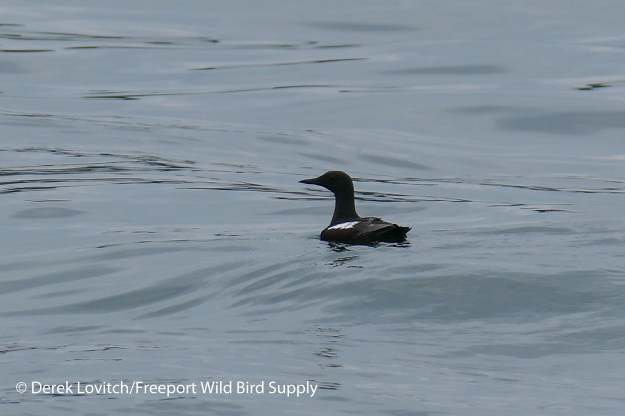
My 7th (now annual) Birding By Schooner aboard the Lewis R. French tour got underway on Monday morning from Camden Harbor with sunny skies and a light breeze perfect for a little sailing. Black Guillemots, Common Eiders, and Laughing, Herring, and Great Black-backed Gulls escorted us out of the harbor, as Ospreys kept a close eye on the proceedings.
1. Camden Harbor Departure_edited-1
3. map session_edited-1

Out in the bay, Harbor Porpoise were soon spotted (they were very plentiful on this trip) and plenty of Harbor Seals. Merlin, Bonaparte’s Gulls, and Common Loons were quickly added to the list. Sailing towards the Fox Islands Thorofare, we picked up an unexpected inshore Great Cormorant, an immature hanging out with Double-cresteds on Scraggy Island. Burnt Cove Harbor on Swan’s Island was our destination for the evening.
2. Entering Fox Islands Thorofare_edited-1

In the morning, we took a walk onshore, birding and naturalizing our way to the lighthouse. A Red Crossbill flew over calling as we landed at the dock, my 132nd all time Birding-by-Schooner species! The walk sampled the common denizens of the Red Spruce-dominated Acadian habitat of the region, with numerous Black-throated Green Warblers and many others. A White-tailed Deer crossed our path, and we spent some time learning the local trees.
5. Burnt Coat Harbor 2_edited-1
As we checked out the feeding station at this house, we couldn’t help but feel as if we were being watched…and we were!  I remember being creeped out by this doll when we last landed here a few years ago.
6. Burnt Coat Harbor 3_edited-1
7. Burnt Coat Harbor 4_edited-1
8. DEJU1C_edited-1

9. Burnt Coat Harbor -later_edited-1
10. Burnt Coat Harbor-departing_edited-1

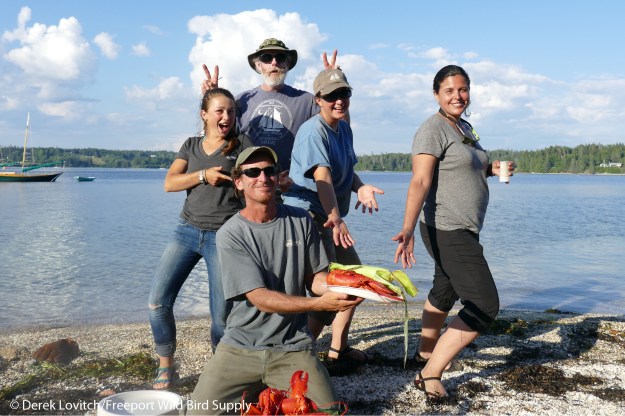
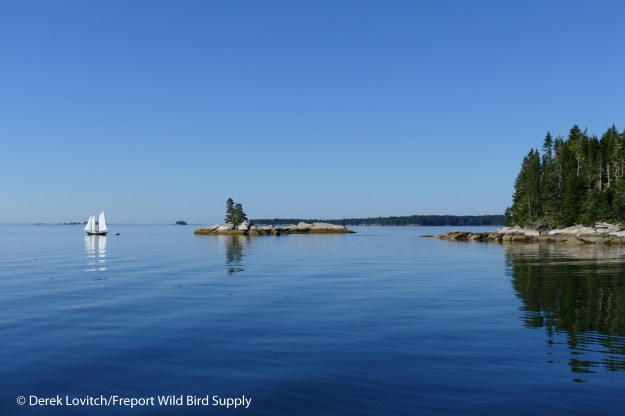
Back on board, the fog had lifted, and we sailed through Blue Hill Bay, arriving at tiny Babson Island for the evening. Usually, the famous lobster bake is the finale of the trip, but this tour’s focus is having the chance to get out to Seal Island – far offshore and needing a narrow suite of conditions to make it possible (or, at least comfortable). Therefore, Captain Garth decided to mix things up a bit and take advantage of a pleasant evening and a lovely little beach. Much food was consumed. Several more Bald Eagles were noted.
11. Babson Island1_edited-1
12. Babson Island 2_edited-1
13
Tobias, visiting us from Sweden, shares the story – and flavors – of Skane aquavit, while Dan shares stories of Garth as a young mate.
14
15. Lobster Bake 3_edited-1
16. crew at lobsterbake_edited-1
The crew.

17. post Lobster Bake1
18. post Lobster bake2

Once again, Garth nailed the window, and conditions were absolutely perfect for a trip out to Seal Island, part of the Maine Coastal Island National Wildlife Refuge.  We passed between Stonington and Isle Au Haut, and cruised by Saddleback Ledge and into open water. I became more vigilant.
19. Babson Island am_edited-1
20. Saddleback Ledge_edited-1
Saddleback Ledge

One of the reasons I most look forward to the annual trip is for the chance to visit Seal Island. Our goal is to head out there every year and spend a night anchored offshore. It’s a very unique and special opportunity, and of course a chance at some great birding. Not the least of which is the chance to see “Troppy,” the Red-billed Tropicbird that has come to the island for the past 10 summers (and 11th year in the area overall). But this year, my anticipation about a visit was stoked even more with a spate of other rarities recently, including a Royal Tern, a Yellow-crowned Night-Heron, and – two days prior to our departure, an inconceivable 1st Western Atlantic seaboard record of a Great Knot! A bird that breeds in Siberia and winters mostly in Southeast Asia and Australia, this is truly an incredible record.  Needless to say, it was not on my annual list of Next 25 Birds for Maine! I was showing symptoms of rarity fever.

Also, needless to say, I couldn’t wait to get out there!  But, at the mercy of the wind (or often, lack thereof), I had little say in whether or not we’d have a chance to look for it (although I really had zero expectations of it sticking around), Troppy, other rarities, or simply enjoy puffins, Common Murres, Razorbills, and calling Leach’s Storm-Petrels through the night.

With Seal Island on the horizon, we scanned the open waters, which we found to be unusually quiet. Commuting Common Terns and several Arctic Terns (who recently regained the crown of longest-distance migrants in the world: up to 55,000 miles a year!) began to appear, a sign that we were getting close. Under full sail (we often have to motor-sail to get this far out on a nice enough day), we spotted a lone Northern Gannet, and as we neared the island, numerous Atlantic Puffins became visible.
21. juvARTE1_edited-1
Juvenile Arctic Tern
22. Seal Island approach_edited-1

We slowly plied the waters off the islands southwest side, enjoying close up puffins, practicing our tern identification, watching Great Cormorants, and keeping an eye out for…

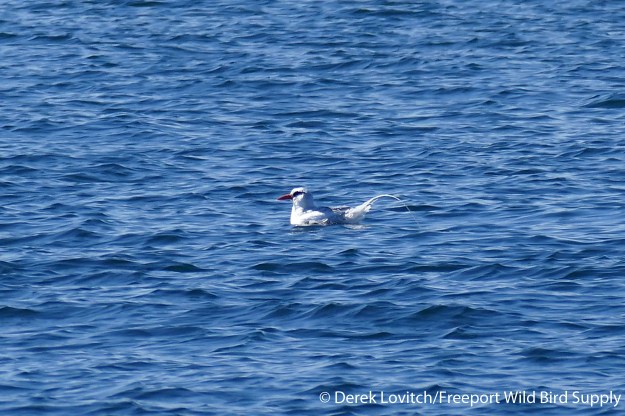
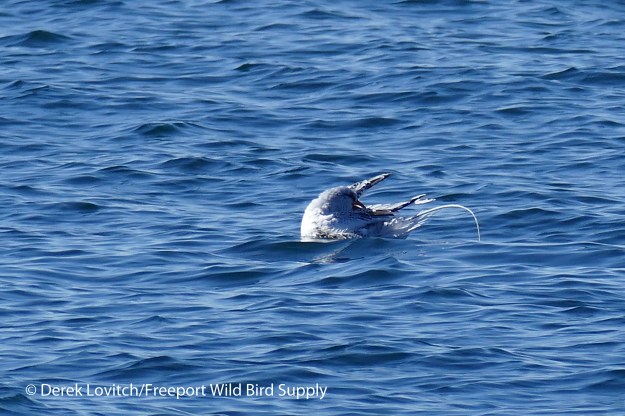
Troppy!  Just a few minutes ahead of schedule at 4:17pm, the famous Red-billed Tropicbird appeared. I was able to spot him as he was flying low, and dropped in for his usual (as long as it is sunny!) afternoon bath. Captain Garth and 1st mate/co-Captain Dan adeptly positioned the boat to slowly approach him on the water, without flushing him. We got incredibly close and cameras clicked away (my photos are a little distant as I decided to try for video this year when we were making our closest approach). Soon, he relocated to his more-usual bathing location closer to the island.
23. Troppy1
24. Troppy8_edited-1

Success!  And with happy birders and a Captain basking in his glory of once again perfectly timing our arrival to once again put us in perfect position for an enjoyable view, we sailed over to the Eastern Bight and dropped anchor for the evening. Besides our incredible success rate of seeing Troppy (5 out of 6 visits to Seal now, a great batting average), this tour also – again, conditions permitting – affords the unique opportunity to spend a night off of this incredible and remote island.

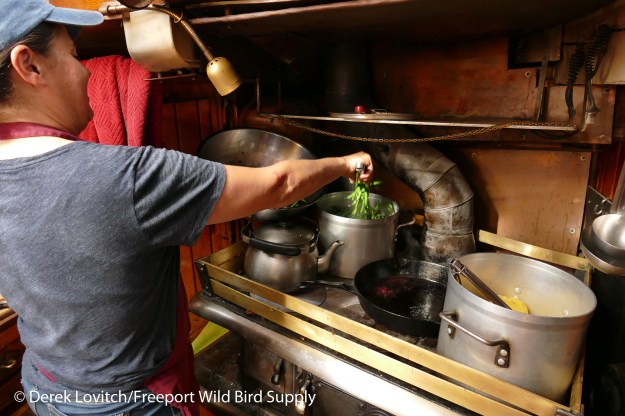
As per tradition, we invited the Seal Island crew of Puffin Project biologists aboard for dinner (thanks to the talents and perfect planning of our cook, Carla and her Mess Mate, Genevieve) and a visit, giving the crew and participants a chance to pepper them with all sorts of questions. We all kept an eye out for shorebirds passing or rounding the island, and Keenan and crew took the opportunity to survey the growing contingent of Laughing Gulls that have been congregating on the island. The sunset was particularly spectacular this evening as well.
25. Seal Crew visits2_edited-125. Seal Crew visits_edited-1
25B. L1060029_edited-1
26. Seal Sunset 2_edited-1

But we weren’t done with the “unique experiences” yet!  In addition to the remoteness of our anchorage, spending the night at Seal also gives us a chance to listen (and perhaps even see) Leach’s Storm-Petrels, vocalizing as they return to their nesting burrows under the cover of darkness.

While staying up a little later, or getting up a little earlier, would likely yield some calling birds, I don’t want to just hear them; I want to experience the cacophony to its fullest extent. Therefore, I suggest people wake up in the middle of the night for a listen. This year, I proposed waking up at 3:00am, and since several folks wanted to also see them, staying up through the twilight until sunrise.

As I stumbled to the deck at 3, I was pleasantly surprised to see seven people had joined me in the insanity. And, with a light fog rolling in (perfect!), the birds were calling a lot – and some giving their almost-sinister, cackling chatter very close to the boat.  Five of us stayed up right through daybreak, and although we didn’t actual spot a Leach’s (although Dan glimpsed a shadow of what was undoubtedly one), we thoroughly enjoyed the experience. Adding to the mystique was the low fog, and the low, deep moans and groans of baying Gray Seals.
27. Seal sunrise_edited-1

We were, however, anxiously anticipating the arrival of morning coffee and muffins!

A Savannah Sparrow briefly alighted on the boat before returning to the island, puffins and guillemots were abundant, and terns were busy, heading to and fro. We only saw one Razorbill on the water, and no Common Murres on this visit, and sorted through the handfuls of shorebirds that were around (migrants, mostly Semipalmated Sandpipers and a smattering of others, along with local and vocal family groups of Spotted Sandpipers).

The skies cleared after breakfast and with a light south-southwest wind, we decided to head out for a little offshore sailing. We passed along Seal, hoping for another visit from Troppy, but then turn around the north end of the island and tacked our way offshore. Dan, Garth, and the sailing fans were having fun, while the birding fans enjoyed the numerous commuting puffins. We also spotted a few good pelagics: led by a Cory’s Shearwater, my first ever from the windjammer, soon followed by a second sighting. A single Great Shearwater passed close by, shortly before encountering a more-distant raft of 36.  There were painfully few Wilson’s Storm-Petrels, but we did have a Minke Whale, and moments after I said we “could use a Manx Shearwater now” a Manx Shearwater passed by!
28. Seal Day 2_edited-1<

We had hopes of sailing around Matinicus Rock, but time and wind suggested it was time to head inshore. We rounded Wooden Ball Island, still under full sail, but then the wind ran out. Drifting mostly with the incoming tide, and soon into dense fog our progress was slow. But napping was in order, and this was the perfect opportunity.

We needed our yawl boat to push our way past Vinalhaven and into the Fox Island Thorofare where the fog finally lifted. Anchoring between the village on North Haven and a dock on Vinalhaven, our day came to a close. Unfortunately, we arrived too late in the day for an evening walk.
29. Fox Islands Thorofare 1_edited-1
30. OSPR1_edited-1
31. Galley1_edited-1
32. Green flash_edited-1
Look? We saw “the green flash” at sunset!

50. breakfast of champions_edited-1
Tobias’s breakfast of champions.
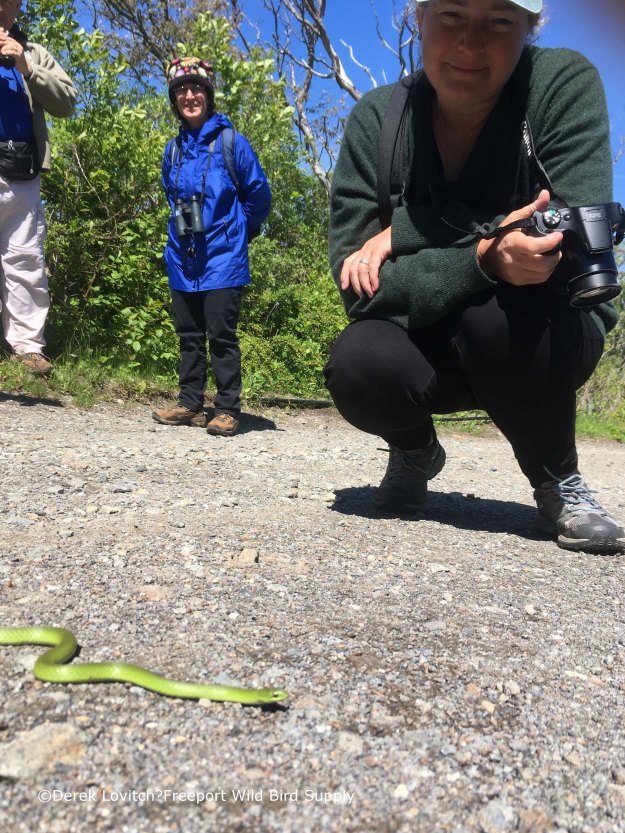
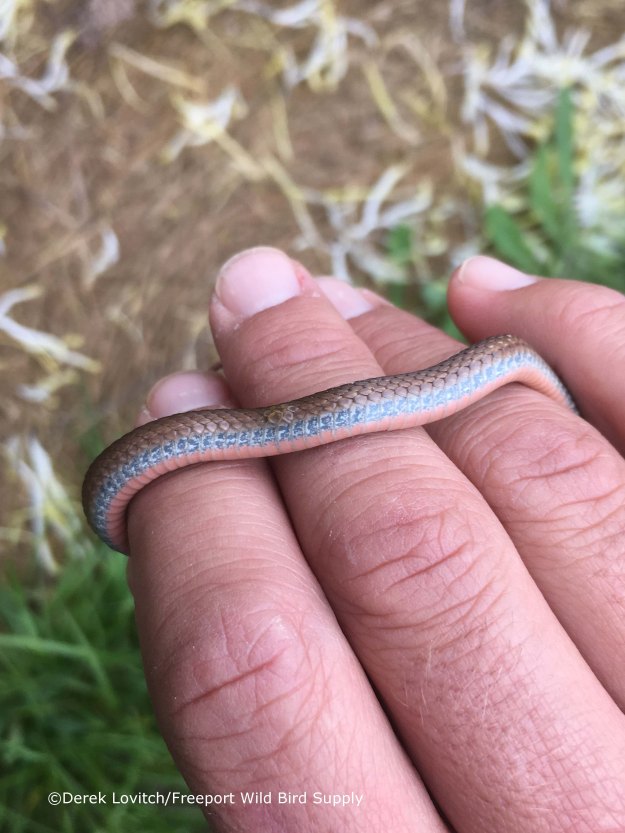
It was a lovely, albeit humid and rapidly warming, morning, which began with a pair of vocal Merlins from the boat. Making up for lost time, we hopped to shore, and I lead a walk in the North Perry Creek Preserve on Vinalhaven. Northern Parula, Black-and-white Warbler, Ruby-throated Hummingbird, and many others were added to our triplist, but most birds were Black-capped Chickadees, Golden-crowned Kinglets, Black-throated Green Warblers, or Red-breasted Nuthatches. Twelve-spotted Skimmer (a dragonfly), Smooth Green Snake, Wood Frog, and a spiffy diurnal moth, the Virginia Ctenucha were also observed.
51. North Perry Creek Preserve_edited-1
52. North Perry Creek Preserve 2_edited-1

We extended our loop a bit, but our selected return trail turned out to be more rugged than expected, so we made it back just in time for lunch. After another scrumptious, and this time well-earned, meal, we pushed to the east, then set sail and turned north into East Penobscot Bay.

While the occasional Razorbill is regular in the bay, small groups are often found after storms, and at this time of year fathers leading flightless juveniles are regularly encountered. But earlier in the season, Garth had started noticing 30-40 regularly in a particular area, roughly between Eagle, Butter, and Bradbury Islands. Seeing them often enough, it was more than a random occurrence.

Needless to say, I was intrigued (and a little bit proud, I must say!), and since we only had one distant Razorbill out at Seal, it seemed like a good plan to check it out today. As we approached the area, I spotted one Razorbill in flight, then a group of 5 passed by. Black Guillemots were even more numerous than usual, and gulls (including several Bonaparte’s) were more common than elsewhere in the bay. But no rafts of Razorbills.
53. BLGU2_edited-1
54. BLGU5_edited-1
56. BLGU12_edited-156. BLGU9_edited-1
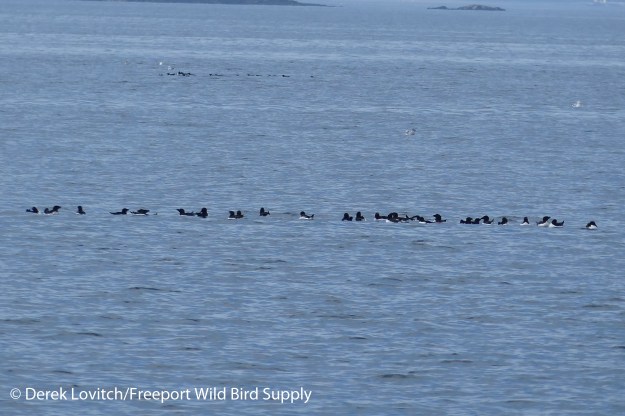
I kept scanning, but noticed Garth was looking a little disappointed. Then I asked Dan to check out what appeared to be a large raft of birds. I immediately thought Razorbills, but the group was so big, I doubted myself. It was way more than 30-40. Were they just eiders distorted by distance and heat shimmer, or were we about to see something really, really exceptional?

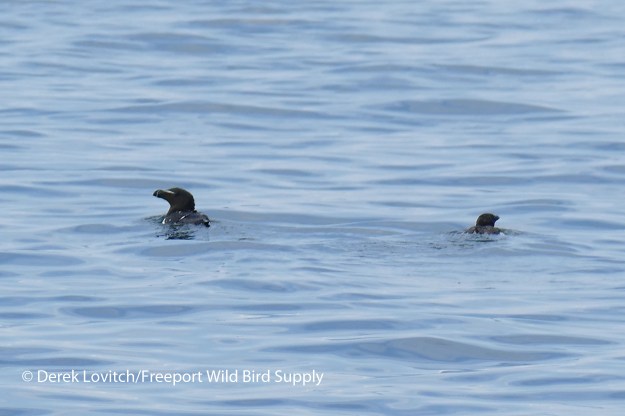
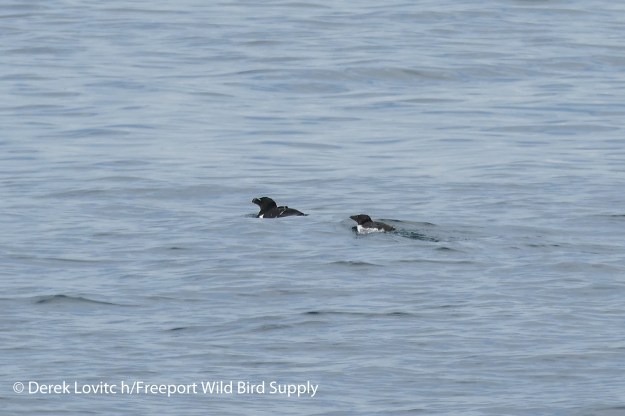
We’re going to go with the latter. But no, there were not 30-40 Razorbills anymore. There were now 252. And while there were a few fathers escorting kiddos, the majority of the group were adults. I need to do some research, but this is probably an unprecedented number for inshore waters, and perhaps even a summertime record for Maine? Regardless of the statistics, it was amazing, and as we simply drifted among them, many photographs were taken, and we were even able to hear many of them growling, and one of the juveniles piping.
65. RAZO1_edited-1
66. RAZO8_edited-1
67. RAZO12_edited-1
68. best1-RAZO13_edited-1
70. RAZO15_edited-1
71. RAZO_juv1_edited-1
72. RAZO-juv4_edited-1
73. RAZO30_edited-1
74. RAZO33_edited-1
75. RAZO38_edited-1
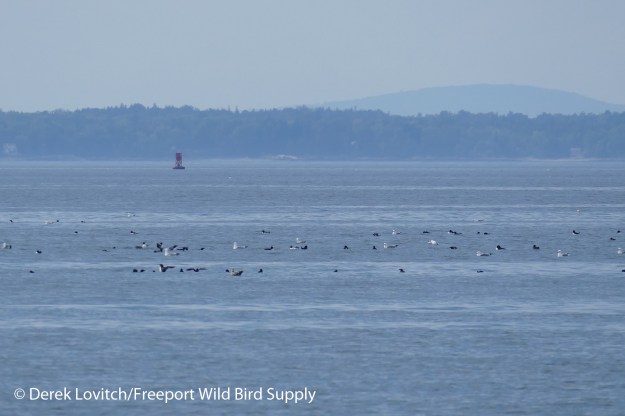
I also spotted a spec in the distance, which I photographed for later analysis. Blowing it up on the computer, I can confirm the 134th species to be seen from the Lewis R. French during the Birding By Schooner Tour: Red-throated Loon (a rare but regular summertime lingerer that I have been expecting to spot at some point).

But, did I mention all the Razorbills!?

59. Garth and Dan_edited-1
With another extraordinary experience under our belts, we pulled into Gilkey Harbor on Islesboro for the night.
57. roast beef_edited-157. Carla Cooking1_edited-1

Carla at work. 
60. dinner line_edited-1\
61. last sunset_edited-1
62. last sunset3_edited-1
63. last piping_edited-1
64. cannon2_edited-1

I was up early the final morning, hoping to add a few more singing birds from the mainland to what was a paltry total triplist. But once again, the dawn chorus was nearly non-existent, and for the first time, species such as Swainson’s Thrush and Winter Wren went undetected during our tour. Was it just because of our few-days-later-than-usual outing? Did the drought lower productivity and birds have already cleared out? Or, was it an early and successful breeding season and birds have already finished doing everything other than secretively undergo molt?
33. last morning1_edited-1

While we did have 1 or 2 fewer walks than usual, we had a better seabird tally than in most years. But no migrant swallows? And a low diversity of migrant shorebirds.  So our total checklist was well below average, so I was working hard to pad the list: American Black Duck and Belted Kingfisher in the harbor, and as we slowly sailed back to Camden: Turkey Vulture and Red-tailed Hawk over the Camden Hills.

Of course, no one would have traded Troppy, three shearwaters, countless calling Leach’s Storm-Petrels, or an unprecedented aggregation of Razorbills for a few more total ticks!

As Ospreys called around us as we entered Camden Harbor – the same ones that announced our departure, and the trip came to a close, another successful, unique, and bird-tastic Birding By Schooner tour was in the books.
34. entering Camden1_edited-133A. entering Camden2_edited-1
35. COLO11_edited-1
One of the first birds we saw was also the last, this Common Loon, apparently with a broken lower mandible, sneaking away from our docking boat.

Here’s our complete list from the trip:

  1. Mallard
  2. Canada Goose
  3. Osprey
  4. American Goldfinch
  5. Yellow Warbler
  6. Rock Pigeon
  7. European Starling
  8. Cedar Waxwing
  9. American Robin
  10. Song Sparrow
  11. Chimney Swift
  12. Double-crested Cormorant
  13. Herring Gull
  14. Great Black-backed Gull
  15. Black Guillemot
  16. Laughing Gull
  17. Common Loon
  18. Ring-billed Gull
  19. Bonaparte’s Gull
  20. Merlin
  21. GREAT CORMORANT
  22. Bald Eagle
  23. American Crow
  24. Mourning Dove
  25. Killdeer
  26. RED CROSSBILL
  27. Red-breasted Nuthatch
  28. Purple Finch
  29. White-throated Sparrow
  30. Black-capped Chickadee
  31. Gray Catbird
  32. Dark-eyed Junco
  33. Yellow-rumped Warbler
  34. Black-throated Green Warbler
  35. Common Yellowthroat
  36. Savannah Sparrow
  37. Broad-winged Hawk
  38. Hermit Thrush
  39. Eastern Phoebe
  40. Great Blue Heron
  41. Spotted Sandpiper
  42. ARCTIC TERN
  43. Semipalmated Sandpiper
  44. Northern Gannet
  45. ATLANTIC PUFFIN
  46. RED-BILLED TROPICBIRD
  47. Greater Yellowlegs
  48. Semipalmated Plover
  49. Ruddy Turnstone
  50. LEACH’S STORM-PETREL
  51. RAZORBILL
  52. CORY’S SHEARWATER
  53. Great Shearwater
  54. Wilson’s Storm-petrel
  55. MANX SHEARWATER
  56. Common Raven
  57. Blue Jay
  58. Downy Woodpecker
  59. Northern Parula
  60. Black-and-white Warbler
  61. Ruby-throated Hummingbird
  62. Northern Flicker
  63. Chipping Sparrow
  64. RED-THROATED LOON
  65. American Black Duck
  66. Belted Kingfisher
  67. Turkey Vulture
  68. Red-tailed Hawk

And the list of mammals, and a selection of other critters:

  1. Harbor Seal
  2. Harbor Porpoise
  3. Red Squirrel
  4. White-tailed Deer
  5. Orange Sulphur
  6. Gray Seal
  7. Minke Whale
  8. Wood Frog
  9. Twelve-spotted Skimmer
  10. Smooth Green Snake
  11. Virginia Ctenucha
  12. Great Spangled Fritillary
  13. Red Admiral

Since every year’s tour is so different, if you would like to look back on previous trips and their respective birdlists, please click on the links below. Furthermore, for more (and better!) photographs of the birds we see, check out the tours (2015 + 2013) that Jeannette was on!

2015

2014

2013

Hope to see you aboard next year!


Birds on Tap – Roadtrip: Spring Ducks and Draughts 2016

NOPI female1, Riverbank Park, 1-9-12_edited-1
One of the trips’ highlights was the two dozen Northern Pintail at the Mouth of the Abby. We enjoyed the gorgeous males, but also took time to appreciate the subtle beauty of the hens. We also learned how to separate “all the brown ducks” but considering shape and size. Female Northern Pintail, April 2009 – Riverbank Park, Westbrook.

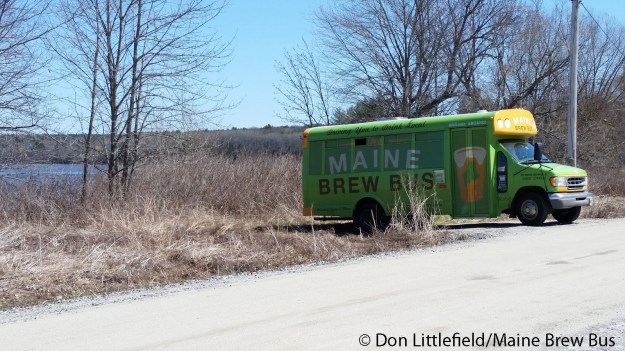
On Sunday, our “Birds on Tap – Roadtrip!” tour headed up to the spring waterfowl hotspot of Merrymeeting Bay. The Spring edition of “Ducks and Draughts” focused on the multitudes of waterbirds that congregate on this productive body of water with our partners at the Maine Brew Bus.

With the abnormally (even by modern standard) early spring, ice was out on ponds, lakes, and rivers to our north well over a month ago. Not surprisingly then, diving ducks were few. Dabbling ducks, however, are still present in great numbers, taking advantage of the food resources (last year’s wild rice and other seeds) in the fine mud of the bay’s extensive flats.

After a quick stop at Bowdoinham’s Mailley Park (Double-crested Cormorants, Common Mergansers, and my first Pied-billed Grebe of the year), we moved over to the famous “Mouth of the Abby,” where the Abagadasset River drains into the bay proper. And it most definitely did not disappoint: About 1,000 American Black Ducks were joined by 200 or so Green-winged Teal, at least 100 Mallards, a goodly tally of 24 Northern Pintails, a dozen more Common Mergansers, 8 Canada Geese, a mere 8 Ring-necked Ducks, and a pair of Wood Ducks. 6 Killdeer also foraged on the flats, and the second Bald Eagle of the day passed right overhead.
At_Abby1At_Abby2
With Jill hard at work taking photos for the paper.

The three Wood Ducks in the small pond on Brown’s Point Road flushed as the bus approached, and they didn’t let us get much closer on foot as we walked back. A Cooper’s Hawk was well seen, however.
BrewBus_BrownsPoint

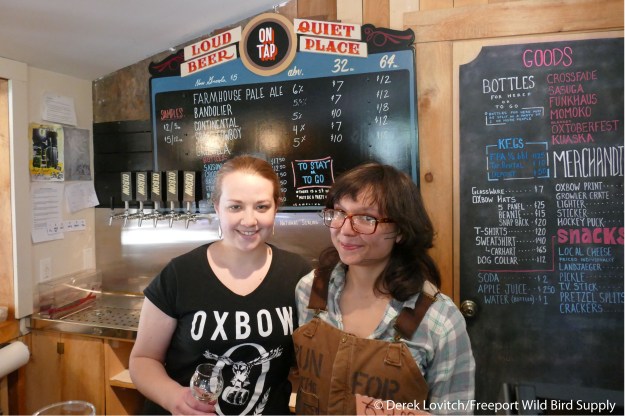
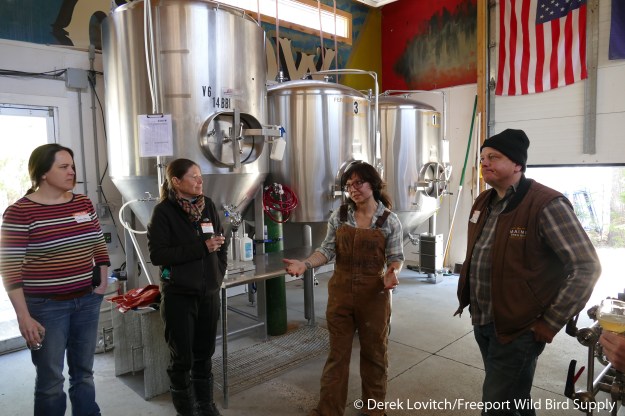
After squiggling cross-country to Newcastle, we pulled into the brewery and rustic tasting room of Oxbow. After a couple of samples – Bandolier, their spring printemps was one of the favorites; it certainly was mine – Rocky took us on a tour of the brewery, and a part of the impressive property.
L1040500_Oxbow1_edited-1L1040521_Oxbow2_edited-1aL1040525_Oxbow3_edited-1L1040537_Oxbow4_edited-1L1040540_Oxbow6_edited-1

Oxbow’s connection to the land is evident, from the sour cherry orchard to the welfare of their livestock (pigs coming soon!). We learned about the philosophy of their beer, and some of the new and creative things they’re working on.
L1040541_Oxbow7_edited-1L1040547_GuineaFowl1,Oxbow_edited-1
Sorry folks, not “countable!”

After another round, it was back on the road, as we weaved our way through scenic rural vistas to Brunswick, where we made a quick stop at Bay Bridge Landing Park. We hoped to add a previously-reported Eurasian Wigeon to our waterfowl list, but the tide was already too high, and the low pass from a Bald Eagle – our 6th or 7th of the day – probably did not help matters! However, a low pass of an Osprey, hovering right overhead, was a nice consolation prize.
L1040558_OSPR,BayBridgeLanding,4-10-16_edited-1

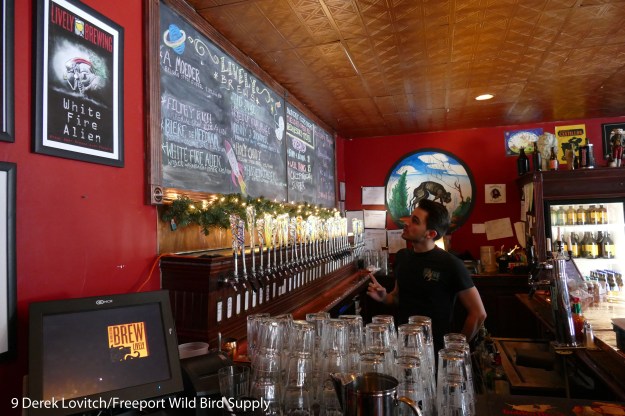
Lively Brewing at Ebenezer’s Brewpub was our second brewery stop of the day. Kelso offered up three samples of some of their representative beers, guiding us through the different styles and some of the intriguing and creative options they play with here.
L1040564_LivelyBrewing1_edited-1L1040567_Lively2_edited-1L1040569_Lively4_edited-1

Whether it’s the birding or the beer-ing portion of these tours, there really is never enough time, so before we all knew it (time really does indeed fly when you are having fun; please excuse the pun) it was time to head back to Freeport and Portland, bringing another fun and successful Birds on tap – Roadtrip! to a close.

So that’s my recap on the trip. But this tour welcomed Meredith Goad, the food writer from the Portland Press Herald on board. You know you have a unique collaboration when you have a food writer wanting write about a birding tour! For Meredith’s perspective, comments from the participants, and more information about this truly unique birds and beer tour concept, check out Meredith’s excellent article in today’s paper!

Needless to say, the rest of the year’s four tours are filling up fast! For more information on those, see the Tours, Events, Programs, and Workshops Page of our website, and check out my blog about all of this year’s journeys. And don’t forget about Birds on Tap – Monhegan! in May.

My beautiful picture

No matter how common they might be, there are few things more stunning than a drake Mallard!

Birds on Tap – Monhegan!
IMG_1030_edited-2
“Coffee Warbler” would be a better name for the Magnolia Warbler due to their affinity, and perhaps even reliance, on shade-grown coffee plantations in winter.

Beer + bird-friendly coffee + birds + migration + Monhegan + Dr. Steve Kress* = Epic.

IMG_1180_edited-2

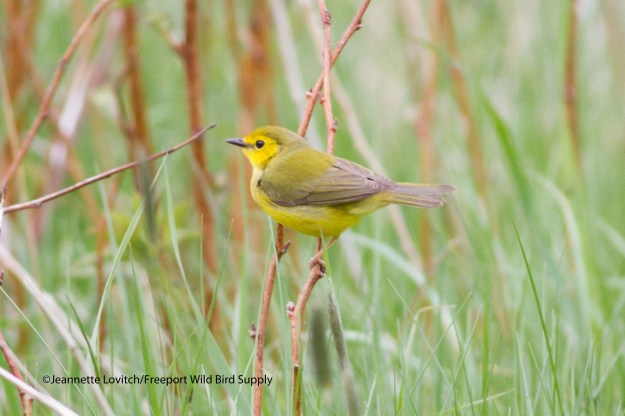
You never know what will show up on Monhegan on Memorial Day weekend, like this female Hooded Warbler.

For a while now, I have been hinting at a big event in the works for Memorial Day Weekend on Monhegan Island. Partnering with Birds & Beans Coffee, Monhegan Brewing, and The Trailing Yew, Freeport Wild Bird Supply is pleased to announce:

Birds on Tap – Monhegan!

We have the “Birds on Tap!” lecture series at Rising Tide in partnership with Dr. Noah Perlut, and the Birds on Tap – Roadtrip! series in conjunction with the Maine Brew Bus, and now, we’re going even bigger with a weekend on the birding Mecca of Monhegan Island!
DSC_0051_2EAKI,Monhegan,5-24-14, edited-1
Eastern Kingbirds.

But now we’re adding coffee to the mix, specifically bird-friendly, shade-grown, organic, and fair-trade certified – not to mention absolutely delicious – Birds & Beans coffee! Roasted right here in Maine, Birds & Beans (available at Freeport Wild Bird Supply and several other retailers around the state) coffee carries the “gold standard” of certification, the “Bird Friendly” label of the Smithsonian Migratory Bird Center. With this level of certification, we can protect the rainforest habitat required for the Neotropical migrants that us birders flock to places like Monhegan Island in spring and fall to see.
Spring (2)_edited-1
DereksGroup_edited-1

Want to see warblers, vireos, tanagers, and orioles? Well then we really can’t afford to lose more rainforest where these birds spend up to eight months of every year. So this year, while enjoying the migrants that pass over and through Monhegan, we’re going to work to save them. By drinking coffee…and a little beer.
IMG_1020_edited-2

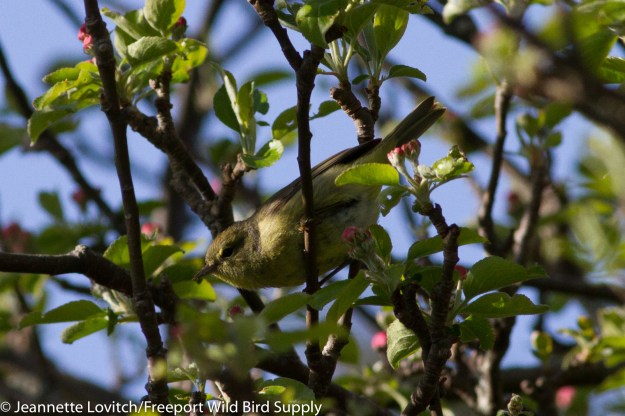
Northern Parula on springtime apples on Monhegan.

Dr. Stephen Kress will be giving a program titled: “Saving Seabirds: Lessons from Puffins and Terns”. Worldwide, about one third of all seabird species are globally threatened due to human caused threats. A recent study has shown that 70% of all seabirds have vanished in the last 60 years. Now, often at the last hour, there is a bold approach emerging to help some of the most threatened species. Dr. Kress will review how techniques developed on Maine islands have led to the restoration of puffins and terns to historic nesting islands. He will also discuss how these techniques are helping to expand breeding ranges and reduce risks to extinction worldwide while serving as a bellwether to the effects of commercial fishing and climate change. His lecture includes reviews of several inspiring and hopeful seabird restoration projects worldwide. Dr. Kress will also share the recent discovery of the previously unknown winter home for puffins- to an area known as New England’s remarkable ‘coral canyons and seamounts’ off the NE continental shelf. Discovery of the puffin wintering area provides an additional reason to protect this biologically diverse habitat.

Dr. Kress is Vice President for Bird Conservation for the National Audubon Society and Director of Project Puffin and the Hog Island Audubon Camp. His career has focused on developing techniques for managing colonial nesting seabirds. In this role, he manages 13 seabird nesting islands in Maine that are home to more than 42,000 seabirds of 27 species. Each year his program trains about 25 interns; hundreds of professional seabird biologists can trace their first interest in seabirds to Project Puffin. Methods first developed in Maine such as seabird chick translocations and social attraction are now standard practice worldwide. Dr. Kress received his Ph.D. from Cornell University and his Master’s and undergraduate degrees from Ohio State University. In the summer he lives in Bremen and winters in Ithaca, NY with his wife Elissa and daughter Liliana. He is author (with Derrick Jackson of the Boston Globe) of a new autobiography (Project Puffin: the Improbable Quest to Bring a Beloved Seabird Back to Egg Rock). The book tells the inside story of how puffins were brought back to Egg Rock and other Maine islands.


The Trailing Yew will be serving Birds & Beans Coffee for its guests all weekend, and there will be an ample supply available to fuel Sunday Morning. We’ll begin by sipping coffee while observing the “Morning Flight” above the Trailing Yew and keeping an eye on the spruces around the property – often one of the most productive patches on the island at sunrise! After breakfast, local experts will lead a birdwalk to some of the nearby hotspots, departing the Yew at 9:00am and returning around 11:00am.

Memorial Day weekend is prime time to view migrants on their way north, in full breeding garb, and we’ll also be seeking rarities – unusual species from all directions often show up on this weekend; expect the unexpected.

IMG_1068_edited-2
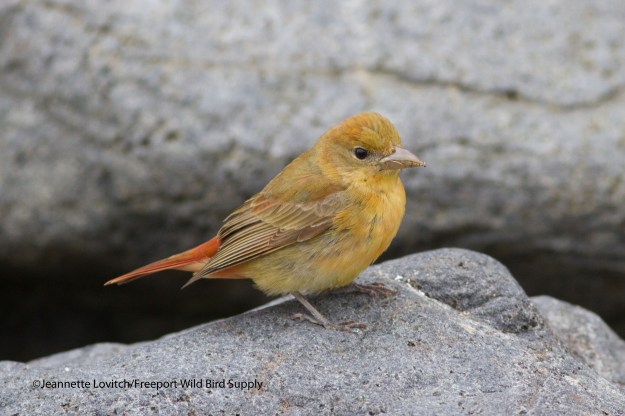
Such as near-annual Summer Tanagers…

DSC_0124_BRSP1,Monhegan,5-25-14_edited-1
… or, as in 2014, Maine’s first-ever Brewer’s Sparrow!

“But wait,” many of you are saying, “you said something about beer!” It is called “Birds on Tap!” afterall, so beer will definitely be at the forefront of this special weekend. But not just any beer, Monhegan Brewing’s fantastic beer! In fact, the event kicks off on Saturday afternoon with an exclusive, limited-edition, small-batch coffee stout brewed with Birds & Beans! “Beer-listers” will want to head out just for this one-time offering, just like birders flock to Monhegan for those once-in-a-lifetime bird sightings!
Sasha_atMonheganBrewery,5-26-14_edited-1Monhegan_Brewing,5-18-15_edited-1

Kenn and Kim will be signing books, birds will be discussed, and beer will be imbibed. And that’s just the kickoff!

Sold yet?

This is going to be a one of a kind event, so you’ll want to make your reservations soon. You can join my MonhegZen Birding Weekend Tour for 1, 2, or 3 days (see details on the “Tours, Events, Workshops, and Programs” page of our website) or make your reservations to spend a night on the island (our group, and our guest speakers, will be staying and dining at the Trailing Yew if you would like to join us!) and join us for some of these outstanding events…all of which are completely free (with books and beer available for purchase). Edit (5/12): NOTE: The tour is full, but all of the following events are free and open to the public, with no registration necessary.

Here’s the complete schedule of events.
Saturday, May 28th:
3:00pm – Release of Monhegan Brewing Company’s coffee-infused Milk Stout. Location: Monhegan Brewing Co.
7:30pm – Presentation by Dr. Stephen Kress. Location: community church. (Note: Trailing Yew will be offering an early dinner service at 6pm).

Sunday, May 29th:
6:30-7:30am – Casual birding while sampling B&B coffee with local experts around the Trailing Yew
9:00-11:00am – Guided birdwalk with local experts (Location: begins and ends at the Trailing Yew)

You often hear birders on Monhegan exclaim “it doesn’t get any better than this!” Except now, it has! I sincerely hope you’ll join us on the island for this fun-filled weekend, as if you needed more incentive than visiting Maine’s premier migration hoptspot!

Yew-May_edited-1

Monhegan, 5-21-11_edited-1

BBlogofinalThis. Is. Going. To. Be. Awesome.

IMG_1175_edited-2

Birds on Tap – Roadtrip: Surf And Suds! 2/28/16

brew bus at store

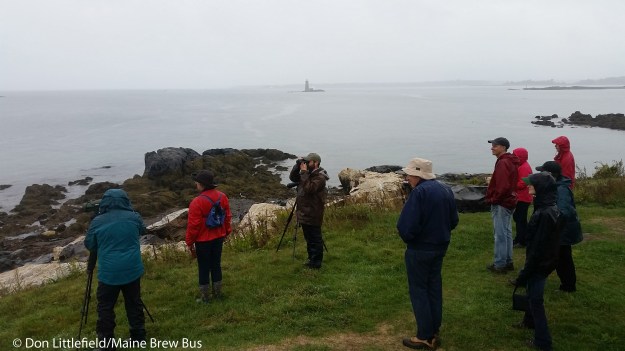
The first of six “Birds on Tap – Roadtrips!” with our partners at the Maine Brew Bus took place last Sunday. Our “Surf and Suds!” tour headed south, visiting two hotspots along the York County Coast, looking for waterfowl (especially Harlequin Ducks), Purple Sandpipers, and Great Cormorants and other winter denizens of the rocky shore.

We began at Marginal Way in Ogunquit, enjoying perfect conditions. With temperatures rapidly rising into the low 40’s on a very light, southwesterly breeze, it was more than comfortable. And with a high deck of clouds and calm waters, viewing conditions were perfect.
birders at Marginal Way

Harlequin Ducks are one of the premier “targets” of this tour, and they could not have been more obliging. At least 35 were along the pathway, with most very close to shore and several small groups hauled out on the rocks.

Harlequin Ducks (Histrionicus histrionicus) at Marginal Way, Ogunquit, ME

Harlequin Ducks (Histrionicus histrionicus) at Marginal Way, Ogunquit, ME

(Photo with Leica V-Lux Type 114)

HADU,MarginalWay,2-29-15_edited-1
(Phone-scoped photo)

While we only encountered 15 Purple Sandpipers, we saw them exceptionally well. I just with the little raft of 8 Razorbills were a little closer! A Carolina Wren singing from the neighborhood and 250+ Black Scoters were among the other highlights, while we also took ample time to enjoy views of Common Eiders, Red-breasted Mergansers, and all three scoters.

Next up was The Nubble, where one Great Cormorant coming into high breeding posed nicely, and a goodly total of 38 Harlequin Ducks were present. It was a MUCH better look at the single Razorbill that was feeding just off the Nubble, and it would be impossible to obtain better views of a Red-tailed Hawk that was making rounds of the parking lot, the Nubble, and nearby rooftops.
birders at Nubble

GRCO,Nubble,2-28-16_edited-1
(phone-scoped photo)

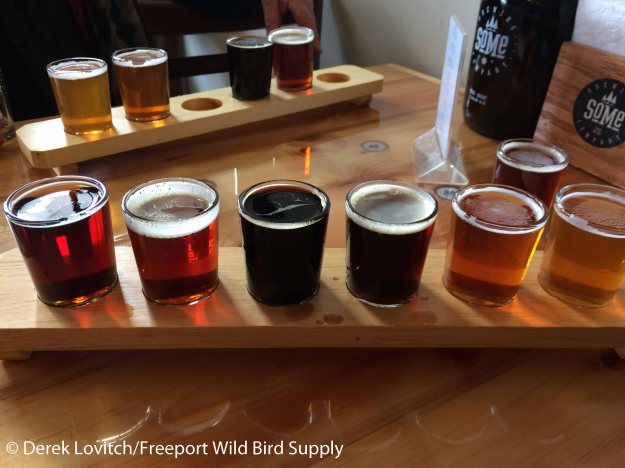
Before we knew it, it was “beer o’clock” and Don took over for the beer-ing portion of this unique tour. York’s SoMe Brewing was our first destination, and after a tour of their rapidly-growing operation as we discussed the ins and outs of brewing beer, we settled in for a flight of samples. Perhaps best known for their Whoopie Pie Stout and their go-to Apostrophe IPA, for me at least (and several others) “Sugar What?” stole the show. This Bourbon Barrel Aged Imperial Maple Amber hit all the right notes for me.
SoMe_board

SoMe1,2-28-16_edited-1

SoMe3,2-28-16_edited-1

Back on the Brew Bus, we began our trek northward, continuing our discussions about birds, beer, and everything from “status and distribution” to bird-friendly coffee. We pulled into the unassuming South Portland neighborhood’s Fore River Brewing Company – a first visit for me, and all of the participants on the tour.
IMG_7805_edited-1

Lygonia IPA was my favorite of our samples, although the crowd was appreciating their John Henry Milk Stout quite a bit. We also learned how their brewing system, philosophy, and background differed from our first brewery; it always fascinates me on these tours to learn about the brewers and their approach to beer.
ForeRiver-taps

With the bus unloaded in Freeport, conversation continued at the store, and plans were made for the next Birds on Tap – Roadtrip! On April 10th, “Spring Ducks and Draughts” will visit Merrymeeting Bay for waterfowl migration and Bald Eagles, followed by visits to Oxbow Brewing Company in Newcastle (I love their woodland tasting room!) and Lively Brewing in Brunswick. These trips are truly unique and we hope you will join us for the next fun-filled tour of birds and beer!

The 2015-16 Winter SnowBird(er) Contest is Underway!

L1010480_RECR1_immMale,CousinsIsland,3-28-14_edited-1A group of Red Crossbills on Cousin’s Island that landed at our feet was just one of the highlights during the 2014-15 Winter SnowBird(er) Contest.

It’s December, and you know what that means! It’s time for the SnowBird(er) Contest here at Freeport Wild Bird Supply!

We are very excited to announce the start of the 7th annual “Winter SnowBird(er) Contest,” which was introduced as a way to encourage people to get outdoors in the depths of winter.  Just because it’s cold out does not mean there aren’t a lot of great birds to see!  While we offer free Saturday morning birdwalks throughout the year, it is much easier to entice people to participate in May when warblers are around, or July when it is nice and warm out.

Therefore, to get more birders out and interested in the great winter birding our area offers, we have added an extra incentive: prizes!  Participants accumulate points based on the temperature at the start of the birdwalk – the colder the morning, the more points are awarded.  The contest runs December 5th through March 26th, and at the end of the period, over $250 in prizes will be awarded!

Winter birding can be a lot of fun.  It is prime season to see seaducks, such as Common and Red-throated Loons, Common Goldeneye, Bufflehead, and scoters.  The southernmost wintering flock of Barrow’s Goldeneyes on the East Coast resides in the lower Harraseeket River in South Freeport, and we frequently visit Winslow Park and the Freeport Town Wharf to enjoy this beautiful duck.
female BAGO with imm COGO1, East Machias River, 2-13-12_edited-1
Barrow’s (center) and Common Goldeneyes side-by-side is another highlight of winter birding in the area.

We’ll look for Northern Shrikes, enjoy our year-round woodland residents, and who knows what else? Last year, we spotted everything from a vagrant Townsend’s Solitaire to Red Crossbills literally at our feet. And, if this winter turns out to be another “irruption” year (and there is a good suggestion that for many species, it will be), we may find Snowy Owls, Common Redpolls, both crossbills, and much more!

Droll Yankees logoThe person with the most points at the end of March wins this year’s Grand Prize: a B7 Domed Caged Feeder complements of DROLL YANKEES. Large capacity, Gray Squirrel-resistant, pigeon-proof, and sheltered from the weather, this great feeder solves feeding station problems. Like all of Droll’s products, it is made in the USA and has a Lifetime Guarantee.

Royal River Massage logoThe runner-up will receive a one-hour massage from ROYAL RIVER MASSAGE in Yarmouth. Relieve “warbler neck” and other aches and pains in a 60 Minute Therapeutic Massage! It’ll be a great way to recover from the winter season of shoveling snow.

Laughing Stock Farm logoAnd, finally, the third place finisher will receive 2 weekly organic vegetable pickups (“medium” shares) at LAUGHING STOCK FARM CSA in Freeport. A selection of veggies will be available on each of two pick-up dates in April.  We’ve been members of the farm’s CSA for 10 years and love having fresh, organic, and local vegetables all year long.

Betsey Puckett, President at Droll Yankees was excited to provide the Grand Prize for the second year in a row, “Kudos…for providing a challenging and educational event. But then again, you Mainers are known for your endurance.”

There are some mornings in mid-winter that can make it tough to get out of bed, so we hope to add a little extra motivation. The real prize of course, is the birding our area offers in the depths of winter.

For a recap of what we have been seeing on our recent birdwalks, you can always visit the News page of our website to see what you are missing. And with 240 species seen in the 11 years of free Saturday Morning Birdwalks, you have been missing a whole lot!

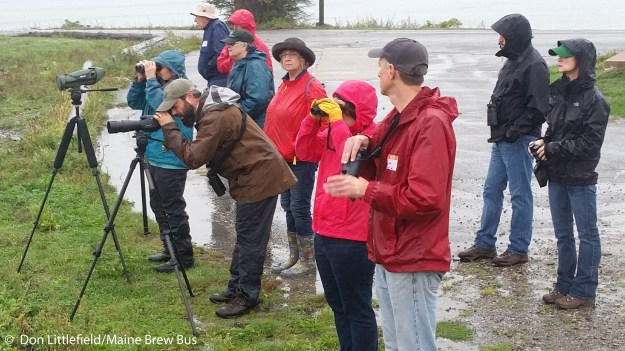
So join us on a Saturday this winter to see how fun winter birding can be, and start accumulating points! Birdwalks meet at the store at 8:00am for a short carpool to a local site, rarely more than 10-15 minutes away. We return to the store between 10 and 10:30 for free shade-grown, organic, bird-friendly coffee and a look at what’s hanging out at our feeders.  The birdwalks are free and do not require advance registration.  Hope to see you soon!
SNOW,Brunswick_Landing_birdwalk,1-31-15_edited-1
This Snowy Owl in Brunswick during last winter’s birdwalk was the 237th species ever seen on a Saturday Morning Birdwalk

Birds on Tap – Roadtrip: Ducks and Draughts! 11/15/15.
scaup scanning

The second “Birds on Tap – Roadtrip!” of 2015 was another resounding success.  As a follow up to our first event in August that featured shorebirds in Scarborough Marsh, we once again partner with the Maine Brew Bus to offer a fun, bird- and beer- filled outing.

Our theme for the this tour was “Ducks and Draughts,” and so we headed northwest to Sabattus Pond in Sabattus, one of the premier duck-watching sites in Maine, and arguably THE waterfowl hotspot in late fall in the southern half of the state. After pick-ups in Portland and Freeport, the bus, Paul (our driver and beer guide for the day), and I arrived at the south end of Sabattus Pond. It didn’t take long to know why this place is such a destination for birders at this time of year.

A large number of ducks were immediately encountered, but we soon focused our attention on the pair of Redheads – rare, but fairly-regular migrants in Maine – that were a “Life” or “State” Bird for some. For others, it was nothing more than the pleasure of seeing this attractive bird!
group at south end

We covered the three primary hotspots on Sabattus Pond, amassing a total of 17 species of waterbirds. In addition to the Redheads, highlights included a Red-necked Grebe (rare in Maine’s interior), 24 American Coots, 4 Northern Pintails, 6 Green-winged Teal, and several hundred Ruddy Ducks. Although a relatively low number for here, “several hundred” Ruddy Ducks is not a statement uttered anywhere else in Maine…and especially not when proceeded by the word “low!”  Other waterbirds species seen today included Lesser and Greater Scaup, Mallard, American Black Duck, Ring-billed and Herring (1) Gulls, Buffleheads, Hooded and Common Mergansers, Common Goldeneyes, and one Great Blue Heron.
group on east side

Sabattus also affords the opportunity to study the two scaup species together, so we took plenty of time to go over this identification challenge. Side-by-side, the major differences are often readily apparent, so we practiced our skills to apply them to a homogenous group, or worse, the “dreaded” lone, single, distant scaup!

Having our fill of the nuances of Aythya identification, Paul took charge and delivered us to Lewiston’s Baxter Brewing. But as we stepped out of the bus at the renovated mill, it was back to the binoculars and scopes as we enjoyed a Peregrine Falcon pair – one busy feasting on a Rock Pigeon lunch – a top a nearby building.  With that, it was beer time!
outside Baxter

The first brewer in New England to can all of its beer, Baxter is known for such go-to brews as their Pamola Pale Ale and especially, their Stowaway IPA. Less well-known, however, is their ultra-creative 10-gallon Small Batch Series. Samples of Tarnation Lager, Phantom Punch Winter Stout, and Bootleg Fireworks Double IPA were enjoyed and discusses, and I simply had to quench my curiosity (as well as my thirst, of course), with the Small Batch “Sweet Tea Chai Spice Stout.”
baxter tour 2Baxter tour

A tour of the brewery and the brewing processed followed, and soon we were off – with one last quick look at the Peregrines, heading down the Androscoggin River to Freeport for a date at Maine Beer Company. Samples of Zoe (Hoppy Amber), Mo (Pale Ale), King Titus (Porter) and one of my absolute favorites, Lunch (IPA) were served, and a few folks sampled their most recent Pilot 8, their take on a Kolsch. Fueled by the delicious brews, we continued the discussion of…well, ducks…and draughts!
MBC beers

outside MBC

The “Birds on Tap – Roadtrip!” series, a partnership between the Maine Brew Bus and Freeport Wild Bird Supply will continue in 2016. In fact, several new tours are in the works, which we hope to announce soon. Stay tuned!

“Birds on Tap – Roadtrip: Shorebirds and Beers!” Trip report, 8/2/15

It’s pretty clear that I am not the only birder who loves beer. And based on the success of the “Birds, Books, and Beers” series at Maine Beer Company, the first of hopefully many “Birds on Tap!” lectures at Rising Tide Brewing, and the fact that many of my tours finish the day at a brewery (e.g. Monhegan Brewing), I was looking for a way to build on these events.

Enter the “Birds on Tap – Roadtrip!” series with our friends at the Maine Brew Bus. And the first of what we hope will be a regular schedule of unique birding and beer-ing outings took place on Sunday.

Combining three hours of birding with visits to two of our great local breweries, we strive to showcase some of Maine’s best birding, and best craft brewers. Beginning in August, there’s no better place to bird in southern Maine than Scarborough Marsh.
on the bus

After two convenient pick-ups, one at the store and one in Portland, it was down the marsh, starting at Pine Point on the incoming tide. Common Terns were feeding in the channel, and we took a moment to check out the truly beautiful turquoise eye of a nearby Double-crested Cormorant.
L1020995_bus_at_marsh

Out on the mudflats, 150+ Semipalmated Plovers were joined by at least 75 Semipalmated Sandpipers, 30 or so Short-billed Dowitchers, 15 “Eastern” Willets, and a few Black-bellied Plovers. As the ride rolled in, many of these birds flew closer, landing on the last strip of mud and sand right in front of us, offering detailed study of plumage details to complement the “general impression of size and shape” methodology of identifying birds afar.
L1020999_group_at_marsh

L1030005_SEPL,PinePoint,8-2-15_edited-1
Some birds, like this Semipalmated Plover, were incredibly close and offered great studies of plumage detail.

Our next stop, with the tide approaching high, was the Eastern Road Trail. The wide, raised trail crossing the marsh provided convenient access and easy viewing of the many hundreds of shorebirds out in the salt pannes. 300+ Semipalmated Sandpipers, 100-150 Semipalmated Plovers, 100+ Short-billed Dowitchers, 50+ Least Sandpipers, 20+ Greater and 6 Lesser Yellowlegs, 2 “Eastern” Willets, 2 White-rumped Sandpipers, and a single Spotted Sandpiper.

Joining the shorebirds in the pannes were a variety of wading birds, with 40+ Snowy and 25 Great Egrets, 8 Glossy Ibis, 4 Great Blue Herons, 3 Little Blue Herons, and “Patches:” the ultra-rare Tricolored Heron x Snowy Egret hybrid that has been frequenting the marsh for at least three summers now.
marsh_birds
There were a lot of birds in the pannes today, with shorebirds covering all of the exposed mud and wading birds standing guard at the edges.

Several singing Nelson’s Sparrows, including a couple of birds that offered unusually prolonged scope-views, a soaring Bald Eagle, and a hunting Northern Harrier added to the diversity of the day.

As we enjoyed some scrumptious vegetable hand-pies, Josh took over the show, and escorted us down to Saco’s Barreled Souls. While several birders got a life bird or two today, everyone in the group had their “life beers” from Barreled Souls. All of Barreled Souls’ beers are fermented in oak barrels using a version of the Burton Union system, a method developed in England in the 1800’s. Unique ingredients coupled with this system that offer subtle flavor additions and changes to the beer, provides a healthy growing environment for the yeast that does the dirty work of making the sugar into alcohol, and allows for the capture the healthiest yeast crops for the next batch of brew.
Barreled_souls

We received a tour of the facility, before being invited in the cozy tasting room. All the while, four unique and very flavorful beers, all very different in taste and body, were sampled, including Half-Nelson, an IPA with 100% Nelson Sauvin hops and Space Gose, a tart German style beer with coriander, Maine sea salt, and lemon zest. Mixing things up a bit, the fruity Eat a Peach and the finale, the malty and nutty – and potent – Quaker State Heavyweight.

Conversations about birds during the first half of the tour rapidly turned to conversations about beer, often spurred on by discussions about the samples, and several people remarked how these beers were outside of their usual comfort zone, broadening their horizons and challenging their pallets. One could say there is a parallel to our discussions about the finer point of “peep” identification while out in the marsh!
Zippys photo_edited-1

It seemed most appropriate that our second brewery of the tour would be Rising Tide Brewing in Portland – our partner in the Birds on Tap! lecture series. Refreshing Daymark, a clean and classic APA; Ishmael, the rich and malty American copper ale; Zephyr, Rising Tide’s hoppy but incredibly well-balanced IPA; and of course, the venerable Maine Island Trail Ale the citrusy, hoppy, and summertime-perfect American Ale that is one of the favorite beers of many a Maine beer drinker, myself included.
Rising_Tide

MITA

While many of the Maine residents in the group – we also had guests from Kansas and folks who share Maine with another home state – were more familiar with the offerings of this favorite brewery, Alex did a great job explaining the philosophy of the brewery and the methods they use to produce so many quality, unique, – and in many cases, exceedingly approachable – brews.

As we wrapped things up and Josh transported us back to our respective drop-offs, the bus was filled with chatter about birds, beers, and more than one question for when the next Birds on Tap – Roadtrip! from Freeport Wild Bird Supply and the Maine Brew Bus will be taking place…stay tuned!

Birding By Schooner Trip Report, 2015

It’s hard for me to pick my “favorite” tour, but if pressed, I would probably answer our annual “Birding by Schooner” aboard the Lewis R. French tour. It just offers such a unique way to bird, and such unique birding experiences. The scenery, the food, and the good conversation can also not be beat.

Last week was my 6th tour aboard the French. And one of the aspects of the tour that I so very much enjoy is that every tour is different. We often don’t know where we are going even as we depart Camden Harbor on our first morning! Weather (especially wind, or lack there of) dictates the plan. And I must say, it’s a nice bit of respite to not have any control over where we go! All I have to do is point out birds wherever our captain takes us.

Of course, this is a birding-themed trip, so we make our best efforts to get into position for some great birding, especially to visit one or more islands with breeding seabirds. But when I boarded the vessel on Sunday night, I could only guess what a plan might be.

We awoke to fog and calm on Monday morning, departed the harbor on the very lightest of breezes, and pushed our way across a bay with only the minimum of ripples. We found a whole in the fog bank as we rounded Owl’s Head Light…
1. L1020522_OwlsHeadLight,7-20_edited-1
(click on photos for larger images)

…but soon we were back in the murk.
2. L1020526_IntotheFig,7-20_edited-1

Wilson’s Storm-Petrels began to show up, with at least 50 noted by the time we pulled into Port Clyde. Bald Eagles were conspicuous, as were the common bay denizens such as Black Guillemot…
3. IMG_1540_edited-2

…and Common Eider.
4. IMG_1770_edited-2

A stroll to Marshall Point Light added to our landbird list, while a Greater Yellowlegs in the harbor was the first migrant shorebird of the trip.

Overnighting in Port Clyde set us up nicely for a short trip to Eastern Egg Rock, which we rounded slowly to enjoy Roseate Terns among the Arctic and Commons, lots of Black Guillemots, and over 100 Atlantic Puffins. The fog lifted enough for us to have great visibility when near the island, but the offshore fog bank and cloudy skies meant a lot of puffins were on the water, and many loafed close to our boat or zipped right by.
5. IMG_1567_edited-2

Back into the fog as we trudged offshore, seabirds were few and far between. Or, I should say, we saw few seabirds…I am sure plenty were out there. We encountered some more puffins, and this one Northern Gannet.
6. IMG_1589_edited-2

Our destination this afternoon was none other than Monhegan Island…one of my favorite places in the world. It was pretty foggy, so the views were limited…
7. L1020530_MonheganFog,7-21_edited-1

…But few complained. Especially those of us who ended up at the Monhegan Brewing Company (Wait, how do so many of my tours end up at breweries?).
8. L1020548_MonheganBrewery,7-21_edited-1

Several common breeding birds were added to our trip list, but no mid-summer vagrants were detected. We had hoped to overnight in the harbor and take a birdwalk in the morning, but a tenuous anchorage and an approaching cold front led Captain Garth to err on the side of caution, and head for the shelter of the mainland, so we said an early farewell to Monhegan.
9. L1020554_departingMonhegan,7-21_edited-1

We sought shelter up the St. George River, first in Turkey Cove, but then Garth made a last minute decision to anchor on the river’s other bank, in the Pleasant Point Gut. Overnight, the storm cleared, and so did the fog.
10. L1020565_PleasantPointGut,7-22_edited-1

We didn’t have much wind, but what we did have facilitated a trip out to remote Seal Island. We had to motor-sail most of the way, but we had an afternoon date with a punctual local.

On the way, we enjoyed some great birding. While we didn’t have enough wind to take the long way out to Matinicus Rock and deeper water, cutting a straight line around the north end of Metinic produced a whole lot of Wilson’s Storm-Petrels (450+ on the day), 6 Red Phalaropes (along with another 20 phalaropes that were just a little too far to ID), and a Mola Mola that gave us the slip. Most surprising, however, was a pair of American Oystercatchers that were flying around Little Green Island. Whether this is a previously-unknown pair of this slowly-increasing species in Maine, southbound migrants, or Maine breeders undergoing post-breeding dispersal is impossible to know, but it was a new “Schooner Bird” for me: my 116th species seen during our “Birding by Schooner” tours!

It was a bit of work, but we made it to Seal Island on a sunny, fairly calm day at the perfect time. And “Troppy” the Red-billed Tropicbird that has returned to Seal Island for its 9th straight summer (10th overall in the area), made his afternoon appearance for a little bath. This was my fourth visit to Seal aboard the French, and we have seen Troppy three times (the only miss was on a cloudy day with fog the next morning).
11. IMG_1633_edited-2

12. IMG_1695_edited-2

13. L1020582_RBTR_landing1,7-22_edited-1

14. L1020583_RBTR_landing2,7-22_edited-1

15. L1020584_RBTR_landing3,7-22_edited-1

16. IMG_1738_edited-2

17. IMG_1684_edited-2

And despite that sign, we dropped anchor for a special evening. One of the unique experiences for participants on this most unique tour is an evening with the Seal Island’s biologists. Not only do the passengers get a break from hearing me talk, the biologists get a break from cooking and their usual routine.
18. L1020637_Seal_biologists_arriving,7-22_edited-1

19. L1020648_Seal_biologists_onBoard,7-22_edited-1

20. L1020658_Seal_Island_sunset,7-22_edited-1

Yet another unique experience afforded by spending a night out at Seal is to get up and listen for Leach’s Storm-Petrels returning to the island from foraging trips in the middle of the night. While clear skies and a light westerly wind reduced the cacophony, the eerie, sinister chuckling of the petrels rang through the night.

And if a sunrise over Seal isn’t enough…
21. L1020667_Seal_sunrise,7-23_edited-1

…there was what seemed to be the entire tern colony in the air…
22. L1020673_Seal_terns,7-23_edited-1

… more puffins, a couple of dozen Razorbills and 1 Common Murre, Great Cormorants, and more Black Guillemots than you could count.
23. IMG_1875_edited-2

Migrant shorebirds included a Whimbrel, a flock of small shorebirds that totaled 20 Semipalmated and 2 Least Sandpipers along with 4 Semipalmated Plovers, and unexpectedly, a fly-by Wood Duck! Not to mention another view of the Red-billed Tropicbird!

If your head wasn’t already on a swivel from looking at all of that, looking down offered a mesmerizing ballet of traveling jellies, both Moon and White-cross Jellies(here)…
24. L1020663_Moon_Jelly,7-23_edited-1

…and painful Lion’s Mane Jellies.
25. L1020677_LionsManeJelly,7-23_edited-1

For me, it is always too soon to depart, but we had other fish to fry, or to be exact, lobsters to boil. So we set a course towards Stonington, keeping our eyes open along the way. Two male Razorbills with their chick in tow were nice to see, as was a Minke Whale. A handful of Northern Gannets and about 10 Wilson’s Storm-Petrels were our only other seabirds, however.

As we entered nearshore waters, we kept an eye out on islands, both big and small. You never know what you might see, and while I am on the lookout for something “mega” like a Brown Booby, we did spot a Great Cormorant on tiny Saddleback Ledge.
26. L1020692_SaddlebackLedge2,7-23_edited-1

27. L1020696_GRCO,SaddlebackLedge,7-23_edited-1

Back in the usual domain of the Schooner fleet, we passed The Heritage…
28. L1020702_The_Heritage,7-23_edited-1

…and while the water boiled on Russ Island, the Angelique cruised passed us.
29. L1020706_FrenchandAngelique,Russ_Island,7-23_edited-1

A little bird, plant, and ecology walk further swelled our appetites. Which was good, because we had a few lobsters to eat tonight. Swainson’s Thrushes offered the evening’s musical performance.
30. L1020712_Lobster_Bake,Russ_Island,7-23_edited-1

A Sharp-shinned Hawk carrying breakfast over Russ Island was another addition to my Schooner List, and our morning walk around Stonington added several new species to our triplist.
31. L1020717_Stonington,7-24_edited-1

Rounding North Haven Island, we kept tallying Wilson’s Storm-Petrels (we don’t always see these birds inshore on this tour), spotted a few small groups of southbound swallows and a few shorebirds, and watched the storm clouds build.
32. L1020727_Storm1,7-24_edited-1

Um, should we have been worried?
33. L1020730_Storm2,7-24_edited-1

Nah, this crew has got it covered!
34. L1020750_Storm3,7-24_edited-1

Although we had some good sailing winds ahead of the storm, and some moderate rain during the storm, the skies looked much worse than what we weathered. In fact, by the time we motored into Gilkey Harbor on Islesboro, the rain was ending and the skies showed a few hints of blue. And once again, we ate. Ate real well.
35. L1020754_food,7-24_edited-1

It’s amazing how fast a week aboard the Schooner French flies by – even without the birds – but it was now time to crank the anchor one last time. A Greater Yellowlegs sounded off and Ospreys circled overhead as we departed the quiet harbor for the bustle of Camden.

Crossing West Penobscot Bay, we encountered yet more Wilson’s Storm-Petrels, and surprisingly (for this far up the bay) another Razorbill father and kid.

Chimney Swifts twittering over Camden were our 79th and final species of the tour – two over our average. Emails were exchanged, bunks were cleared, and one last photo-op capped off yet another stellar “Birding By Schooner” tour.
L1020761_group,7-25_edited-1

Here’s the complete, annotated checklist for this year’s trip, in order of appearance:

  1. American Crow
  2. House Sparrow
  3. Rock Pigeon
  4. Canada Goose (a couple of family groups in Camden Harbor)
  5. Mallard
  6. Song Sparrow
  7. Double-crested Cormorant
  8. Laughing Gull (common; all days)
  9. Osprey (common, just about every day)
  10. House Finch
  11. Herring Gull
  12. Great Black-backed Gull
  13. Cedar Waxwing
  14. Northern Cardinal
  15. Mourning Dove (all of the above from the boat within Camden Harbor)
  16. Wilson’s Storm-Petrel (daily; high day count of 450+ on 7/22, with 400+ between Little Green Island and Seal Island. Unusually common within Penobscot Bay).
  17. Black Guillemot (Abundant daily; several hundred on multiple days).
  18. Common Eider (very common; all days)
  19. Common Tern (abundant, including thousands at Eastern Egg Rock and Seal Island, but also scattered throughout inshore waters)
  20. Bald Eagle (common and seen daily; high count of 7 on 7/20).
  21. Bonaparte’s Gull (scattered few)
  22. Common Loon (scattered few on several days)
  23. Great Blue Heron
  24. Northern Parula
  25. European Starling
  26. Black-capped Chickadee
  27. Common Grackle
  28. American Robin
  29. Common Yellowthroat
  30. Black-throated Green Warbler
  31. Purple Finch
  32. Common Raven
  33. White-throated Sparrow
  34. Blue Jay
  35. Greater Yellowlegs (scattered singletons)
  36. Least Sandpiper (scattered few)
  37. Northern Flicker
  38. Gray Catbird
  39. Semipalmated Sandpiper (scattered small groups; high of 30 at Seal Island on 7/23)
  40. White-rumped Sandpiper (1 each at Eastern Egg Rock, 7/22 and Seal Island, 7/22)
  41. Spotted Sandpiper
  42. ATLANTIC PUFFIN (100+ at Eastern Egg Rock, 7/22 and hundreds at Seal Island 7/22-23)
  43. ROSEATE TERN (dozens at Eastern Egg Rock, 7/22)
  44. ARCTIC TERN (many hundreds at Eastern Egg Rock, 7/22 and Seal Island, 7/22-23)
  45. Northern Gannet (1 between Eastern Egg and Seal, 7/22; 5 between Seal and Stonington, 7/23)
  46. Tree Swallow (several southbound groups seen offshore and around islands)
  47. Brown-headed Cowbird
  48. Red-winged Blackbird
  49. Ruby-throated Hummingbird
  50. Winter Wren
  51. Black-throated Green Warbler
  52. Yellow-rumped Warbler
  53. Barn Swallow (scattered small numbers, many southbound over water)
  54. Blue-headed Vireo
  55. Killdeer
  56. AMERICAN OYSTERCATCHER (pair at Little Green Island, 7/22)
  57. RED PHALAROPE (6 between Little Green Island and Seal Island, 7/22, plus 20 unidentified phalaropes)
  58. GREAT CORMORANT (35+ including juveniles at Seal Island, 7/22-23, plus 1 at Saddleback Ledge light, 7/23).
  59. RED-BILLED TROPICBIRD (Troppy! Seal Island, 7/22-23).
  60. RAZORBILL (20+ Seal Island, 7/22-23)
  61. Bank Swallow (6 off of Seal Island, 7/22)
  62. COMMON MURRE (1 at Seal Island, 7/22)
  63. LEACH’S STORM-PETREL (many heard overnight at Seal Island, 7/22-23)
  64. Savannah Sparrow
  65. Whimbrel (one at Seal Island, 7/23)
  66. WOOD DUCK (one unexpected fly-by at Seal Island, 7/23)
  67. Semipalmated Plover (4 at Seal Island, 7/23 and 4 off North Haven, 7/24)
  68. Turkey Vulture
  69. Dark-eyed Junco
  70. Red-breasted Nuthatch
  71. Golden-crowned Kinglet
  72. Sharp-shinned Hawk
  73. Chipping Sparrow
  74. Black-and-white Warbler
  75. Yellow Warbler
  76. Hermit Thrush
  77. Belted Kingfisher
  78. Ring-billed Gull (just a few in and around Camden Harbor)
  79. Chimney Swift

Since every trip is unique, here are links to the trip reports from the previous two tours.

August, 2014.
And July 2013.

And in the not-so-distant future, we’ll be posting dates and information for our 2016 adventure. This trip fills up fast, so don’t dally…sign up soon and we’ll see you aboard next year!

June 2015 Month in Review

I guide nearly full-time in the month of June, and this year was no different. Add a few days at the store here and there and three days for working on writing projects, it was, needless to say, a very busy month. Please excuse my lack of blogging. I’ll try and make up for it here with a summary of the birds and my birding for the month as I try to catch up here and everywhere else.

After a troublingly-dry spring, rain began to fall in early June, with three inches in the first few days of the month, temporarily alleviating our drought conditions. But unseasonably cool temperatures continued to dominate through much of the month, but at least we started to see rain on a regular basis (but we could still use more) with a more active weather pattern. Unfortunately, it sometime fell at inopportune time for me and my clients!

Early June is often a time for rarities, especially of southern “overshoots” that are often found prospecting for territories – things like Hooded or Worm-eating Warblers, Summer Tanagers, etc. It was rather surprising, actually, that these southern strays weren’t found, considering May ended with several days of southwesterly winds – perfect for facilitating the arrival of late migrants (and kites)!
ADD TO BLOG-wind map, 5-30-15

It’s also a great time for even more exceptional vagrants.  But this year, rarities in early June were limited to a short-staying Franklin’s Gull on Stratton Island on 6/3, and a 1st-summer Little Gull that was hanging out with Bonparte’s Gulls on Pine Point Beach in Scarborough through the first week of the month (following an adult in late May).
L1010930_LIGU1,PinePointBeach,6-4-15_edited-1

But on June 8th, a Little Egret was found in Falmouth, and was followed into Portland. On the 9th, I spent the afternoon chasing it around with Luke Seitz, eventually relocating it several times and eventually getting some good photos.  Hanging out some of the time with Snowy Egrets, this summertime occurrence is most intriguing. This was the third record for Maine, all of which have occurred in the summer, and all since 2011 – could they all be of the same bird?
L1020115_LIEG_best_edited-1

I’m a full-time guide in June, and this summer my private guiding (following a postponement due to the heavy, steady rain on the 1st) kicked of on June 3rd with a two-day tour for a couple who currently reside in Nicaragua. After amazing experiences with Saltmarsh and Nelson’s Sparrows in Scarborough Marsh – with the aforementioned Little Gull as a welcomed treat – we headed for the hills for my first of three visits to the mountaintop realm of the Bicknell’s Thrush. Despite a private, after-hours charter up Mount Washington one evening, and an exhaustive search on another mountain the next morning, for the first time in over 30 attempts, I failed to produce satisfactory views of the enigmatic thrush for my clients. No small part of me was frustrated and disappointed that I could no longer claim a perfect score!  I knew it would happen eventually, however.

Was it too early? Especially during such a cold start to the season? Or was it just too nice out both days? Warm temperatures in the low 50’s and very light winds just don’t seem to be as useful for seeing these birds!

We had a great birdwalk outing on 6/6, and local guiding for a visitor from Alabama on the 7th was fruitful: some of our local breeders here in Freeport, followed by a visit to Pine Point Beach (no Little Gull this day, but the continuing raft of “winter” diving ducks: ~40 White-winged, ~30 Black, and 4 Surf Scoters, along with a single Long-tailed Duck) made for a nice morning.

My next overnight trip was on June 8-9, taking me to Rangeley with a client from Massachussetts. We managed all 6 of our target birds, including finding a Black-backed Woodpecker and with the help of a friend, a new spot for Mourning Warbler.

The weekend of the 13-14th was my annual “Bicknell’s Thrush and the White Mountains” tour. Licking my chops from my first whiff earlier in the month, I was excited to get back on the horse and see some Bicknell’s Thrushes. Of course, even more pressure is on when you’re running a two-day trip solely dedicated to one species!  While we do bird our way to and from the mountain thrush locations, this is an all-or-nothing trip for a lot of people. Let’s just say, a new streak has begun – and wow, what a way to do it!

With rare days off, I squeezed in some relaxed birding with Jeannette and Sasha. We didn’t see the Portland area Little Egret on the 15th, but did enjoy a birdy visit to Capisic Pond Park to walk Sasha, including a nice view of the male Orchard Oriole. A Red Crossbill in the afternoon in our Pownal yard was a surprise. The next day, we did our annual march around all of the Kennebunk Plains. At least five Upland Sandpipers (all very well-seen), 10 Grasshopper Sparrows (low), 18 Vesper Sparrows, 38 Prairie Warblers, and all of the other expected barrens denizens. A visit to Peak’s Island on the 18th yielded a very late migrant Yellow-bellied Flycatcher and a sampling of the breeding birds of this lovely island. Willow Flycatchers and Black-crowned Night-Herons were in the marsh by Battery Steele but I did not hear or see a single Carolina Wren – wow, did this bird get hammered by our winter this year. Of course, there were a few morning dogwalks to local patches as well mixed in

The grand finale of my June this year was my 10-day Maine-New Hampshire Tour for WINGS. This biennial tour is exhaustive, and exhausting.  But 5 hotels, 1300 miles, and 159 species later, we all knew it was well worth it: 20 species of warbler (including Bay-breasted), all 9 species of Maine’s flycatchers (including Olive-sided), 7 species of thrush (including Bicknell’s in New Hampshire), 5 species of tern, 5 species of vireo, 4 species of alcids, and so much more.

After seeing Saltmarsh and Nelson’s Sparrows, Roseate Tern, American Oystercatchers, etc at Scarborough Marsh, we successfully searched for the Little Egret – a life or ABA-area bird for everyone.  Bicknell’s Thrush played hard to get on Mount Washington, but my secret spot produced crippling views the next day.  It rained – a lot – in Rangeley, but we still managed to get several sought-after species, including Gray Jays and Moose. Messalonskee Lake was its usual awesomeness, and then we headed east, way east, arriving in Machias.
GRJA1,BoyScoutCamp,Rangeley,6-23-15_edited-1

GRJA-RickSkehen1,Rangeley,6-23-15_edited-1

Machias Seal Island needs no explanation; although landed was thwarted by swells, we couldn’t have asked for more birds up close and personal from the boat.
ATPU2,MachiasSealIsland,6-24-15_edited-1

BAEA_flying1,CutlerHarbor,6-24-15_edited-1

Spruce Grouse eluded my group for the first time, but we picked up lifers for many, especially as we rode the whale/puffin watch trip out of Bar Harbor (2 Manx and 14 Great Shearwaters, 3 Leach’s and 350+ Wilson’s Storm-Petrels, Northern Fulmars, and another view of puffins, Razorbills, and Common Murres.  And we finally turned up some Great Cormorants – 7 actually – in Acadia National Park.
GRSH_takeoff1,offBarHarbor,6-26-15_edited-1
The Great Shearwaters we encountered today had some serious molt going on!

Besides the Little Egret, which obviously stole the show, unexpected treats included an immature male Purple Martin at Pine Point exploring nesting/roosting cavities with 6 White-winged Scoters off the beach and 2 Black-bellied Plovers off the point. A pair of Black Scoters was off of Quoddy Head State Park was another unseasonable addition to the checklist.

We filled in a few holes on the checklist on the tour’s last day, including Barred Owl, and some feeder watching in our backyard. And like all of my tours, we ate well- very, very well; food is always an important part of my tours as it is so important to tell an area’s story.
QuoddyHeadGroup2,6-25-15_edited-1

With rain falling and clients departing on Sunday the 28th, I slept. A lot. I also slept a lot the next two days, although of course, but I made some time for some casual birding with Jeannette and Sasha, including another chase of the Little Egret – this time resulting in Jeannette’s 600th ABA-area bird!  Then, on Tuesday, we visited Simpson’s Point and spotted the remarkably-unseasonable Pacific Loon that was found there the day before. Joining almost-as-amazing summer records of two Red-throated Loons, a drake Bufflehead, and three Long-tailed Ducks, this amazing bay that has become a real summer oddity hotspot delivers once again.

And with that, my June comes to a close. I have a few tours and private guiding outings coming up, but I look forward to a slightly more relaxed schedule, with perhaps a few minutes on the recliner and wading out to sandbars to enjoy shorebirds!

The All-Time Saturday Morning Birdwalk List

Maine’s first-ever Broad-tailed Hummingbird in November of 2022 was one of the rarest birds ever encountered on a Saturday Morning Birdwalk. Even better, we were among the first to see it as the birdwalk group was among the first to be granted permission to visit this Freeport yard before
it was open to the public for all to enjoy.

Last Update: 11/8/2025.

Our store, Freeport Wild Bird Supply, offers free birdwalks every Saturday morning, all year long. Meeting at 8:00am, we carpool to a local park of seasonal interest, and return to the store for bird-friendly coffee between 10 and 10:30. With the exception of inclement weather, we limit the drive to about 10-15 minutes away, and visit a variety of parks, waterfront overlooks, and other hotspots.

Over the years, we have seen a lot of good birds. We’ve “chased” as species or two, but we have found our fair share of “good” birds.  Encompassing a wide variety of habitats each season, we have seen an impressive array of species. Spurred on by the Townsend’s Solitaire that the Saturday Morning Birdwalk group enjoyed this past weekend, I have finally compiled a list of all of the species seen on Saturday Morning Birdwalks over the past 10 ½ years (As of 2015, and not including any other trips, tours, or special walks).

This is the “unofficial” list at the moment. UPPERCASE is for species seen only once or twice. I am hoping participants will take a look at the list and see if I have missed anything, or made any errors. I’ll edit the list as changes come in, so please let me know what I missed!

      1. Greater White-fronted Goose
      2. Snow Goose
      3. BARNACLE GOOSE
      4. Cackling Goose
      5. Canada Goose
      6. Wood Duck
      7. Gadwall
      8. EURASIAN WIGEON
      9. American Wigeon
      10. American Black Duck
      11. Mallard
      12. Blue-winged Teal
      13. Northern Shoveler
      14. Northern Pintail
      15. Green-winged Teal
      16. Canvasback
      17. Ring-necked Duck
      18. Greater Scaup
      19. Lesser Scaup
      20. Common Eider
      21. HARLEQUIN DUCK
      22. Surf Scoter
      23. White-winged Scoter
      24. Black Scoter
      25. Long-tailed Duck
      26. Bufflehead
      27. Common Goldeneye
      28. Barrow’s Goldeneye
      29. Hooded Merganser
      30. Common Merganser
      31. Red-breasted Merganser
      32. Ruddy Duck
      33. Ruffed Grouse
      34. Wild Turkey
      35. Red-throated Loon
      36. Common Loon
      37. Pied-billed Grebe
      38. Horned Grebe
      39. Red-necked Grebe
      40. Double-crested Cormorant
      41. Great Cormorant
      42. American Bittern
      43. Great Blue Heron
      44. Great Egret
      45. Snowy Egret
      46. Little Blue Heron
      47. Green Heron
      48. Black-crowned Night-Heron
      49. Glossy Ibis
      50. Turkey Vulture
      51. Osprey
      52. Bald Eagle
      53. Northern Harrier
      54. Sharp-shinned Hawk
      55. Cooper’s Hawk
      56. Northern Goshawk
      57. Red-shouldered Hawk
      58. Broad-winged Hawk
      59. Red-tailed Hawk
      60. Rough-legged Hawk
      61. GOLDEN EAGLE
      62. American Kestrel
      63. Merlin
      64. Peregrine Falcon
      65. Sandhill Crane
      66. Black-bellied Plover
      67. American Golden-Plover
      68. Semipalmated Plover
      69. Killdeer
      70. Greater Yellowlegs
      71. Lesser Yellowlegs
      72. Solitary Sandpiper
      73. “Eastern” Willet
      74. Spotted Sandpiper
      75. Whimbrel
      76. MARBLED GODWIT
      77. Ruddy Turnstone
      78. Red Knot
      79. Semipalmated Sandpiper
      80. Least Sandpiper
      81. White-rumped Sandpiper
      82. Baird’s Sandpiper
      83. Pectoral Sandpiper
      84. Purple Sandpiper
      85. Dunlin
      86. Buff-breasted Sandpiper
      87. Short-billed Dowitcher
      88. Long-billed Dowitcher
      89. Wilson’s Snipe
      90. American Woodcock
      91. RED PHALAROPE
      92. Laughing Gull
      93. Bonaparte’s Gull
      94. Ring-billed Gull
      95. Herring Gull
      96. Iceland Gull
      97. Lesser Black-backed Gull
      98. Glaucous Gull
      99. Great Black-backed Gull
      100. Common Tern
      101. FORSTER’S TERN
      102. DOVEKIE
      103. THICK-BILLED MURRE
      104. Razorbill
      105. Black Guillemot
      106. Rock Pigeon
      107. Mourning Dove
      108. Black-billed Cuckoo
      109. Yellow-billed Cuckoo
      110. Great Horned Owl
      111. Barred Owl
      112. Chimney Swift
      113. Ruby-throated Hummingbird
      114. Belted Kingfisher
      115. Red-bellied Woodpecker
      116. Yellow-bellied Sapsucker
      117. Downy Woodpecker
      118. Hairy Woodpecker
      119. Northern Flicker
      120. Pileated Woodpecker
      121. Eastern Wood-Pewee
      122. Yellow-bellied Flycatcher
      123. Alder Flycatcher
      124. Willow Flycatcher
      125. Least Flycatcher
      126. Eastern Phoebe
      127. Great Crested Flycatcher
      128. Eastern Kingbird
      129. Northern Shrike
      130. Blue-headed Vireo
      131. Warbling Vireo
      132. Philadelphia Vireo
      133. Red-eyed Vireo
      134. Blue Jay
      135. American Crow
      136. Fish Crow
      137. Common Raven
      138. Horned Lark
      139. Tree Swallow
      140. Northern Rough-winged Swallow
      141. Bank Swallow
      142. Cliff Swallow
      143. Barn Swallow
      144. Black-capped Chickadee
      145. Tufted Titmouse
      146. Red-breasted Nuthatch
      147. White-breasted Nuthatch
      148. Brown Creeper
      149. Carolina Wren
      150. House Wren
      151. Winter Wren
      152. Marsh Wren
      153. Golden-crowned Kinglet
      154. Ruby-crowned Kinglet
      155. Blue-gray Gnatcatcher
      156. Eastern Bluebird
      157. TOWNSEND’S SOLITAIRE
      158. Veery
      159. GRAY-CHEEKED THRUSH
      160. Swainson’s Thrush
      161. Hermit Thrush
      162. Wood Thrush
      163. American Robin
      164. Gray Catbird
      165. Northern Mockingbird
      166. Brown Thrasher
      167. European Starling
      168. American Pipit
      169. Bohemian Waxwing
      170. Cedar Waxwing
      171. Lapland Longspur
      172. Snow Bunting
      173. Ovenbird
      174. Louisiana Waterthrush
      175. Northern Waterthrush
      176. Black-and-white Warbler
      177. Tennessee Warbler
      178. Nashville Warbler
      179. Common Yellowthroat
      180. American Redstart
      181. Cape May Warbler
      182. Northern Parula
      183. Magnolia Warbler
      184. Bay-breasted Warbler
      185. Blackburnian Warbler
      186. Yellow Warbler
      187. Chestnut-sided Warbler
      188. Blackpoll Warbler
      189. Black-throated Blue Warbler
      190. Palm Warbler
      191. Pine Warbler
      192. Yellow-rumped Warbler
      193. Prairie Warbler
      194. Black-throated Green Warbler
      195. Canada Warbler
      196. Wilson’s Warbler
      197. YELLOW-BREASTED CHAT
      198. Eastern Towhee
      199. American Tree Sparrow
      200. Chipping Sparrow
      201. Clay-colored Sparrow
      202. Field Sparrow
      203. LARK SPARROW
      204. Savannah Sparrow
      205. Nelson’s Sparrow
      206. Saltmarsh Sparrow
      207. Fox Sparrow
      208. Song Sparrow
      209. Lincoln’s Sparrow
      210. Swamp Sparrow
      211. White-throated Sparrow
      212. White-crowned Sparrow
      213. Dark-eyed Junco
      214. Scarlet Tanager
      215. SUMMER TANAGER
      216. Northern Cardinal
      217. Rose-breasted Grosbeak
      218. BLUE GROSBEAK
      219. Indigo Bunting
      220. Dickcissel
      221. Bobolink
      222. Red-winged Blackbird
      223. Eastern Meadowlark
      224. Rusty Blackbird
      225. Common Grackle
      226. Brown-headed Cowbird
      227. ORCHARD ORIOLE
      228. Baltimore Oriole
      229. Pine Grosbeak
      230. House Finch
      231. Purple Finch
      232. White-winged Crossbill
      233. Red Crossbill
      234. Common Redpoll
      235. Pine Siskin
      236. American Goldfinch
      237. Evening Grosbeak
      238. House Sparrow
      239. SNOWY OWL, Brunswick Landing, 1/31/15.
      240. Purple Martin, Rossmore Road, Brunswick, 5/2/15.
      241. BLUE-WINGED WARBLER, Old Town House Park, North Yarmouth, 7/18/15.
      242. WHITE-EYED VIREO, Freeport Transfer Station/Hedgehog Mountain Park 10/10/15
      243. LITTLE EGRET, Tidewater Farm, Falmouth, 7/9/16.
      244. Upland Sandpiper, Bowdoin Sand Plains, 7/1/17
      245. GREAT BLACK HAWK, Deering Oaks Park, Portland, 12/1/18
      246. Vesper Sparrow, Wolfe’s Neck Center, Freeport, 10/9/21.
      247. CATTLE EGRET, Wolfe’s Neck Center, Freeport, 11/6/21
      248. HENSLOW’S SPARROW, Crystal Spring Farm, Brunswick, 7/9/22
      249. Olive-sided Flycatcher, Highland Rd, Brunswick, 8/27/22
      250. HUDSONIAN GODWIT, Wharton Point, Brunswick, 10/15/22.
      251. BROAD-TAILED HUMMINGBIRD, Private Property in Freeport, 11/26/22.
      252. ORANGE-CROWNED WARBLER (finally!), Wolfe’s Neck Center, Freeport, 11/4/23.
      253. Stilt Sandpiper, Walsh Preserve, Freeport, 8/10/24.
      254. RUFF, Walsh Preserve, Freeport, 5/10/25.
      255. MACGILLIVRAY’S WARBLER, Grist Mill Park, Yarmouth, 11/8/25.