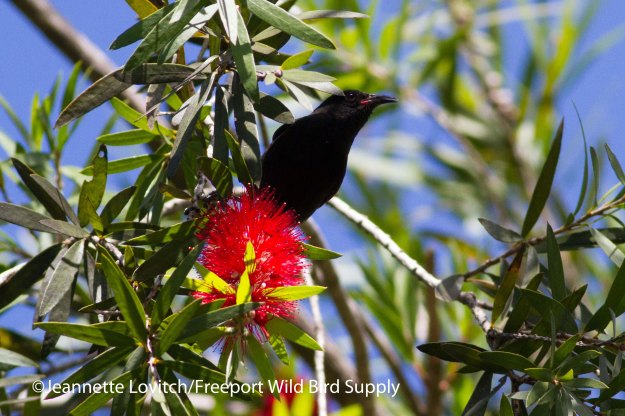
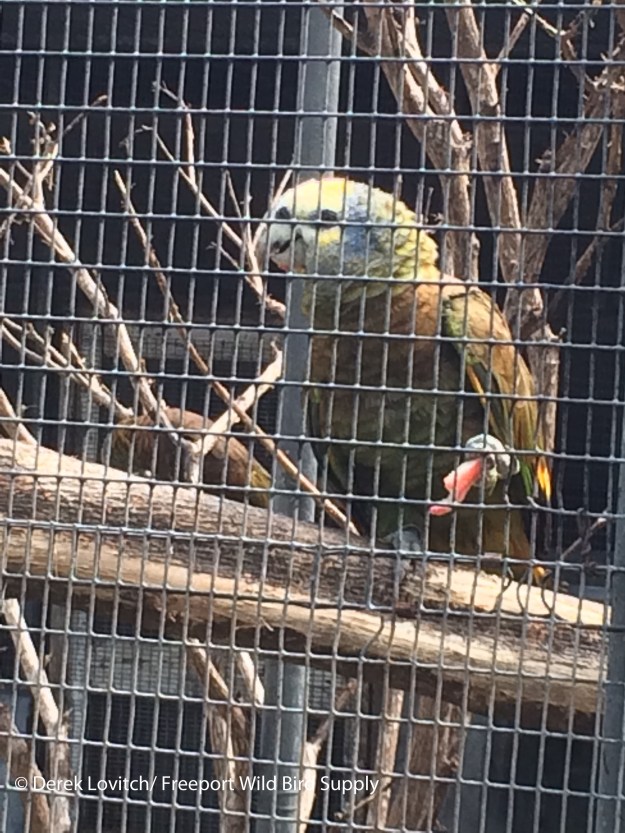
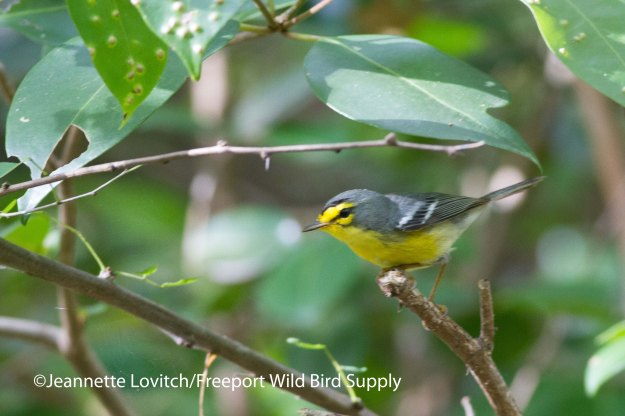
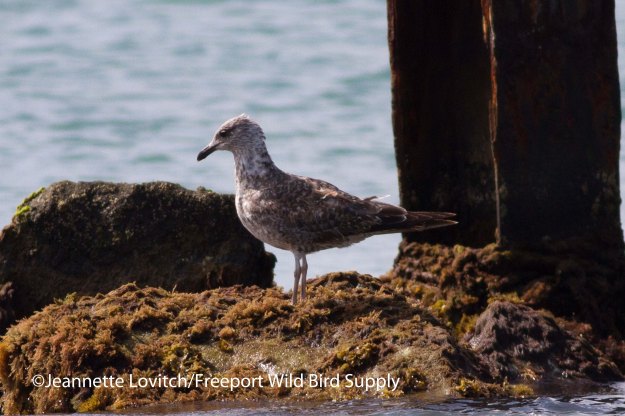
Author Archives: Derek

2016 MonhegZen Spring Birding Weekend PLUS Birds on Tap – Monhegan!

As I do most Memorial Day weekends, I head to Monhegan Island with a tour group for my “MonhegZen Spring Birding Weekend.”  But this was not going to be “just” a weekend on this wonderful, joyful, and bird-filled place. This was going to be truly special – it was “Birds on Tap – Monhegan!

A small group arrived with me on Friday, and boy did we hit the ground running. The first bird we saw off the boat was a Purple Martin zipping overhead – a nice rarity to get things started. As if my usual Monhegan-stoked Rarity Fever wasn’t already in full effect, the next bird we saw was a wet Empid. And let the games begin! Of course, this one was a pretty straightforward Alder Flycatcher after we got good looks at it and heard it call.
ALFL

American Redstarts, Northern Parulas, and Blackpoll Warblers were common and conspicuous as it took us over an hour just to walk up Dock Road!  A great look at a male Bay-breasted Warbler near the Ice Pond was a treat, and we caught up with part of the small flocks of Red and White-winged Crossbills that have been wandering around the island. We saw at least 8 Red and at least 6 White-winged, including fresh juveniles of each – likely having bred out here in the late winter and early spring.

A Sora calling in the marsh didn’t really stop all weekend, and Yellow Warblers were particularly conspicuous around town.
YWAR'

And our FOY Novelty pizza.
Novelty Pizza

While I – and the group – were hearing a little too much “you should have been here yesterday,” we were pretty content with the leftovers of the fallout, with 16 species of warblers by day’s end, including impressive numbers of Northern Parulas.
NOPA

A rare-in-spring Dickcissel flew over the Trailing Yew as we awaited coffee, soon followed by a close-passing Yellow-billed Cuckoo. After a strong flight overnight, there were a lot of new birds around. Fueled by the delicious Birds & Beans coffee being brewed by the Trailing Yew all weekend, we began our birding, soon picking up lots of new arrivals including Cape May Warbler and Swainson’s Thrush.

Apple trees in full bloom all around town were one of the major draws for birds and birders. In fact, you could basically pick an apple tree and sit in front of it long enough to see at least one of all of the common migrants that were about, such as Magnolias Warbler…
MAWA male

MAWA female

…and Chestnut-sided…
CSWA2CSWA1

Jeannette met up with the rest of the tour group arriving on the first boat from New Harbor, and caught up with us after catching up with two of the most cooperative Philadelphia Vireos you’ll ever meet that we all enjoyed along Dock Road.
PHVI

In town, we heard a White-eyed Vireo, another rarity (although one of the expected ones out here), ran into a few more of both species of crossbills behind the Ice Pond, and spotted the young Humpback Whale that has been making regular appearances close to shore off the island’s western shore!  And this Scarlet Tanager…which seemed an appropriate find since we have been consuming the coffee named for it!
SCTA

After hearing a singing Mourning Warbler earlier in the day for our 20th species of warbler on the trip, we had a handful of glimpses of a skulking female near the Yew. I turned around to follow a flitting Yellow-bellied Flycatcher. Training my bins on the flycatcher, I first focused on the branch behind it, which turned out to be hosting a roosting Common Nighthawk!
CONI1a

CONI2

83 species of birds on the day, including 19 species of warblers made for one helluva day, but the fun was just beginning! In addition to my annual tour, this was the weekend of Birds On Tap – Monhegan!

A collaboration between our Freeport Wild Bird Supply, Trailing Yew, Birds & Beans, and Monhegan Brewing, we took our “Birds on Tap” series of events offshore to celebrate birds, migration, bird conservation (especially through consumer choices like what coffee to drink), and, yes, beer!

And one of the truly special events was a limited, 31-gallon batch of a special coffee-infused milk stout from Monhegan Brewing, featuring a pound and a half of the dark roast Scarlet Tanager coffee from Birds & Beans!
MARY POUR

I had the honor of announcing the official release, taking some of the first sips of this delicious light-bodied stout featuring a subtle sweetness from lactose perfectly balanced with a bitter roastiness from the coffee.
Me_At MonheganBrewing_Paul_Wolter_edited-1

ON PORCH

Of course, we were also still birding. I promise!
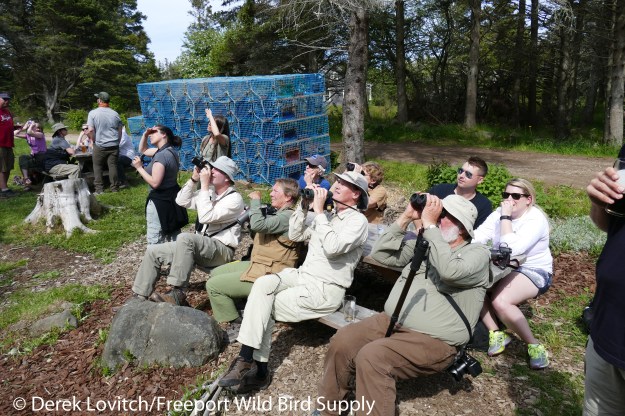
GROUP AT BREWERY

In fact, we momentarily cleared out the brewery when a possible Orange-crowned Warbler (one was seen by others over the past two days) was spotted nearby. Rushing over, we carefully studied the bird before reaching the conclusion that it was indeed a pale Tennessee Warbler.
TEWA

After an unfortunate but necessary cancellation from our original speaker, Dr. Steve Kress arrived to save us – admittedly a feat marginally less heroic than what he did for puffins and endangered seabirds all over the world!


Giving the weekend’s keynote presentation on his work to bring Atlantic Puffins back to nearby Eastern Egg Rock, Steve explained the challenges he and the puffins faced before finally realizing his novel approach finally bore fruit, or should I say, pufflings.
Steve_Kress2_edited-1Steve_Kress1_edited-1

Overnight, a back door cold front sagged southward, shifting the winds to an easterly direction and limiting the arrival of new migrants to the island. Our “Morning Flight Watch” with plentiful free Birds & Beans coffee for all at the Trailing Yew wasn’t too eventful, but things definitely picked up for the post-breakfast walk.


Jeannette led my tour group, and the birding was still a bit slow, relatively speaking. But, they finally made their way down to the pump house to see Eastern Kingbirds flycatching in the marsh. And, up to the lighthouse for the first time which was highlighted by a fantastic view of a female Blackburnian Warbler.
BLBW female

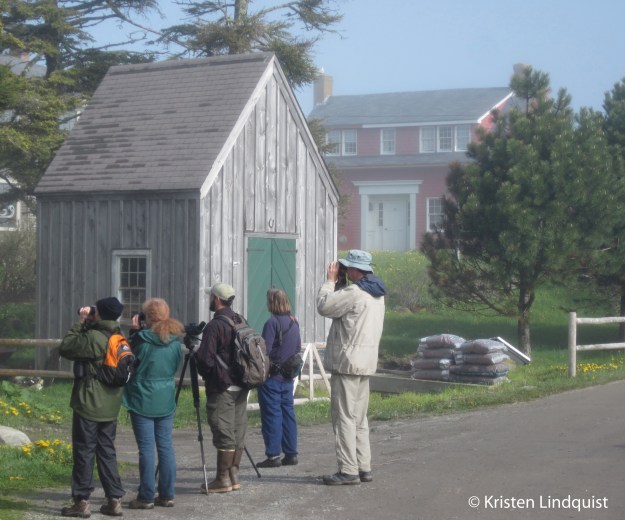
Meanwhile, Kristen Lindquist assisted me in leading the free, open-to-all birdwalk as part of the weekend’s special events. A nice mix of birders, residents, and visitors enjoyed a casual stroll. We chatted as we went, covering a variety of topics from bird migration to conservation to coffee to the ill-conceived industrial wind development scheme for the island’s southern waters.


Some folks, new to birding, may have left with the impression that Red-eyed Vireos were about the most common bird in the world, as quite a few were calmly and methodically foraging through apple trees in and around town.
revi

But perhaps this male Blackburnian Warbler would end up being a “spark” bird for someone! Because male Blackburnian Warbler!
BLBW male

With a light easterly wind continuing, and our group back together after more Novelty pizza, we walked up to Burnt Head, where we enjoyed some nice close passes from Northern Gannets
NOGA

Jeannette and I spent an extra night on the island, knowing we would need a little time to unwind after the even-more-chaotic-than-expected weekend of events. After a great dinner with friends, we listened to two Soras calling from the marsh and an American Woodcock still displaying somewhere overhead before turning in.

We awoke on Monday to dense fog and no visible migration on the radar, but the birding was actually quite good. We found a Nelson’s Sparrow in the Lobster Cove marsh, but also enjoyed how the damp weather (mist, drizzle, and a few showers) were keeping activity low and close, easily viewed in the blooming apple trees around town once again.
As a warm front passed through, with only a little more drizzle but rapidly warming temperatures and clearing skies, we took a post-pizza hike, heading deeper into the woods, which netted more of the island’s breeding species, such as many more Black-throated Green Warblers.
BTNW

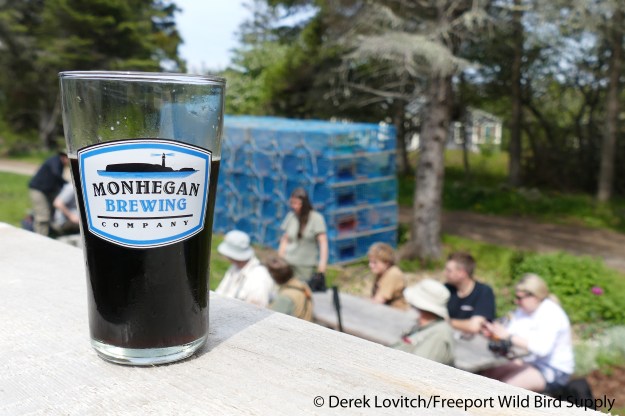
Somehow – now how did this happen? – our hike ended at the brewery, where another pour of the Birds & Beans-infused beer was in order.
CLOSE UP POUR

Unfortunately, especially since the sun was now shining brightly, it was indeed time for us to head back to the real world, so Jeannette and I begrudgingly plodded down to the dock and boarded the Hardy Boat for the return.  It’s never easy saying goodbye to the island – its birds and our friends there – but today was especially challenging as we know a fight about the future of the island – including many of the migratory birds that pass over and through here – is looming.
Leaving_island_edited-1

Here’s the complete daily checklist for the weekend:
26-May 27-May 28-May 29-May
1 Canada Goose 0 0 1 0
American Black Duck x Mallard 0 1 0 0
2 Mallard 2 10 12 8
3 Common Eider x x x x
4 Ring-necked Pheasant 3 3 3 4
5 Common Loon 1 1 0 1
6 Northern Gannet 0 0 12 0
7 Double-crested Cormorant x x x x
8 Great Cormorant 0 0 0 1
9 Great Blue Heron 0 1 0 0
10 Green Heron 1 0 0 0
11 Osprey 0 1 0 0
12 Bald Eagle 2 1 0 0
13 Merlin 0 1 0 1
14 Virginia Rail 0 0 0 1
15 Sora 1 1 2 1
16 American Woodcock 0 0 1 0
17 Black Guillemot x x x x
18 Laughing Gull x x 12 4
19 Herring Gull x x x x
20 Great Black-backed Gull x x x x
21 Common Tern 2 0 0 0
22 Mourning Dove 8 10 4 6
23 YELLOW-BILLED CUCKOO 0 1 0 0
24 Common Nighthawk 0 1 0 0
25 Ruby-throated Hummingbird 2 3 2 2
26 Yellow-bellied Sapsucker 0 1 0 0
27 Downy Woodpecker 4 4 2 0
28 Northern Flicker 0 1 1 1
29 Eastern Wood-Pewee 2 10 4 6
30 Yellow-bellied Flycatcher 1 4 0 5
31 Alder Flycatcher 1 2 0 0
32 Willow Flycatcher 0 4 0 1
33 “Traill’s” Flycatcher 0 6 2 1
34 Least Flycatcher 5 8 2 5
35 Eastern Kingbird 8 14 7 6
36 WHITE-EYED VIREO 0 1 0 0
37 Philadelphia Vireo 2 3 0 0
38 Red-eyed Vireo 15 100 30 25
39 Blue Jay 4 4 6 6
40 American Crow x x x x
41 Tree Swallow 8 2 2 2
42 Cliff Swallow 0 1 0 0
43 Barn Swallow 0 0 2 0
44 PURPLE MARTIN 0 0 0 0
45 Black-capped Chickadee x x x x
46 Red-breasted Nuthatch 2 4 2 3
47 House Wren 0 2 2 2
48 Winter Wren 0 0 0 1
49 Golden-crowned Kinglet 2 2 2 4
50 Swainson’s Thrush 0 1 0 0
51 American Robin 10 8 10 8
52 Gray Catbird x x x x
53 Brown Thrasher 1 0 2 0
54 Northern Mockingbird 0 1 0 0
55 European Starling x x x x
56 Cedar Waxwing 30 80 60 40
57 Ovenbird 0 1 0 0
58 Northern Waterthrush 1 1 0 0
59 Black-and-white Warbler 8 10 6 3
60 Tennesee Warbler 1 10 1 1
61 Nashville Warbler 1 1 1 2
62 MOURNING WARBLER 0 3 0 0
63 Common Yellowthroat x x x x
64 American Redstart 25 40 10 15
65 CAPE MAY WARBLER 0 1 0 0
66 Northern Parula 40 50 20 20
67 Magnolia Warbler 5 15 12 20
68 Bay-breasted Warbler 1 0 0 0
69 Blackburnian Warbler 3 3 2 2
70 Yellow Warbler 20 20 25 20
71 Chestnut-sided Warbler 15 15 10 15
72 Blackpoll Warbler 20 70 30 40
73 Black-throated Blue Warbler 1 3 1 2
74 Yellow-rumped Warbler 0 4 1 2
75 Black-throated Green Warbler 6 7 10 30
76 Canada Warbler 0 1 1 0
77 Wilson’s Warbler 1 0 0 1
78 Eastern Towhee 0 1 0 0
79 Chipping Sparrow 4 1 1 0
80 NELSON’S SPARROW 0 0 0 1
81 Song Sparrow x x x x
82 Lincoln’s Sparrow 0 1 0 1
83 Swamp Sparrow 0 1 0 1
84 White-throated Sparrow 1 2 2 1
85 Scarlet Tanager 0 2 0 0
86 Northern Cardinal 4 4 8 8
87 Rose-breasted Grosbeak 0 1 0 1
88 Indigo Bunting 1 3 1 0
89 DICKCISSEL 0 1 0 0
90 Bobolink 2 6 3 0
91 Red-winged Blackbird x x x x
92 Common Grackle x x x x
93 Baltimore Oriole 4 2 2 1
94 Purple Finch 2 2 2 1
95 RED CROSSBILL 8 2 3 ?
96 WHITE-WINGED CROSSBILL 6 8 0 12
97 Pine Siskin 15 30 30 40
98 American Goldfinch 6 4 4 4

2016 Bradbury Mountain Spring Hawkwatch Season In Review

Hawkwatch_last_day_2016
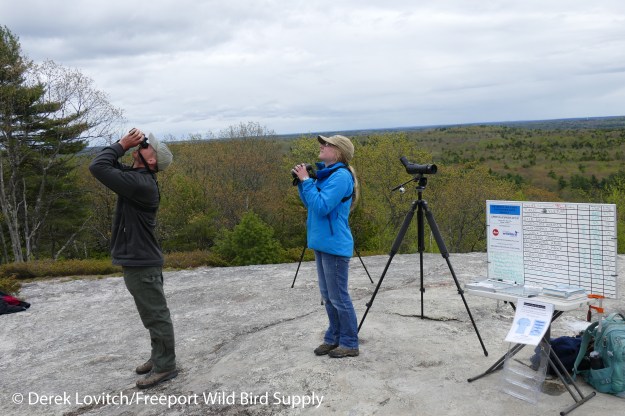
The 10th annual Bradbury Mountain Spring Hawkwatch wrapped up on May 15th, bringing a remarkable season to a close. Although I did go up for two hours to hope for a vagrant Mississippi or Swallow-tailed Kite on the 20th, netting five migrants (2 Sharp-shinned Hawks and 1 each of Broad-winged Hawk, Cooper’s Hawk, and Merlin. All immatures as expected on the late date). It was worth a try!

Anna Stunkel, a College of the Atlantic graduate and veteran of the Lucky Peak hawkwatch in southwestern Idaho, was the 2016 Official Counter, and she did an incredible job. A tireless observer and interpreter, she introduced hundreds of visitors to the project, and to our numerous local Bald Eagles! While Jeannette and I covered her days off – when rain didn’t do the job for us – or whenever else we got a chance, our many volunteers, especially Zane Baker, Tom Downing, Dave Gulick, Chuck Barnes, and Rick Hartzell were priceless. No hawkwatch is successful without a loyal cadre of assistants – spotting birds, answering questions, and bringing food – so thanks to you all!
L1040575_edited-1

The 2016 season total of 4,785 between March 15th and May 15th was our second highest total in the ten years of the project, and an impressive 17.6% above average (we exclude 2007 from our data analysis due to a change in methodology after this “trial” year).

Oddly enough, we amassed this tremendous total despite losing 16.5% of our possible coverage hours (9am to 5pm EDT) to weather, including fog, rain, snow, or high winds. The 414 total hours of observation was actually 6.6% below our average.

343 raptors passed the watch on April 17th, topped by the 980 tallied on 4/22 and 585 on 4/23. Those two amazing days changed our season dramatically – we went from worrying about a record low count to dreaming about a record high! 3,165 of our raptors passed through between April 16th and April 28th, accounting for 70% of our total flight.

Two rarities were recorded, headlined by a Black Vulture (our 7th of all time) on May 12th, and perhaps even rarer according to the season, a Broad-winged Hawk on March 20th (our previous earliest date was April 3rd, 2008 which itself was an outlier). We hypothesize that this was not a vanguard of the usual long-distant migrants arriving from Central America so early, but rather a bird that wintered either in South Florida or perhaps even well north of usual range thanks to the mild winter over the East.

Although southwesterly winds – our best conditions – were rare this spring, numerous days of west and light northwest in April, combined with sunny conditions and few weather systems during the peak weeks of our flight produced our great count, led by above average numbers of Osprey, Northern Harrier, Sharp-shinned Hawk, Broad-winged Hawk, American Kestrel, and Merlin. On our biggest day (4/22), light westerlies eventually turned to the southwest, and westerlies rotated around to the southeast on the following day.
IMG_4644_edited-2

However, the mild winter and early onset of early spring – including snow-free conditions over much of the area on the first day of the count and ice-out already occurring on larger rivers – got the season off to a quick start, but also meant we missed a number of birds that had already continued north before the count started on March 15th. Below average numbers of Turkey Vulture, Bald Eagle, Cooper’s Hawk, Northern Goshawk, Red-shouldered Hawk, and especially Red-tailed Hawks were the result. “Locals” of each from Day 1 also affected our count as we had to err on the side of caution early on to not overcount local birds (especially vultures and eagles) every time they flew around the mountain. It was a very, very different season from the 2015 count, in which winter never seemed to want to go away.

However, our record low 1 Peregrine Falcon is not as easy to explain – perhaps the constant westerlies just kept this predominately more coastal migrant far enough towards the coastline of Casco Bay.

As always, we also keep track of non-raptor migrants to the best of our ability.
2,010 Double-crested Cormorants, 1457 Common Grackles, 1028 Canada Geese, 918 Tree Swallows, and 747 unidentified/mixed blackbirds led the way.

Sandhill Cranes are now an annual occurrence, and this year we tallied four birds: 2 on 3/26, and one each on 4/16 and 4/25. The expansion/colonization/recolonization of Maine by this magnificent species continues, and our hawkwatch is apparently well placed to sample their return flight. Other noteworthy migrants included a White-winged Crossbill on 3/17, migrant Bohemian Waxwings on 3/26 (50) and 4/19 (29) with numerous visits by small flocks to the Common Juniper at the summit, and two Blue-gray Gnatcatchers (4/22 and 5/3).

A total of 92 species were seen and/or heard from the summit, including regular vocalizations from local Barred Owls and a variety of warblers.

IMG_4638_edited-2

  2016 Avg. 2008-2015 difference from average
Black Vulture 1 0.8 33.3%
Turkey Vulture 260 272.5 -4.6%
Osprey 513 431.1 19.0%
Bald Eagle 68 77.6 -12.4%
Northern Harrier 132 98.6 33.8%
Sharp-shinned Hawk 744 715.1 4.0%
Cooper’s Hawk 69 74.1 -6.9%
Northern Goshawk 2 7.9 -74.6%
Red-shouldered Hawk 75 91.4 -17.9%
Broad-winged Hawk 2123 1545.0 37.4%
Red-tailed Hawk 245 270.4 -9.4%
Rough-legged Hawk 0 0.9 -100.0%
Golden Eagle 0 0.5 -100.0%
American Kestrel 429 359.3 19.4%
Merlin 76 69.1 9.9%
Peregrine Falcon 1 5.4 -81.4%
       
Unidentified Raptor 47 47.3 -0.5%
Total 4785 4067.9 17.6%
       
Hours 414.25 443.5 -6.6%

Of course, this project doesn’t happen without your support of Freeport Wild Bird Supply, but we can’t do this without the support of Bradbury Mountain State Park and our co-sponsors, Leica Sport Optics. Our sincerest thank you goes out to Sunshine Hood, the new park manager at Bradbury (we can’t wait to grow the project with you!), and Jeff Bouton and Stan Bucklin of Leica.
L1040577_edited-1

But most importantly, this project doesn’t happen without all of you joining our counter at the summit, learning about raptors, migration, and conservation. To show your support for the project, and to raise funds for future needs (counter’s salary, new signage, etc), check out the exclusive Bradbury Mountain Hawkwatch t-shirt by North Yarmouth’s Coyote Graphics. It features Michael’s original artwork of the view from Bradbury within the outline of raptor on the front, and raptor silhouettes by the 2016 Official Counter, Anna Stunkel on the back.

We look forward to seeing you at the summit again beginning on March 15th, 2017 – or perhaps sooner if weather conditions align (like more kite weather!)
L1040752_edited-1

Western Grebe at Simpson’s Point (4/17/16)

A couple of weeks ago, I wrote about what a hotspot of Simpson’s Point in Brunswick currently is. I also predicted that it was about due for another rarity. And recently, with increasing numbers of migrant ducks, my Rarity Fever was further stoked.

Last Thursday, I counted an amazing 2600 Black Scoters – a really ridiculous count for interior Casco Bay. After enjoying a growing number of Palm and Yellow-rumped Warblers among other migrants (first of year Swamp Sparrows, etc) at Florida Lake this am, I took advantage of the finally-calm conditions to visit them again, and perhaps do a little sorting through the masses.

Those scoters were still present this morning, and the goodly number of Horned Grebes (20+ each day) continued. Horned Grebes molting into breeding plumage can look a lot like vagrant Eared Grebes, especially as the blond tufts are still growing in. I was scanning a small raft of Horned Grebes, thinking about finding the second Eared Grebe record for here.

That’s when I found…a Western Grebe! Not only was this a significant rarity, it was actually a “State Bird” for me (the first time I have seen the bird in the state). A long overdue one that was becoming a nemesis of sorts, it was #6 on my latest predictions list for my next 25 species to see in Maine. And of course, it is always sweeter and more rewarding for me to find it for myself.

It was not close, but the distinctive shape and profile was unmistakable. The relatively short body riding low on the water – like all grebes – looked disproportionally small as that long and skinny neck was craned up. The long bill and fairly large head (relative to the width of the neck) further added to the bird’s distinctive profile.

Upon closer look, the two-toned black-and-white neck and face was obvious. There’s little doubt as to this bird was a member of the genus Aechmophorus – Western and Clark’s Grebe. Luckily, as the active bird moved a smidge closer, I was able to scrutinize several features that ruled out Clark’s. For one, the black hindneck was evenly wide, not narrow and thin, and not pinching toward the top. Although it was too far to see the details of the face, it definitely did not look “white-faced” and I certainly could not see the eye (On Clark’s, the eye stands out in the white face in breeding plumage, on Western, the eye is harder to see as it is enshrouded by dusky black). The bill also looked yellow, but not as bright “banana yellow” or even orange-y like Clark’s.

But it was far, and perhaps a hybrid could not fully be ruled out. However, with one record of Clark’s for Maine (and all of New England) and with at least a dozen or so records of Western for Maine alone, there’s a fair “percentage play.”

Anyway, like many birds at Simpson’s Point, it was off to the east, and the light was not great in the mid-morning. After diving several times, it began to preen, and then loafed for a bit before tucking in its sinuous neck and falling asleep (had I scanned while it was asleep, I probably would have never picked it up!). In between, I managed to rattle off a bunch of phone-scoped “documentation” shots. Well, for what they are worth…

And here’s another lousy photo, from 4/21. However, it was in better light, so the bill color is a little more evident. However, the overexposure of the distant phone-scoped photo makes the face look much more whiter than it really is.
WEGR1,SimpsonsPoint,4-21-16_edited-1

Putative Ring-necked Duck x Scaup Sp Hybrid on Sabattus Pond, 4/11/16

IMG_8147_Hybrid1_edited-1

IMG_8146_Hybrid2_edited-1

On Monday, April 11th, Jeannette and I found a fascinating duck, clearly of the genus Aythya, at Sabattus Pond in Sabattus.  Off of Martin’s Point Park in the southwest corner of the pond, it was hanging out with a mixed flock of Ring-necked Ducks and Lesser Scaup.

Appropriate enough, because this bird appears to be a hybrid between Ring-necked Duck (RNDU) and one of the two scaup species! Unfortunately, it was windy, a light rain was falling, and so my phone-scoped attempts at the moderately-distant bird don’t capture this critter in all of his glory. But, they’re good enough for “documentation,” and they offer a chance to do a little analysis.

IMG_8163_hybrid_withRNDUs1_edited-1
2nd from the left, with Ring-necked Ducks.

IMG_8151_hybrid_withRNDUandLESC2_edited-1
2nd from the left, with Lesser Scaup pair and a drake Ring-necked Duck

IMG_8170_hybrid_in_flock_edited-1
With Ring-necked Ducks, Lesser Scaup, and a Bufflehead. Note the apparent size (see below).

IMG_8175_hybrid_with_LESCandRNDU3_edited-1
The hybrid (right), with Ring-necked Duck and overexposed Lesser Scaup.

IMG_8177_hybrid_withRNDU4_edited-1

Note the dark gray back (intermediate between RNDU and scaup) and the gentle curve on the upper edge of the sides, very much like a RNDU. The sides and flanks are very pale gray, also intermediate between RNDU and breeding plumages scaup. There’s also a narrow whiter area on the front of the chest-sides, suggestive of the distinct white “spur” on the sides of RNDU.

The head shape is also intermediate, with a decidedly peak-headed appearance that is closer to RNDU than either scaup, with a fairly straight nape and the peak at the rear of the head. The bill has a wide, but diffuse pale subterminal ring, suggestive of RNDU as well, but not as crisp or narrow (and no additional ring at the base of the bill). I could not see the width of the black tip at this distance, nor did I have the ability to see if there was a maroon ring around its neck (the namesake, if not very field-worthy, ring-neck of the Ring-necked Duck!).

So, it’s clearly part RNDU. Whether the other half is Greater Scaup (GRSC) or Lesser Scaup (LESC), well, that is another question entirely. While RNDU x LESC are the expected species pair (in large part due to an extensively-overlapping breeding range) that Reeber calls “regular,” RNDU x GRSC have also been recorded.

I never saw the spread wing, and I think a detailed and sharp photo of the wingbar could shed some light on the subject. Short of that – or preferably, a DNA analysis – we can’t say for sure, but there were two interesting observations.

IMG_8148_Hybrid_withLESC1_edited-1

IMG_8165_hybrid_withLESCandRNDU1a_edited-1
Note the Lesser Scaup on the left and the apparent size of the hybrid compared to it and the nearby Ring-necked Ducks. 

For one thing, in all lights, the head had a distinctly greenish sheen; never purple.  While head color on scaup is notoriously misleading and the interpretation of it is of little value for ID in most conditions, I found it interesting that when seen side-by-side with LESC, it still always looked green as the LESC looked purple (as does RNDU). However, Reeber notes that this hybrid pairing can have a green sheen as well. Remember, not all characteristics of hybrids are necessarily intermediate.

However, the one thing that was intriguing about the possibility of a GRSC  as the other parent (documented, but likely exceptionally rare) is that in almost every angle, the hybrid was noticeably larger than the LESC it was occasionally with, and it usually appeared larger than the RNDUs. Unfortunately, no GRSC were present – they were all on the other side of the pond today. If this bird was indeed larger than RNDU, it’s hard to imagine that one parent was the even smaller LESC. But with a scope shaking in the wind, the play of light on light colors verses dark, and the inherent subjectivity of the judgment of size, I would not swear to it that this bird was large enough to rule out LESC as one of the two parents.  Therefore, I am most comfortable with calling this a Ring-necked Duck x Scaup species hybrid. A rare and beautiful bird regardless!

IMG_8138_hybrid_with_GRSCandRNDU_edited-1
The hybrid (left) with Lesser Scaup and Ring-necked Duck.

Reference:
Reeber, Sebastien. 2015. Wildfowl of Europe, Asia, and North America. Christopher Helm: London.

Birds on Tap – Roadtrip: Spring Ducks and Draughts 2016

NOPI female1, Riverbank Park, 1-9-12_edited-1
One of the trips’ highlights was the two dozen Northern Pintail at the Mouth of the Abby. We enjoyed the gorgeous males, but also took time to appreciate the subtle beauty of the hens. We also learned how to separate “all the brown ducks” but considering shape and size. Female Northern Pintail, April 2009 – Riverbank Park, Westbrook.

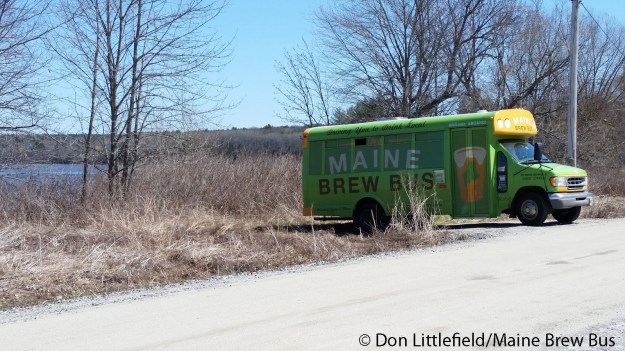
On Sunday, our “Birds on Tap – Roadtrip!” tour headed up to the spring waterfowl hotspot of Merrymeeting Bay. The Spring edition of “Ducks and Draughts” focused on the multitudes of waterbirds that congregate on this productive body of water with our partners at the Maine Brew Bus.

With the abnormally (even by modern standard) early spring, ice was out on ponds, lakes, and rivers to our north well over a month ago. Not surprisingly then, diving ducks were few. Dabbling ducks, however, are still present in great numbers, taking advantage of the food resources (last year’s wild rice and other seeds) in the fine mud of the bay’s extensive flats.

After a quick stop at Bowdoinham’s Mailley Park (Double-crested Cormorants, Common Mergansers, and my first Pied-billed Grebe of the year), we moved over to the famous “Mouth of the Abby,” where the Abagadasset River drains into the bay proper. And it most definitely did not disappoint: About 1,000 American Black Ducks were joined by 200 or so Green-winged Teal, at least 100 Mallards, a goodly tally of 24 Northern Pintails, a dozen more Common Mergansers, 8 Canada Geese, a mere 8 Ring-necked Ducks, and a pair of Wood Ducks. 6 Killdeer also foraged on the flats, and the second Bald Eagle of the day passed right overhead.
At_Abby1At_Abby2
With Jill hard at work taking photos for the paper.

The three Wood Ducks in the small pond on Brown’s Point Road flushed as the bus approached, and they didn’t let us get much closer on foot as we walked back. A Cooper’s Hawk was well seen, however.
BrewBus_BrownsPoint

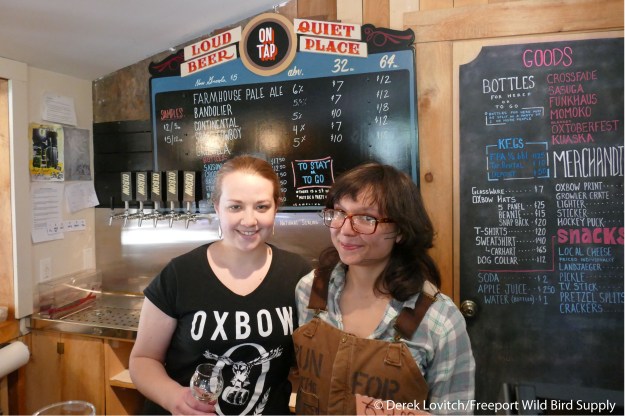
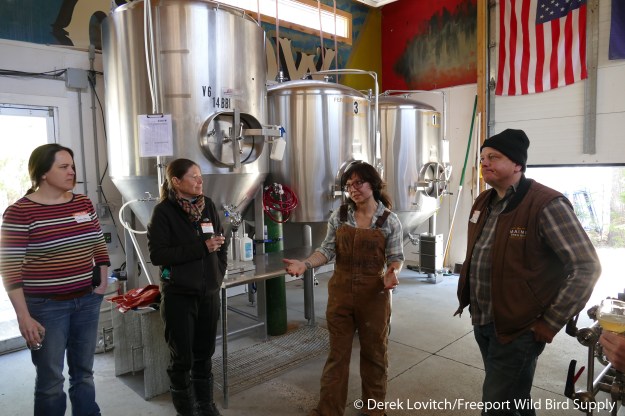
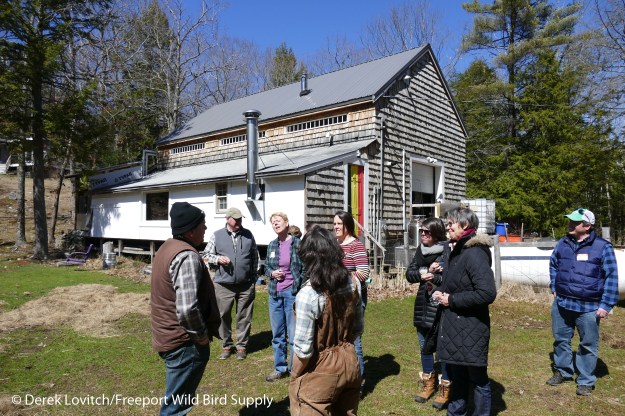
After squiggling cross-country to Newcastle, we pulled into the brewery and rustic tasting room of Oxbow. After a couple of samples – Bandolier, their spring printemps was one of the favorites; it certainly was mine – Rocky took us on a tour of the brewery, and a part of the impressive property.
L1040500_Oxbow1_edited-1L1040521_Oxbow2_edited-1aL1040525_Oxbow3_edited-1L1040537_Oxbow4_edited-1L1040540_Oxbow6_edited-1

Oxbow’s connection to the land is evident, from the sour cherry orchard to the welfare of their livestock (pigs coming soon!). We learned about the philosophy of their beer, and some of the new and creative things they’re working on.
L1040541_Oxbow7_edited-1L1040547_GuineaFowl1,Oxbow_edited-1
Sorry folks, not “countable!”

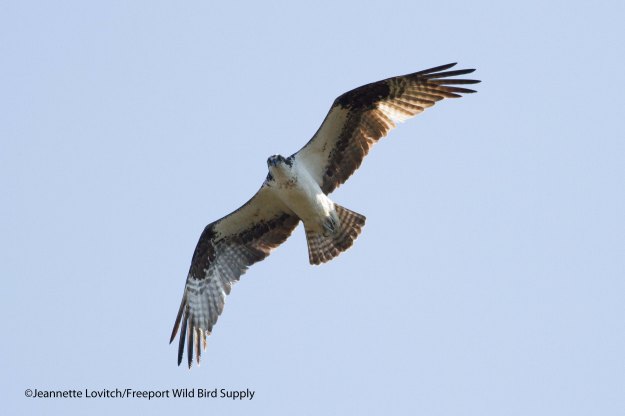
After another round, it was back on the road, as we weaved our way through scenic rural vistas to Brunswick, where we made a quick stop at Bay Bridge Landing Park. We hoped to add a previously-reported Eurasian Wigeon to our waterfowl list, but the tide was already too high, and the low pass from a Bald Eagle – our 6th or 7th of the day – probably did not help matters! However, a low pass of an Osprey, hovering right overhead, was a nice consolation prize.
L1040558_OSPR,BayBridgeLanding,4-10-16_edited-1

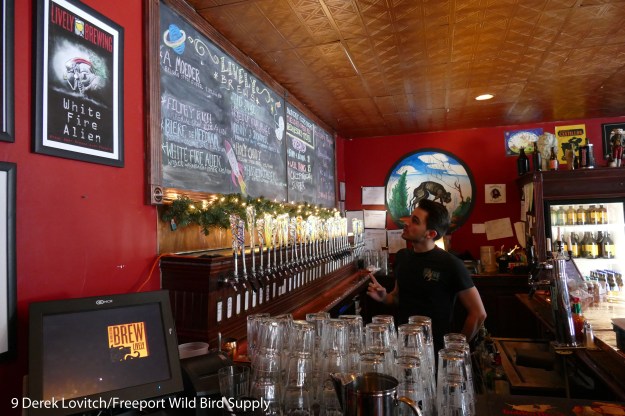
Lively Brewing at Ebenezer’s Brewpub was our second brewery stop of the day. Kelso offered up three samples of some of their representative beers, guiding us through the different styles and some of the intriguing and creative options they play with here.
L1040564_LivelyBrewing1_edited-1L1040567_Lively2_edited-1L1040569_Lively4_edited-1

Whether it’s the birding or the beer-ing portion of these tours, there really is never enough time, so before we all knew it (time really does indeed fly when you are having fun; please excuse the pun) it was time to head back to Freeport and Portland, bringing another fun and successful Birds on tap – Roadtrip! to a close.

So that’s my recap on the trip. But this tour welcomed Meredith Goad, the food writer from the Portland Press Herald on board. You know you have a unique collaboration when you have a food writer wanting write about a birding tour! For Meredith’s perspective, comments from the participants, and more information about this truly unique birds and beer tour concept, check out Meredith’s excellent article in today’s paper!

Needless to say, the rest of the year’s four tours are filling up fast! For more information on those, see the Tours, Events, Programs, and Workshops Page of our website, and check out my blog about all of this year’s journeys. And don’t forget about Birds on Tap – Monhegan! in May.

My beautiful picture

No matter how common they might be, there are few things more stunning than a drake Mallard!

Simpson’s Point, Brunswick – Our Local Duck Hotspot.

IMG_4969_edited-2
Common Goldeneyes, Common Mergansers, and Greater Scaup (Vermont, March 2014)

Simpson’s Point in Brunswick, at the northern end of Middle Bay (Delorme Map 6: C-3) has become one of the best waterbird-watching spots in Casco Bay over the last few years. That trend continues this spring, with outstanding concentrations of waterfowl.

While there might not be a rarity or an addition to your year list right now, I highly encourage a visit to see the concentration (a scope is highly recommended), and it is certainly ripe for a rarity to be discovered!

I visited the point twice times this week, each yielding some remarkable counts (my attempts to visit it for a third time today was thwarted by unexpectedly dense fog). The first number is the count or estimate from 3/26 with my Saturday Morning Birdwalk group, and the second is from Monday, 3/27 with Jeannette.

– Mixed Black and Surf Scoters (roughly 60-65% Black: 1200/2100. A really incredibly count for the bay, this is by far the largest raft(s) of scoters I have seen within Casco Bay.
– Mixed Scaup (at least 80% Greater, but plenty of Lesser usually visible): 650/650. Down a few hundred birds from the massive overwintering flock.
– American Black Duck: 100/40
– Common Goldeneye: 75/40
– Bufflehead: 50/125
– Common Eider: 40/60
– Horned Grebe: 43/30
– Red-breasted Merganser: 10/25
– Common Loon: 5/3
– White-winged Scoter: 0/2

While more birder attention has definitely worked in its favor, it was always a well-known duck-watching hotspot. However, these numbers are outstanding, even based on the renewed attention to this spot over the last few years. I wonder what has changed? Sure, this winter the water was open and that kept the scaup around, but what is attracting all of these scoters? Is there a new food source? Is there a lack of some food somewhere else?

But it’s the oversummering birds (exceptionally rare for the state birds in summer like scoters, Red-necked Grebes and Red-throated Loons, and Long-tailed Ducks) that really suggest the uniqueness of this area. While rarities over the past few years, including Eared Grebe and Pacific Loon, have put this spot “on the map,” it is the numbers of common birds and small numbers of oversummering “winter” ducks that is most noteworthy. Is it nothing more than more birders paying more attention in mid-summer? I certainly am.

So go out and have a look, and perhaps you’ll get there on the day the scaup are close enough to pull out a Tufted Duck!

Meanwhile, nearby Wharton Point is always worth a visit, and can easily be combined with a trip to Simpson’s. Currently, it is hosting more typical-for-here large numbers of dabblers, led by American Black Ducks (800/495). On 3/28, Jeannette and I teased out a pair of American Wigeon and 1 Green-winged Teal from the masses, while 8 Dunlin were on the flats.

So in between the excitement of new arrivals, hawkwatching, and the anticipation of the diversity of May, I know I’ll be taking some more time to do a little local ducking!

Birds on Tap – Monhegan!

IMG_1030_edited-2
“Coffee Warbler” would be a better name for the Magnolia Warbler due to their affinity, and perhaps even reliance, on shade-grown coffee plantations in winter.

Beer + bird-friendly coffee + birds + migration + Monhegan + Dr. Steve Kress* = Epic.

IMG_1180_edited-2

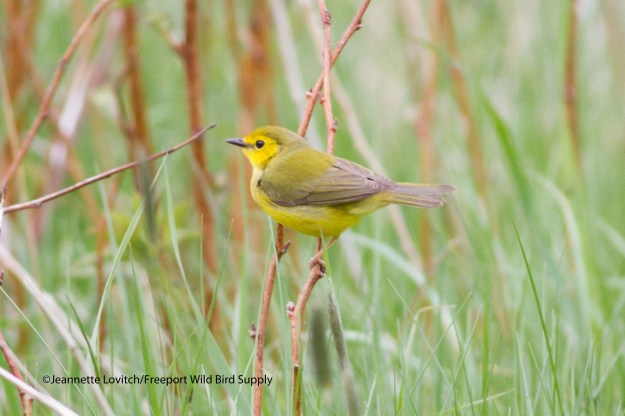
You never know what will show up on Monhegan on Memorial Day weekend, like this female Hooded Warbler.

For a while now, I have been hinting at a big event in the works for Memorial Day Weekend on Monhegan Island. Partnering with Birds & Beans Coffee, Monhegan Brewing, and The Trailing Yew, Freeport Wild Bird Supply is pleased to announce:

Birds on Tap – Monhegan!

We have the “Birds on Tap!” lecture series at Rising Tide in partnership with Dr. Noah Perlut, and the Birds on Tap – Roadtrip! series in conjunction with the Maine Brew Bus, and now, we’re going even bigger with a weekend on the birding Mecca of Monhegan Island!
DSC_0051_2EAKI,Monhegan,5-24-14, edited-1
Eastern Kingbirds.

But now we’re adding coffee to the mix, specifically bird-friendly, shade-grown, organic, and fair-trade certified – not to mention absolutely delicious – Birds & Beans coffee! Roasted right here in Maine, Birds & Beans (available at Freeport Wild Bird Supply and several other retailers around the state) coffee carries the “gold standard” of certification, the “Bird Friendly” label of the Smithsonian Migratory Bird Center. With this level of certification, we can protect the rainforest habitat required for the Neotropical migrants that us birders flock to places like Monhegan Island in spring and fall to see.
Spring (2)_edited-1
DereksGroup_edited-1

Want to see warblers, vireos, tanagers, and orioles? Well then we really can’t afford to lose more rainforest where these birds spend up to eight months of every year. So this year, while enjoying the migrants that pass over and through Monhegan, we’re going to work to save them. By drinking coffee…and a little beer.
IMG_1020_edited-2

Northern Parula on springtime apples on Monhegan.

Dr. Stephen Kress will be giving a program titled: “Saving Seabirds: Lessons from Puffins and Terns”. Worldwide, about one third of all seabird species are globally threatened due to human caused threats. A recent study has shown that 70% of all seabirds have vanished in the last 60 years. Now, often at the last hour, there is a bold approach emerging to help some of the most threatened species. Dr. Kress will review how techniques developed on Maine islands have led to the restoration of puffins and terns to historic nesting islands. He will also discuss how these techniques are helping to expand breeding ranges and reduce risks to extinction worldwide while serving as a bellwether to the effects of commercial fishing and climate change. His lecture includes reviews of several inspiring and hopeful seabird restoration projects worldwide. Dr. Kress will also share the recent discovery of the previously unknown winter home for puffins- to an area known as New England’s remarkable ‘coral canyons and seamounts’ off the NE continental shelf. Discovery of the puffin wintering area provides an additional reason to protect this biologically diverse habitat.

Dr. Kress is Vice President for Bird Conservation for the National Audubon Society and Director of Project Puffin and the Hog Island Audubon Camp. His career has focused on developing techniques for managing colonial nesting seabirds. In this role, he manages 13 seabird nesting islands in Maine that are home to more than 42,000 seabirds of 27 species. Each year his program trains about 25 interns; hundreds of professional seabird biologists can trace their first interest in seabirds to Project Puffin. Methods first developed in Maine such as seabird chick translocations and social attraction are now standard practice worldwide. Dr. Kress received his Ph.D. from Cornell University and his Master’s and undergraduate degrees from Ohio State University. In the summer he lives in Bremen and winters in Ithaca, NY with his wife Elissa and daughter Liliana. He is author (with Derrick Jackson of the Boston Globe) of a new autobiography (Project Puffin: the Improbable Quest to Bring a Beloved Seabird Back to Egg Rock). The book tells the inside story of how puffins were brought back to Egg Rock and other Maine islands.


The Trailing Yew will be serving Birds & Beans Coffee for its guests all weekend, and there will be an ample supply available to fuel Sunday Morning. We’ll begin by sipping coffee while observing the “Morning Flight” above the Trailing Yew and keeping an eye on the spruces around the property – often one of the most productive patches on the island at sunrise! After breakfast, local experts will lead a birdwalk to some of the nearby hotspots, departing the Yew at 9:00am and returning around 11:00am.

Memorial Day weekend is prime time to view migrants on their way north, in full breeding garb, and we’ll also be seeking rarities – unusual species from all directions often show up on this weekend; expect the unexpected.

IMG_1068_edited-2
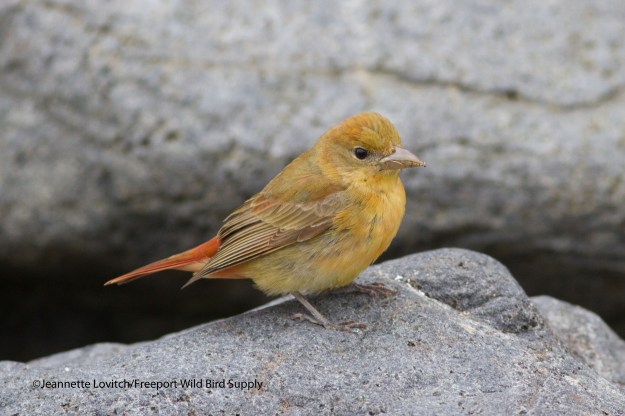
Such as near-annual Summer Tanagers…

DSC_0124_BRSP1,Monhegan,5-25-14_edited-1
… or, as in 2014, Maine’s first-ever Brewer’s Sparrow!

“But wait,” many of you are saying, “you said something about beer!” It is called “Birds on Tap!” afterall, so beer will definitely be at the forefront of this special weekend. But not just any beer, Monhegan Brewing’s fantastic beer! In fact, the event kicks off on Saturday afternoon with an exclusive, limited-edition, small-batch coffee stout brewed with Birds & Beans! “Beer-listers” will want to head out just for this one-time offering, just like birders flock to Monhegan for those once-in-a-lifetime bird sightings!
Sasha_atMonheganBrewery,5-26-14_edited-1Monhegan_Brewing,5-18-15_edited-1

Kenn and Kim will be signing books, birds will be discussed, and beer will be imbibed. And that’s just the kickoff!

Sold yet?

This is going to be a one of a kind event, so you’ll want to make your reservations soon. You can join my MonhegZen Birding Weekend Tour for 1, 2, or 3 days (see details on the “Tours, Events, Workshops, and Programs” page of our website) or make your reservations to spend a night on the island (our group, and our guest speakers, will be staying and dining at the Trailing Yew if you would like to join us!) and join us for some of these outstanding events…all of which are completely free (with books and beer available for purchase). Edit (5/12): NOTE: The tour is full, but all of the following events are free and open to the public, with no registration necessary.

Here’s the complete schedule of events.
Saturday, May 28th:
3:00pm – Release of Monhegan Brewing Company’s coffee-infused Milk Stout. Location: Monhegan Brewing Co.
7:30pm – Presentation by Dr. Stephen Kress. Location: community church. (Note: Trailing Yew will be offering an early dinner service at 6pm).

Sunday, May 29th:
6:30-7:30am – Casual birding while sampling B&B coffee with local experts around the Trailing Yew
9:00-11:00am – Guided birdwalk with local experts (Location: begins and ends at the Trailing Yew)

You often hear birders on Monhegan exclaim “it doesn’t get any better than this!” Except now, it has! I sincerely hope you’ll join us on the island for this fun-filled weekend, as if you needed more incentive than visiting Maine’s premier migration hoptspot!

Yew-May_edited-1

Monhegan, 5-21-11_edited-1

BBlogofinalThis. Is. Going. To. Be. Awesome.

IMG_1175_edited-2

Birds on Tap – Roadtrip: Surf And Suds! 2/28/16

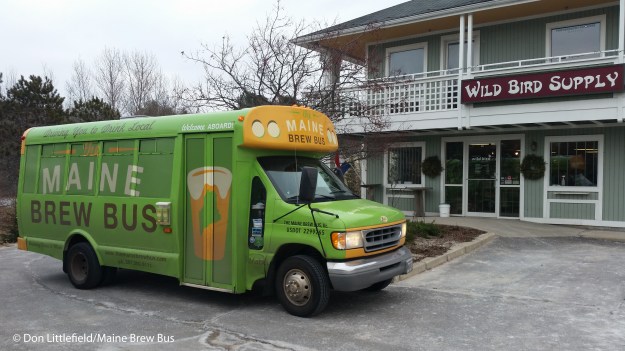
brew bus at store

The first of six “Birds on Tap – Roadtrips!” with our partners at the Maine Brew Bus took place last Sunday. Our “Surf and Suds!” tour headed south, visiting two hotspots along the York County Coast, looking for waterfowl (especially Harlequin Ducks), Purple Sandpipers, and Great Cormorants and other winter denizens of the rocky shore.

We began at Marginal Way in Ogunquit, enjoying perfect conditions. With temperatures rapidly rising into the low 40’s on a very light, southwesterly breeze, it was more than comfortable. And with a high deck of clouds and calm waters, viewing conditions were perfect.
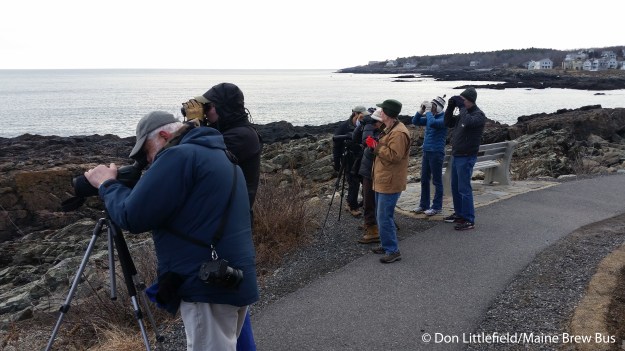
birders at Marginal Way

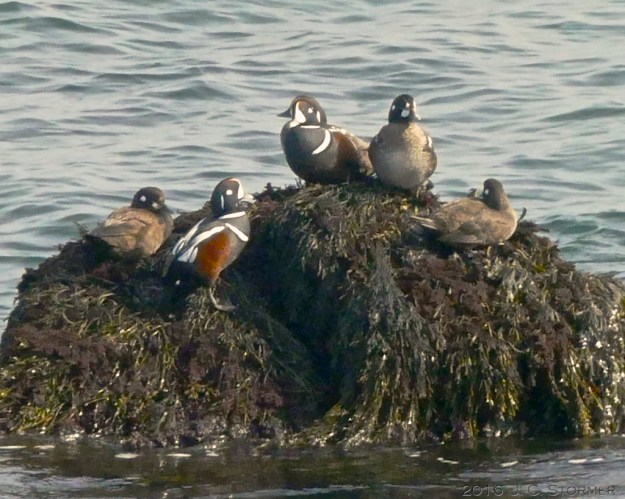
Harlequin Ducks are one of the premier “targets” of this tour, and they could not have been more obliging. At least 35 were along the pathway, with most very close to shore and several small groups hauled out on the rocks.

Harlequin Ducks (Histrionicus histrionicus) at Marginal Way, Ogunquit, ME

Harlequin Ducks (Histrionicus histrionicus) at Marginal Way, Ogunquit, ME

(Photo with Leica V-Lux Type 114)

HADU,MarginalWay,2-29-15_edited-1
(Phone-scoped photo)

While we only encountered 15 Purple Sandpipers, we saw them exceptionally well. I just with the little raft of 8 Razorbills were a little closer! A Carolina Wren singing from the neighborhood and 250+ Black Scoters were among the other highlights, while we also took ample time to enjoy views of Common Eiders, Red-breasted Mergansers, and all three scoters.

Next up was The Nubble, where one Great Cormorant coming into high breeding posed nicely, and a goodly total of 38 Harlequin Ducks were present. It was a MUCH better look at the single Razorbill that was feeding just off the Nubble, and it would be impossible to obtain better views of a Red-tailed Hawk that was making rounds of the parking lot, the Nubble, and nearby rooftops.
birders at Nubble

GRCO,Nubble,2-28-16_edited-1
(phone-scoped photo)

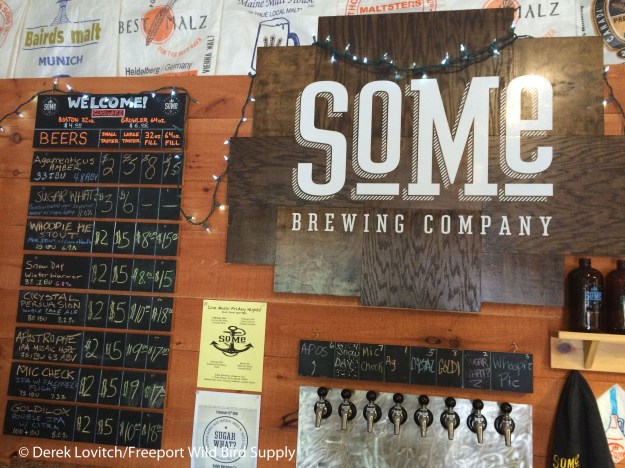
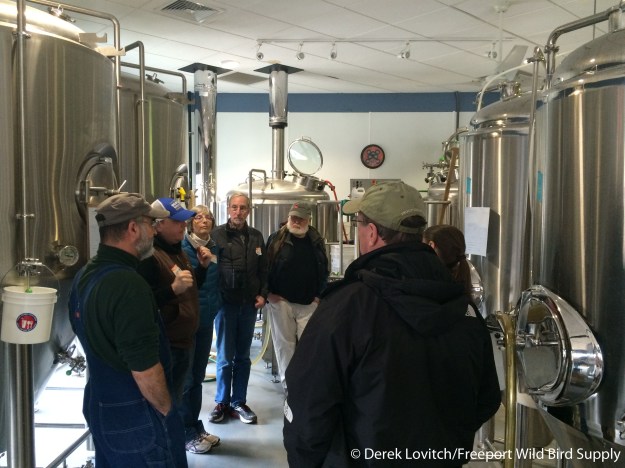
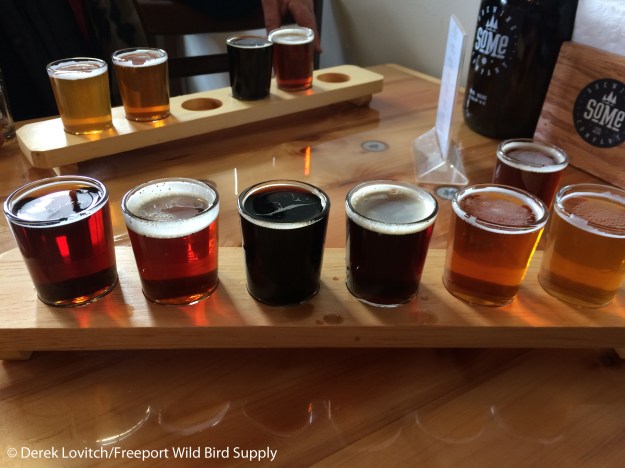
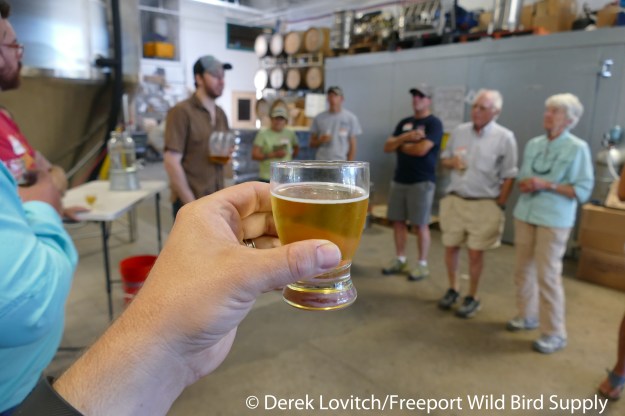
Before we knew it, it was “beer o’clock” and Don took over for the beer-ing portion of this unique tour. York’s SoMe Brewing was our first destination, and after a tour of their rapidly-growing operation as we discussed the ins and outs of brewing beer, we settled in for a flight of samples. Perhaps best known for their Whoopie Pie Stout and their go-to Apostrophe IPA, for me at least (and several others) “Sugar What?” stole the show. This Bourbon Barrel Aged Imperial Maple Amber hit all the right notes for me.
SoMe_board

SoMe1,2-28-16_edited-1

SoMe3,2-28-16_edited-1

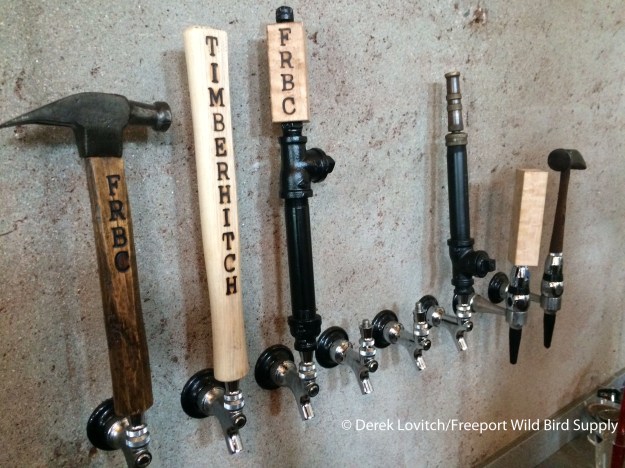
Back on the Brew Bus, we began our trek northward, continuing our discussions about birds, beer, and everything from “status and distribution” to bird-friendly coffee. We pulled into the unassuming South Portland neighborhood’s Fore River Brewing Company – a first visit for me, and all of the participants on the tour.
IMG_7805_edited-1

Lygonia IPA was my favorite of our samples, although the crowd was appreciating their John Henry Milk Stout quite a bit. We also learned how their brewing system, philosophy, and background differed from our first brewery; it always fascinates me on these tours to learn about the brewers and their approach to beer.
ForeRiver-taps

With the bus unloaded in Freeport, conversation continued at the store, and plans were made for the next Birds on Tap – Roadtrip! On April 10th, “Spring Ducks and Draughts” will visit Merrymeeting Bay for waterfowl migration and Bald Eagles, followed by visits to Oxbow Brewing Company in Newcastle (I love their woodland tasting room!) and Lively Brewing in Brunswick. These trips are truly unique and we hope you will join us for the next fun-filled tour of birds and beer!

St. Vincent and St. Lucia (with a quick stop in Barbados), Feb 2016!

23a_edited-2
St. Lucia Parrot.

Awoken by the light and warmth of the sun, I could muster little more than to roll over, push the curtains aside, and look at the tiny brown bird sitting on the fence. My lifer Barbados Bullfinch! Jeannette staggered to the window to glimpse it as well. We then went back to sleep for a couple more hours.

Those extra two hours did little to alleviate our exhaustion, but hey, at least we saw our bullfinch! The only endemic landbird on Barbados (as well as an endemic subspecies of Carib Grackle, which we also saw out the window), this was the reason for our layover here. A layover that was supposed to be 24 hours, including some time to explore and a get a full night’s rest. Instead, we had 10 hours on the island. And by the time we finally got out of bed for real, it was only about 5 hours – and that included getting to and waiting at the airport.

See, our trip from Maine was anything but smooth. During the second half of the Super Bowl, our early am flight from Portland to JFK in New York was cancelled, and everything was re-booked for two full days later. That was not going to work. So Jeannette spent the better part of the half on hold, and eventually getting us on a flight the next afternoon, and rebooking our JFK-Barbados flight.

Jet Blue ostensibly cancelled that early am flight due to weather, but that was complete B.S. There was nothing more than some wet snow at JFK that next morning, and snow didn’t reach Maine until after noon. There would not have been any interference with that 5:20am flight.

But there was a storm coming, so we were worried about our 3:10pm flight out of Portland. Instead of chancing it, we took the 6:30am Concord Trailways bus from New York City (a newer service, under better circumstances, this was actually a very pleasant experience and one we would consider again…especially at only $69 per person each way). 6 hours later, we walked a mile to a subway station for the E train, and took the E to the Airtrain. While on the Airtrain, a text message alerted us to the arrival of our original flight to Barbados. Salt in the wounds. Moments later, the Airtrain was evacuated when someone left a bag on board.

Finally arriving at the airport, we had 8 hours to explore. 8 hours is a lot in an airport terminal. Anyway, at least we were there, and our 9:30 pm flight out of JFK left with only a minor delay, and we were on our way.

We arrived on Barbados at 3:30am, cleared customs, and then got a cab to our Christ Church guesthouse where we were supposed to spend the night. We had alerted them to our delay, but when our cab dropped us off and sped away, no one was to be found. We knocked, and knocked some more, and finally got someone to pick up the phone. We crawled into our room at about 5:00am.

It was about 7:30 when I looked out the window, and by the time we made it outside (sans coffee, so it was really a struggle! And thank goodness we travel with Cliff Bars) we had just little more than an hour to wander. But Barbados Bullfinch was as common and conspicuous as promised, and so were the grackles.  And Bananaquits – one of our favorite birds in the world.

A short walk fueled by a Coca-Cola from a little shop provided just a glimpse into the island’s town avifauna, such as zippy Black-faced Grassquits, stunning Green-throated Caribs, and ubiquitous Gray Kingbirds.
1_edited-1Our Barbados guest house.

1a_edited-1With bullfinch habitat right out the door.
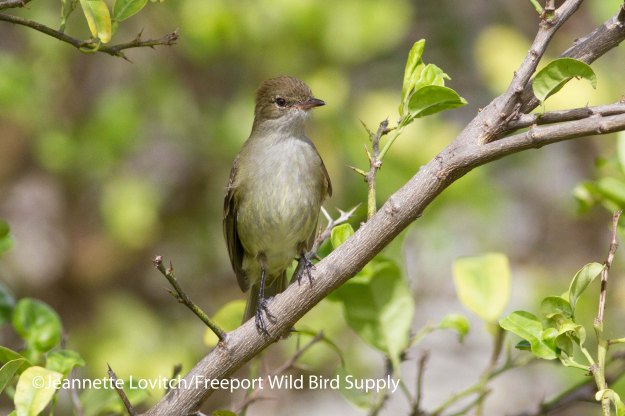
2a_edited-2Caribbean Elaenia

2b_edited-2

Barbados Bullfinch.

2c_edited-2Green-throated Carib.

2d_edited-2Carib Grackle

3_edited-1View of Kingstown from Grenadine Hotel.

But before we knew it, we were back at the airport. 40 minutes after departure we were back on the ground – and back on schedule – in St. Vincent, the first of our two primary destinations of our trip. We were kinda awake on the cab ride to our hotel, the Grenadine House, on the outskirts of Kingstown. An early dinner, and then early to bed. It was a much needed night of rest.

Unfortunately, we had another snafu, as our birding guide for the day had to postpone because the truck she was going to be using for the day broke down. Luckily, we had two full days on the island, so we just rescheduled for the next day.

This turned out to work to our advantage, as we awoke to pouring rain in the morning. Once again, we went back to bed.

Finally revived, we took a walk to the nearby botanical gardens. We were finally birding for real (read: awake), and enjoyed reacquainting ourselves with some of the common birds of the region, including Grenada Flycatcher, Antillean Crested Hummingbird, and Scaly-naped Pigeons. And the spiffy all-black St. Vincent race of the Bananaquit – one of our favorite birds just got even better!

The afternoon was spent wandering the markets and shops of Kingstown, adding a few species to our fledgling island list along the waterfront, such as migrant Barn Swallows and resident Brown Boobies and Magnificent Frigatebirds.
4_edited-1
5_edited-1Cannonball Tree flower.

6_edited-2St. Vincent Bananaquit.

6a_edited-2Gray Kingbird

7_edited-1St. Vincent Parrot captive breeding program.

8_edited-1

Day 3, 2/11:
Lystra Culzac-Wilson (one of the island’s two birding guides) picked us up early in the morning, and by 6:00 we were already on the trail. Shortly after sunrise, from an overlook, we had spotted our quarry: St. Vincent Parrots! At least 15 in all, with pairs and family groups (pairs plus a youngster from the previous year) squawking from nearby hillsides, flying from ridge to ridge, and feeding in trees across the valley. It was cloudy, and the light was still low, and most of the birds were far, so photography was a challenge.

However, Jeannette managed a couple of shots of a close fly-over, and we did enjoy great views as the birds flew around.  Wow. What a bird!  (Yeah, I know, our pictures don’t do it justice.)

Moseying along the nearby Vermont Nature Trail, Purple-throated Caribs were our next lifer – big, gorgeous, stunning hummers.  The endemic subspecies of House Wren finally showed itself, and we saw regional endemics like Lesser Antillean Bullfinch and Lesser Antillean Tanager for the first time since we visited Grenada 7 years ago.

But the endemic and Endangered Whistling Warbler eluded us, so we were off to the other side of the island to search for it. On some seemingly-random trail (accessed by crossing some farm fields and cattle pasture) in the Montreal area (yes, we traveled from Vermont to Montreal, but had to pass through Mesopotamia to do it!), we hiked up yet more stairs (there are a lot of stairs on trails in St. Vincent, we found) and after quite some effort, Lystra whistled a Whistling Warbler into our vicinity, and after a couple of glimpses, I was treated to a stunning view as this shy little bird popped out in the open for a moment just where I happened to be looking. Unfortunately, Jeannette wasn’t looking in the same exact place, so she only caught a fleeting glimpse. Lystra worked hard for us though.

Our lifer Brown Tremblers a’ trembling were anything but fleeting, as near the bottom of the trail three birds put on quite a show. The “chocolate thrasher-wren” was one of our most-wanted non-endemics (but limited to the Lesser Antilles) of the trip, so it was nice to get a good show.
9_edited-19a_edited-2St. Vincent Parrots!

10_edited-111_edited-1

Day 4, 2/12.
Since Jeannette wasn’t completely satisfied with her Whistling Warbler, we decided to try again at the Vermont Nature Trail. We glimpsed a few more parrots, had some better looks at Purple-throated Carib, but unfortunately only heard a single Whistling Warbler. We knew it was time to give up when several busloads of cruise ship passengers arrived on the trail, quite a few clearly out of their element and voicing their displeasure about things like steps, mud, and the pleasantly few mosquitoes.

Back in Kingstown, we finally twitched some delectable curried goat at Stoplight 2 restaurant, on Lystra’s recommendation. As you know, food is second only to birds when we travel, and it’s a local place off the tourist route (well, what there was for a tourist route here) that we love to find.

Also, unlike most tourists, we prefer mass transit, and although we did need a cab to get to the Vermont Trail in the morning, the afternoon was spent traveling strictly by mini-bus. Cheap, easy, a great way to see the towns, meet the people, and especially here (as in Grenada), listen to some local beats.

A short trip to Villa Beach was a change of scenery from the rainforest, and added several birds to our paltry island list, including Royal Tern, Brown Pelican, Osprey, and Belted Kingfisher. A walk into the village of Villa Flat added Tropical Mockingbird, and since we were on the island’s dry side, most of the Bananaquits had yellow-bellies. Undoubtedly, the extra melanin was a benefit in the wet environs, where it likely helps protect the feathers from mold or lice or something.

The Friday afternoon-evening streets of Kingstown were hopping, so after a couple more Harouns (the local endemic lager), we foraged for dinner, finding a great little barbeque stand near the harbor, where we enjoyed a little local flavor – both food wise and conversation. Actually, talking with the grillmaster was a lot of fun and provided that view into local life that you don’t get at a sterilized resort. I do think we were officially “liming,” which is an art form of relaxation and conversation that is practiced like a religion in the Caribbean. Oh yeah, and the BBQ pork was outstanding – perfectly succulent, tender, and the sauce hit every note.
12_edited-112a_edited-214_edited-1Curried Goat at Stoplight2 Restaurant.

15_edited-1 Villa Beach

16_edited-117_edited-1Kingstown BBQ

Day 5, 2/13.
We felt our return to the Vermont Nature Trail the prior day in the hopes of improving Jeannette’s view of the Whistling Warbler precluded exploration of more of the island and its habitats. However, despite the temptation to go further afield, we decided to take it easy (despite having also missed the endemic subspecies of Brown-throated Solitaire which apparently had not yet begun to sing; we never heard a peep from a single one while in the forest), and just return to the Botanical Gardens, a short walk away, for some relaxed birding and photography.

A single Little Blue Heron was the only “new” bird for us (our 38th species on the island), but we had great looks at all of the local flycatchers, including Yellow-bellied Eleanias and Grenada Flycatcher. We were also very surprised to spot a Lesser Antillean Tanager so low, and at the back of the gardens, we flushed a hunting Common Black-hawk, which also came as a surprise to us at the outskirts of the city.

We then went into town for lunch once again (the food at the Grenadine House was quite good, but as usual, we prefer to be even more local in our dining). Our disappointment that our new BBQ friend wasn’t open yet was alleviated when I turned on my “food-dar” and found a fried chicken stand down a waterfront alley, which turned out to be the best piece of fried chicken we have ever had. It was thoroughly coated with what tasted like more spices than flour, and each bite was packed with flavor.

We really could have used another day on the island, but once again, we were back at an airport, and this time, we were heading to St. Lucia. Rich (for its size) in endemics, and with an impressive conservation ethic (compared to most of the region), this island has always been very high on my list.  And it did not disappoint.

Our hour-long taxi ride crossed through the middle of the island, and deposited us at our quaint and quiet little guesthouse, Peace of Paradise (aka “Lorraine’s’). Lesser Antillean Bullfinches, Antillean Crested Hummingbirds, and Bananaquits (100% yellow-bellied on this island) greeted us, which were more welcome than whom we shared our bedroom with(The next day we learned that Sun Spiders were completely harmless. Nonetheless, we were thankful for the bug netting over the bed at night…even if I may have become a bit ensnared in it as I stumbled to the restroom in the middle of the night).

19_edited-219a_edited-2Black-faced Grassquit

19b_edited-2Grenada Flycatcher.

20_edited-1Best fried chicken ever!

21_edited-122_edited-1“Lorraine’s” Peace of Paradise, St. Lucia.

23_edited-1Our bedroom Sun Spider.

Day 6, 2/14:
With a larger roster of endemics, and with two sides of the island to seek them on, we hired local birding guides for two days to hedge the bet. While we can’t really afford to hire a guide for every day of a trip, we also wouldn’t really want to as we like to also learn and explore on our own. However, we ALWAYS hire local guides for a day or two, for several reasons.

Obviously, they are LOCAL and therefore know the spots better than reading someone’s trip report <ahem>. We certainly could have gotten to the Vermont Nature Trail on St. Vincent without Lystra, but we could never have known the best places to stop and the prime patches to search. We also never would have found that back-up trail near Montreal (nor did I have any interest in renting a car and taking on those roads!). We want to see these endemics, and we never want to leave feeling we “need” to come back (wanting to come back is another story) because we missed something. We also want to learn more about the birds, the habitat, the plants and animals, the places to eat lunch, and what life is really like in the places we visit. Some of our best experiences with guides haven’t even been about the birds, such as eating street food in Port of Spain, Trinidad or getting a tour of our guide’s mother’s garden in Grenada.

Most importantly, however, after we leave, these guides are the ones who will make sure these birds exist for the next visitor. Protecting the birds and places they love, and that provide the income for them and their families, are how these special places and special species will have a chance to survive. Without supporting the local economy, too many of the remaining natural areas we want to protect will fall to development, agriculture, and other ways for an economy to be developed or sustained.

St. Lucia has a great infrastructure (much wider and safer-seeming roads than we saw on St. Vincent, for example) to get around, and it wasn’t hard to discover online that the Des Cartier Rainforest Trail was the place to go. Nonetheless, we looked forward to our time there with our local guide and dark and early (checking clothes and footwear for snoozing Sun Spiders), we met our guide, Vision, who, along with Adams (who we would spend time with the next day), make up Wildlife Ambassadors, the upstart nature tour company of the island.

Our first stop was in fact the Des Cartier trail, and it wasn’t long before Vision pointed out our first St. Lucian endemic (and one of the more challenging and endangered ones), the St. Lucia Black Finch.

And that’s when our life list really began to blossom (at least from an island), as in rapid succession, we added St. Lucia Oriole, Antillean Euphonia, St. Lucia Parrot, Pearly-eyed Thrasher, Scaly-breasted Thrasher, Lesser Antillean Flycatcher, and St. Lucia Pewee (split by most everyone except the AOU). And unlike on St. Vincent, we lucked into some great views and photo opportunities of the local parrot.

Our luck continued with great views of two more lifers, Rufous-throated Solitaire and St. Lucia Warbler. The song of the solitaire was other-worldly, and the charismatic (and common) little warbler would become one of our favorite birds of the trip.

Earlier, I mentioned how local guides are so important for conservation, and after we exited the forest, our next stop was a perfect example of this. The Aupicot Wetlands was an old coconut estate that the local guides have gained access to and are working to protect. With future plans for an ecotourism destination of some sort, for now, they have got the local landowners to reduce the impact of local fisherman and protect the habitat. And because of this effort, it was teeming with birdlife, even though a very dry season was quickly drying out the shallow pond. Migrant Greater and Lesser Yellowlegs and Semipalmated Plovers were joined by migrant Blue-winged Teal and American Wigeons. Great and Snowy Egrets and Little Blue Herons were joined by single Green and Great Blue Herons, and we identified a spiffy Little Egret among the flock. A couple of Common Gallinules joined a little “cover” of coots – both resident the-species-formerly-known-until-very-recently-as-Carribean-Coots and presumed migrant, small-shielded “American” American Coots.

After a check of some of the environs around the Hewanorra International Airport (migrant Solitary Sandpipers and some of the only Eared Doves on the island), we dined on chicken curry and chicken pelau among Carib Grackles on the beach at The Reef Beach Café.

Next up was the southern tip of the island, with the second highest lighthouse in the world. More importantly, however, there were Red-billed Tropicbirds below.

Back in Prasline, Vision had one more trick up his sleeve, eventually pulling out our lifer Endangered White-breasted Thrasher from some roadside scrub, along with a couple of Lesser Antillean Saltators – our 12th lifer of the day!

23b_edited-2St. Lucia Parrot pair.

24_edited-124a_edited-2Little Egret, Aupicot Wetlands.

25_edited-1

26_edited-1

Day 7, 2/15:
We really cleaned up the day before, but we had a few more birds to search for – and more of “someone else doing the work” – as Vision picked us up dark and early for a drive to the island’s northeastern side. There, we met up with his colleague, Adams, and three other visiting birders from the States to pile into one high-clearance, 4WD vehicle for the rough and treacherous road to dry native forest in Grand Anse.

A most fruitful Mango tree (pun intended!) yielded our next lifer, the Gray Trembler, plus better looks at St. Lucia Oriole and several Lesser Antillean Saltators. The forest yielded oodles of St. Lucia Warblers, at least two pairs of St. Lucia Black Finches, a whopping 7+ White-breasted Thrashers, and a pair of ultra-cooperative Lesser Antillean Flycatchers.

Bridled Quail-Doves were giving us fits though, as this shy and reclusive bird was not making it easy for us. Adams worked hard, and we stalked at least 5 different birds. Mostly, they were glimpsed by one or two people as they flew across a gully or flushed straight away. Eventually, I saw one (in flight) well enough to count, but Jeannette was still looking for more than a shadow. I had a decent look at one on the ground as we returned to the vehicle and Vision (rejoining us after a quick vehicle repair) spotted one, but Jeannette is still waiting for her satisfactory view.

Back up the hill and in Vision’s roomy van, the group headed towards the water, arriving at Pigeon Island National Landmark. We ate chicken rotis as we watched Royal Terns and Brown Boobies.

At Gros Islet Bay, Vision was excited to point out the first island record of Great Black-backed Gull, a 1st winter bird that he found here in December. While there was some disagreement over its identification, he and Adams had become convinced by a visiting birder that it was in fact a Great Black-backed Gull. Just on a quick impression of overall shape and size, I thought otherwise, so we pulled around for a closer view.

And as I suspected, it was a Lesser Black-backed Gull, and an impromptu gull workshop explained why. I felt bad, however, as I was afraid I had burst the bubble of a rarity, and I took a lifer off my guide’s list. But then Vision assured me it was quite alright – Lesser Black-backed Gull was also a first record for the island and a life bird for himself!  (I’ll be submitting a write-up to Vision, Adams, and the regional editor for North American Birds, so feel free to shoot me an email if you too would like a copy of the report)

Sandwich Terns and a handful of Ruddy Turnstones were new for our triplist, and we finished up with yet another high-note: an urban Cattle Egret rookery teaming with adults, juveniles, and sprinkled with Snowy Egrets, a family of Common Gallinules, and a confiding Green Heron (hmm… I think I know which hotel, and which rooms, we want to stay at next time!).

Vision dropped us off at our final lodging of the trip (speaking of ending on a high note), Fond Doux Plantation and Resort. A heavily-vegetated eco-lodge with its own cocoa plantation (and fruit trees, and garden that provided much of the food for the restaurant), we were surrounded by Scaly-breasted Thrashers and hummingbirds in our little cottage. Yup, we were definitely on vacation now!
27_edited-127a_edited-2St. Lucia Oriole

27b_edited-2St. Lucia Warbler.

27c_edited-2White-breasted Thrasher

27d_edited-2Lesser Antillean Flycatcher

28_edited-2Adams and Vision.

29_edited-129a_edited-1

Lesser Black-backed Gull, 1st St. Lucia Record!

29b_edited-230_edited-130a_edited-2Juvenile Black-crowned Night-Heron.

30b_edited-2Green Heron.

30c_edited-2Cattle Egrets.
30d_edited-2

Day 8, 2/16.
Jeannette out did herself finding this place, as it was a real birder’s paradise (without trying). A St. Lucia Oriole surprised us on a pre-breakfast walk, and at breakfast, we were joined by dining Lesser Antillean Bullfinches. Two bold pairs not only picked up scraps, but they also foraged on the table while we were eating. One even landed on Jeannette’s water glass and took a sip!

This was pretty awesome, and the biologists in us had to have some fun, too, so we conducted a little “food preference study,” a video of which we posted to our store’s Facebook page.

After a long and educational breakfast full of lots of fresh fruit and good coffee (finally!), we decided to explore the island by mini-bus. We took the bus from Fond Doux into the town of Soufriere, then got a connection to the big city of Castries.

Small city parks hosted Zenaida Doves, Carib Grackles, Rock Pigeons, Gray Kingbirds, Shiny Cowbirds, Black-faced Grassquits, Bananaquits, and American Kestrels, while walking the path along the harbor yielded Snowy Egrets and Little Blue Herons, Magnificent Frigatebirds, and a couple more Green-throated Caribs. But after lunch, some shopping for spices, hot sauce, and a couple of souvenirs, we had enough of city life (and crowds of cruise ship passengers) and took the bus back to the quieter town of Soufriere.

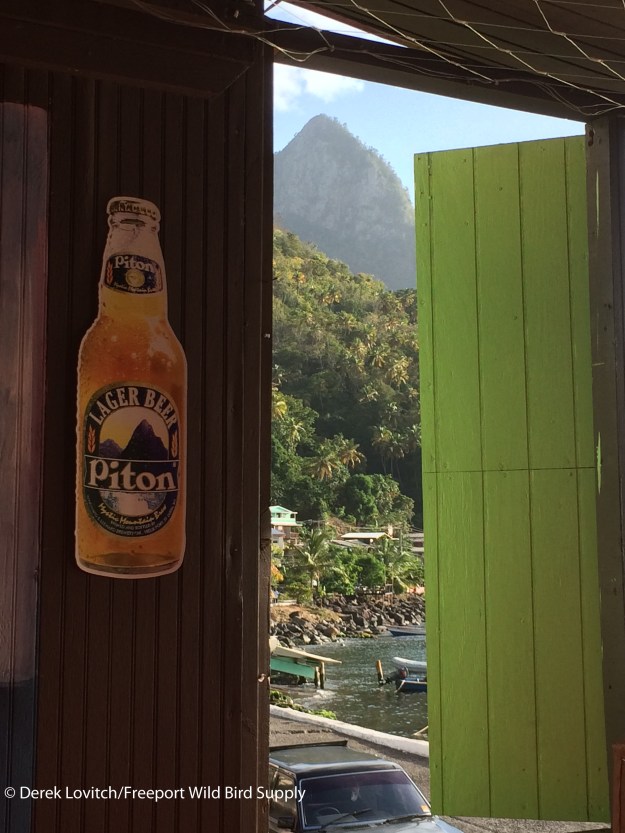
Laughing Gulls (our first of the trip) were right where Vision told us they would be, and bacon-wrapped fried plantains at Petit Peak restaurant which we enjoyed with a couple of afternoon Pitons (the endemic beer) need to become “a thing.”  Also, you couldn’t beat the view of Petit Piton for the enjoyment of your Piton beer.

After a little walk, we decided to have dinner at Water Front De Belle View because I wanted some more curried goat and I was desperate for a good callaloo soup (the one at Fond Doux was just too salty). I wholeheartedly recommend both here.

We grabbed one of the last mini-buses back to Fond Doux, and called it a night.
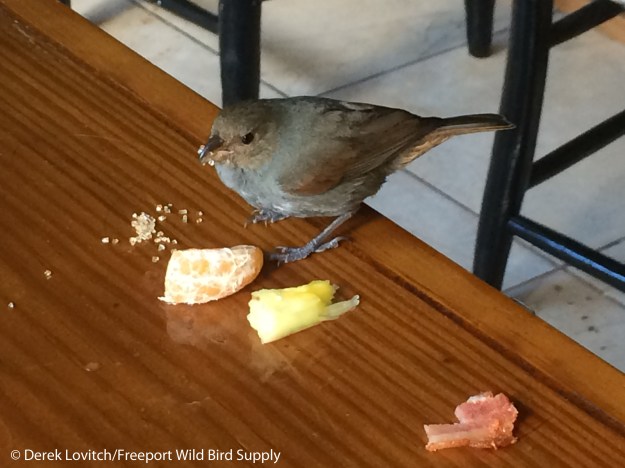
31a.31b. Bullfinch maleFemale (top) and Male (bottom) Lesser Antillean Bullfinches joining us for breakfast.

30e_edited-2Scaly-breasted Pigeon.

34_edited-1Castries.

Day 9, 2/17.
We squeezed in a little more birding by hopping on the bus and taking it uphill from Soufriere to the Bouton Gap. A short, but steep and muddy hike brought us to a series of small overlooks and passed through some productive edge habitat.

We were out in search of our last likely lifer of the trip, Lesser Antillean Swift, but with frequent downpours and low clouds, we were not holding out much hope for high-flying aerial insectivores. So we were forced to content ourselves with a couple of looks at fly-by St. Lucia Parrots, lots of St. Lucia Warblers, cooperative St. Lucia Pewees, and our best view yet of a Pearly-eyed Thrasher.  And then, between a break in the rain, several dozen swifts were on the move, heading into the valley below, affording us very good views from above and below. It was my 20th lifer of the trip (19 for Jeannette and she remained unsatisfied with her quail-dove shadows).

We found some great vegetarian Jamaican-style patties from a food truck on the streets of Soufriere, before we hopped on a bus once again for the short ride back to Fond Doux. There, we finally took the plantation tour that we have been trying to find time (or lack of heavy rain) for, enjoyed some good views and nice looks at Purple-throated Caribs, St. Lucia Warblers, and another Pearly-eyed Thrasher. The grounds turned out to be more extensive, and with more less-disturbed forest than we thought, so had we a little more time, no doubt we could have picked up a few more “yard birds” of note.

Our last night of vacation, it was time for our splurge dinner, and so we headed over to Boucan Resort – “the chocolate hotel” – where everything on the menu of their fine restaurant had cacao incorporated in it some way. Sometimes themes like this come across as gimmicky and forced, but that was most definitely not the case here. From the cocktails to the amuse bouche to each entrée – and of course, dessert! – were incredibly well-conceived and perfectly executed. In fact, when all was said and done, Jeannette and I both agreed it was one of the top 3 or 5 meals we have ever had. Anywhere.  So yeah, good way to finish a trip!
38_edited-1

39_edited-139a_edited-2Antillean Crested Hummingbird

39b_edited-2St. Lucia Pewee.

39c_edited-2Antillean Crested Hummingbird

40_edited-141_edited-1.1Our cottage at Fond Doux.

41a_edited-2Purple-throated Carib

42_edited-1.2Dinner at Boucan.44_edited-2

Day 10, 2/18.
We awoke to heavy rain, and rain that didn’t quite let up as quickly as we would have liked. Therefore, we dallied a bit, fed more bullfinches at breakfast, and eventually had a break in the rain to walk up a nearby side road towards a Nature Trail that was recommended for its birding, and especially its views of the two Pitons.  A Gray Trembler, lots of St. Lucia Warblers, and a couple of good looks at Mangrove Cuckoos suggested we probably should have done this sooner as well. In fact, the birding was good enough, and combined with waiting out a few downpours under trees, we made it to the entrance of the trail just as we had to turn around.

Jeannette worked on photographing Antillean Crested Hummingbirds and both Green-throated and Purple-throated Caribs from the porch of the office at Fond Doux as we waited for Adams, who surprised us with an offer of a ride to the airport in exchange for a discussion about developing their ecotourism business. With the third employee now on board, Wildlife Ambassadors has the potential to become a force in birding and nature tourism on the island, and this could be a very good thing for birds and bird conservation here. The Aupicot Wetlands and their protection is a perfect example, as both resident and migratory birds (including some of “our” birds from North America) are rapidly losing safe refugia in the Lesser Antilles. Even better, unlike some islands, they don’t shoot everything that lands here.

We were happy to add our limited travel dollars to the cause – money will talk; when these places are financially worth protecting, they are much, much easier to protect – but also happy to offer some advice and suggestions on everything from websites and Facebook, to tour amenities. We certainly wish Adams and Vision well, and look forward to keeping in touch and seeing what they accomplish in the future.

We also made a quick stop to see if any Grassland Yellow-finches were present near the airport, squeezing in a few more minutes of birding before we began the long trip home.  But alas, it was smooth and easy, and nothing like our trip south!
44a_edited-2Scaly-breasted Thrasher.

45_edited-1Fond Doux. At least I finally looked at the pool!

45a_edited-2Green-throated Carib

45b_edited-2Purple-throated Carib.

Trip/Island List (* life bird).

Barbados:

  1. Barbados Bullfinch*
  2. Zenaida Dove
  3. Carib Grackle
  4. Eurasian Collared-Dove
  5. Black-faced Grassquit
  6. Cattle Egret
  7. Caribbean Elaenia
  8. Bananaquit
  9. Shiny Cowbird
  10. Gray Kingbird
  11. Green-throated Carib
  12. Common Ground-Dove
  13. Rock Pigeon
  14. Scaly-naped Pigeon
  15. Antillean Crested Hummingbird

St. Vincent:

  1. Cattle Egret
  2. Magnificent Frigatebird
  3. Bananaquit
  4. Black-faced Grassquit
  5. Rock Pigeon
  6. House Sparrow
  7. Shiny Cowbird
  8. Gray Kingbird
  9. Common Ground-Dove
  10. Antillean Crested Hummingbird
  11. Broad-winged Hawk
  12. Yellow-bellied Elaenia
  13. Grenada Flycatcher
  14. Scaly-naped Pigeon
  15. Green-throated Carib
  16. Eared Dove
  17. Great Egret
  18. Barn Swallow
  19. Carib Grackle
  20. Brown Booby
  21. Spotted Sandpiper
  22. Common Black-Hawk
  23. St. Vincent Parrot*
  24. House Wren
  25. Black-whiskered Vireo
  26. Lesser Antillean Bullfinch
  27. Lesser Antillean Tanager
  28. Purple-throated Carib*
  29. Smooth-billed Ani
  30. Whistling Warbler*
  31. Brown Trembler*
  32. Green Heron
  33. Royal Tern
  34. Brown Pelican
  35. Osprey
  36. Belted Kingfisher
  37. Tropical Mockingbird
  38. Little Blue Heron

St. Lucia:

  1. Royal Tern
  2. Cattle Egret
  3. Zenaida Dove
  4. Rock Pigeon
  5. Carib Grackle
  6. Gray Kingbird
  7. Common Ground-Dove
  8. Lesser Antillean Bullfinch
  9. Bananaquit
  10. Antillean Crested Hummingbird
  11. Green-throated Carib
  12. Spectacled Thrush
  13. Scaly-naped Pigeon
  14. Mangrove Cuckoo
  15. St. Lucia Black Finch*
  16. St. Lucia Oriole*
  17. Purple-throated Carib
  18. Antillean Euphonia*
  19. Pearly-eyed Thrasher*
  20. St. Lucia Parrot*
  21. Broad-winged Hawk
  22. Scaly-breasted Thrasher*
  23. Lesser Antillean Flycatcher*
  24. St. Lucia Pewee*
  25. Rufous-throated Solitaire*
  26. St. Lucia Warbler*
  27. American Kestrel
  28. Greater Yellowlegs
  29. Great Blue Heron
  30. Little Blue Heron
  31. Snowy Egret
  32. Great Egret
  33. Green Heron
  34. American + Caribbean Coots
  35. Little Egret
  36. American Wigeon
  37. Blue-winged Teal
  38. Common Gallinule
  39. Yellow Warbler
  40. Lesser Yellowlegs
  41. Semipalmated Plover
  42. Osprey
  43. Eared Dove
  44. Solitary Sandpiper
  45. Shiny Cowbird
  46. Eurasian Collared-Dove
  47. Red-billed Tropicbird
  48. Caribbean Eleania
  49. Lesser Antillean Saltator*
  50. White-breasted Thrasher*
  51. Black-crowned Night-Heron
  52. Spotted Sandpiper
  53. Tropical Mockingbird
  54. House Wren
  55. Gray Trembler*
  56. Black-whiskered Vireo
  57. Bridled Quail-Dove*
  58. Brown Booby
  59. Magnificent Frigatebird
  60. Barn Swallow
  61. Sandwich Tern
  62. Ruddy Turnstone
  63. Lesser Black-backed Gull
  64. Laughing Gull
  65. Lesser Antillean Swift*

36_edited-1Enjoying a Piton in Soufriere, overlooking Petit Piton.

Six “Birds on Tap – Roadtrips” in 2016

As the readers of this blog have probably picked up on, we love birds…and we love beer! And, it turns out, so do lots of other folks. So, we have worked to incorporate these two elements through events at the store, making birding and learning about birds not only educational, but fun too.
group at south end

Therefore, we, Freeport Wild Bird Supply (FWBS) are excited to announce the “Birds On Tap – Roadtrip!” series in collaboration with The Maine Brew Bus (MBB). Each tour combines 2-3 hours of birding at one of Maine’s hotspots with a visit to two of our fantastic local breweries. The idea for this series comes on the heels of several very successful programs sponsored by FWBS, working with some of Maine’s finest breweries to combine birding and beer enjoyment. We began with the “Birds, Books, and Beers” author book signings at Maine Beer Company in 2013. The new tradition continues with the “Birds On Tap!” lecture series at Rising Tide Brewing as we host and support scientists conducting research on birds in the Northeast and beyond.

“Birds On Tap – Roadtrip!” seemed like a natural progression – another way to make learning about birds and birding even more fun. Additionally, it is a great way to support several Maine businesses. The trips introduce people to new breweries, new birds, and new places in a casual atmosphere that makes both birding and beer appreciation approachable. “These tours are a perfect way for couples or friends with different interests to spend the day together. We take the pressure off learning about complex topics from identifying shorebirds to hop characteristics.

These trips are truly unique, we know of no other similar tours offered anywhere in the world!

outside Baxter

Don Littlefield, General Manager of the Maine Brew Bus, adds “Craft beer drinkers come from all walks of life and have all kinds of other interests. This pairing of bird observation and ​beer education has proven to be a real hit with all kinds of folks. It gives access to diverse areas of Maine and many different bird species, and also great locally produced Maine beer. We are happy to partner with Derek and his team, it’s been fantastic to see this series mature and take flight!”

In 2015, we had two very successful outings. In August “Shorebirds and Beer” visited Scarborough Marsh for migrant shorebirds, Barreled Souls, and Rising Tide. In November, we ventured north for a visit to Sabattus Pond for waterfowl, and then visited Baxter Brewing and Maine Beer Company.

Based on the popularity of these trips, we are excited to offer six different trips in 2016, covering birding and breweries from Kittery to Lewiston. Traveling in the Maine Brew Bus, I’ll be guiding the first half of each, as we learn about the birds and their habitats at seasonal hotspots. This is followed by two brewery tours led by the MBB guides. The locations were chosen to enjoy the peak of birding at a particular locale at certain times of year. One does not need to be a “birder” to enjoy these outings. People of all skill levels are encouraged to join us!
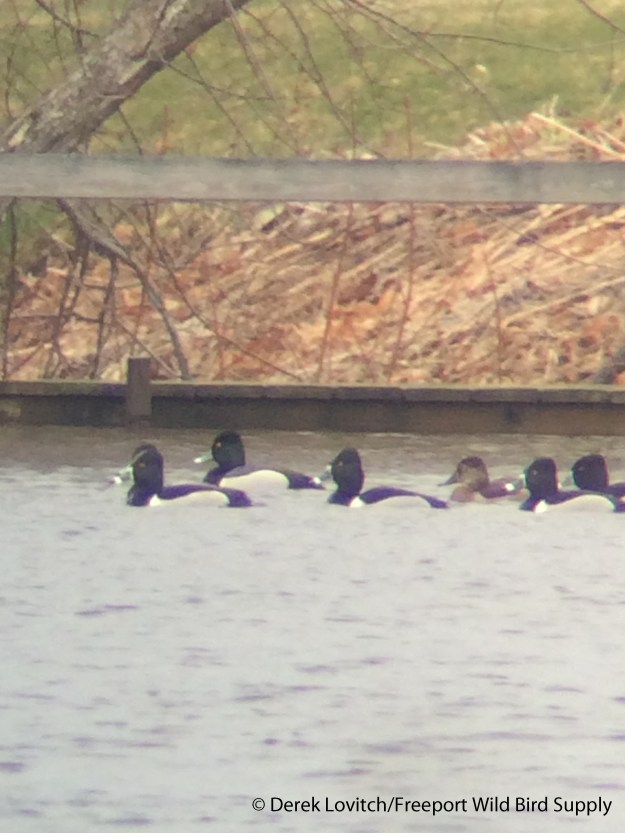
The 2016 schedule is as follows:

Surf and Suds
February 28th , 8:00am – 2:30pm
York and Ogunquit (wintering waterfowl especially Harlequin Ducks, Purple Sandpipers, and  alcids)
SoMe Brewing & Fore River Brewing

Spring Ducks & Draughts
April 10th, 10:00am – 4:00pm.
Merrymeeting Bay (migrant waterfowl and Bald Eagles)
Oxbow & Lively Brewing

Grassland and Grains
June 5th , 8:00am – 2:00pm
Kennebunk Plains(Upland Sandpiper, Grasshopper Sparrow)
Funky Bow & Banded Horn Brewing

Shorebirds and Beer
August 7th, 9:00am-3:00pm.
Scarborough Marsh (migrant shorebirds)
Barreled Souls & Rising Tide

Migrants and Malts
October 9th , 8:00am – 2:30pm
Fort Foster and Seapoint Beach, Kittery (songbird, raptor, and shorebird migrants)
Tributary & Hidden Cover Brewery

Fall Ducks and Draughts
November 13th, 8:30am – 2:30pm
Sabattus Pond and Auburn Riverwalk (migrant waterfowl)
Baxter Brewing & Maine Beer Co.

For more information about each of these tours, see the “Tours, Events, Programs, and Workshops” page our website. And contact us soon (email or call 207-865-6000) as these unique tours fill up fast!

insideRisingTide