This juvenile Marbled Godwit posed nicely at Hill’s Beach in Biddeford early in the morning on the 17th.
I tried to squeeze in as much time with shorebirds as I could muster this week, resulting in the following tallies. 18 (and ½) species of shorebirds was a good week’s total, especially without a visit (due to high water) to the Eastern Road Trail.
AMERICAN OYSTERCATCHER: 5 adults, Ocean Avenue, Biddeford Pool, 8/17 (with Noah Gibb); 1, Pine Point, Scarborough, 8/15; 1 Hill’s Beach, Biddeford, 8/17.
Black-bellied Plover: 151, Wharton Point, Brunswick, 8/14.
Killdeer: 21, Crystal Spring Farm, Brunswick, 8/14.
Semipalmated Plover: 392, Pine Point, Scarborough, 8/15.
1 immature GREAT CORMORANT, East Point, Biddeford Pool, 8/17 (with Noah Gibb).
Passerine migration is really ramping up, for example, I had 3 Northern Waterthrushes on our Durham property on the morning of the 18th. They don’t breed here.
TOURS AND EVENTS:
Tomorrow is our Bird Safe Open House event, with everything from a birdwalk to a keynote speaker. No registration is necessary. Note the Saturday Morning Birdwalk that week meets in Durham at 9:00am.
One of two adult American Oystercatchers tending a downy, flightless chick (late) at Upper Green Island in interior Casco Bay, confirming our suspected breeding on this tiny island.
I have spent dreadfully little time enjoying, studying, and counting shorebirds so far this summer, so I tried to make up for that this week! With many species approaching peak numbers, it was a good week to do so. High water in ponds and salt pannes from all of our recent rains impacted some locations and overall diversity, but my shorebird high counts this week were quite good overall:
AMERICAN OYSTERCATCHER: 2 ad with 1 downy juv, Upper Green Island, Casco Bay, 8/6 (with Birds of Casco Bay with Seacoast Tours). Confirmed breeding on this tiny island after finding a flighted juvenile with adults last summer at this time. See link below.
Black-bellied Plover: 62, Wharton Point, Brunswick, 8/9.
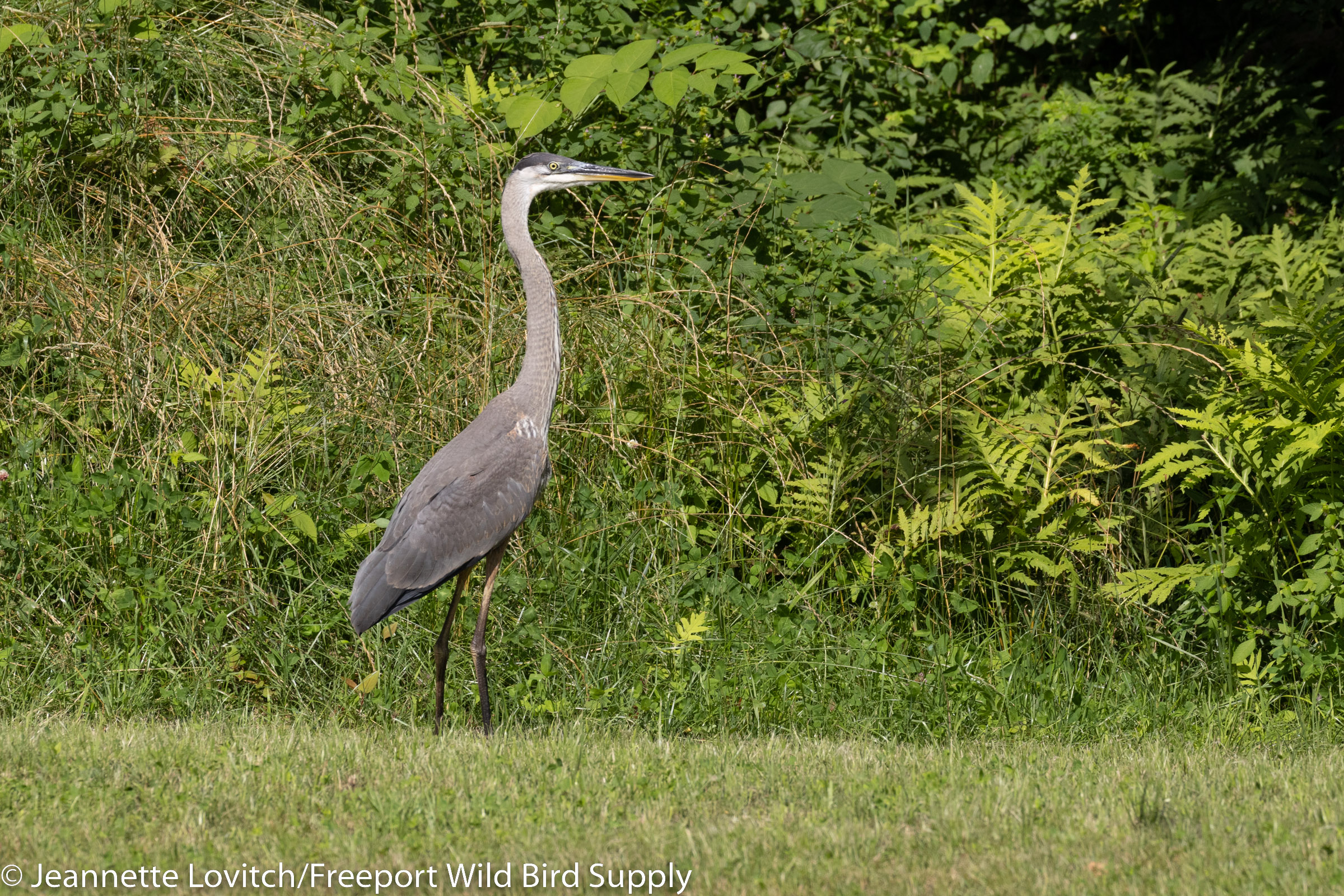
While by no means rare, a highlight for us this week was this Great Blue Heron stalking our pond in our Durham yard. It’s exciting to see the ecosystem we built here in less than a year! I’ve noticed a lot of Great Blue Herons undergoing post-breeding dispersal over the past week.
How is it that when you go away for a week, you fall three weeks behind? I’ve never understood that marvel of the universe. Anyway, catching up from our trip resulted in minimal birding for me over these last 6 days. However, a couple of highlights included the following:
Red Crossbills continue on the coastal plain. My high count this week were 7 flying over our yard on 8/1.
1 House Wren, our property in Durham, 8/1 to present (our 140th Yard Bird!).
1 RED-NECKED GREBE and 11 Piping Plovers, Popham State Park, Phippsburg, 8/3.
Oddly, a Black-billed Cuckoo was singing loudly at around 11pm on the night of the 3rd in our yard in Durham.
TOURS and EVENTS
Speaking of catching up, here’s (finally) my tour report from our July 22nd trip out to Seal Island.
On July 22nd we boarded the Isle au Haut Boat Service’s The Otter for our special annual charter out of Stonington to the raucous seabird colony on Seal Island. Our partnership began while “Troppy” the world-famous Red-billed Tropicbird that called the area home for 17 years. Unfortunately, Troppy failed to appear last year, but we ran the trip anyway, and had an amazing time!
So we did it again this year. There’s just so much life out there, and it’s such an amazing place to visit, and so I needed an excuse for my annual visit. And sure, if that wily Tufted Puffin that’s been wandering the Gulf for the last two summers wants to be the new Troppy, that would be fine, too. But for now, we headed offshore with all sorts of high hopes.
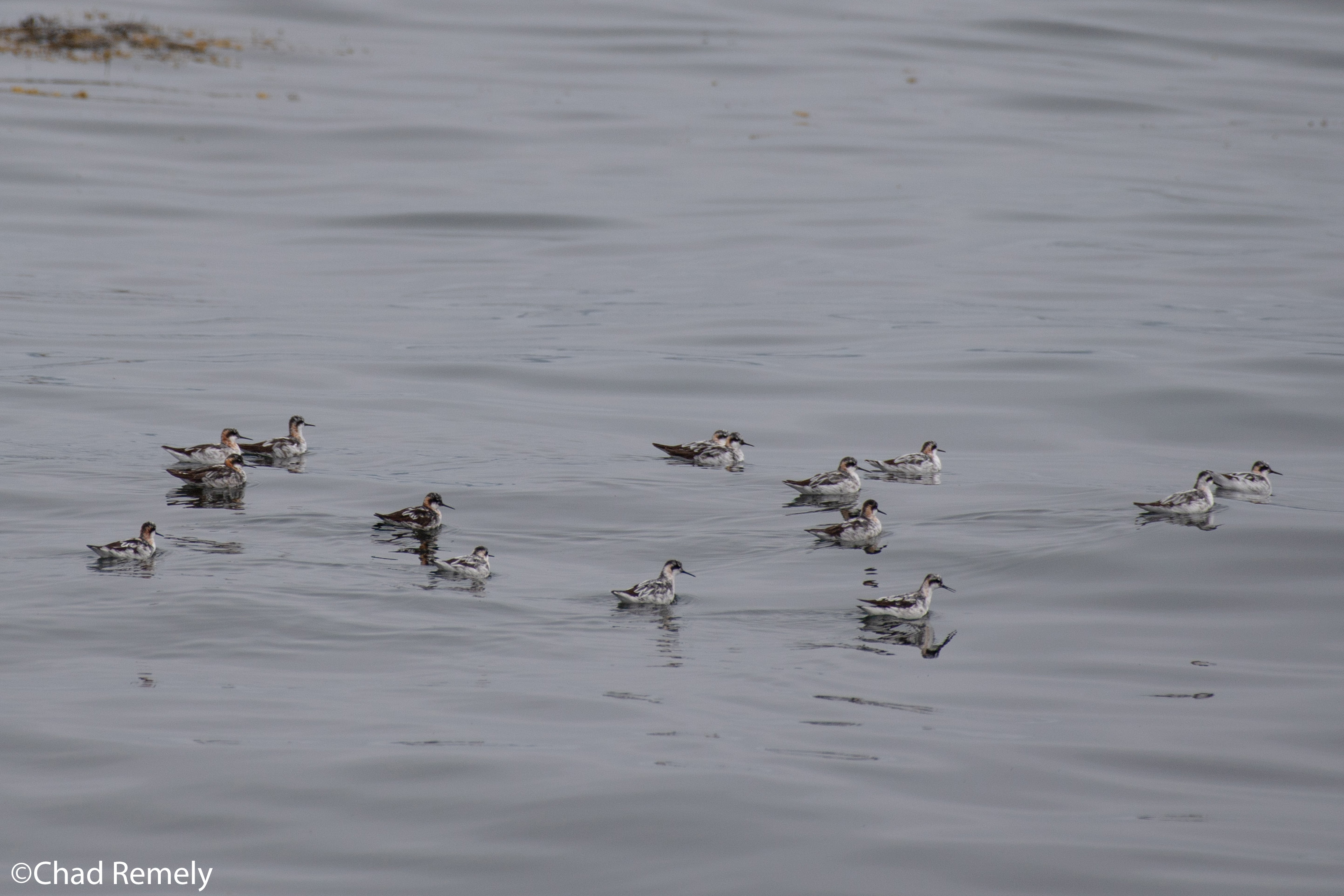
As we left Stonington Harbor, the fog began to thicken, but not before we spotted a group of 15 Red-necked Phalaropes sitting on the water. Captain Tracy did a great job getting us closer, and then inching up to them when they relocated a short distance away. It’s a treat to get so close to phalaropes on the open water.
A handful of Wilson’s Storm-Petrels were bouncing around, but the action picked up as usual as we approached Saddleback Ledge Light. A 1st summer Great Cormorant was surveying the scene, and our first Atlantic Puffin circled around us for a couple of passes. After we ourselves circled the small island twice, we turned for Seal and immediately ran into dense fog that had slowly been creeping in. The tradeoff for calm waters is often fog, and it was pea soup today.
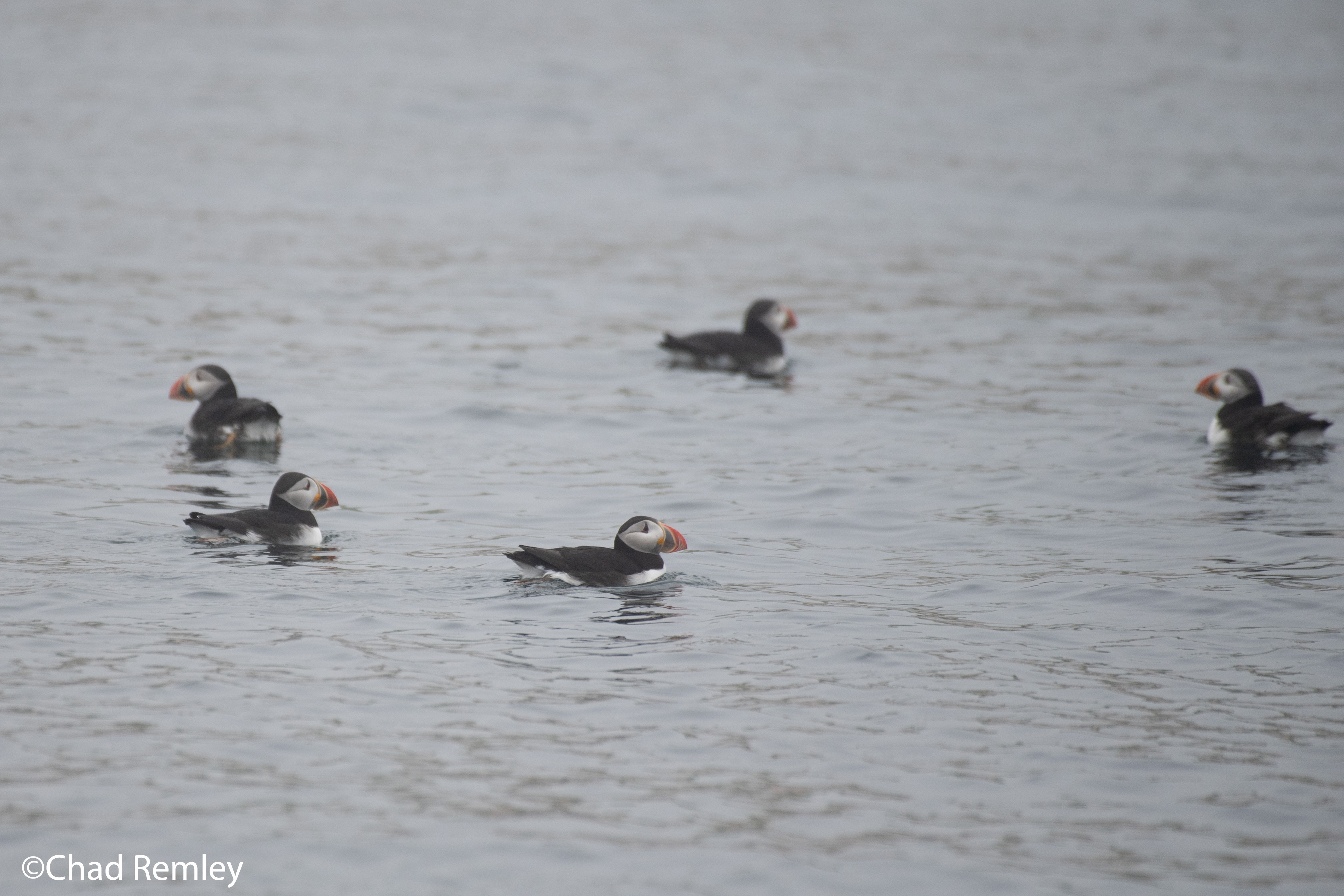
Not surprisingly, we saw little en route, but soon enough, we were out at Seal. While we heard – and even smelled – the tern colony before we could see the island, once along its shores, visibility was adequate. Arctic Terns put on a particularly good show for us, with several near the boat feeding and bathing. Arctic and Common Tern fledglings were everywhere, and we enjoyed their antics. There were plenty of Atlantic Puffins in the water and on land, including several groups that were remarkably confiding as we sided up to them in the glass-calm waters. And Black Guillemots were numerous, and very busy.
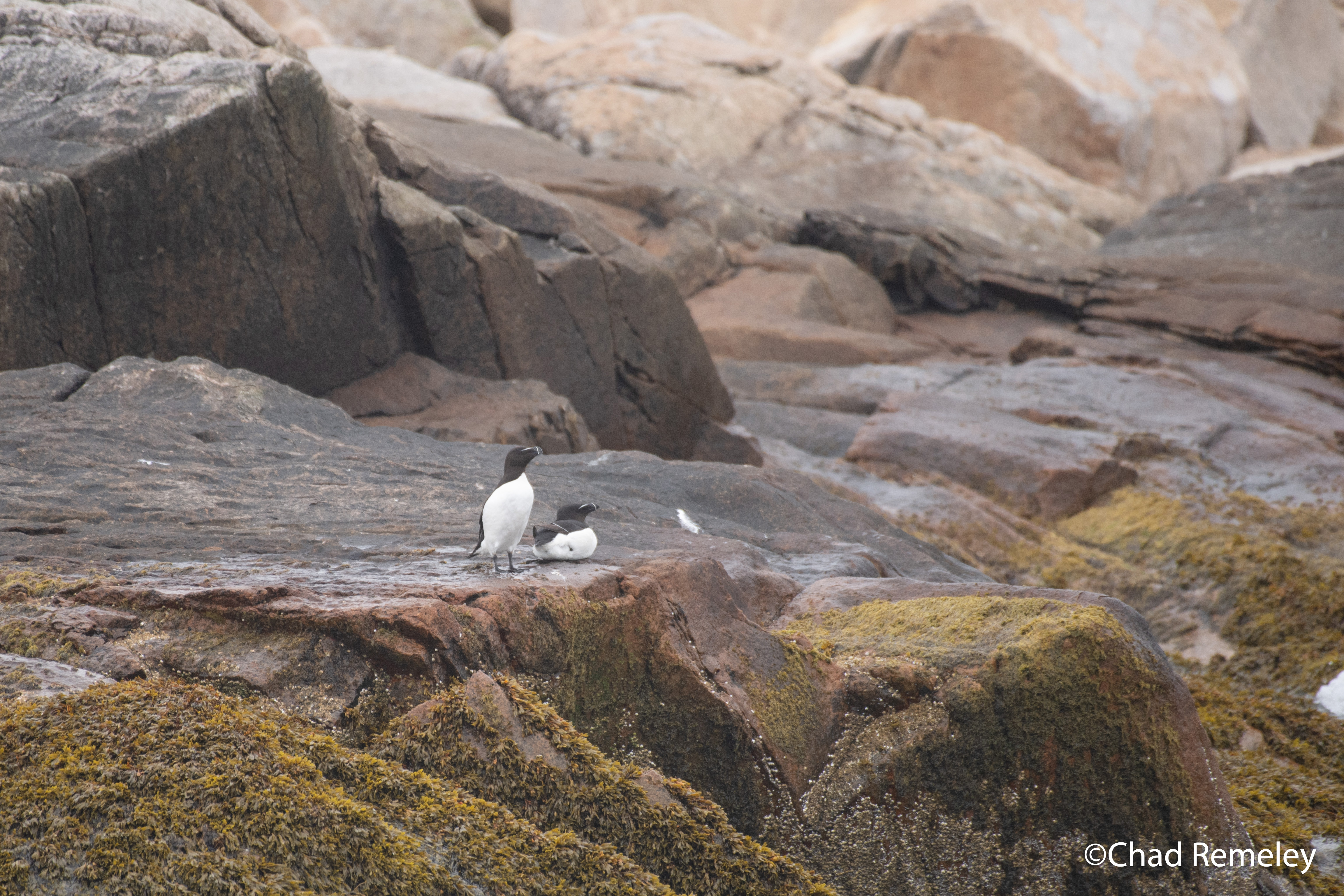
Razorbills were fledgling rapidly, so we only found two on the island, but later, we had great looks at one on the water, too.
We circled around the southern end, spending some time observing the state’s last colony of Great Cormorants (and Double-crested); nests were brimming with chicks!
We kept an eye out for migrant shorebirds in addition to the locally breeding Spotted Sandpipers, but visibility remained a challenge: 4 Short-billed Dowitchers, 3 Least Sandpipers, and some unidentified peeps was the best we could do. A Great Shearwater made a close, but brief, pass as we were on the east side of the island before vanishing back into the fog.
Somehow, it was even foggier on our way back, so seabird sightings – even with a second visit to Saddleback Ledge – were limited to just a couple more Wilson’s Storm-Petrels.
So yeah, the fog was annoying, and did impact photos and our search for the next mega-rarity. But it also produced one of the smoothest boat rides you’ll ever be on in the Gulf of Maine and yielded lots of close puffins and some great looks at phalaropes. And besides, any day birding from a boat is a good day in our book! Especially when a few days prior we thought this trip was going to be cancelled due to wind and thunderstorms.
White-winged Crossbills were amazingly abundant in Northern Aroostook County during our visit last week (see below).
Returning back from a little vacation to the crown of Maine followed by some time in New Brunswick, I apologize for the late report. Last week was a busy and productive week of birding for me, with the following observations of note.
Seal Island Tour, 7/22:
15 RED-NECKED PHALAROPES inside of Saddleback Ledge; 1 1st summer Great Cormorant, Saddleback Ledge Light; 3 Razorbills still at Seal Island; 1 Great Shearwater on trip back. Dense fog impacted our birding all day, but we had a fantastic performance from Atlantic Puffins and Arctic Terns in particular, and the fog cleared enough to enjoy the number of juvenile Great Cormorants in the growing colony on the island’s south end.
2 Red Crossbills, over our yard in Durham, 7/23. Interestingly, we didn’t have a single Red Crossbill in Aroostook County (unless they were all drowned out by all of the White-wings!). However, the Reds in our area seem to be focusing on coastal Red Spruce.
Aroostook County WHITE-WINGED CROSSBILLS, 7/24-7/27 (with Terez Fraser, John Lorence, and Jeannette). Wow, incredible! Over three days of birding from Fort Kent to Stockholm, we conservatively estimated observing about 50 per HOUR while in appropriate habitat! Our high count was 150-200 total along Square Lake Road in Sinclair on 7/26, with single flock of 70-75 individuals!
EVENING GROSBEAKS: just a couple heard here and there, including 1 on Nixon Siding Road, 7/24, 2 at Christina Reservoir, 7/26; and 2 at Square Lake Road, 7/26.
BOREAL CHICKADEES: Mostly heard, but some were unusually conspicuous, especially one (of 3) at Square Lake Road on 7/26 and 1 of 3 at Moscovic Road, Stockholm, 7/27 (all with Terez Fraser, John Lorence, and Jeannette).
Lake Josephine duck tallies (7/25 with John Lorenc and Jeannette): 125+ Gadwall (including juveniles of all ages); 1 drake American Wigeon, two family groups of Blue-winged Teal, 75+ Ring-necked Ducks, 1 American Bittern, etc. Numbers were lower when Jeannette and I visited on the 27th, likely due to Bald Eagle presence.
3 adult Bonaparte’s Gulls, Arnold Brook Beach Recreation Area, 7/25 (with John Lorenc and Jeannette).
Additional species from Square Lake Road in Stockholm on 7/26 (with John Lorenc, Terez Fraser, and Jeannette): 1 Bonaparte’s Gull, 3+ Bay-breasted Warblers, 1 Mourning Warbler, 1 Olive-sided Flycatcher, 1 Lincoln’s Sparrow, etc.
1 female American Wigeon with 10 chicks, Long Lake, St. Agatha, 7/26 (with Terez Fraser, John Lorence, and Jeannette).
3 Common Nighthawks, over St. John River at dusk, Fort Kent, 7/26 (with Terez Fraser, John Lorence, and Jeannette).
Most of the White-winged Crossbills we saw were in flight, or calling and singing in the distance. This male tee’d up nicely, albeit in unfortunate light. We also watched only one group feeding, and they appeared to be eating mostly buds of Tamarack (and maybe some young or old cones).
A visit to Popham Beach State Park on the 19th produced more fog and fewer shorebirds than I had hoped, but a family of Piping Plovers provided plenty of entertainment. Note that I did not approach these birds, but instead sat in the sand (burying my feet and legs mostly to defend against Greenhead Flies!) and let them wander up to me. It was a wonderful moment.
A few observations of note over the past seven days included the following:
Red Crossbills continue to be widespread in small numbers around the state, by my high count this week was only 4 in Millinocket on 7/18.
21 Lesser Yellowlegs, Yarmouth Town Landing, 7/16.
2 CANADA JAYS, 13 total WHITE-WINGED CROSSBILLS including several singing males, 1 out of place FIELD SPARROW, 1 Olive-sided Flycatcher, etc., Katahdin Woods and Waters National Monument, 7/18 (with Jeannette).
2 Whimbrels, Popham Beach State Park, Phippsburg, 7/19.
TOURS:
We have some room available for tomorrow afternoon’s charter to Seal Island. With all of the rarities around offshore recently, who knows what we might find! Hope to see you aboard!
Beginning in 2022, Cap’n Fish’s Cruises in Boothbay Harbor and Freeport Wild Bird Supply have partnered together to offer a mid-summer seabirding opportunity. I join the boat’s naturalist as a seabird and pelagic specialist, to help everyone see all of the breeding seabirds at Eastern Egg Rock (Atlantic Puffins; Arctic, Common, and Roseate Terns; Laughing Gulls; and sometimes Razorbill and Common Murre) before we venture offshore in search of whales. While doing so, we pay special attention on this cruise to the bird life – which is often found at the same places where we are looking for whales. This trip gives us a slightly more bird-centric tour compared to the regularly-scheduled departures.
Here are the trip reports from this very popular annual event.
July 16. 2022
Seas were fairly high (3-5ft) as we bounced offshore to deeper water first. Wilson’s Storm-Petrels were soon visible, and we passed one Razorbill. We could not stop or turn around for it as the seas were just a little too rough for that, and this was unfortunately our only Razorbill of the day. We cruised around waters over 300 feet deep, and were treated to a good performance from Great Shearwaters, Wilson’s Storm-Petrels, and picked up a few Sooty Shearwaters. We had one offshore Atlantic Puffin, but the big surprise was a rare, mid-summer NORTHERN FULMAR – definitely the pelagic bird of the trip.
With the seas building, we made a turn and took advantage of much more pleasant conditions as we trolled the area, giving people a better chance and seeing the aforementioned species. We also spotted a couple of Mola Molas, but no marine mammals, unfortunately.
Away from Eastern Egg Rock (both coming and going), our offshore (“pelagic”) scorecard was:
76 Great Shearwaters
61 Wilson’s Storm-Petrels
21 Northern Gannets
3 Sooty Shearwaters
2 Arctic Terns
1 Razorbill
1 Atlantic Puffin
1 NORTHERN FULMAR
1 Common Loon
scattered Common Terns and unidentified Sterna
As we approached Eastern Egg Rock, the action really picked up with all of the island’s breeding species soon apparent. Roseate and Arctic Terns joined the multitudes of Common Terns. At least a dozen Roseates included several putting on a good show, and we singled out quite a few close-passing Arctic Terns for good studies. 4 migrant Ruddy Turnstones joined island-breeding Spotted Sandpipers onshore, and we heard a couple of singing Song Sparrows. And of course a plentitude of Laughing Gulls; about half of the entire state’s population breeds here. Black Guillemots were also conspicuous today.
But Atlantic Puffins are the star of the show out here, and today, they did not disappoint. In fact, it was a great mid-summer performance, with several dozen on the water – often in very close proximity to the boat, commuters passing by, and dozens more stately stationed on the island’s rocks.
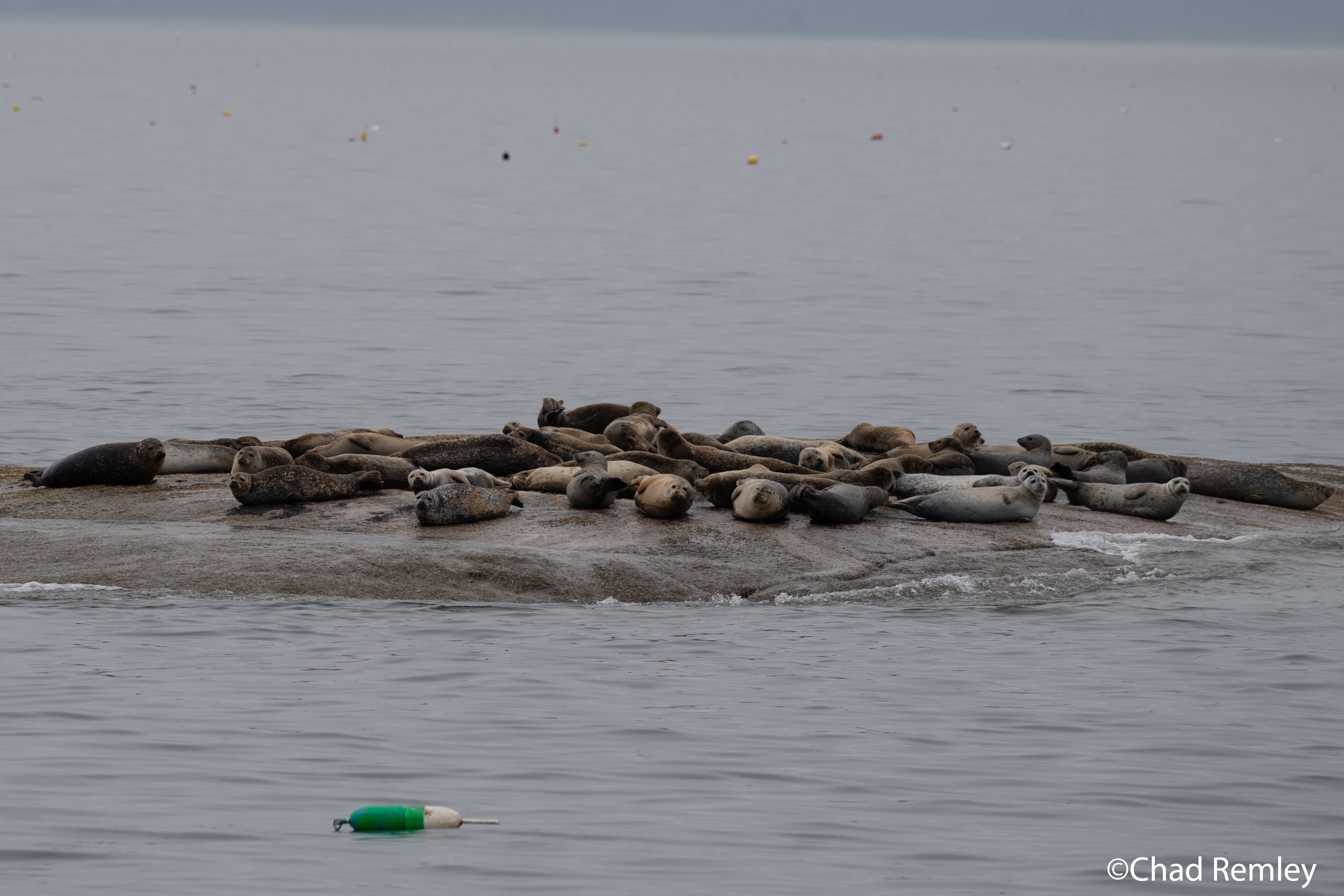
We wandered offshore on the way back, near where the boat had recently seen whales, added a few birds to the tallies, but alas, the only marine mammals of the day were two species of seals: lots of Harbor Seals and two Gray Seals. Hopefully, this got the seal of approval from the marine mammal watchers aboard today.
July 10, 2023.
A Parasitic Jaeger got everyone to our feet as we were motoring home through the fog.
With even more anticipation than usual, birders flocked aboard for this afternoon departure. Three hours earlier, I had spotted the near-mythical Tufted Puffin on Eastern Egg Rock aboard Cap’n Fish’s morning Puffin Cruise. We made a bee-line for the island’s north end, but alas, the Tufted was not to be seen.
Nonetheless, we had a fantastic visit. Fog resulted in many of the island’s Atlantic Puffins being in the water and we had close birds all around the boat. We studied Arctic and Roseate Terns among the masses, making sure everyone had at least one rewarding look at each. While we searched vigilantly for the Tufted, we picked out one of two American Oystercatchers that have been here this summer, and just as we were about to leave, the single Common Murre floated around just off our bow.
It didn’t take long before our first Wilson’s Storm-Petrels of the day to be sighted, with small groups and singletons here and there throughout the rest of the trip for a total of 100-150 or so. Fog only thickened as we traveled further offshore, however, although we did find a hole where the visibility increased dramatically for a spell. While we searched diligently for whales to no avail (but plenty of Harbor Porpoises today), birds began to appear one by one.
A good look at a Sooty Shearwater. A glimpse of a Great Shearwater was followed later by a cooperative one that allowed close approach on the water. One group spotted a Manx Shearwater heading straight away, and a couple of other distant shearwaters disappeared into the fog. We only saw a few gannets today, scattered Common Loons on our way to and from, but a subadult Parasitic Jaeger spiced things up on our ride back (photo above).
Considering how dense the fog was, we were happy to spot much of anything once we left the rock, and considering we remained just east of torrential rain all day, we were more than satisfied with the comfort of what we did see!
If I only saw one bird all week, and it was THIS bird, I would have been more than satisfied. The near-mythological Tufted Puffin that has wandered around the Gulf of Maine for the last two summers finally was in front of my binoculars at Eastern Egg Rock on 7/10 (with Cap’n Fish’s Cruises “Audubon Puffin and Scenic Cruise). Unfortunately, it was not seen a mere three hours later when I returned to the island with my previously-scheduled Mini-Pelagic with our partners at Cap’n Fish’s.
While just about anything else would pale in comparison, I did have several other observations of note over the past seven days, plus lots of quality time with Roseate Terns, Salmarsh and Nelson’s Sparrows, etc:
Scarborough Marsh migrant shorebirds, 7/9 (with Ken Mettie and Mary Beth Oles): 16 Short-billed Dowitchers (First of fall), 4-6 Lesser Yellowlegs, 4 Least Sandpipers (FOF), and 2 Greater Yellowlegs.
Freeport Wild Bird Supply’s “Puffin/Whale Combo Mini-Pelagic” with Cap’n Fish’s Cruises, 7/10: 1 COMMON MURRE and 1 American Oystercatcher at Eastern Egg Rock. Offshore pelagic visitors: 100-150 Wilson’s Storm-Petrels, 2 Great Shearwaters, 2 unidentified shearwaters, 1 Sooty Shearwater, 1 subadult PARASITIC JAEGER. Some observers had a MANX SHEARWATER as well.
1 LOUSIANA WATERTHRUSH and 1 Yellow-billed Cuckoo, Morgan Meadow WMA, 7/11 (with Jeannette).
Scarborough Marsh and Pine Point migrant shorebird totals, 7/14 (with Alec Humann and Buffalo Ornithological Society tour group): 18 Short-billed Dowitchers, 15 Lesser Yellowlegs, 12 Least Sandpipers, 5 Semipalmated Sandpipers (FOF), 2 Whimbrel (FOF, Jones Creek, Pine Point), and 1 Greater Yellowlegs.
I didn’t hit the shoreline at all this week, other than a quick jaunt to the Brunswick waterfront, so I don’t have a lot of observations of note, other than 2 Upland Sandpipers at Brunswick Landing, Brunswick, 7/1 (with Saturday Morning Birdwalk group) and continued scattered Red Crossbills.
However, bird-watching was fantastic this week overall, even if it did not produce anything out of the ordinary. From a visit with clients to Salt Bay Farm Preserve in Damariscotta on Thursday to a stroll this morning at Old Town House Park, I found plenty of entertainment in the life and antics of our common breeding species.
In fact, on a couple of mornings, I just couldn’t tear myself away from our feeding station, which is chock-full of activity right now, including multiple pairs each of Baltimore Orioles, Rose-breasted Grosbeaks, Gray Catbirds, Purple Finches, Ruby-throated Hummingbirds and 5 species of woodpeckers, including fledglings of many: Downy, Hairy, Pileated, Red-bellied, and Yellow-bellied Sapsucker. Yeah, we’re going through a lot of suet right now!
Therefore, I’ll just leave you today with some of my favorite photos from last month’s tour with NJ Audubon. And maybe next week I’ll have some more time for bird-finding again!
It was a week of catching up, so birding time was limited. Nonetheless, I enjoyed a few observations of note over the past six days, highlighted by a successful twitch of the LOGGERHEAD SHRIKE at the Kennebunk Plains on the 25th (with Jess Costa; photo above).
Otherwise, there was a single Red Crossbill over our property in Durham on 6/26 (with Jeannette), and today at Scarborough Marsh, 3 Lesser Yellowlegs (one at Eastern Road, two at Pelreco) – the first of fall! Yes, southbound shorebird migration is now underway!
TOUR REPORTS:
Still catching up on tour reports, a brief rundown of my Rangeley Birding Workshop for Down East Adventures from early June.