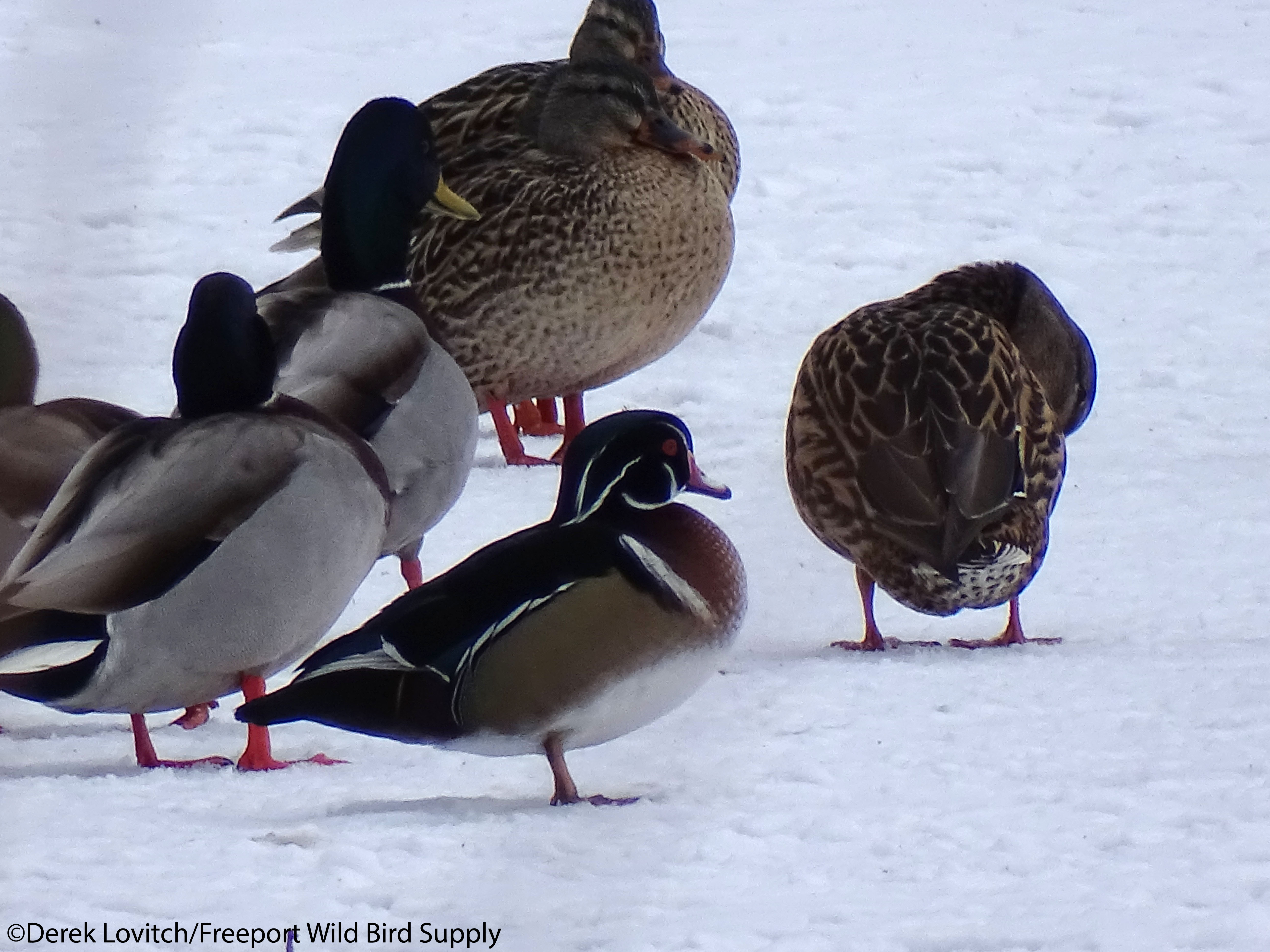
Nothing can brighten up a cold, gray winter’s day like a drake Wood Duck! This hardy drake was toughing it out amongst the Mallards at the North River Road Boat Launch in Auburn on the 13th.
“Lingering” seasonal rarities and concentrating waterfowl with the growth of river and lake ice this week produced some great mid-January birds despite limited dedicated birding outings.
The Fox Sparrow continues at the store since 12/21, but has been very sporadic this week.
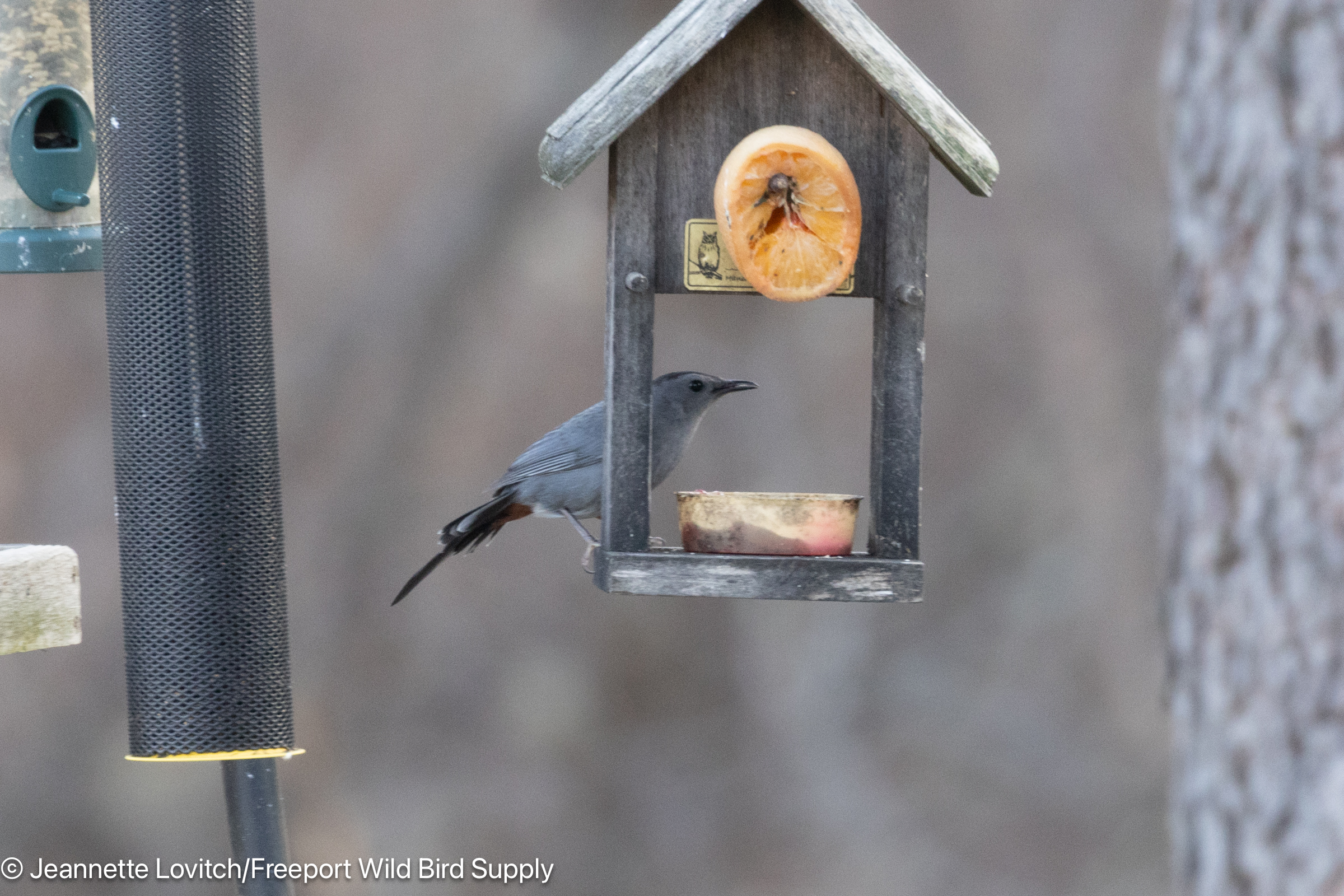
1 GRAY CATBIRD and 1 Fox Sparrow continue at our feeders in Durham through week’s end.
At least two Turkey Vultures continued in the I-295 corridor between Brunswick and Cumberland, and scattered others continue in the area as well.
This spiffy adult Red-shouldered Hawk in Freeport on the 10th was a nice finale to a pleasant morning of birding with a friend.
Well, that was one windy and bitterly cold week, wasn’t it? Strong winds most days precluded productive birding, or at the very least, precluded motivation to do much birding! Feeder-watching was the name of the game on many mornings for me, but despite the cold, “half-hardies” dominated the highlights for me, and for most birders around the state. Lighter winds on Saturday and Friday, relatively speaking, allowed for some much more enjoyable and productive birding.
Single Fox Sparrows continued through week’s end at our feeders both at home in Durham and here at the store.
2 Turkey Vultures continued in the I-295 corridor between Brunswick and Cumberland into the New Year, and scattered others continue in the area.
There was a nice influx of American Robins into the area this week, with some large flocks arriving. Single-flock high count of 138 over the Yarmouth Town Landing on 1/4 (with Saturday Morning Birdwalk group). Keep an eye out for vagrants among them!
1 GRAY CATBIRD, continued from last week at our feeders in Durham through week’s end.
Freeport Wild Bird Supply is very excited to partner with Down East Magazine’s Down East Adventures for the fifth year of offering exclusive birding workshops focused on gaining greater knowledge and field skills in a focused group of seasonally accessible birds. Focused on skill-builder rather than list-building, there will be plenty of “life birds,” but also more knowledge and education about birds, habitats, birding, and much more about the natural world. We are honored to be their provider for a series of unique and exclusive birdwatching endeavors. In 2025, we will have four outings once again.
February 9, 2025; 9:00am – 4:00pm Cancelled due to multiple snowstorms!
Winter is a wonderful time for birding in Maine – at least when you are dressed appropriately! Colorful seaducks that breed in the high Arctic grace our shorelines – including all three scoter species and dapper Long-tailed Ducks, along with everyone’s favorite: striking Harlequin Ducks. Purple Sandpipers and Great Cormorants replace our summertime shoreline denizens. And if the winds are right, very sought-after alcids – including Dovekies and Thick-billed Murres – join our regular Black Guillemots and Razorbills. Black-legged Kittiwakes, Northern Gannets, and “white-winged” gulls add to the mix. In this workshop, we’ll hit a few of the prime viewing locations along Maine’s southern coast. But we won’t just be working on the checklist today. Instead, we’ll be focused on learning how to search for these birds – the how, when, and why – and how to identify them. We’ll learn about microhabitats, weather considerations, and seasonal timing to aid our search today and in the future. By visiting several seasonally-productive sites, we’ll compare similar species while taking time to savor the splashes of color offered by winter seaducks in an otherwise gray and white landscape.
To get an idea of what you may see when the tour returns in the winter of 2026, see the 2024 and 2023 trip reports.
This Northern Parula was one of many ultra-cooperative warblers today. This was one of 10 parulas in a single cluster of willows on the shoreline of Capsic Pond Park during our 20205 workshop.
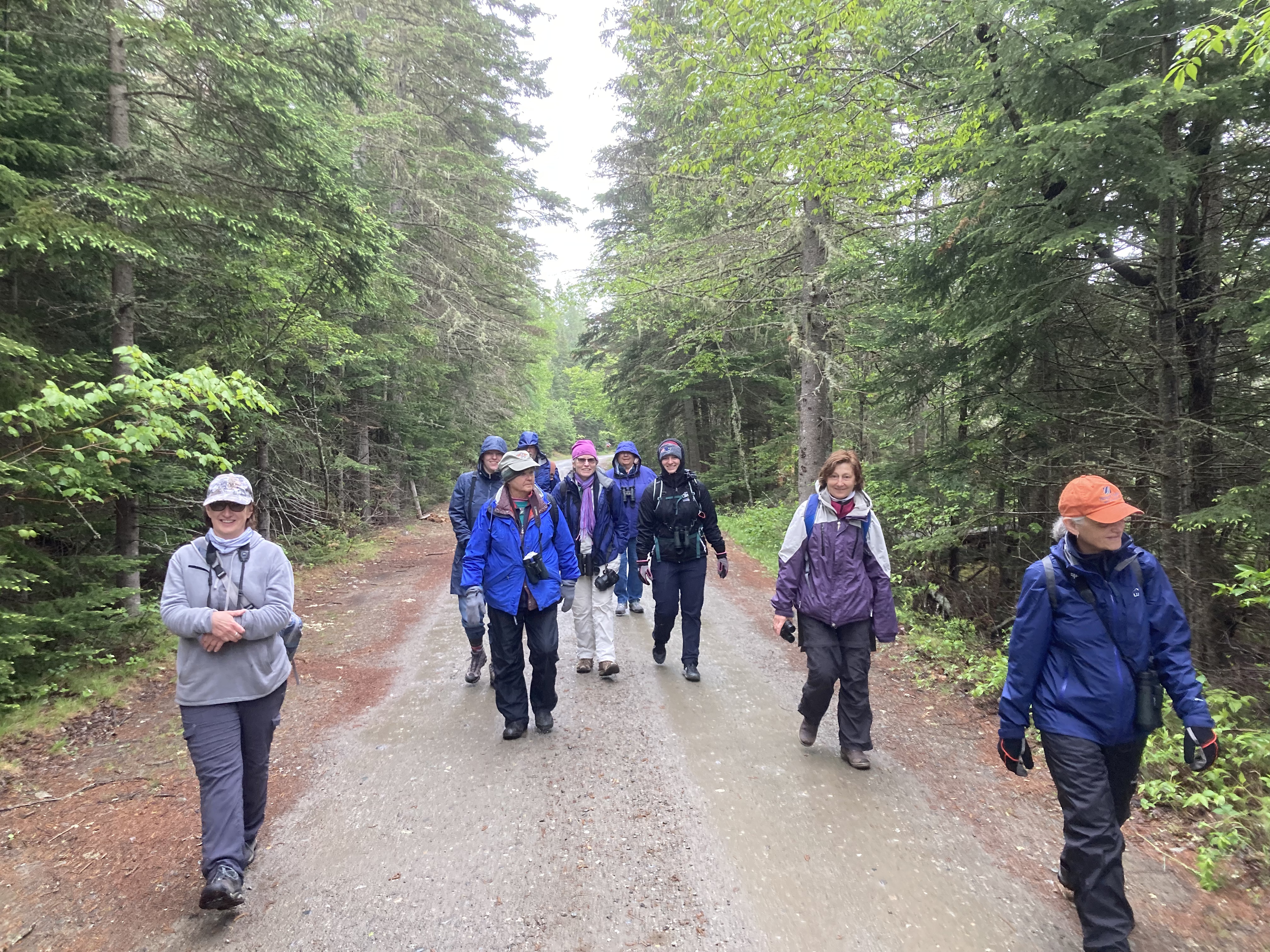
Spirits seemed low when we met in such dense fog, but I was even more excited to explore the environs of Portland migrant traps, beginning with Evergreen Cemetery. After a slow start, with few warblers overhead in the Morning Flight, we encountered several very productive pockets of activity, including a great diversity of warblers. Many were down low, too, with just fantastic looks at species such as Yellow, Black-throated Blue Warbler, Nashville, and Black-and-white Warblers, along with great looks at Veeries and Least Flycatchers. A “herd” of about 75-100 White-throated Sparrows marched through the forest understory, and we stalked a Black-crowned Night-Heron and spotted a Merlin among many other species today.
Evergreen was good, but nearby Capisic Pond Park was just great! While there were fewer warblers in both quantity and diversity, the cool, drippy morning conditions kept everyone even lower here. We began with 10 Northern Parulas at eye level all around us in a blooming willow (photo above), had great looks at a Prairie Warbler, listened to Northern Waterthrushes, and marveled at Baltimore Orioles.
We then discussed the overnight migration and how the radar images suggested what we would see and not see today, and how the “poor” weather produced such great birding. In the end, we tallied a very respectable-for-the-date 15 species of warblers! Although the list was not the priority as usual in these workshops, it’s hard not to get excited about the diversity of warblers now arriving. While Northern Parula was our most abundant warbler today, the total warbler list – in very rough order of abundance- also included Black-and-white,Yellow-rumped, Black-throated Blue, Ovenbird, Magnolia, Chesnut-sided, Yellow, Nashville, Common Yellowthroat, Black-throated Green, American Redstart, Northern Waterthrush, Pine, and the aforementioned Prairie. More importantly, perhaps, we worked on building our skills of recognizing each species and family so that our birding will be better and more successful on our own next time.
3. Shorebird Workshop
August 18, 2025; 8:00am – 4:00pm
This juvenile Piping Plover was one of 12 species of shorebirds we had the chance to really study on our Shorebird Workshop tour.
Could we have had more of a perfect day? Temperatures topping out in the mid-70’s, a light breeze in the afternoon, and clear skies – considering the rain of early summer and the recent extreme heat, we could not have asked for better. And then we saw thousands of shorebirds!
With more than 35 species of shorebirds regularly appearing in Maine, this workshop was designed to appreciate the diversity and beauty of this fascinating family. We hit some of the marshes, beaches, and rocky roosts that shorebirds prefer at the peak of their migration. We focused on comparative experience, learning how to recognize each species both near and far. Starting with the basics, such as plover vs. sandpiper, we’ll work our way up to the identification quandaries such as the “peeps” and lone yellowlegs. We worked through species by species as we developed a “toolkit” to approach shorebird identification on your own, using a combination of habitat, shape, size, structure, behavior, and plumage to identify this wonderfully diverse and attractive group of birds.
By day’s end we tallied a decent 12 (and a half!) species of shorebirds, a little short of our unofficial goal of 15. We did see a couple of rarities but were also dogged by Peregrine Falcons and Para-gliders causing birds to disperse and/or take cover. But we had plenty of chances to study a nice array of species, often side-by side.
Beginning at Biddeford Pool Beach, we started with the basics and enjoyed watching Ruddy Turnstones bulldoze their way into the wrack line and picking out White-rumped Sandpipers from a mass of Semipalmated Sandpipers. A Baird’s Sandpiper at Great Pond was one of our most notable birds of the day, and not where we expected it.
At Hill’s Beach, there was a lot of disturbance today, but we had some good opportunities to study Piping vs Semipalmated Plovers, Sanderlings, spiffy Short-billed Dowitchers, and more. We then shifted to the Pool, where we studied silhouettes and practiced distant shorebird using mostly general impression of size and shape. It was here that we had our largest numbers of the day, with an estimate of 1600 Semipalmated Sandpipers, 300 Semipalmated Plovers, and 163 Black-bellied Plovers leading the way.
Near or far, good light or bad, the general impression of size and shape, behavior, and more can be applied to identify shorebirds more readily than little nuances in some color or pattern.
After our lunch break, we returned north to Scarborough Marsh, where I would usually start the workshop, but with very low water in the upper salt pannes due to the drought, we shifted the itinerary. But the incoming tide at Pine Point did not disappoint! We had some close studies of more Short-billed Dowitchers and better views of Black-bellied Plovers, and about 1200 Semipalmated Sandpipers were present. However, as they moved close and concentrated, a Peregrine Falcon came tearing in, flushing most of the birds. Then, it made a sudden burst of speed and a hard turn and before we knew it, there was one less Semipalmated Plover on the mudflat. While it was poor timing for our shorebirds workshop (let alone for that one particular plover!), it was an awesome show (well, for us anyway) and one that will not soon be forgotten.
Some birds finally returned to the mudflat, when a large (for the date) flock of Willets flew in, making their usual grand entrance. We were able to put our advanced shorebirds ID skills to work with the bigger, lankier, grayer one that we soon identified as a rare in Maine “Western” subspecies of Willet. It might have been beyond today’s goals, but it was a great lesson in using comparative tools.
A couple of upper marsh stops finally gave us a good, close comparison between Least and Semipalmated Sandpipers, and a Lesser Yellowlegs that was close enough to study and enjoy, bringing a productive and successful day to a close.
4. Monhegan Birding Workshop
September 12-14, 2025
Our final Downeast Adventures birding workshop tour of 2025 spent 3 delightful days on Monhegan Island. Weather, geography, habitat, and migration ecology all combine to produce some remarkable birding opportunities at this special place. And even when it’s “slow” by lofty Monhegan standards, lots of learning experiences and workshopping opportunities would be at hand, often right out the front door of our hotel. Oh yeah, the food is sooo good, too!
As per the plan, we hit the ground running shortly after our arrival on the island. It took us an hour and 45 minutes to walk the ½ mile or so to our hotel as we encountered quite a few migrants, especially at my favorite starting spot along Wharf Road. We jumped head-first into aging and sexing fall warblers thanks to 3 different plumages exemplified by a trio of Cape May Warblers. American Redstarts, Northern Parulas, Yellow Warbler, and more introduced us to what birding Monhegan in the fall is all about.
By the time we reconvened after a lunch break, the insanely gorgeous weather with bright sun and very little breeze encouraged birds to take to the shadows. A sky constantly abuzz with Merlins didn’t help either, although we enjoyed it. While passerine activity had slowed dramatically, we enjoyed a light hawk migration with a couple of Northern Harriers and a few American Kestrels, while the Merlins and 1-2 Sharp-shinned Hawks further diminished the activity in the trees and shrubs. We took the time to visit the east side of the island, sample the different habitat types of the island, and discuss food plants for birds and native insects. The butterfly, dragonfly, and insect-watching was excellent on this unseasonably warm afternoon, and we worked on learning the connection between birding and bird habitat.
On Saturday morning, we learned why there were so many birds around Friday morning, but few in the air at sunrise. But there were definitely “new” birds around, suggesting at least a light arrival of birds overnight had occurred, including two vociferous Dickcissels. I made the decision to try and track down a Blue Grosbeak that had just been reported, but unfortunately, it did not wait for us. We did have an immature male Orchard Oriole, however, which was a treat, and we spent more time studying Cape May Warbler plumages.
On such gorgeous days, a lot of newly-arrived migrants simply depart the island as part of their morning redetermined migration flights (yes, we discussed this more thoroughly among many topics of avian and general ecology discussed throughout the weekend). In fact, the second half of our morning was very slow, but we did enjoy a couple of adult Lesser Black-backed Gulls and we kicked up a very uncommon Marsh Wren. But warblers were few, and Merlins remained a’plenty. Red-breasted Nuthatches were very abundant however – demonstrating what an irruption looks like, and Ruby-throated Hummingbirds were unusually widespread for the date.
We filled the time between birds looking at all other walks of life. American Dagger Moths caterpillars were particularly plentiful.
The afternoon was spent with a couple of impromptu workshops, such as an introduction to gull identification as I attempted to enlighten the group about how manageable it is to understand the basics of this group of fascinating species. The avian highlight, however, was the thrilling chase of a Solitary Sandpiper by two Merlins right over our heads! The Merlins would gain some height, dive, and close the distance, only for the sandpiper to take another evasive maneuver. The sandpiper tried to gain elevation to stay above the diving Merlins, but they were getting closer! Then, the sandpiper made one quick turn, ascended, and took off to the north, leaving the hungry Merlins to mosey back down to the treeline to see if the marsh had something much slower to offer. We bid the sandpiper farewell and good luck as we thanked the Merlins for a most entertaining performance!
It was another very light migration overnight Saturday into Sunday, but unlike the previous day, we hit a wonderful early-morning wave. One sunny edge captivated us until it was time to hustle back for breakfast: Several American Redstarts, Red-breasted Nuthatches, Black-capped Chickadees, Common Yellowthroats, and Norther Parulas had joined together, punctuated by repeated views of a most cooperative Least Flycatcher. Every time we tried to move long, a new species appeared. A fly-over Greater Yellowlegs. A flycatching Eastern Wood-Pewee. And finally, a Brown Thrasher that popped out right in front of us.
I was thrilled to have this sample of “what Monhegan can be like” at this season for those who fought the urge to stay in bed. Post-breakfast was once again much slower, but we hit a few pockets of birds, as well a finding a Mourning Warbler which is always fun – and challenging – in fall migration. We watched and listened to territorial Carolina Wrens in a double-duet song battle, encountered a flock of 4-6 Red-eyed Vireos working on Fall Webworms, and spent more quality time with the island’s once-again-ubiquitous Ring-necked Pheasants. And of course, we made time to sample the stunning Acadian Forest habitat of the island’s interior and to take in the view from the lighthouse.
Another delicious lunch and then a slow meander to the ferry brought our visit to a close. On the ferry ride back, a few more Northern Gannets were seen, and plans to return to this extraordinary island were already in the works!
(2026 Birding Tours with Down East Adventures will be posted soon!)
This cooperative hen Northern Pintail was one of the number of “late” dabblers that I encountered this week.
Far from the winter doldrums, a productive week of birding -especially at feeders – produced the following observations of note:
Single Fox Sparrows continued through week’s end at our feeders both at home in Durham and here at the store.
2 Turkey Vultures continued in the I-295 corridor between Brunswick and Cumberland into the New Year.
We tallied 16 species of waterfowl, highlighted by an impressive-for-the-date 5 species of dabbler (inc 1 continuing GADWALL, 1 Northern Pintail, and 3 Green-winged Teals), all in Brunswick during our Saturday Morning Birdwalk on 12/28. Details and locations here.
1 Swamp Sparrow, Lower Mast Landing Road and 2 Northern Flickers, Tidal Brook Preserve, Freeport, 12/29 during about 3 hours of coverage for the Freeport-Brunswick CBC.
1 pair American Wigeon, MacDougal Park, Rockland, 1/1 (with Jeannette).
1 GRAY CATBIRD, our feeders in Durham, 1/2. A fascinating time for it to show up. Presumably, it was pioneering locally and perhaps consumed the rest of a food source (like a cluster of Winterberry) and had to wander to find sustenance. It continues through the 3rd, eating jelly, suet, and nuts. The significant tail molt might be part of the reason it’s still around.
Annual Prediction Blog Now Posted.
And finally this week, it’s that time again: my annual Predictions blog where I look back at the Mega Rarities of 2024 and make my usual Top 25 predictions for the next species to be added to Maine’s list, and my own.
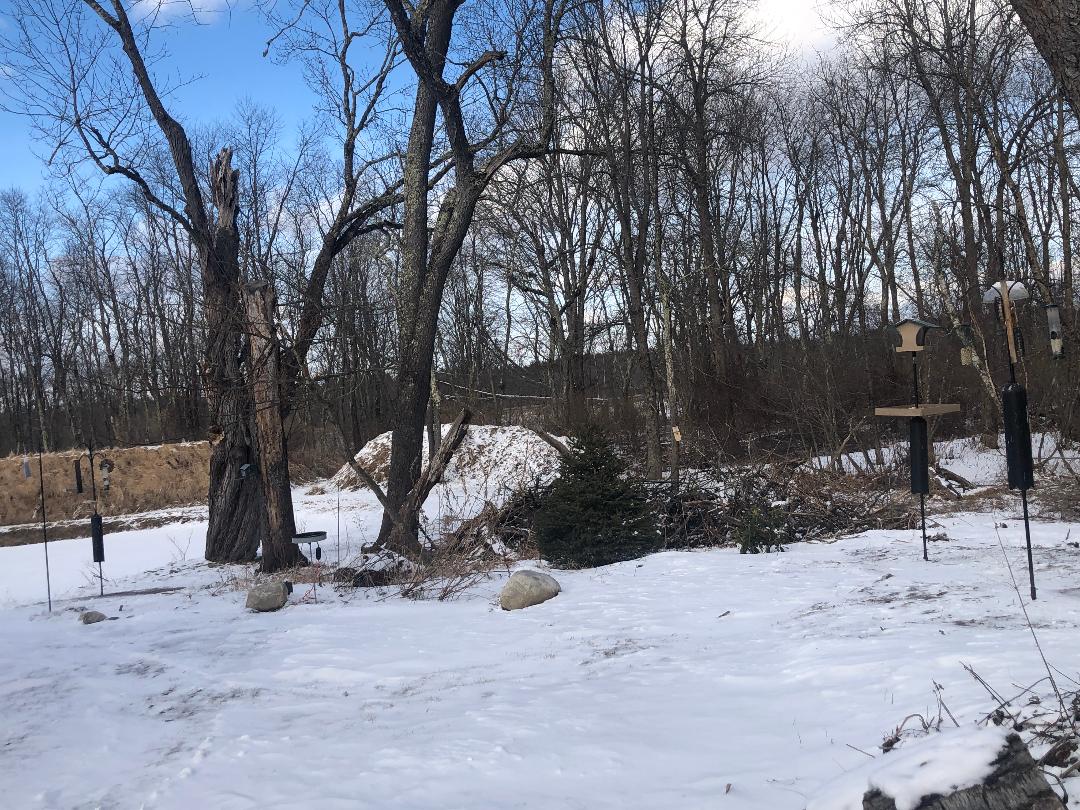
Using our Durham yard as a case study, I wanted to check to see if there were indeed fewer birds this winter than last year, as some (but no longer a majority) of folks have continued to mention to us at the store.
Stuck at home last winter while recovering from shoulder surgery, our feeding station provided my primary source of entertainment. I occupied my time with mugs of tea and enjoying the activity, and occupied my mind with figuring our exact counts, keeping tallies, and watching behavior closely. I wrote about my counts and observations in a pair of blogs, the first one is here, and the second one is here.
This past fall, everyone saw a very slow fall at feeders in Maine, and throughout the East, as discussed here. That was changing for a lot of people – but not all, by December, which I talked about in this follow-up blog.
In January, a series of strong storms, unseasonable heavy rain and flooding, a few cold spells, and eventually, by month’s end, solid snowcover helped change the narrative. Winter food resources were being consumed, ground-feeders were being forced out of the woods, finches were moving about, and so on. Furthermore, I believe that those strong storms knocked a lot of cones – especially those of Eastern White Pine – to the ground where they were subsequently consumed and/or buried.
At least here at our feeders in Durham, a slow start to the winter was a thing of the past, as we were filling almost all of our feeders daily by the end of January. Some impressive tallies included over 70 American Goldfinches and over 50 Dark-eyed Juncos at the end of the month.
American Goldfinches have been absolutely ravaging Nyjer at our home this winter. Fresh Nyjer makes all of the difference!
While some factors remain true from the fall – an abundance of natural food overall, relatively limited snowcover, low movement of irruptive species, etc – clearly most people were reporting to the store that things were “back to normal” or “tons of birds all of the sudden,” and so on. Our seed sales more than doubled by the end of January from what they were at the beginning of the month (by overall poundage).
Just how “normal” have things returned to, and what anomalies are out there? While our home in Durham is only two years old, and we’re a long way away from baseline data or long-term averages, we can at least compare February of 2024 to February of 2023. And since I had nothing better to do last winter, I already had some data to compare to.
So, for the last 10 days (not including the two that we were out of town for), I have once again returned to the window for dedicated sessions of feeder-watching and counting. Like last year, I used the standard methodology of using “high counts” (maximum number of individuals seen at any one time, unless they were readily identifiable as being different), and I was sure to count for at least one hour a day each day.
February 5 – February 15 (minus 2/12 and 2/13).
Species
Average per day 2023
Average per day 2024
Difference
Wild Turkey
0.2
0
-0.2
Mourning Dove
13.5
26.5
+13
Sharp-shinned Hawk
0.4
0.2
-0.2
American Goshawk
0
0.1
+0.1
Red-bellied Woodpecker
1
1
Same
Downy Woodpecker
2.4
2.9
+.5
Hairy Woodpecker
2
2
Same
Pileated Woodpecker
1
0.1
-0.9
Blue Jay
7.8
3.0
-4.8
American Crow
0.7
0
-0.7
Black-capped Chickadee
7.4
2.9
-4.5
Tufted Titmouse
4
3
-1
White-breasted Nuthatch
2
1.4
-0.6
Red-breasted Nuthatch
0.7
0
-0.7
Brown Creeper
0.4
0
-0.4
Carolina Wren
0.9
1
+0.1
European Starling
1.1
2.7
+1.6
Eastern Bluebird
4.4
3
-1.1
House Finch
2.1
0
-2.1
Purple Finch
0.5
0.3
-0.2
Pine Siskin
0
0.2
+0.2
American Goldfinch
26.6
46.8
+20.2
American Tree Sparrow
8.0
4.2
-3.8
Dark-eyed Junco
16.6
30.3
+13.7
White-throated Sparrow
2
2.3
+0.3
Song Sparrow
0
0.9
+0.9
Northern Cardinal
5.2
3.8
-1.4
Total individuals/day
110.9
138.6
+27.7
*Addendum: I guess I should have continued the study for a few more days! By 2/17, we had a whopping 72 Dark-eyed Juncos and an increase to 13 American Tree Sparrows, and by the next day, the American Goldfinch flock returned to well over 60 birds!*
Every year is different, and every yard is different. Controlling here for time and place, we can make some comparisons however. It was much colder in this period last year, with an average morning low of 19.6. This year, the average morning low for the ten days was 23.9 and there is a lot less snow on the ground, even after the fresh inch and a half Friday morning; there were three light snowfall events during the “study period” last year.
Clearly, there are plenty of birds at our feeders at least! And, contrary to conventional wisdom, we actually have more birds overall than last year! The dearth of feeder birds from the fall is no longer true for us. Similar conclusions can be reached from comparing data on our feeder birds at the store, and from conversations with friends and customers. Therefore, I believe the overall pattern fits what many are observing throughout the area.
As discussed in the aforementioned feeder blogs from the fall, Black-capped Chickadees are in low numbers. I saw 4.5 fewer per day at the feeders than last year. This goes with the idea that our local residents were not augmented by irruptives from points north, but also suggests that they did not have a great breeding season. Same for Red-breasted Nuthatch and Blue Jays.
But native sparrows are in larger numbers than last year, especially Dark-eyed Juncos (and elsewhere, like our store, significantly more White-throated Sparrows with a new winter record of 24 on 2/16). My guess is because the mild fall, abundant seeds from a productive growing season, and benign start to the winter kept those around to be pushed to feeders as the season wore on.
And yes, there are indeed a lot of goldfinches around! But very few other finches – at least at feeders. I am not sure where these European Starlings came from, however, and I’m not overly pleased by it!
Raptors are another part of the equation. This time last year, we had more consistent presence from two different Sharp-shinned Hawks. This winter, we only recently confirmed the presence of a single Sharp-shinned Hawk (seen on 2/15 and 2/16, but she likely took a Mourning Dove on the 14th). There was also an all-too brief fly-through of an immature American Goshawk on the 6th. Also this winter, a Red-tailed Hawk has been more frequent around the feeding station, but its focus is primarily the squirrels and voles. So we’ve had enough native predator presence both years that it shouldn’t be a huge factor in comparing feeder counts.
There you have it. 2024 does not have fewer birds at feeders compared to the same period in 2023, at least not in our yard as a single case study. With continued improvement of our yard’s habitat (most of which was put on hold this year due to my shoulder issues) planned, we would hopefully be increasing our yard’s carrying capacity, as feeders remain only a supplement and a relatively small percentage of a bird’s diet, even in the depths of winter.
Next winter, we also might not find a single Eastern White Pine cone in the entire state, and a lot fewer Red Oak acorns and Balsam Fir cones. And if that’s true to our north, perhaps this will increase the amount of irruptives around the area. But we’ll see! And maybe I’ll repeat this exercise next year, if I can force myself to sit still long enough!
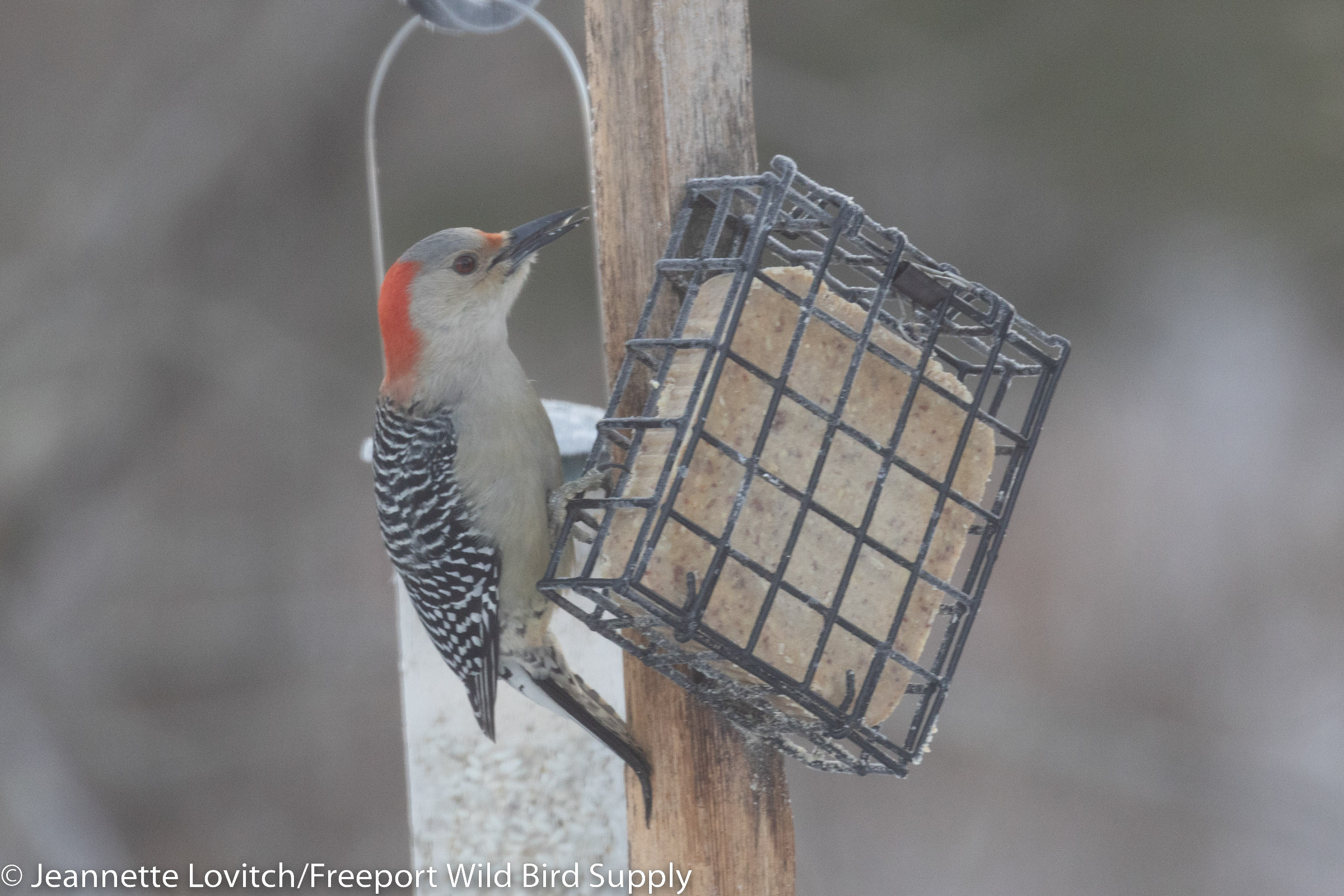
Last winter, we had a male Red-bellied Woodpecker nearly every day, while this winter it has only been this female. We hope they find each other!
This Northern Hawk-Owl has been present for a while in Piscataquis County where it has been seen by many. Jeannette finally took a ride up to see it on the 12th, making our “weekend” out of it.
I enjoyed a great week of birding, both locally and with a trip to north-central Maine. Winter irruptives and the first migrants of spring were among my many highlights over the last seven days.
1 Hermit Thrush, North River Road, Auburn, 2/8.
1 continuing female Red-breasted Merganser, Lincoln St Waterfront Park, Lewiston, 2/8.
5 Northern Pintails (FOY), Flying Point Preserve, Georgetown, 2/9.
1 hen COMMON EIDER SSP. BOREALIS and 1 pair BARROW’S GOLDENEYES, Winslow Park, Freeport, 2/10 (with Saturday Morning Birdwalk group).
1 continuing NORTHERN HAWK-OWL and 1 Northern Shrike, Piscataquis County, 2/12 (with Jeannette). Photo above.
1 Northern Shrike, County Road, Milford, 2/13 (with Jeannette).
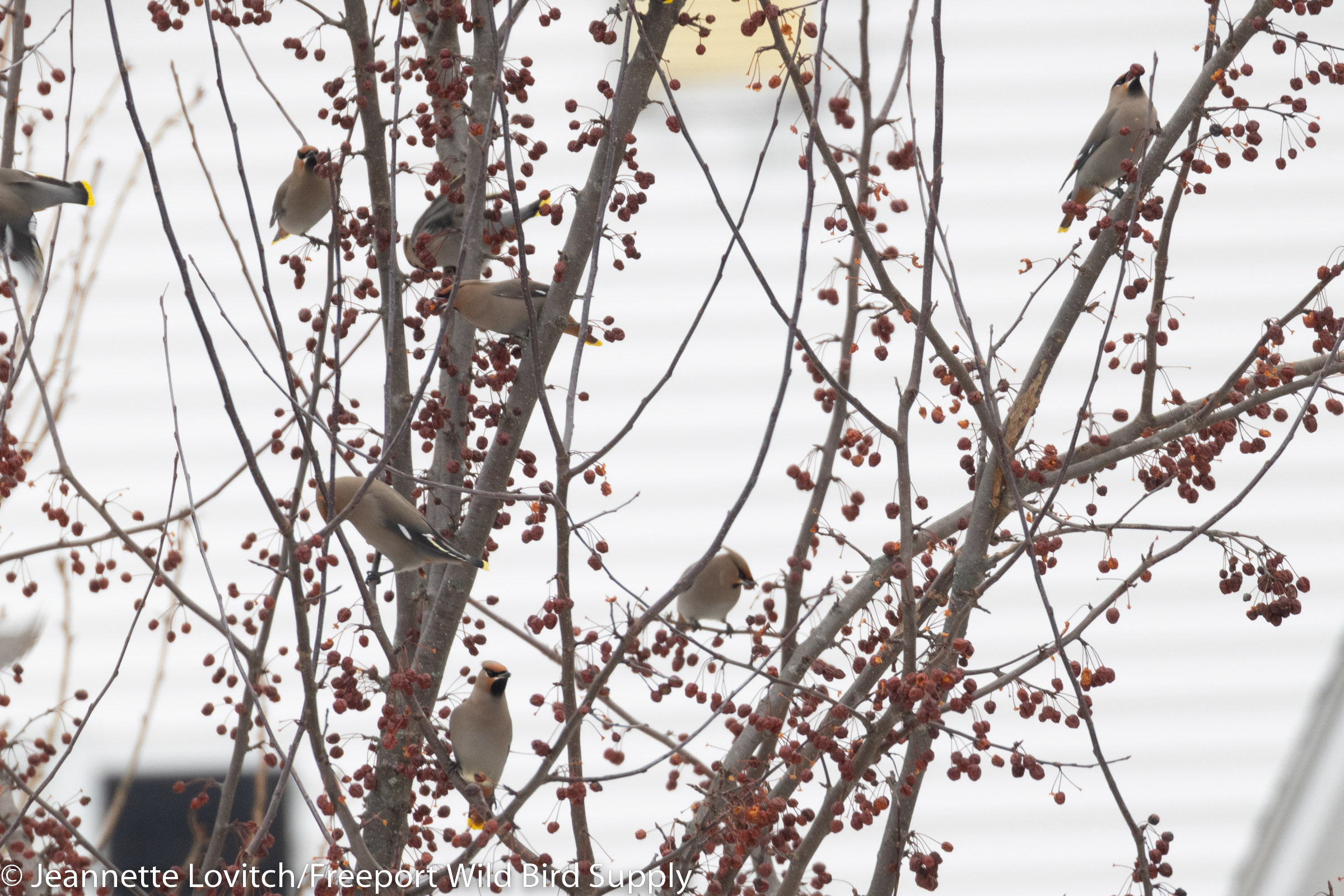
100+ BOHEMIAN WAXWINGS (FOY), downtown Old Town, 2/13 (with Jeannette).
140 BOHEMIAN WAXWINGS and 1 NORTHERN FLICKER (great winter bird away from the coast!), Riverside Park, Veazie, 2/13. Waxwings relocated on Thompson Road where we enjoyed an immersive photo session!
1 male Red-winged Blackbird (first of spring), here at the store on 2/14. Arrived on 2/12 – one of our earliest records here.
Scattered Turkey Vultures and increasing reports of prospecting migrant flocks suggests I will forgo Turkey Vultures on the highlights list for the next 9-10 months already!
Taking the long road to Augusta for an appointment last week, I checked a few open sections of river, including here at the Gardiner Waterfront Park where a group of 16 Common Mergansers were present. Such a snappy bird!
We’ve been busy catching up from our winter vacation, but I did see a few observations of note over the past ten days.
Our feeders In Durham continue to be exceeding active, with at least 70 American Goldfinches and over 50 Dark-eyed Juncos leading the way this week. We’ve also seen increases to 6 American Tree Sparrows, 3 White-throated Sparrows, and a returning two Song Sparrows among all of the resident species. A single Pine Siskin joined the goldfinches on 2/2.
1 hen BARROW’S GOLDENEYE, Bernard Lown Peace Bridge, Lewiston/Auburn, 1/30.
The long-staying hen American Wigeon offered a good, close study as part of the Winter Waterbird Workshop with Down East Adventures tour that I conducted on the 14th.
While I didn’t get as far afield as last week, I enjoyed a productive six days of birding, especially for early January! Here are my observations of note over the past seven days.
Our feeders in Durham have been incredible, led by a growing flock of Dark-eyed Juncos that peaked at 41 on 1/8 and 40+ continuing American Goldfinches. There was a big movement of sparrows after the weekend snow storm, with flocks of Dark-eyed Juncos and White-throated Sparrows common and widespread in the area, along with an increase in American Tree Sparrows. During Tuesday’s snowfall, a careful inventory during the snowfall on the 16th yielded 127 individuals of 16 species, led by 41 American Goldfinches and 37 Dark-eyed Juncos.
At least one Turkey Vulture still continues in the I-295 corridor between Cumberland and Freeport.
1 DOVEKIE, Sandy Point Beach, Cousin’s Island, Yarmouth, 1/13. Patch Bird #198! Healthy fly-by apparently turning around upon seeing the bridge, then turning northeast and following the Cousin’s Island shoreline. I lost it in the fog, but presumably rounding the island to return to sea. A Black Guillemot to the south of the bridge was one of my few ever from this location.
1 continuing female American Wigeon, York Duck Pond (Abbott’s Pond), York, 1/14 (with Down East Adventures Winter Waterbirds Workshop tour group).
Small number of Red Crossbills, Bear Mountain, Hartford, 1/15 (with Jeannette). Mostly single fly-overs and one small heard-only group, so quantification was impossible.
Barrow’s Goldeneyes returned to the Androscoggin River this week, with a pair below the Bernard Lown Peace Bridge between Auburn and Lewiston on the 12th. Early morning shadows were challenging for photos, so I was happy with this great comparison shot of an intermingled pair each of Barrow’s and Common Goldeneyes.
While I didn’t get as far afield as last week, I enjoyed a very productive week of birding, especially for early January! Here are my observations of note over the past seven days.
Our feeders in Durham have been incredible, led by a growing flock of Dark-eyed Juncos that peaked at 41 on 1/8 and 40+ continuing American Goldfinches. There was a big movement of sparrows after the weekend snow storm, with flocks of Dark-eyed Juncos and White-throated Sparrows common and widespread in the area, along with an increase in American Tree Sparrows.
2 drake and 1 hen BARROW’S GOLDENEYES, Winslow Park, Freeport, 1/6 (with Saturday Morning Birdwalk group).
Still fascinated by the warbler flock in Ogunquit Beach after my visit there last week, Jeannette and I went back down on 1/8. Unfortunately, we only had a short look at the brighter CAPE MAY WARBLER and 1 “WESTERN” PALM WARBLER. One Yellow-rumped Warbler spent almost the entire time we were there in and around the sewage tank, eating the little flies along its edge. The Cape May and Palm just briefly waved through the nearby trees. I would have thought that anything still alive would have been in the tank the whole time on that cold morning, as was the single Yellow-rump. Interesting.
While searching, we had 100+ Sanderlings on the beach, two continuing Northern Harriers and 8 Snow Buntings in the marsh, and in the Ocean Avenue neighborhood leading to the footbridge, we had 1-2 fly-over Red Crossbills and 1 RED-WINGED BLACKBIRD while checking feeders in hopes of relocating the warblers.
Cape Elizabeth with Dan Nickerson on 1/11: 1 2nd Cycle LESSER BLACK-BACKED GULL and a few Razorbills at Dyer Point; 1 DOVEKIE at Two Lights State Park; 1 Swamp Sparrow on Private Property, and 1600-2000 Black Scoters between Dyer Point and Kettle Cove.
1 pair BARROW’S GOLDENEYES, Bernard Lown Peace Bridge, Auburn/Lewiston, 1/12.
1 immature Great Cormorant, North River Road Boat Launch, Auburn, 1/12.
+/- 130 Mixed scaup, Lake Auburn, 1/12. Actively feeding, but Lesser continue to greatly outnumber Greater in the flock, as expected on freshwater in winter.
At least one Turkey Vulture continues in the I-295 corridor between Cumberland and Freeport this week.
UPCOMING TOURS.
Winter Waterbirds Workshop with Down East Adventures. Sunday, January 14th. Info here.
No Birdwalk, Saturday, 20th.
No Birdwalk, Saturday, 27th.
Gull Identification Workshop. Saturday, February 3rd and Sunday, February 4th. Info here.
I had a nice photo session this morning with White-throated Sparrows at the Saco Riverwalk. I enjoyed watching them extracting the seeds from crabapples, the opposite of true frugivores that consume the flesh and cough up or poop out the seeds.
It’s been a productive seven days, with this week’s highlights being decidedly wintery in nature. ‘Tis the season!
7 Red Crossbills, Florida Lake Park, Freeport, 12/9 (with Saturday Morning Birdwalk group).
Since we’ve had a mix of “the birds are back!” and “there are still no birds at my feeders” at the store recently, I wrote an updated blog talking about the season and the inconsistencies we are seeing with overall feeder activity, which is posted here:









 Maine Birding Field Notes