Tag Archives: Thornhurst Farm

This Week’s Highlights 10/15 – 10/22/2025.

Swamp Sparrows have been common and conspicuous on our Durham property, and elsewhere this week. I feel this, like most sparrows, is an underappreciated beauty!

My observations of note over a very productive and exciting eight days of birding included the following:

  • Highlights from our Durham property this week included near-daily American Woodcocks and Rusty Blackbirds, and a nice little arrival of more Swamp Sparrows and Purple Finches in particular on 10/21.
  • Sandy Point Morning Flight, 10/15.

A very light flight passed over and through Sandy Point Beach, Cousin’s Island, Yarmouth this morning.

6:55-8:30 (with Bill Thompson).

48F, mostly cloudy to partly cloudy, NW 1.7-2.5mph diminishing to calm.

51 American Robins

33 Yellow-rumped Warblers

28 Dark-eyed Juncos

17 American Goldfinches

16 Ruby-crowned Kinglets

8 Eastern Bluebirds

7 White-throated Sparrows

6 Chipping Sparrows

5 Palm Warblers

4 Hermit Thrushes

4 Golden-crowned Kinglets

3 Blue-headed Vireos

3 Purple Finches

3 Swamp Sparrows

2 Pine Siskins

2 Rusty Blackbirds

2 Tufted Titmice (4 false-starts and counting)

1 Red-breasted Nuthatch

1 Blackpoll Warbler

1 White-breasted Nuthatch

1 Downy Woodpecker (2+ false-starts)

1 House Finch

1 American Pipit

1 Northern Flicker

1 Magnolia Warbler

1 unidentified

Total  = 203

  • 1 continuing CACKLING GOOSE, Thornhurst Farm, North Yarmouth, 10/15 (with Bill Thompson).
  • 1 Least Sandpiper, 1 White-rumped Sandpipers, and 2 Pectoral Sandpipers, Walsh Preserve, Freeport, 10/15 (with Bill Thompson).
  • Sandy Point Morning Flight, 10/16.

An excellent flight passed over and through Sandy Point Beach, Cousin’s Island, Yarmouth this morning.

6:55 to 10:40am.

44F, Mostly cloudy, NW 4.3 – 9.0 increasing to 15.1 – 19.7mph with higher gusts.

2186 American Robins (*NEW RECORD! – just barely).

1776 Yellow-rumped Warblers

167 unidentified

127 Dark-eyed Juncos (One was quite likely not a Slate-colored, but my photos of it are not useful)

61 Common Grackles

48 Cedar Waxwings

43 Canada Geese

31 Chipping Sparrows

21 Ruby-crowned Kinglets

19 Rusty Blackbirds

18 White-throated Sparrows

13 Northern Flickers

11 Golden-crowned Kinglets

11 Purple Finches

9 Pine Siskins

7 Palm Warblers

4 Blue-headed Vireos

4 unidentified finches

4 Hermit Thrushes

4 Song Sparrows (crossed together at 8:29. This is only my second or third observation of SOSP engaging in Morning Flight after sunrise here; plenty more in and around the parking lot as usual)

3 Merlins

3 Common Loons

3 Turkey Vultures

2 Red-winged Blackbirds

2 White-crowned Sparrows

2 Eastern Phoebes

1 Northern Parula

1 Blackpoll Warbler

1 Brown Creeper

1 Peregrine Falcon

1 Yellow-bellied Sapsucker

1 Cooper’s Hawk

1 American Goldfinch

1 Red-shouldered Hawk

1 Cape May Warbler

1 Red-breasted Nuthatch

1 Sharp-shinned Hawk

1 Tennessee Warbler (from Bill Thompson’s photo review)

1 Black-throated Blue Warbler (from Bill Thompson’s photo review).

Total = 4,592

  • Notables from a delightfully birdy morning on Bailey Island, Harpswell on 10/17 included a decent, and relaxingly unquantified, morning flight mostly of Yellow-rumped Warblers; 1 ORANGE-CROWNED WARBLER, and 1 Cape May Warbler among the migrants found here and there around the island.
  • 12 SANDHILL CRANES, Mayall Road, Gray/New Gloucester, 10/18 (with Saturday Morning Birdwalk group).
  • 1 WILSON’S WARBLER and 1 ORANGE-CROWNED WARBLER, Eastern Promenade, Portland, 10/18.
  • 1 DICKCISSEL, feeders here at the store, 10/19, continuing through at least 10/21. Was this the same bird seen on 10/4 and then again on 10/13-14?
  • 4 continuing FORSTER’S TERNS, Pine Point, Scarborough, 10/20 (with clients from California and Massachusetts).
  • 2 “Ipswich” Savannah Sparrows, Eastern Road Trail, Scarborough Marsh, 10/20 (with clients from California and Massachusetts).

Our Last Tour of 2025 still has some space remaining!

Birds on Tap – Roadtrip! Rarity Roundup

November 9, 2025; 8:00am – 3:00pm

Cost – $125

​Portland Explorer (formerly Maine Brews Cruise) and Freeport Wild Bird Supply are excited to continue our collaboration for six very special outings in 2025. 

These unique, relaxed birding and beer-ing adventures that you have come to love combine great local birding at seasonal hotspots with visits to sample the delicious creations of some of our favorite local breweries. These tours are a perfect introduction to birding and/or craft beer, and a great opportunity to travel with significant others, friends, and family that have interest in one topic, while your interest is primarily in the other (for now!). Seasonal birding hotspots and great local beer – a perfect combination, and we’ll even do all of the driving!

Early November is a fantastic time of year in Maine for vagrants – birds normally seen in far-off places.  Due to a combination of weather patterns, changing seasonal food resources, falling temperatures, and other factors – some of which are not completely understood – birds that may have ended up in Maine by “accident” begin to concentrate at the coast in “migrant traps” and “hotspots.”  In other words, this is the time of year to expect the unexpected.  

​A traditional “Rarity Roundup” involves teams of birders heading out on a given day during rarity prime time, looking for species that are not supposed to be around. And in honor of that tradition, that’s exactly what we are going to do on this unique tour. We may “chase” a rarity (go to see something that has already been found, aka “twitch”) or we might choose a destination known for rare birds in an attempt to find one of our own. Or perhaps, we’ll do both!

Anything between Portland and Kittery is fair game, and we might not even know where we will head until we are on the bus and the latest rare bird alert is received. For those who love adding a bird to your Life or State List, and/or basking in the thrill of discovery, well then this is the tour for you! In between seeing great birds, we’ll discuss the complex factors that are involved in delivering rarities to an area, and how we go about finding them.

​After about 3-4 hours of birding, depending on drive time, we will be transported to two of our great local producers to sample their offerings and learn their styles.

This Week’s Highlights, 5/3-5/9/2025.

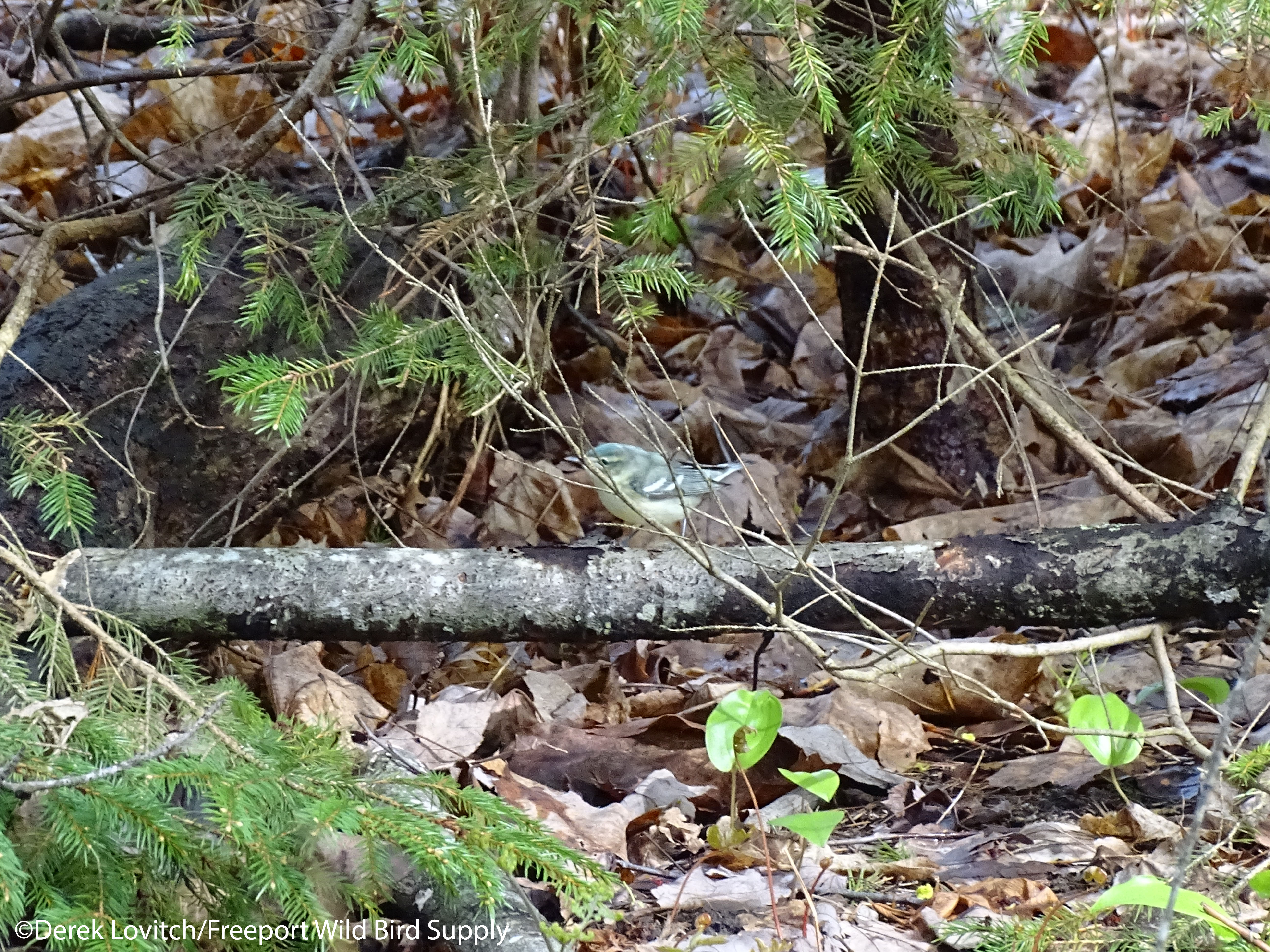
This female Cerulean Warbler at Evergreen Cemetery on 5/6 was the first in Maine for just about every birder who raced to see it! Thanks to Bill for the photo!

Wow! What a week! Although I was out of town for the huge flight Friday night into Saturday morning, my birding with a tour group on an almost-as-productive Sunday morning made up for it. Then, with an upper level low locked into place, migration ground to a halt throughout most of the rest of the week. However, a trickle of new arrivals appeared, and an impressive array of rarities were found around the state. I did a lot more chasing than usual this week (including a personal “state bird”, but a self-found rarity on Friday was a perfect way to put the icing on the cake of a tremendous week of spring birding! My observations of note over the past seven days included the following:

  • 15 species of warblers (FOY) between Evergreen Cemetery and Capsic Pond Park, with Northern Parula the most numerous at both, 5/4 (with Down East Adventures Spring Migrant Songbird Workshop group).
  • 2-3 Louisiana Waterthrushes, Suckfish Brook Conservation Area, Falmouth, 5/5 (with Jeannette).
  • 1 continuing BLACK-NECKED STILT, Spurwink Marsh, Cape Elizabeth, 5/6 (with Bill Thompson). Well, since we were out chasing together, we figured we might as well visit this elegant rarity found by John Lorence on 5/3.
  • The continuing CERULEAN WARBLER at Evergreen Cemetery on 5/8 with my Birds on Tap – Roadtrip: Warblers and Wort! Tour group. I don’t generally take photos while guiding groups, but I took a few of this bird…and completely wiffed on them!
  • After all this “twitching,” I was due to find my own rarity, and did so on 5/9 with an adult breeding plumage female RUFF (REEVE) at Walsh Preserve in Freeport. There are only about 10 previous records for Maine.

My personal “first of years” this week also included:

  • 2 Yellow Warblers, Evergreen Cemetery, Portland, 5/4 (with Down East Adventures Spring Migrant Songbird Workshop group).
  • 8 Black-throated Blue Warblers, Evergreen Cemetery, 5/4 (with Down East Adventures Spring Migrant Songbird Workshop group).
  • 2 Wood Thrushes, Evergreen Cemetery, 5/4 (with Down East Adventures Spring Migrant Songbird Workshop group).
  • 3 Magnolia Warblers, Evergreen Cemetery, 5/4 (with Down East Adventures Spring Migrant Songbird Workshop group).
  • 4 Chestnut-sided Warblers, Evergreen Cemetery, 5/4 (with Down East Adventures Spring Migrant Songbird Workshop group).
  • 2 Great-crested Flycatchers, Evergreen Cemetery, 5/4 (with Down East Adventures Spring Migrant Songbird Workshop group).
  • 2 American Redstarts, Evergreen Cemetery, 5/4 (with Down East Adventures Spring Migrant Songbird Workshop group).
  • 2 Northern Waterthrushes, Capisic Pond Park, Portland, 5/4 (with Down East Adventures Spring Migrant Songbird Workshop group).
  • 7 Chimney Swifts, Capisic Pond Park, 5/4 (with Down East Adventures Spring Migrant Songbird Workshop group).
  • 1 White-crowned Sparrow, feeders here at the store, 5/4.
  • 2 Lincoln’s Sparrows, Suckfish Brook Conservation Area, Falmouth, 5/5 (with Jeannette).
  • 1 Warbling Vireo, our yard in Durham, 5/5.
  • 16 Willets, Eastern Road Trail, Scarborough Marsh, 5/6.
  • 18 Least Sandpipers, Eastern Road Trail, 5/6.
  • 1 Eastern Kingbird, Evergreen Cemetery, 5/6 (with Bill Thompson).
  • 1 LITTLE BLUE HERON, Pelreco Marsh, Scarborough Marsh, 5/6 (with Bill Thompson).
  • 1 Blackburnian Warbler, Rte 136 powerline cut, Durham, 5/7.
  • 1 Wilson’s Warbler, Evergreen Cemetery, 5/8 (with Birds on Tap Roadtrip! tour group)
  • 2 House Wrens, Capisic Pond Park, 5/8 (with Birds on Tap Roadtrip! tour group).
  • 2 Blue-winged Teal, Walsh Preserve, Freeport, 5/9.

Bradbury Mountain Spring Hawkwatch

The Week 7 report – in which we broke the all-time season record – can be found here.

Upcoming Tours (with space available):

Rangeley Birding Festival, June 5-8

Common Teal to Northern Lapwing; American Woodcocks to Wood Ducks: 5 Great Days of Spring Birding!

Well, that was a helluva good five days of birding! And, I covered a heckuva lot of ground in the process. Yes, spring – and spring birding – is finally upon us.

After checking local hotspots on Thursday morning (lots of Killdeer and my first Eastern Phoebes), I began my trek eastwards after lunch. I was giving a presentation and book signing at the Maine Coastal Islands NWR headquarters in Rockland, thanks to an invite from the Friends of Maine Seabird Islands. On the way, I hit a handful of water overlooks, with the only birds of note being my FOY Fish Crows in downtown Brunswick and FOY Double-crested Cormorant in Damariscotta Harbor.

But then I arrived at Weskeag Marsh, and that was most productive. Highlighted by two drake “Eurasian” Green-winged (aka “Common”) Teal, a nice diversity of waterfowl also included two pairs of American Wigeon and a pair of Northern Pintail. I flushed two American Woodcocks and four Fox Sparrows from the short trail that leads to the viewing blind. Afterwards, I found a single 2nd-Cycle Glaucous Gull with four 1st-cycle Iceland Gulls still at Owl’s Head Harbor.

Here’s a poorly phone-scoped image of one of the Common Teal, showing the bold horiztonal white bar across the wing and the lack of a vertical white bar on the side of the chest.
COTE,WeskeagMarsh,4-5-14

Spending the night with friends, I then met up with staff from the Coastal Mountains Land Trust for a walk around their Beech Hill Preserve to discuss and offer suggestions as to augment and improve bird habitat there. A spiffy male Northern Harrier and a Northern Shrike (my 11th of the season!) were me rewards.

I then took the (very) long way home, checking farm fields on my way to the Hatch Hill Landfill in Augusta. Although 900-1000 gulls were present at the dump – a nice number for here – all but 5 were Herring Gulls (plus three Great Black-backed and 2 Ring-billed). At least 10 Bald Eagles were still present however.

Working my way down the Kennebec, I checked the mouth of the Abagadasset River in Bowdoinham, which I found to still be frozen. Nearby Brown’s Point, however, had open water, and duck numbers were clearly building, including 44 Ring-necked Ducls and 50+ Green-winged Teal. Back at the store soon thereafter, I found our Song Sparrow numbers had grown from four to 12 overnight.

As the rain and drizzle ended on Saturday morning, the birdwalk group convened, and we headed inland (for the first time since December!) to work the “Greater Yarmouth Goose Fields.” Highlighted by two Cackling Geese that were first located on Thursday (a couple of hours after I checked the fields in the fog, dammit!) and yet another Northern Shrike (our third week in a row with a shrike on the birdwalk!), this very productive outing is fully covered on our website, here – as are all of our birdwalk outings.
IMG_3244_CACG,GreelyRd,Cumberland,4-5-14One of the two Cackling Geese, phone-scoped through the fog.

Normally, the birdwalk’s return to the store is the end of my birding on Saturday, but not this week. Soon, Kristen Lindquist, Barb Brenneman, and I raced off to Jordan Farm in Cape Elizabeth to twitch a real “mega,” the stunning Northern Lapwing! Discovered Friday evening, the bird was enjoyed by many throughout the day on Saturday, but it was not seen again on Sunday despite much searching. This is the 4th record of lapwing in Maine, and the third in just three years! I consider myself exceedingly fortunate to have seen the last two. My distantly-phone-scoped photos of the Cape Elizabeth bird hardly do this stunner justice.
IMG_3262_NOLA1,JordanFarm,4-5-14  IMG_3264_NOLA2,JordanFarm,4-5-14

Yet even still my birding day was far from over, as Saturday night was our annual “Woodcocks Gone Wild at Pineland Farms” dusk trip. Keeping an eye on the weather (the rain had cleared, but increasing winds were a concern), Jeannette and I wondered if we should postpone the outing. Moments after we decided to give the go-ahead in the afternoon, the winds began to gust – a lot. Then, at about 5pm, they died. When our walk got underway at 6:30, there was a little breeze once again, but it was not enough to keep the woodcocks from going wild! In fact, it’s possible that a little wind kept the birds’ display a little lower – especially the first handful of flights – which resulted in quite possibly the best show we’ve ever had here! At least 7 males were displaying, including one repeatedly right over our heads – and at least two more silent birds were observed flying by. Add to this lots of American Robins and a Northern Shrike before the sun set, and the group was treated to a wonderful spring evening performance!

Next up was Androscoggin County on Sunday with my friend Phil McCormack. While our primary target was a pancake breakfast at Jillison’s Farm in Sabattus, we were also hoping for a Redhead that was discovered on the outlet stream at Sabattus Pond a few days ago. Well, the pancake chase (the more important one!) was successful, but the Redhead chase was not. However, a very good day of birding was enjoyed nonetheless.

Scattered ducks on the river including Ring-necked Ducks and Common Mergansers, a couple of pockets of Tree Swallows, and other assorted species were trumped by two flooded fields along Rte 136 in Durham. With ponds and marshes still frozen, ducks are stacking up at more ephemeral – but unfrozen – habitats.  Thousands of ducks and geese were present, mostly Canada Geese, Mallards, and American Black Ducks.  However, between the two fields, we tallied an unbelievable 273 Wood Ducks (probably about quadruple my previous high count in the state). Two immature Snow Geese were my first of the year, and very rare away from the coastal marshes in the spring. 18 Green-winged Teal, 12 Ring-necked Ducks, 10 Northern Pintail, and two pairs of American Wigeon were also among the masses.
IMG_3271_WODUs2,Durham,4-6-14  IMG_3282_WODUs1,Durham,4-6-14_edited-1

Although these phone-scoped photos hardly do the scene justice, they should at least give you a taste of what things looked like.

After brunch, we birded the west side of the Androscoggin River (more Ring-necked Ducks and Common Mergansers, etc) before spending our last hour of our birding (half) day at Bradbury Mountain.  Our disappointment over missing an unprecedented 9 Sandhill Cranes was alleviated when #10 was spotted, along with my first two Ospreys of the year.

After four days of extensive birding, my Monday agenda at the store was lengthy, but the weather in the morning was just too good to pass up!  A spin of the local waterfowl hotspots was fruitful.  The Goose Fields yielded the two continuing Cackling Geese along Greely Road, along with my first American Kestrels of the year, and my FOY Wilson’s Snipe, also along Greely.

No luck finding a lingering Barrow’s Goldeneye in the Harraseeket River, but at Wharton Point, a group of 7 Northern Shovelers was one of the largest flocks of this species I have seen in Maine. My first Greater Yellowlegs of the year was also present, as were 60+ Green-winged Teal, 16 Ring-necked Ducks, about 30 distant scaup, 8 American Wigeons, and 1 Northern Pintail among several hundred American Black Ducks.

Two joyous hours at the Brad were full of raptors: 127 birds had past the watch when I departed at noon, including 4 Osprey. Red-tailed and Red-shouldered Hawks continue to add to their all-time record tallies. Hundreds of Canada Geese were sorted through, hoping for a rarity, while other migrants included Tree Swallows, American Black Ducks, Common Mergansers, and Great Blue Herons.

Furthermore, signs of a good flight last night included the return of Golden-crowned Kinglets to the area – after we were virtually devoid of them this winter, and an increase in Red-breasted Nuthatches (relatively few and far between this winter as well), Song-Sparrows, and at the store, a Fox Sparrow – a bird we don’t get here every spring due to our open habitat.

So long story short, it’s been a great few days of birding!  But now, I should probably get some work done!

Sandy Point on 10/9, Goose Fields Redux, and More.

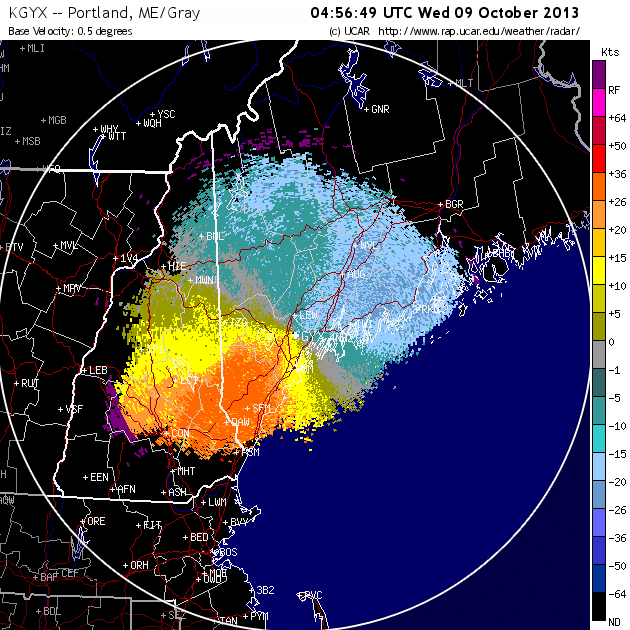
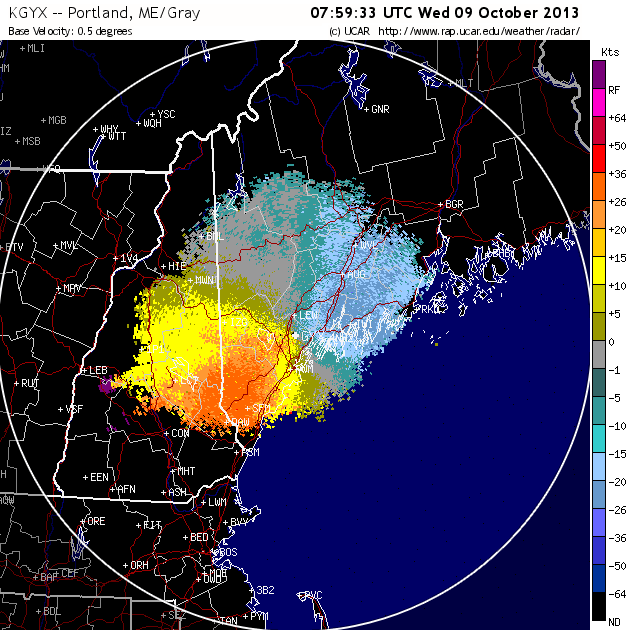
After three nights with little to no migration, birds took to the skies en masse come nightfall last night.  It was a big flight.  For examples, here are the 10pm, 1am, and 4am reflectivity and corresponding velocity images:
10pm radar, 10-8-1310pm velocity, 10-8-13
1am radar, 10-9-13 1am velocity, 10-9-13 4am radar, 10-9-13 4am velocity, 10-9-13

That’s a heckuva flight!  But as October goes on, more and more of the migrants are sparrows. Most sparrows (juncos and Chipping Sparrows are the exceptions) do not partake – or barely so – in the morning re-determined migration (“morning flight”), at least at Sandy Point, so I have been disappointed with the tally come dawn at Sandy Point on more than one occasion in mid-October.  While this morning’s flight was still good, it was not as busy as I would have expected based on the density of those radar returns.  But there were a lot more sparrows around in the bushes at Sandy Point and elsewhere this morning; I wonder what percentage of last night’s flight were White-throated Sparrows?

At the bridge at Sandy Point, the morning’s flight started out quite slow.  By 7:30, I had even considered packing it in and going to look for sparrows.  But then things picked up a little bit, and a steady trickle of birds slowly added up to a respectable tally.  Both kinglets spent a lot of time swirling around the point this morning (as usual, I was conservative in my count of how many were actually crossing, as many would turn around, come back, and try again), and the sparrow tally was probably a lot higher.  However, by the time I left the bridge, most White-throats had already dispersed into the woods.  Song Sparrows – which I do not attempt to tally due the number of breeding birds in the powerline cut – were definitely more abundant than they have been as well.

Here’s the scorecard:
6:45-9:15
39F, light NNW to calm, partly cloudy to clear

323 Yellow-rumped Warblers
105 Ruby-crowned Kinglets
71 Unidentified
60 Dark-eyed Juncos
52 Palm Warblers
39 Golden-crowned Kinglets
30 White-throated Sparrows
15 Unidentified kinglets
13 Blackpoll Warblers
12 Black-capped Chickadees
12 Black-throated Green Warblers
8 American Robins
7 Blue-headed Vireos
7 Northern Parulas
6 Blue Jays
4 Common Loons
4 Common Yellowthroats
4 Chipping Sparrows
3 Nashville Warblers
3 Savannah Sparrows
3 Swamp Sparrows
3 American Goldfinches
2 Sharp-shinned Hawks
2 Eastern Phoebes
2 Tufted Titmice
2 American Pipits
2 Black-throated Blue Warblers
1 Hairy Woodpecker
1 RED-BELLIED WOODPECKER
1 Red-eyed Vireo
1 Hermit Thrush
1 Tennessee Warbler
1 Common Grackle

T=800

Afterwards, I did a circuit of the local “goose fields.” As with everywhere to our south, the resident, non-migratory population of Canada Geese is burgeoning in southern Maine.  This resident population begins to coalesce in the fields of Yarmouth, Cumberland, and Falmouth in early August, and by the middle to end of September, the flock includes a sizeable percentage of the local breeders.  The percentage of local breeders that are in the fields on any given day increases with the onset of early Canada Goose hunting season in early September.

This year, the number of geese among all fields has varied between 200-300 total birds since early September. This number of pre-migrant birds has grown steadily over the past five years in particular.  This week, the first real influx of geese arrived, presumably from some points north.  It is the flock of resident geese that know the safe fields (no hunting, less Bald Eagle activity) and travel corridors to and from the bay where they roost that attract the migrants, including those occasional rarities.

My high count this week of 445 Canada Geese today was my highest tally since the spring.  A couple of Eastern Meadowlarks and up to 8 Killdeer were also present at Thornhurst Farm this week, and Eastern Bluebirds have been rather widespread. A Pied-billed Grebe was once again in the pond on Woodville Road in Falmouth, as is often the case at this time of year.

The goose numbers and the chance for finding rarities should only increase (well, with various ebbs and flows) from now through the first heavy snow.  In fact, I often find my first “good” goose in the second week of October.  It’s also primetime for sparrows.  And this is why I hate leaving the state in October, but once again, I am off!

Early tomorrow morning I depart for Iowa, where I will be speaking at the Iowa Ornithologist Union’s Fall Meeting.  I’ll be giving the keynote presentation on “How to Be a Better Birder” using my SandyPoint case study program and I will also be showing my Russian Far East travelogue.  Finally, I will be joining the 2009 Bradbury Mountain Hawkcounter, Danny Akers, in leading a field trip.

After my weekend in the Hawkeye State, I head to Wisconsin to visit the Urban Ecology Center in Wisconsin.  In between and thereafter, I’ll be spending a couple of days birding and visiting with friends.   I’ll post the occasional update about migration in the Midwest, my birding, and other musings on my book’s Facebook page should you be interested in following my travels.

Now I am just left to wonder what state bird I will miss here in Maine while I am away (there’s always one!)