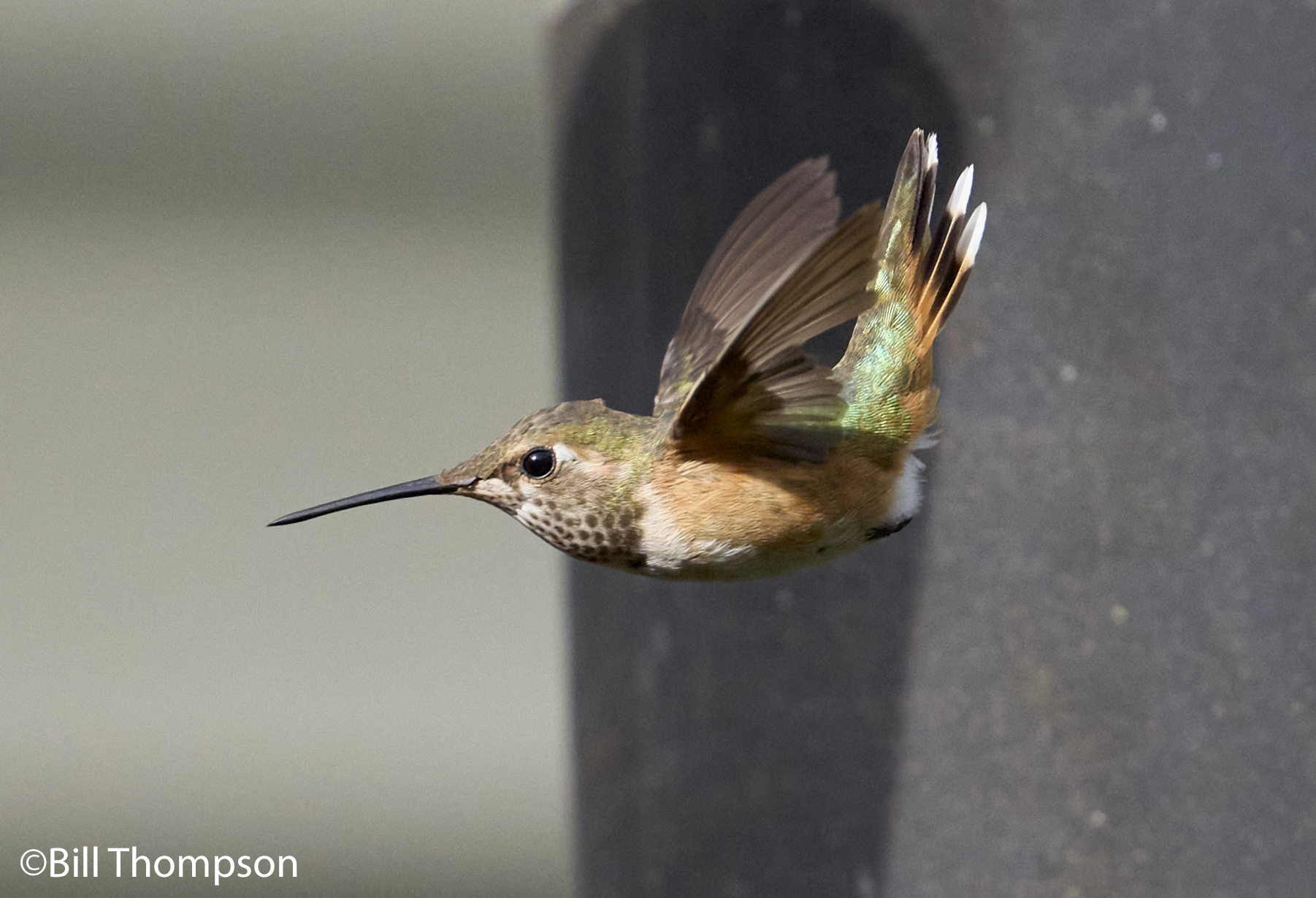
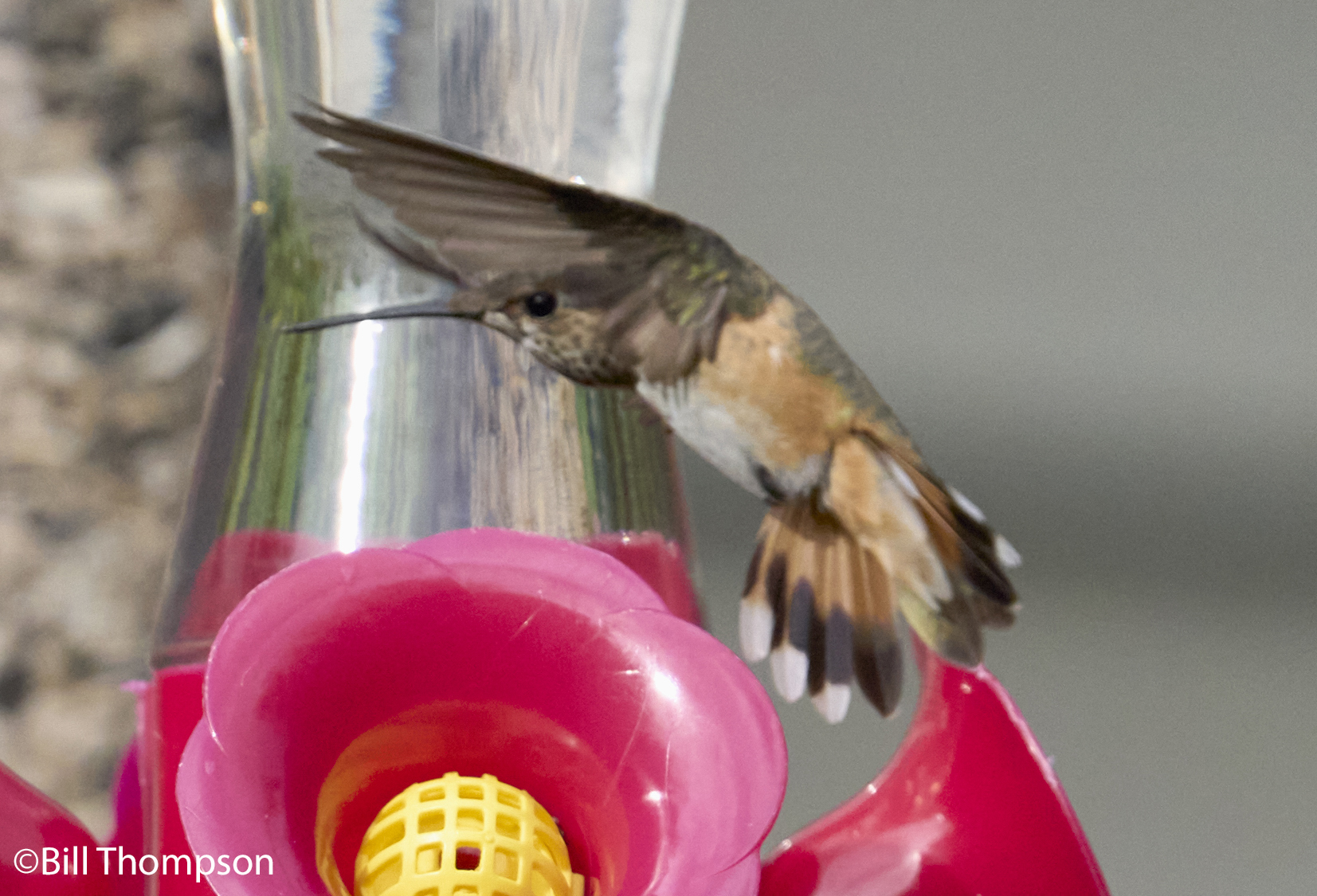
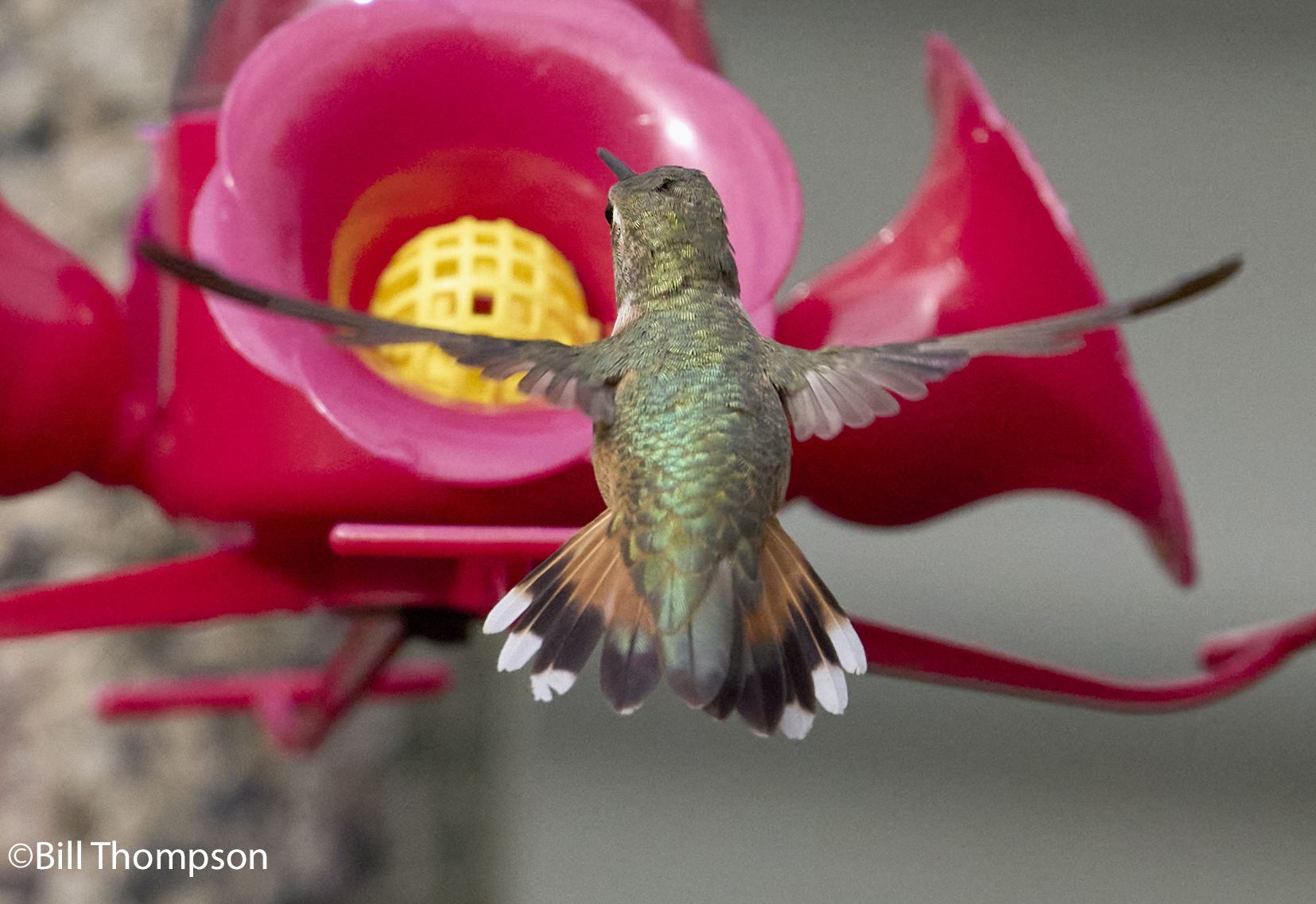
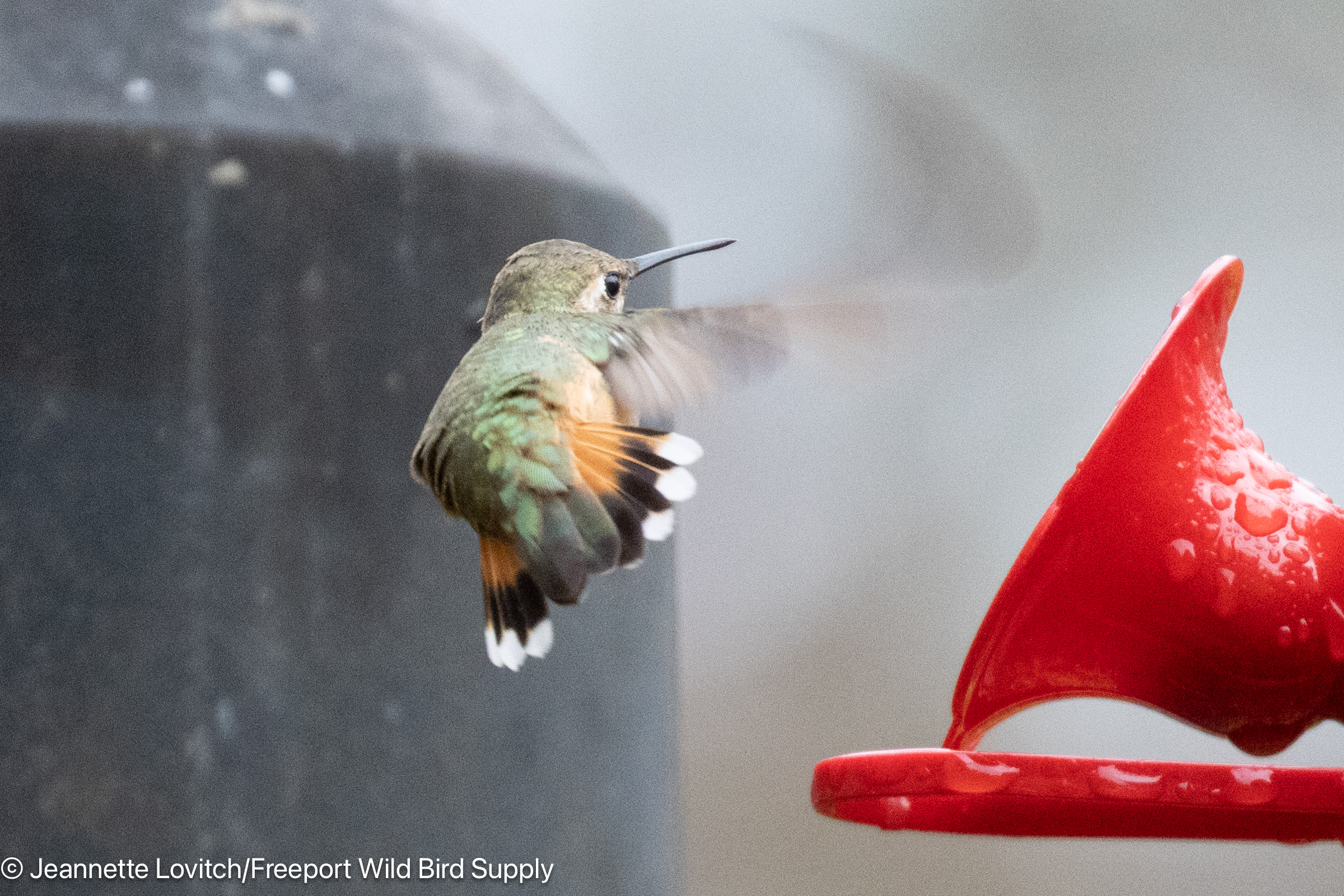
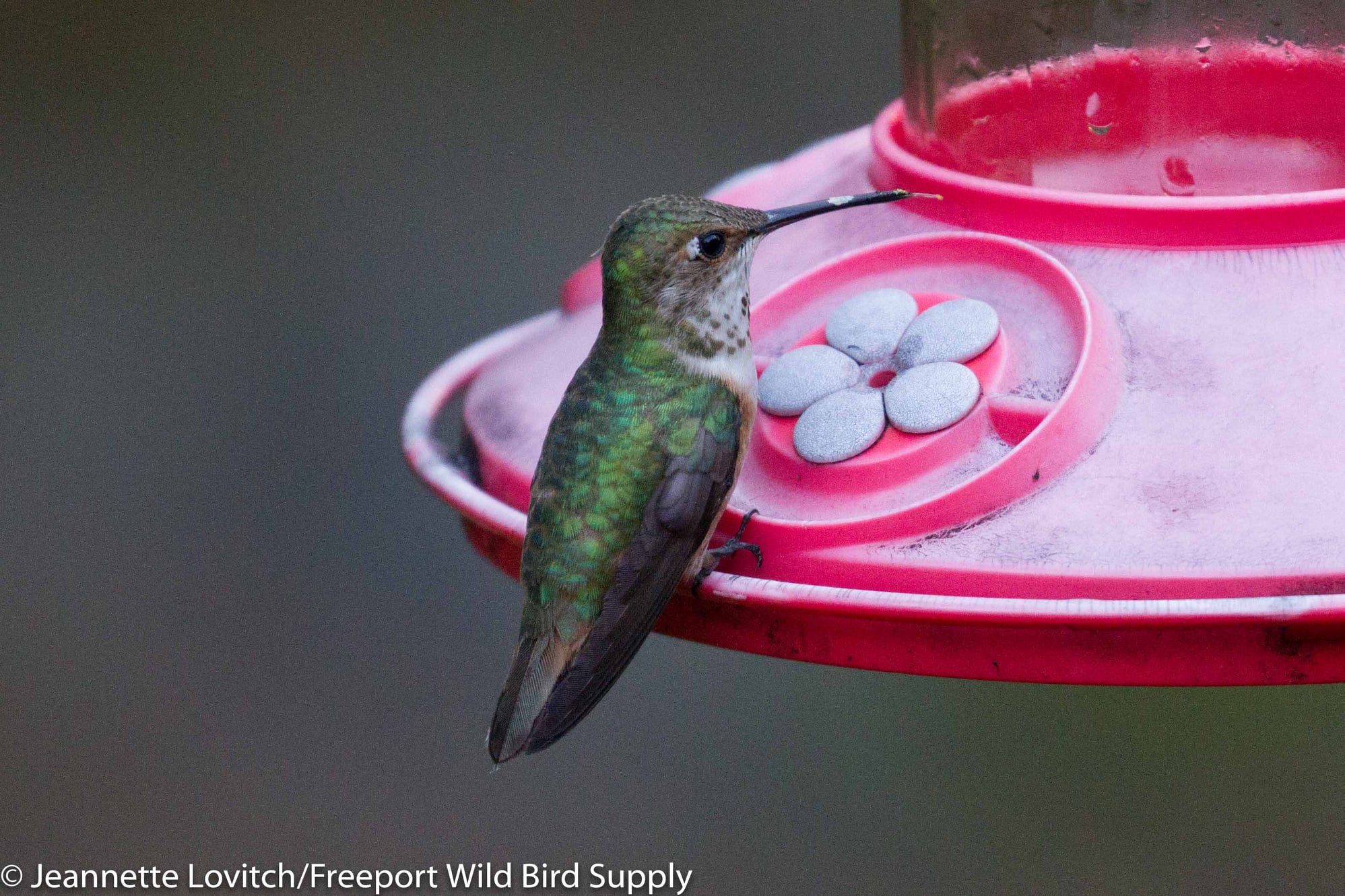
This Rufous Hummingbird graced a Bath yard for almost two months. The story below.
Life in retail during the holiday season, followed by a trip to the Motherland of New Jersey for Christmas resulted in limited Maine birding for me over the past two weeks. However, a couple of good days in the field here in Maine produced several observations of note:
Recent ice and more snow resulted in a nice little surge of Dark-eyed Juncos and American Goldfinches into our Durham yard. A male Purple Finch on ½ was the first I have seen locally in at least a month, and a Northern Flicker dropped in on 12/30.
1 continuing drake Green-winged Teal and 1+ Fish Crow, Auburn Riverwalk, 12/23.
2 drake and one hen BARROW’S GOLDENEYES, Bernard Lowne Peace Bridge, Auburn-Lewiston, 12/30 (with Kelley Sharp)
3 Fish Crows and 1 1st-cycle Iceland Gull, Auburn Riverwalk, Auburn, 12/30 (with Kelley Sharp).
1 pair American Wigeon, Rockland waterfront, 1/1 (with Jeannette).
Rufous Hummingbird in Bath, 10/31-12/26, 2025.
A Rufous Hummingbird arrived in a Bath yard on Halloween. And she stayed until the 26th of December! These birds are just incredible! Unfortunately, it was not in a yard that was conducive to visitation, so we had to keep the sighting under wraps. I really am sincerely sorry about that, but the homeowner’s rights and the bird’s welfare will always be put first and foremost with us. But it was well photographed, well studied, and well monitored. Here’s the story, identification particulars, and more.
We only had one morning for birding after visiting family, and we chose to spend it with an estimated 100,000 American Robins!
It was awesome and I hope these videos do it a modicum of justice! This was in Oldwick, NJ, discovered by Evan Obercian (yup, a birding friend of mine since high school who also now lives in Maine!) around 2021 (although he heard of a former roost not far away before this one). This was the largest gathering he has seen, at least around Christmastime. We just enjoyed the show, but he recently made the estimate (based on counting sample minutes and extrapolating). There were also about 1,000 European Starlings – look for a couple of dense flocks exiting the leaning bamboo during the videos. A few hundred Common Grackles and Red-winged Blackbirds were also present (mostly exited before sunrise in the first video), and Jeannette and I picked out a single Hermit Thrush. 3 Cooper’s Hawks and a Sharp-shinned Hawk were present, but they too seemed to be overwhelmed by the masses!
The videos can be seen here:
New Year Predictions Blog!
I know you are waiting with bated breath, but I’ll publish this soon. Of course, when I am delayed in getting it posted, something really rare shows up! So keep you eyes open!
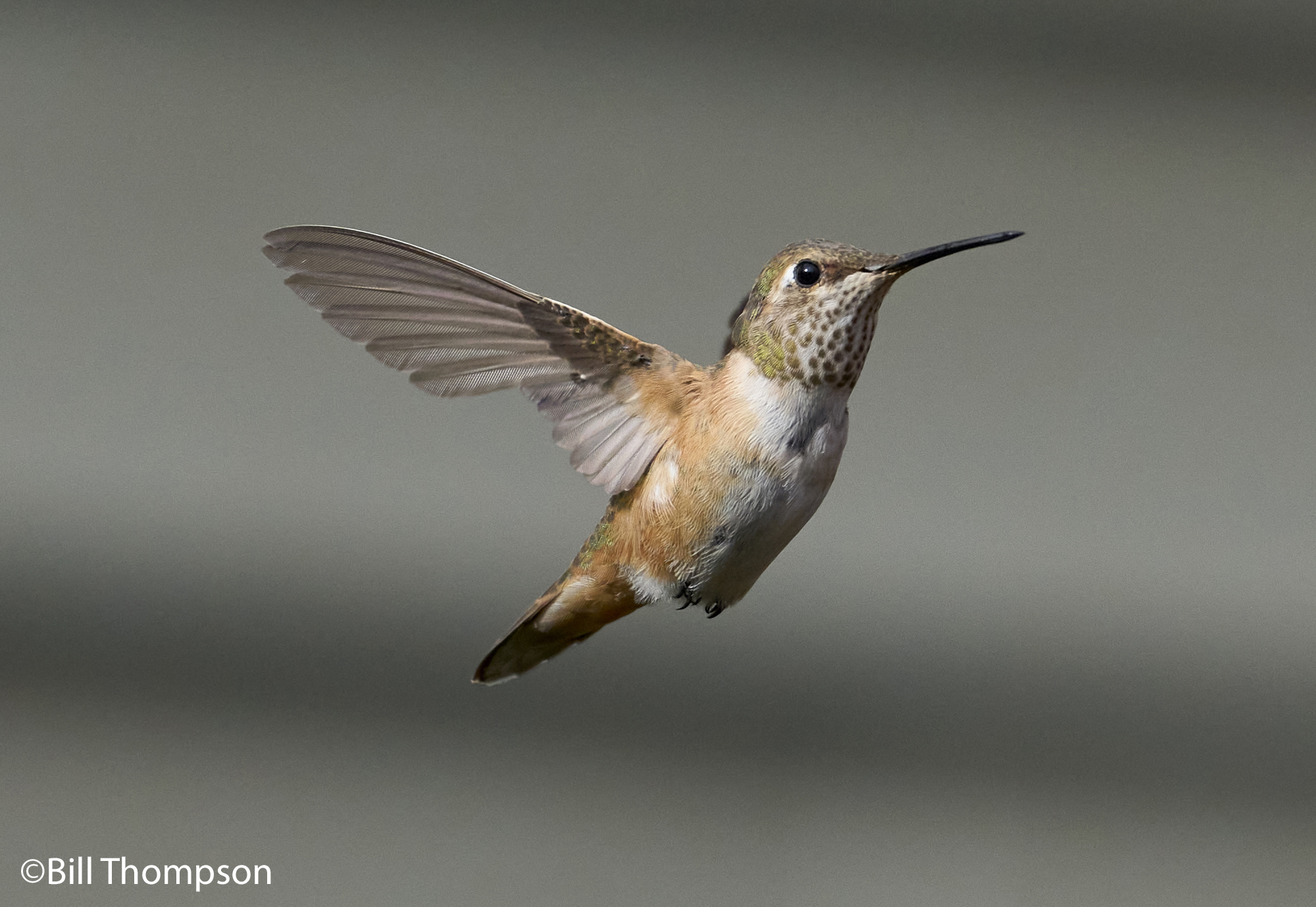
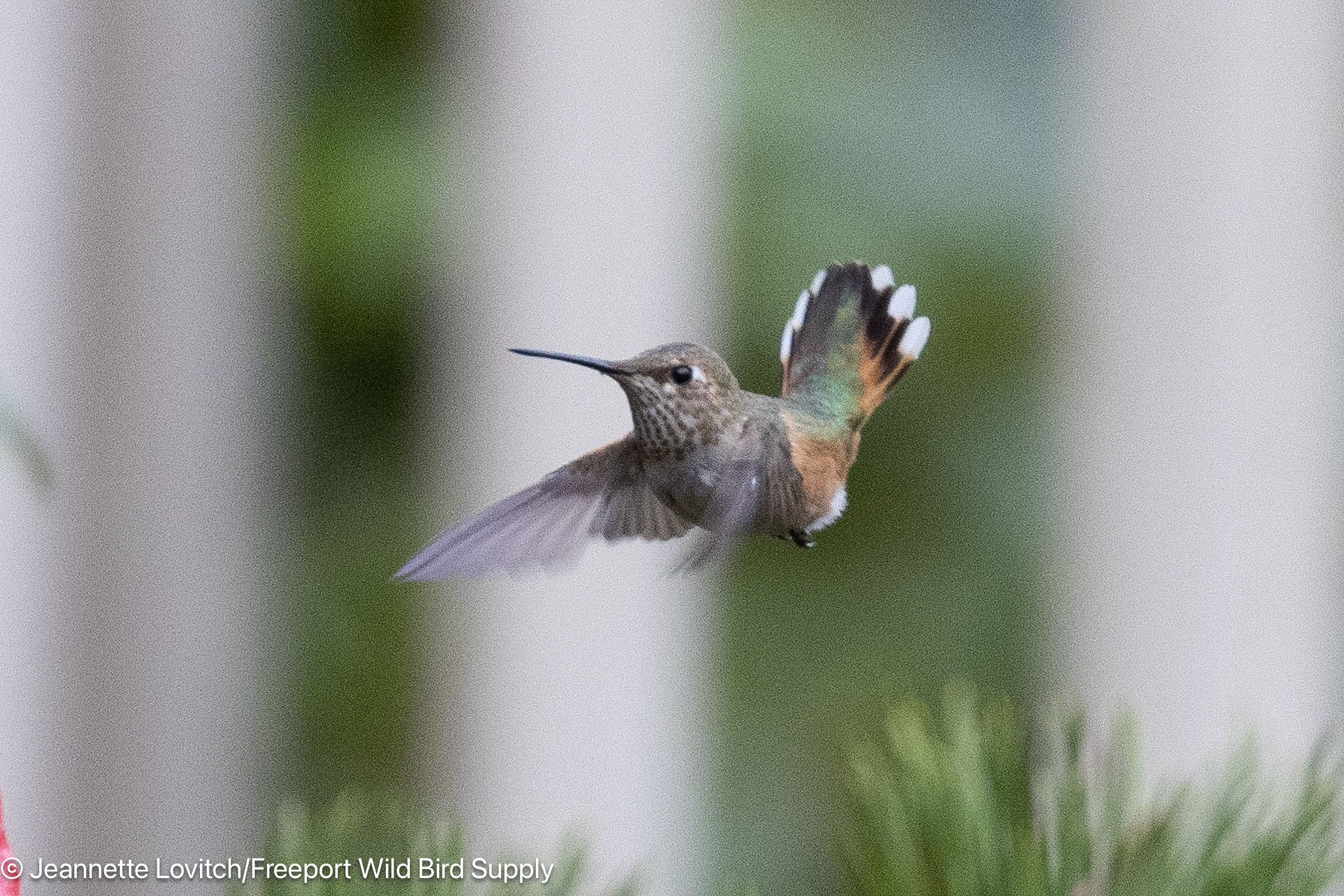
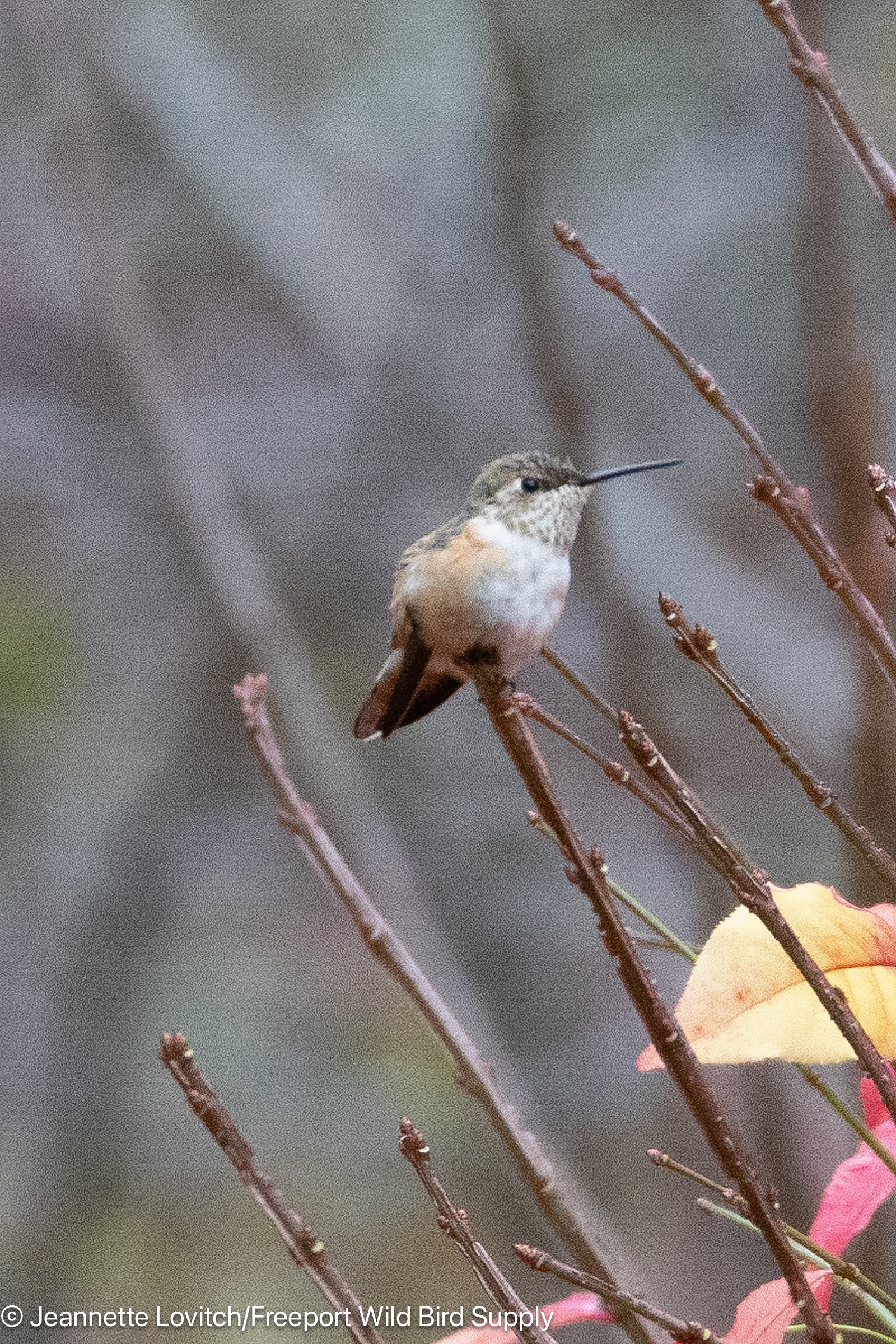
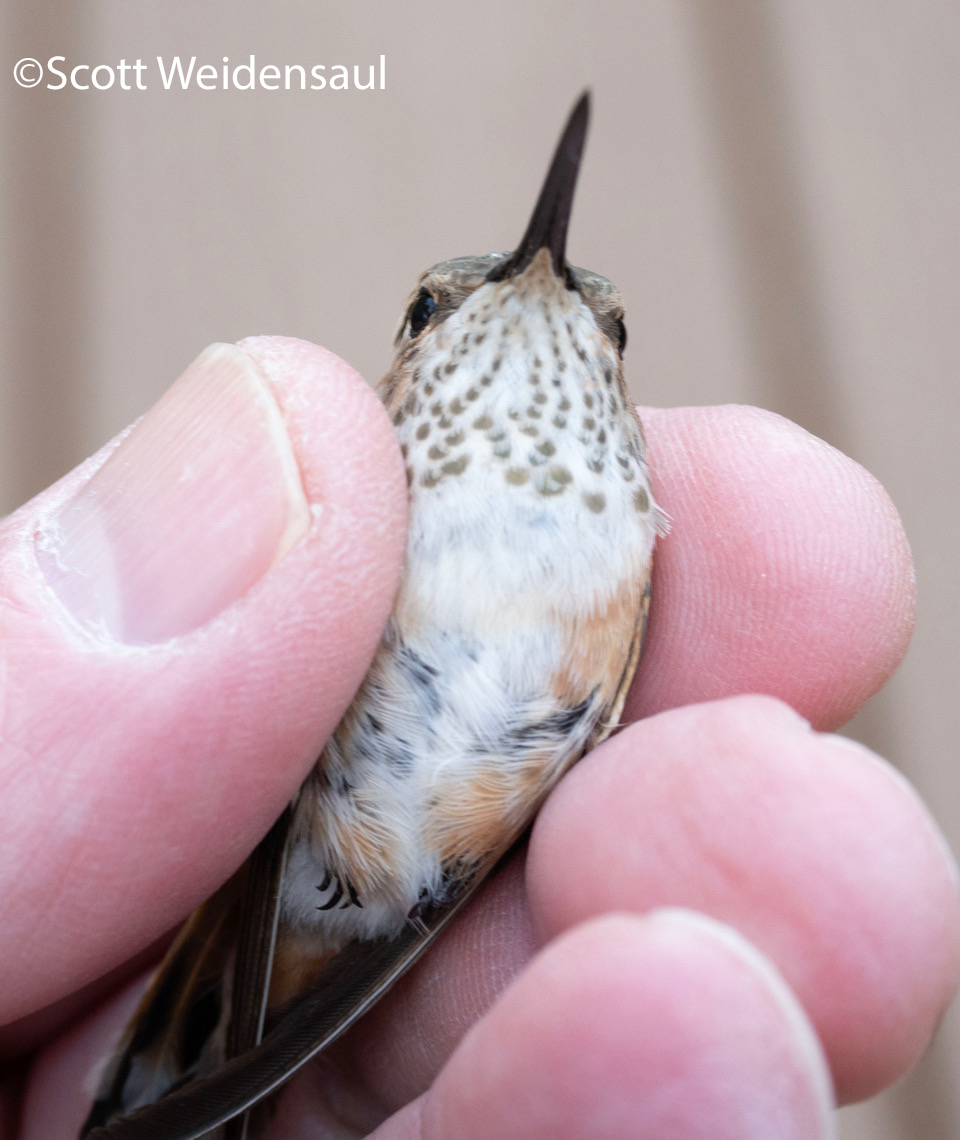
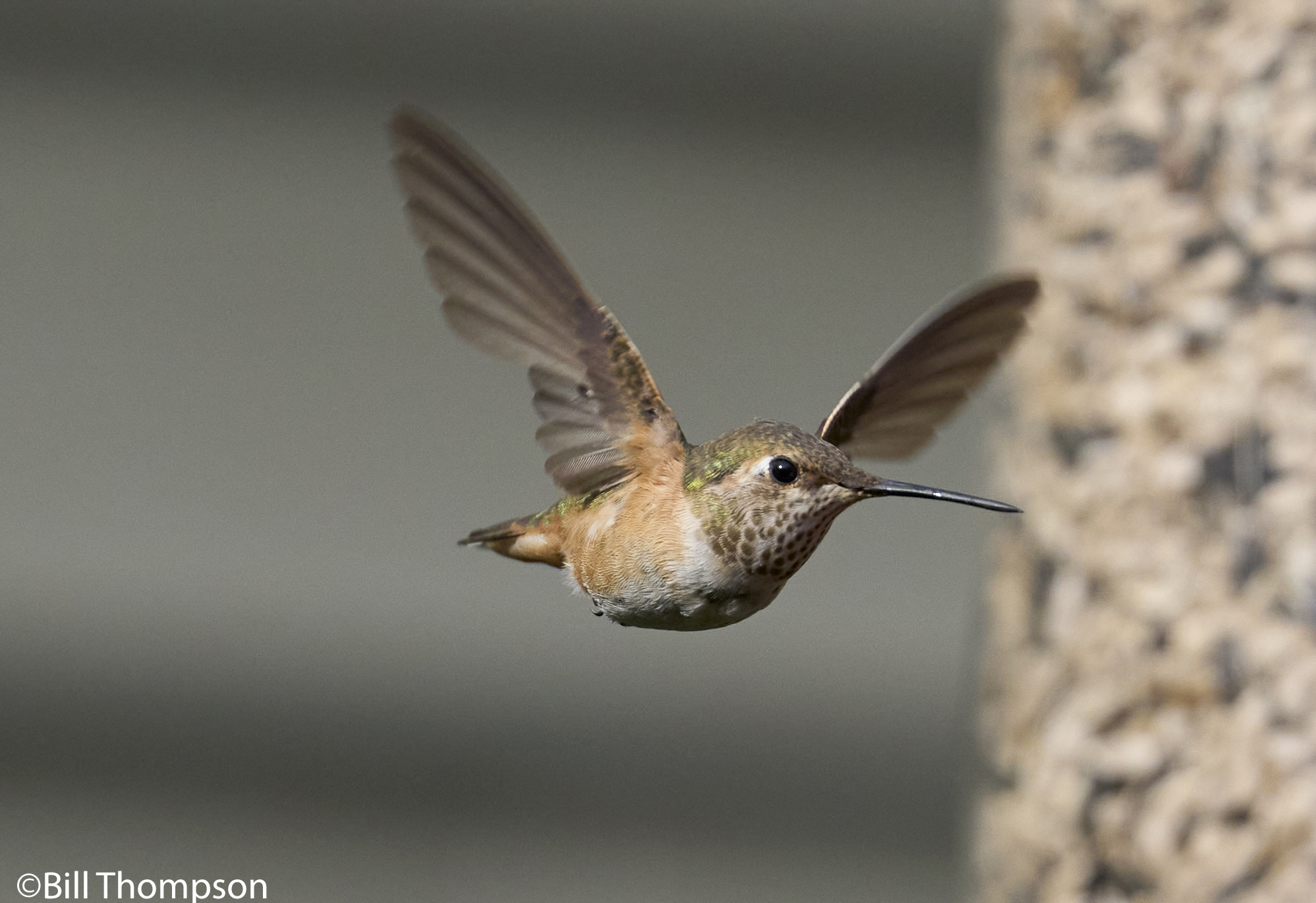
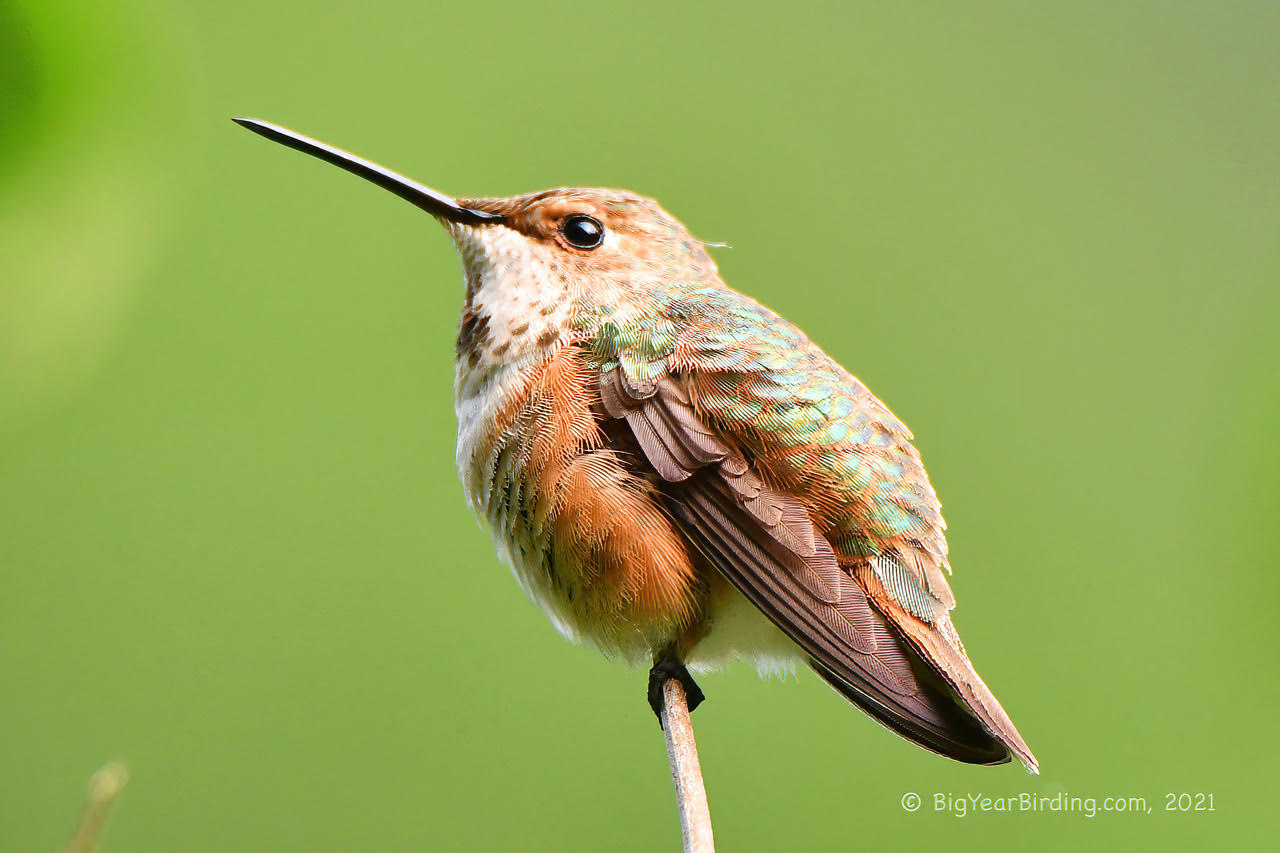
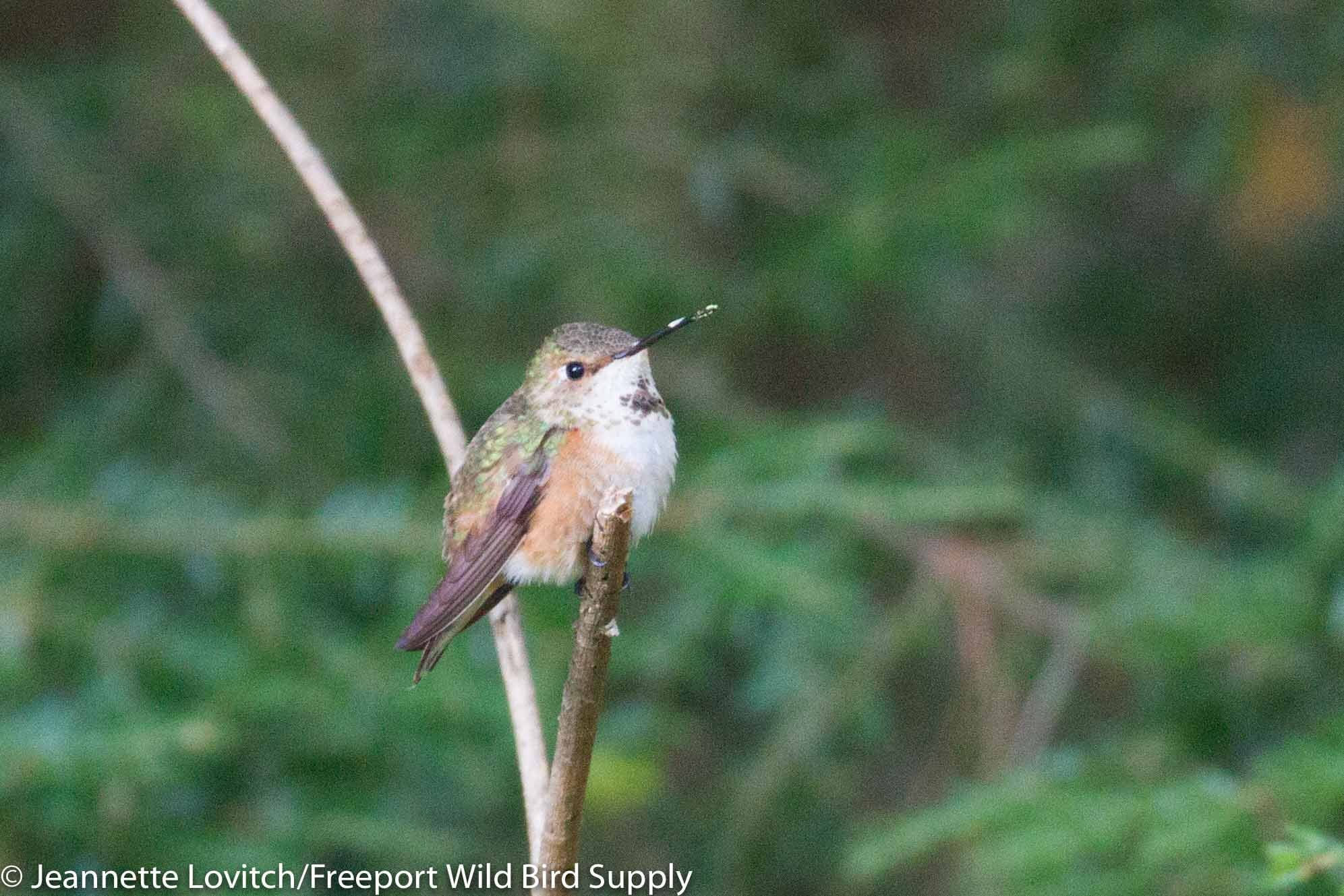
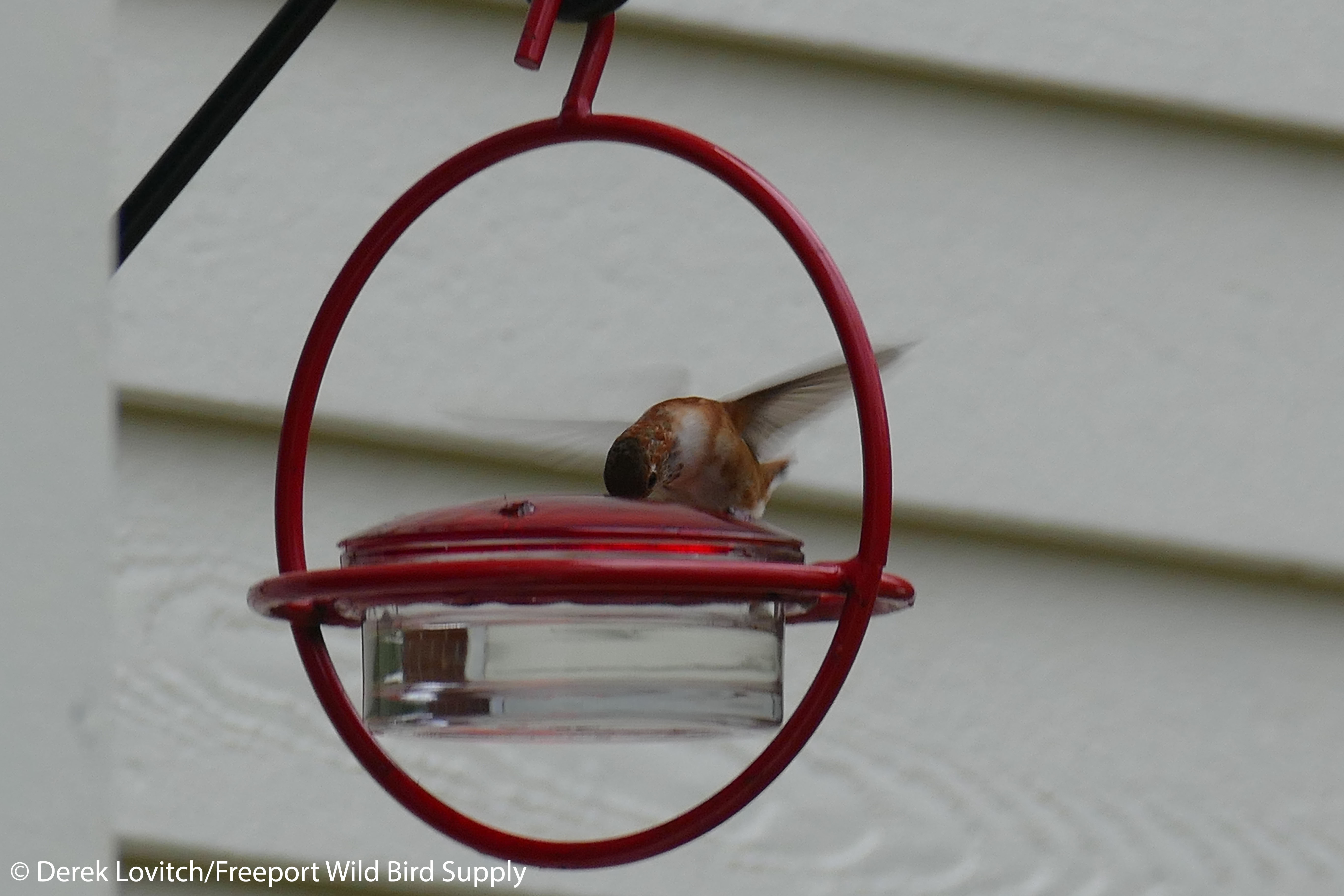
Confirmed by in-hand measurements and very detailed photographs, this adult female Rufous Hummingbird graced a Bath yard from October 31st to December 26th, 2025.
On Halloween, Sue and Bill Barker had quite a treat in their Bath yard: a hummingbird!
Each year, we put out a call on our email and print newsletter to keep your hummingbird feeders up as long as freezing temperatures permit, and to call us if you see a hummingbird after October 1st (and especially after October 7th). Among other outstanding records, this resulted in New England’s first Broad-tailed Hummingbird in 2022.
This year, we have received five hummingbird reports since October 7th, with the previous four including photos and/or video that were good enough to identify as Ruby-throated. Or, at least, rule out everything but that and the state’s first Black-chinned Hummingbird (we’re waiting!). Given the date of the 10/31 report, the statistics suggest that it’s more likely to be something else, so I asked for some photos.
Sue took some photos through her window and screen, and they suggested a warmth in overall color to the bird that would be on the extreme end of Ruby-throated Hummingbird. Sue invited me over for a look, and after waiting for about 45 minutes in the early afternoon on November 2nd, the bird appeared and soon flashed the reddish-brown in the tail indicative of a hummingbird in the genus Selasphorous.
My photos are not very good (mediocre camera in shadow and low afternoon winter light), but they clearly show a Selasphorous hummingbird.
After discussing the situation with the homeowners, it was clear that, unfortunately, this was not a location that could be made public. It sucks, but there was no way to share this widely. Small, dead-end road, partially shared driveway, proximity to the house and the neighbor’s house, and all of the other circumstances that can lead to well, things going wrong when masses appear. We’ve had this happen often enough to guard against it, and privacy and homeowners’ rights always come first in our book (it’s partly why we are trusted with these special birds!). I did wander around and see if there was enough parking nearby to place a hummingbird feeder in a much less intrusive location (like we did with the aforementioned Broad-tailed) but that wasn’t practical or feasible in this case. I am sorry.
But needing to know more, and learn the bird’s identification, the decision was made to allow a very small number of visitors to contact the homeowner and arrange a time to view the bird and obtain additional photographs. I reached out to Scott Weidensaul, and arrangements began to be made to have it captured, banded, measured (and released).
Of course, I dispatched Bill Thompson immediately! And as usual, he “crushed” it!
Highly suggestive – and perhaps all but conclusive, short of in-hand measurements – of an adult female Rufous Hummingbird based on the observations and photographs by several of us, and especially with a close analysis of the tail feathers in particular (critical for these non-adult male Selasphorous), Scott attempted to band it. Unfortunately, the first effort was not successful.
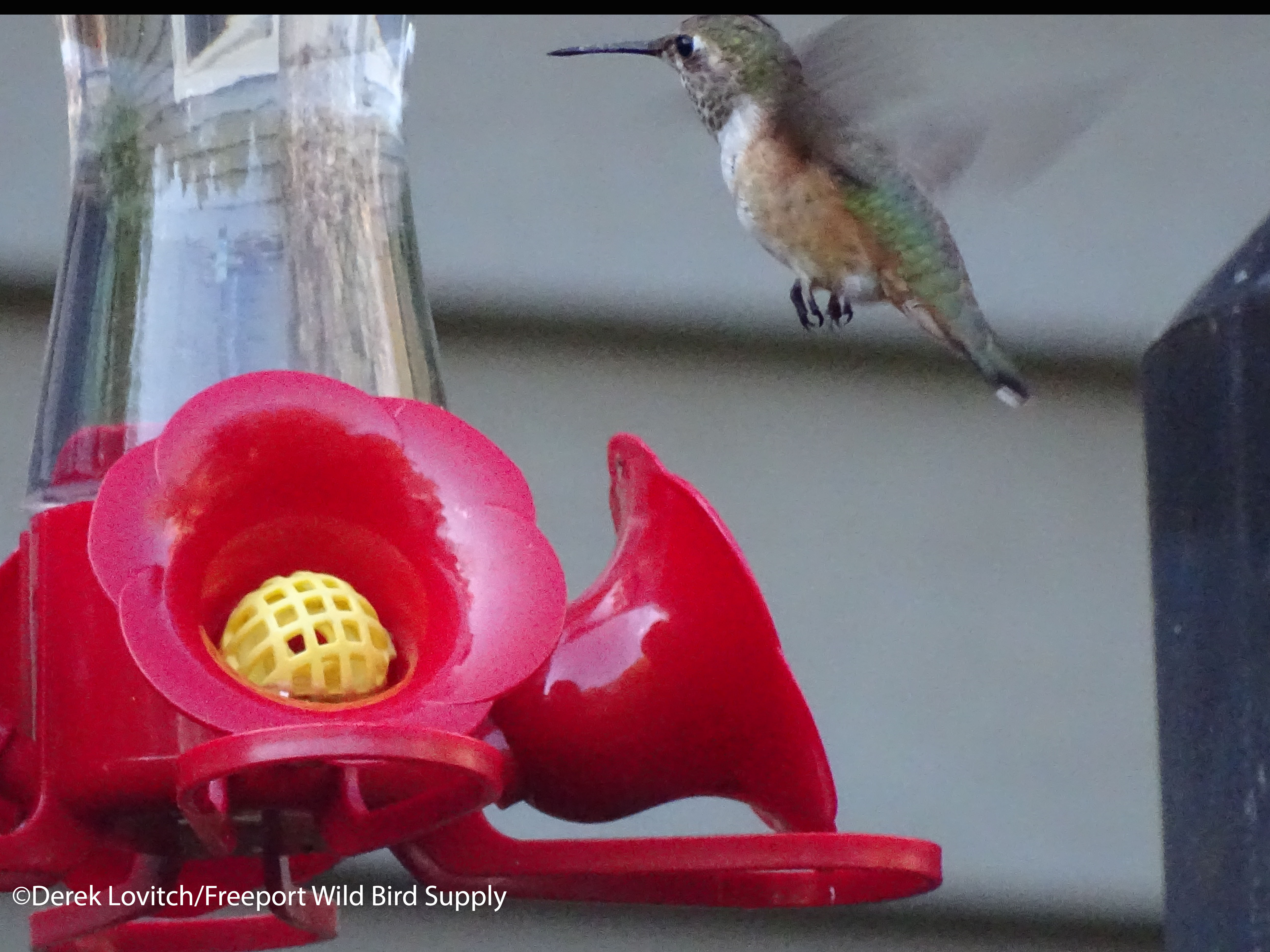
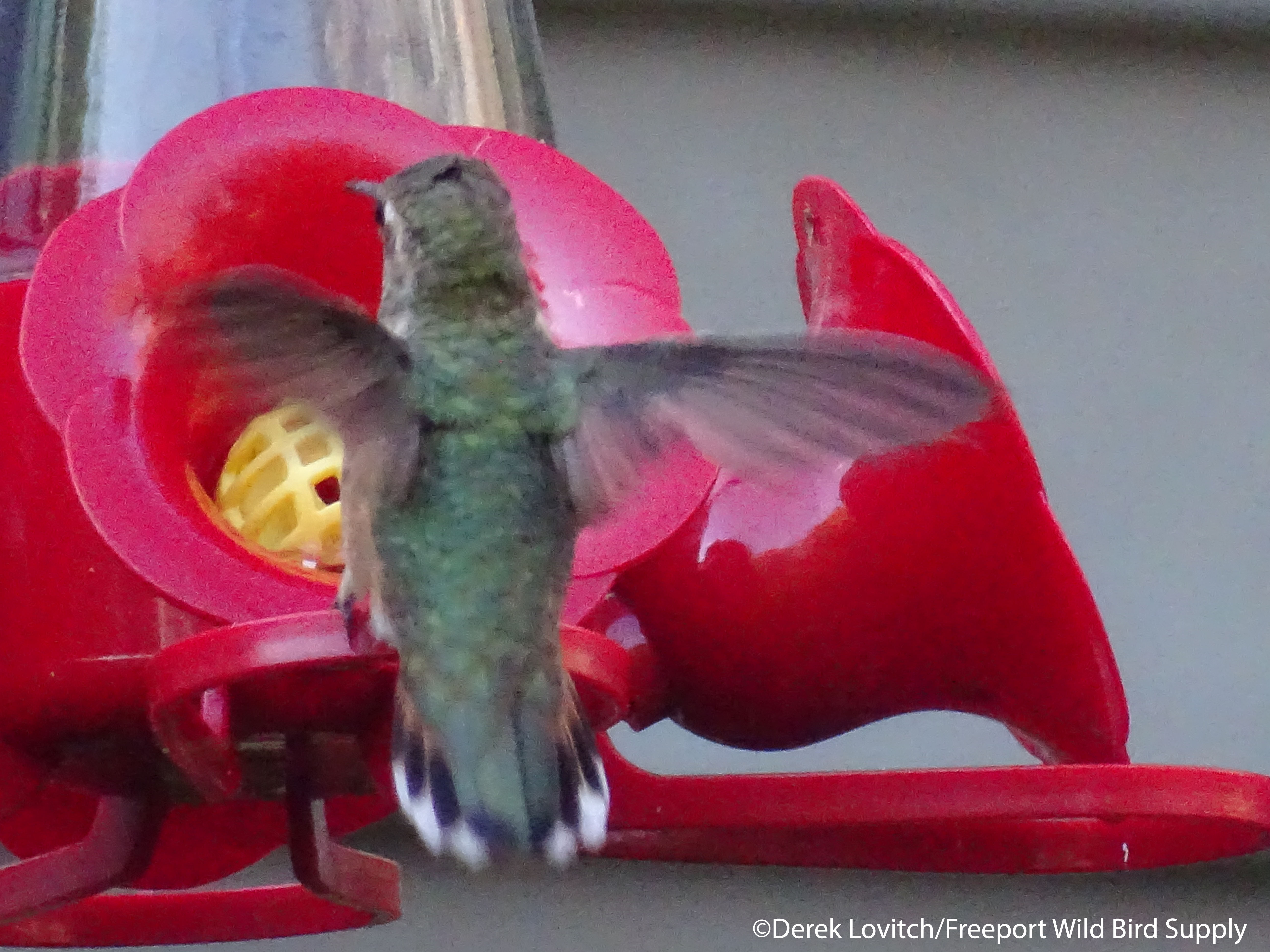
The bird continued to visit, more frequently and reliably as the days got shorter and colder. On 11/11, Jeannette and I visited the yard and were treated to three visits in a mere 30 minutes. While Jeannette worked on getting additional photos, I observed the bird’s behavior and feeding pattern in case we needed to get creative with the next banding attempt. I saw where she came from, fed in the backyard, then perched in a sunny bush with a good view of the front feeder, before feeding longer at that front yard feeder. And then repeat the pattern, as hummingbirds are wont to do.
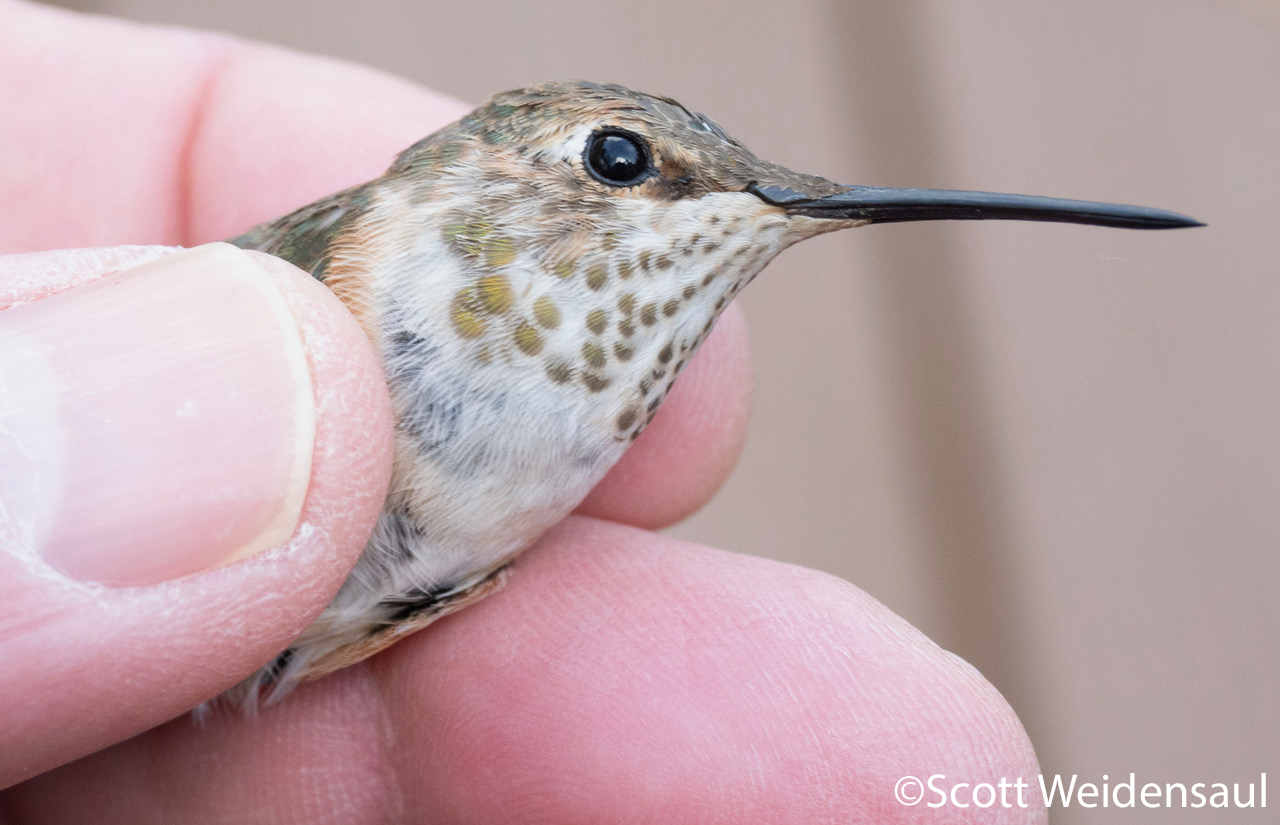
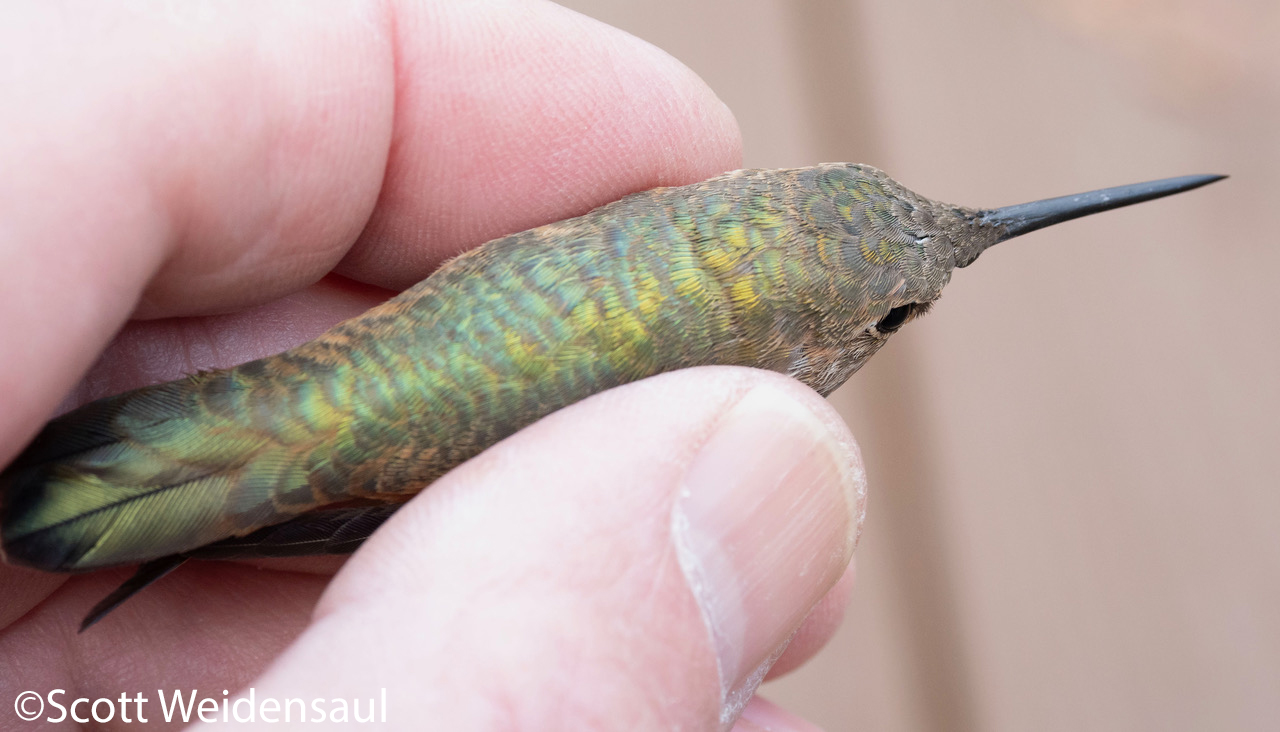
Then, on 11/14, Scott Weidensaul successfully trapped and studied the hummingbird in the hand, taking measurements and confirming our identification of adult female Rufous Hummingbird. This would be the 15th or 16th accepted record of Rufous Hummingbird in Maine according to the Maine Bird Records Committee. However, “unreviewed” reports likely include identifiable individuals, and I stand by my identification of this bird in our Pownal yard in 2021 as a Rufous Hummingbird, despite the lack of measurements in the hand (she departed before banding could be arranged).
And here’s the official banding report from Scott:
Band number: J73404 (the J code stands for 5100-, which won’t fit on the band). Species: Rufous hummingbird Age: After hatching year (adult, at least two years old) Sex: F Wing: 44.15mm Tail: 26mm Culmen (bill): 19.92mm
Bill grooving: 0 (typical for an adult) Gorget feathers: 20+ Weight: 3.5 grams Fat (0-5 scale): 3 Width of R5: 3.69mm R2: moderate nippling
Scott then said, “All of her measurements are in line for a female rufous vs. and Allen’s. Her wing, tail and culmen measurements are all good for RUHU but beyond the upper limit for ALHU, which would lack the slight notch or nipple on R2. All in all she seemed to be in great shape and was quiet and cooperative in the hand.”
__________________________
Rufous vs Allen’s Hummingbirds, in non-adult male plumages are one of the most challenging identifications in all of North American birds, and so all the stops were pulled out here to confirm it’s identification. This blog will be submitted to the Maine Bird Records Committee for its review as well to add to “the record.”
When Jeannette and I first opened the store way back in 2004 (!), we were surprised to find out how persistent the myth of “take down your hummingbird feeders by Labor Day or they won’t migrate” was. It’s simply untrue. Instead, we encouraged people to keep them up much, much later, as it’s the latest migrants that need the help of supplemental food the most, especially after the first hard frost that knocks out most if not all of local flowers, such as the late blooming native, Orange-spotted Jewelweed. We also knew that there had to be more records of rare hummingbirds occurring in Maine, so we encouraged people to keep their feeders out, their eyes open, and to give us a call.
Meanwhile, a frequent question we receive is “what happens to these really late hummingbirds?”
It’s a great question! And with banding, we are beginning to find out! For example, a lot of these birds are departing the northeast on favorable winds after strong cold snaps but in good condition (fat score in particular). That suggests birds are doing the right thing and leaving when they need to.
With an increasing number of banded Rufous Hummingbirds – and other species – overwintering in the southeastern US, and returning in subsequent years, we know that not all of these vagrants are evolutionary dead ends. In fact, perhaps just the opposite – the survivors who are adapting to a changing world and a changing climate.
Thanks to our loyal customers and observers, this is the 3rd Rufous Hummingbird that has come to light through us, along with one other Rufous/Allen’s, and of course, the famous Broad-tailed. And countless truant Ruby-throated Hummingbirds have been aided (and we have confirmed at dozens of late Ruby-throats, averaging about 5 direct reports of late hummingbirds after October 7th each year since 2014) along the way.
Sue and Bill’s Rufous hummingbird turned out to be just as tough as so many vagrant hummingbirds in the Northeast prove to be. Sue reports, “Our little friend made it through all that snow and the low temps, but I think by last Friday she had had it and took off. She was real active in the morning, (we saw her frequently), and was doing a lot of feeding. Then she was gone.”
Thanks to Sue’s diligent care, and the deployment of a heated hummingbird feeder – the same one that sustained the Broad-tailed as it was donated to the cause by its host! – the Rufous was afforded every opportunity to fuel up, continue to molt and build strength, and depart when she was ready.
This perfectly fits the pattern and behavior of “lingering” vagrant hummingbirds. Scott added “That sounds like absolutely classic departure behavior…My hope is that one of my many colleagues down on the Gulf Coast will recapture her this winter, read that band number and let us connect the dots. No guarantees, obviously, but it happens more often than you’d think… And Derek and I will be waiting to perhaps hear from you again next fall that she’s back, because *that* happens even more often than later, distant encounters.”
While I personally had planned to get back over there for some updated photos to see if her molt has progressed at all, I didn’t make the time before she finally departed. I am OK with that! I join Sue, Bill, and Scott in wishing her on her way!
On Saturday, July 31st, 2021, Jeannette and I were sitting on our back porch in Pownal sharing a beer in our usual after work beer o’clock/feeder and yard bird watch. We almost skipped it, however. We were leaving for a trip the next day and had yet to pack, the mosquitoes have been annoying, and besides, the Olympics were on. But I said “It’s my birthday and I can have a beer on the porch if I want to!”
We were enjoying our beverage while watching the constant activities of baby woodpeckers learning the ropes at the suet and nut feeders, and the aerial acrobatics and constant combat of hummingbirds. I’ve worked hard at increasing our hummingbird population with feeders, of course, but more importantly a near-constant source of natural nectar throughout the season. We have been rewarded in our efforts with two nesting females almost every year, and a constant stream of adult males. And now juveniles were about to fledge, adding to that activity.
It was about 7:00pm when I was enthralled with a particularly aggressive dogfight in the red Bee Balm. And then I basically did a spit-take when one of the combatants flashed rufous in its tail.
A SELASPHOROUS HUMMINGBIRD!!!!
I scrambled for the binoculars, Jeannette raced for her camera, and Bonxie wondered what all of the commotion was about and why we were disturbing his chipmunk watching.
We observed and photographed it for over an hour, finally retiring inside for dinner at about 8:15 when the hummingbird activity shut down for the evening. Emails were sent and calls were made.
Here are Jeannette’s best photos from the evening:
It was already getting dark, it was tough to observe details, and her shutter speed was too slow to capture motion: and we really needed to see the spread-tail to have hopes of identifying this inordinately tricky genus.
We decided to invite a handful of folks over to our yard the next morning to share in our excitement over this special backyard visitor. We also hoped to have more long lenses pointed at that tail!
Studying the books and reviewing the photos – along with soliciting some input from other birders – it became readily clear that this was an adult female (based on overall wear and throat pattern) Rufous or Allen’s Hummingbird. We systematically eliminated the other members of the genus, and saw nothing suggestive of the even less likely Allen’s. But this is one of the most challenging species-pairs in North America, depending on the age and sex.
The next morning, 6 people joined us on the porch, and luckily, our bird showed up. And eventually, showed up really, really, well! Unlike the previous evening however, where she spent prolonged periods at the feeder, she rarely lingered at any one flower or feeder for long before be driven off by one of the resident Ruby-throats (at least two adult males, 2 adult females, and either another female or a juvenile were all present and protecting their resources). Plenty of photos were taken, but we had not yet seen the tail pattern clearly.
Jeannette and I really needed to go pack now, and so we left the hummingbird watchers to themselves. Eventually, Bonxie went off to camp, I packed the car, and soon it was time for us to depart. Luckily, Ethan and Ingrid remained vigilant as Ethan finally acquired those critical tail shots:
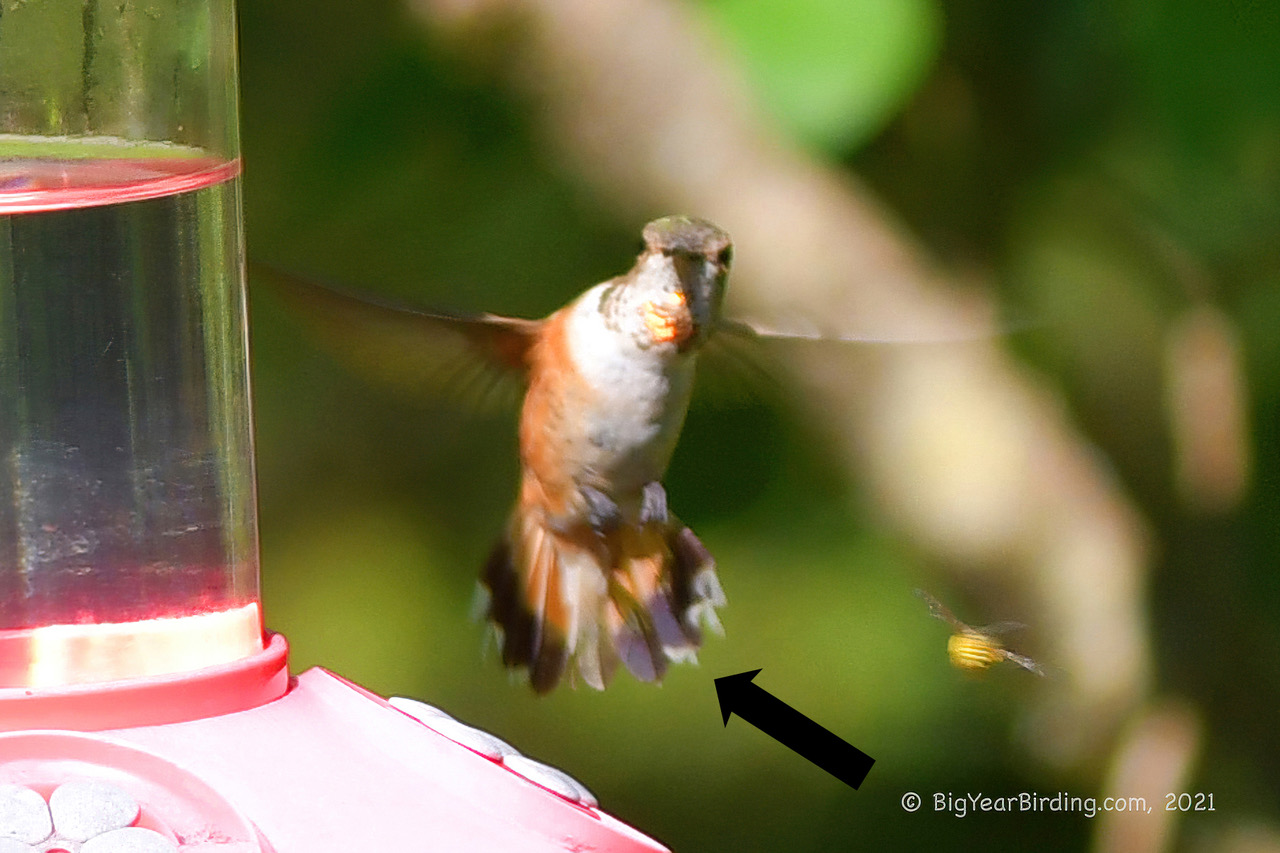
His arrows point to the critical R2, the 2nd tail feather from the center on each half of the tail. On most – but not all – adult female Rufous Hummingbirds, there is an emargination (often called a “nipple tip”) which is not present on Allen’s Hummingbird. Unfortunately, this birds tail is worn – not surprising at this time of year – and the exact original pattern is just impossible to deduce.
We are therefore left with less-reliable set of field marks and circumstances. Often, the fallback here is to band and measure it, but we decided not to consider that unless she was still present when we returned.
So this is what we have:
Tail feathers, including R5, look “wide enough” to be a Rufous. This is pretty subjective visually, however, and usually takes in-hand measurements to confirm.
Limited rufous in the uppertail coverts as expected on Rufous.
Overall wear and fading of plumage is rather minimal; most Allen’s Hummingbirds would look very worn and likely really tattered by now.
The circumstantial evidence is also quite strong:
Rufous Hummingbirds are early long-distance migrants who are on the move in the west by now. Breeding as far north as southeastern Alaska, Rufous Hummingbirds have a pattern of fairly regular vagrancy to the East in late summer. Allen’s does not.
The only New England record of Allen’s Hummingbird is from Nantucket on 8/26/1988 (Massachusetts Avian Records Committee). Admittedly, that is only a month later (I was surprised to learn!).
The next closest records are seven in New Jersey (mostly from Cape May) that all were first found between September 3rd and November 14.
Of course, the preponderance of unconfirmed/unidentifiable “Rufous/Allen’s Hummingbirds” records clouds the judgment of this pattern of occurrence a little.
We already had scheduled someone to take care of our feeders while we were gone, and when he did so on 8/4, he did not see our Selasphorous. We returned home in the evening of 8/8, and sugar water was still available and our meadow of Wild Bergamot was now in full bloom. But alas, our visitor was not present. There were plenty of Ruby-throats still buzzing around – perhaps one less adult male and one more juvenile now, but not surprisingly, our vagrant had continued on, whether by choice or by force.
Now if she was still here, we would have pondered opening our yard up to visitors (not visible from the road, let alone a public one) and perhaps arranging for a bander to visit and attempt to capture her for measurements. But alas, these are the best shots and information we have to work with at this time.
So I am still soliciting comments, but personally, I think this bird is a Rufous Hummingbird. While we might not have absolute conclusive proof, I see absolutely nothing to suggest Allen’s so for me, I am happy with the most probable identification and Rufous Hummingbird is our 133rd Yard Bird!
And after 16 years here, our backyard has finally attracted a bona fide vagrant (although the two Hoary Redpolls were pretty great as well). I just wish her timing was a little better. Then again, she could have shown up the next day and we would have never known! Nevertheless, it was a wonderful birthday present!
Thanks to Michael O’Brien and Paul Lehman for helpful comments on the bird’s suspected identity, and especially to Ethan Whitaker for the diagnostic (or nearly so?) photos.
References:
Howell, Steve N.G. 2002. Hummingbirds of North America: The Photographic Guide. Princeton University Press: Princeton and Oxford.
West, George C. 2015. North American Hummingbirds: An Identification Guide. University of New Mexico Press: Albuquerque.
Williamson, Sheri L. 2001 Hummingbirds of North America. Houghton Mifflin Company: New York and Boston.
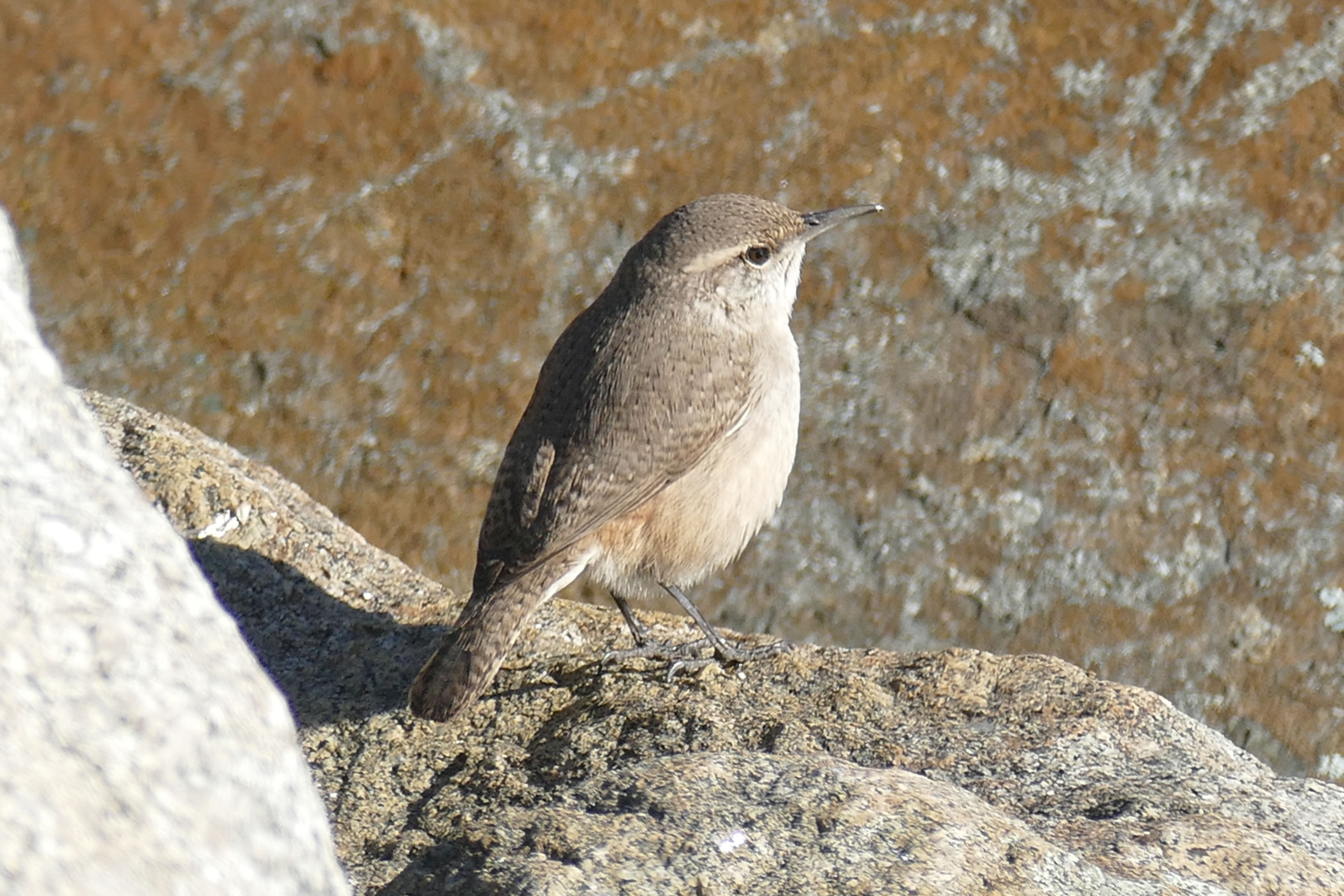
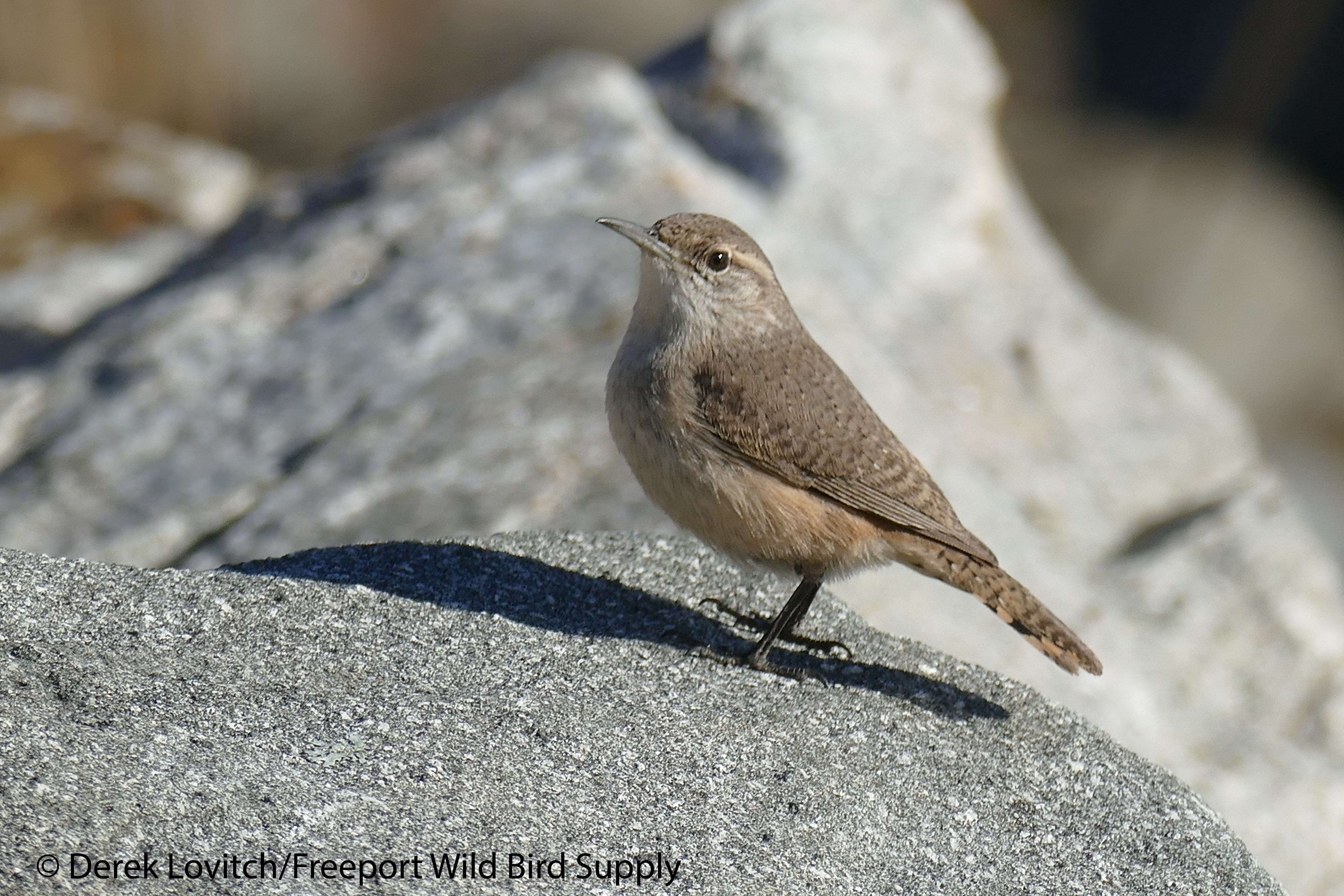
It might “only” have been a second state record, but the Rock Wren that was discovered along Marginal Way near the Perkin’s Cove parking lot in Ogunquit in November was a state bird for everyone who enjoyed it during its long stay that continues right through today.
It’s once again time for my annual Predictions Blog, where I view into my crystal binoculars and attempt to forecast some of the “new” birds to grace the State of Maine – and then my own personal state list – in the coming year.
2020 was definitely a different year. “Worst year ever” was a common refrain by year’s end, but don’t tell that to 2021 which seems to be taking up the challenge so far. I’ve written this blog for over a decade now, but this was the first one written about, and during, a national crisis that was so deadly that many birders stayed home for much of the year. Before spring had arrived in Maine and the deadly COVID-19 pandemic had fully arrived in Maine, trips were cancelled, many folks stayed closer to home if venturing out at all, and many birders avoided crowded seasonal hotspots. I wrote about birding in a pandemic in this early spring blog, but a small silver lining to this tragedy was the huge growth in birding, especially in the backyard. I was even interviewed about this in the New York Times this summer.
By fall, the growth in birding and bird-feeding and the new online community connections made while stuck at home yielded even more opportunities to see amazing birds and add some really spectacular rarities to brand-new life lists. A massive incursion of birds from the western US was underway throughout the East this fall, and this resulted in some of the most incredible “mega” rarities, such as Rock Wren and Bullock’s Oriole. The first chaseable Rufous Hummingbird in many years was another real crowd-pleaser and was made accessible by gracious hosts.
Nonetheless, there were not any first state records detected this year. Therefore, my list of next 25 species to occur in Maine for 2021 remains unchanged:
Neotropical Cormorant
Graylag Goose
California Gull
Spotted Towhee
Hammond’s Flycatcher
Bermuda Petrel
Black-chinned Hummingbird
Common Shelduck
Trumpeter Swan (of wild, “countable” origin)
Audubon’s Shearwater – on “hypothetical” list, but I think the record is good).
Little Stint
Anna’s Hummingbird
“Western” Flycatcher (Pacific-slope/Cordilleran)
Common Ground-Dove
Allen’s Hummingbird
Redwing
Spotted Redshank
Painted Redstart
Ross’s Gull
Black-capped Petrel
Lesser Nighthawk
Elegant Tern
Kelp Gull
Black-tailed Gull
Common Scoter
Despite such a great year for rare birds in Maine, I actually only added two birds to my own state list however. But they were good ones! But first, let’s check in with last year’s prediction list to see how I did…at least for the birds, the rest of the year, no, I did not predict.
As usual, there were also a handful of potential state birds for me that I did not see. Common Ringed Plover (#12) on Seal Island in September and a Sooty Tern (Honorable Mention) on Matinicus Rock following Tropical Storm Isaias were obviously beyond my reach, obviously, a Franklin’s Gull (#5) in Lamoine on 11/5 did not linger, and a Yellow Rail (#22) was kept secret. The big miss however was the Golden-crowned Sparrow (Honorable Mention) in October at a feeder in Abbot that I just did not chase for a variety of reasons, including how busy the fall was at the store.
So a few tweaks to my list for my next additions to my personal state list are as follows:
American White Pelican
Neotropic Cormorant
Franklin’s Gull
Brown Pelican
Graylag Goose
California Gull
Black-bellied Whistling-Duck
Slaty-backed Gull
Boreal Owl
Calliope Hummingbird
Common Ringed Plover
Cerulean Warbler
White Ibis
Gull-billed Tern
Hammond’s Flycatcher
Spotted Towhee
Pacific Golden-Plover
Wood Stork
Ross’s Gull
Black-chinned Hummingbird
Brewer’s Blackbird
Yellow Rail
Loggerhead Shrike
Virginia’s Warbler
Common Shelduck
So let’s see what 2021 brings to the Maine birding world. A return to a sense of normalcy would be a nice start, however.
My favorite rarity photo of the year, however, was the Freeport Bullock’s Oriole feeding in front of the Maine state flag!
Incredible…a Rock Wren and a Rufous Hummingbird…in Maine…in December. It was a big week! Western birds in the East and finches from the north continue to be the stars of the show.
My observations of note over the past seven days included the following:
1 Common Grackle continued at the store through 11/28.
1 Turkey Vulture, I-95 South, Scarborough, 11/29.
The ROCK WREN, Marginal Way, Ogunquit, 11/29 (with m.obs). Photos above.
1 immature White-crowned Sparrow, 1 Savannah Sparrow, and 1 Swamp Sparrow, Private property in Cape Elizabeth, 11/30.
2 Brant, Dyer Point, Cape Elizabeth, 11/30.
1 continuing immature male RUFOUS HUMMINGBIRD, Ledgewood Drive, Yarmouth, 12/4. A hummingbird in Maine in December – incredible! 39F when I arrived. Observed repeatedly between 8:00 and 9:00am visiting hummingbird feeder and foraging in trees (especially at the end of spruce twigs). Photos below.
This Week in Finches:
EVENING GROSBEAK: Up to 3 continue daily at our feeders at home in Pownal; 2 (Main St, Cumberland, 12/2).
PINE GROSBEAK: 4 (in and around the yard here at the store, 12/2- present); 1 (fly-over, Ledgewood Drive, Yarmouth 12/4); 6 (Royal River Park, Yarmouth, 12/4).
Purple Finch: 0
Common Redpoll High Count This Week: 1 (Mayall Rd, Gray/New Gloucester, 12/2).
Pine Siskin High Count This Week: 32 (Ledgewood Drive, Yarmouth, 12/4).
Most of Maine’s Ruby-throated Hummingbirds have departed by the middle of September, but there are always a few migrants and lingering juveniles into the first few days of October. But as October progresses, Ruby-throats become few and far between, and with each passing day, any hummingbird becomes more and more likely to be something other than our familiar Ruby-throat. In recent years, Western vagrants including Rufous and Calliope have appeared in Maine, while neighboring states have seen several others including Black-chinned and Allen’s. It’s just a matter of time before Maine adds another hummer to its state list. In fact, my Next 25 Birds for Maine predictions list includes Black-chinned (#9), Anna’s (#13), and Allen’s (#16).
Key to the observation of late season hummingbirds is continuing to dispel the silly (but persistent) myth that you have to take down your hummingbird feeders (on some arbitrary day like Labor Day) or the birds won’t migrant. But as usual, the birds are smarter than we are, and proceed as directed by hormonal changes triggered by the decreasing daylength. A nice patch of nursed flowers or any number of hummingbird feeders won’t stop them, but it’s the last truant birds and wayward vagrants that can really use the helping hand.
Here at the store, we have been working hard to dispel this myth for years, and get people to not only keep their feeders clean and nectar fresh (and always free of dye and color!) for as long as feasible, preferably into early November. We also urge people to contact us with any hummer sightings after October 1st, and take a picture if possible.
And happily, folks have. Some have gone unconfirmed as a brief sighting came and went or we learned of the observation belatedly, and others have been nicely documented. Last fall, I chased one in Falmouth on October 14th that turned out to be a Ruby-throat, much to my surprise (and somewhat, to my chagrin). The word is getting out, at least.
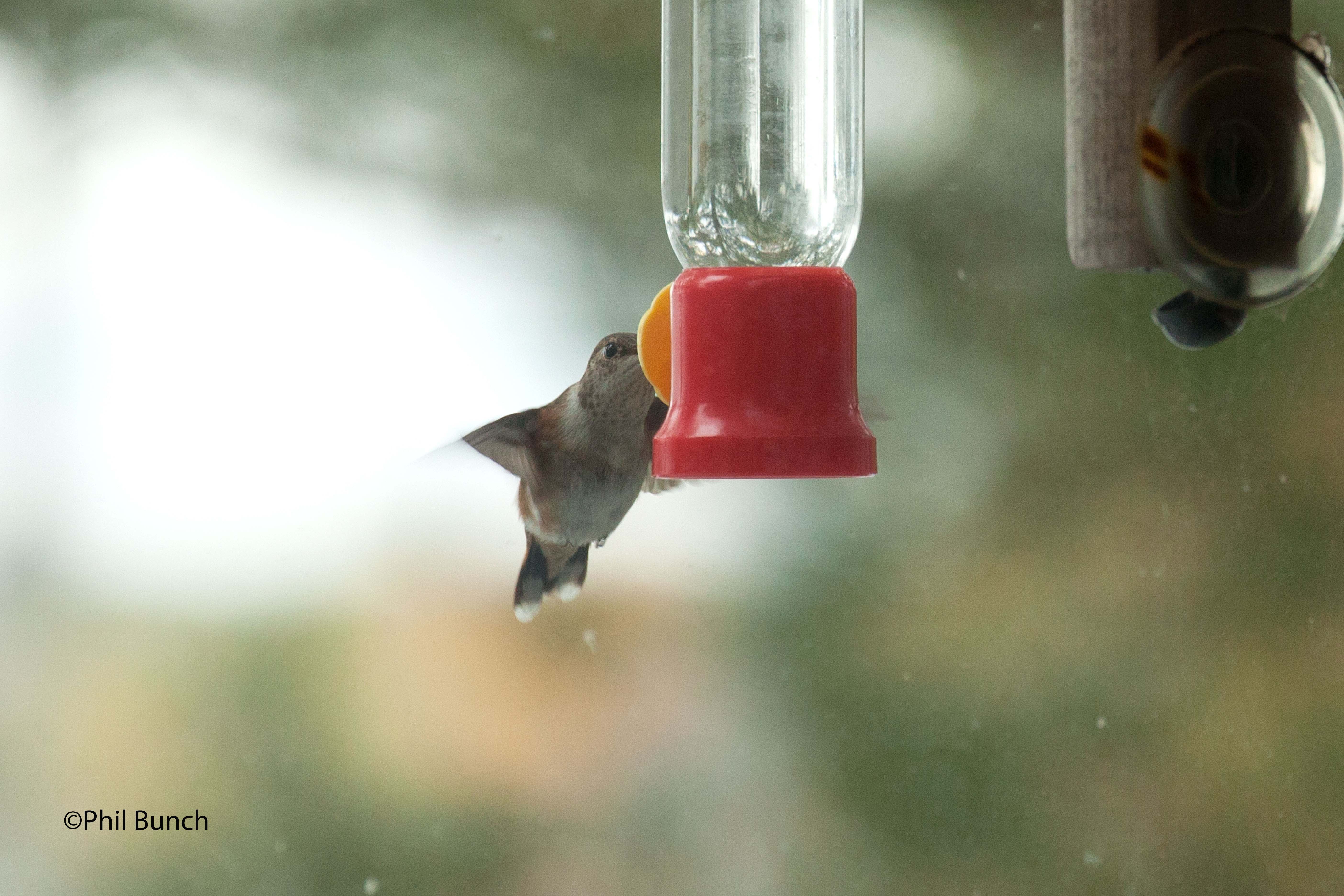
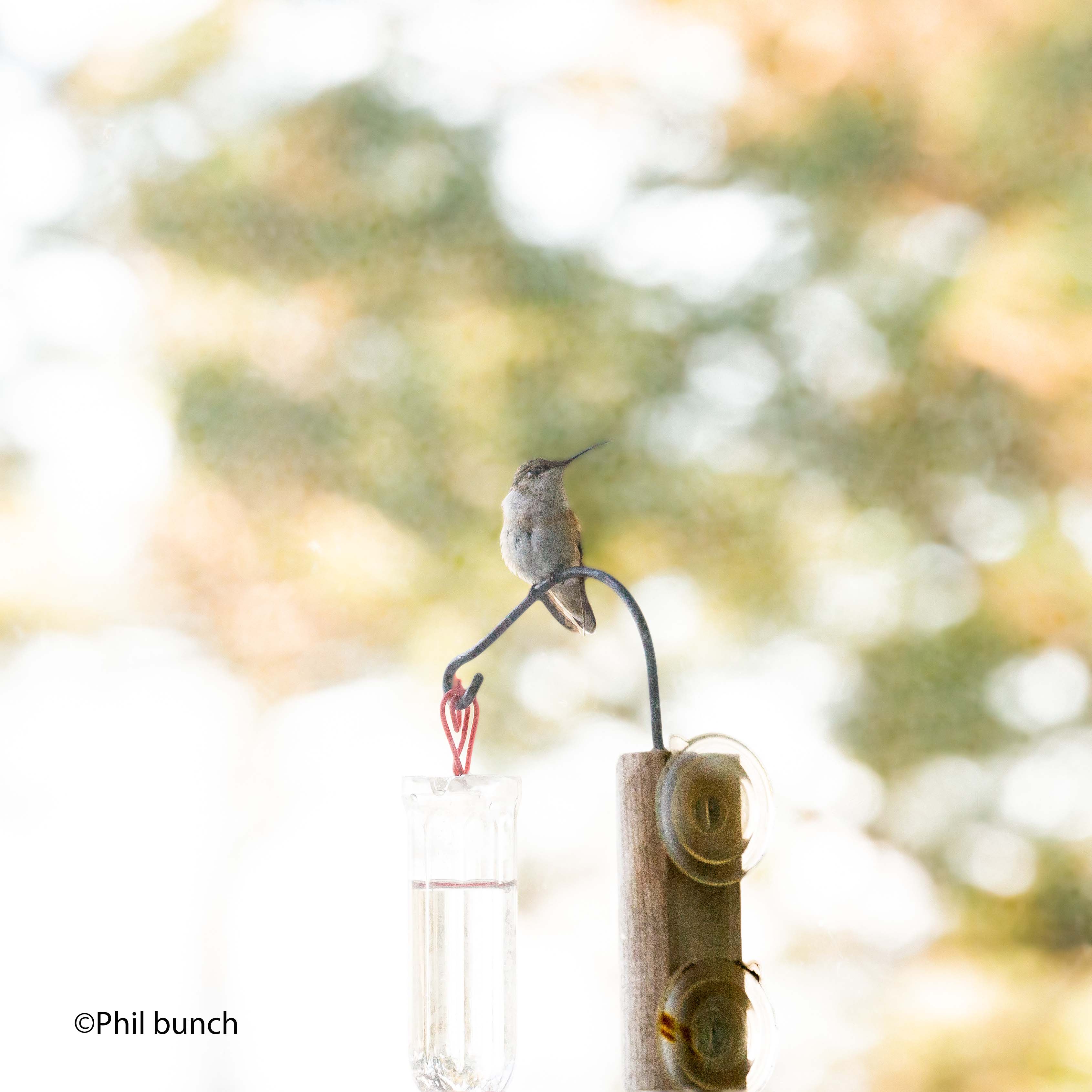
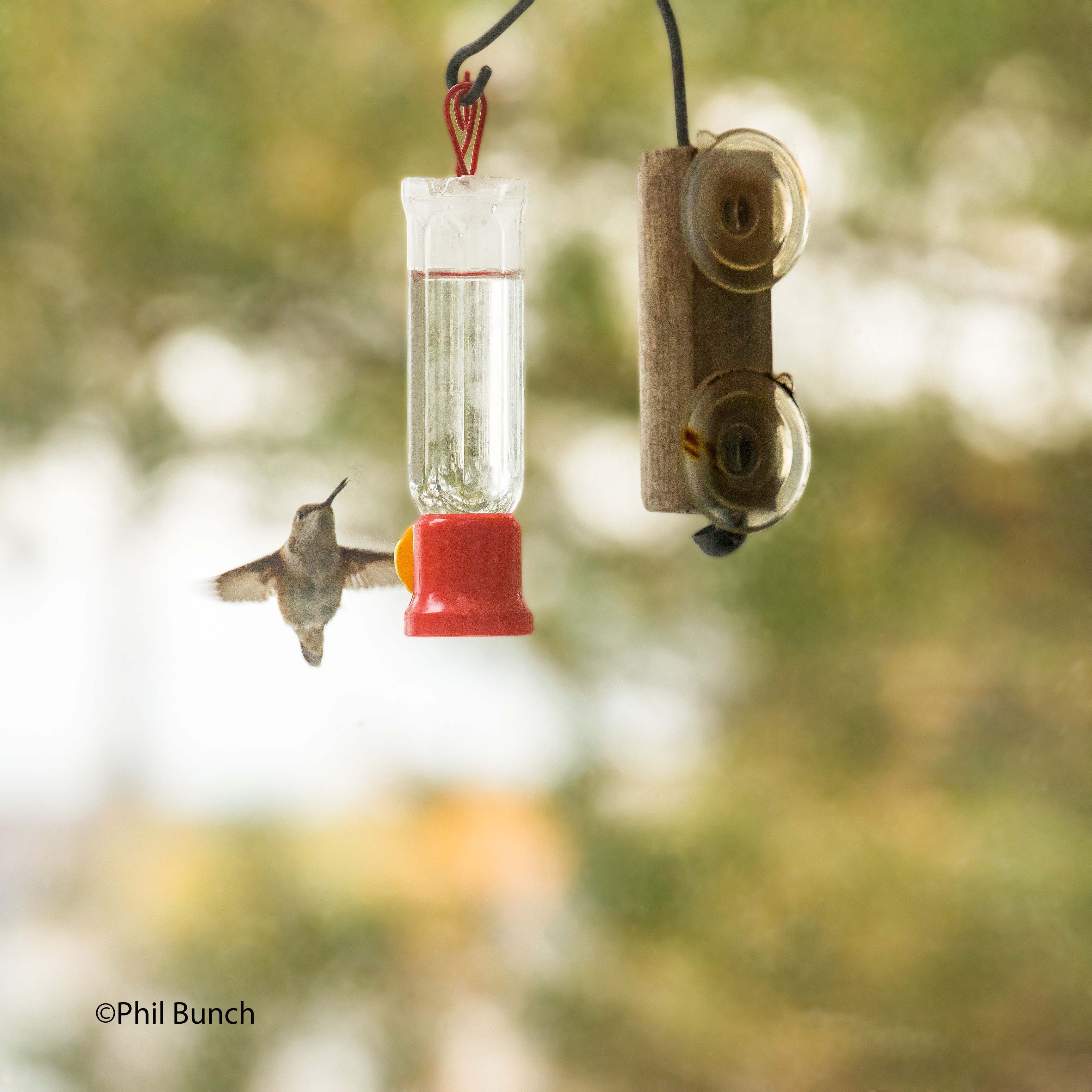
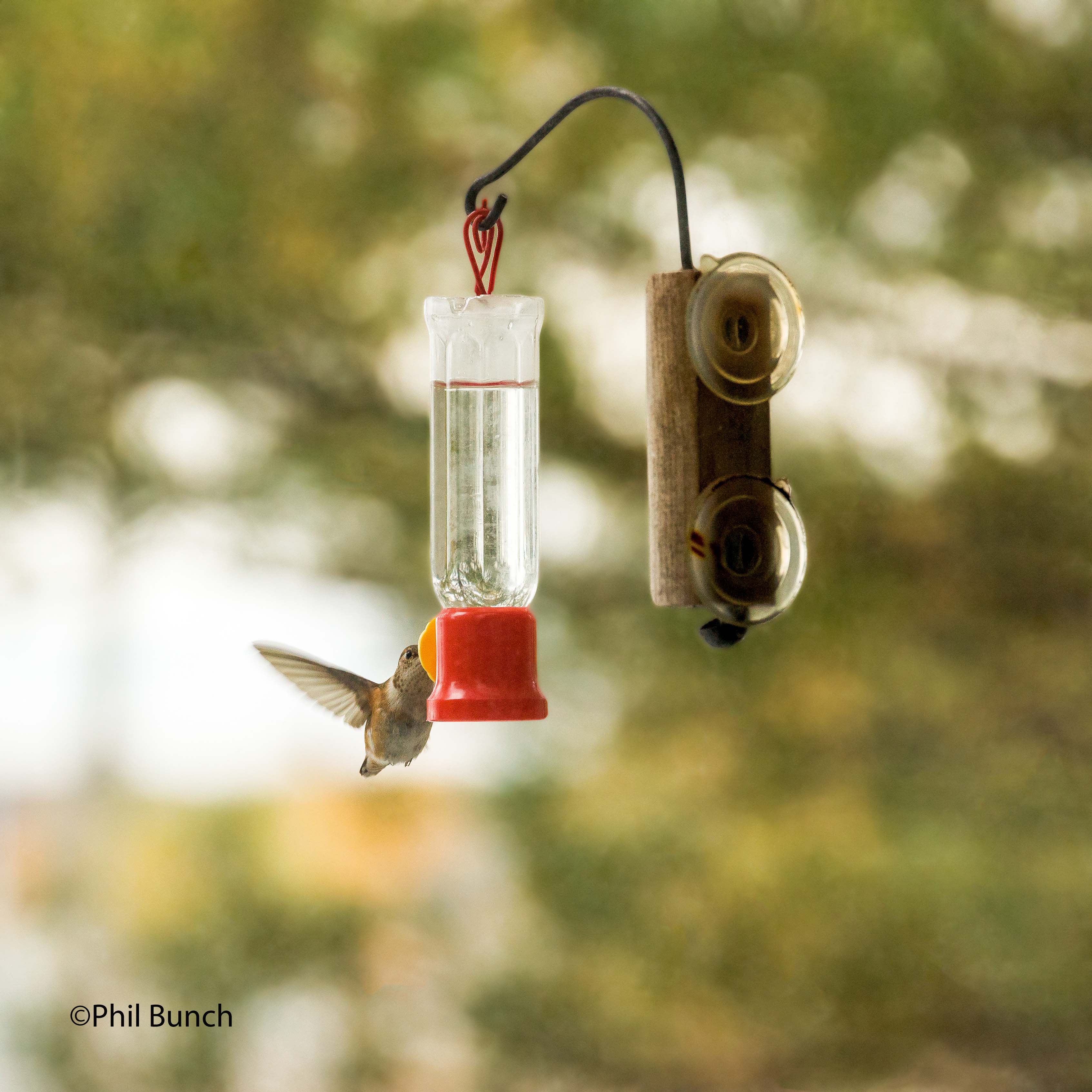
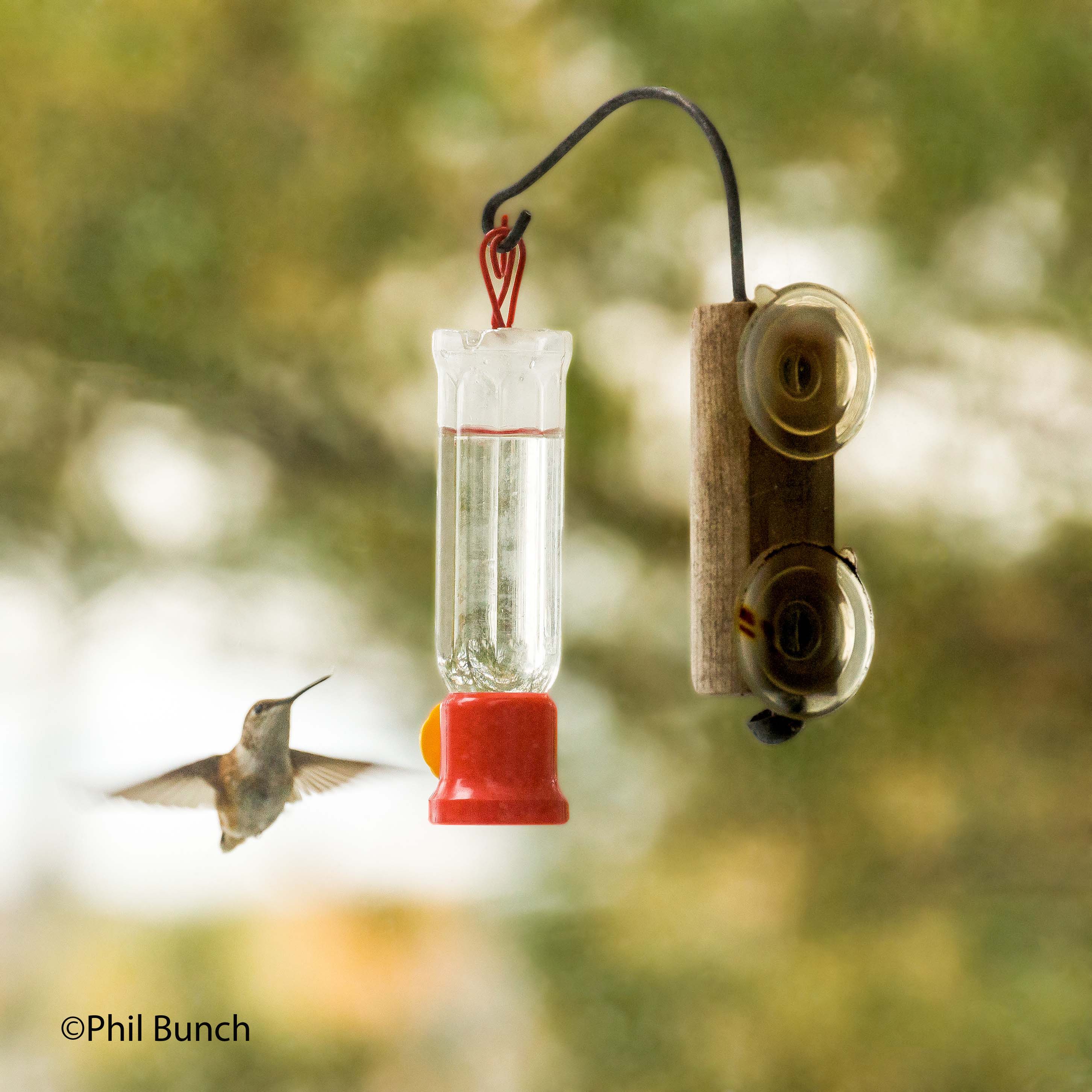
Last Friday (10/17) we got a call from Lois Randall and Phil Bunch on Cousin’s Island in Yarmouth. A hummingbird had been present all day, and it was photographed. I learned of the bird too late in the day to chase it, but I had hoped to go on Saturday. Lois told us it was still present in the morning, so I found some time in the early afternoon to make a quick run over. Unfortunately, I arrived to find out the bird was last seen at around 8:00am, but I was able to view Phil’s photos. And sure enough, this one was NOT a Ruby-throat.
(Click on the following photos for a larger image)
I received all of the photos today (10/22) and was able to take a long, hard look at them with references handy. It’s clearly a hummingbird of the genus Selasphorus, with its extensive buffy sides, buffy undertail, and – although it’s really hard to see – just a hint of the rufous in the base of the tail feather (see Photo 1). There’s not much here to work with, but the overall pale plumage and limited rufous-orange further suggests that this bird is an immature female, although some young males can be equally as pale.
And immature Selasphorus hummingbirds are tough, especially the females! In fact, most are unidentifiable beyond Rufous/Allen’s, with only (most) adult males readily identifiable in the field. In-hand measurements are usually required, or the holy grail of hummingbird photos – the upperside of the spread-tail. And of course, seeing the upperside of the tail (especially when spread), uppertail coverts, and rump would go a long way in identifying this bird, but we will work with what we have – and I am thankful for these photos (most hummingbird reports we receive are not photographed at all)!
The bill and tail both look too long to me for Calliope, and there’s probably a little too much white in the tail. I also think we can rule out Broad-tailed by the fairly extensive buff sides, but perhaps that could still be considered an outside possibility.
But despite Phil’s fine photos, I don’t think we can move beyond Rufous/Allen’s here, although the relatively broad and rounded outermost tail feathers (visible especially on Photo 1) are more suggestive of the more-expect rarity: Rufous Hummingbird. I think Photo 2 is also suggestive of the width of those outer tail feathers, but it also shows an awful lot of white, making me think we’re also seeing an artifact of light passing through the tail tips in this photo. Other photos show the buffy undertail typical of the family, better views of the sides and flanks, and the overall color and pattern of the head and throat.
Lois also diligently took some notes, and wrote them up for me: 1. First sighted on Friday October 16 at 8AM feeding amongst the flowering Agastache plants (common name: Hyssop) on our deck. As the bird darted rapidly back and forth, I caught a glimpse of its back and saw patches of iridescent green. The bird soon discovered the tube feeders hanging on our sliding glass doors and proceeded to feed on the hummingbird nectar vigorously throughout the day.
2. In addition to the single glimpse I got of the green “highlights” on areas of the hummer’s back (thanks to a flash of sunlight on an otherwise cloudy day), I noticed the white tips on the hummer’s tail, and noted rusty highlights on the bird’s “armpits”, otherwise whitish shoulders, and on the bird’s sides (flanks?) I also noted that the bird had a rounded full-looking belly.
3. I last saw the hummingbird briefly at 8AM, Saturday October 17, 2015. It visited the hyssop flowers briefly, flew off, and we haven’t seen it since. We will continue to watch for it in case it returns sometime this afternoon or tomorrow morning. Our best hope is that it “refueled” here and safely continued on its journey south.
So while this bird will remain unidentified to species, Lois’s notes and Phil’s photos combine to nicely document an immature Rufous/Allen’s Hummingbird – one of just a handful of confirmed records for Maine.
I suspect vagrant hummers are more regular in Maine then currently reported, so keep those feeders up, nurse those plants, and keep the reports coming in!












 Maine Birding Field Notes