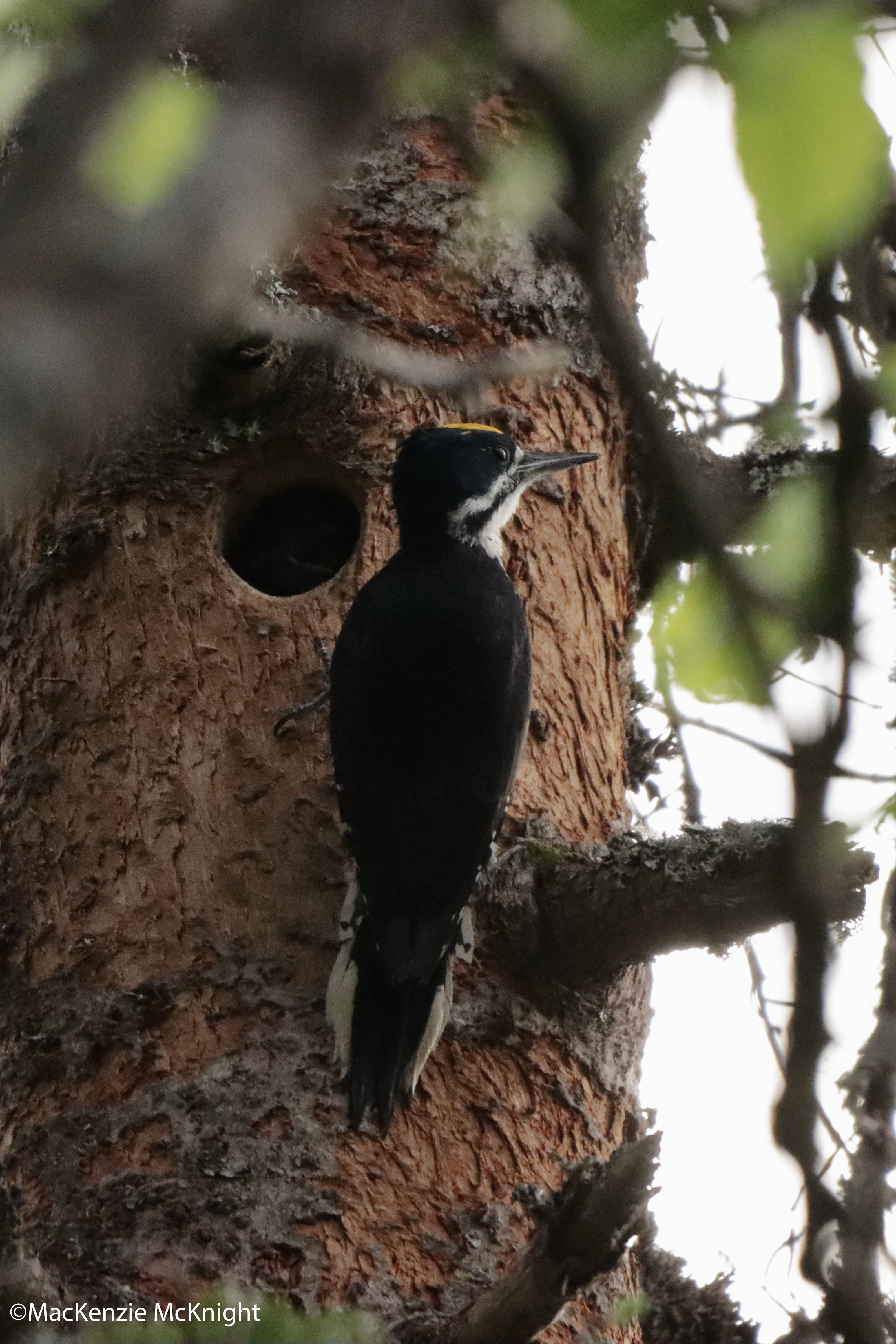
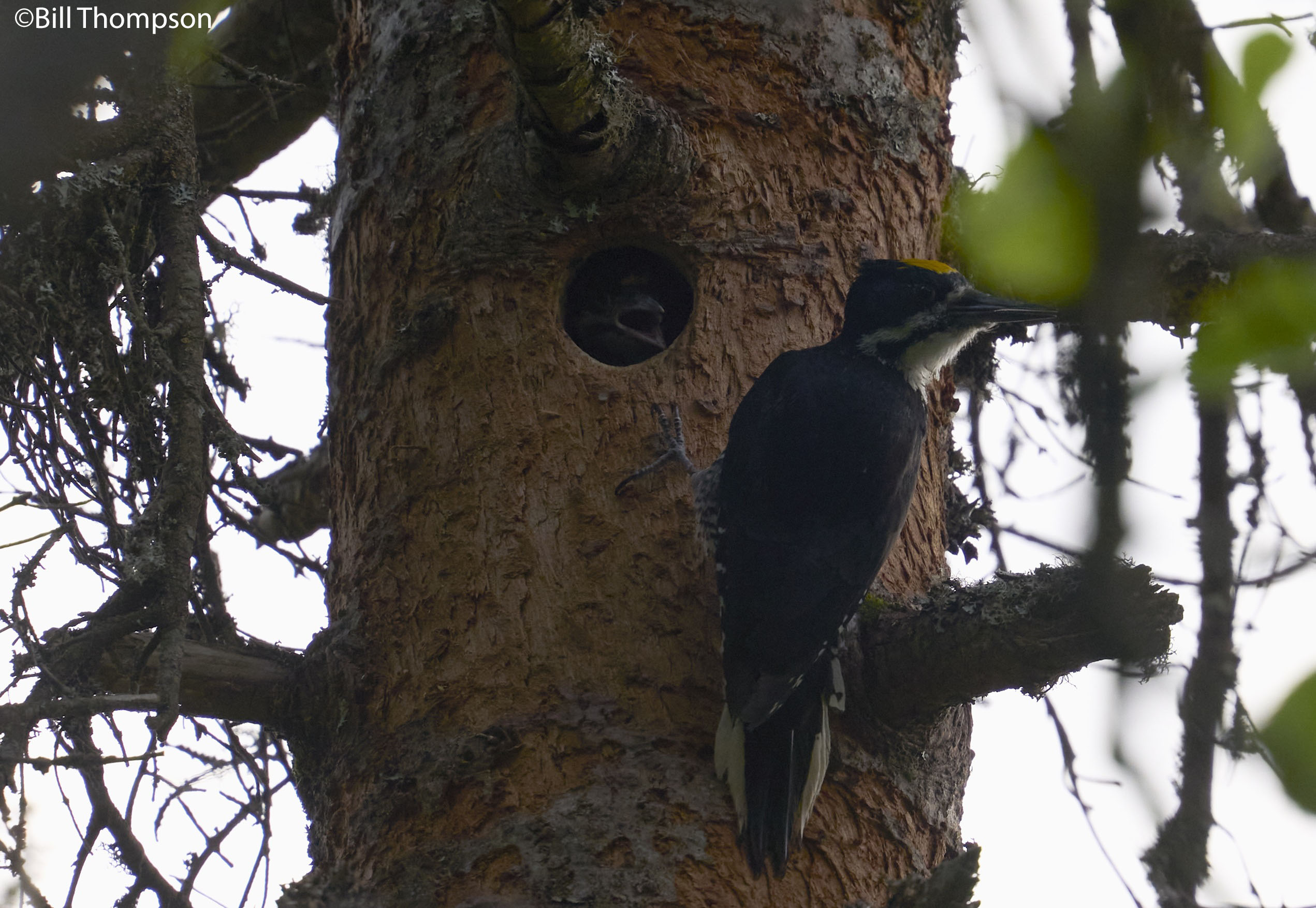
A highlight of our Bicknell’s Thrushes of New Hampshire Weekend was this Black-backed Woodpecker nest that I found on a private tour two weeks ago. By last weekend, the nestling(s?) were getting close to fledging. Thanks to Bill Thompson for the use of his photo as my camera had little interest in performing well in the low light!
After being out of town for a few days (birding highlights in New Jersey included “southern” specialties, a huge Black Skimmer colony, and the growing, awesome White Ibis rookery), I returned to Maine and jumped right back into this record-busy guiding season. From coastal saltmarshes to mountaintops in New Hampshire, a few of my less expected observations in Maine over the past two weeks included just the following:
1 Yellow-billed Cuckoo (FOY!), our property in Durham, 6/23.
1 White-winged Scoter, Fort Popham, Phippsburg, 6/24 (with clients from Vermont).
1 Vesper Sparrow, Auburn Municipal Airport, 6/25.
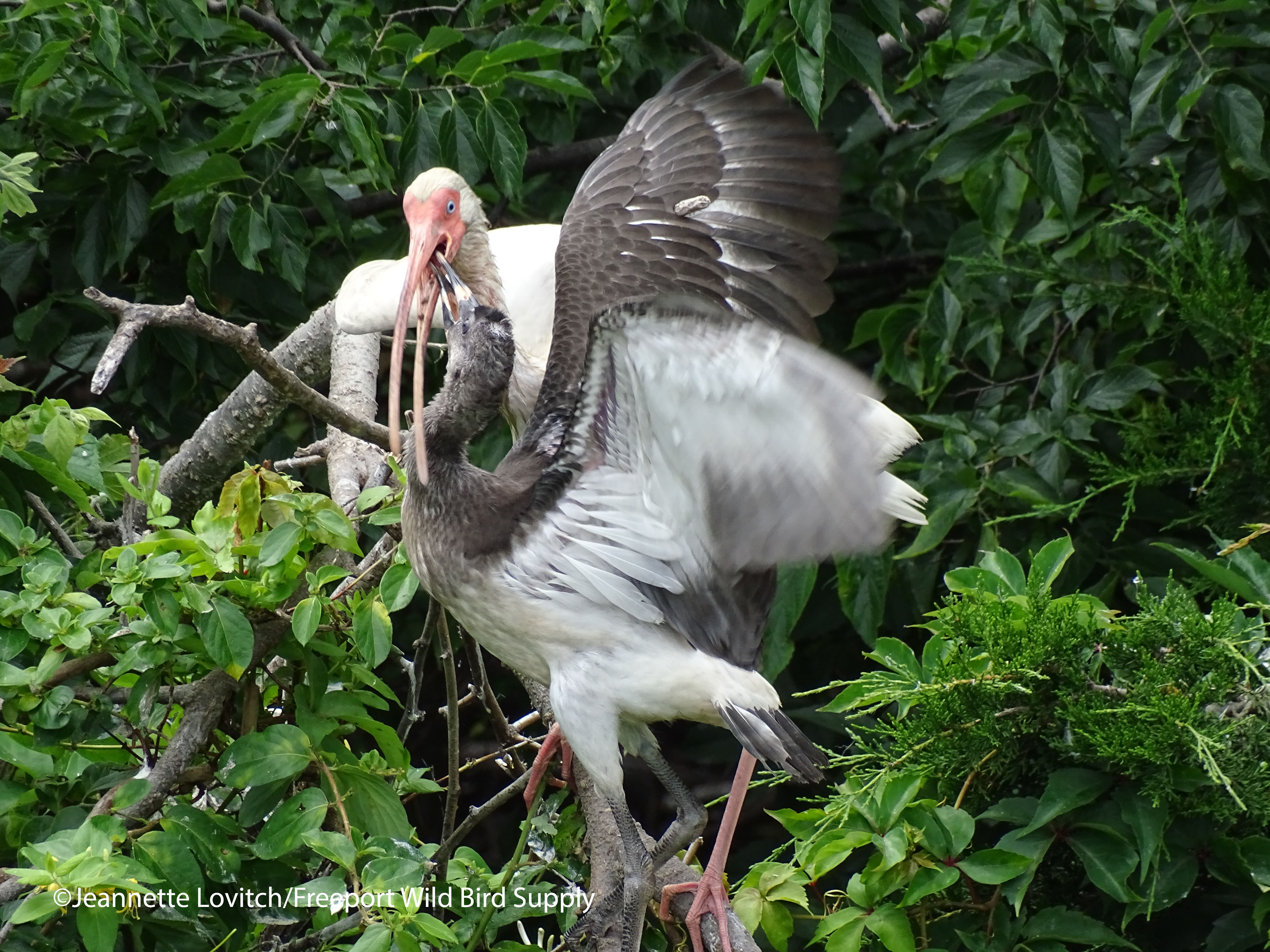
And finally, for fun, here’s a selection of our favorite photos from our visit to the White Ibis rookery in Wildwood, NJ last week.
BICKNELL’S THRUSH WEEKEND TOUR REPORT
The trip report from our recent tour can be seen here.
One of the stars of the show this weekend was this incredibly cooperative Mourning Warbler.
I’ll admit to having a love-hate relationship with this tour. I love taking people into the realm of the Bicknell’s Thrush, but I hate how much I have to stress about getting people to see one! Of course, weather is one of the primary impediments to enjoying a fulfilling mountaintop experience, and well, if I could only control that, too! And then there’s the bird – one of North America’s most reclusive breeding species, and with a behavior that tends to lead to sleep deprivation as well.
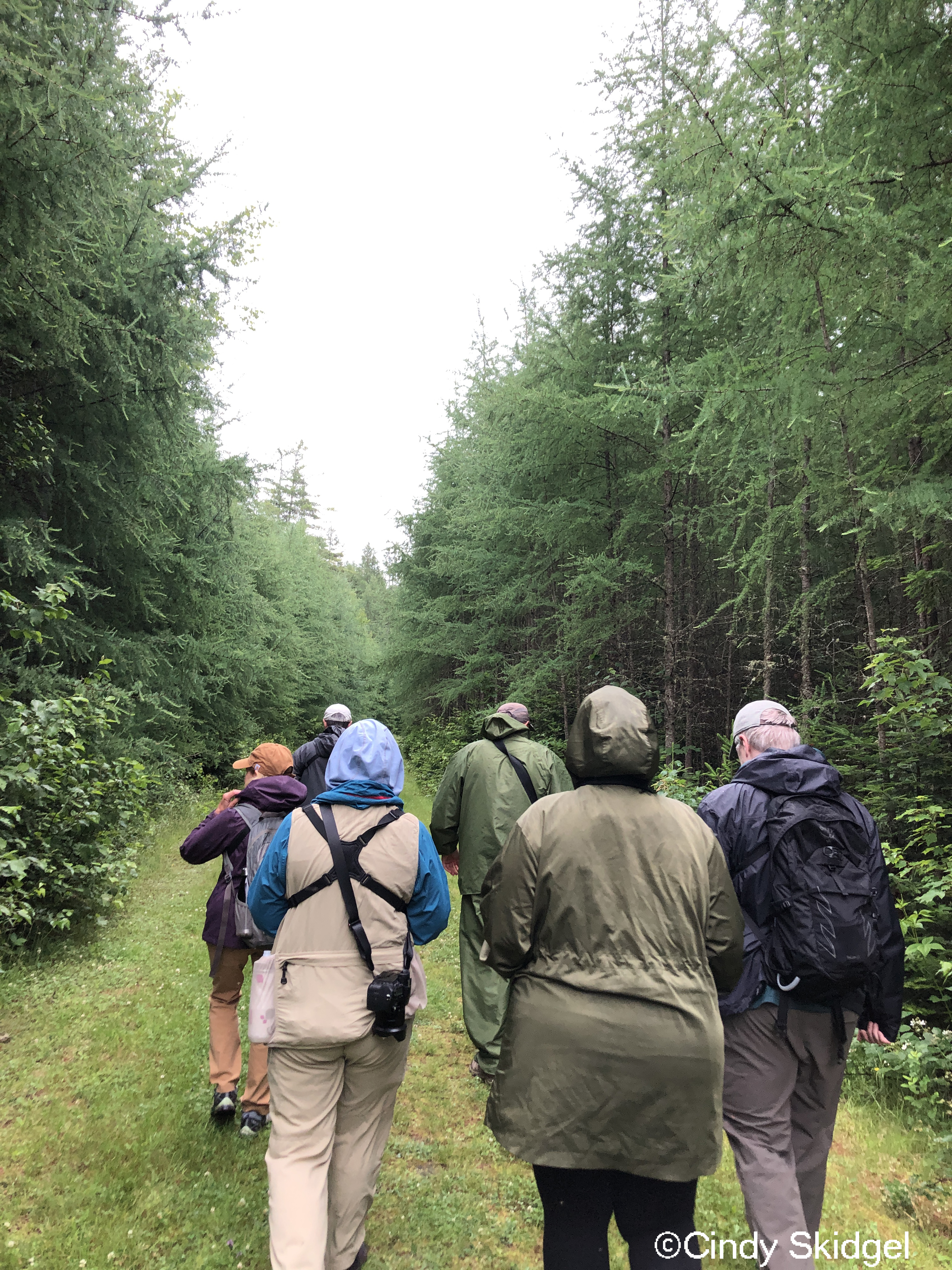
But we could not have asked for a better start to the weekend, with the first Saturday without rain in almost three months! In fact, it was absolutely gorgeous as we assembled in Errol, New Hampshire: sunny, a light breeze, and pleasantly warming temperatures. The relaxing morning was spent exploring the lowlands, focusing on boreal transition forest and spruce/tamarack bogs. We heard a couple of Palm Warblers – and glimpsed one in flight, listened to Yellow-bellied Flycatchers, and enjoyed common warblers such as Magnolia.
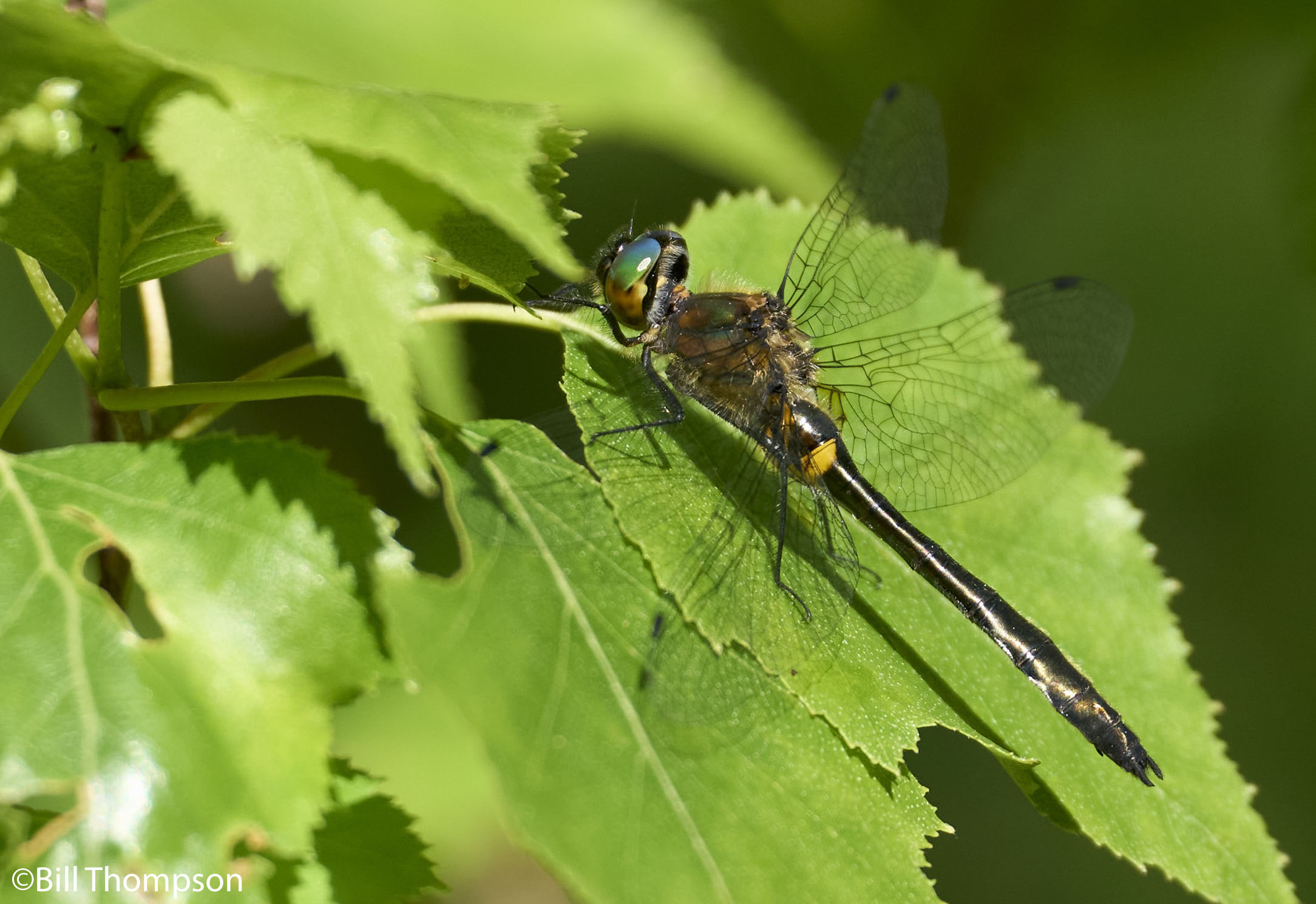
We enjoyed some botanizing as well, and stopped to look at all walks of life, such as butterflies and dragonflies.
Atlantis FritillaryRacket-tailed Emerald
After a quick but delicious lunch, we did a little more casual birding (Blackburnian Warblers!) and even a little sightseeing!
A welcome afternoon break was followed by an early dinner in town, before our first trip up the mountain. With a mostly clear evening, we had some time until dusk, so we used it to make a bee-line to what I assumed would be one of the highlights of the weekend.
On a private tour two weeks ago, I found a Black-backed Woodpecker nest. At the time, the adults were feeding young that I could not yet hear or see. I hoped they would still be in the cavity by now, and it didn’t take long for us to know they were – we heard the begging nestlings from a good 100 feet away. I found a path of least resistance to the nest hole, and we took turns rotating in small groups to watch the adults make repeated feeding visits. Everyone was so respectful of the birds – especially the adult male – who didn’t seem too pleased with our presence. After one feeding visit per group, we backed off, gave the birds a break to feed, and then visited with the next group. While the sun was now setting fast and the photography was challenging, it was truly a special experience with such a charismatic and sought-after species.
Now, it was time to get to work. And tonight, our primary target really did make me work for it! Swainson’s Thrushes continue to increase here, and they were very active and vocal this evening. Too vocal.
While we did have some great looks at them, their presence and activity likely kept the Bicknell’s quiet and in the shadows. In fact, it was getting dark by the time the Swainson’s stopped singing and we finally heard a couple of Bicknell’s calling.
By 8:45, I was starting to get a little worried, so I walked most of the group up a trail where I had activity a couple of weeks ago. One bird was calling there, but it would not come out. I began the retreat to the road when the bird flew right over my head – one person even it heard it whiz by me. We turned back up the path and settled in and eventually at least one thrush began to sing, a couple of others were calling, and surrounded by Bicknell’s Thrushes, we ended up seeing one flying back and forth across the small clearing and at least half the group saw one in silhouette on top a small tree, calling aggressively.
The aural performance was top notch, especially down at the road, and everyone was quite satisfied with at least the sum of all views had of the bird in flight or paused in a tree at the edge of the small clearing. It wasn’t the “crippling views” from last year’s weekend, but everyone agreed it was more than “good enough” and the overall experience was worthy of the effort.
I pushed it a little longer and later than usual as it was such a nice evening (too nice?), and I had my worries about even getting up the mountain the next day. We returned to our hotel at 10:15, and we departed again at 6:00 – I let the group “sleep in” due to the forecast morning rain and our late return.
And it was indeed raining in the morning when we awoke, but the forecast chance of thunderstorms had not materialized. Therefore, it was safe to head up to the mountaintop, so without any further ado, up we went once more.
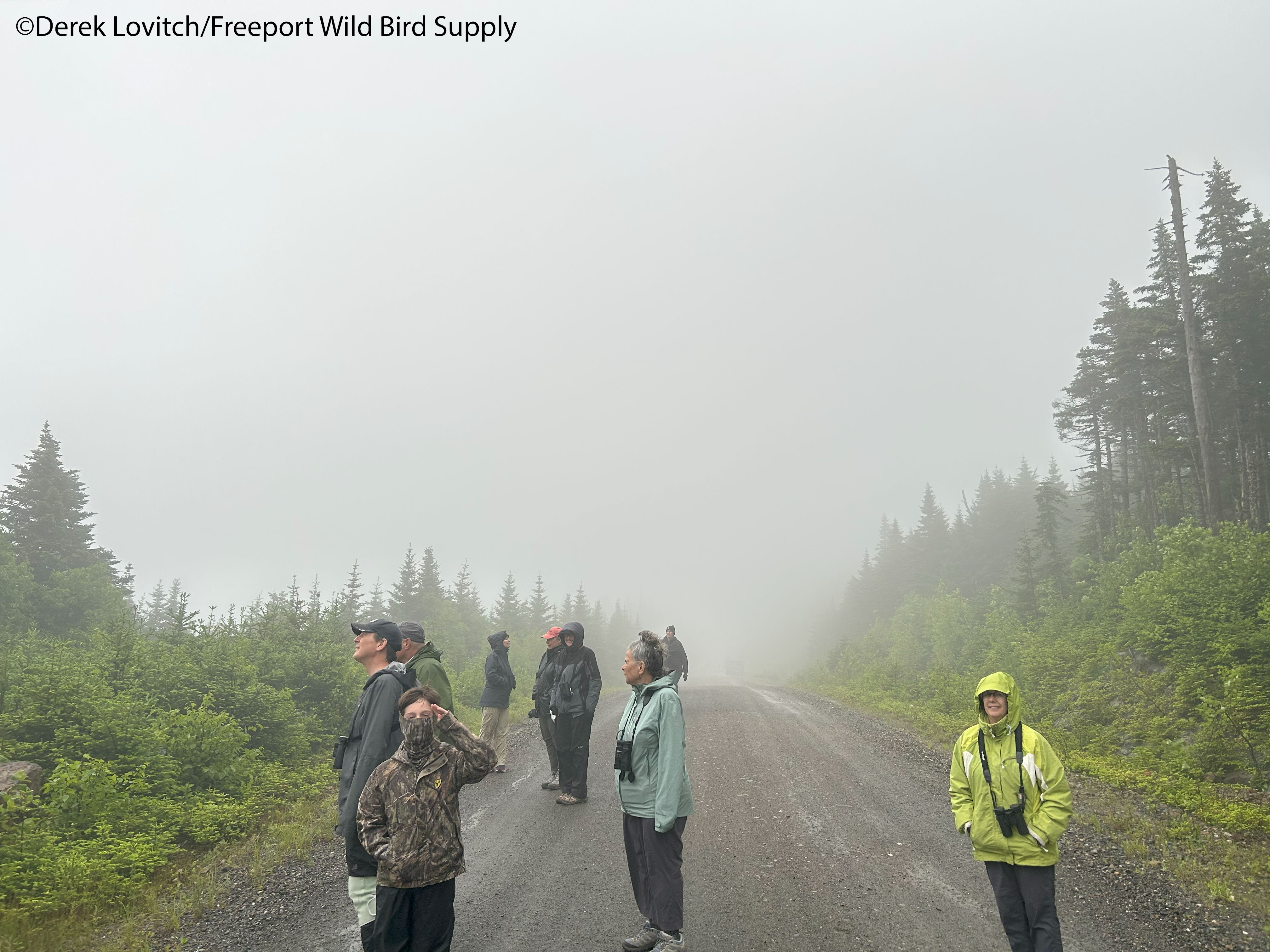
Unfortunately, up top it was still raining, albeit lightly, but the wind was already howling. What a difference 9 hours makes! Light rain came and went, fog would roll in and out, and we had one 10-minute rain delay in our vehicles with a downpour. Luckily, we had just finished breakfast!
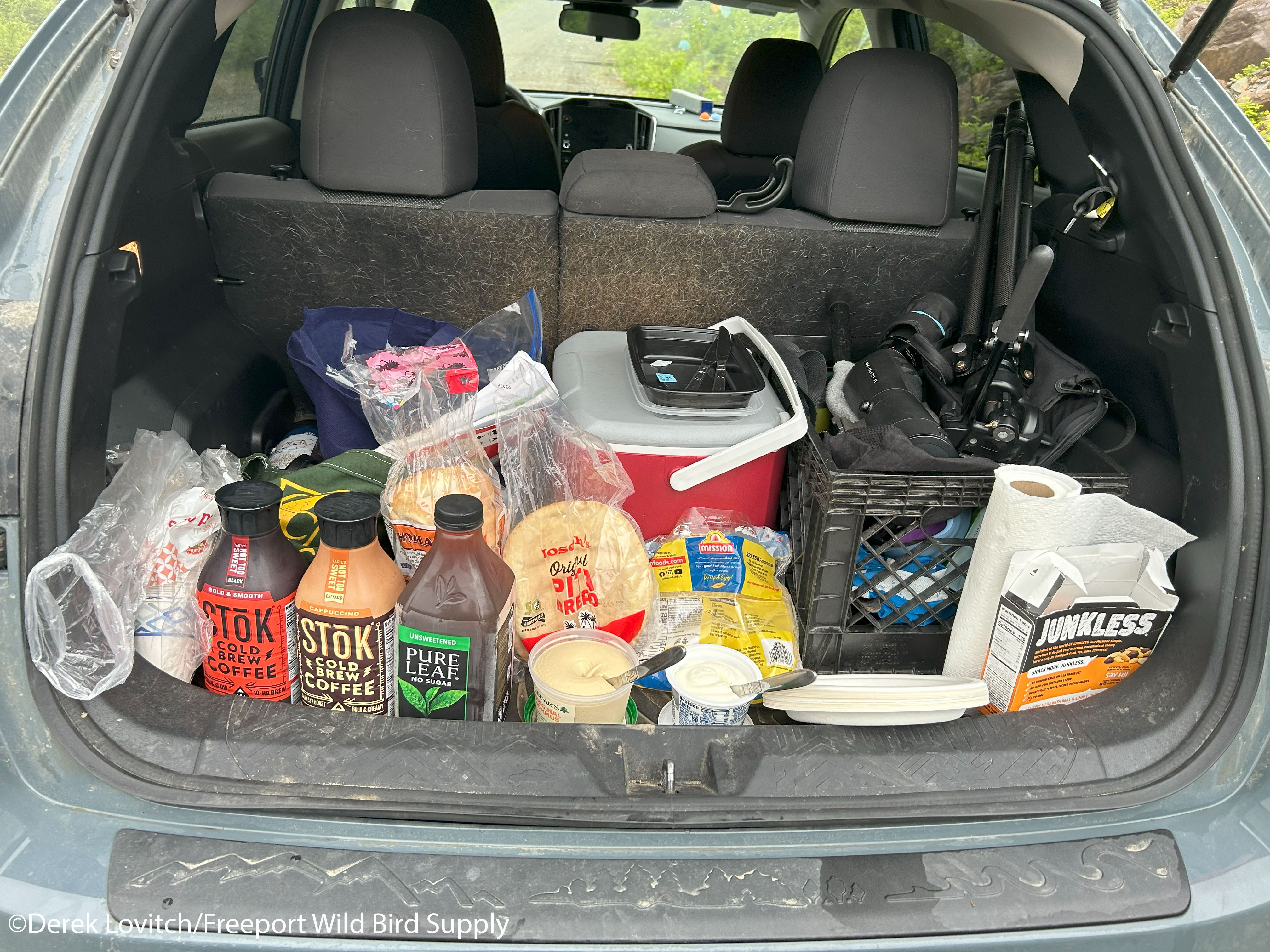
Birding tailgating!
But the morning was by no means the washout we feared, and when the rain stopped, the birding was pretty good. We decided not to bother the Black-backed Woodpeckers (the light was even worse anyway in the fog) given the conditions, but we were happy to hear the begging youngsters from afar. A few Red Crossbills flew over, Blackpoll Warblers were singing, and we heard the mountain’s Fox Sparrow in the distance.
But we did not hear a single Bicknell’s Thrush. I was about ready to give up when one finally called nearby at 8:45. And he kept calling, repeatedly, so close to us, but we never even glimpsed him. He must have been just within the dense edge – so close, yet so far!
Now this tour promises two chances to look for the thrush, not two guaranteed observations, so we took what the birds gave us last night, and with the wind howling, we began our decent.
Stopping as soon as we had some more shelter, we hopped out and soon saw a Bay-breasted Warbler and heard a pair of Boreal Chickadees. A little further down the road, we heard what was almost surely a Cape May Warbler, but could not confirm it. There wasn’t much question about this Mourning Warbler however!
See headline photo…Now that’s the kind of view we were looking for!
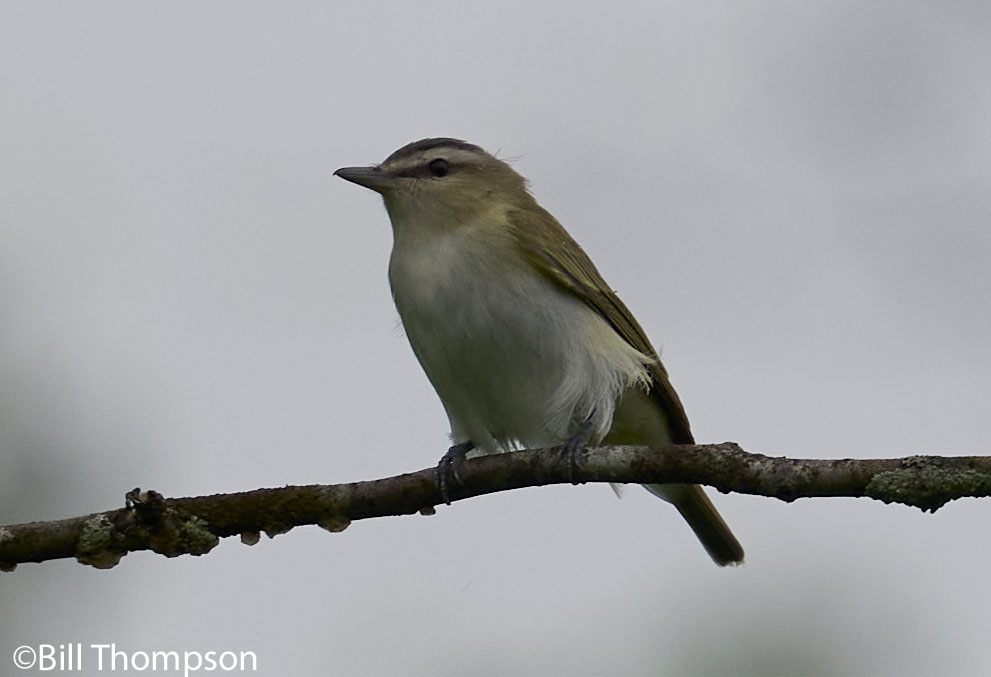
We dipped on Lincoln’s Sparrow, and then spent some time looking for Philadelphia Vireos. While we heard what was likely one singing from within perfect habitat, all of the vireos we saw today – and you simply must see them to identify them – were Red-eyed Vireo. Their march up the mountain and resultant displacement of Philadelphias continue.
It was instructive, however, and analogous to the issues with Swainson’s Thrushes moving uphill and pushing out Bicknell’s – these high elevation specialists have nowhere else to go as our mountains are not getting any taller, and I made sure to weave these conservation and natural history messages throughout the tour.
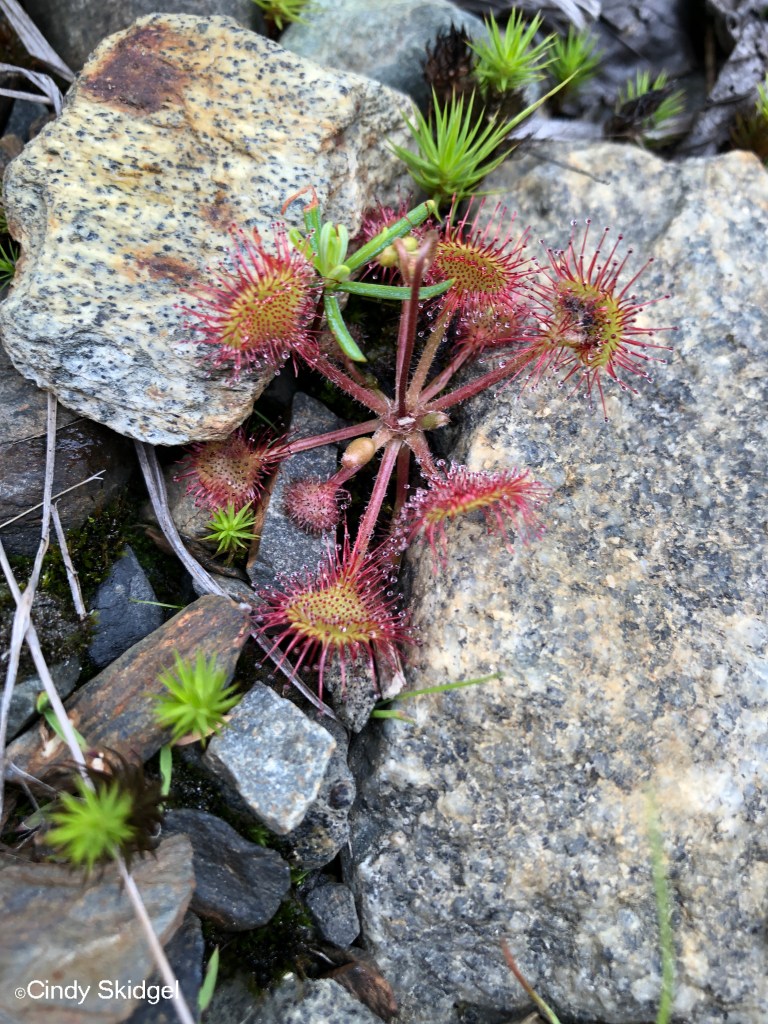
We looked at plants, too, such as Round-leafed Sundew.
We celebrated our success – especially with Black-backed Woodpecker and Mourning Warbler! – with a wonderful and leisurely lunch, and then half of the group joined me for a casual stroll in the lowlands of Colebrook, where we encountered numerous Veeries – just to add to our thrush tally for the weekend. Of course, our photographers had left, so birds here – especially the Veeries – were exceedingly conspicuous, with repeated views of them out in the open and with bills full of food. American Redstarts, Yellow Warblers, and a couple of singing Bobolinks were icing on the weekend cake.
Have views of our primary target, the Bicknell’s Thrush, been better on this tour? Yes. But they have also been much less fulfilling, and rarely, not even seen at all. So, we’ll take it…plus it was a great experience that fostered appreciation for the challenges of seeing this bird. Oh yeah, and a nest of Black-backed Woodpeckers!
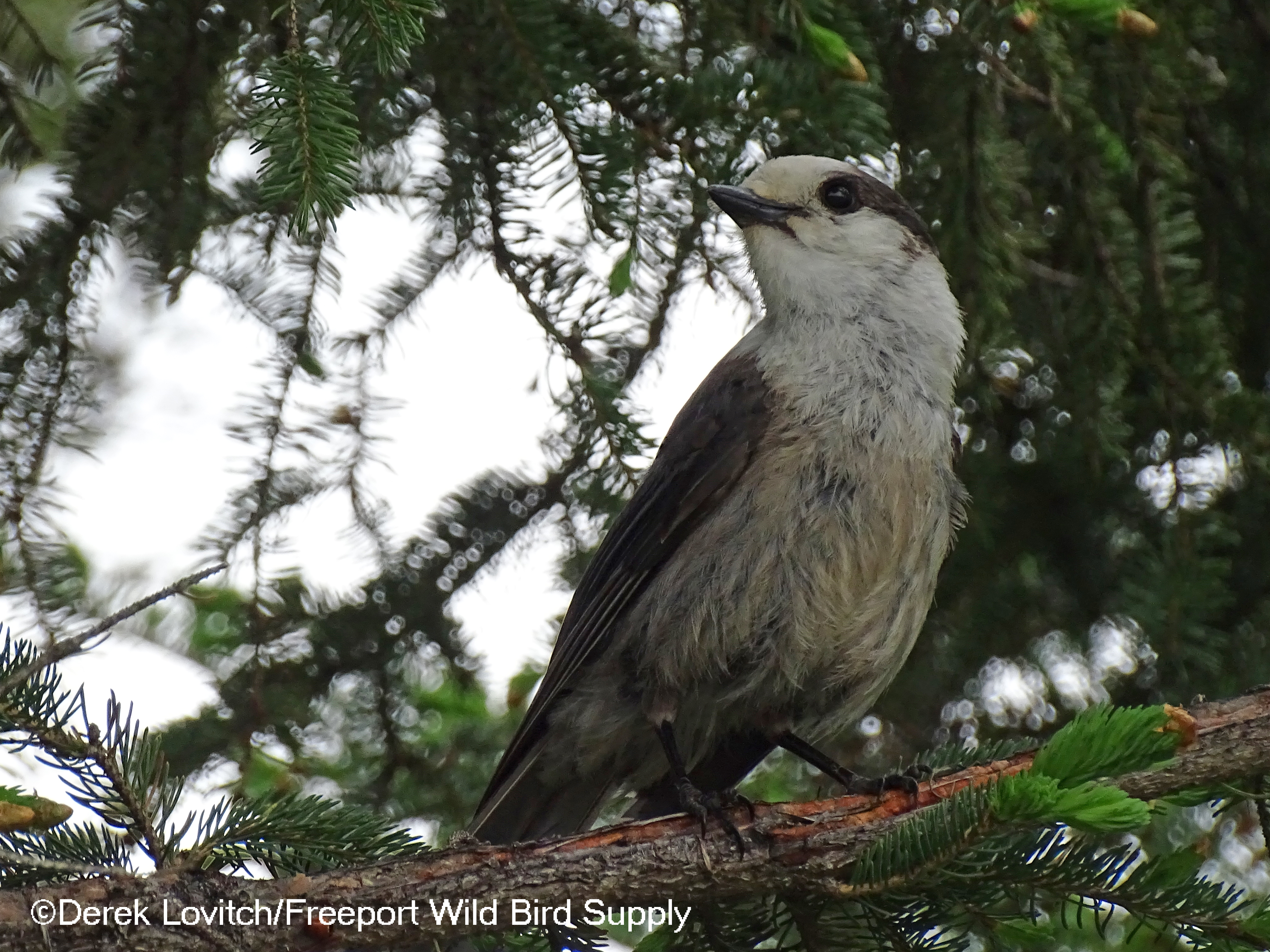
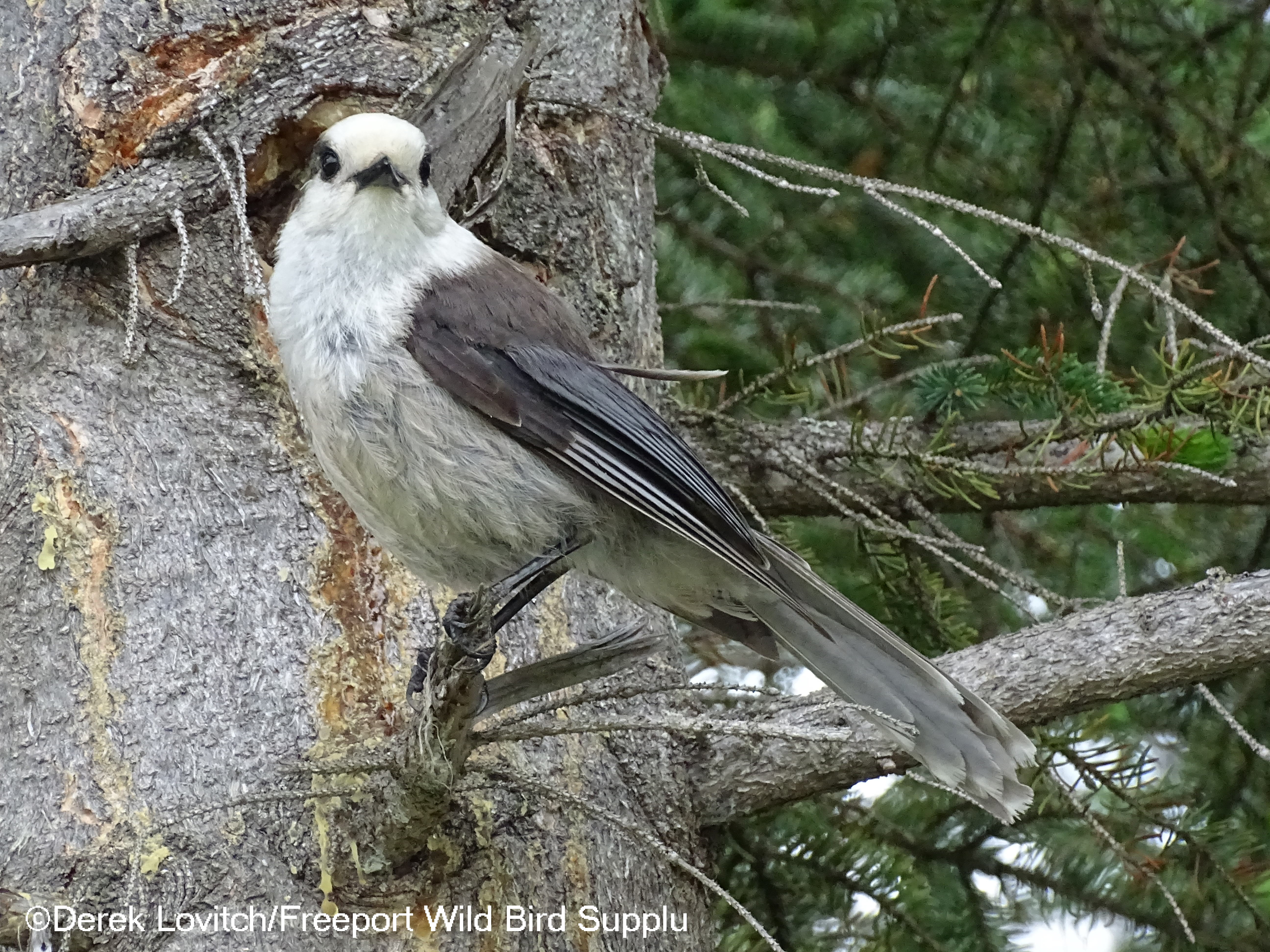
One of up to 6 Canada Jays encountered outside of Rangeley while leading tours for the Rangeley Birding Festival included this confiding adult, part of a family group of at least 4 on 6/6. In fact, I enjoyed Canada Jays in three states in less than a week’s time this week/weekend!
This time of year, most of my birding, both personally and especially professionally, is dedicated to finding, seeing, and enjoying the wide array of breeding species this state has to off. From Saltmarsh Sparrows and Roseate Terns here along the southern coast to Bicknell’s Thrushes and “boreal specialities” in the western Maine mountains (and northern New Hampshire), it has been another extremely busy guiding season for me. Meanwhile, while home, I have been conducting two local breeding bird surveys. While my “highlights” these days are seeing the “expected” species we all seek, I did encounter some unexpected observations and noteworthy counts over the past two weeks, but mostly, I thought I would share some of my photo highlights.
1 Dunlin, 4 Semipalmated Plovers, and 1 Least Sandpiper, Sanford Lagoons, 6/2 (with Jeannette).
Rangeley Birding Festival, 6/6-6/8: Two mornings of birding Redington Road (scouting 6/6, with tour group 6/7) yielded high counts of 2 territorial CAPE MAY WARBLERS (6/6+6/7), 6 CANADA JAYS (6/7), 1 pair of BOREAL CHICKADEES (6/6), 3 Red Crossbills (6/6), 2 Olive-sided Flycatchers (6/6), 1 American Bittern (6/7), 1 Black-billed Cuckoo (6/7), etc.
I was excited to find two Cape May Warbler territories outside of Rangeley on the 6th, and then find both males in the same place the next day with my Rangeley Birding Festival tour group.
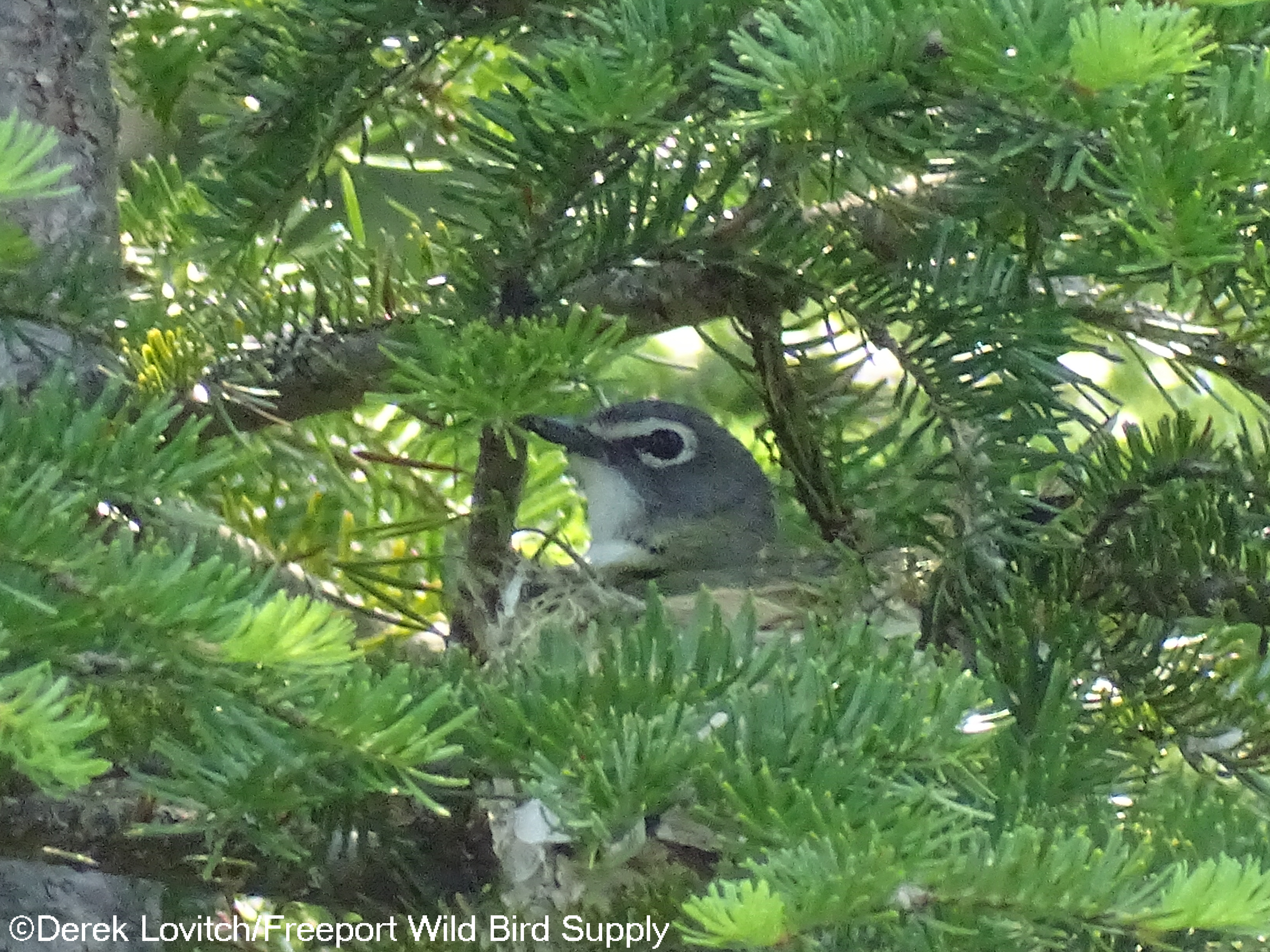
While leading a walk for the Rangeley Birding Festival at Hunter Cove Sanctuary, I found this low-level Blue-headed Vireo nest that was fascinating to observe.
2.5 day private tour in Vermont and Northern New Hampshire (I know, this is a non-Maine-birding-field-note!) yielded: Bicknell’s Thrush, Black-backed Woodpecker, Boreal Chickadee, Canada Jay, Fox Sparrow, and 22 species of warbler including Cape May, Bay-breasted, and Mourning.
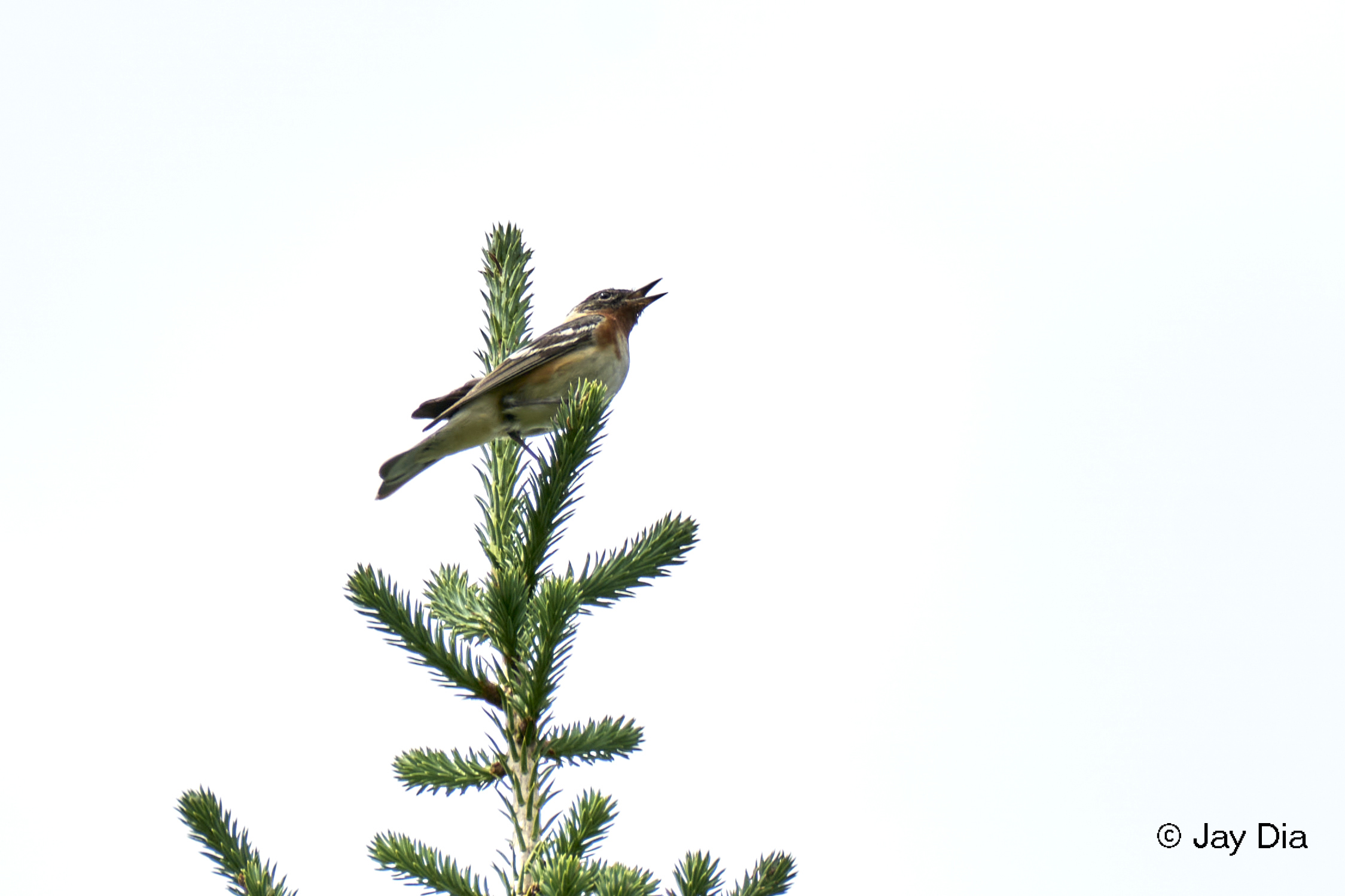
As usual, I took few photos while guiding, but this Bay-breasted Warbler outside Errol, NH on the 10th (with clients) was too cooperative not to fire off a few shots!
Back home for a couple of days, it was off to my local bird surveys. This fledgling Barred Owl was in Freeport on the 12th, confirming breeding once again at one of my local patches.
Monhegan Spring Migration Weekend Trip Report.
The 2025 Monhegan Migration Spring Weekend was a shocking success. We went from having a weather forecast that made me worry if there would be any migrants to see at all, to an exceptional weekend that was by far the best Memorial Day weekend of birding out here in quite a few years. A total of 106 species were tallied in 5 days, including 91 together as a tour group, with a total of 22 species of warblers. Here’s the full trip report.
Tour itineraries are meant to be broken. Or is that “rules.” Well, those too.
We have offered some kind of “Bicknell’s Thrush Wekeend” tour for almost 15 years now. There was a hiatus for COVID, and last year – perhaps due to the uncertainty with travel planning – we pulled the plug on our weekend for the first time as registrations were slow to come in.
Therefore, for 2024, it was time to try something new and head into Northern New Hampshire for a new plan of attack. Two chances at Bicknell’s Thrush over the course of two days, with this one enigmatic bird the sole focus (well, at least until we see it) – that part of it had not changed. Everything else was new this year.
We assembled at 9:00am on Saturday, June 29th in Errol, New Hampshire. The itinerary? Well, never mind.
Several folks arrived to see their guide staring up at the sky and immersed in deep thought (you could smell the wood burning). It wasn’t raining, and it looked like we had a nice window of fair weather. But it was already 9:00am, and by the time we got up the mountain…
…but the forecast for tonight. And tomorrow morning.
…but it can’t be worth it to try for one of, if not the, most elusive of North American breeding songbirds in the middle of the day.
…and it’s getting warm.
…and there’s rain building to our west. The winds are picking up higher up.
…but let’s go for it!
So up the mountain we went. At least we would be trying. And that evening, with the risk of severe thunderstorms, we might not even have a chance to try. And the next morning didn’t look great.
But weather forecasts are fickle, especially up here in the mountains, so it’s hard to make plans. But it’s easy to look up and see what’s about to happen, or not. And when I looked up, my face didn’t get wet, so that’s the only forecast that’s dependable in these parts.
We raced up hill, arriving at about 3,000 feet and the realm of the Bicknell’s Thrush around 10:30, stopping for a Ruffed Grouse in the road escorting five chicks.
Southerly winds were increasing, blowing right up into and through our thrush territories. This was pointless. But hey, the rain was still across the valley. So we birded.
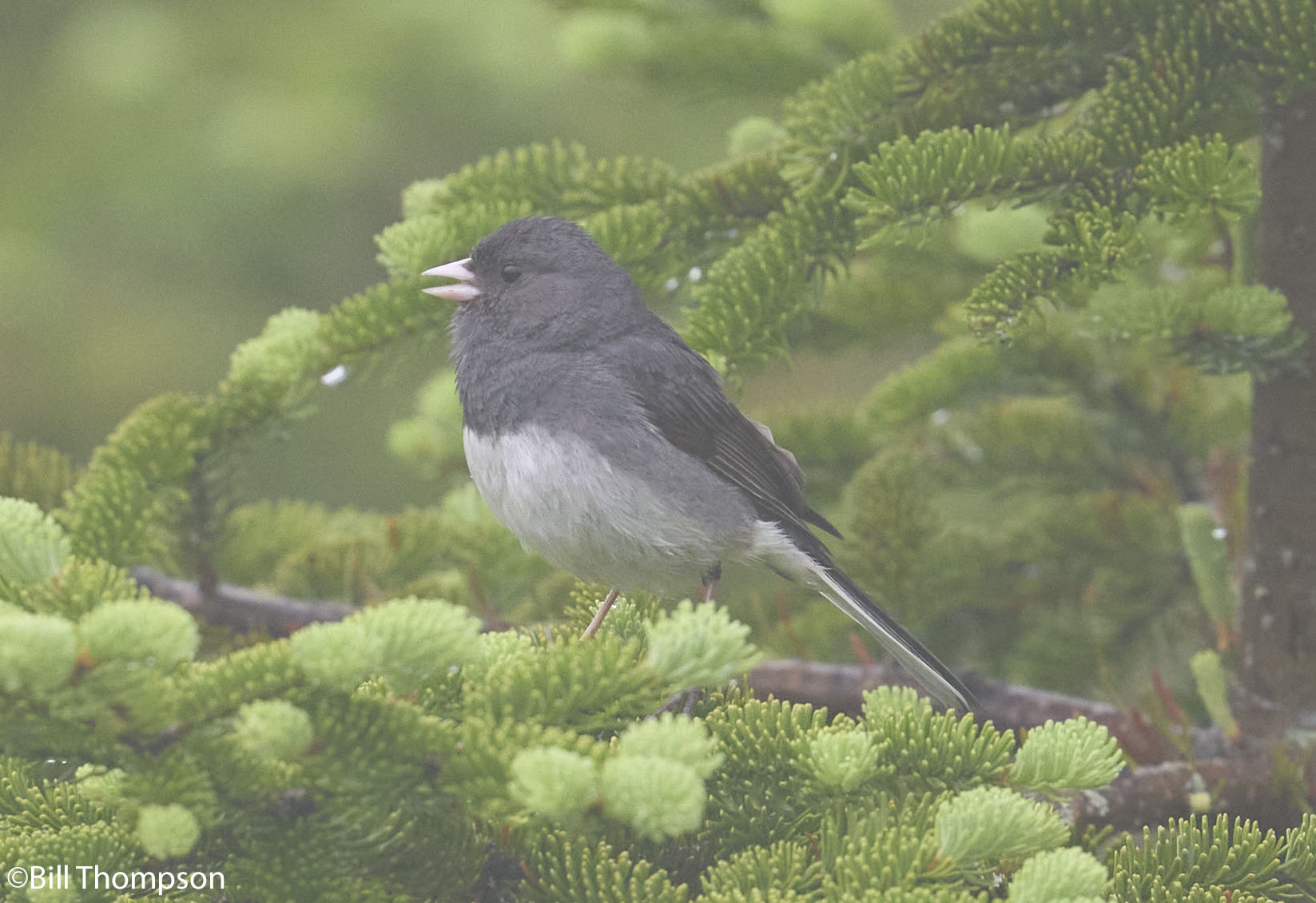
We heard the Fox Sparrow, spotted a couple of Blackpoll Warblers, and enjoyed the usual high-elevation species like Yellow-rumped Warblers and Dark-eyed Juncos.
Then, at the surprisingly late (or extremely early) time of about 11:15am, a Bicknell’s Thrush began to call. Over the next 15-20 minutes, we were treated to two birds counter-singing, and at least 3 or 4 birds calling. One bird silently flew across a clearing, as well seen as a thrush in flight can get. The two dueling birds darted between trees and occasionally paused in view of one or two people before melting back into the trees.
There weren’t photography opportunities, but everyone was more than satisfied with the sum of their views. And it was a tremendous auditory performance. Overall, it was actually a pretty good show, and really demonstrated the behavior of this fascinating bird. And since this is more than just a tick and run” tour, the birds’ behavior was instructional and of keen interest.
And after all being satisfied, the rain arrived.
We enjoyed a leisurely and delicious lunch, and then set out for a little more birding. Making up for the change of plans in the morning, we took a walk and a drive through some boreal habitats, but rain was becoming steadier now. We heard and saw a few common birds, but it was just some good quality time in the afternoon woods, absorbing our phytoncides. When the rain arrived in earnest, we called it quits and went to check in at our hotel.
The original plan was to have an afternoon break, early dinner, and then head up the mountain at dusk to take advantage of the evening activity of the thrush. Instead, we had a relaxing dinner, many of us enjoyed a beer or glass of wine, and we just chatted. Good conversation was enjoyed by all, and the rain kept falling.
At one point, the rain let up and I began to ponder a run up the mountain. Just in case the thought became serious, a downpour arrived. Dessert was ordered.
We were back in our hotel rooms at about the time I had planned to be on the mountaintop, so I didn’t know what to do with myself! I think I was stressed about having nothing to stress about. When a tour is solely dedicated to one species, a trip is a failure without that one species. But we already had our quarry, and if it was raining in the morning, oh well. And if it wasn’t, we would just go enjoy the bird some more. I think I had the longest and best night of sleep I can recall while leading a Bicknell’s Thrush weekend!
Well, it wasn’t that long. A “civilized” 5:30am departure from the hotel (thanks to our success the day before) found us free of the rain that was forecast, and there were even a few breaks of sun. It was rather breezy atop the mountain, and in almost two hours, we only had a couple of calls from Bicknell’s Thrushes. A simple continental breakfast was served from the back of my Subaru.
However, we had a Canada Jay (likely the last youngster in a family group that passed just downhill from us) in plain view, and spent some quality time with the local breeders like Blackpoll Warbler. Then, much to my disbelief, the second-most wanted bird on the tour (according to an unofficial survey), began to call very close to us. Could it be? I had to be mistaken. But not much else sounds like a Black-backed Woodpecker!
Then, with jaws dropping to the ground, it proceeded to fly overhead of us, heading up the mountain where it called a few more times. That was not something I was expecting – not just the species, but such a great look at it in flight (I can only recall one other time that I had seen one overhead) and far removed from the deep and dark bogs most of the local birds prefer.
Between yesterday’s thrush luck and today’s woodpecker fortune, not to mention another mountaintop visit devoid of the forecast rainfall, we were just ecstatic.
And then this happened…
You get a photo, and you get a photo, and you get a photo!
Wow. Just wow.
And it was on a snag that I had just declared, “if this bird comes out, it’s going to perch here.” Most people thought I was joking.
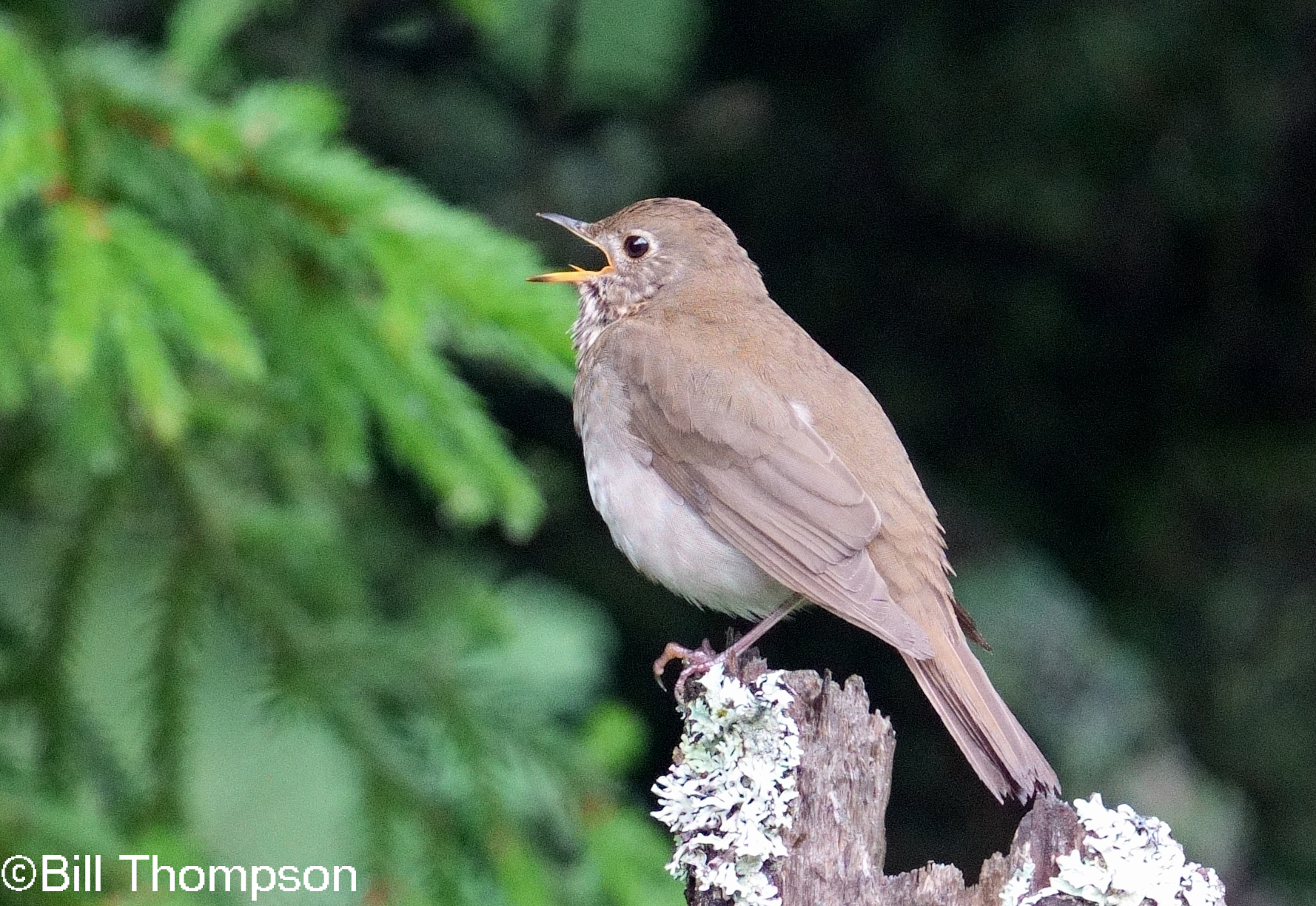
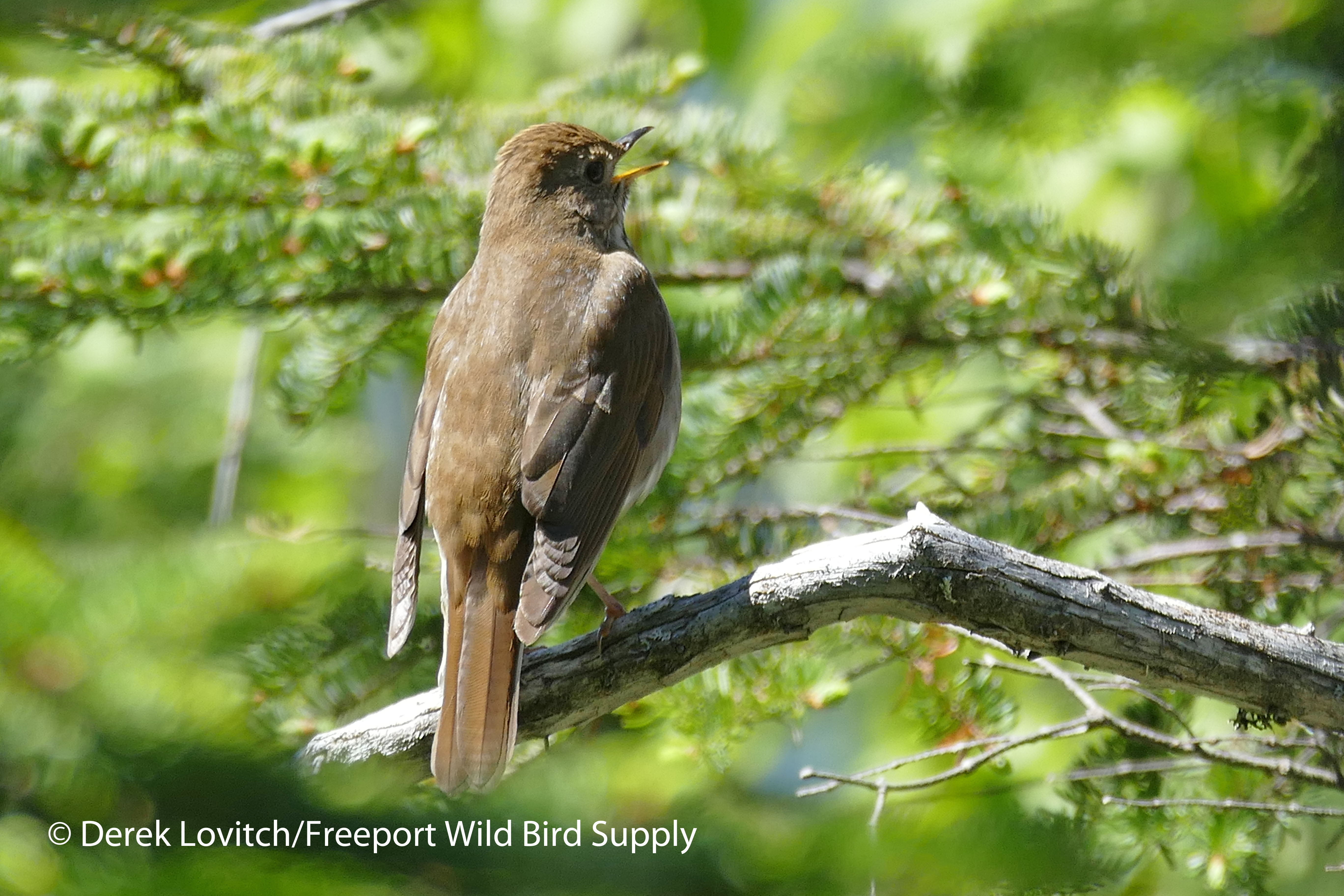
The thrush didn’t. Now, I wish I could always control birds like this, but especially with this species, I have really come to know them and their behavior. To me, it did look perfect for one to sit on. But no, I did not expect it to be sitting on it, singing up a storm, about 30 seconds later. It truly is better to be lucky than good.
And it sat there for long enough to take your camera down, adjust your settings, and return to firing away. It was even there long enough for your dumbfounded guide to remember he had his camera with him for a change. My panicked photos did not do the bird justice, so I will let everyone else’s speak for themselves.
There wasn’t much left to do up here, so we began our trek downhill.
A Mourning Warbler cooperated nicely.
Then, returning to our cars a (the?) family group of Canada Jays returned and came to check us out. Kathy’s granola bar was clutch here as two adults had a snack, with 2-3 dusky juveniles looking on, learning the ways of the Camp Robber.
And then Kathy exclaimed “there’s a Bay-breasted!” and we all looked up to see a stunning male singing from a roadside fir right over our heads.
We heard or saw at least another 5 Mourning Warblers on the way down, glimpsed a busy Lincoln’s Sparrow (a Sharp-shinned Hawk passed overhead precluded a better observation, however), and took some time to enjoy and identify butterflies – even skippers (OK, only Bill actually identified said skippers) – and plants.
White Admiral
Round-leafed Sundew.
But as the winds began to gust, more rain was approaching, and ATVers were becoming overwhelming, we left the mountain and headed to Colebrook for a relaxed, celebratory luncheon as the rain began to fall and before we headed our separate ways.
As for this new Bicknell’s Thrush Weekend itinerary (with and without necessary audibles), well, I think you can assume we’ll see you here again next year!
Our annual “Bicknell’s Thrush and the White Mountains” van trip to New Hampshire took place on the weekend of June 13-14 this year. Still licking my wounds from failing to provide satisfactory views for clients (on a private trip earlier in the week) for the first time in over 30 tours to look for this enigmatic, secretive, and range-restricted Northeastern breeding endemic earlier in the week, I was ready to get back in the game and start a new streak.
We departed the store on Saturday morning, and began our drive to the mountains. I always stop somewhere on the way to the Whites, and this year I mixed it up a bit with an easy walk at the pleasantly birdy Jagolinzer Preserve in Limington. Good views of Scarlet Tanager and Rose-breasted Grosbeak were highlights.
It was already 11am when we arrived at the Caps Ridge Trail in Jefferson Notch, where we casually birded the road, parking area, and the beginning of the trail. It was not the best time of day, of course, but we heard quite a few Blackpoll Warblers and Yellow-bellied Flycatchers, along with spotted a variety of warblers, including a couple of the Blackpolls, Black-throated Greens, and Magnolias.
After a little r&r, we had a fantastic early dinner at Saalt Pub, a lovely little gastropub run by a James Beard Award semifinalist who worked for the legend, Julia Child. It’s not what one expects to find in little Gorham. Luckily, with our regular, casual eatery now open only for breakfast and lunch, they were able to squeeze us in. Rest assured this will likely be a regular feature of this tour from now on.
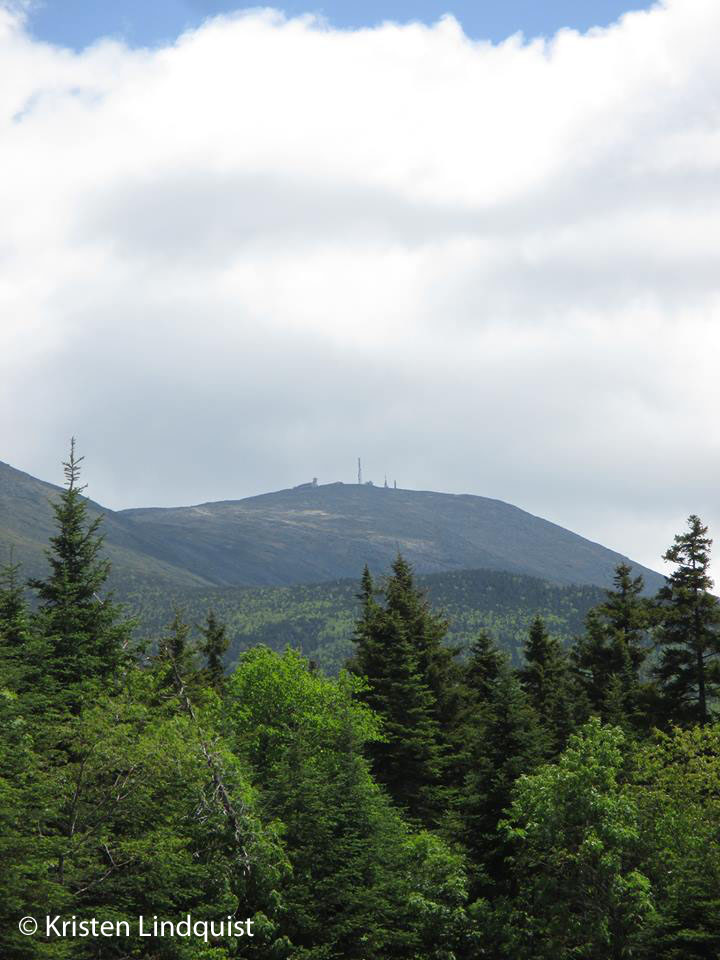
Fueled up and ready to go, we made the short trip to the base of the Mount Washington Auto Road for our private, after-hours charter up to the realm of the thrush.
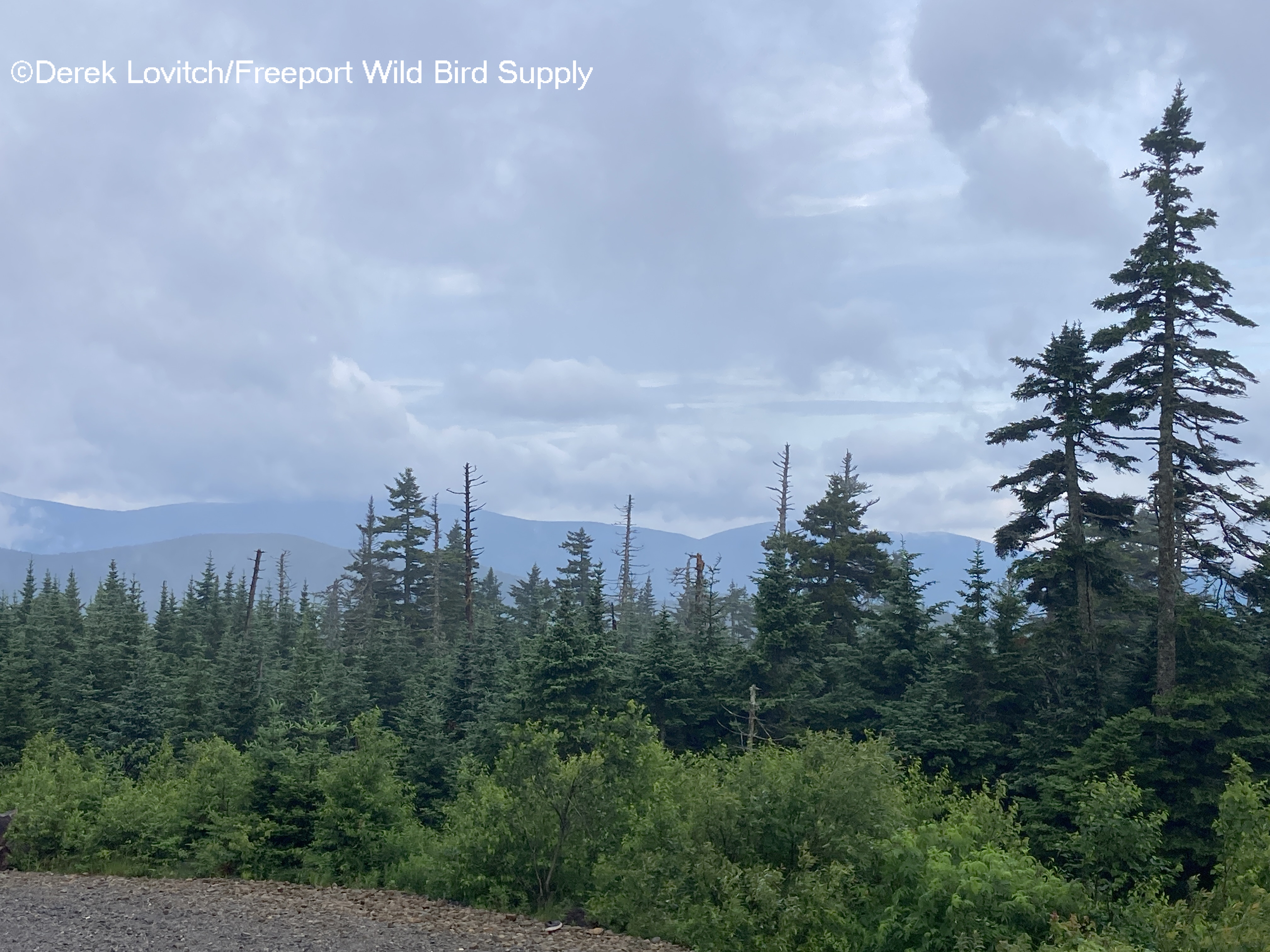
The view from the summit was magnificent, with amazingly clear views in all directions…thanks to winds now gusting over 60mph! It was a challenge to walk around, and especially to open the doors of our van!
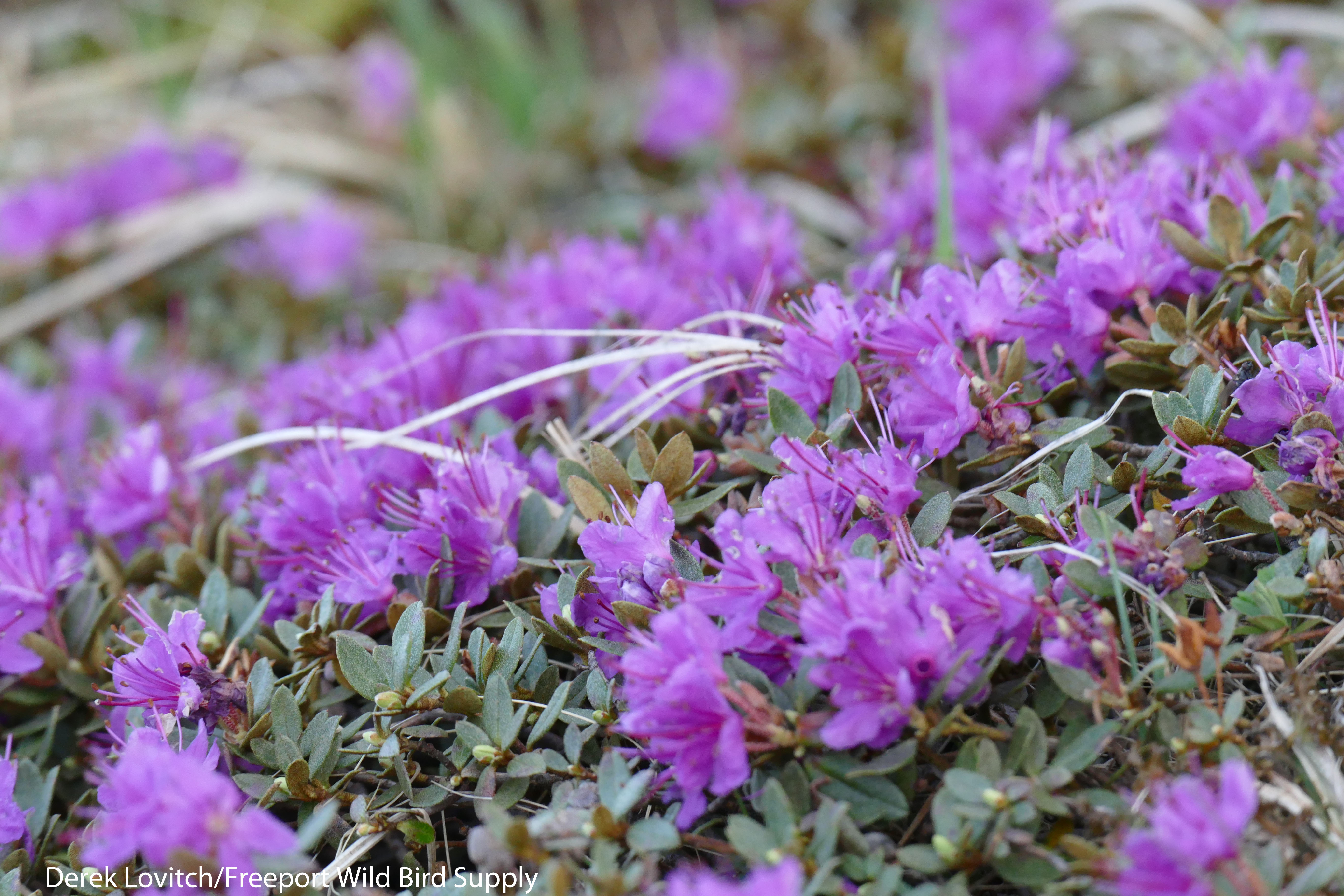
Escaping the gale before any of were blown away, we dropped down to the Cow Pasture to enjoy some flowers, like this glowing Lapland Rosebay and dainty white Diapensia.
With dusk finally approaching, we dropped down into the krummholz to get to work.
Unfortunately, the winds were increasing, and they were whipping around the mountain. My favorite spots were just too windy to hear or see the thrush, or much of anything else. One sheltered stretch of road did host several thrushes, and we did glimpse a few birds crossing the road, and especially one that flew overhead providing unusually decent looks in flight. We had one close bird that seemed to be having a negative interaction with a Swainson’s Thrush – was the Swainson’s chasing it? Swainson’s are marching up the mountain, residing higher and higher each year – are they displacing Bicknell’s? It was a really interesting auditory show, but we couldn’t get a good look at either bird.
Unfortunately, a thrush that froze in our headlights as it was time to go was a Swainson’s, not our quarry. Another miss – was I entering a slump?
But this tour gives us two chances to see the bird, and the next morning – another lovely day – we went to a different mountain to try our luck there.
We worked hard for the bird, and although some were close, and some quick glimpses were to be had, we were running out of time, and running out of chances to really see the bird. Then, this happened:
These are arguably my best photos ever of this reclusive bird, and we were all ecstatic. With everyone happy now, and with these new photos, I even took a moment to enjoy the view.
Gyrfalcons are one of those enigmatic birds of the high northern latitudes that are always a favorite among northern birders, and lusted over by those further south. I’ve been lucky enough to see quite a few in Alaska, one in Michigan, and even one in South Boston. And few sightings of mine will ever surpass the eyrie of three white morph juveniles that we saw in Kamchatka.
But I had yet to see one in Maine. Or, at least, seen one for certain: there was this large, dark falcon with shallow wingbeats that screamed by during a snow squall while birding at Fort Halifax in Winslow one winter morning with a friend. It probably was, but…
Meanwhile, the plot thickened. Shiloh’s photos were strongly suggestive of the dark morph Gyrfalcon seen in Madbury, New Hampshire on December 15th, with at least one more sighting later at the Rochester Waste Water Treatment Plant. Meanwhile, it came to light the bird was actually photographed in Maine on January 10th, in the Ogunquit River Marsh from Ocean Street in Ogunquit.
Then, yesterday (Saturday, 1/17), Bob and Sandi Duchesne, et al, refound the bird in the Webhannet Marsh, just north of Wells Harbor (via Harbor Road). Quite a few birders were able to make it down to the marsh, and observe the bird in the area through sundown.
Not surprisingly, a lot of birders converged on Wells Harbor this morning. Myself included.
I arrived at Harbor Road at about 8:00am, and a short while later, chatted with folks at the end of the road, at the marina and boat launch of the harbor. No sign of the “Gyr.” Several us decided to split up and search elsewhere, keeping in touch of course.
I walked Community Park, scanning the marsh along the way (9 Horned Larks, 2 Yellow-rumped Warblers). I then went up to Parson’s Beach, where there was a possible sighting a few days ago. No luck, but I was surprised to find a small flock of 6 Savannah Sparrows at the end of the road; unseasonable.
Next up, I drove Drake’s Island Road. A car was pulled over, and seeing that they were looking at a Rough-legged Hawk (also seen earlier by others from Harbor Road), I too pulled over. I watched the hawk for several minutes, before it took off rather abruptly. I thought I saw something streaking low across the marsh, but blocked by trees, I really assumed it was a figment of my imagination. Driving ahead to a better view of the marsh, I scanned to the south, spotting a dark lump in the middle of the marsh – a lump that I had not noticed before. Four Common Redpolls flew over. The lump moved. I scoped Harbor Rd and did not see any birders. It was dark, it seemed small-headed, and it was fairly big. But there was heat shimmer, and it was far, very far.
I called Noah Gibb, wondering where he was, and mentioning I spotted a “promising lump” to the north of Harbor Rd and I was racing over. As I pulled into the parking lot at the end of Harbor Road, at least a half dozen birders were now present, but looking in different directions, and clearly not excited. “Damn it,” I thought. Was my lump just a bona fide lump? My excitement waned.
But I set up the scope anyway, pointed it towards said lump, and turned to the other birders and said, “Do you guys know the Gyrfalcon is sitting out here?” After they all saw it, we enjoyed a good chuckle, but most importantly, we all knew where the bird was, and dozens of birders converged.
Between 9:55 and 10:50, many of us enjoyed this magnificent bird, which, through a scope, afforded more than satisfactory views. During the time, it made two sorties, one low over the marsh, taking a run at an American Crow, and another higher flight over the water, flushing up roosting gulls.
This is one beastly bird, almost certainly a female based on its size. Gyr’s don’t have narrow wings like a lot of falcons, but big, broad (especially at the base) wings that seem to fight tapering to a point. In many angles, they even suggest buteos or goshawks. The flight of a Gyr is incredibly fast and seemingly effortless. Its shallow wingbeats generate a lot of power. It’s really like a Peregrine Falcon on steroids.
After each flight, the bird returned to a piece of driftwood in the marsh, north-northwest of the end of the parking lot at the end of Harbor Road (Wells Harbor), about 1/3rd the way between here and Drake’s Island Road. From the boat launch on the north side of the parking lot, looking out at about 11:00, somewhat in line with a marsh-edge house along the western end of Drake’s Island Road.
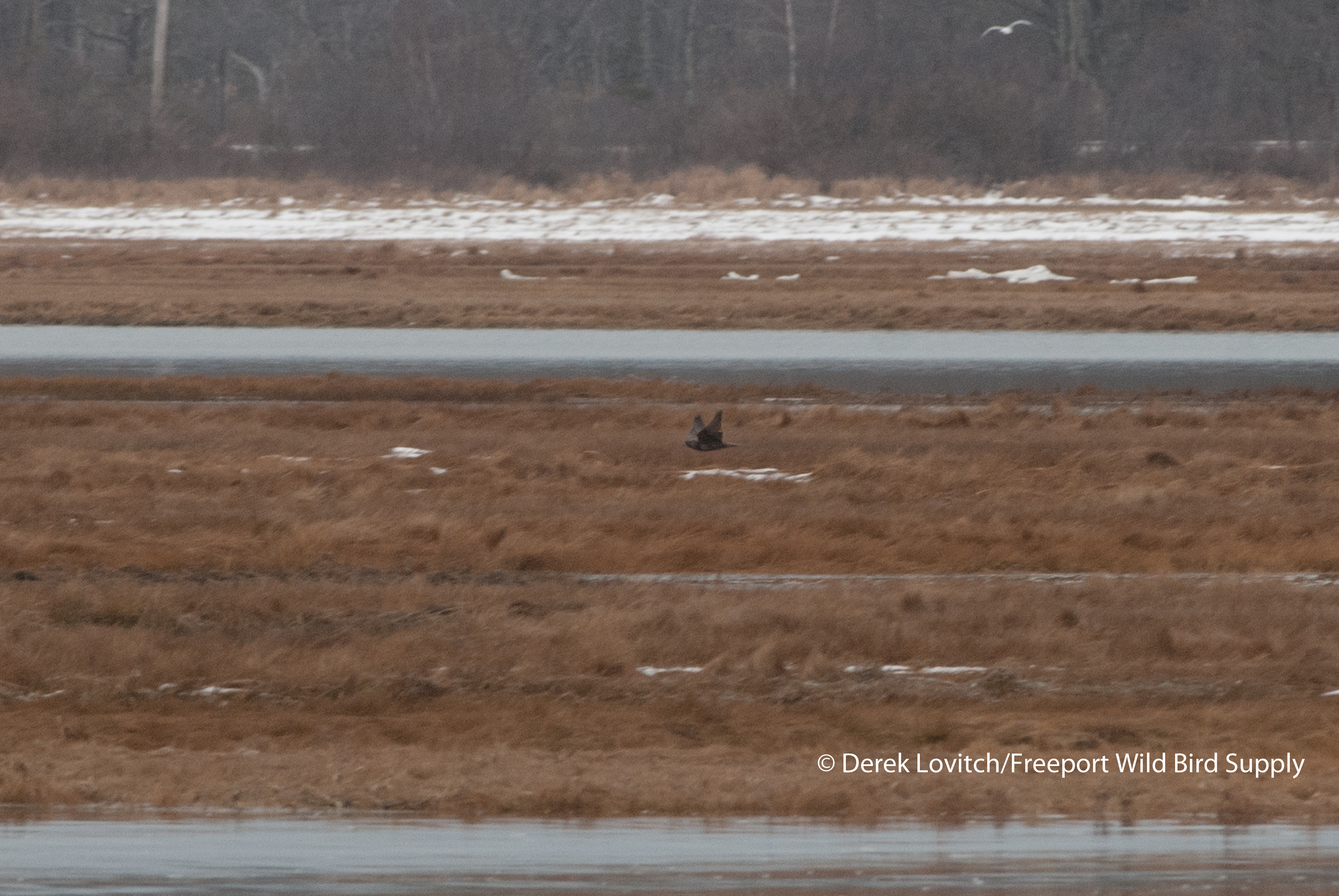
This phone-scoped photo was the best that I could muster:
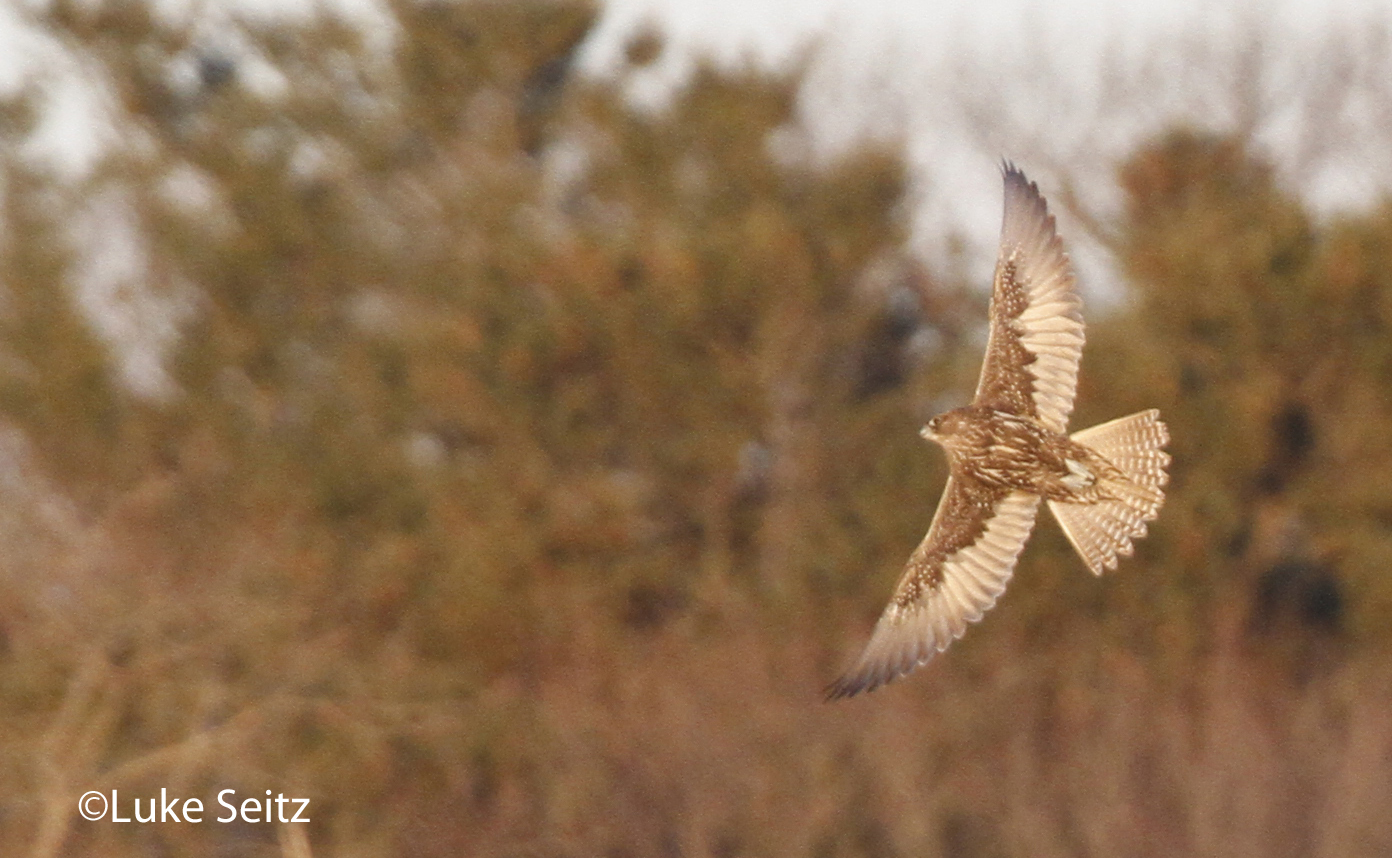
And this was the best flight shot I got of the bird in flight with my Nikon:
On a couple of occasions, the bird took off to the west, and we all lost site of it behind trees and buildings. It crossed the road once, heading over the salt pannes near the beginning of Harbor Road, and disappearing to the south. Several of us failed to locate it in the marsh to the south, and eventually, Luke Seitz and I gave into the call of second breakfast at Congdon’s Donuts.
When we returned to Harbor Road at 12:25, the Gyrfalcon was once again on her low driftwood perch to the north. At least today, the bird seemed to come back to this spot reliably, and it was observed there on and off through a little before 3:00pm. In other words, for birders seeking the bird, spending time patiently looking north from the end of Harbor Road (also, the parking lot at the end Atlantic Road in Wells Beach, accessed from Mile Road off of Rte 1) would likely be a good idea – and keep an eye out for promising lumps! And clearly, the bird covers some ground, so if it is not being seen, spreading out would be useful eventually. Hopefully, my description of the day’s sightings (and lack there of) offers some help in directing the next search, if necessary.
This was my 366th species in Maine, and Gyrfalcon was #5 on my personal “next birds” for my state list, as I wrote about earlier this month. But it was a Gyr, and Gyrs are awesome, no matter what list they are or are not on.
Several dozen birders came and went today, and not surprisingly, with so many birders in an area, and with so many people spread out and looking for the bird, there was a classic “Patagonia Picnic Table Effect” underway: when birders seeking one rare bird start finding others nearby. In addition to the Rough-legged Hawk (not many have been around this winter so far) seen on all three days, 2-3 Yellow-rumped Warblers at Community Park, and scattered Horned Larks, some of the other birds in the area that were reported included:
(Updated, 11:00am, 1/21)
1/18:
– 1 Eastern Meadowlark on Furbish Road in Wells (presumably the same bird that Kristen Lindquist and I found there on the York County CBC in December and has been seen at least once since).
– 6 Savannah Sparrows, Parson’s Beach.
– 2 Bohemian Waxwings, Wells Library.
– 1 Northern Flicker, Drake’s Island Road.
– 1 Snowy Owl, Drake’s Island Beach.
Meanwhile, the overwintering drake King Eider at The Cliff House in York had quite a bit of visitation during these few days.
While dozens, if not hundreds, of birders from throughout New England were looking for the bird in the afternoon on the 19th and all day on the 20th, the Gyr apparently moved on. Late in the afternoon on the 20th, it was reported back in New Hampshire, in the marshes of Hampton – not far from where it was first spotted last month! Will the bird stick around there? Will it be back in Wells? Who knows, but hopefully, people will continue to enjoy the bird, and when its not being seen, spread out and look throughout all of the marshes of both states. Gyrfalcons travel widely in search of food, and there’s no reason why the entire area from Hampton through Kennebunk can’t be part of this bird’s winter range.
In the meantime, please enjoy Luke Seitz’s photos of the Gyrfalcon from Harbor Road on the evening of Saturday, January 17th (note especially the bird’s massive size and girth, and broad wings in relation to a Red-tailed Hawk that it took a run at).
June is my busiest guiding season. Bicknell’s Thrush, Saltmarsh and Nelson’s Sparrows, Roseate Tern, and Atlantic Puffin are my most popular requests, and there is little doubt that I could fill my entire month with Bicknell’s Thrush tours!
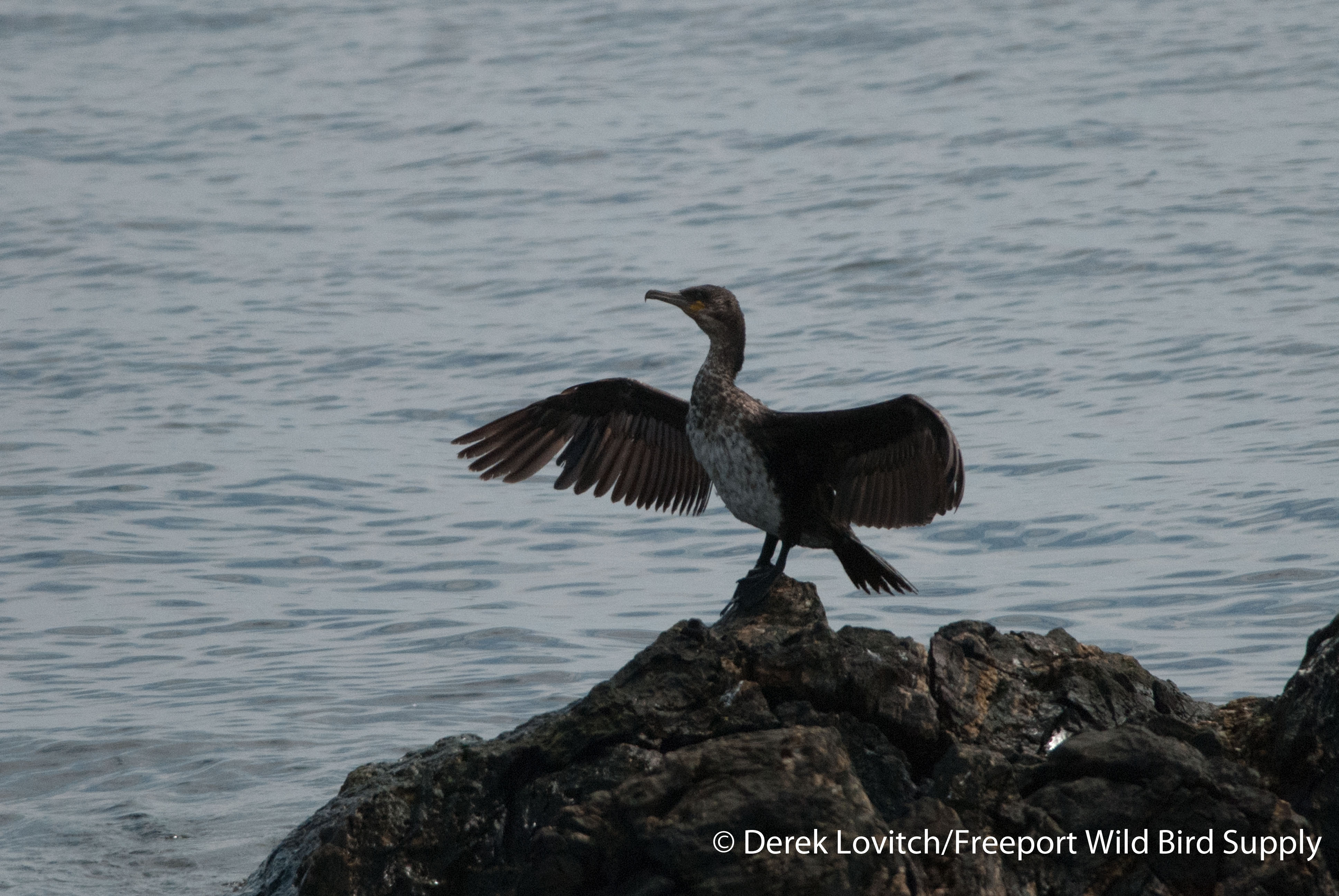
My first visit of the season to the realm of the thrush was last week, as part of a very successful three-day tour for a client visiting from Vancouver. We saw 7 of 8 of our targets: Saltmarsh and Nelson’s Sparrow, Great Cormorant (3!), Bicknell’s Thrush, American Woodcock, Atlantic Puffin, and Manx Shearwater. And most we saw very, very, well. We only missed Razorbill due to a strategic decision that we agreed upon, and in the end, said decision worked out very well as we had unbelievable views of the shearwater.
First-summer Great Cormorant.
Manx Shearwater!
In addition to the species we were seeking, we ran into several other highlights, the most noteworthy of which was an unseasonable subadult male Common Goldeneye at Cutt’s Island in Kittery. Other highlights included a truant Olive-sided Flycatcher at Reid State Park, and an Arctic Tern – usually an offshore feeder – feeding with Roseate and Common Terns off of East Point in Biddeford Pool.
Then, this past weekend was my popular annual “Bicknell’s Thrush and the White Mountains” van tour. Meeting at the store on Saturday morning, we headed for the hills, beginning with a surprise detour to West Paris. For this:
That’s right, a Snowy Owl in Maine in June! Really remarkable. And how’s that for a way to start off a weekend tour? We then made a turn for the White Mountains, and after a couple of stops, arrived at Trudeau Road for this:
Of course, as awesome as a Snowy Owl and a nest-ful of Black-backed Woodpeckers (this is the male above, who kindly paused to preen between visits to feed the young. We also had a great look at the female, who nearly dropped a fecal sac on the group!) are on a birding tour, this is a thrush trip, so our remarkable day of birding would rapidly fade into memory if we didn’t find our one true quarry.
After an early dinner, we boarded the specialized vans of the Mount Washington Stage Line for our private charter up the mountain. It was gorgeous at the base, but looking up, we knew the summit would be different.
And it was!
Luckily, the thrushes’ habitat was below the clouds tonight, and so after visiting the summit and checking for American Pipits (too windy, but the flowers were fantastic), we dropped down and began our real mission.
Although it took a lot more work than usual, we were all eventually rewarded with good to great views of this enigmatic species. We saw two or three different birds, and heard up to 4 others – a good count for the short stretch of habitat that we cover. It was even the 700th ABA-area bird for one of the clients – a fantastic bird for an impressive milestone. A short celebration was called for upon our return to our hotel.
On Sunday morning, the second day of this two-day “target species” tour, the weather looked gorgeous, but the birding was challenging. Granted, it was going to be hard to top Day 1 anyway – we were probably the first tour in history to see a Bicknell’s Thrush and a Snowy Owl in the same day! It certainly was a novel – and a completely unexpected – experience for me.
Birding the Caps Ridge Trail in dense fog and cool temperatures to start the day was less productive than usual, but it was still a nice walk into boreal habitat and enjoy the beautiful forest here. Blackpoll Warblers and Yellow-bellied Flycatchers were conspicuous today, at least.
Very strong, downsloping winds cleared the skies for us at our next few stops, but those winds only increased, and birding became a challenge. My favorite spot for Philadelphia Vireo, for example, was just too windswept. Actually, standing upright was occasionally a challenge. But finding some shelter on the backside of a mountain via a short, but steep hike, a few of us were treated to another view of a Bicknell’s Thrush – just as a little more icing on the cake.
A great lunch followed our birding, fueling us for the drive back to Freeport (or, at least, until the ice cream stop) and capping another successful “Bicknell’s Thrush and the White Mountains” weekend. With one more private thrush tour next weekend, I can only hope my luck with the weather and with seeing the thrush – a mythological bird to some – continues.
It was like birding in another world yesterday as Kristen Lindquist and I headed south of the border…to the New Hampshire Seacoast. For one, we saw birders everywhere! Well, everywhere where there wasn’t wall-to-wall development. And goodness, even in winter, there are a lot of people around here (relatively speaking of course). Yup, we weren’t in Maine anymore!
But I have a lifetime listing goal of seeing 200 species in every state, and my goal was to hit that mark in New Hampshire by the end of this year. This goal is not for any “total ticks” target, or submission to any listing competitions, or anything else other than an excuse and occasional extra motivation to see more parts of the country. The 200 number seems a reasonable goal to me for most states (I won’t reach it in Hawai’i!) that involves seeing a fair sample of what a state has to offer, and usually in multiple seasons – whether its scenery, food, or other interests (i.e. Rutgers football bowl games!), there’s always a good reason to travel near and far and lots of fun to be had in the process. And of course I will be birding in between anyway, so long ago I began keeping track of it.
So the 200 goal was born, and it was time to get to know my neighboring state a little better. Outside of the White Mountains (where I love to bird, hike, and of course, guide), I really didn’t know New Hampshire birding and birding sites very well, and I am happy to say that has changed this year. While I joked with friends about “never having to bird in NH again!” after the goal was met, I did learn quite a bit about birding the state in the process. But yeah, I am partial to birding in Maine.
Anyway, I have been watching the NH listserve and plotting my visit. I needed 5 more species, and I kept an eye on when a handful of uncommon to rare birds joined the more expected species that I “needed.” Seeing recent reports from the Seacoast – and seeing that my days off will be limited (aka: likely non-existent) from now to Christmas, I decided yesterday would be the day, despite early morning ice that slowed our drive (lots of cars off the Turnpike yet again) and persistent drizzle and occasional light rain.
We began in the Hampton Marsh, where the high tide was pushing Horned Larks to the edges. Check. We then ran into Ben Griffith and Lauren Kras, and then joined them in a Snowy Owl search. Unfortunately, this was to no avail.
Pulling into Hampton Beach State Park, the two hen King Eiders (197) performed nicely. I teased out a few Purple Sandpipers (199) from the flock of 100 or so Dunlin (198), and ran into more friends.
Compare the “Queen” Eider with the hen Common Eider on the right. Note especially the concavity of the bill, the face pattern, and the cooler, grayer tone to the plumage.
After chatting and enjoying the eiders for a bit, Kristen and I grabbed some lunch and then returned to the coast. Snowy Owl would make a nice milestone bird.
Shortly thereafter, I received a text from Ben “Nelson’s-type Gull on Eel Pond,” followed by “Correction – possible Thayer’s Gull.” And off we went.
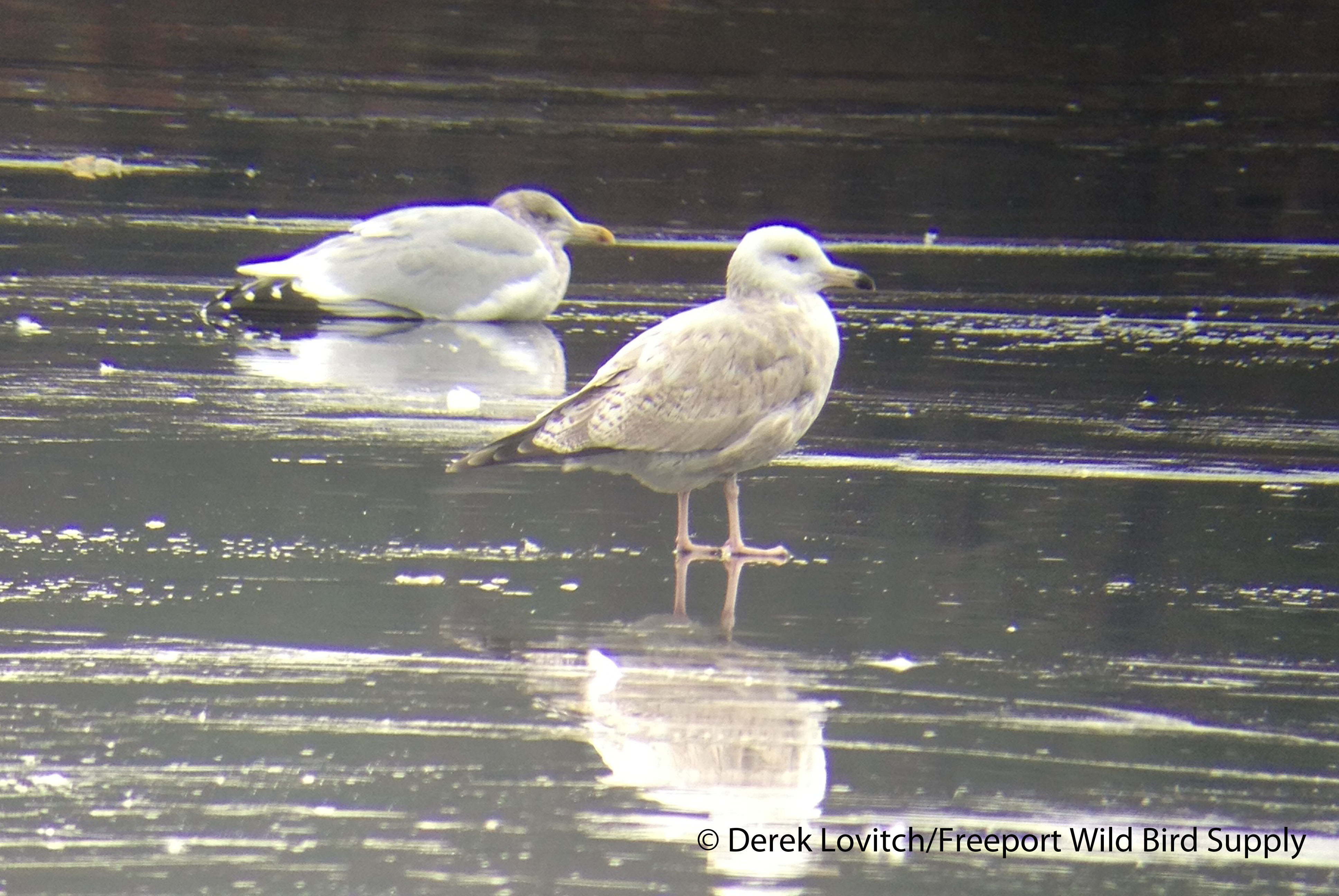
Arriving at Eel Pond, the bird in question immediately stuck out, and I set about studying and photographing it. While it seemed that people were at least leaning heavily towards a Thayer’s Gull by this point, I had my doubts. But, I also have limited experience with 2nd Cycle Thayer’s Gulls. I also did not have a better explanation for this odd bird at the time. But Thayer’s Gulls are tough, 2nd Cycle gulls are a pain in the ass, and a rarity like this (potential 6th NH record) of course warranted extra scrutiny.
I began to take notes, and even a little feather-sketching. I took lots of photos. Birders came and went. Ben, Lauren, Jason Lambert, and I continued to work on the bird. Kristen headed to the car to check on the Patriots and to warm up. She was clearly the smart one.
There were a series of things that bothered me about this bird being a Thayer’s Gull, and I scribbled those down in my notes:
– The primaries were multiple shades darker than any other part of the bird.
– The tertials were extensively marbled.
– The bill was so extensively pale with such a finely demarcated black tip for a bird that was otherwise not very advanced in plumage.
– The bill looked rather large and heavy, especially at the tip.
– The eye color was orange-yellow, not light, but definitely not dark.
– The legs were dingy pinkish-flesh.
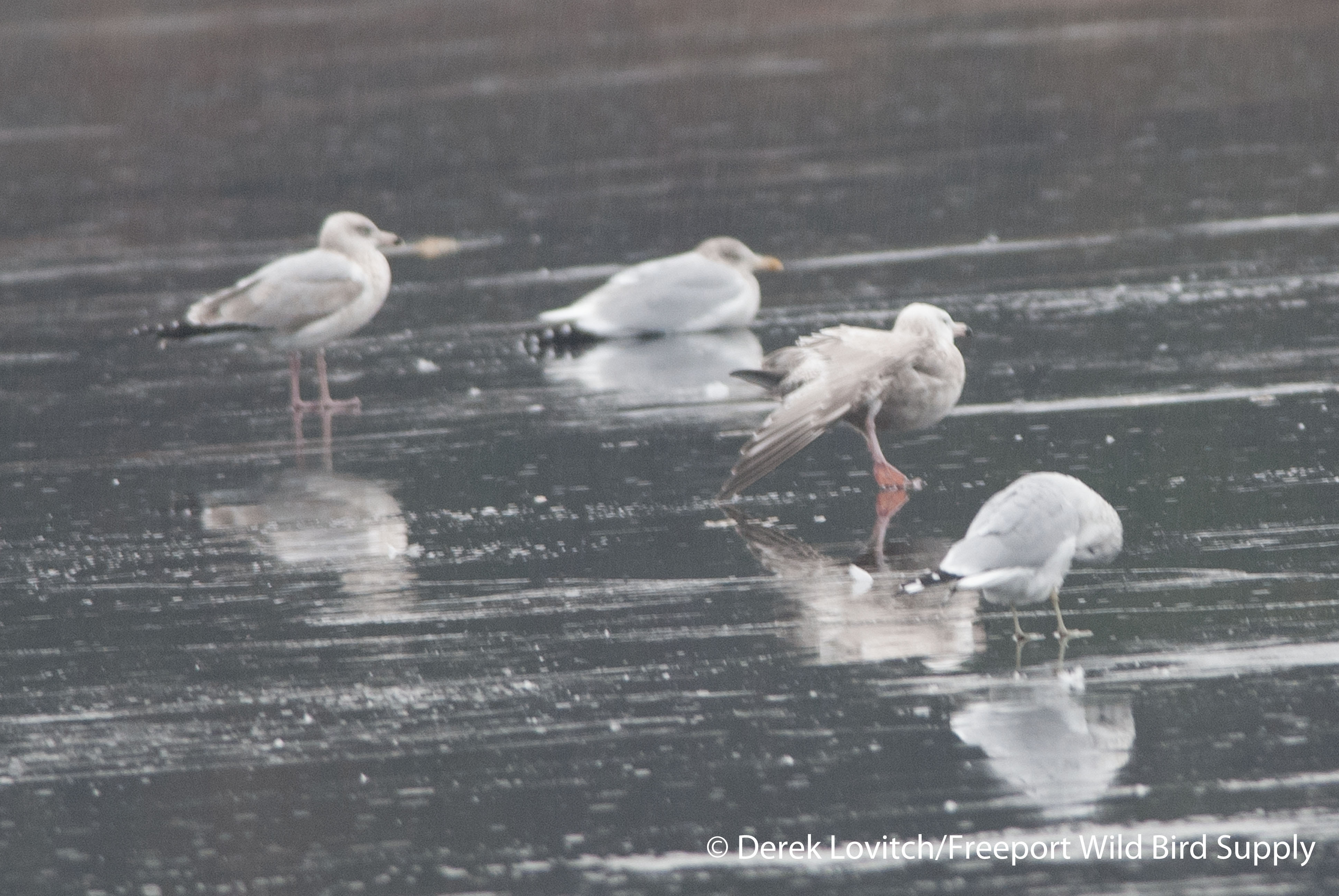
While none of these features really eliminate Thayer’s Gull, they are consistent with “Nelson’s Gull,” the name given to Herring x Glaucous Gull hybrids as well. But try as we might, we could not get the bird to fly closer. I never saw it with the wing fully outstretched, but the bird was photographed well in flight earlier.
It was not a big bird, and looked smaller than most – but definitely not all – of the nearby Herring Gulls. Most Nelson’s I’ve seen are noticeably larger, but large gulls are notoriously variable. But look at this shot – it sure doesn’t look small compared to the 1st cycle Herring Gull on the left! And see that deep build? It doesn’t look at slim and dainty as many Thayer’s look (speaking of variable – and subjective – gull criteria). The head looks rather blocky, and the bill was rather hefty.
Meanwhile, shortly after my arrival and the beginnings of ponder the mystery gull, a Carolina Wren sang…number 200! Yeah, it was pretty obvious to all that my NH birding has mostly been in the mountains, but this was a silly hole that somehow was not filled on previous coastal trips. Mission accomplished. So I went back to pondering the gull. And, with daylight fading and the long drive (especially for Kristen) still ahead of us, we hurried over to RyeState Park to catch up with a Snowy Owl (201), which was one of our real targets of the day. With at least 12 birds seen along the coast on Saturday, we were surprised that – despite the amount of birders combing the coast – it took us all day to see a Snowy (it sounds like a total of 2 or 3 were seen along the coast by day’s end).
Driving home, we listened to the Pats once again stage a come-from-behind victory, and as Kristen departed, I hit our library and the internet for some gull study time. After reviewing my photos of the standing gull, and comparing that to the photos in references – especially Howell & Dunn – and online, I was definitely leaning more towards Thayer’s Gull, as most of my concerns seemed to be accounted for. But I needed to see the spread wing.
And then Ben forwarded me Jason’s photos. My response was simple, “Ewww.” The extensively dark primaries were as extensive and dark as they appeared in the field. While darker Thayer’s can show dark shading bleeding onto the inner webs of the outermost primaries, the outer three primaries on the Eel Pond bird were clearly wholly dark, and the dark was extensive on the next two as well. I just don’t think a Thayer’s can show that. While no single field mark alone can define any gull, this very well could be enough on its own to eliminate a Thayer’s (or, dare I say it, a pure – whatever the hell that means – one), a bird known for its “picket fence” primaries of dark outer webs contrasting with pale inner webs. Adding that with the other features – including the structure of the head, bill, and body – I’m unable to call this a Thayer’s Gull. Short of a DNA sample, it’s a “Nelson’s Gull” to me, although I think there is some argument to be made for this to not be a first-generation hybrid. I sent the link to Jason’s photos (which are far superior to my own) to a handful of friends, and they have so far concurred that this is a Nelson’s-type gull. But, gulls are one of those birds that everyone can have a different opinion on, so I await responses from others. I just hated to rain on the parade, especially since Lauren and Ben were so helpful in my little listing quest that initiated the day.
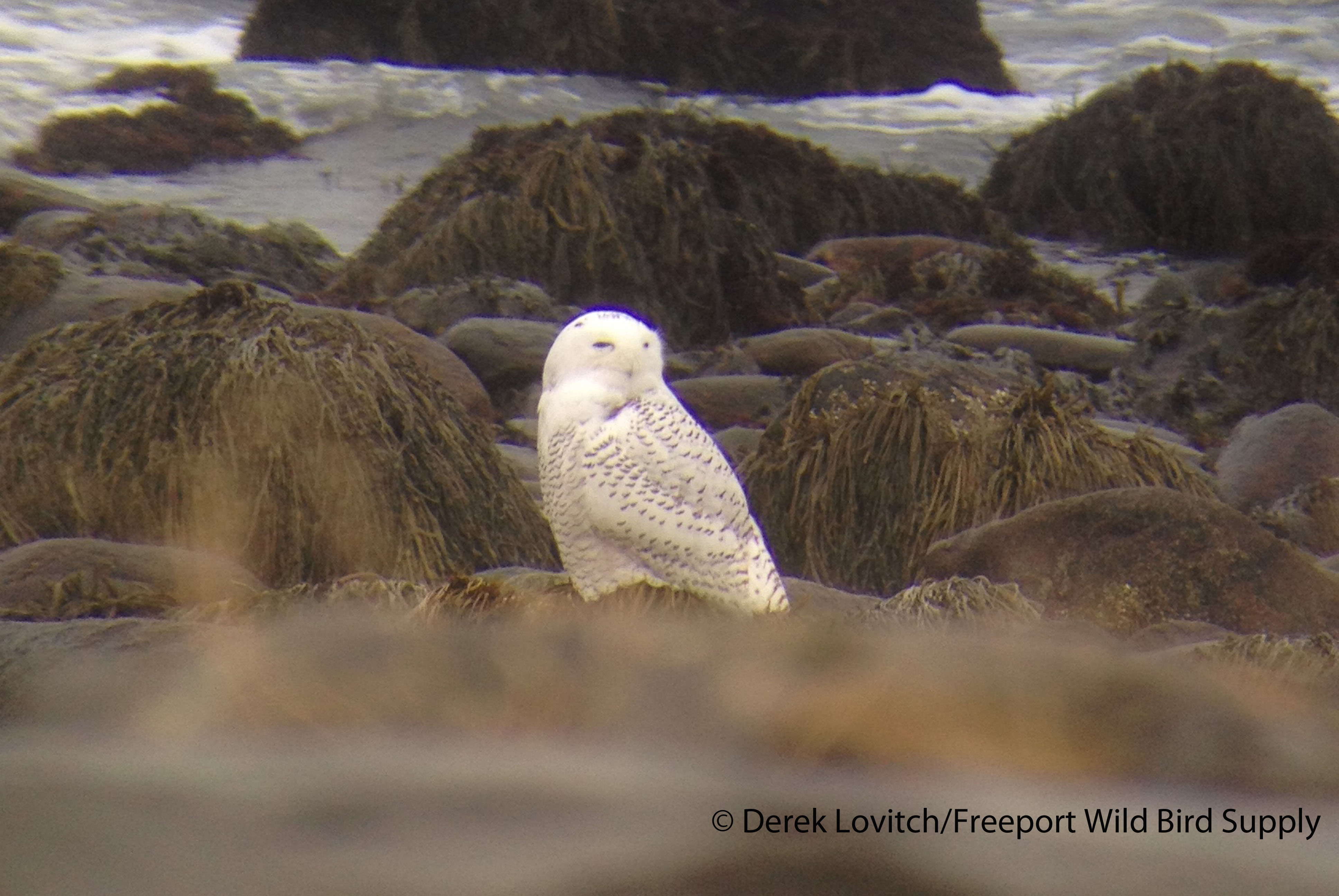
Ahh, large gulls. The Snowy Owl was easier to identify. I like Snowy Owls.
































 Maine Birding Field Notes