Jeannette and I spotted these four Red-necked Phalaropes from the Casco Bay Ferry Mailboat run with visiting family on the 26th.
It was a very busy week for me, but when I did get out, birding was productive – especially in the backyard which hosted at least 15 species of warblers this week. Meanwhile, shorebirding continues to be hot. My observations of note over the past 8 days included the following
1 Black Scoter, 2 White-winged Scoters, and 2 Blue-winged Teal with Common Eiders, Reid State Park, Georgetown, 8/27. As scoters begin to increase in September, I’ll forgo reporting the “oversummering” groups from now on.
1 TRICOLORED HERON, Mill River Park, Thomaston, 8/29 (with Jeannette).
1 Northern Pintail (first of fall) and 1 juv, Little Blue Heron, etc, Eastern Road Trail, Scarborough Marsh, 8/30.
3 adult Lesser Black-backed Gulls, Seawall Beach, Phippsburg, 9/2 (with Ed Hess).
My shorebird high counts for 18 species this week were solid considering I didn’t make it to Biddeford Pool (or Pine Point) during this period. Focusing on mostly lesser-visited hotspots, I found several goodies and had a few decent high counts.
Black-bellied Plover: 67, Wharton Point, Brunswick, 9/2 (with Ed Hess).
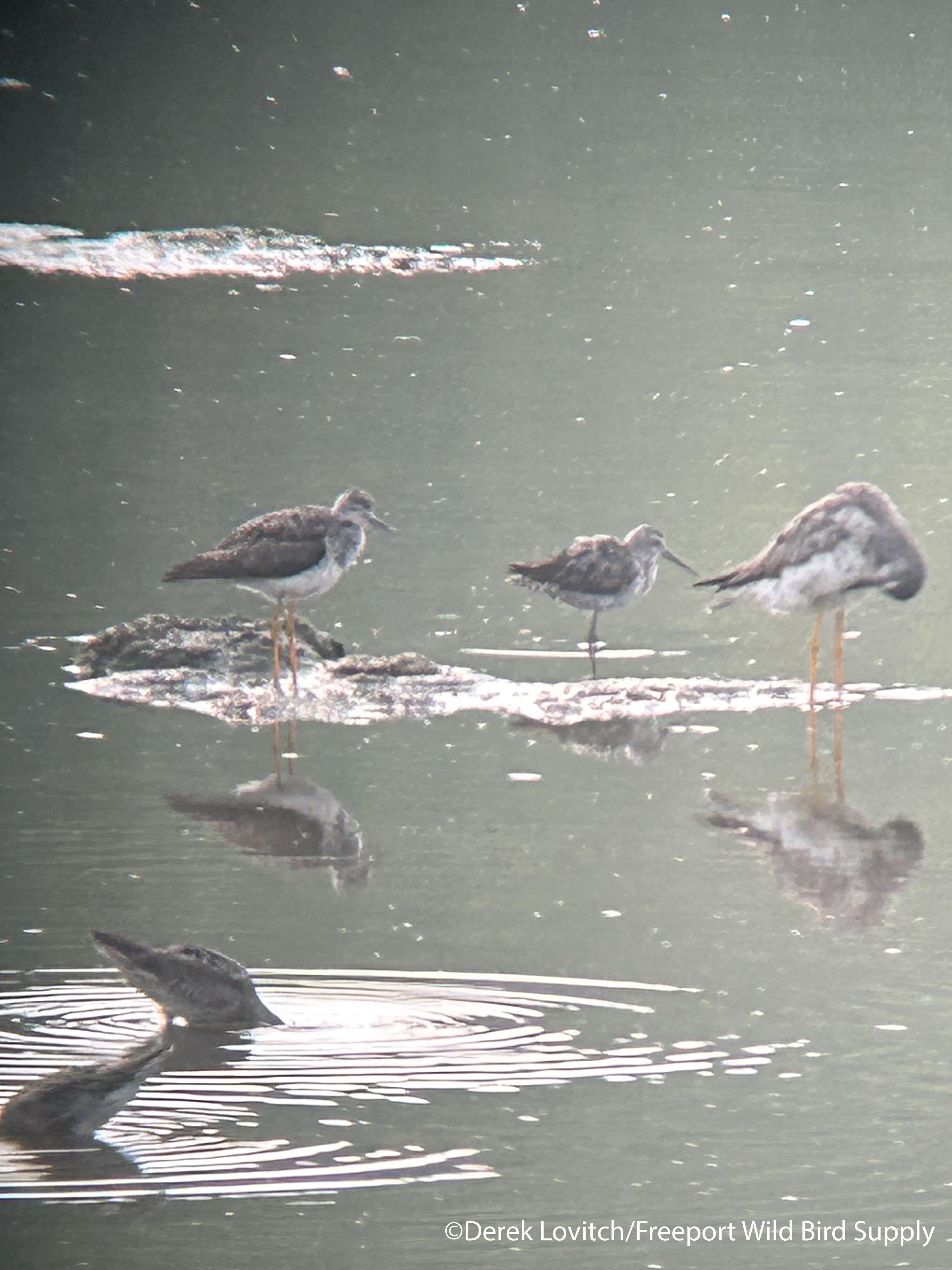
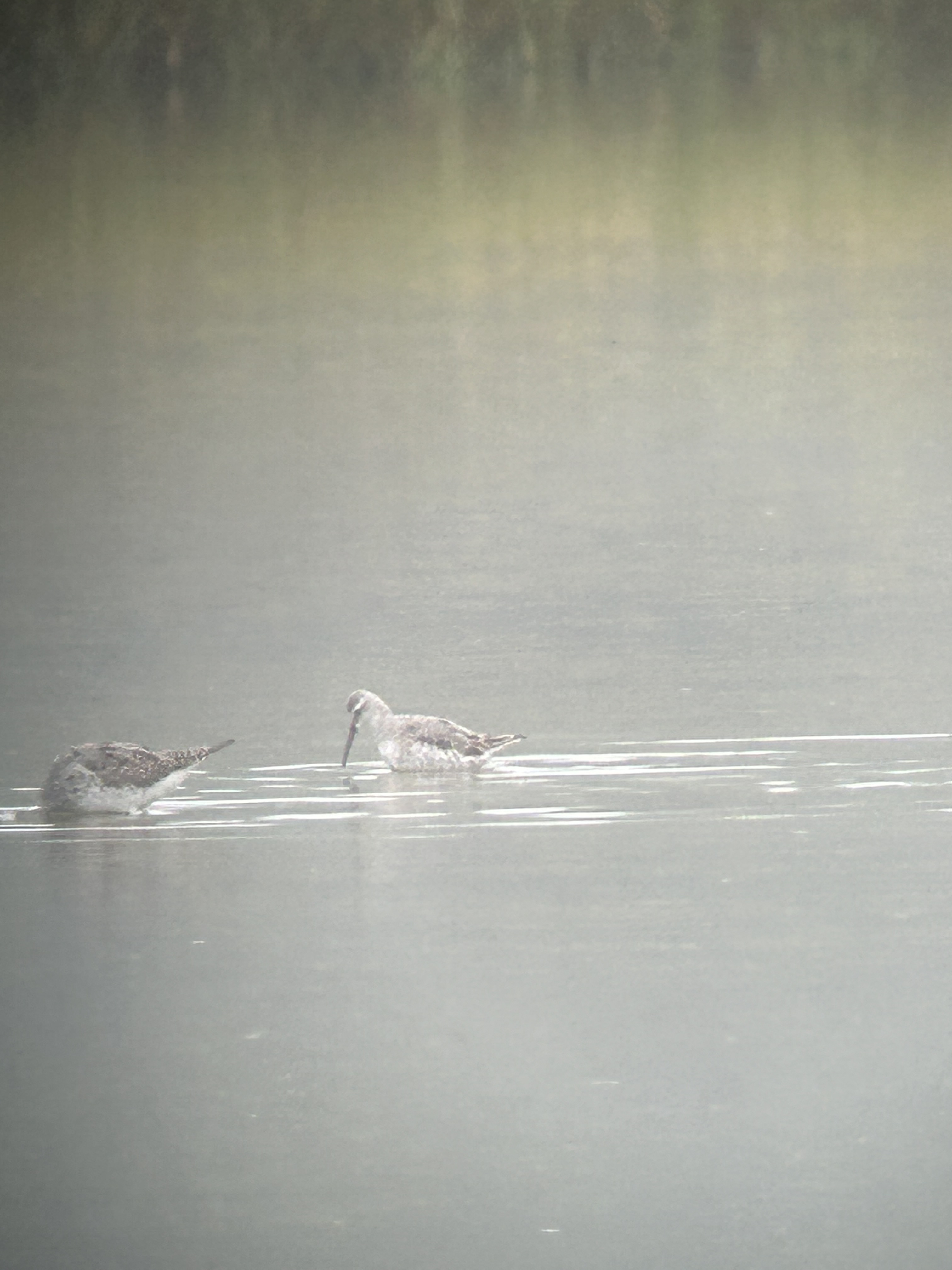
Far from being my best shot of the week, our Saturday Morning Birdwalk group enjoyed 2 Stilt Sandpipers at Freeport’s Walsh Preserve. Here’s one of them (pardon the lousy hand-held phone-scoped photo) flanked by Lesser and Greater Yellowlegs for a perfect comparison. Instructional shorebird identification was the name of the game for my tours this week!
Two shorebird-focused tours, plus a few mornings out on beach/mud on my own produced some solid shorebird high counts. My species list and a few high counts would have been added were in not for the rapidly-approaching thunderstorm as my Shorebird Workshop group arrived at Hill’s Beach on the 15th! Landbird migration is really picking up as well, with lots of the expected early warblers on the move, including a Cape May Warbler at the Walsh Preserve in Freeport (with Saturday Morning Birdwalk group) on the 17th.
Non-shorebird observations of note this week:
28+ continuing Surf Scoters, Wharton Point, Brunswick, 8/12.
2 Common Nighthawks (First of fall), over our property in Durham, 8/13.
2 adult Lesser Black-backed Gulls, Pine Point, Scarborough, 8/15 (with Down East Adventures Shorebird Workshop tour group).
6 Surf Scoters, Popham Beach State Park, Phippsburg, 8/16.
Shorebird high counts this week:
Black-bellied Plover: 91, Wharton Point, Brunswick, 8/12 (with Jeannette).
Killdeer: 35, Crystal Spring Farm, Brunswick, 8/12 (with Jeannette).
Semipalmated Plover: ~300, Pine Point, Scarborough, 8/15 (with Down East Adventures Shorebird Workshop tour group).
Least Sandpiper: 20+, Great Pond, Biddeford Pool, 8/15 (with Down East Adventures Shorebird Workshop tour group).
White-rumped Sandpiper: 12, Pine Point, 8/15 (with Down East Adventures Shorebird Workshop tour group).
Semipalmated Sandpiper: ~1750, Biddeford Pool Beach, 8/15 (with Down East Adventures Shorebird Workshop tour group). Honorable mention of ~1200 at Pine Point on 8/15 (with Down East Adventures Shorebird Workshop tour group).
Short-billed Dowitcher: 8, Popham Beach State Park, 8/16.
Spotted Sandpiper: 2, multiple locations this week.
“Eastern” Willet: 14, Pine Point, 8/15 (with Down East Adventures Shorebird Workshop tour group).
Greater Yellowlegs: 41, Wharton Point, 8/13 (with Jeannette).
Tours and Events:
The 20th Anniversary Celebration Month is underway here at the store. All the details can be found here, including a silent auction for conservation, and several chances to win a new pair of binoculars!
Two of the three Lesser Black-backed Gulls present at Hill’s Beach in Biddeford on the 8th included these two 3rd-cycle birds, seen here with a likely 4th cycle Herring Gull for a nice comparison.
Once again, I focused on shorebirds this week, and not surprisingly the non-shorebird highlights I encountered were while looking at said shorebirds. Meanwhile, passerine movement is really ramping up, with lots of early warblers like Yellow, American Redstart, and Black-and-white on the move. Some of the other migrants on our Durham property this week included Canada Warbler, Eastern Kingbird, Bobolink, and Barn Swallow.
3 Lesser Black-backed Gulls (one 1st-summer; with Dan Gardoqui and two 3rd-summers arriving later), Hill’s Beach, Biddeford, 8/8.
The adults of a lot of species of shorebirds are peaking now, and a growing number of juveniles are arriving, providing for some good numbers at a variety of locations. Shorebird high counts this week:
Black-bellied Plover: 86, The Pool, Biddeford Pool, 8/8.
Killdeer: 21, Crystal Spring Farm, Brunswick, 8/5 (with Jeannette).
Semipalmated Plover: 150+, Pine Point, Scarborough, 8/11 (with Birds on Tap – Roadtrip! Tour group).
Semipalmated Sandpiper: 1500+, The Pool, Biddeford Pool, 8/8 (with Dan Gardoqui).
Short-billed Dowitcher: ~40, The Pool, 8/8 (with Dan Gardoqui).
Spotted Sandpiper: 2, multiple locations this week.
Solitary Sandpiper: 1, several locations this week.
Lesser Yellowlegs: 71, Walsh Preserve, 8/9.
“Eastern” Willet: 18, Pine Point, 8/11 (with Birds on Tap – Roadtrip! Tour group).
“WESTERN” WILLET (FOY): 1, Hill’s Beach, Biddeford, 8/8.
Greater Yellowlegs: 12, Wharton Point, 8/6 (with Jeannette).
Tours and Events:
The 20th Anniversary Celebration Month is underway here at the store. All the details can be found here, including free raffles for dinner (get your tickets in soon; drawing on Wednesday!), a silent auction for conservation, and several chances to win a new pair of binoculars!
Birds of Casco Bay with Seacoast Tours, originally scheduled for 8/4, has been postponed until Sunday, 8/25. Call Seacoast Tours to see if any spaces have opened up.
Jeannette and I spent a few days last week again assisting Dr. Adrienne Leppold of Maine IF&W with a project to put radio transmitters on Wood Thrushes, a species that is declining dramatically throughout its range. This one was particularly feisty, especially for a thrush!
Although breeding season is in full swing locally, it’s already “fall” for a number of species. Swallows are aggregating and some are heading south, some early and failed nesters are already departing, and the first wave of southbound shorebirds have now arrived! My observations of note over the past seven days including the following:
Cuckoos became more vocally-conspicuous as they usually do this time of year along the coastal plain, including a daily Black-billed in our Durham yard and 2-3 Yellow-billed at Suckfish Brook Conservation area in Falmouth on 7/8 (with Jeannette).
1 fresh juvenile Ring-billed Gull, Auburn Riverwalk, Auburn, 7/5 (seems really early to have one so far away from a breeding lake).
1 female ORCHARD ORIOLE, Old Town House Park, North Yarmouth, 7/6 (with Saturday Morning Birdwalk group).
1 Least Sandpiper (first southbound shorebird migrant of fall!), Green Point WMA, 7/7.
2 AMERICAN OYSTERCATCHERS, Pine Point, Scarborough, 7/9.
9 Lesser Yellowlegs (first of fall), 4 Greater Yellowlegs, and a smattering of Least Sandpipers, Pelreco Marsh, Scarborough Marsh, 7/9.
Tours and Events:
Please join me in Jay on Thursday at 4pm as I give a presentation and answer questions about Birdwatching in Maine: The Complete Site Guide at the Jay-Niles Memorial Library. Free and open to the public.
Blackpoll Warblers were pleasantly ubiquitous over the weekend, with endless opportunities to view them without neck strain for a change.
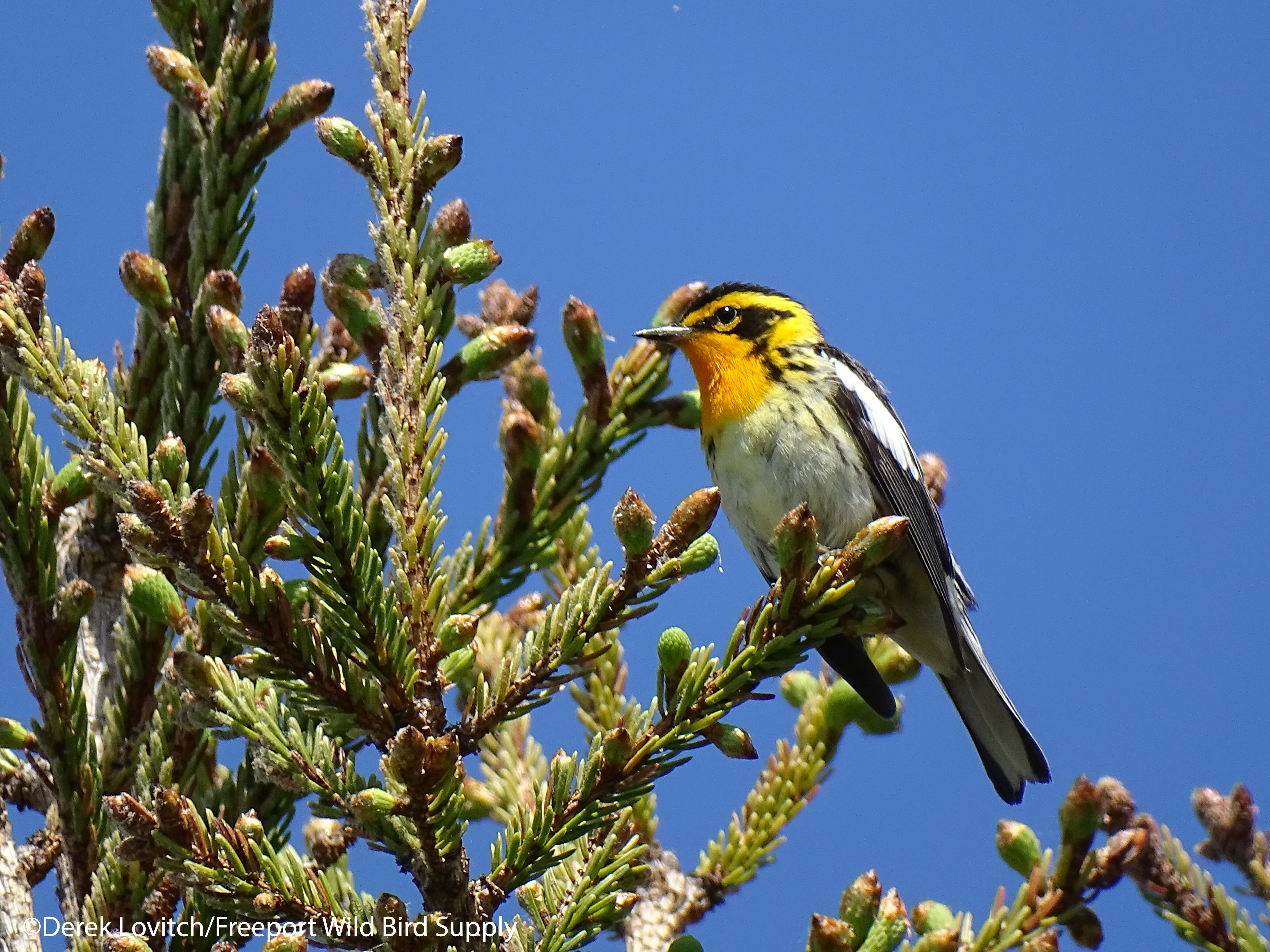
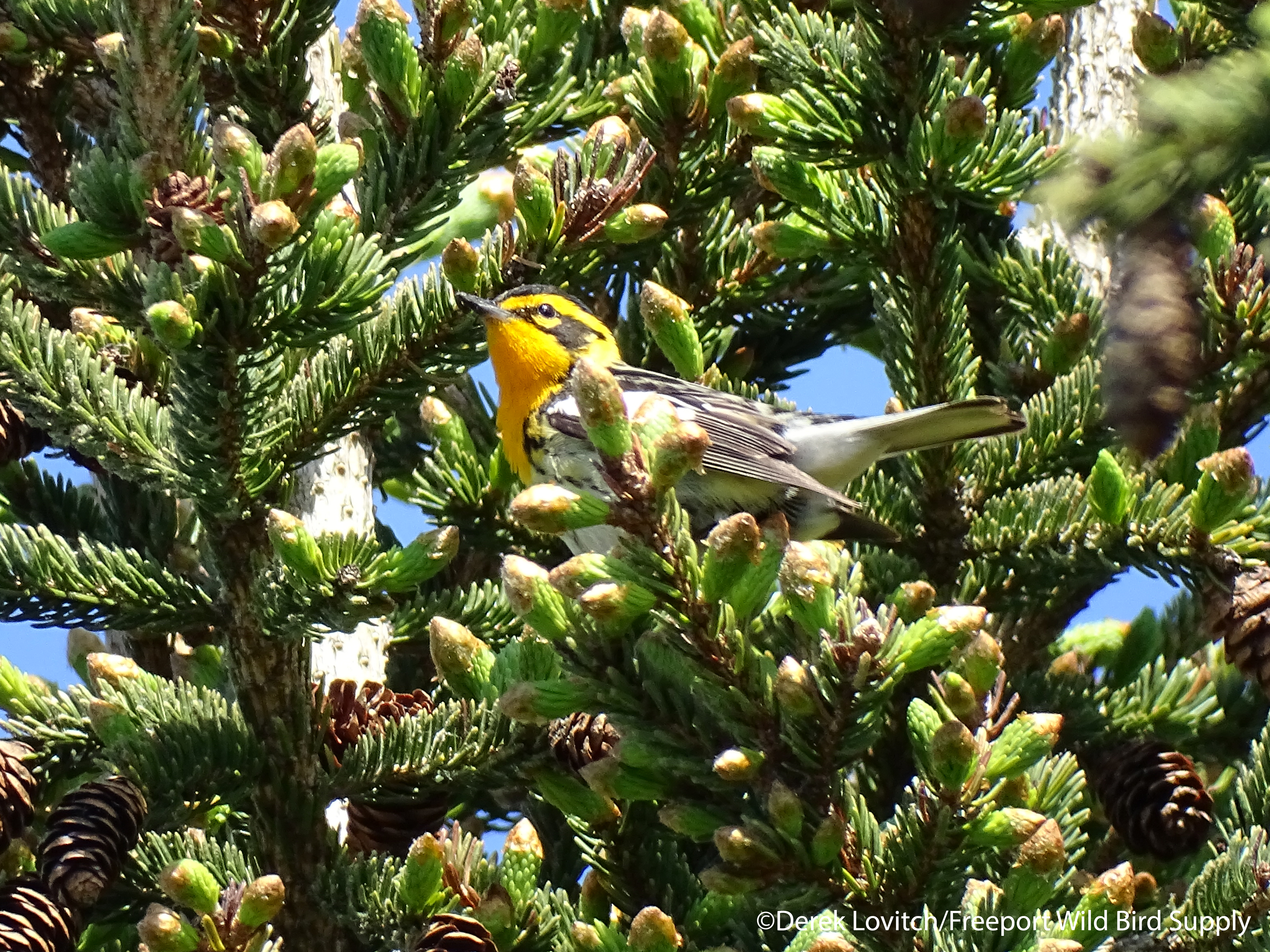
I just can’t walk away from a male Blackburnian Warbler in the sun, especially at eye-level. Just can’t do it. While Blackpolls were the most numerous migrant of the tour, as expected for the end of May, Blackburnian Warblers consistently stole the show.
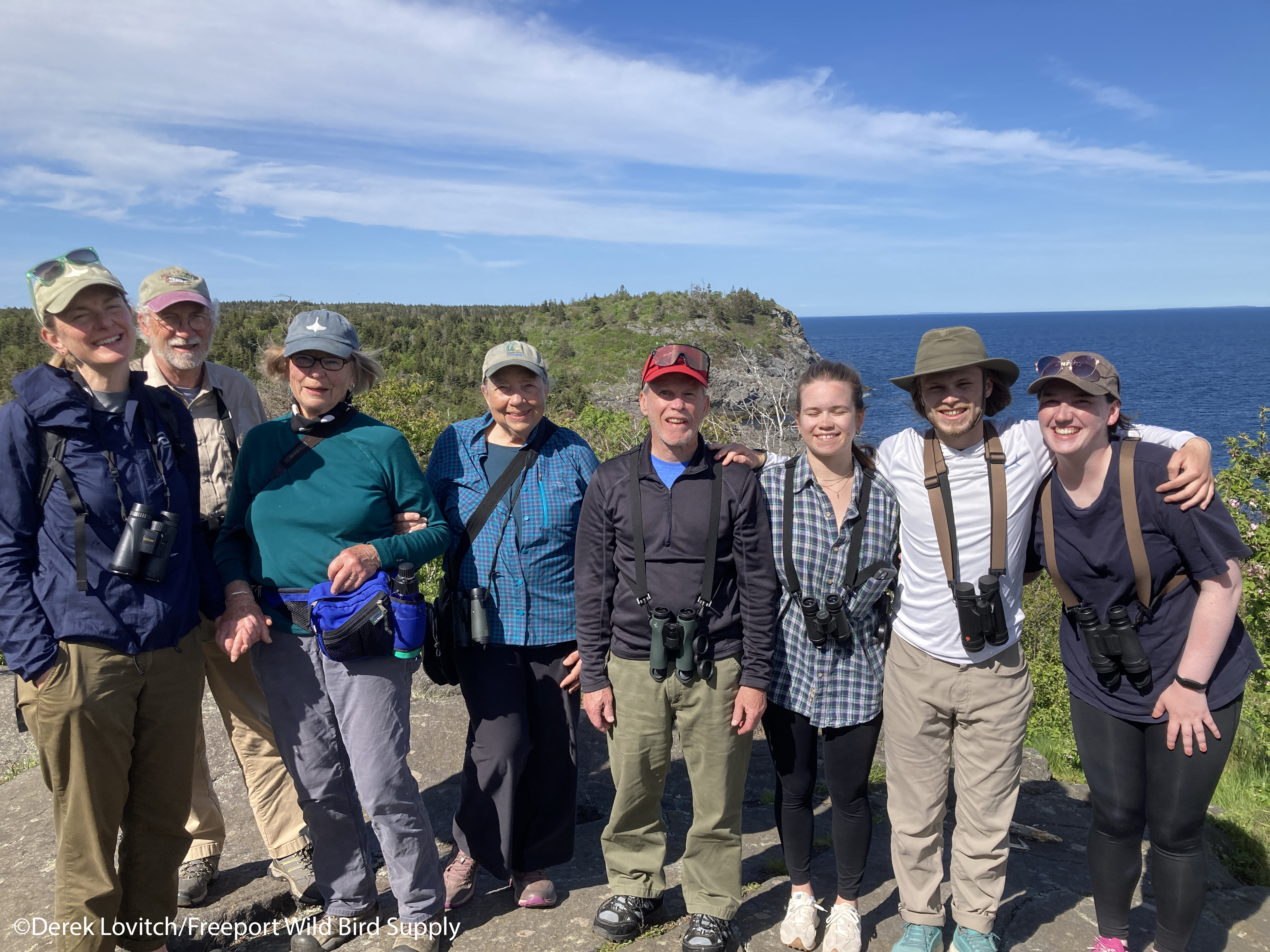
Our 14th annual Monhegan Spring Migration Weekend was highlighted by three days of insanely gorgeous weather, 18 species of warblers, and loads of crossbills. But what set this year’s tour apart was how consistently amazing the looks were at so many birds, especially both crossbills and some of our favorite warblers.
The tone was set on our Friday crossing from New Harbor, with lovely weather and 2 fly-by Atlantic Puffins. And once again, we hit the ground running after our 10:15 arrival, taking nearly an hour just to walk up Dock Road. One of our favorite corners was just hoppin’, with our first stellar looks at both Red and White-winged Crossbills and Blackpoll Warblers, as well as our only Canada Warbler of the tour.
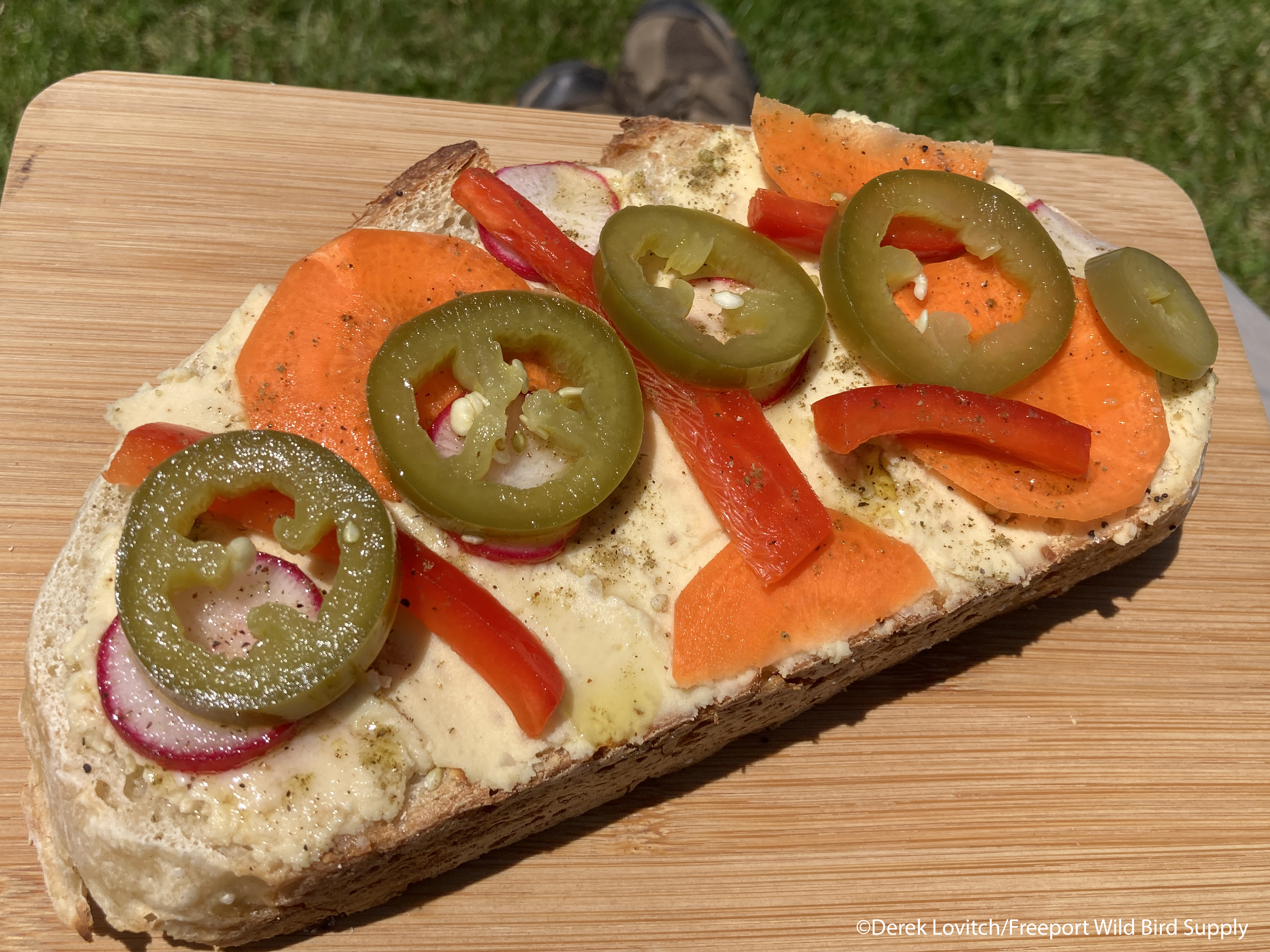
I ate a lot of hummus toasts for lunch at the Trailing Yew in an attempt to make up for copious breakfasts and decadent feeders.
The afternoon, and the next three days were filled with crippling view after crippling view. Blackpoll Warblers were everywhere, both males and females seen in close proximity repeatedly for good studies. American Redstarts were abundant, as were locally-breeding Common Yellowthroats and Yellow Warblers. But it’s been a long time since we have seen crossbills, especially White-winged, so well and so often everywhere around town and beyond. It’s hard not to name this species the bird of the tour this year.
Male White-winged Crossbills.
In that first afternoon, some of our other highlights were a fleeting glimpse of a Black-billed Cuckoo, and later we found a female Purple Martin. Birds were just unusually low and cooperative, despite the gorgeous weather, so that really set this first day apart.
My days started even earlier than I would have liked as pheasants took to calling from the railing right outside my bedroom window. At 4am. 4am.
Unfortunately, the NEXRAD radar archive was down for the duration of our stay, so I can’t do my usual analysis here, but on Saturday morning, a light morning flight of mostly Blackpoll Warblers and American Redstarts suggested at least some birds had arrived on the light westerly wind overnight. There were also more Magnolia Warblers around, but overall, our two morning walks were slower than yesterday’s birding, but we would repeatedly find pockets of good activity with more great views of most of what we encountered.
This Cape May Warbler showed himself nicely, feeding on little midges/flies buzzing around the buds of this Red Spruce.
A Black-billed Cuckoo was as cooperative as they get, freezing on a bare branch for several minutes. Prolonged scope views of Red and White-winged Crossbills offered the chance to watch their amazing feeding behavior. The afternoon was a little slower, as expected, but still low and close Blackpoll Warblers and crossbills all around. Friends found a Blue Grosbeak that afternoon, which confirmed what I thought “had to be one” that flew across the marsh early in the morning but disappeared into brush before we could confirm its identity.
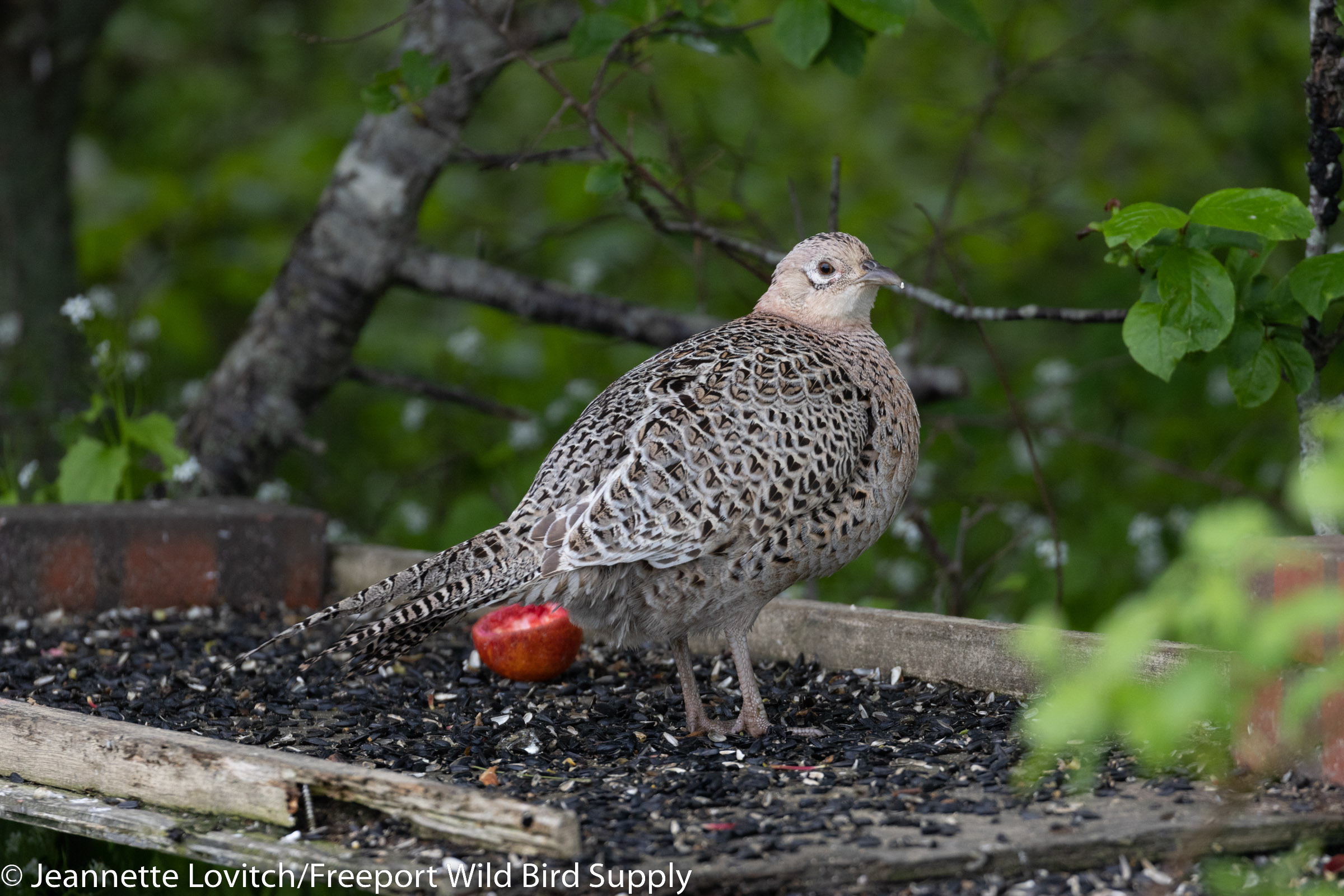
Of course we took some time to enjoy Rose-breasted Grosbeaks at Donna’s feeders, along with the omnipresent Ring-necked Pheasants.
Despite southerly winds overnight, Sunday morning was quite a bit slower, likely due to rainfall cutting off the flow of migrants from the south. We started the day with a bang though, as we moseyed down to the harbor to enjoy an up-close-and-personal Razorbill that ended up spending much of the day foraging in the harbor.
There was some passerine turnover overnight, however, and new birds this morning included an Alder Flycatcher, a calling Olive-sided Flycatcher, and finally a Tennessee Warbler – perhaps our first uncooperative warbler of the trip! The bird of the morning, however, was Blackburnian Warbler, as we started the day with amazing views just as we started and finished the morning with repeated great looks at males and females. Again, we were just in awe of the repeated great views we were getting of so many species, even if, yes, it was slow by Monhegan standards.
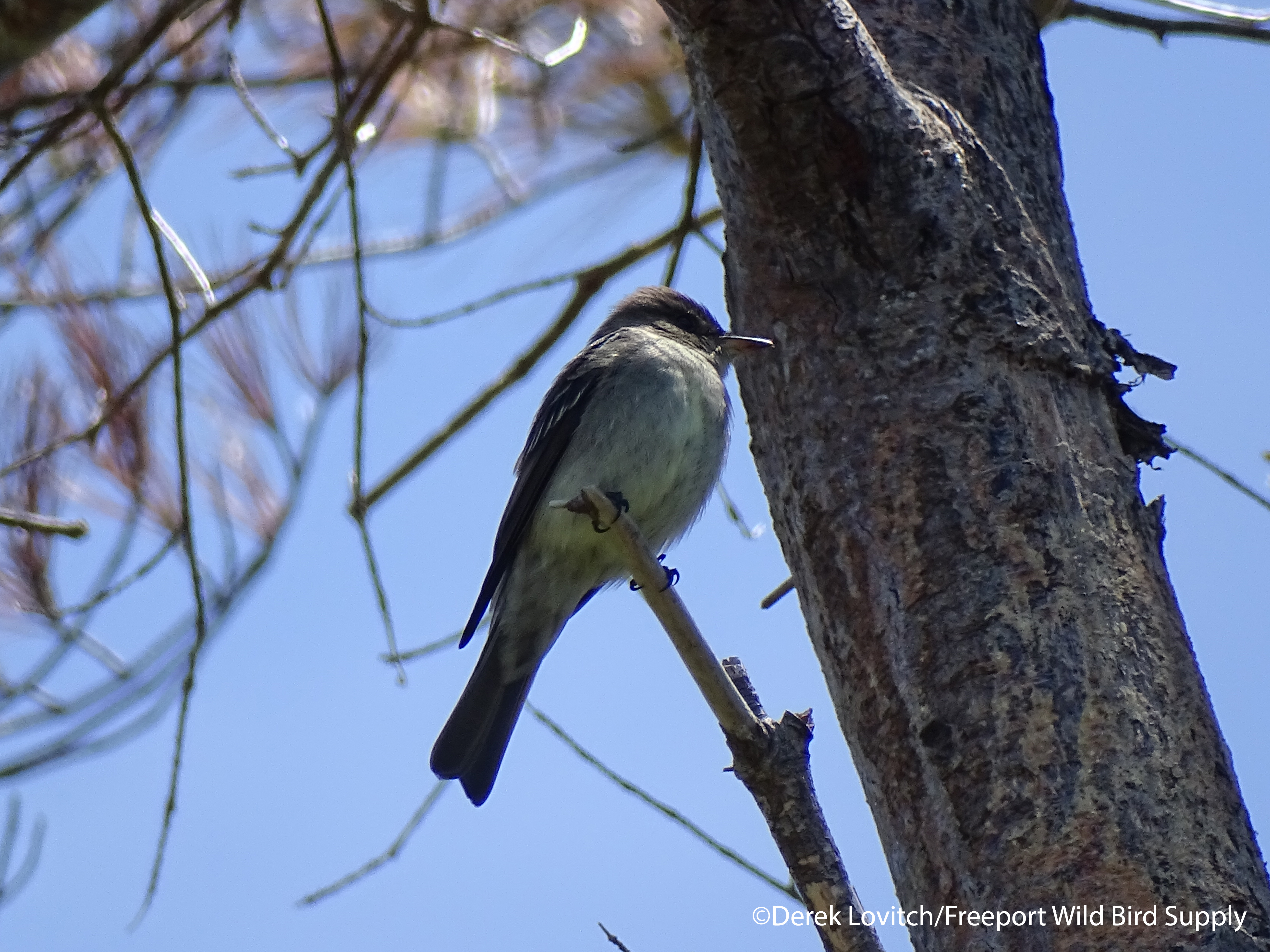
A nice selection of flycatchers over the weekend afforded the opportunity to learn how to break them down via primary projection, such as in this long-winged Eastern Wood-Pewee.
In the afternoon, we took the obligatory walk up to the lighthouse, both for some hawkwatching and snapshots. However, we ended up being enthralled (OK, I was enthralled) by a massive gull feeding frenzy that broke out over the lighthouse hill and beyond. It became clear that the gulls were not just enjoying the weather to soar on thermals but were feeding on some unseen flying insect. While a common event on the mainland, none of the birders present out here has ever seen anything like this over the island. The numerous Herring Gulls attracted a growing number of Laughing Gulls – the most I have ever seen out here (it’s usually just a few pairs around the harbor or fly-bys).
Northern Parula nest under construction.
Monday, the last day of the tour, unfortunately, did not see us go out with a bang. With light easterlies overnight and developing clouds and fog, not only did a new wave of migrants not arrive, but it seemed like just about every single passage migrant had departed! Even Blackpolls were few and far between, and the number of American Redstarts seemed only on par with the number that remain out here to breed.
Pink Lady’s Slipper in the woods.
But once again, White-winged Crossbills stole the show, with the pre-breakfast walk highlighted by incredible views of a feeding family group. And although slow all day, we covered some ground and slowly built up our triplist with everything from a Purple Finch to a calling fly-over Black-bellied Plover. We studied a Great Cormorant (and later, a second), and finally caught up with the long-staying Green Heron in the ice pond. Three tarrying Black Scoters were a surprise in Deadman’s Cove, but not nearly as surprising as the drake Green-winged Teal loafing with Common Eiders on Neigh Duck!
After lunch, an unusual-for-here assortment of swallows over the marsh included two Bank, one Cliff, joining the 2 Tree Swallows and more Barn Swallows that have been out here all weekend. Seawatching at Lobster Cove produced a hen Long-tailed Duck right off the rocks that somehow disappeared in front of our eyes.
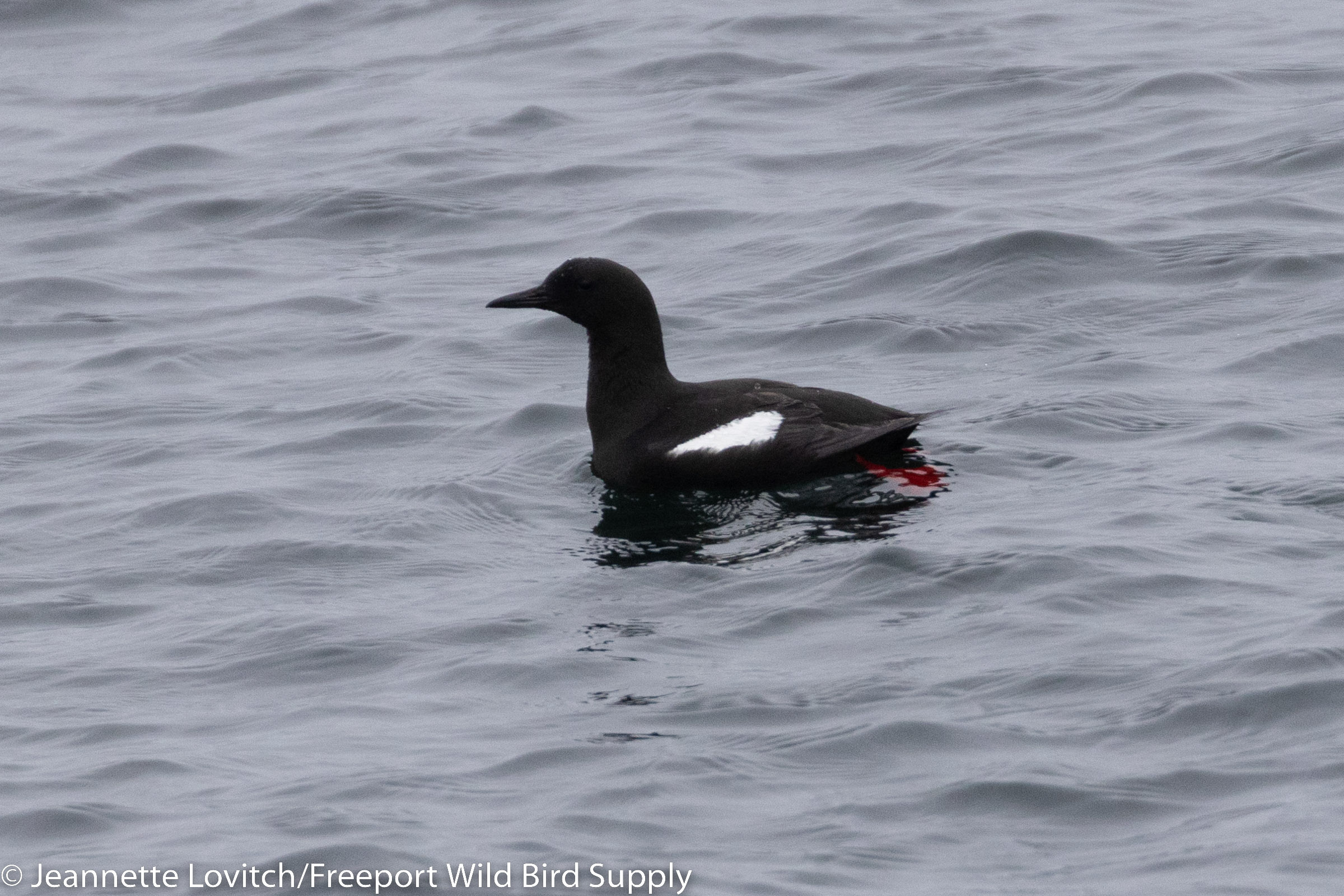
Black Guillemots were all around the island, including some close ones off of Lobster Cove that were close enough to see those vivid red feet.
“Lefty” the Red-winged Blackbird has returned for at least his third summer on territory in the marsh.
With the tour coming to an end at about 3:00pm as just about everyone readied to board the Hardy Boat, rain began to fall, bringing our tour to an official close. However, it wasn’t until dinnertime that a few downpours arrived, and so we squeezed out one more comfortable day of birding.
It was just Jeannette and me now, but “FOMO” was unwarranted. While a White-throated Sparrow outside of the Monhegan House after dinner was unexpected for the date, we didn’t add anything new to the trip list that evening, or the next morning. Rain, heavy at times overnight and a strong south wind with fog in the morning precluded any movement of birds, and our pre-breakfast walk was dreadfully slow. Passage migrants were few, just about 9 Blackpoll Warblers, 1 Canada Warbler, and 1 Northern Waterthrush, and it felt downright June-like with birdsong being almost exclusively breeding birds. We did have another look at uncommon Monhegan birds like the Blue-winged Teal, Green Heron, and Bank Swallow, but it wasn’t the hardest day to walk away from.
Juvenile White-winged Crossbill
…. Which was good, as we were forced to depart earlier than planned due to the cancellation of the afternoon Hardy Boat. With a low pressure system moving along the stalled front that likely reduced our flow of migrants over the second half of the weekend was also building the seas. Our 10:15 trip, however, featured following seas that made for a reasonable ride, but the fog remained thick until New Harbor. We did have 4 Red-necked Phalaropes materialize out of the fog, however, with one remaining on the water just long enough for Jeannette to reach for and get her camera ready.
So, while Monday – and our usual day off together on Tuesday – was lackluster overall, it was really hard to beat the weather, birding, and learning opportunities that this year’s tour offered. Hopefully, everyone will now know how to identify Blackpoll Warblers at least! Oh, and my goodness the crossbills…
We tallied a respectable 93 species, including 18 species of warblers, over the four-day tour. Although below our long-term average, this was slightly above recent spring weekends. The following counts are simply guesstimations of the number of each species we encountered each day. Not the number of observations (eg every time we passed the same singing Yellow Warbler) or even a guess as to how many were on the island on a given day, but some crude attempt to quantify how many individuals of each species we think we saw each day. The ebbs and flows and daily changes are more interesting than the undoubtedly inaccurate numbers. For species such as the two crossbills that move around, back and forth, all over each day, it was impossible to really know how many there were. “A lot” should suffice.
Here is the trip list four the four-day tour. * = seen from ferry only. **=not seen with tour group.
Species
5/24
5/25
5/26
5/27
Wood Duck
1
1
1
0
Blue-winged Teal
0
0
1
0
Mallard
15
20
20
15
American Black Duck
1
1
0
1
Green-winged Teal
0
0
0
1
Common Eider
x
x
x
x
Surf Scoter
2*
0
0
1
Black Scoter
0
0
0
3
Long-tailed Duck
1
0
0
1
Ring-necked Pheasant
8
10
10
10
Mourning Dove
8
10
8
8
Black-billed Cuckoo
1
1
0
0
Common Nighthawk
1
0
0
0
Chimney Swift
0
0
2
0
Ruby-throated Hummingbird
1
2
1
2
Virginia Rail
0
1
1
0
Black-bellied Plover
0
0
0
1
RAZORBILL
0
0
1
0
Black Guillemot
x
x
x
x
ATLANTIC PUFFIN
2*
0
0
0
Laughing Gull
6*
20
1
8
Herring Gull
x
x
x
x
Great Black-backed Gull
x
x
x
x
Common Tern
X*
0
0
0
Common Loon
5*
0
1
2
Northern Gannet
3*
0
1
0
Double-crested Cormorant
x
x
x
x
Great Cormorant
0
0
0
2
Great Blue Heron
0
0
1
0
Osprey
0
2
1
0
Sharp-shinned Hawk
0
1
2
0
Bald Eagle
2
2
2
2
Red-bellied Woodpecker
0
1
0
0
Merlin
0
1
1
1
Eastern Kingbird
3
4
5
5
Olive-sided Flycatcher
0
0
1
0
Eastern Wood-Pewee
4
4
4
3
Alder Flycatcher
0
0
1
0
“Traill’s” Flycatcher
0
0
1
0
Yellow-bellied Flycatcher
0
1
0
0
Least Flycatcher
0
4
5
1
Blue-headed Vireo
0
1
0
0
Red-eyed Vireo
8
15
10
3
Blue Jay
4
48
4
4
American Crow
x
x
x
x
Common Raven
1
1
1
1
Black-capped Chickadee
x
8
6
6
Bank Swallow
0
0
0
2
Tree Swallow
2
2
1
1
Northern Rough-winged Swallow
0
1
0
0
PURPLE MARTIN
1
0
0
0
Barn Swallow
4
1
1
6
CLIFF SWALLOW
0
0
0
1
Golden-crowned Kinglet
1
2
10
2
Cedar Waxwing
40
60
80
30
Carolina Wren
2
7
3
3
House Wren
1
1
2
1
Gray Catbird
x
x
x
x
Brown Thrasher
0
1
1
0
European Starling
x
x
x
x
Swainson’s Thrush
1
1
0
0
American Robin
10
12
8
10
Purple Finch
0
0
0
1
WHITE-WINGED CROSSBILL
6
12
20
25
RED CROSSBILL
4
15
12
4
American Goldfinch
10
10
10
10
Chipping Sparrow
2
0
0
0
Song Sparrow
x
X
x
x
Bobolink
1
1
1
1
Baltimore Oriole
2
2
1
2
Red-winged Blackbird
x
x
x
x
Common Grackle
x
x
x
x
Northern Waterthrush
0
0
0
1
Black-and-white Warbler
0
1
0
1
Tennessee Warbler
0
2**
2
0
Nashville Warbler
1
0
0
0
Common Yellowthroat
10
15
12
x
American Redstart
30
35
25
10
Cape May Warbler
2
1
1
0
Northern Parula
4
8
8
4
Magnolia Warbler
6
10
4
4
Bay-breasted Warbler
2
0
1
2
Blackburnian Warbler
3
3
5
1
Yellow Warbler
20
20
20
15
Chestnut-sided Warbler
6
8
6
3
Blackpoll Warbler
60
50
35
6
Yellow-rumped Warbler
0
1
0
0
Black-throated Green Warbler
3
8
10
1
Canada Warbler
1
0
0
0
Wilson’s Warbler
2
1
1
0
Northern Cardinal
x
10
8
6
Rose-breasted Grosbeak
2
2
0
1
BLUE GROSBEAK
0
1
0
0
Day Total
64
66
65
62
Warbler Day Total
14
14
13
12
Trip Total
93
Warbler Trip Total
18
The above birds follow the “guide plus one” rule, meaning both me and at least one client need to see the bird for it to go onto the list. I saw a Northern Mockingbird on three occasions, for example, but somehow never saw it during the tour! Likewise, an American Woodcock over the Island Inn after sunset on the 26th and the White-throated Sparrow that Jeannette and I heard after the tour ended on Monday, along with our Red-necked Phalaropes on our way home on Tuesday did not count for the official tour list.
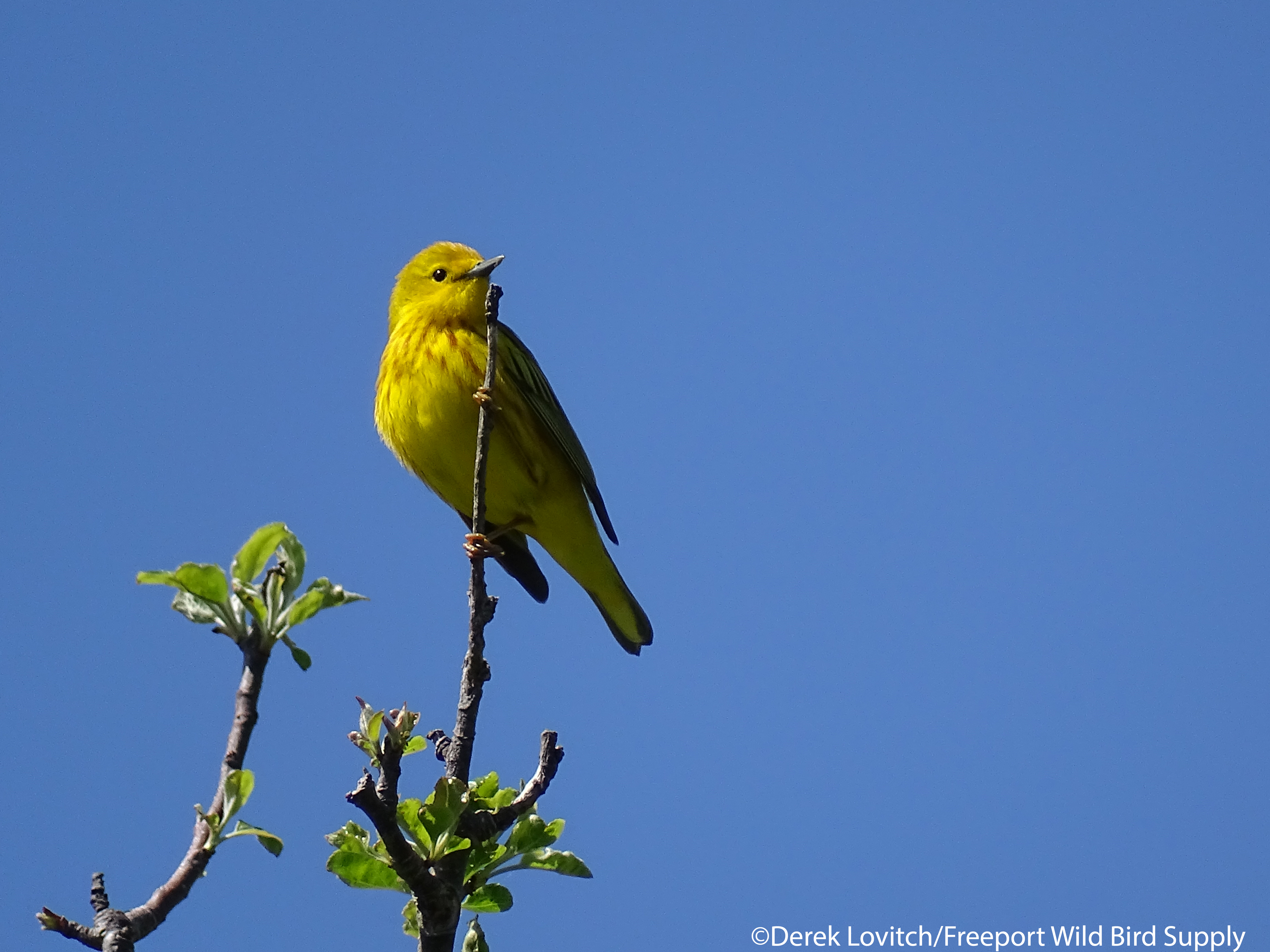
We didn’t care how common Yellow Warblers are…they’re still always beautiful! As are the sunsets from the Trailing Yew.
Two Black-crowned Night-Herons, including this one, were a nice find for a South Portland Big Day on the 21st. Unfortunately, we didn’t have enough good finds to make up for a slow morning at the favored migrant traps.
I had just a handful of observations of note over the past six days before I head out to Monhegan, including the following:
On Tuesday, John Lorenc and I did a South Portland-only “Big Day,” trying to see as many species as we could within the city’s boundaries. With limited migrants at Hinckley Park, we clawed our way to a decent tally of 94 species by day’s end with a lot of regular migrants being undetected. Highlights for the city and the date were limited to Long-tailed Duck, Black Scoter, Glossy Ibis, Black-crowned Night-Heron, White-throated Sparrow, and Red Crossbill. We unfortunately did not turn up any rarities. My personal FOY’s were limited to Swainson’s Thrush (1 each at Clark Pond Trails and Trout Brook Preserve) and Common Nighthawk (two over John and Terez’s yard at dusk for our last species of the day, followed by 4 over our yard in Durham when I returned home).
Two tours over the weekend and private guiding on Monday were likewise fairly slow for passage migrants, but there was a distinct increase in territorial birds with each passing day, as it seemed birds were dropping into their desired habitats and not migrant traps. A big overnight flight on 5/22-23 yielded more territorial birds, but surprisingly few passage migrants on the ground.
2 American Bitterns, surprisingly high over the yard in the evening on 5/22. Really threw me off at that altitude!
3 Greater Scaup, Wharton Point, Brunswick, 5/23.
Additional personal first-of-years this week also included:
1 briefly glimpsed MOURNING WARBLER, Capisic Pond Park, Portland, 5/19 (with Birds on Tap Roadtrip! Warblers and Wort! Tour group).
John Lorenc and I finally caught up with this continuing WHITE-WINGED DOVE at Donna Cundy’s feeders on Monhegan Island in our brief visit on the 17th. It appeared minutes after we walked away for the” last time,” but we were alerted by friends and raced back. My photos have a twig in front of that beautiful powder blue eyering, so I’m borrowing Kristen’s photo.
My observations of note over the past seven days also included:
15 species of warblers, led by only about 20 Black-and-white Warblers and about 15 Northern Parulas, Evergreen Cemetery, Portland, 5/12 (with Down East Adventures Spring Songbird Workshop group).
1-2 Blue-gray Gnatcatcher, Evergreen Cemetery, 5/12 (with Down East Adventures Spring Songbird Workshop group).
15 species of warblers, led by 9 Ovenbirds and 7 American Redstarts, our property in Durham, 5/13.
18 species of warblers (FOY), led by 40+ Yellow-rumped and 13 Common Yellowthroats, Florida Lake Park, Freeport, 5/14 (with Jeannette).
15 species of warblers, led by 10+ each of Ovenbirds and Black-throated Green Warblers, our property in Durham, 5/14.
15 species of warblers, led by 19 Common Yellowthroats and 10 Ovenbirds, Florida Lake Park, 5/15.
5 Red Crossbills, around the store’s yard, 5/15. More impressive was the 23 that Jeannette had fly over early in the day on the 18th.
A very productive ferry crossing from Port Clyde to Monhegan on 5/17 included 4-6 ATLANTIC PUFFINS (FOY), a group of 6 (or possibly 9) RED-NECKED PHALAROPES (FOY), 6 Black Scoters, several Long-tailed Ducks, etc. (with John Lorenc, Jess Bishop, Ron Joseph, Kristen Lindquist, Bill Thompson, et al). On the trip back, John and I had a total of 10 ATLANTIC PUFFINS and more Long-tailed Ducks.
1 continuing WHITE-WINGED DOVE (photo above) and 1 female-type SUMMER TANAGER, Monhegan Island, 5/17 (with John Lorenc).
Additional personal first-of-years this week also included:
1 Blackpoll Warbler, Evergreen Cemetery, Portland, 5/12 (with Down East Adventures Spring Songbird Workshop group).
1 Red-eyed Vireo, Evergreen Cemetery, 5/12 (with Down East Adventures Spring Songbird Workshop group).
1 House Wren, Evergreen Cemetery, 5/12 (with Down East Adventures Spring Songbird Workshop group).
2 Bay-breasted Warblers, Florida Lake Park, 5/14 (with Jeannette).
2 Eastern Wood-Pewees, Morgan Meadow WMA, 5/16.
4 Laughing Gull, ferry from Port Clyde to Monhegan, 5/17 (with John Lorenc).
4+ Indigo Buntings, Monhegan Island, 5/17 (with John Lorenc).
It was a great week of birding on our Durham property this week, including local breeding birds on territory often put on a show. Jeannette photographed this Yellow Warbler on our property on the 15th, for example.
Tours and Events:
There will not be a Saturday Morning Birdwalk on 5/25 as I’ll be on Monhegan with our tour group.
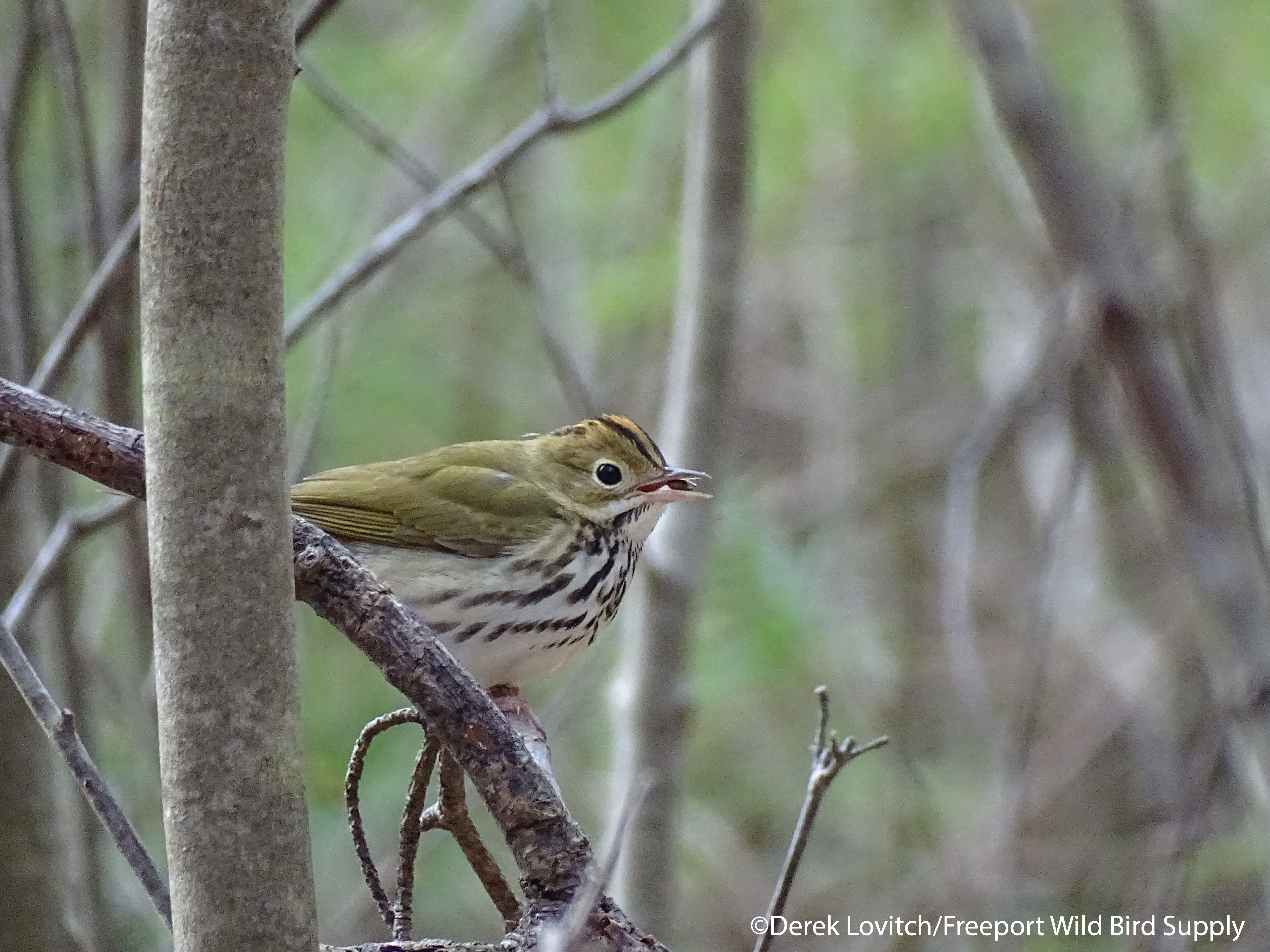
This Ovenbird on our property paused for a moment as it enjoyed a snack it pulled from the leaf litter.
The migratory floodgates really opened this week, as expected, with the diversity of Neotropical migrants increasing dramatically. Days like the 7th and 8th are truly special, but any day birding – especially in May! – yields its own rewards. My observations of note over the past seven days also included:
10 species of warblers (FOY) led by ~40 Yellow-rumped Warblers and 25+ Black-and-white Warblers, Morgan Meadow WMA, 5/6 (with Jeannette).
15 species of warblers (FOY) led by 100+ Yellow-rumped Warblers and 13 Black-and-white Warblers, Florida Lake Park, Freeport, 5/7.
~40 Chimney Swifts, over downtown Portland at dusk, 5/4 (with Jeannette).
4+ Common Terns, Curtis Farm Preserve, Harpswell, 5/5 (with Harpswell Heritage Land Trust birdwalk group).
1 Ruby-throated Hummingbird, our property in Durham, 5/6.
1 Cape May Warbler, Morgan Meadow WMA, 5/6 (with Jeannette).
5 Common Yellowthroats, Morgan Meadow WMA, 5/6 (with Jeannette).
1 Solitary Sandpiper, Morgan Meadow WMA, 5/6 (with Jeannette).
1 Chestnut-sided Warbler, our property in Durham, 5/6.
1 YELLOW-THROATED VIREO (a little early), Morgan Meadow WMA, 5/6 (with Jeannette).
3 Least Flycatchers, Florida Lake Park, Freeport, 5/7.
3 Magnolia Warblers, Florida Lake Park, 5/7.
2 American Redstarts, Florida Lake Park, 5/7.
1 Scarlet Tanager, Florida Lake Park, 5/7.
1 Veery, Florida Lake Park, 5/7.
1 Blackburnian Warbler, Florida Lake Park, 5/7.
Since I had not been in Scarborough Marsh in a few weeks, a number of personal first-of-years on 5/7 for me that have been present for a while now included Lesser Yellowlegs, Glossy Ibis, Willet, and Least Sandpiper, while more recent arrivals included 1 Least Tern (Pelreco Marsh) and 1 Spotted Sandpiper (Pelreco Marsh).
1 Warbling Vireo, our property in Durham, 5/8.
1 Wilson’s Warbler, our property in Durham, 5/8.
2 Bobolinks, Wharton Point, Brunswick, 5/9 (with Dan Nickerson).
Yellow-rumped Warblers have been inundating our feeding station in Durham this week, feasting on nut blocks, insect suet, mealworms, jelly, and just about everything else.
Feeder-watching continues to be great, with lots of Pine Siskins, new arrivals, migrant White-throated Sparrows, and, at our home in Durham, up to a dozen Yellow-rumped Warblers daily – especially during the cool and often wet days we had this week. Meanwhile, Red Crossbills continue to be widespread in the area. There were no huge flights of migrants this week, but new arrivals were trickling in.
My other observations of note over the past seven days also included:
1 LOUISIANA WATERTHRUSH, Morgan Meadow WMA, 5/1.
6 total LOUISIANA WATERTHRUSHES, via “The Louie Loop” (Site AN4 in Birdwatching in Maine: The Complete Site Guide), Androscoggin County, 5/3 (with Noah Gibb).
One of the six individuals, a singing and mate-guarding male, paused just long enough for a snapshot in Mechanic Falls on the 3rd.
As is typical of the season, new arrivals were the headliners of most days of birding. Additional personal first-of-years this week also included:
1 Bank Swallow, Bradbury Mountain Hawkwatch, 4/29.
1 pair Rose-breasted Grosbeaks, our property in Durham, 4/30.
4 Black-and-white Warblers, Florida Lake Park, Freeport, 4/30
1 Great-crested Flycatcher, our property in Durham, 4/30.
1 Northern Waterthrush, our property in Durham, 5/1.
1 Common Yellowthroat, Morgan Meadow WMA, 5/1.
1 Wood Thrush, our property in Durham, 5/2.
1 Gray Catbird (first of spring), our property in Durham, 5/2.
Although it had moved further away by the time I arrived, I managed a few phone-scoped photos of the Loggerhead Shrike that graced Chandler Brook Preserve and nearby yards in North Yarmouth on 4/21.
It was a great week of birding, with an impressive fallout on Saturday morning, a local mega rarity, and more new spring arrivals. My highlight of the week was catching an incredible early-season fallout at Florida Lake Park in Freeport on 4/20 (with Saturday Morning Birdwalk group). I eventually settled on a guestimate of 400 Palm Warblers and 125 Yellow-rumped Warblers. The full report can be found here. 75+ Palm Warblers and 50+ Yellow-rumped Warblers were present on the 24th, but on both dates the only other warbler – as expected for the date – were Pine (3 each day).
My other observations of note over the past seven days included:
1 Fish Crow, over our property in Durham, 4/20 (Yard Bird #150!)
1 LOGGERHEAD SHRIKE, Chandler Brook Preserve, North Yarmouth, 4/21. Found earlier in the afternoon and seen by several of us in the evening. I don’t chase very often, but when I do, I prefer it to be only 15 minutes out of the way on my way home from the store! It was only my second in Maine.
6 Red Crossbills (1 male, 2 female, 3-4 juvenile. Type 12 as per Matt Young), here at the store, 4/24.
Additional personal first-of-years this week also included:
*1+ CLIFF SWALLOW, Florida Lake Park, Freeport, 4/20 (with Saturday Morning Birdwalk group).
1 Northern Rough-winged Swallow, Florida Lake Park, 4/20 (with Saturday Morning Birdwalk group).
1 Blue-headed Vireo, Morgan Meadow WMA, Raymond, 4/21.
1 Black-throated Green Warbler, Papermill Trail, 4/26.
*Numerous very early arrivals of regular migrants are likely also tied to the overshoot event that brought southern vagrants to locations up and down the state’s coast.
TOURS AND EVENTS:
Feathers Over Freeport This Weekend!
Saturday, April 27th at Bradbury Mountains State Park and Sunday, April 28th at Wolfe’s Neck Woods State Park. All events FREE with park entry!
From birdwalks and a hawkwatch workshop to kids’ arts and crafts and a food truck, join us for two activity filled days in the 13th year of Feathers Over Freeport! A full schedule of events can be found here.
Note our regularly scheduled Saturday Morning Birdwalk meets at Bradbury on the 27th.




















 Maine Birding Field Notes