Tag Archives: Greater Yarmouth Goose Fields

This Week’s Highlights 10/15 – 10/22/2025.

Swamp Sparrows have been common and conspicuous on our Durham property, and elsewhere this week. I feel this, like most sparrows, is an underappreciated beauty!

My observations of note over a very productive and exciting eight days of birding included the following:

  • Highlights from our Durham property this week included near-daily American Woodcocks and Rusty Blackbirds, and a nice little arrival of more Swamp Sparrows and Purple Finches in particular on 10/21.
  • Sandy Point Morning Flight, 10/15.

A very light flight passed over and through Sandy Point Beach, Cousin’s Island, Yarmouth this morning.

6:55-8:30 (with Bill Thompson).

48F, mostly cloudy to partly cloudy, NW 1.7-2.5mph diminishing to calm.

51 American Robins

33 Yellow-rumped Warblers

28 Dark-eyed Juncos

17 American Goldfinches

16 Ruby-crowned Kinglets

8 Eastern Bluebirds

7 White-throated Sparrows

6 Chipping Sparrows

5 Palm Warblers

4 Hermit Thrushes

4 Golden-crowned Kinglets

3 Blue-headed Vireos

3 Purple Finches

3 Swamp Sparrows

2 Pine Siskins

2 Rusty Blackbirds

2 Tufted Titmice (4 false-starts and counting)

1 Red-breasted Nuthatch

1 Blackpoll Warbler

1 White-breasted Nuthatch

1 Downy Woodpecker (2+ false-starts)

1 House Finch

1 American Pipit

1 Northern Flicker

1 Magnolia Warbler

1 unidentified

Total  = 203

  • 1 continuing CACKLING GOOSE, Thornhurst Farm, North Yarmouth, 10/15 (with Bill Thompson).
  • 1 Least Sandpiper, 1 White-rumped Sandpipers, and 2 Pectoral Sandpipers, Walsh Preserve, Freeport, 10/15 (with Bill Thompson).
  • Sandy Point Morning Flight, 10/16.

An excellent flight passed over and through Sandy Point Beach, Cousin’s Island, Yarmouth this morning.

6:55 to 10:40am.

44F, Mostly cloudy, NW 4.3 – 9.0 increasing to 15.1 – 19.7mph with higher gusts.

2186 American Robins (*NEW RECORD! – just barely).

1776 Yellow-rumped Warblers

167 unidentified

127 Dark-eyed Juncos (One was quite likely not a Slate-colored, but my photos of it are not useful)

61 Common Grackles

48 Cedar Waxwings

43 Canada Geese

31 Chipping Sparrows

21 Ruby-crowned Kinglets

19 Rusty Blackbirds

18 White-throated Sparrows

13 Northern Flickers

11 Golden-crowned Kinglets

11 Purple Finches

9 Pine Siskins

7 Palm Warblers

4 Blue-headed Vireos

4 unidentified finches

4 Hermit Thrushes

4 Song Sparrows (crossed together at 8:29. This is only my second or third observation of SOSP engaging in Morning Flight after sunrise here; plenty more in and around the parking lot as usual)

3 Merlins

3 Common Loons

3 Turkey Vultures

2 Red-winged Blackbirds

2 White-crowned Sparrows

2 Eastern Phoebes

1 Northern Parula

1 Blackpoll Warbler

1 Brown Creeper

1 Peregrine Falcon

1 Yellow-bellied Sapsucker

1 Cooper’s Hawk

1 American Goldfinch

1 Red-shouldered Hawk

1 Cape May Warbler

1 Red-breasted Nuthatch

1 Sharp-shinned Hawk

1 Tennessee Warbler (from Bill Thompson’s photo review)

1 Black-throated Blue Warbler (from Bill Thompson’s photo review).

Total = 4,592

  • Notables from a delightfully birdy morning on Bailey Island, Harpswell on 10/17 included a decent, and relaxingly unquantified, morning flight mostly of Yellow-rumped Warblers; 1 ORANGE-CROWNED WARBLER, and 1 Cape May Warbler among the migrants found here and there around the island.
  • 12 SANDHILL CRANES, Mayall Road, Gray/New Gloucester, 10/18 (with Saturday Morning Birdwalk group).
  • 1 WILSON’S WARBLER and 1 ORANGE-CROWNED WARBLER, Eastern Promenade, Portland, 10/18.
  • 1 DICKCISSEL, feeders here at the store, 10/19, continuing through at least 10/21. Was this the same bird seen on 10/4 and then again on 10/13-14?
  • 4 continuing FORSTER’S TERNS, Pine Point, Scarborough, 10/20 (with clients from California and Massachusetts).
  • 2 “Ipswich” Savannah Sparrows, Eastern Road Trail, Scarborough Marsh, 10/20 (with clients from California and Massachusetts).

Our Last Tour of 2025 still has some space remaining!

Birds on Tap – Roadtrip! Rarity Roundup

November 9, 2025; 8:00am – 3:00pm

Cost – $125

​Portland Explorer (formerly Maine Brews Cruise) and Freeport Wild Bird Supply are excited to continue our collaboration for six very special outings in 2025. 

These unique, relaxed birding and beer-ing adventures that you have come to love combine great local birding at seasonal hotspots with visits to sample the delicious creations of some of our favorite local breweries. These tours are a perfect introduction to birding and/or craft beer, and a great opportunity to travel with significant others, friends, and family that have interest in one topic, while your interest is primarily in the other (for now!). Seasonal birding hotspots and great local beer – a perfect combination, and we’ll even do all of the driving!

Early November is a fantastic time of year in Maine for vagrants – birds normally seen in far-off places.  Due to a combination of weather patterns, changing seasonal food resources, falling temperatures, and other factors – some of which are not completely understood – birds that may have ended up in Maine by “accident” begin to concentrate at the coast in “migrant traps” and “hotspots.”  In other words, this is the time of year to expect the unexpected.  

​A traditional “Rarity Roundup” involves teams of birders heading out on a given day during rarity prime time, looking for species that are not supposed to be around. And in honor of that tradition, that’s exactly what we are going to do on this unique tour. We may “chase” a rarity (go to see something that has already been found, aka “twitch”) or we might choose a destination known for rare birds in an attempt to find one of our own. Or perhaps, we’ll do both!

Anything between Portland and Kittery is fair game, and we might not even know where we will head until we are on the bus and the latest rare bird alert is received. For those who love adding a bird to your Life or State List, and/or basking in the thrill of discovery, well then this is the tour for you! In between seeing great birds, we’ll discuss the complex factors that are involved in delivering rarities to an area, and how we go about finding them.

​After about 3-4 hours of birding, depending on drive time, we will be transported to two of our great local producers to sample their offerings and learn their styles.

This Week’s Highlights, 5/3-5/9/2025.

This female Cerulean Warbler at Evergreen Cemetery on 5/6 was the first in Maine for just about every birder who raced to see it! Thanks to Bill for the photo!

Wow! What a week! Although I was out of town for the huge flight Friday night into Saturday morning, my birding with a tour group on an almost-as-productive Sunday morning made up for it. Then, with an upper level low locked into place, migration ground to a halt throughout most of the rest of the week. However, a trickle of new arrivals appeared, and an impressive array of rarities were found around the state. I did a lot more chasing than usual this week (including a personal “state bird”, but a self-found rarity on Friday was a perfect way to put the icing on the cake of a tremendous week of spring birding! My observations of note over the past seven days included the following:

  • 15 species of warblers (FOY) between Evergreen Cemetery and Capsic Pond Park, with Northern Parula the most numerous at both, 5/4 (with Down East Adventures Spring Migrant Songbird Workshop group).
  • 2-3 Louisiana Waterthrushes, Suckfish Brook Conservation Area, Falmouth, 5/5 (with Jeannette).
  • 1 continuing BLACK-NECKED STILT, Spurwink Marsh, Cape Elizabeth, 5/6 (with Bill Thompson). Well, since we were out chasing together, we figured we might as well visit this elegant rarity found by John Lorence on 5/3.
  • The continuing CERULEAN WARBLER at Evergreen Cemetery on 5/8 with my Birds on Tap – Roadtrip: Warblers and Wort! Tour group. I don’t generally take photos while guiding groups, but I took a few of this bird…and completely wiffed on them!
  • After all this “twitching,” I was due to find my own rarity, and did so on 5/9 with an adult breeding plumage female RUFF (REEVE) at Walsh Preserve in Freeport. There are only about 10 previous records for Maine.

My personal “first of years” this week also included:

  • 2 Yellow Warblers, Evergreen Cemetery, Portland, 5/4 (with Down East Adventures Spring Migrant Songbird Workshop group).
  • 8 Black-throated Blue Warblers, Evergreen Cemetery, 5/4 (with Down East Adventures Spring Migrant Songbird Workshop group).
  • 2 Wood Thrushes, Evergreen Cemetery, 5/4 (with Down East Adventures Spring Migrant Songbird Workshop group).
  • 3 Magnolia Warblers, Evergreen Cemetery, 5/4 (with Down East Adventures Spring Migrant Songbird Workshop group).
  • 4 Chestnut-sided Warblers, Evergreen Cemetery, 5/4 (with Down East Adventures Spring Migrant Songbird Workshop group).
  • 2 Great-crested Flycatchers, Evergreen Cemetery, 5/4 (with Down East Adventures Spring Migrant Songbird Workshop group).
  • 2 American Redstarts, Evergreen Cemetery, 5/4 (with Down East Adventures Spring Migrant Songbird Workshop group).
  • 2 Northern Waterthrushes, Capisic Pond Park, Portland, 5/4 (with Down East Adventures Spring Migrant Songbird Workshop group).
  • 7 Chimney Swifts, Capisic Pond Park, 5/4 (with Down East Adventures Spring Migrant Songbird Workshop group).
  • 1 White-crowned Sparrow, feeders here at the store, 5/4.
  • 2 Lincoln’s Sparrows, Suckfish Brook Conservation Area, Falmouth, 5/5 (with Jeannette).
  • 1 Warbling Vireo, our yard in Durham, 5/5.
  • 16 Willets, Eastern Road Trail, Scarborough Marsh, 5/6.
  • 18 Least Sandpipers, Eastern Road Trail, 5/6.
  • 1 Eastern Kingbird, Evergreen Cemetery, 5/6 (with Bill Thompson).
  • 1 LITTLE BLUE HERON, Pelreco Marsh, Scarborough Marsh, 5/6 (with Bill Thompson).
  • 1 Blackburnian Warbler, Rte 136 powerline cut, Durham, 5/7.
  • 1 Wilson’s Warbler, Evergreen Cemetery, 5/8 (with Birds on Tap Roadtrip! tour group)
  • 2 House Wrens, Capisic Pond Park, 5/8 (with Birds on Tap Roadtrip! tour group).
  • 2 Blue-winged Teal, Walsh Preserve, Freeport, 5/9.

Bradbury Mountain Spring Hawkwatch

The Week 7 report – in which we broke the all-time season record – can be found here.

Upcoming Tours (with space available):

Rangeley Birding Festival, June 5-8

On Recent and Upcoming Weather, Vagrant Season, and Recent Great Birding

Late October through early November is traditionally the best “rarity season” in Maine, where vagrants from all directions are hoped for, and even expected. We’ve been in a rather active and dynamic weather pattern of late, and this may help to usher vagrants in our direction. While weather rarely “blows” birds off-course, winds and weather systems can certainly facilitate their arrival in far-flung places, especially when combined with some sort of misorientation (for a thorough discussion of the concept, see Chapter 7 of my book, How to Be a Better Birder).

As October progresses, the nights get longer, and the days (usually) get colder. The growing season comes to an end (although in many spots the killing frost has not yet reached the immediate coastline yet this year), and food sources become greatly limited. This can push vagrants that may have arrived over the course of the fall migration into favorable micro-climates and patches of seasonal food abundance. More recently-deposited vagrants, “late/lingering” migrants, and other more typical species can also concentrate in such prime areas, such as urban parks, coastal migrant traps, and so on.

Let’s take a look at some of the recent weather, and attempt to identify some possible species to consider.

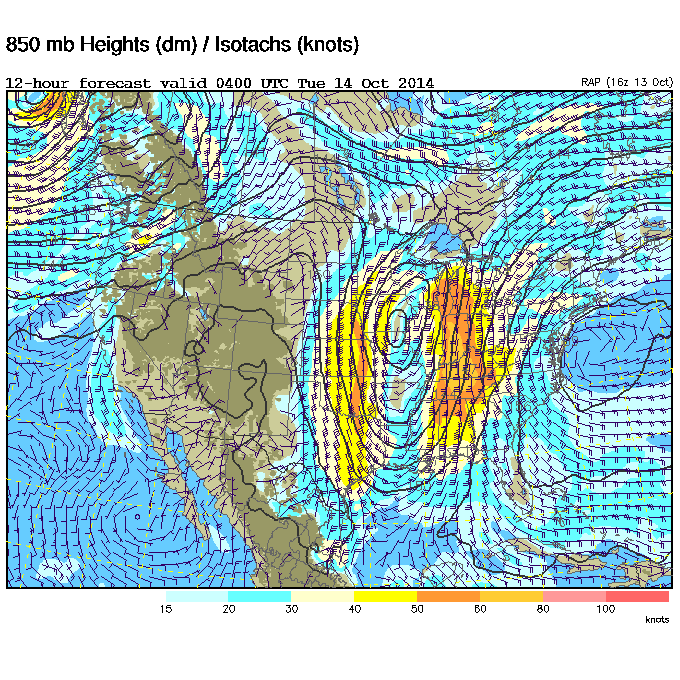
Over the past ten days, above normal temperatures were regular, thanks to southerly winds. Take a look at the wind map from October 13th, for example.
wind map, 10-13-14

Strong southerly winds pumped warm air into the area from the Deep South and the Bahamas (and the South Atlantic Bight). These are favorable conditions for depositing “180-degree misoriented migrants” from the south, such as Summer Tanagers and White-eyed Vireos. I wonder if it’s a little too late for a big push of southern birds, however, as many of the Neotropical migrants have already departed the continent. Meanwhile, that extensive southerly flow all of the way into Mexico is the type of weather pattern that can facilitate the arrival of long-distance vagrants, such as Fork-tailed Flycatcher.

Sparrows are on the move now, and northerly winds with cloudy skies overnight on 10/18 to 19 resulted in a big push of sparrows. The low ceiling likely resulted in disorientation of these low-flying migrants by the big city lights, resulting in a massive flight of birds in Portland’s East End on the morning of the 19th. I estimated over 2000 White-throated Sparrows and 500 Song Sparrows just on the Eastern Promenade alone, with dozens more in almost every lot I checked. A hundred White-throats were in the North St Community Garden, and by the end of the morning, I had tallied 8 species of sparrows, and impressive numbers of Chipping Sparrows (76) and Eastern Phoebes (15) among others. Although 2 Red-bellied Woodpeckers were my 175th species on my Eastern Promenade Patch List, I was surprised that I could not tease out any rarities from the volumes of birds (the sheer number of birds plus gusty winds hampered detection, no doubt).

By 10/19, a strong cold front – a rare occurrence this season – pushed through, and with it, a huge flight of migrants. I tallied over 1100 birds at Sandy Point on the morning of the 20th, led by 461 Yellow-rumped Warblers and 159 American Robins.

You can see how strong and extensive these northwesterly winds finally were from the wind map that day.
wind map, 10-19-14

Rain began to arrive in the afternoon of the 21st, and it didn’t let up until this morning. This massive coastal Nor’easter drenched Maine with up to 5” of rain, and moderate to strong northeasterly winds battered the state, especially the coast.
wind map, 10-23-14

Birding was a challenge on Wednesday and Thursday, as strong winds and often-heavy rain made things difficult. Rain and coastal fog and mist precluded seawatching, and any lake-watching for grounded waterfowl was rendered impossible by visibility and waves. Essentially, feeder-watching was the best bet these two days, and a growing contingent of sparrows at both our home and here at the store provided the entertainment. About 200 Common Grackles descended into our Pownal yard on the 23rd as well.

But now, today (Friday), this massive storm is finally pulling away.
wind map, 10-24-14

And I had a great day of birding in Cape Elizabeth. I began with some seawatching at Dyer Point. From 7:50 to 9:50, I had moderate to good visibility for all but a total of 47 minutes as light showers and mist rolled through. Seas were down to 4-6 feet, and moderate north winds continued. Here’s the scorecard (all southbound unless otherwise noted) – which was actually a little lighter than I had expected:
317 Double-crested Cormorants
127 Northern Gannets (about evenly split between north and southbound)
77 Common Eiders (several hundred northbound)
20 White-winged Scoters
18 Black Scoters
17 Red-breasted Mergansers
16 unidentified ducks
16 Common Loons (plus 18 northbound)
15 Surf Scoters
10 “dark-winged” scoters
8 Long-tailed Ducks (first of fall)
8 Red-throated Loons
5 Great Blue Herons
5 Bonaparte’s Gulls
3 Red-necked Grebes
2 Green-winged Teal
2 Great Cormorants
2 Laughing Gulls
1 Black Guillemot
1 Peregrine Falcon
1 White-throated Sparrow (flew in off the water at 8:05am).

Next up was Kettle Cove, where a nice diversity of migrants, especially sparrows, also included an Orange-crowned Warbler and 3 Common Yellowthroats. Even more interesting was this gull, which appears to be a hybrid Herring x Great Black-back. Intermediate in size and shape between the two, and with an intermediate mantle color, the short wings and pinkish legs separate it from Lesser Black-backed.
DSC_0002_HERGxGBBG1,KettleCove,10-24-14_enlarged_edited-1

DSC_0001_HERGxGBBG2,KettelCove,10-14-14_edited-1

A local sparrow-rific patch of private property was fruitful as well. Although a very tardy Bobolink was the only surprise here, plentiful numbers of sparrows included 200+ White-throated, 100+ Song, 50+ Swamp, 50+ Savannah, 50+ Dark-eyed Juncos, at least 10 White-crowned Sparrows, and a single Lincoln’s Sparrow. A Red-bellied Woodpecker and my second Carolina Wren of the morning were added to the tally.

A male Black-throated Blue and a female Black-and-white Warbler joined Palm and Yellow-rumped Warblers feasting on seaweed flies in and near the wrack at Pond Cove, where another Red-bellied Woodpecker was sounding off.

On my way back, I swung through the goose fields, and clearly more Canada Geese have arrived in the last few days. 718 was a new season-to-date high count, with the most interesting new arrival being this spiffy leucistic Canada. Unlike a hybrid with a Snow or a Domestic Goose, this neat bird was the same shape and size as the average Canada, but with a dull brownish cast to the head, neck, and wingtips.
IMG_4625_leucisticCANG1,GreelyRd,10-24-14_edited-1

As this nasty low rides up into Atlantic Canada and beyond, strong wrap-around winds will offer the potential to displace Northern Wheatears or rare geese from Greenland. Meanwhile, next week, we’ll see unseasonable warmth return on southwesterly winds (“vagrant winds” as I like to call them), just the type of scenario that can facilitate the arrival of strays from the southwest, such as Cave Swallows and Ash-throated Flycatchers. They will also facilitate the survival for at least a little longer of vagrants that are still present but as so far gone undetected.

There isn’t one predominate pattern that yields a strong suggestion of any particular vagrant (or group of vagrants) from any particular direction. However, it is clear that we are getting a nice sample of different conditions that could produce some fun stuff.

At the very least, I expect some big flights of migrants, both day and night in the coming days. In fact, I think there will be a big one tonight. Check out these northwesterly winds that should be ushering in a big push of birds:
wind forecast, overnight

Sparrows will make up the bulk of the flight, especially White-throated Sparrows and Dark-eyed Juncos. If the clouds clear by dawn, I might get a big push at Sandy Point. If the ceiling stays low overnight, look for concentrations of sparrows in migrant traps, especially in and around bright cities. Meanwhile, during the day, a lovely weather forecast should get plenty of birders out into the field.

Needless to say, I will be out looking, and I hope you will to! I look forward to what the coming days and weeks will bring.

Rarity Season Ain’t Over Yet..and Fun Store News and Contest Stuff

“It ain’t over ‘til it’s over” – Yogi Berra

Before we get to my birding of recent days, a couple of quick orders of business. First of all, tonight is our “After Hours Sale” here at the store.  This is our biggest sale of the year.  From 6:00 to 8:00 tonight only, everything in the store (with the usual exception of seed, optics, and sale items) is 25% OFF!  And we’ll have treats, coffee, and other refreshments to fuel your shopping

Then rest up and be sure to join us on Saturday morning for our usual Saturday Morning Birdwalk (meets at the store at 8:00am for a carpool to a local park.  We’ll return for coffee and feeder-watching between 10 and 10:30).  While I would, of course, love to see you all year long, you don’t want to miss tomorrow (or any of the next 17 weeks) as it’s the start of the Fifth Annual “SnowBird(er) Contest,” where we’ll award points to birdwalk participants based on how cold it is.  The top three birders at the end of March will receive some great prizes!

GRAND PRIZE: MAINE BIRDS by RALPH PALMER!
The classic tome from 1948 is still a valuable reference for students of the birds of Maine. This excellent condition copy is valued at over $75. It’s great for comparing status and distribution from then to now, and for collectors of birding books.

2ND PRIZE: BACKYARD BIRDHOUSE from Coveside Conservation in Casco. Perfect for everything from House Wrens to White-breasted Nuthatches, this house is perfect for any yard and made from New England White Pine.

3RD PRIZE: $25 GIFT CERTIFICATE to EDNA & LUCY’S in Pownal – Enjoy a great sandwich, award-winning donuts, and more. Perfect for your next trip up to the Bradbury Mtn. Hawkwatch!

Visit our website for more information and how the game is played. 

OK, back to birding….

In my blog a few weeks ago in which I summarized the Rarity Season through the middle of November, I suggested that it was unlikely that many rare passerines will turn up away from feeding stations.  However, the possibility of strays “concentrat(ing) along the coast as they seek out more favorable microclimates or seasonal food sources,” still seemed like a cause for hope.  And sure enough, yesterday, I found female Hooded Warbler in the Biddeford Pool neighborhood – a wicked good December bird anywhere in the US!

Unseasonable rarities like this really fascinate me.  How did it get here?  Had it flown the wrong way during the usual period of Hooded Warbler migration and only now was detected as it moved towards the coast to escape the recent cold?  How long has it been present – maybe it’s been in these thickets for months and only now did someone walk by the right place at the right time? (Based on how thoroughly I, and a few others, work this area in November, I find this scenario a little less likely)  Or perhaps, it was a mirror-migrant afterall that flew north instead of south from its usual range in the Southeastern US.  Instead of ending up in Central America, it ended up somewhere in the interior of southern New England.  Then, the recent cold “encouraged” the bird to move on.  But “mis-wired” somehow, it just kept flying the wrong way.  I always wonder why so many birders assume that once birds have made a mistake (i.e. flown north instead of south), they’ll magically figure things out and do the “right” thing the next time.  Of course, who really knows?  But it’s a fun thing to ponder (well, it is to me anyway).

Of course, I was only down at the Pool to look for Snowy Owls.  In that same blog, I wondered if we were seeing the first signs of an irruption.  My goodness, were we ever, and so far, it is HUGE!  There have been dozens up and down the Maine coast.  Jeannette had an amazing TEN in and around Biddeford Pool on Tuesday.  Not only are they widespread, but they are in unusual concentrations.  I “only” found four yesterday, but some of my time was spent walking a mile back for the camera (it was raining and my shoulder was aching when I departed the car) and then not refinding the warbler.
DSC_0157_SNOW,Hatties,12-5-13

This particular bird, that Jeannette also photographed on Tuesday, has made a temporary home for itself in the marsh behind Hattie’s.

While it is unlikely that this density of Snowy Owls will continue, we’ll certainly enjoy it while we can.  Some will head further south, and unfortunately, no small number will succumb to starvation (the reason they’re here in the first place – and with up to 80% of raptors dying in their first winter, it’s no surprise that most of these birds will not make it back to the tundra).  I also wonder if these recent very high tides (astronomical high tide plus a deep low pressure system well offshore) will flood the marshes too much.  In such cases, many rodents (especially voles) will drown as they run out of high ground.  That’s a natural occurrence, but if there are few voles in the marshes, that will be a lot less food for hungry owls.

Meanwhile, in that aforementioned blog I also postulated about the potential of finally getting a good goose in the “Greater Yarmouth Goose Fields,” despite the late date.  Finally!  Although my high count of Canada Geese was only 434 birds (on Wednesday), they were punctuated by an adult Greater White-fronted Goose, in the field off of Cross and Winn Road in Cumberland – the first rarity of the season in the fields.  My stubborn perseverance finally paid off.  Today, I improved upon my photos, and I posted a couple here.

I also had a Gray Catbird at Biddeford Pool yesterday, along with the Hermit Thrush that Jeannette found on Tuesday.  I also had a Winter Wren near the store while walking Sasha on Wednesday afternoon and a Northern Flicker fly over the highway in South Portland yesterday. So there are still some “lingering” migrants around.  Meanwhile, with another increase in seaducks offshore (250+ Black Scoters off of East   Point for example), things are picking up along the coast.

Oh yeah, and there are Snowy Owls everywhere!  In other words, go birding…well, after you visit us at the store, that is!