Tag Archives: Freeport

2014-15 Freeport-Brunswick CBC: West Freeport Territory.

The Freeport-Brunswick Christmas Bird Count (CBC) was conducted on Saturday, January 3rd. With the exception of the last two winters in which we were away visiting family during the count, Jeannette and I have taken part in the count since 2004.

In our first year, as newcomers to the count, we were assigned the least-popular “West Freeport” territory, which includes all of Freeport west of I-295, a corner of Yarmouth and Durham, and a sliver of Pownal. With open water (in some winters) limited to a small stretch of the Cousin’s River and Pratt’s Brook and adjacent brackish marsh, the territory doesn’t get the diversity of the other sections, that include productive places like Cousin’s Island, Winslow Park, and Harpswell.

While Hedgehog Mountain Park and Florida Lake Park are included, these are not usually very productive places in the middle of winter. But I still enjoy being able to cover two of my favorite patches, plus our own backyard (which makes for a good excuse to take a mid-day break for a hot lunch while counting at our feeding station). But in order to adequately sample this large area, with lots of yards, woodlots, and scattered fields, adequately, Jeannette and I spend a lot of time walking.

And whether it’s a CBC or any other birding, I always prefer more time walking than driving. So instead of driving all of these suburban and exurban roads, we walk them. And we walk a lot. Leap-frogging each other with the car, walking one mile stretches at a time, we walk about 20 miles (about 11-12 miles each) in all, and drive only 18-20. In doing so, we pass by a lot of feeders, and encounter mixed species foraging flocks that we would most likely never detect by just driving around.

And so we count a lot of birds. We sift through hundreds of Black-capped Chickadees as we pick out the other members of the winter flock. We listen for finches, check out feeders, and otherwise just go birding! This is how I like to CBC!

One of the other things I particular enjoy about covering this territory is that I am able to quantify some of my impressions of the winter’s birding that I have been noting walking Sasha at the ‘Hog, or watching my own feeders, and just while birding in general.

This year, a lack of snowcover made for easy walking, but reduced concentrations of birds, especially at edges and feeders. Some of the impressions that I have had turned out to be true: although feeders are often a little slower than usual, there are plenty of birds around. Red-breasted Nuthatches are abundant, but Golden-crowned Kinglets are nearly absent. Irruptive finches are still in short supply, but I expect them to now increase as winter returns. There also seem to be a lot of Red-tailed Hawks around, Wild Turkeys and Red-bellied Woodpeckers continue to increase, and the daily “commute” of gulls overhead (which I often note from the yard and Florida Lake Park in particular) no longer occurs following the closing of a feed lot in Auburn (gulls used to travel from Casco Bay to and from this and other Lewiston-Auburn feeding locations).

Dan Nickerson joined us this year, also welcoming the opportunity to bird his neighborhood as well, and making sure his feeder birds get counted. And we really lucked out with the weather. It was indeed the calm before the storm, with light winds all day and the first flurries not falling until we were at the wrap-up in the evening. It was cold though: 10F to start, with a high of only 21F. Increasing humidity and cloud cover made for a very raw afternoon, and a bone-chilling day. That lunch break at our feeders was a necessary respite today, as was some hot chai.

Due to the complex geography of the circle, we actually have two compilers, and two compilations, splitting the long peninsulas of the eastern edge off from the rest of the circle. Therefore, we usually speak of the western half of the circle (nicknamed “The Bean Count”) when comparing our numbers. Of the western half teams, we tallied 9 high counts, and had the only Common Redpolls, White-winged Crossbills, and Northern Shrike of the parties in our area.

The bird of the day was definitely the four White-winged Crossbills that Dan and I had departing a feeder on Beech Hill Road in Freeport. Jeannette and I were very excited to find a shrike at Hidden Pond Preserve where we also hope to see one, and hopefully the two Common Redpolls that flew over us on Granite Road in Yarmouth are a sign of things to come.

But my highlight was the Red-bellied Woodpecker that Dan and I found along Hunter Road. As we were coming up onto the Hunter Road Fields, the Red-bellied called and we spotted it at the edge of the road. I greatly amused Dan, apparently, as I sprinted across the road, got my feet onto the Hunter Road Fields property – which is part of my Hedgehog Mountain Patch List area – and logged the Red-belly for my 148th Patch Bird! …A long overdue, border-line nemesis patch bird at that!

Good conversation throughout the day, and Stella’s chili at the wrap-up at the store, were icing on today’s frosty cake. While our crossbills were one of the best birds of “The Bean Count” area, one could argue the Snowy Owl found at Brunswick Landing would take the crown. 31 Northern Pintails in the “Winter of the Pintail” at Simpson’s Point may have been the most unexpected, along with a Common Grackle in Brunswick, and two Barrow’s Goldeneyes were other highlights.

Because Jeannette and I conduct the CBC with such a consistent route and methodology, I find it unusually valuable to compare data from year to year. Therefore, as I offer the list of this year’s sightings, in parenthesis, I also offer the average for our territory. An *asterix signifies a new record high for our territory.

American Black Duck (8): 4
Wild Turkey (12): 23
Cooper’s Hawk (<1): 1
Red-tailed Hawk (1): 4*
Herring Gull (23): 3
Rock Pigeon (14): 19
Mourning Dove (47): 54
Red-bellied Woodpecker (<1): 2*
Downy Woodpecker (12): 26*
Hairy Woodpecker (7): 27*- by almost triple the previous high!
Pileated Woodpecker (2): 1
NORTHERN SHRIKE (1): 1
Blue Jay (66): 97
American Crow (76): 66
Common Raven (2): 3
Black-capped Chickadee (283): 380
Tufted Titmouse (24): 48*
Red-breasted Nuthatch (13): 44*- by more than triple!
White-breasted Nuthatch (20): 45*
Brown Creeper (3): 2
Golden-crowned Kinglet (13): 0 – our first-ever miss of this species
American Robin (42): 7
European Starling (14): 7
American Tree Sparrow (24): 30
Song Sparrow (1): 3*
White-throated Sparrow (1): 1
Dark-eyed Junco (15): 34
Northern Cardinal (5): 21* – more than double the previous high
House Finch (6): 3
COMMON REDPOLL (9): 2
American Goldfinch (63): 66
WHITE-WINGED CROSSBILL: 4* 1st territory record.
House Sparrow (12): 22

Total (31): 33 species.

The “West Freeport” section of the Freeport-Brunswick CBC doesn’t offer the rarities of the “Moody” section that I annually cover on the York County CBC, nor does it offer the intrigue and surprises when I cover the Portland Peninsula on the Greater Portland CBC. However, this is our “home field” CBC, and with thorough coverage, we quantify a nice sample of what occurs away from the shorelines in the winter. I look forward to learning more, counting lots of chickadees, and getting my exercise on next year’s CBC.

The All-Time Saturday Morning Birdwalk List

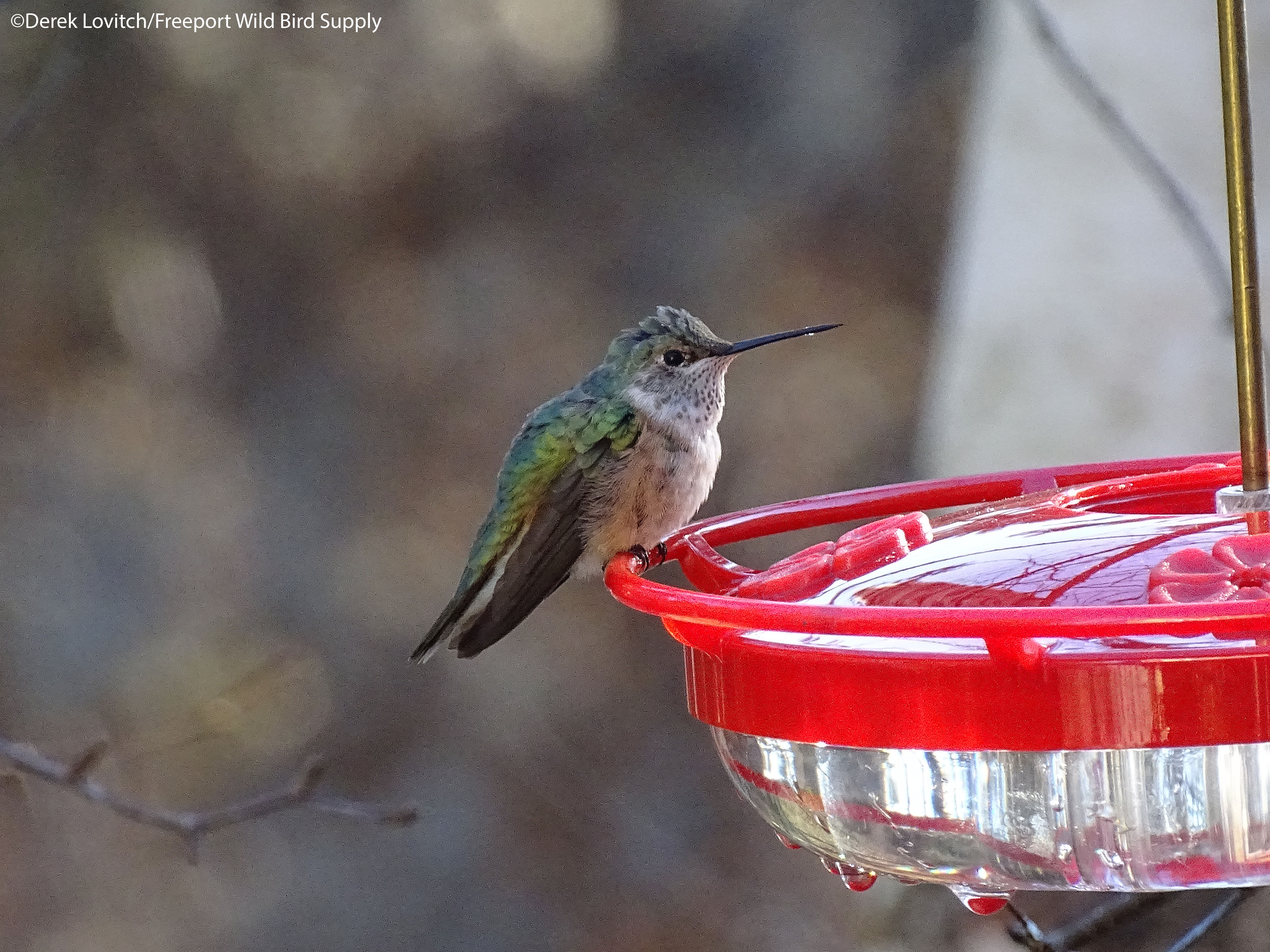
Maine’s first-ever Broad-tailed Hummingbird in November of 2022 was one of the rarest birds ever encountered on a Saturday Morning Birdwalk. Even better, we were among the first to see it as the birdwalk group was among the first to be granted permission to visit this Freeport yard before
it was open to the public for all to enjoy.

Last Update: 11/8/2025.

Our store, Freeport Wild Bird Supply, offers free birdwalks every Saturday morning, all year long. Meeting at 8:00am, we carpool to a local park of seasonal interest, and return to the store for bird-friendly coffee between 10 and 10:30. With the exception of inclement weather, we limit the drive to about 10-15 minutes away, and visit a variety of parks, waterfront overlooks, and other hotspots.

Over the years, we have seen a lot of good birds. We’ve “chased” as species or two, but we have found our fair share of “good” birds.  Encompassing a wide variety of habitats each season, we have seen an impressive array of species. Spurred on by the Townsend’s Solitaire that the Saturday Morning Birdwalk group enjoyed this past weekend, I have finally compiled a list of all of the species seen on Saturday Morning Birdwalks over the past 10 ½ years (As of 2015, and not including any other trips, tours, or special walks).

This is the “unofficial” list at the moment. UPPERCASE is for species seen only once or twice. I am hoping participants will take a look at the list and see if I have missed anything, or made any errors. I’ll edit the list as changes come in, so please let me know what I missed!

      1. Greater White-fronted Goose
      2. Snow Goose
      3. BARNACLE GOOSE
      4. Cackling Goose
      5. Canada Goose
      6. Wood Duck
      7. Gadwall
      8. EURASIAN WIGEON
      9. American Wigeon
      10. American Black Duck
      11. Mallard
      12. Blue-winged Teal
      13. Northern Shoveler
      14. Northern Pintail
      15. Green-winged Teal
      16. Canvasback
      17. Ring-necked Duck
      18. Greater Scaup
      19. Lesser Scaup
      20. Common Eider
      21. HARLEQUIN DUCK
      22. Surf Scoter
      23. White-winged Scoter
      24. Black Scoter
      25. Long-tailed Duck
      26. Bufflehead
      27. Common Goldeneye
      28. Barrow’s Goldeneye
      29. Hooded Merganser
      30. Common Merganser
      31. Red-breasted Merganser
      32. Ruddy Duck
      33. Ruffed Grouse
      34. Wild Turkey
      35. Red-throated Loon
      36. Common Loon
      37. Pied-billed Grebe
      38. Horned Grebe
      39. Red-necked Grebe
      40. Double-crested Cormorant
      41. Great Cormorant
      42. American Bittern
      43. Great Blue Heron
      44. Great Egret
      45. Snowy Egret
      46. Little Blue Heron
      47. Green Heron
      48. Black-crowned Night-Heron
      49. Glossy Ibis
      50. Turkey Vulture
      51. Osprey
      52. Bald Eagle
      53. Northern Harrier
      54. Sharp-shinned Hawk
      55. Cooper’s Hawk
      56. Northern Goshawk
      57. Red-shouldered Hawk
      58. Broad-winged Hawk
      59. Red-tailed Hawk
      60. Rough-legged Hawk
      61. GOLDEN EAGLE
      62. American Kestrel
      63. Merlin
      64. Peregrine Falcon
      65. Sandhill Crane
      66. Black-bellied Plover
      67. American Golden-Plover
      68. Semipalmated Plover
      69. Killdeer
      70. Greater Yellowlegs
      71. Lesser Yellowlegs
      72. Solitary Sandpiper
      73. “Eastern” Willet
      74. Spotted Sandpiper
      75. Whimbrel
      76. MARBLED GODWIT
      77. Ruddy Turnstone
      78. Red Knot
      79. Semipalmated Sandpiper
      80. Least Sandpiper
      81. White-rumped Sandpiper
      82. Baird’s Sandpiper
      83. Pectoral Sandpiper
      84. Purple Sandpiper
      85. Dunlin
      86. Buff-breasted Sandpiper
      87. Short-billed Dowitcher
      88. Long-billed Dowitcher
      89. Wilson’s Snipe
      90. American Woodcock
      91. RED PHALAROPE
      92. Laughing Gull
      93. Bonaparte’s Gull
      94. Ring-billed Gull
      95. Herring Gull
      96. Iceland Gull
      97. Lesser Black-backed Gull
      98. Glaucous Gull
      99. Great Black-backed Gull
      100. Common Tern
      101. FORSTER’S TERN
      102. DOVEKIE
      103. THICK-BILLED MURRE
      104. Razorbill
      105. Black Guillemot
      106. Rock Pigeon
      107. Mourning Dove
      108. Black-billed Cuckoo
      109. Yellow-billed Cuckoo
      110. Great Horned Owl
      111. Barred Owl
      112. Chimney Swift
      113. Ruby-throated Hummingbird
      114. Belted Kingfisher
      115. Red-bellied Woodpecker
      116. Yellow-bellied Sapsucker
      117. Downy Woodpecker
      118. Hairy Woodpecker
      119. Northern Flicker
      120. Pileated Woodpecker
      121. Eastern Wood-Pewee
      122. Yellow-bellied Flycatcher
      123. Alder Flycatcher
      124. Willow Flycatcher
      125. Least Flycatcher
      126. Eastern Phoebe
      127. Great Crested Flycatcher
      128. Eastern Kingbird
      129. Northern Shrike
      130. Blue-headed Vireo
      131. Warbling Vireo
      132. Philadelphia Vireo
      133. Red-eyed Vireo
      134. Blue Jay
      135. American Crow
      136. Fish Crow
      137. Common Raven
      138. Horned Lark
      139. Tree Swallow
      140. Northern Rough-winged Swallow
      141. Bank Swallow
      142. Cliff Swallow
      143. Barn Swallow
      144. Black-capped Chickadee
      145. Tufted Titmouse
      146. Red-breasted Nuthatch
      147. White-breasted Nuthatch
      148. Brown Creeper
      149. Carolina Wren
      150. House Wren
      151. Winter Wren
      152. Marsh Wren
      153. Golden-crowned Kinglet
      154. Ruby-crowned Kinglet
      155. Blue-gray Gnatcatcher
      156. Eastern Bluebird
      157. TOWNSEND’S SOLITAIRE
      158. Veery
      159. GRAY-CHEEKED THRUSH
      160. Swainson’s Thrush
      161. Hermit Thrush
      162. Wood Thrush
      163. American Robin
      164. Gray Catbird
      165. Northern Mockingbird
      166. Brown Thrasher
      167. European Starling
      168. American Pipit
      169. Bohemian Waxwing
      170. Cedar Waxwing
      171. Lapland Longspur
      172. Snow Bunting
      173. Ovenbird
      174. Louisiana Waterthrush
      175. Northern Waterthrush
      176. Black-and-white Warbler
      177. Tennessee Warbler
      178. Nashville Warbler
      179. Common Yellowthroat
      180. American Redstart
      181. Cape May Warbler
      182. Northern Parula
      183. Magnolia Warbler
      184. Bay-breasted Warbler
      185. Blackburnian Warbler
      186. Yellow Warbler
      187. Chestnut-sided Warbler
      188. Blackpoll Warbler
      189. Black-throated Blue Warbler
      190. Palm Warbler
      191. Pine Warbler
      192. Yellow-rumped Warbler
      193. Prairie Warbler
      194. Black-throated Green Warbler
      195. Canada Warbler
      196. Wilson’s Warbler
      197. YELLOW-BREASTED CHAT
      198. Eastern Towhee
      199. American Tree Sparrow
      200. Chipping Sparrow
      201. Clay-colored Sparrow
      202. Field Sparrow
      203. LARK SPARROW
      204. Savannah Sparrow
      205. Nelson’s Sparrow
      206. Saltmarsh Sparrow
      207. Fox Sparrow
      208. Song Sparrow
      209. Lincoln’s Sparrow
      210. Swamp Sparrow
      211. White-throated Sparrow
      212. White-crowned Sparrow
      213. Dark-eyed Junco
      214. Scarlet Tanager
      215. SUMMER TANAGER
      216. Northern Cardinal
      217. Rose-breasted Grosbeak
      218. BLUE GROSBEAK
      219. Indigo Bunting
      220. Dickcissel
      221. Bobolink
      222. Red-winged Blackbird
      223. Eastern Meadowlark
      224. Rusty Blackbird
      225. Common Grackle
      226. Brown-headed Cowbird
      227. ORCHARD ORIOLE
      228. Baltimore Oriole
      229. Pine Grosbeak
      230. House Finch
      231. Purple Finch
      232. White-winged Crossbill
      233. Red Crossbill
      234. Common Redpoll
      235. Pine Siskin
      236. American Goldfinch
      237. Evening Grosbeak
      238. House Sparrow
      239. SNOWY OWL, Brunswick Landing, 1/31/15.
      240. Purple Martin, Rossmore Road, Brunswick, 5/2/15.
      241. BLUE-WINGED WARBLER, Old Town House Park, North Yarmouth, 7/18/15.
      242. WHITE-EYED VIREO, Freeport Transfer Station/Hedgehog Mountain Park 10/10/15
      243. LITTLE EGRET, Tidewater Farm, Falmouth, 7/9/16.
      244. Upland Sandpiper, Bowdoin Sand Plains, 7/1/17
      245. GREAT BLACK HAWK, Deering Oaks Park, Portland, 12/1/18
      246. Vesper Sparrow, Wolfe’s Neck Center, Freeport, 10/9/21.
      247. CATTLE EGRET, Wolfe’s Neck Center, Freeport, 11/6/21
      248. HENSLOW’S SPARROW, Crystal Spring Farm, Brunswick, 7/9/22
      249. Olive-sided Flycatcher, Highland Rd, Brunswick, 8/27/22
      250. HUDSONIAN GODWIT, Wharton Point, Brunswick, 10/15/22.
      251. BROAD-TAILED HUMMINGBIRD, Private Property in Freeport, 11/26/22.
      252. ORANGE-CROWNED WARBLER (finally!), Wolfe’s Neck Center, Freeport, 11/4/23.
      253. Stilt Sandpiper, Walsh Preserve, Freeport, 8/10/24.
      254. RUFF, Walsh Preserve, Freeport, 5/10/25.
      255. MACGILLIVRAY’S WARBLER, Grist Mill Park, Yarmouth, 11/8/25.

Three Days of Migration Watching in May -Day and Night.

In my blog last Wednesday, I made some prognostications about what we might expect for birds in the coming days. Let’s see how I did so far.

Rain began to fall Wednesday evening, and continued, heavy at times, through Thursday morning. With a persistent easterly wind, overnight migration was non-existent. In the rain on Thursday morning, Katrina and I checked out Florida Lake Park, but found only about 20 Yellow-rumped and 10 Palm warblers – fewer than in recent days. The local River Otter pair, however, put on a great show. Nothing new under the feeders at home (or at the store), either.

Afterwards, I took a spin through the local farms and fields, but found nothing out of the ordinary; it’s too early for most shorebirds anyway. Admittedly, however, I had vagrants on my mind (and still do! As usual). Although the southerly winds conducive to southern overshoots (as I discussed in the aforementioned blog) had yet to kick in, the deep easterly flow that we have been ensconced within could offer up its own surprises. With reports of the “largest incursion of Icelandic/European birds to Newfoundland in recent memory,” including amazing tallies of European Golden-Plovers, 9 Black-tailed Godwits, North America’s 4th (or so) Common Redhank…yeah, the “Rarity Fever” in me can’t help but kick up. Perhaps something will ride one of those Iceland-Portland cargo ships that are in service these days!

Light rain continued through Thursday morning, diminishing to drizzle and fog until the afternoon, when a shift to westerly winds began to clear things out. Overnight, light and variable winds suggested a good migration should occur, but the radar wasn’t showing more than a light flight.
1am radar, 5-2-14  1am velocity, 5-2-14

However, it was foggy for much of the night, and fog can obscure the image of birds on the radar, especially if they are flying low. “Birding by radar” is not infallible, and I had a feeling it might have been a little misleading this morning. A steady trickle of Yellow-rumped Warblers moving over the yard at dawn confirmed this. The weather was just too-not-terrible for there not to be a lot of birds on the go.

So off to Florida Lake I went.  And, for a change this spring, I was not disappointed.  100+ Yellow-rumped Warblers, 20+ Palm Warblers, my first Northern Waterthrush and Black-throated Green Warbler (finally!) of the year, a singing migrant Greater Yellowlegs, and much, much more. I caught the lingering pair of Green-winged Teal copulating; are they going to breed here? Ring-necked Ducks had increased to 16 and there is still a pair of Common Mergansers here.

As the fog burned off, the sun shone brightly, and heat began to rise in swirling thermals, hawks took to the skies on the light westerly wind. I had to pull myself away from the hawkwatch kicking and screaming at 12:30, but by then we had eclipsed (at 10:35) our all-time record count of 4,474 birds when a Merlin streaked by. 388 Broad-winged Hawks and 22 Sharp-shinned Hawks were included in the total of 429 migrant raptors when I departed.

Last night’s passerine migration – yup, the fog on the radar definitely obscured the intensity of the flight! – was still evident well past noon, as Yellow-rumped Warblers were still on the go, reorienting inland after last night’s flight. Well over 200 had passed the summit by the time I departed, as did my first two Chimney Swifts and Eastern Kingbirds (also 2) of the year. And by day’s end, 705 raptors led by 583 Broad-wings were tallied, adding to our record totals. Around 4:00pm, our 5000th raptor had passed – a milestone we never thought we would reach.

Come nightfall, the radar was active once again.  Here are the 1am reflectivity and velocity images for example:
1am radar, 5-3-141am velocity, 5-3-14

Notice the dark greens in the center of the return, but overall the rather narrow diameter of the image?  My guess is that mostly overcast skies and a light westerly winds, perhaps including some turbulence from the passing cold front, kept birds low once again.  But, without fog around, it was certain that this was birds – confirmed by the distance SW-NE pattern of the velocity image, and its speed. I think it was actually a lot of birds.

And come morning, Yellow-rumped Warblers were overhead as I stood on the back porch at dawn, and the Saturday Morning Birdwalk group and I headed over to Florida Lake.  Yeah, it was good.  Very good.

In the past few days, we’ve also finally had the first couple of reports of Ruby-throated Hummingbirds and Baltimore Orioles, so that those have just begun to arrive.  As I mentioned the other day, food is in short supply for these backyard favorites, so feeders are going to be important for the first arrivals.

But no vagrants from the south, or East …yet!

The Decline of Barrow’s Goldeneyes in Freeport and Beyond.

I like Barrow’s Goldeneyes! And I like getting to see them every winter, and sometimes in numbers…and only a few miles away from home. But I wish I could see more of them.

DSC_0536_edited-2

Unfortunately, with each passing year, I am seeing fewer and fewer. My local Barrow’s Goldeneye (BAGO) “patch” is the Lower Harraseeket River here in South Freeport. A couple of miles of river between Winslow Park and Bartol Island hosts the southernmost wintering flock on the East Coast…or at least what nowadays passes for a flock.

One of just a handful of locales in the state that regularly hosts more than one or two birds, this once-impressive flock has declined dramatically in the past ten years that I have been watching them. Scanning the river once a week, from early December through the middle of April from a variety of locations (Sand Beach, the Town Wharf, the Harraseeket Yacht Club, Winslow Park, and/or Wolfe’s Neck Woods State Park) I have kept track of arrival and departure dates, and perhaps most importantly, overall numbers.

“High counts” are the maximum number of birds seen at one time in a given time period. While some individuals come and go over the course of the winter, it seems to me that the seasonal high count is a reasonable way of estimating the local population (as keeping track of individual birds is impossible). And my high counts for each of the last nine winters show an alarming pattern:

2004-2005: 23
2005-2006: 15
2006-2007: 10
2007-2008: 2
2008-2009: 9
2009-2010: 2
2010-2011: 6
2011-2012: 3
2012-2013: 2

It has become readily obvious that the less ice there is, the fewer Barrow’s concentrate in the Lower Harraseeket. A deep channel and strong tide combine to keep at least a stretch of the gut at the mouth of the river (between Winslow and tiny Pound of Tea Island) open in the coldest winters. Back in 2004-2005, the river was almost completely frozen, and the narrow strip of open water was so thick with ducks, especially Common Eiders, that it looked as if you could almost walk across the river on their backs!

We also know that the climate, and the temperature of Casco Bay, is getting warmer (yes, that is fact, and yes, this year’s cold winter/spring weather does nothing to disprove this – note that “climate” and “weather” are actually different words that describe different things!). Therefore, I optimistically wondered if the apparent decline in the population of BAGO was nothing more than a lack of ice-caused concentration. The less ice, the fewer BAGO I see.

Therefore, when about 90-95% of the Harraseeket froze this winter (the most extensive coverage since 2004-2005) and ducks concentrated in numbers not seen since then, I was cautiously optimistic that BAGO number would spike:

2013-2014: 5

Not the spike I was hoping for. I searched long and hard to find BAGO elsewhere in the vicinity, but I did not see any (the closest was an overwintering bird in South Portland that has returned to the Fore River for the last two or three years now). That’s a 78% decline from the 2004-2005 high.

Unfortunately, Christmas Bird Counts occur too early in the winter to adequately gauge seasonal high counts of BAGO, although the graph does reflect a decrease in the past ten years (the long-term data set is clouded by low birds-per-party-hour totals as a whole, along with misconceptions about identification in the past).

But this decline is not just apparent in the Harraseeket. Birders have detected a decline in all other known wintering concentrations, especially in Belfast Bay. They are now longer seen on most visits in mid-winter there and it’s been a long time since I have seen a report from Bucksport. However, according to the 1996 A Birder’s Guide to Maine, *1 aggregations of 15+ birds are “regular features in most winters” at these two sites.

In other words, at least in Maine, the decline is real. And it’s time for the Department of Inland Fish and Wildlife to do something about it. No more half-assed, non-action policies that bow to the hunting lobby. No more “please tell us if you shoot one and then say you’re sorry and it will be OK” (with only a disincentive to do so) state policy. *2

In 2009 IF&W listed the Barrow’s Goldeneye as “Threatened.” …And has done almost nothing since, other than set up surveys that are conducted every four years. Oh, and they hung up some posters at boat launches asking people to not shoot them (might as well put a target on them, in my mind).

Let me be clear, there is no evidence to suggest that hunting is causing a decline in BAGO. I think much larger factors are at play. There’s acidification and warming of the ponds and lakes in their limited and narrow eastern Quebec breeding range to changes in winter food sources. Forestry practices could be reducing the availability of suitable nesting cavities as well. There’s lead ingestion and heavy metal bioaccumulation. Then there’s reduced ice in most winters in their primary wintering areas of the St. Lawrence estuary (thereby reducing how many birds come further south) to competition with other native and non-native species (BAGO eat small mollusks, especially mussels – could invasive Green Crabs be impacting the food supply for ducks here, too?). In other words, there are a lot of possible proximate and ultimate causes to the species’ decline. But if hunters shoot one or two (by accident, of course) of the remaining 5, well then the decline becomes even quicker. Even repeated disturbance from concentrated hunting pressure on other species could be impacting where the birds tarry, where they feed, and how much energy they waste fleeing boats and shots.

I am not opposed to waterfowl hunting. But I am opposed to hunting that impacts an endangered species (see, for example: Conservation and Management/Effects of Human Activity in the Birds of North America entry referenced below). The closure of a handful of tiny areas will affect very few hunters, and with more than 99% of the state still available to them, this rates as a minor inconvenience at most. However, this fraction of a percent of water closed to hunting could protect a significant majority of the wintering population – or at least what’s left of it. At the very least, this could buy us some time to find out what the root of the problem is.

I like Barrow’s Goldeneye, and if you do too, it’s time to pressure IF&W and politicians to act. Otherwise, there is a very legitimate chance that this bird will no longer be a part of Maine’s winter avifauna.

Notes:

*1 = Pierson, Elizabeth C., Jan Erik Pierson, and Peter D. Vickery. A Birder’s Guide to Maine. 1996. Down East Books: Camden, ME.

*2 = https://www.maine.gov/ifw/hunting_trapping/hunting/alert_waterfowl_hunters.htm

For more information on the status of BAGO in Maine, see:
https://www.maine.gov/ifw/pdfs/species_planning/birds/barrowsgoldeneye/speciesassessment.pdf

Additional Reference:
Eadie, John M., Jean-Pierre L. Savard and Mark L. Mallory. 2000. Barrow’s Goldeneye (Bucephala islandica), The Birds of North America Online (A. Poole, Ed.). Ithaca: Cornell Lab of Ornithology; Retrieved from the Birds of North America Online: http://bna.birds.cornell.edu.bnaproxy.birds.cornell.edu/bna/species/548 doi:10.2173/bna.548