Tag Archives: Blue Grosbeak

2023 Monhegan Spring Migration Tour Report

Not surprisingly for the end of May, Blackpoll Warblers were the dominate migrant on Monhegan this weekend. However, we never tired of seeing both males (above) and females (below) so well each and every day.

A point-blank Bay-breasted Warbler. Up close and personal Magnolia Warblers, Northern Parulas, and 9 other species of warblers including more Blackpoll Warblers than we knew what to do with…and we hadn’t even made it up the hill of Dock Road yet!

In other words, our 2023 Spring Monhegan Migration Weekend tour got off to a great start as we really hit the ground running.  Then, a calling Evening Grosbeak. A fly-by Black-billed Cuckoo…more. Hmm… it was time to check in, and happily, shed a few layers.

After lunch, the excellent birding continued, with highlights including a flock of 10 Bay-breasted Warblers, a spiffy male Orchard Oriole, and great looks at a Philadelphia Vireo.  By day’s end, we had 59 species including 13 species of warblers – not bad for a mid-morning arrival!

Yellow Warblers (above) and Common Yellowthroats (below) were common and conspicuous in and around town and other scrubby environs as expected.

It was cool and clear on Saturday morning, and the overnight radar image was a little ambiguous. Did the light westerly wind overnight push birds offshore as they approached from the south, or was that all just pollen and smoke haze in the atmosphere? However, the radar return did suggest birds offshore in the early morning, so we were excited to find out. Afterall, I did not expect yesterday to be so good, and it was excellent.

While only a few warblers were overhead by the time we assembled around the coffee pot at 6:30, it took a while for us to leave the spruces behind the Trailing Yew, as we had a nice pocket of warblers and good early-morning activity. We teased out a Blackburnian Warbler – the only one of the weekend, and the 3 White-winged Crossbills that have been on the island paid us a visit. Later in the morning, we caught up with the stunning male Dickcissel that has been around for a while, and were among the first to see a pair of recently-arrived House Finches (a surprising rarity on the island!). We also found a flock of 10 tardy White-winged Scoters and a total of 6 Surf Scoters that briefly visited Deadman’s Cove.

After lunch, we had the female/immature Summer Tanager, a female Orchard Oriole, found an Olive-sided Flycatcher, and while the afternoon was overall rather quiet, we had lots of great studies of a variety of birds, especially Blackpoll Warblers.

Although far from one of our best birding days on the island, it was noteworthy how well we saw just about everything. Even with a full group, birds were overwhelmingly cooperative, and everyone thoroughly enjoyed the birding…and another beautiful day of weather!

Many of our common warblers were easy to see, photograph, and enjoy throughout the weekend, such as this Northern Parula (above) and Black-and-white Warbler (below).

Saturday night into Sunday morning saw another ambiguous radar image, but the overall small number of new arrivals suggested that most of the return was something other than birds this day.

That being said, we started the day with one of the birds of the trip when I nearly spit out my coffee when I realized that flock of cormorants that looked strange was actually a flock of 9 Glossy Ibis.  They circled the town, looked to be pondering the town marsh, and then soared up high and over Lighthouse Hill. Incredibly rare for the island, these were a new “island bird” for me, and we felt very fortunate that we were one of the only birders (I believe only one other birder saw them at all) on the island that got to see them. The “lingering around the coffee pot at the Yew” strikes again!

As expected, it was relatively slow overall, but even after the excitement of the ibis, we continued to enjoy ourselves. We had great looks at a lot of things all morning, including common warblers like American Redstarts and oodles of Blackpolls.  We had our best looks yet of feeding Red Crossbills – they were all over the island this spring! – spotted a Peregrine Falcon, and continued to marvel at the growing flock of swirling Blue Jays contemplating a trip back to the mainland.

Ring-necked Pheasants kept us entertained as always, however.

After breakfast, we had another good find when a Purple Martin flew over us, and a bigger flock yet of Red Crossbills entertained us for a while. Jeannette arrived and joined the group to help carry my scope and to take photographs for this trip report, as well as help us find more birds.

Juvenile Red Crossbill.

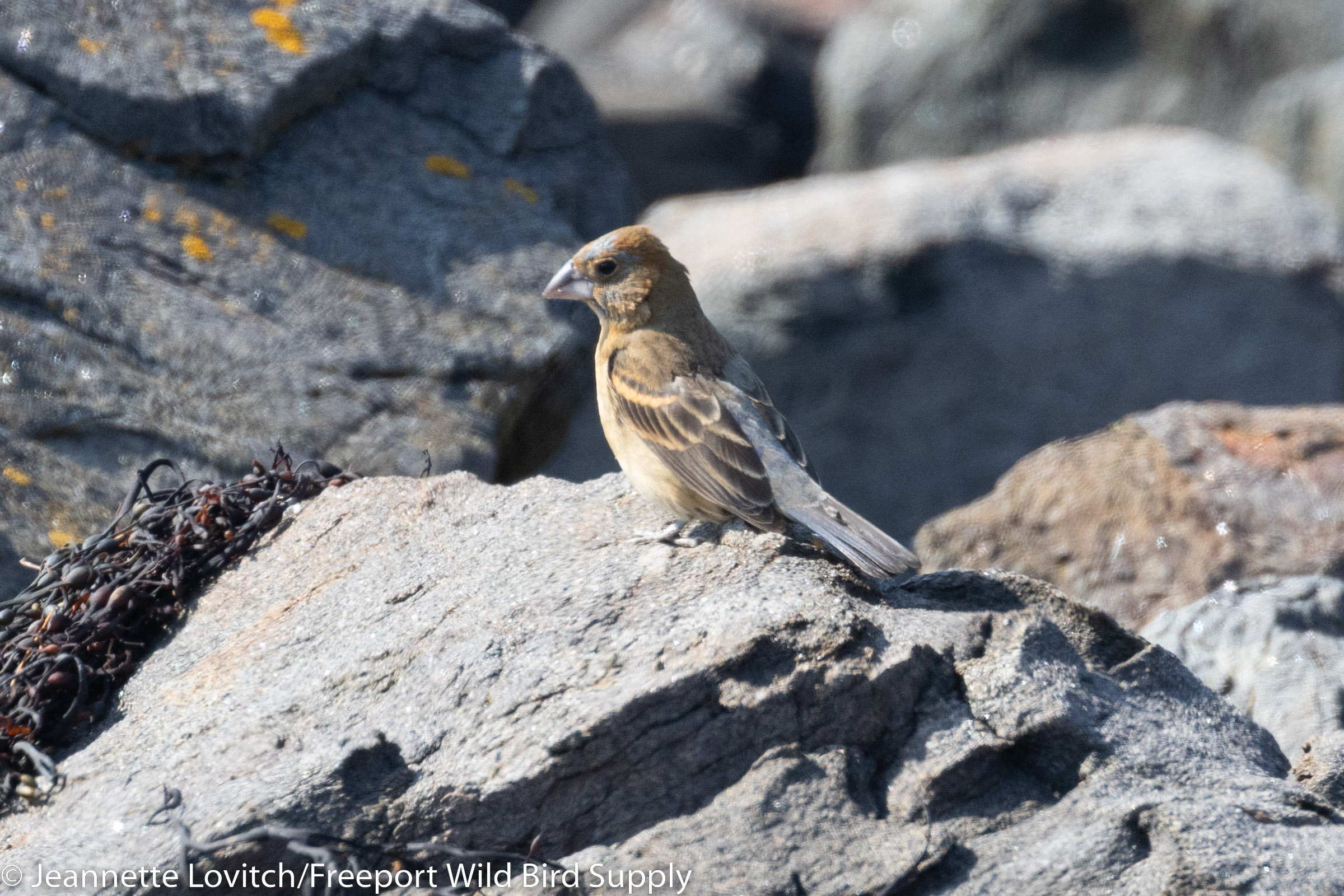
It was warm and fairly slow, so I needed all the help I could get. Regardless, we added species to our trip list here and there in the afternoon, with quality surpassing quantity.  We visited the long-staying 1st year male Blue Grosbeak that has taken up residence at Lobster Cove, where, unlike most Blue Grosbeaks, it has taken to flycatching for seaweed flies in the wrack. Why it is doing this no one knows, but it was a fascinating behavior to watch. Birds and birding on Monhegan never cease to amaze!

The Blue Grosbeak.

A little later, we found an immature Broad-winged Hawk, or again, it found us, as it passed right over us as we poked around the Underhill Trail to find some birds in the shade and in cover.  It was often a struggle to find birds this afternoon, and it was downright hot!  But I heard very few complaints compared to the slow days when it’s 45-degrees, windy, and raining!

We spent a lot of quality time observing birds today, getting to know their behavior and natural history, such as these courting Cedar Waxwings.

While also practicing our field ID skills, such as Eastern Wood-Pewee.

And enjoyed whatever warblers we did encounter, including this male Black-throated Green Warbler.

Monday saw even further reduced activity, with a very summer-like feel to the birding. The migrant flock of Blue Jays built up to at least 46, a Pine Siskin must have just arrived, and some of us even spotted the Virginia Rail!  While passage migrants were few – almost all Blackpoll Warblers – we still had a great day of birding thanks to continued great views of most of what we were finding. There was a Northern Parula nest that a friend found for us to marvel at, and we had quality time once again with a family group of Red Crossbills. Watching them, especially the juveniles, eating buds and cones of Red Spruce at close enough distance to see if they were “righties” or “lefties” was memorable, and more than worth the visit. We had the male Orchard Oriole again, and paid the Blue Grosbeak another lengthy visit.

We took some time to scan the skies over the marsh while also enjoying “Lefty,” the Red-winged Blackbird with white outer primaries on only his left wing. He’s back for the second year.

One of the few birds we missed as a group all weekend was a long-staying but frustrating Snowy Egret that never seemed to stay in the same place long. It was reported at the Ice Pond while we were having breakfast, and Jeannette and I raced down to see it. The “racing” part after the new and ample breakfast buffet at the Trailing Yew may not have been the best decision, however, we got the bird! It was another island bird for me (#226) and I am glad I made the decision to skip the break to chase it, as it was long gone by the time our group arrived at the Ice Pond. I always like to get those chases out of my system before making a bad leadership decision and marching people across the island for a bird that only I cared about!  (Since they are locally common on the mainland, only an island-lister cares about such silliness).

As the afternoon wore on, the group slowly moseyed away from the Blue Grosbeak-evolving-into-a-flycatcher and made our way back to town to catch the last ferries of the weekend, bringing the tour to a close.

A friend found a Northern Parula nest under construction that we took time to marvel at. Here, the female brings some more material in to line the nest, which is nestled in a woven basket inside of large clumps of down-hanging Old Man’s Bear lichen.

However, as usual, Jeannette and I stayed around for another 24 hours to have a day off together and with friends. Leaving the brewery with one friend, I found a male Eastern Bluebird- an odd “new bird” for the date. Where the heck has he been or where did he just come from? Another Monhegan bird mystery…their migration ended a month ago.

Later, as we walked back from dinner with other friends, we heard at least three displaying American Woodcocks. The sunset was quite the stunner, too.

I wasn’t upset to not have a group on Monday, because my goodness, it was slow! I think what was left of the passage migrants cleared out overnight, and little if nothing came in. There were a few Blackpolls here and there, and maybe a few more American Redstarts than usual in the summer, but in and around town, that was about all.

So Jeannette and I decided to take a longer hike and check some oft-productive-but-less-often-birded areas. In doing so, we found a Field Sparrow on Horn Hill, and had a singing Yellow-bellied Flycatcher between Burnt Head and White Head. An adult male Sharp-shinned Hawk was a surprise – was it breeding here? – and a visit into the shaded woods added Winter Wren and Swainson’s Thrush to our weekend list.

We got excited when we saw a gray-backed, white-bellied flycatcher over at Gull Pond, but alas, it had the expected short, not-forked tail that we were hoping for!

Not including the 7 species Jeannette and I saw between 3:00 on Monday and when we departed at 3:15 on Tuesday, the tour list for the 12th annual Monhegan Spring Migration Weekend ended up a goodly 90 total species, despite only 15 species of warblers.  The overall count was better than our last two tours, but still below our long-term average. But I cannot recall four (and five) days of simply gorgeous and warm weather on any of our prior tours!  While the benign weather of late reduced the volume of migrants yet to pass through, and allowed many recent migrants to pass unimpeded overhead, I was pleasantly surprised by the final tally. It was also a high-quality list, with lots of “good” birds not seen by many in Maine away from the island. Oh, and my two island birds were nice, too!

Blue Jays are not the biggest feeder bird on this island!

Even our most common and familiar birds present speciaal photographic opportunities out here!

Species5/265/275/285/29
Mallardx10108
Mallard x American Black Duck1000
Common Eiderxxxx
White-winged Scoter01000
Surf Scoter0600
Ring-necked Pheasantx665
Mourning Dove810810
Black-billed Cuckoo1000
Chimney Swift0010
Ruby-throated Hummingbird6431
Virginia Railh.oh.o11
Semipalmated Sandpiper0010
Greater Yellowlegs0100
Black Guillemot2030x20
Laughing Gull6*216
Herring Gullxxxx
Great Black-backed Gullxxxx
Common Tern1 + 5*000
Northern Gannet0001
Red-throated Loon0100
Common Loon3*100
Double-crested Cormorantxxxx
Great Blue Heron0013
SNOWY EGRET0001**
GLOSSY IBIS0090
Bald Eagle2100
Osprey0322
Red-bellied Woodpecker0010
Merlin2210
Peregrin Falcon0010
Eastern Kingbird0022
Olive-sided Flycatcher0100
Eastern Wood-Pewee2222
“Traill’s” Flycatcher2010
Least Flycatcher2110
Eastern Phoebe1111
Philadelphia Vireo1100
Red-eyed Vireo6844
Blue Jayx484752
American Crowx46x
Common Raven0110
Black-capped Chickadeexxxx
Tree Swallow0222
PURPLE MARTIN0010
Barn Swallow1011
Golden-crowned Kinglet0010
Cedar Waxwing30504030
White-breasted Nuthatch0111
Red-breasted Nuthatch1000
Carolina Wren3 h.o.443
Gray Catbirdxxxx
European Starlingxxxx
American Robinxxxx
HOUSE FINCH0022
Purple Finch0122
WHITE-WINGED CROSSBILL0330
RED CROSSBILL022420
Pine Siskin0001
American Goldfinch12101212
Chipping Sparrow0011-2
White-throated Sparrow2220
Savannah Sparrow3010
Song Sparrow10Xxx
Lincoln’s Sparrow0110
Bobolink1100
ORCHARD ORIOLE1102
Baltimore Oriole1433
Red-winged Blackbirdxxxx
Common Gracklexxxx
Northern Waterthrush0010
Black-and-white Warbler3443
Tennessee Warbler8430
Common Yellowthroatx8xx
American Redstart525168
Cape May Warbler1000
Northern Parula15101212
Magnolia Warbler10868
Bay-breasted Warbler11302
Blackburnian Warbler0100
Yellow Warbler10201515
Chestnut-sided Warbler2111
Blackpoll Warbler25602520
Black-throated Green Warbler1131
Wilson’s Warbler2220
SUMMER TANAGER0100
Scarlet Tanager0100
Northern Cardinalxxxx
Rose-breasted Grosbeak3220
Indigo Bunting0110
BLUE GROSBEAK0011
DICKCISSEL0110
Day Total60666954
Warbler Day Total13131210
Trip Total90
Warbler Trip Total15
Here is the trip list four the four-day tour. * = seen from ferry only. **=not seen with tour group.

This Week’s Highlights, 5/26 to 6/2, 2023

This first summer male Blue Grosbeak was present on Monhegan for at least a week, and unexpectedly, was flycatching for seaweed flies in shoreline rocks for most of the time, including the two days we looked at it with my Monhegan Spring Migration Weekend tour group.

With 5 days on Monhegan and one (half) day offshore, I enjoyed a lot of great birds this week. My observations of note over the past seven days included:

  • 1 Mourning Warbler, our property in Durham, 5/26 (Yard Bird #137!)
  • Monhegan Island with our Monhegan Spring Migration Weekend Tour group (full trip report and photos to come).

Daily:

  • Impressive numbers of Red Crossbills swirling around the island and tough to quantify, including many juveniles. High counts of largest flock(s) in the mid-20’s.  Three WHITE-WINGED CROSSBILLS were present each day at least through the end of the weekend. Rare for the island, a pair of HOUSE FINCHES appeared on the 27th and continued through the end of our stay.  Here are my group’s other daily highlights.

5/26:

  • 11 Bay-breasted Warblers (FOY)
  • 1 Cape May Warbler (FOY)
  • 1 female Evening Grosbeak
  • 1 Black-billed Cuckoo
  • 1 continuing ORCHARD ORIOLE
  • 1 Philadelphia Vireo (FOY)

5/27:

  • 1 continuing male DICKCISSEL
  • 1 continuing female/imm male SUMMER TANAGER
  • 1 female ORCHARD ORIOLE
  • 1 Olive-sided Flycatcher (FOY)

5/28:

  • 9 GLOSSY IBIS – circled the island early in the morning but did not land. My 225th Island Bird!
  • 1 probable immature male PURPLE MARTIN
  • 1 continuing 1st-year male BLUE GROSBEAK
  • 1 immature BROAD-WINGED HAWK
  • 1 continuing male DICKCISSEL

5/29:

  • 1 pair ORCHARD ORIOLES
  • 1 continuing SNOWY EGRET – Jeannette and I finally caught up with it for my 226th Island Bird!
  • 1 continuing 1st year male BLUE GROSBEAK
  • 5/30 (With Jeannette):
  • 1 continuing male ORCHARD ORIOLE
  • 1 Field Sparrow
  • Did not try to catch up with continuing rarities, although two quick checks did not turn up the Dickcissel or the Blue Grosbeak.
  • The Zeiss Pelagic with Cap’n Fish’s Cruises out of Boothbay Harbor, 6/2. This special mini-pelagic, sponsored by Zeiss Optics visited Eastern Egg Rock before heading 20 miles offshore. Trip report to come, but for now, the highlights:

1 Razorbill at Eastern Egg Rock

1 COMMON MURRE (between Eastern Egg Rock and Murray Hole)

350-400 total Wilson’s Storm-Petrels (FOY)

12 RED-NECKED PHALAROPES

  • TOURS AND EVENTS:

I’ll see you next week at the Rangely Birding Festival! Most (but not all) tours are sold out, but everyone can join me for the free and open to the public Birds on Tap! Event at Parkside and Main (beverages not included)!

Sandy Point Morning Flight, 9/29/2022

There are some Morning Flights at Sandy Point that deserve their own blog. This was one of those. (I also haven’t finished my Monhegan Tour report blog yet, either).

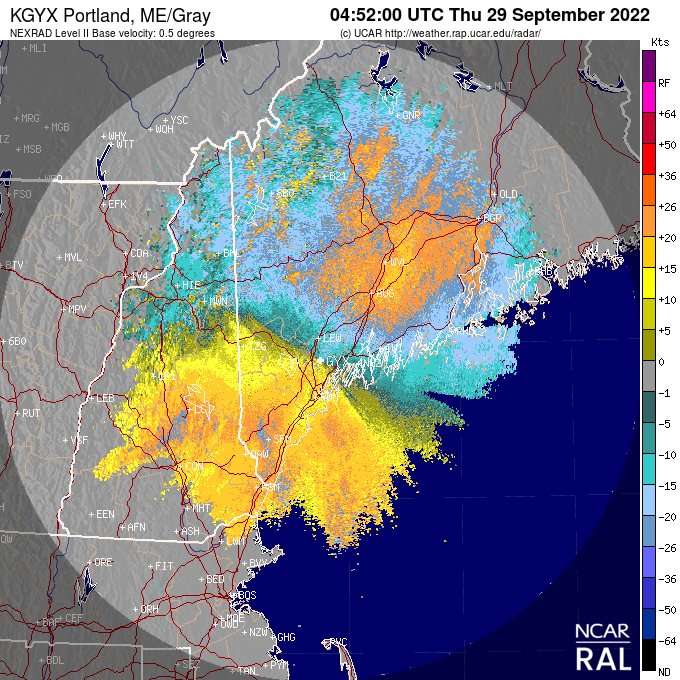
Let’s start with the 1:00am reflectivity and velocity images from the Gray NEXRAD station. I was very happy that the station was back online in time for this incredible large flight. In fact, it was one of the densest flights I have seen in the area, and you can see how much biomass was offshore.

For an explanation of just what this means, see the “Birding at Night” chapter in my first book, How to be a Better Birder. Furthermore, see previous Sandy Point posts on the topic – you can use the search box in the upper right-hand corner of this blog page, and search “Sandy Point” or “Morning Flight.”

That got my pretty darn excited for the morning. And, well, it was a lot of fun! OK, mostly…at times I was overwhelmed and early on, I just felt beat! For the first 30 minutes, I often just clicked waves of “unidentified” as I tried to keep pace. Luckily, after the massive early rush, the flight became more manageable, although bursts of activity were barely quantifiable.

20 species of warblers, a very rare Blue Grosbeak, and my 195th all-time Sandy Point birds: 2 Little Blue Herons! It was quite a day.

Thanks to Evan Obercian, I learned a ton and had some great species tallies. I have no doubt that some of the records set (e.g. 2nd-highest tally for Cape May Warbler) came from his exceptional auditory skills – some of those birds would have just went unidentified or not even detected by me! Of course, the more eyes (and ears) the better, and Reed Robinson and Weston Barker – splitting time on the “flicker clicker” and pointing out birds landing below – helped immensely as well. Assistance was critical today.

When Evan and I finally departed for desperately needed bagels and coffee at 11:45, there were still a few birds on the move. With some raptors in the air, I am sure that if we didn’t leave then, I would be there all day. I wish I could have been, because this morning was simply awesome. Here’s the scoreboard:

  • 6:36 to 11:45am
  • With Evan Obercian, Reed Robinson, and Weston Barker.
  • 50F, mostly clear, WNW 4.5-5.1 to NW 13.3-16.1
  • 2,389 unidentified
  • 1,036 Yellow-rumped Warblers (*2nd highest)
  • 449 Northern Parulas
  • 374 Ruby-crowned Kinglets (*3rd highest)
  • 286 Yellow-bellied Sapsuckers (*new record)
  • 251 Northern Flickers
  • 155 Blackpoll Warblers
  • 138 Eastern Phoebes (*new record. Previous high of 26! And this was very conservative as many were swirling, too. But at times, steady pulses of 2-6 were clearly crossing)>
  • 105 Black-throated Green Warblers
  • 93 American Robins
  • 75 White-throated Sparrows
  • 71 Black-and-white Warblers (*new record)
  • 65 Red-eyed Vireos (*new record)
  • 64 Red-breasted Nuthatches (*new record)
  • 58 Magnolia Warblers
  • 57 Cedar Waxwings
  • 44 Blue Jays
  • 41 Dark-eyed Juncos
  • 33 American Goldfinches
  • 31 Blue-headed Vireos (*2nd highest)
  • 26 American Redstarts
  • 25 Cape May Warblers (*2nd highest)
  • 25 Black-throated Blue Warblers
  • 25 Purple Finches
  • 23 Chipping Sparrows
  • 22 Rusty Blackbirds
  • 22 Nashville Warbler (*2nd highest)
  • 22 Broad-winged Hawks
  • 18 Tennessee Warblers (*3rd highest)
  • 18 Golden-crowned Kinglets
  • 16 Palm Warblers
  • 12 Scarlet Tanagers
  • 9 Yellow Warblers
  • 8 Savannah Sparrows
  • 7 Swainson’s Thrushes
  • 7 American Kestrels
  • 7 Turkey Vultures
  • 6 White-breasted Nuthatches (*tied highest)
  • 5 Baltimore Orioles
  • 4 Ospreys
  • 4 Philadelphia Vireos
  • 4 Bay-breasted Warblers
  • 4 Black-capped Chickadees
  • 3 Brown Creepers
  • 2 Rose-breasted Grosbeaks
  • 2 Chestnut-sided Warblers
  • 2 Orange-crowned/Tennessee Warbler
  • 2 Red-winged Blackbirds
  • 2 Eastern Wood-Pewees
  • 2 Sharp-shinned Hawks
  • 2 juvenile LITTLE BLUE HERONS (**high fly-overs. My first record for Sandy Point and Patch Bird #195.)
  • 2 Lincoln’s Sparrows
  • 2 White-crowned Sparrows
  • 1 Pine Warbler
  • 1 Least Flycatcher
  • 1 Northern Harrier
  • 1 Tufted Titmouse (did not cross after a few false starts)
  • 1 Red-bellied Woodpecker (crossed after three false starts)
  • 1 Common Loon
  • 1 Eastern Bluebird
  • 1 Hairy Woodpecker (crossed after 8 false starts)
  • 1 BLUE GROSBEAK (**My 3rd-ever at Sandy Point. Spotted by Evan, photographed by Weston Barker; photo below).
  • 1 Common Grackle
  • 1 Wilson’s Warbler
  • 1 Red-tailed Hawk
  • 1 American Pipit
  • 1 Blackburnian Warbler
  • 1 unidentified Empid
  • 1 Downy Woodpecker (did not cross after 2 false starts)
  • 1 Swamp Sparrow
  • 1 Hermit Thrush
  • 1 Ovenbird (in the woods; warbler #20!)
  • X Common Yellowthroat (I don’t try and count them in the brush here, but there were a lot around this morning and many more than there have been. None even attempted a crossing as usual).

***Total = 6,183 (2nd highest all time!)***

2021 Monhegan Fall Migration Weekend Tour Report.

This Blue Grosbeak was among the highlights of an incredible weekend on the island.

“It was like the good ol’ days!” When every other bird you saw was a rare one, and you barely walked 10 steps before finding more birds.  But this was not what we were expecting, and the weekend sure didn’t start out that way!

After a very rough boat ride, we were still putting ourselves back together when one birder said “Go back, there are no birds here.”  Apparently, it had been a dreadfully slow week of little migration, but at least nice weather. This weekend, the weather wasn’t supposed to be very nice. So without many birds on the island, and quite a bit of rain on the way, were less enthused about arriving than usual…well, that might have had something to do with the boat ride.

And I am not sure if it helped that one of the first birds I looked at was a rare hybrid Herring X Great Black-backed Gull.  I am not sure if anyone was ready to take in gull hybrids yet.  Even more when we feared that this could be our best bird of the trip if the pattern held.

And sure enough, it was a very slow afternoon. But we did have good luck. We found a Sora that walked out into an open patch of mud, quickly caught up with the adult Lesser Black-backed Gull that has been hanging around, and after lunch immediately found the Least Sandpiper and Spotted Sandpiper at Lobster Cove that have been playing hard to get all week. There was also a good Northern Gannet show, which is always a treat. So at least we were seeing what was around, which sadly, really was not very much.  But hey, it still hadn’t rained!

Least and Spotted Sandpipers – shorebirds are few and far between on the island.

A period of rain, heavy at times, fell overnight, but the band was much narrower and less heavy than forecast. It did not rain all night, and it even appeared that a light flight of migrants had developed on the radar after midnight. And sure enough, come dawn, there was a light Morning Flight overhead. It was mostly Yellow-rumped and Blackpoll Warblers, but hey, there were new birds around!  And once, again, it was not raining.

A fly-over Dickcissel or two, a calling Gray-cheeked Thrush, and more. Birds!  Yay!

Then, after breakfast, I went to spread some seed in my favorite corner to attract some birds for the group to enjoy this morning.  Turning the corner near the famous “Chat Bridge” a shockingly bright flash of the most intense yellow you can imagine. And blue wings, and a flash of white in the tail. Prothonotary Warbler I exclaimed to no one around.

I raced back towards the group meeting point and sent them on their way. Kristen Lindquist took off running.  I eventually made it back with the rest of the group and we divided to conquer. Kristen and about half the group spotted it repeatedly, while it remained tantalizingly out of view from where I and others were standing. 

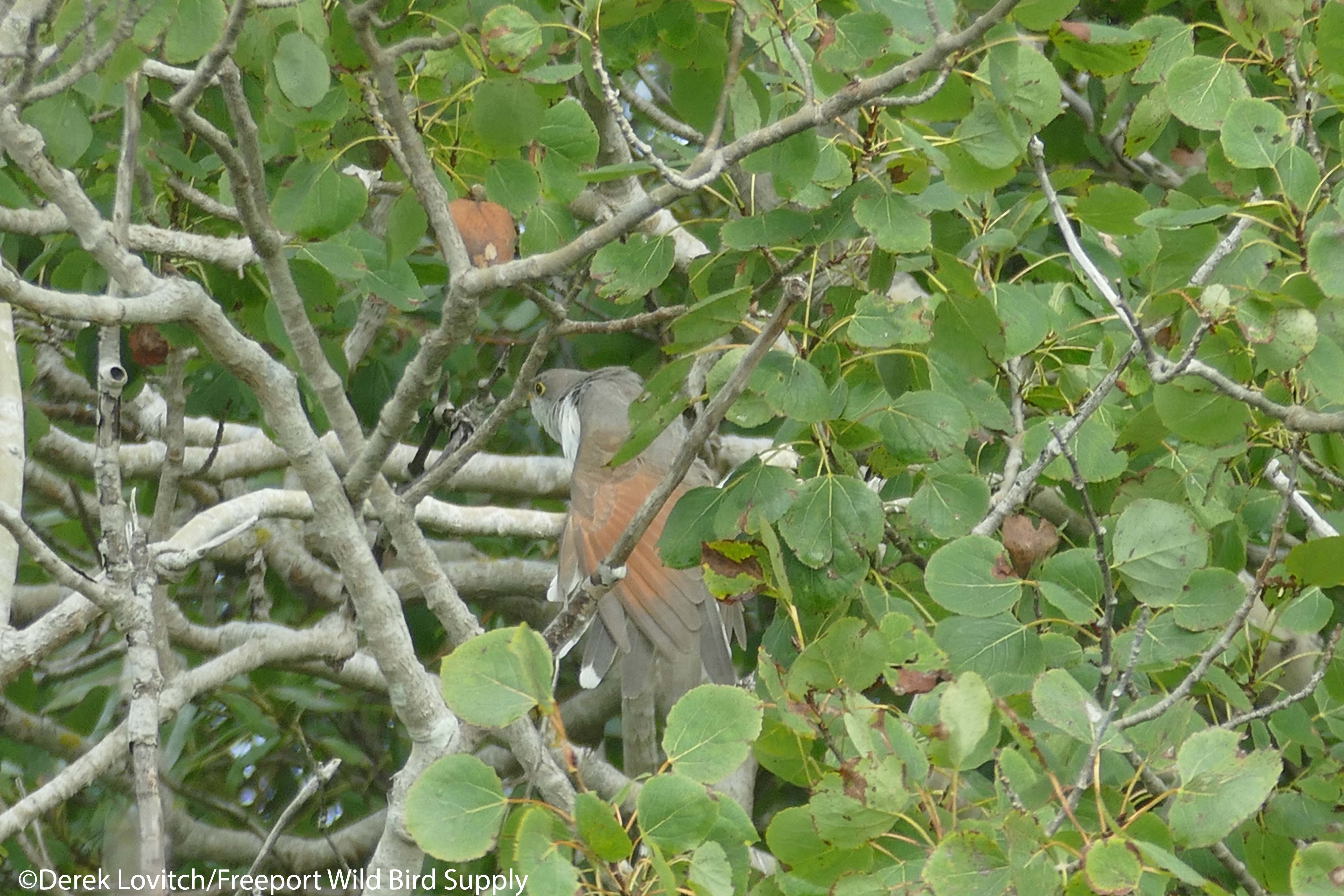
As other birders converged, a classic “Patagonia Picnic Table Effect” occurred. First, there were two Dickcissels, then I spotted a Yellow-breasted Chat making a short flight over the brush. While searching for that, Ilsa spotted a Yellow-billed Cuckoo that would sit still, preening, for well over and hour.  It might have been the most cooperative cuckoo ever on the island!  Another group had a brief look at a Clay-colored Sparrow.

Unfortunately, the Prothonotary Warbler was never seen again.

Yellow-billed Cuckoos don’t usually sit this still for this long. This bird was likely exhausted
after just arriving on the island.
In case you didn’t see it’s yellow bill.

It was already a pretty amazing day for one that we thought would be a wash-out. And it was still not raining.  After our lunch break, we convened at the Monhegan House at 1:30, and spent the next hour and a half on its lawn, and going no where else.

One Dickcissel became two, and then four, and when the group finally took off together, we were shocked to confirm a genuine flock of 8 Dickcissels – exceptional, even for Monhegan. And there were not one, but two Clay-colored Sparrows!  And other birds just kept arriving, as standing in one spot saw our list quickly grow: American Redstart, Brown Creeper, Warbling Vireo, etc, etc. One “Western” Palm Warbler became 4, a couple of Cape May Warblers paid us a visit, a Savannah Sparrow dropped in…

It was truly incredible! It felt like my first tours here 15 years ago. By now, a light shower was falling, but we didn’t seem to care. We finally pulled ourselves away as the action waned, wanting to see what the next hot corner would offer.  After spotting at least 8 Baltimore Orioles along Pumphouse Road, the rain finally arrived in earnest by about 3:30pm. We called it quits, but considering the day we had, no complaints were to be heard.  It was a really special day; one that will not soon be forgotten.

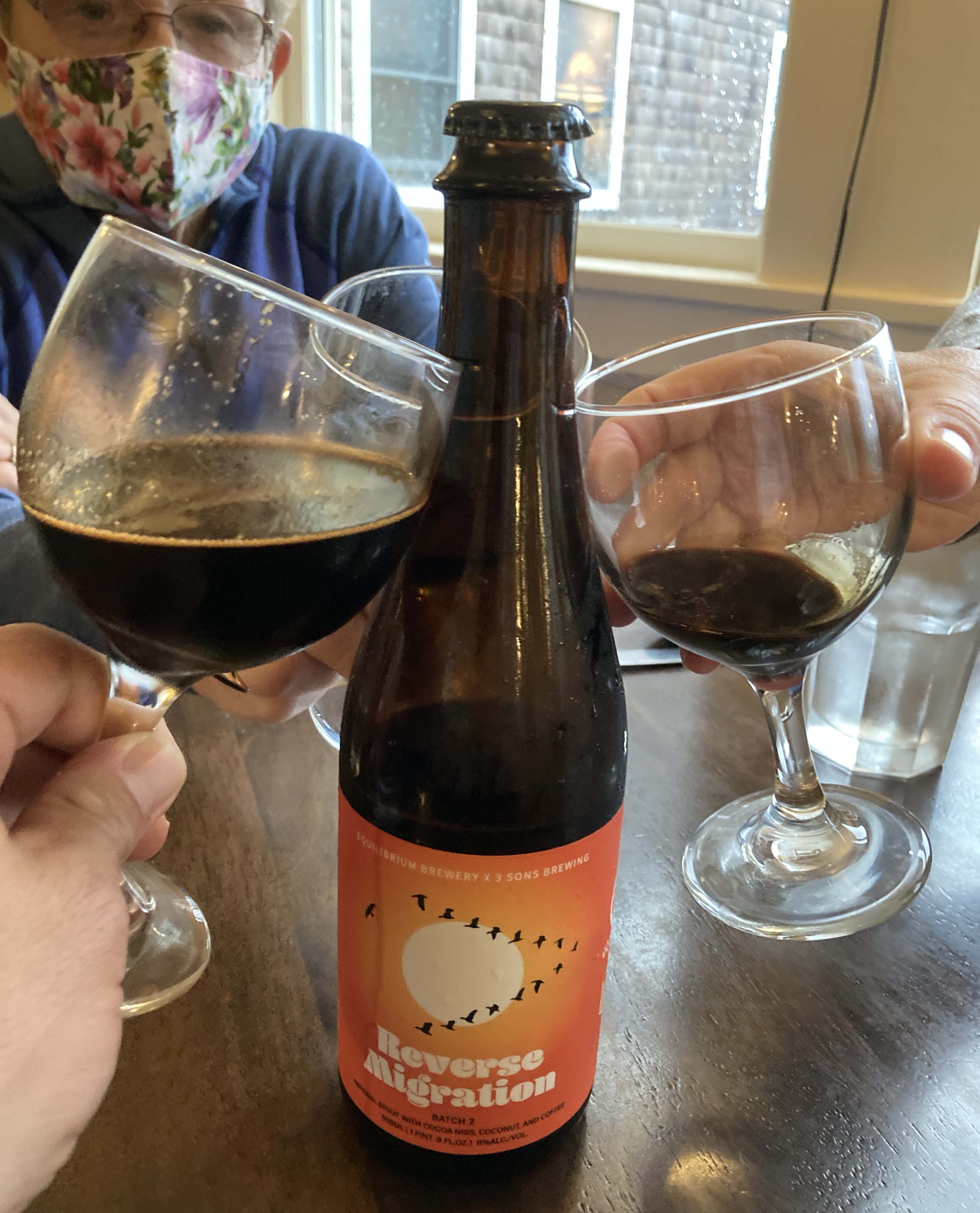
While it was more accurately “180-degree misorientation” and other forms of vagrancy and not “reverse migration” that brought us so many good birds, I brought a special beer out
just in case we had a day like we did today!

Rain fell overnight again, and come dawn on Sunday (Day 3), dense fog had rolled in.  There were a few Yellow-rumped Warblers overhead, especially during a short respite from the fog, but there were not nearly as many birds around as the day before. But, with fog overnight, we expected birds who were on the island to stay, which was good, because yesterday was awesome and there were still a few birds we had not yet encountered.

It might be a while before they are “countable” again, but the Ring-necked Pheasant population
seems to be booming in town.

We delayed the start of the after-breakfast walk to let a batch of heavier rain clear through. We were stuck in such an odd fall weather pattern, with virtually no west-east progression of weather systems. But we had been so lucky with the timing of the rainfall so far, that a little delay was of no concern.  Regrouping at 10:00, light showers gave way to just some lingering drizzle by 11, and it soon became apparent that there were new birds around.  We had two Prairie Warblers, a Scarlet Tanager joining the growing flock of Baltimore Orioles, and a Blue-winged Teal joined a Green-winged Teal in the marsh.  Two Cliff Swallows and a Barn Swallow foraged over Manana, and we had our second Yellow-breasted Chat of the trip – this one in the Island Farm garden on Pumphouse Road. And another Clay-colored Sparrow?

There was a really impressive number of Baltimore Orioles on the island over the weekend.

Pockets of Yellow-rumped Warblers here and there often contained another warbler species or two, and we had good looks at stuff all morning, even often-challenging birds to see with a group like Lincoln’s Sparrows. 

And after lunch, the sun was out!  We had the Lesser Black-backed Gull again, more looks at Clay-colored Sparrows, and finally the immature male Blue Grosbeak showed up for us, and show it did!

It wasn’t as birdy once the sun was out, but a light raptor flight, including at least 6 Peregrine Falcons helped make up for it.

On Monday, our last day of the tour, it appeared that little moved overnight on a light southwesterly flow aloft. But that had our daydreams going for rarities from our west and southwest.  And sure enough, while some of us were dallying over breakfast, a Western Kingbird that Kristen Lindquist found earlier flew right over us at the Yew and alighted nearby!

After breakfast, we “cleaned it up” for the group when we relocated it at the cemetery, affording great looks for all.  A slower day finally gave us an opportunity to head into the deeper woods. And while we expected fewer birds in the island’s interior, a couple of mixed-species foraging flocks finally put Red-breasted Nuthatch on the list, and we found the first Pine Warbler of the weekend. 

“Look at my tail!” Just in case anyone had hopes of stringing it into a rarer western Tyrannus.

Jeannette joined us by lunchtime, and after lunch, we had a frustratingly brief glimpse of the original Yellow-breasted Chat, along with more great looks at Clay-colored Sparrows. 

The tour came to a close with the 3:15 departure back to New Harbor, bringing our incredible four days together to the always-bittersweet end. 

Jeannette and I birded the rest of the afternoon together, picking up a few things, like my first “Yellow” Palm Warblers of the weekend and a Solitary Sandpiper.  Our walk to dinner yielded a second Pine Warbler, and at the harbor: a juvenile Ring-billed Gull (actually fairly rare out here in the early fall) and another view of the lingering Lesser Black-backed Gull.

On Tuesday, Jeannette and I enjoyed our day off on the island, and Kristen Lindquist joined us for most of the day.  A diminishing light southwest wind overnight gave way to a little bit of northwesterly winds by dawn, but it didn’t appear that much had arrived on the island overnight.

At least two, if not three, different Prairie Warblers were around the island.
Getting late, a few American Redstarts helped bump up our impressive warbler tally.

However, we soon located a Lark Sparrow found yesterday by Bryan Pfeiffer, the immature male Blue Grosbeak paid us a visit, and we heard the Sora briefly.  We then found an Orange-crowned Warbler out past the Ice Pond, my 20th warbler species of the weekend! Unfortunately, we were sans cameras with a little light rain falling.

This Scarlet Tanager was often cooperative at the grape arbor.
As per tradition with this tour report: at least one gratuitous “food porn” photo. Here’s the colorful and fresh avocado toast from the Trailing Yew.
And here’s one of the island’s resident Black-capped Chickadees…just because.

After lunch, we were excited to find two Lark Sparrows sitting next to each other at the cul-de-sac, there were now two Ring-billed Gulls in the harbor, and yes, there were still at least 4 Clay-colored Sparrows and several Dickcissels around! 

Just for a change of pace, we decided to walk the diffuse trail along the island’s southwestern end, but were soon distracted by something large in the water in the distance.  Retrieving my scope, it was clear that it was indeed a dead whale, and eventually it floated close enough to identify it as a dead (and rather bloated) Minke Whale.  A handful of gulls were around it, and briefly, a quick pass by a jaeger that was too far to claim the identity of.  It was a fascinating, if not rather sad, end to our visit as by now it was time for Jeannette and I to head to the dock to return to the real world.

A much more pleasant boat ride back, this time to Port Clyde yielded a number of Common Loons and plenty of Northern Gannets, and a surprise of a small pod of Atlantic White-sided Dolphins.  I’m not sure if I have seen this pelagic species from a Monhegan ferry before, or this close to land at all.

And finally, one last “good” bird: a pair of truant American Oystercatchers on Dry Ledges (off of Allen Island)! Interestingly, we had a pair on the same exact ledge on our way back from the island on October 5th of last year.

At least 8 Dickcissels, at least 4 Clay-colored Sparrows, 2 Lark Sparrows, and an Orange-crowned Warbler from the Midwest. A Western Kingbird from the West.  A Prothonotary Warbler, 2 Yellow-breasted Chats, and a Blue Grosbeak from the South.  105 total species (102 with the tour) including 20 species of warblers.  Yeah, that was a good trip  – and the stuff that Monhegan legends are made of, at least sans fallout.

Four of a flock that grew to an impressive 8 Dickcissels, often found in the swale behind the
Monhegan House throughout the weekend.

And finally, here is our birdlist from the extraordinary weekend:

9/24 = * denotes ferry ride only
9/27 = * with just Jeannette
9/28 = with Jeannette; *denotes ferry ride only
24-Sep25-Sep26-Sep27-Sep28-Sep
American Black Duck00111
Mallard310262424
Mallard x American Black Duck Hybrid00011
Green-winged Teal0101*0
Blue-winged Teal0101*0
Common Eiderxxxxx
Ring-necked Pheasant613121610
Mourning Dove622301518
YELLOW-BILLED CUCKOO01000
unidentified cuckoo00010
Common Nighthawk00000
Sora10001
Semipalmated Plover01000
Least Sandpiper10201
American Woodcock10000
Spotted Sandpiper10100
Unidentified jaeger00001
Solitary Sandpiper0001*0
Black Guillemot23103
Laughing Gull1*0003
Ring-billed Gull0001*2
Herring Gullxxxxx
LESSER BLACK-BACKED GULL1011*0
Great Black-backed Gullxxxxx
GREAT BLACK-BACKED X HERRING HYBRID1000
Common Loon1*0006*
Northern Gannet2002043
Double-crested Cormorantxxxxx
Great Cormorant03311*
Great Blue Heron01103
Bald Eagle2*111*1
Sharp-shinned Hawk00021
Belted Kingfisher00111
Yellow-bellied Sapsucker04382
Downy Woodpecker00143
Northern Flicker4541010
Merlin00486
Peregrine Falcon00686
WESTERN KINGBIRD00010
Eastern Phoebe00011
Blue-headed Vireo00010
Warbling Vireo01000
Red-eyed Vireo01081210
Blue Jay61881618
American Crow46xxx
Common Raven22022
Black-capped Chickadeexxxxx
CLIFF SWALLOW00200
Barn Swallow00100
Golden-crowned Kinglet044158
Ruby-crowned Kinglet02034
Cedar Waxwing3048406050
Red-breasted Nuthatch00003
White-breasted Nuthatch00022
Brown Creeper02111
House Wren01101
Carolina Wren04478
Gray Catbirdxxxxx
Brown Thrasher02000
European Starling1818181818
GRAY-CHEEKED THRUSH01000
Swainson’s Thrush04111
American Robin03034
American Pipit00010
Purple Finch01000
LARK SPARROW00002
American Goldfinch210413
Chipping Sparrow086108
CLAY-COLORED SPARROW024414
Dark-eyed Junco00021
White-crowned Sparrow00010
White-throated Sparrow21061510
Savannah Sparrow03301
Song Sparrowxxxxx
Lincoln’s Sparrow01315
Swamp Sparrow00212
YELLOW-BREASTED CHAT01110
Bobolink06050
Rusty Blackbird02010
Common Grackle06964
Brown-headed Cowbird01000
Baltimore Oriole08151612
Northern Waterthrush10421
Black-and-white Warbler00110
PROTHONOTARY WARBLER01000
Tennessee Warbler10000
ORANGE-CROWNED WARBLER00001
Nashville Warbler03224
American Redstart01202
Common Yellowthroat26544
Cape May Warbler13002
Northern Parula05433
Magnolia Warbler01210
Yellow Warbler05432
Blackpoll Warbler1158106
Black-throated Blue Warbler00010
Palm Warbler0441410
PINE WARBLER00023
Yellow-rumped Warbler306075300150
Prairie Warbler0022*1
Black-throated Green Warbler03345
Wilson’s Warbler01221
Scarlet Tanager00210
Northern Cardinal410886
Rose-breasted Grosbeak04443
BLUE GROSBEAK00101
Indigo Bunting00044
DICKCISSEL08754
Day Total3465667477
Warbler day total513141515
4-Day Tour total=102
Plus with Jeannette after the group =3
Total warblers =20

This Week’s (Non Sandy-Point) Highlights, 9/24-9/30: Monhegan Island

This Blue Grosbeak was among the stars of the show from an exceptional weekend of
great birds on Monhegan Island.

I haven’t yet posted a Monhegan tour blog from last weekend, so I figured I’d at least post some of the highlights from our extremely exciting weekend chock-full of great birds!

9/24 (with Monhegan Fall Migration Weekend tour group):

  • 1 adult GREAT BLACK BACKED X HERRING GULL HYBRID
  • 1 adult Lesser Black-backed Gull
  • 1 Sora

9/25 (with tour group):

  • 1 adult PROTHONOTARY WARBLER. Found by me at “Chat Bridge” and refound nearby a short while later by Kristen Lindquist and part of my group.  Only bird of the weekend not seen again.
  • 1 YELLOW-BREASTED CHAT
  • 8 DICKCISSELS (in flock together at one point)
  • 2 CLAY-COLORED SPARROWS (in flock with 8 Dickcissels).
  • 1 Gray-cheeked/Bicknell’s Thrush (presumed Gray-cheeked)
  • 1 Yellow-billed Cuckoo

9/26 (with Tour group):

  • 1 YELLOW-BREASTED CHAT
  • 1 immature male BLUE GROSBEAK
  • At least 4 CLAY-COLORED SPARROWS
  • At least 7 DICKCISSELS
  • 1 adult Lesser Black-backed Gull

9/27 (with tour group):

  • 1 WESTERN KINGBIRD (found by Kristen Lindquist. Refound by us at the Trailing Yew, then later by our group again at the cemetery. Last sighting?)
  • At least 5 DICKCISSELS
  • At least 4 CLAY-COLORED SPARROWS
  • 9/28 (with Jeannette and Kristen Lindquist):
  • 1 immature male BLUE GROSBEAK
  • 2 LARK SPARROWS
  • At least 4 CLAY-COLORED SPARROWS
  • At least 4 DICKCISSELS
  • 1 Orange-crowned Warbler
  • 1 unidentified jaeger at a floating Minke Whale carcass offshore.
  • 1 adult Lesser Black-backed Gull

Other Highlights:

  • 2 AMERICAN OYSTERCATCHERS, Dry Ledges off of Allen Island from Port Clyde Ferry, 9/28 (with Jeannette).

And don’t forget, our next pelagic with Cap’n Fish’s out of Boothbay Harbor is coming up, on October 11th. Information and registration can be found here.

OK, back to work on my Monhegan blog.