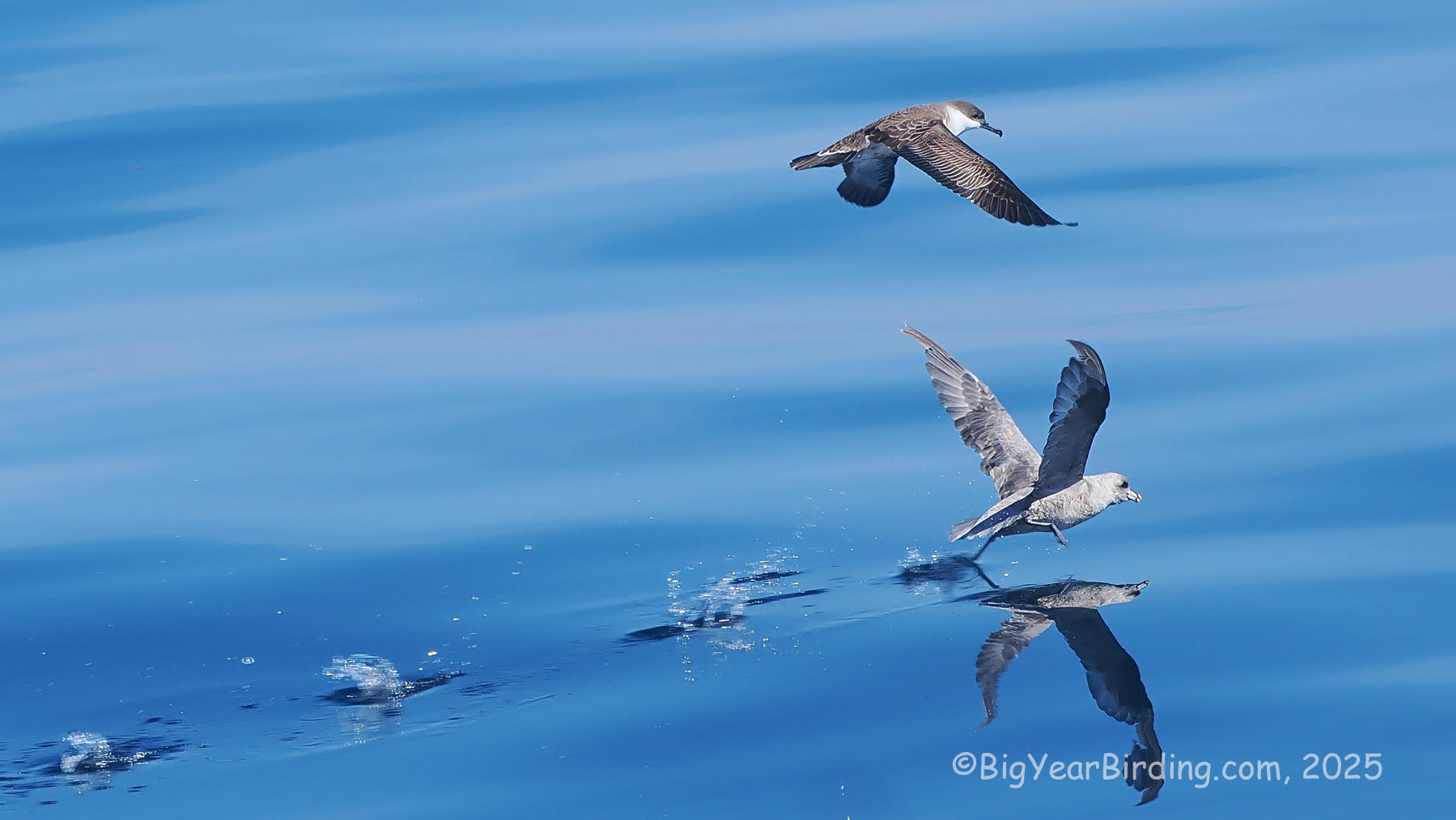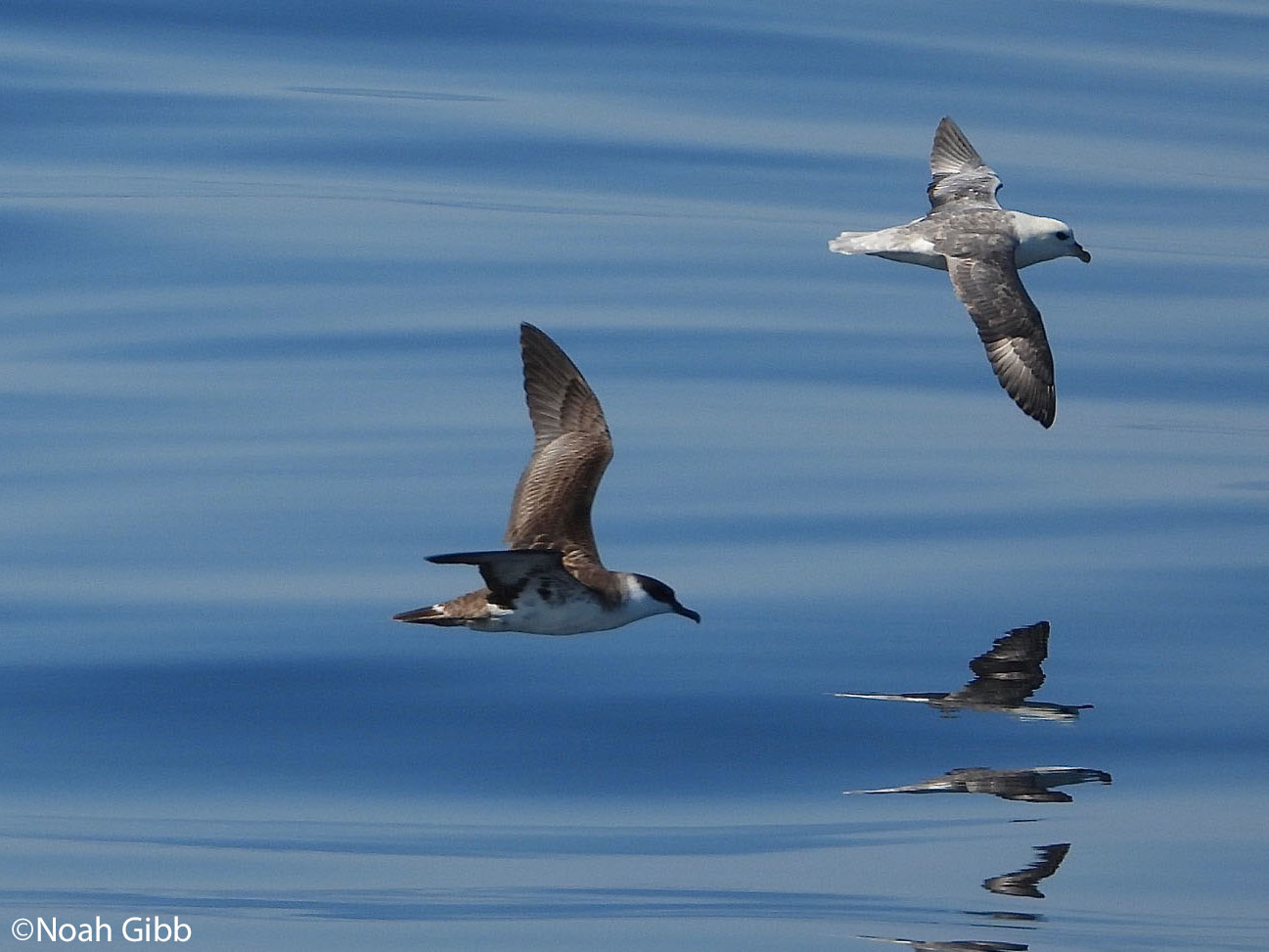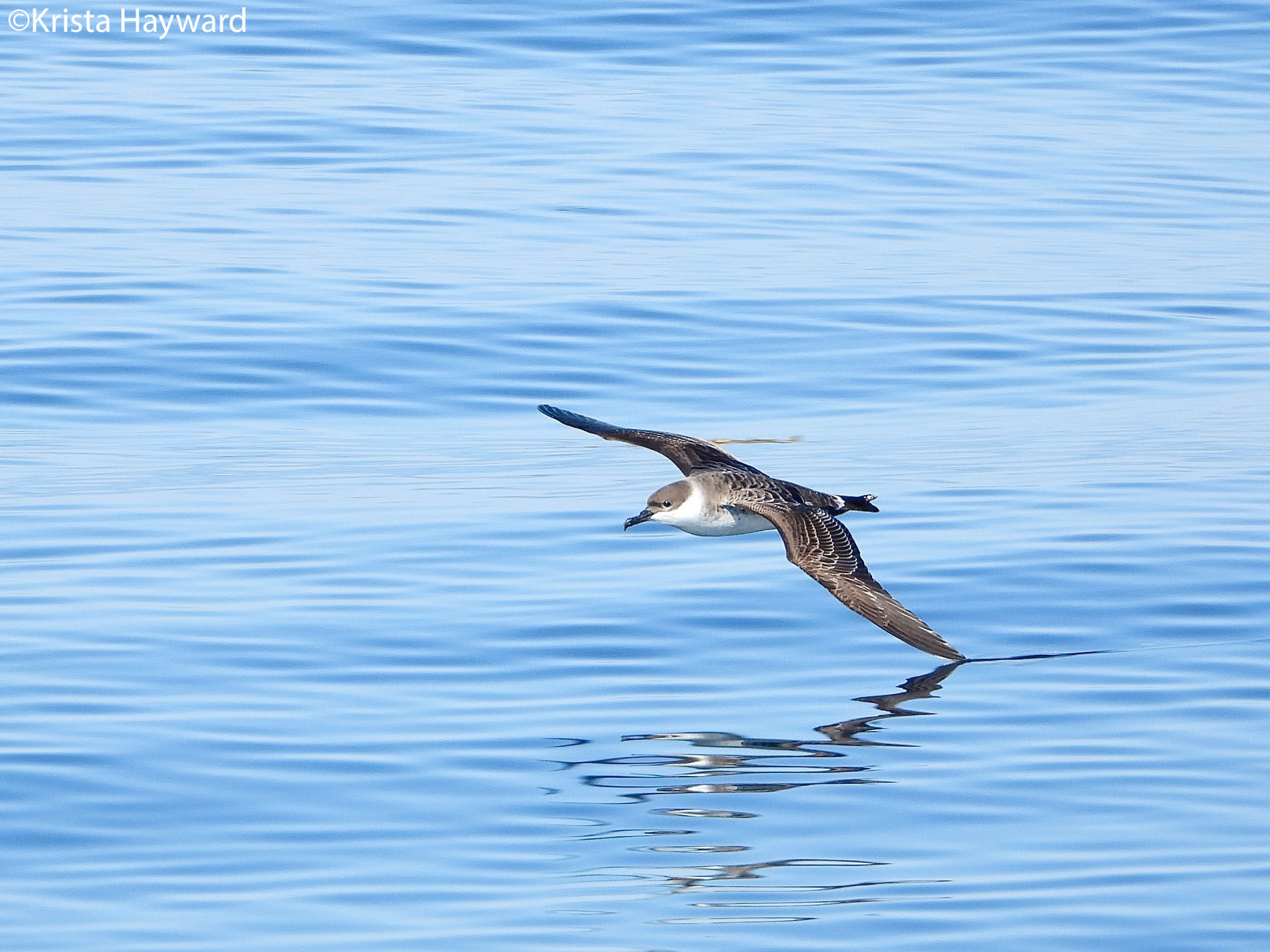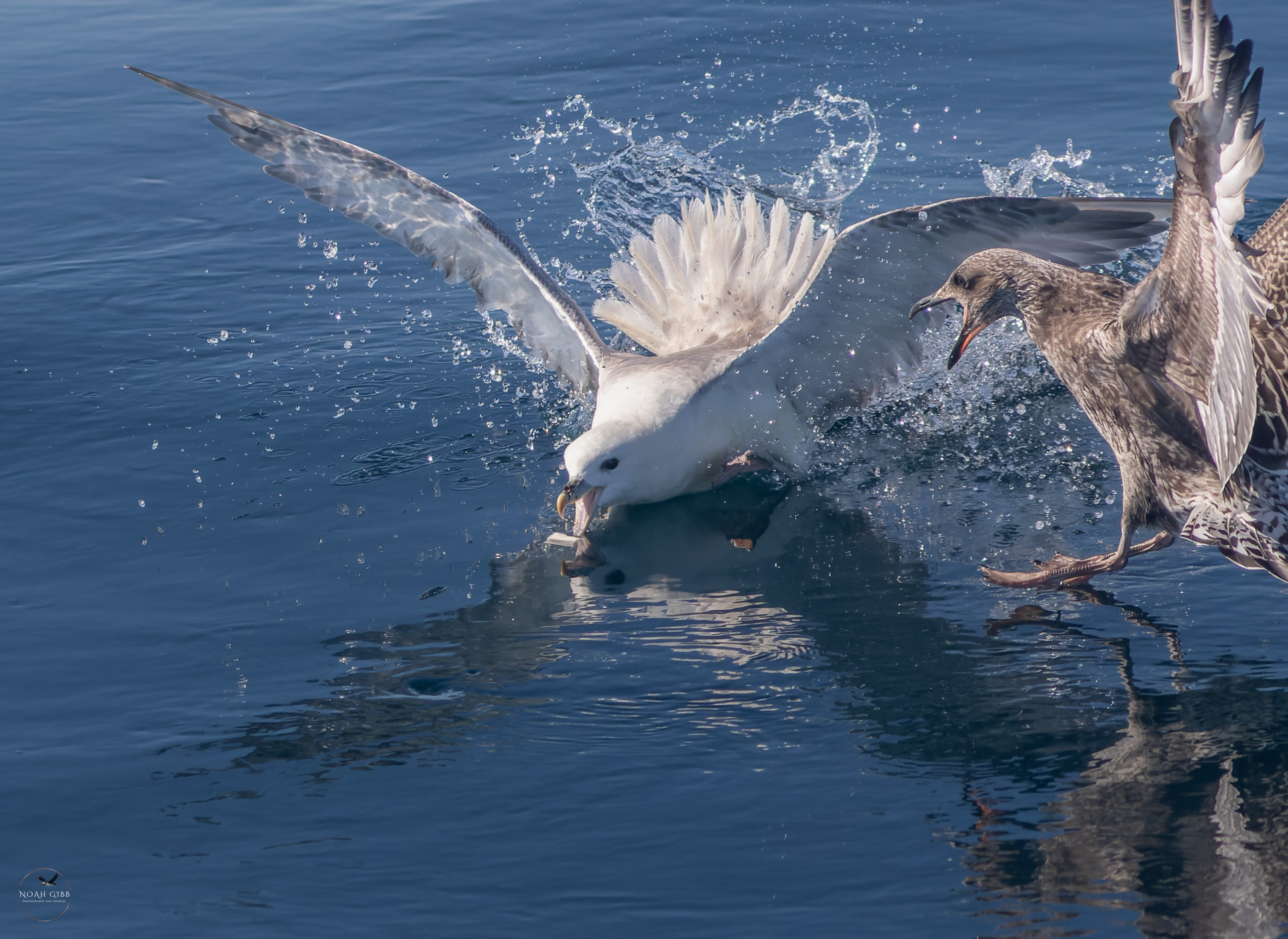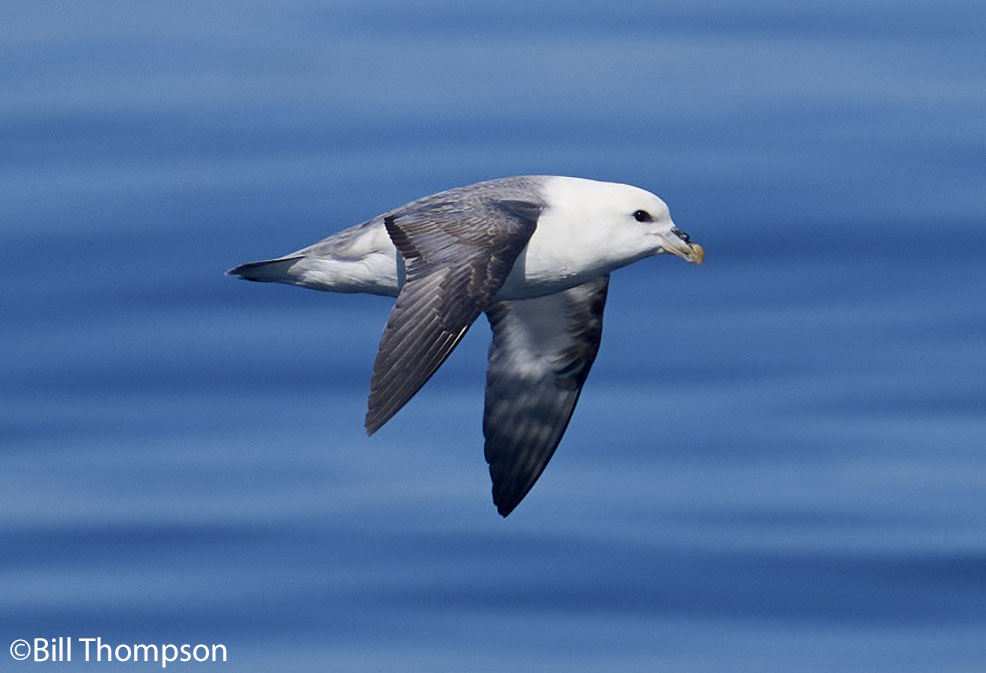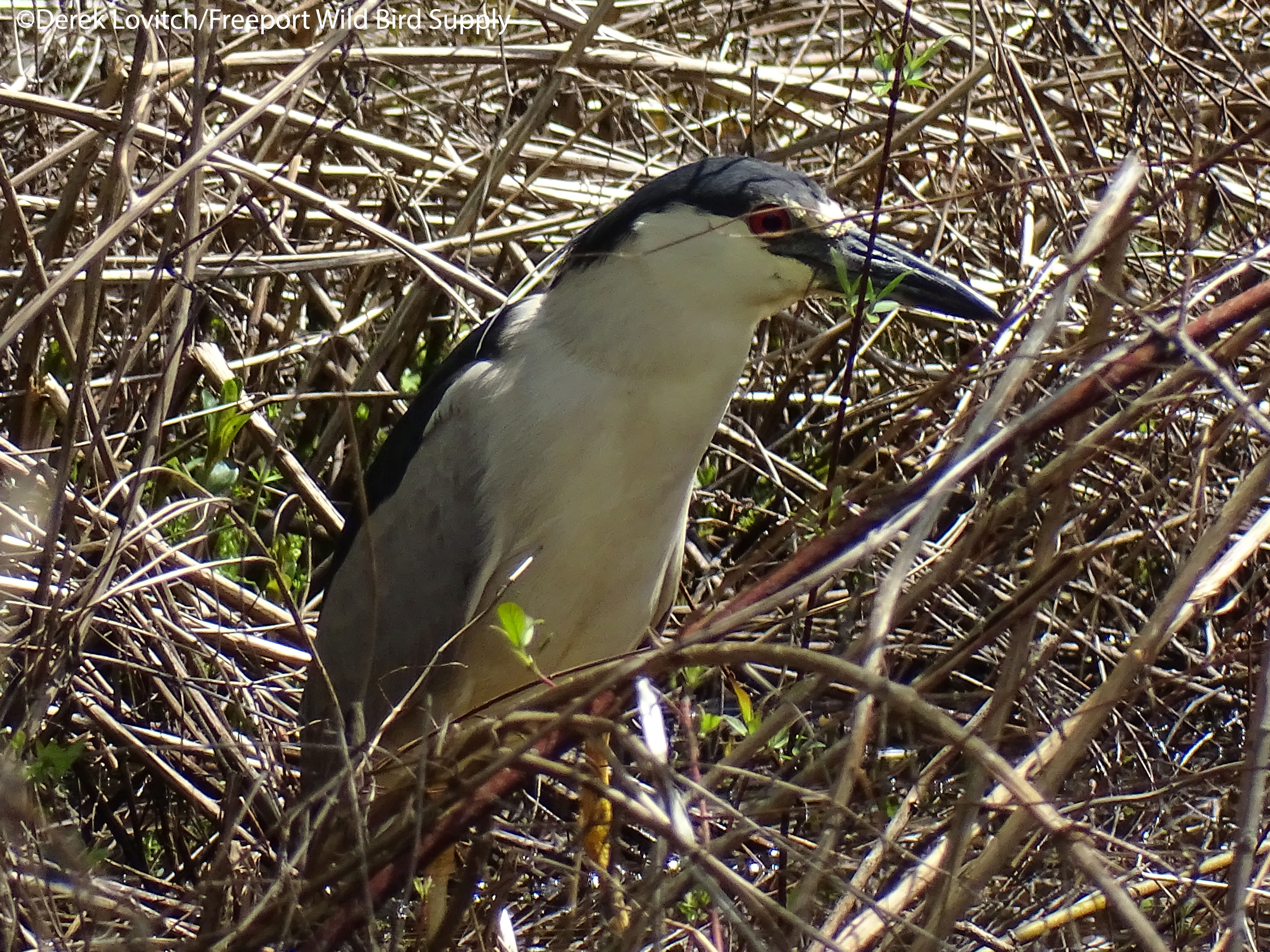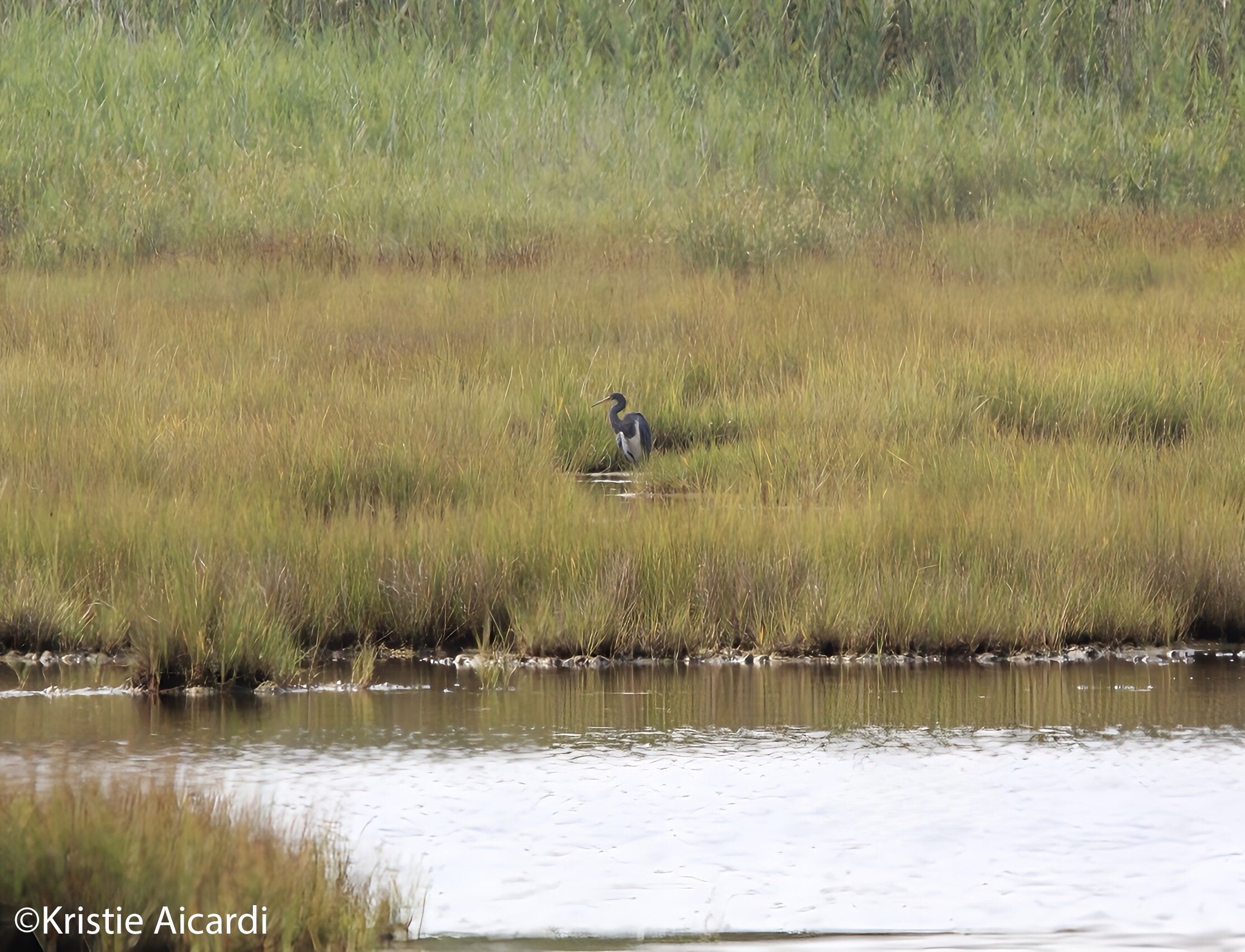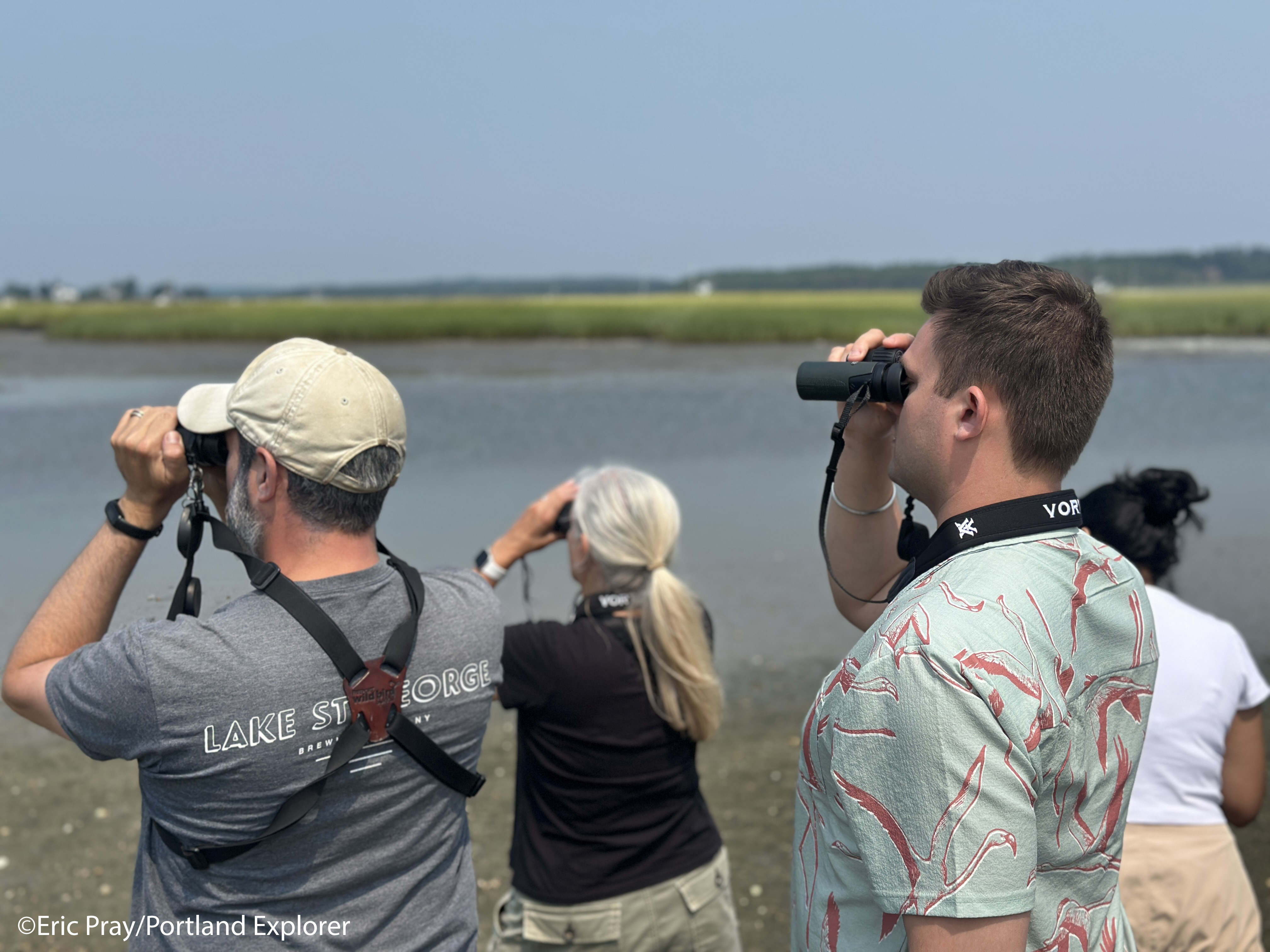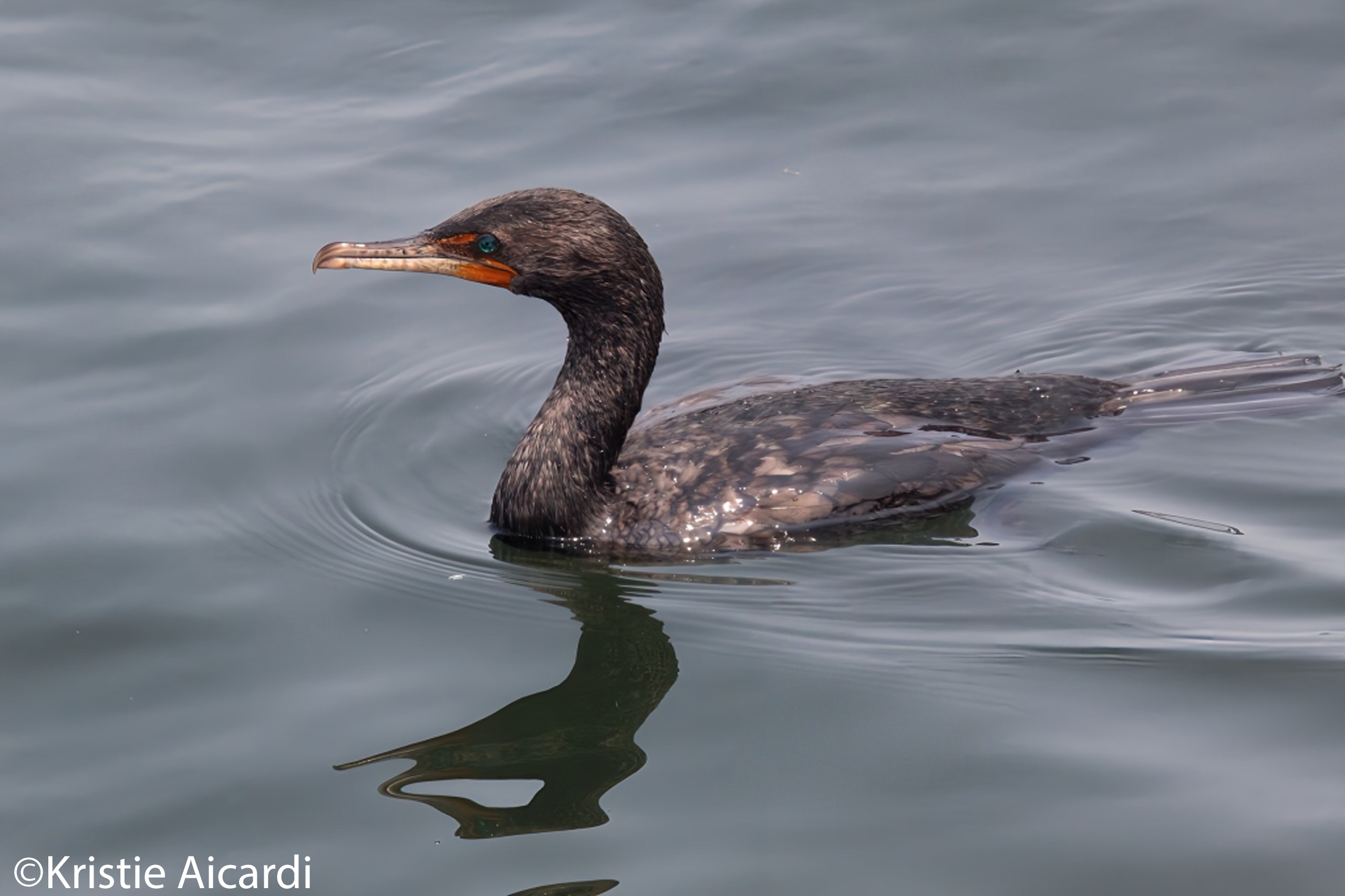
Considering most people would have been happy with a single Northern Fulmar, our tally of at least 18 was fantastic…but the photo opportunities of this winter visitor could not be beat, including of this much less common dark morph.
Fall pelagics in the Gulf of Maine are notoriously hit or miss. Suffice to say, our Half-Day Pelagic out of Boothbay Harbor on 10/5, with our partner, Cap’n Fish’s Cruises, was most definitely a hit!
And not just because of the ridiculously pleasant weather! The birding was great, the marine mammals were fantastic, and I don’t think a single person was seasick! What a difference a year makes.
We departed the harbor at 9:00am, with clear and calm skies, less than a foot of swell offshore, and high hopes (I had a productive scouting trip on a whale watch two days prior). But even with the always-lofty expectations of pelagic trips, we would not be disappointed this day.
Black Guillemots are always a nice way to begin and end all of our local pelagic trips since they are usually only seen in inshore waters.
Perhaps the one complaint I had was that we didn’t get all that far offshore! In fact, our furthest point was only about 20 miles south-southwest of Monhegan. There was just too much to look at, and every time we were about to head further offshore, something else of note appeared.
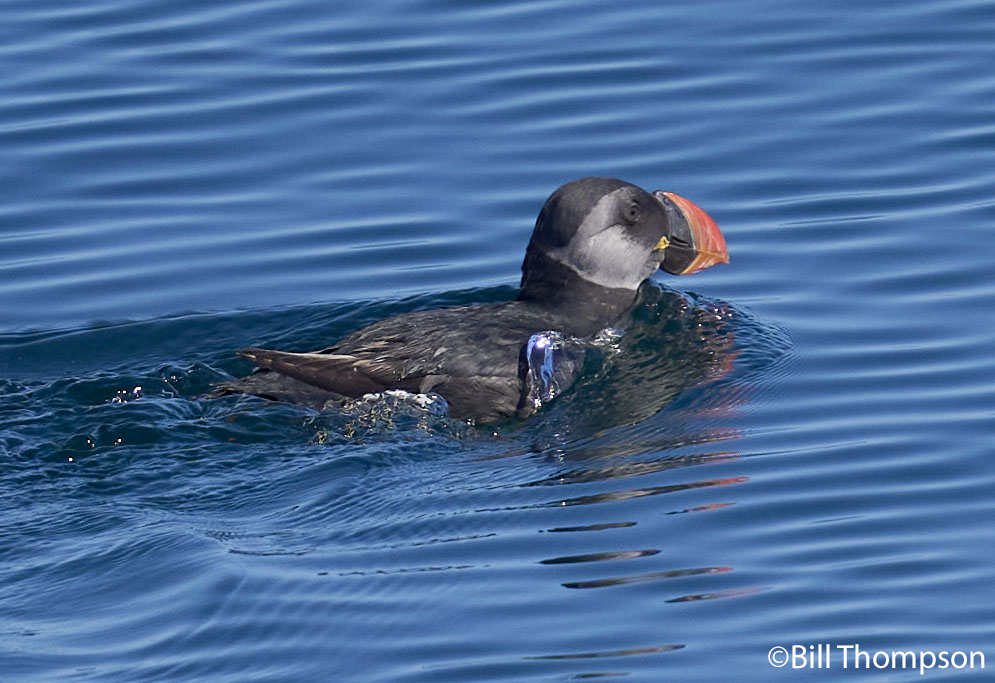
We started picking up a few seabirds, including our first of what would be a remarkable total of mostly juvenile Atlantic Puffins, the first of our sought-after Northern Fulmars, scattered Red-necked Phalaropes (mostly), along with a few Great Shearwaters, all around Murray Hole, but we hit paydirt right around the edge of the incoming shipping channel to Portland.
Great Shearwaters and Northern Fulmars were constant companions in our deeper water time.All of the photographed phalaropes so far that we encountered were Red-necked Phalaropes, so the checklist has been adjusted accordingly, even though we believe we had some Reds over the course of the trip.
There, in about 500-600 feet of water (but otherwise “in the middle of nowhere”), our chum slick of fish oil and pork fat (generously donated by Durham’s Old Crow Ranch!) worked its magic. Will Broussard, with both the honor and burden of his first time as Chummer, was the hero, bringing Northern Fulmars and Great Shearwaters in for close looks.]
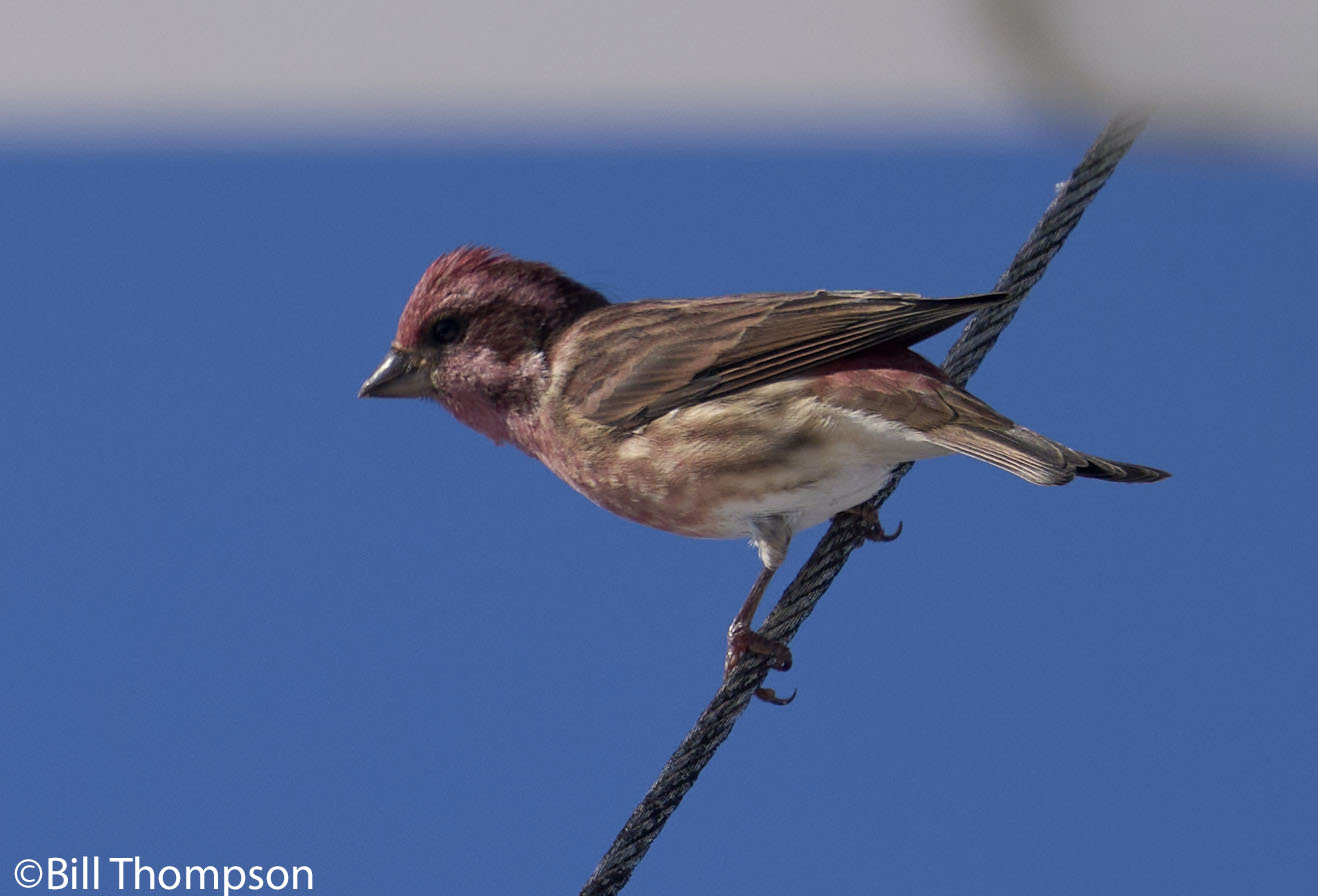
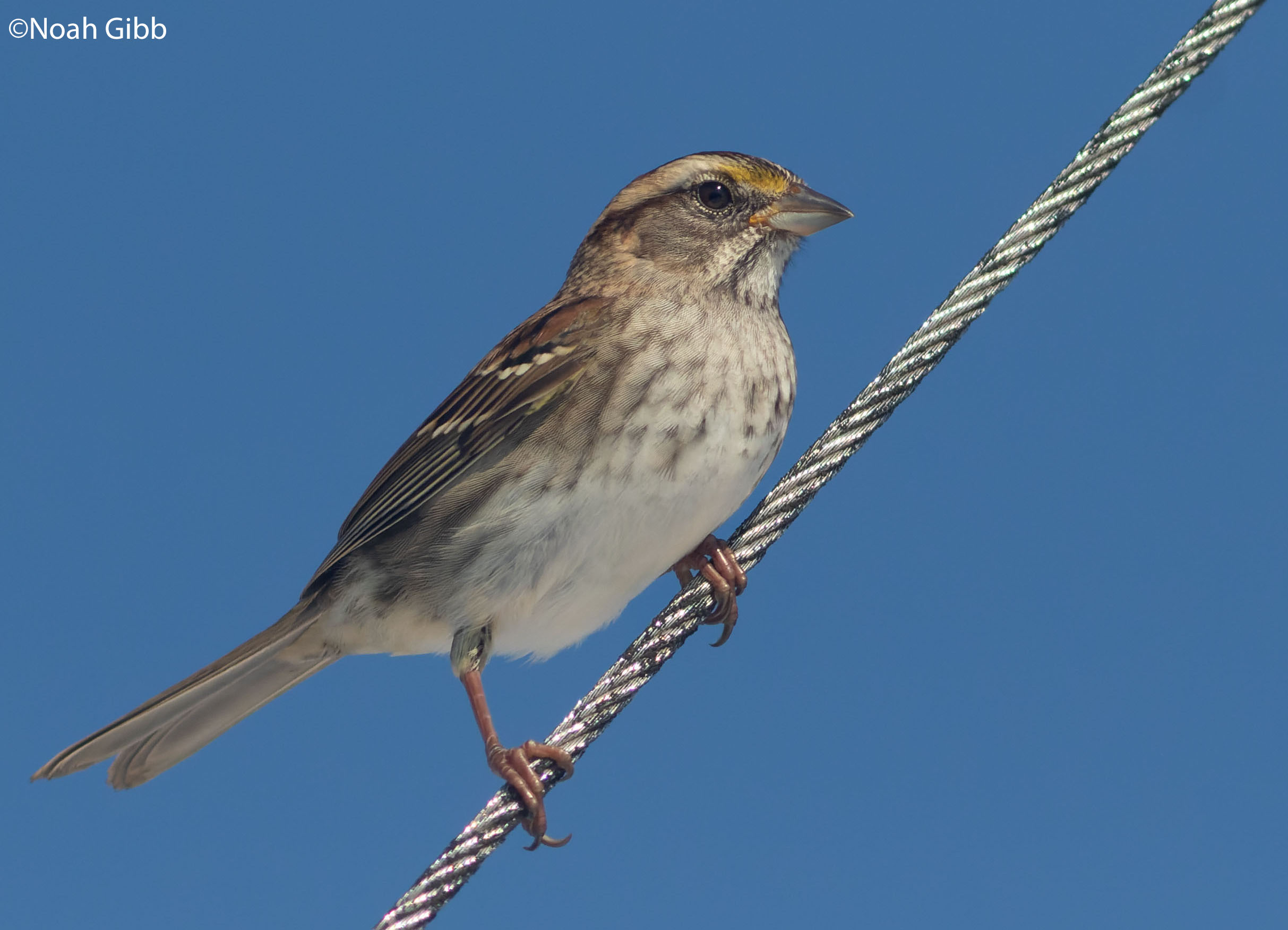
Passerines would appear on occasion, a total of somewhere between 4 and 8 White-throated Sparrows, including one that rode right back to port with us in the cabin. A male Purple Finch took a break on the boat, resting and preening on our radar, as a female did later. Passerines are always a fun addition to a pelagic birding experience.
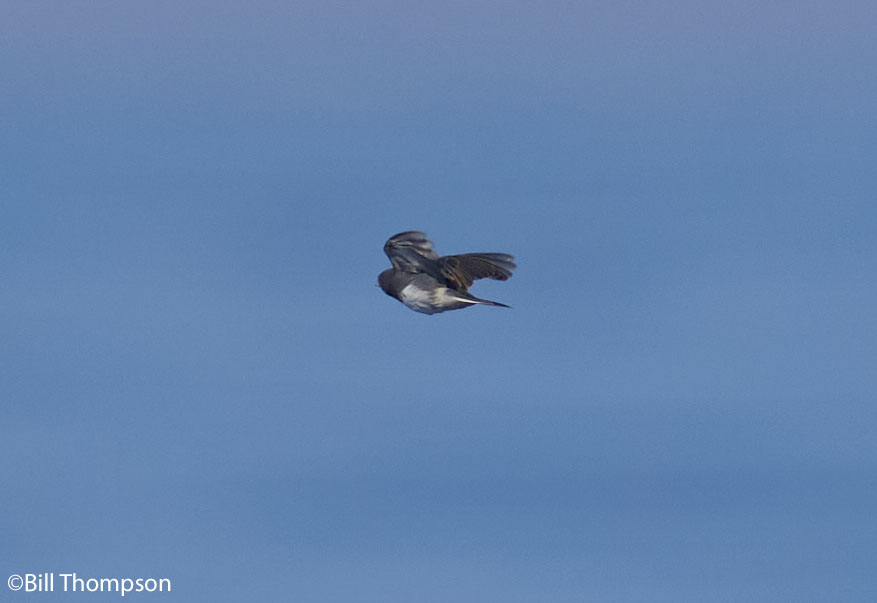
Less fun, perhaps, but most amazing and insightful, however, was watching a Peregrine Falcon chasing a passerine, driving it into the water, and then, unable to snatch it off the surface, moved on, leaving an Ovenbird helpless on the ocean’s surface, likely becoming waterlogged and hypothermic. It was impossible for us not to, so we attempted a water rescue, with the crew putting in a valiant effort to save the hapless warbler. Unfortunately, it perished, but we had to try!
This might be one of the most incredible photos of non-pelagics ever taken on a pelagic. Awesome work, Bill!
Repeated sightings of Atlantic Puffins continued to surprise us, and we spent some time with two different Fin Whales, including getting to see one doing a little lunge-feeding. While we looked at whales, birds were all around us, thanks to the chum, so we had something for everyone.
A big and bright-billed adult Atlantic Puffin.Both of our Razorbills were hanging out with juvenile puffins.
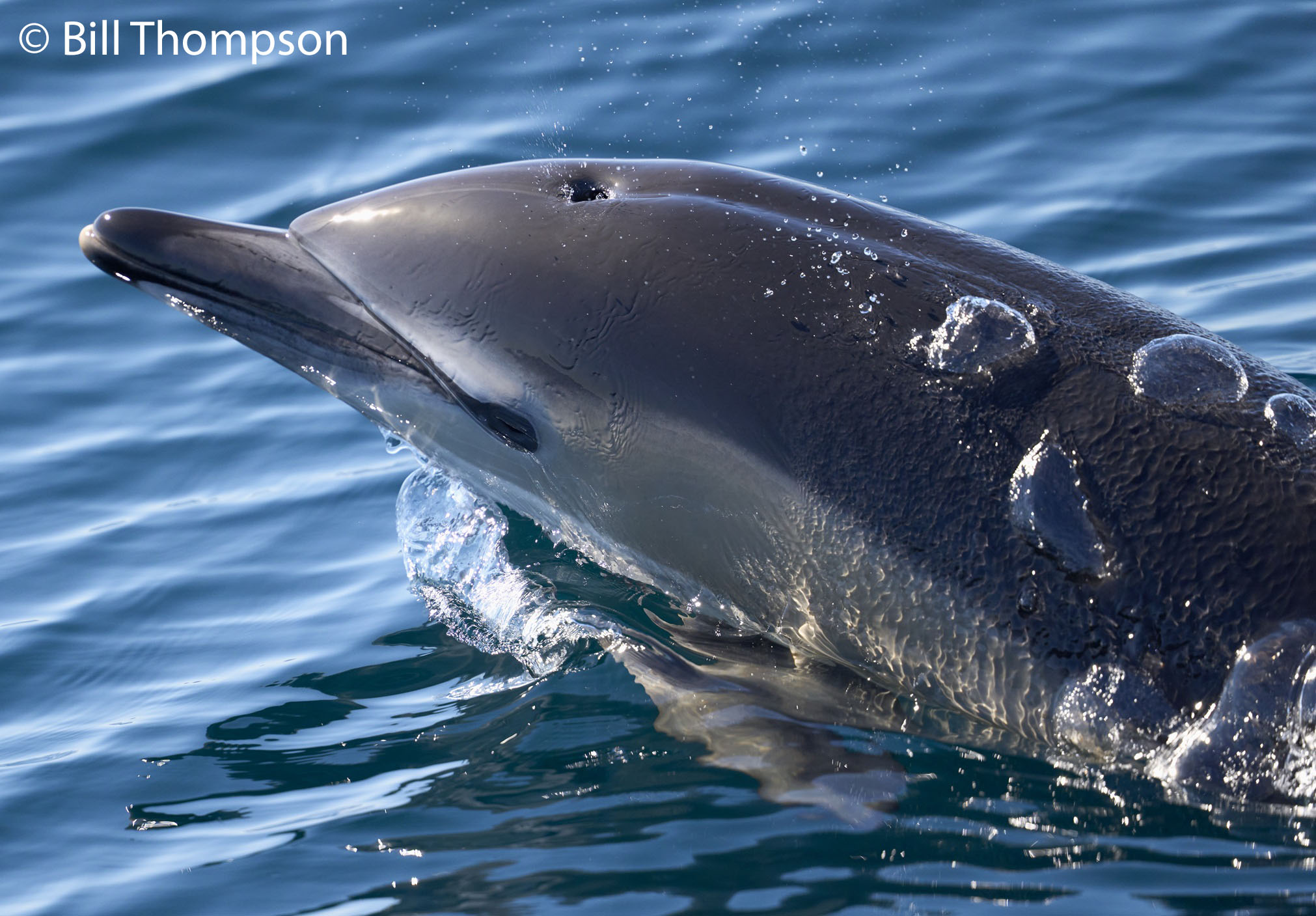
While this was of course a birding tour, we made sure to enjoy the marine mammals we encountered, along with a Blue Shark, but the highlight for most everyone was the incredible and awesome experience we had with a small pod of 25-30 Common Dolphins. Amid all of our seabird activity, the pod approached us in the glass-calm warblers. Captain Nate added a little speed to build up a wake, and the dolphins had come to play. They rode the bow, did some surfing, and otherwise created constant “oohs and aahs.” The photos don’t quite do it justice…it was really a special experience, a life mammal for most of the crew, and one of the best dolphin encounters I have experienced in the Gulf of Maine.
Puffins and fulmars, Fin Whales and dolphins, and all on just the most ridiculous weather possible for a fall pelagic in Maine! We’ll see you on board next year!
I want to thank Captain Nate for his skilled maneuvering of the boat – even more remarkable as this was his first pelagic, too! Naturalist Trinity shared the narration duties with me, taking over for local landmarks and non-feathered marine life, and Valentin and Joe took care of everyone at the galley – and did the work of our attempted Ovenbird rescue. Thanks to my team, chummer Will Broussard, and our checklist-keeper Noah Gibb. And a special thanks to Tabor and Seamus at Cap’n Fish’s for working with me to make this memorable trip a reality.
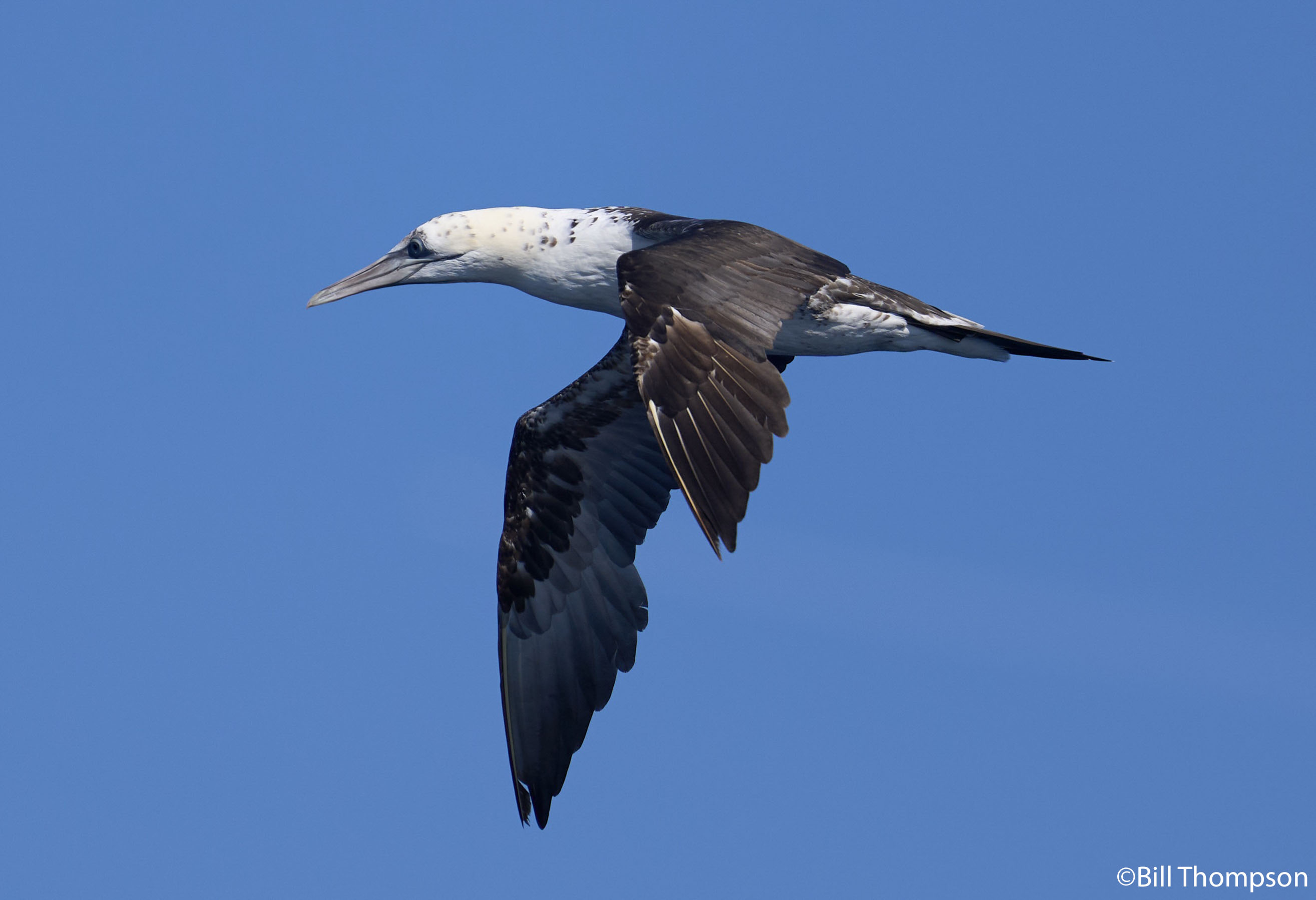
Subadult Northern Gannet
Here’s the complete trip list, including birds seen while docked before departure marled with an *. We know counts of several species, such as Common Eider and Herring Gull are likely extremely low, but we chose to be conservative with our Northern Fulmar and Great Shearwater tallies as we covered a relatively small area during our deeper-water time, and the chumming kept birds with us, and perhaps, coming back for more.
267 Common Eider
89 Surf Scoter
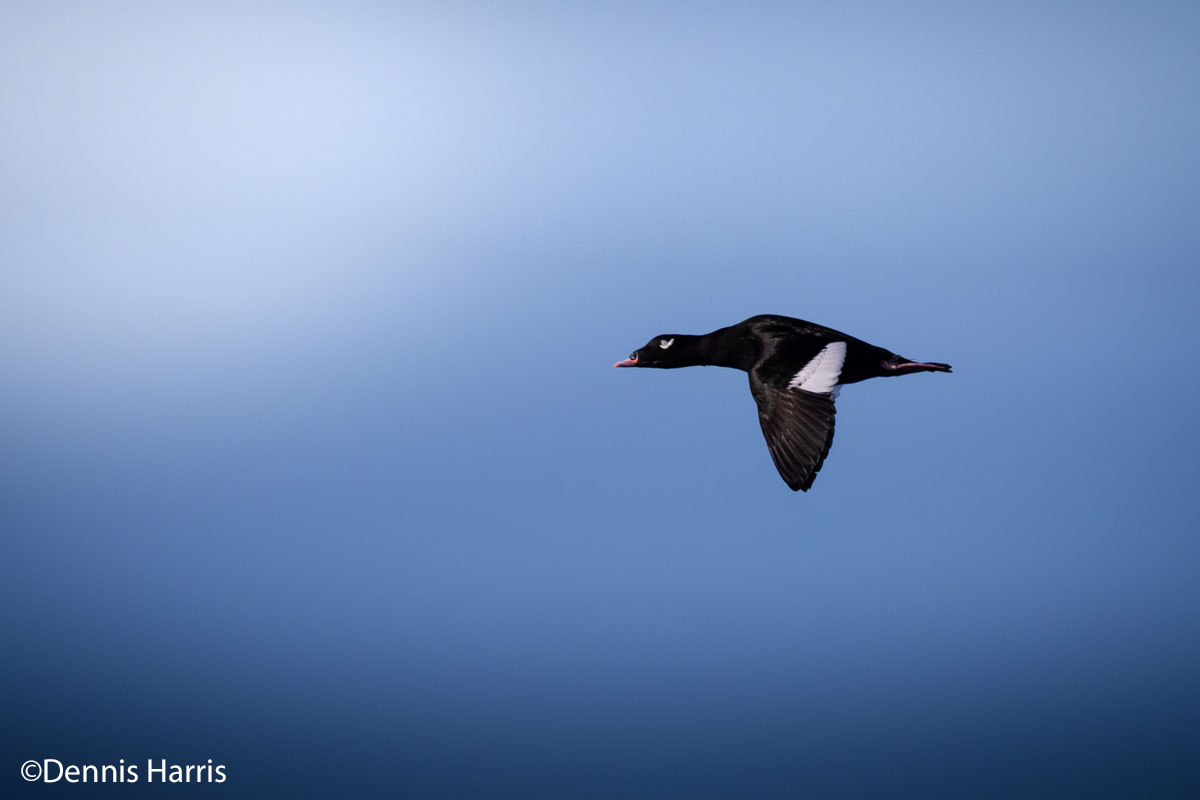
3 White-winged Scoter
36 Black Scoter
25 Rock Pigeon*
54 Red-necked Phalaropes
21 unidentified phalaropes
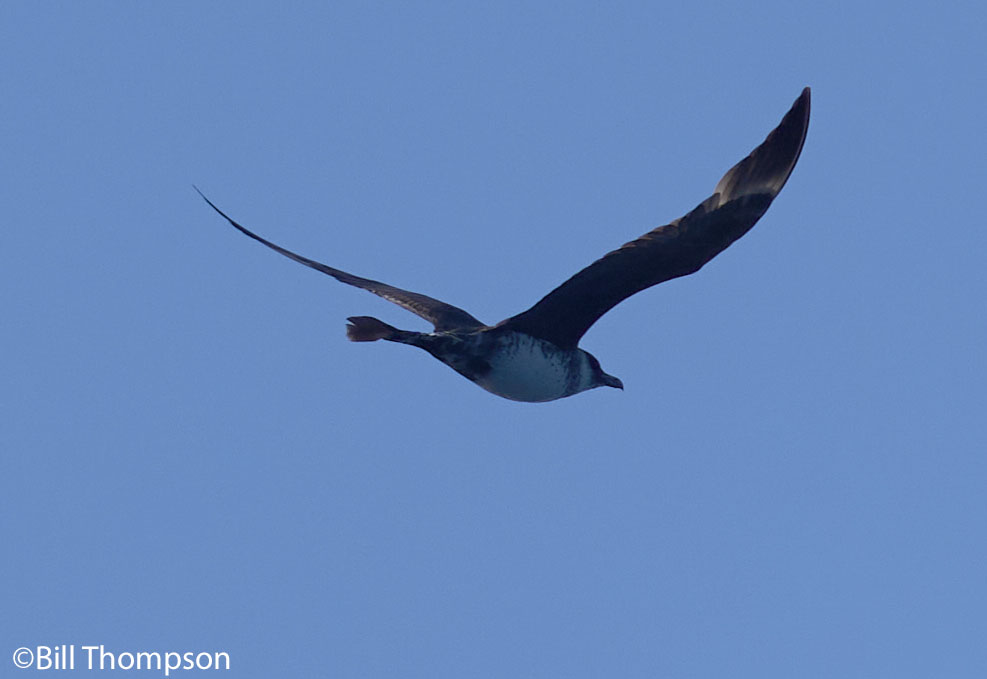
1 Pomarine Jaeger
28 ATLANTIC PUFFINS
15 Black Guillemots
2 Razorbills
1 Black-legged Kittiwake (only spotted from photos later, unfortunately)
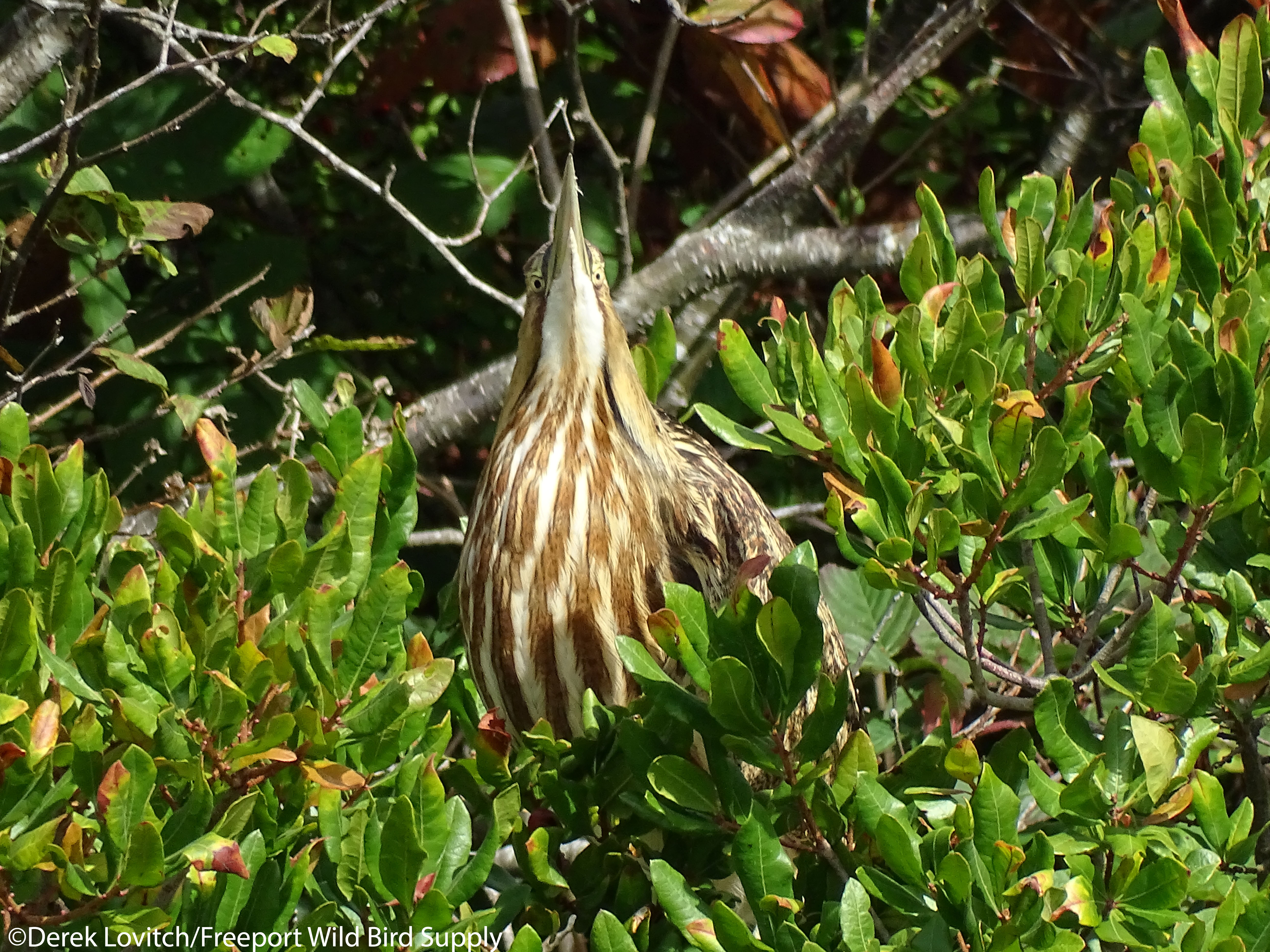
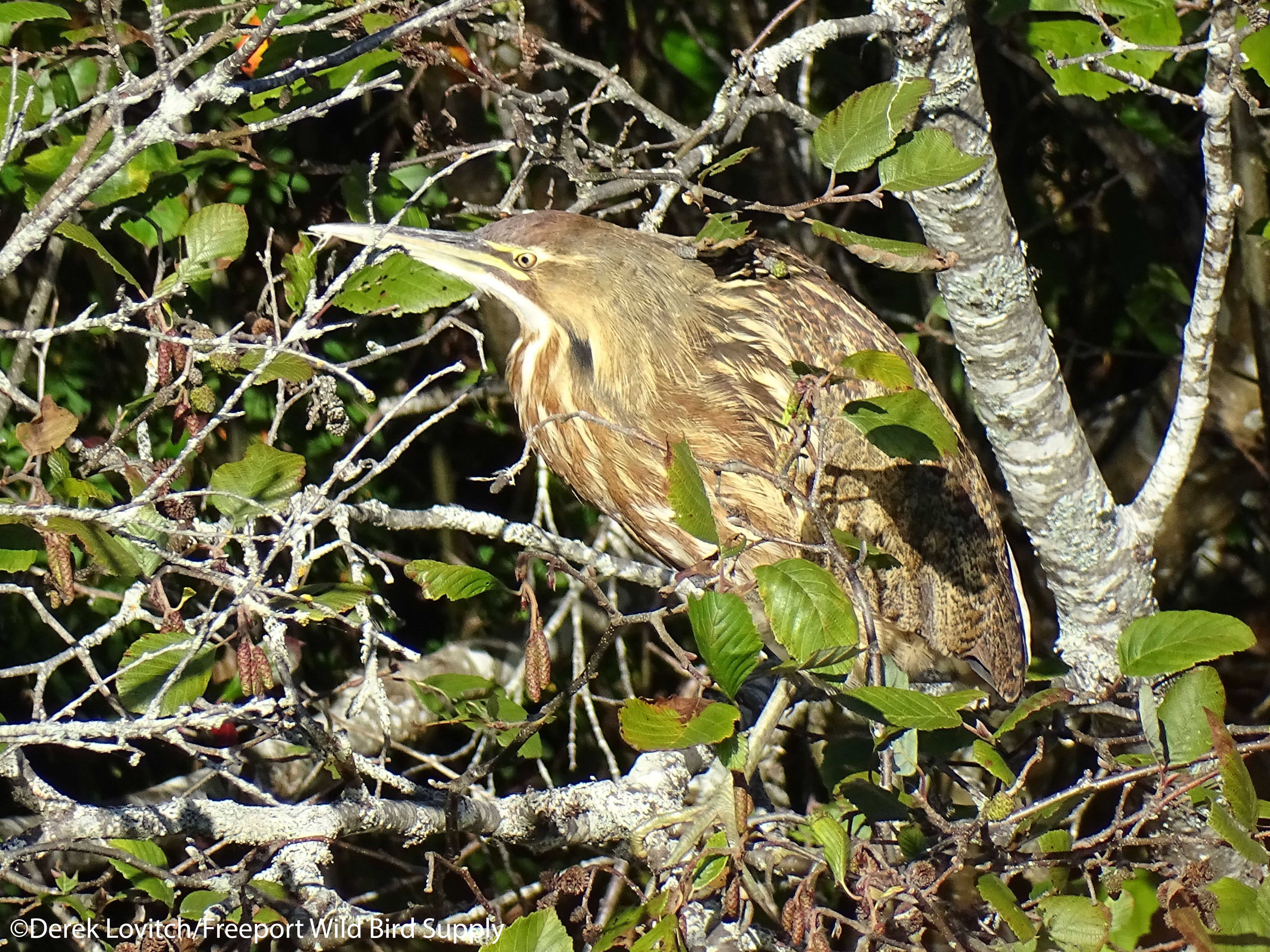
An American Bittern sitting in the open in a tree, just a handful of yards away could have easily been the highlight of any birding weekend. But, this stellar start was just the tip of the iceberg of the weekend’s birding excitement.
It has been quite a few years since we had a weekend like this. Lots of birds, “mega” rarities, warm weather, and tons of excitement. It was truly a special weekend. We were honored to have been there for it.
The tour began on Friday, with only one participant joining me on the Hardy Boat. The island greeted us with a Lesser Black-backed Gull, which we scoped from the wharf, and several warblers at the usual spot uphill. But after getting the inside scoop from birders already on the island, we made a bee-line for the Ice Pond where an American Bittern was sitting all morning. Remarkably, however, it was sitting in a bush (see above)!
How’s that for starting a tour off right? We also immediately encountered Dickcissel and Blue-gray Gnatcatcher, and there were plenty of Yellow-rumped Warblers and Palm Warblers here and there.
After lunch, with our group now complete, the surprisingly good birding continued. Despite such a warm afternoon and few birds on the radar overnight on mostly a southwest wind aloft, we enjoyed an excellent introduction to Monhegan birding in the fall: 2 Clay-colored Sparrows with 2 immature White-crowned Sparrows, a Dickcissel, and several White-throated Sparrows in one field of view; a dozing Common Nighthawk trying to stay camouflaged on a wood pile, and another visit to the still-confiding American Bittern at the Ice Pond for those who arrived later. It was a solid afternoon overall, with bird activity continuing right up until dinnertime.
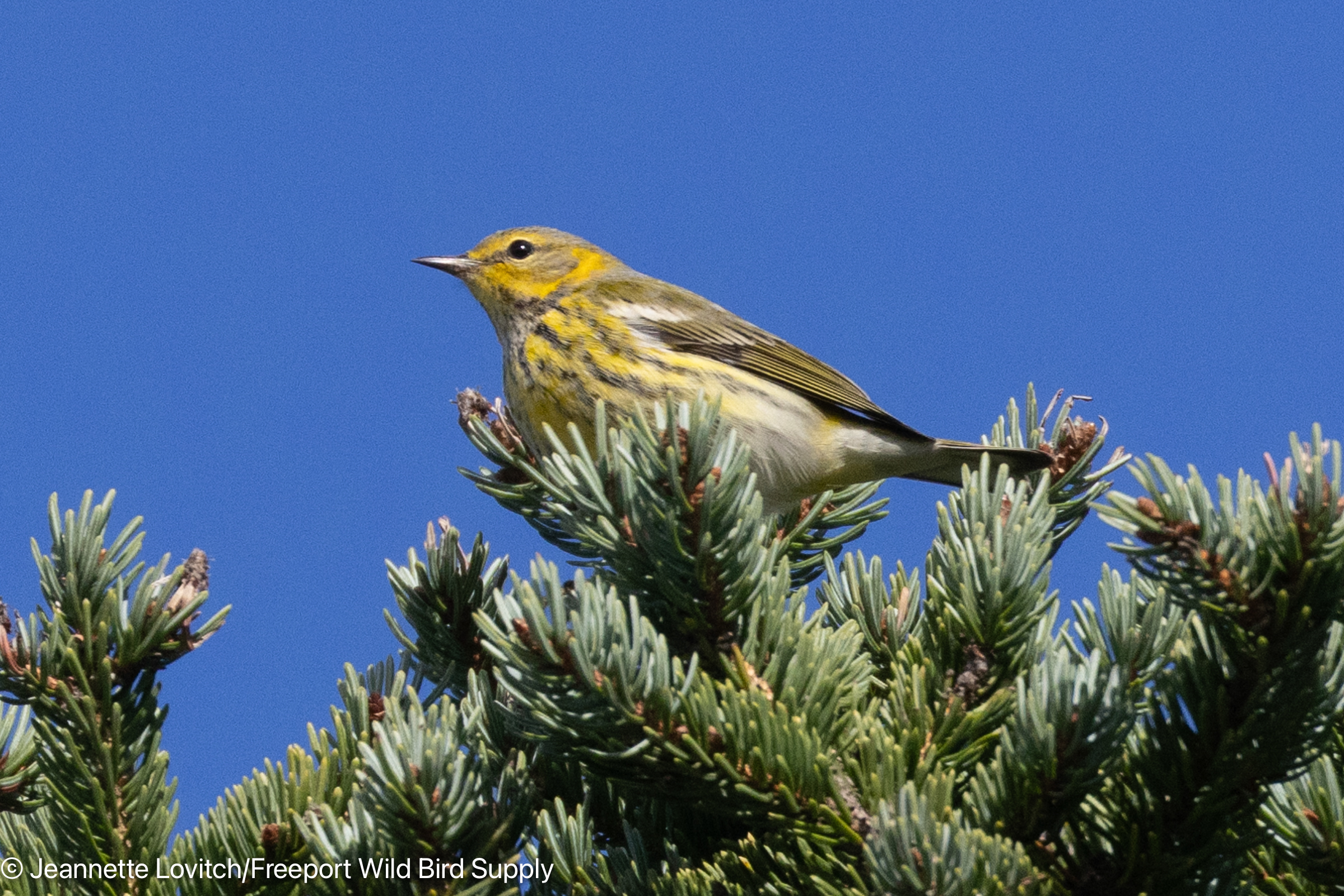
Cape May Warblers in a wide variety of plumages is always one of the highlights of any fall weekend on Monhegan
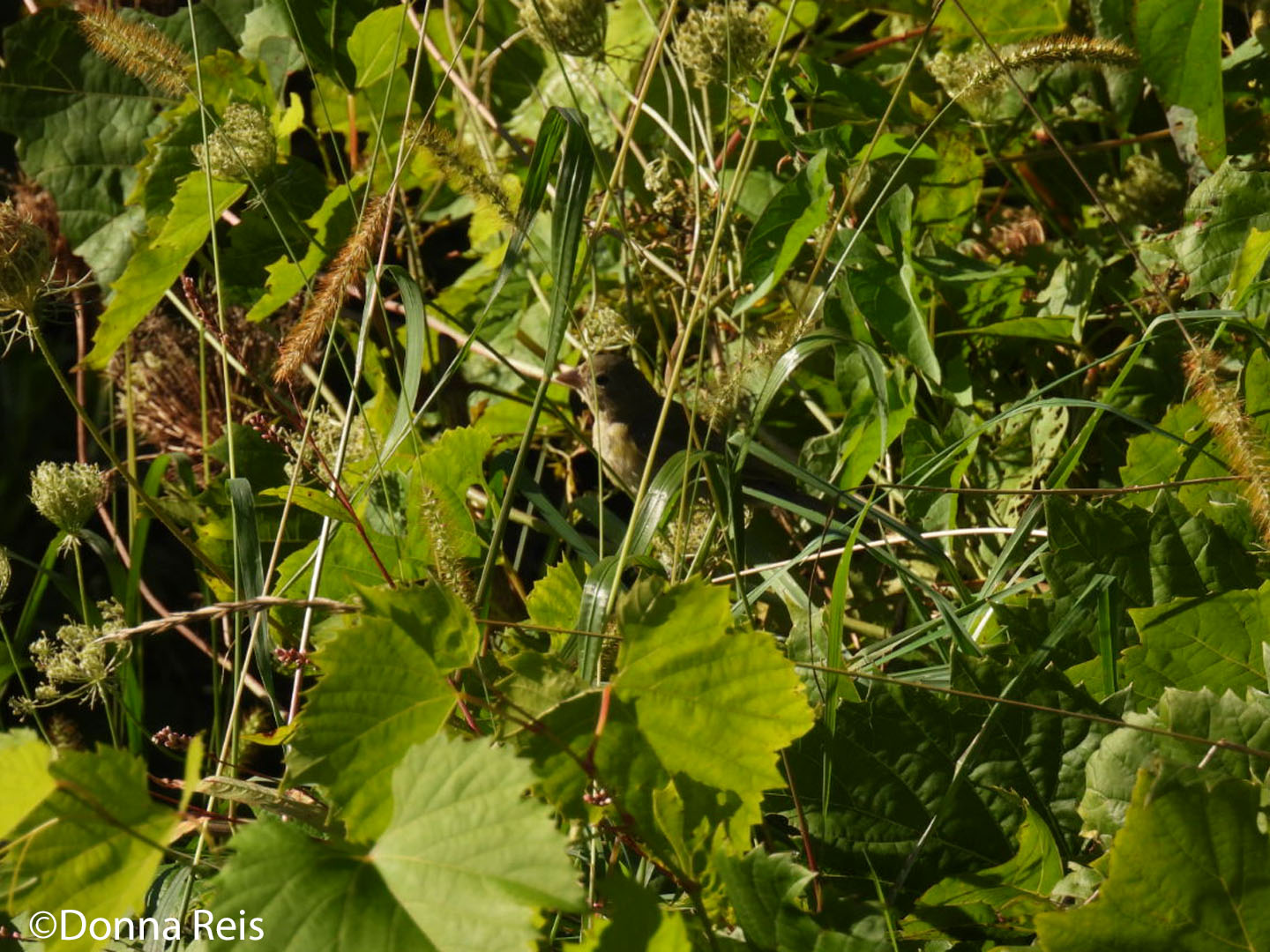
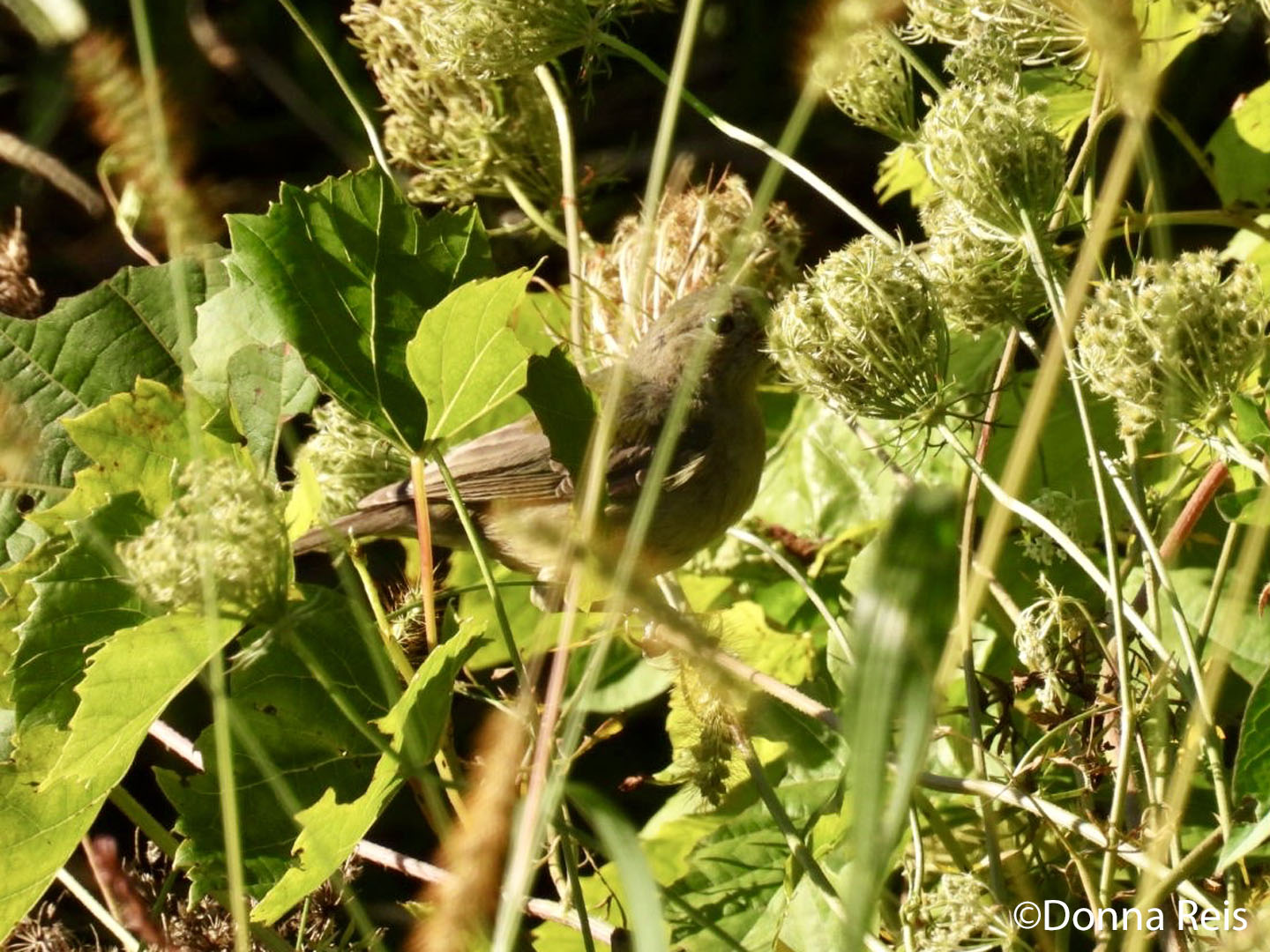
.Unfortunately, our best bird of the day was almost the one that got away. Almost! While viewing an Indigo Bunting in the Community Garden, a second bunting snuck into view, skulking. It briefly popped out, and I yelled “get photos” and then it popped back into the weeds and was not to be seen again.
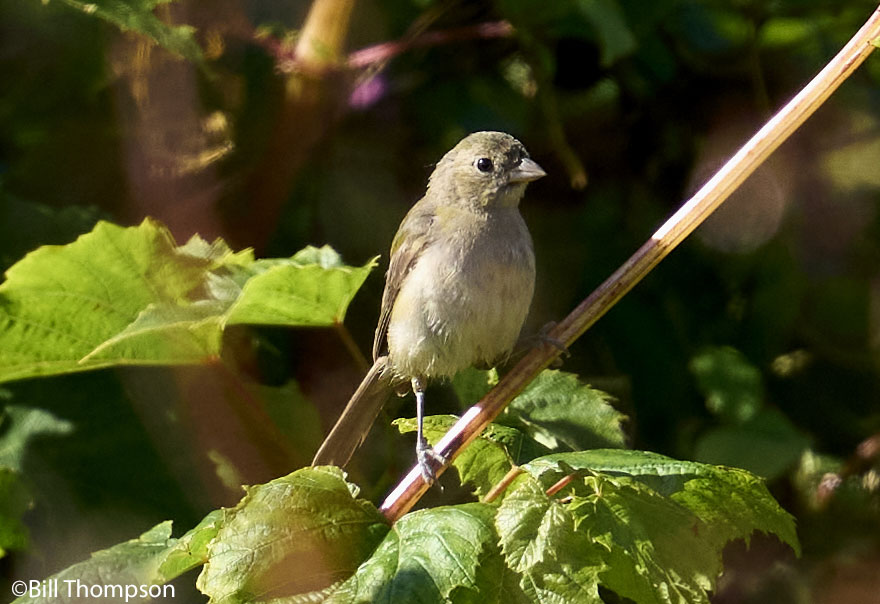
“Did I see green?” I exclaimed, but it was so fleeting, and the light was so harsh, and the bird was so, so pale, I couldn’t be sure. I looked at photos on the back of cameras in the sun, and we had a good discussion on why this could have been a Painted Bunting. Unfortunately, I have little experience with first fall female (presumably) Painted Buntings and had no idea they could be this unbelievably drab. So I talked myself out of it.
Overnight, I received photos from Bill Thompson, who, an hour or two after we saw the bunting, also briefly saw and photographed it. “Is this a Painted Bunting?” he asked.
Yup, that really does have green on it, and on more than one side – in other words, not a reflection. Darn it. It counts for us – we all saw it – but in hindsight, we should have gotten the word out about a “possible/probable” Painted Bunting and had more eyes looking. Luckily, Bill was in the right place at the right time once again! But I felt like I had blown this one. I was too quick to dismiss it and so I decided I would have to make up for it over the rest of the weekend. Maybe the dry cold front that passed through on Friday evening and shifted the winds would help.
A very strong flight Friday night into Saturday morning on a diminishing northwesterly wind was idea for bringing birds to Monhegan Island come sunrise. And at first light, it was clear it was on!
The Morning Flight featured tons of Yellow-rumped Warblers with the occasional Palm and Blackpoll Warbler. Between the morning flight and our pre-breakfast stroll, we had a lot of birds: a couple of waves of Dark-eyed Juncos, bunches of Red-breasted Nuthatches, more Golden-crowned Kinglets and Purple Finches, insane views of Peregrine Falcons, 2 Dickcissels, 4 Baltimore Orioles, and lots of great views of lots of common species.
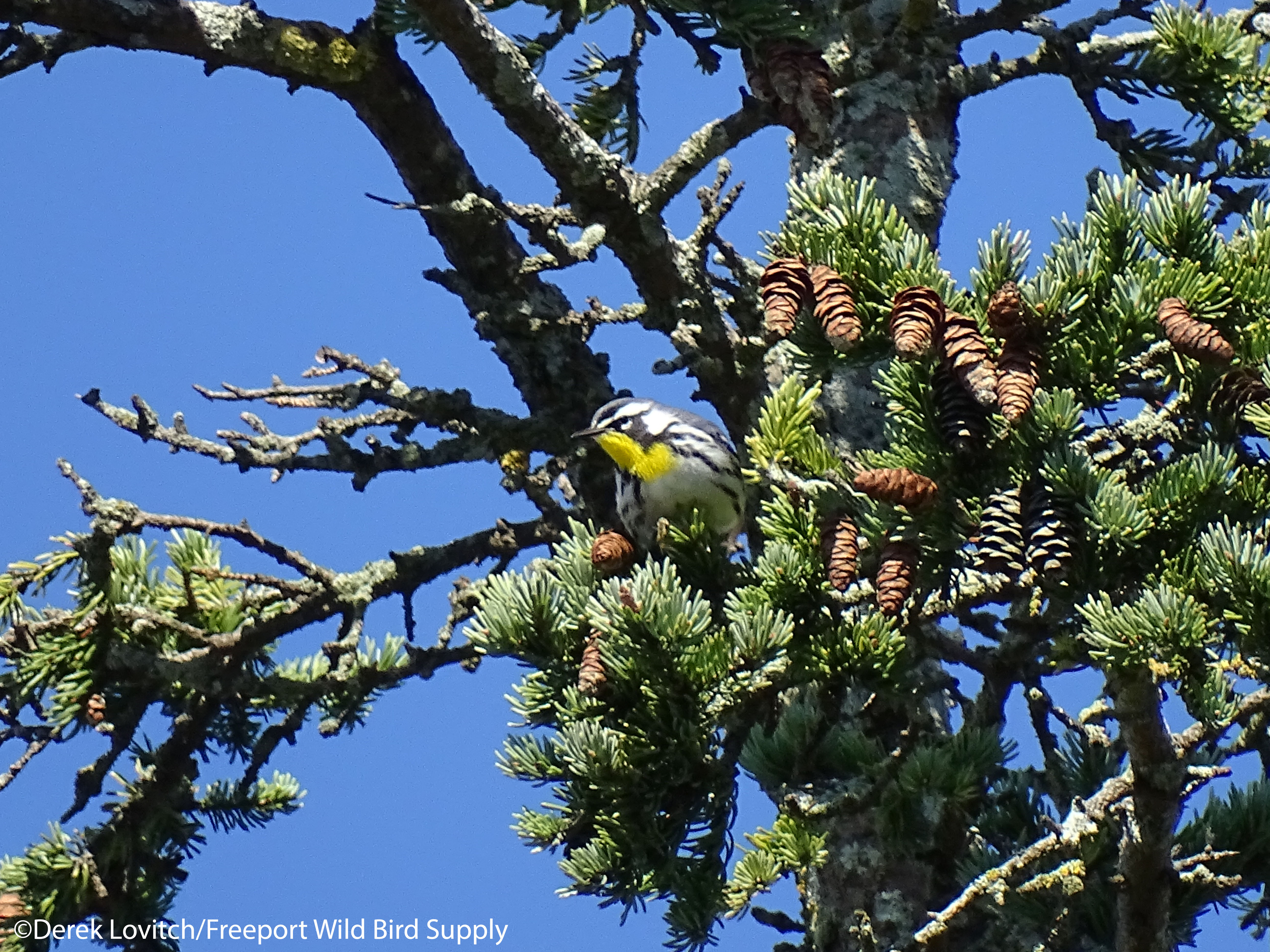
After breakfast, it remained fantastic. Just birds everywhere, and not surprisingly, some notable species began to be turned up. Our first “chase” was a Yellow-throated Warbler, our group arriving just in time before it took off.
Luckily, Dan Gardoqui and I stumbled upon it again while foraging for lunch, and I was able to round up several of the group members for improved views and photographs.
The American Bittern was now in the marsh, there were now three Dickcissels, 8 Baltimore Orioles, and a second, but definitively identified Indigo Bunting. No green one, unfortunately.
Not surprisingly on such a nice day, the afternoon was slower, as birds had departed the island early, or had now sought refuge in the shadows, especially with the continuing activity of Peregrines, Merlins, and Sharp-shinned Hawks. So, we checked some nooks and crannies, turning up a Nelson’s Sparrow at Lobster Cove and enjoying gliding Peregrine Falcons passing right in front of us from Burnt Head. We also took the time to enjoy butterflies, plants, and all other walks of life.
It was a delightful afternoon, but we returned to town to find we had missed out on a Western Kingbird. Luckily, a few of us caught up with it at dusk when it was refound near the Mooring Chain.
(phone-binned photo under low light)
So, it was a great day, and given the winds and weather, we expected it to be such. Then, with little to no movement overnight (at least visible on the radar), on a light south to southwest wind, we hoped for some birds to stick around from Saturday and perhaps be augmented by a rarity or two. At the very least, I wanted to show the Yellow-throated Warbler and Western Kingbird to the rest of the group, especially with a big turnover in participants for the second half of the weekend.
What we didn’t expect was to run out of superlatives before breakfast. We certainly did not expect it after viewing the Morning Flight, which consisted of exactly one American Pipit (and the big wandering flock of Cedar Waxwings, of course).
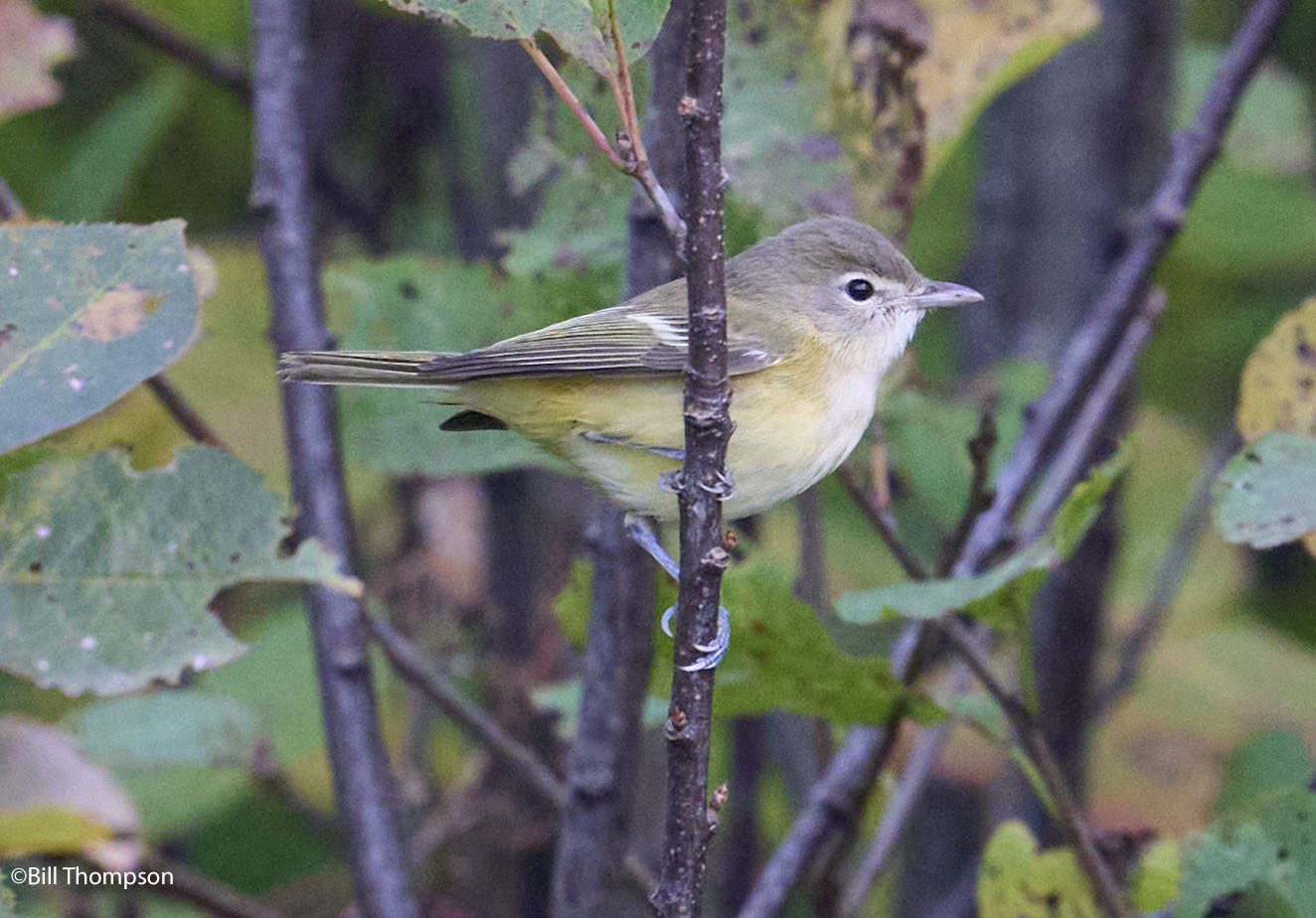
Once again, a bird was identified from photo review (what did we do before Instant Replay?!) and Bill Thompson and Jess Bishop had apparently discovered a Mega rare Bell’s Vireo on Saturday with only 4 accepted previous records for Maine. With such a slow morning flight, I decided to mix things up from my usual routine, head clockwise through my usual dawn loop, and give it a try to find the Bell’s. We stopped near where it was seen on Saturday, and chatted about the rarity, the identification, etc. “Holy shit, there it is!” I tried not to exclaim too loudly as the bird popped out right in front of us.
We observed it for about 10-15 minutes as it popped in and out of a brushy edge, focusing on feeding in young cherry trees with fall webworm clusters. Birders began to arrive from all directions, as the vireo kept coming in and out of view before flying right over our heads and disappearing deep into a dense thicket.
I’ll steal Bill Thompson‘s (with permission of course) Bell’s Vireo from this morning since he was standing next to us.
It was getting too crowded for our tastes, so we moved on and let others have the edge to monitor. We enjoyed Cedar Waxwings, Northern Flickers, and then took a moment to pause at our usual starting spot, at the spruces behind the Yew.
It was slow, and quiet, and so I was making sure we looked at everything, like the one solo warbler flying towards us from across the sky over the Trailing Yew. It then landed a short distance away, and I brought my binoculars up to it, assuming we had a close Yellow-rumped Warbler to talk about.
<expletives deleted>
A Black-throated Gray Warbler, with only 5 previous records from Maine, was there. Right there. We had some great looks and photo ops, called over a friend, and then watched it the herd of birders arrive and head out to follow it. What a lucky find! We were ecstatic. And we still hadn’t had breakfast! (See photos from tomorrow),
Wondering if the day could get any better – and pretty content if it did not – we reconvened after breakfast and headed in the opposite direction from the searching masses, as I am wont to do.
It worked again: we found one Lark Sparrow, and then another. How many Clay-colored Sparrows – 4? 8? More? An Orange-crowned Warbler at the Ice Pond, a fly-over Red-bellied Woodpecker, a Pine Warbler, a Yellow-bellied Sapsucker on every tree. So much for it being a slow day.
Another warm afternoon sent us into the woods for shade, immersing ourselves in a cacophony of Red-breasted Nuthatches, sprinkled with Golden-crowned Kinglets, and the occasional Red-eyed Vireo or other migrant. We took in the Fringed Gentian, the scenery, and finished strong with the 2 Lark Sparrows and 4 Clay-colored Sparrows together.
Today was a good day.
Monday, the fourth and final day of the tour began with excited anticipation with another strong flight overnight on a diminishing NW to W wind. But today, it was just too nice, and a lot of last night’s birds passed overhead resulting in just a light Morning Flight come sunrise. But there was a turnover of birds, and our morning walk added several things to our list including the Eastern Kingbird we finally caught up with, and another Orange-crowned Warbler. The highlight, however, of our pre-breakfast jaunt was a juvenile Sharp-shinned Hawk that flew to a spruce, plucked a cone off of an outer branch, and then proceeded to play with it! It would move it from its bill to its talons, and then it dropped it, chasing it down the tree. It then flew back up and grabbed another! What a remarkable insight into how a kid Sharpie gets better at hunting on its own.
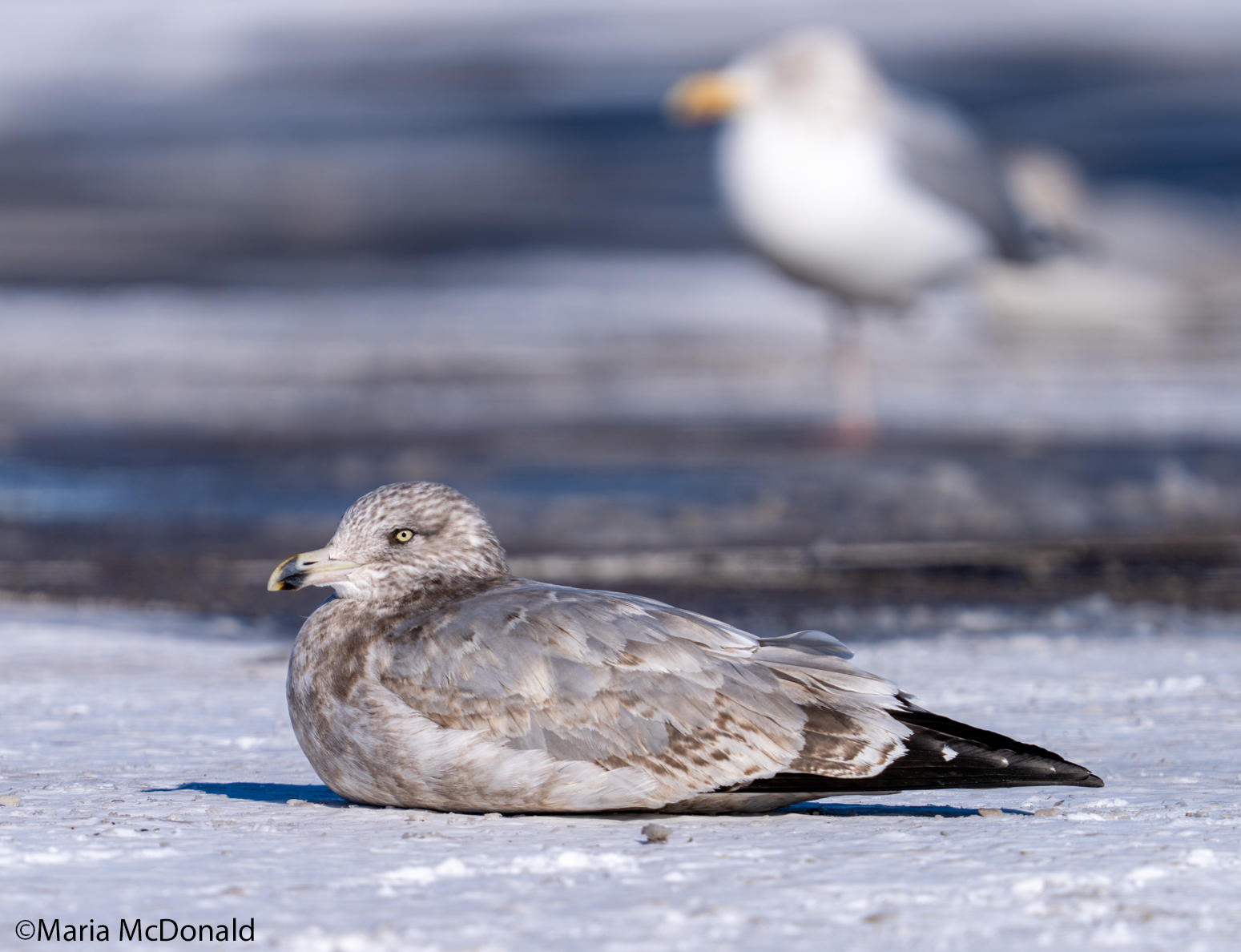
After breakfast, the good Merlin show of the day continued, and we took time for a short gull identification workshop. Our first Ring-billed Gull out here was good to practice on, and we conveniently had three Lesser Black-backed Gulls: an adult and 2 first-cycle birds. But mostly, we worked through the difference between each age class of the common Herring and Great Black-backed Gulls.
We finally picked up a Northern Waterthrush- our 20th species of warbler on the weekend! But otherwise, it was pretty slow.
It was slow in the afternoon, too, but the Black-throated Gray Warbler had been refound just before we reconvened after lunch, and eventually we were all treated to much, much better views and photo ops than the morning before.
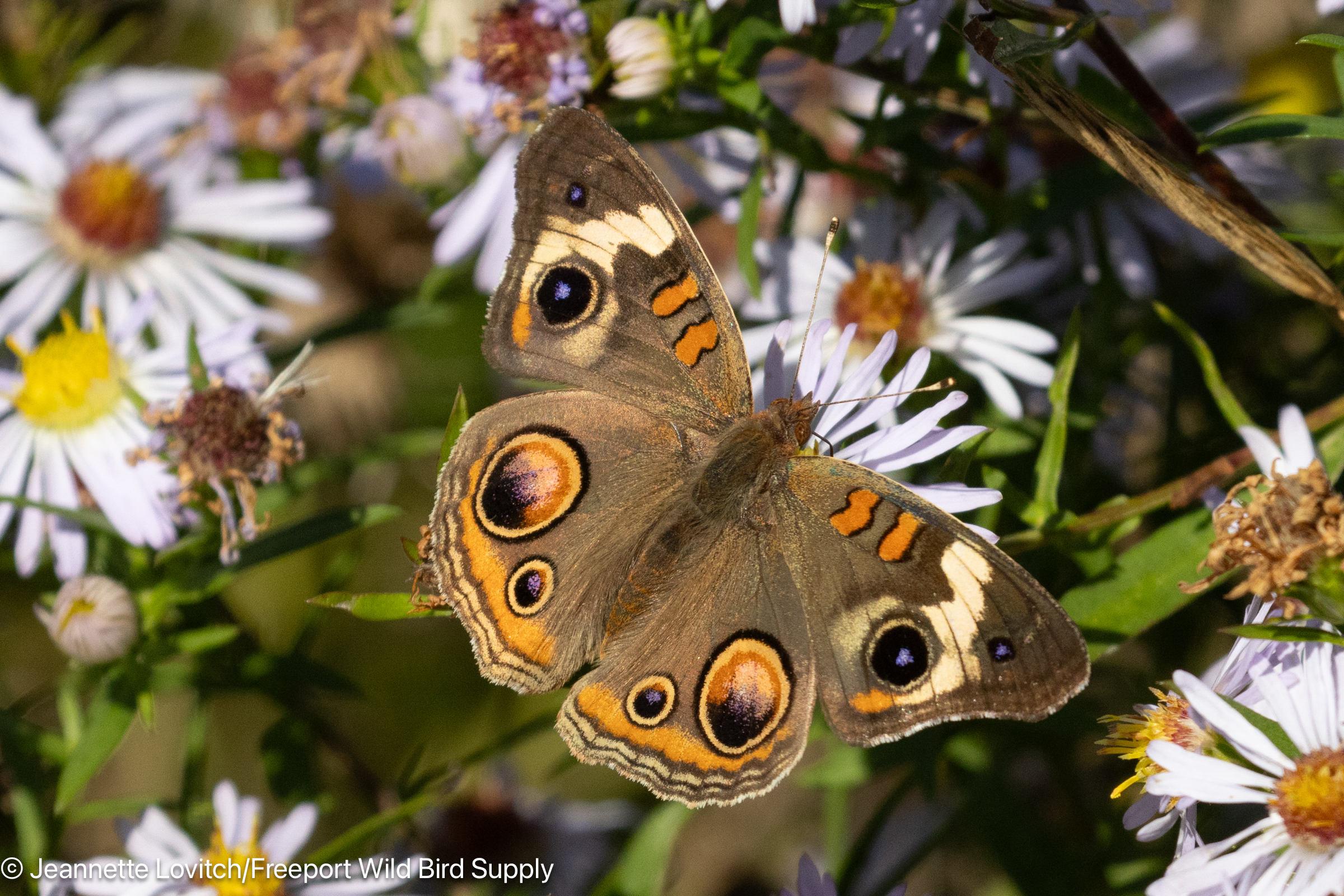
We then twitched a rare Common Buckeye butterfly and Lady’s Tresses orchids.
Our last new species of the trip was one of the last birds we observed together: a Yellow-billed Cuckoo eating American Dagger Moth and/or Hickory Tussock Moth caterpillars. Watching it whack the caterpillar on a twig to beat off its irritating hairs, we had another moment of insight into a bird’s world.
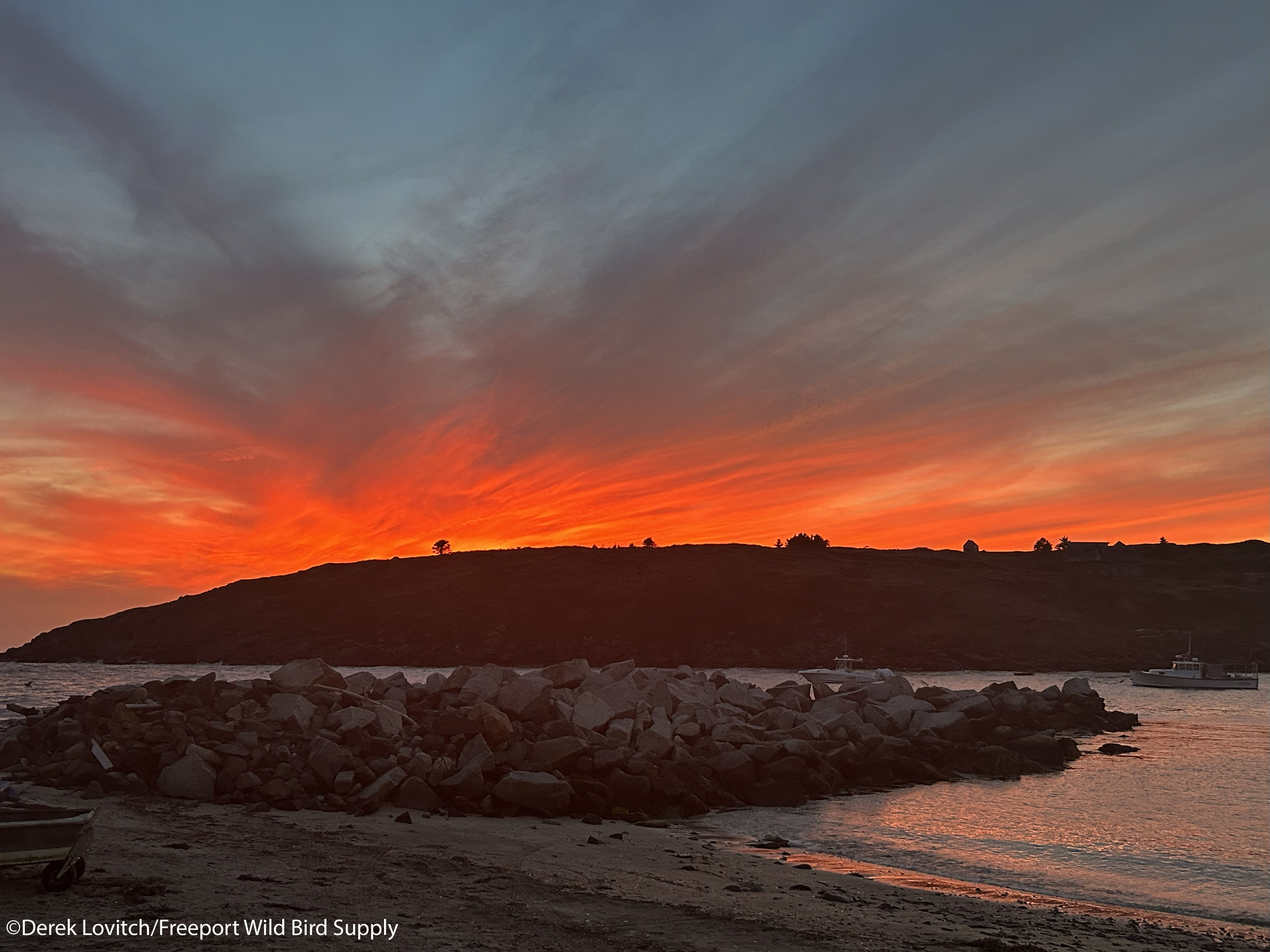
With the tour now complete, Jeannete and I enjoyed a delicious sunset and delightful food with friends and spotted an American Woodcock on our walk back.
And finished with another meal of Monhegan indulgence.
As usual, Jeannette and I then spent our Tuesday off together on the island. After a light morning flight, but another turnover of birds, we decided to spend most of the morning in the woods, ostensibly looking for a previously reported Black-backed Woodpecker. But mostly, we wanted to take a hike along the island’s less-visited north end. We added Winter Wren and an Ovenbird to our weekend list, enjoyed the silly amount of Red-breasted Nuthatches, and encountered several pockets of White-throated Sparrows and Dark-eyed Juncos. Later, after lunch, we ran into a Black-billed Cuckoo, and a Spotted Sandpiper at the dock turned out to be our 100th and final bird of a truly exceptional weekend on Monhegan. We already cannot wait to return in May!
Species seen without the tour group during the tour:
*Denotes ferry only
9/26
9/27
9/28
9/29
Canada Goose
0
0
14
0
Blue-winged Teal
1
0
0
0
Mallard
15
20
20
20
American Black Duck
1
1
1
0
Common Eider
x
x
x
x
White-winged Scoter
1*
0
0
0
Ring-necked Pheasant
x
x
x
x
Mourning Dove
12
15
12
6
YELLOW-BILLED CUCKOO
0
0
0
1
Common Nighthawk
1
0
0
0
Semipalmated Plover
0
1
1
0
Solitary Sandpiper
1
0
0
0
Greater Yellowlegs
0
1
0
1
Black Guillemot
x
2
3
0
Laughing Gull
4*
0
0
0
Ring-billed Gull
0
0
0
1
Herring Gull
x
x
x
x
LESSER BLACK-BACKED GULL
0
0
1
3
Great Black-backed Gull
x
x
x
x
Great Cormorant
1
1
2
1
Double-crested Cormorant
x
x
x
x
AMERICAN BITTERN
1
1
0
0
Osprey
1
3
1
0
Northern Harrier
0
1
0
2
Sharp-shinned Hawk
3
1
2
6
Belted Kingfisher
1
0
1
1
Red-bellied Woodpecker
0
0
1
0
Yellow-bellied Sapsucker
8
20
15
20
Downy Woodpecker
0
1
1
1
Northern Flicker
6
10
6
8
American Kestrel
0
0
1
0
Merlin
4
8
6
5
Peregrine Falcon
6
20
3
7
WESTERN KINGBIRD
0
1
0
0
Eastern Kingbird
0
0
0
1
Eastern Wood-Pewee
6
8
1
1
Least Flycatcher
3
2
0
0
Eastern Phoebe
1
3
2
1
BELL’S VIREO
0
0
1
0
Blue-headed Vireo
2
4
3
0
Red-eyed Vireo
12
12
12
12
Blue Jay
8
8
3
3
American Crow
4
2
6
6
Common Raven
0
2
2
1
Black-capped Chickadee
x
x
x
x
Ruby-crowned Kinglet
1
3
2
2
Golden-crowned Kinglet
0
20
10
6
Cedar Waxwing
80
80
80
80
Red-breasted Nuthatch
10
60
50
40
Brown Creeper
0
2
0
1
BLUE-GRAY GNATCATCHER
1
0
0
1
Carolina Wren
8
6
8
6
Gray Catbird
x
x
x
10
European Starling
14
14
14
13
Swainson’s Thrush
0
2
0
0
American Robin
0
4
1
0
American Pipit
1
6
2
2
Purple Finch
0
10
8
6
Pine Siskin
1
2
1
2
American Goldfinch
8
10
6
6
LARK SPARROW
0
0
2
1
Chipping Sparrow
2
2
10
2
CLAY-COLORED SPARROW
3
3
6
1
Dark-eyed Junco
0
30
2
12
White-crowned Sparrow
2
1
2
0
White-throated Sparrow
12
60
10
20
Nelson’s Sparrow
0
1
0
0
Savannah Sparrow
1
4
4
1
Song Sparrow
x
x
x
x
Lincoln’s Sparrow
1
6
5
1
Swamp Sparrow
2
3
2
1
Bobolink
5
5
5
2
Baltimore Oriole
2
8
7
6
Rusty Blackbird
0
2
0
0
Common Grackle
3
3
3
3
Northern Waterthrush
0
0
0
1
Black-and-white Warbler
1
3
0
0
ORANGE-CROWNED WARBLER
0
1
2
1
Nashville Warbler
1
1
0
0
Common Yellowthroat
4
8
8
6
American Redstart
3
4
1
1
Cape May Warbler
2
8
2
8
Northern Parula
3
6
1
0
Magnolia Warbler
0
1
0
0
Yellow Warbler
2
4
2
1
Chestnut-sided Warbler
0
1
0
0
Blackpoll Warbler
8
40
4
4
Black-throated Blue Warbler
0
3
0
0
Palm Warbler
20
60
4
4
Pine Warbler
0
0
1
0
Yellow-rumped Warbler
40
600
40
20
YELLOW-THROATED WARBLER
0
1
0
0
BLACK-THROATED GRAY WARBLER
0
0
1
1
Black-throated Green Warbler
0
6
1
1
Wilson’s Warbler
1
2
0
0
Northern Cardinal
x
8
8
8
Rose-breasted Grosbeak
0
1
1
1
Indigo Bunting
1
1
3
2
PAINTED BUNTING
1
0
0
0
DICKCISSEL
2
3
1
1
Day total
67
80
69
68
Species added on Monday evening and Tuesday, with Jeannette:
Common Loon, Spotted Sandpiper, American Woodcock, Black-billed Cuckoo, Winter Wren, Hermit Thrush, Ovenbird (warbler #21!),
Tour total = 100 Total Weekend Total = 107
This winter wren was one of the last birds Jeannette and I added to the cumulative weekend list as we spent some time on our day off hiking the island’s north end.
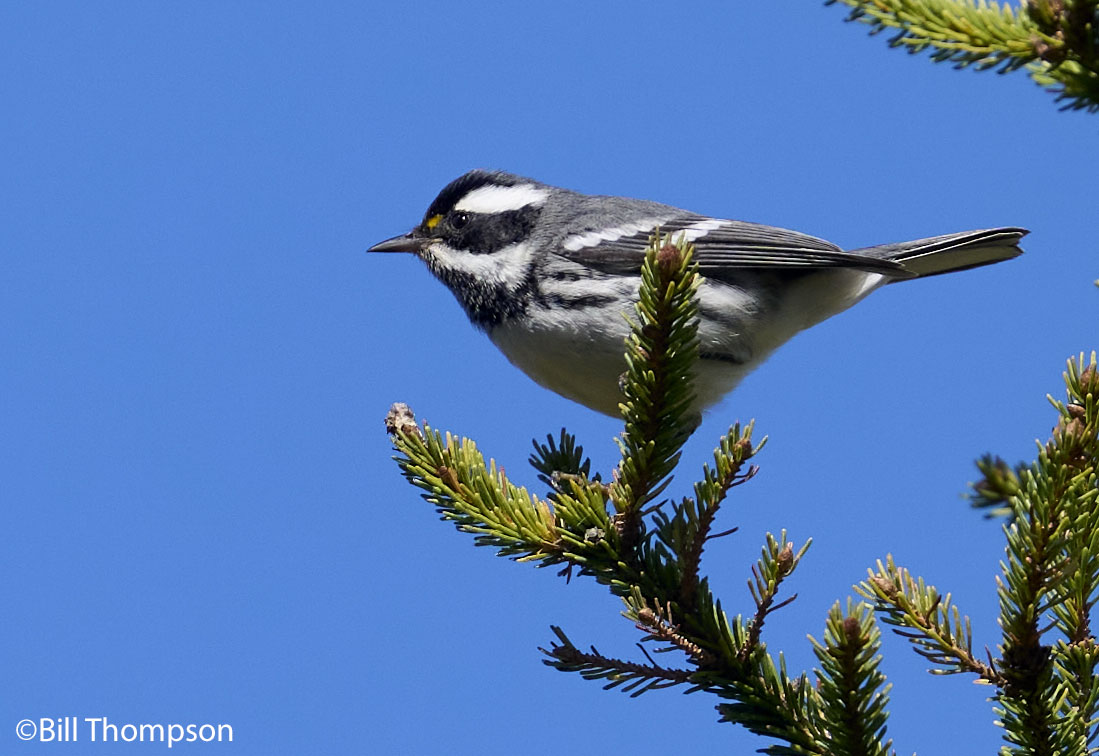
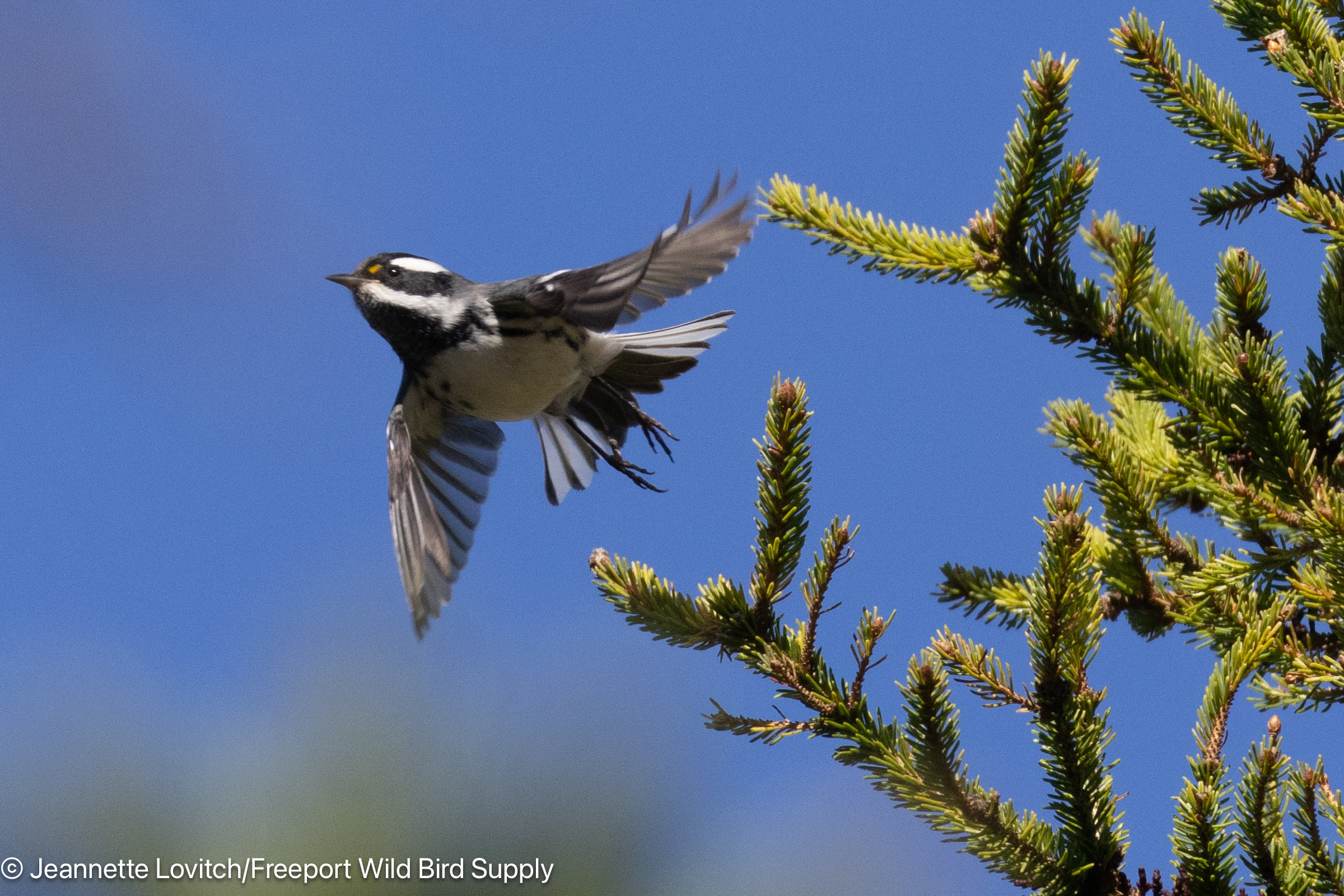
One of the stars of the show during an epic weekend on Monhegan included this Black-throated Gray Warbler that I found with my tour on 9/28. There are only 5-7 previous records of this spiffy western warbler in Maine. It was relocated by others on and off that day, and through much of the day on the 29th. The best show for everyone was when Doug Hitchcox re-relocated it a few feet from where my group and I first discovered it! That’s when Bill Thompson got this crushing photo.
My observations of note over the last 9 days included 5 remarkable days on Monhegan Island included the following:
Highlights from our Durham property this period included 2 continuing Indigo Buntings and 2 Solitary Sandpipers on 9/22; 1 Ruby-throated Hummingbird 9/23-24; and 5 Lincoln’s Sparrows on 9/24.
An exceptional day in and around Biddeford Pool on the 23rd with Jeannette included a number of highlights and excellent counts of uncommon birds. Some of the most notable observations include an astounding 26 FORSTER’S TERNS together at Hill’s Beach (with scattered individuals elsewhere that may or may not have been part of this tally, the shockingly large “irruption” of this tern – especially given the lack of a tropical system to cause it – continues); a juvenile YELLOW-CROWNED NIGHT-HERON at Great Pond, a late juvenile BAIRD’S SANDPIPER on Biddeford Pool Beach, single CLAY-COLORED SPARROWS in Hill’s Beach and East Point, 12 American Oystercatchers off of Ocean Avenue, a goodly 41 Red Knots in The Pool; 7 adult Lesser Black-backed Gulls at Hill’s Beach, and an arrival of fresh juvenile (technically 1st winter as most showed a couple of replaced feathers by now as expected) Dunlin in various locations (high of 30+ on Biddeford Pool Beach).
It was like the good ol’ days on Monhegan for my tour group this weekend. I was on the island with the tour 9/26-9/29, and then enjoyed a day off with Jeannette on 9/30. I’ll have a complete tour report posted next week (including rarity photos), but for now, the mind-blowing list of rarities and excitement for my group and I included the following:
1 BELL’S VIREO, 9/28 (refound by my group after being discovered by Jess Bishop and Bill Thompson on 9/28).
1 BLACK-THROATED GRAY WARBLER, 9/28-29 (Found by my group, on 9/28 and refound by m.obs on 9/29).
1 immature female PAINTED BUNTING, 9/26 (independently identified – eventually – by my group and Bill Thompson).
1 YELLOW-THROATED WARBLER, 9/27
1 WESTERN KINGBIRD, 9/27.
21 total species of warblers.
Up to 2 Lark Sparrows daily beginning 9/28.
Up to 6+ Clay-colored Sparrows daily.
Up to 3 Dickcissels daily
Up to 2 Orange-crowned Warblers daily beginning 9/27.
1 American Bittern, 9/26-9/27.
Up to 3 Lesser Black-backed Gulls daily.
1 Blue-gray Gnatcatcher, 9/26.
1 Red-bellied Woodpecker, 9/28.
1 Nelson’s Sparrow, 9/27.
1 Yellow-billed Cuckoo on 9/29 (with my group) and 1 Black-billed Cuckoo on 9/30 (with Evan Obercian and Jeannette).
Join us on a special cruise dedicated to off-shore birding: a collaboration with Cap’n Fish’s Cruises offering half-day “mini-pelagics!” We’ll seek out the rare and common seabirds that occur in our nearshore waters, but we will always have the hope for something unexpected. Derek will team up with the boat’s expert naturalists to spot, identify, and point out pelagic seabirds. Chumming efforts will provide opportunities to attract the birds in for better photo ops and viewing. While we’ll stop to look at any whales and whatever other interesting sea life we encounter along the way, it is the feathered wildlife we’re searching for, and will be focused on.
This annual fall excursion gives a chance at some very sought after pelagic species, such as Great and South Polar Skua. More likely species include Northern Fulmar; Black-legged Kittiwake; Pomarine and Parasitic Jaeger; shearwaters – Great, Sooty, Cory’s, and possibly even Manx; Leach’s Storm-Petrel; Razorbill and Atlantic Puffin; Red and Red-necked Phalaropes, and much more. With the later departure date this year, we hope for more jaegers and a better chance at Great Skua, along with the chance at more early-arriving alcids.
Each of our four October trips have been very different, with each year providing some unexpected highlights. Once again, we will be chumming at at least one hotspot, and we’ll have an additional spotter who will keep dedicated eBird lists for those who so desire and want it shared with them.
Join the crew of Seacoast Tours and Derek Lovitch from Freeport Wild Bird Supply on a special tour of the islands and waters of Casco Bay. We’ll explore the inner islands of Freeport, Brunswick and Harpswell as we search for eagles, migrant waterfowl, and an occasional seal basking in the sun on the ledges of hidden coves. We’ll focus on the common resident and migratory water and shoreline birds of the region, including photographic opportunities whenever we can.
Conditions and tide permitting, we’ll poke around the mouth of Maquoit Bay and especially up into Middle Bay, two of the richest areas for waterfowl concentrations. If we can find a mass of American Black Ducks, we’ll scour them for a variety of other dabblers, such as Green-winged Teal and Northern Shovelers. Some of our wintering and migratory bayducks, such as Surf and White-winged Scoters will just be arriving, and Common Loons begin to build in for the winter.
These unique, relaxed birding and beer-ing adventures that you have come to love combine great local birding at seasonal hotspots with visits to sample the delicious creations of some of our favorite local breweries. These tours are a perfect introduction to birding and/or craft beer, and a great opportunity to travel with significant others, friends, and family that have interest in one topic, while your interest is primarily in the other (for now!). But this time we’re leaving the van in the garage, and hitting the water! That’s right, we’re taking a cruise, and we’re returning to the private House Island in Porland Harbor twice in 2025.
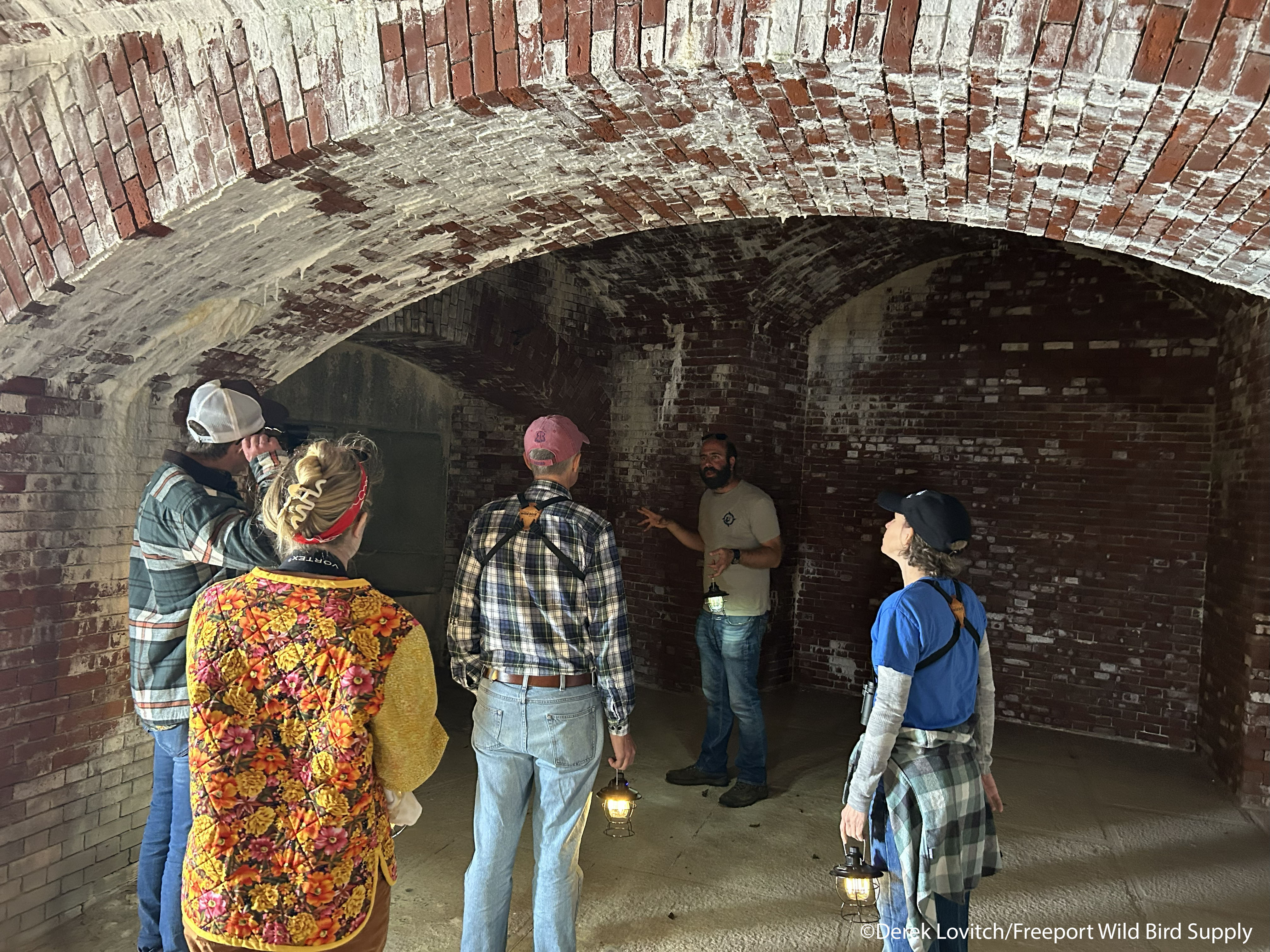
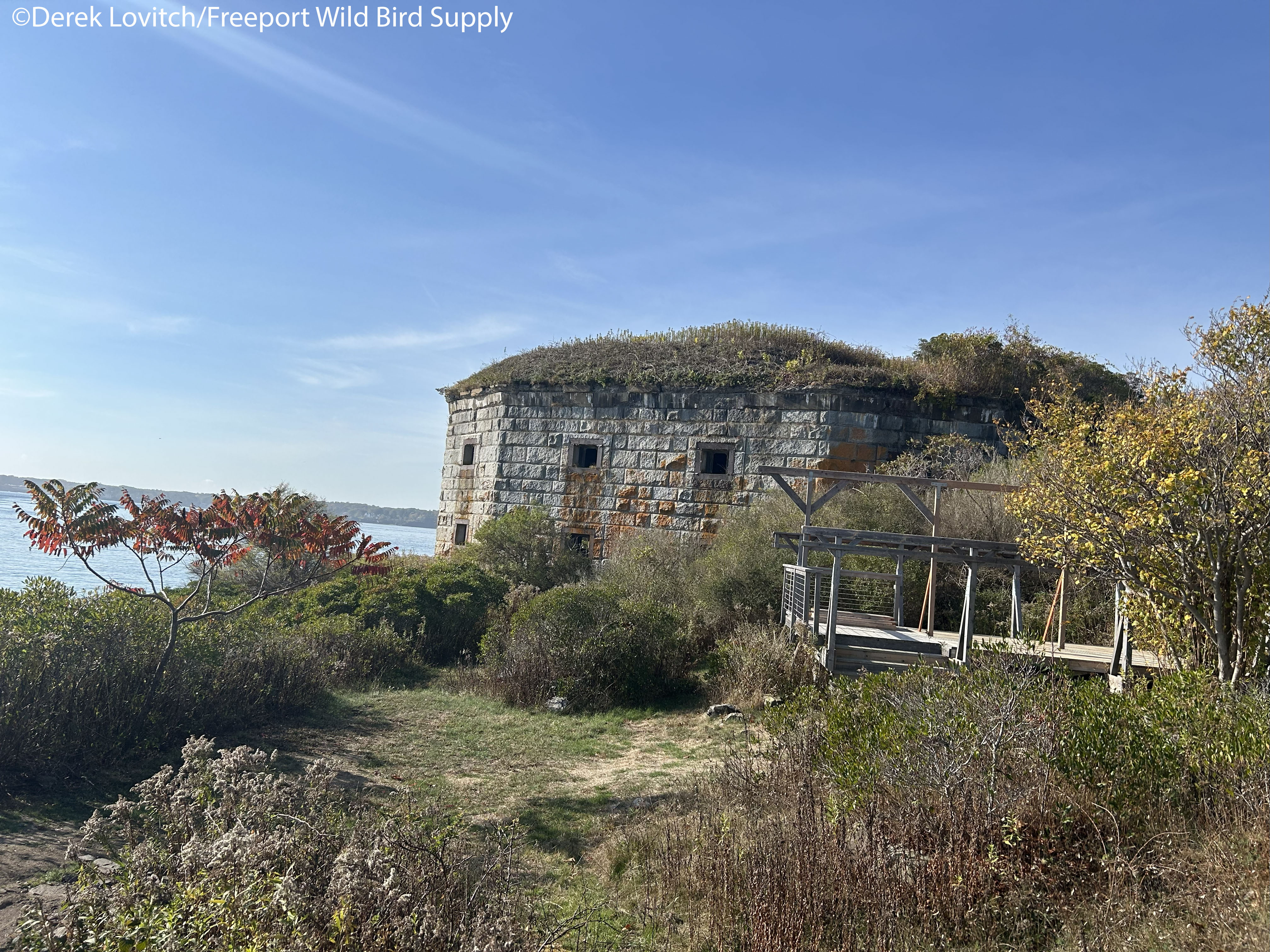
During last year’s wildly successful outing in which we became the first birding group ever on the island, we found oodles of Yellow-rumped Warblers, an uncommon Field Sparrow, and other migrants. But we were truly captivated by Captain Pete, who guided us through the historic fort, sharing a wealth of historical knowledge and fascinating stories. The beer was pretty darn good too, as we sampled the history of Maine’s craft beer scene.
Building on that success, we’re visiting the private House Island in Portland Harbor twice in 2025. We’ve been granted special permission to come ashore and scour the island here in the peak of fall migration. We’ll follow well-maintained trails through the island’s mosaic of open habitats, scrub, and young woods. These are great habitats to search for a variety of migrants, and perhaps even a rarity!
Returning in late October, once again rarities will be on our mind. While rare birds are rare, we are still going to expect the unexpected. But more likely are regular migrants of the season such as Yellow-rumped Warblers, a variety of sparrows, and a growing diversity of waterbirds. At the very least, we’ll have resident waterbirds and several species of gulls to sort through. We are having daydreams of a rare flycatcher!
As we motor back across the harbor, we’ll continue to familiarize ourselves with some of the common waterbirds, such as Common Eiders, Common Loons, and the vanguard of our winter diving ducks while enjoying a local craft beverage produced in the city of Portland. While the exact plan is subject to change, we’ll be sure to come up with a plan to adequately celebrate our discoveries – or the one that got away!
To “count it” or “not to count it,” that is the question. Regardless, what’s more iconic about birding on Monhegan Island than a Ring-necked Pheasant?
My observations of note over the last seven days included my first two Morning Flights of the season at Sandy Point and 3 days on Monhegan included the following:
A light flight over and through Sandy Point Beach, Cousin’s Island, Yarmouth on 9/8:
6:12 to 8:00am.
50F, mostly clear, calm.
57 Northern Parulas
31 American Redstarts
17 unidentified
8 Cedar Waxwings
6 Magnolia Warblers
5 Black-throated Green Warblers
4 Red-breasted Nuthatches
3 Yellow Warblers
3 American Goldfinches
2 Swainson’s Thrushes
2 Bobolinks
1 Black-and-white Warbler
1 Purple Finch
1 Cooper’s Hawk
1 Bay-breasted Warbler
1 Yellow-rumped Warbler
1 Northern Flicker
1 Black-throated Blue Warbler
1 Osprey
1 Rose-breasted Grosbeak
Total = 147
1 DICKCISSEL, Wharton Point, Brunswick, 9/9.
2-3 Red Knots, Wharton Point, Brunswick, 9/10.
A very good flight over and through Sandy Point Beach, Cousin’s Island, Yarmouth on 9/11 featured over 1,000 migrants and 16 species of warblers.
6:13-10:20
46F, mostly clear. NW 1.8-2.8 increasing to 6.1-8.8mph.
312 Northern Parulas
272 American Redstarts
144 unidentified
81 Cedar Waxwings
34 Red-eyed Vireos
25 Red-breasted Nuthatches
25 Black-throated Green Warblers
24 Magnolia Warblers
23 Yellow Warblers
16 Blue Jays
11 American Goldfinches
10 Black-throated Blue Warblers
9 Canada Geese
8 Swainson’s Thrushes
7 Northern Flickers
7 American Kestrels
7 Black-and-white Warblers
5 Yellow-rumped Warblers
4 Eastern Wood-Pewees
4 Purple Finches
4 Ospreys
3 Bay-breasted Warblers
3 Wilson’s Warblers
3 Blackpoll Warblers
3 Mourning Doves
2 Blackburnian Warblers
2 Common Loons
2 Bay-breasted/Blackpoll Warblers
2 Blue-headed Vireos
2 Philadelphia Vireos
1 Palm Warbler
1 Pileated Woodpecker
1 Savannah Sparrow
1 Tennessee Warbler
1 “Traill’s” Flycatcher
1 House Finch
1 Hairy Woodpecker (6 “false starts”)
1 Sharp-shinned Hawk
1 Pine Warbler
1 Ruby-throated Hummingbird
1 unidentified Empid
1 unidentified flycatcher
1 Turkey Vulture
1 unidentified vireo
1 Merlin
1 Cape May Warbler
1 White-throated Sparrow
Total = 1,069
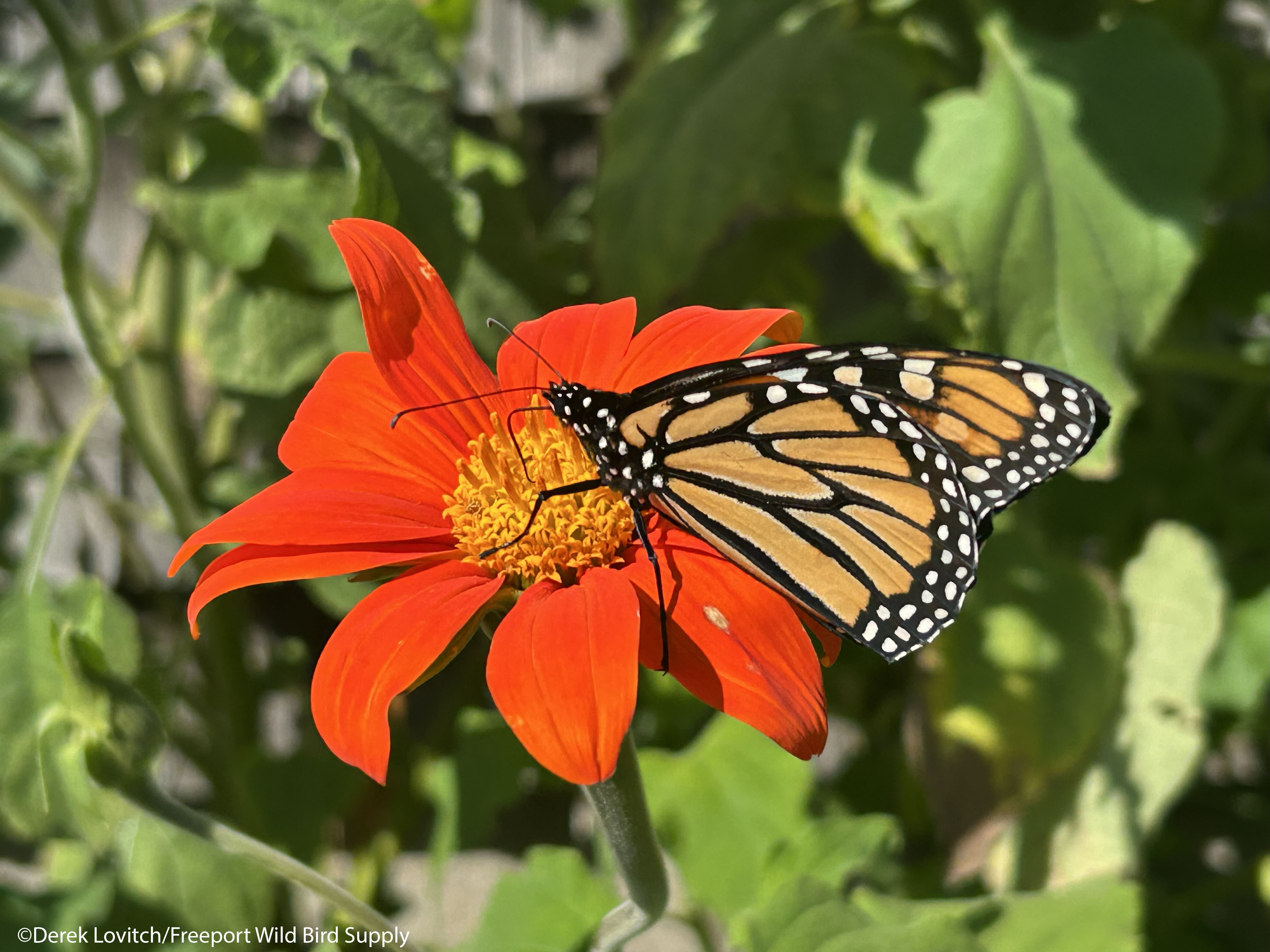
Monarch 1
Green Darner 2
Monhegan Island 9/12-14 (with Down East Adventures tour group):
Very slow by Monhegan standards, only Merlins and especially Red-breasted Nuthatches and Ruby-throated Hummingbirds were above average (significantly so for the hummingbird) for the date. Island notable species for us were limited to 2 DICKCISSELS all three days; 1 ORCHARD ORIOLE, 2 adult Lesser Black-backed Gulls, and 1 Marsh Wren on 9/13; and 1 Mourning Warbler on 9/14. Great insect-watching though.
Upcoming Tours:
Birds on Tap℠ – The Boat Trip! Migrant Birds and Island Exploration
September 21, 2025; 9:00am to 2:00pm
These unique, relaxed birding and beer-ing adventures that you have come to love combine great local birding at seasonal hotspots with visits to sample the delicious creations of some of our favorite local breweries. These tours are a perfect introduction to birding and/or craft beer, and a great opportunity to travel with significant others, friends, and family that have interest in one topic, while your interest is primarily in the other (for now!). But this time we’re leaving the van in the garage and hitting the water! That’s right, we’re taking a cruise, and we’re returning to the private House Island in Porland Harbor twice in 2025.
Building on that success of last year’s tours, we’re visiting the private House Island in Portland Harbor twice in 2025! Once again, we’ve been granted special permission to come ashore and scour the island here in the peak of fall migration. We’ll follow well-maintained trails through the island’s mosaic of open habitats, scrub, and young woods. These are great habitats to search for a variety of migrants, and perhaps even a rarity!
One of the stars of the show this weekend was this incredibly cooperative Mourning Warbler.
I’ll admit to having a love-hate relationship with this tour. I love taking people into the realm of the Bicknell’s Thrush, but I hate how much I have to stress about getting people to see one! Of course, weather is one of the primary impediments to enjoying a fulfilling mountaintop experience, and well, if I could only control that, too! And then there’s the bird – one of North America’s most reclusive breeding species, and with a behavior that tends to lead to sleep deprivation as well.
But we could not have asked for a better start to the weekend, with the first Saturday without rain in almost three months! In fact, it was absolutely gorgeous as we assembled in Errol, New Hampshire: sunny, a light breeze, and pleasantly warming temperatures. The relaxing morning was spent exploring the lowlands, focusing on boreal transition forest and spruce/tamarack bogs. We heard a couple of Palm Warblers – and glimpsed one in flight, listened to Yellow-bellied Flycatchers, and enjoyed common warblers such as Magnolia.
We enjoyed some botanizing as well, and stopped to look at all walks of life, such as butterflies and dragonflies.
Atlantis FritillaryRacket-tailed Emerald
After a quick but delicious lunch, we did a little more casual birding (Blackburnian Warblers!) and even a little sightseeing!
A welcome afternoon break was followed by an early dinner in town, before our first trip up the mountain. With a mostly clear evening, we had some time until dusk, so we used it to make a bee-line to what I assumed would be one of the highlights of the weekend.
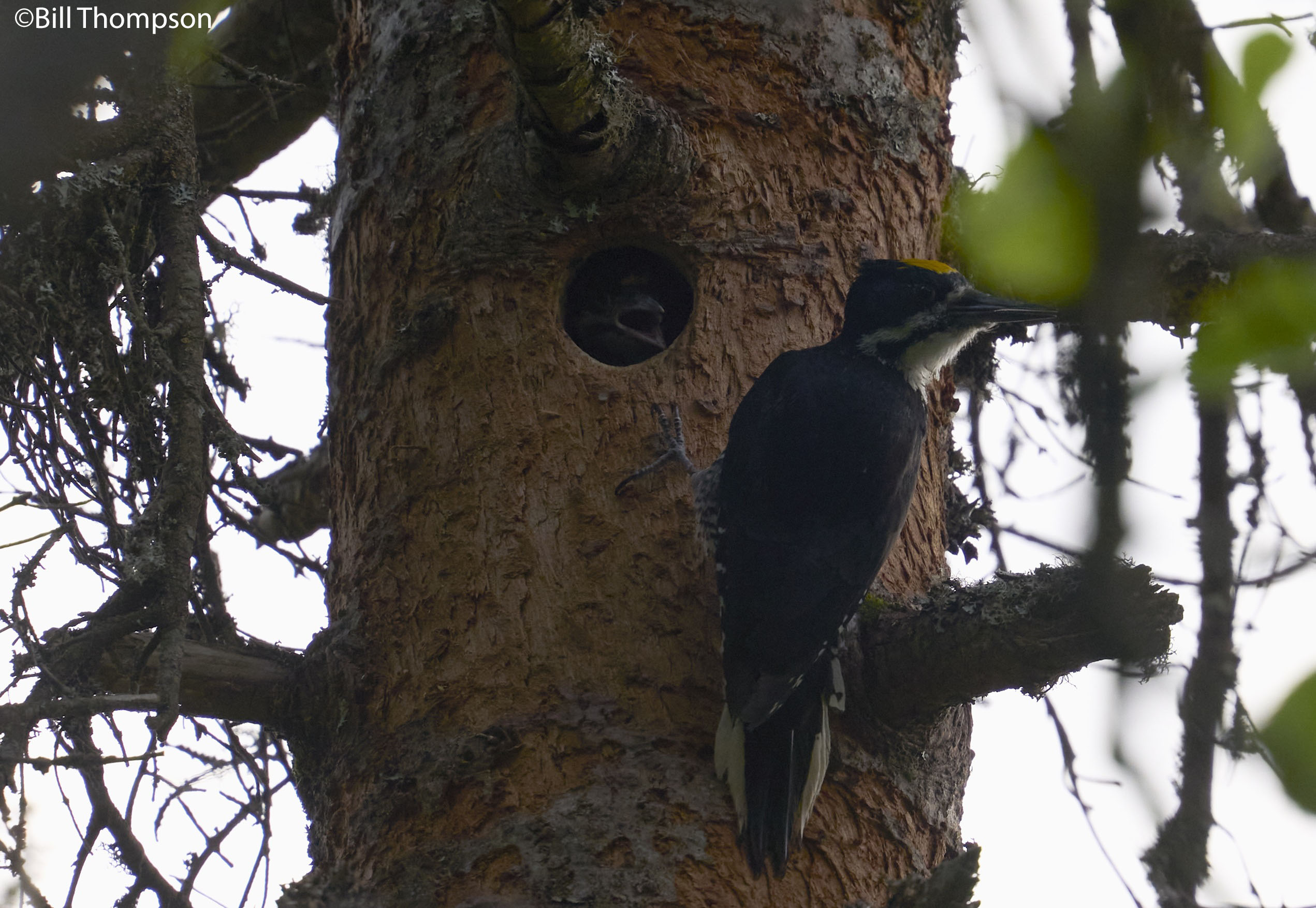
On a private tour two weeks ago, I found a Black-backed Woodpecker nest. At the time, the adults were feeding young that I could not yet hear or see. I hoped they would still be in the cavity by now, and it didn’t take long for us to know they were – we heard the begging nestlings from a good 100 feet away. I found a path of least resistance to the nest hole, and we took turns rotating in small groups to watch the adults make repeated feeding visits. Everyone was so respectful of the birds – especially the adult male – who didn’t seem too pleased with our presence. After one feeding visit per group, we backed off, gave the birds a break to feed, and then visited with the next group. While the sun was now setting fast and the photography was challenging, it was truly a special experience with such a charismatic and sought-after species.
Now, it was time to get to work. And tonight, our primary target really did make me work for it! Swainson’s Thrushes continue to increase here, and they were very active and vocal this evening. Too vocal.
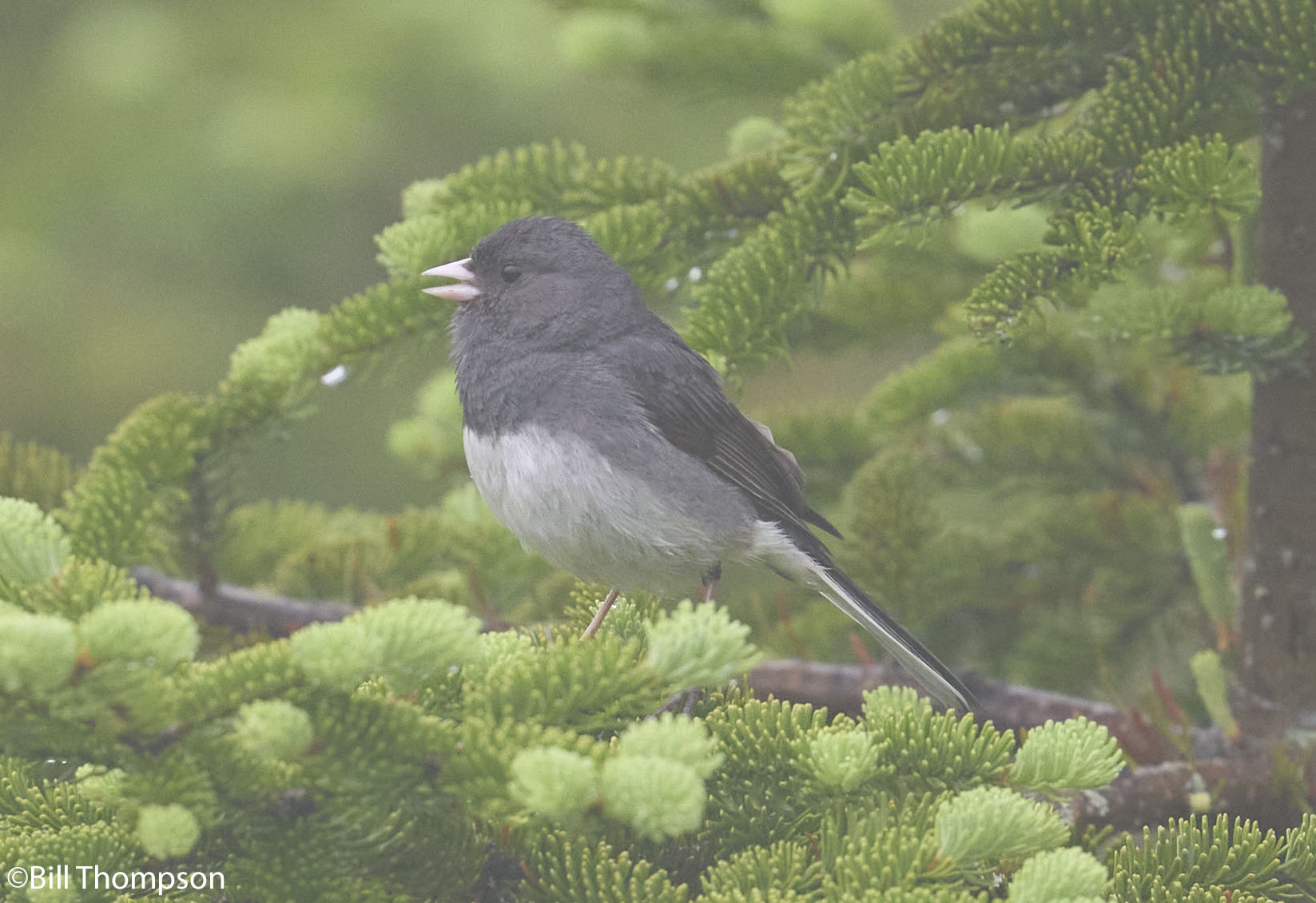
While we did have some great looks at them, their presence and activity likely kept the Bicknell’s quiet and in the shadows. In fact, it was getting dark by the time the Swainson’s stopped singing and we finally heard a couple of Bicknell’s calling.
By 8:45, I was starting to get a little worried, so I walked most of the group up a trail where I had activity a couple of weeks ago. One bird was calling there, but it would not come out. I began the retreat to the road when the bird flew right over my head – one person even it heard it whiz by me. We turned back up the path and settled in and eventually at least one thrush began to sing, a couple of others were calling, and surrounded by Bicknell’s Thrushes, we ended up seeing one flying back and forth across the small clearing and at least half the group saw one in silhouette on top a small tree, calling aggressively.
The aural performance was top notch, especially down at the road, and everyone was quite satisfied with at least the sum of all views had of the bird in flight or paused in a tree at the edge of the small clearing. It wasn’t the “crippling views” from last year’s weekend, but everyone agreed it was more than “good enough” and the overall experience was worthy of the effort.
I pushed it a little longer and later than usual as it was such a nice evening (too nice?), and I had my worries about even getting up the mountain the next day. We returned to our hotel at 10:15, and we departed again at 6:00 – I let the group “sleep in” due to the forecast morning rain and our late return.
And it was indeed raining in the morning when we awoke, but the forecast chance of thunderstorms had not materialized. Therefore, it was safe to head up to the mountaintop, so without any further ado, up we went once more.
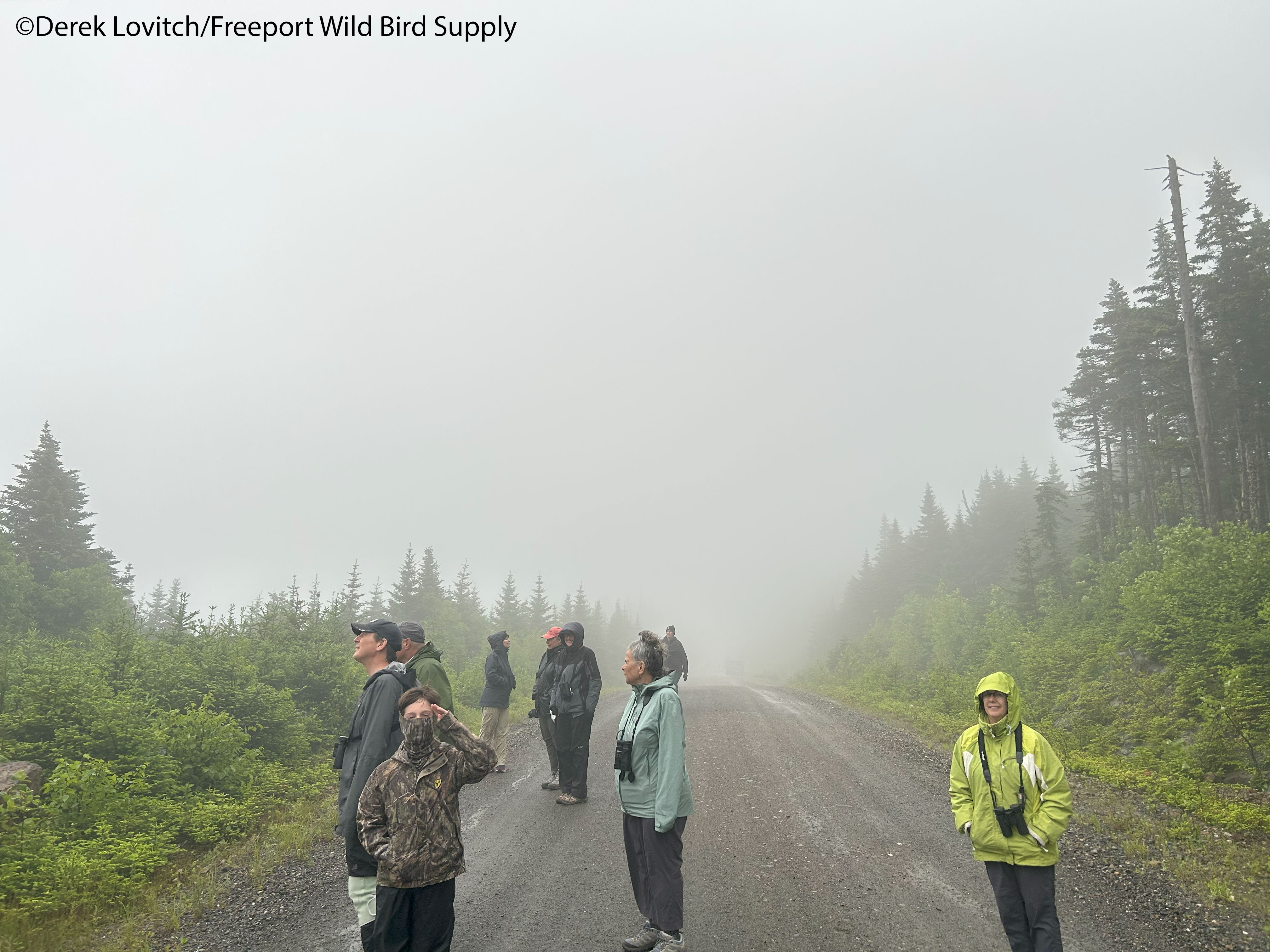
Unfortunately, up top it was still raining, albeit lightly, but the wind was already howling. What a difference 9 hours makes! Light rain came and went, fog would roll in and out, and we had one 10-minute rain delay in our vehicles with a downpour. Luckily, we had just finished breakfast!
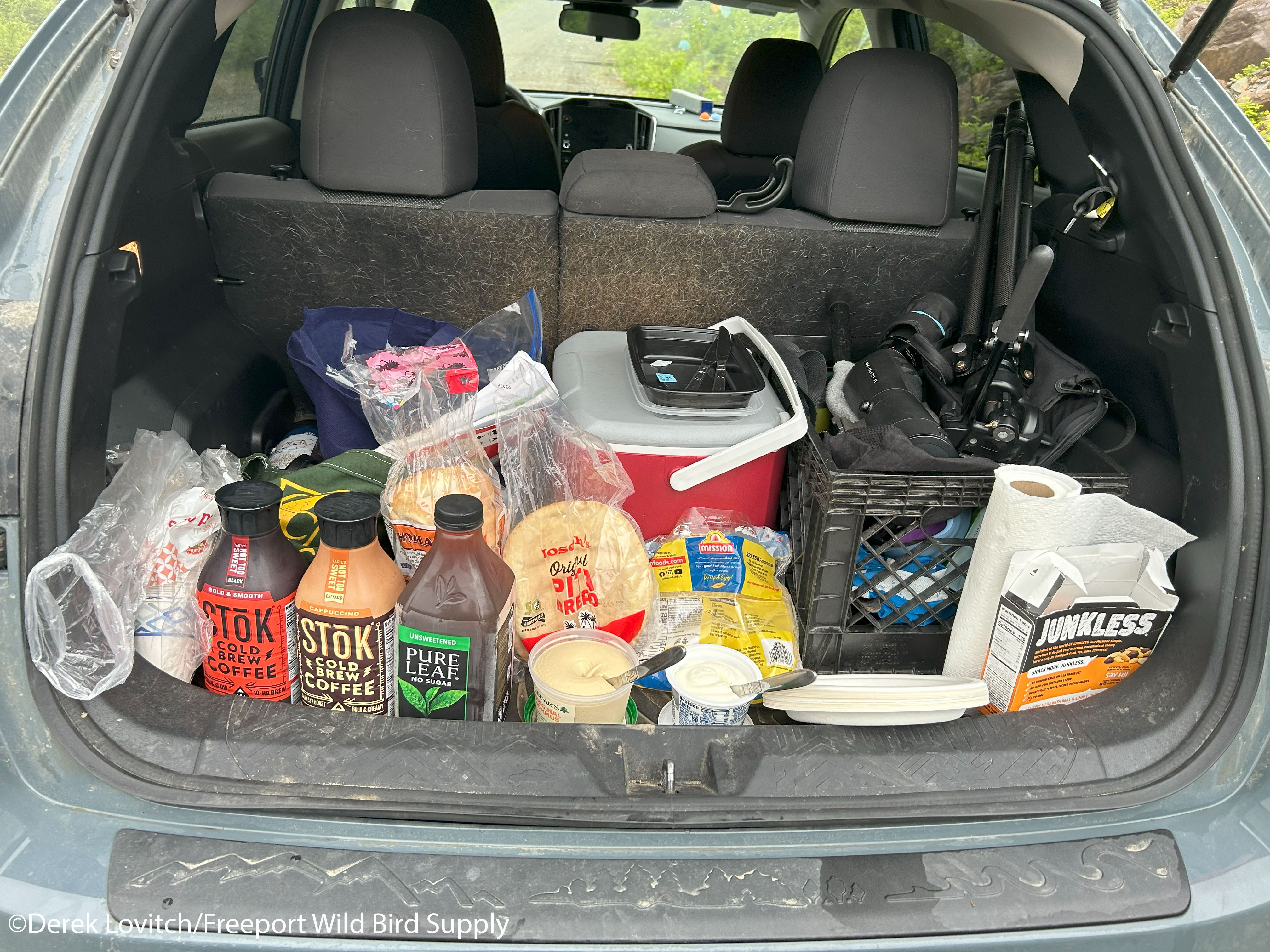
Birding tailgating!
But the morning was by no means the washout we feared, and when the rain stopped, the birding was pretty good. We decided not to bother the Black-backed Woodpeckers (the light was even worse anyway in the fog) given the conditions, but we were happy to hear the begging youngsters from afar. A few Red Crossbills flew over, Blackpoll Warblers were singing, and we heard the mountain’s Fox Sparrow in the distance.
But we did not hear a single Bicknell’s Thrush. I was about ready to give up when one finally called nearby at 8:45. And he kept calling, repeatedly, so close to us, but we never even glimpsed him. He must have been just within the dense edge – so close, yet so far!
Now this tour promises two chances to look for the thrush, not two guaranteed observations, so we took what the birds gave us last night, and with the wind howling, we began our decent.
Stopping as soon as we had some more shelter, we hopped out and soon saw a Bay-breasted Warbler and heard a pair of Boreal Chickadees. A little further down the road, we heard what was almost surely a Cape May Warbler, but could not confirm it. There wasn’t much question about this Mourning Warbler however!
See headline photo…Now that’s the kind of view we were looking for!
We dipped on Lincoln’s Sparrow, and then spent some time looking for Philadelphia Vireos. While we heard what was likely one singing from within perfect habitat, all of the vireos we saw today – and you simply must see them to identify them – were Red-eyed Vireo. Their march up the mountain and resultant displacement of Philadelphias continue.
It was instructive, however, and analogous to the issues with Swainson’s Thrushes moving uphill and pushing out Bicknell’s – these high elevation specialists have nowhere else to go as our mountains are not getting any taller, and I made sure to weave these conservation and natural history messages throughout the tour.
We looked at plants, too, such as Round-leafed Sundew.
We celebrated our success – especially with Black-backed Woodpecker and Mourning Warbler! – with a wonderful and leisurely lunch, and then half of the group joined me for a casual stroll in the lowlands of Colebrook, where we encountered numerous Veeries – just to add to our thrush tally for the weekend. Of course, our photographers had left, so birds here – especially the Veeries – were exceedingly conspicuous, with repeated views of them out in the open and with bills full of food. American Redstarts, Yellow Warblers, and a couple of singing Bobolinks were icing on the weekend cake.
Have views of our primary target, the Bicknell’s Thrush, been better on this tour? Yes. But they have also been much less fulfilling, and rarely, not even seen at all. So, we’ll take it…plus it was a great experience that fostered appreciation for the challenges of seeing this bird. Oh yeah, and a nest of Black-backed Woodpeckers!
It was a great weekend for warblers, with a tour total of 19 species and a 5-day total of 22 species, including quite a lot of Wilson’s Warblers for the end of May. With 10-20 estimated per day, we were regularly treated to exceptional views, such as this adult male.
The 2025 Monhegan Migration Spring Weekend was a shocking success. We went from having a weather forecast that made me worry if there would be any migrants to see at all, to an exceptional weekend that was by far the best Memorial Day weekend of birding out here in quite a few years.
Technically, our tour was to begin on Friday with a little morning birding in Port Clyde before boarding our ferry. But it was raining. A lot. Wisely, most folks held out until the ferry meeting time. Unfortunately, that meeting time was delayed by 5 hours when the first two boats of the day were cancelled due to the storm. It was a bona fide late season Nor’Easter and it was raging out there.
We were lucky enough to get spaces on the 3:00 boat, but even luckier that the seas were dropping dramatically. OK, it was far from calm, and while I might not have thought it was “too bad,” others disagreed. But we made it! And the rain had stopped. And we went from 10-14 foot seas to a few waves that may have approached 8 feet. Not pleasant, but more than manageable. Of course, I have to admit that the “worst ferry ride” bar is pretty high for me.
By the time our luggage was organized, we didn’t have a lot of time, but we decided to try and catch up with the continuing truant Harlequin Ducks that had been seen in and around the harbor. Up to 8 had been reported, but when we arrived at the recommended spot, we found 12! While common in winter, “Harlies” are usually long gone by now, so this was a treat (it was also an island bird for me!). We also picked up a 2nd/3rd cycle Lesser Black-backed Gull for our troubles. There was even a short break of sunshine!
Noteworthy for the date, 12 lingering Harlequin Ducks diminished to just one by the end of the weekend.
By dusk, winds were light northwest and it was still cloudy. Overnight there were some scattered showers, with winds shifting to the west and then going calm. The fog and showers made the radar hard to decipher, but the wind map for offshore offered some hope.
Screenshot
Note how birds who were offshore of southern New England would be pushed out to sea, but then find a tailwind that could theoretically take them right to the Mid-coast of Maine? The Boston radar was very busy, and suggested birds were indeed well offshore to our south come dawn. We had hope.
But our pre-breakfast walk was not very productive. Uh-oh. Scattered showers had returned, and there were very, very few migrants around. We did see the 12 Harlequin Ducks again, but passage migrants were limited to a handful of Blackpoll Warblers and a Wilson’s Warbler. Was this going to be a very slow weekend?
We returned for breakfast at our respective lodges, and the showers stopped. We met at 9:00 and began our next outing. I was concerned. But then, it happened. All of it.
First, a Lark Sparrow was found – very rare in spring – and while I was going to meet the group, I relocated it in the lawn of the Trailing Yew. It wasn’t there when we returned as a group, but we elected to repeat the southern loop in the hopes of encountering it. And encounter it we did, several times, actually, as it worked its way around the lawns feeding on fresh dandelion seeds.
Meanwhile, something else was happening. Suddenly, birds were everywhere! Pocket after pocket of warbler activity was encountered, and every apple tree had birds in it! Small batches of birds giving flight calls overhead were suggestive of birds only now, at mid-morning, arriving on the island. As these birds were a very different mix of species from the last “birdy” day four days ago, according to a fellow guide, these were in fact “new birds” only now, and rather unexpectedly, arriving en masse.
As the afternoon went on, it only got better! There were warblers in every cluster of trees, with lots of Magnolia Warblers and American Redstarts, but overall good diversity. Birds must have been arriving throughout the day and therefore remained active into the evening. Birds were often low, easy to observe, and the repetition allowed for reinforcing study and comparisons.
Magnolia WarblerRed-eyed Vireo
Not only was today not the forecast wash-out (just a few brief periods of drizzle and a couple of very light showers), but it was simply amazing! While warblers stole the show as expected, and the Lark Sparrow was a harbinger of things to come, our afternoon at Lobster Cove was rather exceptional, too, with two continuing “Eastern” Willets, a close pair of Harlequin Ducks, and 3 feeding Atlantic Puffins. What a way to end a spectacular day! It was like the good ol’ days out here.
By Sunday, the Low was dissipating over New Brunswick, and while the radar showed what may have been a light migration overnight, there wasn’t much happening in the “morning flight” once again. But as we began our birding day, it was actually quite good! While a lot of birds were left over from yesterday’s flight, they were augmented by some new arrivals, or at the very least, new detections. Once again, the birding was better than expected, and by late morning we already had some partial sunshine.
Unlike Saturday, activity slowly died down as the morning went on as usual, but it was just a downright delightful morning in the field. Lots of pockets of activity were still dominated by American Redstarts and Magnolia Warblers, but there were a lot more Blackpoll Warblers and fewer Wilson’s Warblers today. 8-10 Harlequin Ducks continued, and spiffy Bay-breasted Warblers were particularly cooperative. And we had three irregularly fantastic views of Lincoln’s Sparrows throughout the day.
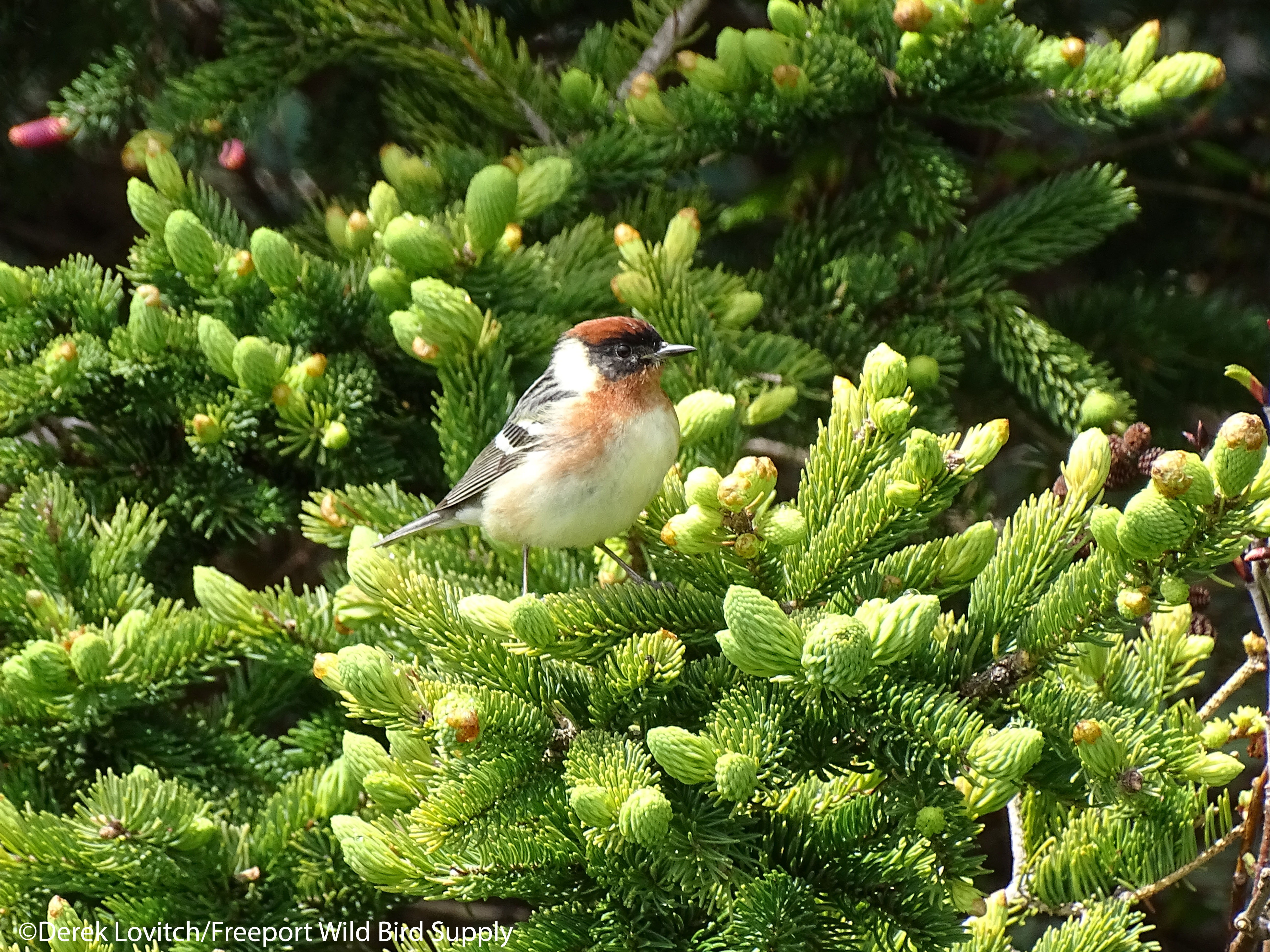
Bay-breasted Warblers were really conspicuous this trip, and we enjoyed great looks at both males and females daily.
Lincoln’s Sparrows were unusually cooperative.
A longer walk out to Burnt Head and a check of the island’s interior in the afternoon found some of the birds that had melted away from the edges, while an uncharacteristically skulky Great-crested Flycatcher gave us a jolt of excitement until finally revealing itself.
With the storm pulling away, light northwesterly winds and mostly cloudy skies dominated the overnight Sunday into Monday, and therefore there was little or no migration overnight, and therefore almost nothing in the Morning Flight. However, it also meant that most birds didn’t leave. And while slower than the last two days, it was still decent, good views of fun species were to be had, and the sun came out for good.
Magnolia Warblers, American Redstarts, and Blackpoll Warblers continued to dominate, along with the ubiquitous Yellow Warblers. Flycatchers were up, offering ample opportunity for instruction – and for eyes to glaze over. Morning highlights ranged from a particularly good tutelage from a Willow Flycatcher, a raft of 50 Surf Scoters offshore, and a really amazing Common Nighthawk repeatedly flying low over our heads and foraging over the island as noon approached.
It was warm and sunny, and with a sea breeze pushing birds out of the edges and deeper into cover, we decided to enjoy more of the island with a visit to the lighthouse grounds and a stroll deep into the spruce woods. In addition to building our list with island residents like Golden-crowned Kinglet and breeding species such as more Black-throated Green Warblers on territory, we enjoyed the plantlife of the Acadian habitat and a healthy dose of phytoncides. And in between, the occasional pocket of migrant warbler activity to bring us back to birding.
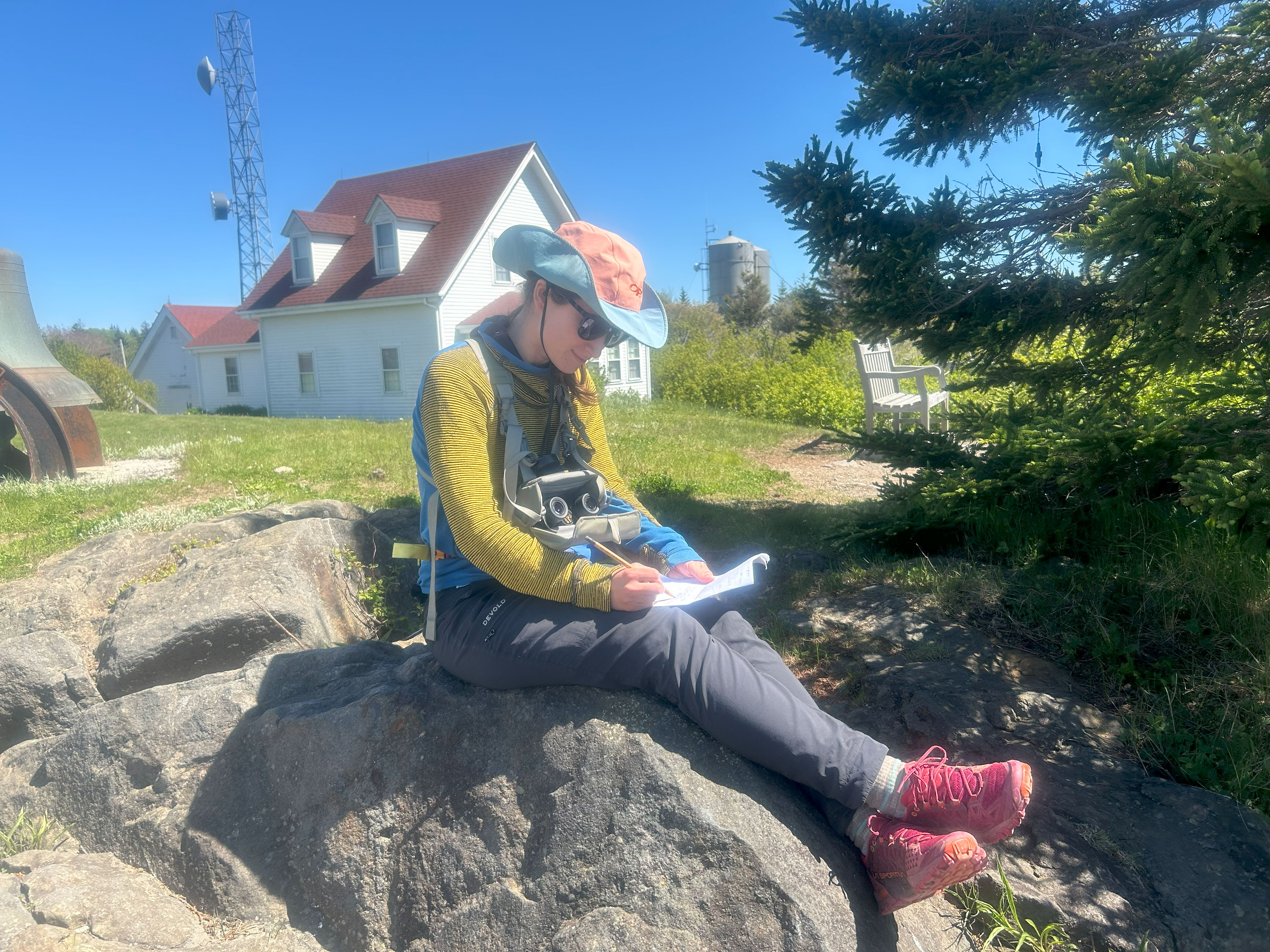
Catching up on note-taking.
Our tour concluded with an impressive 91 total species, but I admit to being a little frustrated by having to give up with 19 species of warblers…20 sounds so much better! But given the unexpected big arrival on Saturday, and the minimal rain and wind after Friday, the tour was truly an incredibly success, far exceeded expectations, and did live up to what Monhegan birding legends are made of.
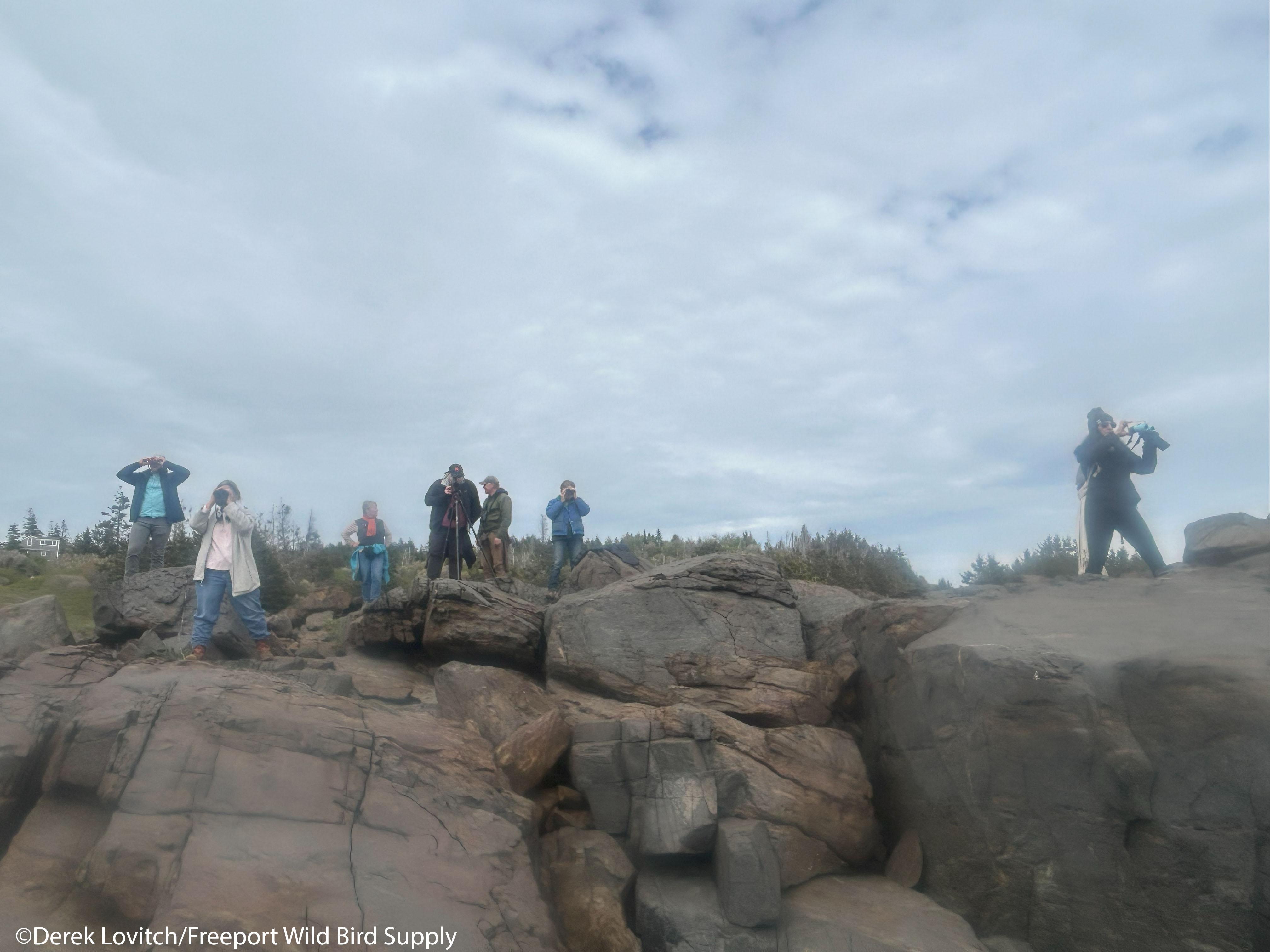
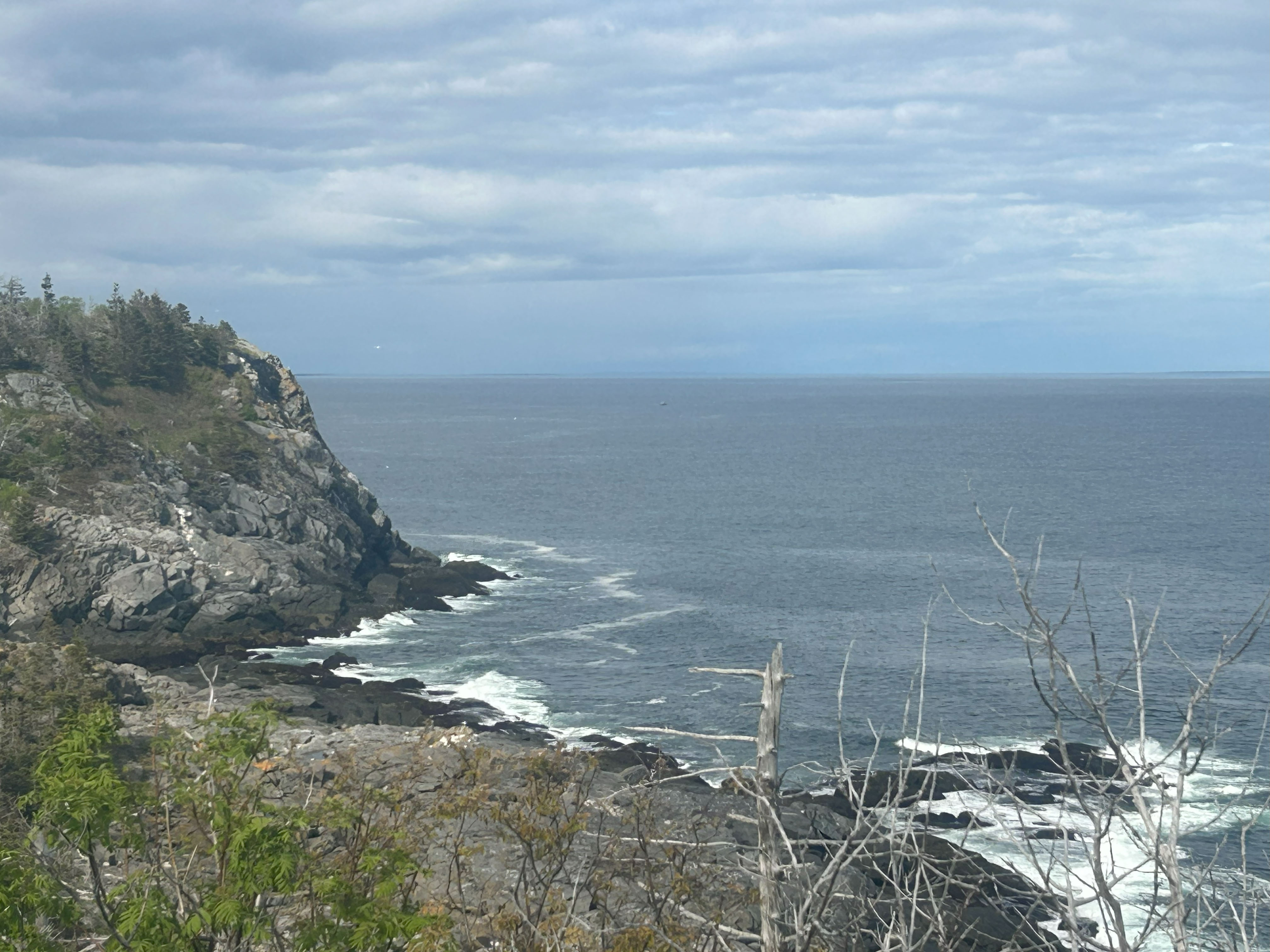
Last birders standing on the last afternoon of the tour.Staring at Eastern Egg Rock, attempting to will THE Tufted Puffin over to us.
Then, as per usual, Jeannette – who joined us late on Sunday – and I enjoyed a day off together on the island on Tuesday. Unlike the magically-appearing flight on Saturday, this was a more predictable great morning. A moderate to strong flight overnight lit up the radar on light southwesterly to west winds. That put a lot of birds in the Gulf of Maine come dawn, and the morning flight was hoppin!
Consisting mostly of Blackpoll Warblers, American Redstarts, and Magnolia Warblers, it was quite diverse overall. A few “new” species included a Pine Siskin and a Wood Duck, and 3 Red-breasted Mergansers were a fun Morning Flight fly-by.
Before and after breakfast, the birding was excellent. It was the best day by far in volume, but a lot of the birds were “on the move” and departing the island throughout the morning. But there was more of pretty much every migrant species, save for Wilson’s Warblers in particular. Birds weren’t held low by clouds and drizzle, or exhaustion, so it wasn’t as mind-blowing as Saturday, even with more birds around overall.
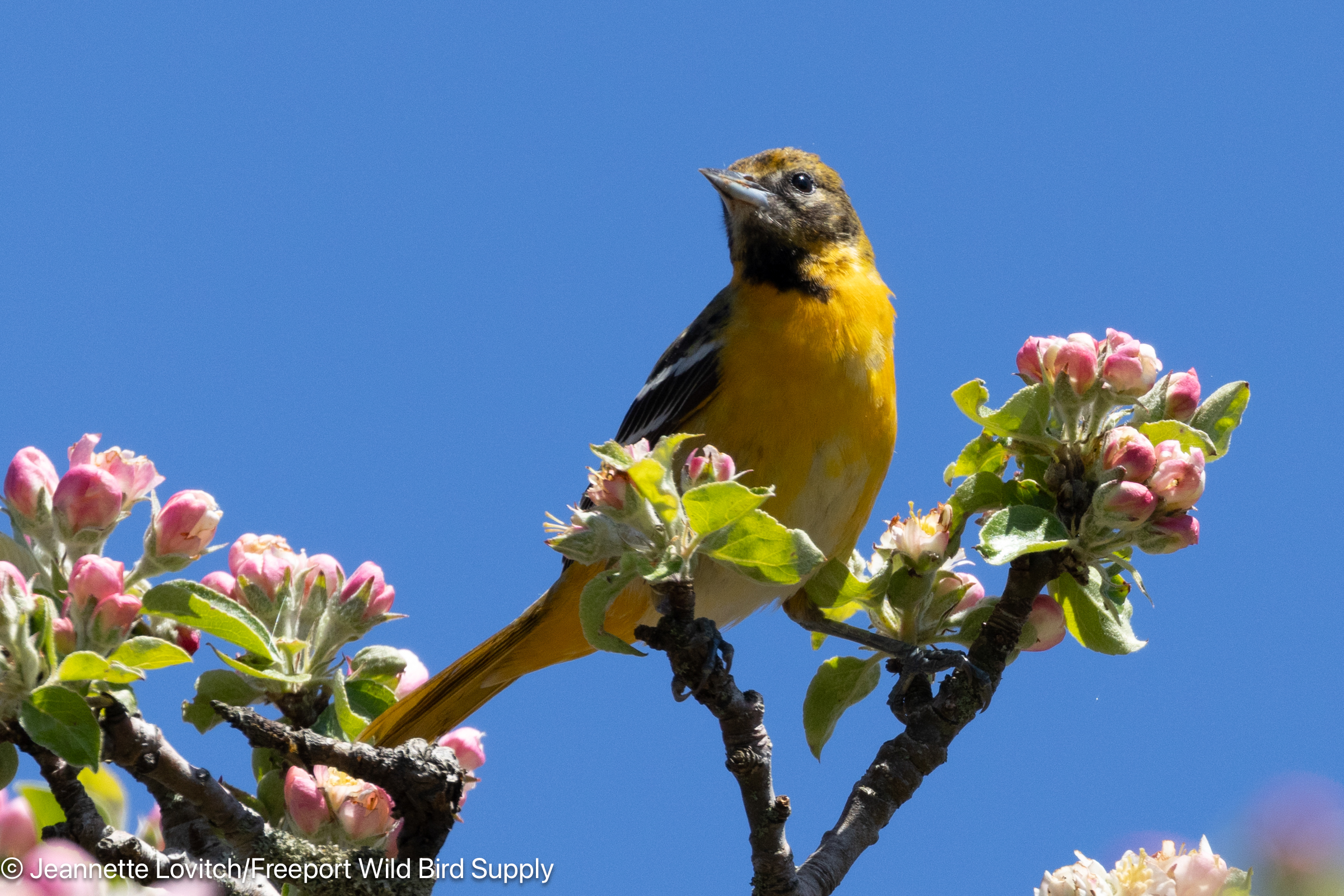
Baltimore OrioleThere were a lot more flycatchers around today, including quite a few Eastern Wood-Pewees.
It was also getting warm on a perfectly sunny sky, and birds took to the shadows earlier than in days past; the hotspots got much quieter by late morning with the increasing seabreeze. Nonetheless, pockets of activity continued right up through lunchtime.
The veggie burger bahn mi from The Bait Bag.
We rapidly added to our collective weekend list (which do not count for our tour total, of course), including finally reaching 20 species of warblers with an uncommon-out-here Pine Warbler. We then eclipsed it with a stunning male Mourning Warbler, and finally in the afternoon, picked up an Ovenbird for our 22nd and final species of warbler. Locally-rare Hairy Woodpecker, a truant Long-tailed Duck, at least one continuing Harlequin Duck, and we found my first Nelson’s Sparrow of the year at Lobster Cove. We even got a little hike in to try and burn a few of the extra calories we consumed from all of the islands’ scrumptious meals. And, anytime we stopped at a favorable looking patch of vegetation, migrants would appear, everywhere we went. It’s always tough to leave, but we at least went out with a bang!
Male Chestnut-sided Warbler
So back here in the Real World now, we can reflect on this past weekend as one that we will most surely always remember!
Here is the trip list four the five-day tour. I didn’t bother including the first day though, but it did net us a Lesser Black-backed Gull that we didn’t see any other day.
* = seen from ferry only.
Species
5/24
5/25
5/26
5/27 (with Jeannette) *ferry ride only
Canada Goose
0
2
4
2
Wood Duck
0
0
0
1
Mallard
15
15
x
x
Common Eider
x
x
x
x
HARLEQUIN DUCK
12
10
0
1
White-winged Scoter
0
0
0
2
Surf Scoter
0
0
50
1
Black Scoter
0
0
0
30*
Long-tailed Duck
2
0
0
1
Red-breasted Merganser
0
0
0
3
Ring-necked Pheasant
x
x
x
x
Mourning Dove
6
8
10
8
Common Nighthawk
0
0
1
0
Ruby-throated Hummingbird
3
4
5
4
Virginia Rail
0
1
1
1
WILLET
2
0
0
0
Spotted Sandpiper
0
0
0
2
Black Guillemot
x
x
x
x
ATLANTIC PUFFIN
3
0
0
0
Laughing Gull
5
6
10
6
Herring Gull
x
x
x
x
LESSER BLACK-BACKED GULL
1 (5/23)
0
0
0
Great Black-backed Gull
x
x
x
x
Common Tern
0
0
0
5*
Common Loon
2
3
3
1
Red-throated Loon
0
0
0
1
Northern Gannet
6
2
1
2*
Double-crested Cormorant
x
x
x
x
Great Cormorant
0
0
0
1*
SNOWY EGRET
0
1
0
1
Great Blue Heron
0
0
1
0
Osprey
0
1
2
0
Sharp-shinned Hawk
1
0
0
0
Bald Eagle
2
2
3
3
Yellow-bellied Sapsucker
0
0
1
0
Downy Woodpecker
1
0
0
0
HAIRY WOODPECKER
0
0
0
1
Northern Flicker
1
2
2
1
American Kestrel
0
0
0
1
Merlin
1
1
0
0
GREAT-CRESTED FLYCATCHER
0
1
0
0
Eastern Kingbird
3
1
2
2
Eastern Wood-Pewee
4
2
4
20
Alder Flycatcher
0
2
2
2
“Traill’s” Flycatcher
0
0
1
3
Willow Flycatcher
0
0
2
2
Least Flycatcher
2
2
10
12
Philadelphia Vireo
1
0
0
0
Red-eyed Vireo
6
5
4
30
Blue Jay
4
2
1
1
American Crow
2
2
4
4
Common Raven
2
2
2
2
Black-capped Chickadee
x
x
x
x
Tree Swallow
1
1
2
2
Barn Swallow
1
1
3
6
Golden-crowned Kinglet
0
2
2
1
Cedar Waxwing
80
60
60
150
Red-breasted Nuthatch
1
2
4
6
Carolina Wren
2
4
3
3
House Wren
2
2
1
2
Gray Catbird
x
x
x
x
Brown Thrasher
0
1
1
1
European Starling
x
x
x
x
Eastern Bluebird
0
2
0
1
Swainson’s Thrush
1
3
3
8
American Robin
10
10
x
8
Purple Finch
1
1
0
1
Pine Siskin
0
0
0
1
American Goldfinch
10
10
12
10
LARK SPARROW
1
0
0
0
Chipping Sparrow
2
0
0
0
White-crowned Sparrow
0
1
1
1
White-throated Sparrow
1
2
1
1
NELSON’S SPARROW
0
0
0
1
Savannah Sparrow
4
4
3
2
Song Sparrow
x
X
x
x
Lincoln’s Sparrow
0
3
3
10
Bobolink
3
4
1
3
Baltimore Oriole
2
2
3
2
Red-winged Blackbird
x
x
x
x
Common Grackle
x
x
x
x
Ovenbird
0
0
0
1
Northern Waterthrush
1
1
1
10
Black-and-white Warbler
12
10
8
15
Tennessee Warbler
2
2
6
10
Nashville Warbler
0
1
1
4
MOURNING WARBLER
0
0
0
1
Common Yellowthroat
20
20
x
x
American Redstart
55
45
40
80
Cape May Warbler
3
4
2
6
Northern Parula
15
15
45
40
Magnolia Warbler
50
45
40
70
Bay-breasted Warbler
8
10
3
15
Blackburnian Warbler
4
4
3
4
Yellow Warbler
35
30
25
x
Chestnut-sided Warbler
6
6
10
20
Blackpoll Warbler
15
35
55
100
Black-throated Blue Warbler
1
1
2
6
Pine Warbler
0
0
0
1
Yellow-rumped Warbler
3
2
0
1
Black-throated Green Warbler
10
15
20
15
Canada Warbler
1
0
0
0
Wilson’s Warbler
20
15
10
10
Scarlet Tanager
1
1
1
1
Northern Cardinal
6
10
8
6
Rose-breasted Grosbeak
3
3
3
2
Day Total
72
75
73
92
Warbler Day Total
18
18
17
21
Trip Total
91
Weekend Total inc. Tuesday
106
Warbler Trip Total
19
Warbler total inc, Tuesday
22
The above birds follow the “guide plus one” rule, meaning both me and at least one client need to see the bird for it to go onto the list. This year, the only two birds I saw without the group that we didn’t later encounter was a fly-by Belted Kingfisher and an American Woodcock at dusk, both on the the 24th, for a total of 91 with the group and a 5-day tally of a respectable 106 species.
Freeport Wild Bird Supply is very excited to partner with Down East Magazine’s Down East Adventures for the fifth year of offering exclusive birding workshops focused on gaining greater knowledge and field skills in a focused group of seasonally accessible birds. Focused on skill-builder rather than list-building, there will be plenty of “life birds,” but also more knowledge and education about birds, habitats, birding, and much more about the natural world. We are honored to be their provider for a series of unique and exclusive birdwatching endeavors. In 2025, we will have four outings once again.
February 9, 2025; 9:00am – 4:00pm Cancelled due to multiple snowstorms!
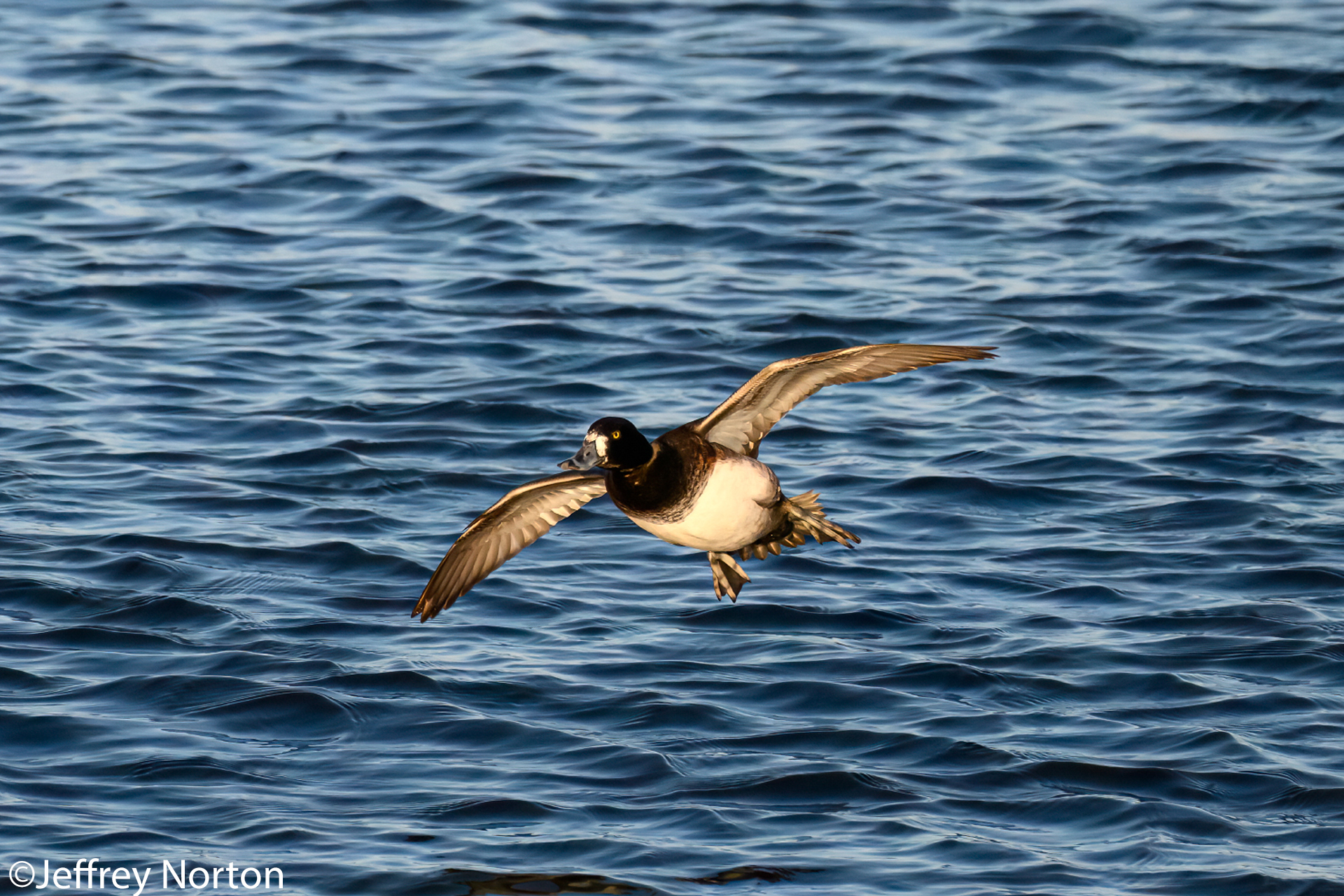
Winter is a wonderful time for birding in Maine – at least when you are dressed appropriately! Colorful seaducks that breed in the high Arctic grace our shorelines – including all three scoter species and dapper Long-tailed Ducks, along with everyone’s favorite: striking Harlequin Ducks. Purple Sandpipers and Great Cormorants replace our summertime shoreline denizens. And if the winds are right, very sought-after alcids – including Dovekies and Thick-billed Murres – join our regular Black Guillemots and Razorbills. Black-legged Kittiwakes, Northern Gannets, and “white-winged” gulls add to the mix. In this workshop, we’ll hit a few of the prime viewing locations along Maine’s southern coast. But we won’t just be working on the checklist today. Instead, we’ll be focused on learning how to search for these birds – the how, when, and why – and how to identify them. We’ll learn about microhabitats, weather considerations, and seasonal timing to aid our search today and in the future. By visiting several seasonally-productive sites, we’ll compare similar species while taking time to savor the splashes of color offered by winter seaducks in an otherwise gray and white landscape.
To get an idea of what you may see when the tour returns in the winter of 2026, see the 2024 and 2023 trip reports.
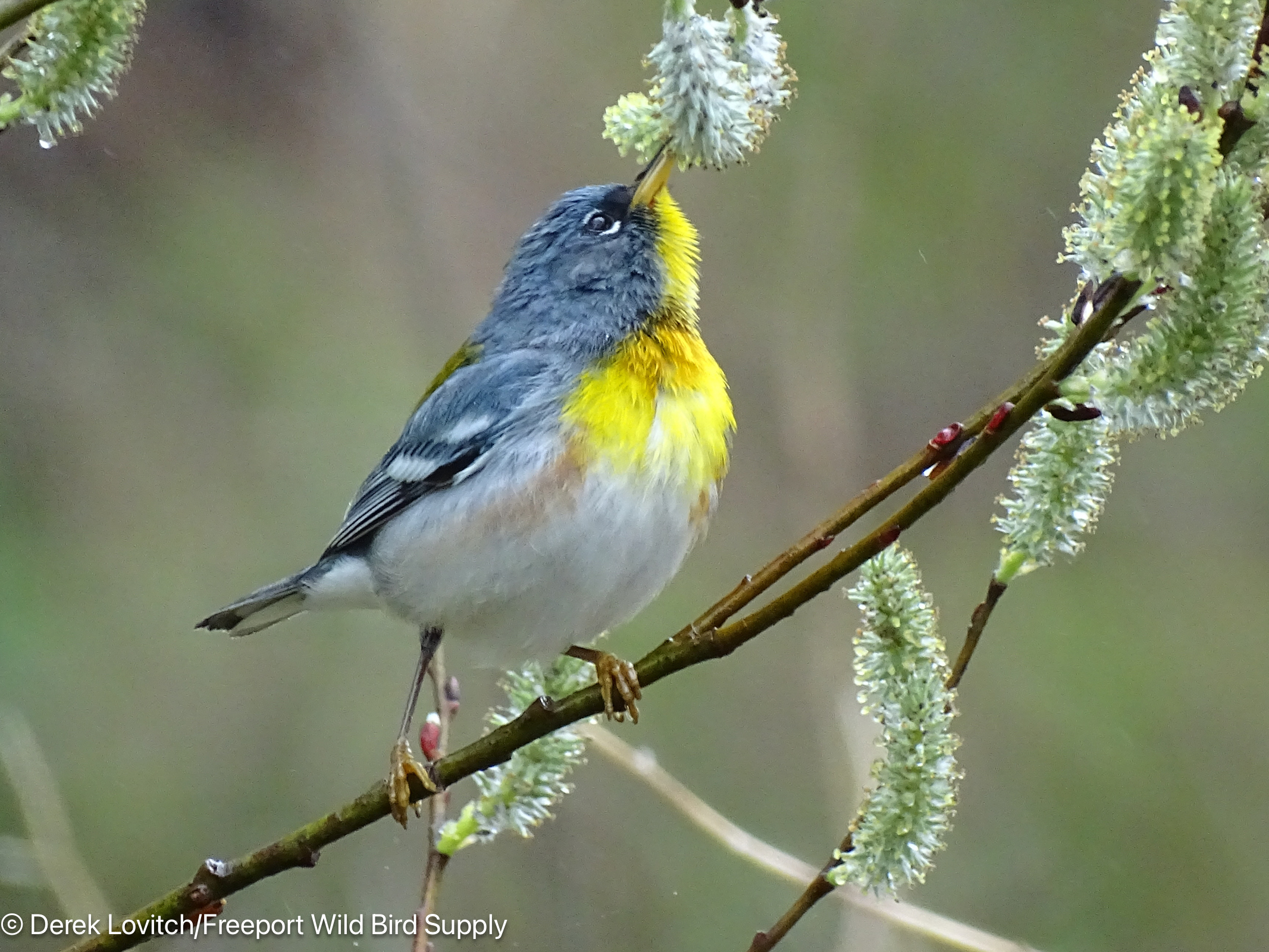
This Northern Parula was one of many ultra-cooperative warblers today. This was one of 10 parulas in a single cluster of willows on the shoreline of Capsic Pond Park during our 20205 workshop.
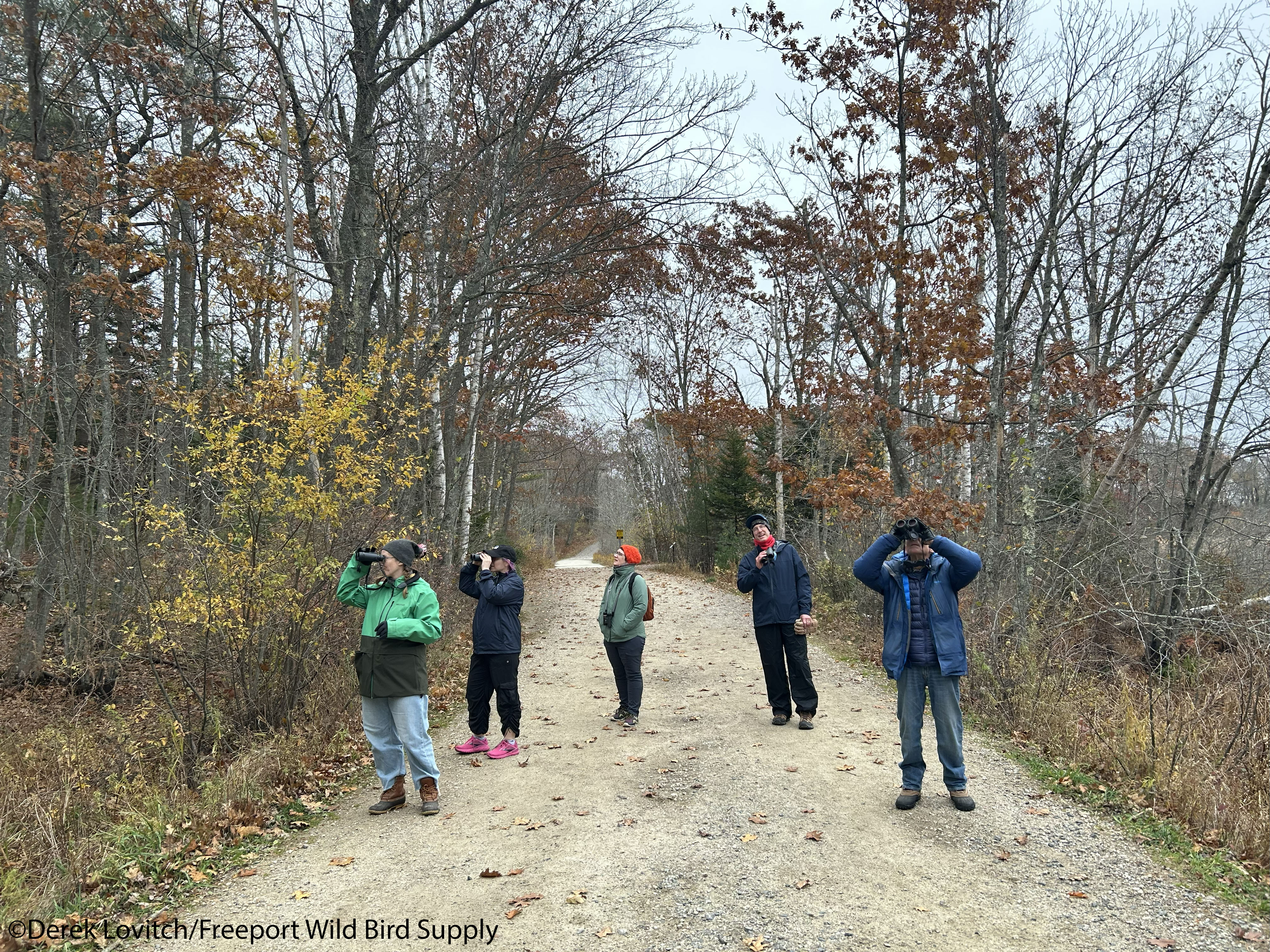
Spirits seemed low when we met in such dense fog, but I was even more excited to explore the environs of Portland migrant traps, beginning with Evergreen Cemetery. After a slow start, with few warblers overhead in the Morning Flight, we encountered several very productive pockets of activity, including a great diversity of warblers. Many were down low, too, with just fantastic looks at species such as Yellow, Black-throated Blue Warbler, Nashville, and Black-and-white Warblers, along with great looks at Veeries and Least Flycatchers. A “herd” of about 75-100 White-throated Sparrows marched through the forest understory, and we stalked a Black-crowned Night-Heron and spotted a Merlin among many other species today.
Evergreen was good, but nearby Capisic Pond Park was just great! While there were fewer warblers in both quantity and diversity, the cool, drippy morning conditions kept everyone even lower here. We began with 10 Northern Parulas at eye level all around us in a blooming willow (photo above), had great looks at a Prairie Warbler, listened to Northern Waterthrushes, and marveled at Baltimore Orioles.
We then discussed the overnight migration and how the radar images suggested what we would see and not see today, and how the “poor” weather produced such great birding. In the end, we tallied a very respectable-for-the-date 15 species of warblers! Although the list was not the priority as usual in these workshops, it’s hard not to get excited about the diversity of warblers now arriving. While Northern Parula was our most abundant warbler today, the total warbler list – in very rough order of abundance- also included Black-and-white,Yellow-rumped, Black-throated Blue, Ovenbird, Magnolia, Chesnut-sided, Yellow, Nashville, Common Yellowthroat, Black-throated Green, American Redstart, Northern Waterthrush, Pine, and the aforementioned Prairie. More importantly, perhaps, we worked on building our skills of recognizing each species and family so that our birding will be better and more successful on our own next time.
3. Shorebird Workshop
August 18, 2025; 8:00am – 4:00pm
This juvenile Piping Plover was one of 12 species of shorebirds we had the chance to really study on our Shorebird Workshop tour.
Could we have had more of a perfect day? Temperatures topping out in the mid-70’s, a light breeze in the afternoon, and clear skies – considering the rain of early summer and the recent extreme heat, we could not have asked for better. And then we saw thousands of shorebirds!
With more than 35 species of shorebirds regularly appearing in Maine, this workshop was designed to appreciate the diversity and beauty of this fascinating family. We hit some of the marshes, beaches, and rocky roosts that shorebirds prefer at the peak of their migration. We focused on comparative experience, learning how to recognize each species both near and far. Starting with the basics, such as plover vs. sandpiper, we’ll work our way up to the identification quandaries such as the “peeps” and lone yellowlegs. We worked through species by species as we developed a “toolkit” to approach shorebird identification on your own, using a combination of habitat, shape, size, structure, behavior, and plumage to identify this wonderfully diverse and attractive group of birds.
By day’s end we tallied a decent 12 (and a half!) species of shorebirds, a little short of our unofficial goal of 15. We did see a couple of rarities but were also dogged by Peregrine Falcons and Para-gliders causing birds to disperse and/or take cover. But we had plenty of chances to study a nice array of species, often side-by side.
Beginning at Biddeford Pool Beach, we started with the basics and enjoyed watching Ruddy Turnstones bulldoze their way into the wrack line and picking out White-rumped Sandpipers from a mass of Semipalmated Sandpipers. A Baird’s Sandpiper at Great Pond was one of our most notable birds of the day, and not where we expected it.
At Hill’s Beach, there was a lot of disturbance today, but we had some good opportunities to study Piping vs Semipalmated Plovers, Sanderlings, spiffy Short-billed Dowitchers, and more. We then shifted to the Pool, where we studied silhouettes and practiced distant shorebird using mostly general impression of size and shape. It was here that we had our largest numbers of the day, with an estimate of 1600 Semipalmated Sandpipers, 300 Semipalmated Plovers, and 163 Black-bellied Plovers leading the way.
Near or far, good light or bad, the general impression of size and shape, behavior, and more can be applied to identify shorebirds more readily than little nuances in some color or pattern.
After our lunch break, we returned north to Scarborough Marsh, where I would usually start the workshop, but with very low water in the upper salt pannes due to the drought, we shifted the itinerary. But the incoming tide at Pine Point did not disappoint! We had some close studies of more Short-billed Dowitchers and better views of Black-bellied Plovers, and about 1200 Semipalmated Sandpipers were present. However, as they moved close and concentrated, a Peregrine Falcon came tearing in, flushing most of the birds. Then, it made a sudden burst of speed and a hard turn and before we knew it, there was one less Semipalmated Plover on the mudflat. While it was poor timing for our shorebirds workshop (let alone for that one particular plover!), it was an awesome show (well, for us anyway) and one that will not soon be forgotten.
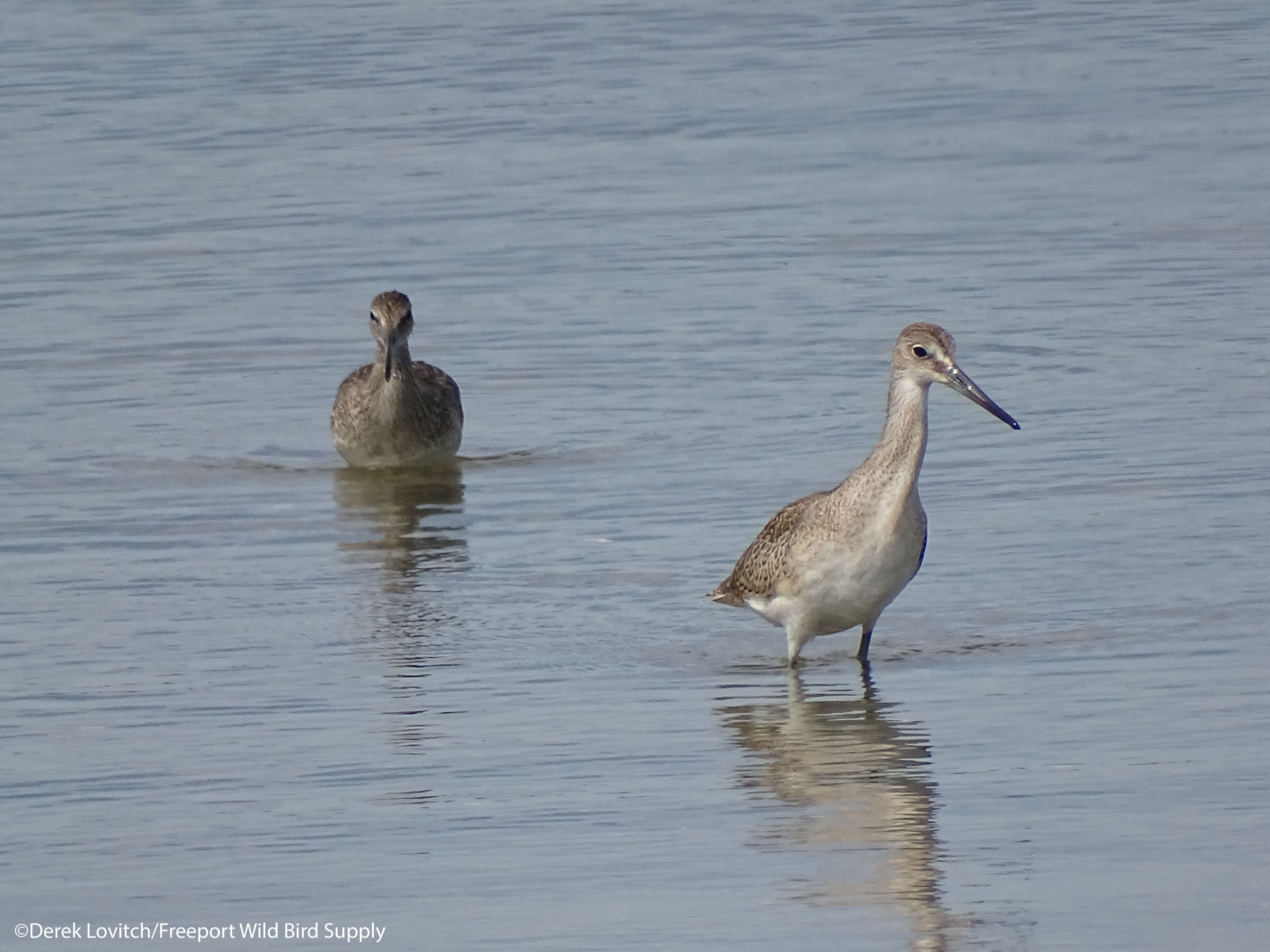
Some birds finally returned to the mudflat, when a large (for the date) flock of Willets flew in, making their usual grand entrance. We were able to put our advanced shorebirds ID skills to work with the bigger, lankier, grayer one that we soon identified as a rare in Maine “Western” subspecies of Willet. It might have been beyond today’s goals, but it was a great lesson in using comparative tools.
A couple of upper marsh stops finally gave us a good, close comparison between Least and Semipalmated Sandpipers, and a Lesser Yellowlegs that was close enough to study and enjoy, bringing a productive and successful day to a close.
4. Monhegan Birding Workshop
September 12-14, 2025
Our final Downeast Adventures birding workshop tour of 2025 spent 3 delightful days on Monhegan Island. Weather, geography, habitat, and migration ecology all combine to produce some remarkable birding opportunities at this special place. And even when it’s “slow” by lofty Monhegan standards, lots of learning experiences and workshopping opportunities would be at hand, often right out the front door of our hotel. Oh yeah, the food is sooo good, too!
As per the plan, we hit the ground running shortly after our arrival on the island. It took us an hour and 45 minutes to walk the ½ mile or so to our hotel as we encountered quite a few migrants, especially at my favorite starting spot along Wharf Road. We jumped head-first into aging and sexing fall warblers thanks to 3 different plumages exemplified by a trio of Cape May Warblers. American Redstarts, Northern Parulas, Yellow Warbler, and more introduced us to what birding Monhegan in the fall is all about.
By the time we reconvened after a lunch break, the insanely gorgeous weather with bright sun and very little breeze encouraged birds to take to the shadows. A sky constantly abuzz with Merlins didn’t help either, although we enjoyed it. While passerine activity had slowed dramatically, we enjoyed a light hawk migration with a couple of Northern Harriers and a few American Kestrels, while the Merlins and 1-2 Sharp-shinned Hawks further diminished the activity in the trees and shrubs. We took the time to visit the east side of the island, sample the different habitat types of the island, and discuss food plants for birds and native insects. The butterfly, dragonfly, and insect-watching was excellent on this unseasonably warm afternoon, and we worked on learning the connection between birding and bird habitat.
On Saturday morning, we learned why there were so many birds around Friday morning, but few in the air at sunrise. But there were definitely “new” birds around, suggesting at least a light arrival of birds overnight had occurred, including two vociferous Dickcissels. I made the decision to try and track down a Blue Grosbeak that had just been reported, but unfortunately, it did not wait for us. We did have an immature male Orchard Oriole, however, which was a treat, and we spent more time studying Cape May Warbler plumages.
On such gorgeous days, a lot of newly-arrived migrants simply depart the island as part of their morning redetermined migration flights (yes, we discussed this more thoroughly among many topics of avian and general ecology discussed throughout the weekend). In fact, the second half of our morning was very slow, but we did enjoy a couple of adult Lesser Black-backed Gulls and we kicked up a very uncommon Marsh Wren. But warblers were few, and Merlins remained a’plenty. Red-breasted Nuthatches were very abundant however – demonstrating what an irruption looks like, and Ruby-throated Hummingbirds were unusually widespread for the date.
We filled the time between birds looking at all other walks of life. American Dagger Moths caterpillars were particularly plentiful.
The afternoon was spent with a couple of impromptu workshops, such as an introduction to gull identification as I attempted to enlighten the group about how manageable it is to understand the basics of this group of fascinating species. The avian highlight, however, was the thrilling chase of a Solitary Sandpiper by two Merlins right over our heads! The Merlins would gain some height, dive, and close the distance, only for the sandpiper to take another evasive maneuver. The sandpiper tried to gain elevation to stay above the diving Merlins, but they were getting closer! Then, the sandpiper made one quick turn, ascended, and took off to the north, leaving the hungry Merlins to mosey back down to the treeline to see if the marsh had something much slower to offer. We bid the sandpiper farewell and good luck as we thanked the Merlins for a most entertaining performance!
It was another very light migration overnight Saturday into Sunday, but unlike the previous day, we hit a wonderful early-morning wave. One sunny edge captivated us until it was time to hustle back for breakfast: Several American Redstarts, Red-breasted Nuthatches, Black-capped Chickadees, Common Yellowthroats, and Norther Parulas had joined together, punctuated by repeated views of a most cooperative Least Flycatcher. Every time we tried to move long, a new species appeared. A fly-over Greater Yellowlegs. A flycatching Eastern Wood-Pewee. And finally, a Brown Thrasher that popped out right in front of us.
I was thrilled to have this sample of “what Monhegan can be like” at this season for those who fought the urge to stay in bed. Post-breakfast was once again much slower, but we hit a few pockets of birds, as well a finding a Mourning Warbler which is always fun – and challenging – in fall migration. We watched and listened to territorial Carolina Wrens in a double-duet song battle, encountered a flock of 4-6 Red-eyed Vireos working on Fall Webworms, and spent more quality time with the island’s once-again-ubiquitous Ring-necked Pheasants. And of course, we made time to sample the stunning Acadian Forest habitat of the island’s interior and to take in the view from the lighthouse.
Another delicious lunch and then a slow meander to the ferry brought our visit to a close. On the ferry ride back, a few more Northern Gannets were seen, and plans to return to this extraordinary island were already in the works!
(2026 Birding Tours with Down East Adventures will be posted soon!)
Our collaboration with The Maine Brews Cruise enters its 11th season, with six exciting itineraries. These unique, relaxed birding and beer-ing adventures that you have come to love combine great local birding at seasonal hotspots with approachable opportunities to sample the delicious creations of some of our favorite Maine breweries. These events are a perfect introduction to birding and/or craft beer, and a great opportunity to enjoy our favorite pastimes with significant others, friends, and family that have interest in one topic, while your interest is primarily in the other (for now!). Educational, enjoyable, and eye-opening you won’t want to miss out our unique Birds on Tap series. In 2025, we’re excited to bring back more of these special birding and beer tours, perfectly blending nature exploration and craft beer tasting.
The six tours are as follows. After completion, tour reports will be posted here so this blog is your one-stop shopping for tour reports and upcoming itineraries.
1. Birds On Trip℠ – Roadtrip! Harlequins and Hops
Sunday, February 23rd, 2025:
After postponing our original date due to extreme cold, it was a full 30 degrees warmer today at start time! And while there was a chilly wind at a couple of stops, we also had some lovely calm and sunny conditions. As much as we hate to reschedule, this one worked, and therefore the day was already a success before we even departed for our birding destination!
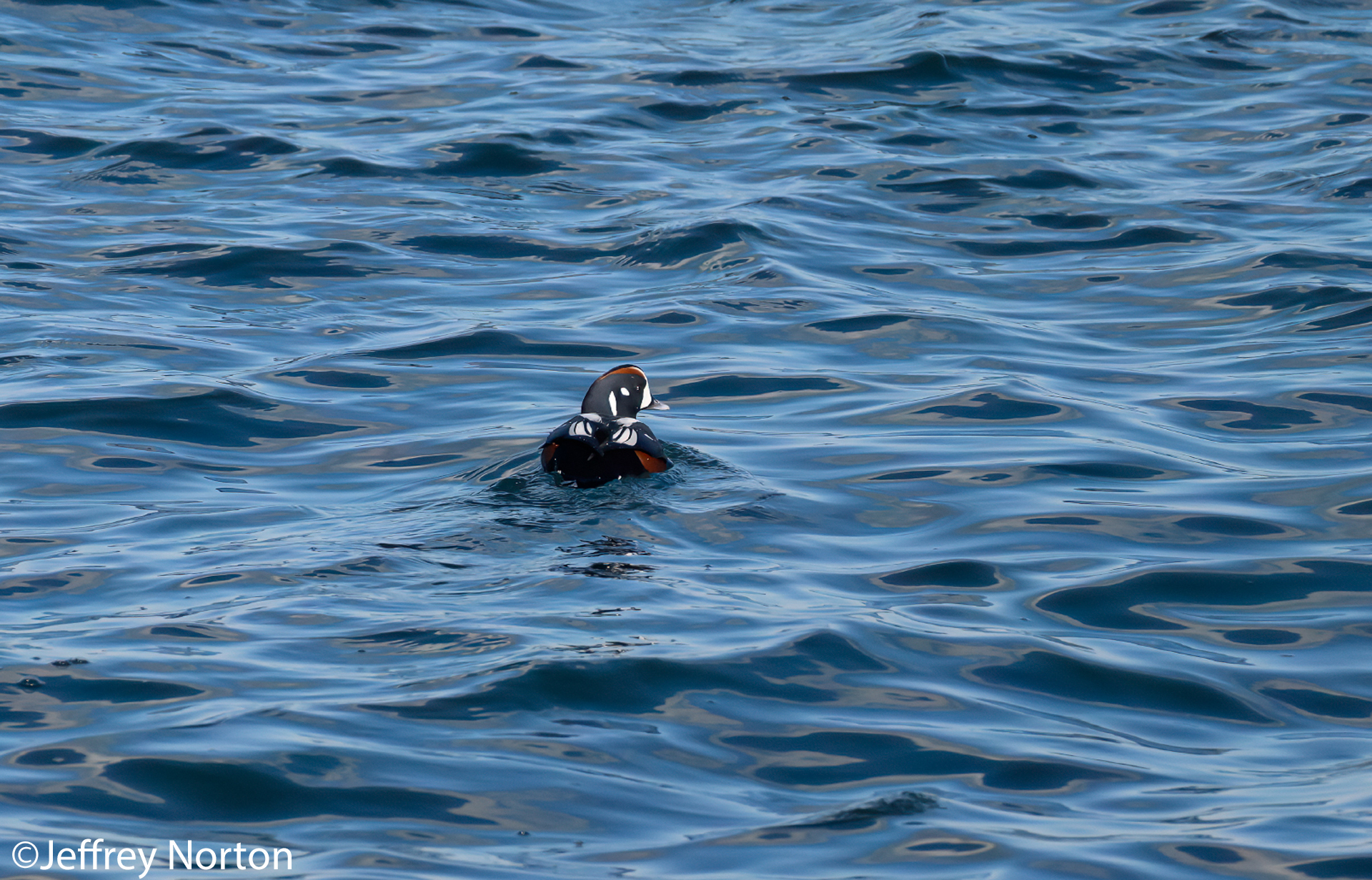
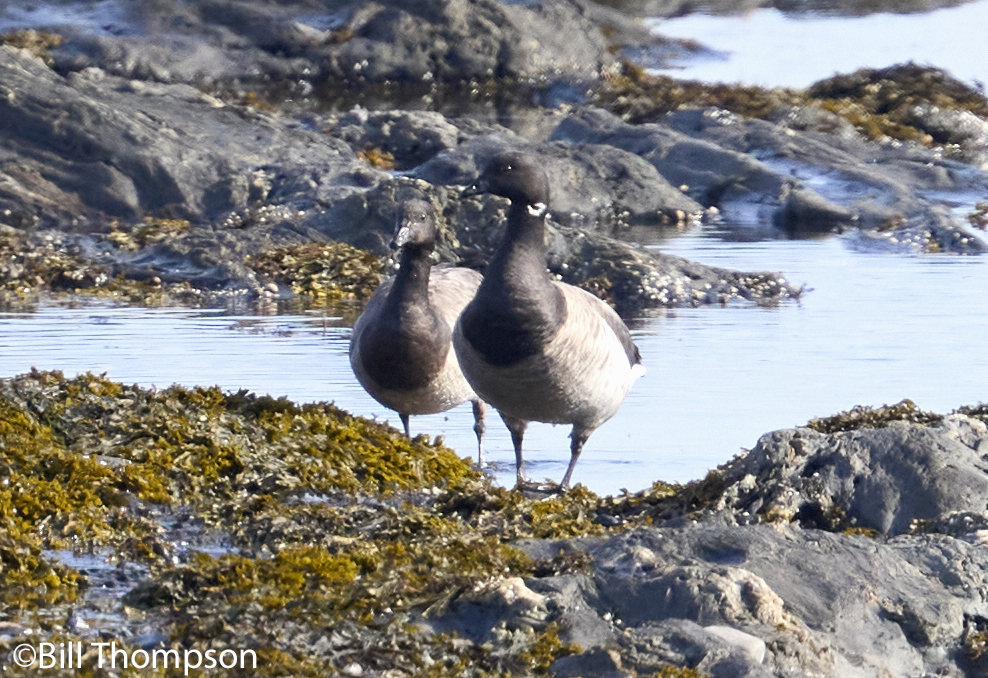
We began at Dyer Point in Cape Elizabeth, where we found our highest concentration of seaducks on the day, including at least 20 Harlequin Ducks – the tour’s eponymous bird.
And what a stunner they were, with males in perfect light and some small groups pleasantly close to shore. Large numbers of Common Eider and Black Scoters were present, along with several other species, introducing us to winter waterfowl identification. And as a special treat, 4 uncommon and local Brant were foraging in a tidepool before us.
Most of the ducks were here today, and not at nearby Two Lights State Park, but there we saw another 8 Harlequin Ducks, discussed American Robin winter foraging ecology, and practiced our basic duck and gull identification before we headed to nearby Kettle Cove. There were not a lot of ducks here today, but we did get a surprise Merlin whipping through, perhaps the reason a Horned Lark was calling high overhead.
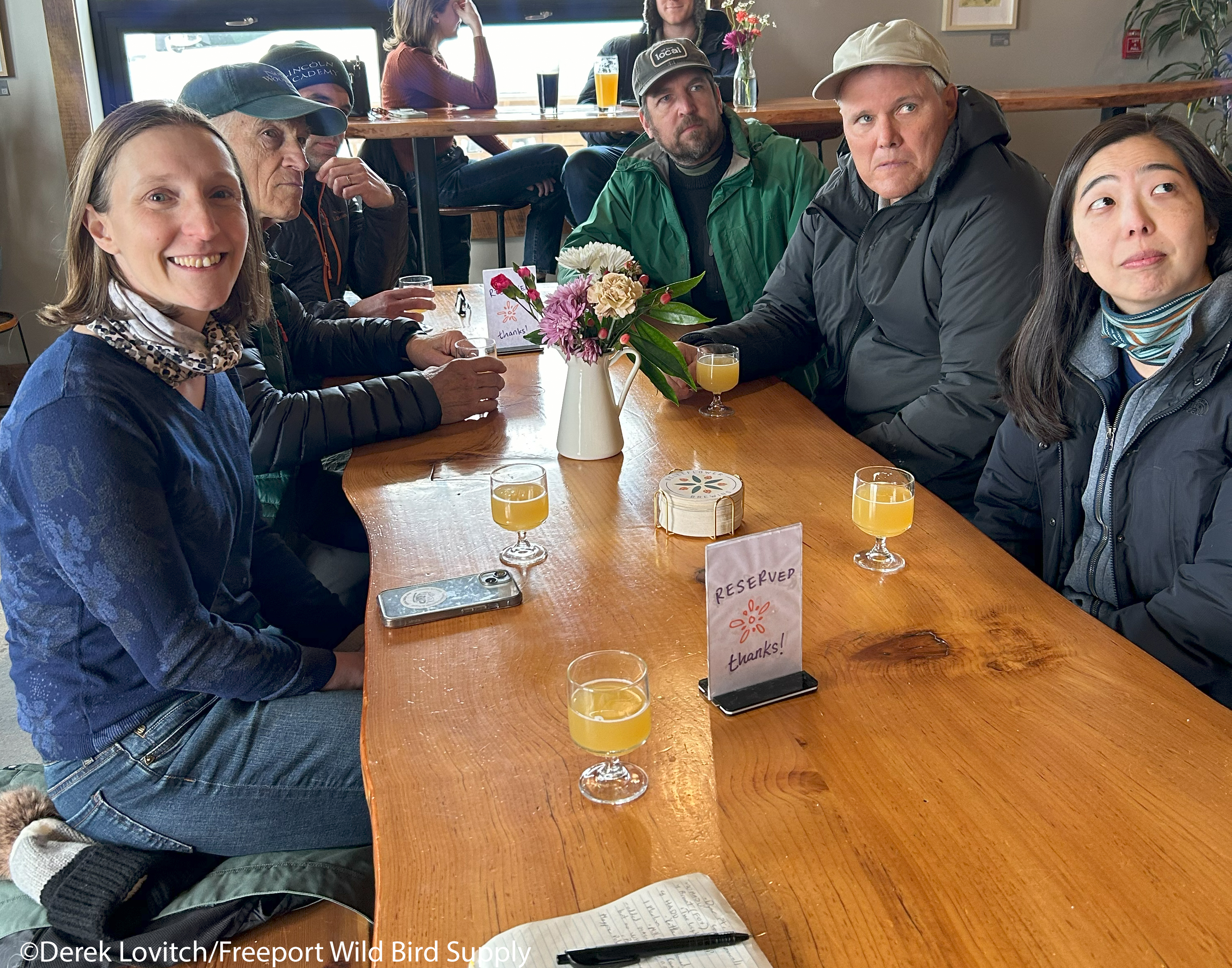
As a final stop, we checked Mill Creek Cove in South Portland for a very quick gull ID introduction to augment earlier conversation, compared Mallards and American Black Ducks (taking time to marvel at the beautiful drake Mallard!), soaked in a sunning drake Red-breasted Merganser, and enjoyed the sight of all of the gulls and ducks in the cove taking flight as our second Bald Eagle of the day soared overhead.
Part two of the tour began at Belleflower Brewing in Portland, one of my favorite Maine breweries. Keeping with the bird theme, we started by sampling their Magpie Pale Ale and then compared it to their Double-dry Hopped Finch & Thistle. Beginning with the recommended way of smelling and sipping a new beer, we discussed the basics of beer style, what the hell “double-dry hopping” means, the origins of the “New England” style, and then shifted gears with their brand new Just Like Home, a maple coffee brown ale. I thought the subtle maple sweetness was just right with a roasty coffee hint but the lighter body of a brown compared to a stout.
Crossing the Bayside neighborhood brought us to Argenta Brewing, one of Portland’s newest breweries. Exclusively brewing lagers, it was a nice contrast to our focus on ales at Belleflower. Starting with a generous half-pour of their Generic American Lager, we enjoyed the light, refreshing, “crushability” of a craft version of the popular lawnmower beer style. Craft beer truly is for everyone, and simple beers like Argenta’s Generic American Lager shows its not all about “hop-heads” and alcohol bombs.
We were given a choice for our next pour, and several folks tried the Mexican Lager to compare corn verses barley as the primary malt, while other tried everything from their hard seltzer to their Munich Dunkel- new to me, I found the mild roastiness and hint of sweetness on point for the style.
With a pleasant day (compared to the rest of the month), lots of beautiful and accessible wintering waterfowl – of course and especially including Harlequin Ducks – a few avian surprises, and newly-broadened palettes (I love it when folks say they really liked a beer in a style they didn’t think they liked), we kicked off the 11th year of the Birds on Tap – Roadtrip! the right way!
2. Birds On Tap℠ – Roadtrip! Warblers and Wort
Thursday, May 8, 2025.
While the rarest bird of the day came early, the rest of the trip was far from anticlimactic. Even better, it was the only warm and dry day of the week!
As planned, we began at Evergreen Cemetery, but our goal was set forth for us in the continuing presence of a very rare Cerulean Warbler. In fact, when I saw her a few days prior, it was the first Cerulean Warbler I have ever seen in Maine and at least a “state bird” for the several hundred folks who have seen it since. Even if you have never heard of a Cerulean Warbler, the excitement of the dozens of other birds present today was contagious. Luckily, we saw her not just once, but twice, without any concerted effort, and the second view was long and fantastic. Unfortunately, my sad attempt at a photo did not do it any justice.
There were other birds, too! We heard Ovenbirds and Wood Thrushes, saw some close-up Black-and-white Warblers, found our first Wilson’s Warbler of the year, and enjoyed basking Painted and Snapping Turtles.
Other than the Cerulean excitement (do we have to rename this tour Cerulean and Cervezas!?), it was actually rather slow today for mid-May, so we relocated to Capisic Pond Park as the last of the fog burned off and the sun (remember that?) came out. Here, birds were easier to see, including stunners like Baltimore Orioles fighting over territories, and some really close and insanely cooperative Northern Parulas that fed right in front of our faces. A sharp eye yielded a Black-crowned Night-Heron as well.
After some productive and instructive birding, we headed back into town to visit Belleflower Brewing, one of my favorite Maine breweries. Keeping with the bird theme for a little longer, we began with their pale ale, Magpie, with its great citrus and resinous balance, followed by the more grapefruity Finch and Thistle. Belleflower treated us to a third sample, of our choice, and we covered a nice range of their offerings from a Vienna lager to a double-dry-hopped double IPA to savor as we discussed some beer history and mythology.
Next up was Definitive Brewing on the other side of town. With so many options, everyone was able to choose their two samples, and there are no shortages of choices here. I went with Robin (because bird names!) their Imperial Pastry Stout and Blueberry Waffles, a pastry sour. I saw lagers, an IPA, and several sours among the group, and this photo captured the rainbow of colors here, with my choices and those of two of the members of the group. Our birding had something for everyone: a rarity for the “life list” and cool behavior from some of our common and beautiful birds as we learned about the mind-blowing feat of migration. And between Belleflower and Definitive, there was most certainly something for every beer drinker!
3. Birds on Tap℠ – Road Trip! Shorebirds and Steins
Sunday, August 3rd: 9:00am – 3:00pm
The original BoT Roadtrip! Way back in 2015, our most popular tour returned to Scarborough Marsh at prime time for a good variety of migrant shorebirds. And we had absolutely gorgeous, perfect weather to do it!
Beginning at the “Pelreco Marsh” high water levels limited our shorebird numbers a bit, but we were introduced to some of the basics of shorebird identification thanks to a flock of Short-billed Dowitchers and scattered Least Sandpipers. We spied a Saltmarsh Sparrow and talked about its fascinating ecology and peril, and were surprised by the arrival of a rare Tricolored Heron!
Relocating to Pine Point, we hit the tide perfectly, and soon, thousands of shorebirds were before us! The rapidly exposing mudflats steadily sucked in birds, with long-legged sandpipers appearing first, including 3 Whimbrel, with their massive curved bills, 8 Willets, and 3 Black-bellied Plovers. But as usual, it was the masses of the smallest shorebirds that stole the show, with an estimate of 2500+ Semipalmated Sandpipers and 225+ Semipalmated Plovers spread out before us. What looked like the first exposed sandbar was actually solid shorebirds! Learning the basics of sandpiper vs plover and moving on to sorting through the “peeps” for a White-rumped Sandpiper or two, we were introduced to the joys and challenges of shorebird identification, while mostly just enjoying the sight of so many birds! A few of us picked out a couple of Roseate Terns among Common Terns, and later, a mostly-adult-plumaged Bonaparte’s Gull was especially cooperative for photo-ops.
In the photo above, a Black-bellied Plover, Whimbrel, and Willet are in one field of view for comparative study, while I always insist on taking a moment to gawk at the eye of a Double-crested Cormorant.
Eric then led us to our first brewery, Modestman in South Portland. Originally founded in Keene, NH, owner/operator Ash Sheehan opened this second location closer to home here in SoPo. Tucked in a neighborhood down a side street off of Rte 1, someone on the tour who lived a mile and a half away didn’t even know it was there…there were all sorts of discoveries on this tour today, from rare herons to hidden gem breweries.
Coming in from the sun, we began with a refreshing and quenching light berliner Weiss sour, Black Reign with blackberry and boysenberry. Next up was It’s a Beautiful Thing, their flagship single-hope pale ale. Loaded with Citra hops, it blurs the line between a pale and an IPA, but it nicely progressed the palette and the ABV. When Life Gives You Lemons, loaded up with Citra and Simcoe was next up, providing a nice fruity/dank balance that Modestman is known for. I think this beer really nicely captured the essence of what people I know like most about their brews. Everyone got to choose their own last 4oz sample, and I went with Hard Rass Imperial Sour for a big and bold raspberry juice bomb.
Our next destination was the latest tasting room for Westbrook-based Mast Landing, a short distance away on Cottage Street in South Portland. We continued to cover the basics of beer varieties here, starting with the clean and crushable Champ Lager. No visit to Mast Landing – especially a first visit for most of our crew today – is complete without trying their famous flagship Gunner’s Daughter peanut butter milk stout, and enjoying it on Nitro is always a special treat. Like a creamy liquid peanut butter cup (sans the allergens), Gunner’s Daughter deserves its accolades. Once again, our last sample was a personal choice, and since Mast Landing has something for everyone and I believe there were over 10 beers chosen among the 13 people (unfortunately, everyone but Eric, our trusty brewery guide and driver). Since it’s a Birds on Tap – Roadtrip, I for one had no choice but to go with a bird named beer. There are several here, but today I tried the 2025 incarnation of Song of the Swallow, which was laden with 5 varieties of hops for a really smooth and juicy final toast.
5. Birds on Tap – The Boat Trip! Rare Birds and Island Exploration.
Sunday, October 19th , 9:00am to 2:00pm
Here are some photo highlights from this annual favorite!
Big Brown BatDeKay’s Brown SnakeFort Gorges
6. Birds on Tap℠ – Road Trip! Rarity Roundup!
Sunday, November 9: 8:00am – 3:00pm
Our final Birds on Tap! tour of 2025 was our Roadtrip: “Rarity Roundup” on 11/9. Unlike most tours, where we know our destination – chosen to provide the best birding opportunities and highest rates of success possible – this trip didn’t have a destination until we were pulling out of the parking lot in Portland!
Designed to take advantage of the latest rare bird reports, our itinerary was to work our way south, either looking for rarities that had previously been reported, or finding our own by checking the seasonal vagrant hotspots. The southern coast of Maine is usually the best area for really rare birds this time of year, but I threw the plan out the window immediately and we turned northward.
I just couldn’t resist taking people to see a long-staying (since November 2nd!) MacGillivray’s Warbler (only the 7th ever in the state of Maine) in Yarmouth. I felt confident I could find it quickly, thanks to its constant vocalizations, we’d get a look and then we would move on to the next bird. I did not expect, however, to find it that quickly!
In fact, I heard it the very second we entered the trail. It was calling nearby and we slowly and quietly moved in position. We found it foraging low on the ground, in some perennials, only a handful of feet away. Now this skulky bird didn’t exactly sit out in the open, but over the next 15 minutes or so, we all had satisfying (or better) looks, until anxious birders (who had apparently been waiting too far down the trail for up to two hours!) overwhelmed us. We slowly moved away, following the bird’s call notes, eventually finding it again, and then watching as it flew about 2 feet from one of us where it disappeared into a dense thicket.
Wow! What a thrill!
I refreshed the rare bird alerts (and all the different places rare birds get reported these days) as we began our journey south, spending the time in the van working on a little game to practice our “status and distribution” knowledge during this exciting time of year for rare birds.
I didn’t want to ask folks to stand still in Scarborough Marsh for the rest of the morning to maybe hear a Clapper Rail call once, and there were no further reports of the Seaside Sparrow in Wells. So with each passing exit of the Turnpike, I decided to go all in in Kittery, beginning at Seapoint Beach. Yeah, there wasn’t much there, and nothing of note.
So the rest of our time was spent at the delightful Fort Foster, the host of so many vagrants over the years. We hoped the Cave Swallow from two days prior would reappear, or we would find something even better. Um, we did not.
In fact, it was pretty darn slow, at least in the brush and the woods. Offshore, waterbirds were building, and we had some good looks at Surf Scoters, for example. And overhead, there was an absolute massive Double-crested Cormorant migration going on. Numerous large flocks of several hundred were winging it south, in their usual “drunken v’s.”
We swung for the fences and combed Fort Foster, but alas, we were not heroes today: we found nothing rare. But it was fun to try!
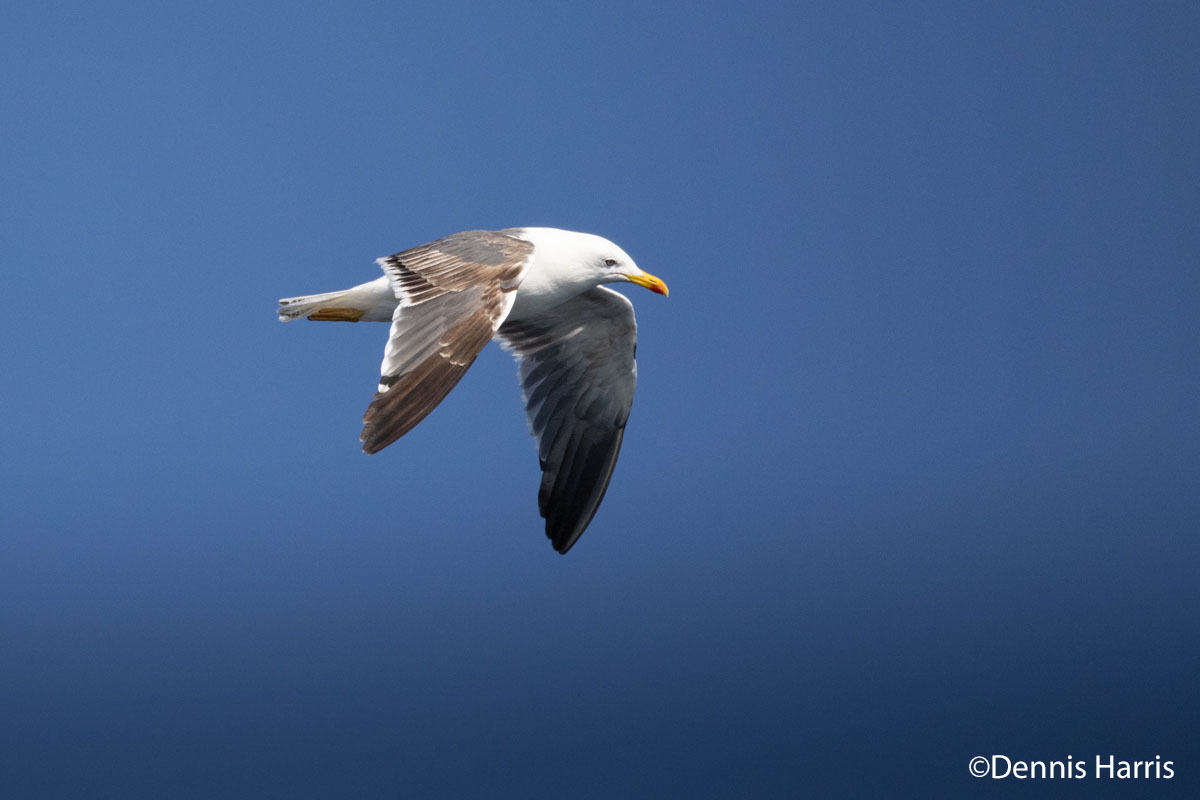
And besides, not only did we get a “mega rarity” with the MacGillivray’s Warbler, we got another “mega” rarity when we arrived at Tributary Brewing. There, we found Mott The Lesser, their 10.5% ABV Imperial Stout, released twice a year, and only available at the brewery. And yesterday it was released, so this was quite the “twitch.” You think people drive far to see a MacGillivray’s Warbler!? Well, rare beers are no different. This year’s version was aged in red, white, and tawny port wine barrels and then a rare apple wood rye barrel for additional complexity.
Of course, we didn’t want to destroy our palates, and we were here to learn about a wide range of Tributary’s beers, so we began with their flagship Pale Ale and compared this West Coast American standard to Affluente, an Italian-style Pilsner, with Adriatic barley and a light dry hopping of lemon-forward hops. Moving on to their new Zwicklebier, an “immature” lager, which was more malt-forward thanks to 100% Maine grown and malted barley. Then we tried the Mott the Lesser. And it was good. And bottles were purchased.
Our driver and beer guide Joe started us off with the basics of beer tasting and an overview of styles, but during our tasting, we were treated to a visit from head brewer and owner, Woody, who gave us the history of the brewery, started by his beer-legendary father, and guided us through the tasting. He discussed their commitments to Old World styles of beer and answered questions from the crowd.
Not to be outdone, apparently, Woodland Farms just up the road also laid out the red carpet for us, with owner Pat not only guiding us through our tasting, but providing a tour of the brewery itself, from first boil to final packaging. Woodland Farms is becoming known for their wide variety of offerings, and it was amazing to see how they can pull so much off in this small space!
Their Flagship is Blinky, an IPA with a very complex dry hop bill. We then tried Rossa Matrimonial, their version of an Italian Pilsner, a dry beer made with red malts. We once again remained in the Old World with Tmavy Piro, which means “dark beer” in Czech. A dark lager, it offered the “crushability” of a lager, but with more malt flavors before the crisp lager finish. And finally, everyone got to choose a final sample, with most people choosing the Big Effin Porter, a robust 8.2% porter. I went with the masses and tried this, too, and enjoyed how rich it was without the thickness and weight of an imperial stout.
Woodland Farms is also becoming known for their non-alcoholic beers, a rapidly growing segment of the beer economy. Out back, we learned about the differences in making non-alcoholic beer that tastes good verses beer with alcohol, and especially, mass-produced NA beer that usually tastes like, well, not much. To demonstrate what NA beer means in 2025, we were treated to two bonus samples: the NA Dogwalker with an abundance of sticky, piney-resinous hops, and their NA Festbier, an easy-drinking seasonal malt-forward Oktober-fest style.
So from a mega rare bird and a mega rare beer, learning how to search for rare birds and how to make beer, and trying everything from non-alcoholic to a 10.5% imperial flavor-bomb, we most surely enjoyed an educational, enjoyable, and often enlightening day!
Once we traveled beyond the shelter of Damariscove Island, we had a plan – or at least the concept of a plan. We’d slowly work our way straight south to deep water, make a turn to the east as the forecast was for seas to start diminishing, and then take mostly following seas for a smooth return trip home.
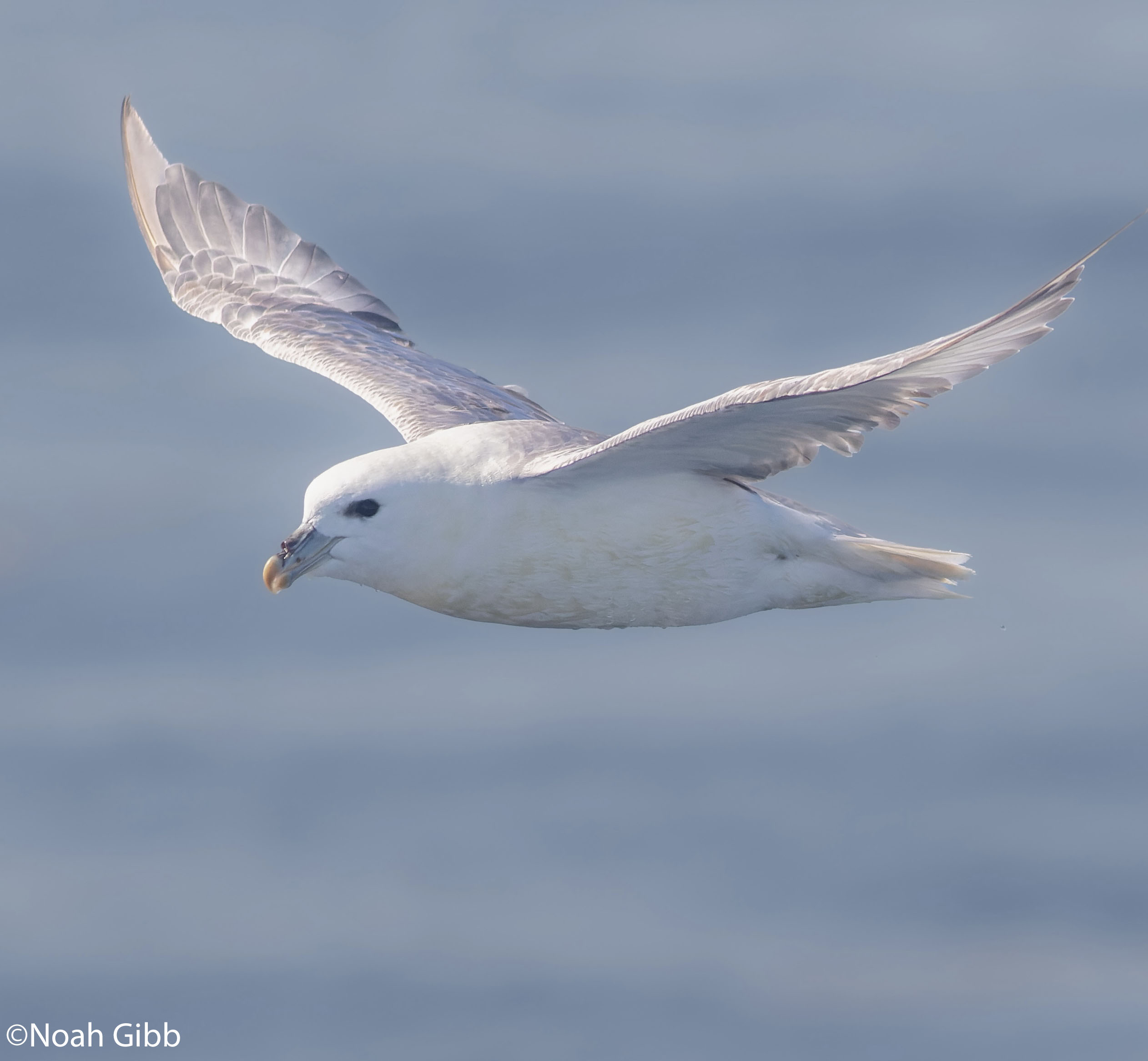
Peregrine Falcon having brunch to go.
We had lots of Northern Gannets early in the trip – always a good sign – but it was pretty slow going through the area known as The Pasture, which like all offshore patches, is always hit or miss. In fact, the only other pelagic we had was a single Cory’s Shearwater seen by only a handful.
Unfortunately, once we made the turn to the east, it became essentially unbirdable. The forecast 4-6 foot seas were right, but the distance between waves (the wave period) was significantly shorter than forecast, and the waves were definitely not diminishing. Captain Steve did an exceptional job of trying to soften the ride and keep us safe, but we just weren’t going to be able to continue east towards some of our deep water hotspots. When a bird was called – such as a single Northern Fulmar (one of our primary targets on the trip), few people were able to even try to see it before it was long gone behind the waves. Perhaps only the Yellow-rumped Warbler and Savannah Sparrow that we encountered about 15 miles offshore were having a worse day. I tried to keep some bird commentary going, if only as a distraction, but I’m not sure anyone was listening at this point!
So it was decided to make a turn for home. In a last ditch effort to salvage the birding day, we angled for the mouth of Sheepscot Bay. An unidentified dark jaeger zipped by, seen by just a few, tantalizing us to what else is out here today.
Once in the mouth of the bay, sheltered by Damariscove off to the east, we found gentle seas, and decided to try our hand at attracting some birds with a chum slick. We laid a slick for about 1-2 miles of pork fat soaked in fish oil. Thanks to a generous donation of surplus fatback compliments of Old Crow Ranch of Durham, we were likely the first ever pelagic to use local, pasture-based, regeneratively-farmed, non-GMO, pork fat. The experiment turned out to be quite a success, too!
First, we kicked up two Common Murres as we traveled, one of which flew past the boat affording a great view for those who were still on deck; even the seabirds were seeking sheltered waters today!
We were soon attracting several hundred gulls to our chumslick, and we finally teased out a single Lesser Black-backed Gull from the masses. A few lingering Laughing Gulls and several Ring-billed Gulls, including spiffy fresh juveniles, joined the myriads of Herring and Great Black-backed Gulls.
We then tried the same technique closer to the mouth of the outer Boothbay Harbor, closer to Damarsicove. At first the results were surprisingly lower, until a Peregrine Falcon and a Northern Harrier over the island kicked up the gulls roosting on the windward side. Once the gulls saw the feeding birds behind us, the game was on. Meanwhile, we enjoyed many dozens of Surf Scoters and Common Eiders, punctuated by both Black and White-winged Scoters, and from here to the harbor, another couple of dozen Common Loons and plenty of Black Guillemots.
I want to thank the captain and crew of Cap’n Fish’s Cruises for their hard work and dedication today, and their best efforts to keep us comfortable. I want to thank my spotters, Jeannette Lovitch and Ian Carlsen (who also did a fantastic job keeping the official eBird checklist following pelagic protocol). A big thank you to Alex Lamoreaux for still finding birds in the worst of the snotty water. And another big thanks to our chummer, Dan Nickerson, who got the action going once we found some calm waters.
And most importantly, thank you to all of those who came aboard today. Some said they had fun. Many suffered. But everyone endured. If this was your first pelagic, you’ll be thrilled to know you were likely just had your worst trip. For those who like roller coasters (unlike me!), I guess you’re welcome?
Here’s the trip list. For the hit-or-miss October pelagics in the Gulf of Maine it’s really not that bad.
It might not “count,” but the Ring-necked Pheasants on Monhegan are iconic!
Approaching the island on Friday, 9/27, the fog was rapidly lifting on the mainland, and the skies were clearing. High seas from the previous days were steadily diminishing. An offshore fogbank reduced our chances to see many birds during the boatride, but by the time we reach the island, the sun was shining through.
Things seemed fairly slow, but there were birds here and there. One single bush hosted all three Melospizas: Lincoln’s, Swamp, and Song Sparrows, and one of the tarrying Baltimore Orioles soon joined them. It was a relaxed start to the weekend, affording us time to check in and enjoy lunch before returning to the birding.
We don’t just look at rare birds, we study the common ones…at least on a slow day! Like this cooperative Song Sparrow
The afternoon was quite slow, as expected from the preceding nights with little or no migration on unfavorable winds, but we had birds to look at: Yellow-rumped Warblers sallying for midges at the top of spruces, scattered assorted sparrows, lots of great Merlin performances, and no shortage of Ring-necked Pheasants.
As usual for the end of September, Yellow-rumped Warblers were the most abundant migrant. This one was nicely demonstarting what makes it a “Myrtle Warbler.”
As the sun set, a huge flight was taking off and continued throughout the night. Very light northwesterly winds overnight were a little lighter than I would have preferred, but there was just a massive amount of birds on the move, and a great Morning Flight on Saturday morning to start our day was indicative of that.
The radar return was huge overnight, with lots of birds on the move. We did wonder, however, if that blob over the Mid-Coast was an isolated shower…or perhaps it was “Independence Day!“
Yellow-rumped Warblers filled the air, with handfuls of Blackpoll Warblers and a small number of Northern Parulas. After the morning flight settled down, the rest of our am was also very good. While the very light winds allowed much of the birds partaking in the Morning Flight to leave the island, there were plenty of birds remaining on the island to be seen. In addition to Yellow-rumps, there was a good arrival of White-throated and other sparrows, and pockets of activity were sifted through, producing a wide array of fun birds.
A Dickcissel in the community farm and a total of 6-7 Baltimore Orioles nearby were soon trumped when a first fall female Mourning Warbler actually walked into the open for all to see (for a change) …on a plywood garden table nonetheless! We found a Clay-colored Sparrow feeding amongst Chipping Sparrows, discovered a rather rare on the island Pine Warbler, and enjoyed a nice variety of the expected seasonal migrants.
Clay-colored SparrowClay-colored Sparrow with a molting juvenile Chipping Sparrow in the foreground.
Lovely weather all day encouraged us to enjoy an afternoon on Burnt Head, were we picked up a tardy Chestnut-sided Warbler and a rather rare in the fall on the island juvenile Ring-billed Gull. We also noticed a lot more Red-eyed Vireos during the course of the day, with many at and below eye level.
While a rare Yellow-crowned Night-Heron called over the harbor at nightfall, I was wandering on my own so it doesn’t count for the group, unfortunately. I was still pleasantly surprised by it, and it punctuated the calls of songbirds departing the island.
Luckily, a moderate flight occurred throughout the night (the overall intensity was a little obscured by fog on the radar images) on light west winds that had become calm by morning. Those calm and cooling conditions allowed fog to roll back in, and the Morning Flight was just a trickle to start on Sunday morning, our last morning together.
However, once the sun burned through, birds were in the air and appearing out of nowhere, and the birding really picked up. In flight, it was mostly Yellow-rumped Warblers, but there were more Palm Warblers involved today. We began finding “new” species for the trip list, like a Cape May Warbler, some recently-arrived American Robins, and we enjoyed watching a swirling flock of 16 migrant Black-capped Chickadees.
Late Blackburnian Warbler
After breakfast, the birding was overall quite a bit slower than Saturday, but the quantity was replaced by quality! An Orange-crowned Warbler at the Ice Pond, a continuing female Dickcissel in the cul-de-sac, two different Clay-colored Sparrows. Pockets of activity offered up nice views of a male Cape May Warbler, a few Blackpoll Warblers, and then we found not one, but 3 Nelson’s Sparrows in the Lobster Cove meadow – one even perched conspicuously enough to be viewed by all!
Nelson;s Sparrow sitting in what passes for “the open” with this species!Dickcissel
As the group trickled home, the last participants standing joined me in a little longer hike from Lobster Cove to Burnt Head, which yielded two Lesser Black-backed Gulls, more Great Cormorants, and yet another Orange-crowned Warbler to bring the official tour to a productive conclusion.
I remained on the island overnight, and with light southerly winds and a return of the fog, there was very little in Morning Flight and to start the day. But the day had a “rarity” feel to it (southwest winds overnight will do that!), and my Rarity Fever was soon stoked by a wayward Yellow-billed Cuckoo that sat still for me, gaining the first rays of sunshine of the morning, in a small tree in the Monhegan House lawn. Two Rusty Blackbirds were foraging on the lawn, and once the sun came up, a few more Yellow-rumped Warblers began to appear.
Yellow-billed Cuckoo
But as Jessica Bishop and I began a post-breakfast search, the What’s App began to ping. Ken and Sue Feustel had just found an Ash-throated Flycatcher on Wharton Ave, and we did a quick 180 and began the march back across town. The ample Trailing Yew breakfast was weighing on me, however, so my speed could have been improved. Nonetheless, the bird had disappeared before we arrived, so we fanned out to search.
After a short spell, I relocated the bird behind the Trailing Yew, and Jess rushed over and we began photographing it as the rest of the island’s remaining birders convened, including Donna the last member of my to depart. And she was quite happy with the decision to linger to say the least! (The tour was officially over, so this gem doesn’t count for the official triplist…darn!)
We studied the flycatcher, and I made sure to get a shot of the tail that would be adequate for identification confirmation (to rule out an even rarer Myiarchus flycatcher). Here, you can see the outer tail feather on one side, showing the dark brown of the outer web intruding into the end of the inner web – diagnostic for Ash-throated.
This was my 227th Monhegan Bird, and the island’s 3rd-ever, of this southwestern vagrant. What a bird!
While the rest of the day was a little anticlimactic from a birding perspective, Jeannette arrived and we set out to search for the now-missing Ash-throat and whatever else we might stumble upon. Two Clay-colored Sparrows were now together, one of the Orange-crowned Warblers was still at the Ice Pond, and at least one Nelson’s Sparrow was still at Lobster Cove. At dusk, two Wilson’s Snipe launched out of the town marsh, and at sunset, a migrant Great Blue Heron flew over. No sign of the Ash-throat for the rest of the day, unfortunately.
Orange-crowned WarblerPeregrine Falcon
On Tuesday, Jeannette and I awoke to a strong flight on the overnight radar image, but as expected on a north to north-east wind by dawn, only fairly a light Morning Flight occurred. Made up of at least 95% Yellow-rumped Warblers, it was a little busier than I expected, but it ended by about 7:00am. Granted, at least two hunting Peregrine Falcons may have had something to do with that.
We watched a Wilson’s Snipe evading a Merlin in flight, and some more new species for the weekend were overhead, including a Horned Lark, an Osprey, and a Semipalmated Plover. There were at least a half-dozen American Pipits in morning flight, and a new-to-us Brown Thrasher put in an appearance.
Red-eyed Vireo
After breakfast, it was exceeding slow, but we did have a Dickcissel in the garden, and a Scarlet Tanager joined the remaining Baltimore Orioles in the grapes. But most of our morning was spent chasing a reported Yellow-headed Blackbird (seen by two and never again) and Will Russell briefly relocated the Ash-throated Flycatcher – which looked much healthier today and was much more active. In other words, it was soon once again melting away into the scrub. It kept us occupied until it was time to depart, however.
Yellow-bellied Sapsucker
A very pleasant boat ride back to the mainland for Jeannette and I was far too nice to produce any seabirds of note, but it was a lovely way to finish up a delightful and fruitful fall weekend.
Here’s the official tour checklist:
27-Sept
28-Sept
29-Sept
American Black Duck
0
0
1
Mallard
8
12
16
Green-winged Teal
0
0
1
Common Eider
x
x
x
Black Scoter
0
0
8
Ring-necked Pheasant
15
15
25
Mourning Dove
10
15
12
Black Guillemot
x
x
x
Laughing Gull
8*
0
2
Ring-billed Gull
0
1
0
Herring Gull
x
x
x
LESSER BLACK-BACKED GULL
0
0
2
Great Black-backed Gull
x
x
x
Common Loon
1*
0
0
Northern Gannet
2*
0
1
Double-crested Cormorant
x
x
x
Great Cormorant
0
1
5
Bald Eagle
2*
0
1
Sharp-shinned Hawk
2
4
4
Belted Kingfisher
1
0
1
Yellow-bellied Sapsucker
0
20
20
Downy Woodpecker
2
4
3
Northern Flicker
3
15
15
Merlin
6
8
6
Peregrine Falcon
2
3
4
Eastern Phoebe
0
3
3
Blue-headed Vireo
0
3
4
Red-eyed Vireo
1
30
25
Blue Jay
9
13
9
American Crow
4
4
4
Common Raven
0
1
1
Black-capped Chickadee
x
x
30
Golden-crowned Kinglet
4
15
40
Ruby-crowned Kinglet
2
10
20
Cedar Waxwing
30
40
40
Red-breasted Nuthatch
2
8
6
Brown Creeper
0
4
4
House Wren
0
1
0
Carolina Wren
5
10
10
Gray Catbird
10
x
x
Northern Mockingbird
2
2
3
European Starling
x
26
26
Hermit Thrush
0
1
0
American Robin
0
0
2
American Pipit
0
3
3
Purple Finch
0
4
5
American Goldfinch
10
10
8
Chipping Sparrow
0
10
12
CLAY-COLORED SPARROW
0
1
2
Dark-eyed Junco
0
4
2
White-throated Sparrow
15
50
60
NELSON’S SPARROW
0
0
3
Savannah Sparrow
1
6
10
Song Sparrow
x
x
x
Lincoln’s Sparrow
1
5
4
Swamp Sparrow
2
15
20
Rusty Blackbird
0
4
2
Common Grackle
2
20
20
Baltimore Oriole
2
7
6
Northern Waterthrush
0
1
0
Black-and-white Warbler
0
0
3
ORANGE-CROWNED WARBLER
0
0
2
Nashville Warbler
0
3
0
American Redstart
0
1
0
MOURNING WARBLER
0
1
0
Common Yellowthroat
0
8
10
Cape May Warbler
0
1
3
Northern Parula
1
15
15
Blackburnian Warbler
0
0
2
Yellow Warbler
0
2
1
Chestnut-sided Warbler
0
1
1
Blackpoll Warbler
6
25
15
Black-throated Blue Warbler
0
0
1
Palm Warbler
1
30
20
PINE WARBLER
0
2
1
Yellow-rumped Warbler
20
150
100
Black-throated Green Warbler
0
10
3
Wilson’s Warbler
0
1
0
Northern Cardinal
8
10
6
Rose-breasted Grosbeak
1
0
1
Indigo Bunting
0
1
1
DICKCISSEL
1
1-2
1
Day Total
44
68
73
Warbler day total
4
15
14
3-Day Tour total=
81
Plus with Jeannette after the group and on my own =
13
Total warblers =
19+1
Molting juvenile Cedar Waxwing learning how to eat Winterberry.
And the additional species seen by me without the group, on Monday, and on Tuesday: