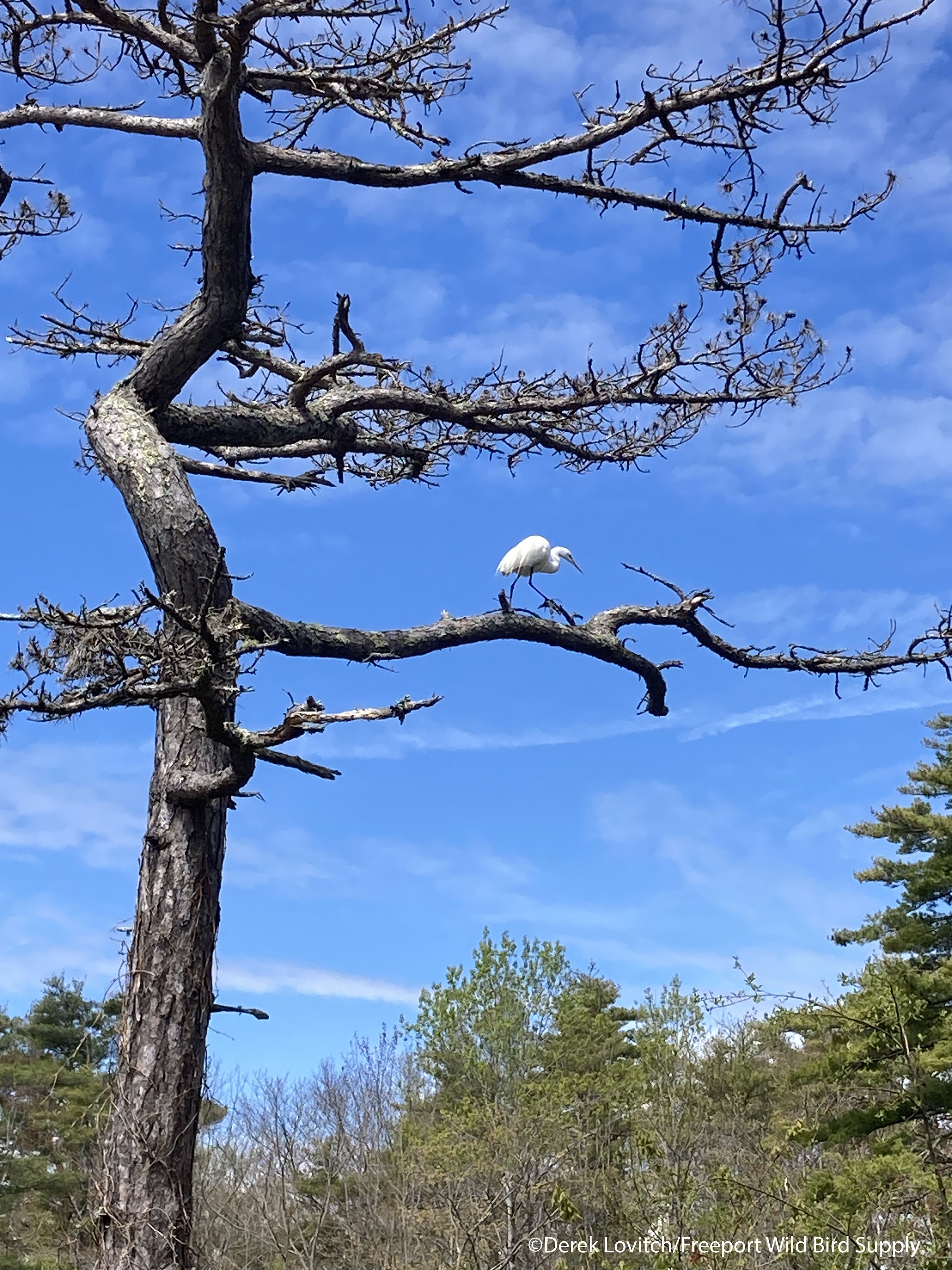
Luckily for this Great Egret – showing off it’s high-breeding condition lime green lores – last week’s snow didn’t last long in Scarborough Marsh.
The massive “winter” storm of 4/3 through 4/5 produced heavy snow cover and drove a lot of birds to feeders, including those that are not usual feeder visitors. Numerous reports of American Robins eating offerings of dried mealworms, suet, and even some seed were received. At our home in Durham, I spent the snow day experimenting with getting Eastern Phoebes to eat dried mealworms, finally finding success by floating them in the slush at the edge of our pond.
Meanwhile, feeder-watching during the day on the 4th yielded 44 Dark-eyed Juncos (up from 22), and more Red-winged Blackbirds and Common Grackles. By the next day, we had a new recent high of 4 Purple Finches and 6 Pine Siskins. Here at the store our 10 White-throated Sparrows continued, growing to 14 by week’s end. Two great nights of migration 4/8-9 and especially 4/9-10 saw many of these sparrows depart.
Away from feeders, my other observations of note over the past ten days included:
Red Crossbills continue to be widespread, with a highlight of 3 (including a fresh juvenile) feeding on the ground within 20-30 feet of the Saturday Morning Birdwalk group at Winslow Park on 4/6.
1 pair AMERICAN OYSTERCATCHERS, Pine Point, Scarborough, 4/7.
1 pair Piping Plovers, Pine Point Beach, 4/7.
1 Winter Wren (FOS), our property in Durham, 4/9.
1 Hermit Thrush (FOS), Florida Lake Park, Freeport, 4/10.
2 Ruby-crowned Kinglets, Florida Lake Park, 4/10.
1 Pine Warbler, Florida Lake Park, 4/10.
16 Palm Warblers, Florida Lake Park, 4/10.
2 Barn Swallows, Florida Lake Park, 4/10.
2 Yellow-rumped Warblers (FOS), Florida Lake Park, 4/10.
TOURS AND EVENTS:
1.Woodcocks Gone Wild – Now Saturday, 4/13
Due to the high winds and precip forecast for the evening of the 6th, we postponed our tour to the weather date of 4/13. There are no current openings, but a short waitlist if you would like to be added in case of cancellations. . Please call the store, 207-865-6000 to register.
2. Community Pizza Night at Maine Beer Company to support Feathers Over Freeport!
April 17: 4:00 – 8:00 p.m. – Maine Beer Company – Freeport Join us for a Community Pizza Night to benefit Feathers over Freeport. Proceeds from a raffle along with 20% of all food sales from 4-8:00 p.m. will be donated to support the annual birdwatching and nature discovery weekend hosted by the Bureau of Parks and Lands. Park and event staff will host an activity & information table and be on hand to answer questions about birding, the Hawk Watch, and Feathers Over Freeport. Location: Maine Beer Company, in the Tasting Room, 525 US-1, Freeport, ME 04342.
3. Birds on Tap! Kick-off event at the Portland Beer Hub!
Thursday, April 25, 2024; 5:00 – 7:00pm. Free!
Join Birding Guide and owner of Freeport Wild Bird Supply Derek Lovitch, and Brew’s Cruise owner Zach Poole, for an exclusive gathering at the Portland Beer Hub to celebrate the 10th Anniversary of Birds on Tap! and kick off our new tour lineup.
During this casual meetup, guests will mingle with other bird and beer enthusiasts, discuss the exciting lineup of upcoming Birds on Tap tours, and can enjoy flights of bird-themed local beers (for purchase).
It’s the perfect opportunity to immerse yourself in the world of birdwatching and craft beers. For a bit of fun, be prepared for some impromptu bird trivia and birding games.
Freeport Wild Bird Supply is very excited to partner with Down East Magazine’s Down East Adventures for the fourth year of offering exclusive birding workshops focused on gaining greater knowledge and field skills in a focused group of seasonally accessible birds. Focused on skill-builder rather than list-building, there will be plenty of “life birds,” but also more knowledge and education about birds, habitats, birding, and much more about the natural world. We’re happy to bring back the complete slate of tours from our 2023 season.
The full list and descriptions, along with registration information, for all of our upcoming tours (and an outline of 2025 options) can be found here. At the conclusion of each tour, I’ll post the trip report here.
Winter Waterbirds Workshop, January 14th.
I mean, really, what’s better than a Harlequin Duck?
For the second year in a row, very strong winds greeted us in the morning. So the game of the day was finding sheltered coves and respites from the wind. Therefore, we adjusted our itinerary accordingly, making a further adjustment based on parking lot closures from storm damage.
While we had high hopes of finding alcids that were blown closer to shore and were seeking refuge after the strong storm of the previous day, we didn’t see a single one – not even a Black Guillemot! However, we did see just about every other regularly occurring winter waterbird, from Red-necked and Horned Grebes to Buffleheads and Long-tailed Ducks Not surprisingly, Harlequin Ducks were the star of the show, with about 10 along Marginal Way in Oqunguit and abut 20 at The Nubble. Large rafts of Black Scoters were seen at several locations, with Surf and White-winged Scoters seen nearby for careful study.
We had a lot of Common Loons today, and we practiced learning their shape and size to separate them from other waterbirds at any range. Great Cormorants at The Nubble were nice to see, and we did a little introduction to gull identification with a mixed flock at Short Sands Beach.
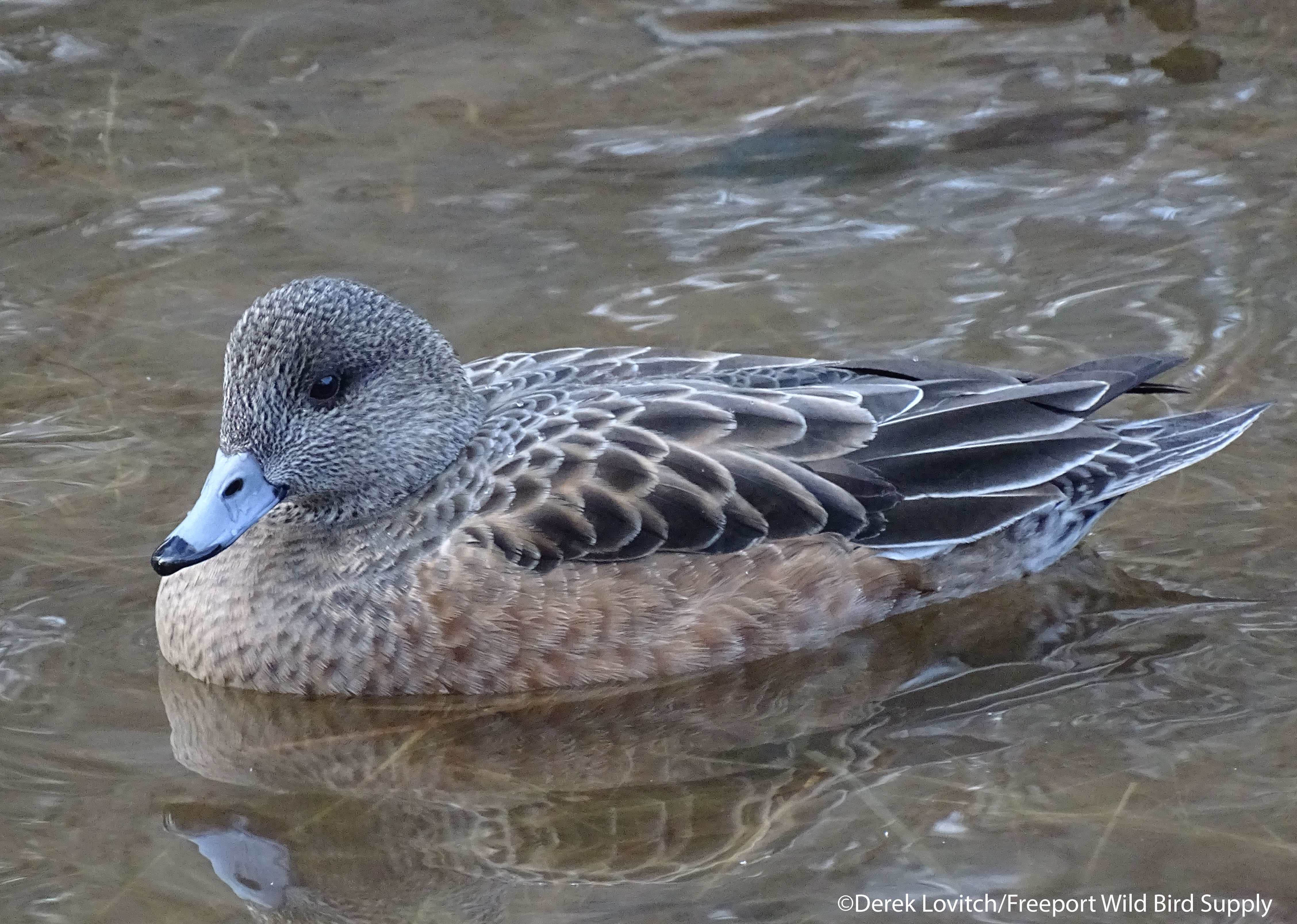
Finally, a stop at the York Duck Pond introduced us to another group of waterbirds: dabbling ducks. There, we had close studies of Mallards, American Black Ducks, and hybrids thereof. Practicing our “feather birding” we used the hybrids of an example of what to look for beyond the general impression of size and shape we were focused on throughout much of the day. The icing on the cake was the hen American Wigeon that has been here all winter – you may never see one as close and as well as that again! Enjoying the fine black detailing on the steely blue bill was a highlight for me.
Spring Migrant Songbird Workshop, May 12th.
Honestly, I am not sure if we could have dialed up a more productive morning for an instructional workshop designed for learning about migrants – from identification to natural history, habitat to visible migration. “Slow” by mid-May standards, we eventually tallied 15 species of warblers (including a few “heard only”), but we had absolutely remarkable “quality time” with so many of the species we did encounter today.
We were greeted by a Great-crested Flycatcher and finished with Maine’s most confiding Great Egret. In between, a wide range of species included an uncommon Blue-gray Gnatcatcher and a family of Wood Ducks. I particularly enjoyed the quality time spent with a pair of Black-capped Chickadees who were busy gathering moss for their nest lining.
But it was the Neotropical migrants who were the stars of the show, as predicted and hoped for. My first Red-eyed Vireo of the spring was uncharacteristically low and cooperative, but the single early-ish Blackpoll Warbler was most definitely not. However, almost every other warbler was just shockingly well seen. In one willow thicket, we watched – often without binoculars and often within 10-15 feet of us and below eye-level – two each of stunning Magnolia Warblers, gorgeous Northern Parulas, charismatic Common Yellowthroats, and distinctive Chestnut-sided Warblers. A short distance down the trail, our patience with Ovenbirds was rewarded with one walking out into the open a short distance ahead.
In between bird sightings, we discussed habitat, NEXRAD radar, and the big picture of what we were and were not seeing today and why. We noted how American Crows mobbed a Red-tailed Hawk but barely bothered to call at the sight of a less-threatening Broad-winged Hawk. OK, fine, those aren’t songbirds, but we learned a lot from them anyway.
More birds of more species can and will be seen under different conditions at Evergreen Cemetery and similar urban green spaces as encountered today, but we would be hard pressed to see so many birds so well, for prolonged periods of time to allow for thorough study. While we encountered one wave of migrants all moving together, which can easily become frustrating when getting started, many of birds came one or two at a time allowing for in-depth observation -exactly want we want in a songbird workshop!
Not a songbird, but this Great Egret that frequents the ponds here also poses in interesting places.
Shorebird Workshop, August 15th.
Nothing wrong with starting out with the easy ones, like dapper Ruddy Turnstones!
Recent rainfall, approaching thunderstorms, and current observations all combined to make me throw our itinerary out the window this day. Sometimes audibles work…and today, it most definitely did.
While I prefer to start with smaller groups of birds so as not to overwhelm, we took advantage of the lovely morning and high tide to soak in an estimated 2000 shorebirds at our first stop! Biddeford Pool Beach did not disappoint, and we began our lessons with the basics: shorebird vs everything else, plover vs sandpiper, and eventually each species. We compared Semipalmated Sandpipers (~1750 individuals) and Semipalmated Plovers (about 200 individuals), then teased out several White-rumped Sandpipers from the masses. We noticed how white Sanderlings look, and what little bulldozers the distinctive Ruddy Turnstone can be. Spotted Sandpipers nicely demonstrated their shallow short-distance flight wingbeats as well.
Nearby Great Pond allowed us to compare Semipalmated Sandpipers vs Least Sandpipers at nearly arm’s length, while giving us better looks at a couple of Spotted Sandpipers. A single Lesser Yellowlegs was also added to the list.
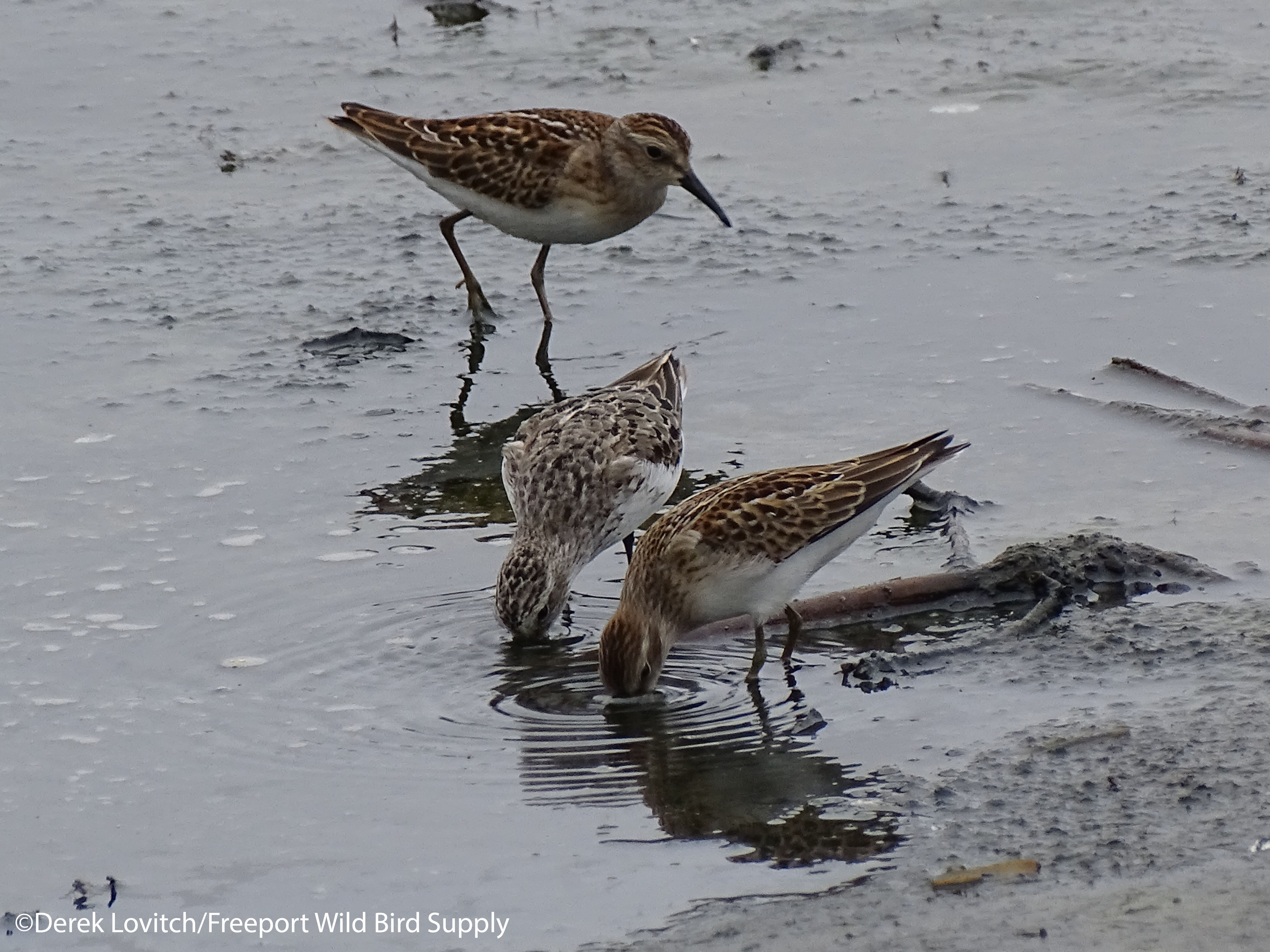
By using habitat cues and tide charts, we maximize our shorebirding productivity. By studying birds near (like these side-by-side Least and Semipalmated Sandpipers) and far, we can learn to quickly recognize most shorebirds, most of the time, using a range of tools that we worked on together throughout the day.
Next up was Hill’s Beach, on the prime outgoing tide. Unfortunately, thunderstorms were rapidly approaching, and after a short check (more Sanderlings and a growing number of Semipalmated Sandpipers and Plovers), we decided to play it safe, return to the cars, and head into Saco for lunch. Good thing, too, as while we were eating, it was pouring outside!
White-rumped Sandpiper.
Returning to the field, we poked around the edges of Scarborough Marsh as we waited for the tide to begin rolling back in and for the rain to finally come to a stop. After a 10-minute rain delay in the cars while we waited out the last of it, we returned to the field to take in the flats of Pine Point. Good looks at Black-bellied Plovers (75+) allowed us to compare their shape, size, and feeding style to the estimated 300 Semipalmated Plovers that were here. Another 1200 or so Semipalmated Sandpipers contained at least a dozen White-rumped Sandpipers, which we practiced sorting out at a distance using shape and size, especially those long primaries. 14 Willet were new for our list, and the 90’s steroid-era-baseball-players of the greater Tringa family nicely contrasted with 4 slim Lesser Yellowlegs that alighted with some of them. Four not-so-short-billed Short-billed Dowitchers were our 11th species of shorebird of the day. And finally, as we continued to grow and practice our shorebird identification toolkit, we also took note of some non-shorebirds, such as Common Terns and a variety of gulls which today included 2 very-uncommon Lesser Black-backed Gulls!
Monhegan Birding Workshop, September 13th – 15th.
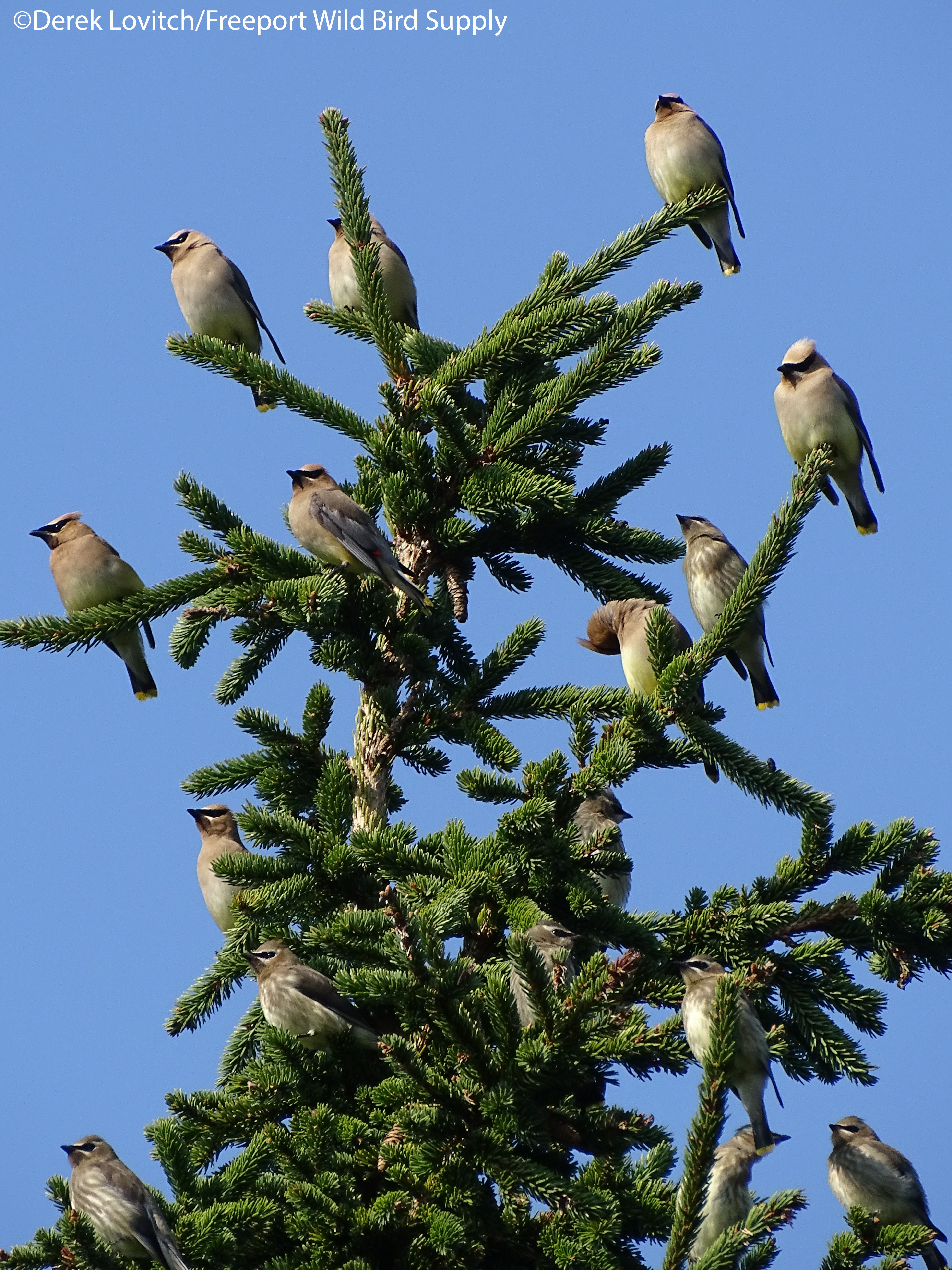
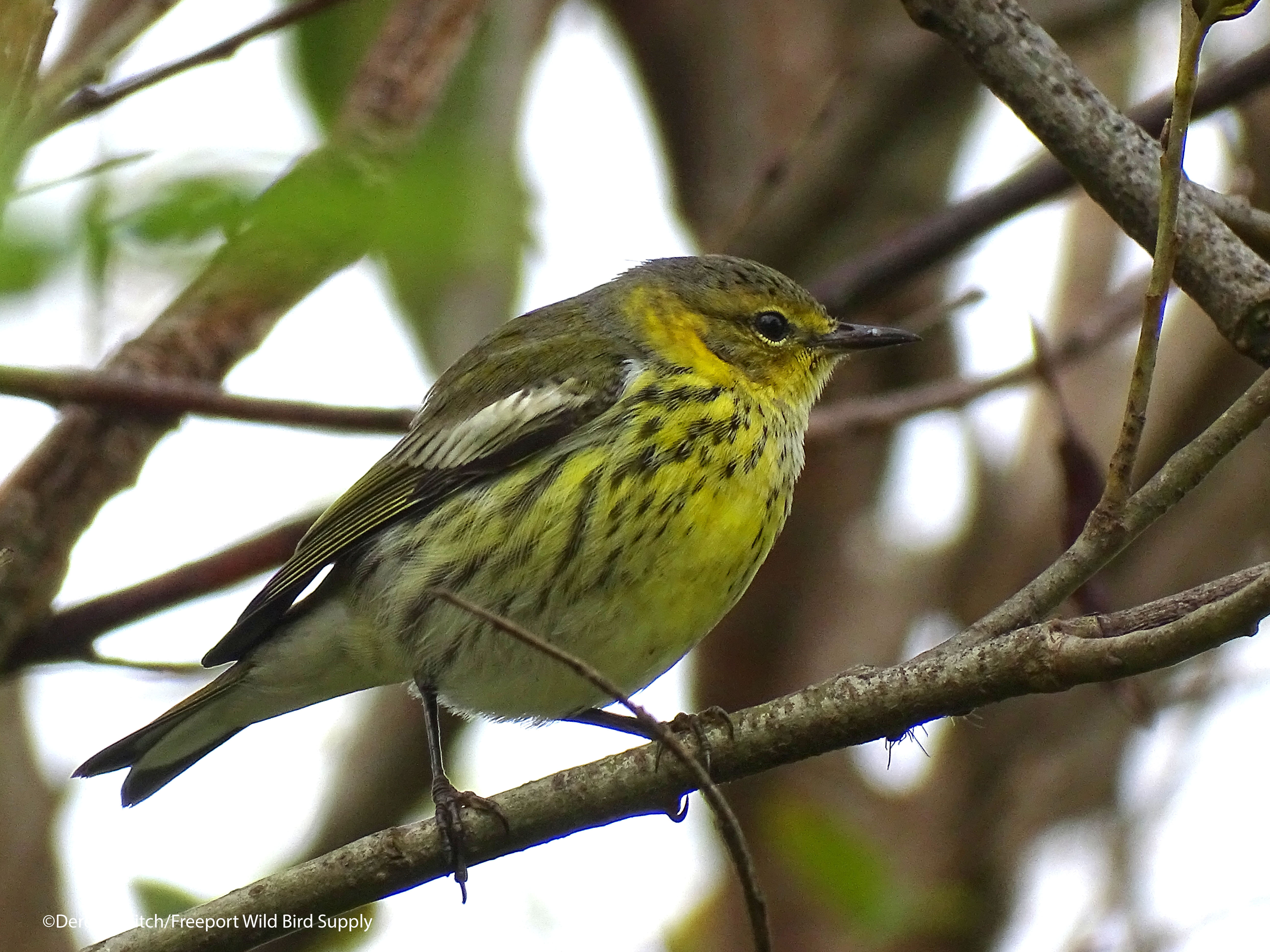
Cedar Waxwings were often with us, alighting on trees, eating native fruits, and avoiding marauding Merlins. Few things bring as much pleasure to the birding day as a “Waxwing Christmas Tree.”
Arriving on a glass-calm sea on Friday the 13th, luck was most definitely with us today and the entire weekend. We were greeted at the dock by a darting Merlin, a sign of things to come. After checking in and a relaxed lunch, we began our workshopping. While overall songbird activity was slow, we enjoyed plants, butterflies, and the weather as we wandered around and spotted birds here and there: a Northern Waterthrush in an isolated bush in a yard, a female Black-throated Blue Warbler in the woods, and lots of Cedar Waxwings in small flocks, overhead and landing in trees. Merlins continued to perform, and several Peregrine Falcons and Sharp-shinned Hawks joined the show, although it did not help us detect skulking warblers!
A late afternoon walk to Burnt Head to take in the cliffs and sample the habitat of the island’s interior produced a 1st-winter Lesser Black-backed Gull, but more importantly perhaps, allowed us to enjoy such a beautiful day on the island for mid-September.
On Saturday morning, we stepped off the porch at the Monhegan House, and it was ON. A great Morning Flight (morning redetermined migration) was underway, with dozens upon dozens of warblers zipping overhead as the sun slowly rose. As we did a short stroll to some favored early-morning micro-habitats, we ground-truthed the morning flight, finding that Cape May Warblers were indeed the dominant migrant of the morning. In fact, we often had 3 or 4 (as many as 5 in one tree) in the top of nearly every spruce we checked, and the entire range of plumages was on display. Northern Parulas were also numerous, but we estimated about 3 of every 5 warblers we encountered this morning were Cape May!
It was such a great morning it was hard to come inside to break for breakfast. Or so one thinks until they have had the Monhegan House Breakfast…and this was just the final of three courses!
Although the day’s activity peaked in the morning as many of the birds in Morning Flight continued on back to the mainland with a light northwest wind becoming northeasterly by noon, we continued to find pockets of activity and mixed-species foraging flocks throughout the day. There were a few Eastern Kingbirds and Eastern Wood-Pewees scattered about, often giving very good looks, and we had a nice mixed vireo flock that included 2 Philadelphia Vireos, 1 Blue-headed Vireo, and several Red-eyed Vireos for nice comparison. Northern Harriers put on a performance for us in the late afternoon over the marsh.
While our afternoon walk through the woods to the lighthouse was as much for pleasure and learning about habitats as it was for birds, the result was the discovery of a rare Lark Sparrow! We covered a lot of ground today, and definitely earned our delicious dinner. Before that, however, we had a little workshopping session to recap the day and compare what we saw (morning flight) with what the overnight radar image had suggested.
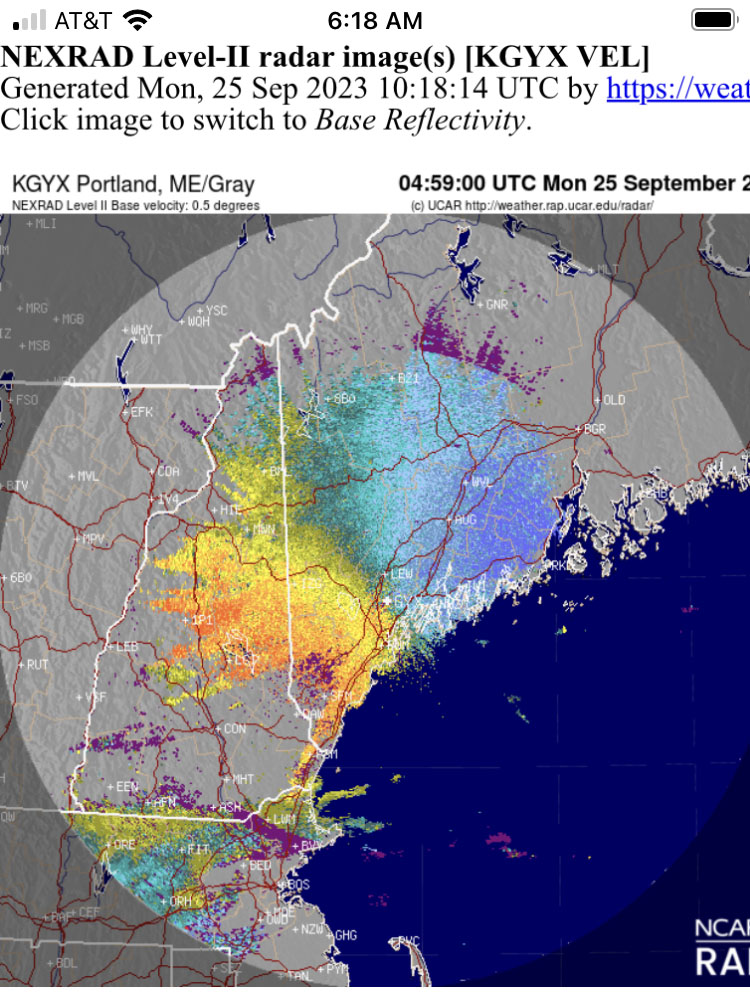
One of the new migration skills we learned was how to monitor and plan your birding accordingly by looking at NEXRAD weather radar. For comparison, here are the 1am images from Saturday and Sunday morning, respectively, showing the greater density of birds in the air and offshore on Saturday morning – and confirmed by our morning flight observations come sunrise.
Another clear and calm night resulted in a very strong flight of birds, but with fewer birds drifting offshore, the morning flight was slower than Saturday, as we forecast. However, there were plenty of new birds around, and we repeatedly saw birds we had not yet seen and many rather “fun” species. It started with a drift-vagrant Dickcissel in Morning Flight, followed by a Whimbrel flying around. A likely Clay-colored Sparrow disappeared before we could confirm it in poor light, but warblers such as Bay-breasted, Blackburnian, and Wilson’s were more confiding. Unexpected offshore and always a surprise on Monhegan, an immature Cooper’s Hawk flew over us on our way to lunch.
There was a noticeable turnover in species, with more sparrows and many fewer Cape May Warblers. We had some unusually cooperative Lincoln’s Sparrows to study, such as this one that perched in a bush with a Song Sparrow for comparison (and later, the same bush held a Swamp Sparrow next to a Song for further study of the entire genus!).
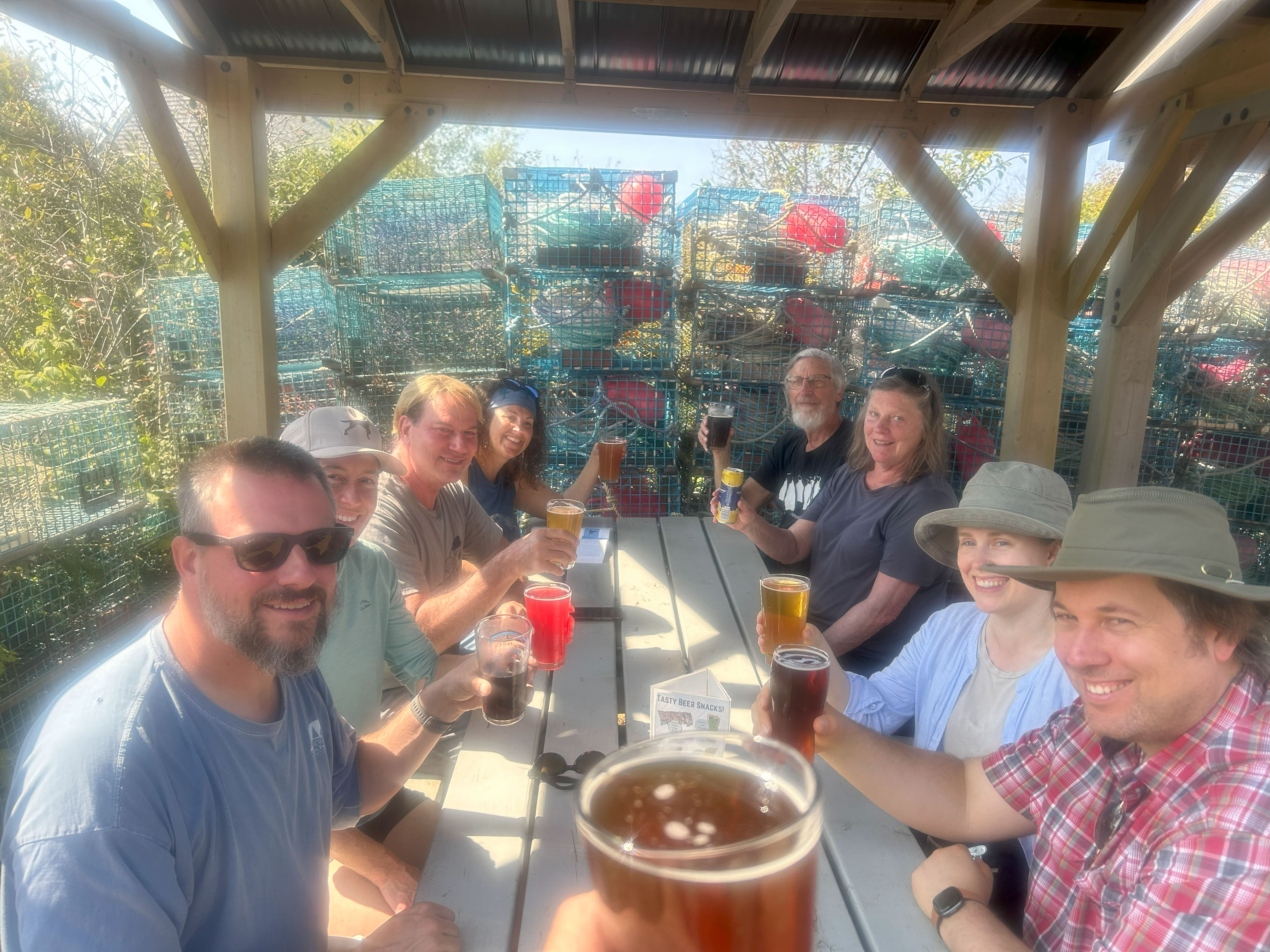
Since we were focused on learning bird identification and the nuances of migration’s ebbs and flows (and mechanisms thereof), we did not keep a running bird list. We did count our warbler tally and finished the trip with a very respectable 17 species of warblers! We found a couple of “good birds” (and jokingly disparaged the use of the descriptor) for ourselves and ate way too much good food. We learned a bunch about migration, plants, birds, and insects, and a little about the island. So instead of trying to add one more bird to the non-existent list, we brought the tour – and the 2024 Down East Adventures Birding tours season to a close with lunch and a toast at the brewery!
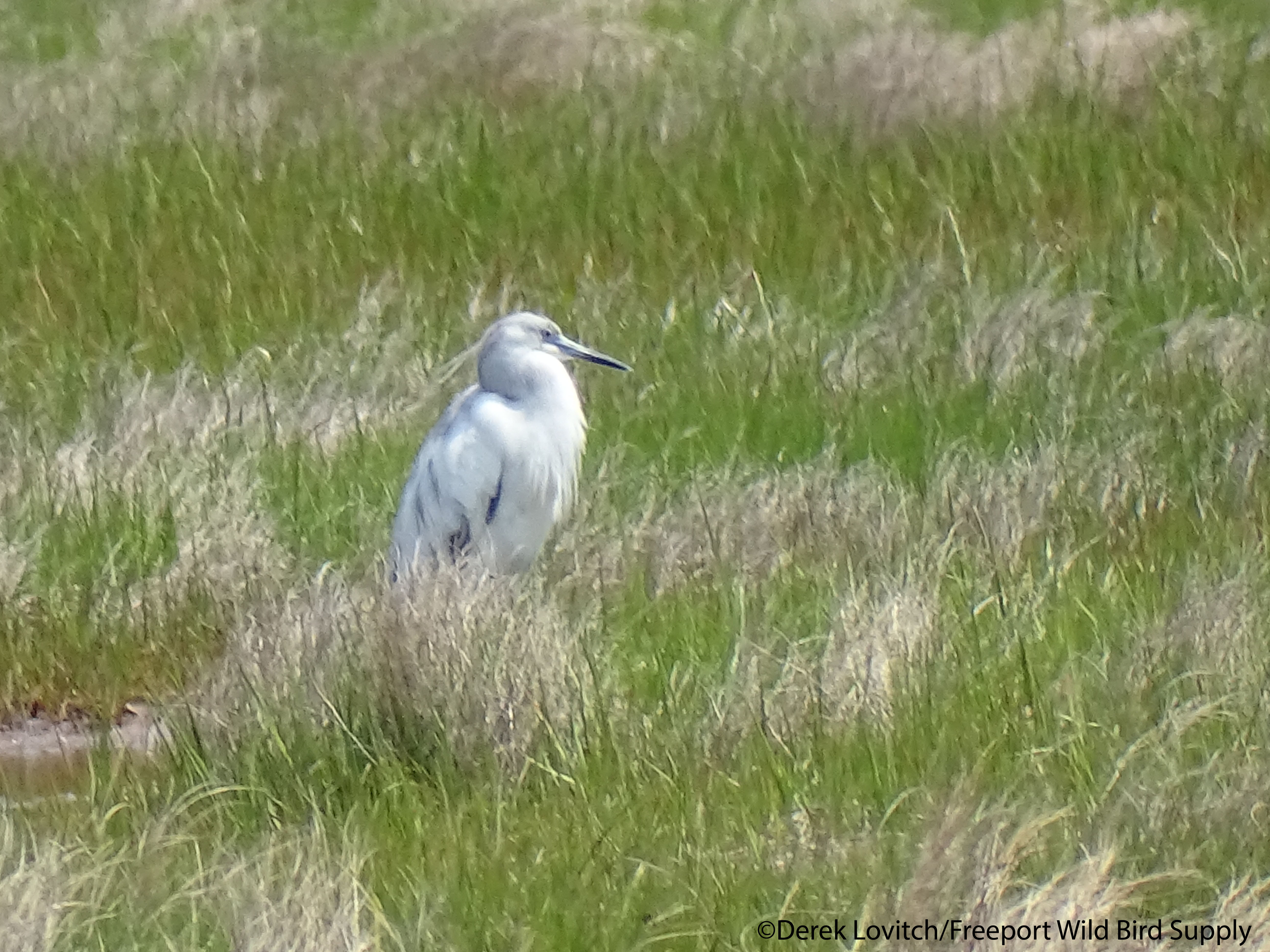
This reported Little Blue Heron x Snowy Egret Hybrid in Spurwink Marsh of Cape Elizabeth may add to the mix of ultra-rare hybrid herons that have been occurring annually since 2012 in the Greater Scarborough Marsh area. Or does it? See below.
The last cadre of migrants are arriving, and the late spring “rarity season” is now upon us. With new arrivals, breeding birds on territory, and the expectation of the unexpected, it was a great week of birding for me as I head out to Monhegan Island with our annual tour group.
My observations of note over the past seven days included:
1 continuing reported LITTLE BLUE HERON X SNOWY EGRET HYBRID, Spurwink Marsh, Cape Elizabeth, 5/22 (with Jeannette, et al). Present since 5/16, this would be the first record of this hybrid combination in Maine, and one of the few ever. Or, is this just a funky 1st or second summer Little Blue Heron that is showing oddly dark legs? Plus if it is truly a hybrid with a small white heron, I am not sure how we would rule out Little Egret (or a hybrid that includes Little Egret) as the other half of the mix, especially with the long-ish-looking dual wiry plumes. Furthermore, some folks have raised doubts about even the potential of mixed parentage here. While clearly different from the TRICOLORED HERON X SMALL WHITE EGRET SPP hybrids that have been in Scarborough Marsh since 2012, I hypothesized about the possibility of Little Blue joining the mix(es) in my 2021 article in North American Birds. I saw the bird again on the 23rd with clients, and obtained better photos than the evening before. Unless of course, my fascination with the hybrid herons of Maine is clouding my judgement here? (Edited for clarity and for minimizing definitives*)
The bicolored bill and blue-gray lores looks fine for Little Blue Heron, but the bill seems a little longer and thinner. The two wiry plumes on the back of the head also look longer and wispier than a Little Blue – could it suggest that the small white egret that’s 50% of its blood (we think) is actually a Little Egret…or the Little Egret x Snowy Egret hybrid…or…
The extra bushy plumes suggestive of Snowy is evident here, and are the soles of the feet a little yellowish? Other photos show the blakcish legs better than this, and 1st summer Little Blue Heron should have uniformly yellow-green legs, especially if still this white.
Also very Snowy/Little-like are the bushy plumes on the foreneck. When it shook, I also observed some whispy white plumes on the back…neither of these should be so fluffy and obvious in a pure Little Blue Heron, especially in its first summer.
***5/26 am edits: The more I think about and study this bird, the less sure I am. It bothers me that the lores and bill are spot on for a Little Blue. But would color develop further when in high breeding, which it won’t reach until next year? Could this just be a super-shaggy-looking Little Blue? Howver, the legs are black or blackish, which is not a characteristic of Little Blue Heron at any age. There seem to be too many anomolous features here to dismiss it as just another splotchy 1st-summer Little Blue. Perhaps, as the summer goes on, and more adult-like characteristics develop, a true pattern and its presumptive ID will become apparent. Hope it sticks around in the same area!**
1 BLACK-NECKED STILT, Eastern Road Trail, Scarborough Marsh, 5/23 (with clients from Maine and Idaho). First spotted by one of my clients as we were split up and scanning both sides of the marsh for sharp-tailed sparrow activity. Awesome find, Ralph! Here’s a lousy, one-armed phone-scoped photo of the bird in the distance.
1 Blue-gray Gnatcatcher, Garcelon Bog Preserve, Lewiston, 5/25.
With the advancement of the season, my personal “FOY’s” this week were limited, as expected in late May, but many of our latest-arriving breeders are showing up on territory now.
1 Alder Flycatcher, Long Reach Preserve, Harpswell, 5/21 (with Harpswell Heritage Land Trust tour group).
1 MOURNING WARBLER, Long Reach Preserve, 5/21 (with Harpswell Heritage Land Trust tour group).
1 Eastern Wood-Pewee, our property in Durham, 5/22.
1 Common Nighthawk, over Bayside neighborhood of Portland, 5/22 (with Jeannette).
3+ Saltmarsh Sparrows, Scarborough Marsh, 5/23 (with clients from Maine and Idaho).
2+ Nelson’s Sparrows, Scarborough Marsh, 5/23 (with clients from Maine and Idaho).
7 RED KNOTS, Pine Point, Scarborough, 5/23 (with clients from Maine and Idaho).
3 Short-billed Dowitchers, Pine Point, 5/23 (with clients from Maine and Idaho).
TOURS AND EVENTS:
Our June 2ndZeiss Pelagic is sold out, but we are starting a waiting list in case there are any late cancellations. Please email the store at info@freeportwildbirdsupply.com to get on it.
With my guiding season now in full swing, I have no choice but to be out in the field a lot, regardless of my shoulder situation. And with much finer weather and some good nights of especially Saturday and Thursday nights, the arrivals of migrants caught up to the date quite rapidly. Many new arrivals – as well as a lot of personal first-of-years since I had not been getting out much – resulted in a nice long list of highlights for me -and my clients – over the past 7 days.
My observations of note over the past seven days included:
10 Greater Yellowlegs, our property in Durham (thanks to a flood in our field), 5/5 diminishing to 3 by 5/7.
250-300++ White-throated Sparrow in impressive fallout, Evergreen Cemetery, Portland, 5/8 (with client from Spain).
1 female Red Crossbill, Evergreen Cemetery, 5/8 (with client from Spain).
10 species of warblers, Evergreen Cemetery, 5/8 (with client from Spain). This tied my latest date for reaching 10 species at one place in one morning for the first time of the season.
1 WHITE-WINGED SCOTER (looking very out of place) and a pair of RUDDY DUCKS, Sanford Lagoons, Sanford, 5/8 (with clients from Spain and Maine).
1 drake Northern Shoveler, Dunstan Landing, Scarborough Marsh, 5/8 (with clients from Spain and Maine).
1 pair LOUISIANA WATERTHRUSH, Morgan Meadow WMA, Gray/Raymond, 5/11 (with clients from Spain and Maine).
1 BLUE-GRAY GNATCATCHER, Florida Lake Park, Freeport, 5/11 (with clients from Spain and Maine).
The long list of my personal FOY’s this week also included:
1 Ovenbird, Florida Lake Park, 5/6 (with Saturday Morning Birdwalk group).
1 Nashville Warbler, Evergreen Cemetery, 5/8 (with client from Spain).
3 Chimney Swifts, Evergreen Cemetery, 5/8 (with client from Spain).
2 Yellow Warblers, Evergreen Cemetery, 5/8 (with client from Spain).
1 American Redstart, Evergreen Cemetery, 5/8 (with client from Spain).
1 Green Heron, Evergreen Cemetery, 5/8 (with client from Spain).
1 Black-crowned Night-Heron, Evergreen Cemetery, 5/8 (with client from Spain).
1 Chestnut-sided Warbler, Evergreen Cemetery, 5/8 (with client from Spain).
1 Prairie Warbler, Evergreen Cemetery, 5/8 (with client from Spain).
20+ Field Sparrows, Kennebunk Plains, 5/8 (with clients from Spain and Maine).
3 Vesper Sparrows, Kennebunk Plains, 5/8 (with clients from Spain and Maine).
1 Eastern Meadowlark, Kennebunk Plains, 5/8 (with clients from Spain and Maine).
2 Solitary Sandpipers, Sanford Lagoons, 5/8 (with clients from Spain and Maine).
1 Spotted Sandpiper, Sanford Lagoons, 5/8 (with clients from Spain and Maine).
1 Least Tern, Pelreco Marsh, Scarborough Marsh, 5/8 (with clients from Spain and Maine).
30+ Common Terns, Pine Point, Scarborough, 5/8 (with clients from Spain and Maine).
4-6 ROSEATE TERNS, Pine Point, 5/8 (with clients from Spain and Maine).
1 Eastern Kingbird, Dunstan Landing, Scarborough Marsh, 5/8 (with clients from Spain and Maine).
1 Northern Waterthrush, Florida Lake Park, 5/9.
1 Black-throated Blue Warbler, Florida Lake Park, 5/9.
1 Northern Rough-winged Swallow (finally, extremely late for my first of the year, and this one was not due to lack of visitation of its habitats), Florida Lake Park, 5/9.
1 Veery, Florida Lake Park, 5/9.
1 Cliff Swallow, Florida Lake Park, 5/9.
1 Ruby-throated Hummingbird, our yard in Durham, 5/9.
1 White-crowned Sparrows, feeders here at the store, 5/10.
14 Least Flycatchers, Morgan Meadow WMA, 5/11 (with clients from Spain and Maine).
2 Great Crested Flycatcher, Morgan Meadow WMA, 5/11 (with clients from Spain and Maine).
3-4 YELLOW-THROATED VIREOS, Morgan Meadow WMA. 5/11 (with clients from Spain and Maine).
1 Scarlet Tanager, Morgan Meadow WMA, 5/11 (with clients from Spain and Maine).
1 Warbling Vireo, Durham River Park, Durham, 5/11 (with clients from Spain and Maine).
1 Bank Swallow, Florida Lake Park, Freeport, 5/11 (with clients from Spain and Maine).
Freeport Wild Bird Supply is very excited to partner with Down East Magazine’s Down East Adventures for our third year. In 2023, we are expanding our offerings to include two exclusive overnight trips, along with our popular ½- and whole-day targeted workshops. Focused on skill-builder rather than list-building, there will be plenty of “life birds,” but also more knowledge and education about birds, habitats, birding, and much more about the natural world.
The full list of upcoming tours can be found here. At the conclusion of each tour, I’ll post the trip report here.
Winter Waterbirds Workshop, January 15.
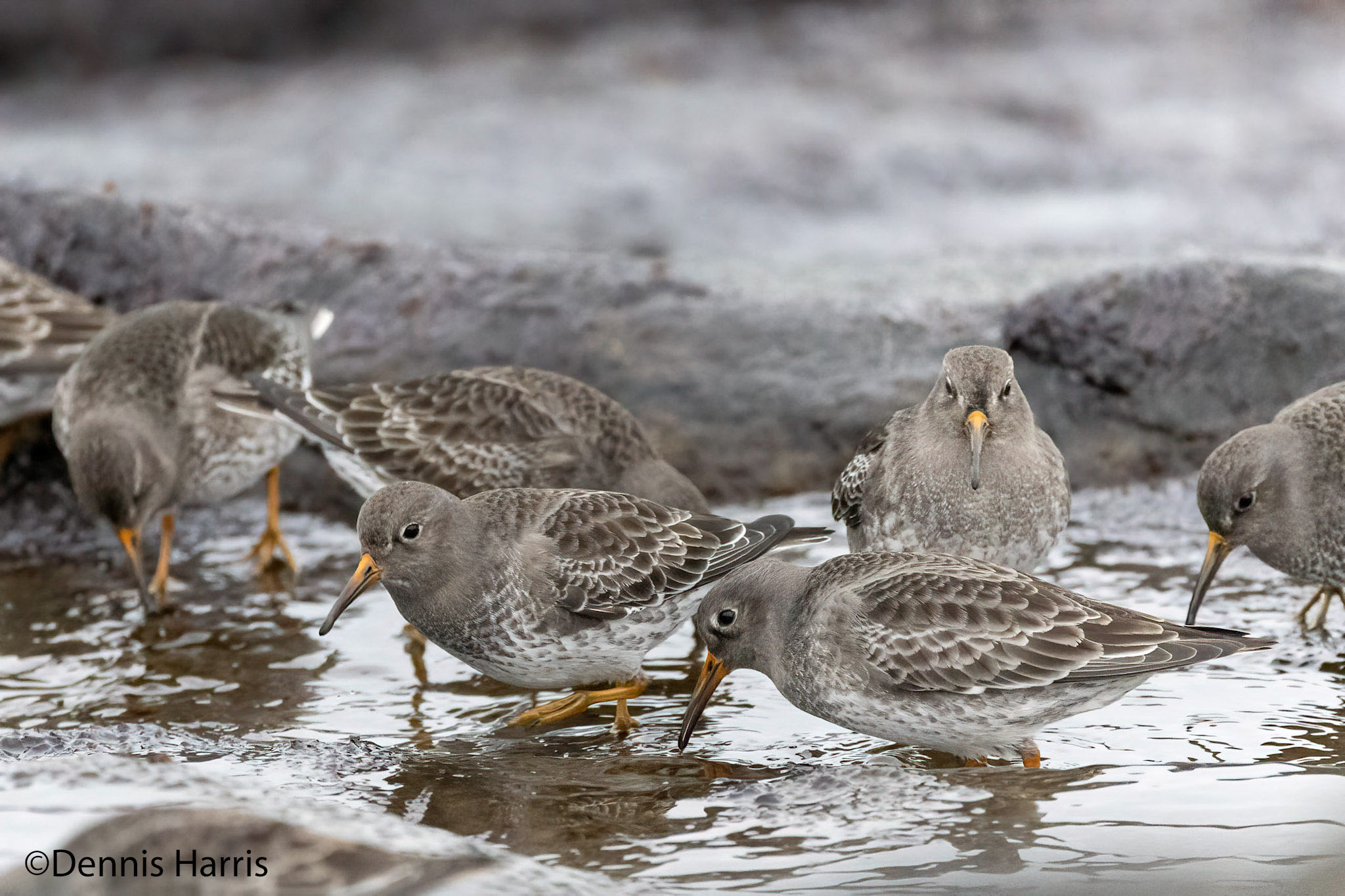
This Purple Sandpiper was about as cooperative as it gets for us at Sohier Park in York. Later, it was joined by its friends (photo below). This is really a lovely shorebird when viewed as well and as close as we experienced.
Extremely strong winds and very high seas presented a challenge as we sought out wintering waterbirds along the southern York County Coast. We worked hard to find sheltered water where we could observe birds well, but when we did find that secluded cove, peninsula lee, or rivermouth, we were treated to incredible looks at many of the birds we had hoped for.
We looked down on Red-breasted Mergansers at Perkin’s Cove, and you’ll never be closer to a Common Loon than we were at the Ogunquit Rivermouth. We checked a few more locations than I usually need to on this tour, but our most productive spot was the southern shoreline of Sohier Park at The Nubble. There, we were treated to close views of Black and White-winged Scoters, Harlequin Ducks, and a most-cooperative flock of Purple Sandpipers. We then ended the day at hidden Abbott’s Pond, where we enjoyed a break for the wind, close comparisons to study details between Mallards, American Black Ducks, and hybrids thereof.
Meanwhile, a group of 8 or so Black-legged Kittiwakes were feeding off of Short Sands Beach, and a stunning adult Iceland Gull passed by at The Nubble. Unfortunately, the seas were just a little too rough to find any alcids today, but we knew they were out there!
Spring Migrant Songbirds Workshop, May 14.
This stunning Blackburnian Warbler nicely demonstrated the value of blooming oak trees for seeing warblers in the middle of May.
Four hours later we had not left Evergreen Cemetery in Portland…a very good sign. There was just no need to move along, the birds kept coming to us. In the end we tallied a respectable 16 species of warblers, even though growing a list was not our goal. What made this workshop successful, however, was how well we saw just about all of the warblers and other songbird migrants throughout the morning.
Warblers were a highlight of course, including repeated quality time with favorites such as American Redstart and Black-and-white Warblers, the two most plentiful migrants this morning. We also enjoyed great looks at several Chestnut-sided Warblers, Magnolia Warblers, and Northern Parulas, with fantastic studies of Black-throated Blue Warbler, Black-throated Green Warbler, Yellow Warbler, and Wilson’s Warbler. We also saw two newly-arrived Tennessee Warblers which aren’t always easy to get looks at. There was a good amount of song this morning, so we had chances to listen and learn many of these species as well.
Shortly after hearing a Red-eyed Vireo and my describing it as “high up and often hard to see,” we found one in the lower branches of a nearby oak, and watched it sing, forage, and do all things vireo for almost 10 minutes! Likewise, after hearing distant Ovenbirds, we had two walking around right in front of us! Beginning with a view of a Veery on the ground in the open, we saw it again as the walk ended, only a few feet in front of us for another great view and chance to observe and study.
During the morning, we chatted about migration, habitat, and the process of building the necessary toolkit to build birding skills. Finishing the walk with a quick overview of some references (we had too many birds to leave much time for anything more), we recapped a very productive and instructive morning of spring birding.
Rangeley Birding Workshop, June 6-8.
Our first overnight tour together, the Rangeley Birding Workshop was based at Bald Mountain Camps in Oquossoc, nestled on the shore of Mooselookmeguntic Lake. Common Loons greeted us, but so did the rain. June of 2023 was one of the rainiest Junes on record in Maine, and we were very thankful for the wood stoves in each cabin!
Our first morning, 6/7, began at Hunter Cove Wildlife Sanctuary, with lots of singing Blackburnian Warblers. A large flock of Red Crossbills flew over, two Yellow-bellied Flycatchers were heard clearly and then glimpsed, and a variety of common warblers were detected. A confiding pair of Canada Jays was the highlight – as they often are – but even the common warblers were tough to see today, so we focused on practicing our birding by ear skills.
Enjoying our delicious boxed lunches at the Rangeley Waterfront Park, with more Common Loons offshore, we delved into an impromptu gull workshop, using each age class of Ring-billed Gull as an introduction to molt, feather topography, and identification. A 3rd-cycle Herring Gull kindly dropped in for comparison as well. In inclement weather, we take advantage of whatever learning opportunities the birds are willing to provide!
After lunch, we poked around the Mingo Spring Birding Loop, with good looks at the likes of Least Flycatcher, Alder Flycatcher, and Dark-eyed Juncos among others. But as rain returned, we called it a day and settled in to dry out in front of our stoves instead of an afternoon of lake-watching from the BMC property. And dinner was absolutely delicious!
Day 2 began with a brief walk around the BMC property (American Redstart, Ruby-throated Hummingbird, etc) followed by a foray over to the famous birding destination of Boy Scout Road, looking to build on the identification toolkit we worked on the previous day. We parked half the cars at one end and then walked the length of the road, birding along the way. But it was rather quiet here too – the ongoing story of June 2023. We did have some more Red Crossbills, a fantastic view -finally – of a Blackburnian Warbler, several Alder Flycatchers, and once again more Canada Jays. But this time, it was a family group of a pair with 2 juveniles in tow!
And then it began to rain. Again. A lot. But I give this group credit – they soldiered on! Of course the rain began in earnest when we were as far from either set of cars as possible, so there wasn’t really a choice, but still, spirits remained high and the birding continued. A pair of Hooded Mergansers, a singing Palm Warbler, and a Spotted Sandpiper were among the last birds of the outing, before the water had penetrated our clothing and it was time to call it a day and hope for better conditions next year!
Shorebirds Workshop, August 10.
The best way to learn shorebirds is to see them in their preferred habitats, feeding, moving, and mixing with other species, such as these Short-billed Dowitchers (a sandpiper) and Semipalmated Plovers here at Hill’s Beach in Biddeford.
An absolutely perfect day of summer weather (finally!) greeted us for this annual favorite outing. And the only thing better than the weather this day was the birding! Recent insane rainfalls have led to very high water in many of our favored high-tide, upper-marsh locales, so we focused on tidal habitats including beaches and mudflats, altering our usual routine from the start.
Beginning in Biddeford Pool, we introduced shorebirds with several Spotted Sandpipers along Ocean Avenue before jumping into the mixed species flock on Biddeford Pool Beach on the outgoing tide. There we estimated over 1,250 Semipalmated Sandpipers and 200 Semipalmated Plovers as we learned the basics of shorebird (sandpiper vs. plover) identification and began to work our way up to teasing out a couple of White-rumped Sandpipers and Ruddy Turnstones from the masses. 2 Killdeer in flight overhead were our only two of the day.
Kicking off our shoes to spend the rest of the morning on the sandflats of Hill’s Beach, we compared a Piping Plover to the many (400+) Semipalmated Plovers and 30 Black-bellied Plovers. A single juvenile Least Sandpiper was out of place on the beach, but offered a perfect opportunity to closely study the differences in shape, size, and overall structure to the 150 or so Semipalmated Sandpipers that were scattered about. 59 Short-billed Dowitchers gave us the chance to really observe shape and feeding styles, practicing identifying these birds both near and far.
Over at The Pool, a distant “Western” Willet joined 7 “Eastern” Willets, as we advanced into subspecific identification just briefly before stopping for lunch as the tide began to roll in.
The afternoon was spent at Scarborough Marsh, where our first two stops offered little (other than a calling Greater Yellowlegs to at least practice our shorebirding by ear) due to the very high water in the salt pannes from the recent rains. Pine Point more than made up for it on the rapidly incoming tide, however, with one heck of a shorebird show: 1500-2000 Semipalmated Sandpipers, 400-500 Semipalmated Plovers, a few more Short-billed Dowitchers and White-rumped Sandpipers, better looks at “Eastern” Willets, and the icing on the cake: a cooperative Whimbrel – our 13th species of shorebird for the day.
Practicing with our identification tool kit, we tested ourselves on finding the uncommon species among the masses, and took a moment or three to simply sit back and enjoy the show. Now that we know how approachable shorebird identification really is, we can more fully appreciate these most marvelous migrants!
Monhegan Birding Workshop, September 23-25.
Northern Gannets and two Green-winged Teal flying with 6 Surf Scoters from the ferry and an adult Lesser Black-backed Gull greeting us upon our arrival seemed like a great sign for what would be a bird- and fun-filled weekend on the Migration Mecca of Monhegan.
Unfortunately, it turned out to be one of the slowest (for both species and diversity) fall weekends I have ever experienced on the island. That being said, a big list wasn’t our goal. It was to learn birds – their ID, their migration ecology, and everything else that makes the island so special for birds and birders. And this is not tour guide spin: a slower day is better for that as we had ample opportunity to view almost everything we encountered, study them, discuss them, and luckily, what the island failed to provide in quantity, it certainly delivered in quality of observations.
On each day, we would find pockets of warblers here and there, but we kept coming back to one particular willow and a nearby thicket that constantly hosted 4-5 Cape May Warblers (photo above), 4 Yellow Warblers, a Yellow-bellied Sapsucker, and a smattering of others. The Cape Mays put on a clinic: all four plumages from pale, 1st-fall female, to bright and spiffy adult male were on display.
Over the first day and a half, we took what the island offered, besides exceedingly pleasant weather! There was the hen Green-winged Teal feeding within three feet of us, fly-over Rusty Blackbirds in the morning, and Great Cormorants on the cliffs on an afternoon short hike to name a few highlights. The skies were punctuated by the occasional migrant Peregrine Falcon and the constantly-hunting Merlins.
Granted, we were really just looking at birds to fill the time between the incredible meals at the Monhegan House!
On our final morning, a good migration overnight produced a new arrival of birds for the “morning flight;” the concepts and nuances thereof were topics of regular discussion.
The group’s high spirits earned them a great morning, with a taste of what Monhegan birding has to offer. There were American Pipits and Yellow-rumped Warblers in Morning Flight, a flock of 10 truant Bobolinks circling around, an immature male Belted Kingfisher displaying to a very-uninterested female, more Cape May Warblers, and a surprising fly-by Wilson’s Snipe.
At one point we had four juvenile Sharp-shinned Hawks dogfighting, exemplifying the difference in sizes of male vs female raptors. And the workshopping continued with Great and Double-crested Cormorants side-by-side, migrant raptors including several Northern Harriers, and more species before breakfast than we had most of the previous weekend! Speaking of breakfasts, goodness, they were good as well.
We finished up with a gull workshop on the shoreline, opening eyes to just how easy most gulls are most of the time. The advanced course was the fly-by 1st winter Lesser Black-backed Gull amongst Herring Gulls on the ferry ride back! And yes, we looked at butterflies, too!
This snazzy, fresh adult male Red-winged Blackbird at a feeder in Wells was one of the few highlights in my usually-very-productive “Moody Sector” of the Southern York County CBC.
T’was the week before Christmas and all through Wild Bird Supply, no one was birding much, even this guy. Nonetheless, I found some great birds when I did get out this week:
1 incredibly late NELSON’S SPARROW, 1 Savannah Sparrow, 1 Northern Flicker, 4 Snow Buntings, etc, Eastern Road Trail, Scarborough Marsh, 12/18. I was unaware that the Portland CBC was being conducted that day, but apparently, the Nelson’s was a first count record!
1 THICK-BILLED MURRE (FOS), Pine Point, Scarborough, 12/18. Not in great shape; I first saw it on land fighting off a crow on land before eventually waddling into the water.
“Moody Sector” of the Southern York County CBC, 12/19: 1538 individuals of 52 species (both quite low for me) with highlights including 4 American Wigeon (very surprisingly only a second count record!), 1 male Red-winged Blackbird, 2 Northern Harrier, and 18 Horned Larks.
1 Great Blue Heron (late for inland) and 1 1st-winted Iceland Gull, Auburn Riverwalk, 12/22.
1 SAGE THRASHER, Gilsland Farm, Falmouth, 12/22. 2nd State Record found earlier in the morning by Doug Hitchcox. I eventually had fantastic looks at it, including in flight, but I was on the wrong side of its favored tree for photographs, so this was the “best” I did!
Meanwhile, left off my weekly updates for the past four weeks has been my regular observation of one particular rarity right here in Freeport – Maine’s first ever Broad-tailed Hummingbird! Here’s the full story.
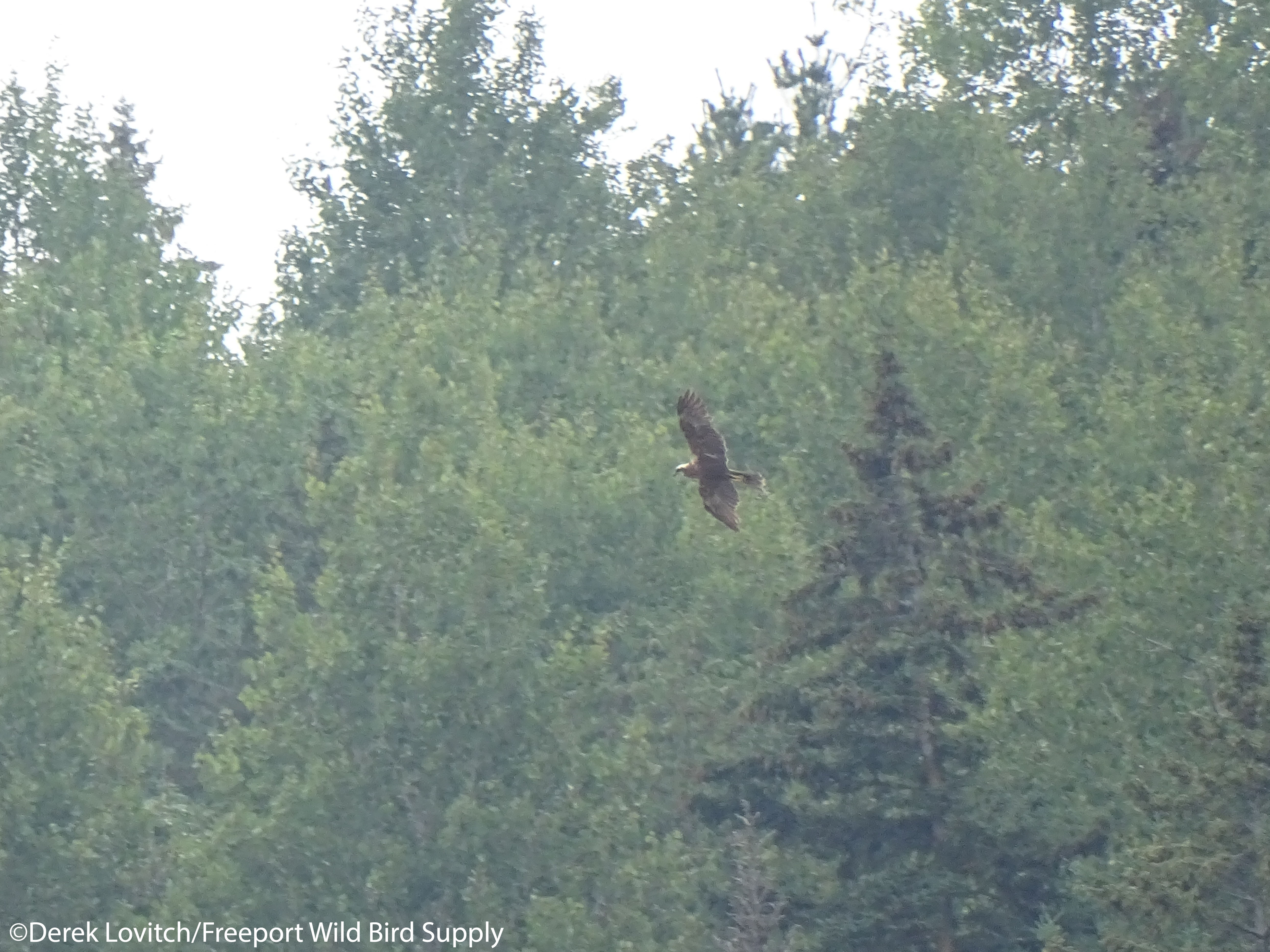
The amazing run of ultra-rare raptors in Maine continued with the all-too-short visit of a Eurasian (Western) Marsh Harrier last week. First found on North Haven on 8/25, it was then relocated the next day in Weskeag Marsh. I finished a tour that morning and raced eastward to South Thomaston. After waiting only 20 minutes (others had been waiting nearly 5 hours), it appeared and put on a show for about 30-45 minutes. After a reappearance the next morning, it has disappeared up birders up and down the East Coast are on high alert!
After returning from our summer vacation to New Brunswick and Prince Edward Island (see link)…
154 Snowy Egrets, 106 Green-winged Teal, etc, etc, Pine Point, Scarborough, 8/28.
1 continuing proposed TRICOLORED HERON X SNOWY EGRET X SNOWY EGRET hybrid, Eastern Road Trail, Scarborough Marsh, 8/28.
7 continuing WHITE IBIS in non-exhaustive search, Harbor Road, Wells, 8/30 (with Jeannette).
6 SANDHILL CRANES (two pairs with one juvenile each), Mayall Road, Gray/New Gloucester, 9/1.
SANDY POINT MORNING FLIGHT (FOY), 9/2: 482 total individuals including 2 DICKCISSELS and 20 species of warblers. Complete tally here.
And my shorebird high counts over these past ten days included some fine tallies but much reduced diversity, mostly due to recent heavy rains filling the best high-marsh salt pannes:
AMERICAN OYSTERCATCHER: 2 ad, Pine Point, Scarborough, 8/28.
Semipalmated Sandpiper: 1,000++, Weskeag Marsh, South Thomaston, 8/26. Honorary mention of 45-500 at Wharton Point on 8/27 – my highest tally here in years (with Saturday Morning Birdwalk group).
Short-billed Dowitcher: 24, Pine Point, 8/28.
Spotted Sandpiper: 2, Sebago Lake State Park, 8/25.
Solitary Sandpiper: 1, several locations this week.
Greater Yellowlegs: 15, Weskeag Marsh, South Thomaston, 8/26.
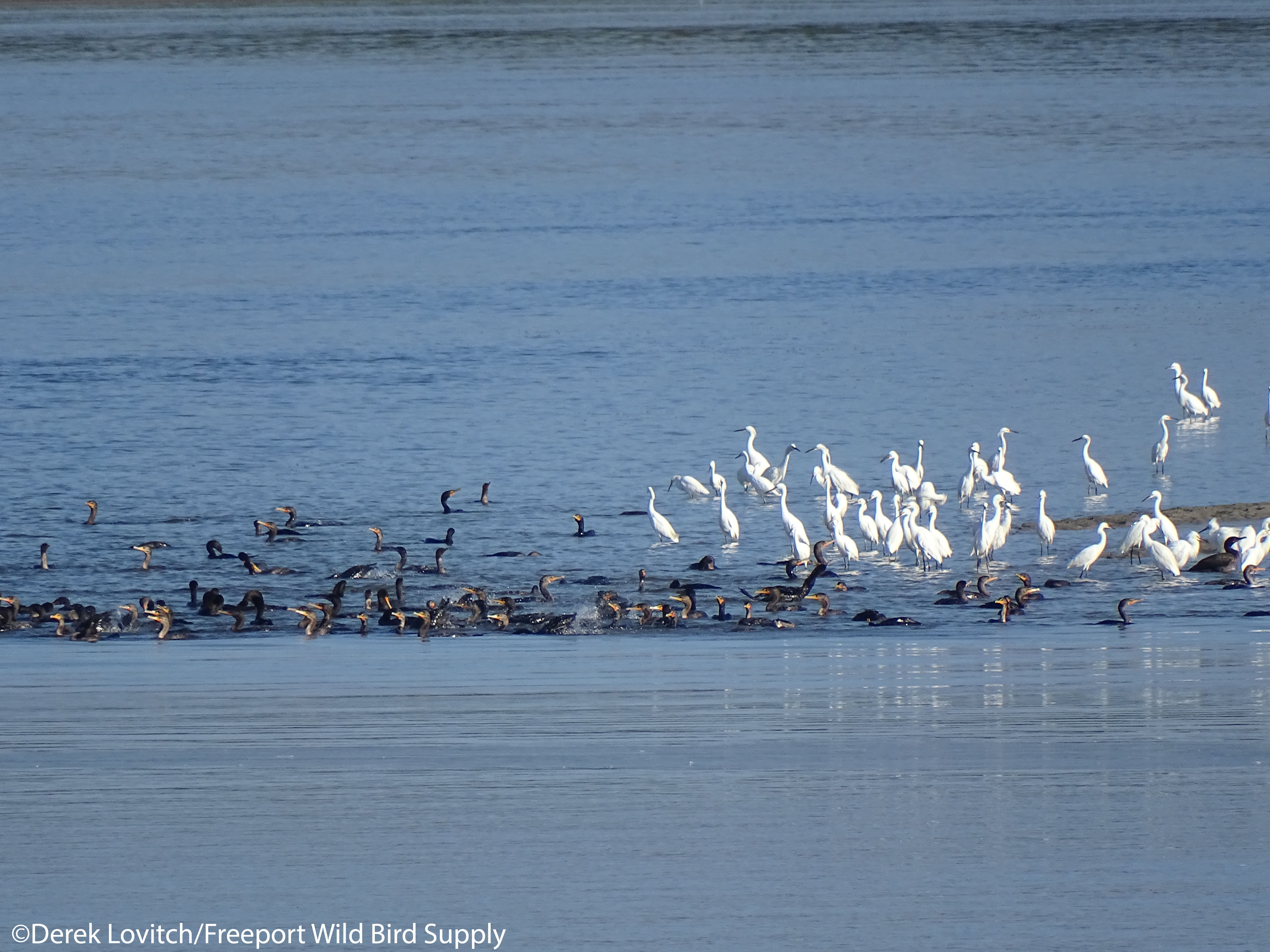
Just a very small part of an impressive feeding frenzy of Double-crested Cormorants and Snowy Egrets that were at Pine Point in Scarborough on the 25th.
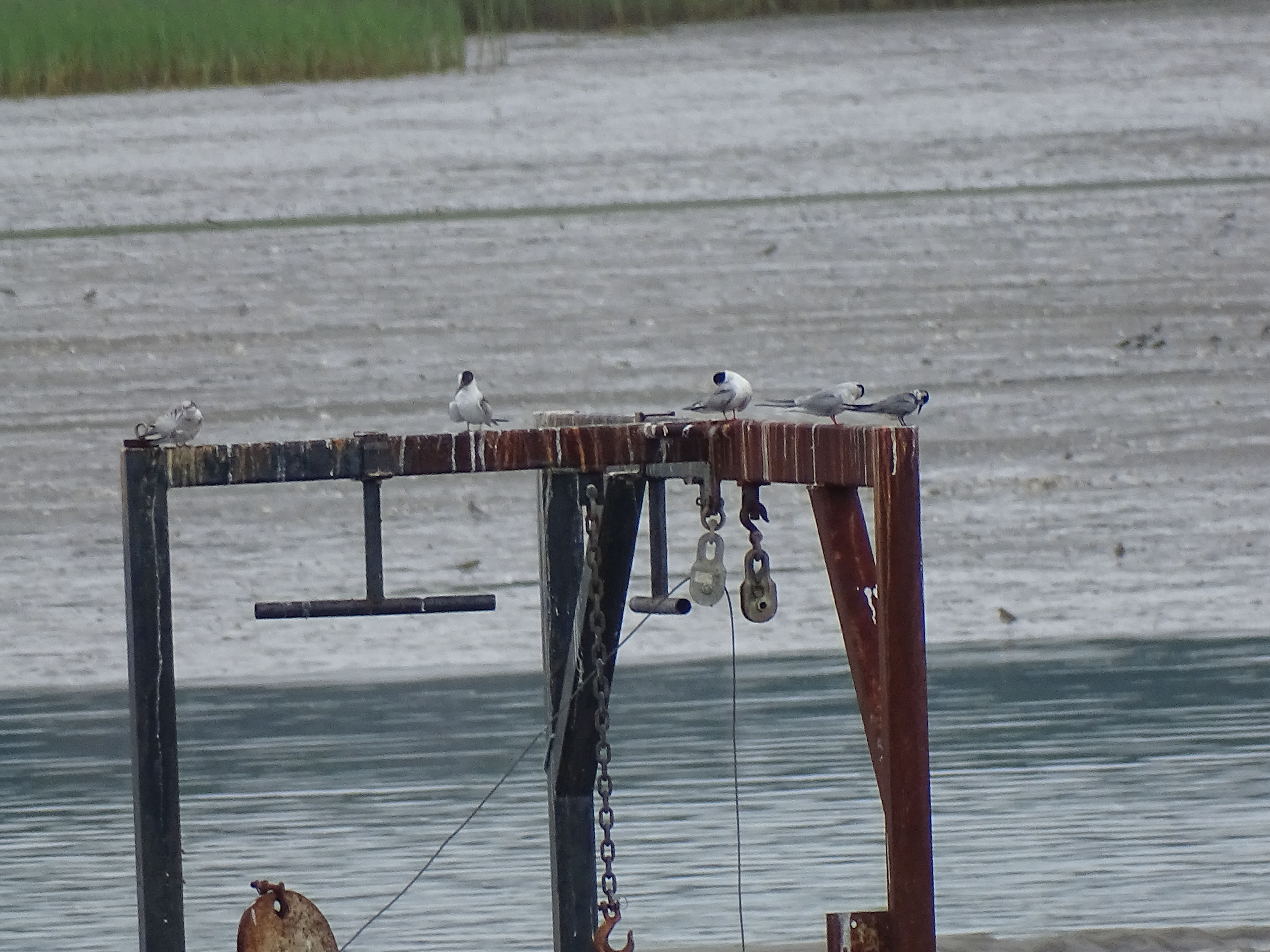
This Black Tern (far right, with Roseate Terns) has been slowly molting out of breeding plumage since it arrived at Pine Point back on July 2nd. It was still present in the morning of August 5th.
It’s August, so as usual, shorebirds were the focus. Here are my observations of note over the past seven days.
1 Surf Scoter, off Sisters Island, Casco Bay, 7/31 (with Birds of Casco Bay Tour group).
1 Fish Crow continues, Point Sebago Resort (private), 8/4 (with Point Sebago Birdwalk group).
1 Red Crossbill, our yard in Pownal, 8/5.
1 continuing molting adult BLACK TERN, Pine Point, Scarborough, 8/5.
Shorebird high counts this week:
Black-bellied Plover: 39, Pine Point, Scarborough, 8/5.
The local “bird of the summer,” Henslow’s Sparrow, continues this week in Brunswick. (Note: photographed only via patience, no playback or other harassments).
Another dandy week of summertime birding produced the following highlights for me.
2 continuing HENSLOW’S SPARROWS, Crystal Spring Farm, Brunswick. Quite a bit of my birding time this week was spent enjoying this exceptional visitor. I saw it on 7/9 with our Saturday Morning Birdwalk group for our 246th all-time Saturday Morning Birdwalk bird! On 7/11, Jeannette and I, along with two other birders saw both individuals at the same time for the first time – as two scopes had both birds in view at once in the opposite direction here. No disputing that! However, the echo and acoustic issues are very apparent here – at one point, we could easily have argued there were four birds! Interestingly, on 7/12, Cameron Cox and I were unable to confirm the presence of two birds, as was the case in my visits prior to the 11th. Phone-scoped video from the 11th here.
HYBRID HERONS of Scarborough Marsh. On 7/11, Cameron Cox and I spotted both continuing birds. The proposed Snowy Egret x Tricolored Heron x Little Egret was off of Eastern Road, while the proposed Snowy Egret x Tricolored Heron x Snowy Egret was incredibly close and cooperative at Pelreco Marsh. Video of the latter bird here.
1 subadult LESSER BLACK-BACKED GULL, Pine Point Beach, Scarborough, 7/11 (with Cameron Cox).
2 Fish Crows, Point Sebago Resort (private), Casco, 7/14 (with Point Sebago Resort birdwalk group). Are these two from the Windham colony or outliers of this slowly expanding species?
Eastern Egg Rock/Whale-watching/and mini-pelagic tour out of Boothbay Harbor with our partners Cap’n Fish’s Cruises, yielded the following highlights in addition to a fantastic show at Eastern Egg Rock from Atlantic Puffins; Roseate, Common, and Arctic Terns; Black Guillemots; etc): 2 Razorbills on Eastern Egg, a mere two Wilson’s Storm-Petrels and handfuls of Northern Gannets offshore, but an insane show from a breaching Humpback Whale. And for the record, the Tufted Puffin appeared there a mere 3 hours after our boat left.
Each summer, I begin reporting my “shorebird high counts this week” here. Really, I do it for my own note-keeping and organization, but I hope at least a few folks find value in it. This year, I am starting it early, even though diversity is expectedly low and I didn’t get to a lot of shorebird sites this week. However, numbers are picking up dramatically, and this bears watching. Unfortunately, large numbers of adult shorebirds in early July could portend widespread breeding failure. Therefore, I will organize my counts here so I can compare it to previous seasons.
Black-bellied Plover: 2 first-summer, Pine Point Co-op, Scarborough, 7/11 (with Cameron Cox).
Killdeer: 35, Crystal Spring Farm, Brunswick, 7/12 (with Cameron Cox).
Piping Plover: 4+, Western Beach from Pine Point Beach, 7/11 (with Cameron Cox).
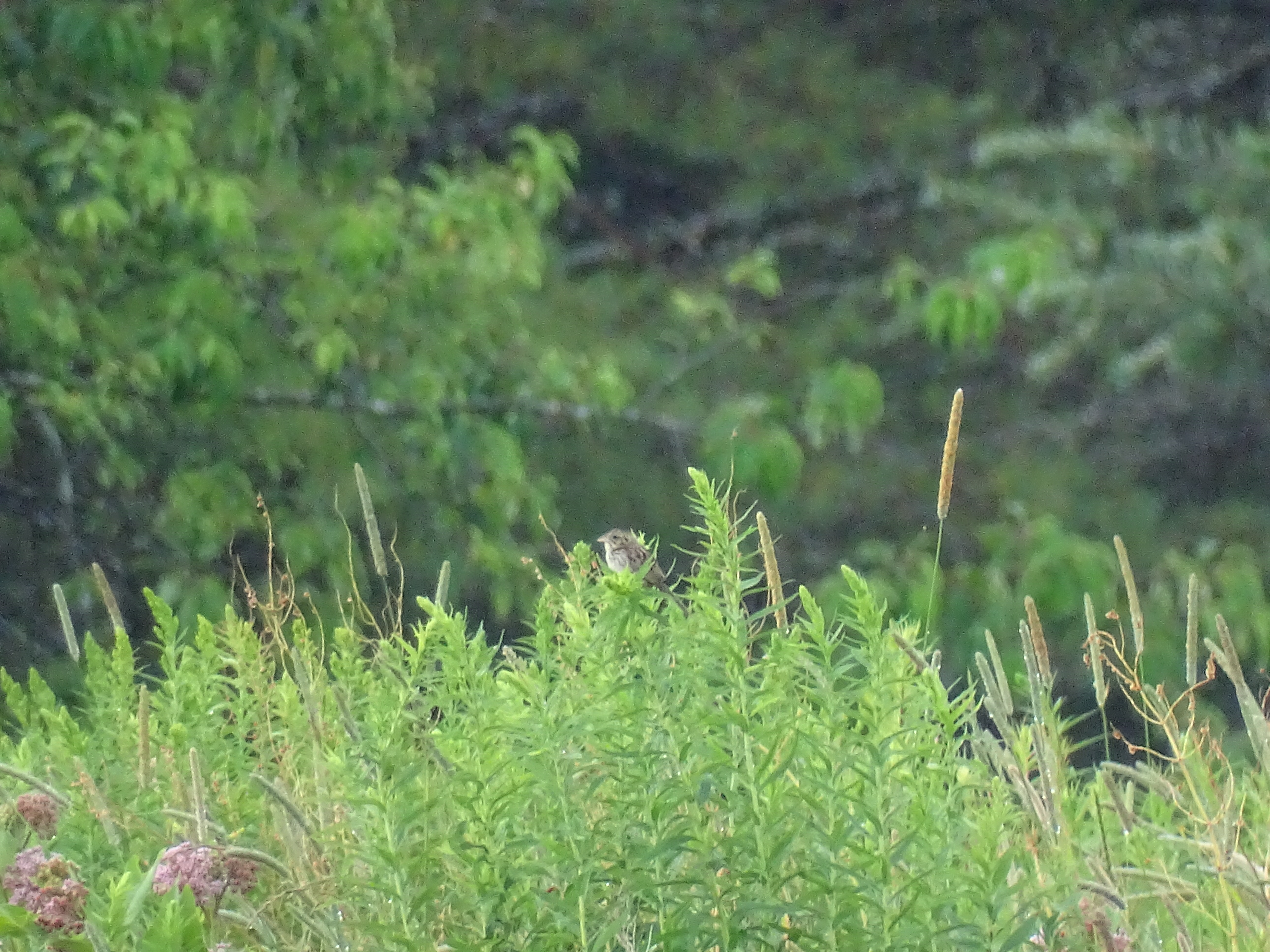
This Henslow’s Sparrow was a new “Maine Bird” for me – and virtually everyone who saw it during its stay Brunswick from 7/5 through week’s end. Details below.
So much for the mythological “summer birding doldrums.” They never really existed, but between climate change, land use changes, and better birding communication, they certainly don’t exist now. Several rarities headlined the week, along with the first wave of southbound (fall!) shorebird migration. My highlights of note over the past seven days included the following:
1 adult Black Tern, Pine Point, Scarborough, 7/2 (early migrant/post- or failed-breeding dispersal. With client from North Carolina). N. Gibb had two that afternoon, and one bird continued through 7/8 (with Buffalo Ornithological Society)
“Fall” migration is definitely underway, with the vanguard of southbound shorebirds now arriving. A good diversity for the date in Scarborough Marsh on 7/2 included 9 Black-bellied Plovers, 7 Greater Yellowlegs, 3 Short-billed Dowitchers (first of fall), and 2 Lesser Yellowlegs (FOF). (With client from North Carolina).
1 HENSLOW’S SPARROW, Crystal Springs Farm at intersection of Pleasant Hill Road and Casco/Church St, Brunswick, 7/6. Found on 7/5 by Gordon Smith. Observed from 6:25am through 8:15am, singing nearly constantly. Video (better than the photo above) at: https://fb.watch/e5wtcTjSrV/
4-5 Red Crossbills and 4 Short-billed Dowitchers, Reid State Park, Georgetown, 7/7.
1 continuing BLACK-NECKED STILT, salt pannes on north end of Scarborough Marsh from US Rte 1, Scarborough, 7/8 (with Buffalo Ornithological Society).
1 continuing proposed TRICOLORED HERON X SNOWY EGRET X LITTLE EGRET hybrid, Eastern Road Trail, Scarborough Marsh, 7/8 (with Buffalo Ornithological Society). *Hybrid combo as proposed in: Lovitch, Derek J. 2022. Photo Salon: Hybrid Herons of Maine. North American Birds 72 (2): 28-40.
Migrant shorebird migrant totals from Scarborough Marsh on 7/8 (with Buffalo Ornithological Society): 100+ Least Sandpipers, 19 Short-billed Dowitchers, 8 Lesser Yellowlegs, 4 Greater Yellowlegs, and 4 Black-bellied Plovers.