As you well know by now, I enjoy looking at gulls. I especially enjoy looking at white-winged gulls in winter here in Maine. From the seemingly-endless range of variation of first-winter “Kumlien’s” Iceland Gulls to the stately elegance and dominating demeanor of adult Glaucous Gulls, I can’t get enough. And there’s one particular white-winged gull that I have studied more than all of the others.
For the fourth year in a row, a relatively-small white-winged gull has spent the winter at Riverbank Park in Westbrook. This has afforded me the opportunity to study the bird’s progression, and to one day, hopefully, identify it! Yup, after four winters, I am still not certain as to what it is! And that is both fun and frustrating.
First of all, I have no doubts that the bird is indeed the same individual – despite the lack of a band or any sort of unique marking – due to the bird’s behavior and overall very pale plumage each year. While other “Kumlien’s” Iceland Gulls occasionally visit the river here, most of the birds just head up to the base of the falls for a bath with the other gulls, and then head back down the river. Once in a while, another Iceland Gull will spend some time at Riverbank, but they don’t tend to linger long. The bird’s behavior is also more than suggestive – not only does it sit in the same three spots (including a church steeple that rarely has any other gull) whenever it is near the park, but it is the only white-winged gull that is almost always present and comes down to feed on handouts with the contingent of Ring-billed Gulls. The chance that a similarly-super-pale bird would do exactly the same things for four years in a row at a place that usually doesn’t have any other white-winged gulls seems rather far-fetched. It also tends to show up at about the same time – early to mid-January each year. I think it is safe to assume that this is the same bird.
Therefore, what we now have is a record of the bird over four years of life, showing the plumage progression of each year. Now, I never recommend using only one photo to describe a given bird (in this case, in a given year), especially with gulls, as gray scale in particular changes so much with lighting (and how badly I butchered the ISO) among other factors ranging from time of the season to how recently the bird ate. Therefore<a href=”http://www.facebook.com/media/set/?set=a.350344068328887.95540.198877036808925&type=3“>, I recommend taking a look at the photo gallery on our store’s Facebook page here.
But for sake of conversation, let me simply include one photo from each of the past three winters.
2010-11:
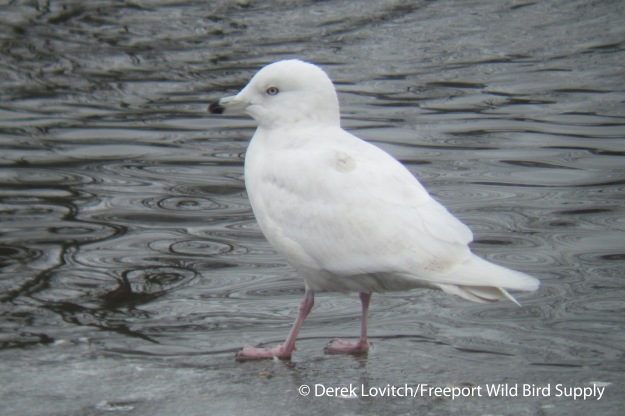
2011-12:

2012-13:

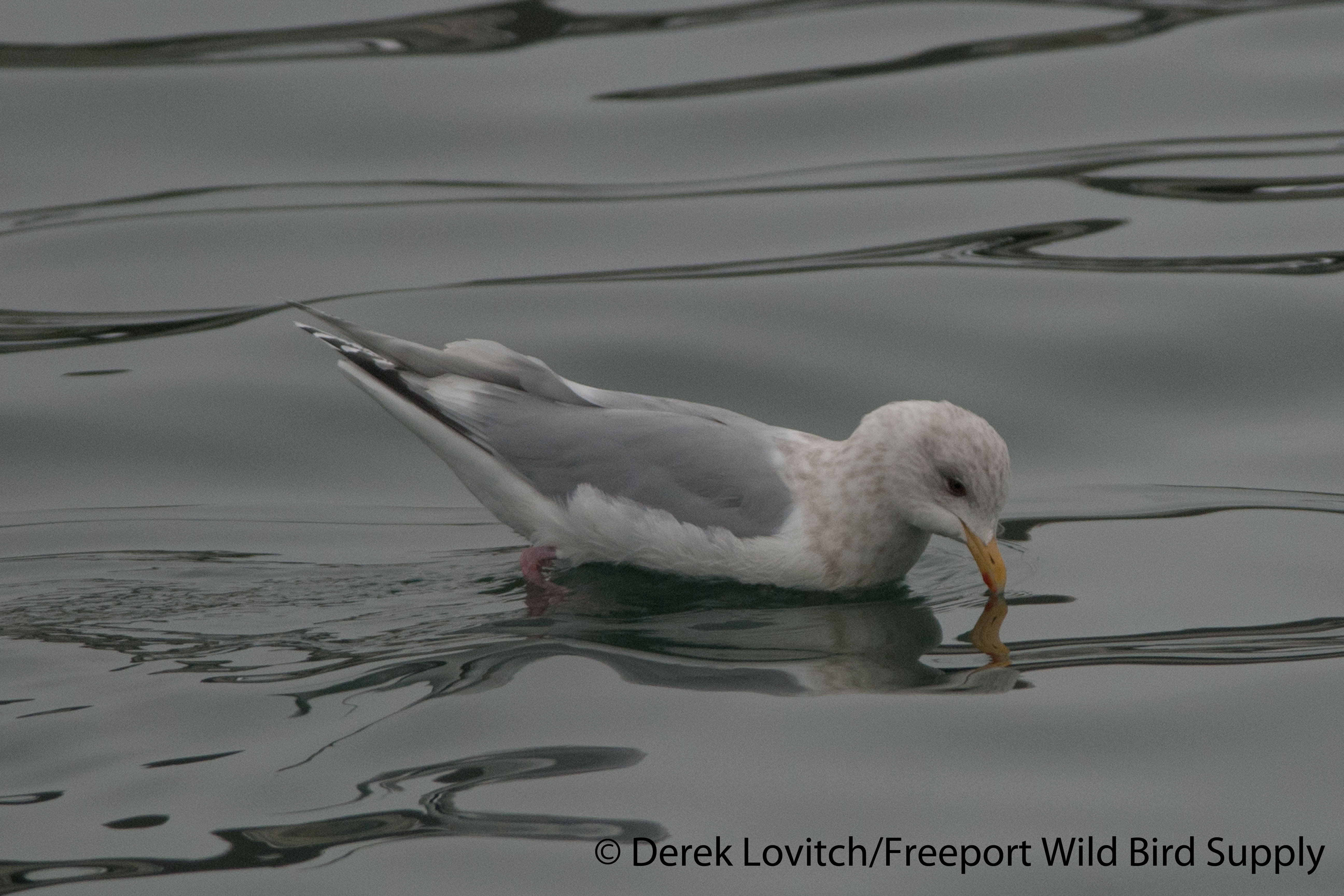
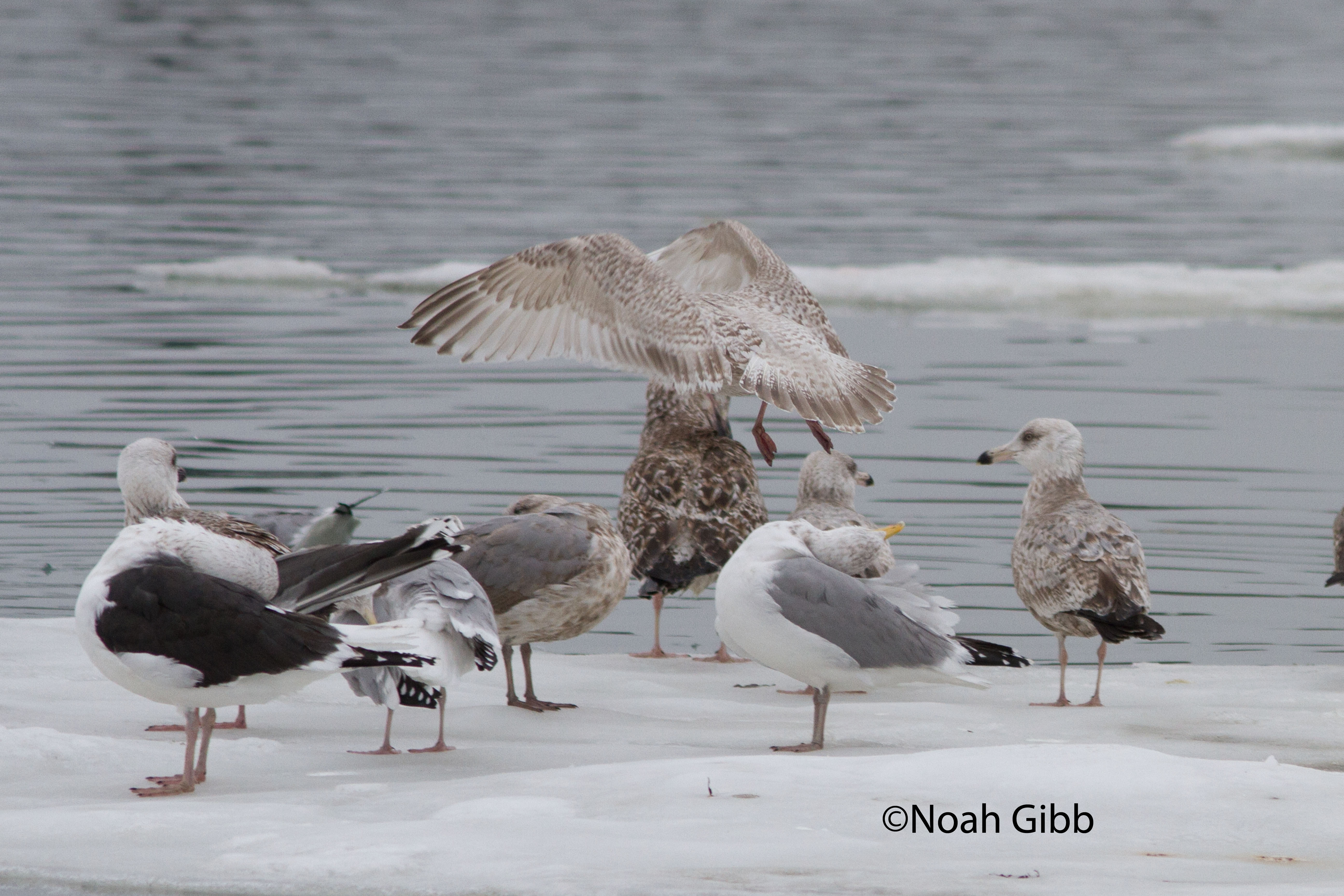
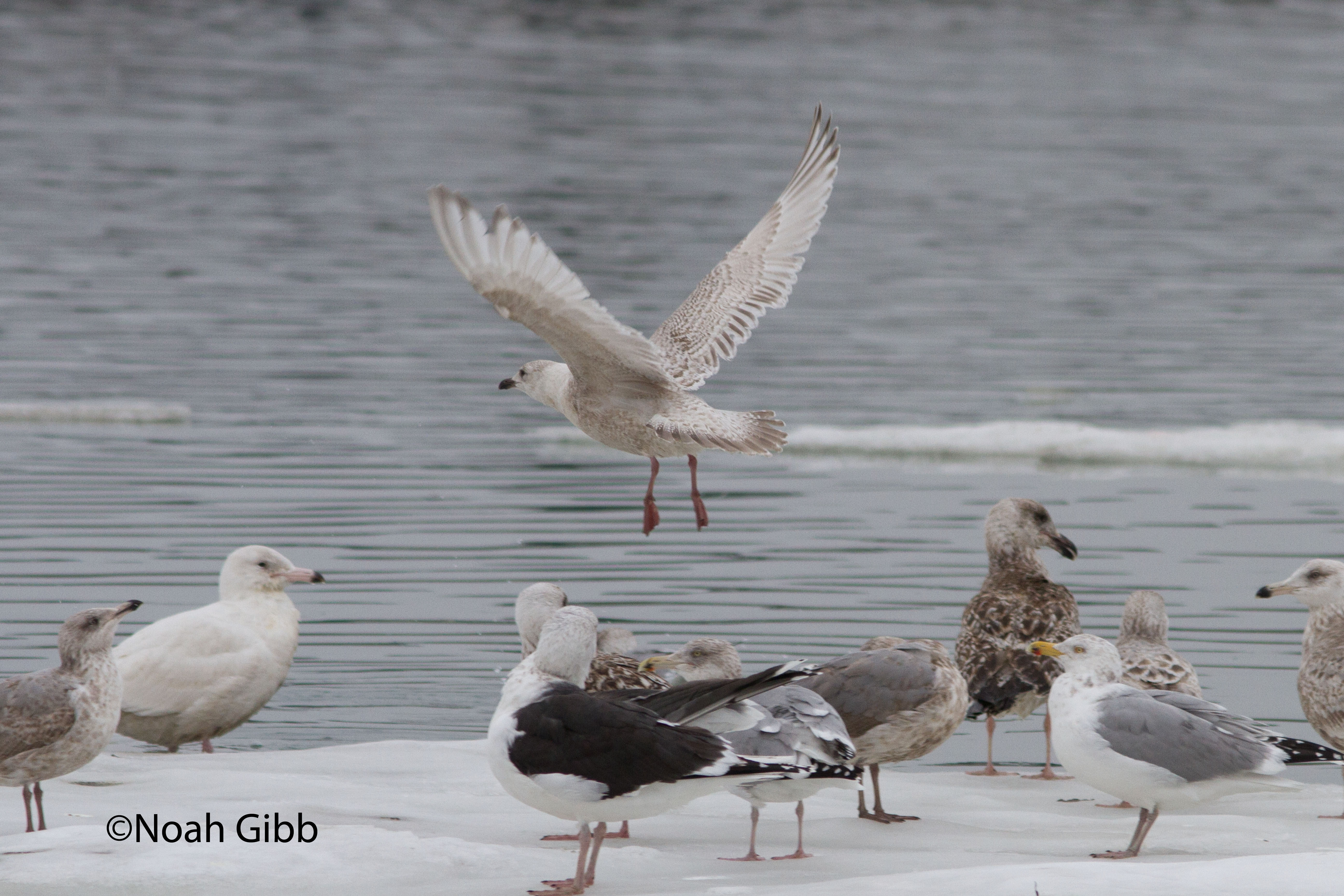
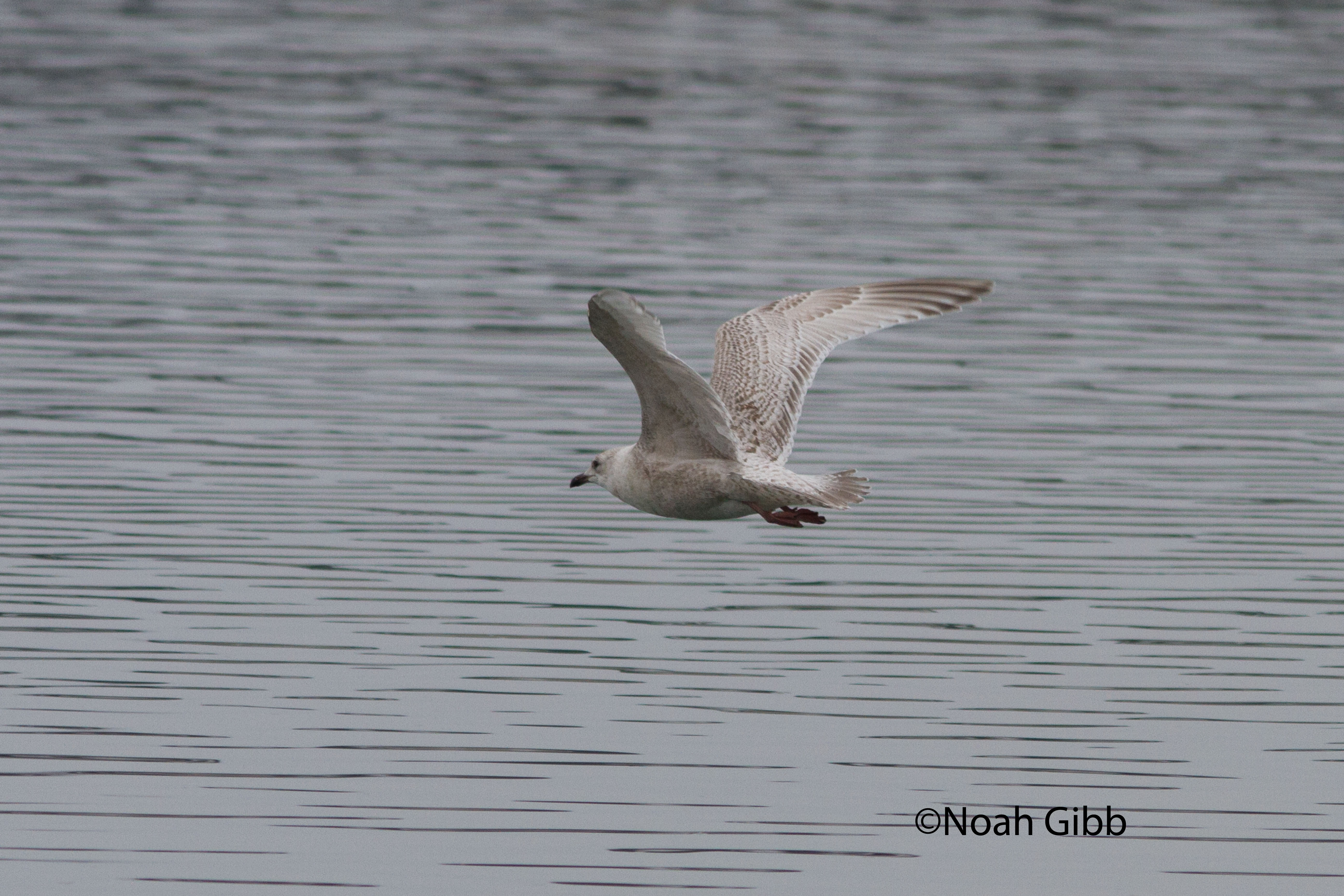
And now, it has returned, in full-adult plumage. Here are a series of photos that I took at Riverbank on Monday (1/27):

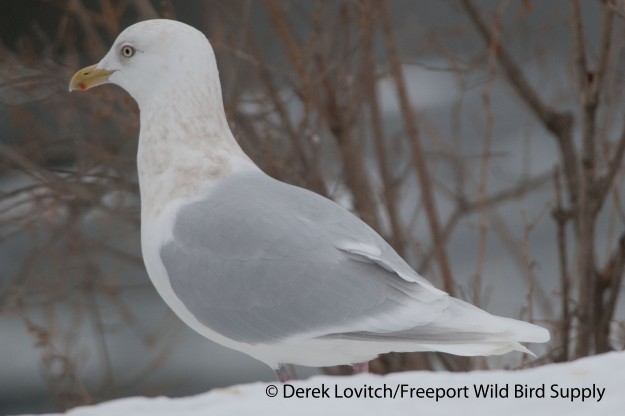


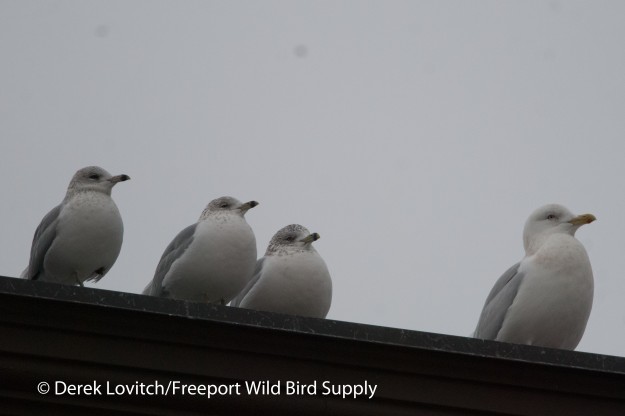
In that aforementioned Facebook gallery, I included some of the thought process that I have had about exactly how old this bird is, and what subspecies of Iceland Gull that it might be. From an identification perspective, now that is in “adult” plumage, the exact age is moot – all adult plumages look the same, with minor differences between winter (especially streaking on the head and neck) and summer (white head and more vivid bare part coloration). It is safe to say that this bird is “at least” 4 years old, and now it is in the plumage that should allow us to more-safely identify it to subspecies. In theory.
But before we delve into the Iceland Gull subspecies question, I think it is worth taking a moment to be sure it is in fact, and Iceland Gull. The case has been made that this bird could be a runt Glaucous Gull (or one of the very small subspecies) or even an Iceland x Glaucous Gull hybrid.
The basis for the argument has revolved around the exceedingly pale plumage, the bird’s rather bulky size and shape, its dominance over even larger Herring Gulls, and especially the length of the wing. Here, I blew up a photo from Monday of the primaries. I extensively manipulated it to try and bring out the detail of the edges of each feather – so ignore the color.
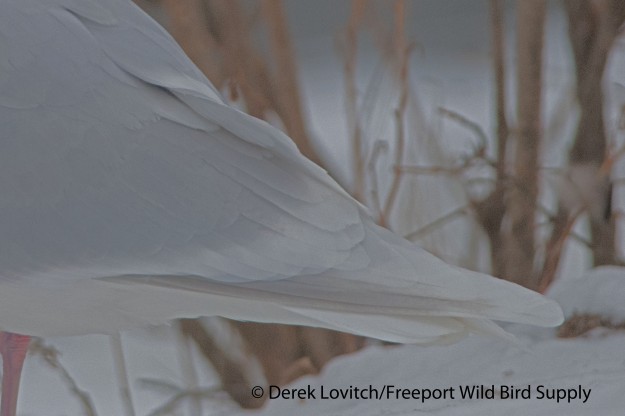
Iceland Gulls are usually readily identifiable by their longer wings. Those wings extend well beyond the tail, and usually at least 4 primaries are visible beyond the tail. Olsen and Larson reference this projection as being “equivalent (to) the bill length or longer.” It’s not a perfect photo above, but I definitely don’t see four primaries beyond the tail, and the primary projection does not look as long as the bill in any of the photos. In fact, this “unusually short-winged impression” was consistent in every year that we have seen the bird. Take a look at the photo gallery over the years – you never see a “long-winged” Iceland Gull with four primaries extending beyond the tail.
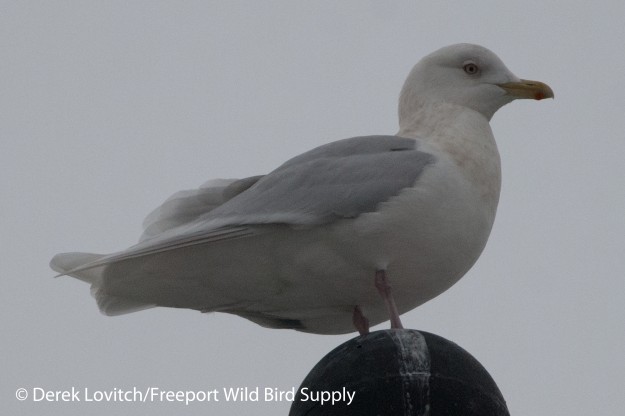
Another clue for Iceland vs. Glaucous is the relatively short legs of Iceland: the tibia (upper part) is usually mostly covered by body feathers, while on Glaucous, the tibia is more exposed – at least when the bird is alert. To me, this bird sometimes looks short-legged, with little exposed tibia, which is in line with Iceland Gull, but other times looks oddly long-legged, in line with Glaucous (see above and additional photos). This is a fairly subjective (like so many other gull ID characteristics) point, and one that I am not putting much weight in either way.
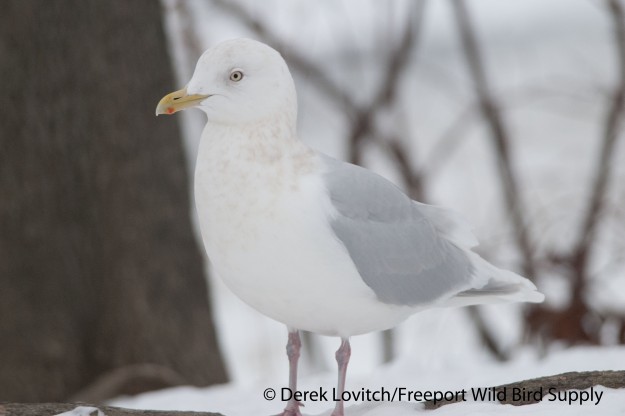
On the Westbrook bird, the forehead usually appears gently rounded, and the eye looks fairly big on the head – as it should on an Iceland Gull. However, other photos show a very sloping forehead – this feature changes significantly with posture and “attitude,’ but I must say that I have never seen a Glaucous Gull that appeared truly “round-headed.”
While the bill is not dainty, it is not as formidable as Glaucous usually looks, and it shows little in the way of a gonydeal angle. Howell and Dunn state that Glaucous’s “bill base often has slightly expanded culmen that creates distinctive shape (especially males), with a depth at the base greater than the depth at the gonydeal expansion.” I don’t see that on this bird. In fact, their description for Iceland Gull of “relatively short and slender, parallel edged with a shallow to moderate gonydeal expansion,” seems to match this bird much better, although it’s not the most slender, nor the shortest, bill that I have seen on Iceland Gulls.
HEAD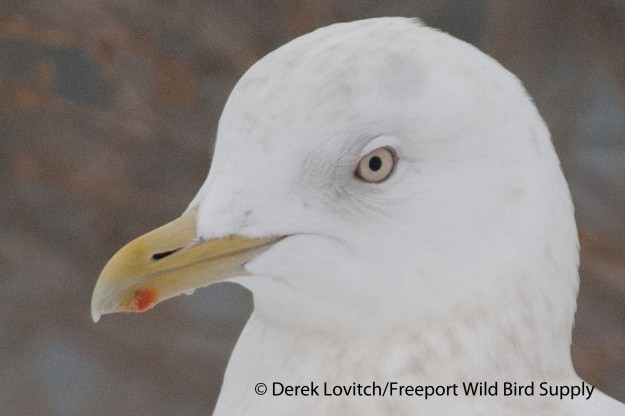
The fleshy orbital ring is pink on this bird at the moment. Howell and Dunn describe Glaucous Gull as having an orange orbital ring, “Kumlien’s” Gull as having it “purplish-pink,” with the nominate Iceland showing a “pink to reddish.”
Of these characteristics, the only thing that suggests that this is not anything other than a pure Iceland Gull of one or the other subspecies is what appears – and has consistently appeared over the years – to be a short wing. Personally, I have a hard time relying on any one single field mark to rule a species in or out, but I can’t completely ignore how short this wing is.
So assuming for a second that this is indeed an Iceland Gull, it comes down to which subspecies it is: the nominate glaucoides or kumieni. I’m not going to get into the taxonomic debate here, so I will discuss this based on the current most-widely-used taxonomy that includes two subspecies of Iceland Gull: the nominate glaucoides that breeds in Greenland and winters mostly in Iceland and Northern Europe, while kumlieni breeds on Baffin Island and adjacent areas of northeastern Canada, and winters largely in the Northeastern US and Atlantic Canada. Birds that seem perfect for glaucoides are regularly seen in Newfoundland and Nova Scotia, but in the Northeast US, the conventional wisdom suggests that glaucoides is very rare, and some argue that most if not all birds that appear to be glaucoides are actually just the pale extremes of kumlieni.
The extensively pure white wingtips, very pale gray mantle, and very white appearance as a youngster are all points in favor of glaucoides. However, most features overlap with kumlieni. What’s troubling is that the Westbrook bird never appears as small and dainty as a textbook glaucoides; sometimes described as “cuter” with a big eye, more rounded head, and small size than most kumlieni. This bird is more along the lines of a big kumlieni, which few plumage characteristics at any age have been overly consistent with.
If I saw this bird for the first time this week, I think I would call it a “probable glaucoides” and move on. But I have spent so much time with this bird over the years (“You are a little obsessed with this bird,” Jeannette just said.) that I prefer to still answer “I don’t know,” that I stubbornly want to keep pondering this bird. Its appearance in preceding years and those short wings continue to bother me, even though my gut tells me that this is just an Iceland Gull.
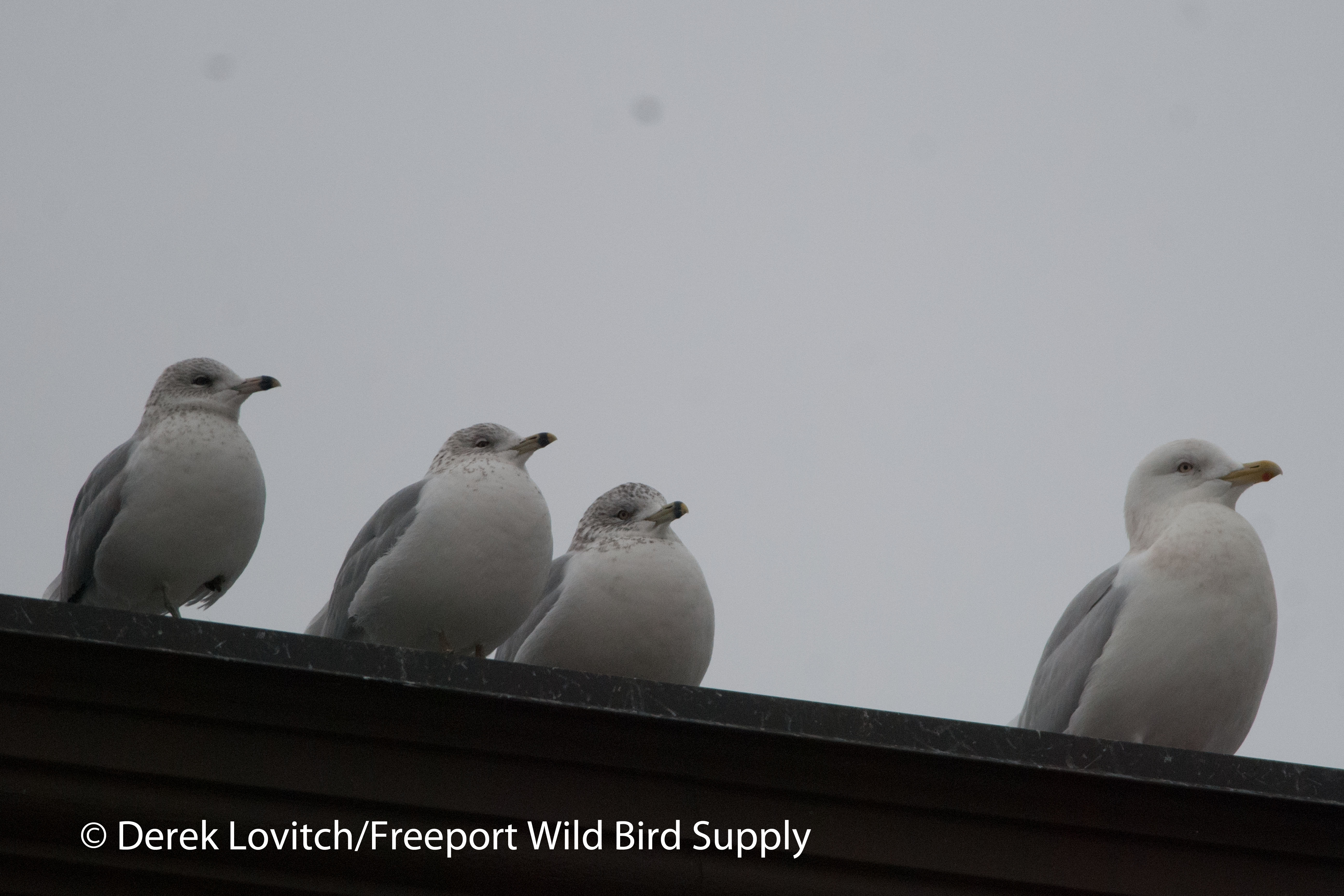
Essentially, the problem with this gull for each of the last four years is that it’s never been seen (to my knowledge) side-by-side with another white-winged gull. We’re therefore left with conjecture, comparing this bird to Herring and Ring-billed Gulls. What we really need is photos of this bird next to another Iceland-type gull. A direct comparison would do wonders for figuring this thing out for sure. Or a DNA test.
Short of that, this is, essentially, only an exercise. I don’t think anything can be said definitively. Hopefully, by spring, this bird’s bare part coloration (orbital ring and the bill in particular) will develop a little further, which may shed further light on the birds’ identity. More importantly, I – and others – will be trying to get more photos of the bird and especially photos of the bird with other Iceland Gulls. Until then, I will continue to ponder, enjoy, study, and yes, be frustrated by “The Westbrook Gull.”
Now for those who are truly gluttons for punishment, I will be discussing this bird as part of my upcoming Gull Identification Workshop for York County Audubon on February 8th and 9th. But don’t worry, we’re not going to spend too much time with the unidentifiable…I promise. Instead, we’ll spend most of our time learning that MOST gulls are actually fairly easy to identify. I believe the Westbrook Gull is the exciting and challenging exception to the rule. And once you are comfortable identifying just about every gull just about every time, you’ll be ready to accept and excel such challenges. I hope you will join me for this workshop. For more information, and a link to register, visit the Tours, Events, Workshops, and Programs page of our website.
References:
Howell, Steve N.G. and Jon Dunn. 2007. The Reference Guide to Gulls of the Americas. Houghton Mifflin Company: New York and Boston.
Olsen, Klaus Malling and Hans Larsson. 2004. Gulls of North America, Europe, and Asia. Princeton University Press: Princeton and Oxford.






 ]
]









 Maine Birding Field Notes