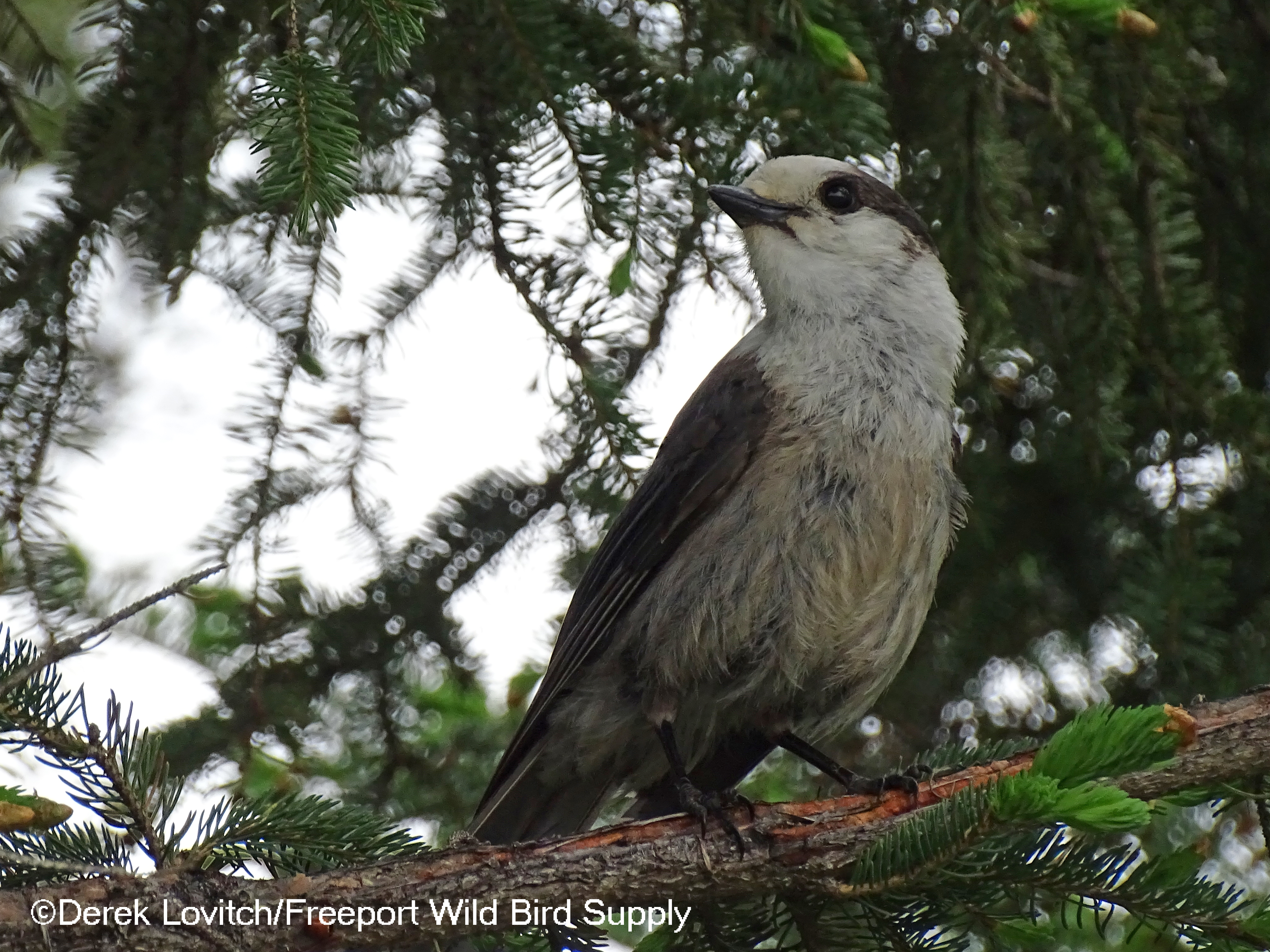
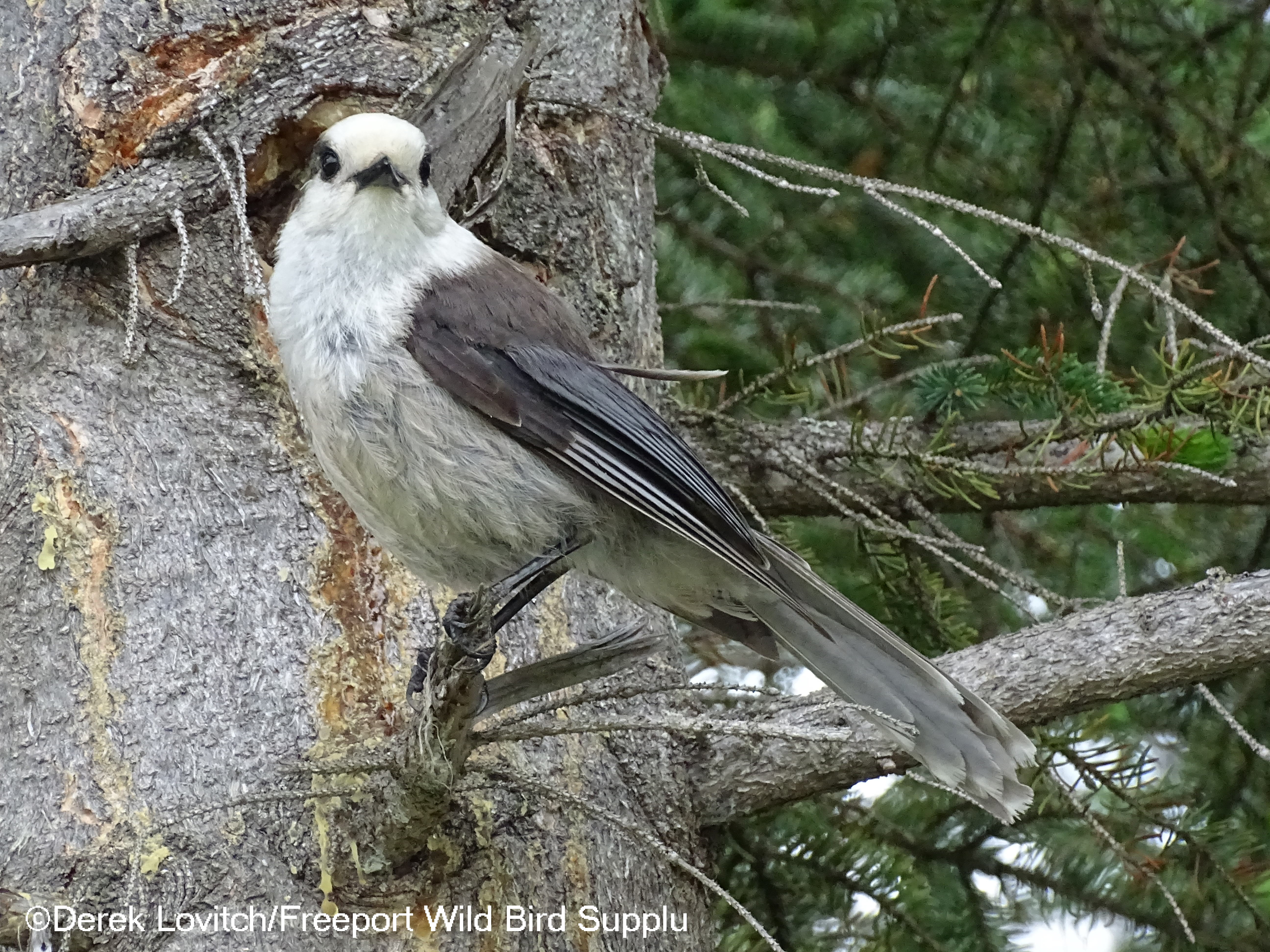
One of up to 6 Canada Jays encountered outside of Rangeley while leading tours for the Rangeley Birding Festival included this confiding adult, part of a family group of at least 4 on 6/6. In fact, I enjoyed Canada Jays in three states in less than a week’s time this week/weekend!
This time of year, most of my birding, both personally and especially professionally, is dedicated to finding, seeing, and enjoying the wide array of breeding species this state has to off. From Saltmarsh Sparrows and Roseate Terns here along the southern coast to Bicknell’s Thrushes and “boreal specialities” in the western Maine mountains (and northern New Hampshire), it has been another extremely busy guiding season for me. Meanwhile, while home, I have been conducting two local breeding bird surveys. While my “highlights” these days are seeing the “expected” species we all seek, I did encounter some unexpected observations and noteworthy counts over the past two weeks, but mostly, I thought I would share some of my photo highlights.
1 Dunlin, 4 Semipalmated Plovers, and 1 Least Sandpiper, Sanford Lagoons, 6/2 (with Jeannette).
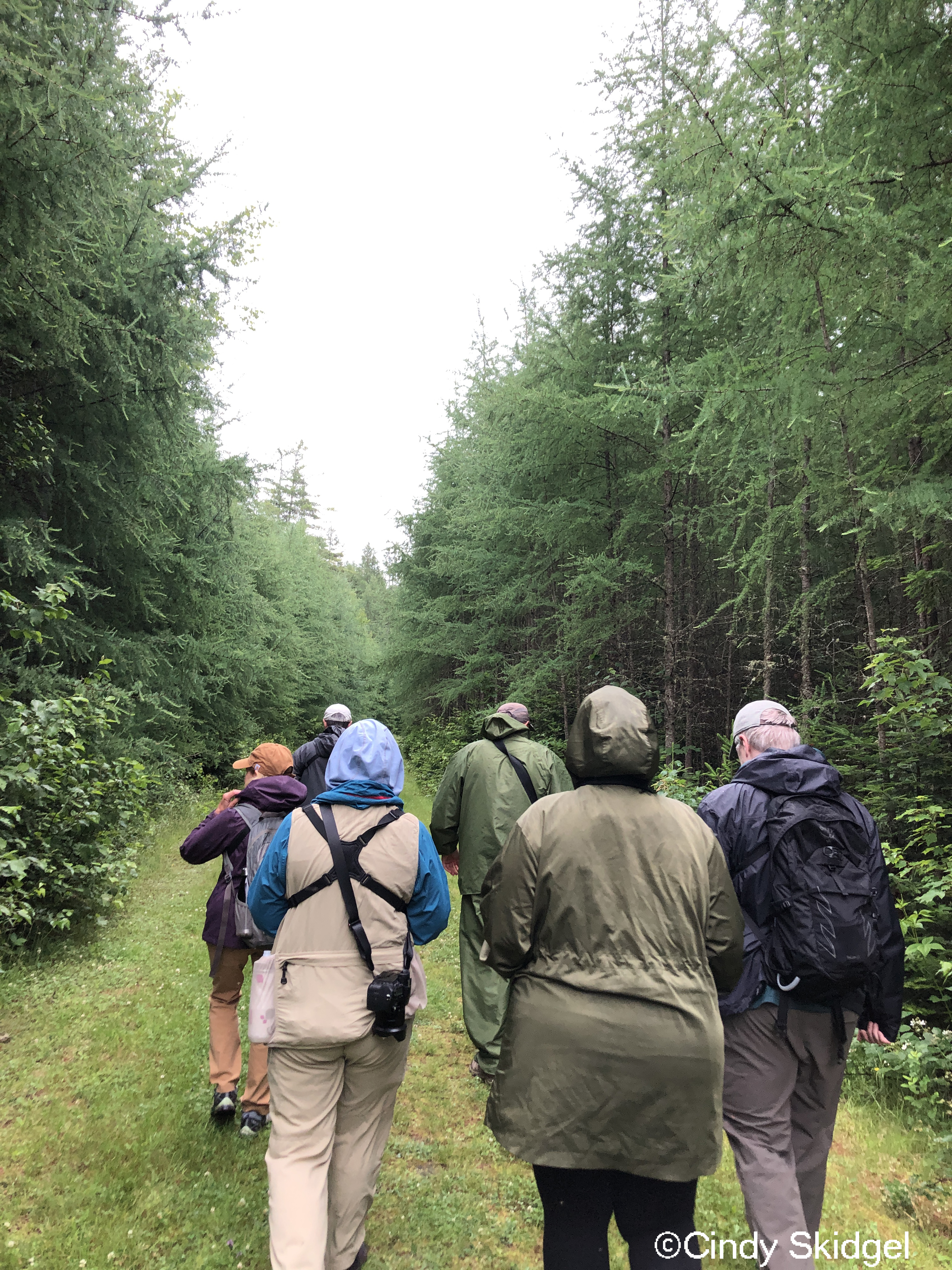
Rangeley Birding Festival, 6/6-6/8: Two mornings of birding Redington Road (scouting 6/6, with tour group 6/7) yielded high counts of 2 territorial CAPE MAY WARBLERS (6/6+6/7), 6 CANADA JAYS (6/7), 1 pair of BOREAL CHICKADEES (6/6), 3 Red Crossbills (6/6), 2 Olive-sided Flycatchers (6/6), 1 American Bittern (6/7), 1 Black-billed Cuckoo (6/7), etc.
I was excited to find two Cape May Warbler territories outside of Rangeley on the 6th, and then find both males in the same place the next day with my Rangeley Birding Festival tour group.
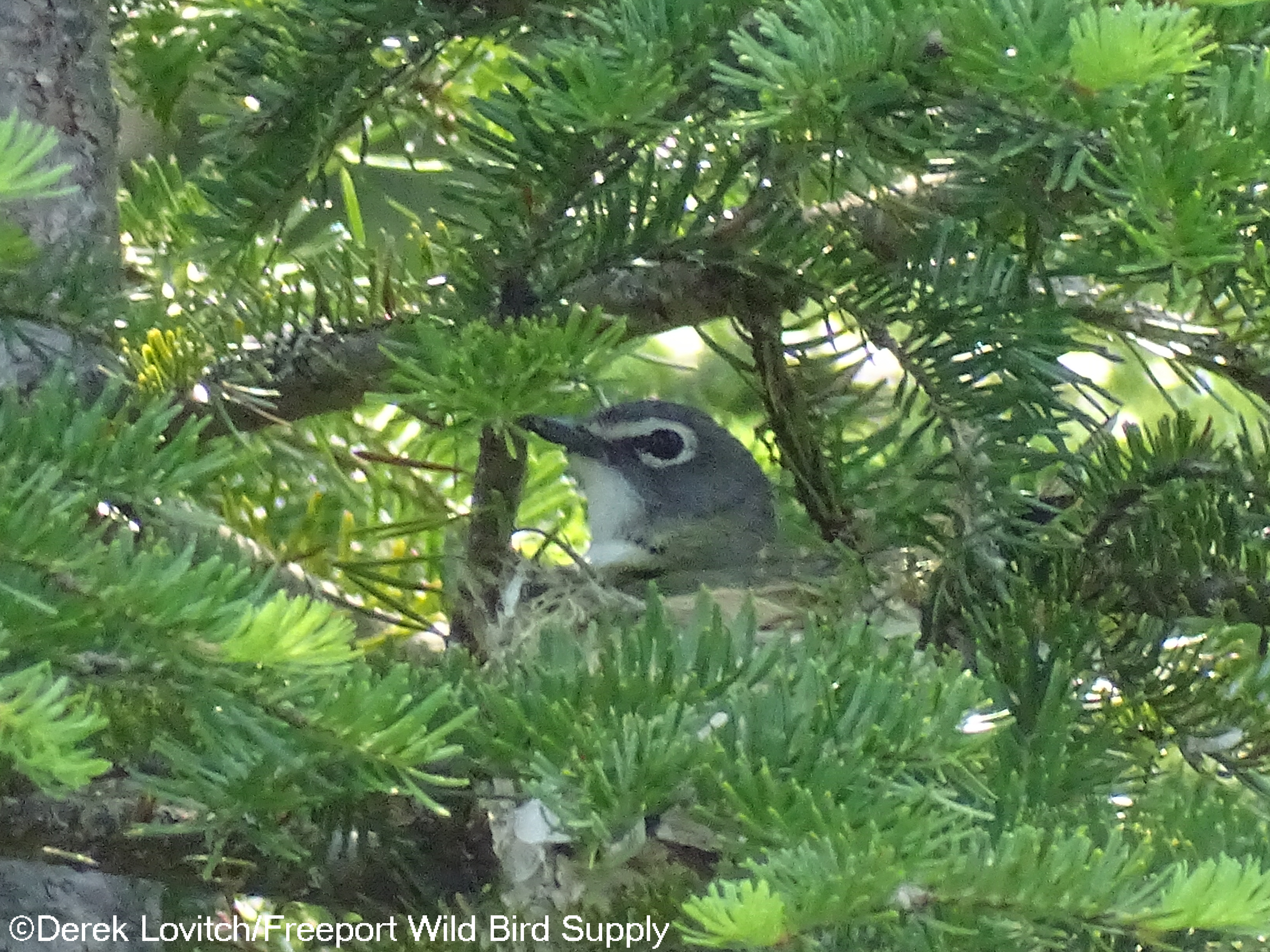
While leading a walk for the Rangeley Birding Festival at Hunter Cove Sanctuary, I found this low-level Blue-headed Vireo nest that was fascinating to observe.
2.5 day private tour in Vermont and Northern New Hampshire (I know, this is a non-Maine-birding-field-note!) yielded: Bicknell’s Thrush, Black-backed Woodpecker, Boreal Chickadee, Canada Jay, Fox Sparrow, and 22 species of warbler including Cape May, Bay-breasted, and Mourning.
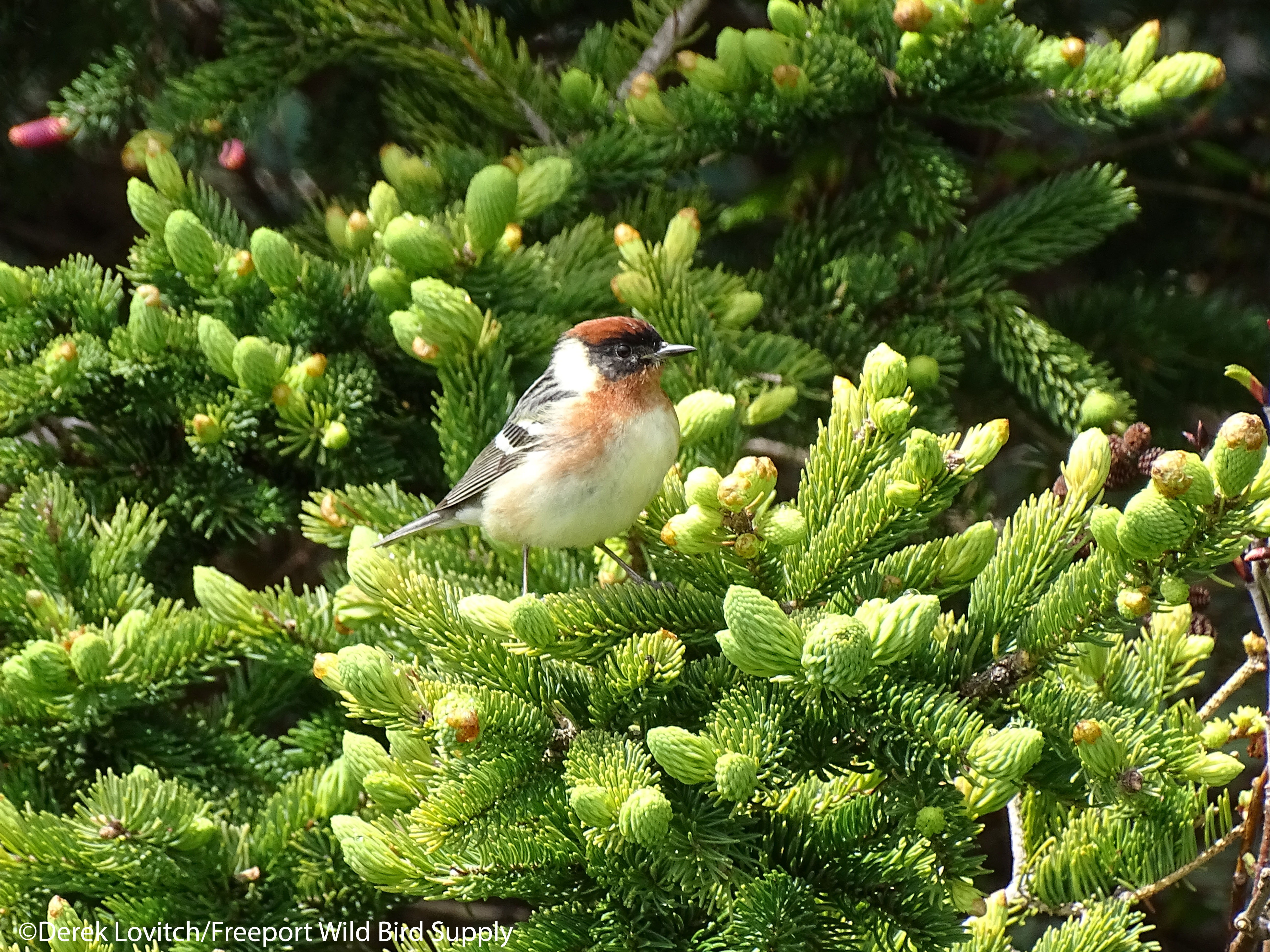
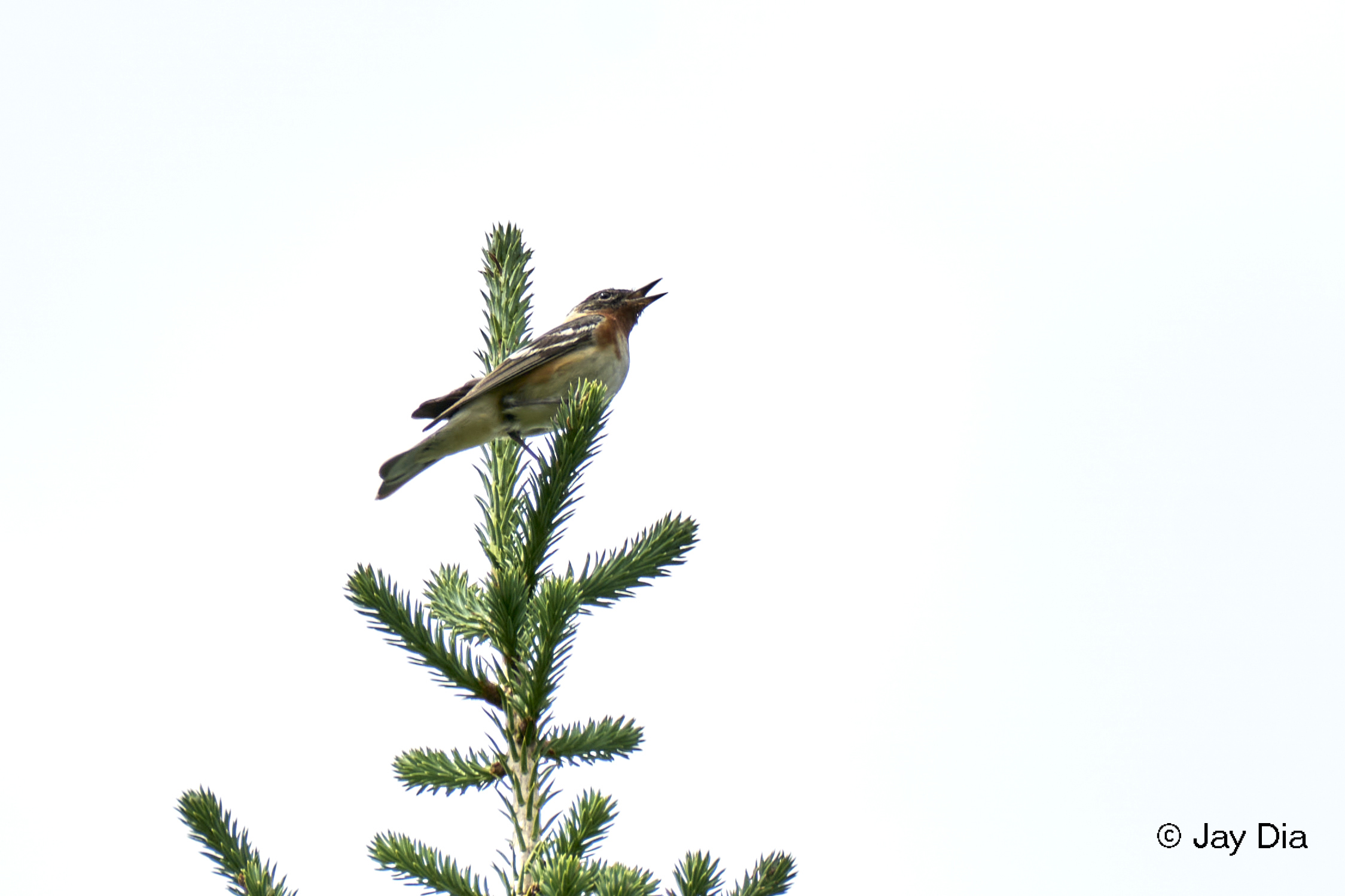
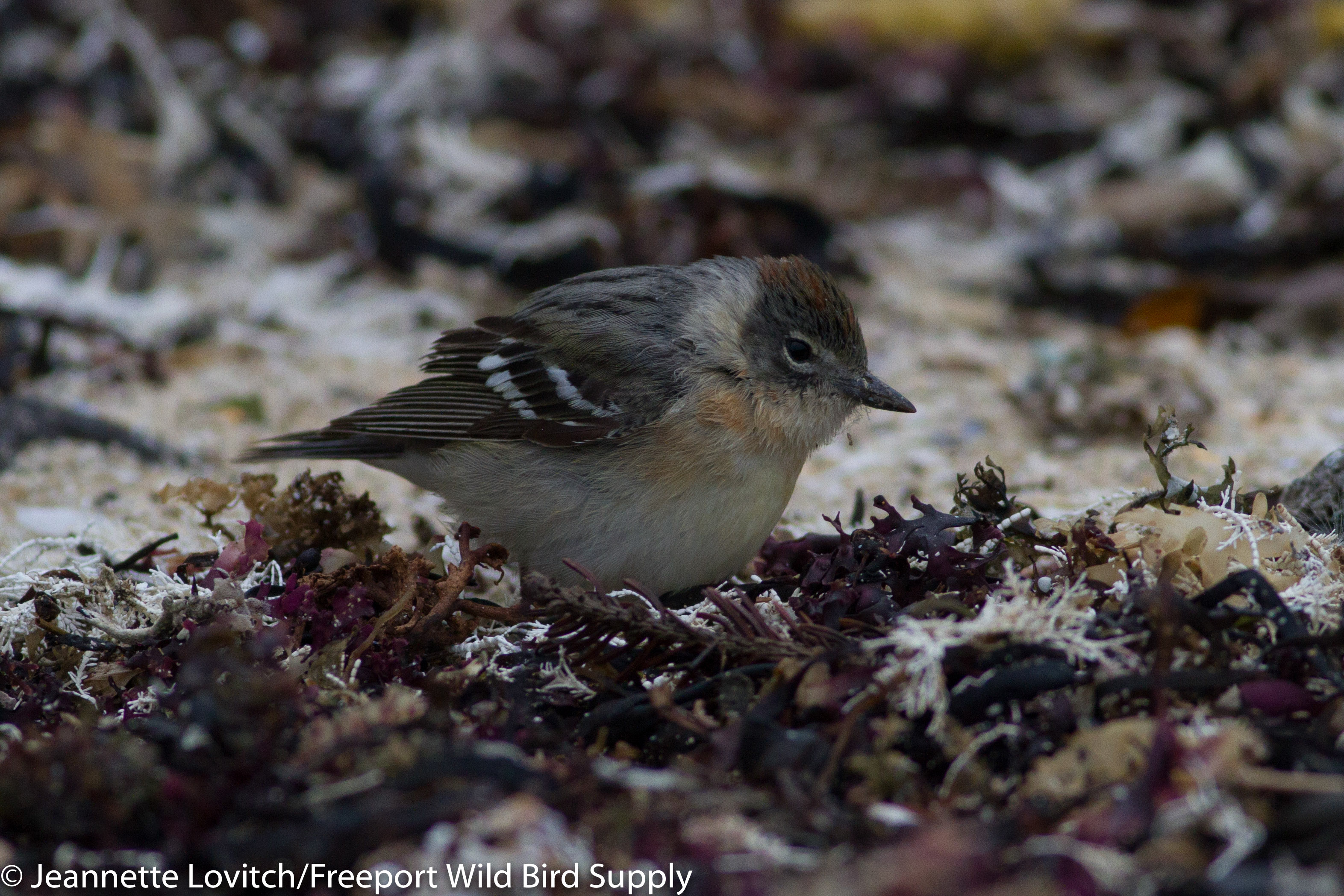
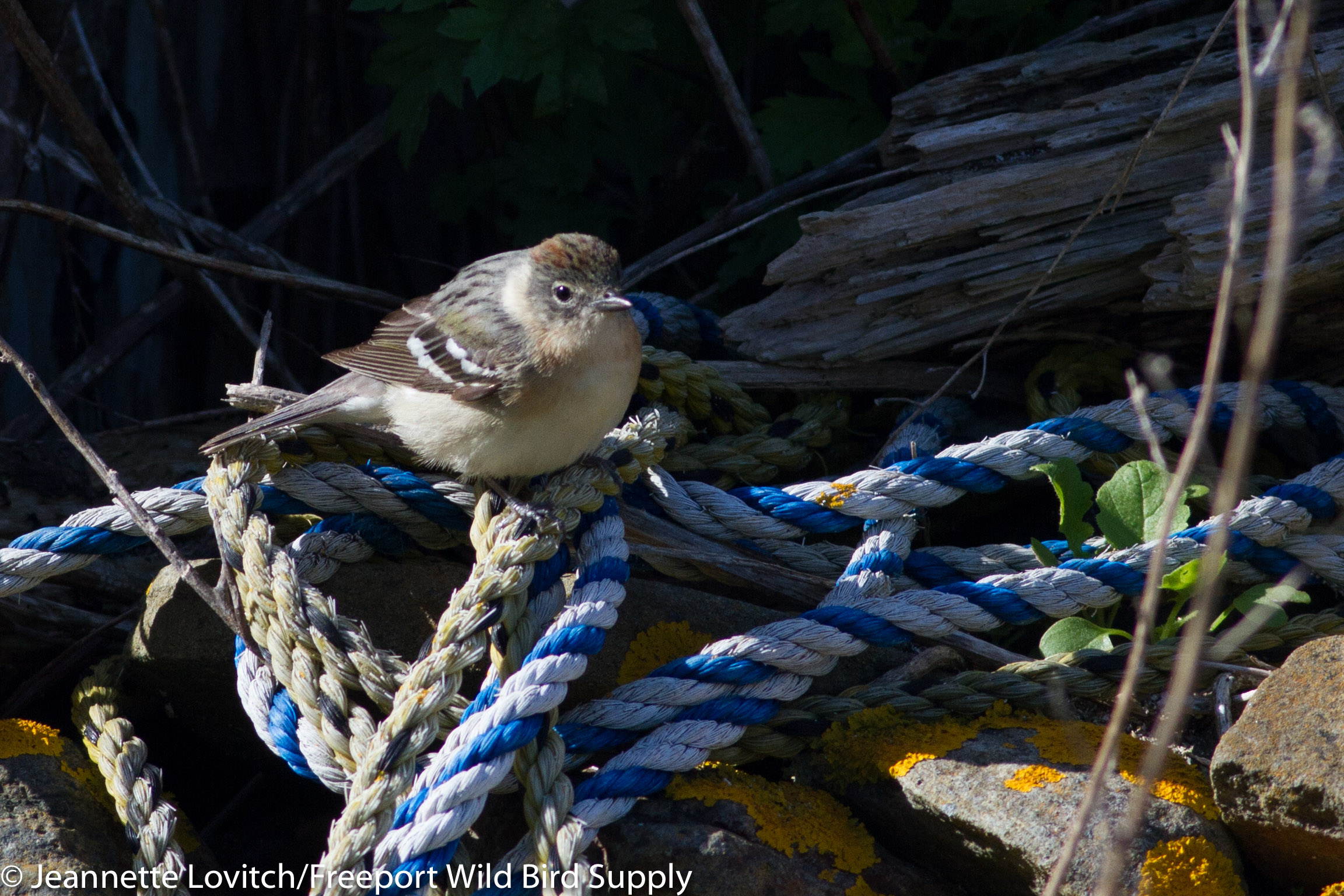
As usual, I took few photos while guiding, but this Bay-breasted Warbler outside Errol, NH on the 10th (with clients) was too cooperative not to fire off a few shots!
Back home for a couple of days, it was off to my local bird surveys. This fledgling Barred Owl was in Freeport on the 12th, confirming breeding once again at one of my local patches.
Monhegan Spring Migration Weekend Trip Report.
The 2025 Monhegan Migration Spring Weekend was a shocking success. We went from having a weather forecast that made me worry if there would be any migrants to see at all, to an exceptional weekend that was by far the best Memorial Day weekend of birding out here in quite a few years. A total of 106 species were tallied in 5 days, including 91 together as a tour group, with a total of 22 species of warblers. Here’s the full trip report.
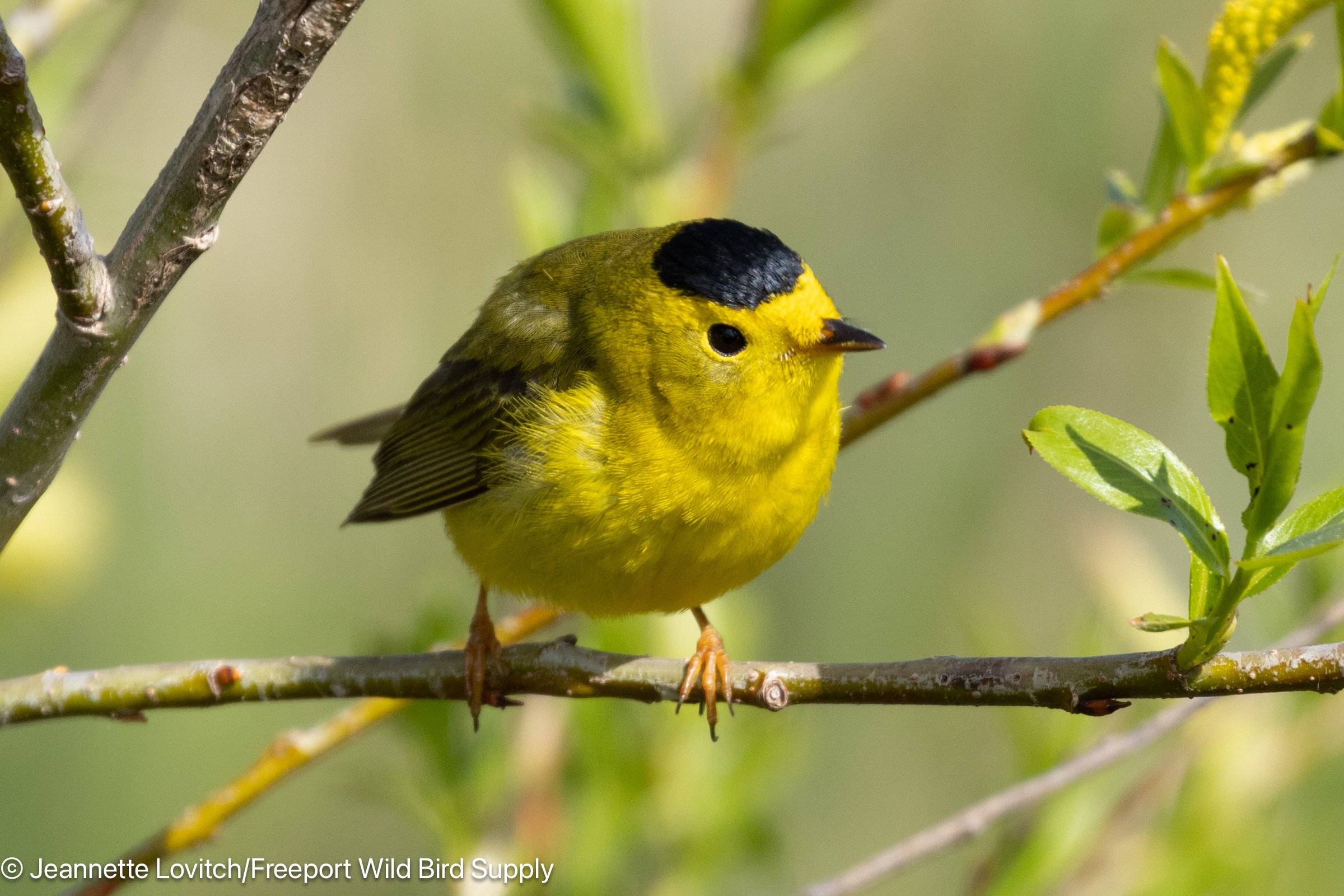
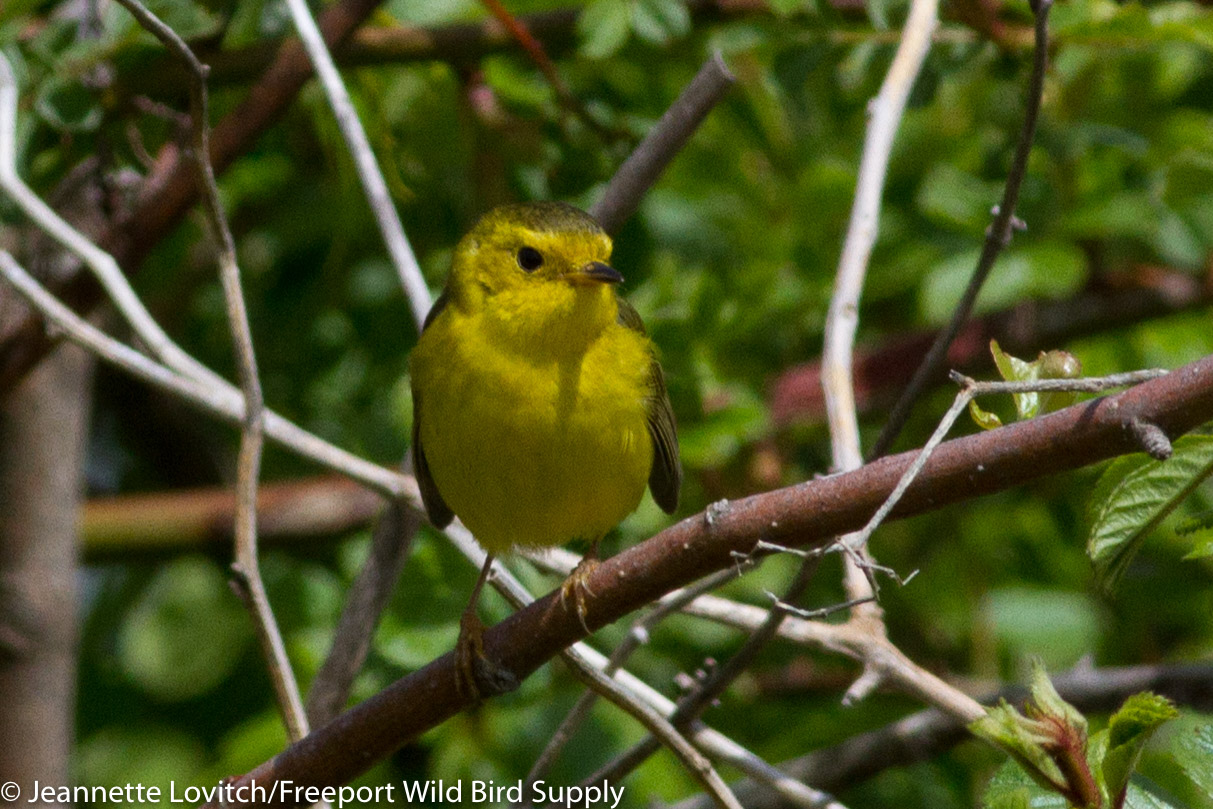
It was a great weekend for warblers, with a tour total of 19 species and a 5-day total of 22 species, including quite a lot of Wilson’s Warblers for the end of May. With 10-20 estimated per day, we were regularly treated to exceptional views, such as this adult male.
The 2025 Monhegan Migration Spring Weekend was a shocking success. We went from having a weather forecast that made me worry if there would be any migrants to see at all, to an exceptional weekend that was by far the best Memorial Day weekend of birding out here in quite a few years.
Technically, our tour was to begin on Friday with a little morning birding in Port Clyde before boarding our ferry. But it was raining. A lot. Wisely, most folks held out until the ferry meeting time. Unfortunately, that meeting time was delayed by 5 hours when the first two boats of the day were cancelled due to the storm. It was a bona fide late season Nor’Easter and it was raging out there.
We were lucky enough to get spaces on the 3:00 boat, but even luckier that the seas were dropping dramatically. OK, it was far from calm, and while I might not have thought it was “too bad,” others disagreed. But we made it! And the rain had stopped. And we went from 10-14 foot seas to a few waves that may have approached 8 feet. Not pleasant, but more than manageable. Of course, I have to admit that the “worst ferry ride” bar is pretty high for me.
By the time our luggage was organized, we didn’t have a lot of time, but we decided to try and catch up with the continuing truant Harlequin Ducks that had been seen in and around the harbor. Up to 8 had been reported, but when we arrived at the recommended spot, we found 12! While common in winter, “Harlies” are usually long gone by now, so this was a treat (it was also an island bird for me!). We also picked up a 2nd/3rd cycle Lesser Black-backed Gull for our troubles. There was even a short break of sunshine!
Noteworthy for the date, 12 lingering Harlequin Ducks diminished to just one by the end of the weekend.
By dusk, winds were light northwest and it was still cloudy. Overnight there were some scattered showers, with winds shifting to the west and then going calm. The fog and showers made the radar hard to decipher, but the wind map for offshore offered some hope.
Screenshot
Note how birds who were offshore of southern New England would be pushed out to sea, but then find a tailwind that could theoretically take them right to the Mid-coast of Maine? The Boston radar was very busy, and suggested birds were indeed well offshore to our south come dawn. We had hope.
But our pre-breakfast walk was not very productive. Uh-oh. Scattered showers had returned, and there were very, very few migrants around. We did see the 12 Harlequin Ducks again, but passage migrants were limited to a handful of Blackpoll Warblers and a Wilson’s Warbler. Was this going to be a very slow weekend?
We returned for breakfast at our respective lodges, and the showers stopped. We met at 9:00 and began our next outing. I was concerned. But then, it happened. All of it.
First, a Lark Sparrow was found – very rare in spring – and while I was going to meet the group, I relocated it in the lawn of the Trailing Yew. It wasn’t there when we returned as a group, but we elected to repeat the southern loop in the hopes of encountering it. And encounter it we did, several times, actually, as it worked its way around the lawns feeding on fresh dandelion seeds.
Meanwhile, something else was happening. Suddenly, birds were everywhere! Pocket after pocket of warbler activity was encountered, and every apple tree had birds in it! Small batches of birds giving flight calls overhead were suggestive of birds only now, at mid-morning, arriving on the island. As these birds were a very different mix of species from the last “birdy” day four days ago, according to a fellow guide, these were in fact “new birds” only now, and rather unexpectedly, arriving en masse.
As the afternoon went on, it only got better! There were warblers in every cluster of trees, with lots of Magnolia Warblers and American Redstarts, but overall good diversity. Birds must have been arriving throughout the day and therefore remained active into the evening. Birds were often low, easy to observe, and the repetition allowed for reinforcing study and comparisons.
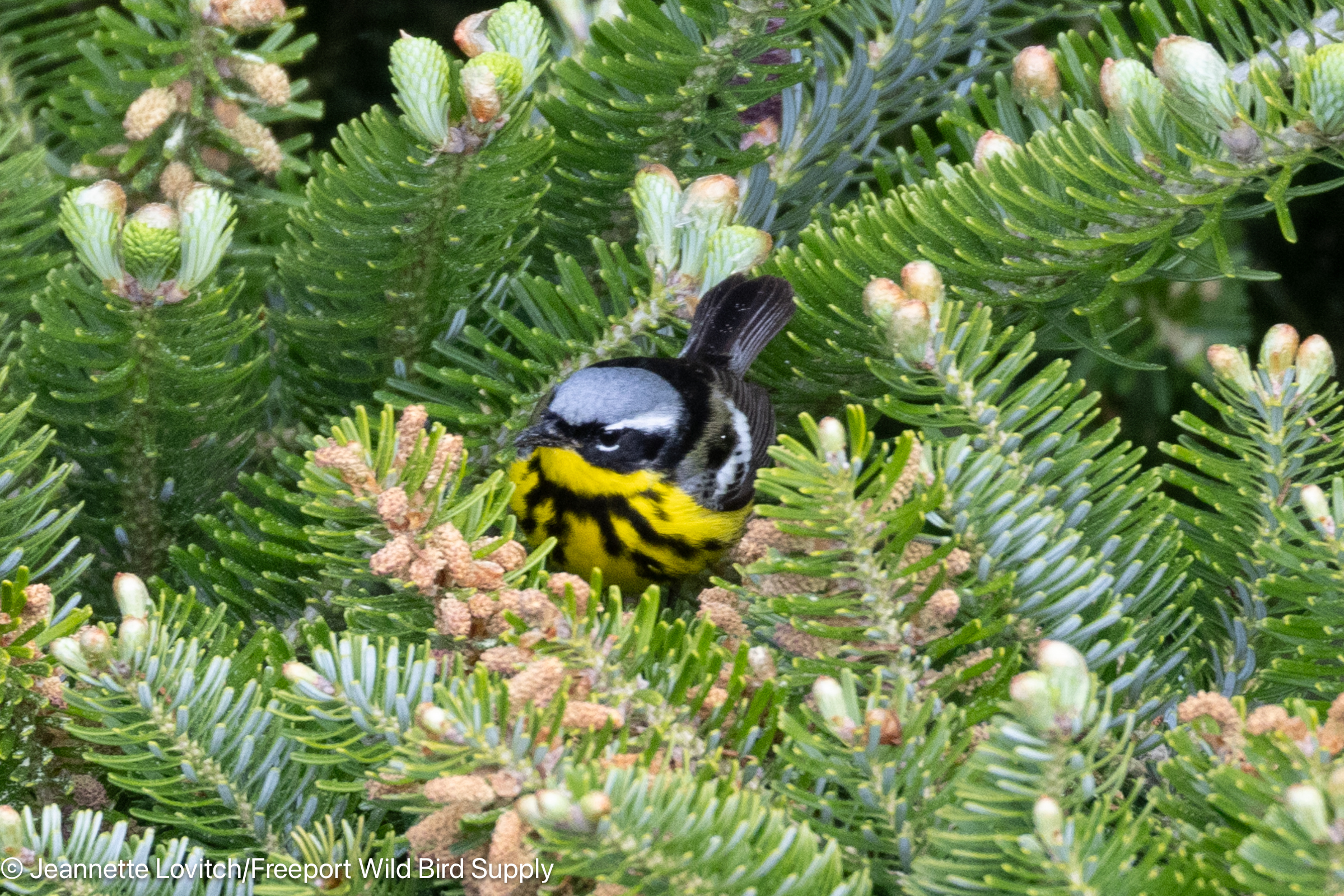
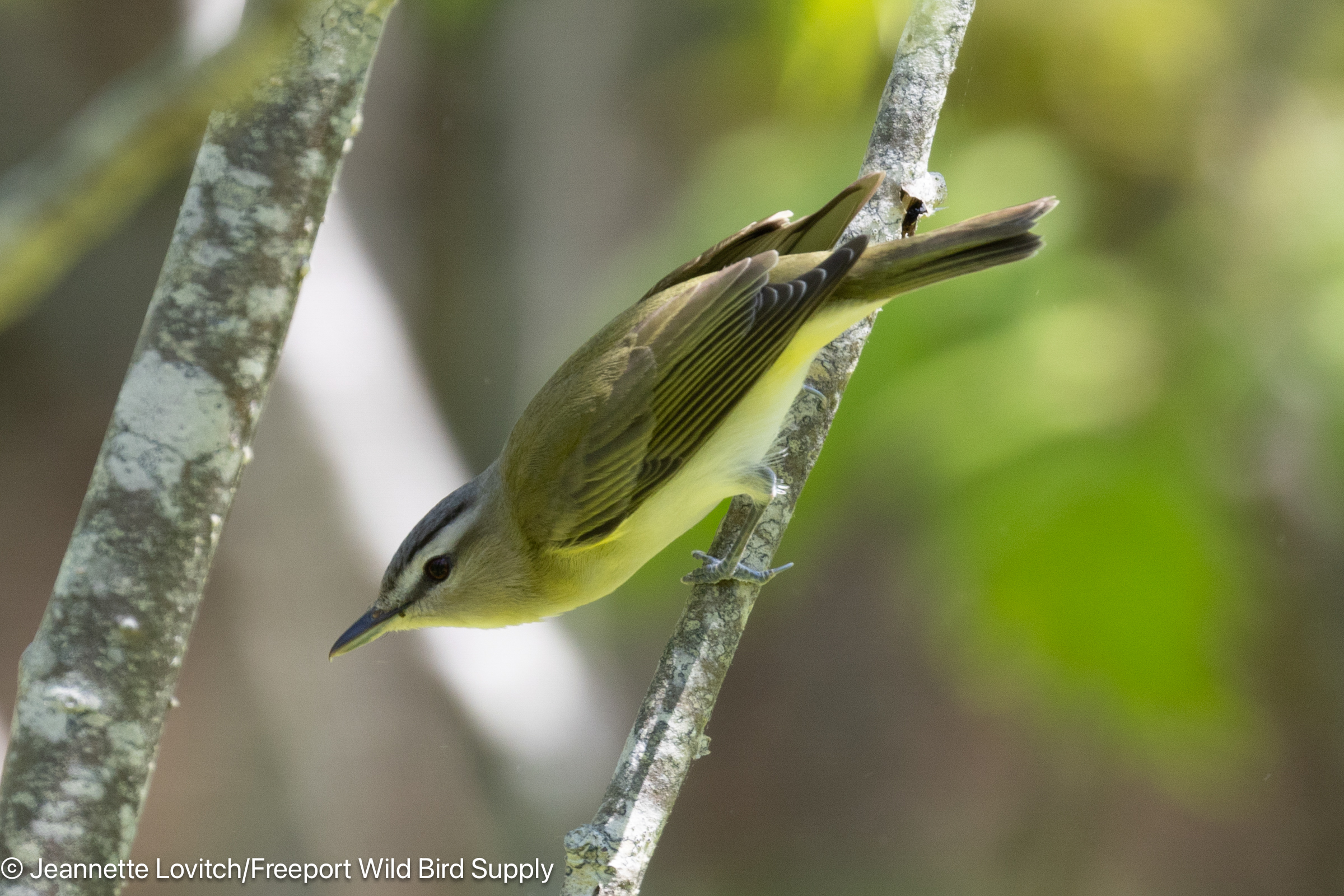
Magnolia WarblerRed-eyed Vireo
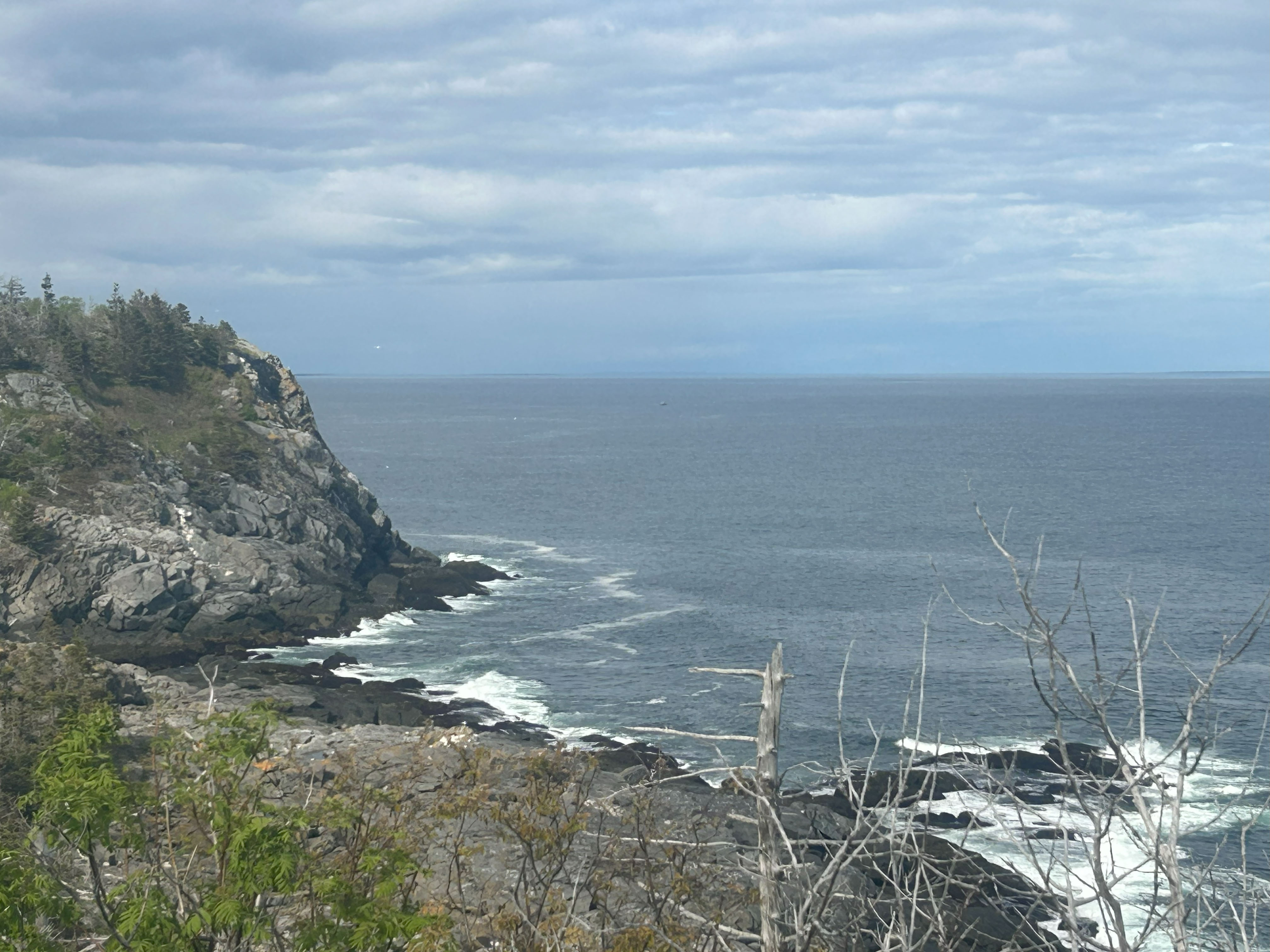
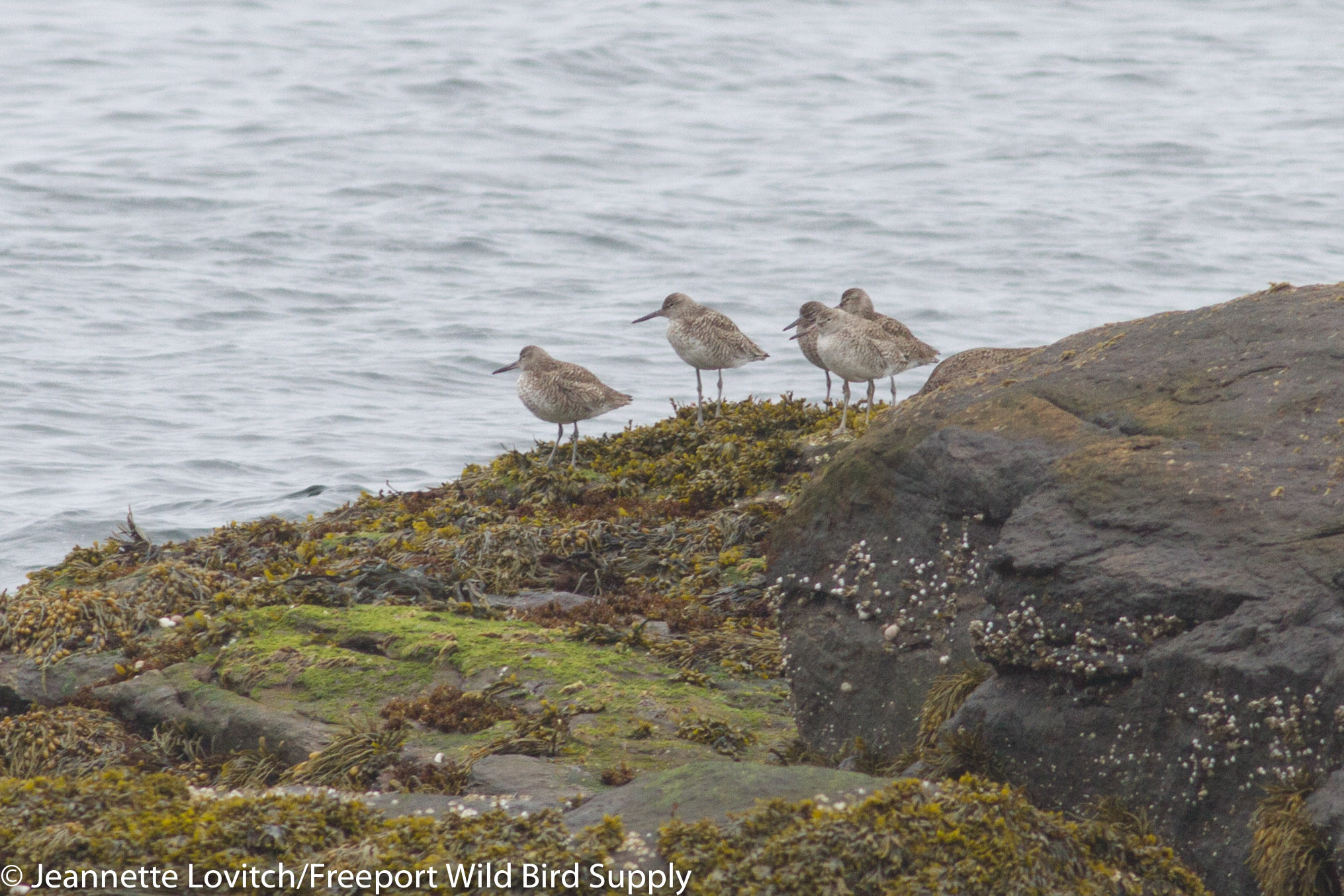
Not only was today not the forecast wash-out (just a few brief periods of drizzle and a couple of very light showers), but it was simply amazing! While warblers stole the show as expected, and the Lark Sparrow was a harbinger of things to come, our afternoon at Lobster Cove was rather exceptional, too, with two continuing “Eastern” Willets, a close pair of Harlequin Ducks, and 3 feeding Atlantic Puffins. What a way to end a spectacular day! It was like the good ol’ days out here.
By Sunday, the Low was dissipating over New Brunswick, and while the radar showed what may have been a light migration overnight, there wasn’t much happening in the “morning flight” once again. But as we began our birding day, it was actually quite good! While a lot of birds were left over from yesterday’s flight, they were augmented by some new arrivals, or at the very least, new detections. Once again, the birding was better than expected, and by late morning we already had some partial sunshine.
Unlike Saturday, activity slowly died down as the morning went on as usual, but it was just a downright delightful morning in the field. Lots of pockets of activity were still dominated by American Redstarts and Magnolia Warblers, but there were a lot more Blackpoll Warblers and fewer Wilson’s Warblers today. 8-10 Harlequin Ducks continued, and spiffy Bay-breasted Warblers were particularly cooperative. And we had three irregularly fantastic views of Lincoln’s Sparrows throughout the day.
Bay-breasted Warblers were really conspicuous this trip, and we enjoyed great looks at both males and females daily.
Lincoln’s Sparrows were unusually cooperative.
A longer walk out to Burnt Head and a check of the island’s interior in the afternoon found some of the birds that had melted away from the edges, while an uncharacteristically skulky Great-crested Flycatcher gave us a jolt of excitement until finally revealing itself.
With the storm pulling away, light northwesterly winds and mostly cloudy skies dominated the overnight Sunday into Monday, and therefore there was little or no migration overnight, and therefore almost nothing in the Morning Flight. However, it also meant that most birds didn’t leave. And while slower than the last two days, it was still decent, good views of fun species were to be had, and the sun came out for good.
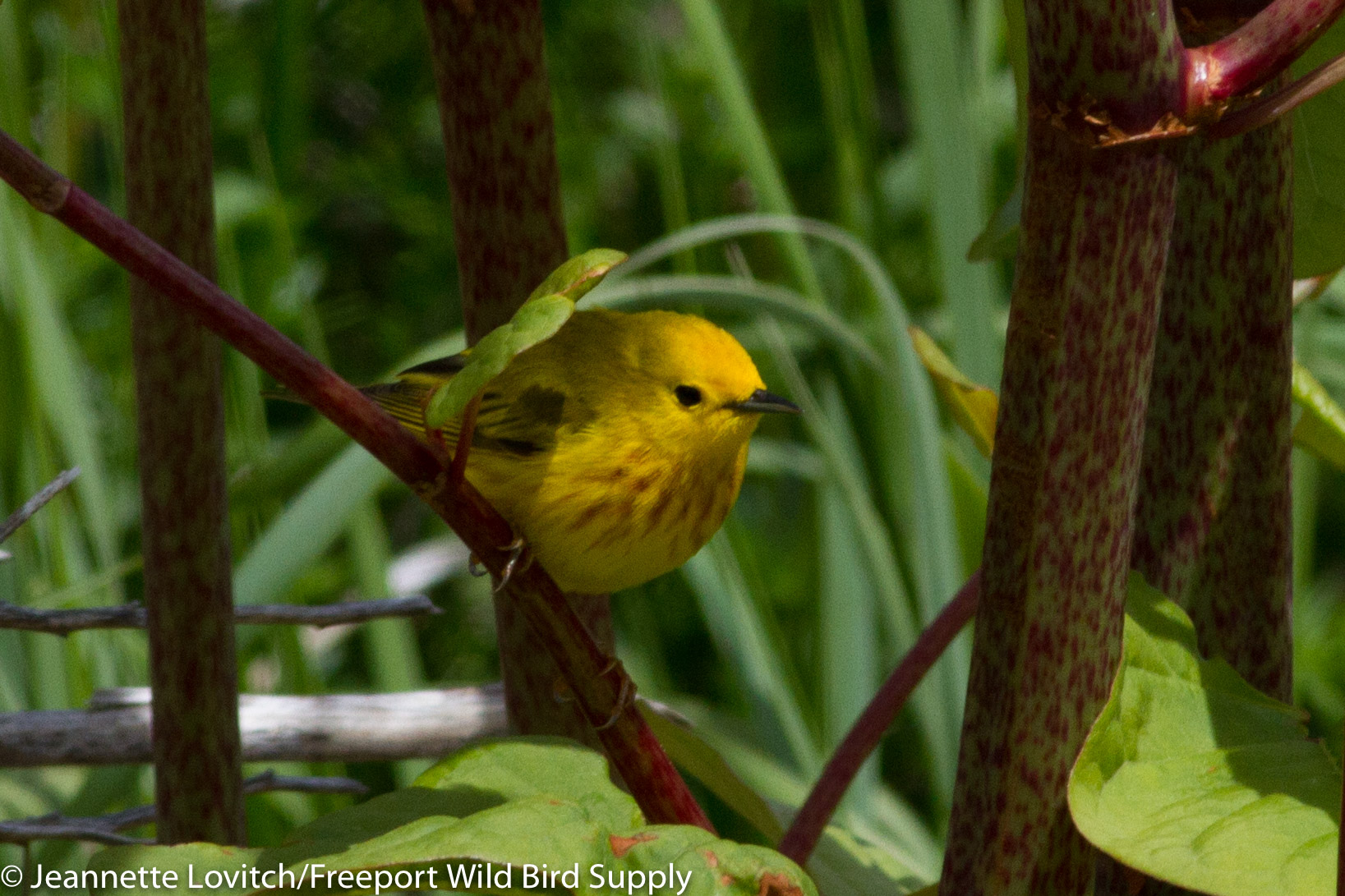
Magnolia Warblers, American Redstarts, and Blackpoll Warblers continued to dominate, along with the ubiquitous Yellow Warblers. Flycatchers were up, offering ample opportunity for instruction – and for eyes to glaze over. Morning highlights ranged from a particularly good tutelage from a Willow Flycatcher, a raft of 50 Surf Scoters offshore, and a really amazing Common Nighthawk repeatedly flying low over our heads and foraging over the island as noon approached.
It was warm and sunny, and with a sea breeze pushing birds out of the edges and deeper into cover, we decided to enjoy more of the island with a visit to the lighthouse grounds and a stroll deep into the spruce woods. In addition to building our list with island residents like Golden-crowned Kinglet and breeding species such as more Black-throated Green Warblers on territory, we enjoyed the plantlife of the Acadian habitat and a healthy dose of phytoncides. And in between, the occasional pocket of migrant warbler activity to bring us back to birding.
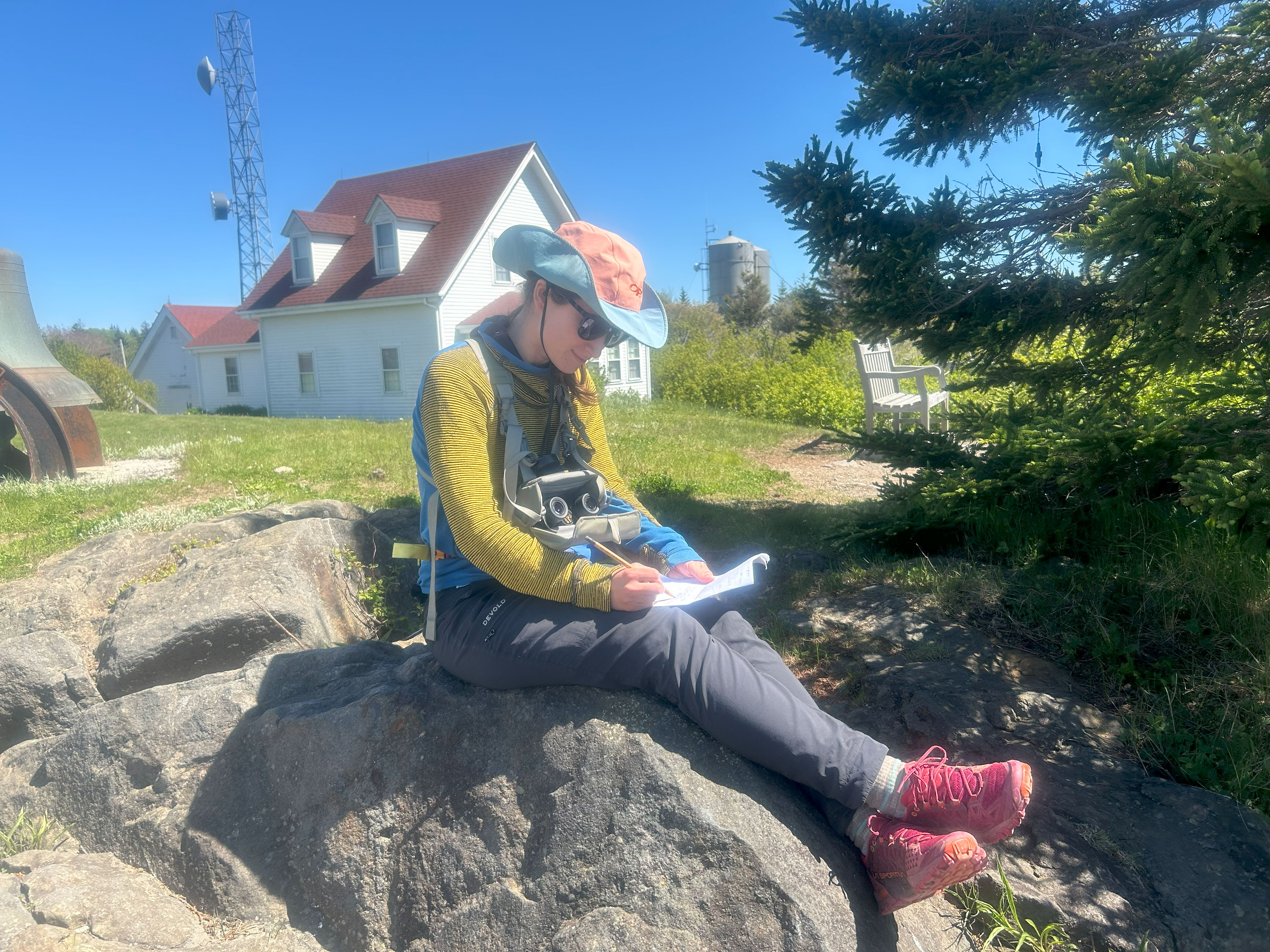
Catching up on note-taking.
Our tour concluded with an impressive 91 total species, but I admit to being a little frustrated by having to give up with 19 species of warblers…20 sounds so much better! But given the unexpected big arrival on Saturday, and the minimal rain and wind after Friday, the tour was truly an incredibly success, far exceeded expectations, and did live up to what Monhegan birding legends are made of.
Last birders standing on the last afternoon of the tour.Staring at Eastern Egg Rock, attempting to will THE Tufted Puffin over to us.
Then, as per usual, Jeannette – who joined us late on Sunday – and I enjoyed a day off together on the island on Tuesday. Unlike the magically-appearing flight on Saturday, this was a more predictable great morning. A moderate to strong flight overnight lit up the radar on light southwesterly to west winds. That put a lot of birds in the Gulf of Maine come dawn, and the morning flight was hoppin!
Consisting mostly of Blackpoll Warblers, American Redstarts, and Magnolia Warblers, it was quite diverse overall. A few “new” species included a Pine Siskin and a Wood Duck, and 3 Red-breasted Mergansers were a fun Morning Flight fly-by.
Before and after breakfast, the birding was excellent. It was the best day by far in volume, but a lot of the birds were “on the move” and departing the island throughout the morning. But there was more of pretty much every migrant species, save for Wilson’s Warblers in particular. Birds weren’t held low by clouds and drizzle, or exhaustion, so it wasn’t as mind-blowing as Saturday, even with more birds around overall.
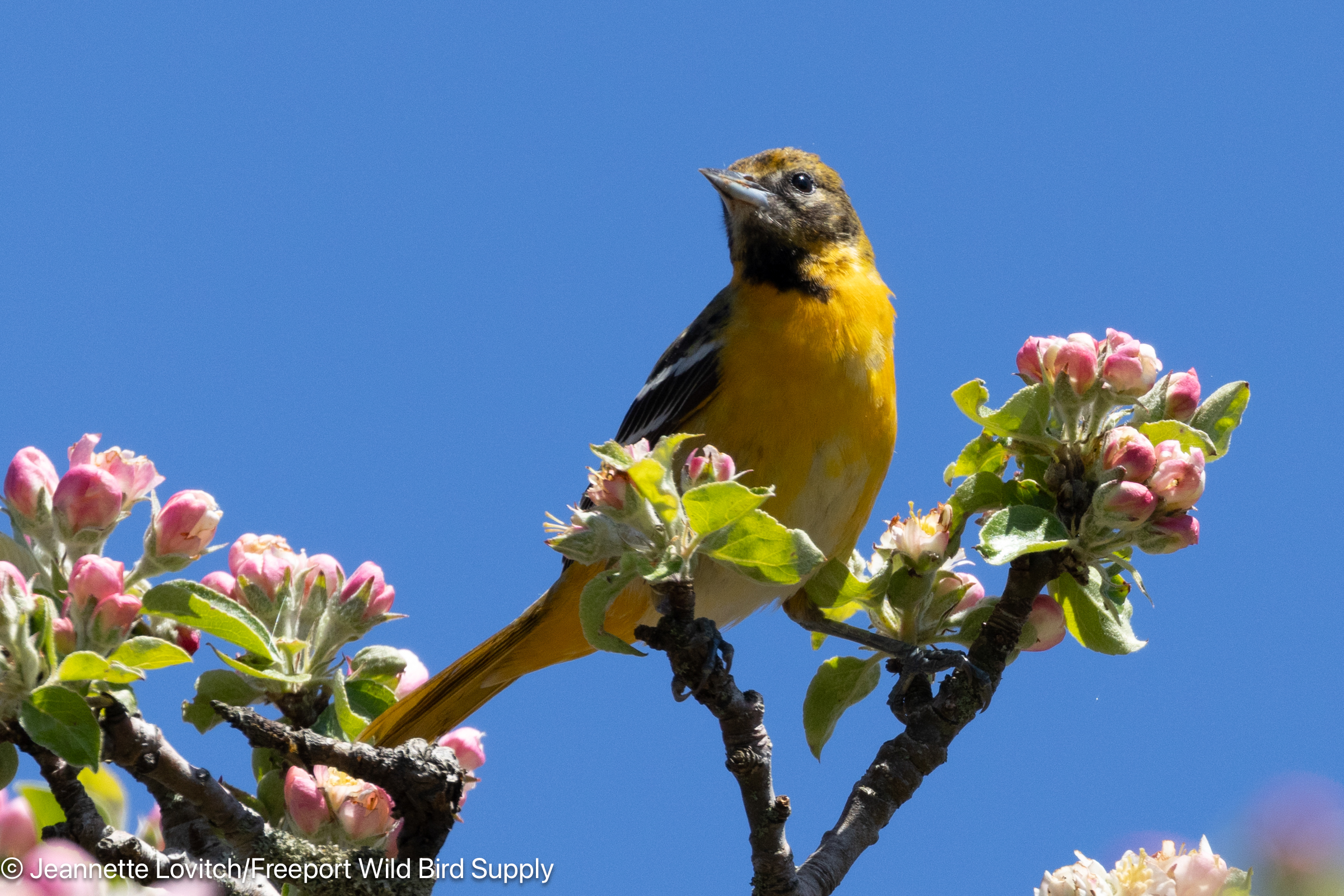
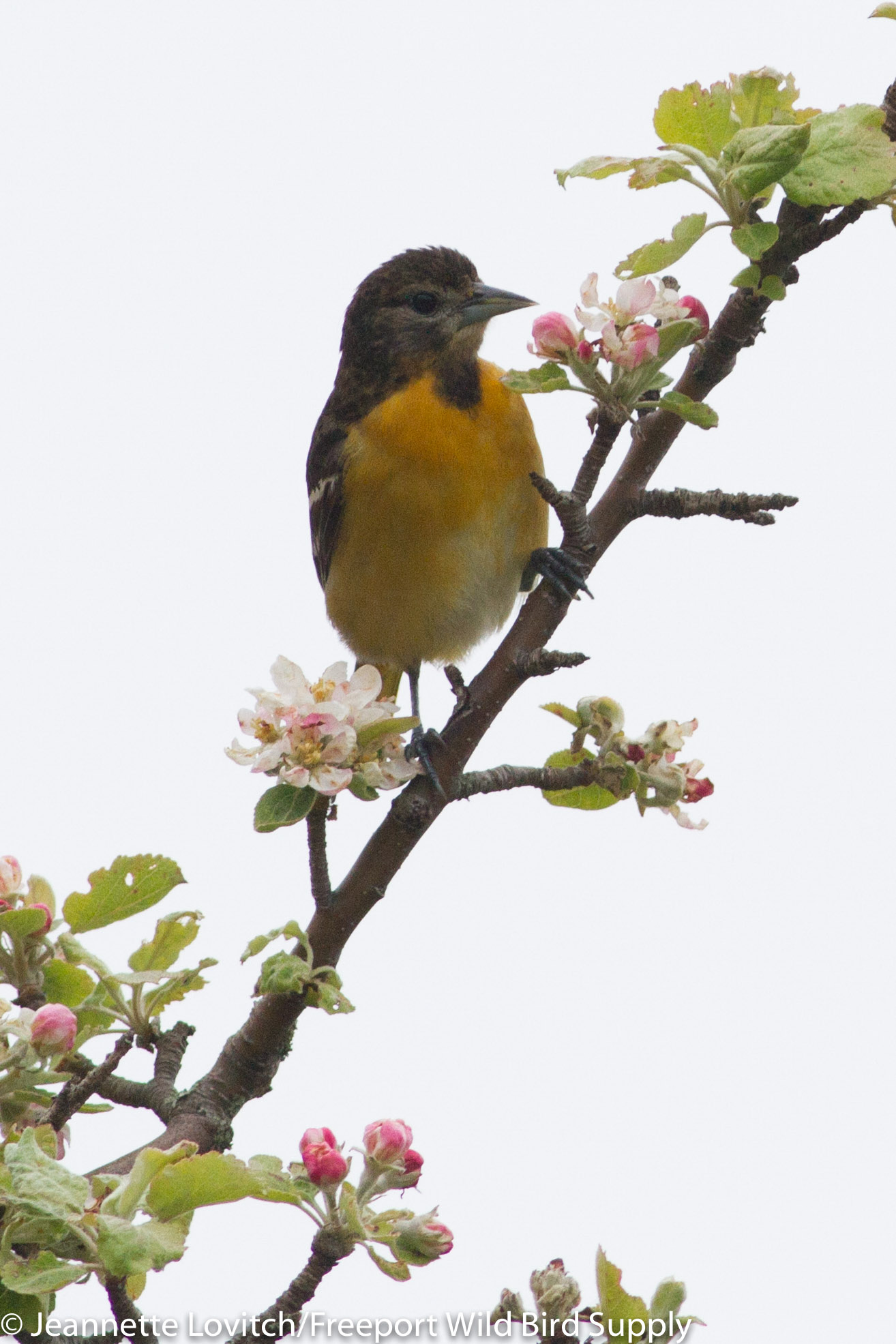
Baltimore OrioleThere were a lot more flycatchers around today, including quite a few Eastern Wood-Pewees.
It was also getting warm on a perfectly sunny sky, and birds took to the shadows earlier than in days past; the hotspots got much quieter by late morning with the increasing seabreeze. Nonetheless, pockets of activity continued right up through lunchtime.
The veggie burger bahn mi from The Bait Bag.
We rapidly added to our collective weekend list (which do not count for our tour total, of course), including finally reaching 20 species of warblers with an uncommon-out-here Pine Warbler. We then eclipsed it with a stunning male Mourning Warbler, and finally in the afternoon, picked up an Ovenbird for our 22nd and final species of warbler. Locally-rare Hairy Woodpecker, a truant Long-tailed Duck, at least one continuing Harlequin Duck, and we found my first Nelson’s Sparrow of the year at Lobster Cove. We even got a little hike in to try and burn a few of the extra calories we consumed from all of the islands’ scrumptious meals. And, anytime we stopped at a favorable looking patch of vegetation, migrants would appear, everywhere we went. It’s always tough to leave, but we at least went out with a bang!
Male Chestnut-sided Warbler
So back here in the Real World now, we can reflect on this past weekend as one that we will most surely always remember!
Here is the trip list four the five-day tour. I didn’t bother including the first day though, but it did net us a Lesser Black-backed Gull that we didn’t see any other day.
* = seen from ferry only.
Species
5/24
5/25
5/26
5/27 (with Jeannette) *ferry ride only
Canada Goose
0
2
4
2
Wood Duck
0
0
0
1
Mallard
15
15
x
x
Common Eider
x
x
x
x
HARLEQUIN DUCK
12
10
0
1
White-winged Scoter
0
0
0
2
Surf Scoter
0
0
50
1
Black Scoter
0
0
0
30*
Long-tailed Duck
2
0
0
1
Red-breasted Merganser
0
0
0
3
Ring-necked Pheasant
x
x
x
x
Mourning Dove
6
8
10
8
Common Nighthawk
0
0
1
0
Ruby-throated Hummingbird
3
4
5
4
Virginia Rail
0
1
1
1
WILLET
2
0
0
0
Spotted Sandpiper
0
0
0
2
Black Guillemot
x
x
x
x
ATLANTIC PUFFIN
3
0
0
0
Laughing Gull
5
6
10
6
Herring Gull
x
x
x
x
LESSER BLACK-BACKED GULL
1 (5/23)
0
0
0
Great Black-backed Gull
x
x
x
x
Common Tern
0
0
0
5*
Common Loon
2
3
3
1
Red-throated Loon
0
0
0
1
Northern Gannet
6
2
1
2*
Double-crested Cormorant
x
x
x
x
Great Cormorant
0
0
0
1*
SNOWY EGRET
0
1
0
1
Great Blue Heron
0
0
1
0
Osprey
0
1
2
0
Sharp-shinned Hawk
1
0
0
0
Bald Eagle
2
2
3
3
Yellow-bellied Sapsucker
0
0
1
0
Downy Woodpecker
1
0
0
0
HAIRY WOODPECKER
0
0
0
1
Northern Flicker
1
2
2
1
American Kestrel
0
0
0
1
Merlin
1
1
0
0
GREAT-CRESTED FLYCATCHER
0
1
0
0
Eastern Kingbird
3
1
2
2
Eastern Wood-Pewee
4
2
4
20
Alder Flycatcher
0
2
2
2
“Traill’s” Flycatcher
0
0
1
3
Willow Flycatcher
0
0
2
2
Least Flycatcher
2
2
10
12
Philadelphia Vireo
1
0
0
0
Red-eyed Vireo
6
5
4
30
Blue Jay
4
2
1
1
American Crow
2
2
4
4
Common Raven
2
2
2
2
Black-capped Chickadee
x
x
x
x
Tree Swallow
1
1
2
2
Barn Swallow
1
1
3
6
Golden-crowned Kinglet
0
2
2
1
Cedar Waxwing
80
60
60
150
Red-breasted Nuthatch
1
2
4
6
Carolina Wren
2
4
3
3
House Wren
2
2
1
2
Gray Catbird
x
x
x
x
Brown Thrasher
0
1
1
1
European Starling
x
x
x
x
Eastern Bluebird
0
2
0
1
Swainson’s Thrush
1
3
3
8
American Robin
10
10
x
8
Purple Finch
1
1
0
1
Pine Siskin
0
0
0
1
American Goldfinch
10
10
12
10
LARK SPARROW
1
0
0
0
Chipping Sparrow
2
0
0
0
White-crowned Sparrow
0
1
1
1
White-throated Sparrow
1
2
1
1
NELSON’S SPARROW
0
0
0
1
Savannah Sparrow
4
4
3
2
Song Sparrow
x
X
x
x
Lincoln’s Sparrow
0
3
3
10
Bobolink
3
4
1
3
Baltimore Oriole
2
2
3
2
Red-winged Blackbird
x
x
x
x
Common Grackle
x
x
x
x
Ovenbird
0
0
0
1
Northern Waterthrush
1
1
1
10
Black-and-white Warbler
12
10
8
15
Tennessee Warbler
2
2
6
10
Nashville Warbler
0
1
1
4
MOURNING WARBLER
0
0
0
1
Common Yellowthroat
20
20
x
x
American Redstart
55
45
40
80
Cape May Warbler
3
4
2
6
Northern Parula
15
15
45
40
Magnolia Warbler
50
45
40
70
Bay-breasted Warbler
8
10
3
15
Blackburnian Warbler
4
4
3
4
Yellow Warbler
35
30
25
x
Chestnut-sided Warbler
6
6
10
20
Blackpoll Warbler
15
35
55
100
Black-throated Blue Warbler
1
1
2
6
Pine Warbler
0
0
0
1
Yellow-rumped Warbler
3
2
0
1
Black-throated Green Warbler
10
15
20
15
Canada Warbler
1
0
0
0
Wilson’s Warbler
20
15
10
10
Scarlet Tanager
1
1
1
1
Northern Cardinal
6
10
8
6
Rose-breasted Grosbeak
3
3
3
2
Day Total
72
75
73
92
Warbler Day Total
18
18
17
21
Trip Total
91
Weekend Total inc. Tuesday
106
Warbler Trip Total
19
Warbler total inc, Tuesday
22
The above birds follow the “guide plus one” rule, meaning both me and at least one client need to see the bird for it to go onto the list. This year, the only two birds I saw without the group that we didn’t later encounter was a fly-by Belted Kingfisher and an American Woodcock at dusk, both on the the 24th, for a total of 91 with the group and a 5-day tally of a respectable 106 species.
Tour itineraries are meant to be broken. Or is that “rules.” Well, those too.
We have offered some kind of “Bicknell’s Thrush Wekeend” tour for almost 15 years now. There was a hiatus for COVID, and last year – perhaps due to the uncertainty with travel planning – we pulled the plug on our weekend for the first time as registrations were slow to come in.
Therefore, for 2024, it was time to try something new and head into Northern New Hampshire for a new plan of attack. Two chances at Bicknell’s Thrush over the course of two days, with this one enigmatic bird the sole focus (well, at least until we see it) – that part of it had not changed. Everything else was new this year.
We assembled at 9:00am on Saturday, June 29th in Errol, New Hampshire. The itinerary? Well, never mind.
Several folks arrived to see their guide staring up at the sky and immersed in deep thought (you could smell the wood burning). It wasn’t raining, and it looked like we had a nice window of fair weather. But it was already 9:00am, and by the time we got up the mountain…
…but the forecast for tonight. And tomorrow morning.
…but it can’t be worth it to try for one of, if not the, most elusive of North American breeding songbirds in the middle of the day.
…and it’s getting warm.
…and there’s rain building to our west. The winds are picking up higher up.
…but let’s go for it!
So up the mountain we went. At least we would be trying. And that evening, with the risk of severe thunderstorms, we might not even have a chance to try. And the next morning didn’t look great.
But weather forecasts are fickle, especially up here in the mountains, so it’s hard to make plans. But it’s easy to look up and see what’s about to happen, or not. And when I looked up, my face didn’t get wet, so that’s the only forecast that’s dependable in these parts.
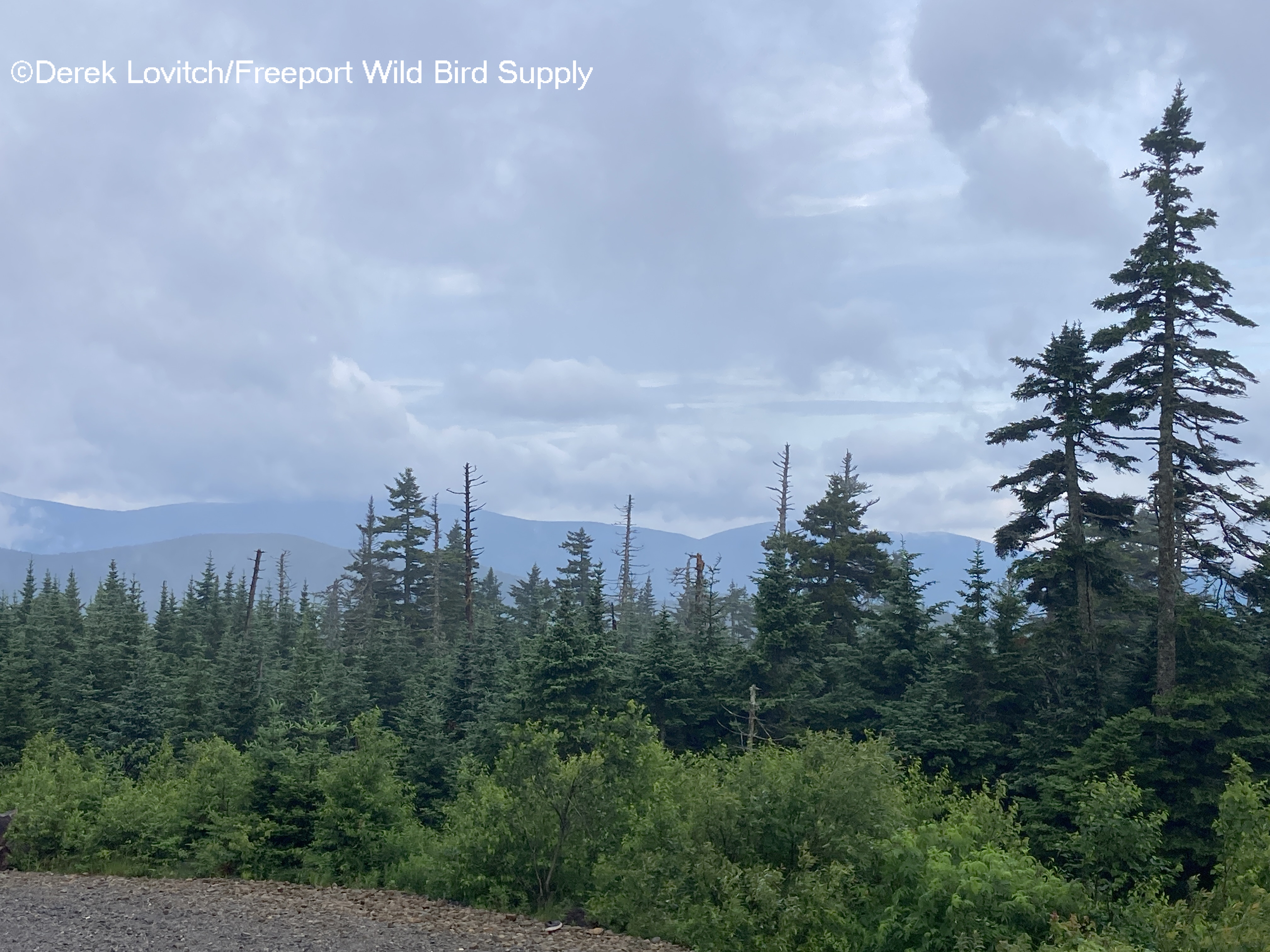
We raced up hill, arriving at about 3,000 feet and the realm of the Bicknell’s Thrush around 10:30, stopping for a Ruffed Grouse in the road escorting five chicks.
Southerly winds were increasing, blowing right up into and through our thrush territories. This was pointless. But hey, the rain was still across the valley. So we birded.
We heard the Fox Sparrow, spotted a couple of Blackpoll Warblers, and enjoyed the usual high-elevation species like Yellow-rumped Warblers and Dark-eyed Juncos.
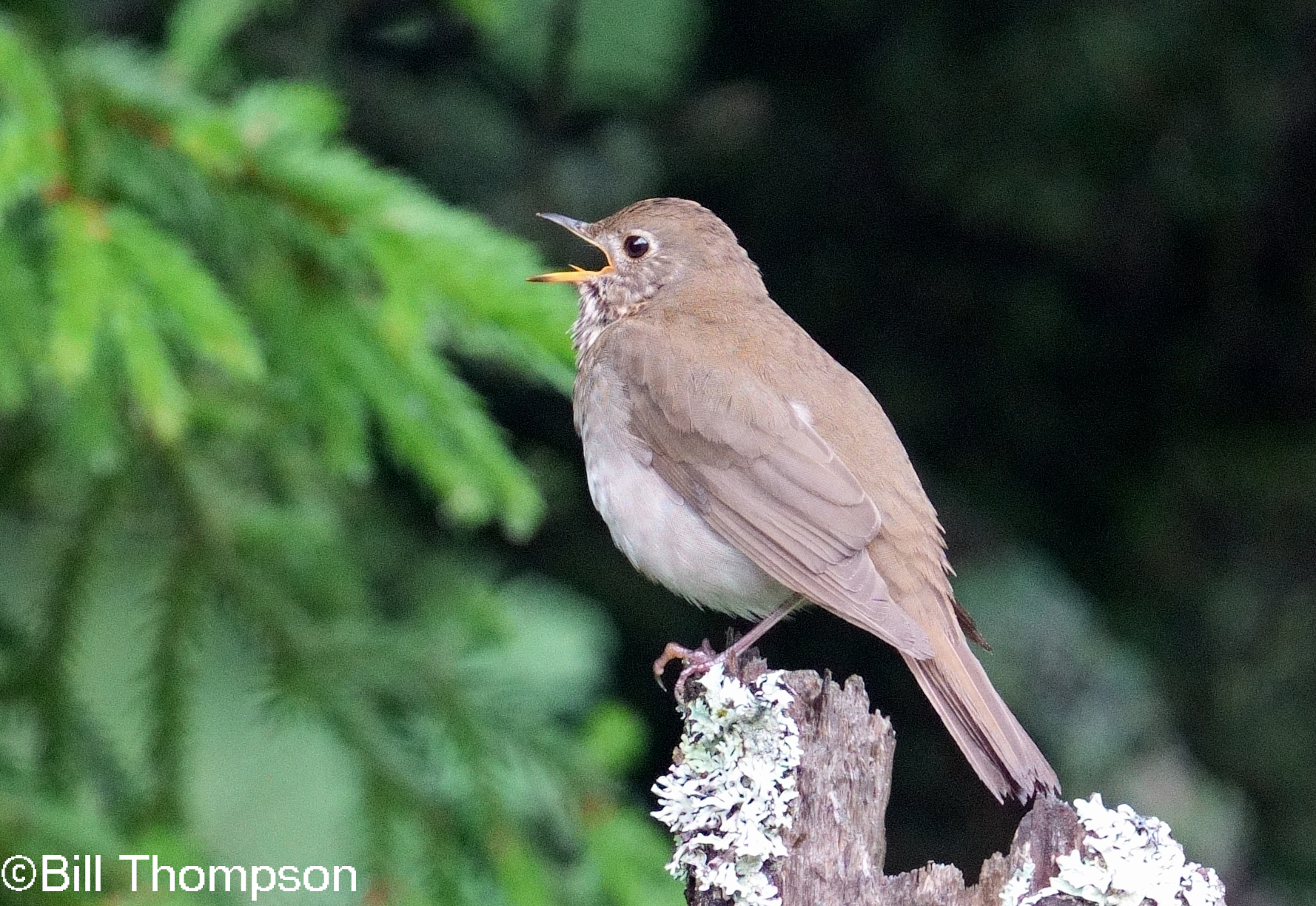
Then, at the surprisingly late (or extremely early) time of about 11:15am, a Bicknell’s Thrush began to call. Over the next 15-20 minutes, we were treated to two birds counter-singing, and at least 3 or 4 birds calling. One bird silently flew across a clearing, as well seen as a thrush in flight can get. The two dueling birds darted between trees and occasionally paused in view of one or two people before melting back into the trees.
There weren’t photography opportunities, but everyone was more than satisfied with the sum of their views. And it was a tremendous auditory performance. Overall, it was actually a pretty good show, and really demonstrated the behavior of this fascinating bird. And since this is more than just a tick and run” tour, the birds’ behavior was instructional and of keen interest.
And after all being satisfied, the rain arrived.
We enjoyed a leisurely and delicious lunch, and then set out for a little more birding. Making up for the change of plans in the morning, we took a walk and a drive through some boreal habitats, but rain was becoming steadier now. We heard and saw a few common birds, but it was just some good quality time in the afternoon woods, absorbing our phytoncides. When the rain arrived in earnest, we called it quits and went to check in at our hotel.
The original plan was to have an afternoon break, early dinner, and then head up the mountain at dusk to take advantage of the evening activity of the thrush. Instead, we had a relaxing dinner, many of us enjoyed a beer or glass of wine, and we just chatted. Good conversation was enjoyed by all, and the rain kept falling.
At one point, the rain let up and I began to ponder a run up the mountain. Just in case the thought became serious, a downpour arrived. Dessert was ordered.
We were back in our hotel rooms at about the time I had planned to be on the mountaintop, so I didn’t know what to do with myself! I think I was stressed about having nothing to stress about. When a tour is solely dedicated to one species, a trip is a failure without that one species. But we already had our quarry, and if it was raining in the morning, oh well. And if it wasn’t, we would just go enjoy the bird some more. I think I had the longest and best night of sleep I can recall while leading a Bicknell’s Thrush weekend!
Well, it wasn’t that long. A “civilized” 5:30am departure from the hotel (thanks to our success the day before) found us free of the rain that was forecast, and there were even a few breaks of sun. It was rather breezy atop the mountain, and in almost two hours, we only had a couple of calls from Bicknell’s Thrushes. A simple continental breakfast was served from the back of my Subaru.
However, we had a Canada Jay (likely the last youngster in a family group that passed just downhill from us) in plain view, and spent some quality time with the local breeders like Blackpoll Warbler. Then, much to my disbelief, the second-most wanted bird on the tour (according to an unofficial survey), began to call very close to us. Could it be? I had to be mistaken. But not much else sounds like a Black-backed Woodpecker!
Then, with jaws dropping to the ground, it proceeded to fly overhead of us, heading up the mountain where it called a few more times. That was not something I was expecting – not just the species, but such a great look at it in flight (I can only recall one other time that I had seen one overhead) and far removed from the deep and dark bogs most of the local birds prefer.
Between yesterday’s thrush luck and today’s woodpecker fortune, not to mention another mountaintop visit devoid of the forecast rainfall, we were just ecstatic.
And then this happened…
You get a photo, and you get a photo, and you get a photo!
Wow. Just wow.
And it was on a snag that I had just declared, “if this bird comes out, it’s going to perch here.” Most people thought I was joking.
The thrush didn’t. Now, I wish I could always control birds like this, but especially with this species, I have really come to know them and their behavior. To me, it did look perfect for one to sit on. But no, I did not expect it to be sitting on it, singing up a storm, about 30 seconds later. It truly is better to be lucky than good.
And it sat there for long enough to take your camera down, adjust your settings, and return to firing away. It was even there long enough for your dumbfounded guide to remember he had his camera with him for a change. My panicked photos did not do the bird justice, so I will let everyone else’s speak for themselves.
There wasn’t much left to do up here, so we began our trek downhill.
A Mourning Warbler cooperated nicely.
Then, returning to our cars a (the?) family group of Canada Jays returned and came to check us out. Kathy’s granola bar was clutch here as two adults had a snack, with 2-3 dusky juveniles looking on, learning the ways of the Camp Robber.
And then Kathy exclaimed “there’s a Bay-breasted!” and we all looked up to see a stunning male singing from a roadside fir right over our heads.
We heard or saw at least another 5 Mourning Warblers on the way down, glimpsed a busy Lincoln’s Sparrow (a Sharp-shinned Hawk passed overhead precluded a better observation, however), and took some time to enjoy and identify butterflies – even skippers (OK, only Bill actually identified said skippers) – and plants.
White Admiral
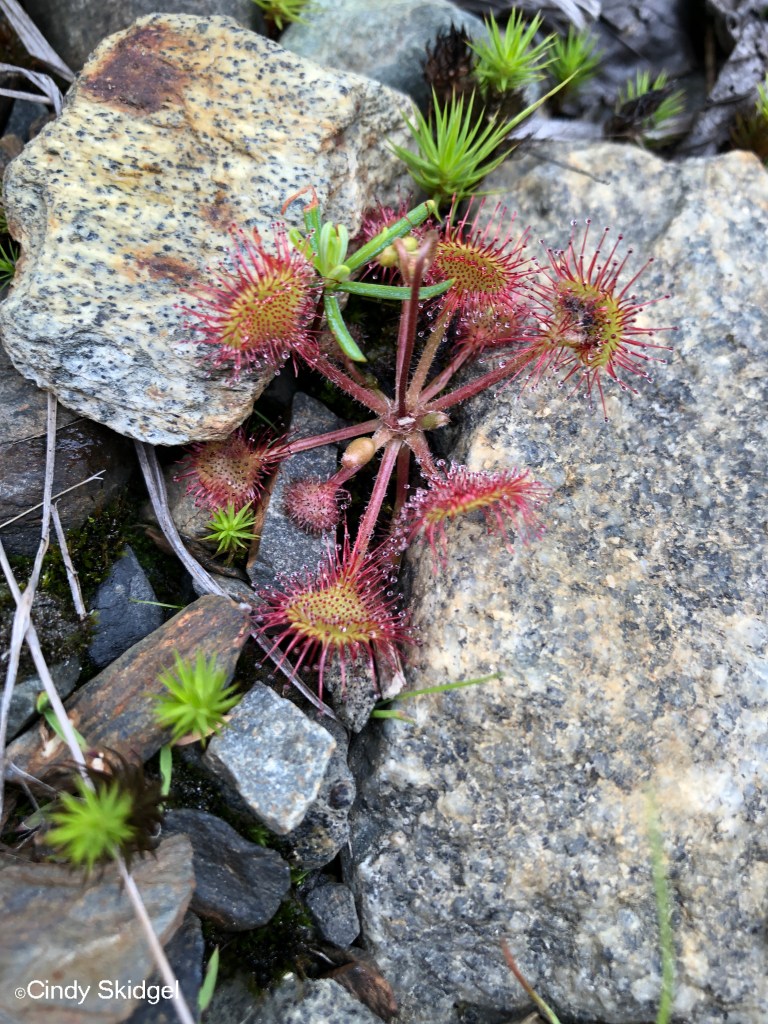
Round-leafed Sundew.
But as the winds began to gust, more rain was approaching, and ATVers were becoming overwhelming, we left the mountain and headed to Colebrook for a relaxed, celebratory luncheon as the rain began to fall and before we headed our separate ways.
As for this new Bicknell’s Thrush Weekend itinerary (with and without necessary audibles), well, I think you can assume we’ll see you here again next year!
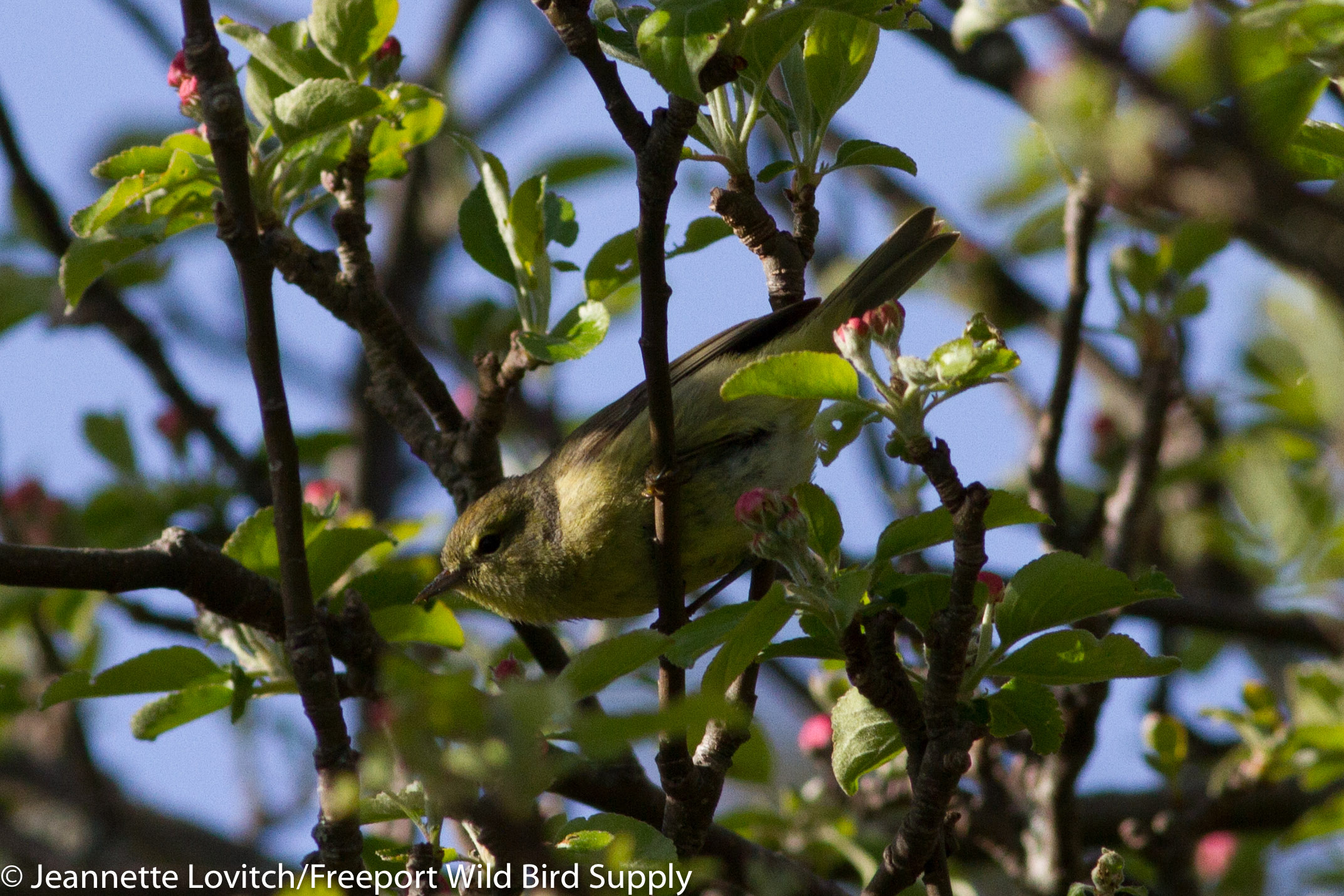
Our group found a singing male Orange-crowned Warbler, one of the best birds of the weekend.
For the 7th year spring a row (fall tours since for over a decade), I spent my Memorial Day Weekend with a tour group visiting the magical and magnificent Monhegan Island. Exactly 100 species (including birds seen offshore during the ferry crossing) later – including 18 species of warblers – I was forced to depart, already counting down the days to my two fall tours (and perhaps making some plans for a summer visit…just because).
But the usually stress-free tour (compared to the logistics of much of the rest of my summer slate) got off to a rocky start (pun intended) with the early boat from New Harbor cancelling their morning trip late in the evening on Thursday. We made plans to head up to Port Clyde instead, and early in the morning, we received confirmation that all was well with the 10:30 am departure and we were reserved on it. Phew!
The whole group rendezvoused in Port Clyde, where based on the ride, well, let’s just say we were glad we were taking a big, heavy boat with a route that is sheltered for the first half. Because once we cleared the islands, well, things got a ‘rollin! But as always, the captain of the Monhegan Boat adeptly chose the route, and we basically tacked our way to Monhegan to avoid taking the swells on broadside. It was breezy enough that we were able to avoid the rain but remain in the fresh air outside on the stern (without diesel fumes), and we even spotted two Atlantic Puffins on the trip! But as for that small gull that was wheeling off in the distance just as we hit a trough and I hit John in my scramble for a view…well, we’ll never know.
Not surprisingly, the trip took longer than usual, but it allowed us to miss the rain! We arrived shortly after noon, with just a little lingering drizzle and mist. With diminishing northeast winds, we were prepared for worse, so we were fine with merely cool, only damp, and rather slow birding. Sure was better than steady rain and wind! And there were a few good birds to track down, led by the three Cattle Egrets that had been frequenting the island – my 206th species on the island, and a state bird for most of the group, at least. They were not hard to find, and were in fact pretty hard to miss for the better part of the next two and a half days. Really, until Jeannette arrived on Sunday, but that’s a story for a different day.
Good looks at Philadelphia Vireo, a very vociferous Sora, and a dusk vigil which resulted in very close encounters with Common Nighthawks rounded out a productive first day. Eastern Kingbirds spent most of the weekend foraging low along the shoreline.
5/27: Day 2.
Well, that was a cold night in the rooms! Clearly the buildings of the island didn’t have a whole lot of ambient warmth built up, and extra blankets were at a premium. And with light northeast winds overnight, little to no migration was visible on the radar or in the dawn flight, but it was our first morning on the island, so we had a lot of birding to do.
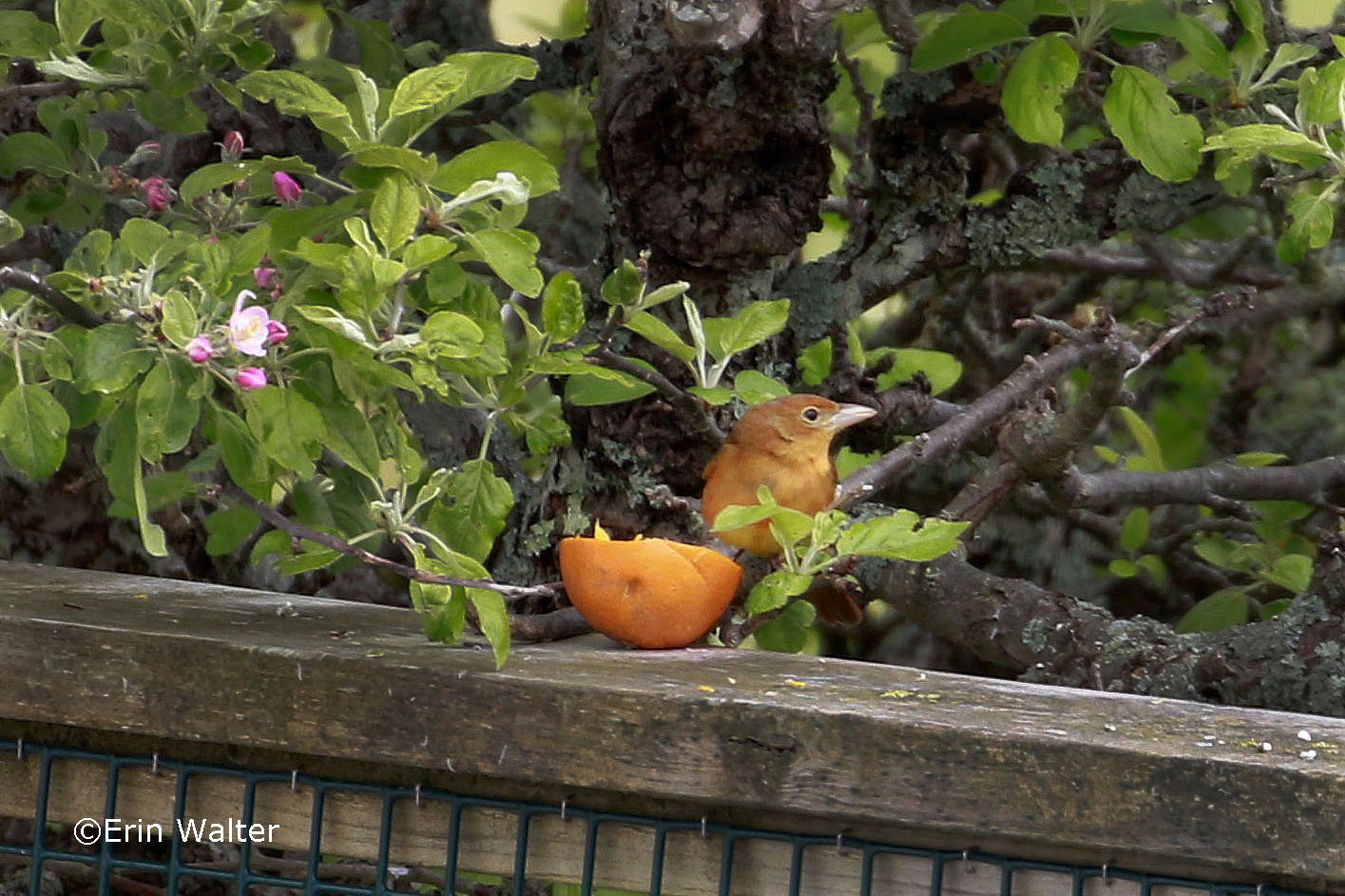
A few pockets of migrants here and there slowly built up the checklist, with occasionally goodies including the Cattle Egrets, an immature male Orchard Oriole, a good look for most of a singing Mourning Warbler, and a fleeting White-eyed Vireo. We finally caught up with a female Summer Tanager (a bona fide one, not the female Scarlet with some missing feathers near the base of her bill), and we once again finished the day with feeding nighthawks, the incessantly calling Sora, and last but not least, a displaying American Woodcock. Female Summer Tanager
Immature male Baltimore Oriole.
Male Blackpoll Warbler
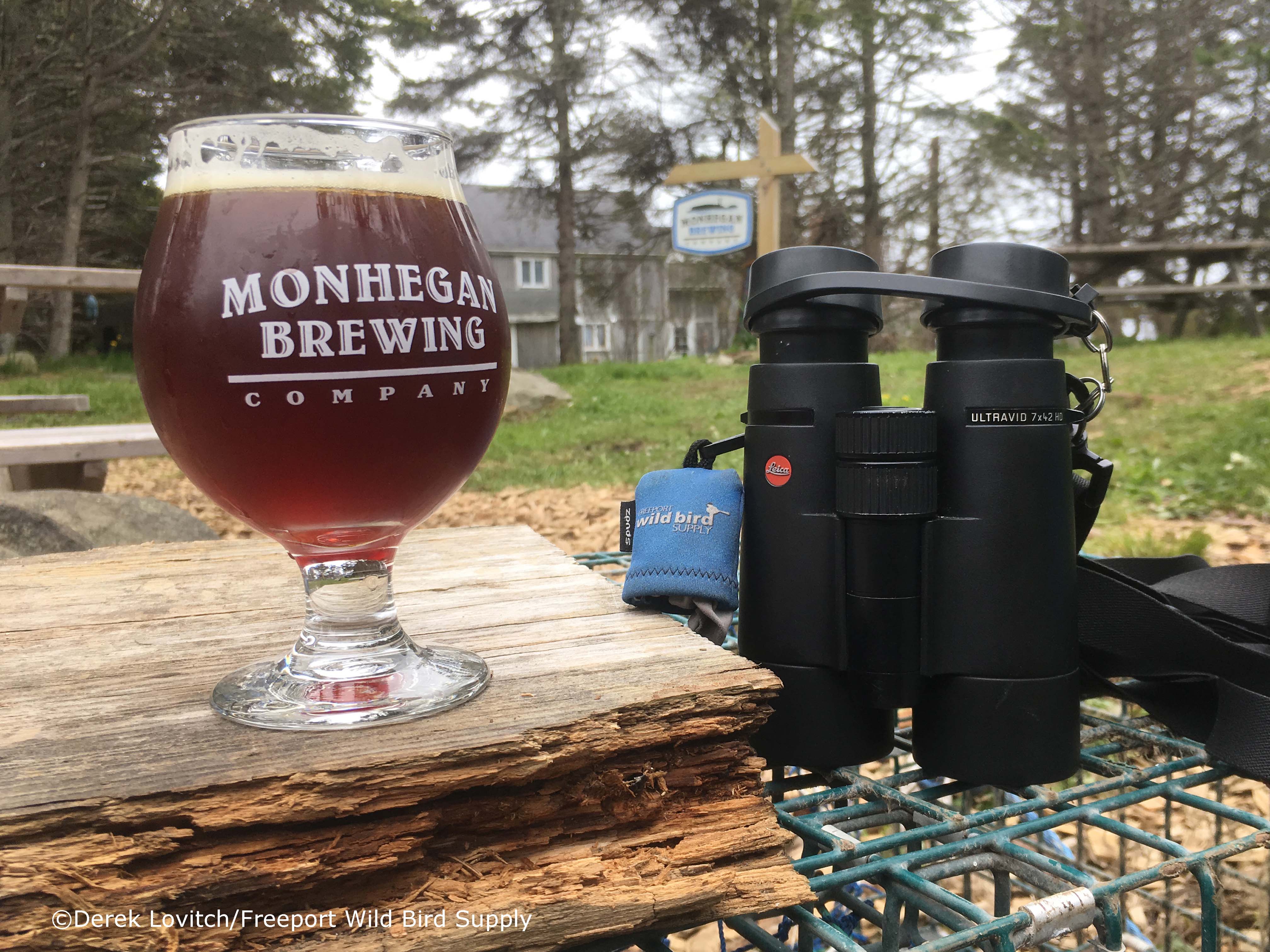
In between, we feasted on delicious pizza at The Novelty, fueled ourselves with coffee at the Black Duck, and relaxed in the late afternoon with a beer at Monhegan Brewing (including ginger beer and root beer, too). Yeah, a slow day of birding on Monhegan is better than most days most anywhere else!
5/28: Day 3
With some people departing on Saturday, and others joining us for Sunday, we started Day 3 with a great find: A singing Orange-crowned Warbler right outside the Trailing Yew. Well, OK, it found us, and I’ll admit to taking way too long to identify it by sound with my pre-coffee and poor-night’s-sleep foggy state. Eventually, we had great looks at it, and those who were not yet with us were able to catch up with it later in the day or early Monday morning. This is a great bird in Maine in spring. In fact, it may have been my first in Maine in this season.
Clearing skies and calm winds overnight allowed for an impressive migration, and the Orange-crowned was just the start of a great day of birding. The first half of the day was very birdy, with lots of new arrivals and new species. It was one of those mornings that were hard to break for breakfasts…but those breakfasts are all so damn good!
We found a second White-eyed Vireo, had unusually good looks at several Swainson’s Thrushes and Yellow-bellied Flycatchers, and slowly built up our triplist. It was a very good day, featuring a goodly total of 70 species. Magnolia Warbler Rose-breasted Grosbeak Wilson’s Warbler Yellow Warbler
5/29: Day 4
Light southerly winds at dusk had me optimistic as birds took to the air en masse come sunset. However, overnight, the winds shifted more easterly, shunting the flight inland, and overall, many more birds departed than arrived. With dense fog and a little mist come morning, my hopes for fallout conditions were dashed by the light to moderate easterly.
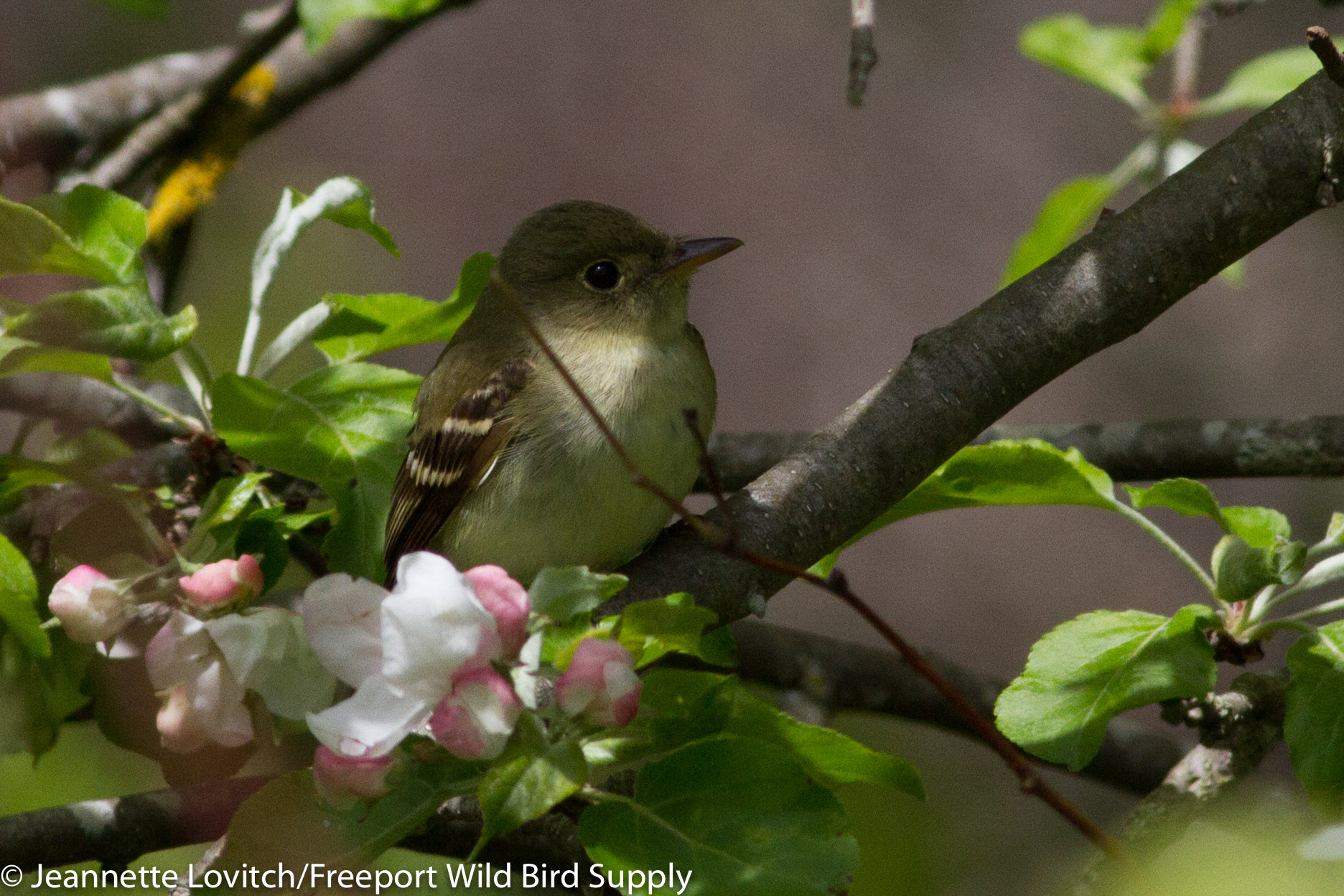
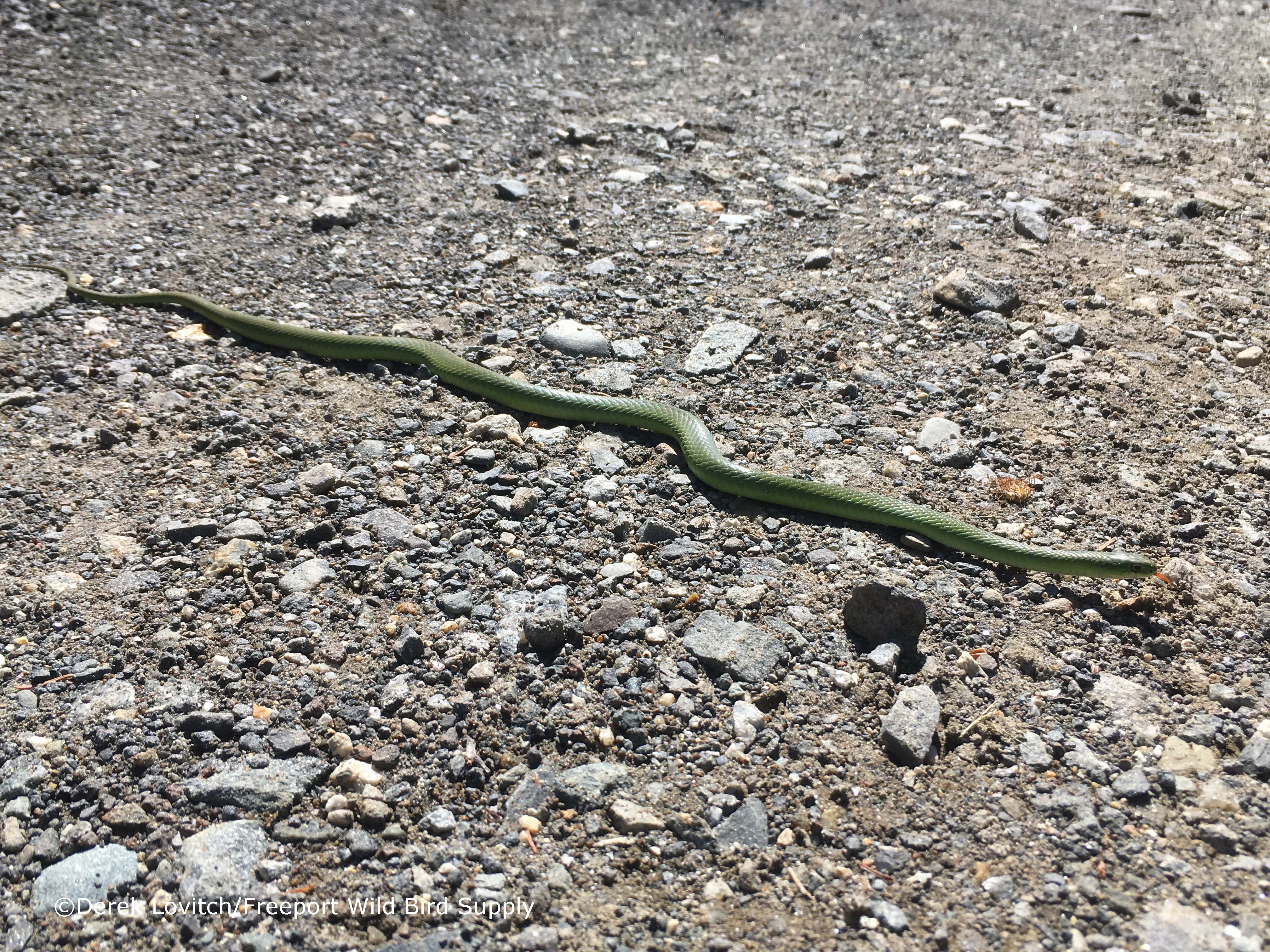
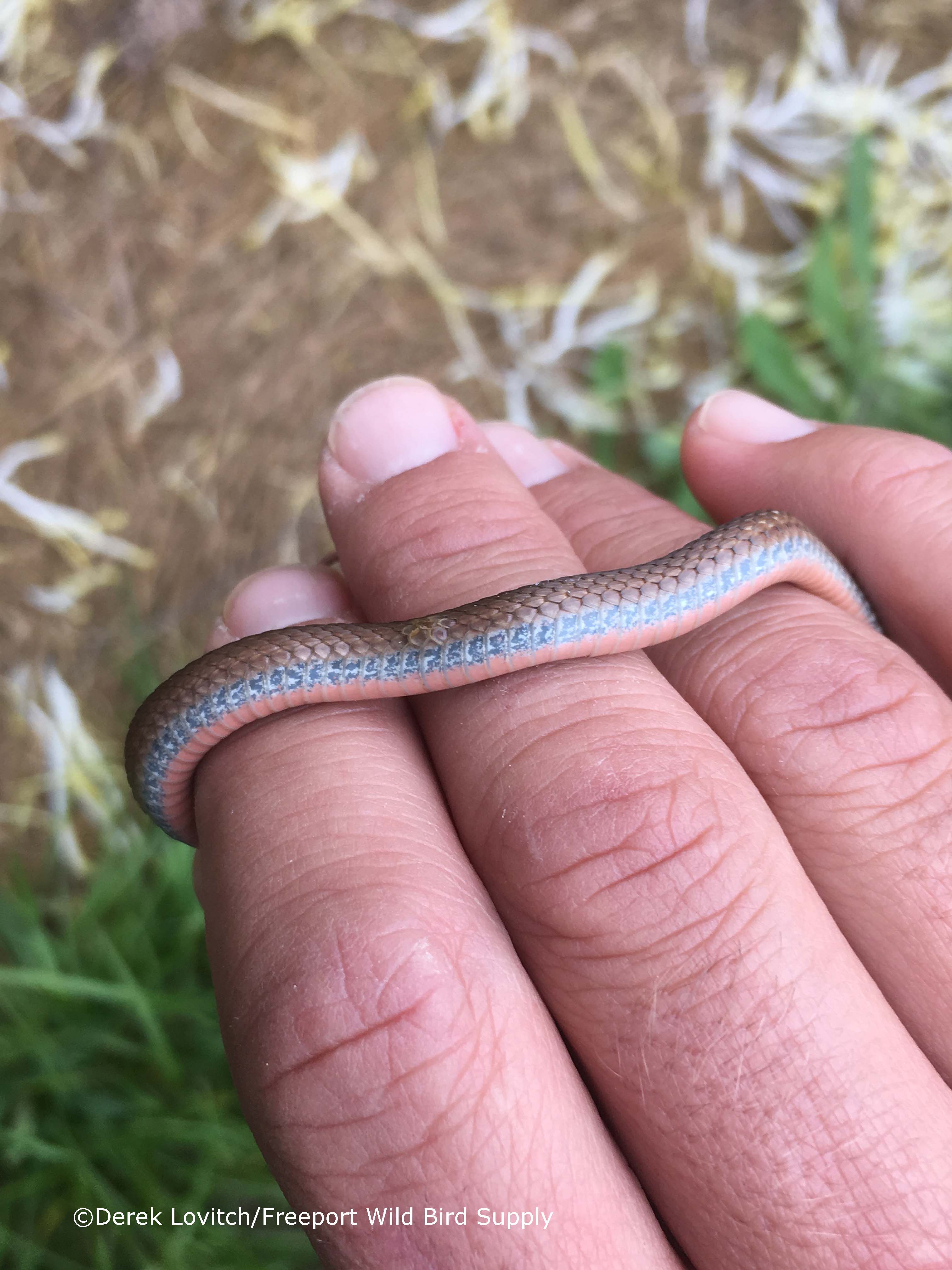
And accordingly, birding was very slow. I had a private tour for the first 2/3rds of the day, and we clawed our way through scattered small migrant flocks to find the goodies. There were definitely more Yellow-bellied Flycatchers around – including several unusually well out in the open. But the skies cleared up as the fog lifted, and we had a decent morning, a good part of which was simply spent exploring the woodlands of the interior of the island. Yellow-bellied Flycatcher A photo session with a Smooth Green Snake was a nice treat, however.
In the afternoon, Jeannette and I joined with several friends for some casual birding and conversation. Of course, once “off the clock,” my luck returned. After two of our friends had spent the weekend desperate for a good look at the Mourning Warbler, I walk by Donna’s lawn and calmly proclaim “umm, the Mourning Warbler is in Donna’s lawn.” We received permission to enter her yard, and followed it around the house for a while as it foraged around the foundation. This is not where I usually expect to see a Mourning Warbler, but we’ll take it. Unfortunately, all of Jeannette’s photos of it are of its butt.
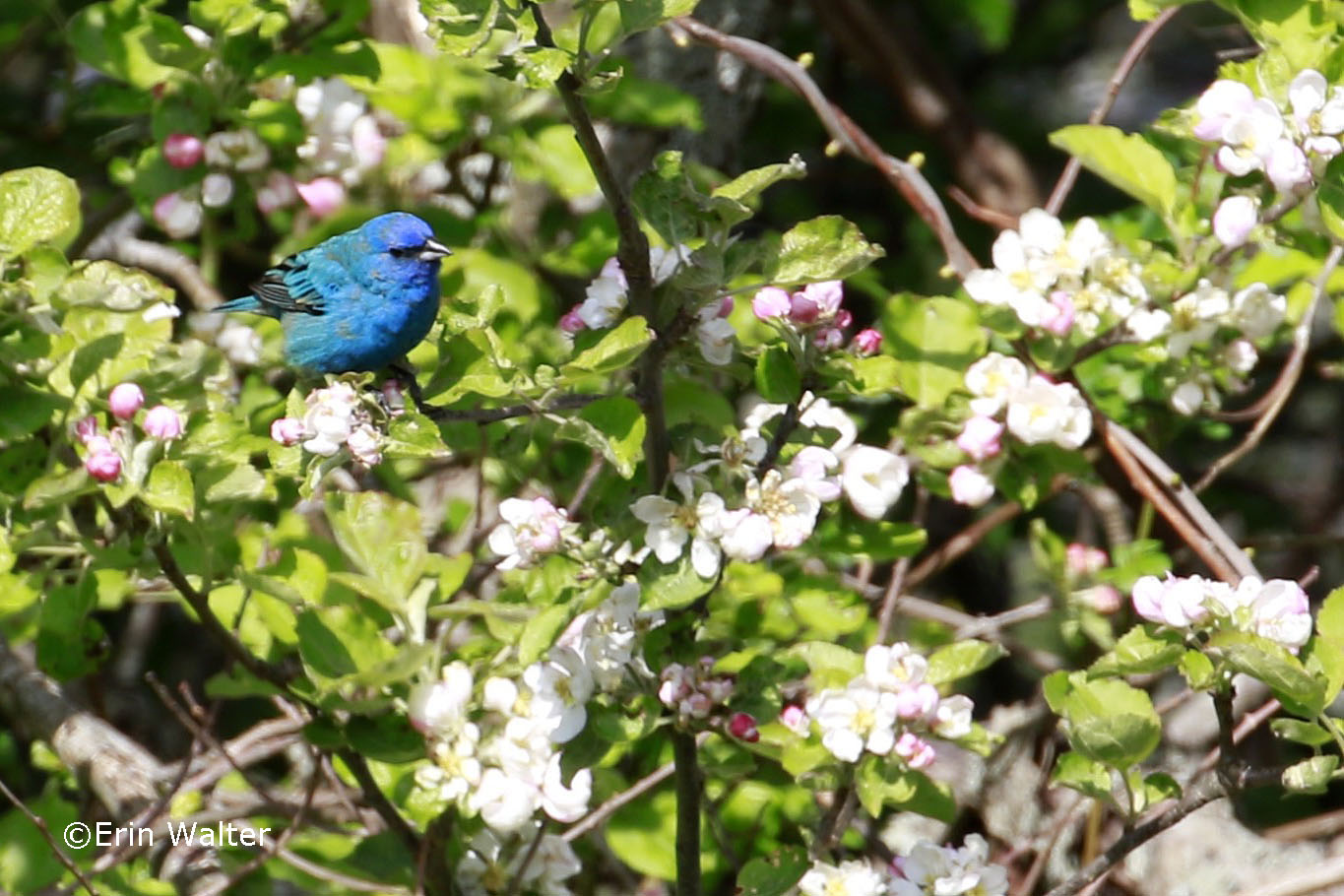
Although it remained very slow overall, we had some really great looks at several birds we never did see on the tour, like a male Indigo Bunting, a Northern Waterthrush, and two very cooperative Olive-sided Flycatchers. We also caught up with the immature male Summer Tanager that was hanging out with the female and at least three Scarlet Tanagers – an impressive swatch of color and splendor, let alone offering good studies and comparisons.
Undersides of a Red-bellied Snake Male Scarlet Tanager Immature male Summer Tanager
And in the afternoon, after everyone else departed, Jeannette and I happened upon a female Bay-breasted Warbler at Fish Beach that needed some help. Several mealworms later (a new species for my fed-mealworms list!) she hopped off into cover to digest. And I am happy to report that by the next morning, she didn’t need any handouts as she was actively foraging on her own.
Jeannette and I enjoyed dinner at the Island Inn as our 24-hour vacation got underway, with Common Nighthawk, Sora, and American Woodcock serenading us on the way home. Willets spotted earlier in the day by Jeannette and several others as they briefly alighted on the island.
Day 5: 5/30.
It was just Jeannette and I today, and with no visible migration on the radar and expansive fog, our main plans were to sleep in for a change – and for the last time for me until July! So we did not expect to be woken up by sun shining into our windows.
Not surprisingly, I popped up and outside, and began birding with another great look at the continuing Orange-crowned Warbler. There were not a lot of new birds around, not surprisingly, but with sun shining, birds were out at edges and easy to see. The female Bay-breasted Warbler was busy catching seaweed flies at Fish Beach, joined by a companion male Blackburnian Warbler and later, a young male American Redstart.
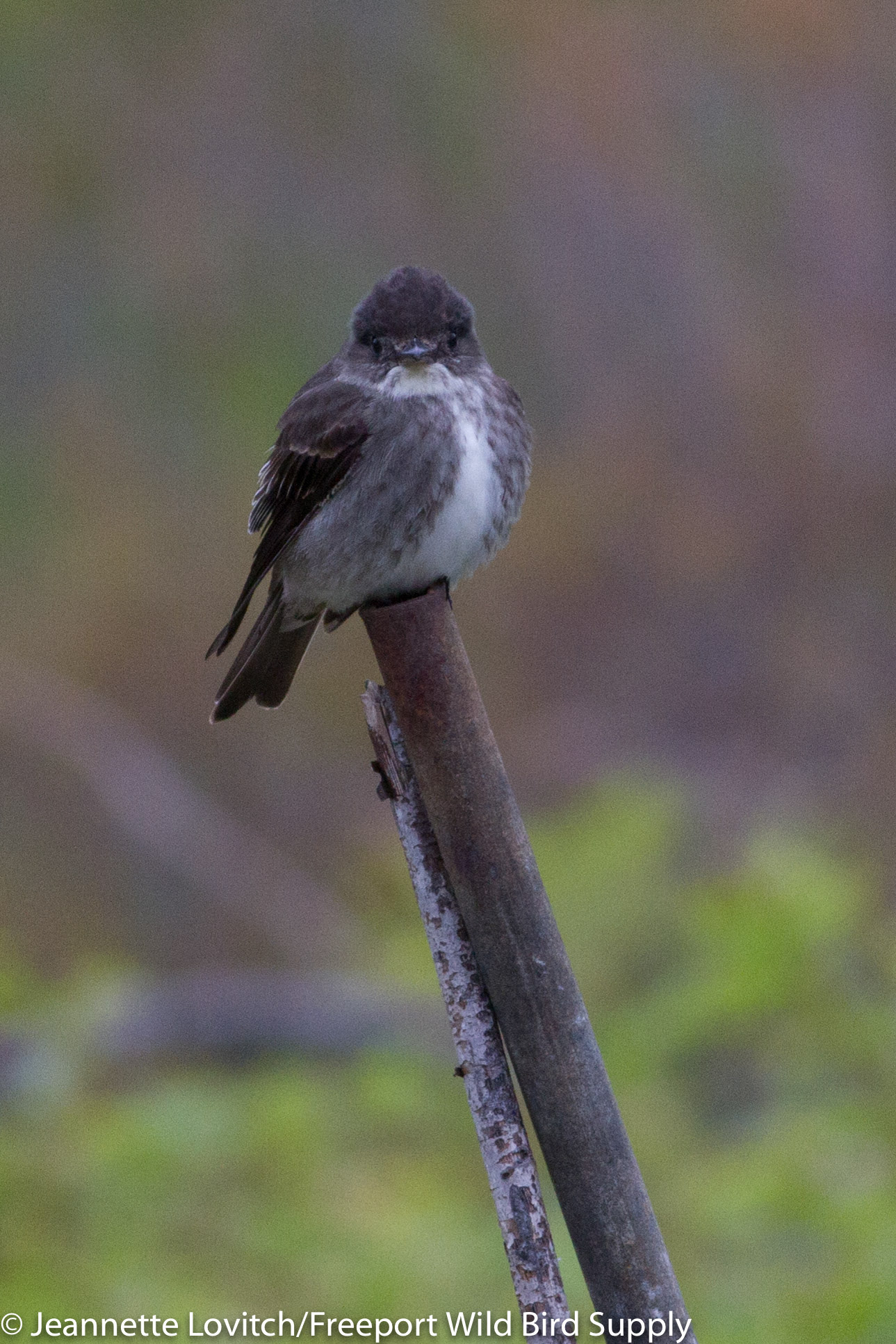
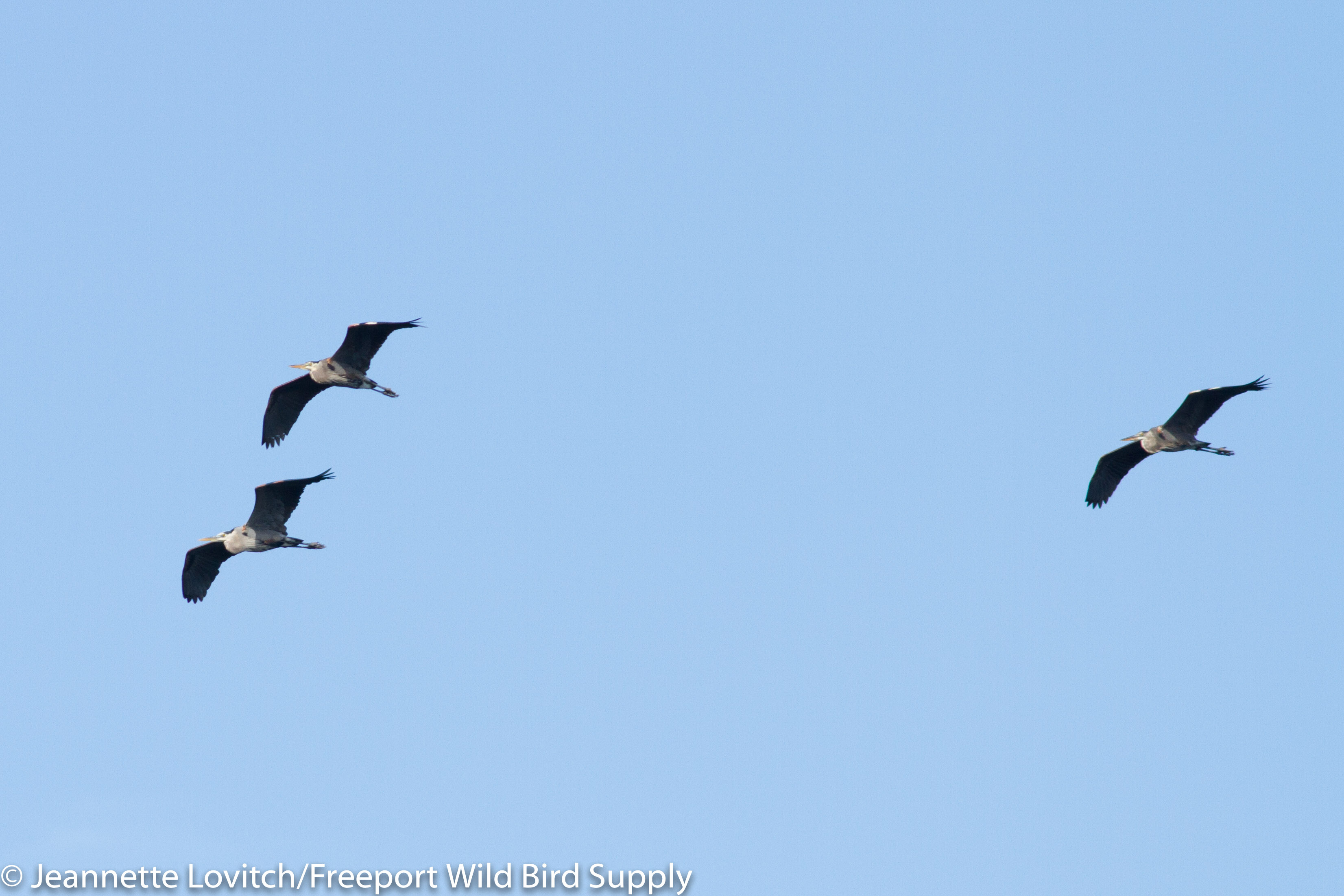
We finally saw a Bald Eagle after five days on the island, and 4-7 Great Blue Herons dropped in for a visit. It was extremely quiet after breakfast, but again birds were just pleasantly visible in the sun, especially in blooming apple trees. Things like the Eastern Kingbirds, which spent most of the weekend feeding in and around patches of seaweed on the beaches were up and about, flycatching “normally” from treetops. We also slowly padded the triplist, with a Yellow-bellied Sapsucker (incredibly, the first woodpecker of my five days here – how did I miss the resident Downies?) and great look at a Yellow-billed Cuckoo (my first of the year, and later, a very good look at a Black-billed as well). The male Summer Tanager, at least, continued to frequent a feeding station, and a Garter Snake was my third snake of the weekend (Smooth Green on a couple of occasions, and a single Red-bellied on Monday morning).
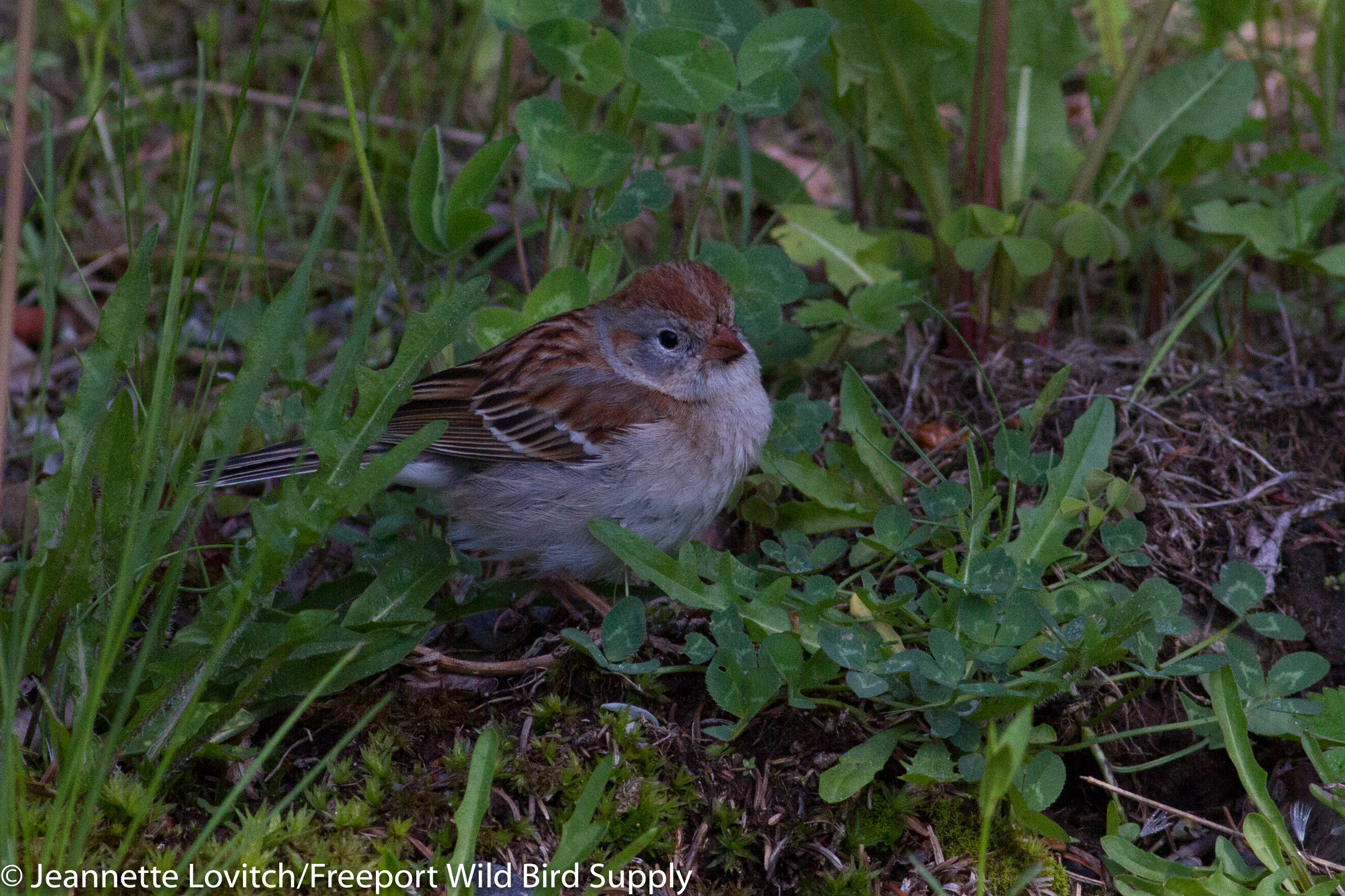
Field Sparrow
A little wave of presumed migrant swallows increased the number of Barn and Tree Swallows by 2-3 each, but also including 3 Bank and 1 Cliff Swallow, the final two new species of our stay.
The afternoon was quite slow otherwise, but admittedly, we spent a decent portion of the last couple of hours of the afternoon involved in conversation at the brewery, and about everywhere in between.
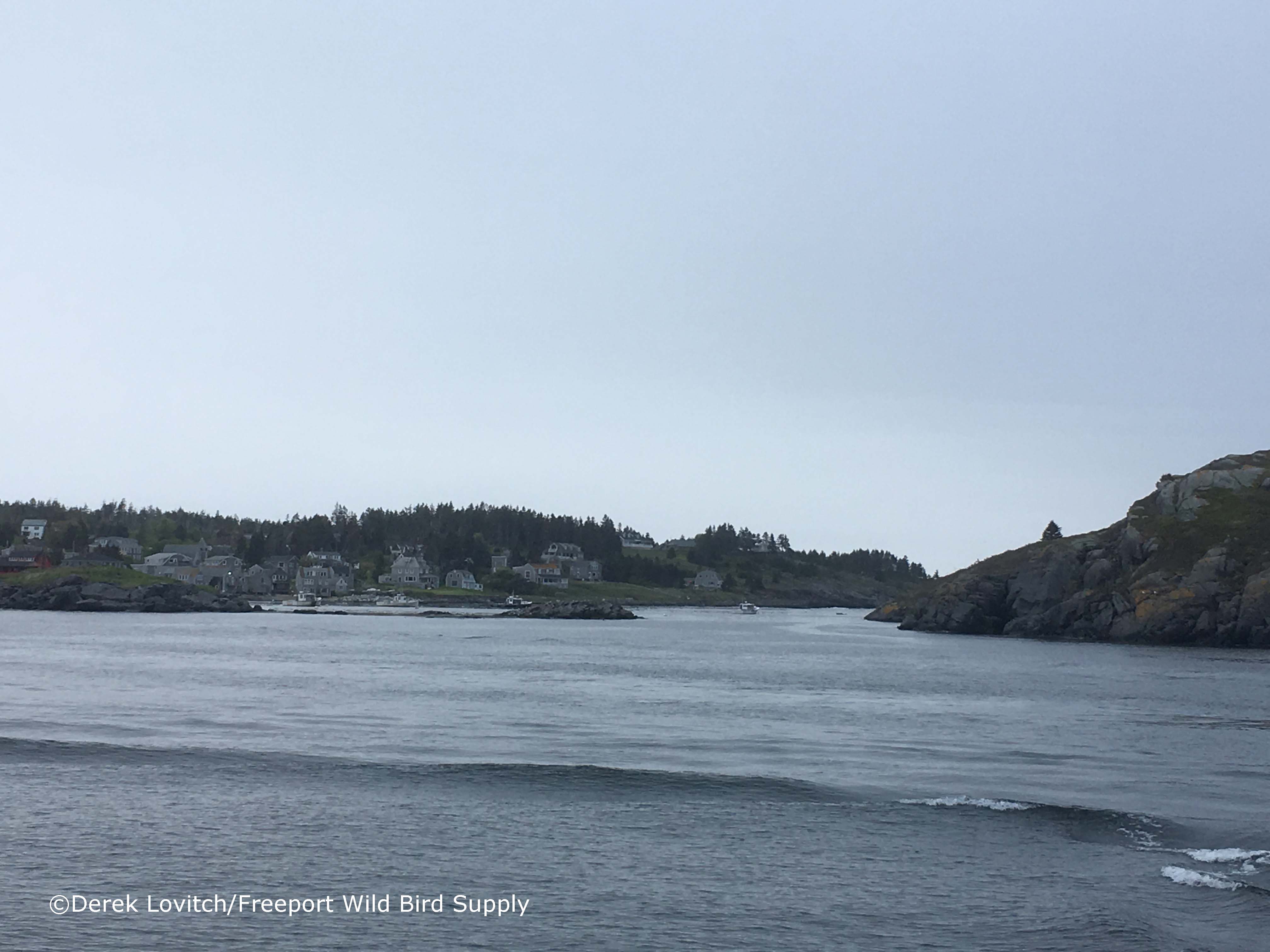
But alas, it was time to go, on the late boat back to Port Clyde. We said our goodbyes, for now, wondering if we’ll be back next spring (depending on if that misguided wind project gets underway), but also how soon we can get back this summer!
While we didn’t have any puffins – or any other seabirds – on our smooth ride back, we did have a couple of Roseate Terns as we approached Port Clyde. And then it was time for the drive home, and back into entry into the real world!
Here’s the five day daily checklist:
Mallard 16-16-10-12-10
Common Eider x-x-x-x-x
Ring-necked Pheasant 0-0-1-1-1
Common Loon 0-0-2-1-3
Northern Gannet 10-0-1-3-3
Double-crested Cormorant x-x-x-x-x
Great Cormorant 0-0-2-2-1
CATTLE EGRET 3-3-2-0-0
Great Blue Heron 0-0-0-0-4
Green Heron 0-2-0-0-0
Osprey 0-0-1-0-1
Bald Eagle 0-0-0-0-1
Merlin 0-1-1-1-1
Peregrine Falcon 0-1-0-0-0
Sora 1-1-1-1-1
Greater Yellowlegs 1-0-0-0-0
Spotted Sandpiper 0-1-0-0-0
American Woodcock 0-1-0-0-0
Laughing Gull (8)-0-2-2-11
Herring Gull x-x-x-x-x
Great Black-backed Gull x-x-x-x-x
Common Tern (x)-0-0-0-0
Roseate Tern 0-0-0-0-(2)
Black Guillemot x-x-x-x-x
ATLANTIC PUFFIN (2)-0-0-0-0
Mourning Dove 4-8-6-6-4
Black-billed Cuckoo 0-1-0-0-1
YELLOW-BILLED CUCKOO 0-0-0-0-1
Common Nighthawk 2-2-0-1-0
Ruby-throated Hummingbird 2-3-3-2-3
Yellow-bellied Sapsucker 0-0-0-0-1
Belted Kingfisher 0-0-1-1-0
Olive-sided Flycatcher 0-0-0-2-0
Eastern Wood-Pewee 2-1-2-2-1
Yellow-bellied Flycatcher 0-0-3-6-0
Alder Flycatcher 0-0-1-1-0
Willow Flycatcher 0-3-3-2-1
“Traill’s” Flycatcher 1-2-0-0-0
Least Flycatcher 0-3-4-0-2
Eastern Kingbird 5-4-3-2-2
WHITE-EYED VIREO 0-1-1-0-0
Blue-headed Vireo 0-1-0-0-0
Philadelphia Vireo 1-3-4-3-2
Red-eyed Vireo 3-6-15-6-4
Blue Jay 6-8-6-6-6
American Crow 4-x-x-x-x
Common Raven 0-0-0-1-0
Northern Rough-winged Swallow 0-0-1-0-0
Tree Swallow 0-2-2-2-2
Bank Swallow 0-0-0-0-03
Barn Swallow 0-3-3-0-4
Cliff Swallow 0-0-0-0-1
Black-capped Chickadee x-x-x-x-x
Red-breasted Nuthatch 4-4-8-8-4
House Wren 0-1-0-0-0
Winter Wren 0-0-2-2-1
Golden-crowned Kinglet 0-0-6-10-4
Veery 1-0-1-0-0
Swainson’s Thrush 0-0-4-1-1
American Robin 8-10-10-12-15
Gray Catbird 20-x-x-x-x
Brown Thrasher 0-1-0-1-0
European Starling 4-6-6-10-10
Cedar Waxwing 40-40-40-30-50
Tennessee Warbler 0-0-2-0-0
ORANGE-CROWNED WARBLER 0-0-1-1-1
Northern Parula 3-6-8-8-8
Yellow Warbler 15-20-15-12-20
Chestnut-sided Warbler 0-4-10-8-6
Magnolia Warbler 1-3-20-10-15
Yellow-rumped Warbler 0-0-0-2-0
Black-throated Green Warbler 2-3-8-8-4
Blackburnian Warbler 0-1-6-6-8
Bay-breasted Warbler 0-1-0-1-1
Blackpoll Warbler 4-10-20-10-15
Black-and-white Warbler 0-2-2-2-1
American Redstart 6-15-40-20-10
Northern Waterthrush 0-0-0-1-0
MOURNING WARBLER 0-1-0-1-0
Common Yellowthroat 12-20-x-x-x
Wilson’s Warbler 1-0-4-1-2
Canada Warbler 0-1-2-0-1
SUMMER TANAGER 0-1-0-2-2
Scarlet Tanager 1-4-3-3-3
Chipping Sparrow 0-4-2-4-2
Field Sparrow 0-1-0-1-1
Savannah Sparrow 0-2-2-2-1
Song Sparrow x-x-x-x-x
White-throated Sparrow 0-1-1-0-1
Northern Cardinal x-8-8-8-6
Rose-breasted Grosbeak 1-3-3-3-4
Indigo Bunting 0-0-1-2-1
Bobolink 0-1-2-1-0
Red-winged Blackbird 15-14-x-x-x
Common Grackle x-x-x-x-x
ORCHARD ORIOLE 0-1-0-0-0
Baltimore Oriole 4-3-5-3-3
Purple Finch 2-3-2-2-1
Pine Siskin 0-0-1-0-0
American Goldfinch 10-12-10-10-8
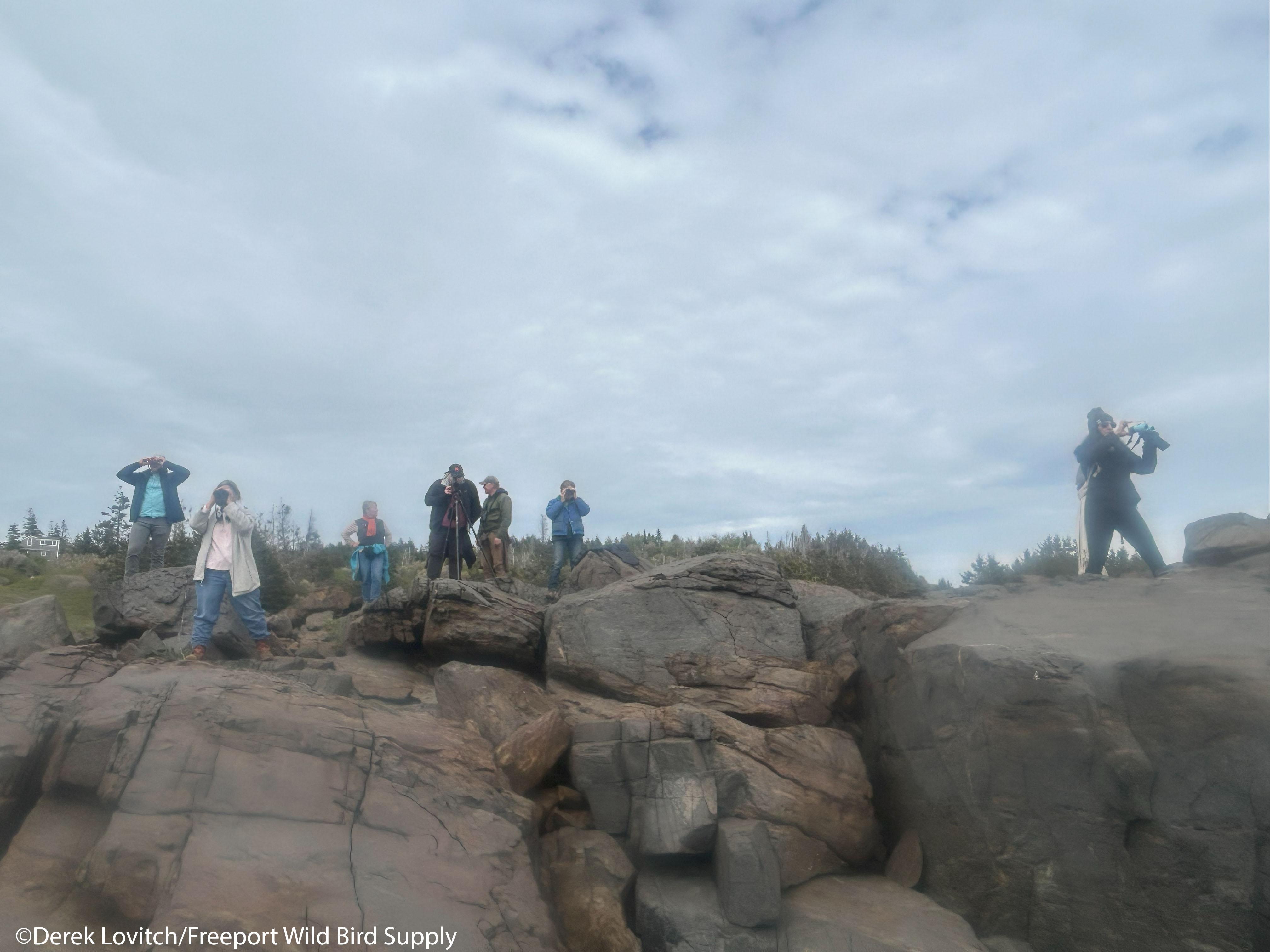
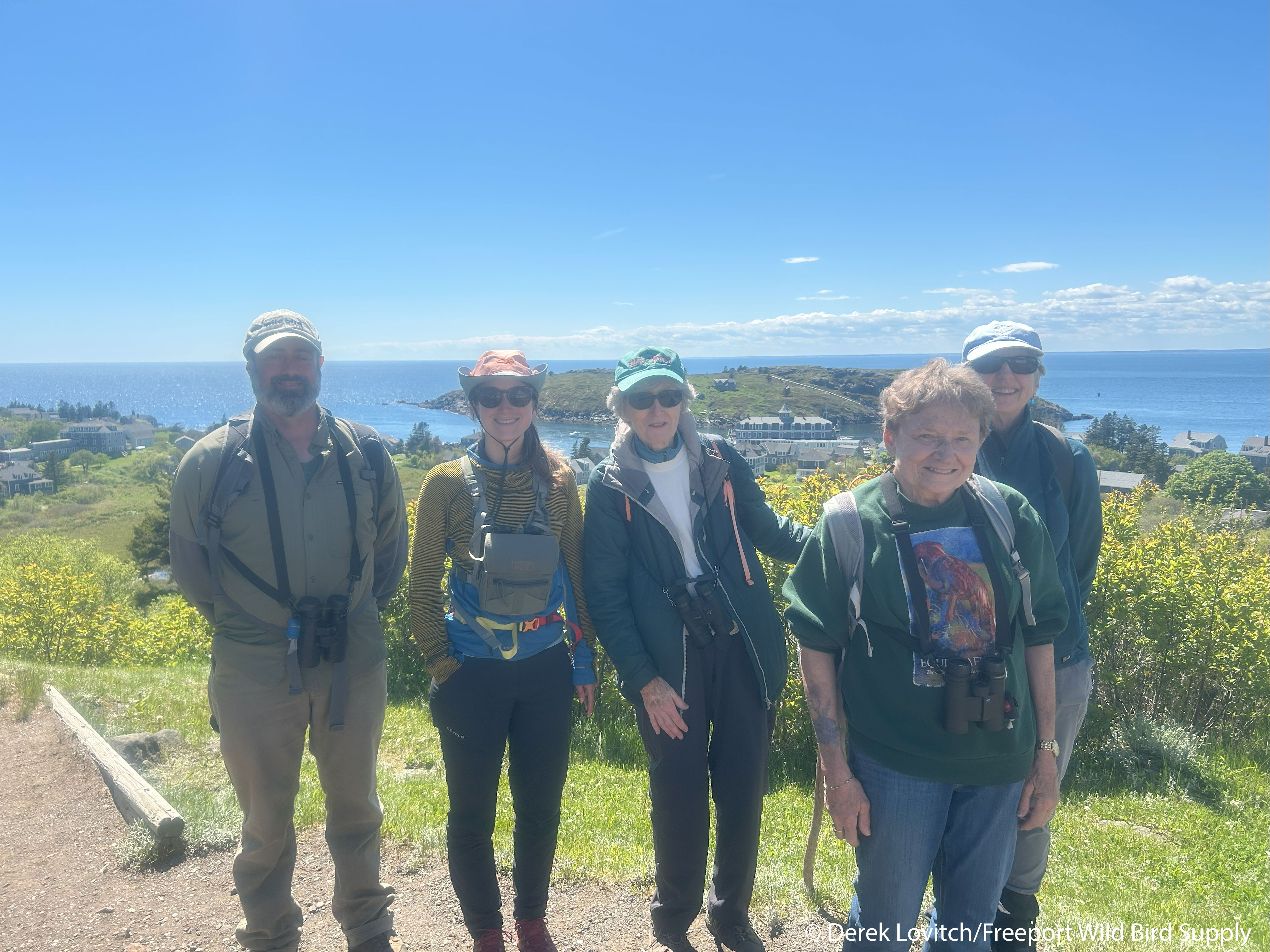
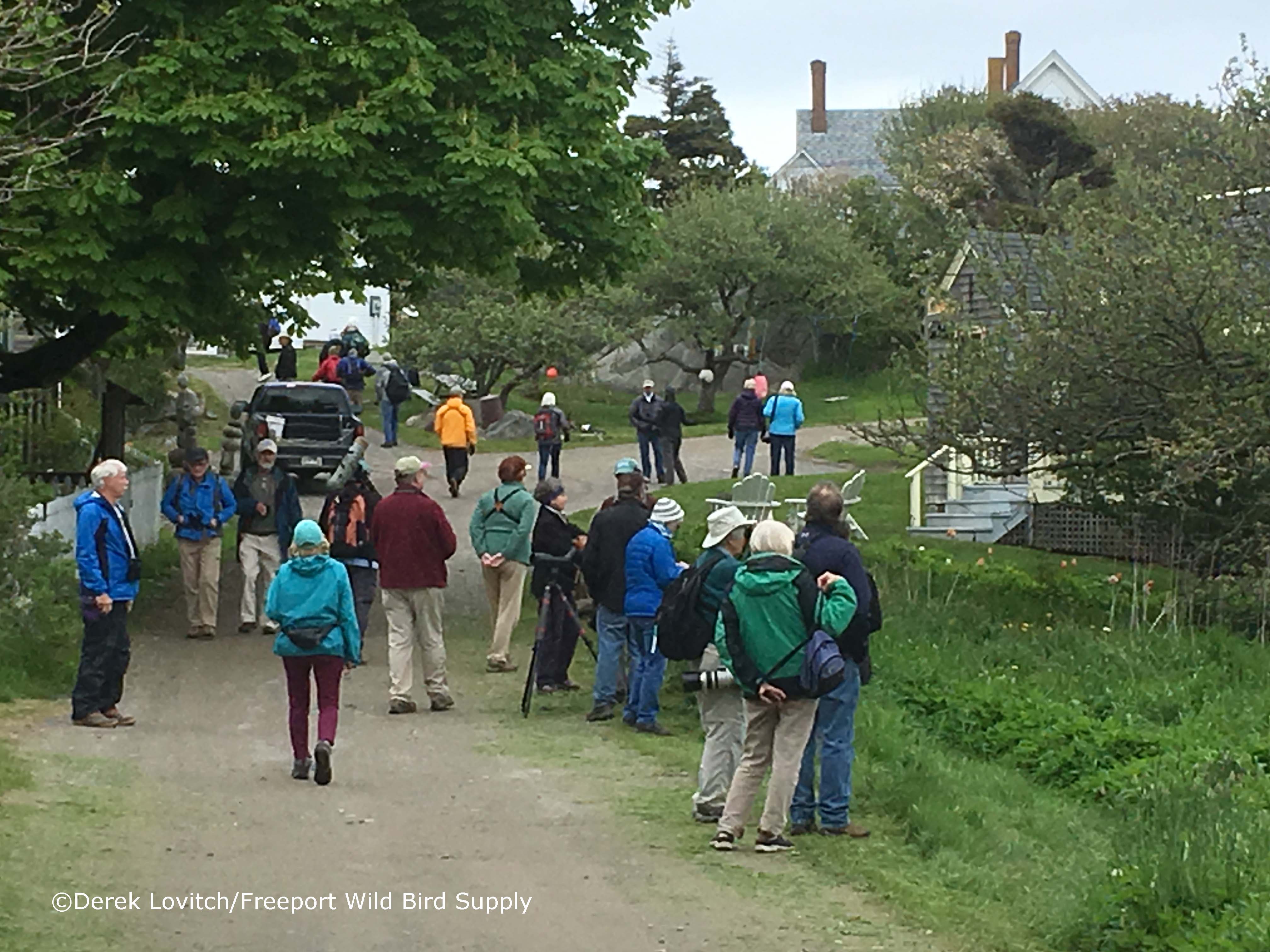
Just a typical Memorial Day Weekend full of birders on Monhegan!

























 Maine Birding Field Notes