This Rufous Hummingbird graced a Bath yard for almost two months. The story below.
Life in retail during the holiday season, followed by a trip to the Motherland of New Jersey for Christmas resulted in limited Maine birding for me over the past two weeks. However, a couple of good days in the field here in Maine produced several observations of note:
Recent ice and more snow resulted in a nice little surge of Dark-eyed Juncos and American Goldfinches into our Durham yard. A male Purple Finch on ½ was the first I have seen locally in at least a month, and a Northern Flicker dropped in on 12/30.
1 continuing drake Green-winged Teal and 1+ Fish Crow, Auburn Riverwalk, 12/23.
2 drake and one hen BARROW’S GOLDENEYES, Bernard Lowne Peace Bridge, Auburn-Lewiston, 12/30 (with Kelley Sharp)
3 Fish Crows and 1 1st-cycle Iceland Gull, Auburn Riverwalk, Auburn, 12/30 (with Kelley Sharp).
1 pair American Wigeon, Rockland waterfront, 1/1 (with Jeannette).
Rufous Hummingbird in Bath, 10/31-12/26, 2025.
A Rufous Hummingbird arrived in a Bath yard on Halloween. And she stayed until the 26th of December! These birds are just incredible! Unfortunately, it was not in a yard that was conducive to visitation, so we had to keep the sighting under wraps. I really am sincerely sorry about that, but the homeowner’s rights and the bird’s welfare will always be put first and foremost with us. But it was well photographed, well studied, and well monitored. Here’s the story, identification particulars, and more.
We only had one morning for birding after visiting family, and we chose to spend it with an estimated 100,000 American Robins!
It was awesome and I hope these videos do it a modicum of justice! This was in Oldwick, NJ, discovered by Evan Obercian (yup, a birding friend of mine since high school who also now lives in Maine!) around 2021 (although he heard of a former roost not far away before this one). This was the largest gathering he has seen, at least around Christmastime. We just enjoyed the show, but he recently made the estimate (based on counting sample minutes and extrapolating). There were also about 1,000 European Starlings – look for a couple of dense flocks exiting the leaning bamboo during the videos. A few hundred Common Grackles and Red-winged Blackbirds were also present (mostly exited before sunrise in the first video), and Jeannette and I picked out a single Hermit Thrush. 3 Cooper’s Hawks and a Sharp-shinned Hawk were present, but they too seemed to be overwhelmed by the masses!
The videos can be seen here:
New Year Predictions Blog!
I know you are waiting with bated breath, but I’ll publish this soon. Of course, when I am delayed in getting it posted, something really rare shows up! So keep you eyes open!
Swamp Sparrows have been common and conspicuous on our Durham property, and elsewhere this week. I feel this, like most sparrows, is an underappreciated beauty!
My observations of note over a very productive and exciting eight days of birding included the following:
Highlights from our Durham property this week included near-daily American Woodcocks and Rusty Blackbirds, and a nice little arrival of more Swamp Sparrows and Purple Finches in particular on 10/21.
Sandy Point Morning Flight, 10/15.
A very light flight passed over and through Sandy Point Beach, Cousin’s Island, Yarmouth this morning.
6:55-8:30 (with Bill Thompson).
48F, mostly cloudy to partly cloudy, NW 1.7-2.5mph diminishing to calm.
51 American Robins
33 Yellow-rumped Warblers
28 Dark-eyed Juncos
17 American Goldfinches
16 Ruby-crowned Kinglets
8 Eastern Bluebirds
7 White-throated Sparrows
6 Chipping Sparrows
5 Palm Warblers
4 Hermit Thrushes
4 Golden-crowned Kinglets
3 Blue-headed Vireos
3 Purple Finches
3 Swamp Sparrows
2 Pine Siskins
2 Rusty Blackbirds
2 Tufted Titmice (4 false-starts and counting)
1 Red-breasted Nuthatch
1 Blackpoll Warbler
1 White-breasted Nuthatch
1 Downy Woodpecker (2+ false-starts)
1 House Finch
1 American Pipit
1 Northern Flicker
1 Magnolia Warbler
1 unidentified
Total = 203
1 continuing CACKLING GOOSE, Thornhurst Farm, North Yarmouth, 10/15 (with Bill Thompson).
1 Least Sandpiper, 1 White-rumped Sandpipers, and 2 Pectoral Sandpipers, Walsh Preserve, Freeport, 10/15 (with Bill Thompson).
Sandy Point Morning Flight, 10/16.
An excellent flight passed over and through Sandy Point Beach, Cousin’s Island, Yarmouth this morning.
6:55 to 10:40am.
44F, Mostly cloudy, NW 4.3 – 9.0 increasing to 15.1 – 19.7mph with higher gusts.
2186 American Robins (*NEW RECORD! – just barely).
1776 Yellow-rumped Warblers
167 unidentified
127 Dark-eyed Juncos (One was quite likely not a Slate-colored, but my photos of it are not useful)
61 Common Grackles
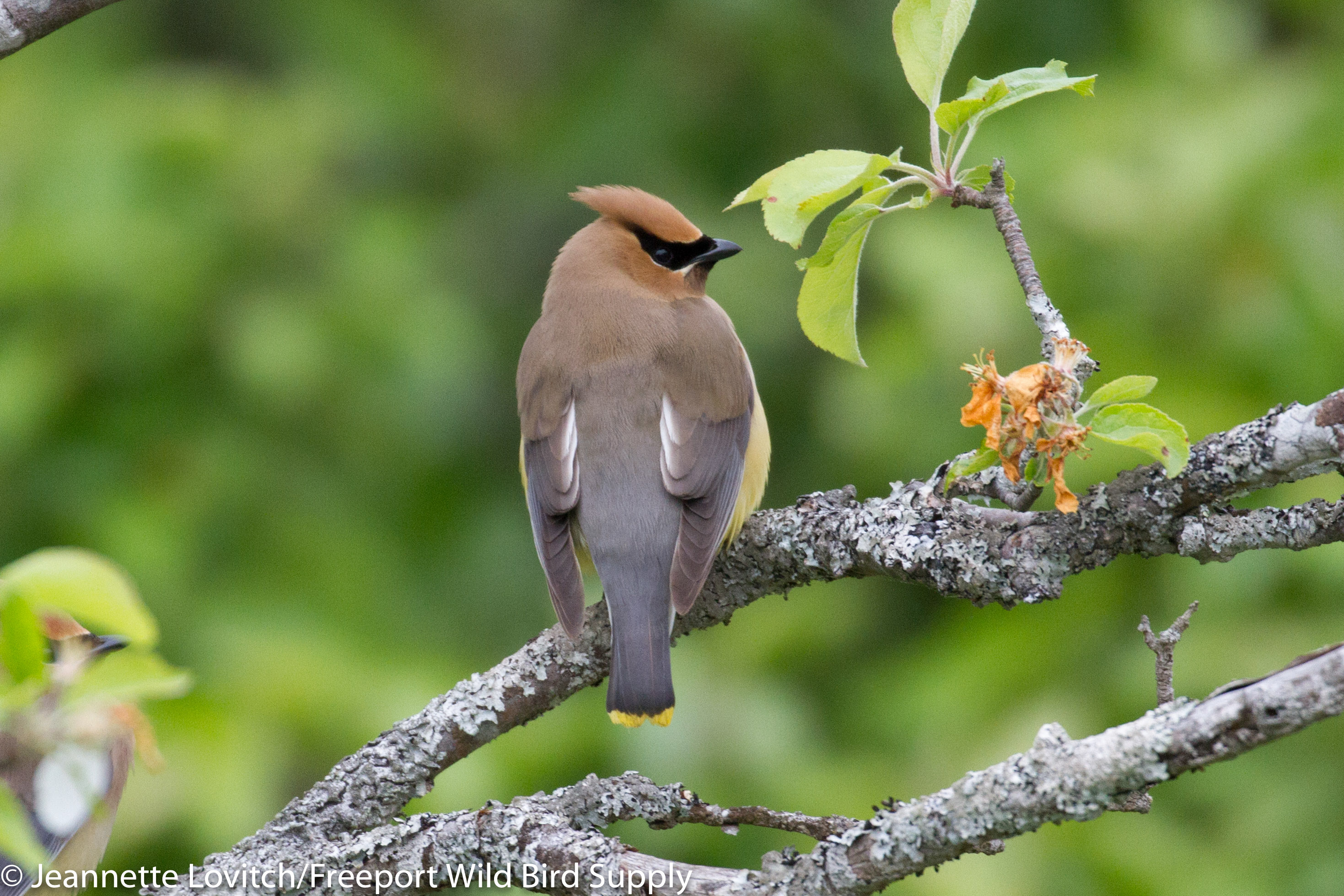
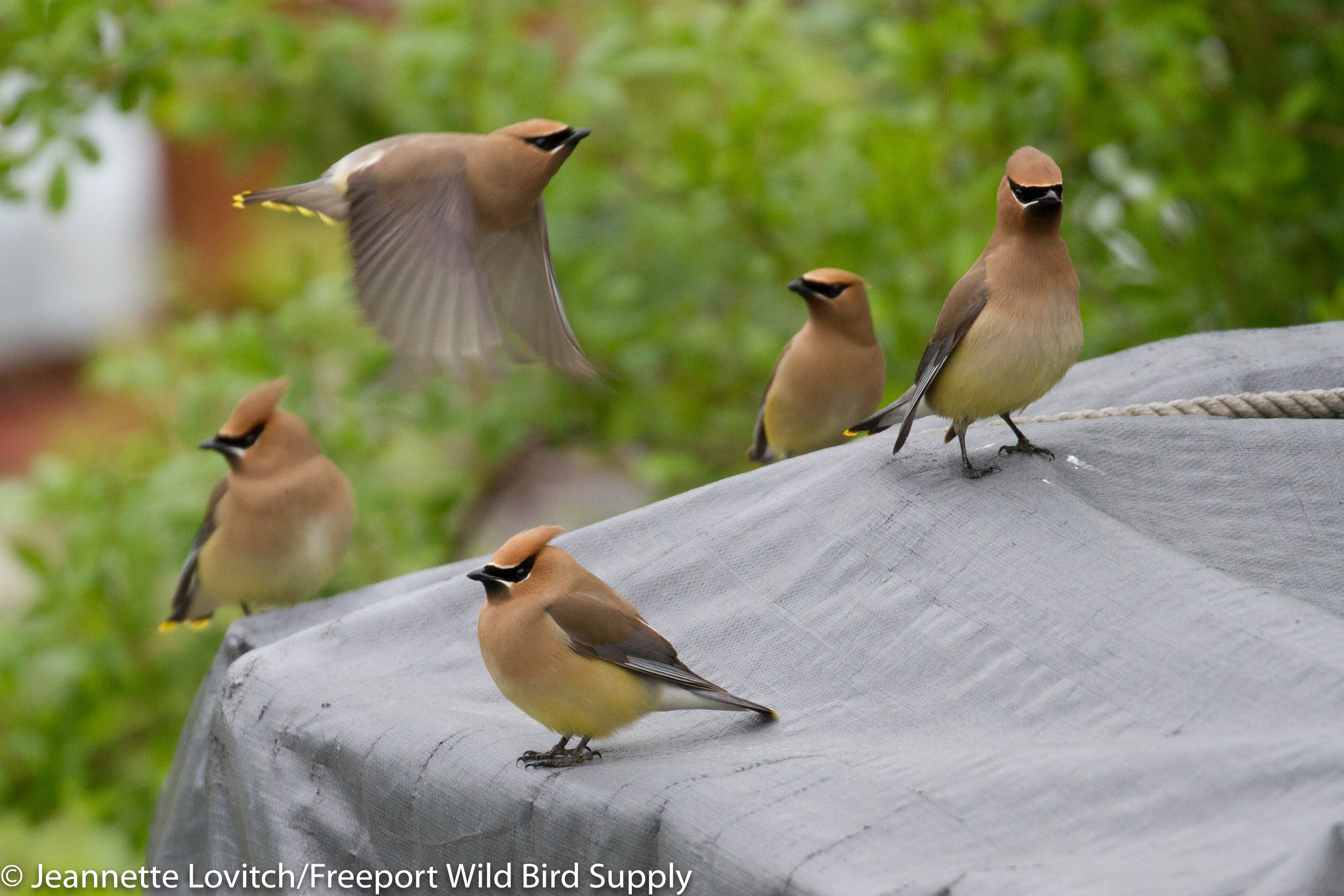
48 Cedar Waxwings
43 Canada Geese
31 Chipping Sparrows
21 Ruby-crowned Kinglets
19 Rusty Blackbirds
18 White-throated Sparrows
13 Northern Flickers
11 Golden-crowned Kinglets
11 Purple Finches
9 Pine Siskins
7 Palm Warblers
4 Blue-headed Vireos
4 unidentified finches
4 Hermit Thrushes
4 Song Sparrows (crossed together at 8:29. This is only my second or third observation of SOSP engaging in Morning Flight after sunrise here; plenty more in and around the parking lot as usual)
3 Merlins
3 Common Loons
3 Turkey Vultures
2 Red-winged Blackbirds
2 White-crowned Sparrows
2 Eastern Phoebes
1 Northern Parula
1 Blackpoll Warbler
1 Brown Creeper
1 Peregrine Falcon
1 Yellow-bellied Sapsucker
1 Cooper’s Hawk
1 American Goldfinch
1 Red-shouldered Hawk
1 Cape May Warbler
1 Red-breasted Nuthatch
1 Sharp-shinned Hawk
1 Tennessee Warbler (from Bill Thompson’s photo review)
1 Black-throated Blue Warbler (from Bill Thompson’s photo review).
Total = 4,592
Notables from a delightfully birdy morning on Bailey Island, Harpswell on 10/17 included a decent, and relaxingly unquantified, morning flight mostly of Yellow-rumped Warblers; 1 ORANGE-CROWNED WARBLER, and 1 Cape May Warbler among the migrants found here and there around the island.
1 DICKCISSEL, feeders here at the store, 10/19, continuing through at least 10/21. Was this the same bird seen on 10/4 and then again on 10/13-14?
4 continuing FORSTER’S TERNS, Pine Point, Scarborough, 10/20 (with clients from California and Massachusetts).
2 “Ipswich” Savannah Sparrows, Eastern Road Trail, Scarborough Marsh, 10/20 (with clients from California and Massachusetts).
Our Last Tour of 2025 still has some space remaining!
Birds on Tap℠ – Roadtrip! Rarity Roundup
November 9, 2025; 8:00am – 3:00pm
Cost – $125
Portland Explorer (formerly Maine Brews Cruise) and Freeport Wild Bird Supply are excited to continue our collaboration for six very special outings in 2025.
These unique, relaxed birding and beer-ing adventures that you have come to love combine great local birding at seasonal hotspots with visits to sample the delicious creations of some of our favorite local breweries. These tours are a perfect introduction to birding and/or craft beer, and a great opportunity to travel with significant others, friends, and family that have interest in one topic, while your interest is primarily in the other (for now!). Seasonal birding hotspots and great local beer – a perfect combination, and we’ll even do all of the driving!
Early November is a fantastic time of year in Maine for vagrants – birds normally seen in far-off places. Due to a combination of weather patterns, changing seasonal food resources, falling temperatures, and other factors – some of which are not completely understood – birds that may have ended up in Maine by “accident” begin to concentrate at the coast in “migrant traps” and “hotspots.” In other words, this is the time of year to expect the unexpected.
A traditional “Rarity Roundup” involves teams of birders heading out on a given day during rarity prime time, looking for species that are not supposed to be around. And in honor of that tradition, that’s exactly what we are going to do on this unique tour. We may “chase” a rarity (go to see something that has already been found, aka “twitch”) or we might choose a destination known for rare birds in an attempt to find one of our own. Or perhaps, we’ll do both!
Anything between Portland and Kittery is fair game, and we might not even know where we will head until we are on the bus and the latest rare bird alert is received. For those who love adding a bird to your Life or State List, and/or basking in the thrill of discovery, well then this is the tour for you! In between seeing great birds, we’ll discuss the complex factors that are involved in delivering rarities to an area, and how we go about finding them.
After about 3-4 hours of birding, depending on drive time, we will be transported to two of our great local producers to sample their offerings and learn their styles.
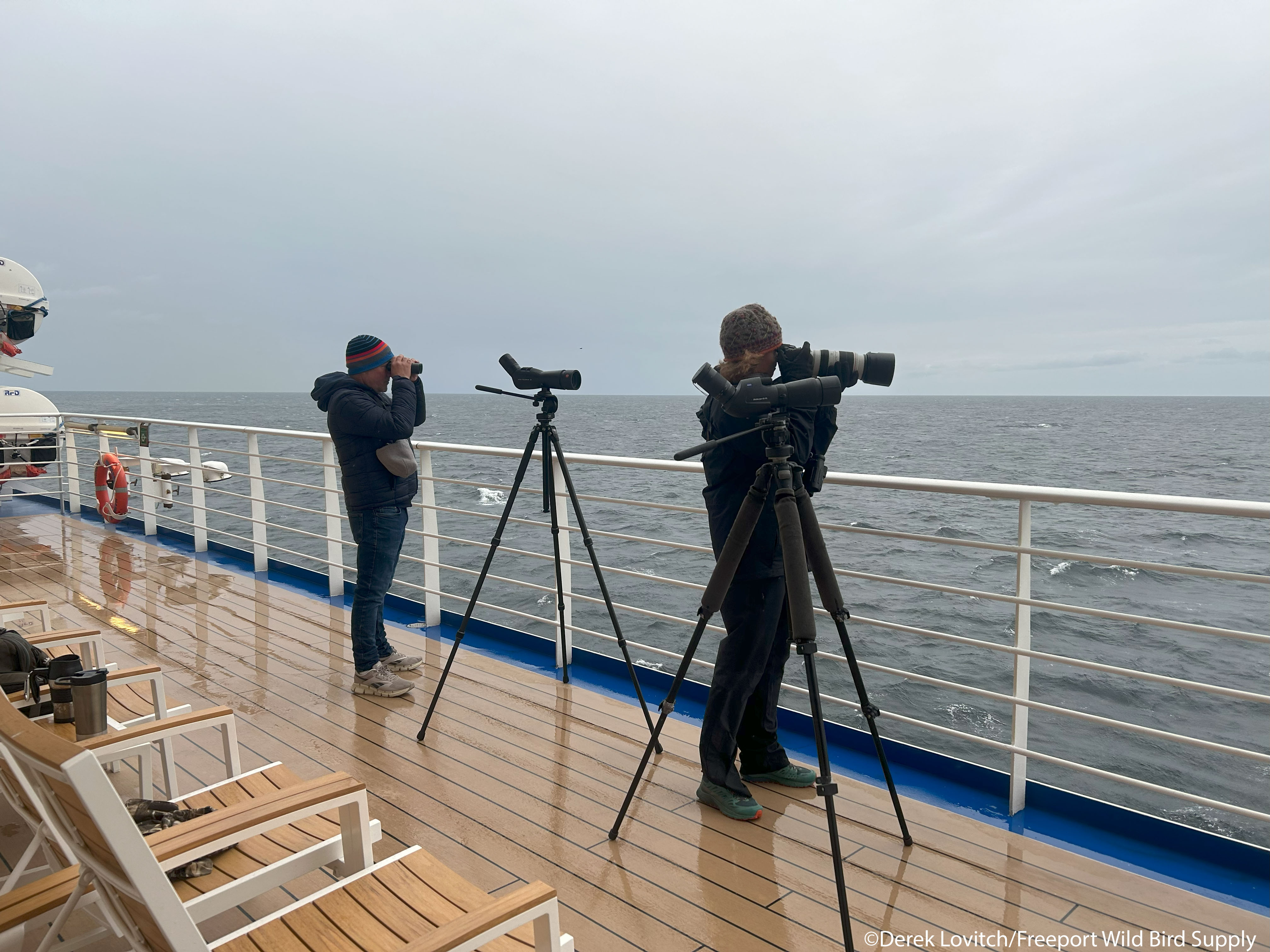
Cruise ships are big, stable platforms that allow for pelagic birding in comfort and with the use of spotting scopes!
In 2019, Jeannette and I took a cruise through the Gulf of Maine and northwestern Atlantic Ocean in the hopes of finding Great Skuas in particular. It was wildly successful, and if we could repeat this success, perhaps there would be a cruise-ship-based tour to offer. At least it would be more comfortable than last week’s attempt!
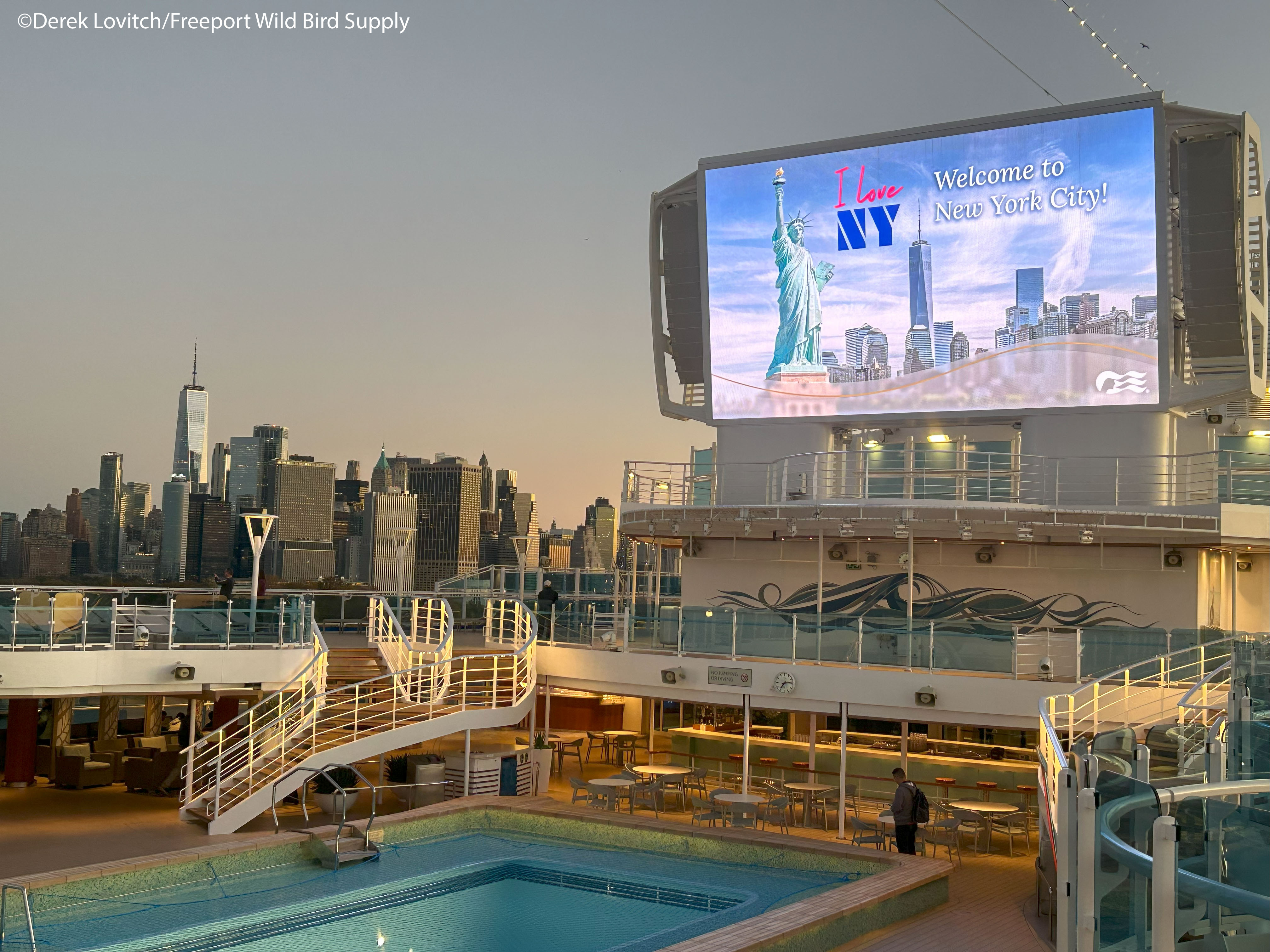
Therefore, on the evening of 10/26, Jeannette and I boarded Princess Cruises’s Enchanted Princess out of Brooklyn, New York. Our hope was to replicate the success of our 2019 trip. We were planning on a second scouting trip in the fall of 2020, but then COVID.
After finally feeling ready to consider a cruise again, we found the itinerary had changed, and we would need to spend seven days to get two full days offshore..we even needed to come back home first! But alas, we had pandemic-era credit that was going to expire, so off we went. Is this a reliable way to see Great Skuas in North America? Could I document a Barolo’s Shearwater this time?
We started our birding, however, at Brooklyn’s Greenwood Cemetery, home of this massive Monk Parakeet colony.
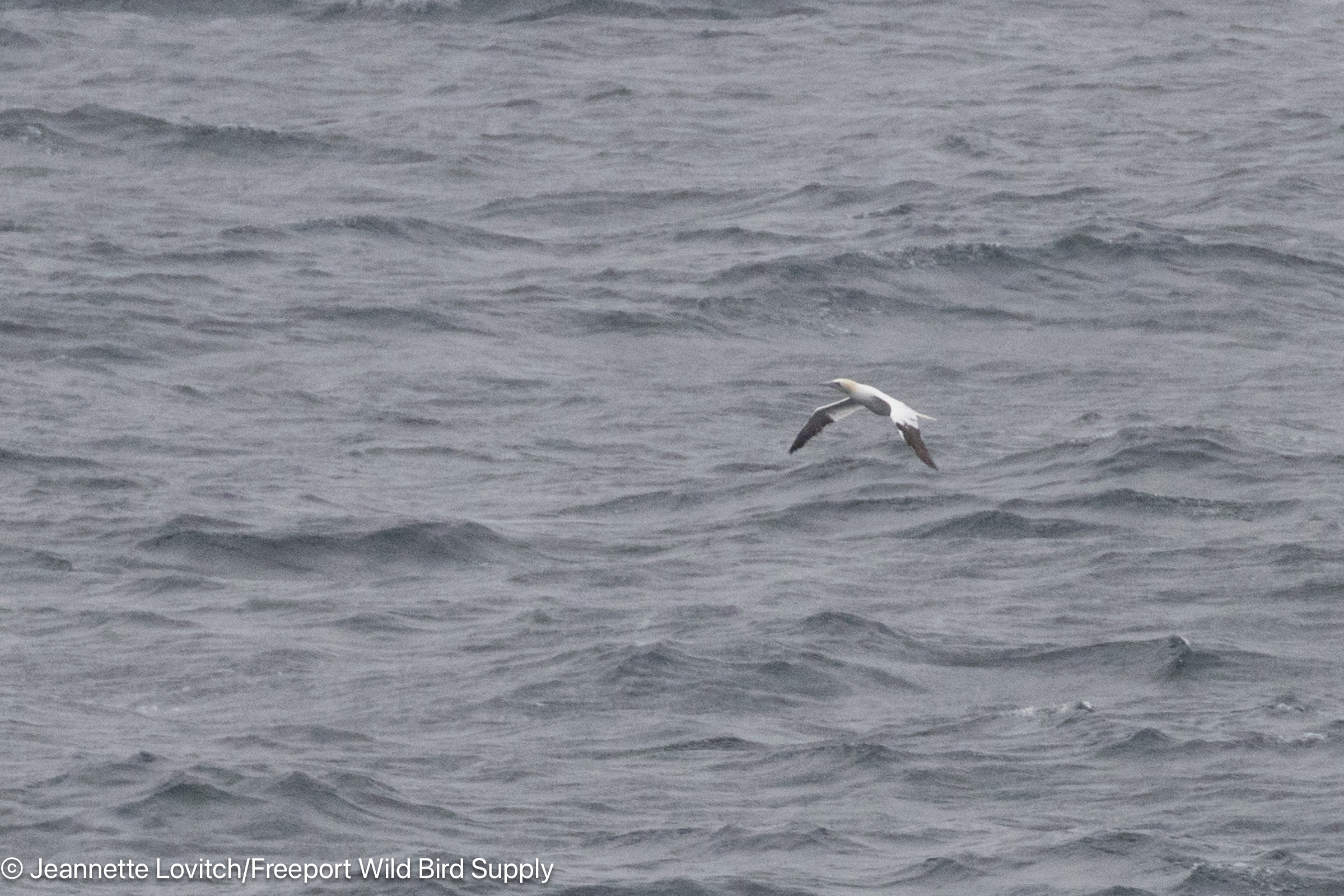
We departed New York Harbor with about an hour of usable daylight, picking up a single Cory’s Shearwater and plenty of Northern Gannets.
Screenshot
Arriving off Newport before dawn the next morning, we got the first shuttle to town, where our friends Bill and Jess picked us up for a lovely day of birding (Clay-colored Sparrow, Orange-crowned Warbler, late Nashville Warbler) before returning to the boat. About 45 minutes of deck time produced 8 Cory’s and a single Great Shearwater.
Newport arrivals. “Western” Palm Warbler at Sachuest NWR.
Unfortunately, this particular boat offered less-than-ideal viewing opportunities compared to our first trip, with the best deck space on Deck 7 (a great height) but way too aft. Even with our scopes on the steady platform, this was going to be a challenge.
Approaching Boston on the morning of 10/28, we checked the decks for passerines (none) before taking our place on Deck 7. There were a lot of Northern Gannets, 4-5 Cory’s Shearwaters close enough to identify as borealis, and a pod of Atlantic White-sided Dolphins. A Song Sparrow flew aboard just outside the outer harbor islands, but before that, our first real surprise of the trip: an American Woodcock appearing from the north and cruising alongside the length of the boat before disappearing. That’s not a “pelagic” we expected!
We birded Boston’s Greenway a bit, but returned to the boat well after dark. Sailing slowly overnight, we returned to Portland (the original itinerary had us visiting Bar Harbor), where a long, thorough check of the Eastern Promenade yielded two Orange-crowned Warblers and a very late Red-eyed Vireo.
Darkness reached us a tantalizingly-short distance to Cash’s Ledge, so we retired to rest up for the big day at sea tomorrow (finally!).
Waking up in Maine waters about 16.5 nautical miles southeast of Mt Desert Rock, I stepped outside well before first light at 6:05am. I immediately texted Noam, the other birder on board that we rapidly had become friends with, and I hustled Jeannette outside. With some drizzle arriving ahead of approaching light rain, we had ourselves a fallout!
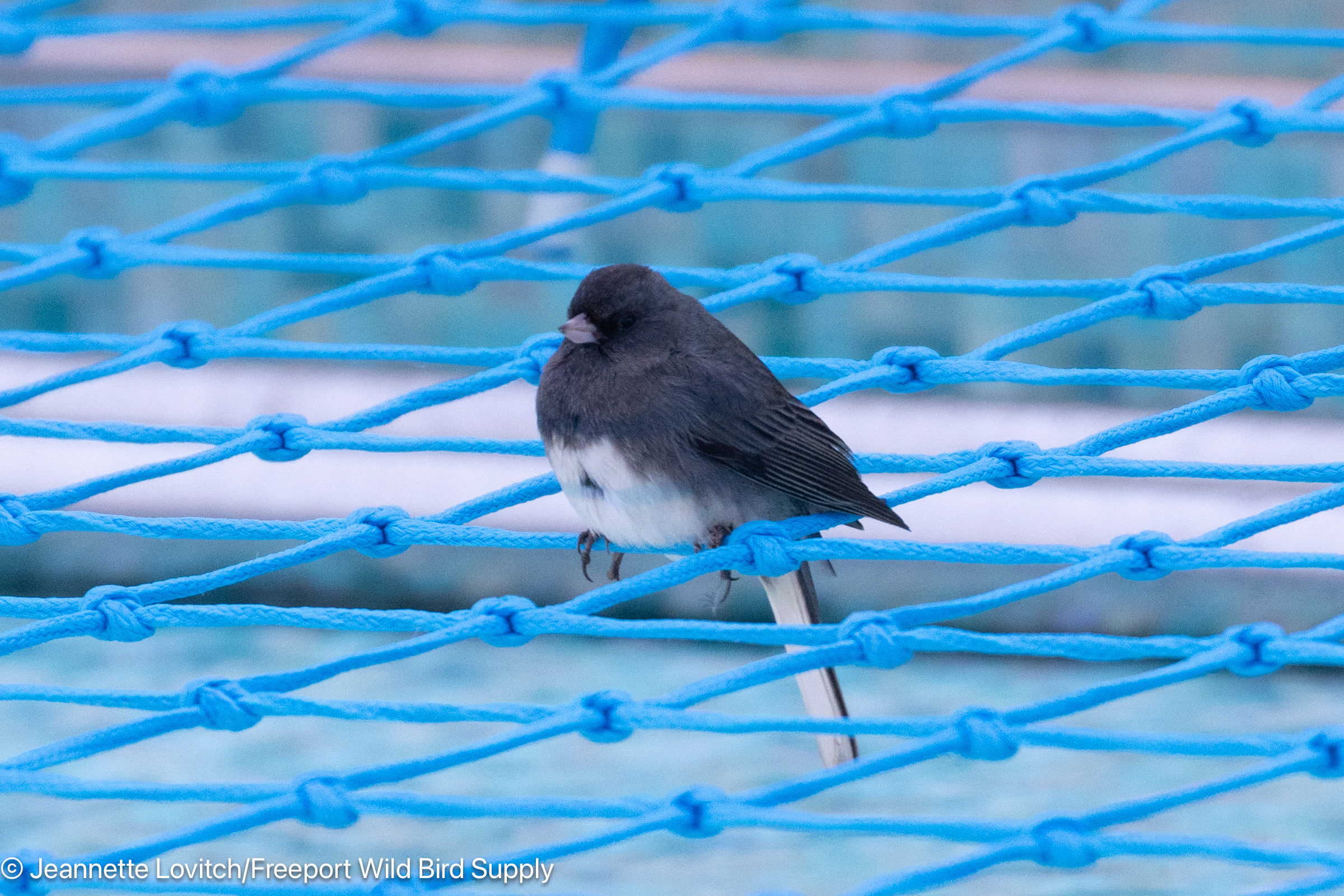
Unexpected considering there were little to no birds on the Maine radars overnight, and with a south wind through most of the night, I was surprised to immediately hear the flight calls of several Yellow-rumped Warblers. Sparrows were scattered about on the open decks. Noam and I had to usher a Rusty Blackbird out of a foyer, while Jeannette had to steer a Dark-eyed Junco down a hallway.
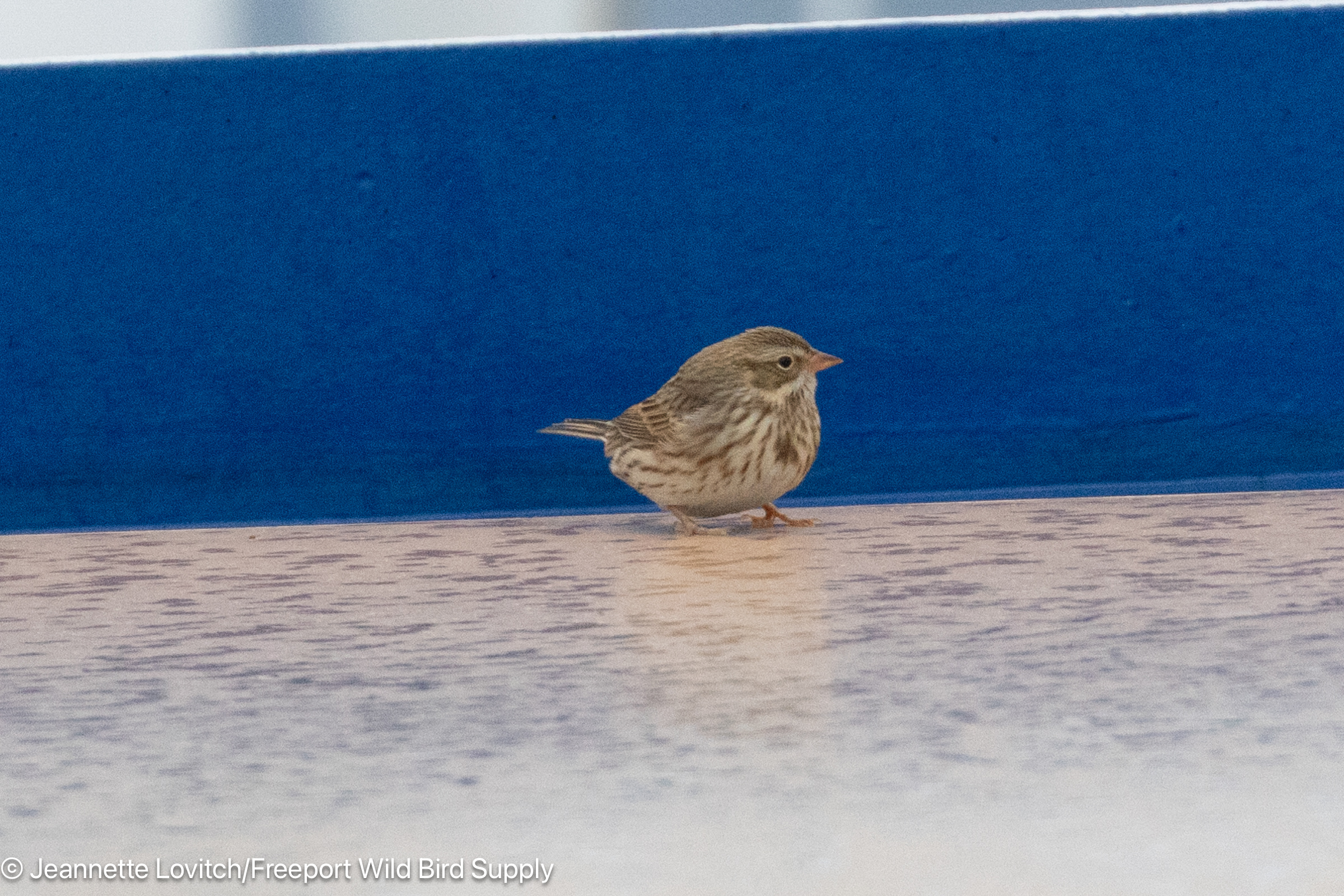
“Ipswich” Savannah Sparrow – that was an unexpected migrant, but makes sense considering we were southwest of Sable Island!
Clearly disoriented by the obnoxiously superfluous lighting of the ship, dozens of birds were around…often being flushed by now-awakening crew and passengers. Luckily, few birds seemed to be in dire straits – only one Yellow-rumped Warbler looked to me to be thoroughly exhausted, thankfully. In fact, most birds were leaving the boat as the sun rose and they were able to reorient themselves. While some birds seemed to arrive in the 15 or so minutes after sunrise, just about all passerines had departed the boat by 7:30 or so.
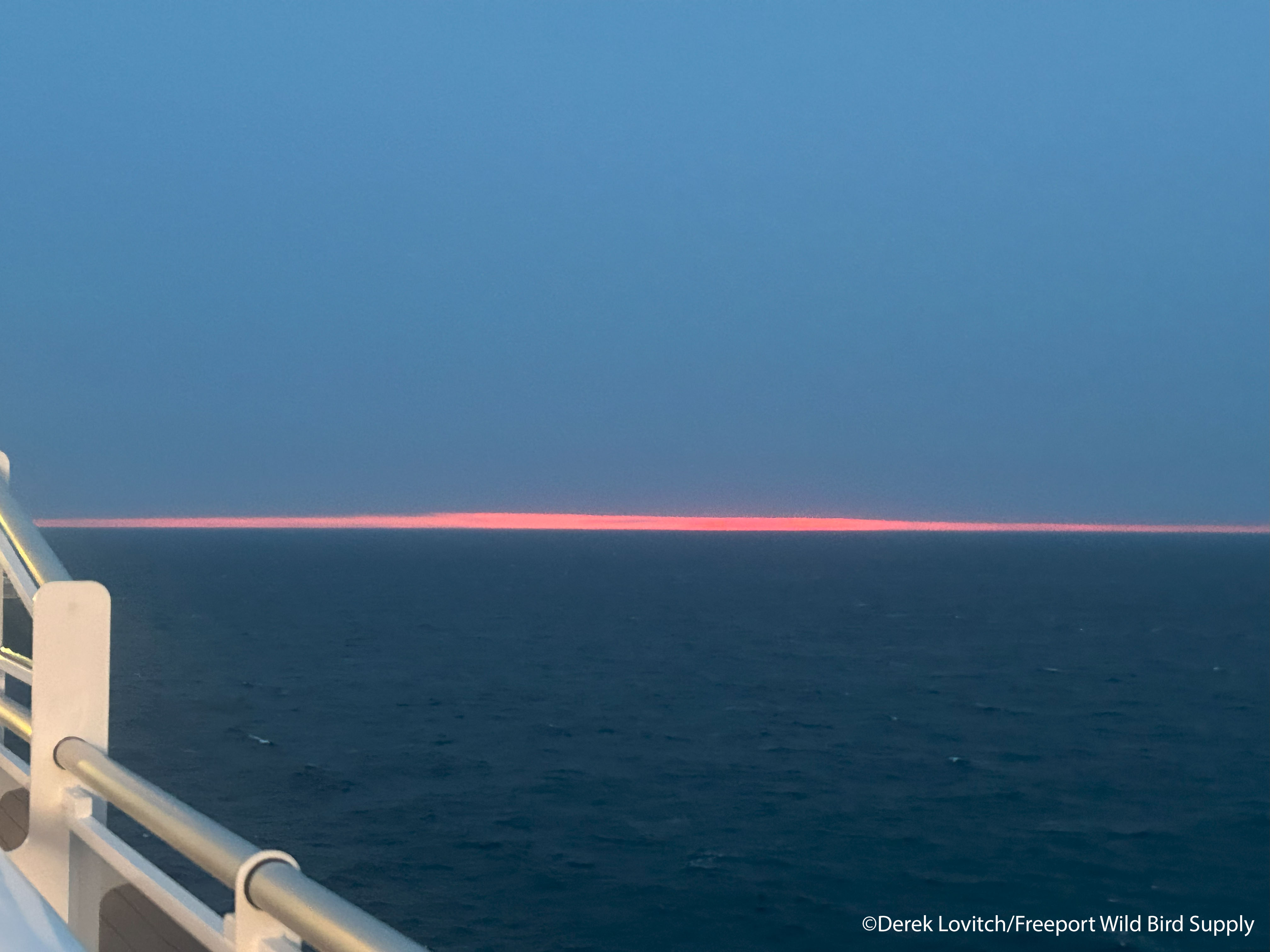
This photo, taken from off Eastern Point in Gloucester, MA the night before shows just how bright these ships are, and how disorienting they can be to birds.
With birds circling the boat before dawn, calling continuously, and others hiding in corners before being flushed to another corner, it was tough to count, but I estimated and counted a bare minimum of 8 Yellow-rumped Warblers, 8 American Robins (mostly overhead), 7 European Starlings (surprisingly), 6+ Dark-eyed Juncos, 2 Purple Finches, 2 fly-over American Pipits, 2 Savannah Sparrows, and one each of Palm Warbler, Snow Bunting, White-throated Sparrow, Cedar Waxwing, and Rusty Blackbird. Additionally, Noam photographed a Pine Warbler.
The three of us were in place on Deck 7 by 7:30, but the passerine show continued. A flock of 12 Red-winged Blackbirds flew by, while a flock of 14 American Robins joined by two more red-wings flew alongside the boat for several miles later in the morning before overtaking us and heading back to Nova Scotia.
Throughout the day, other passerines appeared and disappeared, some of which could easily have been sheltering out of sight somewhere inaccessible on the boat. These included a few more robins, 3+ Yellow-rumped Warblers, 2 Dark-eyed Juncos, and one each of Palm Warbler, Song Sparrow, Cedar Waxwing, Snow Bunting, American Pipit, and Lapland Longspur.
American PipitHarlequin Duck (L) with Black Scoters
But this was a seabird trip, and so we remained vigilant over the water. While we only had a few minutes in Maine waters once we began our vigil, the rest of the day was productive overall, although the afternoon was quite slow. As we passed the southern tip of Nova Scotia (we even spotted Seal Island Light that we were lucky enough to visit with a group of birders about 20 years ago), we finally called it quits at 5:45 pm when cloud cover accelerated the falling of darkness.
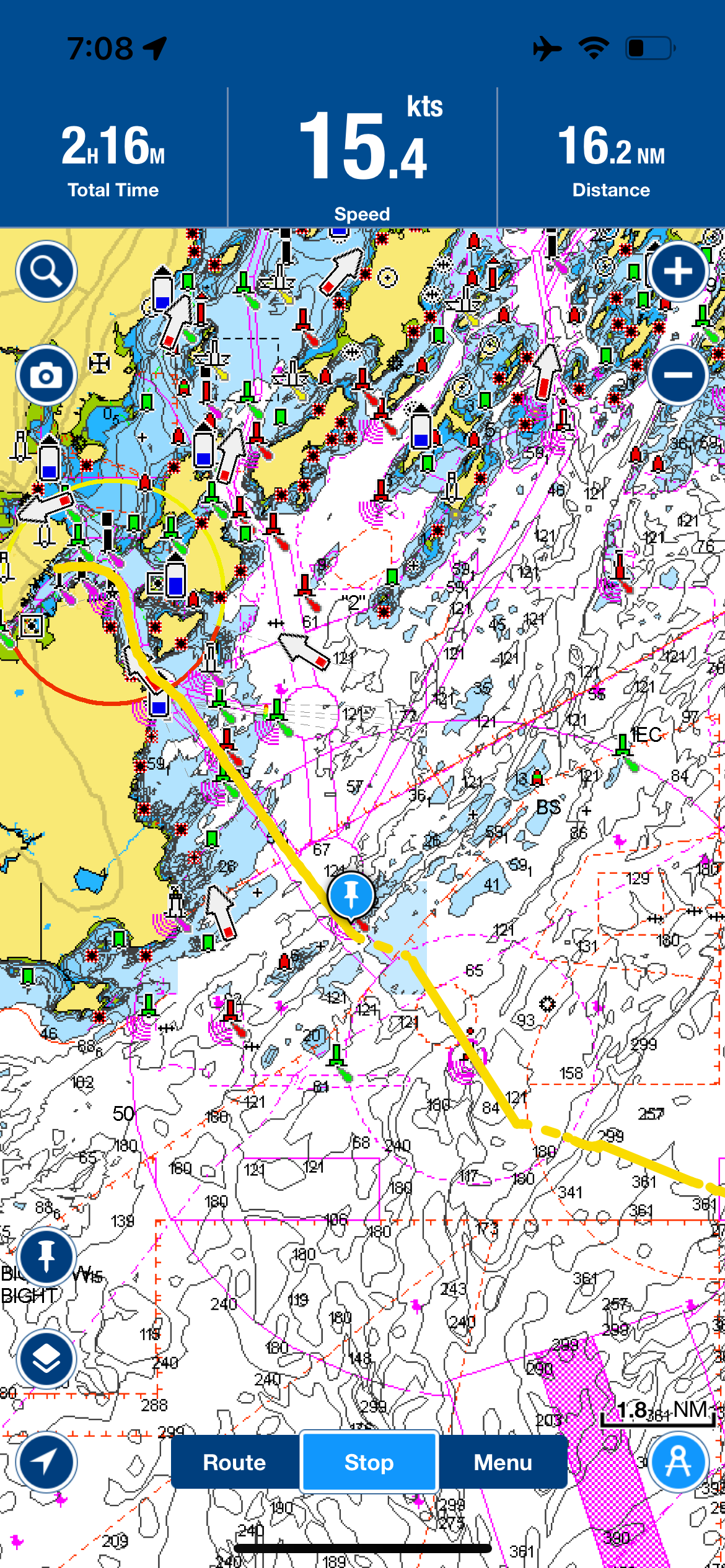
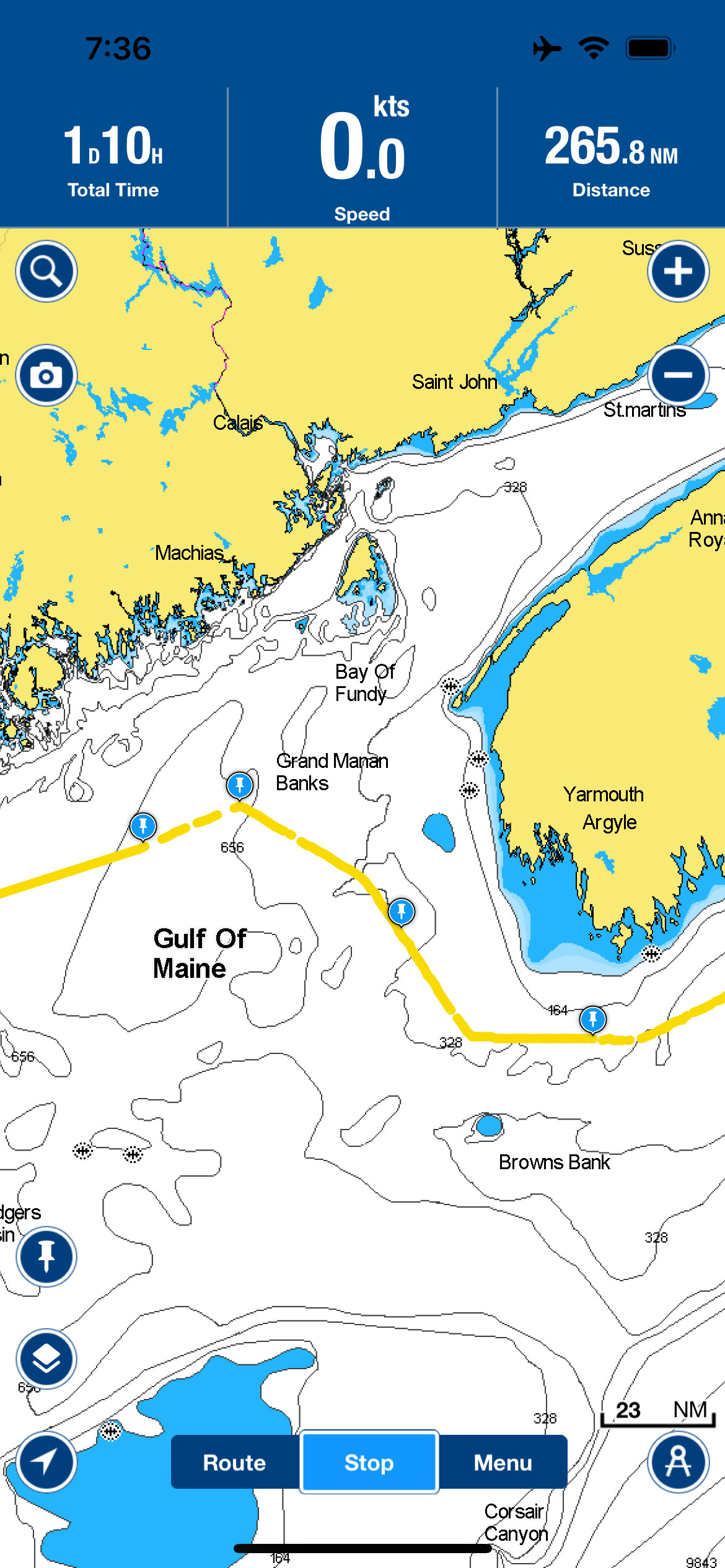
Here’s our route (left pin to right pin) for the day, thanks to the Navionics Boating app by Garmin.
From start to finish, our respectable – albeit not breathtaking – seabird tallies included oodles of Northern Gannets (including a steady southbound trickle almost all morning), and occasional southbound flocks of all three scoters and Common Eiders. Specific counts included:
47 Black-legged Kittiwakes
36 Razorbills
13 Northern Fulmars
10 Great Shearwaters
6 DOVEKIES (one flock landing off to the side of the boat)
3 ATLANTIC PUFFINS
3 American Black Ducks
3 unidentified large shearwaters
2 Harlequin Ducks
1 Greater Scaup
Great Shearwater
So all in all, not a bad day, but the passerines stole the show, and while Dovekie is one of the target birds of this trip, we didn’t see a skua…or even a jaeger, surprisingly.
The next day we awoke well within Halifax Harbor, but a sunrise passerine check yielded two birds: a White-throated Sparrow, and of all things, a rare Dickcissel!
Local friends Eric and Anne once again rescued us for a day of casual birding and good conversation, but the ship departed after dark; just more time to rest for our second full day at sea!
Halifax Public GardenNorthern Flicker
The morning of 11/1 found us between Downeast Maine and the northern corner of Georges Bank. The rest of the day would be in the same waters of our great success on our trip five years ago. After a passerine check which didn’t turn up anything (which meant nothing was disoriented by the ship overnight or desperate for a place to land come dawn, so this is never a bad thing), it was time to get to work in our usual spot.
Unfortunately, strong southwesterly winds and growing seas, with haze and light fog in the distance, made birding challenging. We worked hard though, but it was slow. We did have some excitement from two Dovekies that landed fairly close to the boat, and two Manx Shearwaters that, thanks to the lighting, I was absolutely sure were not Manx Shearwaters until we carefully reviews Noam’s photos later.
With glare and haze becoming problematic, we broke for an early lunch at 11:30, with the previous 4.5 hours of observation producing only the following, plus two Humpback Whales:
12 Northern Gannets
7 Great Shearwaters
6 Red Phalaropes
4 unidentified large shearwaters
2 DOVEKIES
2 Northern Fulmars
2 Manx Shearwater (after review)
2 Black-legged Kittiwakes
2 Lesser Black-backed Gulls
2 unidentified large alcids
1 unidentified small black-and-white shearwater.
Unfortunately, with increasing wind (that we were heading straight into) and seas growing up to 7-10 feet (barely noticeable on a ship this big though, thankfully!), the lower deck was closed off for safety. Later, even the upper decks were closed off due to the very high winds, which were now blowing nearly 30mph out of the southwest.
Screenshot
Luckily for Jeannette and I, we had scored a forward-facing room, and although we were high up on Deck 17, we could see forward. Haze and the angled window were problematic, but we could see birds close to the ship, and we could relax, remove layers, and even crack open a beer. This is pelagic birding in style!
From 1pm to 5pm, when we finally called it a day, the afternoon cabin-watch netted:
11 Great Shearwaters
9 Northern Gannets
5 Cory’s/Cory’s-type Shearwaters
3 unidentified phalaropes
2 Manx Shearwaters
Screenshot
And so our two days at seas concluded without a Great Skua, our primary target species for a future cruise..and perhaps a future tour. Alas, we’re only 1 for 2 in seeing skuas from the boat, and we would need a different class of ship (and, a shorter itinerary with more time at sea and less time in multiple ports) if we were to do this again. We’ll be keeping an eye out from other companies and other Princess ships to see if there’s a more skua-tactic itinerary in the future, but until then, our northeast Atlantic cruisin’ days may have come to a close.
Arriving in New York harbor before dawn, our last sunrise deck check yielded a single Dark-eyed Junco, Yellow-rumped Warbler, and White-throated Sparrow, bringing our more-productive passerine birding cruise to a close.
For 2024, I decided to post my Sandy Point Morning Flight tallies here in one blog entry (instead of only to Facebook and the Maine Birds Google-group), or perhaps one entry per month. If nothing else, it helps me organize them, and my thoughts! Hopefully, you’ll enjoy reading them, too. A busy tour schedule this fall, a little personal travel, and the continued decline in the number of strong, sweeping cold fronts due to climate change are all conspiring to reduce the number of days I begin at “my office.”
The following lists are birds counted passing over and through Sandy Point Beach, Cousin’s Island, Yarmouth as part of the “Morning Flight” or Morning Redetermined Migration. For more information about this site, and my counts here, see Site C14 in Birdwatching in Maine: The Complete Site Guide (2024).
September 3rd.
A light flight passed over and through this morning. It was my first visit of the season, as cold fronts have been few and weak so far this fall, so it was great to be back at my office. I was expecting a stronger flight, however. Perhaps the winds were just too westerly overnight, as the northwesterly component is so critical for pushing birds out over the bay and beyond, forcing them to reorient into the wind and concentrating here at the northwest tip of the island.
6:02-8:20am
48F, clear, light W increasing then decreasing.
105 Northern Parulas
88 Cedar Waxwings
56 American Redstarts
41 unidentified
12 Yellow Warblers
10 American Goldfinches
7 Red-eyed Vireos
5 Cape May Warblers
4 Magnolia Warblers
3 Eastern Wood-Pewees
3 Chestnut-sided Warblers
2 Nashville Warblers
2 Red-breasted Nuthatches
2 unidentified flycatchers
2 Black-capped Chickadees
2 Rose-breasted Grosbeaks
1 Black-throated Blue Warbler
1 Olive-sided Flycatcher
1 Black-throated Green Warbler
1 Baltimore Oriole
1 Black-and-white Warbler
1 Wilson’s Warbler
1 House Finch
1 Least Flycatcher
1 Bay-breasted/Blackpoll Warbler
1 unidentified Catharus
1 BLUE-GRAY GNATCATCHER (4th Sandy Point Morning Flight Record).
Total = 351
2. September 10th Update.
Well, so much for this plan! A week has gone by and there hasn’t been a decent morning to try at Sandy Point. And, with a massive area of high pressure dominating our weather (and most of the Eastern US) for another week, the next possible day looks a long way off! While several nights have featured at least some northerly component, it has been dead calm by dawn. Most other nights have been calm, and while that’s great for migrants to make progress, it’s not so great for a concentration of birds along the coast. For example, a very weak – and mostly dry – cold front that passed on Monday night briefly changed winds, but they were mostly westerly, and were calm by dusk.
Good for the migrants, not great for the migration-watchers! Let’s hope for a change in the forecast; we need the rain, too!
3. September 11.
I probably should have gone this morning, just based on the huge flight that occurred overnight. But, as with most good nights of migration this season, winds were virtually calm. Maybe there was just enough of a puff from the west to make a count worthwhile, but alas, my schedule didn’t allow for a last-minute change. However, there were A LOT of birds in the air last night.
A huge flight overnight on 9/13-14 resulted in a lot of birds offshore, and while I couldn’t be at Sandy Point, I had an exceptional morning flight on Monhegan – dominated by Cape May Warblers – with my tour group that weekend.
4. September 18th Update.
Yup, another clear and calm night, with migrants passing high overhead. Fog at dawn, too. Another week with no morning flight. Goodness, this blog sucks!
5. September 25th Update.
OK, this is getting ridiculous! Another week with lots of nights of great migration, but with either calm conditions or a light north to northeasterly aloft, not one more was conducive to being on the bridge. Friday and especially Saturday look great though…but alas, I’ll be back on Monhegan. No complaints there. But I’ll go ahead and change this blog title to “September-October” and hope for better conditions next month!
6. October 2nd Update.
Two great flights over the weekend conducive to a good if not great flight at Sandy Point occurred, but my tour group on Monhegan once again reaped the benefits. Next favorable winds might not be until Sunday the 6th. Fingers crossed! Maybe I’ll have some real content for this blog then…and I really need my Sandy Point fix!
6. October 5 – Finally!
I was finally at “my office” on the bridge this morning. Unfortunately, with clouds in the eastern sky and a light northerly wind, only a light flight passed over and through the point this morning. Furthermore, the Caribou radar showed rain into the early night, and likely unsettled weather thereafter, reducing or even eliminating the arrival of birds from the north and northeast (the radar after midnight showed virtually nothing over northern Maine). Nonetheless, it was just good to be back!
6:45-8:45am
45F, partly to mostly cloudy, NNW 5.3-7.0 to N 6.7-8.2mph.
60 Yellow-rumped Warblers
15 Blackpoll Warblers
9 American Robins
7 Palm Warblers
6 Ruby-crowned Kinglets
5 unidentified
4 Golden-crowned Kinglets
4 Red-breasted Nuthatches
4 Chipping Sparrows
3 Northern Flickers
3 Dark-eyed Juncos
3 Common Loons
3 Hermit Thrushes
3 White-throated Sparrows
3 unidentified blackbirds
2 Rusty Blackbirds
2 Blue Jays
1 Blue-headed Vireo
1 unidentified kinglet
1 Tufted Titmouse (did not cross after 4+ false starts)
1 Hairy Woodpecker (finally crossed after 7 false starts)
Total = 140
7. October 10.
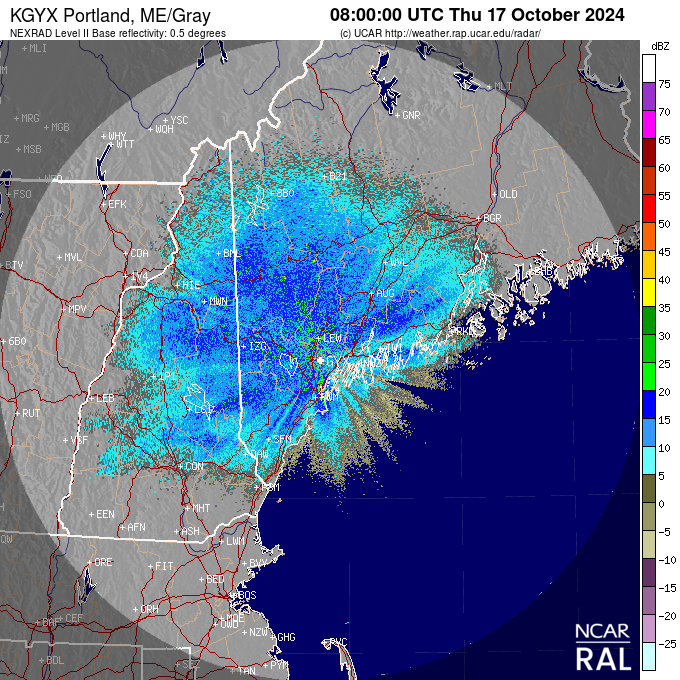
A moderately-strong flight overnight on variable W to NW winds suggested many more birds departed last night than arrived. With a light W wind by dawn, only a light flight passed through the point.
6:49-9:15
41F, mostly clear, W 3.5 to 5.0 to W 4.4 to 7.7mph.
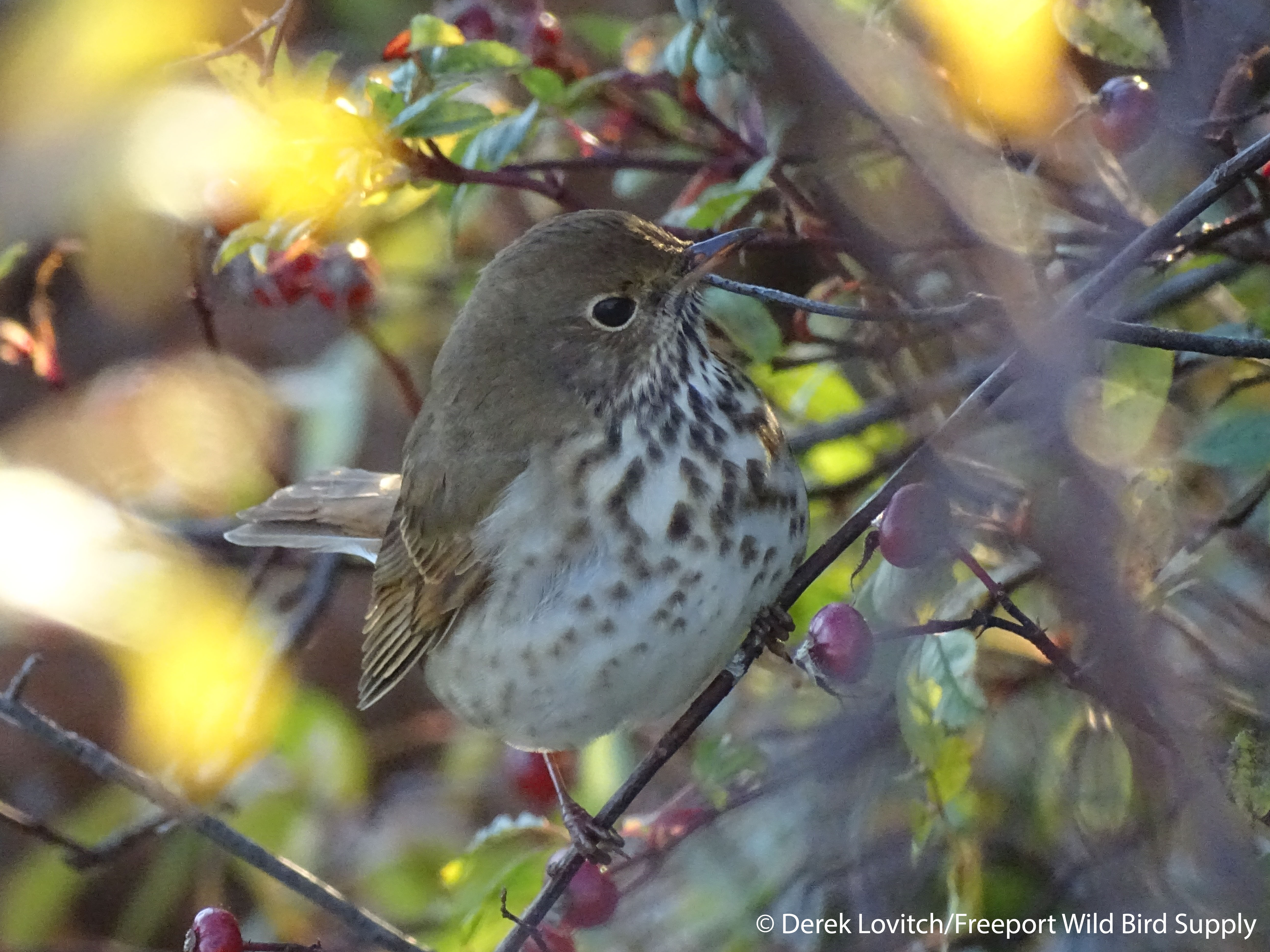
This Hermit Thrush kept me company at the point, alternating between snacking on Pasture Rose hips and contemplating crossing the channel (with Catharus thrushes rarely do after sunrise)
After a very slow start on a chilly morning, the flight picked up a bit in the second hour, but was still far lighter than I would have expected given the massive flight detected by the radar overnight. Even by 4:00am, the radar image was boomin’
6:59-9:15
31F, clear, NW 2.7-4.9 to W 1.2 TO 2.6mph.
114 Yellow-rumped Warblers
56 American Robins
44 Golden-crowned Kinglets
44 Blue Jays
17 Ruby-crowned Kinglets
14 Dark-eyed Juncos
9 Hermit Thrushes
8 Palm Warblers
7 Black-capped Chickadees (still did not cross after 14 “false starts”)
7 White-throated Sparrows
5 Unidentified
4 Nashville Warblers
4 Blackpoll Warblers
3 Swamp Sparrows
2 Purple Finches
2 Blue-headed Vireos
2 Tufted Titmice (did not cross after 4 false starts)
1 TENNESSEE WARBLER
1 Northern Parula
1 Eastern Bluebird
1 Yellow-bellied Sapsucker
1 Red-breasted Nuthatch
1 Northern Flicker
1 Savannah Sparrow
1 Common Loon
1 ORANGE-CROWNED WARBLER (in parking lot)
T=351
10. October 23rd.
With only a moderate flight overnight and very light winds, I didn’t have high hopes today for much of a flight. However, with the forecast for the next few days followed by a trip, this very well may be my last chance of the season, so off I went. Well, I was correct…there wasn’t much.
7:10-8:30
43F, mostly clear, NNW 2.7-3.2 to calm.
10 Dark-eyed Juncos
10 Yellow-rumped Warblers
4 Golden-crowned Kinglets
4 Hermit Thrushes
3 Savannah Sparrows
2 Palm Warblers
1 American Rpbin
1 Purple Finch
1 Black-capped Chickadee
1 Blue-headed Vireo
1 Chipping Sparrow
1 Red-breasted Nuthatch
1 Blackpoll Warbler
Total = 42
11. November 6th.
I had every intention of trying one more morning at the bridge after we returned from vacation. Sunday the 3rd may have been the day. But, avoiding the painful early wake-up call of the end of Daylight Savings Time, I decided to twitch the Common Gull in Rockland instead. I feel a little guilty, but ya know, every now and then I like a little chase, and besides, it was kind enough to stick around until we returned, so I felt I owed it.
It wasn’t a great season for me at “my office,” as this was certainly a record low number of visits. And to not catch any big flights is of course disappointing. But it was a good fall for birding – and an especially good fall for birds with little to impede their migration – and I enjoy every chance I can get to be at Sandy Point. And with a lot less pain this year than last year when I was still recovering from complications following shoulder surgery.
So with that, the 2024 Sandy Point Morning Flight season is officially closed. Still plenty of migration left, but it’s mostly diurnal migrants now. There will be a Dark-eyed Junco flight or two, some great flights of American Robins, and likely one last little push of Yellow-rumped Warblers. However, Rarity Season is now in full swing, so it’s time to focus on other birding locations. See you in August! (If there are any real cold fronts).
(And now it’s time to see what Yarmouth’s plans are for the walkway repair and improvement. I’ll need to make sure birding opportunities are improved and vegetation is protecting. Stay tuned…I might need your help)
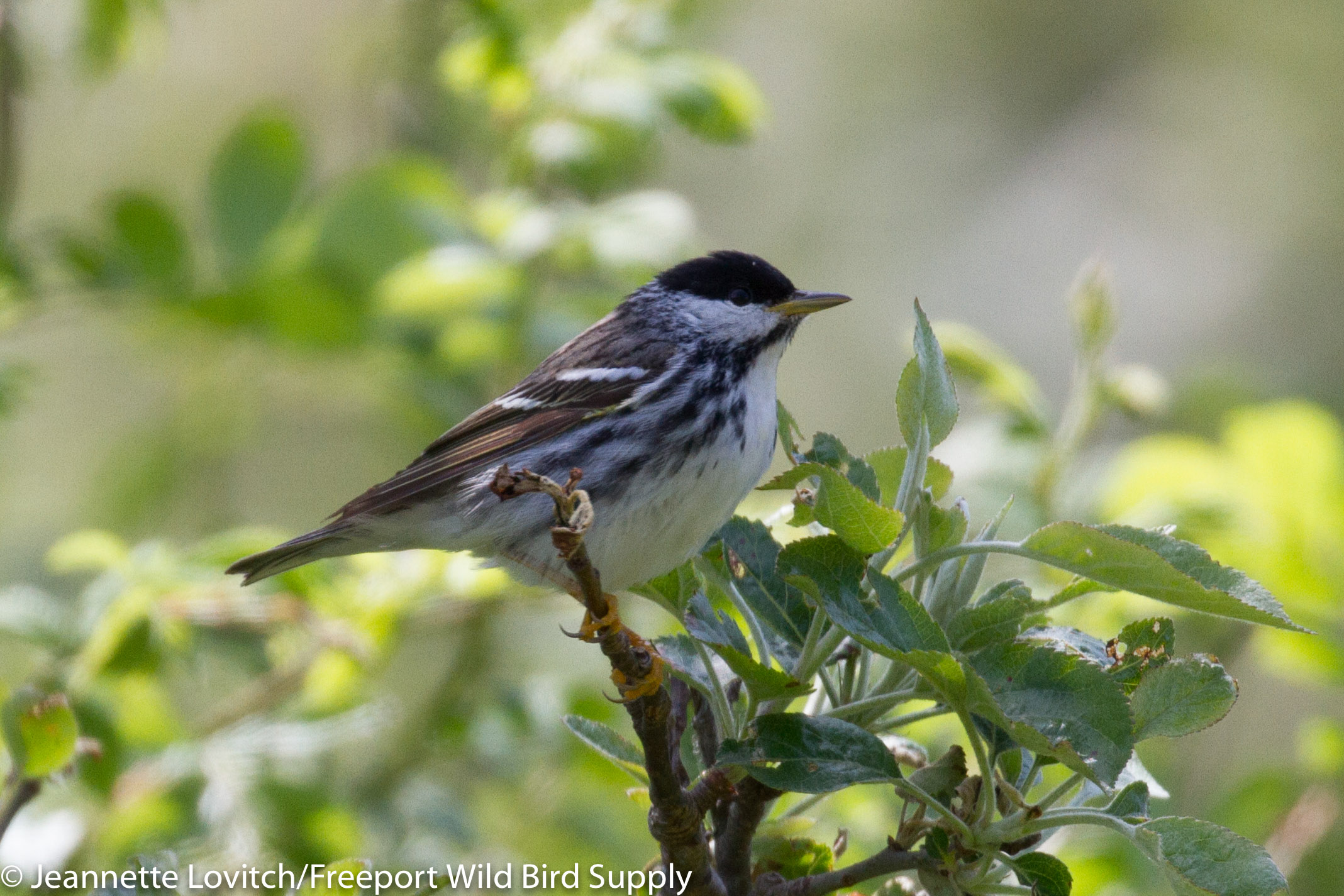
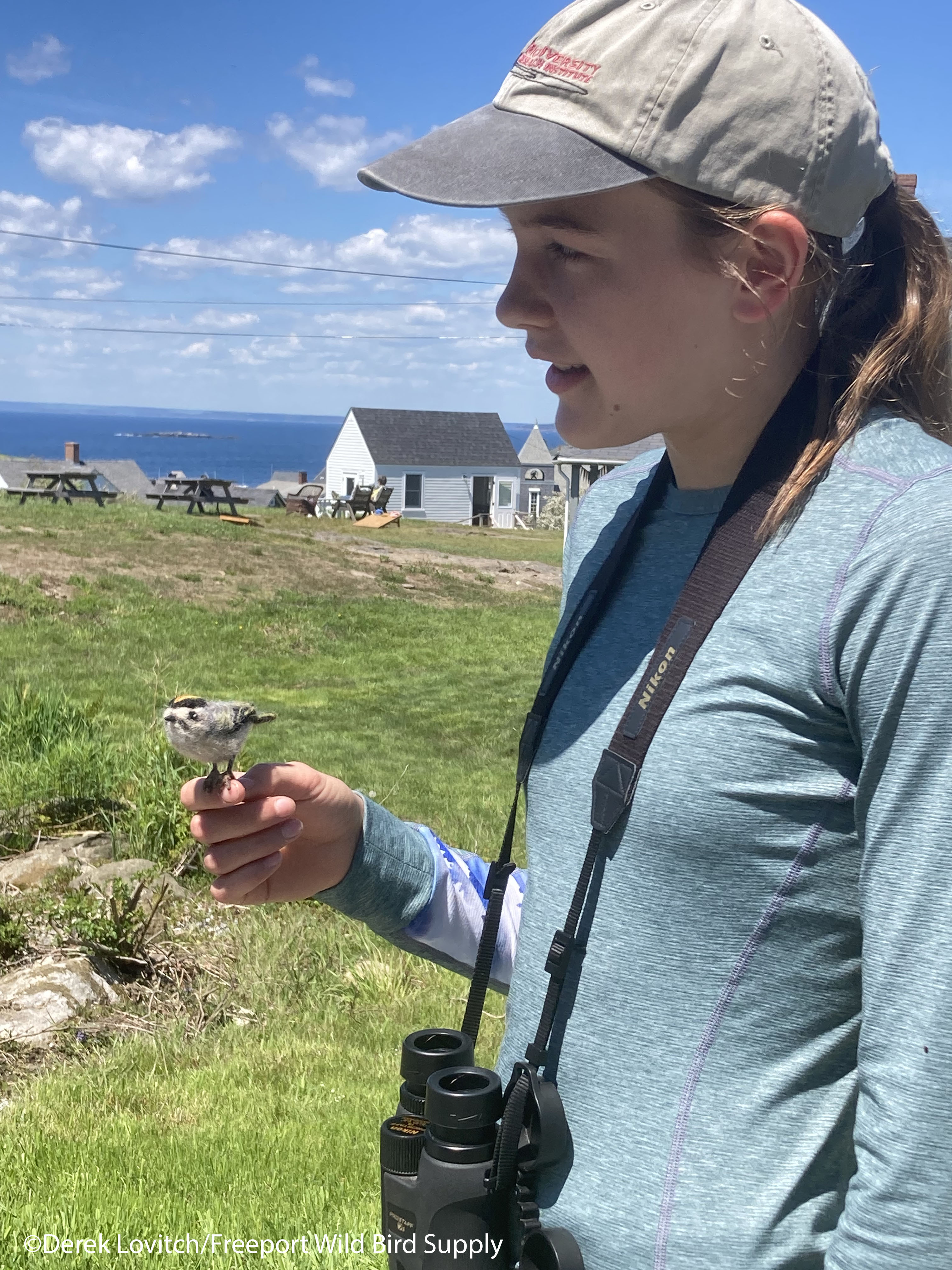
Not surprisingly for the end of May, Blackpoll Warblers were the dominate migrant on Monhegan this weekend. However, we never tired of seeing both males (above) and females (below) so well each and every day.
A point-blank Bay-breasted Warbler. Up close and personal Magnolia Warblers, Northern Parulas, and 9 other species of warblers including more Blackpoll Warblers than we knew what to do with…and we hadn’t even made it up the hill of Dock Road yet!
In other words, our 2023 Spring Monhegan Migration Weekend tour got off to a great start as we really hit the ground running. Then, a calling Evening Grosbeak. A fly-by Black-billed Cuckoo…more. Hmm… it was time to check in, and happily, shed a few layers.
After lunch, the excellent birding continued, with highlights including a flock of 10 Bay-breasted Warblers, a spiffy male Orchard Oriole, and great looks at a Philadelphia Vireo. By day’s end, we had 59 species including 13 species of warblers – not bad for a mid-morning arrival!
Yellow Warblers (above) and Common Yellowthroats (below) were common and conspicuous in and around town and other scrubby environs as expected.
It was cool and clear on Saturday morning, and the overnight radar image was a little ambiguous. Did the light westerly wind overnight push birds offshore as they approached from the south, or was that all just pollen and smoke haze in the atmosphere? However, the radar return did suggest birds offshore in the early morning, so we were excited to find out. Afterall, I did not expect yesterday to be so good, and it was excellent.
While only a few warblers were overhead by the time we assembled around the coffee pot at 6:30, it took a while for us to leave the spruces behind the Trailing Yew, as we had a nice pocket of warblers and good early-morning activity. We teased out a Blackburnian Warbler – the only one of the weekend, and the 3 White-winged Crossbills that have been on the island paid us a visit. Later in the morning, we caught up with the stunning male Dickcissel that has been around for a while, and were among the first to see a pair of recently-arrived House Finches (a surprising rarity on the island!). We also found a flock of 10 tardy White-winged Scoters and a total of 6 Surf Scoters that briefly visited Deadman’s Cove.
After lunch, we had the female/immature Summer Tanager, a female Orchard Oriole, found an Olive-sided Flycatcher, and while the afternoon was overall rather quiet, we had lots of great studies of a variety of birds, especially Blackpoll Warblers.
Although far from one of our best birding days on the island, it was noteworthy how well we saw just about everything. Even with a full group, birds were overwhelmingly cooperative, and everyone thoroughly enjoyed the birding…and another beautiful day of weather!
Many of our common warblers were easy to see, photograph, and enjoy throughout the weekend, such as this Northern Parula (above) and Black-and-white Warbler (below).
Saturday night into Sunday morning saw another ambiguous radar image, but the overall small number of new arrivals suggested that most of the return was something other than birds this day.
That being said, we started the day with one of the birds of the trip when I nearly spit out my coffee when I realized that flock of cormorants that looked strange was actually a flock of 9 Glossy Ibis. They circled the town, looked to be pondering the town marsh, and then soared up high and over Lighthouse Hill. Incredibly rare for the island, these were a new “island bird” for me, and we felt very fortunate that we were one of the only birders (I believe only one other birder saw them at all) on the island that got to see them. The “lingering around the coffee pot at the Yew” strikes again!
As expected, it was relatively slow overall, but even after the excitement of the ibis, we continued to enjoy ourselves. We had great looks at a lot of things all morning, including common warblers like American Redstarts and oodles of Blackpolls. We had our best looks yet of feeding Red Crossbills – they were all over the island this spring! – spotted a Peregrine Falcon, and continued to marvel at the growing flock of swirling Blue Jays contemplating a trip back to the mainland.
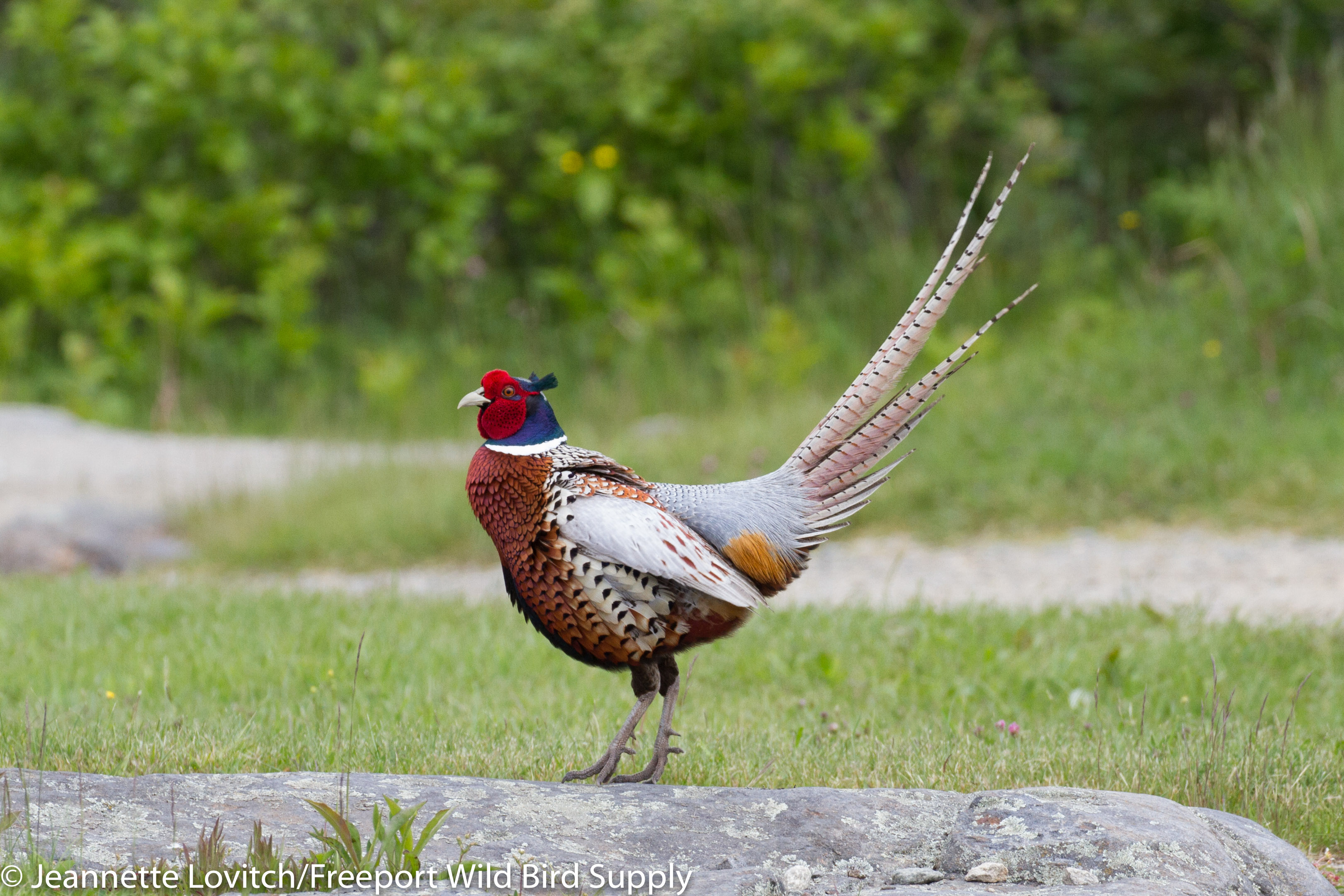
Ring-necked Pheasants kept us entertained as always, however.
After breakfast, we had another good find when a Purple Martin flew over us, and a bigger flock yet of Red Crossbills entertained us for a while. Jeannette arrived and joined the group to help carry my scope and to take photographs for this trip report, as well as help us find more birds.
Juvenile Red Crossbill.
It was warm and fairly slow, so I needed all the help I could get. Regardless, we added species to our trip list here and there in the afternoon, with quality surpassing quantity. We visited the long-staying 1st year male Blue Grosbeak that has taken up residence at Lobster Cove, where, unlike most Blue Grosbeaks, it has taken to flycatching for seaweed flies in the wrack. Why it is doing this no one knows, but it was a fascinating behavior to watch. Birds and birding on Monhegan never cease to amaze!
The Blue Grosbeak.
A little later, we found an immature Broad-winged Hawk, or again, it found us, as it passed right over us as we poked around the Underhill Trail to find some birds in the shade and in cover. It was often a struggle to find birds this afternoon, and it was downright hot! But I heard very few complaints compared to the slow days when it’s 45-degrees, windy, and raining!
We spent a lot of quality time observing birds today, getting to know their behavior and natural history, such as these courting Cedar Waxwings.
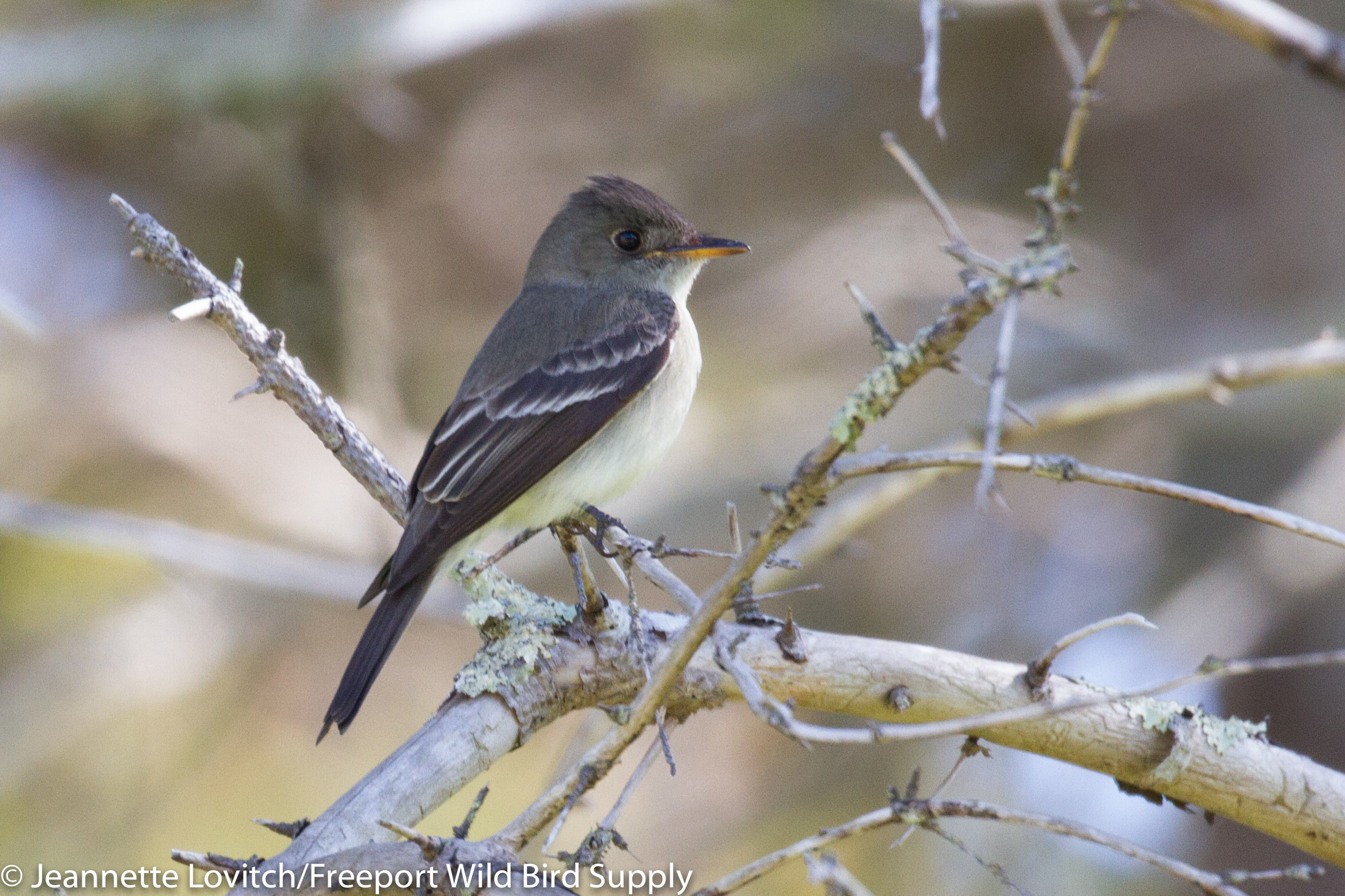
While also practicing our field ID skills, such as Eastern Wood-Pewee.
And enjoyed whatever warblers we did encounter, including this male Black-throated Green Warbler.
Monday saw even further reduced activity, with a very summer-like feel to the birding. The migrant flock of Blue Jays built up to at least 46, a Pine Siskin must have just arrived, and some of us even spotted the Virginia Rail! While passage migrants were few – almost all Blackpoll Warblers – we still had a great day of birding thanks to continued great views of most of what we were finding. There was a Northern Parula nest that a friend found for us to marvel at, and we had quality time once again with a family group of Red Crossbills. Watching them, especially the juveniles, eating buds and cones of Red Spruce at close enough distance to see if they were “righties” or “lefties” was memorable, and more than worth the visit. We had the male Orchard Oriole again, and paid the Blue Grosbeak another lengthy visit.
We took some time to scan the skies over the marsh while also enjoying “Lefty,” the Red-winged Blackbird with white outer primaries on only his left wing. He’s back for the second year.
One of the few birds we missed as a group all weekend was a long-staying but frustrating Snowy Egret that never seemed to stay in the same place long. It was reported at the Ice Pond while we were having breakfast, and Jeannette and I raced down to see it. The “racing” part after the new and ample breakfast buffet at the Trailing Yew may not have been the best decision, however, we got the bird! It was another island bird for me (#226) and I am glad I made the decision to skip the break to chase it, as it was long gone by the time our group arrived at the Ice Pond. I always like to get those chases out of my system before making a bad leadership decision and marching people across the island for a bird that only I cared about! (Since they are locally common on the mainland, only an island-lister cares about such silliness).
As the afternoon wore on, the group slowly moseyed away from the Blue Grosbeak-evolving-into-a-flycatcher and made our way back to town to catch the last ferries of the weekend, bringing the tour to a close.
A friend found a Northern Parula nest under construction that we took time to marvel at. Here, the female brings some more material in to line the nest, which is nestled in a woven basket inside of large clumps of down-hanging Old Man’s Bear lichen.
However, as usual, Jeannette and I stayed around for another 24 hours to have a day off together and with friends. Leaving the brewery with one friend, I found a male Eastern Bluebird- an odd “new bird” for the date. Where the heck has he been or where did he just come from? Another Monhegan bird mystery…their migration ended a month ago.
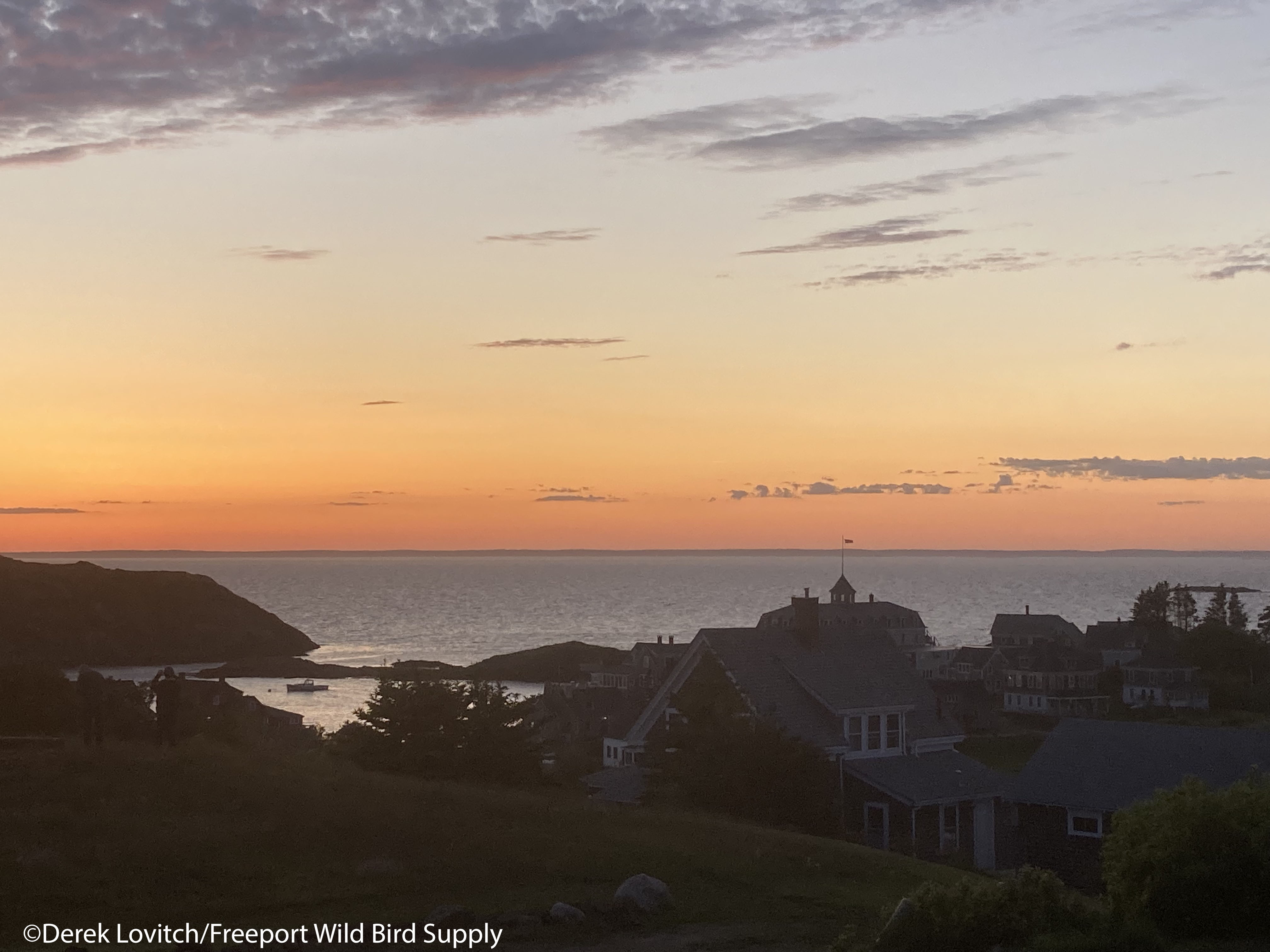
Later, as we walked back from dinner with other friends, we heard at least three displaying American Woodcocks. The sunset was quite the stunner, too.
I wasn’t upset to not have a group on Monday, because my goodness, it was slow! I think what was left of the passage migrants cleared out overnight, and little if nothing came in. There were a few Blackpolls here and there, and maybe a few more American Redstarts than usual in the summer, but in and around town, that was about all.
So Jeannette and I decided to take a longer hike and check some oft-productive-but-less-often-birded areas. In doing so, we found a Field Sparrow on Horn Hill, and had a singing Yellow-bellied Flycatcher between Burnt Head and White Head. An adult male Sharp-shinned Hawk was a surprise – was it breeding here? – and a visit into the shaded woods added Winter Wren and Swainson’s Thrush to our weekend list.
We got excited when we saw a gray-backed, white-bellied flycatcher over at Gull Pond, but alas, it had the expected short, not-forked tail that we were hoping for!
Not including the 7 species Jeannette and I saw between 3:00 on Monday and when we departed at 3:15 on Tuesday, the tour list for the 12th annual Monhegan Spring Migration Weekend ended up a goodly 90 total species, despite only 15 species of warblers. The overall count was better than our last two tours, but still below our long-term average. But I cannot recall four (and five) days of simply gorgeous and warm weather on any of our prior tours! While the benign weather of late reduced the volume of migrants yet to pass through, and allowed many recent migrants to pass unimpeded overhead, I was pleasantly surprised by the final tally. It was also a high-quality list, with lots of “good” birds not seen by many in Maine away from the island. Oh, and my two island birds were nice, too!
Blue Jays are not the biggest feeder bird on this island!
Even our most common and familiar birds present speciaal photographic opportunities out here!
Species
5/26
5/27
5/28
5/29
Mallard
x
10
10
8
Mallard x American Black Duck
1
0
0
0
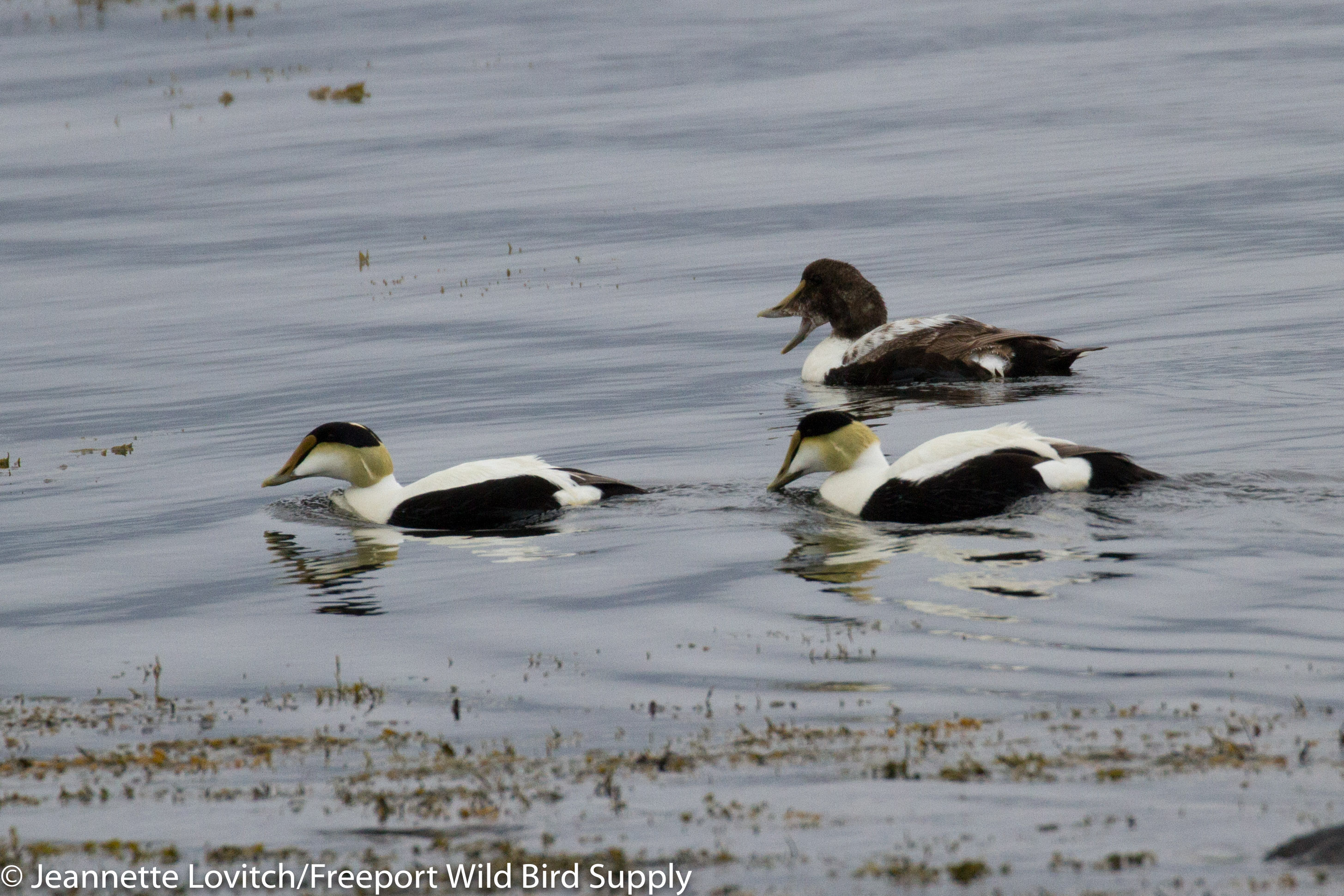
Common Eider
x
x
x
x
White-winged Scoter
0
10
0
0
Surf Scoter
0
6
0
0
Ring-necked Pheasant
x
6
6
5
Mourning Dove
8
10
8
10
Black-billed Cuckoo
1
0
0
0
Chimney Swift
0
0
1
0
Ruby-throated Hummingbird
6
4
3
1
Virginia Rail
h.o
h.o
1
1
Semipalmated Sandpiper
0
0
1
0
Greater Yellowlegs
0
1
0
0
Black Guillemot
20
30
x
20
Laughing Gull
6*
2
1
6
Herring Gull
x
x
x
x
Great Black-backed Gull
x
x
x
x
Common Tern
1 + 5*
0
0
0
Northern Gannet
0
0
0
1
Red-throated Loon
0
1
0
0
Common Loon
3*
1
0
0
Double-crested Cormorant
x
x
x
x
Great Blue Heron
0
0
1
3
SNOWY EGRET
0
0
0
1**
GLOSSY IBIS
0
0
9
0
Bald Eagle
2
1
0
0
Osprey
0
3
2
2
Red-bellied Woodpecker
0
0
1
0
Merlin
2
2
1
0
Peregrin Falcon
0
0
1
0
Eastern Kingbird
0
0
2
2
Olive-sided Flycatcher
0
1
0
0
Eastern Wood-Pewee
2
2
2
2
“Traill’s” Flycatcher
2
0
1
0
Least Flycatcher
2
1
1
0
Eastern Phoebe
1
1
1
1
Philadelphia Vireo
1
1
0
0
Red-eyed Vireo
6
8
4
4
Blue Jay
x
48
47
52
American Crow
x
4
6
x
Common Raven
0
1
1
0
Black-capped Chickadee
x
x
x
x
Tree Swallow
0
2
2
2
PURPLE MARTIN
0
0
1
0
Barn Swallow
1
0
1
1
Golden-crowned Kinglet
0
0
1
0
Cedar Waxwing
30
50
40
30
White-breasted Nuthatch
0
1
1
1
Red-breasted Nuthatch
1
0
0
0
Carolina Wren
3 h.o.
4
4
3
Gray Catbird
x
x
x
x
European Starling
x
x
x
x
American Robin
x
x
x
x
HOUSE FINCH
0
0
2
2
Purple Finch
0
1
2
2
WHITE-WINGED CROSSBILL
0
3
3
0
RED CROSSBILL
0
2
24
20
Pine Siskin
0
0
0
1
American Goldfinch
12
10
12
12
Chipping Sparrow
0
0
1
1-2
White-throated Sparrow
2
2
2
0
Savannah Sparrow
3
0
1
0
Song Sparrow
10
X
x
x
Lincoln’s Sparrow
0
1
1
0
Bobolink
1
1
0
0
ORCHARD ORIOLE
1
1
0
2
Baltimore Oriole
1
4
3
3
Red-winged Blackbird
x
x
x
x
Common Grackle
x
x
x
x
Northern Waterthrush
0
0
1
0
Black-and-white Warbler
3
4
4
3
Tennessee Warbler
8
4
3
0
Common Yellowthroat
x
8
x
x
American Redstart
5
25
16
8
Cape May Warbler
1
0
0
0
Northern Parula
15
10
12
12
Magnolia Warbler
10
8
6
8
Bay-breasted Warbler
11
3
0
2
Blackburnian Warbler
0
1
0
0
Yellow Warbler
10
20
15
15
Chestnut-sided Warbler
2
1
1
1
Blackpoll Warbler
25
60
25
20
Black-throated Green Warbler
1
1
3
1
Wilson’s Warbler
2
2
2
0
SUMMER TANAGER
0
1
0
0
Scarlet Tanager
0
1
0
0
Northern Cardinal
x
x
x
x
Rose-breasted Grosbeak
3
2
2
0
Indigo Bunting
0
1
1
0
BLUE GROSBEAK
0
0
1
1
DICKCISSEL
0
1
1
0
Day Total
60
66
69
54
Warbler Day Total
13
13
12
10
Trip Total
90
Warbler Trip Total
15
Here is the trip list four the four-day tour. * = seen from ferry only. **=not seen with tour group.
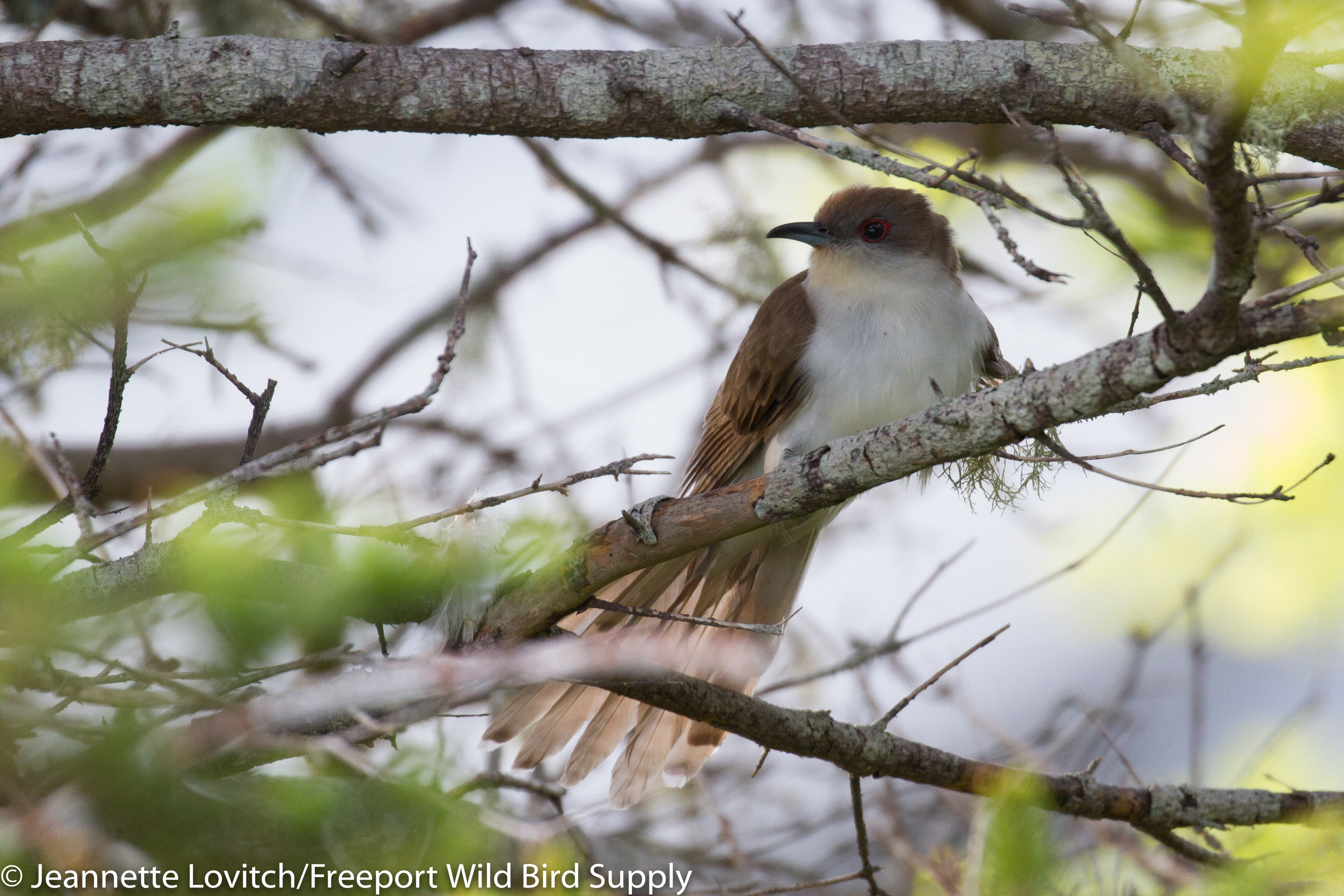
With so many great views of Black-billed Cuckoo(s) each day over the weekend, it was hard to argue against this being the bird of the trip. It was unusual how well, and how often, we saw this usually reclusive bird.
How about we just fast-forward to Sunday? Sunday was delightful.
After two quiet days, which I will eventually confess to, we had a bunch of birds. And no fog. And colorful birds in good light. The pre-breakfast loop was actually downright great, with a good variety of warblers. One copse of trees alone featured 3 Blackburnian Warblers, 4+ Blackpoll Warblers, 2 each of Yellow, Common Yellowthroat, Northern Parula, American Redstart, and 1 Magnolia Warbler
It was nice and birdy after breakfast as well, with more Blackburnian fun, a single Cape May Warbler, and a nice birdy walk through the woods (Winter Wren, Carolina Wren, and House Wren singing one after another) to Whitehead where we actually got to see the ocean – and a Great Cormorant for those visiting from afar. Bird activity and birdsong was pleasantly consistent throughout the day, and in most places we visited.
We caught up with a continuing immature male Orchard Oriole for all to see, and while perhaps one could argue it was still fairly slow for Monhegan by Memorial Day Weekend standards, it was a lot better than Friday and Saturday! In fact, the 59 species and 11 species of warblers was more than the first two days combined. A few of us who stayed out late even got to see an American Woodcock as it displayed over Horn Hill at dusk. It was a good day.
Blackpoll Warbler was definitely the migrant of the weekend. Besides being by far the most numerous passage migrant, they constantly offered crippling views throughout the tour. The male is above, and the female is below.This American Robin nesting in lobster traps was a delight to watch. The parents had to run a gauntlet of 5 or 7 traps to enter and exit the nest. It was a great demonstration of how lobster traps work.Laura shows off her handiwork. Hey, on a slow day, I’ll take all of the birds I can get!Northern ParulaImmature male Orchard Oriole
Friday got off to a rocky start. Really rocky actually, as in few people were even able to keep their breakfast down on the two ferry rides. Dense fog and near-zero visibility resulted in virtually no birds being seen, and well, let’s just not talk about these boat trips anymore…it was one of the worst I have ever experienced on the way to or from. Thankfully, I am not predisposed to feeling how many people felt upon arrival, but it was still a challenge to shake it off, and all of us were moving slowly by day’s end.
The sheltered waters of Deadman’s Cove were deceiving, but I think you get the idea!
Of course, it didn’t help that there were so few birds around! The huge wave of birds that arrived the previous weekend had cleared out, and nothing had arrived to take their place over the last few nights. With such strong winds, it was a challenge to find sheltered pockets, and when we did, we didn’t find many with many birds. Only Blackpoll Warblers were to be seen in numbers.
That being said, what we did see – especially the aforementioned Blackpolls and the continuing world’s most cooperative Black-billed Cuckoo(s) – we saw really well. A few of us even saw the Virginia Rail for a second. The dense fog also precluded scanning the water, so our checklist is even more pitiful for the day. Ring-necked Pheasants put on a show though, from confiding snazzy males to adorable little chicks.
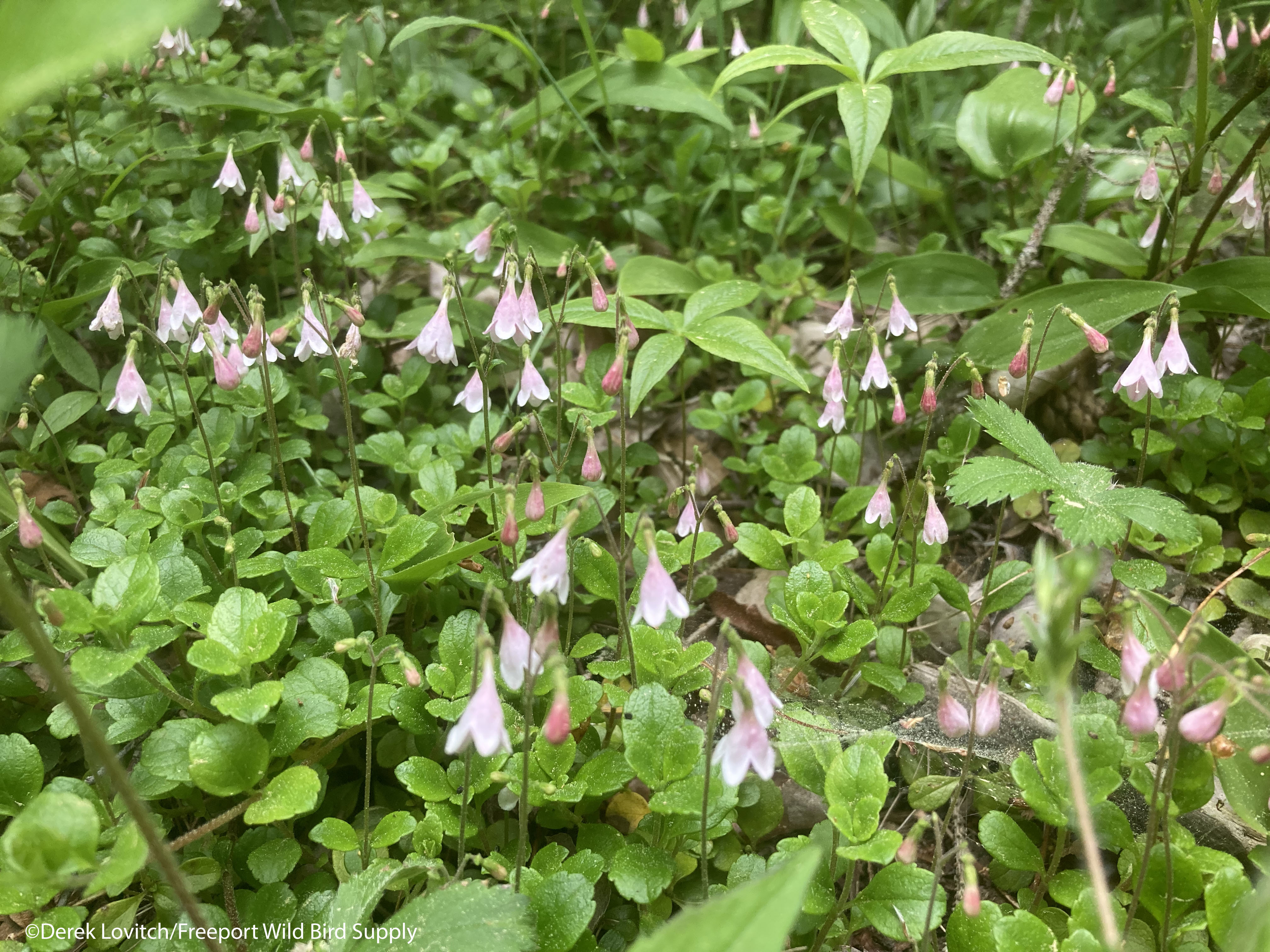
There was no shortage of Cedar Waxwings this weekend, with numbers growing in the final two days of our stay.We definitely took advantage of the lull in birding to do some botanizing, including taking the time to stop and smell the Twinflower (Linnea).What migrants were around, however, were often low, close, and confiding, such as this Red-eyed Vireo.
I had hopes for Saturday – it really couldn’t be any worse than Friday anyway! – based on the forecast. However, only a light flight was detected on the radar overnight, despite light southerly winds. It was mostly cloudy, but I couldn’t help to wonder if we were just running out of migrants.
Rain that could have resulted in a fallout of what little was airborne overnight didn’t arrive until after sunrise, but it only caused a 20-minute delay to the start of the day. That was it though, and certainly we were lucky that Saturday was not the washout that was predicted as of a few days prior. It was still slow, but once again, we had exceedingly great looks at everything that we did encounter, including more quality cuckoo time, a stunning male Indigo Bunting that was just glowing in the soft light, Blackpoll Warblers, Northern Parulas, American Redstarts, and more colorful splashes to brighten another gray day. And it wasn’t raining.
But it’s hard to sugarcoat just how slow it was – like Mid-June-kinda slow. Luckily, the fog lifted just long enough to see some waterbirds, and we took advantage of that for an impromptu gull workshop.
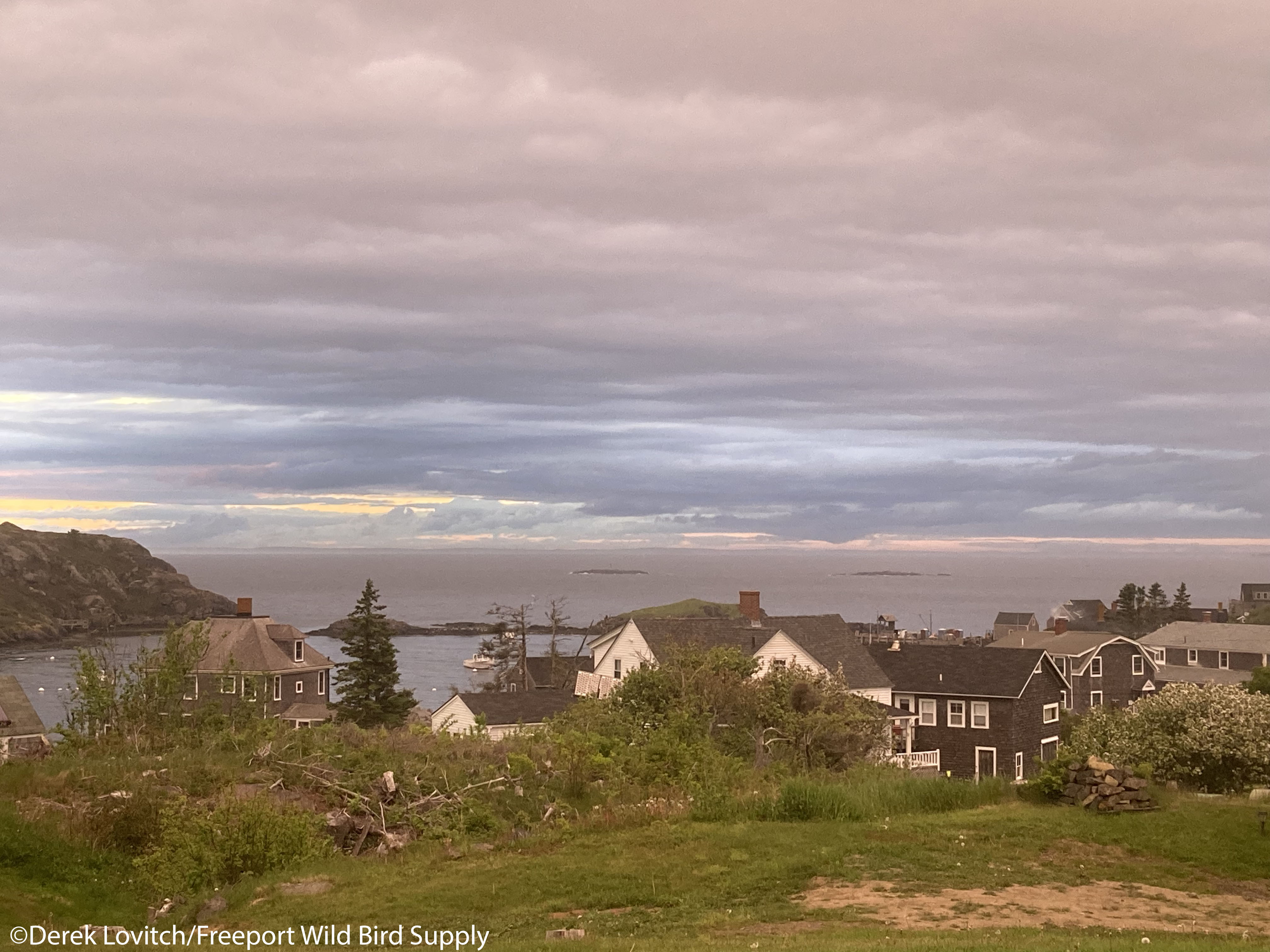
A tease. The fog returned shortly thereafter.It was news to me that Red-backed Salamanders were on the island. Upon finding that out, our Saturday afternoon walk in the woods featured a lot of log-rolling to sample. Apparently, they are rather widespread, as we found them throughout the spruce forest of the next few days.Sunsets on Monhegan are always memorable, but Saturday night’s was even more exciting as it meant an end to two days of solid fog.Tomorrow would be better, this scene promised. And it most certainly was!
A brief shower at dinnertime ushered in a cold front and skies began to clear at dusk, with the fog finally lifting. That led to the delightful Sunday I was talking about. And Monday wasn’t too shabby either, as we again started the day without fog, a very light wind, and evidence of some bird migration on the radar overnight. And, with the southwesterly flow continuing, we had even higher hopes for finding the “mega” that would make up for the so-far lackluster species list.
Starting the morning with a Black-billed Cuckoo sunning itself in a tree right in front of the Trailing Yew was a solid start, and there were more Eastern Wood-Pewees and a decent number of Blackpoll Warblers around. Again, a rather slow day by Monhegan standards, but we really had more great looks at everything we did see. Today’s magic tree was by the Ice Pond, with a pair of Blackburnian Warblers, a pair of Blackpoll Warblers, Yellow Warbler, Common Yellowthroat, and finally a Bay-breasted Warbler.
We also finally had some rarity excitement. First, a Spizella sparrow flushed in front of us and a very quick glimpse in the scope suggested a Clay-colored Sparrow, which is a great bird in the spring. But just to be sure, we searched for it, but to no avail. Luckily, its identity was confirmed the next morning went it put on a show in the exact same spot it didn’t want to return to today.
Later, a female Purple Martin made an appearance…OK, fine, I could not completely rule out a Gray-breasted Martin. I was trying.
The tour officially concluded in the afternoon, but Jeannette and I remained to enjoy a 24-hour vacation. Don’t worry, you didn’t “just miss” something, as all we had new in the afternoon was a Savannah Sparrow.
It’s already baby bird season!Cedar Waxwings were the most numerous passerine on the island – or at least, the most obvious, with a flock of 60 that grew to at least 150 by Tuesday afternoon. Common Yellowthroat.Eastern Kingbird
Also, don’t worry that you missed the day Monhegan legends are made of on Tuesday. You did not. It was still fairly slow, but we had a little uptick in diversity. The pulse of late-migrating flycatchers that I had expected finally arrived, there was a good Northern Gannet show off Lobster Cove in the morning, and a steady trickle of commuting Atlantic Puffins in a small sample of afternoon Lobster Cove seawatching.
Eastern Wood-Pewee
We picked up three Willets well offshore to the south from Lobster Cove in the morning, eventually following them into the harbor where they landed for a spell. As for that “probable” Clay-colored Sparrow that was nagging me all afternoon and night, well, I am thankful that it returned to the exact same spot as where we first glimpsed it. I received a text that it had been observed, photographed, and confirmed by others, and it obligingly remained long enough for us to catch back up with it.
Clay-colored Sparrow
Overall, there were many fewer warblers around on Tuesday, likely as many of the passage migrants had departed overnight. But it would have been nice if this diverse day with several quality birds and good seawatching fell during the official tour!
The 11 species we added after the group tour ended therefore were as follows:
Savannah Sparrow
White-winged Scoter
Surf Scoter
Atlantic Puffin
WILLET
Alder Flycatcher
Yellow-bellied Flycatcher
Bobolink
Pine Siskin
Hermit Thrush
Red-bellied Woodpecker (where were you hiding these past 4 days?)
Common EidersBlack GuillemotAmerican RedstartNorthern ParulaRing-necked Pheasant. No need to work on primary projection beyond the tertial step to identify this one!
Furthermore, on the Hardy Boat back to New Harbor, we added 2 Red-necked Phalaropes (personal first-of-year) and a Razorbill. With those 13 species, we had a total of 88 species over the 5 days, with a couple of more “quality” birds and that would have produced a much more respectable tour list! But alas.
So yes, by Monhegan standards, it was a pretty slow weekend. In fact, the 75 species on Friday through Monday was a record low (by two) for this annual tour. 16 species of warblers wasn’t too bad (last year’s soaker only produced 10), and we had some great birds. We also had such good looks at so many things, especially those – like Black-billed Cuckoo – that just don’t give such great looks very often, let alone daily!
Here is the official trip list (not including the 13 additional species from Monday afternoon through Tuesday evening when we got off the boat in New Harbor):
A strong, if relatively homogenous, flight passed over and through SandyPointBeach, Cousin’s Island, Yarmouth this morning.
7:03-9:00
39F, mostly clear, light-moderate but rapidly increasing W wind.
708 American Robins
88 Yellow-rumped Warblers
45 Dark-eyed Juncos
34 American Crows
22 Unidentified
8 American Goldfinches
7 Palm Warblers
6 Golden-crowned Kinglets
5 Savannah Sparrows
3 Hermit Thrushes
3 Ruby-crowned Kinglets
3 Chipping Sparrows
3 Rusty Blackbirds
2 Brown Creepers
2 Unidentified sparrows
1 Common Loon
1 Eastern Phoebe
1 Tufted Titmouse (they keep on coming this year)
1 American Pipit
1 AMERICAN REDSTART (very late)
1 White-throated Sparrow
Total = 945
I actually expected more juncos and especially White-throated Sparrows (at least in the parking lot, they almost never cross the water here), but the American Robin count was actually my third highest here. The redstart, one of the first birds of the morning, was definitely unexpected – it has been several weeks since I have seen one.
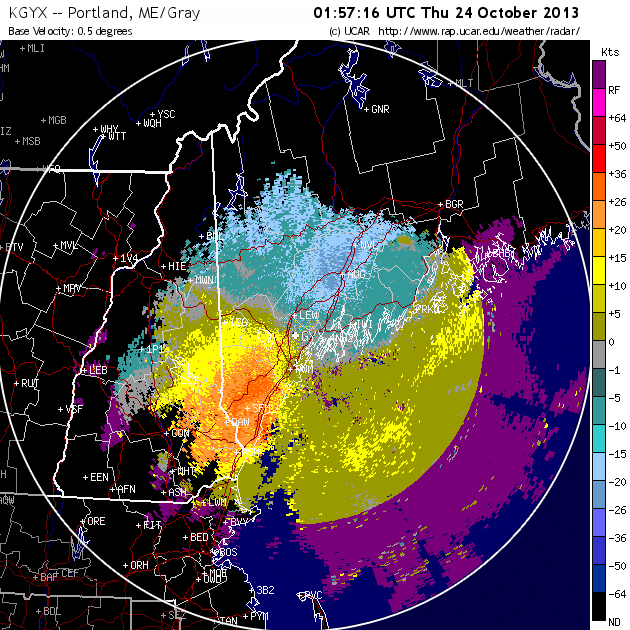
Unlike Tuesday night into Wednesday, last night’s radar was unambiguous (I posted briefly about yesterday on the store’s Facebook page). This was a solid late-season flight. Here are the 10pm, 1am, and 4am reflectivity and velocity images for example. You can see the rain mostly remaining well offshore.
So was this my last good flight at Sandy Point? I sure hope not, but the calendar is getting late. There’s no doubt there is still a big push of juncos at least. But we’ll see if the weather conditions cooperate.
Meanwhile, as SandyPoint winds down, “Rarity Season” starts to pick up. There’s our Bell’s Vireo in Harpswell, an Ash-throated Flycatcher on Monhegan, a Pink-footed Goose that was up in The County, and the usual smattering of fun fall stuff like a White-eyed Vireo or two, a couple of juvenile Red-headed Woodpeckers, and a sprinkling of “late” birds in no doubt partially due to the mild season. I believe there are symptoms of Rarity Fever welling up inside me!






























 Maine Birding Field Notes