Gyrfalcons are one of those enigmatic birds of the high northern latitudes that are always a favorite among northern birders, and lusted over by those further south. I’ve been lucky enough to see quite a few in Alaska, one in Michigan, and even one in South Boston. And few sightings of mine will ever surpass the eyrie of three white morph juveniles that we saw in Kamchatka.
But I had yet to see one in Maine. Or, at least, seen one for certain: there was this large, dark falcon with shallow wingbeats that screamed by during a snow squall while birding at Fort Halifax in Winslow one winter morning with a friend. It probably was, but…
On January 13th, a dark morph Gyrfalcon was found ravaging a Herring Gull on a ballfield in Kennebunk by Shiloh Shulte. His crippling photos of this beautiful bird can be seen here.
We were in Georgia.
Meanwhile, the plot thickened. Shiloh’s photos were strongly suggestive of the dark morph Gyrfalcon seen in Madbury, New Hampshire on December 15th, with at least one more sighting later at the Rochester Waste Water Treatment Plant. Meanwhile, it came to light the bird was actually photographed in Maine on January 10th, in the Ogunquit River Marsh from Ocean Street in Ogunquit.
Then, yesterday (Saturday, 1/17), Bob and Sandi Duchesne, et al, refound the bird in the Webhannet Marsh, just north of Wells Harbor (via Harbor Road). Quite a few birders were able to make it down to the marsh, and observe the bird in the area through sundown.
Not surprisingly, a lot of birders converged on Wells Harbor this morning. Myself included.
I arrived at Harbor Road at about 8:00am, and a short while later, chatted with folks at the end of the road, at the marina and boat launch of the harbor. No sign of the “Gyr.” Several us decided to split up and search elsewhere, keeping in touch of course.
I walked Community Park, scanning the marsh along the way (9 Horned Larks, 2 Yellow-rumped Warblers). I then went up to Parson’s Beach, where there was a possible sighting a few days ago. No luck, but I was surprised to find a small flock of 6 Savannah Sparrows at the end of the road; unseasonable.
Next up, I drove Drake’s Island Road. A car was pulled over, and seeing that they were looking at a Rough-legged Hawk (also seen earlier by others from Harbor Road), I too pulled over. I watched the hawk for several minutes, before it took off rather abruptly. I thought I saw something streaking low across the marsh, but blocked by trees, I really assumed it was a figment of my imagination. Driving ahead to a better view of the marsh, I scanned to the south, spotting a dark lump in the middle of the marsh – a lump that I had not noticed before. Four Common Redpolls flew over. The lump moved. I scoped Harbor Rd and did not see any birders. It was dark, it seemed small-headed, and it was fairly big. But there was heat shimmer, and it was far, very far.
I called Noah Gibb, wondering where he was, and mentioning I spotted a “promising lump” to the north of Harbor Rd and I was racing over. As I pulled into the parking lot at the end of Harbor Road, at least a half dozen birders were now present, but looking in different directions, and clearly not excited. “Damn it,” I thought. Was my lump just a bona fide lump? My excitement waned.
But I set up the scope anyway, pointed it towards said lump, and turned to the other birders and said, “Do you guys know the Gyrfalcon is sitting out here?” After they all saw it, we enjoyed a good chuckle, but most importantly, we all knew where the bird was, and dozens of birders converged.
Between 9:55 and 10:50, many of us enjoyed this magnificent bird, which, through a scope, afforded more than satisfactory views. During the time, it made two sorties, one low over the marsh, taking a run at an American Crow, and another higher flight over the water, flushing up roosting gulls.
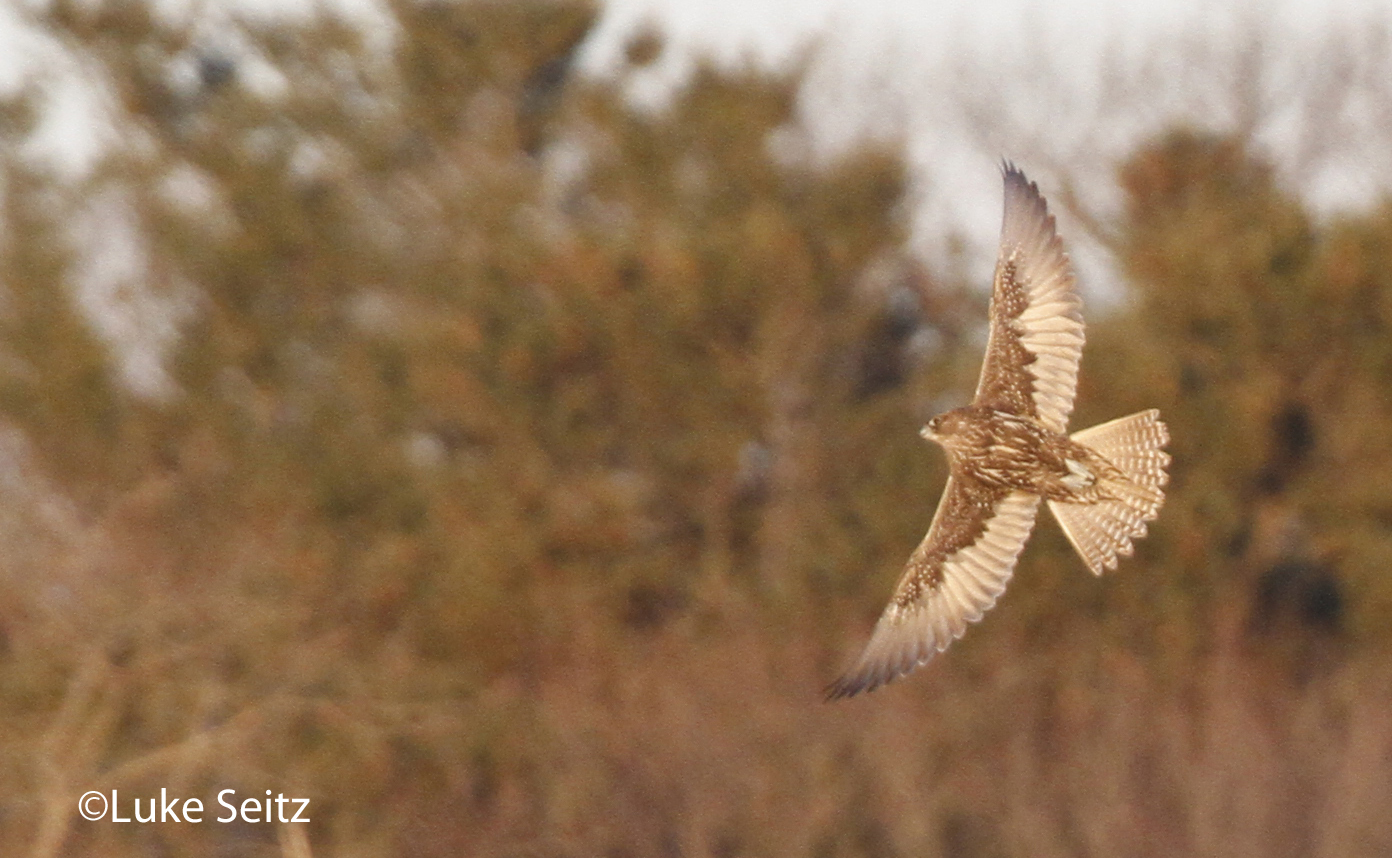
This is one beastly bird, almost certainly a female based on its size. Gyr’s don’t have narrow wings like a lot of falcons, but big, broad (especially at the base) wings that seem to fight tapering to a point. In many angles, they even suggest buteos or goshawks. The flight of a Gyr is incredibly fast and seemingly effortless. Its shallow wingbeats generate a lot of power. It’s really like a Peregrine Falcon on steroids.
After each flight, the bird returned to a piece of driftwood in the marsh, north-northwest of the end of the parking lot at the end of Harbor Road (Wells Harbor), about 1/3rd the way between here and Drake’s Island Road. From the boat launch on the north side of the parking lot, looking out at about 11:00, somewhat in line with a marsh-edge house along the western end of Drake’s Island Road.
This phone-scoped photo was the best that I could muster:

And this was the best flight shot I got of the bird in flight with my Nikon:
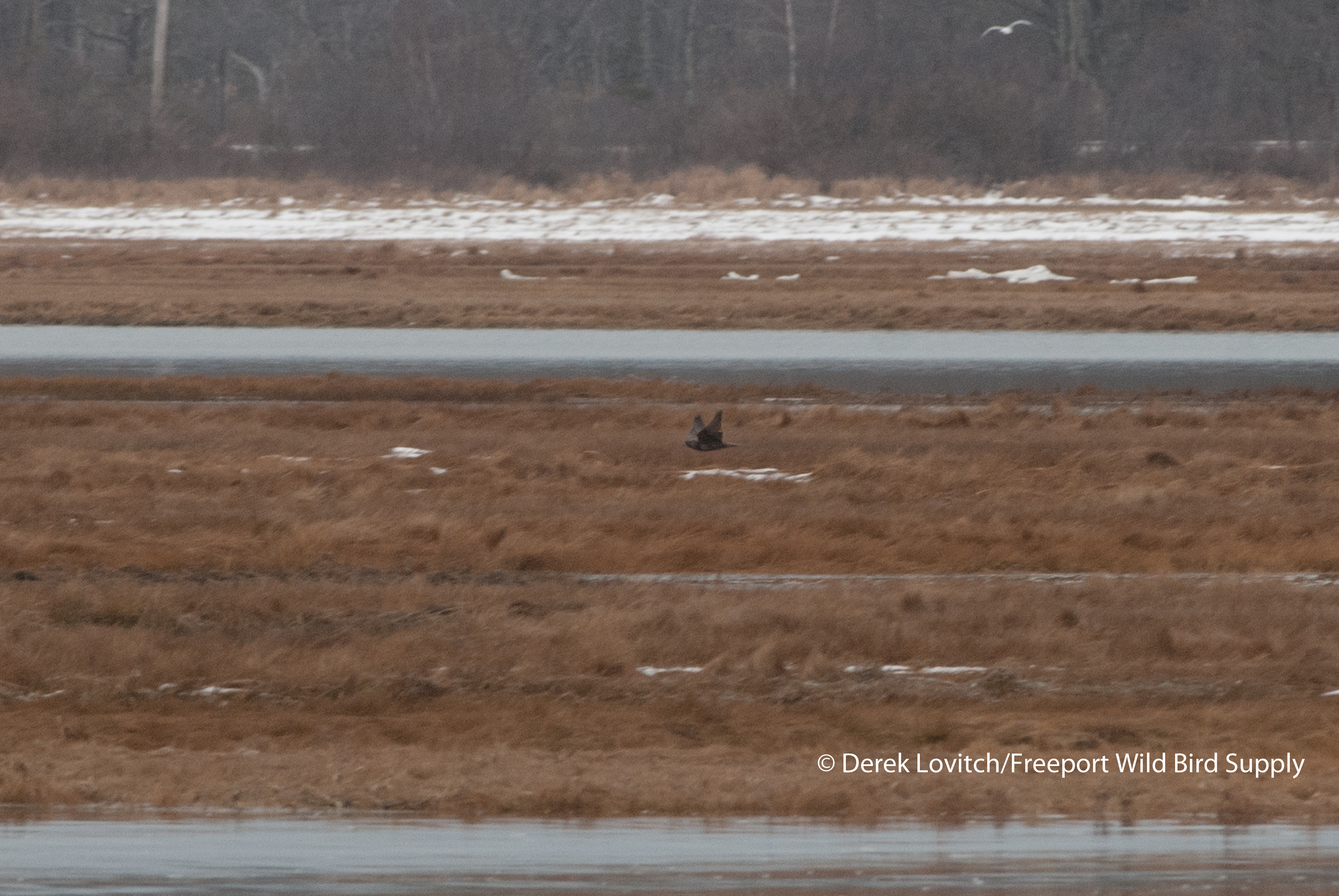
On a couple of occasions, the bird took off to the west, and we all lost site of it behind trees and buildings. It crossed the road once, heading over the salt pannes near the beginning of Harbor Road, and disappearing to the south. Several of us failed to locate it in the marsh to the south, and eventually, Luke Seitz and I gave into the call of second breakfast at Congdon’s Donuts.
When we returned to Harbor Road at 12:25, the Gyrfalcon was once again on her low driftwood perch to the north. At least today, the bird seemed to come back to this spot reliably, and it was observed there on and off through a little before 3:00pm. In other words, for birders seeking the bird, spending time patiently looking north from the end of Harbor Road (also, the parking lot at the end Atlantic Road in Wells Beach, accessed from Mile Road off of Rte 1) would likely be a good idea – and keep an eye out for promising lumps! And clearly, the bird covers some ground, so if it is not being seen, spreading out would be useful eventually. Hopefully, my description of the day’s sightings (and lack there of) offers some help in directing the next search, if necessary.
This was my 366th species in Maine, and Gyrfalcon was #5 on my personal “next birds” for my state list, as I wrote about earlier this month. But it was a Gyr, and Gyrs are awesome, no matter what list they are or are not on.
Several dozen birders came and went today, and not surprisingly, with so many birders in an area, and with so many people spread out and looking for the bird, there was a classic “Patagonia Picnic Table Effect” underway: when birders seeking one rare bird start finding others nearby. In addition to the Rough-legged Hawk (not many have been around this winter so far) seen on all three days, 2-3 Yellow-rumped Warblers at Community Park, and scattered Horned Larks, some of the other birds in the area that were reported included:
(Updated, 11:00am, 1/21)
1/18:
– 1 Eastern Meadowlark on Furbish Road in Wells (presumably the same bird that Kristen Lindquist and I found there on the York County CBC in December and has been seen at least once since).
– 6 Savannah Sparrows, Parson’s Beach.
– 2 Bohemian Waxwings, Wells Library.
– 1 Northern Flicker, Drake’s Island Road.
– 1 Snowy Owl, Drake’s Island Beach.
1/19:
– 1 Swamp Sparrow, Eldridge Road.
– 1 Merlin, Wells Harbor.
– 2 Dunlin with 128 Sanderlings, Ogunquit Beach.
1/20:
– Snowy Owl, over Wells Beach.
– 128 Sanderling, Ogunquit Beach.
Meanwhile, the overwintering drake King Eider at The Cliff House in York had quite a bit of visitation during these few days.
While dozens, if not hundreds, of birders from throughout New England were looking for the bird in the afternoon on the 19th and all day on the 20th, the Gyr apparently moved on. Late in the afternoon on the 20th, it was reported back in New Hampshire, in the marshes of Hampton – not far from where it was first spotted last month! Will the bird stick around there? Will it be back in Wells? Who knows, but hopefully, people will continue to enjoy the bird, and when its not being seen, spread out and look throughout all of the marshes of both states. Gyrfalcons travel widely in search of food, and there’s no reason why the entire area from Hampton through Kennebunk can’t be part of this bird’s winter range.
In the meantime, please enjoy Luke Seitz’s photos of the Gyrfalcon from Harbor Road on the evening of Saturday, January 17th (note especially the bird’s massive size and girth, and broad wings in relation to a Red-tailed Hawk that it took a run at).


 Maine Birding Field Notes