On Sunday, November 19th, 2023, I found Maine’s first confirmed Spotted Towhee at Fort Foster Park in Kittery. Fort Foster is one of my favorite birding locations, especially in fall “rarity season.” I’ve been lamenting the complete dearth of vagrants found in Maine during the month of November so far, and so I set out for the southern York County coast that morning in hopes of changing that.
It didn’t take long.
A little more than an hour after I arrived at the park, slowly birding the warm, sunny edges of a chilly morning, I encountered a pocket of activity as I was turning off the main coastal trail and up the slight hill towards the Small Pier Pavilion. A tardy “WESTERN” PALM WARBLER that I encountered earlier had flown this way with a Yellow-rumped Warbler, and these two birds were at the edge along with several resident species including Black-capped Chickadees and Northern Cardinals as well as migrants including Golden-crowned Kinglets and White-throated Sparrows.
As I approached the top of the rise, I noticed a towhee sitting in the sun at the edge of one of two fairly large Eastern Red Cedars. Since I had my camera at the ready since it’s rarity season afterall, I immediately grabbed it. Although I was assuming it was just a late Eastern Towhee (not unreasonably rare in a mild fall even at this date), it was a nice photo – towhees don’t sit still in the sun often enough! The bird was facing directly at me, so all I could see was its black hood, rufous sides, and white belly.
As I focused through my viewfinder, the bird shifted slightly, showing just enough of its side to reveal large white spots on it’s wing! A vagrant Spotted Towhee! Incredible!

And to think I almost blew this…if I didn’t go for my camera for “just” a nice shot of an Eastern Towhee, perhaps I wouldn’t have looked at it long enough to see its diagnostic wings and back. That was a close one! (That one twig right across the face though!)
Knowing that hybrids between the two towhees (formerly known collectively as “Rufous-sided Towhee”) have occurred out of range, I knew I needed some better views and more photos. Over about 10 minutes, I observed and photographed the bird in the cedars, having it drop down once into the brush only to return to the cedar, perhaps as a result of some gentle pishing.

During this second photo session, a Cooper’s Hawk flew overhead, and all of the activity in this pocket dove for cover and remained silent (9:28am). As birds slowly returned to the edge, the towhee did not. A late Hermit Thrush that was also in the cedars reappeared, but the towhee did not.
As I waited, I sent out some text messages and checked my photos. Within about 45 minutes, Maili Waters and Luke Seitz arrived, and we began a thorough search, slowly increasing our search radius. It took until about 12:15 before Maili and Luke finally relocated the towhee on the other side of the very large and dense thicket. Luke’s excellent photos showed a more complete view of the wing and back, crucial field marks for confirming the bird’s identity.
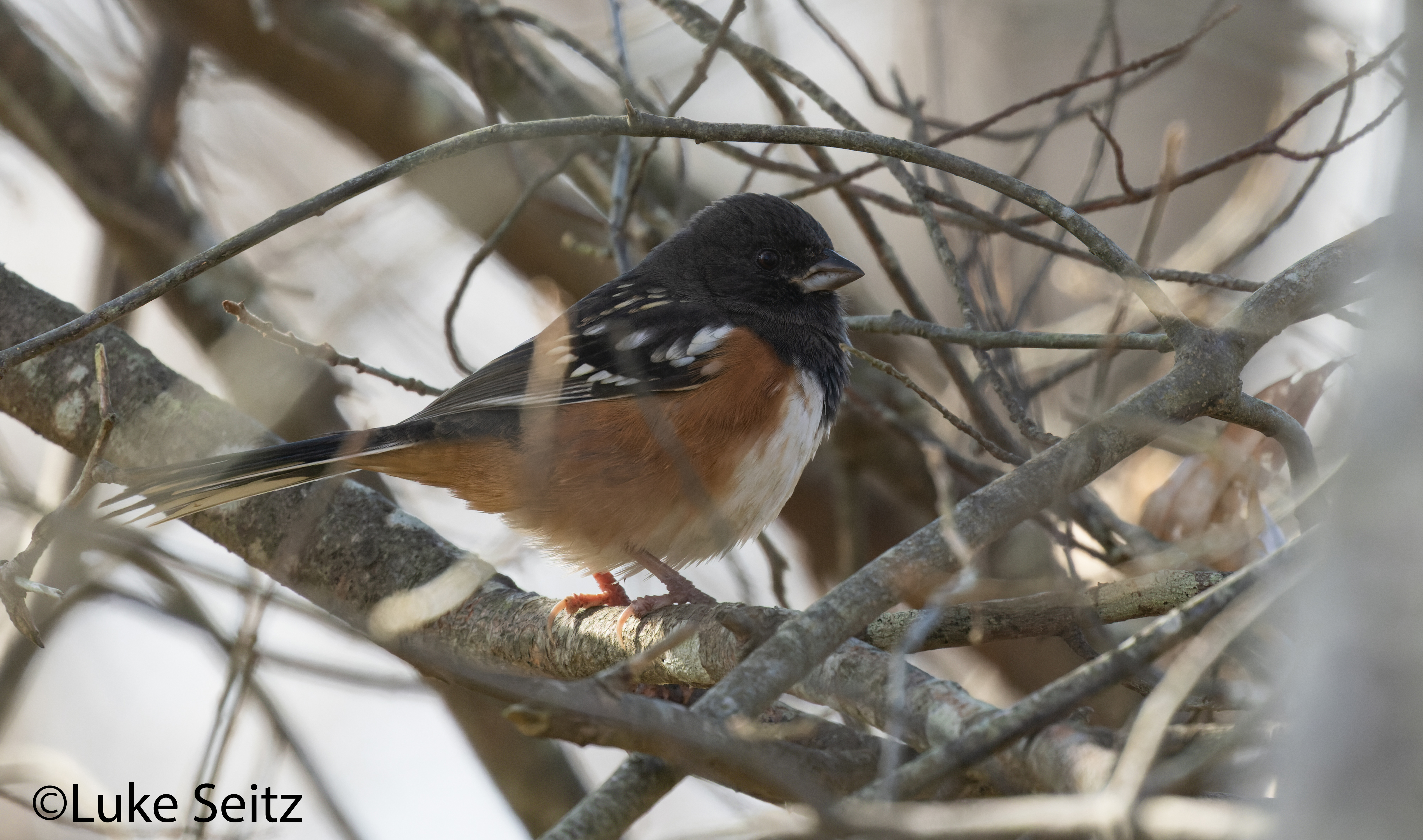
I was on the other side of the park, searching for the towhee and whatever else might have been present, turning up a very late PRAIRIE WARBLER, a Gray Catbird, and a Ruby-crowned Kinglet – all good birds for the date. It took me a while to get to where Luke and Maili were, and we were soon joined by Doug Hitchcox and Matthew Gilbert.

We waited for about 30 minutes before the need for water and lunch finally got the best of me, and I headed out. I was halfway to Kittery Center when Noah Gibb spotted the bird once again at the original location. It was here, in the two cedars, that numerous observers were able to see the bird early in the morning the next day as well.
Returning home and in discussion with Luke, Maili, and Evan Obercian, we confidently ruled out any suggestion of a hybrid. The amount of white in the primaries had us a little wary, for example, but the National Geographic Guide to the Birds of North America nicely shows the regional variation with Spotted Towhees, including the more extensive white “slash” on the primaries of the Great Plains subspecies – the expected source of vagrants to the East.
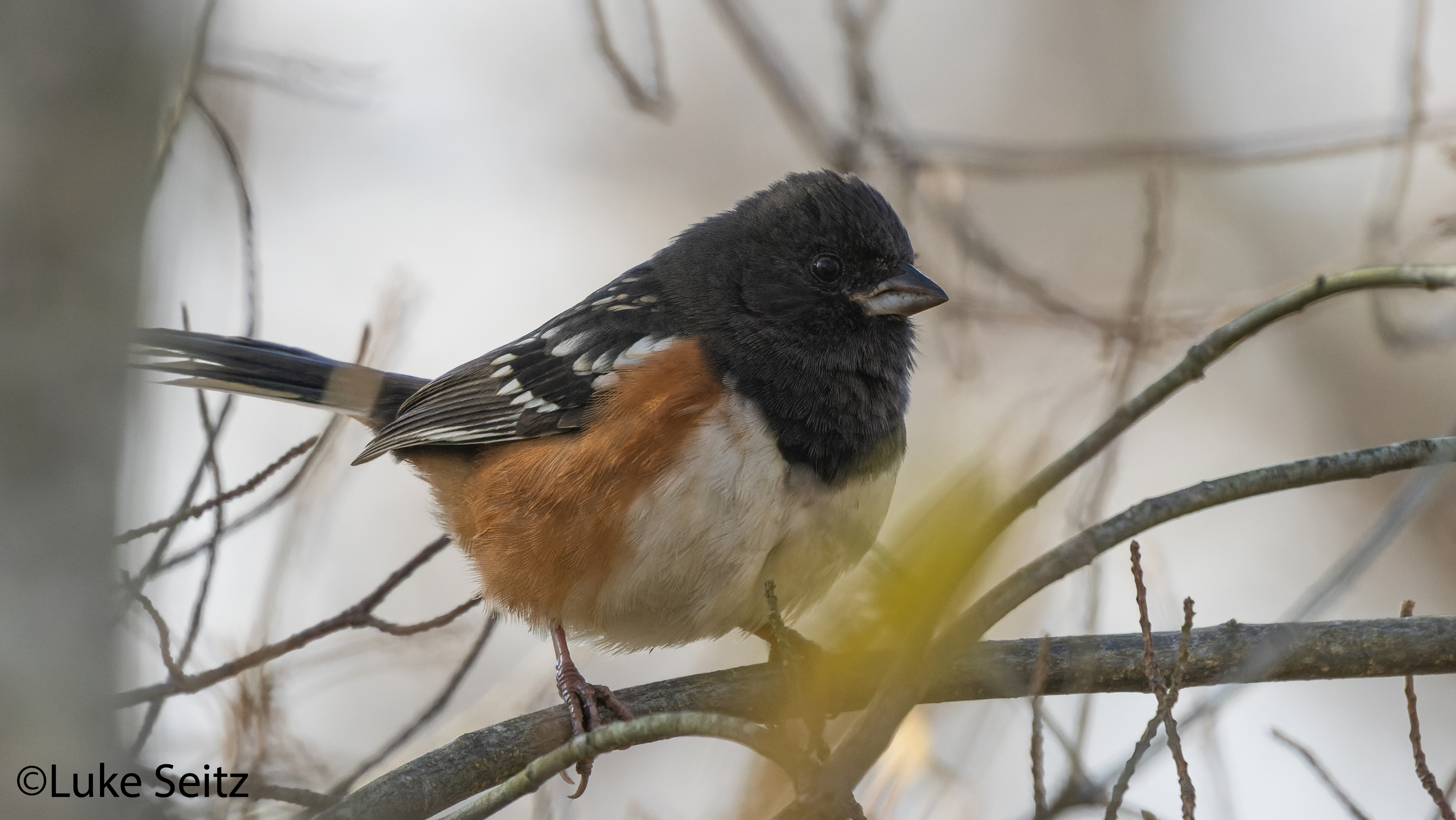
Big white spots on each scapular, two complete wingbars (one bold on the greater coverts and one more subtle bar on the median coverts), the spotted-streaked back mantle, and the extensively white undertail are all consistent with a phenotypically pure Spotted Towhee – Maine’s first, and a long-overdue addition to our state’s list. In fact, this was #4 on my “Next Birds for Maine” predictions list. But as always, it’s always better find than to chase!
 Maine Birding Field Notes